Review

Inflammation at the Maternal–Fetal Interface: Mechanisms Linking Maternal–Fetal Immunity to Preeclampsia and Fetal Growth Restriction

by
Jezid Miranda
1,2,*,
Natalia Maestre
1,
Mariana Devia
3,
Roberto Zapata
1,4,
Margarita M. Ochoa-Díaz
5 and
Walter Annicchiarico
1
1
Department of Obstetrics and Gynecology, Faculty of Medicine, University of Cartagena, Zaragocilla Carrera 50 #24-63, Cartagena de Indias 130014, Colombia
2
Department of Obstetrics and Gynecology, Centro Hospitalario Serena del Mar, Cartagena de Indias 130008, Colombia
3
Department of Obstetrics and Gynecology, University of Sinu, Cartagena de Indias 130015, Colombia
4
Department of Obstetrics and Gynecology, Clinica General Del Norte, Barranquilla 080002, Colombia
5
School of Medicine, Grupo de Investigación Básicas y Clínicas Facultad de Ciencias de Salud (GIBACUS), University of Sinu, Cartagena de Indias 130015, Colombia
*
Author to whom correspondence should be addressed.
Int. J. Mol. Sci. 2026, 27(9), 3954; https://doi.org/10.3390/ijms27093954
Submission received: 6 January 2026 / Revised: 8 April 2026 / Accepted: 16 April 2026 / Published: 29 April 2026
(This article belongs to the Special Issue Pathogenesis of Preeclampsia: From a Molecular Perspective)

Abstract

Inflammation is a physiological and tightly regulated component of normal pregnancy, contributing to implantation, placental development, and the initiation of parturition. The placenta functions as an active immunological hub, coordinating innate and adaptive immune responses to maintain tolerance while protecting against infection. Preeclampsia and fetal growth restriction (FGR) are major causes of maternal and perinatal morbidity worldwide and represent central manifestations of placental disease. Increasing evidence indicates that these conditions share key pathophysiological mechanisms, including placental dysfunction and maladaptive maternal immune responses. When immune regulation at the maternal–fetal interface becomes disrupted, inflammatory pathways contribute to impaired placental development and vascular maladaptation. In this context, excessive immune activation—driven by inflammasome signaling, Th1/Th17 polarization, and altered natural killer and macrophage function—can compromise placental perfusion, promote antiangiogenic imbalance, and lead to systemic endothelial dysfunction. This review, therefore, focuses on how immune dysregulation contributes to placental dysfunction in preeclampsia and FGR, synthesizing current knowledge of the maternal–fetal immune interface and exploring therapeutic strategies that link pathogenic mechanisms to targeted interventions. A deeper understanding of placental immunology and inflammatory signaling is essential to develop precision therapies. Established therapies, including low-dose aspirin, low-molecular-weight heparin, and antenatal corticosteroids, aim to mitigate inflammation and optimize fetal outcomes, while adjunctive strategies target oxidative stress, nutritional deficits, and the maternal microbiome. Emerging approaches such as cytokine-targeted biologics, inflammasome inhibitors, and mesenchymal stem cell therapies show promise but require rigorous safety and efficacy evaluation. Future research should prioritize biomarker validation, pathway-specific interventions, and equitable implementation to reduce inflammation-driven pregnancy complications.

1. Introduction

Inflammation is a fundamental physiological process in pregnancy, supporting implantation, placental development, and the onset of labor [1,2,3,4]. Through finely regulated immune modulation, the maternal immune system maintains a delicate balance, tolerating the semi-allogeneic fetus while maintaining host defense. Successful pregnancy depends on tightly controlled temporal shifts in immune activity. A proinflammatory environment during early gestation facilitates implantation and trophoblast invasion, whereas a predominantly anti-inflammatory state during mid-gestation promotes placental maturation and fetal growth. Towards term, the re-emergence of inflammatory signaling contributes to the physiological onset of labor [4,5].
Increasing evidence suggests that placental inflammation is not merely a secondary consequence of obstetric complications but a central driver of disease. Although inflammation plays a role in a broad range of obstetric complications, including spontaneous preterm labor and infection-associated preterm birth, the underlying biological pathways in these conditions are heterogeneous and often driven by distinct mechanisms such as microbial invasion of the amniotic cavity, decidual activation, or uterine inflammatory signaling independent of placental pathology. In contrast, preeclampsia and FGR represent prototypical models of placental-mediated disease, in which dysregulated immune responses at the maternal–fetal interface converge with abnormal placental vascular development [6,7]. These conditions share common features, including defective spiral artery remodeling, placental hypoxia, an imbalance in angiogenic factors, and systemic endothelial activation [8,9,10,11]. For this reason, they provide a particularly informative framework for understanding how inflammatory pathways contribute to placental dysfunction and maternal vascular disease.
The placenta is now recognized as a highly dynamic immunological organ in which trophoblasts, decidual stromal cells, and specialized immune populations—including uterine natural killer (uNK) cells, macrophages, and regulatory T cells—coordinate tolerance and defense at the maternal–fetal interface [3,12]. This equilibrium is sustained through multiple immunomodulatory pathways involving molecules such as HLA-G, programmed death ligand-1 (PD-L1), and Galectin-1, which dampen maternal cytotoxic responses and preserve fetomaternal tolerance [5,13,14,15]. However, environmental and pathological stressors- including placental hypoxia, oxidative stress, or sterile inflammatory signals- can disrupt this balance and reprogram the local immune environment toward pathological inflammation [5,14].
In preeclampsia and FGR, such immune dysregulation contributes to defective spiral remodeling, increased production of antiangiogenic factors such as soluble fms-like tyrosine kinase-1 (sFlt-1), and widespread endothelial dysfunction, hallmarks of placental insufficiency observed in both conditions [16,17,18,19,20]. Recent studies have identified activation of the NLRP3 inflammasome, an intracellular multiprotein complex involved in innate immune signaling, as a key mediator linking trophoblast stress to systemic maternal inflammation [15,21]. Activation of the NLRP3 pathway promotes maturation of the proinflammatory cytokines interleukin (IL)-1β and IL-18, which in turn drive Th1/Th17 polarization, disrupt uNK cell regulation, and exacerbate oxidative stress in placental tissues [22,23,24]. Additional cytokines such as tumor necrosis factor-α (TNF-α), IL-6, and IL-17 further amplify endothelial activation by increasing vascular permeability, reducing nitric oxide bioavailability, and promoting oxidative injury [25,26,27]. Emerging spatial and single-cell transcriptomic studies reveal how these inflammatory circuits are organized within the placenta, shedding light on cellular communication across the maternal–fetal interface [12,28].
Scientific advances have begun to translate into preventive and therapeutic strategies. Low-dose aspirin initiated early in gestation reduces the incidence of placental-mediated complications, likely through combined effects on platelet activation, angiogenic balance, and inflammatory signaling pathways [29]. Complementary approaches—including optimization of maternal nutrition and managing metabolic inflammation—are gaining support as regulators of immune homeostasis during pregnancy [30,31,32,33]. In parallel, emerging therapeutic strategies are being explored, including inflammasome inhibitors (e.g., MCC950), cytokine-targeted biologic therapies, and mesenchymal stem cell-based interventions [34]. Although these approaches remain largely experimental, they represent promising avenues for therapies aimed at restoring placental immune balance. However, their clinical translation demands thorough evaluation of maternal–fetal safety, dose optimization, and long-term developmental effects.
Despite substantial progress in placental immunology, critical gaps remain in understanding how immune dysregulation at the maternal–fetal interface translates into placental insufficiency and systemic endothelial dysfunction [15,16,28]. Preeclampsia and FGR are frequently considered separate clinical entities, yet accumulating evidence suggests that both emerge from defective spiral artery remodeling, placental ischemia, and the release of antiangiogenic and proinflammatory mediators—including sFlt-1, soluble endoglin, IL-6, and TNF-α—linking placental pathology to systemic maternal vascular dysfunction [8,10,17,18,35,36]. This review focuses primarily on preeclampsia and FGR as clinically relevant models of inflammation-driven placental disease. By synthesizing current evidence on inflammatory signaling at the maternal–fetal interface, we aim to integrate molecular mechanisms, biomarkers, and emerging therapeutic strategies to improve pregnancy outcomes and reduce global disparities in maternal and neonatal health.

2. Methodology

A narrative literature review was conducted to synthesize current knowledge on inflammatory mechanisms at the maternal–fetal interface and their contribution to placental dysfunction and pregnancy complications. The objective was to integrate experimental, translational, and clinical evidence regarding immune pathways involved in placental disease, with particular emphasis on fetal growth restriction and hypertensive placental disorders.

2.1. Literature Search Strategy

A structured search of the scientific literature was performed in PubMed/MEDLINE and Scopus databases. The search included studies published between January 1989 and November 2025, a timeframe selected to capture the development of modern concepts in placental immunology, angiogenic imbalance, and inflammatory signaling in pregnancy.
Search strategies combined Medical Subject Headings (MeSH) and free-text terms related to placental inflammation and immune regulation in pregnancy. The following key terms and their combinations were used:
  • Preeclampsia;
  • Fetal Growth Restriction;
  • Placental Dysfunction;
  • Inflammation;
  • Inflammasome;
  • Endothelium;
  • Placenta;
  • Immunology;
  • Cytokines;
  • Angiogenic imbalance;
  • Maternal–fetal interface.
Boolean operators (AND, OR) were applied to generate search strings such as:
  • (Preeclampsia OR Fetal Growth Restriction) AND (Inflammation OR Cytokines OR Immunology);
  • Placenta AND (Inflammasome OR NLRP3);
  • Placental dysfunction AND endothelial activation.
Reference lists of key publications and relevant review articles were also manually screened to identify additional studies not captured in database searches.

2.2. Eligibility Criteria

Articles were considered eligible if they addressed immune or inflammatory mechanisms related to placental biology or placental-mediated pregnancy complications. Eligible study designs included clinical studies, cohort studies, translational research, experimental models, and narrative and systematic reviews. Only articles published in English and available in full-text format were included. Studies focusing primarily on infection-driven preterm birth or unrelated obstetric conditions without a clear link to placental immune regulation were excluded unless they provided mechanistic insights relevant to placental inflammation.

2.3. Study Selection Process

The selection process was conducted in three stages. First, articles were initially screened by title to exclude studies that were clearly unrelated. Second, abstracts were reviewed to assess their relevance to the study objectives. Finally, full-text manuscripts were evaluated to confirm their contribution to the understanding of inflammatory mechanisms, placental dysfunction, or immune-mediated pathways in pregnancy. Priority was given to high-quality evidence, including well-designed cohort studies, translational research, and landmark experimental studies that have shaped current understanding of placental immunology.

3. Immune Development in the Placenta

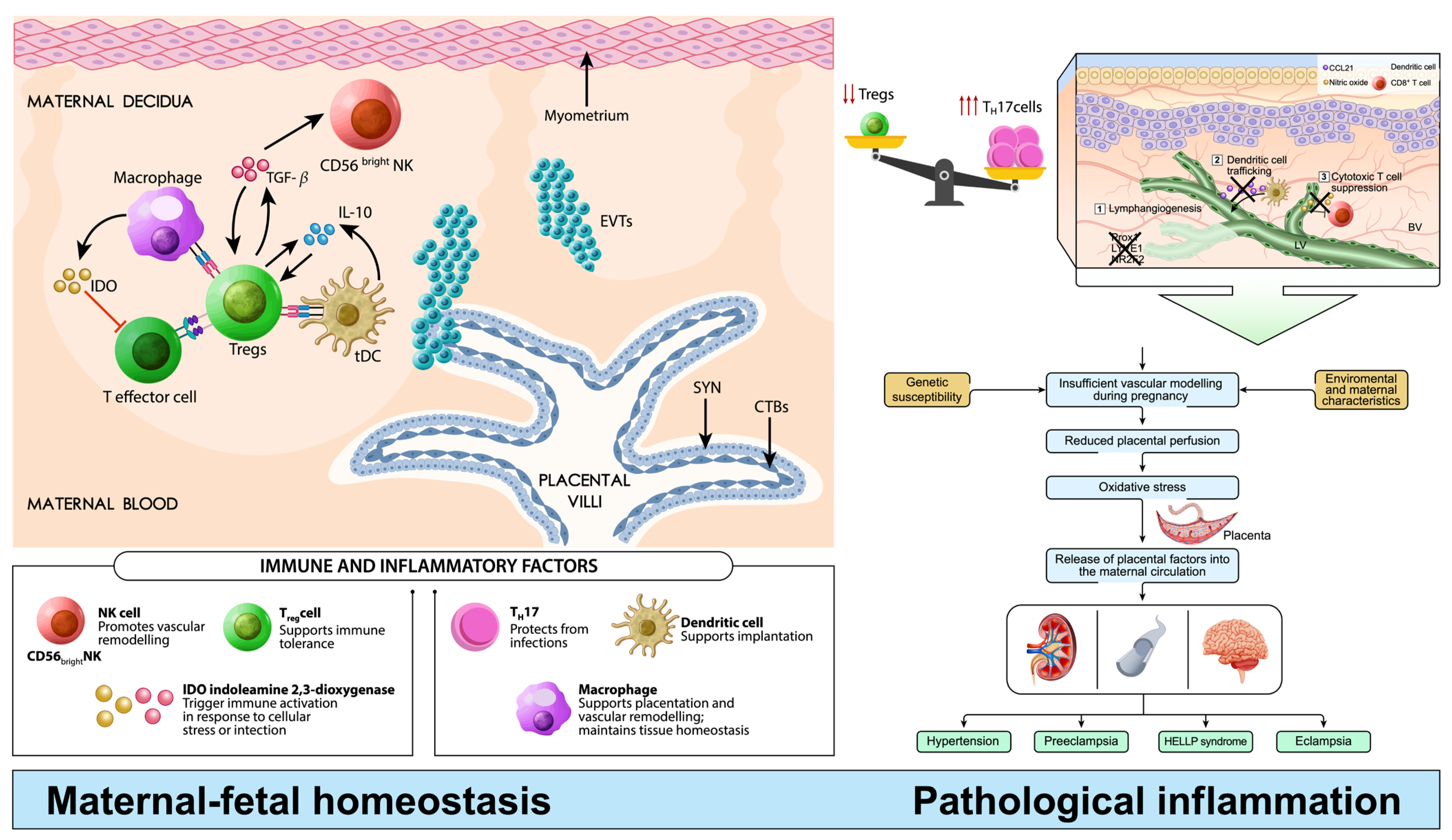
The placenta plays a central role in pregnancy, mediating the delicate balance between maternal immune tolerance toward the fetus—a semi-allograft genetically distinct from the mother—and protection against infection [37,38]. The maternal–fetal interface, formed by the decidua and fetal trophoblast-derived tissues, constitutes a highly specialized immunological environment in which the maternal immune system adapts to sustain fetal growth while maintaining antimicrobial defense [39,40]. Successful pregnancy requires a tightly regulated immune equilibrium, characterized by coordinated interactions among decidual natural killer (NK) cells, T cells—including regulatory T cells (Tregs)—and macrophages, which promote tolerance, controlled trophoblast invasion, and appropriate spiral artery remodeling, ensuring adequate placental perfusion [37,38,41] (Figure 1).
Within this context, mechanisms such as indoleamine 2,3-dioxygenase (IDO) activity contribute to immune regulation by limiting effector T-cell proliferation and promoting a tolerogenic microenvironment. Disruption of this balance results in immune dysregulation, characterized by reduced Treg numbers, a shift toward proinflammatory T helper 17 (Th17) responses, and altered immune cell function. These changes impair implantation and vascular remodeling, leading to placental insufficiency and contributing to systemic maternal endothelial dysfunction, a hallmark of preeclampsia (Figure 1).

3.1. Immune Cells at the Maternal–Fetal Interface

Immune cell populations at this interface are recruited and regulated by cytokines secreted by trophoblasts and decidual stromal cells [42,43]. In early gestation, dNK cells account for approximately 70% of immune cells, macrophages for 20%, and Tregs for 10% [3,4,12,44]. Smaller populations include B lymphocytes, mast cells, and dendritic cells [3,4].

3.1.1. Natural Killer Cells

dNK cells, located around invading extravillous trophoblasts, display a pregnancy-specific phenotype (CD56brightCD16) shaped by interleukin-15 (IL-15) and transforming growth factor-β (TGF-β) [4,45,46]. They facilitate implantation, trophoblast invasion, and spiral artery remodeling by secreting IL-8, angiogenic mediators, and interferon-inducible protein-10 (IP-10) [45]. Their numbers decline during gestation, with Tregs assuming a more prominent immunoregulatory role [15,38,46]. Ultimately, this finely tuned balance of immune activation and tolerance at the maternal–fetal interface is fundamental to successful gestation.

3.1.2. Decidual Macrophages

Macrophages in the decidua exhibit marked plasticity, responding dynamically to local microenvironmental cues [45]. They serve as primary antigen-presenting cells, recruited through trophoblast-derived IL-10 and macrophage colony-stimulating factor [47]. Two functional phenotypes predominate: pro-inflammatory M1 macrophages—most abundant during implantation and near term—and anti-inflammatory M2 macrophages, which dominate during established placentation [47]. Both subsets contribute to spiral artery remodeling, clearance of apoptotic cells, and antimicrobial defense by secreting vascular endothelial growth factor (VEGF) and matrix metalloproteinases (MMPs) [47,48]. Through this coordinated functional versatility, decidual macrophages play an essential role in sustaining tissue homeostasis and supporting a successful pregnancy.

3.1.3. Regulatory T Cells

Tregs play a central role in maintaining immune tolerance during pregnancy, helping the mother’s immune system accept the semi-allogeneic fetus while still protecting against infection. Tregs secrete anti-inflammatory cytokines, including TGF-β and IL-10, promoting tolerance to fetal antigens, supporting implantation, and limiting excessive inflammation [49]. At the maternal–fetal interface, Tregs suppress excessive inflammation, promote vascular remodeling, and support healthy placental development by secreting cytokines such as IL-10 and TGF-β. Their population expands throughout gestation, and direct interactions between trophoblasts and Tregs appear critical for their differentiation and function [49,50]. When Treg number or function is reduced—or pro-inflammatory T-cell subsets dominate—immune imbalance can drive endothelial dysfunction, placental malperfusion, and tissue injury. This dysregulation has been implicated in complications including preeclampsia, fetal growth restriction, recurrent pregnancy loss, and preterm birth [37,38]. Although therapeutic strategies that boost Treg activity (e.g., targeted immunomodulation, metabolites influenced by the microbiome, or cell-based approaches) are under investigation, clinical translation remains early; restoring immune tolerance without compromising host defense remains the key challenge.

3.1.4. Hofbauer Cells (HBCs)

HBCs are fetal-derived macrophages located within the villous stroma of the placenta and are present from the earliest stages of pregnancy (approximately day 18 post-conception), even before the establishment of the embryonic circulation. Transcriptomic studies indicate that these cells originate from primitive yolk sac hematopoiesis, positioning them as foundational components of the placental immunological microenvironment [51]. Under physiological conditions, HBCs express gene programs associated with angiogenesis, extracellular matrix remodeling, and placental homeostasis. They secrete mediators such as IL-8, osteopontin, and MMP-9, thereby contributing to the development of the villous tree and early placental vasculogenesis. In addition to their trophic functions, HBCs participate in fetal immune defense. These cells respond to Toll-like receptor signaling, exhibit microbicidal activity, and maintain immunological tolerance at the maternal–fetal interface.
A distinctive immunological feature of HBCs is their predominant expression of CD74 within placental tissues, which integrates signals related to antigen presentation and inflammatory regulation through macrophage migration inhibitory factor (MIF). Emerging evidence suggests that alterations in this pathway may contribute to placental disease. In preeclampsia, reduced CD74 expression has been associated with a shift toward a pro-inflammatory HBC phenotype, characterized by increased production of cytokines and chemokines, including TNF-α, CCL5, and monocyte chemotactic protein-1 (MCP-1). This inflammatory polarization may disrupt trophoblast-machophage communication and contribute to impaired spiral artery remodeling, endothelial dysfunction, and fetal growth restriction [52].

3.1.5. Myeloid-Derived Suppressor Cells (MDSCs)

Myeloid-derived suppressor cells (MDSCs) have emerged as critical regulators of maternal–fetal immune tolerance during pregnancy. During healthy gestation, granulocytic MDSCs (G-MDSCs) accumulate in the maternal peripheral blood, cord blood, and placenta, where they suppress T cell activation through arginase-1 expression and reactive oxygen species production and polarize CD4+ T cells toward a protective Th2 phenotype [53,54,55]. Mouse studies have demonstrated the causal importance of this expansion: MDSC depletion during early gestation leads to implantation failure and increased uterine T cell infiltration, while adoptive transfer of G-MDSCs rescues pregnancy in abortion-prone models [56,57]. Progesterone drives G-MDSC differentiation and activation through STAT3 signaling, linking hormonal changes in pregnancy directly to immunosuppressive cell expansion [57]. Multiple reviews have proposed that MDSCs may serve as a unifying mechanism underlying the diverse immune adaptations required for successful pregnancy (Zhao et al., 2016; Pang et al., 2023; Zhang et al., 2022) [58,59,60].
When MDSC expansion fails, pregnancy complications ensue. In preeclampsia, [61]. showed that the pregnancy-associated increase in G-MDSCs—but not monocytic MDSCs—is markedly inhibited in both maternal and cord blood, accompanied by significantly reduced serum arginase-1 levels, while Treg cell frequencies remain unchanged between preeclamptic and healthy pregnancies. This suggests that G-MDSC deficiency is a more distinctive immunological feature of preeclampsia than Treg dysfunction. For fetal growth restriction (FGR) [62], reported that continuous activation of polymorphonuclear MDSCs (PMN-MDSCs) during pregnancy is closely associated with fetal growth, using the SR-E1 marker to track PMN-MDSC function in humans [63] further elucidated the mechanism, demonstrating that placental PMN-MDSCs secrete growth-promoting factors via an OLFM4/galectin-3/HIF-1α axis; myeloid-specific Olfm4 knockout in female mice produced FGR with decreased placental PMN-MDSCs, and OLFM4 expression was reduced in placental PMN-MDSCs from human FGR pregnancies. Taken together, these findings position MDSC dysfunction as a shared immunological feature across preeclampsia and fetal growth restriction and suggest that therapeutic strategies aimed at restoring MDSC numbers or function could represent a novel approach to managing these pregnancy complications [55,58,64].

3.2. Mechanisms of Immune Adaptation and Tolerance

Several molecular pathways sustain maternal tolerance while preserving host defense:
  • Human Leukocyte Antigen (HLA): Extravillous trophoblasts express non-classical HLA molecules (HLA-C, HLA-E, HLA-G, HLA-F) that inhibit cytotoxic immune responses and facilitate placentation. HLA-G promotes NK-cell secretion of fetal growth factors [65].
  • B7 Protein Family: High expression of costimulatory molecules such as B7-H1 on trophoblasts interacts with PD-1 receptors on maternal T cells, suppressing Th17 responses and enhancing Treg activity [66].
  • TNF Superfamily Members: Placental Fas ligand (FasL) and TNF-related apoptosis-inducing ligand (TRAIL) induce apoptosis in activated maternal T cells [65], preventing immune-mediated rejection.
  • Pattern Recognition Receptors: Toll-like receptors (TLRs) and RIG-I-like receptors on trophoblasts detect pathogen-associated molecular patterns, initiating controlled inflammatory cascades that preserve defense without disrupting tolerance [67].
  • Maternal–Fetal IgG Transfer: Immunoglobulin G is actively transported across the placenta during the second and third trimesters, conferring passive immunity to the neonate and infant [68].
  • Interferon-γ (IFN-γ): Produced by syncytiotrophoblast, IFN-γ plays a crucial role in antiviral protection and local immune signaling [69].
  • Other Immunomodulators: Galectin-1, sex hormones such as progesterone and estrogen, and complement regulatory proteins (CD46, CD55, CD59) collectively maintain immune equilibrium and protect the fetus from complement-mediated injury [13].
These molecular pathways establish a tightly regulated immunological balance in which tolerance to fetal antigens is maintained while antimicrobial defense is preserved, supporting normal placental development and protecting the fetus from immune-mediated injury. Emerging evidence further suggests that the placental and maternal microbiomes contribute to this regulatory network, influencing immune maturation and susceptibility to inflammation-mediated pregnancy complications.

Galectin-Mediated Glyco-Immune Regulation at the Maternal–Fetal Interface

Galectins are β-galactoside-binding lectins that provide an additional layer of glycan-dependent immune regulation at the maternal–fetal interface. Among them, Galectin-1 (Gal-1) and Galectin-9 (Gal-9) play central roles in maintaining immune tolerance during pregnancy by integrating carbohydrate recognition with immune checkpoint signaling [13,70,71,72]. Gal-1 promotes maternal–fetal tolerance by selectively inducing apoptosis of activated T cells, expanding Tregs, and modulating natural killer (NK) cell function. It induces apoptosis of activated CD45RO+ T cells via carbohydrate-dependent interactions with glycosylated surface receptors, activating AP-1 signaling, downregulating Bcl-2, and triggering caspase pathways [5,73]. This mechanism preferentially targets activated effector T cells while sparing resting populations, thereby limiting maternal anti-fetal responses [5,74]. Gal-1 also promotes tolerogenic dendritic cells and enhances IL-10–dependent Treg expansion, while suppressing Th1/Th17 differentiation and IFN-γ production [13,74,75]. In Gal-1–deficient murine models, fetal loss increases significantly, whereas recombinant Gal-1 restores tolerance through Treg expansion [13].
At the decidual level, Gal-1 contributes to the establishment of the CD56brightCD16 decidual NK phenotype, characterized by angiogenic and immunoregulatory functions rather than cytotoxicity [76]. Its expression is hormonally regulated through estrogen-responsive elements within the LGALS1 promoter and modulated by redox-dependent conformational changes, linking endocrine and immune pathways during placentation [76]. Gal-9 exerts complementary effects by interacting with TIM-3, an immune checkpoint receptor expressed on NK cells and T cells [77]. At the maternal–fetal interface, trophoblast-derived Gal-9 binds TIM-3 on decidual NK cells, suppressing cytotoxic responses toward trophoblast cells while preserving antimicrobial competence [13]. TIM-3 expression increases during early gestation and is associated with enhanced immune regulation and reduced fetal loss in experimental models [77].
In T cells, Gal-9–TIM-3 signaling promotes expansion of highly suppressive TIM-3+ Tregs, particularly in cooperation with IL-27 signaling. These cells exhibit strong proliferative and contribute to immune equilibrium within the decidua [14,16]. Gal-9 further restrains Th1 and Th17 responses and promotes Foxp3+ Treg differentiation [78]. Together, Gal-1 and Gal-9 integrate glycan recognition with immune checkpoint pathways, coordinating regulation of effector T cells, NK cells, and regulatory populations. Within the broader network of placental immunoregulation—including HLA-mediated inhibition, cytokine balance, and complementary control—these lectins help maintain tolerance to fetal antigens while preserving antimicrobial defense, supporting placental development and fetal protection during pregnancy.

4. The Maternal Microbiome: A Hidden Regulator of Pregnancy

Throughout pregnancy, the maternal microbiome undergoes profound physiological shifts driven by hormonal, metabolic, and immunological changes. These alterations influence maternal health and fetal development, shaping susceptibility to conditions such as gestational diabetes mellitus and other noncommunicable diseases [79,80,81,82]. In preeclampsia, studies have demonstrated consistent alterations in gut microbiota composition, including increased abundance of Proteobacteria and Actinobacteria, accompanied by reduced levels of Prevotella, Varibaculum, Lactobacillus, and Porphyromonas [83]. These changes reflect a shift toward a proinflammatory microbial profile, supporting the hypothesis that maternal gut dysbiosis may contribute to systemic inflammation, endothelial dysfunction, and ultimately placental disease. Together, these findings underscore the maternal microbiome as a dynamic regulator of immune and metabolic homeostasis during pregnancy. Understanding how microbial dysbiosis contributes to disorders such as preeclampsia offers a promising path to early risk stratification and targeted interventions to improve maternal and neonatal outcomes.

5. Evidence of Altered Inflammation in Preeclampsia

Normal pregnancy is characterized by a controlled, low-grade systemic inflammatory state that is essential for implantation, placental development, and preparation for parturition [84,85]. Compared with the non-pregnant state, pregnancy is associated with leukocytosis [84], increased complement activation, and dynamic shifts in peripheral leukocyte populations [84]. Distinct immunological phases have been described, reflecting changes in both innate and adaptive immunity [4,42,84,86]. This physiological inflammatory environment represents a balance between proinflammatory mediators—such as TNF-α, IL-2, IL-4, IL-6, IL-8, IL-10, interferon-γ (IFN-γ), and monocyte chemotactic protein-1 (MCP-1) [4,41,42]—and anti-inflammatory/regulatory mechanisms (Figure 2).
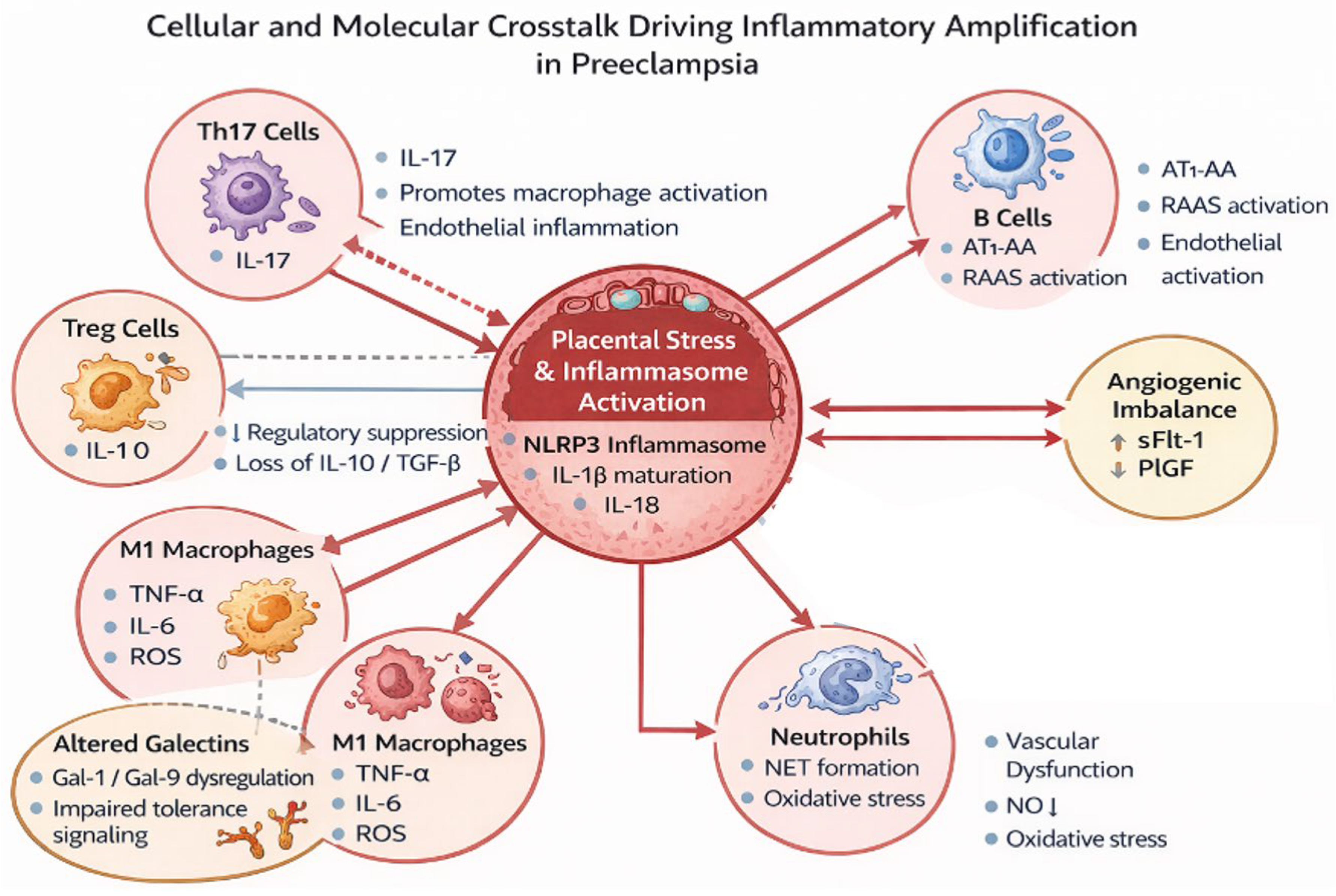
In preeclampsia, this finely regulated inflammatory equilibrium is destabilized, leading to a coordinated network of immune cell interactions that amplify proinflammatory signaling. Rather than isolated cytokine elevation, the disorder is characterized by reciprocal activation among Th17 cells, M1 macrophages, neutrophils, B cells, and reduced regulatory T-cell suppression. Central to this process is activation of the NLRP3 inflammasome, which promotes maturation of IL-1β and IL-18 and reinforces inflammatory crosstalk across immune subsets (Figure 2).
Preeclampsia shares some features with the inflammatory state of normal pregnancy, but the intensity of the response is markedly increased [8,86,87]. This exaggerated inflammation is thought to originate from syncytiotrophoblast stress due to hypoxia, oxidative stress, or both [5,84,85,87], leading to the release of proinflammatory cytokines and antiangiogenic factors [5,10,84]. The inflammatory response may be triggered by both exogenous danger signals (e.g., pathogens) and endogenous signals (products of trauma, ischemia, necrosis, or oxidative stress) [88,89,90]. It involves inflammatory leukocytes (granulocytes, macrophages, and NK cells) in concert with endothelial cells, platelets, and soluble mediators, such as complement [38,86].
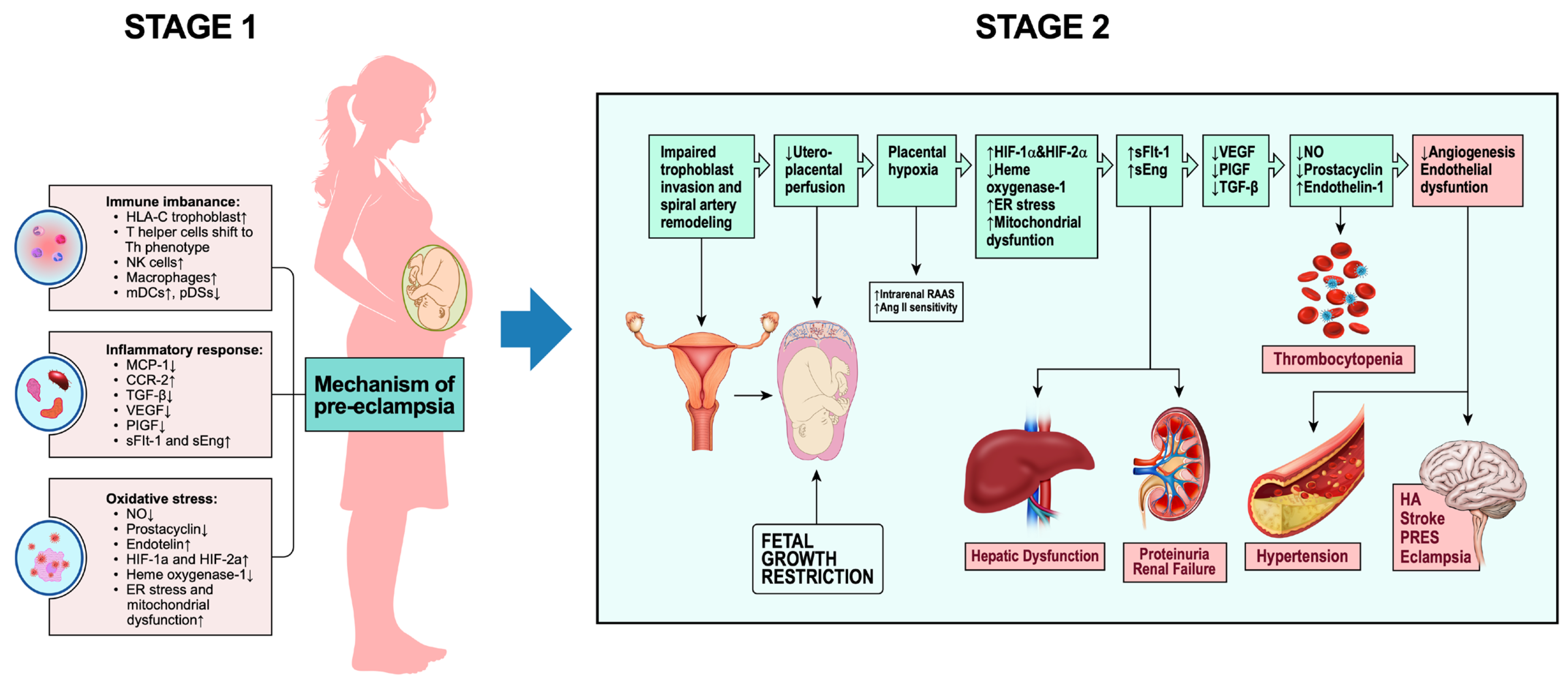
Preeclampsia is conceptualized as a two-stage disorder [8,87]:
  • Pre-clinical Stage—Abnormal placentation and inadequate spiral artery remodeling, leading to placental hypoperfusion [14,91].
  • Clinical Stage—Systemic maternal endothelial dysfunction and hypertension [18,84,92].
Placental-derived antiangiogenic factors—such as increased sFlt-1 and sEng and decreased placental growth factor (PlGF)—are distinctive features of preeclampsia and contribute to widespread endothelial injury [20,92]. In summary, preeclampsia represents the convergence of dysregulated inflammation, imbalanced angiogenic signaling, and heightened long-term cardiovascular vulnerability [20,85,86]. Excess maternal inflammatory activation injures the endothelium and amplifies oxidative stress, whereas anti-angiogenic factors, such as sFlt-1 and sEng, disrupt placental perfusion and propagate systemic vascular dysfunction. These acute pathophysiologic pathways not only drive the clinical syndrome of hypertension, proteinuria, and multi-organ involvement but also leave a persistent imprint on maternal cardiovascular health, explaining the markedly increased risk of later hypertension, ischemic heart disease, and stroke [16,23,93]. Understanding how immune, vascular, and metabolic networks intersect in preeclampsia is essential for developing therapies that protect both immediate pregnancy outcomes and lifelong cardiovascular health.

5.1. Autophagy and Placental Stress Responses in Preeclampsia

Autophagy is a highly conserved intracellular degradation pathway that maintains cellular homeostasis by recycling damaged organelles, protein aggregates, and misfolded proteins [78,94]. In the placenta, basal autophagic activity plays an essential role in trophoblast differentiation, adaptation to hypoxic stress, and the regulation of oxidative balance [66,95]. Under physiological conditions, autophagy supports syncytiotrophoblast renewal and contributes to metabolic equilibrium within the developing placenta [95,96].
In preeclampsia, however, autophagic regulation appears to become dysregulated. Placental hypoxia and oxidative stress—hallmarks of impaired spiral artery remodeling—can trigger excessive or maladaptive autophagic responses [97,98]. Altered expression of key autophagy-related proteins, including LC3-II, Beclin-1, and p62, has been documented in preeclamptic placentas, suggesting disruption of normal autophagic flux [98,99]. Such alterations may promote trophoblast apoptosis, impair trophoblast invasion, and exacerbate placental insufficiency [97,98].
Autophagy also interacts closely with inflammatory signaling pathways. Experimental evidence indicates significant crosstalk between autophagic mechanisms and NLRP3 inflammasome activation. Impaired autophagy may lead to the accumulation of damaged mitochondria and increased production of reactive oxygen species, thereby facilitating inflammasome activation and enhanced IL-1β secretion [8,9,10]. Conversely, intact autophagic activity can limit excessive inflammatory signaling by promoting mitochondrial quality control and reducing oxidative stress, thereby protecting endothelial integrity [100,101].
Together, these findings position autophagy as a key regulatory pathway linking placental hypoxic stress, inflammasome activation, and trophoblast dysfunction. A deeper understanding of autophagic regulation in the placenta may therefore reveal novel therapeutic targets to restore cellular homeostasis and prevent inflammation-driven vascular injury in preeclampsia. Importantly, these stress-response pathways also intersect with adaptive immune dysregulation, further amplifying cytokine imbalance and contributing to systemic endothelial dysfunction.

5.2. Immune Dysregulation and Cytokine Imbalance

Since Medawar’s 1953 hypothesis that the fetus is an “allograft” [40,102], early theories posited that maternal immune privilege at the maternal–fetal interface was necessary to maintain pregnancy [65,103]. These models emphasized maternal immune suppression, reduced expression of major histocompatibility complex (MHC) antigens in fetal tissue, and a shift from Th1 to Th2 cytokine dominance [67,90,102,104]. Contemporary evidence, however, indicates that a balanced interplay between pro- and anti-inflammatory responses is essential for successful pregnancy [90,102]. In early gestation, implantation and placental development are inherently proinflammatory but are tightly regulated by anti-inflammatory mediators, such as IL-10 and Tregs [1,50].
In preeclampsia, this balance is disrupted [86,105]. There is an overactivation of Th1 and Th17 responses, reduced Treg activity, and increased activation of cytotoxic NK cells and autoreactive B cells [86,104]. This leads to increased innate immune activation in both the maternal circulation and the uteroplacental unit [84,87,90]. The result is superficial trophoblast invasion, poor spiral artery remodeling, and worsening placental ischemia with escalating oxidative stress [15,104,106,107].

5.3. Cytokines and Endothelial Dysfunction in Preeclampsia

Chronic immune activation in preeclampsia is characterized by elevated levels of proinflammatory cytokines, particularly TNF-α, IL-6, and IL-17 [25,26,86,104,108]. These act locally and systemically, perpetuating oxidative stress, vascular inflammation, and endothelial damage.
  • TNF-α and IL-6: Promote endothelial adhesion molecule expression, increase vascular permeability, and impair endothelial nitric oxide synthase (eNOS) activity, reducing nitric oxide (NO) bioavailability and vasodilation [108,109]. Experimental models show that a two-fold increase in TNF-α elevates mean arterial pressure (MAP) and reduces renal plasma flow and glomerular filtration rate (GFR) [109,110]. IL-6 exerts similar effects and has been linked to increased plasma renin activity [109,111].
  • IL-17: In animal models, IL-17 increases MAP, induces placental oxidative stress, and stimulates B cells to produce angiotensin II type 1 receptor autoantibodies (AT1-AA), exacerbating hypertension and vascular injury [104].
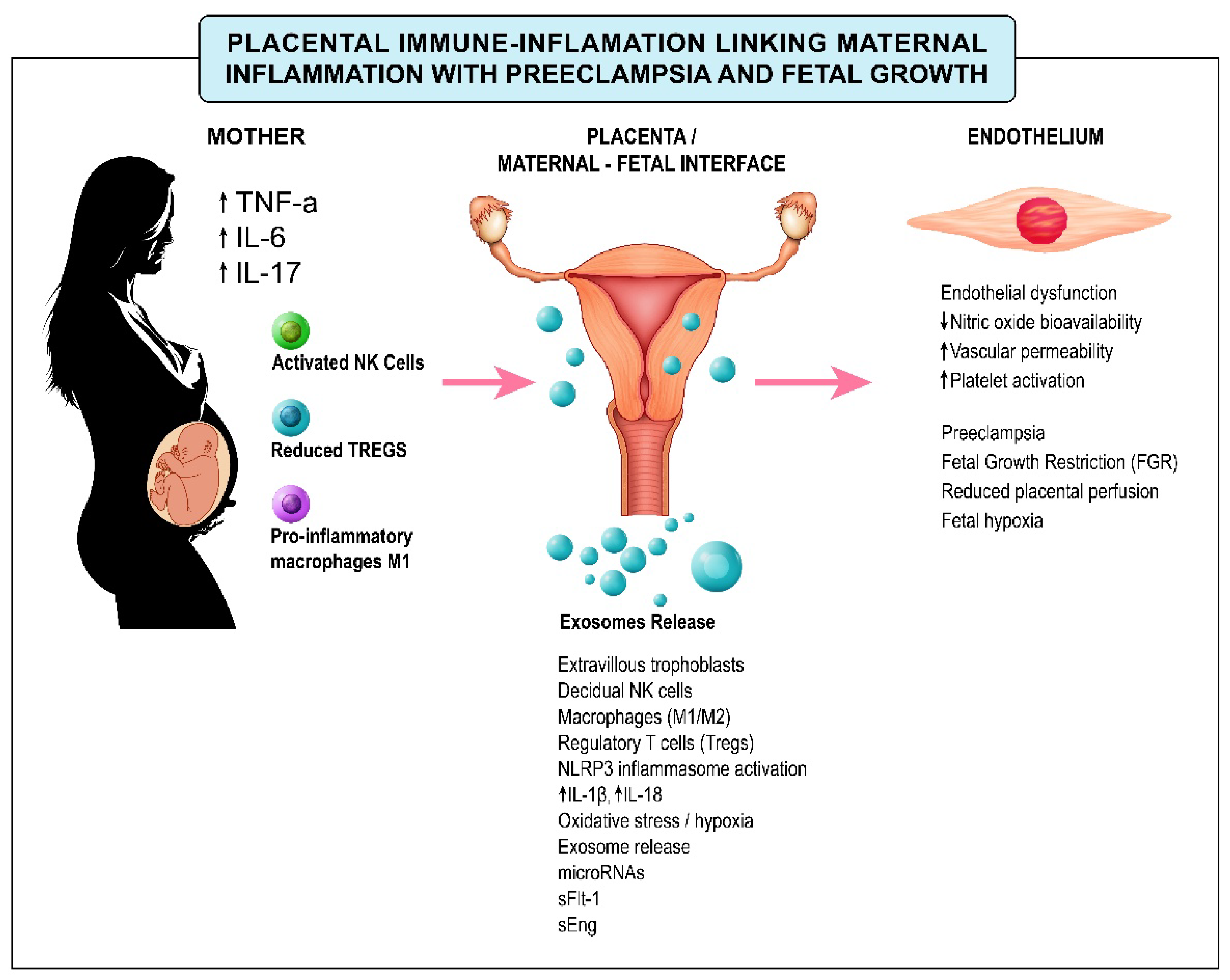
Together, these inflammatory and immunological disturbances integrate placental dysfunction with maternal endothelial injury, illustrating how maternal immune activation at the systemic level converges on placental signaling and endothelial dysfunction (Figure 3).

6. Inflammation and Fetal Growth Restriction

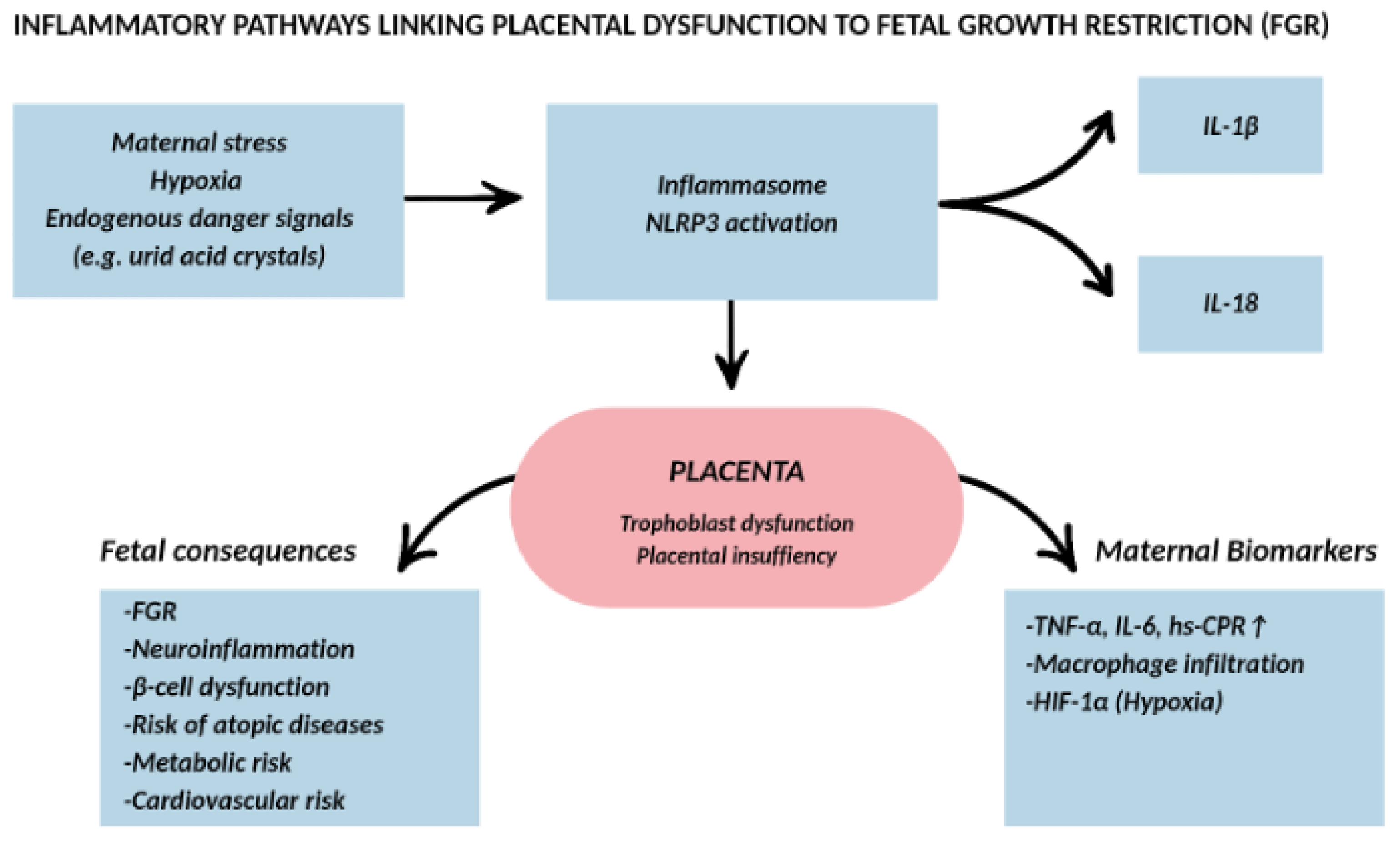
FGR is a complex clinical condition associated with increased perinatal morbidity and mortality [112,113]. It is primarily a consequence of placental insufficiency and alterations in the intrauterine inflammatory environment, both of which can have lasting effects on perinatal and long-term health [114,115,116]. FGR is defined as the failure of a fetus to achieve its genetically determined growth potential [113]. Clinically, the most widely accepted criterion is an estimated fetal weight below the 10th percentile for gestational age, as defined by standardized growth charts [117]. Multiple etiological factors contribute to FGR, with inflammation playing a pivotal role in its pathogenesis [118]. Excessive placental inflammation can be triggered by maternal stress, hypoxia, and endogenous danger signals such as uric acid crystals [6,22,88]. These stimuli activate placental inflammasomes—particularly NLRP3—promoting IL-1β–dependent signaling that impairs trophoblast function and contributes to placental insufficiency. Although inflammasome activation is also implicated in preeclampsia, its sustained activation appears particularly relevant in the context of placental insufficiency–driven fetal growth restriction (Figure 4).
The NLRP3 inflammasome, a multiprotein complex, mediates the maturation of proinflammatory cytokines such as IL-1β and IL-18, which are critical in amplifying inflammatory responses [22,26]. Experimental models demonstrate that sustained maternal inflammation can disrupt fetal metabolic programming, affecting skeletal muscle glucose metabolism and β-cell function, with potential implications for future metabolic disease risk [119]. Placental inflammation is also associated with increased macrophage infiltration and a proinflammatory cytokine profile in both placental tissue and maternal serum [6,105,120]. Furthermore, inflammation in FGR may extend beyond the placenta, affecting other systems such as the central nervous system—where neuroinflammation can impair brain development [121,122,123]—and the skin, where inflammatory changes may predispose to childhood atopic diseases [81].
Assessment of inflammatory involvement in FGR includes evaluation of both systemic and local biomarkers. Elevated maternal serum levels of TNF-α, IL-6, and high-sensitivity C-reactive protein (hs-CRP) have been reported in pregnancies complicated by FGR, with correlations to adverse neonatal outcomes such as low birth weight and reduced Apgar scores [88,119,124]. Histological and immunohistochemical analyses of placental tissue reveal increased macrophage density and a predominance of proinflammatory markers [125,126]. Additionally, hypoxia-induced factors such as hypoxia-inducible factor 1-alpha (HIF-1α) accumulate in placentas of pregnancies complicated with FGR, linking placental hypoxia to sterile inflammation and dysfunction [127]. The inflammatory milieu associated with FGR may have lasting effects on both the fetus and the mother. Children with a history of poor postnatal growth demonstrate elevated circulating inflammatory markers—such as C-reactive protein, hepatocyte growth factor, IL-8, and TNF-α—compared with age-matched controls [128]. This low-grade inflammation may increase the risk of future metabolic and cardiovascular disease. Animal studies indicate that FGR can blunt the neonatal proinflammatory response to infectious stimuli, mediated by reduced nuclear factor kappa B (NF-κB) activation [119]. This suggests impaired innate immunity and increased susceptibility to infection. On the maternal side, pregnancies complicated by FGR often show elevated proinflammatory cytokines, reinforcing the concept of a shared maternal–fetal inflammatory environment [6]. Collectively, these findings position placental inflammation not only as a determinant of fetal growth restriction but as part of a broader spectrum of immune-mediated placental insufficiency with shared maternal vascular consequences.

7. Immune Dysregulation in Placental Insufficiency: Clinical Implications and Translational Perspectives

From a clinical perspective, both preeclampsia and fetal growth restriction are consistently associated with elevated circulating inflammatory mediators, including key Th1/Th17-associated cytokines such as TNF-α, IL-6, and IL-17 [27,86,90,104]. These cytokines amplify oxidative stress in placental tissue, aggravating endothelial dysfunction and contributing to the most acute and clinically severe stages of the disease. However, interpreting these biomarkers in clinical practice remains challenging, as inflammation can also be influenced by maternal characteristics such as advanced age, prolonged interpregnancy interval, obesity, and comorbidities, including chronic hypertension, diabetes, renal disease, and autoimmune conditions (Figure 5).
Dysregulation of galectin-mediated glyco-immune signaling further contributes to this cascade, as reduced Gal-1 and altered Gal-9 activity impair immune tolerance and vascular remodeling, reinforcing the transition from physiological adaptation to pathological inflammation.
Beyond heightened inflammation, preeclampsia is also characterized by impaired anti-inflammatory regulation [86]. A consistent finding across studies is the reduction in Tregs and decreased IL-10 production—both essential for maintaining immunological tolerance at the maternal–fetal interface. Several reports indicate that Treg cell depletion is more pronounced in early-onset, severe preeclampsia compared with late-onset or milder forms [91,102,129]. Reduced Treg function promotes increased trophoblast apoptosis, shallow trophoblast invasion, and inadequate spiral artery remodeling [49,102], highlighting a mechanistic link between immune dysregulation and the placental malperfusion that precedes clinical disease [86].
IL-10 plays a central role in this process. As a key anti-inflammatory cytokine that restrains Th1-driven inflammation and supports Treg differentiation, its reduction in preeclampsia further skews the maternal immune milieu toward a cytotoxic, proinflammatory state. This imbalance contributes to hypertension, endothelial activation, and ultimately impaired fetal growth [5,84]. Together, these findings underscore the importance of immune homeostasis for optimal pregnancy outcomes. Clinically, they highlight potential avenues for intervention: therapies that enhance Treg function, restore IL-10 signaling, or attenuate excessive cytokine activity could help rebalance inflammatory pathways and improve maternal and perinatal outcomes. Although still experimental, strategies such as Treg cell transfer, IL-10–based therapies, and selective immunomodulators hold promise and warrant further investigation in well-designed translational studies [86]. Strengthening the bridge between immunopathology and clinical care is essential. By identifying immune signatures that distinguish pathological inflammation from physiological adaptation, future strategies may enable earlier detection, refined risk stratification, and mechanism-oriented interventions aimed not only at preventing acute obstetric complications but also at mitigating long-term maternal cardiovascular risk.

8. Therapy Development

Therapeutic strategies for pregnancy-associated inflammatory disorders must achieve a delicate balance between modulating the maternal immune response and ensuring fetal safety. The primary objective is to attenuate excessive inflammation—implicated in adverse outcomes such as preeclampsia, FGR, and preterm birth—while preserving adequate host defense against infections. Current management combines evidence-based interventions from established clinical guidelines with emerging approaches that target specific inflammatory pathways (Table 1). Understanding how these interventions modulate the maternal–fetal immune landscape is essential for developing more precise and effective therapies.

8.1. Established Therapies

8.1.1. Low-Dose Aspirin

Low-dose aspirin (LDA), initiated before 16 weeks of gestation, reduces the incidence of preeclampsia and other placental-mediated complications. Its mechanism involves inhibition of platelet aggregation and modulation of inflammatory responses via selective cyclooxygenase-1 (COX-1) blockade [29,147]. Emerging clinical guidelines increasingly support the use of LDA in women identified as high risk for preeclampsia following first-trimester screening. Evidence from randomized trials and meta-analyses demonstrates that initiating LDA—ideally before 16 weeks—significantly reduces the risk of preeclampsia, particularly early-onset disease, and associated outcomes, including preterm birth and fetal growth restriction [29,147]. Screening-based strategies enable targeted treatment of women most likely to benefit, thereby optimizing the risk–benefit balance. Collectively, these data underpin current recommendations endorsing prophylactic LDA as a cornerstone of prevention in appropriately selected pregnancies.

8.1.2. Anticoagulants

Low molecular weight heparin (LMWH) is indicated in selected high-risk pregnancies, particularly in the context of thrombophilia or recurrent pregnancy loss. Beyond its anticoagulant properties, LMWH exhibits anti-inflammatory effects by modulating complement activation and leukocyte trafficking [93]. A growing body of evidence suggests that adjunctive LMWH may confer benefit in women at high risk of preeclampsia who do not have thrombophilia. In a meta-analysis of 10 randomized trials (1758 participants), LMWH significantly reduced the incidence of preeclampsia, with risk reduction confined mainly to studies in which low-dose aspirin was the primary intervention. The combination of LMWH and LDA was also associated with fewer preterm births and fewer cases of fetal growth restriction, without affecting placental abruption rates. Overall, these findings support the selective use of LMWH as an adjunct to LDA in carefully defined high-risk populations [148].

8.1.3. Corticosteroids

Antenatal corticosteroids remain a cornerstone when preterm delivery is anticipated in pregnancies complicated by fetal growth restriction or preeclampsia, primarily because they accelerate fetal lung maturation and reduce neonatal respiratory distress, intraventricular hemorrhage, and death [149,150]. Although they do not directly treat placental insufficiency or maternal disease, their use can safely extend the window for optimizing delivery timing and adjunctive care. In these high-risk contexts, clinicians must balance benefits against potential maternal effects—including transient hyperglycemia, fluid retention, and a small increase in infectious risk—particularly in women with diabetes or severe hypertension. Overall, a single standard course before early preterm birth is strongly supported, while repeat dosing requires individualized consideration [149,150].
These established therapies delineate the current therapeutic landscape—effective in specific contexts yet fundamentally constrained by the need to safeguard the maternal–fetal unit. This limitation underscores an urgent scientific priority: to design next-generation immunomodulatory approaches that selectively suppress pathological inflammation while preserving fetal development. As insights into placental immunobiology expand, the development of truly targeted, precision therapies in pregnancy is shifting from possibility to near inevitability.

8.2. Adjunctive and Supportive Interventions

8.2.1. Antioxidants and Nutritional Modulation

Oxidative stress is a key contributor to placental inflammation [151,152]. Although antioxidants such as vitamins C and E have been extensively evaluated, large clinical trials have not demonstrated consistent benefit in preventing preeclampsia [90]. Melatonin, with potent antioxidant and vasoprotective properties, has shown promising results in small-scale studies [153,154], suggesting a potential role for targeted antioxidant therapy. Experimental data demonstrate that melatonin reduces placental oxidative stress and enhances antioxidant defenses without altering key anti-angiogenic mediators, and that it partially protects endothelial function in vitro. In a phase I clinical study involving women with established preeclampsia, melatonin administration was safe for both mother and fetus [153]. It was associated with a meaningful prolongation of pregnancy, along with reduced requirements for escalation of antihypertensive therapy [153]. Although significant biochemical markers of disease severity remained unchanged, these findings suggest that melatonin may attenuate maternal endothelial injury and help stabilize the disease long enough to improve perinatal outcomes, warranting larger confirmatory trials.
Recent high-quality evidence challenges earlier assumptions regarding routine calcium supplementation for the prevention of preeclampsia [155]. Across large, prospectively registered randomized trials, calcium showed little to no effect on preeclampsia, preterm birth, or major maternal and perinatal outcomes, regardless of baseline intake or dose. Overall, current data suggest that dietary calcium alone is unlikely to modify preeclampsia risk meaningfully and should not replace proven preventive strategies in high-risk pregnancies [155].

8.2.2. Lifestyle and Microbiome Modulation

Optimizing maternal diet, engaging in regular moderate physical activity, and using probiotic supplementation are under investigation as strategies to modulate systemic inflammation and enhance immune tolerance during pregnancy [30,156]. Lifestyle and microbiome modulation are emerging areas of interest for reducing the risk of preeclampsia, though the evidence remains preliminary. Observational and mechanistic studies suggest that healthy dietary patterns, appropriate weight gain, physical activity, and smoking avoidance may attenuate systemic inflammation, improve metabolic function, and support vascular health—pathways central to preeclampsia [157]. Parallel research indicates that alterations in the gut, vaginal, and placental microbiomes may influence immune tolerance, endothelial function, and oxidative stress, suggesting that probiotics, prebiotics, or diet-driven microbial shifts could play a preventive role. However, high-quality randomized trials are scarce, and standardized interventions have not yet been defined. For now, lifestyle optimization should be encouraged as part of comprehensive antenatal care, while microbiome-targeted therapies remain promising but investigational.

8.3. Emerging and Experimental Therapies

8.3.1. Cytokine-Targeted Biologics

Monoclonal antibodies that neutralize pro-inflammatory cytokines (e.g., anti–TNF-α, anti–IL-6) have been successful in treating autoimmune diseases and are now under consideration for the treatment of pregnancy-related inflammatory disorders [158]. Their capacity to exert highly specific immunomodulatory effects makes them an appealing, although still experimental, therapeutic avenue. Experimental models suggest these cytokines contribute to endothelial dysfunction, placental malperfusion, and systemic oxidative stress, and targeted blockade can partially restore vascular homeostasis. Clinically, experience in pregnant patients largely comes from women treated for autoimmune diseases, where selected agents (e.g., certain anti–TNF drugs) have shown acceptable safety profiles when carefully monitored; however, robust randomized data specific to hypertensive or placental disorders are lacking. At present, cytokine-neutralizing antibodies remain investigational for pregnancy-specific indications, and their future role will depend on trials that balance maternal benefit with fetal immune and developmental safety.

8.3.2. Inflammasome Inhibitors

Given the pivotal role of NLRP3 inflammasome activation in placental inflammation and FGR, small-molecule inhibitors such as MCC950 are being tested in preclinical models [159]. By targeting upstream inflammatory signaling, these agents may help mitigate placental injury. Inflammasome inhibitors, particularly those targeting NLRP3, offer a novel approach for pregnancy disorders in which excessive IL-1β and IL-18 signaling drives endothelial and placental injury, such as preeclampsia and fetal growth restriction [160]. Preclinical models suggest that pharmacologic blockade of inflammasome activation can attenuate oxidative stress, vascular dysfunction, and placental inflammation, thereby improving maternal hemodynamics and fetal growth [160]. However, clinical experience in pregnancy is virtually absent, and concerns remain regarding host defense and fetal immune development. At present, inflammasome inhibition is a promising but purely experimental strategy that requires rigorous safety and efficacy trials before translation to obstetric care.

8.3.3. Cell-Based Therapies

Mesenchymal stem cell (MSC) therapy represents a novel approach to promote immune tolerance and facilitate tissue repair at the maternal–fetal interface [161]. Early data indicate that MSCs possess strong immunomodulatory and regenerative potential, positioning them as a promising frontier in perinatal therapeutics. Cell-based therapies are emerging as an innovative strategy for preeclampsia, aiming to repair rather than merely temporize placental and endothelial injury [161]. Mesenchymal stromal cells, endothelial progenitor cells, and regulatory T-cell–based approaches have been shown in preclinical models to improve uteroplacental perfusion, dampen inflammation, and restore endothelial function, primarily through paracrine and immunomodulatory mechanisms. Early-phase studies outside pregnancy suggest acceptable safety profiles for some platforms, but robust clinical data in pregnant populations are lacking. For now, cell-based therapies remain experimental, offering a compelling future avenue for disease modification in severe or early-onset preeclampsia [161].

8.3.4. Safety Considerations

The administration of anti-inflammatory agents during pregnancy requires rigorous assessment of their teratogenic potential, effects on fetal immune development, and potential long-term effects on offspring. Current guidelines advocate individualized risk–benefit evaluation and preferentially use therapies with well-established safety profiles [162,163]. While current and emerging therapeutic approaches offer promising avenues for managing pregnancy-associated inflammatory disorders, ongoing research is advancing toward even more targeted and biologically precise interventions. Among these, exosome-based strategies are among the most innovative and rapidly evolving frontiers.

9. Future Perspectives: Emerging Role of Exosomal Signaling

Growing evidence indicates that placental-derived exosomes participate in immune and vascular communication at the maternal–fetal interface. Exosomes are nanoscale extracellular vesicles that transport bioactive cargo, including proteins, mRNA, and microRNAs, enabling coordinated signaling between placental and maternal tissues and influencing inflammatory and angiogenic pathways [164,165,166,167]. During physiological pregnancy, trophoblast-derived exosomes contribute to immune modulation and the maintenance of maternal–fetal tolerance, facilitating the transfer of regulatory molecules [166,168,169,170,171].
In preeclampsia and FGR, alterations in exosomal composition have been reported, including enrichment of proinflammatory mediators and antiangiogenic factors such as sFlt-1 [172,173]. These observations suggest that exosomes may act as intermediaries linking placental stress to systemic inflammatory signaling and endothelial dysfunction, although the precise mechanisms remain incompletely defined.
Experimental studies using mesenchymal stromal cell-derived extracellular vesicles have demonstrated immunomodulatory effects and partial restoration of placental vascular remodeling in preclinical models [146]. While these observations highlight the therapeutic potential of exosome-based strategies, further mechanistic studies are needed before they can be translated into clinical practice. Collectively, exosomal signaling represents a promising but still evolving area of investigation within the broader landscape of immune-mediated placental disease, particularly in the context of preeclampsia and FGR.

10. Conclusions

Inflammation is an intrinsic component of normal pregnancy, orchestrating implantation, placental development, and the physiological onset of labor. However, when inflammatory regulation becomes disrupted at the maternal–fetal interface, these protective immune mechanisms may shift toward pathological signaling that contributes to placental and vascular disease. The evidence reviewed here supports the concept that preeclampsia and fetal growth restriction represent interconnected manifestations of inflammation-driven placental dysfunction, arising from disturbances in the delicate equilibrium between maternal immune tolerance and vascular adaptation.
Within this inflammatory landscape, immune cell imbalance, inflammasome activation, cytokine amplification, and angiogenic disruption converge to impair trophoblast invasion, compromise spiral artery remodeling, and reduce placental perfusion. These local placental alterations propagate systemic effects, ultimately contributing to maternal endothelial dysfunction and adverse fetal outcomes. Viewing these disorders through a unified immunological framework helps bridge molecular mechanisms to clinical expression and reinforces the concept that placental disease arises from complex interactions among immune signaling, vascular biology, and environmental stressors. Importantly, this perspective highlights opportunities for precision approaches targeting specific inflammatory and angiogenic pathways, while preserving the physiological immune adaptations required for successful gestation.
Advances in molecular profiling, systems immunology, and translational research will be essential to further characterize the inflammatory networks that shape placental function. Such efforts may facilitate the development of targeted preventive and therapeutic strategies, ultimately improve maternal and neonatal outcomes and reduce global disparities in pregnancy-related complications.

Author Contributions

N.M. and J.M. conceived the initial outline, conducted the literature search, synthesized the evidence, and drafted the first version of the manuscript. R.Z. contributed to data interpretation, critically revised the manuscript for clinical relevance, and assisted with the structure of the figures and tables. M.D. contributed to literature screening and synthesis, participated in the critical appraisal of the evidence, supported the development of sections, and contributed to manuscript editing. M.M.O.-D. provided conceptual input on immunological mechanisms, reviewed all drafts, and refined the discussion. W.A. contributed to methodological oversight, verified sources, and critically reviewed the final version for accuracy and coherence. J.M. (senior author) supervised the project, contributed to conceptual design, integrated clinical and translational perspectives, provided major revisions across multiple drafts, and approved the final manuscript for submission. All authors have read and agreed to the published version of the manuscript.

Funding

No specific funding was received for this work.

Institutional Review Board Statement

Not applicable.

Informed Consent Statement

Not applicable.

Data Availability Statement

The original contributions presented in this study are included in the article. Further inquiries can be directed to the corresponding author.

Conflicts of Interest

The authors declare no conflicts of interest.

Abbreviations

FGRFetal growth restriction
Th1T-helper 1 cells
Th2 T-helper 2 cells
HDPHypertensive disorders of pregnancy
uNKUterine natural killer cells
HLA-GHuman Leukocyte Antigen-G
PD-L1Programmed Death-Ligand 1
sFlt-1soluble fms-like tyrosine kinase-1
NLRP3NOD-like receptor family, pyrin domain containing 3
ILInterleukin
TNF-αTumor necrosis factor-α
dNKDecidual natural killer cells
CD56Cluster of Differentiation 56
IP-10Interferon-inducible protein-10
VEGFVascular endothelial growth factor
TregsRegulatory T cells
TGF-βTransforming Growth Factor-Beta
FasLPlacental Fas ligand
TLRsToll-like receptors
PTBPreterm birth
LBWLow birth weight
MCP-1Monocyte chemotactic protein-1
PlGFPlacental growth factor
sEngSoluble endoglin
MHCHistocompatibility complex
eNOSEndothelial nitric oxide synthase
NONitric oxide
MAPMean arterial pressure
HIF-1αHypoxia-inducible factor 1-alpha
NF-κBNuclear factor kappa B
LDALow-dose aspirin
COX-1Cyclooxygenase-1
LMWHLow molecular weight heparin
MSCMesenchymal stem cell
miRNAsmicroRNAs
HBCsHofbauer cells

References

  1. Dekel, N.; Gnainsky, Y.; Granot, I.; Racicot, K.; Mor, G. The Role of Inflammation for a Successful Implantation. Am. J. Reprod. Immunol. 2014, 72, 141–147. [Google Scholar] [CrossRef]
  2. Dimitriadis, E.; Rolnik, D.L.; Zhou, W.; Estrada-Gutierrez, G.; Koga, K.; Francisco, R.P.V.; Whitehead, C.; Hyett, J.; Da Silva Costa, F.; Nicolaides, K.; et al. Pre-eclampsia. Nat. Rev. Dis. Primers 2023, 9, 8, Correction in Nat. Rev. Dis. Primer, 2023, 9, 35. https://doi.org/10.1038/s41572-023-00451-4. [Google Scholar] [CrossRef]
  3. Hanna, J.; Goldman-Wohl, D.; Hamani, Y.; Avraham, I.; Greenfield, C.; Natanson-Yaron, S.; Prus, D.; Cohen-Daniel, L.; Arnon, T.I.; Manaster, I.; et al. Decidual NK cells regulate key developmental processes at the human fetal-maternal interface. Nat. Med. 2006, 12, 1065–1074. [Google Scholar] [CrossRef]
  4. Mor, G.; Aldo, P.; Alvero, A.B. The unique immunological and microbial aspects of pregnancy. Nat. Rev. Immunol. 2017, 17, 469–482. [Google Scholar] [CrossRef]
  5. Redman, C.W.G.; Sargent, I.L. Placental Stress and Pre-eclampsia: A Revised View. Placenta 2009, 30, 38–42. [Google Scholar] [CrossRef]
  6. Burton, G.J.; Jauniaux, E. Pathophysiology of placental-derived fetal growth restriction. Am. J. Obstet. Gynecol. 2018, 218, S745–S761. [Google Scholar] [CrossRef]
  7. Staff, A.C. The two-stage placental model of preeclampsia: An update. J. Reprod. Immunol. 2019, 134–135, 1–10. [Google Scholar] [CrossRef]
  8. Roberts, J.M.; Hubel, C.A. The Two Stage Model of Preeclampsia: Variations on the Theme. Placenta 2009, 30, 32–37. [Google Scholar] [CrossRef] [PubMed]
  9. Crispi, F.; Domínguez, C.; Llurba, E.; Martín-Gallán, P.; Cabero, L.; Gratacós, E. Placental angiogenic growth factors and uterine artery Doppler findings for characterization of different subsets in preeclampsia and in isolated intrauterine growth restriction. Am. J. Obstet. Gynecol. 2006, 195, 201–207. [Google Scholar] [CrossRef] [PubMed]
  10. Karumanchi, S.A. Angiogenic Factors in Preeclampsia: From Diagnosis to Therapy. Hypertension 2016, 67, 1072–1079. [Google Scholar] [CrossRef] [PubMed]
  11. Llurba, E.; Crispi, F.; Verlohren, S. Update on the Pathophysiological Implications and Clinical Role of Angiogenic Factors in Pregnancy. Fetal Diagn. Ther. 2015, 37, 81–92. [Google Scholar] [CrossRef] [PubMed]
  12. Vento-Tormo, R.; Efremova, M.; Botting, R.A.; Turco, M.Y.; Vento-Tormo, M.; Meyer, K.B.; Park, J.-E.; Stephenson, E.; Polański, K.; Goncalves, A.; et al. Single-cell reconstruction of the early maternal–fetal interface in humans. Nature 2018, 563, 347–353. [Google Scholar] [CrossRef] [PubMed]
  13. Blois, S.M.; Ilarregui, J.M.; Tometten, M.; Garcia, M.; Orsal, A.S.; Cordo-Russo, R.; Toscano, M.A.; Bianco, G.A.; Kobelt, P.; Handjiski, B.; et al. A pivotal role for galectin-1 in fetomaternal tolerance. Nat. Med. 2007, 13, 1450–1457, Erratum in Nat. Med. 2009, 15, 584. [Google Scholar] [CrossRef]
  14. Redman, C.W.G.; Tannetta, D.S.; Dragovic, R.A.; Gardiner, C.; Southcombe, J.H.; Collett, G.P.; Sargent, I.L. Review: Does size matter? Placental debris and the pathophysiology of pre-eclampsia. Placenta 2012, 33, S48–S54. [Google Scholar] [CrossRef]
  15. Deer, E.; Herrock, O.; Campbell, N.; Cornelius, D.; Fitzgerald, S.; Amaral, L.M.; LaMarca, B. The role of immune cells and mediators in preeclampsia. Nat. Rev. Nephrol. 2023, 19, 257–270. [Google Scholar] [CrossRef] [PubMed]
  16. Hausvater, A.; Giannone, T.; Sandoval, Y.-H.G.; Doonan, R.J.; Antonopoulos, C.N.; Matsoukis, I.L.; Petridou, E.T.; Daskalopoulou, S.S. The association between preeclampsia and arterial stiffness. J. Hypertens. 2012, 30, 17–33. [Google Scholar] [CrossRef]
  17. Herraiz, I.; Dröge, L.A.; Gómez-Montes, E.; Henrich, W.; Galindo, A.; Verlohren, S. Characterization of the Soluble fms-Like Tyrosine Kinase-1 to Placental Growth Factor Ratio in Pregnancies Complicated by Fetal Growth Restriction. Obstet. Gynecol. 2014, 124, 265–273. [Google Scholar] [CrossRef] [PubMed]
  18. Maynard, S.E.; Min, J.-Y.; Merchan, J.; Lim, K.-H.; Li, J.; Mondal, S.; Libermann, T.A.; Morgan, J.P.; Sellke, F.W.; Stillman, I.E.; et al. Excess placental soluble fms-like tyrosine kinase 1 (sFlt1) may contribute to endothelial dysfunction, hypertension, and proteinuria in preeclampsia. J. Clin. Investig. 2003, 111, 649–658. [Google Scholar] [CrossRef]
  19. Shibata, E.; Rajakumar, A.; Powers, R.W.; Larkin, R.W.; Gilmour, C.; Bodnar, L.M.; Crombleholme, W.R.; Ness, R.B.; Roberts, J.M.; Hubel, C.A. Soluble fms-Like Tyrosine Kinase 1 Is Increased in Preeclampsia but Not in Normotensive Pregnancies with Small-for-Gestational-Age Neonates: Relationship to Circulating Placental Growth Factor. J. Clin. Endocrinol. Metab. 2005, 90, 4895–4903. [Google Scholar] [CrossRef]
  20. Levine, R.J.; Maynard, S.E.; Qian, C.; Lim, K.-H.; England, L.J.; Yu, K.F.; Schisterman, E.F.; Thadhani, R.; Sachs, B.P.; Epstein, F.H.; et al. Circulating Angiogenic Factors and the Risk of Preeclampsia. N. Engl. J. Med. 2004, 350, 672–683. [Google Scholar] [CrossRef]
  21. Moss, C.G.; Dilworth, M.R.; Harris, L.K.; Freeman, S.; Heazell, A.E.P. Understanding a Potential Role for the NLRP3 Inflammasome in Placenta-Mediated Pregnancy Complications. Am. J. Reprod. Immunol. 2025, 93, e70077. [Google Scholar] [CrossRef]
  22. Alfian, I.; Chakraborty, A.; Yong, H.E.J.; Saini, S.; Lau, R.W.K.; Kalionis, B.; Dimitriadis, E.; Alfaidy, N.; Ricardo, S.D.; Samuel, C.S.; et al. The Placental NLRP3 Inflammasome and Its Downstream Targets, Caspase-1 and Interleukin-6, Are Increased in Human Fetal Growth Restriction: Implications for Aberrant Inflammation-Induced Trophoblast Dysfunction. Cells 2022, 11, 1413. [Google Scholar] [CrossRef]
  23. Garcia-Puente, L.M.; Fraile-Martinez, O.; García-Montero, C.; Bujan, J.; De León-Luis, J.A.; Bravo, C.; Rodríguez-Benitez, P.; Pintado, P.; Ruiz-Labarta, F.J.; Álvarez-Mon, M.; et al. Placentas from Women with Late-Onset Preeclampsia Exhibit Increased Expression of the NLRP3 Inflammasome Machinery. Biomolecules 2023, 13, 1644. [Google Scholar] [CrossRef] [PubMed]
  24. Menkhorst, E.; Santos, L.L.; Zhou, W.; Yang, G.; Winship, A.L.; Rainczuk, K.E.; Nguyen, P.; Zhang, J.-G.; Moore, P.; Williams, M.; et al. IL11 activates the placental inflammasome to drive preeclampsia. Front. Immunol. 2023, 14, 1175926. [Google Scholar] [CrossRef] [PubMed]
  25. Szarka, A.; Rigó, J.; Lázár, L.; Bekő, G.; Molvarec, A. Circulating cytokines, chemokines and adhesion molecules in normal pregnancy and preeclampsia determined by multiplex suspension array. BMC Immunol. 2010, 11, 59. [Google Scholar] [CrossRef]
  26. Pinheiro, M.B.; Martins-Filho, O.A.; Mota, A.P.L.; Alpoim, P.N.; Godoi, L.C.; Silveira, A.C.O.; Teixeira-Carvalho, A.; Gomes, K.B.; Dusse, L.M. Severe preeclampsia goes along with a cytokine network disturbance towards a systemic inflammatory state. Cytokine 2013, 62, 165–173. [Google Scholar] [CrossRef]
  27. Tosun, M.; Celik, H.; Avci, B.; Yavuz, E.; Alper, T.; Malatyalioğlu, E. Maternal and umbilical serum levels of interleukin-6, interleukin-8, and tumor necrosis factor-α in normal pregnancies and in pregnancies complicated by preeclampsia. J. Matern. Fetal Neonatal Med. 2010, 23, 880–886. [Google Scholar] [CrossRef] [PubMed]
  28. Zheng, S.; Xu, P.; Shen, H.; Shu, C. Immune dysregulation in preeclampsia: Integrative analysis of peripheral transcriptomes and placental single-cell land-scapes. Front. Immunol. 2025, 16, 1638603. [Google Scholar] [CrossRef] [PubMed]
  29. Rolnik, D.L.; Wright, D.; Poon, L.C.; O’Gorman, N.; Syngelaki, A.; De Paco Matallana, C.; Akolekar, R.; Cicero, S.; Janga, D.; Singh, M.; et al. Aspirin versus Placebo in Pregnancies at High Risk for Preterm Preeclampsia. N. Engl. J. Med. 2017, 377, 613–622. [Google Scholar] [CrossRef]
  30. García-Montero, C.; Fraile-Martinez, O.; De Leon-Oliva, D.; Boaru, D.L.; Garcia-Puente, L.M.; De León-Luis, J.A.; Bravo, C.; Diaz-Pedrero, R.; Lopez-Gonzalez, L.; Álvarez-Mon, M.; et al. Exploring the Role of Mediterranean and Westernized Diets and Their Main Nutrients in the Modulation of Oxidative Stress in the Placenta: A Narrative Review. Antioxidants 2023, 12, 1918. [Google Scholar] [CrossRef]
  31. Fernandes, K.A.; Lim, A.I. Maternal-driven immune education in offspring. Immunol. Rev. 2024, 323, 288–302. [Google Scholar] [CrossRef] [PubMed]
  32. Delaroque, C.; Chassaing, B. Microbiome in heritage: How maternal microbiome transmission impacts next generation health. Microbiome 2025, 13, 196. [Google Scholar] [CrossRef]
  33. Andonotopo, W.; Bachnas, M.A.; Dewantiningrum, J.; Adi Pramono, M.B.; Sulistyowati, S.; Hariyasa Sanjaya, I.N.; Stanojevic, M.; Kurjak, A. Nutriepigenomics in perinatal medicine: Maternal nutrition as a modulator of fetal gene expression and long-term health. J. Perinat. Med. 2025, 54, 244–257. [Google Scholar] [CrossRef]
  34. Mangan, M.S.J.; Olhava, E.J.; Roush, W.R.; Seidel, H.M.; Glick, G.D.; Latz, E. Targeting the NLRP3 inflammasome in inflammatory diseases. Nat. Rev. Drug Discov. 2018, 17, 588–606. [Google Scholar] [CrossRef]
  35. Chappell, L.C.; Cluver, C.A.; Kingdom, J.; Tong, S. Pre-eclampsia. Lancet 2021, 398, 341–354. [Google Scholar] [CrossRef] [PubMed]
  36. Ives, C.W.; Sinkey, R.; Rajapreyar, I.; Tita, A.T.N.; Oparil, S. Preeclampsia—Pathophysiology and Clinical Presentations. J. Am. Coll. Cardiol. 2020, 76, 1690–1702. [Google Scholar] [CrossRef]
  37. Mor, G.; Cardenas, I. Review Article: The Immune System in Pregnancy: A Unique Complexity. Am. J. Reprod. Immunol. 2010, 63, 425–433. [Google Scholar] [CrossRef]
  38. Racicot, K.; Kwon, J.; Aldo, P.; Silasi, M.; Mor, G. Understanding the Complexity of the Immune System during Pregnancy. Am. J. Reprod. Immunol. 2014, 72, 107–116. [Google Scholar] [CrossRef]
  39. Riley, J.K. Trophoblast Immune Receptors in Maternal-Fetal Tolerance. Immunol. Investig. 2008, 37, 395–426. [Google Scholar] [CrossRef] [PubMed]
  40. Huppertz, B.; Ghosh, D.; Sengupta, J. An integrative view on the physiology of human early placental villi. Prog. Biophys. Mol. Biol. 2014, 114, 33–48. [Google Scholar] [CrossRef]
  41. Burton, G.J.; Woods, A.W.; Jauniaux, E.; Kingdom, J.C.P. Rheological and Physiological Consequences of Conversion of the Maternal Spiral Arteries for Uteroplacental Blood Flow during Human Pregnancy. Placenta 2009, 30, 473–482. [Google Scholar] [CrossRef] [PubMed]
  42. Iwasaki, A.; Medzhitov, R. Control of adaptive immunity by the innate immune system. Nat. Immunol. 2015, 16, 343–353. [Google Scholar] [CrossRef]
  43. Medzhitov, R. Origin and physiological roles of inflammation. Nature 2008, 454, 428–435. [Google Scholar] [CrossRef]
  44. Levenson, D.; Romero, R.; Miller, D.; Galaz, J.; Garcia-Flores, V.; Neshek, B.; Pique-Regi, R.; Gomez-Lopez, N. The maternal-fetal interface at single-cell resolution: Uncovering the cellular anatomy of the placenta and decidua. Am. J. Obstet. Gynecol. 2025, 232, S55–S79. [Google Scholar] [CrossRef] [PubMed]
  45. Moffett, A.; Colucci, F. Uterine NK cells: Active regulators at the maternal-fetal interface. J. Clin. Investig. 2014, 124, 1872–1879. [Google Scholar] [CrossRef]
  46. Alippe, Y.; Hatterschide, J.; Coyne, C.B.; Diamond, M.S. Innate immune responses to pathogens at the maternal–fetal interface. Nat. Rev. Immunol. 2025, 25, 869–884. [Google Scholar] [CrossRef]
  47. Svensson-Arvelund, J.; Ernerudh, J. The Role of Macrophages in Promoting and Maintaining Homeostasis at the Fetal–Maternal Interface. Am. J. Reprod. Immunol. 2015, 74, 100–109. [Google Scholar] [CrossRef] [PubMed]
  48. Houser, B.L. Decidual macrophages and their roles at the maternal-fetal interface. Yale J. Biol. Med. 2012, 85, 105–118. [Google Scholar] [PubMed] [PubMed Central]
  49. Aluvihare, V.R.; Kallikourdis, M.; Betz, A.G. Regulatory T cells mediate maternal tolerance to the fetus. Nat. Immunol. 2004, 5, 266–271. [Google Scholar] [CrossRef]
  50. Robertson, S.A.; Care, A.S.; Moldenhauer, L.M. Regulatory T cells in embryo implantation and the immune response to pregnancy. J. Clin. Investig. 2018, 128, 4224–4235. [Google Scholar] [CrossRef]
  51. Thomas, J.R.; Appios, A.; Zhao, X.; Dutkiewicz, R.; Donde, M.; Lee, C.Y.C.; Naidu, P.; Lee, C.; Cerveira, J.; Liu, B.; et al. Phenotypic and functional characterization of first-trimester human placental macrophages, Hofbauer cells. J. Exp. Med. 2021, 218, e20200891. [Google Scholar] [CrossRef]
  52. Przybyl, L.; Haase, N.; Golic, M.; Rugor, J.; Solano, M.E.; Arck, P.C.; Gauster, M.; Huppertz, B.; Emontzpohl, C.; Stoppe, C.; et al. CD74-Downregulation of Placental Macrophage-Trophoblastic Interactions in Preeclampsia. Circ. Res. 2016, 119, 55–68. [Google Scholar] [CrossRef]
  53. Ahmadi, M.; Mohammadi, M.; Ali-Hassanzadeh, M.; Zare, M.; Gharesi-Fard, B. MDSCs in pregnancy: Critical players for a balanced immune system at the feto-maternal interface. Cell. Immunol. 2019, 346, 103990. [Google Scholar] [CrossRef]
  54. Köstlin, N.; Hofstädter, K.; Ostermeir, A.-L.; Spring, B.; Leiber, A.; Haen, S.; Abele, H.; Bauer, P.; Pollheimer, J.; Hartl, D.; et al. Granulocytic Myeloid-Derived Suppressor Cells Accumulate in Human Placenta and Polarize toward a Th2 Phenotype. J. Immunol. 2016, 196, 1132–1145. [Google Scholar] [CrossRef]
  55. Shah, N.K.; Xu, P.; Shan, Y.; Chen, C.; Xie, M.; Li, Y.; Meng, Y.; Shu, C.; Dong, S.; He, J. MDSCs in pregnancy and pregnancy-related complications: An update. Biol. Reprod. 2023, 108, 382–392. [Google Scholar] [CrossRef]
  56. Ostrand-Rosenberg, S.; Sinha, P.; Figley, C.; Long, R.; Park, D.; Carter, D.; Clements, V.K. Frontline Science: Myeloid-derived suppressor cells (MDSCs) facilitate maternal–fetal tolerance in mice. J. Leukoc. Biol. 2017, 101, 1091–1101. [Google Scholar] [CrossRef] [PubMed]
  57. Pan, T.; Liu, Y.; Zhong, L.M.; Shi, M.H.; Duan, X.B.; Wu, K.; Yang, Q.; Liu, C.; Wei, J.Y.; Ma, X.R.; et al. Myeloid-derived suppressor cells are essential for maintaining feto-maternal immunotolerance via STAT3 signaling in mice. J. Leukoc. Biol. 2016, 100, 499–511. [Google Scholar] [CrossRef]
  58. Zhao, A.-M.; Xu, H.-J.; Kang, X.-M.; Zhao, A.-M.; Lu, L.-M. New insights into myeloid-derived suppressor cells and their roles in feto-maternal immune cross-talk. J. Reprod. Immunol. 2016, 113, 35–41. [Google Scholar] [CrossRef]
  59. Zhang, Y.; Wang, X.; Zhang, R.; Wang, X.; Fu, H.; Yang, W. MDSCs interactions with other immune cells and their role in maternal-fetal tolerance. Int. Rev. Immunol. 2022, 41, 534–551. [Google Scholar] [CrossRef] [PubMed]
  60. Pang, B.; Hu, C.; Li, H.; Nie, X.; Wang, K.; Zhou, C.; Yi, H. Myeloidderived suppressor cells: Escorts at the maternal–fetal interface. Front. Immunol. 2023, 14, 1080391. [Google Scholar] [CrossRef] [PubMed]
  61. Wang, Y.; Liu, Y.; Shu, C.; Wan, J.; Shan, Y.; Zhi, X.; Sun, L.; Yi, H.; Yang, Y.-G.; He, J. Inhibition of pregnancy-associated granulocytic myeloid-derived suppressor cell expansion and arginase-1 production in preeclampsia. J. Reprod. Immunol. 2018, 127, 48–54. [Google Scholar] [CrossRef]
  62. Shi, M.; Chen, Z.; Chen, M.; Liu, J.; Li, J.; Xing, Z.; Zhang, X.; Lv, S.; Li, X.; Zuo, S.; et al. Continuous activation of polymorphonuclear myeloid-derived suppressor cells during pregnancy is critical for fetal development. Cell. Mol. Immunol. 2021, 18, 1692–1707. [Google Scholar] [CrossRef]
  63. Lv, S.; Chen, M.; Li, Z.; Huang, Z.; Wan, S.; Kuang, S.; Peng, L.; Ye, J.; Yang, M.; Li, J.; et al. Blocking OLFM4/galectin-3 axis in placental polymorphonuclear myeloid-derived suppressor cells triggers intestinal inflammation in newborns. Int. Immunopharmacol. 2024, 133, 112058. [Google Scholar] [CrossRef] [PubMed]
  64. Dong, S.; Shah, N.K.; He, J.; Han, S.; Xie, M.; Wang, Y.; Cheng, T.; Liu, Z.; Shu, C. The abnormal expression of Tim-3 is involved in the regulation of myeloid-derived suppressor cells and its correlation with preeclampsia. Placenta 2021, 114, 108–114. [Google Scholar] [CrossRef]
  65. Tilburgs, T.; Scherjon, S.A.; Van Der Mast, B.J.; Haasnoot, G.W.; Versteeg-v.d.Voort-Maarschalk, M.; Roelen, D.L.; Van Rood, J.J.; Claas, F.H.J. Fetal–maternal HLA-C mismatch is associated with decidual T cell activation and induction of functional T regulatory cells. J. Reprod. Immunol. 2009, 82, 148–157. [Google Scholar] [CrossRef]
  66. Saito, S.; Nakashima, A. Review: The role of autophagy in extravillous trophoblast function under hypoxia. Placenta 2013, 34, S79–S84. [Google Scholar] [CrossRef]
  67. Abrahams, V.M.; Visintin, I.; Aldo, P.B.; Guller, S.; Romero, R.; Mor, G. A Role for TLRs in the Regulation of Immune Cell Migration by First Trimester Trophoblast Cells. J. Immunol. 2005, 175, 8096–8104. [Google Scholar] [CrossRef]
  68. Palmeira, P.; Quinello, C.; Silveira-Lessa, A.L.; Zago, C.A.; Carneiro-Sampaio, M. IgG Placental Transfer in Healthy and Pathological Pregnancies. Clin. Dev. Immunol. 2012, 2012, 985646. [Google Scholar] [CrossRef] [PubMed]
  69. Gomez-Lopez, N.; Romero, R.; Xu, Y.; Miller, D.; Leng, Y.; Panaitescu, B.; Silva, P.; Faro, J.; Alhousseini, A.; Gill, N.; et al. The immunophenotype of amniotic fluid leukocytes in normal and complicated pregnancies. Am. J. Reprod. Immunol. 2018, 79, e12827. [Google Scholar] [CrossRef]
  70. Blois, S.M.; Dveksler, G.; Vasta, G.R.; Freitag, N.; Blanchard, V.; Barrientos, G. Pregnancy Galectinology: Insights Into a Complex Network of Glycan Binding Proteins. Front. Immunol. 2019, 10, 1166. [Google Scholar] [CrossRef] [PubMed] [PubMed Central]
  71. Menkhorst, E.; Than, N.G.; Jeschke, U.; Barrientos, G.; Szereday, L.; Dveksler, G.; Blois, S.M. Medawar’s PostEra: Galectins Emerged as Key Players During Fetal-Maternal Glycoimmune Adaptation. Front. Immunol. 2021, 12, 784473. [Google Scholar] [CrossRef] [PubMed]
  72. Zhang, Q.; Luan, H.; Wang, L.; He, F.; Zhou, H.; Xu, X.; Li, X.; Xu, Q.; Niki, T.; Hirashima, M.; et al. Galectin-9 ameliorates anti-GBM glomerulonephritis by inhibiting Th1 and Th17 immune responses in mice. Am. J. Physiol. Ren. Physiol. 2014, 306, F822–F832. [Google Scholar] [CrossRef]
  73. Bongaarts, J. WHO, UNICEF, UNFPA, World Bank Group, and United Nations Population DivisionTrends in Maternal Mortality: 1990 to 2015Geneva: World Health Organization, 2015. Popul. Dev. Rev. 2016, 42, 726. [Google Scholar] [CrossRef]
  74. Abalos, E.; Cuesta, C.; Grosso, A.L.; Chou, D.; Say, L. Global and regional estimates of preeclampsia and eclampsia: A systematic review. Eur. J. Obstet. Gynecol. Reprod. Biol. 2013, 170, 1–7. [Google Scholar] [CrossRef]
  75. World Health Organization. Maternal Mortality: Key Facts; World Health Organization: Geneva, Switzerland, 2025. [Google Scholar]
  76. Than, N.G.; Romero, R.; Erez, O.; Weckle, A.; Tarca, A.L.; Hotra, J.; Abbas, A.; Han, Y.M.; Kim, S.-S.; Kusanovic, J.P.; et al. Emergence of hormonal and redox regulation of galectin-1 in placental mammals: Implication in maternal–fetal immune tolerance. Proc. Natl. Acad. Sci. USA 2008, 105, 15819–15824. [Google Scholar] [CrossRef]
  77. Sun, J.; Yang, M.; Ban, Y.; Gao, W.; Song, B.; Wang, Y.; Zhang, Y.; Shao, Q.; Kong, B.; Qu, X. Tim-3 Is Upregulated in NK Cells during Early Pregnancy and Inhibits NK Cytotoxicity toward Trophoblast in Galectin-9 Dependent Pathway. PLoS ONE 2016, 11, e0147186. [Google Scholar] [CrossRef]
  78. Oh, S.-Y.; Choi, S.-J.; Kim, K.H.; Cho, E.Y.; Kim, J.-H.; Roh, C.-R. Autophagy-Related Proteins, LC3 and Beclin-1, in Placentas from Pregnancies Complicated by Preeclampsia. Reprod. Sci. 2008, 15, 912–920. [Google Scholar] [CrossRef] [PubMed]
  79. Frishman, S.; Nuriel-Ohayon, M.; Turjeman, S.; Pinto, Y.; Yariv, O.; Tenenbaum-Gavish, K.; Peled, Y.; Poran, E.; Pardo, J.; Chen, R.; et al. Positive effects of diet-induced microbiome modification on GDM in mice following human faecal transfer. Gut 2024, 73, e17. [Google Scholar] [CrossRef] [PubMed]
  80. Koren, O.; Konnikova, L.; Brodin, P.; Mysorekar, I.U.; Collado, M.C. The maternal gut microbiome in pregnancy: Implications for the developing immune system. Nat. Rev. Gastroenterol. Hepatol. 2024, 21, 35–45. [Google Scholar] [CrossRef]
  81. Fasano, A.; Chassaing, B.; Haller, D.; Flores Ventura, E.; Carmen-Collado, M.; Pastor, N.; Koren, O.; Berni Canani, R. Microbiota during pregnancy and early life: Role in maternal-neonatal outcomes based on human evidence. Gut Microbes 2024, 16, 2392009. [Google Scholar] [CrossRef] [PubMed] [PubMed Central]
  82. Pinto, Y.; Frishman, S.; Turjeman, S.; Eshel, A.; Nuriel-Ohayon, M.; Shtossel, O.; Ziv, O.; Walters, W.; Parsonnet, J.; Ley, C.; et al. Gestational diabetes is driven by microbiota-induced inflammation months before diagnosis. Gut 2023, 72, 918–928. [Google Scholar] [CrossRef]
  83. Huang, L.; Cai, M.; Li, L.; Zhang, X.; Xu, Y.; Xiao, J.; Huang, Q.; Luo, G.; Zeng, Z.; Jin, C.; et al. Gut microbiota changes in preeclampsia, abnormal placental growth and healthy pregnant women. BMC Microbiol. 2021, 21, 265. [Google Scholar] [CrossRef]
  84. Redman, C.W.G.; Sargent, I.L. Preeclampsia and the systemic inflammatory response. Semin. Nephrol. 2004, 24, 565–570. [Google Scholar] [CrossRef]
  85. Deer, E.; Vaka, V.R.; McMaster, K.M.; Wallace, K.; Cornelius, D.C.; Amaral, L.M.; Cunningham, M.W.; LaMarca, B. Vascular endothelial mitochondrial oxidative stress in response to preeclampsia: A role for angiotension II type 1 autoantibodies. Am. J. Obstet. Gynecol. MFM 2021, 3, 100275. [Google Scholar] [CrossRef]
  86. Boulanger, H.; Bounan, S.; Mahdhi, A.; Drouin, D.; Ahriz-Saksi, S.; Guimiot, F.; Rouas-Freiss, N. Immunologic aspects of preeclampsia. AJOG Glob. Rep. 2024, 4, 100321. [Google Scholar] [CrossRef]
  87. Redman, C.W.; Sargent, I.L.; Staff, A.C. IFPA Senior Award Lecture: Making sense of pre-eclampsia—Two placental causes of preeclampsia? Placenta 2014, 35, S20–S25. [Google Scholar] [CrossRef]
  88. Brien, M.-E.; Duval, C.; Palacios, J.; Boufaied, I.; Hudon-Thibeault, A.-A.; Nadeau-Vallée, M.; Vaillancourt, C.; Sibley, C.P.; Abrahams, V.M.; Jones, R.L.; et al. Uric Acid Crystals Induce Placental Inflammation and Alter Trophoblast Function via an IL-1–Dependent Pathway: Implications for Fetal Growth Restriction. J. Immunol. 2017, 198, 443–451. [Google Scholar] [CrossRef] [PubMed]
  89. Matzinger, P. The Danger Model: A Renewed Sense of Self. Science 2002, 296, 301–305. [Google Scholar] [CrossRef] [PubMed]
  90. Sacks, G.P.; Studena, K.; Sargent, I.L.; Redman, C.W.G. Normal pregnancy and preeclampsia both produce inflammatory changes in peripheral blood leukocytes akin to those of sepsis. Am. J. Obstet. Gynecol. 1998, 179, 80–86. [Google Scholar] [CrossRef]
  91. Salomon, C.; Yee, S.W.; Mitchell, M.D.; Rice, G.E. The Possible Role of Extravillous Trophoblast-Derived Exosomes on the Uterine Spiral Arterial Remodeling under Both Normal and Pathological Conditions. BioMed Res. Int. 2014, 2014, 693157. [Google Scholar] [CrossRef] [PubMed]
  92. Romero, R.; Nien, J.K.; Espinoza, J.; Todem, D.; Fu, W.; Chung, H.; Kusanovic, J.P.; Gotsch, F.; Erez, O.; Mazaki-Tovi, S.; et al. A longitudinal study of angiogenic (placental growth factor) and anti-angiogenic (soluble endoglin and soluble vascular endothelial growth factor receptor-1) factors in normal pregnancy and patients destined to develop preeclampsia and deliver a small for gestational age neonate. J. Matern. Fetal Neonatal Med. 2008, 21, 9–23. [Google Scholar] [CrossRef]
  93. Gestational Hypertension and Preeclampsia: ACOG Practice Bulletin, Number 222. Obstet. Gynecol. 2020, 135, e237–e260. [CrossRef]
  94. Akaishi, R.; Yamada, T.; Nakabayashi, K.; Nishihara, H.; Furuta, I.; Kojima, T.; Morikawa, M.; Yamada, T.; Fujita, N.; Minakami, H. Autophagy in the placenta of women with hypertensive disorders in pregnancy. Placenta 2014, 35, 974–980. [Google Scholar] [CrossRef]
  95. Hung, T.-H.; Hsieh, T.-T.; Chen, S.-F.; Li, M.-J.; Yeh, Y.-L. Autophagy in the Human Placenta throughout Gestation. PLoS ONE 2013, 8, e83475. [Google Scholar] [CrossRef]
  96. Oh, S.-Y.; Roh, C.-R. Autophagy in the placenta. Obstet. Gynecol. Sci. 2017, 60, 241–259. [Google Scholar] [CrossRef] [PubMed] [PubMed Central]
  97. Saito, S.; Nakashima, A. A review of the mechanism for poor placentation in early-onset preeclampsia: The role of autophagy in trophoblast invasion and vascular remodeling. J. Reprod. Immunol. 2014, 101–102, 80–88. [Google Scholar] [CrossRef] [PubMed]
  98. Nakahira, K.; Haspel, J.A.; Rathinam, V.A.K.; Lee, S.-J.; Dolinay, T.; Lam, H.C.; Englert, J.A.; Rabinovitch, M.; Cernadas, M.; Kim, H.P.; et al. Autophagy proteins regulate innate immune responses by inhibiting the release of mitochondrial DNA mediated by the NALP3 inflammasome. Nat. Immunol. 2011, 12, 222–230. [Google Scholar] [CrossRef] [PubMed]
  99. Saitoh, T.; Akira, S. Regulation of inflammasomes by autophagy. J. Allergy Clin. Immunol. 2016, 138, 28–36. [Google Scholar] [CrossRef]
  100. Shi, C.-S.; Shenderov, K.; Huang, N.-N.; Kabat, J.; Abu-Asab, M.; Fitzgerald, K.A.; Sher, A.; Kehrl, J.H. Activation of autophagy by inflammatory signals limits IL-1β production by targeting ubiquitinated inflammasomes for destruction. Nat. Immunol. 2012, 13, 255–263. [Google Scholar] [CrossRef] [PubMed]
  101. Li, Y.; Zhao, X.; He, B.; Wu, W.; Zhang, H.; Yang, X.; Cheng, W. Autophagy Activation by Hypoxia Regulates Angiogenesis and Apoptosis in Oxidized Low-Density Lipoprotein-Induced Preeclampsia. Front. Mol. Biosci. 2021, 8, 709751. [Google Scholar] [CrossRef]
  102. La Rocca, C.; Carbone, F.; Longobardi, S.; Matarese, G. The immunology of pregnancy: Regulatory T cells control maternal immune tolerance toward the fetus. Immunol. Lett. 2014, 162, 41–48. [Google Scholar] [CrossRef]
  103. Tilburgs, T.; Roelen, D.L.; Van Der Mast, B.J.; Van Schip, J.J.; Kleijburg, C.; De Groot-Swings, G.M.; Kanhai, H.H.H.; Claas, F.H.J.; Scherjon, S.A. Differential Distribution of CD4+CD25bright and CD8+CD28 T-cells in Decidua and Maternal Blood During Human Pregnancy. Placenta 2006, 27, 47–53. [Google Scholar] [CrossRef] [PubMed]
  104. Dhillion, P.; Wallace, K.; Herse, F.; Scott, J.; Wallukat, G.; Heath, J.; Mosely, J.; Martin, J.N.; Dechend, R.; LaMarca, B. IL-17-mediated oxidative stress is an important stimulator of AT1-AA and hypertension during pregnancy. Am. J. Physiol. Regul. Integr. Comp. Physiol. 2012, 303, R353–R358. [Google Scholar] [CrossRef]
  105. Geldenhuys, J.; Rossouw, T.M.; Lombaard, H.A.; Ehlers, M.M.; Kock, M.M. Disruption in the Regulation of Immune Responses in the Placental Subtype of Preeclampsia. Front. Immunol. 2018, 9, 1659. [Google Scholar] [CrossRef]
  106. Kharfi, A.; Giguère, Y.; Sapin, V.; Massé, J.; Dastugue, B.; Forest, J.-C. Trophoblastic remodeling in normal and preeclamptic pregnancies: Implication of cytokines. Clin. Biochem. 2003, 36, 323–331. [Google Scholar] [CrossRef] [PubMed]
  107. Lyall, F.; Robson, S.C.; Bulmer, J.N. Spiral Artery Remodeling and Trophoblast Invasion in Preeclampsia and Fetal Growth Restriction: Relationship to Clinical Outcome. Hypertension 2013, 62, 1046–1054. [Google Scholar] [CrossRef]
  108. Madazli, R.; Aydin, S.; Uludag, S.; Vildan, O.; Tolun, N. Maternal plasma levels of cytokines in normal and preeclamptic pregnancies and their relationship with diastolic blood pressure and fibronectin levels. Acta Obstet. Gynecol. Scand. 2003, 82, 797–802. [Google Scholar] [CrossRef] [PubMed]
  109. Aggarwal, R.; Jain, A.K.; Mittal, P.; Kohli, M.; Jawanjal, P.; Rath, G. Association of pro- and anti-inflammatory cytokines in preeclampsia. J. Clin. Lab. Anal. 2019, 33, e22834. [Google Scholar] [CrossRef]
  110. LaMarca, B.; Speed, J.; Fournier, L.; Babcock, S.A.; Berry, H.; Cockrell, K.; Granger, J.P. Hypertension in Response to Chronic Reductions in Uterine Perfusion in Pregnant Rats: Effect of Tumor Necrosis Factor-α Blockade. Hypertension 2008, 52, 1161–1167. [Google Scholar] [CrossRef]
  111. Gadonski, G.; LaMarca, B.B.D.; Sullivan, E.; Bennett, W.; Chandler, D.; Granger, J.P. Hypertension Produced by Reductions in Uterine Perfusion in the Pregnant Rat: Role of Interleukin 6. Hypertension 2006, 48, 711–716. [Google Scholar] [CrossRef]
  112. Crispi, F.; Crovetto, F.; Gratacos, E. Intrauterine growth restriction and later cardiovascular function. Early Hum. Dev. 2018, 126, 23–27. [Google Scholar] [CrossRef]
  113. Figueras, F.; Gratacos, E. Stage-based approach to the management of fetal growth restriction. Prenat. Diagn. 2014, 34, 655–659. [Google Scholar] [CrossRef]
  114. Crispi, F.; Figueras, F.; Cruz-Lemini, M.; Bartrons, J.; Bijnens, B.; Gratacos, E. Cardiovascular programming in children born small for gestational age and relationship with prenatal signs of severity. Am. J. Obstet. Gynecol. 2012, 207, 121.e1–121.e9. [Google Scholar] [CrossRef] [PubMed]
  115. Crispi, F.; Bijnens, B.; Figueras, F.; Bartrons, J.; Eixarch, E.; Le Noble, F.; Ahmed, A.; Gratacós, E. Fetal Growth Restriction Results in Remodeled and Less Efficient Hearts in Children. Circulation 2010, 121, 2427–2436. [Google Scholar] [CrossRef]
  116. Crispi, F.; Miranda, J.; Gratacós, E. Long-term cardiovascular consequences of fetal growth restriction: Biology, clinical implications, and opportunities for prevention of adult disease. Am. J. Obstet. Gynecol. 2018, 218, S869–S879. [Google Scholar] [CrossRef] [PubMed]
  117. Lees, C.C.; Stampalija, T.; Baschat, A.A.; Da Silva Costa, F.; Ferrazzi, E.; Figueras, F.; Hecher, K.; Kingdom, J.; Poon, L.C.; Salomon, L.J.; et al. ISUOG Practice Guidelines: Diagnosis and management of small-for-gestational-age fetus and fetal growth restriction. Ultrasound Obstet. Gynecol. 2020, 56, 298–312. [Google Scholar] [CrossRef]
  118. Miranda, J.; Paules, C.; Noell, G.; Youssef, L.; Paternina-Caicedo, A.; Crovetto, F.; Cañellas, N.; Garcia-Martín, M.L.; Amigó, N.; Eixarch, E.; et al. Similarity network fusion to identify phenotypes of small-for-gestational-age fetuses. iScience 2023, 26, 107620. [Google Scholar] [CrossRef] [PubMed]
  119. Zarate, M.A.; De Dios, R.K.; Balasubramaniyan, D.; Zheng, L.; Sherlock, L.G.; Rozance, P.J.; Wright, C.J. The Acute Hepatic NF-κB-Mediated Proinflammatory Response to Endotoxemia Is Attenuated in Intrauterine Growth-Restricted Newborn Mice. Front. Immunol. 2021, 12, 706774. [Google Scholar] [CrossRef]
  120. Reijnders, I.F.; Mulders, A.G.M.G.J.; Koster, M.P.H. Placental development and function in women with a history of placenta-related complications: A systematic review. Acta Obstet. Gynecol. Scand. 2018, 97, 248–257. [Google Scholar] [CrossRef]
  121. Arcangeli, T.; Thilaganathan, B.; Hooper, R.; Khan, K.S.; Bhide, A. Neurodevelopmental delay in small babies at term: A systematic review. Ultrasound Obstet. Gynecol. 2012, 40, 267–275. [Google Scholar] [CrossRef]
  122. Baschat, A.A. Neurodevelopment after Fetal Growth Restriction. Fetal Diagn. Ther. 2014, 36, 136–142. [Google Scholar] [CrossRef]
  123. Eixarch, E.; Meler, E.; Iraola, A.; Illa, M.; Crispi, F.; Hernandez-Andrade, E.; Gratacos, E.; Figueras, F. Neurodevelopmental outcome in 2-year-old infants who were small-for-gestational age term fetuses with cerebral blood flow redistribution. Ultrasound Obstet. Gynecol. 2008, 32, 894–899. [Google Scholar] [CrossRef]
  124. Azizieh, F.; Dingle, K.; Raghupathy, R.; Johnson, K.; VanderPlas, J.; Ansari, A. Multivariate analysis of cytokine profiles in pregnancy complications. Am. J. Reprod. Immunol. 2018, 79, e12818. [Google Scholar] [CrossRef]
  125. Salafia, C.M.; Minior, V.K.; Pezzullo, J.C.; Popek, E.J.; Rosenkrantz, T.S.; Vintzileos, A.M. Intrauterine growth restriction in infants of less than thirty-two weeks’ gestation: Associated placental pathologic features. Am. J. Obstet. Gynecol. 1995, 173, 1049–1057. [Google Scholar] [CrossRef]
  126. Salafia, C.M.; Rukat, C.; Dygulska, B.; Miller, R.K.; Misra, D.P. Placental chronic inflammatory histopathology and fetal growth in a cohort with universal placental examination. Placenta 2024, 154, 193–200. [Google Scholar] [CrossRef]
  127. Tan, C.X.; Yeoh, H.X.Y.; Tazilan, N.A.A.M.; Tan, J.W.D.; Alfian, N.; Zakaria, H.; Azhar Shah, S.; Rahman, R.A.; Wong, Y.P.; Tan, G.C. HIF-1A Expression in Placenta of Pregnancies Complicated with Preeclampsia and Fetal Growth Restriction. Diagnostics 2025, 15, 1843. [Google Scholar] [CrossRef] [PubMed]
  128. Ordóñez-Díaz, M.D.; Gil-Campos, M.; Flores-Rojas, K.; Muñoz-Villanueva, M.C.; Aguilera-García, C.M.; Torre-Aguilar, M.J.D.L.; Pérez-Navero, J.L. Plasma Adipokines Profile in Prepubertal Children with a History of Prematurity or Extrauterine Growth Restriction. Nutrients 2020, 12, 1201. [Google Scholar] [CrossRef] [PubMed]
  129. Sasaki, Y.; Darmochwal-Kolarz, D.; Suzuki, D.; Sakai, M.; Ito, M.; Shima, T.; Shiozaki, A.; Rolinski, J.; Saito, S. Proportion of peripheral blood and decidual CD4+ CD25bright regulatory T cells in pre-eclampsia. Clin. Exp. Immunol. 2007, 149, 139–145. [Google Scholar] [CrossRef] [PubMed]
  130. Wang, Y.; Guo, X.; Obore, N.; Ding, H.; Wu, C.; Yu, H. Aspirin for the prevention of preeclampsia: A systematic review and meta-analysis of randomized controlled studies. Front. Cardiovasc. Med. 2022, 9, 936560. [Google Scholar] [CrossRef] [PubMed] [PubMed Central]
  131. ACOG. ACOG Committee Opinion No. 743: Low-Dose Aspirin Use During Pregnancy. Obstet. Gynecol. 2018, 132, e44–e52. [CrossRef]
  132. US Preventive Services Task Force. Aspirin Use to Prevent Preeclampsia and Related Morbidity and Mortality: US Preventive Services Task Force Recommendation Statement. JAMA 2021, 326, 1186. [Google Scholar] [CrossRef]
  133. Girardi, G.; Redecha, P.; Salmon, J.E. Heparin prevents antiphospholipid antibody-induced fetal loss by inhibiting complement activation. Nat. Med. 2004, 10, 1222–1226. [Google Scholar] [CrossRef] [PubMed]
  134. Rodger, M.A.; Hague, W.M.; Kingdom, J.; Kahn, S.R.; Karovitch, A.; Sermer, M.; Clement, A.M.; Coat, S.; Chan, W.S.; Said, J.; et al. Antepartum dalteparin versus no antepartum dalteparin for the prevention of pregnancy complications in pregnant women with thrombophilia (TIPPS): A multinational open-label randomised trial. Lancet 2014, 384, 1673–1683. [Google Scholar] [CrossRef] [PubMed]
  135. Cruz-Lemini, M.; Vázquez, J.C.; Ullmo, J.; Llurba, E. Low-molecular-weight heparin for prevention of preeclampsia and other placenta-mediated complications: A systematic review and meta-analysis. Am. J. Obstet. Gynecol. 2022, 226, S1126–S1144.e17. [Google Scholar] [CrossRef] [PubMed]
  136. Rodger, M.A.; Carrier, M.; Le Gal, G.; Martinelli, I.; Perna, A.; Rey, E.; de Vries, J.I.P.; Gris, J.-C. Low-Molecular-Weight Heparin for Placenta-Mediated Pregnancy Complications Study Group. Meta-analysis of low-molecular-weight heparin to prevent recurrent placenta-mediated pregnancy complications. Blood 2014, 123, 822–828. [Google Scholar] [CrossRef] [PubMed]
  137. Gyamfi-Bannerman, C.; Thom, E.A.; Blackwell, S.C.; Tita, A.T.N.; Reddy, U.M.; Saade, G.R.; Rouse, D.J.; McKenna, D.S.; Clark, E.A.S.; Thorp, J.M.; et al. Antenatal Betamethasone for Women at Risk for Late Preterm Delivery. N. Engl. J. Med. 2016, 374, 1311–1320, Erratum in N. Engl. J. Med. 2023, 388, 1728. https://doi.org/10.1056/NEJMx220010. [Google Scholar] [CrossRef] [PubMed] [PubMed Central]
  138. Roberts, D.; Brown, J.; Medley, N.; Dalziel, S.R. Antenatal corticosteroids for accelerating fetal lung maturation for women at risk of preterm birth. Cochrane Database Syst. Rev. 2017, 3, CD004454. [Google Scholar] [CrossRef]
  139. Poston, L.; Briley, A.; Seed, P.; Kelly, F.; Shennan, A. Vitamin C and vitamin E in pregnant women at risk for pre-eclampsia (VIP trial): Randomised placebo-controlled trial. Lancet 2006, 367, 1145–1154. [Google Scholar] [CrossRef] [PubMed]
  140. Rumbold, A.; Ota, E.; Nagata, C.; Shahrook, S.; Crowther, C.A. Vitamin C supplementation in pregnancy. Cochrane Database Syst. Rev. 2015, 2015, CD004072. [Google Scholar] [CrossRef] [PubMed] [PubMed Central]
  141. Obuchowska, A.; Gorczyca, K.; Standyło, A.; Obuchowska, K.; Kimber-Trojnar, Ż.; Wierzchowska-Opoka, M.; Leszczyńska-Gorzelak, B. Effects of Probiotic Supplementation during Pregnancy on the Future Maternal Risk of Metabolic Syndrome. Int. J. Mol. Sci. 2022, 23, 8253. [Google Scholar] [CrossRef]
  142. Piccinni, M.-P.; Raghupathy, R.; Saito, S.; Szekeres-Bartho, J. Cytokines, Hormones and Cellular Regulatory Mechanisms Favoring Successful Reproduction. Front. Immunol. 2021, 12, 717808. [Google Scholar] [CrossRef] [PubMed] [PubMed Central]
  143. Barenbrug, L.; Groen, M.T.; Hoentjen, F.; van Drongelen, J.; Reek, J.M.P.A.v.; Joosten, I.; de Jong, E.M.G.J.; van der Molen, R.G. Pregnancy and neonatal outcomes in women with immune mediated inflammatory diseases exposed to anti-tumor necrosis factor-α during pregnancy: A systemic review and meta-analysis. J. Autoimmun. 2021, 122, 102676. [Google Scholar] [CrossRef] [PubMed]
  144. Shirasuna, K.; Karasawa, T.; Takahashi, M. Role of the NLRP3 Inflammasome in Preeclampsia. Front. Endocrinol. 2020, 11, 80. [Google Scholar] [CrossRef] [PubMed] [PubMed Central]
  145. Shi, H.; Yang, Z.; Cui, J.; Tao, H.; Ma, R.; Zhao, Y. Mesenchymal stem cell-derived exosomes: A promising alternative in the therapy of preeclampsia. Stem Cell Res. Ther. 2024, 15, 30. [Google Scholar] [CrossRef] [PubMed] [PubMed Central]
  146. Taglauer, E.S.; Fernandez-Gonzalez, A.; Willis, G.R.; Reis, M.; Yeung, V.; Liu, X.; Mitsialis, S.A.; Kourembanas, S. Mesenchymal stromal cell-derived extracellular vesicle therapy prevents preeclamptic physiology through intrauterine immunomodulation. Biol. Reprod. 2021, 104, 457–467. [Google Scholar] [CrossRef] [PubMed] [PubMed Central]
  147. Xu, T.; Zhou, F.; Deng, C.; Huang, G.; Li, J.; Wang, X. Low-Dose Aspirin for Preventing Preeclampsia and Its Complications: A Meta-Analysis. J. Clin. Hypertens. 2015, 17, 567–573. [Google Scholar] [CrossRef]
  148. Chen, J.; Huai, J.; Yang, H. Low-molecular-weight heparin for the prevention of preeclampsia in high-risk pregnancies without thrombophilia: A systematic review and meta-analysis. BMC Pregnancy Childbirth 2024, 24, 68. [Google Scholar] [CrossRef]
  149. World Health Organization. WHO Recommendations on Antenatal Corticosteroids for Improving Preterm Birth Outcomes, 1st ed.; World Health Organization: Geneva, Switzerland, 2022. [Google Scholar]
  150. Martins, J.G.; Biggio, J.R.; Abuhamad, A. Society for Maternal-Fetal Medicine Consult Series #52: Diagnosis and management of fetal growth restriction. Am. J. Obstet. Gynecol. 2020, 223, B2–B17. [Google Scholar] [CrossRef]
  151. Liabsuetrakul, T.; Yamamoto, Y.; Kongkamol, C.; Ota, E.; Mori, R.; Noma, H. Medications for preventing hypertensive disorders in high-risk pregnant women: A systematic review and network meta-analysis. Syst. Rev. 2022, 11, 135. [Google Scholar] [CrossRef]
  152. Alves, P.R.M.M.; Fragoso, M.B.T.; Tenório, M.C.S.; Bueno, N.B.; Goulart, M.O.F.; Oliveira, A.C.M. The role played by oral antioxidant therapies in preventing and treating preeclampsia: An updated meta-analysis. Nutr. Metab. Cardiovasc. Dis. 2023, 33, 1277–1292. [Google Scholar] [CrossRef]
  153. Hobson, S.R.; Gurusinghe, S.; Lim, R.; Alers, N.O.; Miller, S.L.; Kingdom, J.C.; Wallace, E.M. Melatonin improves endothelial function in vitro and prolongs pregnancy in women with early-onset preeclampsia. J. Pineal Res. 2018, 65, e12508. [Google Scholar] [CrossRef] [PubMed]
  154. Dou, Y.; Lin, B.; Cheng, H.; Wang, C.; Zhao, M.; Zhang, J.; Wu, J. The reduction of melatonin levels is associated with the development of preeclampsia: A meta-analysis. Hypertens. Pregnancy 2019, 38, 65–72. [Google Scholar] [CrossRef]
  155. Hofmeyr, G.J.; Lawrie, T.A.; Atallah, Á.N.; Torloni, M.R. Calcium supplementation during pregnancy for preventing hypertensive disorders and related problems. Cochrane Database Syst. Rev. 2018, 2018, CD001059. [Google Scholar] [CrossRef]
  156. Gregório, B.M.; Souza-Mello, V.; Mandarim-de-Lacerda, C.A.; Águila, M.B. Maternal fish oil supplementation benefits programmed offspring from rat dams fed low-protein diet. Am. J. Obstet. Gynecol. 2008, 199, 82.e1–82.e7. [Google Scholar] [CrossRef]
  157. Crovetto, F.; Crispi, F.; Borras, R.; Paules, C.; Casas, R.; Martín-Asuero, A.; Arranz, A.; Vieta, E.; Estruch, R.; Gratacós, E. Mediterranean diet, Mindfulness-Based Stress Reduction and usual care during pregnancy for reducing fetal growth restriction and adverse perinatal outcomes: IMPACT BCN (Improving Mothers for a better PrenAtal Care Trial BarCeloNa): A study protocol for a randomized controlled trial. Trials 2021, 22, 362. [Google Scholar] [CrossRef]
  158. Zhou, J.; Yan, P.; Ma, W.; Li, J. Cytokine modulation and immunoregulation of uterine NK cells in pregnancy disorders. Cytokine Growth Factor Rev. 2025, 81, 40–53. [Google Scholar] [CrossRef]
  159. Santos, K.N.; Bizzotto, J.Q.; Bueno-Pereira, T.O.; Romao-Veiga, M.; Ribeiro-Vasques, V.R.; Oliveira, L.R.C.; Sandrim, V.C.; Nunes, P.R. Preeclamptic plasma disrupts endothelial function and promotes inflammation in endothelial cells: Beneficial effects of glibenclamide and MCC950 in this scenario. J. Recept. Signal Transduct. 2025, 45, 237–249. [Google Scholar] [CrossRef] [PubMed]
  160. Wang, X.; Travis, O.K.; Shields, C.A.; Tardo, G.A.; Giachelli, C.; Nutter, C.W.; Glenn, H.L.; Cooper, O.G.; Davis, T.; Thomas, R.; et al. NLRP3 inhibition improves maternal hypertension, inflammation, and vascular dysfunction in response to placental ischemia. Am. J. Physiol. Regul. Integr. Comp. Physiol. 2023, 324, R556–R567. [Google Scholar] [CrossRef]
  161. Grimes, S.; Bombay, K.; Lanes, A.; Walker, M.; Corsi, D.J. Potential biological therapies for severe preeclampsia: A systematic review and meta-analysis. BMC Pregnancy Childbirth 2019, 19, 163. [Google Scholar] [CrossRef] [PubMed] [PubMed Central]
  162. Magee, L.A.; Brown, M.A.; Hall, D.R.; Gupte, S.; Hennessy, A.; Karumanchi, S.A.; Kenny, L.C.; McCarthy, F.; Myers, J.; Poon, L.C.; et al. The 2021 International Society for the Study of Hypertension in Pregnancy classification, diagnosis & management recommendations for international practice. Pregnancy Hypertens. 2022, 27, 148–169. [Google Scholar] [CrossRef]
  163. Magee, L.A.; Smith, G.N.; Bloch, C.; Côté, A.-M.; Jain, V.; Nerenberg, K.; Von Dadelszen, P.; Helewa, M.; Rey, E. Guideline No. 426: Hypertensive Disorders of Pregnancy: Diagnosis, Prediction, Prevention, and Management. J. Obstet. Gynaecol. Can. 2022, 44, 547–571.e1. [Google Scholar] [CrossRef]
  164. Aryani, A.; Denecke, B. Exosomes as a Nanodelivery System: A Key to the Future of Neuromedicine? Mol. Neurobiol. 2016, 53, 818–834. [Google Scholar] [CrossRef] [PubMed]
  165. An, T.; Qin, S.; Xu, Y.; Tang, Y.; Huang, Y.; Situ, B.; Inal, J.M.; Zheng, L. Exosomes serve as tumour markers for personalized diagnostics owing to their important role in cancer metastasis. J. Extracell. Vesicles 2015, 4, 27522. [Google Scholar] [CrossRef] [PubMed] [PubMed Central]
  166. Atay, S.; Gercel-Taylor, C.; Kesimer, M.; Taylor, D.D. Morphologic and proteomic characterization of exosomes released by cultured extravillous trophoblast cells. Exp. Cell Res. 2011, 317, 1192–1202. [Google Scholar] [CrossRef]
  167. Colombo, M.; Raposo, G.; Théry, C. Biogenesis, Secretion, and Intercellular Interactions of Exosomes and Other Extracellular Vesicles. Annu. Rev. Cell Dev. Biol. 2014, 30, 255–289. [Google Scholar] [CrossRef] [PubMed]
  168. Bullerdiek, J.; Flor, I. Exosome-delivered microRNAs of “chromosome 19 microRNA cluster” as immunomodulators in pregnancy and tumorigenesis. Mol. Cytogenet. 2012, 5, 27. [Google Scholar] [CrossRef]
  169. Holder, B.; Jones, T.; Sancho Shimizu, V.; Rice, T.F.; Donaldson, B.; Bouqueau, M.; Forbes, K.; Kampmann, B. Macrophage Exosomes Induce Placental Inflammatory Cytokines: A Novel Mode of Maternal–Placental Messaging. Traffic 2016, 17, 168–178. [Google Scholar] [CrossRef]
  170. Mincheva-Nilsson, L.; Baranov, V. Placenta-Derived Exosomes and Syncytiotrophoblast Microparticles and their Role in Human Reproduction: Immune Modulation for Pregnancy Success. Am. J. Reprod. Immunol. 2014, 72, 440–457. [Google Scholar] [CrossRef] [PubMed]
  171. Salomon, C.; Kobayashi, M.; Ashman, K.; Sobrevia, L.; Mitchell, M.D.; Rice, G.E. Hypoxia-Induced Changes in the Bioactivity of Cytotrophoblast-Derived Exosomes. PLoS ONE 2013, 8, e79636. [Google Scholar] [CrossRef]
  172. Lykoudi, A.; Kolialexi, A.; Lambrou, G.I.; Braoudaki, M.; Siristatidis, C.; Papaioanou, G.K.; Tzetis, M.; Mavrou, A.; Papantoniou, N. Dysregulated placental microRNAs in Early and Late onset Preeclampsia. Placenta 2018, 61, 24–32. [Google Scholar] [CrossRef]
  173. Miranda, J.; Paules, C.; Nair, S.; Lai, A.; Palma, C.; Scholz-Romero, K.; Rice, G.E.; Gratacos, E.; Crispi, F.; Salomon, C. Placental exosomes profile in maternal and fetal circulation in intrauterine growth restriction—Liquid biopsies to monitoring fetal growth. Placenta 2018, 64, 34–43. [Google Scholar] [CrossRef]
Figure 1. Immune homeostasis and dysregulation at the maternal–fetal interface in physiological pregnancy and preeclampsia. The left panel illustrates the state of maternal–fetal immune homeostasis required to maintain a healthy pregnancy. Within the decidua and placental villi, coordinated interactions between decidual NK cells, T cells (including regulatory T cells [Tregs] and effector T cells [Teff cells]), and macrophages support immune tolerance, appropriate trophoblast invasion, and physiological spiral artery remodeling, ensuring adequate placental perfusion. In this context, indoleamine 2,3-dioxygenase (IDO) activity contributes to immune regulation by catabolizing tryptophan, limiting Teff-cell proliferation and activation, and promoting a tolerogenic microenvironment. The right panel depicts an immune imbalance associated with placental dysfunction and preeclampsia. This state is characterized by reduced regulatory T cells (Tregs) and a shift toward proinflammatory T helper 17 (Th17) responses, accompanied by altered immune cell function. These changes impair implantation and spiral artery remodeling, leading to placental insufficiency. The resulting placental stress contributes to systemic maternal endothelial dysfunction and the clinical manifestations of preeclampsia.
Ijms 27 03954 g001
Figure 2. Cellular and molecular interactions driving inflammatory amplification in preeclampsia. Activation of the NLRP3 inflammasome within the placental microenvironment promotes a proinflammatory cascade through dynamic crosstalk among Th17 lymphocytes, classically activated (M1) macrophages, neutrophils, and B cells. This network enhances the production of key inflammatory mediators—including IL-1β, IL-6, TNF-α, and IL-17—which collectively amplify local and systemic immune activation. Concurrent reduction in regulatory T-cell (Treg) function, together with dysregulated galectin-mediated signaling, disrupts mechanisms of immune tolerance at the maternal–fetal interface. These alterations establish a self-reinforcing inflammatory circuit that contributes to placental dysfunction, endothelial activation, and the pathophysiological cascade characteristic of preeclampsia.
Ijms 27 03954 g002
Figure 3. Maternal–placental inflammatory crosstalk linking systemic immune activation to endothelial dysfunction in preeclampsia and fetal growth restriction. This schematic illustrates the directional interplay between maternal systemic inflammation, placental immune signaling, and endothelial perturbation. Elevated maternal cytokines (e.g., TNF-α, IL-6, IL-17), activation of innate immune cells, and reduced regulatory T-cell activity influence the decidual and trophoblastic environment. Placental stress promotes inflammasome activation, oxidative imbalance, and release of bioactive mediators—including exosomes, microRNAs, and antiangiogenic factors—that propagate inflammatory and vascular signaling. The convergence of these processes contributes to impaired uteroplacental perfusion and endothelial dysfunction, linking maternal immune dysregulation with adverse pregnancy outcomes.
Ijms 27 03954 g003
Figure 4. NLRP3 inflammasome–mediated inflammatory pathways contributing to fetal growth restriction. Maternal hypoxia and endogenous danger signals activate the placental NLRP3 inflammasome, promoting IL-1β and IL-18 maturation and trophoblast dysfunction. Sustained inflammasome signaling contributes to placental insufficiency and adverse fetal consequences, including growth restriction, neuroinflammatory changes, and long-term metabolic vulnerability. The diagram emphasizes inflammasome-driven mechanisms specific to FGR pathophysiology.
Ijms 27 03954 g004
Figure 5. Inflammatory and Angiogenic Cascade Leading to Endothelial Dysfunction and Clinical Manifestations in preeclampsia and fetal growth restriction. This schematic illustrates the progressive transition from regulated physiological inflammation to a dysregulated state characterized by sustained immune activation and angiogenic imbalance. Excessive production of proinflammatory cytokines and antiangiogenic mediators promotes endothelial dysfunction, oxidative stress, and impaired uteroplacental perfusion. As vascular injury intensifies, maternal and fetal consequences emerge along a continuum, culminating in the clinical phenotypes of preeclampsia and fetal growth restriction, which may present independently or concurrently.
Ijms 27 03954 g005
Table 1. Comparative Therapies aimed to modulate inflammation during pregnancy.
CategoryTypeMechanism of ActionEvidence Level
Low-Dose Aspirin [29,130,131,132]EstablishedCOX-1 inhibition → Reduction of platelet aggregation & inflammationHigh—Multiple RCTs in PE prevention
Low Molecular Weight Heparin [133,134,135,136]EstablishedAnticoagulation + modulation of complement & leukocyte traffickingModerate—Observational studies & some RCTs
Antenatal Corticosteroids [137,138]EstablishedPromote fetal lung maturation, transient anti-inflammatory effectHigh—Standard of care in threatened preterm birth
Antioxidants & Nutritional Modulation [139,140]AdjunctiveReduce oxidative stress, improve endothelial functionLow to Moderate—Inconsistent RCT results
Lifestyle & Microbiome Modulation [141]AdjunctiveImprove immune tolerance & reduce systemic inflammationLow—Ongoing trials
Cytokine-Targeted Biologics [142,143]EmergingNeutralize pro-inflammatory cytokines (e.g., TNF-α, IL-6)Experimental—Limited pregnancy-specific data
Inflammasome Inhibitors [144]EmergingBlock NLRP3 inflammasome activationPreclinical—Animal models
Cell-Based Therapies [145,146]EmergingPromote immune tolerance & tissue repair at maternal–fetal interfacePreclinical—Early-phase studies
Disclaimer/Publisher’s Note: The statements, opinions and data contained in all publications are solely those of the individual author(s) and contributor(s) and not of MDPI and/or the editor(s). MDPI and/or the editor(s) disclaim responsibility for any injury to people or property resulting from any ideas, methods, instructions or products referred to in the content.