Generative Protein Design: From Deep Learning Algorithms to Translational Applications


Abstract
1. Introduction
2. Generative Protein Design Algorithms
2.1. Protein Representation and Geometric Deep Learning
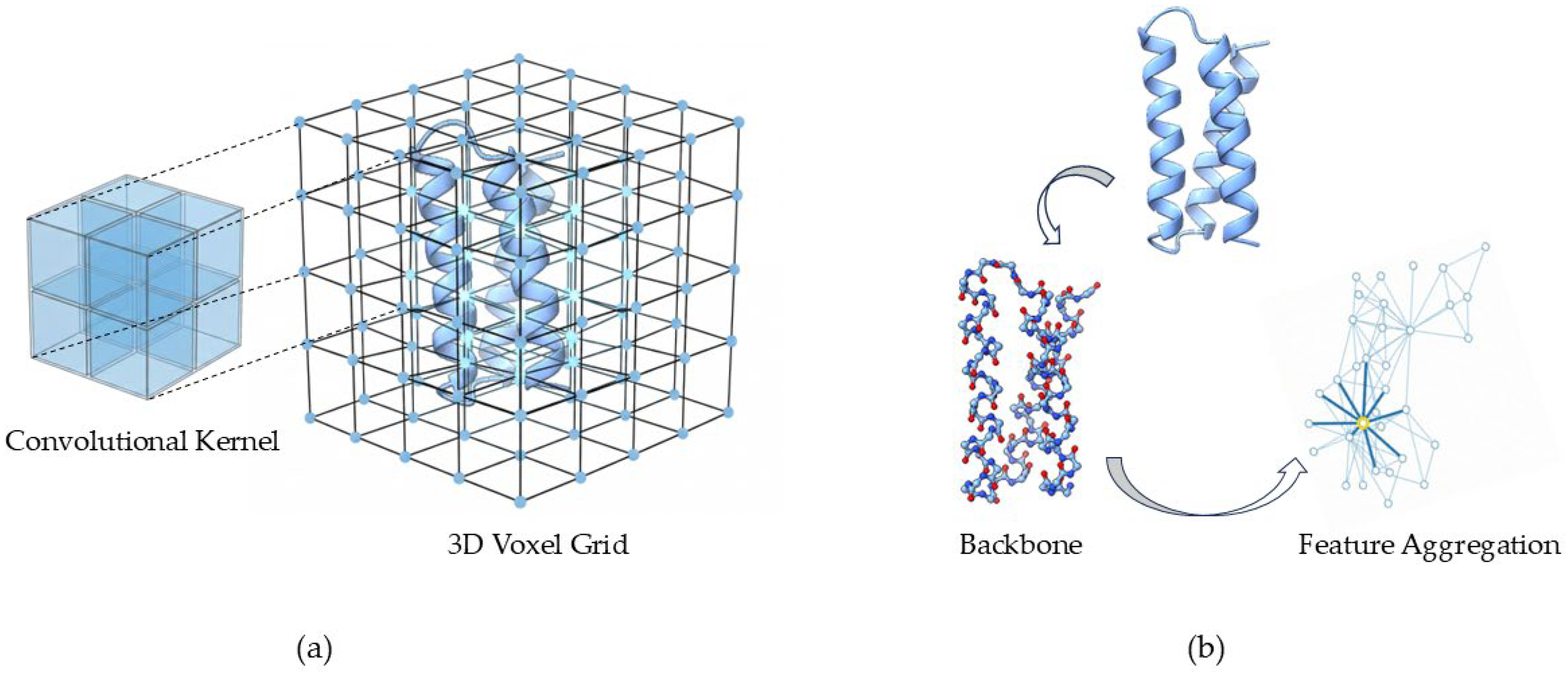
2.1.1. 1D Sequence Semantics
2.1.2. 3D Topological Graphs
2.1.3. SE(3) Geometric Equivariance
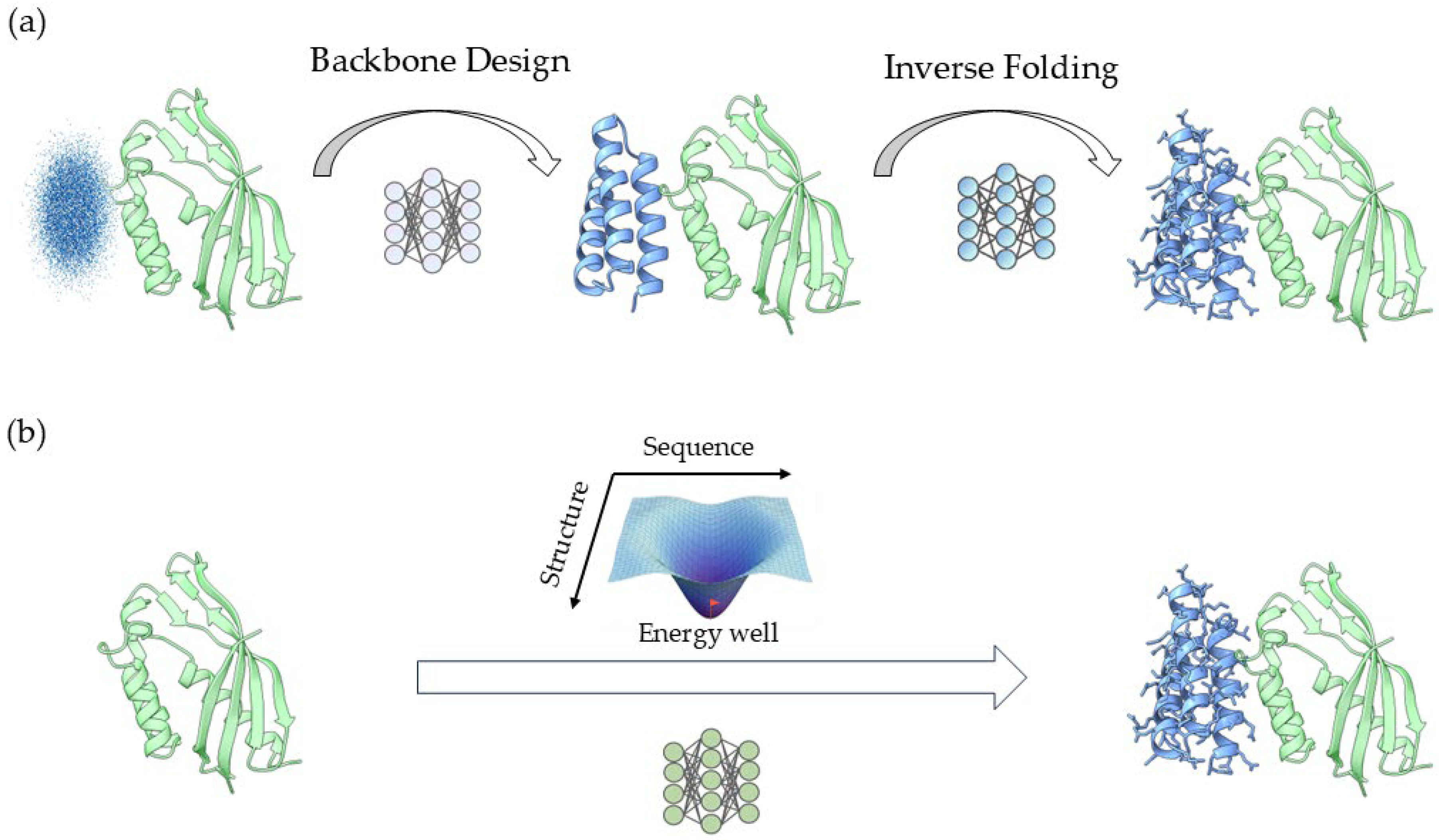
2.2. Sequence–Structure Decoupled Design
2.2.1. Predictor-Driven Hallucination
2.2.2. Backbone Coordinate Generation
2.2.3. Backbone-Conditional Sequence Design
2.3. Hybrid Approaches
2.3.1. Integrated Two-Stage Design
2.3.2. Predictor-Driven Iterative Co-Refinement
2.4. Sequence–Structure Co-Design
2.5. Evaluation Metrics
2.5.1. Physical Validity
2.5.2. Folding Consistency
2.5.3. Design Coverage
3. Applications of Protein Design
3.1. Synthetic Biological Tools
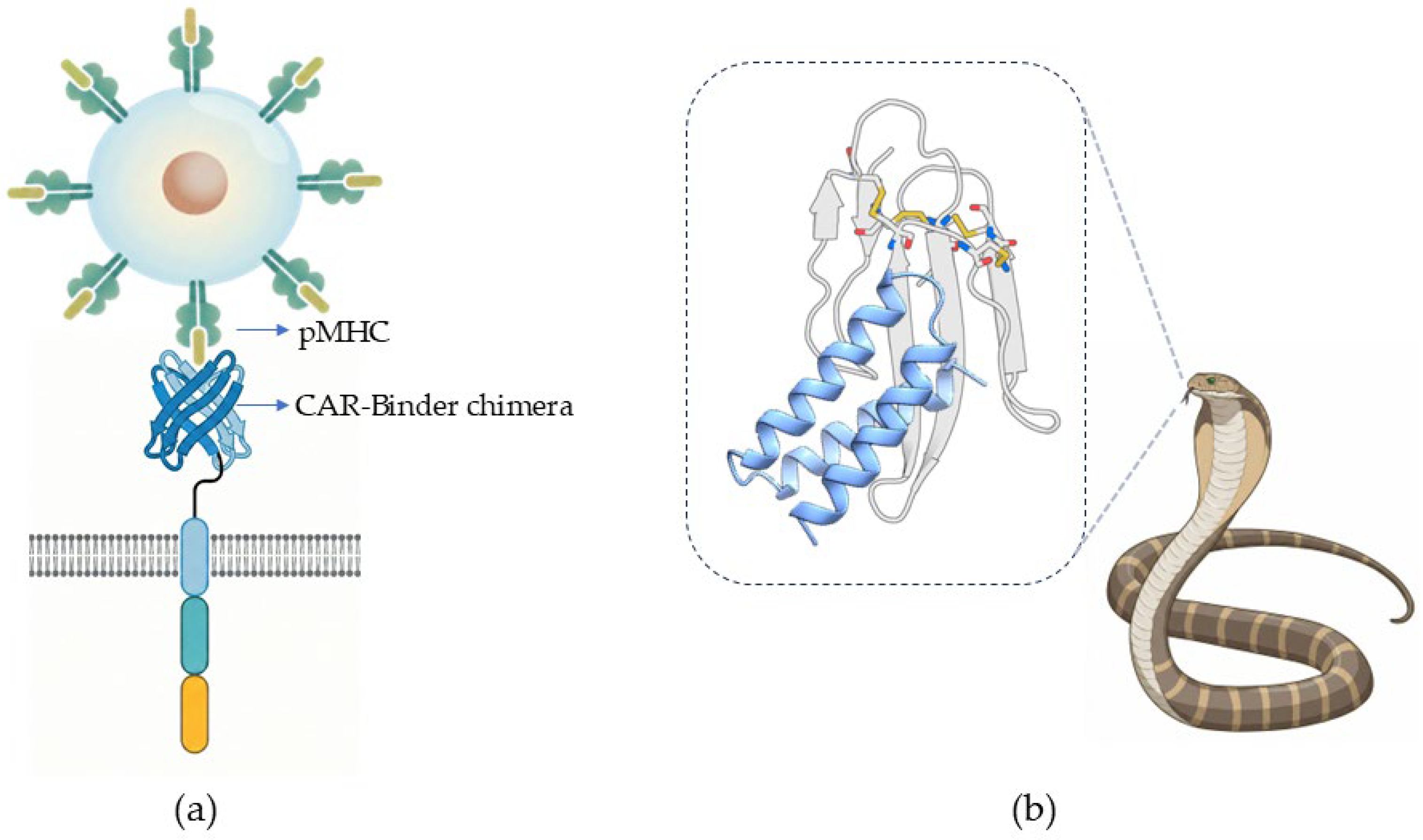
3.2. Therapeutic Applications
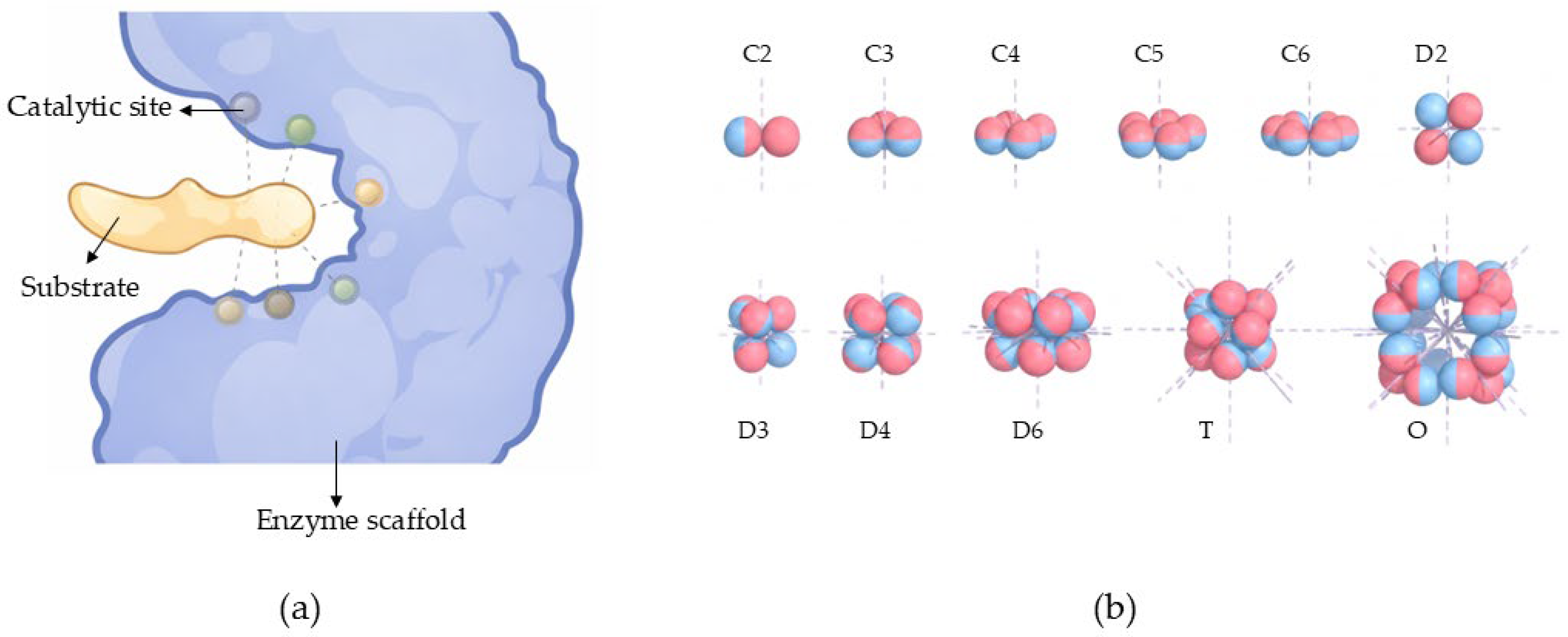
3.3. Enzyme Design and Catalysis
3.4. Protein Materials
4. Outlook
Author Contributions
Funding
Institutional Review Board Statement
Informed Consent Statement
Data Availability Statement
Conflicts of Interest
References
- DeGrado, W.F.; Wasserman, Z.R.; Lear, J.D. Protein Design, a Minimalist Approach. Science 1989, 243, 622–628. [Google Scholar] [CrossRef] [PubMed]
- Hecht, M.H.; Richardson, J.S.; Richardson, D.C.; Ogden, R.C. De Novo Design, Expression, and Characterization of Felix: A Four-Helix Bundle Protein of Native-Like Sequence. Science 1990, 249, 884–891. [Google Scholar] [CrossRef]
- Dahiyat, B.I.; Mayo, S.L. De Novo Protein Design: Fully Automated Sequence Selection. Science 1997, 278, 82–87. [Google Scholar] [CrossRef] [PubMed]
- Ponder, J.W.; Richards, F.M. Tertiary Templates for Proteins: Use of Packing Criteria in the Enumeration of Allowed Sequences for Different Structural Classes. J. Mol. Biol. 1987, 193, 775–791. [Google Scholar] [CrossRef]
- Simons, K.T.; Kooperberg, C.; Huang, E.; Baker, D. Assembly of Protein Tertiary Structures From Fragments with Similar Local Sequences Using Simulated Annealing and Bayesian Scoring Functions. J. Mol. Biol. 1997, 268, 209–225. [Google Scholar] [CrossRef]
- Kuhlman, B.; Dantas, G.; Ireton, G.C.; Varani, G.; Stoddard, B.L.; Baker, D. Design of a Novel Globular Protein Fold with Atomic-Level Accuracy. Science 2003, 302, 1364–1368. [Google Scholar] [CrossRef]
- Huang, P.-S.; Boyken, S.E.; Baker, D. The Coming of Age of de novo Protein Design. Nature 2016, 537, 320–327. [Google Scholar] [CrossRef]
- Jumper, J.; Evans, R.; Pritzel, A.; Green, T.; Figurnov, M.; Ronneberger, O.; Tunyasuvunakool, K.; Bates, R.; Zídek, A.; Potapenko, A.; et al. Highly Accurate Protein Structure Prediction with AlphaFold. Nature 2021, 596, 583–589. [Google Scholar] [CrossRef]
- Baek, M.; DiMaio, F.; Anishchenko, I.; Dauparas, J.; Ovchinnikov, S.; Lee, G.R.; Wang, J.; Cong, Q.; Kinch, L.N.; Schaeffer, R.D.; et al. Accurate Prediction of Protein Structures and Interactions using a Three-track Neural Network. Science 2021, 373, 871–876. [Google Scholar] [CrossRef]
- Khakzad, H.; Igashov, I.; Schneuing, A.; Goverde, C.; Bronstein, M.; Correia, B. A New Age in Protein Design Empowered by Deep Learning. Cell Syst. 2023, 14, 925–939. [Google Scholar] [CrossRef] [PubMed]
- Koh, H.Y.; Zheng, Y.; Yang, M.; Arora, R.; Webb, G.I.; Pan, S.; Li, L.; Church, G.M. AI-driven Protein Design. Nat. Rev. Bioeng. 2025, 3, 1034–1056. [Google Scholar] [CrossRef]
- Notin, P.; Rollins, N.; Gal, Y.; Sander, C.; Marks, D. Machine Learning for Functional Protein Design. Nat. Biotechnol. 2024, 42, 216–228. [Google Scholar] [CrossRef]
- Zhang, Z.; Ou, C.; Cho, Y.; Akiyama, Y.; Ovchinnikov, S. Artificial Intelligence Methods for Protein Folding and Design. Curr. Opin. Struct. Biol. 2025, 93, 103066. [Google Scholar] [CrossRef] [PubMed]
- Rives, A.; Meier, J.; Sercu, T.; Goyal, S.; Lin, Z.; Liu, J.; Guo, D.; Ott, M.; Zitnick, C.L.; Ma, J.; et al. Biological Structure and Function Emerge from Scaling Unsupervised Learning to 250 Million Protein Sequences. Proc. Natl. Acad. Sci. USA 2021, 118, e2016239118. [Google Scholar] [CrossRef]
- Rao, R.; Liu, J.; Verkuil, R.; Meier, J.; Canny, J.F.; Abbeel, P.; Sercu, T.; Rives, A. MSA Transformer. bioRxiv 2021. [Google Scholar] [CrossRef]
- Lin, Z.; Akin, H.; Rao, R.; Hie, B.; Zhu, Z.; Lu, W.; Smetanin, N.; Verkuil, R.; Kabeli, O.; Shmueli, Y.; et al. Evolutionary-scale Prediction of Atomic-level Protein Structure with a Language Model. Science 2023, 379, 1123–1130. [Google Scholar]
- Vig, J.; Madani, A.; Varshney, L.R.; Xiong, C.; Socher, R.; Fatema Rajani, N. BERTology Meets Biology: Interpreting Attention in Protein Language Models. arXiv 2020, arXiv:2006.15222. [Google Scholar]
- Madani, A.; Krause, B.; Greene, E.R.; Subramanian, S.; Mohr, B.P.; Holton, J.M.; Olmos, J.L.; Xiong, C.; Sun, Z.Z.; Socher, R.; et al. Large Language Models Generate Functional Protein Sequences Across Diverse Families. Nat. Biotechnol. 2023, 41, 1099–1106. [Google Scholar] [CrossRef]
- Verkuil, R.; Kabeli, O.; Du, Y.; Wicky, B.I.M.; Milles, L.F.; Dauparas, J.; Baker, D.; Ovchinnikov, S.; Sercu, T.; Rives, A. Language Models Generalize Beyond Natural Proteins. bioRxiv 2022. [Google Scholar] [CrossRef]
- Ferruz, N.; Schmidt, S.; Höcker, B. ProtGPT2 is a Deep Unsupervised Language Model for Protein Design. Nat. Commun. 2022, 13, 4348. [Google Scholar] [CrossRef] [PubMed]
- Qi, Y.; Zhang, J.Z.H. DenseCPD: Improving the Accuracy of Neural-Network-Based Computational Protein Sequence Design with DenseNet. J. Chem. Inf. Model. 2020, 60, 1245–1252. [Google Scholar] [CrossRef]
- Anand, N.; Achim, T. Protein Structure and Sequence Generation with Equivariant Denoising Diffusion Probabilistic Models. arXiv 2022, arXiv:2205.15019. [Google Scholar] [CrossRef]
- Ingraham, J.; Garg, V.; Barzilay, R.; Jaakkola, T. Generative Models for Graph-Based Protein Design. In Proceedings of the 33rd International Conference on Neural Information Processing Systems; Curran Associates Inc.: Red Hook, NY, USA, 2019; pp. 15820–15831. [Google Scholar]
- Jing, B.; Eismann, S.; Suriana, P.; Townshend, R.J.L.; Dror, R. Learning from Protein Structure with Geometric Vector Perceptrons. arXiv 2020, arXiv:2009.01411. [Google Scholar]
- Strokach, A.; Becerra, D.; Corbi-Verge, C.; Perez-Riba, A.; Kim, P.M. Fast and Flexible Protein Design Using Deep Graph Neural Networks. Cell Syst. 2020, 11, 402–411 e4. [Google Scholar] [CrossRef]
- Dauparas, J.; Anishchenko, I.; Bennett, N.; Bai, H.; Ragotte, R.J.; Milles, L.F.; Wicky, B.I.M.; Courbet, A.; de Haas, R.J.; Bethel, N.; et al. Robust Deep Learning–based Protein Sequence Design using ProteinMPNN. Science 2022, 378, 49–56. [Google Scholar] [CrossRef] [PubMed]
- Dauparas, J.; Lee, G.R.; Pecoraro, R.; An, L.; Anishchenko, I.; Glasscock, C.; Baker, D. Atomic Context-conditioned Protein Sequence Design using LigandMPNN. Nat. Methods 2025, 22, 717–723. [Google Scholar] [CrossRef] [PubMed]
- Hsu, C.; Verkuil, R.; Liu, J.; Lin, Z.; Hie, B.; Sercu, T.; Lerer, A.; Rives, A. Learning Inverse Folding from Millions of Predicted Structures. bioRxiv 2022. [Google Scholar] [CrossRef]
- Bronstein, M.M.; Bruna, J.; Cohen, T.; Veličković, P. Geometric Deep Learning: Grids, Groups, Graphs, Geodesics, and Gauges. arXiv 2021, arXiv:2104.13478. [Google Scholar] [CrossRef]
- Cohen, T.S.; Welling, M. Group Equivariant Convolutional Networks. arXiv 2016, arXiv:1602.07576. [Google Scholar] [CrossRef]
- Thomas, N.; Smidt, T.; Kearnes, S.; Yang, L.; Li, L.; Kohlhoff, K.; Riley, P. Tensor Field Networks: Rotation- and Translation-Equivariant Neural Networks for 3D Point Clouds. arXiv 2018, arXiv:1802.08219. [Google Scholar] [CrossRef]
- Weiler, M.; Geiger, M.; Welling, M.; Boomsma, W.; Cohen, T. 3D Steerable CNNs: Learning Rotationally Equivariant Features in Volumetric Data. arXiv 2018, arXiv:1807.02547. [Google Scholar] [CrossRef]
- Fuchs, F.B.; Worrall, D.E.; Fischer, V.; Welling, M. SE(3)-Transformers: 3D Roto-Translation Equivariant Attention Networks. arXiv 2020, arXiv:2006.10503. [Google Scholar]
- Garcia Satorras, V.; Hoogeboom, E.; Welling, M. E(n) Equivariant Graph Neural Networks. arXiv 2021, arXiv:2102.09844. [Google Scholar]
- Deng, C.; Litany, O.; Duan, Y.; Poulenard, A.; Tagliasacchi, A.; Guibas, L. Vector Neurons: A General Framework for SO(3)-Equivariant Networks. arXiv 2021, arXiv:2104.12229. [Google Scholar] [CrossRef]
- Anishchenko, I.; Pellock, S.J.; Chidyausiku, T.M.; Ramelot, T.A.; Ovchinnikov, S.; Hao, J.; Bafna, K.; Norn, C.; Kang, A.; Bera, A.K.; et al. De novo Protein Design by Deep Network Hallucination. Nature 2021, 600, 547–552. [Google Scholar] [CrossRef]
- Jendrusch, M.A.; Yang, A.L.J.; Cacace, E.; Bobonis, J.; Voogdt, C.G.P.; Kaspar, S.; Schweimer, K.; Perez-Borrajero, C.; Lapouge, K.; Scheurich, J.; et al. AlphaDesign: A de novo Protein Design Framework Based on AlphaFold. Mol. Syst. Biol. 2025, 21, 1166–1189. [Google Scholar] [CrossRef]
- Moffat, L.; Greener, J.G.; Jones, D.T. Using AlphaFold for Rapid and Accurate Fixed Backbone Protein Design. bioRxiv 2021. [Google Scholar] [CrossRef]
- Moffat, L.; Kandathil, S.M.; Jones, D.T. Design in the DARK: Learning Deep Generative Models for De Novo Protein Design. bioRxiv 2022. [Google Scholar] [CrossRef]
- Wang, J.; Lisanza, S.; Juergens, D.; Tischer, D.; Watson, J.L.; Castro, K.M.; Ragotte, R.; Saragovi, A.; Milles, L.F.; Baek, M.; et al. Scaffolding Protein Functional Sites using Deep Learning. Science 2022, 377, 387–394. [Google Scholar] [CrossRef]
- Wicky, B.I.M.; Milles, L.F.; Courbet, A.; Ragotte, R.J.; Dauparas, J.; Kinfu, E.; Tipps, S.; Kibler, R.D.; Baek, M.; DiMaio, F.; et al. Hallucinating Symmetric Protein Assemblies. Science 2022, 378, 56–61. [Google Scholar] [CrossRef]
- Ingraham, J.B.; Baranov, M.; Costello, Z.; Barber, K.W.; Wang, W.; Ismail, A.; Frappier, V.; Lord, D.M.; Ng-Thow-Hing, C.; Van Vlack, E.R.; et al. Iluminating Protein Space with a Programmable Generative Model. Nature 2023, 623, 1070–1078. [Google Scholar] [CrossRef]
- Watson, J.L.; Juergens, D.; Bennett, N.R.; Trippe, B.L.; Yim, J.; Eisenach, H.E.; Ahern, W.; Borst, A.J.; Ragotte, R.J.; Milles, L.F.; et al. De Novo Design of Protein Structure and Function with RFdiffusion. Nature 2023, 620, 1089–1100. [Google Scholar] [CrossRef]
- Yim, J.; Trippe, B.L.; De Bortoli, V.; Mathieu, E.; Doucet, A.; Barzilay, R.; Jaakkola, T. SE(3) Diffusion Model with Application to Protein Backbone Generation. arXiv 2023, arXiv:2302.02277. [Google Scholar] [CrossRef]
- De Bortoli, V.; Mathieu, E.; Hutchinson, M.; Thornton, J.; Whye Teh, Y.; Doucet, A. Riemannian Score-Based Generative Modelling. arXiv 2022, arXiv:2202.02763. [Google Scholar] [CrossRef]
- Geffner, T.; Didi, K.; Zhang, Z.; Reidenbach, D.; Cao, Z.; Yim, J.; Geiger, M.; Dallago, C.; Kucukbenli, E.; Vahdat, A.; et al. Proteina: Scaling Flow-based Protein Structure Generative Models. arXiv 2025, arXiv:2503.00710. [Google Scholar] [CrossRef]
- Dauparas, J. Backbone Conditional Protein Sequence Design. Cold Spring Harb. Perspect. Biol. 2026, 18, a041517. [Google Scholar] [CrossRef] [PubMed]
- Yang, K.K.; Zanichelli, N.; Yeh, H. Masked Inverse Folding with Sequence Transfer for Protein Representation Learning. Protein Eng. Des. Sel. 2022, 36, gzad015. [Google Scholar] [CrossRef]
- Gao, Z.; Tan, C.; Chacón, P.; Li, S.Z. PiFold: Toward Effective and Efficient Protein Inverse Folding. arXiv 2022, arXiv:2209.12643. [Google Scholar]
- Anand, N.; Eguchi, R.; Mathews, I.I.; Perez, C.P.; Derry, A.; Altman, R.B.; Huang, P.-S. Protein Sequence Design with a Learned Potential. Nat. Commun. 2022, 13, 746. [Google Scholar] [CrossRef]
- Li, A.J.; Lu, M.; Desta, I.; Sundar, V.; Grigoryan, G.; Keating, A.E. Neural Network-derived Potts Models for Structure-Based Protein Design using Backbone Atomic Coordinates and Tertiary Motifs. Protein Sci. 2023, 32, e4554. [Google Scholar] [CrossRef] [PubMed]
- Zhang, O.; Zhang, X.; Lin, H.; Tan, C.; Wang, Q.; Mo, Y.; Feng, Q.; Du, G.; Yu, Y.; Jin, Z.; et al. ODesign: A World Model for Biomolecular Interaction Design. arXiv 2025, arXiv:2510.22304. [Google Scholar] [CrossRef]
- Abramson, J.; Adler, J.; Dunger, J.; Evans, R.; Green, T.; Pritzel, A.; Ronneberger, O.; Willmore, L.; Ballard, A.J.; Bambrick, J.; et al. Accurate Structure Prediction of Biomolecular Interactions with AlphaFold 3. Nature 2024, 630, 493–500. [Google Scholar] [CrossRef]
- Wohlwend, J.; Corso, G.; Passaro, S.; Getz, N.; Reveiz, M.; Leidal, K.; Swiderski, W.; Atkinson, L.; Portnoi, T.; Chinn, I.; et al. Boltz-1 Democratizing Biomolecular Interaction Modeling. bioRxiv 2025. [Google Scholar] [CrossRef]
- Passaro, S.; Corso, G.; Wohlwend, J.; Reveiz, M.; Thaler, S.; Somnath, V.R.; Getz, N.; Portnoi, T.; Roy, J.; Stark, H.; et al. Boltz-2: Towards Accurate and Efficient Binding Affinity Prediction. bioRxiv 2025. [Google Scholar] [CrossRef]
- Discovery, C.; Boitreaud, J.; Dent, J.; McPartlon, M.; Meier, J.; Reis, V.; Rogozhnikov, A.; Wu, K. Chai-1: Decoding the Molecular Interactions of Life. bioRxiv 2024. [Google Scholar] [CrossRef]
- Frank, C.; Khoshouei, A.; Fuβ, L.; Schiwietz, D.; Putz, D.; Weber, L.; Zhao, Z.; Hattori, M.; Feng, S.; de Stigter, Y.; et al. Scalable Protein Design Using Optimization in a Relaxed Sequence Space. Science 2024, 386, 439–445. [Google Scholar] [CrossRef]
- Pacesa, M.; Nickel, L.; Schellhaas, C.; Schmidt, J.; Pyatova, E.; Kissling, L.; Barendse, P.; Choudhury, J.; Kapoor, S.; Alcaraz-Serna, A.; et al. BindCraft: One-shot Design of Functional Protein Binders. bioRxiv 2025. [Google Scholar] [CrossRef] [PubMed]
- Fang, M.; Wang, C.; Shi, J.; Lian, F.; Jin, Q.; Wang, Z.; Zhang, Y.; Cui, Z.; Wang, Y.; Ke, Y.; et al. HalluDesign: Protein Optimization and de novo Design via Iterative Structure Hallucination and Sequence design. bioRxiv 2025. [Google Scholar] [CrossRef]
- Cho, Y.; Rangel, G.; Bhardwaj, G.; Ovchinnikov, S. Protein Hunter: Exploiting Structure Hallucination within Diffusion for Protein Design. bioRxiv 2025. [Google Scholar] [CrossRef]
- Stark, H.; Faltings, F.; Choi, M.; Xie, Y.; Hur, E.; O’Donnell, T.; Bushuiev, A.; Uçar, T.; Passaro, S.; Mao, W.; et al. BoltzGen: Toward Universal Binder Design. bioRxiv 2025. [Google Scholar] [CrossRef] [PubMed]
- Butcher, J.; Krishna, R.; Mitra, R.; Brent, R.I.; Li, Y.; Corley, N.; Kim, P.T.; Funk, J.; Mathis, S.; Salike, S.; et al. De novo Design of All-atom Biomolecular Interactions with RFdiffusion3. bioRxiv 2025. [Google Scholar] [CrossRef]
- Qu, W.; Guan, J.; Ma, R.; Zhai, K.; Wu, W.; Wang, H. P(all-atom) Is Unlocking New Path For Protein Design. bioRxiv 2025. [Google Scholar] [CrossRef]
- Ren, M.; Zhu, T.; Zhang, H. CarbonNovo: Joint Design of Protein structure and Sequence Using a Unified Energy-based Model. In Proceedings of the 41st International Conference on Machine Learning, Vienna, Austria, 2024; JMLR Inc.: New York, NY, USA, 2024. [Google Scholar]
- Geffner, T.; Didi, K.; Cao, Z.; Reidenbach, D.; Zhang, Z.; Dallago, C.; Kucukbenli, E.; Kreis, K.; Vahdat, A. La-Proteina: Atomistic Protein Generation via Partially Latent Flow Matching. arXiv 2025, arXiv:2507.09466. [Google Scholar] [CrossRef]
- Didi, K.; Zhang, Z.; Zhou, G.; Reidenbach, D.; Cao, Z.; Cha, S.; Geffner, T.; Dallago, C.; Tang, J.; Bronstein, M.M.; et al. Scaling Atomistic Protein Binder Design with Generative Pretraining and Test-Time Compute. arXiv 2026, arXiv:2603.27950. [Google Scholar] [CrossRef]
- Team, L.L.; Bridgland, A.; Crabbé, J.; Kenlay, H.; Pretorius, D.; Schmon, S.M.; Hilmkil, A.; Bartke-Croughan, R.; Rombach, R.; Flashman, M.; et al. Latent-X: An Atom-level Frontier Model for De Novo Protein Binder Design. arXiv 2025, arXiv:2507.19375. [Google Scholar]
- Lu, A.X.; Yan, W.; Robinson, S.A.; Kelow, S.; Yang, K.K.; Gligorijevic, V.; Cho, K.; Bonneau, R.; Abbeel, P.; Frey, N.C. Controllable All-Atom Protein Generation with Latent Diffusion. bioRxiv 2025. [Google Scholar] [CrossRef]
- Campbell, A.; Yim, J.; Barzilay, R.; Rainforth, T.; Jaakkola, T. Generative Flows on Discrete State-Spaces: Enabling Multimodal Flows with Applications to Protein Co-Design. arXiv 2024, arXiv:2402.04997. [Google Scholar] [CrossRef]
- Castorina, L.V.; Petrenas, R.; Subr, K.; Wood, C.W. PDBench: Evaluating Computational Methods for Protein Sequence Design. arXiv 2021, arXiv:2109.07925. [Google Scholar] [CrossRef] [PubMed]
- Petukh, M.; Kucukkal, T.G.; Alexov, E. On Human Disease-Causing Amino Acid Variants: Statistical Study of Sequence and Structural Patterns. Hum. Mutat. 2015, 36, 524–534. [Google Scholar] [CrossRef]
- Liu, C.; Wu, K.; Choi, H.; Han, H.L.; Zhang, X.; Watson, J.L.; Ahn, G.; Zhang, J.Z.; Shijo, S.; Good, L.L.; et al. Diffusing Protein Binders to Intrinsically Disordered Proteins. Nature 2025, 644, 809–817. [Google Scholar] [CrossRef]
- Park, J.-C.; Uhm, H.; Kim, Y.-W.; Oh, Y.E.; Lee, J.H.; Yang, J.; Kim, K.; Bae, S. AI-generated MLH1 Small Binder Improves Prime Editing Efficiency. Cell 2025, 188, 5831–5846.e21. [Google Scholar] [CrossRef] [PubMed]
- Ahn, G.; Coventry, B.; Haefner, E.; Sadre, S.; Hu, J.; Van, M.; Huang, B.; Sappington, I.; Broerman, A.J.; Lichtenstein, M.A.; et al. Computational Design of pH-sensitive Binders. bioRxiv 2025. [Google Scholar] [CrossRef]
- Wolf, B.; Shehu, P.; Brenker, L.; von Bachmann, A.-L.; Kroell, A.-S.; Southern, N.; Holderbach, S.; Eigenmann, J.; Aschenbrenner, S.; Mathony, J.; et al. Rational Engineering of Allosteric Protein Switches by in Silico Prediction of Domain Insertion Sites. Nat. Methods 2025, 22, 1698–1706. [Google Scholar] [CrossRef]
- Jin, Q.; Wang, Y.; Chen, D.; Liao, J.; Cui, Z.; Fan, Y.; Zeng, A.; Xie, M.; Cao, L. De novo Design of Small Molecule–regulated Protein Oligomers. Science 2026, 391, eady6017. [Google Scholar] [CrossRef]
- Zhou, C.; Li, H.; Wang, J.; Qian, C.; Xiong, H.; Chu, Z.; Shao, Q.; Li, X.; Sun, S.; Sun, K.; et al. De novo Designed Voltage-gated Anion Channels Suppress Neuron Firing. Cell 2025, 188, 7495–7511.e21. [Google Scholar] [CrossRef]
- Zhu, J.; Liang, M.; Sun, K.; Wei, Y.; Guo, R.; Zhang, L.; Shi, J.; Ma, D.; Hu, Q.; Huang, G.; et al. De novo Design of Transmembrane Fluorescence-activating Proteins. Nature 2025, 640, 249–257. [Google Scholar] [CrossRef]
- Liu, B.; Greenwood, N.F.; Bonzanini, J.E.; Motmaen, A.; Meyerberg, J.; Dao, T.; Xiang, X.; Ault, R.; Sharp, J.; Wang, C.; et al. Design of High-Specificity Binders for Peptide–MHC-I Complexes. Science 2025, 389, 386–391. [Google Scholar] [PubMed]
- Householder, K.D.; Xiang, X.; Jude, K.M.; Deng, A.; Obenaus, M.; Zhao, Y.; Wilson, S.C.; Chen, X.; Wang, N.; Garcia, K.C. De novo Design and Structure of a Peptide–centric TCR Mimic Binding Module. Science 2025, 389, 375–379. [Google Scholar] [CrossRef]
- Johansen, K.H.; Wolff, D.S.; Scapolo, B.; Fernández-Quintero, M.L.; Risager Christensen, C.; Loeffler, J.R.; Rivera-de-Torre, E.; Overath, M.D.; Kjærgaard Munk, K.; Morell, O.; et al. De novo-designed pMHC Binders Facilitate T cell–Mediated Cytotoxicity toward Cancer Cells. Science 2025, 389, 380–385. [Google Scholar]
- Mout, R.; Jing, R.; Tanaka-Yano, M.; Egan, E.D.; Eisenach, H.; Kononov, M.A.; Windisch, R.; Najia, M.A.T.; Tompkins, A.; Hensch, L.; et al. Design of Soluble Notch Agonists that Drive T cell Development and Boost Immunity. Cell 2025, 188, 5980–5994.e28. [Google Scholar] [CrossRef] [PubMed]
- Broerman, A.J.; Pollmann, C.; Zhao, Y.; Lichtenstein, M.A.; Jackson, M.D.; Tessmer, M.H.; Ryu, W.H.; Ogishi, M.; Abedi, M.H.; Sahtoe, D.D.; et al. Design of Facilitated Dissociation Enables Timing of Cytokine Signalling. Nature 2025, 647, 528–535. [Google Scholar] [CrossRef] [PubMed]
- Wang, X.; Cardoso, S.; Cai, K.; Venkatesh, P.; Hung, A.; Ng, M.; Hall, C.; Coventry, B.; Lee, D.S.; Chowhan, R.; et al. Tuning Insulin Receptor Signaling using de novo-designed Agonists. Mol. Cell 2025, 85, 4064–4081.e9. [Google Scholar] [CrossRef] [PubMed]
- Cheng, S.; Guo, J.; Zhou, Y.-l.; Luo, X.; Zhang, G.; Zhang, Y.-z.; Yang, Y.; Xie, J.; Xu, P.; Shen, D.-d.; et al. De novo Design of GPCR Exoframe Modulators. Nature 2026, 651, 242–250. [Google Scholar] [CrossRef]
- Mahling, R.; Hegyi, B.; Cullen, E.R.; Cho, T.M.; Rodriques, A.R.; Fossier, L.; Yehya, M.; Yang, L.; Chen, B.-X.; Katchman, A.N.; et al. De novo Design of a Peptide Modulator to Reverse Sodium Channel Dysfunction Linked to Cardiac Arrhythmias and Epilepsy. Cell 2025, 188, 6170–6185.e19. [Google Scholar] [CrossRef]
- Vázquez Torres, S.; Benard Valle, M.; Mackessy, S.P.; Menzies, S.K.; Casewell, N.R.; Ahmadi, S.; Burlet, N.J.; Muratspahić, E.; Sappington, I.; Overath, M.D.; et al. De novo Designed Proteins Neutralize Lethal Snake Venom Toxins. Nature 2025, 639, 225–231. [Google Scholar] [CrossRef]
- Listov, D.; Vos, E.; Hoffka, G.; Hoch, S.Y.; Berg, A.; Hamer-Rogotner, S.; Dym, O.; Kamerlin, S.C.L.; Fleishman, S.J. Complete Computational Design of High-efficiency Kemp Elimination Enzymes. Nature 2025, 643, 1421–1427. [Google Scholar] [CrossRef]
- Lauko, A.; Pellock, S.J.; Sumida, K.H.; Anishchenko, I.; Juergens, D.; Ahern, W.; Jeung, J.; Shida, A.F.; Hunt, A.; Kalvet, I.; et al. Computational Design of Serine Hydrolases. Science 2025, 388, eadu2454. [Google Scholar] [CrossRef]
- Hou, K.; Huang, W.; Qi, M.; Tugwell, T.H.; Alturaifi, T.M.; Chen, Y.; Zhang, X.; Lu, L.; Mann, S.I.; Liu, P.; et al. De novo Design of Porphyrin-containing Proteins as Efficient and Stereoselective Catalysts. Science 2025, 388, 665–670. [Google Scholar] [CrossRef]
- Zou, Z.; Kalvet, I.; Lozhkin, B.; Morris, E.; Zhang, K.; Chen, D.; Ernst, M.L.; Zhang, X.; Baker, D.; Ward, T.R. De novo Design and Evolution of an Artificial Metathase for Cytoplasmic Olefin Metathesis. Nat. Catal. 2025, 8, 1208–1219. [Google Scholar] [CrossRef] [PubMed]
- Wang, S.; Favor, A.; Kibler, R.D.; Lubner, J.M.; Borst, A.J.; Coudray, N.; Redler, R.L.; Chiang, H.T.; Sheffler, W.; Hsia, Y.; et al. Bond-centric Modular Design of Protein Assemblies. Nat. Mater. 2025, 24, 1644–1652. [Google Scholar] [CrossRef]
- Rankovic, S.; Carr, K.D.; Decarreau, J.; Skotheim, R.; Kibler, R.D.; Ols, S.; Lee, S.; Chun, J.-H.; Tooley, M.R.; Dauparas, J.; et al. Computational Design of Bifaceted Protein Nanomaterials. Nat. Mater. 2025, 24, 1635–1643. [Google Scholar] [CrossRef] [PubMed]


Disclaimer/Publisher’s Note: The statements, opinions and data contained in all publications are solely those of the individual author(s) and contributor(s) and not of MDPI and/or the editor(s). MDPI and/or the editor(s) disclaim responsibility for any injury to people or property resulting from any ideas, methods, instructions or products referred to in the content. |
© 2026 by the authors. Licensee MDPI, Basel, Switzerland. This article is an open access article distributed under the terms and conditions of the Creative Commons Attribution (CC BY) license.
Share and Cite
Luo, S.; Zhou, B. Generative Protein Design: From Deep Learning Algorithms to Translational Applications. Int. J. Mol. Sci. 2026, 27, 3917. https://doi.org/10.3390/ijms27093917
Luo S, Zhou B. Generative Protein Design: From Deep Learning Algorithms to Translational Applications. International Journal of Molecular Sciences. 2026; 27(9):3917. https://doi.org/10.3390/ijms27093917
Chicago/Turabian StyleLuo, Shaotong, and Bo Zhou. 2026. "Generative Protein Design: From Deep Learning Algorithms to Translational Applications" International Journal of Molecular Sciences 27, no. 9: 3917. https://doi.org/10.3390/ijms27093917
APA StyleLuo, S., & Zhou, B. (2026). Generative Protein Design: From Deep Learning Algorithms to Translational Applications. International Journal of Molecular Sciences, 27(9), 3917. https://doi.org/10.3390/ijms27093917