Type 1 Brugada Pattern Triggered by Low-Grade Fever: Implications for Diagnosis and Risk Stratification
 ,
,  , , , ,
Abstract
1. Introduction
1.1. Temperature-Dependent Gating Alterations
1.2. Conformational Instability and Thermosensitive Protein Structure
1.3. Trafficking Defects and Proteostatic Disturbances
1.4. Disruption of Ionic Current Balance
1.5. Post-Translational and Inflammatory Modulation
2. Case Presentation
3. Discussion
4. Materials and Methods
4.1. Study Protocol
4.2. Echocardiography
4.3. Electrocardiography
4.4. Laboratory Parameters
4.5. Genetic Testing
5. Conclusions
Author Contributions
Funding
Institutional Review Board Statement
Informed Consent Statement
Data Availability Statement
Conflicts of Interest
Abbreviations
| BrS | Brugada syndrome |
| RVOT | Right ventricular outflow tract |
| INa | Inward sodium current |
| ICa-L | Inward L-type calcium current |
| Ito | Transient outward potassium current |
| SCN5A | Sodium channel protein type 5 |
| AP | Action potential |
| VF | Ventricular fibrillation |
| SCD | Sudden cardiac death |
| ECG | Electrocardiogram |
| ICD | Implantable cardioverter defibrillator |
References
- Vutthikraivit, W.; Rattanawong, P.; Putthapiban, P.; Sukhumthammarat, W.; Vathesatogkit, P.; Ngarmukos, T.; Thakkinstian, A. Worldwide Prevalence of Brugada Syndrome: A Systematic Review and Meta-Analysis. Acta Cardiol. Sin. 2018, 34, 267–277, Erratum in Acta Cardiol. Sin. 2019, 35, 192. [Google Scholar] [CrossRef]
- Ishikawa, T.; Masuda, T.; Hachiya, T.; Dina, C.; Simonet, F.; Nagata, Y.; Tanck, M.W.T.; Sonehara, K.; Glinge, C.; Tadros, R.; et al. Brugada syndrome in Japan and Europe: A genome-wide association study reveals shared genetic architecture and new risk loci. Eur. Heart J. 2024, 45, 2320–2332. [Google Scholar] [CrossRef] [PubMed]
- Milman, A.; Andorin, A.; Gourraud, J.B.; Sacher, F.; Mabo, P.; Kim, S.H.; Maeda, S.; Takahashi, Y.; Kamakura, T.; Aiba, T.; et al. Age of First Arrhythmic Event in Brugada Syndrome: Data From the SABRUS (Survey on Arrhythmic Events in Brugada Syndrome) in 678 Patients. Circ. Arrhythmia Electrophysiol. 2017, 10, e005222. [Google Scholar] [CrossRef] [PubMed]
- Berthome, P.; Tixier, R.; Briand, J.; Geoffroy, O.; Babuty, D.; Mansourati, J.; Jesel, L.; Dupuis, J.M.; Bru, P.; Kyndt, F.; et al. Clinical presentation and follow-up of women affected by Brugada syndrome. Heart Rhythm 2019, 16, 260–267. [Google Scholar] [CrossRef] [PubMed]
- Asatryan, B.; Barth, A.S. Sex-related differences in incidence, phenotype and risk of sudden cardiac death in inherited arrhythmia syndromes. Front. Cardiovasc. Med. 2022, 9, 1010748. [Google Scholar] [CrossRef]
- Shimizu, W.; Matsuo, K.; Kokubo, Y.; Satomi, K.; Kurita, T.; Noda, T.; Nagaya, N.; Suyama, K.; Aihara, N.; Kamakura, S.; et al. Sex hormone and gender difference—role of testosterone on male predominance in Brugada syndrome. J. Cardiovasc. Electrophysiol. 2007, 18, 415–421. [Google Scholar] [CrossRef]
- Kataoka, N.; Imamura, T. Brugada Syndrome: A Comprehensive Review of Fundamental and Electrophysiological New Findings. J. Clin. Med. 2023, 12, 6590. [Google Scholar] [CrossRef]
- Basile, P.; Carella, M.C.; Zaccaro, S.; Dicorato, M.M.; Sgarra, L.; Khan, Y.; Pontone, G.; Luzzi, G.; Santobuono, V.E.; Forleo, C.; et al. MEPPC Syndrome: A Systematic Review and State-of-the-Art Paper. Circ. Arrhythm. Electrophysiol. 2025, 18, e014113. [Google Scholar] [CrossRef]
- Remme, C.A.; Wilde, A.A.; Bezzina, C.R. Cardiac sodium channel overlap syndromes: Different faces of SCN5A mutations. Trends Cardiovasc. Med. 2008, 18, 78–87. [Google Scholar] [CrossRef]
- Wilde, A.A.M.; Amin, A.S. Clinical Spectrum of SCN5A Mutations: Long QT Syndrome, Brugada Syndrome, and Cardiomyopathy. JACC Clin. Electrophysiol. 2018, 4, 569–579. [Google Scholar] [CrossRef]
- Campuzano, O.; Sarquella-Brugada, G.; Cesar, S.; Arbelo, E.; Brugada, J.; Brugada, R. Update on Genetic Basis of Brugada Syndrome: Monogenic, Polygenic or Oligogenic? Int. J. Mol. Sci. 2020, 21, 7155. [Google Scholar] [CrossRef]
- Monasky, M.M.; Micaglio, E.; Locati, E.T.; Pappone, C. Evaluating the Use of Genetics in Brugada Syndrome Risk Stratification. Front. Cardiovasc. Med. 2021, 8, 652027. [Google Scholar] [CrossRef]
- Keller, D.I.; Huang, H.; Zhao, J.; Frank, R.; Suarez, V.; Delacretaz, E.; Brink, M.; Osswald, S.; Schwick, N.; Chahine, M. A novel SCN5A mutation, F1344S, identified in a patient with Brugada syndrome and fever-induced ventricular fibrillation. Cardiovasc. Res. 2006, 70, 521–529. [Google Scholar] [CrossRef]
- Keller, D.I.; Rougier, J.S.; Kucera, J.P.; Benammar, N.; Fressart, V.; Guicheney, P.; Madle, A.; Fromer, M.; Schlapfer, J.; Abriel, H. Brugada syndrome and fever: Genetic and molecular characterization of patients carrying SCN5A mutations. Cardiovasc. Res. 2005, 67, 510–519. [Google Scholar] [CrossRef] [PubMed]
- Kasbekar, R.; Naz, A.; Marcos, L.; Liu, Y.; Hendrickson, K.; Gorsich, J.C.; Baun, M. Threshold for defining fever varies with age, especially in children: A multi-site diagnostic accuracy study. Nurs. Open 2021, 8, 2705–2721. [Google Scholar] [CrossRef] [PubMed]
- Li, Y.; Dinkel, H.; Pakalniskyte, D.; Busley, A.V.; Cyganek, L.; Zhong, R.; Zhang, F.; Xu, Q.; Maywald, L.; Aweimer, A.; et al. Novel insights in the pathomechanism of Brugada syndrome and fever-related type 1 ECG changes in a preclinical study using human-induced pluripotent stem cell-derived cardiomyocytes. Clin. Transl. Med. 2023, 13, e1130. [Google Scholar] [CrossRef] [PubMed]
- Popovic, D.; Lavie, C.J. Stress, Cardiovascular Diseases and Exercise—A Narrative Review. Heart Mind 2023, 7, 18–24. [Google Scholar] [CrossRef]
- Gill, A.; Aldosoky, W.; Ong, M.B.H.; Mir, T.; Dar, T.; Abohashem, S. A Narrative Review on Mental Stress and Cardiovascular Disease: Evidence, Mechanisms, and Potential Interventions. Heart Mind 2023, 7, 62–69. [Google Scholar] [CrossRef]
- Chen, G.X.; Barajas-Martinez, H.; Ciconte, G.; Wu, C.I.; Monasky, M.M.; Xia, H.; Li, B.; Capra, J.A.; Guo, K.; Zhang, Z.H.; et al. Clinical characteristics and electrophysiologic properties of SCN5A variants in fever-induced Brugada syndrome. eBioMedicine 2023, 87, 104388. [Google Scholar] [CrossRef]
- Priori, S.G.; Blomstrom-Lundqvist, C.; Mazzanti, A.; Blom, N.; Borggrefe, M.; Camm, J.; Elliott, P.M.; Fitzsimons, D.; Hatala, R.; Hindricks, G.; et al. 2015 ESC Guidelines for the management of patients with ventricular arrhythmias and the prevention of sudden cardiac death: The Task Force for the Management of Patients with Ventricular Arrhythmias and the Prevention of Sudden Cardiac Death of the European Society of Cardiology (ESC)Endorsed by: Association for European Paediatric and Congenital Cardiology (AEPC). Europace 2015, 17, 1601–1687. [Google Scholar] [CrossRef]
- Zeppenfeld, K.; Tfelt-Hansen, J.; de Riva, M.; Winkel, B.G.; Behr, E.R.; Blom, N.A.; Charron, P.; Corrado, D.; Dagres, N.; de Chillou, C.; et al. 2022 ESC Guidelines for the management of patients with ventricular arrhythmias and the prevention of sudden cardiac death. Eur. Heart J. 2022, 43, 3997–4126. [Google Scholar] [CrossRef]
- Cinier, G.; Tse, G.; Baranchuk, A. Brugada phenocopies: Current evidence, diagnostic algorithms and a perspective for the future. Türk Kardiyol. Derneği Arşivi 2020, 48, 158–166. [Google Scholar] [CrossRef]
- Kabra, N.; Gupta, R.; Aronow, W.S.; Frishman, W.H. Sudden Cardiac Death in Brugada Syndrome. Cardiol. Rev. 2020, 28, 203–207. [Google Scholar] [CrossRef]
- Cheung, C.C.; Mellor, G.; Deyell, M.W.; Ensam, B.; Batchvarov, V.; Papadakis, M.; Roberts, J.D.; Leather, R.; Sanatani, S.; Healey, J.S.; et al. Comparison of Ajmaline and Procainamide Provocation Tests in the Diagnosis of Brugada Syndrome. JACC Clin. Electrophysiol. 2019, 5, 504–512. [Google Scholar] [CrossRef] [PubMed]
- Tadros, R.; Nannenberg, E.A.; Lieve, K.V.; Skoric-Milosavljevic, D.; Lahrouchi, N.; Lekanne Deprez, R.H.; Vendrik, J.; Reckman, Y.J.; Postema, P.G.; Amin, A.S.; et al. Yield and Pitfalls of Ajmaline Testing in the Evaluation of Unexplained Cardiac Arrest and Sudden Unexplained Death: Single-Center Experience with 482 Families. JACC Clin. Electrophysiol. 2017, 3, 1400–1408. [Google Scholar] [CrossRef]
- Viskin, S.; Chorin, E.; Rosso, R.; Amin, A.S.; Wilde, A.A. Diagnosis of Brugada Syndrome with a Sodium-Channel-Blocker Test: Who Should Be Tested? Who Should Not? Circulation 2024, 150, 642–650. [Google Scholar] [CrossRef] [PubMed]
- Wilde, A.A.M.; Amin, A.S.; Morita, H.; Tadros, R. Use, misuse, and pitfalls of the drug challenge test in the diagnosis of the Brugada syndrome. Eur. Heart J. 2023, 44, 2427–2439. [Google Scholar] [CrossRef] [PubMed]
- Vetta, G.; Parlavecchio, A.; Pistelli, L.; Desalvo, P.; Lo Savio, A.; Magnocavallo, M.; Caminiti, R.; Tribuzio, A.; Vairo, A.; La Maestra, D.; et al. The r’-Wave Algorithm: A New Diagnostic Tool to Predict the Diagnosis of Brugada Syndrome after a Sodium Channel Blocker Provocation Test. Sensors 2023, 23, 3159. [Google Scholar] [CrossRef]
- Viswanathan, S.; Aghoram, R. Brugada syndrome in patients with acute febrile illness. Indian Heart J. 2018, 70, 416–420. [Google Scholar] [CrossRef]
- Rattanawong, P.; Vutthikraivit, W.; Charoensri, A.; Jongraksak, T.; Prombandankul, A.; Kanjanahattakij, N.; Rungaramsin, S.; Wisaratapong, T.; Ngarmukos, T. Fever-Induced Brugada Syndrome Is More Common Than Previously Suspected: A Cross-Sectional Study from an Endemic Area. Ann. Noninvasive Electrocardiol. 2016, 21, 136–141. [Google Scholar] [CrossRef]
- Viskin, S.; Adler, A.; Rosso, R. Brugada burden in Brugada syndrome: The way to go in risk stratification? Heart Rhythm 2013, 10, 1019–1020. [Google Scholar] [CrossRef]
- Shen, K.K.; Zhang, Z.H.; Chen, G.X.; Liu, X.X.; Fan, G.H.; Liu, J.Q.; Xia, H.; Jiang, H.; Hu, D. Clinical and electrocardiographic characteristics of carriers with SCN5A mutations and non-SCN5A mutations in fever-induced Brugada syndrome. Zhonghua Xin Xue Guan Bing Za Zhi 2024, 52, 1377–1382. [Google Scholar] [CrossRef]
- Savastano, S.; Rordorf, R.; Vicentini, A.; Petracci, B.; Taravelli, E.; Castelletti, S.; D’Errico, A.; Torchio, M.; Dossena, C.; Novara, P.; et al. A comprehensive electrocardiographic, molecular, and echocardiographic study of Brugada syndrome: Validation of the 2013 diagnostic criteria. Heart Rhythm 2014, 11, 1176–1183. [Google Scholar] [CrossRef] [PubMed]
- Belhassen, B.; Rahkovich, M.; Michowitz, Y.; Glick, A.; Viskin, S. Management of Brugada Syndrome: Thirty-Three-Year Experience Using Electrophysiologically Guided Therapy with Class 1A Antiarrhythmic Drugs. Circ. Arrhythm. Electrophysiol. 2015, 8, 1393–1402. [Google Scholar] [CrossRef] [PubMed]
- Giustetto, C.; Cerrato, N.; Dusi, V.; Angelini, F.; De Ferrari, G.; Gaita, F. The Brugada syndrome: Pharmacological therapy. Eur. Heart J. Suppl. 2023, 25, C32–C37. [Google Scholar] [CrossRef]
- Darar, C.; Mohammed, E.A.; Mohammed, B.; Noha, E.O.; Zakaria, B. Risk stratification of sudden cardiac death in Brugada syndrome: An updated review of literature. Egypt Heart J. 2022, 74, 25. [Google Scholar] [CrossRef]
- Brodie, O.T.; Michowitz, Y.; Belhassen, B. Pharmacological Therapy in Brugada Syndrome. Arrhythm. Electrophysiol. Rev. 2018, 7, 135–142. [Google Scholar] [CrossRef] [PubMed]
- Crosson, J.E.; Nies, M. Brugada syndrome in children. Expert. Rev. Cardiovasc. Ther. 2015, 13, 173–181. [Google Scholar] [CrossRef]
- Fujiki, S.; Iijima, K.; Nakagawa, Y.; Takahashi, K.; Okabe, M.; Kusano, K.; Owada, S.; Kondo, Y.; Tsujita, K.; Shimizu, W.; et al. Effect of empagliflozin on ventricular arrhythmias in patients with type 2 diabetes treated with an implantable cardioverter-defibrillator: The EMPA-ICD trial. Cardiovasc. Diabetol. 2024, 23, 224. [Google Scholar] [CrossRef]
- Bonny, A.; Talle, M.A.; Vaugrenard, T.; Taieb, J.; Ngantcha, M. Inappropriate implantable cardioverter-defibrillator shocks in Brugada syndrome: Pattern in primary and secondary prevention. Indian Pacing Electrophysiol. J. 2017, 17, 10–15. [Google Scholar] [CrossRef]
- Richards, S.; Aziz, N.; Bale, S.; Bick, D.; Das, S.; Gastier-Foster, J.; Grody, W.W.; Hegde, M.; Lyon, E.; Spector, E.; et al. Standards and guidelines for the interpretation of sequence variants: A joint consensus recommendation of the American College of Medical Genetics and Genomics and the Association for Molecular Pathology. Genet. Med. 2015, 17, 405–424. [Google Scholar] [CrossRef]
- Kapplinger, J.D.; Tester, D.J.; Alders, M.; Benito, B.; Berthet, M.; Brugada, J.; Brugada, P.; Fressart, V.; Guerchicoff, A.; Harris-Kerr, C.; et al. An international compendium of mutations in the SCN5A-encoded cardiac sodium channel in patients referred for Brugada syndrome genetic testing. Heart Rhythm 2010, 7, 33–46. [Google Scholar] [CrossRef]
- Stenson, P.D.; Mort, M.; Ball, E.V.; Chapman, M.; Evans, K.; Azevedo, L.; Hayden, M.; Heywood, S.; Millar, D.S.; Phillips, A.D.; et al. The Human Gene Mutation Database (HGMD((R))): Optimizing its use in a clinical diagnostic or research setting. Hum. Genet. 2020, 139, 1197–1207. [Google Scholar] [CrossRef]
- Wilde, A.A.M.; Semsarian, C.; Marquez, M.F.; Sepehri Shamloo, A.; Ackerman, M.J.; Ashley, E.A.; Sternick, E.B.; Barajas-Martinez, H.; Behr, E.R.; Bezzina, C.R.; et al. European Heart Rhythm Association (EHRA)/Heart Rhythm Society (HRS)/Asia Pacific Heart Rhythm Society (APHRS)/Latin American Heart Rhythm Society (LAHRS) Expert Consensus Statement on the State of Genetic Testing for Cardiac Diseases. Heart Rhythm 2022, 19, e1–e60. [Google Scholar] [CrossRef]
- Chen, Q.; Kirsch, G.E.; Zhang, D.; Brugada, R.; Brugada, J.; Brugada, P.; Potenza, D.; Moya, A.; Borggrefe, M.; Breithardt, G.; et al. Genetic basis and molecular mechanism for idiopathic ventricular fibrillation. Nature 1998, 392, 293–296. [Google Scholar] [CrossRef]
- Dumaine, R.; Towbin, J.A.; Brugada, P.; Vatta, M.; Nesterenko, D.V.; Nesterenko, V.V.; Brugada, J.; Brugada, R.; Antzelevitch, C. Ionic mechanisms responsible for the electrocardiographic phenotype of the Brugada syndrome are temperature dependent. Circ. Res. 1999, 85, 803–809. [Google Scholar] [CrossRef]
- Antzelevitch, C.; Brugada, P.; Borggrefe, M.; Brugada, J.; Brugada, R.; Corrado, D.; Gussak, I.; LeMarec, H.; Nademanee, K.; Perez Riera, A.R.; et al. Brugada syndrome: Report of the second consensus conference: Endorsed by the Heart Rhythm Society and the European Heart Rhythm Association. Circulation 2005, 111, 659–670, Correction in Circulation 2005, 112, e74. [Google Scholar] [CrossRef] [PubMed]
- Bergonti, M.; Sacher, F.; Arbelo, E.; Crotti, L.; Sabbag, A.; Casella, M.; Saenen, J.; Rossi, A.; Monaco, C.; Pannone, L.; et al. Implantable loop recorders in patients with Brugada syndrome: The BruLoop study. Eur. Heart J. 2024, 45, 1255–1265, Correction in Eur. Heart J. 2024, 45, 2104. [Google Scholar] [CrossRef]
- Das, S.K.; Hawson, J.; Koh, Y.; Lim, M.W.; D’Ambrosio, P.; Virk, S.A.; Liang, D.; Watts, T.; Padilla, J.R.; Nanthakumar, K.; et al. Left Ventricular Summit Arrhythmias: State-of-the-Art Review of Anatomy, Mapping, and Ablation Strategies. JACC Clin. Electrophysiol. 2024, 10, 2516–2539. [Google Scholar] [CrossRef] [PubMed]
- Santobuono, V.E.; Carella, M.C.; Guaricci, A.I.; Carulli, E.; Basile, P.; Dicorato, M.M.; Ciccone, M.M.; Forleo, C. The Beneficial Role of Telemedicine for Arrhythmic Risk Stratification in Asymptomatic Brugada Syndrome: An Exemplary Case Report. Telemed. J. e-Health 2024, 30, 1499–1503. [Google Scholar] [CrossRef] [PubMed]
- Kusumoto, F.M.; Bailey, K.R.; Chaouki, A.S.; Deshmukh, A.J.; Gautam, S.; Kim, R.J.; Kramer, D.B.; Lambrakos, L.K.; Nasser, N.H.; Sorajja, D. Systematic Review for the 2017 AHA/ACC/HRS Guideline for Management of Patients with Ventricular Arrhythmias and the Prevention of Sudden Cardiac Death: A Report of the American College of Cardiology/American Heart Association Task Force on Clinical Practice Guidelines and the Heart Rhythm Society. J. Am. Coll. Cardiol. 2018, 72, 1653–1676, Correction in J. Am. Coll. Cardiol. 2018, 138, e421. [Google Scholar] [CrossRef]
- Roterberg, G.; El-Battrawy, I.; Veith, M.; Liebe, V.; Ansari, U.; Lang, S.; Zhou, X.; Akin, I.; Borggrefe, M. Arrhythmic events in Brugada syndrome patients induced by fever. Ann. Noninvasive Electrocardiol. 2020, 25, e12723. [Google Scholar] [CrossRef]
- Chen, X.; Zhao, H.; Sun, L.; Zhu, W.; Zhang, F. Electrocardiogram Characteristics and Arrhythmic Events during Fever in Patients with Fever-Induced Brugada Syndrome. Cardiology 2020, 145, 130–135. [Google Scholar] [CrossRef] [PubMed]
- John, L.A.; Karimianpour, A.; Gold, M.R. The Role of Subcutaneous ICDs in the Prevention of Sudden Cardiac Death. US Cardiol. 2021, 15, e19. [Google Scholar] [CrossRef]
- Brugada, J.; Campuzano, O.; Arbelo, E.; Sarquella-Brugada, G.; Brugada, R. Present Status of Brugada Syndrome: JACC State-of-the-Art Review. J. Am. Coll. Cardiol. 2018, 72, 1046–1059. [Google Scholar] [CrossRef] [PubMed]
- Postema, P.G.; Wolpert, C.; Amin, A.S.; Probst, V.; Borggrefe, M.; Roden, D.M.; Priori, S.G.; Tan, H.L.; Hiraoka, M.; Brugada, J.; et al. Drugs and Brugada syndrome patients: Review of the literature, recommendations, and an up-to-date website (www.brugadadrugs.org). Heart Rhythm 2009, 6, 1335–1341. [Google Scholar] [CrossRef]



| Level | Pathological Process |
|---|---|
| Genetic | SCN5A/Ca-channel/K-channel mutations |
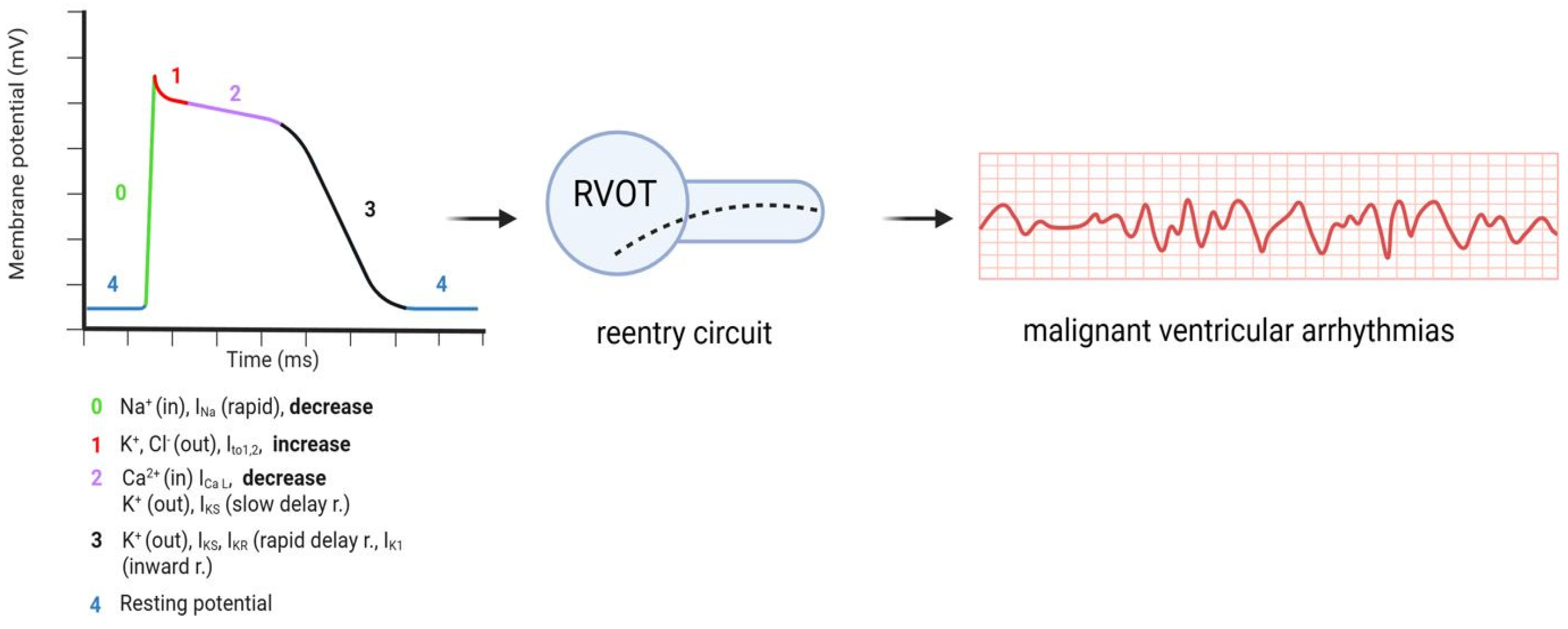
| Cellular | ↓ INa/ICa, ↑ Ito ⟶ loss of epicardial AP dome |
| Tissue | Conduction disorder on the epicardium of RVOT |
| ECG | Coved-pattern ST elevation in V1–V3 |
| Clinical | VF, SCD among young men, can be induced by fever or certain medications |
| Gene | Protein/Ion Channel | Function | Effect |
|---|---|---|---|
| SCN5A | Sodium channel (Nav1.5), αINa | Depolarization | ↓ INa |
| CACNA1C | Calcium channel subunits (Cav1.2), αICa | Plateau-phase | ↓ ICa-L |
| CACNB2b | Calcium channel subunits (Cavb2), βICa | Plateau-phase | ↓ ICa-L |
| KCND3 | Ito Potassium channel subunits | Repolarization | ↑ Ito |
| SCN10A, SCN1B | Sodium channel accessory proteins | Conduction | ↓ INa |
| PKP2, RYR2 (less often) | Desmosomal/Calcium handling proteins | Structural-electrical connection | Arrhythmias |
| Type | Characteristic ECG Findings | Diagnostic Value of ECG | Description |
|---|---|---|---|
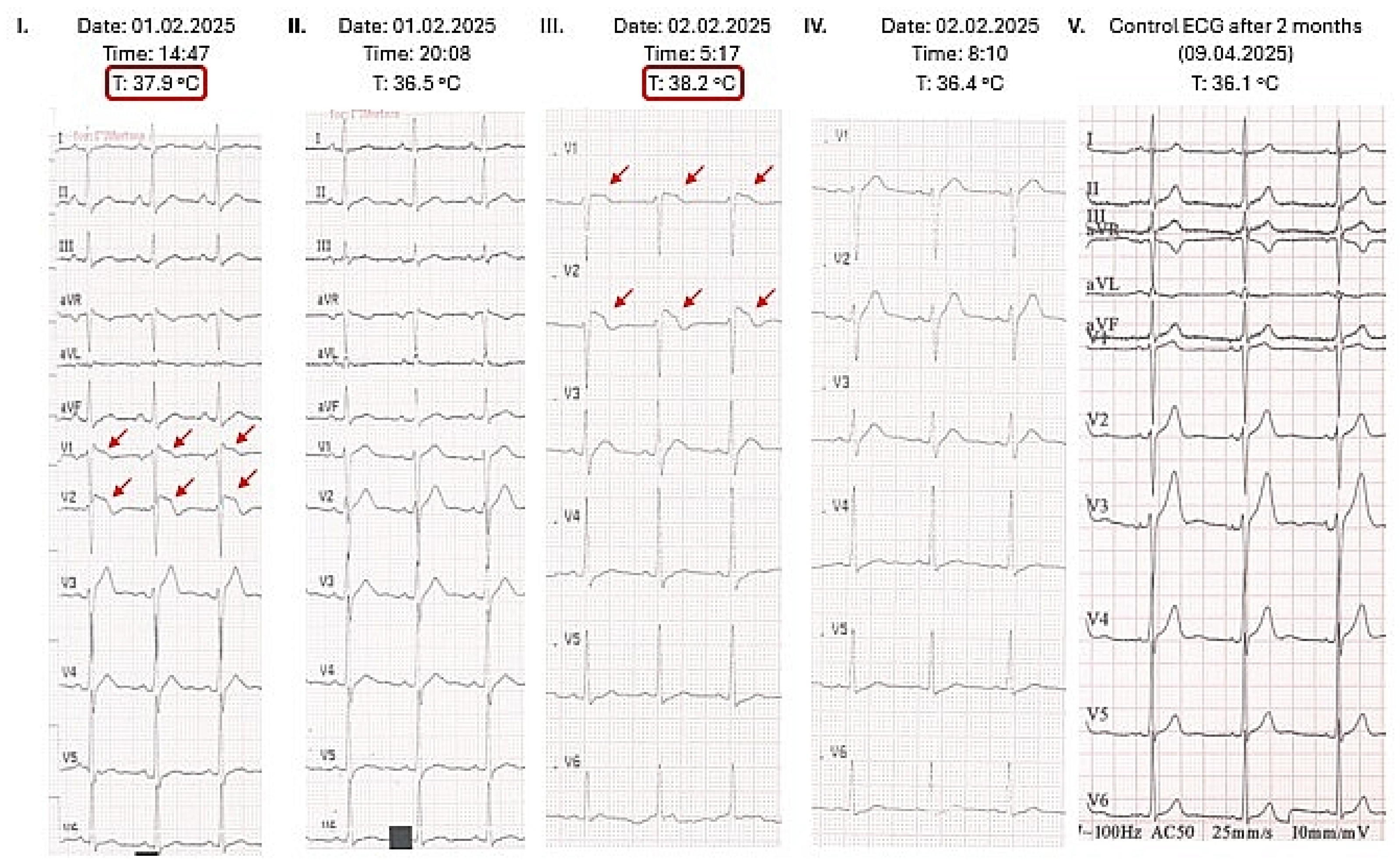
| Type 1 (coved type) | ≥2 mm coved (downward-sloping) ST-segment elevation in leads V1–V2, followed by a negative T wave | Diagnostic | “Coved-type” ST-segment elevation, gradually descending into a negative T wave. Alone, this is diagnostic for Brugada syndrome. |
| Type 2 (saddle-back type) | Biphasic (“saddle-back”) ST-segment elevation, ≥2 mm initial elevation, followed by a positive or biphasic T wave | Non-diagnostic (but suggestive) | Frequently convertible to type 1 during drug provocation |
| Type 3 | Similar to type 1 or type 2, but ST-segment elevation < 2 mm. | Non-diagnostic | Mild form, often indistinguishable from a normal variant |
| Examination Time Points/Laboratory Parameters Assessed | 1 February 2025 16:03 | 1 February 2025 18:33 | 2 February 2025 06:48 |
|---|---|---|---|
| Na+ (mmol/L) | 136 | 137 | |
| K+ (mmol/L) | hemolyzed | 3.9 | |
| Cl− (mmol/L) | 102 | ||
| Glucose (mmol/L) | 7.1 | ||
| Urea (mmol/L) | 5.0 | ||
| Creatinine (μmol/L) | 97 | ||
| GFR (mL/p/1.73 m2) | 90 | ||
| CK (U/L) | hemolyzed | 575 | 422 |
| CK-MB activity (U/L) | hemolyzed | 18 | 17 |
| CK-MB activity (%) | not assessable | 3.1 | 4.0 |
| Cardiac troponin-T (ng/L) | 6.06 | 6.08 | 5.65 |
| AST (U/L) | hemolyzed | 38 | 35 |
| LDH (U/L) | hemolyzed | 224 | 202 |
| CRP (mg/L) | 30.03 | ||
| WBC (G/L) | 5.50 |
Disclaimer/Publisher’s Note: The statements, opinions and data contained in all publications are solely those of the individual author(s) and contributor(s) and not of MDPI and/or the editor(s). MDPI and/or the editor(s) disclaim responsibility for any injury to people or property resulting from any ideas, methods, instructions or products referred to in the content. |
© 2026 by the authors. Licensee MDPI, Basel, Switzerland. This article is an open access article distributed under the terms and conditions of the Creative Commons Attribution (CC BY) license.
Share and Cite
Hamza, I.; Végh, L.; Sebestyén, V.; Gulyás, E.; Juhász, B.; Somodi, S.; Ratku, B.; Szűcs, Z.; Koczok, K.; Balogh, I.; et al. Type 1 Brugada Pattern Triggered by Low-Grade Fever: Implications for Diagnosis and Risk Stratification. Int. J. Mol. Sci. 2026, 27, 3900. https://doi.org/10.3390/ijms27093900
Hamza I, Végh L, Sebestyén V, Gulyás E, Juhász B, Somodi S, Ratku B, Szűcs Z, Koczok K, Balogh I, et al. Type 1 Brugada Pattern Triggered by Low-Grade Fever: Implications for Diagnosis and Risk Stratification. International Journal of Molecular Sciences. 2026; 27(9):3900. https://doi.org/10.3390/ijms27093900
Chicago/Turabian StyleHamza, Ildikó, Lilla Végh, Veronika Sebestyén, Eszter Gulyás, Béla Juhász, Sándor Somodi, Balázs Ratku, Zsuzsanna Szűcs, Katalin Koczok, István Balogh, and et al. 2026. "Type 1 Brugada Pattern Triggered by Low-Grade Fever: Implications for Diagnosis and Risk Stratification" International Journal of Molecular Sciences 27, no. 9: 3900. https://doi.org/10.3390/ijms27093900
APA StyleHamza, I., Végh, L., Sebestyén, V., Gulyás, E., Juhász, B., Somodi, S., Ratku, B., Szűcs, Z., Koczok, K., Balogh, I., Szabó, Z., & Ujvárosy, D. (2026). Type 1 Brugada Pattern Triggered by Low-Grade Fever: Implications for Diagnosis and Risk Stratification. International Journal of Molecular Sciences, 27(9), 3900. https://doi.org/10.3390/ijms27093900