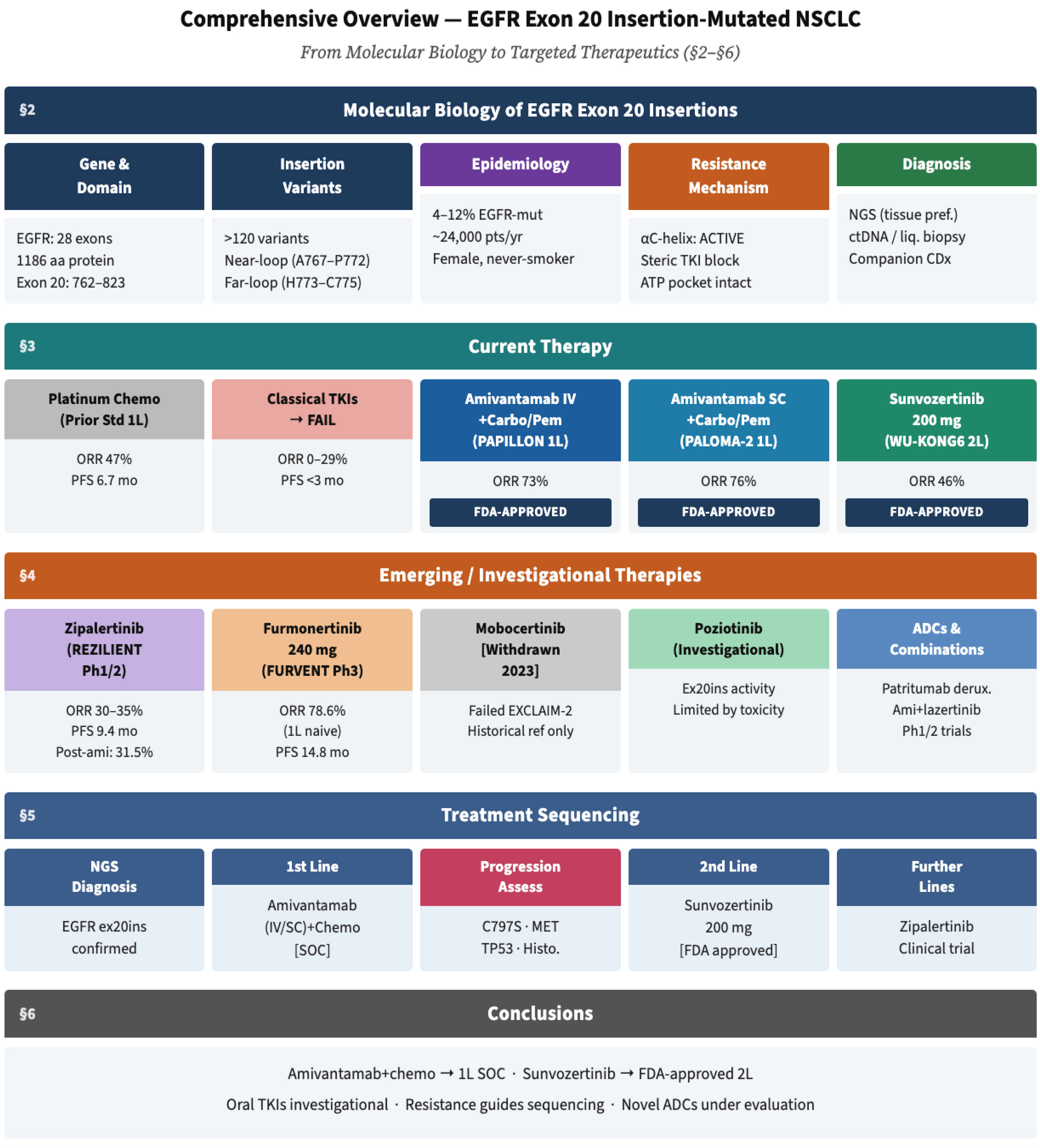
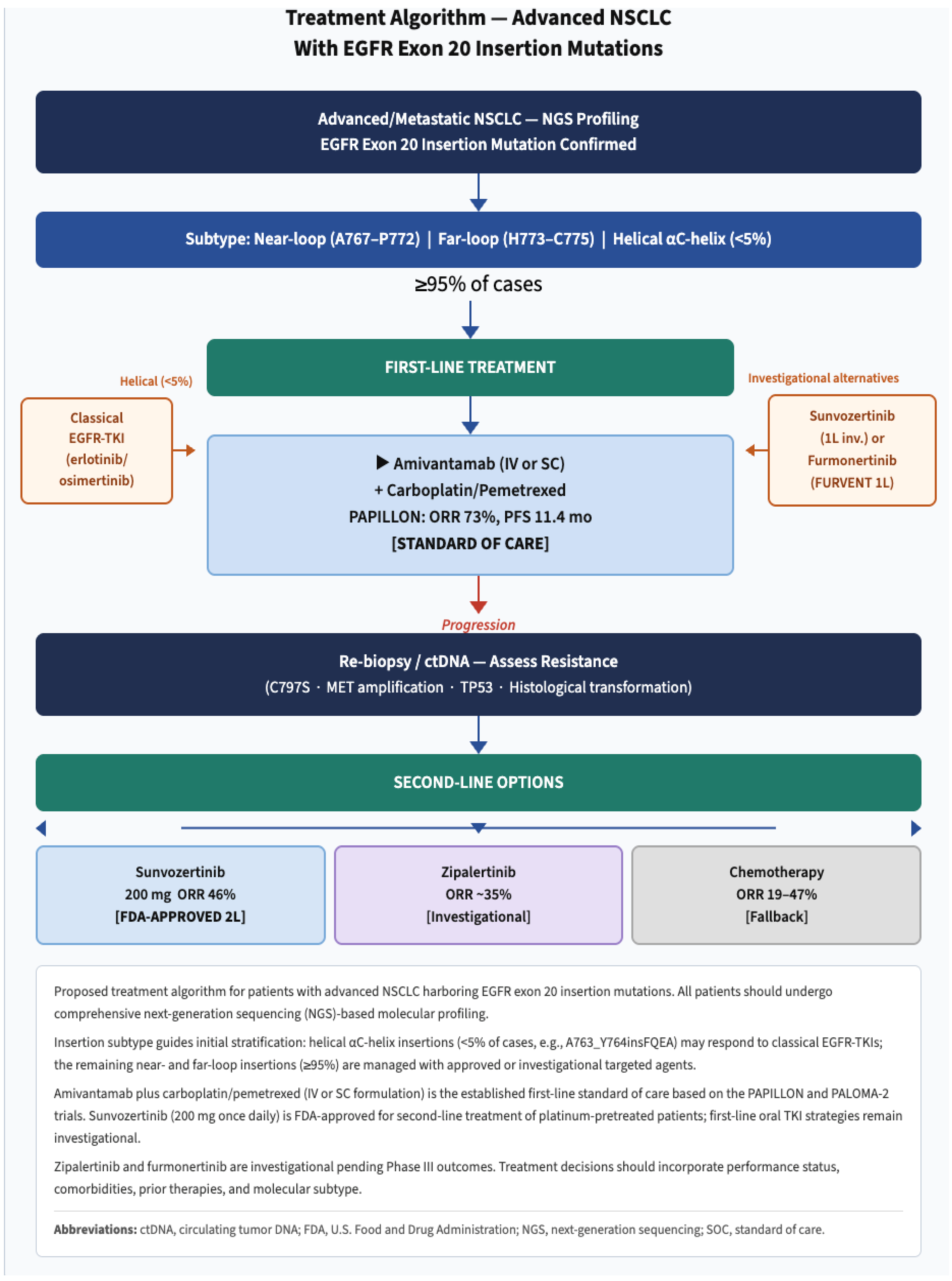
Therapeutic Advances in Non-Small Cell Lung Cancer Harboring EGFR Exon 20 Insertion Mutations: From Molecular Biology to Targeted Therapy

Abstract
1. Introduction
2. Role of EGFR Exon 20 Insertions in Lung Cancer: Biology, Genetics, and Targetable Alterations
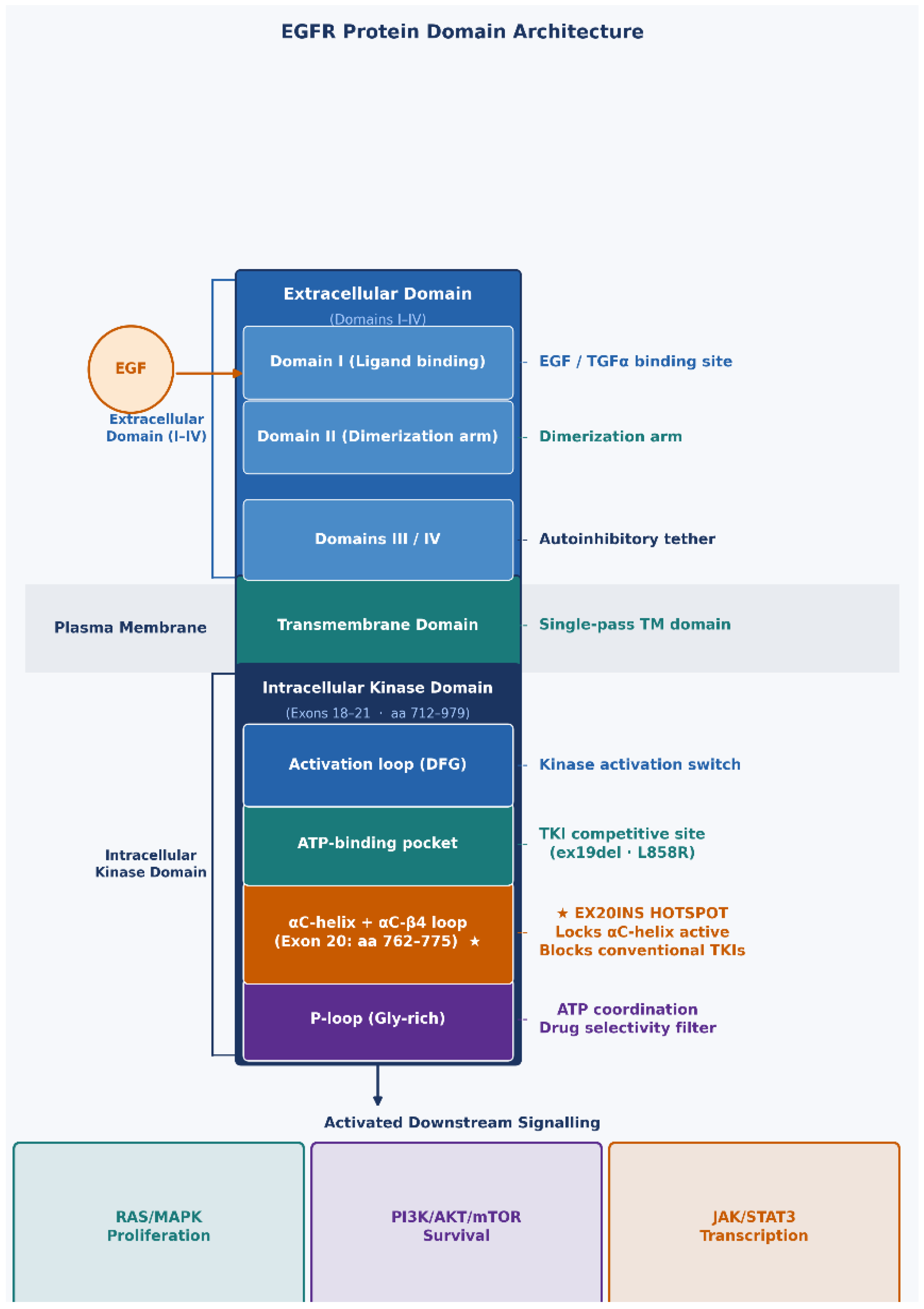
2.1. Structure and Function of the EGFR Gene
2.2. Molecular Characteristics of EGFR Exon 20 Insertions
2.3. Molecular Mechanisms of Oncogenic Activation
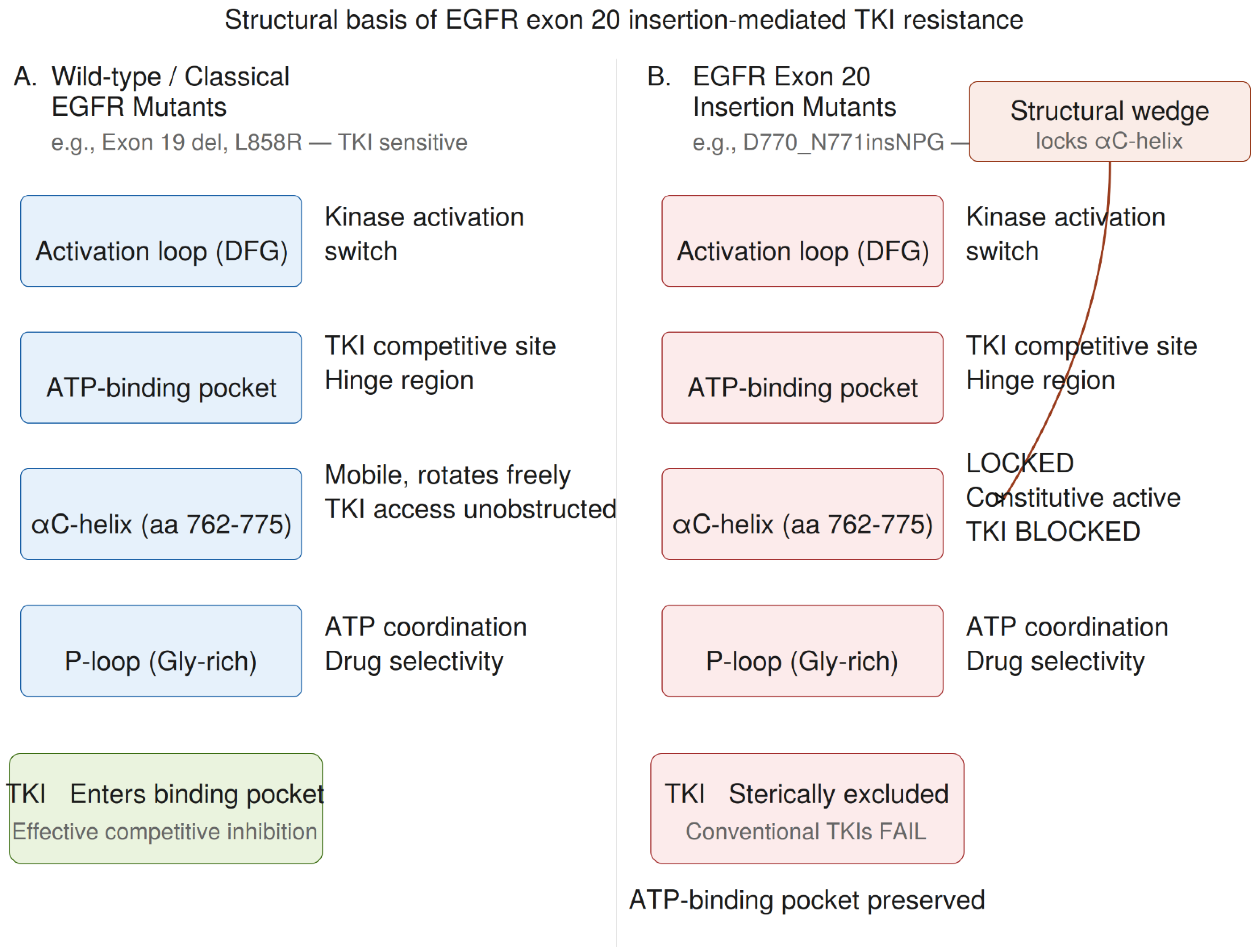
2.4. Structural Basis for Resistance to Conventional EGFR-TKIs
2.5. Co-Occurring Genomic Alterations and Tumor Biology
2.6. Comparison with HER2 Exon 20 Insertions
2.7. Detection and Molecular Diagnosis
3. Current Therapy for EGFR Exon 20 Insertions in Lung Cancer
3.1. Platinum-Based Chemotherapy as First-Line Standard of Care
3.2. Amivantamab: A Bispecific EGFR-MET Antibody
3.2.1. Mechanism of Action and Preclinical Development
3.2.2. Clinical Efficacy in EGFR Exon 20 Insertions
3.2.3. Subcutaneous Formulation
3.2.4. Safety Profile
3.3. Sunvozertinib: An Oral Selective EGFR Inhibitor
3.3.1. Development and Mechanism of Action
3.3.2. Clinical Efficacy: WU-KONG Trials
3.3.3. Safety and Tolerability
3.4. Other Available Therapies
3.4.1. Mobocertinib
3.4.2. Position of Third-Generation TKIs
4. Emerging Therapies for EGFR Exon 20 Insertions
4.1. Zipalertinib: Next-Generation Selective Inhibitor
4.2. Furmonertinib: Next-Generation Irreversible EGFR TKI
4.3. Other Investigational Approaches
4.3.1. Poziotinib
4.3.2. Antibody–Drug Conjugates
4.3.3. Combination Strategies
5. Treatment Sequencing and Clinical Decision-Making
5.1. First-Line Treatment Strategies
5.2. Second-Line and Beyond Treatment
5.3. Managing Resistance and Emerging Mechanisms
6. Conclusions and Future Directions
Funding
Data Availability Statement
Conflicts of Interest
References
- Sung, H.; Ferlay, J.; Siegel, R.L.; Laversanne, M.; Soerjomataram, I.; Jemal, A.; Bray, F. Global cancer statistics 2020: GLOBOCAN estimates of incidence and mortality worldwide for 36 cancers in 185 countries. CA Cancer J. Clin. 2021, 71, 209–249. [Google Scholar] [CrossRef]
- Rosell, R.; Carcereny, E.; Gervais, R.; Vergnenegre, A.; Massuti, B.; Felip, E.; Palmero, R.; Garcia-Gomez, R.; Pallares, C.; Sanchez, J.M.; et al. Erlotinib versus standard chemotherapy as first-line treatment for European patients with advanced EGFR mutation-positive non-small-cell lung cancer (EURTAC): A randomized open-label phase 3 trial. Lancet Oncol. 2012, 13, 239–246. [Google Scholar] [CrossRef] [PubMed]
- Lynch, T.J.; Bell, D.W.; Sordella, R.; Gurubhagavatula, S.; Okimoto, R.A.; Brannigan, B.W.; Harris, P.L.; Haserlat, S.M.; Supko, J.G.; Haluska, F.G.; et al. Activating mutations in the epidermal growth factor receptor underlying the responsiveness of non-small-cell lung cancer to gefitinib. N. Engl. J. Med. 2004, 350, 2129–2139. [Google Scholar] [CrossRef] [PubMed]
- Arcila, M.E.; Nafa, K.; Chaft, J.E.; Rekhtman, N.; Lau, C.; Reva, B.A.; Zakowski, M.F.; Kris, M.G.; Ladanyi, M. EGFR exon 20 insertion mutations in lung adenocarcinomas: A distinct subset of EGFR mutations that do not respond to EGFR tyrosine kinase inhibitors. Mol. Cancer Ther. 2013, 12, 220–229. [Google Scholar] [CrossRef]
- Oxnard, G.R.; Lo, P.C.; Nishino, M.; Dahlberg, S.E.; Lindeman, N.I.; Butaney, M.; Jackman, D.M.; Johnson, B.E.; Janne, P.A. Natural history and molecular characteristics of lung cancers harboring EGFR exon 20 insertions. J. Thorac. Oncol. 2013, 8, 179–184. [Google Scholar] [CrossRef]
- Burnett, H.; Emich, H.; Carroll, C.; Stapleton, N.; Mahadevia, P.; Li, T. Epidemiological and clinical burden of EGFR exon 20 insertion in advanced non-small cell lung cancer: A systematic literature review. PLoS ONE 2021, 16, e0247620. [Google Scholar] [CrossRef]
- Watanabe, N.; Horio, Y.; Fujiwara, Y. Emerging therapies for non-small cell lung cancer harboring EGFR exon 20 insertion mutations: Narrative review. Ann. Transl. Med. 2022, 10, 1283. [Google Scholar] [CrossRef]
- Seo, D.; Lim, J.H. Targeted therapies for EGFR exon 20 insertion mutation in non-small-cell lung cancer. Int. J. Mol. Sci. 2024, 25, 5917. [Google Scholar] [CrossRef] [PubMed]
- Christopoulos, P. A new era for EGFR exon 20 insertion mutation targeting NSCLC. Chin. Clin. Oncol. 2025, 14, 14. [Google Scholar] [CrossRef]
- Yasuda, H.; Park, E.; Yun, C.H.; Sng, N.J.; Lucena-Araujo, A.R.; Grber, W.L.; Neel, D.S.; Dagogo-Jack, I.; Rodig, S.J.; Muzikansky, A.; et al. Structural, biochemical, and clinical characterization of EGFR exon 20 insertion mutations in lung cancer. Sci. Transl. Med. 2013, 5, 216ra177. [Google Scholar] [CrossRef]
- Zhou, C.; Tang, K.-J.; Cho, B.C.; Liu, B.; Paz-Ares, L.; Cheng, S.; Kitazono, S.; Thiagarajan, M.; Goldman, J.W.; Sabari, J.K.; et al. Amivantamab plus chemotherapy in NSCLC with EGFR exon 20 insertions. N. Engl. J. Med. 2023, 389, 2039–2051. [Google Scholar] [CrossRef]
- Hynes, N.E.; Lane, H.A. ERBB receptors and cancer: The complexity of targeted inhibitors. Nat. Rev. Cancer 2005, 5, 341–354, Erratum in Nat. Rev. Cancer 2005, 7, 580. [Google Scholar] [CrossRef] [PubMed]
- Lemmon, M.A.; Schlessinger, J. Cell signaling by receptor tyrosine kinases. Cell 2010, 141, 1117–1134. [Google Scholar] [CrossRef] [PubMed]
- Yarden, Y.; Sliwkowski, M.X. Untangling the ErbB signalling network. Nat. Rev. Mol. Cell Biol. 2001, 2, 127–137. [Google Scholar] [CrossRef] [PubMed]
- Downward, J. Targeting RAS signaling pathways in cancer therapy. Nat. Rev. Cancer 2003, 3, 11–22. [Google Scholar] [CrossRef]
- Vivanco, I.; Sawyers, C.L. The phosphatidylinositol 3-kinase AKT pathway in human cancer. Nat Rev Cancer. 2002, 2, 489–501. [Google Scholar] [CrossRef]
- Shigematsu, H.; Lin, L.; Takahashi, T.; Nomura, M.; Suzuki, M.; Wistuba, I.I.; Fong, K.M.; Lee, H.; Toyooka, S.; Shimizu, N.; et al. Clinical and biological features associated with epidermal growth factor receptor gene mutations in lung cancers. J. Natl. Cancer Inst. 2005, 97, 339–346. [Google Scholar] [CrossRef]
- Manning, G.; Whyte, D.B.; Martinez, R.; Hunter, T.; Sudarsanam, S. The protein kinase complement of the human genome. Science 2002, 298, 1912–1934. [Google Scholar] [CrossRef]
- Yasuda, H.; Kobayashi, S.; Costa, D.B. EGFR exon 20 insertion: Preclinical data and clinical implications. Lancet Oncol. 2012, 13, e23–e31. [Google Scholar] [CrossRef]
- Giridharan, S.; Ansari, J.; Hussain, I. Advancing EGFR exon 20 insertion-mutated non-small cell lung cancer (NSCLC) management through molecular diagnostics and targeted therapies. Cureus 2025, 17, e82573. [Google Scholar] [CrossRef]
- Wen, Q.; Zhuang, Y.; Fu, S.; Pan, C.; Liu, Z.; Wang, L. Efficacy and safety of later-line targeted therapies in advanced non-small cell lung cancer with EGFR exon 20 insertion mutations: A systematic review. Front Pharmacol. 2025, 16, 1707050. [Google Scholar] [CrossRef] [PubMed]
- Piotrowska, Z.; Tan, D.S.; Smit, E.F.; Spira, A.I.; Soo, R.A.; Nguyen, D.; Lee, V.H.; Yang, J.C.; Velcheti, V.; Wrangle, J.M.; et al. Safety, tolerability, and antitumor activity of zipalertinib among patients with non-small-cell lung cancer harboring epidermal growth factor receptor exon 20 insertions. J. Clin. Oncol. 2023, 41, 4218–4225. [Google Scholar] [CrossRef]
- Elamin, Y.Y.; Robichaux, J.P.; Carter, B.W.; Altan, M.; Gibbons, D.L.; Fossella, F.V.; Lam, V.K.; Patel, A.B.; Negrao, M.V.; Le, X.; et al. Poziotinib for EGFR exon 20-mutant NSCLC: Clinical efficacy, resistance mechanisms, and impact of mutation subtypes. J. Thorac. Oncol. 2022, 17, 708–723. [Google Scholar]
- Bhullar, K.S.; Lagarón, N.O.; McGowan, E.M.; Parmar, I.; Jha, A.; Hubbard, B.P.; Rupasinghe, H.P.V. Kinase-targeted cancer therapies: Progress, challenges and future directions. Mol. Cancer 2018, 17, 48. [Google Scholar] [CrossRef]
- Zhang, X.; Gureasko, J.; Shen, K.; Cole, P.A.; Kuriyan, J. An allosteric mechanism for activation of the kinase domain of epidermal growth factor receptor. Cell 2006, 125, 1137–1149. [Google Scholar] [CrossRef]
- Carey, K.D.; Garton, A.J.; Romero, M.S.; Kahler, J.; Thomson, S.; Ross, S.; Park, F.; Haley, J.D.; Gibson, N.; Sliwkowski, M.X.; et al. Kinetic analysis of the epidermal growth factor receptor kinase domain reveals kinetically distinct mechanisms of kinase inhibition. J. Biol. Chem. 2006, 281, 1095–1104. [Google Scholar]
- Yun, C.H.; Boggon, T.J.; Li, Y.; Woo, M.S.; Greulich, H.; Meyerson, M.; Eck, M.J. Structures of lung cancer-derived EGFR mutants and inhibitor complexes: Mechanism of activation and resistance. Cancer Cell 2007, 11, 217–227. [Google Scholar] [CrossRef]
- Wood, E.R.; Truesdale, A.T.; McDonald, O.B.; Yuan, D.; Hassell, A.; Dickerson, S.H.; Ellis, B.; Pennisi, C.; Horne, E.; Lackey, K.; et al. A unique structure for epidermal growth factor receptor bound to GW572016 (Lapatinib): Relationships among protein conformation inhibitor off-rate, and receptor activity in tumor cells. Cancer Res. 2004, 64, 6652–6659. [Google Scholar] [CrossRef]
- Remon, J.; Moran, T.; Majem, M.; Reguart, N.; Dalmau, E.; Marquez-Medina, D.; Gascon, P. Acquired resistance to epidermal growth factor receptor tyrosine kinase inhibitors in EGFR-mutant non-small cell lung cancer: A new era in oncogenic mutations. Cancer Treat. Rev. 2014, 40, 1195–1203. [Google Scholar] [CrossRef]
- Robichaux, J.P.; Elamin, Y.Y.; Tan, Z.; Carter, B.W.; Zhang, S.; Liu, S.; Li, S.; He, J.; Patel, A.B.; Gibbons, D.L.; et al. Mechanisms and clinical activity of an EGFR and HER2 exon 20-selective kinase inhibitor in non-small cell lung cancers with EGFR or HER2 exon 20 mutations. Nat. Med. 2018, 24, 638–646. [Google Scholar] [CrossRef] [PubMed]
- Sha, C.; Lee, P.C. EGFR-Targeted Therapies: A Literature Review. J. Clin. Med. 2024, 13, 6391. [Google Scholar] [CrossRef]
- Oxnard, G.R.; Binder, A.; Janne, P.A. New targetable oncogenes in non-small-cell lung cancer. J. Clin. Oncol. 2013, 31, 1097–1104. [Google Scholar] [CrossRef] [PubMed]
- Chalmers, Z.R.; Connelly, C.F.; Fabrizio, D.; Gay, L.; Ali, S.M.; Ennis, R.; Schrock, A.B.; Campbell, B.; Shlien, A.; Chmielecki, J.; et al. Analysis of 100,000 human cancer genomes reveals the landscape of tumor mutational burden. Genome Med. 2017, 9, 34. [Google Scholar] [CrossRef]
- Yang, J.C.; Wang, M.; Doucet, L.; Fan, Y.; Lv, D.; Sun, M.; Huang, D.; Greillier, L.; Planchard, D.; Hong, Q.; et al. Phase II dose-randomized study of sunvozertinib in platinum-pretreated non-small cell lung cancer with epidermal growth factor receptor exon 20 insertion mutations (WU-KONG1B). J. Clin. Oncol. 2025, 43, 3198–3208. [Google Scholar] [CrossRef]
- Zhou, C.; Fan, Y.; Wu, L.; Han, B.; Wang, M.; Chen, G.; Fang, J.; Li, W.; Lu, S.; Zhang, L.; et al. Efficacy and safety of furmonertinib at 240 mg in patients with EGFR exon 20 insertion-positive NSCLC: Results from the FURVENT phase III trial. In Proceedings of the WCLC 2024, San Diego, CA, USA, 7–10 September 2024. [Google Scholar]
- Yu, H.A.; Zhou, C.; Ramalingam, S.S.; Fan, Y.; Wu, L.; Han, B.; Wang, M.; Chen, G.; Fang, J.; Li, W.; et al. Furmonertinib 240 mg in first-line treatment of EGFR exon 20 insertion-positive NSCLC: Updated efficacy and safety from the FURVENT trial. In Proceedings of the ASCO 2025, Chicago, IL, USA, 30 May–3 June 2025. [Google Scholar]
- Cho, B.C.; Lu, S.; Felip, E.; Spira, A.I.; Girard, N.; Lee, J.S.; Lee, S.H.; Han, J.-Y.; Kim, S.-W.; Yang, J.C.; et al. Amivantamab plus lazertinib in previously untreated EGFR-mutated advanced NSCLC. N. Engl. J. Med. 2024, 391, 1486–1498. [Google Scholar] [CrossRef]
- Yang, G.; Xu, H.; Hu, J.; Liu, R.; Hu, P.; Yang, Y.; Li, W.; Hao, X.; Zhang, S.; Xu, F.; et al. Specific HER2 exon 20 Gly776 deletion-insertions in non-small cell lung cancer: Structural analysis and sensitivity to HER2-targeted tyrosine kinase inhibitors. Front. Pharmacol. 2022, 13, 806737. [Google Scholar] [CrossRef]
- Shi, Y.; Au, J.S.; Thongprasert, S.; Srinivasan, S.; Tsai, C.M.; Khoa, M.T.; Heeber, R.A.; Sriuranpong, V.; Mok, T.; Ford, J.; et al. A prospective, molecular epidemiology study of EGFR mutations in Asian patients with advanced non-small-cell lung cancer of adenocarcinoma histology (PIONEER). J. Thorac. Oncol. 2014, 9, 154–162. [Google Scholar] [CrossRef] [PubMed]
- Li, B.T.; Smit, E.F.; Goto, Y.; Nakagawa, K.; Udagawa, H.; Mazieres, J.; Nagasaka, M.; Bazhenova, L.; Saltos, A.N.; Felip, E.; et al. Trastuzumab deruxtecan in HER2-mutant non-small-cell lung cancer. N. Engl. J. Med. 2022, 386, 241–251. [Google Scholar] [CrossRef] [PubMed]
- Lindeman, N.I.; Cagle, P.T.; Aisner, D.L.; Arcila, M.E.; Beasley, M.B.; Bernicker, E.H.; Colasacco, C.; Dacic, S.; Hirsch, F.R.; Kerr, K.; et al. Updated molecular testing guideline for the selection of lung cancer patients for treatment with targeted tyrosine kinase inhibitors: Guideline from the College of American Pathologists, the International Association for the Study of Lung Cancer, and the Association for Molecular Pathology. Arch Pathol. Lab. Med. 2018, 142, 321–346. [Google Scholar]
- Rolfo, C.; Mack, P.C.; Scagliotti, G.V.; Baas, P.; Barlesi, F.; Bivona, T.G.; Herbst, R.S.; Mok, T.S.; Peled, N.; Pirker, R.; et al. Liquid biopsy for advanced NSCLC: A consensus statement from the IASLC. J. Thorac. Oncol. 2021, 16, 751–768. [Google Scholar] [CrossRef]
- Westover, D.; Zugazagoitia, J.; Cho, B.C.; Lovly, C.M.; Paz-Ares, L. Mechanisms of acquired resistance to first-and second-generation EGFR tyrosine kinase inhibitors. Ann. Oncol. 2018, 29, i10–i19. [Google Scholar] [CrossRef]
- Le, X.; Cornelissen, R.; Garassino, M.; Clarke, J.M.; Ali, S.M.; Goldman, J.W.; Socinski, M.A.; Bauml, J.M.; Levy, B.; Goto, K.; et al. A phase 2 study of poziotinib in EGFR or HER2 exon 20 mutant non-small cell lung cancers. J. Thorac. Oncol. 2021, 16, 1143–1155. [Google Scholar]
- Park, K.; Haura, E.B.; Leighl, N.B.; Mitchell, P.; Shu, C.A.; Girard, N.; Viteri, S.; Han, J.Y.; Kim, S.W.; Lee, C.K.; et al. Amivantamab in post-platinum NSCLC with EGFR exon 20 insertions (CHRYSALIS study). J. Clin. Oncol. 2021, 39, 3391–3402. [Google Scholar] [CrossRef] [PubMed]
- Lim, S.M.; Sabari, J.K.; Sanborn, R.E.; Girard, N.; Zhou, C.; Park, K.; Cho, B.C. First-line subcutaneous amivantamab plus chemotherapy in EGFR exon 20 insertion-mutated advanced NSCLC: Results from PALOMA-2. In Proceedings of the IASLC World Conference on Lung Cancer (WCLC) 2025, Barcelona, Spain, 6–9 September 2025. [Google Scholar]
- Riely, G.J.; Neal, J.W.; Camidge, D.R.; Spira, A.I.; Piotrowska, Z.; Costa, D.B.; Tsao, A.S.; Patel, J.D.; Gadgeel, S.M.; Bazhenova, L.; et al. Activity and safety of mobocertinib (TAK-788) in previously treated non–small cell lung cancer with EGFR exon 20 insertion mutations from a phase I/II trial. Cancer Discov. 2021, 11, 1688–1699, Erratum in Cancer Discov. 2023, 13, 2107. [Google Scholar] [CrossRef]
- Zhou, C.; Ramalingam, S.S.; Kim, T.M.; Kim, S.W.; Yang, J.C.; Riely, G.J.; Mekhail, T.; Nguyen, D.; Garcia Campelo, M.R.; Felip, E.; et al. Treatment outcomes and safety of mobocertinib in platinum-pretreated patients with EGFR exon 20 insertion-positive metastatic NSCLC. JAMA Oncol. 2021, 7, e214761, Correction in JAMA Oncol. 2022, 8, 1359. [Google Scholar] [CrossRef] [PubMed]
- Shi, Y.; Chen, G.; Wang, X.; Liu, Y.; Wu, L.; Hao, Y.; Liu, C.; Zhu, S.; Zhang, X.; Li, Y.; et al. Furmonertinib (AST2818) versus gefitinib as first-line therapy for Chinese patients with locally advanced or metastatic EGFR mutation-positive non-small-cell lung cancer (FURLONG): A multicentre, double-blind, randomised phase 3 study. Lancet Respir. Med. 2022, 10, 1019–1028. [Google Scholar] [CrossRef]
- Hu, S.; Ming, H.; He, Q.; Ding, M.; Ding, H.; Li, C. A study of high dose furmonertinib in EGFR exon 20 insertion mutation-positive advanced non-small cell lung cancer. Front. Oncol. 2024, 14, 1314301. [Google Scholar] [CrossRef] [PubMed]
- Passaro, A.; Janne, P.A.; Mok, T.; Peters, S. Overcoming therapy resistance in EGFR-mutant lung cancer. Nat. Cancer 2021, 2, 377–391. [Google Scholar] [CrossRef]
- Piotrowska, Z.; Isozaki, H.; Lennerz, J.K.; Gainor, J.F.; Lennes, I.T.; Zhu, V.W.; Marcoux, N.; Banwait, M.K.; Digumarthy, S.R.; Su, W.; et al. Landscape of acquired resistance to osimertinib in EGFR-mutant NSCLC and clinical validation of combined EGFR and RET inhibition. Cancer Discov. 2018, 8, 1529–1539. [Google Scholar] [CrossRef]





| Common EGFR Exon 20 Mutations | |||
|---|---|---|---|
| Mutation | Mutation Type | Relative Frequency | Structural Effect |
| V769_D770insASV | Insertion | Rare | Stabilizes C-helix |
| D770_N771insSVD | Insertion | Less Common | Causes steric hindrance in the drug-binding pocket |
| A767_V769dupASV | Duplication | Very Common | Stabilizes C-helix |
| H773_V774insNPH | Insertion | Very Common | Reduces autoinhibitory interactions of C-helix |
| D770_N771insG | Insertion | Less Common | Activates EGFR in a ligand-independent manner |
| S768_D770dup | Duplication | Very Common | Stabilizes active conformation and causes steric hindrance |
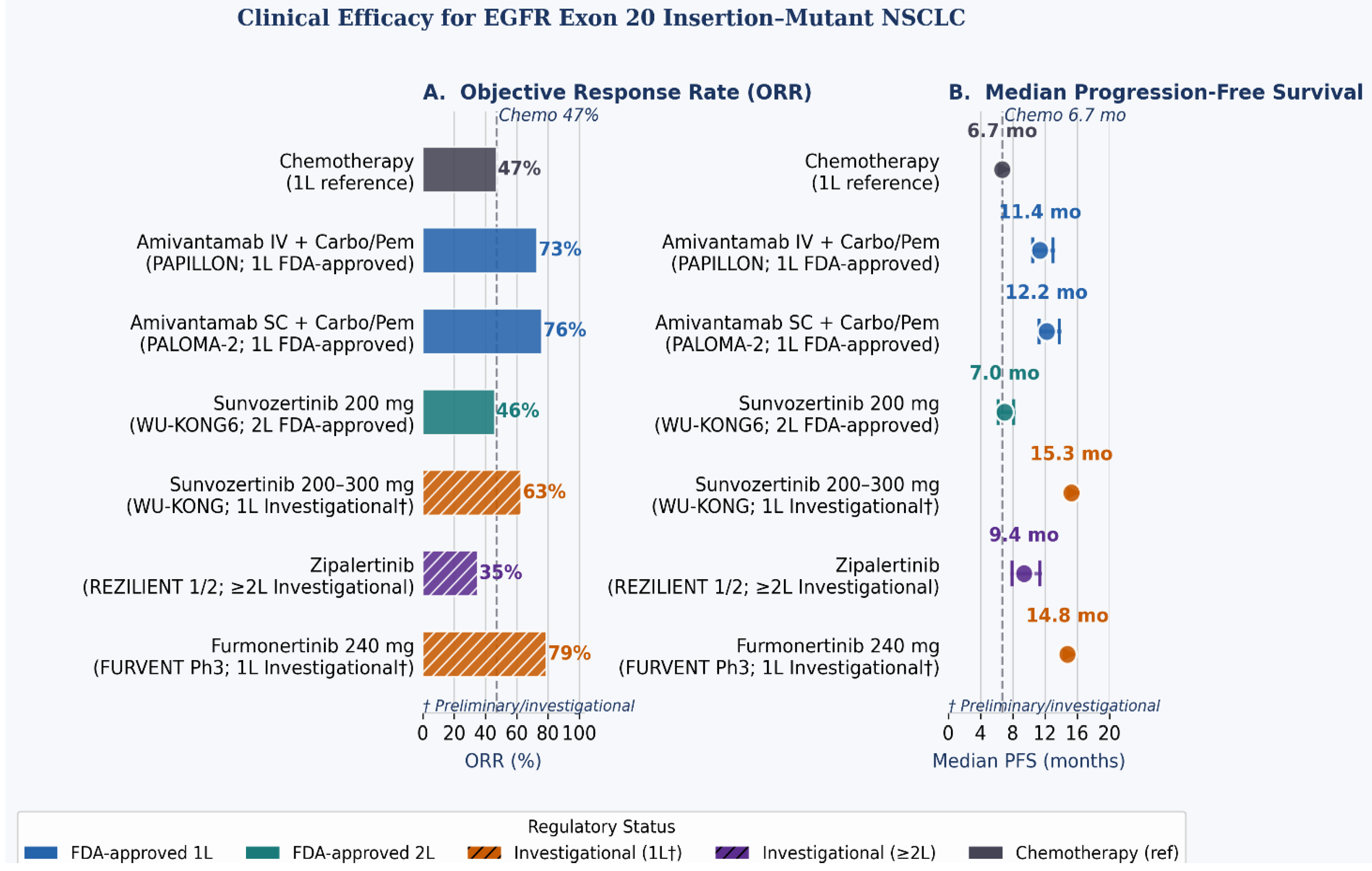
| Drug/Regimen | Key Trial | ORR | Median PFS | Grade 1–2 AEs | Grade 3–4 AEs |
|---|---|---|---|---|---|
| Amivantamab + Carboplatin/Pemetrexed | PAPILLON phase 3 (NCT04538664) [11] | 73% (vs. 47% chemo alone) [11] | 11.4 months (vs. 6.7 chemo alone) [11] | Rash, paronychia, infusion reactions [11] | Neutropenia, infusion reactions, stomatitis [11] |
| Sunvozertinib | WU-KONG1B phase 2 (NCT03974022) [34] | 46% [34] | ~6–8 months [34] | Diarrhea, rash, stomatitis [34] | Increase CPK levels, anemia, arrhythmia [34] |
| Zipalertinib | REZILIENT1 phase 1/2 (NCT04036682) [22] | 35.2% [22] | 9.4 months [22] | Paronychia, rash, diarrhea [22] | Anemia, pneumonitis, stomatitis [22] |
| Furmonertinib | FAVOUR phase 1b (NCT04858958) [35]; FURVENT phase 3 (NCT05607550) [36] | 78.6% [37] | NR (phase 1b) [35]; phase 3 ongoing [36] | Diarrhea, anemia, transaminase evolution, rash [35] | QT prolongation, mouth ulceration, leukopenia [35] |
Disclaimer/Publisher’s Note: The statements, opinions and data contained in all publications are solely those of the individual author(s) and contributor(s) and not of MDPI and/or the editor(s). MDPI and/or the editor(s) disclaim responsibility for any injury to people or property resulting from any ideas, methods, instructions or products referred to in the content. |
© 2026 by the authors. Licensee MDPI, Basel, Switzerland. This article is an open access article distributed under the terms and conditions of the Creative Commons Attribution (CC BY) license.
Share and Cite
Rosas, D.; Desai, J.; Raez, L. Therapeutic Advances in Non-Small Cell Lung Cancer Harboring EGFR Exon 20 Insertion Mutations: From Molecular Biology to Targeted Therapy. Int. J. Mol. Sci. 2026, 27, 3714. https://doi.org/10.3390/ijms27093714
Rosas D, Desai J, Raez L. Therapeutic Advances in Non-Small Cell Lung Cancer Harboring EGFR Exon 20 Insertion Mutations: From Molecular Biology to Targeted Therapy. International Journal of Molecular Sciences. 2026; 27(9):3714. https://doi.org/10.3390/ijms27093714
Chicago/Turabian StyleRosas, Daniel, Jay Desai, and Luis Raez. 2026. "Therapeutic Advances in Non-Small Cell Lung Cancer Harboring EGFR Exon 20 Insertion Mutations: From Molecular Biology to Targeted Therapy" International Journal of Molecular Sciences 27, no. 9: 3714. https://doi.org/10.3390/ijms27093714
APA StyleRosas, D., Desai, J., & Raez, L. (2026). Therapeutic Advances in Non-Small Cell Lung Cancer Harboring EGFR Exon 20 Insertion Mutations: From Molecular Biology to Targeted Therapy. International Journal of Molecular Sciences, 27(9), 3714. https://doi.org/10.3390/ijms27093714