Metabolism-Mediated Regulation of Brain–Heart Interactions

Abstract
1. Introduction
2. Brain Metabolism Regulates Cardiac Functions
2.1. Neurometabolic Regulation
2.1.1. Glu
2.1.2. NE
2.1.3. DA
2.1.4. AEA
2.2. Endocrine Metabolic Regulation
2.2.1. OX
2.2.2. OXT
2.2.3. PGE2
2.3. Immunometabolic Regulation

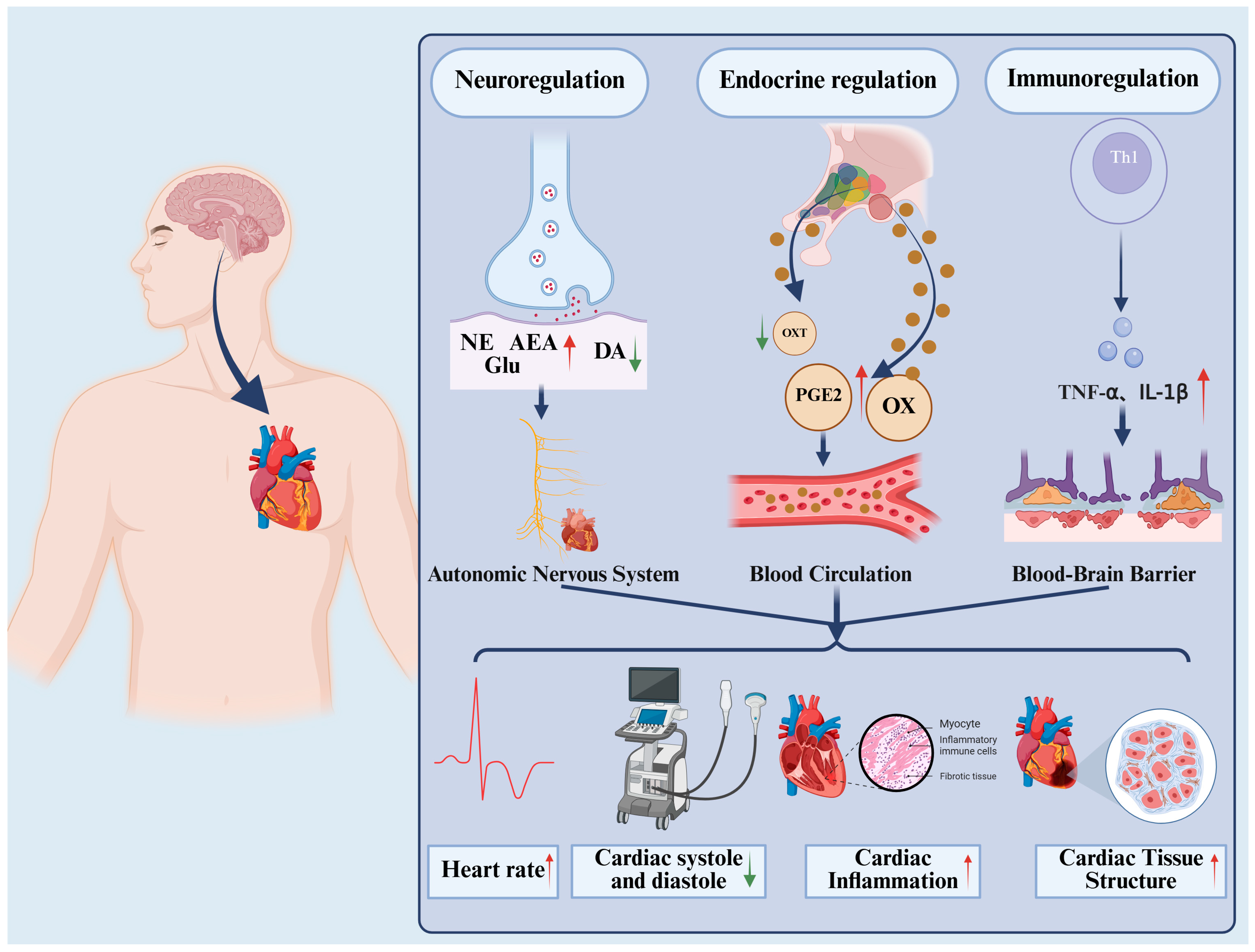
| Species | Metabolite | Brain Regions Regulating Heart | Affect Cardiac Function | References |
|---|---|---|---|---|
| Mice | Glu | M1 | Heart rate ⬆ Autonomic nerve balance ⬆ | Bo, W., et al., 2024 [20] |
| MnR | ||||
| Rat | ACC | Heart rate ⬆ | Yoshimoto, A., et al., 2024 [21] | |
| VMT | ||||
| DMH | ||||
| Amb | ||||
| Rat | RVLM | |||
| MHb | ||||
| Rat | NE | NTS | Autonomic nerve balance ⬆ | Bundzikova-Osacka, J., et al., 2015 [23] |
| Mice | LC | Heart rate ⬆ Cardiac contractility ⬇ | Wang, X., et al., 2014 [25] | |
| Mice | DA | VTA | Cardiac inflammation ⬆ Contractility ⬇ Heart rate ⬆ | Haykin, H., et al., 2024 [26]; Sato, Y., et al., 2024 [27] |
| Rat | AEA | PAG | Heart rate ⬆ Autonomic nerve balance ⬆ | Dean, C., et al., 2016 [29]; Dean, C., et al., 2017 [30] |
| Mice/Rat | OX | Hypothalamus | Heart rate ⬆ | Zhang, W., et al., 2009 [35] |
| Rat | PGE2 | Kageyama, H., et al., 2013 [42] | ||
| OXT | PVN | Cardiac inflammation ⬆ Contractility ⬇ | Schunke, K.J., et al., 2023 [37] |
3. Cardiac Function Regulates Brain Metabolism
3.1. Carbohydrate Metabolites
3.2. Lipid Metabolites
3.3. Energy Metabolism-Related Substances
3.4. Amino Acid Metabolites
3.5. Cytokines
4. Bidirectional Regulation of Brain–Heart Metabolism
5. Summary and Prospects
Author Contributions
Funding
Institutional Review Board Statement
Informed Consent Statement
Data Availability Statement
Conflicts of Interest
Abbreviations
References
- Tahsili-Fahadan, P.; Geocadin, R.G. Heart-brain axis: Effects of neurologic injury on cardiovascular function. Circ. Res. 2017, 120, 559–572. [Google Scholar] [CrossRef]
- Kuhtz-Buschbeck, J.P.; Schaefer, J.; Wilder, N.; Wolze, W.T. The origin of the heartbeat and theories of muscle contraction. Physiological concepts and conflicts in the 19th century. Prog. Biophys. Mol. Biol. 2021, 159, 3–9. [Google Scholar] [CrossRef]
- Chen, Z.; Venkat, P.; Seyfried, D.; Chopp, M.; Yan, T.; Chen, J. Brain-heart interaction: Cardiac complications after stroke. Circ. Res. 2017, 121, 451–468. [Google Scholar] [CrossRef]
- Zou, L.; Han, R. Inflammatory response and immune regulation in brain-heart interaction after stroke. Cardiovasc. Ther. 2022, 2022, 2406122. [Google Scholar] [CrossRef] [PubMed]
- Lee, R.H.; Couto E Silva, A.; Possoit, H.E.; Lerner, F.M.; Chen, P.-Y.; Azizbayeva, R.; Citadin, C.T.; Wu, C.Y.-C.; Neumann, J.T.; Lin, H.W. Palmitic acid methyl ester is a novel neuroprotective agent against cardiac arrest. Prostaglandins Leukot. Essent. Fat. Acids 2019, 147, 6–14. [Google Scholar] [CrossRef] [PubMed]
- Prasad Hrishi, A.; Ruby Lionel, K.; Prathapadas, U. Head rules over the heart: Cardiac manifestations of cerebral disorders. Indian J. Crit. Care Med. 2019, 23, 329–335. [Google Scholar] [CrossRef] [PubMed]
- Siedler, G.; Sommer, K.; Macha, K.; Marsch, A.; Breuer, L.; Stoll, S.; Engelhorn, T.; Dörfler, A.; Arnold, M.; Schwab, S.; et al. Heart failure in ischemic stroke: Relevance for acute care and outcome. Stroke 2019, 50, 3051–3056. [Google Scholar] [CrossRef]
- Wang, X.; Yang, H.; Cheng, Y.; Liu, S.; Jin, G.; Qiao, Z.; Qi, L.; Wang, S.; Ge, J.; Hu, D.; et al. Mapping human brain topography to heart rhythms: An SEEG study. Cardiovasc. Res. 2025, 121, 1228–1239. [Google Scholar] [CrossRef]
- Bioque, M.; García-Portilla, M.A.P.; García-Rizo, C.; Cabrera, B.; Lobo, A.; González-Pinto, A.; Díaz-Caneja, C.M.; Corripio, I.; Vieta, E.; Castro-Fornieles, J.; et al. Evolution of metabolic risk factors over a two-year period in a cohort of first episodes of psychosis. Schizophr. Res. 2018, 193, 188–196. [Google Scholar] [CrossRef]
- Hachinski, V.C.; Smith, K.E.; Silver, M.D.; Gibson, C.J.; Ciriello, J. Acute myocardial and plasma catecholamine changes in experimental stroke. Stroke 1986, 17, 387–390. [Google Scholar] [CrossRef]
- Ferketich, A.K.; Ferguson, J.P.; Binkley, P.F. Depressive symptoms and inflammation among heart failure patients. Am. Heart J. 2005, 150, 132–136. [Google Scholar] [CrossRef]
- Van der Bilt, I.A.; Vendeville, J.P.; van de Hoef, T.P.; Begieneman, M.P.V.; Lagrand, W.K.; Kros, J.M.; Wilde, A.A.M.; Rinkel, G.J.E.; Niessen, H.W.M. Myocarditis in patients with subarachnoid hemorrhage: A histopathologic study. J. Crit. Care 2016, 32, 196–200. [Google Scholar] [CrossRef] [PubMed]
- Zhang, H.J.; Mitchell, S.; Fang, Y.H.; Tsai, H.-M.; Piao, L.; Ousta, A.; Leoni, L.; Chen, C.-T.; Sharp, W.W. Assessment of brain glucose metabolism following cardiac arrest by [18F]FDG positron emission tomography. Neurocrit. Care 2021, 34, 64–72. [Google Scholar] [CrossRef] [PubMed]
- Hoiland, R.L.; Rikhraj, K.J.K.; Thiara, S.; Fordyce, C.; Kramer, A.H.; Skrifvars, M.B.; Wellington, C.L.; Griesdale, D.E.; Fergusson, N.A.; Sekhon, M.S. Neurologic prognostication after cardiac arrest using brain biomarkers: A systematic review and meta-analysis. JAMA Neurol. 2022, 79, 390–398. [Google Scholar] [CrossRef] [PubMed]
- Hoiland, R.L.; Ainslie, P.N.; Wellington, C.L.; Cooper, J.; Stukas, S.; Thiara, S.; Foster, D.; Fergusson, N.A.; Conway, E.M.; Menon, D.K.; et al. Brain hypoxia is associated with neuroglial injury in humans post-cardiac arrest. Circ. Res. 2021, 129, 583–597. [Google Scholar] [CrossRef]
- Fatar, M.; Akin, I.; Borggrefe, M.; Platten, M.; Alonso, A. Interaction between heart and brain in sudden cardiac death. Herz 2017, 42, 171–175. [Google Scholar] [CrossRef]
- Gopinath, R.; Ayya, S.S. Neurogenic stress cardiomyopathy: What do we need to know. Ann. Card. Anaesth. 2018, 21, 228–234. [Google Scholar] [CrossRef]
- Zhang, H.; Ren, X.; Wu, C.; He, X.; Huang, Z.; Li, Y.; Liao, L.; Xiang, J.; Li, M.; Wu, L. Intracellular calcium dysregulation in heart and brain diseases: Insights from induced pluripotent stem cell studies. J. Neuropathol. Exp. Neurol. 2024, 83, 993–1002. [Google Scholar] [CrossRef]
- Silvani, A.; Calandra-Buonaura, G.; Dampney, R.A.; Cortelli, P. Brain-heart interactions: Physiology and clinical implications. Philos. Trans. A Math. Phys. Eng. Sci. 2016, 374, 20150181. [Google Scholar] [CrossRef]
- Bo, W.; Cai, M.; Ma, Y.; Di, L.; Geng, Y.; Li, H.; Tang, C.; Tai, F.; He, Z.; Tian, Z. Manipulation of glutamatergic neuronal activity in the primary motor cortex regulates cardiac function in normal and myocardial infarction mice. Adv. Sci. 2024, 11, e2305581. [Google Scholar] [CrossRef]
- Yoshimoto, A.; Morikawa, S.; Kato, E.; Takeuchi, H.; Ikegaya, Y. Top-down brain circuits for operant bradycardia. Science 2024, 384, 1361–1368. [Google Scholar] [CrossRef]
- Wu, Y.Y.; Zeng, C.H.; Cai, K.Y.; Zheng, C.; Wang, M.Y.; Zhang, H.H. A glutamatergic pathway between the medial habenula and the rostral ventrolateral medulla may regulate cardiovascular function in a rat model of post-traumatic stress disorder. Chin. J. Physiol. 2023, 66, 326–334. [Google Scholar] [CrossRef]
- Bundzikova-Osacka, J.; Ghosal, S.; Packard, B.A.; Ulrich-Lai, Y.M.; Herman, J.P. Role of nucleus of the solitary tract noradrenergic neurons in post-stress cardiovascular and hormonal control in male rats. Stress 2015, 18, 221–232. [Google Scholar] [CrossRef] [PubMed]
- Lian, X.; Xu, Q.; Wang, Y.; Gu, L.; Yu, Q.; Shao, W.; Ma, H.; Shen, Y.; Liu, L.; Gu, J.; et al. Noradrenergic pathway from the locus coeruleus to heart is implicated in modulating SUDEP. iScience 2023, 26, 106284. [Google Scholar] [CrossRef] [PubMed]
- Wang, X.; Piñol, R.A.; Byrne, P.; Mendelowitz, D. Optogenetic stimulation of locus ceruleus neurons augments inhibitory transmission to parasympathetic cardiac vagal neurons via activation of brainstem α1 and β1 receptors. J. Neurosci. 2014, 34, 6182–6189. [Google Scholar] [CrossRef] [PubMed]
- Haykin, H.; Avishai, E.; Krot, M.; Ghiringhelli, M.; Reshef, M.; Abboud, Y.; Melamed, S.; Merom, S.; Boshnak, N.; Azulay-Debby, H.; et al. Reward system activation improves recovery from acute myocardial infarction. Nat. Cardiovasc. Res. 2024, 3, 841–856. [Google Scholar] [CrossRef]
- Sato, Y.; Matsumoto, M.; Koganezawa, T. The dopaminergic system mediates the lateral habenula-induced autonomic cardiovascular responses. Front. Physiol. 2024, 15, 1496726. [Google Scholar] [CrossRef]
- Galiègue, S.; Mary, S.; Marchand, J.; Dussossoy, D.; Carriere, D.; Carayon, P.; Bouaboula, M.; Shire, D.; Le Fur, G.; Casellas, P. Expression of central and peripheral cannabinoid receptors in human immune tissues and leukocyte subpopulations. Eur. J. Biochem. 1995, 232, 54–61. [Google Scholar] [CrossRef]
- Dean, C.; Hillard, C.J.; Seagard, J.L.; Hopp, F.A.; Hogan, Q.H. Components of the cannabinoid system in the dorsal periaqueductal gray are related to resting heart rate. Am. J. Physiol. Regul. Integr. Comp. Physiol. 2016, 311, R254–R262. [Google Scholar] [CrossRef]
- Dean, C.; Hillard, C.J.; Seagard, J.L.; Hopp, F.A.; Hogan, Q.H. Upregulation of fatty acid amide hydrolase in the dorsal periaqueductal gray is associated with neuropathic pain and reduced heart rate in rats. Am. J. Physiol. Regul. Integr. Comp. Physiol. 2017, 312, R585–R596. [Google Scholar] [CrossRef]
- Huang, S.C.; Dai, Y.W.; Lee, Y.H.; Chiou, L.C.; Hwang, L.L. Orexins depolarize rostral ventrolateral medulla neurons and increase arterial pressure and heart rate in rats mainly via orexin 2 receptors. J. Pharmacol. Exp. Ther. 2010, 334, 522–529. [Google Scholar] [CrossRef]
- Li, T.L.; Chen, J.Y.S.; Huang, S.C.; Dai, Y.E.; Hwang, L.L. Cardiovascular pressor effects of orexins in the dorsomedial hypothalamus. Eur. J. Pharmacol. 2018, 818, 343–350. [Google Scholar] [CrossRef]
- Luong, L.N.; Carrive, P. Orexin microinjection in the medullary raphe increases heart rate and arterial pressure but does not reduce tail skin blood flow in the awake rat. Neuroscience 2012, 202, 209–217. [Google Scholar] [CrossRef] [PubMed]
- Olsen, N.; Furlong, T.M.; Carrive, P. Behavioural and cardiovascular effects of orexin-A infused into the central amygdala under basal and fear conditions in rats. Behav. Brain Res. 2021, 415, 113515. [Google Scholar] [CrossRef]
- Zhang, W.; Zhang, N.; Sakurai, T.; Kuwaki, T. Orexin neurons in the hypothalamus mediate cardiorespiratory responses induced by disinhibition of the amygdala and bed nucleus of the stria terminalis. Brain Res. 2009, 1262, 25–37. [Google Scholar] [CrossRef]
- Dyavanapalli, J.; Rodriguez, J.; Rocha Dos Santos, C.; Escobar, J.B.; Dwyer, M.K.; Schloen, J.; Lee, K.-M.; Wolaver, W.; Wang, X.; Dergacheva, O.; et al. Activation of oxytocin neurons improves cardiac function in a pressure-overload model of heart failure. JACC Basic Transl. Sci. 2020, 5, 484–497. [Google Scholar] [CrossRef] [PubMed]
- Schunke, K.J.; Rodriguez, J.; Dyavanapalli, J.; Schloen, J.; Wang, X.; Escobar, J.; Kowalik, G.; Cheung, E.C.; Ribeiro, C.; Russo, R.; et al. Outcomes of hypothalamic oxytocin neuron-driven cardioprotection after acute myocardial infarction. Basic Res. Cardiol. 2023, 118, 43. [Google Scholar] [CrossRef] [PubMed]
- Mutsaers, H.A.M.; Nørregaard, R. Prostaglandin E2 receptors as therapeutic targets in renal fibrosis. Kidney Res. Clin. Pract. 2022, 41, 4–13. [Google Scholar] [CrossRef]
- Fujimura, T.; Kondo, T.; Kobayashi, K.; Duan, S.; Kanda, H.; Kono, T.; Fukushima, M.; Tomita, T.; Oshima, T.; Fukui, H.; et al. Acid increases PGE2 in the duodenal mucosa in rats. J. Clin. Biochem. Nutr. 2022, 70, 28–32. [Google Scholar] [CrossRef]
- Bryson, T.D.; Harding, P. Prostaglandin E2 EP receptors in cardiovascular disease: An update. Biochem. Pharmacol. 2022, 195, 114858. [Google Scholar] [CrossRef]
- Guvenc-Bayram, G.; Yalcin, M. The intermediary role of the central cyclooxygenase/lipoxygenase enzymes in intracerebroventricular injected nesfatin-1-evoked cardiovascular effects in rats. Neurosci. Lett. 2021, 756, 135961. [Google Scholar] [CrossRef]
- Kageyama, H.; Endo, K.; Osaka, T.; Watanabe, J.; Wang, L.H.; Ito, K.; Suzuki, M.; Sakagami, J.; Takenoya, F.; Shioda, S. Galanin-like peptide (GALP) facilitates thermogenesis via synthesis of prostaglandin E2 by astrocytes in the periventricular zone of the third ventricle. J. Mol. Neurosci. 2013, 50, 443–452. [Google Scholar] [CrossRef]
- Zaretskaia, M.V.; Zaretsky, D.V.; DiMicco, J.A. Role of the dorsomedial hypothalamus in thermogenesis and tachycardia caused by microinjection of prostaglandin E2 into the preoptic area in anesthetized rats. Neurosci. Lett. 2003, 340, 1–4. [Google Scholar] [CrossRef]
- Zaretsky, D.V.; Hunt, J.L.; Zaretskaia, M.V.; DiMicco, J.A. Microinjection of prostaglandin E2 and muscimol into the preoptic area in conscious rats: Comparison of effects on plasma adrenocorticotrophic hormone (ACTH), body temperature, locomotor activity, and cardiovascular function. Neurosci. Lett. 2006, 397, 291–296. [Google Scholar] [CrossRef] [PubMed]
- Feuerstein, G.; Adelberg, S.A.; Kopin, I.J.; Jacobowitz, D.M. Hypothalamic sites for cardiovascular and sympathetic modulation by prostaglandin E2. Brain Res. 1982, 231, 335–342. [Google Scholar] [CrossRef] [PubMed]
- Żera, T.; Nowiński, A.; Kwiatkowski, P. Centrally administered TNF increases arterial blood pressure independently of nitric oxide synthase. Neuropeptides 2016, 58, 67–72. [Google Scholar] [CrossRef] [PubMed]
- Yu, Y.; Xue, B.; Irfan, N.M.; Beltz, T.; Weiss, R.M.; Johnson, A.K.; Felder, R.B.; Wei, S.-G. Reducing brain TACE activity improves neuroinflammation and cardiac function in heart failure rats. Front. Physiol. 2022, 13, 1052304. [Google Scholar] [CrossRef]
- Barbu, M.; Jónsson, K.; Zetterberg, H.; Blennow, K.; Kolsrud, O.; Ricksten, S.; Dellgren, G.; Björk, K.; Jeppsson, A. Serum biomarkers of brain injury after uncomplicated cardiac surgery: Secondary analysis from a randomized trial. Acta Anaesthesiol. Scand. 2022, 66, 447–453. [Google Scholar] [CrossRef]
- Fiechter, M.; Roggo, A.; Haider, A.; Bengs, S.; Burger, I.A.; Marędziak, M.; Portmann, A.; Treyer, V.; Becker, A.S.; Messerli, M.; et al. Metabolic activity in central neural structures of patients with myocardial injury. J. Am. Heart Assoc. 2019, 8, e013070. [Google Scholar] [CrossRef]
- Zheng, C.; Cui, Y.; Gu, S.; Yan, S.; Cui, B.; Song, T.; Li, J.; Si, J.; Xiao, K.; Ge, Q.; et al. Cerebral hypometabolism mediates the effect of stroke volume on cognitive impairment in heart failure patients. ESC Heart Fail. 2024, 11, 444–455. [Google Scholar] [CrossRef]
- Dridi, H.; Liu, Y.; Reiken, S.; Liu, X.; Argyrousi, E.K.; Yuan, Q.; Miotto, M.C.; Sittenfeld, L.; Meddar, A.; Soni, R.K.; et al. Heart failure-induced cognitive dysfunction is mediated by intracellular Ca2+ leak through ryanodine receptor type 2. Nat. Neurosci. 2023, 26, 1365–1378. [Google Scholar] [CrossRef]
- Yang, T.; Lu, Z.; Wang, L.; Zhao, Y.; Nie, B.; Xu, Q.; Han, X.; Li, T.; Zhao, J.; Cheng, W.; et al. Dynamic changes in brain glucose metabolism and neuronal structure in rats with heart failure. Neuroscience 2020, 424, 34–44. [Google Scholar] [CrossRef]
- Putzu, A.; Valtorta, S.; Di Grigoli, G.; Haenggi, M.; Belloli, S.; Malgaroli, A.; Gemma, M.; Landoni, G.; Beretta, L.; Moresco, R.M. Regional differences in cerebral glucose metabolism after cardiac arrest and resuscitation in rats using [18F]FDG positron emission tomography and autoradiography. Neurocrit. Care 2018, 28, 370–378. [Google Scholar] [CrossRef] [PubMed]
- Choi, J.; Shoaib, M.; Yin, T.; Nayyar, G.; Shinozaki, K.; Stevens, J.F.; Becker, L.B.; Kim, J. Tissue-specific metabolic profiles after prolonged cardiac arrest reveal brain metabolome dysfunction predominantly after resuscitation. J. Am. Heart Assoc. 2019, 8, e012809. [Google Scholar] [CrossRef] [PubMed]
- Anthonymuthu, T.S.; Kenny, E.M.; Lamade, A.M.; Gidwani, H.; Krehel, N.M.B.; Misse, A.B.; Gao, X.; Amoscato, A.A.; Straub, A.C.; Kagan, V.E.P.; et al. Lipidomics detection of brain cardiolipins in plasma is associated with outcome after cardiac arrest. Crit. Care Med. 2019, 47, e292–e300. [Google Scholar] [CrossRef] [PubMed]
- Lei, Z.; Wan, J.; Han, J.J.; Zhang, C.-Y.; Wang, H.-T.; Zhou, D.-J.; Chen, Y.; Huang, H. Spatial metabolomics reveals key features of hippocampal lipid changes in rats with postoperative cognitive dysfunction. J. Cereb. Blood Flow Metab. 2024, 44, 1501–1516. [Google Scholar] [CrossRef]
- Surinkaew, P.; Apaijai, N.; Sawaddiruk, P.; Jaiwongkam, T.; Kerdphoo, S.; Chattipakorn, N.; Chattipakorn, S.C. Mitochondrial fusion promoter alleviates brain damage in rats with cardiac ischemia/reperfusion injury. J. Alzheimer’s Dis. 2020, 77, 993–1003. [Google Scholar] [CrossRef]
- Thackeray, J.T.; Hupe, H.C.; Wang, Y.; Bankstahl, J.P.; Berding, G.; Ross, T.L.; Bauersachs, J.; Wollert, K.C.; Bengel, F.M. Myocardial inflammation predicts remodeling and neuroinflammation after myocardial infarction. J. Am. Coll. Cardiol. 2018, 71, 263–275. [Google Scholar] [CrossRef]
- Zhang, W.; Yu, X.; Lin, Y.; Wu, C.; Zhu, R.; Jiang, X.; Tao, J.; Chen, Z.; He, J.; Zhang, X.; et al. Acetyl-CoA synthetase 2 alleviates brain injury following cardiac arrest by promoting autophagy in brain microvascular endothelial cells. Cell. Mol. Life Sci. 2025, 82, 160. [Google Scholar] [CrossRef]
- Yan, H.; Wang, H.; Chen, W.; Jia, Y.; Yan, F.; Yuan, S. Integrative proteomics and metabolomics data analysis exploring the mechanism of brain injury after cardiac surgery in chronic stress rats. BMC Anesthesiol. 2024, 24, 111. [Google Scholar] [CrossRef]
- Agrimi, J.; Menicucci, D.; Qu, J.H.; Laurino, M.; Mackey, C.D.; Hasnain, L.; Tarasova, Y.S.; Tarasov, K.V.; McDevitt, R.A.; Hoover, D.B.; et al. Enhanced myocardial adenylyl cyclase activity alters heart-brain communication. JACC Clin. Electrophysiol. 2023, 9, 2219–2235. [Google Scholar] [CrossRef]
- Feng, M.H.; Li, Z.X.; Wang, Q.; Manyande, A.; Li, Y.-J.; Li, S.-Y.; Xu, W.; Xiang, H.-B. Neurochemical alterations of different cerebral regions in rats with myocardial ischemia-reperfusion injury based on proton nuclear magnetic spectroscopy analysis. Aging 2020, 13, 2294–2309. [Google Scholar] [CrossRef] [PubMed]
- Liao, S.; Luo, Y.; Chunchai, T.; Singhanat, K.; Arunsak, B.; Benjanuwattra, J.; Apaijai, N.; Chattipakorn, N.; Chattipakorn, S.C. An apoptosis inhibitor suppresses microglial and astrocytic activation after cardiac ischemia/reperfusion injury. Inflamm. Res. 2022, 71, 861–872. [Google Scholar] [CrossRef] [PubMed]
- Wang, P.; Chen, M.; Yang, Z.; Yu, T.; Zhu, J.; Zhou, L.; Lin, J.; Fang, X.; Huang, Z.; Jiang, L.; et al. Activation of pyruvate dehydrogenase activity by dichloroacetate improves survival and neurologic outcomes after cardiac arrest in rats. Shock 2018, 49, 704–711. [Google Scholar] [CrossRef] [PubMed]
- Huynh, P.; Hoffmann, J.D.; Gerhardt, T.; Kiss, M.G.; Zuraikat, F.M.; Cohen, O.; Wolfram, C.; Yates, A.G.; Leunig, A.; Heiser, M.; et al. Myocardial infarction augments sleep to limit cardiac inflammation and damage. Nature 2024, 635, 168–177. [Google Scholar] [CrossRef]
- Yu, Y.; Weiss, R.M.; Wei, S.G. Brain interleukin-17A contributes to neuroinflammation and cardiac dysfunction in rats with myocardial infarction. Front. Neurosci. 2022, 16, 1032434. [Google Scholar] [CrossRef]
- Perrotta, S.; Carnevale, L.; Perrotta, M.; Pallante, F.; Mikołajczyk, T.P.; Fardella, V.; Migliaccio, A.; Fardella, S.; Nejat, S.; Kapelak, B.; et al. A heart-brain-spleen axis controls cardiac remodeling to hypertensive stress. Immunity 2025, 58, 648–665.e7. [Google Scholar] [CrossRef]
- Hsueh, B.; Chen, R.; Jo, Y.; Tang, D.; Raffiee, M.; Kim, Y.S.; Inoue, M.; Randles, S.; Ramakrishnan, C.; Patel, S.; et al. Cardiogenic control of affective behavioural state. Nature 2023, 615, 292–299. [Google Scholar] [CrossRef]


Disclaimer/Publisher’s Note: The statements, opinions and data contained in all publications are solely those of the individual author(s) and contributor(s) and not of MDPI and/or the editor(s). MDPI and/or the editor(s) disclaim responsibility for any injury to people or property resulting from any ideas, methods, instructions or products referred to in the content. |
© 2026 by the authors. Licensee MDPI, Basel, Switzerland. This article is an open access article distributed under the terms and conditions of the Creative Commons Attribution (CC BY) license.
Share and Cite
Liu, Z.; Peng, R.; Zhao, L. Metabolism-Mediated Regulation of Brain–Heart Interactions. Int. J. Mol. Sci. 2026, 27, 3712. https://doi.org/10.3390/ijms27093712
Liu Z, Peng R, Zhao L. Metabolism-Mediated Regulation of Brain–Heart Interactions. International Journal of Molecular Sciences. 2026; 27(9):3712. https://doi.org/10.3390/ijms27093712
Chicago/Turabian StyleLiu, Zemin, Ruiyun Peng, and Li Zhao. 2026. "Metabolism-Mediated Regulation of Brain–Heart Interactions" International Journal of Molecular Sciences 27, no. 9: 3712. https://doi.org/10.3390/ijms27093712
APA StyleLiu, Z., Peng, R., & Zhao, L. (2026). Metabolism-Mediated Regulation of Brain–Heart Interactions. International Journal of Molecular Sciences, 27(9), 3712. https://doi.org/10.3390/ijms27093712