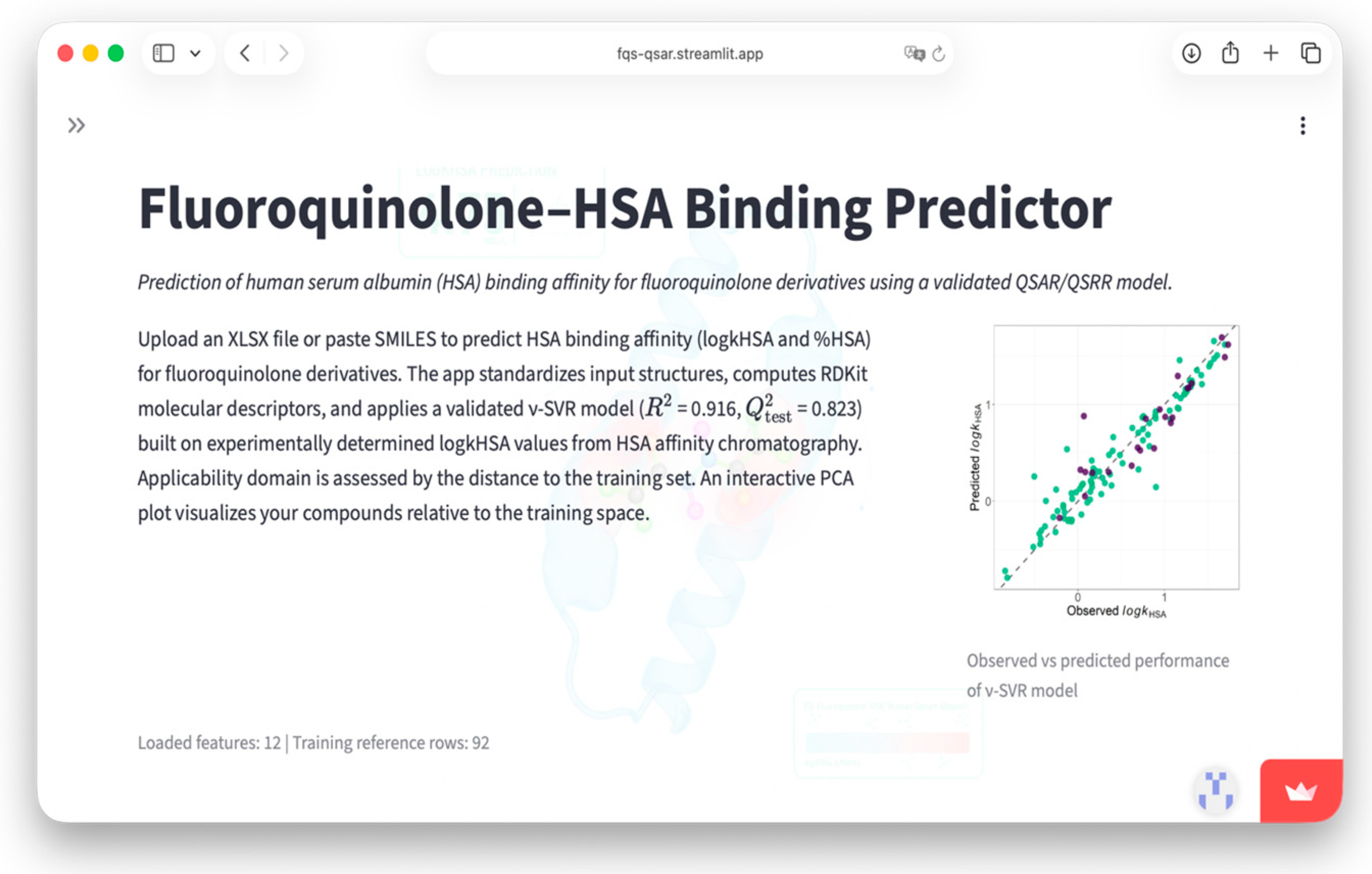
Machine Learning-Driven QSRR Modeling of Albumin Binding in Fluoroquinolones: An SVR Approach Supported by HSA Chromatography
 , , , , ,
Abstract
1. Introduction
2. Results and Discussion
3. Materials and Methods
3.1. Chemical Reagents
3.2. Analytes
3.3. Chromatographic Analysis
3.4. Molecular Descriptors
3.5. QSRR Modeling
3.5.1. Data Set Preparation and Splitting
3.5.2. Descriptor Reduction
3.5.3. Initial Model Screening
3.5.4. Model Optimization and Validation
3.5.5. Model Evaluation and Performance Metrics
4. Conclusions
Supplementary Materials
Author Contributions
Funding
Institutional Review Board Statement
Informed Consent Statement
Data Availability Statement
Acknowledgments
Conflicts of Interest
References
- Barberán, J.; De La Cuerda, A.; González, M.I.T.; Aparicio, A.L.; Vinuesa, C.M.; Sánchez, A.R.; Barberán, L.C. Safety of Fluoroquinolones. Rev. Esp. Quimioter. 2024, 37, 127–133. [Google Scholar] [CrossRef] [PubMed]
- Jonville-Béra, A.P.; Largeau, B.; di Meglio, F.; Pariente, A. The Safety Profile of Fluoroquinolones. Infect. Dis. Now 2025, 55, 105064. [Google Scholar] [CrossRef] [PubMed]
- Kassab, A.E. The Most Recent Updates on the Anticancer Potential of Fluoroquinolones: A Mini Review. Future Med. Chem. 2025, 17, 2067–2078. [Google Scholar] [CrossRef]
- Idowu, T.; Schweizer, F. Ubiquitous Nature of Fluoroquinolones: The Oscillation between Antibacterial and Anticancer Activities. Antibiotics 2017, 6, 26. [Google Scholar] [CrossRef] [PubMed]
- Suleiman, G.; El Brahmi, N.; Guillaumet, G.; El Kazzouli, S. Advances in the Synthesis and Biological Applications of Enoxacin-Based Compounds. Biomolecules 2024, 14, 1419. [Google Scholar] [CrossRef]
- Abrahams, K.A.; Besra, G.S. Fluoroquinolones as Versatile Scaffolds: Potential for Targeting Classical and Novel Mechanisms to Combat Antibacterial Resistance. Eur. J. Pharm. Sci. 2025, 214, 107247. [Google Scholar] [CrossRef]
- Dhiman, P.; Arora, N.; Thanikachalam, P.V.; Monga, V. Recent Advances in the Synthetic and Medicinal Perspective of Quinolones: A Review. Bioorg. Chem. 2019, 92, 103291. [Google Scholar] [CrossRef]
- Rao Gollapalli, V.; Babu Bollikolla, H.; Rao Allaka, T.; Ranga Rao Vaddi, P.; Basireddy, S.; Ganivada, M.; Reddy Pindi, S. New Fluoroquinolone-1,2,4-Triazoles as Potent Antibacterial Agents: Design, Synthesis, Docking Studies and in Silico ADME Profiles. Chem. Biodivers. 2023, 20, e202201259. [Google Scholar] [CrossRef]
- Pranger, A.D.; Alffenaar, J.W.C.; Aarnoutse, R.E. Fluoroquinolones, the Cornerstone of Treatment of Drug-Resistant Tuberculosis: A Pharmacokinetic and Pharmacodynamic Approach. Curr. Pharm. Des. 2012, 17, 2900–2930. [Google Scholar] [CrossRef]
- Di, L. An Update on the Importance of Plasma Protein Binding in Drug Discovery and Development. Expert Opin. Drug Discov. 2021, 16, 1453–1465. [Google Scholar] [CrossRef]
- Valkó, K.L. Lipophilicity and Biomimetic Properties Measured by HPLC to Support Drug Discovery. J. Pharm. Biomed. Anal. 2016, 130, 35–54. [Google Scholar] [CrossRef]
- Talevi, A.; Bellera, C.L. Drug Binding to Plasma Proteins. In The ADME Encyclopedia; Springer: Cham, Switzerland, 2022; pp. 315–326. [Google Scholar] [CrossRef]
- Tesseromatis, C.; Alevizou, A. The Role of the Protein-Binding on the Mode of Drug Action as Well the Interactions with Other Drugs. Eur. J. Drug Metab. Pharmacokinet. 2008, 33, 225–230. [Google Scholar] [CrossRef]
- Bergogne-Bérézin, E. Clinical role of protein binding of quinolones. Clin. Pharmacokinet. 2002, 41, 741–750. [Google Scholar] [CrossRef]
- Zeitlinger, M.; Sauermann, R.; Fille, M.; Hausdorfer, J.; Leitner, I.; Müller, M. Plasma protein binding of fluoroquinolones affects antimicrobial activity. J. Antimicrob. Chemother. 2008, 61, 561–567. [Google Scholar] [CrossRef]
- Hou, Y.; Zhao, Y.; Li, Y. Environmentally friendly fluoroquinolone derivatives with lower plasma protein binding rate designed using 3D-QSAR, molecular docking and molecular dynamics simulation. Int. J. Environ. Res. Public Health 2020, 17, 6626. [Google Scholar] [CrossRef]
- Tsopelas, F.; Vallianatou, T.; Tsantili-Kakoulidou, A. Recent Developments in the Application of Immobilized Artificial Membrane (IAM) Chromatography to Drug Discovery. Expert Opin. Drug Discov. 2024, 19, 1087–1098. [Google Scholar] [CrossRef]
- Valko, K.L. Biomimetic Chromatography—A Novel Application of the Chromatographic Principles. Anal. Sci. Adv. 2022, 3, 146–153. [Google Scholar] [CrossRef] [PubMed]
- Tsopelas, F.; Stergiopoulos, C.; Danias, P.; Tsantili-Kakoulidou, A. Biomimetic Separations in Chemistry and Life Sciences. Microchim. Acta 2025, 192, 133. [Google Scholar] [CrossRef] [PubMed]
- Valko, K.; Nunhuck, S.; Bevan, C.; Abraham, M.H.; Reynolds, D.P. Fast Gradient HPLC Method to Determine Compounds Binding to Human Serum Albumin. Relationships with Octanol/Water and Immobilized Artificial Membrane Lipophilicity. J. Pharm. Sci. 2003, 92, 2236–2248. [Google Scholar] [CrossRef] [PubMed]
- Nisterenko, W.; Żołnowska, B.; Deng, J.; Zgoda, D.; Różycka, A.; Greber, K.E.; Pogorzelska, A.; Szafrański, K.; Bułakowska, A.; Tomorowicz, Ł.; et al. Machine Learning-Driven Insights into Retention Mechanism in IAM Chromatography of Anticancer Sulfonamides: Implications for Biological Efficacy. J. Chromatogr. A 2025, 1751, 465911. [Google Scholar] [CrossRef]
- Ciura, K. Modeling of Small Molecule’s Affinity to Phospholipids Using IAM-HPLC and QSRR Approach Enhanced by Similarity-Based Machine Algorithms. J. Chromatogr. A 2024, 1714, 464549. [Google Scholar] [CrossRef]
- Cherkasov, A.; Muratov, E.N.; Fourches, D.; Varnek, A.; Baskin, I.I.; Cronin, M.; Dearden, J.; Gramatica, P.; Martin, Y.C.; Todeschini, R.; et al. QSAR modeling: Where have you been? Where are you going to? J. Med. Chem. 2014, 57, 4977–5010. [Google Scholar] [CrossRef] [PubMed]
- Wang, Z.; Zhang, S.; Chen, Y.; Zhang, Z.; Ma, S. Covalent organic frameworks for separation applications. Chem. Soc. Rev. 2020, 49, 708–735. [Google Scholar] [CrossRef] [PubMed]
- Tropsha, A.; Isayev, O.; Varnek, A.; Schneider, G.; Cherkasov, A. Integrating QSAR modelling and deep learning in drug discovery: The emergence of deep QSAR. Nat. Rev. Drug Discov. 2024, 23, 141–155. [Google Scholar] [CrossRef]
- Votano, J.R.; Parham, M.; Hall, L.M.; Hall, L.H.; Kier, L.B.; Oloff, S.; Tropsha, A. QSAR modeling of human serum protein binding with several modeling techniques utilizing structure–information representation. J. Med. Chem. 2006, 49, 7169–7181. [Google Scholar] [CrossRef]
- Rahman, M.S.; Khan, M.K.H.; Kawakami, J.; Wang, K.; Diaz, A.; Riley, F. Recent applications of liquid chromatography-based QSRR models for pharmaceutically relevant small molecules: A review. J. Pharm. Sci. 2025, 114, 104047. [Google Scholar] [CrossRef]
- Fouad, M.A.; Serag, A.; Tolba, E.H.; El-Shal, M.A.; El Kerdawy, A.M. QSRR modeling of the chromatographic retention behavior of some quinolone and sulfonamide antibacterial agents using firefly algorithm coupled to support vector machine. BMC Chem. 2022, 16, 85. [Google Scholar] [CrossRef]
- Kumari, P.; Van Laethem, T.; Hubert, P.; Fillet, M.; Sacré, P.Y.; Hubert, C. Quantitative structure retention-relationship modeling: Towards an innovative general-purpose strategy. Molecules 2023, 28, 1696. [Google Scholar] [CrossRef]
- Topliss, J.G.; Costello, R.J. Chance Correlations in Structure-Activity Studies Using Multiple Regression Analysis. J. Med. Chem. 2002, 15, 1066–1068. [Google Scholar] [CrossRef]
- Bernal, L.; Rastelli, G.; Pinzi, L. Improving Machine Learning Classification Predictions through SHAP and Features Analysis Interpretation. J. Chem. Inf. Model. 2025, 65, 11716–11732. [Google Scholar] [CrossRef] [PubMed]



| Metric | SVR | ν-SVR |
|---|---|---|
| R2 | 0.901 | 0.916 |
| MAE | 0.161 | 0.135 |
| RMSE | 0.206 | 0.190 |
| Q2CV | 0.818 | 0.811 |
| MAECV | 0.211 | 0.204 |
| RMSECV | 0.280 | 0.287 |
| Q2test | 0.800 | 0.823 |
| MAEtest | 0.194 | 0.174 |
| RMSEtest | 0.252 | 0.238 |
| Q2F1 | 0.850 | 0.867 |
| Q2F2 | 0.800 | 0.823 |
| Q2F3 | 0.851 | 0.868 |
| CCC | 0.882 | 0.899 |
Disclaimer/Publisher’s Note: The statements, opinions and data contained in all publications are solely those of the individual author(s) and contributor(s) and not of MDPI and/or the editor(s). MDPI and/or the editor(s) disclaim responsibility for any injury to people or property resulting from any ideas, methods, instructions or products referred to in the content. |
© 2026 by the authors. Licensee MDPI, Basel, Switzerland. This article is an open access article distributed under the terms and conditions of the Creative Commons Attribution (CC BY) license.
Share and Cite
Singh, Y.R.; Nisterenko, W.; Fedorowicz, J.; Sączewski, J.; Szulczyk, D.; Greber, K.E.; Sawicki, W.; Ciura, K. Machine Learning-Driven QSRR Modeling of Albumin Binding in Fluoroquinolones: An SVR Approach Supported by HSA Chromatography. Int. J. Mol. Sci. 2026, 27, 3700. https://doi.org/10.3390/ijms27083700
Singh YR, Nisterenko W, Fedorowicz J, Sączewski J, Szulczyk D, Greber KE, Sawicki W, Ciura K. Machine Learning-Driven QSRR Modeling of Albumin Binding in Fluoroquinolones: An SVR Approach Supported by HSA Chromatography. International Journal of Molecular Sciences. 2026; 27(8):3700. https://doi.org/10.3390/ijms27083700
Chicago/Turabian StyleSingh, Yash Raj, Wiktor Nisterenko, Joanna Fedorowicz, Jarosław Sączewski, Daniel Szulczyk, Katarzyna Ewa Greber, Wiesław Sawicki, and Krzesimir Ciura. 2026. "Machine Learning-Driven QSRR Modeling of Albumin Binding in Fluoroquinolones: An SVR Approach Supported by HSA Chromatography" International Journal of Molecular Sciences 27, no. 8: 3700. https://doi.org/10.3390/ijms27083700
APA StyleSingh, Y. R., Nisterenko, W., Fedorowicz, J., Sączewski, J., Szulczyk, D., Greber, K. E., Sawicki, W., & Ciura, K. (2026). Machine Learning-Driven QSRR Modeling of Albumin Binding in Fluoroquinolones: An SVR Approach Supported by HSA Chromatography. International Journal of Molecular Sciences, 27(8), 3700. https://doi.org/10.3390/ijms27083700