Novel Insights into the Role of circRNAs in Cancer Immunotherapy Resistance and Clinical Implications
Abstract
1. Introduction
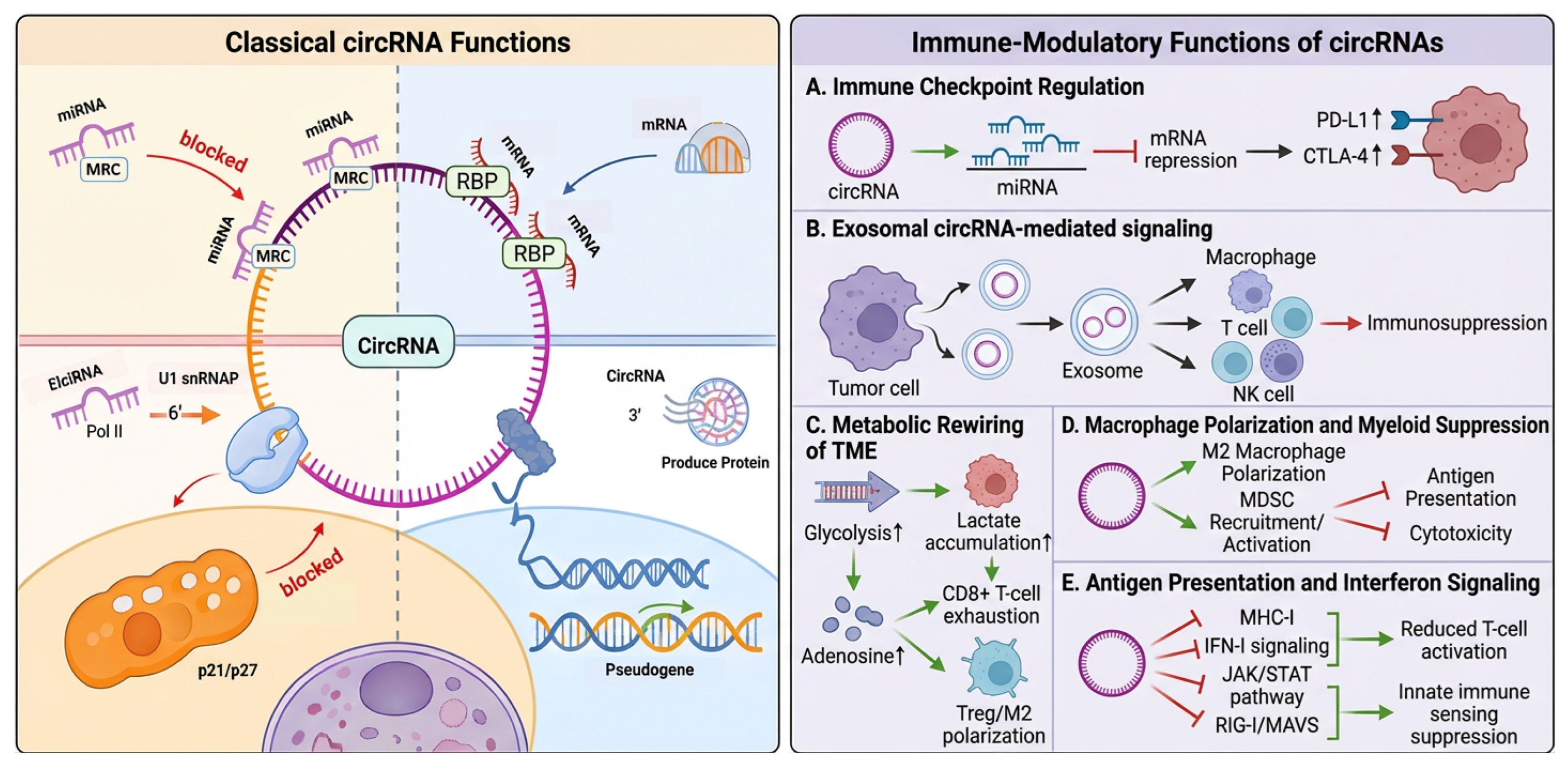
2. Circular RNA and Its Function
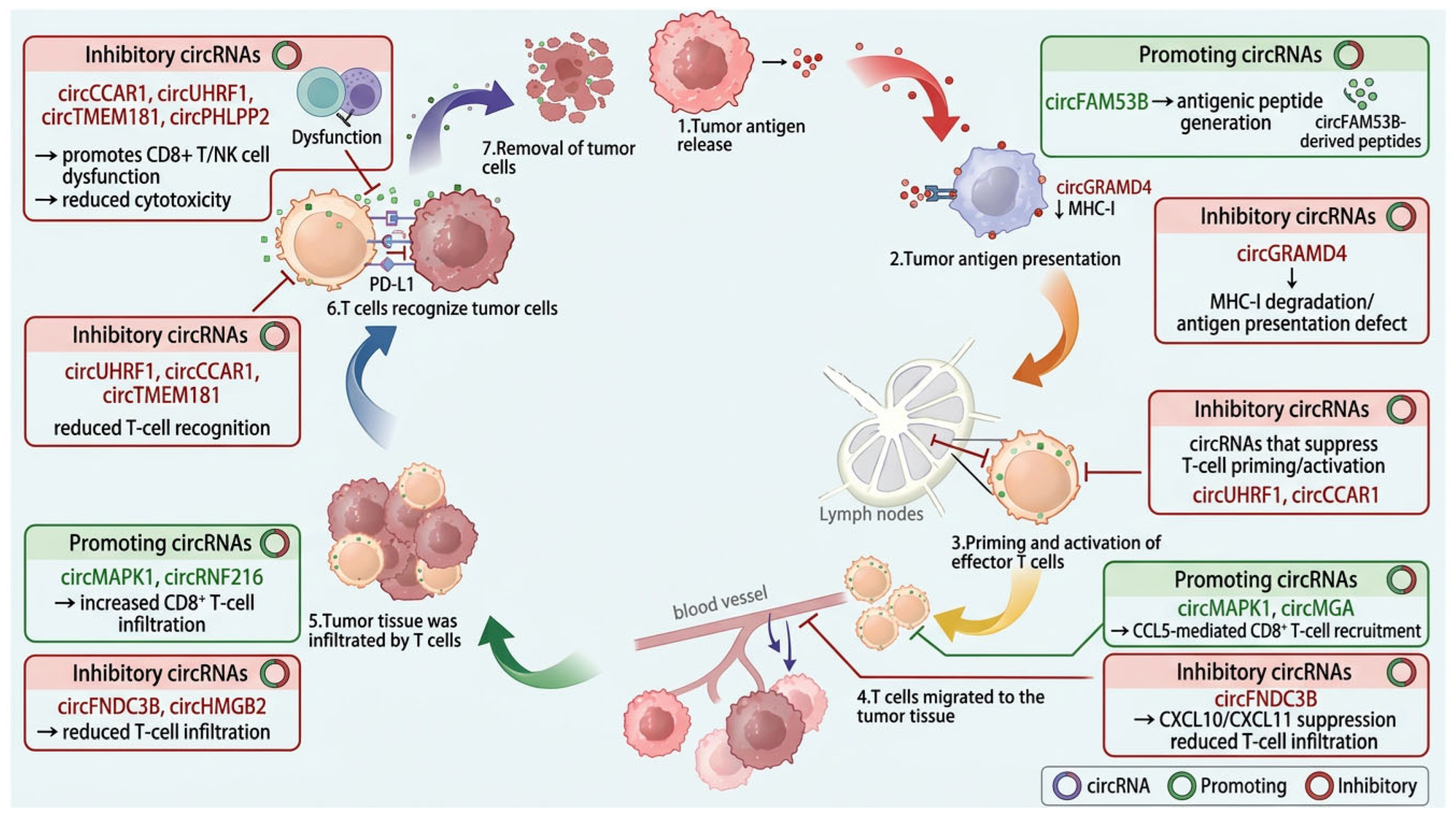
3. Immunotherapy in Tumors
4. The Challenge of Immunotherapy: Drug Resistance Emergence
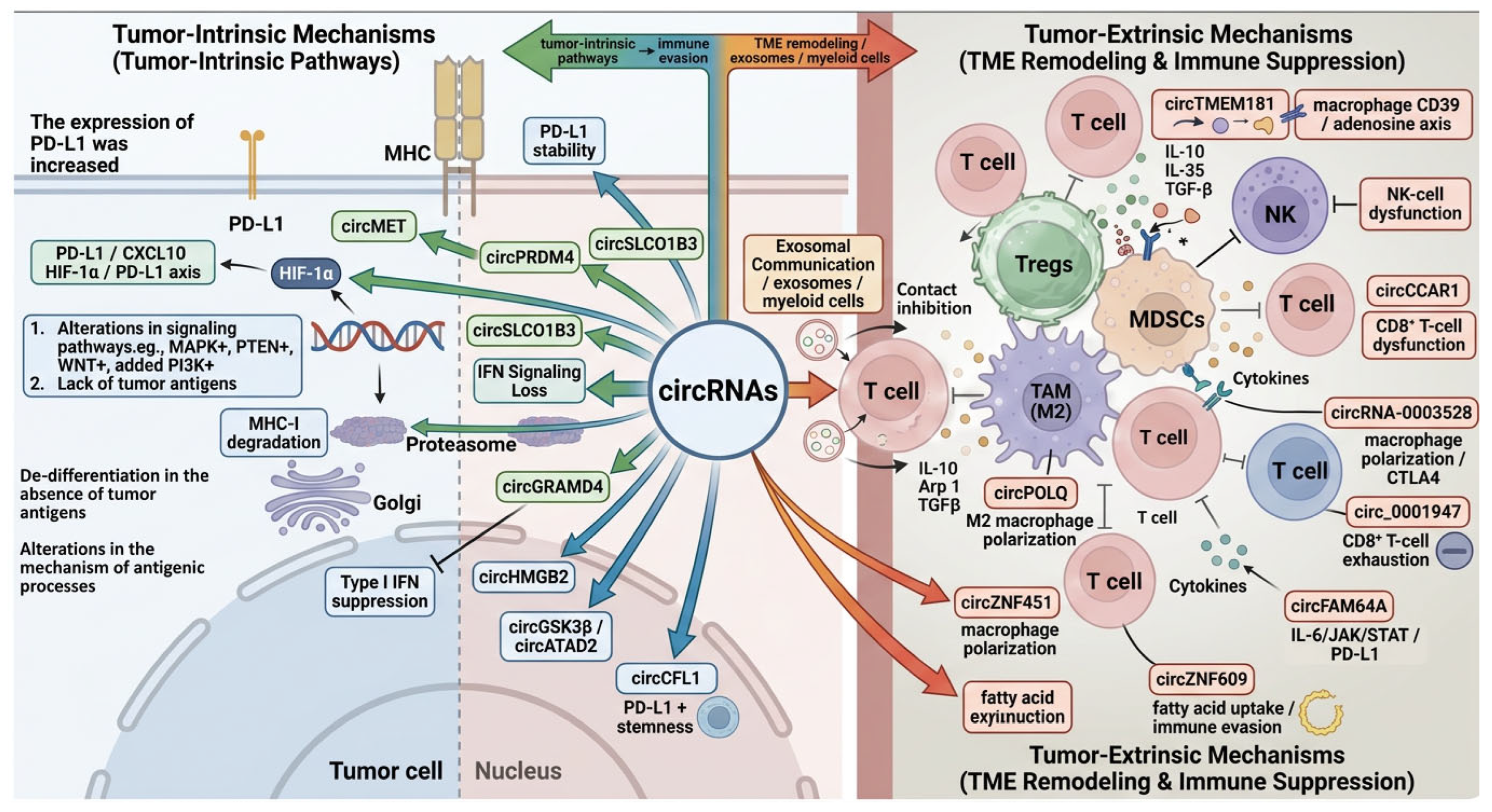
5. CircRNA in Drug Resistance of Tumor Immunotherapy
5.1. Circular RNA’s Role in Immunotherapy Resistance in Hepatic Tumors

| circRNA | Cancer Type | Immune Checkpoints | Altered Mechanism | Molecular Targets | Study Model | Drug | References |
|---|---|---|---|---|---|---|---|
| circTMEM181 | HCC | PD-L1 | Exosome Upscale and ATP–Adenosine Pathway Inhibition. | miR-488–3p | In vitro, clinical | Sintilimab | [157] |
| circUHRF1 | HCC | TIM-3 | Inhibition of NK-cell IFN-γ and TNF-α secretion. | miR-449c–5p | In vitro, in vivo, clinical | TSR-022 | [158] |
| circMET | HCC | PD-L1 | miR-30-5p/Snail/DPP4/CXCL10 axis. | miR-30–5p | In vitro, in vivo, clinical | Sintilimab | [159] |
| circSOD2 | HCC | PD-1 | ANXA11 upregulation induced by interaction with miR-497-5p. | miR-497-5p | In vitro, in vivo | Sintilimab | [160] |
| circ-PTPN22 | ICC | / | T-cell depletion and neutrophil extracellular trap injury. | / | In vitro, clinical | / | [161] |
| circPRDM4 | HCC | PD-1 | Hypoxia promotes HIF-1 recruitment to the CD274 promoter. | / | In vitro, in vivo, clinical | [162] | |
| circWDR25 | HCC | CTLA-4/PD-1 | circWDR25/miR-4474–3p/ALOX15 axis promoted HCC cell proliferation and invasion. | miR-4474–3p | In vitro, clinical | / | [163] |
| circRNA-0003528 | HCC | CTLA4 | Macrophage polarization. | miR-224–5p, miR-324–5p, miR-488–5p | In vitro | [164] | |
| circCCAR1 | HCC | PD-L1 | CD8+ T-cell dysfunction leads to immunosuppression. | miR-127–5p | In vitro, in vivo, clinical | [165] | |
| CircHMGCSI-016 | ICC | PD-1 | Key role in ICC development and immune tolerance. | miR-1236-3p | In vitro, clinical | Sintilimab | [166] |
| circPETH-147aa | HCC | PD-1 | Methionine and leucine insufficiency in cytotoxic CD8+ T-cells. | SLC43A2 | In vitro, in vivo | Norathyriol | [167] |
| circCCNY | HCC | PD-1 | Inhibition of the MAPK/c-Myc/PD-L1 signaling pathway. | / | In vitro, in vivo, clinical | / | [168] |
| circCDYL | HCC | PD-L1 | Hornerin stabilization via blocking synoviolin 1 ubiquitination facilitates PD-L1(+) exosomes. | HRNR | In vitro, in vivo, clinical | / | [169] |
| Circ0027791 | HCC | PD-L1 | Circ0027791/miR-496/PD-L1 axis promoted facilitates HCC progression and immune evasion. | miR-496 | In vitro, in vivo | / | [170] |
| circ0044539 | HCC | / | Downregulation of Hbp1 in PMN-MDSCs. | miR-29a-3p | In vitro, in vivo, clinical | / | [171] |
| circSLCO1B3 | ICC | PD-L1 | miR-502-5p/HOXC8/SMAD3 axis promotes ICC proliferation and stabilizes PD-L1 via SPOP-mediated ubiquitination inhibition. | miR-502-5p | In vitro, in vivo, clinical | / | [172] |
5.2. Circular RNA’s Role in Immunotherapy Resistance in Gastrointestinal Tumors
| circRNA | Cancer Type | Immune Checkpoints | Altered Mechanism | Molecular Targets | Study Model | Drug | References |
|---|---|---|---|---|---|---|---|
| circDLG1 | GC | PD-1 | circDLG1 can act as an miRNA sponge to increase the expression of CXCL12. | miR-141–3p | In vitro, in vivo, clinical | [173] | |
| circcube3 | GC | PD-L1 | Targeting SLC7A5 regulates PD-L1 to affect the immune escape of gastric cancer. | miR-744–5p | In vitro, in vivo | [174] | |
| circ_0073453 | GC | PD-L1 | Resistance to killing by cytotoxic CD8+ T-cells. | miR-146a–5p | In vitro, clinical | [175] | |
| circ-VIM | EC | PD-L1 | The Ras/ERK signaling pathway was inactivated. | miR-124 | In vitro, in vivo | [178] | |
| circQSOX1 | CRC | CTLA-4 | It regulates glycolysis and promotes immune escape in CRC cells. | miR-326/miR-330-5p | In vitro, in vivo, clinical | [180] | |
| circ_0136666 | CRC | PD-L1 | Stimulation of Treq cells. | miR-497 | In vitro, in vivo | [181] | |
| hsa_circ_0046523 | PBMC | PD-L1 | Apoptosis and exhaustion of CD8+ T-cells. | miR-148a–3p | In vitro, clinical | [189] | |
| circRNA_102049 | PBMC | PD-L1 | The expression of CD80 was upregulated. | miR-455–3p | In vitro, clinical | [190] | |
| circ_0001947 | GC | PD-1 | The upregulation of CD39 can facilitate CD8+ T-cell exhaustion. | miR-661/miR-671-5p | In vitro, clinical | / | [191] |
| circRHBDD1 | GC | PD-L1 | It enhances PD-L1 expression and impeds the infiltration of CD8+ T-cells. | IGF2BP2 | In vitro, in vivo, clinical | / | [176] |
| circMAN1A2 | GC | / | CircMAN1A2 inhibits T-cell anti-tumor activity by suppressing T-cell receptor signaling. | T-cell receptor signaling. | In vitro, clinical | / | [177] |
| circNF1 | ESCC | PD-L1 | IL-6-mediated JAK-STAT3 activation enhances p-STAT3 binding and USP7-dependent PD-L1 stabilization. | IL-6, ANXA1 | In vitro, in vivo, clinical | / | [179] |
| circ_0089761 | CRC | PD-L1 | The expression of PD-L1 was upregulated. | miR-27b-3p | In vitro, in vivo | [182] | |
| circ_0007422 | CRC | PD-L1 | The expression of PD-L1 was upregulated. | miR-1256 | In vitro, in vivo | [183] | |
| circPHLPP2 | CRC | PD-1 | The infiltration of NK-cells and the production of granzyme B and interferon-gamma (IFN-γ) are suppressed. | ILF3 | In vitro, in vivo, clinical | / | [184] |
| circPOLQ | CRC | / | Targeting miR-379-3p to active IL-10/STAT3 axis for promoting M2 macrophage polarization. | miR-379-3p | In vitro, in vivo, clinical | / | [185] |
| circNCOA3 | CRC | PD-1 | Through the regulation of CXCL1 levels by miR-203aa-3p.1, sensitivity to PD-1 antibody therapy is enhanced. | miR-203aa-3p.1 | In vitro, in vivo, clinical | [186] | |
| circRNF216 | CRC | / | circRNF216/miR-576-5p/ZC3H12C pathway was activated to increase CD8+ T-cell infiltration. | miR-576-5p | In vitro, clinical | [187] | |
| circMVP | CRC | B7-H3 | The expression of β-catenin is increased, leading to a subsequent upregulation of B7-H3. | β-catenin | In vitro, in vivo | [188] |
5.3. Circular RNA’s Role in Immunotherapy Resistance in Lung Tumors
| circRNA | Cancer Type | Immune Checkpoints | Altered Mechanism | Molecular Targets | Study Model | Drug | References |
|---|---|---|---|---|---|---|---|
| Circ-CPA4 | NSCLC | PD-L1 | Growth, migration, stemness, and drug resistance of inactivated CD8+ T-cells in the tumor immune microenvironment. | let-7 miRNA | In vitro, clinical | [192] | |
| hsa_circ_0003222 | NSCLC | PD-L1 | The important role of hsa_circ_000322 in the stem cell-like characteristics of NSCLC cells. | miR-527 | In vitro, in vivo, clinical | [193] | |
| circ_CELF1 | NSCLC | / | Increasing the expression of miR-491-5p target gene EGFR ultimately promotes the progression of NSCLC. | miR-491-5p/EGFR | In vitro, clinical | [194] | |
| hsa_circ_0000190 | NSCLC | PD-L1 | Upregulation of sPD-L1 expression promotes the tumorigenesis and immune escape of NSCLC. | / | In vitro, clinical | [195] | |
| circ_001678 | NSCLC | PD-1/PD-L1 | It also promoted the apoptosis of CD8+ T-cells. | miR-326/ZEB1 | In vitro, in vivo | [196] | |
| circ_0068252 | NSCLC | PD-L1 | It is involved in the regulation of cisplatin resistance and immune escape in NSCLC cells. | miR-1304-5p/PD-L1 | In vitro, clinical | [197] | |
| hsa_circ_0020714 | NSCLC | PD-L1 | Enhanced SOX4 expression. | miR-30a-5p | In vitro, clinical | [198] | |
| circASCC3 | NSCLC | PD-1 | It can upregulate the level of complement C5a, promote the progression of NSCLC and immune dysfunction. | miR-432-5p | In vitro, clinical | [199] | |
| circ-HSP90A | NSCLC | STAT3, PD-1/PD-L1 | Regulation of STAT3 signaling pathway and programmed death 1 (PD-1)/PD-L1 checkpoint promotes the growth of NSCLC cells. | miR-424-5p | In vitro, in vivo | [200] | |
| has-circRNA-002178 | LUAD | PD-L1 | T-cell exhaustion was induced. | miR-34 | In vitro, clinical | [201] | |
| circUSP7 | NSCLC | PD-1 | Inhibition of CD8+ T-cells, secretion of IFN-γ, TNF-α, granzyme b and perforin by CD8+ T-cells. | miR-934/SHP2 | In vitro, in vivo, clinical | [202] | |
| CircFGFR1 | NSCLC | PD-1 | The expression of C-X-C motif chemokine receptor 4 (CXCR4), the target gene of miR-381-3p, was upregulated. | miR-381-3p/CXCR4 | In vitro, in vivo | [203] | |
| CircZNF451 | NSCLC | PD-1 | Induction of macrophage polarization to reshape the tumor immune microenvironment. | FXR1- ELF4-IRF4 | In vitro, in vivo, clinical | [204] | |
| CircCHST15 | NSCLC | PD-1/PD-L1 | Immune escape of lung cancer cells. | miR-194-5p | In vitro, in vivo, clinical | [205] | |
| circHMGB2 | LUAD | PD-1 | Inactivation of the type 1 interferon response. | miR-181a-5p/CARM1 | In vitro, in vivo, clinical | [206] | |
| circPLEKHM1 | NSCLC | / | Polarizing macrophages towards the M2 phenotype. | PABPC1/eIF4G | In vitro, in vivo | / | [207] |
| circRUNX1 | NSCLC | / | The proliferation of Treg cells. | miR-145 | In vitro, in vivo | / | [208] |
| circFNDC3B | NSCLC | / | Downregulation of CD8+ T-cells. | TFII-I | In vitro, in vivo | / | [209] |
| circENTPD7 | NSCLC | PD-L1 | Promoting the expression of IGF2BP2 to upregulate PD-L1. | IGF2BP2 | In vitro | [210] | |
| circ_0101675 | NSCLC | PD-L1 | Upregulation of PD-L1 levels. | miR-607 | In vitro, in vivo | [211] | |
| circMAPK1 | LUAD | / | Connecting IGF2BP1 to stabilizers CCL5 to recruit CD8+ cells. | IGF2BP1 | In vitro, in vivo | [212] |
5.4. Circular RNA’s Role in Immunotherapy Resistance in Urological Tumors
| circRNA | Cancer Type | Immune Checkpoints | Altered Mechanism | Molecular Targets | Study Model | Drug | References |
|---|---|---|---|---|---|---|---|
| circMGA | CUB | PD-1 | Synergistic treatment between anti-PD-1 can significantly inhibit the growth of xenograft bladder cancer. | HNRNPL | In vitro, in vivo | [213] | |
| circFAM13B | CUB | PD-1 | Inhibition of BCa glycolysis and acidic TME. | IGF2BP1/PKM2 | In vitro, in vivo | [214] | |
| DE-circRs | WT | / | Multiple signaling pathways of DE-mRs are related to cell cycle and immune response. | / | In vitro, clinical | [215] | |
| circRNA_0013936 | BC | / | Through circRNA_0013936/miR-320a/JAK2 and circRNA_0013936/miR-301b-3p/CREB1pathway to inhibit CD8+ T-cell. | miR-320a/miR-301b | In vitro, clinical | / | [216] |
| circFAM64A (3) | BC | PD-L1 | Triggering the JAK/STAT pathway and upregulating PD-L1 levels | miR-149-5p | In vitro, in vivo | / | [217] |
| circZNF609 | BC | / | It can stabilize CD36 mRNA. | IGF2BP2 | In vitro, in vivo | / | [218] |
| circGRAMD4 | RCC | / | Decreasing the infiltration of CD8+ T-cells. | RBM4 | In vitro, in vivo, clinical | [219] |
5.5. Circular RNA’s Role in Immunotherapy Resistance in Gynecologic Tumors and Breast Cancer
| circRNA | Cancer Type | Immune Checkpoints | Altered Mechanism | Molecular Targets | Study Model | Drug | References |
|---|---|---|---|---|---|---|---|
| hsa_circ_0025721 | OC | PD-L1 | It is related to the dysfunction of CD8+ T-cells. | hsa-miR-4428/CXCL8 | In vitro, clinical | [220] | |
| circ-0001068 | OC | PD-L1 | PDI expression was induced by competing endogenous RNA (ecRNA). | miR-28-5p | In vitro, clinical | [221] | |
| circ_0001598 | BC | PD-L1 | All oncogenic effects leading to CD8+ T-cell killing were abolished. | miR-1184 | In vitro, clinical | [222] | |
| CircPYT1 | BC | PD-L1 | Inhibition of type I interferon (IFN) signaling and anti-tumor immunity. | RIGI-MAVS | In vitro, in vivo, clinical | [223] | |
| circNFIX | OC | PD-L1 | Through JAK/STAT3 pathway to increase PD-L1 levels. | miR-647 | In vitro, in vivo | / | [224] |
| Circ-E-cadherin | BC | PD-1 | Activating EGFR signaling and boosting CXCL8 transcription. | / | In vitro, in vivo | [12] | |
| CircGSK3 β | BC | PD-L1 | ThroughCircGSK3 β/miR-338-3p/PRMT5/H3K4me3. | miR-338-3p | In vitro, in vivo | [13] | |
| circATAD2 | BC | PD-L1 | PD-L1mRNA was stabilized by bonding with circATAD2. | m6A PD-L1 | In vitro, clinical | [14] | |
| CircTNK2 | BC | / | It interacts with STAT3and downregulate CXCL10. | STAT3 | In vitro, in vivo, clinical | [15] | |
| circFAM53B | BC | / | Encoding peptides to prime naive CD4+ and CD8+ T-cells in an antigen-specific manner. | HLA | In vitro, in vivo, clinical | [16] | |
| CircCFL1 | BC | PD-L1 | Upregulation of PD-L1 and reducing CD8+ T-cell infiltration. | HDAC1, c-Myc | In vitro, in vivo, clinical | [17] |
5.6. circRNA’s Role in Brain Cancer Resistance
5.7. Circular RNA’s Role in Immunotherapy Resistance in Other Tumors
| circRNA | Cancer Type | Immune Checkpoints | Altered Mechanism | Molecular Targets | Study Model | Drug | References |
|---|---|---|---|---|---|---|---|
| circFAT1 | Squamous cell carcinoma | PD-1/STAT3 | The infiltration of CD8+ cells into the tumor. | / | In vitro, in vivo | [30] | |
| CircKRT1 | OSCC | PD-L1 | Promotes immune evasion. | miR-495-3p | In vitro, in vivo | [31] | |
| circBART2.2 | EBV | PD-L1 | Activation of transcription factors IRF and NF-κ. B promotes the transcription of PD-L1. | RIG-I | In vitro, in vivo, clinical | [32] |
5.8. Limitations and Translational Barriers
6. Conclusions and Perspective
Author Contributions
Funding
Institutional Review Board Statement
Informed Consent Statement
Data Availability Statement
Acknowledgments
Conflicts of Interest
Abbreviations
| ASO | antisense oligonucleotide |
| B2M | β-2-microglobulin |
| BC | breast cancer |
| BCa | bladder cancer |
| ceRNA | competing endogenous RNA |
| circRNAs | circular RNAs |
| CRC | colorectal cancer |
| CSC | cancer stem cell |
| ctDNA | circulating tumor DNA detection |
| CXCL12 | C-X-C motif chemokine ligand 12 |
| DC | dendritic cell |
| DPP4 | dipeptidyl peptidase 4 |
| EBV | Epstein–Barr virus |
| EGFR | epidermal growth factor receptor |
| EMT | epithelial–mesenchymal transition |
| ER | estrogen-receptor |
| FDA | Food and Drug Administration |
| GAL-8 | galectin-8 |
| GSEA | gene set enrichment analysis |
| HCC | hepatocellular carcinoma |
| HLA | human leukocyte antigen |
| HSC | hepatic stellate cell |
| ICB | immune checkpoint blockers |
| IFN-γ | interferon-gamma |
| IL-8 | interleukin-8 |
| IRES | internal ribosome entry site |
| JAK | janus kinase |
| LncRNA | long non-coding RNA |
| LUAD | lung adenocarcinoma |
| MAPK | mitogen-activated protein kinase |
| MDR | multidrug resistance |
| MDSCs | myeloid-derived suppressor cells |
| miRNA | microRNA |
| MYC | myelocytomatosis oncogene |
| NK | natural killer |
| NSCLC | non-small cell lung cancer |
| OSCC | oral squamous cell carcinoma |
| OSMR | oncostatin M receptor |
| PD-1 | programmed cell death protein 1 |
| PD-L1 | programmed cell death ligand 1 |
| PI3K | phosphoinositide 3-kinase |
| PTEN | phosphatase and tensin homolog |
| RCC | renal cell carcinoma |
| SLC7A5 | solute carrier family 7 member 5 |
| TAMs | tumor-associated macrophages |
| TFII-I | transcription factor II-I |
| TGF-β | transforming growth factor-β |
| TME | tumor microenvironment |
| TNBC | triple negative breast cancer |
| Treg | regulatory T |
| USP7 | ubiquitin specific peptidase 7 |
| VEGF | vascular endothelial growth factor |
| WT | Wilms tumor |
References
- Wadhwa, V.; Patel, N.; Grover, D.; Ali, F.S.; Thosani, N. Interventional gastroenterology in oncology. CA Cancer J. Clin. 2022, 73, 286–319. [Google Scholar] [CrossRef] [PubMed]
- Del Rivero, J.; Perez, K.; Kennedy, E.B.; Mittra, E.S.; Vijayvergia, N.; Arshad, J.; Basu, S.; Chauhan, A.; Dasari, A.N.; Bellizzi, A.M.; et al. Systemic Therapy for Tumor Control in Metastatic Well-Differentiated Gastroenteropancreatic Neuroendocrine Tumors: ASCO Guideline. J. Clin. Oncol. 2023, 41, 5049–5067. [Google Scholar] [CrossRef] [PubMed]
- Wang, Y.; Ronckers, C.M.; van Leeuwen, F.E.; Moskowitz, C.S.; Leisenring, W.; Armstrong, G.T.; de Vathaire, F.; Hudson, M.M.; Kuehni, C.E.; Arnold, M.A.; et al. Subsequent female breast cancer risk associated with anthracycline chemotherapy for childhood cancer. Nat. Med. 2023, 29, 2268–2277. [Google Scholar] [CrossRef] [PubMed]
- Carvalho, T. Personalized anti-cancer vaccine combining mRNA and immunotherapy tested in melanoma trial. Nat. Med. 2023, 29, 2379–2380. [Google Scholar] [CrossRef]
- Cho, B.C.; Kim, D.-W.; Spira, A.I.; Gomez, J.E.; Haura, E.B.; Kim, S.-W.; Sanborn, R.E.; Cho, E.K.; Lee, K.H.; Minchom, A.; et al. Amivantamab Plus Lazertinib in Osimertinib-Relapsed EGFR-Mutant Advanced Non-Small Cell Lung Cancer: A Phase 1 Trial. Nat. Med. 2023, 29, 2577–2585. [Google Scholar] [CrossRef]
- Goyal, Y.; Busch, G.T.; Pillai, M.; Li, J.; Boe, R.H.; Grody, E.I.; Chelvanambi, M.; Dardani, I.P.; Emert, B.; Bodkin, N.; et al. Diverse clonal fates emerge upon drug treatment of homogeneous cancer cells. Nature 2023, 620, 651–659. [Google Scholar] [CrossRef]
- Haradhvala, N.J.; Leick, M.B.; Maurer, K.; Gohil, S.H.; Larson, R.C.; Yao, N.; Gallagher, K.M.E.; Katsis, K.; Frigault, M.J.; Southard, J.; et al. Distinct cellular dynamics associated with response to CAR-T therapy for refractory B cell lymphoma. Nat. Med. 2022, 28, 1848–1859. [Google Scholar] [CrossRef]
- Cabezón-Gutiérrez, L.; Palka-Kotlowska, M.; Custodio-Cabello, S.; Chacón-Ovejero, B.; Pacheco-Barcia, V. Metabolic Mechanisms of Immunotherapy Resistance. Explor. Target. Anti-tumor Ther. 2025, 6, 1002297. [Google Scholar] [CrossRef]
- Ai, J.; Du, Y.; Xue, Q.; Peng, W.; Zhou, Q. Metabolic Checkpoints in CD8+ T Cells within the Tumor Microenvironment: A Comprehensive Review and Emerging Insights. Int. J. Biol. Sci. 2026, 22, 1950–1973. [Google Scholar] [CrossRef]
- Wierda, W.G.; Brown, J.; Abramson, J.S.; Awan, F.; Bilgrami, S.F.; Bociek, G.; Brander, D.; Cortese, M.; Cripe, L.; Davis, R.S.; et al. Chronic Lymphocytic Leukemia/Small Lymphocytic Lymphoma, Version 2.2024. J. Natl. Compr. Cancer Netw. 2024, 22, 175–204. [Google Scholar] [CrossRef]
- Xu, J.; Tang, Z. Progress on Angiogenic and Antiangiogenic Agents in the Tumor Microenvironment. Front. Oncol. 2024, 14, 1491099. [Google Scholar] [CrossRef]
- Shan, K.S.; Musleh Ud Din, S.; Dalal, S.; Gonzalez, T.; Dalal, M.; Ferraro, P.; Hussein, A.; Vulfovich, M. Bispecific Antibodies in Solid Tumors: Advances and Challenges. Int. J. Mol. Sci. 2025, 26, 5838. [Google Scholar] [CrossRef] [PubMed]
- Jeoung, J.; Kim, W.; Jo, H.; Jeoung, D. Circular RNAs as Targets for Developing Anticancer Therapeutics. Cells 2025, 14, 1106. [Google Scholar] [CrossRef] [PubMed]
- Baliton, M.; Alfatlawi, D.; Attarian, S.; Nabar, R.; Villaflor, V. Therapeutic Vaccines for Head and Neck Squamous Cell Carcinoma and Nasopharyngeal Carcinoma. Vaccines 2026, 14, 321. [Google Scholar] [CrossRef]
- Lauwers, Y.; De Groof, T.W.M.; Vincke, C.; Van Craenenbroeck, J.; Jumapili, N.A.; Barthelmess, R.M.; Courtoy, G.; Waelput, W.; De Pauw, T.; Raes, G.; et al. Imaging of tumor-associated macrophage dynamics during immunotherapy using a CD163-specific nanobody-based immunotracer. Proc. Natl. Acad. Sci. USA 2024, 121, e2409668121. [Google Scholar] [CrossRef]
- Blay, J.-Y.; Chevret, S.; Le Cesne, A.; Brahmi, M.; Penel, N.; Cousin, S.; Bertucci, F.; Bompas, E.; Ryckewaert, T.; Soibinet, P.; et al. Pembrolizumab in patients with rare and ultra-rare sarcomas (AcSé Pembrolizumab): Analysis of a subgroup from a non-randomised, open-label, phase 2, basket trial. Lancet Oncol. 2023, 24, 892–902, Erratum in Lancet Oncol. 2023, 24, e405. [Google Scholar] [CrossRef]
- Ghorani, E.; Quartagno, M.; Blackhall, F.; Gilbert, D.C.; O’BRien, M.; Ottensmeier, C.; Pizzo, E.; Spicer, J.; Williams, A.; Badman, P.; et al. REFINE-Lung implements a novel multi-arm randomised trial design to address possible immunotherapy overtreatment. Lancet Oncol. 2023, 24, e219–e227. [Google Scholar] [CrossRef]
- Yang, J.; Chen, Y.; Jing, Y.; Green, M.R.; Han, L. Advancing CAR T cell therapy through the use of multidimensional omics data. Nat. Rev. Clin. Oncol. 2023, 20, 211–228. [Google Scholar] [CrossRef]
- Hou, A.J.; Chen, L.C.; Chen, Y.Y. Navigating CAR-T cells through the solid-tumour microenvironment. Nat. Rev. Drug Discov. 2021, 20, 531–550. [Google Scholar] [CrossRef]
- MacKay, M.; Afshinnekoo, E.; Rub, J.; Hassan, C.; Khunte, M.; Baskaran, N.; Owens, B.; Liu, L.; Roboz, G.J.; Guzman, M.L.; et al. The therapeutic landscape for cells engineered with chimeric antigen receptors. Nat. Biotechnol. 2020, 38, 233–244. [Google Scholar] [CrossRef]
- Zhang, M.; Li, L.; Pu, H.; Wang, Y.; Zhang, X.; Guo, X.; Zhao, Y.; Meng, Q.; Yin, M. Tumor immune organoids in immunotherapy resistance and drug screening. Drug Resist. Updat. 2026, 85, 101360. [Google Scholar] [CrossRef] [PubMed]
- Hamdan, F.H.; Abdelrahman, A.M.; Kutschat, A.P.; Wang, X.; Ekstrom, T.L.; Jalan-Sakrikar, N.; Wippel, C.W.; Taheri, N.; Tamon, L.; Kopp, W.; et al. Interactive enhancer hubs (iHUBs) mediate transcriptional reprogramming and adaptive resistance in pancreatic cancer. Gut 2023, 72, 1174–1185. [Google Scholar] [CrossRef] [PubMed]
- Liu, Z.; Zou, H.; Dang, Q.; Xu, H.; Liu, L.; Zhang, Y.; Lv, J.; Li, H.; Zhou, Z.; Han, X. Biological and pharmacological roles of m6A modifications in cancer drug resistance. Mol. Cancer 2022, 21, 220. [Google Scholar] [CrossRef] [PubMed]
- Wood, L.D.; Canto, M.I.; Jaffee, E.M.; Simeone, D.M. Pancreatic Cancer: Pathogenesis, Screening, Diagnosis, and Treatment. Gastroenterology 2022, 163, 386–402.e1. [Google Scholar] [CrossRef]
- De Miguel, F.J.; Gentile, C.; Feng William, W.; Silva Shannon, J.; Sankar, A.; Exposito, F.; Cai Wesley, L.; Melnick Mary, A.; Robles-Oteiza, C.; Hinkley Madeline, M.; et al. Mammalian SWI/SNF chromatin remodeling complexes promote tyrosine kinase inhibitor resistance in EGFR-mutant lung cancer. Cancer Cell 2023, 41, 1516–1534. [Google Scholar] [CrossRef]
- Stossel, C.; Raitses-Gurevich, M.; Atias, D.; Beller, T.; Glick Gorman, Y.; Halperin, S.; Peer, E.; Denroche Robert, E.; Zhang, A.; Notta, F.; et al. Spectrum of Response to Platinum and PARP Inhibitors in Germline BRCA-Associated Pancreatic Cancer in the Clinical and Preclinical Setting. Cancer Discov. 2023, 13, 1826–1843. [Google Scholar] [CrossRef]
- Paz-Ares, L.; Champiat, S.; Lai, W.V.; Izumi, H.; Govindan, R.; Boyer, M.; Hummel, H.-D.; Borghaei, H.; Johnson, M.L.; Steeghs, N.; et al. Tarlatamab, a First-in-Class DLL3-Targeted Bispecific T-Cell Engager, in Recurrent Small-Cell Lung Cancer: An Open-Label, Phase I Study. J. Clin. Oncol. 2023, 41, 2893–2903. [Google Scholar] [CrossRef]
- Jungfleisch, J.; Gebauer, F. RNA-binding proteins as therapeutic targets in cancer. RNA Biol. 2025, 22, 1–8. [Google Scholar] [CrossRef]
- Ho, Y.-J.; Wu, C.-H.; Jin, Q.-F.; Lin, C.-Y.; Chiang, P.-H.; Wu, N.; Fan, C.-H.; Yang, C.-M.; Yeh, C.-K. Superhydrophobic drug-loaded mesoporous silica nanoparticles capped with β-cyclodextrin for ultrasound image-guided combined antivascular and chemo-sonodynamic therapy. Biomaterials 2020, 232, 119723. [Google Scholar] [CrossRef]
- Scandolara, T.B.; Siqueira, I.V.M.; Pinto, L.F.R.; Soares-Lima, S.C. The power and the promise of epigenetic drugs in oncology. Front. Genet. 2026, 16, 1622115. [Google Scholar] [CrossRef]
- Frost, A.; O’Connor, S.; Ciulli, A. Allosteric PROTACs: Expanding the Horizon of Targeted Protein Degradation. J. Am. Chem. Soc. 2026, 148, 2823–2837. [Google Scholar] [CrossRef] [PubMed]
- Kobayashi, Y.; Lim, S.-O.; Yamaguchi, H. Oncogenic signaling pathways associated with immune evasion and resistance to immune checkpoint inhibitors in cancer. Semin. Cancer Biol. 2020, 65, 51–64. [Google Scholar] [CrossRef] [PubMed]
- Dmello, C.; Zhao, J.; Chen, L.; Gould, A.; Castro, B.; Arrieta, V.A.; Zhang, D.Y.; Kim, K.-S.; Kanojia, D.; Zhang, P.; et al. Checkpoint kinase 1/2 inhibition potentiates anti-tumoral immune response and sensitizes gliomas to immune checkpoint blockade. Nat. Commun. 2023, 14, 1566. [Google Scholar] [CrossRef] [PubMed]
- Loh, J.T.; Lam, K.-P. Fungal infections: Immune defense, immunotherapies and vaccines. Adv. Drug Deliv. Rev. 2023, 196, 114775. [Google Scholar] [CrossRef]
- Gowd, V.; Ahmad, A.; Tarique, M.; Suhail, M.; Zughaibi, T.A.; Tabrez, S.; Khan, R. Advancement of cancer immunotherapy using nanoparticles-based nanomedicine. Semin. Cancer Biol. 2022, 86, 624–644. [Google Scholar] [CrossRef]
- Davis, A.A.; Luo, J.; Zheng, T.; Dai, C.; Dong, X.; Tan, L.; Suresh, R.; Ademuyiwa, F.O.; Rigden, C.; Rearden, T.P.; et al. Genomic Complexity Predicts Resistance to Endocrine Therapy and CDK4/6 Inhibition in Hormone Receptor–Positive (HR+)/HER2-Negative Metastatic Breast Cancer. Clin. Cancer Res. 2023, 29, 1719–1729. [Google Scholar] [CrossRef]
- Circular RNA Detection Pipelines Yield Divergent Sets of Circular RNAs. Nat. Methods 2023, 20, 1135–1136. [CrossRef]
- Vromman, M.; Anckaert, J.; Bortoluzzi, S.; Buratin, A.; Chen, C.-Y.; Chu, Q.; Chuang, T.-J.; Dehghannasiri, R.; Dieterich, C.; Dong, X.; et al. Large-scale benchmarking of circRNA detection tools reveals large differences in sensitivity but not in precision. Nat. Methods 2023, 20, 1159–1169, Erratum in Nat. Methods 2025, 22, 448. [Google Scholar] [CrossRef]
- Fudge, J.B. Metatranscriptomes reveal increased diversity of viroid-like circular RNAs. Nat. Biotechnol. 2023, 41, 323. [Google Scholar] [CrossRef]
- Kong, B.; Kim, Y.; Kim, E.H.; Suk, J.S.; Yang, Y. mRNA: A promising platform for cancer immunotherapy. Adv. Drug Deliv. Rev. 2023, 199, 114993. [Google Scholar] [CrossRef]
- Guo, H.; Vuille, J.A.; Wittner, B.S.; Lachtara, E.M.; Hou, Y.; Lin, M.; Zhao, T.; Raman, A.T.; Russell, H.C.; Reeves, B.A.; et al. DNA hypomethylation silences anti-tumor immune genes in early prostate cancer and CTCs. Cell 2023, 186, 2765–2782.e28. [Google Scholar] [CrossRef]
- Gonzalez, H.; Mei, W.; Robles, I.; Hagerling, C.; Allen, B.M.; Okholm, T.L.H.; Nanjaraj, A.; Verbeek, T.; Kalavacherla, S.; van Gogh, M.; et al. Cellular architecture of human brain metastases. Cell 2022, 185, 729–745.e20. [Google Scholar] [CrossRef]
- Fidelle, M.; Rauber, C.; Alves Costa Silva, C.; Tian, A.-L.; Lahmar, I.; de La Varende Anne-Laure, M.; Zhao, L.; Thelemaque, C.; Lebhar, I.; Messaoudene, M.; et al. A Microbiota-Modulated Checkpoint Directs Immunosuppressive Intestinal T Cells into Cancers. Science 2023, 380, eabo2296. [Google Scholar] [CrossRef]
- Liu, X.; Song, J.; Zhang, H.; Liu, X.; Zuo, F.; Zhao, Y.; Zhao, Y.; Yin, X.; Guo, X.; Wu, X.; et al. Immune Checkpoint HLA-E:CD94-NKG2A Mediates Evasion of Circulating Tumor Cells from NK cell surveillance. Cancer Cell 2023, 41, 272–287.e9. [Google Scholar] [CrossRef]
- Noviello, T.M.R.; Di Giacomo, A.M.; Caruso, F.P.; Covre, A.; Mortarini, R.; Scala, G.; Costa, M.C.; Coral, S.; Fridman, W.H.; Sautès-Fridman, C.; et al. Guadecitabine plus ipilimumab in unresectable melanoma: Five-year follow-up and integrated multi-omic analysis in the phase 1b NIBIT-M4 trial. Nat. Commun. 2023, 14, 5914. [Google Scholar] [CrossRef] [PubMed]
- Baumgartner, C.K.; Ebrahimi-Nik, H.; Iracheta-Vellve, A.; Hamel, K.M.; Olander, K.E.; Davis, T.G.R.; McGuire, K.A.; Halvorsen, G.T.; Avila, O.I.; Patel, C.H.; et al. The PTPN2/PTPN1 inhibitor ABBV-CLS-484 unleashes potent anti-tumour immunity. Nature 2023, 622, 850–862. [Google Scholar] [CrossRef] [PubMed]
- Dashti, A.; Sukkestad, S.; Horner, A.M.; Neja, M.; Siddiqi, Z.; Waller, C.; Goldy, J.; Monroe, D.; Lin, A.; Schoof, N.; et al. AZD5582 plus SIV-specific antibodies reduce lymph node viral reservoirs in antiretroviral therapy-suppressed macaques. Nat. Med. 2023, 29, 2535–2546. [Google Scholar] [CrossRef] [PubMed]
- Yuan, L.; Ma, X.; Yang, Y.; Qu, Y.; Li, X.; Zhu, X.; Ma, W.; Duan, J.; Xue, J.; Yang, H.; et al. Phosphoantigens Glue Butyrophilin 3A1 and 2A1 to Activate Vγ9Vδ2 T Cells. Nature 2023, 621, 840–848. [Google Scholar] [CrossRef]
- Nassiri, F.; Patil, V.; Yefet Leeor, S.; Singh, O.; Liu, J.; Dang Rachel, M.A.; Yamaguchi Takafumi, N.; Daras, M.; Cloughesy Timothy, F.; Colman, H.; et al. Oncolytic DNX-2401 Virotherapy Plus Pembrolizumab in Recurrent Glioblastoma: A phase 1/2 trial. Nat. Med. 2023, 29, 1370–1378, Erratum in Nat. Med. 2025, 31, 3204. [Google Scholar] [CrossRef]
- Kamat, A.M.; Apolo, A.B.; Babjuk, M.; Bivalacqua, T.J.; Black, P.C.; Buckley, R.; Campbell, M.T.; Compérat, E.; Efstathiou, J.A.; Grivas, P.; et al. Definitions, End Points, and Clinical Trial Designs for Bladder Cancer: Recommendations from the Society for Immunotherapy of Cancer and the International Bladder Cancer Group. J. Clin. Oncol. 2023, 41, 5437–5447. [Google Scholar] [CrossRef]
- Cartron, G.; Bachy, E.; Tilly, H.; Daguindau, N.; Pica, G.-M.; Bijou, F.; Mounier, C.; Clavert, A.; Damaj, G.L.; Slama, B.; et al. Randomized Phase III Trial Evaluating Subcutaneous Rituximab for the First-Line Treatment of Low–Tumor Burden Follicular Lymphoma: Results of a LYSA Study. J. Clin. Oncol. 2023, 41, 3523–3533, Erratum in J. Clin. Oncol. 2023, 41, 4187. [Google Scholar] [CrossRef] [PubMed]
- McLaughlin, P.; Grillo-López, A.J.; Link, B.K.; Levy, R.; Czuczman, M.S.; Williams, M.E.; Heyman, M.R.; Bence-Bruckler, I.; White, C.A.; Cabanillas, F.; et al. Rituximab Chimeric Anti-CD20 Monoclonal Antibody Therapy for Relapsed Indolent Lymphoma: Half of Patients Respond to a Four-Dose Treatment Program. J. Clin. Oncol. 2023, 41, 154–162. [Google Scholar] [CrossRef] [PubMed]
- Kim, C.G.; Jung, M.; Kim, H.S.; Lee, C.-K.; Jeung, H.-C.; Koo, D.-H.; Bae, W.K.; Zang, D.Y.; Kim, B.J.; Kim, H.; et al. Trastuzumab Combined with Ramucirumab and Paclitaxel in Patients with Previously Treated Human Epidermal Growth Factor Receptor 2–Positive Advanced Gastric or Gastroesophageal Junction Cancer. J. Clin. Oncol. 2023, 41, 4394–4405. [Google Scholar] [CrossRef] [PubMed]
- Van Cutsem, E.; di Bartolomeo, M.; Smyth, E.; Chau, I.; Park, H.; Siena, S.; Lonardi, S.; Wainberg Zev, A.; Ajani, J.; Chao, J.; et al. Trastuzumab Deruxtecan in Patients in the USA and Europe with HER2-positive advanced gastric or gastroesophageal junction cancer with disease progression on or after a trastuzumab-containing regimen (DESTINY-Gastric02): Primary and updated analyses from a single-arm, phase 2 study. Lancet Oncol. 2023, 24, 744–756. [Google Scholar] [CrossRef]
- Globig, A.-M.; Zhao, S.; Roginsky, J.; Maltez, V.I.; Guiza, J.; Avina-Ochoa, N.; Heeg, M.; Hoffmann, F.A.; Chaudhary, O.; Wang, J.; et al. The β1-adrenergic receptor links sympathetic nerves to T cell exhaustion. Nature 2023, 622, 383–392. [Google Scholar] [CrossRef]
- Pan, K.; Concannon, K.; Li, J.; Zhang, J.; Heymach, J.V.; Le, X. Emerging therapeutics and evolving assessment criteria for intracranial metastases in patients with oncogene-driven non-small-cell lung cancer. Nat. Rev. Clin. Oncol. 2023, 20, 716–732. [Google Scholar] [CrossRef]
- Gao, X.; Xu, N.; Li, Z.; Shen, L.; Ji, K.; Zheng, Z.; Liu, D.; Lou, H.; Bai, L.; Liu, T.; et al. Safety and antitumour activity of cadonilimab, an anti-PD-1/CTLA-4 bispecific antibody, for patients with advanced solid tumours (COMPASSION-03): A multicentre, open-label, phase 1b/2 trial. Lancet Oncol. 2023, 24, 1134–1146. [Google Scholar] [CrossRef]
- Baker, D.J.; Arany, Z.; Baur, J.A.; Epstein, J.A.; June, C.H. CAR T therapy beyond cancer: The evolution of a living drug. Nature 2023, 619, 707–715. [Google Scholar] [CrossRef]
- Narayan, V.; Barber-Rotenberg, J.S.; Jung, I.-Y.; Lacey, S.F.; Rech, A.J.; Davis, M.M.; Hwang, W.-T.; Lal, P.; Carpenter, E.L.; Maude, S.L.; et al. PSMA-targeting TGFβ-insensitive armored CAR T cells in metastatic castration-resistant prostate cancer: A phase 1 trial. Nat. Med. 2022, 28, 724–734. [Google Scholar] [CrossRef]
- Good, C.R.; Aznar, M.A.; Kuramitsu, S.; Samareh, P.; Agarwal, S.; Donahue, G.; Ishiyama, K.; Wellhausen, N.; Rennels, A.K.; Ma, Y.; et al. An NK-like CAR T cell transition in CAR T cell dysfunction. Cell 2021, 184, 6081–6100.e26. [Google Scholar] [CrossRef]
- Soliman, H.; Hogue, D.; Han, H.; Mooney, B.; Costa, R.; Lee Marie, C.; Niell, B.; Williams, A.; Chau, A.; Falcon, S.; et al. Oncolytic T-VEC Virotherapy Plus Neoadjuvant Chemotherapy in Nonmetastatic Triple-Negative Breast Cancer: A Phase 2 Trial. Nat. Med. 2023, 29, 450–457, Erratum in Nat. Med. 2023, 29, 3270. [Google Scholar] [CrossRef] [PubMed]
- Katsikis, P.D.; Ishii, K.J.; Schliehe, C. Challenges in developing personalized neoantigen cancer vaccines. Nat. Rev. Immunol. 2023, 24, 213–227. [Google Scholar] [CrossRef] [PubMed]
- A Vaccine Against the Cervical-Cancer Virus Shows Its Prowess. Nature 2023, 621, 7979. [CrossRef]
- Fiuza-Luces, C.; Valenzuela, P.L.; Gálvez, B.G.; Ramírez, M.; López-Soto, A.; Simpson, R.J.; Lucia, A. The effect of physical exercise on anticancer immunity. Nat. Rev. Immunol. 2023, 24, 282–293, Erratum in Nat. Rev. Immunol. 2024, 24, 229. [Google Scholar] [CrossRef]
- Driskill, J.H.; Pan, D. Control of stem cell renewal and fate by YAP and TAZ. Nat. Rev. Mol. Cell Biol. 2023, 24, 895–911. [Google Scholar] [CrossRef]
- Xue, R.; Zhang, Q.; Cao, Q.; Kong, R.; Xiang, X.; Liu, H.; Feng, M.; Wang, F.; Cheng, J.; Li, Z.; et al. Liver tumour immune microenvironment subtypes and neutrophil heterogeneity. Nature 2022, 612, 141–147. [Google Scholar] [CrossRef]
- Cowan, A.J.; Pont, M.; Sather Blythe, D.; Turtle Cameron, J.; Till Brian, G.; Libby Edward, N.; Coffey David, G.; Tuazon Sherilyn, A.; Wood, B.; Gooley, T.; et al. γ-Secretase Inhibitor in Combination with BCMA Chimeric Antigen Receptor T-Cell Immunotherapy for Individuals with Relapsed or Refractory Multiple Myeloma: A Phase 1, First-in-Human Trial. Lancet Oncol. 2023, 24, 811–822. [Google Scholar] [CrossRef]
- Li, C.; He, C.; Pan, J.; Feng, Y.; Tian, D.; Meng, J.; Qi, Z.; Li, C.; Yang, K. MIF Facilitates Resistance to Androgen Deprivation Therapy by Regulating AMPD2 Expression in Prostate Cancer Cells. Prostate 2026, 86, 53–64. [Google Scholar] [CrossRef]
- Peplinski, R.M.; Riordan, J.D.; Schillo, J.L.; Hannan, E.C.; Nobre, S.P.; Lyons, Y.A.; Ulmer, K.K.; Goodheart, M.J.; Dupuy, A.J. Co-targeting the PI3K-Akt pathway improves response to MEK inhibition in low-grade serous ovarian cancer cell lines. Gynecol. Oncol. 2026, 204, 194–201. [Google Scholar] [CrossRef]
- Lee, C.H.; Minh Nguyen, T.; Lee, Y.; Choi, S.G.; Nguyen, P.N.; Park, J.H.; Park, M.K. Overcoming Therapeutic Resistance in Triple-Negative Breast Cancer: Targeting the Undrugged Kinome. Int. J. Mol. Sci. 2026, 27, 450. [Google Scholar] [CrossRef]
- Voutsadakis, I.A. Treatment of extended RAS/BRAF wild-type metastatic colorectal cancer with anti-EGFR antibody combinations. Pharmacogenomics 2025, 26, 39–52. [Google Scholar] [CrossRef]
- Li, Y.; Zhao, L.; Li, X. Hypoxia and the Tumor Microenvironment. Technol. Cancer Res. Treat. 2021, 20, 15330338211036304. [Google Scholar] [CrossRef]
- Ortolano, A.; Frigerio, R.; Ciliberto, G.; Fattore, L.; Mancini, R. miRNA-driven cancer cell plasticity, tolerance and therapy resistance: Lessons from melanoma. Mol. Cancer 2026, 25, 71. [Google Scholar] [CrossRef]
- Suminaga, K.; Nomizo, T.; Yoshida, H.; Ozasa, H. The impact of PD-L1 polymorphisms on the efficacy of immune checkpoint inhibitors depends on the tumor proportion score: A retrospective study. J. Cancer Res. Clin. Oncol. 2025, 151, 2. [Google Scholar] [CrossRef]
- Myers, J.A.; Miller, J.S. Exploring the NK cell platform for cancer immunotherapy. Nat. Rev. Clin. Oncol. 2020, 18, 85–100. [Google Scholar] [CrossRef]
- Huang, D.; Wang, Y.; Thompson, J.W.; Yin, T.; Alexander, P.B.; Qin, D.; Mudgal, P.; Wu, H.; Liang, Y.; Tan, L.; et al. Cancer-cell-derived GABA promotes β-catenin-mediated tumour growth and immunosuppression. Nat. Cell Biol. 2022, 24, 230–241. [Google Scholar] [CrossRef]
- Maas, R.R.; Soukup, K.; Fournier, N.; Massara, M.; Galland, S.; Kornete, M.; Wischnewski, V.; Lourenco, J.; Croci, D.; Álvarez-Prado, Á.F.; et al. The local microenvironment drives activation of neutrophils in human brain tumors. Cell 2023, 186, 4546–4566.e27. [Google Scholar] [CrossRef]
- Kalbasi, A.; Ribas, A. Tumour-intrinsic resistance to immune checkpoint blockade. Nat. Rev. Immunol. 2019, 20, 25–39. [Google Scholar] [CrossRef]
- Loaiza-Moss, J.; Leitges, M. Pan-cancer landscape of protein kinase D3: An integrative TCGA multi-omics analysis of clinical, molecular, and immunological roles. PLoS ONE 2026, 21, e0346173. [Google Scholar] [CrossRef]
- Xu, Q.; Wang, J.; Sun, Y.; Lin, Y.; Liu, J.; Zhuo, Y.; Huang, Z.; Huang, S.; Chen, Y.; Chen, L.; et al. Efficacy and Safety of Sintilimab Plus Anlotinib for PD-L1-Positive Recurrent or Metastatic Cervical Cancer: A Multicenter, Single-Arm, Prospective Phase II Trial. J. Clin. Oncol. 2022, 40, 1795–1805. [Google Scholar] [CrossRef]
- Liu, W.-J.; Wang, L.; Zhou, F.-M.; Liu, S.-W.; Wang, W.; Zhao, E.-J.; Yao, Q.-J.; Li, W.; Zhao, Y.-Q.; Shi, Z.; et al. Elevated NOX4 promotes tumorigenesis and acquired EGFR-TKIs resistance via enhancing IL-8/PD-L1 signaling in NSCLC. Drug Resist. Updat. 2023, 70, 100987. [Google Scholar] [CrossRef]
- Kidoguchi, K.; Ureshino, H.; Yamamoto, Y.; Yanagiya, R.; Kurahashi, Y.; Fukuda-Kurahasi, Y.; Mine, Y.; Aoki, S.; Nakashima, K.; Miyoshi, H.; et al. Orally available decitabine prodrug OR-2100 induces mitotic perturbation for the treatment of double-hit lymphoma. Blood Neoplasia 2025, 2, 100155. [Google Scholar] [CrossRef]
- Xu, N.; Yao, Z.; Shang, G.; Ye, D.; Wang, H.; Zhang, H.; Qu, Y.; Xu, F.; Wang, Y.; Qin, Z.; et al. Integrated proteogenomic characterization of urothelial carcinoma of the bladder. J. Hematol. Oncol. 2022, 15, 76. [Google Scholar] [CrossRef]
- Nicolini, A.; Rossi, G.; Ferrari, P.; Carpi, A. Minimal residual disease in advanced or metastatic solid cancers: The G0-G1 state and immunotherapy are key to unwinding cancer complexity. Semin. Cancer Biol. 2022, 79, 68–82. [Google Scholar] [CrossRef]
- Sosnowska, D.; Cheung, T.S.; Sarkar, J.; Opzoomer, J.W.; Feehan, K.T.; Anstee, J.E.; Woodman, C.A.; Keddar, M.R. Tumor microenvironments with an active type I IFN response are sensitive to inhibitors of heme degradation. JCI Insight 2025, 10, e191017. [Google Scholar] [CrossRef]
- Yang, W. Cancer and Inflammation: Immunologic Interplay, Translational Advances, and Clinical Strategies. J. Explor. Res. Pharmacol. 2025, 10, e00045. [Google Scholar] [CrossRef]
- Wang, J.; Shi, Y.; Gao, Y.; Zhu, N.; Liu, Y.; Zhang, Y.; Xu, C.; Yang, R. Targeting macrophage-derived SPP1 enhances CD8 T cell infiltration via ROS-DNA fragment/cGAS-STING/STAT1-mediated CXCL9/10 in tumor microenvironment. J. Immunother. Cancer 2026, 14, e013697. [Google Scholar] [CrossRef]
- Krishnan, A.; Mukherjee, D. Postoperative immune checkpoint inhibitors plus anti-angiogenesis for hepatitis B virus-associated hepatocellular carcinoma: Analyzing the evidence and future prospects. World J. Gastrointest. Oncol. 2025, 17, 106801. [Google Scholar] [CrossRef]
- Mineo, M.; Lyons, S.M.; Zdioruk, M.; von Spreckelsen, N.; Ferrer-Luna, R.; Ito, H.; Alayo, Q.A.; Kharel, P.; Larsen, A.G.; Fan, W.Y.; et al. Tumor Interferon Signaling Is Regulated by a lncRNA INCR1 Transcribed from the PD-L1 Locus. Mol. Cell 2020, 78, 1207–1223.e8. [Google Scholar] [CrossRef]
- Dykema, A.G.; Zhang, J.; Cheung Laurene, S.; Connor, S.; Zhang, B.; Zeng, Z.; Cherry Christopher, M.; Li, T.; Caushi Justina, X.; Nishimoto, M.; et al. Lung Tumor-Infiltrating Treg Have Divergent Transcriptional Profiles and Function Linked to Checkpoint Blockade Response. Sci. Immunol. 2023, 8, eadg1487. [Google Scholar] [CrossRef]
- Nayyar, N.; de Sauvage, M.A.; Chuprin, J.; Sullivan, E.M.; Singh, M.; Torrini, C.; Zhang, B.S.; Bandyopadhyay, S.; Daniels, K.A.; Alvarez-Breckenridge, C.; et al. CDK4/6 Inhibition Sensitizes Intracranial Tumors to PD-1 Blockade in Preclinical Models of Brain Metastasis. Clin. Cancer Res. 2023, 30, 420–435. [Google Scholar] [CrossRef]
- Rouprêt, M.; Seisen, T.; Birtle, A.J.; Capoun, O.; Compérat, E.M.; Dominguez-Escrig, J.L.; Andersson, I.G.; Liedberg, F.; Mariappan, P.; Mostafid, A.H.; et al. European Association of Urology Guidelines on Upper Urinary Tract Urothelial Carcinoma: 2023 Update. Eur. Urol. 2023, 84, 49–64. [Google Scholar] [CrossRef] [PubMed]
- Ali Lestat, R.; Lenehan Patrick, J.; Cardot-Ruffino, V.; Dias Costa, A.; Katz Matthew, H.G.; Bauer Todd, W.; Nowak Jonathan, A.; Wolpin Brian, M.; Abrams Thomas, A.; Patel, A.; et al. PD-1 Blockade Induces Reactivation of Non-Productive T Cell Responses Characterized by NF-kB Signaling in Patients with Pancreatic Cancer. Clin. Cancer Res. 2023, 30, 542–553. [Google Scholar]
- Chaudagar, K.; Hieromnimon, H.M.; Kelley, A.; Labadie, B.; Shafran, J.; Rameshbabu, S.; Drovetsky, C.; Bynoe, K.; Solanki, A.; Markiewicz, E.; et al. Suppression of Tumor Cell Lactate-generating Signaling Pathways Eradicates Murine PTEN/p53-deficient Aggressive-variant Prostate Cancer via Macrophage Phagocytosis. Clin. Cancer Res. 2023, 29, 4930–4940. [Google Scholar] [CrossRef] [PubMed]
- Lv, X.; Chen, Y.; Wang, Z.; Lin, Y. Immunoregulatory role of exosomal circRNAs in the tumor microenvironment. Front. Oncol. 2025, 15, 1453786. [Google Scholar] [CrossRef]
- Imianowski, C.J.; Chen, Q.; Workman, C.J.; Vignali, D.A.A. Regulatory T cells in the tumour microenvironment. Nat. Rev. Cancer 2025, 25, 703–722. [Google Scholar] [CrossRef]
- Basurto-Olvera, J.; Serrano, C.; Maldonado-Bernal, C. Regulatory T cells in cancer: From immunosuppression to therapeutic targeting. Front. Immunol. 2025, 16, 1703211. [Google Scholar] [CrossRef]
- Zhu, Y.; Shao, X.; Shao, Y.; Cai, Z.; Gu, Y.; Ge, L.; Liu, J. Immunotherapy strategies targeting tumor-associated macrophages and their mechanisms of action in tumor progression. Front. Immunol. 2025, 16, 1680455. [Google Scholar] [CrossRef]
- Liu, S.; Jiang, Y.; Fu, Y.; Wang, S.; Fu, R.; Gao, M.; Zhao, Y.; Chen, S.; Yang, Y.; Yang, W.; et al. Tumor immune microenvironment facilitates resistance to KRAS G12C inhibitor sotorasib by altered PD-L1 expression. J. Immunother. Cancer 2026, 14, e012886. [Google Scholar] [CrossRef]
- Piñeiro-Hermida, S.; Bosso, G.; Sánchez-Vázquez, R.; Martínez, P.; Blasco, M.A. Telomerase deficiency and dysfunctional telomeres in the lung tumor microenvironment impair tumor progression in NSCLC mouse models and patient-derived xenografts. Cell Death Differ. 2023, 30, 1585–1600. [Google Scholar] [CrossRef]
- Bockorny, B.; Semenisty, V.; Macarulla, T.; Borazanci, E.; Wolpin, B.M.; Stemmer, S.M.; Golan, T.; Geva, R.; Borad, M.J.; Pedersen, K.S.; et al. BL-8040, a CXCR4 antagonist, in combination with pembrolizumab and chemotherapy for pancreatic cancer: The COMBAT trial. Nat. Med. 2020, 26, 878–885. [Google Scholar] [CrossRef]
- Fermi, V.; Warta, R.; Wöllner, A.; Lotsch, C.; Jassowicz, L.; Rapp, C.; Knoll, M.; Jungwirth, G.; Jungk, C.; Dao Trong, P. Effective Reprogramming of Patient-Derived M2-Polarized Glioblastoma-Associated Microglia/Macrophages by Treatment with GW2580. Clin. Cancer Res. 2023, 29, 4685–4697. [Google Scholar] [CrossRef]
- Saleem, A.; Khan, M.U.; Zahid, T.; Khurram, I.; Ghani, M.U.; Ullah, I.; Munir, R.; Calina, D.; Sharifi-Rad, J. Biological role and regulation of circular RNA as an emerging biomarker and potential therapeutic target for cancer. Mol. Biol. Rep. 2024, 51, 296. [Google Scholar] [CrossRef]
- Conn, V.M.; Chinnaiyan, A.M.; Conn, S.J. Circular RNA in cancer. Nat. Rev. Cancer 2024, 24, 597–613. [Google Scholar] [CrossRef]
- Korbecki, J.; Grochans, S.; Gutowska, I.; Barczak, K.; Baranowska-Bosiacka, I. CC Chemokines in a Tumor: A Review of Pro-Cancer and Anti-Cancer Properties of Receptors CCR5, CCR6, CCR7, CCR8, CCR9, and CCR10 Ligands. Int. J. Mol. Sci. 2020, 21, 7619. [Google Scholar] [CrossRef] [PubMed]
- Korbecki, J.; Kojder, K.; Kapczuk, P.; Kupnicka, P.; Gawrońska-Szklarz, B.; Gutowska, I.; Chlubek, D.; Baranowska-Bosiacka, I. The Effect of Hypoxia on the Expression of CXC Chemokines and CXC Chemokine Receptors—A Review of Literature. Int. J. Mol. Sci. 2021, 22, 843. [Google Scholar] [CrossRef] [PubMed]
- Yang, M.; Li, J.; Gu, P.; Fan, X. The application of nanoparticles in cancer immunotherapy: Targeting tumor microenvironment. Bioact. Mater. 2021, 6, 1973–1987. [Google Scholar] [CrossRef] [PubMed]
- Kumagai, S.; Togashi, Y.; Kamada, T.; Sugiyama, E.; Nishinakamura, H.; Takeuchi, Y.; Vitaly, K.; Itahashi, K.; Maeda, Y.; Matsui, S.; et al. The PD-1 expression balance between effector and regulatory T cells predicts the clinical efficacy of PD-1 blockade therapies. Nat. Immunol. 2020, 21, 1346–1358. [Google Scholar] [CrossRef]
- Lin, Y.; Wang, Y.; Li, L.; Zhang, K. Coding circular RNA in human cancer. Genes Dis. 2024, 12, 101347. [Google Scholar] [CrossRef]
- Tawbi, H.A.; Schadendorf, D.; Lipson, E.J.; Ascierto, P.A.; Matamala, L.; Gutiérrez, E.C.; Rutkowski, P.; Gogas, H.J.; Lao, C.D.; De Menezes, J.J.; et al. Relatlimab and Nivolumab Versus Nivolumab in Untreated Advanced Melanoma. N. Engl. J. Med. 2022, 386, 24–34. [Google Scholar] [CrossRef]
- Dixon, K.O.; Tabaka, M.; Schramm, M.A.; Xiao, S.; Tang, R.; Dionne, D.; Anderson, A.C.; Rozenblatt-Rosen, O.; Regev, A.; Kuchroo, V.K. TIM-3 restrains anti-tumour immunity by regulating inflammasome activation. Nature 2021, 595, 101–106. [Google Scholar] [CrossRef] [PubMed]
- Bod, L.; Kye, Y.-C.; Shi, J.; Triglia, E.T.; Schnell, A.; Fessler, J.; Ostrowski, S.M.; Von-Franque, M.Y.; Kuchroo, J.R.; Barilla, R.M.; et al. B-cell-specific checkpoint molecules that regulate anti-tumour immunity. Nature 2023, 619, 348–356, Erratum in Nature 2025, 640, E1. [Google Scholar] [CrossRef] [PubMed]
- He, M.; Pan, Y.; You, C.; Gao, H. CircRNAs in cancer therapy tolerance. Clin. Chim. Acta 2024, 558, 119684. [Google Scholar] [CrossRef] [PubMed]
- Lu, J.; Zhang, P.; Huang, X.; Guo, X.; Gao, C.; Zeng, H.; Zheng, Y.; Wang, S.; Cai, J.; Sun, Q.; et al. Amplification of spatially isolated adenosine pathway by tumor–macrophage interaction induces anti-PD1 resistance in hepatocellular carcinoma. J. Hematol. Oncol. 2021, 14, 200. [Google Scholar] [CrossRef]
- Zhang, P.-F.; Gao, C.; Huang, X.-Y.; Lu, J.-C.; Guo, X.-J.; Shi, G.-M.; Cai, J.-B.; Ke, A.-W. Cancer cell-derived exosomal circUHRF1 induces natural killer cell exhaustion and may cause resistance to anti-PD1 therapy in hepatocellular carcinoma. Mol. Cancer 2020, 19, 110. [Google Scholar] [CrossRef]
- Huang, X.-Y.; Zhang, P.-F.; Wei, C.-Y.; Peng, R.; Lu, J.-C.; Gao, C.; Cai, J.-B.; Yang, X.; Fan, J.; Ke, A.-W.; et al. Circular RNA circMET drives immunosuppression and anti-PD1 therapy resistance in hepatocellular carcinoma via the miR-30-5p/snail/DPP4 axis. Mol. Cancer 2020, 19, 92, Erratum in Mol. Cancer 2024, 23, 44. [Google Scholar] [CrossRef]
- Ye, R.; Lu, X.; Liu, J.; Duan, Q.; Xiao, J.; Duan, X.; Yue, Z.; Liu, F. CircSOD2 Contributes to Tumor Progression, Immune Evasion and Anti-PD-1 Resistance in Hepatocellular Carcinoma by Targeting miR-497-5p/ANXA11 Axis. Biochem. Genet. 2023, 61, 597–614. [Google Scholar] [CrossRef]
- Huang, Z.; Yao, F.; Liu, J.; Xu, J.; Guo, Y.; Su, R.; Luo, Q.; Li, J. Up-Regulation of circRNA-0003528 Promotes Mycobacterium Tuberculosis Associated Macrophage Polarization via Down-Regulating miR-224-5p, miR-324-5p and miR-488-5p and Up-Regulating CTLA4. Aging 2020, 12, 25658–25672. [Google Scholar] [CrossRef]
- Hu, Z.; Chen, G.; Zhao, Y.; Gao, H.; Li, L.; Yin, Y.; Jiang, J.; Wang, L.; Mang, Y.; Gao, Y.; et al. Exosome-Derived circCCAR1 Promotes CD8+ T-Cell Dysfunction and Anti-PD1 Resistance in hepatocellular carcinoma. Mol. Cancer 2023, 22, 55. [Google Scholar] [CrossRef]
- Lan, T.; Gao, F.; Cai, Y.; Lv, Y.; Zhu, J.; Liu, H.; Xie, S.; Wan, H.; He, H.; Xie, K.; et al. The protein circPETH-147aa regulates metabolic reprogramming in hepatocellular carcinoma cells to remodel immunosuppressive microenvironment. Nat. Commun. 2025, 16, 333. [Google Scholar] [CrossRef]
- Yang, L.; Tan, W.; Wang, M.; Wei, Y.; Xie, Z.; Wang, Q.; Zhang, Z.; Zhuang, H.; Ma, X.; Wang, B.; et al. circCCNY Enhances Lenvatinib Sensitivity and Suppresses Immune Evasion in Hepatocellular Carcinoma by Serving as a Scaffold for SMURF1 Mediated HSP60 Degradation. Cancer Lett. 2025, 612, 217470. [Google Scholar] [CrossRef]
- Fu, J.; Liu, F.; Bai, S.; Jiang, X.; Song, H.; Zhang, M.; Zhao, R.; Ouyang, T.; Yu, M.; Qian, H.; et al. Circular RNA CDYL Facilitates Hepatocellular Carcinoma Stemness and PD-L1+ Exosomes-Mediated Immunotherapy Resistance via Stabilizing Hornerin Protein by Blocking Synoviolin 1-Mediated Ubiquitination. Int. J. Biol. Macromol. 2025, 310, 143246. [Google Scholar] [CrossRef]
- Yu, F.; Fang, P.; Fang, Y.; Chen, D. Circ_0027791 Contributes to the Growth and Immune Evasion of Hepatocellular Carcinoma via the miR-496/Programmed Cell Death Ligand 1 Axis in an m6A-Dependent Manner. Environ. Toxicol. 2024, 39, 3721–3733. [Google Scholar] [CrossRef]
- Yang, Y.; Chen, X.-Q.; Jia, Y.-X.; Ma, J.; Xu, D.; Xiang, Z.-L. Circ-0044539 promotes lymph node metastasis of hepatocellular carcinoma through exosomal-miR-29a-3p. Cell Death Dis. 2024, 15, 630. [Google Scholar] [CrossRef]
- Liu, L.; Liao, R.; Wu, Z.; Du, C.; You, Y.; Que, K.; Duan, Y.; Yin, K.; Ye, W. Hepatic Stellate Cell Exosome-Derived circWDR25 Promotes the Progression of Hepatocellular Carcinoma via the miRNA-4474-3P-ALOX-15 and EMT Axes. Biosci. Trends 2022, 16, 267–281, Erratum in Biosci. Trends 2022, 16, 267–281. [Google Scholar] [CrossRef]
- Wang, X.; Wang, G.; Wu, Z.; Dong, Y.; Shi, Y.; Yang, F.; Chen, X.; Wang, J.; Du, S.; Xu, H.; et al. Exosomal circ-PTPN22 and circ-ADAMTS6 Mark T Cell Exhaustion and Neutrophil Extracellular Traps in Asian Intrahepatic Cholangiocarcinoma. Mol. Ther. Nucleic Acids 2022, 31, 151–163. [Google Scholar] [CrossRef]
- Chen, Z.Q.; Zuo, X.-L.; Cai, J.; Zhang, Y.; Han, G.-Y.; Zhang, L.; Ding, W.-Z.; Wu, J.-D.; Wang, X.-H. Hypoxia-Associated circPRDM4 Promotes Immune Escape via HIF-1α Regulation of PD-L1 in Hepatocellular Carcinoma. Exp. Hematol. Oncol. 2023, 12, 17. [Google Scholar] [CrossRef]
- Zhang, P.; Pei, X.; Li, K.; Jin, L.; Wang, F.; Wu, J.; Zhang, X. Circular RNA circFGFR1 promotes progression and anti-PD-1 resistance by sponging miR-381-3p in non-small cell lung cancer cells. Mol. Cancer 2019, 18, 179, Erratum in Mol. Cancer 2020, 19, 21. [Google Scholar] [CrossRef]
- Li, J.; Xu, X.; Xu, K.; Zhou, X.; Wu, K.; Yao, Y.; Liu, Z.; Chen, C.; Wang, L.; Sun, Z.; et al. N6-Methyladenosine-Modified circSLCO1B3 Promotes Intrahepatic Cholangiocarcinoma Progression via regulating HOXC8 and PD-L1. J. Exp. Clin. Cancer Res. 2024, 43, 119. [Google Scholar] [CrossRef]
- Chen, D.L.; Sheng, H.; Zhang, D.-S.; Jin, Y.; Zhao, B.-T.; Chen, N.; Song, K.; Xu, R.-H. The Circular RNA circDLG1 Promotes Gastric Cancer Progression and Anti-PD-1 Resistance Through the Regulation of CXCL12 by Sponging miR-141-3p. Mol. Cancer 2021, 20, 166. [Google Scholar] [CrossRef]
- Shan, H.; Zhang, X.; Wei, Y.; Meng, L.; Li, J.; Zhang, Z.; Ma, L.; Xiao, Y. CircSCUBE3 Reduces the Anti-gastric Cancer Activity of Anti-PD-L1. Mol. Biotechnol. 2023, 66, 123–137. [Google Scholar] [CrossRef]
- Wu, C.; Cao, X.; Xu, J.; Wang, L.; Huang, J.; Wen, J.; Wang, X.; Sang, X.; Zhu, W.; Yao, Y.; et al. Hsa_circ_0073453 Modulates IL-8 Secretion by GC-MSCs to Promote Gastric Cancer Progression by sponging miR-146a-5p. Int. Immunopharmacol. 2023, 119, 110121. [Google Scholar] [CrossRef]
- Li, Y.; Wang, Z.; Gao, P.; Cao, D.; Dong, R.; Zhu, M.; Fei, Y.; Zuo, X.; Cai, J. CircRHBDD1 promotes immune escape via IGF2BP2/PD-L1 signaling and acts as a nanotherapeutic target in gastric cancer. J. Transl. Med. 2024, 22, 704. [Google Scholar] [CrossRef]
- Shen, Y.; Lin, J.; Jiang, T.; Shen, X.; Li, Y.; Fu, Y.; Xu, P.; Fang, L.; Chen, Z.; Huang, H. GC-Derived Exosomal circMAN1A2 Promotes Cancer Progression and Suppresses T-Cell Antitumour Immunity by Inhibiting FBXW11-Mediated SFPQ Degradation. J. Exp. Clin. Cancer Res. 2025, 44, 24. [Google Scholar] [CrossRef]
- Gao, C.; Xu, Y.-J.; Qi, L.; Bao, Y.-F.; Zhang, L.; Zheng, L. CircRNA VIM silence synergizes with sevoflurane to inhibit immune escape and multiple oncogenic activities of esophageal cancer by simultaneously regulating miR-124/PD-L1 axis. Cell Biol. Toxicol. 2021, 38, 825–845. [Google Scholar] [CrossRef]
- Wang, C.; Ju, C.; Du, D.; Zhu, P.; Yin, J.; Jia, J.; Wang, X.; Xu, X.; Zhao, L.; Wan, J.; et al. CircNF1 Modulates the Progression and Immune Evasion of Esophageal Squamous Cell Carcinoma through dual regulation of PD-L1. Cell. Mol. Biol. Lett. 2025, 30, 37. [Google Scholar] [CrossRef]
- Liu, Z.; Zheng, N.; Li, J.; Li, C.; Zheng, D.; Jiang, X.; Ge, X.; Liu, M.; Liu, L.; Song, Z.; et al. N6-methyladenosine-modified circular RNA QSOX1 promotes colorectal cancer resistance to anti-CTLA-4 therapy through induction of intratumoral regulatory T cells. Drug Resist. Updates 2022, 65, 100886. [Google Scholar] [CrossRef]
- Yang, Z.; Chen, W.; Wang, Y.; Qin, M.; Ji, Y. CircKRT1 Drives Tumor Progression and Immune Evasion in Oral Squamous Cell Carcinoma by Sponging miR-495-3p to Regulate PDL1 Expression. Cell Biol. Int. 2021, 45, 1423–1435. [Google Scholar] [CrossRef]
- Gao, Q.; Cheng, X.; Gao, X. Circ_0089761 accelerates colorectal cancer metastasis and immune escape via miR-27b-3p/PD-L1 axis. Physiol. Rep. 2024, 12, e70137. [Google Scholar] [CrossRef]
- Yin, D.; Yang, L.; Feng, X.; Zhai, X.; Hua, M.; Liu, J.; Chen, Y. Circ_0007422 Knockdown Inhibits Tumor Property and Immune Escape of Colorectal Cancer by Decreasing PDL1 Expression in a miR-1256-Dependent Manner. Mol. Biotechnol. 2024, 66, 2606–2619. [Google Scholar] [CrossRef]
- Hu, Y.; Cai, Z.-R.; Huang, R.-Z.; Wang, D.-S.; Ju, H.-Q.; Chen, D.-L. Circular RNA circPHLPP2 promotes tumor growth and anti-PD-1 resistance through binding ILF3 to regulate IL36γ transcription in colorectal cancer. Mol. Cancer 2024, 23, 272. [Google Scholar] [CrossRef]
- Sun, Z.; Xu, Y.; Shao, B.; Dang, P.; Hu, S.; Sun, H.; Chen, C.; Wang, C.; Liu, J.; Liu, Y.; et al. Exosomal circPOLQ promotes macrophage M2 polarization via activating IL-10/STAT3 axis in a colorectal cancer model. J. Immunother. Cancer 2024, 12, e008491. [Google Scholar] [CrossRef]
- Chen, D.-L.; Chen, N.; Sheng, H.; Zhang, D.-S. Circular RNA circNCOA3 promotes tumor progression and anti-PD-1 resistance in colorectal cancer. Cancer Drug Resist. 2024, 7, 9. [Google Scholar] [CrossRef]
- Du, W.; Quan, X.; Wang, C.; Song, Q.; Mou, J.; Pei, D. Regulation of tumor metastasis and CD8+ T cells infiltration by circRNF216/miR-576-5p/ZC3H12C axis in colorectal cancer. Cell. Mol. Biol. Lett. 2024, 29, 19. [Google Scholar] [CrossRef]
- Wang, F.; Wang, Q.; Wu, Y.; Huang, Z.; Zhong, X.; Wang, H.; Yang, C.; Qin, Y.; Qi, X.; Ge, X.; et al. CircMVP promotes METTL3 activation mediated CTNNB1 m6A modification in the inhibition of colorectal cancer in B7-H3 dependence antitumor immunity. Int. J. Biol. Sci. 2025, 21, 306–327. [Google Scholar] [CrossRef]
- Fu, X.; Sun, G.; Tu, S.; Fang, K.; Xiong, Y.; Tu, Y.; Zha, M.; Xiao, T.; Xiao, W. Hsa_circ_0046523 Mediates an Immunosuppressive Tumor Microenvironment by Regulating MiR-148a-3p/PD-L1 Axis in Pancreatic Cancer. Front. Oncol. 2022, 12, 877376. [Google Scholar] [CrossRef]
- Zhu, J.; Zhou, Y.; Zhu, S.; Li, F.; Xu, J.; Zhang, L.; Shu, H. circRNA circ_102049 Implicates in Pancreatic Ductal Adenocarcinoma Progression Through Activating CD80 by Targeting miR-455-3p. Mediat. Inflamm. 2021, 2021, 8819990. [Google Scholar] [CrossRef]
- Wang, B.; Liu, W.; Zhang, M.; Li, Y.; Tang, H.; Wang, Y.; Song, C.; Song, B.; Tan, B. Circ_0001947 Encapsulated by Small Extracellular Vesicles Promotes Gastric Cancer Progression and Anti-PD-1 Resistance by Modulating CD8+ T Cell Exhaustion. J. Nanobiotechnol. 2024, 22, 563. [Google Scholar] [CrossRef]
- Li, X.; Li, Y.; Zhu, H. Next-generation T cell immunotherapy: Overcoming exhaustion, senescence, and suppression. Front. Immunol. 2025, 16, 1662145. [Google Scholar] [CrossRef]
- Li, C.; Zhang, J.; Yang, X.; Hu, C.; Chu, T.; Zhong, R.; Shen, Y.; Hu, F.; Pan, F.; Xu, J.; et al. hsa_circ_0003222 accelerates stemness and progression of non-small cell lung cancer by sponging miR-527. Cell Death Dis. 2021, 12, 807. [Google Scholar] [CrossRef]
- Ge, W.; Chi, H.; Tang, H.; Xu, J.; Wang, J.; Cai, W.; Ma, H. Circular RNA CELF1 Drives Immunosuppression and Anti-PD1 Therapy Resistance in Non-Small Cell Lung Cancer via the miR-491-5p/EGFR Axis. Aging 2021, 13, 24560–24579. [Google Scholar] [CrossRef] [PubMed]
- Wang, D.; Wang, S.; Jin, M.; Zuo, Y.; Wang, J.; Niu, Y.; Zhou, Q.; Chen, J.; Tang, X.; Tang, W.; et al. Hypoxic Exosomal circPLEKHM1-Mediated Crosstalk between Tumor Cells and Macrophages Drives Lung Cancer Metastasis. Adv. Sci. 2024, 11, e2309857. [Google Scholar] [CrossRef] [PubMed]
- Li, J.; Xu, S.; Zhan, Y.; Lv, X.; Sun, Z.; Man, L.; Yang, D.; Sun, Y.; Ding, S. CircRUNX1 enhances the Warburg effect and immune evasion in non-small cell lung cancer through the miR-145/HK2 pathway. Cancer Lett. 2025, 620, 217639. [Google Scholar] [CrossRef] [PubMed]
- Luo, Y.-H.; Yang, Y.-P.; Chien, C.-S.; Yarmishyn, A.A.; Adekunle Ishola, A.; Chien, Y.; Chen, Y.-M.; Tsai, P.-H.; Lin, T.-W.; Wang, M.-L.; et al. Circular RNA hsa_circ_0000190 Facilitates the Tumorigenesis and Immune Evasion by Upregulating the Expression of Soluble PD-L1 in Non-Small-Cell Lung Cancer. Int. J. Mol. Sci. 2021, 23, 64. [Google Scholar] [CrossRef]
- Tian, Q.; Wu, T.; Zhang, X.; Xu, K.; Yin, X.; Wang, X.; Shi, S.; Wang, P.; Gao, L.; Xu, S.; et al. Immunomodulatory functions of the circ_001678/miRNA-326/ZEB1 axis in non-small cell lung cancer via the regulation of PD-1/PD-L1 pathway. Hum. Mol. Genet. 2022, 31, 4094–4106. [Google Scholar] [CrossRef]
- Li, J.; Xu, J.; Wu, G.; Ren, Y.; Wang, X.; Zhang, Q. Circular RNA hsa_circ_0068252 Functions in Cisplatin Resistance and Immune Response via miR-1304-5p/PD-L1 Axis in Non-Small Cell Lung Cancer. Chemotherapy 2022, 67, 223–233. [Google Scholar] [CrossRef]
- Wu, J.; Zhu, M.-X.; Li, K.-S.; Peng, L.; Zhang, P.-F. Circular RNA drives resistance to anti-PD-1 immunotherapy by regulating the miR-30a-5p/SOX4 axis in non-small cell lung cancer. Cancer Drug Resist. 2022, 5, 261–270. [Google Scholar] [CrossRef]
- Dong, R.-F.; Zhu, M.-L.; Liu, M.-M.; Xu, Y.-T.; Yuan, L.-L.; Bian, J.; Xia, Y.-Z.; Kong, L.-Y. EGFR mutation mediates resistance to EGFR tyrosine kinase inhibitors in NSCLC: From molecular mechanisms to clinical research. Pharmacol. Res. 2021, 167, 105583. [Google Scholar] [CrossRef]
- Cai, Z.; Wuri, Q.; Song, Y.; Qu, X.; Hu, H.; Cao, S.; Wu, H.; Wu, J.; Wang, C.; Yu, X.; et al. CircRNA-loaded DC vaccine in combination with low-dose gemcitabine induced potent anti-tumor immunity in pancreatic cancer model. Cancer Immunol. Immunother. 2025, 74, 68. [Google Scholar] [CrossRef]
- Gao, J.; Zhang, L.-X.; Ao, Y.-Q.; Jin, C.; Zhang, P.-F.; Wang, H.-K.; Wang, S.; Lin, M.; Jiang, J.-H.; Ding, J.-Y. Elevated circASCC3 Limits Antitumor Immunity by Sponging miR-432-5p to Upregulate C5a in Non-Small Cell Lung Cancer. Cancer Lett. 2022, 543, 215774. [Google Scholar] [CrossRef]
- Lei, J.; Zhu, J.; Hui, B.; Jia, C.; Yan, X.; Jiang, T.; Wang, X. Circ-HSP90A expedites cell growth, stemness, and immune evasion in non-small cell lung cancer by regulating STAT3 signaling and PD-1/PD-L1 checkpoint. Cancer Immunol. Immunother. 2022, 72, 101–124. [Google Scholar] [CrossRef]
- Yu, H.; Zhang, Y.; Yang, R.; Xie, C.; Liao, Z.; Zhou, T. CircENTPD7 affects the immune escape of non-small cell lung cancer cells by modulating the IGF2BP2/PD-L1 axis. Oncol. Lett. 2024, 29, 112. [Google Scholar] [CrossRef] [PubMed]
- Lu, W.; Li, L.; Li, L.; Guo, N.; Ma, X. Circular RNA circ_0101675 Promotes NSCLC Cell Proliferation, Migration, Invasion, Angiogenesis and Immune Evasion by Sponging miR-607/PDL1 Axis. Biochem. Genet. 2024, 62, 1539–1555. [Google Scholar] [CrossRef] [PubMed]
- Chen, S.-W.; Zhu, S.-Q.; Pei, X.; Qiu, B.-Q.; Xiong, D.; Long, X.; Lin, K.; Lu, F.; Xu, J.-J.; Wu, Y.-B. Cancer cell-derived exosomal circUSP7 induces CD8+ T cell dysfunction and anti-PD1 resistance by regulating the miR-934/SHP2 axis in NSCLC. Mol. Cancer 2021, 20, 114. [Google Scholar] [CrossRef] [PubMed]
- Lv, J.; Li, K.; Yu, H.; Han, J.; Zhuang, J.; Yu, R.; Cheng, Y.; Song, Q.; Bai, K.; Cao, Q.; et al. HNRNPL induced circFAM13B increased bladder cancer immunotherapy sensitivity via inhibiting glycolysis through IGF2BP1/PKM2 pathway. J. Exp. Clin. Cancer Res. 2023, 42, 41. [Google Scholar] [CrossRef]
- Wei, X.; Xiang, X.; Wang, H.; Wang, Z.; Xing, S.; Peng, W.; Ye, L.; Qu, Y.; Chen, L.; Yang, B.; et al. Tumor Cell-Intrinsic Circular RNA circFNDC3B Attenuates CD8+ T Cells Infiltration in Non-Small Cell Lung Cancer. Commun. Biol. 2025, 8, 711. [Google Scholar] [CrossRef]
- Wang, J.; Zhao, X.; Wang, Y.; Ren, F.; Sun, D.; Yan, Y.; Kong, X.; Bu, J.; Liu, M.; Xu, S. circRNA-002178 act as a ceRNA to promote PDL1/PD1 expression in lung adenocarcinoma. Cell Death Dis. 2020, 11, 32. [Google Scholar] [CrossRef]
- Gao, J.; Ao, Y.-Q.; Zhang, L.-X.; Deng, J.; Wang, S.; Wang, H.-K.; Jiang, J.-H.; Ding, J.-Y. Exosomal circZNF451 restrains anti-PD1 treatment in lung adenocarcinoma via polarizing macrophages by complexing with TRIM56 and FXR1. J. Exp. Clin. Cancer Res. 2022, 41, 295. [Google Scholar] [CrossRef]
- Zhao, F.; Zhu, G.; He, J.; Xu, X.; Zhu, W.; Jiang, W.; He, G. CircMAPK1 promoted CD8+ T cell infiltration in LUAD by improving the IGF2BP1 dependent CCL5 upregulation. Int. Immunopharmacol. 2023, 127, 111267. [Google Scholar] [CrossRef]
- Yang, J.; Jia, Y.; Wang, B.; Yang, S.; Du, K.; Luo, Y.; Li, Y.; Zhu, B. Circular RNA CHST15 Sponges miR-155-5p and miR-194-5p to Promote the Immune Escape of Lung Cancer Cells Mediated by PD-L1. Front. Oncol. 2021, 11, 595609. [Google Scholar] [CrossRef]
- Chen, R.; Wang, S.K.; Belk, J.A.; Amaya, L.; Li, Z.; Cardenas, A.; Abe, B.T.; Chen, C.-K.; Wender, P.A.; Chang, H.Y. Engineering circular RNA for enhanced protein production. Nat. Biotechnol. 2022, 41, 262–272, Erratum in Nat. Biotechnol. 2023, 41, 293. [Google Scholar] [CrossRef] [PubMed]
- Cui, J.; Zhang, L.; Zhang, Z.; Luo, X.; Liu, Y.; Li, C.; Huang, W.; Zou, L.; Yu, X.; Xiao, F. A precise and efficient circular RNA synthesis system based on a ribozyme derived from Tetrahymena thermophila. Nucleic Acids Res. 2023, 51, e78. [Google Scholar] [CrossRef] [PubMed]
- Wu, S.; Dai, X.; Xia, Y.; Zhao, Q.; Zhao, H.; Shi, Z.; Yin, X.; Liu, X.; Zhang, A.; Yao, Z.; et al. Targeting high circDNA2v levels in colorectal cancer induces cellular senescence and elicits an anti-tumor secretome. Cell Rep. 2024, 43, 114111. [Google Scholar] [CrossRef] [PubMed]
- Wang, G.; Cheng, T.; Yuan, H.; Zou, F.; Miao, P.; Jiao, J. Tracing cellular interaction of circRNA-miRNA axis with Cu metal-organic framework supported DNA cascade assembly. Biosens. Bioelectron. 2023, 228, 115226. [Google Scholar] [CrossRef]
- Liu, C.; Liang, D. Letter to the Editor: There may be a misunderstanding about the function of circular RNA as miRNA sponges. Hepatology 2023, 77, E102. [Google Scholar] [CrossRef]
- Kameda, S.; Ohno, H.; Saito, H. Synthetic circular RNA switches and circuits that control protein expression in mammalian cells. Nucleic Acids Res. 2023, 51, e24. [Google Scholar] [CrossRef]
- Lin, J.; Wang, X.; Zhai, S.; Shi, M.; Peng, C.; Deng, X.; Fu, D.; Wang, J.; Shen, B. Hypoxia-Induced Exosomal circPDK1 Promotes Pancreatic Cancer Glycolysis via c-myc Activation by modulating miR-628-3p/BPTF axis and degrading BIN1. J. Hematol. Oncol. 2022, 15, 128. [Google Scholar] [CrossRef]
- Niu, D.; Wu, Y.; Lian, J. Circular RNA vaccine in disease prevention and treatment. Signal Transduct. Target. Ther. 2023, 8, 341. [Google Scholar] [CrossRef]
- Wang, Y.; Wu, C.; Du, Y.; Li, Z.; Li, M.; Hou, P.; Shen, Z.; Chu, S.; Zheng, J.; Bai, J. Expanding uncapped translation and emerging function of circular RNA in carcinomas and noncarcinomas. Mol. Cancer 2022, 21, 13. [Google Scholar] [CrossRef]
- Wang, H.; Wang, X.; Zhang, X.; Xu, W. The promising role of tumor-associated macrophages in the treatment of cancer. Drug Resist. Updates 2024, 73, 101041. [Google Scholar] [CrossRef]
- Mao, J.; Lu, Y. Roles of circRNAs in the progression of colorectal cancer: Novel strategies for detection and therapy. Cancer Gene Ther. 2024, 31, 831–841. [Google Scholar] [CrossRef] [PubMed]
- Ou, Q.; Chang, Y.; Liu, J.; Yan, H.; Chen, L.; Guo, D.; Zhang, S.F. Mapping the intellectual structure and landscape of colorectal cancer immunotherapy: A bibliometric analysis. Hum. Vaccin. Immunother. 2024, 20, 2323861. [Google Scholar] [CrossRef] [PubMed]
- Yang, L.; Fu, J.; Han, X.; Zhang, C.; Xia, L.; Zhu, R.; Huang, S.; Xiao, W.; Yu, H.; Gao, Y.; et al. Hsa_circ_0004287 Inhibits Macrophage-Mediated Inflammation in an N6-Methyladenosine-Dependent Manner in atopic dermatitis and psoriasis. J. Allergy Clin. Immunol. 2022, 149, 2021–2033. [Google Scholar] [CrossRef] [PubMed]
- Chen, Y.; Yao, L.; Tang, Y.; Jhong, J.-H.; Wan, J.; Chang, J.; Cui, S.; Luo, Y.; Cai, X.; Li, W.; et al. CircNet 2.0: An updated database for exploring circular RNA regulatory networks in cancers. Nucleic Acids Res. 2021, 50, D93–D101. [Google Scholar] [CrossRef]
- Liu, C.-X.; Chen, L.-L. Circular RNAs: Characterization, cellular roles, and applications. Cell 2022, 185, 2016–2034, Erratum in Cell 2022, 185, 2390. [Google Scholar] [CrossRef]
- Zhu, X.; Zhang, X.; Qin, Y.; Chen, Y.; Feng, X.; Deng, S.; Hu, F.; Yuan, Y.; Luo, X.; Du, K.; et al. Circular RNA circATM binds PARP1 to suppress Wnt/β-catenin signaling and induce cell cycle arrest in gastric cancer cells. J. Adv. Res. 2025, 80, 609–625. [Google Scholar] [CrossRef]
- Dong, Y.; Gao, Q.; Chen, Y.; Zhang, Z.; Du, Y.; Liu, Y.; Zhang, G.; Li, S.; Wang, G.; Chen, X.; et al. Identification of CircRNA signature associated with tumor immune infiltration to predict therapeutic efficacy of immunotherapy. Nat. Commun. 2023, 14, 2540. [Google Scholar] [CrossRef]
- Ding, N.; You, A.-B.; Yang, H.; Hu, G.-S.; Lai, C.-P.; Liu, W.; Ye, F. A Tumor-suppressive Molecular Axis EP300/circRERE/miR-6837-3p/MAVS Activates Type I IFN Pathway and Antitumor Immunity to Suppress Colorectal Cancer. Clin. Cancer Res. 2023, 29, 2095–2109. [Google Scholar] [CrossRef]
- Wu, D.; Hu, L.; Wang, X.; Yu, Y.; Jia, S.-P.; Huang, H.-Y.; Li, Z.-W.; Ma, J.-F.; Zhu, H.-B.; Tang, Y.; et al. Clinical development of mRNA therapies against solid tumors. J. Hematol. Oncol. 2023, 16, 75. [Google Scholar] [CrossRef]
- Gu, Y.; Yang, J.; He, C.; Zhao, T.; Lu, R.; Liu, J.; Mo, X.; Wen, F.; Shi, H. Incorporation of a Toll-like receptor 2/6 agonist potentiates mRNA vaccines against cancer and infectious diseases. Signal Transduct. Target. Ther. 2023, 8, 273. [Google Scholar] [CrossRef]
- Casirati, G.; Cosentino, A.; Mucci, A.; Mahmoud, M.S.; Zabala, I.U.; Zeng, J.; Ficarro, S.B.; Klatt, D.; Brendel, C.; Rambaldi, A.; et al. Epitope editing enables targeted immunotherapy of acute myeloid leukaemia. Nature 2023, 621, 404–414. [Google Scholar] [CrossRef] [PubMed]
- Chen, X.; Lu, Q.; Zhou, H.; Liu, J.; Nadorp, B.; Lasry, A.; Sun, Z.; Lai, B.; Rona, G.; Zhang, J.; et al. A membrane-associated MHC-I inhibitory axis for cancer immune evasion. Cell 2023, 186, 3903–3920.e21. [Google Scholar] [CrossRef] [PubMed]
- Ma, L.; Hostetler, A.; Morgan, D.M.; Maiorino, L.; Sulkaj, I.; Whittaker, C.A.; Neeser, A.; Pires, I.S.; Yousefpour, P.; Gregory, J.; et al. Vaccine-boosted CAR T crosstalk with host immunity to reject tumors with antigen heterogeneity. Cell 2023, 186, 3148–3165.e20. [Google Scholar] [CrossRef] [PubMed]
- Moore, K.N.; Bookman, M.; Sehouli, J.; Miller, A.; Anderson, C.; Scambia, G.; Myers, T.; Taskiran, C.; Robison, K.; Mäenpää, J.; et al. Atezolizumab, Bevacizumab, and Chemotherapy for Newly Diagnosed Stage III or IV Ovarian Cancer: Placebo-Controlled Randomized Phase III Trial (IMagyn050/GOG 3015/ENGOT-OV39). J. Clin. Oncol. 2021, 39, 1842–1855, Erratum in J. Clin. Oncol. 2021, 39, 2420. [Google Scholar] [CrossRef]
- Yang, L.; Yi, Y.; Mei, Z.; Huang, D.; Tang, S.; Hu, L.; Liu, L. Circular RNAs in cancer stem cells: Insights into their roles and mechanisms (Review). Int. J. Mol. Med. 2025, 55, 5491. [Google Scholar] [CrossRef]
- Jiang, Y.; Li, Y.; Wu, T.; Cao, L.; Xu, G.; Liu, J.; Hua, C.; Ding, C.; Yang, B.; Tong, R.; et al. GPC3-based circular RNA vaccine suppresses hepatocellular carcinoma progression by activating adaptive immune responses. Hepatology 2025, 16, 1722576. [Google Scholar] [CrossRef]
- Sacristán Santos, V.; Pensado-López, A.; García-Campelo, R.; Antolín Novoa, S.; Señarís Rodríguez, R.; Torres Andón, F. Reprogramming tumor-associated macrophages using STING or TLR agonists: A promising strategy to enhance immunotherapy in hormone-dependent cancers. J. Immunother. Cancer 2025, 13, e010950. [Google Scholar] [CrossRef]
- Chen, Y.; Ling, Z.; Cai, X.; Xu, Y.; Lv, Z.; Man, D.; Ge, J.; Yu, C.; Zhang, D.; Zhang, Y.; et al. Activation of YAP1 by N6-Methyladenosine–Modified circCPSF6 Drives Malignancy in Hepatocellular Carcinoma. Cancer Res. 2021, 82, 599–614. [Google Scholar] [CrossRef]
- Lin, Z.; Xie, X.; Lu, S.; Liu, T. Noncoding RNAs in osteosarcoma: Implications for drug resistance. Cancer Lett. 2021, 504, 91–103. [Google Scholar] [CrossRef]
- Kim, Y.-N.; Shim, Y.; Seo, J.; Choi, Z.; Lee, Y.J.; Shin, S.; Kim, S.W.; Kim, S.; Choi, J.R.; Lee, J.-Y.; et al. Investigation of PARP Inhibitor Resistance Based on Serially Collected Circulating Tumor DNA in Patients with BRCA -Mutated Ovarian Cancer. Clin. Cancer Res. 2023, 29, 2725–2734. [Google Scholar] [CrossRef]
- Deng, S.; Qian, L.; Liu, L.; Liu, H.; Xu, Z.; Liu, Y.; Wang, Y.; Chen, L.; Zhou, Y. Circular RNA ARHGAP5 inhibits cisplatin resistance in cervical squamous cell carcinoma by interacting with AUF1. Cancer Sci. 2023, 114, 1582–1595. [Google Scholar] [CrossRef]
- Tomar, D.; Yadav, A.S.; Kumar, D.; Bhadauriya, G.; Kundu, G.C. Non-coding RNAs as potential therapeutic targets in breast cancer. Biochim. Biophys. Acta Gene Regul. Mech. 2020, 1863, 194378. [Google Scholar] [CrossRef]
- Li, J.; Zhang, G.; Liu, C.-G.; Xiang, X.; Le, M.T.N.; Sethi, G.; Wang, L.; Goh, B.-C.; Ma, Z. The potential role of exosomal circRNAs in the tumor microenvironment: Insights into cancer diagnosis and therapy. Theranostics 2022, 12, 87–104. [Google Scholar] [CrossRef]
- Kashyap, M.P.; Sinha, R.; Mukhtar, M.S.; Athar, M. Epigenetic regulation in the pathogenesis of non-melanoma skin cancer. Semin. Cancer Biol. 2022, 83, 36–56. [Google Scholar] [CrossRef]
- Zhang, L.-X.; Gao, J.; Long, X.; Zhang, P.-F.; Yang, X.; Zhu, S.-Q.; Pei, X.; Qiu, B.-Q.; Chen, S.-W.; Lu, F. The circular RNA circHMGB2 drives immunosuppression and anti-PD-1 resistance in lung adenocarcinomas and squamous cell carcinomas via the miR-181a-5p/CARM1 axis. Mol. Cancer 2022, 21, 110. [Google Scholar] [CrossRef] [PubMed]
- Sun, J.; Zhang, H.; Wei, W.; Xiao, X.; Huang, C.; Wang, L.; Zhong, H.; Jiang, Y.; Zheng, F.; Yang, H.; et al. Regulation of CD8+ T cells infiltration and immunotherapy by circMGA/HNRNPL complex in bladder cancer. Oncogene 2023, 42, 1247–1262. [Google Scholar] [CrossRef] [PubMed]
- Shi, X.; Pang, S.; Zhou, J.; Yan, G.; Gao, R.; Wu, H.; Wang, Z.; Wei, Y.; Liu, X.; Tan, W. Bladder-cancer-derived exosomal circRNA_0013936 promotes suppressive immunity by up-regulating fatty acid transporter protein 2 and down-regulating receptor-interacting protein kinase 3 in PMN-MDSCs. Mol. Cancer 2024, 23, 52. [Google Scholar] [CrossRef] [PubMed]
- Zhuang, J.; Zhou, M.; Yu, H.; Zhou, R.; Bai, K.; Lv, J.; Li, K.; Cheng, Y.; Yang, H.; Yang, X.; et al. CircFAM64A(3) promoted bladder cancer proliferation and inhibited CD8+ T cell via sponging to miR-149-5p and activated IL-6/JAK/STAT pathway. Int. Immunopharmacol. 2024, 145, 113762. [Google Scholar] [CrossRef]
- Li, K.; Lv, J.; Wang, J.; Wei, Y.; Zhang, Y.; Lin, J.; Zhu, Q. CircZNF609 inhibited bladder cancer immunotherapy sensitivity via enhancing fatty acid uptake through IGF2BP2/CD36 pathway. Int. Immunopharmacol. 2024, 137, 112485. [Google Scholar] [CrossRef]
- Tian, X.-M.; Xiang, B.; Zhang, Z.-X.; Li, Y.-P.; Shi, Q.-L.; Li, M.-J.; Li, Q.; Yu, Y.-H.; Lu, P.; Liu, F.; et al. The Regulatory Network and Role of the circRNA-miRNA-mRNA ceRNA Network in the Progression and the Immune Response of Wilms Tumor Based on RNA-Seq. Front. Genet. 2022, 13, 849941. [Google Scholar] [CrossRef]
- Zhou, M.; Chen, M.; Zheng, Z.; Li, Q.; Liao, L.; Wang, Y.; Xu, Y.; Shu, G.; Luo, J.; Yang, T.; et al. CircRNA GRAMD4 induces NBR1 expression to promote autophagy and immune escape in renal cell carcinoma. Autophagy 2025, 21, 2332–2352. [Google Scholar] [CrossRef] [PubMed]
- Yan, W.; Jin, H.; Zhang, X.; Long, S.; Xia, Q.; Meng, D.; Ding, B.; Li, D.; Ma, J.; Cao, J.; et al. Identification of an immune signature to predict poor clinical outcome in cervical cancer. Epigenomics 2021, 13, 891–907. [Google Scholar] [CrossRef] [PubMed]
- Wang, X.; Yao, Y.; Jin, M. Circ-0001068 is a novel biomarker for ovarian cancer and inducer of PD1 expression in T cells. Aging 2020, 12, 19095–19106. [Google Scholar] [CrossRef] [PubMed]
- Wang, R.; Ye, H.; Yang, B.; Ao, M.; Yu, X.; Wu, Y.; Xi, M.; Hou, M. m6A-modified circNFIX promotes ovarian cancer progression and immune escape via activating IL-6R/JAK1/STAT3 signaling by sponging miR-647. Int. Immunopharmacol. 2023, 124, 110879. [Google Scholar] [CrossRef]
- Zhou, J.; Xu, H.; Li, X.; Liu, H.; Sun, Z.; Li, J.; Tang, Y.; Gao, H.; Zhao, K.; Ding, C.; et al. Targeting tumorous Circ-E-Cadherinencoded C-E-Cad inhibits the recruitment and function of breast cancer-associated myeloid-derived suppressor cells. Pharmacol. Res. 2024, 204, 107204. [Google Scholar] [CrossRef]
- Liang, L.; Gao, M.; Li, W.; Tang, J.; He, Q.; Zeng, F.; Cao, J.; Liu, S.; Chen, Y.; Li, X.; et al. CircGSK3β mediates PD-L1 transcription through miR-338-3p/PRMT5/H3K4me3 to promote breast cancer cell immune evasion and tumor progression. Cell Death Discov. 2024, 10, 426. [Google Scholar] [CrossRef]
- Zhang, Z.; Huo, W.; Li, J. circATAD2 mitigates CD8+ T cells antitumor immune surveillance in breast cancer via IGF2BP3/m6A/PD-L1 manner. Cancer Immunol. Immunother. 2024, 73, 130. [Google Scholar] [CrossRef]
- Huang, L.; Ma, J.; Cui, M. Circular RNA hsa_circ_0001598 promotes programmed death-ligand-1-mediated immune escape and trastuzumab resistance via sponging miR-1184 in breast cancer cells. Immunol. Res. 2021, 69, 558–567. [Google Scholar] [CrossRef]
- Wu, R.; Yu, S.; Bi, A.; Li, Y.; Tiek, D.; Yu, K.; Xiong, H.; Shi, Q.; Mo, Z.; Yu, X.; et al. Therapeutic targeting of circTNK2 with nanoparticles restores tamoxifen sensitivity and enhances NK cell-mediated immunity in ER-positive breast cancer. Cancer Lett. 2025, 627, 217823. [Google Scholar] [CrossRef]
- Huang, D.; Zhu, X.; Ye, S.; Zhang, J.; Liao, J.; Zhang, N.; Zeng, X.; Wang, J.; Yang, B.; Zhang, Y.; et al. Tumour circular RNAs elicit anti-tumour immunity by encoding cryptic peptides. Nature 2023, 625, 593–602. [Google Scholar] [CrossRef]
- Wang, Z.; Li, Y.; Yang, J.; Sun, Y.; He, Y.; Wang, Y.; Liang, Y.; Chen, X.; Chen, T.; Han, D.; et al. CircCFL1 Promotes TNBC Stemness and Immunoescape via Deacetylation-Mediated c-Myc Deubiquitylation to Facilitate Mutant TP53 Transcription. Adv. Sci. 2024, 11, e2404628. [Google Scholar] [CrossRef]
- Jia, L.; Wang, Y.; Wang, C. circFAT1 Promotes Cancer Stemness and Immune Evasion by Promoting STAT3 Activation. Adv. Sci. 2021, 8, 2003376. [Google Scholar] [CrossRef]
- Ge, J.; Wang, J.; Xiong, F.; Jiang, X.; Zhu, K.; Wang, Y.; Mo, Y.; Gong, Z.; Zhang, S.; He, Y.; et al. Epstein–Barr Virus–Encoded Circular RNA CircBART2.2 Promotes Immune Escape of Nasopharyngeal Carcinoma by Regulating PD-L1. Cancer Res. 2021, 81, 5074–5088. [Google Scholar] [CrossRef]
- Stavrou, M.; Constantinidou, A. Tumor associated macrophages in breast cancer progression: Implications and clinical relevance. Front. Immunol. 2024, 15, 1441820. [Google Scholar] [CrossRef]


Disclaimer/Publisher’s Note: The statements, opinions and data contained in all publications are solely those of the individual author(s) and contributor(s) and not of MDPI and/or the editor(s). MDPI and/or the editor(s) disclaim responsibility for any injury to people or property resulting from any ideas, methods, instructions or products referred to in the content. |
© 2026 by the authors. Licensee MDPI, Basel, Switzerland. This article is an open access article distributed under the terms and conditions of the Creative Commons Attribution (CC BY) license.
Share and Cite
Yang, K.; Zhang, Y.; Xiong, J.; Ai, B.; Han, D.; Chong, X. Novel Insights into the Role of circRNAs in Cancer Immunotherapy Resistance and Clinical Implications. Int. J. Mol. Sci. 2026, 27, 3678. https://doi.org/10.3390/ijms27083678
Yang K, Zhang Y, Xiong J, Ai B, Han D, Chong X. Novel Insights into the Role of circRNAs in Cancer Immunotherapy Resistance and Clinical Implications. International Journal of Molecular Sciences. 2026; 27(8):3678. https://doi.org/10.3390/ijms27083678
Chicago/Turabian StyleYang, Kangdi, Yu Zhang, Junjie Xiong, Bin Ai, Dan Han, and Xiaodan Chong. 2026. "Novel Insights into the Role of circRNAs in Cancer Immunotherapy Resistance and Clinical Implications" International Journal of Molecular Sciences 27, no. 8: 3678. https://doi.org/10.3390/ijms27083678
APA StyleYang, K., Zhang, Y., Xiong, J., Ai, B., Han, D., & Chong, X. (2026). Novel Insights into the Role of circRNAs in Cancer Immunotherapy Resistance and Clinical Implications. International Journal of Molecular Sciences, 27(8), 3678. https://doi.org/10.3390/ijms27083678