Cytokine Gene Polymorphisms Modulate Isohemagglutinin Titers and Classes: Another Aspect Towards the Link Between ABO Groups and Human Pathologies?

 , , , ,
  and
and 
Abstract
1. Introduction
2. Results
2.1. Titration of Total Isohemagglutinins of the IgM Anti-A and Anti-B and IgG Anti-A and Anti-B Classes
2.2. Associations Between Titers Above or Equal to the Median and Cytokine Polymorphisms in Each Blood Group and in Total
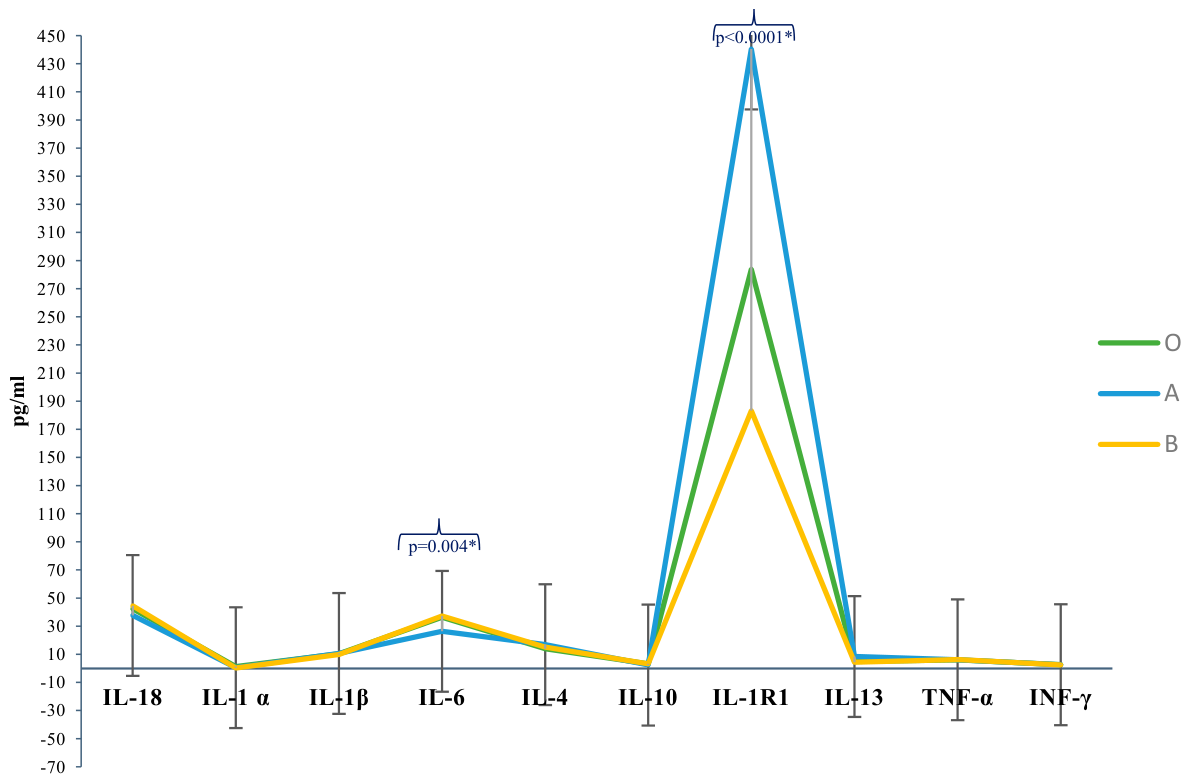
2.3. Levels of Cytokines in Three ABO Groups and Their Correlations with Anti-A and Anti-B IgG Antibodies Titers
2.4. Binary Regression Analysis of Potential Factors Associated with Titers of Anti-A and Anti-B IgG Antibodies
3. Discussion
4. Materials and Methods
4.1. Population Selected in the Study
4.2. Evaluation of the Titers of Isohemagglutinins with Neo Iris Instrument
- -
- IgM anti-B and IgG anti-B for blood group A
- -
- IgM anti-A and IgG anti-A for blood group B
- -
- IgM anti-A and anti-B and IgG anti-A and anti-B for blood group O
4.3. DNA Sample Extraction
4.4. Genotyping by the KASPar (Competitive Allele Specific PCR) System
- -
- H2O to dilute the components, ensure uniform distribution, and achieve the desired final reaction volume (to maintain reagent concentrations)
- -
- primers, which are short nucleotide sequences that, by binding to specific DNA sequences, provide a starting point for DNA polymerase
- -
- a mixture containing the thermostable DNA polymerase TAQ polymerase (an important enzyme for the synthesis of new DNA strands), dNTPs (the building blocks for strand synthesis), magnesium chloride (required for DNA polymerase activity), the fluorochromes FAM and VIC, a passive reference fluorochrome (ROX), and a buffer to maintain reagent stability. The ROX serves to normalize the fluorescent signals emitted by the fluorochromes FAM and VIC.
4.5. Cytokines
4.6. Statistical Analysis
5. Conclusions and Limitations
Supplementary Materials
Author Contributions
Funding
Institutional Review Board Statement
Informed Consent Statement
Data Availability Statement
Conflicts of Interest
References
- Zhernakova, D.V.; Wang, D.; Liu, L.; Andreu-Sánchez, S.; Zhang, Y.; Ruiz-Moreno, A.J.; Peng, H.; Plomp, N.; Del Castillo-Izquierdo, Á.; Gacesa, R.; et al. Host genetic regulation of human gut microbial structural variation. Nature 2024, 625, 813–821. [Google Scholar] [CrossRef]
- Tang, T.W.H.; Ullah, K.; Lee, J.J.; Chen, H.C.; Hsieh, P.C.H. Comparative insights into the gut-heart axis: Cross-species and cross-population perspectives. Gut Microbes 2026, 18, 2611617. [Google Scholar] [CrossRef]
- Franchini, M.; Liumbruno, G.M. ABO blood group: Old dogma, new perspectives. Clin. Chem. Lab. Med. 2013, 51, 1545–1553. [Google Scholar] [CrossRef]
- Reid, M.E.; Mohandas, N. Red blood cell blood group antigens: Structure and function. Semin. Hematol. 2004, 41, 93–117. [Google Scholar] [CrossRef] [PubMed]
- Anstee, D.J. The relationship between blood groups and disease. Blood 2010, 115, 4635–4643. [Google Scholar] [CrossRef]
- Abegaz, S.B. Human ABO Blood Groups and Their Associations with Different Diseases. BioMed Res. Int. 2021, 2021, 6629060. [Google Scholar] [CrossRef]
- Neshat, S.; Rezaei, A.; Farid, A.; Javanshir, S.; Dehghan Niri, F.; Daneii, P.; Heshmat-Ghahdarijani, K.; Sotoudehnia Korani, S. Cardiovascular Diseases Risk Predictors: ABO Blood Groups in a Different Role. Cardiol. Rev. 2024, 32, 174–179. [Google Scholar] [CrossRef]
- Cui, H.; Qu, Y.; Zhang, L.; Zhang, W.; Yan, P.; Yang, C.; Zhang, M.; Bai, Y.; Tang, M.; Wang, Y.; et al. Epidemiological and genetic evidence for the relationship between ABO blood group and human cancer. Int. J. Cancer 2023, 153, 320–330. [Google Scholar] [CrossRef]
- Ellinghaus, D. COVID-19 host genetics and ABO blood group susceptibility. Camb. Prisms. Precis. Med. 2023, 1, e10. [Google Scholar] [CrossRef] [PubMed]
- Franchini, M.; Liumbruno, G.M. ABO blood group and neurodegenerative disorders: More than a casual association. Blood Transfus. 2016, 14, 158–159. [Google Scholar] [CrossRef] [PubMed]
- Bandyopadhyay, A.; Sarkar, D.; Das, A.; Das, A. Intersections of ABO blood group, secretor status, and the gut microbiome: Implications for disease susceptibility and therapeutics. Arch. Microbiol. 2025, 207, 296. [Google Scholar] [CrossRef]
- Rühlemann, M.C.; Hermes, B.M.; Bang, C.; Doms, S.; Moitinho-Silva, L.; Thingholm, L.B.; Frost, F.; Degenhardt, F.; Wittig, M.; Kässens, J.; et al. Genome-wide association study in 8,956 German individuals identifies influence of ABO histo-blood groups on gut microbiome. Nat. Genet. 2021, 53, 147–155. [Google Scholar] [CrossRef]
- Vlasova, A.N.; Takanashi, S.; Miyazaki, A.; Rajashekara, G.; Saif, L.J. How the gut microbiome regulates host immune responses to viral vaccines. Curr. Opin. Virol. 2019, 37, 16–25. [Google Scholar] [CrossRef]
- Bahashwan, A.S. The mechanism underlying the association between ABO blood groups and allergic diseases: An evidence-based systematic review. Allergol. Immunopathol. 2025, 53, 78–84. [Google Scholar] [CrossRef]
- Liumbruno, G.M.; Franchini, M. Beyond immunohaematology: The role of the ABO blood group in human diseases. Blood Transfus. 2013, 11, 491–499. [Google Scholar] [CrossRef]
- Smith, A.J.; Humphries, S.E. Cytokine and cytokine receptor gene polymorphisms and their functionality. Cytokine Growth Factor Rev. 2009, 20, 43–59. [Google Scholar] [CrossRef]
- Franchini, M.; Bonfanti, C. Evolutionary aspects of ABO blood group in humans. Clin. Chim. Acta 2015, 444, 66–71. [Google Scholar] [CrossRef]
- Mohandas, N.; Narla, A. Blood group antigens in health and disease. Curr. Opin. Hematol. 2005, 12, 135–140. [Google Scholar] [CrossRef] [PubMed]
- Corcoran, P.A.; McGuane, D.E.; McGrath, A.M.; Burke, C.M.; Byrne, M.F. Blood group O and vWf expression may be involved in development of peptic ulcer disease secondary to Helicobacter pylori infection. Med. Hypotheses 2009, 73, 338–339. [Google Scholar] [CrossRef] [PubMed]
- Ferous, S.; Siafakas, N.; Boufidou, F.; Patrinos, G.P.; Tsakris, A.; Anastassopoulou, C. Investigating ABO Blood Groups and Secretor Status in Relation to SARS-CoV-2 Infection and COVID-19 Severity. J. Pers. Med. 2024, 14, 346. [Google Scholar] [CrossRef] [PubMed]
- Dahmer, M.K.; Cornell, T.; Quasney, M.W. Genetic and epigenetic factors in the regulation of the immune response. Curr. Opin. Pediatr. 2016, 28, 281–286. [Google Scholar] [CrossRef] [PubMed]
- Balistreri, C.R.; Garagnani, P.; Madonna, R.; Vaiserman, A.; Melino, G. Developmental programming of adult haematopoiesis system. Ageing Res. Rev. 2019, 54, 100918. [Google Scholar] [CrossRef]
- Balistreri, C.R. Anti-Inflamm-Ageing and/or Anti-Age-Related Disease Emerging Treatments: A Historical Alchemy or Revolutionary Effective Procedures? Mediat. Inflamm. 2018, 2018, 3705389. [Google Scholar] [CrossRef]
- Yamamoto, F.; Clausen, H.; White, T.; Marken, J.; Hakomori, S. Molecular genetic basis of the histo-blood group ABO system. Nature 1990, 345, 229–233. [Google Scholar] [CrossRef] [PubMed]
- Yamamoto, F. A historical overview of advances in molecular genetic/genomic studies of the ABO blood group system. Glycoconj. J. 2022, 39, 207–218. [Google Scholar] [CrossRef] [PubMed]
- Novak, J.; Berthelot, L.; Hermouet, S. Editorial: Structure, isotypes, targets, and post-translational modifications of immunoglobulins and their role in infection, inflammation and autoimmunity, Volume II. Front. Immunol. 2022, 13, 1041613. [Google Scholar] [CrossRef]
- McConnell, S.A.; Casadevall, A. New insights into antibody structure with implications for specificity, variable region restriction and isotype choice. Nat. Rev. Immunol. 2025, 25, 621–632. [Google Scholar] [CrossRef]
- Liu, X.; Li, H. A Systematic Review and Meta-Analysis on Multiple Cytokine Gene Polymorphisms in the Pathogenesis of Periodontitis. Front. Immunol. 2022, 12, 713198. [Google Scholar] [CrossRef]
- Hsia, T.C.; Chang, W.S.; Wang, S.; Shen, T.C.; Hsiao, W.Y.; Liu, C.J.; Liang, S.J.; Chen, W.C.; Tu, C.Y.; Tsai, C.W.; et al. The Contribution of Interleukin-10 Promoter Genotypes to Susceptibility to Asthma in Adults. In Vivo 2015, 29, 695–699. [Google Scholar] [PubMed]
- Landy, E.; Carol, H.; Ring, A.; Canna, S. Biological and clinical roles of IL-18 in inflammatory diseases. Nat. Rev. Rheumatol. 2024, 20, 33–47. [Google Scholar] [CrossRef] [PubMed]
- Thompson, S.R.; Humphries, S.E. Interleukin-18 genetics and inflammatory disease susceptibility. Genes Immun. 2007, 8, 91–99. [Google Scholar] [CrossRef]
- Ritvo, P.G.; Klatzmann, D. Interleukin-1 in the Response of Follicular Helper and Follicular Regulatory T Cells. Front. Immunol. 2019, 10, 250. [Google Scholar] [CrossRef]
- Lio, D.; Di Lorenzo, G.; Brusca, I.; Scola, L.; Bellia, C.; La Piana, S.; Barrale, M.; Bova, M.; Vaccarino, L.; Forte, G.I.; et al. A Heuristic Approach to Analysis of the Genetic Susceptibility Profile in Patients Affected by Airway Allergies. Genes 2024, 15, 1105. [Google Scholar] [CrossRef] [PubMed]
- Meng, J.F.; Rosenwasser, L.J. Unraveling the genetic basis of asthma and allergic diseases. Allergy Asthma Immunol. Res. 2010, 2, 215–227. [Google Scholar] [CrossRef] [PubMed]
- Mountz, J.D.; Gao, M.; Ponder, D.M.; Liu, S.; Sun, C.W.; Alduraibi, F.; Sullivan, K.; Pat, B.; Dell’Italia, L.J.; Hsu, H.C. IL-4 receptor blockade is a global repressor of naïve B cell development and responses in a dupilumab-treated patient. Clin. Immunol. 2022, 244, 109130. [Google Scholar] [CrossRef] [PubMed]
- Chelbi, Y.; Hamdoun, M.; Cherni, H.; Triki, H.; Ben Ahmed, M.; Bahri, O. Impact of IL10 polymorphism in chronic progression of hepatitis B virus infection. Virus Res. 2025, 361, 199636. [Google Scholar] [CrossRef]
- Chen, Z.; Liu, S.; Xie, R.; Zhang, P.; Feng, Y. Cytokine networks and therapeutic advances in systemic lupus erythematosus. Front. Immunol. 2025, 16, 1680418. [Google Scholar] [CrossRef]
- Gaceja, K.V.; Ancheta, Z.F.R.; Buna, A.C.A.; Clarencio, S.M.S.; Garrido, M.A.R.; Ramos, J.D.A. Association of interleukin-13 gene single nucleotide polymorphism rs1800925 with allergic asthma in Asian population: A meta-analysis. Asia Pac. Allergy 2023, 13, 148–157. [Google Scholar] [CrossRef] [PubMed]
- Waqar, M.; Tai, T.S.; Qadeer, A.; Aziz, U.; Abohassan, M.; Chen, C.C.; Khan, S. Association of TNF-α polymorphisms rs1800629 (−308G>A) and rs361525 (−238G>A) with type 2 diabetes mellitus in the Punjabi population of Pakistan. Front. Endocrinol. 2025, 16, 1664411. [Google Scholar] [CrossRef]
- Ferreira, F.B.; Rafael, M.A.; Coimbra, L.; Boavida, N.; Arrobas, F.; Correia, F.P.; Figueiredo, L.M.; Branco, J.C.E.; Lourenço, L.C.; Santos, L.; et al. Oliveira-Anti-tumor necrosis factor therapy is associated with attenuated humoral response to SARS-COV-2 vaccines in patients with inflammatory bowel disease. Vaccines 2023, 41, 3862–3871. [Google Scholar] [CrossRef]
- Karaba, A.H.; Zhu, X.M.; Benner, S.E.; Akinde, O.B.; Eby, Y.; Wang, K.H.B.; Saraf, S.B.; Garonzik-Wang, J.M.; Klein, S.L.; Bailey, J.R.; et al. Higher Proinflammatory Cytokines Are Associated with Increased Antibody Titer After a Third Dose of SARS-CoV-2 Vaccine in Solid Organ Transplant Recipients. Transplantation 2022, 106, 835–841. [Google Scholar] [CrossRef]
- Abraham, L.J.; Kroeger, K.M. Impact of the −308 TNF promoter polymorphism on the transcriptional regulation of the TNF gene: Relevance to disease. J. Leukoc. Biol. 1999, 66, 562–566. [Google Scholar] [CrossRef]
- Sabry, R.; Mohamed, Z.A.Z.; Abdallah, A.M. Relationship between Th1 and Th2 cytokine serum levels and immune response to Hepatitis B vaccination among Egyptian health care workers. J. Immunoass. Immunochem. 2018, 39, 496–508. [Google Scholar] [CrossRef]
- Marone, G.; Granata, F.; Pucino, V.; Pecoraro, A.; Heffler, E.; Loffredo, S.; Scadding, G.W.; Varricchi, G. The intriguing role of interleukin 13 in the pathophysiology of asthma. Front. Pharmacol. 2019, 10, 1387. [Google Scholar] [CrossRef] [PubMed]
- Ramírez-Bello, J.; Jiménez-Morales, M. Implicaciones funcionales de los polimorfismos de un solo nucleótido (SNP) en genes codificantes de proteínas y no codificantes en enfermedades multifactoriales [Functional implications of single nucleotide polymorphisms (SNPs) in protein-coding and non-coding RNA genes in multifactorial diseases]. Gac. Med. Mex. 2017, 153, 238–250. [Google Scholar] [PubMed]
- Saba, N.; Raja, G.K.; Yusuf, O.; Rehman, S.; Munir, S.; Mansoor, A. Impacts of different cytokine and chemokine polymorphisms in Pakistani asthmatics a case control study. COPD Res. Pract. 2017, 3, 8. [Google Scholar] [CrossRef]
- Hong, Y.; Mu, S.; Wang, L. Association between ABO blood group system and autoimmune liver disease. Front. Med. 2025, 12, 1696577. [Google Scholar] [CrossRef] [PubMed]
- Forte, G.I.; Scola, L.; Misiano, G.; Milano, S.; Mansueto, P.; Vitale, G.; Bellanca, F.; Sanacore, M.; Vaccarino, L.; Rini, G.B.; et al. Relevance of gamma interferon, tumor necrosis factor alpha, and interleukin-10 gene polymorphisms to susceptibility to Mediterranean spotted fever. Clin. Vaccine Immunol. CVI 2009, 16, 811–815. [Google Scholar] [CrossRef]
- Hijikata, M.; Shojima, J.; Matsushita, I.; Tokunaga, K.; Ohashi, J.; Hang, N.T.; Horie, T.; Sakurada, S.; Hoang, N.P.; Thuong, P.H.; et al. Association of IFNGR2 gene polymorphisms with pulmonary tuberculosis among the Vietnamese. Hum. Genet. 2012, 131, 675–682. [Google Scholar] [CrossRef] [PubMed] [PubMed Central]
- Hijikata, M.; Okahashi, A.; Morioka, I. Vertical Transmission of Severe Acute Respiratory Syndrome Coronavirus 2 from the Mother to the Infant. JAMA Pediatr. 2020, 174, 1006–1007. [Google Scholar] [CrossRef]
- Scola, L.; Giarratana, R.M.; Marinello, V.; Cancila, V.; Pisano, C.; Ruvolo, G.; Frati, G.; Lio, D.; Balistreri, C.R. Polymorphisms of Pro-Inflammatory IL-6 and IL-1β Cytokines in Ascending Aortic Aneurysms as Genetic Modifiers and Predictive and Prognostic Biomarkers. Biomolecules 2021, 11, 943. [Google Scholar] [CrossRef] [PubMed]
- Sun, Y.H.; Wei, S.T.; Zong, S.H. Correlation between IL-4 gene polymorphism as well as its mRNA expression and rheumatoid arthritis. Eur. Rev. Med. Pharmacol. Sci. 2017, 21, 3879–3885. [Google Scholar]
- Lee, E.G.; Oh, J.E. From neglect to spotlight: The underappreciated role of B cells in cutaneous inflammatory diseases. Front. Immunol. 2024, 15, 1328785. [Google Scholar] [CrossRef]
- Tendulkar, A.A.; Jain, P.A.; Velaye, S. Antibody titers in Group O platelet donors. Asian J. Transfus. Sci. 2017, 11, 22–27. [Google Scholar] [CrossRef]
- Kannan, S.; Kulkarni, R.; Basavarajegowda, A. Prevalence of High Titered Anti-A and Anti-B Antibodies Among O Blood Group Individuals and their Associated Factors. Glob. J. Transfus. Med. 2020, 5, 187. [Google Scholar] [CrossRef]
- Truglia, S.; Capozzi, A.; Mancuso, S.; Manganelli, V.; Rapino, L.; Riitano, G.; Recalchi, S.; Colafrancesco, S.; Ceccarelli, F.; Garofalo, T.; et al. Relationship Between Gender Differences and Clinical Outcome in Patients with the Antiphospholipid Syndrome. Front. Immunol. 2022, 13, 932181. [Google Scholar] [CrossRef]
- Noor, N.H.M.; Hasan, M.N.; Iberahim, S.; Zulkafli, Z.; Yusuf, S.M.; Bahar, R.; Ramli, M.; Rahman, W.S.W.A.; Saidin, N.I.S. Determination of ABO antibody titre and haemolysin test of group O whole blood used for exchanged transfusion in a teaching hospital. Bangladesh J. Med. Sci. 2022, 21, 368–372. [Google Scholar] [CrossRef]
- Lally, K.; Kruse, R.L.; Smetana, H.; Davis, R.; Roots, A.; Marshall, C.; Ness, P.M.; DeZern, A.E.; Gladstone, D.E.; Brennan, D.C.; et al. Isohemagglutinin titering performed on an automated solid-phase and hemagglutinin-based analyzer is comparable to results obtained by manual gel testing. Transfusion 2020, 60, 628–636. [Google Scholar] [CrossRef] [PubMed]
- Mangwana, S.; Kumar, S.; Gangwar, V. ABO isoagglutinin titers in group «O» blood donors. Asian J. Transfus. Sci. 2024, 18, 208–213. [Google Scholar] [CrossRef] [PubMed]
- Jacob, R.P.; Wang, D.; Hodghead, K.; Pham, T.D. Identifying correlations between donor demographics and isohemagglutinin titers as a potential method to screen for low-titer group O whole blood. Transfus. Apher. Sci. 2021, 60, 102970. [Google Scholar] [CrossRef]


| Gene | SNP | Position | Minor Allele | Biological Effect | References |
|---|---|---|---|---|---|
| IL-1α | rs1800587 | 2:112785383 | T | The minor allele is associated with a greater production of the cytokine | [21] |
| IL-1β | rs1143634 | 2:112832813 | T | The minor allele is associated with greater production of the cytokine | [22] |
| rs16944 | 2:112837290 | A | The minor allele is associated with a reduced production of the cytokine | [23] | |
| IL-1RN | rs315952 | 2:113132727 | C | The minor allele is associated with an increased efficiency in inflammation control | [24] |
| IL1-R1 | rs2234650 | 2:102141867 | T | Alleles create two alternative putative binding sites for two different transcription factors | [25] |
| IL-18 | rs187238 | 11:112164265 | G | The minor allele is associated with greater production of the cytokine | [25] |
| rs1946518 | 11:112164735 | T | The minor allele is associated with a reduced production of the cytokine | [26,27] | |
| IL-6 | rs1800795 | 7: 22727026 | C | The minor allele is associated with a reduced production of the cytokine | [28] |
| TNF-α | rs1800629 | 6:31575254 | A | The minor allele is associated with a greater production of the cytokine | [29] |
| IL-10 | rs1800896 | 1: 06773552 | G | The minor allele is associated with greater production of the cytokine | [30] |
| rs1800872 | 1:206773062 | A | The minor allele is associated with a reduced production of the cytokine | ||
| rs3021097 | 1:206773289 | T | The minor allele is associated with a reduced production of the cytokine | ||
| IL-4 | rs2243250 | 5:132673462 | T | The minor allele is associated with a greater production of the cytokine | [31] |
| IL-13 | rs1800925 | 5:132657117 | T | The minor allele is associated with a greater production of the cytokine | [33] |
| IFN-γ | rs2430561 | 12:68158742 | T | The minor allele is associated with a greater production of the cytokine | [33,34] |
| IFNγR2 | rs2834213 | 21: 3420603 | G | The minor allele is associated with a greater production of the cytokine | [34] |
| Blood Group O | |||||||
|---|---|---|---|---|---|---|---|
| IgM anti A | |||||||
| IL-18-607GT rs1946518 | Ab titer ≥ 8% | Ab titer ≥ 8% | Ab titer < 8% | Ab titer < 8% | OR | CI | p value * |
| GG | 14 | 0.625 | 7 | 1 | 0.08406 | 0.004329–1.632 | 0.0664 |
| GT | 10 | 0.312 | 0 | 0 | 10.161 | 0.5220–197.81 | 0.0694 |
| TT | 1 | 0.063 | 0 | 0 | 0.9184 | 0.03373–25.006 | NS |
| IgG anti-A | |||||||
| INFγ-R2 rs2834213 | Ab titer ≥ 2% | Ab titer ≥ 2% | Ab titer < 2% | Ab titer < 2% | OR | CI | p value * |
| AA | 21 | 0.84 | 4 | 0.5 | 5.250 | 0.9115 to 30.238 | 0.0737 |
| AG | 3 | 0.12 | 4 | 0.5 | 0.1364 | 0.02170 to 0.8567 | 0.0418 |
| GG | 1 | 0.04 | 0 | 0 | 1.041 | NS | |
| Il-6-174 rs1800796 | Ab titer ≥ 2% | Ab titer ≥ 2% | Ab titer < 2% | Ab titer < 2% | OR | CI | p value * |
| CC | 12 | 0.48 | 0 | 0 | 15.741 | 0.8199 to 302.20 | 0.0299 |
| CG | 8 | 0.32 | 5 | 0.625 | 0.2824 | 0.05368 to 1.485 | NS |
| GG | 5 | 0.20 | 3 | 0.375 | 0.4167 | 0.07349–2.362 | NS |
| Blood Group A | |||||||
|---|---|---|---|---|---|---|---|
| IgM anti-B | |||||||
| IL-10-819 rs1800872 | Ab titer ≥ 8% | Ab titer ≥ 8% | Ab titer < 8% | Ab titer < 8% | OR | CI | p value * |
| CC | 15 | 0.79 | 7 | 0.37 | 6.429 | 1.516–27.254 | 0.0201 |
| CT | 4 | 0.21 | 10 | 0.53 | 0.2400 | 0.05777–0.9971 | 0.0911 |
| TT | 0 | 0 | 2 | 0.10 | 0.1795 | 0.008046–4.004 | NS |
| IgG anti-B | |||||||
| IL-18-137 rs187238 | Ab titer ≥ 0.5% | Ab titer ≥ 0.5% | Ab titer < 0.5% | Ab titer < 0.5% | OR | CI | p value * |
| GG | 16 | 0.084 | 11 | 0.61 | 3.394 | 0.7164–16.080 | NS |
| GC | 1 | 0.05 | 7 | 0.39 | 0.08730 | 0.009424–0.8087 | 0.0188 |
| CC | 2 | 0.11 | 0 | 0 | 5.286 | 0.2365–118.12 | NS |
| Blood Group B | |||||||
|---|---|---|---|---|---|---|---|
| IgM anti-A | |||||||
| IL-18-607 rs1946518 | Ab titer ≥ 8% | Ab titer ≥ 8% | Ab titer < 8% | Ab titer < 8% | OR | CI | p value * |
| GG | 14 | 0.625 | 7 | 1 | 0.08406 | 0.004329–1.632 | 0.0664 |
| GT | 10 | 0.312 | 0 | 0 | 10–161 | 0.5220–197.81 | 0.0694 |
| TT | 1 | 0.063 | 0 | 0 | 0.9184 | 0.03373–25.006 | NS |
| IgG anti-A | |||||||
| INFGR2 rs2834213 | Ab titer ≥ 2% | Ab titer ≥ 2% | Ab titer < 2% | Ab titer < 2% | OR | CI | p value * |
| AA | 21 | 0.84 | 4 | 0.5 | 5.250 | 0.9115–30.238 | 0.0737 |
| AG | 3 | 0.12 | 4 | 0.5 | 0.1364 | 0.02170–0.8567 | 0.0418 |
| GG | 1 | 0.04 | 0 | 0 | 1.041 | 0.3858–28.083 | NS |
| IL-6-174 rs1800796 | Ab titer ≥ 2% | Ab titer ≥ 2% | Ab titer < 2% | Ab titer < 2% | OR | CI | p value * |
| CC | 12 | 0.48 | 0 | 0 | 15.741 | 0.8199–302.20 | 0.0299 |
| CG | 8 | 0.32 | 5 | 0.625 | 0.2824 | 0.05368–1.485 | NS |
| GG | 5 | 0.20 | 3 | 0.375 | 0.4167 | 0.07349–2.363 | NS |
| Anti-A IgG | |||||||
| Polymorphism | Ab titer ≥ 4% | Ab titer ≥ 4% | Ab titer < 4% | Ab titer < 4% | OR | C.I | p value * |
| INFγ-R2 rs2834213 | |||||||
| AA | 38 | 0.83 | 11 | 0.48 | 5.182 | 1.693 to 15.859 | 0.0045 |
| AG | 6 | 0.13 | 12 | 0.53 | 0 | 0.04200 to 0.4501 | 0.0010 |
| GG | 2 | 0.04 | 0 | 0 | 0 | 0.1216 to 57.336 | NS |
| IL-10 rs3021097 | |||||||
| CC | 19 | 0.41 | 16 | 0.70 | 0.3079 | 0.1061 to 0.8929 | 0.0406 |
| CT | 24 | 0.52 | 6 | 0.26 | 3.091 | 1.033 to 9.250 | 0.0446 |
| TT | 3 | 0.07 | 1 | 0.04 | 1.535 | 0.1506 to 15.639 | NS |
| IL-6 rs1800795 | |||||||
| CC | 20 | 0.435 | 4 | 0.17 | 3.654 | 1.072 to 12.5451 | 0.0362 |
| CG | 14 | 0.304 | 14 | 0.61 | 0.2813 | 0.09872 to 0.8013 | 0.0203 |
| GG | 12 | 0.261 | 5 | 0.22 | 1.271 | 0.3866 to 4.175 | NS |
| Anti-B IgG | |||||||
| Polymorphism | Ab titer ≥ 2% | Ab titer ≥ 2% | Ab titer < 2% | Ab titer < 2% | OR | CI | p value * |
| IL-18-137 rs187238 | |||||||
| GG | 37 | 0.76 | 20 | 0.50 | 3.083 | 1.255 to 7.577 | 0.0155 |
| GC | 9 | 0.18 | 19 | 0.47 | 0.2487 | 0.09588 to 0.6450 | 0.0054 |
| CC | 3 | 0.06 | 1 | 0.03 | 2.543 | 0.2541 to 25.461 | NS |
| IL-4 rs2243250 | |||||||
| CC | 19 | 0.39 | 22 | 0.55 | 0.5182 | 0.2220 to 1.210 | NS |
| CT | 28 | 0.57 | 14 | 0.35 | 2.600 | 1.092 to 6.188 | 0.0342 |
| TT | 2 | 0.04 | 4 | 0.1 | 0.3830 | 0.06639 to 2.209 | NS |
| IFN-γ rs2430561 | |||||||
| AA | 31 | 0.63 | 23 | 0.575 | 1.273 | 0.5415 to 2.993 | NS |
| AT | 16 | 0.33 | 10 | 0.250 | 1.455 | 0.5726 to 3.695 | NS |
| TT | 2 | 0.04 | 7 | 0.175 | 0.2006 | 0.03916 to 1.028 | 0.0725 |
| Anti-A IgM | |||||||
| Polymorphism | Ab titer ≥ 8% | Ab titer ≥ 8% | Ab titer < 8% | Ab titer < 8% | OR | CI | p value * |
| IL-18-607 rs1946518 | |||||||
| GG | 27 | 0.51 | 13 | 0.86 | 0.1598 | 0.03279 to 0.7784 | 0.0170 |
| GT | 23 | 0.43 | 1 | 0.07 | 10.733 | 1.313 to 87.715 | 0.0124 |
| TT | 3 | 0.06 | 1 | 0.07 | 0.8400 | 0.08091 to 8.721 | NS |
| Anti-B IgM | |||||||
| Polymorphism | Ab titer ≥ 8% | Ab titer ≥ 8% | Ab titer < 8% | Ab titer < 8% | OR | CI | p value * |
| INFγ-R2 rs2834213 | |||||||
| AA | 30 | 0.623 | 23 | 0.885 | 0.2174 | 0.05705 to 0.8284 | 0.0292 |
| AG | 16 | 0.333 | 3 | 0.115 | 3.833 | 0.9989 to 14.710 | 0.0524 |
| GG | 2 | 0.042 | 0 | 0 | 2.849 | 0.1317 to 61.652 | NS |
| IL-10 rs3021097 | |||||||
| CC | 32 | 0.67 | 9 | 0.35 | 3.778 | 1.380 to 10.338 | 0.0137 |
| CT | 15 | 0.31 | 14 | 0.54 | 0.3896 | 0.1457 to 1.042 | 0.0811 |
| TT | 1 | 0.02 | 3 | 0.11 | 0.1631 | 0.01606 to 1.657 | NS |
| IL-1 R1 rs2234650 | Ab titer ≥ 8% | Ab titer ≥ 8% | Ab titer < 8% | Ab titer < 8% | OR | CI | p value * |
| CC | 26 | 0.54 | 21 | 0.81 | 0.2814 | 0.09101 to 0.8700 | 0.0259 |
| CT | 20 | 0.42 | 5 | 0.19 | 3.000 | 0.9673 to 9.304 | 0.0719 |
| TT | 2 | 0.04 | 0 | 0 | 2.849 | 0.1317 to 61.652 | NS |
| Anti-A IgG | ||
| Variables | r Values | p Values * |
| Age | −0.16 | 0.01 |
| Males | 0.22 | >0.05 |
| Females | 0.33 | >0.05 |
| Il-18 | 0.24 | 0.049 |
| IL-1α | 0.31 | >0.05 |
| IL-1β | 0.41 | >0.05 |
| IL-6 | 0.29 | 0.03 |
| IL-4 | 0.28 | 0.03 |
| IL-1R1 | 0.24 | 0.021 |
| IL-13 | 0.48 | 0.05 |
| TNFα | 0.57 | >0.05 |
| IFN-γ | 0.29 | 0.01 |
| IL-10 | −0.38 | 0.04 |
| Anti-B IgG | ||
| Variables | r Values | p Values * |
| Age | −0.21 | 0.02 |
| Males | 0.29 | >0.05 |
| Females | 0.39 | >0.05 |
| Il-18 | 0.29 | >0.05 |
| IL-1α | 0.35 | >0.05 |
| IL-1β | 0.55 | >0.05 |
| IL-6 | 0.22 | 0.02 |
| IL-4 | 0.23 | 0.03 |
| IL-1R1 | 0.31 | 0.04 |
| IL-13 | 0.51 | >0.05 |
| TNFα | 0.41 | >0.05 |
| IFN-γ | 0.23 | 0.01 |
| IL-10 | −0.22 | 0.03 |
| Variables | Unadjusted OR (95%CI) | p | Adjusted OR (95%CI) * | p |
|---|---|---|---|---|
| Age | 1.02 (1.01–1.05) | 0.02 | 1.01 (0.98–1.06) | 0.011 |
| IL-6 | 1.27 (0.99–2.4) | 0.01 | 1.15 (0.69–1.78) | 0.041 |
| IL-4 | 1.32 (0.91–1.35) | 0.039 | 2.01 (1.02–2.1) | 0.02 |
| IL-1R1 | 1.78 (0.89–1.99) | 0.12 | - | - |
| IL-10 | 1.4 (1.3–2.21) | 0.02 | 1.98 (1.67–2.1) | 0.039 |
| INF-γ IL-6rs1800795C/IL-4rs2243250T/IL-10rs3021097T/IFN-γ rs2430561T combined genotype_profile | 2.51 (0.8–3.1) 1.39 (0.99–2.4) | 0.01 0.04 | 2.1 (1.2–2.98) 1.59 (1.67–2.1) | 0.058 0.042 |
Disclaimer/Publisher’s Note: The statements, opinions and data contained in all publications are solely those of the individual author(s) and contributor(s) and not of MDPI and/or the editor(s). MDPI and/or the editor(s) disclaim responsibility for any injury to people or property resulting from any ideas, methods, instructions or products referred to in the content. |
© 2026 by the authors. Licensee MDPI, Basel, Switzerland. This article is an open access article distributed under the terms and conditions of the Creative Commons Attribution (CC BY) license.
Share and Cite
Scola, L.; Magro, D.; Motisi, C.; Di Salvo, A.; Bulati, M.; Bellia, C.; Balistreri, C.R. Cytokine Gene Polymorphisms Modulate Isohemagglutinin Titers and Classes: Another Aspect Towards the Link Between ABO Groups and Human Pathologies? Int. J. Mol. Sci. 2026, 27, 3629. https://doi.org/10.3390/ijms27083629
Scola L, Magro D, Motisi C, Di Salvo A, Bulati M, Bellia C, Balistreri CR. Cytokine Gene Polymorphisms Modulate Isohemagglutinin Titers and Classes: Another Aspect Towards the Link Between ABO Groups and Human Pathologies? International Journal of Molecular Sciences. 2026; 27(8):3629. https://doi.org/10.3390/ijms27083629
Chicago/Turabian StyleScola, Letizia, Daniele Magro, Chiara Motisi, Alessia Di Salvo, Matteo Bulati, Chiara Bellia, and Carmela Rita Balistreri. 2026. "Cytokine Gene Polymorphisms Modulate Isohemagglutinin Titers and Classes: Another Aspect Towards the Link Between ABO Groups and Human Pathologies?" International Journal of Molecular Sciences 27, no. 8: 3629. https://doi.org/10.3390/ijms27083629
APA StyleScola, L., Magro, D., Motisi, C., Di Salvo, A., Bulati, M., Bellia, C., & Balistreri, C. R. (2026). Cytokine Gene Polymorphisms Modulate Isohemagglutinin Titers and Classes: Another Aspect Towards the Link Between ABO Groups and Human Pathologies? International Journal of Molecular Sciences, 27(8), 3629. https://doi.org/10.3390/ijms27083629