Theranostic Nanoplatforms for Alzheimer’s Disease: A Critical Analysis of Conceptual Contradictions


Abstract
1. Introduction
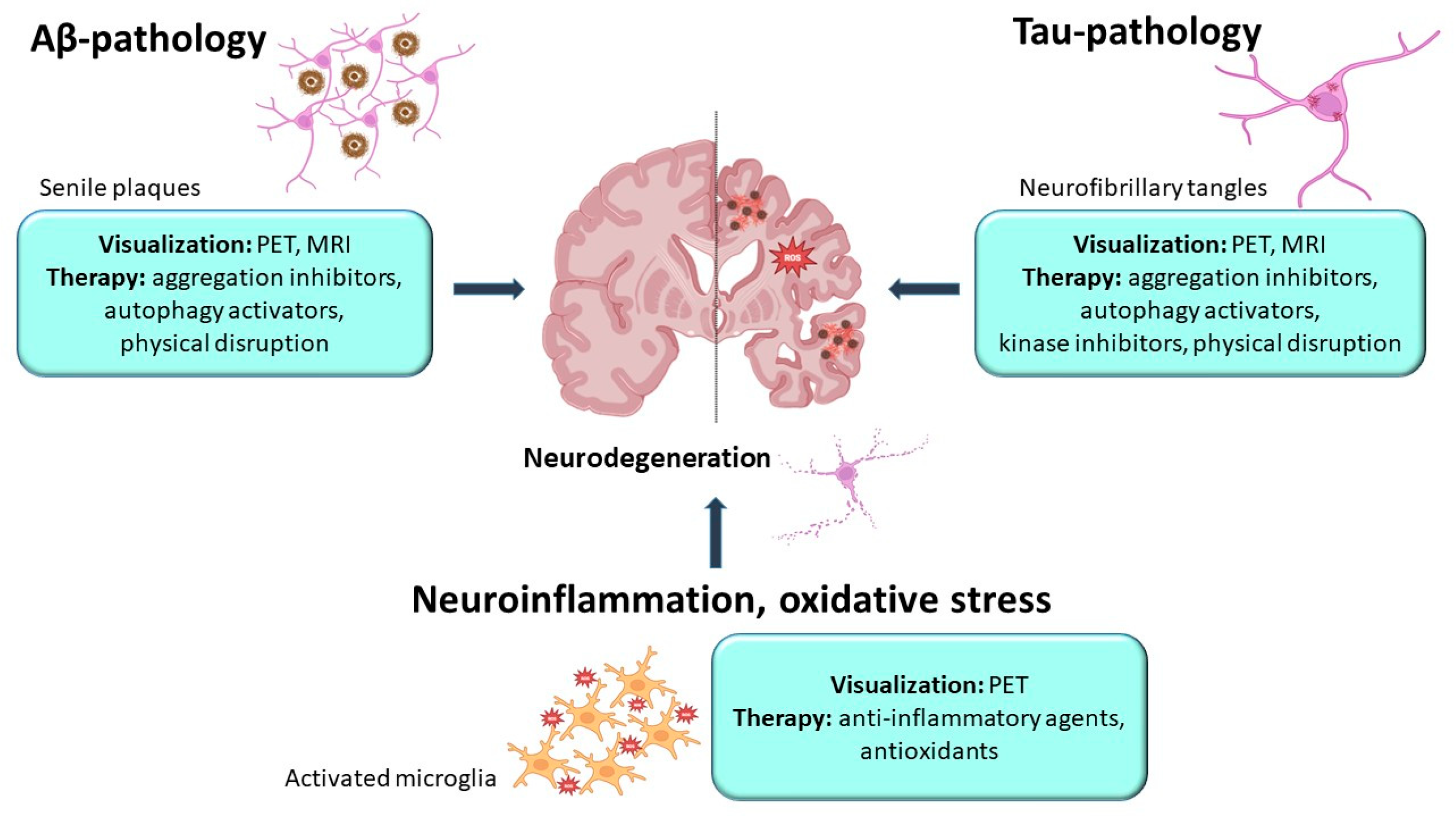
2. Molecular Targets of Theranostics
2.1. β-Amyloid (Aβ)
2.2. Hyperphosphorylated Tau-Protein
2.3. Other Pathogenetic Mechanisms
2.4. Methodological Trap: Fibrils vs. Oligomers
3. Analysis of Existing Nanotheranostic Systems for AD
3.1. General Characteristics and Classification of Theranostic Systems
3.2. Analysis of Functional Characteristics of Theranostic Systems
3.2.1. Diagnostics and Specificity of Detection
3.2.2. Therapeutic Strategies and Their Effectiveness
3.2.3. Integration of Diagnostics and Therapy
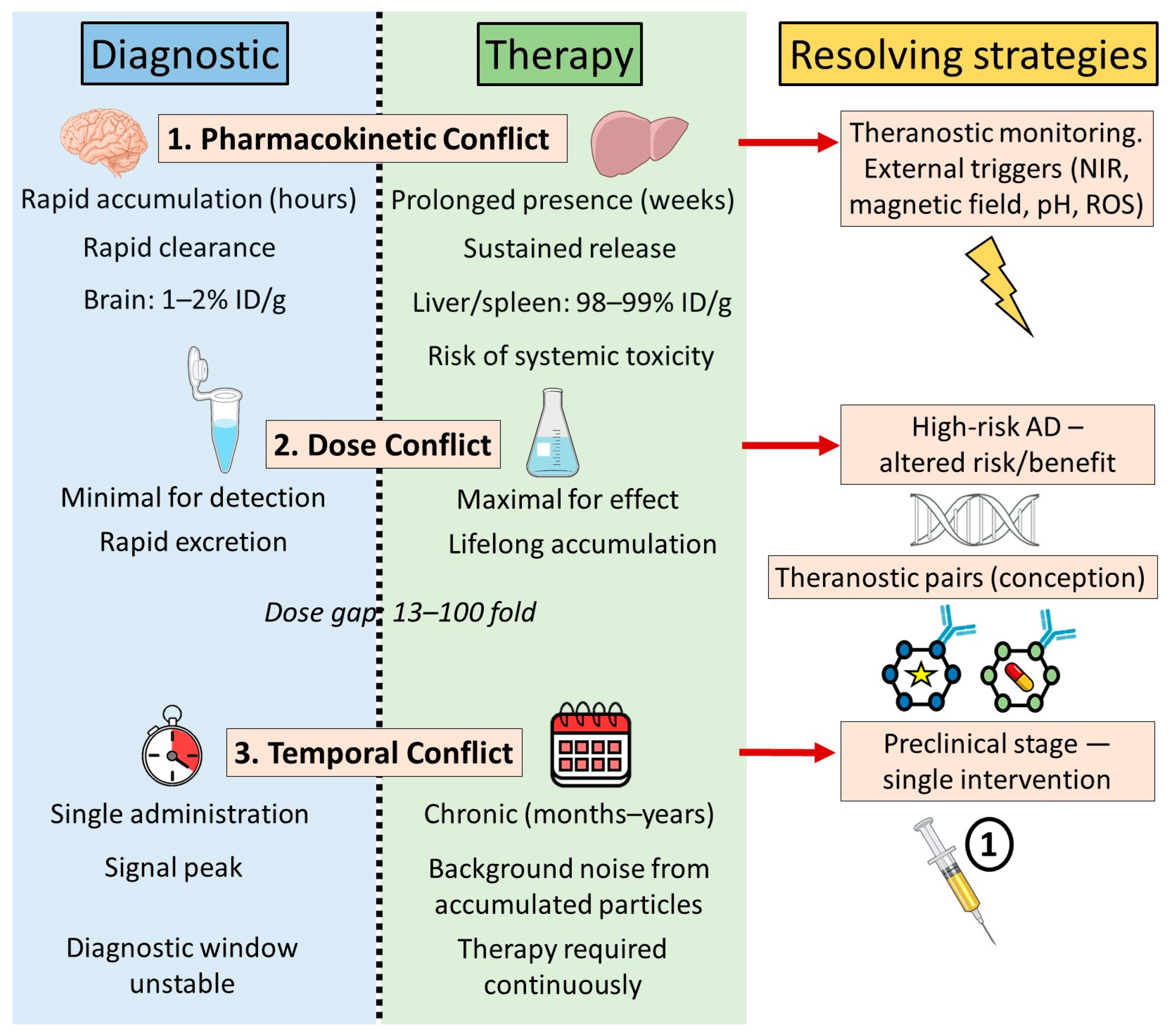
4. Conceptual Contradictions of Theranostics in AD
4.1. Pharmacokinetic Conflict
4.2. Dose Conflict
4.2.1. Diagnostic and Therapeutic Doses: Mismatch of Ranges
4.2.2. The Price of Repeated Administration: Cumulative Toxicity
4.2.3. The Fate of Particles in the Brain: Lifelong Accumulation
4.3. Temporal Conflict
5. Potential Scenarios for Theranostics in AD
- Photothermal therapy with an NIR laser, where diagnostics (dye fluorescence) works constantly, and therapy (heating) is activated only after confirmation of the target’s presence (e.g., the graphene oxide—ThS system).
- Photodynamic therapy, where the fluorescent probe is simultaneously a photosensitizer, generating toxic forms of oxygen only upon irradiation with light of a specific wavelength.
- Magnetic hyperthermia, where SPIONs serve as an MRI contrast agent and a heat source when exposed to an alternating magnetic field [27].
- Stimuli-sensitive linkers (pH, GSH), which ensure the release of a therapeutic dose only in the microenvironment of the target, while the diagnostic signal can be obtained from the particle itself before its degradation.
6. Rethinking the Theranostic Approach: A Roadmap
7. Limitations of Our Analysis
8. Conclusions
Author Contributions
Funding
Institutional Review Board Statement
Informed Consent Statement
Data Availability Statement
Acknowledgments
Conflicts of Interest
Abbreviations
| AD | Alzheimer’s disease |
| APP | Amyloid precursor protein |
| BBB | Blood–Brain Barrier |
| CDs | Carbon dots |
| CNS | Central nervous system |
| CSF | Cerebrospinal Fluid |
| EPR | Enhanced Permeability and Retention |
| FDA | Food and Drug Administration |
| MRI | Magnetic Resonance Imaging |
| NIR | Near infrared |
| NPs | Nanoparticles |
| PET | Positron Emission Tomography |
| QDs | Quantum Dots |
| ROS | Reactive Oxygen Species |
| SPECT | Single-Photon Emission Computed Tomography |
| SPIONs | Superparamagnetic iron oxide nanoparticles |
| ThS | Thioflavin-S |
| ThT | Thioflavin-T |
References
- Dementia. Available online: https://www.who.int/news-room/fact-sheets/detail/dementia (accessed on 21 March 2026).
- Better, M.A. Alzheimer’s Disease Facts and Figures. Alzheimers Dement. 2023, 19, 1598–1695. [Google Scholar] [CrossRef]
- Jia, J.; Wei, C.; Chen, S.; Li, F.; Tang, Y.; Qin, W.; Zhao, L.; Jin, H.; Xu, H.; Wang, F.; et al. The Cost of Alzheimer’s Disease in China and Re-Estimation of Costs Worldwide. Alzheimers Dement. 2018, 14, 483–491. [Google Scholar] [CrossRef] [PubMed]
- Ashrafian, H.; Zadeh, E.H.; Khan, R.H. Review on Alzheimer’s Disease: Inhibition of Amyloid Beta and Tau Tangle Formation. Int. J. Biol. Macromol. 2021, 167, 382–394. [Google Scholar] [CrossRef]
- Zhang, J.; Zhang, Y.; Wang, J.; Xia, Y.; Zhang, J.; Chen, L. Recent Advances in Alzheimer’s Disease: Mechanisms, Clinical Trials and New Drug Development Strategies. Signal Transduct. Target. Ther. 2024, 9, 211. [Google Scholar] [CrossRef]
- Prajapati, S.K.; Pathak, A.; Samaiya, P.K. Alzheimer’s Disease: From Early Pathogenesis to Novel Therapeutic Approaches. Metab. Brain Dis. 2024, 39, 1231–1254. [Google Scholar] [CrossRef] [PubMed]
- Khan, S.; Barve, K.H.; Kumar, M.S. Recent Advancements in Pathogenesis, Diagnostics and Treatment of Alzheimer’s Disease. Curr. Neuropharmacol. 2020, 18, 1106–1125. [Google Scholar] [CrossRef] [PubMed]
- van Oostveen, W.M.; de Lange, E.C.M. Imaging Techniques in Alzheimer’s Disease: A Review of Applications in Early Diagnosis and Longitudinal Monitoring. Int. J. Mol. Sci. 2021, 22, 2110. [Google Scholar] [CrossRef]
- Jack, C.R.; Bennett, D.A.; Blennow, K.; Carrillo, M.C.; Dunn, B.; Haeberlein, S.B.; Holtzman, D.M.; Jagust, W.; Jessen, F.; Karlawish, J.; et al. NIA-AA Research Framework: Toward a Biological Definition of Alzheimer’s Disease. Alzheimers Dement. 2018, 14, 535–562. [Google Scholar] [CrossRef]
- Dubois, B.; von Arnim, C.A.F.; Burnie, N.; Bozeat, S.; Cummings, J. Biomarkers in Alzheimer’s Disease: Role in Early and Differential Diagnosis and Recognition of Atypical Variants. Alzheimers Res. Ther. 2023, 15, 175. [Google Scholar] [CrossRef]
- Martínez, G.; Vernooij, R.W.; Fuentes Padilla, P.; Zamora, J.; Flicker, L.; Bonfill Cosp, X. 18F PET with Flutemetamol for the Early Diagnosis of Alzheimer’s Disease Dementia and Other Dementias in People with Mild Cognitive Impairment (MCI). Cochrane Database Syst. Rev. 2017, 11, CD012884. [Google Scholar] [CrossRef] [PubMed]
- Rasmussen, J.; Langerman, H. Alzheimer’s Disease—Why We Need Early Diagnosis. Degener. Neurol. Neuromuscul. Dis. 2019, 9, 123–130. [Google Scholar] [CrossRef]
- Cummings, J. Lessons Learned from Alzheimer Disease: Clinical Trials with Negative Outcomes. Clin. Transl. Sci. 2018, 11, 147–152. [Google Scholar] [CrossRef] [PubMed]
- Knopman, D.S.; Amieva, H.; Petersen, R.C.; Chételat, G.; Holtzman, D.M.; Hyman, B.T.; Nixon, R.A.; Jones, D.T. Alzheimer Disease. Nat. Rev. Dis. Primers 2021, 7, 33. [Google Scholar] [CrossRef] [PubMed]
- Stögmann, E.; Schmidt, R. Amyloid-Beta Antibody Treatment in Alzheimer’s Disease: An Update on Recent Data and Outlook on Implementation in Clinical Routine. Wien. Klin. Wochenschr. 2025, 137, 182–188. [Google Scholar] [CrossRef]
- Ebell, M.H.; Barry, H.C.; Baduni, K.; Grasso, G. Clinically Important Benefits and Harms of Monoclonal Antibodies Targeting Amyloid for the Treatment of Alzheimer Disease: A Systematic Review and Meta-Analysis. Ann. Fam. Med. 2024, 22, 50–62. [Google Scholar] [CrossRef]
- Jeong, S.Y.; Suh, C.H.; Kim, S.J.; Lemere, C.A.; Lim, J.-S.; Lee, J.-H. Amyloid-Related Imaging Abnormalities in the Era of Anti-Amyloid Beta Monoclonal Antibodies for Alzheimer’s Disease: Recent Updates on Clinical and Imaging Features and MRI Monitoring. Korean J. Radiol. 2024, 25, 726–741. [Google Scholar] [CrossRef] [PubMed]
- Pene, F.; Courtine, E.; Cariou, A.; Mira, J.-P. Toward Theragnostics. Crit. Care Med. 2009, 37, S50–S58. [Google Scholar] [CrossRef]
- Moorthy, H.; Govindaraju, T. Dendrimer Architectonics to Treat Cancer and Neurodegenerative Diseases with Implications in Theranostics and Personalized Medicine. ACS Appl. Bio Mater. 2021, 4, 1115–1139. [Google Scholar] [CrossRef]
- Kevadiya, B.D.; Ottemann, B.M.; Thomas, M.B.; Mukadam, I.; Nigam, S.; McMillan, J.; Gorantla, S.; Bronich, T.K.; Edagwa, B.; Gendelman, H.E. Neurotheranostics as Personalized Medicines. Adv. Drug Deliv. Rev. 2019, 148, 252–289. [Google Scholar] [CrossRef]
- Zhou, H.; Yin, X.; Zhang, G.; Yang, Z.; Zhou, R. Advancing Nanomaterial-Based Strategies for Alzheimer’s Disease: A Perspective. JACS Au 2025, 5, 1519–1537. [Google Scholar] [CrossRef]
- Xu, Y.; Zhao, M.; Zhou, D.; Zheng, T.; Zhang, H. The Application of Multifunctional Nanomaterials in Alzheimer’s Disease: A Potential Theranostics Strategy. Biomed. Pharmacother. 2021, 137, 111360. [Google Scholar] [CrossRef] [PubMed]
- Nsairat, H.; Khater, D.; Sayed, U.; Odeh, F.; Al Bawab, A.; Alshaer, W. Liposomes: Structure, Composition, Types, and Clinical Applications. Heliyon 2022, 8, e09394. [Google Scholar] [CrossRef] [PubMed]
- Salarpour, S.; Barani, M.; Pardakhty, A.; Khatami, M.; Pal Singh Chauhan, N. The Application of Exosomes and Exosome-Nanoparticle in Treating Brain Disorders. J. Mol. Liq. 2022, 350, 118549. [Google Scholar] [CrossRef]
- Satapathy, M.K.; Yen, T.-L.; Jan, J.-S.; Tang, R.-D.; Wang, J.-Y.; Taliyan, R.; Yang, C.-H. Solid Lipid Nanoparticles (SLNs): An Advanced Drug Delivery System Targeting Brain through BBB. Pharmaceutics 2021, 13, 1183. [Google Scholar] [CrossRef]
- Grosso, C.; Silva, A.; Delerue-Matos, C.; Barroso, M.F. Single and Multitarget Systems for Drug Delivery and Detection: Up-to-Date Strategies for Brain Disorders. Pharmaceuticals 2023, 16, 1721. [Google Scholar] [CrossRef]
- Chaparro, C.I.P.; Simões, B.T.; Borges, J.P.; Castanho, M.A.R.B.; Soares, P.I.P.; Neves, V. A Promising Approach: Magnetic Nanosystems for Alzheimer’s Disease Theranostics. Pharmaceutics 2023, 15, 2316. [Google Scholar] [CrossRef]
- Dykman, L.; Khlebtsov, N. Gold Nanoparticles in Biomedical Applications: Recent Advances and Perspectives. Chem. Soc. Rev. 2012, 41, 2256–2282. [Google Scholar] [CrossRef]
- Li, M.; Guan, Y.; Zhao, A.; Ren, J.; Qu, X. Using Multifunctional Peptide Conjugated Au Nanorods for Monitoring β-Amyloid Aggregation and Chemo-Photothermal Treatment of Alzheimer’s Disease. Theranostics 2017, 7, 2996–3006. [Google Scholar] [CrossRef]
- Li, M.; Yang, X.; Ren, J.; Qu, K.; Qu, X. Using Graphene Oxide High Near-Infrared Absorbance for Photothermal Treatment of Alzheimer’s Disease. Adv. Mater. 2012, 24, 1722–1728. [Google Scholar] [CrossRef]
- Gao, L.; Wang, J.; Bi, Y. Nanotechnology for Neurodegenerative Diseases: Recent Progress in Brain-Targeted Delivery, Stimuli-Responsive Platforms, and Organelle-Specific Therapeutics. Int. J. Nanomed. 2025, 20, 11015–11044. [Google Scholar] [CrossRef]
- Jo, S.D.; Ku, S.H.; Won, Y.-Y.; Kim, S.H.; Kwon, I.C. Targeted Nanotheranostics for Future Personalized Medicine: Recent Progress in Cancer Therapy. Theranostics 2016, 6, 1362–1377. [Google Scholar] [CrossRef]
- Leupe, H.; Cauwenbergh, M.; Cleeren, F.; Dekervel, J.; Verslype, C.; Deroose, C.M. Clinical Experience with Targeted Alpha-Emitter Peptide Receptor Radionuclide Therapy (α-PRRT) for Somatostatin Receptor-Positive Neuroendocrine Tumors. Pharmaceuticals 2025, 18, 1608. [Google Scholar] [CrossRef]
- Kobayashi, H.; Watanabe, R.; Choyke, P.L. Improving Conventional Enhanced Permeability and Retention (EPR) Effects; What Is the Appropriate Target? Theranostics 2013, 4, 81–89. [Google Scholar] [CrossRef]
- Burkett, B.J.; Bartlett, D.J.; McGarrah, P.W.; Lewis, A.R.; Johnson, D.R.; Berberoğlu, K.; Pandey, M.K.; Packard, A.T.; Halfdanarson, T.R.; Hruska, C.B.; et al. A Review of Theranostics: Perspectives on Emerging Approaches and Clinical Advancements. Radiol. Imaging Cancer 2023, 5, e220157. [Google Scholar] [CrossRef]
- Vinod, C.; Jena, S. Nano-Neurotheranostics: Impact of Nanoparticles on Neural Dysfunctions and Strategies to Reduce Toxicity for Improved Efficacy. Front. Pharmacol. 2021, 12, 612692. [Google Scholar] [CrossRef] [PubMed]
- Safety, Tolerability and Efficacy Assessment of Intranasal Nanoparticles of APH-1105, A Novel Alpha Secretase Modulator for Mild to Moderate Cognitive Impairment Due to Alzheimer’s Disease (AD); clinicaltrials.gov: Bethesda, MD, USA, 2021.
- Hardy, J.; Selkoe, D.J. The Amyloid Hypothesis of Alzheimer’s Disease: Progress and Problems on the Road to Therapeutics. Science 2002, 297, 353–356. [Google Scholar] [CrossRef] [PubMed]
- Amiri, H.; Saeidi, K.; Borhani, P.; Manafirad, A.; Ghavami, M.; Zerbi, V. Alzheimer’s Disease: Pathophysiology and Applications of Magnetic Nanoparticles as MRI Theranostic Agents. ACS Chem. Neurosci. 2013, 4, 1417–1429. [Google Scholar] [CrossRef]
- Singh, A.; Mahajan, S.D.; Kutscher, H.L.; Kim, S.; Prasad, P.N. Curcumin-Pluronic Nanoparticles: A Theranostic Nanoformulation for Alzheimer’s Disease. Crit. Rev. Biomed. Eng. 2020, 48, 153–168. [Google Scholar] [CrossRef] [PubMed]
- Yang, L.; Rieves, D.; Ganley, C. Brain Amyloid Imaging-FDA Approval of Florbetapir F18 Injection. N. Engl. J. Med. 2012, 367, 885–887. [Google Scholar] [CrossRef]
- Cheng, K.K.; Chan, P.S.; Fan, S.; Kwan, S.M.; Yeung, K.L.; Wáng, Y.-X.J.; Chow, A.H.L.; Wu, E.X.; Baum, L. Curcumin-Conjugated Magnetic Nanoparticles for Detecting Amyloid Plaques in Alzheimer’s Disease Mice Using Magnetic Resonance Imaging (MRI). Biomaterials 2015, 44, 155–172. [Google Scholar] [CrossRef]
- Kochman, U.; Sitka, H.; Kuźniar, J.; Czaja, M.; Kozubek, P.; Beszłej, J.A.; Leszek, J. Targeted Nanoparticles for Drug Delivery Across the Blood-Brain Barrier in Early and Late Stages of Alzheimer’s Disease: A Review. Mol. Neurobiol. 2025, 63, 75. [Google Scholar] [CrossRef]
- Luo, Q.; Lin, Y.-X.; Yang, P.-P.; Wang, Y.; Qi, G.-B.; Qiao, Z.-Y.; Li, B.-N.; Zhang, K.; Zhang, J.-P.; Wang, L.; et al. A Self-Destructive Nanosweeper That Captures and Clears Amyloid β-Peptides. Nat. Commun. 2018, 9, 1802. [Google Scholar] [CrossRef]
- Qu, F.; Yang, M.; Rasooly, A. Dual Signal Amplification Electrochemical Biosensor for Monitoring the Activity and Inhibition of the Alzheimer’s Related Protease β-Secretase. Anal. Chem. 2016, 88, 10559–10565. [Google Scholar] [CrossRef] [PubMed]
- Doody, R.S.; Thomas, R.G.; Farlow, M.; Iwatsubo, T.; Vellas, B.; Joffe, S.; Kieburtz, K.; Raman, R.; Sun, X.; Aisen, P.S.; et al. Phase 3 Trials of Solanezumab for Mild-to-Moderate Alzheimer’s Disease. N. Engl. J. Med. 2014, 370, 311–321, Correction in N. Engl. J. Med. 2014, 371, 584.. [Google Scholar] [CrossRef] [PubMed]
- Salloway, S.; Sperling, R.; Fox, N.C.; Blennow, K.; Klunk, W.; Raskind, M.; Sabbagh, M.; Honig, L.S.; Porsteinsson, A.P.; Ferris, S.; et al. Two Phase 3 Trials of Bapineuzumab in Mild-to-Moderate Alzheimer’s Disease. N. Engl. J. Med. 2014, 370, 322–333. [Google Scholar] [CrossRef]
- Herrup, K. The Case for Rejecting the Amyloid Cascade Hypothesis. Nat. Neurosci. 2015, 18, 794–799. [Google Scholar] [CrossRef]
- Mullane, K.; Williams, M. Alzheimer’s Disease (AD) Therapeutics—2: Beyond Amyloid—Re-Defining AD and Its Causality to Discover Effective Therapeutics. Biochem. Pharmacol. 2018, 158, 376–401. [Google Scholar] [CrossRef]
- Kim, S.; Ma, X.; Jeon, M.J.; Song, S.; Lee, J.S.; Lee, J.U.; Lee, C.-N.; Choi, S.H.; Sim, S.J. Distinct Plasma Phosphorylated-Tau Proteins Profiling for the Differential Diagnosis of Mild Cognitive Impairment and Alzheimer’s Disease by Plasmonic Asymmetric Nanobridge-Based Biosensor. Biosens. Bioelectron. 2024, 250, 116085. [Google Scholar] [CrossRef] [PubMed]
- Nisbet, R.M.; Polanco, J.-C.; Ittner, L.M.; Götz, J. Tau Aggregation and Its Interplay with Amyloid-β. Acta Neuropathol. 2015, 129, 207–220. [Google Scholar] [CrossRef]
- Saint-Aubert, L.; Lemoine, L.; Chiotis, K.; Leuzy, A.; Rodriguez-Vieitez, E.; Nordberg, A. Tau PET Imaging: Present and Future Directions. Mol. Neurodegener. 2017, 12, 19. [Google Scholar] [CrossRef]
- Pawar, S.; Rauf, M.A.; Abdelhady, H.; Iyer, A.K. Tau-Targeting Nanoparticles for Treatment of Alzheimer’s Disease. Exploration 2025, 5, 20230137. [Google Scholar] [CrossRef]
- Zhao, J.; Yin, F.; Ji, L.; Wang, C.; Shi, C.; Liu, X.; Yang, H.; Wang, X.; Kong, L. Development of a Tau-Targeted Drug Delivery System Using a Multifunctional Nanoscale Metal-Organic Framework for Alzheimer’s Disease Therapy. ACS Appl. Mater. Interfaces 2020, 12, 44447–44458. [Google Scholar] [CrossRef]
- Sun, H.; Zhong, Y.; Zhu, X.; Liao, H.; Lee, J.; Chen, Y.; Ma, L.; Ren, J.; Zhao, M.; Tu, M.; et al. A Tauopathy-Homing and Autophagy-Activating Nanoassembly for Specific Clearance of Pathogenic Tau in Alzheimer’s Disease. ACS Nano 2021, 15, 5263–5275. [Google Scholar] [CrossRef]
- Hampel, H.; Caraci, F.; Cuello, A.C.; Caruso, G.; Nisticò, R.; Corbo, M.; Baldacci, F.; Toschi, N.; Garaci, F.; Chiesa, P.A.; et al. A Path Toward Precision Medicine for Neuroinflammatory Mechanisms in Alzheimer’s Disease. Front. Immunol. 2020, 11, 456. [Google Scholar] [CrossRef]
- Dupont, A.-C.; Largeau, B.; Santiago Ribeiro, M.J.; Guilloteau, D.; Tronel, C.; Arlicot, N. Translocator Protein-18 kDa (TSPO) Positron Emission Tomography (PET) Imaging and Its Clinical Impact in Neurodegenerative Diseases. Int. J. Mol. Sci. 2017, 18, 785. [Google Scholar] [CrossRef]
- Ruan, Y.; Xiong, Y.; Fang, W.; Yu, Q.; Mai, Y.; Cao, Z.; Wang, K.; Lei, M.; Xu, J.; Liu, Y.; et al. Highly Sensitive Curcumin-Conjugated Nanotheranostic Platform for Detecting Amyloid-Beta Plaques by Magnetic Resonance Imaging and Reversing Cognitive Deficits of Alzheimer’s Disease via NLRP3-Inhibition. J. Nanobiotechnol. 2022, 20, 322. [Google Scholar] [CrossRef]
- Kwon, H.J.; Cha, M.-Y.; Kim, D.; Kim, D.K.; Soh, M.; Shin, K.; Hyeon, T.; Mook-Jung, I. Mitochondria-Targeting Ceria Nanoparticles as Antioxidants for Alzheimer’s Disease. ACS Nano 2016, 10, 2860–2870. [Google Scholar] [CrossRef] [PubMed]
- Morales, I.; Guzmán-Martínez, L.; Cerda-Troncoso, C.; Farías, G.A.; Maccioni, R.B. Neuroinflammation in the Pathogenesis of Alzheimer’s Disease. A Rational Framework for the Search of Novel Therapeutic Approaches. Front. Cell Neurosci. 2014, 8, 112. [Google Scholar] [CrossRef] [PubMed]
- Kuhl, D.E.; Koeppe, R.A.; Minoshima, S.; Snyder, S.E.; Ficaro, E.P.; Foster, N.L.; Frey, K.A.; Kilbourn, M.R. In Vivo Mapping of Cerebral Acetylcholinesterase Activity in Aging and Alzheimer’s Disease. Neurology 1999, 52, 691–699. [Google Scholar] [CrossRef] [PubMed]
- Wilson, B.; Samanta, M.K.; Santhi, K.; Kumar, K.P.S.; Paramakrishnan, N.; Suresh, B. Poly(n-Butylcyanoacrylate) Nanoparticles Coated with Polysorbate 80 for the Targeted Delivery of Rivastigmine into the Brain to Treat Alzheimer’s Disease. Brain Res. 2008, 1200, 159–168. [Google Scholar] [CrossRef]
- Liu, X.-G.; Zhang, L.; Lu, S.; Liu, D.-Q.; Zhang, L.-X.; Yu, X.-L.; Liu, R.-T. Multifunctional Superparamagnetic Iron Oxide Nanoparticles Conjugated with Aβ Oligomer-Specific scFv Antibody and Class A Scavenger Receptor Activator Show Early Diagnostic Potentials for Alzheimer’s Disease. Int. J. Nanomed. 2020, 15, 4919–4932. [Google Scholar] [CrossRef] [PubMed]
- Chen, Q.; Du, Y.; Zhang, K.; Liang, Z.; Li, J.; Yu, H.; Ren, R.; Feng, J.; Jin, Z.; Li, F.; et al. Tau-Targeted Multifunctional Nanocomposite for Combinational Therapy of Alzheimer’s Disease. ACS Nano 2018, 12, 1321–1338. [Google Scholar] [CrossRef]
- Francisco, T.N.; Malafaia, D.; Melo, L.; Silva, A.M.S.; Albuquerque, H.M.T. Recent Advances in Fluorescent Theranostics for Alzheimer’s Disease: A Comprehensive Survey on Design, Synthesis, and Properties. ACS Omega 2024, 9, 13556–13591. [Google Scholar] [CrossRef] [PubMed]
- Morgado, I.; Wieligmann, K.; Bereza, M.; Rönicke, R.; Meinhardt, K.; Annamalai, K.; Baumann, M.; Wacker, J.; Hortschansky, P.; Malešević, M.; et al. Molecular Basis of β-Amyloid Oligomer Recognition with a Conformational Antibody Fragment. Proc. Natl. Acad. Sci. USA 2012, 109, 12503–12508. [Google Scholar] [CrossRef]
- Liu, N.; Liang, X.; Yang, C.; Hu, S.; Luo, Q.; Luo, H. Dual-Targeted Magnetic Mesoporous Silica Nanoparticles Reduce Brain Amyloid-β Burden via Depolymerization and Intestinal Metabolism. Theranostics 2022, 12, 6646–6664. [Google Scholar] [CrossRef]
- Wang, W.; Liu, M.; Gao, W.; Sun, Y.; Dong, X. Coassembled Chitosan-Hyaluronic Acid Nanoparticles as a Theranostic Agent Targeting Alzheimer’s β-Amyloid. ACS Appl. Mater. Interfaces 2021, 13, 55879–55889. [Google Scholar] [CrossRef]
- Cui, Z.; Bu, W.; Fan, W.; Zhang, J.; Ni, D.; Liu, Y.; Wang, J.; Liu, J.; Yao, Z.; Shi, J. Sensitive Imaging and Effective Capture of Cu(2+): Towards Highly Efficient Theranostics of Alzheimer’s Disease. Biomaterials 2016, 104, 158–167. [Google Scholar] [CrossRef]
- Agyare, E.K.; Jaruszewski, K.M.; Curran, G.L.; Rosenberg, J.T.; Grant, S.C.; Lowe, V.J.; Ramakrishnan, S.; Paravastu, A.K.; Poduslo, J.F.; Kandimalla, K.K. Engineering Theranostic Nanovehicles Capable of Targeting Cerebrovascular Amyloid Deposits. J. Control. Release 2014, 185, 121–129. [Google Scholar] [CrossRef]
- Jaruszewski, K.M.; Curran, G.L.; Swaminathan, S.K.; Rosenberg, J.T.; Grant, S.C.; Ramakrishnan, S.; Lowe, V.J.; Poduslo, J.F.; Kandimalla, K.K. Multimodal Nanoprobes to Target Cerebrovascular Amyloid in Alzheimer’s Disease Brain. Biomaterials 2014, 35, 1967–1976. [Google Scholar] [CrossRef] [PubMed]
- Gu, Y.; Zhang, Q.; Huang, H.; Ho, K.H.W.; Zhang, Y.; Yi, C.; Zheng, Y.; Chang, R.C.C.; Wang, E.S.; Yang, M. Tau-targeting Multifunctional Nanocomposite Based on Tannic Acid-Metal for near-Infrared Fluorescence/Magnetic Resonance Bimodal Imaging-Guided Combinational Therapy in Alzheimer’s Disease. Theranostics 2024, 14, 6218–6235. [Google Scholar] [CrossRef] [PubMed]
- Zhang, R.; Li, Y.; Hu, B.; Lu, Z.; Zhang, J.; Zhang, X. Traceable Nanoparticle Delivery of Small Interfering RNA and Retinoic Acid with Temporally Release Ability to Control Neural Stem Cell Differentiation for Alzheimer’s Disease Therapy. Adv. Mater. 2016, 28, 6345–6352. [Google Scholar] [CrossRef]
- Papadia, K.; Markoutsa, E.; Mourtas, S.; Giannou, A.D.; La Ferla, B.; Nicotra, F.; Salmona, M.; Klepetsanis, P.; Stathopoulos, G.T.; Antimisiaris, S.G. Multifunctional LUV Liposomes Decorated for BBB and Amyloid Targeting. A. In Vitro Proof-of-Concept. Eur. J. Pharm. Sci. 2017, 101, 140–148. [Google Scholar] [CrossRef]
- Zhang, L.; Lin, J.; Xiang, K.; Shi, T.; Guo, B. Omnidirectional Improvement of Mitochondrial Health in Alzheimer’s Disease by Multi-Targeting Engineered Activated Neutrophil Exosomes. J. Control. Release 2024, 376, 470–487. [Google Scholar] [CrossRef] [PubMed]
- Liu, H.; Guo, H.; Fang, Y.; Wang, L.; Li, P. Rational Design of Nitrogen-Doped Carbon Dots for Inhibiting β-Amyloid Aggregation. Molecules 2023, 28, 1451, Erratum in Molecules 2024, 29, 2253.. [Google Scholar] [CrossRef]
- Lin, X.; Liu, W.; Dong, X.; Sun, Y. Epigallocatechin Gallate-Derived Carbonized Polymer Dots: A Multifunctional Scavenger Targeting Alzheimer’s β-Amyloid Plaques. Acta Biomater. 2023, 157, 524–537. [Google Scholar] [CrossRef]
- Wei, Z.; Dong, X.; Sun, Y. Design of Red Fluorescence Ce-Based Carbon Dots of High and Balanced Multiple Functions against Alzheimer’s β-Amyloid Fibrillization. ACS Appl. Mater. Interfaces 2025, 17, 49737–49750. [Google Scholar] [CrossRef]
- Wei, Z.; Dong, X.; Sun, Y. Quercetin-Derived Red Emission Carbon Dots: A Multifunctional Theranostic Nano-Agent against Alzheimer’s β-Amyloid Fibrillogenesis. Colloids Surf. B Biointerfaces 2024, 238, 113907. [Google Scholar] [CrossRef] [PubMed]
- Wang, W.; Lin, X.; Dong, X.; Sun, Y. A Multi-Target Theranostic Nano-Composite against Alzheimer’s Disease Fabricated by Conjugating Carbon Dots and Triple-Functionalized Human Serum Albumin. Acta Biomater. 2022, 148, 298–309. [Google Scholar] [CrossRef]
- Liu, D.; Li, W.; Jiang, X.; Bai, S.; Liu, J.; Liu, X.; Shi, Y.; Kuai, Z.; Kong, W.; Gao, R.; et al. Using Near-Infrared Enhanced Thermozyme and scFv Dual-Conjugated Au Nanorods for Detection and Targeted Photothermal Treatment of Alzheimer’s Disease. Theranostics 2019, 9, 2268–2281. [Google Scholar] [CrossRef] [PubMed]
- Cai, J.; Dao, P.; Chen, H.; Yan, L.; Li, Y.L.; Zhang, W.; Li, L.; Du, Z.; Dong, C.-Z.; Meunier, B. Ultrasmall Superparamagnetic Iron Oxide Nanoparticles-Bound NIR Dyes: Novel Theranostic Agents for Alzheimer’s Disease. Dye. Pigment. 2020, 173, 107968. [Google Scholar] [CrossRef]
- Hu, B.; Dai, F.; Fan, Z.; Ma, G.; Tang, Q.; Zhang, X. Nanotheranostics: Congo Red/Rutin-MNPs with Enhanced Magnetic Resonance Imaging and H2O2-Responsive Therapy of Alzheimer’s Disease in APPswe/PS1dE9 Transgenic Mice. Adv. Mater. 2015, 27, 5499–5505. [Google Scholar] [CrossRef]
- Li, Y.; Xu, D.; Ho, S.-L.; Li, H.-W.; Yang, R.; Wong, M.S. A Theranostic Agent for in Vivo Near-Infrared Imaging of β-Amyloid Species and Inhibition of β-Amyloid Aggregation. Biomaterials 2016, 94, 84–92. [Google Scholar] [CrossRef]
- Sharma, M.; Tiwari, V.; Chaturvedi, S.; Wahajuddin, M.; Shukla, S.; Panda, J.J. Self-Fluorescent Lone Tryptophan Nanoparticles as Theranostic Agents Against Alzheimer’s Disease. ACS Appl. Mater. Interfaces 2022, 14, 13079–13093. [Google Scholar] [CrossRef]
- Bai, P.; Gomm, A.; Yoo, C.-H.; Mondal, P.; Lobo, F.M.; Meng, H.; Zhou, Y.; Xie, W.; Wey, H.-Y.; Tanzi, R.E.; et al. Development of Carbon-11 Labeled Pyrimidine Derivatives as Novel Positron Emission Tomography (PET) Agents Enabling Brain Sigma-1 Receptor Imaging. Adv. Sci. 2025, 12, e2414827. [Google Scholar] [CrossRef]
- Liu, Y.; Xu, L.-P.; Wang, Q.; Yang, B.; Zhang, X. Synergistic Inhibitory Effect of GQDs-Tramiprosate Covalent Binding on Amyloid Aggregation. ACS Chem. Neurosci. 2018, 9, 817–823. [Google Scholar] [CrossRef]
- Han, L.; Jiang, C. Evolution of Blood-Brain Barrier in Brain Diseases and Related Systemic Nanoscale Brain-Targeting Drug Delivery Strategies. Acta Pharm. Sin. B 2021, 11, 2306–2325. [Google Scholar] [CrossRef] [PubMed]
- La Barbera, L.; Mauri, E.; D’Amelio, M.; Gori, M. Functionalization Strategies of Polymeric Nanoparticles for Drug Delivery in Alzheimer’s Disease: Current Trends and Future Perspectives. Front. Neurosci. 2022, 16, 939855. [Google Scholar] [CrossRef] [PubMed]
- Long, J.M.; Holtzman, D.M. Alzheimer Disease: An Update on Pathobiology and Treatment Strategies. Cell 2019, 179, 312–339. [Google Scholar] [CrossRef]
- Villalva, M.D.; Agarwal, V.; Ulanova, M.; Sachdev, P.S.; Braidy, N. Quantum Dots as a Theranostic Approach in Alzheimer’s Disease: A Systematic Review. Nanomedicine 2021, 16, 1595–1611. [Google Scholar] [CrossRef] [PubMed]
- Aminyavari, S.; Afshari, A.R.; Ahmadi, S.S.; Kesharwani, P.; Sanati, M.; Sahebkar, A. Unveiling the Theranostic Potential of SPIONs in Alzheimer’s Disease Management. J. Psychiatr. Res. 2024, 179, 244–256. [Google Scholar] [CrossRef]
- Derakhshankhah, H.; Sajadimajd, S.; Jafari, S.; Izadi, Z.; Sarvari, S.; Sharifi, M.; Falahati, M.; Moakedi, F.; Muganda, W.C.A.; Müller, M.; et al. Novel Therapeutic Strategies for Alzheimer’s Disease: Implications from Cell-Based Therapy and Nanotherapy. Nanomedicine 2020, 24, 102149. [Google Scholar] [CrossRef] [PubMed]
- Cano, A.; Turowski, P.; Ettcheto, M.; Duskey, J.T.; Tosi, G.; Sánchez-López, E.; García, M.L.; Camins, A.; Souto, E.B.; Ruiz, A.; et al. Nanomedicine-Based Technologies and Novel Biomarkers for the Diagnosis and Treatment of Alzheimer’s Disease: From Current to Future Challenges. J. Nanobiotechnol. 2021, 19, 122. [Google Scholar] [CrossRef] [PubMed]
- Kurz, S.C.; Zan, E.; Cordova, C.; Troxel, A.B.; Barbaro, M.; Silverman, J.S.; Snuderl, M.; Zagzag, D.; Kondziolka, D.; Golfinos, J.G.; et al. Evaluation of the SSTR2-Targeted Radiopharmaceutical 177Lu-DOTATATE and SSTR2-Specific 68Ga-DOTATATE PET as Imaging Biomarker in Patients with Intracranial Meningioma. Clin. Cancer Res. 2024, 30, 680–686. [Google Scholar] [CrossRef] [PubMed]



| Nanoparticle Type | Size, nm | Zeta Potential, mV | Therapeutic Agent | Imaging Method | Target | Animal Model | Cell Model | Administration Route | Key Results | Reference |
|---|---|---|---|---|---|---|---|---|---|---|
| Polymeric and nanocomposites | ||||||||||
| NaYF4:Yb/Er/Tm@DSPE-PEG@HQC NPs (UCHQs) | 114 | 31.2 | HQC (Cu2+ chelator) | Luminescence | Aβ (via Cu2+) | Transgenic AD model—APPsw/PSEN1 mice | PC-12 cell | i.c., 0.4 mg/kg, 25 μL per mice, single dose; i.c., 200 μg/mL per zebrafish embryos, single dose; In vitro: 0–500 μg/mL (cytotoxicity); 50 μmol/L (apoptosis). | Detect and capture Cu2+; inhibit Aβ aggregation. | Cui et al., 2016 [69] |
| Chitosan-hyaluronic acid NPs (CHG) | 110.4 ± 15.6 | 32.0 ± 3.1 | Particle itself (Aβ aggregation inhibitor) | Fluorescence | Aβ oligomers and fibrils | Transgenic AD model—C. elegans | SHSY-5Y cells | C. elegans: 30 μg/mL (imaging, fixed nematodes), 300 μg/mL (therapy, ingested with food, 72 h); in vitro: CHG NPs 7 μg/mL (probing), 90–720 μg/mL (inhibition, MTT). | Selectively bind to Aβ aggregates; inhibit fibrillogenesis; fluorescence enhances upon binding. | Wang et al., 2021 [68] |
| Polymeric nanocore with Magnevist® (TNV) | 239 ± 4.1 | 11.9 ± 0.5 | Cyclophosphamide, anti-amyloid antibody Putrescine modified F(ab’)2 fragment | MRI, SPECT | Aβ, inflammation | Cerebral amyloid angiopathy model—B6SJLF1/J mice | hCMEC/D3 cells, BBMVEC cells | i.v., single dose: 125I-TNVs 100 μCi (PK/biodistribution) or 500 μCi (SPECT/CT), TNVs 200 μL with 2 mM Gd (MRI). In vitro: TNV 30 μg/mL (cells uptake); TNV 1.74 mg/mL (cytokine inhibition in cells). | Target cerebrovascular amyloid; reduce pro-inflammatory cytokine production. | Agyare et al., 2014 [70] |
| Chitosan-based NPs with Gd-DTPA (gadolinium-diethylene triamine pentaacetic acid) | 145–158 | 4.5–7.7 | Curcumin or dexamethasone + IgG4.1 antibody | MRI, SPECT | Aβ, inflammation | Transgenic AD model—Tg2576 transgenic mice; B6/SJL mice | hCMEC/D3 cells | i.v. (femoral vein, single dose: 100 µCi 125I-nanovehicles (PK), 17 mg (MRI), 500 µCi (SPECT); external carotid artery (single dose: 45 mg nanovehicles). | Accumulate in brain vasculature, target amyloid; provide contrast and reduce inflammation. | Jaruszewski et al., 2014 [71] |
| DSPE-PEG-SPIO with curcumin (SDP@Cur-CRT/QSH) | 180 | ~–19 | Curcumin | MRI | Aβ, inflammation (NLRP3) | Transgenic AD model—PP/PS1 mice | n/a | i.v. tail vein, 25 mg/kg, every 4 days for 3 months; i.v. tail vein 200 µL Fe/kg, single dose, (MRI); In vitro: 25–200 µg/mL for cells cytotoxicity; 100 µg/mL for uptake. | Visualize plaques, reduce their burden; improve cognitive function. | Ruan et al., 2022 [58] |
| CeNC/IONC/MSN-T807 nanocomposite | 131.6 | 9.32 | Methylene blue (MB) (tau aggregation inhibitor), CeNC (antioxidant and suppressor tau hyperphosphorylation) | MRI/PET bimodal imaging (IONCs and 68Ga) | Hyperphosphorylated tau, oxidative stress | Intrahippocampal okadaic acid injection—Sprague-Dawley rats | SH-SY5Y cells | i.h. (unilateral hippocampus) 10 μL (MB 3.6 mg/mL equivalent), single dose (therapy); i.h. 2 μL (20 mg/mL) for MRI; in vitro (cells): MB 2.25 μg/mL, nanocomposite 4–6.25 μg/mL. | Reduces tau hyperphosphorylation, oxidative stress, and neuronal apoptosis; improves memory in rats. | Chen et al., 2018 [64] |
| IR780-Mn@TA-TPL NPs (DSPE-PEG-based) | 116 | –16.5 | Tannic acid (antioxidant) | MRI (Mn2+ ions), fluorescence (IR780) | Oxidative stress, tau | Intracerebral aluminum oxide injection—Sprague-Dawley | PC12 and BV2 cells | i.v., single dose (imaging); i.h. single dose (MRI); in vitro: 50 µg/mL for cellular uptake. | Reduce ROS and tau hyperphosphorylation; restore memory. | Gu et al., 2024 [72] |
| PHEMA-RA-PCB-CPP/SPION/siSOX9 | 100 | 2.6 (pH 7.4)—15.4 (pH 3.5) | siSOX9, retinoic acid | MRI | NSCs | Transgenic AD model—2 × Tg-AD mice | n/a | Transplantation of NSCs pre-treated with NPs (into brain), dose not specified, single dose (for therapy); MRI at day 1 and day 35 post-transplantation. | Control NSC differentiation into neurons; suppress SOX9; improve memory. | Zhang et al., 2016 [73] |
| Lipid nanoparticles and exosomes | ||||||||||
| Liposomal immunoglobulins (mf-LIPs) with three ligands on the surface | 149 ± 25 | –3.01 to –3.71 | Curcumin-lipid ligand (TREG), ligand for action on transferrin and low-density lipoprotein receptors of the BBB (TfR-Mab), ApoE | Biofluorescence | Aβ, BBB receptors | FVB mice (wild-type) | In vitro BBB model—hCMEC/D3 cells | i.v. (tail vein) 0.05 mg/mouse, single dose; 200 nmol lipid/well (permeation); 200 nmol/106 cells (uptake); 40 mM (thioflavin-T aggregation assay). | Inhibit Aβ aggregation in vitro; cross BBB; stable. | Papadia et al., 2017 [74] |
| Modified neutrophil-derived exosomes (MP@Cur-MExo) | 120 | –20.6 | Curcumin, SPION | MRI/IVIS (fluorescence) bimodal imaging | Aβ, mitochondria | Transgenic AD model—APP/PS1 mice | n/a | i.v. injection, dose 1 mg/mL per mice for MRI; in vitro: 105 exosomes/well (cells). | Accumulate in inflamed brain areas; protect neurons; improve cognitive function. | Zhang et al., 2024 [75] |
| Carbon dots (CDs) | ||||||||||
| Nitrogen-doped carbon dots (N-CD) | 2.2 | n/a | Particle itself | Fluorescence | Aβ | n/a | n/a | In vitro only: N-CD 0.75–6.0 mg/mL + Aβ1-42 (100 μM), 24 h for cells. | Reduce Aβ content 5-fold; inhibit Aβ1-42 self-assembly. | Liu et al., 2023 [76] |
| EGCG-derived polymer dots (E-CPDs) | 1.9 ± 0.4 | –17.5 | EGCG | Fluorescence | Aβ | Transgenic AD model—C. elegans (CL2006) | SH-SY5Y cells | addition to nematode growth medium (80 µg/mL). | Inhibit fibrillization and disaggregate Aβ fibrils; extend nematode lifespan. | Lin et al., 2023 [77] |
| Cerium-containing carbon dots (CCP-CD) | n/a | n/a | Curcumin, Ce3+ | Fluorescence (p-PD) | Aβ, oxidative stress | Transgenic AD model—C. elegans | n/a | 1–10 μg/mL (ROS). | Reduce ROS and inflammation; inhibit Aβ fibrillization; extend nematode lifespan. | Wei et al., 2025 [78] |
| Quercetin and p-PD -derived carbon dots (R-CD-75) | 3.66 ± 0.03 | –12.38 | Quercetin, CDs | Fluorescence | Aβ, ROS | Transgenic AD model—C. elegans (CL2006) | SH-SY5Y cells | in vitro: 2–50 μg/mL. | Inhibit aggregation and disaggregate Aβ fibrils; reduce ROS; extend nematode lifespan by 50%. | Wei et al., 2024 [79] |
| HSA-BFP@CDs nanocomposite | 37.8 | n/a | HSA-BFP, CDs | Fluorescence | Aβ, ROS | Transgenic AD model—C. elegans (CL2006) | SH-SY5Y cells | C. elegans: added to nematode growth medium, 30 µg/mL for 4 h (imaging), 100 µg/mL for 72 h (deposition, ROS, distribution, lifespan), 100 µg/mL; in vitro: 10–100 µg/mL (cell viability, ROS). | Detect plaques; reduce ROS and Aβ cytotoxicity. | Wang et al., 2022 [80] |
| Gold nanorods | ||||||||||
| AuNRs with POM and Aβ15-20 (AuP) | n/a | n/a | POM, Aβ15-20 peptide | Fluorescence | Aβ | S4880202 mice | PC12 cells | i.v. tail vein, single dose 100 µL AuP (120 µg/mL Au), analyzed at 6 h (BBB permeability). In vitro: 50 µM Aβ + 0.3 nM AuP (ThS Staining). | Disrupt Aβ fibrils under NIR; protect cells; cross BBB. | Li et al., 2017 [29] |
| GNRs-APH-scFv (GAS) | n/a | 15.8 (GAS) | scFv 12B4, APH ST0779 | NIR fluorescence | Aβ | Transgenic AD model—C. elegans (CL4176) | n/a | Via food—40 µM per nematode growth medium plate. | Detect Aβ aggregates; under NIR disrupt fibrils; delay paralysis. | Liu et al., 2019 [81] |
| Magnetic nanoparticles | ||||||||||
| SPION with PH-1/PH-2 | 12.6 ± 0.7 | n/a | SPION | MRI, fluorescence | Aβ | Transgenic AD model—APP/PS1 mice | n/a | i.v. 0.2 mmol Fe/kg, single dose (imaging); in vitro: concentrations 1–100 ng/mL (cytotoxicity, disaggregation of Aβ1-42). | Bind to Aβ; block aggregation; protect SH-SY5Y cells. | Cai et al., 2020 [82] |
| W20/XD4-SPION | 11.5 ± 1.8 | –15 | SPION + W20 | MRI | Aβ oligomers | Transgenic AD model—APP/PS1 mice | BV-2 cells | i.v. tail vein, 200 μmol Fe/kg, single dose (distribution, MRI). | Target Aβ oligomers; enhance microglial phagocytosis; differentiate transgenic mice. | Liu et al., 2020 [63] |
| Congo Red/Rutin-MNPs based on USPION, DSPE-PEG and Oleic acid | 35–45 | n/a | Rutin | MRI | Aβ, oxidative stress | Transgenic AD model—APP/PS1 mice | SH-SY5Y cells | i.v. (co-injected with mannitol), dose not specified, single dose. | Visualize plaques; H2O2-responsive release; reduce ROS; improve memory. | Hu et al., 2015 [83] |
| Miscellaneous | ||||||||||
| Charged dye molecule DBA-SLOH. | n/a | n/a | Particle itself | Fluorescence | Aβ | Transgenic AD model—APP/PS1 mice | n/a | i.v. (tail vein) 5 mg/kg, single dose (100 μL); in vitro: 1–50 μM (cytotoxicity), 100 μM (aggregation inhibition). | High Aβ affinity, BBB-permeable. Inhibits Aβ aggregation. | Li et al., 2016 [84] |
| Tryptophan Nps (TNPs) | 82–121 | n/a | Tryptophan | Fluorescence | Aβ42, phenylalanine-phenylalanine -dipeptides | Streptozotocin injection—Sprague-Dawley rats | SH-SY5Y cells | i.v. 5 mg/kg every third day for 26 days (therapy); in vitro: TNPs 100 μg/mL. | Inhibit Aβ aggregation; disrupt fibrils; improve memory in rats. | Sharma et al., 2022 [85] |
| 11C-pyrimidine radioligands | n/a | n/a | Particle itself | PET | σ1 receptor | Transgenic AD model—5xFAD mice; NHP | n/a | i.v. mice tail vein 200 µL (PET); single dose; NHP—i.v. NHP 5.1 mCi (PET/MRI); single dose. | Bind to σ1R; sensitive to σ1R downregulation in pathology. | Bai et al., 2025 [86] |
Disclaimer/Publisher’s Note: The statements, opinions and data contained in all publications are solely those of the individual author(s) and contributor(s) and not of MDPI and/or the editor(s). MDPI and/or the editor(s) disclaim responsibility for any injury to people or property resulting from any ideas, methods, instructions or products referred to in the content. |
© 2026 by the authors. Licensee MDPI, Basel, Switzerland. This article is an open access article distributed under the terms and conditions of the Creative Commons Attribution (CC BY) license.
Share and Cite
Zorkina, Y.; Abramova, O.; Zubkov, E.; Gurina, O.; Ushakova, V. Theranostic Nanoplatforms for Alzheimer’s Disease: A Critical Analysis of Conceptual Contradictions. Int. J. Mol. Sci. 2026, 27, 3560. https://doi.org/10.3390/ijms27083560
Zorkina Y, Abramova O, Zubkov E, Gurina O, Ushakova V. Theranostic Nanoplatforms for Alzheimer’s Disease: A Critical Analysis of Conceptual Contradictions. International Journal of Molecular Sciences. 2026; 27(8):3560. https://doi.org/10.3390/ijms27083560
Chicago/Turabian StyleZorkina, Yana, Olga Abramova, Eugene Zubkov, Olga Gurina, and Valeriya Ushakova. 2026. "Theranostic Nanoplatforms for Alzheimer’s Disease: A Critical Analysis of Conceptual Contradictions" International Journal of Molecular Sciences 27, no. 8: 3560. https://doi.org/10.3390/ijms27083560
APA StyleZorkina, Y., Abramova, O., Zubkov, E., Gurina, O., & Ushakova, V. (2026). Theranostic Nanoplatforms for Alzheimer’s Disease: A Critical Analysis of Conceptual Contradictions. International Journal of Molecular Sciences, 27(8), 3560. https://doi.org/10.3390/ijms27083560