Potential Applications of Genome-Wide Association Studies in Establishing Climate Resilience in Livestock: A Comprehensive Review

 , , , , ,
  , ,
, ,  and
and 
Abstract
1. Introduction
2. Climate Change and Livestock Production: Importance of Identifying Climate-Resilient Livestock Breeds
3. Progression Towards GWAS for Economically Important Traits in Livestock
4. Different Genetic Models for Establishing Climate Resilience in Livestock
5. Applications of Genomic Models in Establishing Phenotypic Plasticity in Livestock
6. Applications of Artificial Intelligence and Machine Learning in Genomics Approaches to Establish Climate Resilience in Livestock
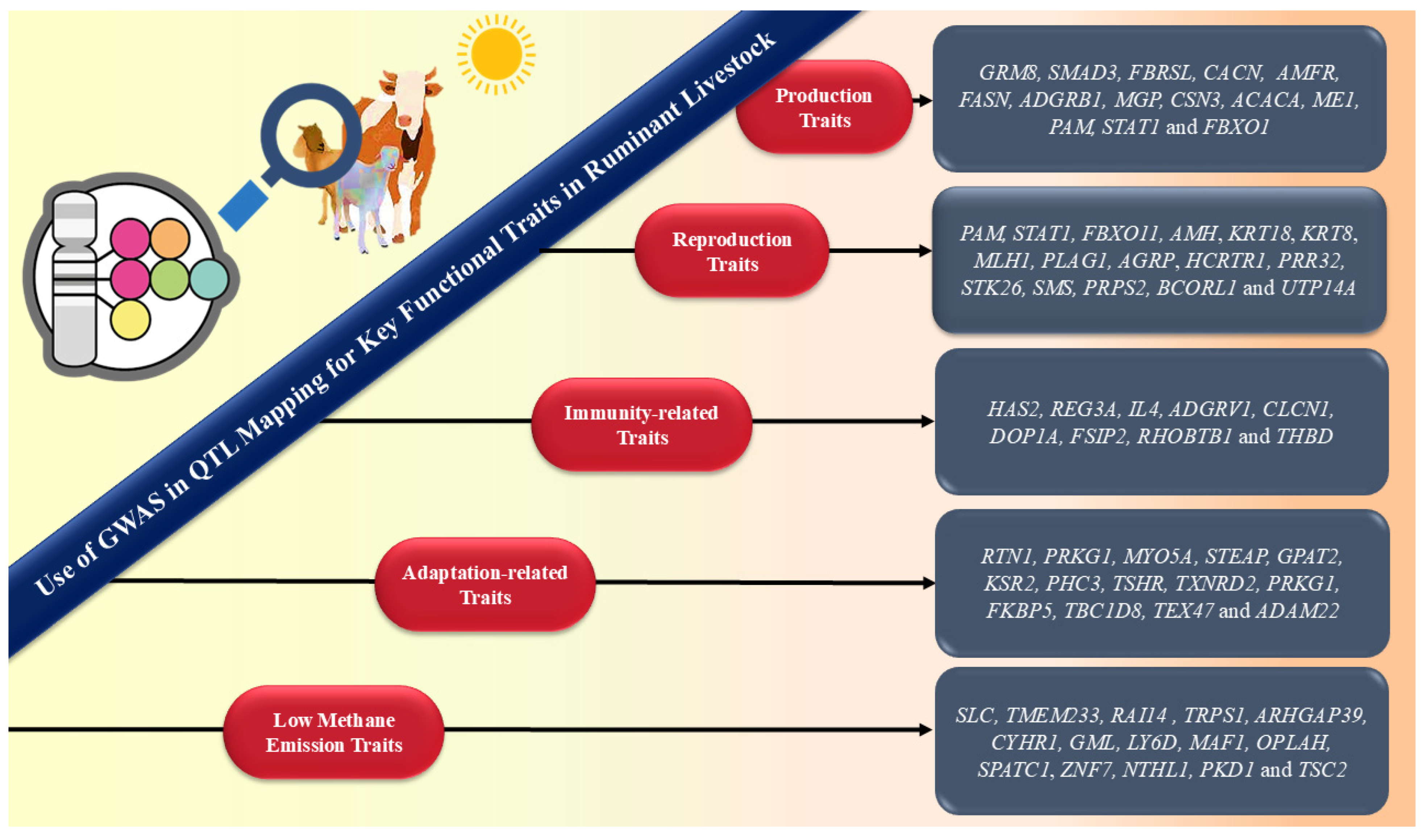
7. Applications for GWAS in Mapping QTL of Different Important Functional Traits
7.1. Production Traits
7.2. Reproduction Traits
7.3. Immune Response Traits
7.4. Adaptation Traits
7.5. Low Methane Emission Traits
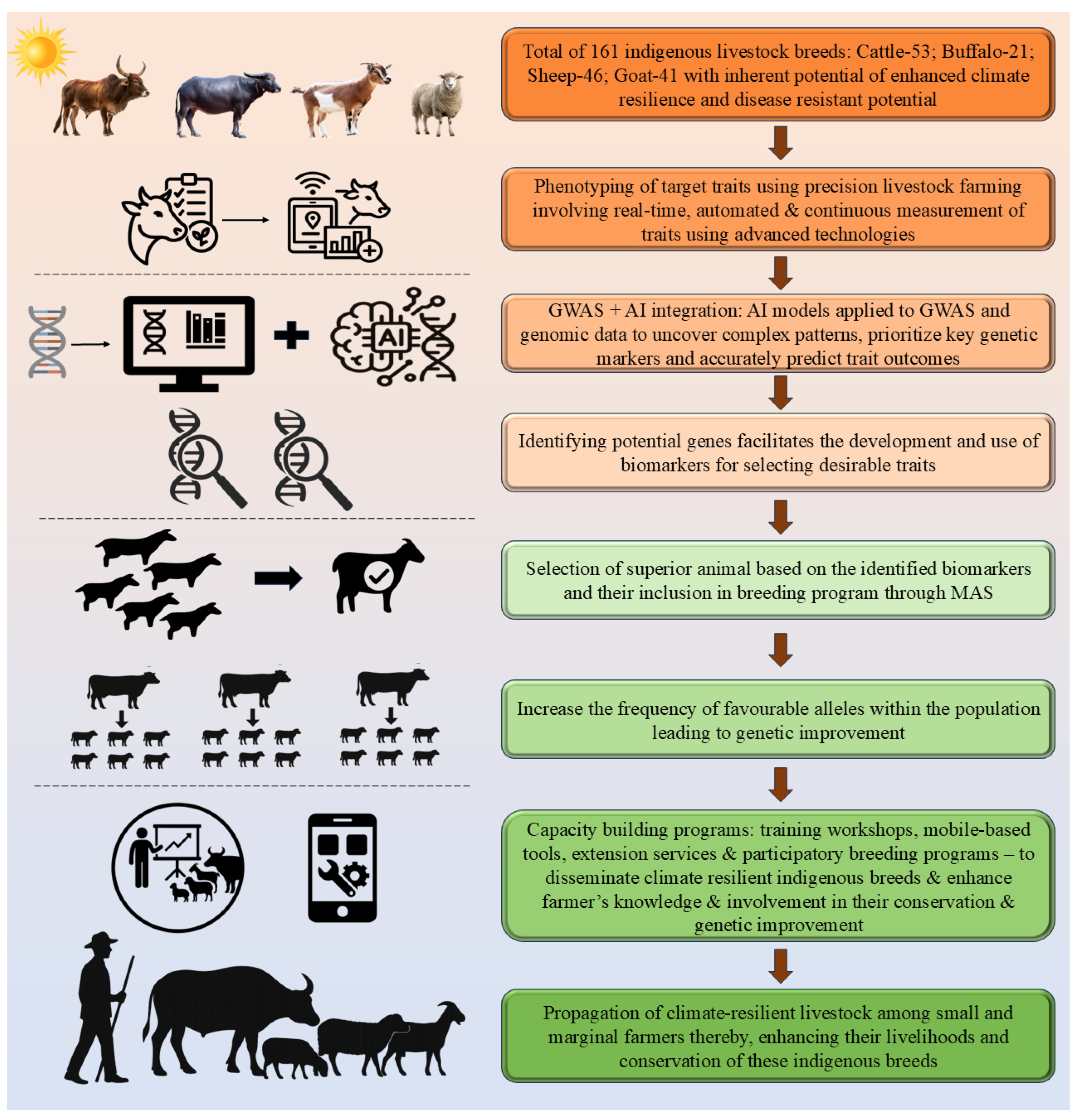
7.6. GWAS-AI Model—An Integrated Modeling Approach for the Conservation of Indigenous Climate-Resilient Breeds
8. Other Applications of GWAS in the Detection of Genomic Regions for Improving Climate Resilience in Livestock
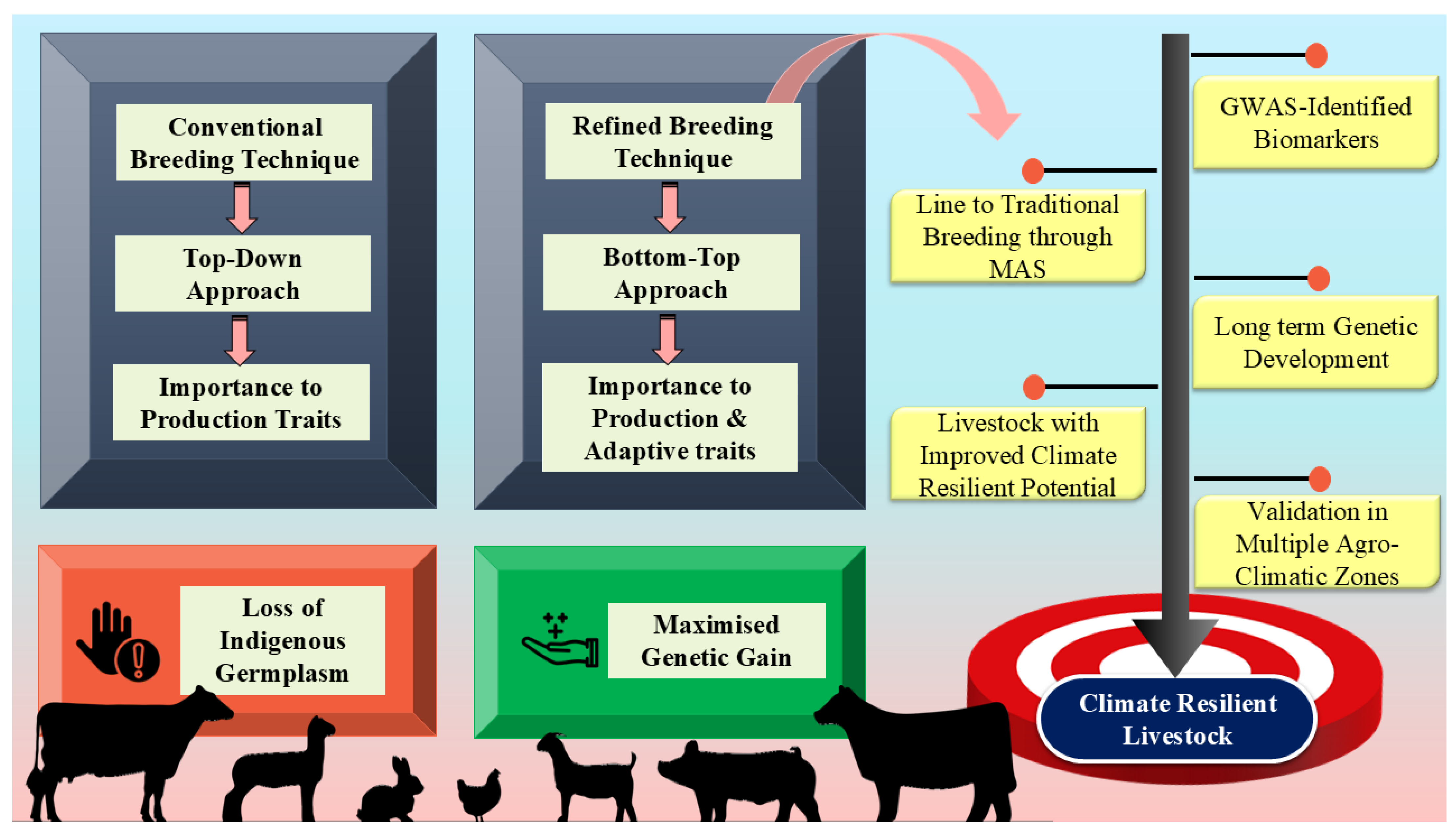
9. Role of GWAS in Redefining Breeding Policies for Climate Resilience in Tropical Countries
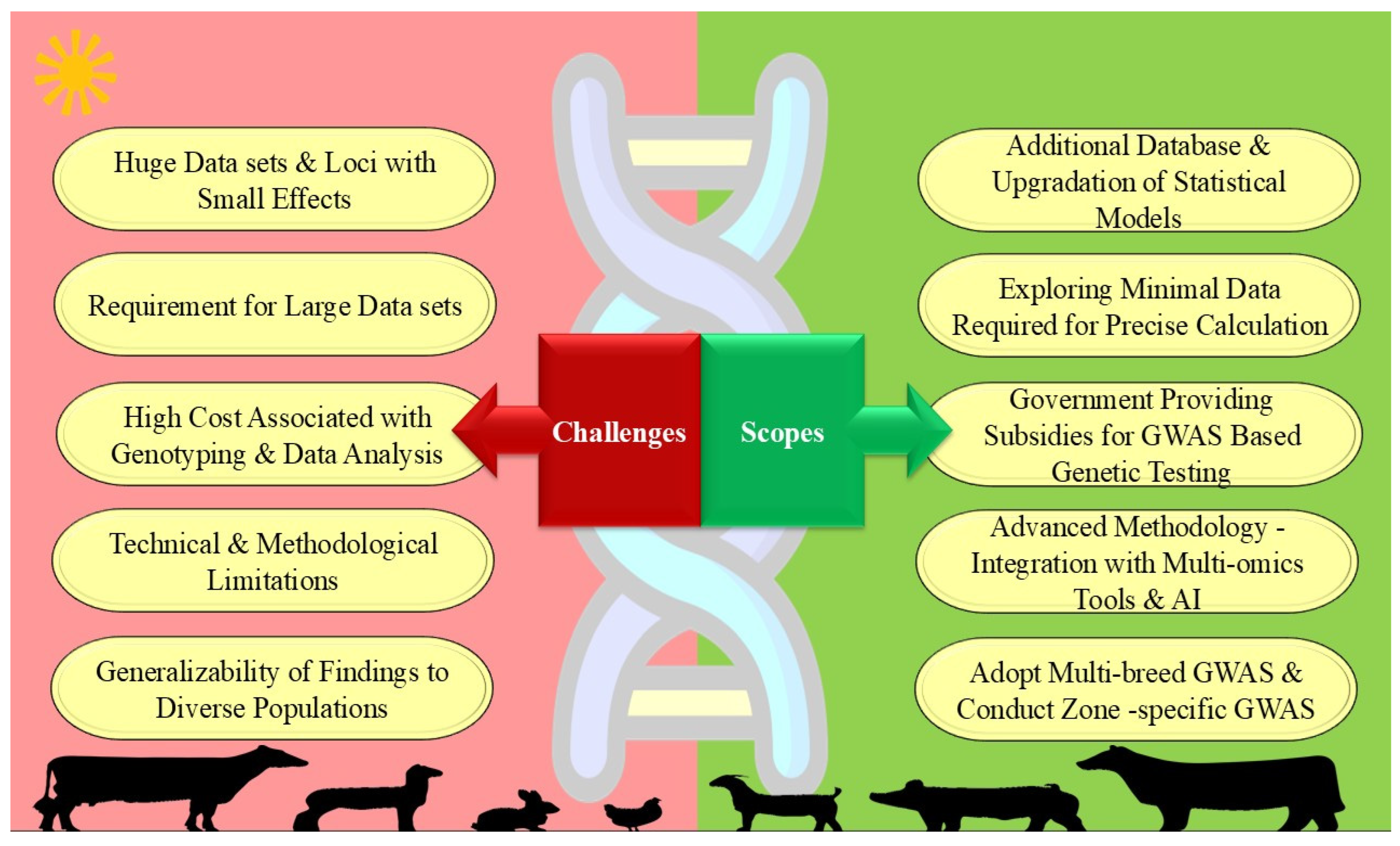
10. Challenges and Limitations of GWAS in Livestock
11. Conclusions
12. Future Perspectives
Author Contributions
Funding
Institutional Review Board Statement
Informed Consent Statement
Data Availability Statement
Conflicts of Interest
References
- Sejian, V.; Bhatta, R.; Gaughan, J.B.; Dunshea, F.R.; Lacetera, N. Adaptation of animals to heat stress. Animal 2018, 12, s431–s444. [Google Scholar] [CrossRef] [PubMed]
- Opio, C.; Gerber, P.; Mottet, A.; Falcucci, A.; Tempio, G.; MacLeod, M.; Vellinga, T.; Henderson, B.; Steinfeld, H. Greenhouse gas emissions from ruminant supply chains—A global life cycle assessment. In FAO Animal Production and Health Division Report I; Food and Agriculture Organization of the United Nations: Rome, Italy, 2013. [Google Scholar]
- United Nations. The World Population Prospects 2019: Highlights; United Nations: New York, NY, USA, 2019. [Google Scholar]
- Ren, J.; Gao, Z.; Lu, Y.; Li, M.; Hong, J.; Wu, J.; Wu, D.; Deng, W.; Xi, D.; Chong, Y. Application of GWAS and mGWAS in livestock and poultry breeding. Animals 2024, 14, 2382. [Google Scholar] [CrossRef] [PubMed]
- Souza, L.L.; Dominguez-Castaño, P.; Gianvecchio, S.B.; Sakamoto, L.S.; Rodrigues, G.R.; Soares, T.L.; Bonilha, S.F.; Marcatto, J.D.; Galvão Albuquerque, L.; Vasconcelos Silva, J.A.; et al. Heritability estimates and genome-wide association study of methane emission traits in Nellore cattle. J. Anim. Sci. 2024, 102, skae182. [Google Scholar] [CrossRef] [PubMed]
- Zamorano-Algandar, R.; Medrano, J.F.; Thomas, M.G.; Enns, R.M.; Speidel, S.E.; Sánchez-Castro, M.A.; Luna-Nevárez, G.; Leyva-Corona, J.C.; Luna-Nevárez, P. Genetic markers associated with milk production and thermotolerance in Holstein dairy cows managed in a heat-stressed environment. Biology 2023, 12, 679. [Google Scholar] [CrossRef]
- Castillo-Salas, C.A.; Luna-Nevárez, G.; Reyna-Granados, J.R.; Luna-Ramirez, R.I.; Limesand, S.W.; Luna-Nevárez, P. Molecular markers for thermo-tolerance are associated with reproductive and physiological traits in Pelibuey ewes raised in a semiarid environment. J. Therm. Biol. 2023, 112, 103475. [Google Scholar] [CrossRef]
- Carvalheiro, R.; Costilla, R.; Neves, H.H.; Albuquerque, L.G.; Moore, S.; Hayes, B.J. Unraveling genetic sensitivity of beef cattle to environmental variation under tropical conditions. Genet. Sel. Evol. 2019, 51, 29. [Google Scholar] [CrossRef]
- Aboul-Naga, A.M.; Alsamman, A.M.; El Allali, A.; Elshafie, M.H.; Abdelal, E.S.; Abdelkhalek, T.M.; Abdelsabour, T.H.; Mohamed, L.G.; Hamwieh, A. Genome-wide analysis identified candidate variants and genes associated with heat stress adaptation in Egyptian sheep breeds. Front. Genet. 2022, 13, 898522. [Google Scholar] [CrossRef]
- Silpa, M.V.; König, S.; Sejian, V.; Malik, P.K.; Nair, M.R.; Fonseca, V.F.; Maia, A.S.; Bhatta, R. Climate-resilient dairy cattle production: Applications of genomic tools and statistical models. Front. Vet. Sci. 2021, 8, 625189. [Google Scholar] [CrossRef]
- Sharma, A.; Lee, J.S.; Dang, C.G.; Sudrajad, P.; Kim, H.C.; Yeon, S.H.; Kang, H.S.; Lee, S.H. Stories and challenges of genome wide association studies in livestock—A review. Asian-Austral. J. Anim. Sci. 2015, 28, 1371. [Google Scholar] [CrossRef]
- Stephens, Z.D.; Lee, S.Y.; Faghri, F.; Campbell, R.H.; Zhai, C.; Efron, M.J.; Iyer, R.; Schatz, M.C.; Sinha, S.; Robinson, G.E. Big data: Astronomical or genomical? PLoS Biol. 2015, 13, e1002195. [Google Scholar] [CrossRef]
- Rebez, E.B.; Sejian, V.; Silpa, M.V.; Kalaignazhal, G.; Thirunavukkarasu, D.; Devaraj, C.; Nikhil, K.T.; Ninan, J.; Sahoo, A.; Lacetera, N.; et al. Applications of artificial intelligence for heat stress management in ruminant livestock. Sensors 2024, 24, 5890. [Google Scholar] [CrossRef] [PubMed]
- Chafai, N.; Hayah, I.; Houaga, I.; Badaoui, B. A review of machine learning models applied to genomic prediction in animal breeding. Front. Genet. 2023, 14, 1150596. [Google Scholar] [CrossRef] [PubMed]
- United Nations Office for Partnerships. Five Alarming Facts About Climate Change; UN Office for Partnerships: New York, NY, USA, 2022. [Google Scholar]
- Intergovernmental Panel on Climate Change. FAQ 2: How Will Nature and the Benefits it Provides to People be Affected by Higher Levels of Warming; IPCC Sixth Assessment Report; Intergovernmental Panel on Climate Change: Geneva, Switzerland, 2022. [Google Scholar]
- Banik, S.; Pankaj, P.K.; Naskar, S. Climate Change: Impacts on Livestock Diversity in Tropical Countries; Livestock Production and Climate Change: Wallingford, UK, 2015; pp. 162–182. [Google Scholar]
- Collier, R.J.; Baumgard, L.H.; Zimbelman, R.B.; Xiao, Y. Heat stress: Physiology of acclimation and adaptation. Anim. Front. 2019, 9, 12–19. [Google Scholar] [CrossRef] [PubMed]
- Lacetera, N. Impact of climate change on animal health and welfare. Anim. Front. 2019, 9, 26–31, Erratum in Anim. Front. 2019, 9, 123. [Google Scholar] [CrossRef]
- Sejian, V.; Gaughan, J.B.; Bhatta, R.; Naqvi, S.M.K. Impact of Climate Change on Livestock Productivity. Feedipedia—Animal Feed Resources Information System. 2016. Available online: http://www.feedipedia.org/content/impact-climate-change-livestock-productivity (accessed on 24 December 2025).
- Gonzalez-Rivas, P.A.; Chauhan, S.S.; Ha, M.; Fegan, N.; Dunshea, F.R.; Warner, R.D. Effects of heat stress on animal physiology, metabolism, and meat quality: A review. Meat Sci. 2020, 162, 108025. [Google Scholar] [CrossRef]
- Cheng, M.; McCarl, B.; Fei, C. Climate change and livestock production: A literature review. Atmosphere 2022, 13, 140. [Google Scholar] [CrossRef]
- Ranganathan, J.; Searchinger, T.; Waite, R.; Hanson, C.; Dumas, P.; Matthews, E. How to Sustainably Feed 10 Billion People by 2050, in 21 Charts; World Resources Institute: Washington, DC, USA, 2018; Available online: https://www.wri.org/insights/how-sustainably-feed-10-billion-people-2050-21-charts (accessed on 24 December 2025).
- Prasad, C.S.; Sejian, V. Climate change impact on livestock sector: Visioning 2025. Clim. Change Impact Livest. Adapt. Mitig. 2015, 479–489. [Google Scholar]
- Sejian, V.; Ravindra, J.P.; Prasad, C.S. Livestock production under ensuing climate change scenario: Resilience versus performance. In Climate Resilient Small Ruminant Production; ICAR-NICRA, Central Sheep and Wool Research Institute: Avikanagar, India, 2013; pp. 8–19. [Google Scholar]
- Joy, A.; Dunshea, F.R.; Leury, B.J.; Clarke, I.J.; DiGiacomo, K.; Chauhan, S.S. Resilience of small ruminants to climate change and increased environmental temperature: A review. Animals 2020, 10, 867. [Google Scholar] [CrossRef]
- Sejian, V.; Samal, L.; Soren, N.M.; Bagath, M.; Krishnan, G.; Vidya, M.K.; Archana, P.R.; Pragna, P.; Hyder, I.; Maurya, V.P.; et al. Adaptation strategies to counter climate change impact on sheep. In Sheep Production Adapting to Climate Change; Springer Nature: Berlin/Heidelberg, Germany, 2017; pp. 413–430. [Google Scholar]
- Sejian, V.; Silpa, M.V.; Nair, M.R.R.; Devaraj, C.; Devapriya, A.; Ramachandran, N.; Awachat, V.B.; Shashank, C.G.; Fonseca, V.F.; Bhatta, R. Goat as the ideal future climate-resilient animal model. In Climate Change and Livestock Production: Recent Advances and Future Perspectives; Springer: Singapore, 2022; pp. 279–292. [Google Scholar]
- Pragna, P.; Sejian, V.; Soren, N.M.; Bagath, M.; Krishnan, G.; Beena, V.; Devi, P.I.; Bhatta, R. Summer season induced rhythmic alterations in metabolic activities to adapt to heat stress in three indigenous goat breeds. Biol. Rhythm Res. 2018, 49, 551–565. [Google Scholar] [CrossRef]
- Sölkner, J.; Grausgruber, H.; Okeyo, A.M.; Ruckenbauer, P.; Wurzinger, M. Breeding objectives and the relative importance of traits in plant and animal breeding: A comparative review. Euphytica 2008, 161, 273–282. [Google Scholar] [CrossRef]
- Krupová, Z.; Krupa, E.; Zavadilová, L.; Kašná, E.; Žáková, E. Current challenges for trait economic values in animal breeding. Czech J. Anim. Sci. 2020, 65, 454–462. [Google Scholar] [CrossRef]
- Eggen, A. The development and application of genomic selection as a new breeding paradigm. Anim. Front. 2012, 2, 10–15. [Google Scholar] [CrossRef]
- Ibtisham, F.; Zhang, L.; Xiao, M.; An, L.; Ramzan, M.B.; Nawab, A.; Zhao, Y.; Li, G.; Xu, Y. Genomic selection and its application in animal breeding. Thai J. Vet. Med. 2017, 47, 301–310. [Google Scholar] [CrossRef]
- König, S.; Simianer, H.; Willam, A. Economic evaluation of genomic breeding programs. J. Dairy Sci. 2009, 92, 382–391. [Google Scholar] [CrossRef]
- Das, D.N.; Karuthadurai, T.; Gnanasekaran, S. Genomic selection: A molecular tool for genetic improvement in livestock. Adv. Anim. Genom. 2021, 141–163. [Google Scholar]
- Naha, B.C.; Prasad, A.; Sailo, L.; Chaudhary, R.; Prakash, O. Concept of genome-wide association studies and its progress in livestock. Int. J. Sci. Nat. 2016, 7, 9–42. [Google Scholar]
- Zhang, L.; Wang, F.; Gao, G.; Yan, X.; Liu, H.; Liu, Z.; Wang, Z.; He, L.; Lv, Q.; Wang, Z.; et al. Genome-wide association study of body weight traits in Inner Mongolia cashmere goats. Front. Vet. Sci. 2021, 8, 752746. [Google Scholar] [CrossRef]
- Liu, L.; Zhou, J.; Chen, C.J.; Zhang, J.; Wen, W.; Tian, J.; Zhang, Z.; Gu, Y. GWAS-based identification of new loci for milk yield, fat, and protein in Holstein cattle. Animals 2020, 10, 2048. [Google Scholar] [CrossRef]
- Zhang, L.; Liu, J.; Zhao, F.; Ren, H.; Xu, L.; Lu, J.; Zhang, S.; Zhang, X.; Wei, C.; Lu, G.; et al. Genome-wide association studies for growth and meat production traits in sheep. PLoS ONE 2013, 8, e66569. [Google Scholar] [CrossRef]
- Wang, Z.; Zhang, H.; Yang, H.; Wang, S.; Rong, E.; Pei, W.; Li, H.; Wang, N. Genome-wide association study for wool production traits in a Chinese Merino sheep population. PLoS ONE 2014, 9, e107101. [Google Scholar] [CrossRef]
- Vohra, V.; Chhotaray, S.; Gowane, G.; Alex, R.; Mukherjee, A.; Verma, A.; Deb, S.M. Genome-wide association studies in Indian buffalo revealed genomic regions for lactation and fertility. Front. Genet. 2021, 12, 696109. [Google Scholar] [CrossRef] [PubMed]
- Huang, J.; Lin, X. Advances in animal disease resistance research: Discoveries of genetic markers for disease resistance in cattle through GWAS. Biol. Evid. 2024, 14, 24–31. [Google Scholar] [CrossRef]
- Koltes, J.E.; Cole, J.B.; Clemmens, R.; Dilger, R.N.; Kramer, L.M.; Lunney, J.K.; McCue, M.E.; McKay, S.D.; Mateescu, R.G.; Murdoch, B.M.; et al. A vision for development and utilization of high-throughput phenotyping and big data analytics in livestock. Front. Genet. 2019, 10, 1197. [Google Scholar] [CrossRef] [PubMed]
- Sejian, V.; Devaraj, C.; Shashank, C.G.; Madhusoodan, A.P.; Silpa, M.V.; Devapriya, A.; Nair, M.R.; Suganthi, R.U.; Ramachandran, N.; Manjunathareddy, G.B.; et al. Heat stress in ruminants and its mitigation through nutritional additives. In Feed Additives and Supplements for Ruminants; Springer Nature: Singapore, 2024; pp. 367–398. [Google Scholar]
- Boonkum, W.; Misztal, I.; Duangjinda, M.; Pattarajinda, V.; Tumwasorn, S.; Sanpote, J. Genetic effects of heat stress on milk yield of Thai Holstein crossbreds. J. Dairy Sci. 2011, 94, 487–492. [Google Scholar] [CrossRef] [PubMed]
- Teneva, A.; Petrovic, M.P. Application of molecular markers in livestock improvement. Biotechnol. Anim. Husb. 2010, 26, 135–154. [Google Scholar] [CrossRef]
- Habimana, V.; Nguluma, A.S.; Nziku, Z.C.; Ekine-Dzivenu, C.C.; Morota, G.; Mrode, R.; Chenyambuga, S.W. Heat stress effects on milk yield traits and metabolites and mitigation strategies for dairy cattle breeds reared in tropical and sub-tropical countries. Front. Vet. Sci. 2023, 10, 1121499. [Google Scholar] [CrossRef]
- Clark, S.A.; van der Werf, J. Genomic best linear unbiased prediction (gBLUP) for the estimation of genomic breeding values. In Genome-Wide Association Studies and Genomic Prediction; Springer Nature: Berlin/Heidelberg, Germany, 2013; pp. 321–330. [Google Scholar]
- Nguyen, T.T.; Bowman, P.J.; Haile-Mariam, M.; Pryce, J.E.; Hayes, B.J. Genomic selection for tolerance to heat stress in Australian dairy cattle. J. Dairy Sci. 2016, 99, 2849–2862. [Google Scholar] [CrossRef]
- Osei-Amponsah, R.; Dunshea, F.R.; Leury, B.J.; Abhijith, A.; Chauhan, S.S. Association of phenotypic markers of heat tolerance with Australian genomic estimated breeding values and dairy cattle selection indices. Animals 2023, 13, 2259. [Google Scholar] [CrossRef]
- Sungkhapreecha, P.; Chankitisakul, V.; Duangjinda, M.; Buaban, S.; Boonkum, W. Determining heat stress effects of multiple genetic traits in tropical dairy cattle using single-step genomic BLUP. Vet. Sci. 2022, 9, 66. [Google Scholar] [CrossRef]
- Sungkhapreecha, P.; Misztal, I.; Hidalgo, J.; Lourenco, D.; Buaban, S.; Chankitisakul, V.; Boonkum, W. Validation of single-step genomic predictions using the linear regression method for milk yield and heat tolerance in a Thai-Holstein population. Vet. World 2021, 14, 3119. [Google Scholar] [CrossRef]
- Fragomeni, B.D.; Lourenco, D.; Tsuruta, S.; Gray, K.A.; Huang, Y.; Misztal, I. Genetics of heat stress in purebred and crossbred pigs from different states using BLUP or ssGBLUP. J. Anim. Sci. 2016, 94, 169–170. [Google Scholar] [CrossRef]
- Luo, H.; Hu, L.; Brito, L.F.; Dou, J.; Sammad, A.; Chang, Y.; Ma, L.; Guo, G.; Liu, L.; Zhai, L.; et al. Weighted single-step GWAS and RNA sequencing reveals key candidate genes associated with physiological indicators of heat stress in Holstein cattle. J. Anim. Sci. Biotechnol. 2022, 13, 108. [Google Scholar] [CrossRef] [PubMed]
- Buaban, S.; Lengnudum, K.; Boonkum, W.; Phakdeedindan, P. Genome-wide association study on milk production and somatic cell score for Thai dairy cattle using weighted single-step approach with random regression test-day model. J. Dairy Sci. 2022, 105, 468–494. [Google Scholar] [CrossRef] [PubMed]
- Hedeker, D. Generalized linear mixed models. Encycl. Stat. Behav. Sci. 2005. [Google Scholar] [CrossRef]
- Recce, S.; Huber, E.; Notaro, U.S.; Rodríguez, F.M.; Ortega, H.H.; Rey, F.; Signorini, M.L.; Salvetti, N.R. Association between heat stress during intrauterine development and the calving-to-conception and calving-to-first-service intervals in Holstein cows. Theriogenology 2021, 162, 95–104. [Google Scholar] [CrossRef]
- Schaeffer, L.R. Application of random regression models in animal breeding. Livest. Prod. Sci. 2004, 86, 35–45. [Google Scholar] [CrossRef]
- Oliveira, H.R.; Brito, L.F.; Lourenco, D.A.L.; Silva, F.F.; Jamrozik, J.; Schaeffer, L.R.; Schenkel, F.S. Advances and applications of random regression models: From quantitative genetics to genomics. J. Dairy Sci. 2019, 102, 7664–7683. [Google Scholar] [CrossRef]
- Oloo, R.D.; Ekine-Dzivenu, C.C.; Mrode, R.; Bennewitz, J.; Ojango, J.M.; Kipkosgei, G.; Gebreyohanes, G.; Okeyo, A.M.; Chagunda, M.G.G. Genetic analysis of phenotypic indicators for heat tolerance in crossbred dairy cattle. Animal 2024, 18, 101139. [Google Scholar] [CrossRef]
- Cebeci, Z.; Bayraktar, M.; Gökçe, G. Comparison of the statistical methods for genome-wide association studies on simulated quantitative traits of domesticated goats (Capra hircus L.). Small Rumin. Res. 2023, 227, 107053. [Google Scholar] [CrossRef]
- Zhang, W.; Gao, X.; Shi, X.; Zhu, B.; Wang, Z.; Gao, H.; Xu, L.; Zhang, L.; Li, J.; Chen, Y. PCA-based multiple-trait GWAS analysis: A powerful model for exploring pleiotropy. Animals 2018, 8, 239. [Google Scholar] [CrossRef]
- Yu, J.; Pressoir, G.; Briggs, W.H.; Vroh Bi, I.; Yamasaki, M.; Doebley, J.F.; McMullen, M.D.; Gaut, B.S.; Nielsen, D.M.; Holland, J.B.; et al. A unified mixed-model method for association mapping that accounts for multiple levels of relatedness. Nat. Genet. 2006, 38, 203–208. [Google Scholar] [CrossRef] [PubMed]
- Zhang, Z.; Ersoz, E.; Lai, C.Q.; Todhunter, R.J.; Tiwari, H.K.; Gore, M.A.; Bradbury, P.J.; Yu, J.; Arnett, D.K.; Ordovas, J.M.; et al. Mixed linear model approach adapted for genome-wide association studies. Nat. Genet. 2010, 42, 355–360. [Google Scholar] [CrossRef] [PubMed]
- Tsartsianidou, V.; Sánchez-Molano, E.; Kapsona, V.V.; Basdagianni, Z.; Chatziplis, D.; Arsenos, G.; Triantafyllidis, A.; Banos, G. A comprehensive genome-wide scan detects genomic regions related to local adaptation and climate resilience in Mediterranean domestic sheep. Genet. Sel. Evol. 2021, 53, 90. [Google Scholar] [CrossRef] [PubMed]
- Otto, P.I.; Guimarães, S.E.; Verardo, L.L.; Azevedo, A.L.S.; Vandenplas, J.; Sevillano, C.A.; Marques, D.B.; de Freitas, C.; Verneque, R.S.; Martins, M.F. Genome-wide association studies for heat stress response in Bos taurus × Bos indicus crossbred cattle. J. Dairy Sci. 2019, 102, 8148–8158. [Google Scholar] [CrossRef]
- Kominakis, A.; Tarsani, E.; Hager-Theodorides, A.L.; Mastranestasis, I.; Gkelia, D.; Hadjigeorgiou, I. Genetic differentiation of mainland-island sheep of Greece: Implications for identifying candidate genes for long-term local adaptation. PLoS ONE 2021, 16, e0257461. [Google Scholar] [CrossRef]
- Wolc, A.; Dekkers, J.C.M. Application of Bayesian genomic prediction methods to genome-wide association analyses. Genet. Sel. Evol. 2022, 54, 31. [Google Scholar] [CrossRef]
- Luna-Nevárez, G.; Pendleton, A.L.; Luna-Ramirez, R.I.; Limesand, S.W.; Reyna-Granados, J.R.; Luna-Nevárez, P. Genome-wide association study of a thermo-tolerance indicator in pregnant ewes exposed to an artificial heat-stressed environment. J. Therm. Biol. 2021, 101, 103095. [Google Scholar] [CrossRef]
- Kusmec, A.; Schnable, P.S. FarmCPUpp: Efficient large-scale genome-wide association studies. Plant Direct 2018, 2, e00053. [Google Scholar] [CrossRef]
- Yang, M.L.; Zhang, H.; Luo, H.P.; Huang, X.; Zhang, H.; Zhang, S.; Wang, Y.; Liu, L.; Guo, G.; Wang, Y.C. Estimation of genetic parameters and genome-wide association study of heat indicators in Holstein cattle based on collar-mounted device. Sci. Agric. Sin. 2023, 56, 995–1006. [Google Scholar]
- Sun, N.; Zhao, H. Statistical methods in genome-wide association studies. Annu. Rev. Biomed. Data Sci. 2020, 3, 265–288. [Google Scholar] [CrossRef]
- Alford, A.R.; Hegarty, R.S.; Parnell, P.F.; Cacho, O.J.; Herd, R.M.; Griffith, G.R. The impact of breeding to reduce residual feed intake on enteric methane emissions from the Australian beef industry. Aust. J. Exp. Agric. 2006, 46, 813–820. [Google Scholar] [CrossRef]
- Rovelli, G.; Ceccobelli, S.; Perini, F.; Demir, E.; Mastrangelo, S.; Conte, G.; Abeni, F.; Marletta, D.; Ciampolini, R.; Cassandro, M.; et al. The genetics of phenotypic plasticity in livestock in the era of climate change: A review. Ital. J. Anim. Sci. 2020, 19, 997–1014. [Google Scholar] [CrossRef]
- Aubin-Horth, N.; Renn, S.C.P. Genomic reaction norms: Using integrative biology to understand molecular mechanisms of phenotypic plasticity. Mol. Ecol. 2009, 18, 3763–3780. [Google Scholar] [CrossRef] [PubMed]
- Shaffer, W.; Moreno, J.A.H.; Bello, N.M.; Weaber, R.; Bormann, J.; Rolf, M. Modelling phenotypic plasticity relative to a temperature humidity index as an indicator of adaptability in beef cattle. In Proceedings of the 12th World Congress on Genetics Applied to Livestock Production; Wageningen Academic Publishers: Leiden, The Netherlands, 2022; pp. 1701–1704. [Google Scholar]
- Mateescu, R.G.; Sarlo-Davila, K.M.; Dikmen, S.; Rodriguez, E.; Oltenacu, P.A. The effect of Brahman genes on body temperature plasticity of heifers on pasture under heat stress. J. Anim. Sci. 2020, 98, 126. [Google Scholar] [CrossRef]
- You, X.; Vlatkovic, I.; Babic, A.; Will, T.; Epstein, I.; Tushev, G.; Akbalik, G.; Wang, M.; Glock, C.; Quedenau, C.; et al. Neural circular RNAs are derived from synaptic genes and regulated by development and plasticity. Nat. Neurosci. 2015, 18, 603–610. [Google Scholar] [CrossRef]
- Mota, L.F.; Lopes, F.B.; Fernandes Júnior, G.A.; Rosa, G.J.; Magalhães, A.F.; Carvalheiro, R.; Albuquerque, L.G. Genome-wide scan highlights the role of candidate genes on phenotypic plasticity for age at first calving in Nellore heifers. Sci. Rep. 2020, 10, 6481. [Google Scholar] [CrossRef]
- Lafuente, E.; Beldade, P. Genomics of developmental plasticity in animals. Front. Genet. 2019, 10, 720. [Google Scholar] [CrossRef]
- Sommer, R.J. Phenotypic plasticity: From theory and genetics to current and future challenges. Genetics 2020, 215, 1–13. [Google Scholar] [CrossRef]
- Kebede, F.G.; Komen, H.; Dessie, T.; Hanotte, O.; Kemp, S.; Barros, C.P.; Crooijmans, R.; Derks, M.; Alemu, S.W.; Bastiaansen, J.W.M. Exploiting phenotypic plasticity in animal breeding. In Proceedings of the 12th World Congress on Genetics Applied to Livestock Production; Wageningen Academic Publishers: Leiden, The Netherlands, 2022; pp. 1753–1756. [Google Scholar]
- Fathoni, A.; Boonkum, W.; Chankitisakul, V.; Duangjinda, M. An appropriate genetic approach for improving reproductive traits in crossbred Thai–Holstein cattle under heat stress conditions. Vet. Sci. 2022, 9, 163. [Google Scholar] [CrossRef]
- Garner, J.B.; Douglas, M.L.; Williams, S.O.; Wales, W.J.; Marett, L.C.; Nguyen, T.T.T.; Reich, C.M.; Hayes, B.J. Genomic selection improves heat tolerance in dairy cattle. Sci. Rep. 2016, 6, 34114, Erratum in Sci. Rep. 2017, 7, 39896. [Google Scholar] [CrossRef]
- Melak, A.; Aseged, T.; Shitaw, T. The influence of artificial intelligence technology on the management of livestock farms. Int. J. Distrib. Sens. Netw. 2024, 2024, 8929748. [Google Scholar] [CrossRef]
- Weigel, K.A.; VanRaden, P.M.; Norman, H.D.; Grosu, H. A 100-year review: Methods and impact of genetic selection in dairy cattle—From daughter–dam comparisons to deep learning algorithms. J. Dairy Sci. 2017, 100, 10234–10250. [Google Scholar] [CrossRef]
- Kalaignazhal, G.; Sejian, V.; Velayudhan, S.M.; Mishra, C.; Rebez, E.B.; Chauhan, S.S.; DiGiacomo, K.; Lacetera, N.; Dunshea, F.R. Applications of next-generation sequencing technologies and statistical tools in identifying pathways and biomarkers for heat tolerance in livestock. Vet. Sci. 2024, 11, 616. [Google Scholar] [CrossRef] [PubMed]
- Schmidt, B.; Hildebrandt, A. Deep learning in next-generation sequencing. Drug Discov. Today 2021, 26, 173–180. [Google Scholar] [CrossRef] [PubMed]
- Enoma, D.O.; Bishung, J.; Abiodun, T.; Ogunlana, O.; Osamor, V.C. Machine learning approaches to genome-wide association studies. J. King Saud Univ. Sci. 2022, 34, 101847. [Google Scholar] [CrossRef]
- Kumar, H.; Panigrahi, M.; Panwar, A.; Rajawat, D.; Nayak, S.S.; Saravanan, K.A.; Kaisa, K.; Parida, S.; Bhushan, B.; Dutt, T. Machine-learning prospects for detecting selection signatures using population genomics data. J. Comput. Biol. 2022, 29, 943–960. [Google Scholar] [CrossRef]
- Kumar, H. Exploring the Potential of Machine Learning for Identification of Selective Sweeps in Tharparkar Cattle Genome. Ph.D. Thesis, Indian Veterinary Research Institute, Singapore, 2023. [Google Scholar]
- Passamonti, M.M.; Somenzi, E.; Barbato, M.; Chillemi, G.; Colli, L.; Joost, S.; Milanesi, M.; Negrini, R.; Santini, M.; Vajana, E.; et al. The quest for genes involved in adaptation to climate change in ruminant livestock. Animals 2021, 11, 2833. [Google Scholar] [CrossRef]
- Zhang, H.; Wang, Z.; Wang, S.; Li, H. Progress of genome-wide association study in domestic animals. J. Anim. Sci. Biotechnol. 2012, 3, 26. [Google Scholar] [CrossRef]
- Sahana, G.; Cai, Z.; Sanchez, M.P.; Bouwman, A.C.; Boichard, D. Good practices in genome-wide association studies to identify candidate sequence variants in dairy cattle. J. Dairy Sci. 2023, 106, 5218–5241. [Google Scholar] [CrossRef]
- Wankar, A.K.; Rindhe, S.N.; Doijad, N.S. Heat stress in dairy animals and current milk production trends, economics, and future perspectives: The global scenario. Trop. Anim. Health Prod. 2021, 53, 70. [Google Scholar] [CrossRef]
- Correa-Calderón, A.; Avendaño-Reyes, L.; López-Baca, M.; Macías-Cruz, U. Heat stress in dairy cattle with emphasis on milk production and feed and water intake habits. Rev. Mex. Cienc. Pecu. 2022, 13, 488–509. [Google Scholar] [CrossRef]
- Macciotta, N.P.P.; Biffani, S.; Bernabucci, U.; Lacetera, N.; Vitali, A.; Ajmone-Marsan, P.; Nardone, A. Derivation and genome-wide association study of a principal component-based measure of heat tolerance in dairy cattle. J. Dairy Sci. 2017, 100, 4683–4697. [Google Scholar] [CrossRef] [PubMed]
- Velayudhan, S.M.; Yin, T.; Alam, S.; Brügemann, K.; Sejian, V.; Bhatta, R.; Schlecht, E.; König, S. Unraveling the genomic association for milk production traits and signatures of selection of cattle in a harsh tropical environment. Biology 2023, 12, 1483. [Google Scholar] [CrossRef] [PubMed]
- Bang, N.N.; Hayes, B.J.; Lyons, R.E.; Randhawa, I.A.; Gaughan, J.B.; Trach, N.X.; McNeill, D.M. Genomic prediction and genome-wide association studies for productivity, conformation and heat tolerance traits in tropical smallholder dairy cows. J. Anim. Breed. Genet. 2025, 142, 322–341. [Google Scholar] [CrossRef]
- Bohlouli, M.; Halli, K.; Yin, T.; Gengler, N.; König, S. Genome-wide associations for heat stress response suggest potential candidate genes underlying milk fatty acid composition in dairy cattle. J. Dairy Sci. 2022, 105, 3323–3340. [Google Scholar] [CrossRef]
- Zidi, A.; Abo-Shady, H.; Molina, A.; Menéndez-Buxadera, A.; Sánchez-Rodríguez, M.; Díaz, C.; Carabaño, M.J.; Serradilla, J.M. Genome-wide association for heat stress tolerance/susceptibility in Florida dairy goats. In Proceedings of the 10th World Congress on Genetics Applied to Livestock Production; Wageningen Academic Publishers: Leiden, The Netherlands, 2014; pp. 17–22. [Google Scholar]
- Contreras-Méndez, L.A.; Medrano, J.F.; Thomas, M.G.; Enns, R.M.; Speidel, S.E.; Luna-Nevárez, G.; López-Castro, P.A.; Rivera-Acuña, F.; Luna-Nevárez, P. The anti-Müllerian hormone as endocrine and molecular marker associated with reproductive performance in Holstein dairy cows exposed to heat stress. Animals 2024, 14, 213. [Google Scholar] [CrossRef]
- Shi, R.; Brito, L.F.; Liu, A.; Luo, H.; Chen, Z.; Liu, L.; Guo, G.; Mulder, H.; Ducro, B.; van der Linden, A.; et al. Genotype-by-environment interaction in Holstein heifer fertility traits using single-step genomic reaction norm models. BMC Genom. 2021, 22, 193. [Google Scholar] [CrossRef]
- Tan, X.; He, Z.; Fahey, A.G.; Zhao, G.; Liu, R.; Wen, J. Research progress and applications of genome-wide association study in farm animals. Anim. Res. One Health 2023, 1, 56–77. [Google Scholar] [CrossRef]
- de Carvalho, F.E.; Ferraz, J.B.S.; Pedrosa, V.B.; Matos, E.C.; Eler, J.P.; Silva, M.R.; Guimarães, J.D.; Bussiman, F.; Silva, B.C.; Mulim, H.A.; et al. Genetic parameters and genome-wide association studies including the X chromosome for various reproduction and semen quality traits in Nellore cattle. BMC Genom. 2025, 26, 26. [Google Scholar] [CrossRef]
- Yin, T.; Halli, K.; König, S. Direct genetic effects, maternal genetic effects, and maternal genetic sensitivity on prenatal heat stress for calf diseases and corresponding genomic loci in German Holsteins. J. Dairy Sci. 2022, 105, 6795–6808. [Google Scholar] [CrossRef]
- Sölzer, N.; May, K.; Yin, T.; König, S. Genomic analyses of claw disorders in Holstein cows: Genetic parameters, trait associations, and genome-wide associations considering interactions of SNP and heat stress. J. Dairy Sci. 2022, 105, 8218–8236. [Google Scholar] [CrossRef] [PubMed]
- Czech, B.; Wang, Y.; Szyda, J. Genome-wide association study of heat stress response in Bos taurus. BioRxiv 2023. [Google Scholar] [CrossRef]
- Vaibhav, P. Genome-Wide Analysis of Heat Stress Variation on Milk Yield in Murrah Buffalo. Ph.D. Thesis, National Dairy Research Institute, Karnal, India, 2023. [Google Scholar]
- Manzanilla-Pech, C.I.V.; Difford, G.F.; Sahana, G.; Romé, H.; Løvendahl, P.; Lassen, J. Genome-wide association study for methane emission traits in Danish Holstein cattle. J. Dairy Sci. 2022, 105, 1357–1368. [Google Scholar] [CrossRef] [PubMed]
- Calderón-Chagoya, R.; Hernandez-Medrano, J.H.; Ruiz-López, F.J.; Garcia-Ruiz, A.; Vega-Murillo, V.E.; Montano-Bermudez, M.; Arechavaleta-Velasco, M.E.; Gonzalez-Padilla, E.; Mejia-Melchor, E.I.; Saunders, N.; et al. Genome-wide association studies for methane production in dairy cattle. Genes 2019, 10, 995. [Google Scholar] [CrossRef]
- Sypniewski, M.; Strabel, T.; Pszczola, M. Genetic variability of methane production and concentration measured in the breath of Polish Holstein-Friesian cattle. Animals 2021, 11, 3175. [Google Scholar] [CrossRef]
- Jalil Sarghale, A.; Moradi Shahrebabak, M.; Moradi Shahrebabak, H.; Nejati Javaremi, A.; Saatchi, M.; Khansefid, M.; Miar, Y. Genome-wide association studies for methane emission and ruminal volatile fatty acids using Holstein cattle sequence data. BMC Genet. 2020, 21, 129. [Google Scholar] [CrossRef]
- Atashi, H.; Wilmot, H.; Vanderick, S.; Hubin, X.; Soyeurt, H.; Gengler, N. 27. Genome-wide association study for mid-infrared methane predictions in Walloon dairy cows. In Proceedings of the World Congress on Genetics Applied to Livestock Production 2022, Wageningen, The Netherlands, 3–8 July 2022. [Google Scholar]
- Pszczola, M.; Strabel, T.; Mucha, S.; Sell-Kubiak, E. Genome-wide association identifies methane production level relation to genetic control of digestive tract development in dairy cows. Sci. Rep. 2018, 8, 15164. [Google Scholar] [CrossRef]
- Núñez Soto, S.G.; Berruecos Villalobos, J.M.; Moreno, N.C.; Magaña-Monforte, J.G.; Ochoa-Galván, P.; Ulloa-Arvizu, R.; Toledo-Alvarado, H.O. Genome-wide association study for heat stress resistance in Brown Swiss cattle in Yucatan, Mexico. Vet. Méx. OA 2023, 10, 1–13. [Google Scholar] [CrossRef]
- Dikmen, S.; Cole, J.B.; Null, D.J.; Hansen, P.J. Genome-wide association mapping for identification of quantitative trait loci for rectal temperature during heat stress in Holstein cattle. PLoS ONE 2013, 8, e69202. [Google Scholar] [CrossRef]
- Dikmen, S.; Wang, X.Z.; Ortega, M.S.; Cole, J.B.; Null, D.J.; Hansen, P.J. Single nucleotide polymorphisms associated with thermoregulation in lactating dairy cows exposed to heat stress. J. Anim. Breed. Genet. 2015, 132, 409–419. [Google Scholar] [CrossRef]
- Luo, H.; Li, X.; Hu, L.; Xu, W.; Chu, Q.; Liu, A.; Guo, G.; Liu, L.; Brito, L.F.; Wang, Y. Genomic analyses and biological validation of candidate genes for rectal temperature as an indicator of heat stress in Holstein cattle. J. Dairy Sci. 2021, 104, 4441–4451, Erratum in J. Dairy Sci. 2021, 104, 8338. [Google Scholar] [CrossRef] [PubMed]
- Hernandez, A.S.; Zayas, G.A.; Rodriguez, E.E.; Sarlo Davila, K.M.; Rafiq, F.; Nunez, A.N.; Titto, C.G.; Mateescu, R.G. Exploring the genetic control of sweat gland characteristics in beef cattle for enhanced heat tolerance. J. Anim. Sci. Biotechnol. 2024, 15, 66. [Google Scholar] [CrossRef] [PubMed]
- Grigoletto, L.; Ferraz, J.B.; Oliveira, H.R.; Eler, J.P.; Bussiman, F.O.; Abreu Silva, B.C.; Baldi, F.; Brito, L.F. Genetic architecture of carcass and meat quality traits in Montana Tropical® composite beef cattle. Front. Genet. 2020, 11, 123. [Google Scholar] [CrossRef] [PubMed]
- Reis, H.B.D.; Carvalho, M.E.; Espigolan, R.; Poleti, M.D.; Ambrizi, D.R.; Berton, M.P.; Ferraz, J.B.S.; de Mattos Oliveira, E.C.; Eler, J.P. Genome-wide association (GWAS) applied to carcass and meat traits of Nellore cattle. Metabolites 2023, 14, 6. [Google Scholar] [CrossRef]
- Khan, I.; Mesalam, A.; Heo, Y.S.; Lee, S.H.; Nabi, G.; Kong, I.K. Heat stress as a barrier to successful reproduction and potential alleviation strategies in cattle. Animals 2023, 13, 2359. [Google Scholar] [CrossRef]
- Wu, J.; Zhang, J.; Teng, M.; Yang, L.; Yi, J.; Ha, G.; Cooke, J.S.; Clempson, A.M.; Pollott, G.E.; Wathes, D.C.; et al. Genome-wide association study of fertility traits in dairy cows. Adv. Anim. Biosci. 2014, 5, 256–280. [Google Scholar]
- Inbaraj, S.; Sejian, V.; Bagath, M.; Bhatta, R. Impact of heat stress on immune responses of livestock: A review. Pertanika J. Trop. Agric. Sci. 2016, 39, 459–482. [Google Scholar]
- Bagath, M.; Krishnan, G.; Devaraj, C.; Rashamol, V.P.; Pragna, P.; Lees, A.M.; Sejian, V. The impact of heat stress on the immune system in dairy cattle: A review. Res. Vet. Sci. 2019, 126, 94–102. [Google Scholar] [CrossRef]
- Halli, K.; Vanvanhossou, S.F.; Bohlouli, M.; König, S.; Yin, T. Identification of candidate genes on the basis of SNP by time-lagged heat stress interactions for milk production traits in German Holstein cattle. PLoS ONE 2021, 16, e0258216. [Google Scholar] [CrossRef]
- de Oliveira, L.F.; Veroneze, R.; Sousa, K.R.S.; Mulim, H.A.; Araujo, A.C.; Huang, Y.; Johnson, J.S.; Brito, L.F. Genomic regions, candidate genes, and pleiotropic variants associated with physiological and anatomical indicators of heat stress response in lactating sows. BMC Genom. 2024, 25, 467. [Google Scholar] [CrossRef]
- Porto-Neto, L.R.; Reverter, A.; Prayaga, K.C.; Chan, E.K.; Johnston, D.J.; Hawken, R.J.; Fordyce, G.; Garcia, J.F.; Sonstegard, T.S.; Bolormaa, S.; et al. The genetic architecture of climatic adaptation of tropical cattle. PLoS ONE 2014, 9, e113284. [Google Scholar] [CrossRef] [PubMed]
- Food and Agriculture Organization of the United Nations. The State of Food Security and Nutrition in the World 2018: Building Climate Resilience for Food Security and Nutrition; FAO: Rome, Italy, 2018. [Google Scholar]
- Moumen, A.; Azizi, G.; Chekroun, K.B.; Baghour, M. The effects of livestock methane emission on global warming: A review. Int. J. Global Warm. 2016, 9, 229–253. [Google Scholar] [CrossRef]
- Panwar, A.; Kumar, H.; Rani, C.; Bhure, M. Genetic strategies to reduce enteric methane emission from ruminants. Int. J. Livest. Res. 2024, 14, 13–30. [Google Scholar]
- Worku, D. Unraveling the genetic basis of methane emission in dairy cattle: A comprehensive exploration and breeding approach to lower methane emissions. Anim. Biotechnol. 2024, 35, 2362677. [Google Scholar] [CrossRef]
- Rashamol, V.P.; Sejian, V.; Bagath, M.; Krishnan, G.; Archana, P.R.; Bhatta, R. Physiological adaptability of livestock to heat stress: An updated review. J. Anim. Behav. Biometeorol. 2020, 6, 62–71. [Google Scholar] [CrossRef]
- Indu, S.; Pareek, A. Growth and physiological adaptability of sheep to heat stress under semi-arid environment: A review. Int. J. Emerg. Trends Sci. Technol. 2015, 2, 3188–3198. [Google Scholar] [CrossRef]
- Amamou, H.; Beckers, Y.; Mahouachi, M.; Hammami, H. Thermotolerance indicators related to production and physiological responses to heat stress of Holstein cows. J. Therm. Biol. 2019, 82, 90–98. [Google Scholar] [CrossRef]
- Vasilenko, T.; Mylostyvyi, R.; Milostiviy, R.; Milostivyiy, R.; Kalinichenko, A.; Kalinichenko, O.; Mylostyva, D. Heat stress in dairy cows in the central part of Ukraine and its economic consequences. In Social and Economic Aspects of Sustainable Development of Regions: Monograph; Publishing House WSZiA: Opole, Poland, 2018; pp. 128–135. [Google Scholar]
- Tao, S.; Rivas, R.M.O.; Marins, T.N.; Chen, Y.C.; Gao, J.; Bernard, J.K. Impact of heat stress on lactational performance of dairy cows. Theriogenology 2020, 150, 437–444. [Google Scholar] [CrossRef]
- Osei-Amponsah, R.; Chauhan, S.S.; Leury, B.J.; Cheng, L.; Cullen, B.; Clarke, I.J.; Dunshea, F.R. Genetic selection for thermotolerance in ruminants. Animals 2019, 9, 948. [Google Scholar] [CrossRef]
- Naskar, S.; Gowane, G.R.; Chopra, A.; Paswan, C.; Prince, L.L.L. Genetic adaptability of livestock to environmental stresses. In Environmental Stress and Amelioration in Livestock Production; Springer: Berlin/Heidelberg, Germany, 2012; pp. 317–378. [Google Scholar]
- Worku, D.; Hussen, J.; De Matteis, G.; Schusser, B.; Alhussien, M.N. Candidate genes associated with heat stress and breeding strategies to relieve its effects in dairy cattle. Front. Vet. Sci. 2023, 10, 1151241. [Google Scholar] [CrossRef]
- Carabaño, M.J.; Ramón, M.; Díaz, C.; Molina, A.; Pérez-Guzmán, M.D.; Serradilla, J.M. Breeding for resilience to heat stress effects in dairy ruminants: A comprehensive review. J. Anim. Sci. 2017, 95, 1813–1826. [Google Scholar]
- Ravagnolo, O.; Misztal, I. Genetic component of heat stress in dairy cattle: Parameter estimation. J. Dairy Sci. 2000, 83, 2126–2130. [Google Scholar] [CrossRef] [PubMed]
- Khanzadeh, H.; Ghavi Hossein-Zadeh, N.; Ghovvati, S. Genome-wide association studies, next generation sequencing and their application in animal breeding and genetics. Iran. J. Appl. Anim. Sci. 2020, 10, 395–404. [Google Scholar]
- Korte, A.; Farlow, A. The advantages and limitations of trait analysis with GWAS. Plant Methods 2013, 9, 29–38. [Google Scholar] [CrossRef] [PubMed]
- Jang, M.J.; Lee, S.H.; Kim, J.M. Genome-wide association studies: A powerful approach for identifying genomic variants for livestock breeding and disease management. In Bioinformatics in Veterinary Science; Springer Nature: Berlin/Heidelberg, Germany, 2025; pp. 87–117. [Google Scholar]
- Long, M.; Wang, B.; Yang, Z.; Lu, X. Genome-wide association study as an efficacious approach to discover candidate genes associated with body linear type traits in dairy cattle. Animals 2024, 14, 2181. [Google Scholar] [CrossRef]
- Mkize, N.; Maiwashe, A.; Dzama, K.; Dube, B.; Mapholi, N. Suitability of GWAS as a tool to discover SNPs associated with tick resistance in cattle. Pathogens 2021, 10, 1604. [Google Scholar] [CrossRef]
- Tan, W.L.A.; Neto, L.R.P.; Reverter, A.; McGowan, M.; Fortes, M.R.S. Sequence-level genome-wide associations for bull production and fertility traits in tropically adapted bulls. BMC Genom. 2023, 24, 365. [Google Scholar] [CrossRef]
- Burrow, H.M.; Mrode, R.; Mwai, A.O.; Coffey, M.P.; Hayes, B.J. Challenges and opportunities in applying genomic selection to ruminants owned by smallholder farmers. Agriculture 2021, 11, 1172. [Google Scholar] [CrossRef]
- Mrode, R.; Jones, C.S.; Okeyo, M.A. Application of nuclear and genomic technologies for improving livestock productivity in developing world: Challenges and opportunities. Sustain. Anim. Prod. Health 2023, 248. [Google Scholar]
- Aslam, S.; Masoud, M.S.; Ashfaq, U.A.; Ansari, M.U.R.; Nahid, N.; Imran, M.; Munir, S.; Khurshid, M.; Qasim, M. Genomic tools and technologies: Revolutionizing livestock improvement. In Animal Production and Health; ISRES Publishing: Konya, Turkey, 2024; pp. 46–64. [Google Scholar]
- Goshme, S.; Dadi, H. Genetic diversity and footprint of the Ethiopian cattle population and application of molecular information for sustainable genetic improvement. Biol. Diver. 2024, 1, 147–157. [Google Scholar] [CrossRef]



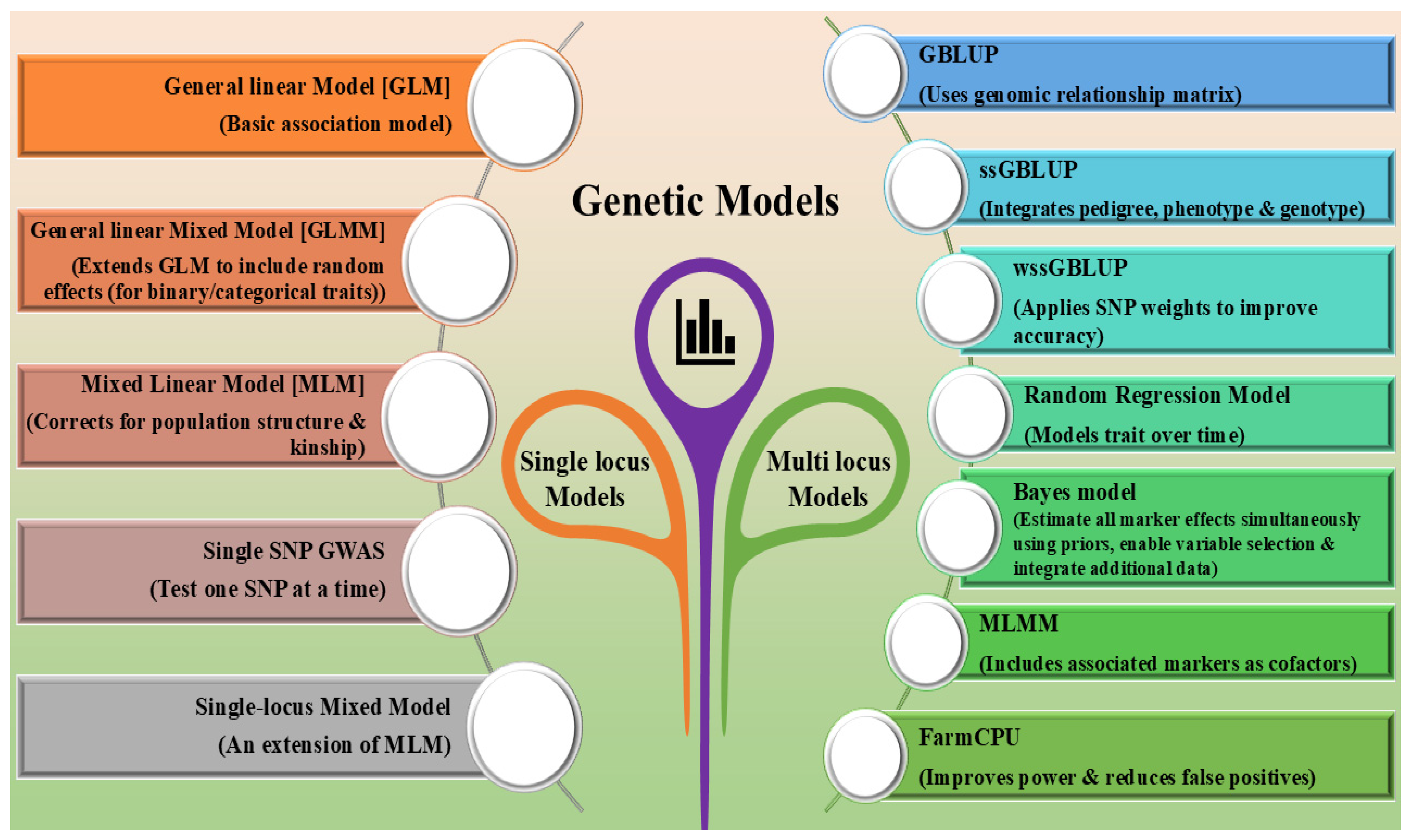
| Genetic Model | Key Characteristics | Advantages | Disadvantages/Limitations | References |
|---|---|---|---|---|
| GBLUP (Genomic Best Linear Unbiased Prediction) | Uses a genomic relationship matrix (GRM) derived from SNP data to estimate genomic breeding values (GEBVs) | Higher accuracy than pedigree-based models; suitable for genomic selection; effective for heat tolerance traits | Assumes equal SNP effects; may not capture complex genetic architecture fully | [48,49,50] |
| ssGBLUP (Single-step GBLUP) | Integrates pedigree, phenotypic, and genomic data simultaneously | Improved accuracy and reduced bias; efficient use of all available data | Computationally demanding; requires high-quality integrated datasets | [51,52,53] |
| Weighted ssGBLUP/WssGWAS | Assign weights to SNPs based on their effects; improves GRM | Better detection of QTL; increased prediction accuracy; accounts for marker importance | Slight improvement over ssGBLUP; iterative weighting increases complexity | [54,55] |
| GLMM (Generalized Linear Mixed Model) | Extends GLM by including fixed and random effects; handles non-normal data | Suitable for longitudinal and clustered data; accounts for environmental variation | Model complexity; computational intensity; requires careful model specification | [56,57] |
| Random Regression Models (RRM) | Models genetic and environmental effects over time; use reaction norms | Captures dynamic responses to heat stress; evaluates phenotypic plasticity | Requires large datasets; complex interpretation | [58,59,60] |
| GLM (General Linear Model) | Simple linear model without random effects | Easy to implement; low computational demand | Cannot control population structure; prone to false positives | [61] |
| MLM (Mixed Linear Model) | Includes both fixed and random effects; controls population structure | Reduces false positives; widely used in GWAS | Computationally intensive; may miss small-effect loci | [63,64,65] |
| Single-SNP GWAS Model | Tests one SNP at a time for association | Simple and interpretable; widely used | Ignores polygenic nature; high false discovery risk | [66] |
| Single-locus Mixed Model | Similar to single-SNP but includes random effects | Controls confounding factors better than single-SNP | Limited power for complex traits | [67] |
| Bayesian Models (e.g., Bayes B, Bayes C) | Multi-locus models estimating all marker effects simultaneously with prior distributions | Captures polygenic traits; flexible; effective for variable selection | Computationally intensive; requires prior assumptions | [68,69] |
| PCA-based GWAS | Uses principal components to analyze multiple correlated traits | Increases statistical power; detects pleiotropic QTLs | Interpretation can be complex; may lose trait-specific detail | [62] |
| FarmCPU (Fixed and Random Model Circulating Probability Unification) | Iterative model combining GLM and MLM; separates testing markers and covariates | Reduces false positives and negatives; high statistical power | Requires careful parameter tuning; computationally intensive | [70,71] |
| Multi-locus Models (SUPER, MLMM, Blink) | Consider multiple loci simultaneously | Better detection of true associations; improved control of false positives | Higher computational requirements; model complexity | [61] |
| Genetic Model | Species | Breed | Trait | Chip | Reference |
|---|---|---|---|---|---|
| Random regression model | Bovine | Holstein and Jersey | Milk production | Illumina Bovine High-Density genotype | [49] |
| Random regression model | Bovine | Holstein cows | Milk production | - | [50] |
| Single-step genomic best linear unbiased prediction; linear regression model | Bovine | Thai Holstein cows | Milk yield | Illumina BovineSNP50 | [52] |
| Weighted single-step genome-wide association study | Bovine | Holstein cows | Rectal temperature, respiration rate, and drooling score | Illumina 150 K Bovine Bead chip | [54] |
| Generalized linear mixed model | Bovine | Holstein cows | Reproduction performance | - | [57] |
| Random regression model | Bovine | Multi-breeds | Milk production | - | [60] |
| Mixed linear model | Ovine | Chios dairy sheep | Milk yield | OvineSNP50 Genotyping | [65] |
| Single-SNP GWAS | Bovine | Gir × Holstein F2 population | Rectal temperature | Illumina BovineSNP50v1 | [66] |
| Single locus mixed model GWAS | Ovine | Greek sheep | Adaptation | Illumina Ovine 50K SNP | [67] |
| Single-marker analysis and Bayesian multi-marker models | Ovine | Columbia–Rambouillet crossbred ewes | Adaptation | Illumina OvineSNP50 BeadChip | [69] |
| FarmCPU | Bovine | Holstein cows | Fertility | - | [71] |
| Approach | Key Characteristics | Applications in Climate Adaptability | Advantages | Limitations/Disadvantages | References |
|---|---|---|---|---|---|
| Genomic models (reaction norms, GWAS, G × E models, omics integration) | Use SNPs, genomic markers, and reaction norm models to evaluate genotype–environment interactions (G × E); rely on statistical genetics frameworks | Identification of biomarkers for thermo-tolerance; estimation of phenotypic plasticity; detection of adaptive genes; selection of climate-resilient breeds | Biologically interpretable; directly links genotype to phenotype; robust for detecting QTLs and G × E interactions; supports marker-assisted selection (MAS) | Requires large, high-quality genomic datasets; limited ability to capture non-linear relationships; moderate predictive power for complex traits | [73,74,75,76,77,78,79,80] |
| Reaction norm models (within genomic approaches) | Model phenotypic response across environmental gradients | Evaluation of heat tolerance and adaptive responses under varying THI; identification of resilient genotypes | Captures environmental sensitivity; improves accuracy of G × E estimation | Data-intensive; complex modeling and interpretation | [75,79] |
| Omics-based genomic approaches (RNA-seq, microarrays, GWAS integration) | Integrate transcriptomics and genomics to study gene expression under stress | Identification of genes regulating adaptive responses; understanding the molecular basis of plasticity | High-resolution biological insight; identifies regulatory pathways | Expensive; complex data integration; requires bioinformatics expertise | [78,80] |
| AI/machine learning models | Use algorithms to analyze large, high-dimensional datasets; detect patterns beyond linear assumptions | Prediction of adaptive traits; genomic prediction of heat tolerance; integration of environmental and genomic data; decision support in breeding | Handles big data efficiently; captures non-linear relationships; higher predictive accuracy; adaptable to multi-source data | Risk of overfitting; limited biological interpretability (“black box”); requires large datasets and computational power | [12,13,14,86,88] |
| Deep learning (DL) | Advanced ML using neural networks for feature extraction and pattern recognition | Analysis of NGS data; prediction of complex adaptive traits; integration of multi-omics and environmental data | Superior performance in complex datasets; automatic feature extraction | Poor generalization across datasets; high computational cost; interpretability challenges | [88,92] |
| AI-integrated genomic prediction models | Combine ML with genomic selection (genomic + phenotypic + environmental data) | Improved prediction of breeding values for thermo-tolerance and productivity under climate stress | Enhanced prediction accuracy; faster decision-making; supports precision breeding | Data integration challenges; requires validation across populations | [86,89] |
| Machine learning for selection signatures | Treats selection detection as a classification problem | Identification of adaptive genomic regions under climate stress | More robust than traditional statistical assumptions; handles complex patterns | Requires labelled datasets; methodological complexity | [90,91] |
| Traits | Species | Breed | Parameters | Candidate Genes/Genomic Regions | Functions | Reference |
|---|---|---|---|---|---|---|
| Productions traits | Bovine | Holstein cows | Total milk yield, rectal temperature, and respiration rate | TLR4, GRM8, and SMAD3 | Immune response, glutamate release, regulation of lipid and adipose tissue metabolism | [6] |
| Bovine | Exotic Holstein and Jersey; crossbreds; native—Hallikar and Khillar | Test day milk yield | FBRSL and CACN | Immune response, cell signaling, ubiquitination | [98] | |
| Bovine | Vietnamese dairy cattle | Milk yield, energy corrected milk yield, fat% | BTA14 | [99] | ||
| Bovine | Italian Holstein cows | Milk yield, fat%, protein% | HSF1, MCAT | Regulation of stress proteins, fatty acid metabolism | [97] | |
| Bovine | Holstein cows | PUFA, SFA | AMFR, FASN, ADGRB1, and MGP | Fatty acid synthesis and disease resistance | [100] | |
| Caprine | Florida goats | Milk composition | CSN3, ACACA, ME1 | Regulation of cell death in the mammary gland and thermo-tolerance function of HSP27 | [101] | |
| Reproduction | Ovine | Pelibeuy ewes | Conception rate, Lambing rate | PAM, STAT1, and FBXO11 | Modulates the effects of HSPs | [7] |
| Bovine | Holstein cows | AMH level | AMH, LGR5, IGFBP1, and TLR4 | Regulation of follicular growth, cell proliferation and survival, immune response | [102] | |
| Bovine | Holstein heifers | Age at first calving, service period, conception rate | SP1, KRT18, KRT8, MLH1, EOMES, PLAG1, AMHR2, PC, AGRP, GUCY1B1, and HCRTR1 | Oocyte development, maturation, differentiation, embryo development, oogenesis, stress response regulation | [103] | |
| Bovine | - | Scrotal circumference, sheath score | DYRK2, GRIP1, CAND1 | Spermatogenesis | [104] | |
| Bovine | Nellore | 18 male and 5 female fertility and reproductive traits | PRR32, TMSB4X, STK26, TLR7, SMS, PRPS2, SMARCA1, BCORL1, UTP14A | Oocyte maturation, thermogenesis, sperm flagellum development, immune response | [105] | |
| Immune response | Bovine | Nellore | HAS2, REG3A, and IL4 | Inflammation, cell proliferation, immune response, and metabolism | [8] | |
| Bovine | Holstein calves | 43 candidate genes | Viral life cycle regulation, immune response, and protein ubiquitination | [106] | ||
| Bovine | Holstein cows | ADGRV1, CLCN1, DOP1A, FSIP2, RHOBTB1 and THBD | Blood clotting, growth hormone and prolactin secretion, electrical excitability of skeletal muscles | [107] | ||
| Adaptation | Ovine | Saidi, Wahati, and Barki | Animal Heat Tolerance Index | RTN1, PRKG1, GSTCD, MYO5A, STEAP3, GPAT2, KSR2 | Endoplasmic reticulum stress, thermoregulation, respiratory function, and melanin production | [9] |
| Ovine | Columbia × Rambouillet ewes | Thermotolerance indicator | FBXO11, PHC3, TSHR, and STAT1 | Regulation of HSPs | [69] | |
| Bovine | Gir × Holstein | Rectal temperature | DGCR8, OSM, LIF, TXNRD2 | Regulation of HSP, RNA degradation, redox regulation | [66] | |
| Bovine | Chinese Holstein | Rectal temperature, drooling score, and respiratory score | PDZRN4 and PRKG1 | Protein degradation and blood vessel dilation | [108] | |
| Buffalo | Murrah | Test day milk yield | FKBP5, FSHR, GRIN2A, SUGCT, NDRG, TBC1D8 | Regulation of various metabolic and biological pathways | [109] | |
| Ovine | Greek sheep breeds | TEX47, SRI, STEAP4, ZNF804B, and ADAM22 | Photoreceptor activity, maintenance of cellular homeostasis | [67] | ||
| Low methane emission | Bovine | Danish Holstein cows | Methane concentration (MeC), methane production (MeP) | Genomic regions, particularly on chromosomes 13 and 26 | - | [110] |
| Bovine | Methane production | SLC23A2, SLC9A9, TMEM233, RAI14 | Milk fatty acid composition | [111] | ||
| Bovine | Polish Holstein–Friesian | CH4 ppm/d, CH4 g/d | BTA 14—TRPS1 gene | Regulates milk fat yield | [112] | |
| Bovine | Italian Holstein | Predicted methane emissions (PME) and valeric acid traits | 40 and 17 significant SNPs for PME and valeric acid, respectively | Organelle organization and olfactory receptor activity | [113] | |
| Bovine | Walloon dairy cows | CH4emissions and methane emission intensity | ARHGAP39, CYHR1, GML, LY6D, MAF1, OPLAH, PPP1R16A, SPATC1 and ZNF7 | Methane emissions | [114] | |
| Bovine | Polish Holstein–Friesian | CH4 production | CYP51A1, NTHL1, PKD1, PPP1R16B, and TSC2 | Digestive development and potential involvement in GHG emissions | [115] | |
| Physiological response traits | Bovine | Brown Swiss | Respiratory frequency | FAM13A and PI4K2B | Protein production, body condition, and metabolism | [116] |
| Bovine | Holstein | Rectal temperature | SLC01C1, GOT1, KBTBD2, RFWD12, LSM5, SCARNA3, SNORA19, and U1 | Protection from cellular stress, RNA metabolism, protein ubiquitination | [117] | |
| Bovine | Holstein | Rectal temperature | PGR, ASL, ARL6IP1 | Progesterone regulation, inhibits apoptosis | [118] | |
| Bovine | Chinese Holstein | Rectal temperature | FAM107B and PHRF1 | Repair cell damage | [119] | |
| Bovine | Chinese Holstein | Rectal temperature, respiration rate, and drooling score | PMAIP1, SBK1, TMEM33, GATB, CHORDC1, RTN4IP1, and BTBD7 | Autophagy regulation, heat shock, and cellular adaptive functions, maintenance of homeostasis | [54] | |
| Bovine | Holstein | Respiration rate | ACAT2 and ARL6IP1 | Inhibits apoptosis | [118] | |
| Bovine | Holstein | Sweating rate | ARL6IP1 and SERPINE2 | Inhibits apoptosis, inhibits thrombin, and plasminogen activator | [118] | |
| Bovine | Brangus cattle | Sweat gland traits | ADGRV1 and CCDC168 | Immune response and cellular proliferation | [120] |
Disclaimer/Publisher’s Note: The statements, opinions and data contained in all publications are solely those of the individual author(s) and contributor(s) and not of MDPI and/or the editor(s). MDPI and/or the editor(s) disclaim responsibility for any injury to people or property resulting from any ideas, methods, instructions or products referred to in the content. |
© 2026 by the authors. Licensee MDPI, Basel, Switzerland. This article is an open access article distributed under the terms and conditions of the Creative Commons Attribution (CC BY) license.
Share and Cite
Kalaignazhal, G.; Silpa, M.V.; Mishra, C.; Rebez, E.B.; Voggu, S.P.; Visha, P.; Pandiyan, G.D.V.; Sahoo, A.; Browne, C.; Bernabucci, U.; et al. Potential Applications of Genome-Wide Association Studies in Establishing Climate Resilience in Livestock: A Comprehensive Review. Int. J. Mol. Sci. 2026, 27, 3498. https://doi.org/10.3390/ijms27083498
Kalaignazhal G, Silpa MV, Mishra C, Rebez EB, Voggu SP, Visha P, Pandiyan GDV, Sahoo A, Browne C, Bernabucci U, et al. Potential Applications of Genome-Wide Association Studies in Establishing Climate Resilience in Livestock: A Comprehensive Review. International Journal of Molecular Sciences. 2026; 27(8):3498. https://doi.org/10.3390/ijms27083498
Chicago/Turabian StyleKalaignazhal, Gajendirane, Mullakkalparambil Velayudhan Silpa, Chinmoy Mishra, Ebenezer Binuni Rebez, Santhi Priya Voggu, Pasuvalingam Visha, Guru D. V. Pandiyan, Artabandhu Sahoo, Christopher Browne, Umberto Bernabucci, and et al. 2026. "Potential Applications of Genome-Wide Association Studies in Establishing Climate Resilience in Livestock: A Comprehensive Review" International Journal of Molecular Sciences 27, no. 8: 3498. https://doi.org/10.3390/ijms27083498
APA StyleKalaignazhal, G., Silpa, M. V., Mishra, C., Rebez, E. B., Voggu, S. P., Visha, P., Pandiyan, G. D. V., Sahoo, A., Browne, C., Bernabucci, U., Dunshea, F. R., & Sejian, V. (2026). Potential Applications of Genome-Wide Association Studies in Establishing Climate Resilience in Livestock: A Comprehensive Review. International Journal of Molecular Sciences, 27(8), 3498. https://doi.org/10.3390/ijms27083498