Stability and Degradation of Perovskite Solar Cells in Space Environments: Mechanisms and Protocols
 , , , and
Abstract
1. Introduction
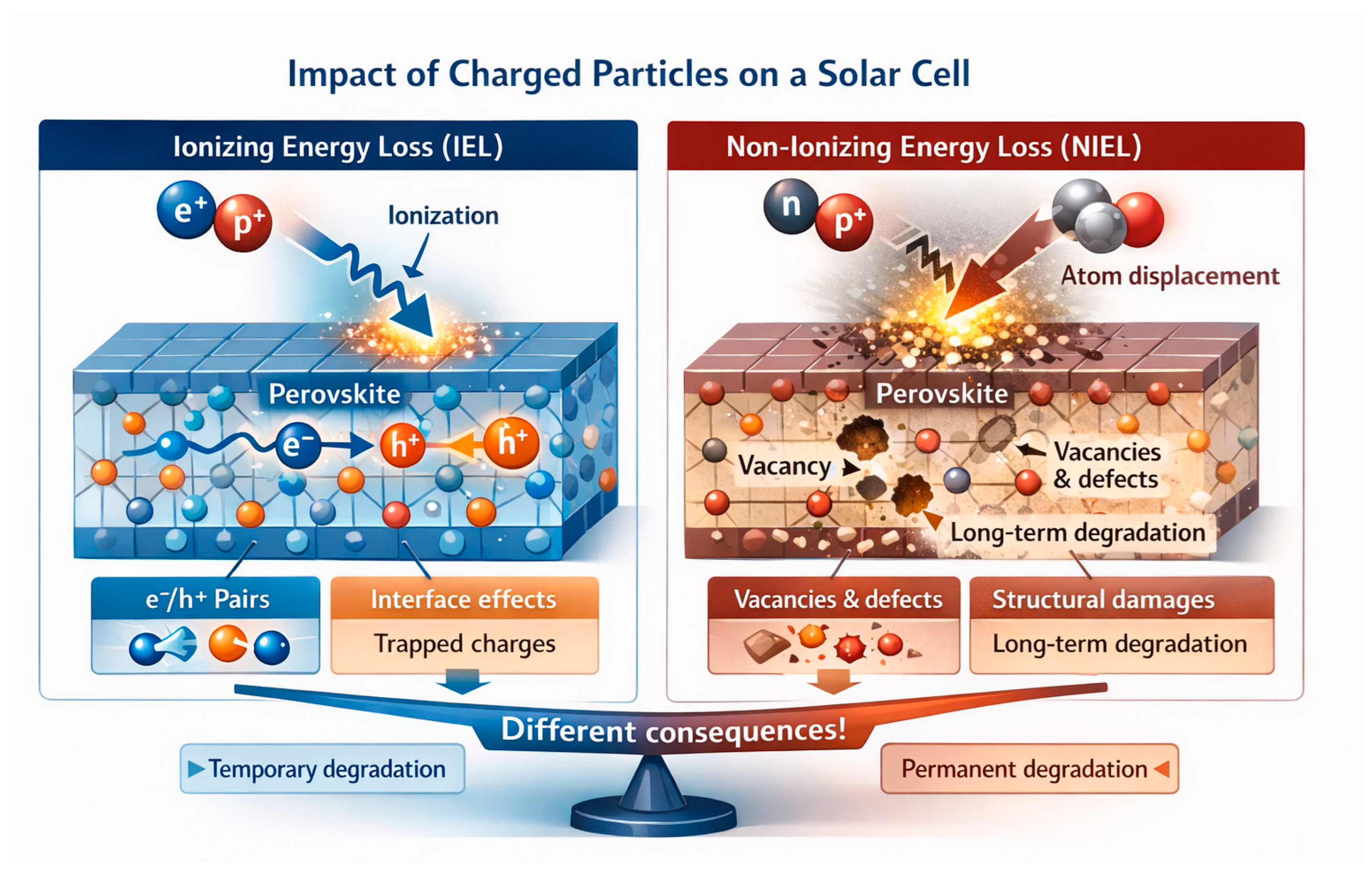
2. Ionizing and Non-Ionizing Energy Loss Mechanisms
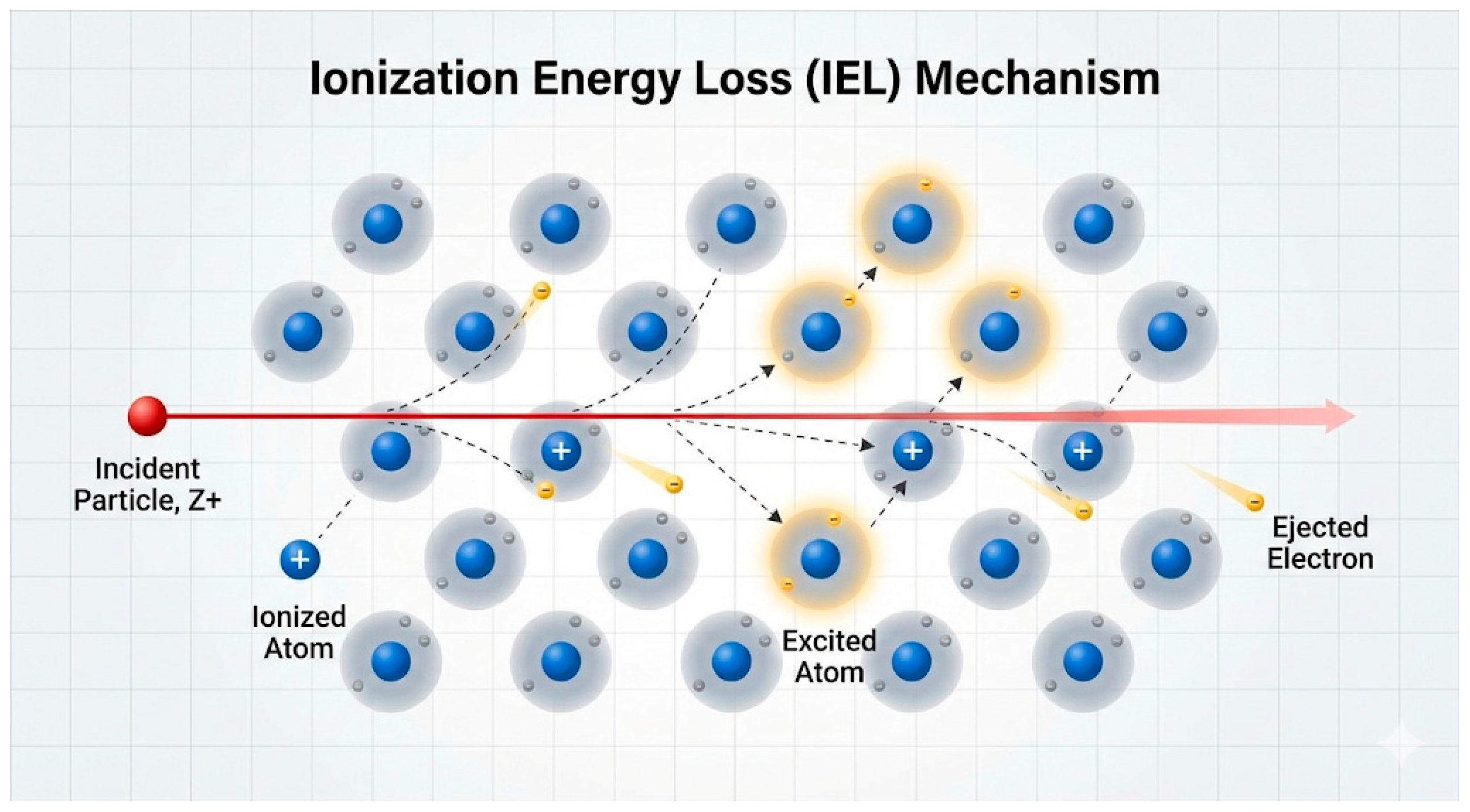
2.1. Ionization Effects (IEL)
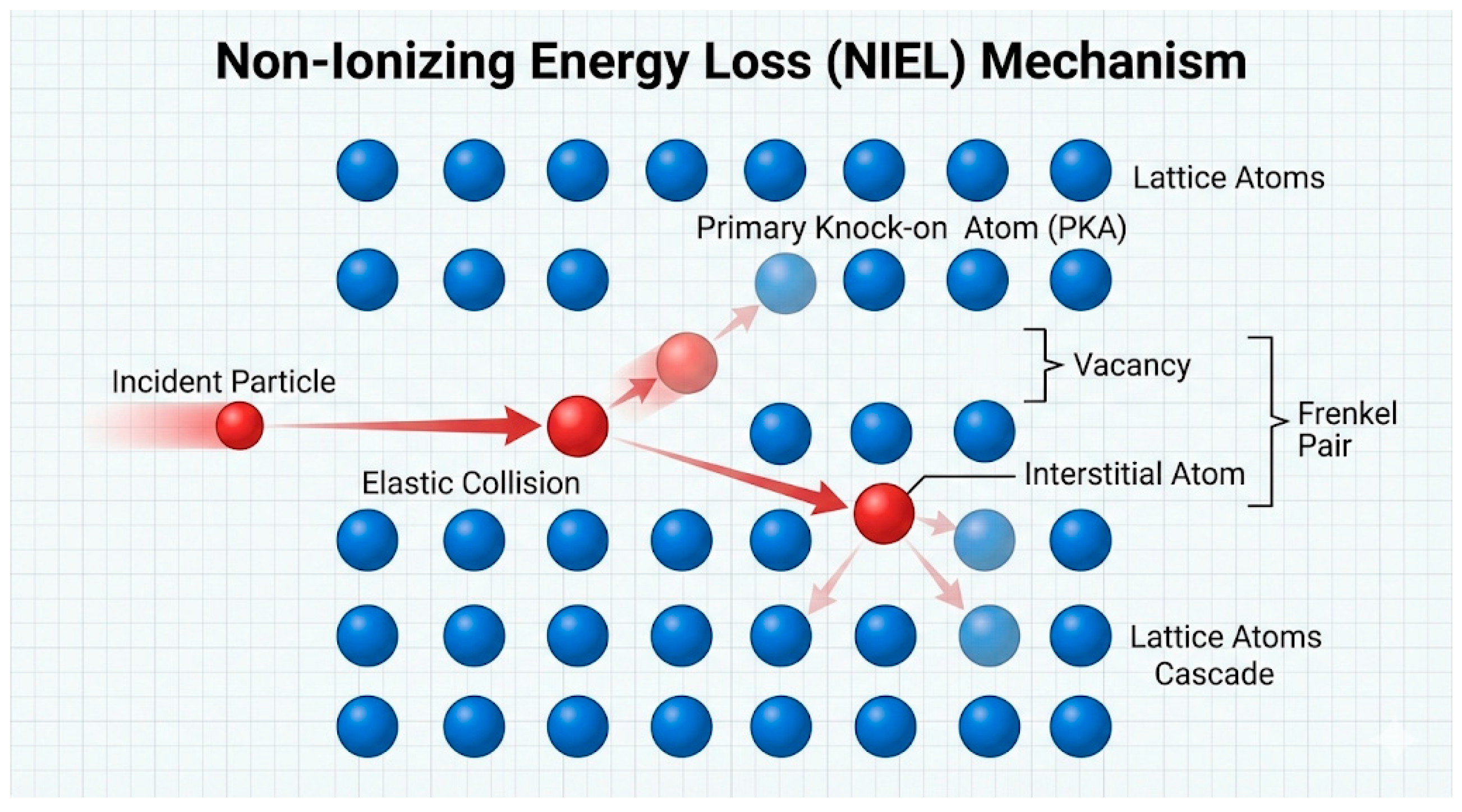
2.2. Non-Ionizing Effects (NIEL)
3. Mechanisms of Degradation of PSCs in Space
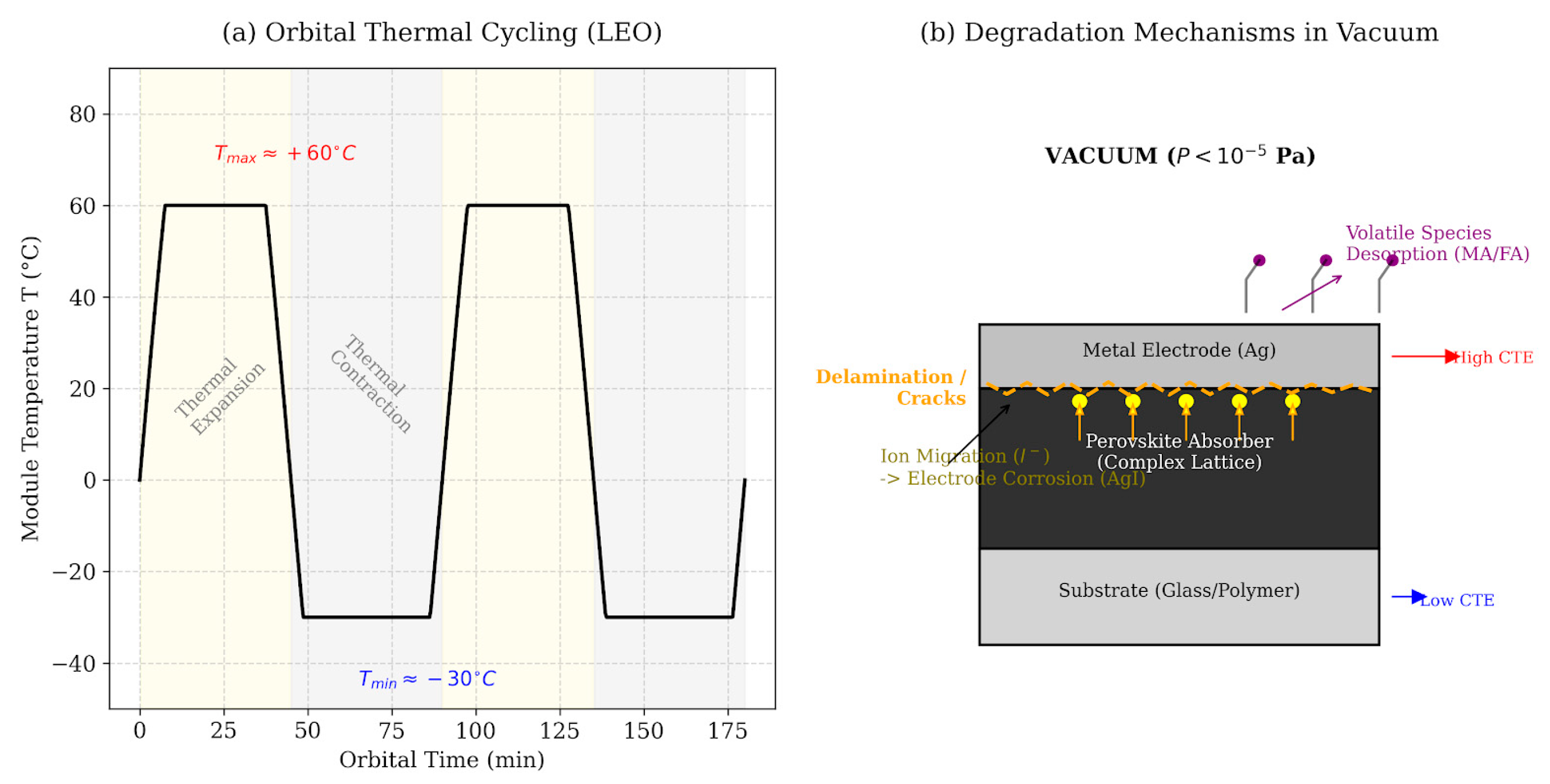
3.1. Thermal Vacuum Conditions and Thermal Cycles
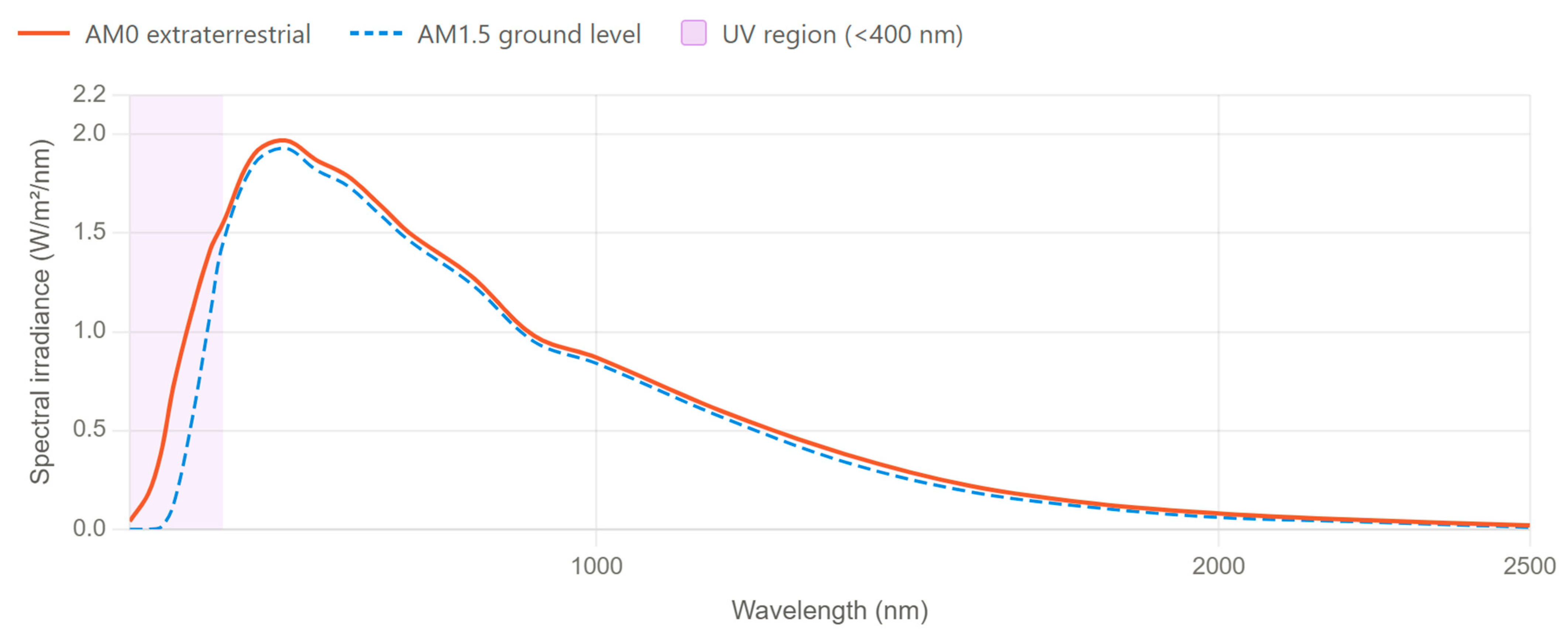
3.2. Ultraviolet Radiation and the Solar Spectrum
Device Engineering Strategies for Enhanced UV Stability
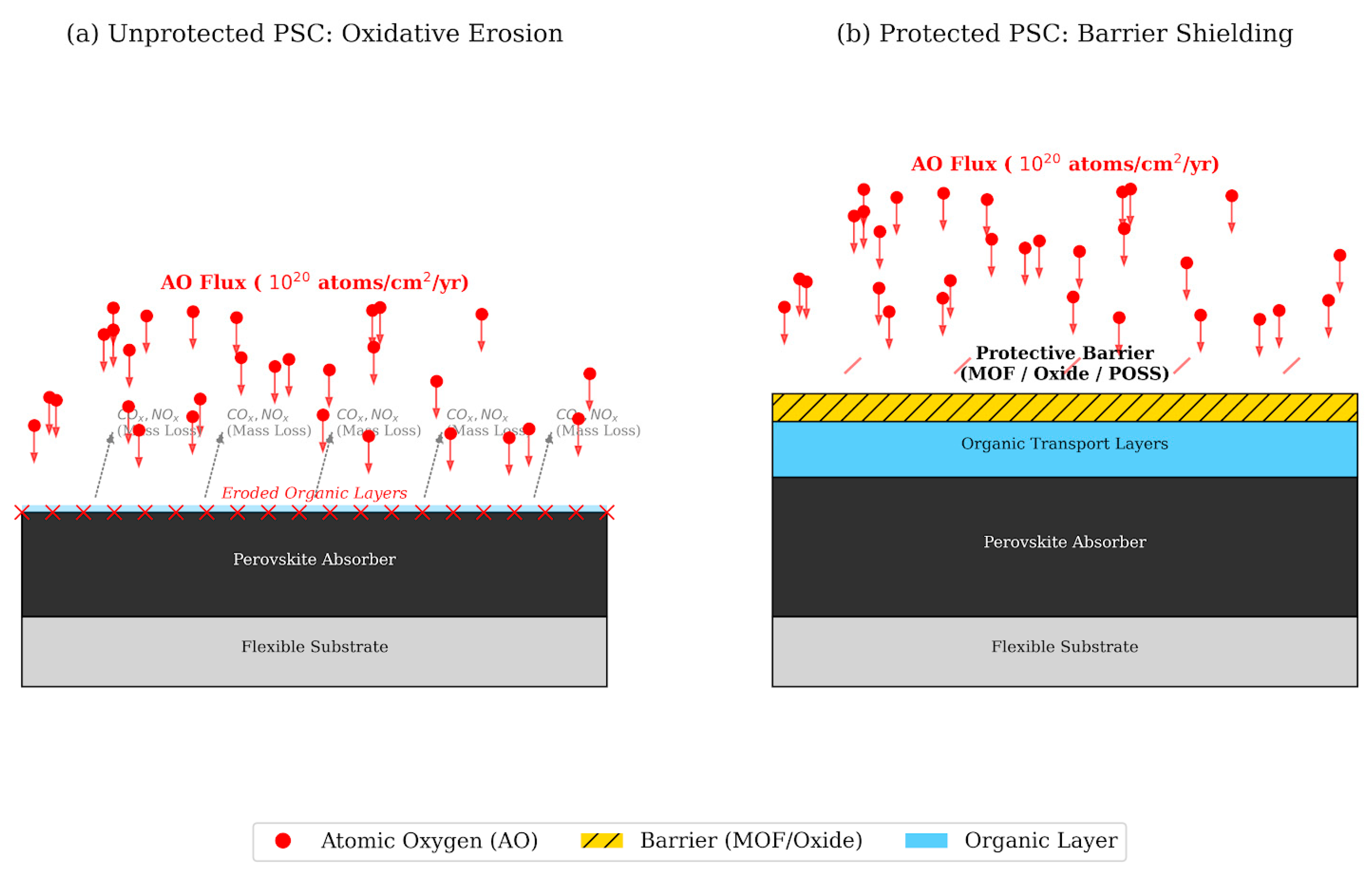
3.3. Atomic Oxygen in Low Orbit
3.4. Synthesis of Space Degradation Mechanisms and Current Experimental Evidence Base
Recovery Mechanisms and Mitigation Strategies for Radiation-Induced Degradation
3.5. Shielding Strategies for Long-Term Space Operation of PSCs
4. Modern Approaches to Testing and Verification of Solar Panels
4.1. IEC Standards for Ground-Based Solar Modules
4.2. ISOS Stability Protocols for Laboratory Testing
5. Discussion and Proposed Additions to the ISOS-T and ISOS-LC Protocols for Space Applications
6. Conclusions and Prospects for Further Research
Supplementary Materials
Author Contributions
Funding
Institutional Review Board Statement
Informed Consent Statement
Data Availability Statement
Conflicts of Interest
References
- Yang, C.; Hu, W.; Liu, J.; Han, C.; Gao, Q.; Mei, A.; Zhou, Y.; Guo, F.; Han, H. Achievements, Challenges, and Future Prospects for Industrialization of Perovskite Solar Cells. Light Sci. Appl. 2024, 13, 227. [Google Scholar] [CrossRef]
- Li, C.; Liu, M.; Xu, X.; Mo, H. Perovskite Materials for Multifaceted Energy Applications: From Fundamental Properties to Industrialization Challenges. Mater. Sci. Semicond. Process. 2026, 202, 110199. [Google Scholar] [CrossRef]
- boutagount, S.; El Fanaoui, A.; Douihi, N.; Bakiz, B.; Benlhachemi, A.; Taoufyq, A.; Ihlal, A. Innovative Materials for Energy Storage Systems and Photovoltaic Solar Technologies: A Review. Nano-Struct. Nano-Objects 2025, 44, 101562. [Google Scholar] [CrossRef]
- Lu, D.; Jamshidi, M.; Gardner, J.M.; Belova, L. Scalable Fabrication of Perovskite Solar Cells with Inkjet-Printed Perovskite Absorbers Processed under Ambient Conditions. ACS Appl. Mater. Interfaces 2025, 17, 28055–28064. [Google Scholar] [CrossRef] [PubMed]
- Sun, M.; Jiao, Z.; Wang, P.; Li, X.; Yuan, G. Strategies and Methods for Upscaling Perovskite Solar Cell Fabrication from Lab-Scale to Commercial-Area Fabrication. Molecules 2025, 30, 2221. [Google Scholar] [CrossRef] [PubMed]
- Jiang, J.; Yang, G.; Salim, T.; Yang, Y.; Hu, H.; Zhang, J.; Xiao, X.; Huang, H.; Yuan, N.; Lam, Y.; et al. SnO2 Based Colloid-Spray Processed Electron Transport Layer for High Performance and Stable Perovskite Solar Cells. Chem. Eng. J. 2025, 525, 170443. [Google Scholar] [CrossRef]
- Cassella, E.J.; Oliver, R.D.J.; Thornber, T.; Tucker, S.; Goodwin, R.; Lidzey, D.G.; Ramadan, A.J. Alumina Nanoparticles Enable Optimal Spray-Coated Perovskite Thin Film Growth on Self-Assembled Monolayers for Efficient and Reproducible Photovoltaics. J. Mater. Chem. C 2024, 12, 13332–13342. [Google Scholar] [CrossRef]
- Li, H.; Zhang, Z.; Wei, Y.; An, B.; Liao, J.; Lv, X.; Lv, W.; Yang, J.; Li, H.; Zeng, C.; et al. Nucleation Modification in Two-Step Slot-Die Coating Toward Efficient Large Scale Perovskite/Silicon Tandems Based on Commercial Silicon Cells. Adv. Mater. 2025, 37, e2501961. [Google Scholar] [CrossRef] [PubMed]
- Keshavarzi, R.; Hajisharifi, F.; Saki, Z.; Omrani, M.; Sheibani, R.; Afzali, N.; Abdi-Jalebi, M.; Vesce, L.; Di Carlo, A. Organic and Perovskite Solar Cells Based on Scalable Slot-Die Coating Technique: Progress and Challenges. Nano Today 2025, 61, 102600. [Google Scholar] [CrossRef]
- Liu, X.; Zhang, J.; Wang, B.; Tong, G.; Yang, J.; Shi, Y.; Chen, Z.; Ono, L.K.; Jiang, Y.; Qi, Y. Perovskite Solar Modules with High Efficiency Exceeding 20%: From Laboratory to Industrial Community. Joule 2025, 9, 102056. [Google Scholar] [CrossRef]
- Seyisi, T.; Fouda-Mbanga, B.G.; Mnyango, J.I.; Nthwane, Y.B.; Nyoni, B.; Mhlanga, S.; Hlangothi, S.P.; Tywabi-Ngeva, Z. Major Challenges for Commercialization of Perovskite Solar Cells: A Critical Review. Energy Rep. 2025, 13, 1400–1415. [Google Scholar] [CrossRef]
- NREL. Best Research-Cell Efficiency Chart; National Renewable Energy Laboratory: Golden, CO, USA, 2026. Available online: https://www.nrel.gov/pv/cell-efficiency.html (accessed on 11 March 2026).
- Du, K.; Zhang, H.; Li, L.; Wang, A.; Ding, J. Research Progress on Irradiation Stability of Perovskite Solar Cells for Space Applications. Space Sol. Power Wirel. Transm. 2025, 2, 180–187. [Google Scholar] [CrossRef]
- Afshari, H.; Chacon, S.A.; Sourabh, S.; Byers, T.A.; Whiteside, V.R.; Crawford, R.; Rout, B.; Eperon, G.E.; Sellers, I.R. Radiation Tolerance and Self-Healing in Triple Halide Perovskite Solar Cells. APL Energy 2023, 1, 026105. [Google Scholar] [CrossRef]
- Romano, V.; Agresti, A.; Verduci, R.; D’Angelo, G. Advances in Perovskites for Photovoltaic Applications in Space. ACS Energy Lett. 2022, 7, 2490–2514. [Google Scholar] [CrossRef]
- Novoselov, I.E.; Cholakh, S.O.; Zhidkov, I.S. Unveiling the Hidden Cascade: Secondary Particle Generation in Hybrid Halide Perovskites Under Space-Relevant Ionizing Radiation. Aerospace 2025, 12, 1015. [Google Scholar] [CrossRef]
- Bush, M.E.; Sims, J.D.; Erickson, S.S.; VanSant, K.T.; Ghosh, S.; Luther, J.M.; McMillon-Brown, L. Space Environment Considerations for Perovskite Solar Cell Operations: A Review. Acta Astronaut. 2025, 235, 235–250. [Google Scholar] [CrossRef]
- Li, X.; Wang, T.; Yang, L.; Dong, B.; Li, Y.; Li, L.; Li, L.; Feng, S.; Chen, G.; Yang, Y. Efficient Flexible Perovskite Solar Cells: From Materials to Buried Structure Revealed by Synchrotron Radiation GIWAXS. J. Energy Chem. 2025, 104, 254–267. [Google Scholar] [CrossRef]
- Wali, Q.; Lee, I.E.; Aamir, M.; Chuah, T.C.; Jose, R. Flexible Perovskite Solar Cells: Recent Breakthroughs, Key Challenges, and Future Perspectives. Surf. Interfaces 2025, 76, 107922. [Google Scholar] [CrossRef]
- Hu, Y.; Niu, T.; Liu, Y.; Zhou, Y.; Xia, Y.; Ran, C.; Wu, Z.; Song, L.; Müller-Buschbaum, P.; Chen, Y.; et al. Flexible Perovskite Solar Cells with High Power-Per-Weight: Progress, Application, and Perspectives. ACS Energy Lett. 2021, 6, 2917–2943. [Google Scholar] [CrossRef]
- Verduci, R.; Romano, V.; Brunetti, G.; Yaghoobi Nia, N.; Di Carlo, A.; D’Angelo, G.; Ciminelli, C. Solar Energy in Space Applications: Review and Technology Perspectives. Adv. Energy Mater. 2022, 12, 2200125. [Google Scholar] [CrossRef]
- Kishor, A.; Raj, A.; Raj, M.; Goel, N. Proton Radiation Impact on Bilayer Perovskite Solar Cells for Space Application: A Comprehensive SCAPS, DFT and ML Study. J. Phys. Chem. Solids 2026, 209, 113302. [Google Scholar] [CrossRef]
- Nair, M.H.; Rai, M.C.; Reade, S.; Bloch, O.; Adlen, S.; Soltau, M.; Homfray, D.A. In-Orbit Assembly of High-Value Modular Infrastructures: Holistic Analysis and Mission Concepts. Acta Astronaut. 2026, 238, 1418–1431. [Google Scholar] [CrossRef]
- Angmo, D.; Yan, S.; Liang, D.; Scully, A.D.; Chesman, A.S.R.; Kellam, M.; Duffy, N.W.; Carter, N.; Chantler, R.; Chen, C.; et al. Toward Rollable Printed Perovskite Solar Cells for Deployment in Low-Earth Orbit Space Applications. ACS Appl. Energy Mater. 2024, 7, 1777–1791. [Google Scholar] [CrossRef]
- Hirst, L.C.; Yakes, M.K.; Warner, J.H.; Bennett, M.F.; Schmieder, K.J.; Walters, R.J.; Jenkins, P.P. Intrinsic Radiation Tolerance of Ultra-Thin GaAs Solar Cells. Appl. Phys. Lett. 2016, 109, 033908. [Google Scholar] [CrossRef]
- Gruginskie, N.; Cappelluti, F.; Bauhuis, G.J.; Mulder, P.; Haverkamp, E.J.; Vlieg, E.; Schermer, J.J. Electron Radiation–Induced Degradation of GaAs Solar Cells with Different Architectures. Prog. Photovolt. Res. Appl. 2020, 28, 266–278. [Google Scholar] [CrossRef]
- Plis, E.A.; Fouchal, Y.; Ramirez, R.; Collman, S.E.J. Properties of Space Cover Glass Materials Postexposure to High-Energy Electron Irradiation. J. Spacecr. Rockets 2025, 62, 606–610. [Google Scholar] [CrossRef]
- Smeenk, N.J.; Mooney, C.; Feenstra, J.; Mulder, P.; Rohr, T.; Semprimoschnig, C.O.A.; Vlieg, E.; Schermer, J.J. Space Environmental Testing of Flexible Coverglass Alternatives Based on Siloxanes. Polym. Degrad. Stab. 2013, 98, 2503–2511. [Google Scholar] [CrossRef]
- Feenstra, J.; van Leest, R.H.; Smeenk, N.J.; Oomen, G.; Bongers, E.; Mulder, P.; Vlieg, E.; Schermer, J.J. Flexible Shielding Layers for Solar Cells in Space Applications. J. Appl. Polym. Sci. 2016, 133, 43661. [Google Scholar] [CrossRef]
- Suchikova, Y.; Nazarovets, S.; Konuhova, M.; Popov, A.I. Binary Oxide Ceramics (TiO2, ZnO, Al2O3, SiO2, CeO2, Fe2O3, and WO3) for Solar Cell Applications: A Comparative and Bibliometric Analysis. Ceramics 2025, 8, 119. [Google Scholar] [CrossRef]
- Lang, F.; Nickel, N.H.; Bundesmann, J.; Seidel, S.; Denker, A.; Albrecht, S.; Brus, V.V.; Rappich, J.; Rech, B.; Landi, G.; et al. Radiation Hardness and Self-Healing of Perovskite Solar Cells. Adv. Mater. 2016, 28, 8726–8731. [Google Scholar] [CrossRef]
- Kirmani, A.R.; Byers, T.A.; Ni, Z.; VanSant, K.; Saini, D.K.; Scheidt, R.; Zheng, X.; Kum, T.B.; Sellers, I.R.; McMillon-Brown, L.; et al. Unraveling Radiation Damage and Healing Mechanisms in Halide Perovskites Using Energy-Tuned Dual Irradiation Dosing. Nat. Commun. 2024, 15, 696. [Google Scholar] [CrossRef] [PubMed]
- Sharma, M.; Parashar, M.; Saini, D.K.; Chen, H.; Khanal, M.N.; Fu, S.; Durant, B.K.; Whiteside, V.R.; Byers, T.A.; Yan, Y.; et al. Probing Self-Healing Dynamics in Perovskite Solar Cells under Proton Irradiation via in Situ and in Operando Characterization. Newton 2025, 2, 100332. [Google Scholar] [CrossRef]
- Delmas, W.; Erickson, S.; Arteaga, J.; Woodall, M.; Scheibner, M.; Krause, T.S.; Crowley, K.; VanSant, K.T.; Luther, J.M.; Williams, J.N.; et al. Evaluation of Hybrid Perovskite Prototypes After 10-Month Space Flight on the International Space Station. Adv. Energy Mater. 2023, 13, 2203920. [Google Scholar] [CrossRef]
- Erickson, S.S.; Arteaga, J.; VanSant, K.T.; Kirmani, A.R.; Harvey, S.P.; Luther, J.M.; Peshek, T.J.; McMillon-Brown, L.; Ghosh, S. Full Device Evaluation of Metal Halide Perovskite Solar Cells in Low Earth Orbit Aboard the International Space Station. Small 2025, 21, e08232. [Google Scholar] [CrossRef] [PubMed]
- Kirmani, A.R.; Sellers, I.R. Are Metal-Halide Perovskite Solar Cells Really Radiation Tolerant? Joule 2025, 9, 101852. [Google Scholar] [CrossRef]
- Parashar, M.; Sharma, M.; Penukula, S.; Saini, D.K.; Byers, T.A.; Rolston, N.; Rout, B. Combined Effects of Irradiation and Environmental Stressors on Elemental Migration and Device Stability in Perovskite Solar Cells. ACS Appl. Mater. Interfaces 2025, 17, 54721–54734. [Google Scholar] [CrossRef]
- Srour, J.R.; McGarrity, J.M. Radiation Effects on Microelectronics in Space. Proc. IEEE 1988, 76, 1443–1469. [Google Scholar] [CrossRef]
- Gruginskie, N.; Cappelluti, F.; van Eerden, M.; Bauhuis, G.; Mulder, P.; Vlieg, E.; Schermer, J. Proton Irradiation Induced GaAs Solar Cell Performance Degradation Simulations Using a Physics-Based Model. Sol. Energy Mater. Sol. Cells 2021, 223, 110971. [Google Scholar] [CrossRef]
- Peters, A.; Preindl, M.; Fthenakis, V. Semiconductor Material Damage Mechanisms Due to Non-Ionizing Energy in Space-Based Solar Systems. Energies 2025, 18, 509. [Google Scholar] [CrossRef]
- Attix, F.H. Introduction to Radiological Physics and Radiation Dosimetry; Wiley: Hoboken, NJ, USA, 1986. [Google Scholar]
- Herz, L.M. Charge-Carrier Dynamics in Organic-Inorganic Metal Halide Perovskites. Annu. Rev. Phys. Chem. 2016, 67, 65–89. [Google Scholar] [CrossRef]
- Azpiroz, J.M.; Mosconi, E.; Bisquert, J.; De Angelis, F. Defect Migration in Methylammonium Lead Iodide and Its Role in Perovskite Solar Cell Operation. Energy Environ. Sci. 2015, 8, 2118–2127. [Google Scholar] [CrossRef]
- Popov, A.I.; Kotomin, E.A.; Maier, J. Basic Properties of the F-Type Centers in Halides, Oxides and Perovskites. Nucl. Instrum. Methods Phys. Res. Sect. B Beam Interact. Mater. Atoms 2010, 268, 3084–3089. [Google Scholar] [CrossRef]
- Zdorovets, M.V.; Kozlovskiy, A.A.; ZhMoldabayeva, G.; Ivanov, I.A.; Konuhova, M. Radiation-Induced Degradation Effects of Optical Properties of MgO Ceramics Caused by Heavy Ion Irradiation. Opt. Mater. X 2025, 26, 100406. [Google Scholar] [CrossRef]
- Fiedler, H.; Gupta, P.; Kennedy, J.V. Ion Irradiation of Halide Perovskites: Role of Defect Engineering for Enhanced Performance. Small 2026, 22, e12001. [Google Scholar] [CrossRef] [PubMed]
- Kim, S.; Lee, C.M.; Shah, S.H.U.; Jung, M.-C.; Lee, S.G.; Kim, C.H.; Lee, H.J.; Park, C.; Yeom, J.-Y.; Ryu, S.Y.; et al. Radiation Tolerance of Organohalide-Based Perovskite Solar Cells under 6 MeV Electron Beam Irradiation. J. Phys. Chem. C 2024, 128, 885–893. [Google Scholar] [CrossRef]
- Nguyen, D.-T.; Walter, D.; Weber, K.J.; Duong, T.; White, T.P. Simulating Proton Radiation Tolerance of Perovskite Solar Cells for Space Applications. Adv. Energy Sustain. Res. 2023, 4, 2300085. [Google Scholar] [CrossRef]
- Wang, C.; Qu, D.; Zhou, B.; Shang, C.; Zhang, X.; Tu, Y.; Huang, W. Self-Healing Behavior of the Metal Halide Perovskites and Photovoltaics. Small 2024, 20, 2307645. [Google Scholar] [CrossRef]
- Bryant, D.; Aristidou, N.; Pont, S.; Sanchez-Molina, I.; Chotchunangatchaval, T.; Wheeler, S.; Durrant, J.R.; Haque, S.A. Light and Oxygen Induced Degradation Limits the Operational Stability of Methylammonium Lead Triiodide Perovskite Solar Cells. Energy Environ. Sci. 2016, 9, 1655–1660, Correction in Energy Environ. Sci. 2016, 9, 16850. https://doi.org/10.1039/C6EE90023B. [Google Scholar] [CrossRef]
- Hoke, E.T.; Slotcavage, D.J.; Dohner, E.R.; Bowring, A.R.; Karunadasa, H.I.; McGehee, M.D. Reversible Photo-Induced Trap Formation in Mixed-Halide Hybrid Perovskites for Photovoltaics. Chem. Sci. 2015, 6, 613–617. [Google Scholar] [CrossRef]
- Aristidou, N.; Sanchez-Molina, I.; Chotchuangchutchaval, T.; Brown, M.; Martinez, L.; Rath, T.; Haque, S.A. The Role of Oxygen in the Degradation of Methylammonium Lead Trihalide Perovskite Photoactive Layers. Angew. Chem. Int. Ed. 2015, 54, 8208–8212. [Google Scholar] [CrossRef]
- Zhuang, J.; Wang, J.; Yan, F. Review on Chemical Stability of Lead Halide Perovskite Solar Cells. Nano-Micro Lett. 2023, 15, 84. [Google Scholar] [CrossRef]
- Miah, M.H.; Rahman, M.B.; Nur-E-Alam, M.; Islam, M.A.; Shahinuzzaman, M.; Rahman, M.R.; Ullah, M.H.; Khandaker, M.U. Key Degradation Mechanisms of Perovskite Solar Cells and Strategies for Enhanced Stability: Issues and Prospects. RSC Adv. 2025, 15, 628–654. [Google Scholar] [CrossRef] [PubMed]
- Aristidou, N.; Eames, C.; Sanchez-Molina, I.; Bu, X.; Kosco, J.; Islam, M.S.; Haque, S.A. Fast Oxygen Diffusion and Iodide Defects Mediate Oxygen-Induced Degradation of Perovskite Solar Cells. Nat. Commun. 2017, 8, 15218. [Google Scholar] [CrossRef] [PubMed]
- Yerezhep, D.; Omarova, Z.; Aldiyarov, A.; Shinbayeva, A.; Tokmoldin, N. IR Spectroscopic Degradation Study of Thin Organometal Halide Perovskite Films. Molecules 2023, 28, 1288. [Google Scholar] [CrossRef]
- Zhang, B.; Xue, B.; Xiao, S.; Wang, X. Chemical Stability of Metal Halide Perovskite Detectors. Inorganics 2024, 12, 52. [Google Scholar] [CrossRef]
- Zhang, X.; Wang, X.; Liu, H.; Chen, R. Defect Engineering of Metal Halide Perovskite Optoelectronic Devices. Prog. Quantum Electron. 2022, 86, 100438. [Google Scholar] [CrossRef]
- Wang, C.; Xie, Z.; Wang, Y.; Ding, Y.; Leung, M.K.H.; Ng, Y.H. Defects of Metal Halide Perovskites in Photocatalytic Energy Conversion: Friend or Foe? Adv. Sci. 2024, 11, 2402471. [Google Scholar] [CrossRef]
- Duan, L.; Uddin, A. Defects and Stability of Perovskite Solar Cells: A Critical Analysis. Mater. Chem. Front. 2022, 6, 400–417. [Google Scholar] [CrossRef]
- Kinchin, G.H.; Pease, R.S. The Displacement of Atoms in Solids by Radiation. Rep. Prog. Phys. 1955, 18, 301. [Google Scholar] [CrossRef]
- Zhao, X.-H.; Lu, H.-L.; Zhang, Y.-M.; Zhang, Y.-M. Model of Phonon Contribution to Nonionizing Energy Loss (NIEL) for InP/InGaAs Heterojunction. Microelectron. Reliab. 2017, 78, 156–160. [Google Scholar] [CrossRef]
- Inguimbert, C.; Lemière, K.; Yjjou, S.; Ruffenach, M.; Aicardi, C. NIEL with Various Damage Energy Threshold Applied to Solar Cells Degradation Prediction. In Proceedings of the 2024 24th European Conference on Radiation and Its Effects on Components and Systems (RADECS); IEEE: New York, NY, USA, 2024; pp. 1–14. [Google Scholar]
- Akkerman, A.; Barak, J.; Murat, M. A Survey of the Analytical Methods of Proton-NIEL Calculations in Silicon and Germanium. IEEE Trans. Nucl. Sci. 2020, 67, 1813–1825. [Google Scholar] [CrossRef]
- Biswas, K. The Nature of Defect Tolerance in (Some) Halide Perovskites. APL Electron. Devices 2025, 1, 030901. [Google Scholar] [CrossRef]
- Zai, H.; Ma, Y.; Chen, Q.; Zhou, H. Ion Migration in Halide Perovskite Solar Cells: Mechanism, Characterization, Impact and Suppression. J. Energy Chem. 2021, 63, 528–549. [Google Scholar] [CrossRef]
- Meggiolaro, D.; De Angelis, F. First-Principles Modeling of Defects in Lead Halide Perovskites: Best Practices and Open Issues. ACS Energy Lett. 2018, 3, 2206–2222. [Google Scholar] [CrossRef]
- Alkhalifah, G.; Wang, B.; Prezhdo, O.V.; Chan, W.-L. Suppressing Polaronic Defect–Photocarrier Interaction in Halide Perovskites by Pre-Distorting Its Lattice. J. Am. Chem. Soc. 2025, 147, 2411–2420. [Google Scholar] [CrossRef]
- Liang, Y.; Cui, X.; Li, F.; Stampfl, C.; Ringer, S.P.; Yang, X.; Huang, J.; Zheng, R. Origin of Enhanced Nonradiative Carrier Recombination Induced by Oxygen in Hybrid Sn Perovskite. J. Phys. Chem. Lett. 2023, 14, 2950–2957. [Google Scholar] [CrossRef]
- Ratcliff, E.L. Assessing Defects, Buried Interfaces, and Stability in Metal Halide Perovskites. In Proceedings of the Organic, Hybrid, and Perovskite Photovoltaics XXV; Li, G., Stingelin, N., Eds.; SPIE: Cergy Pontoise, France, 2024; p. 21. [Google Scholar]
- Luo, P.; Sun, X.-Y.; Li, Y.; Yang, L.; Shao, W.-Z.; Zhen, L.; Xu, C.-Y. Correlation between Structural Evolution and Device Performance of CH 3 NH 3 PbI 3 Solar Cells under Proton Irradiation. ACS Appl. Energy Mater. 2021, 4, 13504–13515. [Google Scholar] [CrossRef]
- Yin, W.-J.; Shi, T.; Yan, Y. Unusual Defect Physics in CH3NH3PbI3 Perovskite Solar Cell Absorber. Appl. Phys. Lett. 2014, 104, 063903. [Google Scholar] [CrossRef]
- Shao, Y.; Xiao, Z.; Bi, C.; Yuan, Y.; Huang, J. Origin and Elimination of Photocurrent Hysteresis by Fullerene Passivation in CH3NH3PbI3 Planar Heterojunction Solar Cells. Nat. Commun. 2014, 5, 5784. [Google Scholar] [CrossRef] [PubMed]
- Walters, R.J.; Summers, G.P. Space Radiation Effects in Advanced Solar Cell Materials and Devices. MRS Proc. 2001, 692, H10.2.1. [Google Scholar] [CrossRef]
- Khanal, M.N.; Whiteside, V.R.; Parashar, M.; Merckx, T.; Sharma, M.; Kuang, Y.; Aguirre, A.; Afshari, H.; Hamtaei, S.; Aernouts, T.; et al. Radiation versus Environmental Degradation in Unencapsulated Metal Halide Perovskite Solar Cells. J. Phys. Energy 2024, 6, 045001. [Google Scholar] [CrossRef]
- Tu, Y.; Wu, J.; Xu, G.; Yang, X.; Cai, R.; Gong, Q.; Zhu, R.; Huang, W. Perovskite Solar Cells for Space Applications: Progress and Challenges. Adv. Mater. 2021, 33, 2006545. [Google Scholar] [CrossRef]
- Jun, I.; Garrett, H.; Kim, W.; Zheng, Y.; Fung, S.F.; Corti, C.; Ganushkina, N.; Guo, J. A Review on Radiation Environment Pathways to Impacts: Radiation Effects, Relevant Empirical Environment Models, and Future Needs. Adv. Space Res. 2024, in press. [Google Scholar] [CrossRef]
- Youn, S.; Nam, U.; Kim, S.; Park, W.-K.; Kwak, J.; Sohn, J.; Moon, B.; Lee, J.; Choi, Y.-J.; Kim, J.; et al. Monitoring the Radiation Environment in High-Latitude Low-Earth Orbit during an Ascending Phase of the Solar Cycle (July 1, 2023 to July 31, 2024). Acta Astronaut. 2026, 240, 398–407. [Google Scholar] [CrossRef]
- Meredith, N.P.; Horne, R.B.; Isles, J.D.; Green, J.C. Extreme Energetic Electron Fluxes in Low Earth Orbit: Analysis of POES E > 30, E > 100, and E > 300 KeV Electrons. Space Weather 2016, 14, 136–150. [Google Scholar] [CrossRef]
- Badavi, F.F.; Walker, S.A.; Santos Koos, L.M. Low Earth Orbit Assessment of Proton Anisotropy Using AP8 and AP9 Trapped Proton Models. Life Sci. Space Res. 2015, 5, 21–30. [Google Scholar] [CrossRef]
- Millan, R.M.; Thorne, R.M. Review of Radiation Belt Relativistic Electron Losses. J. Atmos. Solar-Terr. Phys. 2007, 69, 362–377. [Google Scholar] [CrossRef]
- Nwankwo, V.U.J.; Jibiri, N.N.; Kio, M.T. The Impact of Space Radiation Environment on Satellites Operation in Near-Earth Space. In Satellites Missions and Technologies for Geosciences; IntechOpen: London, UK, 2020. [Google Scholar]
- Durante, M.; Cucinotta, F.A. Physical Basis of Radiation Protection in Space Travel. Rev. Mod. Phys. 2011, 83, 1245–1281. [Google Scholar] [CrossRef]
- Desai, M.; Giacalone, J. Large Gradual Solar Energetic Particle Events. Living Rev. Sol. Phys. 2016, 13, 3. [Google Scholar] [CrossRef] [PubMed]
- Altana, C.; Calcagno, L.; Ciampi, C.; La Via, F.; Lanzalone, G.; Muoio, A.; Pasquali, G.; Pellegrino, D.; Puglia, S.; Rapisarda, G.; et al. Radiation Damage by Heavy Ions in Silicon and Silicon Carbide Detectors. Sensors 2023, 23, 6522. [Google Scholar] [CrossRef] [PubMed]
- Abd El-Hameed, A.M. Radiation Effects on Composite Materials Used in Space Systems: A Review. NRIAG J. Astron. Geophys. 2022, 11, 313–324. [Google Scholar] [CrossRef]
- Xu, Z.; Guo, J.; Wimmer-Schweingruber, R.F.; Dobynde, M.I.; Kühl, P.; Khaksarighiri, S.; Zhang, S. Primary and Albedo Protons Detected by the Lunar Lander Neutron and Dosimetry Experiment on the Lunar Farside. Front. Astron. Space Sci. 2022, 9, 974946. [Google Scholar] [CrossRef]
- Zhang, S.; Wimmer-Schweingruber, R.F.; Yu, J.; Wang, C.; Fu, Q.; Zou, Y.; Sun, Y.; Wang, C.; Hou, D.; Böttcher, S.I.; et al. First Measurements of the Radiation Dose on the Lunar Surface. Sci. Adv. 2020, 6, eaaz1334. [Google Scholar] [CrossRef]
- Erickson, S.; Lum, C.; Stephens, K.; Parashar, M.; Saini, D.K.; Rout, B.; Park, C.; Peshek, T.J.; McMillon-Brown, L.; Ghosh, S. Elucidating Early Proton Irradiation Effects in Metal Halide Perovskites via Photoluminescence Spectroscopy. iScience 2025, 28, 111586. [Google Scholar] [CrossRef]
- Pérez-del-Rey, D.; Dreessen, C.; Igual-Muñoz, A.M.; van den Hengel, L.; Gélvez-Rueda, M.C.; Savenije, T.J.; Grozema, F.C.; Zimmermann, C.; Bolink, H.J. Perovskite Solar Cells: Stable under Space Conditions. Sol. RRL 2020, 4, 2000447. [Google Scholar] [CrossRef]
- Herrera Martínez, W.O.; Correa Guerrero, N.B.; Gómez Andrade, V.A.; Alurralde, M.; Perez, M.D. Evaluation of the Resistance of Halide Perovskite Solar Cells to High Energy Proton Irradiation for Space Applications. Sol. Energy Mater. Sol. Cells 2022, 238, 111644. [Google Scholar] [CrossRef]
- Raya-Armenta, J.M.; Bazmohammadi, N.; Vasquez, J.C.; Guerrero, J.M. A Short Review of Radiation-Induced Degradation of III–V Photovoltaic Cells for Space Applications. Sol. Energy Mater. Sol. Cells 2021, 233, 111379. [Google Scholar] [CrossRef]
- Wang, D.; Wright, M.; Elumalai, N.K.; Uddin, A. Stability of Perovskite Solar Cells. Sol. Energy Mater. Sol. Cells 2016, 147, 255–275. [Google Scholar] [CrossRef]
- Niu, G.; Guo, X.; Wang, L. Review of Recent Progress in Chemical Stability of Perovskite Solar Cells. J. Mater. Chem. A 2015, 3, 8970–8980. [Google Scholar] [CrossRef]
- Philippe, B.; Park, B.-W.; Lindblad, R.; Oscarsson, J.; Ahmadi, S.; Johansson, E.M.J.; Rensmo, H. Chemical and Electronic Structure Characterization of Lead Halide Perovskites and Stability Behavior under Different Exposures—A Photoelectron Spectroscopy Investigation. Chem. Mater. 2015, 27, 1720–1731. [Google Scholar] [CrossRef]
- Rolston, N.; Watson, B.L.; Bailie, C.D.; McGehee, M.D.; Bastos, J.P.; Gehlhaar, R.; Kim, J.-E.; Vak, D.; Mallajosyula, A.T.; Gupta, G.; et al. Mechanical Integrity of Solution-Processed Perovskite Solar Cells. Extrem. Mech. Lett. 2016, 9, 353–358. [Google Scholar] [CrossRef]
- Kim, N.-K.; Min, Y.H.; Noh, S.; Cho, E.; Jeong, G.; Joo, M.; Ahn, S.-W.; Lee, J.S.; Kim, S.; Ihm, K.; et al. Investigation of Thermally Induced Degradation in CH3NH3PbI3 Perovskite Solar Cells Using In-Situ Synchrotron Radiation Analysis. Sci. Rep. 2017, 7, 4645. [Google Scholar] [CrossRef] [PubMed]
- Witteck, R.; Nguyen Minh, D.; Paul, G.; Harvey, S.P.; Zheng, X.; Jiang, Q.; Chen, M.; Abzieher, T.; Palmstrom, A.F.; Habersberger, B.; et al. Reducing Thermal Degradation of Perovskite Solar Cells during Vacuum Lamination by Internal Diffusion Barriers. ACS Appl. Energy Mater. 2024, 7, 10750–10757. [Google Scholar] [CrossRef] [PubMed]
- Cheacharoen, R.; Boyd, C.C.; Burkhard, G.F.; Leijtens, T.; Raiford, J.A.; Bush, K.A.; Bent, S.F.; McGehee, M.D. Encapsulating Perovskite Solar Cells to Withstand Damp Heat and Thermal Cycling. Sustain. Energy Fuels 2018, 2, 2398–2406. [Google Scholar] [CrossRef]
- Cheacharoen, R.; Rolston, N.; Harwood, D.; Bush, K.A.; Dauskardt, R.H.; McGehee, M.D. Design and Understanding of Encapsulated Perovskite Solar Cells to Withstand Temperature Cycling. Energy Environ. Sci. 2018, 11, 144–150. [Google Scholar] [CrossRef]
- Baumann, S.; Brockmann, L.; Blankemeyer, S.; Steckenreiter, V.; Barnscheidt, V.; Köntges, M.; Kajari-Schröder, S.; Wolter, S.J.; Schulte-Huxel, H.; Wietler, T. Influence of Encapsulation Process Temperature on the Performance of Perovskite Mini Modules. AIP Conf. Proc. 2022, 2487, 120001. [Google Scholar] [CrossRef]
- Li, J.; Dong, Q.; Li, N.; Wang, L. Direct Evidence of Ion Diffusion for the Silver-Electrode-Induced Thermal Degradation of Inverted Perovskite Solar Cells. Adv. Energy Mater. 2017, 7, 1602922. [Google Scholar] [CrossRef]
- Juarez-Perez, E.J.; Ono, L.K.; Qi, Y. Thermal Degradation of Formamidinium Based Lead Halide Perovskites into Sym -Triazine and Hydrogen Cyanide Observed by Coupled Thermogravimetry-Mass Spectrometry Analysis. J. Mater. Chem. A 2019, 7, 16912–16919. [Google Scholar] [CrossRef]
- Ma, S.; Tang, J.; Yuan, G.; Zhang, Y.; Wang, Y.; Wu, Y.; Zhu, C.; Wang, Y.; Wu, S.; Lu, Y.; et al. Resist Thermal Shock Through Viscoelastic Interface Encapsulation in Perovskite Solar Cells. Energy Environ. Mater. 2024, 7, e12739. [Google Scholar] [CrossRef]
- Habib, H.; Rehman, S.U.; El Hyani, H.; Sharif, M.N.; Tan, F.; Wang, K. Degradation Pathways in Perovskite Solar Cells: Strategies for Enhancing Stability. Energy Technol. 2025, 13, 2500137. [Google Scholar] [CrossRef]
- Baumann, F.; Padilla-Pantoja, J.; Caicedo-Roque, J.M.; Karimipour, M.; Vahedigharehchopogh, N.; Santiso, J.; Ballesteros, B.; Miranda Gamboa, R.A.; Tian, Z.; Raga, S.R.; et al. Stabilizing Perovskite Solar Cells at 85 °C via Additive Engineering and MXene Interlayers. EES Sol. 2025, 1, 1061–1073. [Google Scholar] [CrossRef]
- Elshaer, A.M.; Soliman, A.M.A.; Kassab, M.; Mori, S.; Hawwash, A.A. Thermal Control of a Small Satellite in Low Earth Orbit Using Phase Change Materials-Based Thermal Energy Storage Panel. Egypt. J. Remote Sens. Space Sci. 2023, 26, 954–965. [Google Scholar] [CrossRef]
- Liu, T.; Sun, Q.; Meng, J.; Pan, Z.; Tang, Y. Degradation Modeling of Satellite Thermal Control Coatings in a Low Earth Orbit Environment. Sol. Energy 2016, 139, 467–474. [Google Scholar] [CrossRef]
- Meseguer, J.; Pérez-Grande, I.; Sanz-Andrés, A. Thermal Control Surfaces. In Spacecraft Thermal Control; Elsevier: Amsterdam, The Netherlands, 2012; pp. 87–110. [Google Scholar]
- D.P., K.; Kumar, C.; G, A.; P, K.R.; Mishra, S.K.; Kumar, J.; Vajja, D.P.; V, A.; Ladiya, T.; Patel, A.; et al. Higher Surface Temperatures near South Polar Region of the Moon Measured by ChaSTE Experiment On-Board Chandrayaan-3. Commun. Earth Environ. 2025, 6, 153. [Google Scholar] [CrossRef]
- Williams, J.-P.; Paige, D.A.; Greenhagen, B.T.; Sefton-Nash, E. The Global Surface Temperatures of the Moon as Measured by the Diviner Lunar Radiometer Experiment. Icarus 2017, 283, 300–325. [Google Scholar] [CrossRef]
- Stranks, S.D.; Snaith, H.J. Metal-Halide Perovskites for Photovoltaic and Light-Emitting Devices. Nat. Nanotechnol. 2015, 10, 391–402. [Google Scholar] [CrossRef] [PubMed]
- Yamada, Y.; Nakamura, T.; Endo, M.; Wakamiya, A.; Kanemitsu, Y. Photocarrier Recombination Dynamics in Perovskite CH3NH3PbI3 for Solar Cell Applications. J. Am. Chem. Soc. 2014, 136, 11610–11613. [Google Scholar] [CrossRef] [PubMed]
- Teng, Q.; Shi, T.-T.; Tian, R.-Y.; Yang, X.-B.; Zhao, Y.-J. Role of Organic Cations on Hybrid Halide Perovskite CH3NH3PbI3 Surfaces. J. Solid State Chem. 2018, 258, 488–494. [Google Scholar] [CrossRef]
- Zhang, D.; Li, D.; Hu, Y.; Mei, A.; Han, H. Degradation Pathways in Perovskite Solar Cells and How to Meet International Standards. Commun. Mater. 2022, 3, 58. [Google Scholar] [CrossRef]
- Zhang, G.; Hawks, S.A.; Ngo, C.; Schelhas, L.T.; Scholes, D.T.; Kang, H.; Aguirre, J.C.; Tolbert, S.H.; Schwartz, B.J. Extensive Penetration of Evaporated Electrode Metals into Fullerene Films: Intercalated Metal Nanostructures and Influence on Device Architecture. ACS Appl. Mater. Interfaces 2015, 7, 25247–25258. [Google Scholar] [CrossRef]
- Ming, W.; Yang, D.; Li, T.; Zhang, L.; Du, M. Formation and Diffusion of Metal Impurities in Perovskite Solar Cell Material CH3NH3PbI3: Implications on Solar Cell Degradation and Choice of Electrode. Adv. Sci. 2018, 5, 1700662. [Google Scholar] [CrossRef]
- Thuillier, G.; Zhu, P.; Snow, M.; Zhang, P.; Ye, X. Characteristics of Solar-Irradiance Spectra from Measurements, Modeling, and Theoretical Approach. Light Sci. Appl. 2022, 11, 79. [Google Scholar] [CrossRef] [PubMed]
- Gueymard, C.A. Interdisciplinary Applications of a Versatile Spectral Solar Irradiance Model: A Review. Energy 2005, 30, 1551–1576. [Google Scholar] [CrossRef]
- Gueymard, C.A. The SMARTS Spectral Irradiance Model after 25 Years: New Developments and Validation of Reference Spectra. Sol. Energy 2019, 187, 233–253, Corrigendum in Sol. Energy 2022, 236, 906–907. https://doi.org/10.1016/j.solener.2022.02.046. [Google Scholar] [CrossRef]
- Yang, Y.; Liu, X.; Wu, Y. Review of Solar Spectral Irradiance Modelling at Ground Level: Current Methods and Machine Learning Opportunities. Energy 2026, 344, 139967. [Google Scholar] [CrossRef]
- Juarez-Perez, E.J.; Ono, L.K.; Maeda, M.; Jiang, Y.; Hawash, Z.; Qi, Y. Photodecomposition and Thermal Decomposition in Methylammonium Halide Lead Perovskites and Inferred Design Principles to Increase Photovoltaic Device Stability. J. Mater. Chem. A 2018, 6, 9604–9612. [Google Scholar] [CrossRef]
- Correa-Baena, J.-P.; Saliba, M.; Buonassisi, T.; Grätzel, M.; Abate, A.; Tress, W.; Hagfeldt, A. Promises and Challenges of Perovskite Solar Cells. Science 2017, 358, 739–744. [Google Scholar] [CrossRef] [PubMed]
- Bisquert, J.; Juarez-Perez, E.J. The Causes of Degradation of Perovskite Solar Cells. J. Phys. Chem. Lett. 2019, 10, 5889–5891. [Google Scholar] [CrossRef]
- Abdelmageed, G.; Jewell, L.; Hellier, K.; Seymour, L.; Luo, B.; Bridges, F.; Zhang, J.Z.; Carter, S. Mechanisms for Light Induced Degradation in MAPbI3 Perovskite Thin Films and Solar Cells. Appl. Phys. Lett. 2016, 109, 233905. [Google Scholar] [CrossRef]
- Domanski, K.; Correa-Baena, J.-P.; Mine, N.; Nazeeruddin, M.K.; Abate, A.; Saliba, M.; Tress, W.; Hagfeldt, A.; Grätzel, M. Not All That Glitters Is Gold: Metal-Migration-Induced Degradation in Perovskite Solar Cells. ACS Nano 2016, 10, 6306–6314. [Google Scholar] [CrossRef]
- Leijtens, T.; Eperon, G.E.; Pathak, S.; Abate, A.; Lee, M.M.; Snaith, H.J. Overcoming Ultraviolet Light Instability of Sensitized TiO2 with Meso-Superstructured Organometal Tri-Halide Perovskite Solar Cells. Nat. Commun. 2013, 4, 2885. [Google Scholar] [CrossRef] [PubMed]
- Garai, R.; Gupta, R.K.; Choudhury, A.; Iyer, P.K. Triple Passivation Approach to Laminate Perovskite Layers for Augmented UV and Ambient Stable Photovoltaics. ACS Appl. Energy Mater. 2022, 5, 3392–3400. [Google Scholar] [CrossRef]
- Park, B.; Seok, S. Il Intrinsic Instability of Inorganic–Organic Hybrid Halide Perovskite Materials. Adv. Mater. 2019, 31, e1805337. [Google Scholar] [CrossRef]
- Chen, S.; Wu, C.; Han, B.; Liu, Z.; Mi, Z.; Hao, W.; Zhao, J.; Wang, X.; Zhang, Q.; Liu, K.; et al. Atomic-Scale Imaging of CH3NH3PbI3 Structure and Its Decomposition Pathway. Nat. Commun. 2021, 12, 5516. [Google Scholar] [CrossRef] [PubMed]
- Lee, S.-W.; Kim, S.; Bae, S.; Cho, K.; Chung, T.; Mundt, L.E.; Lee, S.; Park, S.; Park, H.; Schubert, M.C.; et al. UV Degradation and Recovery of Perovskite Solar Cells. Sci. Rep. 2016, 6, 38150. [Google Scholar] [CrossRef] [PubMed]
- Soltani, S.; Hjiri, M.; Ahmed, N.I.A.; Jbeli, A.; Aldukhayel, A.M.; Althumairi, N.A. Metal Halide Perovskites for Energy Applications: Recent Advances, Challenges, and Future Perspectives. RSC Adv. 2025, 15, 21811–21837. [Google Scholar] [CrossRef] [PubMed]
- Liu, T.; Ren, Z.; Liu, Y.; Zhang, Y.; Liang, J.; Cheng, F.; Li, Y.; Shi, X.; Dou, Y.; Hu, X.; et al. Efficient Perovskite Solar Modules Enabled by a UV-Stable and High-Conductivity Hole Transport Material. Sci. Adv. 2025, 11, eadu3493. [Google Scholar] [CrossRef]
- Banks, B.; Miller, S.; de Groh, K. Low Earth Orbital Atomic Oxygen Interactions with Materials. In Proceedings of the 2nd International Energy Conversion Engineering Conference; American Institute of Aeronautics and Astronautics: Reston, VA, USA, 2004. [Google Scholar]
- Banks, B.A.; de Groh, K.K.; Miller, S.K. Low Earth Orbital Atomic Oxygen Interactions with Spacecraft Materials. MRS Proc. 2004, 851, NN8.1. [Google Scholar] [CrossRef]
- Hooshangi, Z.; Hossein Feghhi, S.A.; Saeedzadeh, R. The Effects of Low Earth Orbit Atomic Oxygen on the Properties of Polytetrafluoroethylene. Acta Astronaut. 2016, 119, 233–240. [Google Scholar] [CrossRef]
- Li, G.; Liu, X.; Li, T. Effects of Low Earth Orbit Environments on Atomic Oxygen Undercutting of Spacecraft Polymer Films. Compos. Part B Eng. 2013, 44, 60–66. [Google Scholar] [CrossRef]
- Jing, A.; Wei, Z.; Dongsheng, Y. Atomic Oxygen Environment Analysis Technology for Low Earth Orbit Spacecraft. In Proceedings of the 2017 Prognostics and System Health Management Conference (PHM-Harbin); IEEE: New York, NY, USA, 2017; pp. 1–5. [Google Scholar]
- Reddy, M.R.; Srinivasamurthy, N.; Agrawal, B.L. Atomic Oxygen Protective Coatings for Kapton Film: A Review. Surf. Coat. Technol. 1993, 58, 1–17. [Google Scholar] [CrossRef]
- Reddy, M.R. Effect of Low Earth Orbit Atomic Oxygen on Spacecraft Materials. J. Mater. Sci. 1995, 30, 281–307. [Google Scholar] [CrossRef]
- Kleiman, J.I.; Iskanderova, Z.A.; Pérez, F.J.; Tennyson, R.C. Protective Coatings for LEO Environments in Spacecraft Applications. Surf. Coat. Technol. 1995, 76–77, 827–834. [Google Scholar] [CrossRef]
- Forkapa, M.J.; Stidham, C.R.; Banks, B.A.; Rutledge, S.K.; Ma, D.H.; Sechkar, E.A. Atomic Oxygen Durability Testing of an International Space Station Solar Array Validation Coupon. In Protection of Materials and Structures from the Low Earth Orbit Space Environment; Springer: Dordrecht, The Netherlands, 1999; pp. 9–29. [Google Scholar]
- Verker, R.; Keren, E.; Refaeli, N.; Carmiel, Y.; Bolker, A.; David, D.; Katz, S.; Sagi, E.; Bashi, D.; Finkelstein, I.; et al. Measurements of Material Erosion in Space by Atomic Oxygen Using the On-Orbit Material Degradation Detector. Acta Astronaut. 2023, 211, 818–826. [Google Scholar] [CrossRef]
- Samwel, S.W. Low Earth Orbital Atomic Oxygen Erosion Effect on Spacecraft Materials. Space Res. J. 2014, 7, 1–13. [Google Scholar] [CrossRef]
- Morrissey, L.S.; Rahnamoun, A.; Nakhla, S. The Effect of Atomic Oxygen Flux and Impact Energy on the Damage of Spacecraft Metals. Adv. Space Res. 2020, 66, 1495–1506. [Google Scholar] [CrossRef]
- Yoon, G.W.; Jo, B.; Boonmongkolras, P.; Han, G.S.; Jung, H.S. Perovskite Tandem Solar Cells for Low Earth Orbit Satellite Power Applications. Adv. Energy Mater. 2025, 15, 2400204. [Google Scholar] [CrossRef]
- Seid, B.A.; Sarisozen, S.; Peña-Camargo, F.; Ozen, S.; Gutierrez-Partida, E.; Solano, E.; Steele, J.A.; Stolterfoht, M.; Neher, D.; Lang, F. Understanding and Mitigating Atomic Oxygen-Induced Degradation of Perovskite Solar Cells for Near-Earth Space Applications. Small 2024, 20, e2311097. [Google Scholar] [CrossRef]
- Sun, R.; Zhang, Y.; Gu, H.; Wang, X.; Zhang, M.; Li, H.; Ma, J.; Song, L. Property of Protection against Simultaneous Action between Atomic Oxygen Erosion and Ultraviolet Irradiation by MIL-53(Al) Coating. ACS Omega 2024, 9, 47324–47331. [Google Scholar] [CrossRef]
- Sun, R.; Gu, H.; Zhang, Y.; Li, H.; Tang, D.; Xu, M.; Ma, J.; Song, L. Flexible and Gradually Bonded Metal Organic Framework Coatings for Atomic Oxygen Protection of Polyimide Films. Appl. Surf. Sci. 2023, 641, 158490. [Google Scholar] [CrossRef]
- Yu, C.; Zhang, P.; Wei, M.; Wang, Q.; Zhang, W. POSS-Grafted PI/MoS2 Gradient Composite Coatings with Enhanced Tribological Properties Under Atomic Oxygen Irradiation. Coatings 2026, 16, 73. [Google Scholar] [CrossRef]
- Shim, H.; Seo, S.; Chandler, C.; Sharpe, M.K.; McAleese, C.D.; Lim, J.; Kim, B.-S.; Roy, S.; Jayawardena, I.; Silva, S.R.P.; et al. Enhancing Radiation Resilience of Wide-Band-Gap Perovskite Solar Cells for Space Applications via A-Site Cation Stabilization with PDAI2. Joule 2025, 9, 102043. [Google Scholar] [CrossRef]
- Miyazawa, Y.; Ikegami, M.; Miyasaka, T.; Ohshima, T.; Imaizumi, M.; Hirose, K. Evaluation of Radiation Tolerance of Perovskite Solar Cell for Use in Space. In Proceedings of the 2015 IEEE 42nd Photovoltaic Specialist Conference (PVSC); IEEE: New York, NY, USA, 2015; pp. 1–4. [Google Scholar]
- Khenkin, M.V.; Katz, E.A.; Abate, A.; Bardizza, G.; Berry, J.J.; Brabec, C.; Brunetti, F.; Bulović, V.; Burlingame, Q.; Di Carlo, A.; et al. Consensus Statement for Stability Assessment and Reporting for Perovskite Photovoltaics Based on ISOS Procedures. Nat. Energy 2020, 5, 35–49. [Google Scholar] [CrossRef]
- Domanski, K.; Roose, B.; Matsui, T.; Saliba, M.; Turren-Cruz, S.-H.; Correa-Baena, J.-P.; Carmona, C.R.; Richardson, G.; Foster, J.M.; De Angelis, F.; et al. Migration of Cations Induces Reversible Performance Losses over Day/Night Cycling in Perovskite Solar Cells. Energy Environ. Sci. 2017, 10, 604–613. [Google Scholar] [CrossRef]
- DeWitt, J.M.; Benton, E.R. Shielding Effectiveness: A Weighted Figure of Merit for Space Radiation Shielding. Appl. Radiat. Isot. 2020, 161, 109141. [Google Scholar] [CrossRef] [PubMed]
- Walters, R. Materials, Cell Structures, and Radiation Effects. In Photovoltaic Solar Energy; Wiley: Hoboken, NJ, USA, 2016; pp. 431–443. [Google Scholar]
- Brown, M.R.; Garcia, C.A.; Goodelle, G.S.; Powe, J.S.; Schwartz, J.A. Characterization Testing of Measat GaAs/Ge Solar Cell Assemblies. Prog. Photovolt. Res. Appl. 1996, 4, 129–138. [Google Scholar] [CrossRef]
- Haegel, N.M.; Atwater, H.; Barnes, T.; Breyer, C.; Burrell, A.; Chiang, Y.-M.; De Wolf, S.; Dimmler, B.; Feldman, D.; Glunz, S.; et al. Terawatt-Scale Photovoltaics: Transform Global Energy. Science 2019, 364, 836–838. [Google Scholar] [CrossRef]
- Feng, S.-P.; Cheng, Y.; Yip, H.-L.; Zhong, Y.; Fong, P.W.K.; Li, G.; Ng, A.; Chen, C.; Castriotta, L.A.; Matteocci, F.; et al. Roadmap on Commercialization of Metal Halide Perovskite Photovoltaics. J. Phys. Mater. 2023, 6, 032501. [Google Scholar] [CrossRef]
- Osterwald, C.R.; McMahon, T.J. History of Accelerated and Qualification Testing of Terrestrial Photovoltaic Modules: A Literature Review. Prog. Photovolt. Res. Appl. 2009, 17, 11–33. [Google Scholar] [CrossRef]
- Kurtz, S. Reliability and Durability of PV Modules. In Photovoltaic Solar Energy; Wiley: Hoboken, NJ, USA, 2016; pp. 491–501. [Google Scholar]
- Băjenescu, T.-M.I. Some Reliability Aspects of Photovoltaic Modules. In Reliability and Ecological Aspects of Photovoltaic Modules; IntechOpen: London, UK, 2020. [Google Scholar]
- CEI/IEC 61215; Crystalline Silicon Terrestrial Photovoltaic (PV) Modules-Design Qualification and Type Approval. IEC: Geneva, Switzerland, 1993.
- IEC 61730-1; IEC 61730: Photovoltaic (PV) Module Safety Qualification—Part 1, Edition 2.0. International Electrotechnical Commission: Geneva, Switzerland, 2016.
- IEC 61730-2; IEC 61730: Photovoltaic (PV) Module Safety Qualification—Part 2, Edition 2.0. International Electrotechnical Commission: Geneva, Switzerland, 2016.
- Holzhey, P.; Saliba, M. A Full Overview of International Standards Assessing the Long-Term Stability of Perovskite Solar Cells. J. Mater. Chem. A 2018, 6, 21794–21808. [Google Scholar] [CrossRef]
- Mazumdar, S.; Zhao, Y.; Zhang, X. Stability of Perovskite Solar Cells: Degradation Mechanisms and Remedies. Front. Electron. 2021, 2, 712785. [Google Scholar] [CrossRef]
- Shin, K.-B.; Kim, C.-G.; Hong, C.-S.; Lee, H.-H. Thermal Distortion Analysis of Orbiting Solar Array Including Degradation Effects of Composite Materials. Compos. Part B Eng. 2001, 32, 271–285. [Google Scholar] [CrossRef]
- Gordo, P.; Frederico, T.; Melicio, R.; Duzellier, S.; Amorim, A. System for Space Materials Evaluation in LEO Environment. Adv. Space Res. 2020, 66, 307–320. [Google Scholar] [CrossRef]
- Pearson, A.J.; Eperon, G.E.; Hopkinson, P.E.; Habisreutinger, S.N.; Wang, J.T.; Snaith, H.J.; Greenham, N.C. Oxygen Degradation in Mesoporous Al2O3/CH3NH3PbI3−xClx Perovskite Solar Cells: Kinetics and Mechanisms. Adv. Energy Mater. 2016, 6, 1600014. [Google Scholar] [CrossRef]
- Xie, M.; Burger, J. Thermal Conditions on the International Space Station: Effects of Operations of the Station Main Radiators on the Alpha Magnetic Spectrometer. Nucl. Instrum. Methods Phys. Res. Sect. A Accel. Spectrometers Detect. Assoc. Equip. 2016, 815, 50–56. [Google Scholar] [CrossRef]
- Gebhardt, P.; Mülhöfer, G.; Roth, A.; Philipp, D. Statistical Analysis of 12 Years of Standardized Accelerated Aging in Photovoltaic-module Certification Tests. Prog. Photovolt. Res. Appl. 2021, 29, 1252–1261. [Google Scholar] [CrossRef]
- Reese, M.O.; Gevorgyan, S.A.; Jørgensen, M.; Bundgaard, E.; Kurtz, S.R.; Ginley, D.S.; Olson, D.C.; Lloyd, M.T.; Morvillo, P.; Katz, E.A.; et al. Consensus Stability Testing Protocols for Organic Photovoltaic Materials and Devices. Sol. Energy Mater. Sol. Cells 2011, 95, 1253–1267. [Google Scholar] [CrossRef]
- Christians, J.A.; Schulz, P.; Tinkham, J.S.; Schloemer, T.H.; Harvey, S.P.; Tremolet de Villers, B.J.; Sellinger, A.; Berry, J.J.; Luther, J.M. Tailored Interfaces of Unencapsulated Perovskite Solar Cells for >1,000 Hour Operational Stability. Nat. Energy 2018, 3, 68–74. [Google Scholar] [CrossRef]
- Gottesman, R.; Haltzi, E.; Gouda, L.; Tirosh, S.; Bouhadana, Y.; Zaban, A.; Mosconi, E.; De Angelis, F. Extremely Slow Photoconductivity Response of CH3NH3PbI3 Perovskites Suggesting Structural Changes under Working Conditions. J. Phys. Chem. Lett. 2014, 5, 2662–2669. [Google Scholar] [CrossRef]
- Cacovich, S.; Ciná, L.; Matteocci, F.; Divitini, G.; Midgley, P.A.; Di Carlo, A.; Ducati, C. Gold and Iodine Diffusion in Large Area Perovskite Solar Cells under Illumination. Nanoscale 2017, 9, 4700–4706. [Google Scholar] [CrossRef]
- Duong, T.; Mulmudi, H.K.; Wu, Y.; Fu, X.; Shen, H.; Peng, J.; Wu, N.; Nguyen, H.T.; Macdonald, D.; Lockrey, M.; et al. Light and Electrically Induced Phase Segregation and Its Impact on the Stability of Quadruple Cation High Bandgap Perovskite Solar Cells. ACS Appl. Mater. Interfaces 2017, 9, 26859–26866. [Google Scholar] [CrossRef]
- Nie, W.; Blancon, J.-C.; Neukirch, A.J.; Appavoo, K.; Tsai, H.; Chhowalla, M.; Alam, M.A.; Sfeir, M.Y.; Katan, C.; Even, J.; et al. Light-Activated Photocurrent Degradation and Self-Healing in Perovskite Solar Cells. Nat. Commun. 2016, 7, 11574. [Google Scholar] [CrossRef]
- Rosenthal, A.L.; Thomas, M.G.; Durand, S.J. A Ten Year Review of Performance of Photovoltaic Systems. In Proceedings of the Conference Record of the Twenty Third IEEE Photovoltaic Specialists Conference-1993 (Cat. No.93CH3283-9); IEEE: New York, NY, USA, 1993; pp. 1289–1291. [Google Scholar]
- Li, X.; Tschumi, M.; Han, H.; Babkair, S.S.; Alzubaydi, R.A.; Ansari, A.A.; Habib, S.S.; Nazeeruddin, M.K.; Zakeeruddin, S.M.; Grätzel, M. Outdoor Performance and Stability under Elevated Temperatures and Long-Term Light Soaking of Triple-Layer Mesoporous Perovskite Photovoltaics. Energy Technol. 2015, 3, 551–555. [Google Scholar] [CrossRef]
- Reyna, Y.; Salado, M.; Kazim, S.; Pérez-Tomas, A.; Ahmad, S.; Lira-Cantu, M. Performance and Stability of Mixed FAPbI3(0.85)MAPbBr3(0.15) Halide Perovskite Solar Cells under Outdoor Conditions and the Effect of Low Light Irradiation. Nano Energy 2016, 30, 570–579. [Google Scholar] [CrossRef]
- Khenkin, M.V.; K.M., A.; Visoly-Fisher, I.; Galagan, Y.; Di Giacomo, F.; Patil, B.R.; Sherafatipour, G.; Turkovic, V.; Rubahn, H.-G.; Madsen, M.; et al. Reconsidering Figures of Merit for Performance and Stability of Perovskite Photovoltaics. Energy Environ. Sci. 2018, 11, 739–743. [Google Scholar] [CrossRef]
- Leguy, A.M.A.; Hu, Y.; Campoy-Quiles, M.; Alonso, M.I.; Weber, O.J.; Azarhoosh, P.; van Schilfgaarde, M.; Weller, M.T.; Bein, T.; Nelson, J.; et al. Reversible Hydration of CH3NH3PbI3 in Films, Single Crystals, and Solar Cells. Chem. Mater. 2015, 27, 3397–3407. [Google Scholar] [CrossRef]
- Noh, J.H.; Im, S.H.; Heo, J.H.; Mandal, T.N.; Seok, S. Il Chemical Management for Colorful, Efficient, and Stable Inorganic–Organic Hybrid Nanostructured Solar Cells. Nano Lett. 2013, 13, 1764–1769. [Google Scholar] [CrossRef] [PubMed]
- Yang, J.; Siempelkamp, B.D.; Liu, D.; Kelly, T.L. Investigation of CH3NH3PbI3 Degradation Rates and Mechanisms in Controlled Humidity Environments Using in Situ Techniques. ACS Nano 2015, 9, 1955–1963. [Google Scholar] [CrossRef] [PubMed]
- Lee, H.; Lee, C.; Song, H.-J. Influence of Electrical Traps on the Current Density Degradation of Inverted Perovskite Solar Cells. Materials 2019, 12, 1644. [Google Scholar] [CrossRef]
- Anaya, M.; Galisteo-López, J.F.; Calvo, M.E.; Espinós, J.P.; Míguez, H. Origin of Light-Induced Photophysical Effects in Organic Metal Halide Perovskites in the Presence of Oxygen. J. Phys. Chem. Lett. 2018, 9, 3891–3896. [Google Scholar] [CrossRef] [PubMed]
- Haillant, O.; Dumbleton, D.; Zielnik, A. An Arrhenius Approach to Estimating Organic Photovoltaic Module Weathering Acceleration Factors. Sol. Energy Mater. Sol. Cells 2011, 95, 1889–1895. [Google Scholar] [CrossRef]
- Abate, A.; Paek, S.; Giordano, F.; Correa-Baena, J.-P.; Saliba, M.; Gao, P.; Matsui, T.; Ko, J.; Zakeeruddin, S.M.; Dahmen, K.H.; et al. Silolothiophene-Linked Triphenylamines as Stable Hole Transporting Materials for High Efficiency Perovskite Solar Cells. Energy Environ. Sci. 2015, 8, 2946–2953. [Google Scholar] [CrossRef]
- Malinauskas, T.; Tomkute-Luksiene, D.; Sens, R.; Daskeviciene, M.; Send, R.; Wonneberger, H.; Jankauskas, V.; Bruder, I.; Getautis, V. Enhancing Thermal Stability and Lifetime of Solid-State Dye-Sensitized Solar Cells via Molecular Engineering of the Hole-Transporting Material Spiro-OMeTAD. ACS Appl. Mater. Interfaces 2015, 7, 11107–11116. [Google Scholar] [CrossRef] [PubMed]
- Divitini, G.; Cacovich, S.; Matteocci, F.; Cinà, L.; Di Carlo, A.; Ducati, C. In Situ Observation of Heat-Induced Degradation of Perovskite Solar Cells. Nat. Energy 2016, 1, 15012. [Google Scholar] [CrossRef]
- Schwenzer, J.A.; Rakocevic, L.; Gehlhaar, R.; Abzieher, T.; Gharibzadeh, S.; Moghadamzadeh, S.; Quintilla, A.; Richards, B.S.; Lemmer, U.; Paetzold, U.W. Temperature Variation-Induced Performance Decline of Perovskite Solar Cells. ACS Appl. Mater. Interfaces 2018, 10, 16390–16399. [Google Scholar] [CrossRef]
- Gupta, R.K.; Kumar, D.K.; Sudhakar, V.; Beckedahl, J.M.; Abate, A.; Katz, E.A.; Visoly-Fisher, I. Seasonal Effects on Outdoor Stability of Perovskite Solar Cells. Adv. Energy Mater. 2025, 15, 2403844. [Google Scholar] [CrossRef]
- Inguimbert, C.; Messenger, S. Equivalent Displacement Damage Dose for On-Orbit Space Applications. IEEE Trans. Nucl. Sci. 2012, 59, 3117–3125. [Google Scholar] [CrossRef]



| Architecture | Absorber | Encapsulation | Substrate | Test Conditions | PCE Retention/Key Metric | Reversibility | Sample Type | Reference |
|---|---|---|---|---|---|---|---|---|
| n-i-p | MAPbI3 | None | RG | Protons, 68 MeV, ~1010 p/cm2 | Partial PCE recovery after irradiation; self-healing confirmed | PR | FD | Lang et al. [31] |
| p-i-n | Triple halide Cl/Br/I | None | RG | Electrons, 1 MeV, ~1014 e/cm2 | >85% PCE retained; superior tolerance vs. binary halide | PR | FD | Afshari et al. [14] |
| n-i-p | MAPbI3 | None | RG | Electrons, 1 MeV; protons, 10 MeV | Moderate PCE loss; initial radiation tolerance demonstrated | PR | FD | Miyazawa et al. [152] |
| n-i-p | MAPbI3 | None | RG | Protons, 150 keV, ~1011 p/cm2 | Irreversible Jsc and FF loss; structural lattice damage confirmed by XRD | IR | FD | Luo et al. [71] |
| p-i-n | Wide-bandgap | Yes (POL) | RG | Protons, 50–150 keV | A-site PDAI2 stabilization significantly improves proton resilience | IR → reduced | FD | Shim et al. [151] |
| p-i-n | Mixed halide FA/MA/Cs | None | RG | Dual-energy proton irradiation, energy-tuned dosing | Damage and healing mechanisms resolved; NIEL vs. IEL contributions quantified | PR/IR | FD + AF | Kirmani et al. [32] |
| p-i-n | Mixed halide | None | RG | In situ proton irradiation, operando characterization | Real-time self-healing dynamics observed under continuous proton flux | PR | FD | Sharma et al. [33] |
| p-i-n | MAPbI3 | None | RG | Electrons, high vacuum (10−5 Pa) | Stable performance under simulated space vacuum; vacuum does not accelerate electron damage | PR | FD | Pérez-del-Rey et al. [90] |
| n-i-p | MAPbI3 | Yes (GL) | RG | ISS, LEO, real orbit, 10 months | Minimal degradation; first extended real-orbit dataset for PSC | PR | FD | Delmas et al. [34] |
| p-i-n | Mixed cation/halide | Yes (POL) | FLEX (PET) | ISS, LEO, real orbit | First on-orbit evaluation on flexible substrate; moderate PCE retention | PR | FD | Erickson et al. [35] |
| p-i-n | CsFAPbIBr | Yes (ALD) | RG | AtOx, ~1020 atom/cm2/yr, LEO-simulated | −40% PCE without barrier; >97% PCE with ALD barrier coating | IR (unprotected) | FD | Seid et al. [147] |
| p-i-n | Mixed halide | None | RG | Combined: protons + humidity + elevated T | Environmental co-stressors strongly accelerate radiation-induced degradation | IR | FD | Khanal et al. [75] |
| p-i-n | Mixed cation | None | RG | Protons + humidity + heat, combined exposure | Elemental migration intensified under combined vs. single-stressor conditions | IR | FD | Parashar et al. [37] |
| p-i-n | Mixed cation | Yes (POL) | FLEX (PEN) | LEO simulation, UV + vacuum | Rollable printed PSC; proof-of-concept for flexible LEO deployment | — | FD | Angmo et al. [24] |
| Protocol | Primary Stress | Space Relevance | Key Limitation for Space Qualification |
|---|---|---|---|
| ISOS-T-3 | Thermal cycling −40 to +85 °C | Medium | Insufficient T range (vs. −170 to +120 °C in lunar missions); ambient pressure excludes vacuum effects |
| ISOS-L-2/3 | Light soaking at elevated T | Medium | AM1.5 underestimates UV load by ~30–40% vs. AM0; no vacuum; no radiation |
| ISOS-LC-2/3 | Light/dark cycling at elevated T | High | No vacuum; no radiation; AM1.5 spectrum only; basis for proposed ISOS-LC-Space |
| ISOS-LT-2/3 | Simultaneous light + thermal cycling | High | Closest to orbital conditions; still limited by AM1.5 and ambient atmosphere |
| ISOS-D-2/3 | Thermal aging in dark | Medium | Relevant for eclipse/storage phases; humid atmosphere must be replaced with vacuum for space applicability |
| ISOS-V-2/3 | Bias stability in dark | Low–Medium | Relevant for ion migration studies under applied field; not designed for space environmental stressors |
| ISOS-O | Outdoor natural illumination | Low | Climate-dependent; not reproducible; inapplicable to space environment |
| Parameter | ISOS-T (Current) | ISOS-T-Space Level 1 (Screening) | ISOS-T-Space Level 2 (Qualification) | ISOS-T-Space Level 3 (Full Qualification) | Rationale |
|---|---|---|---|---|---|
| Temperature range | −40 °C to +85 °C | −40 °C to +100 °C | −100 °C to +100 °C | −170 °C to +120 °C | Level 3 simulates shadow–sun transitions on lunar surface [110,111] and deep-space missions; Level 2 covers LEO/GEO range [107,108,171] |
| Heating/cooling rate | ~2–10 °C/min | ~2–10 °C/min | up to 20 °C/min | up to 30 °C/min (programmable) | Models rapid thermal gradients during orbital day/night transitions |
| Number of cycles | 50–200 | ≥500 | ≥1000 | ≥2000 | A spacecraft in LEO at ~600 km altitude has an orbital period of ~96.5 min, yielding ~14.9 thermal cycles per day and ~5435 cycles per year. Level 2 (≥1000 cycles) corresponds to ~67 LEO-equivalent days; Level 3 (≥2000 cycles) to ~134 days. For full mission-life qualification of a 3-year LEO mission (~16,300 total cycles), acceleration factors must be derived by comparing protocol results with available on-orbit data [17,34,172] |
| Test atmosphere | Ambient/N2 | N2 inert gas | High vacuum (≤10−4 Torr) | Ultra-high vacuum (≤10−5 Torr) | Mimics space vacuum; activates volatile component desorption and ion migration absent under atmospheric conditions [98,103] |
| Particle fluence | - | None | Protons 50–150 keV: 1011 p/cm2 (screening) | Protons 50–150 keV: 1012–1013 p/cm2; electrons 0.5–1 MeV: 1012–1013 e/cm2 | Equivalent to 1–5 years LEO proton exposure; based on AP9/AE9 models [77] and NIEL methodology [193,194] |
| Electrical load condition | OC | OC | Fixed bias at V_MPP | Continuous MPP tracking with hysteresis J–V measurement | OC maximises internal field (conservative/worst-case); MPP tracking is most representative of operational conditions [153,154] |
| Additional stressors | - | - | - | Coupled radiation + thermal (T + R simultaneous) | Enables detection of synergistic degradation mechanisms invisible to sequential single-stressor protocols [37,75,193] |
| Sample type | Module/cell | Full encapsulated device | Full encapsulated device | Full encapsulated device in final configuration | Self-healing and reversibility observed in absorber films do not reproduce in full device stacks [36,37] |
| Parameter | ISOS-T (Current) | ISOS-T-Space Level 1 (Screening) | ISOS-T-Space Level 2 (Qualification) | ISOS-T-Space Level 3 (Full Qualification) | Rationale |
|---|---|---|---|---|---|
| Light spectrum | AM1.5 | AM1.5 | AM0 (extraterrestrial solar spectrum) | AM0 (space solar spectrum) | AM1.5 underestimates UV load by ~30–40% relative to AM0; AM0 mandatory for realistic photochemical stress [119,120,121] |
| Light intensity | 1 sun (1000 W/m2) | 1 sun | 0.5–1.0 sun (adjustable) | 0.1–1.5 sun (adjustable) | Simulates solar flux variations across interplanetary distances and orbital shadowing; 0.1 sun models eclipse entry/exit conditions |
| Light/dark cycle period | 2, 8, or 24 h | 2 or 8 h | ~90 min (LEO orbital period) | ~90 min LEO or mission-specific | LEO day/night cycle of ~90 min is the most relevant orbital period for PSC light-cycling degradation [172,193] |
| Temperature range | up to 85 °C | Ambient | −40 °C to +85 °C | −170 °C to +100 °C | Covers LEO and lunar surface environments; combined light + thermal cycling reveals synergistic degradation not observed under single stressors [193] |
| Test atmosphere | Ambient air/N2 | N2 inert gas | High vacuum (≤10−4 Torr) | Ultra-high vacuum (≤10−5 Torr) | Prevents ambient-induced failure mechanisms; activates vacuum-specific desorption and stoichiometry loss [98,103] |
| Particle fluence | None | None | Protons 50–150 keV: 1011 p/cm2 | Protons 50–150 keV: 1012–1013 p/cm2; electrons 0.5–1 MeV: 1012–1013 e/cm2 | Evaluates IEL and NIEL mechanisms simultaneously; fluence based on AP9/AE9 LEO models [77] and NIEL damage methodology [193,194] |
| Duration | ≤1000 h | ≤1000 h | ≥2000 h | ≥3000 h | Long-term AM0 photodegradation studies; 1000 h corresponds to <42 days of continuous AM0 exposure—insufficient for space-grade qualification |
| Electrical load condition | MPP or OC | OC | Fixed bias at V_MPP | Continuous MPP tracking with hysteresis J–V measurement | Ion migration rate is field-dependent; MPP tracking most representative of operational degradation [153,154,178] |
| Sample type | Cell/module | Full encapsulated device | Full encapsulated device | Full encapsulated device in final configuration | Space qualification must be performed on complete stacks; film-only results are not transferable to device qualification [36,37] |
Disclaimer/Publisher’s Note: The statements, opinions and data contained in all publications are solely those of the individual author(s) and contributor(s) and not of MDPI and/or the editor(s). MDPI and/or the editor(s) disclaim responsibility for any injury to people or property resulting from any ideas, methods, instructions or products referred to in the content. |
© 2026 by the authors. Licensee MDPI, Basel, Switzerland. This article is an open access article distributed under the terms and conditions of the Creative Commons Attribution (CC BY) license.
Share and Cite
Akylbayeva, A.; Nussupov, Y.; Omarova, Z.; Korshikov, Y.; Aldiyarov, A.; Yerezhep, D. Stability and Degradation of Perovskite Solar Cells in Space Environments: Mechanisms and Protocols. Int. J. Mol. Sci. 2026, 27, 3459. https://doi.org/10.3390/ijms27083459
Akylbayeva A, Nussupov Y, Omarova Z, Korshikov Y, Aldiyarov A, Yerezhep D. Stability and Degradation of Perovskite Solar Cells in Space Environments: Mechanisms and Protocols. International Journal of Molecular Sciences. 2026; 27(8):3459. https://doi.org/10.3390/ijms27083459
Chicago/Turabian StyleAkylbayeva, Aigerim, Yerzhan Nussupov, Zhansaya Omarova, Yevgeniy Korshikov, Abdurakhman Aldiyarov, and Darkhan Yerezhep. 2026. "Stability and Degradation of Perovskite Solar Cells in Space Environments: Mechanisms and Protocols" International Journal of Molecular Sciences 27, no. 8: 3459. https://doi.org/10.3390/ijms27083459
APA StyleAkylbayeva, A., Nussupov, Y., Omarova, Z., Korshikov, Y., Aldiyarov, A., & Yerezhep, D. (2026). Stability and Degradation of Perovskite Solar Cells in Space Environments: Mechanisms and Protocols. International Journal of Molecular Sciences, 27(8), 3459. https://doi.org/10.3390/ijms27083459