Article

ERF49 Gene Negatively Regulates Plant Resistance to Verticillium Wilt Through Modulation of Genes Involved in Lignin Biosynthesis

1
Agricultural College, Heilongjiang Bayi Agricultural University, Daqing 163319, China
2
Key Laboratory of Plant Molecular Physiology, Institute of Botany, Chinese Academy of Sciences, Beijing 100093, China
3
Xinjiang Cotton Technology Innovation Center, Xinjiang Key Laboratory of Cotton Genetic Improvement and Intelligent Production, National Cotton Engineering Technology Research Center, Cotton Research Institute of Xinjiang Uyghur Autonomous Region Academy of Agricultural Sciences, Wulumuqi 830091, China
4
College of Bioscience and Biotechnology, Hunan Agricultural University, Changsha 410128, China
*
Authors to whom correspondence should be addressed.
These authors contributed equally to this work.
Int. J. Mol. Sci. 2026, 27(8), 3447; https://doi.org/10.3390/ijms27083447
Submission received: 28 February 2026 / Revised: 23 March 2026 / Accepted: 27 March 2026 / Published: 12 April 2026
(This article belongs to the Section Molecular Biology)

Abstract

Cotton Verticillium wilt seriously threatens global cotton production, necessitating the development of resistant cultivars through molecular breeding. Members of the ethylene response factor (ERF) family function as pivotal transcriptional regulators of the ethylene signaling pathway, orchestrating plant defensive responses against pathogen invasion. Here, through comprehensive phenotypic and transcriptional analyses of lignin biosynthesis genes in AtERF49-overexpressing lines, loss-of-function mutants, dominant repressor plants, and GhERF49-silenced cotton plants (TRV-VIGS), we demonstrate that AtERF49 functions as a negative regulator of Verticillium wilt resistance. Overexpression of AtERF49 significantly compromised defense responses in Arabidopsis thaliana, whereas GhERF49 silencing enhanced cotton resistance to Verticillium wilt. Transcription analysis showed that ERF49-mediated susceptibility correlates with suppression of lignin biosynthesis-related genes following pathogen challenge, suggesting that ERF49 interferes with inducible cell wall fortification. These findings elucidate a previously unrecognized negative regulatory node linking ethylene signaling to lignin-mediated disease resistance, providing promising biotechnological targets for engineering durable Verticillium wilt resistance in cotton and related crops.

1. Introduction

Cotton Verticillium wilt is a devastating vascular disease caused by Verticillium dahliae which severely compromises global cotton yield and fiber quality [1]. Conventional resistance breeding has been hampered by limited genetic diversity for resistance in upland cotton (Gossypium hirsutum) germplasm resources. Recent advances in molecular biology techniques have provided powerful strategies to elucidate plant disease resistance mechanisms [2]. Plants resist pathogen infection through multilayered immune responses. As central integrators of the ethylene signaling pathway, ethylene response factors (ERFs) play a pivotal role in regulating resistance gene expression, reactive oxygen species (ROS) burst, and stomatal immunity [3]. During plant–pathogen interactions, ERF genes participate in diverse regulatory pathways. Notably, ERF genes function as direct targets of the mitogen-activated protein kinase (MAPK) signaling cascade. Upon perception of plant pathogen attack, activated MAPKs phosphorylate ERF proteins, thereby modulating their activity and subcellular localization to regulate the expression of downstream defense genes [4,5]. In Arabidopsis, the MPK3/MPK6 phosphorylate ERF72 directly activates the transcription of phytoalexin biosynthetic genes (PAD3 and CYP71A13), and indirectly regulates the expression of PAD3 and CYP71A13 via the induction of the transcription factor WRKY33, thereby enhancing resistance against Botrytis cinerea [6].
Additionally, ERF genes serve as critical integrators of plant hormone signaling networks, and coordinate multilayered defense responses. Canonical plant defense hormones such as jasmonic acid (JA), salicylic acid (SA) and ethylene (ET) are central regulators of plant immune response. They activate or repress the expression of a series of defense genes through their respective signal transduction pathways [7,8]. The expression of ERF genes is dynamically modulated by these hormones, and individual ERF members serve as pivotal nodes in hormonal crosstalk [9,10]. For instance, while both AtERF1 and ORA59 operate at the convergence of ethylene and JA, signaling downstream pathways to orchestrate resistance against necrotrophic fungi, ORA59 uniquely functions as a key regulatory node in the antagonistic interaction between SA and JA [11,12]. Similarly, in broccoli (Brassica oleracea var. italica), infection with the black rot pathogen Xanthomonas campestris pv. Campestris triggers SA-dependent signaling, which strongly induces the expression of AP2/ERF transcription factors; these factors subsequently regulate defense-related genes to initiate the defense response [13].
These findings establish a theoretical basis for molecular design breeding of Verticillium wilt resistance via ERF gene manipulation. However, critical knowledge gaps remain regarding the allelic diversity of ERF genes across diverse cotton germplasms, and their interaction dynamics with pathogen effector proteins. Leveraging our prior cloning of GhERF49, the cotton homolog of Arabidopsis thaliana AtERF49, we employed an integrated approach combining bioinformatics, molecular biology, and biochemistry to elucidate the functional role of ERF49 in Verticillium wilt resistance. Through overexpression and loss-of-function (VIGS-mediated silencing) analyses, we demonstrated that ERF49 functions as a negative regulator of plant immunity, with its suppression enhancing resistance against Verticillium wilt. These discoveries not only advance our understanding of integrating ethylene signaling into defense networks, but also provide immediately applicable genetic targets for developing resilient cotton cultivars through precision breeding.

2. Results

2.1. AtERF49 Increases Plant Susceptibility to Verticillium dahliae

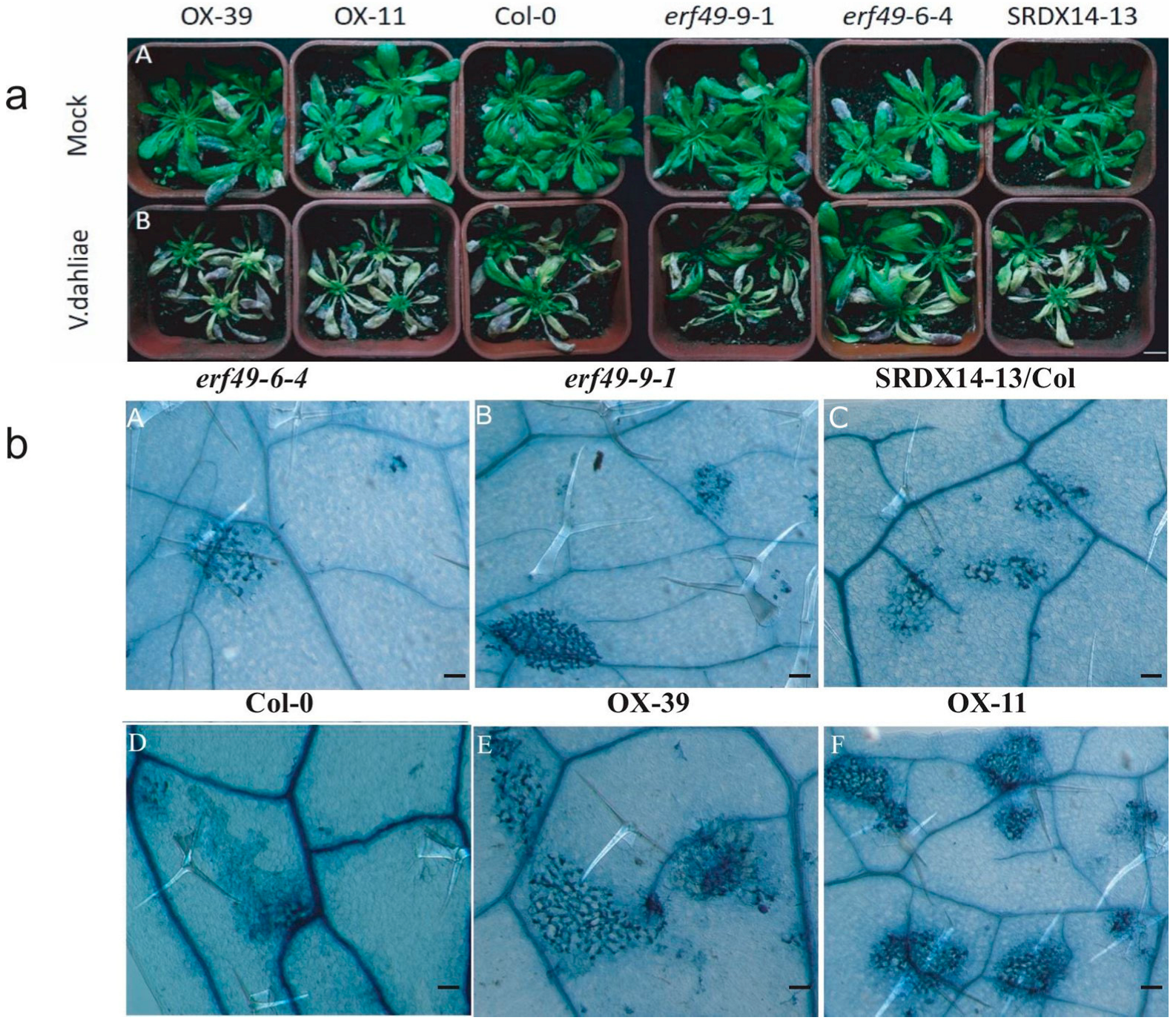
Two-week-old Arabidopsis thaliana seedlings were inoculated with Verticillium dahliae, and the plant phenotype was observed for 14 days post-inoculation (dpi). The results showed that AtERF49-overexpression plants exhibited markedly enhanced susceptibility to V. dahliae, with severe wilting symptoms compared to wild-type Col-0 (Figure 1a). Conversely, erf49 and ERF49-SRDX/Col mutants displayed milder wilting symptoms, indicating increased resistance to V. dahlia (Figure 1a). To quantify V. dahliae-induced cell death, Arabidopsis leaves were stained with trepan. Consistent with the results from the aforementioned phenotypic experiments, severe cell death was observed in AtERF49-OX plants after inoculation with V. dahliae, while both erf49 mutants and SRDX-ERF49 plants showed mild cell death (Figure 1b). These results demonstrate that AtERF49 negatively regulates the defense response of Arabidopsis to V. dahliae, as a susceptibility factor in the plant pathosystem.

2.2. Silencing GhERF49 Enhances Resistance to Verticillium Wilt in Cotton

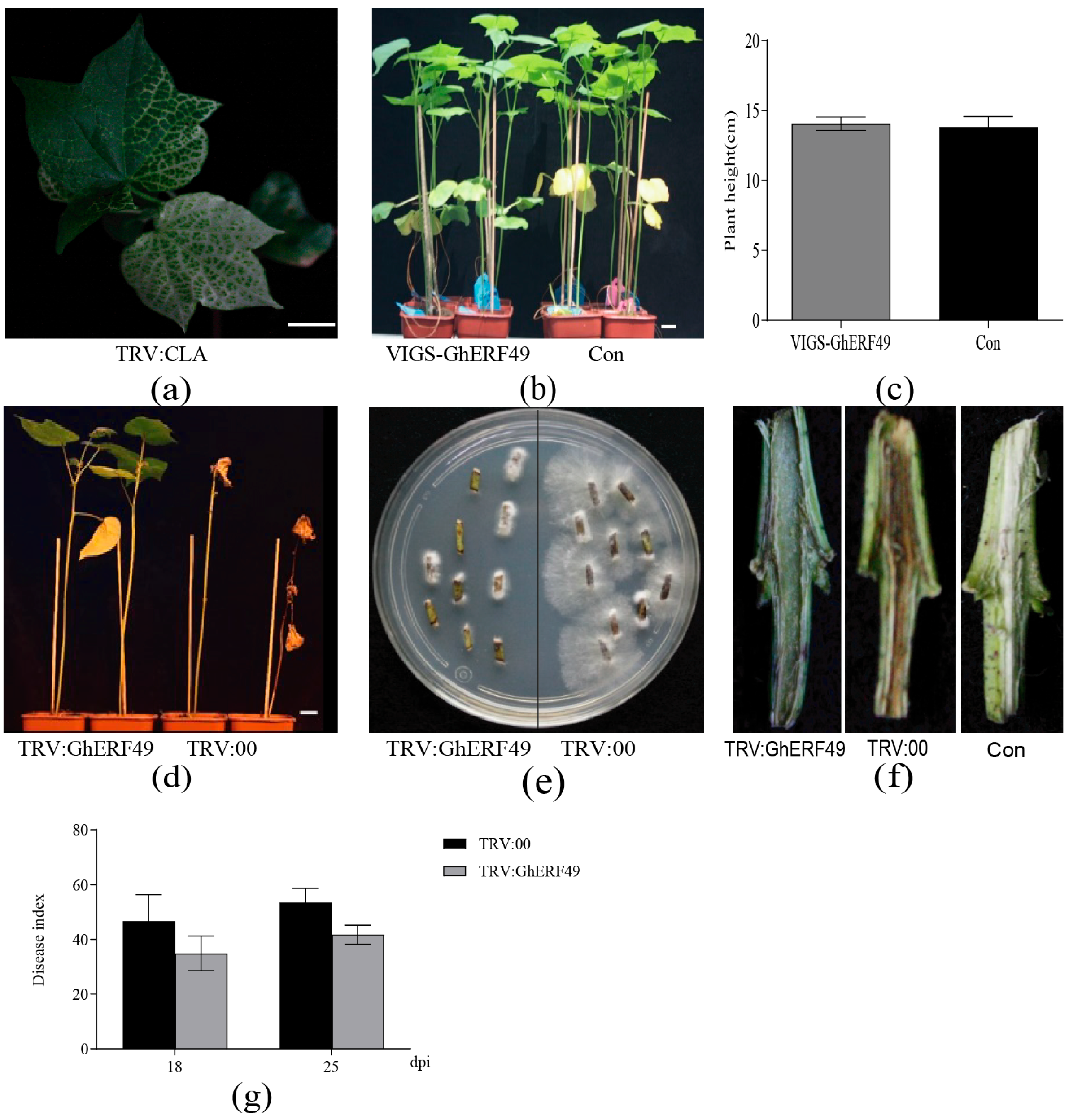
The CLA gene in cotton is related to the synthesis of chlorophyll, and its suppression causes leaf albinism. To validate the efficiency of the VIGS system, Agrobacterium tumefaciens GV3101 solution containing pTRV2-GhCLA and pTRV1 vectors was mixed and infiltrated into cotyledons of 2-week-old cotton (TM-1) seedlings of uniform size. The newly emerging leaves showed an albino phenotype (Figure 2a). This result indicated that the VIGS system was successful and effectively silenced the expression of cotton CLA genes. Subsequently, identical procedures were applied to silence GhERF49. The cotton plants of VIGS-GhERF49 and control were sampled separately, and target gene expression was detected by qRT-PCR. Plant height was measured at the two-true-leaf stage. As can be seen in Figure 2c, there was no significant difference in plant height between VIGS-GhERF49 plants and control plants (TRV:00).
In order to explore the role of GhERF49 in cotton resistance to Verticillium wilt, the expression levels of GhERF49 were first detected in both VIGS-GhERF49 plants (TRV:GhERF49) and control plants (TRV:00). Subsequently, VIGS-GhERF49 plants and control plants were quantitatively irrigated with solution of V. dahliae LX2-1 cultured for 1 week. The results showed that the symptoms of Verticillium wilt in TRV:GhERF49 plants were significantly less severe than those in TRV:00 plants (Figure 2d). Statistical disease indices showed lower values in TRV:GhERF49 plants compared to control plants (TRV:00) (Figure 2g). Specifically, the disease indices of TRV:GhERF49 plants were 34.9% and 41.78% at 18 and 27 dpi, respectively, with V. dahliae, while disease indices of TRV:00 plants reached 46.78% and 53.57% at the same time points. Fungal recovery culture showed that the amount of V. dahliae in stems of TRV:GhERF49 plants was significantly lower than in TRV:00 plants (Figure 2e). Stem cutting assays showed that the vascular bundles of the stems of TRV:00 plants developed yellowish-brown discoloration, showing acute symptoms of Verticillium wilt (Figure 2f). The above results indicate that suppressing the expression of GhERF49 enhances cotton resistance to Verticillium wilt.

2.3. GhERF49 Negatively Regulates Lignin-Synthesis-Related Genes

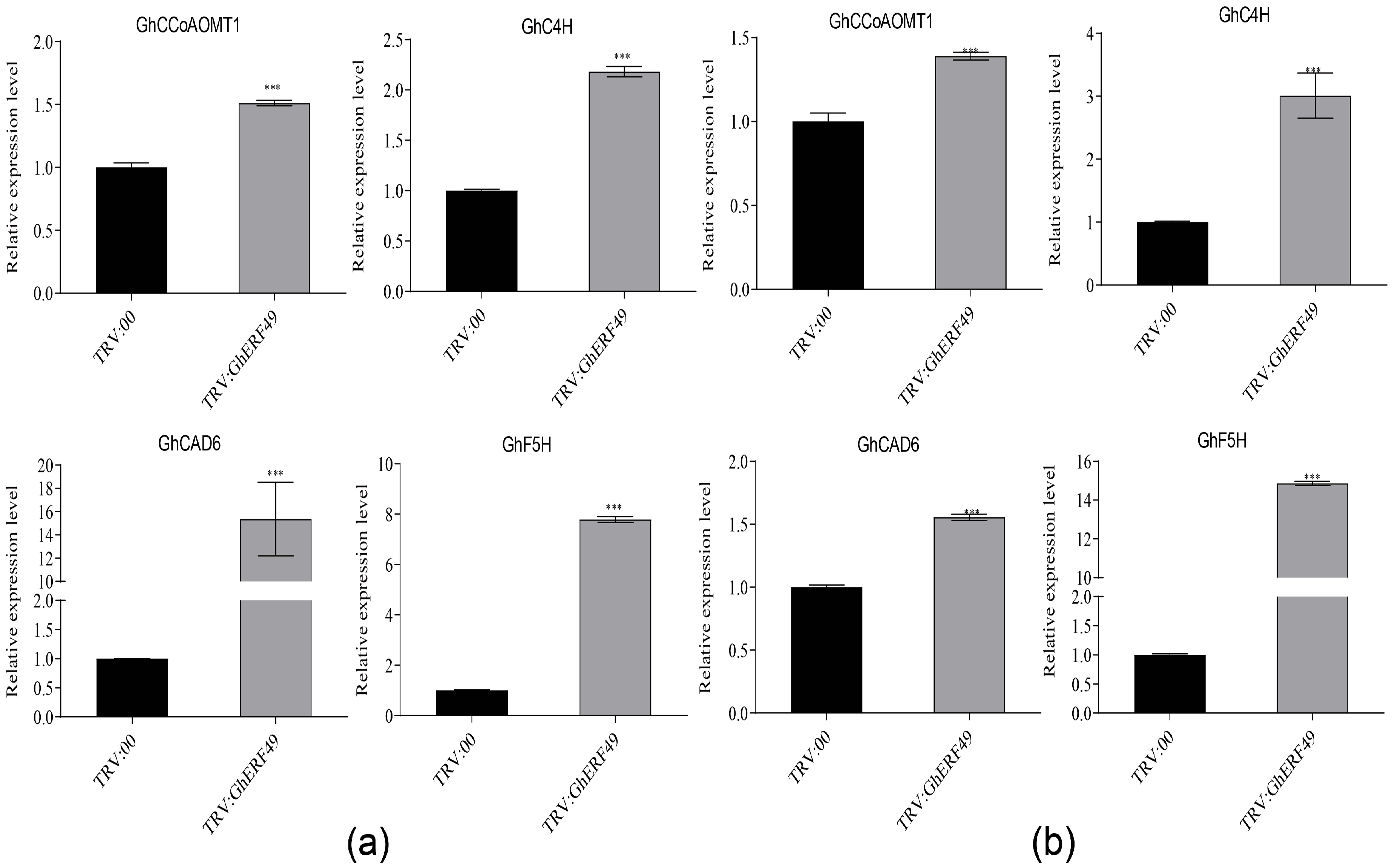
Lignin, a phenylpropanoid-derived polymer produced by oxidative polymerization of the three main hydroxycinnamyl alcohols, plays an essential role in plant defense against adverse environmental stresses [14]. To investigate whether GhERF49 modulates lignin biosynthesis during Verticillium dahlia infection, we analyzed the transcription levels of key lignin biosynthesis genes in cotton. The results showed that transcription levels of four lignin formation genes (GhCAD6, GhC4H1, GhF5H1 and GhCCoAOMT1) in TRV:GhERF49 plants were significantly higher than those in TRV:00 plants before and after inoculation with Verticillium dahliae LX2-1. Before inoculation, expression levels of GhCCoAOMT1, GhC4H1, GhCAD6 and GhF5H1 in TRV:GhERF49 plants were, respectively, 1.5, 2.2, 15.4, and 7.8 times higher than those in TRV:00 plants. Notably, GhCAD6 exhibited the strongest induction (15.4-fold) (Figure 3a). After inoculation, expression of the four genes increased by 1.4-, 3.0-, 1.55- and 14.8-fold, respectively, with GhF5H1 showing the most dramatic upregulation (14.8-fold) (Figure 3b). Taken together with the reduced disease symptoms in TRV:GhERF49 plants (Figure 2d,f), these findings indicated that the improved resistance conferred by GhERF49 silencing is mediated through the upregulation of lignin biosynthetic genes. Thus GhERF49 functions as a negative regulator of lignin-mediated defense.

2.4. AtERF49 Negatively Regulates Expression of Lignin-Synthesis-Related Genes

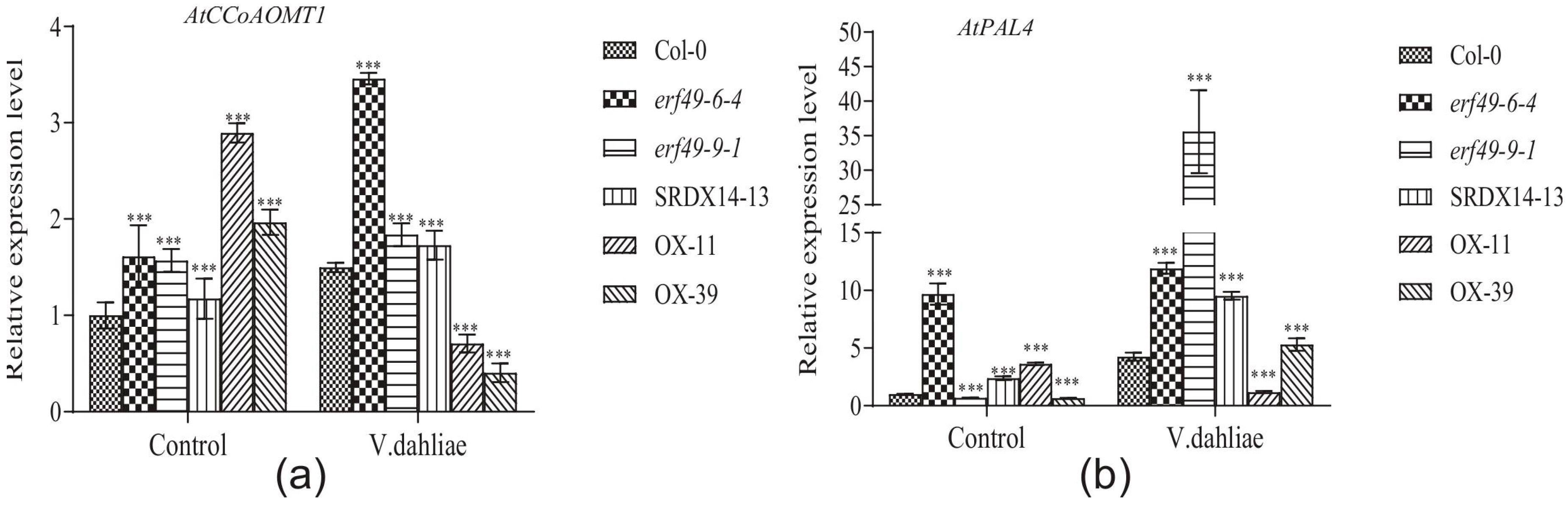
Based on the findings presented in Section 2.2 and Section 2.3, which showed that GhERF49 silencing enhances cotton resistance to Verticillium wilt through depression of lignin biosynthesis, we hypothesized that its homolog in Arabidopsis, AtERF49, might function similarly. To validate this, the expression of lignin biosynthetic genes AtPAL4 and AtCCoAOMT1 was analyzed by qRT-PCR in AtERF49 transgenic lines. As shown in Figure 4, the transcription levels of both genes differed significantly between transgenic Arabidopsis plants and wild-type Col-0 plants before Verticillium dahlia inoculation. After inoculation, AtPAL4 and AtCCoAOMT1 expression was markedly induced in erf49 mutant and ERF49 dominant repressor plants (ERF49-SRDX), with expression increases of 2- to 9-fold and 1- to 3-fold, respectively. Conversely, their expression was significantly repressed (50–73%) in AtERF49-OX plants. Combined with disease phenotypes (Figure 1a), overexpression of AtERF49 increased the susceptibility of plants to Verticillium wilt, while inhibition of ERF49 enhanced the resistance of ERF49-SRDX plants and erf49 mutants to Verticillium wilt. These findings from cotton and Arabidopsis established ERF49 as a negative regulator of lignin biosynthesis-mediated defense against Verticillium wilt across dicot plants.

3. Discussion

This study identifies ERF49 as a novel negative regulator of plant resistance to Verticillium wilt, potentially modulating susceptibility through transcriptional through of lignin biosynthesis. In the Arabidopsis model, AtERF49 overexpression significantly suppressed the expression of lignin synthesis genes AtPAL4 and AtCCoAOMT1 (Figure 4) and enhance cell death (Figure 1b), resulting in enhanced susceptibility to Verticillium wilt.
Further supporting this conclusion, we found that this regulatory mechanism is also conserved in cotton, where silencing GhERF49 in cotton significantly upregulated lignin biosynthetic genes (e.g., GhCAD6 and GhF5H1 (Figure 3) and reduced the disease severity by 34.9% (Figure 2g). These findings align with recent research indicating that lignin deposition resists vascular bundle diseases by enhancing cell wall barriers and reactive oxygen species (ROS) accumulation [15,16], while ERF transcription factors downstream of ethylene signals often function as immune balance switches [17]. It is worth noting that the function of ERF49 is opposite to that of typical disease-resistant ERFs (e.g., NbERF5) [18], suggesting that there is a functional differentiation of the gene family.
The negative regulation mechanism of ERF49 may involve hormone signal crosstalk and epigenetic modification. Studies have shown that jasmonic acid (JA) can activate lignin biosynthesis genes [19], and ethylene signaling inhibits JA pathway effectors via ERF49, resembling the antagonism of the VaERF16-JA module in grape vine [7]. Furthermore, histone H3K27ac modification was confirmed to relieve the inhibition of target genes by ERF49 [20], which may explain why the expression of lignin genes in GhERF49-silenced plants was increased by 14.8-fold after Verticillium dahliae infection (Figure 3b).
The applicability of VIGS technology throughout the whole growth period of cotton (e.g., stem injection and fruit branch base injection) provides technical support for rapid screening in the field [21,22], while the functional conservation of AtERF49 in Arabidopsis thaliana suggests that this mechanism may be conserved in dicots such as tomato, and soybean. It is noteworthy that Wang et al. [2] used host-induced gene silencing (HIGS) technology to target pathogen genes and enhance cotton disease resistance, providing a collaborative innovation path with the host gene editing strategy of this study. Combined with host-induced gene silencing (HIGS) targeting the pathogen VdThit gene [2], or co-expression with the disease-resistant positive regulator GhWRKY75 [1], this strategy is expected to achieve dual-pathway enhancement of disease resistance. While our data demonstrate that GhERF49 silencing leads to significant upregulation of key lignin biosynthesis genes (e.g., GhCCoAOMT1, GhCAD6) and enhanced disease resistance, the precise molecular mechanism warrants further investigation. Based on the present study, we cannot conclusively determine whether GhERF49 protein directly binds to the promoters of these lignin genes to repress their transcription, or whether it acts indirectly through intermediary regulators. The observed regulatory relationship may involve complex hormone signaling crosstalk (e.g., ethylene-JA antagonism) or epigenetic modifications, as suggested by prior studies in other systems. Future work employing chromatin immunoprecipitation sequencing (ChIP-seq), electrophoretic mobility shift assays (EMSA), or detailed promoter analysis will be essential to clarify whether these lignin genes are direct targets of GhERF49. Nevertheless, our findings firmly establish GhERF49 as a critical negative regulator of lignin deposition and Verticillium wilt resistance, providing a valuable target for molecular design of resistant crop varieties [23].
This study reveals that the ERF49 gene functions as a negative regulator of plant resistance to Verticillium wilt. In both Arabidopsis and cotton, loss-of-function or silencing of this gene significantly enhanced plant resistance, whereas its overexpression increased susceptibility.
The molecular mechanism involves ERF49 negatively regulating the expression of several key lignin biosynthesis genes, such as GhCAD6 and GhC4H1, thereby suppressing pathogen-induced lignification of the cell wall, a crucial defense response.
In summary, ERF49 acts as a critical negative regulatory node linking ethylene signaling to lignin-mediated disease resistance. This finding provides a novel potential target for molecular breeding of disease-resistant crops. Whether ERF49 directly regulates these downstream genes requires further investigation.

4. Materials and Methods

4.1. Plant Materials

The Arabidopsis thaliana material used in this experiment was ecotype Col-0. Plants were cultured at 22 °C under a 16 h light/8 h dark photoperiod.
The cotton materials used in the experiment was the upland cotton (Gossypium hirsutum) standard line TM-1, which was provided by the Key Laboratory of Plant Molecular Physiology, Chinese Academy of Sciences, Institute of Botany, Chinese Academy of Sciences. Plants were grown in a greenhouse with a day/night temperature cycle of 30 °C/22 °C, and a light cycle of 12 h light/12 h dark.

4.2. Strains and Carriers

The vectors used in cotton VIGS were pTRV1 and pTRV2. The Agrobacterium tumefaciens strain GV3101, used for transformation, was provided by the Key Laboratory of Plant Molecular Physiology, Institute of Botany, Chinese Academy of Sciences. Verticillium dahliae LX2-1 was provided by Hebei Agricultural University.

4.3. VIGS-Technology-Infected Cotton

Agrobacterium GV3101 carrying pTRV1/pTRV2-GhERF49 was inoculated into LB liquid medium containing kanamycin (50 mg/L) and rifampicin (25 mg/L), then cultured at 28 °C and 200 rpm until OD600 = 0.5. After centrifugation at 5000 rpm for 15 min at 4 °C, the bacterial suspension was washed twice with sterile water to remove antibiotic residues, then re-suspended in the infection solution (10 mM MgCl2, 10 mM MES, 200 μM acetosyringone) and placed in the dark at room temperature for 4 h to induce infection. The pTRV1 was mixed with the target vector (such as pTRV2-GhERF49) at a ratio of 1:1, and the bacterial suspension was injected into the leaves after the backs of the cotton cotyledons were scratched with a needle until the leaves were completely penetrated. This protocol is suitable for 2-week-old seedlings (cotyledon expansion period), and can also be extended to 4-day-old stem injection or flowering fruit branch base injection to improve full-cycle applicability. Two weeks after injection, the effectiveness of the system was visually evaluated by the albino phenotype caused by GhCLA1 gene silencing, and the expression of the target gene (such as GhERF49) was detected by qRT-PCR to confirm the silencing efficiency.

4.4. Inoculation Treatment and Disease Index Statistics

After 2 weeks of growth of cotton with expression of gene GhERF49 silenced by VIGS technology, Verticillium dahliae was inoculated using the root irrigation method. The culture conditions were day temperature 28 °C/night temperature 22 °C, light cycle 12 h light/12 h dark. The 2-week-old Arabidopsis thaliana was treated using the root dipping method. Each plant in the treatment group was dipped in conidial suspension for 5 min, and each plant in the control group was dipped in Czapek–Dox liquid medium for 5 min. All plants were then transplanted into fresh soil. The culture conditions were day temperature 28 °C/night temperature 22 °C, light cycle 12 h light/12 h dark. About 2 weeks after inoculation, the disease grade was recorded and the disease index was calculated according to the grading standard of cotton and Arabidopsis Verticillium wilt at the seedling stage. Disease was classified into five grades [24].

4.5. Design Primers

Primer Premier 5 was used to design fluorescent quantitative RT-PCR primers. The detailed sequence of primers is shown in Table 1. Primers were synthesized by Beijing Meiji Sanger Biomedical Technology Co., Ltd, Beijing, China.

4.6. qRT-PCR Analysis

Leaves of Arabidopsis thaliana and cotton before and after inoculation with Verticillium dahliae were used as materials for leaf RNA extraction and reverse transcription into cDNA. The lignin-related genes of Arabidopsis thaliana and cotton were used as detection objects, and expression changes in lignin-related genes were detected by qRT-PCR. qRT-PCR analysis was performed on PAL4, C4H, F5H, CAD and CCoAOMT1 in the lignin biosynthetic pathway to explore the relationship between AtERF49 and its homologous gene GhERF49 with the lignin biosynthetic pathway. Arabidopsis AtUBC30 was used as an internal reference gene, and cotton GhHISTONE3 was used as a reference gene.

4.7. Fungal Recovery and Observation of Cotton Plant Cutting

At 14 days post-inoculation (dpi) with Verticillium dahliae, the same stem parts of TRV:GhERF49 and TRV:00 plants with silenced GhERF49 expression were sampled and placed on PDA medium containing cephalosporin at 25 °C under dark conditions in the incubator.
The cotyledon nodes of TRV:GhERF49 and TRV:00 plants with silenced GhERF49 expression were cut with a blade. The stems were dissected longitudinally, observed under a stereomicroscope, and photographed.

4.8. Trepan Blue Staining

The trepan blue working solution was prepared by diluting stock solution (containing 0.1% trepan blue) with 95% ethanol at a 1:2 (v/v) ratio, resulting in a final working concentration of approximately 0.033%. Leaves were placed in a microcentrifuge tube, immersed in the trepan blue staining solution, vacuum-infiltrated for 30 min, incubated at room temperature for 5 h, heated in a 90 °C water bath for 10 min, and cleared with a 2.5 g/mL chloral hydrate aqueous solution (replaced every 3–4 h) until the leaves became transparent.

Author Contributions

Conceptualization, M.L.; data curation, H.R., Q.M. and J.Z.; formal analysis, M.L., Y.L. and J.W.; investigation, H.R., Z.Z., Z.L. (Zhiquan Liu) and Z.G.; methodology, M.L. and Z.L. (Zhi Liu); project administration, W.F. and S.Z.; resources, W.F., B.L., W.S. and S.J.; supervision, W.F. and S.Z.; visualization, H.R.; writing—original draft, M.L.; writing—review and editing, S.J. and S.Z. All authors have read and agreed to the published version of the manuscript.

Funding

This research was funded by the Finance Science and Technology Project of XinJiang Uyghur Autonomous Region (grant number 2023A01), and the Seed industry Innovation Program of Yuelushan Laboratory (YLS-2025-ZY02060).

Institutional Review Board Statement

Not applicable.

Informed Consent Statement

Not applicable.

Data Availability Statement

The data and materials that support the findings of this study are available from the corresponding authors upon reasonable request.

Acknowledgments

The authors gratefully acknowledge technical support from the experimental platforms at Heilongjiang Bayi Agricultural University, the Institute of Botany of the Chinese Academy of Sciences, the Cotton Research Institute of Xinjiang Uyghur Autonomous Region Academy of Agricultural Sciences, and Hunan Agricultural University. We thank our colleagues in these institutions for their assistance with field management, sample collection, and laboratory analysis throughout this study. This research was supported by the Finance Science and Technology Project of XinJiang Uyghur Autonomous Region (grant number 2023A01), and the Seed industry Innovation Program of Yuelushan Laboratory (YLS-2025-ZY02060). The funding body had no role in the design of the study, the collection, analysis, or interpretation of data, or in writing the manuscript.

Conflicts of Interest

The authors declare no conflicts of interest.

Abbreviations

The following abbreviations are used in this manuscript:
cDNAComplementary DNA
VIGSVirus-induced gene silencing

References

  1. Chai, Q.; Zheng, M.; Li, Y.; Gao, M.; Wang, Y.; Wang, X.; Zhang, C.; Jiang, H.; Chen, Y.; Wang, J.; et al. GhWRKY75 positively regulates GhPR6-5b via binding to a W-box TTGAC (C/T) to orchestrate cotton resistance to Verticillium dahliae. J. Integr. Agric. 2024, 23, 3343–3357. [Google Scholar] [CrossRef]
  2. Wang, Q.; Pan, G.; Wang, X.; Sun, Z.; Guo, H.; Su, X.; Cheng, H. Host-induced gene silencing of the Verticillium dahliae thiamine transporter protein gene (VdThit) confers resistance to Verticillium wilt in cotton. J. Integr. Agric. 2024, 23, 3358–3369. [Google Scholar] [CrossRef]
  3. Mi, X.; Li, W.; Chen, C.; Xu, H.; Wang, G.; Jin, X.; Zhang, D.; Guo, W. GhMPK9-GhRAF39_1-GhWRKY40a Regulates the GhERF1b- and GhABF2-Mediated Pathways to Increase Cotton Disease Resistance. Adv. Sci. 2024, 11, 2404400. [Google Scholar] [CrossRef] [PubMed]
  4. Zhou, J.; Mu, Q.; Wang, X.; Zhang, J.; Yu, H.; Huang, T.; He, Y.; Dai, S.; Meng, X. Multilayered synergistic regulation of phytoalexin biosynthesis by ethylene, jasmonate, and MAPK signaling pathways in Arabidopsis. Plant Cell 2022, 34, 3066–3087. [Google Scholar] [CrossRef]
  5. Asai, T.; Tena, G.; Plotnikova, J.; Willmann, M.R.; Chiu, W.-L.; Gomez-Gomez, L.; Boller, T.; Ausubel, F.M.; Sheen, J. MAP kinase signalling cascade in Arabidopsis innate immunity. Nature 2002, 415, 977–983. [Google Scholar] [CrossRef]
  6. Li, Y.; Liu, K.; Tong, G.; Xi, C.; Liu, J.; Zhao, H.; Wang, Y.; Ren, D.; Han, S. MPK3/MPK6-mediated phosphorylation of ERF72 positively regulates resistance to Botrytis cinerea through directly and indirectly activating the transcription of camalexin biosynthesis enzymes. J. Exp. Bot. 2021, 73, 413–428. [Google Scholar] [CrossRef]
  7. Zhu, Y.; Zhang, X.; Zhang, Q.; Chai, S.; Yin, W.; Gao, M.; Li, Z.; Wang, X. The transcription factors VaERF16 and VaMYB306 interact to enhance resistance of grapevine to Botrytis cinerea infection. Mol. Plant Pathol. 2022, 23, 1415–1432. [Google Scholar] [CrossRef]
  8. Zhang, D.; Zhu, K.; Shen, X.; Meng, J.; Huang, X.; Tan, Y.; Cardinale, F.; Liu, J.; Li, G.; Liu, J. Two interacting ethylene response factors negatively regulate peach resistance to Lasiodiplodia theobromae. Plant Physiol. 2023, 192, 3134–3151. [Google Scholar] [CrossRef]
  9. Müller, M.; Munné-Bosch, S. Ethylene Response Factors: A Key Regulatory Hub in Hormone and Stress Signaling. Plant Physiol. 2015, 169, 32–41. [Google Scholar] [CrossRef] [PubMed]
  10. Fan, Z.; Wang, Y.; Zhai, Y.; Gu, X.; Sun, K.; Zhao, D.; Wang, J.; Sun, P.; Huang, H.; He, J.; et al. ERF100 regulated by ERF28 and NOR controls pectate lyase 7, modulating fig (Ficuscarica L.) fruit softening. Plant Biotechnol. J. 2025, 23, 2611–2626. [Google Scholar] [CrossRef] [PubMed]
  11. Lorenzo, O.; Piqueras, R.; Sánchez-Serrano, J.J.; Solano, R. ETHYLENE RESPONSE FACTOR1 Integrates Signals from Ethylene and Jasmonate Pathways in Plant Defense. Plant Cell 2003, 15, 165–178. [Google Scholar] [CrossRef]
  12. Pré, M.; Atallah, M.; Champion, A.; De Vos, M.; Pieterse, C.M.J.; Memelink, J. The AP2/ERF Domain Transcription Factor ORA59 Integrates Jasmonic Acid and Ethylene Signals in Plant Defense. Plant Physiol. 2008, 147, 1347–1357. [Google Scholar] [CrossRef]
  13. Tang, Z.; Chen, S.; Xu, Q.; Zhong, W.; Liu, Q.; Zhu, S. Functional Study of AP2/ERF in Response to Black Rot at Broccoli Seedling Stage. Acta Hortic. Sin. 2024, 51, 2523–2539. (In Chinese) [Google Scholar]
  14. Dong, N.-Q.; Lin, H.-X. Contribution of phenylpropanoid metabolism to plant development and plant–environment interactions. J. Integr. Plant Biol. 2021, 63, 180–209. [Google Scholar] [CrossRef] [PubMed]
  15. Zhang, L.; Liu, J.; Cheng, J.; Sun, Q.; Zhang, Y.; Liu, J.; Li, H.; Zhang, Z.; Wang, P.; Cai, C.; et al. lncRNA7 and lncRNA2 modulate cell wall defense genes to regulate cotton resistance to Verticillium wilt. Plant Physiol. 2022, 189, 264–284, Correction in Plant Physiol. 2022, 189, 1881. [Google Scholar] [CrossRef] [PubMed]
  16. Wang, H.; Wang, Z.-X.; Tian, H.-Y.; Zeng, Y.-L.; Xue, H.; Mao, W.-T.; Zhang, L.-Y.; Chen, J.-N.; Lu, X.; Zhu, Y.; et al. The miR172a–SNB module orchestrates both induced and adult-plant resistance to multiple diseases via MYB30-mediated lignin accumulation in rice. Mol. Plant 2025, 18, 59–75. [Google Scholar] [CrossRef] [PubMed]
  17. Zhu, C.; Li, X.; Zhang, M.; Wang, S.; Jing, B.; Hu, C.; Thomas, H.R.; Zhou, Y.; Yu, J.; Hu, Z. ERF.D2 negatively controls drought tolerance through synergistic regulation of abscisic acid and jasmonic acid in tomato. Plant Biotechnol. 2025, 23, 3363–3381. [Google Scholar] [CrossRef]
  18. Zhao, M.; Zhang, L.; Ghanem, H.; Wu, G.; Li, M.; Qing, L. Ethylene response transcription factor 5 (ERF5) enhances defense against tobacco curly shoot virus and associated betasatellite (TbCSV/TbCSB) in Nicotiana benthamiana. Virology 2025, 603, 110309. [Google Scholar] [CrossRef]
  19. Xu, H.; Dong, C.; Wu, Y.; Fu, S.; Tauqeer, A.; Gu, X.; Li, Q.; Niu, X.; Liu, P.; Zhang, X.; et al. The JA-to-ABA signaling relay promotes lignin deposition for wound healing in Arabidopsis. Mol. Plant 2024, 17, 1594–1605. [Google Scholar] [CrossRef]
  20. Chen, X.; Xue, H.; Zhu, L.; Wang, H.; Long, H.; Zhao, J.; Meng, F.; Liu, Y.; Ye, Y.; Luo, X.; et al. ERF49 mediates brassinosteroid regulation of heat stress tolerance in Arabidopsis thaliana. BMC Biol. 2022, 20, 254. [Google Scholar] [CrossRef]
  21. Tian, Y.; Fang, Y.; Zhang, K.; Zhai, Z.; Yang, Y.; He, M.; Cao, X. Applications of Virus-Induced Gene Silencing in Cotton. Plants 2024, 13, 272. [Google Scholar] [CrossRef]
  22. Qu, J.; Ye, J.; Geng, Y.-F.; Sun, Y.-W.; Gao, S.-Q.; Zhang, B.-P.; Chen, W.; Chua, N.-H. Dissecting Functions of KATANIN and WRINKLED1 in Cotton Fiber Development by Virus-Induced Gene Silencing. Plant Physiol. 2012, 160, 738–748. [Google Scholar] [CrossRef] [PubMed]
  23. Yu, F.; Liang, K.; Fang, T.; Zhao, H.; Han, X.; Cai, M.; Qiu, F. A group VII ethylene response factor gene, ZmEREB180, coordinates waterlogging tolerance in maize seedlings. Plant Biotechnol. J. 2019, 17, 2286–2298. [Google Scholar] [CrossRef] [PubMed]
  24. Zhang, Y.; Yang, Y.; Yu, L.; Wang, A.; Xue, C.; Zhang, J.; Duan, A.; Zhao, M. Composition and characteristics of soil microbial communities in cotton fields with different incidences of Verticillium wilt. Plant Signal. Behav. 2022, 17, 2034271. [Google Scholar] [CrossRef] [PubMed]
Figure 1. Overexpression of AtERF49 increased the susceptibility of Arabidopsis to Verticillium dahliae. (a) (A,B) Disease symptoms of erf49-6-4, erf49-9-1, SRDX14-13/Col, Col-0, OX-39 and OX-11 plants at 14 days post-inoculation (dpi) with Czapek–Dox medium (Mock) or Verticillium dahliae (V. dahliae). Scale bar = 4 cm. (b) (AF) Trypan blue staining showing cell death in leaves of indicated Arabidopsis genotypes. Scale bar = 100 µm.
Ijms 27 03447 g001
Figure 2. Silencing GhERF49 enhances cotton resistance to Verticillium wilt. (a) Phenotype of VIGS-CLA plant at 14 days post-inoculation (dpi) with Verticillium dahliae. (b,c) Disease symptoms (b) and plant height (c) of VIGS -silenced plants at 2 weeks post-treatment. Con is control; VIGS-GhERF49 is the silencing experimental group. (d) Phenotypic analysis of GhERF49-silenced plants compared to control at 35 dpi. Scale bar = 1 cm. (e) Recovery culture of the pathogen from stems. (f) Longitudinal sections of stem cuttings from TRV:00 and TRV:GhERF49, showing disease symptoms. (g) Disease indices of TRV:GhERF49 and TRV:00 plants at 18 and 25 dpi. The experiments above were repeated 3 times. The error bar is the standard error.
Ijms 27 03447 g002
Figure 3. Expression analysis of lignin-related genes after silencing GhERF49. (a,b) Expression of pathway-related genes related to lignin synthesis in TRV:GhERF49 and TRV:00 plants before and after Verticillium wilt treatment. F5H1—ferulate 5-hydroxylase 1; C4H—cinnamate 4-hydroxylase; CAD6—cinnamy1 alcohol dehydrogenase 6; CCoAOMT1—caffeoy1 CoA 3-O-methyltransferase 1. The asterisk indicates a statistically significant difference, *** indicates p < 0.001. The experiments above were repeated 3 times. The error bar is the standard error.
Ijms 27 03447 g003
Figure 4. Expression analysis of lignin-related gene expression of Arabidopsis. Relative expression analysis of AtCCoAOMT1 (a) and AtPAL4 (b) genes. AtUBC30 was used as reference gene. The asterisk indicates a statistically significant difference, *** indicates p < 0.001. The experiments above were repeated 3 times. The error bar is the standard error.
Ijms 27 03447 g004
Table 1. Primers used for fluorescent quantitative PCR.
Primer NamePrimer Sequence (5′–3′)
GhC4H1-F GATGCAAAGCTTGGTGGGTATGAC
GhC4H1-RACTTGTTAAATCAAAACACCCTTGGCTT
GhCCoAOMT1-FAAGAAGGGCCTGCAATGCCAGTT
GhCCoAOMT1-RGGTAACGGTGGTTCATTTGAGGCGA
GhF5H1-FCGACGGTAGCATAGAACATCC
GhF5H1-RCAACAAGCAAGATCATTGACCT
GhCAD6-FGCTTCCAGCAACATCCACGAC
GhCAD6-RAGGATTGTTGATGACGCCTGAC
AtCCoAOMT1-FGGGTTTACCGATCATTGAGA
AtCCoAOMT1-RCACCAACAGGGAGCATACAG
AtPAL4-FCGGCGCCGGGGACACGTC
AtPAL4-RGCGGCTTCGATCTGACCG
Disclaimer/Publisher’s Note: The statements, opinions and data contained in all publications are solely those of the individual author(s) and contributor(s) and not of MDPI and/or the editor(s). MDPI and/or the editor(s) disclaim responsibility for any injury to people or property resulting from any ideas, methods, instructions or products referred to in the content.