Xanthine Oxidase Inhibitory Potential of Achillea santolina Methanolic Extract with ROS Modulation in HepG2 Cells


Abstract
1. Introduction
2. Results
2.1. Phytochemical Analysis
2.2. Xanthine Oxidase Inhibitory Activity
2.3. Effect of A. santolina Extract on ROS Levels
3. Discussion
4. Materials and Methods
4.1. Chemicals and Reagents
4.2. Plant Material and Extraction
4.3. LC-MS Analysis
4.4. Xanthine Oxidase Inhibition Assay
4.5. Reactive Oxygen Species (ROS) Assay
4.6. Statistical Analysis
5. Conclusions
Author Contributions
Funding
Institutional Review Board Statement
Informed Consent Statement
Data Availability Statement
Conflicts of Interest
References
- Raut, S.K.; Khullar, M. Oxidative stress in metabolic diseases: Current scenario and therapeutic relevance. Mol. Cell. Biochem. 2023, 478, 185–196. [Google Scholar] [CrossRef]
- Mudgal, R.; Singh, S. Xanthine oxidoreductase in the pathogenesis of endothelial dysfunction: An update. Curr. Hypertens. Rev. 2024, 20, 10–22. [Google Scholar] [CrossRef]
- Du, L.; Zong, Y.; Li, H.; Wang, Q.; Xie, L.; Yang, B.; Pang, Y.; Zhang, C.; Zhong, Z.; Gao, J. Hyperuricemia and its related diseases: Mechanisms and advances in therapy. Signal Transduct. Target. Ther. 2024, 9, 212. [Google Scholar] [CrossRef]
- Mehmood, A.; Li, J.; Rehman, A.U.; Kobun, R.; Llah, I.U.; Khan, I.; Althobaiti, F.; Albo, S.; Zhao, L. Xanthine oxidase inhibitory study of eight structurally diverse phenolic compounds. Front. Nutr. 2022, 9, 966557. [Google Scholar] [CrossRef]
- Wu, D.; Chen, R.; Zhang, W.; Lai, X.; Sun, L.; Li, Q.; Zhang, Z.; Cao, J.; Wen, S.; Lai, Z.; et al. Tea and its components reduce the production of uric acid by inhibiting xanthine oxidase. Food Nutr. Res. 2022, 66, 10-29219. [Google Scholar] [CrossRef]
- Jiang, L.L.; Gong, X.; Ji, M.Y.; Wang, C.C.; Wang, J.H.; Li, M.H. Bioactive compounds from plant-based functional foods: A promising choice for the prevention and management of hyperuricemia. Foods 2020, 9, 973. [Google Scholar] [CrossRef]
- Nguyen, L.K.; Tran, C.V.; Pham, N.D.; Tran, T.V. Phytochemical screening, antioxidant and xanthine oxidase inhibitory activities of Vitis heyneana Schult. Stem Extracts From Vietnam. Trop. J. Nat. Prod. Res. 2023, 7, 3981–3988. [Google Scholar]
- Shen, N.; Wang, T.; Gan, Q.; Liu, S.; Wang, L.; Jin, B. Plant flavonoids: Classification, distribution, biosynthesis, and antioxidant activity. Food Chem. 2022, 383, 132531. [Google Scholar] [CrossRef]
- Al-Khayri, J.M.; Sahana, G.R.; Nagella, P.; Joseph, B.V.; Alessa, F.M.; Al-Mssallem, M.Q. Flavonoids as potential anti-inflammatory molecules: A review. Molecules 2022, 27, 2901. [Google Scholar] [CrossRef]
- Pyo, Y.; Kwon, K.H.; Jung, Y.J. Anticancer potential of flavonoids: Their role in cancer prevention and health benefits. Foods 2024, 13, 2253. [Google Scholar] [CrossRef]
- Xu, H.; Yu, S.; Lin, C.; Dong, D.; Xiao, J.; Ye, Y.; Wang, M. Roles of flavonoids in ischemic heart disease: Cardioprotective effects and mechanisms against myocardial ischemia and reperfusion injury. Phytomedicine 2024, 126, 155409. [Google Scholar] [CrossRef]
- Alharbi, H.O.A.; Alshebremi, M.; Babiker, A.Y.; Rahmani, A.H. The role of quercetin, a flavonoid in the management of pathogenesis through regulation of oxidative stress, inflammation, and biological activities. Biomolecules 2025, 15, 151. [Google Scholar] [CrossRef] [PubMed]
- Ajala, O.S.; Ayeleso, A.O.; Owolabi, M.; Akinleye, M.O.; Ukpo, G. Xanthine oxidase inhibitory potentials of flavonoid aglycones of Tribulus terrestris: In vivo, in silico and in vitro studies. Future J. Pharm. Sci. 2022, 8, 58. [Google Scholar] [CrossRef]
- Rasheed, A.; Ali, G.; Islam, M.R.; Rauf, A.; Ajaj, R.; Hemeg, H.A.; Iriti, M. Mechanistic Insights into the Pharmacological Actions of Flavonoids: A Comprehensive Review. Nat. Prod. Commun. 2026, 21, 1934578X261416331. [Google Scholar] [CrossRef]
- Kotik, M.; Kulik, N.; Valentova, K. Flavonoids as aglycones in retaining glycosidase-catalyzed reactions: Prospects for green chemistry. J. Agric. Food Chem. 2023, 71, 14890–14910. [Google Scholar] [CrossRef]
- Gupta, M.; Ahmad, J.; Ahamad, J.; Kundu, S.; Goel, A.; Mishra, A. Flavonoids as promising anticancer therapeutics: Contemporary research, nanoantioxidant potential, and future scope. Phytother. Res. 2023, 37, 5159–5192. [Google Scholar] [CrossRef] [PubMed]
- Rana, J.N.; Gul, K.; Mumtaz, S. Isorhamnetin: Reviewing Recent Developments in Anticancer Mechanisms and Nanoformulation-Driven Delivery. Int. J. Mol. Sci. 2025, 26, 7381. [Google Scholar] [CrossRef]
- Oran, S.A.; Al-Eisawi, D.M. Check-list of medicinal plants in Jordan. Dirasat Med. Biol. Sci. 1998, 25, 84–112. [Google Scholar]
- Salehi, B.; Selamoglu, Z.; Sevindik, M.; Fahmy, N.M.; Al-Sayed, E.; El-Shazly, M.; Csupor-Löffler, B.; Csupor, D.; Yazdi, S.E.; Sharifi-Rad, J.; et al. Achillea spp.: A comprehensive review on its ethnobotany, phytochemistry, phytopharmacology and industrial applications. Cell. Mol. Biol. 2020, 66, 78–103. [Google Scholar] [CrossRef] [PubMed]
- Bozyel, M.E.; Merdamert-Bozyel, E.; Canli, K.; Shukla, A.C. Achillea (yarrow): Diversity, trade potential, and ethnomedicinal uses. In Advances in Medicinal and Aromatic Plants; Apple Academic Press: Palm Bay, FL, USA, 2024; Volume 1. [Google Scholar]
- Strzępek-Gomółka, M.; Gaweł-Bęben, K.; Kukula-Koch, W. Achillea species as sources of active phytochemicals for dermatological and cosmetic applications. Oxidative Med. Cell. Longev. 2021, 2021, 6643827. [Google Scholar] [CrossRef] [PubMed]
- Shevchenko, A.; Akhelova, A.; Nokerbek, S.; Kaldybayeva, A.; Sagyndykova, L.; Raganina, K.; Dossymbekova, R.; Meldebekova, A.; Amirkhanova, A.; Ikhsanov, Y.; et al. Phytochemistry, Pharmacological Potential, and Ethnomedicinal Relevance of Achillea nobilis and Its Subspecies: A Comprehensive Review. Molecules 2025, 30, 2460. [Google Scholar] [CrossRef] [PubMed]
- Daneshvar-Ghahfarokhi, S.; Ahmadinia, H.; Sadeghi, T.; Basirat, E.; Mohammadi-Shahrokhi, V. Achillea millefolium capsule improved liver enzymes and lipid profile compared to placebo in patients with type 2 diabetes: A double-blind randomized clinical trial. BMC Nutr. 2025, 11, 21. [Google Scholar] [CrossRef]
- Farajpour, M.; Ebrahimi, M.; Sadat-Hosseini, M.; Al-Fekaiki, D.F.; Baghizadeh, A. Multivariate analysis of the phytochemical composition and antioxidant properties in twenty-five accessions across three Achillea species. Sci. Rep. 2024, 14, 11843. [Google Scholar] [CrossRef] [PubMed]
- Ghavam, M.; Castangia, I.; Manconi, M.; Bacchetta, G.; Manca, M.L. Chemical composition and antimicrobial activity of a newly identified chemotype of Achillea wilhelmsii K. Koch from Kashan, Iran. Sci. Rep. 2024, 14, 22655. [Google Scholar] [CrossRef]
- Ebrahim Netaj, N.; Rezaei Dastjerdi, M.; Ansari, S.; Amirian Chayjan, K.; Sepidarkish, M.; Jafarzadeh, J.; Hossein Nejad, A.; Taghizadeh Armaki, M. Evaluation of antifungal effect of alcoholic extract of Achillea millefolium and Trachyspermum ammi against Candida albicans isolated from denture stomatitis. Payavard Salamat 2022, 16, 278–285. [Google Scholar]
- Cheng, J.; Fu, Y.; Meng, X.; Tang, G.; Li, L.; Yusupov, Z.; Tojibaev, K.; He, M.; Sun, M. Investigation of anti-inflammatory effect of essential oil extracted from Achillea alpina L. through multi-omics analysis in zebrafish tail fin amputation model. J. Ethnopharmacol. 2025, 344, 119519. [Google Scholar] [CrossRef] [PubMed]
- Boubertakh, H.; Kabouche, Z.; Boudechicha, A.; Madi, A.; Khalfallah, A.; Kabouche, A. RP–UHPLC–ESI–QTOF–MSn analyses, antioxidant, antimicrobial, analgesic activities and toxicity of Achillea ligustica All. Nat. Prod. Res. 2025, 39, 3316–3321. [Google Scholar] [CrossRef]
- Rehman, N.U.; Salkini, M.A.A.; Alanizi, H.M.; Alharbi, A.G.; Alqarni, M.H.; Abdel-Kader, M.S. Achillea fragrantissima essential oil: Composition and detailed pharmacodynamics study of the bronchodilator activity. Separations 2022, 9, 334. [Google Scholar] [CrossRef]
- Xu, L.; Li, C.; Wan, T.; Sun, X.; Lin, X.; Yan, D.; Li, J.; Wei, P. Targeting uric acid: A promising intervention against oxidative stress and neuroinflammation in neurodegenerative diseases. Cell Commun. Signal. 2025, 23, 4. [Google Scholar] [CrossRef]
- Al-Mterin, M.A.; Aboalhaija, N.H.; Abaza, I.F.; Kailani, M.H.; Zihlif, M.A.; Afifi, F.U. Chromatographic analysis (LC-MS and GC-MS), antioxidant activity, total phenol and total flavonoid determination of Ononis natrix L. grown in Jordan. Jordan J. Chem. 2021, 16, 31–39. [Google Scholar]
- Nabil-Adam, A.; Elnosary, M.E.; Ashour, M.L.; Abd El-Moneam, N.M.; Shreadah, M.A. Flavonoids biosynthesis in plants as a defense mechanism: Role and function concerning pharmacodynamics and pharmacokinetic properties. In Flavonoid Metabolism-Recent Advances and Applications in Crop Breeding; IntechOpen: London, UK, 2023. [Google Scholar]
- Khan, M.S.; Khan, S.; Khan, N.; Khan, A.S. Dietary sources, classification, biosynthesis, and mechanism of action of flavonoids in combating oxidative stress. In Role of Flavonoids in Chronic Metabolic Diseases: From Bench to Clinic; Wiley: Hoboken, NJ, USA, 2024; pp. 67–114. [Google Scholar]
- Rana, J.N.; Mumtaz, S. Prunin: An emerging anticancer flavonoid. Int. J. Mol. Sci. 2025, 26, 2678. [Google Scholar] [CrossRef]
- Sadiq, I.Z. Free radicals and oxidative stress: Signaling mechanisms, redox basis for human diseases, and cell cycle regulation. Curr. Mol. Med. 2023, 23, 13–35. [Google Scholar] [CrossRef] [PubMed]
- Abdel-Baki, P.M.; Mahdy, N.E.; Ibrahim, R.M.; El Badawy, S.A.; Ali, S.E.; Ibrahim, M.A.; Khattab, M.S.; El-Rashedy, A.A.; Emam, S.R. Phytochemical analysis and neuroprotective potential of Achillea santolina L. fractions. Sci. Rep. 2025, 15, 16070. [Google Scholar] [CrossRef] [PubMed]
- Renda, C.; Nina, S.; Amina, B.; Amina, B.; Imane, H.; Khellaf, R.; Garzoli, S.; Bendif, H. Chemical Profiling by High-Performance Liquid Chromatography with Diode Array Detection and Gas Chromatography-Mass Spectrometry Analysis and Antimicrobial Potential of Achillea santolina Plant Extracts against Extended-Spectrum Beta-Lactamase-producing Escherichia coli and Fungal Pathogens. Chem. Biodivers. 2025, 22, e202403064. [Google Scholar]
- Farhadi, N.; Moghaddam, M.; Farsaraei, S.; Babaei, K.; Pirbalouti, A.G. Phytochemical profiling and antioxidant capacity of Achillea santolina at different phenological stages. Sci. Rep. 2025, 15, 25885. [Google Scholar] [CrossRef] [PubMed]
- Alkhatib, R. Chemical Composition of Essential Oils Total Phenols and Antioxidant Activity of Achillea fragrantissima and A. santolina Grown in Syria. Jordan J. Pharm. Sci. 2024, 17, 594–602. [Google Scholar] [CrossRef]
- Asnaashari, S.; Marefat, S.; Vatankhah, A.M.; Bamdad Moghaddam, S.; Delazar, A.; Hamedeyazdan, S. Bioactivity assays and phytochemical analysis upon Achillea filipendulina, focusing on xanthine oxidase inhibitory and antimalarial properties. Beni-Suef Univ. J. Basic Appl. Sci. 2023, 12, 46. [Google Scholar] [CrossRef]
- Karaaslan Ayhan, N.; Karaaslan Tunc, M.G.; Noma, S.A.A.; Kurucay, A.; Ates, B. Characterization of the antioxidant activity, total phenolic content, enzyme inhibition, and anticancer properties of Achillea millefolium L. (yarrow). Instrum. Sci. Technol. 2022, 50, 654–667. [Google Scholar] [CrossRef]
- Yu, Y.; Xiong, Y.; Tong, S.; Li, Y.; Cai, R.; Zhang, X.; Gao, F. Inhibitory activity of quercetin, rutin, and hyperoside against xanthine oxidase: Kinetics, fluorescence, and molecular docking. Curr. Pharm. Biotechnol. 2025, 26, 513–524. [Google Scholar] [CrossRef]
- Kozlov, A.V.; Javadov, S.; Sommer, N. Cellular ROS and antioxidants: Physiological and pathological role. Antioxidants 2024, 13, 602. [Google Scholar] [CrossRef]
- Le, T.M.; Nguyen, C.D.P.; Ha, A.C. Optimisation and Evaluation of the Correlation of Extraction Conditions for Total Flavonoid Content and Antixanthine Oxidase Activity in Psidium guajava. J. Herb. Med. 2024, 47, 100915. [Google Scholar] [CrossRef]
- Mapfumari, S.; Nogbou, N.D.; Musyoki, A.; Gololo, S.; Mothibe, M.; Bassey, K. Phytochemical screening, antioxidant and antibacterial properties of extracts of Viscum continuum E. Mey. Ex Sprague, a South African Mistletoe. Plants 2022, 11, 2094. [Google Scholar] [CrossRef] [PubMed]
- Husnunnisa, R.H.; Mauludin, R.; Insanu, M. Antioxidant potential and xanthine oxidase inhibition of flavonol glycosides from Phyllanthus emblica L. leaves. J. Pharm. Pharmacogn. Res. 2024, 12, 1067–1078. [Google Scholar] [CrossRef]
- Zhang, M.; Zhang, G.; Meng, X.; Wang, X.; Xie, J.; Wang, S.; Wang, B.; Wang, J.; Liu, S.; Huang, Q.; et al. Reduction of the oxidative damage to H2O2-induced HepG2 cells via the Nrf2 signalling pathway by plant flavonoids Quercetin and Hyperoside. Food Sci. Hum. Wellness 2024, 13, 1864–1876. [Google Scholar] [CrossRef]


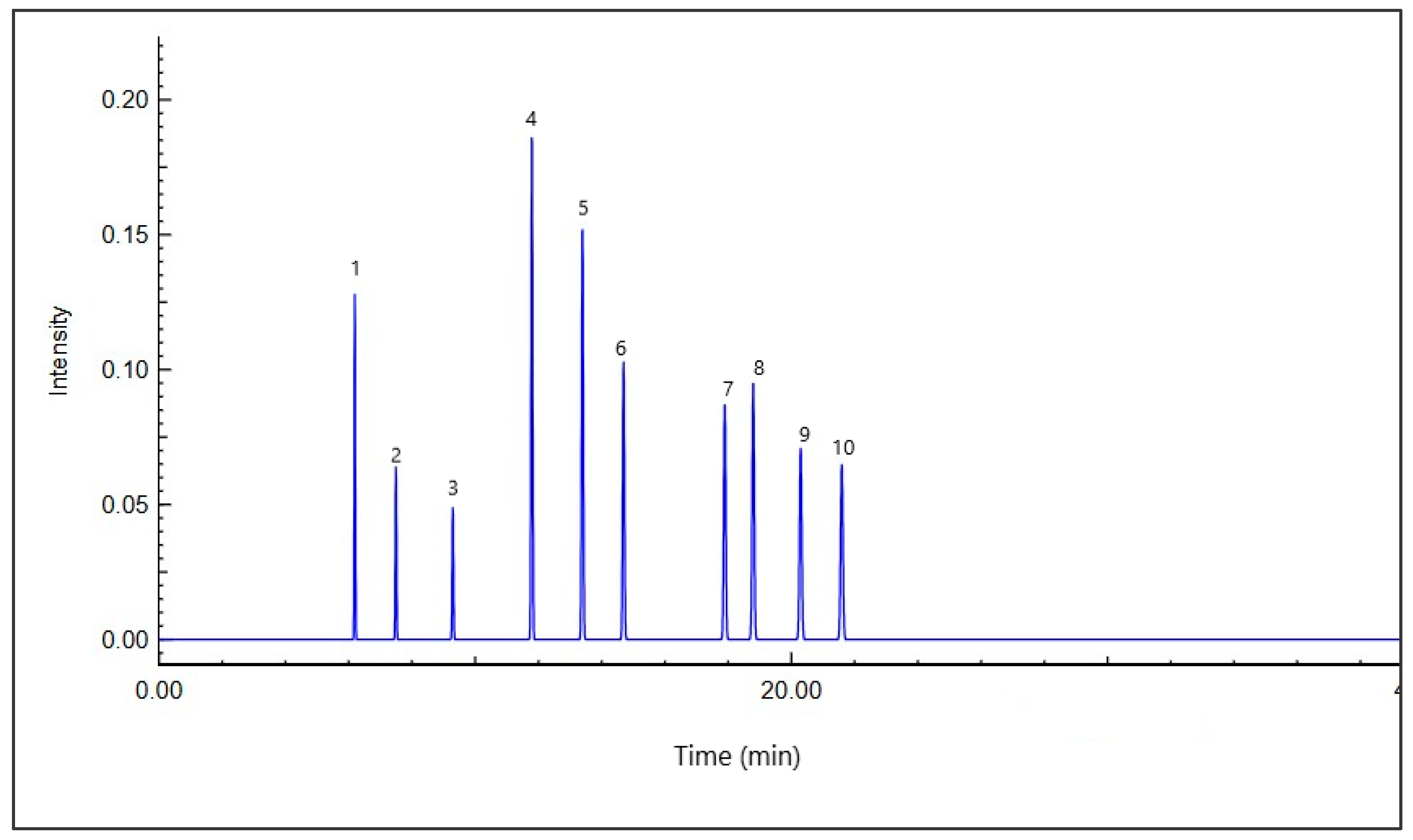
| No. | Compound | Retention Time (min) | Area (%) |
|---|---|---|---|
| 1 | Chlorogenic acid | 6.2 | 12.8 |
| 2 | Caffeic acid | 7.5 | 6.4 |
| 3 | Unknown | 9.3 | 4.9 |
| 4 | Rutin | 11.8 | 18.6 |
| 5 | Luteolin-7-O-glucoside | 13.4 | 15.2 |
| 6 | Apigenin-7-O-glucoside | 14.7 | 10.3 |
| 7 | Quercetin | 17.9 | 8.7 |
| 8 | Luteolin | 18.8 | 9.5 |
| 9 | Apigenin | 20.3 | 7.1 |
| 10 | Kaempferol | 21.6 | 6.5 |
| Total identification | 95.1 | ||
| Chemical classification | % | ||
| Phenolic acid | 19.2 | ||
| Flavonoid glycoside | 44.1 | ||
| Flavonoid aglycone | 31.8 | ||
| Treatment | ROS (%) ± SD |
|---|---|
| Control (no xanthine) | 100 ± 2.1 |
| Xanthine alone | 210 ± 3.2 *** |
| ASME 5 µg/mL + Xanthine | 172 ± 1.5 ** |
| ASME 10 µg/mL + Xanthine | 137 ± 2.0 ** |
| ASME 25 µg/mL + Xanthine | 80 ± 2.8 ** |
| ASME 50 µg/mL + Xanthine | 52 ± 3.1 ** |
Disclaimer/Publisher’s Note: The statements, opinions and data contained in all publications are solely those of the individual author(s) and contributor(s) and not of MDPI and/or the editor(s). MDPI and/or the editor(s) disclaim responsibility for any injury to people or property resulting from any ideas, methods, instructions or products referred to in the content. |
© 2026 by the authors. Licensee MDPI, Basel, Switzerland. This article is an open access article distributed under the terms and conditions of the Creative Commons Attribution (CC BY) license.
Share and Cite
Althaher, A.R.; Awadallah, M.W.; Qattoum, M.N. Xanthine Oxidase Inhibitory Potential of Achillea santolina Methanolic Extract with ROS Modulation in HepG2 Cells. Int. J. Mol. Sci. 2026, 27, 3401. https://doi.org/10.3390/ijms27083401
Althaher AR, Awadallah MW, Qattoum MN. Xanthine Oxidase Inhibitory Potential of Achillea santolina Methanolic Extract with ROS Modulation in HepG2 Cells. International Journal of Molecular Sciences. 2026; 27(8):3401. https://doi.org/10.3390/ijms27083401
Chicago/Turabian StyleAlthaher, Arwa R., Mirna W. Awadallah, and Muhammad N. Qattoum. 2026. "Xanthine Oxidase Inhibitory Potential of Achillea santolina Methanolic Extract with ROS Modulation in HepG2 Cells" International Journal of Molecular Sciences 27, no. 8: 3401. https://doi.org/10.3390/ijms27083401
APA StyleAlthaher, A. R., Awadallah, M. W., & Qattoum, M. N. (2026). Xanthine Oxidase Inhibitory Potential of Achillea santolina Methanolic Extract with ROS Modulation in HepG2 Cells. International Journal of Molecular Sciences, 27(8), 3401. https://doi.org/10.3390/ijms27083401