Compartment-Specific Mitochondrial Proteomic Alterations in Rat Hippocampus Following Chronic Social Isolation Stress


Abstract
1. Introduction
2. Heterogeneity of Neuronal Mitochondria Across Subcellular Compartments
3. CSIS-Associated Changes in the Hippocampal NSM Proteome
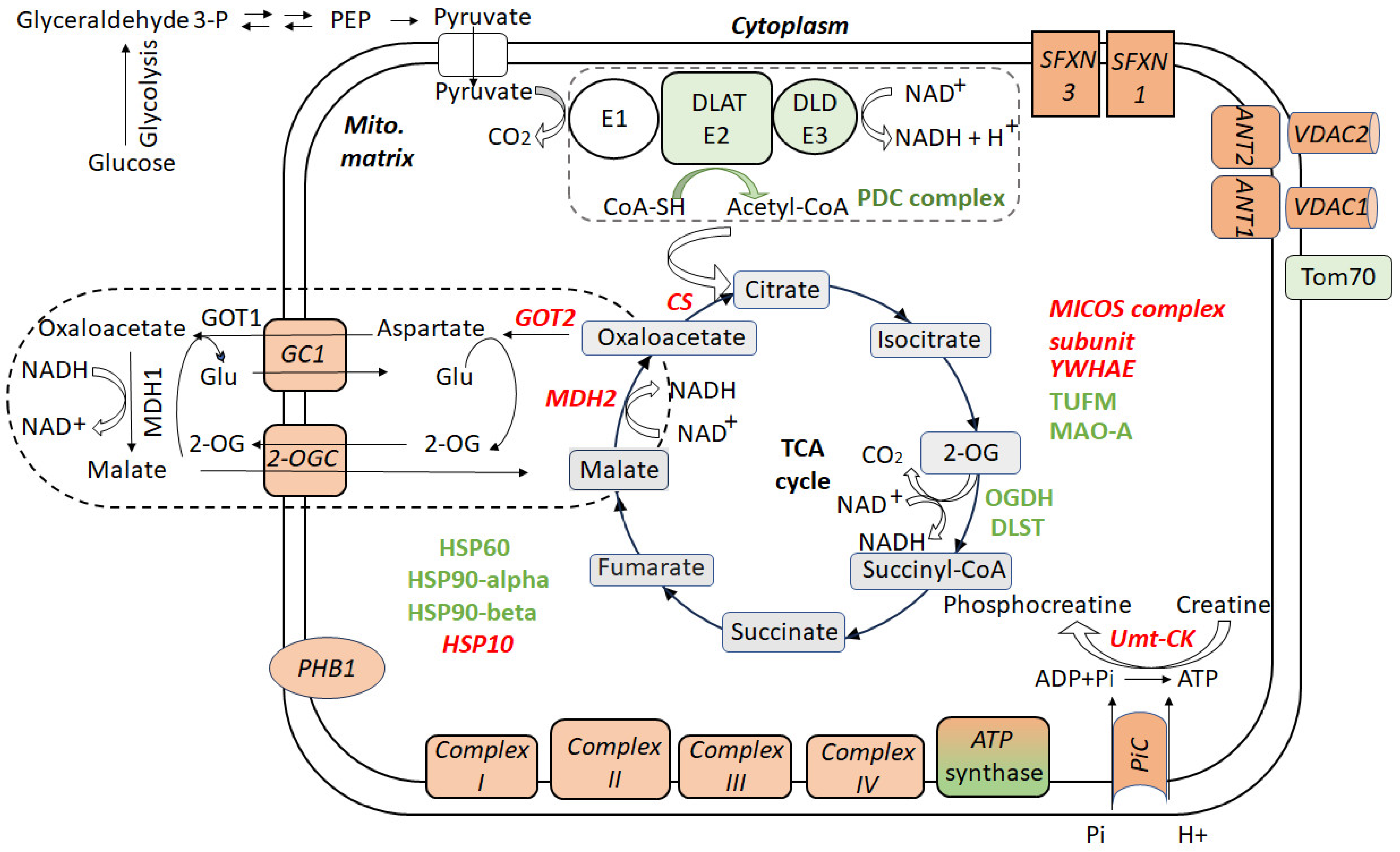
3.1. Pyruvate Metabolism and TCA Cycle Alterations in NSM
3.2. Alterations in the NSM Electron Transport Chain and ATP Synthase

| Respiratory Complex | Protein | Stress Model/ Brain Region | Expression Change | Technique | Key Finding | References |
|---|---|---|---|---|---|---|
| Complex I (NADH dehydrogenase) | NDUFS1/NDUFS3 | Sleep deprivation; mouse; hippocampus | ↓ | WB | Reduced NDUFS3 and decreased Complex I activity | [93] |
| NDUFS1/UQCRFS1 | CSIS; rat; PFC; NSM | ↑ | LC-MS/MS | Adaptive mitochondrial response to increased energy demand | [15] | |
| NDUFA2/NDUFS3/NDUFA13 | AD; human brain frontal cortex mitochondria; late-onset | ↓ | iTRAQ-based proteomics | Downregulation of subunits in the late-onset AD | [94] | |
| NDUFA13 | Human MDD; DLPFC | ↑ | 1D-LC-MS | Altered mitochondrial Complex I function and disrupted brain energy metabolism associated with depression and psychotic symptoms | [95] | |
| NDUFA2 | AD; human brain frontal cortex mitochondria; early-onset | ↓ | iTRAQ-based proteomics | Significant reduction in Complex I subunit in early-onset AD | [94] | |
| NDUFA2/NDUFV3 | CMS; rat; cerebellum | ↓ | iTRAQ-based proteomics | Downregulation linked to mitochondrial dysfunction | [71] | |
| NDUFV1/NDUFS1/NDUFV2 | Schizophrenia and PPD; human brain | ↑ | RT-qPCR | NDUFV2 upregulated in schizophrenia—opposite to depression findings | [96] | |
| NDUFV2/NDUFS2/NDUFS3 | CMS; rat; hippocampal synaptosomes | ↓/↑/↑ | iTRAQ-based proteomics | Abnormal activity of hippocampal synaptic mitochondria-related OXPHOS pathways in CMS susceptible rats | [97] | |
| NDUFS3 | CMS; rat; whole hippocampal lysate (Dep-Sus/Anx-Sus/Insus) | ↑/↑/↔ | iTRAQ-based proteomics | Dep-sus ↑; Anx-sus ↑; Insus ↔ | [69] | |
| NDUFS3 | STZ-induced type-1 diabetic rat; forebrain mitochondria | ↓ | 2D-HPLC-ESI-MS/MS | Reduced catalytic activity of Complex I | [98] | |
| Complex II (Succinate dehydrogenase) | SDHB | HAB/LAB mouse lines; cingulate cortex; synaptosomes | ↑ | LC-MS/MS | ↑ HAB/LAB ratio contributes to pathophysiology of anxious phenotype in HAB mice | [99] |
| SDHB | SI-induced anxiety; mouse; hippocampal mitochondria | ↓ | Enzyme activity | ~52% decrease in SDHB activity vs. control | [100] | |
| Complex III (Cytochrome bc1) | CYC1 | Rat zinc-deficiency depression-like model; PFC | ↑ | LC-MS/MS | Impaired mitochondrial respiration and energy metabolism in models of depression and zinc deficiency | [101] |
| UQCRFS1/CYC1 | HAB/LAB mouse lines; cingulate cortex synaptosomes | ↑ | LC-MS/MS | Upregulation of OXPHOS complexes as a general characteristic of the anxious brain | [99] | |
| Complex IV (Cytochrome c oxidase) | MT-CO2 (COX2) | CMS; rat; cerebellum | ↑ | iTRAQ-based proteomics | Upregulation linked to mitochondrial respiratory chain disruption | [71] |
| COX4I1/COX5A | CMS; hippocampal synaptosomes | ↑ | iTRAQ-based proteomics | Increased expression in CMS-susceptible animals | [97] | |
| COX4I1/COX5B | Human MDD; DLPFC | ↑ | 1D SDS-LC-MS | An attempt by mitochondria to compensate for respiratory chain dysfunction caused by oxidative stress | [95] | |
| COX4I1/COX2 | Rat zinc-deficiency depression-like model; PFC | ↑/↑ | LC-MS/MS | Adaptive response of neurons to maintain energy metabolism under zinc deficiency | [101] | |
| COX5A/COX5B | CMS; rat; hippocampus | ↑ | iTRAQ-based proteomics | Increased in stress-resilient rats as part of a stress-protection mechanism | [102] | |
| COX5A | Schizophrenia; post-mortem frontal cortex | ↓ | LC-MS | Reduced mitochondrial oxidative respiration | [103] | |
| COX6B1 | I/R; rat; hippocampal neurons | ↑ | WB | Protection of hippocampal neurons from I/R-induced injury by enhancing Complex IV function and reducing apoptosis | [104] | |
| Complex I/II/IV | SI; mouse; PFC lysate | ↓ | WB; enzyme activity, ELISA | Changes in ETC indicate impaired mitochondrial energy metabolism | [105] | |
| ATP5F1B/ATP5F1D | CSIS-resilient vs. control rats; PFC; synaptosomes | ↓ | LC-MS/MS | Downregulation suggests diminished mitochondrial ATP synthesis capacity in resilient rats | [106] | |
| Complex V (ATP synthase) | ATP5F1A/ATP5F1B | CSIS-resilient vs. CSIS-susceptible rats; NSM; hippocampus | ↑ | 1D-LC-MS/MS | Strengthening OXPHOS capacity to support the high energy demands required for stress adaptation | [66,67] |
| ATP5F1A | CSIS-resilient vs. control rats; NSM; hippocampus | ↑ | 1D-LC-MS/MS | Improved energy supply | [66,67] | |
| Energy Metabolism | ATP levels | SI; rat/mouse; NAc; hippocampus, PFC, | ↓ | Biochemical assays | Reduced ATP levels across brain regions | [90,100] |
3.3. Alterations in NSM Transport Proteins
3.4. CSIS-Induced Changes in NSM Chaperones
3.5. Dysregulation of Structural and Translational Proteins in NSM
3.6. Increased MAO-A Protein Levels
4. CSIS-Associated Changes in the Hippocampal Synaptosome Proteome
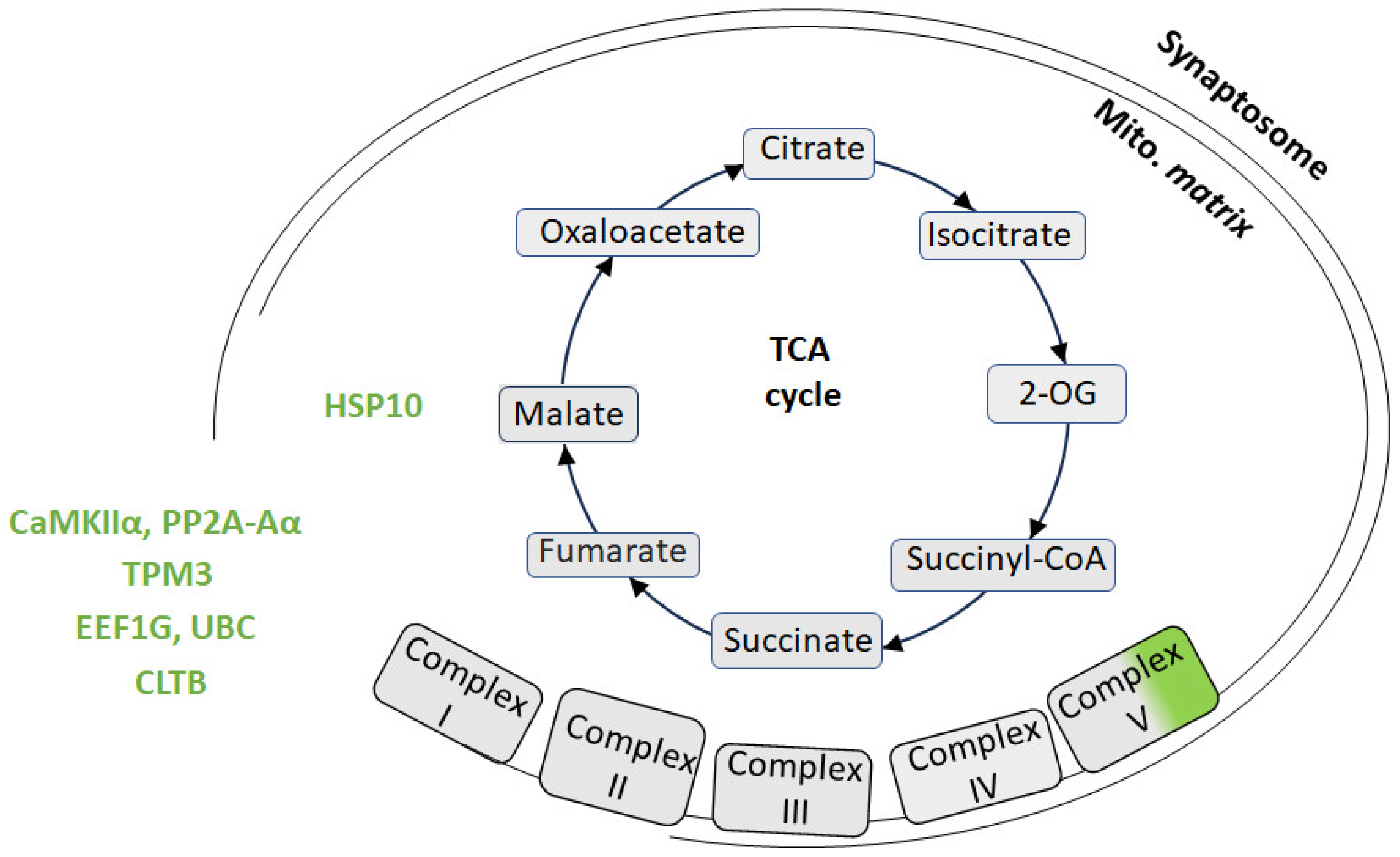
4.1. Adaptive Mitochondrial Responses in Synaptosomes: ATP8 and Chaperone Upregulation
4.2. Modulation of Synaptosome Kinases and Phosphatases
4.3. Cytoskeletal Remodeling in Synaptosomes
4.4. Coordinated Regulation of Synaptic Protein Synthesis and Degradation
4.5. Vesicle Trafficking and Synaptic Vesicle Recycling
5. Conclusions
Supplementary Materials
Funding
Institutional Review Board Statement
Informed Consent Statement
Data Availability Statement
Conflicts of Interest
References
- Jiang, M.; Wang, L.; Sheng, H. Mitochondria in Depression: The Dysfunction of Mitochondrial Energy Metabolism and Quality Control Systems. CNS Neurosci. Ther. 2024, 30, e14576. [Google Scholar] [CrossRef]
- Scifo, E.; Pabba, M.; Kapadia, F.; Ma, T.; Lewis, D.A.; Tseng, G.C.; Sibille, E. Sustained Molecular Pathology Across Episodes and Remission in Major Depressive Disorder. Biol. Psychiatry 2018, 83, 81–89. [Google Scholar] [CrossRef]
- Khan, M.; Baussan, Y.; Hebert-Chatelain, E. Connecting Dots between Mitochondrial Dysfunction and Depression. Biomolecules 2023, 13, 695. [Google Scholar] [CrossRef]
- Chandel, N.S. Mitochondria as Signaling Organelles. BMC Biol. 2014, 12, 34. [Google Scholar] [CrossRef]
- Moretti, A.; Gorini, A.; Villa, R.F. Affective Disorders, Antidepressant Drugs and Brain Metabolism. Mol. Psychiatry 2003, 8, 773–785. [Google Scholar] [CrossRef] [PubMed]
- Vos, M.; Lauwers, E.; Verstreken, P. Synaptic Mitochondria in Synaptic Transmission and Organization of Vesicle Pools in Health and Disease. Front. Synaptic Neurosci. 2010, 2, 139. [Google Scholar] [CrossRef] [PubMed]
- Devine, M.J.; Kittler, J.T. Mitochondria at the Neuronal Presynapse in Health and Disease. Nat. Rev. Neurosci. 2018, 19, 63–80. [Google Scholar] [CrossRef] [PubMed]
- Tobe, E.H. Mitochondrial Dysfunction, Oxidative Stress, and Major Depressive Disorder. Neuropsychiatr. Dis. Treat. 2013, 9, 567–573. [Google Scholar] [CrossRef]
- Chen, F.; Danladi, J.; Ardalan, M.; Elfving, B.; Müller, H.K.; Wegener, G.; Sanchez, C.; Nyengaard, J.R. A Critical Role of Mitochondria in BDNF-Associated Synaptic Plasticity After One-Week Vortioxetine Treatment. Int. J. Neuropsychopharmacol. 2018, 21, 603–615. [Google Scholar] [CrossRef]
- Brunetti, D.; Dykstra, W.; Le, S.; Zink, A.; Prigione, A. Mitochondria in Neurogenesis: Implications for Mitochondrial Diseases. Stem Cells 2021, 39, 1289–1297. [Google Scholar] [CrossRef]
- Guo, W.; Tang, Z.Y.; Cai, Z.Y.; Zhao, W.E.; Yang, J.; Wang, X.P.; Ji, J.; Huang, X.X.; Sun, X.L. Iptakalim Alleviates Synaptic Damages via Targeting Mitochondrial ATP-Sensitive Potassium Channel in Depression. FASEB J. 2021, 35, e21581. [Google Scholar] [CrossRef]
- Grigoryan, G.A.; Pavlova, I.V.; Zaichenko, M.I. Effects of Social Isolation on the Development of Anxiety and Depression-Like Behavior in Model Experiments in Animals. Neurosci. Behav. Physiol. 2022, 52, 722–738. [Google Scholar] [CrossRef] [PubMed]
- Garzón, J.; Del Río, J. Hyperactivity Induced in Rats by Long-Term Isolation: Further Studies on a New Animal Model for the Detection of Antidepressants. Eur. J. Pharmacol. 1981, 74, 287–294. [Google Scholar] [CrossRef]
- Filipović, D.; Todorović, N.; Bernardi, R.E.; Gass, P. Oxidative and Nitrosative Stress Pathways in the Brain of Socially Isolated Adult Male Rats Demonstrating Depressive- and Anxiety-like Symptoms. Brain Struct. Funct. 2017, 222, 1–20. [Google Scholar] [CrossRef]
- Filipović, D.; Novak, B.; Xiao, J.; Yan, Y.; Yeoh, K.; Turck, C.W. Chronic Fluoxetine Treatment of Socially Isolated Rats Modulates Prefrontal Cortex Proteome. Neuroscience 2022, 501, 52–71. [Google Scholar] [CrossRef]
- Perić, I.; Costina, V.; Stanisavljević, A.; Findeisen, P.; Filipović, D. Proteomic Characterization of Hippocampus of Chronically Socially Isolated Rats Treated with Fluoxetine: Depression-like Behaviour and Fluoxetine Mechanism of Action. Neuropharmacology 2018, 135, 268–283. [Google Scholar] [CrossRef] [PubMed]
- Filipović, D.; Costina, V.; Findeisen, P.; Inta, D. Fluoxetine Enhances Synaptic Vesicle Trafficking and Energy Metabolism in the Hippocampus of Socially Isolated Rats. Int. J. Mol. Sci. 2022, 23, 15351. [Google Scholar] [CrossRef]
- Perić, I.; Stanisavljević, A.; Gass, P.; Filipović, D. Fluoxetine Reverses Behavior Changes in Socially Isolated Rats: Role of the Hippocampal GSH-Dependent Defense System and Proinflammatory Cytokines. Eur. Arch. Psychiatry Clin. Neurosci. 2017, 267, 737–749. [Google Scholar] [CrossRef] [PubMed]
- Gong, Y.; Chai, Y.; Ding, J.H.; Sun, X.L.; Hu, G. Chronic Mild Stress Damages Mitochondrial Ultrastructure and Function in Mouse Brain. Neurosci. Lett. 2011, 488, 76–80. [Google Scholar] [CrossRef]
- Lu, S.; Li, C.; Jin, X.; Zhu, L.; Shen, J.; Bai, M.; Li, Y.; Xu, E. Baicalin Improves the Energy Levels in the Prefrontal Cortex of Mice Exposed to Chronic Unpredictable Mild Stress. Heliyon 2022, 8, e12083. [Google Scholar] [CrossRef]
- Shen, J.D.; Zhang, Y.W.; Wang, B.Y.; Bai, L.; Lu, S.F.; Zhu, L.L.; Bai, M.; Li, Y.C.; Xu, E.P. Effects of Resveratrol on the Levels of ATP, 5-HT and GAP-43 in the Hippocampus of Mice Exposed to Chronic Unpredictable Mild Stress. Neurosci. Lett. 2020, 735, 135232. [Google Scholar] [CrossRef]
- Cao, X.; Li, L.P.; Wang, Q.; Wu, Q.; Hu, H.H.; Zhang, M.; Fang, Y.Y.; Zhang, J.; Li, S.J.; Xiong, W.C.; et al. Astrocyte-Derived ATP Modulates Depressive-like Behaviors. Nat. Med. 2013, 19, 773–777. [Google Scholar] [CrossRef]
- Hollis, F.; Van Der Kooij, M.A.; Zanoletti, O.; Lozano, L.; Cantó, C.; Sandi, C. Mitochondrial Function in the Brain Links Anxiety with Social Subordination. Proc. Natl. Acad. Sci. USA 2015, 112, 15486–15491. [Google Scholar] [CrossRef]
- Villa, R.F.; Ferrari, F.; Bagini, L.; Gorini, A.; Brunello, N.; Tascedda, F. Mitochondrial Energy Metabolism of Rat Hippocampus after Treatment with the Antidepressants Desipramine and Fluoxetine. Neuropharmacology 2017, 121, 30–38. [Google Scholar] [CrossRef]
- Saia-Cereda, V.M.; Cassoli, J.S.; Martins-de-Souza, D.; Nascimento, J.M. Psychiatric Disorders Biochemical Pathways Unraveled by Human Brain Proteomics. Eur. Arch. Psychiatry Clin. Neurosci. 2017, 267, 3–17. [Google Scholar] [CrossRef] [PubMed]
- Zinsmaier, K.E.; Babic, M.; Russo, G.J. Mitochondrial Transport Dynamics in Axons and Dendrites. Results Probl. Cell Differ. 2009, 48, 107–139. [Google Scholar] [CrossRef] [PubMed]
- Brown, M.R.; Sullivan, P.G.; Geddes, J.W. Synaptic Mitochondria Are More Susceptible to Ca2+ Overload than Nonsynaptic Mitochondria. J. Biol. Chem. 2006, 281, 11658–11668. [Google Scholar] [CrossRef] [PubMed]
- Kulbe, J.R.; Hill, R.L.; Singh, I.N.; Wang, J.A.; Hall, E.D. Synaptic Mitochondria Sustain More Damage than Non-Synaptic Mitochondria after Traumatic Brain Injury and Are Protected by Cyclosporine A. J. Neurotrauma 2017, 34, 1291–1301. [Google Scholar] [CrossRef] [PubMed]
- Hill, R.L.; Singh, I.N.; Wang, J.A.; Kulbe, J.R.; Hall, E.D. Protective Effects of Phenelzine Administration on Synaptic and Non-Synaptic Cortical Mitochondrial Function and Lipid Peroxidation-Mediated Oxidative Damage Following TBI in Young Adult Male Rats. Exp. Neurol. 2020, 330, 113322. [Google Scholar] [CrossRef] [PubMed]
- Narendra, D.; Tanaka, A.; Suen, D.F.; Youle, R.J. Parkin Is Recruited Selectively to Impaired Mitochondria and Promotes Their Autophagy. J. Cell Biol. 2008, 183, 795–803. [Google Scholar] [CrossRef] [PubMed]
- Duarte, F.V.; Ciampi, D.; Duarte, C.B. Mitochondria as Central Hubs in Synaptic Modulation. Cell. Mol. Life Sci. 2023, 80, 173. [Google Scholar] [CrossRef]
- Pekkurnaz, G.; Wang, X. Mitochondrial Heterogeneity and Homeostasis through the Lens of a Neuron. Nat. Metab. 2022, 4, 802–812. [Google Scholar] [CrossRef]
- Morris, R.L.; Hollenbeck, P.J. The Regulation of Bidirectional Mitochondrial Transport Is Coordinated with Axonal Outgrowth. J. Cell Sci. 1993, 104, 917–927. [Google Scholar] [CrossRef]
- Stauch, K.L.; Purnell, P.R.; Fox, H.S. Quantitative Proteomics of Synaptic and Nonsynaptic Mitochondria: Insights for Synaptic Mitochondrial Vulnerability. J. Proteome Res. 2014, 13, 2620–2636. [Google Scholar] [CrossRef] [PubMed]
- Gulyássy, P.; Puska, G.; Györffy, B.A.; Todorov-Völgyi, K.; Juhász, G.; Drahos, L.; Kékesi, K.A. Proteomic Comparison of Different Synaptosome Preparation Procedures. Amino Acids 2020, 52, 1529–1543. [Google Scholar] [CrossRef] [PubMed]
- Graham, L.C.; Eaton, S.L.; Brunton, P.J.; Atrih, A.; Smith, C.; Lamont, D.J.; Gillingwater, T.H.; Pennetta, G.; Skehel, P.; Wishart, T.M. Proteomic Profiling of Neuronal Mitochondria Reveals Modulators of Synaptic Architecture. Mol. Neurodegener. 2017, 12, 77. [Google Scholar] [CrossRef]
- Faitg, J.; Lacefield, C.; Davey, T.; White, K.; Laws, R.; Kosmidis, S.; Reeve, A.K.; Kandel, E.R.; Vincent, A.E.; Picard, M. 3D Neuronal Mitochondrial Morphology in Axons, Dendrites, and Somata of the Aging Mouse Hippocampus. Cell Rep. 2021, 36, 109509. [Google Scholar] [CrossRef]
- Völgyi, K.; Gulyássy, P.; Háden, K.; Kis, V.; Badics, K.; Kékesi, K.A.; Simor, A.; Györffy, B.; Tóth, E.A.; Lubec, G.; et al. Synaptic Mitochondria: A Brain Mitochondria Cluster with a Specific Proteome. J. Proteom. 2015, 120, 142–157. [Google Scholar] [CrossRef] [PubMed]
- Hill, R.L.; Kulbe, J.R.; Singh, I.N.; Wang, J.A.; Hall, E.D. Synaptic Mitochondria Are More Susceptible to Traumatic Brain Injury-Induced Oxidative Damage and Respiratory Dysfunction than Non-Synaptic Mitochondria. Neuroscience 2018, 386, 265–283. [Google Scholar] [CrossRef]
- Yarana, C.; Sanit, J.; Chattipakorn, N.; Chattipakorn, S. Synaptic and Nonsynaptic Mitochondria Demonstrate a Different Degree of Calcium-Induced Mitochondrial Dysfunction. Life Sci. 2012, 90, 808–814. [Google Scholar] [CrossRef]
- Naga, K.K.; Sullivan, P.G.; Geddes, J.W. High Cyclophilin D Content of Synaptic Mitochondria Results in Increased Vulnerability to Permeability Transition. J. Neurosci. 2007, 27, 7469–7475. [Google Scholar] [CrossRef] [PubMed]
- Lores-Arnaiz, S.; Bustamante, J. Age-Related Alterations in Mitochondrial Physiological Parameters and Nitric Oxide Production in Synaptic and Non-Synaptic Brain Cortex Mitochondria. Neuroscience 2011, 188, 117–124. [Google Scholar] [CrossRef]
- Cicali, K.A.; Torres, A.K.; Tapia-Rojas, C. Synaptic Mitochondria in Aging and Neurodegenerative Diseases: Unraveling Their Functional Decline and Vulnerability. Neural Regen. Res. 2025, 2, 2145–2152. [Google Scholar] [CrossRef]
- Saura, J.; Kettler, R.; Da Prada, M.; Richards, J.G. Quantitative Enzyme Radioautography with 3H-Ro 41-1049 and 3H-Ro 19-6327 in Vitro: Localization and Abundance of MAO-A and MAO-B in Rat CNS, Peripheral Organs, and Human Brain. J. Neurosci. 1992, 12, 1977–1999. [Google Scholar] [CrossRef]
- Shih, J.C.; Chen, K.; Ridd, M.J. Monoamine Oxidase: From Genes to Behavior. Annu. Rev. Neurosci. 1999, 22, 197–217. [Google Scholar] [CrossRef]
- Cesura, A.M.; Pletscher, A. The New Generation of Monoamine Oxidase Inhibitors. Prog. Drug Res. 1992, 38, 171–297. [Google Scholar] [CrossRef]
- Bortolato, M.; Chen, K.; Shih, J.C. Monoamine Oxidase Inactivation: From Pathophysiology to Therapeutics. Adv. Drug Deliv. Rev. 2008, 60, 1527–1533. [Google Scholar] [CrossRef] [PubMed]
- Kaludercic, N.; Mialet-Perez, J.; Paolocci, N.; Parini, A.; Di Lisa, F. Monoamine Oxidases as Sources of Oxidants in the Heart. J. Mol. Cell. Cardiol. 2014, 73, 34–42. [Google Scholar] [CrossRef] [PubMed]
- Glover, V.; Sandler, M.; Owen, F.; Riley, G.J. Dopamine Is a Monoamine Oxidase B Substrate in Man. Nature 1977, 265, 80–81. [Google Scholar] [CrossRef]
- Graves, S.M.; Xie, Z.; Stout, K.A.; Zampese, E.; Burbulla, L.F.; Shih, J.C.; Kondapalli, J.; Patriarchi, T.; Tian, L.; Brichta, L.; et al. Dopamine Metabolism by a Monoamine Oxidase Mitochondrial Shuttle Activates the Electron Transport Chain. Nat. Neurosci. 2019, 23, 15–20, Erratum in Nat. Neurosci. 2020, 23, 293. [Google Scholar] [CrossRef]
- Kristian, T. Isolation of Mitochondria from the CNS. Curr. Protoc. Neurosci. 2010, 52, 7–22. [Google Scholar] [CrossRef]
- Arnone, D.; McIntosh, A.M.; Ebmeier, K.P.; Munafò, M.R.; Anderson, I.M. Magnetic Resonance Imaging Studies in Unipolar Depression: Systematic Review and Meta-Regression Analyses. Eur. Neuropsychopharmacol. 2012, 22, 1–16. [Google Scholar] [CrossRef]
- McEwen, B.S.; Nasca, C.; Gray, J.D. Stress Effects on Neuronal Structure: Hippocampus, Amygdala, and Prefrontal Cortex. Neuropsychopharmacology 2016, 41, 3–23. [Google Scholar] [CrossRef]
- LeGates, T.A.; Kvarta, M.D.; Tooley, J.R.; Francis, T.C.; Lobo, M.K.; Creed, M.C.; Thompson, S.M. Reward Behavior Is Regulated by the Strength of Hippocampus-Nucleus Accumbens Synapses. Nature 2018, 564, 258–262. [Google Scholar] [CrossRef]
- Immordino-Yang, M.H.; Singh, V. Hippocampal Contributions to the Processing of Social Emotions. Hum. Brain Mapp. 2011, 34, 945–955. [Google Scholar] [CrossRef] [PubMed]
- McEwen, B.S.; Eiland, L.; Hunter, R.G.; Miller, M.M. Stress and Anxiety: Structural Plasticity and Epigenetic Regulation as a Consequence of Stress. Neuropharmacology 2012, 62, 3–12. [Google Scholar] [CrossRef] [PubMed]
- Pittenger, C.; Duman, R.S. Stress, Depression, and Neuroplasticity: A Convergence of Mechanisms. Neuropsychopharmacology 2008, 33, 88–109. [Google Scholar] [CrossRef]
- Curtiss, J.; Klemanski, D.H. Taxonicity and Network Structure of Generalized Anxiety Disorder and Major Depressive Disorder: An Admixture Analysis and Complex Network Analysis. J. Affect. Disord. 2016, 199, 99–105, Erratum in J. Affect. Disord. 2019, 242, 172. [Google Scholar] [CrossRef] [PubMed]
- Klinedinst, N.J.; Regenold, W.T. A Mitochondrial Bioenergetic Basis of Depression. J. Bioenerg. Biomembr. 2015, 47, 155–171. [Google Scholar] [CrossRef]
- Patel, M.S.; Nemeria, N.S.; Furey, W.; Jordan, F. The Pyruvate Dehydrogenase Complexes: Structure-Based Function and Regulation. J. Biol. Chem. 2014, 289, 16615–16623. [Google Scholar] [CrossRef]
- Allen, J.; Romay-Tallon, R.; Brymer, K.J.; Caruncho, H.J.; Kalynchuk, L.E. Mitochondria and Mood: Mitochondrial Dysfunction as a Key Player in the Manifestation of Depression. Front. Neurosci. 2018, 12, 386. [Google Scholar] [CrossRef]
- Giménez-Palomo, A.; Dodd, S.; Anmella, G.; Carvalho, A.F.; Scaini, G.; Quevedo, J.; Pacchiarotti, I.; Vieta, E.; Berk, M. The Role of Mitochondria in Mood Disorders: From Physiology to Pathophysiology and to Treatment. Front. Psychiatry 2021, 12, 546801. [Google Scholar] [CrossRef]
- Nemeria, N.S.; Zhang, X.; Jordan, F.; Leandro, J.; Zhou, J.; Yang, L.; Houten, S.M. Toward an Understanding of the Structural and Mechanistic Aspects of Protein-Protein Interactions in 2-Oxoacid Dehydrogenase Complexes. Life 2021, 11, 407. [Google Scholar] [CrossRef]
- Araújo, W.L.; Martins, A.O.; Fernie, A.R.; Tohge, T. 2-Oxoglutarate: Linking TCA Cycle Function with Amino Acid, Glucosinolate, Flavonoid, Alkaloid, and Gibberellin Biosynthesis. Front. Plant Sci. 2014, 5, 552. [Google Scholar] [CrossRef] [PubMed]
- Głombik, K.; Stachowicz, A.; Trojan, E.; Ślusarczyk, J.; Suski, M.; Chamera, K.; Kotarska, K.; Olszanecki, R.; Basta-Kaim, A. Mitochondrial Proteomics Investigation of Frontal Cortex in an Animal Model of Depression: Focus on Chronic Antidepressant Drugs Treatment. Pharmacol. Rep. 2018, 70, 322–330. [Google Scholar] [CrossRef]
- Filipović, D.; Perić, I.; Costina, V.; Stanisavljević, A.; Gass, P.; Findeisen, P. Social Isolation Stress-Resilient Rats Reveal Energy Shift from Glycolysis to Oxidative Phosphorylation in Hippocampal Nonsynaptic Mitochondria. Life Sci. 2020, 254, 117790. [Google Scholar] [CrossRef] [PubMed]
- Filipović, D.; Turck, C.W. Proteomic Signatures of Hippocampal Nonsynaptic and Synaptosome-Enriched Mitochondria in Rats Resilient to Chronic Social Isolation. Biomolecules 2025, 15, 1358. [Google Scholar] [CrossRef] [PubMed]
- Filipović, D.; Costina, V.; Perić, I.; Stanisavljević, A.; Findeisen, P. Chronic Fluoxetine Treatment Directs Energy Metabolism towards the Citric Acid Cycle and Oxidative Phosphorylation in Rat Hippocampal Nonsynaptic Mitochondria. Brain Res. 2017, 1659, 41–54. [Google Scholar] [CrossRef]
- Tang, M.; Huang, H.; Li, S.; Zhou, M.; Liu, Z.; Huang, R.; Liao, W.; Xie, P.; Zhou, J. Hippocampal Proteomic Changes of Susceptibility and Resilience to Depression or Anxiety in a Rat Model of Chronic Mild Stress. Transl. Psychiatry 2019, 9, 260. [Google Scholar] [CrossRef]
- Ji, G.; Chang, H.; Yang, M.; Chen, H.; Wang, T.; Liu, X.; Lv, K.; Li, Y.; Song, B.; Qu, L. The Mitochondrial Proteomic Changes of Rat Hippocampus Induced by 28-Day Simulated Microgravity. PLoS ONE 2022, 17, e0265108. [Google Scholar] [CrossRef]
- Shao, W.H.; Chen, J.J.; Fan, S.H.; Lei, Y.; Xu, H.B.; Zhou, J.; Cheng, P.F.; Yang, Y.T.; Rao, C.L.; Wu, B.; et al. Combined Metabolomics and Proteomics Analysis of Major Depression in an Animal Model: Perturbed Energy Metabolism in the Chronic Mild Stressed Rat Cerebellum. OMICS 2015, 19, 383–392. [Google Scholar] [CrossRef]
- Artiukhov, A.V.; Graf, A.V.; Kazantsev, A.V.; Boyko, A.I.; Aleshin, V.A.; Ksenofontov, A.L.; Bunik, V.I. Increasing Inhibition of the Rat Brain 2-Oxoglutarate Dehydrogenase Decreases Glutathione Redox State, Elevating Anxiety and Perturbing Stress Adaptation. Pharmaceuticals 2022, 15, 182. [Google Scholar] [CrossRef]
- Lazzarino, G.; Amorini, A.M.; Signoretti, S.; Musumeci, G.; Lazzarino, G.; Caruso, G.; Pastore, F.S.; Di Pietro, V.; Tavazzi, B.; Belli, A. Pyruvate Dehydrogenase and Tricarboxylic Acid Cycle Enzymes Are Sensitive Targets of Traumatic Brain Injury Induced Metabolic Derangement. Int. J. Mol. Sci. 2019, 20, 5774. [Google Scholar] [CrossRef]
- Perić, I.; Costina, V.; Gass, P.; Findeisen, P.; Filipović, D. Hippocampal Synaptoproteomic Changes of Susceptibility and Resilience of Male Rats to Chronic Social Isolation. Brain Res. Bull. 2021, 166, 128–141. [Google Scholar] [CrossRef]
- Shi, Q.; Gibson, G.E. Up-Regulation of the Mitochondrial Malate Dehydrogenase by Oxidative Stress Is Mediated by MiR-743a. J. Neurochem. 2011, 118, 440–448. [Google Scholar] [CrossRef]
- Büttiker, P.; Weissenberger, S.; Esch, T.; Anders, M.; Raboch, J.; Ptacek, R.; Kream, R.M.; Stefano, G.B. Dysfunctional Mitochondrial Processes Contribute to Energy Perturbations in the Brain and Neuropsychiatric Symptoms. Front. Pharmacol. 2023, 13, 1095923. [Google Scholar] [CrossRef]
- Sharma, L.K.; Lu, J.; Bai, Y. Mitochondrial Respiratory Complex I: Structure, Function and Implication in Human Diseases. Curr. Med. Chem. 2009, 16, 1266–1277. [Google Scholar] [CrossRef]
- Emmerzaal, T.L.; Preston, G.; Geenen, B.; Verweij, V.; Wiesmann, M.; Vasileiou, E.; Grüter, F.; de Groot, C.; Schoorl, J.; de Veer, R.; et al. Impaired Mitochondrial Complex I Function as a Candidate Driver in the Biological Stress Response and a Concomitant Stress-Induced Brain Metabolic Reprogramming in Male Mice. Transl. Psychiatry 2020, 10, 176. [Google Scholar] [CrossRef] [PubMed]
- Ben-Shachar, D.; Karry, R. Neuroanatomical Pattern of Mitochondrial Complex I Pathology Varies between Schizophrenia, Bipolar Disorder and Major Depression. PLoS ONE 2008, 3, e3676. [Google Scholar] [CrossRef] [PubMed]
- Holper, L.; Ben-Shachar, D.; Mann, J. Multivariate Meta-Analyses of Mitochondrial Complex I and IV in Major Depressive Disorder, Bipolar Disorder, Schizophrenia, Alzheimer Disease, and Parkinson Disease. Neuropsychopharmacology 2019, 44, 837–849. [Google Scholar] [CrossRef] [PubMed]
- Lenaz, G.; Genova, M.L. Structure and Organization of Mitochondrial Respiratory Complexes: A New Understanding of an Old Subject. Antioxid. Redox Signal. 2010, 12, 961–1008. [Google Scholar] [CrossRef] [PubMed]
- Tabassum, N.; Kheya, I.; Ibn Asaduzzaman, S.; Maniha, S.; Fayz, A.; Zakaria, A.; Fayz, A.; Zakaria, A.; Noor, R. A Review on the Possible Leakage of Electrons through the Electron Transport Chain within Mitochondria. J. Biomed. Res. Environ. Sci. 2020, 1, 105–113. [Google Scholar] [CrossRef]
- Goetzl, E.J.; Wolkowitz, O.M.; Srihari, V.H.; Reus, V.I.; Goetzl, L.; Kapogiannis, D.; Heninger, G.R.; Mellon, S.H. Abnormal Levels of Mitochondrial Proteins in Plasma Neuronal Extracellular Vesicles in Major Depressive Disorder. Mol. Psychiatry 2021, 26, 7355–7362. [Google Scholar] [CrossRef]
- Bourens, M.; Boulet, A.; Leary, S.C.; Barrientos, A. Human COX20 Cooperates with SCO1 and SCO2 to Mature COX2 and Promote the Assembly of Cytochrome c Oxidase. Hum. Mol. Genet. 2014, 23, 2901–2913. [Google Scholar] [CrossRef] [PubMed]
- Leary, S.C.; Kaufman, B.A.; Pellecchia, G.; Guercin, G.H.; Mattman, A.; Jaksch, M.; Shoubridge, E.A. Human SCO1 and SCO2 Have Independent, Cooperative Functions in Copper Delivery to Cytochrome c Oxidase. Hum. Mol. Genet. 2004, 13, 1839–1848. [Google Scholar] [CrossRef] [PubMed]
- Mick, D.U.; Fox, T.D.; Rehling, P. Inventory Control: Cytochrome c Oxidase Assembly Regulates Mitochondrial Translation. Nat. Rev. Mol. Cell Biol. 2010, 12, 14–20. [Google Scholar] [CrossRef]
- Bourens, M.; Barrientos, A. Human Mitochondrial Cytochrome c Oxidase Assembly Factor COX18 Acts Transiently as a Membrane Insertase within the Subunit 2 Maturation Module. J. Biol. Chem. 2017, 292, 7774–7783. [Google Scholar] [CrossRef]
- Picard, M.; McEwen, B.S. Psychological Stress and Mitochondria: A Conceptual Framework. Psychosom. Med. 2018, 80, 126–140. [Google Scholar] [CrossRef]
- Qaisiya, M.; Moretto, E.; Battocchio, E.; Pistella, A.; Caso, M.G.; Bellani, M.; Guarnieri, F.C. Social Isolation: An Integrated Molecular Web That Disrupts Cellular Homeostasis. Front. Neurosci. 2025, 19, 1693696. [Google Scholar] [CrossRef]
- Möller, M.; Du Preez, J.L.; Viljoen, F.P.; Berk, M.; Emsley, R.; Harvey, B.H. Social Isolation Rearing Induces Mitochondrial, Immunological, Neurochemical and Behavioural Deficits in Rats, and Is Reversed by Clozapine or N-Acetyl Cysteine. Brain Behav. Immun. 2013, 30, 156–167. [Google Scholar] [CrossRef]
- Silva, J.; Shao, A.S.; Shen, Y.; Davies, D.L.; Olsen, R.W.; Holschneider, D.P.; Shao, X.M.; Liang, J. Modulation of Hippocampal GABAergic Neurotransmission and Gephyrin Levels by Dihydromyricetin Improves Anxiety. Front. Pharmacol. 2020, 11, 1008. [Google Scholar] [CrossRef]
- Schlattner, U.; Tokarska-Schlattner, M.; Wallimann, T. Mitochondrial Creatine Kinase in Human Health and Disease. Biochim. Biophys. Acta 2006, 1762, 164–180. [Google Scholar] [CrossRef]
- Ravichandran, K.; Kisku, P.; Ningchangmi, L.; Palanisamy, P.; Strack, S.; Abel, T.; Banerjee, S. Long Non-Coding RNA Cerox1 Targets Components of the Mitochondrial Electron Transport Chain to Regulate the Memory Impairment Caused by Sleep Deprivation. bioRxiv 2025. bioRxiv:2025.09.15.676326. [Google Scholar] [CrossRef]
- Adav, S.S.; Park, J.E.; Sze, S.K. Quantitative Profiling Brain Proteomes Revealed Mitochondrial Dysfunction in Alzheimer’s Disease. Mol. Brain 2019, 12, 8. [Google Scholar] [CrossRef] [PubMed]
- Martins-De-Souza, D.; Guest, P.C.; Harris, L.W.; Vanattou-Saifoudine, N.; Webster, M.J.; Rahmoune, H.; Bahn, S. Identification of Proteomic Signatures Associated with Depression and Psychotic Depression in Post-Mortem Brains from Major Depression Patients. Transl. Psychiatry 2012, 2, e87. [Google Scholar] [CrossRef]
- Haghighatfard, A.; Andalib, S.; Amini Faskhodi, M.; Sadeghi, S.; Ghaderi, A.H.; Moradkhani, S.; Rostampour, J.; Tabrizi, Z.; Mahmoodi, A.; Karimi, T.; et al. Gene Expression Study of Mitochondrial Complex I in Schizophrenia and Paranoid Personality Disorder. World J. Biol. Psychiatry 2018, 19, S133–S146. [Google Scholar] [CrossRef]
- Xie, H.; Huang, H.; Tang, M.; Wu, Y.; Huang, R.; Liu, Z.; Zhou, M.; Liao, W.; Zhou, J. ITRAQ-Based Quantitative Proteomics Suggests Synaptic Mitochondrial Dysfunction in the Hippocampus of Rats Susceptible to Chronic Mild Stress. Neurochem. Res. 2018, 43, 2372–2383. [Google Scholar] [CrossRef] [PubMed]
- Taurino, F.; Stanca, E.; Siculella, L.; Trentadue, R.; Papa, S.; Zanotti, F.; Gnoni, A. Mitochondrial Proteome Analysis Reveals Depression of the Ndufs3 Subunit and Activity of Complex I in Diabetic Rat Brain. J. Proteom. 2012, 75, 2331–2341. [Google Scholar] [CrossRef] [PubMed]
- Filiou, M.D.; Zhang, Y.; Teplytska, L.; Reckow, S.; Gormanns, P.; MacCarrone, G.; Frank, E.; Kessler, M.S.; Hambsch, B.; Nussbaumer, M.; et al. Proteomics and Metabolomics Analysis of a Trait Anxiety Mouse Model Reveals Divergent Mitochondrial Pathways. Biol. Psychiatry 2011, 70, 1074–1082. [Google Scholar] [CrossRef]
- Watanabe, S.; Al Omran, A.J.; Shao, A.S.; Zhang, Z.; Xue, C.; Zhang, J.; Watanabe, J.; Liang, J. Social Isolation Induces Succinate Dehydrogenase Dysfunction in Anxious Mice. Neurochem. Int. 2022, 161, 105434. [Google Scholar] [CrossRef]
- Gąsior, Ł.; Pochwat, B.; Zaręba-Kozioł, M.; Włodarczyk, J.; Grabrucker, A.M.; Szewczyk, B. Proteomics Analysis in Rats Reveals Convergent Mechanisms between Major Depressive Disorder and Dietary Zinc Deficiency. Pharmacol. Rep. 2025, 77, 145–157. [Google Scholar] [CrossRef]
- Henningsen, K.; Palmfeldt, J.; Christiansen, S.; Baiges, I.; Bak, S.; Jensen, O.N.; Gregersen, N.; Wiborg, O. Candidate Hippocampal Biomarkers of Susceptibility and Resilience to Stress in a Rat Model of Depression. Mol. Cell. Proteom. 2012, 11, M111.016428-1. [Google Scholar] [CrossRef]
- Koopmans, F.; Dijkstra, A.A.; Li, W.P.; Klaassen, R.V.; Gouwenberg, Y.; Yao, S.; Bast, L.; Verhage, M.; Karlsson, R.; Dwork, A.J.; et al. Human Brain Prefrontal Cortex Proteomics Identifies Compromised Energy Metabolism and Neuronal Function in Schizophrenia. Nat. Commun. 2026, 17, 2131. [Google Scholar] [CrossRef]
- Yang, S.; Wu, P.; Xiao, J.; Jiang, L. Overexpression of COX6B1 Protects against I/R-induced Neuronal Injury in Rat Hippocampal Neurons. Mol. Med. Rep. 2019, 19, 4852–4862. [Google Scholar] [CrossRef]
- Al Omran, A.J.; Watanabe, S.; Hong, E.C.; Skinner, S.G.; Zhang, M.; Zhang, J.; Shao, X.M.; Liang, J. Dihydromyricetin Ameliorates Social Isolation-Induced Anxiety by Modulating Mitochondrial Function, Antioxidant Enzymes, and BDNF. Neurobiol. Stress 2022, 21, 100499. [Google Scholar] [CrossRef] [PubMed]
- Filipović, D.; Novak, B.; Xiao, J.; Tadić, P.; Turck, C.W. Prefrontal Cortical Synaptoproteome Profile Combined with Machine Learning Predicts Resilience towards Chronic Social Isolation in Rats. J. Psychiatr. Res. 2024, 172, 221–228. [Google Scholar] [CrossRef] [PubMed]
- Backes, S.; Bykov, Y.S.; Flohr, T.; Räschle, M.; Zhou, J.; Lenhard, S.; Krämer, L.; Mühlhaus, T.; Bibi, C.; Jann, C.; et al. The Chaperone-Binding Activity of the Mitochondrial Surface Receptor Tom70 Protects the Cytosol against Mitoprotein-Induced Stress. Cell Rep. 2021, 35, 108936. [Google Scholar] [CrossRef] [PubMed]
- Camara, A.K.S.; Zhou, Y.F.; Wen, P.C.; Tajkhorshid, E.; Kwok, W.M. Mitochondrial VDAC1: A Key Gatekeeper as Potential Therapeutic Target. Front. Physiol. 2017, 8, 460. [Google Scholar] [CrossRef]
- Bround, M.J.; Bers, D.M.; Molkentin, J.D. A 20/20 View of ANT Function in Mitochondrial Biology and Necrotic Cell Death. J. Mol. Cell. Cardiol. 2020, 144, A3–A13. [Google Scholar] [CrossRef]
- Baghel, M.S.; Thakur, M.K. Vdac1 Downregulation Causes Mitochondrial Disintegration Leading to Hippocampal Neurodegeneration in Scopolamine-Induced Amnesic Mice. Mol. Neurobiol. 2019, 56, 1707–1718. [Google Scholar] [CrossRef]
- Monné, M.; Palmieri, F. Antiporters of the Mitochondrial Carrier Family. Curr. Top. Membr. 2014, 73, 289–320. [Google Scholar] [CrossRef]
- Kory, N.; Wyant, G.A.; Prakash, G.; uit De Bos, J.; Bottanelli, F.; Pacold, M.E.; Chan, S.H.; Lewis, C.A.; Wang, T.; Keys, H.R.; et al. SFXN1 Is a Mitochondrial Serine Transporter Required for One-Carbon Metabolism. Science 2018, 362, eaat9528. [Google Scholar] [CrossRef]
- Amorim, I.S.; Graham, L.C.; Carter, R.N.; Morton, N.M.; Hammachi, F.; Kunath, T.; Pennetta, G.; Carpanini, S.M.; Manson, J.C.; Lamont, D.J.; et al. Sideroflexin 3 Is an α-Synuclein-Dependent Mitochondrial Protein That Regulates Synaptic Morphology. J. Cell Sci. 2017, 130, 325–331. [Google Scholar] [CrossRef]
- Zhang, J.R.; Shen, S.Y.; Zhai, M.Y.; Shen, Z.Q.; Li, W.; Liang, L.F.; Yin, S.Y.; Han, Q.Q.; Li, B.; Zhang, Y.Q.; et al. Augmented Microglial Endoplasmic Reticulum-Mitochondria Contacts Mediate Depression-like Behavior in Mice Induced by Chronic Social Defeat Stress. Nat. Commun. 2024, 15, 5199. [Google Scholar] [CrossRef]
- Datta, A.; Akatsu, H.; Heese, K.; Sze, S.K. Quantitative Clinical Proteomic Study of Autopsied Human Infarcted Brain Specimens to Elucidate the Deregulated Pathways in Ischemic Stroke Pathology. J. Proteom. 2013, 91, 556–568. [Google Scholar] [CrossRef]
- Nussbaumer, M.; Asara, J.M.; Teplytska, L.; Murphy, M.P.; Logan, A.; Turck, C.W.; Filiou, M.D. Selective Mitochondrial Targeting Exerts Anxiolytic Effects In Vivo. Neuropsychopharmacology 2016, 41, 1751–1758. [Google Scholar] [CrossRef] [PubMed]
- Minjarez, B.; Calderón-González, K.G.; Rustarazo, M.L.V.; Herrera-Aguirre, M.E.; Labra-Barrios, M.L.; Rincon-Limas, D.E.; del Pino, M.M.S.; Mena, R.; Luna-Arias, J.P. Identification of Proteins That Are Differentially Expressed in Brains with Alzheimer’s Disease Using ITRAQ Labeling and Tandem Mass Spectrometry. J. Proteom. 2016, 139, 103–121. [Google Scholar] [CrossRef]
- Ledahawsky, L.M.; Terzenidou, M.E.; Edwards, R.; Kline, R.A.; Graham, L.C.; Eaton, S.L.; van der Hoorn, D.; Chaytow, H.; Huang, Y.T.; Groen, E.J.N.; et al. The Mitochondrial Protein Sideroflexin 3 (SFXN3) Influences Neurodegeneration Pathways In Vivo. FEBS J. 2022, 289, 3894–3914. [Google Scholar] [CrossRef] [PubMed]
- Singh, M.K.; Shin, Y.; Han, S.; Ha, J.; Tiwari, P.K.; Kim, S.S.; Kang, I. Molecular Chaperonin HSP60: Current Understanding and Future Prospects. Int. J. Mol. Sci. 2024, 25, 5483. [Google Scholar] [CrossRef] [PubMed]
- Margineantu, D.H.; Emerson, C.B.; Diaz, D.; Hockenbery, D.M. Hsp90 Inhibition Decreases Mitochondrial Protein Turnover. PLoS ONE 2007, 2, e1066. [Google Scholar] [CrossRef]
- Bross, P.; Magnoni, R.; Sigaard Bie, A. Molecular Chaperone Disorders: Defective Hsp60 in Neurodegeneration. Curr. Top. Med. Chem. 2012, 12, 2491–2503. [Google Scholar] [CrossRef]
- Osman, C.; Merkwirth, C.; Langer, T. Prohibitins and the Functional Compartmentalization of Mitochondrial Membranes. J. Cell Sci. 2009, 122, 3823–3830. [Google Scholar] [CrossRef]
- Merkwirth, C.; Martinelli, P.; Korwitz, A.; Morbin, M.; Brönneke, H.S.; Jordan, S.D.; Rugarli, E.I.; Langer, T. Loss of Prohibitin Membrane Scaffolds Impairs Mitochondrial Architecture and Leads to Tau Hyperphosphorylation and Neurodegeneration. PLoS Genet. 2012, 8, e1003021. [Google Scholar] [CrossRef]
- Hashikawa, N.; Utaka, Y.; Ogawa, T.; Tanoue, R.; Morita, Y.; Yamamoto, S.; Yamaguchi, S.; Kayano, M.; Zamami, Y.; Hashikawa-Hobara, N. HSP105 Prevents Depression-like Behavior by Increasing Hippocampal Brain-Derived Neurotrophic Factor Levels in Mice. Sci. Adv. 2017, 3, e1603014. [Google Scholar] [CrossRef]
- Bielawski, A.; Zelek-Molik, A.; Rafa-Zabłocka, K.; Kowalska, M.; Gruca, P.; Papp, M.; Nalepa, I. Elevated Expression of HSP72 in the Prefrontal Cortex and Hippocampus of Rats Subjected to Chronic Mild Stress and Treated with Imipramine. Int. J. Mol. Sci. 2023, 25, 243. [Google Scholar] [CrossRef]
- Zhu, W.; Chang, J.; Tian, L.; Yang, X.; Li, W. Depletion of HSP60 in Microglia Leads to Synaptic Dysfunction and Depression-Like Behaviors Through Enhanced Synaptic Pruning in Male Mice. CNS Neurosci. Ther. 2025, 31, e70394. [Google Scholar] [CrossRef]
- Cömert, C.; Kjær-Sørensen, K.; Hansen, J.; Carlsen, J.; Just, J.; Meaney, B.F.; Østergaard, E.; Luo, Y.; Oxvig, C.; Schmidt-Laursen, L.; et al. HSP60 Chaperone Deficiency Disrupts the Mitochondrial Matrix Proteome and Dysregulates Cholesterol Synthesis. Mol. Metab. 2024, 88, 102009. [Google Scholar] [CrossRef] [PubMed]
- Kozjak-Pavlovic, V. The MICOS Complex of Human Mitochondria. Cell Tissue Res. 2017, 367, 83–93. [Google Scholar] [CrossRef]
- Christian, B.E.; Spremulli, L.L. Mechanism of Protein Biosynthesis in Mammalian Mitochondria. Biochim. Biophys. Acta 2011, 1819, 1035–1054. [Google Scholar] [CrossRef] [PubMed]
- Uzbekov, M.G. Monoamine Oxidase as a Potential Biomarker of the Efficacy of Treatment of Mental Disorders. Biochemistry 2021, 86, 773–783. [Google Scholar] [CrossRef] [PubMed]
- Filipenko, M.L.; Beilina, A.G.; Alekseyenko, O.V.; Dolgov, V.V.; Kudryavtseva, N.N. Increase in Expression of Brain Serotonin Transporter and Monoamine Oxidase a Genes Induced by Repeated Experience of Social Defeats in Male Mice. Biochemistry 2002, 67, 451–455. [Google Scholar] [CrossRef]
- Higuchi, Y.; Soga, T.; Parhar, I.S. Social Defeat Stress Decreases MRNA for Monoamine Oxidase A and Increases 5-HT Turnover in the Brain of Male Nile Tilapia (Oreochromis Niloticus). Front. Pharmacol. 2019, 9, 1549. [Google Scholar] [CrossRef] [PubMed]
- Hu, Y.; Zhou, J.; Fang, L.; Liu, H.; Zhan, Q.; Luo, D.; Zhou, C.; Chen, J.; Li, Q.; Xie, P. Hippocampal Synaptic Dysregulation of Exo/Endocytosis-Associated Proteins Induced in a Chronic Mild-Stressed Rat Model. Neuroscience 2013, 230, 1–12. [Google Scholar] [CrossRef] [PubMed]
- Harris, J.J.; Jolivet, R.; Attwell, D. Synaptic Energy Use and Supply. Neuron 2012, 75, 762–777. [Google Scholar] [CrossRef]
- Levy-Rimler, G.; Viitanen, P.; Weiss, C.; Sharkia, R.; Greenberg, A.; Niv, A.; Lustig, A.; Delarea, Y.; Azem, A. The Effect of Nucleotides and Mitochondrial Chaperonin 10 on the Structure and Chaperone Activity of Mitochondrial Chaperonin 60. Eur. J. Biochem. 2001, 268, 3465–3472. [Google Scholar] [CrossRef]
- Campos, J.C.; Bozi, L.H.M.; Bechara, L.R.G.; Lima, V.M.; Ferreira, J.C.B. Mitochondrial Quality Control in Cardiac Diseases. Front. Physiol. 2016, 7, 479. [Google Scholar] [CrossRef]
- Pellegrino, M.W.; Nargund, A.M.; Haynes, C.M. Signaling the Mitochondrial Unfolded Protein Response. Biochim. Biophys. Acta 2013, 1833, 410–416. [Google Scholar] [CrossRef]
- An, H.; Zhou, B.; Hayakawa, K.; Durán Laforet, V.; Park, J.H.; Nakamura, Y.; Mandeville, E.T.; Liu, N.; Guo, S.; Yu, Z.; et al. ATF5-Mediated Mitochondrial Unfolded Protein Response (UPRmt) Protects Neurons Against Oxygen-Glucose Deprivation and Cerebral Ischemia. Stroke 2024, 55, 1904–1913. [Google Scholar] [CrossRef]
- Cooper, J.F.; Machiela, E.; Dues, D.J.; Spielbauer, K.K.; Senchuk, M.M.; Van Raamsdonk, J.M. Activation of the Mitochondrial Unfolded Protein Response Promotes Longevity and Dopamine Neuron Survival in Parkinson’s Disease Models. Sci. Rep. 2017, 7, 16441. [Google Scholar] [CrossRef]
- Picard, M.; McEwen, B.S. Mitochondria Impact Brain Function and Cognition. Proc. Natl. Acad. Sci. USA 2014, 111, 7–8. [Google Scholar] [CrossRef] [PubMed]
- Szegő, É.M.; Dominguez-Meijide, A.; Gerhardt, E.; König, A.; Koss, D.J.; Li, W.; Pinho, R.; Fahlbusch, C.; Johnson, M.; Santos, P.; et al. Cytosolic Trapping of a Mitochondrial Heat Shock Protein Is an Early Pathological Event in Synucleinopathies. Cell Rep. 2019, 28, 65–77.e6. [Google Scholar] [CrossRef]
- Mucic, G.; Sase, S.; Stork, O.; Lubec, G.; Li, L. Networks of Protein Kinases and Phosphatases in the Individual Phases of Contextual Fear Conditioning in the C57BL/6J Mouse. Behav. Brain Res. 2015, 280, 45–50. [Google Scholar] [CrossRef]
- Lisman, J.; Schulman, H.; Cline, H. The Molecular Basis of CaMKII Function in Synaptic and Behavioural Memory. Nat. Rev. Neurosci. 2002, 3, 175–190. [Google Scholar] [CrossRef]
- Gateva, G.; Kremneva, E.; Reindl, T.; Kotila, T.; Kogan, K.; Gressin, L.; Gunning, P.W.; Manstein, D.J.; Michelot, A.; Lappalainen, P. Tropomyosin Isoforms Specify Functionally Distinct Actin Filament Populations In Vitro. Curr. Biol. 2017, 27, 705–713. [Google Scholar] [CrossRef] [PubMed]
- Bryce, N.S.; Schevzov, G.; Ferguson, V.; Percival, J.M.; Lin, J.J.C.; Matsumura, F.; Bamburg, J.R.; Jeffrey, P.L.; Hardeman, E.C.; Gunning, P.; et al. Specification of Actin Filament Function and Molecular Composition by Tropomyosin Isoforms. Moll. Biol. Cell 2002, 14, 1002–1016. [Google Scholar] [CrossRef] [PubMed]
- Qiao, H.; Li, M.X.; Xu, C.; Chen, H.B.; An, S.C.; Ma, X.M. Dendritic Spines in Depression: What We Learned from Animal Models. Neural Plast. 2016, 2016, 8056370. [Google Scholar] [CrossRef]
- Cao, Y.; Portela, M.; Janikiewicz, J.; Doig, J.; Abbott, C.M. Characterisation of Translation Elongation Factor EEF1B Subunit Expression in Mammalian Cells and Tissues and Co-Localisation with EEF1A2. PLoS ONE 2014, 9, e114117. [Google Scholar] [CrossRef]
- Hafner, A.S.; Donlin-Asp, P.G.; Leitch, B.; Herzog, E.; Schuman, E.M. Local Protein Synthesis Is a Ubiquitous Feature of Neuronal Pre- and Postsynaptic Compartments. Science 2019, 364, eaau3644. [Google Scholar] [CrossRef]
- Mallei, A.; Failler, M.; Corna, S.; Racagni, G.; Mathé, A.A.; Popoli, M. Synaptoproteomic Analysis of a Rat Gene-Environment Model of Depression Reveals Involvement of Energy Metabolism and Cellular Remodeling Pathways. Int. J. Neuropsychopharmacol. 2015, 18, pyu067. [Google Scholar] [CrossRef]
- Patrick, M.B.; Omar, N.; Werner, C.T.; Mitra, S.; Jarome, T.J. The Ubiquitin-Proteasome System and Learning-Dependent Synaptic Plasticity—A 10 Year Update. Neurosci. Biobehav. Rev. 2023, 152, 105280. [Google Scholar] [CrossRef] [PubMed]
- Fonseca, R.; Vabulas, R.M.; Hartl, F.U.; Bonhoeffer, T.; Nägerl, U.V. A Balance of Protein Synthesis and Proteasome-Dependent Degradation Determines the Maintenance of LTP. Neuron 2006, 52, 239–245. [Google Scholar] [CrossRef]
- Hetz, C. Adapting the Proteostasis Capacity to Sustain Brain Healthspan. Cell 2021, 184, 1545–1560. [Google Scholar] [CrossRef] [PubMed]
- Milosevic, I. Revisiting the Role of Clathrin-Mediated Endoytosis in Synaptic Vesicle Recycling. Front. Cell. Neurosci. 2018, 12, 27. [Google Scholar] [CrossRef] [PubMed]
- Granseth, B.; Odermatt, B.; Royle, S.J.J.; Lagnado, L. Clathrin-Mediated Endocytosis Is the Dominant Mechanism of Vesicle Retrieval at Hippocampal Synapses. Neuron 2006, 51, 773–786. [Google Scholar] [CrossRef] [PubMed]
- Man, H.Y.; Lin, J.W.; Ju, W.H.; Ahmadian, G.; Liu, L.; Becker, L.E.; Sheng, M.; Wang, Y.T. Regulation of AMPA Receptor-Mediated Synaptic Transmission by Clathrin-Dependent Receptor Internalization. Neuron 2000, 25, 649–662. [Google Scholar] [CrossRef]


| Feature | Synaptic Mitochondria | Non-Synaptic Mitochondria (NSM) | References |
|---|---|---|---|
| OXPHOS subunits | Reduced expression (Complexes I, II, IV; COX4I2 exception with higher expression) | Higher/stable expression across OXPHOS complexes | [34] |
| ATP production | Lower per mitochondrion; requires higher mitochondrial density at synaptic terminals | Higher/stable ATP output per mitochondrion | [34] |
| Fission/fusion balance | Increased fission (DNM1L ↑), reduced fusion (OPA1 ↓, MFN1/2 ↓); enhanced fragmentation | Balanced fission–fusion dynamics | [34] |
| Calcium handling | MCU ↓, MICU1 ↓; more sensitive to Ca2+ overload | Robust MCU/MICU1 expression; better Ca2+ regulation | [27,34,40,41] |
| Susceptibility to oxidative/ nitrosative stress | High; sensitive to ROS/RNS and lipid peroxidation | Low; more resistant to oxidative challenge | [39,42] |
| mtDNA maintenance | TFAM ↓; increased mtDNA deletions, reduced transcription | TFAM maintained; stable mtDNA | [34,43] |
| MAO-A | Present at synaptic terminals, MAO-A catabolizes norepinephrine, serotonin, and dopamine, generating H2O2. Despite its relatively low abundance in dopaminergic neurons, its oxidative contribution is disproportionate, as it synergizes with the limited local antioxidant capacity to cause oxidative damage | The predominant MAO isoform in neuronal cell bodies and astrocytes, responsible for extracellular serotonin and norepinephrine clearance. H2O2 generated by astrocytic MAO-A is effectively buffered by glial antioxidant systems, contributing to physiological redox signaling rather than oxidative damage | [44,45,46,47,48] |
| MAO-B | Predominant at dopaminergic synaptic terminals, catabolizing dopamine, phenylethylamine, and benzylamine with the highest specific activity in synaptosomal fractions. Anchored to the outer mitochondrial membrane, MAO-B oxidizes substrates via a FAD-dependent mechanism, generating H2O2 as a byproduct | Enriched in astrocytic and serotonergic NSM, MAO-B operates at lower activity than at synaptic terminals. However, chronic low-level H2O2 production may cumulatively erode glial antioxidant reserves over time | [44,47,48,49,50] |
| Functional consequence | Vulnerable to energy failure; compromised synaptic plasticity and neuronal integrity | Resilient; preserved energy homeostasis | [34,39,43] |
| Protein/ Function | Stress Model/Brain Region | Expression Change | Technique | Key Finding | References |
|---|---|---|---|---|---|
| DLAT Dihydrolipoyllysine-residue acetyltransferase (PDC E2) | Prenatal stress; rat frontal cortex; total mitochondria | ↑ | 2D-LC-MS/MS | Fluoxetine may positively modulate mitochondrial energetics via the pyruvate dehydrogenase pathway | [65] |
| CSIS-resilient vs. control rats; hippocampus; NSM | ↑ | 1D-LC-MS/MS | Enhanced capacity to channel glycolytic intermediates into the TCA cycle, increasing substrate availability for energy production | [66,67] | |
| Fluoxetine-treated control vs. control rats; hippocampus; NSM; | ↑ | 1D-LC-MS/MS | Fluoxetine directs energy metabolism towards the citric acid cycle and oxidative phosphorylation | [68] | |
| CSIS; rat; PFC; NSM | ↓ | LC-MS/MS | An adaptive response of the cells to increased energy demands | [15] | |
| CMS–depression-susceptible, anxiety-susceptible, stress-resilient (insusceptible) rats; whole hippocampal lysate | ↑ all groups; WB confirmed in insusceptible rats | iTRAQ-based proteomics | Western blot-confirmed upregulation of DLAT in the insusceptible group, despite the iTRAQ trend observed across all groups, highlights DLAT as a specific molecular marker of stress resilience | [69] | |
| DLD Dihydrolipoyl dehydrogenase (PDC E3/OGDHC/BCKDHC) | Fluoxetine-treated control vs. control rats; hippocampus; NSM | ↑ | 1D-LC-MS/MS | Fluoxetine directs energy metabolism towards the citric acid cycle and oxidative phosphorylation | [68] |
| CMS–depression-susceptible; anxiety-susceptible; stress-resilient rats; whole hippocampal lysate | ↑ all groups; WB: anxiety-Sus. | iTRAQ-based proteomics | Enhanced flux of pyruvate into the TCA cycle as a metabolic signature of anxiety | [69] | |
| DLST Dihdrolipoamide S-succinyltransferase (OGDHC-E2) | Simulated microgravity; tail suspension; rat; hippocampus; mitochondria | ↑ | TMT-based LC-MS/MS | Represents a potential mechanism of cognitive impairment under spaceflight conditions | [70] |
| CMS; rat; cerebellum | ↑ | iTRAQ-based proteomics | Compensatory response to the energy deficit induced by depression | [71] | |
| OGDH 2-Oxoglutarate dehydrogenase E1 (OGDHC E1) | CMS–depression-susceptible; anxiety-susceptible; stress-resilient rats; whole hippocampal lysate | ↑ OGDHL, stress-insusceptible rats, confirmed by WB | iTRAQ-based proteomics | OGDHL, a homolog of OGDH, upregulated in stress-resilient rats, upregulation of the TCA cycle as a signature of resilience | [69] |
| OGDHC inhibition model (SP/TESP); rat; cerebral cortex | Biphasic | Enzyme activity assay (spectrophotometric) | Biphasic response of the rat brain to progressive OGDH inhibition; compensatory OGDHC upregulation at low inhibitor doses, while higher doses disrupted the glutathione redox state and elevated anxiety-like behavior | [72] | |
| Simulated microgravity; tail suspension; rat; hippocampus; mitochondria | ↑ | TMT- based-LC-MS/MS | OGDHC pathway upregulated as part of coordinated TCA activation (including ACO2, CS) | [70] | |
| CS Citrate synthase | Simulated microgravity; tail suspension; rat; hippocampus; mitochondria | ↑ | TMT- based-LC-MS/MS | CS upregulated, TCA activation under microgravity stress | [70] |
| mTBI/sTBI (closed-head impact acceleration); rat whole brain | ↓ (sTBI) after 48 and 120 h post injury | ELISA kits | Reflects the progressive collapse of mitochondrial energetics as part of secondary brain injury | [73] | |
| CMS; rat; cerebellum | ↑ | iTRAQ-based proteomics | TCA cycle enzymes generally upregulated in CMS cerebellum, compensatory response to energy deficit | [71] | |
| MDH2 Malate dehydrogenase | CSIS vs. control rats; hippocampus; synaptosome | ↑ | 1D-LC-MS/MS | Enhanced mitochondrial TCA cycle capacity | [74] |
| Oxidative stress; HT22 hippocampal neurons; in vitro; H2O2 | ↑ | Spectrophotometric, RT-qPCR | MDH2 activity and mRNA upregulated via miR-743a under H2O2-induced oxidative stress | [75] | |
| GOT2 Aspartate amino transferase | CSIS-resilient vs. susceptible; rat; hippocampus; NSM | ↓ (resilient) | 1D-LC-MS/MS | Reduced amino acid-mediated anaplerotic TCA replenishment, favoring direct glycolytic–oxidative energy flux, underlies stress resilience | [66,67] |
| Protein (Mitochondrial Localization) | Stress Model/Brain Region | Expression Change | Technique | Key Finding | Reference |
|---|---|---|---|---|---|
| TOM70 (OMM) | Fluoxetine-treated control rats; hippocampus; NSM | ↑ | 1D-LC-MS/MS | Increased mitochondrial protein import and adaptive mitochondrial remodeling after antidepressant treatment | [68] |
| VDAC1 (OMM) | CSDS; mouse; hippocampal microglia | ↑ | Immunofluorescence | Upregulation of VDAC1 associated with mitochondrial stress and depressive-like behavior | [114] |
| VDAC1/VDAC2 (OMM) | Zinc-deficient rats; PFC | ↑/↑ | LC-MS/MS | Altered mitochondrial membrane permeability and metabolic dysfunction | [101] |
| VDAC2 (OMM) | CSIS; PFC; NSM | ↑ | LC-MS/MS | Upregulation VDAC2 indicates metabolic adaptation to chronic stress | [15] |
| VDAC1 (OMM)/ PiC (IMM) | CSIS; rat; hippocampus; synaptosomal mitochondria | ↓/↓ | LC-MS/MS | Downregulation in CSIS-resilient vs. CSIS-susceptible (VDAC1, PiC) and CSIS-resilient vs. control (VDAC1) rats suggests altered mitochondrial transport linked to stress resilience | [74] |
| VDAC2 (OMM)/ PiC (IMM) | CSIS; rat; hippocampus; NSM | ↓/↑/↓ | LC-MS/MS | Differential regulation (CSIS-resilient vs. CSIS-susceptible VDAC2 ↓, PiC ↑ and CSIS-resilient vs. control PiC ↓) indicates mitochondrial metabolic adaptation between resilient and susceptible/control rats | [66] |
| PiC (IMM) | CMS; rat; hippocampus | ↑ | iTRAQ-based proteomics | Upregulation in CMS-insusceptible rats suggests adaptive mitochondrial phosphate transport | [69] |
| PiC (IMM)/VDAC2 (OMM) | CSIS-resilient vs. CSIS-susceptible rats; hippocampus; NSM | ↑/↓ | 1D-LC-MS/MS | Enhanced mitochondrial energy metabolism and reduced mitochondrial permeability compared with stress-susceptible animals | [66] |
| ANT1/ANT2 (IMM) | CMS; rat; hippocampus; depression- and anxiety-susceptible and insusceptible rats | ↑ | iTRAQ-based proteomics | Altered mitochondrial ATP/ADP exchange and energy metabolism in depression-susceptible rats | [69] |
| 2-OGC (IMM) | Human ischemic brain | ↓ | iTRAQ-based proteomics | Downregulation of 2-OG transport protein levels suggests impaired metabolic coupling | [115] |
| 2-OGC/PiC (IMM) | CMS; rat; hippocampal synaptosome (synaptic mitochondria) | ↔/↑ | iTRAQ-based proteomics | Significant changes in synaptic mitochondrial proteins implying disruption of oxidative phosphorylation and transport systems | [97] |
| GC1 (IMM) | Mouse cortex; MitoQ responders vs. non-responders | ↓ | WB | Downregulation associated with anxiolytic response to mitochondrial antioxidant treatment | [116] |
| SFXN-1 (IMM) | Alzheimer’s disease; brain cortex | ↓ | iTRAQ-based proteomics | Disrupted mitochondrial amino-acid metabolism | [117] |
| SFXN-3 (IMM) | Sfxn3-KO mice brain synaptosomes | Dysregulated | TMT- LC-MS/MS | Regulates levels of proteins known to be associated with neurodegeneration and cell death pathways | [118] |
| Protein | Stress Model/Brain Region | Expression Change | Technique | Key Finding | Reference |
|---|---|---|---|---|---|
| HSP60 (HSPD1) | Microglia-specific KO mice; whole brain | ↓ (KO) | Nano-LC–MS/MS | Loss of HSP60 induces depression-like behavior, synaptic loss, and microglial overactivation → impaired glutamatergic signaling | [126] |
| HSP60 (HSPD1) | Social defeat stress; mouse; hippocampus | ↓ | WB | Downregulation of hippocampal HSP105 is associated with depression-like phenotype | [124] |
| HSP60 (HSPD1)/HSP10 (HSPE1) | CSIS-resilient vs. control rats; hippocampus; NSM | ↓ | 1D-LC-MS/MS | Reduced mitochondrial stress response and more efficient protein folding observed in CSIS-resilient rats | [66] |
| HSP10 (HSPE1) | Inferred from mitochondrial proteostasis impairment; not directly measured | ↓ | Indirect evidence | HSP60 deficiency causes downregulation of mitochondrial proteome, implying HSPE1 dysfunction in stress conditions | [127] |
| HSP90-β (HSP90AB1) | CMS; rat; hippocampus, mRNA | ↑ | RT-qPCR | Upregulated as part of an adaptive stress response; linked to neuroprotection and enhanced protein folding capacity | [125] |
| HSP90-α (HSP90AA1) | Human MDD (non-psychotic); DLPFC | ↑ | 1D-LC-MS | Stress-induced protein folding response | [95] |
Disclaimer/Publisher’s Note: The statements, opinions and data contained in all publications are solely those of the individual author(s) and contributor(s) and not of MDPI and/or the editor(s). MDPI and/or the editor(s) disclaim responsibility for any injury to people or property resulting from any ideas, methods, instructions or products referred to in the content. |
© 2026 by the author. Licensee MDPI, Basel, Switzerland. This article is an open access article distributed under the terms and conditions of the Creative Commons Attribution (CC BY) license.
Share and Cite
Filipović, D. Compartment-Specific Mitochondrial Proteomic Alterations in Rat Hippocampus Following Chronic Social Isolation Stress. Int. J. Mol. Sci. 2026, 27, 3386. https://doi.org/10.3390/ijms27083386
Filipović D. Compartment-Specific Mitochondrial Proteomic Alterations in Rat Hippocampus Following Chronic Social Isolation Stress. International Journal of Molecular Sciences. 2026; 27(8):3386. https://doi.org/10.3390/ijms27083386
Chicago/Turabian StyleFilipović, Dragana. 2026. "Compartment-Specific Mitochondrial Proteomic Alterations in Rat Hippocampus Following Chronic Social Isolation Stress" International Journal of Molecular Sciences 27, no. 8: 3386. https://doi.org/10.3390/ijms27083386
APA StyleFilipović, D. (2026). Compartment-Specific Mitochondrial Proteomic Alterations in Rat Hippocampus Following Chronic Social Isolation Stress. International Journal of Molecular Sciences, 27(8), 3386. https://doi.org/10.3390/ijms27083386