Article

Ergosteroid and Phenolic Constituents from the Mushroom Sanghuangporus vaninii with Anti-Inflammatory Activity

1
College of Life Sciences, Northwest University, Xi’an 710069, China
2
Shaanxi Key Laboratory of Natural Products & Chemical Biology, College of Chemistry & Pharmacy, Northwest A&F University, Yangling 712100, China
3
College of Food Science and Technology, Northwest University, Xi’an 710069, China
*
Authors to whom correspondence should be addressed.
These authors contributed equally to this work.
Int. J. Mol. Sci. 2026, 27(7), 3315; https://doi.org/10.3390/ijms27073315
Submission received: 14 January 2026 / Revised: 25 March 2026 / Accepted: 1 April 2026 / Published: 7 April 2026

Abstract

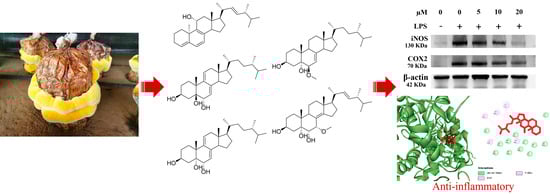
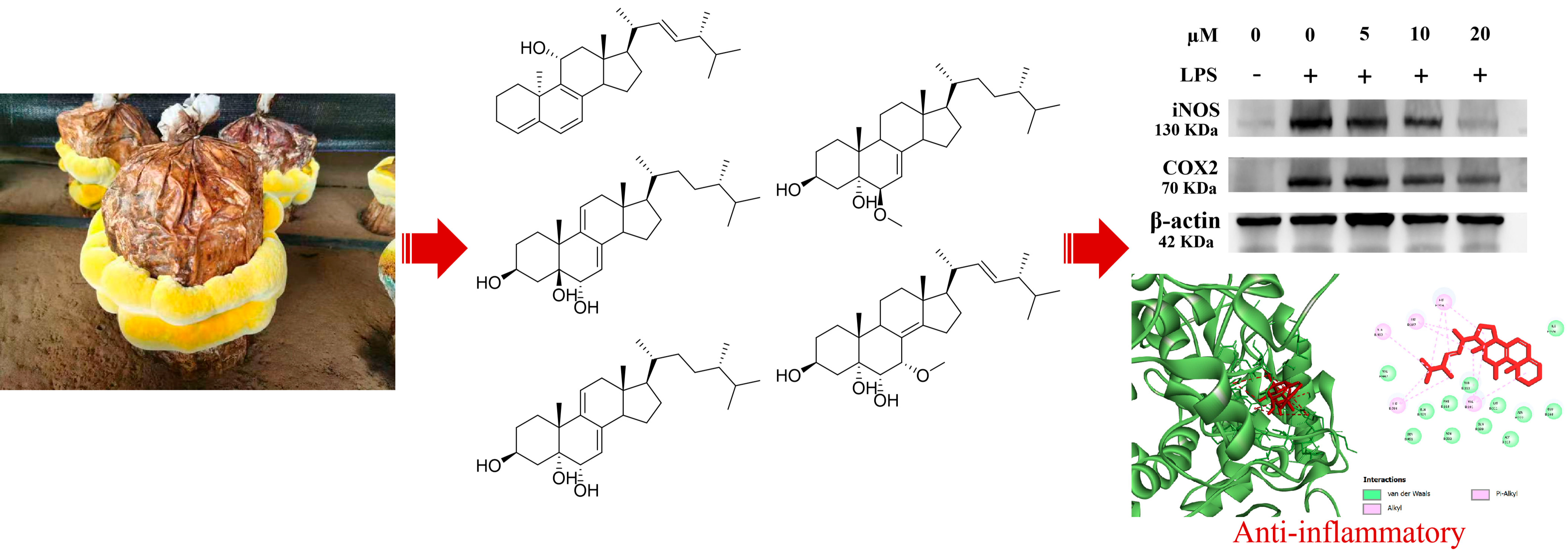
Sanghuangporus vaninii (Ljub.) is an edible and medicinal macrofungus that has become the main strain for artificial cultivation of Sanghuang. In this study, twenty-six compounds (126), including five previously undescribed ergosterols, named sanghusterols A–E (15), were isolated from the fruiting bodies of S. vaninii. Their structures were elucidated by spectroscopic methods and electronic circular dichroism (ECD) calculations. Compounds 1, 15, 17, 21 and 25 exhibited potent inhibitory activity against NO production with the IC50 value of 8.3–14.8 μM and dose-dependently decreased iNOS and COX-2 protein expression in RAW264.7 cells. Molecular docking studies confirmed the capacity of compounds 1, 15, 17, 21 and 25 to interact with iNOS and COX-2 proteins. These findings may provide a solid phytochemical and pharmacological basis for developing the mushroom as potential anti-inflammatory agents.

Graphical Abstract

1. Introduction

Chronic inflammation is a key driver in the initiation, progression, invasion, and metastasis of tumors. In order to clear tumor cells, the immune system is activated and macrophages are stimulated, leading to the production of pro-inflammatory mediators including cytokines such as interleukin (IL)-1β and tumor necrosis factor (TNF)-α [1]. The genus Sanghuangporus comprises edible and medicinal fungi that have been used in China for over 2000 years to treat various diseases [2]. They contain many chemical components with various pharmacological effects, including anti-tumor, antioxidant, hypoglycemic, and anti-inflammatory properties, with their anti-tumor activity being particularly notable, and they are therefore known as ‘forest gold’ [3]. Sanghuangporus vaninii (Ljub.) can be artificially cultivated in the bag and cut log, the fruiting bodies of which are rich in sterols, polysaccharides, flavonoids, polyphenols, etc. [4]. Among sterol compounds, ergosterol constitutes the largest proportion. Through structural modifications such as ring cleavage, rearrangement, and degradation, ergosterol can form novel carbon skeletons and exhibit diverse biological activities, particularly its anti-inflammatory activity, which even surpasses that of certain pharmaceutical drugs [5,6].
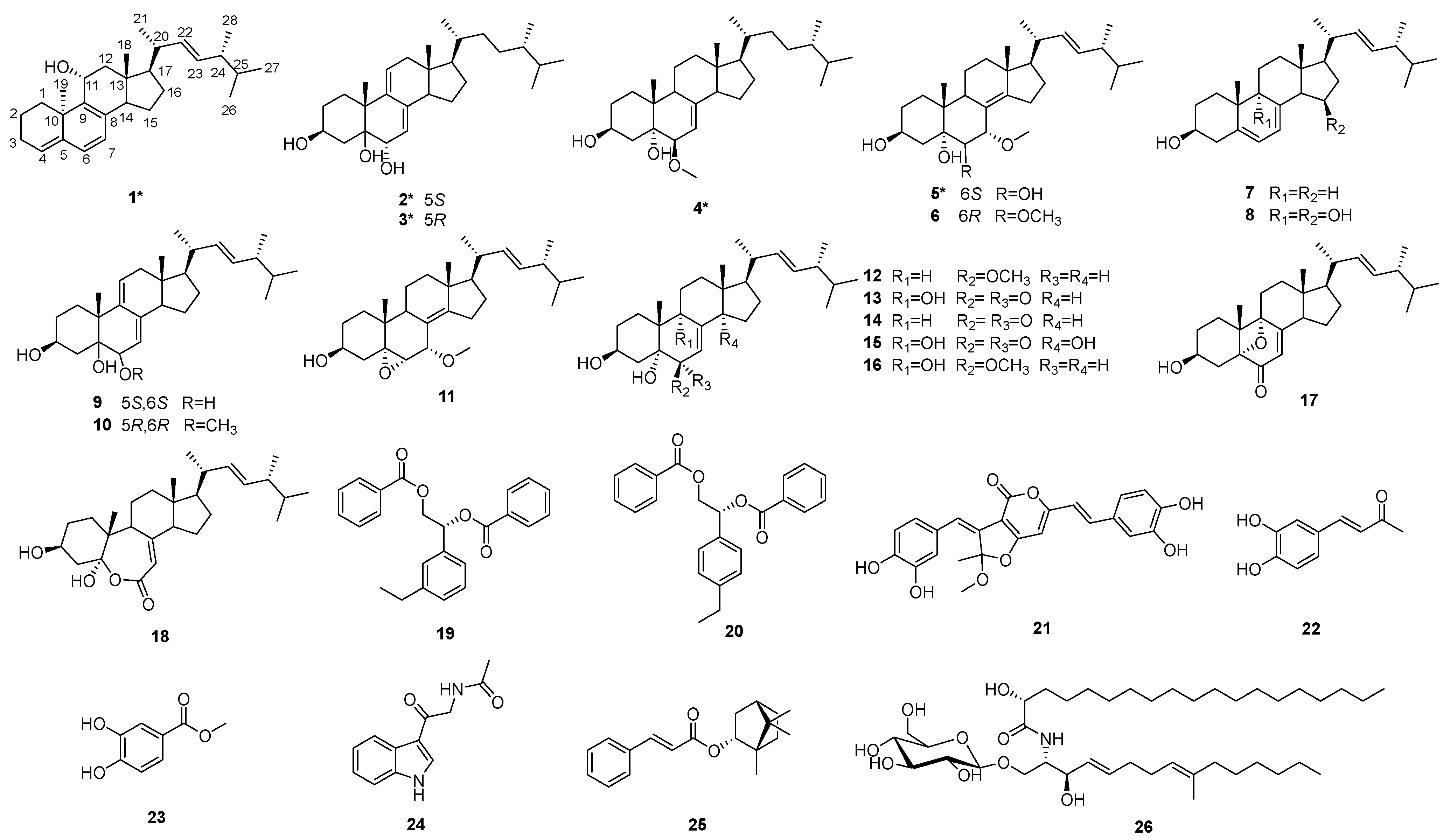
To elucidate the anti-tumor active components of S. vaninii while continuing our ongoing research on extracting novel bioactive substances from large fungi [7,8,9,10,11], a chemical investigation on cultivated S. vaninii was carried out, leading to the isolation of eighteen steroids (118), including five new ones (15), along with other eight known compounds (1926) (Figure 1). The inhibitory effects of compounds 113, 1521, 25 and 26 on anti-inflammatory activity were evaluated, and compounds 1, 15, 17, 21 and 25 significantly inhibited the release of NO in LPS-stimulated RAW264.7 cells, with IC50 values ranging from 8.3 to 14.8 μM. Moreover, they blocked the expression of pro-inflammatory cytokines (iNOS and COX-2) in a dose-dependent manner. 1D/2D NMR and HRESIMS spectra of compound 15 (Figures S1–S35), 1H and 13C NMR spectra of compound 621 and 2426 (Figures S36–S73), Dose–response curve for the compounds 1, 15, 17, 21 and 25 (Figures S74–S78).

2. Results

2.1. Structure Elucidation

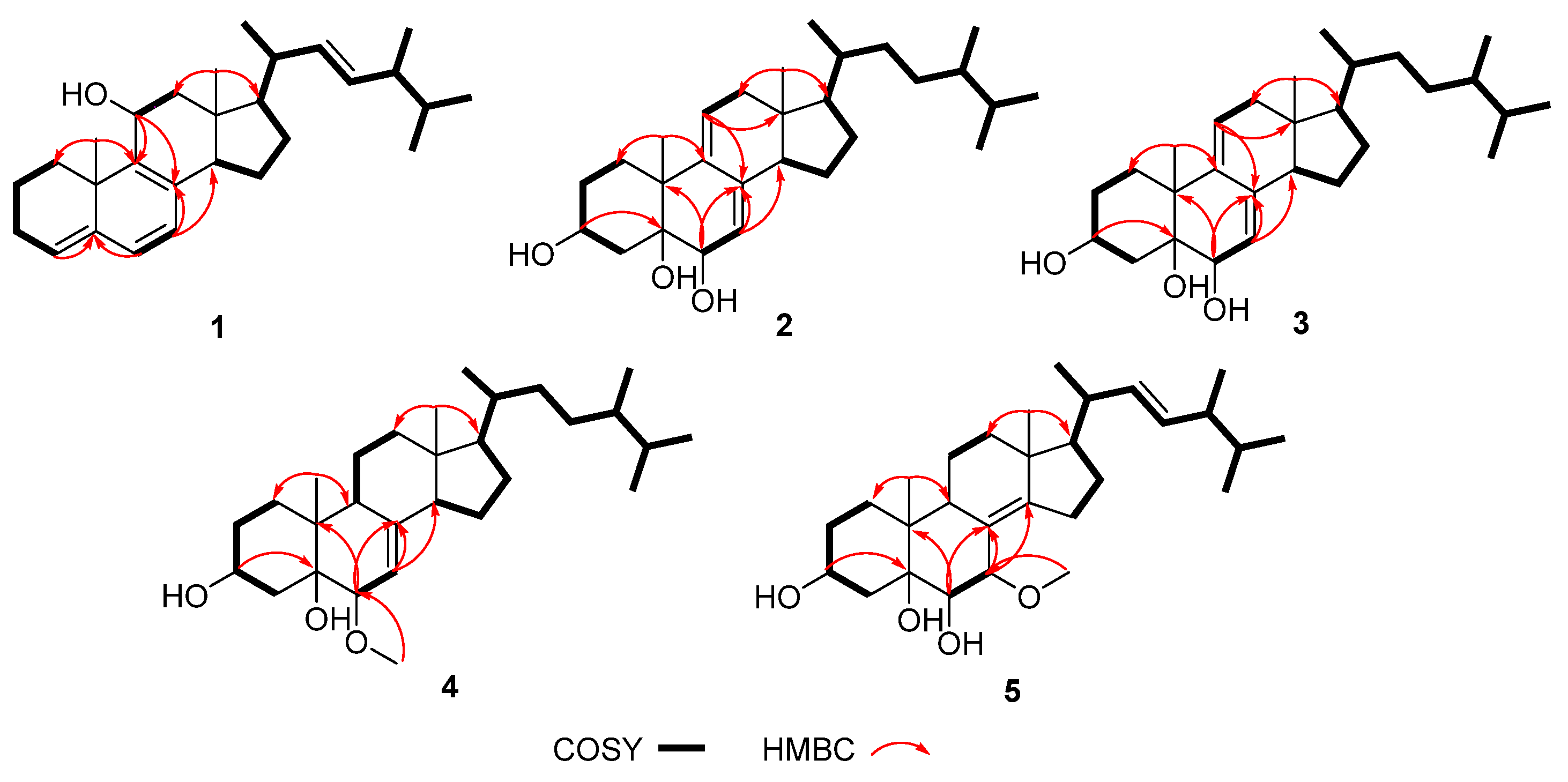
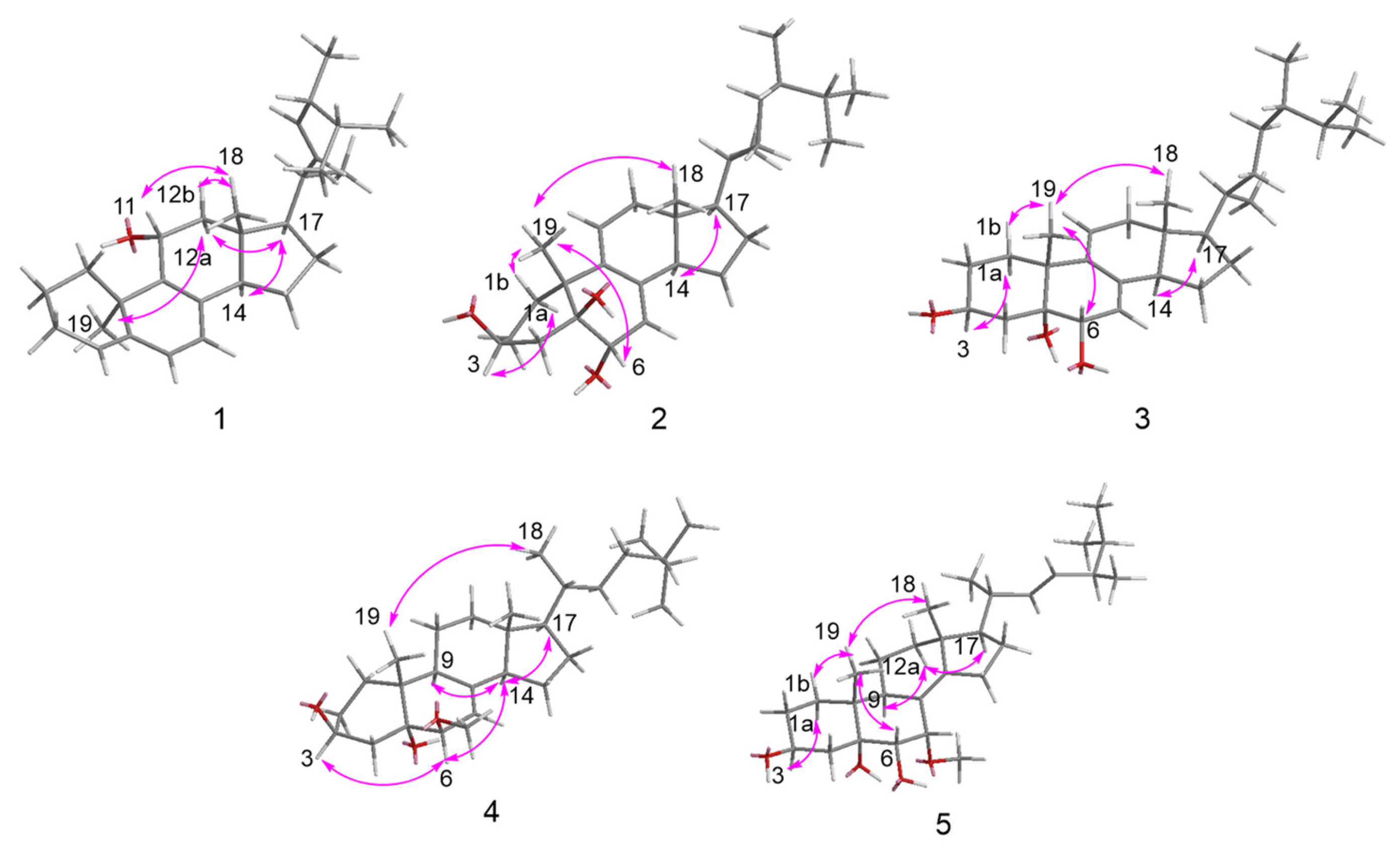
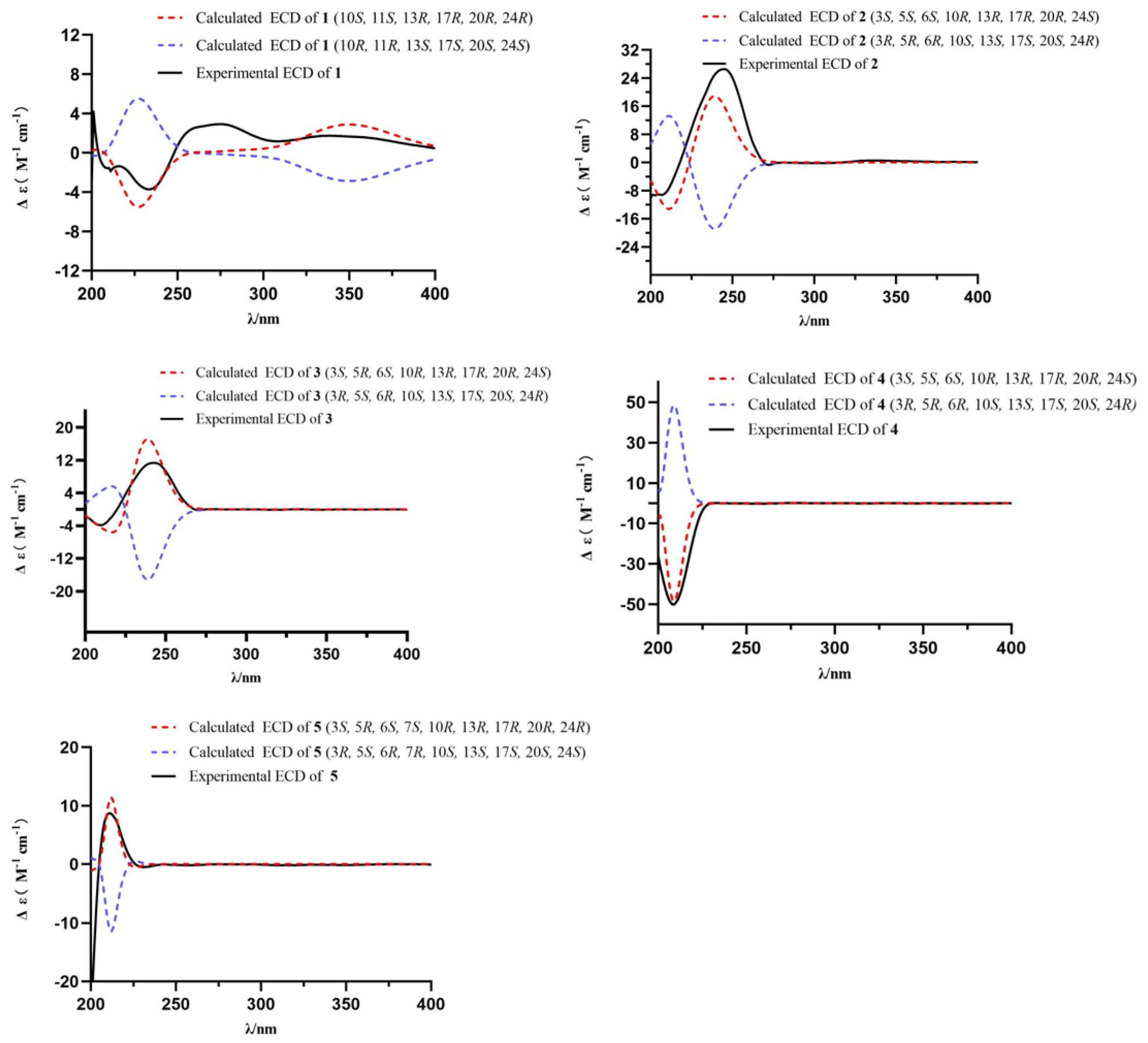
Compound 1 was isolated as a white powder, and its molecular formula was determined as C28H42O by HRESIMS and NMR data. The 1H NMR data displayed six methyl groups [δH 0.59 (3H, s), 0.82 (3H, d, J = 7.1 Hz), 0.84 (3H, d, J = 7.1 Hz), 0.92 (3H, d, J = 6.8 Hz), 1.02 (3H, d, J = 6.5 Hz), and 1.25 (3H, s)], one oxygenated methine 3.61 (1H, m), and five olefinic protons [δH 5.16 (1H, dd, J = 15.3, 8.2 Hz), 5.23 (1H, dd, J = 15.3, 7.4 Hz), 5.40 (1H, d, J = 5.9 Hz), 5.52 (1H, d, J = 6.4 Hz), and 5.68 (1H, d, J = 5.9 Hz)] (Table 1). The 13C NMR spectrum revealed 28 carbon resonances comprising six methyl groups, six methylenes, eleven methines (including an oxygenated carbon), and five quaternary carbons (Table 2). A further comprehensive analysis of the 2D NMR spectra is required. The 1H-1H COSY correlations (Figure 2) revealed the presence of four spin-coupling systems in 1, including H2-1/H2-2/H2-3/H-4; H-6/H-7; H-11/H2-12; and H-14/H2-15/H2-16/H-17/H-20/(H3-21)/H-22/H-23/H-24(H3-28)/H-25/H3-26(H3-27). The HMBC correlations (Figure 2) from H3-19 to C-1, C-9, and C-10; from H-4/H-6 to C-5; from H-7 to C-8/C-14; from H-11 to C-8/C-9; and from H3-18 to C-12/C-13/C-17 established the carbon connectivity, and the gross structure of 1 is much similar to the ergosteroid skeleton as ergosta-4,6,8,22E-tetraen-11β-ol from Coprinus setulosus [12]. The only difference observed in the 13C NMR spectrum was that the chemical shift of C-19 in 1 (δC 30.6) moved downfield compared to C-19 in ergosta-4,6,8,22E-tetraen-11β-ol (δC 22.4). The NOE correlations (Figure 3) of H-11/H3-18, H-12b/H3-18, H-12a/H3-19, H-12a/H-17, and H-17/H-14 demonstrated that H3-19, 11-OH, H-14, and H-17 were α-oriented, while H3-18 was β-oriented. The double bond Δ22,23 was determined as E-configuration by the large coupling constant (J = 15.3 Hz). The experimental and calculated ECD spectra demonstrated a high degree of congruence (Figure 4), suggesting that the absolute configuration of 1 is 10S,11S,13R,17R,20R,24R, and named as (22E,24R,10S)-ergosta-4,6,8(9),22-tetraen-11α-ol.
Compound 2 was obtained as a white powder. Its molecular formula was determined to be C28H46O3 by HRESIMS data, which also indicated six degrees of unsaturation. The 1D and 2D NMR spectra revealed that compound 2 contained 28 carbons, which were classified as six methyl groups, eight methylenes, nine methines and five quaternary carbons (Table 1 and Table 2). This suggests that 2 may be an ergosteroid. The characteristic signals of two singlet methyl groups at δH 0.57 (3H, s) and 0.79 (3H, s), and four doublet methyls at δH 0.82 (3H, d, J = 7.0 Hz), 0.82 (3H, d, J = 6.8 Hz), 0.89 (3H, d, J = 7.0 Hz), and 0.97 (3H, d, J = 7.0 Hz), as observed in the 1H NMR, further indicated the ergosteroid skeleton of 2. Combining with 2D NMR data (Figure 2), the structure of compound 2 was similar to the gross structure of (22E,24R)-ergosta-7,9(11),22-triene-3β,5α,6β-triol [13]; the only difference was that 22,23-position carbons of compound 2 were an ethylidene group. By combining NOESY spectrum and the biosynthetic pathway [13], the relative configuration of compound 2 was determined to be rel-3S,5S,6S,10R,13R,17R,20R,24S (Figure 3). The absolute configuration of 6 was determined by comparing the experimental and calculated ECD spectra (Figure 4). Therefore, compound 2 was elucidated as (24R)-ergosta-7,9(11)-diene-3β,5β,6α-triol.
Compound 3 had the same molecular formula (C28H46O3) as 2 according to their (+)-HRESIMS and the 13C NMR data. Through scrutiny of the 1D and 2D NMR data of 3 and 2, only slight differences were observed for the vicinal protons and carbons adjacent to the C-5 CH group. The same HMBC correlations were reported for both compounds, implying that they are stereoisomers (Figure 2). Similar NOESY patterns and ECD data for compounds 3 and 2 indicated that the only difference between them is the configuration of C-5 (Figure 3 and Figure 4). Therefore, compound 3 was assigned as a 5-epimer of 2 and named (24R)-ergost-7,9(11)-dien-3β,5α,6α-triol.
The molecular formula of (24R)-6β-methoxyergosta-7-ene-3β,5α-diol (4), white powder, was determined to be C29H50O3 (five degrees of unsaturation) based on its HRESIMS data at m/z 469.3653 [M + Na]+ (calcd for C29H50O3Na, 469.3652). The 1H and 13C NMR data for 4 were greatly similar to those for 3 with the absence of a double bond at C-9/C-11 positions (δC 44.8 and 23.0) and the additional presence of a methoxy group attached at C-6 in 4 (δH 3.39; δC 58.2) (Table 1 and Table 2). This conclusion was supported by 1H-1H COSY correlation between H-9 (δH 2.02) and H2-11 (δH 1.56) and HMBC correlations from H-9 (δH 2.02) to C-7 (δC 116.0), C-5 (δC 78.0), and 6-OCH3 (δH 3.39) to C-6 (δC 83.9) (Figure 2). The relative configuration of 4 was consistent with 3, as evidenced by NOESY correlations of H-3/H-6, H-6/H-14, H-9/H-14, H-14/H-17, and H3-18/H3-19 (Figure 3). The calculated ECD spectrum of 3S,5S,6S,10R,13R,17R,20R,24S matched with the experimental ECD data (Figure 4).
Compound 5 was acquired as a white powder and exhibited a [M + Na]+ peak at m/z 483.3447 in the HRESIMS spectrum, disclosing its molecular formula to be C29H48O4. Comprehensive analysis of the 1H and 13C NMR spectra (Table 1 and Table 2) for 5 disclosed that they were quite similar to those of the reported metabolite (22E,24R)-6β,7α-dimethoxyergosta-8(14),22-diene-3β,5α-diol (6) [13] except for signals of a methoxy group. Only one methoxyl (δH 3.22, δC 53.7) was observed in compound 5. Through further detailed analysis of 2D NMR data, the only difference between 5 and 6 was that the methoxy group at C-6 disappeared, which was corroborated by the HMBC relationships from H-6 to C-8 and C-10, from 7-OCH3 to C-7, and from H-7 to C-5 and C-14 (Figure 2). The smaller coupling constants (JH6,H7 = 2.4 Hz) indicated a cis configuration, while the NOE-related signals between H-6 and H3-19 suggested both adopt the β configuration (Figure 3). Similarly, the double bond Δ22,23 was determined to be the E configuration, as indicated by the large coupling constants (J = 15.4 Hz). The absolute configuration in 5 was then affirmed as 3S,5R,6S,7S,10R,13R,17R,20R,24R according to the perfect similarity between the calculated and the experimental ECD spectra (Figure 4). Therefore, the structure of 5 was verified as (22E,24R)-7α-methoxyergosta-8(14),22-diene-3β,5α,6α-triol.
Twenty-one known compounds were determined as (22E,24R)-6β,7α-dimethoxyergosta-8(14),22-diene-3β,5α-diol (6) [13], ergosterol (7) [13], penicisterol F (8) [14], (22E,24R)-ergosta-7,9(11),22-triene-3β,5β,6α-triol (9) [13], 6β-methoxyergosta-7,9(11),22E-triene-3β,5α-diol (10) [15], 22E-7α-methoxy-5α,6α-epoxyergosta-8(14),22-dien-3β-ol (11) [16], ergosta-7,22-dien-6β-methoxy-3β,5α-diol (12) [17], 3β,5α,9α-trihydroxyergosta-7,22-dien-6-one (13) [18], (22E,24R)-ergosta-7,22-dien-3β,5α-diol-6-one (14) [13], 3β,5α,9α,14α-tetrahydroxy-(22E,24R)-ergosta-7,22-dien-6-one (15) [19], (22E,24S)-6-O-methyl-24-methylcholesta-7,22-diene-3β,5α,6β,9α-tetrol (16) [20], 3β-hydroxy-5,9-epoxy-(22E,24R)-ergosta-7,22-dien-6-one (17) [13], (22E,24R)-ergosta-7,22-dien-3β,5α-diol-6,5-olide (18) [21], (2R)-1,2-ethanediol, 1-(3-ethylphenyl)-, 1,2-dibenzoate (19) [22], (2R)-1,2-ethanediol, 1-(4-ethylphenyl)-, 1,2-dibenzoate (20) [22], inoscavin B (21) [23], (E)-4-(3,4-dihydroxyphenyl)but-3-en-2-one (22) [24], 3,4-dihydroxybenzoate (23) [25], 3-N-acetyl-β-oxotryptamine (24) [26], cinnamic acid bornyl ester (25) [27], and chrysogeside E (26) [28] by comparing their spectroscopic data with those reported in the literature.

2.2. Anti-Inflammatory Assays

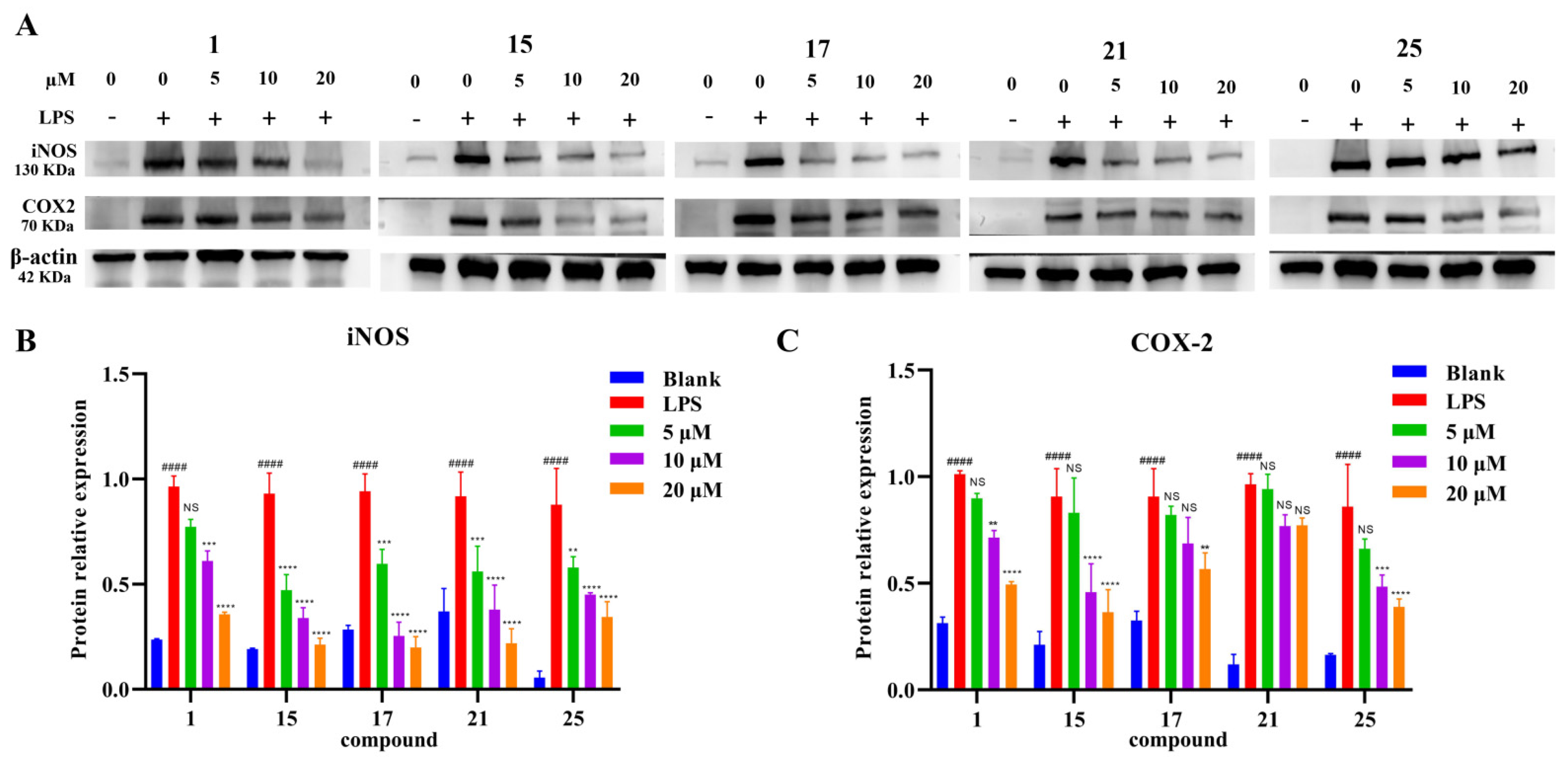
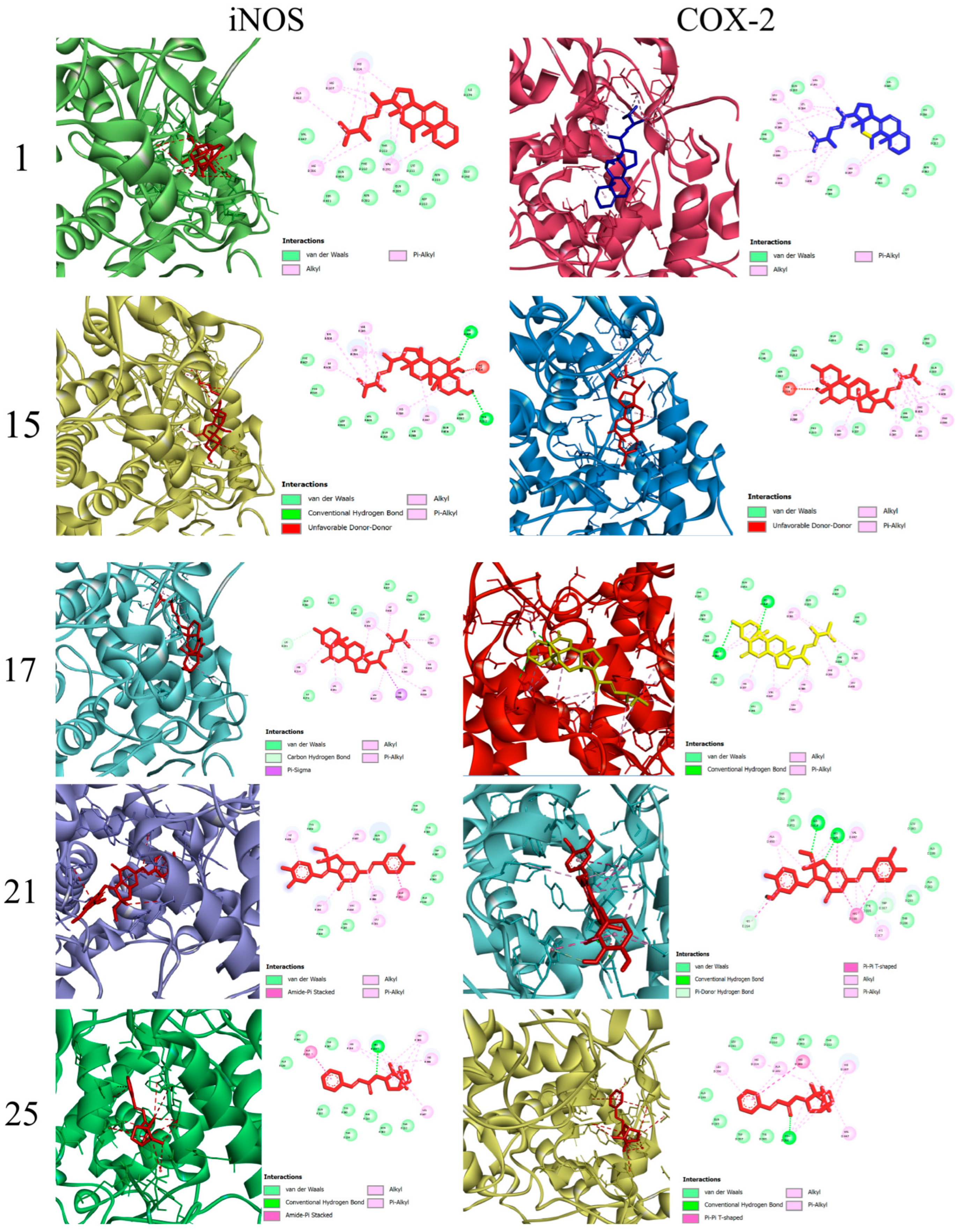
Compounds 113, 1522 and 25 were evaluated for their anti-inflammatory activity in a classical model of LPS-induced NO release in RAW264.7 cells. All tested compounds had no obvious effect on cell viability at a concentration of 20 μM. As shown in Table 3, compounds 1, 15, 17, 21 and 25 exhibited inhibitory effects against LPS-induced NO production in RAW264.7 macrophages with IC50 values ranging from 8.3 to 14.8 μM, being comparable to the well-known NO inhibitor, dexamethasone (IC50 = 9.7 μM) [29]. Compounds 15, 17, 21 and 25 all contain an α,β-unsaturated ketone structural moiety. As Michael acceptors, these moieties could potentially react with nucleophiles involved in NO biosynthesis in biological systems. As shown in Figure 5, a Western blotting assay revealed that compounds 1, 15, 17, 21 and 25 dose-dependently inhibited LPS-induced iNOS and COX-2 expression in RAW264.7 macrophages at 5, 10, and 20 μM. Molecular docking is a theoretical simulation method that studies intermolecular interactions and predicts their binding patterns and affinity. The binding modes and forces between the compounds 1, 15, 17, 21 and 25 and inflammatory factors (iNOS and COX-2) were investigated using AutoDockTools software. The results of the molecular docking analysis indicated that compounds 1, 15, 17, 21 and 25 exhibited a high affinity for iNOS and COX-2, with a binding energy arrange from −8.8 to −7.2 kcal/mol (Figure 6 and Table 4).

3. Materials and Methods

3.1. General Experimental Procedures

Optical rotation (OR) was measured on a Rudolph Autopol III automatic polarimeter at 20 °C (Rudolph Research Analytical, Hackettstown, NJ, USA). Ultraviolet (UV) and experimental Circular Dichroism (ECD) spectra were recorded on a Chirascan spectrometer (Applied Photophysics Ltd., Leatherhead, UK). IR spectra were obtained on Bruker TENSOR 27 spectrometer (Bruker, Mannheim, Germany). NMR spectra were recorded on a Bruker AM-400 NMR spectrometer (Bruker, Mannheim, Germany). HRESIMS data was completed by a LC-30A + TripleTOF5600+(AB SCIEX, Framingham, MA, USA).

3.2. Fungal Material

The bag-cultivated sporocarps of S. vaninii were collected from Yulin City, Shaanxi Province, in December 2022. The strain was identified by Pro. Shuang Tian Du of College of Life Sciences and preserved in the key laboratory of chemical biology of natural products, Northwest A&F University, Yangling, Shaanxi.

3.3. Extraction and Isolation

The 20 kg dried fruiting bodies of S. vaninii were pulverized, and the powder was extracted with methanol by heating with reflux. The methanol extract was evaporated to afford the crude product (1.17 kg). The crude extract was dissolved in distilled water (2.0 L) and then extracted three times with petroleum ether (PE), dichloromethane (DCM), ethyl acetate (EA), and n-butanol (n-BuOH), successively. The EA and n-BuOH extracts (143.0 g) were subjected to a small pore resin coagulant gel column (MCI) with MeOH/H2O (40%, 60%, 80%, 100%) to get four fractions (Fr.A~Fr.D). Fr.A was separated by silica gel CC eluting stepwise with DCM-MeOH (40:1 → 2:1) to give Fr.A1-A3, and then Fr.A1 and A2 were further purified by Sephadex LH-20 (DCM/CH3OH, v/v, 1:1) and semi-prep RP-HPLC (CH3OH/H2O, 45%) to yield compounds 21 (23.8 min, 2.6 mg), 23 (28.6 min, 3.0 mg), 24 (25.5 min, 2.0 mg), and 25 (29.0 min, 2.5 mg). Fr.D was applied to a silica gel CC (300–400 mesh) eluting with CH2Cl2–MeOH (100:1–5:1, v/v) to afford six subfractions (Fr. D1~D6). Fr. D1 was separated with silica gel CC (PE/EA, 20:1 to 2:1) to obtain three fractions (Fr.D1-1~Fr.D1-3), and Fr.D1-3 was further purified by semipreparative HPLC (MeOH/H2O, 76:24, v/v) to yield compounds 1 (33.1 min, 3.8 mg) and 6 (36.1 min, 29.0 mg). Fr.D1-1 was chromatographed with silica gel CC (PE–EA, 20:1 to 2:1) to give three fractions (Fr.D1-1-1~Fr.D1-1-3), then Fr.D1-1-2 and Fr.D1-1-3 were purified by RP-HPLC (MeOH/H2O, 76:24, v/v) to afford compounds 22 (24.2 min, 1.5 mg), 19 (28.3 min, 4.7 mg) and 20 (33.1 min, 2.9 mg). Fraction D3 was subjected to silica gel CC (300–400 mush) eluting with DCM/MeOH (from 20:1 to 2:1, v/v) to obtain four fractions (Fr.D3-1~Fr.D3-4). After that, fraction D3-1 was separated by prep-HPLC (MeOH/H2O, 76:24, v/v), which produced compounds 3 (16.1 min, 4.8 mg), 8 (19.9 min, 21.0 mg), 9 (29.4 min, 3.3 mg), 10 (32.1 min, 46.0 mg), and 11 (35.7 min, 4.5 mg). Compounds 2 (24.4 min, 3.4 mg) and 7 (28.3 min, 19.0 mg) were acquired from fraction D3-2 by prep-HPLC (MeOH/H2O = 72:28, v/v). Fr.D4 was first subjected to a Sephadex LH-20 column (CH3OH/CHCl3, 1:1, v/v) to yield two subfractions (Fr.D4-1 and Fr.D4-2), the purification of Fr.D4-1 was chromatographed with prep-HPLC (MeOH/H2O = 67:33, v/v) to yield compounds 4 (21.2 min, 1.5 mg), 5 (24.8 min, 2.4 mg), 12 (26.4 min, 15.0 mg), 13 (32.1 min, 6.8 mg), 14 (27.9 min, 2.1 mg), 15 (36.6 min, 5.5 mg), and 16 (39.1 min, 28.0 mg). Compounds 17 (15.5 min, 3.7 mg) and 18 (20.8 min, 11.0 mg) were obtained from fraction D4-2 by prep-HPLC (MeOH/H2O = 62:38, v/v). Fr.D5 was partitioned on Sephadex LH-20 and silica gel column chromatography to get four subfractions (Fr. D5-1~Fr. D5-4). Compound 5 (22.2 min, 15.0 mg) was obtained by purifying Fr. D5-2 with semipreparative HPLC (MeOH/H2O = 68:32, v/v).

3.3.1. Sanghusterol A = (22E,24R,10S)-ergosta-4,6,8(9),22-tetraen-11α-ol (1)

White powder; [ α ] D 20 −18.5 (c 0.1, MeOH); UV (MeOH): λmax (log ε) 225 (4.47), 256 (4.77) nm; CD (MeOH): λmax (Δε) 235 (−4.39), 275 (+3.48), 341 (+2.06) nm; IR νmax 2955, 2926, 1711, 1664, 1465, 1372, 1100, 998, 869 cm−1; 1H and 13C NMR data, see Table 1 and Table 2; HRESIMS: m/z 395.3309 [M + H]+ (calcd for C28H43O, 395.3308).

3.3.2. Sanghusterol B = (24R)-ergosta-7,9(11)-diene-3β,5β,6α-triol (2)

White powder; [ α ] D 20 +35.8 (c 0.1, MeOH); UV (MeOH): λmax (log ε) 248 (4.84) nm; CD (MeOH): λmax (Δε) 245 (+34.64) nm; IR νmax 2967, 2880, 1707, 1455, 1376, 1221, 1061, 971 cm−1; 1H and 13C NMR data, see Table 1 and Table 2; HRESIMS: m/z 453.3341 [M + Na]+ (calcd for C28H46O3Na, 453.3339).

3.3.3. Sanghusterol C = (24R)-ergost-7,9(11)-dien-3β,5α,6α-triol (3)

White powder; [ α ] D 20 +22.0 (c 0.1, MeOH); UV (MeOH): λmax (log ε) 248 (4.45) nm; CD (MeOH): λmax (Δε) 209 (−5.03), 242 (+14.82) nm; IR νmax 2953, 2867, 1459, 1376, 1257, 1165, 1033, 983, 840 cm−1; 1H and 13C NMR data, see Table 1 and Table 2; HRESIMS: m/z 453.3341 [M + Na]+ (calcd for C28H46O3Na, 453.3339).

3.3.4. Sanghusterol D = (24R)-6β-methoxyergosta-7-ene-3β,5α-diol (4)

White powder; [ α ] D 20 −41.0 (c 0.1, MeOH); UV (MeOH): λmax (log ε) 205 (4.55) nm; CD (MeOH): λmax (Δε) 208 (−67.80) nm; IR νmax 2951, 2869, 1712, 1664, 1463, 1378, 1157, 1092, cm−1; 1H and 13C NMR data, see Table 1 and Table 2; HRESIMS: m/z 469.3653 [M + Na]+ (calcd for C29H50O3Na, 469.3652).

3.3.5. Sanghusterol E = (22E,24R)-7α-methoxyergosta-8(14),22-diene-3β,5α,6α-triol (5)

White powder; [ α ] D 20 −0.40 (c 0.1, MeOH); UV (MeOH): λmax (log ε) 200 (4.89) nm; CD (MeOH): λmax (Δε) 214 (+11.00) nm; IR νmax 2955, 2872, 1703, 1451, 1378, 1079, 973 cm−1; 1H and 13C NMR data, see Table 1 and Table 2; HRESIMS: m/z 483.3447 [M + Na]+ (calcd for C29H48O4Na, 483.3445).

3.4. ECD Calculation Details

Gaussian 16 software was utilized for the execution of ECD calculations. Conformational optimization was performed in the gas phase via density functional theory (DFT) at the B3LYP/6-31G(d) level. Time-dependent density functional theory (TDDFT) was also adopted for ECD calculations, which were conducted in methanol (MeOH) using the polarizable continuum model (PCM) at the B3LYP/6-311G(d,p) level. ECD spectra were generated via SpecDis 1.7 software [30].

3.5. Anti-Inflammatory Activity

3.5.1. Cell Culture

The RAW 264.7 macrophage cell line was acquired from Procell Life Science & Technology Co., Ltd. (Wuhan, China). These cells were cultured in Dulbecco’s Modified Eagle Medium (DMEM; Gibco, Grand Island, NY, USA), which was supplemented with 10% fetal bovine serum (FBS; ABW, Shanghai Nova Pharmaceutical Technology Co., Ltd., Shanghai, China) and 1% penicillin-streptomycin (Beyotime, Shanghai Beyotime Biotechnology Co., Ltd., Shanghai, China). All cell lines were maintained at 37 °C in a humidified incubator with 5% CO2.

3.5.2. Cell Viability

The cytotoxicity of the test compounds on RAW 264.7 macrophages was assessed using a slightly modified version of a previously described protocol [7]. RAW 264.7 cells were seeded into 96-well plates at a density of 8 × 10³ cells per well and incubated for 24 h, followed by exposure to the test compounds at a concentration of 20 µM for another 24 h. Dexamethasone (20 µM) served as the positive control, while 0.1% dimethyl sulfoxide (DMSO) was used as the negative control. After incubation, 3-(4,5-dimethylthiazol-2-yl)-2,5-diphenyltetrazolium bromide (MTT) was added to each well to a final concentration of 0.5 mg/mL. The insoluble formazan crystals were harvested, dissolved in DMSO, and the absorbance was quantified using a microplate reader (BioRad, Bio-Rad Laboratories, Inc., Hercules, CA, USA) at a wavelength of 490 nm.

3.5.3. NO Production in LPS-Induced RAW 264.7 Macrophages

RAW 264.7 macrophages were seeded into 96-well plates at a density of 1.5 × 10⁴ cells per well and incubated for 24 h. The cells were then treated with various concentrations of the test compounds and positive control (0, 0.6125, 1.25, 2.5, 5, 10, and 20 µM) in the presence or absence of lipopolysaccharide (LPS; 1 μg/mL, Sigma-Aldrich, St. Louis, MO, USA) for 24 h. The concentration of nitric oxide (NO) in the cell culture supernatant was quantified using a Griess reagent kit (Beyotime, China). Briefly, 100 μL of the culture supernatant from each group and standard curve solutions were added to a 96-well plate, followed by the addition of 100 μL of Griess reagent. The absorbance was detected with a multifunctional microplate reader at 540 nm. All experiments were conducted in triplicate, and the data were expressed as mean ± standard deviation (SD). Dexamethasone was employed as the positive control [7].

3.5.4. Western Blotting

RAW 264.7 cells were seeded into six-well plates at a density of 5 × 10⁵ cells per well and treated with compounds 1, 15, 17, 21, and 25 at different concentrations (0, 5, 10, and 20 μM), followed by stimulation with LPS (1 μg/mL) for 24 h. The cells were collected and lysed on ice for 30 min. The supernatant was obtained by centrifugation at 12,000 rpm and 4 °C for 15 min, and the protein concentration was determined using a BCA protein assay kit (BC3710, Solarbio, Beijing, China). A total of 30 μg of protein from each supernatant sample was subjected to 10% sodium dodecyl sulfate-polyacrylamide gel electrophoresis (SDS-PAGE) for separation and then transferred onto polyvinylidene fluoride (PVDF) membranes (Millipore, Burlington, MA, USA). Non-specific binding sites were blocked with TBST buffer containing 5% non-fat milk for 2 h, followed by overnight incubation at 4 °C with primary antibodies. The membranes were then washed three times with TBST buffer and incubated with secondary antibodies at room temperature for 1 h. After three additional washes with TBST buffer, immunoreactive bands were visualized using an enhanced chemiluminescence (ECL) Western blotting kit (Sigma, St. Louis, MO, USA) and quantified using ImageJ 1.52a software. The bands were scanned with a GS-800 scanner and analyzed using a ChemiDoc XRS imaging system (Bio-Rad Life Sciences, Hercules, CA, USA). The primary antibody against β-actin (60008-1-Ig) was purchased from Proteintech (Wuhan, China), whereas COX2 (cat. no. 12282) and iNOS (cat. no. 13120) antibodies were obtained from Cell Signaling Technology (Beverly, MA, USA) [7]. All experiments were conducted in triplicate.

3.5.5. Molecular Docking

Molecular docking analyses were performed with PyRx 0.8 software. The X-ray crystal structures of COX-2 (PDB ID: 1CX2) and iNOS (PDB ID: 6KEY) were downloaded from the RCSB Protein Data Bank (http://www.rcsb.org/pdb/, accessed on 31 March 2026). AutoDock 4.2.6 Tools were used to process the PDB structures, which involved adding hydrogen atoms and removing water molecules, and the processed structures were saved in PDBQT format. The 3D structures of the test compounds were optimized and saved in MOL2 format, then subsequently imported into AutoDock Tools. Molecular docking was performed using the AutoDock platform (https://autodock.scripps.edu, accessed on 31 March 2026), and the binding affinities between the compounds and their target proteins were evaluated according to the binding energy values. To visualize the molecular docking results, 2D interaction diagrams of the docking poses were generated using LigPlot+ 2.3.1, and 3D representations of the binding modes were visualized with PyMOL 3.1.

3.6. Statistical Analysis

All data are expressed as mean ± SEM from at least three independent experiments. Statistical significance for the LPS-induced iNOS and COX-2 inhibition assays was evaluated using one-way ANOVA followed by Dunnett’s post hoc test, with the untreated control group as the reference. A p-value < 0.05 was considered statistically significant. Data analysis was performed using GraphPad Prism 9.0.

4. Conclusions

In summary, 26 compounds, including five new steroids (15), were isolated from S. vaninii. Their structure was elucidated based on detailed spectroscopic analysis and quantum chemical calculations. Concurrently, compounds 1, 15, 17, 21 and 25 displayed potent inhibitory effects on LPS-induced NO production in RAW264.7 macrophages, with IC50 values of 8.3–14.8 μM. Mechanistically, these compounds dose-dependently downregulated the protein expression levels of iNOS and COX-2, two pivotal mediators of the inflammatory response. These findings validate the traditional medicinal application of S. vaninii and provide a solid phytochemical and pharmacological basis for developing S. vaninii-derived compounds as potential anti-inflammatory agents.

Supplementary Materials

The following supporting information can be downloaded at: https://www.mdpi.com/article/10.3390/ijms27073315/s1.

Author Contributions

Methodology, investigation, and writing—original draft preparation, Y.-X.G.; methodology, visualization, and data curation, Y.-T.Z.; methodology and investigation, A.S.; investigation and software, Y.-R.W. and Q.-Y.Z.; funding acquisition and writing—review and editing, Y.-H.W., Y.-Q.G., and J.-M.G. All authors have read and agreed to the published version of the manuscript.

Funding

This research was financially supported by grants from the National Natural Science Foundation of China (Nos. 22277099, 32201249), Shaanxi Province Innovation Support Project (2025ZY1-GNYZ-13), the Shaanxi Key Laboratory of Natural Product & Chemical Biology Open Foundation (SXNPCB 2024008), Shaanxi Provincial Key Project—‘Four Chains’ Integration Project of the Qinchuangyuan Industrial Cluster (2024CY-JJQ-42), the integration of the ‘Four Chains’ of the Key Research and Development Program of Shaanxi Province—Key Project—Qinchuangyuan Industrial Innovation Cluster Area (2025CY-JJQ-88), 2024 Yangling Demonstration Zone Sci-Tech Program Projects (S20251747).

Institutional Review Board Statement

Not applicable.

Informed Consent Statement

Not applicable.

Data Availability Statement

The original contributions presented in this study are included in the article/Supplementary Materials. Further inquiries can be directed to the corresponding authors.

Conflicts of Interest

The authors declare no conflicts of interest.

References

  1. Shen, Z.Q.; Jiang, J.H.; Li, C.T.; Li, Y.; Zhou, L.W. Genome re-annotation and transcriptome analyses of Sanghuangporus sanghuang. J. Fungi 2023, 9, 505. [Google Scholar] [CrossRef] [PubMed]
  2. Zhou, L.W.; Ghobad-Nejhad, M.; Tian, X.M.; Wang, Y.F.; Wu, F. Current status of ‘Sanghuang’ as a group of medicinal mushrooms and their perspective in industry development. Food Rev. Int. 2022, 38, 589–607. [Google Scholar] [CrossRef]
  3. Ren, Y.H.; Liu, Q.F.; Chen, L.; He, S.J.; Zuo, J.P.; Fan, Y.Y.; Yue, J.M. Urceoloids A and B, two C19 steroids with a rearranged spirocyclic carbon skeleton from Urceola quintaretii. Org. Lett. 2019, 21, 1904–1907. [Google Scholar] [CrossRef] [PubMed]
  4. Zheng, M.; Lin, Z.; Lin, S.; Qu, X. Chemoenzymatic synthesis of steroidal products: Recent advances. Eur. J. Org. Chem. 2024, 27, e202301066. [Google Scholar] [CrossRef]
  5. Varela, M.L.; Mogildea, M.; Moreno, I.; Lopes, A. Acute inflammation and metabolism. Inflammation 2018, 41, 1115–1127. [Google Scholar] [CrossRef]
  6. Wu, F.; Zhou, L.W.; Yang, Z.L.; Bau, T.; Li, T.H.; Dai, Y.C. Resource diversity of Chinese macrofungi: Edible, medicinal and poisonous species. Fungal Divers. 2019, 98, 1–76. [Google Scholar] [CrossRef]
  7. Kou, R.W.; Gao, Y.Q.; Xia, B.; Wang, J.Y.; Liu, X.N.; Tang, J.J.; Yin, X.; Gao, J.M. Ganoderterpene A, a new triterpenoid from Ganoderma lucidum, attenuates LPS-Induced inflammation and apoptosis via suppressing MAPK and TLR-4/NF-κB pathways in BV-2 Cells. J. Agric. Food Chem. 2021, 69, 12730–12740. [Google Scholar] [CrossRef]
  8. Gao, J.M.; Yang, S.X.; Qin, J.C. Azaphilones: Chemistry and biology. Chem. Rev. 2013, 113, 4755–4811. [Google Scholar] [CrossRef]
  9. Guo, Y.F.; Feng, Y.Z.; Xu, J.Y.; Dong, M.Y.; Yang, A.A.; Gao, J.M.; Yin, X. Ganoderma calidophilum-derived highly oxygenated lanostane triterpenoids: Multitarget neuroprotection through AMPK/mTOR/SIRT1 axis modulation and gut-brain axis crosstalk. Bioorg. Chem. 2025, 163, 108757. [Google Scholar] [CrossRef]
  10. Han, W.B.; Zhai, Y.J.; Zhang, R.; Gong, X.S.; Li, J.Q.; Xu, G.; Lei, X.; Du, L.; Gao, J.M. Tricrilactones A-H, potent antiosteoporosis macrolides with distinctive ring skeletons from Trichocladium crispatum, an alpine moss-associated gungus. Angew. Chem. Int. Ed. Engl. 2013, 62, e202300773. [Google Scholar] [CrossRef]
  11. Zhao, C.; Zhao, S.; Zhang, D.; Stadler, M.; Liu, C.; Shi, Q.Q.; Gao, Y.Q.; Han, W.B.; Gao, J.M. Cyathstrines A-K, structurally diverse polycyclic polyoxygenated cyathane diterpenoid xylosides with antibacterial and neuroprotective activities from the fungus Cyathus striatus. J. Nat. Prod. 2025, 88, 2909–2920. [Google Scholar] [CrossRef]
  12. Ma, Q.Y.; Yang, S.; Huang, S.Z.; Kong, F.D.; Xie, Q.Y.; Dai, H.F.; Yu, Z.F.; Zhao, Y.X. Ergostane steroids from Coprinus setulosus. Chem. Nat. Compd. 2018, 54, 710–713. [Google Scholar] [CrossRef]
  13. Ishizuka, T.; Yaoita, Y.; Kikuchi, M. Sterol constituents from the fruit bodies of Grifola frondosa (FR.) S. F. Gray. Chem. Pharm. Bull. 1997, 45, 1756–1760. [Google Scholar] [CrossRef]
  14. Deng, M.; Pu, Y.; Wan, Z.; Xu, J.; Huang, S.; Xie, J.; Zhou, X. Nine undescribed oxidized ergosterols from the endophytic fungus Penicillium herquei and their cytotoxic activity. Phytochemistry 2023, 212, 113716. [Google Scholar] [CrossRef] [PubMed]
  15. Zhang, S.S.; Ma, Q.Y.; Huang, S.Z.; Dai, H.F.; Guo, Z.K.; Yu, Z.F.; Zhao, Y.X. Lanostanoids with acetylcholinesterase inhibitory activity from the mushroom Haddowia longipes. Phytochemistry 2015, 110, 133–139. [Google Scholar] [CrossRef] [PubMed]
  16. Ma, Q.Y.; Hu, L.L.; Kong, L.M.; Huang, S.Z.; Dai, H.F.; LI, Y.; Zhao, Y.X. Chemical constituents from the fungus Ganoderma tropicum (jungh.) bres. and their cytotoxic activities. Afr. J. Microbiol. Res. 2013, 7, 1543–1547. [Google Scholar] [CrossRef]
  17. Liu, H.W.; Hu, L.; Zhang, A.L.; Gao, J.M. Steroids and phenolic constituents from the fruiting bodies of the basidiomycete Sarcodon joedes. Nat. Prod. Res. 2013, 27, 80–84. [Google Scholar] [CrossRef]
  18. Luo, Y.; Ma, Q.Y.; Huang, S.Z.; Guo, Z.K.; Dai, H.F.; Zhao, Y.X. Chemical Constituents from Ganoderma hainanense. J. Trop. Subtrop. Bot. 2014, 22, 190–194. [Google Scholar]
  19. Hu, C.; Chen, F.; Zheng, X.H.; Lin, B.R.; Zhou, G.X. Chemical compounds from the fermented broth of actinomycete strain Streptomyces antibioticus H12-15. Nat. Prod. Res. Dev. 2017, 29, 404–409. [Google Scholar]
  20. Luo, X.; Li, F.; Shinde, P.B.; Hong, J.; Lee, C.O.; Im, K.S.; Jung, J.H. 26,27-cyclosterols and other polyoxygenated sterols from a marine sponge Topsentia sp. J. Nat. Prod. 2006, 69, 1760–1768. [Google Scholar] [CrossRef]
  21. Yu, F.X.; Li, Z.; Chen, Y.; Yang, Y.H.; Li, G.H.; Zhao, P.J. Four new steroids from the endophytic fungus Chaetomium sp. M453 derived of Chinese herbal medicine Huperzia serrata. Fitoterapia 2017, 117, 41–46. [Google Scholar] [CrossRef] [PubMed]
  22. Nurettin, Y. Isolation and characterization of dibenzoated aromatic compounds. Turk. J. Chem. 1993, 17, 208–214. [Google Scholar]
  23. Lee, I.K.; Seok, S.J.; Kim, W.K.; Yun, B.S. Hispidin derivatives from the mushroom Inonotus xeranticus and their antioxidant activity. J. Nat. Prod. 2006, 69, 299–301. [Google Scholar] [CrossRef] [PubMed]
  24. Zan, L.F.; Qin, J.C.; Zhang, Y.M.; Yao, Y.H.; Bao, H.Y.; Li, X. Antioxidant hispidin derivatives from medicinal mushroom Inonotus hispidus. Chem. Pharm. Bull. 2011, 59, 770–772. [Google Scholar] [CrossRef]
  25. Zhang, Z.; Zhou, X.; Zhou, X.; Xu, X.; Liao, M.; Yan, L.; Lv, R.; Luo, H. Methyl 3,4-dihydroxybenzoate promotes neurite outgrowth of cortical neurons cultured in vitro. Neural Regen. Res. 2012, 7, 971–977. [Google Scholar] [CrossRef]
  26. Martínez-Luis, S.; Gómez, J.F.; Spadafora, C.; Guzmán, H.M.; Gutiérrez, M. Antitrypanosomal alkaloids from the marine bacterium Bacillus pumilus. Molecules 2012, 17, 11146–11155. [Google Scholar] [CrossRef]
  27. Wu, D.; Nair, M.G.; DeWitt, D.L. Novel compounds from Piper methysticum Forst (Kava Kava) roots and their effect on cyclooxygenase enzyme. J. Agric. Food Chem. 2002, 50, 701–705. [Google Scholar] [CrossRef]
  28. Peng, X.; Wang, Y.; Sun, K.; Liu, P.; Yin, X.; Zhu, W. Cerebrosides and 2-pyridone alkaloids from the halotolerant fungus Penicillium chrysogenum grown in a hypersaline medium. J. Nat. Prod. 2011, 74, 1298–1302. [Google Scholar] [CrossRef]
  29. He, J.; Du, J.-X.; Wang, M.; Luo, X.-D.; Feng, T. Irpexlactones A and B, a pair of ring-rearranged tremulane sesquiterpenoids from the basidiomycete Irpex lacteus and their anti-inflammatory activity. Chin. Chem. Lett. 2024, 36. [Google Scholar] [CrossRef]
  30. Bruhn, T.; Schaumlöffel, A.; Hemberger, Y.; Bringmann, G. SpecDis: Quantifying the comparison of calculated and experimental electronic circular dichroism spectra. Chirality 2013, 25, 243–249. [Google Scholar] [CrossRef]
Figure 1. Structures of compounds 126 (*—new structures).
Ijms 27 03315 g001
Figure 2. Key COSY and HMBC correlations of compounds 15.
Ijms 27 03315 g002
Figure 3. Key NOESY correlations of compounds 15.
Ijms 27 03315 g003
Figure 4. Comparison of the calculated vs experimental ECD spectra in MeOH for compounds 15.
Ijms 27 03315 g004
Figure 5. Western blotting images (A) and density analysis (B,C) of compounds 1, 15, 17, 21 and 25 on the expression of iNOS and COX-2 in LPS-stimulated RAW264.7 cells. Compared to the control, #### p < 0.0001. Compared to the LPS-treated group, NS: not significant, ** p < 0.01, *** p < 0.001, and **** p < 0.0001.
Ijms 27 03315 g005
Figure 6. Molecular docking results of interactions between compounds 1, 15, 17, 21, and 25 and the core targets iNOS (PDB ID:4CX7) and COX-2 (PDB ID: 3VRJ).
Ijms 27 03315 g006
Table 1. 1H NMR data for compounds 15 (400 MHz, J in Hz).
No.1 a2 a3 b4 b5 b
11.51 (m), 1.72 (m)1.51 (m), 1.72 (m)1.70 (m), 1.88 (m)1.60 (m),1.50 (m)1.75 (m), 1.42 (m)
21.41 (m), 1.74 (m)1.88 (m), 1.28 (m)1.90 (m), 1.55 (m)1.78 (m), 1.44 (m)1.71 (m), 1.28 (m)
32.17 (m), 2.33 (m)4.07 (m)3.92 (dt, 16.1, 5.7)3.98 (m)3.96 (dt, 15.7, 5.7)
45.52 (d, 6.4)1.71 (m),1.55 (m)2.23 (m), 1.43 (m)2.10 (m), 1.70 (m)1.94 (m), 1.58 (m)
65.68 (d, 5.9)4.26 (brs)4.03 (brs)3.17 (d, 4.9)3.55 (d, 2.4)
75.40 (d, 5.9)5.15 (brs)5.12 (brs)5.42 (d, 4.9)4.13 (d, 2.4)
9 2.02 (m)2.32 (m)
113.61 (m)5.68 (m)5.62 (d, 6.3)1.56 (m)1.60 (m)
122.47 (m), 2.38 (m)2.35 (m), 2.18 (m)2.38 (m), 2.18 (m)2.10 (m), 1.33 (m)2.02 (m), 1.20 (m)
142.22 (m)2.23 (m)2.37 (m)1.96 (m)
151.46 (m), 1.79 (m)1.80 (m), 1.46 (m)1.87 (m), 1.48 (m)1.62 (m), 1.52 (m)2.41 (m)
161.70 (m), 1.92 (m)2.00 (m), 1.36 (m)2.03 (m), 1.38 (m)1.95 (m), 1.34 (m)1.75 (m), 1.46 (m)
171.30 (m)1.34 (m)1.38 (m)1.33 (m)1.20 (m)
180.59 (s)0.57 (s)0.60 (s)0.63 (s)0.95 (s)
191.25 (s)0.97 (s)1.10 (s)1.00 (s)1.00 (s)
202.04 (m)1.38 (m)1.42 (m)1.40 (m)2.16 (m)
211.02 (d, 6.5)0.97 (d, 6.6)0.98 (d, 6.6)0.98 (d, 6.6)1.09 (d, 6.6)
225.16 (dd, 15.3, 8.2)1.47 (m), 0.99 (m)1.50 (m), 1.02 (m)1.46 (m), 1.00 (m)5.22 (dd, 15.4, 7.8)
235.23 (dd, 15.3, 7.4)1.43 (m), 0.98 (m)1.48 (m), 1.02 (m)1.43 (m), 0.99 (m)5.24 (dd, 15.4, 7.8)
241.87 (m)1.21 (m)1.25 (m)1.24 (m)1.86 (m)
251.47 (m)1.58 (m)1.60 (m)1.60 (m)1.47 (m)
260.82 (d, 7.1)0.89 (d, 7.0)0.91 (d, 7.0)0.90 (d, 7.0)0.86 (d, 6.8)
270.84 (d, 7.1)0.82 (d, 7.0)0.84 (d, 7.0)0.83 (d, 7.0)0.86 (d, 6.8)
280.92 (d, 6.8)0.82 (d, 6.8)0.84 (d, 6.8)0.83 (d, 6.8)0.94 (d, 6.9)
6-OCH3 3.39 (s)
7-OCH3 3.22 (s)
a Recorded in CDCl3. b Recorded in methanol-d4.
Table 2. 13C NMR data for compounds 15 (100 MHz).
No.1 a2 a3 b4 b5 b
138.5, CH230.3, CH231.2, CH233.6, CH230.2, CH2
223.0, CH232.0, CH231.7, CH231.7, CH231.6, CH2
343.0, CH268.4, CH67.8, CH68.3, CH66.3, CH
4122.6, CH29.5, CH239.1, CH240.7, CH239.7, CH2
5141.5, C78.8, C77.0, C78.0, C76.7, C
6118.4, CH72.5, CH71.6, CH83.9, CH75.2, CH
7115.8, CH122.8, CH121.7, CH116.0, CH80.4, CH
8135.6, C140.4, C142.1, C144.5, C122.0, C
9144.4, C138.2, C138.7, C44.8, CH36.6, CH
1039.5, C44.2, C41.6, C38.2, C40.5, C
1172.4, CH123.5, CH123.5, CH23.0, CH219.0, CH2
1241.7, CH243.8, CH243.7, CH240.8, CH237.3, CH2
1342.3, C43.6, C43.6, C44.7, C43.5, C
1451.2, CH52.3, CH52.2, CH53.0, CH153.3, C
1529.1, CH224.2, CH224.2, CH224.0, CH225.2, CH2
1632.4, CH229.4, CH229.5, CH228.9, CH227.1, CH2
1756.3, CH57.4, CH57.4, CH57.3, CH57.2, CH
1811.7, CH311.7, CH311.8, CH312.4, CH316.7, CH3
1930.6, CH326.1, CH325.1, CH318.8, CH316.9, CH3
2040.6, CH37.6, CH37.6, CH37.9, CH39.2, CH
2120.8, CH319.1, CH319.1, CH319.5, CH320.5, CH3
22135.5, CH34.8, CH234.7, CH234.8, CH2135.4, CH
23132.2, CH31.7, CH231.7, CH231.7, CH2132.1, CH
2442.9, CH40.4, CH40.4, CH40.4, CH43.0, CH
2533.2, CH32.7, CH32.7, CH32.7, CH33.0, CH
2620.1, CH320.9, CH320.9, CH320.9, CH319.1, CH3
2719.8, CH318.0, CH318.0, CH318.0, CH318.7, CH3
2817.7, CH315.9, CH315.9, CH315.9, CH316.8, CH3
6-OCH3 58.2, CH3
7-OCH3 53.7, CH3
a Recorded in CDCl3. b Recorded in methanol-d4.
Table 3. Inhibitory effects of compounds 113, 1521, 25 and 26 on NO production in LPS-induced RAW 264.7 cells.
Comp.IC50 (μM) ± SD (μM)Comp.IC50 (μM) ± SD (μM)
110.1 ± 0.113NA
2NA158.3 ± 0.5
3NA16NA
4NA1710.6 ± 0.4
5NA18NA
6NA19NA
7NA20NA
8NA218.9 ± 0.2
9NA2514.8 ± 0.4
10NA26NA
11NADEX a9.7 ± 0.2
12NA
a Positive control. NA: no active.
Table 4. Binding energy of compounds 1, 15, 17, 21, and 25 with iNOS and COX-2.
CompoundBinding Energy
iNOSCOX-2
1−7.7−8.2
15−8.1−8.4
17−7.2−8.8
21−7.2−8.2
25−7.9−8.2
Disclaimer/Publisher’s Note: The statements, opinions and data contained in all publications are solely those of the individual author(s) and contributor(s) and not of MDPI and/or the editor(s). MDPI and/or the editor(s) disclaim responsibility for any injury to people or property resulting from any ideas, methods, instructions or products referred to in the content.