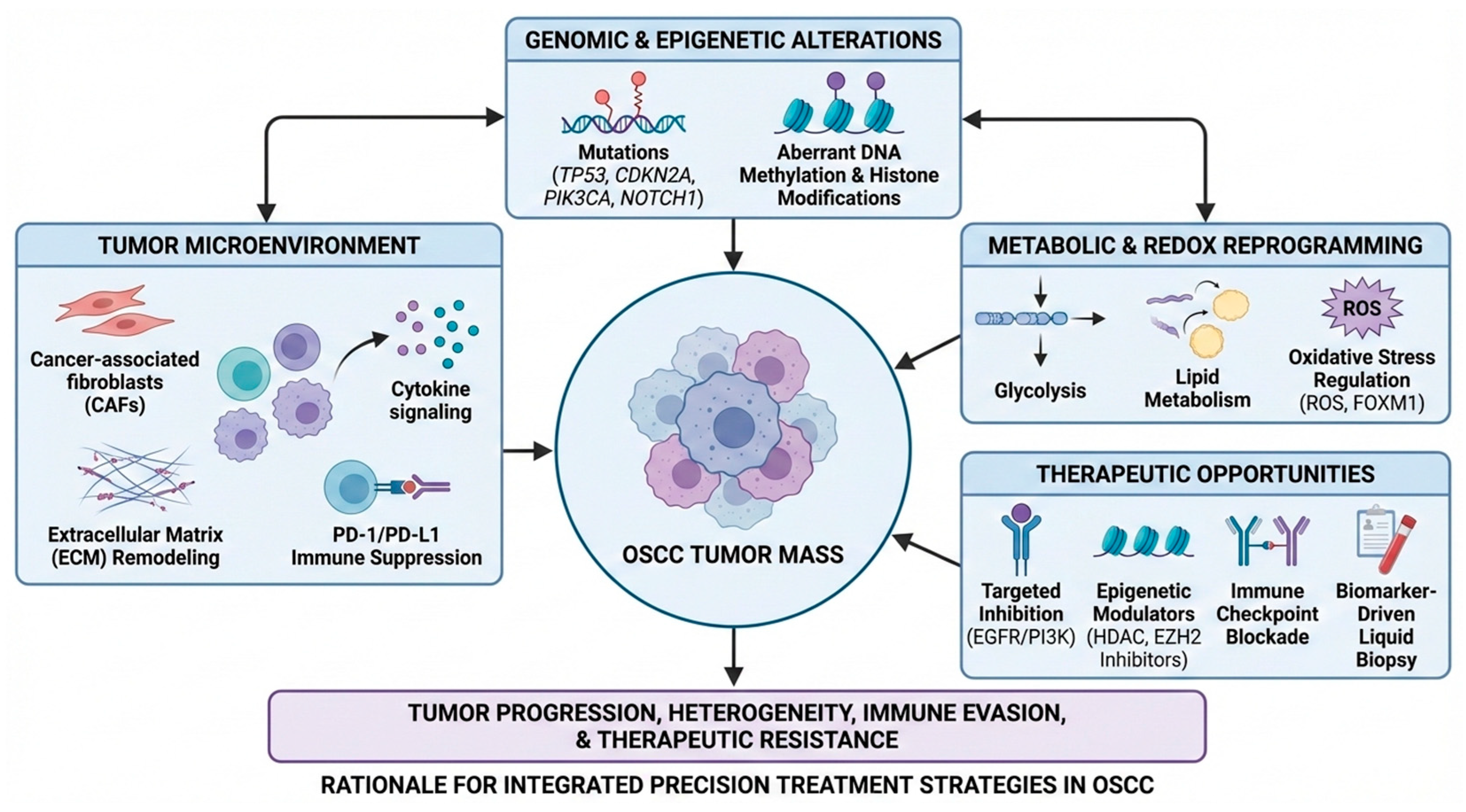
Molecular Mechanisms in Oral Squamous Cell Carcinoma: Integrative Roles of Cancer-Associated Fibroblasts, Immune Microenvironment, and Precision Therapeutic Opportunities



Abstract
1. Introduction
2. Genomic Landscape of Oral Cancers
2.1. Key Oncogenic and Tumor Suppressor Pathways Shaping the Molecular Landscape and Clinical Behavior of OSCC
2.2. Copy Number Alterations and Structural Variants
2.3. Oncogenic Copy Number Amplifications as Key Determinants of OSCC Progression and Biological Diversity
3. Epigenetic Reprogramming in Oral Carcinogenesis
3.1. Aberrant DNA Methylation Orchestrates Tumor Suppressor Silencing and Malignant Progression in OSCC
3.2. Epigenetic Reprogramming Through Dysregulated Histone Acetylation and Methylation in OSCC: Roles of Histone Deacetylases and Enhancer of Zeste Homolog 2 as Therapeutic Targets
4. Non-Coding RNAs as Regulatory Hubs
4.1. MicroRNA Dysregulation in OSCC: Diagnostic, Prognostic, and Therapeutic Implications Across Molecular Pathways
4.2. Dysregulated lncRNA- and circRNA-Mediated Regulatory Networks Driving Epigenetic Reprogramming and Therapeutic Resistance in OSCC
5. Dysregulated Signaling Pathways in OSCC
5.1. EGFR-Mediated PI3K/AKT/mTOR and MAPK Activation in OSCC: Implications for Tumor Progression and Therapeutic Resistance
5.2. Context-Dependent Reprogramming of TGF-β, Wnt, and Notch Signaling in OSCC: Implications for Tumor Progression and Precision Therapy
6. Immune Microenvironment and Immune Evasion
6.1. Immune Heterogeneity and Macrophage Regulation in OSCC
6.2. Clinical and Biological Significance of PD-1/PD-L1 Pathway Activation in OSCC
6.3. Central Roles of Cancer-Associated Fibroblasts in OSCC and HNSCC Progression and Therapy Resistance
7. Metabolic and Redox Reprogramming in OSCC: Mechanisms, Diagnostic Potential, and Therapeutic Implications
8. Critical Evaluation and Translational Challenges
9. Discussion
10. Conclusions
Author Contributions
Funding
Institutional Review Board Statement
Informed Consent Statement
Data Availability Statement
Conflicts of Interest
Abbreviations
| AKT | Protein kinase B |
| CAF(s) | Cancer-associated fibroblast(s) |
| CAMKIV | Calcium/calmodulin dependent protein kinase IV |
| CAR | Chimeric antigen receptor |
| CCL2 | C-C motif chemokine ligand 2 |
| CCND1 | Cyclin D1 |
| CDH1 | Cadherin 1 |
| CDKN2A | Cyclin-dependent kinase inhibitor 2A |
| ceRNA | Competing endogenous RNA |
| circRNA | Circular RNA |
| CNA | Copy number alteration |
| CREB1 | CAMP responsive element binding protein 1 |
| CTLA-4 | Cytotoxic T-lymphocyte–associated protein 4 |
| DGKG | Diacylglycerol kinase γ |
| ECM | Extracellular matrix |
| EGFR | Epidermal growth factor receptor |
| EMT | Epithelial–mesenchymal transition |
| ERCC1 | Excision repair cross-complementation group 1 |
| ERK | Extracellular signal-regulated kinase |
| EZH2 | Enhancer of zeste homolog 2 |
| FAK | Focal adhesion kinase |
| FAP | Fibroblast activation protein |
| FOXM1 | Forkhead box M1 |
| GDF15 | Growth differentiation factor 15 |
| GLUT3 | Glucose transporter 3 |
| HDAC | Histone deacetylase |
| HIF | Hypoxia-inducible factor |
| HLA-G | Human leukocyte antigen-G |
| HNSCC | Head and neck squamous cell carcinoma |
| HPV | Human papillomavirus |
| HRAS | Harvey rat sarcoma viral oncogene homolog |
| IFN-γ | Interferon gamma |
| IL | Interleukin |
| IL2RA | Interleukin 2 receptor subunit alpha |
| lncRNA | Long non-coding RNA |
| LOX | Lysyl oxidase |
| MAPK | Mitogen-activated protein kinase |
| MALAT1 | Metastasis-associated lung adenocarcinoma transcript 1 |
| MDSC(s) | Myeloid-derived suppressor cell(s) |
| miRNA | MicroRNA |
| MMP | Matrix metalloproteinase |
| mTOR | Mechanistic target of rapamycin |
| MYC | MYC proto-oncogene, BHLH transcription factor |
| NK cell(s) | Natural killer cell(s) |
| NLRP3 | NLR family pyrin domain containing 3 |
| NOTCH1-Dll4 | Notch1–Delta-like-4 |
| NOX5 | NADPH oxidase 5 |
| OSCC | Oral squamous cell carcinoma |
| PD-1 | Programmed cell death protein 1 |
| PD-L1 | Programmed death-ligand 1 |
| PI3K | Phosphatidylinositol 3-kinase |
| PIK3CA | Phosphatidylinositol-4,5-bisphosphate 3-kinase catalytic subunit alpha |
| PRC2 | Polycomb repressive complex 2 |
| PTEN | Phosphatase and tensin homolog |
| RASSF1A | Ras association domain family member 1 isoform A |
| ROS | Reactive oxygen species |
| RRAD | Ras-related glycolysis inhibitor and calcium channel regulator |
| SOX2 | SRY-box transcription factor 2 |
| TCGA | The Cancer Genome Atlas |
| TGF-β | Transforming growth factor beta |
| TME | Tumor microenvironment |
| TNF-α | Tumor necrosis factor alpha |
| TP53 | Tumor protein p53 |
| Wnt | Wingless/integrated signaling pathway |
References
- Badwelan, M.; Muaddi, H.; Ahmed, A.; Lee, K.T.; Tran, S.D. Oral Squamous Cell Carcinoma and Concomitant Primary Tumors, What Do We Know? A Review of the Literature. Curr. Oncol. 2023, 30, 3721–3734. [Google Scholar] [CrossRef]
- Filho, A.M.; Warnakulasuriya, S. Epidemiology of oral cancer in South and South-East Asia: Incidence and mortality. Oral Dis. 2024, 30, 4847–4854. [Google Scholar] [CrossRef]
- Tseng, Y.-A.; Ou, Y.-L.; Geng, J.-H.; Wang, C.-W.; Wu, D.-W.; Chen, S.-C.; Lu, P.-L. The association between alcohol, betel nut, and cigarette use with hepatitis C virus infection in Taiwan. Sci. Rep. 2023, 13, 23082. [Google Scholar] [CrossRef]
- Constantin, M.; Chifiriuc, M.C.; Mihaescu, G.; Vrancianu, C.O.; Dobre, E.G.; Cristian, R.E.; Bleotu, C.; Bertesteanu, S.V.; Grigore, R.; Serban, B.; et al. Implications of oral dysbiosis and HPV infection in head and neck cancer: From molecular and cellular mechanisms to early diagnosis and therapy. Front. Oncol. 2023, 13, 1273516. [Google Scholar] [CrossRef]
- Saka-Herrán, C.; Jané-Salas, E.; Mari-Roig, A.; Estrugo-Devesa, A.; López-López, J. Time-to-Treatment in Oral Cancer: Causes and Implications for Survival. Cancers 2021, 13, 1321. [Google Scholar] [CrossRef]
- Ma, L.; Kim, M.O. Advances in Preventive and Therapeutic Strategies for Oral Cancer: A Short Review. J. Cancer Prev. 2024, 29, 113–119. [Google Scholar] [CrossRef]
- Zhou, Y.; Wang, L.; Liu, M.; Jiang, H.; Wu, Y. Oral squamous cell carcinoma: Insights into cellular heterogeneity, drug resistance, and evolutionary trajectories. Cell Biol. Toxicol. 2025, 41, 101. [Google Scholar] [CrossRef] [PubMed]
- Liu, L.; Zhong, X.; Zhong, Y.; Li, L. Recent advances in biomarker detection of oral squamous cell carcinoma. Front. Oncol. 2025, 15, 1597086. [Google Scholar] [CrossRef] [PubMed]
- Zhu, Y.; Li, X.; Wang, L.; Hong, X.; Yang, J. Metabolic reprogramming and crosstalk of cancer-related fibroblasts and immune cells in the tumor microenvironment. Front. Endocrinol. 2022, 13, 988295. [Google Scholar] [CrossRef] [PubMed]
- Fan, C.; Zhu, W.; Chen, Y.; Zhu, W.; Ding, J. Cancer-Associated Fibroblasts: Origin, Classification, Tumorigenicity, and Targeting for Cancer Therapy. MedComm 2025, 6, e70415. [Google Scholar] [CrossRef]
- Wils, L.J.; Poell, J.B.; Brink, A.; Peferoen, L.A.; Evren, I.; Brouns, E.R.; de Visscher, J.G.; van der Meij, E.H.; Bloemena, E.; Brakenhoff, R.H. New insights into the genetic progression of cancer through longitudinal analysis of oral lesions. J. Pathol. 2025, 267, 155–167. [Google Scholar] [CrossRef]
- Chen, X.; Zhang, T.; Su, W.; Dou, Z.; Zhao, D.; Jin, X.; Lei, H.; Wang, J.; Xie, X.; Cheng, B.; et al. Mutant p53 in cancer: From molecular mechanism to therapeutic modulation. Cell Death Dis. 2022, 13, 974. [Google Scholar] [CrossRef]
- Hernández Borrero, L.J.; El-Deiry, W.S. Tumor suppressor p53: Biology, signaling pathways, and therapeutic targeting. Biochim. Biophys. Acta (BBA)—Rev. Cancer 2021, 1876, 188556. [Google Scholar] [CrossRef]
- Lakshmipriya, T.; Gopinath, S.C.B. Monitoring changes in the P53 gene mutation to diagnose oral cancer. Oral Oncol. Rep. 2024, 10, 100513. [Google Scholar] [CrossRef]
- Eboshida, N.; Hamada, A.; Tanigawa, A.; Higaki, M.; Obayashi, F.; Ito, N.; Yamasaki, S.; Tani, R.; Shintani, T.; Koizumi, K.; et al. High expression of CDKN2A in oral squamous cell carcinoma is associated with distant metastasis: Cell-free DNA as a new prognostic feature. Mol. Clin. Oncol. 2025, 23, 111. [Google Scholar] [CrossRef] [PubMed]
- Wang, Y.; Zhou, C.; Li, T.; Luo, J. Prognostic value of CDKN2A in head and neck squamous cell carcinoma via pathomics and machine learning. J. Cell. Mol. Med. 2024, 28, e18394. [Google Scholar] [CrossRef]
- Nalecz, D.; Swietek, A.; Hudy, D.; Zlotopolska, Z.; Dawidek, M.; Wiczkowski, K.; Strzelczyk, J.K. The Potential Association of CDKN2A and Ki-67 Proteins in View of the Selected Characteristics of Patients with Head and Neck Squamous Cell Carcinoma. Curr. Issues Mol. Biol. 2024, 46, 13267–13280. [Google Scholar] [CrossRef]
- Xue, L.; Tang, W.; Zhou, J.; Xue, J.; Li, Q.; Ge, X.; Lin, F.; Zhao, W.; Guo, Y. Next-generation sequencing identifies CDKN2A alterations as prognostic biomarkers in recurrent or metastatic head and neck squamous cell carcinoma predominantly receiving immune checkpoint inhibitors. Front. Oncol. 2023, 13, 1276009. [Google Scholar] [CrossRef]
- Huang, C.; Moorthy, S.; Li, Q.; Ahmed, K.M.; Deng, D.; Wang, J.; Rao, X.; Zhang, J.; Xi, Y.; Wang, J.; et al. NOTCH1 Acts as a Tumor Suppressor That Induces Early Differentiation in Head and Neck Cancer. bioRxiv 2025. [Google Scholar] [CrossRef]
- de Vicente, J.C.; Lequerica-Fernández, P.; Rivas, H.T.; Blanco-Lorenzo, V.; López-Fernández, A.; Escalante-Narváez, S.A.; Herrera i Nogués, S.; Rodrigo, J.P.; Álvarez-Teijeiro, S.; García-Pedrero, J.M. Immunohistochemical Evaluation of NOTCH1 Signaling Pathway in Oral Squamous Cell Carcinoma: Clinical and Prognostic Significance. Int. J. Mol. Sci. 2025, 26, 9167. [Google Scholar] [CrossRef] [PubMed]
- Wu-Chou, Y.-H.; Hsieh, C.-H.; Liao, C.-T.; Lin, Y.-T.; Fan, W.-L.; Yang, C.-H. NOTCH1 mutations as prognostic marker in oral squamous cell carcinoma. Pathol.—Res. Pract. 2021, 223, 153474. [Google Scholar] [CrossRef]
- Mohammedsaleh, Z.M.; Moawadh, M.S.; Saleh, F.M.; Jalal, M.M.; Al-Otaibi, A.S.; Saeedi, N.H.; Baskaran, R.; Huang, C.Y.; Kumar, V.B. Increased NOTCH1 expression is associated with low survival in moderate/poor differentiated human oral squamous cell carcinoma patients. J. Cancer 2023, 14, 3023–3027. [Google Scholar] [CrossRef]
- Meisel, C.T.; Destefani, R.; Valookkaran, I.J.; Batavia, A.; Rupp, N.; Porcheri, C.; Mitsiadis, T.A. The Notch1/Delta-like-4 axis is crucial for the initiation and progression of oral squamous cell carcinoma. bioRxiv 2024. [Google Scholar] [CrossRef]
- Borkowska, E.M.; Barańska, M.; Kowalczyk, M.; Pietruszewska, W. Detection of PIK3CA Gene Mutation in Head and Neck Squamous Cell Carcinoma Using Droplet Digital PCR and RT-qPCR. Biomolecules 2021, 11, 818. [Google Scholar] [CrossRef]
- Rajendran, P.; Sekar, R.; Dhayasankar, P.S.; Ali, E.M.; Abdelsalam, S.A.; Balaraman, S.; Chellappan, B.V.; Metwally, A.M.; Abdallah, B.M. PI3K/AKT Signaling Pathway Mediated Autophagy in Oral Carcinoma—A Comprehensive Review. Int. J. Med. Sci. 2024, 21, 1165–1175. [Google Scholar] [CrossRef]
- Kruger, K.; Grust, A.; Muallah, D.; Patenge, A.; Wikman, H.; Mesa, M.M.; Knust, E.S.; Sartori, A.; Smeets, R.; Kluwe, L.; et al. PIK3CA Hotspot Mutations in Saliva as a Diagnostic Marker in Oral Squamous Cell Carcinoma Patients. Anticancer. Res. 2024, 44, 2369–2376. [Google Scholar] [CrossRef] [PubMed]
- Denninghoff, V.; Muino, A.; Diaz, M.; Harada, L.; Lence, A.; Turon, P.; Labbrozzi, M.; Aguas, S.; Peñaloza, P.; Avagnina, A.; et al. Mutational status of PIK3ca oncogene in oral cancer—In the new age of PI3K inhibitors. Pathol.—Res. Pract. 2020, 216, 152777. [Google Scholar] [CrossRef] [PubMed]
- Muthusamy, M.; Ramani, P.; Arumugam, P. Effect of Harvey Rat Sarcoma Virus Mutation in Oral Squamous Cell Carcinoma and Its Influence on Different Populations: A Systematic Review. Cureus 2023, 15, e45505. [Google Scholar] [CrossRef] [PubMed]
- Ngan, H.-L.; Law, C.-H.; Choi, Y.C.Y.; Chan, J.Y.-S.; Lui, V.W.Y. Precision drugging of the MAPK pathway in head and neck cancer. npj Genom. Med. 2022, 7, 20. [Google Scholar] [CrossRef]
- Hoxhallari, L.; Katsikis, K.; Makri, A.; Pouliou, M.; Kanaki, Z.; Vatsellas, G.; Sonou, C.; Telios, D.; Giotakis, E.; Giotakis, A.; et al. Regulation of nucleotide excision repair by wild-type HRAS signaling in head and neck cancer. Cancer Gene Ther. 2025, 32, 662–677. [Google Scholar] [CrossRef]
- Devi, P.; Dwivedi, R.; Sankar, R.; Jain, A.; Gupta, S.; Gupta, S. Unraveling the Genetic Web: H-Ras Expression and Mutation in Oral Squamous Cell Carcinoma-A Systematic Review. Head Neck Pathol. 2024, 18, 21. [Google Scholar] [CrossRef]
- Sasaki, E.; Masago, K.; Fujita, S.; Hanai, N.; Yatabe, Y. Frequent KRAS and HRAS mutations in squamous cell papillomas of the head and neck. J. Pathol. Clin. Res. 2020, 6, 154–159. [Google Scholar] [CrossRef]
- Tan, M.T.; Wu, J.G.; Callejas-Valera, J.L.; Schwarz, R.A.; Gillenwater, A.M.; Richards-Kortum, R.R.; Vigneswaran, N. A PIK3CA transgenic mouse model with chemical carcinogen exposure mimics human oral tongue tumorigenesis. Int. J. Exp. Pathol. 2020, 101, 45–54. [Google Scholar] [CrossRef] [PubMed]
- Starzyńska, A.; Adamska, P.; Sejda, A.; Sakowicz-Burkiewicz, M.; Adamski, Ł.J.; Marvaso, G.; Wychowański, P.; Jereczek-Fossa, B.A. Any Role of PIK3CA and PTEN Biomarkers in the Prognosis in Oral Squamous Cell Carcinoma? Life 2020, 10, 325. [Google Scholar] [CrossRef]
- Wu, C.-S.; Li, H.-P.; Hsieh, C.-H.; Lin, Y.-T.; Chang, Y.-F.I.; Chung, A.-K.; Huang, Y.; Ueng, S.-H.; Hsiao, Y.-C.; Chien, K.-Y.; et al. Integrated multi-omics analyses of oral squamous cell carcinoma reveal precision patient stratification and personalized treatment strategies. Cancer Lett. 2025, 614, 217482. [Google Scholar] [CrossRef]
- Lawrence, M.S.; Sougnez, C.; Lichtenstein, L.; Cibulskis, K.; Lander, E.; Gabriel, S.B.; Getz, G.; Ally, A.; Balasundaram, M.; Birol, I.; et al. Comprehensive genomic characterization of head and neck squamous cell carcinomas. Nature 2015, 517, 576–582. [Google Scholar] [CrossRef]
- Chien, H.T.; Cheng, S.D.; Liao, C.T.; Wang, H.M.; Huang, S.F. Amplification of the EGFR and CCND1 Are Coordinated and Play Important Roles in the Progression of Oral Squamous Cell Carcinomas. Cancers 2019, 11, 760. [Google Scholar] [CrossRef]
- Cyberski, T.F.; Singh, A.; Korzinkin, M.; Mishra, V.; Pun, F.; Shen, L.; Wing, C.; Cheng, X.; Baird, B.; Miao, Y.; et al. Acquired resistance to immunotherapy and chemoradiation in MYC amplified head and neck cancer. npj Precis. Oncol. 2024, 8, 114. [Google Scholar] [CrossRef]
- Falougy, M.; Taubitz, C.; Ragab, M.; Patil, A.; Jensen, J.; Hoppe, S.; Kümpers, C.; Ribbat-Idel, J.; Rades, D.; Hakim, S.G. Prognostic Value of SOX2 and NANOG Expression in Recurrent Oral Squamous Cell Carcinoma. Cancers 2025, 17, 1181. [Google Scholar] [CrossRef] [PubMed]
- Mamilos, A.; Lein, A.; Winter, L.; Ettl, T.; Künzel, J.; Reichert, T.E.; Spanier, G.; Brochhausen, C. Tumor Immune Microenvironment Heterogeneity at the Invasion Front and Tumor Center in Oral Squamous Cell Carcinoma as a Perspective of Managing This Cancer Entity. J. Clin. Med. 2023, 12, 1704. [Google Scholar] [CrossRef] [PubMed]
- Mishra, R. Oral tumor heterogeneity, its implications for patient monitoring and designing anti-cancer strategies. Pathol.—Res. Pract. 2024, 253, 154953. [Google Scholar] [CrossRef]
- Wang, L.; Wang, X.; Jia, Y.; Guo, F.; Zhengjun, S.; Shao, Z. Intratumoural heterogeneity and clone evolution of oral squamous cell carcinoma. Mol. Carcinog. 2021, 60, 758–768. [Google Scholar] [CrossRef] [PubMed]
- Fu, Y.C.; Liang, S.B.; Luo, M.; Wang, X.P. Intratumoral heterogeneity and drug resistance in cancer. Cancer Cell Int. 2025, 25, 103. [Google Scholar] [CrossRef] [PubMed]
- Glaviano, A.; Lau, H.S.-H.; Carter, L.M.; Lee, E.H.C.; Lam, H.Y.; Okina, E.; Tan, D.J.J.; Tan, W.; Ang, H.L.; Carbone, D.; et al. Harnessing the tumor microenvironment: Targeted cancer therapies through modulation of epithelial-mesenchymal transition. J. Hematol. Oncol. 2025, 18, 6. [Google Scholar] [CrossRef]
- Tufail, M.; Jiang, C.-H.; Li, N. Immune evasion in cancer: Mechanisms and cutting-edge therapeutic approaches. Signal Transduct. Target. Ther. 2025, 10, 227. [Google Scholar] [CrossRef]
- Mesgari, H.; Esmaelian, S.; Nasiri, K.; Ghasemzadeh, S.; Doroudgar, P.; Payandeh, Z. Epigenetic Regulation in Oral Squamous Cell Carcinoma Microenvironment: A Comprehensive Review. Cancers 2023, 15, 5600. [Google Scholar] [CrossRef]
- Flausino, C.S.; Daniel, F.I.; Modolo, F. DNA methylation in oral squamous cell carcinoma: From its role in carcinogenesis to potential inhibitor drugs. Crit. Rev. Oncol. Hematol. 2021, 164, 103399. [Google Scholar] [CrossRef] [PubMed]
- Marmo, G.M.; Munzone, M.; Polizzi, A.; Campagna, R.; Mascitti, M.; Isola, G. Genetic and Epigenetic Biomarkers for the Early Oral Cancerization Risk in Periodontitis Patients. Curr. Issues Mol. Biol. 2025, 47, 933. [Google Scholar] [CrossRef]
- Kim, H.-S.; Chung, W.-B.; Hong, S.-H.; Kim, J.-A.; Na, S.-Y.; Jang, H.-J.; Sohn, Y.-K.; Kim, J.-W. Inactivation of p16INK4a in Primary Tumors and Cell Lines of Head and Neck Squamous Cell Carcinoma. Mol. Cells 2000, 10, 557–565. [Google Scholar] [CrossRef]
- Wang, L.-P.; Li, C.-Y.; Wu, Y.-H.; Chen, M.-Y.; Hsieh, Y.-P.; Huang, T.-T.; Hong, T.-M.; Chen, Y.-L. DNA Hypermethylation at the Invasive Front of Oral Squamous Cell Carcinoma Confers Poorly Differentiated Characteristics and Promotes Migration of Cancer Cells. Diagnostics 2025, 15, 2477. [Google Scholar] [CrossRef]
- Rivera-Pena, B.; Folawiyo, O.; Turaga, N.; Rodriguez-Benitez, R.J.; Felici, M.E.; Aponte-Ortiz, J.A.; Pirini, F.; Rodriguez-Torres, S.; Vazquez, R.; Lopez, R.; et al. Promoter DNA methylation patterns in oral, laryngeal and oropharyngeal anatomical regions are associated with tumor differentiation, nodal involvement and survival. Oncol. Lett. 2024, 27, 89. [Google Scholar] [CrossRef]
- Nizar Jawad, Z. Epigenetic and genetic events of oral squamous cell carcinoma: Perspective on DNA methylation, silencing of tumor suppressor gene, and activating oncogenes. Cell. Mol. Biol. 2025, 71, 96–104. [Google Scholar] [CrossRef]
- Hema, K.N.; Smitha, T.; Sheethal, H.S.; Mirnalini, S.A. Epigenetics in oral squamous cell carcinoma. J. Oral Maxillofac. Pathol. 2017, 21, 252–259. [Google Scholar] [CrossRef]
- Rajendran, P.; Prasad, M.; Ali, E.M.; Sekar, R.; AlZahrani, A.M.; Karobari, M.I.; Genena, M.A.M.; Abdallah, B.M. Molecular insight into histone methylation as a novel target for oral squamous cell carcinoma: Future hope in personalised medicine. J. Cancer 2025, 16, 1575–1590. [Google Scholar] [CrossRef] [PubMed]
- Xu, M.; Hou, Y.; Li, N.; Yu, W.; Chen, L. Targeting histone deacetylases in head and neck squamous cell carcinoma: Molecular mechanisms and therapeutic targets. J. Transl. Med. 2024, 22, 418. [Google Scholar] [CrossRef]
- Krishna, A.; Singh, V.; Singh, S.; Kumar, S.; Kumar, V.; Mehrotra, D.; Singh, U.S.; Mahdi, A.A. Upregulated histone deacetylase 2 gene correlates with the progression of oral squamous cell carcinoma. Cancer Biomark. 2020, 29, 543–552. [Google Scholar] [CrossRef] [PubMed]
- Li, G.; Tian, Y.; Zhu, W.G. The Roles of Histone Deacetylases and Their Inhibitors in Cancer Therapy. Front. Cell Dev. Biol. 2020, 8, 576946. [Google Scholar] [CrossRef]
- Cheng, Y.; Song, Z.; Fang, X.; Tang, Z. Polycomb repressive complex 2 and its core component EZH2: Potential targeted therapeutic strategies for head and neck squamous cell carcinoma. Clin. Epigenet. 2024, 16, 54. [Google Scholar] [CrossRef] [PubMed]
- Chen, J.; Tang, S.; Zheng, Q.; Li, J.; Jiang, H.; Lu, H.; Liao, G.; Li, K.; Liang, Y. The competitive mechanism of EZH1 and EZH2 in promoting oral squamous cell carcinoma. Exp. Cell Res. 2024, 436, 113957. [Google Scholar] [CrossRef]
- Liu, F.; Gu, L.; Cao, Y.; Fan, X.; Zhang, F.; Sang, M. Aberrant overexpression of EZH2 and H3K27me3 serves as poor prognostic biomarker for esophageal squamous cell carcinoma patients. Biomarkers 2016, 21, 80–90. [Google Scholar] [CrossRef]
- Verma, S.; Goyal, N.; Goyal, S.; Kaur, P.; Gupta, S. EZH2 Dysregulation and Its Oncogenic Role in Human Cancers. Cancers 2025, 17, 3111. [Google Scholar] [CrossRef] [PubMed]
- Zhou, W.; Feng, Y.; Lin, C.; Chao, C.K.; He, Z.; Zhao, S.; Xue, J.; Zhao, X.Y.; Cao, W. Yin Yang 1-Induced Long Noncoding RNA DUXAP9 Drives the Progression of Oral Squamous Cell Carcinoma by Blocking CDK1-Mediated EZH2 Degradation. Adv. Sci. 2023, 10, e2207549. [Google Scholar] [CrossRef]
- Révész, M.; Oberna, F.; Slezák, A.; Tóth, E.; Ferenczi, Ö.; Kenessey, I.; Takácsi-Nagy, Z. EZH2 Expression in Head-and-Neck Squamous Cell Cancer in Young Patients. Int. J. Mol. Sci. 2024, 25, 5250. [Google Scholar] [CrossRef] [PubMed]
- Hussain, S.F.J.; Fareed, M.; Karobari, M.I. miRNA regulation of the Akt/mTOR pathway in oral squamous cell carcinoma: A focused review. Discov. Oncol. 2025, 16, 1355. [Google Scholar] [CrossRef]
- Gintoni, I.; Vassiliou, S.; Chrousos, G.P.; Yapijakis, C. Review of Disease-Specific microRNAs by Strategically Bridging Genetics and Epigenetics in Oral Squamous Cell Carcinoma. Genes 2023, 14, 1578. [Google Scholar] [CrossRef] [PubMed]
- da Luz-Silva, G.; de Oliveira Sanabria Castellaci, J.C.; Veit, T.D.; Visioli, F. Unveiling miRNA signatures as diagnostic and prognostic biomarkers in oral leukoplakia: A systematic review and meta-analysis. J. Oral Maxillofac. Surg. Med. Pathol. 2026, 38, 509–521. [Google Scholar] [CrossRef]
- Lin, X.; Wu, W.; Ying, Y.; Luo, J.; Xu, X.; Zheng, L.; Wu, W.; Yang, S.; Zhao, S. MicroRNA-31: A pivotal oncogenic factor in oral squamous cell carcinoma. Cell Death Discov. 2022, 8, 140. [Google Scholar] [CrossRef]
- Park, Y.N.; Ryu, J.K.; Ju, Y. The Potential MicroRNA Diagnostic Biomarkers in Oral Squamous Cell Carcinoma of the Tongue. Curr. Issues Mol. Biol. 2024, 46, 6746–6756. [Google Scholar] [CrossRef]
- Rajan, C.; Roshan, V.G.D.; Khan, I.; Manasa, V.G.; Himal, I.; Kattoor, J.; Thomas, S.; Kondaiah, P.; Kannan, S. MiRNA expression profiling and emergence of new prognostic signature for oral squamous cell carcinoma. Sci. Rep. 2021, 11, 7298. [Google Scholar] [CrossRef]
- Malekjafarian, S.M.; Mohtasham, N.; Mirhashemi, M.; Sadeghi, M.; Arab, F.; Mohajertehran, F. Metastasis and cell proliferation inhibition by microRNAs and its potential therapeutic applications in OSCC: A systematic review. Pathol.—Res. Pract. 2024, 262, 155532. [Google Scholar] [CrossRef]
- Qin, Y.; Dong, X.; Li, B. Salivary miRNAs and cytokines associated with diagnosis and prognosis of oral squamous cell carcinoma. Front. Cell Dev. Biol. 2025, 13, 1531016. [Google Scholar] [CrossRef]
- Cai, N.; Zhang, J.; Zhang, X.; Zhou, J.; Diao, Z.; Fang, Y.; Liang, A.; Zhu, X. Unveiling the role of lncRNAs in tumorigenesis: Mechanisms, functions, and diagnostic/therapeutic applications. Silico Res. Biomed. 2025, 1, 100086. [Google Scholar] [CrossRef]
- Liu, C.-G.; Li, J.; Xu, Y.; Li, W.; Fang, S.-X.; Zhang, Q.; Xin, H.-W.; Ma, Z. Long non-coding RNAs and circular RNAs in tumor angiogenesis: From mechanisms to clinical significance. Mol. Ther.—Oncolytics 2021, 22, 336–354. [Google Scholar] [CrossRef] [PubMed]
- To, K.K.W.; Zhang, H.; Cho, W.C. Competing endogenous RNAs (ceRNAs) and drug resistance to cancer therapy. Cancer Drug Resist. 2024, 7, 37. [Google Scholar] [CrossRef]
- Liu, S.; Li, J.; Shao, Q.; Chen, J.; Zou, C.; Ai, Y. Uncovering biomarkers and pathways in oral squamous cell carcinoma through integrated lncRNA-mRNA regulatory network analysis. Discov. Oncol. 2025, 16, 1462. [Google Scholar] [CrossRef]
- Tang, J.; Fang, X.; Chen, J.; Zhang, H.; Tang, Z. Long Non-Coding RNA (lncRNA) in Oral Squamous Cell Carcinoma: Biological Function and Clinical Application. Cancers 2021, 13, 5944. [Google Scholar] [CrossRef]
- Xiao, L.; Wang, W.; Zhao, J.; Xu, H.; Li, S.; Yang, X. lncRNA MALAT1 promotes cell proliferation and invasion by regulating the miR-101/EZH2 axis in oral squamous cell carcinoma. Oncol. Lett. 2020, 20, 164. [Google Scholar] [CrossRef]
- Duan, Y.; Yue, K.; Ye, B.; Chen, P.; Zhang, J.; He, Q.; Wu, Y.; Lai, Q.; Li, H.; Wu, Y.; et al. LncRNA MALAT1 promotes growth and metastasis of head and neck squamous cell carcinoma by repressing VHL through a non-canonical function of EZH2. Cell Death Dis. 2023, 14, 149, Erratum in Cell Death Dis. 2023, 14, 522. https://doi.org/10.1038/s41419-023-05941-7. PMID: 36813772; PMCID: PMC9946937.. [Google Scholar] [CrossRef] [PubMed]
- Bitaraf, A.; Zafarani, A.; Jahandideh, P.; Hakak-Zargar, B.; Haghi, A.; Asgaritarghi, G.; Babashah, S. MALAT1 as a molecular driver of tumor progression, immune evasion, and resistance to therapy. Mol. Cancer 2025, 24, 245. [Google Scholar] [CrossRef] [PubMed]
- Dai, Q.; Zhang, T.; Li, C. LncRNA MALAT1 Regulates the Cell Proliferation and Cisplatin Resistance in Gastric Cancer via PI3K/AKT Pathway. Cancer Manag. Res. 2020, 12, 1929–1939. [Google Scholar] [CrossRef]
- Hussein, M.A.; Valinezhad, K.; Adel, E.; Munirathinam, G. MALAT-1 Is a Key Regulator of Epithelial-Mesenchymal Transition in Cancer: A Potential Therapeutic Target for Metastasis. Cancers 2024, 16, 234. [Google Scholar] [CrossRef]
- Wang, R.; Lu, X.; Yu, R. lncRNA MALAT1 Promotes EMT Process and Cisplatin Resistance of Oral Squamous Cell Carcinoma via PI3K/AKT/m-TOR Signal Pathway. OncoTargets Ther. 2020, 13, 4049–4061. [Google Scholar] [CrossRef]
- Wang, W.; Liu, Y.; Wu, J. The roles of lncRNAs in the development of drug resistance of oral cancers. Biomed. Pharmacother. 2024, 180, 117458. [Google Scholar] [CrossRef]
- Zhang, Y.; Li, C.X.; Guo, C.; Liu, P.; Li, C.; Zhao, H.R.; Gong, Z.C. lncRNA HOTAIR regulates radio-resistance in squamous cell carcinoma of the tongue by Notch signaling. Biochem. Biophys. Res. Commun. 2025, 777, 152258. [Google Scholar] [CrossRef] [PubMed]
- Ikram, F.; Mathur, P.; Dubey, P.; Verma, S.; Agarwal, S.; Tripathi, S. Diagnostic value of circulating lncRNAs HOTAIR, ANRIL, and MEG3 in oral squamous cell carcinoma and their correlation with clinicopathological features. J. Liq. Biopsy 2025, 9, 100315. [Google Scholar] [CrossRef] [PubMed]
- Cantile, M.; Belli, V.; Scognamiglio, G.; Martorana, A.; De Pietro, G.; Tracey, M.; Budillon, A. The role of HOTAIR in the modulation of resistance to anticancer therapy. Front. Mol. Biosci. 2024, 11, 1414651. [Google Scholar] [CrossRef]
- Wang, X.; Liu, W.; Wang, P.; Li, S. RNA interference of long noncoding RNA HOTAIR suppresses autophagy and promotes apoptosis and sensitivity to cisplatin in oral squamous cell carcinoma. J. Oral Pathol. Med. 2018, 47, 930–937. [Google Scholar] [CrossRef]
- Meng, X.; Lou, Q.Y.; Yang, W.Y.; Wang, Y.R.; Chen, R.; Wang, L.; Xu, T.; Zhang, L. The role of non-coding RNAs in drug resistance of oral squamous cell carcinoma and therapeutic potential. Cancer Commun. 2021, 41, 981–1006. [Google Scholar] [CrossRef]
- Zou, E.; Venkatraman, C.; Sweeney, J.; Flannery, K.; Lailer, S.; Mehdiyar, D.; Parikh, K.; Salik, M.; Baughman, B.; Arnouk, H. Current and Emerging Protein Biomarkers for the Diagnosis and Prognosis of Head and Neck Cancer. Genes 2025, 16, 1493. [Google Scholar] [CrossRef] [PubMed]
- Aamir, R.; Rauf, F.; Iqbal, F.; Yousuf, S.; Rehman, A.; Sheikh, A.K.; Muhammad, S. Immunohistochemical Expression of Epidermal Growth Factor Receptor (EGFR) in Oral Squamous Cell Carcinoma and Oral Potentially Malignant Disorders. Appl. Immunohistochem. Mol. Morphol. 2024, 32, 157–162. [Google Scholar] [CrossRef] [PubMed]
- Jiang, M.; Zhang, K.; Zhang, Z.; Zeng, X.; Huang, Z.; Qin, P.; Xie, Z.; Cai, X.; Ashrafizadeh, M.; Tian, Y.; et al. PI3K/AKT/mTOR Axis in Cancer: From Pathogenesis to Treatment. MedComm (2020) 2025, 6, e70295. [Google Scholar] [CrossRef] [PubMed]
- Tan, Y.; Wang, Z.; Xu, M.; Li, B.; Huang, Z.; Qin, S.; Nice, E.C.; Tang, J.; Huang, C. Oral squamous cell carcinomas: State of the field and emerging directions. Int. J. Oral Sci. 2023, 15, 44. [Google Scholar] [CrossRef]
- Ghafouri-Fard, S.; Noie Alamdari, A.; Noee Alamdari, Y.; Abak, A.; Hussen, B.M.; Taheri, M.; Jamali, E. Role of PI3K/AKT pathway in squamous cell carcinoma with an especial focus on head and neck cancers. Cancer Cell Int. 2022, 22, 254. [Google Scholar] [CrossRef]
- Lin, Y.-C.; Hua, C.-H.; Lu, H.-M.; Huang, S.-W.; Chen, Y.; Tsai, M.-H.; Lin, F.-Y.; Canoll, P.; Chiu, S.-C.; Huang, W.-H.; et al. CAR-T cells targeting HLA-G as potent therapeutic strategy for EGFR-mutated and overexpressed oral cancer. iScience 2023, 26, 106089. [Google Scholar] [CrossRef]
- Gupta, S.; Khan, H.; Kushwaha, V.S.; Husain, N.; Negi, M.; Ghatak, A.; Bhatt, M. Impact of EGFR and p53 expressions on survival and quality of life in locally advanced oral squamous cell carcinoma patients treated with chemoradiation. Cancer Biol. Ther. 2015, 16, 1269–1280. [Google Scholar] [CrossRef]
- AlRaheem, Z.S.G.; Le, T.T.; Seyfoddin, A.; Li, Y. Molecular Crosstalk and Therapeutic Synergy: Tyrosine Kinase Inhibitors and Cannabidiol in Oral Cancer Treatment. Curr. Issues Mol. Biol. 2025, 47, 584. [Google Scholar] [CrossRef]
- Novoplansky, O.; Shnerb, A.B.; Marripati, D.; Jagadeeshan, S.; Abu Shareb, R.; Conde-López, C.; Zorea, J.; Prasad, M.; Ben Lulu, T.; Yegodayev, K.M.; et al. Activation of the EGFR/PI3K/AKT pathway limits the efficacy of trametinib treatment in head and neck cancer. Mol. Oncol. 2023, 17, 2618–2636. [Google Scholar] [CrossRef]
- Peng, R.; Huang, Y.; Huang, P.; Liu, L.; Cheng, L.; Peng, X. The paradoxical role of transforming growth factor-β in controlling oral squamous cell carcinoma development. Cancer Biomark. 2024, 40, 241–250. [Google Scholar] [CrossRef]
- Guo, Y.; Xu, T.; Chai, Y.; Chen, F. TGF-β Signaling in Progression of Oral Cancer. Int. J. Mol. Sci. 2023, 24, 10263. [Google Scholar] [CrossRef] [PubMed]
- Ganesh, A.; Ashikha Shirin Usman, P.P.; K.P, A.; Thomas, P.; Ganapathy, D.M.; Sekar, D. Expression analysis of transforming growth factor beta (TGF-β) in oral squamous cell carcinoma. Oral Oncol. Rep. 2024, 9, 100195. [Google Scholar] [CrossRef]
- Hirota, J.; Takeda, D.; Sadakane, Y.; Matsuzoe, Y.; Tadokoro, Y.; Murakami, A.; Yatagai, N.; Saito, I.; Akashi, M.; Hasegawa, T. TGF-B-induced Cancer-associated Fibroblast Activation Promotes Tumor Progression in Oral Squamous Cell Carcinoma Mouse Model. Anticancer. Res. 2025, 45, 3687–3700. [Google Scholar] [CrossRef]
- Reyes, M.; Urra, H.; Pena-Oyarzun, D. Evaluating the link between periodontitis and oral squamous cell carcinoma through Wnt/beta-catenin pathway: A critical review. Front. Oral Health 2025, 6, 1575721. [Google Scholar] [CrossRef]
- Shi, Q.; Xue, C.; Zeng, Y.; Yuan, X.; Chu, Q.; Jiang, S.; Wang, J.; Zhang, Y.; Zhu, D.; Li, L. Notch signaling pathway in cancer: From mechanistic insights to targeted therapies. Signal Transduct. Target. Ther. 2024, 9, 128. [Google Scholar] [CrossRef]
- Porcheri, C.; Meisel, C.T.; Mitsiadis, T. Multifactorial Contribution of Notch Signaling in Head and Neck Squamous Cell Carcinoma. Int. J. Mol. Sci. 2019, 20, 1520. [Google Scholar] [CrossRef]
- Xie, J.; Huang, L.; Lu, Y.G.; Zheng, D.L. Roles of the Wnt Signaling Pathway in Head and Neck Squamous Cell Carcinoma. Front. Mol. Biosci. 2020, 7, 590912. [Google Scholar] [CrossRef]
- Luo, X.; Deng, Y.; Wu, H. A scientometric study on Wnt and Notch signaling pathways in oral potentially malignant disorders and oral cancer. J. Dent. Sci. 2025, 20, 2483–2488. [Google Scholar] [CrossRef] [PubMed]
- Caponio, V.C.A.; Zhurakivska, K.; Lo Muzio, L.; Troiano, G.; Cirillo, N. The Immune Cells in the Development of Oral Squamous Cell Carcinoma. Cancers 2023, 15, 3779. [Google Scholar] [CrossRef] [PubMed]
- Farhood, B.; Najafi, M.; Mortezaee, K. CD8+ cytotoxic T lymphocytes in cancer immunotherapy: A review. J. Cell. Physiol. 2019, 234, 8509–8521. [Google Scholar] [CrossRef] [PubMed]
- Chen, H.; Sameshima, J.; Yokomizo, S.; Sueyoshi, T.; Nagano, H.; Miyahara, Y.; Sakamoto, T.; Fujii, S.; Kiyoshima, T.; Guy, T.; et al. Expansion of CD4+ cytotoxic T lymphocytes with specific gene expression patterns may contribute to suppression of tumor immunity in oral squamous cell carcinoma: Single-cell analysis and in vitro experiments. Front. Immunol. 2023, 14, 1305783. [Google Scholar] [CrossRef]
- Zhang, Y.; Xie, J.; Wu, H.; Huang, J.; Zheng, D.; Wang, S.; Jia, X.; He, Z.; Gong, Y.; Ju, L.; et al. NK cell based immunotherapy against oral squamous cell carcinoma. Front. Immunol. 2024, 15, 1440764. [Google Scholar] [CrossRef]
- Takabatake, K.; Tianyan, P.; Arashima, T.; Chang, A.; Kawai, H.; Eain, H.S.; Soe, Y.; Min, Z.Z.; Fujii, M.; Nakano, K.; et al. Refining the Role of Tumor-Associated Macrophages in Oral Squamous Cell Carcinoma. Cancers 2025, 17, 2770. [Google Scholar] [CrossRef]
- Dong, X.; Dong, C.; Li, B. Effects of macrophages in OSCC progression. Front. Immunol. 2024, 15, 1517886. [Google Scholar] [CrossRef]
- Pelaez-Prestel, H.F.; Gonzalez-Martin, F.; Ras-Carmona, A.; Rocha, A.; Cabañas, C.; Lafuente, E.M.; Reche, P.A. Oral squamous cell carcinomas drive monocytes into immunosuppressive CD25+CD163+CD206+ macrophages. Oral Oncol. 2024, 159, 107078. [Google Scholar] [CrossRef]
- Lv, C.; Li, S.; Zhao, J.; Yang, P.; Yang, C. M1 Macrophages Enhance Survival and Invasion of Oral Squamous Cell Carcinoma by Inducing GDF15-Mediated ErbB2 Phosphorylation. ACS Omega 2022, 7, 11405–11414. [Google Scholar] [CrossRef] [PubMed]
- Qin, X.; Kang, K.; Zhu, B.; Shi, Y.; Bu, S. C1QBP Drives M2 Macrophage Polarization Via TRAF2-CCL2 to Promote Oral Squamous Cell Carcinoma Progression. Int. Dent. J. 2025, 75, 103938. [Google Scholar] [CrossRef] [PubMed]
- Venkatesiah, S.S.; Augustine, D.; Mishra, D.; Gujjar, N.; Haragannavar, V.C.; Awan, K.H.; Patil, S. Immunology of Oral Squamous Cell Carcinoma—A Comprehensive Insight with Recent Concepts. Life 2022, 12, 1807. [Google Scholar] [CrossRef]
- Mulder, F.J.; de Ruiter, E.J.; Gielgens, T.F.B.; Farshadpour, F.; de Bree, R.; van den Hout, M.; Kremer, B.; Willems, S.M.; Speel, E.J.M. Frequent PD-L1 expression in oral squamous cell carcinoma of non-smokers and non-drinkers, and association of tumor infiltrating lymphocytes with favorable prognosis. Transl. Oncol. 2025, 55, 102357. [Google Scholar] [CrossRef]
- Greeshma, L.R.; Joseph, A.P.; Sivakumar, T.T.; Raghavan Pillai, V.; Vijayakumar, G. Correlation of PD-1 and PD-L1 expression in oral leukoplakia and oral squamous cell carcinoma: An immunohistochemical study. Sci. Rep. 2023, 13, 21698. [Google Scholar] [CrossRef]
- Fiedler, M.; Off, A.; Gartner, A.; Brockhoff, G.; Eichberger, J.; Gottsauner, M.; Schuderer, J.G.; Maurer, M.; Bauer, R.J.; Gerken, M.; et al. Increased PD-1/PD-L1 Immune Checkpoint Expression Is Associated with Oral Squamous Cell Carcinoma in Never-Smokers and Never-Drinkers. Head Neck 2025, 47, 822–831. [Google Scholar] [CrossRef]
- Blatt, S.; Kruger, M.; Rump, C.; Zimmer, S.; Sagheb, K.; Kunzel, J. Differences in PD-L1 Expression between oral and oropharyngeal squamous cell carcinoma. PLoS ONE 2022, 17, e0269136. [Google Scholar] [CrossRef] [PubMed]
- Nocini, R.; Vianini, M.; Girolami, I.; Calabrese, L.; Scarpa, A.; Martini, M.; Morbini, P.; Marletta, S.; Brunelli, M.; Molteni, G.; et al. PD-L1 in oral squamous cell carcinoma: A key biomarker from the laboratory to the bedside. Clin. Exp. Dent. Res. 2022, 8, 690–698. [Google Scholar] [CrossRef]
- Kondo, Y.; Suzuki, S.; Ono, S.; Goto, M.; Miyabe, S.; Ogawa, T.; Tsuchida, H.; Ito, H.; Takahara, T.; Satou, A.; et al. In Situ PD-L1 Expression in Oral Squamous Cell Carcinoma Is Induced by Heterogeneous Mechanisms among Patients. Int. J. Mol. Sci. 2022, 23, 4077. [Google Scholar] [CrossRef]
- Dave, K.; Ali, A.; Magalhaes, M. Increased expression of PD-1 and PD-L1 in oral lesions progressing to oral squamous cell carcinoma: A pilot study. Sci. Rep. 2020, 10, 9705. [Google Scholar] [CrossRef] [PubMed]
- Feng, L.; Yin, K.; Zhang, S.; Chen, Z.; Bao, Y.; Li, T. Anti-PD-1 Therapy is Beneficial for the Survival of Patients with Oral Squamous Cell Carcinoma. Cancer Manag. Res. 2022, 14, 2723–2731. [Google Scholar] [CrossRef] [PubMed]
- Ratnakar, S.; Kumar, M.; Maurya, M.K.; Qayoom, S.; Sagar, M.; Babu, S.; Kumar, V. Expression of immune checkpoint protein in oral squamous cell carcinoma and its clinicopathological correlation: A tertiary care center cross-sectional study. J. Oral Maxillofac. Pathol. 2023, 27, 597. [Google Scholar] [CrossRef]
- Li, X.; González-Maroto, C.; Tavassoli, M. Crosstalk between CAFs and tumour cells in head and neck cancer. Cell Death Discov. 2024, 10, 303. [Google Scholar] [CrossRef] [PubMed]
- Pawar, J.S.; Salam, M.A.; Dipto, M.S.U.; Al-Amin, M.Y.; Salam, M.T.; Sengupta, S.; Kumari, S.; Gujjari, L.; Yadagiri, G. Cancer-Associated Fibroblasts: Immunosuppressive Crosstalk with Tumor-Infiltrating Immune Cells and Implications for Therapeutic Resistance. Cancers 2025, 17, 2484. [Google Scholar] [CrossRef]
- Zhang, S.; Liu, X.; Zhang, J.; Chen, K.; Li, W.; Yao, Y.; Wang, A.; Hou, J. Cancer-associated fibroblasts promote oral squamous cell carcinoma progression by targeting ATP7A via exosome-mediated paracrine miR-148b-3p. Cell. Signal. 2025, 128, 111631. [Google Scholar] [CrossRef]
- Zhang, J.-Y.; Zhu, W.-W.; Wang, M.-Y.; Zhai, R.-D.; Wang, Q.; Shen, W.-L.; Liu, L.-K. Cancer-associated fibroblasts promote oral squamous cell carcinoma progression through LOX-mediated matrix stiffness. J. Transl. Med. 2021, 19, 513. [Google Scholar] [CrossRef]
- Zhang, W.-l.; Fan, H.-y.; Chen, B.-j.; Wang, H.-f.; Pang, X.; Li, M.; Liang, X.-h.; Tang, Y.-l. Cancer-associated fibroblasts-derived CXCL1 activates DEC2-mediated dormancy in oral squamous cell carcinoma. Heliyon 2024, 10, e39133. [Google Scholar] [CrossRef]
- Graizel, D.; Zlotogorski-Hurvitz, A.; Tsesis, I.; Rosen, E.; Kedem, R.; Vered, M. Oral cancer-associated fibroblasts predict poor survival: Systematic review and meta-analysis. Oral Dis. 2020, 26, 733–744. [Google Scholar] [CrossRef]
- Yamamoto, I.; Igawa, K.; Kondo, N.; Sakurai, Y.; Fujimura, A.; Takabatake, K.; Huang, P.; Michiue, H.; Ibaragi, S.; Izumi, K. The Early Response After Radiation Therapy on Three-Dimensional Oral Cancer Model Using Patient-Derived Cancer-Associated Fibroblasts. Int. J. Transl. Med. Issues Mol. Biol. 2025, 5, 12. [Google Scholar] [CrossRef]
- Datar, U.V.; Kale, A.D.; Angadi, P.V.; Hallikerimath, S.; Deepa, M.; Desai, K.M. Role of cancer-associated fibroblasts in oral squamous cell carcinomas, surgical margins, and verrucous carcinomas: An immunohistochemical study. J. Clin. Transl. Res. 2022, 8, 80–85. [Google Scholar] [PubMed]
- Shin, J.A. Glycolytic Reprogramming in Oral Squamous Cell Carcinoma: Molecular Regulators and Natural Product-Based Therapies. Int. Dent. J. 2025, 75, 103949. [Google Scholar] [CrossRef] [PubMed]
- Liang, L.; Luo, C.; Dong, S.; Jia, Z.; Zhao, L.; Tang, J.; Li, M.; Zong, X.; Li, S.; Ghani, Z.A. Lipid homeostasis dysregulation in oral cancer drives metabolic reprogramming and offers novel diagnostic and therapeutic opportunities. Discov. Oncol. 2025, 16, 1613. [Google Scholar] [CrossRef]
- Cheng, A.; Xu, Q.; Li, B.; Zhang, L.; Wang, H.; Liu, C.; Han, Z.; Feng, Z. The enhanced energy metabolism in the tumor margin mediated by RRAD promotes the progression of oral squamous cell carcinoma. Cell Death Dis. 2024, 15, 376. [Google Scholar] [CrossRef]
- Ma, H.; Liu, C.; Li, X.; Zuo, L.; Li, C.; Xu, X.; Zhang, S.; Ma, X.; Yue, E.; Qiao, B.; et al. Lipid metabolites as biomarkers and therapeutic targets in oral squamous cell carcinoma. BMC Oral Health 2025, 25, 1390. [Google Scholar] [CrossRef]
- Huang, Z.; Su, Q.; Li, W.; Ren, H.; Huang, H.; Wang, A. Suppressed mitochondrial respiration via NOX5-mediated redox imbalance contributes to the antitumor activity of anlotinib in oral squamous cell carcinoma. J. Genet. Genom. 2021, 48, 582–594. [Google Scholar] [CrossRef] [PubMed]
- Takeshita, H.; Yoshida, R.; Inoue, J.; Ishikawa, K.; Shinohara, K.; Hirayama, M.; Oyama, T.; Kubo, R.; Yamana, K.; Nagao, Y.; et al. FOXM1-Mediated Regulation of Reactive Oxygen Species and Radioresistance in Oral Squamous Cell Carcinoma Cells. Lab. Investig. 2023, 103, 100060. [Google Scholar] [CrossRef]
- Niazi, Z.; Mujtaba, H.; Ibrahim, N.R.; Murtey, M.D.; Yusop, N. Strategies in the development of pro-oxidant therapy for oral squamous cell carcinoma: A scoping review. J. Taibah Univ. Med. Sci. 2025, 20, 417–428. [Google Scholar] [CrossRef]
- Liang, Z.; Zhao, Y.; Wang, X.; Li, Y. The role and targeting strategies of non-coding RNAs in immunotherapy resistance in oral squamous cell carcinoma. Front. Cell Dev. Biol. 2025, 13, 1642417. [Google Scholar] [CrossRef]
- Hashemi, M.; Khoushab, S.; Aghmiuni, M.H.; Anaraki, S.N.; Alimohammadi, M.; Taheriazam, A.; Farahani, N.; Entezari, M. Non-coding RNAs in oral cancer: Emerging biomarkers and therapeutic frontier. Heliyon 2024, 10, e40096. [Google Scholar] [CrossRef]
- Pickup, M.; Novitskiy, S.; Moses, H.L. The roles of TGFβ in the tumour microenvironment. Nat. Rev. Cancer 2013, 13, 788–799. [Google Scholar] [CrossRef]
- Ikushima, H.; Miyazono, K. TGFbeta signalling: A complex web in cancer progression. Nat. Rev. Cancer 2010, 10, 415–424. [Google Scholar] [CrossRef]
- Spranger, S.; Bao, R.; Gajewski, T.F. Melanoma-intrinsic β-catenin signalling prevents anti-tumour immunity. Nature 2015, 523, 231–235. [Google Scholar] [CrossRef]
- Luke, J.J.; Bao, R.; Sweis, R.F.; Spranger, S.; Gajewski, T.F. WNT/β-catenin Pathway Activation Correlates with Immune Exclusion across Human Cancers. Clin. Cancer Res. 2019, 25, 3074–3083. [Google Scholar] [CrossRef]
- Errico, A. Colorectal cancer: POLR2A deletion with TP53 opens a window of opportunity for therapy. Nat. Rev. Clin. Oncol. 2015, 12, 374. [Google Scholar] [CrossRef]
- Akhurst, R.J.; Hata, A. Targeting the TGFβ signalling pathway in disease. Nat. Rev. Drug Discov. 2012, 11, 790–811, Erratum in Nat. Rev. Drug Discov. 2012, 11, 886. https://doi.org/10.1038/nrd3878.. [Google Scholar] [CrossRef] [PubMed]
- Zhang, Y.; Wang, X. Targeting the Wnt/β-catenin signaling pathway in cancer. J. Hematol. Oncol. 2020, 13, 165. [Google Scholar] [CrossRef] [PubMed]
- Liu, C.; Wang, M.; Zhang, H.; Li, C.; Zhang, T.; Liu, H.; Zhu, S.; Chen, J. Tumor microenvironment and immunotherapy of oral cancer. Eur. J. Med. Res. 2022, 27, 198. [Google Scholar] [CrossRef] [PubMed]
- Elmusrati, A.; Wang, J.; Wang, C.Y. Tumor microenvironment and immune evasion in head and neck squamous cell carcinoma. Int. J. Oral Sci. 2021, 13, 24. [Google Scholar] [CrossRef]
- Hadler-Olsen, E.; Wirsing, A.M. Tissue-infiltrating immune cells as prognostic markers in oral squamous cell carcinoma: A systematic review and meta-analysis. Br. J. Cancer 2019, 120, 714–727. [Google Scholar] [CrossRef]
- Xie, H.; Liao, S.; Liang, L.; Liao, G. Single-cell analysis of tumor microenvironment immune homeostasis and identification of prognostic biomarkers in head and neck squamous cell carcinoma. Transl. Cancer Res. 2025, 14, 7089–7101. [Google Scholar] [CrossRef] [PubMed]
- Chaurasia, A.; Brigi, C.; Daghrery, A.; Asa’ad, F.; Spirito, F.; Hasuike, A.; González-Alva, P.; Kojic, D.D.; Ünsal, R.B.K.; Sivaramakrishnan, G. Tumour-Associated Macrophages in Oral Squamous Cell Carcinoma. Oral Dis. 2025, 31, 1546–1563. [Google Scholar] [CrossRef] [PubMed]
- Mantovani, A.; Marchesi, F.; Malesci, A.; Laghi, L.; Allavena, P. Tumour-associated macrophages as treatment targets in oncology. Nat. Rev. Clin. Oncol. 2017, 14, 399–416. [Google Scholar] [CrossRef] [PubMed]
- Qian, B.Z.; Pollard, J.W. Macrophage diversity enhances tumor progression and metastasis. Cell 2010, 141, 39–51. [Google Scholar] [CrossRef]
- Ferris, R.L.; Blumenschein, G., Jr.; Fayette, J.; Guigay, J.; Colevas, A.D.; Licitra, L.; Harrington, K.; Kasper, S.; Vokes, E.E.; Even, C.; et al. Nivolumab for Recurrent Squamous-Cell Carcinoma of the Head and Neck. N. Engl. J. Med. 2016, 375, 1856–1867. [Google Scholar] [CrossRef]
- Mercier, A.; Conan-Charlet, V.; Quintin-Roué, I.; Doucet, L.; Marcorelles, P.; Uguen, A. Reproducibility in PD-L1 Immunohistochemistry Quantification through the Tumor Proportion Score and the Combined Positive Score: Could Dual Immunostaining Help Pathologists? Cancers 2023, 15, 2768. [Google Scholar] [CrossRef]
- Wang, M.; Qin, L.; Thia, K.; Nguyen, T.; MacDonald, S.; Belobrov, S.; Kranz, S.; Goode, D.; Trapani, J.A.; Wiesenfeld, D.; et al. Cancer cell-specific PD-L1 expression is a predictor of poor outcome in patients with locally advanced oral cavity squamous cell carcinoma. J. Immunother. Cancer 2024, 12, e009617. [Google Scholar] [CrossRef]
- Bill, R.; Faquin, W.C.; Pai, S.I. Assessing PD-L1 Expression in Head and Neck Squamous Cell Carcinoma: Trials and Tribulations. Head Neck Pathol. 2023, 17, 969–975. [Google Scholar] [CrossRef]
- Chen, Y.; McAndrews, K.M.; Kalluri, R. Clinical and therapeutic relevance of cancer-associated fibroblasts. Nat. Rev. Clin. Oncol. 2021, 18, 792–804. [Google Scholar] [CrossRef] [PubMed]
- Gubala, J.; Benamran, D.; Tsantoulis, P.; Mieville, V.; Valerio, M.; Nowak-Sliwinska, P. Modeling CAF-tumor interactions to overcome therapy resistance. J. Exp. Clin. Cancer Res. 2026, 45, 41. [Google Scholar] [CrossRef]
- Puram, S.V.; Tirosh, I.; Parikh, A.S.; Patel, A.P.; Yizhak, K.; Gillespie, S.; Rodman, C.; Luo, C.L.; Mroz, E.A.; Emerick, K.S.; et al. Single-Cell Transcriptomic Analysis of Primary and Metastatic Tumor Ecosystems in Head and Neck Cancer. Cell 2017, 171, 1611–1624.e1624. [Google Scholar] [CrossRef]
- Tucci, P. Targeting Cancer Metabolism as a New Strategy to Enhance Treatment Efficacy and Overcome Resistance. Cancers 2024, 16, 3629. [Google Scholar] [CrossRef]
- Wang, X.; Luo, X.; Xiao, R.; Liu, X.; Zhou, F.; Jiang, D.; Bai, J.; Cui, M.; You, L.; Zhao, Y. Targeting metabolic-epigenetic-immune axis in cancer: Molecular mechanisms and therapeutic implications. Signal Transduct. Target. Ther. 2026, 11, 28. [Google Scholar] [CrossRef]
- Liu, H.; Wang, S.; Wang, J.; Guo, X.; Song, Y.; Fu, K.; Gao, Z.; Liu, D.; He, W.; Yang, L.L. Energy metabolism in health and diseases. Signal Transduct. Target. Ther. 2025, 10, 69. [Google Scholar] [CrossRef]
- Burtness, B.; Rischin, D.; Greil, R.; Soulières, D.; Tahara, M.; de Castro, G., Jr.; Psyrri, A.; Brana, I.; Basté, N.; Neupane, P.; et al. Pembrolizumab Alone or With Chemotherapy for Recurrent/Metastatic Head and Neck Squamous Cell Carcinoma in KEYNOTE-048: Subgroup Analysis by Programmed Death Ligand-1 Combined Positive Score. J. Clin. Oncol. 2022, 40, 2321–2332. [Google Scholar] [CrossRef]
- Leemans, C.R.; Snijders, P.J.F.; Brakenhoff, R.H. The molecular landscape of head and neck cancer. Nat. Rev. Cancer 2018, 18, 269–282, Erratum in Nat. Rev. Cancer 2018, 18, 662. https://doi.org/10.1038/s41568-018-0057-9. PMID: 29497144.. [Google Scholar] [CrossRef] [PubMed]
- Cohen, E.E.W.; Bell, R.B.; Bifulco, C.B.; Burtness, B.; Gillison, M.L.; Harrington, K.J.; Le, Q.T.; Lee, N.Y.; Leidner, R.; Lewis, R.L.; et al. The Society for Immunotherapy of Cancer consensus statement on immunotherapy for the treatment of squamous cell carcinoma of the head and neck (HNSCC). J. Immunother. Cancer 2019, 7, 184. [Google Scholar] [CrossRef]
- Binnewies, M.; Roberts, E.W.; Kersten, K.; Chan, V.; Fearon, D.F.; Merad, M.; Coussens, L.M.; Gabrilovich, D.I.; Ostrand-Rosenberg, S.; Hedrick, C.C.; et al. Understanding the tumor immune microenvironment (TIME) for effective therapy. Nat. Med. 2018, 24, 541–550. [Google Scholar] [CrossRef] [PubMed]
- Chen, D.S.; Mellman, I. Elements of cancer immunity and the cancer-immune set point. Nature 2017, 541, 321–330. [Google Scholar] [CrossRef] [PubMed]


| Domain | Key Molecules or Cells | Major Roles in OSCC | Representative References |
|---|---|---|---|
| Epidemiology and Risk Factors | Betel quid, tobacco, alcohol, HPV | Drive geographic heterogeneity, chronic inflammation, and carcinogenesis | [1,2,3,4] |
| Core Genomic Drivers | TP53, CDKN2A(p16), NOTCH1, PIK3CA, HRAS | Genomic instability, cell-cycle dysregulation, context-dependent differentiation, oncogenic signaling | [11,12,13,14,15,16,17,18,19,20,21,22,23,24,25,26,27,28,29,30,31,32,33,34] |
| Copy Number Alterations | EGFR, CCND1, MYC, SOX2 | Promote proliferation, stemness, therapy resistance, and intratumoral heterogeneity | [35,36,37,38,39] |
| Intratumoral Heterogeneity | Clonal evolution, EMT-like states | Enables adaptive resistance and recurrence under therapeutic pressure | [40,41,42,43,44,45] |
| DNA Methylation | CDH1, CDKN2A, RASSF1A | Promoter hypermethylation silences tumor suppressors; global hypomethylation induces instability | [46,47,48,49,50,51,52,53] |
| Histone Modifiers | HDACs, EZH2 (PRC2) | Chromatin compaction, transcriptional repression, aggressive phenotype | [54,55,56,57,58,59,60,61,62,63] |
| MicroRNAs (miRNAs) | miR-21, miR-31, miR-145, miR-196, miR-204 | Regulate PI3K/AKT/mTOR, EMT, invasion, prognosis; diagnostic saliva/plasma markers | [64,65,66,67,68,69,70,71] |
| lncRNAs/circRNAs | MALAT1, HOTAIR | Act as ceRNA and epigenetic scaffolds; promote EMT and cisplatin resistance | [72,73,74,75,76,77,78,79,80,81,82,83,84,85,86,87,88] |
| EGFR-Driven Signaling | EGFR–PI3K/AKT/mTOR, MAPK | Sustains proliferation, metabolism, immune evasion; limited response to monotherapy | [89,90,91,92,93,94,95,96,97] |
| TGF-β/Wnt/Notch | TGF-β, β-catenin, NOTCH1 | Stage-dependent switch from tumor suppression to EMT, invasion, immune escape | [98,99,100,101,102,103,104,105,106] |
| Immune Landscape | CD8+ T cells, CD4+ T cells, NK cells | Functional balance determines antitumor vs. immunosuppressive state | [107,108,109,110] |
| Macrophage Polarization | M1/M2 TAMs, GDF15, CCL2 | Promote invasion, angiogenesis, immune suppression | [111,112,113,114,115] |
| Immune Checkpoints | PD-1/PD-L1 | Progressive upregulation from dysplasia to OSCC; heterogeneous prognostic value | [116,117,118,119,120,121,122,123,124,125] |
| CAFs | α-SMA+ CAFs, LOX, CXCL1 | ECM stiffening, immune exclusion, therapy resistance, recurrence | [126,127,128,129,130,131,132,133] |
| Metabolic Reprogramming | Glycolysis, lipid metabolism, GLUT3 | Supports invasion, immune modulation, and resistance | [134,135,136,137] |
| Redox Regulation | Reactive oxygen species (ROS), NOX5, FOXM1 | Determines radio- and chemoresistance; exploitable vulnerability | [138,139,140] |
Disclaimer/Publisher’s Note: The statements, opinions and data contained in all publications are solely those of the individual author(s) and contributor(s) and not of MDPI and/or the editor(s). MDPI and/or the editor(s) disclaim responsibility for any injury to people or property resulting from any ideas, methods, instructions or products referred to in the content. |
© 2026 by the authors. Licensee MDPI, Basel, Switzerland. This article is an open access article distributed under the terms and conditions of the Creative Commons Attribution (CC BY) license.
Share and Cite
Tsai, C.-C.; Hsu, P.-C.; Kuo, C.-Y. Molecular Mechanisms in Oral Squamous Cell Carcinoma: Integrative Roles of Cancer-Associated Fibroblasts, Immune Microenvironment, and Precision Therapeutic Opportunities. Int. J. Mol. Sci. 2026, 27, 2956. https://doi.org/10.3390/ijms27072956
Tsai C-C, Hsu P-C, Kuo C-Y. Molecular Mechanisms in Oral Squamous Cell Carcinoma: Integrative Roles of Cancer-Associated Fibroblasts, Immune Microenvironment, and Precision Therapeutic Opportunities. International Journal of Molecular Sciences. 2026; 27(7):2956. https://doi.org/10.3390/ijms27072956
Chicago/Turabian StyleTsai, Chung-Che, Po-Chih Hsu, and Chan-Yen Kuo. 2026. "Molecular Mechanisms in Oral Squamous Cell Carcinoma: Integrative Roles of Cancer-Associated Fibroblasts, Immune Microenvironment, and Precision Therapeutic Opportunities" International Journal of Molecular Sciences 27, no. 7: 2956. https://doi.org/10.3390/ijms27072956
APA StyleTsai, C.-C., Hsu, P.-C., & Kuo, C.-Y. (2026). Molecular Mechanisms in Oral Squamous Cell Carcinoma: Integrative Roles of Cancer-Associated Fibroblasts, Immune Microenvironment, and Precision Therapeutic Opportunities. International Journal of Molecular Sciences, 27(7), 2956. https://doi.org/10.3390/ijms27072956