Article

Pancancer Analysis and the Oncogenic Role of UBTF in Breast Invasive Carcinoma

1
Key Laboratory of Breast Cancer in Shanghai, Fudan University Shanghai Cancer Center, Shanghai 200032, China
2
Department of Oncology, Shanghai Medica College, Fudan University, Shanghai 200032, China
*
Authors to whom correspondence should be addressed.
Int. J. Mol. Sci. 2026, 27(6), 2909; https://doi.org/10.3390/ijms27062909
Submission received: 31 January 2026 / Revised: 12 March 2026 / Accepted: 18 March 2026 / Published: 23 March 2026
(This article belongs to the Special Issue Molecular Research and Immune Landscape of Breast Cancer)

Abstract

Upstream binding transcription factor (UBTF) is a nuclear transcription factor implicated in ribosome biogenesis, yet its pancancer relevance and immunological associations remain incompletely understood. We integrated datasets from The Cancer Genome Atlas (TCGA), Genotype-Tissue Expression (GTEx), Human Protein Atlas (HPA), Cancer Cell Line Encyclopedia (CCLE), and cBioPortal databases to characterize UBTF expression, genomic alterations, and prognostic value across 33 cancer types. Immune microenvironment analyses were performed using ESTIMATE and multiple deconvolution algorithms. CRISPR-Cas9–mediated UBTF depletion was conducted in breast invasive carcinoma (BRCA) cell lines to evaluate functional roles. UBTF was broadly upregulated in multiple tumors with recurrent copy number gains. Survival analyses revealed cancer type–dependent prognostic associations. UBTF expression correlated with immune/stromal contexture, checkpoint features, and predicted immunotherapy response. In BRCA, UBTF depletion reduced proliferation and migration while increasing apoptosis. A UBTF-related prognostic signature effectively stratified patient outcomes and was associated with immune infiltration and predicted immunotherapy response. UBTF represents a pancancer biomarker linked to tumor immunity, with validated functional significance in BRCA and potential utility for risk stratification.

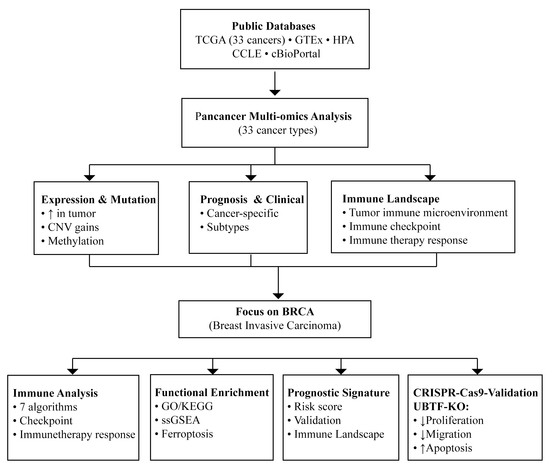
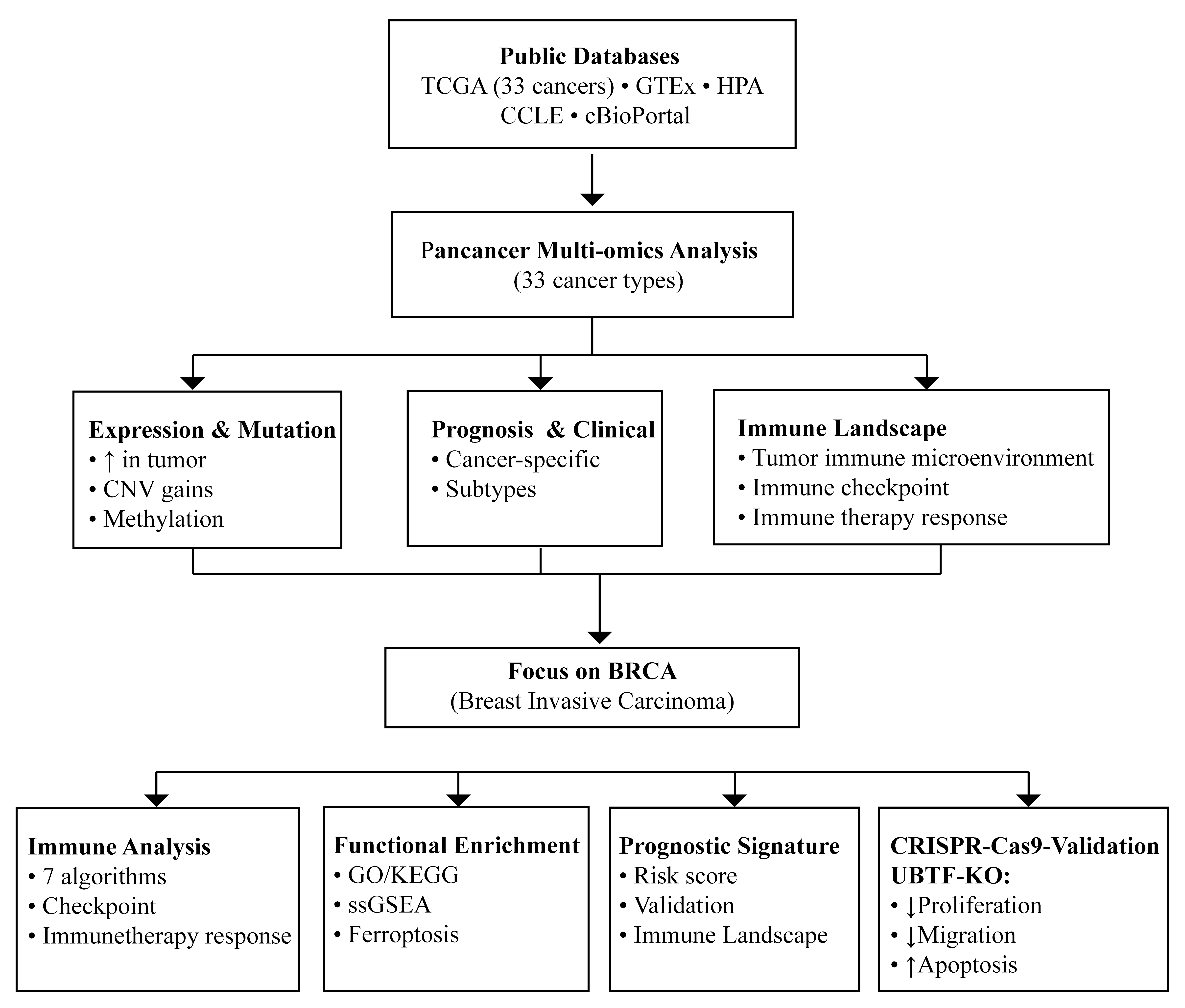
Graphical Abstract

1. Introduction

Upstream binding transcription factor (UBTF), which encodes the protein UBTF, is located on chromosome 17q21.31 and produces a 764–amino acid HMG-box DNA-binding protein [1]. UBTF is a core component of the RNA polymerase I (Pol I) preinitiation complex and facilitates rDNA transcription by promoting Pol I binding at rDNA promoter regions [1,2]. Beyond this canonical role, UBTF has also been reported to localize broadly to RNA polymerase II (Pol II)-transcribed genes across the human genome [3,4], suggesting that UBTF is widely involved in transcriptional regulation.
Consistent with its positioning at the nexus of biosynthesis and transcription, UBTF has been linked to cellular programs that are central to malignant behavior. Prior work has implicated UBTF in DNA damage and repair processes within ATR/ATM-regulated DNA damage responses, and in signaling responses to growth factor stimulation [4]. UBTF has also been connected to the regulation of differentiation, proliferation, and cell growth through multiple pathways [5], and its activity can be modulated through interactions with key repressors of cell-cycle progression, including RB family proteins and p53 [6]. These observations provide a biological rationale for examining UBTF in cancer, where increased biosynthetic demand and altered transcriptional states are common.
Although UBTF has not been extensively studied across tumor types, emerging evidence supports its relevance in cancer pathogenesis. UBTF upregulation has been reported in lung cancer specimens [7], and a recent study linked UBTF to tumor progression in melanoma [8]. In parallel, UBTF genetic alterations, including fusion events and recurrent internal tandem duplications reported in AML cohorts [9,10,11], are associated with hematologic malignancy disease subtype and clinical outcome [10,12]. Notably, recent work in AML further suggested that UBTF may contribute to immune escape through PD-L1 regulation [13], suggesting that UBTF can intersect not only with tumor-intrinsic growth programs but also with tumor–immune interactions. These malignancies represent substantial global health burdens. According to the Global Cancer Observatory (GLOBOCAN) 2020 data, breast cancer is the most commonly diagnosed cancer worldwide, with 2.3 million new cases annually, lung cancer accounts for 2.2 million cases with the highest mortality rate, and melanoma represents approximately 325,000 new cases globally [14]. Collectively, these cancers contribute significantly to cancer-related disability-adjusted life years (DALYs), with breast cancer alone accounting for over 17 million DALYs globally [15]. The high prevalence and disease burden of these cancers underscore the importance of identifying novel biomarkers and therapeutic targets such as UBTF.
Moreover, cancer is being increasingly recognized as an ecosystem in which tumor cells and the tumor microenvironment coevolve [16,17]. Immune infiltration, stromal composition, and immune checkpoint activity can influence prognosis and the response to immune checkpoint blockade [18,19]. Importantly, the immune landscape is not solely a property of tissue context; it can be coupled to tumor genomic and transcriptional states [19]. Whether UBTF expression is systematically associated with these immune features across cancers—and how such associations are related to clinical outcomes—remains unclear.
Here, we performed an integrative pancancer analysis to characterize UBTF expression patterns and molecular alterations and to evaluate their associations with prognosis and immune contexture across 33 cancer types. We further focused on breast invasive carcinoma (BRCA) to connect UBTF-associated immune and pathway programs with functional evidence from CRISPR-Cas9–mediated UBTF depletion in BRCA cell lines, and we developed and externally validated a UBTF-related prognostic signature to support risk stratification and immune relevance in BRCA.

2. Results

2.1. Pancancer Expression Profile of UBTF

Analysis of datasets from the Human Protein Atlas (HPA) and the Genotype-Tissue Expression (GTEx) project revealed that UBTF mRNA expression was elevated in the endometrium, thyroid gland, spleen, and other normal tissues (Figure 1A). Analysis of the Tumor Immune Estimation Resource 2.0 (TIMER 2.0) dataset further revealed increased UBTF mRNA expression in multiple cancer types (Supplementary Figure S1A). Similarly, UBTF protein levels were elevated in various cancers (Supplementary Figure S1B,C), as supported by immunohistochemistry (IHC) data from the Human Protein Atlas (HPA) database (Supplementary Figure S1D–F). Furthermore, analysis of cancer cell lines revealed that UBTF is highly expressed in specific cancers, such as bone, pancreatic, and uterine cancers (Figure 1B). Combined analysis of the TCGA and GTEx datasets confirmed that UBTF is highly expressed in several cancers, including BRCA (Figure 1C). Receiver operating characteristic (ROC) analysis demonstrated the diagnostic value of UBTF (area under the curve (AUC) > 0.7) in BRCA and other cancers (Supplementary Figure S2). These findings were validated in paired tumor and normal tissue samples (Figure 1D). Finally, immunofluorescence (IF) staining from the HPA database indicated that the UBTF protein is located primarily in the nucleus (Figure 1E).

2.2. Genomic and Epigenetic Alterations of UBTF

UBTF genetic alterations spanning multiple malignancy types were interrogated via the cBioPortal database. UBTF was altered in 2% of pancancer samples, predominantly via missense mutations and amplification (Supplementary Figure S3A). UBTF alteration was associated with high-frequency coalteration of several genes, including ALOX12P1, THNS2_AST, and NUP210P1 (Supplementary Figure S3B). Missense mutations were the predominant variant type, and single-nucleotide variants (SNVs) showed a strong C > T bias (69%) (Supplementary Figure S3C). Copy-number variants (CNVs) of UBTF was significantly associated with poor prognosis in several cancers, including MESO, PRAD, LUSC, and COAD. UBTF was associated with frequent genetic alterations, with mutation rates exceeding 4% in PCPG, UCEC, and PRAD (Supplementary Figure S4A). Most mutations were missense, followed by truncating and splice-site variants, with a recurrent G601S missense mutation observed (Supplementary Figure S4B). Mutation burden varied by cancer type and was highest in UCEC and SKCM (Supplementary Figure S4C). UBTF mRNA expression correlated positively with copy number (Spearman’s ρ = 0.14, p < 0.05; Supplementary Figure S4D), though the modest coefficient indicates that genomic amplification explains only part of expression variability. UBTF expression increased with increasing copy number, peaking in the amplified samples (Supplementary Figure S4E).
Additionally, we obtained the details of the SNV and CNV of UBTF across multiple cancer types from the GSCA database. CNV of UBTF was significantly associated with poor prognosis in several cancers, including UCEC, LGG, ACC, and PRAD (Supplementary Figure S3D). CNV was positively correlated with mRNA expression across cancers, including BRCA, OV, KIRP, and LUAD (Supplementary Figure S3E). UBTF SNVs were associated with poor survival in patients with BRCA, UCEC, and COAD (Supplementary Figure S4F). The mutation frequency ranged from 1% to 16% across cancers, with UCEC having the highest mutation frequency (Supplementary Figure S4G).
Next, we evaluated the methylation levels of UBTF in BRCA using the UALCAN database [18,19], and we evaluated methylation sites using the MEXPRESS database [20,21]. In BRCA, UBTF promoter methylation was significantly greater in tumors than in normal tissues (p < 0.05) (Supplementary Figure S4H), indicating epigenetic regulation. The genomic context of UBTF was revealed to be within a predicted CpG island, with methylation at specific probes (e.g., cg04583165) significantly correlated with its expression (r = −0.083, FDR < 0.05) in BRCA (Supplementary Figure S3F).

2.3. Prognostic Value Across Cancer Types

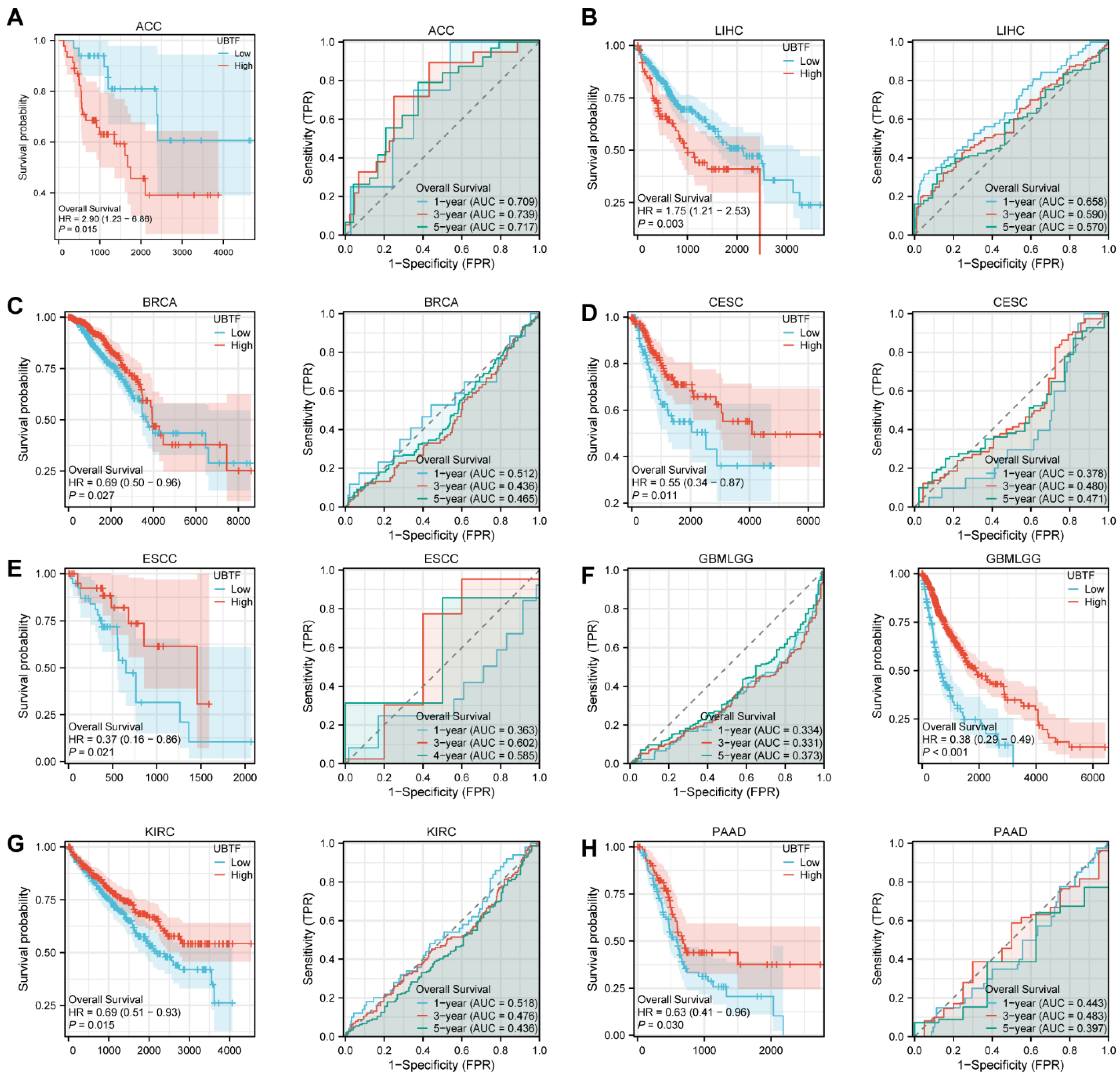
TCGA RNA-seq and clinical data were analyzed to further elucidate UBTF abundance’s prognostic significance in malignancies. Kaplan–Meier (KM) survival curves were constructed and ROC analysis was executed to explore the association between UBTF abundance and overall survival (OS) in 33 malignancy categories. Elevated UBTF abundance was significantly associated with poor outcomes in patients with ACC and LIHC (Figure 2A,B). In contrast, elevated UBTF abundance levels were positively associated with better prognosis in BRCA, CESC, ESCC, GBMLGG, KIRC, and PAAD (Figure 2C–H). To exclude nontumor event bias, we further assessed UBTF abundance’s effect on disease-specific survival (DSS). Findings paralleled those from OS analysis, revealing that increased UBTF abundance predicted worse outcomes in patients with LIHC, ACC, and UVM (Supplemental Figure S5A–C). Moreover, UBTF abundance was inversely associated with DSS in BRCA, GBMLGG, and KIRC (Supplemental Figure S5D–F). Furthermore, we appraised the association between UBTF and progression-free interval (PFI). Poor prognosis was associated with elevated UBTF abundance in patients with ACC, ESAD, LIHC, LUSC, PRAD, STAD, SARC, and UVM (Supplemental Figure S6A–H). Moreover, UBTF abundance was inversely associated with DSS in ESCC, GBM, BRCA, CHCL, UCEC, and GBMLGG (Supplemental Figure S6I–N).

2.4. Clinicopathological and Immune Subtype Associations

Accurate tumor subtype classification is vital for prognostic evaluation and tailoring precision therapeutic strategies. This study evaluated how UBTF expression correlates with clinicopathological characteristics across diverse tumor types. We observed elevated UBTF expression in patients aged ≤50 years with ESCA, HNSC, KIRP, OSCC, COAD, READ, SARC, THYM, and GBMLGG but in patients aged >50 years with CESC (Supplemental Figure S7A–J). Moreover, UBTF expression increased with increasing tumor grade in HNSC, LIHC, KIRC, OSCC, and UCEC (Supplemental Figure S7K–O). In LIHC and ESCA, UBTF expression was higher in patients with a body mass index (BMI) > 25 (Supplemental Figure S7P,Q). UBTF expression tended to increase with increasing TNM stage in LIHC, LUADLUSC and SKCM (Supplemental Figure S7R–T). We also examined UBTF expression-immune subtype associations. UBTF exhibited distinct distribution patterns across immune subtype categories in BLCA, BRCA, CHOL, TGCT, KIRC, LUAD, STAD, LUSC, LIHC, PRAD, and THCA (Supplemental Figure S8).

2.5. Pancancer Immune Landscape and Immunotherapy Response Prediction

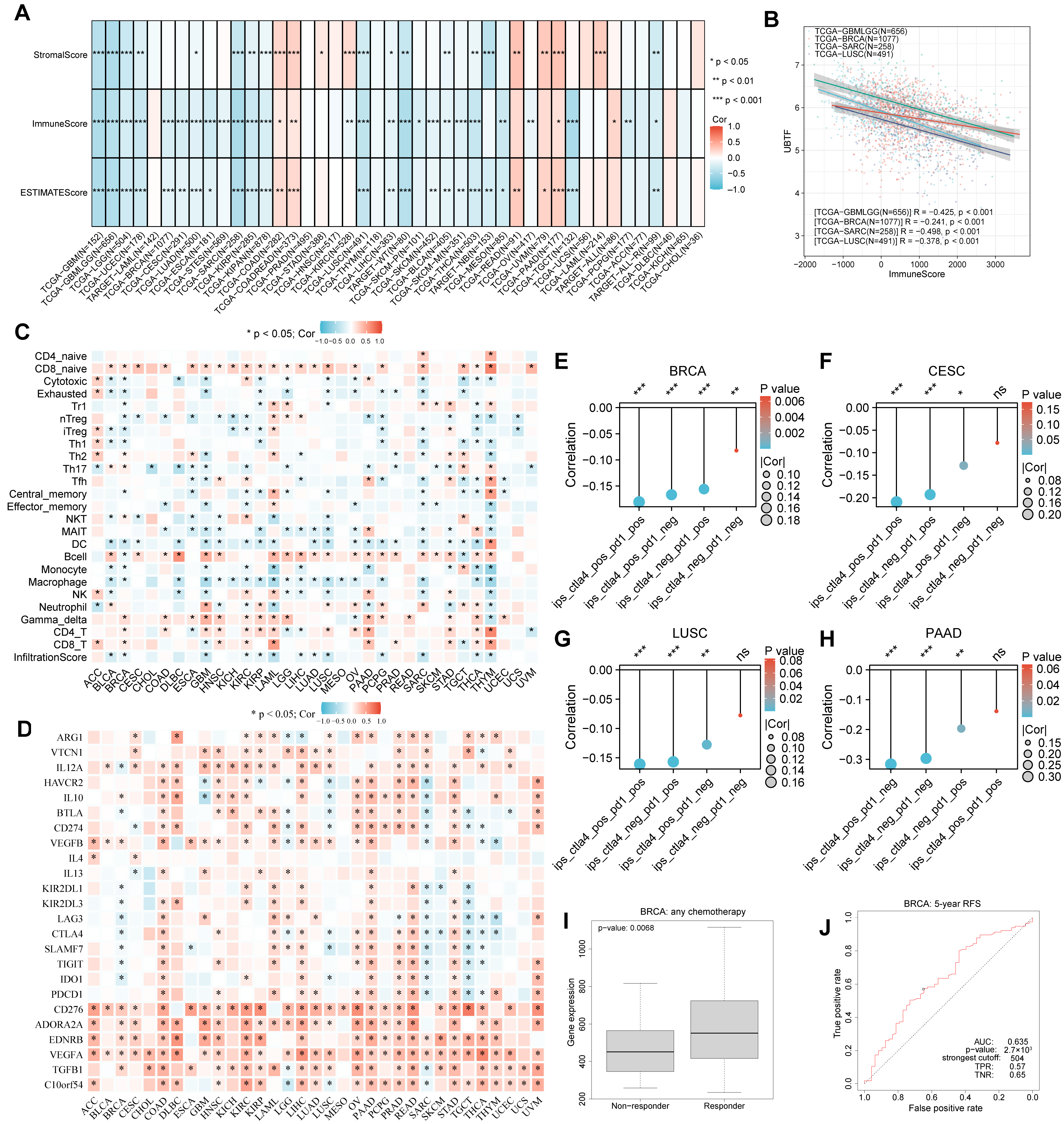
To characterize the tumor immune microenvironment, we computed immune, stromal, and ESTIMATE scores. Across various malignancy types, UBTF abundance demonstrated inverse relationships with all three scoring metrics (Figure 3A). Specifically, we observed robust positive associations between UBTF and immune, stromal, and ESTIMATE scores in GBM, BRCA, SARC, and LUSC (Figure 3B). Multiple computational methods including single-sample gene set enrichment analysis (ssGSEA) (Figure 3C), EPIC, CIBERSORT, xCELL, MCP-counter, TIMER, and QUANTISEQ (Supplemental Figure S9A–F), were employed to appraise the association of UBTF with immune cell infiltration among various malignancies. The outcomes disclosed that UBTF abundance was inversely correlated with the abundance of multiple immune cells in BRCA, GBM, KIRP, and THYM. In addition, UBTF abundance was inversely correlated with the abundance of various immune checkpoint genes in BRCA, SARC, and TGCT (Figure 3D).
Furthermore, we appraised the influence of UBTF on predicted immunotherapy response across malignancy categories. Immunophenoscore (IPS) served to evaluate associations between UBTF levels and predicted immunotherapy outcomes, and the outcomes disclosed a robust inverse association between UBTF and predicted immunotherapy response to PD-1, CTLA4, and combination therapy in BRCA, CESC, LUSC, and PAAD (Figure 3E–H). We further explored UBTF’s capacity to predict therapeutic response in malignancies through the ROC plotter database, which indicated that Chemotherapy-responsive BRCA patients demonstrated elevated UBTF levels, achieving an AUC value of 0.635 for 5-year recurrence-free survival (RFS) (Figure 3I,J).

2.6. Functional Characterization in BRCA

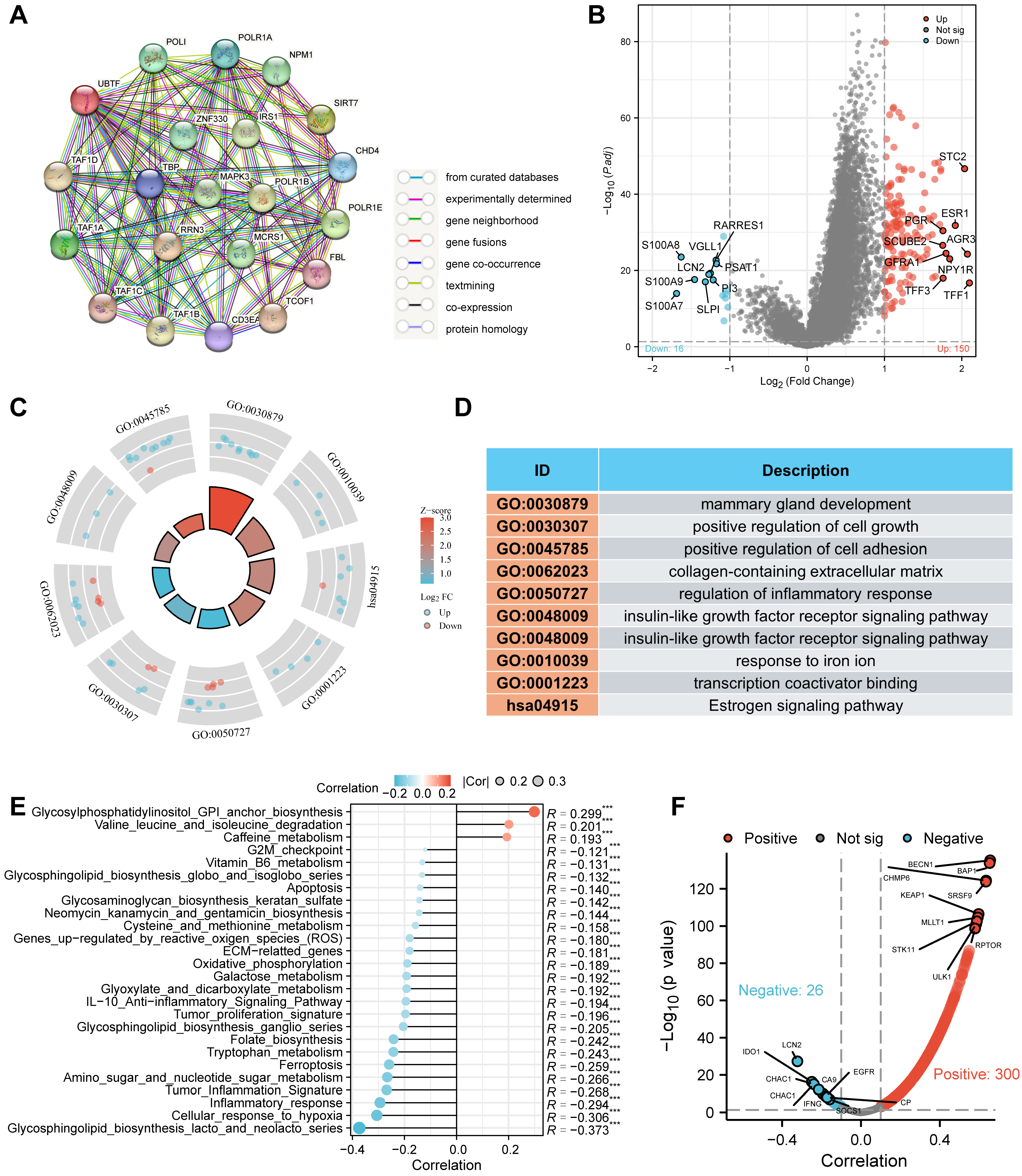
We further investigated UBTF’s functional roles in BRCA by analyzing protein interaction networks and gene expression profiles. STRING database served as the source for UBTF protein interaction data (Figure 4A). In BRCA, differential gene expression profiling unveiled 150 genes with elevated expression and 116 genes with reduced expression (Figure 4B). Functional annotation via Gene Ontology (GO) revealed predominant DEG enrichment in biological processes including positive regulation of cell adhesion and growth, plus iron ion response; conversely, Kyoto Encyclopedia of Genes and Genomes (KEGG) pathway analysis identified estrogen signaling pathway as the principal enriched route (Figure 4C,D). ssGSEA disclosed that UBTF abundance was significantly inversely correlated with cellular response to hypoxia, inflammatory response, ferroptosis, tumor proliferation, extracellular matrix (ECM)-related genes, and apoptosis (Figure 4E). Because the apoptosis gene set comprises genes promoting and inhibiting apoptosis, we evaluated how each apoptosis-related gene correlates with UBTF. Multiple antiapoptotic factors exhibited significant inverse associations with UBTF abundance, including GAL, CTSC, and caspase-5, and significantly positively correlated with the abundance of proapoptotic factors, such as ZNF830, BECN1, AMBRA1, and RGL2 (Supplementary Figure S10C). The pronounced association between UBTF and ferroptosis prompted us to investigate how UBTF correlates with 484 ferroptosis-associated genes catalogued in the FerrDB database. Analysis identified 326 significantly differentially expressed genes, including 26 that exhibited significant negative correlation with UBTF (Figure 4F). We further explored UBTF through coessentiality analysis, which uncovered 35 functionally related neighboring genes (Supplementary Figure S10A), which were enriched predominantly in ribosome and cadherin binding (Supplementary Figure S10B).

2.7. Immune Characteristics in BRCA

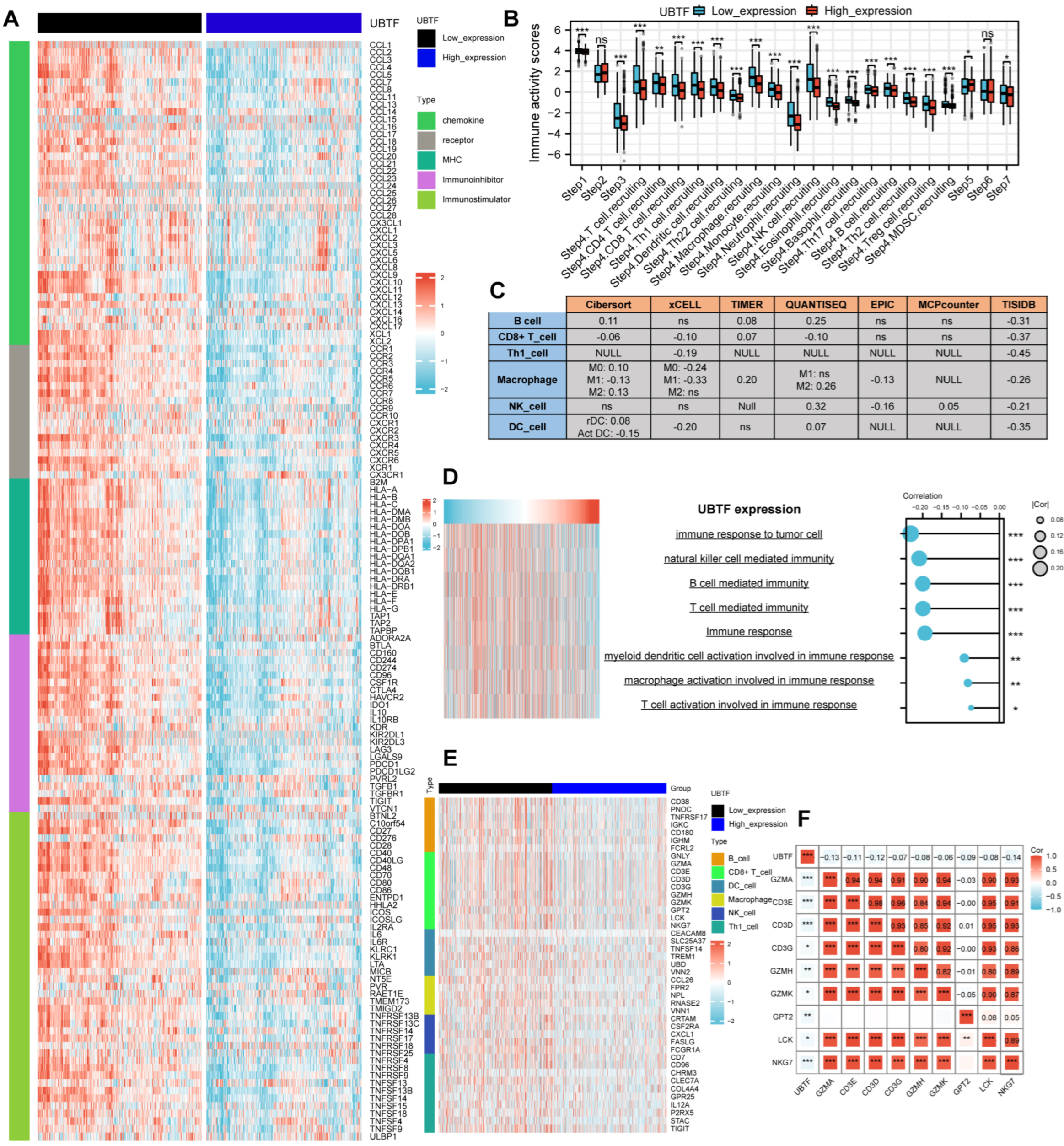
UBTF expression showed strong negative correlations with multiple immune modulators in BRCA (Figure 5A). The UBTF low-expression group demonstrated stronger anticancer immune activity across multiple steps of the cancer-immunity cycle, including priming and activation (step 3), trafficking of immune cells to tumors (step 4), immune cell infiltration into tumors (step 5), and killing of cancer cells (step 7) (Figure 5B). Immune cell infiltration analysis using multiple algorithms consistently revealed negative correlations between UBTF expression and infiltration of CD8+ T cells, NK cells, and macrophages (Figure 5C). Significant negative associations were observed between UBTF expression and immune-related pathways encompassing cytokine production, T-cell-mediated immunity, and tumor-targeting immune response (Figure 5D). Analysis of immune cell marker gene expression confirmed significant negative correlations between UBTF and marker genes of infiltrating immune cells (Figure 5E), particularly macrophage markers CD11B and CD45 (Figure 5F).

2.8. Experimental Validation of UBTF Function in BRCA

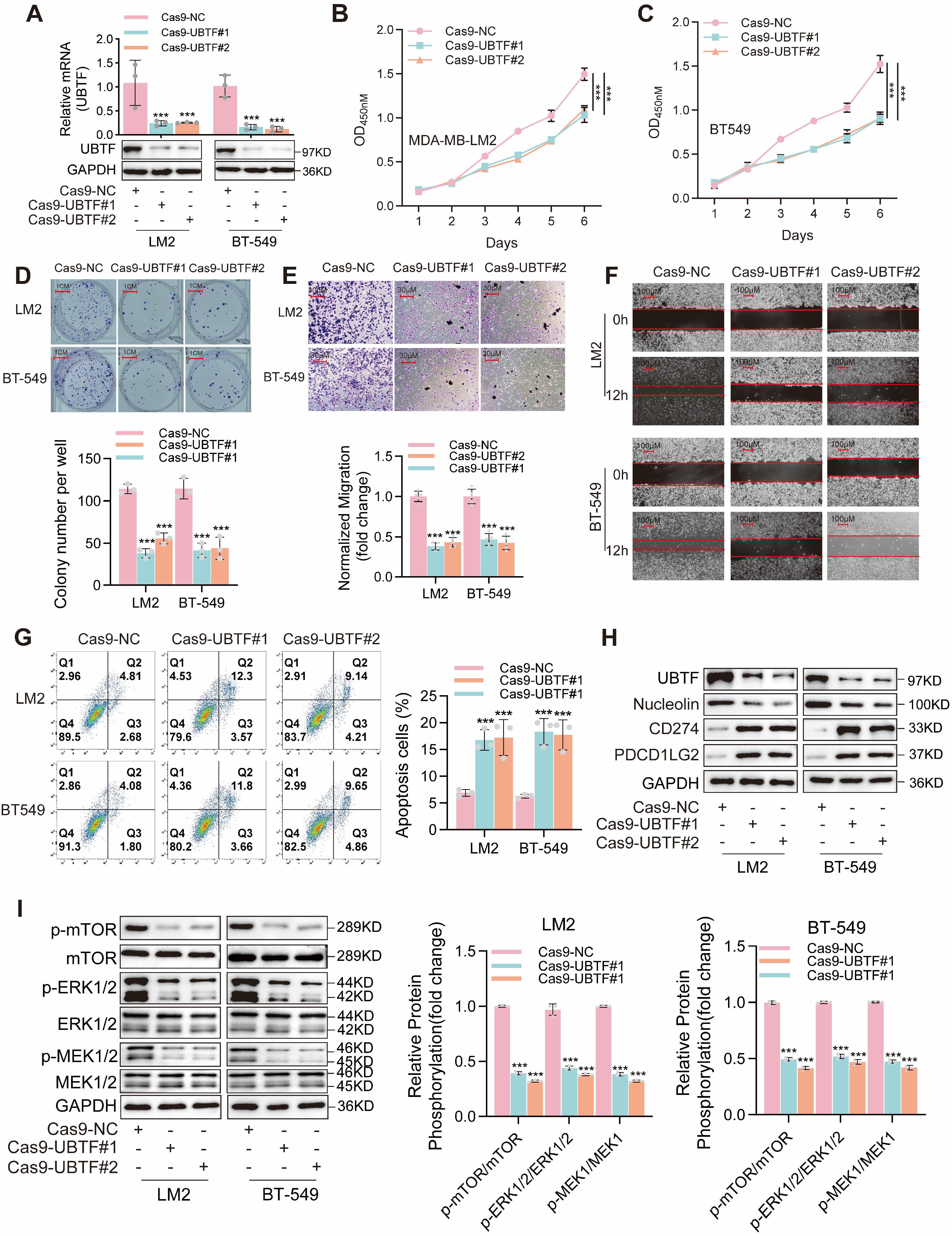
To further validate the role of UBTF in BRCA cells, we knocked down the expression of UBTF in MDA-MB-231.LM2 (LM2) and BT-549 BRCA cells using CRISPR-Cas9. Quantitative real-time PCR (qRT-PCR) and Western blot analysis confirmed successful UBTF knockdown, with both mRNA and protein expression levels significantly reduced compared with the control group (Figure 6A). The ability of UBTF to affect the proliferation of BRCA cells was confirmed by a Cell Counting Kit-8 (CCK-8) assay (Figure 6B,C) and a colony formation assay (Figure 6D), which revealed that compared with the control group, UBTF knockdown markedly reduced the proliferation ability of LM2 and BT-549 cells. Additionally, the migration abilities of the LM2 and BT-549 cells significantly decreased after UBTF knockdown, as revealed by the results of the Transwell (Figure 6E) and wound healing (Figure 6F) assays, respectively. Flow cytometry analysis revealed that UBTF knockdown significantly increased the rate of baseline apoptosis in LM2 and BT-549 cells (Figure 6G).
To further investigate the molecular mechanisms, we examined key pathway components and immune-related molecules. Western blot analysis revealed that UBTF knockdown reduced the expression of Nucleolin, a ribosome biogenesis-related protein, and increased the levels of immune checkpoint proteins PD-L1 (CD274) and PD-L2 (PDCD1LG2) (Figure 6H). Additionally, UBTF knockdown significantly reduced the phosphorylation of mTOR, ERK, and MEK, indicating suppression of the mTOR/ERK/MEK signaling pathway (Figure 6I).

2.9. Development and Validation of UBTF-PS Prognostic Model

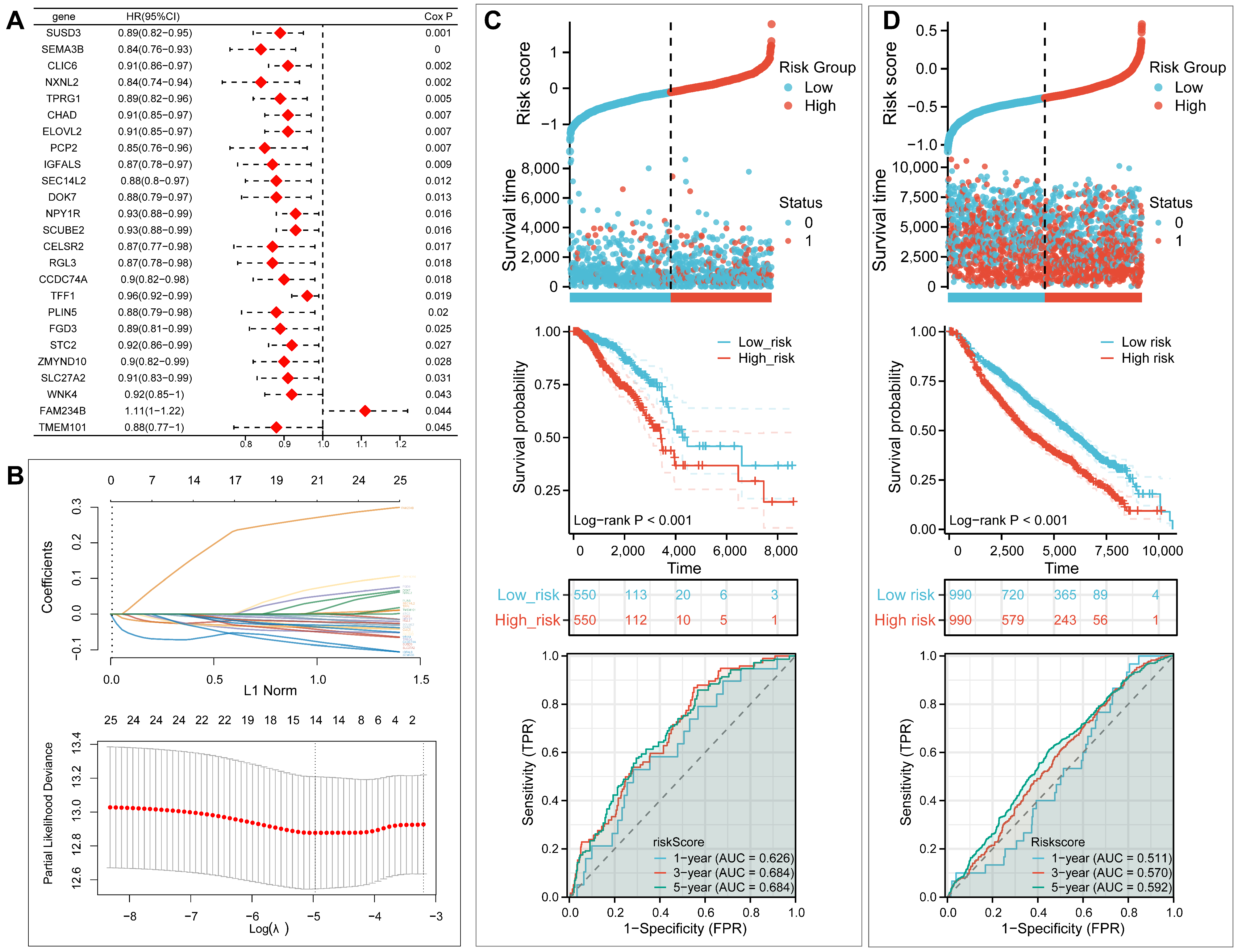
Univariate Cox regression of DEGs was performed to assess elevated UBTF expression’s prognostic significance in BRCA tumor cells; 14 genes were selected for Least Absolute Shrinkage and Selection Operator (LASSO) Cox regression, from which a prognostic model was built using the lambda value corresponding to minimal cross-validated deviance (Figure 7A,B). For external validation, the Molecular Taxonomy of Breast Cancer International Consortium (METABRIC) cohort was stratified using the median risk score derived from TCGA. Analysis across both databases revealed that overexpression of these 14 genes was associated with markedly unfavorable patient outcomes (Figure 7C,D). To assess the incremental clinical utility of UBTF-PS, decision curve analysis (DCA) was performed comparing four models: UBTF-PS alone (Risk Score), age alone, TNM stage alone, and the combined model (Risk Score + Age + TNM Stage). DCA demonstrated that the combined model incorporating UBTF-PS provided superior net benefit compared to clinical variables alone across a wide range of threshold probabilities for predicting 1-year, 3-year, and 5-year survival (Supplementary Figure S11A–C), confirming that UBTF-PS adds incremental clinical value beyond standard prognostic factors.
To integrate clinical features into a comprehensive evaluation of patient prognosis, univariate Cox regression analysis was first performed including age, race (Asian/non-Asian), TNM stage (I-II/III-IV), and risk score (Supplementary Figure S11D). Variables with p < 0.05 (age, TNM stage, and risk score) were subsequently included in multivariable Cox regression analysis, revealing that all three factors were independent risk factors affecting survival outcomes in BRCA patients (Supplementary Figure S11E). On the basis of the point values assigned to each independent risk factor, a nomogram was constructed to provide an intuitive representation of individualized survival probability (Supplementary Figure S11F). Strong predictive performance was demonstrated by the nomogram, with AUC values reaching 0.807, 0.776, and 0.736 at 1-, 3-, and 5-year time points, respectively (Supplementary Figure S11G). The calibration plot graphically evaluated the accuracy of the nomogram-predicted probabilities, with data points close to the ideal line confirming high predictive reliability at 1-year, 3-year, and 5-year intervals (Supplementary Figure S11H). Our model’s robust prognostic performance and clinical applicability are confirmed by these results.

2.10. UBTF-PS Model: Immune Infiltration and Immunotherapy Response

Analysis of immune cell infiltration through CIBERSORT indicated that elevated risk scores were associated with increased levels of most immune cell populations (Supplementary Figure S12A). Correlations between risk scores and immune checkpoint gene expression were subsequently evaluated. The majority of immune checkpoint genes demonstrated significant upregulation in high-risk patients (Supplementary Figure S12B). A substantial number of components in the immune response cycle, such as the release of cancer cell antigens (Step 1), cancer antigen presentation (Step 2), and their transport to the tumor site (Step 4), including the recruitment of CD4+ T cells, dendritic cells, Th17 cells, and regulatory T cells (Tregs), were notably positively correlated with the risk score (Supplementary Figure S12C). We corroborated these result`s by applying the TIDE algorithm to estimate immunotherapy response rates in low-risk versus high-risk patient populations. Predicted immunotherapy response rates were significantly lower in the high-risk group versus the low-risk group (Supplementary Figure S12D).

3. Discussion

UBTF is a nucleolar transcription factor that regulates rDNA transcription and ribosome biogenesis [1,2,13]. Although UBTF has been implicated in several cancer types [3,8,20], its pancancer expression patterns, regulatory mechanisms, and clinical significance remain poorly characterized. In this study, we performed a comprehensive pancancer analysis of UBTF across 33 cancer types and validated its functional role in BRCA.
UBTF expression was elevated in multiple tumor types compared with normal tissues. This reflects the increased ribosome biogenesis demands of cancer cells [2,13]. Elevated ribosome biogenesis is a characteristic feature of cancer that supports high translational capacity and accelerated proliferation [21,22]. Pancancer analyses show that nucleolar proteins and RNA polymerase I components are frequently upregulated and represent promising therapeutic targets [23]. As a core component of the RNA polymerase I preinitiation complex, UBTF is functionally linked to oncogenic pathways including mTOR, MYC, and MAPK/ERK [22].
We investigated the mechanisms driving UBTF overexpression in cancer. Genomic alterations, including copy number variations and mutations, are known to directly influence gene expression levels and represent key drivers of oncogene activation in cancer [24]. At the genomic level, UBTF alterations occurred in approximately 2% of samples, mainly copy number gains. While UBTF expression showed a statistically significant positive correlation with copy number (Spearman’s ρ = 0.14, p < 0.05), the weak correlation coefficient suggests that copy number alterations are not the primary driver of UBTF overexpression, and other regulatory mechanisms likely play more substantial roles. Given that epigenetic dysregulation represents a key mechanism of gene expression control in cancer [25], we examined DNA methylation patterns in BRCA. Differential methylation was observed between tumors and normal tissues. While overall promoter methylation levels differed, specific CpG sites (e.g., cg04583165) showed inverse correlations with UBTF expression, suggesting site-specific regulatory effects. These observations indicate that UBTF expression in cancer is controlled by multiple mechanisms, including genomic alterations and epigenetic modifications.
The prognostic value of UBTF differed greatly by cancer type. High UBTF expression was associated with poor survival in ACC (HR = 2.31, p < 0.01) and LIHC (HR = 1.68, p < 0.01) but favorable outcomes in BRCA (HR = 0.71, p < 0.001), CESC, ESCC, GBMLGG, KIRC, and PAAD. This cancer type-dependent pattern is common in pancancer biomarker studies. Tumor purity, immune infiltration, and molecular subtypes vary substantially across cancer types [19], contributing to heterogeneous biomarker-outcome relationships. However, such prognostic heterogeneity likely reflects genuine biological differences in how UBTF functions across tumor contexts rather than technical artifacts. Similar cancer-specific patterns have been reported for stemness signatures in relation to immunotherapy response [22], supporting the concept that biomarker functions are context-dependent. These observations motivated us to validate UBTF’s functional role in a specific cancer type.
UBTF expression correlated with tumor immune microenvironment features across multiple cancer types. Seven algorithms showed consistent relationships between UBTF and immune/stromal scores (ssGSEA, CIBERSORT, TIMER, EPIC, xCell, MCP-counter, quanTIseq). In BRCA, GBM, KIRP, and THYM, higher UBTF expression was associated with reduced cytotoxic lymphocyte and antigen-presenting cell infiltration, consistent with an immunologically “cold” phenotype. UBTF also correlated with immune checkpoint expression (PD-1, PD-L1, CTLA-4, LAG3) in cancer-specific patterns. Immunophenoscore analyses suggested associations with predicted response to PD-1/CTLA-4 blockade in BRCA, CESC, LUSC, and PAAD. These findings indicate that UBTF may influence tumor–immune interactions beyond its canonical role in ribosome biogenesis. Emerging evidence suggests that metabolic programs, including ribosome biogenesis, can modulate immune cell function and contribute to immunosuppressive microenvironments [26,27]. These observations suggest that UBTF connects ribosome biogenesis to immune modulation through metabolic and translational mechanisms.
Given the cancer-specific patterns observed in our pancancer analyses, we selected BRCA for functional validation based on its clinical importance, biological heterogeneity, and availability of large validation cohorts. Functional enrichment analyses of UBTF revealed significant associations with cell proliferation, migration, and oncogenic signaling pathways. To validate these associations, CRISPR-Cas9 gene editing has emerged as a powerful and precise tool for functional genomics studies in cancer research [28]. We therefore employed CRISPR-Cas9 to generate stable UBTF knockdown in LM2 and BT-549 BRCA cell lines. UBTF knockdown reduced proliferation and migration and increased apoptosis, confirming that UBTF contributes to malignant behavior in BRCA. At the molecular level, UBTF knockdown suppressed mTOR/ERK/MEK phosphorylation. These pathways play central roles in breast cancer progression [29]. UBTF knockdown also reduced Nucleolin expression, a marker of ribosome biogenesis activity. These findings confirm that UBTF links ribosome biogenesis to oncogenic signaling in BRCA. This is consistent with the established role of ribosome biogenesis in promoting tumor growth and survival [30]. These results support an oncogenic role for UBTF in breast cancer.
In BRCA, higher UBTF expression was associated with reduced immune cell infiltration and an immunologically “cold” phenotype. Additionally, UBTF expression showed negative correlations with immune checkpoint molecules. To validate this correlation, we examined PD-L1 and PD-L2 protein levels in UBTF-knockdown BRCA cells. Consistent with the negative correlation, UBTF knockdown increased PD-L1 and PD-L2 expression. These findings support a model in which UBTF promotes malignant behavior through oncogenic signaling pathways while simultaneously suppressing immune checkpoint expression. This pattern contrasts with recent findings in AML, where UBTF promotes immune escape through PD-L1 upregulation [13], suggesting differential regulation of immune checkpoint expression between solid tumors and hematologic malignancies. Such cancer-specific variation in immune checkpoint regulation is increasingly recognized, with transcriptomic analyses demonstrating substantial heterogeneity in checkpoint expression patterns both between and within cancer types [31]. Collectively, these findings indicate that UBTF exerts distinct immunoregulatory effects in different tumor types.
Several limitations should be noted. Our analysis uses bulk transcriptomic data, which cannot resolve cell-type-specific effects. The immunotherapy predictions are based on computational algorithms and require validation in prospective cohorts. Mechanistic links between UBTF and immune features remain correlative.
Future studies should address several questions. First, whether UBTF expression can predict clinical benefit from immunotherapy requires validation in prospective cohorts. Second, UBTF may represent a therapeutic target via RNA polymerase I inhibitors such as CX-5461 [31]. Third, the interplay between epigenetic therapies that reshape the tumor immune microenvironment and UBTF regulation requires further investigation [32]. Advanced imaging technologies, including nanoscale imaging [33,34] and Z-stack confocal microscopy, combined with single-cell multi-omics profiling, could reveal UBTF’s binding dynamics and cell-type-specific functions.

4. Materials and Methods

4.1. Data Collection and Preprocessing

For 33 malignancy categories, we obtained transcriptomic profiles together with matching clinical metadata via the UCSC Xena platform [35], a repository furnishing standardized, batch-normalized data originating from TCGA and GTEx initiatives. The UCSC Xena computational framework employs a uniform bioinformatics protocol encompassing read alignment, gene-level quantification, and log2 (TPM + 1) transformation across TCGA malignant specimens and GTEx physiological tissue specimens, thereby attenuating systematic discrepancies between data repositories and facilitating integrative cross-platform investigations. Protein-level expression profiles, IHC images, and IF confocal microscopy images were sourced from the HPA (http://v13.proteinatlas.org/) (accessed on 10 June 2025) [36] to corroborate UBTF expression patterns and subcellular distribution. Gene abundance matrices for malignancy-derived cell lines were procured from the CCLE (http://www.broadinstitute.org/ccle/home) (accessed on 15 June 2025) [37]. Disease nomenclature adheres to TCGA classification standards. Comprehensive nomenclature details and specimen characteristics are delineated in Supplementary Table S1. For independent validation, the METABRIC dataset (https://www.cbioportal.org/study/summary?id=brca_metabric#summary) (accessed on 15 June 2025) [38] served as an external cohort to evaluate the prognostic robustness of the model in BRCA.

4.2. Pancancer Expression Profiling of UBTF

UBTF mRNA abundance in physiological human tissues was evaluated by synthesizing transcriptomic data from HPA and GTEx repositories. UBTF mRNA abundance across diverse malignancy categories was interrogated via TIMER 2.0 (https://compbio.cn/timer2/) (accessed on 18 June 2025) [39]. UBTF protein abundance was ascertained utilizing data from the Clinical Proteomic Tumor Analysis Consortium (CPTAC) (https://proteomics.cancer.gov/programs/cptac) (accessed on 23 June 2025) [40], while IHC staining patterns were retrieved from HPA to corroborate expression at the proteomic level. Subcellular distribution of UBTF was interrogated using IF images from HPA. UBTF abundance across malignancy cell lines was interrogated using CCLE. By harmonizing gene expression profiles from TCGA and GTEx, differential abundance of UBTF between malignant and physiological tissues was systematically interrogated across 33 malignancy categories, with subsequent validation in paired tumor-normal tissue specimens. ROC curves were constructed to appraise the discriminatory capacity of UBTF abundance in distinguishing malignant from physiological tissues.

4.3. Prognostic Value Assessment of UBTF

Malignant specimens from 33 cancer categories were dichotomized into high- and low-abundance cohorts predicated on the median UBTF abundance value, as this methodology ensures balanced cohort sizes for robust statistical comparison and circumvents bias from outlier values [41]. Survival outcomes between cohorts were contrasted using KM analysis implemented in the R package survival [42] (v3.2.10). Statistical significance was ascertained via Log-rank tests, with hazard ratios (HRs) alongside 95% confidence intervals (CIs) derived through univariate Cox proportional hazards regression. The association between UBTF abundance and three survival endpoints was interrogated: DSS, OS, and PFI. To appraise the prognostic discriminatory capacity of UBTF abundance, time-dependent ROC analysis was executed via the timeROC R package [43] (v0.4), with AUC values computed at 1-, 3-, and 5-year time points to quantify predictive performance.

4.4. Genomic and Epigenetic Alteration Analysis

The mutational landscape of UBTF across diverse malignancies was systematically interrogated using cBioPortal (http://www.cbioportal.org) (accessed on 27 June 2025) [44] predicated on the TCGA Pancancer Atlas Studies dataset, wherein mutation sites, types, and frequencies were extracted from the “Cancer Types Summary” and “Mutations” modules. Concurrently, CNVs coupled with SNVs data were retrieved and interrogated through GSCALite (http://bioinfo.life.hust.edu.cn/web/GSCALite/) (accessed on 10 July 2025) [45]. Potential associations were appraised through Spearman’s rank correlation analysis, which examined the linkage between CNV mutation proportions and UBTF mRNA abundance. Furthermore, the SMART database (http://www.bioinfo-zs.com/smartapp/) (accessed on 15 July 2025) [46] was employed to interrogate the association between UBTF and its methylation status; differential methylation analysis was executed to contrast methylation levels at individual sites between physiological and malignant tissues, and the association between UBTF abundance and 14 specific methylation sites was interrogated.

4.5. Clinicopathological Feature Correlation Analysis

To appraise the associations between UBTF abundance and clinicopathological characteristics, we executed comprehensive correlation analyses across all 33 malignancy categories using TCGA data. Clinical variables including age, tumor grade, BMI, disease stage, and immune subtypes were systematically interrogated for each malignancy category. Clinical variables were categorized as appropriate.

4.6. Pancancer Immune Landscape Analysis

To thoroughly investigate UBTF abundance in relation to the tumor immune microenvironment across malignancies, we appraised multiple immune-related parameters, including immune scores, immune cell infiltration levels, immunomodulators, and tumor immunophenotypic features. Stromal, immune, and ESTIMATE scores were computed for each malignant specimen predicated on UBTF abundance levels using the R package ESTIMATE (v1.0.13), which infers non-malignant cell composition from gene expression profiles [47]. Seven computational algorithms (ssGSEA, CIBERSORT, TIMER, EPIC, MCP-counter, xCell, and quanTIseq) were used to explore the UBTF-immune cell infiltration relationship across pancancer categories. Specifically, six algorithms (CIBERSORT, TIMER, EPIC, MCP-counter, xCell, and quanTIseq) were implemented using the immunedeconv R package (v2.0.3), which integrates multiple immune cell quantification methods [48]; CIBERSORT was executed with 1000 permutations, and only specimens with p < 0.05 were included; ssGSEA was executed using the GSVA R package (v1.48.3) [49] with default parameters. All other algorithms were executed with default settings as implemented in their respective methods.

4.7. Immunotherapy Response Prediction Analysis

To characterize UBTF abundance in relation to predicted immunotherapy response, IPS data originated from The Cancer Immunome Atlas (TCIA) (https://tcia.at/home) (accessed on 18 July 2025) [50], and correlations between UBTF expression and IPS for anti–CTLA-4, anti–PD-1, and combination therapy were assessed using Spearman correlation analysis. Additionally, to predict cancer therapy response, we utilized the ROC plotter database (http://www.rocplot.org/) (accessed on 20 July 2025) [51], which integrates gene expression and clinical outcome data to assess the predictive value of UBTF for treatment response. The predictive performance of UBTF expression for chemotherapy response in BRCA was evaluated, and AUC values for RFS were calculated.

4.8. BRCA-Specific Immune Characterization Analysis

For BRCA-specific immune characterization, we executed additional analyses predicated on Charoentong et al.’s study [50]. In BRCA, 122 immune modulators were identified and subsequently analyzed for their correlations with UBTF mRNA abundance. To appraise the anti-tumor immune status, we employed the TIP database (http://biocc.hrbmu.edu.cn/TIP/) (accessed on 29 July 2025) [52]. In BRCA, immune cell infiltration levels were further corroborated using TISIDB database (http://cis.hku.hk/TISIDB/browse.php) (accessed on 2 August 2025) [53]. Gene sets pertaining to specific immune processes were sourced from the AmiGO 2 portal (https://amigo.geneontology.org/amigo) (accessed on 4 August 2025), and associations with UBTF were ascertained via the GSVA R package [49] (v1.48.3). Furthermore, we interrogated the association between UBTF and established immune cell marker genes in BRCA. For the UBTF-Related Prognostic Signature (UBTF-PS) prognostic model, the TIDE algorithm was additionally utilized to evaluate predicted immunotherapy response, with subsequent comparison of TIDE scores between high- and low-risk cohorts.

4.9. Functional Enrichment and Pathway Analysis

Protein–protein interaction networks were prognosticated via the STRING database (https://string-db.org/) (accessed on 11 August 2025) [54]. To ascertain differentially expressed genes (DEGs) distinguishing UBTF high- from low-abundance cohorts in BRCA, we employed Limma R package [55] (v3.56.2), establishing significance thresholds at FDR-adjusted p value < 0.05 alongside |log2 FC| > 1. Subsequently, the identified DEGs underwent GO and KEGG pathway enrichment analyses via ClusterProfiler R package [56] (v4.1.4) with default parameters, wherein significantly enriched terms were ascertained at p value < 0.05.
To interrogate the association between UBTF and tumor-related pathway activities in BRCA, we collected gene sets from various biological pathways predicated on a previous study [57]. We executed ssGSEA to compute enrichment scores for each pathway across all BRCA specimens. The association between UBTF abundance and pathway enrichment scores was then appraised using Spearman correlation analysis. To interrogate the association between UBTF and ferroptosis in depth, the FerrDB database yielded 484 ferroptosis-related genes for analysis and interrogated their association with UBTF abundance in BRCA using Spearman correlation analysis, with significantly correlated genes defined as those with |R| > 0.1 and p < 0.05. Additionally, to identify genes functionally related to UBTF, we executed coessentiality analysis using DepMap database (https://depmap.org/portal/) (accessed on 12 August 2025), which identifies genes whose essentiality patterns correlate across hundreds of malignant cell lines [58].

4.10. Construction and Validation of UBTF-PS

Within the TCGA-BRCA cohort, patients were bifurcated into high- and low-UBTF abundance cohorts predicated on median abundance. These DEGs were then analyzed via univariate Cox regression for identifying OS-related genes. The glmnet R package [59] (v4.1-7) was utilized to build a UBTF-related prognostic model via LASSO Cox regression. To prevent overfitting, 10-fold cross-validation over 1000 iterations was used to determine the optimal penalty parameter (λ), minimizing cross-validated partial likelihood deviance, and lambda.min was selected. A risk score (UBTF-PS) was calculated as: UBTF-PS = Σ (coefficient_i × expression_i). The median UBTF-PS value was employed to dichotomize patients into two risk strata: high and low. Outcome differences were quantified through KM survival curves in conjunction with log-rank statistical testing. The model’s discriminatory capacity was evaluated through time-dependent ROC curves, with AUC values computed at 1-, 3-, and 5-year follow-up milestones. DCA via the rmda R package [60] (v1.6) quantified net benefit for pre-dicting 1-, 3-, and 5-year survival, comparing four models: UBTF-PS alone, age alone, pTNM stage alone, and the combined model (UBTF-PS + Age + pTNM Stage), plus “treat all” and “treat none” strategies. External corroboration was conducted in the METABRIC cohort employing identical risk formula and cutoff values derived from the TCGA-BRCA cohort.

4.11. Construction of Nomogram

To appraise the independent prognostic utility of UBTF-PS, clinical variables including age, race (Asian vs. non-Asian), TNM stage (I-II vs. III-IV), and risk score (UBTF-PS) underwent preliminary univariate Cox regression analysis. Variables achieving p < 0.05 were then entered into multivariable Cox regression for pinpointing independent prognostic factors. An integrated nomogram featuring the identified independent prognostic factors was built to forecast individualized survival probability at 1-, 3-, and 5-year time points. Nomogram discriminatory capacity was quantified through time-dependent ROC curves, deriving AUC values. Calibration plots generated through the rms R package (v 6.2-0) served to evaluate the correspondence between model predictions and actual survival outcomes [61].

4.12. Cell Culture and CRISPR/Cas9-Mediated UBTF Knockdown

The BT-549 BRCA cell line originated from ATCC. LM2 was graciously supplied by Dr. Joan Massagué [62]. Cell propagation occurred in DMEM medium supplemented with 10% fetal bovine serum (FBS; Gibco) plus 1% penicillin-streptomycin under standard conditions (37 °C, humidified 5% CO2). Regular mycoplasma testing was conducted employing the MycoAlert Mycoplasma Detection Kit (Lonza, Shanghai, China).
To generate UBTF knockdown stable BRCA cell lines, we employed the CRISPR/Cas9 system. UBTF-targeting small-guide RNA (sgRNA) was engineered using the Optimized CRISPR Design program, which employs validated algorithms to maximize on-target activity and minimize off-target effects [63]. The sgRNA sequences are as follows: sgUBTF#1: 5′-TCTTCTCGGAGGAGAAACGG-3′; sgUBTF#2: 5′-CTCTGCAGTCCAAGTCGGTA-3′. 293T cells were employed to assemble and package Lenti-Cas9-sgRNA-puro expressing Cas9 nuclease coupled with UBTF-directed guide RNA, alongside the appropriate empty vector control. Lentivirus was introduced to cultured BRCA cells at a multiplicity of infection (MOI) of approximately 10. Following 72 h incubation, selection of stable cells was accomplished using puromycin at 2.0 μg/mL (Thermo Fisher, Beijing, China, A1113803) for 7 days. Pooled populations of puromycin-resistant cells were used for all subsequent experiments. Knockdown efficacy was corroborated via Western blot analysis in conjunction with qRT-PCR, demonstrating >70% reduction in UBTF protein and mRNA levels compared to control cells (Figure 6A).

4.13. RNA Isolation and qRT-PCR

Cells underwent total RNA extraction using TRIzol® reagent (Invitrogen, Shanghai, China 15596026). For complementary DNA (cDNA) synthesis, 500 ng of the purified RNA was reverse-transcribed employing the Prime-Script™ RT Master Mix (Takara, Dalian, China, RR037A). qRT-PCR was subsequently executed employing the ChamQ Universal SYBR Green Master Mix (Vazyme, Nanjing, China, Q711). The amplification protocol entailed an initial denaturation phase at 95 °C for 10 min, with subsequent 40 cycles at 95 °C for 15 s and 60 °C for 60 s. Melting curve analysis was executed to corroborate amplicon specificity. Quantification of gene expression employed the 2−ΔΔCT method, with normalization performed relative to GAPDH as the internal control. Primer sequences for this investigation are specified below: UBTF (Forward, 5′- AAACCACCGAATCACACATGG-3′; Reverse, 5′-TCTGTCAATGTACGGAACTTCCT-3′).

4.14. Western Blotting

Protein specimens were isolated from cultured cells through extraction in T-PER protein extraction reagent (Thermo Fisher) alongside protease and phosphatase inhibitor cocktail (Thermo Fisher), followed by incubation on ice for 30 min to ensure complete cell lysis. Upon centrifugation at 11,000× g for 20 min at 4 °C, supernatant fractions were isolated, and protein content was quantified via a BCA Protein Assay Kit (Thermo Fisher, 23225). For immunoblotting, protein samples (40 μg) were loaded and electrophoresed by SDS-PAGE employing 8–15% polyacrylamide gels under denaturing conditions. Proteins were then electrotransferred onto polyvinylidene fluoride (PVDF) membranes (Millipore, Burlington, MA, USA, IPVH00010). Succeeding transfer, blocking was performed using 5% non-fat milk prepared in Tris-buffered saline with 0.1% Tween-20 (TBST; Sangon Biotech, Shanghai, China, B040126), incubating membranes for 2 h at ambient temperature. Membranes were subsequently incubated with specific primary antibodies at 4 °C overnight while gently rocking. Primary antibodies employed were GAPDH (diluted 1:20,000, Proteintech, Wuhan, China, 60004-1-Ig), UBTF (diluted 1:500, Abcam, Shanghai, China, EP2741Y), Nucleolin (diluted 1:1000, Abcam, ab22758), CD274/PD-L1 (diluted 1:1000, Cell Signaling Technology, Shanghai, China, #13684), PDCD1LG2/PD-L2 (diluted 1:1000, Cell Signaling Technology, Shanghai, China, #82723), mTOR (diluted 1:1000, Cell Signaling Technology, #2983), p-mTOR (Ser2448) (diluted 1:1000, Cell Signaling Technology, #5536), ERK1/2 (diluted 1:1000, Cell Signaling Technology, #4695), p-ERK1/2 (Thr202/Tyr204) (diluted 1:1000, Cell Signaling Technology, #4370), MEK1/2 (diluted 1:1000, Cell Signaling Technology, #9122), and p-MEK1/2 (Ser217/221) (diluted 1:2000, Cell Signaling Technology, #9154). Following three washes in TBST (15 min each), HRP-conjugated goat anti-rabbit IgG secondary antibody (diluted 1:10,000, SAB, Shanghai, China, L3012) or HRP-conjugated goat anti-mouse IgG secondary antibody (diluted 1:10,000, SAB, L3032) was introduced with subsequent 2 h incubation at ambient temperature. Protein bands were revealed employing LumiBest ECL reagent solution kit (share-bio, Shanghai, China, WB012).

4.15. Cell Proliferation Assessment

Cellular proliferative capacity was dynamically appraised employing the CCK-8 (SAB biotech, Nanjing, China, CP002). Briefly, 2500 cells suspended in 100 μL complete medium were added per well to 96-well plates, with subsequent cultivation extending up to 7 days. At predefined intervals (days 1 through 6), wells were given 10 μL CCK-8 solution and kept for a further 2 h. Measurements at 450 nm were obtained employing a microplate reader (BioTek Synergy H1, Beijing, China) to appraise metabolic activity as a surrogate for viable cell number. Background optical density from media-only wells was deducted from all measurements.

4.16. Colony Formation Assay

Clonogenic capacity of cells was appraised via colony formation assay. Six-well plates received approximately 500 cells per well, which were then cultured for 14 days under standard conditions to permit colony maturation, with medium refreshed every 3 days. Following the emergence of visible, distinct monoclonal colonies, the growth medium was aspirated, and adherent cells were rinsed with PBS (Solarbio, Beijing, China) and then immobilized with 4% paraformaldehyde at ambient temperature for 45 min. Upon completion of fixation, colonies received 0.1% crystal violet staining for 15 min, followed by gentle distilled water washes to clear excess dye, then air-drying. Three independent investigators, blinded to experimental groups, manually counted colonies exceeding 50 cells under light microscopy. Clonogenic efficiency was computed as (colonies enumerated/cells initially plated) × 100%, and outcomes were normalized to the control group.

4.17. Cellular Migratory Capacity Assessment via Transwell

To appraise cellular migratory capabilities, Transwell assays were executed employing Transwell Permeable Supports (Corning Costar, Beijing, China, #3422) in 24-well plates. Cells were harvested by trypsinization, enumerated employing an automated cell counter, and re-suspended in serum-free DMEM medium. To exclude the confounding influence of proliferation, mitomycin C (10 μg/mL, Sigma-Aldrich, Shanghai, China, M4287) was applied to cells for 2 h as pretreatment. Thereafter, 5000 viable cells resuspended in 200 μL serum-free DMEM with mitomycin C (10 μg/mL) were transferred to the upper chamber; concurrently, 600 μL complete DMEM medium enriched with 20% FBS was dispensed into the lower chamber to serve as chemoattractant. After 18 h at 37 °C in 5% CO2, non-migrated cells were removed with a cotton swab. Cells on the lower membrane surface were fixed in 4% paraformaldehyde (15 min), stained with 0.5% crystal violet (20 min), and photographed at 100× magnification. Five random fields per insert were analyzed for migrated cell counts using ImageJ software (v2.0.0). Fold-change values are normalized to the control group.

4.18. Cellular Motility Assessment via Scratch Wound

Cell motility was further assessed by wound healing assay. Cells were seeded at 5 × 10⁵ cells/well in 6-well plates and cultured to 80–90% confluence (~24 h). To exclude proliferation, cells were pretreated with mitomycin C (10 μg/mL) for 2 h before wounding. Using a sterile 200 μL pipette tip positioned perpendicular to the plate, a linear scratch was made across the cell monolayer. Two PBS washes removed detached cells and debris, and fresh complete DMEM medium containing mitomycin C (10 μg/mL) was supplemented. Cellular migration was appraised by quantifying the movement of cells into the acellular area generated by the scratch. Wound closure was monitored and photographed under phase-contrast microscopy immediately (0 h) and 12 h after scratching employing an inverted microscope (Nikon Eclipse Ti-U, Shanghai, China). Images were captured at 100× magnification from at least three fields per well. Wound width was quantified employing ImageJ software.

4.19. Apoptotic Cell Death Assessment via Flow Cytometry

Apoptotic cell death was appraised employing the Annexin V-FITC and PI Apoptosis Detection Kit (BD Biosciences, Beijing, China, 556547) in conjunction with flow cytometric analysis. Cells were maintained to approximately 70–80% confluence, then both floating and adherent cells were harvested by trypsinization (for adherent cells) and gentle pipetting (for floating cells), combined, centrifuged (400× g, 5 min), and rinsed (ice-cold PBS) to eliminate residual medium and debris. Cell pellets underwent resuspension in 1× binding buffer to achieve 1 × 10⁷ cells/mL. Aliquots of 100 μL were dispensed into 1.5 mL tubes and labeled with 5 μL Annexin V-FITC plus 5 μL PI as per manufacturer’s guidelines. Following incubation in the dark at ambient temperature for 15 min, 400 μL of 1× binding buffer was supplemented to each tube. Specimens were immediately interrogated by flow cytometry (BD FACSCanto II, Beijing, China) within 1 h. For each specimen, at least 10,000 events were recorded. Cell populations were quantified employing FlowJo software (v10.8.1).

4.20. Statistical Analysis

Each in vitro functional experiment was repeated three times in three independent experimental replicates. Statistical analyses were executed employing R software (v4.3.2). Comparisons between two groups utilized the Wilcoxon rank-sum test (Mann–Whitney U test), and comparisons across multiple groups utilized the Kruskal–Wallis test with post hoc pairwise comparisons and multiple-testing correction as appropriate. For in vitro functional experiments, appropriate parametric or non-parametric statistical tests were applied as specified in figure legends. Spearman’s rank correlation coefficient was employed for correlation and association analyses between continuous variables. When comparing UBTF high- versus low-expression groups for differential gene expression, multiple testing correction was applied to raw p values via the Benjamini–Hochberg FDR method; genes were designated as DEGs if they satisfied both FDR-adjusted p value < 0.05 and |log2 FC| > 1. Significance levels were designated as follows: p < 0.05, p < 0.01, and p < 0.001.

5. Conclusions

UBTF serves as a promising biomarker for prognostic prediction and immunotherapy response across multiple cancers, particularly BRCA. UBTF expression correlates with immune microenvironment composition, immune checkpoint molecule regulation, and patient survival outcomes. Functional validation in BRCA demonstrates that UBTF promotes tumor cell proliferation and migration through mTOR/ERK/MEK signaling activation while suppressing PD-L1 and PD-L2 expression. These findings warrant further investigation of UBTF as a therapeutic target for cancer treatment and immunotherapy optimization.

Supplementary Materials

The following supporting information can be downloaded at: https://www.mdpi.com/article/10.3390/ijms27062909/s1.

Author Contributions

Conceptualization, W.J. and H.S.; Methodology, M.H.; Software, M.H. and S.L.; Validation, M.H. and Y.W.; Formal Analysis, M.H.; Investigation, Y.H.; Data Curation, M.H.; Writing—Original Draft Preparation, M.H.; Writing—Review & Editing, W.J., Y.H. and H.S.; Visualization, Y.H.; Supervision, W.J.; Funding Acquisition, W.J. All authors have read and agreed to the published version of the manuscript.

Funding

This work was supported by the National Nature Science Foundation of China (82372961).

Institutional Review Board Statement

Not applicable.

Informed Consent Statement

Not applicable.

Data Availability Statement

The original contributions presented in this study are included in the Supplementary Material. Further inquiries can be directed to the corresponding authors.

Conflicts of Interest

The authors declare no conflicts of interest.

References

  1. Sanij, E.; Hannan, R.D. The role of UBF in regulating the structure and dynamics of transcriptionally active rDNA chromatin. Epigenetics 2009, 4, 374–382. [Google Scholar] [CrossRef]
  2. Sanij, E.; Poortinga, G.; Sharkey, K.; Hung, S.; Holloway, T.P.; Quin, J.; Robb, E.; Wong, L.H.; Thomas, W.G.; Stefanovsky, V.; et al. UBF levels determine the number of active ribosomal RNA genes in mammals. J. Cell Biol. 2008, 183, 1259–1274. [Google Scholar] [CrossRef]
  3. Sanij, E.; Diesch, J.; Lesmana, A.; Poortinga, G.; Hein, N.; Lidgerwood, G.; Cameron, D.P.; Ellul, J.; Goodall, G.J.; Wong, L.H.; et al. A novel role for the Pol I transcription factor UBTF in maintaining genome stability through the regulation of highly transcribed Pol II genes. Genome Res. 2015, 25, 201–212. [Google Scholar] [CrossRef]
  4. Diesch, J.; Hannan, R.D.; Sanij, E. Genome wide mapping of UBF binding-sites in mouse and human cell lines. Genom. Data 2015, 3, 103–105. [Google Scholar] [CrossRef] [PubMed]
  5. Stefanovsky, V.Y.; Moss, T. The splice variants of UBF differentially regulate RNA polymerase I transcription elongation in response to ERK phosphorylation. Nucleic Acids Res. 2008, 36, 5093–5101. [Google Scholar] [CrossRef] [PubMed]
  6. Kong, R.; Zhang, L.; Hu, L.; Peng, Q.; Han, W.; Du, X.; Ke, Y. hALP, a novel transcriptional U three protein (t-UTP), activates RNA polymerase I transcription by binding and acetylating the upstream binding factor (UBF). J. Biol. Chem. 2011, 286, 7139–7148. [Google Scholar] [CrossRef] [PubMed]
  7. Xie, Z.C.; Tang, R.X.; Gao, X.; Xie, Q.N.; Lin, J.Y.; Chen, G.; Li, Z. A meta-analysis and bioinformatics exploration of the diagnostic value and molecular mechanism of miR-193a-5p in lung cancer. Oncol. Lett. 2018, 16, 4114–4128. [Google Scholar] [CrossRef]
  8. Zhang, J.; Zhang, J.; Liu, W.; Ge, R.; Gao, T.; Tian, Q.; Mu, X.; Zhao, L.; Li, X. UBTF facilitates melanoma progression via modulating MEK1/2-ERK1/2 signalling pathways by promoting GIT1 transcription. Cancer Cell Int. 2021, 21, 543. [Google Scholar] [CrossRef]
  9. Bastian, L.; Hartmann, A.M.; Beder, T.; Hänzelmann, S.; Kässens, J.; Bultmann, M.; Hoeppner, M.P.; Franzenburg, S.; Wittig, M.; Franke, A.; et al. UBTF::ATXN7L3 gene fusion defines novel B cell precursor ALL subtype with CDX2 expression and need for intensified treatment. Leukemia 2022, 36, 1676–1680. [Google Scholar] [CrossRef]
  10. Duployez, N.; Vasseur, L.; Kim, R.; Largeaud, L.; Passet, M.; L’Haridon, A.; Lemaire, P.; Fenwarth, L.; Geffroy, S.; Helevaut, N.; et al. UBTF tandem duplications define a distinct subtype of adult de novo acute myeloid leukemia. Leukemia 2023, 37, 1245–1253. [Google Scholar] [CrossRef]
  11. Kaburagi, T.; Shiba, N.; Yamato, G.; Yoshida, K.; Tabuchi, K.; Ohki, K.; Ishikita, E.; Hara, Y.; Shiraishi, Y.; Kawasaki, H.; et al. UBTF-internal tandem duplication as a novel poor prognostic factor in pediatric acute myeloid leukemia. Genes Chromosomes Cancer 2023, 62, 202–209. [Google Scholar] [CrossRef]
  12. Umeda, M.; Ma, J.; Huang, B.J.; Hagiwara, K.; Westover, T.; Abdelhamed, S.; Barajas, J.M.; Thomas, M.E.; Walsh, M.P.; Song, G.; et al. Integrated Genomic Analysis Identifies UBTF Tandem Duplications as a Recurrent Lesion in Pediatric Acute Myeloid Leukemia. Blood Cancer Discov. 2022, 3, 194–207. [Google Scholar] [CrossRef] [PubMed]
  13. Yang, C.; Wan, J.; Wang, Y.; Yang, Y.; Ran, Y.; Zhang, F.; Zhou, M.; Liu, P.; Kang, Q.; Ma, D.; et al. UBTF facilitates acute myeloid leukemia development and immune escape via PD-L1 regulation. Int. Immunopharmacol. 2025, 152, 114433. [Google Scholar] [CrossRef]
  14. Sung, H.; Ferlay, J.; Siegel, R.L.; Laversanne, M.; Soerjomataram, I.; Jemal, A.; Bray, F. Global Cancer Statistics 2020: GLOBOCAN Estimates of Incidence and Mortality Worldwide for 36 Cancers in 185 Countries. CA Cancer J. Clin. 2021, 71, 209–249. [Google Scholar] [CrossRef] [PubMed]
  15. Tsilidis, K.K.; Papadimitriou, N.; Capothanassi, D.; Bamia, C.; Benetou, V.; Jenab, M.; Freisling, H.; Kee, F.; Nelen, A.; O’Doherty, M.G.; et al. Burden of Cancer in a Large Consortium of Prospective Cohorts in Europe. J. Natl. Cancer Inst. 2016, 108, djw127. [Google Scholar] [CrossRef] [PubMed]
  16. Hanahan, D.; Weinberg, R.A. Hallmarks of cancer: The next generation. Cell 2011, 144, 646–674. [Google Scholar] [CrossRef]
  17. Quail, D.F.; Joyce, J.A. Microenvironmental regulation of tumor progression and metastasis. Nat. Med. 2013, 19, 1423–1437. [Google Scholar] [CrossRef]
  18. Binnewies, M.; Roberts, E.W.; Kersten, K.; Chan, V.; Fearon, D.F.; Merad, M.; Coussens, L.M.; Gabrilovich, D.I.; Ostrand-Rosenberg, S.; Hedrick, C.C.; et al. Understanding the tumor immune microenvironment (TIME) for effective therapy. Nat. Med. 2018, 24, 541–550. [Google Scholar] [CrossRef]
  19. Thorsson, V.; Gibbs, D.L.; Brown, S.D.; Wolf, D.; Bortone, D.S.; Ou Yang, T.H.; Porta-Pardo, E.; Gao, G.F.; Plaisier, C.L.; Eddy, J.A.; et al. The Immune Landscape of Cancer. Immunity 2018, 48, 812–830.e14. [Google Scholar] [CrossRef]
  20. Chen, K.; Dong, Y.; He, G.; He, X.; Pan, M.; Huang, X.; Yu, X.; Xia, J. UBTF mediates activation of L3MBTL2 to suppress NISCH expression through histone H2AK119 monoubiquitination modification in breast cancer. Clin. Exp. Metastasis 2024, 41, 791–805. [Google Scholar] [CrossRef]
  21. Pelletier, J.; Thomas, G.; Volarević, S. Ribosome biogenesis in cancer: New players and therapeutic avenues. Nat. Rev. Cancer 2018, 18, 51–63, Erratum in Nat. Rev. Cancer 2018, 18, 134. https://doi.org/10.1038/nrc.2018.3. [Google Scholar] [CrossRef] [PubMed]
  22. Jiao, L.; Liu, Y.; Yu, X.Y.; Pan, X.; Zhang, Y.; Tu, J.; Song, Y.-H.; Li, Y. Ribosome biogenesis in disease: New players and therapeutic targets. Signal Transduct. Target. Ther. 2023, 8, 15. [Google Scholar] [CrossRef] [PubMed]
  23. Zang, Y.; Ran, X.; Yuan, J.; Wu, H.; Wang, Y.; Li, H.; Teng, H.; Sun, Z. Genomic hallmarks and therapeutic targets of ribosome biogenesis in cancer. Brief. Bioinform. 2024, 25, bbae023. [Google Scholar] [CrossRef] [PubMed]
  24. Vogelstein, B.; Papadopoulos, N.; Velculescu, V.E.; Zhou, S.; Diaz, L.A., Jr.; Kinzler, K.W. Cancer genome landscapes. Science 2013, 339, 1546–1558. [Google Scholar] [CrossRef]
  25. Hanahan, D. Hallmarks of Cancer: New Dimensions. Cancer Discov. 2022, 12, 31–46. [Google Scholar] [CrossRef]
  26. Hu, C.; Qiao, W.; Li, X.; Ning, Z.K.; Liu, J.; Dalangood, S.; Li, H.; Yu, X.; Zong, Z.; Wen, Z.; et al. Tumor-secreted FGF21 acts as an immune suppressor by rewiring cholesterol metabolism of CD8+T cells. Cell Metab. 2024, 36, 630–647.e8. [Google Scholar] [CrossRef]
  27. Elhamamsy, A.R.; Metge, B.J.; Alsheikh, H.A.; Shevde, L.A.; Samant, R.S. Ribosome Biogenesis: A Central Player in Cancer Metastasis and Therapeutic Resistance. Cancer Res. 2022, 82, 2344–2353. [Google Scholar] [CrossRef]
  28. Chehelgerdi, M.; Chehelgerdi, M.; Khorramian-Ghahfarokhi, M.; Shafieizadeh, M.; Mahmoudi, E.; Eskandari, F.; Rashidi, M.; Arshi, A.; Mokhtari-Farsani, A. Comprehensive review of CRISPR-based gene editing: Mechanisms, challenges, and applications in cancer therapy. Mol. Cancer 2024, 23, 9, Erratum in Mol. Cancer 2024, 23, 43. https://doi.org/10.1186/s12943-024-01961-9. [Google Scholar] [CrossRef]
  29. Nunnery, S.E.; Mayer, I.A. Targeting the PI3K/AKT/mTOR Pathway in Hormone-Positive Breast Cancer. Drugs 2020, 80, 1685–1697. [Google Scholar] [CrossRef]
  30. Penzo, M.; Montanaro, L.; Treré, D.; Derenzini, M. The Ribosome Biogenesis-Cancer Connection. Cells 2019, 8, 55. [Google Scholar] [CrossRef]
  31. Miyashita, H.; Bevins, N.J.; Thangathurai, K.; Lee, S.; Pabla, S.; Nesline, M.K.; Glenn, S.T.; Conroy, J.M.; DePietro, P.; Rubin, E.; et al. The transcriptomic expression pattern of immune checkpoints shows heterogeneity between and within cancer types. Am. J. Cancer Res. 2024, 14, 2240–2252. [Google Scholar] [CrossRef]
  32. Yang, J.; Xu, J.; Wang, W.; Zhang, B.; Yu, X.; Shi, S. Epigenetic regulation in the tumor microenvironment: Molecular mechanisms and therapeutic targets. Signal Transduct. Target. Ther. 2023, 8, 210. [Google Scholar] [CrossRef]
  33. Holmes, E.P.; Gamill, M.C.; Provan, J.I.; Wiggins, L.; Rusková, R.; Whittle, S.; Catley, T.E.; Main, K.H.S.; Shephard, N.; Bryant, H.E.; et al. Quantifying complexity in DNA structures with high resolution Atomic Force Microscopy. Nat. Commun. 2025, 16, 5482. [Google Scholar] [CrossRef]
  34. Marcuello, C.; Lim, K.; Nisini, G.; Pokrovsky, V.S.; Conde, J.; Ruggeri, F.S. Nanoscale Analysis beyond Imaging by Atomic Force Microscopy: Molecular Perspectives on Oncology and Neurodegeneration. Small Sci. 2025, 5, 2500351. [Google Scholar] [CrossRef]
  35. Perez, G.; Barber, G.P.; Benet-Pages, A.; Casper, J.; Clawson, H.; Diekhans, M.; Fischer, C.; Gonzalez, J.N.; Hinrichs, A.S.; Lee, C.M.; et al. The UCSC Genome Browser database: 2025 update. Nucleic Acids Res. 2025, 53, D1243–D1249. [Google Scholar] [CrossRef]
  36. Sjöstedt, E.; Zhong, W.; Fagerberg, L.; Karlsson, M.; Mitsios, N.; Adori, C.; Oksvold, P.; Edfors, F.; Limiszewska, A.; Hikmet, F.; et al. An atlas of the protein-coding genes in the human, pig, and mouse brain. Science 2020, 367, eaay5947. [Google Scholar] [CrossRef]
  37. Barretina, J.; Caponigro, G.; Stransky, N.; Venkatesan, K.; Margolin, A.A.; Kim, S.; Wilson, C.J.; Kryukov, G.V.; Sonkin, D.; Reddy, A.; et al. The Cancer Cell Line Encyclopedia enables predictive modelling of anticancer drug sensitivity. Nature 2012, 483, 603–607. [Google Scholar] [CrossRef]
  38. Curtis, C.; Shah, S.P.; Chin, S.F.; Turashvili, G.; Rueda, O.M.; Dunning, M.J.; Speed, D.; Lynch, A.; Samarajiwa, S.; Yuan, Y.; et al. The genomic and transcriptomic architecture of 2,000 breast tumours reveals novel subgroups. Nature 2012, 486, 346–352. [Google Scholar] [CrossRef]
  39. Li, T.; Fu, J.; Zeng, Z.; Cohen, D.; Li, J.; Chen, Q.; Li, B.; Liu, X.S. TIMER2.0 for analysis of tumor-infiltrating immune cells. Nucleic Acids Res. 2020, 48, W509–W514. [Google Scholar] [CrossRef]
  40. Chandrashekar, D.S.; Karthikeyan, S.K.; Korla, P.K.; Patel, H.; Shovon, A.R.; Athar, M.; Netto, G.J.; Qin, Z.S.; Kumar, S.; Manne, U.; et al. UALCAN: An update to the integrated cancer data analysis platform. Neoplasia 2022, 25, 18–27. [Google Scholar] [CrossRef]
  41. Analytical Methods Committee. Robust statistics-how not to reject outliers. part 1. basic concepts. Analyst 1989, 114, 1693–1697. [Google Scholar] [CrossRef]
  42. Therneau, T.M.; Lumley, T. Package ‘Survival’. Survival Analysis; CRAN: Vienna, Austria, 2014; p. 3. [Google Scholar]
  43. Blanche, P.; Dartigues, J.F.; Jacqmin-Gadda, H. Estimating and comparing time-dependent areas under receiver operating characteristic curves for censored event times with competing risks. Stat. Med. 2013, 32, 5381–5397. [Google Scholar] [CrossRef] [PubMed]
  44. Cerami, E.; Gao, J.; Dogrusoz, U.; Gross, B.E.; Sumer, S.O.; Aksoy, B.A.; Jacobsen, A.; Byrne, C.J.; Heuer, M.L.; Larsson, E.; et al. The cBio cancer genomics portal: An open platform for exploring multidimensional cancer genomics data. Cancer Discov. 2012, 2, 401–404, Erratum in Cancer Discov. 2012, 2, 960. [Google Scholar] [CrossRef] [PubMed]
  45. Liu, C.J.; Hu, F.F.; Xia, M.X.; Han, L.; Zhang, Q.; Guo, A.Y. GSCALite: A web server for gene set cancer analysis. Bioinformatics 2018, 34, 3771–3772. [Google Scholar] [CrossRef]
  46. Li, Y.; Ge, D.; Lu, C. The SMART App: An interactive web application for comprehensive DNA methylation analysis and visualization. Epigenet. Chromatin 2019, 12, 71. [Google Scholar] [CrossRef]
  47. Yoshihara, K.; Shahmoradgoli, M.; Martínez, E.; Vegesna, R.; Kim, H.; Torres-Garcia, W.; Treviño, V.; Shen, H.; Laird, P.W.; Levine, D.A.; et al. Inferring tumour purity and stromal and immune cell admixture from expression data. Nat. Commun. 2013, 4, 2612. [Google Scholar] [CrossRef]
  48. Sturm, G.; Finotello, F.; List, M. Immunedeconv: An R Package for Unified Access to Computational Methods for Estimating Immune Cell Fractions from Bulk RNA-Sequencing Data. Methods Mol. Biol. 2020, 2120, 223–232. [Google Scholar]
  49. Hänzelmann, S.; Castelo, R.; Guinney, J. GSVA: Gene set variation analysis for microarray and RNA-seq data. BMC Bioinform. 2013, 14, 7. [Google Scholar] [CrossRef]
  50. Charoentong, P.; Finotello, F.; Angelova, M.; Mayer, C.; Efremova, M.; Rieder, D.; Hackl, H.; Trajanoski, Z. Pan-cancer Immunogenomic Analyses Reveal Genotype-Immunophenotype Relationships and Predictors of Response to Checkpoint Blockade. Cell Rep. 2017, 18, 248–262. [Google Scholar] [CrossRef]
  51. Fekete, J.T.; Győrffy, B. ROCplot.org: Validating predictive biomarkers of chemotherapy/hormonal therapy/anti-HER2 therapy using transcriptomic data of 3,104 breast cancer patients. Int. J. Cancer 2019, 145, 3140–3151. [Google Scholar] [CrossRef]
  52. Xu, L.; Deng, C.; Pang, B.; Zhang, X.; Liu, W.; Liao, G.; Yuan, H.; Cheng, P.; Li, F.; Long, Z.; et al. TIP: A Web Server for Resolving Tumor Immunophenotype Profiling. Cancer Res. 2018, 78, 6575–6780. [Google Scholar] [CrossRef] [PubMed]
  53. Ru, B.; Wong, C.N.; Tong, Y.; Zhong, J.Y.; Zhong, S.S.W.; Wu, W.C.; Chu, K.C.; Wong, C.Y.; Lau, C.Y.; Chen, I.; et al. TISIDB: An integrated repository portal for tumor-immune system interactions. Bioinformatics 2019, 35, 4200–4202. [Google Scholar] [CrossRef] [PubMed]
  54. Szklarczyk, D.; Gable, A.L.; Lyon, D.; Junge, A.; Wyder, S.; Huerta-Cepas, J.; Simonovic, M.; Doncheva, N.T.; Morris, J.H.; Bork, P.; et al. STRING v11: Protein-protein association networks with increased coverage, supporting functional discovery in genome-wide experimental datasets. Nucleic Acids Res. 2019, 47, D607–D613. [Google Scholar] [CrossRef] [PubMed]
  55. Ritchie, M.E.; Phipson, B.; Wu, D.; Hu, Y.; Law, C.W.; Shi, W.; Smyth, G.K. limma powers differential expression analyses for RNA-sequencing and microarray studies. Nucleic Acids Res. 2015, 43, e47. [Google Scholar] [CrossRef]
  56. Yu, G.; Wang, L.G.; Han, Y.; He, Q.Y. clusterProfiler: An R package for comparing biological themes among gene clusters. Omics J. Integr. Biol. 2012, 16, 284–287. [Google Scholar] [CrossRef]
  57. Wei, J.; Huang, K.; Chen, Z.; Hu, M.; Bai, Y.; Lin, S.; Du, H. Characterization of Glycolysis-Associated Molecules in the Tumor Microenvironment Revealed by Pan-Cancer Tissues and Lung Cancer Single Cell Data. Cancers 2020, 12, 1788. [Google Scholar] [CrossRef]
  58. Arafeh, R.; Shibue, T.; Dempster, J.M.; Hahn, W.C.; Vazquez, F. The present and future of the Cancer Dependency Map. Nat. Rev. Cancer 2025, 25, 59–73. [Google Scholar] [CrossRef]
  59. Friedman, J.; Hastie, T.; Tibshirani, R. Regularization Paths for Generalized Linear Models via Coordinate Descent. J. Stat. Softw. 2010, 33, 1–22. [Google Scholar] [CrossRef]
  60. Kerr, K.F.; Brown, M.D.; Zhu, K.; Janes, H. Assessing the Clinical Impact of Risk Prediction Models with Decision Curves: Guidance for Correct Interpretation and Appropriate Use. J. Clin. Oncol. Off. J. Am. Soc. Clin. Oncol. 2016, 34, 2534–2540. [Google Scholar] [CrossRef]
  61. Zhang, Z.; Kattan, M.W. Drawing Nomograms with R: Applications to categorical outcome and survival data. Ann. Transl. Med. 2017, 5, 211. [Google Scholar] [CrossRef]
  62. Minn, A.J.; Gupta, G.P.; Siegel, P.M.; Bos, P.D.; Shu, W.; Giri, D.D.; Viale, A.; Olshen, A.B.; Gerald, W.L.; Massagué, J. Genes that mediate breast cancer metastasis to lung. Nature 2005, 436, 518–524. [Google Scholar] [CrossRef]
  63. Doench, J.G.; Fusi, N.; Sullender, M.; Hegde, M.; Vaimberg, E.W.; Donovan, K.F.; Smith, I.; Tothova, Z.; Wilen, C.; Orchard, R.; et al. Optimized sgRNA design to maximize activity and minimize off-target effects of CRISPR-Cas9. Nat. Biotechnol. 2016, 34, 184–191. [Google Scholar] [CrossRef]
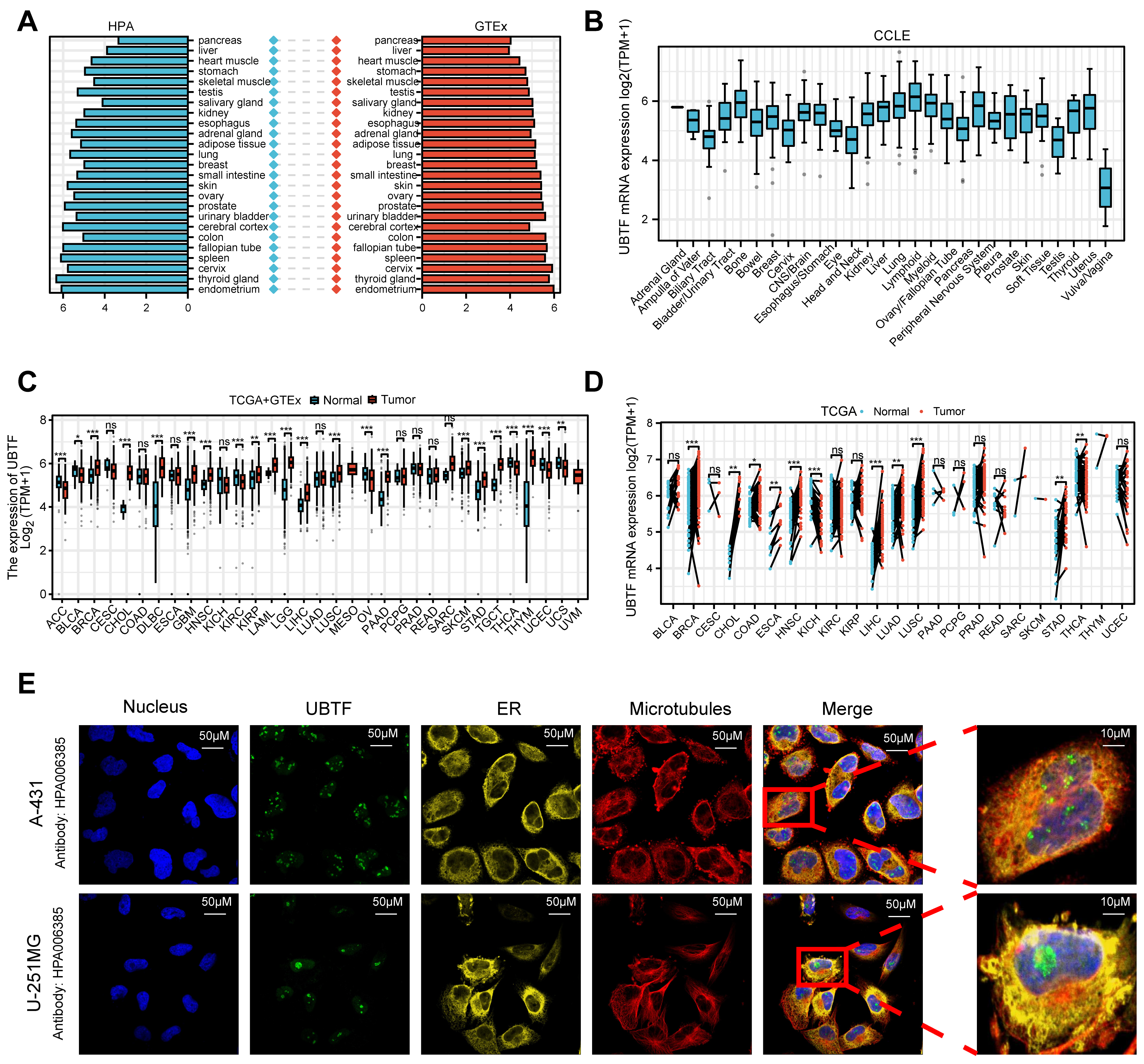
Figure 1. UBTF Expression Patterns Across Normal Tissues and Cancer Types. (A) Normal tissue UBTF expression profiles (HPA + GTEx datasets); (B) Cancer cell line UBTF expression profiles (Cancer Cell Line Encyclopedia (CCLE) datasets); (C) Comparative UBTF expression in normal versus malignant tissues (TCGA + GTEx datasets); (D) UBTF mRNA expression across tumor tissues compared with paired normal tissues (TCGA datasets); (E) IF visualization of UBTF subcellular compartmentalization across nucleus, ER, and microtubules in A-431 and U-251MG cell lines (HPA database). Blue: nucleus (DAPI); Green: UBTF; Yellow: endoplasmic reticulum (ER); Red: microtubules. Merge: overlay of all channels. Scale bar: 10 μm. Statistical comparison was performed using the Wilcoxon rank-sum test *, p < 0.05; **, p < 0.01; ***, p < 0.001; ns, not significant.
Ijms 27 02909 g001
Figure 2. Prognostic Value of UBTF in Multiple Human Cancers. KM survival curves and ROC analysis between UBTF expression and OS of ACC (A), LIHC (B), BRCA (C), CESC (D), ESCC (E), GBMLGG (F), KIRC (G), PAAD (H). Log-rank test was used for survival analysis. Left panels: Kaplan–Meier survival curves comparing high (red) and low (blue) UBTF expression groups. Shaded areas represent 95% confidence intervals. Right panels: ROC curves for 1-year, 3-year, and 5-year overall survival prediction. Shaded areas indicate the area under the ROC curve (AUC).
Ijms 27 02909 g002
Figure 3. Pancancer Association of UBTF with Immune Microenvironment and Predicted Immunotherapy Response. (A) Correlations between UBTF expression and StromalScore, ImmuneScore and ESTIMATEScore. (B) Top 3 cancers with the highest immune score; (C) Correlation between UBTF expression and immune cell infiltration across cancer types (GSVA); (D) Correlation between UBTF expression and immune checkpoints across cancer types; (EH) Correlation between UBTF and predicted immunotherapy response across cancer types; (I,J) Box plots showing the differences in UBTF expression between responders and nonresponders, and ROC curve showing the predictive accuracy of patient therapeutic response according to UBTF levels (ROCplotter database). Spearman correlation was used for correlation analysis. Wilcoxon rank-sum test was used for group comparisons. * p < 0.05; ** p < 0.01; *** p < 0.001. ns = not significant (p > 0.05).
Ijms 27 02909 g003
Figure 4. Functional Characterization of UBTF in Breast Cancer. (A) UBTF-centered protein interaction network; (B) Volcano visualization of gene expression differences between UBTF-high and UBTF-low cohorts (FDR-adjusted p < 0.05, |log2 fold-change (FC)| > 1); (C,D) GO and KEGG functional enrichment analysis; (E) Association between UBTF and pathways in BRCA (ssGSEA); (F) Association between UBTF and ferroptosis-related genes in BRCA. Spearman correlation was employed for pathway and gene correlation analysis (E,F). Dashed lines indicate significance thresholds: in (B), vertical dashed lines represent |log2(FC)| = 1 and horizontal dashed line represents p = 0.05; in (E), vertical dashed lines represent |R| = 0.1 and horizontal dashed line represents p = 0.05. *** p < 0.001.
Ijms 27 02909 g004
Figure 5. Immune Landscape of UBTF in BRCA. (A) Associations between UBTF and immune modulators in BRCA; (B) Cancer immune cycle step differences between high- and low-UBTF cohorts; (C) Seven algorithms assess UBTF-immune cell infiltration associations in BRCA; (D) GSVA assesses UBTF-immune pathway associations; (E) Effector gene differences in tumor-associated immune cells between high- and low-UBTF groups; (F) Links between UBTF expression and CD8 + T-cell marker gene expression in BRCA. Spearman correlation was employed for correlation analysis. Wilcoxon rank-sum test was employed for group comparisons. * p < 0.05; ** p < 0.01; *** p < 0.001. ns = not significant (p > 0.05).
Ijms 27 02909 g005
Figure 6. UBTF Knockdown Inhibits Malignant Phenotypes and Increases Immune Checkpoint Expression in BRCA Cells. (A) UBTF mRNA and protein expression in LM2 and BT-549 cells after CRISPR-Cas9 knockdown. (B,C) Cell viability measured by CCK-8 assay over 6 days. (D) Colony formation assay showing representative images and quantification. Colonies counted in a blinded manner. Scale bar: 1 cm. (E) Transwell migration assay showing representative images and quantification. (F) Wound healing assay at 0 h and 12 h. Red lines indicate wound edges. Scale bar: 100 μm. (G) Flow cytometry analysis of apoptosis. Q1: necrotic; Q2: late apoptotic; Q3: viable; Q4: early apoptotic cells. Flow cytometry dot plots showing cell distribution. Colors represent cell density: blue indicates low cell density, green/yellow indicates medium density, and red indicates high density. (H) Western blot analysis of Nucleolin, PD-L1, and PD-L2 expression. (I) Western blot analysis of mTOR/ERK/MEK pathway activation. Quantification shows phosphorylated/total protein ratios normalized to Cas9-NC control. All experiments were performed in triplicate in three independent experimental sets. Data represent mean ± SD. Statistical analyses: two-way ANOVA with Dunnett’s post hoc test (B,C); one-way ANOVA with Dunnett’s post hoc test (A,D,E,G,I). *** p < 0.001. Original Western blot images are provided in Supplementary Figures S13 and S14.
Ijms 27 02909 g006
Figure 7. Development and Validation of UBTF-Related Prognostic Signature. (A) Forest plot of univariate Cox regression analysis for 14 UBTF-related genes in BRCA. Red = hazard ratios, black lines = 95% CI. (B) LASSO Cox regression analysis. Upper: coefficient trajectories; Lower: cross-validation for optimal λ selection. (C,D) Risk score distribution, survival status, Kaplan–Meier curves, and time-dependent ROC curves for TCGA-BRCA (C) and METABRIC (D) cohorts. Log-rank test was used for survival analysis. Shaded area in ROC curves represents the AUC.
Ijms 27 02909 g007
Disclaimer/Publisher’s Note: The statements, opinions and data contained in all publications are solely those of the individual author(s) and contributor(s) and not of MDPI and/or the editor(s). MDPI and/or the editor(s) disclaim responsibility for any injury to people or property resulting from any ideas, methods, instructions or products referred to in the content.