Impaired T Follicular Regulatory Cell Function and Enhanced T Follicular Helper Cell Activity in Experimental Autoimmune Encephalomyelitis: Mechanistic Insights into CNS Autoimmunity

 , , , , and
Abstract
1. Introduction
2. Results
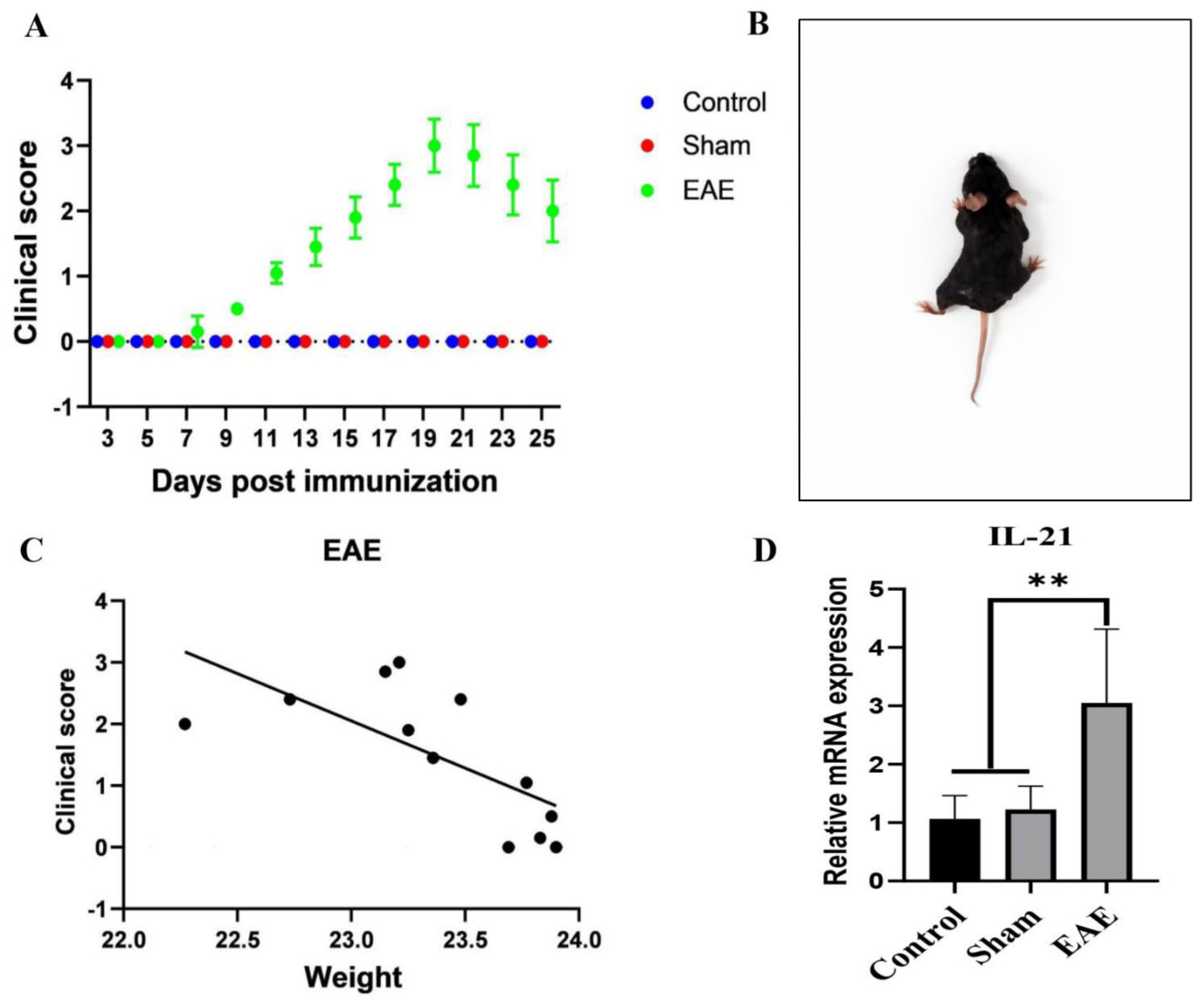
2.1. Clinical Course and Disease Progression in EAE Mice
2.2. Clinical Severity and Weight Loss Correlate During EAE Development
2.3. IL-21 mRNA Levels Increase During EAE Progression
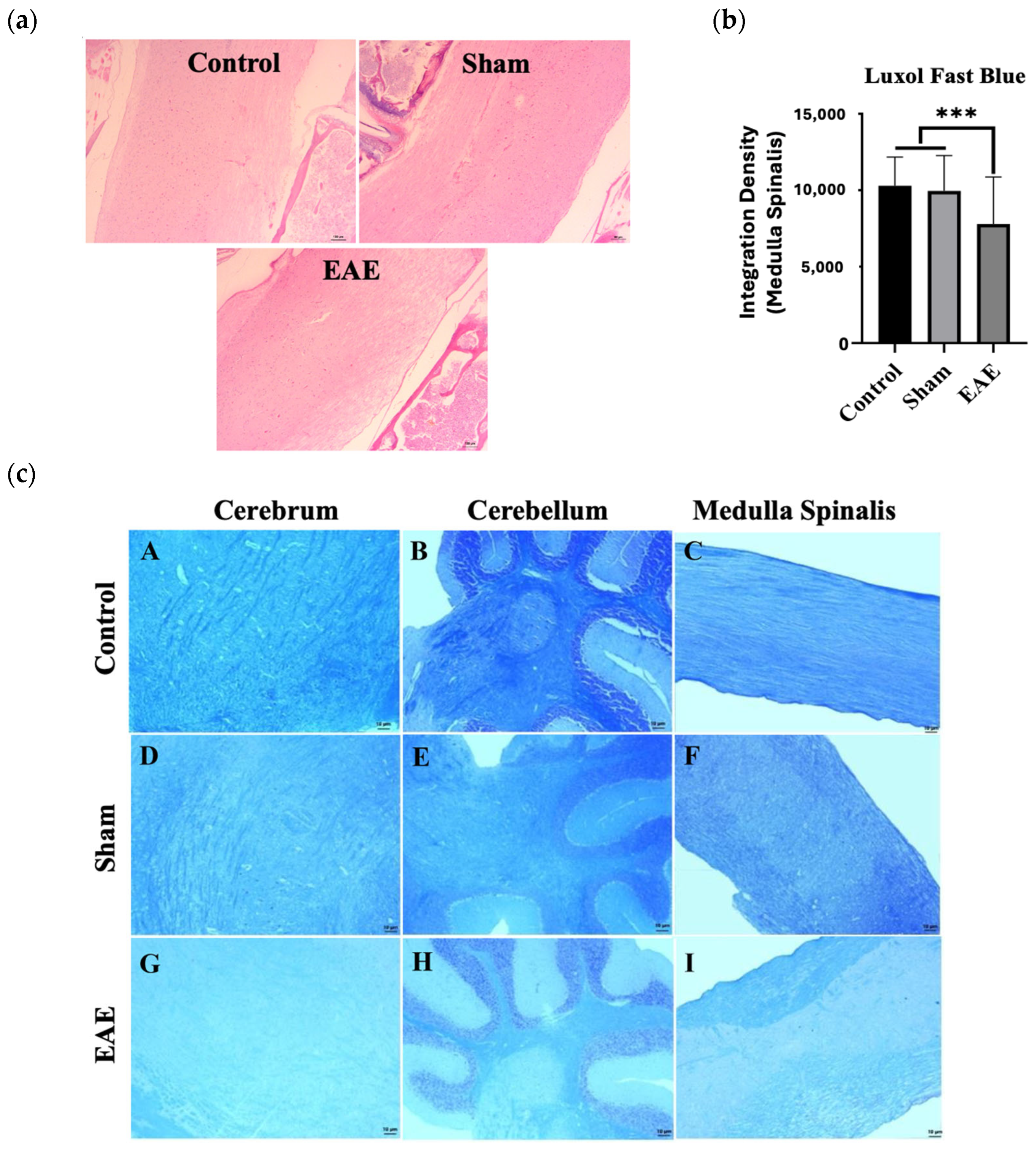
2.4. Increased Tissue Damage in the Medulla Spinalis of EAE Mice
2.5. EAE-Induced Demyelination in the Brain and Spinal Cord
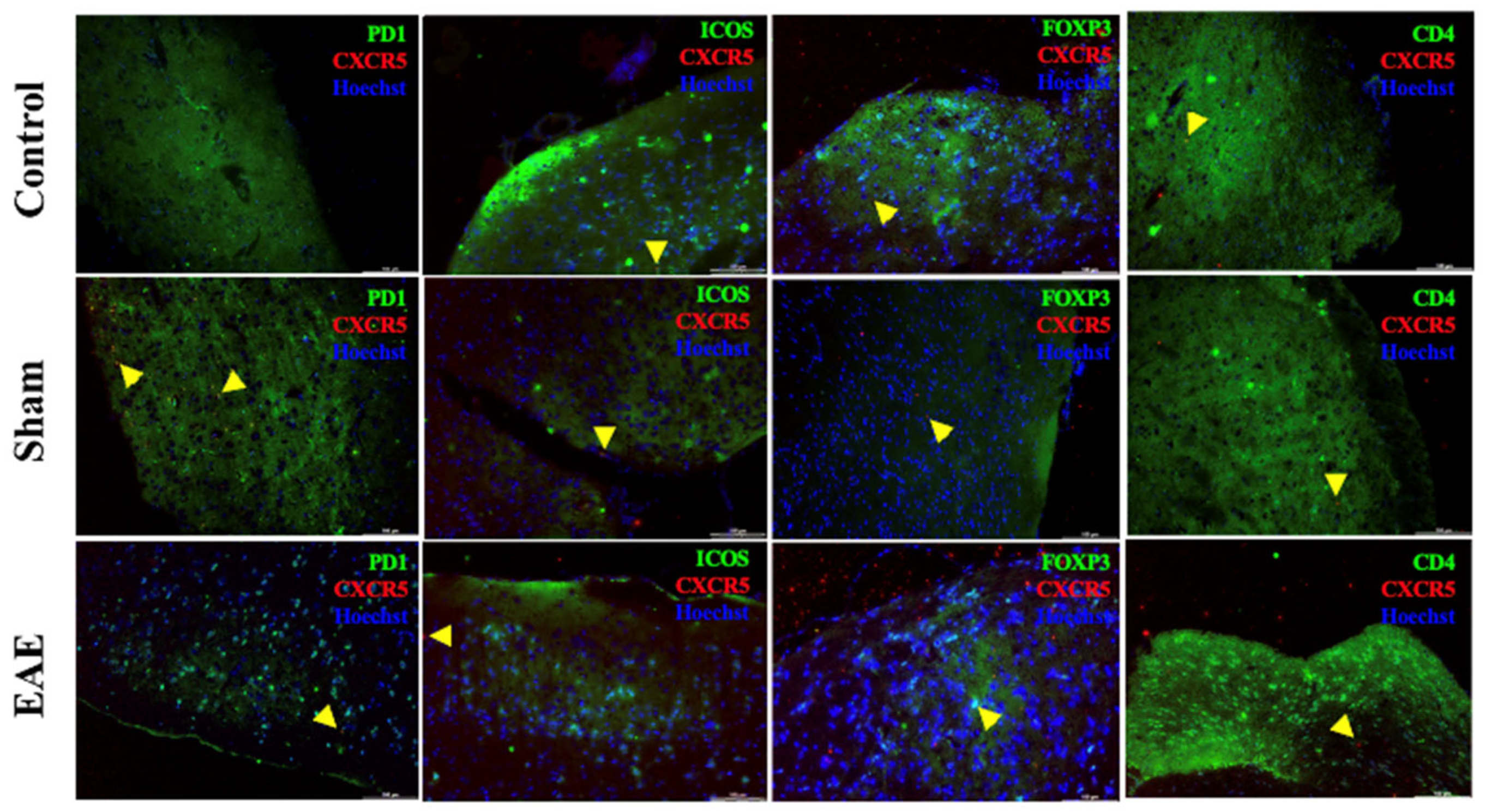
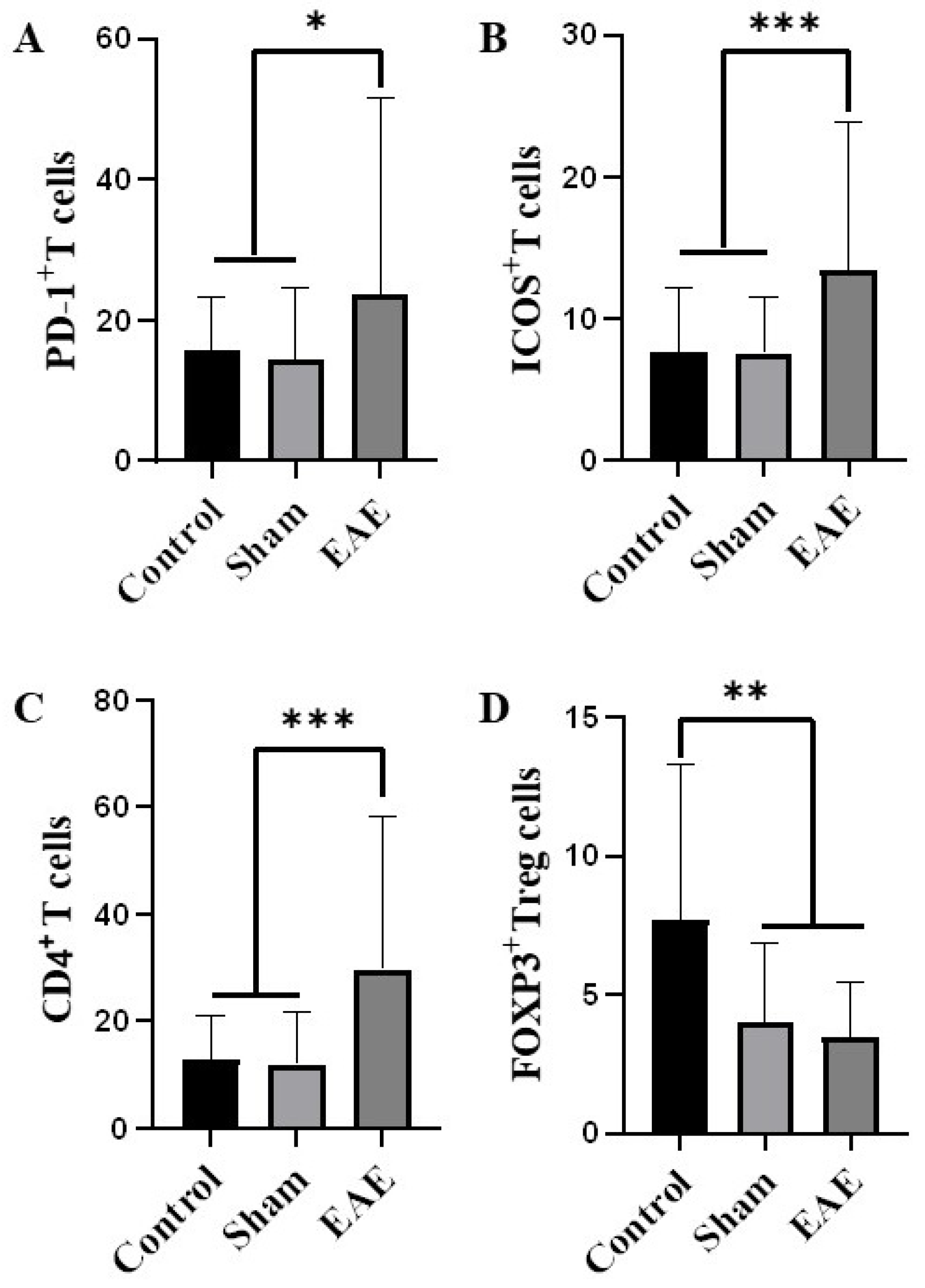
2.6. Immune Cell Subset Distribution in EAE: PD-1+, ICOS+, CD4+, and FOXP3+ Cells
3. Discussion
4. Materials and Methods
4.1. Animals
4.2. Preparation of Myelin Oligodendrocyte Glycoprotein (MOG35-55)/Complete Freund’s Adjuvant (CFA) Emulsion
4.3. Preparation of Pertussis Toxin
4.4. Animal Immunization and EAE Induction
4.5. Clinical Assessment
4.6. Tissue Sampling and Experimental Examination of Samples
4.7. RT-PCR Analysis
4.8. Histological and Immunofluorescence Staining
4.8.1. Routine Histology
4.8.2. Immunofluorescence Staining
4.9. Statistical Analysis
5. Conclusions
Supplementary Materials
Author Contributions
Funding
Institutional Review Board Statement
Informed Consent Statement
Data Availability Statement
Acknowledgments
Conflicts of Interest
References
- Hauser, S.L.; Oksenberg, J.R. The neurobiology of multiple sclerosis: Genes, inflammation, and neurodegeneration. Neuron 2006, 52, 61–76. [Google Scholar] [CrossRef]
- Thompson, A.J.; Baranzini, S.E.; Geurts, J.; Hemmer, B.; Ciccarelli, O. Multiple sclerosis. Lancet 2018, 391, 1622–1636. [Google Scholar] [CrossRef] [PubMed]
- Bjelobaba, I.; Begovic-Kupresanin, V.; Pekovic, S.; Lavrnja, I. Animal models of multiple sclerosis: Focus on experimental autoimmune encephalomyelitis. J. Neurosci. Res. 2018, 96, 1021–1042. [Google Scholar] [CrossRef]
- Arneth, B. Contributions of T cells in multiple sclerosis: What do we currently know? J. Neurol. 2021, 268, 4587–4593. [Google Scholar] [CrossRef]
- Li, R.; Patterson, K.R.; Bar-Or, A. Reassessing B cell contributions in multiple sclerosis. Nat. Immunol. 2018, 19, 696–707. [Google Scholar] [CrossRef]
- Piehl, F. Current and emerging disease-modulatory therapies and treatment targets for multiple sclerosis. J. Intern. Med. 2021, 289, 771–791. [Google Scholar] [CrossRef] [PubMed]
- Crotty, S. Follicular helper CD4 T cells (TFH). Annu. Rev. Immunol. 2011, 29, 621–663. [Google Scholar] [CrossRef] [PubMed]
- Guo, J.; Zhao, C.; Wu, F.; Tao, L.; Zhang, C.; Zhao, D.; Yang, S.; Jiang, D.; Wang, J.; Sun, Y.; et al. T follicular helper-like cells are involved in the pathogenesis of experimental autoimmune encephalomyelitis. Front. Immunol. 2018, 9, 944. [Google Scholar] [CrossRef]
- Schafflick, D.; Xu, C.A.; Hartlehnert, M.; Cole, M.; Schulte-Mecklenbeck, A.; Lautwein, T.; Wolbert, J.; Heming, M.; Meuth, S.G.; Kuhlmann, T.; et al. Integrated single cell analysis of blood and cerebrospinal fluid leukocytes in multiple sclerosis. Nat. Commun. 2020, 11, 247. [Google Scholar] [CrossRef]
- Sage, P.T.; Sharpe, A.H. T follicular regulatory cells in the regulation of B cell responses. Trends Immunol. 2015, 36, 410–418. [Google Scholar] [CrossRef]
- Dhaeze, T.; Peelen, E.; Hombrouck, A.; Peeters, L.; Van Wijmeersch, B.; Lemkens, N.; Lemkens, P.; Somers, V.; Lucas, S.; Broux, B.; et al. Circulating follicular regulatory T cells are defective in multiple sclerosis. J. Immunol. 2015, 195, 832–840. [Google Scholar] [CrossRef]
- Qiu, H.; Wu, H.; Chan, V.; Lau, C.S.; Lu, Q. Transcriptional and epigenetic regulation of follicular T-helper cells and their role in autoimmunity. Autoimmunity 2017, 50, 71–81. [Google Scholar] [CrossRef]
- Ghalamfarsa, G.; Mahmoudi, M.; Mohammadnia-Afrouzi, M.; Yazdani, Y.; Anvari, E.; Hadinia, A.; Ghanbari, A.; Setayesh, M.; Yousefi, M.; Jadidi-Niaragh, F. IL-21 and IL-21 receptor in the immunopathogenesis of multiple sclerosis. J. Immunotoxicol. 2016, 13, 274–285. [Google Scholar] [CrossRef]
- Lassmann, H.; Brück, W.; Lucchinetti, C.F. The immunopathology of multiple sclerosis: An overview. Brain Pathol. 2007, 17, 210–218. [Google Scholar] [CrossRef]
- Francisco, L.M.; Sage, P.T.; Sharpe, A.H. The PD-1 pathway in tolerance and autoimmunity. Immunol. Rev. 2010, 236, 219–242. [Google Scholar] [CrossRef] [PubMed]
- He, F.; Balling, R. The role of regulatory T cells in neurodegenerative diseases. Wiley Interdiscip. Rev. Syst. Biol. Med. 2013, 5, 153–180. [Google Scholar]
- Choi, Y.S.; Kageyama, R.; Eto, D.; Escobar, T.C.; Johnston, R.J.; Monticelli, L.; Lao, C.; Crotty, S. ICOS receptor instructs T follicular helper cell versus effector cell differentiation by inducing differential expression of transcription factors. Immunity 2011, 34, 932–946. [Google Scholar] [CrossRef] [PubMed]
- Crotty, S. T follicular helper cell biology: A decade of discovery and diseases. Immunity 2019, 50, 1132–1148. [Google Scholar] [CrossRef]
- Korn, T.; Bettelli, E.; Oukka, M.; Kuchroo, V.K. IL-17 and Th17 cells. Annu. Rev. Immunol. 2007, 27, 485–517. [Google Scholar] [CrossRef]
- O’Connor, R.A.; Prendergast, C.T.; Sabatos, C.A.; Lau, C.W.; Leech, M.D.; Wraith, D.C.; Anderton, S.M. Cutting edge: Th1 cells facilitate the entry of Th17 cells to the central nervous system during experimental autoimmune encephalomyelitis. J. Immunol. 2008, 181, 3750–3754. [Google Scholar] [CrossRef] [PubMed]
- Longhi, M.S.; Mieli-Vergani, G.; Vergani, D. Regulatory T cells in autoimmune hepatitis: An updated overview. J. Autoimmun. 2021, 119, 102619. [Google Scholar] [CrossRef]
- Kroenke, M.A.; Carlson, T.J.; Andjelkovic, A.V.; Segal, B.M. IL-12- and IL-23-modulated T cells induce distinct types of EAE based on histology, CNS chemokine profile, and response to cytokine inhibition. J. Exp. Med. 2008, 205, 1535–1541. [Google Scholar] [CrossRef] [PubMed]
- Goverman, J. Autoimmune T cell responses in the central nervous system. Nat. Rev. Immunol. 2009, 9, 393–407. [Google Scholar] [CrossRef]
- Fletcher, J.M.; Lalor, S.J.; Sweeney, C.M.; Tubridy, N.; Mills, K.H. CD4+ T cells in multiple sclerosis and experimental autoimmune encephalomyelitis. Clin. Exp. Immunol. 2010, 162, 1–11. [Google Scholar] [CrossRef] [PubMed]
- Serada, S.; Fujimoto, M.; Mihara, M.; Koike, N.; Ohsugi, Y.; Nomura, S.; Yoshida, H.; Nishikawa, T.; Terabe, F.; Ohkawara, T.; et al. IL-6 blockade inhibits the induction of myelin antigen-specific Th17 cells and Th1 cells in experimental autoimmune encephalomyelitis. Proc. Natl. Acad. Sci. USA 2008, 105, 9041–9046. [Google Scholar] [CrossRef] [PubMed]
- Langrish, C.L.; Chen, Y.; Blumenschein, W.M.; Mattson, J.; Basham, B.; Sedgwick, J.D.; McClanahan, T.; Kastelein, R.A.; Cua, D.J. IL-23 drives a pathogenic T cell population that induces autoimmune inflammation. J. Exp. Med. 2005, 201, 233–240. [Google Scholar] [CrossRef]
- Kurschus, F.C. T cell mediated pathogenesis in EAE: Molecular mechanisms. Biomed. J. 2015, 38, 183–193. [Google Scholar] [CrossRef]
- Ettinger, R.; Sims, G.P.; Fairhurst, A.M.; Robbins, R.; da Silva, Y.S.; Spolski, R.; Leonard, W.J.; Lipsky, P.E. IL-21 induces differentiation of human naive and memory B cells into antibody-secreting plasma cells. J. Immunol. 2005, 175, 7867–7873. [Google Scholar] [CrossRef]
- Peters, A.; Pitcher, L.A.; Sullivan, J.M.; Mitsdoerffer, M.; Acton, S.E.; Franz, B.; Wucherpfennig, K.; Turley, S.; Carroll, M.C.; Sobel, R.A.; et al. Th17 cells induce ectopic lymphoid follicles in central nervous system tissue inflammation. Immunity 2011, 35, 986–996. [Google Scholar] [CrossRef]
- Pierson, W.; Cauwe, B.; Policheni, A.; Schlenner, S.M.; Franckaert, D.; Berges, J.; Humblet-Baron, S.; Schönefeldt, S.; Herold, M.J.; Hildeman, D.; et al. Antiapoptotic Mcl-1 is critical for the survival and niche-filling capacity of Foxp3+ regulatory T cells. Nat. Immunol. 2013, 14, 959–965. [Google Scholar] [CrossRef] [PubMed]
- Korn, T.; Bettelli, E.; Gao, W.; Awasthi, A.; Jäger, A.; Strom, T.B.; Oukka, M.; Kuchroo, V.K. IL-21 initiates an alternative pathway to induce proinflammatory T(H)17 cells. Nature 2007, 448, 484–487. [Google Scholar] [CrossRef] [PubMed]
- Linterman, M.A.; Beaton, L.; Yu, D.; Ramiscal, R.R.; Srivastava, M.; Hogan, J.J.; Verma, N.K.; Smyth, M.J.; Rigby, R.J.; Vinuesa, C.G. IL-21 acts directly on B cells to regulate Bcl-6 expression and germinal center responses. J. Exp. Med. 2010, 207, 353–363. [Google Scholar] [CrossRef]
- O’Connor, R.A.; Malpass, K.H.; Anderton, S.M. The inflamed central nervous system drives the activation and rapid proliferation of Foxp3+ regulatory T cells. J. Immunol. 2010, 184, 2075–2084. [Google Scholar] [CrossRef] [PubMed]
- Segal, J.P.; Phillips, S.; Dubois, R.M.; Silva, J.R.; Haird, C.M.; Gale, D.; Hopman, W.M.; Gallivan, J.; Gilron, I.; Ghasemlou, N. Weight bearing as a measure of disease progression in experimental autoimmune encephalomyelitis. J. Neuroimmunol. 2021, 361, 577730. [Google Scholar] [CrossRef]
- Bittner, S.; Afzali, A.M.; Wiendl, H.; Meuth, S.G. Myelin oligodendrocyte glycoprotein (MOG35-55) induced experimental autoimmune encephalomyelitis (EAE) in C57BL/6 mice. J. Vis. Exp. 2014, 86, e51275. [Google Scholar] [PubMed]
- Pyka-Fosciak, G.; Fosciak, M.; Wójcik, B.; Lis, G.J.; Litwin, J.A. Histopathological parameters of the spinal cord in different phases of experimental autoimmune encephalomyelitis. J. Physiol. Pharmacol. 2023, 74, 465–472. [Google Scholar] [CrossRef]



| Group | Condition | n | Treatment | Route and Dose |
|---|---|---|---|---|
| 1 | Control | 7 | PBS | Subcutaneous (Right 100 μL + Left 100 μL) |
| Intraperitoneal (100 μL + 48 h later 100 μL) | ||||
| 2 | Sham | 8 | CFA | Subcutaneous (Right 100 μL + Left 100 μL) |
| PTX | Intraperitoneal (100 μL+ 48 h later 100 μL) | |||
| 3 | EAE | 10 | CFA + MOG | Subcutaneous (Right 100 μg/100 μL + Left 100 μg/100 μL) |
| PTX | Intraperitoneal (100 μL + 48 h later 100 μL) |
Disclaimer/Publisher’s Note: The statements, opinions and data contained in all publications are solely those of the individual author(s) and contributor(s) and not of MDPI and/or the editor(s). MDPI and/or the editor(s) disclaim responsibility for any injury to people or property resulting from any ideas, methods, instructions or products referred to in the content. |
© 2026 by the authors. Licensee MDPI, Basel, Switzerland. This article is an open access article distributed under the terms and conditions of the Creative Commons Attribution (CC BY) license.
Share and Cite
Hekimoglu, G.; Sevgin, K.; Yucel, N.; Yesilay, G.; Erguven, S.P.; Seker, M. Impaired T Follicular Regulatory Cell Function and Enhanced T Follicular Helper Cell Activity in Experimental Autoimmune Encephalomyelitis: Mechanistic Insights into CNS Autoimmunity. Int. J. Mol. Sci. 2026, 27, 2901. https://doi.org/10.3390/ijms27062901
Hekimoglu G, Sevgin K, Yucel N, Yesilay G, Erguven SP, Seker M. Impaired T Follicular Regulatory Cell Function and Enhanced T Follicular Helper Cell Activity in Experimental Autoimmune Encephalomyelitis: Mechanistic Insights into CNS Autoimmunity. International Journal of Molecular Sciences. 2026; 27(6):2901. https://doi.org/10.3390/ijms27062901
Chicago/Turabian StyleHekimoglu, Gulam, Kubra Sevgin, Nurullah Yucel, Gamze Yesilay, Salime Pelin Erguven, and Muzaffer Seker. 2026. "Impaired T Follicular Regulatory Cell Function and Enhanced T Follicular Helper Cell Activity in Experimental Autoimmune Encephalomyelitis: Mechanistic Insights into CNS Autoimmunity" International Journal of Molecular Sciences 27, no. 6: 2901. https://doi.org/10.3390/ijms27062901
APA StyleHekimoglu, G., Sevgin, K., Yucel, N., Yesilay, G., Erguven, S. P., & Seker, M. (2026). Impaired T Follicular Regulatory Cell Function and Enhanced T Follicular Helper Cell Activity in Experimental Autoimmune Encephalomyelitis: Mechanistic Insights into CNS Autoimmunity. International Journal of Molecular Sciences, 27(6), 2901. https://doi.org/10.3390/ijms27062901