The Role of the TG2-GPR56 Complex in Cutaneous Squamous Cell Carcinoma (CSCC) Aggression and Therapeutic Resistance

 , , ,
, , ,
Abstract
1. Introduction
2. TG2 Structure and Function

| Effectors/Inhibitors | Closed/Open | Method | PDB | References |
|---|---|---|---|---|
| GDP/Mg2+ | Closed | X-ray | 1KV3 | [88] |
| GDP/Mg2+ | Closed | CryoEM | 8TR9 | [89] |
| GTP/Mg2+ | Closed | X-ray | 4PYG | [78] |
| ATP/Mg2+ | Closed | X-ray | 3LY6 | [90] |
| Ca2+ | Open | X-ray | 6KZB | [80] |
| Ca2+ | Open | X-ray | 9BC2 | [81] |
| Ca2+ | Intermediate | X-ray | 9BC3, 9BC4 | [81] |
| Ac-P(DON)LPF-NH2 | Open | X-ray | 2Q3Z | [75] |
| FNI2-3 | Closed | Predicted model | 9A3X | [91] |
| FNI7-9 | Closed | Predicted model | 9A3Y | [91] |
| FNI6FNII1-2FNI7-9 | Closed | Predicted model | 9A3Z | [91] |
| Inhibitor 1 | Open | X-ray | 3S3J | To be published |
| Inhibitor 2 | Open | X-ray | 3S3P | To be published |
| Inhibitor 3 | Open | X-ray | 3S3S | To be published |
3. The Role of TG2 in Cancer
3.1. Cancer Stem Cell Survival and Maintenance
3.2. Chemo- and Radiation-Resistance
3.3. Metastasis and Invasion
4. TG2 Is Highly Expressed and Required in cSCC Stem Cells
5. GPR56: A Key Receptor in Neurological Disorders and Cancer
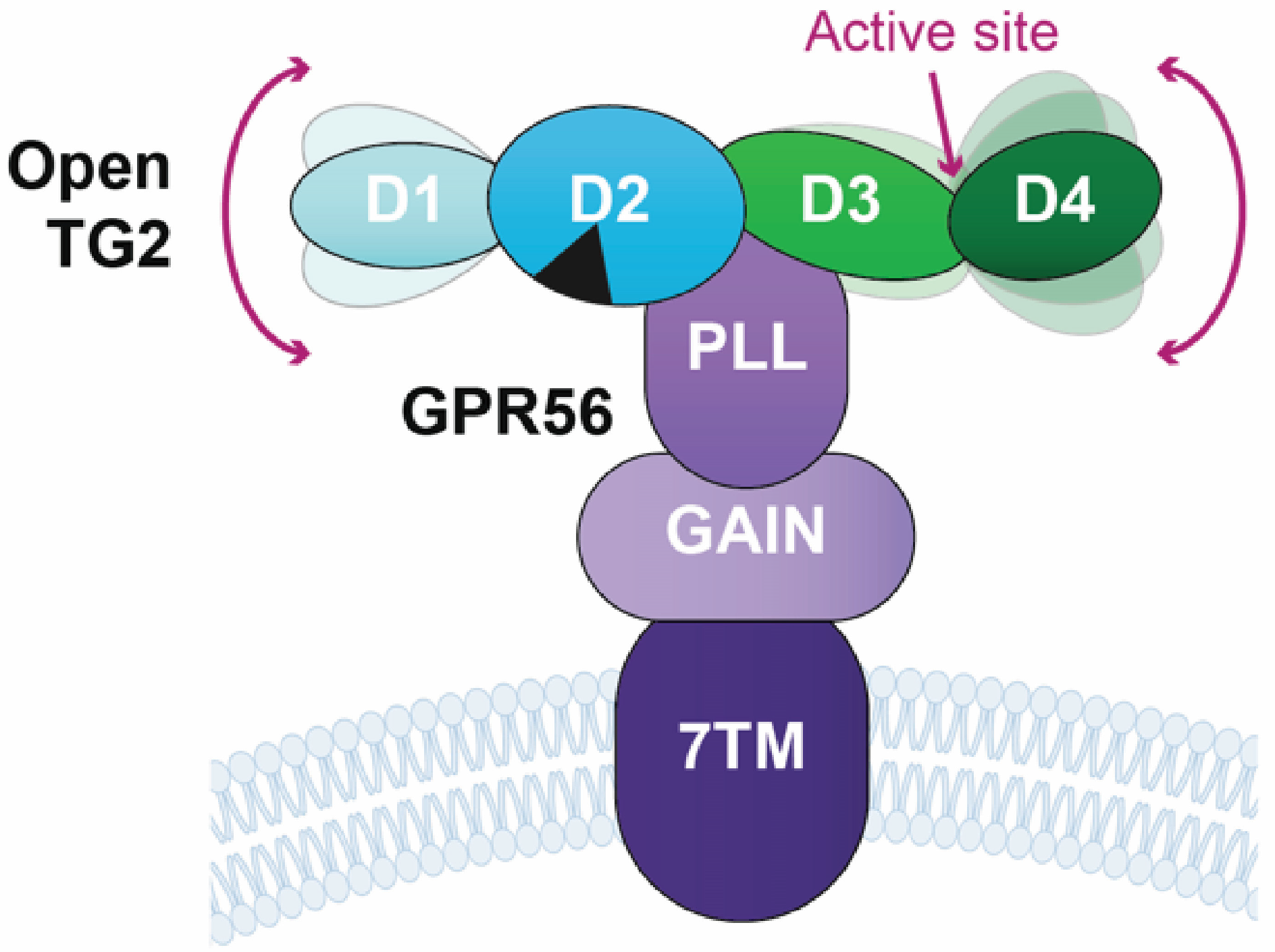
6. The Role of TG2 and GPR56 Interaction in Cancer Invasion
7. Conclusions and Future Directions
Supplementary Materials
Author Contributions
Funding
Data Availability Statement
Acknowledgments
Conflicts of Interest
Abbreviations
| ASPR | Age-standardized prevalence rate |
| ASIR | Age-standardized incidence rate |
| TG1 | Transglutaminase 1 |
| TG2 | Transglutaminase 2 |
| TG3 | Transglutaminase 3 |
| TG5 | Transglutaminase 5 |
| CE | Cornified envelope |
| GTP | Guanosine triphosphate |
| cSCC | Cutaneous squamous cell carcinoma |
| aGPCRs | Adhesion G-protein-coupled receptors |
| GPR56 | G-protein-coupled receptor 56 |
| ADGRG1 | Adhesion G-protein-coupled receptor G1 |
| NTF | N-terminal fragment of GPR56 |
| CTF | C-terminal fragment of GPR56 |
| PLL | Pentraxin, Laminin, neurexin, and sex hormone-binding globulin-Like domain |
| GAIN | G-protein-coupled receptor Autoproteolysis INducing domain |
| GPS | G-protein-coupled receptor proteolysis site |
| 7TM | Seven-pass transmembrane domain |
| ECS | Epidermal cancer stem |
| EMT | Epithelial–Mesenchymal Transition |
| UI | Uncertainty Interval |
| ECM | Extracellular matrix |
| CRC | Colorectal cancer |
| BCL-2 | B-cell lymphoma 2 anti-apoptotic protein |
| PI3K/AKT | Phosphoinositide 3-kinase (PI3K)/Protein kinase B (AKT) |
| CSC | Cancer stem cell |
| NF-κB | Nuclear factor kappa-light-chain-enhancer of activated B-cells |
| Wnt | Wingless-related integration site |
| TGF-β | Transforming growth factor-β |
| CD44v6 | Cluster of differentiation 44 variant 6 |
| EGFR | Epidermal growth factor receptor |
| Src | Proto-oncogene tyrosine-protein kinase Src |
| MITF | Microphthalmia-associated transcription factor |
| YAP1 | Yes-associated protein 1 |
| ΔNp63α | Delta Np63 alpha, p53-family transcription factor |
| ROCK | RhoA-associated protein kinase |
| LPHN3 | Latrophilin-3 |
| ADGRL3 | GPR56 and latrophilin-3 |
| ADAM17 | Metalloproteinase 17 |
| VEGF | Vascular Endothelial Growth Factor |
| CXCL12 | CXC motif chemokine 12, also known as stromal cell-derived factor 1 (SDF-1) |
| KRT19 | Keratin 19 |
| CD81 | Cluster of Differentiation 81 |
| CD9 | Tetraspanin CD9 protein |
References
- Fisher, M.L.; Keillor, J.W.; Xu, W.; Eckert, R.L.; Kerr, C. Transglutaminase Is Required for Epidermal Squamous Cell Carcinoma Stem Cell Survival. Mol. Cancer Res. 2015, 13, 1083–1094. [Google Scholar] [CrossRef]
- Armstrong, B.K.; Kricker, A. The epidemiology of UV induced skin cancer. J. Photochem. Photobiol. B 2001, 63, 8–18. [Google Scholar] [CrossRef] [PubMed]
- Boukamp, P. UV-induced skin cancer: Similarities–variations. J. Dtsch. Dermatol. Ges. 2005, 3, 493–503. [Google Scholar] [CrossRef]
- Boukamp, P. Non-melanoma skin cancer: What drives tumor development and progression? Carcinogenesis 2005, 26, 1657–1667. [Google Scholar] [CrossRef] [PubMed]
- Lee, S.J.; Lee, K.B.; Son, Y.H.; Shin, J.; Lee, J.H.; Kim, H.J.; Hong, A.Y.; Bae, H.W.; Kwon, M.A.; Lee, W.J.; et al. Transglutaminase 2 mediates UV-induced skin inflammation by enhancing inflammatory cytokine production. Cell Death Dis. 2017, 8, e3148. [Google Scholar] [CrossRef] [PubMed]
- Liu, C.; Liu, X.; Cao, P.; Li, X.; Xin, H.; Zhu, S. Global, regional, national prevalence, mortality, and disability-adjusted life-years of cutaneous squamous cell carcinoma and trend analysis from 1990 to 2021 and prediction to 2045. Front Oncol. 2025, 15, 1523169. [Google Scholar] [CrossRef]
- Jiang, R.; Fritz, M.; Que, S.K.T. Cutaneous Squamous Cell Carcinoma: An Updated Review. Cancers 2024, 16, 1800. [Google Scholar] [CrossRef] [PubMed]
- Slominski, R.M.; Chen, J.Y.; Raman, C.; Slominski, A.T. Photo-neuro-immuno-endocrinology: How the ultraviolet radiation regulates the body, brain, and immune system. Proc. Natl. Acad. Sci. USA 2024, 121, e2308374121. [Google Scholar] [CrossRef]
- Slominski, R.M.; Raman, C.; Jetten, A.M.; Slominski, A.T. Neuro-immuno-endocrinology of the skin: How environment regulates body homeostasis. Nat. Rev. Endocrinol. 2025, 21, 495–509, Correction in Nat. Rev. Endocrinol. 2025, 21, 513. [Google Scholar] [CrossRef]
- AlSharif, H.; Danchine, V.; Deekollu, K.; Hasanov, M.; Wu, R.; Haykal, T.; Faieta, A.; Verschraegen, C.F. Second-line treatments for patients with programmed cell death protein 1-refractory cutaneous squamous cell carcinomas: A brief report. Oncologist 2026, 31, oyag038. [Google Scholar] [CrossRef]
- Pei, M.; Wiefels, M.; Harris, D.; Velez Torres, J.M.; Gomez-Fernandez, C.; Tang, J.C.; Hernandez Aya, L.; Samuels, S.E.; Sargi, Z.; Weed, D.; et al. Perineural Invasion in Head and Neck Cutaneous Squamous Cell Carcinoma. Cancers 2024, 16, 3695. [Google Scholar] [CrossRef] [PubMed]
- Pastushenko, I.; Blanpain, C. EMT Transition States during Tumor Progression and Metastasis. Trends Cell Biol. 2019, 29, 212–226. [Google Scholar] [CrossRef]
- Zonca, S.; Pinton, G.; Wang, Z.; Soluri, M.F.; Tavian, D.; Griffin, M.; Sblattero, D.; Moro, L. Tissue transglutaminase (TG2) enables survival of human malignant pleural mesothelioma cells in hypoxia. Cell Death Dis. 2017, 8, e2592. [Google Scholar] [CrossRef] [PubMed]
- Bauer, L.; Edwards, J.; Heil, A.; Dewitt, S.; Biebermann, H.; Aeschlimann, D.; Knauper, V. Mesenchymal Transglutaminase 2 Activates Epithelial ADAM17: Link to G-Protein-Coupled Receptor 56 (ADGRG1) Signalling. Int. J. Mol. Sci. 2024, 25, 2329. [Google Scholar] [CrossRef]
- Allgayer, H.; Mahapatra, S.; Mishra, B.; Swain, B.; Saha, S.; Khanra, S.; Kumari, K.; Panda, V.K.; Malhotra, D.; Patil, N.S.; et al. Epithelial-to-mesenchymal transition (EMT) and cancer metastasis: The status quo of methods and experimental models 2025. Mol. Cancer 2025, 24, 167. [Google Scholar] [CrossRef]
- Eckert, R.L.; Kaartinen, M.T.; Nurminskaya, M.; Belkin, A.M.; Colak, G.; Johnson, G.V.; Mehta, K. Transglutaminase regulation of cell function. Physiol. Rev. 2014, 94, 383–417. [Google Scholar] [CrossRef]
- Li, M.; Wang, X.; Hong, J.; Mao, J.; Chen, J.; Chen, X.; Du, Y.; Song, D. Transglutaminase 2 in breast cancer metastasis and drug resistance. Front Cell Dev. Biol. 2024, 12, 1485258. [Google Scholar] [CrossRef]
- Ayinde, O.; Wang, Z.; Griffin, M. Tissue transglutaminase induces Epithelial-Mesenchymal-Transition and the acquisition of stem cell like characteristics in colorectal cancer cells. Oncotarget 2017, 8, 20025–20041. [Google Scholar] [CrossRef]
- Tempest, R.; Guarnerio, S.; Maani, R.; Cooper, J.; Peake, N. The Biological and Biomechanical Role of Transglutaminase-2 in the Tumour Microenvironment. Cancers 2021, 13, 2788. [Google Scholar] [CrossRef] [PubMed]
- Ayinde, O.; Wang, Z.; Pinton, G.; Moro, L.; Griffin, M. Transglutaminase 2 maintains a colorectal cancer stem phenotype by regulating epithelial-mesenchymal transition. Oncotarget 2019, 10, 4556–4569. [Google Scholar] [CrossRef]
- Eckert, R.L.; Fisher, M.L.; Grun, D.; Adhikary, G.; Xu, W.; Kerr, C. Transglutaminase is a tumor cell and cancer stem cell survival factor. Mol. Carcinog. 2015, 54, 947–958. [Google Scholar] [CrossRef] [PubMed]
- Kerr, C.; Szmacinski, H.; Fisher, M.L.; Nance, B.; Lakowicz, J.R.; Akbar, A.; Keillor, J.W.; Lok Wong, T.; Godoy-Ruiz, R.; Toth, E.A.; et al. Transamidase site-targeted agents alter the conformation of the transglutaminase cancer stem cell survival protein to reduce GTP binding activity and cancer stem cell survival. Oncogene 2017, 36, 2981–2990, Correction in Oncogene 2021, 40, 2479–2481. [Google Scholar] [CrossRef]
- Fisher, M.L.; Kerr, C.; Adhikary, G.; Grun, D.; Xu, W.; Keillor, J.W.; Eckert, R.L. Transglutaminase Interaction with alpha6/beta4-Integrin Stimulates YAP1-Dependent DeltaNp63alpha Stabilization and Leads to Enhanced Cancer Stem Cell Survival and Tumor Formation. Cancer Res. 2016, 76, 7265–7276. [Google Scholar] [CrossRef]
- Chen, X.; Adhikary, G.; Newland, J.J.; Xu, W.; Keillor, J.W.; Weber, D.J.; Eckert, R.L. Transglutaminase 2 Binds to the CD44v6 Cytoplasmic Domain to Stimulate CD44v6/ERK1/2 Signaling and Maintain an Aggressive Cancer Phenotype. Mol. Cancer Res. 2023, 21, 922–932. [Google Scholar] [CrossRef]
- Chen, X.; Adhikary, G.; Shrestha, S.; Xu, W.; Keillor, J.W.; Naselsky, W.; Eckert, R.L. Transglutaminase 2 Maintains Hepatocyte Growth Factor Signaling to Enhance the Cancer Cell Phenotype. Mol. Cancer Res. 2021, 19, 2026–2035. [Google Scholar] [CrossRef]
- Genenger, B.; Conley, J.; Penney, C.; McAlary, L.; Perry, J.R.; Ashford, B.; Ranson, M. Spatial Organisation and Invasive Behaviour of Metastatic Cutaneous Squamous Cell Carcinoma-Derived Multicellular Spheroids Reflect Tumour Cell Phenotype. Cancers 2025, 17, 3399. [Google Scholar] [CrossRef]
- Huang, L.; Xu, A.M.; Liu, W. Transglutaminase 2 in cancer. Am. J. Cancer Res. 2015, 5, 2756–2776. [Google Scholar] [PubMed]
- Zaltron, E.; Vianello, F.; Ruzza, A.; Palazzo, A.; Brillo, V.; Celotti, I.; Scavezzon, M.; Rossin, F.; Leanza, L.; Severin, F. The Role of Transglutaminase 2 in Cancer: An Update. Int. J. Mol. Sci. 2024, 25, 2797. [Google Scholar] [CrossRef]
- Tatsukawa, H.; Furutani, Y.; Hitomi, K.; Kojima, S. Transglutaminase 2 has opposing roles in the regulation of cellular functions as well as cell growth and death. Cell Death Dis. 2016, 7, e2244. [Google Scholar] [CrossRef] [PubMed]
- Sima, L.E.; Matei, D.; Condello, S. The Outside-In Journey of Tissue Transglutaminase in Cancer. Cells 2022, 11, 1779. [Google Scholar] [CrossRef]
- Akimov, S.S.; Krylov, D.; Fleischman, L.F.; Belkin, A.M. Tissue transglutaminase is an integrin-binding adhesion coreceptor for fibronectin. J. Cell. Biol. 2000, 148, 825–838. [Google Scholar] [CrossRef]
- Odii, B.O.; Coussons, P. Biological functionalities of transglutaminase 2 and the possibility of its compensation by other members of the transglutaminase family. Sci. World J. 2014, 2014, 714561. [Google Scholar] [CrossRef]
- Ng, K.F.; Chen, T.C.; Stacey, M.; Lin, H.H. Role of ADGRG1/GPR56 in Tumor Progression. Cells 2021, 10, 3352. [Google Scholar] [CrossRef]
- Kausar, T.; Sharma, R.; Hasan, M.R.; Tripathi, S.C.; Saraya, A.; Chattopadhyay, T.K.; Gupta, S.D.; Ralhan, R. Clinical significance of GPR56, transglutaminase 2, and NF-kappaB in esophageal squamous cell carcinoma. Cancer Investig. 2011, 29, 42–48. [Google Scholar] [CrossRef]
- Chatterjee, T.; Zhang, S.; Posey, T.A.; Jacob, J.; Wu, L.; Yu, W.; Francisco, L.E.; Liu, Q.J.; Carmon, K.S. Anti-GPR56 monoclonal antibody potentiates GPR56-mediated Src-Fak signaling to modulate cell adhesion. J. Biol. Chem. 2021, 296, 100261. [Google Scholar] [CrossRef]
- Ganesh, R.A.; Venkataraman, K.; Sirdeshmukh, R. GPR56: An adhesion GPCR involved in brain development, neurological disorders and cancer. Brain Res. 2020, 1747, 147055. [Google Scholar] [CrossRef]
- Yang, L.; Friedland, S.; Corson, N.; Xu, L. GPR56 inhibits melanoma growth by internalizing and degrading its ligand TG2. Cancer Res. 2014, 74, 1022–1031. [Google Scholar] [CrossRef] [PubMed]
- Xu, L.; Begum, S.; Hearn, J.D.; Hynes, R.O. GPR56, an atypical G protein-coupled receptor, binds tissue transglutaminase, TG2, and inhibits melanoma tumor growth and metastasis. Proc. Natl. Acad. Sci. USA 2006, 103, 9023–9028. [Google Scholar] [CrossRef]
- Ke, N.; Sundaram, R.; Liu, G.; Chionis, J.; Fan, W.; Rogers, C.; Awad, T.; Grifman, M.; Yu, D.; Wong-Staal, F.; et al. Orphan G protein-coupled receptor GPR56 plays a role in cell transformation and tumorigenesis involving the cell adhesion pathway. Mol. Cancer Ther. 2007, 6, 1840–1850. [Google Scholar] [CrossRef] [PubMed]
- Liu, Z.; Huang, Z.; Yang, W.; Li, Z.; Xing, S.; Li, H.; Hu, B.; Li, P. Expression of orphan GPR56 correlates with tumor progression in human epithelial ovarian cancer. Neoplasma 2017, 64, 32–39. [Google Scholar] [CrossRef] [PubMed]
- Duner, P.; Al-Amily, I.M.; Soni, A.; Asplund, O.; Safi, F.; Storm, P.; Groop, L.; Amisten, S.; Salehi, A. Adhesion G Protein-Coupled Receptor G1 (ADGRG1/GPR56) and Pancreatic beta-Cell Function. J. Clin. Endocrinol. Metab. 2016, 101, 4637–4645. [Google Scholar] [CrossRef]
- Pierce, A.; Whetton, A.D.; Meyer, S.; Ravandi-Kashani, F.; Borthakur, G.; Coombes, K.R.; Zhang, N.; Kornblau, S. Transglutaminase 2 expression in acute myeloid leukemia: Association with adhesion molecule expression and leukemic blast motility. Proteomics 2013, 13, 2216–2224. [Google Scholar] [CrossRef]
- Daria, D.; Kirsten, N.; Muranyi, A.; Mulaw, M.; Ihme, S.; Kechter, A.; Hollnagel, M.; Bullinger, L.; Dohner, K.; Dohner, H.; et al. GPR56 contributes to the development of acute myeloid leukemia in mice. Leukemia 2016, 30, 1734–1741. [Google Scholar] [CrossRef]
- Pabst, C.; Bergeron, A.; Lavallee, V.P.; Yeh, J.; Gendron, P.; Norddahl, G.L.; Krosl, J.; Boivin, I.; Deneault, E.; Simard, J.; et al. GPR56 identifies primary human acute myeloid leukemia cells with high repopulating potential in vivo. Blood 2016, 127, 2018–2027. [Google Scholar] [CrossRef] [PubMed]
- Ganesh, R.A.; Venkataraman, K.; Sirdeshmukh, R. GPR56 signaling pathway network and its dynamics in the mesenchymal transition of glioblastoma. J. Cell Commun. Signal 2023, 17, 1527–1535. [Google Scholar] [CrossRef]
- Ganesh, R.A.; Sonpatki, P.; Naik, D.; John, A.E.; Sathe, G.; Lakshmikantha, A.; Chandrachari, K.P.; Bauer, L.; Knauper, V.; Aeschlimann, D.; et al. Multi-Omics Analysis of Glioblastoma and Glioblastoma Cell Line: Molecular Insights Into the Functional Role of GPR56 and TG2 in Mesenchymal Transition. Front Oncol. 2022, 12, 841890. [Google Scholar] [CrossRef] [PubMed]
- Giera, S.; Luo, R.; Ying, Y.; Ackerman, S.D.; Jeong, S.J.; Stoveken, H.M.; Folts, C.J.; Welsh, C.A.; Tall, G.G.; Stevens, B.; et al. Microglial transglutaminase-2 drives myelination and myelin repair via GPR56/ADGRG1 in oligodendrocyte precursor cells. eLife 2018, 7, e33385. [Google Scholar] [CrossRef] [PubMed]
- Salzman, G.S.; Zhang, S.; Fernandez, C.G.; Arac, D.; Koide, S. Specific and direct modulation of the interaction between adhesion GPCR GPR56/ADGRG1 and tissue transglutaminase 2 using synthetic ligands. Sci. Rep. 2020, 10, 16912. [Google Scholar] [CrossRef]
- Malkomes, P.; Lunger, I.; Oppermann, E.; Abou-El-Ardat, K.; Oellerich, T.; Gunther, S.; Canbulat, C.; Bothur, S.; Schnutgen, F.; Yu, W.; et al. Transglutaminase 2 promotes tumorigenicity of colon cancer cells by inactivation of the tumor suppressor p53. Oncogene 2021, 40, 4352–4367. [Google Scholar] [CrossRef]
- Malkomes, P.; Lunger, I.; Oppermann, E.; Lorenz, J.; Faqar-Uz-Zaman, S.F.; Han, J.; Bothur, S.; Ziegler, P.; Bankov, K.; Wild, P.; et al. Transglutaminase 2 is associated with adverse colorectal cancer survival and represents a therapeutic target. Cancer Gene Ther. 2023, 30, 1346–1354. [Google Scholar] [CrossRef]
- Ji, B.; Feng, Y.; Sun, Y.; Ji, D.; Qian, W.; Zhang, Z.; Wang, Q.; Zhang, Y.; Zhang, C.; Sun, Y. GPR56 promotes proliferation of colorectal cancer cells and enhances metastasis via epithelial-mesenchymal transition through PI3K/AKT signaling activation. Oncol. Rep. 2018, 40, 1885–1896. [Google Scholar] [CrossRef]
- Jin, G.; Sakitani, K.; Wang, H.; Jin, Y.; Dubeykovskiy, A.; Worthley, D.L.; Tailor, Y.; Wang, T.C. The G-protein coupled receptor 56, expressed in colonic stem and cancer cells, binds progastrin to promote proliferation and carcinogenesis. Oncotarget 2017, 8, 40606–40619. [Google Scholar] [CrossRef]
- Lim, D.R.; Kang, D.H.; Kuk, J.C.; Kim, T.H.; Shin, E.J.; Ahn, T.S.; Kim, H.J.; Jeong, D.J.; Baek, M.J.; Kim, N.K. Prognostic impact of GPR56 in patients with colorectal cancer. Neoplasma 2021, 68, 580–589. [Google Scholar] [CrossRef] [PubMed]
- Zhang, S.; Chatterjee, T.; Godoy, C.; Wu, L.; Liu, Q.J.; Carmon, K.S. GPR56 Drives Colorectal Tumor Growth and Promotes Drug Resistance through Upregulation of MDR1 Expression via a RhoA-Mediated Mechanism. Mol. Cancer Res. 2019, 17, 2196–2207. [Google Scholar] [CrossRef] [PubMed]
- Nemes, Z.; Marekov, L.N.; Fesus, L.; Steinert, P.M. A novel function for transglutaminase 1: Attachment of long-chain omega-hydroxyceramides to involucrin by ester bond formation. Proc. Natl. Acad. Sci. USA 1999, 96, 8402–8407. [Google Scholar] [CrossRef]
- Kim, S.Y.; Kim, I.G.; Chung, S.I.; Steinert, P.M. The structure of the transglutaminase 1 enzyme. Deletion cloning reveals domains that regulate its specific activity and substrate specificity. J. Biol. Chem. 1994, 269, 27979–27986. [Google Scholar] [CrossRef]
- Kim, S.Y.; Chung, S.I.; Steinert, P.M. Highly active soluble processed forms of the transglutaminase 1 enzyme in epidermal keratinocytes. J. Biol. Chem. 1995, 270, 18026–18035. [Google Scholar] [CrossRef]
- Kim, S.Y.; Chung, S.I.; Yoneda, K.; Steinert, P.M. Expression of transglutaminase 1 in human epidermis. J. Investig. Dermatol. 1995, 104, 211–217. [Google Scholar] [CrossRef] [PubMed]
- Nemes, Z.; Marekov, L.N.; Steinert, P.M. Involucrin cross-linking by transglutaminase 1. Binding to membranes directs residue specificity. J. Biol. Chem. 1999, 274, 11013–11021. [Google Scholar] [CrossRef]
- Tanabe, Y.; Yamane, M.; Kato, M.; Teshima, H.; Kuribayashi, M.; Tatsukawa, H.; Takama, H.; Akiyama, M.; Hitomi, K. Studies on differentiation-dependent expression and activity of distinct transglutaminases by specific substrate peptides using three-dimensional reconstituted epidermis. FEBS J. 2019, 286, 2536–2548. [Google Scholar] [CrossRef]
- Ebrahimi Samani, S.; Tatsukawa, H.; Hitomi, K.; Kaartinen, M.T. Transglutaminase 1: Emerging Functions beyond Skin. Int. J. Mol. Sci. 2024, 25, 10306. [Google Scholar] [CrossRef]
- Fisher, M.L.; Adhikary, G.; Xu, W.; Kerr, C.; Keillor, J.W.; Eckert, R.L. Type II transglutaminase stimulates epidermal cancer stem cell epithelial-mesenchymal transition. Oncotarget 2015, 6, 20525–20539. [Google Scholar] [CrossRef] [PubMed]
- Eckert, R.L. Transglutaminase 2 takes center stage as a cancer cell survival factor and therapy target. Mol. Carcinog. 2019, 58, 837–853. [Google Scholar] [CrossRef]
- Xu, L.; Hynes, R.O. GPR56 and TG2: Possible roles in suppression of tumor growth by the microenvironment. Cell Cycle 2007, 6, 160–165. [Google Scholar] [CrossRef]
- Lorand, L.; Graham, R.M. Transglutaminases: Crosslinking enzymes with pleiotropic functions. Nat. Rev. Mol. Cell Biol. 2003, 4, 140–156. [Google Scholar] [CrossRef]
- Demény, M.A.; Korponay-Szabó, I.; Fésüs, L. Structure of Transglutaminases: Unique Features Serve Diverse Functions; Springer: Tokyo, Japan, 2016. [Google Scholar]
- Lan, K.; April, V.; Jamali, F.; Sabri, S.; Abdulkarim, B. Current insights on transglutaminase 2: Exploring its functions, mechanisms, and therapeutic potential in glioblastoma. Crit. Rev. Oncol. Hematol. 2025, 214, 104894. [Google Scholar] [CrossRef]
- Verma, A.; Mehta, K. Tissue transglutaminase-mediated chemoresistance in cancer cells. Drug Resist. Updat. 2007, 10, 144–151. [Google Scholar] [CrossRef]
- Mehta, K.; Kumar, A.; Kim, H.I. Transglutaminase 2: A multi-tasking protein in the complex circuitry of inflammation and cancer. Biochem. Pharmacol. 2010, 80, 1921–1929. [Google Scholar] [CrossRef] [PubMed]
- Verma, A.; Wang, H.; Manavathi, B.; Fok, J.Y.; Mann, A.P.; Kumar, R.; Mehta, K. Increased expression of tissue transglutaminase in pancreatic ductal adenocarcinoma and its implications in drug resistance and metastasis. Cancer Res. 2006, 66, 10525–10533. [Google Scholar] [CrossRef] [PubMed]
- Park, K.S.; Kim, H.K.; Lee, J.H.; Choi, Y.B.; Park, S.Y.; Yang, S.H.; Kim, S.Y.; Hong, K.M. Transglutaminase 2 as a cisplatin resistance marker in non-small cell lung cancer. J. Cancer. Res. Clin. Oncol. 2010, 136, 493–502. [Google Scholar] [CrossRef]
- Satpathy, M.; Cao, L.; Pincheira, R.; Emerson, R.; Bigsby, R.; Nakshatri, H.; Matei, D. Enhanced peritoneal ovarian tumor dissemination by tissue transglutaminase. Cancer Res. 2007, 67, 7194–7202. [Google Scholar] [CrossRef] [PubMed]
- Fisher, M.L.; Adhikary, G.; Kerr, C.; Grun, D.; Eckert, R.L. Transglutaminase 2 Is a Direct Target Gene of YAP-TAZ-Response. Cancer Res. 2017, 77, 4736, Correction in Cancer Res. 2018, 78, 2775.. [Google Scholar] [CrossRef]
- Gundemir, S.; Colak, G.; Tucholski, J.; Johnson, G.V. Transglutaminase 2: A molecular Swiss army knife. Biochim. Biophys. Acta 2012, 1823, 406–419. [Google Scholar] [CrossRef]
- Pinkas, D.M.; Strop, P.; Brunger, A.T.; Khosla, C. Transglutaminase 2 undergoes a large conformational change upon activation. PLoS Biol. 2007, 5, e327. [Google Scholar] [CrossRef] [PubMed]
- Stamnaes, J.; Pinkas, D.M.; Fleckenstein, B.; Khosla, C.; Sollid, L.M. Redox regulation of transglutaminase 2 activity. J. Biol. Chem. 2010, 285, 25402–25409. [Google Scholar] [CrossRef]
- Kumar, A.; Xu, J.; Sung, B.; Kumar, S.; Yu, D.; Aggarwal, B.B.; Mehta, K. Evidence that GTP-binding domain but not catalytic domain of transglutaminase 2 is essential for epithelial-to-mesenchymal transition in mammary epithelial cells. Breast Cancer Res. 2012, 14, R4. [Google Scholar] [CrossRef]
- Jang, T.H.; Lee, D.S.; Choi, K.; Jeong, E.M.; Kim, I.G.; Kim, Y.W.; Chun, J.N.; Jeon, J.H.; Park, H.H. Crystal structure of transglutaminase 2 with GTP complex and amino acid sequence evidence of evolution of GTP binding site. PLoS ONE 2014, 9, e107005. [Google Scholar] [CrossRef]
- Katt, W.P.; Blobel, N.J.; Komarova, S.; Antonyak, M.A.; Nakano, I.; Cerione, R.A. A small molecule regulator of tissue transglutaminase conformation inhibits the malignant phenotype of cancer cells. Oncotarget 2018, 9, 34379–34397. [Google Scholar] [CrossRef][Green Version]
- Jeong, E.M.; Lee, K.B.; Kim, G.E.; Kim, C.M.; Lee, J.H.; Kim, H.J.; Shin, J.W.; Kwon, M.A.; Park, H.H.; Kim, I.G. Competitive Binding of Magnesium to Calcium Binding Sites Reciprocally Regulates Transamidase and GTP Hydrolysis Activity of Transglutaminase 2. Int. J. Mol. Sci. 2020, 21, 791. [Google Scholar] [CrossRef]
- Sewa, A.S.; Besser, H.A.; Mathews, I.I.; Khosla, C. Structural and mechanistic analysis of Ca2+-dependent regulation of transglutaminase 2 activity using a Ca2+-bound intermediate state. Proc. Natl. Acad. Sci. USA 2024, 121, e2407066121. [Google Scholar] [CrossRef] [PubMed]
- Ha, H.J.; Kwon, S.; Jeong, E.M.; Kim, C.M.; Lee, K.B.; Kim, I.G.; Park, H.H. Structure of natural variant transglutaminase 2 reveals molecular basis of gaining stability and higher activity. PLoS ONE 2018, 13, e0204707. [Google Scholar] [CrossRef]
- Tabolacci, C.; De Martino, A.; Mischiati, C.; Feriotto, G.; Beninati, S. The Role of Tissue Transglutaminase in Cancer Cell Initiation, Survival and Progression. Med. Sci. 2019, 7, 19. [Google Scholar] [CrossRef]
- Keillor, J.W.; Apperley, K.Y.; Akbar, A. Inhibitors of tissue transglutaminase. Trends Pharmacol. Sci. 2015, 36, 32–40. [Google Scholar] [CrossRef]
- Gallo, M.; Ferrari, E.; Terrazzan, A.; Brugnoli, F.; Spisni, A.; Taccioli, C.; Aguiari, G.; Trentini, A.; Volinia, S.; Keillor, J.W.; et al. Metabolic characterisation of transglutaminase 2 inhibitor effects in breast cancer cell lines. FEBS J. 2023, 290, 5411–5433. [Google Scholar] [CrossRef] [PubMed]
- Sima, P.; Vannucci, L.; Vetvicka, V. Immunity in cancer and atherosclerosis. Ann. Transl. Med. 2019, 7, 204. [Google Scholar] [CrossRef]
- Akimov, S.S.; Belkin, A.M. Cell-surface transglutaminase promotes fibronectin assembly via interaction with the gelatin-binding domain of fibronectin: A role in TGFbeta-dependent matrix deposition. J. Cell Sci. 2001, 114, 2989–3000. [Google Scholar] [CrossRef]
- Liu, S.; Cerione, R.A.; Clardy, J. Structural basis for the guanine nucleotide-binding activity of tissue transglutaminase and its regulation of transamidation activity. Proc. Natl. Acad. Sci. USA 2002, 99, 2743–2747. [Google Scholar] [CrossRef]
- Aplin, C.; Zielinski, K.A.; Pabit, S.; Ogunribido, D.; Katt, W.P.; Pollack, L.; Cerione, R.A.; Milano, S.K. Distinct conformational states enable transglutaminase 2 to promote cancer cell survival versus cell death. Commun. Biol. 2024, 7, 982. [Google Scholar] [CrossRef] [PubMed]
- Han, B.G.; Cho, J.W.; Cho, Y.D.; Jeong, K.C.; Kim, S.Y.; Lee, B.I. Crystal structure of human transglutaminase 2 in complex with adenosine triphosphate. Int. J. Biol. Macromol. 2010, 47, 190–195, Correction in Int. J. Biol. Macromol. 2018, 106, 1330. [Google Scholar] [CrossRef] [PubMed]
- Selcuk, K.; Leitner, A.; Braun, L.; Le Blanc, F.; Pacak, P.; Pot, S.; Vogel, V. Transglutaminase 2 has higher affinity for relaxed than for stretched fibronectin fibers. Matrix Biol. 2024, 125, 113–132. [Google Scholar] [CrossRef]
- Caffarel, M.M.; Chattopadhyay, A.; Araujo, A.M.; Bauer, J.; Scarpini, C.G.; Coleman, N. Tissue transglutaminase mediates the pro-malignant effects of oncostatin M receptor over-expression in cervical squamous cell carcinoma. J. Pathol. 2013, 231, 168–179. [Google Scholar] [CrossRef]
- Yakubov, B.; Chelladurai, B.; Schmitt, J.; Emerson, R.; Turchi, J.J.; Matei, D. Extracellular tissue transglutaminase activates noncanonical NF-kappaB signaling and promotes metastasis in ovarian cancer. Neoplasia 2013, 15, 609–619. [Google Scholar] [CrossRef]
- Yang, L.; Xu, L. GPR56 in cancer progression: Current status and future perspective. Future Oncol. 2012, 8, 431–440. [Google Scholar] [CrossRef]
- Blows, F.M.; Ali, H.R.; Cope, W.; Pharoah, P.D.P.; Pike, C.V.S.; Provenzano, E.; Coussons, P. Expression of transglutaminase-2 (TGM2) in the prognosis of female invasive breast cancer. BJC Rep. 2024, 2, 5. [Google Scholar] [CrossRef]
- Chen, J.; Li, M.; Mao, J.; Wang, X.; Guo, B.; Chen, X.; Kalvakolanu, D.V.; Hong, J.; Yang, M.; Liu, J.; et al. Transglutaminase 2 promotes breast cancer cell autophagy by targeting p53/mTOR axis. Biochem. Pharmacol. 2025, 237, 116926. [Google Scholar] [CrossRef] [PubMed]
- Assi, J.; Srivastava, G.; Matta, A.; Chang, M.C.; Walfish, P.G.; Ralhan, R. Transglutaminase 2 overexpression in tumor stroma identifies invasive ductal carcinomas of breast at high risk of recurrence. PLoS ONE 2013, 8, e74437. [Google Scholar] [CrossRef]
- Merlino, G.; Miodini, P.; Paolini, B.; Carcangiu, M.L.; Gennaro, M.; Dugo, M.; Daidone, M.G.; Cappelletti, V. Stromal Activation by Tumor Cells: An in Vitro Study in Breast Cancer. Microarrays 2016, 5, 10. [Google Scholar] [CrossRef] [PubMed]
- Oh, K.; Ko, E.; Kim, H.S.; Park, A.K.; Moon, H.G.; Noh, D.Y.; Lee, D.S. Transglutaminase 2 facilitates the distant hematogenous metastasis of breast cancer by modulating interleukin-6 in cancer cells. Breast Cancer Res. 2011, 13, R96. [Google Scholar] [CrossRef] [PubMed]
- Li, B.; Antonyak, M.A.; Druso, J.E.; Cheng, L.; Nikitin, A.Y.; Cerione, R.A. EGF potentiated oncogenesis requires a tissue transglutaminase-dependent signaling pathway leading to Src activation. Proc. Natl. Acad. Sci. USA 2010, 107, 1408–1413. [Google Scholar] [CrossRef]
- He, W.; Sun, Z.; Liu, Z. Silencing of TGM2 reverses epithelial to mesenchymal transition and modulates the chemosensitivity of breast cancer to docetaxel. Exp. Ther. Med. 2015, 10, 1413–1418. [Google Scholar] [CrossRef]
- Cao, J.; Huang, W. Compensatory Increase of Transglutaminase 2 Is Responsible for Resistance to mTOR Inhibitor Treatment. PLoS ONE 2016, 11, e0149388. [Google Scholar] [CrossRef]
- Carbone, C.; Di Gennaro, E.; Piro, G.; Milone, M.R.; Pucci, B.; Caraglia, M.; Budillon, A. Tissue transglutaminase (TG2) is involved in the resistance of cancer cells to the histone deacetylase (HDAC) inhibitor vorinostat. Amino Acids 2017, 49, 517–528. [Google Scholar] [CrossRef]
- Ai, L.; Skehan, R.R.; Saydi, J.; Lin, T.; Brown, K.D. Ataxia-Telangiectasia, Mutated (ATM)/Nuclear Factor kappa light chain enhancer of activated B cells (NFkappaB) signaling controls basal and DNA damage-induced transglutaminase 2 expression. J. Biol. Chem. 2012, 287, 18330–18341. [Google Scholar] [CrossRef]
- Kumar, A.; Xu, J.; Brady, S.; Gao, H.; Yu, D.; Reuben, J.; Mehta, K. Tissue transglutaminase promotes drug resistance and invasion by inducing mesenchymal transition in mammary epithelial cells. PLoS ONE 2010, 5, e13390. [Google Scholar] [CrossRef]
- Kumar, S.; Mehta, K. Tissue transglutaminase, inflammation, and cancer: How intimate is the relationship? Amino Acids 2013, 44, 81–88. [Google Scholar] [CrossRef]
- Kumar, S.; Mehta, K. Tissue transglutaminase constitutively activates HIF-1alpha promoter and nuclear factor-kappaB via a non-canonical pathway. PLoS ONE 2012, 7, e49321. [Google Scholar] [CrossRef]
- Ibrahim, D.; Grondin, M.; Galpin, K.; Asif, S.; Thompson, E.; Nersesian, S.; Abou-Hamad, J.; Echaibi, M.; Rodriguez, G.M.; Navals, P.; et al. Transglutaminase 2 regulates ovarian cancer metastasis by modulating the immune microenvironment. Front. Immunol. 2025, 16, 1639853. [Google Scholar] [CrossRef]
- Valdivia, A.; Zhu, J.L.; Hernandez, V.; Vagadia, P.P.; Masnica, N.; Isac, A.M.; Changyuan, Q.; Huang, H.; Condello, S.; Orsulic, S.; et al. Novel PROTACs targeting tissue transglutaminase (TG2) suppress tumorigenicity of ovarian cancer cells. Eur. J. Med. Chem. 2026, 301, 118228. [Google Scholar] [CrossRef]
- Yang, N.; Abbaspour, A.; Considine, J.M.; McGregor, S.M.; Brooks, E.G.; Naba, A.; Masters, K.S.; Kreeger, P.K. Fibronectin Composition and Transglutaminase 2 Cross-linking Cooperatively Regulate Ovarian Cancer Cell Adhesion in ECM-Mimetic Constructs. bioRxiv 2025. [Google Scholar] [CrossRef] [PubMed]
- Yakubov, B.; Chen, L.; Belkin, A.M.; Zhang, S.; Chelladurai, B.; Zhang, Z.Y.; Matei, D. Small molecule inhibitors target the tissue transglutaminase and fibronectin interaction. PLoS ONE 2014, 9, e89285. [Google Scholar] [CrossRef]
- Condello, S.; Cao, L.; Matei, D. Tissue transglutaminase regulates beta-catenin signaling through a c-Src-dependent mechanism. FASEB J. 2013, 27, 3100–3112. [Google Scholar] [CrossRef]
- Cao, L.; Shao, M.; Schilder, J.; Guise, T.; Mohammad, K.S.; Matei, D. Tissue transglutaminase links TGF-beta, epithelial to mesenchymal transition and a stem cell phenotype in ovarian cancer. Oncogene 2012, 31, 2521–2534. [Google Scholar] [CrossRef]
- Khanna, M.; Chelladurai, B.; Gavini, A.; Li, L.; Shao, M.; Courtney, D.; Turchi, J.J.; Matei, D.; Meroueh, S. Targeting ovarian tumor cell adhesion mediated by tissue transglutaminase. Mol. Cancer Ther. 2011, 10, 626–636. [Google Scholar] [CrossRef]
- Atobatele, A.G.; Tonoli, E.; Vadakekolathu, J.; Savoca, M.P.; Barr, M.; Kataria, Y.; Rossanese, M.; Burhan, I.; McArdle, S.; Caccamo, D.; et al. Canonical and truncated transglutaminase-2 regulate mucin-1 expression and androgen independency in prostate cancer cell lines. Cell Death Dis. 2023, 14, 317. [Google Scholar] [CrossRef]
- Han, A.L.; Kumar, S.; Fok, J.Y.; Tyagi, A.K.; Mehta, K. Tissue transglutaminase expression promotes castration-resistant phenotype and transcriptional repression of androgen receptor. Eur. J. Cancer 2014, 50, 1685–1696. [Google Scholar] [CrossRef]
- Ye, L.; Sanders, A.J.; Jiang, W.G. Transglutaminase-4 (Prostate Transglutaminase), a Potential Biological Factor and Clinical Indicator for the Diagnosis and Prognosis of Prostate Cancer. Anticancer Res. 2023, 43, 291–296. [Google Scholar] [CrossRef]
- Jiang, W.G.; Ye, L.; Sanders, A.J.; Ruge, F.; Kynaston, H.G.; Ablin, R.J.; Mason, M.D. Prostate transglutaminase (TGase-4, TGaseP) enhances the adhesion of prostate cancer cells to extracellular matrix, the potential role of TGase-core domain. J. Transl. Med. 2013, 11, 269. [Google Scholar] [CrossRef]
- Ablin, R.J.; Owen, S.; Jiang, W.G. Prostate Transglutaminase (TGase-4) Induces Epithelial-to-Mesenchymal Transition in Prostate Cancer Cells. Anticancer Res. 2017, 37, 481–487. [Google Scholar] [CrossRef]
- Jeong, J.H.; Cho, B.C.; Shim, H.S.; Kim, H.R.; Lim, S.M.; Kim, S.K.; Chung, K.Y.; Ul Islam, S.M.; Song, J.J.; Kim, S.Y.; et al. Transglutaminase 2 expression predicts progression free survival in non-small cell lung cancer patients treated with epidermal growth factor receptor tyrosine kinase inhibitor. J. Korean Med. Sci. 2013, 28, 1005–1014. [Google Scholar] [CrossRef]
- Chihong, Z.; Yutian, L.; Danying, W.; Ruibin, J.; Huaying, S.; Linhui, G.; Jianguo, F. Prognostic value of Transglutaminase 2 in non-small cell lung cancer patients. Oncotarget 2017, 8, 45577–45584. [Google Scholar] [CrossRef]
- Lee, H.T.; Huang, C.H.; Chen, W.C.; Tsai, C.S.; Chao, Y.L.; Liu, S.H.; Chen, J.H.; Wu, Y.Y.; Lee, Y.J. Transglutaminase 2 Promotes Migration and Invasion of Lung Cancer Cells. Oncol. Res. 2018, 26, 1175–1182. [Google Scholar] [CrossRef]
- Lee, M.Y.; Wu, M.F.; Cherng, S.H.; Chiu, L.Y.; Yang, T.Y.; Sheu, G.T. Tissue transglutaminase 2 expression is epigenetically regulated in human lung cancer cells and prevents reactive oxygen species-induced apoptosis. Cancer Manag. Res. 2018, 10, 2835–2848. [Google Scholar] [CrossRef]
- Li, Z.; Xu, X.; Bai, L.; Chen, W.; Lin, Y. Epidermal growth factor receptor-mediated tissue transglutaminase overexpression couples acquired tumor necrosis factor-related apoptosis-inducing ligand resistance and migration through c-FLIP and MMP-9 proteins in lung cancer cells. J. Biol. Chem. 2011, 286, 21164–21172. [Google Scholar] [CrossRef]
- Park, M.K.; You, H.J.; Lee, H.J.; Kang, J.H.; Oh, S.H.; Kim, S.Y.; Lee, C.H. Transglutaminase-2 induces N-cadherin expression in TGF-beta1-induced epithelial mesenchymal transition via c-Jun-N-terminal kinase activation by protein phosphatase 2A down-regulation. Eur. J. Cancer 2013, 49, 1692–1705. [Google Scholar] [CrossRef]
- Pan, L.L.; Huang, Y.M.; Wang, M.; Zhuang, X.E.; Luo, D.F.; Guo, S.C.; Zhang, Z.S.; Huang, Q.; Lin, S.L.; Wang, S.Y. Positional cloning and next-generation sequencing identified a TGM6 mutation in a large Chinese pedigree with acute myeloid leukaemia. Eur. J. Hum. Genet. 2015, 23, 218–223. [Google Scholar] [CrossRef] [PubMed][Green Version]
- Gundemir, S.; Monteagudo, A.; Akbar, A.; Keillor, J.W.; Johnson, G.V.W. The complex role of transglutaminase 2 in glioblastoma proliferation. Neuro. Oncol. 2017, 19, 208–218. [Google Scholar] [CrossRef] [PubMed]
- Sun, C.; Du, Z.; Yang, W.; Wang, Q. Transglutaminase 2 nuclear localization enhances glioblastoma radiation resistance. Discov. Oncol. 2025, 16, 952. [Google Scholar] [CrossRef] [PubMed]
- Park, M.J.; Baek, H.W.; Rhee, Y.Y.; Lee, C.; Park, J.W.; Kim, H.W.; Moon, K.C. Transglutaminase 2 expression and its prognostic significance in clear cell renal cell carcinoma. J. Pathol. Transl. Med. 2015, 49, 37–43. [Google Scholar] [CrossRef]
- Min, B.; Park, H.; Lee, S.; Li, Y.; Choi, J.M.; Lee, J.Y.; Kim, J.; Choi, Y.D.; Kwon, Y.G.; Lee, H.W.; et al. CHIP-mediated degradation of transglutaminase 2 negatively regulates tumor growth and angiogenesis in renal cancer. Oncogene 2016, 35, 3718–3728. [Google Scholar] [CrossRef]
- Kang, J.H.; Lee, S.H.; Kim, S.Y. Discovery of a novel target for renal cell carcinoma: Transglutaminase 2. Cell Death Dis. 2016, 7, e2200. [Google Scholar] [CrossRef]
- Kang, J.H.; Lee, J.S.; Hong, D.; Lee, S.H.; Kim, N.; Lee, W.K.; Sung, T.W.; Gong, Y.D.; Kim, S.Y. Renal cell carcinoma escapes death by p53 depletion through transglutaminase 2-chaperoned autophagy. Cell Death Dis. 2016, 7, e2163. [Google Scholar] [CrossRef]
- Ku, B.M.; Lee, C.H.; Lee, S.H.; Kim, S.Y. Increased expression of transglutaminase 2 drives glycolytic metabolism in renal carcinoma cells. Amino Acids 2014, 46, 1527–1536. [Google Scholar] [CrossRef] [PubMed]
- Ku, B.M.; Kim, S.J.; Kim, N.; Hong, D.; Choi, Y.B.; Lee, S.H.; Gong, Y.D.; Kim, S.Y. Transglutaminase 2 inhibitor abrogates renal cell carcinoma in xenograft models. J. Cancer Res. Clin. Oncol. 2014, 140, 757–767. [Google Scholar] [CrossRef] [PubMed]
- Bagatur, Y.; Ilter Akulke, A.Z.; Bihorac, A.; Erdem, M.; Telci, D. Tissue transglutaminase expression is necessary for adhesion, metastatic potential and cancer stemness of renal cell carcinoma. Cell Adh. Migr. 2018, 12, 138–151. [Google Scholar] [CrossRef]
- Song, M. Recent developments in small molecule therapies for renal cell carcinoma. Eur. J. Med. Chem. 2017, 142, 383–392. [Google Scholar] [CrossRef] [PubMed]
- Ulukan, B.; Bihorac, A.; Sipahioglu, T.; Kiraly, R.; Fesus, L.; Telci, D. Role of Tissue Transglutaminase Catalytic and Guanosine Triphosphate-Binding Domains in Renal Cell Carcinoma Progression. ACS Omega 2020, 5, 28273–28284. [Google Scholar] [CrossRef]
- Kerr, C.; Adhikary, G.; Grun, D.; George, N.; Eckert, R.L. Combination cisplatin and sulforaphane treatment reduces proliferation, invasion, and tumor formation in epidermal squamous cell carcinoma. Mol. Carcinog. 2018, 57, 3–11. [Google Scholar] [CrossRef]
- Rorke, E.A.; Adhikary, G.; Szmacinski, H.; Lakowicz, J.R.; Weber, D.J.; Godoy-Ruiz, R.; Puranik, P.; Keillor, J.W.; Gates, E.W.J.; Eckert, R.L. Sulforaphane covalently interacts with the transglutaminase 2 cancer maintenance protein to alter its structure and suppress its activity. Mol. Carcinog. 2022, 61, 19–32. [Google Scholar] [CrossRef]
- Grun, D.; Adhikary, G.; Eckert, R.L. VEGF-A acts via neuropilin-1 to enhance epidermal cancer stem cell survival and formation of aggressive and highly vascularized tumors. Oncogene 2016, 35, 4379–4387. [Google Scholar] [CrossRef]
- Grun, D.; Adhikary, G.; Eckert, R.L. NRP-1 interacts with GIPC1 and SYX to activate p38 MAPK signaling and cancer stem cell survival. Mol. Carcinog. 2019, 58, 488–499. [Google Scholar] [CrossRef]
- Stacey, S.N.; Sulem, P.; Gudbjartsson, D.F.; Jonasdottir, A.; Thorleifsson, G.; Gudjonsson, S.A.; Masson, G.; Gudmundsson, J.; Sigurgeirsson, B.; Benediktsdottir, K.R.; et al. Germline sequence variants in TGM3 and RGS22 confer risk of basal cell carcinoma. Hum. Mol. Genet. 2014, 23, 3045–3053. [Google Scholar] [CrossRef]
- Eckert, R.L.; Sturniolo, M.T.; Broome, A.M.; Ruse, M.; Rorke, E.A. Transglutaminase function in epidermis. J. Investig. Dermatol. 2005, 124, 481–492. [Google Scholar] [CrossRef]
- Kalinin, A.E.; Kajava, A.V.; Steinert, P.M. Epithelial barrier function: Assembly and structural features of the cornified cell envelope. Bioessays 2002, 24, 789–800. [Google Scholar] [CrossRef] [PubMed]
- Lahusen, A.; Minhofer, N.; Lohse, K.A.; Blechner, C.; Lindenmayer, J.; Eiseler, T.; Wellstein, A.; Kleger, A.; Seufferlein, T.; Windhorst, S.; et al. Pancreatic cancer cell-intrinsic transglutaminase-2 promotes T cell suppression through microtubule-dependent secretion of immunosuppressive cytokines. J. Immunother. Cancer 2025, 13, e010579. [Google Scholar] [CrossRef] [PubMed]
- Su, X.; He, X.; Ben, Q.; Wang, W.; Song, H.; Ye, Q.; Zang, Y.; Li, W.; Chen, P.; Yao, W.; et al. Effect of p53 on pancreatic cancer-glucose tolerance abnormalities by regulating transglutaminase 2 in resistance to glucose metabolic stress. Oncotarget 2017, 8, 74299–74311. [Google Scholar] [CrossRef][Green Version]
- Ashour, A.A.; Gurbuz, N.; Alpay, S.N.; Abdel-Aziz, A.A.; Mansour, A.M.; Huo, L.; Ozpolat, B. Elongation factor-2 kinase regulates TG2/beta1 integrin/Src/uPAR pathway and epithelial-mesenchymal transition mediating pancreatic cancer cells invasion. J. Cell Mol. Med. 2014, 18, 2235–2251. [Google Scholar] [CrossRef] [PubMed]
- Lee, J.; Yakubov, B.; Ivan, C.; Jones, D.R.; Caperell-Grant, A.; Fishel, M.; Cardenas, H.; Matei, D. Tissue Transglutaminase Activates Cancer-Associated Fibroblasts and Contributes to Gemcitabine Resistance in Pancreatic Cancer. Neoplasia 2016, 18, 689–698. [Google Scholar] [CrossRef] [PubMed]
- Lee, J.; Condello, S.; Yakubov, B.; Emerson, R.; Caperell-Grant, A.; Hitomi, K.; Xie, J.; Matei, D. Tissue Transglutaminase Mediated Tumor-Stroma Interaction Promotes Pancreatic Cancer Progression. Clin Cancer Res. 2015, 21, 4482–4493. [Google Scholar] [CrossRef]
- Lee, E.J.; Park, M.K.; Kim, H.J.; Kang, J.H.; Kim, Y.R.; Kang, G.J.; Byun, H.J.; Lee, C.H. 12-O-Tetradecanoylphorbol-13-Acetate Induces Keratin 8 Phosphorylation and Reorganization via Expression of Transglutaminase-2. Biomol. Ther. 2014, 22, 122–128. [Google Scholar] [CrossRef]
- Gupta, R.; Srinivasan, R.; Nijhawan, R.; Suri, V. Tissue transglutaminase 2 as a biomarker of cervical intraepithelial neoplasia (CIN) and its relationship to p16INK4A and nuclear factor kappaB expression. Virchows Arch. 2010, 456, 45–51. [Google Scholar] [CrossRef]
- Leicht, D.T.; Kausar, T.; Wang, Z.; Ferrer-Torres, D.; Wang, T.D.; Thomas, D.G.; Lin, J.; Chang, A.C.; Lin, L.; Beer, D.G. TGM2: A cell surface marker in esophageal adenocarcinomas. J. Thorac. Oncol. 2014, 9, 872–881. [Google Scholar] [CrossRef]
- Li, W.; Zhang, Z.; Zhao, W.; Han, N. Transglutaminase 3 protein modulates human esophageal cancer cell growth by targeting the NF-kappaB signaling pathway. Oncol. Rep. 2016, 36, 1723–1730. [Google Scholar] [CrossRef] [PubMed]
- Lim, E.; Wu, C.H.; Moi, S.H.; Lui, M.T.; Yang, C.H.; Yang, C.C. The expression of transglutaminase 2 (TG-2) in oral squamous cell carcinoma and its clinical significance. J. Chin. Med. Assoc. 2017, 80, 515–520. [Google Scholar] [CrossRef] [PubMed]
- Ding, Y.; Liu, P.; Zhang, S.; Tao, L.; Han, J. Screening pathogenic genes in oral squamous cell carcinoma based on the mRNA expression microarray data. Int. J. Mol. Med. 2018, 41, 3597–3603. [Google Scholar] [CrossRef]
- Negishi, A.; Masuda, M.; Ono, M.; Honda, K.; Shitashige, M.; Satow, R.; Sakuma, T.; Kuwabara, H.; Nakanishi, Y.; Kanai, Y.; et al. Quantitative proteomics using formalin-fixed paraffin-embedded tissues of oral squamous cell carcinoma. Cancer Sci. 2009, 100, 1605–1611. [Google Scholar] [CrossRef] [PubMed]
- Hitomi, K.; Presland, R.B.; Nakayama, T.; Fleckman, P.; Dale, B.A.; Maki, M. Analysis of epidermal-type transglutaminase (transglutaminase 3) in human stratified epithelia and cultured keratinocytes using monoclonal antibodies. J. Dermatol. Sci. 2003, 32, 95–103. [Google Scholar] [CrossRef]
- Naselsky, W.; Adhikary, G.; Shrestha, S.; Chen, X.; Ezeka, G.; Xu, W.; Friedberg, J.S.; Eckert, R.L. Transglutaminase 2 enhances hepatocyte growth factor signaling to drive the mesothelioma cancer cell phenotype. Mol. Carcinog. 2022, 61, 537–548. [Google Scholar] [CrossRef]
- Du, K.L.; Both, S.; Friedberg, J.S.; Rengan, R.; Hahn, S.M.; Cengel, K.A. Extrapleural pneumonectomy, photodynamic therapy and intensity modulated radiation therapy for the treatment of malignant pleural mesothelioma. Cancer Biol. Ther. 2010, 10, 425–429. [Google Scholar] [CrossRef]
- Adhikary, G.; Shrestha, S.; Naselsky, W.; Newland, J.J.; Chen, X.; Xu, W.; Emadi, A.; Friedberg, J.S.; Eckert, R.L. Mesothelioma cancer cells are glutamine addicted and glutamine restriction reduces YAP1 signaling to attenuate tumor formation. Mol. Carcinog. 2023, 62, 438–449. [Google Scholar] [CrossRef]
- Gao, J.P.; Xu, W.; Liu, W.T.; Yan, M.; Zhu, Z.G. Tumor heterogeneity of gastric cancer: From the perspective of tumor-initiating cell. World J. Gastroenterol. 2018, 24, 2567–2581. [Google Scholar] [CrossRef]
- Wang, X.; Yu, Z.; Zhou, Q.; Wu, X.; Chen, X.; Li, J.; Zhu, Z.; Liu, B.; Su, L. Tissue transglutaminase-2 promotes gastric cancer progression via the ERK1/2 pathway. Oncotarget 2016, 7, 7066–7079. [Google Scholar] [CrossRef]
- Lei, Z.; Chai, N.; Tian, M.; Zhang, Y.; Wang, G.; Liu, J.; Tian, Z.; Yi, X.; Chen, D.; Li, X.; et al. Novel peptide GX1 inhibits angiogenesis by specifically binding to transglutaminase-2 in the tumorous endothelial cells of gastric cancer. Cell Death Dis. 2018, 9, 579. [Google Scholar] [CrossRef]
- Yoo, J.O.; Lim, Y.C.; Kim, Y.M.; Ha, K.S. Differential cytotoxic responses to low- and high-dose photodynamic therapy in human gastric and bladder cancer cells. J. Cell. Biochem. 2011, 112, 3061–3071. [Google Scholar] [CrossRef]
- Huang, H.; Chen, Z.; Ni, X. Tissue transglutaminase-1 promotes stemness and chemoresistance in gastric cancer cells by regulating Wnt/beta-catenin signaling. Exp. Biol. Med. 2017, 242, 194–202. [Google Scholar] [CrossRef] [PubMed]
- Yang, L.L.; Liang, C.Y.; Lu, T.C.; Zhi, C.Y.; Liu, B.; Zhou, J.H.; Liu, X.M.; Gao, H.C.; Huang, W. Role of tissue transglutaminase and effect of cantharidinate in human colorectal cancer. Mol. Med. Rep. 2013, 8, 1812–1816. [Google Scholar] [CrossRef] [PubMed]
- Kang, S.; Oh, S.C.; Min, B.W.; Lee, D.H. Transglutaminase 2 Regulates Self-renewal and Stem Cell Marker of Human Colorectal Cancer Stem Cells. Anticancer Res. 2018, 38, 787–794. [Google Scholar]
- Cellura, D.; Pickard, K.; Quaratino, S.; Parker, H.; Strefford, J.C.; Thomas, G.J.; Mitter, R.; Mirnezami, A.H.; Peake, N.J. miR-19-Mediated Inhibition of Transglutaminase-2 Leads to Enhanced Invasion and Metastasis in Colorectal Cancer. Mol. Cancer. Res. 2015, 13, 1095–1105. [Google Scholar] [CrossRef] [PubMed]
- Pavlyukov, M.S.; Antipova, N.V.; Balashova, M.V.; Shakhparonov, M.I. Detection of Transglutaminase 2 conformational changes in living cell. Biochem. Biophys. Res. Commun. 2012, 421, 773–779. [Google Scholar] [CrossRef]
- Rossin, F.; Costa, R.; Bordi, M.; D’Eletto, M.; Occhigrossi, L.; Farrace, M.G.; Barlev, N.; Ciccosanti, F.; Muccioli, S.; Chieregato, L.; et al. Transglutaminase Type 2 regulates the Wnt/beta-catenin pathway in vertebrates. Cell Death Dis. 2021, 12, 249. [Google Scholar] [CrossRef]
- Yamaguchi, H.; Gonzalez-Duarte, R.J.; Qin, X.Y.; Abe, Y.; Takada, I.; Charroy, B.; Cazares-Ordonez, V.; Uno, S.; Makishima, M.; Esumi, M. Transglutaminase 2 Stimulates Cell Proliferation and Modulates Transforming Growth Factor-Beta Signaling Pathway Independently of Epithelial-Mesenchymal Transition in Hepatocellular Carcinoma Cells. Int. J. Mol. Sci. 2025, 26, 5497. [Google Scholar] [CrossRef]
- Kumar, A.; Gao, H.; Xu, J.; Reuben, J.; Yu, D.; Mehta, K. Evidence that aberrant expression of tissue transglutaminase promotes stem cell characteristics in mammary epithelial cells. PLoS ONE 2011, 6, e20701. [Google Scholar] [CrossRef]
- Caksa, S.; Purwin, T.J.; Erkes, D.A.; DeRosa, K.M.; Kitterman, E.; Barnada, S.M.; Stefanski, C.D.; Wilson, H.P.; Mersky, G.L.; Glasheen, M.Q.; et al. Elevated Transglutaminase-2 in SOX10-Deficient Melanoma Promotes Tumor Onset and Decreases Intratumoral CD4+ T Cells. Cancer Res. 2025, 85, 3614–3632. [Google Scholar] [CrossRef]
- Karaca, Y.; Kayipmaz, S.; Telci, D.; Akca, O. Increased expression of transglutaminase-2 is associated with invasive disease in bladder cancer. Arch. Ital. Urol. Androl. 2025, 97, 13615. [Google Scholar] [CrossRef]
- Chen, D.; Li, X.; Zhao, G.; Zhang, C.; Gan, J.; Li, T.; Xu, N.; Li, Q.; Yi, Z.; Xie, Y.; et al. Transglutaminase 2 facilitates metastasis of basal-like bladder cancer by sustaining MVP-mediated MAPK/ERK1/2 signaling activation. Cancer Lett. 2026, 636, 218146. [Google Scholar] [CrossRef] [PubMed]
- Wang, K.; Zu, C.; Zhang, Y.; Wang, X.; Huan, X.; Wang, L. Blocking TG2 attenuates bleomycin-induced pulmonary fibrosis in mice through inhibiting EMT. Respir. Physiol. Neurobiol. 2020, 276, 103402. [Google Scholar] [CrossRef] [PubMed]
- Ma, H.; Xie, L.; Zhang, L.; Yin, X.; Jiang, H.; Xie, X.; Chen, R.; Lu, H.; Ren, Z. Activated hepatic stellate cells promote epithelial-to-mesenchymal transition in hepatocellular carcinoma through transglutaminase 2-induced pseudohypoxia. Commun. Biol. 2018, 1, 168. [Google Scholar] [CrossRef] [PubMed]
- Frese-Schaper, M.; Schardt, J.A.; Sakai, T.; Carboni, G.L.; Schmid, R.A.; Frese, S. Inhibition of tissue transglutaminase sensitizes TRAIL-resistant lung cancer cells through upregulation of death receptor 5. FEBS Lett. 2010, 584, 2867–2871. [Google Scholar] [CrossRef]
- Huaying, S.; Dong, Y.; Chihong, Z.; Xiaoqian, Q.; Danying, W.; Jianguo, F. Transglutaminase 2 Inhibitor KCC009 Induces p53-Independent Radiosensitization in Lung Adenocarcinoma Cells. Med. Sci. Monit. 2016, 22, 5041–5048. [Google Scholar] [CrossRef]
- Vyas, F.S.; Nelson, C.P.; Dickenson, J.M. Role of transglutaminase 2 in A1 adenosine receptor- and beta2-adrenoceptor-mediated pharmacological pre- and post-conditioning against hypoxia-reoxygenation-induced cell death in H9c2 cells. Eur. J. Pharmacol. 2018, 819, 144–160. [Google Scholar] [CrossRef]
- Jang, J.H.; Park, J.S.; Lee, T.J.; Kwon, T.K. Transglutaminase 2 expression levels regulate sensitivity to cystamine plus TRAIL-mediated apoptosis. Cancer Lett. 2010, 287, 224–230. [Google Scholar] [CrossRef]
- Kim, G.R.; Kang, J.H.; Kim, H.J.; Im, E.; Bae, J.; Kwon, W.S.; Rha, S.Y.; Chung, H.C.; Cho, E.Y.; Kim, S.Y.; et al. Discovery of novel 1H-benzo[d]imidazole-4,7-dione based transglutaminase 2 inhibitors as p53 stabilizing anticancer agents in renal cell carcinoma. Bioorg. Chem. 2024, 143, 107061. [Google Scholar] [CrossRef] [PubMed]
- Liao, Y.W.; Hsieh, H.H.; Yeh, J.W.; Wang, H.C.; Huang, S.Y.; Wang, P.Y.; Lin, J.J. Transglutaminase 2-mediated glutamine deamidation enhances p21 stability during senescence. Proc. Natl. Acad. Sci. USA 2025, 122, e2419762122. [Google Scholar] [CrossRef]
- Cho, S.Y.; Oh, Y.; Jeong, E.M.; Park, S.; Lee, D.; Wang, X.; Zeng, Q.; Qin, H.; Hu, F.; Gong, H.; et al. Amplification of transglutaminase 2 enhances tumor-promoting inflammation in gastric cancers. Exp. Mol. Med. 2020, 52, 854–864. [Google Scholar] [CrossRef] [PubMed]
- Choi, J.; Lee, H.J.; Yoon, S.; Ryu, H.M.; Lee, E.; Jo, Y.; Seo, S.; Kim, D.; Lee, C.H.; Kim, W.; et al. Blockade of CCL2 expression overcomes intrinsic PD-1/PD-L1 inhibitor-resistance in transglutaminase 2-induced PD-L1 positive triple negative breast cancer. Am. J. Cancer Res. 2020, 10, 2878–2894. [Google Scholar]
- Shin, J.W.; Kwon, M.A.; Hwang, J.; Lee, S.J.; Lee, J.H.; Kim, H.J.; Lee, K.B.; Lee, S.J.; Jeong, E.M.; Chung, J.H.; et al. Keratinocyte transglutaminase 2 promotes CCR6+ gammadeltaT-cell recruitment by upregulating CCL20 in psoriatic inflammation. Cell Death Dis. 2020, 11, 301. [Google Scholar] [CrossRef]
- Wang, Z.; Perez, M.; Lee, E.S.; Kojima, S.; Griffin, M. The functional relationship between transglutaminase 2 and transforming growth factor beta1 in the regulation of angiogenesis and endothelial-mesenchymal transition. Cell Death Dis. 2017, 8, e3032. [Google Scholar] [CrossRef]
- Lee, S.H.; Kang, J.H.; Ha, J.S.; Lee, J.S.; Oh, S.J.; Choi, H.J.; Song, J.; Kim, S.Y. Transglutaminase 2-Mediated p53 Depletion Promotes Angiogenesis by Increasing HIF-1alpha-p300 Binding in Renal Cell Carcinoma. Int. J. Mol. Sci. 2020, 21, 5042. [Google Scholar] [CrossRef]
- Kunoki, S.; Tatsukawa, H.; Sakai, Y.; Kinashi, H.; Kariya, T.; Suzuki, Y.; Mizuno, M.; Yamaguchi, M.; Sasakura, H.; Ikeno, M.; et al. Inhibition of Transglutaminase 2 Reduces Peritoneal Injury in a Chlorhexidine-Induced Peritoneal Fibrosis Model. Lab. Investig. 2023, 103, 100050. [Google Scholar] [CrossRef]
- Fok, J.Y.; Ekmekcioglu, S.; Mehta, K. Implications of tissue transglutaminase expression in malignant melanoma. Mol. Cancer Ther. 2006, 5, 1493–1503. [Google Scholar] [CrossRef]
- Muccioli, S.; Brillo, V.; Varanita, T.; Rossin, F.; Zaltron, E.; Velle, A.; Alessio, G.; Angi, B.; Severin, F.; Tosi, A.; et al. Transglutaminase Type 2-MITF axis regulates phenotype switching in skin cutaneous melanoma. Cell Death Dis. 2023, 14, 704. [Google Scholar] [CrossRef] [PubMed]
- Lai, T.S.; Lin, C.J.; Greenberg, C.S. Role of tissue transglutaminase-2 (TG2)-mediated aminylation in biological processes. Amino Acids 2017, 49, 501–515. [Google Scholar] [CrossRef]
- Lee, S.H.; Lee, W.K.; Kim, N.; Kang, J.H.; Kim, K.H.; Kim, S.G.; Lee, J.S.; Lee, S.; Lee, J.; Joo, J.; et al. Renal Cell Carcinoma Is Abrogated by p53 Stabilization through Transglutaminase 2 Inhibition. Cancers 2018, 10, 455. [Google Scholar] [CrossRef]
- Li, C.; Cai, J.; Ge, F.; Wang, G. TGM2 knockdown reverses cisplatin chemoresistance in osteosarcoma. Int. J. Mol. Med. 2018, 42, 1799–1808. [Google Scholar] [CrossRef]
- Singh, U.S.; Kunar, M.T.; Kao, Y.L.; Baker, K.M. Role of transglutaminase II in retinoic acid-induced activation of RhoA-associated kinase-2. EMBO J. 2001, 20, 2413–2423. [Google Scholar] [CrossRef]
- Salzman, G.S.; Ackerman, S.D.; Ding, C.; Koide, A.; Leon, K.; Luo, R.; Stoveken, H.M.; Fernandez, C.G.; Tall, G.G.; Piao, X.; et al. Structural Basis for Regulation of GPR56/ADGRG1 by Its Alternatively Spliced Extracellular Domains. Neuron 2016, 91, 1292–1304. [Google Scholar] [CrossRef] [PubMed]
- Caron, N.S.; Munsie, L.N.; Keillor, J.W.; Truant, R. Using FLIM-FRET to measure conformational changes of transglutaminase type 2 in live cells. PLoS ONE 2012, 7, e44159. [Google Scholar] [CrossRef]
- Verderio, E.A.; Telci, D.; Okoye, A.; Melino, G.; Griffin, M. A novel RGD-independent cel adhesion pathway mediated by fibronectin-bound tissue transglutaminase rescues cells from anoikis. J. Biol. Chem. 2003, 278, 42604–42614. [Google Scholar] [CrossRef] [PubMed]
- Li, S.; Jin, Z.; Koirala, S.; Bu, L.; Xu, L.; Hynes, R.O.; Walsh, C.A.; Corfas, G.; Piao, X. GPR56 regulates pial basement membrane integrity and cortical lamination. J. Neurosci. 2008, 28, 5817–5826. [Google Scholar] [CrossRef]
- Ackerman, S.D.; Garcia, C.; Piao, X.; Gutmann, D.H.; Monk, K.R. The adhesion GPCR Gpr56 regulates oligodendrocyte development via interactions with Galpha12/13 and RhoA. Nat. Commun. 2015, 6, 6122. [Google Scholar] [CrossRef] [PubMed]
- Ackerman, S.D.; Luo, R.; Poitelon, Y.; Mogha, A.; Harty, B.L.; D’Rozario, M.; Sanchez, N.E.; Lakkaraju, A.K.K.; Gamble, P.; Li, J.; et al. GPR56/ADGRG1 regulates development and maintenance of peripheral myelin. J. Exp. Med. 2018, 215, 941–961. [Google Scholar] [CrossRef]
- Barros-Alvarez, X.; Nwokonko, R.M.; Vizurraga, A.; Matzov, D.; He, F.; Papasergi-Scott, M.M.; Robertson, M.J.; Panova, O.; Yardeni, E.H.; Seven, A.B.; et al. The tethered peptide activation mechanism of adhesion GPCRs. Nature 2022, 604, 757–762. [Google Scholar] [CrossRef]
- Paavola, K.J.; Stephenson, J.R.; Ritter, S.L.; Alter, S.P.; Hall, R.A. The N terminus of the adhesion G protein-coupled receptor GPR56 controls receptor signaling activity. J. Biol. Chem. 2011, 286, 28914–28921. [Google Scholar] [CrossRef]
- Huang, K.Y.; Ng, K.F.; I, K.Y.; Chang, Y.C.; Chen, H.Y.; Chiu, Y.F.; Hung, C.M.; Yu, W.C.; Chen, T.C.; Stacey, M.; et al. GPR56/ADGRG1 induces biased Rho-ROCK-MLC and JAK-STAT3 signaling to promote amoeboid-like morphology and IL-6 upregulation in melanoma cells. Cell Commun. Signal 2025, 23, 251. [Google Scholar] [CrossRef]
- Cevheroglu, O.; Demir, N.; Kesici, M.S.; Ozcubukcu, S.; Son, C.D. Downstream signalling of the disease-associated mutations on GPR56/ADGRG1. Basic Clin. Pharmacol. Toxicol. 2023, 133, 331–341. [Google Scholar] [CrossRef]
- Singh, J.P.; Dagar, M.; Dagar, G.; Kumar, S.; Rawal, S.; Sharma, R.D.; Tyagi, R.K.; Bagchi, G. Activation of GPR56, a novel adhesion GPCR, is necessary for nuclear androgen receptor signaling in prostate cells. PLoS ONE 2020, 15, e0226056. [Google Scholar] [CrossRef] [PubMed]
- Chiang, N.Y.; Chang, G.W.; Huang, Y.S.; Peng, Y.M.; Hsiao, C.C.; Kuo, M.L.; Lin, H.H. Heparin interacts with the adhesion GPCR GPR56, reduces receptor shedding, and promotes cell adhesion and motility. J. Cell Sci. 2016, 129, 2156–2169. [Google Scholar] [CrossRef] [PubMed]
- Kitakaze, T.; Yoshikawa, M.; Kobayashi, Y.; Kimura, N.; Goshima, N.; Ishikawa, T.; Ogata, Y.; Yamashita, Y.; Ashida, H.; Harada, N.; et al. Extracellular transglutaminase 2 induces myotube hypertrophy through G protein-coupled receptor 56. Biochim. Biophys. Acta. Mol. Cell Res. 2020, 1867, 118563. [Google Scholar] [CrossRef]
- Yang, L.; Chen, G.; Mohanty, S.; Scott, G.; Fazal, F.; Rahman, A.; Begum, S.; Hynes, R.O.; Xu, L. GPR56 Regulates VEGF production and angiogenesis during melanoma progression. Cancer Res. 2011, 71, 5558–5568. [Google Scholar] [CrossRef]
- Keillor, J.W.; Chabot, N.; Roy, I.; Mulani, A.; Leogane, O.; Pardin, C. Irreversible inhibitors of tissue transglutaminase. Adv. Enzymol. Relat. Areas Mol. Biol. 2011, 78, 415–447. [Google Scholar]
- Akbar, A.; McNeil, N.M.R.; Albert, M.R.; Ta, V.; Adhikary, G.; Bourgeois, K.; Eckert, R.L.; Keillor, J.W. Structure-Activity Relationships of Potent, Targeted Covalent Inhibitors That Abolish Both the Transamidation and GTP Binding Activities of Human Tissue Transglutaminase. J. Med. Chem. 2017, 60, 7910–7927. [Google Scholar] [CrossRef] [PubMed]
- Stoveken, H.M.; Bahr, L.L.; Anders, M.W.; Wojtovich, A.P.; Smrcka, A.V.; Tall, G.G. Dihydromunduletone Is a Small-Molecule Selective Adhesion G Protein-Coupled Receptor Antagonist. Mol. Pharmacol. 2016, 90, 214–224. [Google Scholar] [CrossRef] [PubMed]
- Stoveken, H.M.; Hajduczok, A.G.; Xu, L.; Tall, G.G. Adhesion G protein-coupled receptors are activated by exposure of a cryptic tethered agonist. Proc. Natl. Acad. Sci. USA 2015, 112, 6194–6199, Correction in Proc. Natl. Acad. Sci. USA 2015, 112, E3452. [Google Scholar] [CrossRef] [PubMed]


| Cancer Impact | Key Pathways and Mechanisms | References |
|---|---|---|
|
Stimulation of cell proliferation and aggressive cancer phenotype | β-catenin/Wnt, TGF-β, PI3K/AKT, CD44v6/ERK1/2 Signaling | [24,25,158,170,171] |
| Increased cell invasiveness, survival and metastasis | EMT-CSCs, β-catenin and VEGF, MVP mediated MAPK/ERK1/2 signaling | [20,63,69,77,172,173,174,175,176,177] |
| Survival and treatment resistance | ECS, TRAIL, Caspase-3/Bax | [49,178,179,180,181] |
| Evading growth suppressors | RB/p53 pathway regulation | [50,96,128,182,183] |
| Inducing angiogenesis | NF-κB/HIF1α, VEGF, ECM remodeling | [20,184,185,186,187,188,189] |
| Contribution to TME and tumorigenesis | EGF, TGF-β induced EMT, Rac | [67,108,173,174] |
| Ligands/Activators | GPR56 Domain | Downstream Signaling Pathway | References |
|---|---|---|---|
| Collagen III | CTF/NTF | RhoA-ROCK-MLC/JAK-STAT3 | [204,205] |
| Transglutaminase 2 (TG2) | NTF | MES transition/NF-kB | [46] |
| Transglutaminase 2 (TG2) | CTF | ECR-PLL domain | [48,196] |
| Epidermal growth factor (EGF) receptor | NTF | RhoA-ROCK-ADAM17 | [14] |
| Androgen receptor (AR) | Gas/ | RhoA-cAMP/PKA | [206] |
| Tetraspanin complexes (CD9/CD81) | Gq/Gα12/13 | RhoA, β-arrestin recruitment | [45,205] |
| Heparin | Gα12/13 | Rho signaling | [45,207] |
| Biased signaling | Gα12/13 | JAK-STAT3 pathway | [204] |
Disclaimer/Publisher’s Note: The statements, opinions and data contained in all publications are solely those of the individual author(s) and contributor(s) and not of MDPI and/or the editor(s). MDPI and/or the editor(s) disclaim responsibility for any injury to people or property resulting from any ideas, methods, instructions or products referred to in the content. |
© 2026 by the authors. Licensee MDPI, Basel, Switzerland. This article is an open access article distributed under the terms and conditions of the Creative Commons Attribution (CC BY) license.
Share and Cite
Weber, D.J.; Cook, M.E.; Yu, W.; Redondo, M.; Godoy-Ruiz, R. The Role of the TG2-GPR56 Complex in Cutaneous Squamous Cell Carcinoma (CSCC) Aggression and Therapeutic Resistance. Int. J. Mol. Sci. 2026, 27, 2902. https://doi.org/10.3390/ijms27062902
Weber DJ, Cook ME, Yu W, Redondo M, Godoy-Ruiz R. The Role of the TG2-GPR56 Complex in Cutaneous Squamous Cell Carcinoma (CSCC) Aggression and Therapeutic Resistance. International Journal of Molecular Sciences. 2026; 27(6):2902. https://doi.org/10.3390/ijms27062902
Chicago/Turabian StyleWeber, David J., Mary E. Cook, Wenbo Yu, Maximino Redondo, and Raquel Godoy-Ruiz. 2026. "The Role of the TG2-GPR56 Complex in Cutaneous Squamous Cell Carcinoma (CSCC) Aggression and Therapeutic Resistance" International Journal of Molecular Sciences 27, no. 6: 2902. https://doi.org/10.3390/ijms27062902
APA StyleWeber, D. J., Cook, M. E., Yu, W., Redondo, M., & Godoy-Ruiz, R. (2026). The Role of the TG2-GPR56 Complex in Cutaneous Squamous Cell Carcinoma (CSCC) Aggression and Therapeutic Resistance. International Journal of Molecular Sciences, 27(6), 2902. https://doi.org/10.3390/ijms27062902