1. Introduction
BK polyomavirus (BKPyV) is widespread in the population; antibodies were found to be present in about 90% of the individuals examined [
1,
2,
3], and the DNAuria-BKPyV detection rate ranges from 1% to more than 40% [
4,
5,
6,
7].
After the initial infection, the pathogen enters a state of life-long latency in immunocompetent individuals [
8], while in immunocompromised individuals, e.g., recipients of renal transplant (RTx) or hematopoietic stem cell transplant (HSCT), it can be reactivated [
9,
10], potentially leading to BKPyV-associated nephropathy (BKPyVAN) or hemorrhagic cystitis (HC) [
11]. It is believed that the main cause of reactivation and the onset of clinical symptoms in these patients is a decline in immunity resulting from the strength of post-RTx immunosuppressive therapy [
12]. BKPyVAN occurs in up to about 10% of renal transplant recipients (RTRs) [
13,
14,
15] and can lead to loss of the graft in 50–80% of cases [
7,
16,
17]. To date, specific antiviral therapies against BKPyV are not available; therefore, early diagnosis of virus reactivation is of great clinical importance [
14].
The gold standard in BKPyVAN diagnostics is allograft biopsy [
18]; however, as this is a highly invasive procedure, surrogate markers of BKPyVAN and of BKPyV infection have been proposed. One of these is qPCR, which can be used to quantify the viral load in serum and/or urine (monitoring of BKPyV-DNAemia and/or DNAuria-BKPyV, respectively). Screening for BKPyV replication via qPCR is the basic strategy for early prediction of the onset of BKPyVAN [
19]. Owing to the development of molecular methods, the determination of the viral load in serum and/or urine is increasingly accompanied by the determination of the genotype of the virus. Based on single-nucleotide polymorphisms (SNPs) in the BKPyV protein VP1 region from 1650 to 1936 bp, the virus has been divided into genotypes and subtypes [
20,
21]. The most common BKPyV type worldwide is genotype I, followed by genotype IV [
22].
The complexity of the course of BKPyV infection, due in part to infections with different genotypes of the virus, has prompted the search for new markers or diagnostic methods that would make it possible to reduce the risk of BKPyVAN [
23]. One promising direction of research is the identification of screening markers, based on routinely determined parameters that could be used as early predictors of infection prior to further BKPyV diagnostics.
The aim of the study was to determine the incidence and severity of BKPyV infections in a population of dialysis patients subsequently treated by RTx from deceased donors and to determine the effect of the BKPyV genotypes on the function and survival/fate of the graft and the clinical condition of the recipient over a one-year observation period. Clinical parameters and laboratory test results were analyzed, and on this basis, a modification of current diagnostic procedures was proposed and discussed.
3. Discussion
The results of the study call into question the classical approach according to which BKPyV infection is merely a consequence of the transfer of the infection from the donor and excessive immunosuppression [
24]. Our data analysis demonstrated that DNAuria-BKPyV was present in nearly half of patients before RTx (46.3%), and BKPyV-DNAemia in 3.25%, which indicates that infection was already present at the dialysis stage and reactivated once favorable conditions emerged after RTx [
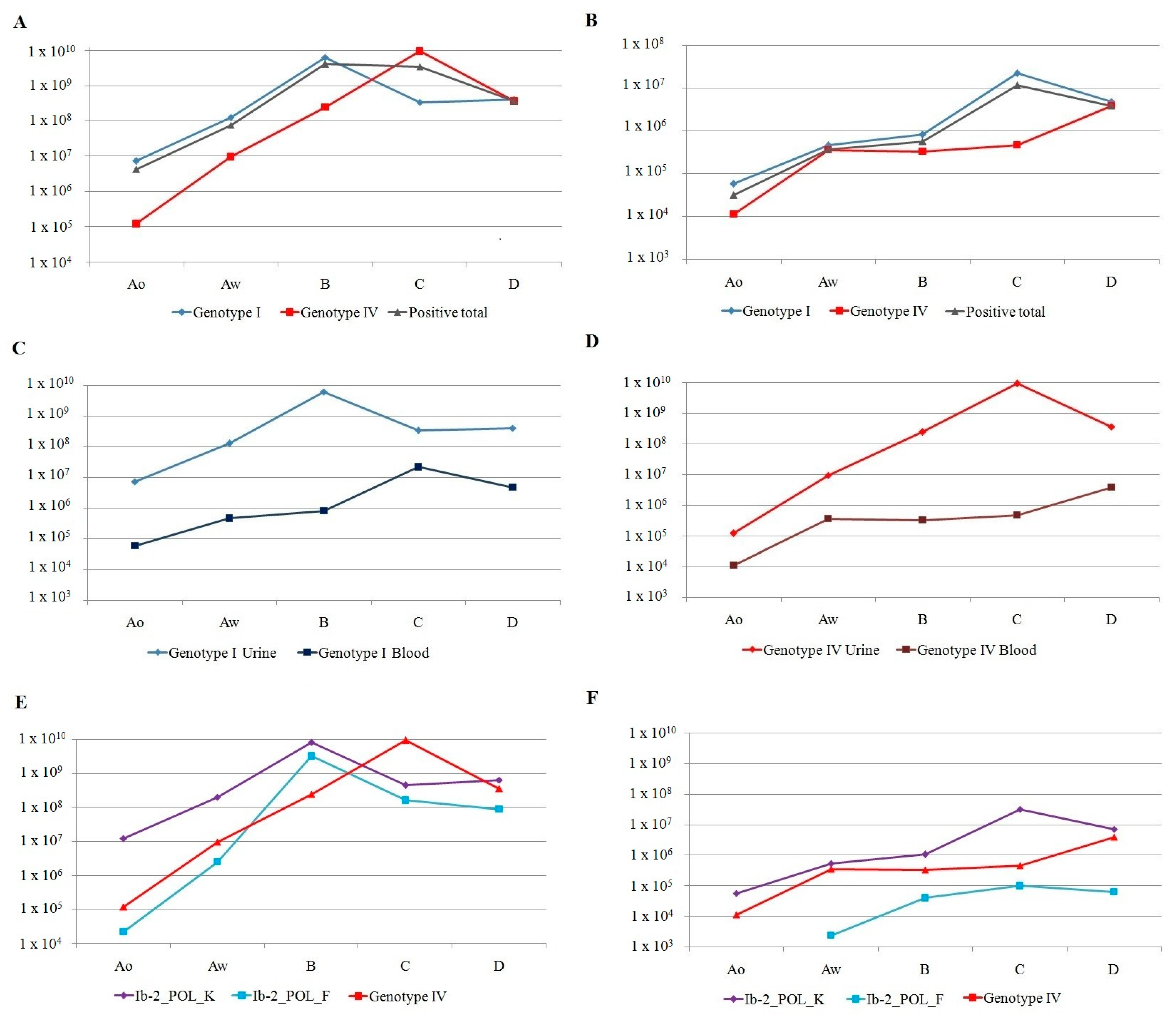
7]. Post-RTx, the percentage of BKPyV-DNA-positive recipients showed a rapid increase reaching its highest level at 3 months after transplantation, as detected in both urine (50.58%) and serum (26.16%). Urinary viral load peaked at 3 months post-RTx (4.10 × 10
9 copies/mL), whereas serum viral load reached its maximum at 6 months (1.15 × 10
7 copies/mL) and subsequently declined gradually over the remainder of the 12-month observation period. The presented dynamics of infection are in partial agreement with the observation made by Babel et al. [
25].
According to the findings of our study, the genotype of the virus seems to be a factor that affects the course of infection, partially determining the fate of the transplanted kidney. Individual genotypes have varying distribution on a global scale, with genotype I appearing predominant. In European countries, there is also a high prevalence of genotype IV [
26,
27]. Genotype I subtype Ib-2 is predominant in Poland, with variants distinguished on the basis of a nonsynonymous G1809A/C mutation: Ib-2_POL_K and Ib-2_POL_F variants [
4], while the isolates listed in bioinformatics databases from various parts of the world are 100% identical to the variants described in the present study. A high rate of genotype IV and coinfection with both genotypes was observed. The prevalence observed in our study is slightly higher than most literature data [
24,
28,
29], but consistent with the results published from another facility in Poland: DNAuria-BKPyV (29.4%), BKV-DNAemia (8.26–25.5%) and BKPyVAN (7.87–14.93%), virus titer 2.3–9.0 log10 copies/mL in serum [
30,
31,
32]. The distribution of individual genotypes in a given population may also represent a unique pattern of endemic evolution of a variant, such as the one occurring in Vietnam following a nonsynonymous mutation at position A1745G, identified in 95% of RTRs [
33], or even changed over time [
26]. Throughout the entire observation period, the average DNAuria titer exceeded the DNAemia titer by two orders of magnitude, with the sole exception of the values at 3 months post-RTx. DNAuria-BKPyV therefore precedes BKPyV-DNAemia, affects more patients and has a higher and more easily detected viral load. The aforementioned characteristics suggest that it could be used as an earlier marker and, even more importantly, as a key predictive index of high clinical value, related to the later detection of the virus in serum alone.
Prior to RTx, no major difference among the tested parameters (p = NS) was observed among the BKPyV-DNA-negative and BKPyV-DNA-positive groups of recipients, as a clear manifestation of viral infection. The only exception was the hematological (Hb, Hct, and RBC) parameters in the BKPyV-DNAemia-positive group. However, it seems that the “clinical silence” prior to the transplant does not imply the absence of risk. Variations in hematological, inflammatory and renal function parameters were observed post-RTx and are directly and causally associated with longer hospitalization (p < 0.05). The deterioration of graft function, a decrease in 24 h urine collection and CBC parameters (complete blood count parameters) in the BKPyV-DNA-positive group do not appear to be incidental, but systematically follow the increase in DNAuria-BKPyV and BKPyV-DNAemia, especially in the period from 6 to 12 months after RTx. This can be interpreted as a pathophysiological sequence of events that may demonstrate that the virus co-shapes the trajectory of the graft, influencing the recipients’ immunological and hematological response.
Hematological changes are the result of complex, concurrent processes such as chronic inflammation, rejection, allograft dysfunction, effects of medications (immunosuppressive, antiviral, and antimicrobial) and, obviously, viral infections [
34]. Their consequence is subclinical inflammation and a prothrombotic state, which may intensify one another. Elevated CRP is positively correlated with a deterioration in graft function long after transplantation [
35], accompanied by a statistically significant increase in D-dimer levels. Moreover, an increase in CRP values is associated with higher mortality rates in RTRs [
36] and is considered a predictive factor of coronary events in the case of both ESRD (end-stage renal disease) patients and in the general population [
37]. Although this can be treated as a manifestation of the systemic acute phase response, it cannot be ruled out that D-dimers are a marker of thrombosis in the renal microcirculation, which can contribute to graft damage, including in the context of BKPyVAN [
38]. High D-dimer levels can exacerbate inflammatory and coagulation processes, leading to acute kidney injury (AKI) [
38], and their concentration is directly correlated with creatinine levels and graft function [
39].
Hematological complications following transplantation include post-transplant anemia (38–42%) [
40,
41], leukopenia (20–75%) [
30,
42], and thrombocytopenia (about 30%) [
30], which are most often observed during the first few months after transplantation [
40]. They may be due to drug-induced myelosuppression, and since their toxic effect is dose-dependent [
40], appropriate, individualized treatment and close monitoring of drug levels remain a key element of treatment. BKPyV replication is also considered responsible for myelosuppression, although this mechanism is not fully understood [
43]. It is likely that, like other viruses, BKPyV affects helper and stromal cells, changes the expression of adhesion molecules or directly infects stem cells, impairing hematopoiesis [
44].
Complications associated with BKPyV affect both the donor’s kidney and the recipient’s bone marrow [
14]. Most likely, both the decrease in hemoglobin levels and the increase in creatinine levels observed in the present study are caused by stromal cell dysfunction and concomitant clinical infection in post-RTx patients. These parameters constitute markers of deteriorating graft function, expressed as a significant decrease in the Hb/Cr ratio. The observed trend of persistent deterioration of renal parameters measured through our observation period suggests that the effect of the damage is long-lasting and that therapeutic interventions should be undertaken early in order to prevent nephropathy [
25].
Our study demonstrates that early monitoring of DNAuria-BKPyV should be incorporated into classical screening and not merely as an addition to it. In other words, not only do the effects of immunosuppression allow the virus to develop, but the virus itself actively shapes the recipient’s immune status; therefore, instead of treating BKPyV as a “passenger”, we should perceive it as a co-architect of the outcome of transplantation, graft fate and patient survival. A key question from a clinical and therapeutic perspective is whether individual genotypes or subtypes lead to various manifestations of the disease. This may have potential treatment implications, as knowing the molecular variant could enable more precise, individualized therapy. It is well established that polymorphisms in the nucleotide sequence, especially in the BC loop, can influence traits of the virus, such as tropism for specific cells, the replication rate, or the ability to evade the host’s immune system [
4,
33,
45,
46,
47,
48,
49,
50].
The appearance of viruria followed by viremia is well known, but our results add to this knowledge, demonstrating that the highest incidence of DNAuria-BKPyV-positive and BKPyV-DNAemia-positive patients occurred three months post-RTx. In this study, we observed that viral-load dynamics are genotype-dependent. In genotype I infection, the viral load peaked at 3 months in urine and at 6 months in serum—a three-month delay. In genotype IV infection, the urinary viral load peaked later, at 6 months, while the serum viral load did not peak until 12 months—a six-month delay relative to urine. Our results indicate that genotype IV attains higher peak levels of DNAuria-BKPyV, replicates later in serum, and has a higher percentage infection rate in serum than in urine, which may be due to more effective evasion of the host’s immune mechanisms. Pastrana et al. [
51] demonstrated that genotypes I and IV belong to different serotypes and that while nearly all healthy subjects had BKPyV genotype I neutralizing antibodies, a majority of subjects did not detectably neutralize genotype III or IV.
The more rapid viral load increase observed in both urine and serum in patients infected with genotype I, especially in the initial period post transplantation, seems to be consistent with the findings of studies indicating that BKPyV subtype I replicates more efficiently than BKPyV subtype IV in human renal epithelial cells [
52]. The later but more rapid replication of genotype IV and perhaps lower susceptibility to the host’s immune mechanisms may indicate a more chronic type of infection, predispose the patient to significant deterioration of graft function, and translate into a potentially higher risk of BKPyVAN. This seems to be in agreement with the literature, in which infection by genotype IV presents as one of the risk factors for BKPyVAN [
24,
46,
53].
Chronic deterioration of graft function is observed in the case of both genotypes (I and IV) in comparison with the BKPyV-DNA-negative group. Comparison of creatinine, eGFR, and hematological parameters indicated that genotype IV showed less favorable values at the conclusion of the observation period (p = NS).
Ultimately, the question is whether we seek only to confirm the presence of BKPyV and its adverse effects, or to more effectively prevent infection progression. The BKPyV-DNAemia (>104) group selected in our study essentially confirms the poorest renal parameter outcomes, accompanied by reduced 24 h urine collection volumes, lower hematological values, and higher inflammatory markers—findings that are consistent with the literature [
54]. Classical models of risk assessment for the course of BKPyV infection based on biochemical parameters are no longer sufficient; there is a need for new algorithms taking into account the genetic polymorphism of the virus and the dynamics of its replication. It is no longer only a question of whether a patient has a BKPyV infection; we want to know what genotype is causing it, where and when it is replicating, what the pro-inflammatory and prothrombotic response is, and how it acts together with the immunosuppression profile. Until now, it has been assumed that the conflict following transplantation is between immunosuppression and rejection, but the present study indicates that a third factor—BKPyV infection—should be taken into account as well, in terms of both genetic polymorphism of the virus and its load. Thus, the equation has three components: immunosuppression–rejection–virus. Therefore, genotyping of the virus is necessary in practice. There is also a need to redefine “optimal immunosuppression”—instead of universal, rigid regimens, we should speak of a dynamic balance adjusted to varied replication of the virus. Only a holistic approach and integration of these three axes (genotype–load–immunosuppression) will enable true personalization of post-transplant care.
5. Conclusions
1. High BKPyV-DNAemia and DNAuria-BKPyV are risk factors for graft injury, the development of BKPyVAN and poorer prognosis for the transplanted organ.
2. Without discounting the possibility of transfer of BKPyV infection together with the donor’s organ, our data suggest that the infection is already present at the dialysis stage and is waiting for favorable conditions for further progression, which occur after RTx.
3. DNAuria-BKPyV precedes BKPyV-DNAemia, affects a larger group of patients, and has a greater and more easily detected viral load, which makes it not only an earlier marker, but also a key predictive marker of greater clinical value than later detection of the virus in serum alone.
4. A priori to RTx, a statistically significant difference in hematological values of BKPyV-DNAemia-positive/-negative groups was noted. No other differences in inflammatory, nutritional, renal function parameters or in 24 h urine collection were recorded.
5. Post-RTx, increasingly after 6 months, rising DNAuria-BKPyV and BKPyV-DNAemia are accompanied by worsening signs of graft dysfunction, decreasing 24 h urine collection, and intensifying hematological abnormalities. These findings suggest that the damage is long-lasting and that therapeutic intervention should be initiated early to prevent BKPyVAN.
6. Genotype I is characterized by a rapid onset of viral load (3–6 months), whereas genotype IV shows later replication in the serum, a higher prevalence in serum than in urine, and the highest peak levels of DNAuria-BKPyV, which may be due to more effective evasion of the host’s immune mechanisms.
7. Classical models of risk assessment for the course of BKPyV infection based on biochemical parameters are no longer sufficient; there is a need for new algorithms taking into account the genetic polymorphism of the virus and the dynamics of its replication, the pro-inflammatory and prothrombotic response, and how it acts together with the immunosuppression profile.
8. There is a need to redefine “optimal immunosuppression”. Only a holistic approach comprising an integration of the three axes (genotype–load–immunosuppression) will enable true personalization of post-transplant care.
9. Early monitoring of DNAuria-BKPyV should be incorporated into classical screening and not merely as an addition to it.



 ,
,