Phosphatase Signaling as a Therapeutic Strategy in Schizophrenia


Abstract
1. Introduction

| Therapy | Primary Targets | Mechanism of Action | Symptom Domain Targeted | Clinical Status | Key Limitations | Citations |
|---|---|---|---|---|---|---|
| Typical antipsychotics (e.g., haloperidol, chlorpromazine) | D2R (±D1R) | Broad antagonism of D2R in mesolimbic pathway; some agents engage D1R and indirectly | Positive | Approved | High EPS liability; limited efficacy for negative/cognitive symptoms | [8,24] |
| Atypical antipsychotics (e.g., clozapine, risperidone, olanzapine) | D2R (±D1R), 5-HT2A | Reduced D2 antagonism + 5-HT2A blockade releases dopamine in mesocortical pathways; some agents engage D1R | Positive | Approved | Metabolic side effects (weight gain, dyslipidemia); limited efficacy for cognitive symptoms | [24,25] |
| Partial D2 agonists (e.g., aripiprazole, brexpiprazole, lumateperone) | D2R (partial agonist) (±D1R, D3R), 5-HT receptors | Dopamine “stabilization” rather than full blockade; lumateperone engages D1R | Positive | Approved | Restlessness; Limited efficacy for negative and cognitive symptoms | [24] |
| KarXT (xanomeline–trospium) | M1/M4 mAChRs | Indirect modulation of dopamine circuits; M4 reduces mesolimbic dopamine; M1 enhances cortical signaling | Positive, Negative, Cognitive | Approved | Exact MOA still under investigation | [26,27] |
| mGlu2/3 agonists/PAMs (e.g., pomaglumetad) | Group II mGlus | Reduce presynaptic glutamate release; normalize corticolimbic E/I imbalance | Positive, Negative, Cognitive | Phase II–III | Variable efficacy | [10] |
| Glycine/D-serine/GlyT1 inhibitors | NMDAR co-agonist site | Enhance NMDAR function by increasing glycine availability | Negative, Cognitive | Phase II–III | Limited efficacy | [10] |
| KAT II inhibitors | KAT II (kynurenine aminotransferase II) | Inhibit conversion of kynurenine to kynurenic acid (KYNA), relieving endogenous inhibition of NMDARs | Cognitive | Phase I–II | Side effects remain to be fully characterized | [10] |
| NMDAR PAMs | NMDAR | Directly enhance receptor activity | Negative, Cognitive | Phase I | Risk of excitotoxicity | [10] |
| Voltage-gated sodium channel blockers (e.g., evenamide) | NaV channels | Reduce glutamate release indirectly | Positive, Negative | Open-label | Nonspecific CNS effects | [10] |
| LSD1 inhibitors | LSD1 (KDM1A) | Epigenetic modulation downstream of SETD1A dysfunction; alter transcriptional programs affecting synaptic plasticity | Negative, Cognitive | Phase II | Long-term safety under evaluation | [28] |
| cAMP/PKA pathway inhibitors | PKA signaling | Rescue network hyperactivity downstream of SETD1A mutations | Cognitive (preclinical) | Preclinical | Potential off-target effects | [29] |
| Kinase modulators (e.g., targeting AKT1, PTK2B/Pyk2) | AKT1, Pyk2 | Modulate phosphorylation-dependent synaptic signaling and NMDAR regulation | Cognitive, Negative | Preclinical | Kinase pleiotropy complicates selectivity | [30] |
| Phosphatase-targeting strategies (emerging) | PP1, STEP, others | May restore balance in phosphorylation-dependent signaling, NMDAR trafficking, and synaptic strength | Cognitive, Negative (hypothesized) | Preclinical/Conceptual | Historically underexplored | [31,32] |
2. Neurobiological Mechanisms of Current Schizophrenia Treatments
3. Protein Phosphatases Implicated in Schizophrenia
3.1. PP1 (PPP1C)
3.2. Calcineurin (PPP3C)
3.3. PTPD1 (PTPN21)
3.4. LAR (PTPRF)
3.5. RPTPα (PTPRA)
3.6. RPTPβ/ζ (PTPRZ1)
3.7. PTP1B (PTPN1)
3.8. STEP (PTPN5)
4. Challenges and Opportunities in Targeting Phosphatases for Schizophrenia Treatment
4.1. Inhibition of STEP and Restoration of Synaptic Receptor Trafficking
4.2. Allosteric Inhibition of PTP1B in Schizophrenia-Relevant Signaling Pathways
4.3. Calcineurin Inhibition and CNS-Relevant Behavioral and Synaptic Effects
4.4. Pharmacological Inhibition of RPTPβ/ζ and Network-Level Signaling Effects
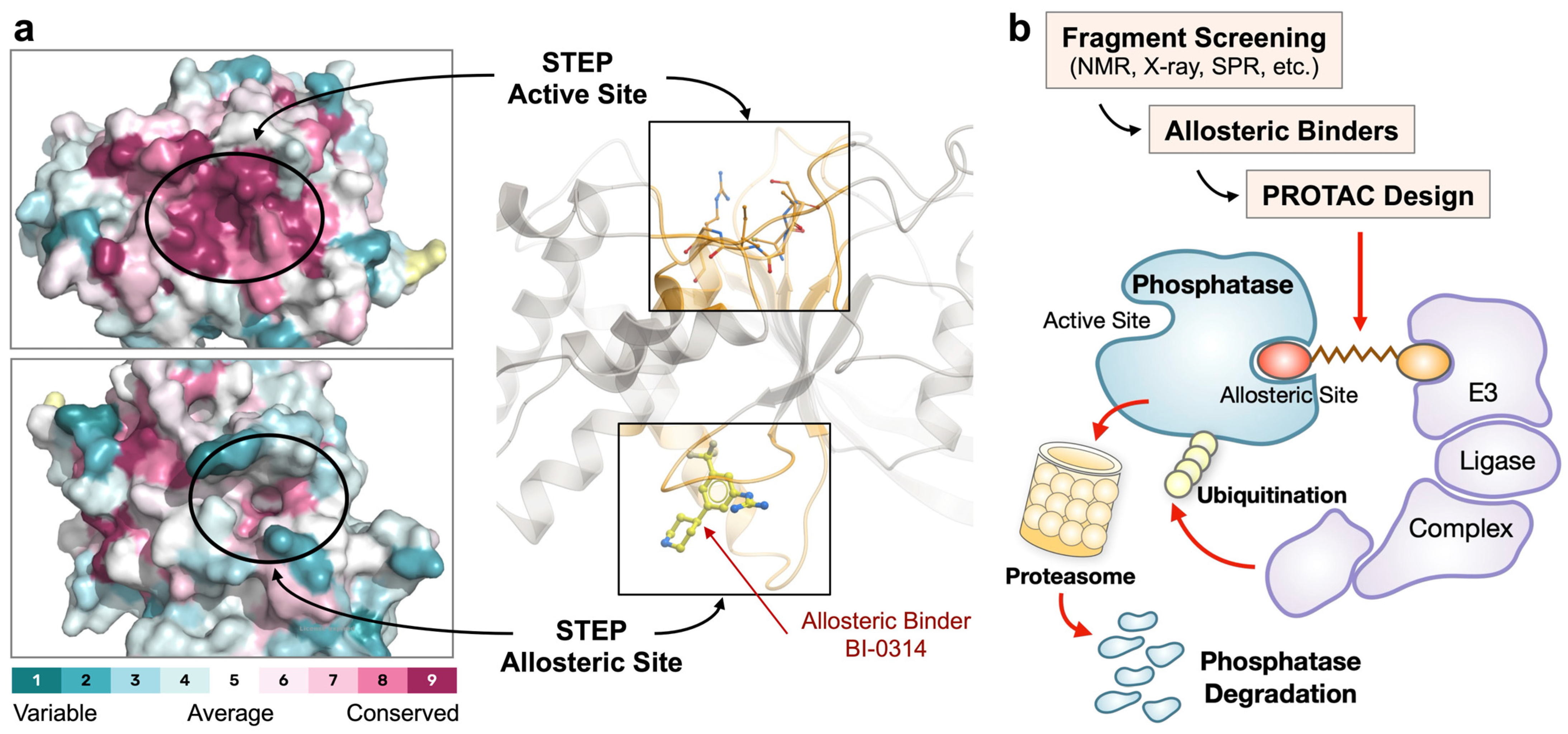
4.5. Novel Approaches Targeting Phosphatases for CNS Disorders

5. Conclusions
Author Contributions
Funding
Institutional Review Board Statement
Informed Consent Statement
Data Availability Statement
Acknowledgments
Conflicts of Interest
Abbreviations
| AD | Alzheimer’s disease |
| AMPAR | α-amino-3-hydroxy-5-methyl-4-isoxazolepropionic acid receptor |
| BBB | blood–brain barrier |
| BDNF | brain-derived neurotrophic factor |
| CREB | cAMP-response element-binding protein |
| CNS | central nervous system |
| CsA | cyclosporine A |
| D1R | D1 receptor |
| D2R | D2 receptor |
| DARPP-32 | adenosine 3′:5′-monophosphate-regulated phosphoprotein of 32 kDa |
| DLPFC | dorsolateral prefrontal cortex |
| DSF | differential scanning fluorometry |
| EPS | extra-pyramidal side effects |
| ErbB4 | V-erb-b2 avian erythroblastic leukemia viral oncogene homolog 4 |
| ERK1/2 | extracellular signal-regulated kinases 1/2 |
| FBDD | fragment-based drug discovery |
| GWAS | genome-wide association studies |
| HAD | haloacid dehalogenase |
| HTS | high-throughput screening |
| hiPSC | human induced pluripotent stem cell |
| KarXT | xanomeline-tropsium chloride |
| LAR | leukocyte common antigen-related |
| LRRK2 | leucine-rich repeat kinase 2 |
| LTD | long-term depression |
| LTP | long-term potentiation |
| LSD1 | lysine-specific demethylase 1 |
| mAChR | muscarinic acetylcholine receptor |
| MST | microscale thermophoresis |
| NGL-3 | netrin-G ligand-3 |
| NMDAR | N-methyl-D-aspartate receptor |
| NMR | nuclear magnetic resonance |
| NRG | neuregulin |
| PAM | positive allosteric modulator |
| PFC | prefrontal cortex |
| PKA | cyclic AMP (cAMP)/protein kinase A |
| POI | protein of interest |
| PP1 | protein phosphatase 1 |
| PPI | prepulse inhibition |
| PROTAC | proteolysis-targeting chimera |
| PSD | postsynaptic density |
| PTP | protein tyrosine phosphatase |
| PTS | protein thermal shift |
| pTyr | phosphotyrosine |
| QoL | quality of life |
| RPTP | receptor-type protein tyrosine phosphatase |
| SNP | single nucleotide polymorphism |
| SNV | single nucleotide variant |
| SPR | surface plasmon resonance |
| STEP | striatal-enriched tyrosine phosphatase |
| STP | serine/threonine phosphatase |
| TrkB | tropomyosin receptor kinase B |
| UPS | ubiquitin–proteasome system |
References
- Laursen, T.M.; Nordentoft, M.; Mortensen, P.B. Excess early mortality in schizophrenia. Annu. Rev. Clin. Psychol. 2014, 10, 425–448. [Google Scholar] [CrossRef]
- Ashok, A.H.; Baugh, J.; Yeragani, V.K. Paul Eugen Bleuler and the origin of the term schizophrenia (SCHIZOPRENIEGRUPPE). Indian J. Psychiatry 2012, 54, 95–96. [Google Scholar] [CrossRef]
- Ali, S.A.; Mathur, N.; Malhotra, A.K.; Braga, R.J. Electroconvulsive Therapy and Schizophrenia: A Systematic Review. Mol. Neuropsychiatry 2019, 5, 75–83. [Google Scholar] [CrossRef]
- Turner, T. Chlorpromazine: Unlocking psychosis. BMJ 2007, 334, s7. [Google Scholar] [CrossRef]
- Owen, M.J.; Sawa, A.; Mortensen, P.B. Schizophrenia. Lancet 2016, 388, 86–97. [Google Scholar] [CrossRef] [PubMed]
- Kahn, R.S.; Sommer, I.E.; Murray, R.M.; Meyer-Lindenberg, A.; Weinberger, D.R.; Cannon, T.D.; O’Donovan, M.; Correll, C.U.; Kane, J.M.; van Os, J.; et al. Schizophrenia. Nat. Rev. Dis. Prim. 2015, 1, 15067. [Google Scholar] [CrossRef]
- Nakamura, T.; Takata, A. The molecular pathology of schizophrenia: An overview of existing knowledge and new directions for future research. Mol. Psychiatry 2023, 28, 1868–1889. [Google Scholar] [CrossRef] [PubMed]
- Patel, K.R.; Cherian, J.; Gohil, K.; Atkinson, D. Schizophrenia: Overview and treatment options. Peer Rev. J. Formul. Manag. 2014, 39, 638–645. [Google Scholar]
- Jablensky, A. The diagnostic concept of schizophrenia: Its history, evolution, and future prospects. Dialogues Clin. Neurosci. 2010, 12, 271–287. [Google Scholar] [CrossRef]
- Coyle, J.T.; Paul, S.M. Novel drug treatments for schizophrenia. Nat. Rev. Drug Discov. 2026. Erratum in Nat. Rev. Drug Discov. 2026. [Google Scholar] [CrossRef]
- Solmi, M.; Seitidis, G.; Mavridis, D.; Correll, C.U.; Dragioti, E.; Guimond, S.; Tuominen, L.; Dargel, A.; Carvalho, A.F.; Fornaro, M.; et al. Incidence, prevalence, and global burden of schizophrenia-data, with critical appraisal, from the Global Burden of Disease (GBD) 2019. Mol. Psychiatry 2023, 28, 5319–5327. [Google Scholar] [CrossRef]
- Jauhar, S.; Johnstone, M.; McKenna, P.J. Schizophrenia. Lancet 2022, 399, 473–486. [Google Scholar] [CrossRef]
- Kadakia, A.; Catillon, M.; Fan, Q.; Williams, G.R.; Marden, J.R.; Anderson, A.; Kirson, N.; Dembek, C. The Economic Burden of Schizophrenia in the United States. J. Clin. Psychiatry 2022, 83, 22m14458. [Google Scholar] [CrossRef]
- Howes, O.H.; Kaar, S.J. Antipsychotic drugs: Challenges and future directions. World Psychiatry 2018, 17, 170–171. [Google Scholar] [CrossRef] [PubMed]
- Frost, A.; O’Connor, S.; Ciulli, A. Allosteric PROTACs: Expanding the Horizon of Targeted Protein Degradation. J. Am. Chem. Soc. 2026, 148, 2823–2837. [Google Scholar] [CrossRef]
- Stephan, K.E.; Baldeweg, T.; Friston, K.J. Synaptic plasticity and dysconnection in schizophrenia. Biol. Psychiatry 2006, 59, 929–939. [Google Scholar] [CrossRef]
- Belkhiri, A.; Zhu, S.; El-Rifai, W. DARPP-32: From neurotransmission to cancer. Oncotarget 2016, 7, 17631–17640. [Google Scholar] [CrossRef]
- Gerber, D.J.; Hall, D.; Miyakawa, T.; Demars, S.; Gogos, J.A.; Karayiorgou, M.; Tonegawa, S. Evidence for association of schizophrenia with genetic variation in the 8p21.3 gene, PPP3CC, encoding the calcineurin gamma subunit. Proc. Natl. Acad. Sci. USA 2003, 100, 8993–8998. [Google Scholar] [CrossRef] [PubMed]
- Plani-Lam, J.H.; Chow, T.C.; Siu, K.L.; Chau, W.H.; Ng, M.H.; Bao, S.; Ng, C.T.; Sham, P.; Shum, D.K.; Ingley, E.; et al. PTPN21 exerts pro-neuronal survival and neuritic elongation via ErbB4/NRG3 signaling. Int. J. Biochem. Cell Biol. 2015, 61, 53–62. [Google Scholar] [CrossRef] [PubMed]
- Takahashi, N.; Nielsen, K.S.; Aleksic, B.; Petersen, S.; Ikeda, M.; Kushima, I.; Vacaresse, N.; Ujike, H.; Iwata, N.; Dubreuil, V.; et al. Loss of function studies in mice and genetic association link receptor protein tyrosine phosphatase alpha to schizophrenia. Biol. Psychiatry 2011, 70, 626–635. [Google Scholar] [CrossRef]
- Takahashi, N.; Sakurai, T.; Bozdagi-Gunal, O.; Dorr, N.P.; Moy, J.; Krug, L.; Gama-Sosa, M.; Elder, G.A.; Koch, R.J.; Walker, R.H.; et al. Increased expression of receptor phosphotyrosine phosphatase-beta/zeta is associated with molecular, cellular, behavioral and cognitive schizophrenia phenotypes. Transl. Psychiatry 2011, 1, e8. [Google Scholar] [CrossRef]
- Olloquequi, J.; Cano, A.; Sanchez-Lopez, E.; Carrasco, M.; Verdaguer, E.; Fortuna, A.; Folch, J.; Bullo, M.; Auladell, C.; Camins, A.; et al. Protein tyrosine phosphatase 1B (PTP1B) as a potential therapeutic target for neurological disorders. Biomed. Pharmacother. 2022, 155, 113709. [Google Scholar] [CrossRef] [PubMed]
- Pelov, I.; Teltsh, O.; Greenbaum, L.; Rigbi, A.; Kanyas-Sarner, K.; Lerer, B.; Lombroso, P.; Kohn, Y. Involvement of PTPN5, the gene encoding the striatal-enriched protein tyrosine phosphatase, in schizophrenia and cognition. Psychiatr. Genet. 2012, 22, 168–176. [Google Scholar] [CrossRef]
- de Bartolomeis, A.; Barone, A.; Begni, V.; Riva, M.A. Present and future antipsychotic drugs: A systematic review of the putative mechanisms of action for efficacy and a critical appraisal under a translational perspective. Pharmacol. Res. 2022, 176, 106078. [Google Scholar] [CrossRef] [PubMed]
- Miyamoto, S.; Duncan, G.E.; Marx, C.E.; Lieberman, J.A. Treatments for schizophrenia: A critical review of pharmacology and mechanisms of action of antipsychotic drugs. Mol. Psychiatry 2005, 10, 79–104. [Google Scholar] [CrossRef]
- Mohammed, H.E.; Gomaa, M.A.; Khalifa, Y.M.; Shawky, A.A. Does KarXT (xanomeline-trospium) represent a novel approach to schizophrenia management? A GRADE-assessed systematic review and meta-analysis of randomized controlled clinical trials. BMC Psychiatry 2025, 25, 309. [Google Scholar] [CrossRef] [PubMed]
- Yohn, S.E.; Harvey, P.D.; Brannan, S.K.; Horan, W.P. The potential of muscarinic M(1) and M(4) receptor activators for the treatment of cognitive impairment associated with schizophrenia. Front. Psychiatry 2024, 15, 1421554. [Google Scholar] [CrossRef]
- Ferrer, M.; Richarte, V.; Gisbert, L.; Xaus, J.; Gutierrez, S.; Arevalo, M.I.; Ropacki, M.; Bullock, R.; Buesa, C.; Ramos-Quiroga, J.A. REIMAGINE: A central nervous system basket trial showing safety and efficacy of vafidemstat on aggression in different psychiatric disorders. Psychiatry Clin. Neurosci. 2025, 79, 257–265. [Google Scholar] [CrossRef]
- Wang, S.; Rhijn, J.V.; Akkouh, I.; Kogo, N.; Maas, N.; Bleeck, A.; Ortiz, I.S.; Lewerissa, E.; Wu, K.M.; Schoenmaker, C.; et al. Loss-of-function variants in the schizophrenia risk gene SETD1A alter neuronal network activity in human neurons through the cAMP/PKA pathway. Cell Rep. 2022, 39, 110790. [Google Scholar] [CrossRef]
- Kvajo, M.; McKellar, H.; Gogos, J.A. Molecules, signaling, and schizophrenia. In Behavioral Neurobiology of Schizophrenia and Its Treatment; Current Topics in Behavioral Neurosciences, Springer: Berlin/Heidelberg, Germany, 2010; Volume 4, pp. 629–656. [Google Scholar] [CrossRef]
- Chatterji, T.; Gates, K.S. DNA cleavage by 7-methylbenzopentathiepin: A simple analog of the antitumor antibiotic varacin. Bioorg. Med. Chem. Lett. 1998, 8, 535–538. [Google Scholar] [CrossRef] [PubMed]
- Nogueira, J.M.; Freire, M.J.; Nova, V.V.; Jesus, G. When Paranoia Comes with the Treatment: Psychosis Associated with Tacrolimus Use. Case Rep. Nephrol. Dial. 2021, 11, 241–246. [Google Scholar] [CrossRef] [PubMed]
- Kaul, I.; Sawchak, S.; Correll, C.U.; Kakar, R.; Breier, A.; Zhu, H.; Miller, A.C.; Paul, S.M.; Brannan, S.K. Efficacy and safety of the muscarinic receptor agonist KarXT (xanomeline-trospium) in schizophrenia (EMERGENT-2) in the USA: Results from a randomised, double-blind, placebo-controlled, flexible-dose phase 3 trial. Lancet 2024, 403, 160–170, Erratum in Lancet 2024, 403, 2380. [Google Scholar] [CrossRef]
- Sauder, C.; Allen, L.A.; Baker, E.; Miller, A.C.; Paul, S.M.; Brannan, S.K. Effectiveness of KarXT (xanomeline-trospium) for cognitive impairment in schizophrenia: Post hoc analyses from a randomised, double-blind, placebo-controlled phase 2 study. Transl. Psychiatry 2022, 12, 491. [Google Scholar] [CrossRef]
- Kruse, A.O.; Bustillo, J.R. Glutamatergic dysfunction in Schizophrenia. Transl. Psychiatry 2022, 12, 500. [Google Scholar] [CrossRef]
- Harrison, P.J.; Bannerman, D.M. GRIN2A (NR2A): A gene contributing to glutamatergic involvement in schizophrenia. Mol. Psychiatry 2023, 28, 3568–3572. [Google Scholar] [CrossRef] [PubMed]
- Hollville, E.; Joers, V.; Nakamura, A.; Swahari, V.; Tansey, M.G.; Moy, S.S.; Deshmukh, M. Characterization of a Cul9-Parkin double knockout mouse model for Parkinson’s disease. Sci. Rep. 2020, 10, 16886. [Google Scholar] [CrossRef]
- Schrode, N.; Ho, S.M.; Yamamuro, K.; Dobbyn, A.; Huckins, L.; Matos, M.R.; Cheng, E.; Deans, P.J.M.; Flaherty, E.; Barretto, N.; et al. Synergistic effects of common schizophrenia risk variants. Nat. Genet. 2019, 51, 1475–1485. [Google Scholar] [CrossRef]
- Zhu, J.; Wang, H.; Huang, Y.Q.; Song, W.; Li, Y.F.; Wang, W.J.; Ding, Z.L. Comprehensive analysis of a long non-coding RNA-associated competing endogenous RNA network in glioma. Oncol. Lett. 2020, 20, 63. [Google Scholar] [CrossRef]
- Toyoda, S.; Kikuchi, M.; Abe, Y.; Tashiro, K.; Handa, T.; Katayama, S.; Motokawa, Y.; Tanaka, K.F.; Takahashi, H.; Shiwaku, H. Schizophrenia-related Xpo7 haploinsufficiency leads to behavioral and nuclear transport pathologies. EMBO Rep. 2025, 26, 948–981. [Google Scholar] [CrossRef] [PubMed]
- Parnell, E.; Christiansen, J.M.; Spratt, M.A.; Ruiz, S.; Macdonald, M.L.; Penzes, P.; Sweet, R.A.; Grubisha, M.J. Oligodendrocyte myelin glycoprotein impairs dendritic arbors via schizophrenia risk gene Trio. Neurobiol. Dis. 2025, 211, 106928. [Google Scholar] [CrossRef]
- Kim, J.I.; Miura, Y.; Li, M.Y.; Revah, O.; Selvaraj, S.; Birey, F.; Meng, X.; Thete, M.V.; Pavlov, S.D.; Andersen, J.; et al. Human assembloids reveal the consequences of CACNA1G gene variants in the thalamocortical pathway. Neuron 2024, 112, 4048–4059.e7. [Google Scholar] [CrossRef]
- Tang, X.; Walter, E.; Wohleb, E.; Fan, Y.; Wang, C. ATG5 (autophagy related 5) in microglia controls hippocampal neurogenesis in Alzheimer disease. Autophagy 2024, 20, 847–862. [Google Scholar] [CrossRef] [PubMed]
- Nagahama, K.; Sakoori, K.; Watanabe, T.; Kishi, Y.; Kawaji, K.; Koebis, M.; Nakao, K.; Gotoh, Y.; Aiba, A.; Uesaka, N.; et al. Setd1a Insufficiency in Mice Attenuates Excitatory Synaptic Function and Recapitulates Schizophrenia-Related Behavioral Abnormalities. Cell Rep. 2020, 32, 108126. [Google Scholar] [CrossRef] [PubMed]
- Adamczyk, A.; Mejias, R.; Takamiya, K.; Yocum, J.; Krasnova, I.N.; Calderon, J.; Cadet, J.L.; Huganir, R.L.; Pletnikov, M.V.; Wang, T. GluA3-deficiency in mice is associated with increased social and aggressive behavior and elevated dopamine in striatum. Behav. Brain Res. 2012, 229, 265–272. [Google Scholar] [CrossRef]
- Herzog, L.E.; Wang, L.; Yu, E.; Choi, S.; Farsi, Z.; Song, B.J.; Pan, J.Q.; Sheng, M. Mouse mutants in schizophrenia risk genes GRIN2A and AKAP11 show EEG abnormalities in common with schizophrenia patients. Transl. Psychiatry 2023, 13, 92. [Google Scholar] [CrossRef]
- Sun, X.; Pinacho, R.; Saia, G.; Punko, D.; Meana, J.J.; Ramos, B.; Gill, G. Transcription factor Sp4 regulates expression of nervous wreck 2 to control NMDAR1 levels and dendrite patterning. Dev. Neurobiol. 2015, 75, 93–108. [Google Scholar] [CrossRef]
- Monteleone, P.; Di Lieto, A.; Martiadis, V.; Pannuto, M.; Maj, M. Altered immunoreactive levels of G proteins in peripheral mononuclear cells of patients with anorexia nervosa and bulimia nervosa. Mol. Psychiatry 2003, 8, 680–684. [Google Scholar] [CrossRef]
- de Pins, B.; Mendes, T.; Giralt, A.; Girault, J.A. The Non-receptor Tyrosine Kinase Pyk2 in Brain Function and Neurological and Psychiatric Diseases. Front. Synaptic Neurosci. 2021, 13, 749001. [Google Scholar] [CrossRef]
- Nairn, A.C.; Shenolikar, S. The role of protein phosphatases in synaptic transmission, plasticity and neuronal development. Curr. Opin. Neurobiol. 1992, 2, 296–301. [Google Scholar] [CrossRef]
- Khan, R.; Kulasiri, D.; Samarasinghe, S. Functional repertoire of protein kinases and phosphatases in synaptic plasticity and associated neurological disorders. Neural Regen. Res. 2021, 16, 1150–1157. [Google Scholar] [CrossRef] [PubMed]
- Karam, C.S.; Ballon, J.S.; Bivens, N.M.; Freyberg, Z.; Girgis, R.R.; Lizardi-Ortiz, J.E.; Markx, S.; Lieberman, J.A.; Javitch, J.A. Signaling pathways in schizophrenia: Emerging targets and therapeutic strategies. Trends Pharmacol. Sci. 2010, 31, 381–390. [Google Scholar] [CrossRef] [PubMed]
- Walaas, S.I.; Hemmings, H.C., Jr.; Greengard, P.; Nairn, A.C. Beyond the dopamine receptor: Regulation and roles of serine/threonine protein phosphatases. Front. Neuroanat. 2011, 5, 50. [Google Scholar] [CrossRef]
- Chen, J.; Lee, G.; Fanous, A.H.; Zhao, Z.; Jia, P.; O’Neill, A.; Walsh, D.; Kendler, K.S.; Chen, X.; The International Schizophrenia Consortium. Two non-synonymous markers in PTPN21, identified by genome-wide association study data-mining and replication, are associated with schizophrenia. Schizophr. Res. 2011, 131, 43–51. [Google Scholar] [CrossRef] [PubMed]
- Gan, T.; Stevens, A.T.; Xiong, X.; Wen, Y.A.; Farmer, T.N.; Li, A.T.; Stevens, P.D.; Golshani, S.; Weiss, H.L.; Evers, B.M.; et al. Inhibition of protein tyrosine phosphatase receptor type F suppresses Wnt signaling in colorectal cancer. Oncogene 2020, 39, 6789–6801. [Google Scholar] [CrossRef]
- Konopaske, G.T.; Subburaju, S.; Coyle, J.T.; Benes, F.M. Altered prefrontal cortical MARCKS and PPP1R9A mRNA expression in schizophrenia and bipolar disorder. Schizophr. Res. 2015, 164, 100–108. [Google Scholar] [CrossRef]
- Cornejo, F.; Cortes, B.I.; Findlay, G.M.; Cancino, G.I. LAR Receptor Tyrosine Phosphatase Family in Healthy and Diseased Brain. Front. Cell Dev. Biol. 2021, 9, 659951. [Google Scholar] [CrossRef]
- John, J.; Kukshal, P.; Sharma, A.; Bhatia, T.; Nimgaonkar, V.L.; Deshpande, S.N.; Thelma, B.K. Rare variants in Protein tyrosine phosphatase, receptor type A (PTPRA) in schizophrenia: Evidence from a family based study. Schizophr. Res. 2019, 206, 75–81. [Google Scholar] [CrossRef]
- Xing, J.; Wang, C.; Kimura, H.; Takasaki, Y.; Kunimoto, S.; Yoshimi, A.; Nakamura, Y.; Koide, T.; Banno, M.; Kushima, I.; et al. Resequencing and association analysis of PTPRA, a possible susceptibility gene for schizophrenia and autism spectrum disorders. PLoS ONE 2014, 9, e112531. [Google Scholar] [CrossRef]
- Buxbaum, J.D.; Georgieva, L.; Young, J.J.; Plescia, C.; Kajiwara, Y.; Jiang, Y.; Moskvina, V.; Norton, N.; Peirce, T.; Williams, H.; et al. Molecular dissection of NRG1-ERBB4 signaling implicates PTPRZ1 as a potential schizophrenia susceptibility gene. Mol. Psychiatry 2008, 13, 162–172. [Google Scholar] [CrossRef]
- Ito, Y.; Yamada, S.; Takahashi, N.; Saito, S.; Yoshimi, A.; Inada, T.; Noda, Y.; Ozaki, N. No association between the protein tyrosine phosphatase, receptor-type, Z Polypeptide 1 (PTPRZ1) gene and schizophrenia in the Japanese population. Am. J. Med. Genet. Part B Neuropsychiatr. Genet. 2008, 147B, 1013–1018. [Google Scholar] [CrossRef]
- Cressant, A.; Dubreuil, V.; Kong, J.; Kranz, T.M.; Lazarini, F.; Launay, J.M.; Callebert, J.; Sap, J.; Malaspina, D.; Granon, S.; et al. Loss-of-function of PTPR gamma and zeta, observed in sporadic schizophrenia, causes brain region-specific deregulation of monoamine levels and altered behavior in mice. Psychopharmacology 2017, 234, 575–587. [Google Scholar] [CrossRef]
- Qin, Z.; Zhang, L.; Cruz, S.A.; Stewart, A.F.R.; Chen, H.H. Activation of tyrosine phosphatase PTP1B in pyramidal neurons impairs endocannabinoid signaling by tyrosine receptor kinase trkB and causes schizophrenia-like behaviors in mice. Neuropsychopharmacology 2020, 45, 1884–1895. [Google Scholar] [CrossRef]
- Qin, Z.; Zhang, L.; Zasloff, M.A.; Stewart, A.F.R.; Chen, H.H. Ketamine’s schizophrenia-like effects are prevented by targeting PTP1B. Neurobiol. Dis. 2021, 155, 105397. [Google Scholar] [CrossRef] [PubMed]
- Bosco, F.; Valente, P.; Milanese, M.; Piccini, A.; Messa, M.; Bonanno, G.; Lombroso, P.; Baldelli, P.; Benfenati, F.; Giovedi, S. Altered Intracellular Calcium Homeostasis Underlying Enhanced Glutamatergic Transmission in Striatal-Enriched Tyrosine Phosphatase (STEP) Knockout Mice. Mol. Neurobiol. 2018, 55, 8084–8102. [Google Scholar] [CrossRef]
- Walters, J.M.; Noblet, H.A.; Chung, H.J. An emerging role of STriatal-Enriched protein tyrosine Phosphatase in hyperexcitability-associated brain disorders. Neurobiol. Dis. 2024, 200, 106641. [Google Scholar] [CrossRef]
- Carty, N.; Xu, J.; Kurup, P.; Brouillette, J.; Goebel-Goody, S.; Austin, D.; Yuan, P.; Chen, G.; Correa, P.; Haroutunian, V.; et al. The tyrosine phosphatase STEP: Implications in schizophrenia and the molecular mechanism underlying antipsychotic medications. Transl. Psychiatry 2012, 2, e137. [Google Scholar] [CrossRef] [PubMed]
- Xu, J.; Hartley, B.J.; Kurup, P.; Phillips, A.; Topol, A.; Xu, M.; Ononenyi, C.; Foscue, E.; Ho, S.M.; Baguley, T.D.; et al. Inhibition of STEP61 ameliorates deficits in mouse and hiPSC-based schizophrenia models. Mol. Psychiatry 2018, 23, 271–281. [Google Scholar] [CrossRef]
- Lanz, T.A.; Joshi, J.J.; Reinhart, V.; Johnson, K.; Grantham, L.E.; Volfson, D. STEP levels are unchanged in pre-frontal cortex and associative striatum in post-mortem human brain samples from subjects with schizophrenia, bipolar disorder and major depressive disorder. PLoS ONE 2015, 10, e0121744. [Google Scholar] [CrossRef] [PubMed]
- Kozlovsky, N.; Scarr, E.; Dean, B.; Agam, G. Postmortem brain calcineurin protein levels in schizophrenia patients are not different from controls. Schizophr. Res. 2006, 83, 173–177. [Google Scholar] [CrossRef]
- Goebel-Goody, S.; Baum, M.; Paspalas, C.; Fernandez, S.; Carty, N.; Kurup, P.; Lombroso, P. Therapeutic implications for striatal-enriched protein tyrosine phosphatase (STEP) in neuropsychiatric disorders. Pharmacol. Rev. 2012, 64, 65–87. [Google Scholar] [CrossRef]
- Zhang, Y.; Kurup, P.; Xu, J.; Carty, N.; Fernandez, S.; Nygaard, H.; Pittenger, C.; Greengard, P.; Strittmatter, S.; Nairn, A.; et al. Genetic reduction of striatal-enriched tyrosine phosphatase (STEP) reverses cognitive and cellular deficits in an Alzheimer’s disease mouse model. Proc. Natl. Acad. Sci. USA 2010, 107, 19014–19019. [Google Scholar] [CrossRef]
- Tian, M.; Xu, J.; Lei, G.; Lombroso, P.J.; Jackson, M.F.; MacDonald, J.F. STEP activation by Galphaq coupled GPCRs opposes Src regulation of NMDA receptors containing the GluN2A subunit. Sci. Rep. 2016, 6, 36684. [Google Scholar] [CrossRef] [PubMed]
- Bialy, L.; Waldmann, H. Inhibitors of protein tyrosine phosphatases: Next-generation drugs? Angew. Chem. Int. Ed. Engl. 2005, 44, 3814–3839. [Google Scholar] [CrossRef]
- Barr, A. Protein tyrosine phosphatases as drug targets: Strategies and challenges of inhibitor development. Future Med. Chem. 2010, 2, 1563–1576. [Google Scholar] [CrossRef]
- He, R.; Zeng, L.; He, Y.; Zhang, S.; Zhang, Z. Small molecule tools for functional interrogation of protein tyrosine phosphatases. FEBS J. 2012, 280, 731–750. [Google Scholar] [CrossRef]
- Tautz, L.; Critton, D.A.; Grotegut, S. Protein tyrosine phosphatases: Structure, function, and implication in human disease. In Phosphatase Modulators; Methods in Molecular Biology, Humana Press: Totowa, NJ, USA, 2013; Volume 1053, pp. 179–221. [Google Scholar] [CrossRef]
- Stanford, S.M.; Bottini, N. Targeting Tyrosine Phosphatases: Time to End the Stigma. Trends Pharmacol. Sci. 2017, 38, 524–540. [Google Scholar] [CrossRef] [PubMed]
- Chin, J.; Palop, J.; Puolivali, J.; Massaro, C.; Bien-Ly, N.; Gerstein, H.; Scearce-Levie, K.; Masliah, E.; Mucke, L. Fyn kinase induces synaptic and cognitive impairments in a transgenic mouse model of Alzheimer’s disease. J. Neurosci. 2005, 25, 9694–9703. [Google Scholar] [CrossRef]
- Snyder, E.; Nong, Y.; Almeida, C.; Paul, S.; Moran, T.; Choi, E.; Nairn, A.; Salter, M.; Lombroso, P.; Gouras, G.; et al. Regulation of NMDA receptor trafficking by amyloid-beta. Nat. Neurosci. 2005, 8, 1051–1058. [Google Scholar] [CrossRef] [PubMed]
- Kurup, P.; Zhang, Y.; Xu, J.; Venkitaramani, D.; Haroutunian, V.; Greengard, P.; Nairn, A.; Lombroso, P. Abeta-mediated NMDA receptor endocytosis in Alzheimer’s disease involves ubiquitination of the tyrosine phosphatase STEP61. J. Neurosci. 2010, 30, 5948–5957. [Google Scholar] [CrossRef]
- Goebel-Goody, S.; Wilson-Wallis, E.; Royston, S.; Tagliatela, S.; Naegele, J.; Lombroso, P. Genetic manipulation of STEP reverses behavioral abnormalities in a fragile X syndrome mouse model. Genes. Brain Behav. 2012, 11, 586–600. [Google Scholar] [CrossRef]
- Kurup, P.K.; Xu, J.; Videira, R.A.; Ononenyi, C.; Baltazar, G.; Lombroso, P.J.; Nairn, A.C. STEP61 is a substrate of the E3 ligase parkin and is upregulated in Parkinson’s disease. Proc. Natl. Acad. Sci. USA 2015, 112, 1202–1207. [Google Scholar] [CrossRef]
- Venkitaramani, D.; Paul, S.; Zhang, Y.; Kurup, P.; Ding, L.; Tressler, L.; Allen, M.; Sacca, R.; Picciotto, M.; Lombroso, P. Knockout of striatal enriched protein tyrosine phosphatase in mice results in increased ERK1/2 phosphorylation. Synapse 2009, 63, 69–81. [Google Scholar] [CrossRef]
- Xu, J.; Chatterjee, M.; Baguley, T.D.; Brouillette, J.; Kurup, P.; Ghosh, D.; Kanyo, J.; Zhang, Y.; Seyb, K.; Ononenyi, C.; et al. Inhibitor of the tyrosine phosphatase STEP reverses cognitive deficits in a mouse model of Alzheimer’s disease. PLoS Biol. 2014, 12, e1001923. [Google Scholar] [CrossRef]
- Lee, A.H.; Chan, A.S.; Li, T. Acid-accelerated DNA-cleaving activities of antitumor antibiotic varacin. Chem. Commun. 2002, 2112–2113. [Google Scholar] [CrossRef]
- Lee, A.H.; Chen, J.; Liu, D.; Leung, T.Y.; Chan, A.S.; Li, T. Acid-promoted DNA-cleaving activities and total synthesis of varacin C. J. Am. Chem. Soc. 2002, 124, 13972–13973. [Google Scholar] [CrossRef]
- Greer, A. On the origin of cytotoxicity of the natural product varacin. A novel example of a pentathiepin reaction that provides evidence for a triatomic sulfur intermediate. J. Am. Chem. Soc. 2001, 123, 10379–10386. [Google Scholar] [CrossRef]
- Witten, M.R.; Wissler, L.; Snow, M.; Geschwindner, S.; Read, J.A.; Brandon, N.J.; Nairn, A.C.; Lombroso, P.J.; Kack, H.; Ellman, J.A. X-ray Characterization and Structure-Based Optimization of Striatal-Enriched Protein Tyrosine Phosphatase Inhibitors. J. Med. Chem. 2017, 60, 9299–9319. [Google Scholar] [CrossRef]
- Suzuki, M.; Kondo, K.; Kurimura, M.; Valluru, K.R.; Takahashi, A.; Kuroda, T.; Takahashi, H.; Fukushima, T.; Miyamura, S.; Ghosh, I.; et al. Therapeutic Compounds and Related Methods of Use. U.S. Patent 2015307477A1, 10 October 2015. [Google Scholar]
- Suzuki, M.; Kondo, K.; Kurimura, M.; Valluru, K.R.; Takahashi, A.; Kuroda, T.; Takahashi, H.; Fukushima, T.; Miyamura, S.; Ghosh, I.; et al. Quinazolines as Therapeutic Compounds and Related Methods of Use. U.S. Patent 20140315886A1, 23 October 2014. [Google Scholar]
- Lambert, L.J.; Grotegut, S.; Celeridad, M.; Gosalia, P.; Backer, L.J.; Bobkov, A.A.; Salaniwal, S.; Chung, T.D.; Zeng, F.Y.; Pass, I.; et al. Development of a Robust High-Throughput Screening Platform for Inhibitors of the Striatal-Enriched Tyrosine Phosphatase (STEP). Int. J. Mol. Sci. 2021, 22, 4417. [Google Scholar] [CrossRef]
- Qin, Z.; Zhou, X.; Pandey, N.R.; Vecchiarelli, H.A.; Stewart, C.A.; Zhang, X.; Lagace, D.C.; Brunel, J.M.; Beique, J.C.; Stewart, A.F.; et al. Chronic stress induces anxiety via an amygdalar intracellular cascade that impairs endocannabinoid signaling. Neuron 2015, 85, 1319–1331. [Google Scholar] [CrossRef] [PubMed]
- Brosda, J.; Becker, T.; Richter, M.; Jakobs, M.; Horbelt, T.; Bendix, I.; Luckemann, L.; Schedlowski, M.; Hadamitzky, M. Treatment with the calcineurin inhibitor and immunosuppressant cyclosporine A impairs sensorimotor gating in Dark Agouti rats. Psychopharmacology 2021, 238, 1047–1057. [Google Scholar] [CrossRef]
- Sato, Y.; Takayanagi, Y.; Onaka, T.; Kobayashi, E. Impact of cyclosporine upon emotional and social behavior in mice. Transplantation 2007, 83, 1365–1370. [Google Scholar] [CrossRef]
- Lu, Y.F.; Tomizawa, K.; Moriwaki, A.; Hayashi, Y.; Tokuda, M.; Itano, T.; Hatase, O.; Matsui, H. Calcineurin inhibitors, FK506 and cyclosporin A, suppress the NMDA receptor-mediated potentials and LTP, but not depotentiation in the rat hippocampus. Brain Res. 1996, 729, 142–146. [Google Scholar] [CrossRef] [PubMed]
- Victor, R.G.; Thomas, G.D.; Marban, E.; O’Rourke, B. Presynaptic modulation of cortical synaptic activity by calcineurin. Proc. Natl. Acad. Sci. USA 1995, 92, 6269–6273. [Google Scholar] [CrossRef]
- Thiankhaw, K.; Chattipakorn, N.; Chattipakorn, S.C. How calcineurin inhibitors affect cognition. Acta Physiol. 2024, 240, e14161. [Google Scholar] [CrossRef]
- Fontan-Baselga, T.; Caneque-Rufo, H.; Rivera-Illades, E.; Gramage, E.; Zapico, J.M.; de Pascual-Teresa, B.; Ramos-Alvarez, M.D.P.; Herradon, G.; Vicente-Rodriguez, M. Pharmacological inhibition of receptor protein tyrosine phosphatase beta/zeta decreases Abeta plaques and neuroinflammation in the hippocampus of APP/PS1 mice. Front. Pharmacol. 2024, 15, 1506049. [Google Scholar] [CrossRef]
- Tiganis, T.; Tonks, N.K. Mechanisms, functions and therapeutic targeting of protein tyrosine phosphatases. Nat. Rev. Mol. Cell Biol. 2026, 27, 129–152. [Google Scholar] [CrossRef]
- van Westen, G.J.; Gaulton, A.; Overington, J.P. Chemical, target, and bioactive properties of allosteric modulation. PLoS Comput. Biol. 2014, 10, e1003559. [Google Scholar] [CrossRef]
- Krishnan, N.; Koveal, D.; Miller, D.H.; Xue, B.; Akshinthala, S.D.; Kragelj, J.; Jensen, M.R.; Gauss, C.M.; Page, R.; Blackledge, M.; et al. Targeting the disordered C terminus of PTP1B with an allosteric inhibitor. Nat. Chem. Biol. 2014, 10, 558–566. [Google Scholar] [CrossRef] [PubMed]
- Garcia Fortanet, J.; Chen, C.H.; Chen, Y.N.; Chen, Z.; Deng, Z.; Firestone, B.; Fekkes, P.; Fodor, M.; Fortin, P.D.; Fridrich, C.; et al. Allosteric Inhibition of SHP2: Identification of a Potent, Selective, and Orally Efficacious Phosphatase Inhibitor. J. Med. Chem. 2016, 59, 7773–7782. [Google Scholar] [CrossRef]
- Chen, Y.N.; LaMarche, M.J.; Chan, H.M.; Fekkes, P.; Garcia-Fortanet, J.; Acker, M.G.; Antonakos, B.; Chen, C.H.; Chen, Z.; Cooke, V.G.; et al. Allosteric inhibition of SHP2 phosphatase inhibits cancers driven by receptor tyrosine kinases. Nature 2016, 535, 148–152. [Google Scholar] [CrossRef]
- Sodir, N.M.; Pathria, G.; Adamkewicz, J.I.; Kelley, E.H.; Sudhamsu, J.; Merchant, M.; Chiarle, R.; Maddalo, D. SHP2: A Pleiotropic Target at the Interface of Cancer and Its Microenvironment. Cancer Discov. 2023, 13, 2339–2355. [Google Scholar] [CrossRef]
- Scott, D.E.; Coyne, A.G.; Hudson, S.A.; Abell, C. Fragment-based approaches in drug discovery and chemical biology. Biochemistry 2012, 51, 4990–5003. [Google Scholar] [CrossRef]
- Jhoti, H.; Williams, G.; Rees, D.C.; Murray, C.W. The ‘rule of three’ for fragment-based drug discovery: Where are we now? Nat. Rev. Drug Discov. 2013, 12, 644–645. [Google Scholar] [CrossRef]
- Hopkins, A.; Groom, C.; Alex, A. Ligand efficiency: A useful metric for lead selection. Drug Discov. Today 2004, 9, 430–431. [Google Scholar] [CrossRef]
- Kuntz, I.D.; Chen, K.; Sharp, K.A.; Kollman, P.A. The maximal affinity of ligands. Proc. Natl. Acad. Sci. USA 1999, 96, 9997–10002. [Google Scholar] [CrossRef]
- Hopkins, A.L.; Keseru, G.M.; Leeson, P.D.; Rees, D.C.; Reynolds, C.H. The role of ligand efficiency metrics in drug discovery. Nat. Rev. Drug Discov. 2014, 13, 105–121. [Google Scholar] [CrossRef] [PubMed]
- Liu, G.; Xin, Z.; Pei, Z.; Hajduk, P.J.; Abad-Zapatero, C.; Hutchins, C.W.; Zhao, H.; Lubben, T.H.; Ballaron, S.J.; Haasch, D.L.; et al. Fragment screening and assembly: A highly efficient approach to a selective and cell active protein tyrosine phosphatase 1B inhibitor. J. Med. Chem. 2003, 46, 4232–4235. [Google Scholar] [CrossRef] [PubMed]
- Keedy, D.A.; Hill, Z.B.; Biel, J.T.; Kang, E.; Rettenmaier, T.J.; Brandao-Neto, J.; Pearce, N.M.; von Delft, F.; Wells, J.A.; Fraser, J.S. An expanded allosteric network in PTP1B by multitemperature crystallography, fragment screening, and covalent tethering. eLife 2018, 7, e36307. [Google Scholar] [CrossRef] [PubMed]
- Tautermann, C.S.; Binder, F.; Buttner, F.H.; Eickmeier, C.; Fiegen, D.; Gross, U.; Grundl, M.A.; Heilker, R.; Hobson, S.; Hoerer, S.; et al. Allosteric Activation of Striatal-Enriched Protein Tyrosine Phosphatase (STEP, PTPN5) by a Fragment-like Molecule. J. Med. Chem. 2019, 62, 306–316. [Google Scholar] [CrossRef] [PubMed]
- Wu, J.; Baranowski, M.R.; Aleshin, A.E.; Isiorho, E.A.; Lambert, L.J.; De Backer, L.J.S.; Han, Y.N.; Das, R.; Sheffler, D.J.; Bobkov, A.A.; et al. Fragment Screening Identifies Novel Allosteric Binders and Binding Sites in the VHR (DUSP3) Phosphatase. ACS Omega 2025, 10, 4912–4926. [Google Scholar] [CrossRef] [PubMed]
- Wu, J.; Tautz, L. Identification of target sites in the VHR (DUSP3) enzyme unlocking potential avenues for future sepsis treatment. Expert Opin. Ther. Targets 2025, 29, 655–659. [Google Scholar] [CrossRef]
- Di Lello, P.; Wells, M.M.; Davis, B.; Daniels, Z.; Garner, T.P.; Gazzard, L.; Harris, R.; Hubbard, R.E.; Landry, M.L.; Martin, B.; et al. Targeting PTPN22 at Nonorthosteric Binding Sites A Fragment Approach. ACS Omega 2026, 11, 3465–3480. [Google Scholar] [CrossRef]
- Bekes, M.; Langley, D.R.; Crews, C.M. PROTAC targeted protein degraders: The past is prologue. Nat. Rev. Drug Discov. 2022, 21, 181–200. [Google Scholar] [CrossRef]
- Buckley, D.L.; Crews, C.M. Small-molecule control of intracellular protein levels through modulation of the ubiquitin proteasome system. Angew. Chem. Int. Ed. Engl. 2014, 53, 2312–2330. [Google Scholar] [CrossRef]
- Bondeson, D.P.; Mares, A.; Smith, I.E.; Ko, E.; Campos, S.; Miah, A.H.; Mulholland, K.E.; Routly, N.; Buckley, D.L.; Gustafson, J.L.; et al. Catalytic in vivo protein knockdown by small-molecule PROTACs. Nat. Chem. Biol. 2015, 11, 611–617. [Google Scholar] [CrossRef]
- Crew, A.P.; Raina, K.; Dong, H.; Qian, Y.; Wang, J.; Vigil, D.; Serebrenik, Y.V.; Hamman, B.D.; Morgan, A.; Ferraro, C.; et al. Identification and Characterization of Von Hippel-Lindau-Recruiting Proteolysis Targeting Chimeras (PROTACs) of TANK-Binding Kinase 1. J. Med. Chem. 2018, 61, 583–598. [Google Scholar] [CrossRef]
- Smith, B.E.; Wang, S.L.; Jaime-Figueroa, S.; Harbin, A.; Wang, J.; Hamman, B.D.; Crews, C.M. Differential PROTAC substrate specificity dictated by orientation of recruited E3 ligase. Nat. Commun. 2019, 10, 131. [Google Scholar] [CrossRef] [PubMed]
- Liu, X.; Kalogeropulou, A.F.; Domingos, S.; Makukhin, N.; Nirujogi, R.S.; Singh, F.; Shpiro, N.; Saalfrank, A.; Sammler, E.; Ganley, I.G.; et al. Discovery of XL01126: A Potent, Fast, Cooperative, Selective, Orally Bioavailable, and Blood-Brain Barrier Penetrant PROTAC Degrader of Leucine-Rich Repeat Kinase 2. J. Am. Chem. Soc. 2022, 144, 16930–16952. [Google Scholar] [CrossRef]
- Farrell, K.; Jarome, T.J. Is PROTAC technology really a game changer for central nervous system drug discovery? Expert Opin. Drug Discov. 2021, 16, 833–840. [Google Scholar] [CrossRef]
- Silva, M.C.; Ferguson, F.M.; Cai, Q.; Donovan, K.A.; Nandi, G.; Patnaik, D.; Zhang, T.; Huang, H.T.; Lucente, D.E.; Dickerson, B.C.; et al. Targeted degradation of aberrant tau in frontotemporal dementia patient-derived neuronal cell models. eLife 2019, 8, e45457. [Google Scholar] [CrossRef] [PubMed]
- Kargbo, R.B. PROTAC Compounds Targeting alpha-Synuclein Protein for Treating Neurogenerative Disorders: Alzheimer’s and Parkinson’s Diseases. ACS Med. Chem. Lett. 2020, 11, 1086–1087. [Google Scholar] [CrossRef] [PubMed]
- Kargbo, R.B. Treatment of Alzheimer’s by PROTAC-Tau Protein Degradation. ACS Med. Chem. Lett. 2019, 10, 699–700. [Google Scholar] [CrossRef] [PubMed]


| Phosphatase | Class | Primary Molecular Targets/Pathways | Mechanism Relevant to Synaptic Function | SCZ Genetic Evidence | SCZ Post-Mortem Evidence | SCZ Cellular/ hiPSC Evidence | SCZ Animal Model Evidence | Key Open Questions | Citations |
|---|---|---|---|---|---|---|---|---|---|
| PP1 (PPP1C) | STP | Ion channels, neurotransmitter receptors, CREB | Dephosphorylates ion channels and CREB; activity tightly controlled by DARPP-32 | Mixed genetic evidence for DARPP-32 SNPs; PP1 itself not genetically implicated | Reduced DARPP-32 protein in DLPFC post-mortem | — | — | Whether PP1 activity itself is altered; DARPP-32 as indirect proxy | [17,53] |
| PTPD1 (PTPN21) | Non-receptor PTP | ErbB4/NRG3 signaling | Promotes cortical neuron survival and neurite outgrowth through ErbB4-dependent pathways | GWAS identified non-synonymous SNPs associated with schizophrenia | — | — | — | Functional role in synaptic dysfunction uncharacterized; behavioral effects unknown | [19,54] |
| LAR (PTPRF) | Receptor-type PTP | Axon guidance and synaptic adhesion machinery | Regulates presynaptic glutamatergic terminal development via cytoskeletal and trans-synaptic signaling (NGL-3) | Identified as schizophrenia risk gene | No change in post-mortem expression | — | Knockout induces schizophrenia-like developmental and behavioral phenotypes | Post-mortem expression unchanged despite genetic risk | [10,55,56,57] |
| Calcineurin (PPP3C) | STP | NMDAR-dependent plasticity, dopaminergic signaling | Couples calcium influx to LTD/LTP balance and dopamine-regulated synaptic signaling | PPP3CC maps to susceptibility loci | Mixed results (increased, de-creased, and no difference in levels found) | — | Forebrain knockout induces schizophrenia-like behavioral phenotypes | Post-mortem results mixed (medication status may stratify due to effect of D1R and D2R signaling) | [18] |
| RPTPα (PTPRA) | Receptor-type PTP | Src/Fyn kinases, NMDAR phosphorylation | Regulates NMDAR function indirectly by controlling Src family kinase activity | Rare missense variants; heterogeneous associations | Reduced DLPFC mRNA | — | Knockout induces schizophrenia-like behavioral and cellular phenotypes | Functional validation of rare variants needed; genetic heterogeneity unresolved | [20,58,59] |
| RPTPβ/ζ (PTPRZ1) | Receptor-type PTP | NRG1–ERBB4 signaling | Negatively regulates neurodevelopmental and synaptic plasticity pathways | No direct genetic association | Increased DLPFC expression post-mortem | — | Both overexpression and knockout produce schizophrenia-like behavioral and cellular phenotypes | Bidirectional animal findings unresolved; no genetic anchor; functional directionality unclear | [21,60,61,62] |
| PTP1B (PTPN1) | Non-receptor PTP | BDNF/TrkB, NMDAR-mediated plasticity, metabolic and inflammatory signaling | Modulates LTP and synaptic plasticity via neurotrophic and metabolic pathways | — | — | — | Overactivation induces schizophrenia-like behaviors; Inhibition rescues behavioral phenotypes | Genetic, post-mortem and cellular expression uncharacterized | [22,63,64] |
| STEP (PTPN5) | Non-receptor PTP | NMDARs, AMPARs, ERK1/2, Fyn, Pyk2 | Directly dephosphorylates synaptic receptors and signaling kinases, biasing synapses toward LTD and reducing excitatory transmission | Some nominally associated SNPs and significant haplotypes | Increased levels in DLPFC (mixed results across studies) | Increased levels in patient-derived hiPSC neurons | Knockout or inhibition rescues schizophrenia-like behavioral and cellular phenotypes | Post-mortem inconsistency (medication status may stratify); no genetic link despite strong functional evidence | [23,65,66,67,68,69] |
Disclaimer/Publisher’s Note: The statements, opinions and data contained in all publications are solely those of the individual author(s) and contributor(s) and not of MDPI and/or the editor(s). MDPI and/or the editor(s) disclaim responsibility for any injury to people or property resulting from any ideas, methods, instructions or products referred to in the content. |
© 2026 by the authors. Licensee MDPI, Basel, Switzerland. This article is an open access article distributed under the terms and conditions of the Creative Commons Attribution (CC BY) license.
Share and Cite
Molony, L.E.; Tautz, L. Phosphatase Signaling as a Therapeutic Strategy in Schizophrenia. Int. J. Mol. Sci. 2026, 27, 2822. https://doi.org/10.3390/ijms27062822
Molony LE, Tautz L. Phosphatase Signaling as a Therapeutic Strategy in Schizophrenia. International Journal of Molecular Sciences. 2026; 27(6):2822. https://doi.org/10.3390/ijms27062822
Chicago/Turabian StyleMolony, Lauren E., and Lutz Tautz. 2026. "Phosphatase Signaling as a Therapeutic Strategy in Schizophrenia" International Journal of Molecular Sciences 27, no. 6: 2822. https://doi.org/10.3390/ijms27062822
APA StyleMolony, L. E., & Tautz, L. (2026). Phosphatase Signaling as a Therapeutic Strategy in Schizophrenia. International Journal of Molecular Sciences, 27(6), 2822. https://doi.org/10.3390/ijms27062822