Amelioration of 6-OHDA-Induced Parkinson’s Symptoms in Zebrafish Larvae by an Almond Skin Acetonic Extract

 , ,
, ,  ,
,  and
and 
Abstract
1. Introduction
2. Results
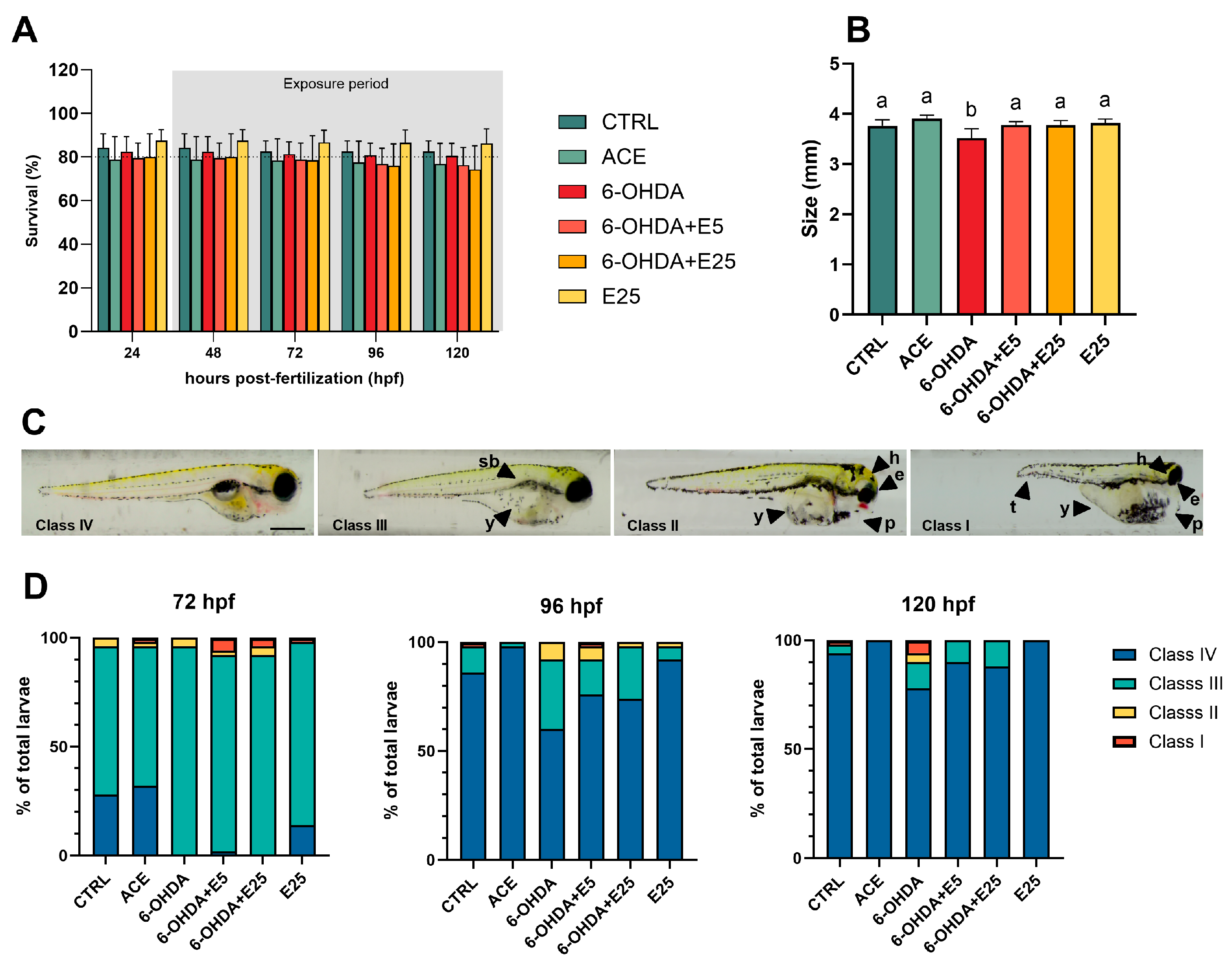
2.1. Reduced Body Length in Larvae Exposed to 6-OHDA
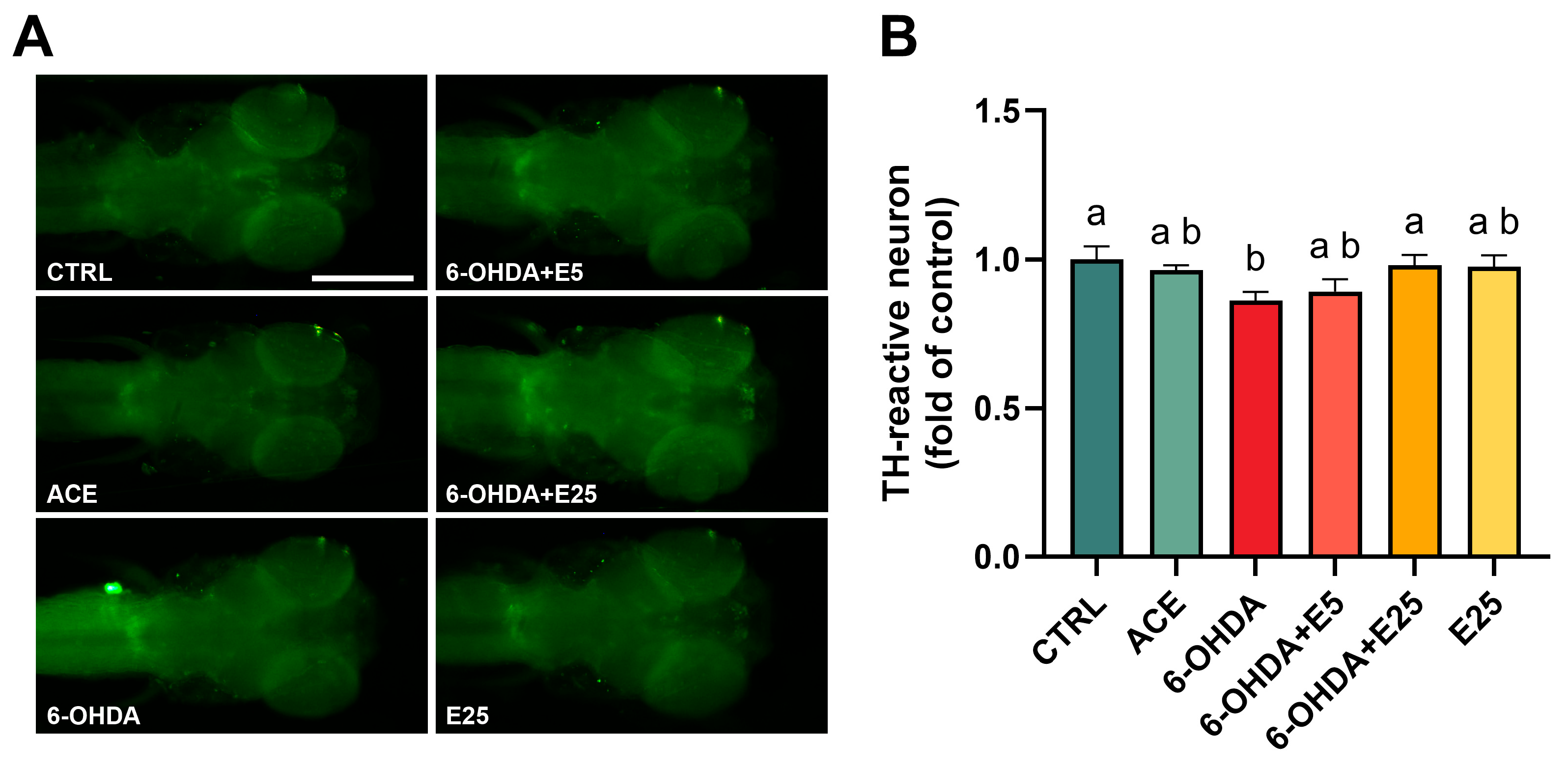
2.2. Restoration of Tyrosine Hydroxylase (TH)—Immunoreactivity in Dopaminergic Regions by the Almond Skin Extract
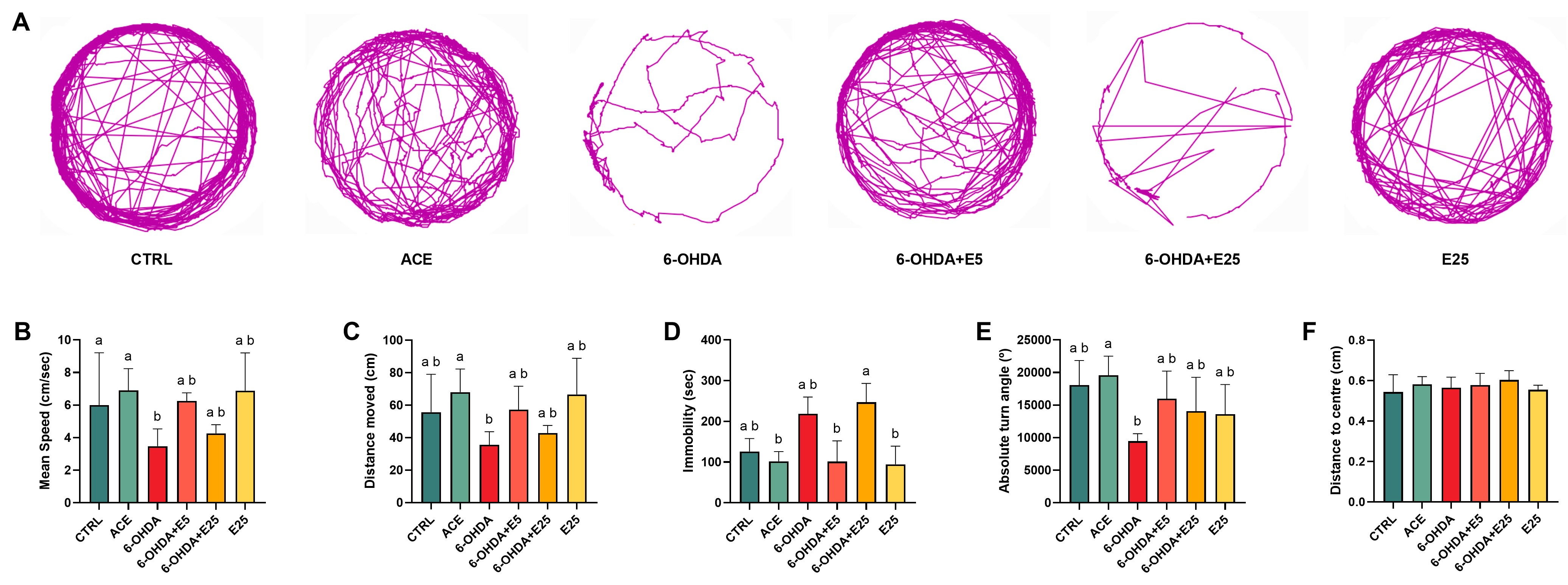
2.3. Almond Skin Extract Improves Locomotor Performance
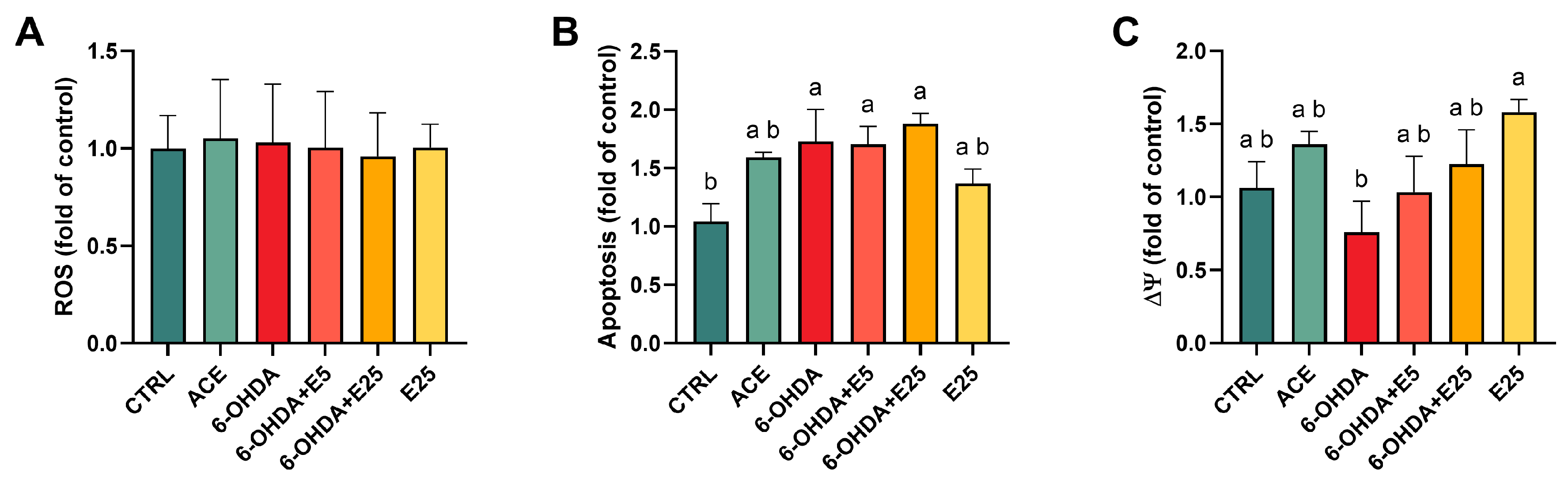
2.4. Increased Apoptosis Induced by 6-OHDA Exposure
2.5. Limited Biochemical Alterations Following Exposure
3. Discussion
4. Materials and Methods
4.1. Reagents and Extract
4.2. Zebrafish Maintenance and Reproduction
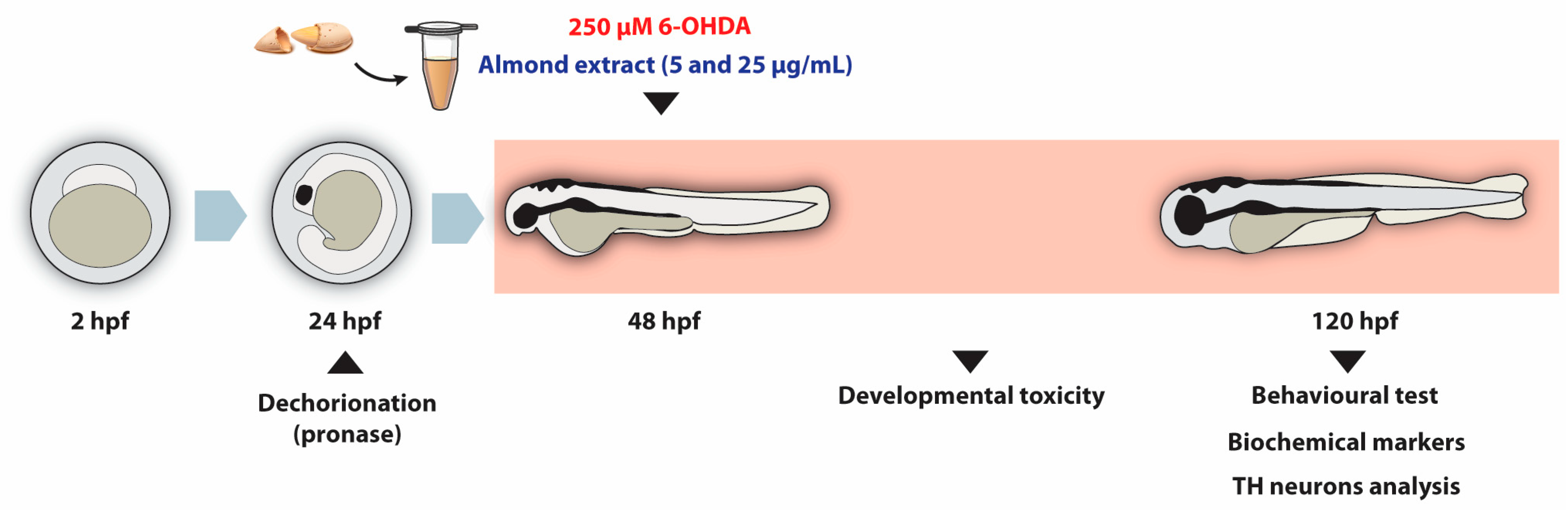
4.3. Experimental Design
4.4. Morphological Assessment
4.5. Whole Mount Immunostaining
4.6. Locomotion Activity
4.7. ROS, Apoptosis, and Mitochondrial Membrane Potential (ΔΨm) Measurement
4.8. Biochemical Evaluation
4.9. Statistical Analysis
5. Conclusions
Author Contributions
Funding
Institutional Review Board Statement
Informed Consent Statement
Data Availability Statement
Conflicts of Interest
References
- Dickson, D.W. Neuropathology of Parkinson Disease. Park. Relat. Disord. 2018, 46, S30–S33. [Google Scholar] [CrossRef]
- Federico, A.; Cardaioli, E.; Da Pozzo, P.; Formichi, P.; Gallus, G.N.; Radi, E. Mitochondria, Oxidative Stress and Neurodegeneration. J. Neurol. Sci. 2012, 322, 254–262. [Google Scholar] [CrossRef]
- Blesa, J.; Trigo-Damas, I.; Quiroga-Varela, A.; Jackson-Lewis, V.R. Oxidative Stress and Parkinson’s Disease. Front. Neuroanat. 2015, 9, 91. [Google Scholar] [CrossRef]
- Subramaniam, S.R.; Chesselet, M.F. Mitochondrial Dysfunction and Oxidative Stress in Parkinson’s Disease. Prog. Neurobiol. 2013, 106, 17–32. [Google Scholar] [CrossRef]
- Fleury, C.; Mignotte, B.; Vayssiere, J.L. Mitochondrial Reactive Oxygen Species in Cell Death Signaling. Biochimie 2002, 84, 131–141. [Google Scholar] [CrossRef]
- Redza-Dutordoir, M.; Averill-Bates, D.A. Activation of Apoptosis Signalling Pathways by Reactive Oxygen Species. Biochim. Biophys. Acta (BBA)-Mol. Cell Res. 2016, 1863, 2977–2992. [Google Scholar] [CrossRef] [PubMed]
- Antony, P.M.; Diederich, N.J.; Kruger, R.; Balling, R. The Hallmarks of Parkinson’s Disease. FEBS J. 2013, 280, 5981–5993. [Google Scholar] [CrossRef]
- Solayman, M.; Islam, M.A.; Alam, F.; Khalil, M.I.; Kamal, M.A.; Gan, S.H. Natural Products Combating Neurodegeneration: Parkinson’s Disease. Curr. Drug Metab. 2017, 18, 50–61. [Google Scholar] [CrossRef] [PubMed]
- Rahman, M.H.; Bajgai, J.; Fadriquela, A.; Sharma, S.; Trinh, T.T.; Akter, R.; Jeong, Y.J.; Goh, S.H.; Kim, C.S.; Lee, K.J. Therapeutic Potential of Natural Products in Treating Neurodegenerative Disorders and Their Future Prospects and Challenges. Molecules 2021, 26, 5327. [Google Scholar] [CrossRef] [PubMed]
- Singh, A.; Tripathi, P.; Yadawa, A.K.; Singh, S. Promising Polyphenols in Parkinson’s Disease Therapeutics. Neurochem. Res. 2020, 45, 1731–1745. [Google Scholar] [CrossRef]
- Gao, X.; Cassidy, A.; Schwarzschild, M.A.; Rimm, E.B.; Ascherio, A. Habitual Intake of Dietary Flavonoids and Risk of Parkinson Disease. Neurology 2012, 78, 1138–1145. [Google Scholar] [CrossRef] [PubMed]
- Hussain, G.; Rasul, A.; Anwar, H.; Aziz, N.; Razzaq, A.; Wei, W.; Ali, M.; Li, J.; Li, X.M. Role of Plant Derived Alkaloids and Their Mechanism in Neurodegenerative Disorders. Int. J. Biol. Sci. 2018, 14, 341–357. [Google Scholar] [CrossRef]
- Pfaltzgraff, L.A.; De Bruyn, M.; Cooper, E.C.; Budarin, V.; Clark, J.H. Food Waste Biomass: A Resource for High-Value Chemicals. Green Chem. 2013, 15, 307–314. [Google Scholar] [CrossRef]
- Rațu, R.N.; Veleșcu, I.D.; Stoica, F.; Usturoi, A.; Arsenoaia, V.N.; Crivei, I.C.; Postolache, A.N.; Lipșa, F.D.; Filipov, F.; Florea, A.M.; et al. Application of Agri-Food by-Products in the Food Industry. Agriculture 2023, 13, 1559. [Google Scholar] [CrossRef]
- Ben-Othman, S.; Joudu, I.; Bhat, R. Bioactives from Agri-Food Wastes: Present Insights and Future Challenges. Molecules 2020, 25, 510. [Google Scholar] [CrossRef]
- Barral-Martinez; Marta; Fraga-Corral, M.; Garcia-Perez, P.; Simal-Gandara, J.; Prieto, M.A. Almond by-Products: Valorization for Sustainability and Competitiveness of the Industry. Foods 2021, 10, 1793. [Google Scholar] [CrossRef]
- Garcia-Perez, P.; Xiao, J.; Munekata, P.E.S.; Lorenzo, J.M.; Barba, F.J.; Rajoka, M.S.; Barros, L.; Sprea, R.M.; Amaral, J.S.; Prieto, M.A.; et al. Revalorization of Almond By-Products for the Design of Novel Functional Foods: An Updated Review. Foods 2021, 10, 1823. [Google Scholar] [CrossRef] [PubMed]
- Bolling, B.W. Almond Polyphenols: Methods of Analysis, Contribution to Food Quality, and Health Promotion. Compr. Rev. Food Sci. Food Saf. 2017, 16, 346–368. [Google Scholar] [CrossRef]
- Percario, S.; da Silva Barbosa, A.; Varela, E.L.P.; Gomes, A.R.Q.; Ferreira, M.E.S.; de Nazare Araujo Moreira, T.; Dolabela, M.F. Oxidative Stress in Parkinson’s Disease: Potential Benefits of Antioxidant Supplementation. Oxid. Med. Cell Longev. 2020, 2020, 2360872. [Google Scholar] [CrossRef] [PubMed]
- Pingale, T.; Gupta, G.L. Classic and Evolving Animal Models in Parkinson’s Disease. Pharmacol. Biochem. Behav. 2020, 199, 173060. [Google Scholar] [CrossRef]
- Thirugnanam, T.; Santhakumar, K. Chemically Induced Models of Parkinson’s Disease. Comp. Biochem. Physiol. C Toxicol. Pharmacol. 2022, 252, 109213. [Google Scholar] [CrossRef]
- Simola, N.; Morelli, M.; Carta, A.R. The 6-Hydroxydopamine Model of Parkinson’s Disease. Neurotox. Res. 2007, 11, 151–167. [Google Scholar] [CrossRef]
- Ghallab, A. In Vitro Test Systems and Their Limitations. EXCLI J. 2013, 12, 1024–1026. [Google Scholar] [PubMed]
- Najib, N.H.M.; Nies, Y.H.; Halim, S.A.S.A.; Yahaya, M.F.; Das, S.; Lim, W.L.; Teoh, S.L. Modeling Parkinson’s Disease in Zebrafish. CNS Neurol. Disord. Drug Targets 2020, 19, 386–399. [Google Scholar] [CrossRef] [PubMed]
- Vaz, R.L.; Outeiro, T.F.; Ferreira, J.J. Zebrafish as an Animal Model for Drug Discovery in Parkinson’s Disease and Other Movement Disorders: A Systematic Review. Front. Neurol. 2018, 9, 347. [Google Scholar] [CrossRef]
- Razali, K.; Othman, N.; Nasir, M.H.M.; Doolaanea, A.A.; Kumar, J.; Ibrahim, W.N.; Ibrahim, N.M.; Mohamed, W.M.Y. The Promise of the Zebrafish Model for Parkinson’s Disease: Today’s Science and Tomorrow’s Treatment. Front. Genet. 2021, 12, 655550. [Google Scholar] [CrossRef] [PubMed]
- Feng, C.W.; Wen, Z.H.; Huang, S.Y.; Hung, H.C.; Chen, C.H.; Yang, S.N.; Chen, N.F.; Wang, H.M.; Hsiao, C.D.; Chen, W.F. Effects of 6-Hydroxydopamine Exposure on Motor Activity and Biochemical Expression in Zebrafish (Danio rerio) Larvae. Zebrafish 2014, 11, 227–239. [Google Scholar] [CrossRef]
- Parng, C.; Roy, N.M.; Ton, C.; Lin, Y.; McGrath, P. Neurotoxicity Assessment Using Zebrafish. J. Pharmacol. Toxicol. Methods 2007, 55, 103–112. [Google Scholar] [CrossRef]
- Grabher, C.; Patton, E.E.; Strahle, U. Sharing Chemical Libraries within the European Zebrafish Community. Zebrafish 2010, 7, 83. [Google Scholar] [CrossRef]
- Gomes, A.; Monteiro, S.M.; Venancio, C.; Felix, L. Protective Effects of 24-Epibrassinolide against the 6-Ohda Zebrafish Model of Parkinson’s Disease. Comp. Biochem. Physiol. C Toxicol. Pharmacol. 2023, 269, 109630. [Google Scholar] [CrossRef]
- Kesh, S.; Kannan, R.R.; Sivaji, K.; Balakrishnan, A. Hesperidin Downregulates Kinases Lrrk2 and Gsk3beta in a 6-Ohda Induced Parkinson’s Disease Model. Neurosci. Lett. 2021, 740, 135426. [Google Scholar] [CrossRef]
- Romero, A.; Hunt, J.C.; Bill, B.R.; Hamouda, A.K. Optimizing 6-Hydroxydopamine Concentrations for Induction of a Parkinson’s Disease Like Behavior in Zebrafish. FASEB J. 2022, 36. [Google Scholar] [CrossRef]
- Romero, A.; Sanchez, A.; Jones, J.D.; Ledesma, K.; El-Halawany, M.S.; Hamouda, A.K.; Bill, B.R. Optimization of Zebrafish Larvae 6-Ohda Exposure for Neurotoxin Induced Dopaminergic Marker Reduction. Zebrafish 2024, 21, 287–293. [Google Scholar] [CrossRef]
- Benvenutti, R.; Marcon, M.; Reis, C.G.; Nery, L.R.; Miguel, C.; Herrmann, A.P.; Vianna, M.R.M.; Piato, A. N-Acetylcysteine Protects against Motor, Optomotor and Morphological Deficits Induced by 6-OHDA in Zebrafish Larvae. PeerJ 2018, 6, e4957. [Google Scholar] [CrossRef] [PubMed]
- Shi, L.; Wang, C.; Yan, Y.; Wang, G.; Zhang, J.; Feng, L.; Yang, X.; Li, G. Function Study of Vasoactive Intestinal Peptide on Chick Embryonic Bone Development. Neuropeptides 2020, 83, 102077. [Google Scholar] [CrossRef] [PubMed]
- Tonelli, F.; Bek, J.W.; Besio, R.; De Clercq, A.; Leoni, L.; Salmon, P.; Coucke, P.J.; Willaert, A.; Forlino, A. Zebrafish: A Resourceful Vertebrate Model to Investigate Skeletal Disorders. Front. Endocrinol. 2020, 11, 489. [Google Scholar] [CrossRef]
- Khotimah, H.; Yuliyani, T.; Nuraenah, E.; Zahara, E.; Kalsum, N.U. Centella Asiatica Increased the Body Length through the Modulation of Antioxidant in Rotenone-Induced Zebrafish Larvae. Biomed. Pharmacol. J. 2018, 11, 827–833. [Google Scholar] [CrossRef]
- Barbosa, R.; Martins, A.; Oliveira, I.V.; Dias, M.I.; Monteiro, S.M.; Venancio, C.; Felix, L. Anti-Inflammatory and Antioxidant Properties of Almond-Skin Acetonic Extract in Zebrafish (Danio rerio) Copper-Sulphate-Induced Inflammation. Planta Medica 2025, 91, 850–861. [Google Scholar] [CrossRef]
- Chakraborty, S.B.; Horn, P.; Hancz, C. Application of Phytochemicals as Growth-Promoters and Endocrine Modulators in Fish Culture. Rev. Aquac. 2014, 6, 1–19. [Google Scholar] [CrossRef]
- Du, Y.; Guo, Q.; Shan, M.; Wu, Y.; Huang, S.; Zhao, H.; Hong, H.; Yang, M.; Yang, X.; Ren, L.; et al. Spatial and Temporal Distribution of Dopaminergic Neurons during Development in Zebrafish. Front. Neuroanat. 2016, 10, 115. [Google Scholar] [CrossRef]
- Blandini, F.; Armentero, M.T. Animal Models of Parkinson’s Disease. FEBS J. 2012, 279, 1156–1166. [Google Scholar] [CrossRef] [PubMed]
- Kin, K.; Yasuhara, T.; Kameda, M.; Date, I. Animal Models for Parkinson’s Disease Research: Trends in the 2000s. Int. J. Mol. Sci. 2019, 20, 5402. [Google Scholar] [CrossRef]
- Trigo-Damas, I.; Del Rey, N.L.; Blesa, J. Novel Models for Parkinson’s Disease and Their Impact on Future Drug Discovery. Expert. Opin. Drug Discov. 2018, 13, 229–239. [Google Scholar] [CrossRef] [PubMed]
- Zhang, C.; Li, C.; Chen, S.; Li, Z.; Ma, L.; Jia, X.; Wang, K.; Bao, J.; Liang, Y.; Chen, M.; et al. Hormetic Effect of Panaxatriol Saponins Confers Neuroprotection in Pc12 Cells and Zebrafish through Pi3k/Akt/Mtor and Ampk/Sirt1/Foxo3 Pathways. Sci. Rep. 2017, 7, 41082. [Google Scholar] [CrossRef]
- Liao, Q.; Gong, G.; Siu, S.W.I.; Wong, C.T.T.; Yu, H.; Tse, Y.C.; Radis-Baptista, G.; Lee, S.M. A Novel Shk-Like Toxic Peptide from the Transcriptome of the Cnidarian Palythoa caribaeorum Displays Neuroprotection and Cardioprotection in Zebrafish. Toxins 2018, 10, 238. [Google Scholar]
- Kalyn, M.; Hua, K.; Noor, S.M.; Wong, C.E.D.; Ekker, M. Comprehensive Analysis of Neurotoxin-Induced Ablation of Dopaminergic Neurons in Zebrafish Larvae. Biomedicines 2020, 8, 1. [Google Scholar] [CrossRef]
- Mazzoni, P.; Shabbott, B.; Cortes, J.C. Motor Control Abnormalities in Parkinson’s Disease. Cold Spring Harb. Perspect. Med. 2012, 2, a009282. [Google Scholar] [CrossRef]
- Vaz, R.L.; Sousa, S.; Chapela, D.; van der Linde, H.C.; Willemsen, R.; Correia, A.D.; Outeiro, T.F.; Afonso, N.D. Identification of Antiparkinsonian Drugs in the 6-Hydroxydopamine Zebrafish Model. Pharmacol. Biochem. Behav. 2020, 189, 172828. [Google Scholar] [CrossRef]
- Yu, D.; Zhang, P.; Li, J.; Liu, T.; Zhang, Y.; Wang, Q.; Zhang, J.; Lu, X.; Fan, X. Neuroprotective Effects of Ginkgo Biloba Dropping Pills in Parkinson’s Disease. J. Pharm. Anal. 2021, 11, 220–231. [Google Scholar] [CrossRef]
- Anichtchik, O.V.; Kaslin, J.; Peitsaro, N.; Scheinin, M.; Panula, P. Neurochemical and Behavioural Changes in Zebrafish Danio rerio after Systemic Administration of 6-Hydroxydopamine and 1-Methyl-4-Phenyl-1,2,3,6-Tetrahydropyridine. J. Neurochem. 2004, 88, 443–453. [Google Scholar] [CrossRef] [PubMed]
- Iancu, R.; Mohapel, P.; Brundin, P.; Paul, G. Behavioral Characterization of a Unilateral 6-Ohda-Lesion Model of Parkinson’s Disease in Mice. Behav. Brain Res. 2005, 162, 1–10. [Google Scholar] [CrossRef]
- Carvalho, M.M.; Campos, F.L.; Coimbra, B.; Pego, J.M.; Rodrigues, C.; Lima, R.; Rodrigues, A.J.; Sousa, N.; Salgado, A.J. Behavioral Characterization of the 6-Hydroxidopamine Model of Parkinson’s Disease and Pharmacological Rescuing of Non-Motor Deficits. Mol. Neurodegener. 2013, 8, 14. [Google Scholar] [CrossRef]
- Zhang, W.; Dong, X.; Huang, R. Antiparkinsonian Effects of Polyphenols: A Narrative Review with a Focus on the Modulation of the Gut-Brain Axis. Pharmacol. Res. 2023, 193, 106787. [Google Scholar] [CrossRef] [PubMed]
- Kujawska, M.; Jodynis-Liebert, J. Polyphenols in Parkinson’s Disease: A Systematic Review of in Vivo Studies. Nutrients 2018, 10, 642. [Google Scholar] [CrossRef]
- Mhalhel, K.; Sicari, M.; Pansera, L.; Chen, J.; Levanti, M.; Diotel, N.; Rastegar, S.; Germana, A.; Montalbano, G. Zebrafish: A Model Deciphering the Impact of Flavonoids on Neurodegenerative Disorders. Cells 2023, 12, 252. [Google Scholar] [CrossRef] [PubMed]
- Li, M.; Zhou, F.; Xu, T.; Song, H.; Lu, B. Acteoside Protects against 6-Ohda-Induced Dopaminergic Neuron Damage Via Nrf2-Are Signaling Pathway. Food Chem. Toxicol. 2018, 119, 6–13. [Google Scholar] [CrossRef] [PubMed]
- Wu, W.; Han, H.; Liu, J.; Tang, M.; Wu, X.; Cao, X.; Zhao, T.; Lu, Y.; Niu, T.; Chen, J.; et al. Fucoxanthin Prevents 6-Ohda-Induced Neurotoxicity by Targeting Keap1. Oxid. Med. Cell. Longev. 2021, 2021, 6688708. [Google Scholar] [CrossRef]
- Chong, C.M.; Zhou, Z.Y.; Razmovski-Naumovski, V.; Cui, G.Z.; Zhang, L.Q.; Sa, F.; Hoi, P.M.; Chan, K.; Lee, S.M. Danshensu Protects against 6-Hydroxydopamine-Induced Damage of Pc12 Cells in Vitro and Dopaminergic Neurons in Zebrafish. Neurosci. Lett. 2013, 543, 121–125. [Google Scholar] [CrossRef]
- Zhang, C.; Li, C.W.; Chen, S.H.; Li, Z.P.; Jia, X.J.; Wang, K.; Bao, J.L.; Liang, Y.; Wang, X.T.; Chen, M.W.; et al. Berberine Protects against 6-Ohda-Induced Neurotoxicity in Pc12 Cells and Zebrafish through Hormetic Mechanisms Involving Pi3k/Akt/Bcl-2 and Nrf2/Ho-1 Pathways. Redox. Biol. 2017, 11, 1–11. [Google Scholar] [CrossRef]
- Pantic, I.; Cumic, J.; Skodric, S.R.; Dugalic, S.; Brodski, C. Oxidopamine and Oxidative Stress: Recent Advances in Experimental Physiology and Pharmacology. Chem. Biol. Interact. 2021, 336, 109380. [Google Scholar] [CrossRef]
- Robea, M.A.; Balmus, I.M.; Ciobica, A.; Strungaru, S.; Plavan, G.; Gorgan, L.D.; Savuca, A.; Nicoara, M. Parkinson’s Disease-Induced Zebrafish Models: Focussing on Oxidative Stress Implications and Sleep Processes. Oxid. Med. Cell. Longev. 2020, 2020, 1370837. [Google Scholar] [CrossRef]
- Vareslija, D.; Tipton, K.F.; Davey, G.P.; McDonald, A.G. 6-Hydroxydopamine: A Far from Simple Neurotoxin. J. Neural. Transm. 2020, 127, 213–230. [Google Scholar] [CrossRef]
- Soto-Otero, R.; Mendez-Alvarez, E.; Hermida-Ameijeiras, A.; Munoz-Patino, A.M.; Labandeira-Garcia, J.L. Autoxidation and Neurotoxicity of 6-Hydroxydopamine in the Presence of Some Antioxidants: Potential Implication in Relation to the Pathogenesis of Parkinson’s Disease. J. Neurochem. 2000, 74, 1605–1612. [Google Scholar] [CrossRef] [PubMed]
- Ly, J.D.; Grubb, D.R.; Lawen, A. The Mitochondrial Membrane Potential (Deltapsi(M)) in Apoptosis; an Update. Apoptosis 2003, 8, 115–128. [Google Scholar] [CrossRef] [PubMed]
- Ochu, E.E.; Rothwell, N.J.; Waters, C.M. Caspases Mediate 6-Hydroxydopamine-Induced Apoptosis but Not Necrosis in Pc12 Cells. J. Neurochem. 1998, 70, 2637–2640. [Google Scholar] [CrossRef] [PubMed]
- Hanrott, K.; Gudmunsen, L.; O’Neill, M.J.; Wonnacott, S. 6-Hydroxydopamine-Induced Apoptosis Is Mediated Via Extracellular Auto-Oxidation and Caspase 3-Dependent Activation of Protein Kinase Cdelta. J. Biol. Chem. 2006, 281, 5373–5382. [Google Scholar] [CrossRef]
- Chen, Q.; Ruan, D.; Shi, J.; Du, D.; Bian, C. The Multifaceted Roles of Natural Products in Mitochondrial Dysfunction. Front. Pharmacol. 2023, 14, 1093038. [Google Scholar] [CrossRef] [PubMed]
- Gibellini, L.; Bianchini, E.; De Biasi, S.; Nasi, M.; Cossarizza, A.; Pinti, M. Natural Compounds Modulating Mitochondrial Functions. Evid. Based Complement. Alternat. Med. 2015, 2015, 527209. [Google Scholar]
- Rudrapal, M.; Khairnar, S.J.; Khan, J.; Dukhyil, A.B.; Ansari, M.A.; Alomary, M.N.; Alshabrmi, F.M.; Palai, S.; Deb, P.K.; Devi, R. Dietary Polyphenols and Their Role in Oxidative Stress-Induced Human Diseases: Insights into Protective Effects, Antioxidant Potentials and Mechanism(S) of Action. Front. Pharmacol. 2022, 13, 806470. [Google Scholar] [CrossRef]
- Meyers, J.R. Zebrafish: Development of a Vertebrate Model Organism. Curr. Protoc. Essent. Lab. Tech. 2018, 16, e19. [Google Scholar] [CrossRef]
- Felix, L.M.; Antunes, L.M.; Coimbra, A.M. Ketamine Nmda Receptor-Independent Toxicity during Zebrafish (Danio rerio) Embryonic Development. Neurotox. Teratol. 2014, 41, 27–34. [Google Scholar] [CrossRef]
- Andersson, M.; Kettunen, P. Effects of Holding Density on the Welfare of Zebrafish: A Systematic Review. Zebrafish 2021, 18, 297–306. [Google Scholar] [CrossRef]
- Monteiro, J.F.; Martins, S.; Farias, M.; Costa, T.; Certal, A.C. The Impact of Two Different Cold-Extruded Feeds and Feeding Regimens on Zebrafish Survival, Growth and Reproductive Performance. J. Dev. Biol. 2018, 6, 15. [Google Scholar] [CrossRef]
- Teixido, E.; Kiessling, T.R.; Krupp, E.; Quevedo, C.; Muriana, A.; Scholz, S. Automated Morphological Feature Assessment for Zebrafish Embryo Developmental Toxicity Screens. Toxicol. Sci. 2019, 167, 438–449. [Google Scholar] [CrossRef]
- Westerfield, M. The Zebrafish Book: A Guide for the Laboratory Use of Zebrafish (Danio rerio), 5th ed.; University of Oregon Press: Eugene, OR, USA, 2007. [Google Scholar]
- Schweitzer, J.; Driever, W. Development of the Dopamine Systems in Zebrafish. In Development and Engineering of Dopamine Neurons; Pasterkamp, R.J., Smidt, M.P., Burbach, J.P.H., Eds.; Springer: New York, NY, USA, 2009; pp. 1–14. [Google Scholar]
- Beekhuijzen, M.; de Koning, C.; Flores-Guillen, M.E.; de Vries-Buitenweg, S.; Tobor-Kaplon, M.; van de Waart, B.; Emmen, H. From Cutting Edge to Guideline: A First Step in Harmonization of the Zebrafish Embryotoxicity Test (Zet) by Describing the Most Optimal Test Conditions and Morphology Scoring System. Rep. Toxicol. 2015, 56, 64–76. [Google Scholar] [CrossRef]
- Daubner, S.C.; Le, T.; Wang, S. Tyrosine Hydroxylase and Regulation of Dopamine Synthesis. Arch. Biochem. Biophys. 2011, 508, 1–12. [Google Scholar] [CrossRef]
- Pinho, B.R.; Reis, S.D.; Guedes-Dias, P.; Leitao-Rocha, A.; Quintas, C.; Valentao, P.; Andrade, P.B.; Santos, M.M.; Oliveira, J.M. Pharmacological Modulation of Hdac1 and Hdac6 in Vivo in a Zebrafish Model: Therapeutic Implications for Parkinson’s Disease. Pharmacol. Res. 2016, 103, 328–339. [Google Scholar] [CrossRef] [PubMed]
- Vauti, F.; Stegemann, L.A.; Vogele, V.; Koster, R.W. All-Age Whole Mount in Situ Hybridization to Reveal Larval and Juvenile Expression Patterns in Zebrafish. PLoS ONE 2020, 15, e0237167. [Google Scholar] [CrossRef] [PubMed]
- Rueden, C.T.; Schindelin, J.; Hiner, M.C.; DeZonia, B.E.; Walter, A.E.; Arena, E.T.; Eliceiri, K.W. Imagej2: Imagej for the Next Generation of Scientific Image Data. BMC Bioinform. 2017, 18, 529. [Google Scholar]
- Felix, L.M.; Serafim, C.; Martins, M.J.; Valentim, A.M.; Antunes, L.M.; Matos, M.; Coimbra, A.M. Morphological and Behavioral Responses of Zebrafish after 24h of Ketamine Embryonic Exposure. Toxicol. Appl. Pharmacol. 2017, 321, 27–36. [Google Scholar] [CrossRef]
- Felix, L.M.; Antunes, L.M.; Coimbra, A.M.; Valentim, A.M. Behavioral Alterations of Zebrafish Larvae after Early Embryonic Exposure to Ketamine. Psychopharmacology 2017, 234, 549–558. [Google Scholar] [CrossRef]
- Giordo, R.; Nasrallah, G.K.; Al-Jamal, O.; Paliogiannis, P.; Pintus, G. Resveratrol Inhibits Oxidative Stress and Prevents Mitochondrial Damage Induced by Zinc Oxide Nanoparticles in Zebrafish (Danio rerio). Int. J. Mol. Sci. 2020, 21, 3838. [Google Scholar] [CrossRef]
- Felix, L.; Lobato-Freitas, C.; Monteiro, S.M.; Venancio, C. 24-Epibrassinolide Modulates the Neurodevelopmental Outcomes of High Caffeine Exposure in Zebrafish (Danio rerio) Embryos. Comp. Biochem. Physiol. C Toxicol. Pharmacol. 2021, 249, 109143. [Google Scholar] [CrossRef] [PubMed]
- Fernandes, P.; Monteiro, S.M.; Venancio, C.; Felix, L. 24-Epibrassinolide Protects against Ethanol-Induced Behavioural Teratogenesis in Zebrafish Embryo. Chem. Biol. Interact. 2020, 328, 109193. [Google Scholar] [CrossRef] [PubMed]
- Liang, X.Y.; Csenki, Z.; Ivánovics, B.; Bock, I.; Csorbai, B.; Molnár, J.; Vásárhelyi, E.; Griffitts, J.; Ferincz, A.; Urbányi, B.; et al. Biochemical Marker Assessment of Chronic Carbamazepine Exposure at Environmentally Relevant Concentrations in Juvenile Common Carp (Cyprinus carpio). Antioxidants 2022, 11, 1136. [Google Scholar] [CrossRef] [PubMed]
- Noble, J.E.; Bailey, M.J. Quantitation of Protein. Methods Enzymol. 2009, 463, 73–95. [Google Scholar]



| Experimental Groups | Statistical Test | p-Value | ||||||
|---|---|---|---|---|---|---|---|---|
| Parameter | CTRL | ACE | 6-OHDA | 6-OHDA+E5 | 6-OHDA+E25 | E25 | ||
| SOD | 58.6 (20.8–90.5) ab | 118.0 (77.8–179.3) a | 71.5 (57.8–93.1) ab | 68.8 (44.5–87.1) ab | 68.1 (53.9–120.6) ab | 41.4 (28.9–50.4) b | X2(5) = 11.30 | 0.046 |
| CAT | 148.6 (95.9–189.2) ab | 209.3 (171.9–252.3) ab | 86.7 (52.8–155.1) ab | 42.9 (29.2–110.9) b | 262.7 (230.4–296.2) a | 256.9 (196.2–299.4) a | X2(5) = 21.77 | 0.0006 |
| GPx | 49.0 ± 21.0 | 56.8 ± 19.4 | 47.9 ± 9.2 | 45.1 ± 22.2 | 44.5 ± 14.2 | 56.3 ± 16.2 | F(5, 24) = 0.446 | 0.812 |
| GR | 7.7 (7.1–16.7) | 7.0 (4.1–7.7) | 8.3 (4.4–11.9) | 8.6 (5.8–13.8) | 6.7 (2.8–13.5) | 5.9 (3.5–10.2) | X2(5) = 3.797 | 0.579 |
| GST | 8.0 (3.8–15.2) b | 26.3 (20.2–29.8) ab | 16.8 (15.8–20.8) ab | 13.0 (9.7–25.8) ab | 17.2 (9.4–16.4) ab | 27.8 (25.1–33.8) a | X2(5) = 14.53 | 0.013 |
| GSH | 18.1 ± 2.8 | 31.6 ± 11.4 | 20.7 ± 4.3 | 22.7 ± 6.9 | 21.1 ± 9.2 | 22.7 ± 4.0 | F(5, 24) = 2.095 | 0.101 |
| GSSG | 87.7 ± 10.6 | 103.1 ± 16.1 | 86.9 ± 21.7 | 85.3 ± 4.4 | 71.5 ± 22.1 | 85.3 ± 10.1 | F(5, 24) = 2.093 | 0.101 |
| OSI | 0.2 ± 0.0 | 0.3 ± 0.1 | 0.3 ± 0.1 | 0.3 ± 0.1 | 0.4 ± 0.3 | 0.3 ± 0.1 | F(5, 24) = 0.785 | 0.571 |
| LPO | 8.9 (5.8–9.7) | 5.6 (4.8–6.2) | 6.4 (5.4–8.9) | 5.5 (4.2–7.0) | 4.8 (3.1–5.1) | 8.1 (5.1–10.1) | X2(5) = 10.16 | 0.071 |
| PC | 1.7 ± 1.2 | 3.3 ± 1.6 | 2.3 ± 0.4 | 2.8 ± 0.7 | 3.2 ± 1.8 | 2.6 ± 0.7 | F(5, 24) = 1.277 | 0.306 |
| DNA | 69.2 ± 41.1 | 59.6 ± 36.9 | 68.1 ± 18.8 | 42.9 ± 16.6 | 65.2 ± 24.6 | 61.4 ± 47.6 | F(5, 24) = 0.424 | 0.827 |
Disclaimer/Publisher’s Note: The statements, opinions and data contained in all publications are solely those of the individual author(s) and contributor(s) and not of MDPI and/or the editor(s). MDPI and/or the editor(s) disclaim responsibility for any injury to people or property resulting from any ideas, methods, instructions or products referred to in the content. |
© 2026 by the authors. Licensee MDPI, Basel, Switzerland. This article is an open access article distributed under the terms and conditions of the Creative Commons Attribution (CC BY) license.
Share and Cite
Carneiro, P.; Pais, P.; Oliveira, I.V.; Monteiro, S.M.; Venâncio, C.; Félix, L. Amelioration of 6-OHDA-Induced Parkinson’s Symptoms in Zebrafish Larvae by an Almond Skin Acetonic Extract. Int. J. Mol. Sci. 2026, 27, 2590. https://doi.org/10.3390/ijms27062590
Carneiro P, Pais P, Oliveira IV, Monteiro SM, Venâncio C, Félix L. Amelioration of 6-OHDA-Induced Parkinson’s Symptoms in Zebrafish Larvae by an Almond Skin Acetonic Extract. International Journal of Molecular Sciences. 2026; 27(6):2590. https://doi.org/10.3390/ijms27062590
Chicago/Turabian StyleCarneiro, Patrícia, Patricia Pais, Ivo Vaz Oliveira, Sandra M. Monteiro, Carlos Venâncio, and Luís Félix. 2026. "Amelioration of 6-OHDA-Induced Parkinson’s Symptoms in Zebrafish Larvae by an Almond Skin Acetonic Extract" International Journal of Molecular Sciences 27, no. 6: 2590. https://doi.org/10.3390/ijms27062590
APA StyleCarneiro, P., Pais, P., Oliveira, I. V., Monteiro, S. M., Venâncio, C., & Félix, L. (2026). Amelioration of 6-OHDA-Induced Parkinson’s Symptoms in Zebrafish Larvae by an Almond Skin Acetonic Extract. International Journal of Molecular Sciences, 27(6), 2590. https://doi.org/10.3390/ijms27062590