1. Introduction
The electrochemical detection of heavy metal ions using nanomaterial-modified electrodes has undergone substantial evolution over the past decade. Earlier reviews, including the comprehensive survey by Solangi and co-workers [
1], summarized nanoparticle-based sensing platforms for environmental monitoring, primarily covering developments prior to 2020. While these studies provided valuable overviews of nanomaterial-assisted sensing strategies, most treated electrode materials broadly or focused predominantly on single-ion detection. Consequently, a critical synthesis that specifically examines recent material architectures engineered for simultaneous multi-ion electrochemical detection on glassy carbon electrodes (GCEs) remains limited.
Glassy carbon electrodes serve as chemically inert, mechanically robust, and electrochemically stable conductive substrates with wide potential windows and low background currents. However, the intrinsic electrochemical activity of bare GCEs toward heavy metal stripping is relatively modest. Analytical performance is dictated primarily by the physicochemical properties of the surface modifier rather than by the substrate itself [
2,
3,
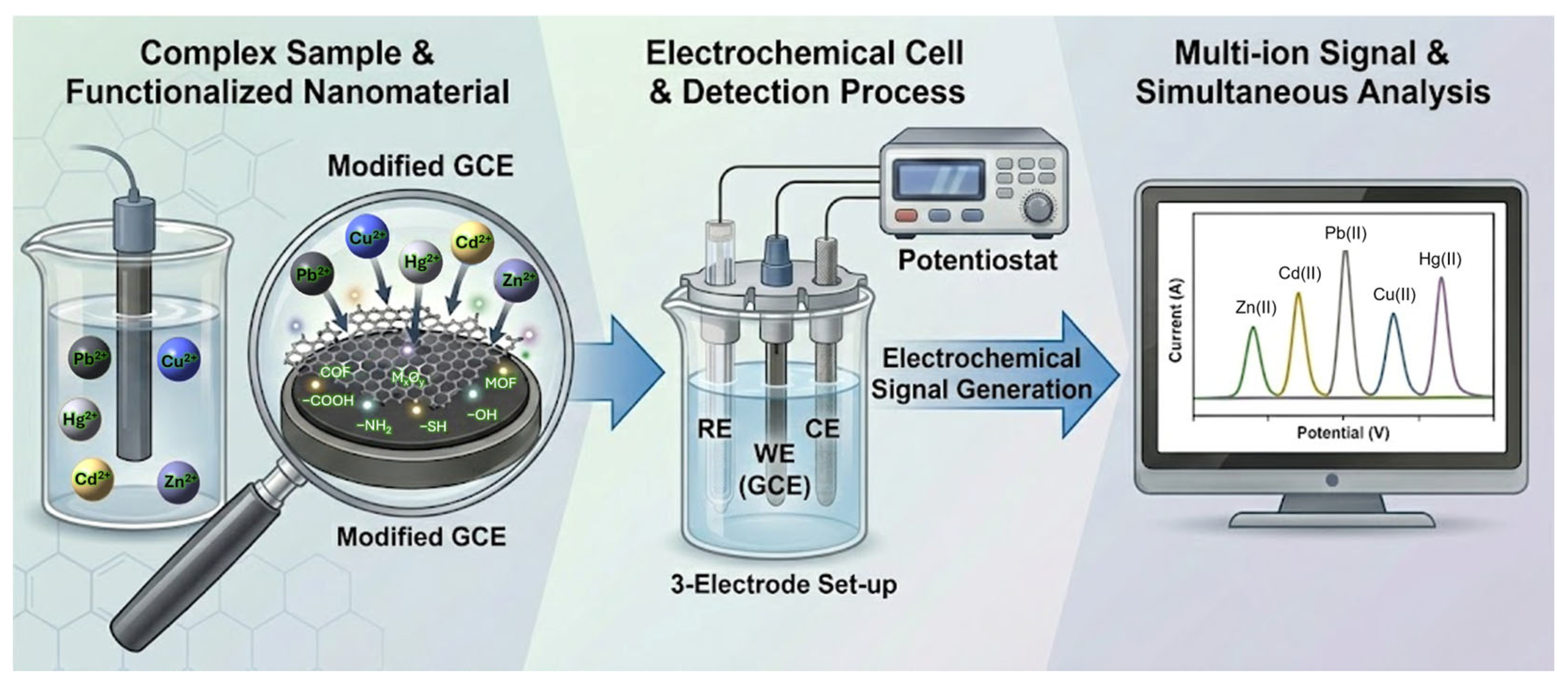
4]. The overall detection strategy for simultaneous multi-ion sensing involves modification of the GCE surface with functional nanomaterials to improve selective adsorption and electron transfer, enabling complex sample analysis and multi-ion voltammetric signal generation, as illustrated schematically in
Figure 1. Therefore, recent progress in trace-level detection has been increasingly driven by rational interface engineering, in which nanoscale structure, surface chemistry, defect density, and functional group distribution are deliberately tailored to control adsorption, nucleation, and electron transfer processes.
Since 2020, research has increasingly shifted from single-component nanomaterials to multifunctional hybrid nanocomposites designed to better address the complexity of multi-metal systems [
5,
6,
7,
8,
9]. These advanced platforms typically integrate metal or metal oxide nanoparticles such as bismuth, gold, zinc oxide, and magnetite (Fe
3O
4), along with graphene derivatives including reduced graphene oxide (rGO), carbon nanotubes (CNTs), metal–organic frameworks (MOFs), conductive polymers such as polyaniline and polypyrrole, and heteroatom-doped porous carbons [
6,
7,
8,
9,
10,
11].
The rationale behind such integration is synergistic coupling. Conductive carbon frameworks enhance charge-transfer kinetics, while metal nanoparticles facilitate alloy formation or catalytic stripping. MOFs and porous carbons provide high surface area and tunable coordination environments, enabling selective preconcentration of specific metal ions. Conductive polymers contribute functional groups that modulate local pH or binding affinity. Rather than serving merely as signal amplifiers, these materials actively regulate interfacial thermodynamics and kinetics, influencing metal ion accumulation efficiency, stripping peak separation, and resistance to fouling [
7,
10,
12].
Simultaneous electrochemical detection introduces additional physicochemical complexities absent in single-ion systems. During anodic stripping voltammetry (ASV), co-deposited metals may form intermetallic compounds or compete for active nucleation sites, leading to distorted or overlapping peaks [
8,
13]. Competitive adsorption can suppress signals of trace-level ions when higher-concentration species dominate surface binding sites. Moreover, differences in diffusion coefficients and deposition potentials further complicate signal interpretation. Addressing these challenges requires deliberate structural design, including spatial confinement effects, heterojunction interfaces that modulate electron density distribution, defect engineering to create preferential nucleation centers, and hierarchical porosity to improve mass transport [
9,
10,
11,
12].
Among electroanalytical techniques, ASV remains the dominant method for multi-metal quantification due to its intrinsic preconcentration capability and compatibility with trace analysis [
13]. However, recent progress demonstrates that performance improvements arise not solely from enhanced conductivity, but from controlled adsorption–desorption equilibria, localized coordination chemistry, and regulation of metal nucleation/stripping behavior at the interface [
7,
10,
12].
Recent progress in multi-ion electrochemical heavy-metal sensing is increasingly driven by electrode design choices that deliberately control interfacial chemistry and transport rather than by “nanomaterial novelty” alone. In particular, studies on non-conductive modifiers emphasize that performance improvements can arise from adsorption-mediated preconcentration, nucleation/stripping behavior, and local micro-environment effects at the interface, even when the modifier itself is not highly conductive, highlighting the need for structure–performance relationships supported by advanced characterization and theory [
13].
Despite rapid growth in publications, several gaps remain. First, many studies report ultra-low detection limits but provide limited mechanistic insight into peak separation mechanisms in multi-ion systems. Second, comparative evaluation across different composite classes is scarce, making it difficult to identify universal design principles. Third, systematic discussions of how hybrid architectures mitigate intermetallic interference remain fragmented. As a result, the field lacks a cohesive framework linking nanomaterial structure to multi-ion electroanalytical performance.
This review addresses current limitations in the electrochemical detection of heavy metal ions by critically analyzing chemically synthesized nanomaterials integrated onto glassy carbon electrode platforms for simultaneous multi-ion detection, with a focus on literature published between 2020 and 2026. Rather than merely compiling detection limits, the discussion emphasizes key aspects of material design strategies for GCE modification, mechanistic insights into signal discrimination and interference suppression, and the synergistic effects observed in hybrid nanocomposites. Additionally, emerging structure–performance correlations are highlighted, supported by advanced characterization techniques and theoretical modeling, providing a comprehensive perspective on the rational design of nanomaterial-based GCE sensors.
By concentrating specifically on interfacial engineering approaches that enable high-resolution, trace-level multi-metal quantification, this review aims to clarify design principles for next-generation electrochemical sensors. Such insight is essential for developing robust, reproducible, and application-oriented platforms capable of operating reliably in complex environmental matrices.
2. Theoretical and Mechanistic Foundations of Electrochemical Multi-Ion Heavy Metal Detection
2.1. Interfacial Redox Principles in Heavy Metal Electroanalysis
Electrochemical detection of heavy metal ions in aqueous environments is fundamentally governed by interfacial redox reactions occurring at the electrode–solution boundary. These techniques offer high sensitivity, low detection limits, rapid response times, and compatibility with portable instrumentation [
12,
14,
15,
16]. In contrast to bulk spectroscopic approaches, electrochemical methods directly interrogate charge-transfer events at the interface, where the analytical signal is generated. As outlined in the general analytical workflow (
Figure 1), the measured current arises from a sequence of interfacial processes rather than a single redox event. A mechanistic understanding of these steps is therefore essential to explain both sensitivity and selectivity.
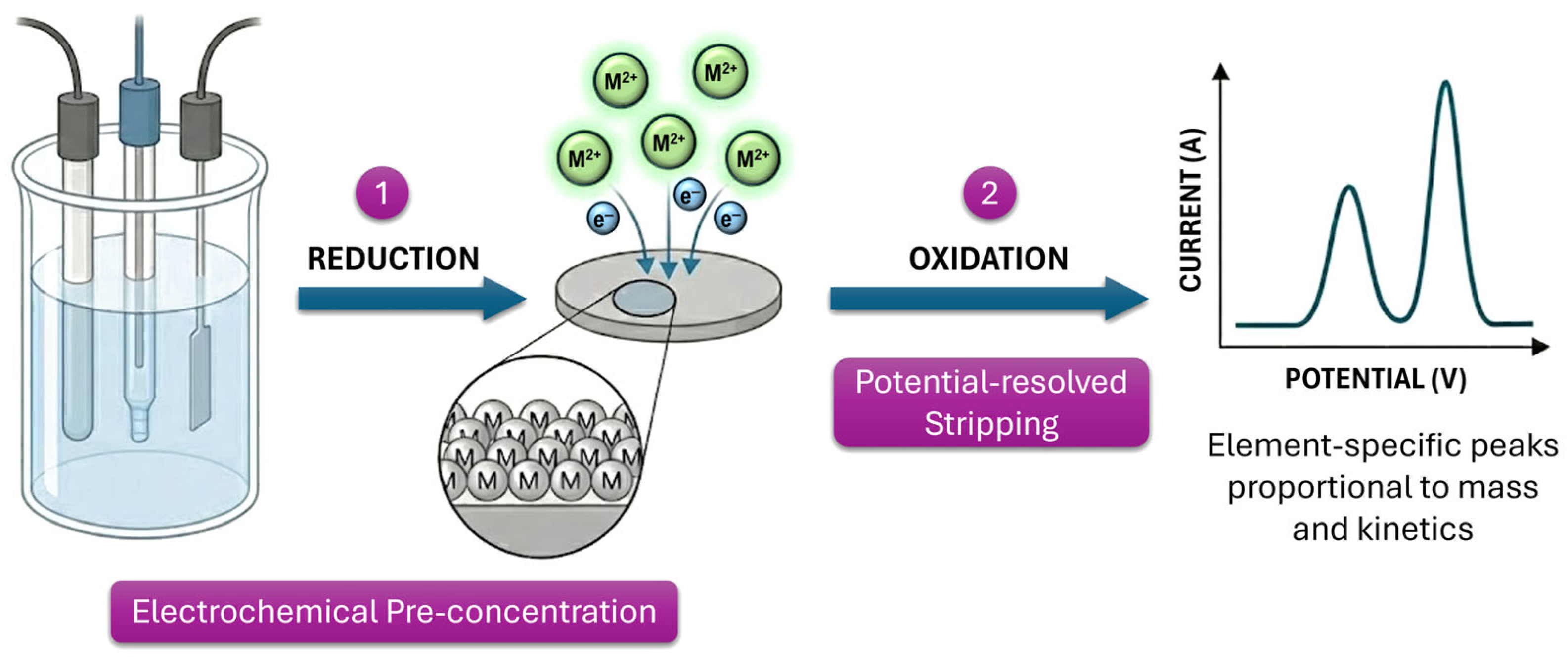
Figure 2 conceptually separates this interfacial sequence into two principal kinetic stages: (i) electrochemical pre-concentration and (ii) potential-resolved stripping. During the pre-concentration step, dissolved metal ions are electrochemically reduced and accumulated onto the electrode surface. This accumulation step effectively amplifies the analyte signal by increasing the local surface concentration. In the subsequent stripping step, the deposited metals are re-oxidized, generating element-specific current peaks. The peak current is proportional to the accumulated mass, while the peak potential reflects the thermodynamic redox potential and interfacial coordination environment. The magnitude and position of stripping peaks are therefore governed by a combination of thermodynamic and kinetic parameters, including formal redox potentials, adsorption energetics, nucleation behavior, and interfacial electron-transfer rates. In multi-ion systems, the analytical resolution depends strongly on differences in these parameters. Rational interface engineering, through material selection, surface functionalization, or nanostructuring, enables deliberate modulation of these thermodynamic and kinetic factors, thereby improving peak separation and detection performance.
A defining strength of voltammetric techniques in multi-metal analysis lies in their discrimination within the potential domain: each metal ion ideally produces a characteristic stripping peak corresponding to its redox thermodynamics and coordination chemistry. However, in realistic environmental matrices, interfacial phenomena such as competitive adsorption, surface site saturation, nucleation competition, and intermetallic compound formation frequently distort peak positions and broaden signals. These coupled processes can reduce peak resolution and compromise analytical accuracy. Consequently, surface chemistry and interfacial structure become decisive determinants of sensitivity, selectivity, and reproducibility in heavy metal electroanalysis [
12,
14,
15,
16].
2.2. Pulse and Stripping Voltammetry for Multi-Ion Detection
Pulse voltammetric techniques such as square-wave voltammetry (SWV) and differential pulse voltammetry (DPV) enhance analytical sensitivity by suppressing capacitive background currents and amplifying faradaic responses [
17,
18,
19]. In stripping voltammetric techniques, including square-wave anodic stripping voltammetry (SWASV) and differential pulse anodic stripping voltammetry (DPASV), pulsed excitation is combined with controlled deposition to achieve ultra-trace detection limits [
20,
21,
22,
23].
Instrumental parameters, including pulse amplitude, frequency, step potential, deposition potential, and accumulation time, directly influence peak sharpness, symmetry, and the signal-to-noise ratio. Although waveform optimization enhances analytical clarity and improves measurement precision, it does not fundamentally modify adsorption thermodynamics or interfacial selectivity. Consequently, in multi-ion systems, instrumental refinement should be integrated with rational interface design to ensure reliable peak discrimination and accurate analytical performance.
Table 1 provides a summary of the operational principles, analytical characteristics, and comparative advantages of these techniques.
2.3. Role of Supporting Electrolytes and Buffer Systems
The supporting electrolyte critically governs electrochemical behavior across both stripping and non-stripping voltammetric techniques. In anodic stripping voltammetry, acetate buffer systems (typically pH 4.0–5.5) are widely employed because they maintain metal ions in soluble form, suppress hydrolysis and precipitation, stabilize peak profiles, and promote reproducible deposition–stripping processes [
24]. Slightly acidic conditions facilitate efficient metal reduction while preserving signal stability.
Beyond stripping methods, base electrolytes such as KCl, KNO
3, Na
2SO
4, and phosphate buffers significantly influence cyclic voltammetry (CV), DPV, and related techniques. Supporting electrolytes regulate ionic strength, solution conductivity, and migration suppression while defining the structure of the electrical double layer at the electrode interface. Variations in electrolyte identity and pH alter metal ion speciation, complex formation equilibria, adsorption behavior, and stripping potentials. For example, chloride-containing media may induce metal–chloride complex formation that shifts peak potentials and affects resolution, whereas nitrate-based systems provide electrochemical inertness but limited buffering capacity [
24,
25].
In multi-ion environments, electrolyte composition becomes a mechanistic control parameter influencing competitive adsorption, deposition kinetics, and peak overlap. Despite its central role, systematic cross-comparative evaluation of electrolyte-dependent multi-metal discrimination remains relatively underreported.
2.4. Nanomaterial-Modified Glassy Carbon Electrodes: Interface Engineering Strategies
Given the dominant influence of interfacial phenomena, nanomaterial-modified glassy carbon electrodes have become central to heavy metal sensing research. GCEs provide chemical stability, a wide potential window, and compatibility with diverse functionalization strategies. Incorporation of metal–organic frameworks (MOFs), covalent organic frameworks (COFs), graphene and carbon nanotubes, metal and metal oxide nanoparticles, and conductive polymers enhances active surface area, introduces chemically addressable coordination sites, and improves electrical conductivity [
16,
22,
26,
27,
28,
29,
30,
31,
32,
33,
34,
35,
36,
37,
38,
39,
40,
41,
42,
43,
44,
45,
46,
47,
48,
49,
50,
51,
52,
53,
54,
55,
56,
57,
58,
59,
60,
61,
62,
63,
64,
65,
66,
67,
68,
69,
70,
71,
72,
73,
74,
75,
76,
77,
78,
79,
80,
81,
82,
83,
84,
85,
86,
87,
88,
89].
For modified GCEs, analytical performance is governed by the interplay between preconcentration thermodynamics, charge-transfer kinetics, and multi-ion discrimination efficiency. Preconcentration efficiency depends on adsorption energy, coordination geometry, porosity, and active site density. Charge-transfer kinetics are influenced by conductivity, defect density, and electronic band structure. Peak discrimination in multi-ion systems is controlled by differences in nucleation behavior, competitive binding equilibria, and deposition–stripping energetics.
Although nanomaterial modification significantly improves sensitivity, challenges such as electrode fouling, surface passivation, and matrix interference persist. Thus, performance enhancement requires not only increased surface area but also controlled interfacial electronic structure.
2.5. Quantum Mechanical and Data-Driven Insights into Metal–Interface Interactions
At the atomic scale, electrochemical sensitivity in heavy metal detection is primarily governed by the interactions between metal ions and surface functional groups on the electrode. Density functional theory (DFT) and related quantum mechanical methods provide mechanistic insight into these interactions by quantifying adsorption energies, coordination geometries, and interfacial charge redistribution. For instance, Flórez and colleagues [
89] demonstrated that oxygen-containing groups on carbon surfaces enable spontaneous adsorption of Cd(II), Pb(II), and Ni(II), highlighting that surface oxygen functionalities enhance orbital overlap between metal ions and carbon frameworks, thereby stabilizing preconcentrated ions. Similarly, Hernández-Fernández et al. [
90] showed that thiol-functionalized graphene quantum dots preferentially bind Pb(II) and Cd(II) due to optimized frontier orbital alignment, indicating that heteroatom chemistry directly modulates adsorption strength and selectivity.
Graphene–carbene composites have also been shown to exhibit strong interaction energies with Cd(II), Hg(II), and Pb(II), as reported by Baachaoui and associates [
91], suggesting that introducing covalently bound active sites can enhance ion preconcentration while maintaining electronic conductivity. Song and collaborators [
92] emphasized that the electronic structure of the modifier, rather than surface area alone, determines stripping peak magnitude, underlining that orbital hybridization and local density-of-states at the interface dictate interfacial electron-transfer kinetics. Notably, Shen and co-authors [
93] provided experimental validation of DFT predictions in boron-modified bio-carbon electrodes, showing enhanced simultaneous detection of Cd(II), Pb(II), and Cu(II), which confirms that computational descriptors such as adsorption energy and charge transfer can reliably predict real-world electrode performance.
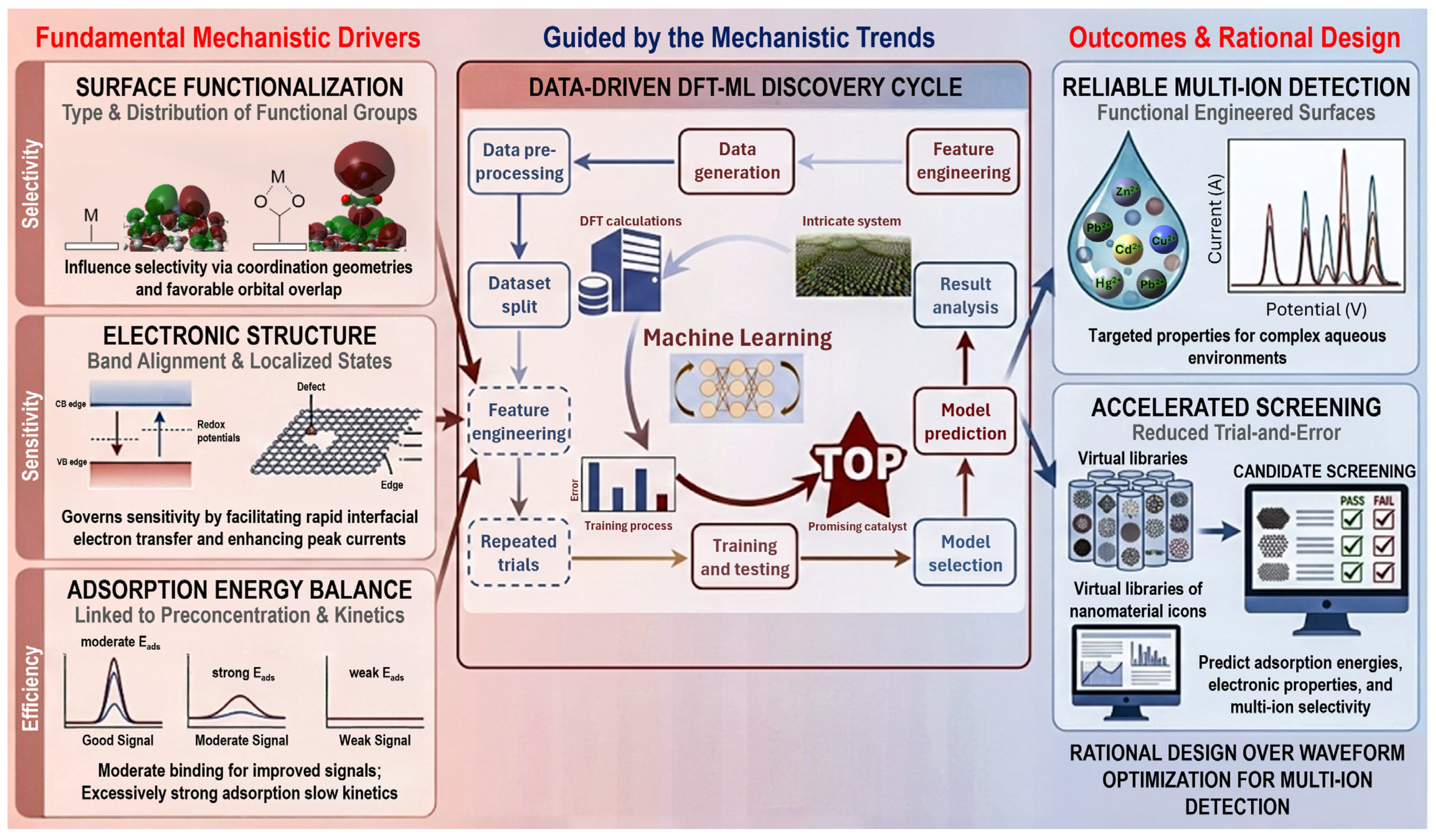
Collectively, these studies reveal several important mechanistic trends. The type and distribution of surface functional groups strongly influence selectivity by stabilizing particular metal ions through favorable orbital overlap and coordination geometries. Electronic structure, including band alignment and localized states at edges or defects, governs sensitivity by facilitating rapid interfacial electron transfer and enhancing peak currents. The efficiency of preconcentration is closely linked to adsorption energy: moderate to strong binding improves stripping signals, but excessively strong adsorption can slow kinetics and broaden peaks, potentially reducing analytical resolution. Beyond traditional DFT, machine learning models trained on DFT-derived datasets [
94] have emerged as powerful tools for rapidly predicting adsorption energies, electronic properties, and multi-ion selectivity, enabling accelerated screening of candidate nanomaterials with reduced experimental trial-and-error. The mechanistic relationships among surface functionalization, electronic structure, adsorption energetics, and machine-learning-guided material screening are schematically illustrated in
Figure 3. The figure integrates fundamental mechanistic drivers, surface chemistry, band structure, and adsorption energy balance, with a data-driven DFT–ML discovery cycle, highlighting how computational descriptors inform accelerated virtual screening and rational design of multi-ion selective electrode materials.
Overall, quantum mechanical and data-driven approaches provide predictive insight into the fundamental factors controlling electrochemical sensitivity, selectivity, and interfacial kinetics. The collective findings indicate that rational electrode design should prioritize functionally engineered surfaces with tailored electronic properties, rather than relying solely on increased surface area or waveform optimization, to achieve reliable multi-ion heavy metal detection in complex aqueous environments.
2.6. Mechanisms of Cross-Talk and Strategies for Multi-Ion Resolution
In multi-ion electrochemical systems, analytical limitations often arise not from insufficient sensitivity but from inter-ion interference phenomena collectively referred to as cross-talk. Unlike single-analyte detection, where adsorption and stripping occur independently, multi-metal environments involve simultaneous competition for active sites, overlapping reduction potentials, and coupled nucleation processes. These interactions introduce both thermodynamic and kinetic complexities that distort stripping responses and reduce quantitative reliability, particularly in anodic stripping voltammetry and pulse-based stripping techniques [
17,
18,
19,
20,
21,
22,
23].
Systematic investigations of interference mechanisms in multi-metal ASV systems have shown that competitive adsorption is a primary factor governing peak suppression and signal attenuation [
95]. When two or more ions possess comparable reduction potentials, preferential adsorption of one species can inhibit the deposition efficiency of others, even at similar bulk concentrations. Thermodynamic modeling studies further demonstrate that the relative adsorption free energies of metal ions on nanostructured surfaces determine the severity of these interference effects [
96]. In addition to adsorption competition, co-deposition and intermetallic alloy formation represent critical sources of peak distortion. Experimental analyses of simultaneous metal detection have confirmed that alloy formation between species such as Cd, Pb, and Cu can shift stripping potentials and broaden peak profiles, thereby complicating quantitative interpretation [
95].
Targeted interface engineering has been shown to mitigate such effects. For example, studies employing amino acid–functionalized glassy carbon electrodes demonstrated improved discrimination among Zn(II), Cd(II), Cu(II), and Hg(II) due to selective coordination interactions that reduce competitive adsorption [
97]. Similarly, nanostructured materials with hierarchical porosity have been reported to enhance ion accumulation while spatially distributing active sites, thereby minimizing direct site competition and improving charge-transfer efficiency in multi-ion environments [
98]. Complementary signal-processing strategies, including baseline correction and peak deconvolution algorithms, have also been applied to resolve partially overlapping stripping peaks in complex matrices without modifying the underlying electrode chemistry [
99].
Kinetic factors further contribute to cross-talk behavior. Differences in electron-transfer rates and nucleation kinetics can cause one ion to dominate the faradaic response even at lower concentration, while surface restructuring during deposition may dynamically alter active site availability. Integrated theoretical–experimental studies confirm that selective binding motifs reshape adsorption energetics upstream, thereby reducing downstream peak overlap during stripping [
13].
Overall, cross-talk in multi-ion electrochemical detection arises from coupled thermodynamic and kinetic interactions at the electrode–solution interface. Competitive adsorption, co-deposition, and alloy formation distort stripping signals and complicate quantification. Effective mitigation therefore requires coordinated control of surface chemistry, nanostructure architecture, deposition protocols, and signal interpretation to achieve reliable simultaneous heavy metal monitoring.
3. Applications of Glassy Carbon Electrodes in Heavy Metal Detection
Glassy carbon electrodes are widely employed in electrochemical heavy metal sensing owing to their broad potential window, low background current, excellent electrical conductivity, and chemical stability. While unmodified GCEs provide a reliable electrochemical substrate, their analytical performance is significantly enhanced through rational surface modification. The rapid development of multifunctional and hybrid modifiers has enabled simultaneous detection of multiple heavy metal ions with improved sensitivity and selectivity. As these architectures become increasingly complex, traditional classifications based purely on material type (e.g., graphene-based, metal oxide-based) are no longer sufficient to describe structure–function relationships within sensor systems.
To provide clearer insight into performance enhancement strategies, recent advances in GCE-based heavy metal sensors are organized here according to the primary functional role of the surface modifier in the sensing process rather than by composition alone. This functional classification emphasizes how modifiers improve electrochemical behavior by acting as conductive scaffolds, ion-coordination platforms, electrocatalytic centers, or bio-inspired recognition interfaces. Such a perspective highlights synergistic interactions within hybrid materials, where multiple mechanisms operate concurrently to enhance signal amplification and multi-ion discrimination. Particular attention is given to platforms capable of simultaneously detecting Hg(II), Pb(II), Cd(II), Cu(II), and Cr(VI) in aqueous systems. For consistency across studies, detection limits are reported in nanomolar (nM) units. The reviewed systems are therefore discussed within four major categories: (1) carbon-based conductive scaffolds, (2) porous coordination frameworks, (3) metallic and metal oxide electrocatalysts, and (4) bio-inspired and polymeric interfaces.
3.1. Carbon-Based Conductive Scaffolds
Carbon-based conductive scaffolds form the structural and electrical foundation of most high-performance electrochemical sensors for heavy metal detection. Comparative studies across carbon nanotubes (CNTs), graphene derivatives, graphitic carbon nitride (g-C
3N
4), graphdiyne, and MXenes show that, despite differences in dimensionality and surface chemistry, their primary contribution lies in establishing continuous electron-transport pathways that enable efficient signal transduction at the electrode–electrolyte interface [
22,
26,
44,
45,
46,
47,
48,
49,
50,
51,
52,
53,
54,
55,
56]. As a result, sensing performance is governed less by the intrinsic chemical activity of the scaffold itself and more by how effectively the carbon framework maintains electrical continuity while supporting secondary functional components (
Table 2).
One-dimensional CNT networks and two-dimensional graphene-based scaffolds represent the two most widely adopted conductive architectures, each offering distinct advantages. CNT-based scaffolds, particularly multi-walled CNTs, form interconnected three-dimensional networks that facilitate rapid electron percolation and efficient mass transport, leading to high stripping currents and robust signal stability [
22]. In contrast, graphene and reduced graphene oxide (rGO) provide extended planar conduction pathways with low intrinsic resistance, which are particularly effective at suppressing background currents and enabling simultaneous multi-metal detection [
45,
46,
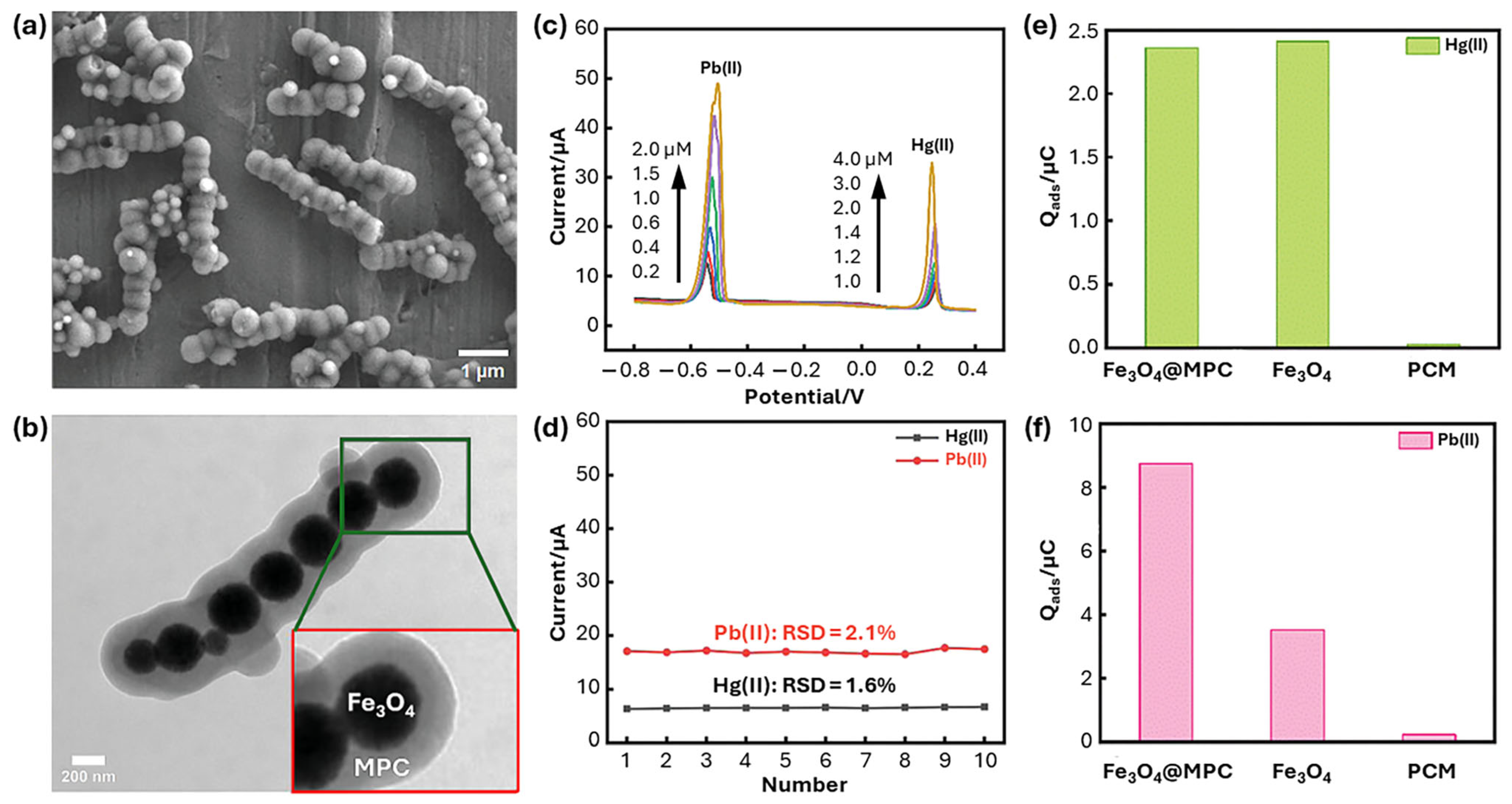
47]. These comparisons indicate that CNT scaffolds favor current amplification through network connectivity, whereas graphene-based scaffolds emphasize charge-transfer uniformity and low noise. An example of how graphene-based scaffolds increases the sensitivity and stability of the electrode is presented in
Figure 4.
The importance of conductive scaffolds becomes especially evident when comparing intrinsically conductive carbons with semiconducting or poorly conductive materials. Carbon frameworks such as graphene or CNTs consistently enhance the electrochemical performance of g-C
3N
4, layered double hydroxides, and metal oxides by compensating for their limited electrical conductivity [
26,
44,
45,
49,
50]. In these hybrids, the carbon scaffold dominates electron transport, while the secondary phase contributes chemical affinity or catalytic activity. Without the carbon backbone, these materials exhibit sluggish kinetics and diminished sensitivity, underscoring the central role of carbon scaffolds in enabling effective signal transduction.
Surface functionalization further differentiates carbon scaffolds without compromising their conductive role. Functionalized CNTs (e.g., MWCNT-COOH) preserve network conductivity while introducing coordination sites that promote analyte accumulation, whereas defect-rich rGO offers abundant anchoring sites for polymers, metal nanoparticles, and oxides with minimal disruption to electron flow [
22,
46,
47]. Comparative results suggest that scaffolds with high defect tolerance, such as rGO, provide greater architectural flexibility, while CNT networks maintain superior mechanical and electrical stability under repeated electrochemical cycling.
Ionic liquid–carbon systems highlight the structural dominance of carbon scaffolds in maintaining charge transport. In BMIMPF
6–MWCNT electrodes, the ionic liquid improves ion mobility and interfacial wetting, but the CNT framework ensures electrical continuity and signal reproducibility [
22]. This comparison reinforces the concept that secondary components modulate interfacial processes, whereas carbon scaffolds govern overall electron-transfer efficiency.
Beyond conventional CNT and graphene scaffolds, emerging carbon allotropes expand the design space for conductive architectures. MXene–carbon hybrids, such as Ti
3C
2T
x–rGO, rely on rGO to prevent MXene restacking and preserve continuous electron pathways, enabling high sensitivity at low analyte concentrations [
52]. Structurally engineered carbons, including electrochemically reduced graphene oxide, heteroatom-doped carbon nitride/graphene hybrids, and graphdiyne, demonstrate that tailored carbon frameworks alone can deliver high conductivity, structural stability, and rapid electrochemical response without extensive secondary modification [
54,
55,
56].
Overall, comparative evaluation of carbon-based conductive scaffolds reveals that sensor performance is dictated by scaffold dimensionality, network connectivity, and defect tolerance rather than the specific carbon allotrope employed. By providing electrically continuous backbones that suppress background interference and support efficient interfacial charge transfer, carbon-based scaffolds remain the cornerstone of advanced electrochemical platforms for heavy metal detection.
3.2. Porous Frameworks for Ion Coordination
Metal–organic frameworks, zeolitic imidazolate frameworks (ZIFs), and covalent organic frameworks have emerged as highly effective modifiers for glassy carbon electrodes, primarily due to their tunable porosity, high surface area, and abundant coordination sites. A defining advantage of these porous frameworks is their ability to function as molecular sieves, selectively capturing and preconcentrating target metal ions within well-defined pore environments [
27]. This preconcentration effect significantly amplifies electrochemical signals and improves detection sensitivity, particularly at trace and ultra-trace concentration levels. Representative examples of these frameworks and their target analytes are summarized in
Table 3.
MOFs are especially attractive because their metal nodes and organic linkers can be rationally selected to tailor pore size, surface chemistry, and redox activity. Bimetallic MOFs, in particular, offer synergistic catalytic behavior that enhances electrochemical responsiveness. For example, Fe–Co MOF hybrids integrated with functionalized multiwalled carbon nanotubes (Fe–Co–MOF@MWCNT–COOH/GCE) [
27] exploit both the redox-active metal centers and the conductive carbon scaffold, enabling efficient ion adsorption and accelerated electron transfer. This architecture yields low-nanomolar detection limits for Cd(II) and Pb(II), illustrating how MOFs simultaneously act as ion reservoirs and electrocatalytic platforms. Similarly, carboxyl-functionalized MIL-101(Cr) combined with MWCNTs benefits from hierarchical porosity and strong metal–ligand interactions, facilitating the simultaneous detection of Pb(II), Cu(II), and Hg(II) with high sensitivity [
29].
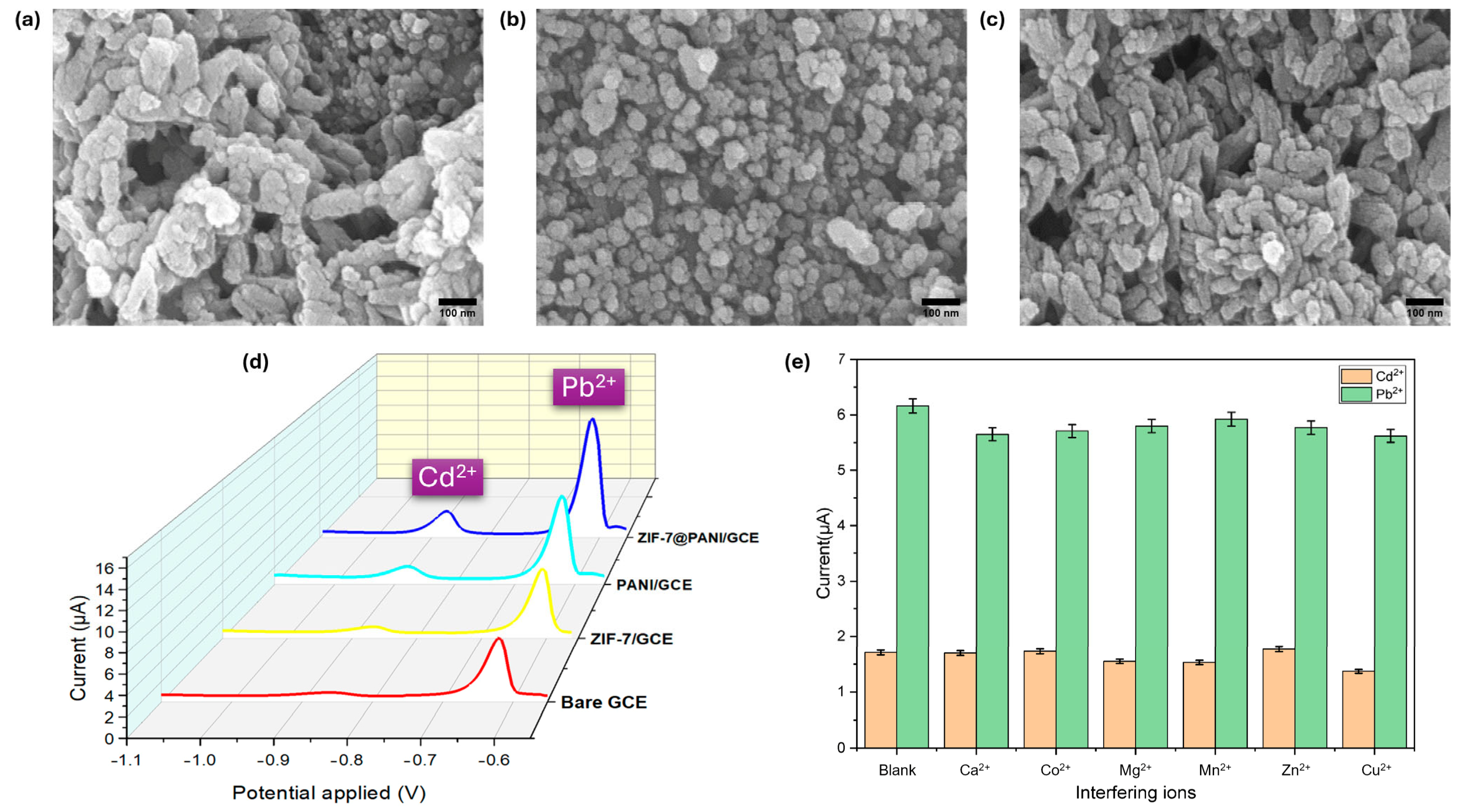
ZIFs represent a distinct subclass of MOFs that combine zeolite-like topology with metal–imidazolate coordination, offering exceptional chemical stability and size-selective ion transport. Their well-defined microporous channels enable selective ion sieving, while surface functionalization further enhances affinity toward specific analytes. ZIF-7@PANI exemplifies this concept by integrating a conductive polymer with the ZIF, improving charge transport while maintaining efficient ion preconcentration, resulting in sub −10 nM detection limits for Cd(II) and Pb(II) [
28] as shown in
Figure 5. ZIF-67-based composites, including ZIF-67/GO [
32] and La-doped ZIF-67@L-Cys [
33], leverage the adsorption capacity of the cobalt-based framework in conjunction with functional groups from graphene oxide or amino acids, enabling simultaneous detection of Pb(II), Hg(II), Zn(II), and Cr(III). In parallel, ZIF-8 hybrids such as Hg/CMWCNTs@ZIF-8 [
30] and Bi@ZIF-8/CMWCNTs [
31] demonstrate how the incorporation of electroactive metals into ZIF pores further refines ion selectivity and signal stability, reinforcing the molecular sieve behavior of these frameworks.
COFs offer a complementary approach to ion coordination by relying entirely on covalent bonding, resulting in lightweight, crystalline, and chemically robust porous networks. Their ordered π-conjugated structures facilitate charge transport, while heteroatom-rich linkages provide strong binding sites for metal ions. COFs such as TPT-COF [
41], and SNW1 [
42] exhibit exceptional stability in aqueous media and maintain high adsorption capacities for Pb(II) and Cd(II), even in complex matrices. Two-dimensional COFs like COFBTLP-1 [
40] further enhance accessibility to active sites, enabling efficient ion diffusion and ultra-low detection limits down to the sub-nanomolar range for Cd(II), Pb(II), Cu(II), and Hg(II). These characteristics underscore the ability of COFs to combine molecular sieving, structural stability, and electrochemical activity within a single platform.
Beyond these core classes, hybrid porous frameworks continue to expand design flexibility. Dendrimer-modified systems such as PAMAM/Ni-MOF [
34] introduce dense chelating functionalities that strengthen metal–ligand interactions, significantly improving binding affinity toward Pb(II) and Cu(II). Likewise, Cr-BDC MOFs [
39] demonstrate how framework composition alone can deliver sub-nanomolar sensitivity for Cd(II), Pb(II), and Hg(II) through efficient ion confinement and preconcentration.
Overall, MOFs, ZIFs, and COFs serve not merely as passive supports but as active molecular sieves that govern ion selectivity, accumulation, and transport at the electrode interface. When coupled with conductive matrices or functional modifiers, these porous frameworks provide a highly tunable and powerful strategy for designing next-generation electrochemical sensors capable of sensitive, selective, and multiplexed heavy metal ion detection.
3.3. Metallic and Metal Oxide Electrocatalysts
Metal and metal oxide-integrated systems represent a central class of glassy carbon electrode modifiers for heavy metal detection due to their exceptional electrocatalytic properties. Their performance stems from a combination of intrinsic characteristics, including high redox activity, chemical stability, and strong affinity for heavy metal ions. When incorporated into GCEs, these materials enhance electron transfer kinetics, expand the electroactive surface area, and promote selective analyte adsorption which are all critical factors for achieving sensitive and reliable electrochemical detection. The benefits of these systems are further amplified when combined with conductive supports, carbon-based nanostructures, or polymeric matrices, producing hybrid platforms that synergistically combine high sensitivity, selectivity, and structural stability [
99].
Table 4 summarizes representative examples of metallic and metal oxide modifiers used for the simultaneous detection of toxic heavy metals.
Bismuth-based systems exemplify the unique advantages of metal-integrated electrodes. Bismuth is particularly valuable because it can form “fused alloys” with heavy metals such as cadmium and lead, significantly enhancing stripping signals during electrochemical analysis. For example, the Bi/carboxyphenyl-modified GCE (Bi/CP/GCE) [
57] integrates high-surface-area carbon paper to support the formation of bismuth alloys, which increases preconcentration efficiency and strengthens electrochemical signals. Similarly, the bismuth film GCE (BiFGCE) [
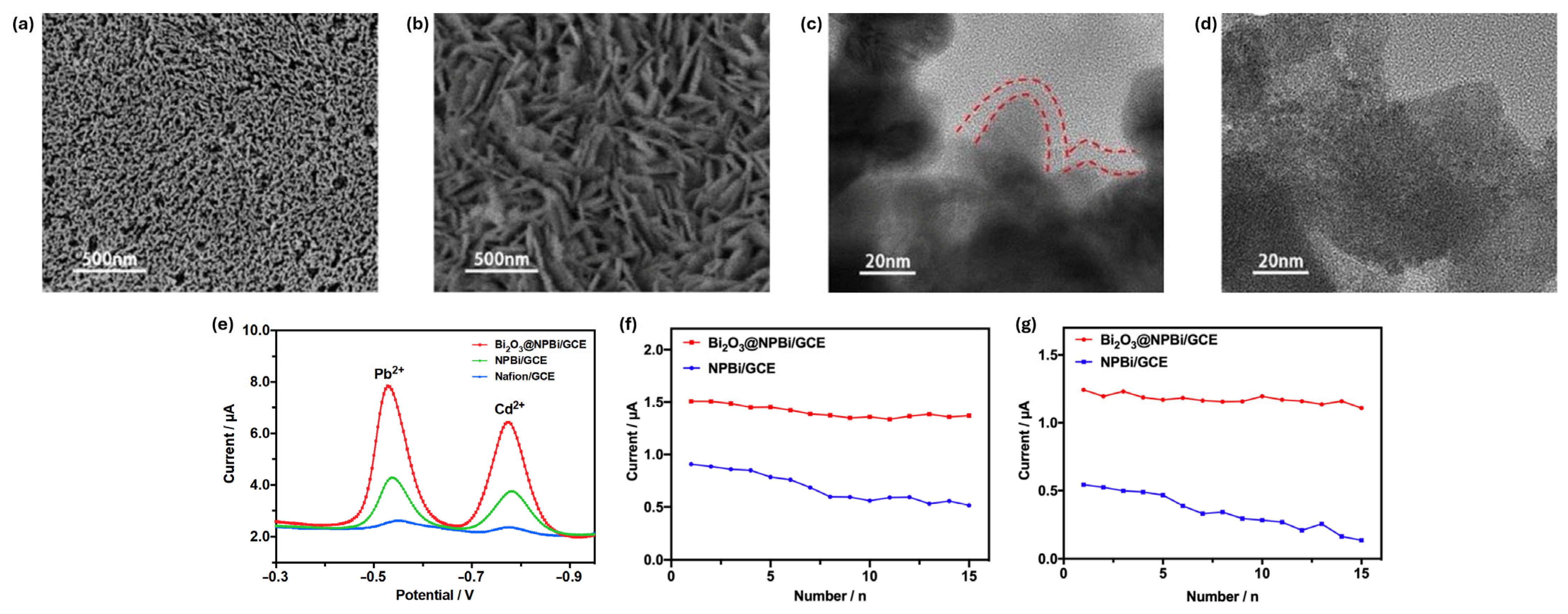
60] relies on in situ formation of Bi–metal alloys during the preconcentration step, leading to markedly improved sensitivity. Advanced architectures, such as Bi
2O
3-decorated nanoporous bismuth (Bi
2O
3@NPBi) [
64], fabricated through dealloying, feature a nanoporous bismuth framework coated with an amorphous Bi
2O
3 layer (
Figure 6). This structure not only increases the electroactive surface area but also provides numerous active sites for selective adsorption of heavy metal ions, enhancing both sensitivity and resistance to interference. Mechanistically, these bismuth-based systems excel because alloy formation facilitates electron transfer, while the high surface area and chemical affinity of Bi for metal ions enable efficient preconcentration, resulting in ultralow detection limits often below 1 nM which is ideal for trace-level detection in environmental and biomedical contexts [
59,
60,
61,
62,
63,
64,
65].
In addition to bismuth, noble metal nanoparticles such as gold and silver play a pivotal role in heavy metal sensing. These metals contribute strong electrocatalytic effects and can form alloys or amalgams with target heavy metals, amplifying stripping responses. For example, Ag nanoparticles enhance signal intensity through both catalytic activity and alloy formation with Cd(II), Pb(II), Cu(II), and Hg(II) [
71,
76], while Au nanoparticles facilitate rapid electron transfer and improve the selectivity of multi-metal detection.
Metal oxides such as Ag
2CrO
4, NiO, Co
3O
4, and CoFe
2O
4 further expand the toolkit for electrocatalytic enhancement. These oxides provide redox-active surfaces that accelerate electrochemical reactions and often exhibit strong adsorption of specific metal ions. Hybrid systems combining metal oxides with carbon nanostructures which include GO, rGO, or MWCNTs leverage the high conductivity and surface area of carbon materials alongside the catalytic properties of oxides. Representative examples include Co
3O
4/GO [
68] and Co
3O
4/rGO [
66], as well as chitosan-encapsulated cobalt ferrite nanoparticles (CoFe
2O
4@CTS) [
69]. In CoFe
2O
4@CTS, the chitosan matrix provides abundant chelating sites for selective binding of heavy metal ions, while embedded CoFe
2O
4 nanoparticles catalyze electron transfer during redox reactions. This dual functionality, selective adsorption coupled with catalytic enhancement, dramatically improves sensitivity and selectivity.
The transition from binary to ternary nanocomposites represents a strategic shift in GCE modification. For instance, the synergy between rGO and metal oxides is not merely additive in terms of surface area. Rather, the carbon scaffold provides the long-range electronic conductivity necessary for rapid electron transfer, while the metal oxide dopants act as localized ‘ion-traps’ via specific coordination chemistry [
99]. However, a recurring challenge in these architectures is the trade-off between catalyst loading and surface fouling. High-impact studies now suggest that the morphological control of the modifier, such as the use of hierarchical porous structures, is more critical for simultaneous detection than high mass-loading, as it ensures unhindered diffusion pathways for different ionic radii during the stripping step.
Beyond composition, structural engineering of these materials also plays a critical role. Porous or hierarchical architectures, such as coral-like L-cysteine/Ag@MnO
2 (L-Cys/Ag@MnO
2) hybrids [
75], maximize the density of electrochemically active sites and facilitate rapid diffusion of analyte ions to the electrode surface. Such designs achieve ultralow detection limits (e.g., 0.052 nM for Pb(II) and 0.065 nM for Cd(II)), demonstrating that rational electrode architecture, combined with judicious choice of metal nanoparticles and oxides, is key to optimizing heavy metal sensor performance.
In summary, the integration of metallic nanoparticles (Bi, Au, and Ag) and metal oxides (Ag
2CrO
4, NiO, and Co
3O
4) into GCEs provides a multifaceted strategy for enhancing electrochemical detection [
43,
69,
76]. The combination of alloy formation, electrocatalysis, high surface area, and selective adsorption establishes these materials as indispensable components in the design of ultrasensitive and selective heavy metal sensors.
3.4. Bio-Inspired and Polymeric Interfaces
Polymer- and biofunctionalized interfaces constitute one of the most versatile and effective classes of modifiers for electrochemical sensing platforms, owing to their tunable chemical functionality, structural flexibility, and intrinsic affinity toward heavy metal ions. Unlike purely inorganic modifiers, these materials enable targeted chemical or biological recognition, allowing simultaneous enhancement of sensitivity, selectivity, and signal stability. As a result, they are particularly well suited for trace- and ultratrace-level detection of toxic metal ions in complex matrices.
Conductive polymers such as polyaniline (PANI) and poly(1,2-diaminoanthraquinone) (PDAAQ) play a dual role in electrochemical sensors [
77,
84,
85]. First, their redox-active backbones facilitate rapid electron transfer between the electrode surface and the target analyte, thereby improving signal transduction efficiency. Second, polymers like PANI significantly enhance the mechanical integrity and electrochemical stability of the sensing interface. The high ionic conductivity and environmental stability of PANI, combined with its protonation–deprotonation behavior, allow it to operate effectively across a wide pH range while maintaining reproducible electrochemical responses. These features make conductive polymers particularly attractive as interfacial layers in sensors designed for long-term or repetitive use.
In contrast, functional polymers and bio-inspired modifiers, including chitosan, L-cysteine (L-Cys), aptamers, and poly(amidoamine) (PAMAM) dendrimers, primarily contribute through their high density of specific binding sites [
35,
86]. Small-molecule modifiers such as L-cysteine provide strong and selective coordination with soft metal ions via thiol (–SH), amine (–NH
2), and carboxyl (–COOH) groups. This targeted chemical recognition enables efficient preconcentration of metal ions such as Cd(II), Pb(II), and Hg(II) at the electrode–electrolyte interface, even in the presence of competing species. Similarly, PAMAM dendrimers offer a three-dimensional, highly branched architecture with a large number of terminal functional groups, enabling multivalent binding interactions and exceptional metal-ion capture efficiency.
The integration of polymeric or biofunctional modifiers with carbon nanostructures or metal-based nanoparticles has led to a new generation of hybrid sensing platforms with markedly enhanced analytical performance. Carbon nanomaterials contribute high surface area and excellent electrical conductivity, while metal or metal-oxide nanoparticles introduce catalytic activity and favorable redox kinetics. Within these hybrids, the polymeric matrix serves multiple functions: it stabilizes dispersed nanostructures, suppresses aggregation, improves interfacial adhesion, and introduces selective binding sites for metal ions. This synergistic combination results in lower detection limits, improved reproducibility, and enhanced long-term operational stability. Moreover, the use of naturally derived biopolymers supports the development of environmentally benign and sustainable electrochemical sensing systems. Representative polymer- and biofunctionalized modifiers applied to GCE-based sensors for heavy metal detection are summarized in
Table 5.
More advanced hybrid architectures have been developed to further improve electrochemical performance, particularly for the detection of toxic heavy metal ions at ultratrace concentrations. Notable examples include mesoporous silica–L-cysteine composites, such as SBA-15/L-cysteine and MCM-41/L-cysteine [
85]. In these systems, the ordered mesoporous silica framework provides a large accessible surface area and well-defined mass transport channels, promoting efficient analyte diffusion and signal amplification. Concurrently, L-cysteine introduces strong metal-binding capability through its thiol and amine groups. The synergistic integration of structural porosity and targeted chemical recognition enables effective preconcentration of metal ions within the electroactive region, resulting in significantly reduced detection limits for Cd(II) and Pb(II).
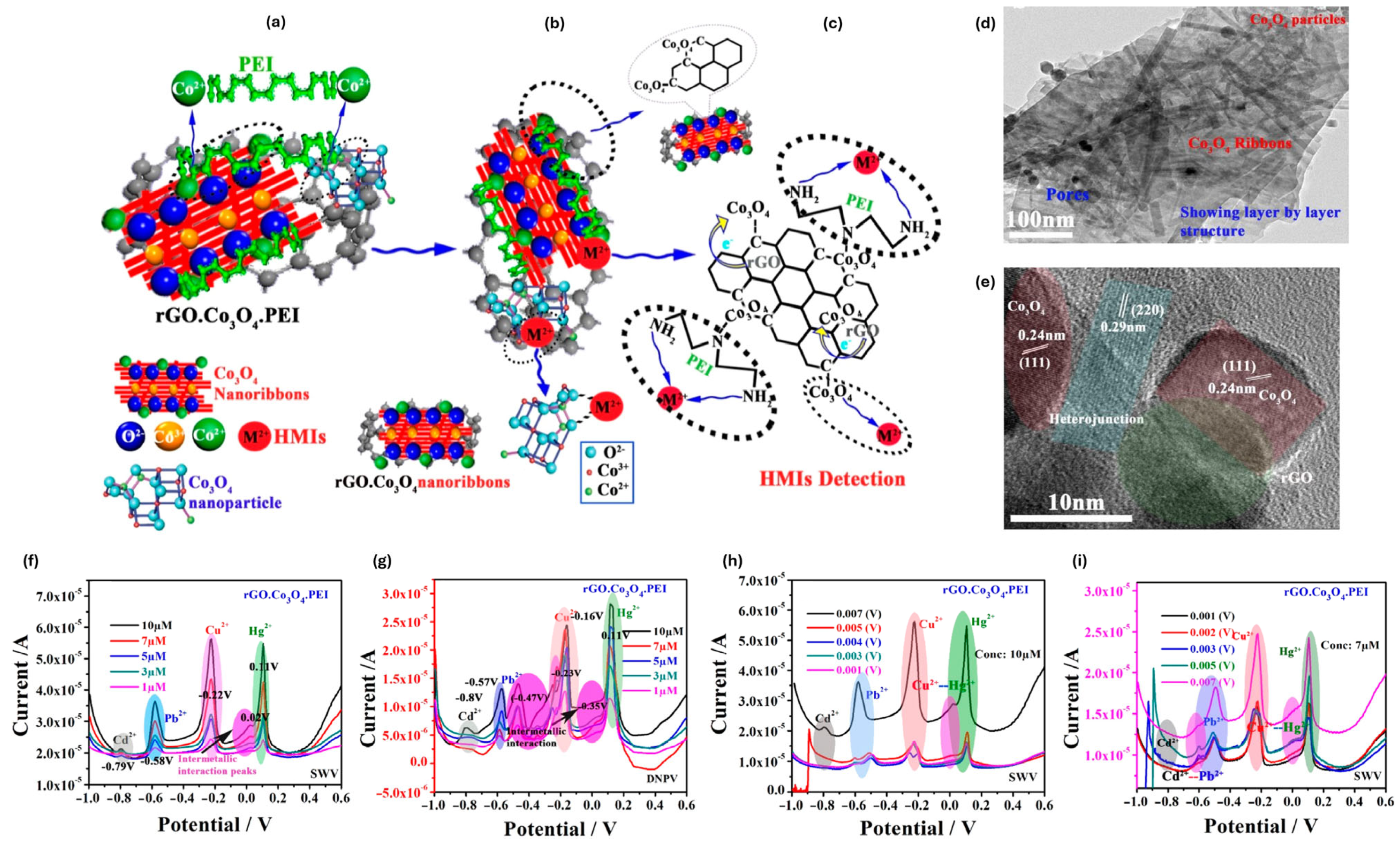
Expanding upon these hybrid strategies, the controllable synthesis of porous polyethyleneimine (PEI)-functionalized Co
3O
4/reduced graphene oxide nanocomposites (rGO-Co
3O
4 · PEI) has demonstrated exceptional performance for the simultaneous and individual detection of Cd(II), Pb(II), Cu(II), and Hg(II) [
82]. As illustrated in
Figure 7, the sensing mechanism is driven by the high density of primary and secondary amino groups on the PEI chains, which serve as highly efficient coordination sites for heavy metal ions. The integration of these polymeric sites with a porous Co
3O
4 nanostructure and conductive rGO sheets creates a synergistic environment: the rGO provides a high-speed electron transfer pathway, while the porous Co
3O
4 nanoribbons/nanoparticles increase the electroactive surface area and facilitate mass transport. This architecture achieves nanomolar detection limits and maintains high sensitivity even in complex individual or simultaneous analytical scenarios.
Among the most sensitive polymer-based platforms reported is the chitosan-mediated bimetallic Fe–Al mixed metal oxide nanocomposite electrode (Ch-MMON/GCE), which achieved ultralow detection limits of 0.00061 nM for Cd(II), 0.00016 nM for Pb(II), and 0.00026 nM for Hg(II) [
88]. The exceptional sensitivity of this system arises from the synergistic interaction between the bimetallic oxide component, which enhances redox activity and increases the density of electroactive sites, and chitosan, which functions both as a stabilizing matrix and as an efficient chelating agent. The abundant amino and hydroxyl groups of chitosan promote strong coordination with metal ions, enabling effective accumulation and pronounced signal enhancement.
Collectively, these studies underscore the critical role of rational surface functionalization and modifier selection in achieving ultrasensitive and selective electrochemical detection of heavy metal ions. By combining conductive polymers for efficient charge transport with bio-inspired modifiers that provide targeted chemical or biological recognition, advanced sensing platforms can be engineered with superior sensitivity, selectivity, and durability. Such hybrid systems offer a robust and adaptable foundation for next-generation electrochemical sensors aimed at environmental monitoring and public health protection.
4. Conclusions and Future Outlook
Recent advances in nanomaterial-modified glassy carbon electrodes have substantially expanded the capabilities of electrochemical platforms for simultaneous multi-ion heavy metal detection. The strategic integration of high-surface-area metal–organic frameworks, metal nanoparticles, and conductive carbon nanostructures has enhanced electron-transfer kinetics while increasing the density of accessible coordination sites. These developments have enabled sub-nanomolar detection of environmentally and biologically relevant metal ions, including Pb(II), Cd(II), Cu(II), Zn(II), and Hg(II). As a result, GCE-based sensors are emerging as cost-effective and portable alternatives to established laboratory-bound techniques such as inductively coupled plasma mass spectrometry and atomic absorption spectroscopy, particularly for decentralized and on-site monitoring. Their reliable performance in mildly acidic media further supports their suitability for environmental applications, where metal ion solubility and mobility are optimized.
Beyond materials engineering, recent progress highlights the increasing importance of data-driven signal processing in overcoming intrinsic limitations of multi-ion electrochemical systems. In complex matrices, overlapping stripping peaks often restrict analytical resolution even when advanced nanomaterials are employed. Integrating computational analytics with electrochemical measurements has therefore emerged as a powerful complementary strategy. For example, Leon-Medina et al. combined square-wave voltammetry with dimensionality reduction and machine learning algorithms to classify As(III), Pb(II), and Cd(II) with over 98% accuracy, demonstrating that multivariate analysis can successfully resolve electrochemical responses that are difficult to separate through electrode design alone [
100]. Such findings illustrate how coupling nanostructured interfaces with advanced signal analytics can significantly enhance selectivity and robustness in multi-metal detection.
Despite these advances, several challenges remain before large-scale real-world deployment can be achieved. Multi-ion systems are inherently susceptible to interference arising from competitive adsorption, intermetallic formation, and surface site saturation. As the number of analytes increases, these coupled thermodynamic and kinetic interactions frequently lead to peak broadening, signal suppression, and reduced quantitative accuracy. These limitations become more pronounced in complex matrices, including industrial effluents, natural waters, and biological fluids, where organic matter, coexisting ions, and electrode fouling introduce additional variability that is insufficiently addressed in many proof-of-concept demonstrations.
Future progress will require a transition from incremental material optimization toward integrated, mechanism-guided sensor design. Advanced surface engineering approaches, such as ion-imprinted polymers and rationally designed MOFs with size- and coordination-selective binding domains, offer promising routes to improving analyte specificity and mitigating competitive adsorption. In parallel, systematic integration of chemometric tools and machine learning algorithms for automated peak recognition and signal deconvolution will be essential for reliable multi-analyte quantification under realistic conditions. Hybrid sensing architectures that combine electrochemical detection with complementary optical or spectroscopic readouts may further enhance analytical reliability through cross-validation strategies.
Importantly, accumulating theoretical and experimental evidence indicates that electrochemical performance in multi-ion systems is governed primarily by atomic-level interactions between metal ions and interfacial functional groups rather than by bulk conductivity alone. Adsorption energy, coordination geometry, and interfacial charge redistribution dictate preconcentration efficiency and stripping behavior, while competitive adsorption controls peak discrimination. Although numerous nanomaterials have demonstrated enhanced sensitivity, systematic structure–performance correlations remain limited. Bridging this gap will require integrating advanced structural characterization techniques with density functional theory and data-driven modeling to enable predictive, mechanism-based electrode design.
Equally critical is rigorous evaluation of long-term operational stability, reproducibility, and resistance to fouling under continuous or repeated-use conditions—factors that are essential for practical in situ monitoring but remain underexplored. Looking forward, continued advances in electrode miniaturization, low-power electronics, wireless communication, and Internet-of-Things (IoT) integration are expected to yield autonomous, smart GCE-based sensing platforms capable of delivering real-time environmental and health-related data. Through the combined evolution of rational interface engineering, computational analytics, and intelligent system integration, electrochemical multi-ion sensing is poised to transition from a laboratory-scale analytical method to a scalable and impactful technology for environmental protection and public health surveillance.
Author Contributions
Conceptualization, A.A., B.B. and M.P.B.; validation, A.A., N.K., B.B. and M.P.B.; formal analysis, A.A., N.K., B.B. and M.P.B.; investigation, A.A., N.K., B.B., R.J.O. and M.P.B.; resources, A.A., R.J.O. and M.P.B.; data curation, A.A., N.K. and M.P.B.; writing—original draft preparation, A.A., N.K. and B.B.; writing—review and editing, R.J.O. and M.P.B.; visualization, A.A., N.K. and M.P.B.; supervision, R.J.O. and M.P.B.; project administration, R.J.O. and M.P.B.; funding acquisition, R.J.O. and M.P.B. All authors have read and agreed to the published version of the manuscript.
Funding
This research was funded by the Science Committee of the Ministry of Science and Higher Education of the Republic of Kazakhstan (Grant No. AP23489476 (M.P.B.)) and Nazarbayev University, through the Collaborative Research Program No. 111024CRP2006 (M.P.B).
Institutional Review Board Statement
Not applicable.
Informed Consent Statement
Not applicable.
Data Availability Statement
The original contributions presented in the study are included in the article, further inquiries can be directed to the corresponding authors.
Conflicts of Interest
The funders had no role in the design of the study; in the collection, analyses, or interpretation of data; in the writing of the manuscript; or in the decision to publish the results.
References
- Buledi, J.A.; Amin, S.; Haider, S.I.; Bhanger, M.I.; Solangi, A.R. A review on detection of heavy metals from aqueous media using nanomaterial-based sensors. Environ. Sci. Pollut. Res. 2021, 28, 58994–59002. [Google Scholar] [CrossRef]
- Wang, J.; Xia, T.; Zhang, X.; Zhang, Q.; Cui, Y.; Yang, Y.; Qian, G. A turn-on fluorescent probe for Cd2+ detection in aqueous environments based on an imine functionalized nanoscale metal–organic framework. RSC Adv. 2017, 7, 54892–54897. [Google Scholar] [CrossRef]
- Shukla, V.; Shukla, P.; Tiwari, A. Lead poisoning. Indian J. Med. Spec. 2018, 9, 146–149. [Google Scholar] [CrossRef]
- Rehman, K.; Fatima, F.; Waheed, I.; Akash, M.S.H. Prevalence of exposure of heavy metals and their impact on health consequences. J. Cell. Biochem. 2018, 119, 157–184. [Google Scholar] [CrossRef] [PubMed]
- Engwa, G.A.; Okeke, P.F.; Nweke Nwalo, F.; Unachukwu, M. Mechanism and Health Effects of Heavy Metal Toxicity in Humans. In Poisoning in the Modern World-New Tricks for an Old Dog? Karcıoğlu, Ö., Arslan, B., Eds.; IntechOpen: Rijeka, Croatia, 2019. [Google Scholar]
- Toscano, C.D.; Guilarte, T.R. Lead neurotoxicity: From exposure to molecular effects. Brain Res. Rev. 2005, 49, 529–554. [Google Scholar] [CrossRef]
- Jang, W.-H.; Lim, K.-M.; Kim, K.; Noh, J.-Y.; Kang, S.; Chang, Y.-K.; Chung, J.-H. Low level of lead can induce phosphatidylserine exposure and erythrophagocytosis: A new mechanism underlying lead-associated anemia. Toxicol. Sci. 2011, 122, 177–184. [Google Scholar] [CrossRef]
- Bernard, A. Cadmium & its adverse effects on human health. Indian J. Med. Res. 2008, 128, 557–564. [Google Scholar]
- Wallace, D.R.; Buha Djordjevic, A. Heavy metal and pesticide exposure: A mixture of potential toxicity and carcinogenicity. Curr. Opin. Toxicol. 2020, 19, 72–79, Erratum in “Regarding missing Editorial Disclosure statements in previously published articles”—Part I. Curr. Opin. Toxicol. 2022, 32, 100375. [Google Scholar] [CrossRef]
- Mukherjee, A.G.; Renu, K.; Gopalakrishnan, A.V.; Veeraraghavan, V.P.; Vinayagam, S.; Paz-Montelongo, S.; Dey, A.; Vellingiri, B.; George, A.; Madhyastha, H.; et al. Heavy metal and metalloid contamination in food and emerging technologies for its detection. Sustainability 2023, 15, 1195, Correction in Sustainability 2024, 16, 1666. [Google Scholar] [CrossRef]
- Wilschefski, S.C.; Baxter, M.R. Inductively coupled plasma mass spectrometry: Introduction to analytical aspects. Clin. Biochem. Rev. 2019, 40, 115–133. [Google Scholar] [CrossRef]
- Zhou, Y.; Zhou, R.; Zhang, C.; Yi, Y.; He, Y.; Zhu, G. Review—Recent advances in electrochemical sensing of lead ion. J. Electrochem. Soc. 2024, 171, 016504. [Google Scholar] [CrossRef]
- Liao, J.; Tao, Z.; Lin, S. Theoretical and experimental insights into the electrochemical heavy metal ion sensing with nonconductive nanomaterials. Curr. Opin. Electrochem. 2019, 17, 1–6. [Google Scholar] [CrossRef]
- Gibi, C.; Liu, C.-H.; Barton, S.C.; Anandan, S.; Wu, J.J. Carbon materials for electrochemical sensing application—A mini review. J. Taiwan Inst. Chem. Eng. 2024, 154, 105071. [Google Scholar] [CrossRef]
- Ustabasi, G.S.; Ozcan, M.; Yilmaz, I. Review—Voltammetric determination of heavy metals with carbon-based electrodes. J. Electrochem. Soc. 2021, 168, 097508. [Google Scholar] [CrossRef]
- Xhanari, K.; Finšgar, M. Recent advances in the modification of electrodes for trace metal analysis: A review. Analyst 2023, 148, 5805–5821. [Google Scholar] [CrossRef]
- Michalkiewicz, S.; Skorupa, A.; Jakubczyk, M. Carbon Materials in Electroanalysis of Preservatives: A Review. Materials 2021, 14, 7630. [Google Scholar] [CrossRef]
- Venkateswara Raju, C.; Hwan Cho, C.; Mohana Rani, G.; Manju, V.; Umapathi, R.; Suk Huh, Y.; Pil Park, J. Emerging insights into the use of carbon-based nanomaterials for the electrochemical detection of heavy metal ions. Coord. Chem. Rev. 2023, 476, 214920. [Google Scholar] [CrossRef]
- Wang, J. Electrochemical Sensors. In Analytical Electrochemistry, 3rd ed.; Wiley-VCH: Weinheim, Germany, 2006; pp. 201–243. [Google Scholar]
- Ejigu, A.; Tefera, M.; Guadie, A. A review article on: Voltammetric detection of lead, mercury, chromium, and arsenic metal ions from environmental samples. Electrochem. Commun. 2025, 178, 107996. [Google Scholar] [CrossRef]
- Keramari, V.; Karastogianni, S.; Girousi, S. New prospects in the electroanalysis of heavy metal ions (Cd, Pb, Zn, Cu): Development and application of novel electrode surfaces. Methods Protoc. 2023, 6, 60. [Google Scholar] [CrossRef]
- Feng, S.; Yang, L.; Yan, L.; Zhu, M.; Xu, H.; Li, G. Rapid detection of heavy metal ions based on a novel BMIMPF6-MWCNTs/GCE sensor and square wave voltammetry in actual water samples. J. Appl. Electrochem. 2024, 54, 1797–1806. [Google Scholar] [CrossRef]
- Anastasiadou, Z.D.; Sipaki, I.; Jannakoudakis, P.D.; Girousi, S.T. Square-wave anodic stripping voltammetry (SWASV) for the determination of ecotoxic metals, using a bismuth-film electrode. Anal. Lett. 2011, 44, 761–777. [Google Scholar] [CrossRef]
- Nsabimana, A.; Kitte, S.A.; Fereja, T.H.; Halawa, M.I.; Zhang, W.; Xu, G. Recent developments in stripping analysis of trace metals. Curr. Opin. Electrochem. 2019, 17, 65–71. [Google Scholar] [CrossRef]
- Saputra, H.A. Electrochemical sensors: Basic principles, engineering, and state of the art. Monatsh. Chem. 2023, 154, 1083–1100. [Google Scholar] [CrossRef]
- Sun, H.; Wang, C.; Xu, Y.; Dai, D.; Deng, X.; Gao, H. A novel electrochemical sensor based on a glassy carbon electrode modified with GO/MnO2 for simultaneous determination of trace Cu2+ and Pb2+ in environmental water. ChemistrySelect 2019, 4, 11862–11871. [Google Scholar] [CrossRef]
- Liu, Z.; Liu, Y.; Wu, L.; Shi, T.; Feng, Q.; Chen, J. High-performance bimetallic Fe–Co–MOF@MWCNT composite electrochemical sensor for sensitive detection of Pb2+ and Cd2+. Microchem. J. 2025, 209, 112813. [Google Scholar] [CrossRef]
- Guesmi, S.; Ali, N.H.; Missaoui, N.; Aloui, Z.; Mabrouk, C.; Martinez, C.C.; Echouchene, F.; Barhoumi, H.; Jaffrezic-Renault, N.; Kahri, H. High-performance ZIF-7@PANI electrochemical sensor for simultaneous trace cadmium and lead detection in water samples: A Box–Behnken design optimization approach. Sensors 2025, 25, 1336. [Google Scholar] [CrossRef]
- Rafea, O.A.S.; Abdel-Aziz, A.M.; Sayed, M.A.; Abdelhameed, R.M.; Badr, I.H.A. Enhanced simultaneous voltammetric detection of lead, copper, and mercury using a MIL-101(Cr)-(COOH)2@MWCNTs modified glassy carbon electrode. Anal. Chim. Acta 2025, 1338, 343600. [Google Scholar] [CrossRef] [PubMed]
- Qin, J.; Li, W.; Cai, K.; Wang, D.; Peng, C.; Luo, L.; Song, S.; Mei, Y.; Wang, Y. Simultaneous electrochemical detection of zinc and copper in fruit juice using Hg/CMWCNTs@ZIF-8 modified glassy carbon electrode. Microporous Mesoporous Mater. 2023, 360, 112721. [Google Scholar] [CrossRef]
- Hu, S.; Zhang, S.; Qin, J.; Cai, K.; Peng, C.; Luo, L.; Gu, Y.; Mei, Y. Simultaneous determination of lead and cadmium in water by metal oxide framework complex-modified glassy carbon electrodes. Microchem. J. 2024, 205, 111154. [Google Scholar] [CrossRef]
- Ghafoor, M.; Khan, Z.U.; Nawaz, M.H.; Akhtar, N.; Rahim, A.; Riaz, S. In-situ synthesized ZIF-67 graphene oxide (ZIF-67/GO) nanocomposite for efficient individual and simultaneous detection of heavy metal ions. Environ. Monit. Assess. 2023, 195, 423. [Google Scholar] [CrossRef]
- Kim, M.-H.; Hedau, B.S.; Sayyad, P.W.; Kim, J.; Ha, T.-J. Electrochemical environmental sensors based on La-doped zeolitic imidazolate framework-67 functionalized with L-cysteine for simultaneous detection of Cd2+ and Hg2+. Appl. Surf. Sci. 2025, 689, 162549. [Google Scholar] [CrossRef]
- Wang, M.; Chen, Y.; Noureen, B.; Ma, Y.; Zheng, A.; Zhou, L.; Liu, M.; Zhao, Y.; Du, L.; Zhang, W.; et al. An electrochemical sensor using nickel-based metal-organic framework towards highly-sensitive detection of multiple heavy metal ions. Sens. Actuators B 2025, 444, 138352. [Google Scholar] [CrossRef]
- Guo, X.; Chen, P.; Jiang, H.; Tang, X.; Huang, Y.; Wu, G.; Zhang, J. Sensitive, selective and simultaneous monitor of multiple heavy metals in environment using a low-cost MIL-53(Fe)/Ag2CrO4 modified GCE sensor. J. Electrochem. Soc. 2022, 169, 097508. [Google Scholar] [CrossRef]
- Baghayeri, M.; Amiri, A.; Safapour Moghaddam, B.; Nodehi, M. Cu-based MOF for simultaneous determination of trace Tl(I) and Hg(II) by stripping voltammetry. J. Electrochem. Soc. 2020, 167, 167522. [Google Scholar] [CrossRef]
- Wan, J.; Shen, Y.; Xu, L.; Xu, R.; Zhang, J.; Sun, H.; Zhang, C.; Yin, C.; Wang, X. Ferrocene-functionalized Ni(II)-based metal–organic framework as electrochemical sensing interface for ratiometric analysis of Cu2+, Pb2+ and Cd2+. J. Electroanal. Chem. 2021, 895, 115374. [Google Scholar] [CrossRef]
- Chu, J.; Chu, B.; Lu, C.; Gu, Q.; Li, W.; Lin, R.; Lu, J.; Chen, X. Highly sensitive detection of lead ions and cadmium ions based on UiO-66-NH2@carbon nanohorns composites enhanced by bismuth film in water environment. J. Environ. Chem. Eng. 2022, 10, 108753. [Google Scholar] [CrossRef]
- Deore, K.B.; Patil, S.S.; Narwade, V.N.; Takte, M.A.; Khune, A.S.; Mohammed, H.Y.; Farea, M.A.; Sayyad, P.W.; Tsai, M.-L.; Shirsat, M.D. Chromium-benzenedicarboxylates metal–organic framework for supersensitive and selective electrochemical sensor of toxic Cd2+, Pb2+, and Hg2+ metal ions: Study of their interactive mechanism. J. Electrochem. Soc. 2023, 170, 046505. [Google Scholar] [CrossRef]
- Yu, J.; Han, J.; Li, P.; Huang, Z.; Chen, S. Simultaneous determination of Cd2+, Cu2+, Pb2+ and Hg2+ based on 1,4-benzenedithiol-2,5-diaminohydrochloride-1,3,5-triformylbenzene covalent-organic frameworks. ChemistrySelect 2020, 5, 12345–12352. [Google Scholar] [CrossRef]
- Sarvestani, M.R.J.; Madrakian, T.; Tavassoli, A.M.; Brukhani, M.M.M.; Afkhami, A.; Zolfigol, M.A. Synthesis of a triazine-based COF and its application for the establishment of an electrochemical sensor for the simultaneous determination of Cd2+ and Pb2+ in edible specimens using Box–Behnken design. Food Chem. 2025, 464, 141606. [Google Scholar] [CrossRef]
- Sarvestani, M.R.J.; Madrakian, T.; Afkhami, A. Simultaneous determination of Pb2+ and Hg2+ at food specimens by a melamine-based covalent organic framework modified glassy carbon electrode. Food Chem. 2023, 402, 134246. [Google Scholar] [CrossRef]
- Kumar Singh, A.; Tarul; Patel, M.; Rosy. In-situ electrodeposition of metal-free poly-cysteine decorated graphitic carbon nitride for synchronous analysis of Zn2+ and Cd2+. J. Environ. Chem. Eng. 2025, 13, 115476. [Google Scholar] [CrossRef]
- Ma, Y.; Wang, Y.; Xie, D.; Gu, Y.; Zhu, X.; Zhang, H.; Wang, G.; Zhang, Y.; Zhao, H. Hierarchical MgFe-layered double hydroxide microsphere/graphene composite for simultaneous electrochemical determination of trace Pb(II) and Cd(II). Chem. Eng. J. 2018, 347, 953–962. [Google Scholar] [CrossRef]
- Hashemi, S.A.; Bahrani, S.; Mousavi, S.M.; Omidifar, N.; Arjmand, M.; Lankarani, K.B.; Ramakrishna, S. Simultaneous electrochemical detection of Cd and Pb in aquatic samples via coupled graphene with brominated white polyaniline flakes. Eur. Polym. J. 2022, 162, 110926. [Google Scholar] [CrossRef]
- Silva, M.K.L.; Cesarino, I. Electrochemical sensor based on Sb nanoparticles/reduced graphene oxide for heavy metal determination. Int. J. Environ. Anal. Chem. 2022, 102, 3109–3123. [Google Scholar] [CrossRef]
- Wang, Y.; Nie, Z.; Li, X.; Zhao, Y.; Wang, H. Highly sensitive and selective electrochemical sensor based on porous graphitic carbon nitride/CoMn2O4 nanocomposite toward heavy metal ions. Sens. Actuators B 2021, 346, 130539. [Google Scholar] [CrossRef]
- Luyen, N.D.; Toan, T.T.T.; Thanh, N.M. Voltammetry determination of Cd(II) and Pb(II) at TiO2/reduced graphene oxide modified electrodes. Viet. J. Chem. 2024, 62, 361–370. [Google Scholar] [CrossRef]
- Liu, Y.; Wu, S.; Xiong, W.; Li, H. Interface co-assembly synthesis of magnetic Fe3O4@mesoporous carbon for efficient electrochemical detection of Hg(II) and Pb(II). Adv. Mater. Interfaces 2023, 10, 2201631. [Google Scholar] [CrossRef]
- Shi, D.; Wu, W.; Li, X. Multiplexed detection of aqueous Cd2+, Pb2+ and Cu2+ ions at mercury-on-graphene film modified electrode by DPASV. Sens. Bio-Sens. Res. 2021, 34, 100464. [Google Scholar] [CrossRef]
- Baghayeri, M.; Alinezhad, H.; Fayazi, M.; Tarahomi, M.; Ghanei-Motlagh, R.; Maleki, B. A novel electrochemical sensor based on a glassy carbon electrode modified with dendrimer functionalized magnetic graphene oxide for simultaneous determination of trace Pb(II) and Cd(II). Electrochim. Acta 2019, 312, 80–88. [Google Scholar] [CrossRef]
- Mohanadas, D.; Rohani, R.; Abdul Rahman, S.F.; Mahmoudi, E.; Sulaiman, Y. Highly sensitive titanium-based MXene–reduced graphene oxide composite for efficient electrochemical detection of cadmium and copper ions in water. J. Compos. Sci. 2025, 9, 232. [Google Scholar] [CrossRef]
- Vasanthi Sridharan, N.; Mandal, B.K. Simultaneous quantitation of lead and cadmium on an EDTA-reduced graphene oxide-modified glassy carbon electrode. ACS Omega 2022, 7, 45469–45480. [Google Scholar] [CrossRef] [PubMed]
- Wang, J.; Yu, P.; Kan, K.; Lv, H.; Liu, Z.; Sun, B.; Bai, X.; Chen, J.; Zhang, Y.; Shi, K. Efficient ultra-trace electrochemical detection of Cd2+, Pb2+ and Hg2+ based on hierarchical porous S-doped C3N4 tube bundles/graphene nanosheets composite. Chem. Eng. J. 2021, 420, 130317. [Google Scholar] [CrossRef]
- Li, Y.; Huang, H.; Cui, R.; Wang, D.; Yin, Z.; Wang, D.; Zheng, L.; Zhang, J.; Zhao, Y.; Yuan, H.; et al. Electrochemical sensor based on graphdiyne is effectively used to determine Cd2+ and Pb2+ in water. Sens. Actuators B 2021, 332, 129519. [Google Scholar] [CrossRef]
- Mourya, A.; Sinha, S.K.; Mazumdar, B. Glassy carbon electrode modified with blast furnace slag for electrochemical investigation of Cu2+ and Pb2+ metal ions. Microchem. J. 2019, 147, 707–716. [Google Scholar] [CrossRef]
- Phal, S.; Nguyễn, H.; Berisha, A.; Tesfalidet, S. In situ Bi/carboxyphenyl-modified glassy carbon electrode as a sensor platform for detection of Cd2+ and Pb2+ using square wave anodic stripping voltammetry. Sens. Bio-Sens. Res. 2021, 34, 100455. [Google Scholar] [CrossRef]
- Thanh, N.M.; Van Hop, N.; Luyen, N.D.; Phong, N.H.; Tam Toan, T.T. Simultaneous determination of Zn(II), Cd(II), Pb(II), and Cu(II) using differential pulse anodic stripping voltammetry at a bismuth film-modified electrode. Adv. Mater. Sci. Eng. 2019, 2019, 1826148. [Google Scholar] [CrossRef]
- Boontungtang, J.; Sanchayanukun, P.; Tedsri, K.; Muncharoen, S. Development of spherical bismuth nanoparticles modified electrode for analysis of heavy metal ions in seawater samples using SWASV technique. Electroanalysis 2025, 37, e202400107. [Google Scholar] [CrossRef]
- Finšgar, M.; Rajh, B. A factorial design and simplex optimization of a bismuth film glassy carbon electrode for Cd(II) and Pb(II) determination. Chemosensors 2023, 11, 129. [Google Scholar] [CrossRef]
- Madhivanan, K.; Atchudan, R.; Arya, S.; Sundramoorthy, A.K. Simultaneous electrochemical detection of heavy metal ions using a sol–gel synthesized BiVO4 nanosphere modified electrode and its antimicrobial activity. Nanoscale Adv. 2025, 7, 3432–3448. [Google Scholar] [CrossRef]
- Li, G.; Qi, X.; Zhang, G.; Wang, S.; Li, K.; Wu, J.; Wan, X.; Liu, Y.; Li, Q. Low-cost voltammetric sensors for robust determination of toxic Cd(II) and Pb(II) in environment and food based on shuttle-like α-Fe2O3 nanoparticles decorated β-Bi2O3 microspheres. Microchem. J. 2022, 179, 107515. [Google Scholar] [CrossRef]
- Ai, Y.; Yan, L.; Zhang, S.; Ye, X.; Xuan, Y.; He, S.; Wang, X.; Sun, W. Ultra-sensitive simultaneous electrochemical detection of Zn(II), Cd(II) and Pb(II) based on the bismuth and graphdiyne film modified electrode. Microchem. J. 2023, 184, 108186. [Google Scholar] [CrossRef]
- Wang, Y.; Wu, X.; Sun, J.; Wang, C.; Zhu, G.; Bai, L.-P.; Jiang, Z.-H.; Zhang, W. Stripping voltammetric determination of cadmium and lead ions based on a bismuth oxide surface-decorated nanoporous bismuth electrode. Electrochem. Commun. 2022, 136, 107233. [Google Scholar] [CrossRef]
- Muna, G.W.; Barrera, E.; Robinson, L.; Majeed, H.; Jones, K.; Damschroder, A.; Vila, A. Electroanalytical performance of a Bismuth/Antimony composite glassy carbon electrode in detecting lead and cadmium. Electroanalysis 2023, 35, e202300019. [Google Scholar] [CrossRef]
- You, J.; Li, J.; Wang, Z.; Baghayeri, M.; Zhang, H. Application of Co3O4 nanocrystal/rGO for simultaneous electrochemical detection of cadmium and lead in environmental waters. Chemosphere 2023, 335, 139133. [Google Scholar] [CrossRef]
- Alghamdi, S.A.; Fagieh, T.M.; Bakhsh, E.M.; Akhtar, K.; Khan, S.B.; Bahaidarah, E.A. Efficient sensor based on CeCo3O6 nanocomposite for the electrochemical detection of cadmium and copper ions. Physica E 2024, 159, 115913. [Google Scholar] [CrossRef]
- Hao, Y.; Zhang, C.; Wang, W.; Wang, J.; Chen, S.; Xu, H.; Zhuiykov, S. Self-assembled Co3O4/GO composites for excellent electrochemical detection of heavy-metal ions. J. Electrochem. Soc. 2021, 168, 083503. [Google Scholar] [CrossRef]
- Neto, A.G.d.S.; Costa, J.H.; Morawski, F.d.M.; Valentini, G.; Faita, F.L.; Parize, A.L.; Jost, C.L. Core–shell chitosan cobalt ferrite nanoparticles for ultrasensitive simultaneous voltammetric determination of Pb(II) and Cd(II). ACS Appl. Nano Mater. 2024, 7, 18499–18510. [Google Scholar] [CrossRef]
- Tang, L.; Wang, Y.; Yu, W.; Dong, Y.; Hasebe, Y. Silver nanoparticles doped three-dimensional hydrogel for electrochemical simultaneous sensing of heavy metal ions. Microchem. J. 2025, 208, 112304. [Google Scholar] [CrossRef]
- Jyothilakshmi, V.P.; Manu, R.; Swaminathan, S. The fabrication of TiO2/AgCNF/Nafion/GC electrodes for simultaneous electrochemical detection of Cd(II), Pb(II), Cu(II), and Hg(II) by optimizing the porosity of electrospun TiO2 nanofibers. J. Appl. Electrochem. 2024, 54, 2377–2387. [Google Scholar] [CrossRef]
- Wei, S.; Kale, G.; Lai, X. Open-layered MBenes: Comparisons of different wet etching techniques and electrochemical detection of heavy metal ions with high sensitivity & selectivity. Sens. Actuators B 2025, 429, 137258. [Google Scholar] [CrossRef]
- Mao, D.; Duan, P.; Piao, Y. Acid phosphate-activated glassy carbon electrode for simultaneous detection of cadmium and lead. J. Electroanal. Chem. 2022, 925, 116898. [Google Scholar] [CrossRef]
- Belcovici, A.; Fort, C.I.; Mureşan, L.E.; Perhaiţa, I.; Borodi, G.; Turdean, G.L. Zinc oxide nanostructured platform for electrochemical detection of heavy metals. Electroanalysis 2023, 35, e202200395. [Google Scholar] [CrossRef]
- Mustafa, I.; Basha, B.; Zulfiqar, S.; Tahir, A.; Hanif, F.; Al-Buriahi, M.S.; Akhtar, M.; Chaudhary, K. L-cysteine functionalized coral-like Ag-doped MnO2 nanostructures for the real-time electrochemical detection of lead and cadmium ions. Mater. Chem. Phys. 2023, 305, 127991. [Google Scholar] [CrossRef]
- Hassan, K.M.; Gaber, S.E.; Altahan, M.F.; Azzem, M.A. Single and simultaneous voltammetric sensing of lead(II), cadmium(II) and zinc(II) using a bimetallic Hg-Bi supported on poly(1,2-diaminoanthraquinone)/glassy carbon modified electrode. Sens. Bio-Sens. Res. 2020, 29, 100369. [Google Scholar] [CrossRef]
- Radulescu, M.-C.; Bucur, M.-P.; Bucur, B.; Radu, G.L. Electrochemical detection of heavy metals in raw materials using a glassy carbon electrode modified with 4-aminothiophenol. J. Electrochem. Soc. 2022, 169, 106513. [Google Scholar] [CrossRef]
- Munir, A.; Shah, A.; Nisar, J.; Ashiq, M.N.; Akhter, M.S.; Shah, A.H. Selective and simultaneous detection of Zn2+, Cd2+, Pb2+, Cu2+, Hg2+ and Sr2+ using surfactant modified electrochemical sensors. Electrochim. Acta 2019, 323, 134592. [Google Scholar] [CrossRef]
- Liu, Z.; Huang, K.; Sun, B.; Zhu, Y.; Xie, Z.; Shi, W. Polyamide/silica/sodium alginate in-situ composite: Synthesis and application in electrochemical probing for Pb2+/Cd2+. Int. J. Biol. Macromol. 2025, 294, 139425. [Google Scholar] [CrossRef]
- Maheshwaran, M.; Satheesh Kumar, K.K. A high-performance electrochemical sensor for the simultaneous detection of Hg2+ and Pb2+ ions in water using ultrasensitive PAn–RB3R composite modified GCE: Experimental and DFT modeling studies. ACS Appl. Electron. Mater. 2025, 7, 5426–5441. [Google Scholar] [CrossRef]
- Triviño, J.J.; Núñez, C.; Martín, I.M.-S.; Zúñiga, M.; Arancibia, V. Voltammetric method for the determination of Pb2+ and Cd2+ in water samples using a Nafion–guanine-coated mercury film electrode. Int. J. Electrochem. Sci. 2022, 17, 220762. [Google Scholar] [CrossRef]
- Rehman, A.U.; Fayaz, M.; Lv, H.; Liu, Y.; Zhang, J.; Wang, Y.; Du, L.; Wang, R.; Shi, K. Controllable synthesis of a porous PEI-functionalized Co3O4/rGO nanocomposite as an electrochemical sensor for simultaneous as well as individual detection of heavy metal ions. ACS Omega 2022, 7, 5870–5882. [Google Scholar] [CrossRef]
- Maheshwaran, M.; Kumar, K.K.S. A highly sensitive electrochemical detection of multiple heavy metal ions in water using PAni–RYFG/GCE modified electrode: Experimental and DFT studies. Microchem. J. 2025, 213, 113654. [Google Scholar] [CrossRef]
- Bao, Q.; Li, G.; Yang, Z.; Pan, P.; Liu, J.; Chang, J.; Wei, J.; Lin, L. Electrochemical performance of a three-layer electrode based on Bi nanoparticles, multi-walled carbon nanotube composites for simultaneous Hg(II) and Cu(II) detection. Chin. Chem. Lett. 2020, 31, 2752–2756. [Google Scholar] [CrossRef]
- Rechotnek, F.; Follmann, H.D.M.; Silva, R. Mesoporous silica decorated with L-cysteine as active hybrid materials for electrochemical sensing of heavy metals. J. Environ. Chem. Eng. 2021, 9, 106492. [Google Scholar] [CrossRef]
- Fort, C.I.; Sanou, A.; Coulibaly, M.; Yao, K.B.; Turdean, G.L. Green modified electrode for sensitive simultaneous heavy metal ions electrodetection. Sens. Actuators B 2024, 418, 136326. [Google Scholar] [CrossRef]
- Zhao, G.; Liu, G. Synthesis and characterization of a single-walled carbon nanotubes/l-cysteine/Nafion-ionic liquid nanocomposite and its application in the ultrasensitive determination of Cd(II) and Pb(II). J. Appl. Electrochem. 2019, 49, 609–619. [Google Scholar] [CrossRef]
- Sengupta, P.; Pramanik, K.; Sarkar, P. Simultaneous detection of trace Pb(II), Cd(II) and Hg(II) by anodic stripping analyses with glassy carbon electrode modified by solid phase synthesized iron-aluminate nano particles. Sens. Actuators B 2021, 329, 129052. [Google Scholar] [CrossRef]
- Flórez, E.; Jimenez-Orozco, C.; Acelas, N. Unravelling the influence of surface functional groups and surface charge on heavy metal adsorption onto carbonaceous materials: An in-depth DFT study. Mater. Today Commun. 2024, 39, 108647. [Google Scholar] [CrossRef]
- Hernández-Fernández, J.A.; Pérez, J.S.G.; Marquez, E. Computational study of graphene quantum dots (GQDs) functionalized with thiol and amino groups for the selective detection of heavy metals in wastewater. Molecules 2025, 30, 4661. [Google Scholar] [CrossRef]
- Baachaoui, S.; Aldulaijan, S.; Sementa, L.; Fortunelli, A.; Dhouib, A.; Raouafi, N. Density functional theory investigation of graphene functionalization with activated carbenes and its application in the sensing of heavy metallic cations. J. Phys. Chem. C 2021, 125, 26418–26428. [Google Scholar] [CrossRef]
- Song, Z.-Y.; Li, Y.-Y.; Duan, W.; Xiao, X.-Y.; Gao, Z.-W.; Zhao, Y.-H.; Liang, B.; Chen, S.-H.; Li, P.-H.; Yang, M.; et al. Decisive role of electronic structure in electroanalysis for sensing materials: Insights from density functional theory. TrAC Trends Anal. Chem. 2023, 160, 116977. [Google Scholar] [CrossRef]
- Shen, Y.; Xue, Y.; Xia, X.; Zeng, S.; Zhang, J.; Li, K. Metallic-like boron-modified bio-carbon electrodes for simultaneous electroanalysis for Cd2+, Pb2+ and Cu2+: Theoretical insight into the role of CxBOy(H). Carbon 2023, 214, 118350. [Google Scholar] [CrossRef]
- Nyangiwe, N.N. Applications of density functional theory and machine learning in nanomaterials: A review. Next Mater. 2025, 8, 100683. [Google Scholar] [CrossRef]
- Yang, Y.; Huang, Y.; Luo, H.; Zhao, J.; Bi, J.; Wu, G. Review—Ion interference and elimination in electrochemical detection of heavy metals using anodic stripping voltammetry. J. Electrochem. Soc. 2023, 170, 057507. [Google Scholar] [CrossRef]
- Song, Z.-Y.; Xiao, X.-Y.; Chen, S.-H.; Li, Y.-Y.; Yang, Y.-F.; Huang, C.-C.; Duan, W.; Yang, M.; Li, P.-H.; Huang, X.-J. Sensing material-dependent interference of multiple heavy metal ions: Experimental and simulated thermodynamics study on Cu(II), Cd(II), and As(III) electroanalysis. Anal. Chem. 2022, 94, 6225–6233. [Google Scholar] [CrossRef] [PubMed]
- Kokab, T.; Shah, A.; Iftikhar, F.J.; Nisar, J.; Akhter, M.S.; Khan, S.B. Amino acid-fabricated glassy carbon electrode for efficient simultaneous sensing of zinc(II), cadmium(II), copper(II), and mercury(II) ions. ACS Omega 2019, 4, 22057–22068. [Google Scholar] [CrossRef]
- Sulthana, S.F.; Iqbal, U.M.; Suseela, S.B.; Anbazhagan, R.; Chinthaginjala, R.; Chitathuru, D.; Ahmad, I.; Kim, T.-h. Electrochemical sensors for heavy metal ion detection in aqueous medium: A systematic review. ACS Omega 2024, 9, 25493–25512. [Google Scholar] [CrossRef] [PubMed]
- Shi, Y.; Zhang, S.; Zhou, H.; Dong, Y.; Liu, G.; Ye, W.; He, R.; Zhao, G. Recent developments in heavy metals detection: Modified electrodes, pretreatment methods, prediction models and algorithms. Metals 2025, 15, 80. [Google Scholar] [CrossRef]
- Leon-Medina, J.X.; Tibaduiza, D.A.; Burgos, J.C.; Cuenca, M.; Vasquez, D. Classification of As, Pb and Cd heavy metal ions using square wave voltammetry, dimensionality reduction and machine learning. IEEE Access 2022, 10, 7684–7694. [Google Scholar] [CrossRef]
| Disclaimer/Publisher’s Note: The statements, opinions and data contained in all publications are solely those of the individual author(s) and contributor(s) and not of MDPI and/or the editor(s). MDPI and/or the editor(s) disclaim responsibility for any injury to people or property resulting from any ideas, methods, instructions or products referred to in the content. |




 ,
,