Review

Neuronal Calcium Signaling and Cytoskeletal Dynamics in Neurodegeneration

by
Anastasiya Rakovskaya
1,2,†,
Ekaterina Volkova
1,† and
Ekaterina Pchitskaya
1,2,*
1
Laboratory of Biomedical Imaging and Data Analysis, Institute of Biomedical Systems and Biotechnology, Peter the Great St. Petersburg Polytechnic University, Khlopina St. 11, 194021 St. Petersburg, Russia
2
Laboratory of Molecular Neurodegeneration, Institute of Biomedical Systems and Biotechnology, Peter the Great St. Petersburg Polytechnic University, Khlopina St. 11, 194021 St. Petersburg, Russia
*
Author to whom correspondence should be addressed.
These authors contributed equally to this work.
Int. J. Mol. Sci. 2026, 27(6), 2550; https://doi.org/10.3390/ijms27062550
Submission received: 20 January 2026 / Revised: 2 March 2026 / Accepted: 9 March 2026 / Published: 10 March 2026
(This article belongs to the Special Issue Advances in the Role of Cytoskeletal Proteins in Diseases)

Abstract

Neuronal function relies on the precise coordination between intracellular calcium (Ca2+) signaling and the cytoskeletal architecture that underpins synaptic transmission, plasticity, and structural stability. Disruption of this calcium–cytoskeleton interplay has been noted in numerous neurodegenerative diseases. We discuss how Ca2+-dependent cytoskeletal remodeling governs long-term potentiation and depression, dendritic spine morphology, and presynaptic function, highlighting the functions of end-binding proteins, STIM (Stromal Interaction Molecule)/Orai-mediated store-operated calcium entry, and the spine apparatus. Disease-specific manifestations of cytoskeletal–calcium dysregulation are reviewed across Alzheimer’s disease, Parkinson’s disease, amyotrophic lateral sclerosis, tauopathies, and prion disorders. Finally, we evaluate emerging therapeutic strategies targeting calcium homeostasis, cytoskeletal dynamics, and their downstream effectors, including multi-target approaches.

1. Introduction

Neurodegeneration refers to the progressive loss of function of neurons, often tied to loss of structure [1], including that of the synaptic compartments. Neurodegeneration in humans can cause a variety of devastating symptoms depending on the class of neurons affected and often leads to fatal outcomes. Some widely studied neurodegenerative diseases include Alzheimer’s disease (AD), Parkinson’s disease (PD), Huntington’s disease (HD), and Amyotrophic Lateral Sclerosis (ALS). These, and other neurodegenerative diseases, exhibit a broad range of clinical symptoms while sharing several common pathological features on the cellular level [2,3,4,5]. Such features include toxic aggregation of proteins [2,4,6], inflammatory responses [3], impaired calcium homeostasis, including endoplasmic reticulum (ER) calcium homeostasis [7,8], oxidative stress [9] and cytoskeletal dysregulation [5,10,11]. The components of the molecular pathways that constitute these features interact with each other, and the study of such interactions is of great interest. A notable example is the influence of intracellular calcium signaling disruption on neuronal cytoskeleton and vice versa. This is especially intriguing for dendritic spines, which govern both synaptic excitatory and inhibitory transmission, with their density and distribution contributing to synaptic function [12,13]. Actin is a primary component of dendritic spines, making actin dynamics critical for their structural plasticity [14]. Increasingly, neurodegenerative diseases are linked to defects in synaptic plasticity, or the ability of synapses to reconfigure over time in response to external cues [15]. Diseases in which synaptic plasticity and associated postsynaptic structure defects are pronounced include AD, PD, HD, schizophrenia (SCZ), and autism spectrum disorder (ASD) [14].
Neurodegenerative disorders have been in the spotlight of countless studies for many years. However, little progress has been made in effective therapy development for most of them. Cytoskeletal dysregulation, including microtubule dysregulation, is a common feature of neurodegenerative and psychiatric disorders [16,17,18,19,20]. Despite that, microtubules are not considered as potential therapeutic targets often enough. In this review, we summarise the findings in the area of cytoskeletal interactions with intracellular calcium signaling in the context of neurodegeneration with additional attention to microtubules, their dynamics and associated proteins. A deeper understanding of this topic is necessary for creating new therapeutic agents and finding new targets to slow down the progression of neurodegeneration.

2. The Neuronal Cytoskeleton

Neurons are highly functionally polarised and asymmetric, and their cytoskeleton structure reflects this asymmetry in the vast difference in its structure in different compartments. The cytoskeleton has three major components: actin, microtubules, and neurofilaments. Each is unique, associating with its own set of binding and regulatory proteins and performing specialized roles. Most of the cytoskeletal proteins are synthesized in the neuronal soma and are transported along the axon and dendrites.

2.1. The Actin Cytoskeleton

Actin rings, joined by spectrin along with several other proteins, such as adducin, form the membrane-associated periodic skeleton (MPS) found in axons, dendrites and the neuronal soma [21,22]. The MPS is usually considered to be immobile, stable, and resistant to actin and microtubule depolymerization, although its stability has been questioned in some recent studies [23,24]. Several studies have highlighted a broad range of involvements for the MPS in neuronal processes, like stabilization of axons [25,26], electrical conductivity [27,28], lattice-like organization of proteins [29,30], and control of axonal diameter [27]. In addition to the MPS, actin forms other structures in axons, such as hot spots [31], trails [32], actin patches [33,34] and longitudinal actin filament bundles (AFB) [31,35,36]. Actin is also highly concentrated at synapses, and it was recently shown that axonal actin patches are localized to presynaptic sites and that F-actin accumulations become even more prominent when the neuron matures [21]. Actin ultrastructure in the presynaptic bouton comprises an intricate combined meshwork of short, branched and bundled filaments [37]. It is thought that in the presynapses the actin network is mainly Arp2/3-dependent [37], and actin dynamics, mediated by the Arp2/3 complex, have been shown to be critical for synapse formation in flies [38]. Presynaptic actin forms a mesh around synaptic vesicles to act as a scaffold for synaptic vesicle regulators, such as synapsin and bassoon [39,40,41] and acts as a scaffold for protein complexes [42] and the presynaptic boutons in general [39,43]. It also plays a role in endocytosis [44,45] and the transport of recycled vesicles to the synaptic vesicle cluster [46,47]. The presynaptic positioning of cytoskeletal meshwork in nonrelease domains also suggests that actin bands help to restrict synaptic vesicles to release domains [41,48]. Synaptic actin becomes even more enriched upon synaptic activity, suggesting additional recruitment and polymerization of actin at the presynapse [39]. Although the overall thinking regarding the actin involvement in the synaptic vesicle (SV) cycle envisions that actin and actin motors would form a range of fixed, distinct structures within a presynaptic compartment, each of which would facilitate a distinct step of the cycle [49,50,51], a recent study proposes an alternative, although not mutually exclusive, possibility in which synapsin-driven SV condensates may act as molecular beacons for locally sequestering actin and directing its polymerization.

2.2. Neurofilaments

Neurofilaments (NF) are neuron-specific intermediate filament proteins that constitute a major component of the neuronal cytoskeleton [52,53]. These proteins are composed of several principal subunits: neurofilament light chain (NF-L), neurofilament medium chain (NF-M), neurofilament heavy chain (NF-H), α-internexin and peripherin [54,55]. Additional splice variants exist, but their distributions and significance are not yet clear because they have not been systematically examined. Neurofilaments are mostly present in large myelinated axons, where they provide rigidity, tensile strength, and contribute to the maintenance of cell shape and intracellular transport [56,57]. They also regulate axonal caliber, which is a key determinant of nerve conduction velocity [54,56]. It has been shown that NF assemblies are a part of the synaptic cytoskeleton [58,59]. Some studies suggest that the NF scaffold acts as a docking platform to organize the topography of organelles within different neuronal compartments [60,61,62].

2.3. Microtubules

Another crucial component of the cytoskeleton are the microtubules (MTs). Microtubules are dynamic polymer structures, assembled from α/β-tubulin heterodimers. The exact α- and β-tubulin isotypes that are incorporated into the polymer, their post-translational modifications (PTMs) and microtubule-associated proteins (MAPs) determine the functions of the microtubules and are different in the axonal and somatodendritic compartments of the neuronal cell [63]. During neuronal polarization, the first distinct feature of the proximal axon is microtubule bundling: this network arises even before the assembly of major Axon Initial Segment (AIS) proteins [64]. Microtubules also display different orientations in axons and dendrites in mammalian neurons. Neurites emerging from the neuronal soma contain bundles of microtubules whose orientation differs between axonal and dendritic compartments. In axons, microtubules exhibit a uniform polarity with plus ends oriented distally, whereas in dendrites—particularly in proximal regions—microtubules display mixed polarity [65,66,67,68]. This fundamental difference in microtubule organization determines the directionality of transport mediated by microtubule-based motor proteins, supporting unidirectional cargo trafficking in axons and bidirectional transport in dendrites [65,69,70]. This configuration is mainly established and maintained by motor-dependent MT sliding mechanisms [71] and the control of non-centrosomal MT nucleation [72]. Within the axon shaft, microtubules are heavily stabilized and organized in dense, parallel overlapping bundles. They are anchored at the minus end by proteins such as patronin [73,74,75], calmodulin-regulated spectrin-associated protein 2 (CAMSAP2) [76] and the γ-tubulin–augmin complex [77]. Proteins belonging to the family of plus-end tracking proteins (+TIPs) associate with the growing plus ends of microtubules and regulate their dynamics as well as their interactions with other cellular components. The +TIPs family includes end-binding protein 3 (EB3), a neuron-specific member of the EB protein family [78]. EB3 is expressed in neurons, including dendritic spines, and localizes to the polymerizing ends of dynamic neuronal microtubules [79,80,81,82,83]. It is shown to participate in the link between actin cytoskeleton and microtubules, especially important during neurogenesis [84] and dendrite branching regulation through association with scaffolding protein PSD95 [85].
Longitudinally aligned MTs enable the directional transport of organelles, vesicles, other microtubules and cargoes along the axon, mediated by MT-based motor proteins of the kinesin superfamily and cytoplasmic dynein [63,86,87]. In addition, microtubules partially comprise the AIS filter itself. AIS-specific fascicles enriched in GTP islands and the associated proteins like the tripartite motif-containing protein 46 (TRIM46) and the microtubule crosslinking factor 1 (MTCL1) are physically linked by EB1 and EB3 proteins to ankyrin-G [64,88]. In turn, ankyrin-G interacts with βIV-spectrin and cortical actin, which provides a strong structural basis for the AIS-dependent filter.

2.4. Dendritic Spine Cytoskeleton

As neurons mature, dendrites give rise to small, actin-rich protrusions known as dendritic spines, which serve as the primary sites of excitatory synaptic transmission. These structures display pronounced morphological and molecular plasticity, which is essential for learning and memory processes. Actin filaments are highly enriched within dendritic spines, where they form the principal structural scaffold of the postsynaptic density (PSD) and play central roles in synapse formation, growth, and remodeling. Although microtubules are largely confined to axonal and dendritic shafts, they can transiently invade dendritic spines during synaptic maturation. These highly regulated and activity-dependent microtubule invasions are closely associated with synaptic plasticity [89,90,91]. Microtubule entry into spines correlates with structural remodeling, including spine head protrusion and enlargement [89,90,91,92], and may enable the targeted delivery of postsynaptic cargo. Consistent with this notion, the kinesin motor KIF1A and its cargo synaptotagmin-IV have been shown to be co-transported along microtubules into selected dendritic spines in an activity-dependent manner, thereby supporting local synaptic remodeling [93].
In contrast to neuronal growth cones, where actin nucleation and elongation occur concurrently at the leading edge, these processes are spatially segregated within mature dendritic spines [94]. Arp2/3-dependent actin nucleation, driven by the WAVE regulatory complex and functionally associated with PSD-95, is restricted to the spine core [94,95], whereas actin elongation factors such as VASP and formin-like protein 2 are preferentially localized to spine protrusions and filopodial regions. This spatial compartmentalization, coordinated by postsynaptic scaffolding and adhesion proteins, enables rapid and stimulus-dependent remodeling of the F-actin network in response to synaptic activity.

3. Molecular Pathways in Cytoskeleton–Calcium Connection

Calcium signaling in neurons is highly complex and spatially diverse, with tightly regulated calcium dynamics acting as a versatile intracellular messenger that coordinates molecular, structural, and functional processes across distinct neuronal compartments. There is a strong link between the components of the cytoskeleton and calcium signaling, with Ca2+ concentrations being able to change the structure of the cytoskeleton and vice versa. A recent study discovered that even the MPS, which is usually considered to be static and stable, undergoes calcium signaling-driven local disassembly and reformation constitutively in axons [24]. However, the most intriguing cytoskeleton–calcium signaling interactions occur in the pre- and postsynaptic compartments.

3.1. Long-Term Potentiation and Long-Term Depression

Synaptic activity induces long-term potentiation (LTP) or long-term depression (LTD), both of which are triggered by a rise in postsynaptic intracellular calcium. Distinct patterns of calcium signaling—differing in amplitude and duration—activate different intracellular pathways. These signaling cascades result in corresponding structural and functional changes, including spine enlargement and increased receptor numbers during LTP, or spine shrinkage and receptor removal during LTD, processes that are essential for learning and memory. In a study of glutamate-induced LTP [96], the actin-severing protein cofilin was recruited within seconds of stimulation, followed by actin and remodeling factors including Aip1 and Arp2/3. Within 7–60 min after stimulation, these components returned to baseline levels, allowing actin crosslinking proteins such as drebrin and α-actinin to stabilize the cytoskeleton. After approximately one hour, newly synthesized postsynaptic proteins were incorporated to support sustained spine maturation. Based on these observations, a three-phase model of early LTP-associated spine remodeling was proposed, comprising reorganization, stabilization, and consolidation phases. In addition, myosin IIB motors localized in the spine neck were shown to regulate actin dynamics during the reorganization phase [97]. Similar to mechanisms observed in growth cones, synaptic activity-driven microtubule invasion into dendritic spines plays a critical role in coordinating actin network remodeling during synaptic plasticity [91,93,98,99].
Dendritic spines were long thought to be devoid of microtubules, with actin filaments considered the primary determinants of spine morphology and synaptic plasticity. However, it is now well established that dynamic microtubules can transiently invade dendritic spines in an activity-dependent manner, contributing to spine enlargement [79,89,90,99]. This process is calcium-dependent, as blockade of NMDAR activity or intracellular calcium chelation reduces microtubule entry into spines [79,80,100]. Elevated calcium signaling is also correlated with increased F-actin content, and spines with higher actin density are preferentially targeted by dynamic microtubules [80,100]. While the precise mechanism guiding microtubules from the dendritic shaft into spines remains to be fully elucidated, F-actin appears to play a central role in this targeting process.
In addition to mushroom spines, calcium–cytoskeletal interactions also critically influence other dendritic spine subtypes, including stubby, thin, and filopodia-like spines, which represent distinct morphological and functional states in synaptic circuits (thin, stubby, and filopodia spines are well-characterized morphologies distinguished by actin architecture and head/neck dimensions) [94]. Unlike mushroom spines, thin and filopodial protrusions exhibit more dynamic actin turnover and are associated with high plasticity and spine formation processes, suggesting that Ca2+ entry through N-methyl-D-aspartate receptors (NMDAR) and downstream signaling cascades may differentially regulate structural transitions among these subtypes [101]. Indeed, calcium influx via NMDARs triggers actin remodeling and activation of calcium-dependent effectors such as CaM kinase pathways, which are essential for spine maturation and stability. Furthermore, stromal interaction molecule 2 (STIM2)-mediated store-operated Ca2+ entry (SOCE) influences spine morphology by contributing to local Ca2+ homeostasis and actin dynamics, with evidence suggesting that disruptions of STIM/Orai-dependent Ca2+ influx can alter the balance between mature spines and immature filopodial protrusions [102]. Microtubule plus-end binding proteins such as EB3 also play a role in spine development beyond mushroom spines: EB3 entry into spines supports actin network stabilization and contributes to spine growth, whereas loss of EB3 promotes thinner, filopodial morphologies [103].
Microtubule invasion into spines is thought to be mediated in part by interactions between microtubule plus-end tracking proteins, such as EB3, and the actin cytoskeleton [79]. This targeting is tightly regulated through coordinated interactions between the actin network and several adaptor and scaffolding proteins, including p140Cap [100], cortactin [99], and drebrin [104], which collectively facilitate the precise delivery of microtubules to postsynaptic compartments.

3.2. Calcium–Cytoskeletal Regulation of Synaptic Proteins and Conduction

Beyond their established roles in long-term potentiation (LTP) and long-term depression (LTD), calcium–cytoskeletal interactions critically regulate the molecular composition of synapses and directly influence synaptic conduction. While previous sections have focused primarily on postsynaptic density (PSD) remodeling, calcium-driven cytoskeletal dynamics affect the broader repertoire of synaptic proteins. At excitatory synapses, actin remodeling governs the stabilization, trafficking, and retention of AMPA and NMDA receptors within the PSD. Activity-dependent Ca2+ influx through NMDA receptors activates CaMKII-centered signaling cascades that regulate actin polymerization and receptor anchoring, which is essential for synaptic potentiation and structural plasticity [105,106]. Actin dynamics directly control AMPA receptor trafficking and surface expression, as demonstrated by studies showing that ADF/cofilin-mediated actin remodeling is necessary for AMPAR insertion during LTP [107,108,109]. Disruption of actin organization promotes Ca2+-dependent AMPAR internalization and impairs receptor stabilization [110]. Moreover, nanoscale organization of Ca2+ signaling domains at excitatory synapses modulates receptor function and plasticity, with alterations linked to neurodegenerative processes [111]. In Alzheimer’s disease and related tauopathies, aberrant Ca2+ signaling and cytoskeletal destabilization are associated with synaptic AMPA receptor loss and impaired glutamatergic transmission [109].
Inhibitory synapses are equally dependent on cytoskeletal integrity. Clustering of GABA_A receptors requires the scaffolding protein gephyrin, which anchors them to the cytoskeleton and organizes inhibitory postsynaptic densities [112,113]. Gephyrin nanoscale reorganization determines inhibitory synaptic strength and is dynamically regulated during inhibitory LTP [114,115]. Calcium-dependent signaling pathways, including kinase/phosphatase cascades and calpain activation, modulate gephyrin stability and inhibitory receptor clustering, and their dysregulation contributes to excitation–inhibition imbalance in neurological disorders [112,114]. Alterations in inhibitory synaptic proteins have been implicated in Alzheimer’s disease and related network hyperexcitability states.
Beyond molecular composition, calcium–cytoskeletal coupling directly regulates synaptic conduction. At presynaptic terminals, Ca2+ influx through voltage-gated calcium channels (CaV) initiates synaptic vesicle docking and fusion, thereby shaping release probability and short-term plasticity [116,117]. Actin cytoskeleton organization at presynaptic boutons regulates vesicle pool mobilization and recovery, with CaV channel subunits interacting with F-actin to control the readily releasable pool size [118]. In addition, presynaptic calcium channels are physically coupled to cytoskeletal and active zone scaffold proteins, linking structural integrity to neurotransmission efficiency [119]. At the postsynaptic site, Ca2+ entry through NMDARs coordinates actin remodeling that stabilizes receptor clusters and maintains synaptic current amplitude [105,107]. Cytoskeletal destabilization reduces receptor retention within the PSD and weakens synaptic responses. Collectively, sustained Ca2+ dyshomeostasis and cytoskeletal disorganization, which are hallmarks of neurodegenerative disorders, impair both molecular synaptic architecture and functional signal transmission, ultimately promoting large-scale network dysfunction.

3.3. Cytoskeletal Interactions with the Endoplasmic Reticulum

The endoplasmic reticulum serves as an intracellular calcium store, and upon ER Ca2+ depletion, calcium sensor proteins of the STIM (stromal interaction molecule)family translocate toward the plasma membrane, where they activate calcium influx through TRPC and Orai channels. This process is known as store-operated calcium entry (SOCE). Previous studies demonstrated that EB3 interacts with the neuronal STIM homolog STIM2 in dendritic spines via a Ser-x-Ile-Pro motif located in the cytosolic domain of STIM2. Disruption of this interaction leads to the loss of mushroom-shaped dendritic spines, a proportional increase in thin spines and filopodium-like protrusions and a reduction in the amplitude of SOCE in hippocampal neurons [120]. Interactions with EB proteins also modulate STIM1 clustering [121] as well as the kinetics and amplitude of STIM1-mediated SOCE [122]. Specifically, downregulation of EB1 or disruption of the interaction between STIM1 and EB proteins promotes enhanced STIM1 clustering and, consequently, potentiation of SOCE [123]. In contrast, STIM2 exhibits an opposite regulatory behavior, underscoring functional divergence between these two homologous proteins. In addition, the STIM1–EB1 protein complex regulates ER motility through the tip-attachment complex (TAC), a mechanism by which ER tubules attach to and move along the growing plus ends of microtubules [124,125]. Recent work further demonstrated that disruption of EB protein binding to STIM2 impairs localization of the spine apparatus, an ER-derived structure, within dendritic spines of hippocampal neurons [123].

3.4. The Spine Apparatus

A key structural and functional component linking the actin cytoskeleton to calcium signaling is the spine apparatus (SA), a specialized extension of the smooth endoplasmic reticulum (sER) that is selectively present in a subset of mature dendritic spines. The SA plays a central role in shaping both fast and slow Ca2+ dynamics within spines and contributes to multiple signaling pathways, including calcium homeostasis, local protein synthesis, and apoptotic signaling [126]. The volume of the SA critically influences the temporal profile of Ca2+ transients, their diffusion into adjacent dendritic compartments, and their coupling to Ca2+-dependent signaling cascades. Notably, SA volume positively correlates with total spine volume [127] and spine head size, an association indirectly supported by synaptopodin (SP) depletion studies [127,128], and it can be dynamically increased through NMDAR-dependent activity [126].
Synaptopodin, an actin-associated protein linking the actin network to the ER, is essential for the formation and maintenance of the spine apparatus and serves as a molecular hallmark of SA-positive spines. Loss of the SA due to synaptopodin deficiency leads to impaired long-term potentiation (LTP) in the hippocampal CA1 region and deficits in spatial learning, underscoring the functional importance of this structure in synaptic plasticity [129]. Through its association with the actin cytoskeleton, synaptopodin stabilizes spine architecture while enabling localized intracellular Ca2+ signaling. Synaptopodin has also been found to colocalise with Pdlim7 (a member of the PDZ (post synaptic density protein, Drosophila disc large tumor suppressor, zonula occludens-1 protein) and LIM (Lin-11, Islet-1, and Mec-3) domain protein family) on the cisternal organelle, a stack of ER cisternae found at axon initial segments of a subset of neurons [130].
One of the principal mechanisms by which the SA modulates synaptic Ca2+ dynamics is calcium-induced calcium release (CICR). During synaptic activity, Ca2+ influx through postsynaptic NMDARs triggers the activation of ryanodine receptors (RyRs) located on the SA membrane, leading to the release of additional Ca2+ from intracellular stores. In hippocampal CA1 neurons, this RyR-mediated CICR is typically confined to the spine head [126], but under certain conditions—particularly in immature neurons—it can propagate along the dendritic shaft and invade neighboring spines [131]. In developing hippocampal tissue (P8–P17), postsynaptic RyRs in the CA3–CA1 pathway facilitate the spread of Ca2+ signals from active synapses to adjacent coactive synapses, thereby lowering the threshold for synaptic plasticity induction [131]. The rapid activation of CICR, occurring within tens of milliseconds, is driven by the diffusion of Ca2+ ions from the spine head to RyRs localized near the base of the spine neck. Computational modeling and experimental evidence suggest that RyR activation requires the binding of two Ca2+ ions and initiates a directed Ca2+ flux from the SA toward the dendritic shaft [132]. Importantly, immunohistochemical studies demonstrate colocalization of synaptopodin and RyRs within the SA, highlighting the close link between the actin cytoskeleton and intracellular Ca2+ release machinery [128].
In addition to neuron-intrinsic mechanisms controlling SA structure and Ca2+ release, dendritic spines are subject to active regulation by glial cells. Microglia directly influence spine formation and elimination. In the developing cortex, transient microglial contact with dendritic shafts induces filopodial protrusions that later mature into spines via local Ca2+ transients and actin accumulation [133]. In the adult hippocampus, microglial motility and contact frequency correlate with spine gain, loss, and stability [134], while after global ischemia, increased microglia–spine interactions and phagocytic engagement accompany spine loss, which can be partially rescued by microglial depletion [135]. Moreover, the spatial distribution of microglia creates local domains of enhanced spine instability [136].
Astrocytes also dynamically regulate spine morphology through structural and signaling interactions. Perisynaptic astrocytic processes rapidly extend and retract around dendritic spines (“tripartite synapse”), with stable, larger spines exhibiting more persistent astrocytic contacts [137]. Astrocytic ephrin-A3 signaling through neuronal EphA4 induces spine retraction and morphological remodeling [138], and three-dimensional reconstructions reveal tighter astroglial ensheathment of thin spines compared to larger spines, suggesting stronger diffusion-based neuron–glia signaling at highly plastic spines [139]. Reviews further support a central role for astrocytes in regulating spine density, maturation, and synaptic strength via contact-dependent and secreted mechanisms [140,141,142].
Importantly, despite robust evidence that glia modulate spine birth, stabilization, and pruning, none of the available studies directly demonstrate glial control of spine apparatus biogenesis or maintenance. Current mechanistic data instead indicate that SA incorporation is governed by intrinsic postsynaptic signaling complexes, including the GPR158–PLCXD2 pathway, which regulates SA abundance and dendritic spine maturation independently of glial input [143]. Thus, while glial regulation of spine structure and Ca2+ microenvironment may indirectly influence conditions permissive for SA-positive spine stabilization [133,140,141,142,144,145,146,147], direct glial targeting of SA assembly has not yet been demonstrated and remains an open question.

3.5. Neurofilaments in Synapses

NF-L was reported to interact with the glutamatergic GluN1, one of the four subunits of the NMDA receptor [148], which is itself a calcium-conducting channel. A study revealed that NF-L stabilises GluN1 at the membrane by protecting it from ubiquitin-dependent degradation. In agreement with the known role of the NMDAR in regulating dendritic spine morphology, NF-L depletion, which decreases GluN1 level in vivo, also decreases the density and length of dendritic spines. Moreover, NF-L depletion was shown to alter neurotransmission and cause NMDAR hypofunction [56,149].

4. Disease-Specific Manifestations

4.1. Membrane-Associated Periodic Skeleton

Defects in actin function or dysregulation of synaptic actin are implicated in several disorders, such as Down syndrome and Alzheimer’s disease [150]. Altered synapse development and morphology have been observed in a mouse model for Fragile X syndrome, where altered levels of several actin-regulating proteins were observed [151]. Moreover, mutant α-synuclein, associated with familial Parkinson’s disease, was demonstrated to alter the rate of actin polymerization and to disrupt the actin cytoskeleton in vitro [152]. In Creutzfeldt-Jakob disease, the dysregulation of actin-binding proteins such as cofilin and gelsolin significantly contributes to disease progression by disrupting actin turnover and cytoskeletal reorganization. Additionally, actin-based structures, known as tunneling nanotubes, play crucial roles in prion spread by facilitating cell-to-cell transfer of prions [102]. Another protein that constitutes the MPS, spectrin, is cleaved by calcium-activated proteases including calpain and caspase-3, producing spectrin breakdown products (SBDPs) that may be indicative of necrotic and excitotoxic neuronal injury and death and thus serve as biomarkers of neuronal stress and injury [153]. Elevated SBDPs are observed in both acute conditions like traumatic brain injury and chronic neurodegenerative diseases including Alzheimer’s disease, indicating ongoing calcium-mediated cytoskeletal degradation. At least one hereditary neurological disorder, called spino-cerebellar ataxia type 5 (SCA5), is associated with spectrin mutations with the βIII-spectrin gene (SPTBN2) [153].

4.2. Dynamics of Microtubules in Health and Neurodegenerative Diseases

Precisely regulated microtubule dynamics are critical for axonal and dendritic trafficking, synaptic plasticity, and structural remodeling. Disruption of this delicate balance is increasingly associated with neurodegenerative disease [154,155]. Accumulating evidence from multiple neurodegenerative disorders implicates perturbed microtubule dynamics in disease pathogenesis. Abnormal tubulin post-translational modifications, such as excessive polyglutamylation, directly induce neurodegeneration and impair axonal transport in mouse models, potentially contributing to phenotypes observed in Parkinson’s, Huntington’s, and Alzheimer’s diseases [156]. Altered microtubule dynamics are also a hallmark of tauopathies, in which hyperphosphorylated tau dissociates from microtubules, destabilizing them and impairing transport, ultimately driving progressive neuronal dysfunction and death [157]. Some of the most prominent pathways that lead to microtubule dysfunctions in neurodegenerative and psychiatric diseases are depicted in Figure 1. Similarly, in models of frontotemporal dementia, abnormal microtubule dynamics distort nuclear architecture and disrupt nucleocytoplasmic transport, linking microtubule instability to early pathogenic events [158].
More broadly, disturbances in cytoskeletal homeostasis are observed across Alzheimer’s disease, Parkinson’s disease, amyotrophic lateral sclerosis, Huntington’s disease, and prion disorders, underscoring microtubule dysfunction as a unifying contributor to neurodegeneration [159] (Figure 1). Additional post-translational modifications, including reduced acetylation and increased detyrosination and polyglutamylation, further compromise microtubule stability and motor protein function, with profound consequences for intracellular trafficking and neuronal survival [160].
Currently identified +TIPs proteins, covering the dynamic microtubule plus end, associated with various neuropathological conditions are summarized in [161], but the precise information about their role is still very limited. Beyond the nervous system, dynamic microtubules play central roles in cancer progression, where tumor cells exploit tubulin dynamics to support mitotic spindle assembly, migration, and metastasis. Alterations in tubulin isotype composition and microtubule-associated protein interactions are associated with tumor aggressiveness and therapeutic resistance [162,163,164].
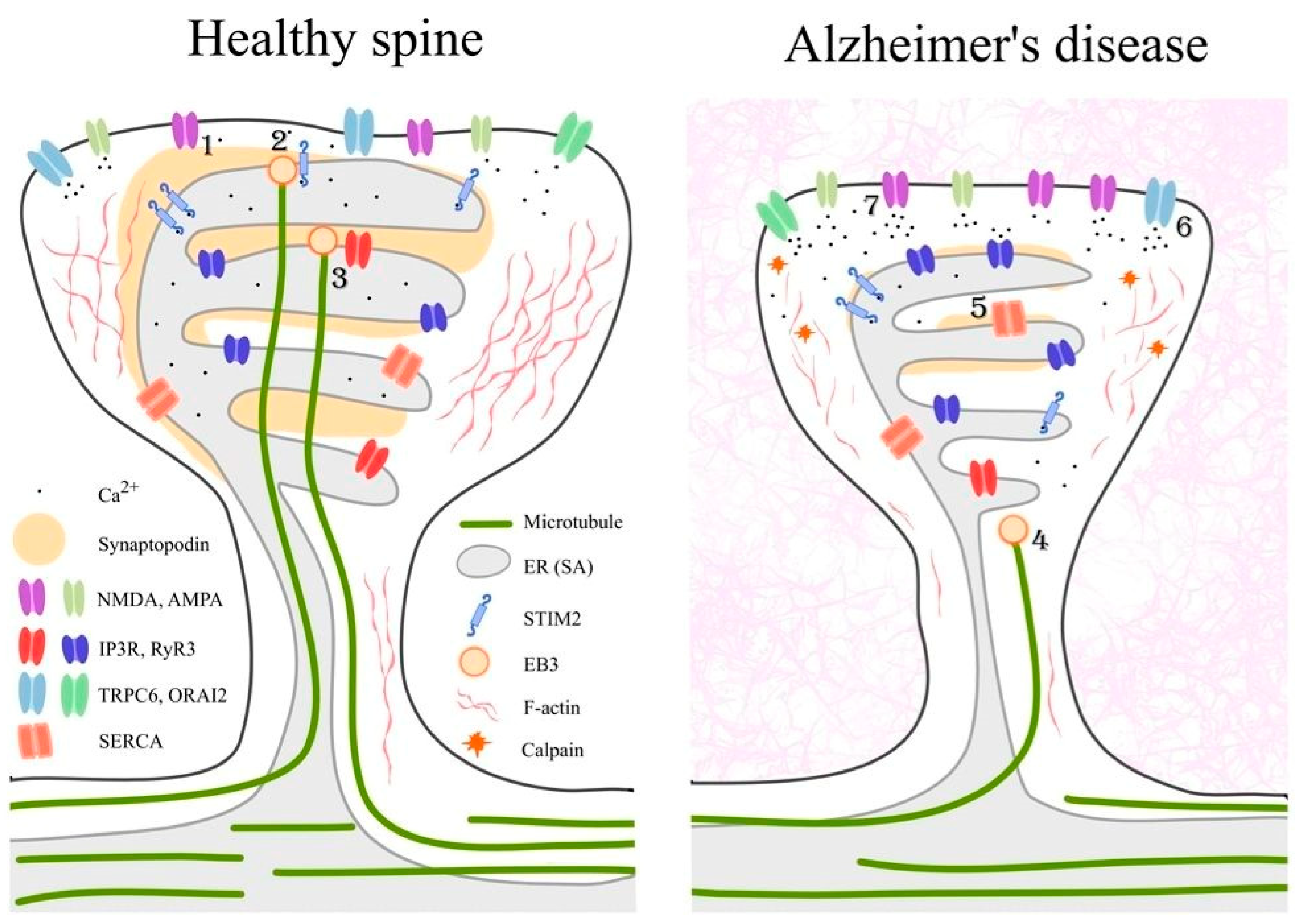
Beyond their roles in cytoskeletal organization and ER dynamics, EB proteins have also emerged as important modulators of neuronal survival under pathological conditions. Overexpression of EB3 exerts a neuroprotective effect in primary hippocampal neurons derived from the PS1-M146V-KI mouse model of Alzheimer’s disease [120], as well as under conditions of amyloid toxicity [165], which is considered a major driver of Alzheimer’s disease pathology. These findings are consistent with emerging evidence that EB family proteins more broadly contribute to neuronal resilience in neurodegenerative conditions. In particular, recent work has shown that EB1 interacts with tau protein, increases the dynamics of tau condensates, and inhibits pathological tau aggregation, thereby delaying the progression toward neurotoxic assemblies in tauopathies [166]. It has also been demonstrated that EB3 binds to inositol 1,4,5-trisphosphate receptors (IP3Rs) through an S/TxIP EB-binding motif in endothelial cells, affecting calcium signaling [167]; however, little is known about this interaction in neurons. Some of the interactions of EB3 and its neuroprotective effects are illustrated in Figure 2. These studies suggest that EB proteins can modulate multiple disease-relevant pathways, including synaptic stability and protein aggregation, positioning them as important cytoskeletal regulators in the context of Alzheimer’s disease.
Together, these findings have stimulated renewed interest in microtubule-targeting agents, including both stabilizers and destabilizers, as potential therapeutic strategies to restore microtubule homeostasis in neurodegenerative and oncologic settings [162,163]. Advances in structural biology and rational drug design continue to identify novel tubulin binding sites and modulators that may selectively fine-tune microtubule dynamics with improved specificity and brain penetrance, further expanding therapeutic opportunities [164]. Collectively, these studies highlight that precise regulation of microtubule dynamics is fundamental for cellular health, and that its disruption represents a central driver of disease processes ranging from synaptic dysfunction and neurodegeneration to cancer.

4.3. The Role of the Spine Apparatus in Alzheimer’s Disease Pathology

Importantly, synaptic activity is essential for maintaining the morphology of mature dendritic spines. Blockade of neuronal activity with tetrodotoxin (TTX) induces STIM-dependent spontaneous Ca2+ transients and shifts spine populations toward immature filopodial structures [101,168,169]. Dysregulation of STIM/Orai-mediated SOCE has also been implicated in neurodegenerative diseases, particularly Alzheimer’s disease. STIM1 and STIM2 contribute to neuronal Ca2+ homeostasis (Figure 2) and are involved in the production of β-amyloid peptide (Aβ). Aberrant expression or activity of these proteins may lead to pathological Ca2+ signaling, synaptic dysfunction, and the progression of neurodegenerative processes [170]. In this context, synaptopodin, a key actin-associated protein required for spine apparatus formation and local calcium regulation, has emerged as an important link between calcium homeostasis, synaptic stability, and neurodegeneration. Synaptopodin critically regulates Hebbian synaptic plasticity by controlling actin organization and calcium signaling within dendritic spines, processes that are highly sensitive to STIM-dependent Ca2+ dynamics [171]. Clinical and proteomic studies further support a disease-relevant role for synaptopodin, as reduced SP levels have been detected in neuronal-derived exosomes and post-mortem brain tissue from patients with Alzheimer’s disease (Figure 2), frontotemporal dementia, and Lewy body dementias, correlating with synaptic loss and cognitive impairment [172,173]. Importantly, experimental evidence from mouse models demonstrates that synaptopodin dysfunction directly influences disease progression. In the 3xTg model of Alzheimer’s disease, synaptopodin deficiency ameliorates synaptic plasticity deficits and reduces amyloid- and tau-associated pathology, highlighting its functional involvement in disease mechanisms rather than serving merely as a marker of synaptic loss [103]. At the mechanistic level, proximity proteomics has revealed that synaptopodin organizes a specialized molecular network within the spine apparatus that integrates actin remodeling, ER-derived calcium stores, and signaling proteins, positioning SP as a structural and signaling hub whose disruption may exacerbate STIM/Orai-mediated calcium dysregulation in disease [130] (Figure 2). Consistent with this view, alterations in synaptopodin-positive spine densities have also been linked to neuropsychiatric symptoms in aging and dementia, further underscoring the vulnerability of SP-dependent synaptic compartments to pathological calcium signaling.

4.4. Neurofilaments in Neurodegeneration

Neurofilaments accumulate abnormally in several major neurodegenerative disorders, including Alzheimer’s disease, Parkinson’s disease, Lewy body disease, and amyotrophic lateral sclerosis [174,175,176]. Mutations in neuronal intermediate filament genes are pathogenic for conditions like Charcot-Marie-Tooth disease and amyotrophic lateral sclerosis [177]. Neurofilament proteins are obligate heteropolymers and contain intrinsically unstructured regions in which most mutations that cause or predispose to disease occur [56,178]. During axon remodeling or pathological circumstances, such as diffuse axonal injury, there is a release of neurofilaments, resulting in neuroinflammation, causing permanent disability in neurodegenerative disorders [53]. The aforementioned release of NF is also the reason why NFs are considered to be great biomarkers for neurodegeneration and injuries [55,56,178]. NF gene mutations are well recognized as causes of several neurological disorders mainly involving degeneration of peripheral nerve fibers [179]. Changes in levels and phosphorylation of NF subunits have consistently been noted in certain psychiatric disorders, although the location of these changes within neurons is poorly understood [53].
All NF proteins are substrates of multiple proteolytic systems; for example, when axoplasm is exposed to the extracellular fluid elevated calcium concentrations activate calpains that readily cleave NFs and promote neurofilament degradation [180,181,182]. Low expression of calcium-binding proteins (parvalbumin, calbindin) in vulnerable neuron populations reduces resilience to transient calcium rises, predisposing to proteolysis and NF pathology in diseases such as ALS [183].

5. Therapeutic Strategies and Translational Potential

5.1. Targeting Calcium Channels and Transporters

Modulating specific calcium channels represents a direct approach to restoring calcium homeostasis. TRPV4 channel blockade attenuates pyroptosis in epilepsy models and improves alpha-synuclein degradation in Parkinson’s disease models [184,185]. These findings suggest TRPV4 as a therapeutic target across multiple neurological conditions. Store-operated calcium entry modulation shows disease-specific and region-specific effects. Pharmacological inhibition of SOCE may benefit the Huntington’s disease striatum but could be detrimental to cortical and hippocampal neurons [186]. This complexity necessitates careful consideration of brain region and disease context when targeting SOCE pathways. IP3 receptor inhibition with compounds like 2-APB and enoxaparin demonstrates neuroprotective effects by preventing intracellular calcium overload [187]. NMDA receptor antagonists like memantine and L-type voltage-gated calcium channel antagonists like nimodipine have been tested in Alzheimer’s disease, though clinical results have been mixed [188]. The challenge lies in achieving sufficient calcium modulation to provide neuroprotection without disrupting normal calcium-dependent processes essential for neuronal function.
Consistent with this challenge, development of disease-modifying therapies based on the amyloid hypothesis has proven difficult, prompting interest in alternative frameworks such as the calcium hypothesis of neurodegeneration. One intuitive strategy has been direct inhibition of calcium influx or release channels. Indeed, calcium channel inhibitors have demonstrated beneficial effects in animal models of Alzheimer’s disease, Parkinson’s disease, amyotrophic lateral sclerosis, Huntington’s disease, and spinocerebellar ataxia [189,190,191,192,193,194,195,196,197,198]. However, clinical translation has been limited by the essential roles of these channels in peripheral tissues. For example, despite strong preclinical support, ryanodine receptor inhibitors have not advanced to clinical trials in neurodegenerative diseases, largely due to concerns over cardiac dysfunction associated with inhibition of the cardiac RyR2 isoform.
The largest clinical effort targeting calcium channels was the phase III STEADY-PD III trial of the neuronal CaV1.3 L-type calcium channel inhibitor isradipine in Parkinson’s disease. Despite compelling preclinical rationale [199], the trial failed to meet its primary and secondary endpoints [200]. Post hoc analyses suggested that greater drug exposure delayed initiation of dopaminergic therapy, implying that insufficient dosing—limited by peripheral blood pressure effects—may have contributed to trial failure [199]. This outcome further illustrates how peripheral calcium channel functions can constrain effective central nervous system targeting.
Beyond ion channels, calcium-dependent effectors such as the phosphatase calcineurin (CaN) have attracted significant attention. CaN overactivation, driven by elevated cytosolic calcium, contributes to synaptic loss and impaired autophagy in Alzheimer’s disease neurons [193,198,201]. Inhibition of CaN has shown beneficial effects in animal models of brain aging, and epidemiological analyses reveal reduced Alzheimer’s disease incidence among transplant patients chronically treated with the CaN inhibitor FK-506 [202]. Nevertheless, clinical application is limited by the essential role of CaN in immune activation, as CaN inhibitors function as potent immunosuppressants [203].
In addition to broadly targeting calcium channels, increasing attention has been directed toward selective modulation of neuronal calcium-permeable channels as a means to achieve synaptoprotection while minimizing peripheral side effects. One such promising target is TRPC6 (Transient Receptor Potential Canonical 6), a calcium-permeable channel implicated in synaptic stability and plasticity [204,205]. Recent studies have demonstrated that pharmacological activation of TRPC6 can confer neuroprotective and synaptoprotective effects in Alzheimer’s disease models [204]. In particular, two novel small molecules, a piperazine-derived compound (cmp2) [206,207] and a benzopyran derivative (C20) [208], have been evaluated in cellular and animal models of Alzheimer’s disease. Notably, cmp2 selectively activated TRPC6 channels without affecting closely related TRPC3 or TRPC7 isoforms. Both compounds robustly restored dendritic spine morphology under conditions of amyloid-induced toxicity in vitro, indicating pronounced synaptoprotective activity. Furthermore, in transgenic 5xFAD mice, treatment with either compound led to significant improvements in cognitive performance in behavioral assays, while cmp2 additionally ameliorated motor deficits.
An alternative strategy to stabilize neuronal calcium signaling avoids blocking calcium entry or downstream effectors and instead enhances calcium extrusion from the cytoplasm. Pharmacological stimulation of calcium pumps, particularly the sarco/endoplasmic reticulum Ca2+-ATPase (SERCA), has emerged as a promising approach. Positive allosteric modulators (PAMs) of SERCA were identified through high-throughput screening targeting SERCA–phospholamban interactions, leading to the development of compounds such as CDN1163 [209]. These lipophilic molecules accelerate the SERCA pumping cycle without altering calcium affinity, facilitating calcium clearance while minimizing basal side effects [210].
SERCA PAMs have demonstrated neuroprotective effects across multiple disease models. CDN1163 ameliorated dyskinesia in a rat Parkinson’s disease model, exerted neuroprotection in Drosophila Parkinson’s disease models, and improved hippocampal memory in APP/PS1 mouse models of Alzheimer’s disease [211,212,213]. Newer compounds, including NDC-1173 and NDC-9009, further enhanced cognitive performance and synaptic integrity in Alzheimer’s disease models [214,215]. Notably, NDC-9009 restored long-term potentiation deficits, normalized aberrant hippocampal network activity observed via miniscope imaging, rescued memory impairments, and reduced amyloid plaque burden in 5xFAD mice [216].

5.2. Modulating Cytoskeletal Dynamics

Modulation of cytoskeletal dynamics represents a complementary therapeutic strategy with significant translational potential for neurodegenerative diseases. The neuronal cytoskeleton, primarily composed of microtubules and actin filaments, is essential for maintaining axonal transport, synaptic integrity, and overall neuronal architecture. Dysregulation of cytoskeletal organization is a common pathological hallmark across neurodegenerative disorders, making these structures attractive pharmacological targets.
Pharmacological modulation of microtubule dynamics is well established in oncology and provides a strong proof of principle for targeting the cytoskeleton with small molecules. Microtubule stabilizers, such as taxanes, and microtubule destabilizers, including vinca alkaloids, have been approved and widely used as chemotherapeutic agents for several decades [217,218]. At submicromolar concentrations, taxanes such as paclitaxel suppress microtubule catastrophe events and increase intracellular microtubule mass, whereas vinca alkaloids like vinblastine primarily inhibit the rates of microtubule polymerization and depolymerization. In rapidly dividing cancer cells, suppression of microtubule dynamics prevents progression from metaphase to anaphase, ultimately triggering apoptotic cell death [219,220]. Importantly, these findings demonstrate that microtubule dynamics can be precisely regulated pharmacologically, encouraging adaptation of this approach for neurodegenerative conditions, where the therapeutic goal is cytoskeletal stabilization rather than cytotoxicity.
In the context of neurodegeneration, microtubule-stabilizing strategies remain an active area of preclinical investigation. These studies include development of brain-penetrant epothilone and taxane analogs, as well as identification of novel polypharmacological compounds designed to restore tau–microtubule interactions. One such compound, the PHOX derivative PHOX15, has been shown to restore physiological interactions between aggregation-prone tau and microtubules while simultaneously inhibiting tau kinases [221]. Quantitative analyses demonstrated that PHOX15 reduced early tau aggregation steps in vitro and normalized tau–microtubule binding in neuronal models, as assessed using live-cell tauopathy imaging and aggregation assays [222]. In parallel, modulation of actin cytoskeleton dynamics has emerged as another promising avenue. Actin remodeling, mediated through actin-binding proteins and associated signaling pathways, is critical for synaptic plasticity and spine morphology and has shown therapeutic potential in Creutzfeldt–Jakob disease and related disorders [102].
Several intracellular signaling pathways that regulate cytoskeletal organization have also become key therapeutic targets. Inhibition of Rho-associated kinase (ROCK) and glycogen synthase kinase 3β (GSK-3β) aims to restore cytoskeletal stability while simultaneously suppressing pathological signaling [223]. Notably, dual inhibition of GSK-3β and DYRK1A reduces tau hyperphosphorylation and ameliorates disease phenotypes in Alzheimer’s disease models [224]. Similarly, histone deacetylase 6 (HDAC6) inhibitors, such as MPT0G211, improve microtubule acetylation and stability, leading to reduced tau phosphorylation and cognitive deficits in preclinical studies [224].
Upstream modulators such as Fyn kinase further expand the therapeutic landscape. Inhibition of Fyn reduces protein aggregation, increases synaptic density, and improves memory performance in tauopathy models [224]. Importantly, many of these kinases regulate both cytoskeletal dynamics and calcium-dependent signaling pathways, highlighting a mechanistic convergence between calcium dysregulation and structural neuronal degeneration.

5.3. Calpain Inhibition and Proteostasis

Calpain inhibition represents a direct and mechanistically grounded strategy for preventing calcium-mediated cytoskeletal degradation and proteostatic failure in neurodegenerative diseases. Calpains are calcium-activated cysteine proteases that, under physiological conditions, participate in synaptic remodeling and signal transduction. However, sustained intracellular calcium elevation leads to pathological calpain overactivation, resulting in cleavage of cytoskeletal proteins, synaptic components, and key regulators of protein homeostasis. This positions calpains as critical mediators linking calcium dyshomeostasis to structural neuronal damage and aggregation-prone protein pathology.
Early genetic studies provided compelling evidence for this role. Overexpression of the endogenous calpain inhibitor calpastatin markedly reduced amyloid plaque burden, prevented tau hyperphosphorylation, and preserved synaptic integrity in transgenic Alzheimer’s disease models [153]. These dramatic effects established calpain activation as a central downstream effector of calcium toxicity rather than a secondary bystander. More recent work has reinforced this concept by demonstrating that calpain overactivation contributes to synaptic loss, axonal degeneration, and impaired autophagic flux across multiple neurodegenerative conditions, including Alzheimer’s disease, Parkinson’s disease, amyotrophic lateral sclerosis, and Huntington’s disease [225,226].
Calpain-mediated cleavage of tau, α-synuclein, and TDP-43 has been shown to generate aggregation-prone fragments that accelerate pathological seeding and propagation [227,228]. In parallel, calpain activity has been linked to impairment of the autophagy–lysosomal pathway through proteolysis of key regulators such as Beclin-1 and Atg proteins, thereby exacerbating intracellular protein accumulation [229]. These findings position calpains at the intersection of calcium dysregulation, cytoskeletal destabilization, and defective protein clearance.
Pharmacological calpain inhibition has shown encouraging results in preclinical models, including reduced synaptic degeneration, improved behavioral outcomes, and attenuation of protein aggregation [230]. Nevertheless, translation to the clinic remains challenging. Major obstacles include achieving sufficient brain penetration, avoiding off-target inhibition of other cysteine proteases, and preserving physiological calpain functions essential for synaptic plasticity. These limitations have prompted renewed interest in indirect strategies that limit pathological calpain activation without complete enzymatic blockade.
One such approach involves targeting upstream calcium entry pathways that drive calpain overactivation. Recent studies have identified channels such as TRPV4 as contributors to sustained calcium influx in disease models, and pharmacological TRPV4 inhibition attenuates calpain activation, reduces cytoskeletal damage, and improves proteostasis in models of epilepsy and Parkinson’s disease [184,185]. This strategy offers the advantage of dampening pathological calcium signals while preserving basal calpain activity.

5.4. Multi-Target Approaches

Given the interconnected nature of cytoskeletal and calcium dysfunction, multi-target therapeutic approaches may prove most effective. Tau-targeting strategies include inhibiting tau aggregation (e.g., OLX-07010, hydromethylthionine mesylate), modulating tau phosphorylation, enhancing tau clearance through autophagy, and immunotherapy approaches like Donanemab [224]. These strategies address tau and amyloid pathology while indirectly affecting calcium homeostasis and mitochondrial function. It is important to note, however, that antibody-based approaches [224] may cause brain hemorrhages and swelling known as amyloid-related imaging abnormalities, which in turn may cause seizures. Multiplexed gene transfer strategies employing silencing and/or over-expressing multiple effectors to preserve vulnerable neurons represent innovative approaches [231]. Modulating tau phosphorylation, enhancing amyloid-beta clearance, regulating glial activation, restoring calcium homeostasis, and preserving mitochondrial function simultaneously may provide synergistic benefits [232]. Emerging therapeutic strategies for neurovascular barrier dysfunction include targeting microRNAs, statins, edaravone dexborneol, minocycline, and stem cell-derived extracellular vesicles to stabilize tight junctions and protect the blood–brain barrier [233]. These approaches address the vascular component of neurodegeneration while potentially affecting neuronal calcium and cytoskeletal function.

6. Critical Gaps and Future Directions

Despite substantial progress, significant gaps remain in understanding cytoskeleton–calcium interactions in neurological diseases. The temporal sequence of events (whether calcium dysregulation precedes cytoskeletal disruption or vice versa) remains largely unanswered and likely varies by disease and stage. Resolving this question will require approaches capable of capturing early, pre-symptomatic molecular changes rather than relying on endpoint pathology. Longitudinal studies using advanced imaging techniques in animal models and patient-derived systems are needed to establish the causes of pathology and identify optimal intervention windows. Emerging tools such as in vivo two-photon calcium imaging, genetically encoded calcium indicators, super-resolution cytoskeletal reporters, and longitudinal miniscope recordings offer unprecedented opportunities to track calcium–cytoskeleton coupling across disease progression.
The cell-type specificity of cytoskeleton–calcium dysfunction requires further investigation. Neurons, astrocytes, microglia, and oligodendrocytes exhibit distinct calcium signaling mechanisms and cytoskeletal organizations, yet most studies focus on neurons. Understanding glial contributions to pathology and identifying glial-specific therapeutic targets represents an important frontier [234,235,236]. Astrocytic calcium waves, microglial actin remodeling during immune surveillance, and oligodendrocyte cytoskeletal dynamics during myelination may each contribute uniquely to disease initiation and progression. Future studies integrating single-cell transcriptomics, spatial proteomics, and cell-type-specific genetic perturbations will be critical to disentangle these contributions.
Brain region-specific differences in calcium channel expression and cytoskeletal protein composition create challenges for therapeutic development. The observation that SOCE inhibition may benefit the striatum but harm the cortex in Huntington’s disease exemplifies this complexity [186]. Developing region-selective or cell-type-selective interventions may be necessary for optimal therapeutic efficacy. This may involve exploiting regional differences in channel subunit composition, kinase signaling context, or cytoskeletal isoform expression to achieve therapeutic precision. Advanced delivery strategies, including viral vectors, nanoparticle-based targeting, and ligand-directed drug conjugates, may enable such spatial selectivity.
The role of cytoskeleton–calcium interactions in disease propagation, particularly for prion-like spreading of tau and alpha synuclein, requires deeper investigation. Actin-based tunneling nanotubes facilitate prion spread [102], and extracellular vesicles with altered proteomic profiles may propagate dysfunction [237]. Understanding these intercellular mechanisms could reveal novel therapeutic targets. Future work should determine how calcium-dependent cytoskeletal remodeling regulates vesicle trafficking, nanotube formation, and synaptic vulnerability during pathological protein transmission. Disrupting these processes may allow selective blockade of disease spread without impairing normal synaptic communication.
Translating preclinical findings to clinical success remains challenging. Many compounds showing promise in animal models have failed in clinical trials, possibly due to species differences, inadequate target engagement, or intervention at late disease stages. Developing better biomarkers of cytoskeletal and calcium dysfunction, including spectrin breakdown products [153], could enable earlier diagnosis and treatment monitoring. Additional candidate biomarkers include phosphorylated cytoskeletal fragments, calcium-regulated protease products, and imaging-based readouts of synaptic and axonal integrity. Integrating fluid biomarkers with functional imaging may provide multidimensional measures of target engagement.
The potential for personalized medicine approaches based on patient-specific iPSC models deserves exploration. Given the heterogeneity in tau domain exposure [238] and genetic backgrounds affecting calcium signaling [239], patient-stratified therapeutic strategies may improve outcomes. High-throughput screening using patient iPSCs could identify individuals most likely to respond to specific interventions. Coupling iPSC-based phenotyping with genome-wide association data and machine-learning approaches may further refine patient stratification. Ultimately, integrating cytoskeletal and calcium signaling profiles into precision medicine frameworks may enable rational matching of patients to mechanism-based therapies.
  • Glossary
  • Neurodegenerative Diseases
  • Alzheimer’s disease (AD)
A progressive neurodegenerative disorder characterized by amyloid-β plaques, tau tangles, synaptic loss, and cognitive decline. Strongly associated with calcium dyshomeostasis and cytoskeletal disruption.
  • Parkinson’s disease (PD)
A movement disorder marked by dopaminergic neuron degeneration and α-synuclein aggregation (Lewy bodies). Involves altered calcium signaling and microtubule dysfunction.
  • Amyotrophic lateral sclerosis (ALS)
A fatal disorder involving progressive motor neuron degeneration, linked to neurofilament pathology, calcium imbalance, and cytoskeletal instability.
  • Huntington’s disease (HD)
A genetic neurodegenerative disease caused by mutant huntingtin protein, associated with disrupted axonal transport and calcium dysregulation.
  • Tauopathies
Neurodegenerative disorders characterized by pathological aggregation of hyperphosphorylated tau protein.
  • Prion Disorders (e.g., Creutzfeldt–Jakob disease)
Fatal neurodegenerative diseases caused by misfolded prion proteins, associated with actin dysregulation and calcium-mediated toxicity.
  • Cytoskeletal Components
  • Actin
A filamentous protein forming microfilaments; essential for dendritic spine structure, synaptic plasticity, and spine remodeling.
  • F-actin (Filamentous actin)
Polymerized actin forming structural scaffolds in dendritic spines and presynaptic compartments.
  • Membrane-Associated Periodic Skeleton (MPS)
A spectrin-actin lattice structure in axons and dendrites that regulates axonal diameter, stability, and electrical properties.
  • Microtubules (MTs)
Dynamic polymers composed of α/β-tubulin heterodimers; critical for intracellular transport, neuronal polarity, and synaptic plasticity.
  • Microtubule-Associated Proteins (MAPs)
Proteins that bind microtubules and regulate their stability and dynamics (e.g., tau, MAP2).
  • Neurofilaments (NF)
Neuron-specific intermediate filaments composed of NF-L, NF-M, and NF-H subunits; regulate axonal caliber and conduction velocity.
  • Post-Translational Modifications (PTMs)
Chemical modifications (e.g., acetylation, detyrosination, polyglutamylation) that regulate tubulin and cytoskeletal protein function.
  • Dendritic Spine Structures
  • Dendritic Spines
Actin-rich protrusions on dendrites that serve as the primary sites of excitatory synaptic transmission.
  • Postsynaptic Density (PSD)
A protein-dense region within dendritic spines containing receptors, scaffolding proteins, and signaling molecules.
  • Spine Apparatus (SA)
A specialized smooth endoplasmic reticulum (ER)-derived structure within certain dendritic spines; regulates local calcium signaling and plasticity.
  • Synaptopodin (SP)
An actin-associated protein essential for spine apparatus formation and synaptic plasticity.
  • Calcium Signaling Mechanisms
  • Calcium (Ca2+) Signaling
A universal intracellular signaling system regulating synaptic plasticity, gene expression, cytoskeletal remodeling, and neuronal survival.
  • Calcium-Induced Calcium Release (CICR)
A process where Ca2+ influx triggers further Ca2+ release from intracellular stores via ryanodine receptors.
  • Store-Operated Calcium Entry (SOCE)
Calcium influx mechanism activated upon ER calcium depletion, mediated by STIM and Orai channels.
  • Stromal Interaction Molecules (STIM1/STIM2)
ER calcium sensors that activate SOCE upon calcium depletion.
  • Orai Channels (ORAI)
Plasma membrane calcium channels activated by STIM proteins during SOCE.
  • Inositol 1,4,5-Trisphosphate Receptors (IP3Rs)
ER membrane receptors that release Ca2+ upon IP3 binding.
  • Ryanodine Receptors (RyRs)
Calcium release channels located on ER membranes involved in CICR.
  • Sarco/Endoplasmic Reticulum Ca2+-ATPase (SERCA)
ATP-dependent pump transporting Ca2+ back into the ER to restore calcium homeostasis.
  • N-Methyl-D-Aspartate Receptor (NMDAR)
A glutamate receptor and calcium-permeable ion channel critical for synaptic plasticity.
  • Synaptic Plasticity
  • Long-Term Potentiation (LTP)
Activity-dependent strengthening of synapses associated with spine enlargement and increased receptor density.
  • Long-Term Depression (LTD)
Activity-dependent weakening of synapses associated with spine shrinkage and receptor removal.
  • Hebbian Plasticity
Synaptic strengthening based on correlated pre- and postsynaptic activity.
  • Microtubule Dynamics and Associated Proteins
  • Plus-End Tracking Proteins (+TIPs)
Proteins that bind to growing microtubule plus ends and regulate microtubule dynamics.
  • End-Binding Protein 3 (EB3)
A neuron-enriched +TIP that regulates microtubule growth, dendritic spine invasion, and interacts with STIM2.
  • End-Binding Protein 1 (EB1)
A +TIP protein involved in microtubule dynamics and tau regulation.
  • Tip-Attachment Complex (TAC)
A complex linking ER tubules to growing microtubule plus ends via STIM1–EB1 interaction.
  • Axon Initial Segment (AIS)
Specialized proximal axonal region responsible for action potential initiation and cytoskeletal organization.
  • Proteases and Calcium-Dependent Enzymes
  • Calpain
A calcium-activated cysteine protease that cleaves cytoskeletal and synaptic proteins under pathological calcium elevation.
  • Calpastatin
Endogenous inhibitor of calpain.
  • Calcineurin (CaN)
A calcium/calmodulin-dependent phosphatase involved in synaptic signaling and neurodegeneration.
  • Pathological Proteins
  • Tau
A microtubule-associated protein that stabilizes microtubules; hyperphosphorylated tau forms neurofibrillary tangles.
  • α-Synuclein
A presynaptic protein that aggregates in Parkinson’s disease and disrupts cytoskeletal organization.
  • β-Amyloid (Aβ)
A peptide derived from amyloid precursor protein; forms plaques and contributes to calcium dysregulation in AD.
  • TDP-43
A DNA/RNA-binding protein implicated in ALS and frontotemporal dementia; undergoes pathological aggregation.
  • Therapeutic Strategies
  • Positive Allosteric Modulators (PAMs)
Compounds enhancing protein function without directly activating the primary binding site (e.g., SERCA PAMs).
  • TRPC6 Activators
Compounds that stimulate TRPC6 channels to promote synaptic stability and calcium homeostasis.
  • Microtubule-Stabilizing Agents
Compounds (e.g., taxane derivatives) that enhance microtubule stability to restore axonal transport.
  • ROCK Inhibitors
Inhibitors of Rho-associated kinase that modulate actin cytoskeleton dynamics.
  • GSK-3β Inhibitors
Compounds reducing tau phosphorylation and cytoskeletal pathology.
  • HDAC6 Inhibitors
Agents that increase microtubule acetylation and stability.
  • Emerging Concepts
  • Calcium Hypothesis of Neurodegeneration
Theory proposing that chronic intracellular calcium dysregulation drives neurodegenerative pathology.
  • Cytoskeleton–Calcium Interplay
Bidirectional relationship in which calcium regulates cytoskeletal dynamics and cytoskeletal structures influence calcium signaling.
  • Prion-like Propagation
Cell-to-cell spread of misfolded proteins via mechanisms such as tunneling nanotubes or extracellular vesicles.

Author Contributions

A.R., E.V. and E.P. wrote and edited the manuscript. All authors have read and agreed to the published version of the manuscript.

Funding

This work is supported by Russian Science Foundation Grant No. 25-74-10019.

Institutional Review Board Statement

Not applicable.

Informed Consent Statement

Not applicable.

Data Availability Statement

No new data were created or analyzed in this study. Data sharing is not applicable to this article.

Acknowledgments

We thank Ilya Bezprozvanny and Olga Vlasova for guidance and valuable discussions. We thank Anastasiya Bolshakova for administrative support.

Conflicts of Interest

The authors declare no conflicts of interest.

References

  1. Dubey, J.; Ratnakaran, N.; Koushika, S.P. Neurodegeneration and microtubule dynamics: Death by a thousand cuts. Front. Cell. Neurosci. 2015, 9, 343, Erratum in Front. Cell. Neurosci. 2016, 10, 26. [Google Scholar] [CrossRef] [PubMed]
  2. Skovronsky, D.M.; Lee, V.M.-Y.; Trojanowski, J.Q. Neurodegenerative diseases: New concepts of pathogenesis and their therapeutic implications. Annu. Rev. Pathol. Mech. Dis. 2006, 1, 151–170. [Google Scholar] [CrossRef] [PubMed]
  3. Glass, C.K.; Saijo, K.; Winner, B.; Marchetto, M.C.; Gage, F.H. Mechanisms underlying inflammation in neurodegeneration. Cell 2010, 140, 918–934. [Google Scholar] [CrossRef]
  4. Arnold, S.E.; Toledo, J.B.; Appleby, D.H.; Xie, S.X.; Wang, L.S.; Baek, Y.; Wolk, D.A.; Lee, E.B.; Miller, B.L.; Lee, V.M.Y. Comparative survey of the topographical distribution of signature molecular lesions in major neurodegenerative diseases. J. Comp. Neurol. 2013, 521, 4339–4355. [Google Scholar] [CrossRef] [PubMed]
  5. Baird, F.J.; Bennett, C.L. Microtubule defects & neurodegeneration. J. Genet. Syndr. Gene Ther. 2013, 4, 203. [Google Scholar]
  6. Takalo, M.; Salminen, A.; Soininen, H.; Hiltunen, M.; Haapasalo, A. Protein aggregation and degradation mechanisms in neurodegenerative diseases. Am. J. Neurodegener. Dis. 2013, 2, 1. [Google Scholar]
  7. Paschen, W.; Mengesdorf, T. Endoplasmic reticulum stress response and neurodegeneration. Cell Calcium 2005, 38, 409–415. [Google Scholar] [CrossRef]
  8. Carvalhais, L.G.; Kole, K.; Kuijpers, M. The diverse forms and roles of the neuronal endoplasmic reticulum. Nat. Rev. Neurosci. 2026; in press. [Google Scholar] [CrossRef]
  9. Ischiropoulos, H.; Beckman, J.S. Oxidative stress and nitration in neurodegeneration: Cause, effect, or association? J. Clin. Investig. 2003, 111, 163–169. [Google Scholar] [CrossRef]
  10. Bamburg, J.; Bernstein, B.; Davis, R.; Flynn, K.; Goldsbury, C.; Jensen, J.; Maloney, M.; Marsden, I.; Minamide, L.; Pak, C. ADF/Cofilin-actin rods in neurodegenerative diseases. Curr. Alzheimer Res. 2010, 7, 241–250. [Google Scholar] [CrossRef]
  11. Haseena, P.A.; Basavaraju, N.; Gupta, A.; Kommaddi, R.P. Actin Cytoskeleton at the Synapse: An Alzheimer’s Disease Perspective. Cytoskeleton 2026, 83, 15–28. [Google Scholar]
  12. Ben Zablah, Y.; Merovitch, N.; Jia, Z. The role of ADF/cofilin in synaptic physiology and Alzheimer’s disease. Front. Cell Dev. Biol. 2020, 8, 594998. [Google Scholar] [CrossRef]
  13. Lamprecht, R. Actin cytoskeleton role in the maintenance of neuronal morphology and long-term memory. Cells 2021, 10, 1795. [Google Scholar] [CrossRef] [PubMed]
  14. Borovac, J.; Bosch, M.; Okamoto, K. Regulation of actin dynamics during structural plasticity of dendritic spines: Signaling messengers and actin-binding proteins. Mol. Cell. Neurosci. 2018, 91, 122–130. [Google Scholar] [CrossRef]
  15. Bliss, T.; Collingridge, G.; Morris, R. Synaptic plasticity in health and disease: Introduction and overview. Philos. Trans. R. Soc. B Biol. Sci. 2014, 369, 20130129. [Google Scholar] [CrossRef]
  16. Chang, Q.; Yang, H.; Wang, M.; Wei, H.; Hu, F. Role of microtubule-associated protein in autism spectrum disorder. Neurosci. Bull. 2018, 34, 1119–1126. [Google Scholar] [CrossRef]
  17. Marchisella, F.; Coffey, E.T.; Hollos, P. Microtubule and microtubule associated protein anomalies in psychiatric disease. Cytoskeleton 2016, 73, 596–611. [Google Scholar] [CrossRef] [PubMed]
  18. Kim, C.; Yousefian-Jazi, A.; Choi, S.-H.; Chang, I.; Lee, J.; Ryu, H. Non-cell autonomous and epigenetic mechanisms of Huntington’s disease. Int. J. Mol. Sci. 2021, 22, 12499. [Google Scholar] [CrossRef]
  19. Gbadamosi, M.; Romano, G.; Simbula, M.; Canarutto, G.; Ottoboni, L.; Corti, S.; Feiguin, F. TDP-43 Regulates Rab4 Levels to Support Synaptic Vesicle Recycling and Neuromuscular Connectivity in Drosophila and Human ALS Models. Int. J. Mol. Sci. 2025, 26, 11030. [Google Scholar] [CrossRef] [PubMed]
  20. Alim, M.A.; Ma, Q.-L.; Takeda, K.; Aizawa, T.; Matsubara, M.; Nakamura, M.; Asada, A.; Saito, T.; Kaji, H.; Yoshii, M.; et al. Demonstration of a role for α-synuclein as a functional microtubule-associated protein. J. Alzheimer’s Dis. 2004, 6, 435–442. [Google Scholar] [CrossRef]
  21. D’Este, E.; Kamin, D.; Göttfert, F.; El-Hady, A.; Hell, S.W. STED nanoscopy reveals the ubiquity of subcortical cytoskeleton periodicity in living neurons. Cell Rep. 2015, 10, 1246–1251. [Google Scholar] [CrossRef]
  22. Han, B.; Zhou, R.; Xia, C.; Zhuang, X. Structural organization of the actin-spectrin–based membrane skeleton in dendrites and soma of neurons. Proc. Natl. Acad. Sci. USA 2017, 114, E6678–E6685. [Google Scholar] [CrossRef]
  23. Zhong, G.; He, J.; Zhou, R.; Lorenzo, D.; Babcock, H.P.; Bennett, V.; Zhuang, X. Developmental mechanism of the periodic membrane skeleton in axons. Elife 2014, 3, e04581. [Google Scholar] [CrossRef]
  24. Heller, E.; Kurup, N.; Zhuang, X. The membrane skeleton is constitutively remodeled in neurons by calcium signaling. Science 2025, 389, eadn6712. [Google Scholar] [CrossRef]
  25. Hofmann, M.; Biller, L.; Michel, U.; Bähr, M.; Koch, J.C. Cytoskeletal assembly in axonal outgrowth and regeneration analyzed on the nanoscale. Sci. Rep. 2022, 12, 14387. [Google Scholar] [CrossRef]
  26. Hammarlund, M.; Jorgensen, E.M.; Bastiani, M.J. Axons break in animals lacking β-spectrin. J. Cell Biol. 2007, 176, 269–275. [Google Scholar] [CrossRef] [PubMed]
  27. Costa, A.R.; Sousa, S.C.; Pinto-Costa, R.; Mateus, J.C.; Lopes, C.D.; Costa, A.C.; Rosa, D.; Machado, D.; Pajuelo, L.; Wang, X. The membrane periodic skeleton is an actomyosin network that regulates axonal diameter and conduction. Elife 2020, 9, e55471. [Google Scholar] [CrossRef] [PubMed]
  28. Leite, S.C.; Sampaio, P.; Sousa, V.F.; Nogueira-Rodrigues, J.; Pinto-Costa, R.; Peters, L.L.; Brites, P.; Sousa, M.M. The actin-binding protein α-adducin is required for maintaining axon diameter. Cell Rep. 2016, 15, 490–498. [Google Scholar] [CrossRef]
  29. Xu, K.; Zhong, G.; Zhuang, X. Actin, spectrin, and associated proteins form a periodic cytoskeletal structure in axons. Science 2013, 339, 452–456. [Google Scholar] [CrossRef]
  30. Vassilopoulos, S.; Gibaud, S.; Jimenez, A.; Caillol, G.; Leterrier, C. Ultrastructure of the axonal periodic scaffold reveals a braid-like organization of actin rings. Nat. Commun. 2019, 10, 5803. [Google Scholar] [CrossRef] [PubMed]
  31. Gallo, G. The axonal actin filament cytoskeleton: Structure, function, and relevance to injury and degeneration. Mol. Neurobiol. 2024, 61, 5646–5664. [Google Scholar] [CrossRef]
  32. Ganguly, A.; Tang, Y.; Wang, L.; Ladt, K.; Loi, J.; Dargent, B.; Leterrier, C.; Roy, S. A dynamic formin-dependent deep F-actin network in axons. J. Cell Biol. 2015, 210, 401–417. [Google Scholar] [CrossRef] [PubMed]
  33. Gallo, G. Mechanisms underlying the initiation and dynamics of neuronal filopodia: From neurite formation to synaptogenesis. Int. Rev. Cell Mol. Biol. 2013, 301, 95–156. [Google Scholar]
  34. Lau, P.-m.; Zucker, R.S.; Bentley, D. Induction of filopodia by direct local elevation of intracellular calcium ion concentration. J. Cell Biol. 1999, 145, 1265–1276. [Google Scholar] [CrossRef]
  35. Gallo, G. RhoA-kinase coordinates F-actin organization and myosin II activity during semaphorin-3A-induced axon retraction. J. Cell Sci. 2006, 119, 3413–3423. [Google Scholar] [CrossRef]
  36. Brown, J.A.; Bridgman, P.C. Disruption of the cytoskeleton during Semaphorin 3A induced growth cone collapse correlates with differences in actin organization and associated binding proteins. Dev. Neurobiol. 2009, 69, 633–646. [Google Scholar] [CrossRef]
  37. Korobova, F.; Svitkina, T. Molecular architecture of synaptic actin cytoskeleton in hippocampal neurons reveals a mechanism of dendritic spine morphogenesis. Mol. Biol. Cell 2010, 21, 165–176. [Google Scholar] [CrossRef]
  38. Koch, N.; Kobler, O.; Thomas, U.; Qualmann, B.; Kessels, M.M. Terminal axonal arborization and synaptic bouton formation critically rely on abp1 and the arp2/3 complex. PLoS ONE 2014, 9, e97692. [Google Scholar] [CrossRef]
  39. Sankaranarayanan, S.; Atluri, P.P.; Ryan, T.A. Actin has a molecular scaffolding, not propulsive, role in presynaptic function. Nat. Neurosci. 2003, 6, 127–135. [Google Scholar] [CrossRef] [PubMed]
  40. Morales, M.; Colicos, M.A.; Goda, Y. Actin-dependent regulation of neurotransmitter release at central synapses. Neuron 2000, 27, 539–550. [Google Scholar] [CrossRef] [PubMed]
  41. Gentile, J.E.; Carrizales, M.G.; Koleske, A.J. Control of synapse structure and function by actin and its regulators. Cells 2022, 11, 603. [Google Scholar] [CrossRef] [PubMed]
  42. Letourneau, P.C. Actin in axons: Stable scaffolds and dynamic filaments. In Cell Biology of the Axon; Springer: Berlin/Heidelberg, Germany, 2009; pp. 265–290. [Google Scholar]
  43. Waites, C.L.; Leal-Ortiz, S.A.; Andlauer, T.F.; Sigrist, S.J.; Garner, C.C. Piccolo regulates the dynamic assembly of presynaptic F-actin. J. Neurosci. 2011, 31, 14250–14263. [Google Scholar] [CrossRef]
  44. Richards, D.; Rizzoli, S.; Betz, W.J. Effects of wortmannin and latrunculin A on slow endocytosis at the frog neuromuscular junction. J. Physiol. 2004, 557, 77–91. [Google Scholar] [CrossRef] [PubMed]
  45. Bourne, J.; Morgan, J.R.; Pieribone, V.A. Actin polymerization regulates clathrin coat maturation during early stages of synaptic vesicle recycling at lamprey synapses. J. Comp. Neurol. 2006, 497, 600–609. [Google Scholar] [CrossRef]
  46. Shupliakov, O.; Bloom, O.; Gustafsson, J.S.; Kjaerulff, O.; Löw, P.; Tomilin, N.; Pieribone, V.A.; Greengard, P.; Brodin, L. Impaired recycling of synaptic vesicles after acute perturbation of the presynaptic actin cytoskeleton. Proc. Natl. Acad. Sci. USA 2002, 99, 14476–14481. [Google Scholar] [CrossRef]
  47. Bloom, O.; Evergren, E.; Tomilin, N.; Kjaerulff, O.; Löw, P.; Brodin, L.; Pieribone, V.A.; Greengard, P.; Shupliakov, O. Colocalization of synapsin and actin during synaptic vesicle recycling. J. Cell Biol. 2003, 161, 737–747. [Google Scholar] [CrossRef]
  48. Dunaevsky, A.; Connor, E.A. F-actin is concentrated in nonrelease domains at frog neuromuscular junctions. J. Neurosci. 2000, 20, 6007–6012. [Google Scholar] [CrossRef]
  49. Cingolani, L.A.; Goda, Y. Differential involvement of β3 integrin in pre-and postsynaptic forms of adaptation to chronic activity deprivation. Neuron Glia Biol. 2008, 4, 179–187. [Google Scholar] [CrossRef]
  50. Rust, M.B.; Maritzen, T. Relevance of presynaptic actin dynamics for synapse function and mouse behavior. Exp. Cell Res. 2015, 335, 165–171. [Google Scholar] [CrossRef] [PubMed]
  51. Nelson, J.C.; Stavoe, A.K.; Colón-Ramos, D.A. The actin cytoskeleton in presynaptic assembly. Cell Adhes. Migr. 2013, 7, 379–387. [Google Scholar] [CrossRef]
  52. Mayaki, A.M.; Razak, I.S.A.; Noraniza, M.A.; Mazlina, M.; Rasedee, A. Biofluid markers of equine neurological disorders reviewed from human perspectives. J. Equine Vet. Sci. 2020, 86, 102907. [Google Scholar] [CrossRef]
  53. Devarakonda, S.S.; Basha, S.; Pithakumar, A.; Thoshna, L.B.; Mukunda, D.C.; Rodrigues, J.; Biswas, S.; Pai, A.R.; Belurkar, S.; Mahato, K.K. Molecular mechanisms of neurofilament alterations and its application in assessing neurodegenerative disorders. Ageing Res. Rev. 2024, 102, 102566. [Google Scholar] [CrossRef] [PubMed]
  54. Tomar, G.S.; Singh, G.P.; Lahkar, D.; Sengar, K.; Nigam, R.; Mohan, M.; Anindya, R. New biomarkers in brain trauma. Clin. Chim. Acta 2018, 487, 325–329. [Google Scholar] [CrossRef]
  55. Kouchaki, E.; Dashti, F.; Mirazimi, S.M.A.; Alirezaei, Z.; Jafari, S.H.; Hamblin, M.R.; Mirzaei, H. Neurofilament light chain as a biomarker for diagnosis of multiple sclerosis. EXCLI J. 2021, 20, 1308. [Google Scholar]
  56. Yuan, A.; Nixon, R.A. Specialized roles of neurofilament proteins in synapses: Relevance to neuropsychiatric disorders. Brain Res. Bull. 2016, 126, 334–346. [Google Scholar] [CrossRef]
  57. Varhaug, K.N.; Torkildsen, Ø.; Myhr, K.-M.; Vedeler, C.A. Neurofilament light chain as a biomarker in multiple sclerosis. Front. Neurol. 2019, 10, 338. [Google Scholar] [CrossRef] [PubMed]
  58. Yuan, A.; Sershen, H.; Basavarajappa, B.S.; Kumar, A.; Hashim, A.; Berg, M.; Lee, J.-H.; Sato, Y.; Rao, M.V.; Mohan, P.S. Neurofilament subunits are integral components of synapses and modulate neurotransmission and behavior in vivo. Mol. Psychiatry 2015, 20, 986–994. [Google Scholar] [CrossRef] [PubMed]
  59. Yuan, A.; Hassinger, L.; Rao, M.V.; Julien, J.-P.; Miller, C.C.; Nixon, R.A. Dissociation of axonal neurofilament content from its transport rate. PLoS ONE 2015, 10, e0133848. [Google Scholar] [CrossRef] [PubMed]
  60. Perrot, R.; Julien, J.-P. Real-time imaging reveals defects of fast axonal transport induced by disorganization of intermediate filaments. FASEB J. 2009, 23, 3213–3225. [Google Scholar] [CrossRef]
  61. Rao, M.V.; Mohan, P.S.; Kumar, A.; Yuan, A.; Montagna, L.; Campbell, J.; Veeranna; Espreafico, E.M.; Julien, J.P.; Nixon, R.A. The myosin Va head domain binds to the neurofilament-L rod and modulates endoplasmic reticulum (ER) content and distribution within axons. PLoS ONE 2011, 6, e17087. [Google Scholar] [CrossRef]
  62. Styers, M.L.; Salazar, G.; Love, R.; Peden, A.A.; Kowalczyk, A.P.; Faundez, V. The endo-lysosomal sorting machinery interacts with the intermediate filament cytoskeleton. Mol. Biol. Cell 2004, 15, 5369–5382. [Google Scholar] [CrossRef] [PubMed]
  63. Jang, E.-H.; Choi, H.; Hur, E.-M. Microtubule function and dysfunction in the nervous system. Mol. Cells 2024, 47, 100111. [Google Scholar] [CrossRef]
  64. Jones, S.L.; Korobova, F.; Svitkina, T. Axon initial segment cytoskeleton comprises a multiprotein submembranous coat containing sparse actin filaments. J. Cell Biol. 2014, 205, 67–81. [Google Scholar] [CrossRef]
  65. Tas, R.P.; Chazeau, A.; Cloin, B.M.; Lambers, M.L.; Hoogenraad, C.C.; Kapitein, L.C. Differentiation between oppositely oriented microtubules controls polarized neuronal transport. Neuron 2017, 96, 1264–1271. e1265. [Google Scholar] [CrossRef]
  66. Yau, K.W.; Schätzle, P.; Tortosa, E.; Pagès, S.; Holtmaat, A.; Kapitein, L.C.; Hoogenraad, C.C. Dendrites in vitro and in vivo contain microtubules of opposite polarity and axon formation correlates with uniform plus-end-out microtubule orientation. J. Neurosci. 2016, 36, 1071–1085. [Google Scholar] [CrossRef] [PubMed]
  67. Takahashi, D.; Yu, W.; Baas, P.W.; Kawai-Hirai, R.; Hayashi, K. Rearrangement of microtubule polarity orientation during conversion of dendrites to axons in cultured pyramidal neurons. Cell Motil. Cytoskelet. 2007, 64, 347–359. [Google Scholar] [CrossRef]
  68. Baas, P.W.; Yu, W. A composite model for establishing the microtubule arrays of the neuron. Mol. Neurobiol. 1996, 12, 145–161. [Google Scholar] [CrossRef]
  69. Kapitein, L.C.; Schlager, M.A.; Kuijpers, M.; Wulf, P.S.; van Spronsen, M.; MacKintosh, F.C.; Hoogenraad, C.C. Mixed microtubules steer dynein-driven cargo transport into dendrites. Curr. Biol. 2010, 20, 290–299. [Google Scholar] [CrossRef] [PubMed]
  70. Kapitein, L.C.; Hoogenraad, C.C. Which way to go? Cytoskeletal organization and polarized transport in neurons. Mol. Cell. Neurosci. 2011, 46, 9–20. [Google Scholar] [CrossRef]
  71. Miller, K.E.; Suter, D.M. An integrated cytoskeletal model of neurite outgrowth. Front. Cell. Neurosci. 2018, 12, 447. [Google Scholar] [CrossRef]
  72. Wilkes, O.R.; Moore, A.W. Distinct microtubule organizing center mechanisms combine to generate neuron polarity and arbor complexity. Front. Cell. Neurosci. 2020, 14, 594199. [Google Scholar] [CrossRef] [PubMed]
  73. Goodwin, S.S.; Vale, R.D. Patronin regulates the microtubule network by protecting microtubule minus ends. Cell 2010, 143, 263–274. [Google Scholar] [CrossRef] [PubMed]
  74. Richardson, C.E.; Spilker, K.A.; Cueva, J.G.; Perrino, J.; Goodman, M.B.; Shen, K. PTRN-1, a microtubule minus end-binding CAMSAP homolog, promotes microtubule function in Caenorhabditis elegans neurons. Elife 2014, 3, e01498. [Google Scholar] [CrossRef] [PubMed]
  75. Marcette, J.D.; Chen, J.J.; Nonet, M.L. The Caenorhabditis elegans microtubule minus-end binding homolog PTRN-1 stabilizes synapses and neurites. Elife 2014, 3, e01637. [Google Scholar] [CrossRef]
  76. Yau, K.W.; van Beuningen, S.F.; Cunha-Ferreira, I.; Cloin, B.M.; van Battum, E.Y.; Will, L.; Schätzle, P.; Tas, R.P.; van Krugten, J.; Katrukha, E.A. Microtubule minus-end binding protein CAMSAP2 controls axon specification and dendrite development. Neuron 2014, 82, 1058–1073. [Google Scholar] [CrossRef]
  77. Sánchez-Huertas, C.; Freixo, F.; Viais, R.; Lacasa, C.; Soriano, E.; Lüders, J. Non-centrosomal nucleation mediated by augmin organizes microtubules in post-mitotic neurons and controls axonal microtubule polarity. Nat. Commun. 2016, 7, 12187. [Google Scholar] [CrossRef]
  78. Nakagawa, H.; Koyama, K.; Murata, Y.; Morito, M.; Akiyama, T.; Nakamura, Y. EB3, a novel member of the EB1 family preferentially expressed in the central nervous system, binds to a CNS-specific APC homologue. Oncogene 2000, 19, 210–216. [Google Scholar] [CrossRef]
  79. Gu, J.; Zheng, J.Q. Microtubules in dendritic spine development and plasticity. Open Neurosci. J. 2009, 3, 128. [Google Scholar] [CrossRef]
  80. Hu, X.; Viesselmann, C.; Nam, S.; Merriam, E.; Dent, E.W. Activity-dependent dynamic microtubule invasion of dendritic spines. J. Neurosci. 2008, 28, 13094–13105. [Google Scholar] [CrossRef]
  81. Merriam, E.B.; Lumbard, D.C.; Viesselmann, C.; Ballweg, J.; Stevenson, M.; Pietila, L.; Hu, X.; Dent, E.W. Dynamic microtubules promote synaptic NMDA receptor-dependent spine enlargement. PLoS ONE 2011, 6, e27688. [Google Scholar] [CrossRef]
  82. Merriam, E.B.; Millette, M.; Lumbard, D.C.; Saengsawang, W.; Fothergill, T.; Hu, X.; Ferhat, L.; Dent, E.W. Synaptic regulation of microtubule dynamics in dendritic spines by calcium, F-actin, and drebrin. J. Neurosci. 2013, 33, 16471–16482. [Google Scholar] [CrossRef]
  83. Wu, J.; Ryskamp, D.A.; Liang, X.; Egorova, P.; Zakharova, O.; Hung, G.; Bezprozvanny, I. Enhanced store-operated calcium entry leads to striatal synaptic loss in a Huntington’s disease mouse model. J. Neurosci. 2016, 36, 125–141. [Google Scholar] [CrossRef]
  84. Geraldo, S.; Khanzada, U.K.; Parsons, M.; Chilton, J.K.; Gordon-Weeks, P.R. Targeting of the F-actin-binding protein drebrin by the microtubule plus-tip protein EB3 is required for neuritogenesis. Nat. Cell Biol. 2008, 10, 1181–1189. [Google Scholar] [CrossRef] [PubMed]
  85. Sweet, E.S.; Previtera, M.L.; Fernández, J.R.; Charych, E.I.; Tseng, C.-Y.; Kwon, M.; Starovoytov, V.; Zheng, J.Q.; Firestein, B.L. PSD-95 alters microtubule dynamics via an association with EB3. J. Neurosci. 2011, 31, 1038–1047. [Google Scholar] [CrossRef]
  86. Terada, S.; Kinjo, M.; Aihara, M.; Takei, Y.; Hirokawa, N. Kinesin-1/Hsc70-dependent mechanism of slow axonal transport and its relation to fast axonal transport. Biophys. J. 2011, 100, 354a. [Google Scholar] [CrossRef]
  87. Guillaud, L.; El-Agamy, S.E.; Otsuki, M.; Terenzio, M. Anterograde axonal transport in neuronal homeostasis and disease. Front. Mol. Neurosci. 2020, 13, 556175. [Google Scholar] [CrossRef] [PubMed]
  88. Leterrier, C.; Vacher, H.; Fache, M.-P.; d’Ortoli, S.A.; Castets, F.; Autillo-Touati, A.; Dargent, B. End-binding proteins EB3 and EB1 link microtubules to ankyrin G in the axon initial segment. Proc. Natl. Acad. Sci. USA 2011, 108, 8826–8831. [Google Scholar] [CrossRef] [PubMed]
  89. Dent, E.W.; Merriam, E.B.; Hu, X. The dynamic cytoskeleton: Backbone of dendritic spine plasticity. Curr. Opin. Neurobiol. 2011, 21, 175–181. [Google Scholar] [CrossRef]
  90. Urbanska, M.; Swiech, L.; Jaworski, J. Developmental plasticity of the dendritic compartment: Focus on the cytoskeleton. In Synaptic Plasticity: Dynamics, Development and Disease; Springer: Vienna, Austria, 2012; pp. 265–284. [Google Scholar]
  91. Shirao, T.; González-Billault, C. Actin filaments and microtubules in dendritic spines. J. Neurochem. 2013, 126, 155–164. [Google Scholar] [CrossRef]
  92. Hoogenraad, C.C.; Bradke, F. Control of neuronal polarity and plasticity—A renaissance for microtubules? Trends Cell Biol. 2009, 19, 669–676. [Google Scholar] [CrossRef]
  93. McVicker, D.P.; Awe, A.M.; Richters, K.E.; Wilson, R.L.; Cowdrey, D.A.; Hu, X.; Chapman, E.R.; Dent, E.W. Transport of a kinesin-cargo pair along microtubules into dendritic spines undergoing synaptic plasticity. Nat. Commun. 2016, 7, 12741. [Google Scholar] [CrossRef]
  94. Hotulainen, P.; Hoogenraad, C.C. Actin in dendritic spines: Connecting dynamics to function. J. Cell Biol. 2010, 189, 619–629. [Google Scholar] [CrossRef]
  95. Rácz, B.; Weinberg, R.J. Organization of the Arp2/3 complex in hippocampal spines. J. Neurosci. 2008, 28, 5654–5659. [Google Scholar] [CrossRef]
  96. Bosch, M.; Castro, J.; Saneyoshi, T.; Matsuno, H.; Sur, M.; Hayashi, Y. Structural and molecular remodeling of dendritic spine substructures during long-term potentiation. Neuron 2014, 82, 444–459. [Google Scholar] [CrossRef]
  97. Rex, C.S.; Gavin, C.F.; Rubio, M.D.; Kramar, E.A.; Chen, L.Y.; Jia, Y.; Huganir, R.L.; Muzyczka, N.; Gall, C.M.; Miller, C.A. Myosin IIb regulates actin dynamics during synaptic plasticity and memory formation. Neuron 2010, 67, 603–617. [Google Scholar] [CrossRef]
  98. Penzes, P.; Srivastava, D.P.; Woolfrey, K.M. Not just actin? A role for dynamic microtubules in dendritic spines. Neuron 2009, 61, 3–5. [Google Scholar] [CrossRef]
  99. Schätzle, P.; da Silva, M.E.; Tas, R.P.; Katrukha, E.A.; Hu, H.Y.; Wierenga, C.J.; Kapitein, L.C.; Hoogenraad, C.C. Activity-dependent actin remodeling at the base of dendritic spines promotes microtubule entry. Curr. Biol. 2018, 28, 2081–2093. e2086. [Google Scholar] [CrossRef] [PubMed]
  100. Jaworski, J.; Kapitein, L.C.; Gouveia, S.M.; Dortland, B.R.; Wulf, P.S.; Grigoriev, I.; Camera, P.; Spangler, S.A.; Di Stefano, P.; Demmers, J. Dynamic microtubules regulate dendritic spine morphology and synaptic plasticity. Neuron 2009, 61, 85–100. [Google Scholar] [CrossRef] [PubMed]
  101. Kushnireva, L.; Korkotian, E.; Segal, M. Calcium sensors STIM1 and STIM2 regulate different calcium functions in cultured hippocampal neurons. Front. Synaptic Neurosci. 2021, 12, 573714. [Google Scholar] [CrossRef]
  102. Bastar-Juarez, L.; Castillo-Estrada, X.; Margarit-Mendez, D.; Coca-Gutierrez, P. The Central Role of Actin in Creutzfeldt-Jakob Disease: Unlocking Therapeutic Pathways. Mol. Neurobiol. 2025, 62, 15132–15148. [Google Scholar] [CrossRef] [PubMed]
  103. Aloni, E.; Oni-Biton, E.; Tsoory, M.; Moallem, D.H.; Segal, M. Synaptopodin deficiency ameliorates symptoms in the 3xTg mouse model of Alzheimer’s disease. J. Neurosci. 2019, 39, 3983–3992. [Google Scholar] [CrossRef]
  104. Koganezawa, N.; Hanamura, K.; Sekino, Y.; Shirao, T. The role of drebrin in dendritic spines. Mol. Cell. Neurosci. 2017, 84, 85–92. [Google Scholar] [CrossRef]
  105. Yasuda, R.; Hayashi, Y.; Hell, J.W. CaMKII: A central molecular organizer of synaptic plasticity, learning and memory. Nat. Rev. Neurosci. 2022, 23, 666–682. [Google Scholar] [CrossRef]
  106. McLeod, F.; Salinas, P.C. Wnt proteins as modulators of synaptic plasticity. Curr. Opin. Neurobiol. 2018, 53, 90–95. [Google Scholar] [CrossRef] [PubMed]
  107. Gu, J.; Lee, C.W.; Fan, Y.; Komlos, D.; Tang, X.; Sun, C.; Yu, K.; Hartzell, H.C.; Chen, G.; Bamburg, J.R. ADF/cofilin-mediated actin dynamics regulate AMPA receptor trafficking during synaptic plasticity. Nat. Neurosci. 2010, 13, 1208–1215. [Google Scholar] [CrossRef]
  108. Hanley, J.G. Actin-dependent mechanisms in AMPA receptor trafficking. Front. Cell. Neurosci. 2014, 8, 381. [Google Scholar] [CrossRef] [PubMed]
  109. Cao, Y.-Y.; Wu, L.-L.; Li, X.-N.; Yuan, Y.-L.; Zhao, W.-W.; Qi, J.-X.; Zhao, X.-Y.; Ward, N.; Wang, J. Molecular mechanisms of AMPA receptor trafficking in the nervous system. Int. J. Mol. Sci. 2023, 25, 111. [Google Scholar] [CrossRef]
  110. Zhou, Q.; Xiao, M.-Y.; Nicoll, R.A. Contribution of cytoskeleton to the internalization of AMPA receptors. Proc. Natl. Acad. Sci. USA 2001, 98, 1261–1266. [Google Scholar] [CrossRef]
  111. McCarthy, C.I.; Kavalali, E.T. Nano-organization of synaptic calcium signaling. Biochem. Soc. Trans. 2024, 52, 1459–1471. [Google Scholar] [CrossRef]
  112. Tyagarajan, S.K.; Fritschy, J.-M. Gephyrin: A master regulator of neuronal function? Nat. Rev. Neurosci. 2014, 15, 141–156. [Google Scholar] [CrossRef] [PubMed]
  113. Choii, G.; Ko, J. Gephyrin: A central GABAergic synapse organizer. Exp. Mol. Med. 2015, 47, e158. [Google Scholar] [CrossRef] [PubMed]
  114. Pizzarelli, R.; Griguoli, M.; Zacchi, P.; Petrini, E.M.; Barberis, A.; Cattaneo, A.; Cherubini, E. Tuning GABAergic inhibition: Gephyrin molecular organization and functions. Neuroscience 2020, 439, 125–136. [Google Scholar] [CrossRef]
  115. Pennacchietti, F.; Vascon, S.; Nieus, T.; Rosillo, C.; Das, S.; Tyagarajan, S.K.; Diaspro, A.; Del Bue, A.; Petrini, E.M.; Barberis, A. Nanoscale molecular reorganization of the inhibitory postsynaptic density is a determinant of GABAergic synaptic potentiation. J. Neurosci. 2017, 37, 1747–1756. [Google Scholar] [CrossRef]
  116. Silva, M.; Tran, V.; Marty, A. Calcium-dependent docking of synaptic vesicles. Trends Neurosci. 2021, 44, 579–592. [Google Scholar] [CrossRef]
  117. Gandini, M.A.; Zamponi, G.W. Voltage-gated calcium channel nanodomains: Molecular composition and function. FEBS J. 2022, 289, 614–633. [Google Scholar] [CrossRef]
  118. Guzman, G.A.; Guzman, R.E.; Jordan, N.; Hidalgo, P. A tripartite interaction among the calcium channel α1-and β-subunits and F-actin increases the readily releasable pool of vesicles and its recovery after depletion. Front. Cell. Neurosci. 2019, 13, 125. [Google Scholar] [CrossRef] [PubMed]
  119. Carlson, S.S.; Valdez, G.; Sanes, J.R. Presynaptic calcium channels and α3-integrins are complexed with synaptic cleft laminins, cytoskeletal elements and active zone components. J. Neurochem. 2010, 115, 654–666. [Google Scholar] [CrossRef]
  120. Pchitskaya, E.; Kraskovskaya, N.; Chernyuk, D.; Popugaeva, E.; Zhang, H.; Vlasova, O.; Bezprozvanny, I. Stim2-Eb3 association and morphology of dendritic spines in hippocampal neurons. Sci. Rep. 2017, 7, 17625. [Google Scholar] [CrossRef] [PubMed]
  121. Asanov, A.; Sherry, R.; Sampieri, A.; Vaca, L. A relay mechanism between EB1 and APC facilitate STIM1 puncta assembly at endoplasmic reticulum–plasma membrane junctions. Cell Calcium 2013, 54, 246–256. [Google Scholar] [CrossRef]
  122. Chang, C.-L.; Chen, Y.-J.; Quintanilla, C.G.; Hsieh, T.-S.; Liou, J. EB1 binding restricts STIM1 translocation to ER–PM junctions and regulates store-operated Ca2+ entry. J. Cell Biol. 2018, 217, 2047–2058. [Google Scholar] [CrossRef]
  123. Rakovskaya, A.; Volkova, E.; Bezprozvanny, I.; Pchitskaya, E. Hippocampal dendritic spines store-operated calcium entry and endoplasmic reticulum content is dynamic microtubule dependent. Sci. Rep. 2025, 15, 1314. [Google Scholar] [CrossRef] [PubMed]
  124. Rodríguez-García, R.; Volkov, V.A.; Chen, C.-Y.; Katrukha, E.A.; Olieric, N.; Aher, A.; Grigoriev, I.; López, M.P.; Steinmetz, M.O.; Kapitein, L.C. Mechanisms of motor-independent membrane remodeling driven by dynamic microtubules. Curr. Biol. 2020, 30, 972–987.e912. [Google Scholar] [CrossRef]
  125. Smyth, J.T.; Beg, A.M.; Wu, S.; Putney, J.W.; Rusan, N.M. Phosphoregulation of STIM1 leads to exclusion of the endoplasmic reticulum from the mitotic spindle. Curr. Biol. 2012, 22, 1487–1493. [Google Scholar] [CrossRef]
  126. Padamsey, Z.; Foster, W.J.; Emptage, N.J. Intracellular Ca2+ release and synaptic plasticity: A tale of many stores. Neuroscientist 2019, 25, 208–226. [Google Scholar] [CrossRef] [PubMed]
  127. Rosado, J.; Bui, V.D.; Haas, C.A.; Beck, J.; Queisser, G.; Vlachos, A. Calcium modeling of spine apparatus-containing human dendritic spines demonstrates an “all-or-nothing” communication switch between the spine head and dendrite. PLoS Comput. Biol. 2022, 18, e1010069. [Google Scholar] [CrossRef]
  128. Vlachos, A.; Korkotian, E.; Schonfeld, E.; Copanaki, E.; Deller, T.; Segal, M. Synaptopodin regulates plasticity of dendritic spines in hippocampal neurons. J. Neurosci. 2009, 29, 1017–1033. [Google Scholar] [CrossRef]
  129. Deller, T.; Korte, M.; Chabanis, S.; Drakew, A.; Schwegler, H.; Stefani, G.G.; Zuniga, A.; Schwarz, K.; Bonhoeffer, T.; Zeller, R. Synaptopodin-deficient mice lack a spine apparatus and show deficits in synaptic plasticity. Proc. Natl. Acad. Sci. USA 2003, 100, 10494–10499. [Google Scholar] [CrossRef]
  130. Falahati, H.; Wu, Y.; Feuerer, V.; Simon, H.-G.; De Camilli, P. Proximity proteomics of synaptopodin provides insight into the molecular composition of the spine apparatus of dendritic spines. Proc. Natl. Acad. Sci. USA 2022, 119, e2203750119. [Google Scholar] [CrossRef]
  131. Lee, W.-C.A.; Bonin, V.; Reed, M.; Graham, B.J.; Hood, G.; Glattfelder, K.; Reid, R.C. Anatomy and function of an excitatory network in the visual cortex. Nature 2016, 532, 370–374. [Google Scholar] [CrossRef] [PubMed]
  132. Basnayake, K.; Mazaud, D.; Bemelmans, A.; Rouach, N.; Korkotian, E.; Holcman, D. Fast calcium transients in dendritic spines driven by extreme statistics. PLoS Biol. 2019, 17, e2006202, Erratum in PLoS Biol. 2022, 20, e3001663.. [Google Scholar] [CrossRef]
  133. Miyamoto, A.; Wake, H.; Ishikawa, A.W.; Eto, K.; Shibata, K.; Murakoshi, H.; Koizumi, S.; Moorhouse, A.J.; Yoshimura, Y.; Nabekura, J. Microglia contact induces synapse formation in developing somatosensory cortex. Nat. Commun. 2016, 7, 12540. [Google Scholar] [CrossRef]
  134. Nebeling, F.C.; Poll, S.; Justus, L.C.; Steffen, J.; Keppler, K.; Mittag, M.; Fuhrmann, M. Microglial motility is modulated by neuronal activity and correlates with dendritic spine plasticity in the hippocampus of awake mice. Elife 2023, 12, e83176. [Google Scholar] [CrossRef]
  135. Basak, J.M.; Falk, M.; Dingman, A.L.; Moore, A.; Tiemeier, E.; Aimale, G.; Quillinan, N. Microglia interact with dendritic spines and regulate spine numbers after brain injury following resuscitation from a cardiac arrest. Exp. Neurol. 2025, 392, 115364. [Google Scholar] [CrossRef]
  136. Iida, T.; Tanaka, S.; Okabe, S. Spatial impact of microglial distribution on dynamics of dendritic spines. Eur. J. Neurosci. 2019, 49, 1400–1417. [Google Scholar] [CrossRef]
  137. Haber, M.; Zhou, L.; Murai, K.K. Cooperative astrocyte and dendritic spine dynamics at hippocampal excitatory synapses. J. Neurosci. 2006, 26, 8881–8891. [Google Scholar] [CrossRef] [PubMed]
  138. Murai, K.K.; Nguyen, L.N.; Irie, F.; Yamaguchi, Y.; Pasquale, E.B. Control of hippocampal dendritic spine morphology through ephrin-A3/EphA4 signaling. Nat. Neurosci. 2003, 6, 153–160. [Google Scholar] [CrossRef] [PubMed]
  139. Medvedev, N.; Popov, V.; Henneberger, C.; Kraev, I.; Rusakov, D.A.; Stewart, M.G. Glia selectively approach synapses on thin dendritic spines. Philos. Trans. R. Soc. B Biol. Sci. 2014, 369, 20140047. [Google Scholar] [CrossRef] [PubMed]
  140. Rasia-Filho, A.A.; Calcagnotto, M.E.; von Bohlen und Halbach, O. Glial cell modulation of dendritic spine structure and synaptic function. In Dendritic Spines: Structure, Function, and Plasticity; Springer: Cham, Switzerland, 2023; pp. 255–310. [Google Scholar]
  141. Allen, N.J.; Lyons, D.A. Glia as architects of central nervous system formation and function. Science 2018, 362, 181–185. [Google Scholar] [CrossRef]
  142. Kim, Y.S.; Choi, J.; Yoon, B.-E. Neuron-glia interactions in neurodevelopmental disorders. Cells 2020, 9, 2176. [Google Scholar] [CrossRef]
  143. Verpoort, B.; Amado, L.; Vandensteen, J.; Leysen, E.; Dascenco, D.; Vandenbempt, J.; Lemmens, I.; Wauman, J.; Vennekens, K.; Escamilla-Ayala, A. A postsynaptic GPR158-PLCXD2 complex controls spine apparatus abundance and dendritic spine maturation. Dev. Cell 2025, 60, 2470–2486.e2410. [Google Scholar] [CrossRef]
  144. Bolton, M.M.; Eroglu, C. Look who is weaving the neural web: Glial control of synapse formation. Curr. Opin. Neurobiol. 2009, 19, 491–497. [Google Scholar] [CrossRef]
  145. Lago-Baldaia, I.; Fernandes, V.M.; Ackerman, S.D. More than mortar: Glia as architects of nervous system development and disease. Front. Cell Dev. Biol. 2020, 8, 611269. [Google Scholar] [CrossRef] [PubMed]
  146. Patel, M.R.; Weaver, A.M. Astrocyte-derived small extracellular vesicles promote synapse formation via fibulin-2-mediated TGF-β signaling. Cell Rep. 2021, 34, 108829. [Google Scholar] [CrossRef]
  147. Verbich, D.; Prenosil, G.A.; Chang, P.K.Y.; Murai, K.K.; McKinney, R.A. Glial glutamate transport modulates dendritic spine head protrusions in the hippocampus. Glia 2012, 60, 1067–1077. [Google Scholar] [CrossRef]
  148. Ehlers, M.D.; Fung, E.T.; O’Brien, R.J.; Huganir, R.L. Splice variant-specific interaction of the NMDA receptor subunit NR1 with neuronal intermediate filaments. J. Neurosci. 1998, 18, 720–730. [Google Scholar] [CrossRef] [PubMed]
  149. Yuan, A.; Veeranna, N.; Sershen, H.; Basavarajappa, B.S.; Smiley, J.F.; Hashim, A.; Bleiwas, C.; Berg, M.; Guifoyle, D.N.; Subbanna, S. Neurofilament light interaction with GluN1 modulates neurotransmission and schizophrenia-associated behaviors. Transl. Psychiatry 2018, 8, 167. [Google Scholar] [CrossRef]
  150. Bernstein, B.W.; Maloney, M.T.; Bamburg, J.R. Actin and diseases of the nervous system. In Neurobiology of Actin: From Neurulation to Synaptic Function; Springer: New York, NY, USA, 2010; pp. 201–234. [Google Scholar]
  151. Klemmer, P.; Meredith, R.M.; Holmgren, C.D.; Klychnikov, O.I.; Stahl-Zeng, J.; Loos, M.; Van Der Schors, R.C.; Wortel, J.; de Wit, H.; Spijker, S. Proteomics, ultrastructure, and physiology of hippocampal synapses in a fragile X syndrome mouse model reveal presynaptic phenotype. J. Biol. Chem. 2011, 286, 25495–25504. [Google Scholar] [CrossRef]
  152. Sousa, V.L.; Bellani, S.; Giannandrea, M.; Yousuf, M.; Valtorta, F.; Meldolesi, J.; Chieregatti, E. α-Synuclein and its A30P mutant affect actin cytoskeletal structure and dynamics. Mol. Biol. Cell 2009, 20, 3725–3739. [Google Scholar] [CrossRef] [PubMed]
  153. Yan, X.-X.; Jeromin, A. Spectrin breakdown products (SBDPs) as potential biomarkers for neurodegenerative diseases. Curr. Transl. Geriatr. Exp. Gerontol. Rep. 2012, 1, 85–93. [Google Scholar] [CrossRef]
  154. Damuka, N.; Lockhart, S.N.; Solingapuram Sai, K.K. Imaging microtubule dynamics: A new frontier in biomarker development for neurodegenerative diseases. Alzheimer’s Dement. 2025, 21, e70670. [Google Scholar] [CrossRef]
  155. Sferra, A.; Nicita, F.; Bertini, E. Microtubule dysfunction: A common feature of neurodegenerative diseases. Int. J. Mol. Sci. 2020, 21, 7354. [Google Scholar] [CrossRef] [PubMed]
  156. Magiera, M.M.; Bodakuntla, S.; Žiak, J.; Lacomme, S.; Marques Sousa, P.; Leboucher, S.; Hausrat, T.J.; Bosc, C.; Andrieux, A.; Kneussel, M. Excessive tubulin polyglutamylation causes neurodegeneration and perturbs neuronal transport. EMBO J. 2018, 37, EMBJ2018100440. [Google Scholar] [CrossRef] [PubMed]
  157. Himmelstein, D.S.; Ward, S.M.; Lancia, J.K.; Patterson, K.R.; Binder, L.I. Tau as a therapeutic target in neurodegenerative disease. Pharmacol. Ther. 2012, 136, 8–22. [Google Scholar] [CrossRef]
  158. Tripathi, T.; Kalita, J. Abnormal microtubule dynamics impair the nuclear-cytoplasmic transport in dementia. ACS Chem. Neurosci. 2019, 10, 1133–1134. [Google Scholar] [CrossRef]
  159. Cyske, Z.; Gaffke, L.; Pierzynowska, K.; Węgrzyn, G. Tubulin cytoskeleton in neurodegenerative diseases–not only primary tubulinopathies. Cell. Mol. Neurobiol. 2023, 43, 1867–1884. [Google Scholar] [CrossRef]
  160. Naren, P.; Samim, K.S.; Tryphena, K.P.; Vora, L.K.; Srivastava, S.; Singh, S.B.; Khatri, D.K. Microtubule acetylation dyshomeostasis in Parkinson’s disease. Transl. Neurodegener. 2023, 12, 20. [Google Scholar] [CrossRef] [PubMed]
  161. van de Willige, D.; Hoogenraad, C.C.; Akhmanova, A. Microtubule plus-end tracking proteins in neuronal development. Cell. Mol. Life Sci. 2016, 73, 2053–2077. [Google Scholar] [CrossRef]
  162. Dráber, P.; Dráberová, E. Dysregulation of microtubule nucleating proteins in cancer cells. Cancers 2021, 13, 5638. [Google Scholar] [CrossRef] [PubMed]
  163. Kanakkanthara, A.; Miller, J.H. βIII-tubulin overexpression in cancer: Causes, consequences, and potential therapies. Biochim. Et Biophys. Acta (BBA)-Rev. Cancer 2021, 1876, 188607. [Google Scholar]
  164. Ezzo, M.; Etienne-Manneville, S. Microtubule-Targeting Agents: Advances in tubulin binding and small molecule therapy for gliomas and neurodegenerative diseases. Int. J. Mol. Sci. 2025, 26, 7652. [Google Scholar] [CrossRef]
  165. Pchitskaya, E.; Rakovskaya, A.; Chigray, M.; Bezprozvanny, I. Cytoskeleton protein EB3 contributes to dendritic spines enlargement and enhances their resilience to toxic effects of beta-amyloid. Int. J. Mol. Sci. 2022, 23, 2274. [Google Scholar] [CrossRef]
  166. Venkatramani, A.; Ashtam, A.; Panda, D. EB1 increases the dynamics of tau droplets and inhibits tau aggregation: Implications in tauopathies. ACS Chem. Neurosci. 2024, 15, 1219–1233. [Google Scholar] [CrossRef] [PubMed]
  167. Geyer, M.; Huang, F.; Sun, Y.; Vogel, S.M.; Malik, A.B.; Taylor, C.W.; Komarova, Y.A. Microtubule-associated protein EB3 regulates IP3 receptor clustering and Ca2+ signaling in endothelial cells. Cell Rep. 2015, 12, 79–89. [Google Scholar] [CrossRef]
  168. Chen, Y.F.; Chen, L.H.; Shen, M.R. The distinct role of STIM1 and STIM2 in the regulation of store-operated Ca2+ entry and cellular function. J. Cell. Physiol. 2019, 234, 8727–8739. [Google Scholar] [CrossRef]
  169. Sokolov, R.A.; Jappy, D.; Podgorny, O.V.; Mukhina, I.V. Nitric oxide synthase blockade impairs spontaneous calcium activity in mouse primary hippocampal culture cells. Int. J. Mol. Sci. 2023, 24, 2608. [Google Scholar] [CrossRef] [PubMed]
  170. Majewski, L.; Maciąg, F.; Boguszewski, P.M.; Kuznicki, J. Transgenic mice overexpressing human STIM2 and ORAI1 in neurons exhibit changes in behavior and calcium homeostasis but show no signs of neurodegeneration. Int. J. Mol. Sci. 2020, 21, 842. [Google Scholar] [CrossRef] [PubMed]
  171. Wu, P.Y.; Inglebert, Y.; McKinney, R.A. Synaptopodin: A key regulator of Hebbian plasticity. Front. Cell. Neurosci. 2024, 18, 1482844. [Google Scholar] [CrossRef]
  172. Goetzl, E.J.; Kapogiannis, D.; Schwartz, J.B.; Lobach, I.V.; Goetzl, L.; Abner, E.L.; Jicha, G.A.; Karydas, A.M.; Boxer, A.; Miller, B.L. Decreased synaptic proteins in neuronal exosomes of frontotemporal dementia and Alzheimer’s disease. FASEB J. 2016, 30, 4141. [Google Scholar] [CrossRef]
  173. Datta, A.; Chai, Y.L.; Tan, J.M.; Lee, J.H.; Francis, P.T.; Chen, C.P.; Sze, S.K.; Lai, M.K. An iTRAQ-based proteomic analysis reveals dysregulation of neocortical synaptopodin in Lewy body dementias. Mol. Brain 2017, 10, 36. [Google Scholar] [CrossRef]
  174. Sternberger, N.H.; Sternberger, L.A.; Ulrich, J. Aberrant neurofilament phosphorylation in Alzheimer disease. Proc. Natl. Acad. Sci. USA 1985, 82, 4274–4276. [Google Scholar] [CrossRef]
  175. Trojanowski, J.; Walkenstein, N.; Lee, V. Expression of neurofilament subunits in neurons of the central and peripheral nervous system: An immunohistochemical study with monoclonal antibodies. J. Neurosci. 1986, 6, 650–660. [Google Scholar] [CrossRef]
  176. Kaji, T.; Boland, B.; Odrljin, T.; Mohan, P.; Basavarajappa, B.S.; Peterhoff, C.; Cataldo, A.; Rudnicki, A.; Amin, N.; Li, B.S. Calpain mediates calcium-induced activation of the erk1, 2 MAPK pathway and cytoskeletal phosphorylation in neurons: Relevance to Alzheimer’s disease. Am. J. Pathol. 2004, 165, 795–805. [Google Scholar]
  177. Cairns, N.J.; Lee, V.M.Y.; Trojanowski, J.Q. The cytoskeleton in neurodegenerative diseases. J. Pathol. A J. Pathol. Soc. Great Br. Irel. 2004, 204, 438–449. [Google Scholar] [CrossRef]
  178. Khalil, M.; Teunissen, C.E.; Lehmann, S.; Otto, M.; Piehl, F.; Ziemssen, T.; Bittner, S.; Sormani, M.P.; Gattringer, T.; Abu-Rumeileh, S. Neurofilaments as biomarkers in neurological disorders—Towards clinical application. Nat. Rev. Neurol. 2024, 20, 269–287. [Google Scholar] [CrossRef]
  179. Brownlees, J.; Ackerley, S.; Grierson, A.J.; Jacobsen, N.J.; Shea, K.; Anderton, B.H.; Leigh, P.N.; Shaw, C.E.; Miller, C.C. Charcot–Marie–Tooth disease neurofilament mutations disrupt neurofilament assembly and axonal transport. Hum. Mol. Genet. 2002, 11, 2837–2844. [Google Scholar] [CrossRef] [PubMed]
  180. Yuan, A.; Rao, M.V.; Nixon, R.A. Neurofilaments and neurofilament proteins in health and disease. Cold Spring Harb. Perspect. Biol. 2017, 9, a018309. [Google Scholar] [CrossRef]
  181. Ma, M. Role of calpains in the injury-induced dysfunction and degeneration of the mammalian axon. Neurobiol. Dis. 2013, 60, 61–79. [Google Scholar] [CrossRef] [PubMed]
  182. Zhao, Y.; Arceneaux, L.; Culicchia, F.; Lukiw, W.J. Neurofilament light (NF-L) chain protein from a highly polymerized structural component of the neuronal cytoskeleton to a neurodegenerative disease biomarker in the periphery. HSOA J. Alzheimer’s Neurodegener. Dis. 2021, 7, 56. [Google Scholar]
  183. Llorens, J. Toxic neurofilamentous axonopathies–accumulation of neurofilaments and axonal degeneration. J. Intern. Med. 2013, 273, 478–489. [Google Scholar] [CrossRef]
  184. Liu, L.; Wang, Y.; Wang, X.; Zhang, G.; Sha, S.; Zhou, R.; Du, Y.; Wu, C.; Chen, L. Transient receptor potential vanilloid 4 blockage attenuates pyroptosis in hippocampus of mice following pilocarpine-induced status epilepticus. Acta Neuropathol. Commun. 2025, 13, 73. [Google Scholar] [CrossRef]
  185. Bai, Y.; Zang, H.; Chen, Z.; Yin, R.; Yang, W.; Luo, J.; Ma, Q.; Liu, N. Inhibiting TRPV4 improves α-synuclein degradation through autophagy-lysosomal pathway in the MPP+-induced cell model of parkinson’s disease. Sci. Rep. 2025, 15, 42443. [Google Scholar] [CrossRef]
  186. Secondo, A.; Bagetta, G.; Amantea, D. On the role of store-operated calcium entry in acute and chronic neurodegenerative diseases. Front. Mol. Neurosci. 2018, 11, 87. [Google Scholar] [CrossRef] [PubMed]
  187. Jaskova, K.; Pavlovicova, M.; Jurkovicova, D. Calcium transporters and their role in the development of neuronal disease and neuronal damage. Gen. Physiol. Biophys. 2012, 31, 375–382. [Google Scholar] [CrossRef]
  188. Supnet, C.; Bezprozvanny, I. Neuronal calcium signaling, mitochondrial dysfunction, and Alzheimer’s disease. J. Alzheimer’s Dis. 2010, 20, S487–S498. [Google Scholar] [CrossRef]
  189. Appel, S.H.; Beers, D.; Siklos, L.; Engelhardt, J.I.; Mosier, D.R. Calcium: The darth vader of ALS. Amyotroph. Lateral Scler. Other Mot. Neuron Disord. 2001, 2, 47–54. [Google Scholar]
  190. Bezprozvanny, I.; Mattson, M.P. Neuronal calcium mishandling and the pathogenesis of Alzheimer’s disease. Trends Neurosci. 2008, 31, 454–463. [Google Scholar] [CrossRef]
  191. Bezprozvanny, I. Calcium signaling and neurodegenerative diseases. Trends Mol. Med. 2009, 15, 89–100. [Google Scholar] [CrossRef] [PubMed]
  192. Bezprozvanny, I. Role of inositol 1, 4, 5-trishosphate receptors in pathogenesis of Huntington’s disease and spinocerebellar ataxias. Neurochem. Res. 2011, 36, 1186–1197. [Google Scholar] [CrossRef] [PubMed]
  193. C Reese, L.; Taglialatela, G. A role for calcineurin in Alzheimer’s disease. Curr. Neuropharmacol. 2011, 9, 685–692. [Google Scholar] [CrossRef]
  194. Chakroborty, S.; Goussakov, I.; Miller, M.B.; Stutzmann, G.E. Deviant ryanodine receptor-mediated calcium release resets synaptic homeostasis in presymptomatic 3xTg-AD mice. J. Neurosci. 2009, 29, 9458–9470. [Google Scholar] [CrossRef]
  195. Chakroborty, S.; Stutzmann, G.E. Calcium channelopathies and Alzheimer’s disease: Insight into therapeutic success and failures. Eur. J. Pharmacol. 2014, 739, 83–95. [Google Scholar] [CrossRef]
  196. Egorova, P.A.; Bezprozvanny, I.B. Electrophysiological studies support utility of positive modulators of SK channels for the treatment of spinocerebellar ataxia type 2. Cerebellum 2022, 21, 742–749. [Google Scholar] [CrossRef]
  197. Oulès, B.; Del Prete, D.; Greco, B.; Zhang, X.; Lauritzen, I.; Sevalle, J.; Moreno, S.; Paterlini-Bréchot, P.; Trebak, M.; Checler, F. Ryanodine receptor blockade reduces amyloid-β load and memory impairments in Tg2576 mouse model of Alzheimer disease. J. Neurosci. 2012, 32, 11820–11834. [Google Scholar] [CrossRef]
  198. Zhang, H.; Knight, C.; Chen, S.W.; Bezprozvanny, I. A gating mutation in ryanodine receptor type 2 rescues phenotypes of Alzheimer’s disease mouse models by upregulating neuronal autophagy. J. Neurosci. 2023, 43, 1441–1454. [Google Scholar] [CrossRef] [PubMed]
  199. Surmeier, D.J.; Nguyen, J.T.; Lancki, N.; Venuto, C.S.; Oakes, D.; Simuni, T.; Wyse, R.K. Re-Analysis of the STEADY-PD II Trial—Evidence for Slowing the Progression of Parkinson’s Disease. Mov. Disord. 2022, 37, 334–342. [Google Scholar] [CrossRef] [PubMed]
  200. Bezprozvanny, I. Calcium hypothesis of neurodegeneration—An update. Biochem. Biophys. Res. Commun. 2019, 520, 667. [Google Scholar] [CrossRef] [PubMed]
  201. Stutzmann, G.E.; Caccamo, A.; LaFerla, F.M.; Parker, I. Dysregulated IP3 signaling in cortical neurons of knock-in mice expressing an Alzheimer’s-linked mutation in presenilin1 results in exaggerated Ca2+ signals and altered membrane excitability. J. Neurosci. 2004, 24, 508–513. [Google Scholar] [CrossRef]
  202. Taglialatela, G.; Rastellini, C.; Cicalese, L. Reduced incidence of dementia in solid organ transplant patients treated with calcineurin inhibitors. J. Alzheimer’s Dis. 2015, 47, 329–333. [Google Scholar] [CrossRef]
  203. Rusnak, F.; Mertz, P. Calcineurin: Form and function. Physiol. Rev. 2000, 80, 1483–1521. [Google Scholar] [CrossRef]
  204. Zernov, N.; Popugaeva, E. Role of neuronal TRPC6 channels in synapse development, memory formation and animal behavior. Int. J. Mol. Sci. 2023, 24, 15415. [Google Scholar] [CrossRef]
  205. Prikhodko, V.; Chernyuk, D.; Sysoev, Y.; Zernov, N.; Okovityi, S.; Popugaeva, E. Potential drug candidates to treat TRPC6 channel deficiencies in the pathophysiology of Alzheimer’s disease and brain ischemia. Cells 2020, 9, 2351. [Google Scholar] [CrossRef]
  206. Zernov, N.; Veselovsky, A.V.; Poroikov, V.V.; Melentieva, D.; Bolshakova, A.; Popugaeva, E. New positive TRPC6 modulator penetrates blood–brain barrier, eliminates synaptic deficiency and restores memory deficit in 5xFAD Mice. Int. J. Mol. Sci. 2022, 23, 13552. [Google Scholar] [CrossRef]
  207. Zernov, N.; Melenteva, D.; Ghamaryan, V.; Makichyan, A.; Hunanyan, L.; Popugaeva, E. NN-Substituted Piperazine, Cmp2, Improves Cognitive and Motor Functions in 5xFAD Mice. Int. J. Mol. Sci. 2025, 26, 4591. [Google Scholar] [CrossRef]
  208. Zernov, N.; Melenteva, D.; Popugaeva, E. Selective TRPC6 Modulator, C20, Improves Cognitive but Not Motor Function in a 5xFAD Mouse Model of Alzheimer’s Disease. J. Evol. Biochem. Physiol. 2025, 61, 926–934. [Google Scholar] [CrossRef]
  209. Cornea, R.L.; Gruber, S.J.; Lockamy, E.L.; Muretta, J.M.; Jin, D.; Chen, J.; Dahl, R.; Bartfai, T.; Zsebo, K.M.; Gillispie, G.D. High-throughput FRET assay yields allosteric SERCA activators. J. Biomol. Screen. 2013, 18, 97–107. [Google Scholar] [CrossRef] [PubMed]
  210. Sordi, G.; Goti, A.; Young, H.S.; Palchetti, I.; Tadini-Buoninsegni, F. Stimulation of Ca2+-ATPase transport activity by a small-molecule drug. ChemMedChem 2021, 16, 3293–3299. [Google Scholar] [CrossRef] [PubMed]
  211. Dahl, R. A new target for Parkinson’s disease: Small molecule SERCA activator CDN1163 ameliorates dyskinesia in 6-OHDA-lesioned rats. Bioorganic Med. Chem. 2017, 25, 53–57. [Google Scholar] [CrossRef]
  212. Krajnak, K.; Dahl, R. A new target for Alzheimer’s disease: A small molecule SERCA activator is neuroprotective in vitro and improves memory and cognition in APP/PS1 mice. Bioorganic Med. Chem. Lett. 2018, 28, 1591–1594. [Google Scholar] [CrossRef]
  213. Solana-Manrique, C.; Munoz-Soriano, V.; Sanz, F.J.; Paricio, N. Oxidative modification impairs SERCA activity in Drosophila and human cell models of Parkinson’s disease. Biochim. Et Biophys. Acta (BBA)-Mol. Basis Dis. 2021, 1867, 166152. [Google Scholar] [CrossRef]
  214. Dahl, R.; Moore, A.C.; Knight, C.; Mauger, C.; Zhang, H.; Schiltz, G.E.; Koss, W.A.; Bezprozvanny, I. Positive allosteric modulator of SERCA pump NDC-1173 exerts beneficial effects in mouse model of Alzheimer’s disease. Int. J. Mol. Sci. 2023, 24, 11057. [Google Scholar] [CrossRef] [PubMed]
  215. Rakovskaya, A.; Erofeev, A.; Vinokurov, E.; Pchitskaya, E.; Dahl, R.; Bezprozvanny, I. Positive allosteric modulators of SERCA pump restore dendritic spines and rescue long-term potentiation defects in Alzheimer’s disease mouse model. Int. J. Mol. Sci. 2023, 24, 13973. [Google Scholar] [CrossRef]
  216. Gerasimov, E.; Rakovskaya, A.; Pchitskaya, E.; Vlasova, O.; Dahl, R.; Bezprozvanny, I. A Positive Allosteric Modulator of the SERCA Pump Rescues Hippocampal Neuronal Circuits Dysfunction and Cognitive Defects in a Mouse Model of Alzheimer’s Disease. J. Neurosci. 2025, 45, e2337242025. [Google Scholar] [CrossRef]
  217. Noble, R.L. The discovery of the vinca alkaloids—Chemotherapeutic agents against cancer. Biochem. Cell Biol. 1990, 68, 1344–1351. [Google Scholar] [CrossRef] [PubMed]
  218. Yang, C.-P.H.; Horwitz, S.B. Taxol®: The first microtubule stabilizing agent. Int. J. Mol. Sci. 2017, 18, 1733. [Google Scholar] [CrossRef]
  219. Wordeman, L.; Vicente, J.J. Microtubule targeting agents in disease: Classic drugs, novel roles. Cancers 2021, 13, 5650. [Google Scholar] [CrossRef] [PubMed]
  220. Jordan, M.A.; Wilson, L. Microtubules as a target for anticancer drugs. Nat. Rev. Cancer 2004, 4, 253–265. [Google Scholar] [CrossRef]
  221. Ghosh, A.; Singh, S. Regulation of microtubule: Current concepts and relevance to neurodegenerative diseases. CNS Neurol. Disord.—Drug Targets 2022, 21, 656–679. [Google Scholar] [CrossRef] [PubMed]
  222. Pinzi, L.; Conze, C.; Bisi, N.; Torre, G.D.; Soliman, A.; Monteiro-Abreu, N.; Trushina, N.I.; Krusenbaum, A.; Dolouei, M.K.; Hellwig, A. Quantitative live cell imaging of a tauopathy model enables the identification of a polypharmacological drug candidate that restores physiological microtubule interaction. Nat. Commun. 2024, 15, 1679. [Google Scholar] [CrossRef]
  223. Sen, S.; Lagas, S.; Roy, A.; Kumar, H. Cytoskeleton saga: Its regulation in normal physiology and modulation in neurodegenerative disorders. Eur. J. Pharmacol. 2022, 925, 175001. [Google Scholar] [CrossRef]
  224. Castillo-Casaña, Y.; Arias, C.; Coria, R. Tau–Mitochondria Interactions in Neurodegeneration: Mechanisms and Therapeutic Potential. Cell. Mol. Neurobiol. 2025, 46, 3. [Google Scholar] [CrossRef]
  225. Wang, L.-H.; Lin, C.-Y.; Lin, Y.-M.; Buée, L.; Sergeant, N.; Blum, D.; Chern, Y.; Wang, G.-S. Calpain-2 mediates MBNL2 degradation and a developmental RNA processing program in neurodegeneration. J. Neurosci. 2022, 42, 5102–5114. [Google Scholar] [CrossRef]
  226. Liu, S.-M.; Liao, L.-S.; Huang, J.-F.; Wang, S.-C. Role of CAST-Drp1 pathway in retinal neuron-regulated necrosis in experimental glaucoma. Curr. Med. Sci. 2023, 43, 166–172. [Google Scholar] [CrossRef] [PubMed]
  227. Ma, X.R.; Prudencio, M.; Koike, Y.; Vatsavayai, S.C.; Kim, G.; Harbinski, F.; Briner, A.; Rodriguez, C.M.; Guo, C.; Akiyama, T. TDP-43 represses cryptic exon inclusion in the FTD–ALS gene UNC13A. Nature 2022, 603, 124–130. [Google Scholar] [CrossRef] [PubMed]
  228. Oiwa, K.; Watanabe, S.; Onodera, K.; Iguchi, Y.; Kinoshita, Y.; Komine, O.; Sobue, A.; Okada, Y.; Katsuno, M.; Yamanaka, K. Monomerization of TDP-43 is a key determinant for inducing TDP-43 pathology in amyotrophic lateral sclerosis. Sci. Adv. 2023, 9, eadf6895. [Google Scholar] [CrossRef]
  229. Zhang, S.; Qiu, Y.; Feng, Y.; Zhang, Y.; Li, Y.; Wang, B.; Wei, H.; Chen, X.; Shen, L.; Li, W. Calpain-2 Facilitates Autophagic/Lysosomal Defects and Apoptosis in ARPE-19 Cells and Rats Induced by Exosomes from RPE Cells under NaIO3 Stimulation. Oxidative Med. Cell. Longev. 2023, 2023, 3310621. [Google Scholar] [CrossRef]
  230. Liu, N.; Bai, L.; Lu, Z.; Gu, R.; Zhao, D.; Yan, F.; Bai, J. TRPV4 contributes to ER stress and inflammation: Implications for Parkinson’s disease. J. Neuroinflammation 2022, 19, 26. [Google Scholar] [CrossRef]
  231. Quach, T.T.; Stratton, H.J.; Khanna, R.; Mackey-Alfonso, S.; Deems, N.; Honnorat, J.; Meyer, K.; Duchemin, A.-M. Neurodegenerative diseases: From dysproteostasis, altered calcium signalosome to selective neuronal vulnerability to AAV-mediated gene therapy. Int. J. Mol. Sci. 2022, 23, 14188. [Google Scholar] [CrossRef]
  232. Chinnathambi, S.; Adithyan, A.; Chandrashekar, M.; Rangappa, N. Tau and Amyloid beta causes microglial activation in Alzheimer’s disease. Adv. Clin. Chem. 2025, 128, 83–107. [Google Scholar]
  233. Gopal, S.S.; Kaur, M.; Lanzkron, S.; Srivastava, A.K. The breakdown of neurovascular barriers: Molecular mechanisms of tight junction dysfunction. Mol. Neurobiol. 2026, 63, 273. [Google Scholar] [CrossRef]
  234. Sompol, P.; Norris, C.M. Ca2+, astrocyte activation and calcineurin/NFAT signaling in age-related neurodegenerative diseases. Front. Aging Neurosci. 2018, 10, 199. [Google Scholar] [CrossRef] [PubMed]
  235. Wang, S.; Zhang, J.; Li, A.; Yuan, Z.; Cheng, J. Roles of microglial calcium channels in neurodegenerative diseases. Hum. Brain 2024, 3. [Google Scholar] [CrossRef]
  236. Mustaly-Kalimi, S.; Littlefield, A.M.; Stutzmann, G.E. Calcium signaling deficits in glia and autophagic pathways contributing to neurodegenerative disease. Antioxid. Redox Signal. 2018, 29, 1158–1175. [Google Scholar] [CrossRef] [PubMed]
  237. Vaz, M.; Soares Martins, T.; Trigo, D.; da Cruz e Silva, O.A.; Amado, F.; Vitorino, R.; Henriques, A.G. Aβ Modulates Extracellular Vesicles Proteomic Profile Impacting Phosphorylation Mediators. Mol. Neurobiol. 2026, 63, 179. [Google Scholar] [CrossRef]
  238. Hromadkova, L.; Kim, C.; Haldiman, T.; Siddiqi, M.K.; Surewicz, K.; Urquhart, K.; Sadruddin, D.-E.-N.; Peng, L.; Zhu, X.; Surewicz, W.K. Structural exposure of different microtubule binding domains determines the propagation and toxicity of pathogenic tau conformers in Alzheimer’s disease. PLoS Pathog. 2025, 21, e1012926. [Google Scholar] [CrossRef] [PubMed]
  239. Infante-Tadeo, S.; Barber, D.L. Patient-derived induced pluripotent stem cells with a C9orf72 expansion as a model to study frontotemporal dementia pathologies. Mol. Biol. Cell 2025, 36, ar145. [Google Scholar] [CrossRef] [PubMed]
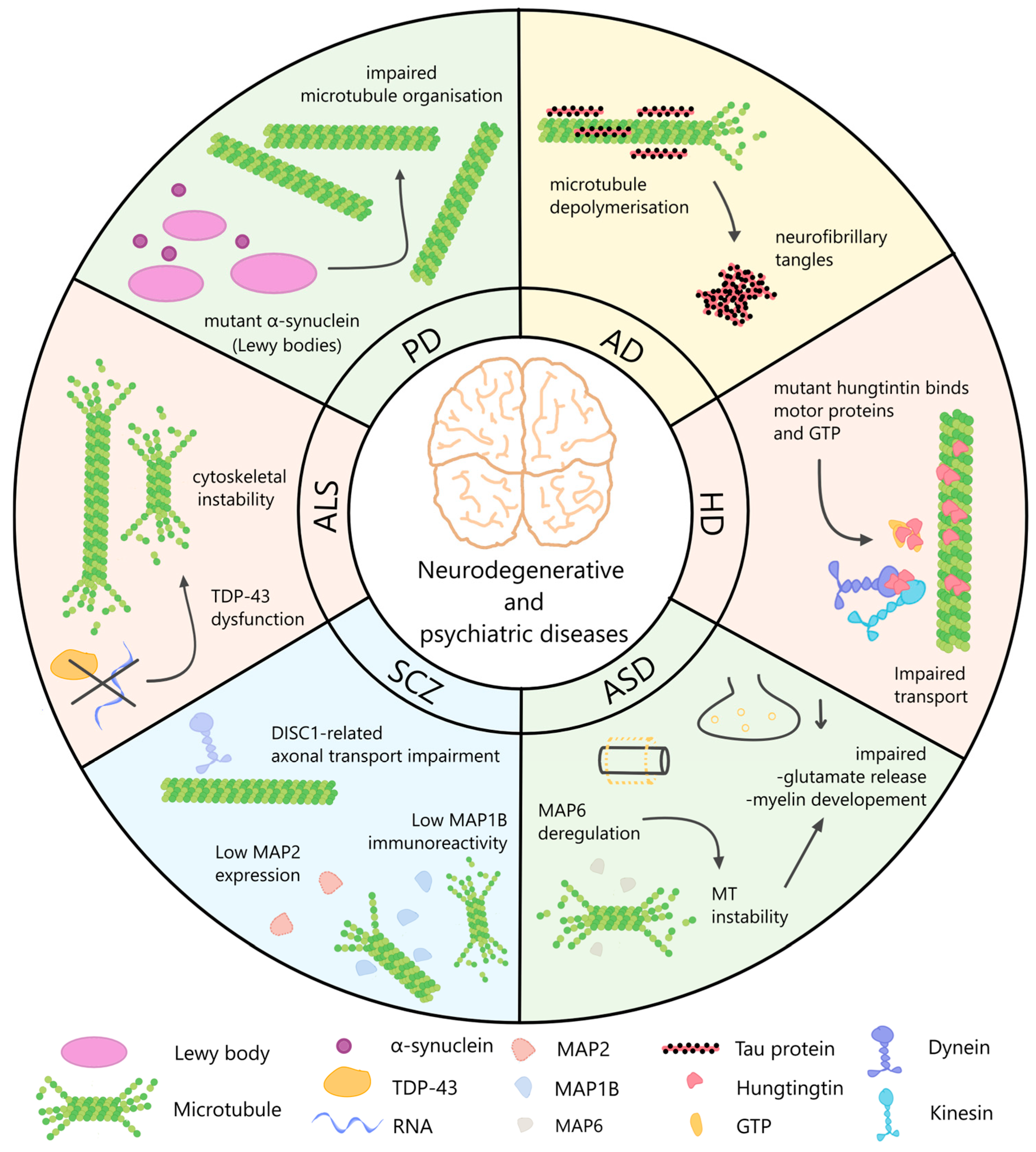
Figure 1. Microtubule dysfunction across neurodegenerative and psychiatric diseases. The schematic summarizes disease-specific alterations in microtubule organization and cytoskeletal regulation associated with major neurodegenerative and psychiatric disorders. In Alzheimer’s disease, tau detachment from microtubules promotes microtubule depolymerization and formation of neurofibrillary tangles. In Parkinson’s disease, mutant alpha-synuclein accumulates in Lewy bodies and disrupts microtubule organization. Huntington’s disease is characterized by mutant huntingtin interactions with motor proteins and GTP, leading to impaired axonal transport. In amyotrophic lateral sclerosis, TDP-43 dysfunction contributes to cytoskeletal instability and microtubule disorganization in motor neurons. Schizophrenia is associated with reduced MAP2 expression and DISC1-related defects in microtubule-dependent axonal transport. In autism spectrum disorder, dysregulation of MAP6 leads to microtubule instability, impaired glutamate release, and altered myelin development.
Ijms 27 02550 g001
Figure 2. Calcium and cytoskeletal dysregulation in dendritic spines under physiological conditions and in Alzheimer’s disease. A simplified schematic representation of major events occurring in dendritic spines upon physiological condition (left) or Aβ oligomer exposure (right). A detailed description of pathways is given in the 2nd, 3rd and 4th sections. The schematic illustrates molecular organization of a healthy dendritic spine (left) compared with a spine in Alzheimer’s disease (right). In healthy spines, coordinated activity of synaptic receptors, calcium channels, and intracellular calcium stores maintains calcium homeostasis and supports actin and microtubule dynamics essential for spine stability and plasticity. In Alzheimer’s disease, disrupted calcium signaling leads to elevated cytosolic calcium, activation of calpain, cytoskeletal destabilization, reduced microtubule invasion, and loss of synaptic proteins. 1—Synaptopodin dependent coupling of NMDA receptors supports calcium signaling and spine stability; 2—STIM2 interaction with the microtubule plus end binding protein EB3 promotes activity dependent microtubule entry into dendritic spines; 3—STIM2 may mediate coupling to IP3 receptors, representing a potential mechanism for regulating calcium release from the spine apparatus endoplasmic reticulum; 4—EB3 associated microtubule invasion exerts neuroprotective effects by stabilizing spine structure and synaptic function; 5—Positive allosteric modulation of SERCA enhances calcium reuptake into the endoplasmic reticulum and limits cytosolic calcium overload; 6—Activation of TRPC6 channels by piperazine derived compounds promotes synaptoprotection and calcium homeostasis; 7—Modulation of NMDA receptor activity contributes to normalization of calcium influx under pathological conditions.
Ijms 27 02550 g002
Disclaimer/Publisher’s Note: The statements, opinions and data contained in all publications are solely those of the individual author(s) and contributor(s) and not of MDPI and/or the editor(s). MDPI and/or the editor(s) disclaim responsibility for any injury to people or property resulting from any ideas, methods, instructions or products referred to in the content.