Making the Bridge Between Experiment and Theory in Metal Oxides for Renewable Energy: Based on TiO2, ZnO, and BiVO4

Abstract
1. Introduction
2. Metal Oxides in Renewable Energy Applications
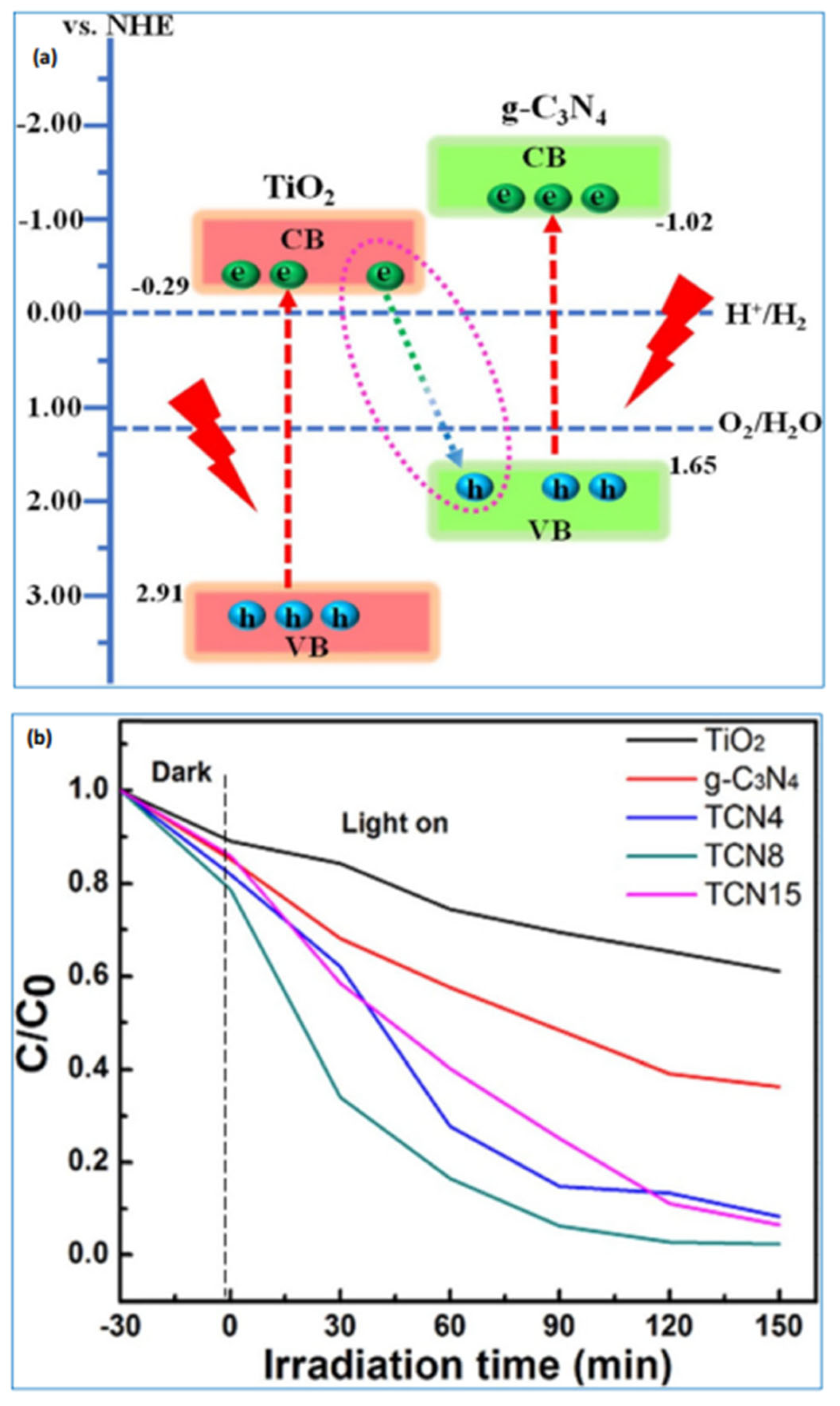
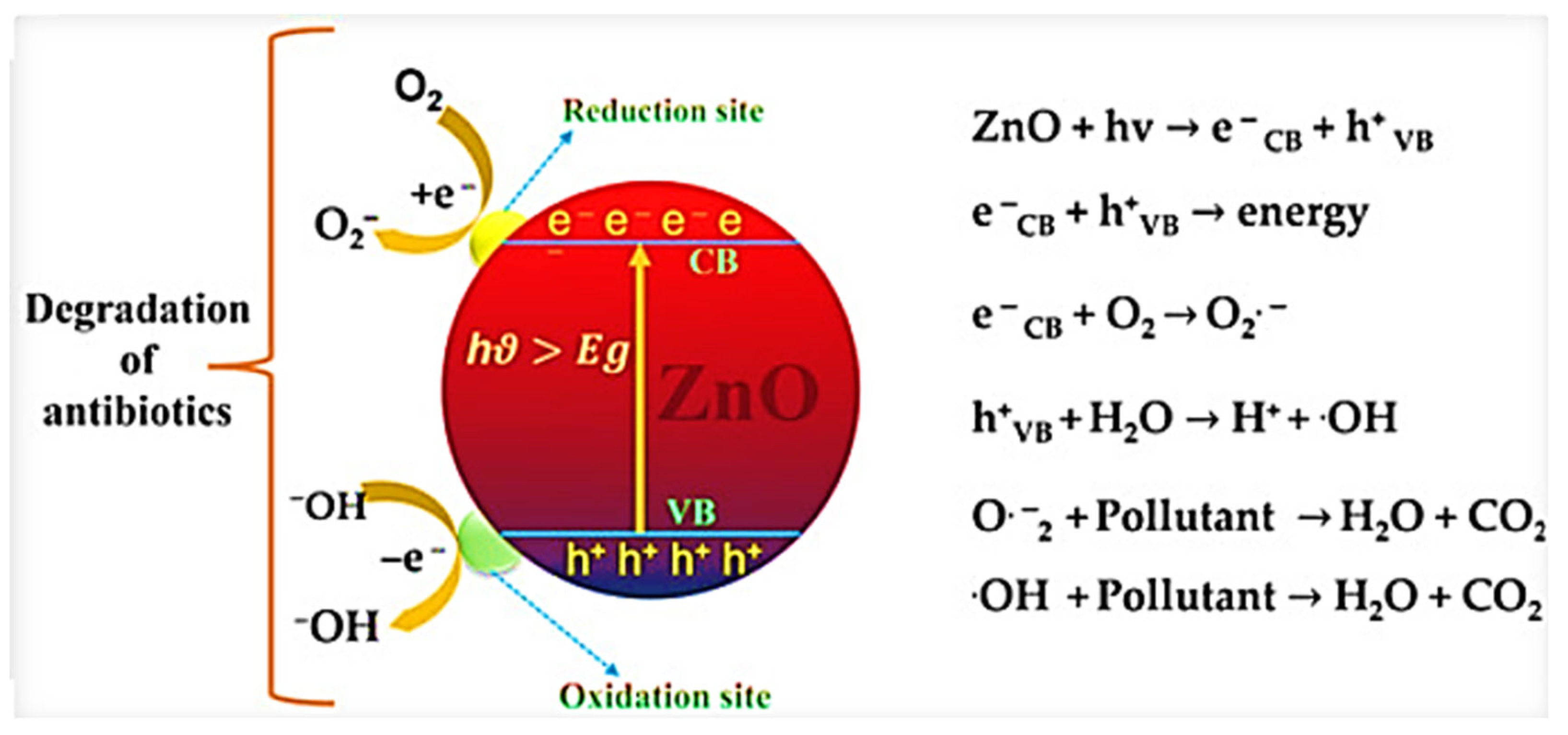
2.1. Photocatalysis (e.g., Water Splitting, Pollutant Degradation)

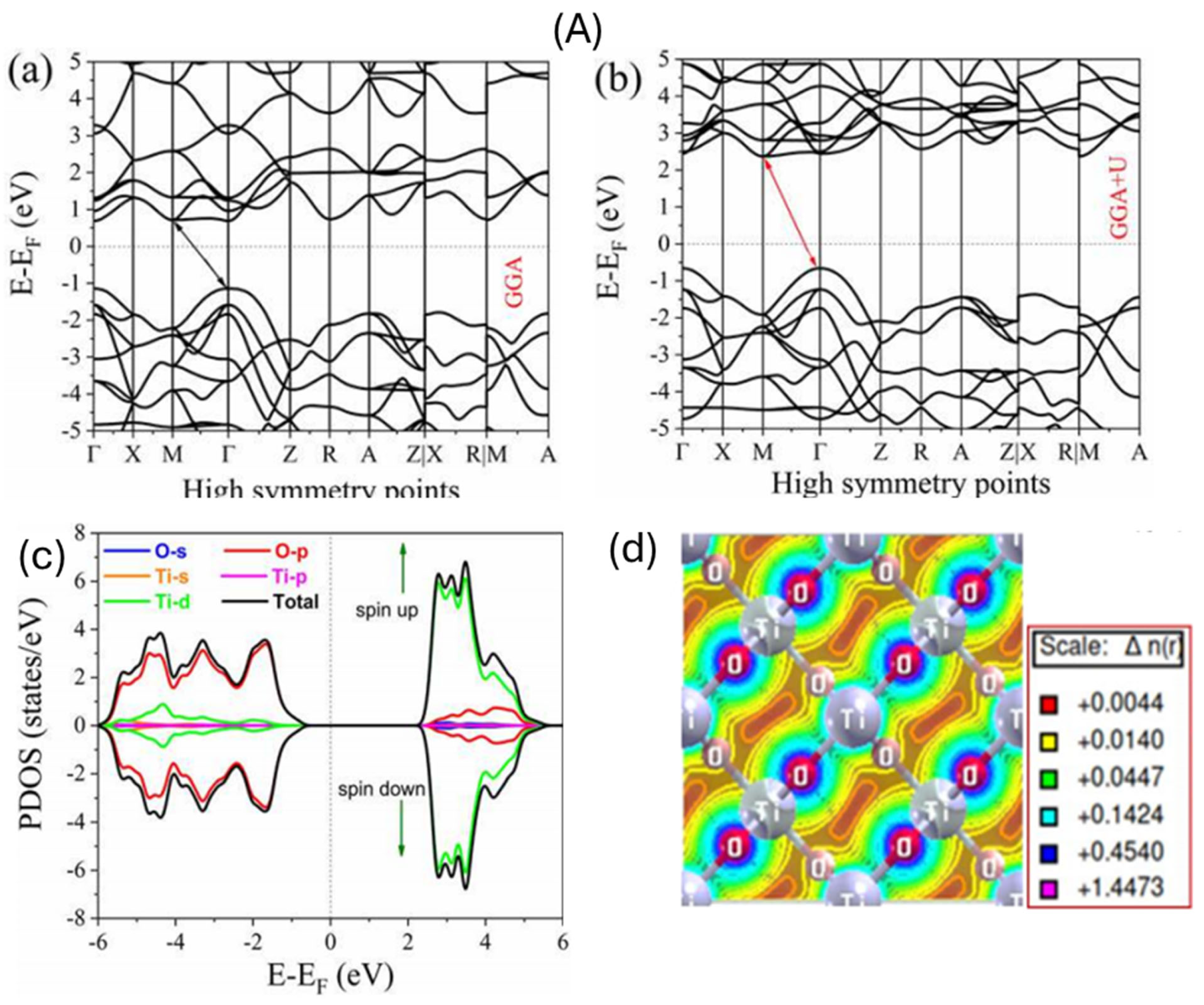
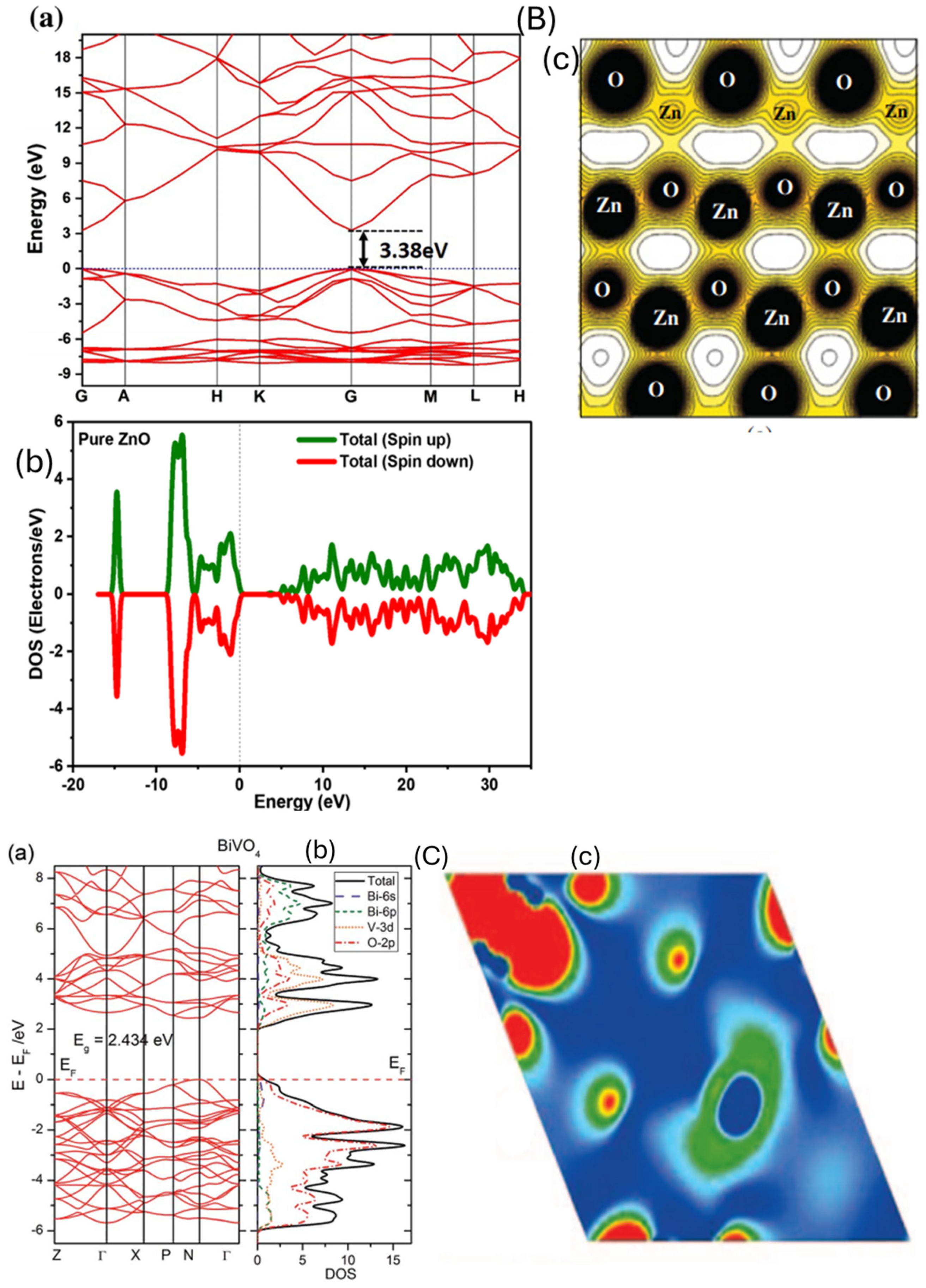
DFT Insights: Band Structure, DOS, Charge Density Maps of TiO2, ZnO, BiVO4


2.2. Solar Energy Conversion
2.2.1. Role of TiO2, ZnO, and BiVO4 as Photoanodes
2.2.2. Interface Engineering
2.3. DFT Modeling for Interface and Energy Level Optimization
2.4. Energy Storage
2.4.1. Transition Metal Oxides (e.g., MnO2, Fe2O3)
2.4.2. Experimental Cycling/Stability Studies
2.4.3. Density Functional Theory (DFT) Analysis of Ion Diffusion and Redox Potentials
3. Challenges and Future Prospects
3.1. Challenges
3.2. Future Prospects
4. Conclusions
Funding
Data Availability Statement
Conflicts of Interest
References
- Zohuri, B. Navigating the global energy landscape balancing growth, demand, and sustainability. J. Mater. Sci. Appl. Eng. 2023, 2, 1–7. [Google Scholar]
- Adewumi, A.; Olu-lawal, K.A.; Okoli, C.E.; Usman, F.O.; Usiagu, G.S. Sustainable energy solutions and climate change: A policy review of emerging trends and global responses. World J. Adv. Res. Rev. 2024, 21, 408–420. [Google Scholar]
- Dechamps, P. The IEA World Energy Outlook 2022—A brief analysis and implications. Eur. Energy Clim. J. 2023, 11, 100–103. [Google Scholar] [CrossRef]
- Marzouk, O.A. Summary of the 2023 Report of TCEP (Tracking Clean Energy Progress) by the International Energy Agency (IEA), and Proposed Process for Computing a Single Aggregate Rating. E3S Web Conf. 2025, 601, 00048. [Google Scholar] [CrossRef]
- Ishola, A. Global renewable energy transition in fossil fuel dependent regions. World J. Adv. Res. Rev. 2024, 24, 1373–1380. [Google Scholar] [CrossRef]
- Hassan, Q.; Viktor, P.; Al-Musawi, T.J.; Ali, B.M.; Algburi, S.; Alzoubi, H.M.; Al-Jiboory, A.K.; Sameen, A.Z.; Salman, H.M.; Jaszczur, M. The renewable energy role in the global energy Transformations. Renew. Energy Focus 2024, 48, 100545. [Google Scholar] [CrossRef]
- Upadhyay, R.K. Markers for global climate change and its impact on social, biological and ecological systems: A review. Am. J. Clim. Chang. 2020, 9, 159. [Google Scholar] [CrossRef]
- Monyei, C.G.; Akpeji, K.O.; Oladeji, O.; Babatunde, O.M.; Aholu, O.C.; Adegoke, D.; Imafidon, J.O. Regional cooperation for mitigating energy poverty in Sub-Saharan Africa: A context-based approach through the tripartite lenses of access, sufficiency, and mobility. Renew. Sustain. Energy Rev. 2022, 159, 112209. [Google Scholar] [CrossRef]
- Nalule, V.R. Energy Poverty and Access Challenges in Sub-Saharan Africa: The Role of Regionalism; Springer: Berlin/Heidelberg, Germany, 2018. [Google Scholar]
- Wright, C.; Sathre, R.; Buluswar, S. The global challenge of clean cooking systems. Food Secur. 2020, 12, 1219–1240. [Google Scholar] [CrossRef]
- Jayachandran, M.; Gatla, R.K.; Rao, K.P.; Rao, G.S.; Mohammed, S.; Milyani, A.H.; Azhari, A.A.; Kalaiarasy, C.; Geetha, S. Challenges in achieving sustainable development goal 7: Affordable and clean energy in light of nascent technologies. Sustain. Energy Technol. Assess. 2022, 53, 102692. [Google Scholar] [CrossRef]
- Agbaitoro, G.A.; Oyibo, K.I. Realizing the United Nations Sustainable Development Goals 7 and 13 in sub-Saharan Africa by 2030: Synergizing energy and climate justice perspectives. J. World Energy Law. Bus. 2022, 15, 223–235. [Google Scholar] [CrossRef]
- Li, X.; Xiong, J.; Tang, Z.; He, W.; Wang, Y.; Wang, X.; Zhao, Z.; Wei, Y. Recent progress in metal oxide-based photocatalysts for CO2 reduction to solar fuels: A review. Molecules 2023, 28, 1653. [Google Scholar] [CrossRef]
- Farooq, U.; Ahmad, T.; Naaz, F.; Islam, S.u. Review on metals and metal oxides in sustainable energy production: Progress and perspectives. Energy Fuels 2023, 37, 1577–1632. [Google Scholar] [CrossRef]
- Danish, M.S.S.; Bhattacharya, A.; Stepanova, D.; Mikhaylov, A.; Grilli, M.L.; Khosravy, M.; Senjyu, T. A systematic review of metal oxide applications for energy and environmental sustainability. Metals 2020, 10, 1604. [Google Scholar] [CrossRef]
- Jayakumar, S.; Santhosh, P.C.; Mohideen, M.M.; Radhamani, A. A comprehensive review of metal oxides (RuO2, Co3O4, MnO2 and NiO) for supercapacitor applications and global market trends. J. Alloys Compd. 2024, 976, 173170. [Google Scholar] [CrossRef]
- Araújo, E.S.; Pereira, M.F.; da Silva, G.M.; Tavares, G.F.; Oliveira, C.Y.; Faia, P.M. A review on the use of metal oxide-based nanocomposites for the remediation of organics-contaminated water via photocatalysis: Fundamentals, bibliometric study and recent advances. Toxics 2023, 11, 658. [Google Scholar] [CrossRef]
- Das, A.; Liu, D.; Wu, Y.; Abzakh, B.A.; Madhumitha, R.; Preethi, M.; Kazakova, E.A.; Vasenko, A.S.; Prezhdo, O.V. Origin of the improved photoelectrochemical and photocatalytic activity in a ZnO-TiO2 nanohybrid revealed by experimental and density functional theory studies. J. Phys. Chem. Lett. 2024, 15, 7524–7532. [Google Scholar] [CrossRef]
- He, Y.; Wei, Y.; Wang, Z.; Zhou, X.; Yu, R. Modulation of electronic structures in N-doped TiO2 (B) for hydrogen evolution: A density functional theory study. Eng. Rep. 2024, 6, e12795. [Google Scholar] [CrossRef]
- Gerosa, M.; Di Valentin, C.; Onida, G.; Bottani, C.E.; Pacchioni, G. Anisotropic effects of oxygen vacancies on electrochromic properties and conductivity of γ-monoclinic WO3. J. Phys. Chem. C 2016, 120, 11716–11726. [Google Scholar] [CrossRef]
- Mansour, S.; Akkari, R.; Ben Chaabene, S.; Saïd Zina, M. Effect of surface site defects on photocatalytic properties of BiVO4/TiO2 heterojunction for enhanced methylene blue degradation. Adv. Mater. Sci. Eng. 2020, 2020, 6505301. [Google Scholar] [CrossRef]
- Etacheri, V.; Di Valentin, C.; Schneider, J.; Bahnemann, D.; Pillai, S.C. Visible-light activation of TiO2 photocatalysts: Advances in theory and experiments. J. Photochem. Photobiol. C Photochem. Rev. 2015, 25, 1–29. [Google Scholar] [CrossRef]
- Das, A.; Patra, M.; Bhagavathiachari, M.; Nair, R.G. Role of type II heterojunction in ZnO–In2O3 nanodiscs for enhanced visible-light photocatalysis through the synergy of effective charge carrier separation and charge transport. Mater. Chem. Phys. 2021, 263, 124431. [Google Scholar] [CrossRef]
- Su, F.-Y.; Zhang, W.-D. Fabrication and photoelectrochemical property of In2O3/ZnO composite nanotube arrays using ZnO nanorods as self-sacrificing templates. Mater. Lett. 2018, 211, 65–68. [Google Scholar] [CrossRef]
- Salih, A.K.; Khan, A.Z.; Drmosh, Q.; Kandiel, T.; Qamar, M.; Jahangir, T.; Ton-That, C.; Yamani, Z. Nanostructured BiVO4 photoanodes fabricated by vanadium-infused interaction for efficient solar water splitting. ACS Appl. Nano Mater. 2024, 7, 14115–14122. [Google Scholar] [CrossRef]
- Kim, T.W.; Choi, K.-S. Nanoporous BiVO4 photoanodes with dual-layer oxygen evolution catalysts for solar water splitting. Science 2014, 343, 990–994. [Google Scholar] [CrossRef] [PubMed]
- Shi, X.; Choi, I.Y.; Zhang, K.; Kwon, J.; Kim, D.Y.; Lee, J.K.; Oh, S.H.; Kim, J.K.; Park, J.H. Efficient photoelectrochemical hydrogen production from bismuth vanadate-decorated tungsten trioxide helix nanostructures. Nat. Commun. 2014, 5, 4775. [Google Scholar] [CrossRef]
- Zhang, J.; Xia, L.; Deng, D.; Jia, X.; Song, D.; Wang, L.; Chang, Y.; Xie, X.; Dou, L.; Wang, W. Metal–Organic Framework-Based Heterojunction Materials for Photocatalytic CO2 Reduction Reaction. Sol. RRL 2025, 202500424. [Google Scholar] [CrossRef]
- Cao, Q.; Li, Q.; Pi, Z.; Zhang, J.; Sun, L.-W.; Xu, J.; Cao, Y.; Cheng, J.; Bian, Y. Metal–organic-framework-derived ball-flower-like porous Co3O4/Fe2O3 heterostructure with enhanced visible-light-driven photocatalytic activity. Nanomaterials 2022, 12, 904. [Google Scholar] [CrossRef] [PubMed]
- Nemiwal, M.; Zhang, T.C.; Kumar, D. Recent progress in g-C3N4, TiO2 and ZnO based photocatalysts for dye degradation: Strategies to improve photocatalytic activity. Sci. Total Environ. 2021, 767, 144896. [Google Scholar] [CrossRef]
- Jia, J.; Wang, Y.; Xu, M.; Qi, M.-l.; Wu, Y.; Zhao, G. MOF-derived the direct Z-scheme gC3N4/TiO2 with enhanced visible photocatalytic activity. J. Sol-Gel Sci. Technol. 2020, 93, 123–130. [Google Scholar] [CrossRef]
- Wang, H.; Zhang, L.; Chen, Z.; Hu, J.; Li, S.; Wang, Z.; Liu, J.; Wang, X. Semiconductor heterojunction photocatalysts: Design, construction, and photocatalytic performances. Chem. Soc. Rev. 2014, 43, 5234–5244. [Google Scholar] [CrossRef]
- Herrmann, J.-M. Heterogeneous photocatalysis: Fundamentals and applications to the removal of various types of aqueous pollutants. Catal. Today 1999, 53, 115–129. [Google Scholar] [CrossRef]
- Rajamanickam, D.; Shanthi, M. Photocatalytic degradation of an organic pollutant by zinc oxide–solar process. Arab. J. Chem. 2016, 9, S1858–S1868. [Google Scholar] [CrossRef]
- Fauziyen, S.P.; Saputera, W.H.; Sasongko, D. Advancement and prospects in photocatalytic degradation of sulfamethoxazole (SMX) pharmaceutical waste. S. Afr. J. Chem. Eng. 2024, 48, 375–394. [Google Scholar] [CrossRef]
- Mohamed, K.; Benitto, J.J.; Vijaya, J.J.; Bououdina, M. Recent advances in ZnO-based nanostructures for the photocatalytic degradation of hazardous, non-biodegradable medicines. Crystals 2023, 13, 329. [Google Scholar] [CrossRef]
- Hanaor, D.A.; Sorrell, C.C. Review of the anatase to rutile phase transformation. J. Mater. Sci. 2011, 46, 855–874. [Google Scholar] [CrossRef]
- Özgür, Ü.; Alivov, Y.I.; Liu, C.; Teke, A.; Reshchikov, M.A.; Doğan, S.; Avrutin, V.; Cho, S.-J.; Morkoç. A comprehensive review of ZnO materials and devices. J. Appl. Phys. 2005, 98, 041301. [Google Scholar] [CrossRef]
- Park, Y.; McDonald, K.J.; Choi, K.-S. Progress in bismuth vanadate photoanodes for use in solar water oxidation. Chem. Soc. Rev. 2013, 42, 2321–2337. [Google Scholar] [CrossRef]
- Yan, C.; Chen, K.-F.; Lai, C.-H.; Lai, S.-W.; Chang, Q.; Peng, Y.-P. Photocatalytic degradation of Rhodamine B by microwave-assisted hydrothermal synthesized N-doped titanate nanotubes. J. Environ. Sci. 2014, 26, 1505–1512. [Google Scholar] [CrossRef]
- Lu, X.; Qiu, W.; Peng, J.; Xu, H.; Wang, D.; Cao, Y.; Zhang, W.; Ma, J. A review on additives-assisted ultrasound for organic pollutants degradation. J. Hazard. Mater. 2021, 403, 123915. [Google Scholar] [CrossRef]
- Zhang, Y. Fabrication, Structural and Spectroscopic Studies of Wide Bandgap Semiconducting Nanoparticles of ZnO for Application as White Light Emitting Diodes. Ph.D. Thesis, Université de Lyon, Lyon, France, 2020. [Google Scholar]
- Kasamatsu, Y.; Toyoshima, A.; Asai, M.; Tsukada, K.; Li, Z.; Ishii, Y.; Toume, H.; Sato, T.K.; Kikuchi, T.; Nishinaka, I. Anionic fluoro complex of element 105, Db. Chem. Lett. 2009, 38, 1084–1085. [Google Scholar] [CrossRef]
- Asahi, R.; Morikawa, T.; Ohwaki, T.; Aoki, K.; Taga, Y. Visible-light photocatalysis in nitrogen-doped titanium oxides. Science 2001, 293, 269–271. [Google Scholar] [CrossRef] [PubMed]
- Morgan, B.J.; Watson, G.W. Polaronic trapping of electrons and holes by native defects in anatase TiO2. Phys. Rev. B—Condens. Matter Mater. Phys. 2009, 80, 233102. [Google Scholar] [CrossRef]
- Kavan, L.; Grätzel, M.; Gilbert, S.; Klemenz, C.; Scheel, H. Electrochemical and photoelectrochemical investigation of single-crystal anatase. J. Am. Chem. Soc. 1996, 118, 6716–6723. [Google Scholar] [CrossRef]
- Janotti, A.; Van de Walle, C.G. Fundamentals of zinc oxide as a semiconductor. Rep. Prog. Phys. 2009, 72, 126501. [Google Scholar] [CrossRef]
- Oba, F.; Togo, A.; Tanaka, I.; Paier, J.; Kresse, G. Defect energetics in ZnO: A hybrid Hartree-Fock density functional study. Phys. Rev. B—Condens. Matter Mater. Phys. 2008, 77, 245202. [Google Scholar] [CrossRef]
- Brivio, F.; Butler, K.T.; Walsh, A.; Van Schilfgaarde, M. Relativistic quasiparticle self-consistent electronic structure of hybrid halide perovskite photovoltaic absorbers. Phys. Rev. B 2014, 89, 155204. [Google Scholar] [CrossRef]
- Cooper, J.K.; Gul, S.; Toma, F.M.; Chen, L.; Glans, P.-A.; Guo, J.; Ager, J.W.; Yano, J.; Sharp, I.D. Electronic structure of monoclinic BiVO4. Chem. Mater. 2014, 26, 5365–5373. [Google Scholar] [CrossRef]
- Abdi, F.F.; Savenije, T.J.; May, M.M.; Dam, B.; Van De Krol, R. The origin of slow carrier transport in BiVO4 thin film photoanodes: A time-resolved microwave conductivity study. J. Phys. Chem. Lett. 2013, 4, 2752–2757. [Google Scholar] [CrossRef]
- Geldasa, F.T.; Kebede, M.A.; Hone, F.G.; Jira, E.T. Density functional theory study for the influence of non-metals doping on the structural, electrical, optical, and photocatalytic properties of rutile TiO2. Comput. Condens. Matter 2024, 41, e00970. [Google Scholar] [CrossRef]
- Geldasa, F.T.; Dejene, F.B. Influence of Fluorine Doping on Rutile TiO2 Nanostructures for Visible-Light-Driven Photocatalysis: A DFT+ U Study. Nanomaterials 2025, 15, 694. [Google Scholar] [CrossRef]
- Achehboune, M.; Khenfouch, M.; Boukhoubza, I.; Derkaoui, I.; Mothudi, B.M.; Zorkani, I.; Jorio, A. Effect of Yb concentration on the structural, magnetic and optoelectronic properties of Yb doped ZnO: First principles calculation. Opt. Quantum Electron. 2021, 53, 709. [Google Scholar] [CrossRef]
- Vidya, R.; Ravindran, P.; Fjellvåg, H.; Svensson, B.; Monakhov, E.; Ganchenkova, M.; Nieminen, R.M. Energetics of intrinsic defects and their complexes in ZnO investigated by density functional calculations. Phys. Rev. B—Condens. Matter Mater. Phys. 2011, 83, 045206. [Google Scholar] [CrossRef]
- Yi, J.; Zhao, Z.-Y.; Wang, Y.-A. Systematic studies on YbxBi1−xVO4: Tm3+ solid solutions: Experiments and DFT calculations on up-conversion photoluminescence properties. RSC Adv. 2018, 8, 596–605. [Google Scholar] [CrossRef]
- Walsh, A.; Yan, Y.; Huda, M.N.; Al-Jassim, M.M.; Wei, S.-H. Band edge electronic structure of BiVO4: Elucidating the role of the Bi s and V d orbitals. Chem. Mater. 2009, 21, 547–551. [Google Scholar] [CrossRef]
- Li, X.; Wang, S.; Wang, K.; Yang, J.; Wang, K.; Han, C.; Li, L.; Yu, R.; Zhang, Y. Solution-processed Bi2S3/BiVO4/TiO2 ternary heterojunction photoanode with enhanced photoelectrochemical performance. Nanotechnol. Rev. 2023, 12, 20220550. [Google Scholar] [CrossRef]
- Khalil, M.; Naumi, F.; Pratomo, U.; Ivandini, T.A.; Kadja, G.T.; Mulyana, J.Y. Coexposed TiO2’s (001) and (101) facets in TiO2/BiVO4 photoanodes for an enhanced photocatalytic fuel cell. Appl. Surf. Sci. 2021, 542, 148746. [Google Scholar] [CrossRef]
- Wu, Z.; Yuan, D.; Lin, S.; Guo, W.; Zhan, D.; Sun, L.; Lin, C. Enhanced photoelectrocatalytic activity of Bi2S3–TiO2 nanotube arrays hetero-structure under visible light irradiation. Int. J. Hydrogen Energy 2020, 45, 32012–32021. [Google Scholar] [CrossRef]
- Su, Y.; Yu, Y.; Xue, T.; Teng, K.; Fan, Y.; Lin, J.; Liu, C.; Qu, Q.; Li, L. Revolutionary photoelectrochemical water splitting performance of BiVO4/Bi2S3 heterojunction photoanodes boosted by trace bio-Cr2O3 through multiple mechanisms. Chem. Eng. J. 2025, 517, 164376. [Google Scholar] [CrossRef]
- Liu, Z.; Xu, K.; Yu, H.; Zhang, M.; Sun, Z. In-situ preparation of double Z-scheme Bi2S3/BiVO4/TiO2 ternary photocatalysts for enhanced photoelectrochemical and photocatalytic performance. Appl. Surf. Sci. 2021, 545, 148986. [Google Scholar] [CrossRef]
- Tada, H.; Jin, Q.; Iwaszuk, A.; Nolan, M. Molecular-scale transition metal oxide nanocluster surface-modified titanium dioxide as solar-activated environmental catalysts. J. Phys. Chem. C 2014, 118, 12077–12086. [Google Scholar] [CrossRef]
- Duan, L.; Liu, S.; Wang, X.; Zhang, Z.; Luo, J. Interfacial Crosslinking for Efficient and Stable Planar TiO2 Perovskite Solar Cells. Adv. Sci. 2024, 11, 2402796. [Google Scholar] [CrossRef]
- Kim, J.; Jo, W. Engineering of buried interfaces in perovskites: Advancing sustainable photovoltaics. Nano Converg. 2024, 11, 57. [Google Scholar] [CrossRef]
- Manser, J.S.; Christians, J.A.; Kamat, P.V. Intriguing optoelectronic properties of metal halide perovskites. Chem. Rev. 2016, 116, 12956–13008. [Google Scholar] [CrossRef]
- He, X.; Tian, W.; Bai, Z.; Yang, L.; Li, L. Decoration of BiVO4/ZnO Photoanodes with Fe-ZIF-8 to Simultaneously Enhance Charge Separation and Hole Transportation for Efficient Solar Water Splitting. ChemPhotoChem 2022, 6, e202200113. [Google Scholar]
- Sun, X.; Li, L.; Shen, S.; Wang, F. TiO2/SnO2 bilayer electron transport layer for high efficiency perovskite solar cells. Nanomaterials 2023, 13, 249. [Google Scholar] [CrossRef]
- Rodbuntum, S.; Sukgorn, N.; Chanlek, N.; Nakajima, H.; Rujisamphan, N.; Ruankham, P.; Wongratanaphisan, D.; Kaewprajak, A.; Kumnorkaew, P. Dual Interfacial Tin-Oxide Layer with Chloride Salt for High-Performance and Durable Perovskite Solar Cells. ACS Appl. Energy Mater. 2023, 6, 10364–10375. [Google Scholar] [CrossRef]
- Sharma, K.K.; Saini, R.; Machinao, S.; Karuppannan, R. (111) Facet-engineered SnO2 as an electron transport layer for efficient and stable triple-cation perovskite solar cells. Sustain. Energy Fuels 2025, 9, 3102–3109. [Google Scholar]
- Abidin, N.A.Z.; Arith, F.; Noorasid, N.S.; Sarkawi, H.; Mustafa, A.N.; Safie, N.; Shah, A.M.; Azam, M.; Chelvanathan, P.; Amin, N. Dopant engineering for ZnO electron transport layer towards efficient perovskite solar cells. RSC Adv. 2023, 13, 33797–33819. [Google Scholar] [CrossRef] [PubMed]
- Lee, J.; Xie, Z.; Wang, L.; Hou, J. Advancements in Interfacial Engineering for Perovskite Light-Emitting Diodes. Chem.—Eur. J. 2024, 30, e202400372. [Google Scholar] [CrossRef] [PubMed]
- Tsvetkov, N.; Khan, M.E.; Moon, B.C.; Kim, Y.-H.; Kang, J.K. Strain-induced metallization and defect suppression at zipper-like interdigitated atomically thin interfaces enabling high-efficiency halide perovskite solar cells. ACS Nano 2020, 15, 1805–1816. [Google Scholar] [CrossRef]
- Verduci, R.; Agresti, A.; Romano, V.; D’Angelo, G. Interface engineering for perovskite solar cells based on 2d-materials: A physics point of view. Materials 2021, 14, 5843. [Google Scholar] [CrossRef]
- Zheng, C.; Li, W.; Shi, Y.; Wei, S.; Liu, K.; Cheng, J.; Ji, L.; Lu, Y. Stretchable self-adhesive and self-powered smart bandage for motion perception and motion intention recognition. Nano Energy 2023, 109, 108245. [Google Scholar] [CrossRef]
- Delbari, S.A.; Ghadimi, L.S.; Hadi, R.; Farhoudian, S.; Nedaei, M.; Babapoor, A.; Namini, A.S.; Van Le, Q.; Shokouhimehr, M.; Asl, M.S. Transition metal oxide-based electrode materials for flexible supercapacitors: A review. J. Alloys Compd. 2021, 857, 158281. [Google Scholar] [CrossRef]
- BiBi, S.; Shah, M.Z.U.; Sajjad, M.; Shafi, H.Z.; Amin, B.; Bajaber, M.A.; Shah, A. A new ZnO-ZnS-CdS heterostructure on Ni substrate: A binder-free electrode for advanced asymmetric supercapacitors with improved performance. Electrochim. Acta 2022, 430, 141031. [Google Scholar] [CrossRef]
- Chaudhari, S.A.; Patil, V.V.; Jadhav, V.A.; Thorat, P.; Sutar, S.S.; Dongale, T.D.; Parale, V.; Patil, V.; Mhamane, D.S.; Mali, M.G. Conductivity boosted BiVO4 for enhanced OER and supercapacitive performance: Stability insights with modeling, predictions, and forecasting using machine learning technique. Energy Mater. 2025, 5, 500082. [Google Scholar] [CrossRef]
- Zhang, J.; Tan, T.; Zhao, Y.; Liu, N. Preparation of ZnO nanorods/graphene composite anodes for high-performance lithium-ion batteries. Nanomaterials 2018, 8, 966. [Google Scholar] [CrossRef] [PubMed]
- Bui, V.K.H.; Pham, T.N.; Hur, J.; Lee, Y.-C. Review of ZnO binary and ternary composite anodes for lithium-ion batteries. Nanomaterials 2021, 11, 2001. [Google Scholar] [CrossRef] [PubMed]
- Dutta, S.; Pal, S.; De, S. Hydrothermally synthesized BiVO4–reduced graphene oxide nanocomposite as a high performance supercapacitor electrode with excellent cycle stability. New J. Chem. 2018, 42, 10161–10166. [Google Scholar] [CrossRef]
- Patil, R.B.; Yadav, A.D.; Kanamadi, C.M.; Patil, S.P. Electrochemical advancements: MnO2-based electrode materials for supercapacitors. Ionics 2025, 31, 1203–1231. [Google Scholar] [CrossRef]
- Qian, J. Graphene/Manganese Oxide Composites for Energy Storage. Ph.D. Thesis, Hong Kong Polytechnic University, Hong Kong, China, 2017. [Google Scholar]
- Yang, Y.; Fu, W.; Lee, D.; Bell, C.; Drexler, M.; Ma, Z.; Magasinski, A.; Yushin, G.; Alamgir, F. Porous FeP/C composite nanofibers as high-performance anodes for Li-ion/Na-ion batteries. Mater. Today Energy 2020, 16, 100410. [Google Scholar] [CrossRef]
- Zou, Y.; Liu, H.; Liu, G.; Yang, B.; Li, J.; Wang, S.; Xie, K.; Wang, C.; Iqbal, S. MXene-modified and electrochemically enhanced polyaniline hydrogels for flexible asymmetric supercapacitors. J. Energy Storage 2025, 120, 116373. [Google Scholar] [CrossRef]
- Chen, Y.; Zou, L.; Liu, H.; Chen, C.; Wang, Q.; Gu, M.; Yang, B.; Zou, Z.; Fang, J.; Yang, H. Fe and N Co-doped porous carbon nanospheres with high density of active sites for efficient CO2 electroreduction. J. Phys. Chem. C 2019, 123, 16651–16659. [Google Scholar] [CrossRef]
- Wang, J.; Cui, Y.; Wang, D. Design of hollow nanostructures for energy storage, conversion and production. Adv. Mater. 2019, 31, 1801993. [Google Scholar] [CrossRef]
- Feng, Y.; Shu, N.; Xie, J.; Ke, F.; Zhu, Y.; Zhu, J. Carbon-coated Fe2O3 hollow sea urchin nanostructures as high-performance anode materials for lithium-ion battery. Sci. China Mater. 2021, 64, 307–317. [Google Scholar] [CrossRef]
- Yang, J.; Xu, Q.; Zheng, Y.; Tian, Z.; Shi, Y.; Ma, C.; Liu, G.; Peng, B.; Wang, Z.; Zheng, W. Phase engineering of metastable transition metal dichalcogenides via ionic liquid assisted synthesis. ACS Nano 2022, 16, 15215–15225. [Google Scholar] [CrossRef]
- Henkelman, G.; Uberuaga, B.P.; Jónsson, H. A climbing image nudged elastic band method for finding saddle points and minimum energy paths. J. Chem. Phys. 2000, 113, 9901–9904. [Google Scholar] [CrossRef]
- Sun, W.; Orme, C.A.; Worsley, M.A.; Wan, L.F. First-principles evaluation of MnO2 polymorphs as cathode material in lithium-ion batteries. Sustain. Energy Fuels 2024, 8, 2718–2729. [Google Scholar] [CrossRef]
- Cai, J.; Xu, L.; Tang, X.; Kong, L.; Wang, J.; Wang, R.; Li, X.; Xie, Q.; Mao, K.; Pan, H. Role of lithium doping on α-Fe2O3 photoanode for enhanced photoelectrochemical water oxidation. J. Alloys Compd. 2022, 915, 165349. [Google Scholar] [CrossRef]
- Rassouli, L.; Dupuis, M. Electronic structure of excitons in hematite Fe2O3. J. Phys. Chem. C 2024, 128, 743–758. [Google Scholar] [CrossRef]
- Xu, G.; Jiang, M.; Li, J.; Xuan, X.; Li, J.; Lu, T.; Pan, L. Machine learning-accelerated discovery and design of electrode materials and electrolytes for lithium ion batteries. Energy Storage Mater. 2024, 72, 103710. [Google Scholar] [CrossRef]
- Li, N.; Wei, Y.; Liu, S.; Yu, Z.; Shen, Y.; Wang, M. Boosting Oxygen Evolution Reaction Performance on BiVO4 Photoanode via Gradient Oxygen Vacancies. ACS Energy Lett. 2025, 10, 2162–2170. [Google Scholar] [CrossRef]
- Zhang, L.; Zhao, S.; Chen, C.; Jiang, B.; Jaroniec, M. In situ characterization of semiconductor photocatalysts. Mater. Today 2025, in press. [CrossRef]
- Schichtl, Z.G.; Carvalho, O.Q.; Tan, J.; Saund, S.S.; Ghoshal, D.; Wilder, L.M.; Gish, M.K.; Nielander, A.C.; Stevens, M.B.; Greenaway, A.L. Chemistry of Materials Underpinning Photoelectrochemical Solar Fuel Production. Chem. Rev. 2025, 125, 4768–4839. [Google Scholar] [CrossRef]
- Wary, R.R.; Das, A.; Amirov, E.S.; Liu, D.; Gumber, S.; Kazakova, E.A.; Vasenko, A.S.; Prezhdo, O.V. Highly Oriented Nitrogen-Doped Flower-like ZnO Nanostructures for Boosting Photocatalytic and Photoelectrochemical Performance: A Combined Experimental and DFT Study. J. Phys. Chem. Lett. 2025, 16, 5180–5187. [Google Scholar] [CrossRef]
- Amelia, S.R.; Rohmatulloh, Y.; Listiani, P.; Devi, M.J.; Ichikawa, Y.; Honda, M.; Nurrosyid, N.; Isnaeni, I.; Sudiarti, T.; Ivansyah, A.L. One pot synthesis and performance of N-and (Mg, B, N)-doped ZnO for photocatalytic and antibacterial applications: Experimental and theoretical investigations. Ceram. Int. 2024, 50, 11216–11235. [Google Scholar] [CrossRef]
- Chen, Y.; Soler, L.; Cazorla, C.; Oliveras, J.; Bastús, N.G.; Puntes, V.F.; Llorca, J. Facet-engineered TiO2 drives photocatalytic activity and stability of supported noble metal clusters during H2 evolution. Nat. Commun. 2023, 14, 6165. [Google Scholar] [CrossRef]
- Feng, N.; Xu, J.; Deng, F. Solid-state NMR of active sites in TiO2 photocatalysis: A critical review. Chem. Synth. 2024, 4, 43. [Google Scholar] [CrossRef]
- Morales-Garcia, A.; Vines, F.; Sousa, C.; Illas, F. Toward a Rigorous Theoretical description of photocatalysis using Realistic models. J. Phys. Chem. Lett. 2023, 14, 3712–3720. [Google Scholar] [CrossRef] [PubMed]
- Arunachalam, P.; Amer, M.S.; Al-Mayouf, A.M.; Alsaleh, A.A. Surface engineering of BiVO4 photoanodes for photoelectrochemical water splitting: Recent advances. ChemCatChem 2024, 16, e202400312. [Google Scholar] [CrossRef]
- Kozyr, E.G.; Njoroge, P.N.; Chapek, S.V.; Shapovalov, V.V.; Skorynina, A.A.; Pnevskaya, A.Y.; Bulgakov, A.N.; Soldatov, A.V.; Pellegrino, F.; Groppo, E. Operando laboratory X-ray absorption spectroscopy and UV–Vis study of Pt/TiO2 photocatalysts during photodeposition and hydrogen evolution reactions. Catalysts 2023, 13, 414. [Google Scholar] [CrossRef]



| Materials | Light Absorption | Charge Transport | Surface Defects | Application | Ref. |
|---|---|---|---|---|---|
| TiO2 | Primarily absorbs UV light due to a wide bandgap (~3.2 eV). Visible light absorption can be enhanced through doping or forming heterojunctions. | Exhibits rapid electron–hole recombination; strategies like doping and heterojunction formation improve charge separation. | Surface defects, such as oxygen vacancies, can trap charge carriers, influencing photocatalytic activity. | Water splitting, pollutant degradation. | [21] |
| ZnO | Absorbs UV light with a bandgap of ~3.3 eV. Visible light activity can be achieved through defect engineering and composite formation. | Similarly to TiO2, it suffers from rapid recombination; heterostructures can enhance charge separation. | Oxygen vacancies and other defects can introduce mid-gap states, affecting photocatalytic efficiency. | Pollutant degradation, water splitting. | [22,23,24] |
| BiVO4 | Narrower bandgap (~2.4 eV) allows visible light absorption. | Limited by short hole diffusion length (~70 nm) and poor electron mobility | Oxygen vacancies and surface states can enhance or suppress performance depending on concentration | Photocatalytic water splitting, photoelectrochemical (PEC) cells. | [25,26,27] |
| Experimental Uv-Vis Potential of TiO2, ZnO, and BiVO4 | ||||||
|---|---|---|---|---|---|---|
| Material | Bandgap (eV) | Absorption Edge | Light Response | UV-Vis Technique | Tauc Type | Ref. |
| TiO2 | ~3.0–3.2 | ~390 nm | UV only | DRS/Transmission | Indirect/Direct | [37] |
| ZnO | ~3.3 | ~375 nm | UV only | DRS/Transmission | Direct | [38] |
| BiVO4 | ~2.4–2.5 | ~520 nm | UV + Visible | DRS | Direct | [39] |
| Experimental Photoluminescence (PL) Potential of TiO2, ZnO, and BiVO4 | ||||||
| TiO2 (Anatase) | ~3.2 | UV (~380 nm) and visible (blue-green) | Band-edge and surface oxygen vacancies | (O vacancy, Ti3+ states) | Photocatalysis monitoring, defect analysis | [40,41] |
| ZnO | ~3.3 | Strong UV (~380 nm) and visible (green, ~500–550 nm) | Excitonic and deep-level emissions | Zn vacancies, O vacancies, interstitials) | LED devices, sensors, defect studies | [42] |
| BiVO4 (Monoclinic) | ~2.4 | Broad visible (~500–700 nm) | Defect states, oxygen vacancies, charge carrier trapping | Yes (mainly V5+/V4+ centers, O vacancies) | Photocatalytic charge recombination study | [26,43] |
Disclaimer/Publisher’s Note: The statements, opinions and data contained in all publications are solely those of the individual author(s) and contributor(s) and not of MDPI and/or the editor(s). MDPI and/or the editor(s) disclaim responsibility for any injury to people or property resulting from any ideas, methods, instructions or products referred to in the content. |
© 2026 by the authors. Licensee MDPI, Basel, Switzerland. This article is an open access article distributed under the terms and conditions of the Creative Commons Attribution (CC BY) license.
Share and Cite
Etefa, H.F.; Dejene, F.B. Making the Bridge Between Experiment and Theory in Metal Oxides for Renewable Energy: Based on TiO2, ZnO, and BiVO4. Int. J. Mol. Sci. 2026, 27, 2087. https://doi.org/10.3390/ijms27052087
Etefa HF, Dejene FB. Making the Bridge Between Experiment and Theory in Metal Oxides for Renewable Energy: Based on TiO2, ZnO, and BiVO4. International Journal of Molecular Sciences. 2026; 27(5):2087. https://doi.org/10.3390/ijms27052087
Chicago/Turabian StyleEtefa, Habtamu F., and Francis B. Dejene. 2026. "Making the Bridge Between Experiment and Theory in Metal Oxides for Renewable Energy: Based on TiO2, ZnO, and BiVO4" International Journal of Molecular Sciences 27, no. 5: 2087. https://doi.org/10.3390/ijms27052087
APA StyleEtefa, H. F., & Dejene, F. B. (2026). Making the Bridge Between Experiment and Theory in Metal Oxides for Renewable Energy: Based on TiO2, ZnO, and BiVO4. International Journal of Molecular Sciences, 27(5), 2087. https://doi.org/10.3390/ijms27052087