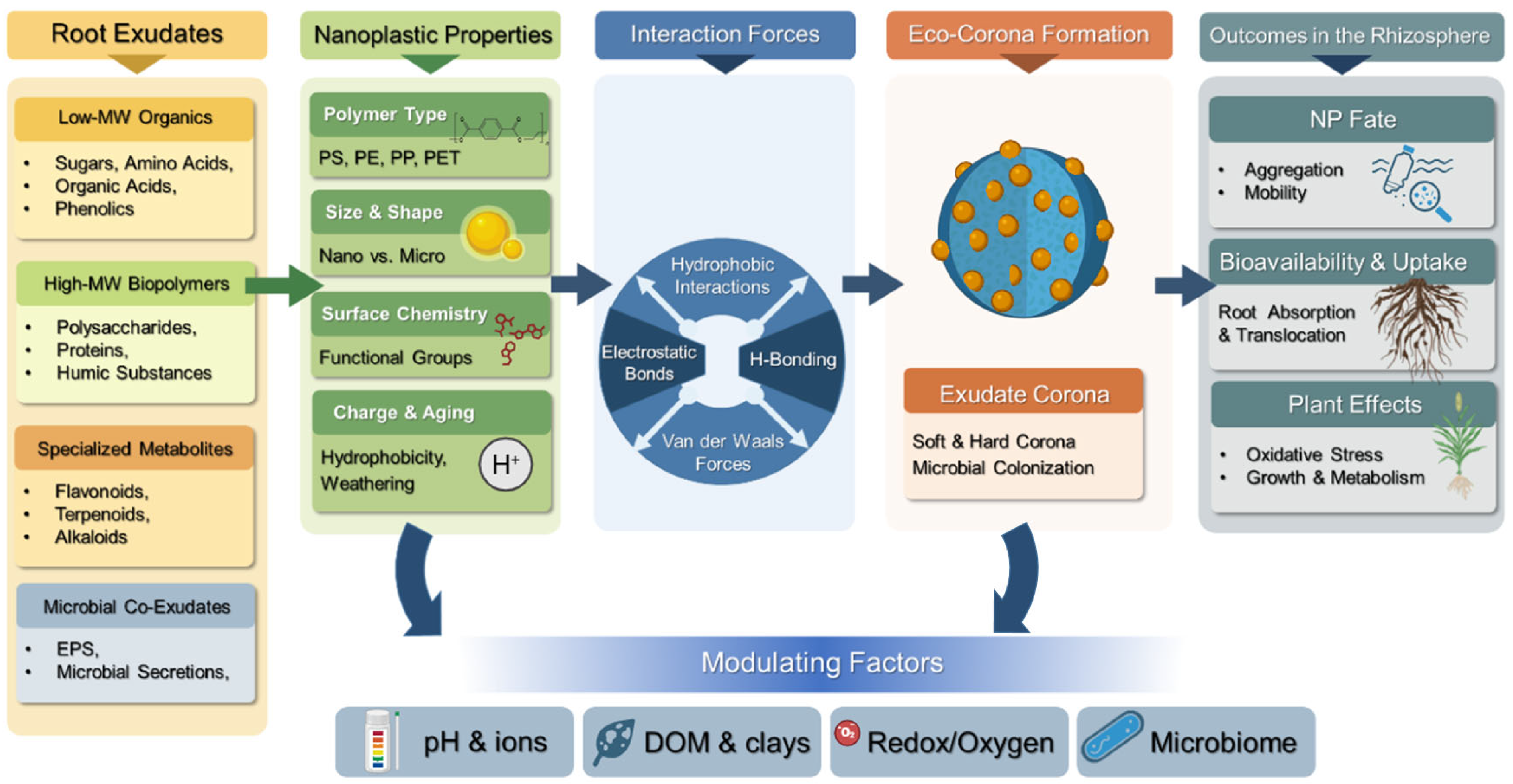
From Root Exudates to Eco-Corona: Mechanisms Shaping Nanoplastic Fate and Plant–Soil Interactions


Abstract
1. Introduction
2. Effects of NPs on Root Exudation
2.1. Chemical Composition and Mechanism of Root Exudate Release
2.2. The Root Exudates Under Abiotic Stress Conditions
2.3. Interactions Between NPs and Root Exudates
2.3.1. Aggregation
2.3.2. Molecular Adsorption

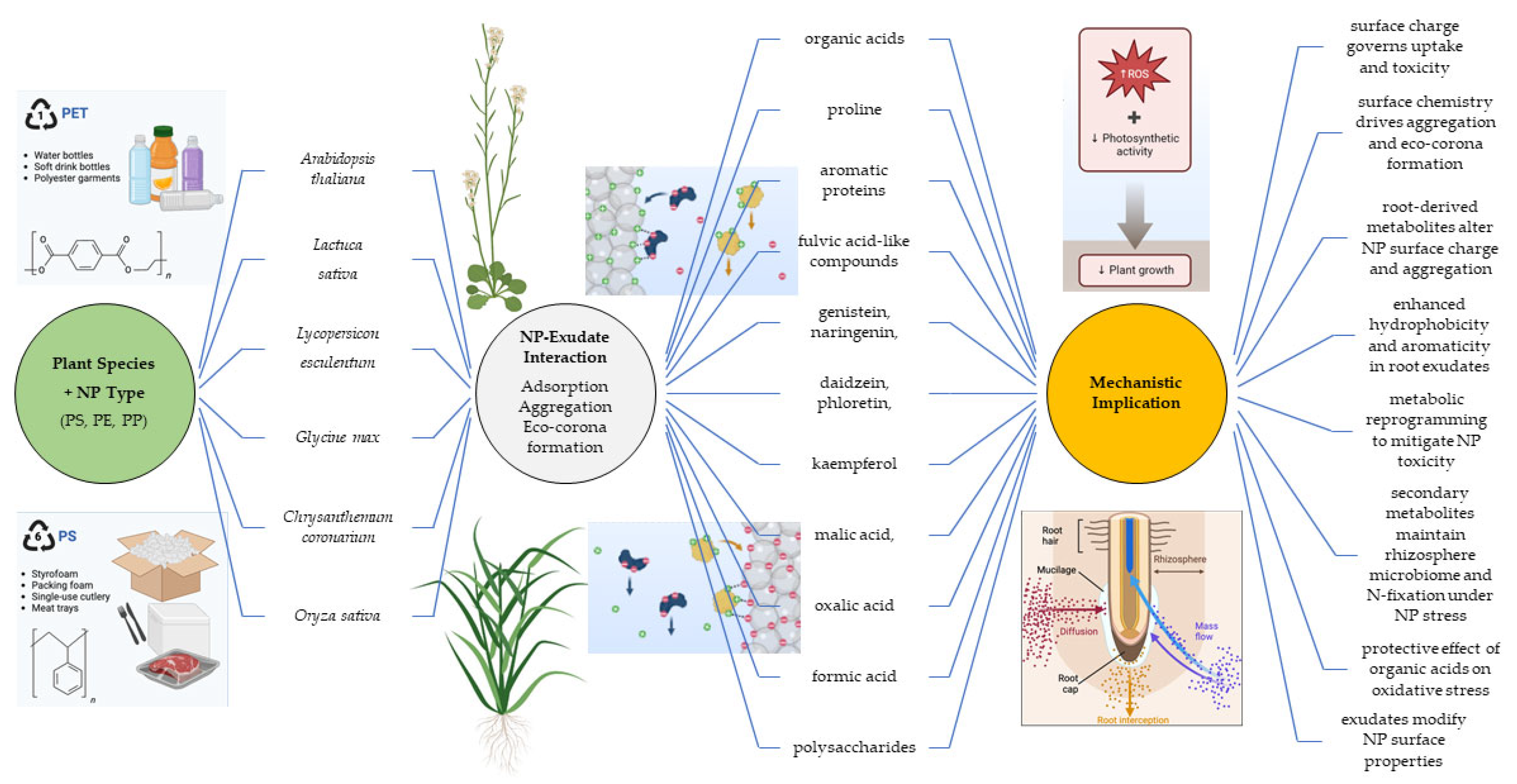
| Plant Species | NP Type and Size | NPs—Exudate Interaction | Key Metabolites Identified | Mechanistic Implication | Ref. |
|---|---|---|---|---|---|
| Accumulation Patterns of NPs in Plants Are Strongly Governed by Their Surface Charge Characteristics | |||||
| Arabidopsis thaliana | PS (~100 nm) |
| Not specified | Surface charge governs uptake and toxicity | [18] |
| Root-Secreted Organic Compounds, Such as Carboxylic Acids and Amino Acids, Serve as a Key Defense Strategy Against NPs Toxicity | |||||
| Lactuca sativa | PE, PS (~200 nm) |
| organic acids proline | Surface chemistry drives aggregation and eco-corona formation | [53] |
| Root Exudates Adsorb Onto the Surface of NPs, Thereby Modifying Their Phytotoxicity | |||||
| Glycine max | NPs (below 1 µm) |
| Organic acids | Root-derived metabolites alter NP surface charge and aggregation | [56] |
| Qualitative Changes in Exudate Composition as Part of the Plant’s Response | |||||
| Lactuca sativa | PE (~100 µm) |
| Aromatic proteins and fulvic acid-like compounds | enhanced hydrophobicity and aromaticity in root exudates | [27] |
| Effects of Microplastics on Plant Growth Are Polymer Type-Dependent | |||||
| Lycopersicon esculentum | PS, PE, PP (<5 mm and <0.1 μm) |
| Organic acids, amino acid | Metabolic reprogramming to mitigate NP toxicity | [30] |
| Under NPs Stress, Plants Strategically Allocate Metabolic Resources to Enhance the Production of Secondary Metabolites | |||||
| Glycine max | PE, PP (~20–50 nm) |
| Genistein, naringenin, daidzein, phloretin, kaempferol | Secondary metabolites maintain rhizosphere microbiome and N-fixation under NP stress | [51] |
| Specific Composition of Low-Molecular-Weight Organic Acids of Root Exudates | |||||
| Chrysanthemum coronarium | PS (~100 nm) |
| Malic acid, oxalic acid, formic acid | Protective effect of organic acids on oxidative stress | [52] |
| Root Exudates Reduce the Mobility of PS and PET Microplastics | |||||
| Oryza sativa | PS (~0.51 μm, 1.1 μm), PET (~1 μm) |
| Low-molecular-weight organic acids, amino acids, polysaccharides | Exudates modify NP surface properties | [55] |
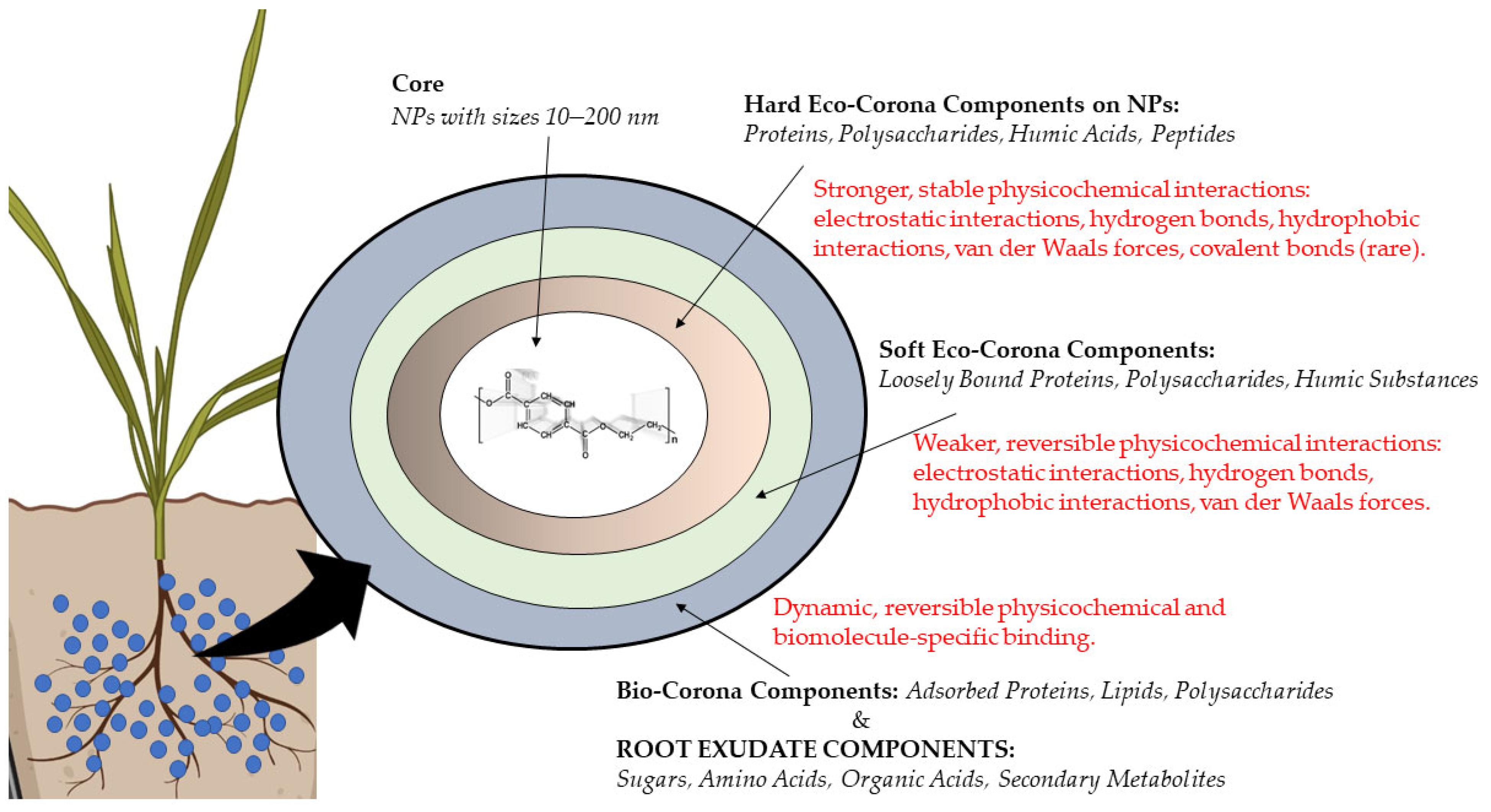
2.4. Formation of an “Ecological Corona” as a Basic Mechanism of Interaction Between NPs and Exudates
3. Conclusions
Author Contributions
Funding
Data Availability Statement
Conflicts of Interest
References
- He, L.; Li, Z.; Jia, Q.; Xu, Z. Soil microplastics pollution in agriculture. Science 2023, 379, 547. [Google Scholar] [CrossRef]
- MacLeod, M.; Arp, H.P.H.; Tekman, M.B.; Jahnke, A. The global threat from plastic pollution. Science 2021, 373, 61–65. [Google Scholar] [CrossRef]
- Rillig, M.C.; Lehmann, A. Microplastic in terrestrial ecosystems. Science 2020, 368, 1430–1431. [Google Scholar] [CrossRef]
- Thompson, R.C.; Courtene-Jones, W.; Boucher, J.; Pahl, S.; Raubenheimer, K.; Koelmans, A.A. Twenty years of microplastic pollution research-what have we learned? Science 2024, 386, eadl2746. [Google Scholar] [CrossRef]
- Yu, Z.; Xu, X.; Guo, L.; Jin, R.; Lu, Y. Uptake and transport of micro/nanoplastics in terrestrial plants: Detection, mechanisms, and influencing factors. Sci. Total Environ. 2024, 907, 168155. [Google Scholar] [CrossRef] [PubMed]
- Tang, Y.; Li, G.; Iqbal, B.; Tariq, M.; Rehman, A.; Khan, I.; Du, D. Soil nutrient levels regulate the effect of soil microplastic contamination on microbial element metabolism and carbon use efficiency. Ecotoxicol. Environ. Saf. 2023, 267, 115640. [Google Scholar] [CrossRef] [PubMed]
- Jia, L.; Liu, L.; Zhang, Y.; Fu, W.; Liu, X.; Wang, Q.; Tanveer, M.; Huang, L. Microplastic stress in plants: Effects on plant growth and their remediations. Front. Plant Sci. 2023, 14, 1226484. [Google Scholar] [CrossRef] [PubMed]
- Bosker, T.; Bouwman, L.J.; Brun, N.R.; Behrens, P.; Vijver, M.G. Microplastics accumulate on pores in seed capsule and delay germination and root growth of the terrestrial vascular plant Lepidium sativum. Chemosphere 2019, 226, 774–781. [Google Scholar] [CrossRef]
- Jiang, X.; Chen, H.; Liao, Y.; Ye, Z.; Li, M.; Klobučar, G. Ecotoxicity and genotoxicity of polystyrene microplastics on higher plant Vicia faba. Environ. Pollut. 2019, 250, 831–838. [Google Scholar] [CrossRef]
- Ren, F.; Huang, J.; Yang, Y. Unveiling the impact of microplastics and nanoplastics on vascular plants: A cellular metabolomic and transcriptomic review. Ecotoxicol. Environ. Saf. 2024, 279, 116490. [Google Scholar] [CrossRef]
- Sun, X.; Withana, P.A.; Palansooriya, K.N.; Vithanage, M.; Yang, X.; Lee, S.R.; Bank, M.S.; You, S.; Ok, Y.S. Impacts of microplastics on terrestrial plants: A critical review. Land. Degrad. Dev. 2024, 35, 1629–1643. [Google Scholar] [CrossRef]
- Lehmann, A.; Leifheit, E.F.; Feng, L.; Bergmann, J.; Wulf, A.; Rillig, M.C. Microplastic fiber and drought effects on plants and soil are only slightly modified by arbuscular mycorrhizal fungi. Soil. Ecol. Lett. 2022, 4, 32–44. [Google Scholar] [CrossRef]
- Jadhav, B.; Medyńska-Juraszek, A. Microplastic and nanoplastic in crops: Possible adverse effects to crop production and contaminant transfer in the food chain. Plants 2024, 13, 2526. [Google Scholar] [CrossRef] [PubMed]
- Jamil, A.; Ahmad, A.; Zhang, Y.; Zhao, Y.; Chen, X.; Cui, X.; Tong, Y.; Liu, X. Unveiling the mechanism of micro-and-nano plastic phytotoxicity on terrestrial plants: A comprehensive review of omics approaches. Environ. Int. 2025, 195, 109257. [Google Scholar] [CrossRef]
- Sahai, H.; Bueno, M.J.M.; del Mar Gómez-Ramos, M.; Fernández-Alba, A.R.; Hernando, M.D. Quantification of nanoplastic uptake and distribution in the root, stem, and leaves of the edible herb Lepidum sativum. Sci. Total Environ. 2024, 912, 168903. [Google Scholar] [CrossRef]
- Vleeming, J.; Laan, S.N.; Bosker, T. Uptake and Translocation of Polystyrene Nanoplastics in Edible Plants via Root and Foliar Exposure: A Qualitative Imaging-Based Study. Environ. Pollut. 2025, 390, 127516. [Google Scholar] [CrossRef]
- Li, H.; Chang, X.; Zhang, J.; Wang, Y.; Zhong, R.; Wang, L.; Wei, J.; Wang, Y. Uptake and distribution of microplastics of different particle sizes in maize (Zea mays) seedling roots. Chemosphere 2023, 313, 137491. [Google Scholar] [CrossRef]
- Sun, X.D.; Yuan, X.Z.; Jia, Y.; Feng, L.J.; Zhu, F.P.; Dong, S.S.; Liu, J.; Kong, X.; Tian, H.; Duan, J.L.; et al. Differentially charged nanoplastics demonstrate distinct accumulation in Arabidopsis thaliana. Nat. Nanotechnol. 2020, 15, 755–760. [Google Scholar] [CrossRef]
- Liu, J.; Wang, P.; Wang, Y.; Zhang, Y.; Xu, T.; Zhang, Y.; Xi, J.; Hou, L.; Li, L.; Zhang, Z.; et al. Negative effects of poly (butylene adipate-co-terephthalate) microplastics on Arabidopsis and its root-associated microbiome. J. Hazard. Mater. 2022, 437, 129294. [Google Scholar] [CrossRef]
- Urbina, M.A.; Correa, F.; Aburto, F.; Ferrio, J.P. Adsorption of polyethylene microbeads and physiological effects on hydroponic maize. Sci. Total Environ. 2020, 741, 140216. [Google Scholar] [CrossRef]
- Wang, L.; Liu, B.; Zhang, W.; Li, Q.; Lin, B.; Wei, C. An unrecognized entry pathway of submicrometre plastics into crop root: The split of hole in protective layer. J. Hazard. Mater. 2023, 457, 131732. [Google Scholar] [CrossRef]
- Dauphin, B.G.; Ranocha, P.; Dunand, C.; Burlat, V. Cell-wall microdomain remodeling controls crucial developmental processes. Trends Plant Sci. 2022, 27, 1033–1048. [Google Scholar] [CrossRef] [PubMed]
- Zhou, P.; Wang, L.; Gao, J.; Jiang, Y.; Adeel, M.; Hou, D. Nanoplastic–plant interaction and implications for soil health. Soil. Use Manag. 2023, 39, 13–42. [Google Scholar] [CrossRef]
- Ma, S.; Hua, Z.; Tang, C.; Qiu, X.; Ding, L.; Liang, X.; Zhang, Y.; Guo, X. Root meristem maintenance mechanisms are key to plant defense against nanoplastics. Adv. Sci. 2025, 12, e11837. [Google Scholar] [CrossRef] [PubMed]
- Giorgetti, L.; Spanò, C.; Muccifora, S.; Bottega, S.; Barbieri, F.; Bellani, L.; Castiglione, M.R. Exploring the interaction between polystyrene nanoplastics and Allium cepa during germination: Internalization in root cells, induction of toxicity and oxidative stress. Plant Physiol. Biochem. 2020, 149, 170–177. [Google Scholar] [CrossRef]
- Zhou, C.Q.; Lu, C.H.; Mai, L.; Bao, L.J.; Liu, L.Y.; Zeng, E.Y. Response of rice (Oryza sativa L.) roots to nanoplastic treatment at seedling stage. J. Hazard. Mater. 2021, 401, 123412. [Google Scholar] [CrossRef]
- Cai, Y.; Xu, Y.; Liu, G.; Li, B.; Guo, T.; Ouyang, D.; Li, M.; Liu, S.; Tan, Y.; Wu, X.; et al. Polyethylene microplastic modulates lettuce root exudates and induces oxidative damage under prolonged hydroponic exposure. Sci. Total Environ. 2024, 916, 170253. [Google Scholar] [CrossRef]
- Liu, H.; Ciric, L.; Bhatti, M. Effects of nanoplastics and compound pollutants containing nanoplastics on plants, microorganisms and rhizosphere systems: A review. Ecotoxicol. Environ. Saf. 2025, 294, 118084. [Google Scholar] [CrossRef]
- Yin, J.; Zhu, T.; Li, X.; Yin, X.; Xu, J.; Xu, G. Polystyrene nanoplastics induce cell type-dependent secondary wall reinforcement in rice (Oryza sativa) roots and reduce root hydraulic conductivity. J. Hazard. Mater. 2024, 477, 135309. [Google Scholar] [CrossRef]
- Shi, R.; Liu, W.; Lian, Y.; Zeb, A.; Wang, Q. Type-dependent effects of microplastics on tomato (Lycopersicon esculentum L.): Focus on root exudates and metabolic reprogramming. Sci. Total Environ. 2023, 859, 160025. [Google Scholar] [CrossRef]
- Wang, L.; Wu, W.M.; Bolan, N.S.; Tsang, D.C.; Li, Y.; Qin, M.; Hou, D. Environmental fate, toxicity and risk management strategies of nanoplastics in the environment: Current status and future perspectives. J. Hazard. Mater. 2021, 401, 123415. [Google Scholar] [CrossRef]
- Robert, C.A.M.; Himmighofen, P.; McLaughlin, S.; Cofer, T.M.; Khan, S.A.; Siffert, A.; Sasse, J. Environmental and biological drivers of root exudation. Annu. Rev. Plant Biol. 2025, 76, 317–339. [Google Scholar] [CrossRef]
- Vives-Peris, V.; De Ollas, C.; Gómez-Cadenas, A.; Pérez-Clemente, R.M. Root exudates: From plant to rhizosphere and beyond. Plant Cell Rep. 2020, 39, 3–17. [Google Scholar] [CrossRef] [PubMed]
- Ahlawat, O.P.; Yadav, D.; Walia, N.; Kashyap, P.L.; Sharma, P.; Tiwari, R. Root exudates and their significance in abiotic stress amelioration in plants: A review. J. Plant Growth Regul. 2024, 43, 1736–1761. [Google Scholar] [CrossRef]
- Camli-Saunders, D.; Villouta, C. Root exudates in controlled environment agriculture: Composition, function, and future directions. Front. Plant Sci. 2025, 16, 1567707. [Google Scholar] [CrossRef] [PubMed]
- Trovato, M.; Funck, D.; Forlani, G.; Okumoto, S.; Amir, R. Amino acids in plants: Regulation and functions in development and stress defense. Front. Plant Sci. 2021, 12, 772810. [Google Scholar] [CrossRef]
- Dreyer, I.; Gomez-Porras, J.L.; Riaño-Pachón, D.M.; Hedrich, R.; Geiger, D. Molecular evolution of slow and quick anion channels (SLACs and QUACs/ALMTs). Front. Plant Sci. 2012, 3, 263. [Google Scholar] [CrossRef]
- Kang, J.; Park, J.; Choi, H.; Burla, B.; Kretzschmar, T.; Lee, Y.; Martinoia, E. Plant ABC transporters. The Arabidopsis book. ASPB 2011, 9, e0153. [Google Scholar]
- Battey, N.H.; Blackbourn, H.D. The control of exocytosis in plant cells. New Phytol. 1993, 125, 307–338. [Google Scholar] [CrossRef]
- Grotewold, E. The challenges of moving chemicals within and out of cells: Insights into the transport of plant natural products. Planta 2004, 219, 906–909. [Google Scholar] [CrossRef]
- Driouich, A.; Gaudry, A.; Pawlak, B.; Moore, J.P. Root cap–derived cells and mucilage: A protective network at the root tip. Protoplasma 2021, 258, 1179–1185. [Google Scholar] [CrossRef] [PubMed]
- Rathore, N.; Hanzelková, V.; Dostálek, T.; Semerád, J.; Schnablová, R.; Cajthaml, T.; Münzbergová, Z. Species phylogeny, ecology, and root traits as predictors of root exudate composition. New Phytol. 2023, 239, 1212–1224. [Google Scholar] [CrossRef] [PubMed]
- Aulakh, M.S.; Wassmann, R.; Bueno, C.; Kreuzwieser, J.; Rennenberg, H. Characterization of root exudates at different growth stages of ten rice (Oryza sativa L.) cultivars. Plant Biol. 2001, 3, 139–148. [Google Scholar] [CrossRef]
- Grover, M.; Madhubala, R.; Ali, S.Z.; Yadav, S.K.; Venkateswarlu, B. Influence of Bacillus spp. strains on seedling growth and physiological parameters of sorghum under moisture stress conditions. J. Basic Microbiol. 2014, 54, 951–961. [Google Scholar] [CrossRef]
- Daei, G.; Ardekani, M.R.; Rejali, F.; Teimuri, S.; Miransari, M. Alleviation of salinity stress on wheat yield, yield components, and nutrient uptake using arbuscular mycorrhizal fungi under field conditions. J. Plant Physiol. 2009, 166, 617–625. [Google Scholar] [CrossRef]
- Frémont, A.; Sas, E.; Sarrazin, M.; Gonzalez, E.; Brisson, J.; Pitre, F.E.; Brereton, N.J.B. Phytochelatin and coumarin enrichment in root exudates of arsenic-treated white lupin. Plant Cell Environ. 2022, 45, 936–954. [Google Scholar] [CrossRef]
- Liu, J.; Magalhaes, J.V.; Shaff, J.; Kochian, L.V. Aluminum-activated citrate and malate transporters from the MATE and ALMT families function independently to confer Arabidopsis aluminum tolerance. Plant J. 2009, 57, 389–399. [Google Scholar] [CrossRef]
- Luo, Q.; Sun, L.; Hu, X.; Zhou, R. The variation of root exudates from the hyperaccumulator Sedum alfredii under cadmium stress: Metabonomics analysis. PLoS ONE 2014, 9, e115581. [Google Scholar] [CrossRef]
- Badia, M.B.; Maurino, V.G.; Pavlovic, T.; Arias, C.L.; Pagani, M.A.; Andreo, C.S.; Andreo, C.S.; Saigo, M.; Drincovich, M.F.; Wheeler, M.C.G. Loss of function of Arabidopsis NADP-malic enzyme 1 results in enhanced tolerance to aluminum stress. Plant J. 2020, 101, 653–665. [Google Scholar] [CrossRef]
- Maity, S.; Guchhait, R.; Sarkar, M.B.; Pramanick, K. Occurrence and distribution of micro/nanoplastics in soils and their phytotoxic effects: A review. Plant Cell Environ. 2022, 45, 1011–1028. [Google Scholar] [CrossRef]
- Shoaib, M.; Li, G.; Liu, X.; Arshad, M.; Zhang, H.; Asif, M.; Brestic, M.; Skalicky, M.; Wu, J.; Zhang, S.; et al. Nanoplastic alters soybean microbiome across rhizocompartments level and symbiosis via flavonoid-mediated pathways. Front. Plant Sci. 2025, 16, 1676933. [Google Scholar] [CrossRef] [PubMed]
- Xiao, L.; Peng, H.; Song, Z.; Liu, H.; Dong, Y.; Lin, Z.; Gao, M. Impacts of root exudates on the toxic response of Chrysanthemum coronarium L. to the co-pollution of nanoplastic particles and tetracycline. Environ. Pollut. 2024, 361, 124916. [Google Scholar] [CrossRef] [PubMed]
- Xu, Z.; Zhang, Y.; Lin, L.; Wang, L.; Sun, W.; Liu, C.; Yu, G.; Yu, J.; Lv, Y.; Chen, J.; et al. Toxic effects of microplastics in plants depend more by their surface functional groups than just accumulation contents. Sci. Total Environ. 2022, 833, 155097. [Google Scholar] [CrossRef] [PubMed]
- Sharma, V.K.; Ma, X.; Guo, B.; Zhang, K. Environmental factors-mediated behavior of microplastics and nanoplastics in water: A review. Chemosphere 2021, 271, 129597. [Google Scholar] [CrossRef]
- Gu, G.; Wu, D.; Liu, Y.; Wang, J.; Zhang, Y.; Min, X.; Cai, L. Quartz sand surface-bound rice root exudates decreased the transport of microplastics in porous media. Environ. Sci. Nano 2025, 12, 1466–1476. [Google Scholar] [CrossRef]
- Cervantes-Avilés, P.; Huang, X.; Keller, A.A. Dissolution and aggregation of metal oxide nanoparticles in root exudates and soil leachate: Implications for nanoagrochemical application. Environ. Sci. Technol. 2021, 55, 13443–13451. [Google Scholar] [CrossRef]
- Feldman, D. Polymer weathering: Photo-oxidation. J. Polym. Environ. 2002, 10, 163–173. [Google Scholar] [CrossRef]
- Cao, J.; Yang, Q.; Jiang, J.; Dalu, T.; Kadushkin, A.; Singh, J.; Fakhrullin, R.; Wang, F.; Cai, X.; Li, R. Coronas of micro/nano plastics: A key determinant in their risk assessments. Part. Fibre Toxicol. 2022, 19, 55. [Google Scholar] [CrossRef]
- Wheeler, K.E.; Chetwynd, A.J.; Fahy, K.M.; Hong, B.S.; Tochihuitl, J.A.; Foster, L.A.; Lynch, I. Environmental dimensions of the protein corona. Nat. Nanotechnol. 2021, 16, 617–629. [Google Scholar] [CrossRef]
- Huang, W.; Xia, X. Element cycling with micro (nano) plastics. Science 2024, 385, 933–935. [Google Scholar] [CrossRef]
- Lynch, I.; Dawson, K.A.; Lead, J.R.; Valsami-Jones, E. Macromolecular coronas and their importance in nanotoxicology and nanoecotoxicology. Front. Nanosci. 2014, 7, 127–156. [Google Scholar]
- Albanese, A.; Walkey, C.D.; Olsen, J.B.; Guo, H.; Emili, A.; Chan, W.C. Secreted biomolecules alter the biological identity and cellular interactions of nanoparticles. ACS Nano 2014, 8, 5515–5526. [Google Scholar] [CrossRef] [PubMed]
- Lundqvist, M.; Stigler, J.; Elia, G.; Lynch, I.; Cedervall, T.; Dawson, K.A. Nanoparticle size and surface properties determine the protein corona with possible implications for biological impacts. Proc. Natl. Acad. Sci. USA 2008, 105, 14265–14270. [Google Scholar] [CrossRef]
- Cedervall, T.; Lynch, I.; Lindman, S.; Berggård, T.; Thulin, E.; Nilsson, H.; Dawson, K.A.; Linse, S. Understanding the nanoparticle–protein corona using methods to quantify exchange rates and affinities of proteins for nanoparticles. Proc. Natl. Acad. Sci. USA 2007, 104, 2050–2055. [Google Scholar] [CrossRef]
- Nasser, F.; Constantinou, J.; Lynch, I. Nanomaterials in the environment acquire an “eco-corona” impacting their toxicity to Daphnia magna—A call for updating toxicity testing policies. Proteomics 2020, 20, 1800412. [Google Scholar] [CrossRef]
- Yang, H.; Chen, Z.; Kong, L.; Xing, H.; Yang, Q.; Wu, J. A review of eco-corona formation on micro/nanoplastics and its effects on stability, bioavailability, and toxicity. Water 2025, 17, 1124. [Google Scholar] [CrossRef]
- Debroy, A.; Nirmala, M.J.; Mukherjee, A. Ecotoxicological significance of bio-corona formation on micro/nanoplastics in aquatic organisms. RSC Adv. 2023, 13, 22905–22917. [Google Scholar]
- Yao, S.; Li, X.; Wang, T.; Jiang, X.; Song, Y.; Arp, H.P.H. Soil metabolome impacts the formation of the eco-corona and adsorption processes on microplastic surfaces. Environ. Sci. Technol. 2023, 57, 8139–8148. [Google Scholar] [CrossRef] [PubMed]


Disclaimer/Publisher’s Note: The statements, opinions and data contained in all publications are solely those of the individual author(s) and contributor(s) and not of MDPI and/or the editor(s). MDPI and/or the editor(s) disclaim responsibility for any injury to people or property resulting from any ideas, methods, instructions or products referred to in the content. |
© 2026 by the authors. Licensee MDPI, Basel, Switzerland. This article is an open access article distributed under the terms and conditions of the Creative Commons Attribution (CC BY) license.
Share and Cite
Leszczuk, A.; Zając, A. From Root Exudates to Eco-Corona: Mechanisms Shaping Nanoplastic Fate and Plant–Soil Interactions. Int. J. Mol. Sci. 2026, 27, 2080. https://doi.org/10.3390/ijms27042080
Leszczuk A, Zając A. From Root Exudates to Eco-Corona: Mechanisms Shaping Nanoplastic Fate and Plant–Soil Interactions. International Journal of Molecular Sciences. 2026; 27(4):2080. https://doi.org/10.3390/ijms27042080
Chicago/Turabian StyleLeszczuk, Agata, and Adrian Zając. 2026. "From Root Exudates to Eco-Corona: Mechanisms Shaping Nanoplastic Fate and Plant–Soil Interactions" International Journal of Molecular Sciences 27, no. 4: 2080. https://doi.org/10.3390/ijms27042080
APA StyleLeszczuk, A., & Zając, A. (2026). From Root Exudates to Eco-Corona: Mechanisms Shaping Nanoplastic Fate and Plant–Soil Interactions. International Journal of Molecular Sciences, 27(4), 2080. https://doi.org/10.3390/ijms27042080