The Electromechanical Connectome: Integrating Voltage, Mechanical Nano-Forces, and Subcellular Fluid Phase Dynamics in Human Neural Computation
Abstract
1. Introduction: Revealing the Hidden Biophysics Beneath Neural Computation
2. Biophysical Foundations of the Electromechanical Connectome
2.1. Voltage Sensing, Gating Energetics, and Ionic Microenvironments
2.2. Mechanical Signal Propagation Across Membranes, Cytoskeleton, and Adhesion Complexes
2.3. Intracellular Rheology, Phase-State Constraints, and Soft Matter Regulation of Neural Signaling
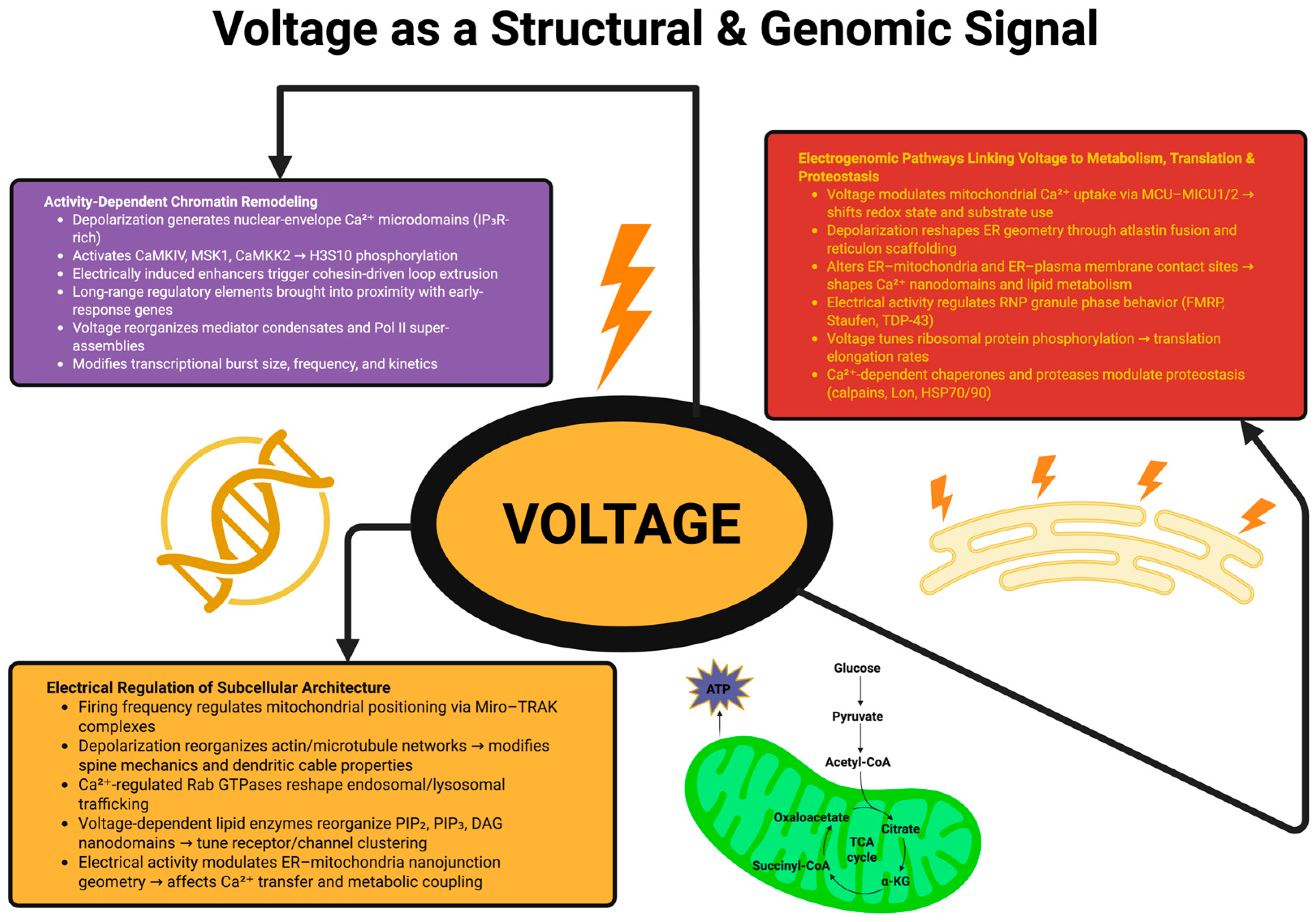
3. Voltage as a Structural and Genomic Signal
3.1. Activity-Dependent Chromatin Remodeling and Electrically Driven Nuclear Reorganization
3.2. Electrogenomic Pathways Integrating Membrane Voltage with Metabolic, Translational, and Proteostatic Architecture
3.3. Electrical Regulation of Subcellular Geometry, Organelle Microdomains, and Spatial Signaling Architecture
4. Mechanical Nano-Computation in Synapses, Dendrites, and Axons
4.1. Mechanosensitive Channel Logic and Tension-Encoded Modulation of Excitability
4.2. Spine and Dendritic Mechanics as Distributed Analog Computation Modules
4.3. Presynaptic Mechanotransduction in Vesicle Positioning, Priming, and Fusion
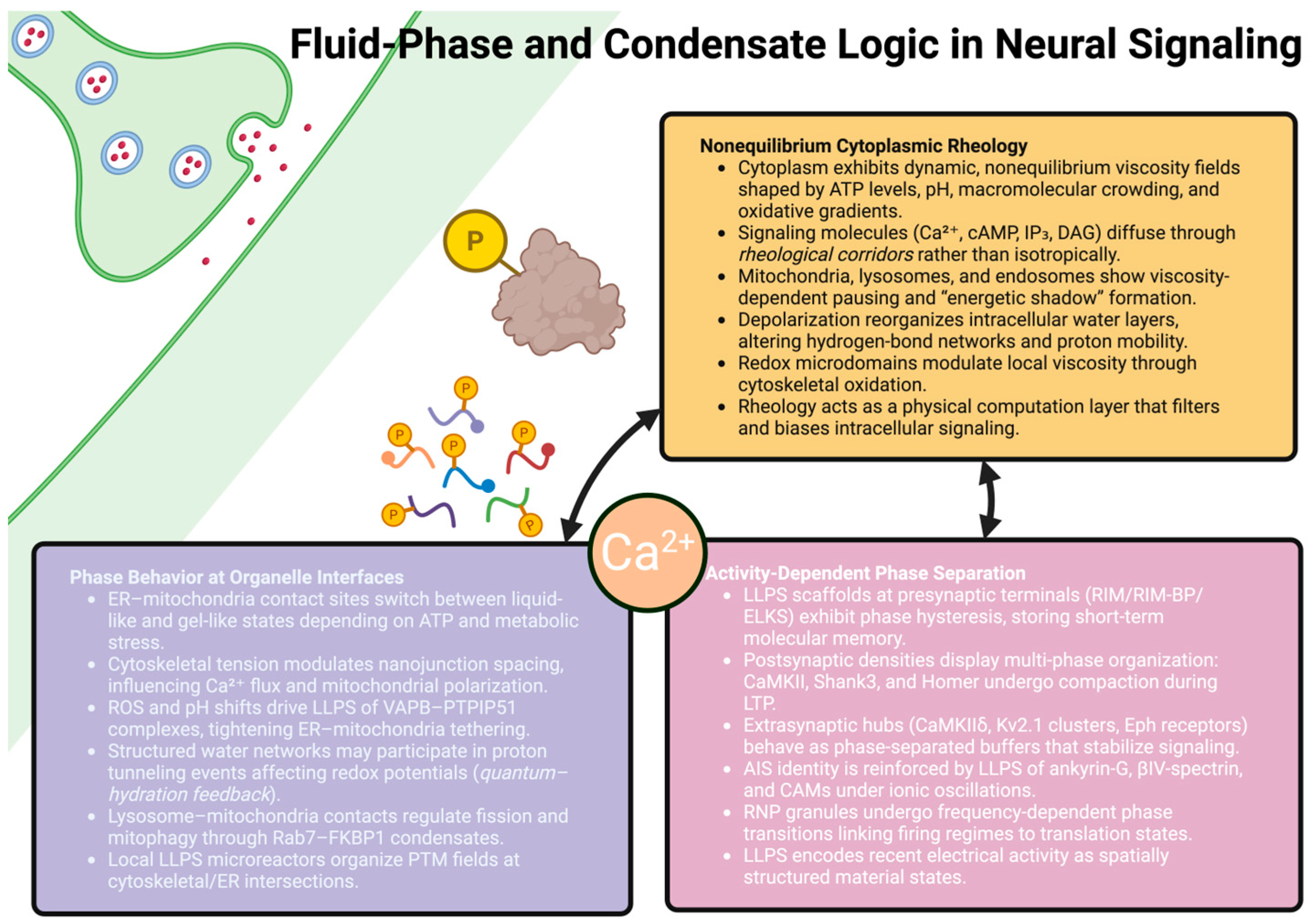
5. Intracellular Fluid Phase and Condensate Logic in Neural Signaling
5.1. Cytoplasmic Rheology, Non-Equilibrium Viscosity Fields, and Diffusion-Limited Computation
5.2. LLPS in Synaptic and Extrasynaptic Domains: Phase State Encoding of Activity History
5.3. Soft Matter Interactions at Organelle Interfaces: Phase-Modulated Nanojunctions and Quantum–Hydration Feedback
6. A Unified Framework for Electromechanical–Phase Computation
6.1. Cross-Domain Coupling Through Shared Physical Interfaces
6.2. Multiscale Integration and Emergent Attractor States
6.3. Thermodynamic and Energetic Structure of the Electromechanical–Phase System
- Energy generated by electrical processes is quickly dissipated through ionic currents and generates transient, sharp perturbations [108].
- Energy stored in mechanical processes is redistributed by the elastic deformation of membranes, filaments and scaffold proteins [109].
- Persistent energetic minima are created through phase state processes, such as condensate formation, viscoelastic transitions and changes in hydration structures [110].
7. Pathological Disruption of the Electromechanical–Phase Connectome
7.1. Electrical Instability Originating from Mechanical and Phase-State Perturbations
7.2. Mechanical Failure Modes and Subcellular Architectural Breakdown
7.3. Breakdown of Soft Matter Homeostasis: Aberrant Condensation, Viscosity Shifts, and Phase Pathology
7.4. Network-Level Degradation and Computational Collapse
8. Conclusions: The Beginning of a Physics of Thought
Author Contributions
Funding
Institutional Review Board Statement
Informed Consent Statement
Data Availability Statement
Conflicts of Interest
References
- Mahapatra, C.; Samuilik, I. A Mathematical Model of Spontaneous Action Potential Based on Stochastics Synaptic Noise Dynamics in Non-Neural Cells. Mathematics 2024, 12, 1149. [Google Scholar] [CrossRef]
- Park, P.; Wong-Campos, J.D.; Itkis, D.G.; Lee, B.H.; Qi, Y.; Davis, H.C.; Antin, B.; Pasarkar, A.; Grimm, J.B.; Plutkis, S.E.; et al. Dendritic Excitations Govern Back-Propagation via a Spike-Rate Accelerometer. Nat. Commun. 2025, 16, 1333. [Google Scholar] [CrossRef]
- Schneider, S.E.; Scott, A.K.; Seelbinder, B.; Elzen, C.V.D.; Wilson, R.L.; Miller, E.Y.; Beato, Q.I.; Ghosh, S.; Barthold, J.E.; Bilyeu, J.; et al. Dynamic Biophysical Responses of Neuronal Cell Nuclei and Cytoskeletal Structure Following High Impulse Loading. Acta Biomater. 2023, 163, 339–350. [Google Scholar] [CrossRef]
- Beiran, M.; Litwin-Kumar, A. Prediction of Neural Activity in Connectome-Constrained Recurrent Networks. Nat. Neurosci. 2025, 28, 2561–2574. [Google Scholar] [CrossRef] [PubMed]
- Tejedor, A.R.; Collepardo-Guevara, R.; Ramírez, J.; Espinosa, J.R. Time-Dependent Material Properties of Aging Biomolecular Condensates from Different Viscoelasticity Measurements in Molecular Dynamics Simulations. J. Phys. Chem. B 2023, 127, 4441–4459. [Google Scholar] [CrossRef]
- Pepperell, R. Consciousness and Energy Processing in Neural Systems. Brain Sci. 2024, 14, 1112. [Google Scholar] [CrossRef] [PubMed]
- Liu, T.X.; Davoudian, P.A.; Lizbinski, K.M.; Jeanne, J.M. Connectomic Features Underlying Diverse Synaptic Connection Strengths and Subcellular Computation. Curr. Biol. 2022, 32, 559–569.e5. [Google Scholar] [CrossRef] [PubMed]
- Sarles, S.A.; Najem, J.S.; Mohamed, A.S. Voltage-Responsive Biomimetic Membranes and Ion Channels for Neuromorphic Computing. Npj Unconv. Comput. 2025, 2, 26. [Google Scholar] [CrossRef]
- Rostas, J.A.P.; Skelding, K.A. Calcium/Calmodulin-Stimulated Protein Kinase II (CaMKII): Different Functional Outcomes from Activation, Depending on the Cellular Microenvironment. Cells 2023, 12, 401. [Google Scholar] [CrossRef]
- Lucariello, M.; Valicenti, M.L.; Giannoni, S.; Donati, L.; Armentano, I.; Morena, F.; Martino, S. Mechanobiology in Action: Biomaterials, Devices, and the Cellular Machinery of Force Sensing. Biomolecules 2025, 15, 848. [Google Scholar] [CrossRef]
- Felix, R.; Corzo-Lopez, A.; Sandoval, A. Voltage-Gated Ion Channels in Neuropathic Pain Signaling. Life 2025, 15, 888. [Google Scholar] [CrossRef]
- Najafi, J.; Dmitrieff, S.; Minc, N. Size- and Position-Dependent Cytoplasm Viscoelasticity through Hydrodynamic Interactions with the Cell Surface. Proc. Natl. Acad. Sci. USA 2023, 120, e2216839120. [Google Scholar] [CrossRef]
- Kruppa, A.J.; Buss, F. Motor Proteins at the Mitochondria–Cytoskeleton Interface. J. Cell Sci. 2021, 134, jcs226084. [Google Scholar] [CrossRef]
- Dai, Y.; Zhou, Z.; Yu, W.; Ma, Y.; Kim, K.; Rivera, N.; Mohammed, J.; Lantelme, E.; Hsu-Kim, H.; Chilkoti, A.; et al. Biomolecular Condensates Regulate Cellular Electrochemical Equilibria. Cell 2024, 187, 5951–5966.e18. [Google Scholar] [CrossRef] [PubMed]
- Canales Coutiño, B.; Mayor, R. Mechanosensitive Ion Channels in Cell Migration. Cells Dev. 2021, 166, 203683. [Google Scholar] [CrossRef]
- Shen, Y.; Wang, Z.; Ren, T.; Wen, J.; Li, J.; Tang, T. Recent Advances in Microfluidic Impedance Detection: Principle, Design and Applications. Micromachines 2025, 16, 683. [Google Scholar] [CrossRef] [PubMed]
- Schröter, M.; Cardes, F.; Bui, C.-V.H.; Dodi, L.D.; Gänswein, T.; Bartram, J.; Sadiraj, L.; Hornauer, P.; Kumar, S.; Pascual-Garcia, M.; et al. Advances in Large-Scale Electrophysiology with High-Density Microelectrode Arrays. Lab Chip 2025, 25, 4844–4885. [Google Scholar] [CrossRef] [PubMed]
- Chan, A.N.; Quach, C.D.; Handlin, L.J.; Lessie, E.N.; Tajkhorshid, E.; Dai, G. Voltage Sensor Conformations Induced by LQTS-Associated Mutations in hERG Potassium Channels. Nat. Commun. 2025, 16, 7126. [Google Scholar] [CrossRef]
- Onciul, R.; Brehar, F.-M.; Toader, C.; Covache-Busuioc, R.-A.; Glavan, L.-A.; Bratu, B.-G.; Costin, H.P.; Dumitrascu, D.-I.; Serban, M.; Ciurea, A.V. Deciphering Glioblastoma: Fundamental and Novel Insights into the Biology and Therapeutic Strategies of Gliomas. Curr. Issues Mol. Biol. 2024, 46, 2402–2443. [Google Scholar] [CrossRef]
- Kariev, A.M.; Green, M.E. H+ and Confined Water in Gating in Many Voltage-Gated Potassium Channels: Ion/Water/Counterion/Protein Networks and Protons Added to Gate the Channel. Int. J. Mol. Sci. 2025, 26, 7325. [Google Scholar] [CrossRef] [PubMed]
- Yadav, R.; Pfeffermann, J.; Goessweiner-Mohr, N.; Glasnov, T.; Akimov, S.A.; Pohl, P. Modulation of Kv Channel Gating by Light-Controlled Membrane Thickness. Biomolecules 2025, 15, 744. [Google Scholar] [CrossRef]
- Nelson, A.D.; Jenkins, P.M. Axonal Membranes and Their Domains: Assembly and Function of the Axon Initial Segment and Node of Ranvier. Front. Cell. Neurosci. 2017, 11, 136. [Google Scholar] [CrossRef]
- Mueller, B.D.; Merrill, S.A.; Watanabe, S.; Liu, P.; Niu, L.; Singh, A.; Maldonado-Catala, P.; Cherry, A.; Rich, M.S.; Silva, M.; et al. CaV1 and CaV2 Calcium Channels Mediate the Release of Distinct Pools of Synaptic Vesicles. eLife 2023, 12, e81407. [Google Scholar] [CrossRef]
- Yang, S.; Qiao, X.; Ma, J.; Yang, Z.; Luo, X.; Du, Z. Recent Advances in Flexible Sensors for Neural Interfaces: Multimodal Sensing, Signal Integration, and Closed-Loop Feedback. Biosensors 2025, 15, 424. [Google Scholar] [CrossRef]
- Putra, V.D.L.; Kilian, K.A.; Knothe Tate, M.L. Biomechanical, Biophysical and Biochemical Modulators of Cytoskeletal Remodelling and Emergent Stem Cell Lineage Commitment. Commun. Biol. 2023, 6, 75. [Google Scholar] [CrossRef] [PubMed]
- Liu, C.; Chen, Y.; Xie, Y.; Xiang, M. Tubulin Post-Translational Modifications: Potential Therapeutic Approaches to Heart Failure. Front. Cell Dev. Biol. 2022, 10, 872058. [Google Scholar] [CrossRef]
- Kirimtay, K.; Huang, W.; Sun, X.; Qiang, L.; Wang, D.V.; Sprouse, C.T.; Craig, E.M.; Baas, P.W. Tau and MAP6 Establish Labile and Stable Domains on Microtubules. iScience 2025, 28, 111785. [Google Scholar] [CrossRef]
- Toader, C.; Ples, H.; Covache-Busuioc, R.-A.; Costin, H.P.; Bratu, B.-G.; Dumitrascu, D.-I.; Glavan, L.A.; Ciurea, A.V. Decoding Chiari Malformation and Syringomyelia: From Epidemiology and Genetics to Advanced Diagnosis and Management Strategies. Brain Sci. 2023, 13, 1658. [Google Scholar] [CrossRef] [PubMed]
- Wang, L.; Liu, P.; Guan, P.; Yang, M.; Sun, J.; Cheng, Y.; Hirata, A.; Zhang, Z.; Ma, E.; Chen, M.; et al. In Situ Atomic-Scale Observation of Continuous and Reversible Lattice Deformation beyond the Elastic Limit. Nat. Commun. 2013, 4, 2413. [Google Scholar] [CrossRef] [PubMed]
- Wang, P.; Li, J.; Wei, Q. Understanding the Interplay between Cell Force and Cell Adhesion Processes. Eng. Regen. 2023, 4, 277–288. [Google Scholar] [CrossRef]
- Uray, I.P.; Uray, K. Mechanotransduction at the Plasma Membrane-Cytoskeleton Interface. Int. J. Mol. Sci. 2021, 22, 11566. [Google Scholar] [CrossRef] [PubMed]
- Villeneuve, C.; McCreery, K.P.; Wickström, S.A. Measuring and Manipulating Mechanical Forces during Development. Nat. Cell Biol. 2025, 27, 575–590. [Google Scholar] [CrossRef] [PubMed]
- Antifeeva, I.A.; Fonin, A.V.; Fefilova, A.S.; Stepanenko, O.V.; Povarova, O.I.; Silonov, S.A.; Kuznetsova, I.M.; Uversky, V.N.; Turoverov, K.K. Liquid–Liquid Phase Separation as an Organizing Principle of Intracellular Space: Overview of the Evolution of the Cell Compartmentalization Concept. Cell. Mol. Life Sci. 2022, 79, 251. [Google Scholar] [CrossRef]
- Mao, Y.; Nielsen, P.; Ali, J. Passive and Active Microrheology for Biomedical Systems. Front. Bioeng. Biotechnol. 2022, 10, 916354. [Google Scholar] [CrossRef] [PubMed]
- Holehouse, A.S.; Alberti, S. Molecular Determinants of Condensate Composition. Mol. Cell 2025, 85, 290–308. [Google Scholar] [CrossRef]
- Wang, H.; Shi, Z. The Rheology and Interfacial Properties of Biomolecular Condensates. Biophys. Rev. 2025, 17, 867–891. [Google Scholar] [CrossRef]
- Ivontsin, L.A.; Mashkovtseva, E.V.; Nartsissov, Y.R. Membrane Lipid Composition Influences the Hydration of Proton Half-Channels in FoF1-ATP Synthase. Life 2023, 13, 1816. [Google Scholar] [CrossRef]
- Mackey, C.; Feng, Y.; Liang, C.; Liang, A.; Tian, H.; Narayan, O.P.; Dong, J.; Tai, Y.; Hu, J.; Mu, Y.; et al. Mechanical Modulation, Physiological Roles, and Imaging Innovations of Intercellular Calcium Waves in Living Systems. Cancers 2025, 17, 1851. [Google Scholar] [CrossRef]
- Toader, C.; Eva, L.; Bratu, B.-G.; Covache-Busuioc, R.-A.; Costin, H.P.; Dumitrascu, D.-I.; Glavan, L.-A.; Corlatescu, A.D.; Ciurea, A.V. Intracranial Aneurysms and Genetics: An Extensive Overview of Genomic Variations, Underlying Molecular Dynamics, Inflammatory Indicators, and Forward-Looking Insights. Brain Sci. 2023, 13, 1454. [Google Scholar] [CrossRef]
- Heiss, M.C.; Fernández-Quintero, M.L.; Campiglio, M.; El Ghaleb, Y.; Pelizzari, S.; Loeffler, J.R.; Liedl, K.R.; Tuluc, P.; Flucher, B.E. Voltage-Sensor Gating Charge Interactions Bimodally Regulate Voltage Dependence and Kinetics of Calcium Channel Activation. J. Gen. Physiol. 2025, 157, e202513769. [Google Scholar] [CrossRef]
- Kageyama, H.; Komiya, M.; Yamamoto, E.; Hirano-Iwata, A. Distinct Structural Responses of Lipid Bilayers to Horizontal and Vertical Electric Fields. J. Phys. Chem. Lett. 2025, 16, 10647–10654. [Google Scholar] [CrossRef]
- Lim, C.Y.; Lim, A.E.; Lam, Y.C. Ionic Origin of Electro-Osmotic Flow Hysteresis. Sci. Rep. 2016, 6, 22329. [Google Scholar] [CrossRef]
- Liu, Y.; Mollaeian, K.; Shamim, M.H.; Ren, J. Effect of F-Actin and Microtubules on Cellular Mechanical Behavior Studied Using Atomic Force Microscope and an Image Recognition-Based Cytoskeleton Quantification Approach. Int. J. Mol. Sci. 2020, 21, 392. [Google Scholar] [CrossRef]
- Wang, Y.; Yao, M.; Baker, K.B.; Gough, R.E.; Le, S.; Goult, B.T.; Yan, J. Force-Dependent Interactions between Talin and Full-Length Vinculin. J. Am. Chem. Soc. 2021, 143, 14726–14737. [Google Scholar] [CrossRef]
- Lv, P.; Du, Y.; He, C.; Peng, L.; Zhou, X.; Wan, Y.; Zeng, M.; Zhou, W.; Zou, P.; Li, C.; et al. O-GlcNAcylation Modulates Liquid–Liquid Phase Separation of SynGAP/PSD-95. Nat. Chem. 2022, 14, 831–840. [Google Scholar] [CrossRef] [PubMed]
- Mangiarotti, A.; Siri, M.; Tam, N.W.; Zhao, Z.; Malacrida, L.; Dimova, R. Biomolecular Condensates Modulate Membrane Lipid Packing and Hydration. Nat. Commun. 2023, 14, 6081. [Google Scholar] [CrossRef] [PubMed]
- Al-Refaie, N.; Padovani, F.; Hornung, J.; Pudelko, L.; Binando, F.; del Carmen Fabregat, A.; Zhao, Q.; Towbin, B.D.; Cenik, E.S.; Stroustrup, N.; et al. Fasting Shapes Chromatin Architecture through an mTOR/RNA Pol I Axis. Nat. Cell Biol. 2024, 26, 1903–1917. [Google Scholar] [CrossRef] [PubMed]
- Sept, C.E.; Tak, Y.E.; Goel, V.; Bhakta, M.S.; Cerda-Smith, C.G.; Hutchinson, H.M.; Blanchette, M.; Eyler, C.E.; Johnstone, S.E.; Joung, J.K.; et al. High-Resolution CTCF Footprinting Reveals Impact of Chromatin State on Cohesin Extrusion. Nat. Commun. 2025, 16, 4506. [Google Scholar] [CrossRef]
- Toader, C.; Dobrin, N.; Tataru, C.-I.; Covache-Busuioc, R.-A.; Bratu, B.-G.; Glavan, L.A.; Costin, H.P.; Corlatescu, A.D.; Dumitrascu, D.-I.; Ciurea, A.V. From Genes to Therapy: Pituitary Adenomas in the Era of Precision Medicine. Biomedicines 2024, 12, 23. [Google Scholar] [CrossRef]
- Mäki-Marttunen, T.; Devor, A.; Phillips, W.A.; Dale, A.M.; Andreassen, O.A.; Einevoll, G.T. Computational Modeling of Genetic Contributions to Excitability and Neural Coding in Layer V Pyramidal Cells: Applications to Schizophrenia Pathology. Front. Comput. Neurosci. 2019, 13, 66. [Google Scholar] [CrossRef]
- Linhartova, K.; Falginella, F.L.; Matl, M.; Sebesta, M.; Vácha, R.; Stefl, R. Sequence and Structural Determinants of RNAPII CTD Phase-Separation and Phosphorylation by CDK7. Nat. Commun. 2024, 15, 9163. [Google Scholar] [CrossRef]
- Su, Y.; Shin, J.; Zhong, C.; Wang, S.; Roychowdhury, P.; Lim, J.; Kim, D.; Ming, G.; Song, H. Neuronal Activity Modifies the Chromatin Accessibility Landscape in the Adult Brain. Nat. Neurosci. 2017, 20, 476–483. [Google Scholar] [CrossRef] [PubMed]
- Ježek, P.; Holendová, B.; Jabůrek, M.; Tauber, J.; Dlasková, A.; Plecitá-Hlavatá, L. The Pancreatic β-Cell: The Perfect Redox System. Antioxidants 2021, 10, 197. [Google Scholar] [CrossRef]
- CHEN, C.-Y.; CHEN, Y.-J.; WANG, C.-A.; LIN, C.-H.; YEH, J.-S.; CHAN, P.; SHIAO, L.-R.; LEUNG, Y.-M. Agonist-Triggered Ca2+ Release from Functionally Connected Endoplasmic Reticulum and Lysosomal Ca2+ Stores in bEND.3 Endothelial Cells. Physiol. Res. 2025, 74, 249–254. [Google Scholar] [CrossRef]
- Sassano, M.L.; Felipe-Abrio, B.; Agostinis, P. ER-Mitochondria Contact Sites; a Multifaceted Factory for Ca2+ Signaling and Lipid Transport. Front. Cell Dev. Biol. 2022, 10, 988014. [Google Scholar] [CrossRef]
- Di Liegro, C.M.; Schiera, G.; Schirò, G.; Di Liegro, I. RNA-Binding Proteins as Epigenetic Regulators of Brain Functions and Their Involvement in Neurodegeneration. Int. J. Mol. Sci. 2022, 23, 14622. [Google Scholar] [CrossRef]
- Chato-Astrain, I.; Pronot, M.; Coppola, T.; Martin, S. Molecular Organization and Regulation of the Mammalian Synapse by the Post-Translational Modification SUMOylation. Cells 2024, 13, 420. [Google Scholar] [CrossRef]
- Polster, B.M.; Mark, K.A.; Arze, R.; Hudson, D. Calpain-Independent Intracellular Protease Activity Is Elevated in Excitotoxic Cortical Neurons Prior to Delayed Calcium Deregulation and Mitochondrial Dysfunction. Biomolecules 2022, 12, 1004. [Google Scholar] [CrossRef]
- Cartes-Saavedra, B.; Ghosh, A.; Hajnóczky, G. The Roles of Mitochondria in Global and Local Intracellular Calcium Signalling. Nat. Rev. Mol. Cell Biol. 2025, 26, 456–475. [Google Scholar] [CrossRef] [PubMed]
- Paciello, F.; Battistoni, M.; Martini, S.; Simone, C.; Pastore, F.; Sollazzo, R.; Grassi, C.; Ripoli, C. Role of LIMK1-Cofilin-Actin Axis in Dendritic Spine Dynamics in Alzheimer’s Disease. Cell Death Dis. 2025, 16, 431. [Google Scholar] [CrossRef] [PubMed]
- Parekh, R.; Ascoli, G.A. Quantitative Investigations of Axonal and Dendritic Arbors: Development, Structure, Function and Pathology. Neuroscientist 2015, 21, 241–254. [Google Scholar] [CrossRef] [PubMed]
- Mulligan, R.J.; Winckler, B. Regulation of Endosomal Trafficking by Rab7 and Its Effectors in Neurons: Clues from Charcot–Marie–Tooth 2B Disease. Biomolecules 2023, 13, 1399. [Google Scholar] [CrossRef] [PubMed]
- Ivanova, N.; Chamati, H. The Effect of Cholesterol in SOPC Lipid Bilayers at Low Temperatures. Membranes 2023, 13, 275. [Google Scholar] [CrossRef] [PubMed]
- Baker, C.; Willis, A.; Milestone, W.; Baker, M.; Garner, A.L.; Joshi, R.P. Numerical Assessments of Geometry, Proximity and Multi-Electrode Effects on Electroporation in Mitochondria and the Endoplasmic Reticulum to Nanosecond Electric Pulses. Sci. Rep. 2024, 14, 23854. [Google Scholar] [CrossRef]
- Rafati, A.H.; Joca, S.; Vontell, R.T.; Mallard, C.; Wegener, G.; Ardalan, M. A Model-Based Approach to Neuronal Electrical Activity and Spatial Organization Through the Neuronal Actin Cytoskeleton. Methods Protoc. 2025, 8, 76. [Google Scholar] [CrossRef]
- Català-Castro, F.; Bonilla-Quintana, M.; Sanfeliu-Cerdán, N.; Rangamani, P.; Krieg, M. Obstacles Regulate Membrane Tension Propagation to Enable Localized Mechanotransduction. Nat. Phys. 2025, 21, 1741–1752. [Google Scholar] [CrossRef]
- Strahl, H.; Ronneau, S.; González, B.S.; Klutsch, D.; Schaffner-Barbero, C.; Hamoen, L.W. Transmembrane Protein Sorting Driven by Membrane Curvature. Nat. Commun. 2015, 6, 8728. [Google Scholar] [CrossRef]
- Numata, T.; Tsutsumi, M.; Sato-Numata, K. Optogenetic and Endogenous Modulation of Ca2+ Signaling in Schwann Cells: Implications for Autocrine and Paracrine Neurotrophic Regulation. Int. J. Mol. Sci. 2025, 26, 9082. [Google Scholar] [CrossRef]
- Martin, W.N.; Hyde, C.; Yung, A.; Taffe, R.; Patel, B.; Premkumar, A.; Bhattaram, P.; Drissi, H.; Khan, N.M. Joint Acidosis and Acid-Sensing Receptors and Ion Channels in Osteoarthritis Pathobiology and Therapy. Cells 2025, 14, 1605. [Google Scholar] [CrossRef]
- Kashiwagi, Y.; Higashi, T.; Obashi, K.; Sato, Y.; Komiyama, N.H.; Grant, S.G.N.; Okabe, S. Computational Geometry Analysis of Dendritic Spines by Structured Illumination Microscopy. Nat. Commun. 2019, 10, 1285. [Google Scholar] [CrossRef]
- Eva, L.; Brehar, F.-M.; Florian, I.-A.; Covache-Busuioc, R.-A.; Costin, H.P.; Dumitrascu, D.-I.; Bratu, B.-G.; Glavan, L.-A.; Ciurea, A.V. Neuropsychiatric and Neuropsychological Aspects of Alcohol-Related Cognitive Disorders: An In-Depth Review of Wernicke’s Encephalopathy and Korsakoff’s Syndrome. J. Clin. Med. 2023, 12, 6101. [Google Scholar] [CrossRef]
- Tazerart, S.; Mitchell, D.E.; Miranda-Rottmann, S.; Araya, R. A Spike-Timing-Dependent Plasticity Rule for Dendritic Spines. Nat. Commun. 2020, 11, 4276. [Google Scholar] [CrossRef] [PubMed]
- Antal, M. Molecular Anatomy of Synaptic and Extrasynaptic Neurotransmission Between Nociceptive Primary Afferents and Spinal Dorsal Horn Neurons. Int. J. Mol. Sci. 2025, 26, 2356. [Google Scholar] [CrossRef]
- Elblová, P.; Lunova, M.; Dejneka, A.; Jirsa, M.; Lunov, O. Impact of Mechanical Cues on Key Cell Functions and Cell-Nanoparticle Interactions. Discov. Nano 2024, 19, 106. [Google Scholar] [CrossRef]
- Alibrandi, S.; Rinaldi, C.; Vinci, S.L.; Conti, A.; Donato, L.; Scimone, C.; Sidoti, A.; D’Angelo, R. Mechanotransduction in Development: A Focus on Angiogenesis. Biology 2025, 14, 346. [Google Scholar] [CrossRef] [PubMed]
- Mochida, S. Stable and Flexible Synaptic Transmission Controlled by the Active Zone Protein Interactions. Int. J. Mol. Sci. 2021, 22, 11775. [Google Scholar] [CrossRef] [PubMed]
- Jahn, R.; Cafiso, D.C.; Tamm, L.K. Mechanisms of SNARE Proteins in Membrane Fusion. Nat. Rev. Mol. Cell Biol. 2024, 25, 101–118. [Google Scholar] [CrossRef]
- Wu, X.-S.; Zhang, Z.; Jin, Y.; Mushtaheed, A.; Wu, L.-G. Actin Maintains Synaptic Transmission by Restraining Vesicle Release Probability. iScience 2025, 28, 112000. [Google Scholar] [CrossRef]
- Bussoletti, M.; Gallo, M.; Bottacchiari, M.; Abbondanza, D.; Casciola, C.M. Mesoscopic Elasticity Controls Dynamin-Driven Fission of Lipid Tubules. Sci. Rep. 2024, 14, 14003. [Google Scholar] [CrossRef]
- Liu, C.-H.; Rasband, M.N. Axonal Spectrins: Nanoscale Organization, Functional Domains and Spectrinopathies. Front. Cell. Neurosci. 2019, 13, 234. [Google Scholar] [CrossRef]
- Costa, F.P.; Wiedenmann, B.; Schöll, E.; Tuszynski, J. Emerging Cancer Therapies: Targeting Physiological Networks and Cellular Bioelectrical Differences with Non-Thermal Systemic Electromagnetic Fields in the Human Body—A Comprehensive Review. Front. Netw. Physiol. 2024, 4, 1483401. [Google Scholar] [CrossRef]
- Sorrenti, A.; Leira-Iglesias, J.; Sato, A.; Hermans, T.M. Non-Equilibrium Steady States in Supramolecular Polymerization. Nat. Commun. 2017, 8, 15899. [Google Scholar] [CrossRef]
- Scheibner, C.; Ori, H.; Cohen, A.E.; Vitelli, V. Spiking at the Edge: Excitability at Interfaces in Reaction–Diffusion Systems. Proc. Natl. Acad. Sci. USA 2024, 121, e2307996120. [Google Scholar] [CrossRef] [PubMed]
- Kiraly, S.; Stanley, J.; Eden, E.R. Lysosome-Mitochondrial Crosstalk in Cellular Stress and Disease. Antioxidants 2025, 14, 125. [Google Scholar] [CrossRef] [PubMed]
- Lang, X.; Shi, L.; Zhao, Z.; Min, W. Probing the Structure of Water in Individual Living Cells. Nat. Commun. 2024, 15, 5271. [Google Scholar] [CrossRef] [PubMed]
- Mahato, R.R.; Adikessavane, N.; Ettikkan, N.K.; Maiti, S. A Chemoenzymatic Reaction-Diffusion System with Local Inhibition and Distal Activation. Nat. Commun. 2025, 16, 9885. [Google Scholar] [CrossRef]
- Najma, B.; Varghese, M.; Tsidilkovski, L.; Lemma, L.; Baskaran, A.; Duclos, G. Competing Instabilities Reveal How to Rationally Design and Control Active Crosslinked Gels. Nat. Commun. 2022, 13, 6465. [Google Scholar] [CrossRef]
- Guzikowski, N.J.; Kavalali, E.T. Functional Specificity of Liquid-Liquid Phase Separation at the Synapse. Nat. Commun. 2024, 15, 10103. [Google Scholar] [CrossRef]
- Chen, X.; Jia, B.; Zhu, S.; Zhang, M. Phase Separation-Mediated Actin Bundling by the Postsynaptic Density Condensates. eLife 2023, 12, e84446. [Google Scholar] [CrossRef]
- Zhu, X.; Yu, Y.; Jiang, Z.; Otani, Y.; Fujitani, M. Ankyrin-G and Its Binding Partners in Neurons: Orchestrating the Molecular Structure of the Axon Initial Segment. Biomolecules 2025, 15, 901. [Google Scholar] [CrossRef]
- Naskar, A.; Nayak, A.; Salaikumaran, M.R.; Vishal, S.S.; Gopal, P.P. Phase Separation and Pathologic Transitions of RNP Condensates in Neurons: Implications for Amyotrophic Lateral Sclerosis, Frontotemporal Dementia and Other Neurodegenerative Disorders. Front. Mol. Neurosci. 2023, 16, 1242925. [Google Scholar] [CrossRef]
- Testa, A.; Spanke, H.T.; Jambon-Puillet, E.; Yasir, M.; Feng, Y.; Küffner, A.M.; Arosio, P.; Dufresne, E.R.; Style, R.W.; Rebane, A.A. Surface Passivation Method for the Super-Repellence of Aqueous Macromolecular Condensates. Langmuir 2023, 39, 14626–14637. [Google Scholar] [CrossRef]
- Mehta, S.; Zhang, J. Liquid-Liquid Phase Separation Drives Cellular Function and Dysfunction in Cancer. Nat. Rev. Cancer 2022, 22, 239–252. [Google Scholar] [CrossRef] [PubMed]
- Magalhães Rebelo, A.P.; Dal Bello, F.; Knedlik, T.; Kaar, N.; Volpin, F.; Shin, S.H.; Giacomello, M. Chemical Modulation of Mitochondria–Endoplasmic Reticulum Contact Sites. Cells 2020, 9, 1637. [Google Scholar] [CrossRef]
- Casas-Martinez, J.C.; Xia, Q.; Li, P.; Borja-Gonzalez, M.; Miranda-Vizuete, A.; McDermott, E.; Dockery, P.; Quinlan, L.R.; Goljanek-Whysall, K.; Samali, A.; et al. Adaptive ER Stress Promotes Mitochondrial Remodelling and Longevity through PERK-Dependent MERCS Assembly. Cell Death Differ. 2025, 1–16. [Google Scholar] [CrossRef] [PubMed]
- Shiiba, I.; Ito, N.; Oshio, H.; Ishikawa, Y.; Nagao, T.; Shimura, H.; Oh, K.-W.; Takasaki, E.; Yamaguchi, F.; Konagaya, R.; et al. ER-Mitochondria Contacts Mediate Lipid Radical Transfer via RMDN3/PTPIP51 Phosphorylation to Reduce Mitochondrial Oxidative Stress. Nat. Commun. 2025, 16, 1508. [Google Scholar] [CrossRef]
- Rühmkorf, A.; Harbauer, A.B. Role of Mitochondria–ER Contact Sites in Mitophagy. Biomolecules 2023, 13, 1198. [Google Scholar] [CrossRef] [PubMed]
- Voicu, V.; Toader, C.; Șerban, M.; Covache-Busuioc, R.-A.; Ciurea, A.V. Systemic Neurodegeneration and Brain Aging: Multi-Omics Disintegration, Proteostatic Collapse, and Network Failure Across the CNS. Biomedicines 2025, 13, 2025. [Google Scholar] [CrossRef]
- Gomez-Jimenez, S.; Guerrero Mendez, C.; Lopez-Betancur, D.; Robles-Guerrero, A.; Navarro-Solis, D.; Silva-Acosta, L.; Lopez-Baltazar, E.A.; Ortiz-Letechipia, J.; Contreras-Rodríguez, A.R. Evolution of the Structure of EDPM Crosslinking Networks and Its Influence on the Rheological Properties of the Injection Molding Process. Polymers 2025, 17, 2438. [Google Scholar] [CrossRef]
- Alimohamadi, H.; Ovryn, B.; Rangamani, P. Modeling Membrane Nanotube Morphology: The Role of Heterogeneity in Composition and Material Properties. Sci. Rep. 2020, 10, 2527. [Google Scholar] [CrossRef]
- Dong, W.; Tang, C.; Chu, W.-T.; Wang, E.; Wang, J. Effects of Mass Change on Liquid–Liquid Phase Separation of the RNA-Binding Protein Fused in Sarcoma. Biomolecules 2023, 13, 625. [Google Scholar] [CrossRef]
- Chen, J.; Xia, M.; Chen, P.; Cai, B.; Chen, H.; Xie, X.; Wu, J.; Shi, Q. Innovations in Multidimensional Force Sensors for Accurate Tactile Perception and Embodied Intelligence. AI Sens. 2025, 1, 7. [Google Scholar] [CrossRef]
- Mougkogiannis, P.; Adamatzky, A. Polymorphism in Glu-Phe-Asp Proteinoids. Biomimetics 2025, 10, 360. [Google Scholar] [CrossRef]
- Lützkendorf, J.; Sigrist, S.J. Condensate Dynamics at the Synapse: Phase Separation Tunes Presynaptic Function. PLoS Biol. 2025, 23, e3003201. [Google Scholar] [CrossRef]
- Toader, C.; Eva, L.; Tataru, C.-I.; Covache-Busuioc, R.-A.; Bratu, B.-G.; Dumitrascu, D.-I.; Costin, H.P.; Glavan, L.-A.; Ciurea, A.V. Frontiers of Cranial Base Surgery: Integrating Technique, Technology, and Teamwork for the Future of Neurosurgery. Brain Sci. 2023, 13, 1495. [Google Scholar] [CrossRef]
- Bergs, J.; Morr, A.S.; Silva, R.V.; Infante-Duarte, C.; Sack, I. The Networking Brain: How Extracellular Matrix, Cellular Networks, and Vasculature Shape the In Vivo Mechanical Properties of the Brain. Adv. Sci. 2024, 11, 2402338. [Google Scholar] [CrossRef]
- Alexiadis, A. Deep Multiphysics and Particle–Neuron Duality: A Computational Framework Coupling (Discrete) Multiphysics and Deep Learning. Appl. Sci. 2019, 9, 5369. [Google Scholar] [CrossRef]
- Jin, M.; Hu, M.; Li, H.; Yang, Y.; Liu, W.; Fang, Q.; Liu, S. Experimental Study on the Transient Disturbance Characteristics and Influence Factors of Pantograph–Catenary Discharge. Energies 2022, 15, 5959. [Google Scholar] [CrossRef]
- Waechtler, B.E.; Jayasankar, R.; Morin, E.P.; Robinson, D.N. Benefits and Challenges of Reconstituting the Actin Cortex. Cytoskeleton 2024, 81, 843–863. [Google Scholar] [CrossRef]
- Tejedor, A.R.; Sanchez-Burgos, I.; Estevez-Espinosa, M.; Garaizar, A.; Collepardo-Guevara, R.; Ramirez, J.; Espinosa, J.R. Protein Structural Transitions Critically Transform the Network Connectivity and Viscoelasticity of RNA-Binding Protein Condensates but RNA Can Prevent It. Nat. Commun. 2022, 13, 5717. [Google Scholar] [CrossRef]
- Pinigin, K.V. Determination of Elastic Parameters of Lipid Membranes with Molecular Dynamics: A Review of Approaches and Theoretical Aspects. Membranes 2022, 12, 1149. [Google Scholar] [CrossRef]
- Alberti, S.; Arosio, P.; Best, R.B.; Boeynaems, S.; Cai, D.; Collepardo-Guevara, R.; Dignon, G.L.; Dimova, R.; Elbaum-Garfinkle, S.; Fawzi, N.L.; et al. Current Practices in the Study of Biomolecular Condensates: A Community Comment. Nat. Commun. 2025, 16, 7730. [Google Scholar] [CrossRef] [PubMed]
- Sun, Z.G.; Zimmerberg, N.; Kelly, P.; Floyd, C.; Papoian, G.; Murrell, M. Feedback between F-Actin Organization and Active Stress Governs Criticality and Energy Localization in the Cell Cytoskeleton. Nat. Phys. 2025, 21, 1290–1302. [Google Scholar] [CrossRef]
- Hylton, T. Thermodynamic State Machine Network. Entropy 2022, 24, 744. [Google Scholar] [CrossRef] [PubMed]
- Zhu, Z.; Chen, K.; Lin, W.; Yan, H.; Liang, L.; Wang, G.; Song, X.; Zhang, C.; Wang, Z. Recent Advances in Spike-Based Neural Coding for Tactile Perception. Microsyst. Nanoeng. 2025, 11, 212. [Google Scholar] [CrossRef]
- Song, E.; Xie, Z.; Bai, W.; Luan, H.; Ji, B.; Ning, X.; Xia, Y.; Baek, J.M.; Lee, Y.; Avila, R.; et al. Miniaturized Electromechanical Devices for the Characterization of the Biomechanics of Deep Tissue. Nat. Biomed. Eng. 2021, 5, 759–771. [Google Scholar] [CrossRef]
- Kwon, J.Y.; Kim, J.E.; Kim, J.S.; Chun, S.Y.; Soh, K.; Yoon, J.H. Artificial Sensory System Based on Memristive Devices. Exploration 2023, 4, 20220162. [Google Scholar] [CrossRef] [PubMed]
- Kondepudi, D.K.; De Bari, B.; Dixon, J.A. Dissipative Structures, Organisms and Evolution. Entropy 2020, 22, 1305. [Google Scholar] [CrossRef]
- Boybat, I.; Le Gallo, M.; Nandakumar, S.R.; Moraitis, T.; Parnell, T.; Tuma, T.; Rajendran, B.; Leblebici, Y.; Sebastian, A.; Eleftheriou, E. Neuromorphic Computing with Multi-Memristive Synapses. Nat. Commun. 2018, 9, 2514. [Google Scholar] [CrossRef]
- Angeloni, C.; Malaguti, M.; Prata, C.; Freschi, M.; Barbalace, M.C.; Hrelia, S. Mechanisms Underlying Neurodegenerative Disorders and Potential Neuroprotective Activity of Agrifood By-Products. Antioxidants 2023, 12, 94. [Google Scholar] [CrossRef]
- Barbieri, R.; Nizzari, M.; Zanardi, I.; Pusch, M.; Gavazzo, P. Voltage-Gated Sodium Channel Dysfunctions in Neurological Disorders. Life 2023, 13, 1191. [Google Scholar] [CrossRef]
- Dubey, S.; Bhembre, N.; Bodas, S.; Veer, S.; Ghose, A.; Callan-Jones, A.; Pullarkat, P. The Axonal Actin-Spectrin Lattice Acts as a Tension Buffering Shock Absorber. eLife 2020, 9, e51772. [Google Scholar] [CrossRef]
- Schreiner, S.M.; Koo, P.K.; Zhao, Y.; Mochrie, S.G.J.; King, M.C. The Tethering of Chromatin to the Nuclear Envelope Supports Nuclear Mechanics. Nat. Commun. 2015, 6, 7159. [Google Scholar] [CrossRef]
- Shih, P.-Y.; Fang, Y.-L.; Shankar, S.; Lee, S.-P.; Hu, H.-T.; Chen, H.; Wang, T.-F.; Hsia, K.-C.; Hsueh, Y.-P. Phase Separation and Zinc-Induced Transition Modulate Synaptic Distribution and Association of Autism-Linked CTTNBP2 and SHANK3. Nat. Commun. 2022, 13, 2664. [Google Scholar] [CrossRef]
- Jiang, G.; Xie, G.; Li, X.; Xiong, J. Cytoskeletal Proteins and Alzheimer’s Disease Pathogenesis: Focusing on the Interplay with Tau Pathology. Biomolecules 2025, 15, 831. [Google Scholar] [CrossRef] [PubMed]
- Alimohamadi, H.; Rangamani, P. Modeling Membrane Curvature Generation Due to Membrane–Protein Interactions. Biomolecules 2018, 8, 120. [Google Scholar] [CrossRef] [PubMed]
- Mierke, C.T. Viscoelasticity, Like Forces, Plays a Role in Mechanotransduction. Front. Cell Dev. Biol. 2022, 10, 789841. [Google Scholar] [CrossRef]
- Verde, E.M.; Secco, V.; Ghezzi, A.; Mandrioli, J.; Carra, S. Molecular Mechanisms of Protein Aggregation in ALS-FTD: Focus on TDP-43 and Cellular Protective Responses. Cells 2025, 14, 680. [Google Scholar] [CrossRef]
- Mebratu, Y.A.; Negasi, Z.H.; Dutta, S.; Rojas-Quintero, J.; Tesfaigzi, Y. Adaptation of Proteasomes and Lysosomes to Cellular Environments. Cells 2020, 9, 2221. [Google Scholar] [CrossRef]
- Ijomone, O.K.; Ukwubile, I.I.; Aneke, V.O.; Olajide, T.S.; Inyang, H.O.; Omotosho, O.I.; Oyerinde, T.O.; Anadu, V.E.; Gbayisomore, T.J.; Okeowo, O.M.; et al. Glial Perturbation in Metal Neurotoxicity: Implications for Brain Disorders. Neuroglia 2025, 6, 4. [Google Scholar] [CrossRef]
- Biswas, P.; Rahman, M.H.; Tabassum, A.; Shoyshob, T.Z.; Jalouli, M.; Islam Tareq, M.M.; Imtiaz, M.; Dona, H.A.; Harrath, A.H.; Rahman, M.A. Novel Drug Targets for Neurodegenerative Diseases of Elderly People to Develop Effective Therapeutics: A Comprehensive Analysis. Adv. Pharmacol. Pharm. Sci. 2025, 2025, 8847508. [Google Scholar] [CrossRef] [PubMed]
- Dias, C.; Nylandsted, J. Neural Membrane Repair at the Core of Regeneration. Neural Regen. Res. 2023, 19, 1399–1400. [Google Scholar] [CrossRef] [PubMed]
- Cebrián-Lacasa, D.; Parra-Rivas, P.; Ruiz-Reynés, D.; Gelens, L. Six Decades of the FitzHugh–Nagumo Model: A Guide through Its Spatio-Temporal Dynamics and Influence across Disciplines. Phys. Rep. 2024, 1096, 1–39, Correction in Phys. Rep. 2025, 1140, 47–48.. [Google Scholar] [CrossRef]
- Maltseva, S.; Kerr, D.; Turke, M.; Adams, E.J.; Lee, K.Y.C. Parkinson’s Disease-Associated Mutations in α-Synuclein Alters Its Lipid-Bound State. Biophys. J. 2024, 123, 1610–1619. [Google Scholar] [CrossRef]
- Lu, Z.-G.; Shen, J.; Yang, J.; Wang, J.-W.; Zhao, R.-C.; Zhang, T.-L.; Guo, J.; Zhang, X. Nucleic Acid Drug Vectors for Diagnosis and Treatment of Brain Diseases. Signal Transduct. Target. Ther. 2023, 8, 39. [Google Scholar] [CrossRef]
- Wareham, L.K.; Calkins, D.J. Making Tracks: Microglia and the Extracellular Matrix. Mol. Neurodegener. 2025, 20, 101. [Google Scholar] [CrossRef]
- Cramer, B.; Stöckel, D.; Kreft, M.; Wibral, M.; Schemmel, J.; Meier, K.; Priesemann, V. Control of Criticality and Computation in Spiking Neuromorphic Networks with Plasticity. Nat. Commun. 2020, 11, 2853. [Google Scholar] [CrossRef]



| Biophysical Tier | Core Mechanisms and Molecular Players | Electromechanical Consequences for Neural Signaling | Experimental/Computational Correlates | References |
|---|---|---|---|---|
| Voltage sensing and gating landscapes | Hierarchical S4 voltage sensor transitions across multiple metastable states; gating charge displacement shaped by lipid headgroups, membrane dipoles, and hydration shells rather than pure helix translation alone. | Fine-tuning of activation/inactivation thresholds; isoform-specific gating heterogeneity across axon initial segment, dendritic shaft, and presynaptic boutons; and dynamic reshaping of excitability with small changes in local field and solvent structure. | Time-resolved cryo-EM of intermediate VSD conformers; atomistic MD of channel–lipid–water complexes; and gating current spectroscopy resolving multistep charge movement. | [40] |
| Lipid electrodynamics and hydration shells | PIP2, phosphatidylserine, and diacylglycerol create anisotropic lateral electric fields; ultrafast restructuring of interfacial water modulates local dielectric constant and proton mobility at the protein–lipid boundary. | Local shifts in effective gating charge and barrier heights; region-specific tuning of channel kinetics and voltage dependence; and emergence of microdomain-specific operating modes from a single channel isoform. | Ultrafast IR and 2D-IR spectroscopy of hydration dynamics; MD/continuum hybrid electrostatics; and voltage-clamp recordings under controlled lipid reconstitution. | [41] |
| Ionic nanodomains and electro-osmotic microgradients | Cav2.1/2.2 Ca2+ nanodomains (10–50 nm) with steep concentration gradients; K+-efflux microdomains generating osmotic and tension shifts; and transient surface potentials modifying neighboring channel open probability. | Highly localized activation of vesicle fusion and Ca2+-sensitive enzymes; spatially patterned electrochemical fields beyond resolution of classical electrophysiology; and coupling of ion flux to water flow and membrane mechanics. | Ca2+ nanodomain mapping with fast indicators and buffers; stochastic channel simulations; and imaging of osmotically driven membrane deformation. | [42] |
| Cytoskeletal force networks (actin, microtubules, spectrin) | Actin–myosin contractility and actin–cofilin stiffness cycling on sub-second timescales; microtubule stiffness set by nucleotide state and PTMs (polyglutamylation, detyrosination); and axonal αII–βII spectrin–ankyrin lattices acting as periodic elastic springs. | Redistribution of mechanical load across axon and dendrites; mechano-tuning of Nav clustering and firing threshold; preservation of axolemmal integrity during high-frequency activity; and anisotropic propagation of deformation signals. | Single-molecule force spectroscopy on actin and MTs; AFM mapping of axonal spectrin elasticity; and live cell imaging of deformation propagation along cytoskeleton. | [43] |
| Adhesion complexes and curvature sensors | Integrin–talin–vinculin mechanotransduction units unfolding under load and exposing cryptic binding sites; cadherin-based junctions transmitting tensile cues; and BAR/F-BAR/I-BAR proteins recruited to curved membranes converting geometry into signaling. | Translation of extracellular stiffness, shear, and curvature into cytoskeletal remodeling and channel localization; curvature-dependent control of endocytosis, spine remodeling, and presynaptic vesicle cycling. | Optical tweezers and traction-force microscopy of adhesion complexes; super-resolution imaging of BAR-domain localization; and curvature-controlled nanotube and vesicle assays. | [44] |
| Cytoplasmic rheology and viscoelastic constraints | Viscoelastic cytoplasm with ms–s relaxation spectra governed by polymer entanglement, transient binding, and organelle crowding; spatial gradients of effective viscosity along neurites. | Compartment-specific diffusion times for proteins, metabolites, and second messengers; shaping of Ca2+ wave spread, kinase cascades, and signal integration timescales; and modulation of coupling between membrane events and nuclear responses. | Active microrheology and optical trapping; particle-tracking velocimetry; and coarse-grained simulations of viscoelastic cytoplasm. | [12] |
| Phase-separated condensates and soft-matter reaction crucibles | LLPS of PSD-95, SynGAP, RIM, FUS and related IDR-rich proteins into condensates with tunable viscosity, mesh size, and interfacial tension; aging-dependent transitions from liquid-like to gel-/solid-like states under stress. | Local amplification or damping of signaling via concentration, residency time, and turnover control; creation of micro-reactors that set thresholds for synaptic plasticity, stress granule dynamics, and transcriptional responses. | FRAP, single-molecule tracking, and rheology of condensates; in vitro reconstitution of synaptic and RNP droplets; polymer physics and sticker–spacer modeling. | [45] |
| Hydration layers, proton transfer and phase boundaries | Structured water at interfaces with lipids, filaments, and condensates alters local dielectric landscape, ion mobility, and proton transfer pathways; osmotic and ionic changes shift condensate phase boundaries (fusion, fission, dissolution). | Fine control of enzyme kinetics, complex stability, and phase transition likelihood; coupling of metabolic state and osmolarity to reconfiguration of signaling landscapes and organelle access. | Ultrafast spectroscopy of interfacial water; QM/MD simulations of proton transfer; and phase diagrams of condensates under ionic/osmotic perturbation. | [46] |
| Computational Domain | Mechanical Inputs | Molecular/Structural Transducers | Resulting Computational Operation | Functional Consequences for Neural Signaling |
|---|---|---|---|---|
| Mechanosensitive Gating (PIEZO1/2, K2P, ASICs, and TRPV4) | Membrane tension, curvature, osmotic strain, and lipid lateral pressure | Curved PIEZO blades; K2P pressure-sensitive helices; ASIC protonation landscapes; and TRPV4 lipid-dependent allostery | Tension-encoded conductance states; graded depolarization/hyperpolarization; and microdomain-level excitability logic | Rapid mechanical → electrical transduction; stabilization of firing thresholds; and spatially patterned excitability maps |
| Lipid–Protein Coupling in Ion Channel Modulation | Bilayer pressure asymmetry; acyl-chain heterogeneity; and curvature stress | PIP2, DAG, and PS microdomains; curvature-sensitive lipids; and mechanosensitive annular lipid shells | Shifted gating charge energetics; altered transition barriers; and local tuning of open/inactivated states | Region-specific channel behavior (AIS vs. dendrite vs. bouton); enhanced computational diversity from identical channel isoforms |
| Spine Head Mechanics | Synaptic deformation; actin turnover; and localized bending | Actin–cofilin complexes; tropomyosin patterns; and spectrin crosslinking | Mechanical shaping of ionic microgeometry; stiffness-dependent filtering of EPSPs | Mechanical gain control; modulation of voltage transfer to dendrite; and refined synaptic weight tuning |
| Receptor Field Reorganization | Membrane curvature pulses; local bending gradients | Endophilin and amphiphysin; curvature-sensing BAR proteins | Mechanically driven AMPAR clustering; lipid defect-guided receptor insertion | Enhanced synaptic fidelity; precise alignment with presynaptic release zones |
| Mechanochemical Signaling Within Spines | Strain on phosphoinositide-rich domains; local tension shifts | PIP2 and PIP3 accessibility changes; PLCβ and PI3K mechanosensitivity | Stiffness-linked modulation of DAG/PIP3 production; tension-defined biochemical states | Spatially restricted signaling; ultrasensitive to mechanical compliance |
| Dendritic Shaft Mechanics | Branch curvature; cytoskeletal anisotropy; and load distribution | MAP-dependent microtubule bundling; actin–microtubule crosstalk | Direction-dependent signal attenuation; mechanical filtering of integrated inputs | Analog computation governed by morphology and mechanical gradients |
| Presynaptic Tension Fields | Active zone deformation; scaffold elasticity | ELKS–RIM–Munc13 networks; tensioned docking sites | Curvature-dependent vesicle priming; SNARE zippering enhancement/suppression | Release probability heterogeneity, microdomain precision in vesicle fusion |
| Actin–Synapsin Matrix Mechanics | Activity-induced softening or stiffening | Synapsin elasticity; actin viscoelasticity | Mechanical gating of vesicle mobility and RRP replenishment | Control of sustained firing capacity; fatigue vs. facilitation dynamics |
| Endocytosis Under Mechanical Constraint | Membrane tension; bending energy; and local curvature reservoirs | BAR-domain proteins; dynamin mechanochemical constriction | Tension-coupled pit formation and scission; mechanically matched retrieval rates | Maintained vesicle supply; coupling of exocytosis with mechanical recovery |
| Axonal Spectrin Lattice Mechanics | Longitudinal strain; firing-associated deformation | αII–βII spectrin periodic scaffolds; ankyrin-G anchoring | Strain distribution and recoil dynamics; maintained nodal geometry | Fidelity of action potential conduction; mechanical safeguarding of presynaptic operation |
Disclaimer/Publisher’s Note: The statements, opinions and data contained in all publications are solely those of the individual author(s) and contributor(s) and not of MDPI and/or the editor(s). MDPI and/or the editor(s) disclaim responsibility for any injury to people or property resulting from any ideas, methods, instructions or products referred to in the content. |
© 2026 by the authors. Licensee MDPI, Basel, Switzerland. This article is an open access article distributed under the terms and conditions of the Creative Commons Attribution (CC BY) license.
Share and Cite
Filipoiu, F.M.; Tataru, C.-I.; Dobrin, N.; Șerban, M.; Covache-Busuioc, R.-A.; Toader, C.; Radoi, M.P.; Munteanu, O.; Enyedi, M. The Electromechanical Connectome: Integrating Voltage, Mechanical Nano-Forces, and Subcellular Fluid Phase Dynamics in Human Neural Computation. Int. J. Mol. Sci. 2026, 27, 2074. https://doi.org/10.3390/ijms27042074
Filipoiu FM, Tataru C-I, Dobrin N, Șerban M, Covache-Busuioc R-A, Toader C, Radoi MP, Munteanu O, Enyedi M. The Electromechanical Connectome: Integrating Voltage, Mechanical Nano-Forces, and Subcellular Fluid Phase Dynamics in Human Neural Computation. International Journal of Molecular Sciences. 2026; 27(4):2074. https://doi.org/10.3390/ijms27042074
Chicago/Turabian StyleFilipoiu, Florin Mihail, Catalina-Ioana Tataru, Nicolaie Dobrin, Matei Șerban, Răzvan-Adrian Covache-Busuioc, Corneliu Toader, Mugurel Petrinel Radoi, Octavian Munteanu, and Mihaly Enyedi. 2026. "The Electromechanical Connectome: Integrating Voltage, Mechanical Nano-Forces, and Subcellular Fluid Phase Dynamics in Human Neural Computation" International Journal of Molecular Sciences 27, no. 4: 2074. https://doi.org/10.3390/ijms27042074
APA StyleFilipoiu, F. M., Tataru, C.-I., Dobrin, N., Șerban, M., Covache-Busuioc, R.-A., Toader, C., Radoi, M. P., Munteanu, O., & Enyedi, M. (2026). The Electromechanical Connectome: Integrating Voltage, Mechanical Nano-Forces, and Subcellular Fluid Phase Dynamics in Human Neural Computation. International Journal of Molecular Sciences, 27(4), 2074. https://doi.org/10.3390/ijms27042074