The Dynamics of Neuroinflammation in Traumatic Brain Injury: Molecular Markers Useful for Establishing the Post-Traumatic Interval in Forensic Practice



Abstract
1. Introduction
2. Pathophysiology of Neuroinflammation in TBI
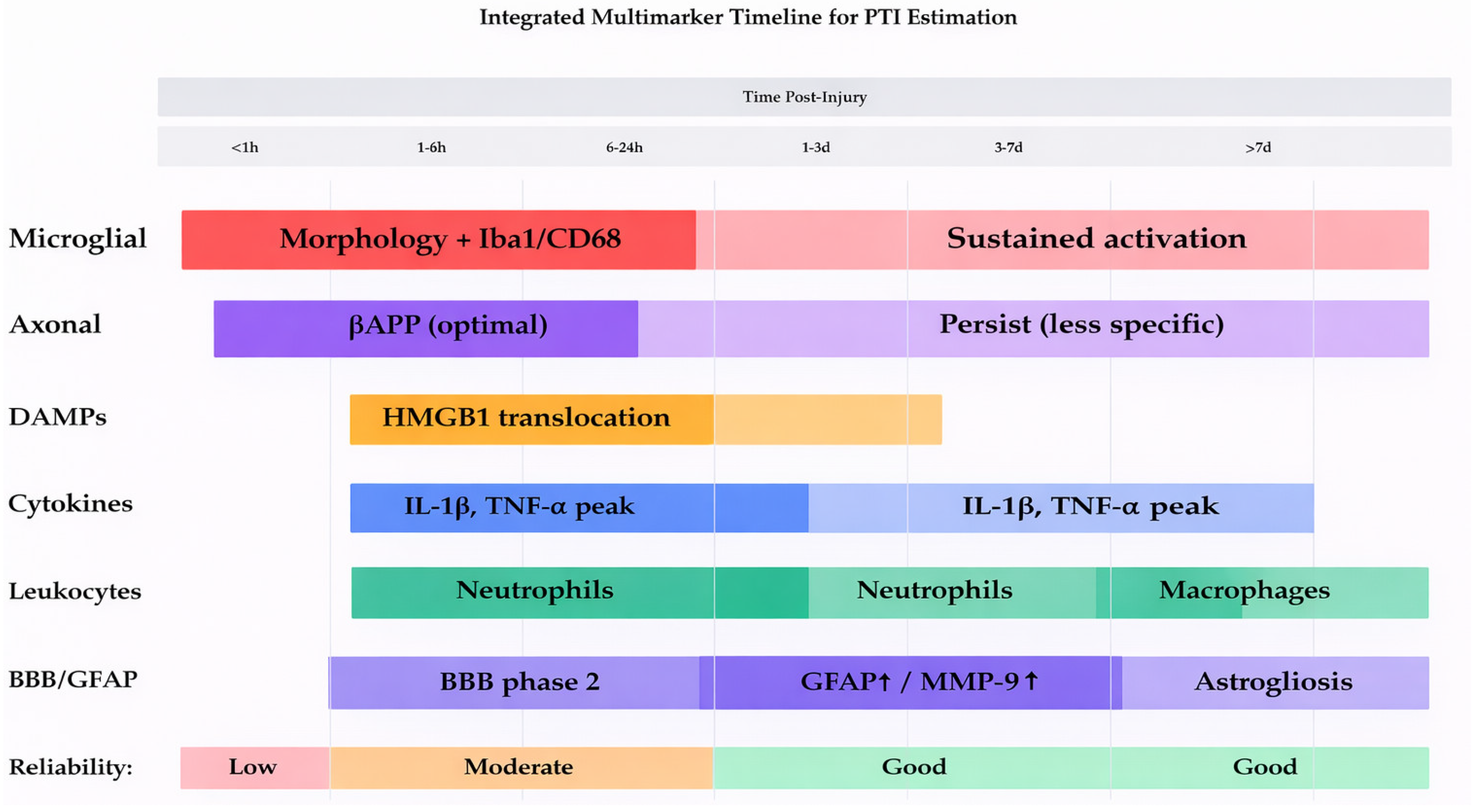
2.1. The Neuroinflammatory Continuum
2.2. The Interaction Between Injury Severity and Inflammatory Response
3. Forensically Relevant Markers for PTI Estimation
3.1. Microglial Activation and Morphological Changes
3.2. Mechanotransduction and Early Axonal Damage
3.3. Damage-Associated Molecular Patterns
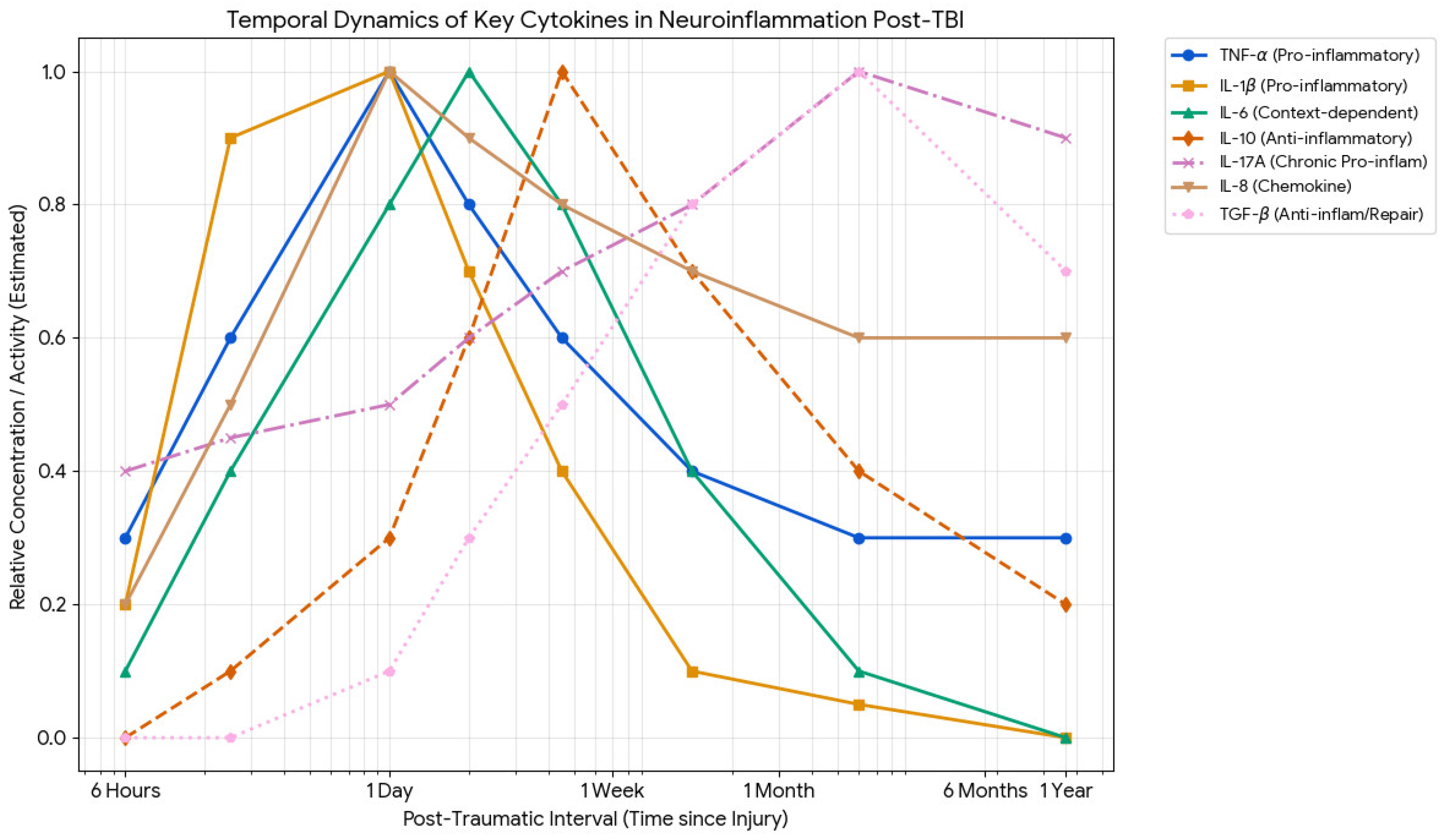
3.4. Temporal Profiles of Key Cytokines
3.5. Leukocyte Characteristics
3.6. BBB Breakdown Markers
3.7. Reactive Astrocytosis and GFAP
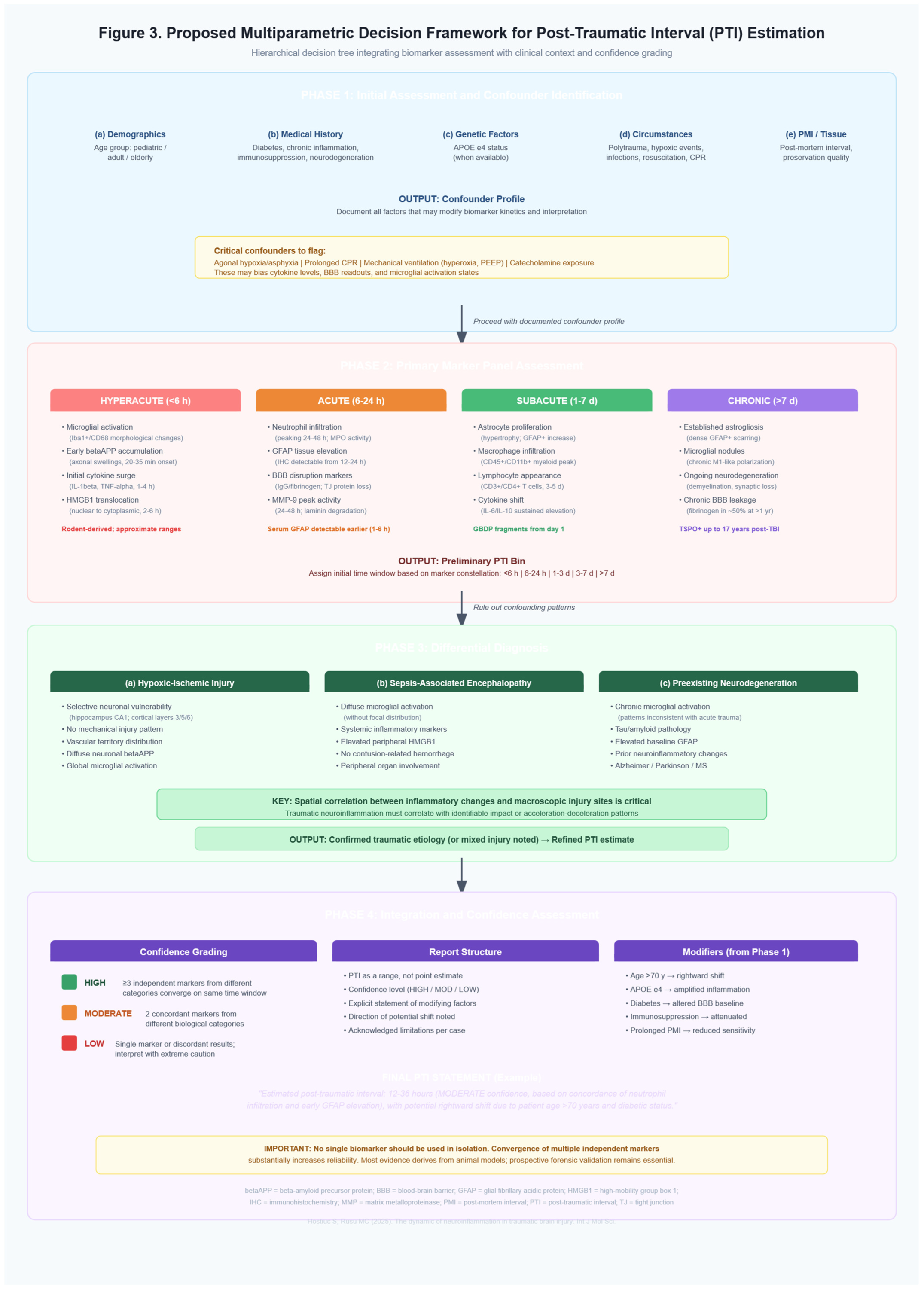
4. Proposed Multiparametric Decision Framework for PTI Estimation
5. Limitations
6. Conclusions
Supplementary Materials
Author Contributions
Funding
Institutional Review Board Statement
Informed Consent Statement
Data Availability Statement
Acknowledgments
Conflicts of Interest
Abbreviations
| AIS | Abbreviated Injury Scale |
| AMPA | α-amino-3-hydroxy-5-methyl-4-isoxazolepropionic acid |
| APOE | Apolipoprotein E |
| APP | Amyloid Precursor Protein |
| ASC | Apoptosis-associated Speck-like protein containing a CARD |
| ATP | Adenosine Triphosphate |
| BBB | Blood–Brain Barrier |
| βAPP | Beta-Amyloid Precursor Protein |
| CCI | Controlled Cortical Impact |
| CCL2 | C-C Motif Chemokine Ligand 2 |
| CCL3 | C-C Motif Chemokine Ligand 3 |
| CCL4 | C-C Motif Chemokine Ligand 4 |
| CCR2 | C-C Chemokine Receptor Type 2 |
| CD3 | Cluster of Differentiation 3 |
| CD4 | Cluster of Differentiation 4 |
| CD8 | Cluster of Differentiation 8 |
| CD11b | Cluster of Differentiation 11b |
| CD45 | Cluster of Differentiation 45 |
| CD206 | Cluster of Differentiation 206 |
| cGAS | Cyclic GMP-AMP Synthase |
| CNS | Central Nervous System |
| CSF | Cerebrospinal Fluid |
| CT | Computed Tomography |
| CTE | Chronic Traumatic Encephalopathy |
| DAI | Diffuse Axonal Injury |
| DAMP | Damage-Associated Molecular Pattern |
| DNA | Deoxyribonucleic Acid |
| eNOS | Endothelial Nitric Oxide Synthase |
| ERK | Extracellular Signal-Regulated Kinase |
| ERK1/2 | Extracellular Signal-Regulated Kinase 1/2 |
| FAK | Focal Adhesion Kinase |
| FPI | Fluid Percussion Injury |
| GBDPs | GFAP Breakdown Products |
| GCS | Glasgow Coma Scale |
| GFAP | Glial Fibrillary Acidic Protein |
| GPX1 | Glutathione Peroxidase 1 |
| GSK-3β | Glycogen Synthase Kinase-3 beta |
| H2O2 | Hydrogen Peroxide |
| HIF | Hypoxia-Inducible Factor |
| HMGB1 | High-Mobility Group Box 1 |
| HRP | Horseradish Peroxidase |
| Iba1 | Ionized calcium-binding adapter molecule 1 |
| IgG | Immunoglobulin G |
| IL-1β | Interleukin-1 beta |
| IL-1R1 | Interleukin-1 Receptor Type 1 |
| IL-1ra | Interleukin-1 Receptor Antagonist |
| IL-4 | Interleukin-4 |
| IL-6 | Interleukin-6 |
| IL-10 | Interleukin-10 |
| IL-15 | Interleukin-15 |
| IL-18 | Interleukin-18 |
| iNOS | Inducible Nitric Oxide Synthase |
| ISS | Injury Severity Score |
| JNK | c-Jun N-terminal Kinase |
| MAPK | Mitogen-Activated Protein Kinase |
| MCP-1 | Monocyte Chemoattractant Protein-1 |
| MMP | Matrix Metalloproteinase |
| MMP-1 | Matrix Metalloproteinase-1 |
| MMP-2 | Matrix Metalloproteinase-2 |
| MMP-7 | Matrix Metalloproteinase-7 |
| MMP-9 | Matrix Metalloproteinase-9 |
| MPO | Myeloperoxidase |
| MRI | Magnetic Resonance Imaging |
| mRNA | Messenger RNA |
| NADH | Nicotinamide Adenine Dinucleotide (reduced) |
| NADPH | Nicotinamide Adenine Dinucleotide Phosphate |
| NCLX | Mitochondrial Na+/Ca2+ Exchanger |
| NF-68 | Neurofilament-68 |
| NF-κB | Nuclear Factor-kappa B |
| NFL | Neurofilament Light |
| NLRP3 | NLR Family Pyrin Domain Containing 3 |
| NMDA | N-methyl-D-aspartate |
| nNOS | Neuronal Nitric Oxide Synthase |
| NO | Nitric Oxide |
| NOS | Nitric Oxide Synthase |
| NOX | NADPH Oxidase |
| NOX1 | NADPH Oxidase 1 |
| NOX2 | NADPH Oxidase 2 |
| NQO1 | NAD(P)H Quinone Dehydrogenase 1 |
| Nrf2 | Nuclear Factor Erythroid 2-Related Factor 2 |
| PDE2 | Phosphodiesterase 2 |
| Piezo1 | Piezo-type Mechanosensitive Ion Channel Component 1 |
| Piezo2 | Piezo-type Mechanosensitive Ion Channel Component 2 |
| PMI | Post-Mortem Interval |
| PRX2 | Peroxiredoxin 2 |
| PSD-95 | Postsynaptic Density Protein 95 |
| PTI | Post-Traumatic Interval |
| RAGE | Receptor for Advanced Glycation End-products |
| RNA | Ribonucleic Acid |
| RNS | Reactive Nitrogen Species |
| ROCK | Rho-associated Protein Kinase |
| ROCK1 | Rho-associated Protein Kinase 1 |
| ROS | Reactive Oxygen Species |
| SAP-97 | Synapse-Associated Protein 97 |
| SASP | Senescence-Associated Secretory Phenotype |
| SNAP-25 | Synaptosome-Associated Protein 25 |
| SOD | Superoxide Dismutase |
| SOD2 | Superoxide Dismutase 2 |
| TBI | Traumatic Brain Injury |
| TGF-β | Transforming Growth Factor beta |
| TJ | Tight Junction |
| TLR | Toll-Like Receptor |
| TLR4 | Toll-Like Receptor 4 |
| TMEM119 | Transmembrane Protein 119 |
| TNF-α | Tumor Necrosis Factor alpha |
| TOS | Total Oxidant Status |
| TRP | Transient Receptor Potential |
| TRX2 | Thioredoxin 2 |
| TSPO | Translocator Protein |
| TUNEL | Terminal deoxynucleotidyl transferase dUTP nick end labeling |
| UCH-L1 | Ubiquitin Carboxy-terminal Hydrolase L-1 |
| VEGF | Vascular Endothelial Growth Factor |
| VEGFR-2 | Vascular Endothelial Growth Factor Receptor 2 |
| ZO-1 | Zonula Occludens-1 |
References
- Maas, A.I.R.; Menon, D.K.; Adelson, P.D.; Andelic, N.; Bell, M.J.; Belli, A.; Bragge, P.; Brazinova, A.; Büki, A.; Chesnut, R.M.; et al. Traumatic Brain Injury: Integrated Approaches to Improve Prevention, Clinical Care, and Research. Lancet Neurol. 2017, 16, 987–1048. [Google Scholar] [CrossRef] [PubMed]
- Yan, J.; Wang, C.; Sun, B. Global, Regional, and National Burdens of Traumatic Brain Injury from 1990 to 2021. Front. Public Health 2025, 13, 1556147. [Google Scholar] [CrossRef] [PubMed]
- Karaboue, M.A.A.; Ministeri, F.; Sessa, F.; Nannola, C.; Chisari, M.G.; Cocimano, G.; Di Mauro, L.; Salerno, M.; Esposito, M. Traumatic Brain Injury as a Public Health Issue: Epidemiology, Prognostic Factors and Useful Data from Forensic Practice. Healthcare 2024, 12, 2266. [Google Scholar] [CrossRef] [PubMed]
- Thakral, S.; Purohit, P.; Mishra, R.; Gupta, V.; Setia, P. The Impact of RNA Stability and Degradation in Different Tissues to the Determination of Post-Mortem Interval: A Systematic Review. Forensic Sci. Int. 2023, 349, 111772. [Google Scholar] [CrossRef]
- Zwirner, J.; Kulakofsky, R.; Fitzek, A.; Schröder, A.S.; Bohnert, S.; Franke, H.; Renné, T.; Tse, R.; Ondruschka, B. Forensic Biomarkers of Lethal Traumatic Brain Injury. Int. J. Leg. Med. 2022, 136, 871–886. [Google Scholar] [CrossRef]
- Pinchi, E.; Frati, A.; Cipolloni, L.; Aromatario, M.; Gatto, V.; La Russa, R.; Pesce, A.; Santurro, A.; Fraschetti, F.; Frati, P.; et al. Clinical-Pathological Study on β-APP, IL-1β, GFAP, NFL, Spectrin II, 8OHdG, TUNEL, MiR-21, MiR-16, MiR-92 Expressions to Verify DAI-Diagnosis, Grade and Prognosis. Sci. Rep. 2018, 8, 2387. [Google Scholar] [CrossRef]
- Whitwell, H.; Milroy, C.; du Plessis, D. Forensic Neuropathology, 2nd ed.; CRC Press: Boca Raton, FL, USA, 2021. [Google Scholar]
- Oehmichen, M.; Auer, R.N.; Konig, H.G. Forensic Neuropathology and Associated Neurology; Springer: Berlin, Heidelberg; New York, NY, USA, 2006; ISBN 9783540235002. [Google Scholar]
- Alam, A.; Thelin, E.P.; Tajsic, T.; Khan, D.Z.; Khellaf, A.; Patani, R.; Helmy, A. Cellular Infiltration in Traumatic Brain Injury. J. Neuroinflamm. 2020, 17, 328. [Google Scholar] [CrossRef]
- Cowansage, K.; Nair, R.; Lara-Ruiz, J.M.; Berman, D.E.; Boyd, C.C.; Milligan, T.L.; Kotzab, D.; Bellanti, D.M.; Shank, L.M.; Morgan, M.A.; et al. Genetic and Peripheral Biomarkers of Comorbid Posttraumatic Stress Disorder and Traumatic Brain Injury: A Systematic Review. Front. Neurol. 2025, 16, 1500667. [Google Scholar] [CrossRef]
- Lassarén, P.; Lindblad, C.; Frostell, A.; Carpenter, K.L.H.; Guilfoyle, M.R.; Hutchinson, P.J.A.; Helmy, A.; Thelin, E.P. Systemic Inflammation Alters the Neuroinflammatory Response: A Prospective Clinical Trial in Traumatic Brain Injury. J. Neuroinflamm. 2021, 18, 221. [Google Scholar] [CrossRef]
- Wu, J.; Ren, R.; Chen, T.; Su, L.-D.; Tang, T. Neuroimmune and Neuroinflammation Response for Traumatic Brain Injury. Brain Res. Bull. 2024, 217, 111066. [Google Scholar] [CrossRef]
- Andersson, D.; Alkass, K.; Mielcarz, J.A.; Davidsson, J.; Druid, H. Bleeding Pattern in the Early Phase after Experimental Rotational Acceleration Induced Traumatic Brain Injury. Int. J. Leg. Med. 2025, 139, 1609–1621. [Google Scholar] [CrossRef]
- Zhang, L.; Yang, K.H.; King, A.I. A Proposed Injury Threshold for Mild Traumatic Brain Injury. J. Biomech. Eng. 2004, 126, 226–236. [Google Scholar] [CrossRef] [PubMed]
- Smith, D.H.; Wolf, J.A.; Lusardi, T.A.; Lee, V.M.; Meaney, D.F. High Tolerance and Delayed Elastic Response of Cultured Axons to Dynamic Stretch Injury. J. Neurosci. 1999, 19, 4263–4269. [Google Scholar] [CrossRef] [PubMed]
- Johnson, V.E.; Stewart, J.E.; Begbie, F.D.; Trojanowski, J.Q.; Smith, D.H.; Stewart, W. Inflammation and White Matter Degeneration Persist for Years after a Single Traumatic Brain Injury. Brain 2013, 136, 28–42. [Google Scholar] [CrossRef] [PubMed]
- Adams, J.H.; Doyle, D.; Ford, I.; Gennarelli, T.A.; Graham, D.I.; McLellan, D.R. Diffuse Axonal Injury in Head Injury: Definition, Diagnosis and Grading. Histopathology 1989, 15, 49–59. [Google Scholar] [CrossRef]
- Ommaya, A.K.; Gennarelli, T.A. Cerebral Concussion and Traumatic Unconsciousness. Correlation of Experimental and Clinical Observations of Blunt Head Injuries. Brain 1974, 97, 633–654. [Google Scholar] [CrossRef]
- Jang, S.H. Diagnostic Problems in Diffuse Axonal Injury. Diagnostics 2020, 10, 117. [Google Scholar] [CrossRef]
- Meaney, D.F.; Smith, D.H.; Shreiber, D.I.; Bain, A.C.; Miller, R.T.; Ross, D.T.; Gennarelli, T.A. Biomechanical Analysis of Experimental Diffuse Axonal Injury. J. Neurotrauma 1995, 12, 689–694. [Google Scholar] [CrossRef]
- Povlishock, J.T.; Katz, D.I. Update of Neuropathology and Neurological Recovery after Traumatic Brain Injury. J. Head Trauma Rehabil. 2005, 20, 76–94. [Google Scholar] [CrossRef]
- Gennarelli, T.A. Head Injury in Man and Experimental Animals: Clinical Aspects. In Trauma and Regeneration; Acta Neurochirurgica Supplement; Springer: Berlin/Heidelberg, Germany, 1983; Volume 32, pp. 1–13. [Google Scholar]
- Farkas, O.; Povlishock, J.T. Cellular and Subcellular Change Evoked by Diffuse Traumatic Brain Injury: A Complex Web of Change Extending Far beyond Focal Damage. Prog. Brain Res. 2007, 161, 43–59. [Google Scholar]
- Raghupathi, R. Cell Death Mechanisms Following Traumatic Brain Injury. Brain Pathol. 2004, 14, 215–222. [Google Scholar] [CrossRef] [PubMed]
- Morrison, B.; Cater, H.L.; Benham, C.D.; Sundstrom, L.E. An in Vitro Model of Traumatic Brain Injury Utilising Two-Dimensional Stretch of Organotypic Hippocampal Slice Cultures. J. Neurosci. Methods 2006, 150, 192–201. [Google Scholar] [CrossRef] [PubMed]
- Faden, A.I.; Demediuk, P.; Panter, S.S.; Vink, R. The Role of Excitatory Amino Acids and NMDA Receptors in Traumatic Brain Injury. Science 1989, 244, 798–800. [Google Scholar] [CrossRef] [PubMed]
- Choi, D.W. Glutamate Neurotoxicity and Diseases of the Nervous System. Neuron 1988, 1, 623–634. [Google Scholar] [CrossRef]
- Bullock, R.; Zauner, A.; Woodward, J.J.; Myseros, J.; Choi, S.C.; Ward, J.D.; Marmarou, A.; Young, H.F. Factors Affecting Excitatory Amino Acid Release Following Severe Human Head Injury. Neurosurg. Focus 1998, 5, E1. [Google Scholar] [CrossRef]
- Weber, J.T. Altered Calcium Signaling Following Traumatic Brain Injury. Front. Pharmacol. 2012, 3, 60. [Google Scholar] [CrossRef]
- Kampfl, A.; Posmantur, R.; Nixon, R.; Grynspan, F.; Zhao, X.; Liu, S.J.; Newcomb, J.K.; Clifton, G.L.; Hayes, R.L. Μ-calpain Activation and Calpain-mediated Cytoskeletal Proteolysis Following Traumatic Brain Injury. J. Neurochem. 1996, 67, 1575–1583. [Google Scholar] [CrossRef]
- Rozenfeld, M.; Azoulay, I.S.; Ben Kasus Nissim, T.; Stavsky, A.; Melamed, M.; Stutzmann, G.; Hershfinkel, M.; Kofman, O.; Sekler, I. Essential Role of the Mitochondrial Na+/Ca2+ Exchanger NCLX in Mediating PDE2-Dependent Neuronal Survival and Learning. Cell Rep. 2022, 41, 111772. [Google Scholar] [CrossRef]
- Nicholls, D.G.; Budd, S.L. Mitochondria and Neuronal Survival. Physiol. Rev. 2000, 80, 315–360. [Google Scholar] [CrossRef]
- Lifshitz, J.; Friberg, H.; Neumar, R.W.; Raghupathi, R.; Welsh, F.A.; Janmey, P.; Saatman, K.E.; Wieloch, T.; Grady, M.S.; McIntosh, T.K. Structural and Functional Damage Sustained by Mitochondria after Traumatic Brain Injury in the Rat: Evidence for Differentially Sensitive Populations in the Cortex and Hippocampus. J. Cereb. Blood Flow Metab. 2003, 23, 219–231. [Google Scholar] [CrossRef]
- Xiong, Y.; Gu, Q.; Peterson, P.L.; Muizelaar, J.P.; Lee, C.P. Mitochondrial Dysfunction and Calcium Perturbation Induced by Traumatic Brain Injury. J. Neurotrauma 1997, 14, 23–34. [Google Scholar] [CrossRef] [PubMed]
- Cornelius, C.; Crupi, R.; Calabrese, V.; Graziano, A.; Milone, P.; Pennisi, G.; Radak, Z.; Calabrese, E.J.; Cuzzocrea, S. Traumatic Brain Injury: Oxidative Stress and Neuroprotection. Antioxid. Redox Signal. 2013, 19, 836–853. [Google Scholar] [CrossRef] [PubMed]
- Khatri, N.; Thakur, M.; Pareek, V.; Kumar, S.; Sharma, S.; Datusalia, A.K. Oxidative Stress: Major Threat in Traumatic Brain Injury. CNS Neurol. Disord. Drug Targets 2018, 17, 689–695. [Google Scholar] [CrossRef] [PubMed]
- Baracaldo-Santamaría, D.; Ariza-Salamanca, D.F.; Corrales-Hernández, M.G.; Pachón-Londoño, M.J.; Hernandez-Duarte, I.; Calderon-Ospina, C.-A. Revisiting Excitotoxicity in Traumatic Brain Injury: From Bench to Bedside. Pharmaceutics 2022, 14, 152. [Google Scholar] [CrossRef]
- Kaur, P.; Sharma, S. Recent Advances in Pathophysiology of Traumatic Brain Injury. Curr. Neuropharmacol. 2018, 16, 1224–1238. [Google Scholar] [CrossRef]
- Hakiminia, B.; Alikiaii, B.; Khorvash, F.; Mousavi, S. Oxidative Stress and Mitochondrial Dysfunction Following Traumatic Brain Injury: From Mechanistic View to Targeted Therapeutic Opportunities. Fundam. Clin. Pharmacol. 2022, 36, 612–662. [Google Scholar] [CrossRef]
- Rodriguez-Rodriguez, A.; Egea-Guerrero, J.; Murillo-Cabezas, F.; Carrillo-Vico, A. Oxidative Stress in Traumatic Brain Injury. Curr. Med. Chem. 2014, 21, 1201–1211. [Google Scholar] [CrossRef]
- Nguyen, A.; Patel, A.B.; Kioutchoukova, I.P.; Diaz, M.J.; Lucke-Wold, B. Mechanisms of Mitochondrial Oxidative Stress in Brain Injury: From Pathophysiology to Therapeutics. Oxygen 2023, 3, 163–178. [Google Scholar] [CrossRef]
- Kumar Sahel, D.; Kaira, M.; Raj, K.; Sharma, S.; Singh, S. Mitochondrial Dysfunctioning and Neuroinflammation: Recent Highlights on the Possible Mechanisms Involved in Traumatic Brain Injury. Neurosci. Lett. 2019, 710, 134347. [Google Scholar] [CrossRef]
- Bano, N.; Khan, S.; Ahamad, S.; Dar, N.J.; Alanazi, H.H.; Nazir, A.; Bhat, S.A. Microglial NOX2 as a Therapeutic Target in Traumatic Brain Injury: Mechanisms, Consequences, and Potential for Neuroprotection. Ageing Res. Rev. 2025, 108, 102735. [Google Scholar] [CrossRef]
- Kuriakose, M.; Younger, D.; Ravula, A.R.; Alay, E.; Rama Rao, K.V.; Chandra, N. Synergistic Role of Oxidative Stress and Blood-Brain Barrier Permeability as Injury Mechanisms in the Acute Pathophysiology of Blast-Induced Neurotrauma. Sci. Rep. 2019, 9, 7717. [Google Scholar] [CrossRef] [PubMed]
- Muneer, P.M.A.; Chandra, N.; Haorah, J. Interactions of Oxidative Stress and Neurovascular Inflammation in the Pathogenesis of Traumatic Brain Injury. Mol. Neurobiol. 2015, 51, 966–979. [Google Scholar] [CrossRef] [PubMed]
- Goyal, L.; Singh, S. Neurological Manifestations Following Traumatic Brain Injury: Role of Behavioral, Neuroinflammation, Excitotoxicity, Nrf-2 and Nitric Oxide. CNS Neurol. Disord. Drug Targets 2025, 24, 47–59. [Google Scholar] [CrossRef] [PubMed]
- Musyaju, S.; Modi, H.R.; Shear, D.A.; Scultetus, A.H.; Pandya, J.D. Time Course of Mitochondrial Antioxidant Markers in a Preclinical Model of Severe Penetrating Traumatic Brain Injury. Int. J. Mol. Sci. 2025, 26, 906. [Google Scholar] [CrossRef]
- Fesharaki-Zadeh, A. Oxidative Stress in Traumatic Brain Injury. Int. J. Mol. Sci. 2022, 23, 13000. [Google Scholar] [CrossRef]
- Jarrahi, A.; Braun, M.; Ahluwalia, M.; Gupta, R.V.; Wilson, M.; Munie, S.; Ahluwalia, P.; Vender, J.R.; Vale, F.L.; Dhandapani, K.M.; et al. Revisiting Traumatic Brain Injury: From Molecular Mechanisms to Therapeutic Interventions. Biomedicines 2020, 8, 389. [Google Scholar] [CrossRef]
- Freire, M.A.M.; Rocha, G.S.; Bittencourt, L.O.; Falcao, D.; Lima, R.R.; Cavalcanti, J.R.L.P. Cellular and Molecular Pathophysiology of Traumatic Brain Injury: What Have We Learned so Far? Biology 2023, 12, 1139. [Google Scholar] [CrossRef]
- Song, K.; Li, Y.; Zhang, H.; An, N.; Wei, Y.; Wang, L.; Tian, C.; Yuan, M.; Sun, Y.; Xing, Y.; et al. Oxidative Stress-Mediated Blood-Brain Barrier (BBB) Disruption in Neurological Diseases. Oxid. Med. Cell. Longev. 2020, 2020, 1–27. [Google Scholar] [CrossRef]
- Kanner, J.; Harel, S.; Salan, A.M. The Generation of Ferryl or Hydroxyl Radicals during Interaction of Hemeproteins with Hydrogen Peroxide. Basic Life Sci. 1988, 49, 145–148. [Google Scholar]
- Ren, B.; Liang, J.; Yang, L.; Wei, X.; Guo, M.; Li, H. Bioinformatics-Driven Exploration of Key Genes and Mechanisms Underlying Oxidative Stress in Traumatic Brain Injury. Front. Aging Neurosci. 2025, 17, 1531317. [Google Scholar] [CrossRef]
- Wu, A.-G.; Yong, Y.-Y.; Pan, Y.-R.; Zhang, L.; Wu, J.-M.; Zhang, Y.; Tang, Y.; Wei, J.; Yu, L.; Law, B.Y.-K.; et al. Targeting Nrf2-Mediated Oxidative Stress Response in Traumatic Brain Injury: Therapeutic Perspectives of Phytochemicals. Oxid. Med. Cell. Longev. 2022, 2022, 1015791. [Google Scholar] [CrossRef]
- Hong, Y.; Yan, W.; Chen, S.; Sun, C.-R.; Zhang, J.-M. The Role of Nrf2 Signaling in the Regulation of Antioxidants and Detoxifying Enzymes after Traumatic Brain Injury in Rats and Mice. Acta Pharmacol. Sin. 2010, 31, 1421–1430. [Google Scholar] [CrossRef] [PubMed]
- Jin, W.; Wang, H.; Yan, W.; Zhu, L.; Hu, Z.; Ding, Y.; Tang, K. Role of Nrf2 in Protection against Traumatic Brain Injury in Mice. J. Neurotrauma 2009, 26, 131–139. [Google Scholar] [CrossRef] [PubMed]
- Bhowmick, S.; D’Mello, V.; Caruso, D.; Muneer, P.M.A. Correction to: Traumatic Brain Injury-Induced Downregulation of Nrf2 Activates Inflammatory Response and Apoptotic Cell Death. J. Mol. Med. 2025, 103, 489. [Google Scholar] [CrossRef] [PubMed]
- Ismail, H.; Shakkour, Z.; Tabet, M.; Abdelhady, S.; Kobaisi, A.; Abedi, R.; Nasrallah, L.; Pintus, G.; Al-Dhaheri, Y.; Mondello, S.; et al. Traumatic Brain Injury: Oxidative Stress and Novel Anti-Oxidants Such as Mitoquinone and Edaravone. Antioxidants 2020, 9, 943. [Google Scholar] [CrossRef]
- Hall, E.D.; Yonkers, P.A.; Andrus, P.K.; Cox, J.W.; Anderson, D.K. Biochemistry and Pharmacology of Lipid Antioxidants in Acute Brain and Spinal Cord Injury. J. Neurotrauma 1992, 9, S425–S442. [Google Scholar]
- Salvagno, M.; Sterchele, E.D.; Zaccarelli, M.; Mrakic-Sposta, S.; Welsby, I.J.; Balestra, C.; Taccone, F.S. Oxidative Stress and Cerebral Vascular Tone: The Role of Reactive Oxygen and Nitrogen Species. Int. J. Mol. Sci. 2024, 25, 3007. [Google Scholar] [CrossRef]
- Sultana, R.; Perluigi, M.; Butterfield, D.A. Oxidatively Modified Proteins in Alzheimer’s Disease (AD), Mild Cognitive Impairment and Animal Models of AD: Role of Abeta in Pathogenesis. Acta Neuropathol. 2009, 118, 131–150. [Google Scholar] [CrossRef]
- Gowthami, N.; Pursotham, N.; Dey, G.; Ghose, V.; Sathe, G.; Pruthi, N.; Shukla, D.; Gayathri, N.; Santhoshkumar, R.; Padmanabhan, B.; et al. Neuroanatomical Zones of Human Traumatic Brain Injury Reveal Significant Differences in Protein Profile and Protein Oxidation: Implications for Secondary Injury Events. J. Neurochem. 2023, 167, 218–247. [Google Scholar] [CrossRef]
- Opii, W.O.; Nukala, V.N.; Sultana, R.; Pandya, J.D.; Day, K.M.; Merchant, M.L.; Klein, J.B.; Sullivan, P.G.; Butterfield, D.A. Proteomic Identification of Oxidized Mitochondrial Proteins Following Experimental Traumatic Brain Injury. J. Neurotrauma 2007, 24, 772–789. [Google Scholar] [CrossRef]
- Butterfield, D.A.; Sultana, R. Redox Proteomics Identification of Oxidatively Modified Brain Proteins in Alzheimer’s Disease and Mild Cognitive Impairment: Insights into the Progression of This Dementing Disorder. J. Alzheimer’s Dis. 2007, 12, 61–72. [Google Scholar] [CrossRef]
- Castegna, A.; Aksenov, M.; Aksenova, M.; Thongboonkerd, V.; Klein, J.B.; Pierce, W.M.; Booze, R.; Markesbery, W.R.; Butterfield, D.A. Proteomic Identification of Oxidatively Modified Proteins in Alzheimer’s Disease Brain. Part I: Creatine Kinase BB, Glutamine Synthase, and Ubiquitin Carboxy-Terminal Hydrolase L-1. Free Radic. Biol. Med. 2002, 33, 562–571. [Google Scholar] [CrossRef]
- Stamatovic, S.M.; Johnson, A.M.; Keep, R.F.; Andjelkovic, A.V. Junctional Proteins of the Blood-Brain Barrier: New Insights into Function and Dysfunction. Tissue Barriers 2016, 4, e1154641. [Google Scholar] [CrossRef] [PubMed]
- Luissint, A.-C.; Artus, C.; Glacial, F.; Ganeshamoorthy, K.; Couraud, P.-O. Tight Junctions at the Blood Brain Barrier: Physiological Architecture and Disease-Associated Dysregulation. Fluids Barriers CNS 2012, 9, 23. [Google Scholar] [CrossRef] [PubMed]
- Shlosberg, D.; Benifla, M.; Kaufer, D.; Friedman, A. Blood-Brain Barrier Breakdown as a Therapeutic Target in Traumatic Brain Injury. Nat. Rev. Neurol. 2010, 6, 393–403. [Google Scholar] [CrossRef] [PubMed]
- Fukuda, K.; Tanno, H.; Okimura, Y.; Nakamura, M.; Yamaura, A. The Blood-Brain Barrier Disruption to Circulating Proteins in the Early Period after Fluid Percussion Brain Injury in Rats. J. Neurotrauma 1995, 12, 315–324. [Google Scholar] [CrossRef]
- Tanno, H.; Nockels, R.P.; Pitts, L.H.; Noble, L.J. Breakdown of the Blood-Brain Barrier after Fluid Percussive Brain Injury in the Rat. Part 1: Distribution and Time Course of Protein Extravasation. J. Neurotrauma 1992, 9, 21–32. [Google Scholar] [CrossRef]
- Lotocki, G.; de Rivero Vaccari, J.P.; Perez, E.R.; Sanchez-Molano, J.; Furones-Alonso, O.; Bramlett, H.M.; Dietrich, W.D. Alterations in Blood-Brain Barrier Permeability to Large and Small Molecules and Leukocyte Accumulation after Traumatic Brain Injury: Effects of Post-Traumatic Hypothermia. J. Neurotrauma 2009, 26, 1123–1134. [Google Scholar] [CrossRef]
- Hu, Y.; Seker, B.; Exner, C.; Zhang, J.; Plesnila, N.; Schwarzmaier, S.M. Longitudinal Characterization of Blood-Brain Barrier Permeability after Experimental Traumatic Brain Injury by in Vivo 2-Photon Microscopy. J. Neurotrauma 2021, 38, 399–410. [Google Scholar] [CrossRef]
- Wen, J.; Qian, S.; Yang, Q.; Deng, L.; Mo, Y.; Yu, Y. Overexpression of Netrin-1 Increases the Expression of Tight Junction-Associated Proteins, Claudin-5, Occludin, and ZO-1, Following Traumatic Brain Injury in Rats. Exp. Ther. Med. 2014, 8, 881–886. [Google Scholar] [CrossRef]
- Kawoos, U.; Abutarboush, R.; Gu, M.; Chen, Y.; Statz, J.K.; Goodrich, S.Y.; Ahlers, S.T. Blast-Induced Temporal Alterations in Blood-Brain Barrier Properties in a Rodent Model. Sci. Rep. 2021, 11, 5906. [Google Scholar] [CrossRef] [PubMed]
- Gowrikumar, S.; Tarudji, A.; McDonald, B.Z.; Balusa, S.S.; Kievit, F.M.; Dhawan, P. Claudin-1 Impairs Blood-Brain Barrier by Downregulating Endothelial Junctional Proteins in Traumatic Brain Injury. Tissue Barriers 2025, 13, 2470482. [Google Scholar] [CrossRef] [PubMed]
- Ivens, S.; Kaufer, D.; Flores, L.P.; Bechmann, I.; Zumsteg, D.; Tomkins, O.; Seiffert, E.; Heinemann, U.; Friedman, A. TGF-Beta Receptor-Mediated Albumin Uptake into Astrocytes Is Involved in Neocortical Epileptogenesis. Brain 2007, 130, 535–547. [Google Scholar] [CrossRef] [PubMed]
- Schwartz, M.; Raposo, C. Protective Autoimmunity: A Unifying Model for the Immune Network Involved in CNS Repair. Neuroscientist 2014, 20, 343–358. [Google Scholar] [CrossRef]
- Maas, A.I.R.; Stocchetti, N.; Bullock, R. Moderate and Severe Traumatic Brain Injury in Adults. Lancet Neurol. 2008, 7, 728–741. [Google Scholar] [CrossRef]
- Zhu, T.; Guo, J.; Wu, Y.; Lei, T.; Zhu, J.; Chen, H.; Kala, S.; Wong, K.F.; Cheung, C.P.; Huang, X.; et al. The Mechanosensitive Ion Channel Piezo1 Modulates the Migration and Immune Response of Microglia. iScience 2023, 26, 105993. [Google Scholar] [CrossRef]
- Yu, D.; Ahmed, A.; Jayasi, J.; Womac, A.; Sally, O.; Bae, C. Inflammation Condition Sensitizes Piezo1 Mechanosensitive Channel in Mouse Cerebellum Astrocyte. Front. Cell. Neurosci. 2023, 17, 1200946. [Google Scholar] [CrossRef]
- Corrigan, F.; Mander, K.A.; Leonard, A.V.; Vink, R. Neurogenic Inflammation after Traumatic Brain Injury and Its Potentiation of Classical Inflammation. J. Neuroinflamm. 2016, 13, 264. [Google Scholar] [CrossRef]
- Ziebell, J.M.; Morganti-Kossmann, M.C. Involvement of Pro- and Anti-Inflammatory Cytokines and Chemokines in the Pathophysiology of Traumatic Brain Injury. Neurotherapeutics 2010, 7, 22–30. [Google Scholar] [CrossRef]
- Abboud, A.; Mi, Q.; Puccio, A.; Okonkwo, D.; Buliga, M.; Constantine, G.; Vodovotz, Y. Inflammation Following Traumatic Brain Injury in Humans: Insights from Data-Driven and Mechanistic Models into Survival and Death. Front. Pharmacol. 2016, 7, 342. [Google Scholar] [CrossRef]
- Simon, D.W.; McGeachy, M.J.; Bayır, H.; Clark, R.S.B.; Loane, D.J.; Kochanek, P.M. The Far-Reaching Scope of Neuroinflammation after Traumatic Brain Injury. Nat. Rev. Neurol. 2017, 13, 572. [Google Scholar] [CrossRef] [PubMed]
- Morganti-Kossmann, M.C.; Semple, B.D.; Hellewell, S.C.; Bye, N.; Ziebell, J.M. The Complexity of Neuroinflammation Consequent to Traumatic Brain Injury: From Research Evidence to Potential Treatments. Acta Neuropathol. 2019, 137, 731–755. [Google Scholar] [CrossRef] [PubMed]
- Thompson, H.J.; Rivara, F.; Becker, K.J.; Maier, R.; Temkin, N. Impact of Aging on the Immune Response to Traumatic Brain Injury (AIm:TBI) Study Protocol. Inj. Prev. 2020, 26, 471–477. [Google Scholar] [CrossRef] [PubMed]
- Obukohwo, O.M.; Oreoluwa, O.A.; Andrew, U.O.; Williams, U.E. Microglia-Mediated Neuroinflammation in Traumatic Brain Injury: A Review. Mol. Biol. Rep. 2024, 51, 1073. [Google Scholar] [CrossRef]
- Witcher, K.G.; Bray, C.E.; Chunchai, T.; Zhao, F.; O’Neil, S.M.; Gordillo, A.J.; Campbell, W.A.; McKim, D.B.; Liu, X.; Dziabis, J.E.; et al. Traumatic Brain Injury Causes Chronic Cortical Inflammation and Neuronal Dysfunction Mediated by Microglia. J. Neurosci. 2021, 41, 1597–1616. [Google Scholar] [CrossRef]
- Kumar, M.; Chaudhary, J.; Jain, A. Exploring Potential Biomarkers and Signaling Pathways in Neuroinflammation Post-Traumatic Brain Injury: Insights for Synthetic Compound-Based Interventions. Inflammopharmacology 2025, 33, 3739–3753. [Google Scholar] [CrossRef]
- Donat, C.K.; Scott, G.; Gentleman, S.M.; Sastre, M. Microglial Activation in Traumatic Brain Injury. Front. Aging Neurosci. 2017, 9, 208. [Google Scholar] [CrossRef]
- Caplan, H.W.; Cardenas, F.; Gudenkauf, F.; Zelnick, P.; Xue, H.; Cox, C.S.; Bedi, S.S. Spatiotemporal Distribution of Microglia after Traumatic Brain Injury in Male Mice. ASN Neuro 2020, 12, 1759091420911770. [Google Scholar] [CrossRef]
- Lier, J.; Ondruschka, B.; Bechmann, I.; Dreßler, J. Fast Microglial Activation after Severe Traumatic Brain Injuries. Int. J. Leg. Med. 2020, 134, 2187–2193. [Google Scholar] [CrossRef]
- Grovola, M.R.; von Reyn, C.; Loane, D.J.; Cullen, D.K. Understanding Microglial Responses in Large Animal Models of Traumatic Brain Injury: An Underutilized Resource for Preclinical and Translational Research. J. Neuroinflamm. 2023, 20, 67. [Google Scholar] [CrossRef]
- Alam, A.; Singh, T.; Kayhanian, S.; Tjerkaski, J.; Garcia, N.M.; Carpenter, K.L.H.; Patani, R.; Lindblad, C.; Thelin, E.P.; Syed, Y.A.; et al. Modeling the Inflammatory Response of Traumatic Brain Injury Using Human Induced Pluripotent Stem Cell Derived Microglia. J. Neurotrauma 2023, 40, 2164–2173. [Google Scholar] [CrossRef]
- Izzy, S.; Liu, Q.; Fang, Z.; Lule, S.; Wu, L.; Chung, J.Y.; Sarro-Schwartz, A.; Brown-Whalen, A.; Perner, C.; Hickman, S.E.; et al. Time-Dependent Changes in Microglia Transcriptional Networks Following Traumatic Brain Injury. Front. Cell. Neurosci. 2019, 13, 307. [Google Scholar] [CrossRef] [PubMed]
- Zhao, J.-Y.; Zhou, Y.; Zhou, C.-W.; Zhan, K.-B.; Yang, M.; Wen, M.; Zhu, L.-Q. Revisiting the Critical Roles of Reactive Microglia in Traumatic Brain Injury. Int. J. Surg. 2025, 111, 3942–3978. [Google Scholar] [CrossRef] [PubMed]
- Wangler, L.M.; Godbout, J.P. Microglia Moonlighting after Traumatic Brain Injury: Aging and Interferons Influence Chronic Microglia Reactivity. Trends Neurosci. 2023, 46, 926–940. [Google Scholar] [CrossRef]
- Subhramanyam, C.S.; Wang, C.; Hu, Q.; Dheen, S.T. Microglia-Mediated Neuroinflammation in Neurodegenerative Diseases. Semin. Cell Dev. Biol. 2019, 94, 112–120. [Google Scholar] [CrossRef] [PubMed]
- Bai, Q.; Xue, M.; Yong, V.W. Microglia and Macrophage Phenotypes in Intracerebral Haemorrhage Injury: Therapeutic Opportunities. Brain 2020, 143, 1297–1314. [Google Scholar] [CrossRef]
- Strehle, J.; Somnuke, P.; Li, S.; Wang, S.; Hirnet, T.; Wang, Y.; Schäfer, M.K.E. The Border-Associated Macrophage Marker MRC1 Contributes to an Early Neuroprotective Inflammatory Response to Traumatic Brain Injury in Mice. Acta Neuropathol. Commun. 2025, 13, 220. [Google Scholar] [CrossRef]
- Li, Q.; Lan, X.; Han, X.; Wang, J. Expression of Tmem119/Sall1 and Ccr2/CD69 in FACS-Sorted Microglia- and Monocyte/Macrophage-Enriched Cell Populations after Intracerebral Hemorrhage. Front. Cell. Neurosci. 2018, 12, 520. [Google Scholar] [CrossRef]
- Ruan, C.; Elyaman, W. A New Understanding of TMEM119 as a Marker of Microglia. Front. Cell. Neurosci. 2022, 16, 902372. [Google Scholar] [CrossRef]
- Chen, H.-R.; Sun, Y.-Y.; Chen, C.-W.; Kuo, Y.-M.; Kuan, I.S.; Tiger Li, Z.-R.; Short-Miller, J.C.; Smucker, M.R.; Kuan, C.-Y. Fate Mapping via CCR2-CreER Mice Reveals Monocyte-to-Microglia Transition in Development and Neonatal Stroke. Sci. Adv. 2020, 6, eabb2119. [Google Scholar] [CrossRef]
- Liu, J.; Lei, F.; Yan, B.; Cao, T.; Cui, N.; Sharma, J.; Correa, V.; Roach, L.; Nicolaou, S.; Pitts, K.; et al. Epigenetic Adaptation Drives Monocyte Differentiation into Microglia-like Cells upon Engraftment into the Central Nervous System. eLife 2025. [Google Scholar] [CrossRef]
- Somebang, K.; Rudolph, J.; Imhof, I.; Li, L.; Niemi, E.C.; Shigenaga, J.; Tran, H.; Gill, T.M.; Lo, I.; Zabel, B.A.; et al. CCR2 Deficiency Alters Activation of Microglia Subsets in Traumatic Brain Injury. Cell Rep. 2021, 36, 109727. [Google Scholar] [CrossRef]
- Paladini, M.S.; Yang, B.A.; Torkenczy, K.A.; Frias, E.S.; Feng, X.; Krukowski, K.; Sit, R.; Morri, M.; Lam, W.; Pedoia, V.; et al. Fate Mapping of Peripherally-Derived Macrophages after Traumatic Brain Injury in Mice Reveals a Long-Lasting Population with a Distinct Transcriptomic Signature. Nat. Commun. 2025, 16, 8898. [Google Scholar] [CrossRef] [PubMed]
- Hostiuc, S.; Pirici, D.; Negoi, I.; Ion, D.A.; Ceausu, M. Detection of Diffuse Axonal Injury in Forensic Pathology. Rom. J. Leg. Med. 2014, 22, 145–152. [Google Scholar] [CrossRef]
- Al-Sarraj, S.; Troakes, C.; Rutty, G.N. Axonal Injury Is Detected by ΒAPP Immunohistochemistry in Rapid Death from Head Injury Following Road Traffic Collision. Int. J. Leg. Med. 2022, 136, 1321–1339. [Google Scholar] [CrossRef] [PubMed]
- Hortobágyi, T.; Wise, S.; Hunt, N.; Cary, N.; Djurovic, V.; Fegan-Earl, A.; Shorrock, K.; Rouse, D.; Al-Sarraj, S. Traumatic Axonal Damage in the Brain Can Be Detected Using Beta-APP Immunohistochemistry within 35 Min after Head Injury to Human Adults. Neuropathol. Appl. Neurobiol. 2007, 33, 226–237. [Google Scholar] [CrossRef]
- Nedic, D.; Pilija, V.; Salihbegovic, A. Expression and Distribution of β Amyloid Precursor Protein Immunomarkers in the Detection of Diffuse Axonal Injury. Srp. Arh. Celok. Lek. 2022, 150, 77–82. [Google Scholar] [CrossRef]
- Allan, S.M.; Rothwell, N.J. Cytokines and Acute Neurodegeneration. Nat. Rev. Neurosci. 2001, 2, 734–744. [Google Scholar] [CrossRef]
- Ramlackhansingh, A.F.; Brooks, D.J.; Greenwood, R.J.; Bose, S.K.; Turkheimer, F.E.; Kinnunen, K.M.; Gentleman, S.; Heckemann, R.A.; Gunanayagam, K.; Gelosa, G.; et al. Inflammation after Trauma: Microglial Activation and Traumatic Brain Injury. Ann. Neurol. 2011, 70, 374–383. [Google Scholar] [CrossRef]
- Loane, D.J.; Kumar, A. Microglia in the TBI Brain: The Good, the Bad, and the Dysregulated. Exp. Neurol. 2016, 275, 316–327. [Google Scholar] [CrossRef]
- Hegdekar, N.; Sarkar, C.; Bustos, S.; Ritzel, R.M.; Hanscom, M.; Ravishankar, P.; Philkana, D.; Wu, J.; Loane, D.J.; Lipinski, M.M. Inhibition of Autophagy in Microglia and Macrophages Exacerbates Innate Immune Responses and Worsens Brain Injury Outcomes. Autophagy 2023, 19, 2026–2044. [Google Scholar] [CrossRef]
- Bussian, T.J.; Aziz, A.; Meyer, C.F.; Swenson, B.L.; van Deursen, J.M.; Baker, D.J. Clearance of Senescent Glial Cells Prevents Tau-Dependent Pathology and Cognitive Decline. Nature 2018, 562, 578–582. [Google Scholar] [CrossRef] [PubMed]
- Krukowski, K.; Chou, A.; Feng, X.; Tiret, B.; Paladini, M.-S.; Riparip, L.-K.; Chaumeil, M.M.; Lemere, C.; Rosi, S. Traumatic Brain Injury in Aged Mice Induces Chronic Microglia Activation, Synapse Loss, and Complement-Dependent Memory Deficits. Int. J. Mol. Sci. 2018, 19, 3753. [Google Scholar] [CrossRef] [PubMed]
- Lagraoui, M.; Latoche, J.R.; Cartwright, N.G.; Sukumar, G.; Dalgard, C.L.; Schaefer, B.C. Controlled Cortical Impact and Craniotomy Induce Strikingly Similar Profiles of Inflammatory Gene Expression, but with Distinct Kinetics. Front. Neurol. 2012, 3, 155. [Google Scholar] [CrossRef] [PubMed]
- Michalovicz, L.T.; Kelly, K.A.; Craddock, T.J.A.; O’Callaghan, J.P. A Projectile Concussive Impact Model Produces Neuroinflammation in Both Mild and Moderate-Severe Traumatic Brain Injury. Brain Sci. 2023, 13, 623. [Google Scholar] [CrossRef]
- Schindler, C.R.; Lustenberger, T.; Woschek, M.; Störmann, P.; Henrich, D.; Radermacher, P.; Marzi, I. Severe Traumatic Brain Injury (TBI) Modulates the Kinetic Profile of the Inflammatory Response of Markers for Neuronal Damage. J. Clin. Med. 2020, 9, 1667. [Google Scholar] [CrossRef]
- Johnson, N.H.; Hadad, R.; Taylor, R.R.; Rodríguez Pilar, J.; Salazar, O.; Llompart-Pou, J.A.; Dietrich, W.D.; Keane, R.W.; Pérez-Bárcena, J.; de Rivero Vaccari, J.P. Inflammatory Biomarkers of Traumatic Brain Injury. Pharmaceuticals 2022, 15, 660. [Google Scholar] [CrossRef]
- Samanta, R.J.; Chiollaz, A.-C.; Needham, E.; Yue, J.K.; Helmy, A.; Zanier, E.R.; Wang, K.K.W.; Kobeissy, F.; Posti, J.P.; Summers, C.; et al. Parsimonious Immune-Response Endotypes and Global Outcome in Patients with Traumatic Brain Injury. eBioMedicine 2024, 108, 105310. [Google Scholar] [CrossRef]
- Bohnert, S.; Seiffert, A.; Trella, S.; Bohnert, M.; Distel, L.; Ondruschka, B.; Monoranu, C.-M. TMEM119 as a Specific Marker of Microglia Reaction in Traumatic Brain Injury in Postmortem Examination. Int. J. Leg. Med. 2020, 134, 2167–2176. [Google Scholar] [CrossRef]
- Toledano Furman, N.; Gottlieb, A.; Prabhakara, K.S.; Bedi, S.; Caplan, H.W.; Ruppert, K.A.; Srivastava, A.K.; Olson, S.D.; Cox, C.S., Jr. High-Resolution and Differential Analysis of Rat Microglial Markers in Traumatic Brain Injury: Conventional Flow Cytometric and Bioinformatics Analysis. Sci. Rep. 2020, 10, 11991. [Google Scholar] [CrossRef]
- Sumberg, L.; Berman, R.; Pazgier, A.; Torres, J.; Qiu, J.; Tran, B.; Greene, S.; Atwood, R.; Boese, M.; Choi, K. A Semi-Automated and Unbiased Microglia Morphology Analysis Following Mild Traumatic Brain Injury in Rats. Int. J. Mol. Sci. 2025, 26, 8149. [Google Scholar] [CrossRef] [PubMed]
- Velayudhan, P.S.; Schwab, N.; Hazrati, L.-N.; Wheeler, A.L. Temporal Patterns of Microglial Activation in White Matter Following Experimental Mild Traumatic Brain Injury: A Systematic Literature Review. Acta Neuropathol. Commun. 2021, 9, 197. [Google Scholar] [CrossRef] [PubMed]
- Zhao, W.; Liu, Z.; Wu, J.; Liu, A.; Yan, J. Potential Targets of Microglia in the Treatment of Neurodegenerative Diseases: Mechanism and Therapeutic Implications. Neural Regen. Res. 2026, 21, 1497–1511. [Google Scholar] [CrossRef] [PubMed]
- Hayashi, T.; Ago, K.; Ago, M.; Ogata, M. Two Patterns of Beta-Amyloid Precursor Protein (APP) Immunoreactivity in Cases of Blunt Head Injury. Leg. Med. 2009, 11, S171–S173. [Google Scholar] [CrossRef]
- Hayashi, T.; Ago, K.; Nakamae, T.; Higo, E.; Ogata, M. Two Different Immunostaining Patterns of Beta-Amyloid Precursor Protein (APP) May Distinguish Traumatic from Nontraumatic Axonal Injury. Int. J. Leg. Med. 2015, 129, 1085–1090. [Google Scholar] [CrossRef]
- Sherriff, F.E.; Bridges, L.R.; Gentleman, S.M.; Sivaloganathan, S.; Wilson, S. Markers of Axonal Injury in Post Mortem Human Brain. Acta Neuropathol. 1994, 88, 433–439. [Google Scholar] [CrossRef]
- Seki, E.; Komori, T.; Arai, N. Distribution of Amyloid-β Precursor Protein-Immunoreactive Axons Differs According to the Severity of Cerebral Ischemia in Autopsy Brains. Neuropathology 2022, 42, 269–273. [Google Scholar] [CrossRef]
- Reichard, R.R.; Smith, C.; Graham, D.I. The Significance of Beta-APP Immunoreactivity in Forensic Practice. Neuropathol. Appl. Neurobiol. 2005, 31, 304–313. [Google Scholar] [CrossRef]
- Paudel, Y.N.; Angelopoulou, E.; Piperi, C.; Othman, I.; Shaikh, M.F. HMGB1-Mediated Neuroinflammatory Responses in Brain Injuries: Potential Mechanisms and Therapeutic Opportunities. Int. J. Mol. Sci. 2020, 21, 4609. [Google Scholar] [CrossRef]
- Manivannan, S.; Marei, O.; Elalfy, O.; Zaben, M. Neurogenesis after Traumatic Brain Injury—The Complex Role of HMGB1 and Neuroinflammation. Neuropharmacology 2021, 183, 108400. [Google Scholar] [CrossRef]
- Nishibori, M.; Wang, D.; Ousaka, D.; Wake, H. High Mobility Group Box-1 and Blood-Brain Barrier Disruption. Cells 2020, 9, 2650. [Google Scholar] [CrossRef] [PubMed]
- Siracusa, L.R.; Park, E.; Liu, E.; Baker, A.J. Prolonged Loss of Nuclear HMGB1 in Neurons Following Modeled TBI and Implications for Long-Term Genetic Health. Brain Res. 2025, 1855, 149559. [Google Scholar] [CrossRef] [PubMed]
- Stahel, P.F. Expression of HMGB1 and RAGE in Rat and Human Brains after Traumatic Brain Injury. J. Trauma Acute Care Surg. 2012, 73, 782; author reply 782–783. [Google Scholar] [CrossRef] [PubMed]
- Kawai, C.; Miyao, M.; Kotani, H.; Minami, H.; Abiru, H.; Tamaki, K.; Nishitani, Y. Roles of HMGB1 on Life-Threatening Traumatic Brain Injury and Sequential Peripheral Organ Damage. Sci. Rep. 2024, 14, 21421. [Google Scholar] [CrossRef]
- Aneja, R.K.; Alcamo, A.M.; Cummings, J.; Vagni, V.; Feldman, K.; Wang, Q.; Dixon, C.E.; Billiar, T.R.; Kochanek, P.M. Lack of Benefit on Brain Edema, Blood-Brain Barrier Permeability, or Cognitive Outcome in Global Inducible High Mobility Group Box 1 Knockout Mice despite Tissue Sparing after Experimental Traumatic Brain Injury. J. Neurotrauma 2019, 36, 360–369. [Google Scholar] [CrossRef]
- Chen, X.; Zhang, J.; Kim, B.; Jaitpal, S.; Meng, S.S.; Adjepong, K.; Imamura, S.; Wake, H.; Nishibori, M.; Stopa, E.G.; et al. High-Mobility Group Box-1 Translocation and Release after Hypoxic Ischemic Brain Injury in Neonatal Rats. Exp. Neurol. 2019, 311, 1–14. [Google Scholar] [CrossRef]
- Qiu, J.; Nishimura, M.; Wang, Y.; Sims, J.R.; Qiu, S.; Savitz, S.I.; Salomone, S.; Moskowitz, M.A. Early Release of HMGB-1 from Neurons after the Onset of Brain Ischemia. J. Cereb. Blood Flow Metab. 2008, 28, 927–938. [Google Scholar] [CrossRef]
- Sun, Q.; Wu, W.; Hu, Y.-C.; Li, H.; Zhang, D.; Li, S.; Li, W.; Li, W.-D.; Ma, B.; Zhu, J.-H.; et al. Early Release of High-Mobility Group Box 1 (HMGB1) from Neurons in Experimental Subarachnoid Hemorrhage in Vivo and in Vitro. J. Neuroinflamm. 2014, 11, 106. [Google Scholar] [CrossRef]
- Yang, Z.; Simovic, M.O.; Edsall, P.R.; Liu, B.; Cancio, T.S.; Batchinsky, A.I.; Cancio, L.C.; Li, Y. HMGB1 Inhibition to Ameliorate Organ Failure and Increase Survival in Trauma. Biomolecules 2022, 12, 101. [Google Scholar] [CrossRef]
- Cohen, M.J.; Brohi, K.; Calfee, C.S.; Rahn, P.; Chesebro, B.B.; Christiaans, S.C.; Carles, M.; Howard, M.; Pittet, J.-F. Early Release of High Mobility Group Box Nuclear Protein 1 after Severe Trauma in Humans: Role of Injury Severity and Tissue Hypoperfusion. Crit. Care 2009, 13, R174. [Google Scholar] [CrossRef]
- Hatayama, K.; Stonestreet, B.S. High Mobility Group Box-1 Protein as a Therapeutic Target in Perinatal Hypoxic-Ischemic Brain Injury. Neural Regen. Res. 2021, 16, 2006–2007. [Google Scholar] [CrossRef]
- Deng, C.; Zhao, L.; Yang, Z.; Shang, J.-J.; Wang, C.-Y.; Shen, M.-Z.; Jiang, S.; Li, T.; Di, W.-C.; Chen, Y.; et al. Targeting HMGB1 for the Treatment of Sepsis and Sepsis-Induced Organ Injury. Acta Pharmacol. Sin. 2022, 43, 520–528. [Google Scholar] [CrossRef]
- Vincent, J.C.; Garnett, C.N.; Watson, J.B.; Higgins, E.K.; Macheda, T.; Sanders, L.; Roberts, K.N.; Shahidehpour, R.K.; Blalock, E.M.; Quan, N.; et al. IL-1R1 Signaling in TBI: Assessing Chronic Impacts and Neuroinflammatory Dynamics in a Mouse Model of Mild Closed-Head Injury. J. Neuroinflamm. 2023, 20, 248, Erratum in Neuroinflamm. 2023, 20, 287. [Google Scholar] [CrossRef]
- Semple, B.D.; O’Brien, T.J.; Gimlin, K.; Wright, D.K.; Kim, S.E.; Casillas-Espinosa, P.M.; Webster, K.M.; Petrou, S.; Noble-Haeusslein, L.J. Interleukin-1 Receptor in Seizure Susceptibility after Traumatic Injury to the Pediatric Brain. J. Neurosci. 2017, 37, 7864–7877. [Google Scholar] [CrossRef] [PubMed]
- Luheshi, N.M.; Kovács, K.J.; Lopez-Castejon, G.; Brough, D.; Denes, A. Interleukin-1α Expression Precedes IL-1β after Ischemic Brain Injury and Is Localised to Areas of Focal Neuronal Loss and Penumbral Tissues. J. Neuroinflamm. 2011, 8, 186. [Google Scholar] [CrossRef] [PubMed]
- Lindblad, C.; Rostami, E.; Helmy, A. Interleukin-1 Receptor Antagonist as Therapy for Traumatic Brain Injury. Neurotherapeutics 2023, 20, 1508–1528. [Google Scholar] [CrossRef] [PubMed]
- Malik, S.; Alnaji, O.; Malik, M.; Gambale, T.; Farrokhyar, F.; Rathbone, M.P. Inflammatory Cytokines Associated with Mild Traumatic Brain Injury and Clinical Outcomes: A Systematic Review and Meta-Analysis. Front. Neurol. 2023, 14, 1123407. [Google Scholar] [CrossRef]
- Visser, K.; Koggel, M.; Blaauw, J.; van der Horn, H.J.; Jacobs, B.; van der Naalt, J. Blood-Based Biomarkers of Inflammation in Mild Traumatic Brain Injury: A Systematic Review. Neurosci. Biobehav. Rev. 2022, 132, 154–168. [Google Scholar] [CrossRef]
- Knoblach, S.M.; Fan, L.; Faden, A.I. Early Neuronal Expression of Tumor Necrosis Factor-α after Experimental Brain Injury Contributes to Neurological Impairment. J. Neuroimmunol. 1999, 95, 115–125. [Google Scholar] [CrossRef]
- Fan, L.; Young, P.R.; Barone, F.C.; Feuerstein, G.Z.; Smith, D.H.; McIntosh, T.K. Experimental Brain Injury Induces Differential Expression of Tumor Necrosis Factor-Alpha MRNA in the CNS. Brain Res. Mol. Brain Res. 1996, 36, 287–291. [Google Scholar] [CrossRef]
- Liu, T.; Clark, R.K.; McDonnell, P.C.; Young, P.R.; White, R.F.; Barone, F.C.; Feuerstein, G.Z. Tumor Necrosis Factor-Alpha Expression in Ischemic Neurons. Stroke 1994, 25, 1481–1488. [Google Scholar] [CrossRef]
- He, J.; Evans, C.-O.; Hoffman, S.W.; Oyesiku, N.M.; Stein, D.G. Progesterone and Allopregnanolone Reduce Inflammatory Cytokines after Traumatic Brain Injury. Exp. Neurol. 2004, 189, 404–412. [Google Scholar] [CrossRef] [PubMed]
- Thelin, E.P.; Hall, C.E.; Gupta, K.; Carpenter, K.L.H.; Chandran, S.; Hutchinson, P.J.; Patani, R.; Helmy, A. Elucidating Pro-Inflammatory Cytokine Responses after Traumatic Brain Injury in a Human Stem Cell Model. J. Neurotrauma 2018, 35, 341–352. [Google Scholar] [CrossRef] [PubMed]
- Chang, J.C. Molecular Pathogenesis of Endotheliopathy and Endotheliopathic Syndromes, Leading to Inflammation and Microthrombosis, and Various Hemostatic Clinical Phenotypes Based on “Two-Activation Theory of the Endothelium” and “Two-Path Unifying Theory” of Hemostasis. Medicina 2022, 58, 1311. [Google Scholar] [CrossRef]
- Casey, L.C.; Balk, R.A.; Bone, R.C. Plasma Cytokine and Endotoxin Levels Correlate with Survival in Patients with the Sepsis Syndrome. Ann. Intern. Med. 1993, 119, 771–778. [Google Scholar] [CrossRef]
- Bakhvalova, V.N.; Panov, V.V.; Potapova, O.F.; Morozova, O.V. Cytokines and antibodies in experimental infection of wild and laboratory rodents (rodentia) with tick-borne encephalitis virus. Vopr. Virusol. 2017, 62, 186–192. [Google Scholar] [CrossRef][Green Version]
- Siwicka-Gieroba, D.; Dabrowski, W. Credibility of the Neutrophil-to-Lymphocyte Count Ratio in Severe Traumatic Brain Injury. Life 2021, 11, 1352. [Google Scholar] [CrossRef]
- Royo, N.C.; Wahl, F.; Stutzmann, J.M. Kinetics of Polymorphonuclear Neutrophil Infiltration after a Traumatic Brain Injury in Rat. Neuroreport 1999, 10, 1363–1367. [Google Scholar] [CrossRef]
- Clark, R.S.; Schiding, J.K.; Kaczorowski, S.L.; Marion, D.W.; Kochanek, P.M. Neutrophil Accumulation after Traumatic Brain Injury in Rats: Comparison of Weight Drop and Controlled Cortical Impact Models. J. Neurotrauma 1994, 11, 499–506. [Google Scholar] [CrossRef]
- Matsuo, Y.; Onodera, H.; Shiga, Y.; Nakamura, M.; Ninomiya, M.; Kihara, T.; Kogure, K. Correlation Between Myeloperoxidase-Quantified Neutrophil Accumulation and Ischemic Brain Injury in the Rat: Effects of Neutrophil Depletion. Stroke 1994, 25, 1469–1475. [Google Scholar] [CrossRef]
- Dwyer, L.J.; Maheshwari, S.; Levy, E.; Poznansky, M.C.; Whalen, M.J.; Sîrbulescu, R.F. B Cell Treatment Promotes a Neuroprotective Microenvironment after Traumatic Brain Injury through Reciprocal Immunomodulation with Infiltrating Peripheral Myeloid Cells. J. Neuroinflamm. 2023, 20, 133. [Google Scholar] [CrossRef] [PubMed]
- Johnson, V.E.; Weber, M.T.; Xiao, R.; Cullen, D.K.; Meaney, D.F.; Stewart, W.; Smith, D.H. Mechanical Disruption of the Blood–Brain Barrier Following Experimental Concussion. Acta Neuropathol. 2018, 135, 711–726. [Google Scholar] [CrossRef] [PubMed]
- Cervós-Navarro, J.; Lafuente, J.V. Traumatic Brain Injuries: Structural Changes. J. Neurol. Sci. 1991, 103, S3–S14. [Google Scholar] [CrossRef] [PubMed]
- van Vliet, E.A.; Ndode-Ekane, X.E.; Lehto, L.J.; Gorter, J.A.; Andrade, P.; Aronica, E.; Gröhn, O.; Pitkänen, A. Long-Lasting Blood-Brain Barrier Dysfunction and Neuroinflammation after Traumatic Brain Injury. Neurobiol. Dis. 2020, 145, 105080. [Google Scholar] [CrossRef]
- Jenkins, D.R.; Craner, M.J.; Esiri, M.M.; DeLuca, G.C. Contribution of Fibrinogen to Inflammation and Neuronal Density in Human Traumatic Brain Injury. J. Neurotrauma 2018, 35, 2259–2271. [Google Scholar] [CrossRef]
- Sladojevic, N.; Stamatovic, S.M.; Johnson, A.M.; Choi, J.; Hu, A.; Dithmer, S.; Blasig, I.E.; Keep, R.F.; Andjelkovic, A.V. Claudin-1-Dependent Destabilization of the Blood-Brain Barrier in Chronic Stroke. J. Neurosci. 2019, 39, 743–757. [Google Scholar] [CrossRef]
- Wu, M.-Y.; Gao, F.; Yang, X.-M.; Qin, X.; Chen, G.-Z.; Li, D.; Dang, B.-Q.; Chen, G. Matrix Metalloproteinase-9 Regulates the Blood Brain Barrier via the Hedgehog Pathway in a Rat Model of Traumatic Brain Injury. Brain Res. 2020, 1727, 146553. [Google Scholar] [CrossRef]
- Higashida, T.; Kreipke, C.W.; Rafols, J.A.; Peng, C.; Schafer, S.; Schafer, P.; Ding, J.Y.; Dornbos, D.; Li, X.; Guthikonda, M.; et al. The Role of Hypoxia-Inducible Factor-1α, Aquaporin-4, and Matrix Metalloproteinase-9 in Blood-Brain Barrier Disruption and Brain Edema after Traumatic Brain Injury: Laboratory Investigation. J. Neurosurg. 2011, 114, 92–101. [Google Scholar] [CrossRef]
- Egashira, Y.; Zhao, H.; Hua, Y.; Keep, R.F.; Xi, G. White Matter Injury after Subarachnoid Hemorrhage: Role of Blood-Brain Barrier Disruption and Matrix Metalloproteinase-9. Stroke 2015, 46, 2909–2915. [Google Scholar] [CrossRef]
- Gasche, Y.; Fujimura, M.; Morita-Fujimura, Y.; Copin, J.C.; Kawase, M.; Massengale, J.; Chan, P.H. Early Appearance of Activated Matrix Metalloproteinase-9 after Focal Cerebral Ischemia in Mice: A Possible Role in Blood-Brain Barrier Dysfunction. J. Cereb. Blood Flow Metab. 1999, 19, 1020–1028. [Google Scholar] [CrossRef]
- Guilfoyle, M.R.; Carpenter, K.L.H.; Helmy, A.; Pickard, J.D.; Menon, D.K.; Hutchinson, P.J.A. Matrix Metalloproteinase Expression in Contusional Traumatic Brain Injury: A Paired Microdialysis Study. J. Neurotrauma 2015, 32, 1553–1559. [Google Scholar] [CrossRef] [PubMed]
- Nichols, P.; Urriola, J.; Miller, S.; Bjorkman, T.; Mahady, K.; Vegh, V.; Nasrallah, F.; Winter, C. Blood-Brain Barrier Dysfunction Significantly Correlates with Serum Matrix Metalloproteinase-7 (MMP-7) Following Traumatic Brain Injury. NeuroImage Clin. 2021, 31, 102741. [Google Scholar] [CrossRef] [PubMed]
- Beaman, E.E.; Bonde, A.N.; Larsen, S.M.U.; Ozenne, B.; Lohela, T.J.; Nedergaard, M.; Gíslason, G.H.; Knudsen, G.M.; Holst, S.C. Blood-Brain Barrier Permeable β-Blockers Linked to Lower Risk of Alzheimer’s Disease in Hypertension. Brain 2023, 146, 1141–1151. [Google Scholar] [CrossRef] [PubMed]
- Muñoz-Ballester, C.; Robel, S. Astrocyte-Mediated Mechanisms Contribute to Traumatic Brain Injury Pathology. WIREs Mech. Dis. 2023, 15, e1622. [Google Scholar] [CrossRef]
- Sabetta, Z.; Krishna, G.; Curry-Koski, T.; Lopez, M.; Adelson, P.D.; Thomas, T.C. Sex-Dependent Temporal Changes in Astrocyte-Vessel Interactions Following Diffuse Traumatic Brain Injury in Rats. Front. Physiol. 2024, 15, 1469073. [Google Scholar] [CrossRef]
- Sacco, M.A.; Gualtieri, S.; Tarallo, A.P.; Verrina, M.C.; Calafiore, J.; Princi, A.; Lombardo, S.; Ranno, F.; Di Cello, A.; Gratteri, S.; et al. The Role of GFAP in Post-Mortem Analysis of Traumatic Brain Injury: A Systematic Review. Int. J. Mol. Sci. 2024, 26, 185. [Google Scholar] [CrossRef]
- Cieri, M.B.; Villarreal, A.; Gomez-Cuautle, D.D.; Mailing, I.; Ramos, A.J. Progression of Reactive Gliosis and Astroglial Phenotypic Changes Following Stab Wound-Induced Traumatic Brain Injury in Mice. J. Neurochem. 2023, 167, 183–203. [Google Scholar] [CrossRef]
- Susarla, B.T.S.; Villapol, S.; Yi, J.-H.; Geller, H.M.; Symes, A.J. Temporal Patterns of Cortical Proliferation of Glial Cell Populations after Traumatic Brain Injury in Mice. ASN Neuro 2014, 6, AN20130034. [Google Scholar] [CrossRef]
- Thomas, T.C.; Ogle, S.B.; Rumney, B.M.; May, H.G.; Adelson, P.D.; Lifshitz, J. Does Time Heal All Wounds? Experimental Diffuse Traumatic Brain Injury Results in Persisting Histopathology in the Thalamus. Behav. Brain Res. 2018, 340, 137–146. [Google Scholar] [CrossRef]
- Yang, Z.; Arja, R.D.; Zhu, T.; Sarkis, G.A.; Patterson, R.L.; Romo, P.; Rathore, D.S.; Moghieb, A.; Abbatiello, S.; Robertson, C.S.; et al. Characterization of Calpain and Caspase-6-Generated Glial Fibrillary Acidic Protein Breakdown Products Following Traumatic Brain Injury and Astroglial Cell Injury. Int. J. Mol. Sci. 2022, 23, 8960. [Google Scholar] [CrossRef]
- Murphy, R.A. Time Course and Diagnostic Accuracy of Glial and Neuronal Blood Biomarkers GFAP and UCH-L1 in a Large Cohort of Trauma Patients with and without Mild Traumatic Brain Injury. J. Emerg. Med. 2016, 51, 338. [Google Scholar] [CrossRef]
- Bogoslovsky, T.; Wilson, D.; Chen, Y.; Hanlon, D.; Gill, J.; Jeromin, A.; Song, L.; Moore, C.; Gong, Y.; Kenney, K.; et al. Increases of Plasma Levels of Glial Fibrillary Acidic Protein, Tau, and Amyloid β up to 90 Days after Traumatic Brain Injury. J. Neurotrauma 2017, 34, 66–73. [Google Scholar] [CrossRef] [PubMed]
- Mercurio, D.; Fumagalli, S.; Schafer, M.K.-H.; Pedragosa, J.; Ngassam, L.D.C.; Wilhelmi, V.; Winterberg, S.; Planas, A.M.; Weihe, E.; De Simoni, M.-G. Protein Expression of the Microglial Marker Tmem119 Decreases in Association with Morphological Changes and Location in a Mouse Model of Traumatic Brain Injury. Front. Cell. Neurosci. 2022, 16, 820127. [Google Scholar] [CrossRef] [PubMed]
- González Ibanez, F.; Picard, K.; Bordeleau, M.; Sharma, K.; Bisht, K.; Tremblay, M.-È. Immunofluorescence Staining Using IBA1 and TMEM119 for Microglial Density, Morphology and Peripheral Myeloid Cell Infiltration Analysis in Mouse Brain. J. Vis. Exp. 2019. [Google Scholar] [CrossRef]
- Doust, Y.V.; Rowe, R.K.; Langley, R.C.; Garratt, E.A.; King, A.E.; Ziebell, J.M. Worsened Axonal Injury and Gliosis Following Diffuse Brain Injury in Male and Female Mice with Neurofilament Light Gene Deletion. Exp. Neurol. 2026, 396, 115520. [Google Scholar] [CrossRef]
- Krieg, J.L.; Leonard, A.V.; Turner, R.J.; Corrigan, F. Identifying the Phenotypes of Diffuse Axonal Injury Following Traumatic Brain Injury. Brain Sci. 2023, 13, 1607. [Google Scholar] [CrossRef]
- Shin, S.S.; Hefti, M.M.; Mazandi, V.M.; Issadore, D.A.; Meaney, D.F.; Schneider, A.L.C.; Diaz-Arrastia, R.; Kilbaugh, T.J. Plasma Neurofilament Light and Glial Fibrillary Acidic Protein Levels over Thirty Days in a Porcine Model of Traumatic Brain Injury. J. Neurotrauma 2022, 39, 935–943. [Google Scholar] [CrossRef]
- Siedler, D.G.; Chuah, M.I.; Kirkcaldie, M.T.K.; Vickers, J.C.; King, A.E. Diffuse Axonal Injury in Brain Trauma: Insights from Alterations in Neurofilaments. Front. Cell. Neurosci. 2014, 8, 429. [Google Scholar] [CrossRef]
- Huber, C.M.; Thakore, A.D.; Oeur, A.; Margulies, S.S. Short-Term Cyclosporin A Treatment Reduced Serum Neurofilament-Light Levels in Diffuse but Not Focal Traumatic Brain Injury in a Piglet Model. Biomedicines 2025, 13, 2547. [Google Scholar] [CrossRef]
- Weber, D.J.; Allette, Y.M.; Wilkes, D.S.; White, F.A. The HMGB1-RAGE Inflammatory Pathway: Implications for Brain Injury-Induced Pulmonary Dysfunction. Antioxid. Redox Signal. 2015, 23, 1316–1328. [Google Scholar] [CrossRef]
- Fan, H.; Tang, H.-B.; Chen, Z.; Wang, H.-Q.; Zhang, L.; Jiang, Y.; Li, T.; Yang, C.-F.; Wang, X.-Y.; Li, X.; et al. Inhibiting HMGB1-RAGE Axis Prevents pro-Inflammatory Macrophages/Microglia Polarization and Affords Neuroprotection after Spinal Cord Injury. J. Neuroinflammation 2020, 17, 295. [Google Scholar] [CrossRef] [PubMed]
- Liesz, A.; Dalpke, A.; Mracsko, E.; Antoine, D.J.; Roth, S.; Zhou, W.; Yang, H.; Na, S.-Y.; Akhisaroglu, M.; Fleming, T.; et al. DAMP Signaling Is a Key Pathway Inducing Immune Modulation after Brain Injury. J. Neurosci. 2015, 35, 583–598, Erratum in J. Neurosci. 2019, 39, 5419. [Google Scholar] [CrossRef] [PubMed]
- Balança, B.; Desmurs, L.; Grelier, J.; Perret-Liaudet, A.; Lukaszewicz, A.-C. DAMPs and RAGE Pathophysiology at the Acute Phase of Brain Injury: An Overview. Int. J. Mol. Sci. 2021, 22, 2439. [Google Scholar] [CrossRef] [PubMed]
- Murao, A.; Aziz, M.; Wang, H.; Brenner, M.; Wang, P. Release Mechanisms of Major DAMPs. Apoptosis 2021, 26, 152–162. [Google Scholar] [CrossRef]
- Fesharaki-Zadeh, A.; Datta, D. An Overview of Preclinical Models of Traumatic Brain Injury (TBI): Relevance to Pathophysiological Mechanisms. Front. Cell. Neurosci. 2024, 18, 1371213. [Google Scholar] [CrossRef]
- Pandolfi, F.; Altamura, S.; Frosali, S.; Conti, P. Key Role of DAMP in Inflammation, Cancer, and Tissue Repair. Clin. Ther. 2016, 38, 1017–1028. [Google Scholar] [CrossRef]
- Yang, Z.; Wang, K.K.W. Glial Fibrillary Acidic Protein: From Intermediate Filament Assembly and Gliosis to Neurobiomarker. Trends Neurosci. 2015, 38, 364–374. [Google Scholar] [CrossRef]
- Kanuri, S.H.; Sirrkay, P.J. Deciphering the Structural Biology of GFAP: Connotations of Its Potency in Presaging the Diagnosis for Traumatic Brain Injury and AD. Neurol. Int. 2025, 17, 134. [Google Scholar] [CrossRef]
- Zheng, X.; Yang, J.; Hou, Y.; Shi, X.; Liu, K. Prediction of Clinical Progression in Nervous System Diseases: Plasma Glial Fibrillary Acidic Protein (GFAP). Eur. J. Med. Res. 2024, 29, 51. [Google Scholar] [CrossRef]
- Gogishvili, D.; Honey, M.I.J.; Verberk, I.M.W.; Vermunt, L.; Hol, E.M.; Teunissen, C.E.; Abeln, S. The GFAP Proteoform Puzzle: How to Advance GFAP as a Fluid Biomarker in Neurological Diseases. J. Neurochem. 2025, 169, e16226. [Google Scholar] [CrossRef]
- Mocciaro, E.; Kidd, M.; Johnson, K.; Bishop, E.; Johnson, K.; Zeng, Y.P.; Perrotta, C.; Micci, M.-A. Mechanosensitive Ion Channel Piezo1 Modulates the Response of Rat Hippocampus Neural Stem Cells to Rapid Stretch Injury. PLoS One 2025, 20, e0323191. [Google Scholar] [CrossRef] [PubMed]
- Beltrán, S.M.; Bobo, J.; Habib, A.; Kodavali, C.V.; Edwards, L.; Mamindla, P.; Taylor, R.E.; LeDuc, P.R.; Zinn, P.O. Author Correction: Characterization of Neural Mechanotransduction Response in Human Traumatic Brain Injury Organoid Model. Sci. Rep. 2024, 14, 2151, Erratum for Sci. Rep. 2023, 13, 13536. [Google Scholar] [CrossRef] [PubMed]
- Beltrán, S.M.; Bobo, J.; Habib, A.; Kodavali, C.V.; Edwards, L.; Mamindla, P.; Taylor, R.E.; LeDuc, P.R.; Zinn, P.O. Characterization of Neural Mechanotransduction Response in Human Traumatic Brain Injury Organoid Model. Sci. Rep. 2023, 13, 13536, Erratum in Sci. Rep. 2024, 14, 2151. [Google Scholar] [CrossRef] [PubMed]
- Xiao, Y.; Zhang, Y.; Yuan, W.; Wang, C.; Ge, Y.; Huang, T.; Gao, J. Piezo2 Contributes to Traumatic Brain Injury by Activating the RhoA/ROCK1 Pathways. Mol. Neurobiol. 2024, 61, 7419–7430. [Google Scholar] [CrossRef]
- Ryu, Y.; Wague, A.; Liu, X.; Feeley, B.T.; Ferguson, A.R.; Morioka, K. Cellular Signaling Pathways in the Nervous System Activated by Various Mechanical and Electromagnetic Stimuli. Front. Mol. Neurosci. 2024, 17, 1427070. [Google Scholar] [CrossRef]
- Kim, J.; Adams, A.A.; Gokina, P.; Zambrano, B.; Jayakumaran, J.; Dobrowolski, R.; Maurel, P.; Pfister, B.J.; Kim, H.A. Mechanical Stretch Induces Myelin Protein Loss in Oligodendrocytes by Activating Erk1/2 in a Calcium-Dependent Manner. Glia 2020, 68, 2070–2085. [Google Scholar] [CrossRef]
- Keating, C.E.; Cullen, D.K. Mechanosensation in Traumatic Brain Injury. Neurobiol. Dis. 2021, 148, 105210. [Google Scholar] [CrossRef]
- Yijie, D.; Weisheng, H.; Ji, Z.; Jiao, M.; Yiwu, Z.; Hongmei, D. Role of Integrin and Its Potential as a Novel Postmortem Biomarker in Traumatic Axonal Injury. Int. J. Legal Med. 2023, 137, 843–849. [Google Scholar] [CrossRef]
- Stukel, J.M.; Willits, R.K. Mechanotransduction of Neural Cells through Cell-Substrate Interactions. Tissue Eng. Part B Rev. 2016, 22, 173–182. [Google Scholar] [CrossRef]
- Miles, L.; Powell, J.; Kozak, C.; Song, Y. Mechanosensitive Ion Channels, Axonal Growth, and Regeneration. Neuroscientist 2023, 29, 421–444. [Google Scholar] [CrossRef]
- Nikolaev, Y.; Cox, C.D.; Ridone, P.; Rohde, P.R.; Cordero-Morales, J.F.; Vasquez, V.; Laver, D.R.; Martinac, B. Mammalian TRP Ion Channels Are Insensitive to Membrane Stretch. Biophys. J. 2020, 118, 22a. [Google Scholar] [CrossRef]
- 1Cheng, P.-W.; Wu, Y.-C.; Wong, T.-Y.; Sun, G.-C.; Tseng, C.-J. Mechanical Stretching-Induced Traumatic Brain Injury Is Mediated by the Formation of GSK-3β-Tau Complex to Impair Insulin Signaling Transduction. Biomedicines 2021, 9, 1650. [Google Scholar] [CrossRef] [PubMed]
- Wachtler, N.; O’Brien, R.; Ehrlich, B.E.; McGuone, D. Exploring Calcium Channels as Potential Therapeutic Targets in Blast Traumatic Brain Injury. Pharmaceuticals 2025, 18, 223. [Google Scholar] [CrossRef]
- Delage, C.; Taib, T.; Mamma, C.; Lerouet, D.; Besson, V.C. Traumatic Brain Injury: An Age-Dependent View of Post-Traumatic Neuroinflammation and Its Treatment. Pharmaceutics 2021, 13, 1624. [Google Scholar] [CrossRef]
- Ritzel, R.M.; Doran, S.J.; Glaser, E.P.; Meadows, V.E.; Faden, A.I.; Stoica, B.A.; Loane, D.J. Old Age Increases Microglial Senescence, Exacerbates Secondary Neuroinflammation, and Worsens Neurological Outcomes after Acute Traumatic Brain Injury in Mice. Neurobiol. Aging 2019, 77, 194–206. [Google Scholar] [CrossRef]
- Moro, F.; Pischiutta, F.; Portet, A.; Needham, E.J.; Norton, E.J.; Ferdinand, J.R.; Vegliante, G.; Sammali, E.; Pascente, R.; Caruso, E.; et al. Ageing Is Associated with Maladaptive Immune Response and Worse Outcome after Traumatic Brain Injury. Brain Commun. 2022, 4, fcac036. [Google Scholar] [CrossRef]
- Kumar, A.; Stoica, B.A.; Sabirzhanov, B.; Burns, M.P.; Faden, A.I.; Loane, D.J. Traumatic Brain Injury in Aged Animals Increases Lesion Size and Chronically Alters Microglial/Macrophage Classical and Alternative Activation States. Neurobiol. Aging 2013, 34, 1397–1411. [Google Scholar] [CrossRef]
- Green, T.R.F.; Murphy, S.M.; Ortiz, J.B.; Rowe, R.K. Age-at-Injury Influences the Glial Response to Traumatic Brain Injury in the Cortex of Male Juvenile Rats. Front. Neurol. 2022, 12, 804139. [Google Scholar] [CrossRef]
- Houle, S.; Kokiko-Cochran, O.N. A Levee to the Flood: Pre-Injury Neuroinflammation and Immune Stress Influence Traumatic Brain Injury Outcome. Front. Aging Neurosci. 2022, 13, 788055. [Google Scholar] [CrossRef]
- Cheng, W.H.; Stukas, S.; Martens, K.M.; Namjoshi, D.R.; Button, E.B.; Wilkinson, A.; Bashir, A.; Robert, J.; Cripton, P.A.; Wellington, C.L. Age at Injury and Genotype Modify Acute Inflammatory and Neurofilament-Light Responses to Mild CHIMERA Traumatic Brain Injury in Wild-Type and APP/PS1 Mice. Exp. Neurol. 2018, 301, 26–38. [Google Scholar] [CrossRef]
- Kokiko-Cochran, O.N.; Godbout, J.P. The Inflammatory Continuum of Traumatic Brain Injury and Alzheimer’s Disease. Front. Immunol. 2018, 9, 672. [Google Scholar] [CrossRef]
- Mahley, R.W.; Huang, Y. Apolipoprotein e Sets the Stage: Response to Injury Triggers Neuropathology. Neuron 2012, 76, 871–885. [Google Scholar] [CrossRef]
- Barrett, J.P.; Knoblach, S.M.; Bhattacharya, S.; Gordish-Dressman, H.; Stoica, B.A.; Loane, D.J. Traumatic Brain Injury Induces CGAS Activation and Type I Interferon Signaling in Aged Mice. Front. Immunol. 2021, 12, 710608. [Google Scholar] [CrossRef]
- Norden, D.M.; Muccigrosso, M.M.; Godbout, J.P. Microglial Priming and Enhanced Reactivity to Secondary Insult in Aging, and Traumatic CNS Injury, and Neurodegenerative Disease. Neuropharmacology 2015, 96, 29–41. [Google Scholar] [CrossRef]
- Bray, C.E.; Witcher, K.G.; Adekunle-Adegbite, D.; Ouvina, M.; Witzel, M.; Hans, E.; Tapp, Z.M.; Packer, J.; Goodman, E.; Zhao, F.; et al. Chronic Cortical Inflammation, Cognitive Impairment, and Immune Reactivity Associated with Diffuse Brain Injury Are Ameliorated by Forced Turnover of Microglia. J. Neurosci. 2022, 42, 4215–4228. [Google Scholar] [CrossRef]



| Cause/Source | Key Molecular Events | Timing and Location | Downstream Consequences |
|---|---|---|---|
| Glutamate excitotoxicity and calcium overload | Massive glutamate release leads to an overactivation of NDMA/AMPA receptors => excessive Calcium influx => activation of NOS, phospholipases, proteases and increased mitochondrial respiration => oveproduction of ROS/RNS [35,36,37,38] | Minutes-hours after injury. Cortex and hippocampus are especially vulnerable. | Mitochondrial depolarization, lipid peroxidation, protein and DNA degradation, DNA oxidation, necrosis, apoptosis, long-term cognitive deficits [35,36,37,38]. |
| Mitochondrial electron transport chain dysfunction | Mechanical or Calcium-related injury to mitochondria => impaired electron transport chain (complexes I–IV), loss of membrane potential, opening of permeability of transition pores => electron leak to O2 causing the formation of superoxide => increases the production of ROS (positive feedback) [35,36,39,40,41]. | Starts in minutes-hours and persists days-weeks in the pericontusional tissue and the hippocampus | Energy failure (decreased ATP production), activation of cell death pathways, releases of pro-apoptotic factors, propagation of secondary injury [35,36,39,40,41]. |
| NADPH oxidase (NOX1/2/4) | TBI activates (NOX) in neurons, microglia, endothelial cells => transfer of electrons from NADPH to O2 => rapid superoxide generation [42,43,44,45]. | Before 4 h in blast and impact models, especially in the vascular endothelium and microglia | BBB breakdown via tight junction loss and activation of MMPs; edema; microglial-driven chronic neuroinflammation and neurodegeneration [42,43,44,45]. |
| Nitric oxide synthases (nNOS, iNOS, eNOS) | Calcium dependent nNOS/eNOS and iNOS leads to an increased production of NO, which, in combination with superoxide leads to the formation of peroxynitrite => protein nitration (3-NT) and mitochondrial damage [35,37,46]. | nNOS/eNOS—early (minutes-hours); iNOS—hours-days. Present in neurons, glial cells and vessels. | Protein nitration, mitochondrial enzyme inhibition, DNA damage, apoptosis. Was associated with delayed congnitive and behavioral deficits [35,37,46,47]. |
| Neuroinflammation and microglial activation | Microglia and migrated leukocytes release ROS, RNS, citokynes (IL-1β, ΤΝF-α) => positive feedback loop on NOX, NOS and mitochondria [42,46,48,49,50]. | Hours–weeks; may persist chronically around the injury and in the white matter | Sustained oxidative stress, synaptic dysfunction, progressive neuronal loss, mood and cognitive disorders [42,46,48,49,50]. |
| BBB disruption and vascular oxidative stress | Oxidative stress in the endothelium => loss of tight junction proteins (claudin-5, occludin, ZO-1), activation of MMP3 and MMP9, degradation of VEGFR-2 => increased permeability of the BBB [44,45,51]. | Hours (around 4 h in blast TBI), and may remain abnormal for days. | Vasogenic and cellular edema, infiltration of peripheral immune cells, further ROS/RNS production and neuroinflammation [44,45,51]. |
| Iron and hemoglobin breakdown products | Microhemorrhages and contusion release Fe2+, Fe3+ and heme => generation of hydroxyl radicals [41,52]. | Subacute/chronic, hear hemorrhagic foci | Increased lipid peroxidation, ferroptosis-like death, increased expansion of the injuries [48,51]. |
| Depletion of mitochondrial antioxidants | Decrease in Reduced Glutathione, NADPH, Superoxide Dismutase 2 (SOD2), Peroxiredoxin 2 (PRX2), Thioredoxin 2 (TRX2) in mitochondria, inconstant compensatory increase in Catalase activity => inability to detoxify superoxide and H2O2 [40,47] | From 30 min to >14 days. | Persistent redox imbalance, increased window of oxidative damage and potential therapeutic activity for antioxidants [47]. |
| Global failure of cytosolic antioxidant systems | Decreased Reduced Glutathione/Oxidized Glutathione ratio, decreased Glutathione Peroxidase, Glutathione Reductase, Glutathione S-Transferase, Glucose-6-Phosphatase Dehydrogenase, SOD, Catalase in brain tissue. Impaired Nuclear Factor Erythroid 2-Related Factor 2 Dehydrogenase (Nrf2-ARE) activation [36,40,53,54]. | Duration incompletely mapped in humans. | Decreased capacity to neutralize ROS/RNS, greated susceptibility of lipids, proteins, DNA to oxidation, poor recovery [36,40,53] |
| Nrf2 pathway supression/insufficient activation | Injury and inflammation supress or inadequately activate Nrf2, liting the induscion of Heme Oxygenase-1, NADPH Quinone Oxidoreductase 1, Gluthathione Peroxidase 1 and other detoxifying enzymes [46,53,54] | Acute and subacute phases. Shown in multiple rodent TBI models [55,56,57] | Exaggerated oxidative damage, apoptosis, neuroinflammation. Nrf2 activators and phytochemicals show neuroprotection preclinically [46,53,54,58] |
| Marker/Process | Approximate PTI Bin(s) | Specimen/Readout | Main Limitations/Confounders | Species & Sample Size (Typical) | Experimental/Clinical Model (TBI Type) | Key References |
|---|---|---|---|---|---|---|
| Microglial activation (Iba1/TMEM119/CD68; morphology) | <1 h; 1–6 h; 6–24 h | Brain tissue IHC (cortex/white matter adjacent to lesion) | Many windows derived from rodent models Strong effects of region/severity; PMI and agonal hypoxia can alter morphology | Focal CCI and lateral FPI; diffuse/midline FPI; pediatric/closed-head WD; human lethal TBI with survival <2 h to >3 d | Focal CCI, lateral/midline FPI, repeated/mild rotational models; diffuse TBI in large animals; fatal human TBI with survival <2 h to months | [90,93,102,186,187] |
| Axonal injury (βAPP; neurofilament changes) | <1 h; 1–6 h; 6–24 h | Brain tissue IHC (white matter tracts, corpus callosum, brainstem) | Overlap with hypoxia/ischemia; Requires pattern-based interpretation and combination with vascular/mechanotransduction markers | Rodents (CCI, weight-drop, FPI, rTBI; ≈5–12/arm); pig (CCI/diffuse; ≈7–10); clinical NfL cohorts (dozens–hundreds of patients) | Diffuse TBI (rotational/weight-drop), focal CCI, rTBI; humans: radiologic DAI, moderate–severe TBI with βAPP post-mortem and blood NfL | [17,22,188,189,190,191,192] |
| DAMPs (HMGB1 translocation; TLR4/RAGE axis) | 1–6 h; 6–24 h | Brain IHC (nuclear → cytoplasmic shift); serum/CSF (context-dependent) | Low specificity (hypoxia-ischemia/systemic inflammation); Influenced by agonal course, resuscitation, sepsis | Mouse/rat ischemia/TBI/SCI (≈6–12/arm); human stroke/TBI cohorts (≈20–100); experimental SCI (≈8–15/arm) | Cerebral ischemia (MCAO), CCI/FPI TBI, SAH, SCI; humans: acute stroke/TBI with plasma/CSF HMGB1, S100B, RAGE | [9,193,194,195,196,197] |
| Early cytokines (IL-1β, TNF-α) | 1–6 h; 6–24 h | Brain tissue, CSF/serum (ELISA/multiplex/IHC) | High inter-individual variability; strongly affected by ventilation/CPR, infection, medications; Temporal windows often preclinical | Rodent CCI/FPI/rTBI (≈6–10/arm, 1–24 h); large mammals (mild diffuse TBI; ≈6–8/arm); human CSF/serum studies (≈20–80) | Focal and diffuse TBI (CCI, FPI, rTBI); ischemia/stroke as analog; ICU TBI patients with serial cytokine monitoring | [90,188,189,198] |
| Delayed cytokine (IL-6)/chemokine signaling | 6–24 h; 1–3 days | CSF/serum and brain tissue (variable) | Non-specific; sustained elevation with systemic inflammation and ICU course | Rodents (CCI/FPI, 6 h–7 d; ≈6–10/arm); clinical stroke/TBI/SAH cohorts (≈30–200) | Acute–subacute focal/diffuse TBI, stroke/hemorrhage; critically ill patients with plasma/CSF IL-6 and chemokines | [83,90,195,198] |
| Leukocyte infiltration (neutrophils, lymphocytes) | Neutrophils: 1–6 h to 6–24 h; lymphocytes: 1–3 days to >3 days | Brain histology/IHC (perivascular and parenchymal) | Depends on BBB integrity and immune status; altered by hemorrhage, shock, and therapeutic interventions | Mouse/rat CCI/FPI/ischemia/SAH (≈6–12/arm); SCI models (≈8–15/arm); human biopsy/autopsy series (tens of cases) | Sterile acute injuries (focal/diffuse TBI, ischemia, SCI); perivascular/parenchymal histology; linked to HMGB1/RAGE and DAMPs | [194,195,196,199] |
| BBB disruption (IgG/fibrinogen leakage; TJ proteins; MMP-9) | 1–6 h; 6–24 h; 1–3 days | Brain IHC (IgG/fibrinogen; claudin-5/occludin/ZO-1); MMP activity | PMI sensitive; influenced by agonal hypoxia/hypercapnia, ventilation settings, catecholamines | Rodent CCI/FPI/ischemia (≈6–12/arm); pig TBI (≈7–10); stroke/TBI cohorts with plasma MMP-9 (≈30–150) | Focal CCI, FPI/diffuse, ischemia-reperfusion; humans: acute stroke/TBI with imaging plus blood BBB/MMP-9 markers | [193,195,196,198] |
| Astrocytosis/GFAP | 6–24 h; 1–3 days; >3 days | Brain IHC; GFAP in CSF/serum (supportive) | Delayed marker; GFAP also increases in non-traumatic CNS injury; affected by age/comorbidities | Rodent CCI/FPI/rTBI (≈6–12/arm, hours–weeks); pig CCI/diffuse (≈7–10); clinical TBI GFAP cohorts (dozens–hundreds) | Focal CCI, diffuse rotational/rTBI, pediatric/adult TBI; humans: mild–severe TBI with serum/CSF GFAP and imaging correlations | [6,119,179,180] |
Disclaimer/Publisher’s Note: The statements, opinions and data contained in all publications are solely those of the individual author(s) and contributor(s) and not of MDPI and/or the editor(s). MDPI and/or the editor(s) disclaim responsibility for any injury to people or property resulting from any ideas, methods, instructions or products referred to in the content. |
© 2026 by the authors. Licensee MDPI, Basel, Switzerland. This article is an open access article distributed under the terms and conditions of the Creative Commons Attribution (CC BY) license.
Share and Cite
Hostiuc, S.; Rusu, M.-C. The Dynamics of Neuroinflammation in Traumatic Brain Injury: Molecular Markers Useful for Establishing the Post-Traumatic Interval in Forensic Practice. Int. J. Mol. Sci. 2026, 27, 2049. https://doi.org/10.3390/ijms27042049
Hostiuc S, Rusu M-C. The Dynamics of Neuroinflammation in Traumatic Brain Injury: Molecular Markers Useful for Establishing the Post-Traumatic Interval in Forensic Practice. International Journal of Molecular Sciences. 2026; 27(4):2049. https://doi.org/10.3390/ijms27042049
Chicago/Turabian StyleHostiuc, Sorin, and Mugurel-Constantin Rusu. 2026. "The Dynamics of Neuroinflammation in Traumatic Brain Injury: Molecular Markers Useful for Establishing the Post-Traumatic Interval in Forensic Practice" International Journal of Molecular Sciences 27, no. 4: 2049. https://doi.org/10.3390/ijms27042049
APA StyleHostiuc, S., & Rusu, M.-C. (2026). The Dynamics of Neuroinflammation in Traumatic Brain Injury: Molecular Markers Useful for Establishing the Post-Traumatic Interval in Forensic Practice. International Journal of Molecular Sciences, 27(4), 2049. https://doi.org/10.3390/ijms27042049