Role of the Clock Drawing Test in Differential Diagnosis of Alzheimer’s Disease: Clinical Findings in Relation to CSF Biomarkers

 , , , , , and
Abstract
1. Introduction
2. Results
2.1. Demographic and Clinical Characteristics
2.2. CDT Quantitative and Qualitative Performance
2.2.1. Patients vs. Healthy Participants
2.2.2. AD vs. Non-AD Groups
2.3. Diagnostic Accuracy
2.4. Associations Between CDT and CSF Biomarkers
3. Discussion
4. Materials and Methods
4.1. Participants
4.2. Neuropsychological Assessment
4.3. CSF Biomarkers
4.4. Clock Drawing Test
4.5. Statistical Analysis
5. Conclusions
Author Contributions
Funding
Institutional Review Board Statement
Informed Consent Statement
Data Availability Statement
Acknowledgments
Conflicts of Interest
Abbreviations
| AD | Alzheimer’s Disease |
| ANCOVA | Analysis of Covariance |
| AUC | Area Under the Curve |
| AUPRC | Area Under the Precision–Recall Curve |
| AT(N) | Amyloid/Tau/Neurodegeneration Framework |
| Aβ42 | Amyloid-Beta 42 |
| BIOMARKAPD | Biomarkers for Alzheimer’s Disease |
| CDT | Clock Drawing Test |
| CI | Confidence Interval |
| CPM-47 | Raven’s Colored Progressive Matrices (47 items) |
| CSF | Cerebrospinal Fluid |
| DSM-5 | Diagnostic and Statistical Manual of Mental Disorders, Fifth Edition |
| ELISA | Enzyme-Linked Immunosorbent Assay |
| FAB | Frontal Assessment Battery |
| FDR | False Discovery Rate |
| FDG-PET | Fluorodeoxyglucose Positron Emission Tomography |
| MCI | Mild Cognitive Impairment |
| MMSE | Mini-Mental State Examination |
| MoCA | Montreal Cognitive Assessment |
| MRI | Magnetic Resonance Imaging |
| NfL | Neurofilament Light |
| OR | Odds Ratio |
| PET | Positron Emission Tomography |
| pTau | Phosphorylated Tau |
| RAVLT | Rey Auditory Verbal Learning Test |
| ROC | Receiver Operating Characteristic |
| SD | Standard Deviation |
| SNAP | Suspected Non-Alzheimer’s Pathophysiology |
| tTau | Total Tau |
| TMT-A/B | Trail Making Test Parts A and B |
References
- Weller, J.; Budson, A. Current understanding of Alzheimer’s disease diagnosis and treatment. F1000Res 2018, 7, F1000. [Google Scholar] [CrossRef] [PubMed]
- Crous-Bou, M.; Minguillón, C.; Gramunt, N.; Molinuevo, J.L. Alzheimer’s disease prevention: From risk factors to early intervention. Alzheimer’s Res. Ther. 2017, 9, 71. [Google Scholar] [CrossRef] [PubMed]
- Jack, C.R., Jr.; Bennett, D.A.; Blennow, K.; Carrillo, M.C.; Dunn, B.; Haeberlein, S.B.; Holtzman, D.M.; Jagust, W.; Jessen, F.; Karlawish, J.; et al. NIA-AA Research Framework: Toward a biological definition of Alzheimer’s disease. Alzheimer’s Dement. 2018, 14, 535–562. [Google Scholar] [CrossRef] [PubMed]
- Jack, C.R., Jr.; Andrews, J.S.; Beach, T.G.; Buracchio, T.; Dunn, B.; Graf, A.; Hansson, O.; Ho, C.; Jagust, W.; McDade, E.; et al. Revised criteria for diagnosis and staging of Alzheimer’s disease: Alzheimer’s Association Workgroup. Alzheimer’s Dement. 2024, 20, 5143–5169. [Google Scholar] [CrossRef]
- Souchet, B.; Michaïl, A.; Billoir, B.; Braudeau, J. Biological Diagnosis of Alzheimer’s Disease Based on Amyloid Status: An Illustration of Confirmation Bias in Medical Research? Int. J. Mol. Sci. 2023, 24, 17544. [Google Scholar] [CrossRef]
- Weintraub, S. Neuropsychological Assessment in Dementia Diagnosis. Continuum 2022, 28, 781–799. [Google Scholar] [CrossRef]
- Alves, L.; Cardoso, S.; Silva, D.; Mendes, T.; Marôco, J.; Nogueira, J.; Lima, M.; Tábuas-Pereira, M.; Baldeiras, I.; Santana, I.; et al. Neuropsychological profile of amyloid-positive versus amyloid-negative amnestic Mild Cognitive Impairment. J. Neuropsychol. 2021, 15, 41–52. [Google Scholar] [CrossRef]
- Korthauer, L.E.; Gemelli, Z.T.; O’Shea, D.; Ott, B.R.; Davis, J.D. Association between neuropsychological assessment and amyloid status in a clinical setting. Neuropsychology 2024, 38, 337–346. [Google Scholar] [CrossRef]
- O’Shea, D.M.; Thomas, K.R.; Asken, B.; Lee, A.K.W.; Davis, J.D.; Malloy, P.F.; Salloway, S.P.; Correia, S. Adding cognition to AT(N) models improves prediction of cognitive and functional decline. Alzheimer’s Dement. 2021, 13, e12174. [Google Scholar] [CrossRef]
- Park, J.; Jeong, E.; Seomun, G. The clock drawing test: A systematic review and meta-analysis of diagnostic accuracy. J. Adv. Nurs. 2018, 74, 2742–2754. [Google Scholar] [CrossRef]
- Shulman, K.I. Clock-drawing: Is it the ideal cognitive screening test? Int. J. Geriatr. Psychiatry 2000, 15, 548–561. [Google Scholar] [CrossRef] [PubMed]
- Chiu, Y.C.; Li, C.L.; Lin, K.N.; Chiu, Y.F.; Liu, H.C. Sensitivity and specificity of the Clock Drawing Test, incorporating Rouleau scoring system, as a screening instrument for questionable and mild dementia: Scale development. Int. J. Nurs. Stud. 2008, 45, 75–84. [Google Scholar] [CrossRef] [PubMed]
- Sunderland, T.; Hill, J.L.; Mellow, A.M.; Lawlor, B.A.; Gundersheimer, J.; Newhouse, P.A.; Grafman, J.H. Clock drawing in Alzheimer’s disease. A novel measure of dementia severity. J. Am. Geriatr. Soc. 1989, 37, 725–729. [Google Scholar] [CrossRef] [PubMed]
- Yamamoto, S.; Mogi, N.; Umegaki, H.; Suzuki, Y.; Ando, F.; Shimokata, H.; Iguchi, A. The clock drawing test as a valid screening method for mild cognitive impairment. Dement. Geriatr. Cogn. Disord. 2004, 18, 172–179. [Google Scholar] [CrossRef]
- Eknoyan, D.; Hurley, R.A.; Taber, K.H. The clock drawing task: Common errors and functional neuroanatomy. J. Neuropsychiatry Clin. Neurosci. 2012, 24, 260–265. [Google Scholar] [CrossRef]
- Supasitthumrong, T.; Herrmann, N.; Tunvirachaisakul, C.; Shulman, K. Clock drawing and neuroanatomical correlates: A systematic review. Int. J. Geriatr. Psychiatry 2019, 34, 223–232. [Google Scholar] [CrossRef] [PubMed]
- Tranel, D.; Rudrauf, D.; Vianna, E.P.; Damasio, H. Does the Clock Drawing Test have focal neuroanatomical correlates? Neuropsychology 2008, 22, 553–562. [Google Scholar] [CrossRef]
- Umegaki, H.; Suzuki, Y.; Komiya, H.; Watanabe, K.; Yamada, Y.; Nagae, M.; Kuzuya, M. Frequencies and Neuropsychological Characteristics of Errors in the Clock Drawing Test. J. Alzheimer’s Dis. 2021, 82, 1291–1300. [Google Scholar] [CrossRef]
- Dion, C.; Arias, F.; Amini, S.; Davis, R.; Penney, D.; Libon, D.J.; Price, C.C. Cognitive Correlates of Digital Clock Drawing Metrics in Older Adults with and without Mild Cognitive Impairment. J. Alzheimer’s Dis. 2020, 75, 73–83. [Google Scholar] [CrossRef]
- Beber, B.C.; Kochhann, R.; Matias, B.; Chaves, M.L.F. The Clock Drawing Test: Performance differences between the free-drawn and incomplete-copy versions in patients with MCI and dementia. Dement. Neuropsychol. 2016, 10, 227–231. [Google Scholar] [CrossRef]
- Parsey, C.M.; Schmitter-Edgecombe, M. Quantitative and qualitative analyses of the clock drawing test in mild cognitive impairment and Alzheimer disease: Evaluation of a modified scoring system. J. Geriatr. Psychiatry Neurol. 2011, 24, 108–118. [Google Scholar] [CrossRef]
- Cahn, D.A.; Salmon, D.P.; Monsch, A.U.; Butters, N.; Wiederholt, W.C.; Corey-Bloom, J.; Barrett-Connor, E. Screening for dementia of the alzheimer type in the community: The utility of the Clock Drawing Test. Arch. Clin. Neuropsychol. 1996, 11, 529–539. [Google Scholar] [CrossRef]
- Rouleau, I.; Salmon, D.P.; Butters, N.; Kennedy, C.; McGuire, K. Quantitative and qualitative analyses of clock drawings in Alzheimer’s and Huntington’s disease. Brain Cogn. 1992, 18, 70–87. [Google Scholar] [CrossRef]
- Amodeo, S.; Mainland, B.J.; Herrmann, N.; Shulman, K.I. The Times They Are a-Changin’: Clock Drawing and Prediction of Dementia. J. Geriatr. Psychiatry Neurol. 2015, 28, 145–155. [Google Scholar] [CrossRef]
- Umegaki, H.; Suzuki, Y.; Yamada, Y.; Komiya, H.; Watanabe, K.; Nagae, M.; Kuzuya, M. Association of the Qualitative Clock Drawing Test with Progression to Dementia in Non-Demented Older Adults. J. Clin. Med. 2020, 9, 2850. [Google Scholar] [CrossRef]
- Blair, M.; Kertesz, A.; McMonagle, P.; Davidson, W.; Bodi, N. Quantitative and qualitative analyses of clock drawing in frontotemporal dementia and Alzheimer’s disease. J. Int. Neuropsychol. Soc. 2006, 12, 159–165. [Google Scholar] [CrossRef]
- Rakusa, M.; Jensterle, J.; Mlakar, J. Clock Drawing Test: A Simple Scoring System for the Accurate Screening of Cognitive Impairment in Patients with Mild Cognitive Impairment and Dementia. Dement. Geriatr. Cogn. Disord. 2018, 45, 326–334. [Google Scholar] [CrossRef]
- Wisse, L.E.M.; Butala, N.; Das, S.R.; Davatzikos, C.; Dickerson, B.C.; Vaishnavi, S.N.; Yushkevich, P.A.; Wolk, D.A. Suspected non-AD pathology in mild cognitive impairment. Neurobiol. Aging 2015, 36, 3152–3162. [Google Scholar] [CrossRef]
- Kaiser, A.; Kuhlmann, B.G.; Bosnjak, M. A meta-analysis of inhibitory-control deficits in patients diagnosed with Alzheimer’s dementia. Neuropsychology 2018, 32, 615–633. [Google Scholar] [CrossRef]
- Papaliagkas, V.; Kalinderi, K.; Vareltzis, P.; Moraitou, D.; Papamitsou, T.; Chatzidimitriou, M. CSF Biomarkers in the Early Diagnosis of Mild Cognitive Impairment and Alzheimer’s Disease. Int. J. Mol. Sci. 2023, 24, 8976. [Google Scholar] [CrossRef]
- Bruno, D.; Jauregi Zinkunegi, A.; Pomara, N.; Zetterberg, H.; Blennow, K.; Koscik, R.L.; Carlsson, C.; Bendlin, B.; Okonkwo, O.; Hermann, B.P.; et al. Cross-sectional associations of CSF tau levels with Rey’s AVLT: A recency ratio study. Neuropsychology 2023, 37, 628–635. [Google Scholar] [CrossRef] [PubMed]



| Group | Age Mean (SD) | Education Mean (SD) | Male/ Female | MMSE Mean (SD) | CSF Aβ42 Mean (SD) | CSF t-Tau Mean (SD) | CSF p-Tau Mean (SD) |
|---|---|---|---|---|---|---|---|
| AD | 68.30 (7098) | 11.92 (4462) | 12/25 | 21.00 (5568) | 408 (158) | 99.4 (61.0) | 659 (356) |
| Non-AD | 68.75 (10,151) | 10.80 (4368) | 32/28 | 23.73 (5054) | 677 (365) | 71.5 (72.1) | 451 (347) |
| Controls | 63.36 (8771) | 14.39 (3358) | 9/27 | 29.00 (1000) | - | - | - |
| Group | Contour (Mean) | Numbers (Mean) | Hands (Mean) | Stimulus-Bound (n) | Conceptual Deficit (n) | Perseveration (n) | Neglect (n) | Planning (n) | Nonspecific Spatial Error (n) | Numbers Written Outside the Clock (n) | Counterclockwise Number Arrangement (n) |
|---|---|---|---|---|---|---|---|---|---|---|---|
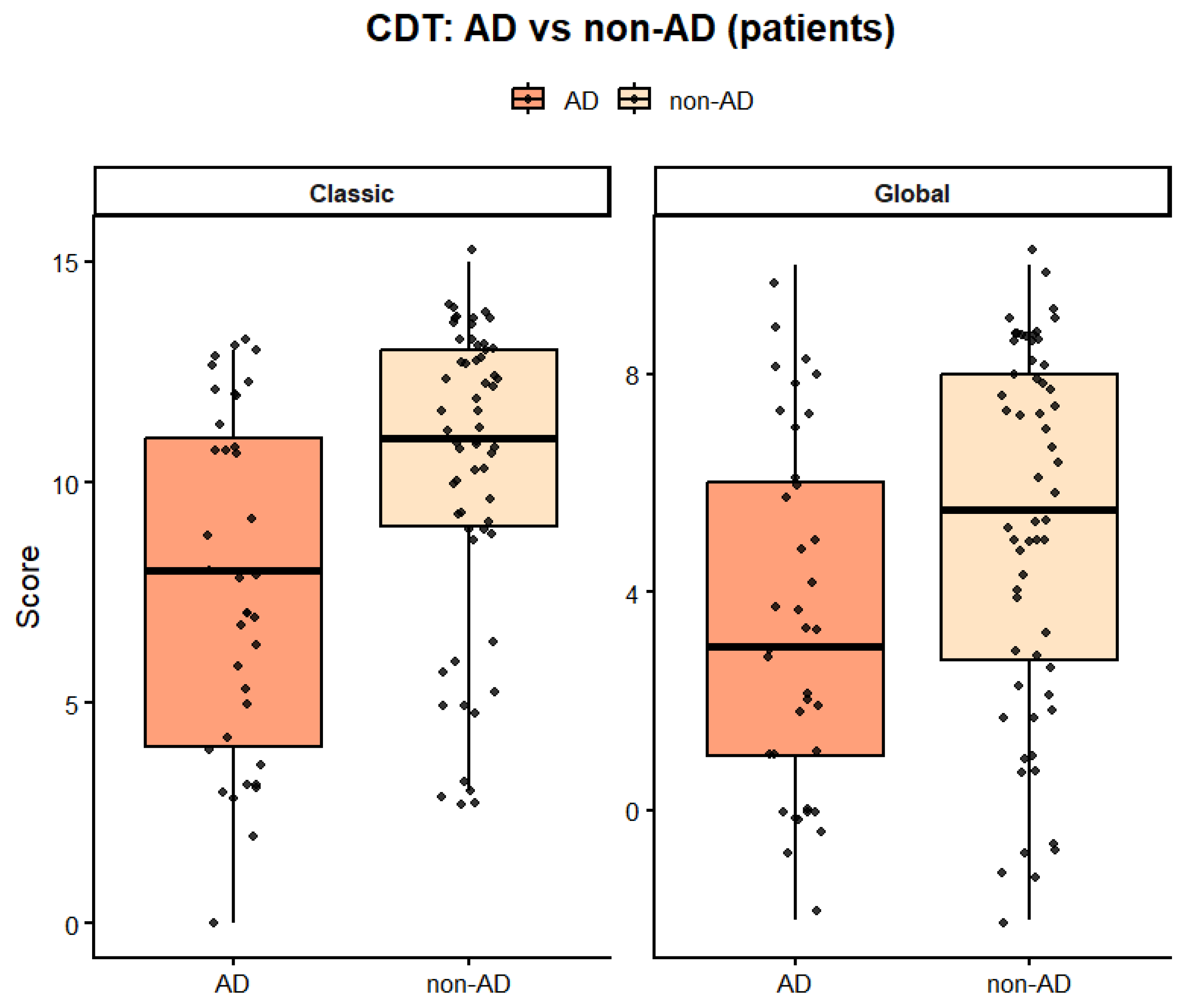
| AD | 1.78 | 2.00 | 1.84 | 18/37 | 26/37 | 7/37 | 0/37 | 3/37 | 13/37 | 7/37 | 2/37 |
| Non-AD | 1.60 | 2.61 | 2.65 | 22/60 | 41/60 | 5/60 | 2/60 | 4/60 | 12/60 | 7/60 | 1/60 |
| Controls | 1.83 | 3.69 | 3.50 | 3/36 | 6/36 | 0/36 | 0/36 | 0/36 | 2/36 | 7/36 | 0/36 |
| Quantitative Score (0–10) |
|---|
Contour (0–2)
|
Numbers (0–4)
|
Clock Hands (0–4)
|
| Qualitative Score—Errors (Total 0–8) |
|---|
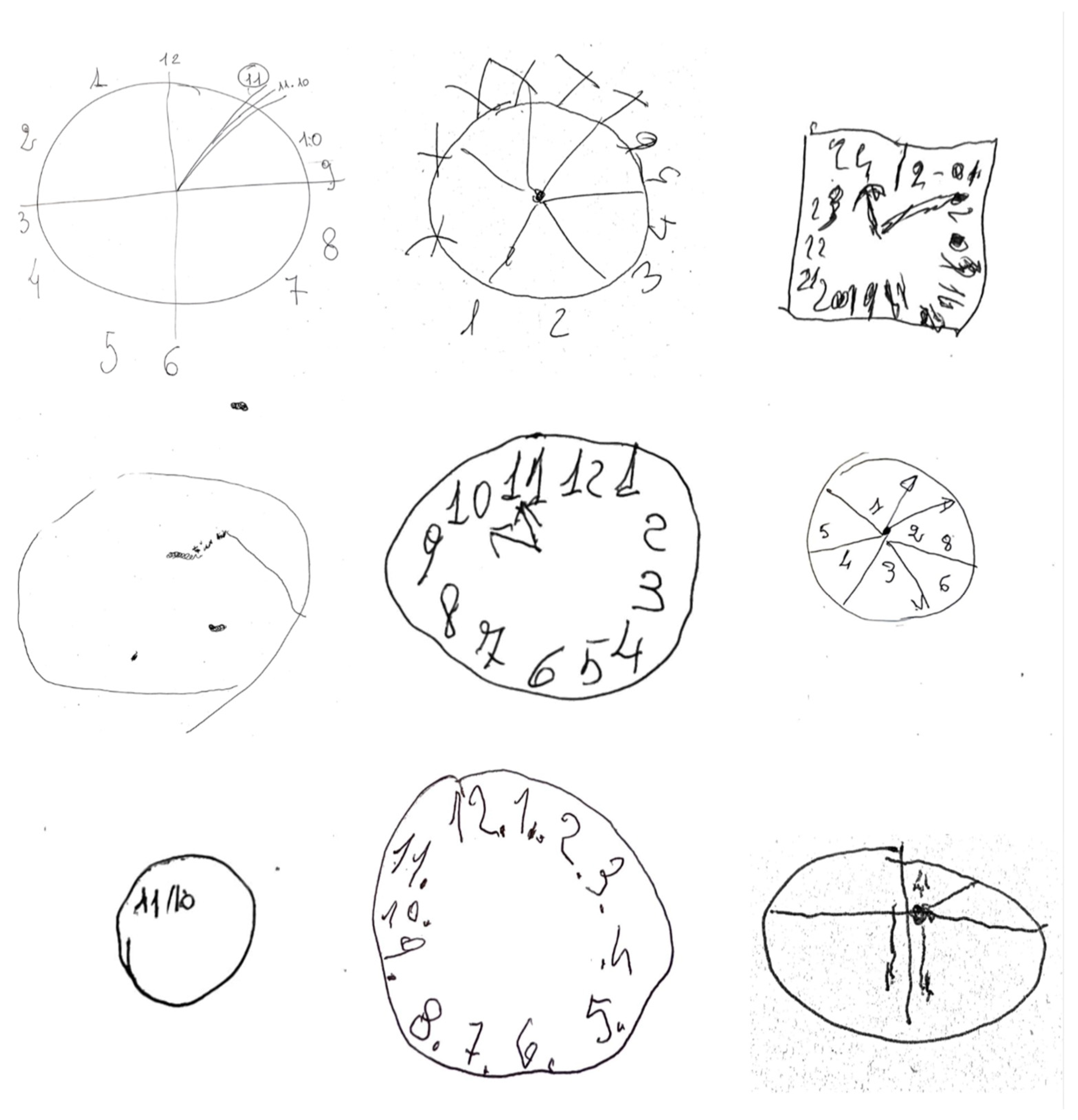
| 1. Stimulus-bound response. The tendency of the drawing to be dominated or guided by a single stimulus. Three types of stimulus-bound errors can occur:
|
| 2. Conceptual deficit. Error reflecting a loss or deficit in accessing semantic memory (knowledge of the characteristics, meaning, and attributes of a clock). This deficit may also lead to a misrepresentation of the clock itself (a dial without numbers or inappropriate use of numbers) and the hour on the dial (hands absent or inadequately represented, or hour written on the clock). |
| 3. Perseveration. Construction or repetition of the test without an appropriate stimulus. In clock drawing, this error is equivalent to depicting more than two hands and abnormal continuation of the numbers (writing beyond “12”). |
| 4. Neglect of the left hemispace. All elements of the clock are written in the right half of the dial. The possible neglect of the right hemispace was also evaluated, but this type of error was never observed. |
| 5. Planning deficit. This error is represented by the presence of spaces before 12, 3, 6, or 9, depending on the drawing strategy used. |
| 6. Nonspecific spatial error. Deficit in the spatial arrangement of numbers without a specific pattern of spatial disorganization. |
| 7. Numbers written outside the clock. Numbers written around the perimeter of the circle or on the circle itself. |
| 8. Counterclockwise number arrangement. Arrangement of numbers with “12” at the top of the dial and continuing counterclockwise. |
Disclaimer/Publisher’s Note: The statements, opinions and data contained in all publications are solely those of the individual author(s) and contributor(s) and not of MDPI and/or the editor(s). MDPI and/or the editor(s) disclaim responsibility for any injury to people or property resulting from any ideas, methods, instructions or products referred to in the content. |
© 2026 by the authors. Licensee MDPI, Basel, Switzerland. This article is an open access article distributed under the terms and conditions of the Creative Commons Attribution (CC BY) license.
Share and Cite
Cermelli, A.; Lombardo, C.; Chiarandon, A.M.; Roveta, F.; Piella, E.M.; Batti, V.; Rubino, E.; Rainero, I.; Boschi, S. Role of the Clock Drawing Test in Differential Diagnosis of Alzheimer’s Disease: Clinical Findings in Relation to CSF Biomarkers. Int. J. Mol. Sci. 2026, 27, 1790. https://doi.org/10.3390/ijms27041790
Cermelli A, Lombardo C, Chiarandon AM, Roveta F, Piella EM, Batti V, Rubino E, Rainero I, Boschi S. Role of the Clock Drawing Test in Differential Diagnosis of Alzheimer’s Disease: Clinical Findings in Relation to CSF Biomarkers. International Journal of Molecular Sciences. 2026; 27(4):1790. https://doi.org/10.3390/ijms27041790
Chicago/Turabian StyleCermelli, Aurora, Chiara Lombardo, Alberto Mario Chiarandon, Fausto Roveta, Elisa Maria Piella, Virginia Batti, Elisa Rubino, Innocenzo Rainero, and Silvia Boschi. 2026. "Role of the Clock Drawing Test in Differential Diagnosis of Alzheimer’s Disease: Clinical Findings in Relation to CSF Biomarkers" International Journal of Molecular Sciences 27, no. 4: 1790. https://doi.org/10.3390/ijms27041790
APA StyleCermelli, A., Lombardo, C., Chiarandon, A. M., Roveta, F., Piella, E. M., Batti, V., Rubino, E., Rainero, I., & Boschi, S. (2026). Role of the Clock Drawing Test in Differential Diagnosis of Alzheimer’s Disease: Clinical Findings in Relation to CSF Biomarkers. International Journal of Molecular Sciences, 27(4), 1790. https://doi.org/10.3390/ijms27041790