Wheat Allergy in the Era of Precision Medicine: From Novel Molecular Markers to New Therapeutic Perspectives

 , , ,
, , ,  and
and
Abstract
1. Introduction
2. From Extract-Based to Component-Based Epidemiology
3. Microbiological Classification of Wheat (Triticum aestivum)
4. Pathomechanism of Wheat Allergy
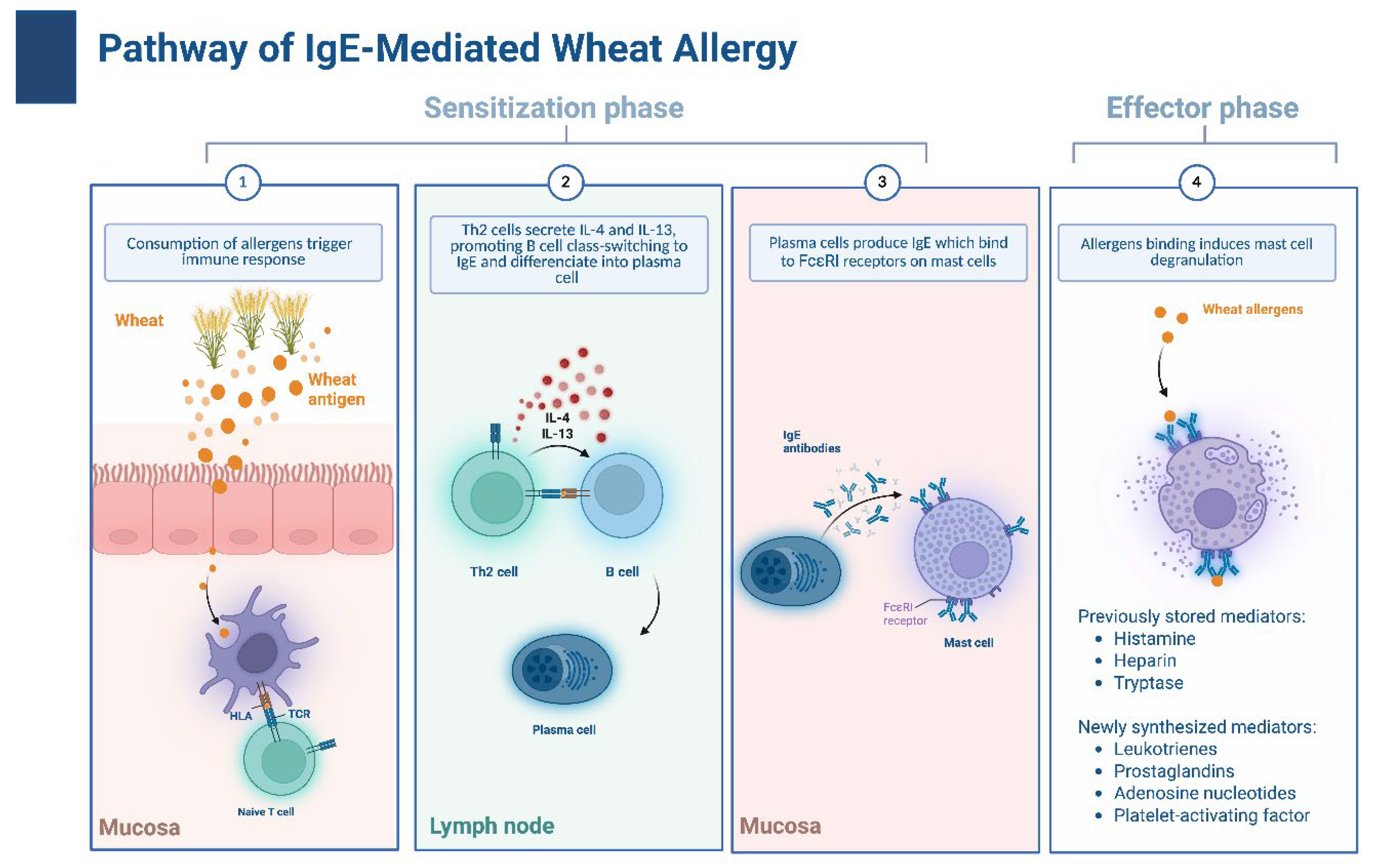
4.1. The Mechanism of IgE-Dependent Reaction to Wheat
4.2. Mechanism of IgE-Independent Reaction to Wheat
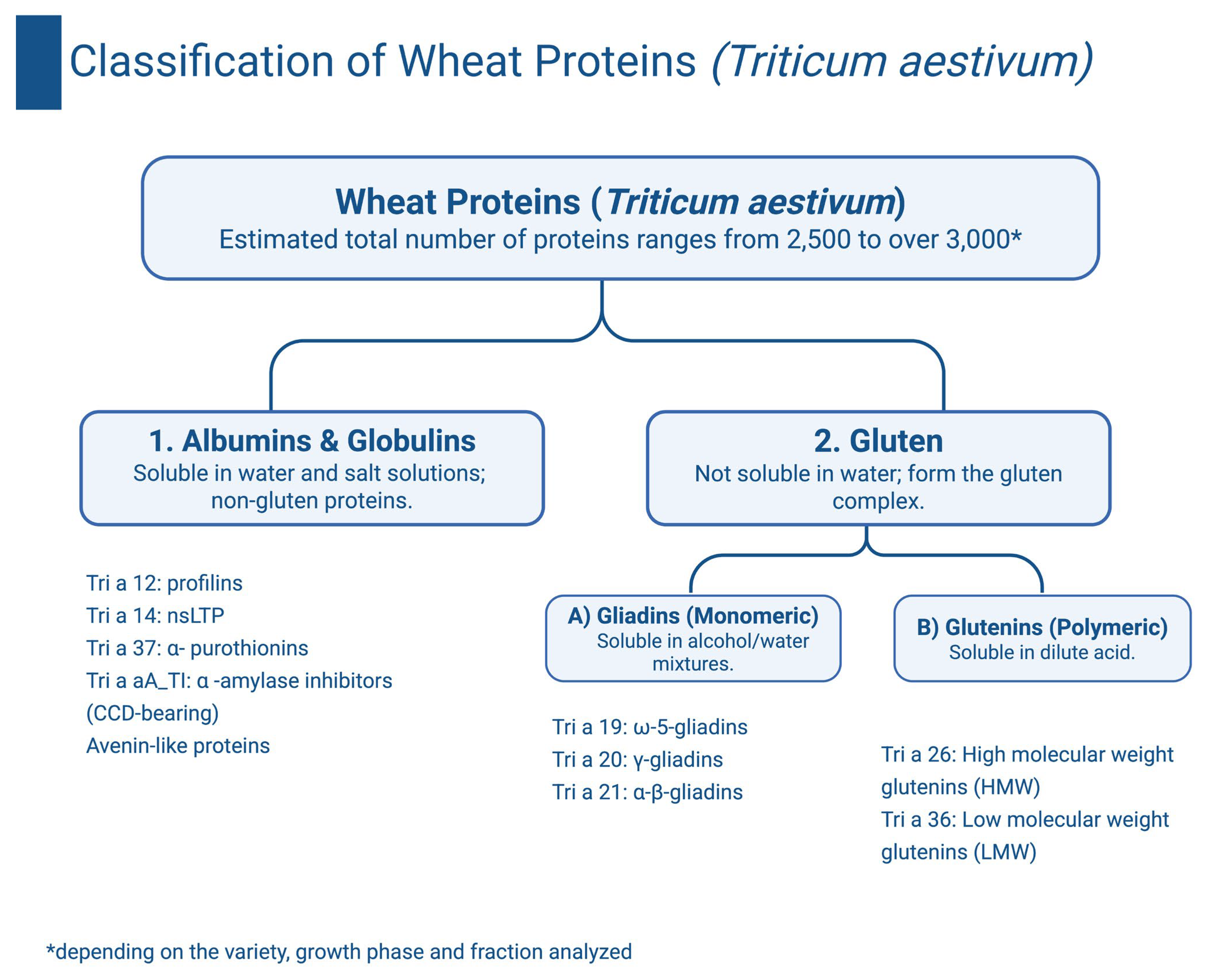
5. Wheat Proteins and Their Significance in Wheat Allergy
- Water-soluble albumins and salt-soluble globulins. These include:
- alpha-amylase inhibitors (Tri a 15, Tri a 28, Tri a 29).
- non-specific lipid transport proteins (nsLTP)–(Tri a 14).
- avenin-like proteins.
- α-purothionin (Tri a 37).
- Gluten. This is a large group of allergens, which is divided into two subgroups:
6. Clinical Picture of Wheat Allergy
7. Comparison of Diagnostic Methods for Wheat Allergy
8. Treatment and Management of Wheat Allergy
9. Summary
Author Contributions
Funding
Data Availability Statement
Conflicts of Interest
References
- Patel, N.; Samant, H. Wheat Allergy. In StatPearls; StatPearls Publishing: Treasure Island, FL, USA, 2025. [Google Scholar]
- Battais, F.; Richard, C.; Jacquenet, S.; Denery-Papini, S.; Moneret-Vautrin, D.A. Wheat grain allergies: An update on wheat allergens. Eur. Ann. Allergy Clin. Immunol. 2008, 40, 67–76. [Google Scholar] [PubMed]
- Liu, W.; Wu, Y.; Wang, J.; Wang, Z.; Gao, J.; Yuan, J.; Chen, H. A Meta-Analysis of the Prevalence of Wheat Allergy Worldwide. Nutrients 2023, 15, 1564. [Google Scholar] [CrossRef] [PubMed]
- Spolidoro, G.C.I.; Ali, M.M.; Amera, Y.T.; Nyassi, S.; Lisik, D.; Ioannidou, A.; Rovner, G.; Khaleva, E.; Venter, C.; van Ree, R.; et al. Prevalence estimates of eight big food allergies in Europe: Updated systematic review and meta-analysis. Allergy 2023, 78, 2361–2417. [Google Scholar] [CrossRef] [PubMed]
- Wong, G.W. Food allergies around the world. Front. Nutr. 2024, 11, 1373110. [Google Scholar] [CrossRef]
- Dramburg, S.; Hilger, C.; Santos, A.F.; de Las Vecillas, L.; Aalberse, R.C.; Acevedo, N.; Aglas, L.; Altmann, F.; Arruda, K.L.; Asero, R.; et al. EAACI Molecular Allergology User’s Guide 2.0. Pediatr. Allergy Immunol. 2023, 34, e13854. [Google Scholar] [CrossRef]
- Salcedo, G.; Quirce, S.; Diaz-Perales, A. Wheat allergens associated with Baker’s asthma. J. Investig. Allergol. Clin. Immunol. 2011, 21, 81–92. [Google Scholar]
- Neyer, A.; Dolle-Bierke, S.; Hofer, V.; Grunhagen, J.; Beyer, K.; Worm, M. Prevalence and Clinical Symptoms of Wheat Allergy in Adults and Adolescents in Central Europe. Clin. Exp. Allergy 2025, 55, 319–329. [Google Scholar] [CrossRef]
- Matricardi, P.M.; Kleine-Tebbe, J.; Hoffman, H.; Valenta, R.; Hilger, C.; Hofmaier, S.; Aalberse, R.C.; Agache, I.; Asero, R.; Ballmer-Weber, B.; et al. Molecular Allergology User’s Guide. Pediatr. Allergy Immunol. 2016, 27, 1–250. [Google Scholar] [CrossRef]
- Rentzos, G.; Johanson, L.; Sjölander, S.; Telemo, E.; Ekerljung, L. Self-reported adverse reactions and IgE sensitization to common foods in adults with asthma. Clin. Transl. Allergy 2015, 5, 25. [Google Scholar] [CrossRef]
- Kleine-Tebbe, J.; Jakob, T. Molecular Allergy Diagnostics: Innovation for a Better Patient Management; Springer International Publishing: Cham, Switzerland, 2017. [Google Scholar]
- Knyziak-Medrzycka, I.; Majsiak, E.; Gromek, W.; Kozlowska, D.; Swadzba, J.; Bierla, J.B.; Kurzawa, R.; Cukrowska, B. The Sensitization Profile for Selected Food Allergens in Polish Children Assessed with the Use of a Precision Allergy Molecular Diagnostic Technique. Int. J. Mol. Sci. 2024, 25, 825. [Google Scholar] [CrossRef]
- Baar, A.; Pahr, S.; Constantin, C.; Giavi, S.; Manoussaki, A.; Papadopoulos, N.G.; Ebner, C.; Mari, A.; Vrtala, S.; Valenta, R. Specific IgE reactivity to Tri a 36 in children with wheat food allergy. J. Allergy Clin. Immunol. 2014, 133, 585–587. [Google Scholar] [CrossRef] [PubMed]
- Baar, A.; Pahr, S.; Constantin, C.; Scheiblhofer, S.; Thalhamer, J.; Giavi, S.; Papadopoulos, N.G.; Ebner, C.; Mari, A.; Vrtala, S.; et al. Molecular and immunological characterization of Tri a 36, a low molecular weight glutenin, as a novel major wheat food allergen. J. Immunol. 2012, 189, 3018–3025. [Google Scholar] [CrossRef] [PubMed]
- Zuberbier, T.; Edenharter, G.; Worm, M.; Ehlers, I.; Reimann, S.; Hantke, T.; Roehr, C.C.; Bergmann, K.E.; Niggemann, B. Prevalence of adverse reactions to food in Germany—A population study. Allergy 2004, 59, 338–345. [Google Scholar] [CrossRef] [PubMed]
- Pahr, S.; Constantin, C.; Papadopoulos, N.G.; Giavi, S.; Mäkelä, M.; Pelkonen, A.; Ebner, C.; Mari, A.; Scheiblhofer, S.; Thalhamer, J.; et al. α-Purothionin, a new wheat allergen associated with severe allergy. J. Allergy Clin. Immunol. 2013, 132, 1000–1003.e4. [Google Scholar] [CrossRef]
- Srisuwatchari, W.; Kanchanapoomi, K.; Pacharn, P. Molecular Diagnosis to IgE-mediated Wheat Allergy and Wheat-Dependent Exercise-Induced Anaphylaxis. Clin. Rev. Allergy Immunol. 2025, 68, 47. [Google Scholar] [CrossRef]
- Nilsson, N.; Nilsson, C.; Ekoff, H.; Wieser-Pahr, S.; Borres, M.P.; Valenta, R.; Hedlin, G.; Sjölander, S. Grass-Allergic Children Frequently Show Asymptomatic Low-Level IgE Co-Sensitization and Cross-Reactivity to Wheat. Int. Arch. Allergy Immunol. 2018, 177, 135–144. [Google Scholar] [CrossRef]
- Grzywnowicz, M.; Majsiak, E.; Gawel, J.; Miskiewicz, K.; Doniec, Z.; Kurzawa, R. Inhibition of Cross-Reactive Carbohydrate Determinants in Allergy Diagnostics. Adv. Exp. Med. Biol. 2018, 1116, 75–79. [Google Scholar]
- Levy, A.A.; Feldman, M. Evolution and origin of bread wheat. Plant Cell 2022, 34, 2549–2567. [Google Scholar] [CrossRef]
- Bálint, A.F.; Kovács, G.; Sutka, J. Origin and Taxonomy of Wheat in the Light of Recent Research. Acta Agron. Hung. 2000, 48, 301–313. [Google Scholar] [CrossRef]
- Natural Resources Conservation Service. PLANTS Database. United States Department of Agriculture. Available online: https://plants.usda.gov (accessed on 1 September 2025).
- Zhang, J.; Feng, X.; Li, M.; Liu, Y.; Liu, M.; Hou, L.J.; Dong, H.P. Deep origin of eukaryotes outside Heimdallarchaeia within Asgardarchaeota. Nature 2025, 642, 990–998. [Google Scholar] [CrossRef]
- Vosseberg, J.; van Hooff, J.J.E.; Köstlbacher, S.; Panagiotou, K.; Tamarit, D.; Ettema, T.J.G. The emerging view on the origin and early evolution of eukaryotic cells. Nature 2024, 633, 295–305. [Google Scholar] [CrossRef] [PubMed]
- Lamza, L. How many kingdoms of life? Eukaryotic phylogeny and philosophy of systematics. Philos. Probl. Sci. 2019, 203–227. [Google Scholar]
- Burki, F.; Roger, A.J.; Brown, M.W.; Simpson, A.G.B. The New Tree of Eukaryotes. Trends Ecol. Evol. 2020, 35, 43–55. [Google Scholar] [CrossRef] [PubMed]
- Sears, E. Homoeologous chromosomes in Triticum aestivum. Genetics 1952, 37, 624. [Google Scholar]
- Mackey, J. The taxonomy of hexaploid wheat. Sven. Bot. Tidskr. 1954, 48, 579–590. [Google Scholar]
- Sharma, S.; Schulthess, A.W.; Bassi, F.M.; Badaeva, E.D.; Neumann, K.; Graner, A.; Özkan, H.; Werner, P.; Knüpffer, H.; Kilian, B. Introducing beneficial alleles from plant genetic resources into the wheat germplasm. Biology 2021, 10, 982. [Google Scholar] [CrossRef]
- Parfrey, L.W.; Barbero, E.; Lasser, E.; Dunthorn, M.; Bhattacharya, D.; Patterson, D.J.; Katz, L.A. Evaluating Support for the Current Classification of Eukaryotic Diversity. PLoS Genet. 2006, 2, e220. [Google Scholar] [CrossRef]
- Available online: https://www.itis.gov/ (accessed on 1 September 2025).
- Porter, S.; Riedman, L.A.; Woltz, C.; Gold, D.; Kellogg, J. Early eukaryote diversity: A review and a reinterpretation. Paleobiology 2025, 51, 132–149. [Google Scholar] [CrossRef]
- Khalid, A.; Hameed, A.; Tahir, M.F. Wheat quality: A review on chemical composition, nutritional attributes, grain anatomy, types, classification, and function of seed storage proteins in bread making quality. Front. Nutr. 2023, 10, 1053196. [Google Scholar] [CrossRef]
- Bowden, W.M. The Taxonomy and Nomenclature of the Wheats, Barleys, and Ryes and Their Wild Relatives. Can. J. Bot. 1959, 37, 657–684. [Google Scholar] [CrossRef]
- Bognounou, F.; R, M.; Ayangma, S.; Jonkers, L.; Björkman, C.; Bylund, H.; Oden, P. Monocotyledons and Dicotyledons’ stand structure in different successional stage in Corcovado National Park, Costa Rica. Bois For. Des Trop. 2011, 307, 33–40. [Google Scholar] [CrossRef]
- Siciński, J.T. Gatunkowa Różnorodność Biologiczna Chwastów Segetalnych I Je J Zagrożenia W Polsce. ACTA Univ. Lodz. Folia Bot. 2001, 16, 73–86. [Google Scholar]
- Johri, B.M.; Ambegaokar, K.B.; Srivastava, P.S. Comparative Embryology of Angiosperms; Springer: Berlin/Heidelberg, Germany, 1992; Volume 1. [Google Scholar]
- Ianovici, N. Relation between Poaceae pollen concentrations and meteorological factors during 2000–2010 in Timisoara, Romania. Acta Agrobot. 2015, 68, 373–381. [Google Scholar] [CrossRef]
- Pundit, V.A.; Makkoukdji, N.; Banegas Carballo, K.M.; Stone, F.; Satnarine, T.; Kuhn, J.; Kleiner, G.I.; Gans, M.D. A Review of Non-IgE Immune-Mediated Allergic Disorders of the Gastrointestinal Tract. Gastrointest. Disord. 2024, 6, 478–496. [Google Scholar] [CrossRef]
- Gauvreau, G.M.; Bergeron, C.; Boulet, L.-P.; Cockcroft, D.W.; Côté, A.; Davis, B.E.; Leigh, R.; Myers, I.; O’Byrne, P.M.; Sehmi, R. Sounding the alarmins—The role of alarmin cytokines in asthma. Allergy 2023, 78, 402–417. [Google Scholar] [CrossRef]
- Schuijs, M.J.; Hammad, H.; Lambrecht, B.N. Professional and ‘Amateur’ Antigen-Presenting Cells In Type 2 Immunity. Trends Immunol. 2019, 40, 22–34. [Google Scholar] [CrossRef]
- Maspero, J.; Adir, Y.; Al-Ahmad, M.; Celis-Preciado, C.A.; Colodenco, F.D.; Giavina-Bianchi, P.; Lababidi, H.; Ledanois, O.; Mahoub, B.; Perng, D.-W.; et al. Type 2 inflammation in asthma and other airway diseases. ERJ Open Res. 2022, 8, 00576–02021. [Google Scholar] [CrossRef]
- Moon, T.C.; Befus, A.D.; Kulka, M. Mast Cell Mediators: Their Differential Release and the Secretory Pathways Involved. Front. Immunol. 2014, 5, 569. [Google Scholar] [CrossRef]
- Cianferoni, A. Non-IgE Mediated Food Allergy. Curr. Pediatr. Rev. 2020, 16, 95–105. [Google Scholar]
- Cook, V.E.; Connors, L.A.; Vander Leek, T.K.; Watson, W. Non-immunoglobulin E-mediated food allergy. Allergy Asthma Clin. Immunol. 2024, 20, 70. [Google Scholar] [CrossRef]
- Afzal, M.; Pfannstiel, J.; Zimmermann, J.; Bischoff, S.C.; Würschum, T.; Longin, C.F.H. High-resolution proteomics reveals differences in the proteome of spelt and bread wheat flour representing targets for research on wheat sensitivities. Sci. Rep. 2020, 10, 14677. [Google Scholar] [CrossRef] [PubMed]
- Afzal, M.; Pfannstiel, J.; Zimmermann, J.; Bischoff, S.C.; Würschum, T.; Longin, C.F.H. Reference proteomes of five wheat species as starting point for future design of cultivars with lower allergenic potential. npj Sci. Food 2023, 7, 9. [Google Scholar] [CrossRef] [PubMed]
- WHO/IUIS Allergen Nomenclature Sub-Committee. Allergen Nomenclature Who/IUIS—Allergen Nomenclature Sub-Committee Financial Contributions from IUIS, EAACI, and AAAAI. Available online: https://allergen.org/search.php?Species=Triticum%20aestivum (accessed on 23 August 2025).
- Morita, E.; Matsuo, H.; Mihara, S.; Morimoto, K.; Savage, A.W.J.; Tatham, A.S. Fast ω-gliadin is a major allergen in wheat-dependent exercise-induced anaphylaxis. J. Dermatol. Sci. 2003, 33, 99–104. [Google Scholar] [CrossRef] [PubMed]
- Calamelli, E.; Liotti, L.; Beghetti, I.; Piccinno, V.; Serra, L.; Bottau, P. Component-Resolved Diagnosis in Food Allergies. Medicina 2019, 55, 498. [Google Scholar] [CrossRef]
- Gromek, W.; Koldej, N.; Switala, S.; Majsiak, E.; Kurowski, M. Revisiting Latex-Fruit Syndrome after 30 Years of Research: A Comprehensive Literature Review and Description of Two Cases. J. Clin. Med. 2024, 13, 4222. [Google Scholar] [CrossRef]
- Buczyłko, K.; Majsiak, E. Wybrane reakcje krzyżowe w alergiach górnych dróg oddechowych i pokarmowych. Pol. J. Allergol. 2017, 4, 139–145. [Google Scholar] [CrossRef]
- Preda, M.; Popescu, F.-D.; Vassilopoulou, E.; Smolinska, S. Allergenic Biomarkers in the Molecular Diagnosis of IgE-Mediated Wheat Allergy. Int. J. Mol. Sci. 2024, 25, 8210. [Google Scholar] [CrossRef]
- Rihs, H.P.; Rozynek, P.; May-Taube, K.; Welticke, B.; Baur, X. Polymerase chain reaction based cDNA cloning of wheat profilin: A potential plant allergen. Int. Arch. Allergy Immunol. 1994, 105, 190–194. [Google Scholar] [CrossRef]
- Van Ree, R.; Voitenko, V.; van Leeuwen, W.A.; Aalberse, R.C. Profilin is a cross-reactive allergen in pollen and vegetable foods. Int. Arch. Allergy Immunol. 1992, 98, 97–104. [Google Scholar] [CrossRef]
- San Bartolomé, C.; Muñoz-Cano, R.; Rius, J.; Casas-Saucedo, R.; Balsells, S.; Egri, N.; Ruano-Zaragoza, M.; de la Cruz, C.; Bartra, J.; Pascal, M. Detection of Wheat Lipid Transfer Protein (Tri a 14) Sensitization: Comparison Between Currently Available Diagnostic Tools. Int. Arch. Allergy Immunol. 2021, 183, 75–79. [Google Scholar] [CrossRef]
- Palacin, A.; Quirce, S.; Armentia, A.; Fernández-Nieto, M.; Pacios, L.F.; Asensio, T.; Sastre, J.; Diaz-Perales, A.; Salcedo, G. Wheat lipid transfer protein is a major allergen associated with baker’s asthma. J. Allergy Clin. Immunol. 2007, 120, 1132–1138. [Google Scholar] [CrossRef] [PubMed]
- Johri, A.; Neelabh Srivastava, M. A computational study of B-cell epitopes of wheat allergens and identification of its IgE binding residues. Int. J. Inf. Technol. 2021, 13, 1357–1364. [Google Scholar] [CrossRef]
- Palosuo, K.; Alenius, H.; Varjonen, E.; Kalkkinen, N.; Reunala, T. Rye γ-70 and γ-35 secalins and barley γ-3 hordein cross-react with ω-5 gliadin, a major allergen in wheat-dependent, exercise-induced anaphylaxis. Clin. Exp. Allergy 2001, 31, 466–473. [Google Scholar] [CrossRef] [PubMed]
- Geisslitz, S.; Shewry, P.; Brouns, F.; America, A.H.P.; Caio, G.P.I.; Daly, M.; D’Amico, S.; De Giorgio, R.; Gilissen, L.; Grausgruber, H.; et al. Wheat ATIs: Characteristics and Role in Human Disease. Front. Nutr. 2021, 8, 667370. [Google Scholar] [CrossRef]
- Lupinek, C.; Forstenlechner, P.; Ringauf, A.; Campana, R.; Salihu, A.; Aumayr, M.; Mittermann, I. Big Data-Driven Evolution of a Diagnostic Multiplex IgE-Test: Enhancing Accuracy and Efficacy in Allergy Diagnostics. Int. J. Mol. Sci. 2025, 26, 4249. [Google Scholar] [CrossRef]
- Cianferoni, A. Wheat allergy: Diagnosis and management. J. Asthma Allergy 2016, 9, 13–25. [Google Scholar] [CrossRef]
- Pahr, S.; Selb, R.; Weber, M.; Focke-Tejkl, M.; Hofer, G.; Dordić, A.; Keller, W.; Papadopoulos, N.G.; Giavi, S.; Mäkelä, M.; et al. Biochemical, biophysical and IgE-epitope characterization of the wheat food allergen, Tri a 37. PLoS ONE 2014, 9, e111483. [Google Scholar] [CrossRef]
- Nam, Y.-H.; Hwang, E.-K.; Jin, H.J.; Lee, J.M.; Shin, Y.-S.; Ye, Y.-M.; Palacin, A.; Salcedo, G.; Lee, S.-Y.; Park, H.-S. Comparison of Specific IgE Antibodies to Wheat Component Allergens in Two Phenotypes of Wheat Allergy. J. Korean Med. Sci. 2013, 28, 1697–1699. [Google Scholar] [CrossRef]
- Pastorello, E.A.; Farioli, L.; Conti, A.; Pravettoni, V.; Bonomi, S.; Iametti, S.; Fortunato, D.; Scibilia, J.; Bindslev-Jensen, C.; Ballmer-Weber, B.; et al. Wheat IgE-Mediated Food Allergy in European Patients: α-Amylase Inhibitors, Lipid Transfer Proteins and Low-Molecular-Weight Glutenins: Allergenic Molecules Recognized by Double-Blind, Placebo-Controlled Food Challenge. Int. Arch. Allergy Immunol. 2007, 144, 10–22. [Google Scholar] [CrossRef]
- Bollecker, S.S.J.; Kaiser, K.P.; Köhler, P.; Wieser, H.; Schofield, J.D. Re-examination of the Glycosylation of High Mr Subunits of Wheat Glutenin. J. Agric. Food Chem. 1998, 46, 4814–4823. [Google Scholar] [CrossRef]
- ImmunoDiagnostics Product Catalog—Thermo Fisher. Available online: https://www.abacusdx.com/media/PU_Product%20Catalogue_Digital_2025.pdf (accessed on 25 August 2025).
- ALEX2 ALLERGEN LIST—MADx. Available online: https://a.storyblok.com/f/164899/x/98a22aad50/20250721_web_madx_alex2_allergen-list_210x250mm_en.pdf (accessed on 25 August 2025).
- Zhang, Y.; Hu, X.; Juhasz, A.; Islam, S.; Yu, Z.; Zhao, Y.; Li, G.; Ding, W.; Ma, W. Characterising avenin-like proteins (ALPs) from albumin/globulin fraction of wheat grains by RP-HPLC, SDS-PAGE, and MS/MS peptides sequencing. BMC Plant Biol. 2020, 20, 45. [Google Scholar] [CrossRef] [PubMed]
- ALEX3 ALLERGEN LIST—MADx. Available online: https://a.storyblok.com/f/164899/x/e2a1e4d5ef/20250818_web_madx_alex3_allergen-list_210x250mm_en.pdf (accessed on 14 October 2025).
- Anyane-Yeboa, A.; Wang, W.; Kavitt, R.T. The Role of Allergy Testing in Eosinophilic Esophagitis. Gastroenterol. Hepatol. 2018, 14, 463–469. [Google Scholar]
- Czaja-Bulsa, G.; Bulsa, M. What Do We Know Now about IgE-Mediated Wheat Allergy in Children? Nutrients 2017, 9, 35. [Google Scholar] [CrossRef] [PubMed]
- Arul Arasan, T.S.; Jorgensen, R.; Van Antwerp, C.; Ng, P.K.W.; Gangur, V. Advances in Mechanisms of Anaphylaxis in Wheat Allergy: Utility of Rodent Models. Foods 2025, 14, 883. [Google Scholar] [CrossRef]
- Rymarczyk, B.; Jura-Szołtys, E.; Gluck, J.; Gawlik, R. Does a healthy diet always mean a safe diet? Food allergy as an obstacle to a healthy lifestyle. Pol. J. Allergol. 2025, 12, 91–97. [Google Scholar] [CrossRef]
- Faihs, V.; Kugler, C.; Schmalhofer, V.; Scherf, K.A.; Lexhaller, B.; Mortz, C.G.; Bindslev-Jensen, C.; Biedermann, T.; Brockow, K. Wheat-dependent exercise-induced anaphylaxis: Subtypes, diagnosis, and management. J. Dtsch. Dermatol. Ges. 2023, 21, 1131–1135. [Google Scholar] [CrossRef]
- Størdal, K.; Kurppa, K. Celiac disease, non-celiac wheat sensitivity, wheat allergy—Clinical and diagnostic aspects. Semin. Immunol. 2025, 77, 101930. [Google Scholar] [CrossRef]
- Chinuki, Y.; Kaneko, S.; Sakieda, K.; Murata, S.; Yoshida, Y.; Morita, E. A case of wheat-dependent exercise-induced anaphylaxis sensitized with hydrolysed wheat protein in a soap. Contact Dermat. 2011, 65, 55–57. [Google Scholar] [CrossRef]
- Pawankar, R.; Holgate, S.T.; Canonica, G.W.; Lockey, R.F.; Blaiss, M.S. WAO White Book on Allergy 2013 Update; World Allergy Organization: Milwaukee, WI, USA, 2011. [Google Scholar]
- Ludwig, H.; Krogulska, A. Food protein-induced enterocolitis syndrome (FPIES)—A rare disease with frequent symptoms—The practitioner’s compendium. Dev. Period. Med. 2019, 23, 67–78. [Google Scholar]
- Nilsson, N.; Sjölander, S.; Baar, A.; Berthold, M.; Pahr, S.; Vrtala, S.; Valenta, R.; Morita, E.; Hedlin, G.; Borres, M.P.; et al. Wheat allergy in children evaluated with challenge and IgE antibodies to wheat components. Pediatr. Allergy Immunol. 2015, 26, 119–125. [Google Scholar] [CrossRef]
- Popescu, F.D.; Vieru, M. Precision medicine allergy immunoassay methods for assessing immunoglobulin E sensitization to aeroallergen molecules. World J. Methodol. 2018, 8, 17–36. [Google Scholar] [CrossRef]
- Sander, I.; Rozynek, P.; Rihs, H.-P.; van Kampen, V.; Chew, F.T.; Lee, W.S.; Kotschy-Lang, N.; Merget, R.; Brüning, T.; Raulf-Heimsoth, M. Multiple wheat flour allergens and cross-reactive carbohydrate determinants bind IgE in baker’s asthma. Allergy 2011, 66, 1208–1215. [Google Scholar] [CrossRef] [PubMed]
- Faihs, V.; Schmalhofer, V.; Kugler, C.; Bent, R.K.; Scherf, K.A.; Lexhaller, B.; Mortz, C.G.; Bindslev-Jensen, C.; Biedermann, T.; Skov, P.S.; et al. Detection of Sensitization Profiles with Cellular In Vitro Tests in Wheat Allergy Dependent on Augmentation Factors (WALDA). Int. J. Mol. Sci. 2024, 25, 3574. [Google Scholar] [CrossRef] [PubMed]
- Jiang, N.; Wang, Y.; Sun, Y.; Gao, Z.; Liu, D.; Chitrakar, B. Allergens from wheat and wheat products: A comprehensive review on allergy mechanisms and modifications. Food Chem. X 2025, 29, 102871. [Google Scholar] [CrossRef] [PubMed]
- Majsiak, E.; Choina, M.; Knyziak-Mędrzycka, I.; Bierła, J.B.; Janeczek, K.; Wykrota, J.; Cukrowska, B. IgE-Dependent Allergy in Patients with Celiac Disease: A Systematic Review. Nutrients 2023, 15, 995. [Google Scholar] [CrossRef]
- Kleine-Tebbe, J.; Jappe, U. Molecular allergy diagnostic tests: Development and relevance in clinical practice. Allergol. Sel. 2017, 1, 169–189. [Google Scholar] [CrossRef]
- Brockow, K.; Kneissl, D.; Valentini, L.; Zelger, O.; Grosber, M.; Kugler, C.; Werich, M.; Darsow, U.; Matsuo, H.; Morita, E.; et al. Using a gluten oral food challenge protocol to improve diagnosis of wheat-dependent exercise-induced anaphylaxis. J. Allergy Clin. Immunol. 2015, 135, 977–984.e4. [Google Scholar] [CrossRef]
- Kotaniemi-Syrjänen, A.; Palosuo, K.; Jartti, T.; Kuitunen, M.; Pelkonen, A.S.; Mäkelä, M.J. The prognosis of wheat hypersensitivity in children. Pediatr. Allergy Immunol. 2010, 21, e421–e428. [Google Scholar] [CrossRef]
- Knyziak-Medrzycka, I.; Szychta, M.; Majsiak, E.; Fal, A.M.; Doniec, Z.; Cukrowska, B. The Precision Allergy Molecular Diagnosis (PAMD@) in Monitoring the Atopic March in a Child with a Primary Food Allergy: Case Report. J. Asthma Allergy 2022, 15, 1263–1267. [Google Scholar] [CrossRef]
- Wood, R.A.; Togias, A.; Sicherer, S.H.; Shreffler, W.G.; Kim, E.H.; Jones, S.M.; Leung, D.Y.M.; Vickery, B.P.; Bird, J.A.; Spergel, J.M.; et al. Omalizumab for the Treatment of Multiple Food Allergies. N. Engl. J. Med. 2024, 390, 889–899. [Google Scholar] [CrossRef]
- Arasi, S.; Cafarotti, A.; Galletta, F.; Panetta, V.; Riccardi, C.; Calandrelli, V.; Fierro, V.; Dahdah, L.; Artesani, M.C.; Valluzzi, R.L.; et al. Omalizumab reduces anaphylactic reactions and allows food introduction in food-allergic in children with severe asthma: An observational study. Allergy 2025, 80, 1074–1085. [Google Scholar] [CrossRef]
- Dantzer, J.; Virkud, Y.; Wang, J.; Sicherer, S.; Groetch, M.; Shreffler, W.; Pyle, D.; Kim, E.; Keet, C.; Kulis, M.; et al. Introduction of allergenic foods after treatment with omalizumab. J. Allergy Clin. Immunol. 2025, 156, 394–405. [Google Scholar] [CrossRef]
- Rafi, A.; Do, L.T.; Katz, R.; Sheinkopf, L.E.; Simons, C.W.; Klaustermeyer, W. Effects of omalizumab in patients with food allergy. Allergy Asthma Proc. 2010, 31, 76–83. [Google Scholar] [CrossRef]
- Altenbach, S.B.; Allen, P.V. Transformation of the US bread wheat ‘Butte 86’ and silencing of omega-5 gliadin genes. GM Crops 2011, 2, 66–73. [Google Scholar] [CrossRef]
- Altenbach, S.B.; Chang, H.C.; Simon-Buss, A.; Jang, Y.R.; Denery-Papini, S.; Pineau, F.; Gu, Y.Q.; Huo, N.; Lim, S.H.; Kang, C.S.; et al. Towards reducing the immunogenic potential of wheat flour: Omega gliadins encoded by the D genome of hexaploid wheat may also harbor epitopes for the serious food allergy WDEIA. BMC Plant Biol. 2018, 18, 291. [Google Scholar] [CrossRef]
- Kim, S.; Sim, J.R.; Gu, Y.Q.; Altenbach, S.B.; Denery-Papini, S.; Pineau, F.; Tranquet, O.; Yang, Y.J.; Park, E.J.; Lim, S.H.; et al. Toward reducing the immunogenic potential of wheat flour: Identification and characterization of wheat lines missing omega-5 gliadins encoded by the 1D chromosome. Theor. Appl. Genet. 2023, 136, 33. [Google Scholar] [CrossRef]




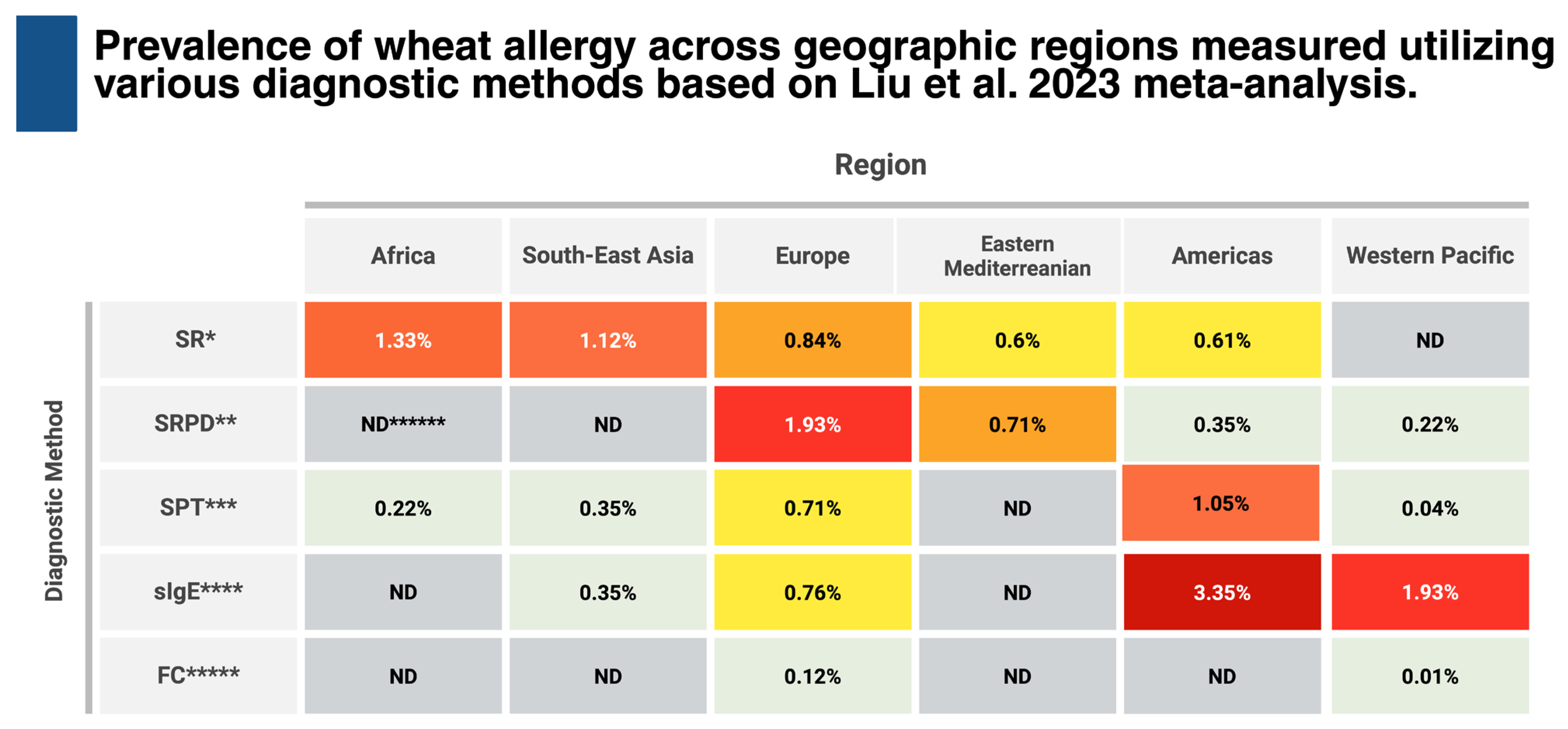
| Diagnostic Method | Pooled Global Prevalence | Regional Range (Min–Max) | Age Trend | Socioeconomic Trend |
|---|---|---|---|---|
| sIgE (Specific IgE) | 0.97% | 0.35% (SE Asia)–3.35% (Americas) | Children (2.16%) > Adults (0.16%) | Developed (0.95%) > Developing (0.88%) |
| SPT (Skin Prick Test) | 0.22% | 0.04% (W. Pacific)–1.05% (Americas) | Data available mostly for children | Developed (0.28%) > Developing (0.19%) |
| OFC (Oral Food Challenge) | 0.04% | 0.01% (W. Pacific)–0.12% (Europe) | Insufficient data | Insufficient data |
| SRPD (Physician-Diagnosed) | 0.70% | 0.22% (W. Pacific)–1.93% (Europe) | Adults (1.34%) > Children (0.88%) | Developed (1.14%) > Developing (0.27%) |
| SR (Self-Reported) | 0.63% | 0.60% (E. Medit.)–1.33% (Africa) | Adults (0.83%) > Children (0.58%) | Developed (0.62%) > Developing (0.46%) |
| Domain | Eukaryota | Organisms that have a cell nucleus and chromosomes (unlike prokaryotes) and complex organelles such as mitochondria and plastids. This domain includes a huge variety of forms: from single-celled organisms to multicellular plants, animals, and fungi. All clinically relevant cereal allergens originate from eukaryotic organisms, primarily in the plant kingdom. |
| Kingdom | Plantae | The plant kingdom (Plantae) includes multicellular, autotrophic eukaryotes with cellulose walls, capable of photosynthesis and unlimited growth. These organisms, which reproduce sexually or asexually, are divided into major evolutionary lines (including mosses, ferns, and seed plants), sometimes referred to in a broader sense as Archaeplastida. This is the most important kingdom in a clinical context, containing most of the allergenic proteins found in food and pollen. Of particular importance here are seed plants and grasses, which are the main sources of allergens. |
| Phylum | Spermatophyta | Plants with specialized structures (roots, stems, and conducting tissues) that reproduce by means of seeds. Seed plants are a common source of both food allergens (grains) and aeroallergens (pollen). |
| Subphylum/type | Angiospermae | Angiosperms (flowering plants) are a subclass of seed plants characterized by exceptional organ plasticity, which has enabled them to effectively colonize the globe. They are divided into two main classes: dicotyledons and monocotyledons, which include wheat, among others. From a clinical perspective, this group is crucial because it provides most cereal grains and strong pollen allergens. It is the species in this group that are responsible for many significant food and inhalant allergies. |
| Class | Monocotyledonae | Monocotyledons, also known as Liliopsida, are a class of angiosperms that include wheat and the grass family. They are characterized by the presence of a single cotyledon in the embryo, parallel leaf venation, and pollen that usually has a single pore. This group shows a high ability to adapt to harsh environments and includes key food grains: wheat, barley, rye, and corn. From a clinical perspective, this is the most important class of plants, responsible for the main food allergies to cereals and mass inhalation allergies (hay fever and asthma) caused by grass pollen. |
| Order | Poales | The order Poales belongs to the class of monocotyledons and includes families of key economic importance, including the most important family of grasses (Poaceae), as well as sedges and rushes. These plants are distinguished by specific characteristics, such as the presence of silica particles in their tissues and seeds with starchy endosperm. This taxon is of fundamental importance in allergology, as it groups the most important species causing allergic reactions worldwide. It is in this order that the main grass pollen allergens and food allergens of wheat, rye, barley, and oats are found. |
| Family | Poaceae | The Poaceae family, also known as grasses (Gramineae), is one of the most economically important groups of plants, comprising over 10,000 species, including wheat, corn, rice, barley, and rye. These plants are the basis of human nutrition and are characterized by enormous evolutionary success, accounting for 25% to 45% of the world’s vegetation. Plants in this family are mainly pollinated by the wind and produce large amounts of pollen. Therefore, they are one of the most important airborne allergens causing hay fever and pollen-induced asthma worldwide (“grass pollen allergy”) and include all major food allergens contained in cereals. |
| Genus | Triticum | The genus Triticum of the Poaceae family includes some of the world’s most important crops, including species with diverse genetics (di-, tetra- and hexaploid), such as common wheat, durum wheat, and spelt. The name of the genus derives from Latin (“to thresh”), and the plants belonging to it are annual or winter forms with characteristic ears. From a clinical perspective, these species, especially Triticum aestivum, are the primary source of protein allergens: gliadins, glutenins, and albumins. These proteins are responsible for a number of disease syndromes, including exercise-induced anaphylaxis (WDEIA), classic food allergy, and cross-reactions with other cereals. |
| Species | Triticum aestivum | Common wheat (Triticum aestivum) is an annual, allohexaploid species with a complex genome (AABBDD), accounting for approximately 95% of global wheat cultivation. As a domesticated form, it is the primary source of carbohydrates and protein in the human diet, containing numerous allergenic fractions (gliadins, glutenins, and albumins). Clinically, it is the main cause of food allergies, atopic dermatitis, baker’s asthma, and severe reactions, including exercise-induced anaphylaxis (WDEIA). Thermostable molecules are primarily responsible for severe systemic reactions: ω-5 gliadin (Tri a 19), LMW glutenin (Tri a 36), nsLTP (Tri a 14), and α-purotin (Tri a 37). Wheat storage proteins show high sequence homology and clinically relevant cross-reactivity with rye and barley, while reactions with grass pollen are mainly due to the presence of panallergens (profilin) and CCD. |
| Allergen | Superfamily/Family/Subfamily | IgE Reactivity | Clinical Significance | Additional Information |
|---|---|---|---|---|
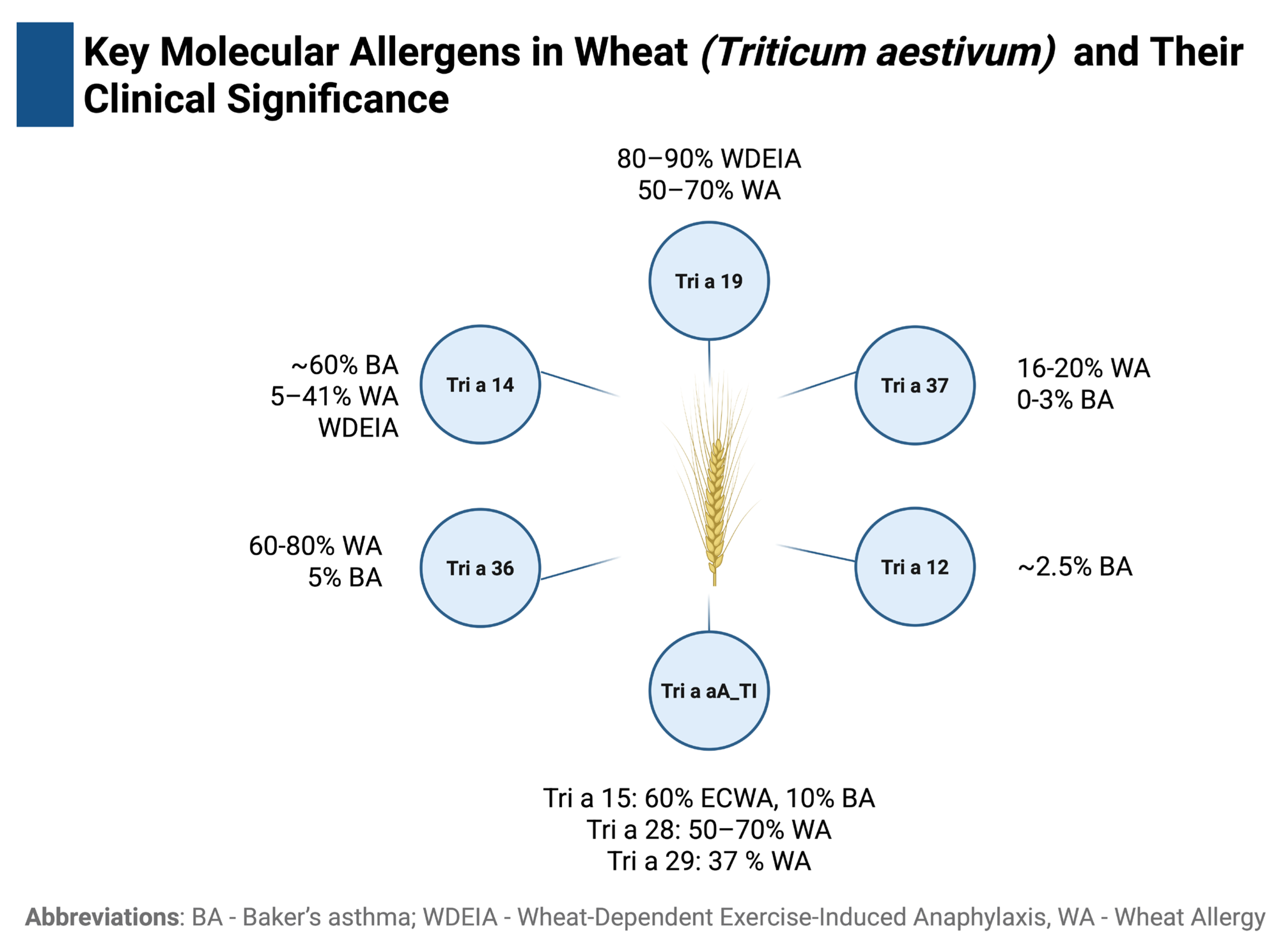
| Tri a 12 profilin | Profilin-like/Profilin/- | ~2.5% BA | Allergen smaller than wheat seeds and pollen. Cross-reactivity marker with pollen and foods, rarely clinically significant in inhalant allergy. May be one of the relevant allergens in food allergy, especially in bakeries. Rarely causes clinically significant systemic symptoms after ingestion, most reactions are mild (OAS). | Road of exposure (RoE): ingestion and inhalation. Soluble in water and salt solutions, non-glycosylated, and sensitive to heat and digestion. High sequence identity with Bet v 2 (birch pollen). Not commercially available; due to high homology within this protein family, interpretation of wheat extract results is possible based on Bet v 2 (birch profilin) or Phl p 12 (timothy grass profilin). |
| Tri a 14 nsLTP | Prolamin/nsLTP/nsLTP1 | ~60% BA, 5–41% WA | A minor wheat allergen. The main allergen in patients with baker’s asthma. A marker of primary WA. After consumption, it may cause OAS, urticaria, and anaphylaxis. Involved in WDEIA; symptoms are often associated with cofactors (most commonly exercise, but also alcohol, infections, or drugs), which may hinder identification of the culprit. Increases sensitivity for detecting WA compared to sIgE to wheat extract No cross-reactivity with grass pollens, which aids in distinguishing WA from pollen sensitization in patients with high grass pollen sIgE. Cross-reactivity with barley nsLTP | RoE: ingestion and inhalation. Soluble in water and salt solutions, non-glycosylated, and heat/digestion resistant. Available for routine testing on singleplex (e.g., ImmunoCAP) and multiplex assay (e.g., ISAC, ALEX2, and ALEX3). |
| Tri a 19 ω-5- gliadin | Prolamin/gliadin/ ω-5-gliadin | 80–90% WDEIA, 50–70% WA | The major allergen in wheat seeds. Marker of primary WA. Marker of severe reactions in children with WA. The most specific marker for WDEIA (78% sensitivity and 96% specificity). Symptoms range from generalized urticaria to severe anaphylactic reactions. Allergy to this molecule is associated with persistent allergy. Cross-reacts with Sec c 20 (rye) and Hor v 20 (barley). | RoE: ingestion. Soluble in alcohol, non-glycosylated, and heat/digestion resistant. Not well represented in wheat extracts. In patients allergic to ω-5-gliadin, gluten-free diet is necessary. The best characterized single wheat allergen. Available for routine testing on singleplex (e.g., ImmunoCAP) and multiplex assay (e.g., ISAC, ALEX2, ALEX3). |
| Tri a aA_TI ATIs | Prolamin/amylase/trypsin inhibitor (ATI)/- | Tri a 15: 60% ECWA, 10% BA Tri a 28: 50–70% WA Tri a 29: 37% WA | Pollen and seed allergens. Major allergens in baker’s asthma. ATIs play a clear role in bakers’ eczema and asthma, as well as in food allergies. They appear to be the strongest activators of allergic respiratory responses, such as in baker’s asthma. | RoE: ingestion and inhalation. Soluble in salt solutions, glycolyzed, and heat/digestion resistant. The α-amylase/trypsin inhibitor family, which includes several 12–17 kDa proteins. May be absent in the test extract. It has been demonstrated in vitro and in animal studies that they may play a role in CD and NCGS. Available for routine testing only on multiplex assay (e.g., ISAC, ALEX2). |
| Tri a 36 LMW glutenin | Prolamin/glutenin/low molecular weight glutenin (LMW glutenin) | 60–80% WA, 5% BA | Major wheat food allergen. Major allergen in immediate allergy in children (common in typical childhood wheat food allergy phenotype). Major allergen in WDEIA. A potential marker for distinguishing occupational allergies from food allergies. Higher sensitivity and specificity than ω-5-gliadin for the diagnosis of wheat food allergy. Cross-reactivity with related allergens in rye, barley, oat, spelt, and rice. | RoE: ingestion. Belongs to the glutenin fraction, soluble in acids, non-glycosylated, and heat/ digestion resistant. Even after extensive in vitro gastric and duodenal digestion, Tri a 36 released distinct IgE-reactive fragments and was highly resistant to boiling. Available for routine testing only in multiplex assays (only on ALEX3). |
| Tri a 37 alpha-purothionin | Thionin/alpha-purothionin | 16–20% WA, 0–3% BA | Minor wheat seed allergen. Possible class I food allergen; has only linear (sequential) epitopes, a typical feature of classic type I allergens (similar to ovomucoid in egg or casein in milk). Patients with IgE to Tri a 37 have a 4-fold increased risk of severe allergic reactions upon wheat ingestion. No IgE reactivity to Tri a 37 detected in grass-pollen-allergic or non-allergic individuals Sensitization to Tri a 37 and related symptoms may be influenced by factors affecting gastric digestion, such as gastrointestinal pathologies and low stomach acidity, which can occur in children, elderly persons, or as a consequence of antacid medication. | RoE: ingestion. Belongs to albumins/globulins, soluble in water and salt solutions, non-glycosylated, and heat/digestion resistant. It belongs to the plant defense proteins and is highly expressed in wheat seeds. Available for routine testing only in multiplex assays (only on ALEX3). |
| Diagnostic Method/Component | Target (Analyte) | Sensitivity | Specificity | Diagnostic Utility | Cost | Availability | Limitations |
|---|---|---|---|---|---|---|---|
| SPT Wheat Extract | Mix proteins/mainly water-soluble proteins (albumins/globulins) | Low | Low/Moderate | Basic screening | Low | Widely available | Low sensitivity (some of the gluten proteins are insoluble in water-based extracts). High false-positive rate due to grass pollen cross-reactivity. |
| sIgE Wheat extract (f4) | Mix proteins/mainly water-soluble proteins (albumins/globulins) | Low/moderate | Low | Basic screening | Low | Widely available | Low sensitivity (some of the gluten proteins are insoluble in water-based extracts). Low specificity (cross-reactivity with Phl p 12/profilins and CCDs). Poor predictor of clinical reactivity without CRD. |
| sIgE Tri a 19 | ω-5 gliadin | Moderate (50–70% WA)/ high (~80% in WDEIA) | High (95–100%) | Second-line diagnostics | Low | Widely available | May miss ~20–30% of WDEIA cases. Often negative in children with immediate WA (who react only to Tri a 36); cofactor-dependent clinical expression, e.g., exercise and NSAIDs). |
| sIgE Tri a 36 | LMW glutenin | High | High | Second-line diagnostics | Moderate (multiplex-based) | Available, but limited to one diagnostic platform | Available mainly in multiplex assays (only on ALEX3). |
| sIgE Tri a 37 | α-purothionin | Low | High | Second-line diagnostics | Moderate (multiplex-based) | Available, but limited to one diagnostic platform | Low sensitivity (detected in minority of patients) but indicates 4-fold increased risk when positive. Available mainly in multiplex assays (only on ALEX3). |
| sIgE Tri a 14 | non-specific lipid transfer protein (nsLTP) | Moderate | High | Second-line diagnostics | Low | Widely available | Possible cross-reactivity with other plant nsLTPs and cofactor-dependent clinical expression (e.g., exercise and NSAIDs). |
| sIgE Tri a 12 | Profilin | Low | Low | Second-line diagnostics | Non-routine testing | Limited; not routinely available | Marker of cross-reactivity with grass pollen (e.g., Phl p 12). Indicates low risk of systemic reaction. |
| Multiplex (e.g., ALEX) | Multiple components + CCD marker | High | High | Comprehensive molecular profiling First-/second- diagnostics line (top-down /bottom-up approaches) | Moderate (per test); low per analyte | Routine availability with regional variability | Component availability depends on the test version; higher cost and limited accessibility compared with standard serology; ongoing need for large-scale validation. |
| BAT (Basophil Activation Test) | Basophil surface markers (CD63/CD203c) | High | High | Functional second-line test | High | Limited availability/specialized laboratories only | Technically demanding; requires fresh blood, specialized equipment (flow cytometer), and validation. ~10% of population are non-responders. |
| BBEA (Bead-Based Epitope Assay) | peptide epitopes (n = 79) (key: ω-5 and γ-gliadin sequences) | High | High | Research tool with high diagnostic potential | High | Research use only for wheat/low availability for penut | High cost; currently not commercially available for wheat in routine practice. |
| OFC (Oral Food Challenge) | Clinical reaction | Gold standard | Gold standard | Reference diagnostic standard | High | Limited; hospital-based procedure | Risk of severe anaphylaxis; resource-intensive; requires precise cofactor protocols. |
| Molecule | Clinical Phenotype/Anaphylaxis Risk | Management Strategy (Clinical Decision) | Monitoring and Prognosis |
|---|---|---|---|
| Tri a 19 (ω-5-gliadyna) | Wheat-dependent exercise-induced anaphylaxis (WDEIA)/severe IgE-mediated allergy. | Strict gluten-free diet (for resting anaphylaxis) or, in WDEIA, avoidance of gluten combined with cofactors (exercise, NSAIDs, and alcohol). Adrenaline auto-injector is recommended. OFC (oral food challenge): may be waived if risk is high; WDEIA challenges must include cofactor(s). For WDEIA, avoid exercise (including brisk walking) for 4 h after ingestion. | Risk of persistent allergy: high sIgE to Tri a 19 is a marker of persistent allergy. WDEIA and baker’s asthma typically persist for life. Education on cofactors is essential. |
| Tri a 37 (α-purotionina) | High risk* of severe anaphylaxis (cofactor-independent). *a 4-fold increased risk of severe reactions. | Strict gluten-free diet. Adrenaline auto-injector is mandatory. Caution with OFC qualification—may be waived due to severe risk. Diet should often exclude not just wheat, but also rye and barley due to >80% sequence identity. | Guarded prognosis. High sIgE levels are associated with slower tolerance acquisition. Clinical manifestation may be modulated by gastric acidity; patients on antacids/PPIs may be at higher risk due to impaired degradation. |
| Tri a 14 (nsLTP) | Cross-reactive or cofactor-dependent allergy. Baker’s asthma (major allergen). Risk of systemic reactions (anaphylaxis, urticaria). | Wheat elimination often necessary. No cross-reactivity with grass pollen–aids in differential diagnosis from pollen allergy. OFC: May be waived if risk is high; in WDEIA cases, challenge must include cofactors. For Baker’s asthma: reduce occupational exposure (masks, job change). | Individual monitoring. Assess tolerance based on cofactors. Potential cross-reactivity with other LTP-containing plants (e.g., peach, barley). Patient education regarding cofactors is crucial. |
| Tri a 36 (LMW glutenina) | Typical wheat food allergy in children. WDEIA Major allergen in immediate reactions in children (higher sensitivity than Tri a 19 in this group). | Wheat elimination diet. An adrenaline auto-injector is mandatory in patients at risk of anaphylaxis. In case of discrepancy between history and serology, confirmation via OFC is indicated. Differentiates true food allergy from grass pollen cross-reactivity. | High probability of acquiring tolerance. Regular monitoring of sIgE is recommended-annual OFC in early childhood is advised to assess the development of tolerance. |
| Tri a 12 (Profilin) | Mostly asymptomatic sensitization or mild oral allergy syndrome (OAS). Marker of cross-reactivity with grass pollen (e.g., Phl p 12). | No indication for elimination diet (unless clinical symptoms are confirmed). Positive result usually reflects cross-reactivity; OFC only if actual clinical symptoms occur. Sensitization to profilins is usually secondary to pollen allergy; detection of Tri a 12 in asymptomatic patients does not justify an elimination diet and should prompt evaluation for pollen (especially grass) allergy. | Not applicable. Symptoms are typically seasonal and related to grass pollination periods. |
Disclaimer/Publisher’s Note: The statements, opinions and data contained in all publications are solely those of the individual author(s) and contributor(s) and not of MDPI and/or the editor(s). MDPI and/or the editor(s) disclaim responsibility for any injury to people or property resulting from any ideas, methods, instructions or products referred to in the content. |
© 2026 by the authors. Licensee MDPI, Basel, Switzerland. This article is an open access article distributed under the terms and conditions of the Creative Commons Attribution (CC BY) license.
Share and Cite
Pukalyak, S.; Gromek, W.; Tomczak, A.; Markut-Miotła, E.; Woźniak, M.; Wysokiński, M.; Smolinska, S.; Majsiak, E. Wheat Allergy in the Era of Precision Medicine: From Novel Molecular Markers to New Therapeutic Perspectives. Int. J. Mol. Sci. 2026, 27, 1717. https://doi.org/10.3390/ijms27041717
Pukalyak S, Gromek W, Tomczak A, Markut-Miotła E, Woźniak M, Wysokiński M, Smolinska S, Majsiak E. Wheat Allergy in the Era of Precision Medicine: From Novel Molecular Markers to New Therapeutic Perspectives. International Journal of Molecular Sciences. 2026; 27(4):1717. https://doi.org/10.3390/ijms27041717
Chicago/Turabian StylePukalyak, Solomiya, Weronika Gromek, Aleksandra Tomczak, Ewa Markut-Miotła, Maja Woźniak, Mariusz Wysokiński, Sylwia Smolinska, and Emilia Majsiak. 2026. "Wheat Allergy in the Era of Precision Medicine: From Novel Molecular Markers to New Therapeutic Perspectives" International Journal of Molecular Sciences 27, no. 4: 1717. https://doi.org/10.3390/ijms27041717
APA StylePukalyak, S., Gromek, W., Tomczak, A., Markut-Miotła, E., Woźniak, M., Wysokiński, M., Smolinska, S., & Majsiak, E. (2026). Wheat Allergy in the Era of Precision Medicine: From Novel Molecular Markers to New Therapeutic Perspectives. International Journal of Molecular Sciences, 27(4), 1717. https://doi.org/10.3390/ijms27041717