Article

Photophysical Processes of Porphyrin and Corrin Complexes with Nickel and Palladium

Institute of Chemistry, University of Silesia in Katowice, Szkolna 9, 40-006 Katowice, Poland
*
Author to whom correspondence should be addressed.
Int. J. Mol. Sci. 2026, 27(3), 1577; https://doi.org/10.3390/ijms27031577
Submission received: 23 December 2025 / Revised: 26 January 2026 / Accepted: 30 January 2026 / Published: 5 February 2026

Abstract

Nickel(II) and palladium(II) ions are capable of forming complexes with macrocyclic terapyrrole structures such as the porphyrin or corrin ring. Many different derivatives of these complexes are synthesized and studied because these compounds have potential numerous applications, including catalysis, various light-driven chemical reactions and processes related to intramolecular and intermolecular energy redistribution. Nickel porphyrins exhibit neither fluorescence nor phosphorescence when excited with light; however, palladium porphyrins, when excited to the singlet state, very quickly transform into the triplet state, and unlike nickel porphyrins, deactivation of the excited states occurs by phosphorescence. Palladium corrin has dual luminescent properties and exhibits both a weak fluorescence and strong phosphorescence. These photophysical differences are based on the complex energetic redistribution of singlet and triplet excited states interacting with each other in the intersystem crossing process. Based on the results of calculations at the DFT/TDDFT and CASSCF/NEVPT2 levels of theory, the structure of electronic excited states of model nickel(II) and palladium(II) complexes with corrin and porphyrin macro-rings was characterized and potential paths of photophysical processes leading to the occupancy of low-lying triplet states were described. In nickel complexes, very low-energy triplet states are the main cause of the rapid radiationless deactivation of excited states via triplet photophysical pathways.

Graphical Abstract

1. Introduction

Porphyrin and corrin are the two tetapyrrole ligands of crucial importance in the metabolism of living beings [1]. Iron complexes with a porphyrin derivative form the so-called heme, which is a component of many enzymes that control important biological processes such as oxygen transport, oxidation reactions, electron transfer and many others [2]. Corrin macrocycle forms a complex with cobalt, producing vitamin B12. Vitamin B12 derivatives, called cobalamins, are components of enzymes that catalyze important biological processes [3]. They participate in DNA synthesis and the metabolism of fatty acids and amino acids. Cobalamin enzymes are required in animal metabolism, but plants do not utilize them. Humans have two B12 enzymes: methionine synthase and methylmalonyl-CoA mutase [4]. Replacing cobalt with nickel in cobalamin produces the so-called nibalamins [5] which may play a role as antivitamin B12 [6]. Antivitamins B12 are structurally modified derivatives of cobalamins that are inactive and can be used to investigate problems with the absorption or deficiency of this vitamin.
Many porphyrin complexes with metals other than iron have been synthesized and studied [7,8,9,10,11]. These compounds have numerous applications, including synthesis, catalysis, and medicine. For corrin, complexes with metals other than cobalt are not as numerous as for porphyrins. Examples include nickel, rhodium, palladium, copper, magnesium, and zinc [12,13,14,15,16,17,18,19].
Nickel porphyrin complexes have been studied extensively due to the interesting photophysical processes that occur within them [10,20,21,22,23,24,25,26,27,28,29,30,31,32,33,34,35,36,37,38,39]. Nickel porphyrins exhibit neither fluorescence nor phosphorescence when excited with light. From the singlet state, there is a rapid transition to the triplet state and a very rapid, radiationless deactivation to the ground state. The structure and properties of palladium corrin have been determined, but this compound has not been widely studied. Palladium porphyrins, when excited to the singlet state, very quickly transform into the triplet state, but unlike nickel porphyrins, deactivation of the triplet state occurs by phosphorescence [9,40,41,42]. In the triplet state, palladium porphyrins interact with oxygen to act as photoreceptors and therefore they are of great interest as oxygen concentration indicators with technological and medical applications and as compounds used in photodynamic therapy [43,44,45,46,47,48,49,50,51,52]. The metal complexes of porphyrin and corrin were also the subject of theoretical studies alongside experimental investigation [35,42,53,54,55,56,57].
In the electronic spectra of porphyrin derivatives, two main bands can be distinguished: the low-intensity Q band at approximately 500 nm and the high-intensity B band, or Soret band [58]. These two bands arise from transitions between four orbitals: the two highest occupied π and the two lowest unoccupied π orbitals. This is the so-called four-orbital Gouterman model [9,58]. The same pattern is found in metalloporphyrins, but in this case numerous transitions involving d-type orbitals also occur; however, they usually have zero or low intensity. The photophysics of metal porphyrin derivatives has been widely investigated [7,9,30,37,59]. The Q and B bands are often called S1 and S2, similar to free porphyrins, but in fact, transitions containing d orbitals lie below and in the middle, so this nomenclature is not particularly suitable to metalloporphyrins.
The subjects of this work are complexes of porphyrin and corrin with nickel and palladium. Our goal was to determine the spectroscopic and photophysical properties of nickel and palladium complexes with porphyrin and corrin by theoretical methods.

2. Results

2.1. Nickel Complexes

2.1.1. Geometry and Electronic Structure of Nickel Porphyrin and Nickel Corrin

The structural formulas, atom coloring, atom numbers and nomenclature for the studied complexes are given in Section 4.5. As it can be seen in Table 1 the Ni-N bonds in nickel(II) corrin (NiCorr) are shorter than those in nickel(II) porphyrin (NiPor). The calculated bond lengths and angles agree well with the experimental ones.
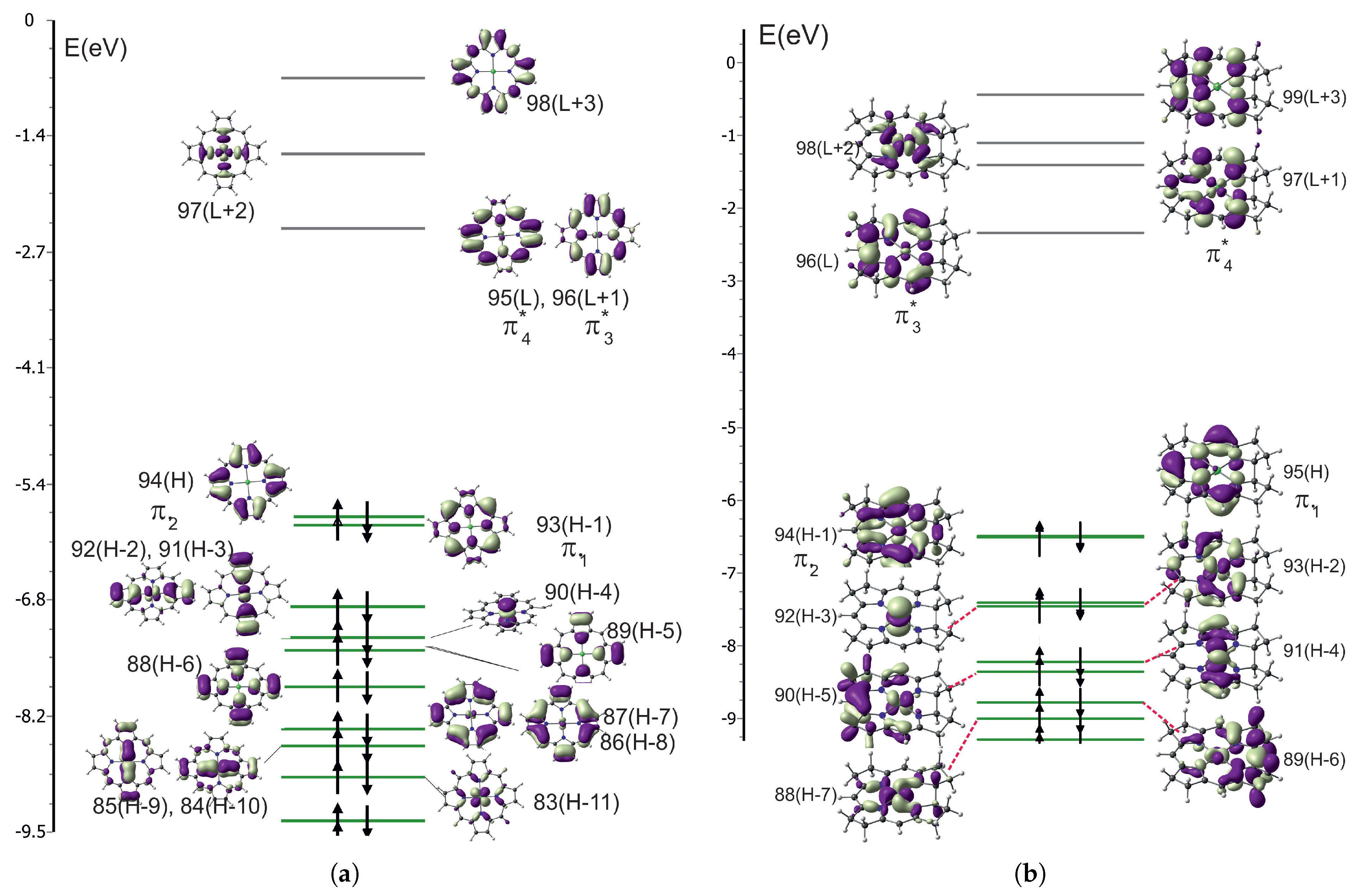
In Figure 1, the MO diagrams of NiPor and NiCorr are depicted.
Figure 1. The orbital energy diagrams: (a) NiPor. (b) NiCorr.
Ijms 27 01577 g001
Table 1. Selected optimized geometry parameters of NiPor and NiCorr. Bond lengths in Å, angles in degrees. The experimental data are given for comparison. Atom numbering is shown in Section 4.5.
ParameterNiCorrNiPor
Calc.Expt. aCalc.Expt. b
Ni-N11.8481.8511.9581.930
Ni-N21.8951.9131.9581.930
Ni-N31.8951.8841.9581.930
Ni-N41.8481.8471.9581.930
N1-Ni-N291.491.290.090.0
N2-Ni-N395.195.590.090.0
N3-Ni-N491.491.490.090.0
N4-Ni-N182.683.090.090.0
N1-Ni-N3171.6170.4180.0179.7
N2-Ni-N4171.6169.5180.0179.7
N1-N2-N3-N4−7.2−10.20.00.5
N1-N2-N3-Ni−3.6−4.70.00.2
a Ref. [18], b Ref. [60]

2.1.2. Electronic Spectra of NiPor and NiCorr

  • A. NiPor
The TDDFT calculated electronic transitions are gathered in Table 2 together with the experimental values. The four lowest energy singlet electronic transitions are of the d d type with some π orbital contribution. These are symmetry-forbidden transition and the corresponding oscillator strengths are zero. The two transitions at 474 nm originate from excitation between four Gouterman orbitals and they correspond to the Q band. Comparison with the experimental data in Table 2 shows that this band for nickel porphyrins lies in the range 520–540 nm and reveals that the calculations give too high transition energies in the Q band. The two degenerate transitions at 325 nm again originate from excitations between the four Goutermann orbitals and correspond to the B (Soret) band. Calculations again give these transitions at shorter wavelengths than the experimental one.
From the perspective of the photophysical properties of nickel porphyrin derivatives, triplet states are very important. These compounds typically exhibit neither fluorescence nor phosphorescence. It is known that upon excitation to the singlet state in the Q or Soret band, a transition to the triplet state occurs, ultimately leading to fast radiationless deactivation through a d d triplet state. Table 2 shows that the first three triplet transitions occur at very low energies, 0.3–0.6 eV. These are d d transitions. The next transition occurs at 1.55 eV, also of the d d type.
Subsequent transitions are π π * , and from 3.0 eV onwards, mixed π d and d π * transitions occur. The presence of low-energy triplet states is important for the radiationless deactivation of nickel porphyrin. Calculations show that these are d d states. As will be shown later (Section 2.5), similar energies of triplet states are obtained by the multi-configuration NEVPT2 method.
  • B. NiCorr
The electronic spectra of nickel corrin were measured, as were the spectra of the derivatives of nickel B12 in which the cobalt was replaced by nickel, called nibalamin [5]. On the other hand, the photophysical properties of nickel corrins have not been studied experimentally.
The calculated electronic transitions of NiCorr are summarized in Table 3, along with the available experimental data. The four lowest singlet transitions have d d character and zero or near-zero oscillator strengths. The non-zero oscillator strengths of some of the corrin derivatives are due to the ring non-planarity. For this reason, d orbitals generally mix with π orbitals in metallocorrins. Two transitions with high oscillator strengths are calculated at 364 and 345 nm. They have π π * character with a small admixture of d character. The experimental bands in the spectra of nickel corrin derivatives differ slightly in wavelength. They can be gathered into several groups: 450–460 nm, 416–435 nm, 319–340 nm, 294–317 nm, 266–277 nm, and 244–245 nm. These can be assigned to calculated transitions with significant oscillator strengths, at 364 nm, 345 nm, 284 nm, 271 nm, 256 nm, and 140 nm, respectively. These are essentially π π transitions, with some d character. The electronic transition at 364 nm with a large oscillator strength is a pure π π * form and can be attributed to the experimental bands at 450–460 nm.
It can be seen that the calculated wavelengths of the electronic transitions are shorter than the experimental ones, similar to NiPor.
The lowest four triplet transitions have energies ranging from 1.18 eV to 2.30 eV, hence they have much higher energy than those in NiPor where the lowest triplet transition has an energy of 0.35 eV.

2.1.3. Minimum Energy Crossing Point of T1 and S0

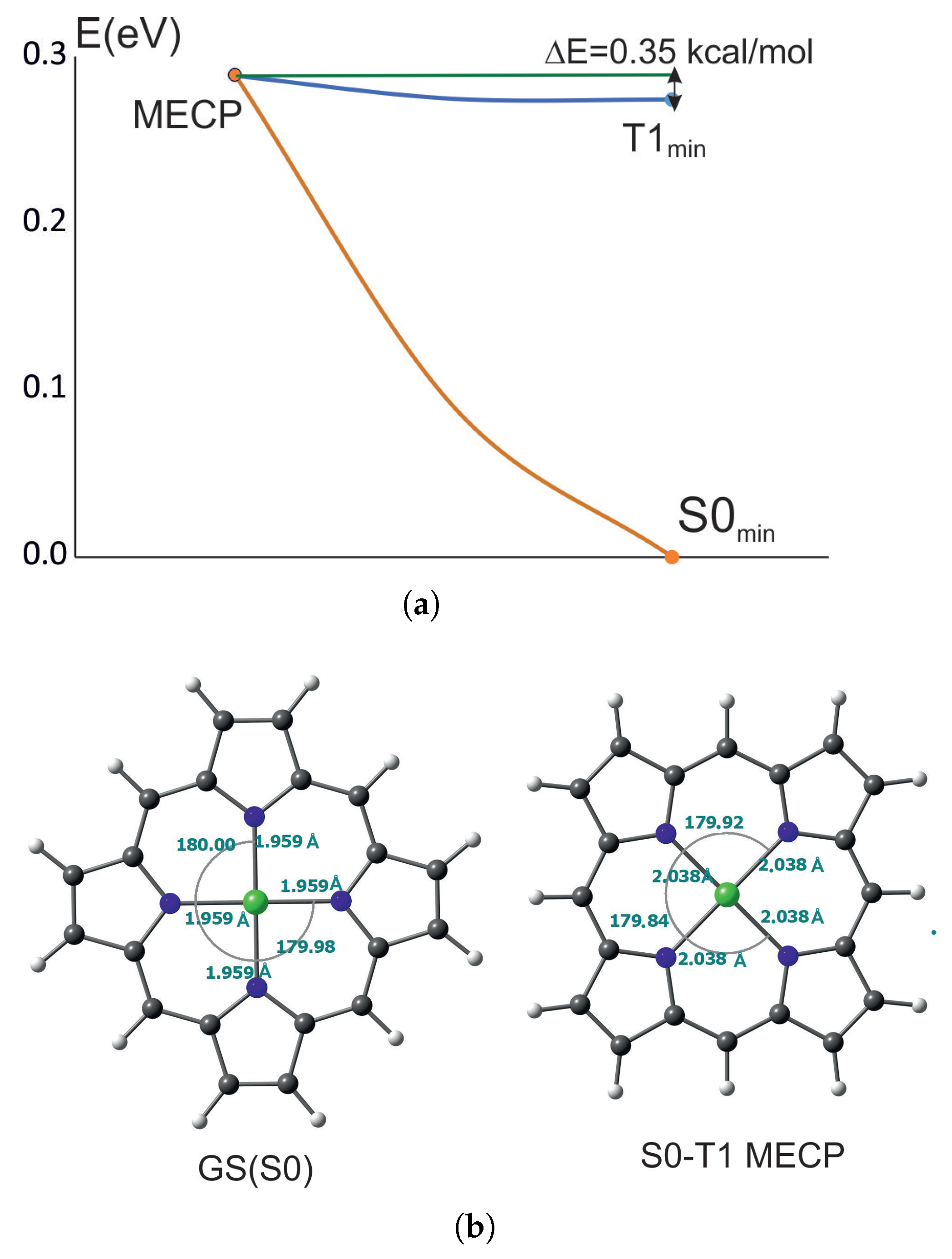
The minimum energy crossing point (MECP) is the lowest energy point between two electronic states with different multiplicity. The MECPs between the lowest energy triplet state (T1) and the ground state were determined for NiPor and NiCorr. They are presented in Figure 2 and Figure 3. As can be seen, reaching the MECP from the triplet state minimum for NiPor requires only 0.35 kcal/mol, which is a very small barrier and the triplet transition to the ground state process should be very fast, which is in agreement with the experiment where it occurs within 200 ps [29,31,33].
In nickel porphyrin, the dihedral angles of the nickel ion practically do not change at the MECP point, but the nickel–nitrogen bonds are lengthened by about 0.07 Å. Therefore, the transition from the lowest triplet state to the ground state takes place by stretching the Ni-N bonds.
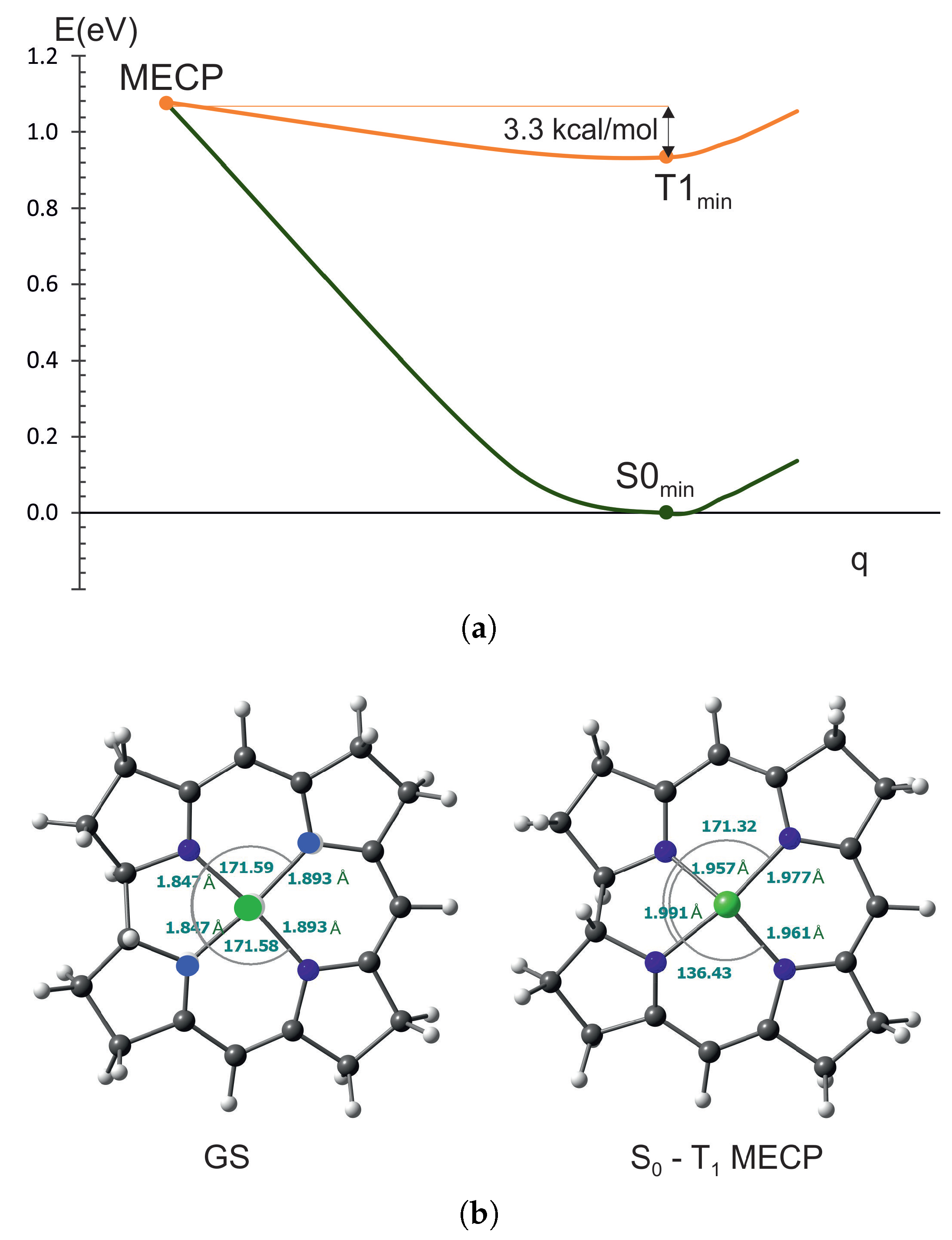
The situation is different in nickel corrin. The energy required to reach the MECP from the minimum of T1 state is 3.3 kcal/mol. The Ni-N bonds lengthen at the MECP by 0.7 to 0.12 Å, but one dihedral angle also changes, from 171 to 136 degrees. So, in this case, the return to the ground state is essentially through the ring bending apart from nickel–nitrogen bond elongation. In the case of nickel complexes, the lowest triplet states are d d and their energy is very low, especially in nickel porphyrin. Therefore, the transition to the ground state involves a very small energy barrier. Experimentally, it is believed that the transition from the triplet state to the ground state in nickel porphyrins involves a state of d d character [31,61], which is in agreement with the calculations.

2.2. Palladium Complexes

2.2.1. Geometry and Electronic Structure of Palladium Porphyrin and Palladium Corrin

Optimized geomety parameters of PdPor (Palladium(II) Porphyrin) and PdCorr (Palladium(II) Corrin) are gathered in Table 4. The calculated palladium–nitrogen bond lengths in PdCorr are shorter than the experimental ones. On the other hand the respective bond lengths in PdPor agree very with the experimental ones. As can be expected, the palladium–nitrogen bonds are longer than those in the nickel complexes.
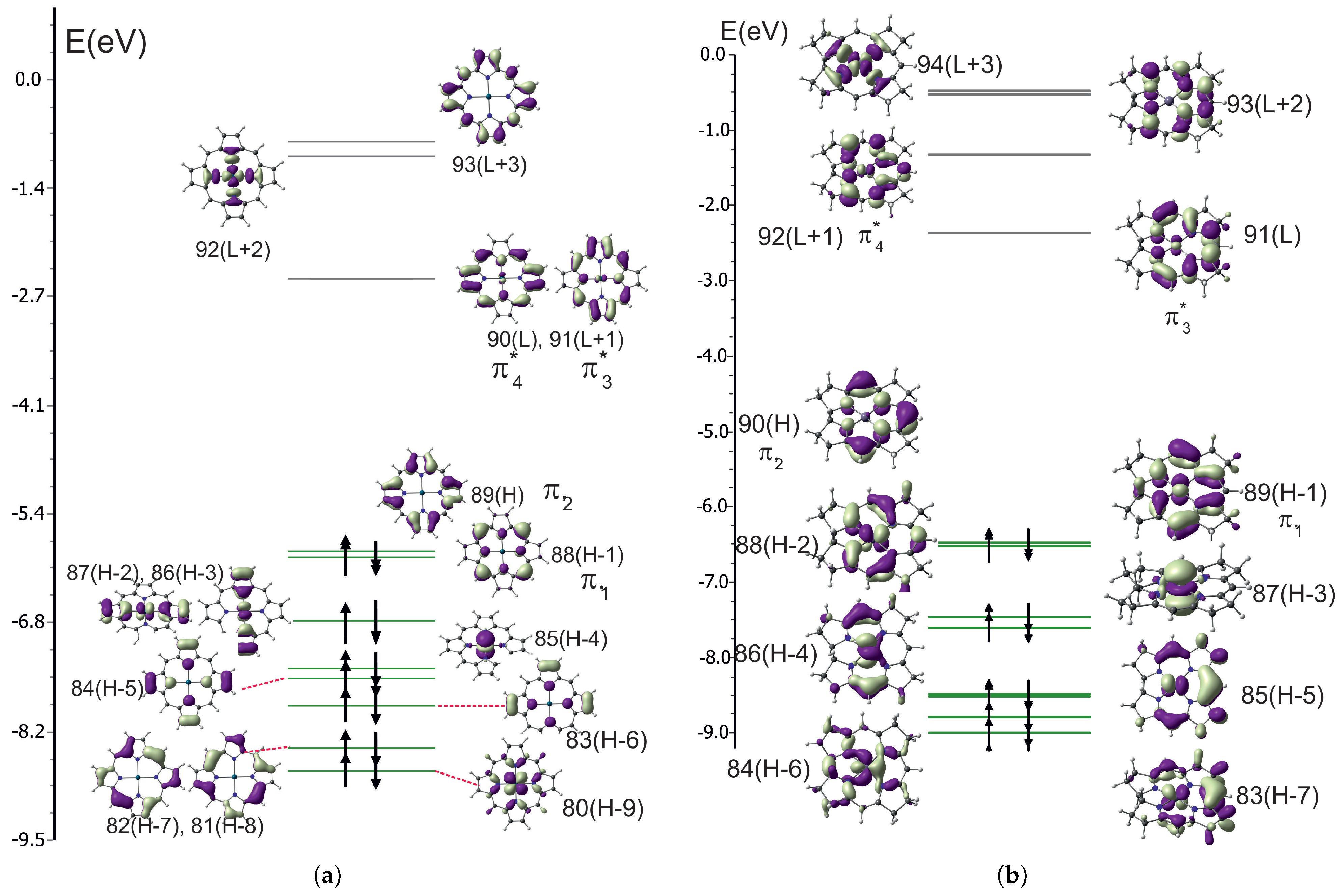
The MO diagrams for PdPor and PdCorr are shown in Figure 4.
For PdPor, similarly as for NiPor, the two highest occupied and two lowest unoccupied orbitals are π -type Gouterman orbitals. For PdCorr those orbitals are also π -type, but some admixture of d orbitals is visible.

2.2.2. Electronic Spectra for Palladium Porphyrin and Palladium Corrin

  • A. PdPor
The TDDFT calculated electronic transitions for PdPor are collected in Table 5, along with the experimental data. The lowest two transitions at 468 nm are degenerate and correspond to the Q band. These are π π * type transitions involving the two highest occupied orbitals and the two lowest unoccupied ones, the four Goutermann orbitals. The experimental bands are given for various derivatives and range between 512 and 524 nm. The calculated transitions are at shorter wavelengths than the experimental ones, as in nickel complexes.
The Soret band is calculated at 326 nm (experimentally between 394 and 417 nm). It also derives from excitations between the Goutermann orbitals. Six transitions, all of d π * type, appear between the Q and Soret bands in the calculations. Above the Soret band, d π * and d d transitions appear, and at higher energy, π π * transitions again, involving orbitals outside the four orbitals that make up the Q and Soret bands. We can see here that the d d transitions occur in palladium porphyrin at much higher energies than in nickel porphyrin. Their oscillator strengths are equal to zero, because of the high symmetry of the porphyrin ring. The triplet states start at 2.09 eV, and the four lowest energy ones are of π π * character. The electronic triplet states involving d orbitals start at 2.94 eV. Here we can see the large difference from nickel porphyrin.
  • B. PdCorr
Palladium corrin derivatives have been synthesized and their electronic spectra measured. However, data on the photophysics of these systems are relatively scarce, and they have not attracted as much attention as palladium porphyrins.
Due to the non-planar ring structure (bent N-Pd-N bonds, Table 4), the π and d orbitals mix, and consequently, bands such as Q and Soret cannot be distinguished. Two bands at long wavelengths of 460 nm and 430–440 nm were experimentally identified. The electronic transitions calculated using the TDDFT method are gathered in Table 6.
The two lowest transitions are of the π π * type, the second one containing some d character. These can be assigned to experimental transitions at 460 and 430–440 nm. Subsequent transitions are of the d π * and d d type, up to the transition at 273 nm, which has π π * character. In this respect, there is a similarity to palladium porphyrin—the π π * transitions are separated by d π * and π d transitions. At higher energies, mixed π d , d π * , and d d transitions occur.
The triplet states show a similar pattern, the lowest two are π π * states, then come the mixed d π * , π d and d d states; at 270 nm a π π * state appears again.

2.2.3. MECP for Palladium Complexes

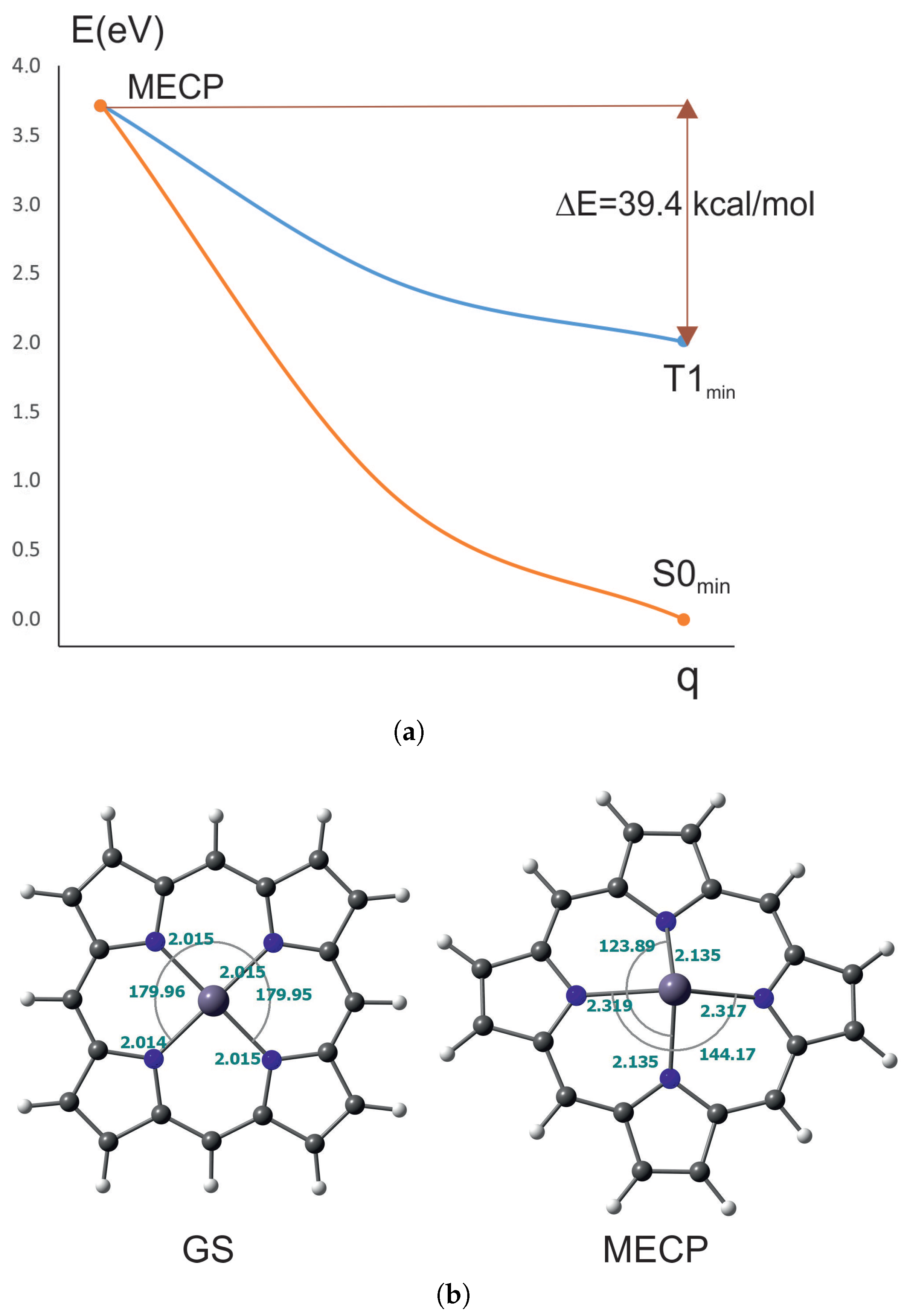
In Figure 5, the T1/S0 crossing is shown for PdPor. The geometry of palladium porphyrin in the MECP point shows a large deformation within the palladium coordination sphere, with dihedral angles of 123 and 144 degrees. The Pd-N bonds elongate in pairs to 2.1 and 2.3 Å. The molecule forms an asymmetric dome. The energy required to transition from the T1 state minimum to the MECP point is 39.4 kcal/mol. Such a high barrier is unfeasible to reach by the molecule, and deactivation to the ground state occurs through phosphorescence. One can note that the T1 state is a π π * state belonging to the Q band, which distinguishes palladium porphyrin from nickel porphyrin and accounts for the high triplet–singlet crossing barrier.
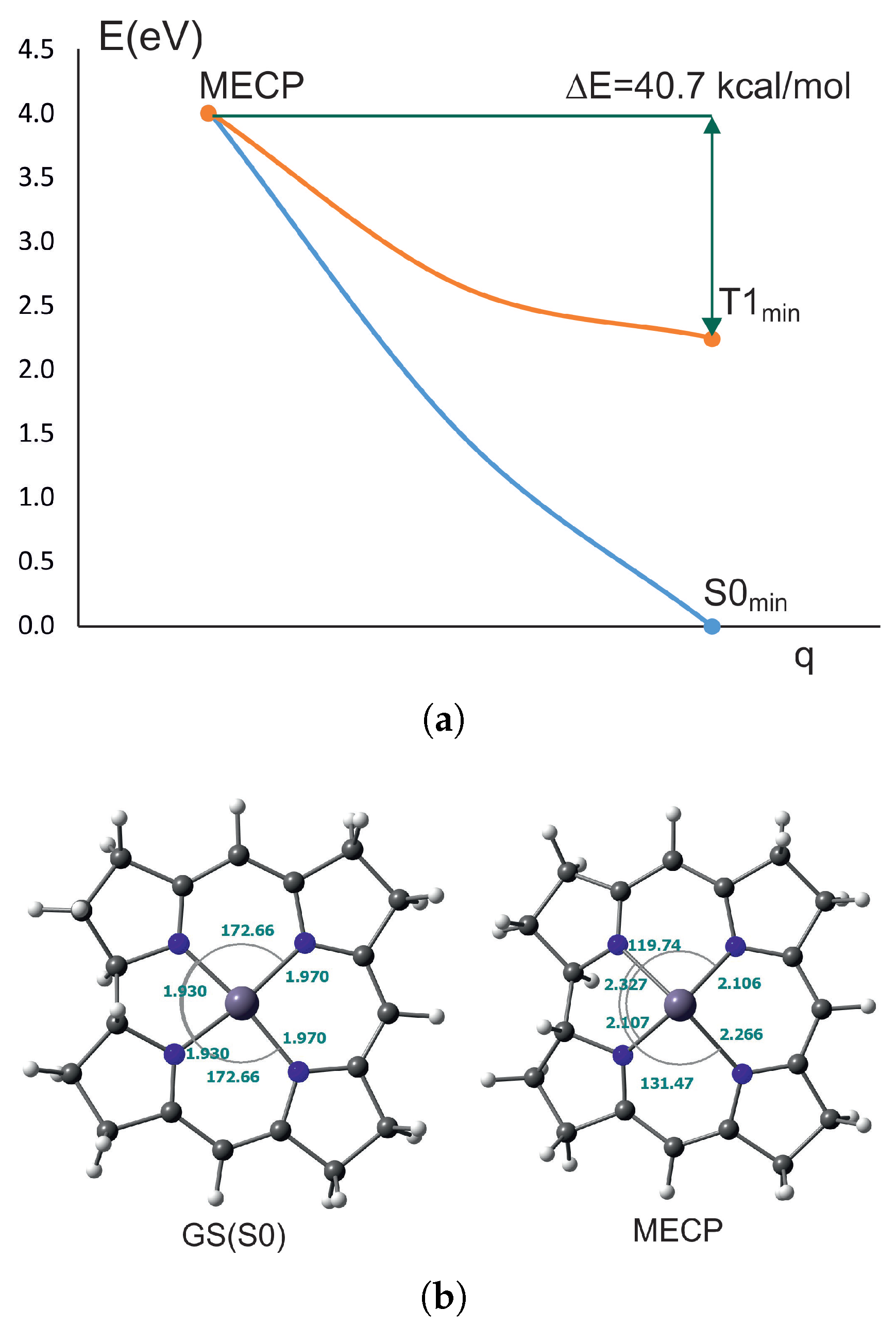
The MECP for T1/S0 crossing for PdCorr is shown in Figure 6. In palladium corrin, the situation regarding the MECP geometry is very similar to palladium porphyrin. The valence angles within the coordination sphere change substantially compared to the ground state, to 119.7 and 131.4 degrees, and the bonds lengthen to 2.1–2.3 Å. The molecule takes the form of an irregular dome with the palladium atom protruding above its plane (or rather, in this case, above the plane of the four nitrogen atoms). The energy barrier is similar to PdPor and amounts to 40.7 kcal/mol.

2.3. Emission of Nickel and Palladium Complexes

The calculated and experimental fluorescence and phosphorescence wavelengths for nickel and palladium complexes with porphyrin and corrin are collected in Table 7.
Palladium porphyrins exhibit phosphorescence at wavelengths above 600 nm, the exact value depending on the porphyrin form and the nature of the fluorescence. Very weak fluorescence above 500 nm is also observed, the appearance of which is influenced by the type of solvent. The calculated phosphorescence wavelength is 703 nm, while the fluorescence wavelength is calculated to be 475 nm. The phosphorescence wavelength is slightly longer than the experimental wavelength, while the fluorescence wavelength is shorter. When converted to energy units, this gives differences of approximately 0.35 eV for fluorescence and 0.1 eV for phosphorescence.
In the case of nickel porphyrin and nickel corrin, virtually no emission is observed. Excitation to a singlet and a rapid transition to the triplet state are followed by a very fast transition to the ground state. This situation is favored by the low-lying triplet states in these complexes, as shown by the results of TDDFT and NEVPT2 calculations (Section 2.5). However, in a study for nickel porphyrin derivatives NiTMP and NiSWTP, the molecule was excited to the Q band, which led to ultrafast stimulated emission at a wavelength of 620–670 nm [33]. No fluorescence was observed upon excitation to the Soret band, leading to the conclusion that the ISC to the triplet state from this band is faster than the IC to the lower singlet states. However, from the triplet states, there is rapid deactivation to the ground state. The calculated fluorescence wavelength is 708 nm, which agrees well with the experiment.

2.4. Spin–Orbit Interaction in Nickel and Palladium Porphyrin and Corrin

For the transition between singlet and triplet states to occur, the integral of the spin–orbit coupling operator, H S T S O , must be large. These states also have to be close in energy to enable their intersection (Intersystem Crossing, ISC). The SOC coefficients (SOCCs) were determined for the singlet and triplet states of NiPor, NiCorr, PdPor, and PdCorr. In Table 8, the calculated values with the TDDFT method are gathered. Only values larger than 100 cm−1 are shown. They are also summarized in Tables S2–S6 in Supplementary Materials.

2.5. NEVPT2 Calculations

The singlet and triplet transition energies for NiPor calculated using the NEVPT2 method are summarized in Table 9. The natural CASSCF orbitals are presented in Figure S2 (Supplementary Materials). The lowest few singlet transitions are of the d π * , d d , and π d type. They have zero oscillator strengths, which results from the symmetry of the porphyrin ligand. Two degenerate transitions at 517 nm involving four π orbitals can be assigned to the Q band. The wavelengths agree well with the experimental data (see Table 2). The oscillator strengths of these transitions are low, which is also consistent with the experiment. Next, the calculations indicate three transitions: one d d and two d π * .
These are followed, at 387 nm, by two π π * transitions with high oscillator strengths, corresponding to the Soret band. The four lowest triplet transitions are of the d d type, and three of them have very low energies, 0.2–0.3 eV, similar to those determined by the TDDFT method (Table 2).
The electronic transitions calculated with the NEVPT2 method for NiCorr are collected in Table 10. The CASSCF natural orbitals are presented in Figure S3 (Supplementary Materials). The calculated transitions with wavelengths from 570 to 490 nm are of the d π and d d types. At 462 nm, a transition with a high oscillator strength occurs and has a π π * character. This can be attributed to the experimental transition at around 460 nm. The next two transitions with a high oscillator strength occur at 342 and 305 nm, which also compare well with the experimental transitions. These are π π * transitions with an admixture of d π * character. As in the TDDFT results, there is a large mixing of transitions containing d orbitals with π π * transitions, which is a consequence of the non-planar structure of the corrin ring.
When considering triplet states, the three lowest ones have very low energy, 0.4–0.6 eV, and are of d d type. Such low-energy triplets also occur in NiPor. At shorter wavelengths, mainly d π * transitions occur, and at 484 and 406 nm, π π * transitions are found.
The electronic transitions calculated with the NEVPT2 method for PdPor are collected in Table 11. The CASSCF natural orbitals are shown in Figure S4 (Supplementary Materials). In Table S8, the lowest singlet and triplet electronic transitions for PdPor complex calculated with the CASSCF(14,13)/NEVPT2/def2-TZVP with the occupation numbers of all active orbitals are gathered. For PdPor, in the spectrum determined by the NEVPT2 method, the Q band occurs at 507 nm and the Soret band at 380 nm. Several d π * transitions occur between these bands. Above the Soret band, transitions involving d orbitals appear, namely, d π * , d d , and π d . Triplet states begin at 579 nm. The lowest are π π * transitions; at higher energies, states involving d orbitals are found.
The electronic transitions calculated for PdCorr by the NEVPT2 method are gathered in Table 12. The CASSCF natural orbitals are depicted in Figure S5 (Supplementary Materials). The NEVPT2 spectrum for PdCorr shows two intense transitions at 382 and 368 nm, which can be assigned to the experimental bands at 460 and 420–430 nm. It can be seen that the calculated wavelength is shorter than the experimental one in this case. These transitions are of d π * , π π * , and d d character. In addition, there are two intense transitions at 299 nm and 274 nm, which correspond to the position of the intense bands in NiCorr (see Table 3). Their character is similar to the earlier transitions. As in NiCorr, the π π * transitions are mixed with transitions involving d orbitals.

3. Discussion

3.1. Photophysics of Nickel and Palladium Porphyrin and Corrin

3.1.1. NiPor and PdPor

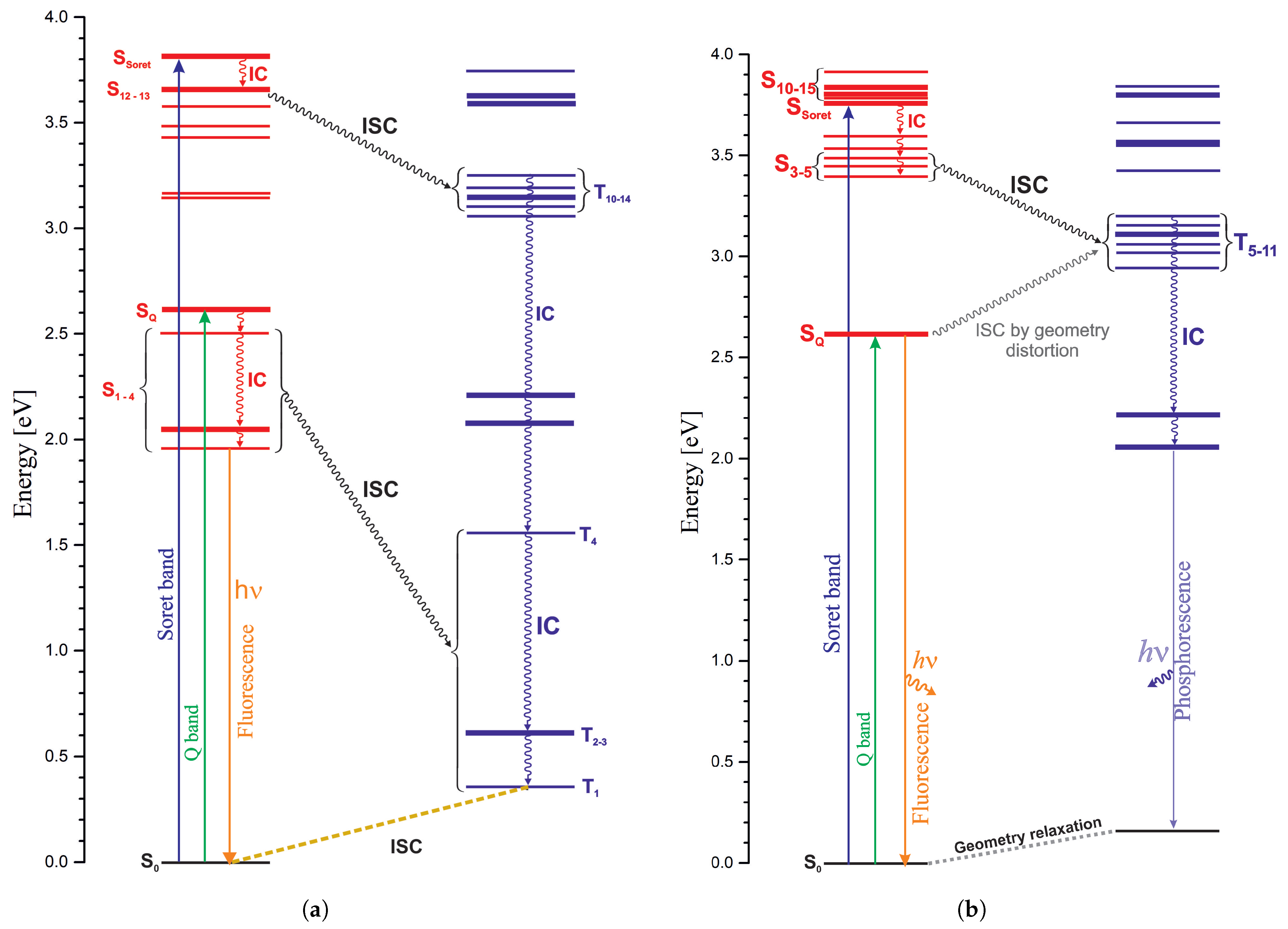
The proposed photophysical processes in NiPor and PdPor are described in Figure 7. They were made based on the calculated electronic spectra and spin–orbit coupling coefficients (SOCCs). Figure 7a depicts a diagram for NiPor. The groups of singlet and triplet states for which the SOCCs are large are marked with a wavy line.
It has been found that upon excitation to the singlet state, a rapid transition to the triplet state occurs in NiPor [26,38,65]. This may be the close-lying T n triplet, from which the system comes to T1 through a series of internal conversions. This vibrationally excited state is mediated by vibrational relaxation, and from this state, a rapid transition to the singlet ground state occurs. This process takes approximately 200 ps. In solutions containing molecules with coordinating properties, such as pyridine, they bind to nickel porphyrin in the excited triplet state, forming five- or six-coordinate complexes [27,30]. These ligands dissociate upon transition to the nickel porphyrin ground state. It is usually considered that the transition to the triplet state occurs from the Q band and if the excitation takes place at the Soret band, there is at first an internal conversion (IC) to the lower Q band, then through intersystem crossing (ISC) to the triplet. There is agreement that the transition to the ground state occurs from a state of d d nature. Nickel porphyrins have no emissive properties and do not exhibit fluorescence or phosphorescence; however, stimulated fluorescence was obtained for NiTPP by exciting it to the Q band. This gave a fluorescence signal of 1 ps. Emission occurs at 620–670 nm. Fluorescence was not observed after excitation to the B (Soret) band, which leads to the conclusion that the transition from the Soret band to the triplet state (ISC) is faster than the internal conversion to the Q state.
Excitation of NiPor to the Q state (calculated at 2.61 eV, Table 2) leads to a rapid transition to the d d and π d states lower in energy (S1−3). The S2 and S3 states (2.04 eV) have large SOC coefficients (see Table 8) with the T4 state of energy equal to 1.55 eV. Considering the relatively small energy difference between S2,3 and T4, a rapid singlet–triplet transition (ISC) may occur, followed by a rapid internal conversion to the T1 state, and then an ISC to the ground state (S0). Note that the S1 state has a high SOCC only with the T1 state, but the energy difference between them is large (1.6 eV) enough that such a transition is unlikely. Hence, rapid fluorescence may occur if the system reaches the S1 state instead of the conversion to triplet state. From T1 to S0, the energy barrier is very small, 0.35 kcal/mol (Figure 2). The state T1 has a d d character, hence confirming the experimental findings that deactivation of excited states in nickel porphyrin occurs through triplet states, with the last step estimated at 200 ps.
If we consider excitation to the B (Soret) state, the situation can be depicted as follows: S 0 I C S 12 , 13 ( 3.65 e V ) I S C T 13 , 14 ( 3.2 e V ) I C T 1 I S C S 0 . The S12,13 and T13,14 states have an energy difference of approximately 0.4 eV and high SOC coefficients. A transition (ISC) between them is possible in this case. From the T12,13 states, a rapid transition (IC) occurs to the T1 state and then ISC to the S0 state. Experimentally, it has been shown that although rapid fluorescence can be detected upon excitation to the Q state, it is absent upon excitation to the B state, which leads to the conclusion that the ISC process from the B state to a triplet is faster than the IC process to the lower lying singlets. There is a large energy gap between the B state and its neighboring states and the Q state, which may explain such a situation.
Palladium porphyrins are intensively studied for their applications in medicine and technology. In both cases, their phosphorescence ability is utilized, as palladium porphyrins, upon excitation to a singlet state, transfer to a triplet state by intersystem crossing process (ISC) and from triplet to the ground state through phosphorescence. When inspecting the PdPor diagram in Figure 7b, one can see a significant difference from NiPor.
The Q state is the lowest-energy state, and the SOCC values for Q and the T1−4 states are zero. This is understandable, as these are π π * states, and according to El-Sayed rules, ISC transitions between such states are forbidden. Similarly, the SOCC values for the S Q (2.64 eV, Table 5) and T5−11 (2.94 eV) states are zero; moreover, the triplet states have higher energy. Transitions between S1,3 and T 5 11 can be possible after ring deformation. As a result of deformation, the π π * states gain d orbital admixture, and the energy barrier can be reached. From the point of view of palladium porphyrin applications, it is important that ISC occurs from the Q state. In substituted and extended porphyrins with a non-planar structure, this problem can be solved. There is experimental evidence that such systems have increased phosphorescence intensity and a shifted Q band position [64,66].
The weak fluorescence that appears in some derivatives (Table 7) indicates that this process may compete with ISC from the Q band. In the case of the Soret state, the situation is different. Below the Soret band several states of the d π * character are found, which can lead to ISC. For example, the S3−5 (3.29–3.41 eV) and T9−11 (3.12–3.19 eV) states have large SOCC values and energy difference is not very large, in the range of 0.3 eV. Rapid singlet–triplet and series of IC transitions to the T1 state of π π * character occur, followed by deactivation to the ground state by phosphorescence. Similar as in the case of NiPor, ISC from the Soret state to triplet states may be faster than IC to the lower energy singlet states. This is supported by the large energy difference between S Q and higher states (around 0.8 eV) and closely located singlets and triplets at around 3.3 eV with large SOCC values.

3.1.2. NiCorr and PdCorr

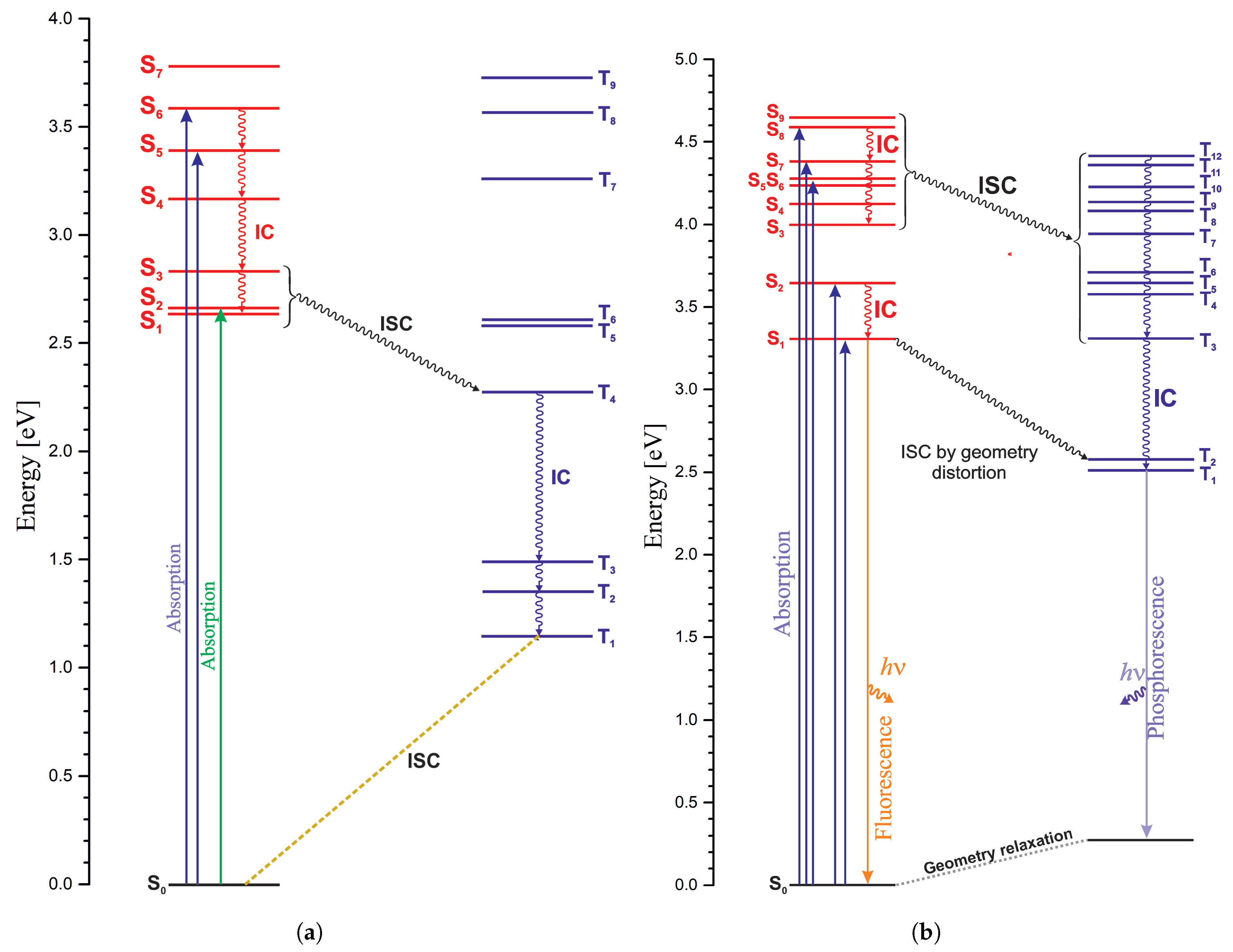
Figure 8 shows schematic diagrams of the photophysical process paths for nickel corrin and palladium corrin. They were prepared based on the calculated electronic spectra and spin–orbital coupling coefficients (SOCCs). Figure 8a depicts a diagram for NiCorr. The groups of singlet and triplet states for which the SOC coefficients are large are marked with a wavy line.
Although the electronic spectra of nickel corrin species have been measured, the photophysics of these molecules have not been studied. For nickel corrin, there are no time-resolved spectroscopic studies of the photophysical stages. Electronic spectra are known for various derivatives, but no fluorescence or phosphorescence has been observed. Figure 8a shows the proposed process of deactivation of excited states of NiCorr. If we look at the SOCCs gathered in Table 8, one can see that high values for energetically closely lying singlet and triplet states occur for the T4-S1 and T4-S3 pairs, with energy difference in the range of 0.36–0.46 eV. Thus, after excitation to the lowest singlet (green arrow in Figure 8) or to singlets with high oscillator strength (blue arrows in Figure 8), a rapid transition occurs via a series of conical intersections (IC) to the S1 or S3 state and from there ISC to T4. Judging by the SOCC values, there is no direct transition from the higher-lying singlet states to triplets. After transition to T4, the system proceeds through consecutive IC to T1 and from there to the ground state. The calculated energy barrier of this latter process is 3.3 kcal/mol (Figure 3).
The photophysical processes proposed for PdCorr are depicted in Figure 8b. For palladium corrin, upon excitation to the low-lying singlet states (S1, S2) with high oscillator strengths, ISC to the T3 and T4 states can occur. PdCorr exhibits both the lowest singlet fluorescence and triplet phosphorescence. From the higher singlet states with high oscillator strengths, ISC processes can occur to T8 considering that the SOCCs for T8 (4.07 eV) and S5 (4.33 eV) have a large value (Table 8) and a relatively small energy difference (about 0.3 eV).

3.1.3. PdPor and PdCorr

Comparison of the photophysical properties of palladium porphyrin (Figure 7b) and palladium corrin (Figure 8b) is also interesting. In PdPor, ISC to the T1−2 states is impossible, and similarly, in PdCorr, there is no transition from S1−2 to T1−2 (as shown by the SOCC values in Table 8); although an S2-T4 transition is possible judging by the respective SOCC values and close energy of the two states. If excitation to the lowest singlets takes place, ISC to triplet states can occur through ring deformation, which introduces d orbitals into the π orbitals, which affects the SOCC values. If the substituents in the porphyrin ring do not introduce structural distortions, such singlet–triplet transitions may require a barrier, in which case fluorescence is also possible, although weak for both compounds (Table 7). From the higher singlet states, given the large SOCC values and close energies of singlets and triplets, rapid conversion to the triplet state, followed by the transition to T1 via the IC series, and phosphorescence are possible. Both complexes show many similarities, but given the intensity of the S1 state in PdCorr, fluorescence seems more likely.

3.2. Comparison of TDDFT and CASSCF/NEVPT2 Results

3.2.1. NiPor

The electronic spectra for NiPor are presented in Table 2 and Table 9 for TDDFT and NEVPT2 methods, respectively. For NiPor, a comparison of CASSCF/NEVPT2 calculations can begin by comparing the electronic transitions belonging to the Q band and the B band (Soret). These are formed by four π Gouterman orbitals. In NEVPT2, the Q band occurs at 517 nm in very good agreement with the experiment (Table 2). The B band occurs at 387 nm, a wavelength somewhat shorter than the experimental one, but in good agreement with the lower bound of the experimental values in Table 2. In NEVPT2 below the Q band transitions, a series of d d , d π * , and π d transitions appear. On the other hand, between the Q and B bands, there is one d d and two d π * transitions for the d x 2 y 2 orbital. In TDDFT both Q and B transitions occur at shorter wavelengths than the experimental ones (474 and 325 nm, respectively, compared to the 517–543 and 393–415 experimental values, Table 2). At energies lower than the Q band, three d d transitions (with π admixture) occur, and between the Q and B transitions, d π * and π d transitions appear.
In both methods, the first three d d triplet transitions have very low energies, 0.23–0.3 eV and 0.36–0.6 eV in NEVPT2 and TDDFT, respectively. This shows an agreement between the methods, which is particularly important from the perspective of photophysical processes. At higher energies, we have π π * and mixed d π * transitions.

3.2.2. NiCorr

The calculated electronic transitions for NiCorr are gathered in Table 3 for the TDDFT method and Table 10 for the NEVPT2 method. The lowest transitions are d d , d π * and π d transitions. In corrin complexes, d and π orbitals mix due to lower symmetry, since the ring is not planar. The first transition with higher intensity is the π π * transition at 364 nm in TDDFT and at 462 nm in NEVPT2. Experimentally, this transition occurs at 440–460 nm (Table 3, depending on the specific form of corrin). It can be seen that TDDFT has a shorter wavelength than the experimental one, while NEVPT2 shows a good agreement. The next high-intensity transition occurs in TDDFT at 284 nm with a π π * character and a small d admixture. The equivalent in NEVPT2 occurs at 342 nm. The experimental band occurs at 320–340 nm, in better agreement with the NEVPT2 method. The band that occurs experimentally at around 300 nm appears at 271 nm and 305 nm, corresponding to the TDDFT and NEVPT2, respectively, demonstrating that NEVPT2 gives better agreement.
Generally, singlets in TDDFT are shifted toward higher energies. The same can be observed for triplets. NEVPT2 produces three triplets at very low energies, 0.4–0.6 eV. In TDDFT, the corresponding transitions occur at 1.2–1.5 eV, i.e., at higher energies. In this, NiCorr is different from NiPor where both methods give triplet d d transitions at very low energy. Generally, the NEVPT2 calculated spectra are in good agreement with the experiment (Table 5), while TDDFT transition energies are shifted to higher energies. However, the order of transitions and their nature are similar in both methods.

3.2.3. PdPor

For PdPor, the calculated spectra are presented in Table 5 and Table 11 for TDDFT and NEVPT2, respectively. The lowest-energy states are the two states belonging to the Q band. They occur at 468 and 507 nm in TDDFT and NEVPT2, respectively. Experimentally, this band is located at 512–527 nm. A better agreement can be observed for NEVPT2. Transitions corresponding to the B band occur at 326 nm in TDDFT and 380 nm in NEVPT2. Again, NEVPT2 provides better agreement with experiment. d π * transitions occur between the Q and B states in both methods, although they are more numerous in TDDFT. The d d states occur above the B band, at 290–314 nm in both methods.
Triplet states begin at an energy of approximately 2.1 eV and arise from the π π * states. Starting from 2.94 eV in TDDFT and 3.07 eV in NEVPT2, excited states involving d orbitals begin.
A qualitative agreement of the spectra can be observed between both methods, but NEVPT2 gives a better agreement with the wavelengths of electronic transitions of the experiment, while in the TDDFT method the electronic transitions are shifted towards shorter wavelengths.

3.2.4. PdCorr

The lowest-lying electronic transitions occur at 367 and 343 nm in TDDFT (Table 6) and 382 and 368 nm in NEVPT2 (Table 12). These are the π π * and d π * transitions. Experimentally, they have been observed at 460 and 430–440 nm. Both methods yield wavelengths that are too short, but NEVPT2 performs slightly better. For PdCorr, there are no experimental measurements for higher electronic states. One can look at the NiCorr spectrum to see what transitions occur there. Experimental bands occur around 320–340 and 300 nm, and around 250–270 nm. In the TDDFT method, there is a transition at 285 nm, which can be compared with the experimental one at around 320 nm. In NEVPT2, there are two transitions with high oscillator strength at 322 and 299 nm, which correspond to the experimental transitions in fairly good agreement. The next higher-energy, high oscillator strength transitions are at 259 and 249 nm in TDDFT, which can be assigned to the experimental band at 240–270 nm. Corresponding transitions occur in NEVPT2 at 258 and 227 nm. All of the above-mentioned transition groups have a large contribution of π π * excitations, with significant contributions from d π * , π d , and π π * . The contribution of π π * transitions contributes to the high deoscillator strength (intensity) of these transitions. A comparison of the TDDFT spectra for NiCorr and PdCorr shows that they appear at similar energies, which is also due to the large contribution of π π transitions. This justifies the comparison of the calculated PdCorr spectrum to the experimental NiCorr spectrum. For PdCorr, it can be concluded that in NEVPT2 the transitions are shifted towards higher energies, although not as much as in TDDFT. However, qualitatively, the transitions in both spectra determined by both methods show essentially the same character. The lowest triplet transition appears at 2.55 eV in TDDFT and 2.82 eV in NEVPT2. At higher energies, the character of the transitions is similar in both methods, but the energies of TDDFT are higher than those of NEVPT2.

3.3. Comparison of Nickel and Palladium Complexes

It is interesting why there is such a difference in photophysical properties between nickel and palladium, given their identical electronic configuration. It can also be noted that MO diagrams for nickel and palladium complexes are very similar. Ake and Gouterman [37] point out that the palladium–porphyrin ligand bond is stronger than that of nickel, since palladium is more covalent. This is a consequence of the larger space extention of the 4 d orbitals. Consequently, these compounds are more stable. The high energy of the d x 2 y 2 orbital causes the d d transitions to have higher energy. This is confirmed by the values of orbital energies gathered Table 13. It shows the HOMO–LUMO energy difference and the energy difference of the occupied and unoccupied orbital d z 2 and d x 2 y 2 , respectively. Although the HOMO–LUMO energy difference is similar for nickel and palladium complexes, the d orbital energy difference for nickel is smaller by 0.8 to 0.9 eV. Note that the HOMO and LUMO orbitals are π orbitals in all complexes (Figure 1 and Figure 4). It can be seen that in the palladium complexes, the unoccupied d x 2 y 2 orbital is significantly shifted upwards. This is an antibonding orbital in the metal–ring bond of corrin or porphyrin. Hence, in palladium complexes, transitions involving d orbitals ( d d , d π * , π d ) appear above the Q band.
In addition to low-lying singlet excited states involving d orbitals, nickel complexes are also characterized by low-energy triplet states, also with participation of d orbitals. This is visible in both the TDDFT and NEVPT2 calculation results. This property of nickel complexes causes rapid deactivation of excited states via triplet states. If we compare the energy of singlet and triplet excited states, the former always have higher energy. The energy difference between a singlet and a triplet is a double exchange integral formed from the orbitals between which the excitation occurs (Equation (1)) [67].
E ( S ) E ( T ) = 2 K ( a , b ) ,
Exchange integrals can be expressed by Racah parameters [68]:
K x y , z 2 = K x 2 y 2 , z 2 = 4 B + C
In Table 14, Racah parameters for Ni2+ and Pd2+ cations calculated with AILFT method are gathered.
Although the calculated Racah parameter values seem too large when comparing the energies of singlet and triplet states, they clearly indicate differences between the nickel and palladium complexes. The nickel parameters are significantly larger, resulting in a lower energy of the triplet states relative to the singlet states. The exchange integral K( d x 2 y 2 , d z 2 ) is larger for nickel than for palladium, which is also a consequence of the more spatially compact structure of the 3 d orbitals than the 4 d orbitals.

4. Materials and Methods

All calculations were performed with the use of the ORCA v. 6 package [69,70]. The DFT [71,72] and TDDFT [73] methods were applied in the calculations with the use of the hybrid PBE0 functional [74,75]. The def2-TZVP basis function [76] was applied with effective core potential (ECP) for palladium. In addition, the RIJCOSX approximation [77] for the Coulomb and exchange was utilized. The noncovalent interactions were described by D3BJ dispersion corrections [78]. The full optimization of the complexes structures was carried out with the DFT method. The Tamm–Dancoff approximation was used in the calculations [79]. It is known for giving good triplet states. For the fluorescence the first singlet excited state was optimized with the TDDFT method, while for the phosphorescence the lowest triplet state was optimized with the unrestricted DFT method. All calculations were performed without symmetry. The minimum energy crossing point (MECP) [80] between the lowest triplet state T1 and the ground state S0 was optomized for all complexes. To get a starting point for the MECP optimization one N-M-N angle was bent until T1 and S0 crossed. The Racah parameters were calculated with the ab initio Ligand Field Theory (AI-LFT) [81] as implemented in the ORCA program.

4.1. Density Functional

The PBE0 functional is known as one which adequately depicts the electronic structure of excited states of transition metal complexes [82,83]. In Table S10 the dependence of the excitation energy on the functional type for the S Q and S B states and the three lowest triplets for nickel porphyrin and palladium porphyrin complexes are presented. For hybrid functionals, the contribution of the HF exchange energy is shown. The transition energies calculated using the TDDFT method for nickel porphyrin and palladium porphyrin were compared to the experiment and with those obtained using the CASSCF/NEVPT2 method. Comparison with the NEVPT2 results is important for triplets, where experimental data are lacking. For nickel porphyrin, gradient functionals yield relatively good energies for the Q and B states, but the energies of the triplet states are much too high, by about 1 eV. Long-range hybrid functionals yield worse results for the Q and B states than hybrid functionals, with the latter giving especially worse results for the B state. For palladium porphyrin, gradient functionals are again better at reproducing the energies of the Q and B states; the remaining functionals behave similarly as for nickel porphyrin. Triplets have much higher energy than in nickel porphyrin, and all functionals produce quite similar results in this case. From these results it can be concluded that PBE0 provides a balanced description of singlet and triplet states.

4.2. Solvent Model

The continuous solvent model CPCM was used [84] with methanol as a solvent. The experimental data concern various solvents. The spectra of nickel corrin and palladium corrin were measured in methanol, while for nickel porphyrin and palladium porphyrin solvents such as dichloromethane and acetonitrile were used. However, from a calculation methodology perspective, we had to choose a single, specific solvent. Therefore, we chose methanol as a representative with a relatively average dielectric constant. In Table S9, the dependence of the excitation energies on the model and solvent type for the Q and B states and the three lowest triplet states for nickel porphyrin and palladium porphyrin complexes are displayed. In Figure S1, the simulated spectra for the NiPor model complex calculations with use CPCM solvation model and two different solvents are depicted.
The test results clearly show that, overall, neither the method (CPCM and SMD [84]) nor the specific solvent have a significant impact on the results. States in the Q band are practically completely insensitive to solvent influence, at least from the perspective of continuous models. A slightly greater influence of the solvent and its nature can be observed for the π π * states in the Soret band. A similarly small influence applies to the lowest triplet states, especially in the case of PdPor. This is not significant from the perspective of photophysical interpretation. Even if there are slight shifts in these states, the overall picture of the photophysical processes will not be significantly different for different solvents. To maintain consistency in our results, we used the same selected solvent for the corrin complexes.

4.3. Spin–Orbit Interaction

To estimate the interactions between singlet and triplet electronic states obtained from TDDFT and determine the values of spin–orbit coupling (SOC) integrals, the formalism of the Quasi-Degenerate Perturbation Theory (QDPT) [85,86] was used with a full electron basis function, ZORA-def2-TZVP [87], for the palladium atom. The geometry was fully optimised in ZORA-def2-TZVP/SARC-ZORA-TZVP basis set. In Table S1, the vertical singlet electronic transitions for the PdPor complex based on the TDDFT/PBE0/ZORA-def2-TZVP/SARC-ZORA-TZVP are shown.
The rate constant for non-radiative ISC ( k I S C ) can be obtained from the Fermi Golden Rule according the formula [88,89]:
k I S C n m = 2 π S n | H ^ S O | T m 2 × FCWD .
FCWD is the Frank–Condon weighted density of states which can be approximately determined from the Marcus theory:
FCWD 1 4 π λ RT e x p ( Δ E + λ ) 2 4 π λ RT ,
where Δ E is the barrier from S n to T m and λ is the reorganization energy. The Marcus theory approximation does not always give good results [90]. Close energy states have a small ΔE barrier. Possible intersystem crossing pathways from singlet excited state to higher triplet states and finally tle lowest triplet were proposed on the basis of the calculated SOCC and the singlet–triplet energy difference [57].

4.4. CASSCF/NEVPT2 Calculations

The electronic spectra of the studied complexes were also calculated by the CASSCF/NEVPT2 method [91,92,93] with the use of the def2-TZVP basis set on the DFT optimized geometry.
The active space for the corrin complexes consisted of 12 electrons and 12 orbitals (CASSCF(12,12)) (see Figures S3 and S5). This space contains four Goutermann π orbitals, 3d orbitals, including three doubly occupied ones: 3 d z 2 , 3 d x z , 3 d y z , and one unoccupied one, i.e., 3 d x y . The 4 d z 2 , 4 d x z , and 4 d y z orbitals were added as correlation orbitals to the doubly occupied ones, and an orbital formed from lone electron pairs of nitrogen atoms with the same symmetry as 3 d x y (denoted as n N ) to the unoccupied one. The 3 d x y and n N orbitals form a metal–ring coordination bond. The addition of 4d orbitals is important due to the so-called double-d-shell effect [94] which is crucial for describing bonding and spectra in transition metal compounds. The active space for porphyrin complexes contains 13 orbitals and 14 electrons, designated CASSCF(14,13) (Figures S2 and S4). It additionally includes an occupied 3 d x 2 y 2 orbital.
It is important to determine the appropriate number of excited states in CASSCF/NEVPT2 calculations. Too few states prevent the low-lying states in NEVPT2 from appearing, due to the different effects of dynamical correlation on different states. Thus, the order of states changes dramatically from CASSCF to NEVPT2. This can be seen in Table S7 (Supplementary Materials), where for NiPor, states 1 and 2 in NEVPT2 are states 29 and 28 in CASSCF, respectively. For NiPor, PdPor, NiCorr, and PdCorr, 50, 40, 35, and 35 singlet and triplet states were determined, respectively.

4.5. Model Geometries

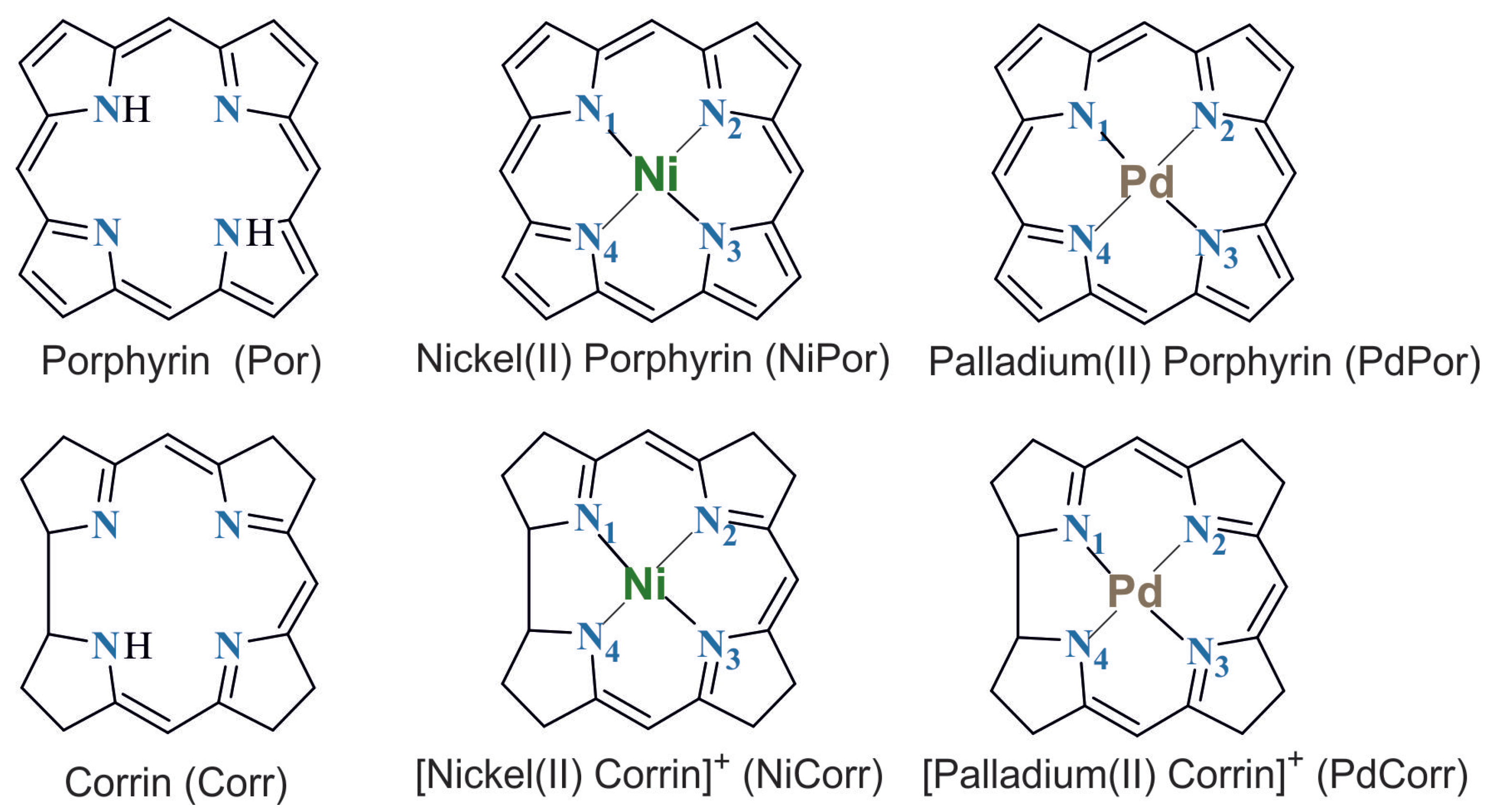
The structural formulas of the model complexes that are the subject of this work, as well as the free ligands, porphyrin and corrin, are shown in Figure 9. Porphyrin has two protons on its nitrogen atoms, while corrin has one. Accordingly, the porphyrinate anion has a charge of −2 and the corrinate anion has a charge of −1. The nickel and palladium ions are in the second oxidation state, so the porphyrin complex is neutral and the corrin complex has a charge of +1.

5. Conclusions

The nickel(II) and palladium(II) model complexes with the porphyrin and corrin ligands were computationally studied with using DFT/TDDFT and CASSCF/NEVPT2 levels of theory. According to the obtained results, the observed experimental differences in photophysical properties have their origin in the complex energetic redistribution of singlet and triplet excited states interacting with each other in the intersystem crossing process. In the case of nickel(II) porphyrin (NiPor) and nickel(II) corrin (NiCorr) complexes, virtually no emission is observed in experimental measurements. Thus, after occupation of a singlet electronic state in absorption and a rapid transition to the triplet state, a very fast transition to the ground state follows. This situation is favored by the low-lying triplet states in these complexes, as shown by the results of TDDFT and NEVPT2 calculations. For NiPor the singlet Q state undergoes rapid internal conversion to lower-lying states involving d orbitals of nickel, from which a transition via ISC occurs to low-energy triplet states. A similar mechanism is predicted for the quenching of excited states in the Soret band. The excited π π * states thermally relax to lower d / π mixed states, after which these states undergo intersystem crossing with triplet states. Next, internal conversion within triplet states ultimately leads to quenching of the excitation energy via T1/S0 ISC. For NiCorr, the computational results indicate that the mechanism of excited state quenching involving triplet states is similar to that of the porphyrin complex. However, in this case, all absorptively excited singlet states undergo internal conversion to low-lying states according to Kasha’s rule. Due to the mixed d / π nature of these states, it is possible to efficiently transition the ISC to higher triplet states, from which the lowest triplet state is occupied as a result of relaxation. This state then undergoes radiationless deactivation to the ground state. In tetrapyrrole palladium(II) complexes, the mechanisms of internal conversion of excited states as well as the interaction of singlet and triplet states are very similar to those considered in the case of nickel(II) complexes. However, in palladium complexes, photophysically active low-lying triplet states have a much higher energy relative to the ground state compared to the energy distribution of triplet states in nickel complexes. In general, radiationless quenching of triplet states is unlikely here, so the main photophysical mechanism leading to deactivation of the complexes in this case is phosphorescence. Alternatively, low-lying triplet states may be deactivated by intra- or intermolecular energy transfer.

Supplementary Materials

The following supporting information can be downloaded at: https://www.mdpi.com/article/10.3390/ijms27031577/s1.

Author Contributions

Conceptualization, M.J.; methodology, M.J. and P.L.; validation, P.L. and M.J.; formal analysis, P.L. and M.J.; investigation, M.J. and P.L.; writing—original draft preparation, M.J. and P.L.; writing—review and editing, P.L. and M.J.; visualization, M.J. and P.L.; supervision, M.J. All authors have read and agreed to the published version of the manuscript.

Funding

This research received no external funding.

Institutional Review Board Statement

Not applicable.

Informed Consent Statement

Not applicable.

Data Availability Statement

The original data presented in the study are openly available in [RepOD] at [https://repod.icm.edu.pl/dataset.xhtml?token=867ecd1f-e6d3-4843-9333-687a8038c974[] accessed on 29 January 2026.

Acknowledgments

Calculations were carried out at the Wroclaw Centre for Networking and Supercomputing, https://wcss.pl accessed on 22 December 2025, under grant No. 18.

Conflicts of Interest

The authors declare no conflicts of interest.

Abbreviations

The following abbreviations are used in this manuscript:
DFTDensity Functional Theory
TDDFTTime Dependent Density Functional Theory
NEVPT2N-Electron Valence State Perturbation Theory
NiPorNickel(II) Porphyrrin
NiCorrNickel(II) Corrin
PdPorPalladium(II) Porphyrin
PdCorrPalladium(II) Corrin)
SOCSpin–Orbit Coupling
SOCCSpin–Orbit Coupling Coefficient
ICInternal Conversion
ISCIntersystem Crossing
S Q Q Band
S S o r e t Soret Band
MECPMinimum Energy Crossing Point

References

  1. Marques, H.M. Corrins and porphyrins: Two of nature’s pigments of life. J. Coord. Chem. 2024, 77, 1161–1210. [Google Scholar] [CrossRef]
  2. Poulos, T.L. Heme Enzyme Structure and Function. Chem. Rev. 2014, 114, 3919–3962. [Google Scholar] [CrossRef]
  3. Gruber, K.; Puffer, B.; Kräutler, B. Vitamin B12-derivatives—Enzyme cofactors and ligands of proteins and nucleic acids. Chem. Soc. Rev. 2011, 40, 4346–4363. [Google Scholar] [CrossRef]
  4. Banerjee, R.; Ragsdale, S.W. The Many Faces of Vitamin B12: Catalysis by Cobalamin-Dependent Enzymes1. Annu. Rev. Biochem. 2003, 72, 209–247. [Google Scholar] [CrossRef]
  5. Kieninger, C.; Wurst, K.; Podewitz, M.; Stanley, M.; Deery, E.; Lawrence, A.D.; Liedl, K.R.; Warren, M.J.; Kräutler, B. Replacement of the Cobalt Center of Vitamin B12 by Nickel: Nibalamin and Nibyric Acid Prepared from Metal-Free B12 Ligands Hydrogenobalamin and Hydrogenobyric Acid. Angew. Chem. Int. Ed. 2020, 59, 20129–20136. [Google Scholar] [CrossRef]
  6. Kräutler, B. Antivitamins B12—Some Inaugural Milestones. Chem.—Eur. J. 2020, 26, 15438–15445. [Google Scholar] [CrossRef] [PubMed]
  7. Johnson, A.W. Transition Metal Complexes of Porphins, Corrins and Related Compounds. In Organometallic Chemistry; Stone, F., Bruce, M., Eds.; Butterworth-Heinemann: Oxford, UK, 1970; pp. 375–389. [Google Scholar] [CrossRef]
  8. Charisiadis, A.; Nikolaou, V.; Nikoloudakis, E.; Ladomenou, K.; Charalambidis, G.; Coutsolelos, A.G. Metalloporphyrins in bio-inspired photocatalytic conversions. Chem. Commun. 2025, 61, 4630–4646. [Google Scholar] [CrossRef]
  9. Spellane, P.J.; Gouterman, M.; Antipas, A.; Kim, S.; Liu, Y.C. Porphyrins. 40. Electronic spectra and four-orbital energies of free-base, zinc, copper, and palladium tetrakis(perfluorophenyl)porphyrins. Inorg. Chem. 1980, 19, 386–391. [Google Scholar] [CrossRef]
  10. Allison, J.B.; Becker, R.S. Effect of Metal Atom Perturbations on the Luminescent Spectra of Porphyrins. J. Chem. Phys. 1960, 32, 1410–1417. [Google Scholar] [CrossRef]
  11. Nyarko, E.; Hanada, N.; Habib, A.; Tabata, M. Fluorescence and phosphorescence spectra of Au(III), Pt(II) and Pd(II) porphyrins with DNA at room temperature. Inorganica Chim. Acta 2004, 357, 739–745. [Google Scholar] [CrossRef]
  12. Yamada, Y.; Wehrli, P.; Miljkovic, D.; Wild, H.J.; Bühler, N.; Götschi, E.; Golding, B.; Löliger, P.; Gleason, J.; Pace, B.; et al. Corrin Syntheses. Part VI. Helv. Chim. Acta 2015, 98, 1921–2054. [Google Scholar] [CrossRef]
  13. Blaser, H.U.; Winnacker, E.L.; Fischli, A.; Hardegger, B.; Bormann, D.; Hashimoto, N.; Schossig, J.; Keese, R.; Eschenmoser, A. ChemInform Abstract: Corrin Syntheses. Part 5. Preparation of Metal-Free Corrin Derivatives via (A→B) Ring Closure. Complexation of the Corrin Chromophore with Metal Ions, and Some Properties of the Ligands in Corrin Complexes. ChemInform 2016, 47. [Google Scholar] [CrossRef]
  14. Grigg, R.; Johnson, A.W.; van den Broek, P. A three-stage synthesis of a nickel corrin perchlorate from pyrrolic intermediates. Chem. Commun. 1967, 502–503. [Google Scholar] [CrossRef]
  15. Gardiner, M.; Thomson, A.J. Luminescence properties of some synthetic metallocorrins. J. Chem. Soc. Dalton Trans. 1974, 820–828. [Google Scholar] [CrossRef]
  16. Dicker, I.D.; Grigg, R.; Johnson, A.W.; Pinnock, H.; Richardson, K.; van den Broek, P. Formation of nickel tetradehydrocorrin derivatives and the reduction of nickel 1,19-dimethyltetrahydrocorrin salts. J. Chem. Soc. C 1971, 536–547. [Google Scholar] [CrossRef]
  17. Szczepańska, M.; Lodowski, P.; Jaworska, M. Electronic excited states and luminescence properties of palladium(II)corrin complex. J. Photochem. Photobiol. A Chem. 2020, 389, 112226. [Google Scholar] [CrossRef]
  18. Dunitz, J.D.; Meyer, E.F. Structure analysis of nickel(II)-1,8,8,13,13-pentamethyl- 5-cyano-trans-corrin chloride. Proc. R. Soc. Lond. Ser. A Math. Phys. Sci. 1965, 288, 324–330. [Google Scholar] [CrossRef]
  19. Johnson, A.W.; Overend, W.R. Synthesis of corrins. Part I. Nickel and cobalt 1,19-dimethylcorrin and 1,19-dimethyl-4,5-dihydrocorrin perchlorates. J. Chem. Soc. Perkin Trans. 1 1972, 2681–2691. [Google Scholar] [CrossRef]
  20. Rodriguez, J.; Holten, D. Ultrafast photodissociation of a metalloporphyrin in the condensed phase. J. Chem. Phys. 1990, 92, 5944–5950. [Google Scholar] [CrossRef]
  21. Rodriguez, J.; Kirmaier, C.; Holten, D. Time-resolved and static optical properties of vibrationally excited porphyrins. J. Chem. Phys. 1991, 94, 6020–6029. [Google Scholar] [CrossRef]
  22. Mizutani, Y.; Uesugi, Y.; Kitagawa, T. Intramolecular vibrational energy redistribution and intermolecular energy transfer in the (d,d) excited state of nickel octaethylporphyrin. J. Chem. Phys. 1999, 111, 8950–8962. [Google Scholar] [CrossRef]
  23. Renner, M.W.; Barkigia, K.M.; Melamed, D.; Gisselbrecht, J.P.; Nelson, N.Y.; Smith, K.M.; Fajer, J. Conformational control of oxidation sites, spin states and orbital occupancy in nickel porphyrins. Res. Chem. Intermed. 2002, 28, 741–759. [Google Scholar] [CrossRef]
  24. Gilch, P.; Musewald, C.; Michel-Beyerle, M. Magnetic field dependent picosecond intersystem crossing. The role of molecular symmetry. Chem. Phys. Lett. 2000, 325, 39–45. [Google Scholar] [CrossRef]
  25. Kruglik, S.G.; Ermolenkov, V.V.; Orlovich, V.A.; Turpin, P.Y. Axial ligand binding and release processes in nickel(II)-tetraphenylporphyrin revisited: A resonance Raman study. Chem. Phys. 2003, 286, 97–108. [Google Scholar] [CrossRef]
  26. Achey, D.; Meyer, G.J. Ligand Coordination and Spin Crossover in a Nickel Porphyrin Anchored to Mesoporous TiO2 Thin Films. Inorg. Chem. 2013, 52, 9574–9582. [Google Scholar] [CrossRef] [PubMed]
  27. Gutzeit, F.; Dommaschk, M.; Levin, N.; Buchholz, A.; Schaub, E.; Plass, W.; Näther, C.; Herges, R. Structure and Properties of a Five-Coordinate Nickel(II) Porphyrin. Inorg. Chem. 2019, 58, 12542–12546. [Google Scholar] [CrossRef]
  28. Duval, H.; Bulach, V.; Fischer, J.; Weiss, R. Four-Coordinate, Low-Spin (S = 0) and Six-Coordinate, High-Spin (S = 1) Nickel(II) Complexes of Tetraphenylporphyrins with β-Pyrrole Electron-Withdrawing Substituents: Porphyrin-Core Expansion and Conformation. Inorg. Chem. 1999, 38, 5495–5501. [Google Scholar] [CrossRef]
  29. Chen, L.X.; Zhang, X.; Wasinger, E.C.; Lockard, J.V.; Stickrath, A.B.; Mara, M.W.; Attenkofer, K.; Jennings, G.; Smolentsev, G.; Soldatov, A. X-ray snapshots for metalloporphyrin axial ligation. Chem. Sci. 2010, 1, 642–650. [Google Scholar] [CrossRef]
  30. Nandi, G.; Chilukuri, B.; Hipps, K.W.; Mazur, U. Surface directed reversible imidazole ligation to nickel(ii) octaethylporphyrin at the solution/solid interface: A single molecule level study. Phys. Chem. Chem. Phys. 2016, 18, 20819–20829. [Google Scholar] [CrossRef]
  31. Phelan, B.T.; Mara, M.W.; Chen, L.X. Excited-state structural dynamics of nickel complexes probed by optical and X-ray transient absorption spectroscopies: Insights and implications. Chem. Commun. 2021, 57, 11904–11921. [Google Scholar] [CrossRef]
  32. Garcia-Orrit, S.; Vega-Mayoral, V.; Chen, Q.; Serra, G.; Guizzardi, M.; Romano, V.; Dal Conte, S.; Cerullo, G.; Di Mario, L.; Kot, M.; et al. Visualizing Thermally Activated Conical Intersections Governing Non-Radiative Triplet Decay in a Ni(II) Porphyrin-Nanographene Conjugate with Variable Temperature Transient Absorption Spectroscopy. J. Phys. Chem. Lett. 2024, 15, 10366–10374. [Google Scholar] [CrossRef] [PubMed]
  33. Zhang, X.; Wasinger, E.C.; Muresan, A.Z.; Attenkofer, K.; Jennings, G.; Lindsey, J.S.; Chen, L.X. Ultrafast Stimulated Emission and Structural Dynamics in Nickel Porphyrins. J. Phys. Chem. A 2007, 111, 11736–11742. [Google Scholar] [CrossRef]
  34. Ryland, E.S.; Zhang, K.; Vura-Weis, J. Sub-100 fs Intersystem Crossing to a Metal-Centered Triplet in Ni(II)OEP Observed with M-Edge XANES. J. Phys. Chem. A 2019, 123, 5214–5222. [Google Scholar] [CrossRef]
  35. Stoyanov, S.R.; Yin, C.X.; Gray, M.R.; Stryker, J.M.; Gusarov, S.; Kovalenko, A. Computational and Experimental Study of the Structure, Binding Preferences, and Spectroscopy of Nickel(II) and Vanadyl Porphyrins in Petroleum. J. Phys. Chem. B 2010, 114, 2180–2188. [Google Scholar] [CrossRef]
  36. Naumova, M.A.; Paveliuc, G.; Biednov, M.; Kubicek, K.; Kalinko, A.; Meng, J.; Liang, M.; Rahaman, A.; Abdellah, M.; Checchia, S.; et al. Nonadiabatic Charge Transfer within Photoexcited Nickel Porphyrins. J. Phys. Chem. Lett. 2024, 15, 3627–3638. [Google Scholar] [CrossRef]
  37. Ake, R.L.; Gouterman, M. Porphyrins. Theor. Chim. Acta 1970, 17, 408–416. [Google Scholar] [CrossRef]
  38. Drain, C.M.; Kirmaier, C.; Medforth, C.J.; Nurco, D.J.; Smith, K.M.; Holten, D. Dynamic Photophysical Properties of Conformationally Distorted Nickel Porphyrins. 1. Nickel(II) Dodecaphenylporphyrin. J. Phys. Chem. 1996, 100, 11984–11993. [Google Scholar] [CrossRef]
  39. Zheng, W.; Shan, N.; Yu, L.; Wang, X. UV–visible, fluorescence and EPR properties of porphyrins and metalloporphyrins. Dyes Pigment. 2008, 77, 153–157. [Google Scholar] [CrossRef]
  40. Singh, A.; Johnson, L.W. Phosphorescence spectra and triplet state lifetimes of palladium octaethylporphyrin, palladium octaethylchlorin and palladium 2,3-dimethyloctaethylisobacteriochlorin at 77 K. Spectrochim. Acta Part A Mol. Biomol. Spectrosc. 2003, 59, 905–908. [Google Scholar] [CrossRef] [PubMed]
  41. Zang, L.; Zhao, H.; Hua, J.; Cao, W.; Qin, F.; Yao, J.; Tian, Y.; Zheng, Y.; Zhang, Z. Comparison study on the influence of the central metal ions in palladium(ii)- and gadolinium(iii)-porphyrins for phosphorescence-based oxygen sensing. J. Mater. Chem. C 2016, 4, 9581–9587. [Google Scholar] [CrossRef]
  42. Piqueras, M.C.; McMichael Rohlfing, C. An ab initio analysis of the electronic structure and harmonic frequencies of nickel porphyrin. Theor. Chem. Accounts 1997, 97, 81–87. [Google Scholar] [CrossRef]
  43. Xu-dong, W.; Hai-xu, C.; Yun, Z.; Xi, C.; Xiao-ru, W.; Xi, C. Optical oxygen sensors move towards colorimetric determination. TrAC Trends Anal. Chem. 2010, 29, 319–338. [Google Scholar] [CrossRef]
  44. Deng, J.; Li, H.; Yang, M.; Wu, F. Palladium porphyrin complexes for photodynamic cancer therapy: Effect of porphyrin units and metal. Photochem. Photobiol. Sci. 2020, 19, 905–912. [Google Scholar] [CrossRef]
  45. Borisov, S.M.; Lehner, P.; Klimant, I. Novel optical trace oxygen sensors based on platinum(II) and palladium(II) complexes with 5,10,15,20-meso-tetrakis-(2,3,4,5,6-pentafluorphenyl)-porphyrin covalently immobilized on silica-gel particles. Anal. Chim. Acta 2011, 690, 108–115. [Google Scholar] [CrossRef]
  46. Shelby, M.L.; Mara, M.W.; Chen, L.X. New insight into metalloporphyrin excited state structures and axial ligand binding from X-ray transient absorption spectroscopic studies. Coord. Chem. Rev. 2014, 277–278, 291–299. [Google Scholar] [CrossRef]
  47. Dąbrowski, J.M.; Pucelik, B.; Regiel-Futyra, A.; Brindell, M.; Mazuryk, O.; Kyzioł, A.; Stochel, G.; Macyk, W.; Arnaut, L.G. Engineering of relevant photodynamic processes through structural modifications of metallotetrapyrrolic photosensitizers. Coord. Chem. Rev. 2016, 325, 67–101. [Google Scholar] [CrossRef]
  48. Lee, G.; Choi, H.E.; Hong, S.H.; Choi, M.; Han, D.W.; Lee, J.; Kim, K.S.; Hahn, S.K. Upconversion nanomaterials and delivery systems for smart photonic medicines and healthcare devices. Adv. Drug Deliv. Rev. 2022, 188, 114419. [Google Scholar] [CrossRef] [PubMed]
  49. DiMarco, G.; Lanza, M. Optical solid-state oxygen sensors using metalloporphyrin complexes immobilized in suitable polymeric matrices. Sens. Actuators B Chem. 2000, 63, 42–48. [Google Scholar] [CrossRef]
  50. Kee, H.L.; Bhaumik, J.; Diers, J.R.; Mroz, P.; Hamblin, M.R.; Bocian, D.F.; Lindsey, J.S.; Holten, D. Photophysical characterization of imidazolium-substituted Pd(II), In(III), and Zn(II) porphyrins as photosensitizers for photodynamic therapy. J. Photochem. Photobiol. A Chem. 2008, 200, 346–355. [Google Scholar] [CrossRef]
  51. Yoshihara, T.; Hirakawa, Y.; Hosaka, M.; Nangaku, M.; Tobita, S. Oxygen imaging of living cells and tissues using luminescent molecular probes. J. Photochem. Photobiol. C Photochem. Rev. 2017, 30, 71–95. [Google Scholar] [CrossRef]
  52. Borisov, S.M.; Nuss, G.; Klimant, I. Red Light-Excitable Oxygen Sensing Materials Based on Platinum(II) and Palladium(II) Benzoporphyrins. Anal. Chem. 2008, 80, 9435–9442. [Google Scholar] [CrossRef] [PubMed]
  53. Patchkovskii, S.; Kozlowski, P.M.; Zgierski, M.Z. Theoretical analysis of singlet and triplet excited states of nickel porphyrins. J. Chem. Phys. 2004, 121, 1317–1324. [Google Scholar] [CrossRef] [PubMed]
  54. Liao, M.S.; Scheiner, S. Electronic structure and bonding in metal porphyrins, metal=Fe, Co, Ni, Cu, Zn. J. Chem. Phys. 2002, 117, 205–219. [Google Scholar] [CrossRef]
  55. Ganguly, G.; Havlas, Z.; Michl, J. Ab Initio Calculation of UV–vis Absorption of Parent Mg, Fe, Co, Ni, Cu, and Zn Metalloporphyrins. Inorg. Chem. 2024, 63, 10127–10142. [Google Scholar] [CrossRef]
  56. Kumar, M.; Pati, Y.A.; Ramasesha, S. A density matrix renormalization group method study of optical properties of porphines and metalloporphines. J. Chem. Phys. 2012, 136, 014112. [Google Scholar] [CrossRef]
  57. Simone, B.C.D.; Mazzone, G.; Russo, N.; Sicilia, E.; Toscano, M. Metal Atom Effect on the Photophysical Properties of Mg(II), Zn(II), Cd(II), and Pd(II) Tetraphenylporphyrin Complexes Proposed as Possible Drugs in Photodynamic Therapy. Molecules 2017, 22, 1093. [Google Scholar] [CrossRef]
  58. Baerends, E.; Ricciardi, G.; Rosa, A.; van Gisbergen, S. A DFT/TDDFT interpretation of the ground and excited states of porphyrin and porphyrazine complexes. Coord. Chem. Rev. 2002, 230, 5–27. [Google Scholar] [CrossRef]
  59. Antipas, A.; Gouterman, M. Porphyrins. 44. Electronic states of cobalt, nickel, rhodium, and palladium complexes. J. Am. Chem. Soc. 1983, 105, 4896–4901. [Google Scholar] [CrossRef]
  60. Meyer Jnr, E.F. The crystal and molecular structure of nickel(II)octaethylporphyrin. Acta Crystallogr. Sect. B 1972, 28, 2162–2167. [Google Scholar] [CrossRef]
  61. Rosa, A.; Ricciardi, G.; Baerends, E.J.; Zimin, M.; Rodgers, M.A.J.; Matsumoto, S.; Ono, N. Structural, Optical, and Photophysical Properties of Nickel(II) Alkylthioporphyrins: Insights from Experimental and DFT/TDDFT Studies. Inorg. Chem. 2005, 44, 6609–6622. [Google Scholar] [CrossRef]
  62. Currie, M.; Dunitz, J.D. Crystallographic Studies of Synthetic Corrinoids. III. Structural similarities and differences between A/D-seco-corrinoid complexes of divalent nickel, palladium and platinum. Helv. Chim. Acta 1971, 54, 98–112. [Google Scholar] [CrossRef]
  63. Stolzenberg, A.M.; Schussel, L.J.; Summers, J.S.; Foxman, B.M.; Petersen, J.L. Structures of the homologous series of square-planar metallotetrapyrroles palladium(II) octaethylporphyrin, palladium(II) trans-octaethylchlorin, and palladium(II) tct-octaethylisobacteriochlorin. Inorg. Chem. 1992, 31, 1678–1686. [Google Scholar] [CrossRef]
  64. Knyukshto, V.N.; Shulga, A.M.; Sagun, E.I.; Zen’kevich, E.I. Formation of intersystem crossing transitions in Pd(II) and Pt(II) porphyrins: Nonplanar distortions of the macrocycle and charge transfer states. Opt. Spectrosc. 2006, 100, 590–601. [Google Scholar] [CrossRef]
  65. Amati, M.; Baerends, E.J.; Ricciardi, G.; Rosa, A. Origin of the Enhanced Binding Capability toward Axial Nitrogen Bases of Ni(II) Porphyrins Bearing Electron-Withdrawing Substituents: An Electronic Structure and Bond Energy Analysis. Inorg. Chem. 2020, 59, 11528–11541. [Google Scholar] [CrossRef]
  66. Ishizuka, T.; Grover, N.; Kingsbury, C.J.; Kotani, H.; Senge, M.O.; Kojima, T. Nonplanar porphyrins: Synthesis, properties, and unique functionalities. Chem. Soc. Rev. 2022, 51, 7560–7630. [Google Scholar] [CrossRef] [PubMed]
  67. Housecroft, H.E.; Sharpe, A.G. Inorganic Chemistry; Prentice Hall: New York, NY, USA, 2001. [Google Scholar]
  68. Schmidtke, H.H. The Variation of Slater-Condon Parameters Fk and Racah Parameters B and C with Chemical Bonding in Transition Group Complexes. In Optical Spectra and Chemical Bonding in Inorganic Compounds: Special Volume Dedicated to Professor Jørgensen I; Mingos, D.M.P., Schönherr, T., Eds.; Springer: Berlin/Heidelberg, Germany, 2004; pp. 19–35. [Google Scholar] [CrossRef]
  69. Neese, F. Software update: The ORCA program system, version 6.0. WIRES Comput. Molec. Sci. 2025, 15, e70019. [Google Scholar] [CrossRef]
  70. Neese, F. The ORCA program system. WIRES Comput. Molec. Sci. 2012, 2, 73–78. [Google Scholar] [CrossRef]
  71. Hohenberg, P.; Kohn, W. Inhomogeneous Electron Gas. Phys. Rev. 1964, 136, B864–B871. [Google Scholar] [CrossRef]
  72. Kohn, W.; Sham, L.J. Self-Consistent Equations Including Exchange and Correlation Effects. Phys. Rev. 1965, 140, A1133–A1138. [Google Scholar] [CrossRef]
  73. Runge, E.; Gross, E.K.U. Density-Functional Theory for Time-Dependent Systems. Phys. Rev. Lett. 1984, 52, 997–1000. [Google Scholar] [CrossRef]
  74. Adamo, C.; Barone, V. Toward reliable density functional methods without adjustable parameters: The PBE0 model. J. Chem. Phys. 1999, 110, 6158–6170. [Google Scholar] [CrossRef]
  75. Perdew, J.P.; Burke, K.; Ernzerhof, M. Generalized Gradient Approximation Made Simple. Phys. Rev. Lett. 1996, 77, 3865–3868. [Google Scholar] [CrossRef]
  76. Weigend, F.; Ahlrichs, R. Balanced basis sets of split valence, triple zeta valence and quadruple zeta valence quality for H to Rn: Design and assessment of accuracy. Phys. Chem. Chem. Phys. 2005, 7, 3297–3305. [Google Scholar] [CrossRef]
  77. Neese, F. An improvement of the resolution of the identity approximation for the formation of the Coulomb matrix. J. Comput. Chem. 2003, 24, 1740–1747. [Google Scholar] [CrossRef]
  78. Grimme, S.; Antony, J.; Ehrlich, S.; Krieg, H. A consistent and accurate ab initio parametrization of density functional dispersion correction (DFT-D) for the 94 elements H-Pu. J. Chem. Phys. 2010, 132, 154104. [Google Scholar] [CrossRef]
  79. Rangel, T.; Hamed, S.M.; Bruneval, F.; Neaton, J.B. An assessment of low-lying excitation energies and triplet instabilities of organic molecules with an ab initio Bethe-Salpeter equation approach and the Tamm-Dancoff approximation. J. Chem. Phys. 2017, 146, 194108. [Google Scholar] [CrossRef]
  80. Chachiyo, T.; Rodriguez, J.H. A direct method for locating minimum-energy crossing points (MECPs) in spin-forbidden transitions and nonadiabatic reactions. J. Chem. Phys. 2005, 123, 094711. [Google Scholar] [CrossRef] [PubMed]
  81. Lang, L.; Atanasov, M.; Neese, F. Improvement of Ab Initio Ligand Field Theory by Means of Multistate Perturbation Theory. J. Phys. Chem. A 2020, 124, 1025–1037. [Google Scholar] [CrossRef] [PubMed]
  82. Steinmetz, M.; Grimme, S. Benchmark Study of the Performance of Density Functional Theory for Bond Activations with (Ni,Pd)-Based Transition-Metal Catalysts. ChemistryOpen 2013, 2, 115–124. [Google Scholar] [CrossRef] [PubMed]
  83. Maity, B.; Scott, T.R.; Stroscio, G.D.; Gagliardi, L.; Cavallo, L. The Role of Excited States of LNiII/III(Aryl)(Halide) Complexes in Ni–Halide Bond Homolysis in the Arylation of Csp3–H Bonds. ACS Catal. 2022, 12, 13215–13224. [Google Scholar] [CrossRef]
  84. Marenich, A.V.; Cramer, C.J.; Truhlar, D.G. Universal Solvation Model Based on Solute Electron Density and on a Continuum Model of the Solvent Defined by the Bulk Dielectric Constant and Atomic Surface Tensions. J. Phys. Chem. B 2009, 113, 6378–6396. [Google Scholar] [CrossRef] [PubMed]
  85. Roemelt, M.; Maganas, D.; DeBeer, S.; Neese, F. A combined DFT and restricted open-shell configuration interaction method including spin–orbit coupling: Application to transition metal L-edge X-ray absorption spectroscopy. J. Chem. Phys. 2013, 138, 204101. [Google Scholar] [CrossRef]
  86. de Souza, B.; Farias, G.; Neese, F.; Izsák, R. Predicting Phosphorescence Rates of Light Organic Molecules Using Time-Dependent Density Functional Theory and the Path Integral Approach to Dynamics. J. Chem. Theory Comput. 2019, 15, 1896–1904. [Google Scholar] [CrossRef]
  87. Rolfes, J.D.; Neese, F.; Pantazis, D.A. All-electron scalar relativistic basis sets for the elements Rb–Xe. J. Comput. Chem. 2020, 41, 1842–1849. [Google Scholar] [CrossRef]
  88. Brédas, J.L.; Beljonne, D.; Coropceanu, V.; Cornil, J. Charge-Transfer and Energy-Transfer Processes in π-Conjugated Oligomers and Polymers:  A Molecular Picture. Chem. Rev. 2004, 104, 4971–5004. [Google Scholar] [CrossRef]
  89. Talbot, J.J.; Cheshire, T.P.; Cotton, S.J.; Houle, F.A.; Head-Gordon, M. The Role of Spin–Orbit Coupling in the Linear Absorption Spectrum and Intersystem Crossing Rate Coefficients of Ruthenium Polypyridyl Dyes. J. Phys. Chem. A 2024, 128, 7830–7842. [Google Scholar] [CrossRef]
  90. Bhandari, S.; Sarkar, S.; Schubert, A.; Yamada, A.; Payne, J.; Ptaszek, M.; Geva, E.; Dunietz, B.D. Intersystem Crossing in Tetrapyrrolic Macrocycles. A First-Principles Analysis. J. Phys. Chem. C 2021, 125, 13493–13500. [Google Scholar] [CrossRef]
  91. Roos, B.O. The Complete Active Space Self-Consistent Field Method and its Applications in Electronic Structure Calculations. In Advances in Chemical Physics; John Wiley and Sons, Ltd.: Hoboken, NJ, USA, 1987; pp. 399–445. [Google Scholar] [CrossRef]
  92. Angeli, C.; Cimiraglia, R.; Evangelisti, S.; Leininger, T.; Malrieu, J.P. Introduction of n-electron valence states for multireference perturbation theory. J. Chem. Phys. 2001, 114, 10252–10264. [Google Scholar] [CrossRef]
  93. Schapiro, I.; Sivalingam, K.; Neese, F. Assessment of n-Electron Valence State Perturbation Theory for Vertical Excitation Energies. J. Theory Comp. Chem. 2013, 9, 3567–3580. [Google Scholar] [CrossRef] [PubMed]
  94. Singh, S.K.; Atanasov, M.; Neese, F. Challenges in Multireference Perturbation Theory for the Calculations of the g-Tensor of First-Row Transition-Metal Complexes. J. Chem. Theory Comput. 2018, 14, 4662–4677. [Google Scholar] [CrossRef] [PubMed]
Figure 2. Minimum energy crossing point for NiPor: (a) Calculated energy barrier. (b) Comparison of the ground state (GS) and MECP geometries. q denotes general coordinate comprising angle and bond length change.
Ijms 27 01577 g002
Figure 3. MECP between T1 and S0 for NiCorr: (a) The energy barrier between crossing point and triplet state minmum. (b) The comparison between S0 and MECP geometry for NiCorr.
Ijms 27 01577 g003
Figure 4. Molecular orbital diagrams: (a) PdPor. (b) PdCorr.
Ijms 27 01577 g004
Figure 5. Palladium(II) porphyrin: (a) Energy barrier of MECP in PdPor. (b) Comparison of the geometry of MECP and the ground state.
Ijms 27 01577 g005
Figure 6. Minimum energy crossing point for PdCorr: (a) Energy barrier between MECP and triplet state minimum (b) Comparison of the ground state and MECP geometry.
Ijms 27 01577 g006
Figure 7. Schematic representation of porphyrin complexes’ photophysics: (a) NiPor. (b) PdPor.
Ijms 27 01577 g007
Figure 8. Schematic representation of corrin complexes’ photophysics: (a) NiCorr. (b) PdCorr.
Ijms 27 01577 g008
Figure 9. Structure of corrin and porphyrin complexes with the atom numbering and colors used.
Ijms 27 01577 g009
Table 2. Electronic transitions of NiPor calculated by TDDFT/PBE0/def2-TZVP and CPCM/methanol solvent model.
NoE(eV) λ (nm)fOrbitalsWeight λ exp
Singlet transitions
11.95633.60.0000 H 4 ( d z 2 ) L + 2 ( d x 2 y 2 ) 0.976
22.04606.30.0000 H 2 ( π + d x z ) L + 2 ( d x 2 y 2 ) 0.651
32.04606.30.0000 H 9 ( d + π ) L + 2 ( d x 2 y 2 ) 0.320
H 3 ( π + d y z ) L + 2 ( d x 2 y 2 ) 0.651
42.49496.30.0000 H 11 ( d x y ) L + 2 ( d x 2 y 2 ) 0.951
52.61474.10.0119 H 1 ( π 1 ) L ( π 3 * ) 0.447525 a, 530 b, 522 c
H ( π 2 ) L + 1 ( π 4 * ) 0.540516 d, 543 e, 527 f, 517 g
62.61474.10.0119 H 1 ( π 1 ) L + 1 ( π 4 * ) 0.447
H ( π 2 ) L ( π 3 * ) 0.540
73.14393.80.0000 H 1 ( π 1 ) L + 2 ( d x 2 y 2 ) 0.985
83.16391.50.0000 H ( π 2 ) L + 2 ( d x 2 y 2 ) 0.999
93.42362.10.0000 H 3 ( π + d y z ) L ( π 3 * ) 0.489
H 2 ( π + d x z ) L + 1 ( π 4 * ) 0.491
103.48356.20.0000 H 3 ( π + d y z ) L ( π 3 * ) 0.492
H 2 ( π + d x z ) L + 1 ( π 4 * ) 0.491
113.57347.00.0000 H 3 ( π + d y z ) L + 1 ( π 4 * ) 0.478
H 2 ( π + d x z ) L ( π 3 * ) 0.479
123.65339.40.0000 H 4 ( d z 2 ) L ( π 3 * ) 0.995
133.65339.40.0000 H 4 ( d z 2 ) L + 1 ( π 4 * ) 0.995
143.81325.11.7872 H 1 ( π 1 ) L ( π 3 * ) 0.464415 a, 415 b, 414 c, 393 d
H ( π 2 ) L + 1 ( π 4 * ) 0.396393 e, 415 f, 415 g, 392 h
153.81325.11.7879 H 1 ( π 1 ) L + 1 ( π 4 * ) 0.464
H ( π 2 ) L ( π 3 * ) 0.396
163.81325.00.0005 H 3 ( π + d y z ) L + 1 ( π 4 * ) 0.477
H 2 ( π + d x z ) L ( π 3 * ) 0.477
Triplet transitions
10.3533505.5 H 4 ( d z 2 ) L + 2 ( d x 2 y 2 ) 0.983
20.6092034.1 H 9 ( d + π ) L + 2 ( d x 2 y 2 ) 0.297
H 3 ( π + d y z ) L + 2 ( d x 2 y 2 ) 0.428
30.6092034.1 H 10 ( d + π ) L + 2 ( d x 2 y 2 ) 0.297
H 2 ( π + d x z ) L + 2 ( d x 2 y 2 ) 0.428
41.553797.9 H 11 ( d x y ) L + 2 ( d x 2 y 2 ) 0.943
52.076597.1 H 1 ( π 1 ) L + 1 ( π 4 * ) 0.440
H ( π 2 ) L ( π 3 * ) 0.527
62.076597.1 H 1 ( π 1 ) L ( π 3 * ) 0.440
H ( π 2 ) L + 1 ( π 4 * ) 0.527
72.213560.0 H ( π 1 ) L + 1 ( π 4 * ) 0.534
H ( π 2 ) L ( π 3 * ) 0.458
83.066404.4 H ( π 1 ) L + 2 ( d x 2 y 2 ) 0.975
93.097400.2 H 3 ( π + d y z ) L ( π 3 * ) 0.465
H ( π 2 ) L + 1 ( π 4 * ) 0.466
103.146394.0 H 3 ( π + d y z ) L ( π 3 * ) 0.466
H ( π 2 ) L + 1 ( π 4 * ) 0.466
113.149393.7 H ( π 2 ) L + 2 ( d x 2 y 2 ) 0.999
123.192388.3 H 3 ( π + d y z ) L + 1 ( π 4 * ) 0.478
H 2 ( π + d x z ) L ( π 3 * ) 0.481
133.246381.9 H 3 ( π + d y z ) L + 1 ( π 4 * ) 0.477
H 2 ( π + d x z ) L ( π 3 * ) 0.474
143.583346.0 H 5 ( π ) L ( π 3 * ) 0.757
153.583346.0 H 5 ( π ) L + 1 ( π 4 * ) 0.757
a Ref. [21], NiTPP; b Ref. [39], NiTPP; c Ref. [29], NiTMP; d Ref. [30], NiOTP; e Ref. [35], NiOEP; f Ref. [36], NiTMP; g Ref. [37] NiTPP; h Ref. [37] NiOEP
Table 3. Electronic transitions of NiCorr calculated by TDDFT/PBE0/def2-TZVP and CPCM/methanol solvent model.
NoE(eV) λ (nm)fOrbitalsWeight λ exp
Singlet transitions
12.664465.40.0000 H - 4 ( d + π ) L + 2 ( d x 2 y 2 ) 0.319
H 1 ( π 1 + d ) L + 2 ( d x 2 y 2 ) 0.400
22.693460.40.0010 H 3 ( d z 2 ) L + 2 ( d x 2 y 2 ) 0.746
32.863433.10.0001 H 2 ( π + d x z ) L + 2 ( d x 2 y 2 ) 0.528
43.195388.00.0030 H 7 ( d x y ) L + 2 ( d x 2 y 2 ) 0.567
53.402364.40.2503 H ( π 2 ) L ( π 3 * ) 0.876460 e, 450 b, 454 c
63.588345.50.1723 H 1 ( π 1 + d ) L ( π 3 * ) 0.870416 c, 427 b, 428 d, 435 a
73.781327.90.0013 H 3 ( d z 2 ) L ( π 3 * ) 0.989
83.977311.80.0058 H 2 ( π + d x z ) L ( π 3 * ) 0.790
94.004309.60.0347 H ( π 2 ) L + 1 ( π 4 * + d ) 0.270
H ( π 2 ) L + 2 ( d x 2 y 2 ) 0.687
104.365284.10.2440 H 1 ( π 1 + d ) L + 1 ( π 4 * + d ) 0.591317 d, 319 a, 320 e, 340 e
114.575271.00.4652 H ( π 2 ) L + 1 ( π 4 * + d ) 0.543294 c, 304 d, 306 d 312 c
H ( π 2 ) L + 2 ( d x 2 y 2 ) 0.262
124.638267.30.0024 H 3 ( d z 2 ) L + 1 ( π 4 * + d ) 0.638
134.729262.20.0011 H 4 ( d y z + π ) L + 2 ( d x 2 y 2 ) 0.264
H 1 ( π 1 + d ) L + 2 ( d x 2 y 2 ) 0.342
144.833256.50.2251 H 4 ( d y z + π ) L ( π 3 * ) 0.755244 d, 245 a, 277 d, 266 d
155.122242.10.0244 H 5 ( π + d ) L ( π 3 * ) 0.670
165.154240.60.0180 H 1 ( π 1 + d ) L + 3 ( π ) 0.721
Triplet transitions
11.1821049.20.0000 H 3 ( d z 2 ) L + 2 ( d x 2 y 2 ) 0.786
21.385895.40.0000 H 4 ( d y z + π ) L + 2 ( d x 2 y 2 ) 0.439
H 1 ( π 1 + d ) L + 2 ( d x 2 y 2 ) 0.308
31.525812.90.0000 H 2 ( π + d x z ) L + 2 ( d x 2 y 2 ) 0.494
42.306537.60.0000 H 7 ( d x y ) L + 2 ( d x 2 y 2 ) 0.597
52.579480.70.0000 H 1 ( π 1 + d ) L ( π 3 * ) 0.903
62.617473.80.0000 H ( π 2 ) L ( π 3 * ) 0.912
73.266379.60.0000 H 2 ( π + d x z ) L ( π 3 * ) 0.430
H 1 ( π 1 + d ) L + 1 ( π 4 * + d ) 0.341
83.577346.60.0000 H ( π 2 ) L + 1 ( π 4 * + d ) 0.775
93.728332.60.0000 H 3 ( d z 2 ) L ( π 3 * ) 0.985
103.923316.10.0000 H ( π 2 ) L + 2 ( d x 2 y 2 ) 0.888
113.939314.80.0000 H 2 ( π + d x z ) L ( π 3 * ) 0.540
H 1 ( π 1 + d ) L + 1 ( π 4 * + d ) 0.320
124.227293.30.0000 H 2 ( π + d x z ) L + 1 ( π 4 * + d ) 0.457
H 1 ( π 1 + d ) L + 3 ( π * ) 0.203
134.337285.90.0000 H 5 ( π + d ) L ( π 3 * ) 0.483
a Ref. [14] corrin perchlorate.; b Ref. [15]; c Ref. [16]; d Ref. [19]; e Ref. [5], Nibl.
Table 4. Selected geometry parameters of PdCorr and PdPor. Bond lengths in Å, angles in degrees.
ParameterPdCorrPdPor
Calc.Expt. aCalc.Expt. b
Pd-N11.9312.0252.0172.017
Pd-N21.9712.0092.0172.011
Pd-N31.9712.0182.0172.017
Pd-N41.9312.0052.0172.011
N1-Pd-N292.289.990.090.1
N2-Pd-N394.492.090.089.9
N3-Pd-N492.289.090.090.1
N4-Pd-N181.492.290.089.9
N1-Pd-N3172.7167.4180.0180.0
N2-Pd-N4172.7166.3180.0180.0
N1-N2-N3-N4−4.3−18.50.00.0
N1-N2-N3-Pd−2.2−8.10.00.0
a Ref. [62], b Ref. [63].
Table 5. Electronic transitions of PdPor calculated by TDDFT/PBE0/def2-TZVP and CPCM/methanol solvent model.
NoE(eV) λ (nm)fOrbitalsWeight λ exp
Singlet transitions
12.64468.60.0104740 π 1 π 3 * 0.401512 a,514 c, 514 e, 519 d
π 2 π 4 * 0.471523 e, 524 f, 527 d
22.64468.60.0104772 π 1 π 4 * 0.401
π 2 π 3 * 0.471
33.29375.90.0000000 d y z + π π 3 * 0.491
d y z + π π 4 * 0.491
43.35369.50.0000000 d y z + π π 3 * 0.492
d y z + π π 4 * 0.492
53.41362.80.0000000 d y z + π π 4 * 0.458
d y z + π π 3 * 0.458
63.72333.00.0000000 d y z + π π 4 * 0.484
d y z + π π 3 * 0.483
73.76329.20.0018097 d z 2 π 3 * 0.986
83.76329.20.0018113 d z 2 π 4 * 0.986
93.79326.41.7061422 π 1 π 3 * 0.450394 a, 394 e, 406 d, 415 d
π 2 π 4 * 0.399416 c, 417 e,417 f, 418 b
103.79326.41.7062120 π 1 π 4 * 0.450
π 2 π 3 * 0.399
113.84322.50.0000003 π 1 d x 2 y 2 0.987
123.87320.20.0000000 π 4 d x 2 y 2 0.998
133.94314.10.0000063 d y z + π d x 2 y 2 0.863
143.94314.10.0000068 d y z + π d x 2 y 2 0.863
154.07304.30.0000000 d z 2 d x 2 y 2 0.916
Triplet transitions
12.09591.40.00000 π 1 π 3 * 0.474
π 2 π 4 * 0.250
22.09591.40.00000 π 1 π 4 * 0.474
π 2 π 3 * 0.250
32.24553.40.00000 π 1 π 4 * 0.345
π 2 π 3 * 0.648
42.24553.40.00000 π 1 π 3 * 0.345
π 2 π 4 * 0.648
52.94420.50.00000 d y z + π π 3 * 0.464
d x z + π π 4 * 0.464
62.99413.60.00000 d x z + π π 4 * 0.464
d x z + π π 4 * 0.467
73.06404.20.00000 d y z + π π 4 * 0.479
d x z + π π 3 * 0.481
83.11398.40.00000 d z 2 d x 2 y 2 0.545
d y z + π π 4 * 0.213
d x z + π π 4 * 0.213
93.11397.40.00000 d z 2 d x 2 y 2 0.439
d y z + π π 4 * 0.263
d x z + π π 3 * 0.263
103.18388.90.00000 d x z + π d x 2 y 2 0.751
113.18388.90.00000 d y z + π d x 2 y 2 0.751
123.59345.10.00000 π 2 π 3 * 0.662
a Ref. [43] PdOEP; b Ref. [41] PdTPP; c Ref. [44] PdTPP; d Ref. [19];e Ref. [64] PdOEP, PdTPP; f Ref. [50], PdTPP.
Table 6. Electronic transitions of PdCorr calculated by TDDFT/PBE0/def2-TZVP and CPCM/methanol solvent model.
NoE(eV) λ (nm)fOrbitalsWeight λ exp
Singlet transitions
13.376367.20.2597 H ( π 2 ) L ( π 3 * ) 0.906460 a, 461 b
23.616342.90.2067 H 1 ( π 1 + d y z ) L ( π 3 * ) 0.890430 a, 441 b
33.980311.50.0000 H 3 ( d z 2 ) L ( π 3 * ) 0.994
44.093302.90.0057 H 2 ( π + d x z ) L ( π 3 * ) 0.711
H 1 ( π 1 + d y z ) L + 1 ( π 4 * ) 0.235
54.338285.80.1706 H 1 ( π 1 + d y z ) L + 1 ( π 4 * ) 0.370
H 1 ( π 1 + d y z ) L + 3 ( d x 2 y 2 ) 0.291
64.509275.00.1052 H 1 ( π 1 + d y z ) L + 3 ( d x 2 y 2 ) 0.578
74.533273.50.4470 H ( π 2 ) L + 1 ( π 4 * ) 0.689
84.768260.00.0054 H 3 ( d z 2 ) L + 1 ( π 4 * ) 0.313
H 3 ( d z 2 ) L + 3 ( d x 2 y 2 ) 0.441
94.776259.60.1415 H ( π 2 ) L + 3 ( d x 2 y 2 ) 0.782
104.978249.00.0119 H 2 ( π + d x z ) L + 3 ( d x 2 y 2 ) 0.615
114.996248.20.0005 H 3 ( d z 2 ) L + 1 ( π 4 * ) 0.653
H 3 ( d z 2 ) L + 3 ( d x 2 y 2 ) 0.234
125.074244.30.0800 H 6 ( d x y ) L ( π 3 * ) 0.316
H 4 ( π + d ) L ( π 3 * ) 0.514
135.153240.60.0772 H 1 ( π 1 + d y z ) L + 2 ( π * ) 0.845
145.251236.10.0034 H 5 ( π + d ) L ( π 3 * ) 0.593
Triplet transitions
12.553485.60.0000 H 1 ( π 1 + d y z ) L ( π 3 * ) 0.9088
22.582480.10.0000 H ( π 2 ) L ( π 3 * ) 0.9163
33.291376.70.0000 H 2 ( π + d x z ) L ( π 3 * ) 0.4526
H 1 ( π 1 + d y z ) L + 1 ( π 4 * ) 0.3795
43.621342.40.0000 H ( π 2 ) L + 1 ( π 4 * ) 0.7816
53.855321.60.0000 H 1 ( π 1 + d y z ) L + 3 ( d x 2 y 2 ) 0.5608
63.926315.80.0000 H 3 ( d z 2 ) L ( π 3 * ) 0.9176
73.930315.50.0000 H 3 ( d z 2 ) L + 3 ( d x 2 y 2 ) 0.7699
84.071304.50.0000 H 2 ( π + d x z ) L ( π 3 * ) 0.4324
H 1 ( π 1 + d y z ) L + 1 ( π 4 * ) 0.3198
94.198295.30.0000 H 2 ( π + d x z ) L + 1 ( π 4 * ) 0.2940
H 2 ( π + d x z ) L + 3 ( d x 2 y 2 ) 0.3055
104.334282.90.0000 H 2 ( π + d x z ) L + 3 ( d x 2 y 2 ) 0.3433
H 1 ( π 1 + d y z ) L + 2 ( π * ) 0.2488
114.382270.80.0000 H 5 ( π + d ) L ( π 3 * ) 0.3007
H ( π 2 ) L + 2 ( π * ) 0.4203
124.578264.30.0000 H ( π 2 ) L + 3 ( d x 2 y 2 ) 0.7792
134.691260.70.0000 H 4 ( π + d ) L ( π 3 * ) 0.6647
144.756254.70.0000 H 5 ( π + d ) L ( π 3 * ) 0.5090
H ( π 2 ) L + 2 ( π * ) 0.3927
154.868253.50.0000 H 3 ( d z 2 ) L + 1 ( π 4 * ) 0.8951
164.890252.50.0000 H 6 ( d x y ) L + 3 ( d x 2 y 2 ) 0.6370
a Ref. [15]; b Ref. [17].
Table 7. Emission of nickel and palladium complexes calculated by TDDFT/PBE0/def2-TZVP and CPCM/methanol solvent model.
MoleculeEmission λ calc λ exp
NiPorFluorescence708620–670 a
NiCorrFluorescence597NA
PdPorFluorescence475550 b, 564 c, 560 e
PdPorPhosphorescence703640 b, 663 c, 658 d, 664 e, 657 g
PdCorrFluorescence412515, 468 f
PdCorrPhosphorescence657702, 653 f
a Ref. [33],b Ref. [42], c Ref. [9], d Ref. [43], e Ref. [50], f Ref. [15], g Ref. [10].
Table 8. SOCC values calculated with the TDDFT method for NiPor, NiCorr, PdPor and PdCorr (in cm−1) with the TDDFT/PBE0 and CPCM/methanol solvent model. For nickel complexes the def2-TZVP basis was used, while for palladium, ZORA-def2-TZVP was used.
NiPorNiCorrPdPorPdCorr
T1S2504T1S1477T5S11893T2S3338
S3504 S3492 S12893 S5142
T2S1515T2S2512 S13148T3S2103
S2147 S3293 S14148 S3268
S3260 S4280T6S5218 S7146
S4312T3S1292 S13382T4S3197
T3S1515 S2489 S14382T5S3190
S2260 S4314T7S10186 S4517
S3147T4S1280 S11166 S5380
S4312 S3312 S12166 S9105
T4S2309T5S7202 S13341T6S5105
S3309T7S7171 S14341 S7717
T10S11134T8S7134 S5452 S9314
S12208 S6251 S12485T7S2400
S13208 S14137 S4272
T12S12203 S15874 S5577
S13203 T9S5452 S7168
T12S12203 S11485 S8148
S13203 S13137 S9242
T13S9127 S15874T8S4271
S12225 T10S3212 S5428
S13225 S11169 S7663
T14S10141 S12169 S9459
S12225 S13382T9S2111
S13225 S14382 S3468
T11S4248T10S1138
S11205 S5106
S12205 S7200
S13373 S8114
S14373 S9158
T11S5108
S7196
S9103
T12S2103
S3330
Table 9. Electronic transitions of NiPor calculated with the NEVPT2 method (def2-TZVP basis set, CPCM/methanol solvent model).
NoE(eV) λ (nm)fOrbitalsWeight
Singlet transitions
11.86663.30.000000 d z 2 π 4 * 0.68
21.87662.90.000000 d z 2 π 3 * 0.68
32.0619.60.000000 d x z π 4 * 0.44
d y z π 3 * 0.2
42.02611.60.000000 d y z d x y 0.87
52.02611.60.000000 π 1 d x y 0.1
62.02611.40.000000 d x z d x y 0.87
72.02611.30.000000 d x z π 3 * 0.40
d y z π 4 * 0.24
82.05604.20.000000 d z 2 d x y 0.88
92.07597.80.000000 d y z π 3 * 0.43
d x z π 4 * 0.19
102.12583.20.000000 d y z π 4 * 0.38
d x z π 3 * 0.23
112.39517.10.047674 π 2 π 3 * 0.30
π 2 π 4 * 0.26
π 1 π 4 * 0.19
π 1 π 3 * 0.16
122.39517.10.047583 π 2 π 4 * 0.30
π 2 π 3 * 0.26
π 1 π 3 * 0.19
π 1 π 4 * 0.16
132.48498.60.000000 d x 2 y 2 d x y 0.9
143.07403.40.000065 d x 2 y 2 π 4 * 0.58
153.07403.20.000071 d x 2 y 2 π 3 * 0.58
163.2387.41.594977 π 1 π 4 * 0.52
π 2 π 3 * 0.31
173.2387.21.597797 π 1 π 3 * 0.52
π 2 π 4 * 0.31
Triplet transitions
10.2315367.00.0000 d z 2 d x y 0.9
20.2954202.70.0000 d y z d x y 0.86
30.2964188.50.0000 d x z d x y 0.86
41.1761054.20.0000 d x 2 y 2 d x y 0.83
52.058602.420.0000 π 1 π 4 * 0.86
62.059602.130.0000 π 1 π 3 * 0.86
72.315535.550.0000 π 2 π 4 * 0.86
82.317535.080.0000 π 2 π 3 * 0.86
92.614474.290.0000 d z 2 π 4 * 0.43
102.687461.400.0000 d z 2 π 3 * 0.44
Table 10. Electronic transitions of NiCorr calculated with the NEVPT2 method (def2-TZVP basis set, CPCM/methanol solvent model).
NoE(eV) λ (nm)fOrbitalsWeight
Singlet transitions
12.16572.20.00013 d z 2 d x y 0.67
d y z + π 1 d x y 0.23
22.19565.90.00001 d y z + π 1 d x y 0.56
d z 2 d x y 0.25
32.26548.30.01332 d z 2 π 3 * 0.43
d y z + π 1 π 3 * 0.23
42.28541.90.00001 d x z d x y 0.83
52.44507.90.00337 d x z π 3 * 0.62
62.51492.40.04073 d y z + π 1 π 3 * 0.43
d z 2 π 3 * 0.25
72.68462.30.31598 π 2 π 3 * 0.75
83.51352.50.02077 d z 2 π 4 * 0.33
d y z + π 1 π 4 * 0.17
93.61342.90.29217 π 2 π 4 * 0.38
d x z π 4 * 0.19
103.62342.40.02888 d y z + π 1 π 4 * 0.25
d z 2 π 4 * 0.14
113.76329.50.04108 π 1 + d y z π 3 * 0.49
124.06305.40.04424 d y z + π 1 π 4 * 0.14
134.06305.10.41735 d x z π 4 * 0.26
π 2 π 4 * 0.17
Triplet transitions
10.413023.90.000 d z 2 d x z 0.93
20.522366.00.000 d y z + π 1 d x z 0.72
30.582122.90.000 d x z d x z 0.82
42.47501.940.000 d z 2 π 3 * 0.43
52.49497.710.000 d y z + π 1 π 3 * 0.54
π 1 + d y z π 3 * 0.18
62.55484.670.000 π 2 π 3 * 0.78
72.84435.170.000 d x z π 3 * 0.34
82.90426.630.000 d z 2 π 3 * 0.25
92.99414.090.000 d x z π 3 * 0.23
103.05406.350.000 π 2 π 4 * 0.34
d y z + π 1 π 3 * 0.14
113.30375.010.000 d y z + π 1 π 4 * 0.46
123.47356.980.000 d z 2 π 4 * 0.46
133.59345.340.000 d x z π 4 * 0.49
143.62342.480.000 d z 2 π 4 * 0.22
Table 11. Electronic transitions of PdPor calculated with the NEVPT2 method (def2-TZVP basis set, CPCM/methanol solvent model).
NoE(eV) λ (nm)fOrbitalsWeight
Singlet transitions
12.455070.0445 π 1 π 3 * 0.4200
π 2 π 4 * 0.2720
π 1 π 4 * 0.1533
22.455070.0445 π 1 π 4 * 0.4200
π 2 π 3 * 0.2720
π 1 π 3 * 0.1533
33.113990.0000 d z 2 π 3 * 0.8643
43.113990.0000 d z 2 π 4 * 0.8643
53.223850.0000 d y z π 3 * 0.3596
d x z π 4 * 0.3580
63.223850.0000 d x z π 4 * 0.4107
d y z π 3 * 0.4091
73.263801.6557 π 2 π 3 * 0.3295
π 2 π 4 * 0.2089
π 1 π 4 * 0.2022
π 1 π 3 * 0.1282
83.263801.6559 π 2 π 4 * 0.3295
π 2 π 3 * 0.2089
π 1 π 3 * 0.2022
π 1 π 4 * 0.1282
93.273800.0000 d y z π 4 * 0.3555
d x z π 3 * 0.3553
103.503540.0000 d x z π 3 * 0.3935
d y z π 4 * 0.3934
114.103030.0000 d z 2 d x y 0.9043
124.113020.0000 π 2 d x y 0.4127
134.182960.0000 π 1 d x y 0.3843
144.242920.0000 d x 2 y 2 π 3 * 0.8247
154.242920.0000 d x 2 y 2 π 4 * 0.8247
164.252920.0000 d x z d x y 0.8972
Triplet transitions
12.14579.30.0000 π 2 π 4 * 0.685
π 2 π 3 * 0.203
22.14579.30.0000 π 2 π 3 * 0.685
π 2 π 4 * 0.203
32.34529.10.0000 π 1 π 4 * 0.882
42.34529.10.0000 π 1 π 3 * 0.882
53.07403.80.0000 d z 2 π 3 * 0.866
63.07403.80.0000 d z 2 π 4 * 0.866
73.14394.70.0000 d y z π 4 * 0.426
d x z π 3 * 0.424
83.15393.20.0000 d x z π 4 * 0.399
d y z π 3 * 0.396
93.16392.80.0000 d z 2 d x y 0.913
103.17391.10.0000 d x z π 3 * 0.398
d y z π 4 * 0.397
113.17390.70.0000 d y z π 3 * 0.420
d x z π 4 * 0.418
133.31374.60.0000 d y z d x y 0.869
143.31374.60.0000 d x z d x y 0.869
154.01309.30.0000 d x 2 y 2 d x y 0.898
164.09302.80.0000 π 2 d x y 0.415
Table 12. Electronic transitions of PdCorr calculated with the NEVPT2 method (def2-TZVP basis set, CPCM/methanol solvent model).
NoE(eV) λ (nm)fOrbitalsWeight
Singlet transitions
13.244382.10.1779 d z 2 π 3 * 0.78
23.369368.00.1155 π 2 π 3 * 0.58
d z 2 d x y 0.20
π 1 + d y z π 4 * 0.11
33.474356.80.0024 d z 2 π 3 * 0.89
43.843322.60.0788 d x z π 3 * 0.87
54.145299.10.1609 π 1 + d y z π 4 * 0.54
d z 2 π 4 * 0.18
64.446278.80.0574 d z 2 π 4 * 0.71
π 1 + d y z π 4 * 0.14
74.512274.70.1042 d z 2 d x y 0.70
π 2 π 3 * 0.21
84.533273.50.6477 d y z + π 1 π 3 * 0.54
π 2 π 3 * 0.29
94.769259.90.0042 π 1 + d y z d x y 0.56
d y z + π 1 d x y 0.32
104.807257.90.0531 π 2 d x y 0.56
115.470226.60.0394 d y z + π 1 π 4 * 0.71
Triplet transitions
12.822439.30.0000 π 1 + d y z π 3 * 0.67
π 2 π 4 * 0.24
22.868432.20.0000 π 2 π 3 * 0.70
π 1 + d y z d x y 0.20
33.470357.20.0000 d z 2 π 3 * 0.90
43.579346.40.0000 π 2 π 4 8 0.37
d y z + π 1 π 3 * 0.25
π + d y z π 3 * 0.22
53.645340.10.0000 d x z π 3 * 0.73
π 1 + d y z π 4 0.11
63.919316.30.0000 π 1 + d y z π 4 8 0.45
d z 2 π 3 * 0.20
π 2 π 3 * 0.12
74.098302.50.0000 d z 2 d x y 0.93
84.124300.60.0000 π 1 + d y z d x y 0.47
d y z + π 1 d x y 0.44
94.389282.40.0000 d x z d x y 0.92
104.415280.80.0000 d y z + π 1 π 3 * 0.54
π 2 π 4 d x y 0.20
114.469277.40.0000 d z 2 π 4 * 0.89
124.666265.70.0000 d x z π 4 * 0.80
134.742261.40.0000 π 2 d x y 0.56
145.588221.80.0000 d y z + π 1 d x y 0.42
155.957208.10.0000 d y z + π 1 d x y 0.25
π 1 + d y z d x y 0.16
166.014206.10.0000 d y z + π 1 π 4 * 0.19
Table 13. HOMO–LUMO and d x 2 y 2 d z 2 energy differences for nickel and palladium porphyrin and corrin.
MoleculeΔE(H-L) (eV) Δ E ( d x 2 y 2 d z 2 ) (eV)
NiPor3.385.82
NiCorr4.166.34
PdPor3.436.77
PdCorr4.117.11
Table 14. Racah parameters for Ni(II) and Pd(II) ions calculated with the AILFT method.
MoleculeB (eV)C (eV)4B+C (eV)
Ni(II)0.1650.6031.263
Pd(II)0.1190.4620.938
Disclaimer/Publisher’s Note: The statements, opinions and data contained in all publications are solely those of the individual author(s) and contributor(s) and not of MDPI and/or the editor(s). MDPI and/or the editor(s) disclaim responsibility for any injury to people or property resulting from any ideas, methods, instructions or products referred to in the content.