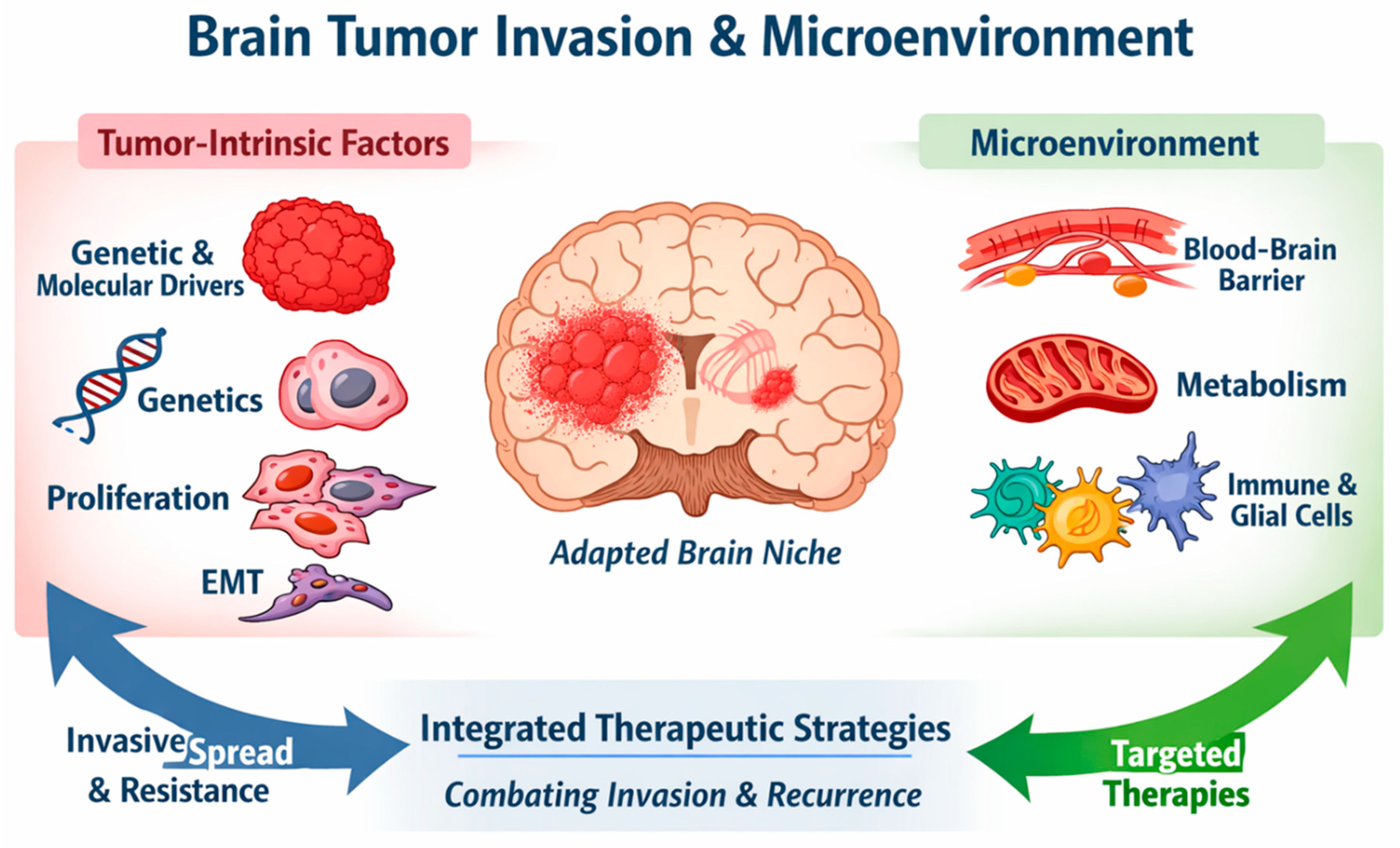
Special Issue “Invasion and Metastasis in Brain Cancer”



Acknowledgments
Conflicts of Interest
List of Contributions
- Ica, R.; Sarbu, M.; Biricioiu, R.; Fabris, D.; Vukelić, Ž.; Zamfir, A.D. Novel Application of Ion Mobility Mass Spectrometry Reveals Complex Ganglioside Landscape in Diffuse Astrocytoma Peritumoral Regions. Int. J. Mol. Sci. 2025, 26, 8433. https://doi.org/10.3390/ijms26178433
- De Fazio, E.; Pittarello, M.; Gans, A.; Ghosh, B.; Slika, H.; Alimonti, P.; Tyler, B. Intrinsic and Microenvironmental Drivers of Glioblastoma Invasion. Int. J. Mol. Sci. 2024, 25, 2563. https://doi.org/10.3390/ijms25052563.
- Jablonska, P.A.; Galán, N.; Barranco, J.; Leon, S.; Robledano, R.; Echeveste, J.I.; Calvo, A.; Aristu, J.; Serrano, D. Presence of Activated (Phosphorylated) STAT3 in Radiation Necrosis Following Stereotactic Radiosurgery for Brain Metastases. Int. J. Mol. Sci. 2023, 24, 14219. https://doi.org/10.3390/ijms241814219.
- Boix De Jesus, A.N.; Taha, A.; Wang, D.; Mehta, P.M.; Mehta, S.; Reily-Bell, A.; Lekamlage, S.P.; Saraiva, A.M.; Tahmeedzaman, T.; Ziad, F.; et al. Increased expression of the Δ133p53β isoform enhances brain metastasis. Int. J. Mol. Sci. 2023, 24, 1267.
- Domentean, S.; Paisana, E.; Cascão, R.; Faria, C.C. Role of UBE2C in Brain Cancer Invasion and Dissemination. Int. J. Mol. Sci. 2023, 24, 15792. https://doi.org/10.3390/ijms242115792.
- Terceiro, L.E.L.; Ikeogu, N.M.; Lima, M.F.; Edechi, C.A.; Nickel, B.E.; Fischer, G.; Leygue, E.; McManus, K.J.; Myal, Y. Navigating the Blood–Brain Barrier: Challenges and Therapeutic Strategies in Breast Cancer Brain Metastases. Int. J. Mol. Sci. 2023, 24, 12034. https://doi.org/10.3390/ijms241512034.
References
- Wen, P.Y.; Kesari, S. Malignant gliomas in adults. N. Engl. J. Med. 2008, 359, 492–507, Erratum in N. Engl. J. Med. 2008, 359, 877. [Google Scholar] [PubMed]
- Lu, Y.; Huang, Y.; Zhu, C.; Li, Z.; Zhang, B.; Sheng, H.; Li, H.; Liu, X.; Xu, Z.; Wen, Y.; et al. Cancer Brain Metastasis: Molecular Mechanisms and Therapeutic Strategies. Mol. Biomed. 2025, 6, 12. [Google Scholar] [CrossRef]
- Klemm, F.; Maas, R.R.; Bowman, R.L.; Kornete, M.; Soukup, K.; Nassiri, S.; Brouland, J.-P.; Iacobuzio-Donahue, C.A.; Brennan, C.; Tabar, V.; et al. Interrogation of the Microenvironmental Landscape in Brain Tumors Reveals Disease-Specific Alterations of Immune Cells. Cell 2020, 181, 1643–1660.e17. [Google Scholar] [CrossRef]
- Jacome, M.A.; Wu, Q.; Chen, J.; Sidi Mohamed, Z.; Mokhtari, S.; Piña, Y.; Etame, A.B. Molecular Underpinnings of Brain Metastases. Int. J. Mol. Sci. 2025, 26, 2307. [Google Scholar] [CrossRef]
- So, K.; Kim, Y. Mechanisms of invasion in glioblastoma: Extracellular matrix, Ca2+ signaling, and glutamate. Brain Tumor Res. Treat. 2021, 9, 53–63. [Google Scholar]
- Erices, J.I.; Bizama, C.; Niechi, I.; Uribe, D.; Rosales, A.; Fabres, K.; Navarro-Martínez, G.; Torres, Á.; San Martín, R.; Roa, J.C.; et al. Glioblastoma Microenvironment and Invasiveness: New Insights and Therapeutic Targets. Int. J. Mol. Sci. 2023, 24, 7047. [Google Scholar] [CrossRef] [PubMed]
- Seker-Polat, F.; Pinarbasi Degirmenci, N.; Solaroglu, I.; Bagci-Onder, T. Tumor cell infiltration into the brain in glioblastoma: Mechanisms and clinical perspectives. Cancers 2021, 14, 443. [Google Scholar]
- Verhaak, R.G.W.; Hoadley, K.A.; Purdom, E.; Wang, V.; Wilkerson, M.D.; Miller, C.R.; Ding, L.; Golub, T.; Jill, P.; Alexe, G.; et al. Integrated Genomic Analysis Identifies Clinically Relevant Subtypes of Glioblastoma Characterized by Abnormalities in PDGFRA, IDH1, EGFR, and NF1. Cancer Cell 2010, 17, 98–110. [Google Scholar] [CrossRef]
- Percuoco, V.; Herlin, E.; Prada, F.; Riva, M.; Pessina, F.; Staartjes, V.E.; Della Pepa, G.M.; Menna, G. Glioblastoma invasion patterns from a clinical perspective—A systematic review. Neurosurg. Rev. 2024, 47, 4. [Google Scholar] [CrossRef]
- Oishi, T.; Koizumi, S.; Kurozumi, K. Molecular Mechanisms and Clinical Challenges of Glioma Invasion. Brain Sci. 2022, 12, 291. [Google Scholar] [CrossRef]
- Doroszko, M.; Stockgard, R.; Yildirim, I.; Ballester Bravo, M.; Millner, T.O.; Kundu, S.; Heinold, J.; Elgendy, R.; Berglund, M.; Elfineh, L.; et al. The Invasion Phenotypes of Glioblastoma Depend on Plastic and Reprogrammable Cell States. Nat. Commun. 2025, 16, 6662. [Google Scholar] [CrossRef]
- Campbell, B.K.; Gao, Z.; Corcoran, N.M.; Stylli, S.S.; Hovens, C.M. Molecular Mechanisms Driving the Formation of Brain Metastases. Cancers 2022, 14, 4963. [Google Scholar] [CrossRef]
- Kannan, S.; Murugan, A.K.; Balasubramanian, S.; Munirajan, A.K.; Alzahrani, A.S. Gliomas: Genetic alterations, mechanisms of metastasis, recurrence, drug resistance, and recent trends in molecular therapeutic options. Biochem. Pharmacol. 2022, 201, 115090. [Google Scholar] [CrossRef]
- Hanahan, D.; Weinberg, R.A. Hallmarks of cancer: The next generation. Cell 2011, 144, 646–674. [Google Scholar] [CrossRef]
- Pickup, M.W.; Mouw, J.K.; Weaver, V.M. The extracellular matrix modulates the hallmarks of cancer. EMBO Rep. 2014, 15, 1243–1253. [Google Scholar] [CrossRef] [PubMed]
- Tripathy, D.K.; Panda, L.P.; Biswal, S.; Barhwal, K. Insights into the glioblastoma tumor microenvironment: Current and emerging therapeutic approaches. Front. Pharmacol. 2024, 15, 1355242. [Google Scholar] [CrossRef]
- Housman, G.; Byler, S.; Heerboth, S.; Lapinska, K.; Longacre, M.; Snyder, N.; Sarkar, S. Drug resistance in cancer: An overview. Cancers 2014, 6, 1769–1792. [Google Scholar] [CrossRef]
- Bedard, P.L.; Hansen, A.R.; Ratain, M.J.; Siu, L.L. Tumour heterogeneity in the clinic. Nature 2013, 501, 355–364. [Google Scholar] [CrossRef] [PubMed]
- Trevisi, G.; Mangiola, A. Current Knowledge about the Peritumoral Microenvironment in Glioblastoma. Cancers 2023, 15, 5460. [Google Scholar] [CrossRef]
- Wood, J.; Smith, S.J.; Castellanos-Uribe, M.; Lourdusamy, A.; May, S.T.; Barrett, D.A.; Grundy, R.G.; Kim, D.H.; Rahman, R. Metabolomic characterisation of the glioblastoma invasive margin reveals a region-specific signature. Heliyon 2025, 11, e12345. [Google Scholar]
- Basov, N.V.; Adamovskaya, A.V.; Rogachev, A.D.; Gaisler, E.V.; Demenkov, P.S.; Ivanisenko, T.V.; Venzel, A.S.; Mishinov, S.V.; Stupak, V.V.; Cheresiz, S.V.; et al. Investigation of metabolic features of glioblastoma tissue and the peritumoral environment using targeted metabolomics screening by LC MS/MS and gene network analysis. Vavilovskii Zhurnal Genet. Sel. 2024, 28, 345–360. [Google Scholar]
- Altieri, R.; Barbagallo, D.; Certo, F.; Broggi, G.; Ragusa, M.; Di Pietro, C.; Caltabiano, R.; Magro, G.; Peschillo, S.; Purrello, M.; et al. Peritumoral microenvironment in high grade gliomas: miRNA patterns and cross talk between GBM and microenvironment. Brain Sci. 2021, 11, 200. [Google Scholar] [PubMed]
- Quail, D.F.; Joyce, J.A. Microenvironmental regulation of tumor progression and metastasis. Nat. Med. 2013, 19, 1423–1437. [Google Scholar] [CrossRef]
- Thoppey Manoharan, V.; Abdelkareem, A.; Gill, G.; Brown, S.; Gillmor, A.; Hall, C.; Seo, H.; Narta, K.; Grewal, S.; Dang, N.H.; et al. Spatiotemporal Modeling Reveals High-Resolution Invasion States in Glioblastoma. Genome Biol. 2024, 25, 264. [Google Scholar] [CrossRef]
- Quail, D.F.; Joyce, J.A. The microenvironmental landscape of brain tumors. Cancer Cell 2017, 31, 326–341. [Google Scholar] [CrossRef]
- Chang, N.; Ahn, S.H.; Kong, D.S.; Lee, H.W.; Nam, D.H. The role of STAT3 in glioblastoma progression through dual influences on tumor cells and the immune microenvironment. Mol. Cell Endocrinol. 2017, 451, 53–65. [Google Scholar] [CrossRef]
- Bourdon, J.-C. p53 and Its Isoforms in Cancer. Br. J. Cancer 2007, 97, 277–282. [Google Scholar] [CrossRef]
- Zhai, X.; Li, Y.; Liang, P.; Li, L.; Zhou, Y.; Zhang, W.; Wang, D.; Wei, G. PI3K/AKT/Afadin Signaling Pathway Contributes to Pathological Vascularization in Glioblastomas. Oncol. Lett. 2017, 15, 1893–1899. [Google Scholar] [CrossRef] [PubMed]
- Peleli, M.; Moustakas, A.; Papapetropoulos, A. Endothelial–Tumor Cell Interaction in Brain and CNS Malignancies. Int. J. Mol. Sci. 2020, 21, 7371. [Google Scholar] [CrossRef]
- Ma, R.; Kang, X.; Zhang, G.; Fang, F.; Du, Y.; Lv, H. High expression of UBE2C is associated with the aggressive progression and poor outcome of malignant glioma. Oncol. Lett. 2016, 11, 2300–2304. [Google Scholar] [CrossRef] [PubMed]
- Xie, C.; Powell, C.; Yao, M.; Wu, J.; Dong, Q. Ubiquitin-conjugating enzyme E2C: A potential cancer biomarker. Int. J. Biochem. Cell Biol. 2014, 54, 182–187. [Google Scholar] [CrossRef] [PubMed]
- Zhang, X.; Wang, X.; Shi, S.; Guo, D. Decoding the Mechanisms Underlying Breast Cancer Brain Metastasis: Paving the Way for Precision Therapeutics. Biomark. Res. 2025, 13, 144. [Google Scholar] [CrossRef] [PubMed]
- Lockman, P.R.; Mittapalli, R.K.; Taskar, K.S.; Rudraraju, V.; Gril, B.; Bohn, K.A.; Adkins, C.E.; Roberts, A.; Thorsheim, H.R.; Gaasch, J.A.; et al. Heterogeneous Blood–Tumor Barrier Permeability Determines Drug Efficacy in Experimental Brain Metastases of Breast Cancer. Clin. Cancer Res. 2010, 16, 5664–5678. [Google Scholar] [CrossRef] [PubMed]
Disclaimer/Publisher’s Note: The statements, opinions and data contained in all publications are solely those of the individual author(s) and contributor(s) and not of MDPI and/or the editor(s). MDPI and/or the editor(s) disclaim responsibility for any injury to people or property resulting from any ideas, methods, instructions or products referred to in the content. |
© 2026 by the authors. Licensee MDPI, Basel, Switzerland. This article is an open access article distributed under the terms and conditions of the Creative Commons Attribution (CC BY) license.
Share and Cite
Glogowska, A.; Ghavami, S. Special Issue “Invasion and Metastasis in Brain Cancer”. Int. J. Mol. Sci. 2026, 27, 1555. https://doi.org/10.3390/ijms27031555
Glogowska A, Ghavami S. Special Issue “Invasion and Metastasis in Brain Cancer”. International Journal of Molecular Sciences. 2026; 27(3):1555. https://doi.org/10.3390/ijms27031555
Chicago/Turabian StyleGlogowska, Aleksandra, and Saeid Ghavami. 2026. "Special Issue “Invasion and Metastasis in Brain Cancer”" International Journal of Molecular Sciences 27, no. 3: 1555. https://doi.org/10.3390/ijms27031555
APA StyleGlogowska, A., & Ghavami, S. (2026). Special Issue “Invasion and Metastasis in Brain Cancer”. International Journal of Molecular Sciences, 27(3), 1555. https://doi.org/10.3390/ijms27031555