Targeting Matrix Stiffness and Mechanotransduction in Breast Cancer: Implications for Emerging Therapies
 and
and
Abstract
1. Introduction
2. The Dynamic Tumor ECM
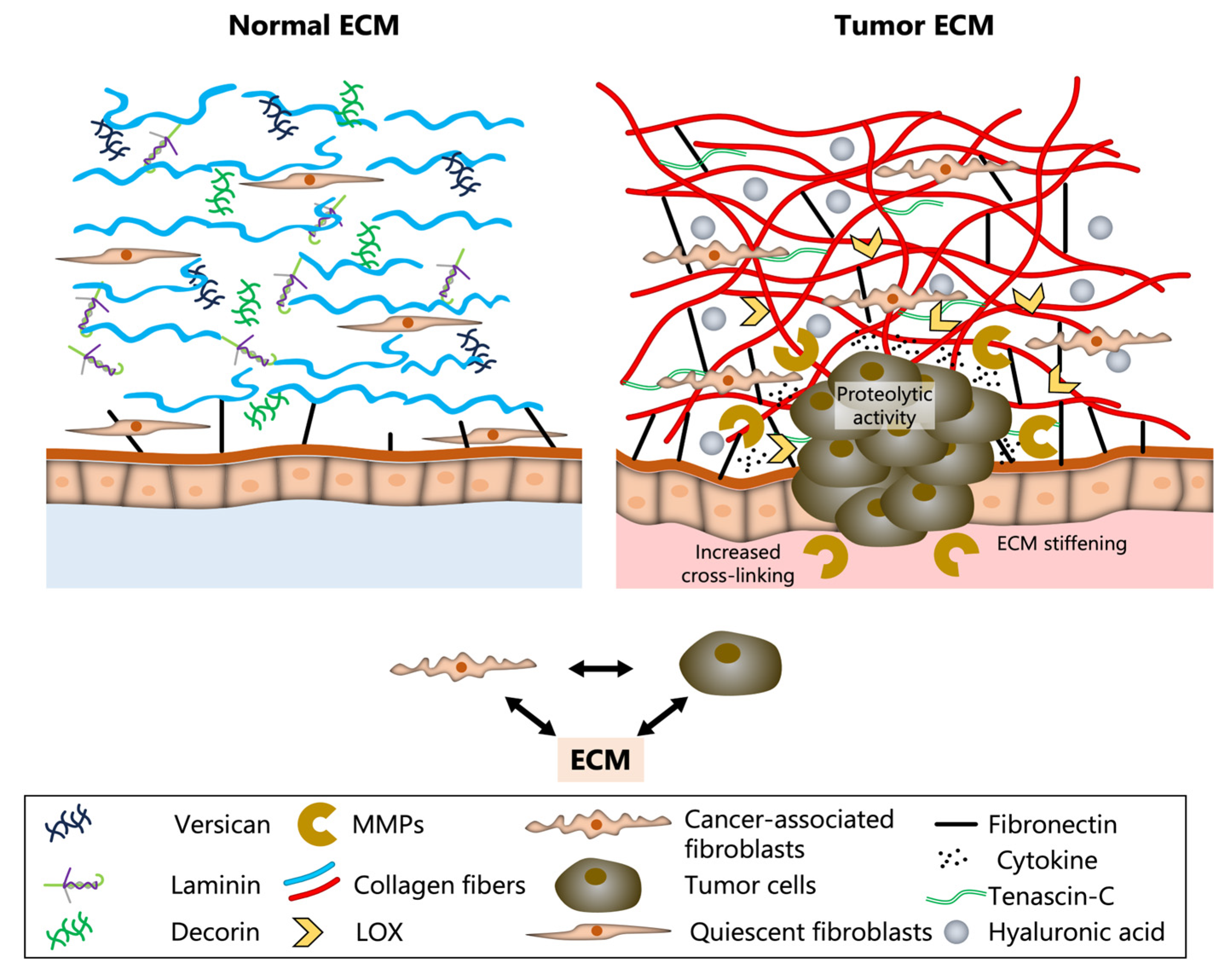
2.1. Normal Versus Cancer Breast ECM Organization
2.2. Tumor Associated ECM Remodeling
2.3. Dynamic Remodeling of the ECM in Breast Cancer Progression
3. Ancestry-Associated ECM Differences
3.1. ECM Composition and Stromal Programs
3.2. Collagen Density and Organization
3.3. Arrangement of Collagen Fibers and Mammogram Density
3.4. Enzymatic Crosslinking and Remodeling Activity
3.5. Immune ECM Interactions
4. ECM-Mediated Mechanisms of Invasion and Metastasis-Biochemical Signaling
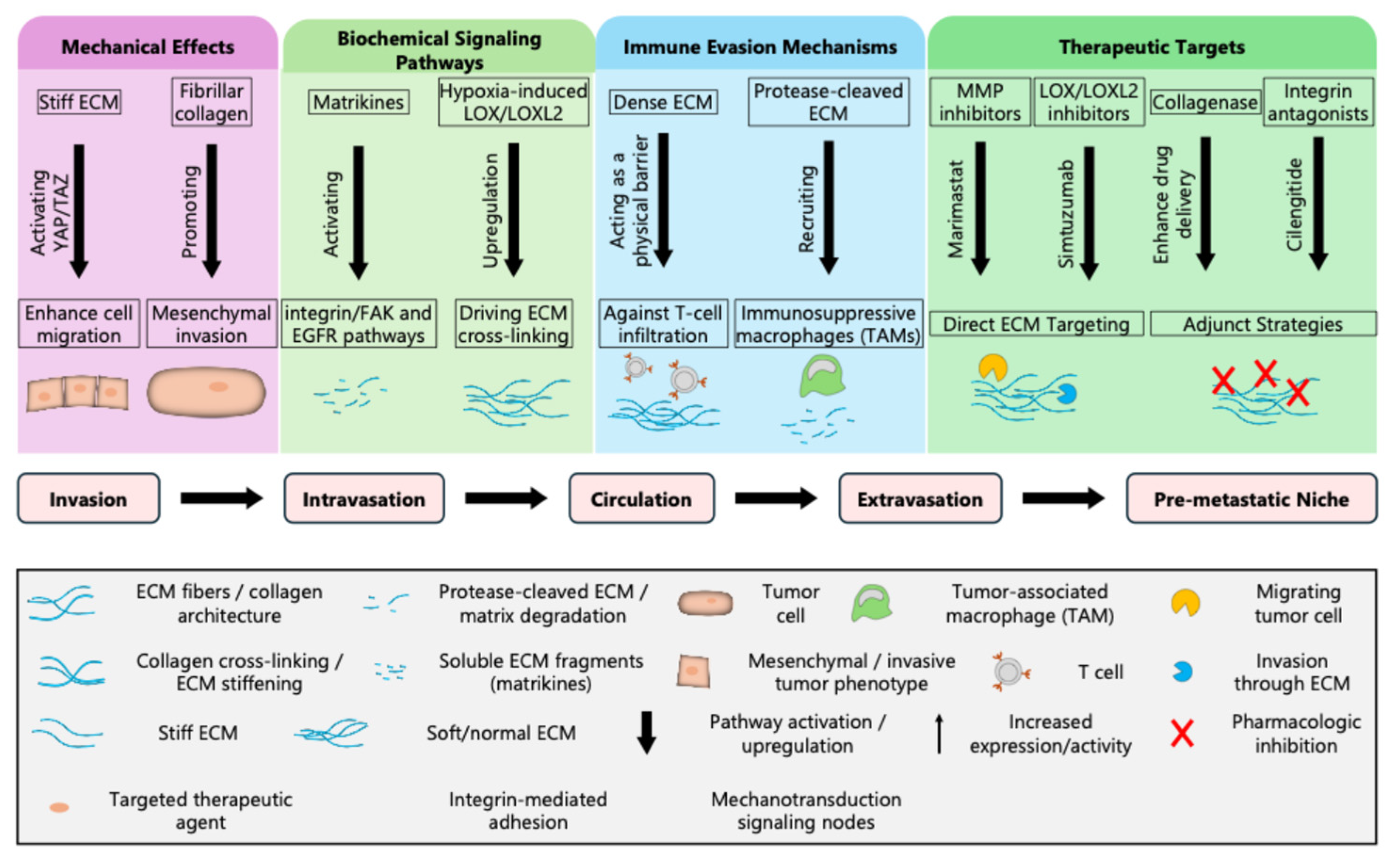
4.1. Mechanical Effects and Immune Evasion
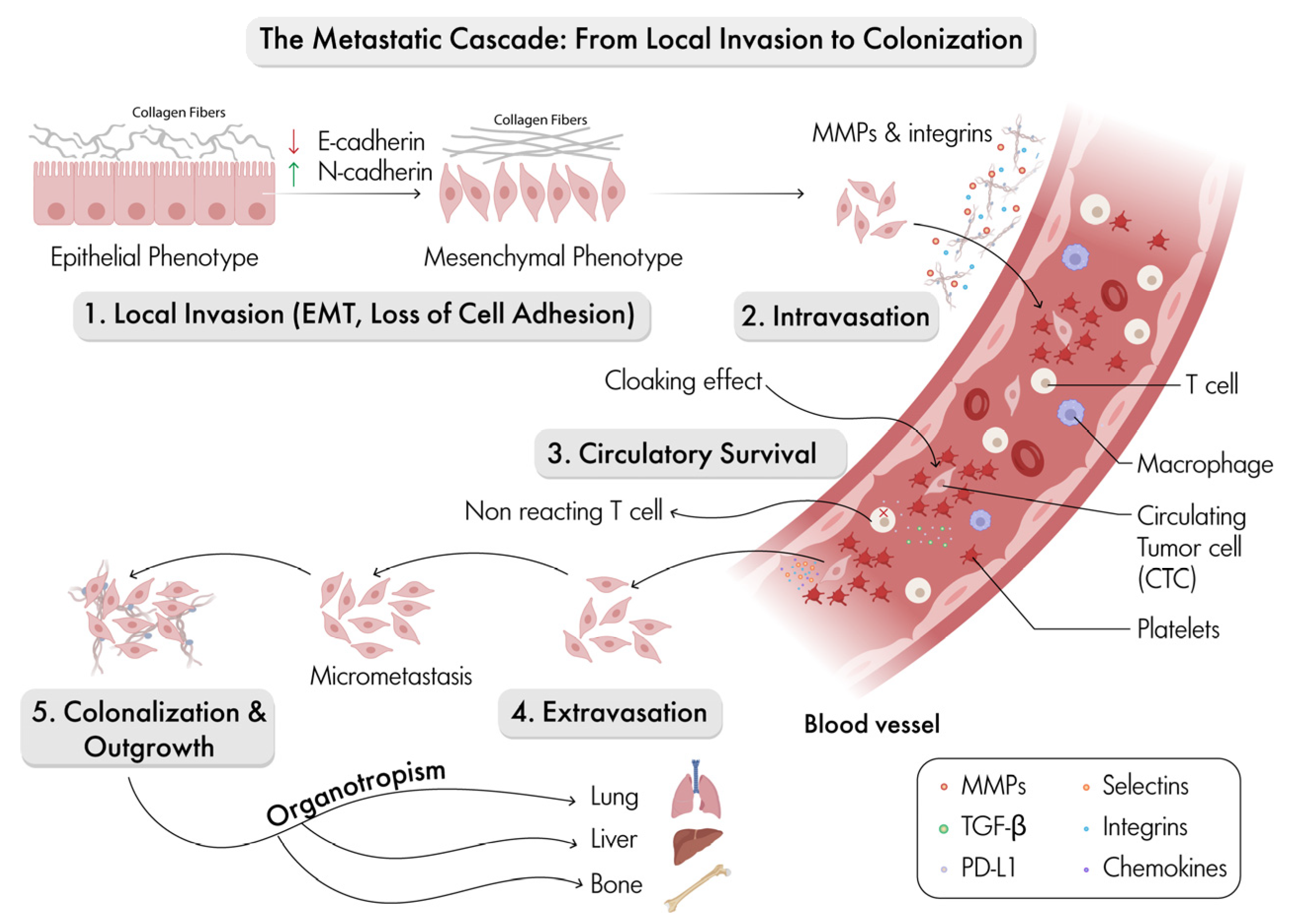
4.2. The Metastatic Cascade: From Local Invasion to Colonization
4.3. Therapeutic Targets and Integration Within the Metastatic Cascade
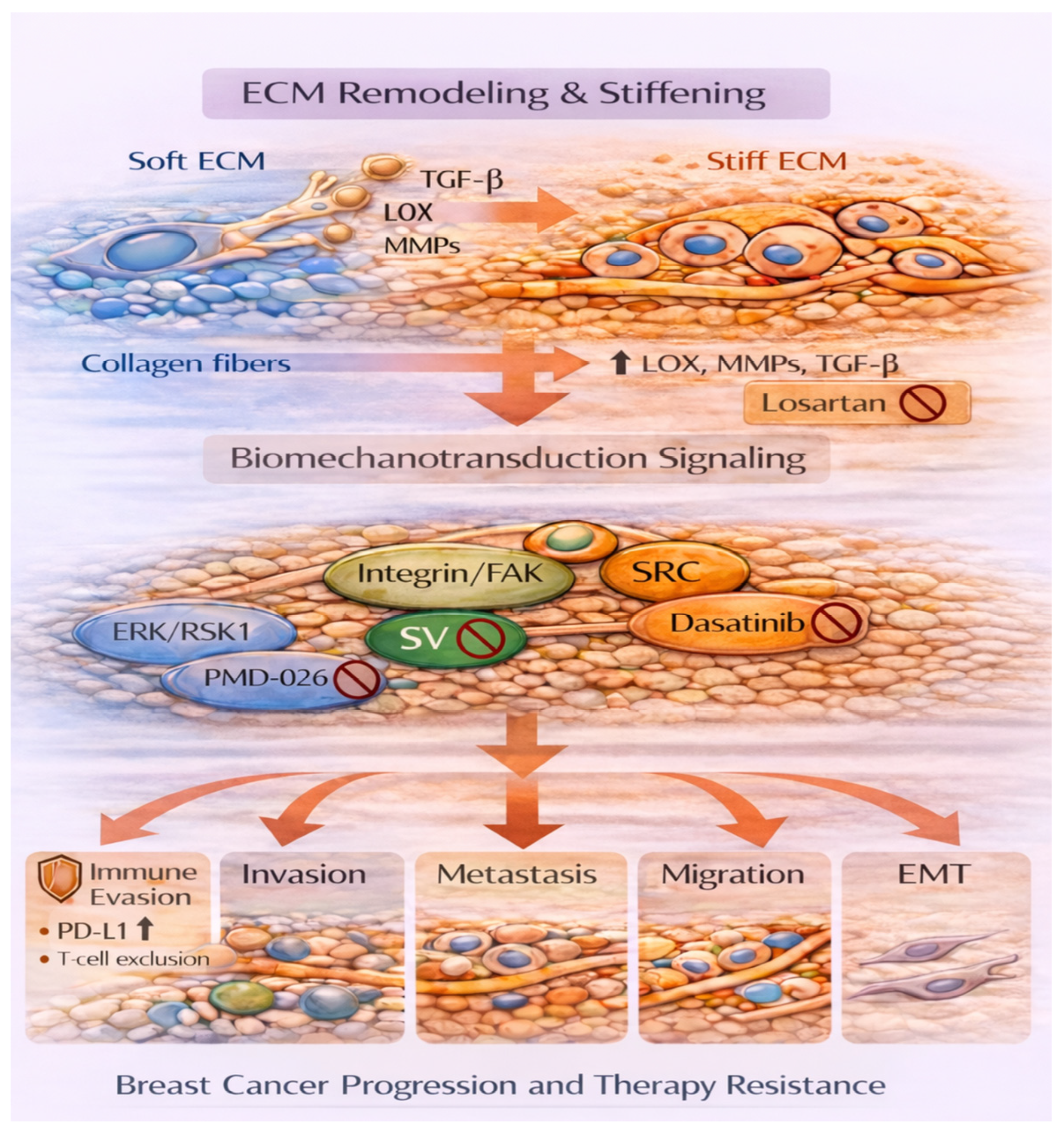
4.4. Mechanobiology- Driven Strategies to Address ECM Stiffness-Mediated Abnormalities
4.5. Novel Agents That Target Mechanotransduction Pathways: Preclinical Studies
4.5.1. Integrin Inhibitors
4.5.2. Matrix Metalloproteinase Inhibitors
4.5.3. Lysyl Oxidase (LOX) Inhibitors
4.6. Agents That Target Mechanotransduction Pathways: Clinical Studies
4.7. Potential to Repurpose FDA-Approved Agents That Target ECM or Mechanotransduction Pathways
5. ECM Biomarkers and Clinical Implications
6. Conclusions and Future Directions
Author Contributions
Funding
Institutional Review Board Statement
Informed Consent Statement
Data Availability Statement
Acknowledgments
Conflicts of Interest
References
- Hanahan, D.; Weinberg, R.A. Hallmarks of cancer: The next generation. Cell 2011, 144, 646–674. [Google Scholar] [CrossRef]
- Pastushenko, I.; Mauri, F.; Song, Y.; de Cock, F.; Meeusen, B.; Swedlund, B.; Impens, F.; Van Haver, D.; Opitz, M.; Thery, M.; et al. Fat1 deletion promotes hybrid EMT state, tumour stemness and metastasis. Nature 2021, 589, 448–455. [Google Scholar] [CrossRef] [PubMed]
- Yang, J.; Mani, S.A.; Donaher, J.L.; Ramaswamy, S.; Itzykson, R.A.; Come, C.; Savagner, P.; Gitelman, I.; Richardson, A.; Weinberg, R.A. Twist, a master regulator of morphogenesis, plays an essential role in tumor metastasis. Cell 2004, 117, 927–939. [Google Scholar] [CrossRef] [PubMed]
- Nallanthighal, S.; Heiserman, J.P.; Cheon, D.J. The Role of the Extracellular Matrix in Cancer Stemness. Front. Cell Dev. Biol. 2019, 7, 86. [Google Scholar] [CrossRef]
- Jiang, Y.; Zhang, H.; Wang, J.; Liu, Y.; Luo, T.; Hua, H. Targeting extracellular matrix stiffness and mechanotransducers to improve cancer therapy. J. Hematol. Oncol. 2022, 15, 34. [Google Scholar] [CrossRef]
- Lu, P.; Weaver, V.M.; Werb, Z. The extracellular matrix: A dynamic niche in cancer progression. J. Cell Biol. 2012, 196, 395–406. [Google Scholar] [CrossRef] [PubMed]
- Kalluri, R. The biology and function of fibroblasts in cancer. Nat. Rev. Cancer 2016, 16, 582–598. [Google Scholar] [CrossRef]
- Packard, B.Z.; Artym, V.V.; Komoriya, A.; Yamada, K.M. Direct visualization of protease activity on cells migrating in three-dimensions. Matrix Biol. J. Int. Soc. Matrix Biol. 2009, 28, 3–10. [Google Scholar] [CrossRef]
- Kessenbrock, K.; Plaks, V.; Werb, Z. Matrix metalloproteinases: Regulators of the tumor microenvironment. Cell 2010, 141, 52–67. [Google Scholar] [CrossRef]
- Kalli, M.; Poskus, M.D.; Stylianopoulos, T.; Zervantonakis, I.K. Beyond matrix stiffness: Targeting force-induced cancer drug resistance. Trends Cancer 2023, 9, 937–954. [Google Scholar] [CrossRef]
- Kumai, J.; Sasagawa, S.; Yui, Y. Metastatic breast cancer cells adapt to a soft environment with limited involvement of mechanotransduction. Exp. Cell Res. 2025, 450, 114629. [Google Scholar] [CrossRef]
- Giaquinto, A.N.; Miller, K.D.; Tossas, K.Y.; Winn, R.A.; Jemal, A.; Siegel, R.L. Cancer statistics for African American/Black People 2022. CA Cancer J Clin 2022, 72, 202–229. [Google Scholar] [CrossRef] [PubMed]
- Reid, S.; Fan, R.; Venton, L.; Weidner, A.; Tezak, A.; Roberson, M.L.; Vadaparampil, S.; Wang, X.; Yoder, S.; Rosa, M.; et al. West African Genetic Ancestry and Breast Cancer Outcomes Among Black Women. JAMA Netw. Open 2024, 7, e2449798. [Google Scholar] [CrossRef]
- Zhu, Q.; Balasubramanian, A.; Asirvatham, J.R.; Chatterjee, M.; Piyarathna, B.; Kaur, J.; Mohamed, N.; Wu, L.; Wang, S.; Pourfarrokh, N.; et al. Integrative spatial omics reveals distinct tumor-promoting multicellular niches and immunosuppressive mechanisms in Black American and White American patients with TNBC. Nat. Commun. 2025, 16, 6584. [Google Scholar] [CrossRef] [PubMed]
- Ansari-Pour, N.; Zheng, Y.; Yoshimatsu, T.F.; Sanni, A.; Ajani, M.; Reynier, J.B.; Tapinos, A.; Pitt, J.J.; Dentro, S.; Woodard, A.; et al. Whole-genome analysis of Nigerian patients with breast cancer reveals ethnic-driven somatic evolution and distinct genomic subtypes. Nat. Commun. 2021, 12, 6946. [Google Scholar] [CrossRef]
- Wright, N.; Rida, P.; Krishnamurti, U.; Li, X.; Aneja, R. Targeted drugs and diagnostic assays: Companions in the race to combat ethnic disparity. Front. Biosci. 2017, 22, 193–211. [Google Scholar] [CrossRef]
- Martin, D.N.; Boersma, B.J.; Yi, M.; Reimers, M.; Howe, T.M.; Yfantis, H.G.; Tsai, Y.C.; Williams, E.H.; Lee, D.H.; Stephens, R.M.; et al. Differences in the tumor microenvironment between African-American and European-American breast cancer patients. PLoS ONE 2009, 4, e4531. [Google Scholar] [CrossRef]
- Alamukii, N.A.; Kovacs, A.; Raghavan, S.; Ilio, J.; Karlsson, P.; Helou, K.; Parris, T.Z. Immune-stromal heterogeneity in breast cancer across diverse ancestries: Impact on prognosis and treatment response. NPJ Breast Cancer 2025, 11, 142. [Google Scholar] [CrossRef] [PubMed]
- Schmidtmann, M.G.; Elliott, V.; Clancy, J.W.; Schafer, Z.T.; Nakshatri, H.; D’Souza-Schorey, C. Ancestry-linked stromal variations impact breast epithelial cell invasion. iScience 2025, 28, 112686. [Google Scholar] [CrossRef]
- Stone, A.; Kalahiki, C.; Li, L.; Hubig, N.; Iuricich, F.; Dunn, H. Evaluation of breast tumor morphologies from African American and Caucasian patients. Comput. Struct. Biotechnol. J. 2023, 21, 3459–3465. [Google Scholar] [CrossRef]
- Dinkel, Z.; Baker, A.; Akins, A.; King, K.L.; Harrington, M.; Kunkel, D.; Gao, Z.; Ye, T.; Dunn, H. Collagen architecture in triple negative breast cancer. PLoS ONE 2025, 20, e0324655. [Google Scholar] [CrossRef]
- King, K.L.; Abdollahi, H.; Dinkel, Z.; Akins, A.; Valafar, H.; Dunn, H. Pilot study: Initial investigation suggests differences in EMT-associated gene expression in breast tumor regions. Comput. Struct. Biotechnol. J. 2025, 27, 548–555. [Google Scholar] [CrossRef] [PubMed]
- Azam, S.; Kemp Jacobsen, K.; Aro, A.R.; von Euler-Chelpin, M.; Tjonneland, A.; Vejborg, I.; Lynge, E.; Andersen, Z.J. Regular physical activity and mammographic density: A cohort study. Cancer Causes Control 2018, 29, 1015–1025. [Google Scholar] [CrossRef]
- Azam, S.; Lange, T.; Huynh, S.; Aro, A.R.; von Euler-Chelpin, M.; Vejborg, I.; Tjonneland, A.; Lynge, E.; Andersen, Z.J. Hormone replacement therapy, mammographic density, and breast cancer risk: A cohort study. Cancer Causes Control 2018, 29, 495–505. [Google Scholar] [CrossRef]
- Boyd, N.F.; Martin, L.J.; Yaffe, M.J.; Minkin, S. Mammographic density and breast cancer risk: Current understanding and future prospects. Breast Cancer Res. 2011, 13, 223. [Google Scholar] [CrossRef]
- Boyd, N.F.; Huszti, E.; Melnichouk, O.; Martin, L.J.; Hislop, G.; Chiarelli, A.; Yaffe, M.J.; Minkin, S. Mammographic features associated with interval breast cancers in screening programs. Breast Cancer Res. 2014, 16, 417. [Google Scholar] [CrossRef] [PubMed]
- Habel, L.A.; Capra, A.M.; Oestreicher, N.; Greendale, G.A.; Cauley, J.A.; Bromberger, J.; Crandall, C.J.; Gold, E.B.; Modugno, F.; Salane, M.; et al. Mammographic density in a multiethnic cohort. Menopause 2007, 14, 891–899. [Google Scholar] [CrossRef] [PubMed]
- Holder, E.X.; Bigham, Z.; Nelson, K.P.; Barnard, M.E.; Palmer, J.R.; Bertrand, K.A. Mammographic density and breast cancer risk among Black American women. Int. J. Cancer 2025, 156, 1173–1180. [Google Scholar] [CrossRef]
- Mahmoud, M.A.; Ehsan, S.; Ginzberg, S.P.; Domchek, S.M.; Nathanson, K.L.; Conant, E.F.; Kontos, D.; Chen, J.; Edmonds, C.E.; Fayanju, O.M.; et al. Racial Differences in Screening Eligibility by Breast Density After State-Level Insurance Expansion. JAMA Netw. Open 2025, 8, e2525216. [Google Scholar] [CrossRef]
- McCarthy, A.M.; Keller, B.M.; Pantalone, L.M.; Hsieh, M.K.; Synnestvedt, M.; Conant, E.F.; Armstrong, K.; Kontos, D. Racial Differences in Quantitative Measures of Area and Volumetric Breast Density. J. Natl. Cancer Inst. 2016, 108, djw104. [Google Scholar] [CrossRef]
- Verma, S.S.; Guare, L.; Ehsan, S.; Gastounioti, A.; Scales, G.; Ritchie, M.D.; Kontos, D.; McCarthy, A.M.; Penn Medicine, B. Genome-Wide Association Study of Breast Density among Women of African Ancestry. Cancers 2023, 15, 2776. [Google Scholar] [CrossRef] [PubMed]
- Mason, J.A.; Yancy, H.F.; Lashley, K.; Jett, M.; Day, A.A. Comparative study of matrix metalloproteinase expression between African American and Caucasian Women. J. Carcinog. 2004, 3, 15. [Google Scholar] [CrossRef] [PubMed]
- Kim, Y.; Ollberding, N.J.; Shvetsov, Y.B.; Franke, A.A.; Wilkens, L.R.; Maskarinec, G.; Hernandez, B.Y.; Le Marchand, L.; Henderson, B.E.; Kolonel, L.N.; et al. Plasma matrix metalloproteinases and postmenopausal breast cancer risk: A nested case-control study in the Multiethnic Cohort study. Breast Cancer Res. Treat. 2012, 136, 837–845. [Google Scholar] [CrossRef]
- Deshmukh, S.K.; Srivastava, S.K.; Bhardwaj, A.; Singh, A.P.; Tyagi, N.; Marimuthu, S.; Dyess, D.L.; Dal Zotto, V.; Carter, J.E.; Singh, S. Resistin and interleukin-6 exhibit racially-disparate expression in breast cancer patients, display molecular association and promote growth and aggressiveness of tumor cells through STAT3 activation. Oncotarget 2015, 6, 11231–11241. [Google Scholar] [CrossRef]
- Deshmukh, S.K.; Srivastava, S.K.; Zubair, H.; Bhardwaj, A.; Tyagi, N.; Al-Ghadhban, A.; Singh, A.P.; Dyess, D.L.; Carter, J.E.; Singh, S. Resistin potentiates chemoresistance and stemness of breast cancer cells: Implications for racially disparate therapeutic outcomes. Cancer Lett. 2017, 396, 21–29. [Google Scholar] [CrossRef]
- Marczyk, M.; Qing, T.; O’Meara, T.; Yagahoobi, V.; Pelekanou, V.; Bai, Y.; Reisenbichler, E.; Cole, K.S.; Li, X.; Gunasekharan, V.; et al. Tumor immune microenvironment of self-identified African American and non-African American triple negative breast cancer. NPJ Breast Cancer 2022, 8, 88. [Google Scholar] [CrossRef]
- Ahmed, M.S.U.; Lord, B.D.; Adu Addai, B.; Singhal, S.K.; Gardner, K.; Salam, A.B.; Ghebremedhin, A.; White, J.; Mahmud, I.; Martini, R.; et al. Immune Profile of Exosomes in African American Breast Cancer Patients Is Mediated by Kaiso/THBS1/CD47 Signaling. Cancers 2023, 15, 2282. [Google Scholar] [CrossRef]
- Acerbi, I.; Cassereau, L.; Dean, I.; Shi, Q.; Au, A.; Park, C.; Chen, Y.Y.; Liphardt, J.; Hwang, E.S.; Weaver, V.M. Human breast cancer invasion and aggression correlates with ECM stiffening and immune cell infiltration. Integr. Biol. 2015, 7, 1120–1134. [Google Scholar] [CrossRef]
- Swindle, C.S.; Tran, K.T.; Johnson, T.D.; Banerjee, P.; Mayes, A.M.; Griffith, L.; Wells, A. Epidermal growth factor (EGF)-like repeats of human tenascin-C as ligands for EGF receptor. J. Cell Biol. 2001, 154, 459–468. [Google Scholar] [CrossRef] [PubMed]
- Fattet, L.; Jung, H.Y.; Matsumoto, M.W.; Aubol, B.E.; Kumar, A.; Adams, J.A.; Chen, A.C.; Sah, R.L.; Engler, A.J.; Pasquale, E.B.; et al. Matrix Rigidity Controls Epithelial-Mesenchymal Plasticity and Tumor Metastasis via a Mechanoresponsive EPHA2/LYN Complex. Dev. Cell 2020, 54, 302–316.e7. [Google Scholar] [CrossRef]
- Dalpati, N.; Rai, S.K.; Dash, S.P.; Kumar, P.; Singh, D.; Sarangi, P.P. Integrins α5β1 and αvβ3 Differentially Participate in the Recruitment and Reprogramming of Tumor-associated Macrophages in the In Vitro and In Vivo Models of Breast Tumor. J. Immunol. 2024, 213, 1553–1568. [Google Scholar] [CrossRef] [PubMed]
- Peng, Y.; Chen, Z.; Chen, Y.; Li, S.; Jiang, Y.; Yang, H.; Wu, C.; You, F.; Zheng, C.; Zhu, J.; et al. ROCK isoforms differentially modulate cancer cell motility by mechanosensing the substrate stiffness. Acta Biomater. 2019, 88, 86–101. [Google Scholar] [CrossRef] [PubMed]
- Postovit, L.M.; Abbott, D.E.; Payne, S.L.; Wheaton, W.W.; Margaryan, N.V.; Sullivan, R.; Jansen, M.K.; Csiszar, K.; Hendrix, M.J.; Kirschmann, D.A. Hypoxia/reoxygenation: A dynamic regulator of lysyl oxidase-facilitated breast cancer migration. J. Cell. Biochem. 2008, 103, 1369–1378. [Google Scholar] [CrossRef] [PubMed]
- Dupont, S.; Morsut, L.; Aragona, M.; Enzo, E.; Giulitti, S.; Cordenonsi, M.; Zanconato, F.; Le Digabel, J.; Forcato, M.; Bicciato, S.; et al. Role of YAP/TAZ in mechanotransduction. Nature 2011, 474, 179–183. [Google Scholar] [CrossRef]
- Mai, Z.; Lin, Y.; Lin, P.; Zhao, X.; Cui, L. Modulating extracellular matrix stiffness: A strategic approach to boost cancer immunotherapy. Cell Death Dis. 2024, 15, 307. [Google Scholar] [CrossRef]
- Carrascal, M.A.; Silva, M.; Ramalho, J.S.; Pen, C.; Martins, M.; Pascoal, C.; Amaral, C.; Serrano, I.; Oliveira, M.J.; Sackstein, R.; et al. Inhibition of fucosylation in human invasive ductal carcinoma reduces E-selectin ligand expression, cell proliferation, and ERK1/2 and p38 MAPK activation. Mol. Oncol. 2018, 12, 579–593. [Google Scholar] [CrossRef]
- Pang, J.H.; Coupland, L.A.; Freeman, C.; Chong, B.H.; Parish, C.R. Activation of tumour cell ECM degradation by thrombin-activated platelet membranes: Potentially a P-selectin and GPIIb/IIIa-dependent process. Clin. Exp. Metastasis 2015, 32, 495–505. [Google Scholar] [CrossRef]
- Sidibe, A.; Ropraz, P.; Jemelin, S.; Emre, Y.; Poittevin, M.; Pocard, M.; Bradfield, P.F.; Imhof, B.A. Angiogenic factor-driven inflammation promotes extravasation of human proangiogenic monocytes to tumours. Nat. Commun. 2018, 9, 355. [Google Scholar] [CrossRef]
- Dimari, G.; Hu, Y.; Frenzel, A.; Fuchs, A.; Wurm, A.A.; Fischer-Friedrich, E. Mesenchymal-epithelial transition reduces proliferation but increases immune evasion in tumor spheroids. iScience 2025, 28, 113023. [Google Scholar] [CrossRef]
- Gong, P.; Wang, F.; Hua, Y.; Ying, J.; Chen, J.; Qiao, Y. Collagenase-mediated extracellular matrix targeting for enhanced drug penetration and therapeutic efficacy in nanoscale delivery systems for cancer therapy. J. Nanobiotechnol. 2025, 23, 733. [Google Scholar] [CrossRef]
- Meng, Z.; Moroishi, T.; Guan, K.L. Mechanisms of Hippo pathway regulation. Genes Dev. 2016, 30, 1–17. [Google Scholar] [CrossRef]
- Ortega, A.; Bermúdez, V.; De Sanctis, J.B.; Diaz, M.P.; Navarro, C.; Parra, H.; Rojas, M.; Salazar, J.; Torres, W.; Vera, I. The YAP/TAZ Signaling Pathway in the Tumor Microenvironment and Carcinogenesis: Current Knowledge and Therapeutic Promises. Int. J. Mol. Sci. 2021, 23, 430. [Google Scholar] [CrossRef]
- Liu, Y.; Cai, K.; Deng, Q.; Fang, D.; Li, L.; Li, M.; Liu, Y.; Luo, Z.; Shi, L.; Song, G.; et al. Mechanotransduction in response to ECM stiffening impairs cGAS immune signaling in tumor cells. Cell Rep. 2023, 42, 113213. [Google Scholar] [CrossRef]
- Weiss, M.B.; Abel, E.V.; Mayberry, M.M.; Basile, K.J.; Berger, A.C.; Aplin, A.E. TWIST1 is an ERK1/2 effector that promotes invasion and regulates MMP-1 expression in human melanoma cells. Cancer Res. 2012, 72, 6382–6392. [Google Scholar] [CrossRef] [PubMed]
- Doehn, U.; Hauge, C.; Frank, S.R.; Jensen, C.J.; Duda, K.; Nielsen, J.V.; Cohen, M.S.; Johansen, J.V.; Winther, B.R.; Lund, L.R.; et al. RSK is a principal effector of the RAS-ERK pathway for eliciting a coordinate promotile/invasive gene program and phenotype in epithelial cells. Mol. Cell 2009, 35, 511–522. [Google Scholar] [CrossRef]
- Wu, T.; Xiong, S.; Chen, M.; Tam, B.T.; Chen, W.; Dong, K.; Ma, Z.; Wang, Z.; Ouyang, G. Matrix stiffening facilitates the collective invasion of breast cancer through the periostin-integrin mechanotransduction pathway. Matrix Biol. J. Int. Soc. Matrix Biol. 2023, 121, 22–40. [Google Scholar] [CrossRef]
- Bandyopadhyay, A.; Raghavan, S. Defining the role of integrin αvβ6 in cancer. Curr. Drug Targets 2009, 10, 645–652. [Google Scholar] [CrossRef] [PubMed]
- Calaf, G.M.; Roy, D.; Narayan, G.; Balajee, A.S. Differential expression of cell adhesion molecules in an ionizing radiation-induced breast cancer model system. Oncol. Rep. 2013, 30, 285–291. [Google Scholar] [CrossRef] [PubMed]
- Arihiro, K.; Kaneko, M.; Fujii, S.; Inai, K.; Yokosaki, Y. Significance of α9β1 and αvβ6 integrin expression in breast carcinoma. Breast Cancer 2000, 7, 19–26. [Google Scholar] [CrossRef]
- Bates, R.C.; Bellovin, D.I.; Brown, C.; Maynard, E.; Wu, B.; Kawakatsu, H.; Sheppard, D.; Oettgen, P.; Mercurio, A.M. Transcriptional activation of integrin β6 during the epithelial-mesenchymal transition defines a novel prognostic indicator of aggressive colon carcinoma. J. Clin. Investig. 2005, 115, 339–347. [Google Scholar] [CrossRef]
- Lee, J.Y.; Chaudhuri, O. Regulation of Breast Cancer Progression by Extracellular Matrix Mechanics: Insights from 3D Culture Models. ACS Biomater. Sci. Eng. 2018, 4, 302–313. [Google Scholar] [CrossRef]
- Zhang, M.; Zhang, B. Extracellular matrix stiffness: Mechanisms in tumor progression and therapeutic potential in cancer. Exp. Hematol. Oncol. 2025, 14, 54. [Google Scholar] [CrossRef]
- Huang, J.; Zhang, L.; Wan, D.; Zhou, L.; Zheng, S.; Lin, S.; Qiao, Y. Extracellular matrix and its therapeutic potential for cancer treatment. Signal Transduct. Target. Ther. 2021, 6, 153. [Google Scholar] [CrossRef]
- Truong, H.H.; Xiong, J.; Ghotra, V.P.; Nirmala, E.; Haazen, L.; Le Devedec, S.E.; Balcioglu, H.E.; He, S.; Snaar-Jagalska, B.E.; Vreugdenhil, E.; et al. β1 integrin inhibition elicits a prometastatic switch through the TGFβ-miR-200-ZEB network in E-cadherin-positive triple-negative breast cancer. Sci. Signal. 2014, 7, ra15. [Google Scholar] [CrossRef] [PubMed]
- Ross, M.H.; Esser, A.K.; Fox, G.C.; Schmieder, A.H.; Yang, X.; Hu, G.; Pan, D.; Su, X.; Xu, Y.; Novack, D.V.; et al. Bone-Induced Expression of Integrin β3 Enables Targeted Nanotherapy of Breast Cancer Metastases. Cancer Res. 2017, 77, 6299–6312. [Google Scholar] [CrossRef] [PubMed]
- Esser, A.K.; Ross, M.H.; Fontana, F.; Su, X.; Gabay, A.; Fox, G.C.; Xu, Y.; Xiang, J.; Schmieder, A.H.; Yang, X.; et al. Nanotherapy delivery of c-myc inhibitor targets Protumor Macrophages and preserves Antitumor Macrophages in Breast Cancer. Theranostics 2020, 10, 7510–7526. [Google Scholar] [CrossRef]
- Paolillo, M.; Russo, M.A.; Serra, M.; Colombo, L.; Schinelli, S. Small molecule integrin antagonists in cancer therapy. Mini Rev. Med. Chem. 2009, 9, 1439–1446. [Google Scholar] [CrossRef]
- Bauerle, T.; Komljenovic, D.; Merz, M.; Berger, M.R.; Goodman, S.L.; Semmler, W. Cilengitide inhibits progression of experimental breast cancer bone metastases as imaged noninvasively using VCT, MRI and DCE-MRI in a longitudinal in vivo study. Int. J. Cancer 2011, 128, 2453–2462. [Google Scholar] [CrossRef]
- Cheng, C.; Komljenovic, D.; Pan, L.; Dimitrakopoulou-Strauss, A.; Strauss, L.; Bauerle, T. Evaluation of treatment response of cilengitide in an experimental model of breast cancer bone metastasis using dynamic PET with 18F-FDG. Hell. J. Nucl. Med. 2011, 14, 15–20. [Google Scholar] [PubMed]
- Cheuk, I.W.; Siu, M.T.; Ho, J.C.; Chen, J.; Shin, V.Y.; Kwong, A. ITGAV targeting as a therapeutic approach for treatment of metastatic breast cancer. Am. J. Cancer Res. 2020, 10, 211–223. [Google Scholar]
- Lautenschlaeger, T.; Perry, J.; Peereboom, D.; Li, B.; Ibrahim, A.; Huebner, A.; Meng, W.; White, J.; Chakravarti, A. In vitro study of combined cilengitide and radiation treatment in breast cancer cell lines. Radiat. Oncol. 2013, 8, 246. [Google Scholar] [CrossRef]
- Burke, P.A.; DeNardo, S.J.; Miers, L.A.; Lamborn, K.R.; Matzku, S.; DeNardo, G.L. Cilengitide targeting of αvβ3 integrin receptor synergizes with radioimmunotherapy to increase efficacy and apoptosis in breast cancer xenografts. Cancer Res. 2002, 62, 4263–4272. [Google Scholar]
- Gasca, J.; Flores, M.L.; Jimenez-Guerrero, R.; Saez, M.E.; Barragan, I.; Ruiz-Borrego, M.; Tortolero, M.; Romero, F.; Saez, C.; Japon, M.A. EDIL3 promotes epithelial-mesenchymal transition and paclitaxel resistance through its interaction with integrin αvβ3 in cancer cells. Cell Death Discov. 2020, 6, 86. [Google Scholar] [CrossRef]
- Boz Er, A.B. Investigation of ITGB3 Heterogeneity to Overcome Trastuzumab Resistance in HER2-Positive Breast Cancer. Biology 2024, 14, 9. [Google Scholar] [CrossRef] [PubMed]
- Wang, X.; Sun, J.; Lan, B.; Wang, C.; Ma, J.; Hu, Q.; Liu, J.; Cheng, H.; Wen, H.; Lin, J.; et al. Asparagine endopeptidase prompts breast cancer-related pericardial calcification by regulating IGF2 and integrin αvβ5. Proc. Natl. Acad. Sci. USA 2025, 122, e2512936122. [Google Scholar] [CrossRef] [PubMed]
- Garamszegi, N.; Garamszegi, S.P.; Shehadeh, L.A.; Scully, S.P. Extracellular matrix-induced gene expression in human breast cancer cells. Mol. Cancer Res. 2009, 7, 319–329. [Google Scholar] [CrossRef][Green Version]
- Morris, J.C.; Tan, A.R.; Olencki, T.E.; Shapiro, G.I.; Dezube, B.J.; Reiss, M.; Hsu, F.J.; Berzofsky, J.A.; Lawrence, D.P. Phase I study of GC1008 (fresolimumab): A human anti-transforming growth factor-beta (TGFβ) monoclonal antibody in patients with advanced malignant melanoma or renal cell carcinoma. PLoS ONE 2014, 9, e90353. [Google Scholar] [CrossRef]
- Zucker, S.; Wang, M.; Sparano, J.A.; Gradishar, W.J.; Ingle, J.N.; Davidson, N.E.; Eastern Cooperative Oncology, G. Plasma matrix metalloproteinases 7 and 9 in patients with metastatic breast cancer treated with marimastat or placebo: Eastern Cooperative Oncology Group trial E2196. Clin. Breast Cancer 2006, 6, 525–529. [Google Scholar] [CrossRef] [PubMed]
- Lv, Y.; Xu, C.; Zhao, X.; Lin, C.; Yang, X.; Xin, X.; Zhang, L.; Qin, C.; Han, X.; Yang, L.; et al. Nanoplatform Assembled from a CD44-Targeted Prodrug and Smart Liposomes for Dual Targeting of Tumor Microenvironment and Cancer Cells. ACS Nano 2018, 12, 1519–1536. [Google Scholar] [CrossRef]
- Lv, Y.; Zhao, X.; Zhu, L.; Li, S.; Xiao, Q.; He, W.; Yin, L. Targeting intracellular MMPs efficiently inhibits tumor metastasis and angiogenesis. Theranostics 2018, 8, 2830–2845. [Google Scholar] [CrossRef]
- Juric, V.; O’Sullivan, C.; Stefanutti, E.; Kovalenko, M.; Greenstein, A.; Barry-Hamilton, V.; Mikaelian, I.; Degenhardt, J.; Yue, P.; Smith, V.; et al. MMP-9 inhibition promotes anti-tumor immunity through disruption of biochemical and physical barriers to T-cell trafficking to tumors. PLoS ONE 2018, 13, e0207255. [Google Scholar] [CrossRef]
- Owyong, M.; Chou, J.; van den Bijgaart, R.J.; Kong, N.; Efe, G.; Maynard, C.; Talmi-Frank, D.; Solomonov, I.; Koopman, C.; Hadler-Olsen, E.; et al. MMP9 modulates the metastatic cascade and immune landscape for breast cancer anti-metastatic therapy. Life Sci. Alliance 2019, 2, e201800226. [Google Scholar] [CrossRef]
- Devy, L.; Huang, L.; Naa, L.; Yanamandra, N.; Pieters, H.; Frans, N.; Chang, E.; Tao, Q.; Vanhove, M.; Lejeune, A.; et al. Selective inhibition of matrix metalloproteinase-14 blocks tumor growth, invasion, and angiogenesis. Cancer Res. 2009, 69, 1517–1526. [Google Scholar] [CrossRef] [PubMed]
- Ager, E.I.; Kozin, S.V.; Kirkpatrick, N.D.; Seano, G.; Kodack, D.P.; Askoxylakis, V.; Huang, Y.; Goel, S.; Snuderl, M.; Muzikansky, A.; et al. Blockade of MMP14 activity in murine breast carcinomas: Implications for macrophages, vessels, and radiotherapy. J. Natl. Cancer Inst. 2015, 107, djv017. [Google Scholar] [CrossRef] [PubMed]
- Ling, B.; Watt, K.; Banerjee, S.; Newsted, D.; Truesdell, P.; Adams, J.; Sidhu, S.S.; Craig, A.W.B. A novel immunotherapy targeting MMP-14 limits hypoxia, immune suppression and metastasis in triple-negative breast cancer models. Oncotarget 2017, 8, 58372–58385. [Google Scholar] [CrossRef]
- Bondareva, A.; Downey, C.M.; Ayres, F.; Liu, W.; Boyd, S.K.; Hallgrimsson, B.; Jirik, F.R. The lysyl oxidase inhibitor, β-aminopropionitrile, diminishes the metastatic colonization potential of circulating breast cancer cells. PLoS ONE 2009, 4, e5620. [Google Scholar] [CrossRef]
- Rachman-Tzemah, C.; Zaffryar-Eilot, S.; Grossman, M.; Ribero, D.; Timaner, M.; Maki, J.M.; Myllyharju, J.; Bertolini, F.; Hershkovitz, D.; Sagi, I.; et al. Blocking Surgically Induced Lysyl Oxidase Activity Reduces the Risk of Lung Metastases. Cell Rep. 2017, 19, 774–784. [Google Scholar] [CrossRef]
- Nicolas-Boluda, A.; Vaquero, J.; Vimeux, L.; Guilbert, T.; Barrin, S.; Kantari-Mimoun, C.; Ponzo, M.; Renault, G.; Deptula, P.; Pogoda, K.; et al. Tumor stiffening reversion through collagen crosslinking inhibition improves T cell migration and anti-PD-1 treatment. eLife 2021, 10, e58688. [Google Scholar] [CrossRef] [PubMed]
- Saatci, O.; Kaymak, A.; Raza, U.; Ersan, P.G.; Akbulut, O.; Banister, C.E.; Sikirzhytski, V.; Tokat, U.M.; Aykut, G.; Ansari, S.A.; et al. Targeting lysyl oxidase (LOX) overcomes chemotherapy resistance in triple negative breast cancer. Nat. Commun. 2020, 11, 2416. [Google Scholar] [CrossRef]
- Smithen, D.A.; Leung, L.M.H.; Challinor, M.; Lawrence, R.; Tang, H.; Niculescu-Duvaz, D.; Pearce, S.P.; McLeary, R.; Lopes, F.; Aljarah, M.; et al. 2-Aminomethylene-5-sulfonylthiazole Inhibitors of Lysyl Oxidase (LOX) and LOXL2 Show Significant Efficacy in Delaying Tumor Growth. J. Med. Chem. 2020, 63, 2308–2324. [Google Scholar] [CrossRef]
- Barry-Hamilton, V.; Spangler, R.; Marshall, D.; McCauley, S.; Rodriguez, H.M.; Oyasu, M.; Mikels, A.; Vaysberg, M.; Ghermazien, H.; Wai, C.; et al. Allosteric inhibition of lysyl oxidase-like-2 impedes the development of a pathologic microenvironment. Nat. Med. 2010, 16, 1009–1017. [Google Scholar] [CrossRef] [PubMed]
- Karalis, T.T.; Heldin, P.; Vynios, D.H.; Neill, T.; Buraschi, S.; Iozzo, R.V.; Karamanos, N.K.; Skandalis, S.S. Tumor-suppressive functions of 4-MU on breast cancer cells of different ER status: Regulation of hyaluronan/HAS2/CD44 and specific matrix effectors. Matrix Biol. 2019, 78–79, 118–138. [Google Scholar] [CrossRef]
- Haddad, T.; Qin, R.; Lupu, R.; Satele, D.; Eadens, M.; Goetz, M.P.; Erlichman, C.; Molina, J. A phase I study of cilengitide and paclitaxel in patients with advanced solid tumors. Cancer Chemother. Pharmacol. 2017, 79, 1221–1227. [Google Scholar] [CrossRef]
- Lyon, R.P.; Jonas, M.; Frantz, C.; Trueblood, E.S.; Yumul, R.; Westendorf, L.; Hale, C.J.; Stilwell, J.L.; Yeddula, N.; Snead, K.M.; et al. SGN-B6A: A New Vedotin Antibody–Drug Conjugate Directed to Integrin Beta-6 for Multiple Carcinoma Indications. Mol. Cancer Ther. 2023, 22, 1444–1453. [Google Scholar] [CrossRef] [PubMed]
- McNeel, D.G.; Eickhoff, J.; Lee, F.T.; King, D.M.; Alberti, D.; Thomas, J.P.; Friedl, A.; Kolesar, J.; Marnocha, R.; Volkman, J.; et al. Phase I trial of a monoclonal antibody specific for αvβ3 integrin (MEDI-522) in patients with advanced malignancies, including an assessment of effect on tumor perfusion. Clin. Cancer Res. 2005, 11, 7851–7860. [Google Scholar] [CrossRef]
- Formenti, S.C.; Hawtin, R.E.; Dixit, N.; Evensen, E.; Lee, P.; Goldberg, J.D.; Li, X.; Vanpouille-Box, C.; Schaue, D.; McBride, W.H.; et al. Baseline T cell dysfunction by single cell network profiling in metastatic breast cancer patients. J. Immunother. Cancer 2019, 7, 177. [Google Scholar] [CrossRef]
- Liu, M.; Wang, J.; Liu, M. Lysyl oxidase inhibitors in colorectal cancer progression. Transl. Oncol. 2025, 52, 102233. [Google Scholar] [CrossRef]
- Chitty, J.L.; Yam, M.; Perryman, L.; Parker, A.L.; Skhinas, J.N.; Setargew, Y.F.I.; Mok, E.T.Y.; Tran, E.; Grant, R.D.; Latham, S.L.; et al. A first-in-class pan-lysyl oxidase inhibitor impairs stromal remodeling and enhances gemcitabine response and survival in pancreatic cancer. Nat. Cancer 2023, 4, 1326–1344. [Google Scholar] [CrossRef]
- Jain, S.; Cohen, J.; Ward, M.M.; Kornhauser, N.; Chuang, E.; Cigler, T.; Moore, A.; Donovan, D.; Lam, C.; Cobham, M.V.; et al. Tetrathiomolybdate-associated copper depletion decreases circulating endothelial progenitor cells in women with breast cancer at high risk of relapse. Ann. Oncol. 2013, 24, 1491–1498. [Google Scholar] [CrossRef] [PubMed]
- Sparano, J.A.; Bernardo, P.; Stephenson, P.; Gradishar, W.J.; Ingle, J.N.; Zucker, S.; Davidson, N.E. Randomized phase III trial of marimastat versus placebo in patients with metastatic breast cancer who have responding or stable disease after first-line chemotherapy: Eastern Cooperative Oncology Group trial E2196. J. Clin. Oncol. 2004, 22, 4683–4690. [Google Scholar] [CrossRef]
- Cheng, F.T.; Ou-Yang, F.; Lapke, N.; Tung, K.C.; Chen, Y.K.; Chou, Y.Y.; Chen, S.J. Pazopanib Sensitivity in a Patient with Breast Cancer and FGFR1 Amplification. J. Natl. Compr. Canc Netw. 2017, 15, 1456–1459. [Google Scholar] [CrossRef]
- Piha-Paul, S.A.; Dumbrava, E.E.; Nair, B.C.; Xiong, W.; Xu, L.; Mostorino, R.; Subbiah, V.; Tannir, N.; Fu, S.; Naing, A.; et al. A Phase I Trial of the MET/ALK/ROS1 Inhibitor Crizotinib Combined with the VEGF Inhibitor Pazopanib in Patients with Advanced Solid Malignancies. OncoTargets Ther. 2021, 14, 3037–3049. [Google Scholar] [CrossRef] [PubMed]
- Gucalp, A.; Sparano, J.A.; Caravelli, J.; Santamauro, J.; Patil, S.; Abbruzzi, A.; Pellegrino, C.; Bromberg, J.; Dang, C.; Theodoulou, M.; et al. Phase II trial of saracatinib (AZD0530), an oral SRC-inhibitor for the treatment of patients with hormone receptor-negative metastatic breast cancer. Clin. Breast Cancer 2011, 11, 306–311. [Google Scholar] [CrossRef]
- Finn, R.S.; Dering, J.; Ginther, C.; Wilson, C.A.; Glaspy, P.; Tchekmedyian, N.; Slamon, D.J. Dasatinib, an orally active small molecule inhibitor of both the src and abl kinases, selectively inhibits growth of basal-type/”triple-negative” breast cancer cell lines growing in vitro. Breast Cancer Res. Treat. 2007, 105, 319–326. [Google Scholar] [CrossRef] [PubMed]
- Nautiyal, J.; Majumder, P.; Patel, B.B.; Lee, F.Y.; Majumdar, A.P. Src inhibitor dasatinib inhibits growth of breast cancer cells by modulating EGFR signaling. Cancer Lett. 2009, 283, 143–151. [Google Scholar] [CrossRef]
- Mayer, E.L.; Krop, I.E. Advances in targeting SRC in the treatment of breast cancer and other solid malignancies. Clin. Cancer Res. 2010, 16, 3526–3532. [Google Scholar] [CrossRef]
- Kong, T.; Laranjeira, A.B.A.; Letson, C.T.; Yu, L.; He, F.; Jayanthan, A.; Los, G.; Dunn, S.E.; Challen, G.A.; Oh, S.T. RSK1 dependency in FLT3-ITD acute myeloid leukemia. Blood Cancer J. 2024, 14, 207. [Google Scholar] [CrossRef]
- Spirrison, A.N.; Lannigan, D.A. RSK1 and RSK2 as therapeutic targets: An up-to-date snapshot of emerging data. Expert Opin. Ther. Targets 2024, 28, 1047–1059. [Google Scholar] [CrossRef]
- Lu, X.; Mu, E.; Wei, Y.; Riethdorf, S.; Yang, Q.; Yuan, M.; Yan, J.; Hua, Y.; Tiede, B.J.; Lu, X.; et al. VCAM-1 promotes osteolytic expansion of indolent bone micrometastasis of breast cancer by engaging α4β1-positive osteoclast progenitors. Cancer Cell 2011, 20, 701–714. [Google Scholar] [CrossRef]
- Kim, S.H.J.; Hammer, D.A. Integrin cross-talk modulates stiffness-independent motility of CD4+ T lymphocytes. Mol. Biol. Cell 2021, 32, 1749–1757. [Google Scholar] [CrossRef] [PubMed]
- Moriggi, M.; Pastorelli, L.; Torretta, E.; Tontini, G.E.; Capitanio, D.; Bogetto, S.F.; Vecchi, M.; Gelfi, C. Contribution of Extracellular Matrix and Signal Mechanotransduction to Epithelial Cell Damage in Inflammatory Bowel Disease Patients: A Proteomic Study. Proteomics 2017, 17, 164. [Google Scholar] [CrossRef]
- Zhong, S.; Zheng, L.; Wu, Y.; Sun, S.; Luo, Q.; Song, G.; Lu, D.; Long, M. Rotating culture regulates the formation of HepaRG-derived liver organoids via YAP translocation. BMC Biol. 2024, 22, 262. [Google Scholar] [CrossRef] [PubMed]
- Yiu, T.H.; Ko, Y.; Pudipeddi, A.; Natale, P.; Leong, R.W. Comparing persistence of new biologics to conventional anti-TNF alphas in adult patients with inflammatory bowel disease: A systematic review and meta-analysis protocol. BMJ Open 2023, 13, e073071. [Google Scholar] [CrossRef] [PubMed]
- Kandasamy, T.; Sen, P.; Ghosh, S.S. Multi-targeted Drug Repurposing Approach for Breast Cancer via Integrated Functional Network Analysis. Mol. Inform. 2022, 41, e2100300. [Google Scholar] [CrossRef]
- Chen, H.; Zhang, L.F.; Miao, Y.; Xi, Y.; Li, X.; Liu, M.F.; Zhang, M.; Li, B. Verteporfin Suppresses YAP-Induced Glycolysis in Breast Cancer Cells. J. Investig. Surg. 2023, 36, 2266732. [Google Scholar] [CrossRef]
- Xia, T.; He, Q.; Shi, K.; Wang, Y.; Yu, Q.; Zhang, L.; Zhang, Q.; Gao, H.; Ma, L.; Liu, J. Losartan loaded liposomes improve the antitumor efficacy of liposomal paclitaxel modified with pH sensitive peptides by inhibition of collagen in breast cancer. Pharm. Dev. Technol. 2018, 23, 13–21. [Google Scholar] [CrossRef] [PubMed]
- Saikawa, S.; Kaji, K.; Nishimura, N.; Seki, K.; Sato, S.; Nakanishi, K.; Kitagawa, K.; Kawaratani, H.; Kitade, M.; Moriya, K.; et al. Angiotensin receptor blockade attenuates cholangiocarcinoma cell growth by inhibiting the oncogenic activity of Yes-associated protein. Cancer Lett. 2018, 434, 120–129. [Google Scholar] [CrossRef]
- Choi, Y.L.; Bocanegra, M.; Kwon, M.J.; Shin, Y.K.; Nam, S.J.; Yang, J.H.; Kao, J.; Godwin, A.K.; Pollack, J.R. LYN is a mediator of epithelial-mesenchymal transition and a target of dasatinib in breast cancer. Cancer Res. 2010, 70, 2296–2306. [Google Scholar] [CrossRef]
- Zhang, Z.; Luo, Z.; Huang, H.; Huang, Y.; Xu, J.; Liu, X.Y.; Zhang, W.; Li, S.; Sun, J. YAP/TAZ Inhibitor-Based Drug Delivery System for Selective Tumor Accumulation and Cancer Combination Therapy. Biomacromolecules 2025, 26, 266–278. [Google Scholar] [CrossRef]
- Campaner, E.; Zannini, A.; Santorsola, M.; Bonazza, D.; Bottin, C.; Cancila, V.; Tripodo, C.; Bortul, M.; Zanconati, F.; Schoeftner, S.; et al. Breast Cancer Organoids Model Patient-Specific Response to Drug Treatment. Cancers 2020, 12, 3869. [Google Scholar] [CrossRef]
- Kim, G.; Ahn, S.H.; Jang, S.K.; Kim, S.; Kim, H.; Park, K.S.; Jin, H.O.; Park, C.S.; Seong, M.K.; Kim, H.A.; et al. Bemcentinib enhances sensitivity to estrogen receptor inhibitors in breast cancer cells. Int. J. Biochem. Cell Biol. 2025, 180, 106750. [Google Scholar] [CrossRef]
- Takai, K.; Le, A.; Weaver, V.M.; Werb, Z. Targeting the cancer-associated fibroblasts as a treatment in triple-negative breast cancer. Oncotarget 2016, 7, 82889–82901. [Google Scholar] [CrossRef]
- Gao, J.J.; Osgood, C.L.; Gong, Y.; Zhang, H.; Bloomquist, E.W.; Jiang, X.; Qiu, J.; Yu, J.; Song, P.; Rahman, N.A.; et al. FDA Approval Summary: Pertuzumab, Trastuzumab, and Hyaluronidase-zzxf Injection for Subcutaneous Use in Patients with HER2-positive Breast Cancer. Clin. Cancer Res. 2021, 27, 2126–2129. [Google Scholar] [CrossRef] [PubMed]
- Liang, F.; Yu, Q.; Li, T.; Meng, H.; Huang, X.; Sheng, S.; Jiang, Y.; Ren, F. Functionalized liposomes induce cascade degradation of extracellular matrix by hyaluronidase and photodynamic therapy for synergistic suppression of breast cancer. Int. J. Biol. Macromol. 2025, 317, 144794. [Google Scholar] [CrossRef] [PubMed]
- Zubiarrain-Laserna, A.; Martinez-Moreno, D.; Lopez de Andres, J.; de Lara-Pena, L.; Guaresti, O.; Zaldua, A.M.; Jimenez, G.; Marchal, J.A. Beyond stiffness: Deciphering the role of viscoelasticity in cancer evolution and treatment response. Biofabrication 2024, 16, ad5705. [Google Scholar] [CrossRef]
- Simi, A.K.; Pang, M.F.; Nelson, C.M. Extracellular Matrix Stiffness Exists in a Feedback Loop that Drives Tumor Progression. Adv. Exp. Med. Biol. 2018, 1092, 57–67. [Google Scholar] [CrossRef]
- Wu, Y.; Chen, W.; Deng, J.; Zhou, X.; Chen, J.; Yang, Z.; Cao, X.; Liu, J.; Tan, Q.; Zhou, E.; et al. Cancer-associated fibroblast-derived extracellular vesicles loaded with GLUT1 inhibitor synergize anti-PD-L1 to suppress tumor growth via degrading matrix stiffness and remodeling tumor microenvironment. J. Control. Release 2025, 385, 113998. [Google Scholar] [CrossRef] [PubMed]
- Li, J.; Zormpas-Petridis, K.; Boult, J.K.R.; Reeves, E.L.; Heindl, A.; Vinci, M.; Lopes, F.; Cummings, C.; Springer, C.J.; Chesler, L.; et al. Investigating the Contribution of Collagen to the Tumor Biomechanical Phenotype with Noninvasive Magnetic Resonance Elastography. Cancer Res. 2019, 79, 5874–5883. [Google Scholar] [CrossRef]
- Toprak, N.; Aras, I.; Toktas, O.; Yokus, A.; Gunduz, A.M. Assessment of Stromal Elastin Fibers in Breast Cancer and Fibroadenomas: Is There a Correlation with Ultrasound Elastography Findings? Eur. J. Breast Health 2022, 18, 134–140. [Google Scholar] [CrossRef]
- Cerqueira, O.L.D.; Botelho, M.C.S.; Fiore, A.; Osorio, C.; Tomasin, R.; Morais, M.C.C.; Lopez, R.V.M.; Cardoso, E.C.; Vilella-Arias, S.A.; Reis, E.M.; et al. Prognostic value of integrin αV expression and localization pattern in invasive breast carcinomas. Neoplasia 2022, 30, 100803. [Google Scholar] [CrossRef]
- Sakthivel, K.; Kotowska, A.; Fan, Z.; Portner, E.J.; Merry, C.; Nordenfelt, P.; Simonsen, A.C.; Wright, A.J.; Swaminathan, V.S. Integrin-Piezo1 Axis Drives ECM Remodeling and Invasion of 3D Breast Epithelium. Adv. Sci. 2026, 13, e09932. [Google Scholar] [CrossRef]
- Hu, R.; Cao, Y.; Wang, Y.; Zhao, T.; Yang, K.; Fan, M.; Guan, M.; Hou, Y.; Ying, J.; Ma, X.; et al. TMEM120B strengthens breast cancer cell stemness and accelerates chemotherapy resistance via β1-integrin/FAK-TAZ-mTOR signaling axis by binding to MYH9. Breast Cancer Res. 2024, 26, 48. [Google Scholar] [CrossRef]
- Cetin, M.; Saatci, O.; Rezaeian, A.H.; Rao, C.N.; Beneker, C.; Sreenivas, K.; Taylor, H.; Pederson, B.; Chatzistamou, I.; Buckley, B.; et al. A highly potent bi-thiazole inhibitor of LOX rewires collagen architecture and enhances chemoresponse in triple-negative breast cancer. Cell Chem. Biol. 2024, 31, 1926–1941.e11. [Google Scholar] [CrossRef] [PubMed]
- Zhu, S.; Zhang, T.; Gao, H.; Jin, G.; Yang, J.; He, X.; Guo, H.; Xu, F. Combination Therapy of Lox Inhibitor and Stimuli-Responsive Drug for Mechanochemically Synergistic Breast Cancer Treatment. Adv. Healthc. Mater. 2023, 12, e2300103. [Google Scholar] [CrossRef] [PubMed]
- Li, G.; Wang, Z.; Guo, Y.; Ni, C.; Gao, Y.; Xu, K.; Xiao, T.; Shi, X.; Shen, M. Copper-doped layered double hydroxides co-deliver proteins/drugs for cascaded chemodynamic/immunotherapy via dual regulation of tumor metabolism. Acta Biomater. 2025, 195, 350–362, Erratum in Acta Biomater. 2025, 207, 653–654. [Google Scholar] [CrossRef] [PubMed]
- Matossian, M.D.; Giardina, A.A.; Wright, M.K.; Elliott, S.; Loch, M.M.; Nguyen, K.; Zea, A.H.; Lau, F.H.; Moroz, K.; Riker, A.I.; et al. Patient-Derived Xenografts as an Innovative Surrogate Tumor Model for the Investigation of Health Disparities in Triple Negative Breast Cancer. Womens Health Rep. 2020, 1, 383–392. [Google Scholar] [CrossRef] [PubMed]


 , denotes agent-mediated inhibition of associated protein.
, denotes agent-mediated inhibition of associated protein.
, denotes agent-mediated inhibition of associated protein.

| Agent(s) | Patient Population | Primary Endpoint | Secondary Endpoint | NCT No. | Target | Patient Ethnicity/Ancestry | Trial Location (Country) | Status * |
|---|---|---|---|---|---|---|---|---|
| Cilengitide with Paclitaxel | Advanced solid tumors (including breast cancer) | AE, CR, DLT, OS, PFS, PR | TEAE, PK | NCT01276496 |
α5β3
− integrin
α5β5 − integrin | European 83.3% African 17.7% | United States | Phase I: Completed |
| SGN-B6A (sigvotatug vedotin) alone or with Pembrolizumab, or with chemotherapy | Advanced solid tumors (including HER2— breast cancer) | AE, DLT | ADA, DOR, ORR, OS, PFS, PK | NCT04389632 | β6-Integrin | Patients of any ancestry/ethnicity eligible and encouraged to participate | United States, France, South Korea, Spain, Switzerland, Taiwan, United Kingdom | Phase I: Ongoing/ Recruiting |
| MEDI-522 | Advanced malignancies including breast cancer | MTD, safety, tolerability | SD, ORR | NCT00049712 | α5β3 − integrin | Unspecified | United States | Phase I: Completed |
| MINT1526A as single agent and in combination with bevacizumab | Advanced solid tumors including breast cancer | DLT, SAE, safety | PK, CL | NCT01139723 | α6β1 − integrin | Unspecified | United States | Phase I: Completed |
| GLPG-0187 | Advanced solid tumors (including breast cancer) | DLT, Safety, tolerability | PK, PE | NCT01313598 | Integrin receptors | Unspecified | Netherlands | Phase I: Completed |
| Fresolimumab + radiotherapy | Metastatic breast cancer | Abscopal response rate | - | NCT01401062 | TGF-β | Unspecified | United States | Phase II: Completed |
| Losartan | Invasive breast cancer | Reduction in radiation-induced fibrosis | Change in breast volume, improved cosmesis | NCT05637216 | TGF-β | Women of any ancestry/ethnicity eligible and encouraged to participate | United States | Phase II: Ongoing/ Recruiting |
| Tetrathiomolyb-date, a copper chelator | Breast cancer with high risk for recurrence | TTP | - | NCT00195091 | LOX |
European: 80%
Hispanic ethnicity: 12.5% Asian: 5% Other: 1% African: 0% | United States | Phase II: Terminated |
| Marimastat | Metastatic breast cancer | PFS | PFS | NCT00003010 | Matrix metalloproteinases 7 & 9 | Unspecified | United States | Phase III: Completed |
| IN10018 + doxorubicin (liposomal) +/− Toripalimab | Solid tumors including metastatic TNBC | ORR, CR, PR | CR, PR, SD | NCT05830539 | FAK | Unspecified | China | Phase Ib/II ongoing/recruiting |
| Pazopanib with Crizotinib or Pemetrexed; or various combinations | Advanced solid tumors (included breast cancer) | MTD | - | NCT01548144 |
MAPK/ERK,
YAP/TAZ | Unspecified | United States | Phase I: Terminated |
| Saracatinib | HR—metastatic breast cancer | Disease control rate | ORR, PFS | NCT00559507 | Src kinase | Unspecified | United States | Phase II: Completed |
| Dasatinib in combination with paclitaxel | Metastatic breast cancer | ORR | CR, PR | NCT01042535 | Src kinase | Unspecified | United States | Phase II: Completed |
| Dasatinib in combination with paclitaxel | Metastatic HER2+ breast cancer | MTD, ORR | CP, TTP | NCT01306942 | Src kinase | Unspecified | Spain | Phase I/II: Completed |
| PMD-026 | Metastatic breast cancer | AE, DLT, SAE, Safety, tolerance | DCR, DOR, ORR, PFS, PK | NCT04115306 | RSK (p90 ribosomal S6 kinase) family of proteins | Unspecified | United States | Phase II: Ongoing/ Recruiting |
Disclaimer/Publisher’s Note: The statements, opinions and data contained in all publications are solely those of the individual author(s) and contributor(s) and not of MDPI and/or the editor(s). MDPI and/or the editor(s) disclaim responsibility for any injury to people or property resulting from any ideas, methods, instructions or products referred to in the content. |
© 2026 by the authors. Licensee MDPI, Basel, Switzerland. This article is an open access article distributed under the terms and conditions of the Creative Commons Attribution (CC BY) license.
Share and Cite
Hall, M.; Amobi, O.; Khalaf, J.; Olanrewaju, A.J.; Brantley, E. Targeting Matrix Stiffness and Mechanotransduction in Breast Cancer: Implications for Emerging Therapies. Int. J. Mol. Sci. 2026, 27, 1510. https://doi.org/10.3390/ijms27031510
Hall M, Amobi O, Khalaf J, Olanrewaju AJ, Brantley E. Targeting Matrix Stiffness and Mechanotransduction in Breast Cancer: Implications for Emerging Therapies. International Journal of Molecular Sciences. 2026; 27(3):1510. https://doi.org/10.3390/ijms27031510
Chicago/Turabian StyleHall, Michael, Ozichi Amobi, John Khalaf, Afees John Olanrewaju, and Eileen Brantley. 2026. "Targeting Matrix Stiffness and Mechanotransduction in Breast Cancer: Implications for Emerging Therapies" International Journal of Molecular Sciences 27, no. 3: 1510. https://doi.org/10.3390/ijms27031510
APA StyleHall, M., Amobi, O., Khalaf, J., Olanrewaju, A. J., & Brantley, E. (2026). Targeting Matrix Stiffness and Mechanotransduction in Breast Cancer: Implications for Emerging Therapies. International Journal of Molecular Sciences, 27(3), 1510. https://doi.org/10.3390/ijms27031510