Molecular Mechanisms of NF-Y Transcription Factors in Horticultural Plant Development and Stress Responses: Recent Advances


Abstract
1. Introduction
2. Genomic Organization and Structural Features of NF-Y Families in Horticultural Plants
2.1. Genomic Organization of NF-Y Families in Horticultural Plants
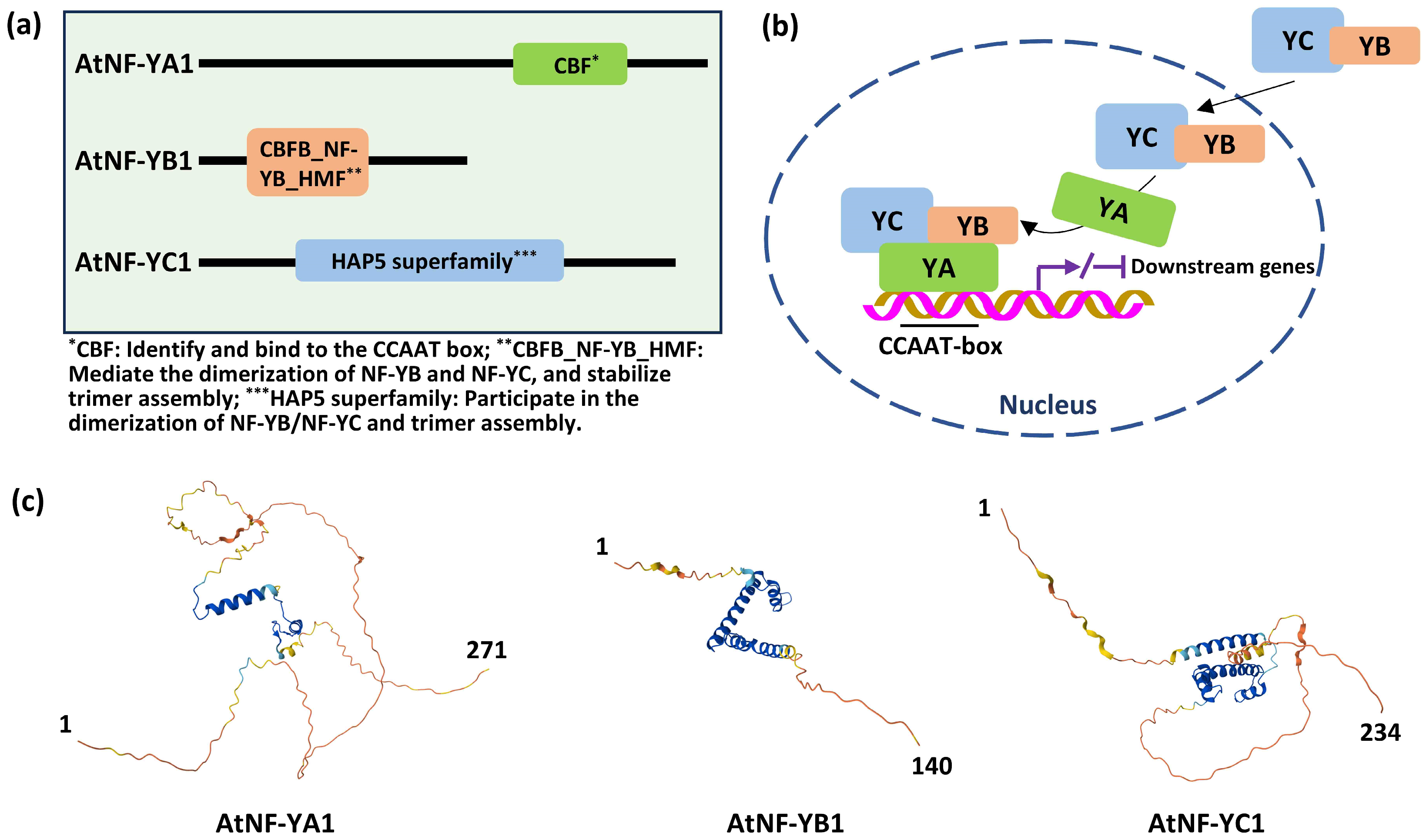
2.2. Structural Features of NF-Y Subunits in Horticultural Plants
3. Molecular Mechanisms of NF-Ys in Horticultural Plant Development
3.1. Phase Transition and Flowering Control
3.2. Early Embryogenesis, Organ Morphogenesis, and Seed Maturation with Storage Compound Accumulation
4. Molecular Mechanisms of NF-Ys in Horticultural Plant Stress Responses
4.1. Drought Stress
4.2. Salt Stress
4.3. Temperature Stress
4.3.1. Heat Stress
4.3.2. Cold Stress
4.4. Other Abiotic and Biotic Stresses
5. Conclusions and Future Directions
Author Contributions
Funding
Data Availability Statement
Conflicts of Interest
References
- Zhang, H.; Liu, S.J.; Ren, T.M.; Niu, M.X.; Liu, X.; Liu, C.; Wang, H.L.; Yin, W.L.; Xia, X.L. Crucial abiotic stress regulatory network of NF-Y transcription factor in plants. Int. J. Mol. Sci. 2023, 24, 4426. [Google Scholar] [CrossRef]
- Kishor, P.B.K.; Ganie, S.A.; Wani, S.H.; Guddimalli, R.; Karumanchi, A.R.; Edupuganti, S.; Naravula, J.; Kumar, V.; Polavarapu, R.; Suravajhala, P.; et al. Nuclear factor-Y (NF-Y): Developmental and stress-responsive roles in the plant lineage. J. Plant Growth Regul. 2023, 42, 2711–2735. [Google Scholar] [CrossRef]
- Wu, H.; Hou, X.; Zhang, C. Nuclear factor-Y transcription factors in crops: Biological roles, regulation, and breeding applications. Plant Commun. 2025, 6, 101530. [Google Scholar] [CrossRef]
- Siefers, N.; Dang, K.K.; Kumimoto, R.W.; Bynum, W.E., IV; Tayrose, G.; Holt, B.F., III. Tissue-specific expression patterns of Arabidopsis NF-Y transcription factors suggest potential for extensive combinatorial complexity. Plant Physiol. 2009, 149, 625–641. [Google Scholar] [CrossRef]
- Hwang, K.; Susila, H.; Nasim, Z.; Jung, J.Y.; Ahn, J.H. Arabidopsis ABF3 and ABF4 transcription factors act with the NF-YC complex to regulate SOC1 expression and mediate drought-accelerated flowering. Mol. Plant 2019, 12, 489–505. [Google Scholar] [CrossRef] [PubMed]
- Zhao, Y.J.; Zhang, Y.Y.; Li, T.J.; Ni, C.Y.; Bai, X.Y.; Lin, R.Z.; Xiao, K. TaNF-YA7-5B, a gene encoding nuclear factor Y (NF-Y) subunit A in Triticum aestivum, confers plant tolerance to PEG-inducing dehydration simulating drought through modulating osmotic stress-associated physiological processes. Plant Physiol. Biochem. 2022, 188, 81–96. [Google Scholar] [CrossRef]
- Liu, R.; Wu, M.; Liu, H.L.; Gao, Y.M.; Chen, J.; Yan, H.W.; Xiang, Y. Genome-wide identification and expression analysis of the NF-Y transcription factor family in Populus. Physiol. Plant. 2020, 171, 309–327. [Google Scholar] [CrossRef]
- Zheng, X.R.; Zhang, H.; Zhang, L.M.; Xu, F.S.; Shi, L.; Wang, S.L.; Hong, J.; Ding, G.D. Identification and comprehensive analysis of the Nuclear Factor-Y family genes reveal their multiple roles in response to nutrient deficiencies in Brassica napus. Int. J. Mol. Sci. 2021, 22, 10354. [Google Scholar] [CrossRef] [PubMed]
- Gyula, P.; Baksa, I.; Tóth, T.; Mohorianu, I.; Dalmay, T.; Szittya, G. Ambient temperature regulates the expression of a small set of sRNAs influencing plant development through NF-YA2 and YUC2. Plant Cell Environ. 2018, 41, 2404–2417. [Google Scholar] [CrossRef] [PubMed]
- Romier, C.; Cocchiarella, F.; Mantovani, R.; Moras, D. The NF-YB/NF-YC structure gives insight into DNA binding and transcription regulation by CCAAT factor NF-Y. J. Biol. Chem. 2003, 278, 1336–1345. [Google Scholar] [CrossRef]
- Nardini, M.; Gnesutta, N.; Donati, G.; Gatta, R.; Forni, C.; Fossati, A.; Vonrhein, C.; Moras, D.; Romier, C.; Bolognesi, M.; et al. Sequence-specific transcription factor NF-Y displays histone-like DNA binding and H2B-like ubiquitination. Cell 2013, 152, 132–143. [Google Scholar] [CrossRef]
- Combier, J.-P.; Frugier, F.; de Billy, F.; Boualem, A.; El-Yahyaoui, F.; Moreau, S.; Vernié, T.; Ott, T.; Gamas, P.; Crespi, M.; et al. MtHAP2-1 is a key transcriptional regulator of symbiotic nodule development regulated by microRNA169 in Medicago truncatula. Genes Dev. 2006, 20, 3084–3088. [Google Scholar] [CrossRef]
- Qu, Y.J.; Wang, Y.P.; Zhu, J.; Zhang, Y.G.; Hou, H.M. Genomic organization, phylogenetic comparison, and differential expression of the Nuclear Factor-Y gene family in apple (Malus domestica). Plants 2021, 10, 16. [Google Scholar] [CrossRef]
- Chen, L.H.; Zhou, Y.; Lai, W.; Hu, L.F.; Jiang, L.W.; Liu, S.Q. In silico identification and expression analysis of Nuclear Factor Y (NF-Y) transcription factors in cucumber. Agronomy 2020, 10, 236. [Google Scholar] [CrossRef]
- Li, S.; Li, K.; Ju, Z.; Cao, D.Y.; Fu, D.Q.; Zhu, H.L.; Zhu, B.Z.; Luo, Y.B. Genome-wide analysis of tomato NF-Y factors and their role in fruit ripening. BMC Genom. 2016, 17, 36. [Google Scholar] [CrossRef] [PubMed]
- Hilioti, Z.; Ganopoulos, I.; Bossis, I.; Tsaftaris, A. LEC1-LIKE paralog transcription factor: How to survive extinction and fit in NF-Y protein complex. Gene 2014, 543, 220–233. [Google Scholar] [CrossRef] [PubMed]
- Li, Y.; Tao, Y.; Bai, A.; Wang, H.; Yu, Z.; Liu, T.; Hou, X.; Li, Y. Genome-wide analysis of the NF-Y gene family in non-heading Chinese cabbage and the involvement of BcNF-YA8 in ABA-mediated flowering regulation. Hortic. Plant J. 2025, 11, 661–679. [Google Scholar] [CrossRef]
- Xuanyuan, G.C.; Lian, Q.; Jia, R.F.; Du, M.R.; Kang, L.R.; Pu, Y.Y.; Zhang, Z.W.; Qi, J.J.; Zhao, J. Genome-wide screening and identification of nuclear Factor-Y family genes and exploration their function on regulating abiotic and biotic stress in potato (Solanum tuberosum L.). Gene 2022, 812, 146089. [Google Scholar] [CrossRef] [PubMed]
- Pan, W.; Li, J.; Du, Y.; Zhao, Y.; Xin, Y.; Wang, S.; Liu, C.; Lin, Z.; Fang, S.; Yang, Y.; et al. Epigenetic silencing of callose synthase by VIL1 promotes bud-growth transition in lily bulbs. Nat. Plants 2023, 9, 1451–1467. [Google Scholar] [CrossRef]
- Rao, S.; Gupta, A.; Bansal, C.; Sorin, C.; Crespi, M.; Mathur, S. A conserved HSF:miR169:NF-YA loop involved in tomato and Arabidopsis heat stress tolerance. Plant J. 2022, 112, 7–26. [Google Scholar] [CrossRef]
- Zhou, Y.; Gao, F.; Zhao, W.; Liu, T.; Wang, M. Genome-wide identification and analysis of the Nuclear Factor Y Gene Family in the woodland strawberry Fragaria vesca. Horticulturae 2024, 10, 755. [Google Scholar] [CrossRef]
- Abd El Moneim, D.; Mansour, H.; Alshegaihi, R.M.; Safhi, F.A.; Alwutayd, K.M.; Alshamrani, R.; Alamri, A.; Felembam, W.; Abuzaid, A.O.; Magdy, M. Evolutionary insights and expression dynamics of the CaNFYB transcription factor gene family in pepper (Capsicum annuum) under salinity stress. Front. Genet. 2023, 14, 1288453. [Google Scholar] [CrossRef] [PubMed]
- Jiang, L.; Ren, Y.; Jiang, Y.; Hu, S.; Wu, J.; Wang, G. Characterization of NF-Y gene family and their expression and interaction analysis in Phalaenopsis orchid. Plant Physiol. Biochem. 2023, 204, 108143. [Google Scholar] [CrossRef]
- Gao, F.; Huang, X.; Segbo, S.; Coulibaly, D.; Wang, R.; Ma, C.; Bai, Y.; Zhou, P.; Tan, W.; Ma, Y.; et al. Identification and functional analysis of transcription factor NF-Y family during flower bud dormancy in Prunus mume. Horticulturae 2022, 8, 1180. [Google Scholar] [CrossRef]
- Yan, H.; Wu, F.; Jiang, G.; Xiao, L.; Li, Z.; Duan, X.; Jiang, Y. Genome-wide identification, characterization and expression analysis of NF-Y gene family in relation to fruit ripening in banana. Postharvest Biol. Technol. 2019, 151, 98–110. [Google Scholar] [CrossRef]
- Jiang, Z.; Wang, Y.; Li, W.; Wang, Y.; Liu, X.; Ou, X.; Su, W.; Song, S.; Chen, R. Genome-wide identification of the NF-Y gene family and their involvement in bolting and flowering in flowering Chinese cabbage. Int. J. Mol. Sci. 2023, 24, 11898. [Google Scholar] [CrossRef] [PubMed]
- Chen, S.X.; Wei, X.J.; Hu, X.L.; Zhang, P.; Chang, K.L.; Zhang, D.Y.; Chen, W.; Tang, D.D.; Tang, Q.; Li, P.W.; et al. Genome-wide analysis of Nuclear Factor-YC genes in the tea plant (Camellia sinensis) and functional identification of CsNF-YC6. Int. J. Mol. Sci. 2024, 25, 836. [Google Scholar] [CrossRef] [PubMed]
- Wang, P.J.; Zheng, Y.C.; Guo, Y.C.; Chen, X.J.; Sun, Y.; Yang, J.F.; Ye, N.X. Identification, expression, and putative target gene analysis of nuclear factor-Y (NF-Y) transcription factors in tea plant (Camellia sinensis). Planta 2019, 250, 1671–1686. [Google Scholar] [CrossRef]
- Wang, X.; Xu, K.; Li, N.; Zhan, X.; Gao, S.; Yin, Y.; Yuan, W.; Chen, W.; Yao, M.; Wang, F. Identification of a nuclear transcription factor-Y (NF-Y) gene family in pepper and analysis of a CaNF-YC1-CaTIFY7-CaCBF1a/b transcription factor module under cold stress. Plant Physiol. Biochem. 2025, 229, 110517. [Google Scholar] [CrossRef]
- Hu, R.Q.; Yin, M.R.; Song, A.P.; Guan, Z.Y.; Fang, W.M.; Chen, F.D.; Jiang, J.F. Genome-wide identification and analysis of NF-Y gene family reveal its potential roles in stress-resistance in Chrysanthemum. Horticulturae 2023, 9, 70. [Google Scholar] [CrossRef]
- Jiang, S.; Wang, H.; Wen, Y.; Liang, J.; Li, D.; Song, F. The NF-Y transcription factor family in watermelon: Re-characterization, assembly of ClNF-Y complexes, hormone- and pathogen-inducible expression and putative functions in disease resistance. Int. J. Mol. Sci. 2022, 23, 15778. [Google Scholar] [CrossRef]
- Yang, J.; Zhu, J.H.; Yang, Y.X. Genome-wide identification and expression analysis of NF-Y transcription factor families in watermelon (Citrullus lanatus). J. Plant Growth Regul. 2017, 36, 590–607. [Google Scholar] [CrossRef]
- Feng, Q.; Xiao, L.; Wang, J.; Wang, J.; Chen, C.; Sun, J.; Wu, X.; Liu, M.; Zhang, X.; Tian, S.; et al. Genome-wide analysis of Nuclear Factor Y genes and functional investigation of watermelon ClNF-YB9 during seed development. Crop J. 2023, 11, 1469–1479. [Google Scholar] [CrossRef]
- Mai, Y.; Shui, L.; Huo, K.; Niu, J. Genome-wide characterization of the NUCLEAR FACTOR-Y (NF-Y) family in Citrus grandis identified CgNF-YB9 involved in the fructose and glucose accumulation. Genes Genom. 2019, 41, 1341–1355. [Google Scholar] [CrossRef]
- Pereira, S.L.S.; Martins, C.P.S.; Sousa, A.O.; Camillo, L.R.; Araújo, C.P.; Alcantara, G.M.; Camargo, D.S.; Cidade, L.C.; de Almeida, A.A.F.; Costa, M.G.C. Genome-wide characterization and expression analysis of citrus NUCLEAR FACTOR-Y (NF-Y) transcription factors identified a novel NF-YA gene involved in drought-stress response and tolerance. PLoS ONE 2018, 13, e0199187. [Google Scholar] [CrossRef]
- Li, M.; Du, Q.; Li, J.; Wang, H.; Xiao, H.; Wang, J. Genome-wide identification and chilling stress analysis of the NF-Y gene family in melon. Int. J. Mol. Sci. 2023, 24, 6934. [Google Scholar] [CrossRef] [PubMed]
- Wang, L.Y.; Zhao, X.W.; Zheng, R.Y.; Huang, Y.; Zhang, C.L.; Zhang, M.M.; Lan, S.R.; Liu, Z.J. Genome-wide identification and drought stress response pattern of the NF-Y gene family in Cymbidium sinense. Int. J. Mol. Sci. 2024, 25, 3031. [Google Scholar] [CrossRef]
- Wang, T.F.; Zou, H.L.; Ren, S.X.; Jin, B.; Lu, Z.G. Genome-wide identification, characterization, and expression analysis of NF-Y gene family in Ginkgo biloba seedlings and GbNF-YA6 involved in heat-stress response and tolerance. Int. J. Mol. Sci. 2023, 24, 12284. [Google Scholar] [CrossRef]
- Liu, M.M.; Pan, Z.X.; Yu, J.; Zhu, L.; Zhao, M.Z.; Wang, Y.F.; Chen, P.; Liu, C.; Hu, J.; Liu, T.; et al. Transcriptome-wide characterization, evolutionary analysis, and expression pattern analysis of the NF-Y transcription factor gene family and salt stress response in Panax ginseng. BMC Plant Biol. 2022, 22, 320. [Google Scholar] [CrossRef]
- Wei, Q.; Wen, S.Y.; Lan, C.Y.; Yu, Y.X.; Chen, G.J. Genome-wide identification and expression profile analysis of the NF-Y transcription factor gene family in Petunia hybrida. Plants 2020, 9, 336. [Google Scholar] [CrossRef] [PubMed]
- Wu, J.; He, Y.; Wang, L.; Zhao, H.; Jiang, N.; Wuyun, T.; Liu, H. Genome-wide identification and expression analysis of the NF-Y transcription factor family in Prunus armeniaca. Forests 2024, 15, 1986. [Google Scholar] [CrossRef]
- Yang, J.; Wan, X.L.; Guo, C.; Zhang, J.W.; Bao, M.Z. Identification and expression analysis of nuclear factor Y families in Prunus mume under different abiotic stresses. Biol. Plant. 2016, 60, 419–426. [Google Scholar] [CrossRef]
- Li, M.; Li, G.; Liu, W.; Dong, X.; Zhang, A. Genome-wide analysis of the NF-Y gene family in peach (Prunus persica L.). BMC Genom. 2019, 20, 612. [Google Scholar] [CrossRef] [PubMed]
- Hu, S.S.; Wang, F.; Feng, Y.B.; Zhong, P.H.; Han, R.D.; Li, G.B.; Hu, X.H. Genome-wide identification of SlNF-YA genes and functional characterization of SlNF-YA10a of tomato under saline-alkali stress. Sci. Hortic. 2024, 338, 113761. [Google Scholar] [CrossRef]
- Liu, Z.; Li, Y.M.; Zhu, J.Y.; Ma, W.J.; Li, Z.T.; Bi, Z.Z.; Sun, C.; Bai, J.P.; Zhang, J.L.; Liu, Y.H. Genome-wide identification and analysis of the NF-Y Gene family in potato (Solanum tuberosum L.). Front. Genet. 2021, 12, 739989. [Google Scholar] [CrossRef]
- Xu, X.Y.; Su, H.; Sun, S.W.; Sun, J.; Zhang, X.; Yu, J.J. Genome-wide identification and expression profiles of Nuclear Factor Y A transcription factors in blueberry under abiotic stress. Int. J. Mol. Sci. 2024, 25, 12832. [Google Scholar] [CrossRef]
- Ren, C.; Zhang, Z.; Wang, Y.; Li, S.H.; Liang, Z.C. Genome-wide identification and characterization of the NF-Y gene family in grape (Vitis vinifera L.). BMC Genom. 2016, 17, 605. [Google Scholar] [CrossRef]
- Li, H.L.; Wu, X.L.; Gong, M.; Xia, M.Q.; Zhang, W.L.; Chen, Z.D.; Xing, H.T. Genome-wide investigation of the nuclear factor Y gene family in ginger (Zingiber officinale Roscoe): Evolution and expression profiling during development and abiotic stresses. BMC Genom. 2024, 25, 820. [Google Scholar] [CrossRef]
- Panzade, K.P.; Kale, S.S.; Manoj, M.L.; Kothawale, S.P.; Damse, D.N. Genome-wide analysis and expression profile of Nuclear Factor Y (NF-Y) gene family in Z. jujuba. Appl. Biochem. Biotechnol. 2022, 194, 1373–1389. [Google Scholar] [CrossRef] [PubMed]
- Kahle, J.; Baake, M.; Doenecke, D.; Albig, W. Subunits of the heterotrimeric transcription factor NF-Y are imported into the nucleus by distinct pathways involving importin β and importin 13. Mol. Cell. Biol. 2005, 25, 5339–5354. [Google Scholar] [CrossRef]
- Chaves-Sanjuan, A.; Gnesutta, N.; Gobbini, A.; Martignago, D.; Bernardini, A.; Fornara, F.; Mantovani, R.; Nardini, M. Structural determinants for NF-Y subunit organization and NF-Y/DNA association in plants. Plant J. 2021, 105, 49–61. [Google Scholar] [CrossRef] [PubMed]
- Jumper, J.; Evans, R.; Pritzel, A.; Green, T.; Figurnov, M.; Ronneberger, O.; Tunyasuvunakool, K.; Bates, R.; Žídek, A.; Potapenko, A.; et al. Highly accurate protein structure prediction with AlphaFold. Nature 2021, 596, 583–589. [Google Scholar] [CrossRef]
- Varadi, M.; Bertoni, D.; Magana, P.; Paramval, U.; Pidruchna, I.; Radhakrishnan, M.; Tsenkov, M.; Nair, S.; Mirdita, M.; Yeo, J.; et al. AlphaFold Protein Structure Database in 2024: Providing structure coverage for over 214 million protein sequences. Nucleic Acids Res. 2024, 52, D368–D375. [Google Scholar] [CrossRef] [PubMed]
- Zhang, D.; Ji, K.; Wang, J.; Liu, X.; Zhou, Z.; Huang, R.; Ai, G.; Li, Y.; Wang, X.; Wang, T.; et al. Nuclear factor Y-A3b binds to the SINGLE FLOWER TRUSS promoter and regulates flowering time in tomato. Hortic. Res. 2024, 11, uhae088. [Google Scholar] [CrossRef]
- Gao, C.; Wei, P.; Xie, Z.; Zhang, P.; Tahir, M.M.; Toktonazarovich, T.K.; Shen, Y.; Zuo, X.; Mao, J.; Zhang, D.; et al. Genomic identification of the NF-Y gene family in apple and functional analysis of MdNF-YB18 involved in flowering transition. Mol. Breed. 2024, 45, 4. [Google Scholar] [CrossRef] [PubMed]
- Yang, Y.J.; Mei, Y.L.; Li, X.P.; Wang, R.; Ma, C.H.; Song, J.K.; Cui, Z.H.; Liu, J.L.; Zhou, X.Z.; Li, D.L. Nuclear factor NF-YA4a regulates salt stress tolerance and juvenile-adult phase transition in Pyrus. Hortic. Environ. Biotechnol. 2025, 66, 137–148. [Google Scholar] [CrossRef]
- Gao, X.; Liu, L.; Wang, T.; Jiang, C.; Xue, Y.; Sun, Y.; Gu, Z.; Xu, Y.; Jiang, C.Z.; Gao, J.; et al. Aging-dependent temporal regulation of MIR156 epigenetic silencing by CiLDL1 and CiNF-YB8 in chrysanthemum. New Phytol. 2025, 245, 2309–2321. [Google Scholar] [CrossRef]
- Petrou, N.; Tsigarida, N.; Hilioti, Z. Genome editing of the NF-YA8 gene modifies tomato plant architecture and fruit traits. Plants 2025, 14, 1826. [Google Scholar] [CrossRef]
- Bin, J.; Tan, Q.; Wen, S.; Huang, L.; Wang, H.; Imtiaz, M.; Zhang, Z.; Guo, H.; Xie, L.; Zeng, R.; et al. Comprehensive analyses of four PhNF-YC genes from Petunia hybrida and impacts on flowering time. Plants 2024, 13, 742. [Google Scholar] [CrossRef]
- Zhang, F.; Cheng, G.; Shu, X.; Wang, N.; Wang, Z. Transcriptome analysis of Lycoris chinensis bulbs reveals flowering in the age-mediated pathway. Biomolecules 2022, 12, 899. [Google Scholar] [CrossRef]
- Yuan, X.; Quan, S.; Liu, J.; Guo, C.; Zhang, Z.; Kang, C.; Niu, J. Evolution of the PEBP gene family in Juglandaceae and their regulation of flowering pathway under the synergistic effect of JrCO and JrNF-Y proteins. Int. J. Biol. Macromol. 2022, 223, 202–212. [Google Scholar] [CrossRef]
- Gao, J.; Ni, X.; Li, H.; Hayat, F.; Shi, T.; Gao, Z. miR169 and PmRGL2 synergistically regulate the NF-Y complex to activate dormancy release in Japanese apricot (Prunus mume Sieb. et Zucc.). Plant Mol. Biol. 2021, 105, 83–97. [Google Scholar] [CrossRef]
- Sri, T.; Gupta, B.; Tyagi, S.; Singh, A. Homeologs of Brassica SOC1, a central regulator of flowering time, are differentially regulated due to partitioning of evolutionarily conserved transcription factor binding sites in promoters. Mol. Phylogenet. Evol. 2020, 147, 106777. [Google Scholar] [CrossRef]
- Wei, Q.; Ma, C.; Xu, Y.J.; Wang, T.L.; Chen, Y.Y.; Lü, J.; Zhang, L.L.; Jiang, C.Z.; Hong, B.; Gao, J.P. Control of chrysanthemum flowering through integration with an aging pathway. Nat. Commun. 2017, 8, 829. [Google Scholar] [CrossRef]
- Xie, Y.; Hou, Z.; Shi, M.; Wang, Q.; Yang, Z.; Lim, K.J.; Wang, Z. Transcriptional regulation of female and male flower bud initiation and development in pecan (Carya illinoensis). Plants 2023, 12, 1378. [Google Scholar] [CrossRef]
- Chen, C.; Hussain, N.; Wang, Y.; Li, M.; Liu, L.; Qin, M.; Ma, N.; Gao, J.; Sun, X. An ethylene-inhibited NF-YC transcription factor RhNF-YC9 regulates petal expansion in rose. Hortic. Plant J. 2020, 6, 419–427. [Google Scholar] [CrossRef]
- Koidou, V.; Valasiadis, D.; Petrou, N.; Emmanouilidou, C.; Hilioti, Z. Comparative transcriptome analysis in tomato fruit reveals genes, pathways, and processes affected by the LEC1-LIKE4 transcription factor. Int. J. Mol. Sci. 2025, 26, 6728. [Google Scholar] [CrossRef] [PubMed]
- Ke, X.; Shen, J.; Niu, Y.; Zhao, H.; Guo, Y.; Sun, P.; Yang, T.; Jiang, Y.; Zhao, B.; Wang, Z.; et al. Cucumber NUCLEAR FACTOR-YC2/-YC9 target translocon component CsTIC21 in chloroplast photomorphogenesis. Plant Physiol. 2023, 192, 2822–2837. [Google Scholar] [CrossRef] [PubMed]
- Wang, X.; Wei, H.; Zhang, N.; Li, S.G.; Si, H.J. StNF-YA8-YB20-YC5 module regulates potato tuber dormancy by modulating gibberellin and abscisic acid pathways. Plant J. 2025, 121, e70106. [Google Scholar] [CrossRef]
- Parreira, J.R.; Cappuccio, M.; Balestrazzi, A.; Fevereiro, P.; Araujo, S.S. MicroRNAs expression dynamics reveal post-transcriptional mechanisms regulating seed development in Phaseolus vulgaris L. Hortic. Res. 2021, 8, 18. [Google Scholar] [CrossRef]
- Tanvir, R.; Wang, L.; Zhang, A.; Li, L. Orphan genes in crop improvement: Enhancing potato tuber protein without impacting yield. Plants 2022, 11, 3076. [Google Scholar] [CrossRef]
- Deng, S.; Wang, R.; Tao, C.; Li, L.; Wang, S.; Jia, C.; Liu, Y.; Du, R.; Du, L.; Yang, J. Genome-wide analysis of CtNF-YB and lipid synthesis regulation of CtNF-YB12 in Carthamus tinctorius L. Plant Cell Rep. 2023, 42, 57–72. [Google Scholar] [CrossRef] [PubMed]
- Zheng, T.; Lv, J.; Sadeghnezhad, E.; Cheng, J.; Jia, H. Transcriptomic and metabolomic profiling of strawberry during postharvest cooling and heat storage. Front. Plant Sci. 2022, 13, 1009747. [Google Scholar] [CrossRef] [PubMed]
- Wang, P.; Ran, S.; Xu, Y.; Mo, F.; Li, F.; Lv, R.; Meng, F.; Zhang, H.; Zou, Y.; Yu, L.; et al. Comprehensive metabolome and transcriptome analyses shed light on the regulation of SlNF-YA3b in carotenoid biosynthesis in tomato fruit. Postharvest Biol. Technol. 2025, 219, 113263. [Google Scholar] [CrossRef]
- Wang, J.; Li, G.; Li, C.; Zhang, C.; Cui, L.; Ai, G.; Wang, X.; Zheng, F.; Zhang, D.; Larkin, R.M.; et al. NF-Y plays essential roles in flavonoid biosynthesis by modulating histone modifications in tomato. New Phytol. 2021, 229, 3237–3252. [Google Scholar] [CrossRef]
- Gao, X.; Song, C.; Tian, J.; Gong, J.; Yuan, P.; Zhang, K.; Jiao, J.; Wang, M.; Hao, P.; Zheng, X.; et al. The MhNF-YA3-like-MhMSI4-like module regulates apple drought tolerance by activating the expression of MhAAO3. Plant Physiol. 2025, 199, kiaf584. [Google Scholar] [CrossRef]
- Wang, T.L.; Wei, Q.; Wang, Z.L.; Liu, W.W.; Zhao, X.; Ma, C.; Gao, J.P.; Xu, Y.J.; Hong, B. CmNF-YB8 affects drought resistance in chrysanthemum by altering stomatal status and leaf cuticle thickness. J. Integr. Plant Biol. 2022, 64, 741–755. [Google Scholar] [CrossRef]
- Zhou, H.; Zeng, R.F.; Liu, T.J.; Ai, X.Y.; Ren, M.K.; Zhou, J.J.; Hu, C.G.; Zhang, J.Z. Drought and low temperature-induced NF-YA1 activates FT expression to promote citrus flowering. Plant Cell Environ. 2022, 45, 3505–3522. [Google Scholar] [CrossRef]
- Palmeros-Suárez, P.A.; Massange-Sánchez, J.A.; Martínez-Gallardo, N.A.; Montero-Vargas, J.M.; Gómez-Leyva, J.F.; Délano-Frier, J.P. The overexpression of an Amaranthus hypochondriacus NF-YC gene modifies growth and confers water deficit stress resistance in Arabidopsis. Plant Sci. 2015, 240, 25–40. [Google Scholar] [CrossRef]
- Yan, J.H.; Song, J.F.; Lv, J.X.; Sun, B.Z.; Chen, B.; Zhang, W.W.; Yang, H.Q. MhNF-YA2 modulates drought tolerance by triggering MhHSP70-3 expression in Malus hupehensis. Physiol. Plant. 2025, 177, e70202. [Google Scholar] [CrossRef]
- Lu, S.X.; Zhou, X.T.; Huang, X.; Zeng, B.Z.; Gou, H.M.; Ma, W.F.; Ma, Z.H.; Mao, J.; Chen, B.H. Comparative analysis of the NF-Y transcription factor family identifies VaNF-YA6 as a positive regulator of salt and drought tolerance in grapevine. Plant Stress 2024, 14, 100658. [Google Scholar] [CrossRef]
- Pahal, S.; Srivastava, H.; Saxena, S.; Tribhuvan, K.U.; Kaila, T.; Sharma, S.; Grewal, S.; Singh, N.K.; Gaikwad, K. Comparative transcriptome analysis of two contrasting genotypes provides new insights into the drought response mechanism in pigeon pea (Cajanus cajan L. Millsp.). Genes Genom. 2024, 46, 65–94. [Google Scholar] [CrossRef]
- Lei, Z.; Zhang, X.; Wang, M.; Mao, J.; Hu, X.; Lin, Y.; Xiong, X.; Qin, Y. Silencing of miR169a improves drought stress by enhancing vascular architecture, ROS scavenging, and photosynthesis of Solanum tuberosum L. Front. Plant Sci. 2025, 16, 1553135. [Google Scholar] [CrossRef]
- Azeez, B.S.; Kim, D.Y.; Na, J.K. Transcriptome dataset for comparative analysis of differentially expressed genes between wild type and transgenic potato plants overexpressing Nuclear Factor Y subunit A7. Data Brief 2024, 54, 110349. [Google Scholar] [CrossRef]
- Na, J.K.; Kim, K.H.; Seong, E.S.; Kim, B.G.; Cho, K.S.; Cho, J.H.; Park, S.K.; Kim, D.Y. Overexpression of Nuclear Factor Y subunit StNF-YA7 enhances drought tolerance in potato. Hortic. Environ. Biotechnol. 2017, 58, 170–177. [Google Scholar] [CrossRef]
- van Muijen, D.; Anithakumari, A.M.; Maliepaard, C.; Visser, R.G.F.; van der Linden, C.G. Systems genetics reveals key genetic elements of drought induced gene regulation in diploid potato. Plant Cell Environ. 2016, 39, 1895–1908. [Google Scholar] [CrossRef] [PubMed]
- Li, S.G.; Zhang, N.; Zhu, X.; Ma, R.; Liu, S.Y.; Wang, X.; Yang, J.W.; Si, H.J. Genome-wide analysis of NF-Y genes in potato and functional identification of StNF-YC9 in drought tolerance. Front. Plant Sci. 2021, 12, 749688. [Google Scholar] [CrossRef] [PubMed]
- Wang, J.; Zhang, Y.; Wang, J.; Ma, F.; Wang, L.; Zhan, X.; Li, G.; Hu, S.; Khan, A.; Dang, H.; et al. Promoting γ-aminobutyric acid accumulation to enhances saline-alkali tolerance in tomato. Plant Physiol. 2024, 196, 2089–2104. [Google Scholar] [CrossRef] [PubMed]
- Sun, X.C.; Xu, L.; Wang, Y.; Yu, R.G.; Zhu, X.W.; Luo, X.B.; Gong, Y.Q.; Wang, R.G.; Limera, C.; Zhang, K.Y.; et al. Identification of novel and salt-responsive miRNAs to explore miRNA-mediated regulatory network of salt stress response in radish (Raphanus sativus L.). BMC Genom. 2015, 16, 197. [Google Scholar] [CrossRef]
- Yu, B.; Liang, Y.; Qin, Q.; Zhao, Y.; Yang, C.; Liu, R.; Gan, Y.; Zhou, H.; Qiu, Z.; Chen, L.; et al. Transcription cofactor CsMBF1c enhances heat tolerance of cucumber and interacts with heat-related proteins CsNFYA1 and CsDREB2. J. Agric. Food. Chem. 2024, 72, 15586–15600. [Google Scholar] [CrossRef]
- Moradpour, M.; Abdullah, S.N.A.; Namasivayam, P. The impact of heat stress on morpho-physiological response and expression of specific genes in the heat stress-responsive transcriptional regulatory network in Brassica oleracea. Plants 2021, 10, 1064. [Google Scholar] [CrossRef]
- Chen, W.; Hu, T.; Ye, J.; Wang, B.; Liu, G.; Wang, Y.; Yuan, L.; Li, J.; Li, F.; Ye, Z.; et al. A CCAAT-binding factor, SlNFYA10, negatively regulates ascorbate accumulation by modulating the D-mannose/L-galactose pathway in tomato. Hortic. Res. 2020, 7, 200. [Google Scholar] [CrossRef] [PubMed]
- Dong, B.; Meng, D.; Song, Z.; Cao, H.; Du, T.; Qi, M.; Wang, S.; Xue, J.; Yang, Q.; Fu, Y. CcNFYB3-CcMATE35 and LncRNA CcLTCS-CcCS modules jointly regulate the efflux and synthesis of citrate to enhance aluminium tolerance in pigeon pea. Plant Biotechnol. J. 2024, 22, 181–199. [Google Scholar] [CrossRef] [PubMed]
- Leitao, S.T.; Mendes, F.A.; Rubiales, D.; Vaz Patto, M.C. Oligogenic control of quantitative resistance against powdery mildew revealed in Portuguese common bean germplasm. Plant Dis. 2023, 107, 3113–3122. [Google Scholar] [CrossRef] [PubMed]
- Su, H.; Zhang, X.; He, Y.; Li, L.; Wang, Y.; Hong, G.; Xu, P. Transcriptomic analysis reveals the molecular adaptation of three major secondary metabolic pathways to multiple macronutrient starvation in tea (Camellia sinensis). Genes 2020, 11, 241. [Google Scholar] [CrossRef]
- Zhang, M.; Dong, C. Molecular mechanisms of cadmium stress resistance in vegetable crops. Int. J. Mol. Sci. 2025, 26, 5812. [Google Scholar] [CrossRef]
- Raza, A.; Bhardwaj, S.; Anas, M.; Su, W.; Abbas, S.; Li, Y.; Guo, C.; Corpas, F.J.; Hu, Z. Role of plant peroxisomal catalase in temperature and drought stress: Physio-biochemical and molecular perspectives. Plant Physiol. Biochem. 2025, 229, 110730. [Google Scholar] [CrossRef]



| Plant Species | Subunit Gene Numbers | Chromosome Distribution Characteristics | Key Functional Roles Studied | Ref(s). |
|---|---|---|---|---|
| Brassica campestris (Flowering Chinese cabbage) | A *: 17, B: 20, C: 12 | Uneven; 10 genes on chr * A09, only 1 on chr A04 | Bolting and flowering | [26] |
| Brassica campestris (Non-heading Chinese cabbage) | A: 20, B: 24, C: 13 | Random on 10 chrs; max (10) on chr9, min (1) on chr4 | Flowering | [17] |
| Camellia sinensis (Tea plant) | C: 9 | Located on 9 different chrs | Growth, development, abiotic stress | [27] |
| Camellia sinensis (Tea plant) | A: 10, B: 15, C: 10 | N/A | Drought stress, ABA signaling, photosynthesis | [28] |
| Capsicum annuum (Pepper) | B: 19 | On 7 of 12 chrs; tandem duplication on chr7 | Salt stress | [22] |
| Capsicum annuum (Pepper) | A: 10, B: 12, C: 9 | Distributed across 12 chrs | Cold stress | [29] |
| Chrysanthemum seticuspe (Chrysanthemum) | A: 8, B: 21, C: 17 | Uneven; absent on CsG_LG3 *; concentrated on CsG_LG1, CsG_LG5, CsG_LG8 | Drought stress, growth | [30] |
| Citrullus lanatus (Watermelon) | A: 7; B: 10; C: 8 [31] A: 7; B: 8; C: 4 [32] A: 7; B: 10; C: 5 [33] | Uneven on 9–10 chrs; often absent on chr5; more genes on chr2, 10 | Abiotic/biotic stress, phytohormone response, growth, seed development | [31,32,33] |
| Citrus grandis (Pummelo) | A: 6, B: 13, C: 5 | 1–5 genes per chr | Sucrose metabolism | [34] |
| Citrus sinensis (Sweet orange) | A: 6, B: 11, C: 5 | On all chrs except chr8; segmental and tandem duplications identified | Drought stress, development | [35] |
| Cucumis melo (Melon) | A: 6, B: 11, C: 8 | Unevenly distributed on 10 chrs | Growth, fruit ripening, cold stress | [36] |
| Cucumis sativus (Cucumber) | A: 7, B: 13, C: 7 | On all chrs except chr2; max (7 each) on chr3, 6 | Fruit development, drought and salt stress | [14] |
| Cymbidium sinense (Cymbidium) | A: 5, B: 9, C: 13 | Uneven on 13 chrs; max (5) on chr9, min (1) on chr3, 4, 6, 17 | Drought stress | [37] |
| Fragaria vesca (Woodland strawberry) | A: 6, B: 12, C: 5 | Uneven on 7 chrs; max on Fvb3 (7), Fvb6 (6); segmental duplication events | Phylogeny, expression profiles, subcellular localization | [21] |
| Ginkgo biloba (Ginkgo) | A: 7, B: 12, C: 6 | Random on 11 chrs; none on chr4; segmental duplications | Heat stress | [38] |
| Malus domestica (Apple) | A: 11, B: 22, C: 10 | Uneven on 16 chrs (except chr08); 1–4 genes/chr; concentrated on termini of chr03, 04, 05, 10, 11 | Growth, abiotic stress | [13] |
| Musa acuminata (Banana) | A: 14, B: 16, C: 14 | Uneven on 11 chrs & 1 scaffold; max on chr4/8; expansion via WGD | Fruit ripening regulation | [25] |
| Panax ginseng (Ginseng) | A: 13, B: 14, C: 13 | N/A | Phylogeny, expression, salt stress | [39] |
| Petunia hybrida (Petunia) | A: 10, B: 13, C: 4 | N/A | Tissue expression, abiotic stress | [40] |
| Phalaenopsis sp. (Butterfly orchid) | A: 4, B: 9, C: 11 | Segmental and tandem duplication events | Flowering, cold stress, ABA response | [23] |
| Prunus armeniaca (Apricot) | A: 6, B: 15, C: 7 | Uneven on 8 chrs; max on chr4 (8), chr6 (7) | Oil biosynthesis in kernels | [41] |
| Prunus mume (Japanese apricot) | A: 5, B: 13, C: 9 | Distributed on 8 chrs; max on Chr01, Chr03 (25.92% each), min on Chr06 (3.70%) | Flower bud dormancy, phytohormone response, cold stress | [24] |
| Prunus mume (Plum blossom) | A: 6, B: 13, C: 8 | N/A | Abiotic stress | [42] |
| Prunus persica (Peach) | A: 6, B: 12, C: 6 | On all 8 chrs; max (8) on chr4, min (1) on chr8 | Drought stress, tissue expression, evolutionary relationships | [43] |
| Solanum lycopersicum (Tomato) | A: 10 | Uneven across 7 of 12 chrs (e.g., Chr01:3 genes) | Saline-alkali and drought stress | [44] |
| Solanum lycopersicum (Tomato) | A: 10, B: 29, C: 20 | 57 genes on 12 chrs; max NF-YB on chr5 (7), max NF-YC on chr3 (6); no NF-YA on chr4–7, 9 | Flowering time, embryogenesis, seed maturation, and fruit development | [15,16] |
| Solanum tuberosum (Potato) | A: 11; B: 20; C: 6 [18] A: 10; B: 22; C: 9 [45] | Uneven on 12 chrs; max (7 each) on chr1,5; min (1) on chr8; high density on proximal chr1 and distal chr5 | Development, abiotic/biotic stress, anthocyanin biosynthesis | [18,45] |
| Vaccinium corymbosum (Blueberry) | A: 24 | Distributed on multiple scaffolds (e.g., S4, S9, S11, S17, S19, S20) | Abiotic stress, tissue expression | [46] |
| Vitis vinifera (Grape) | A: 8, B: 18, C: 8 | 32 genes on 14 chrs; uneven; max (5 genes each) on chr6, 19 | Abiotic/biotic stress, hormone signaling, sugar metabolism, development | [47] |
| Zingiber officinale (Ginger) | A: 10, B: 16, C: 10 | Uneven on 11 chrs; high density on chr06, 11; none on chr01 | Rhizome and flower development, abiotic stress | [48] |
| Ziziphus jujuba (Jujube) | A: 8, B: 15, C: 9 | 27 genes on 11 chrs (except chr6), 5 genes on unplaced scaffolds | Abiotic stress, development | [49] |
| Plant Species | NF-Y Gene | Expression Pattern | Molecular Regulatory Mechanisms | Phenotypic Effect | Ref. |
|---|---|---|---|---|---|
| Pyrus bretschneideri (Chinese white pear) | NF-YA4a | ↑ * during ontogeny, peaks in adult phase; higher in adult vs. juvenile tissues | → * flowering transition pathway activation | ↑ flowering in transgenic Arabidopsis | [56] |
| Brassica campestris (Non-heading Chinese cabbage) | BcNF-YA8 | ↑ in roots; ↑ under ABA | → BcFT ↑; interacts with BcMAX2 * → BcBRC1 ↑; ↓ AsA * accumulation | ↑ flowering in overexpression lines; ↓ * flowering in silenced lines | [17] |
| Chrysanthemum indicum (Wild chrysanthemum) | CiNF-YB8 | ↓ during plant aging | Forms heterotrimer → binds CCAAT box → cin-MIR156ab ↑ | ↑ vegetative transition & ↑ flowering | [57] |
| Solanum lycopersicum (Tomato) | SlNF-YA3b | ↓ in flower buds/flowers | Binds CCAAT motif of SFT promoter → SFT ↓ | ↑ flowering in knockout lines | [54] |
| Solanum lycopersicum (Tomato) | SlNF-YA8 | Expressed in seedlings, stems, inflorescences, and fruits; ↓ in floral buds of early-flowering mutants | ZFN-mediated disruption of DNA-binding domain regulates flowering time-related genes (e.g., FT homologs) | 15% of mutant lines show early flowering; altered inflorescence architecture (increased florets per inflorescence) | [58] |
| Malus domestica (Apple) | MdNF-YB18 | Higher in ‘Qinguan’; peaks at MS * stage | Interacts with MdNF-YC3/7 → binds MdFT1 promoter → MdFT1↑; interacts with MdCOLs * | ↑ flowering in transgenic Arabidopsis | [55] |
| Petunia hybrida (Petunia) | PhNF-YC2 | ↑ in apical buds/leaves before flowering | → PhCO/PhGI/PhFBP21/PhGA20ox4/PhSPL9b * ↓ | ↓ flowering & ↓ chlorophyll content | [59] |
| Petunia hybrida (Petunia) | PhNF-YC4 | ↑ in roots/leaves/buds before flowering | → PhCO/PhGI/PhFBP21/PhGA20ox4/PhSPL9b↓ | ↓ flowering | [59] |
| Lycoris chinensis (Lycoris) | NF-YB3(c105794g3) | ↑ in flowering bulbs (P5) | → FT/SOC1 * ↑ | Putative ↑ floral transition | [60] |
| Juglans regia (Walnut) | JrNF-YB4/Y6/YC1/YC3/YC7 | ↑ in leaf/female flower buds (FB-4) | Bind JrFT promoter → JrFT ↑; JrCO-JrNF-YB-JrNF-YC complex → JrFT transcription ↑ | ↑ female flower differentiation and flowering | [61] |
| Prunus mume (Japanese apricot) | PmNF-YA3/YB3/YC1 | ↓ during dormancy; ↑ during release | miR169 → PmNF-YA3 ↓; GA4 → PmRGL2 * ↓ → NF-Y complex activation | ↑ bud sprouting | [62] |
| Brassica juncea (Chinese mustard) | BjuNF-Y | ↑ in LF/MF2 subgenomes during floral transition | NF-Y-CO complex → SOC1 ↑ | Altered flowering time | [63] |
| Chrysanthemum seticuspe (Chrysanthemum) | CmNF-YB8 | ↓ during development | Binds cmo-MIR156 promoter → cmo-MIR156 ↑ → SPL3/5/9 ↓ | ↑ flowering under LD/SD * | [64] |
| Carya illinoensis (Pecan) | NF-YA1 | ↑ in early male bud development | → vegetative-to-reproductive transition↑ | Facilitates ↑ male flower bud differentiation and development | [65] |
| Lilium spp. (Lily) | LoNFYA7 | ↑ in dormant central buds; ↓ in growth-transited bulbs | LoNFYA7-LoVIL1-PRC2 complex → LoCALS3 ↓ (via H3K27me3) → LoFT1↑ | ↑ central bud growth | [19] |
| Brassica campestris (Flowering Chinese cabbage) | BcNF-YA8/YB14/YB20/YC5 | ↑ during stalk development/flowering | Interacts with BcRGA1 * → GA signaling regulation | Potential regulators of ↑ bolting/flowering | [26] |
| Phalaenopsis sp. (Butterfly orchid) | PhNF-YA1/YA3/YB6/YC7 | ↑ in vegetative/inflorescence buds; ↑ under low-temperature | Complex → PhFT3 ↑ & PhSVP * ↓ | ↑ floral transition | [23] |
| Rosa hybrida (Rose) | RhNF-YC9 | ↑ Early flower opening (peaked at stage 2), then declined; ↓ by ethylene | ↑ RhGA20ox/↓ RhGA2ox & ↑ 11 cell expansion genes | Silencing: ↓ petal ^a expansion, size & AbsE * cell size | [66] |
| Plant Species | NF-Y Gene | Expression Pattern | Molecular Regulatory Mechanisms | Phenotypic Effect | Ref. |
|---|---|---|---|---|---|
| Prunus armeniaca (Apricot) | PaNF-YA2/YA6 | ↑ * in kernels across stages | Positively correlated with oil content; → fatty acid metabolism and oil accumulation | ↑ oil biosynthesis in kernels | [41] |
| Prunus armeniaca (Apricot) | PaNF-YB4 | ↑ in kernels | Homologous to AtLEC1 *; → * ↑ fatty acid synthesis genes | ↑ oil content in kernels | [41] |
| Musa acuminata (Banana) | MaNF-YA5/YB1/YB2/YC9/YC11/YC14 | ↑ during ripening; ethylene ↑, 1-MCP ↓ * | Form heterotrimers to act as transcriptional activators; → ethylene signaling | ↑ fruit ripening (e.g., peel color change) | [25] |
| Musa acuminata (Banana) | MaNF-YA1/YA3/YA6/YB3/YB6/YC2/YC5 | ↓ during ripening; ethylene ↓, 1-MCP ↑ | Function as transcriptional repressors; form inhibitory complexes | ↓ fruit ripening (e.g., delayed under 1-MCP) | [25] |
| Phaseolus vulgaris (Common bean) | NF-YA1/YA9 | ↓ at 10 DAA * | ↓ by pvu-miR169k | Involved in defining embryogenesis time course | [70] |
| Phaseolus vulgaris (Common bean) | LEC1 (NF-YB9), L1L (NF-YB6) | Expressed during seed filling | Act as master regulators of seed filling, modulated by MIR169-NF-YA | Control legume seed filling process | [70] |
| Cucumis sativus (Cucumber) | CsNF-YC2/YC9 | ↑ by light | Binds CsTIC21 promoter to ↑ transcription → chloroplast photomorphogenesis | Silencing → etiolated growth and ↓ chlorophyll content | [68] |
| Solanum tuberosum (Potato) | StNF-YA8 | ↑ during tuber dormancy release | Forms module with StNF-YB20 and StNF-YC5 to ↑ transcription of GA and ABA pathway genes | ↑ tuber dormancy release; overexpression ↑ sprouting | [69] |
| Solanum tuberosum (Potato) | StNF-YC4 | ↑ in shoot apex, stem, roots, tubers | Promoter has AGAMOUS element; → flowering time regulation | ↑ tuber protein content; no impact on yield or appearance | [71] |
| Citrus grandis (Pummelo) | CgNF-YB9 | V-shaped expression in juices sacs (minimum at 120 DAF *, ↑ at 180/240 DAF) | ↓ sucrose-phosphate synthase genes; ↑ vacuolar invertase genes → sucrose conversion | ↓ sucrose content; ↑ fructose and glucose in transgenic tobacco | [34] |
| Carthamus tinctorius (Safflower) | CtNF-YB12 | ↑ during early seed development | ↑ genes for fatty acid biosynthesis and glycolysis | Heterologous expression ↑ seed pod length, size, oil content, and alters fatty acids | [72] |
| Fragaria ananassa (Strawberry) | YZ9 (XM_004291519.2) | ↑ fruit coloring | Regulates anthocyanin and cell wall genes; interacts with CBF */NF-Y pathway | ↑ fruit coloring under cold; ↑ pectin and cellulose; ↑ linalool aroma | [73] |
| Solanum lycopersicum (Tomato) | SlNF-YA8 | Expressed in fruits, cotyledons, and stems; ↑ in developing fruits | ZFN-mediated mutation of DNA-binding domain regulates cell division/expansion genes and fruit shape-related pathways | Mutants show ↑ fruit weight, rounded fruit shape, altered locule number, and abnormal cotyledon development | [58] |
| Solanum lycopersicum (Tomato) | SlLEC1-LIKE4 (SlL1L4) | Expressed in flowers, immature green fruits, seeds, and leaves; ↑ during fruit ripening | ZFN-mediated disruption → alters fruit metabolic pathways (sugar/organic acid metabolism) and seed maturation-related genes | Mutants show altered fruit composition (↑ fructose, ↓ oxalate), ↓ ripening, and abnormal embryogenesis | [67] |
| Solanum lycopersicum (Tomato) | SlNF-YA3b | ↑ during fruit ripening | Binds SlPDS * promoter to ↑ transcription | Silencing → ↓ carotenoid accumulation and abnormal coloration | [74] |
| Solanum lycopersicum (Tomato) | NF-YB8a/b/c, NF-YC1a/b/d, NF-YC9/YA1b/YA9 | ↑ in fruit peels during ripening | Forms NF-Y complex to bind CCAAT in CHS1 * promoter; modulates H3K27me3; cooperates with MYB12 * → ↓ flavonoid genes | Leads to pink fruits with colorless peels due to ↓ naringenin chalcone | [75] |
| Citrullus lanatus (Watermelon) | ClNF-YB9 | Seed-specific expression; peaks at 20 DAP * and 45–50 DAP | Interacts with ClNF-YCs to form heterodimers; recruits ClNF-YA7; binds CCAAT motifs | Knockout → abnormal leaf cotyledon and seed abortion; 43% seeds show no dormancy | [33] |
| Fragaria vesca (Woodland strawberry) | FveNF-YB3 | ↑ in achenes tissues | Homologous to AtNF-YB6; targeted by miR395 | Contributes to seed maturation | [21] |
| Plant Species | NF-Y Gene | Induction Conditions (Drought) | Molecular Regulatory Mechanisms | Resistant Phenotype | Ref. |
|---|---|---|---|---|---|
| Amaranthus hypochondriacus (Amaranth) | AhNF-YC | Withhold irrigation for 4/6/8 d | ABA-dependent pathway | ↑ * water deficit tolerance | [79] |
| Malus hupehensis (Apple) | MhNF-YA2 | 10% PEG *-6000, 0–24 h; Water deprivation for 30 d | Binds MhHSP70-3 * promoter ↑ | ↑ drought tolerance; ↓ * ROS, MDA *, water loss | [80] |
| Malus hupehensis (Apple) | MhNF-YA3-like | Soil drought for apple plants: withhold watering 8–12 d; 100 μM ABA for apple calli 20 d; 400 mM mannitol (apple 3 d)/100 mM (calli 20 d) | Interacts with MhMSI4-like, activates MhAAO3 for ABA synthesis | ↑ drought tolerance; ↓ ROS and membrane damage | [76] |
| Malus domestica (Apple) | MdNF-YC5/8 | 10% PEG-6000 treatment | Interacts with MdNF-YBs; promoter MBS * | ↑ drought resistance (root development) | [13] |
| Chrysanthemum seticuspe (Chrysanthemum) | CmNF-YB8 | Withholding water for 30 d; Dehydration (air exposure, 23 ± 1 °C) | Regulates CmCIPK6/CmSHN3 → * stomatal movement | RNAi: ↑ drought resistance | [77] |
| Citrus spp. (Citrus) | CiNF-YA1 | Natural drought (5 stages); 100 mM mannitol (callus) | Activates CiFT with CiNF-YB2/YC2 | Silencing: ↑ drought tolerance | [78] |
| Cymbidium sinense | CsNF-YBs | Mild drought: 3 d of water withholding; Severe drought: 7 d of water withholding | Promoter MBS motifs; interacts with DR1/BZIP * | ↑ drought tolerance (potential) | [37] |
| Zingiber officinale (Ginger) | ZoNF-YB8 | 15% PEG-6000, 1/3/6/12/24/48 h | Binds CCAAT boxes; ↑ stress genes | ↑ multi-stress tolerance | [48] |
| Zingiber officinale (Ginger) | ZoNF-YB7/16 | 15% PEG-6000, 1/3/6/12/24/48 h | ABA-mediated via ABRE * | ↑ drought tolerance (stomatal closure) | [48] |
| Vitis amurensis (Grapevine) | VaNF-YA6, etc. | 10% PEG-6000 for 24 h | Forms heterotrimers; interacts with SOS2/ABF3 * | ↑ salt/drought tolerance | [81] |
| Vitis amurensis (Grapevine) | VaNF-YA6 | Natural drought for 15 d | ↑ SOS2/SOS3/ABF3; ↑ antioxidants, proline, ABA | ↑ Fv/Fm; ↓ electrolyte leakage | [81] |
| Ziziphus jujuba (Jujube) | ZjNF-Ys | 10% PEG-6000 for 3 h | Promoter MYB/MYC * cis-elements | ↑ drought/salt tolerance (candidate) | [49] |
| Cajanus cajan (Pigeon pea) | NF-YA7, NF-YA10 | Water withholding (11 d) | ABA-dependent; ↑ PYR1 * expression | ↑ RWC *; ↓ MDA; ↑ drought adaptation | [82] |
| Prunus mume (Plum blossom) | PmNF-Ys | 300 mM mannitol for 3/6/12/24 h | Binds CCAAT; ↑ stress genes | N/A | [42] |
| Solanum tuberosum (Potato) | StNF-YA3 | Water withholding (7 d) | Repressed by StmiR169a (↓); ↑ ROS scavenging genes | ↑ drought resistance; ↑ photosynthesis | [83] |
| Solanum tuberosum (Potato) | StNF-YA7 | 15% PEG-6000 treatment on potato seedlings | Regulates drought-resistance genes | ↑ drought tolerance | [84] |
| Solanum tuberosum (Potato) | StNF-YA7 | Water withholding for 3 weeks | ↑ StWRKY75 *; ↓ StMYB102/ANAC038 * | ↑ drought tolerance; ↑ survival rate | [85] |
| Solanum tuberosum (Potato) | StNF-YA7.2 | Drying on Whatman 3MM paper (1/3 h) | Induced via miR169 (↓) | ↑ water deficit tolerance | [18] |
| Solanum tuberosum (Potato) | StNF-YA9.1/9.2 | Drying on Whatman 3MM paper (1/3 h) | Activates ABA signaling; ↑ LEA * genes | ↑ drought/salt tolerance; ↓ water loss | [18] |
| Solanum tuberosum (Potato) | StNF-YC4, YA3/5 | Withhold irrigation for 4/9/21/17 d | Regulates ABA-responsive genes, HSPs | ↑ drought tolerance | [86] |
| Solanum tuberosum (Potato) | StNF-YC9 | 20% PEG-6000 irrigation (300 mL/pot); Soil RWC = 45% for 7/14 d; Detached leaves air-drying (24 °C) | ↑ stomatal closure; ↑ antioxidants, proline | ↑ RWC; ↑ photosynthesis; ↓ MDA | [87] |
| Citrus sinensis (Sweet orange) | CsNF-YA5 | Leaf predawn Ψ * = −1.5 MPa | ↓ H2O2; ↑ antioxidants, photosynthesis | ↑ biomass; ↑ root length; ↓ dehydration rate | [35] |
| Camellia sinensis (Tea plant) | CsNF-YC6 | 15% PEG-6000 for 7 d; 100 mM mannitol (callus) | ↑ ABA signaling genes; ↑ proline | ↑ drought tolerance | [27] |
| Camellia sinensis (Tea plant) | CsNF-YB3, CsNF-YC2 | 10% PEG-6000, 0/6/24/48 h | No drought-responsive cis-elements | ↓ drought tolerance | [28] |
| Plant Species | NF-Y Gene | Induction Conditions (Salt) | Molecular Regulatory Mechanisms | Resistant Phenotype | Ref. |
|---|---|---|---|---|---|
| Pyrus bretschneideri (Chinese white pear) | PbrNF-YA4a | 0/50/100 mM NaCl (10 d) | OE * enhances salt tolerance via unknown downstream pathways | ↑ * Germination & green cotyledons under salt (Transgenic Arabidopsis) | [56] |
| Vaccinium corymbosum (Blueberry) | VcNF-YA1–A24 | 200 mM NaCl (0–24 h) | Bind stress-responsive cis-elements | ↑ Abiotic stress adaptation (Expression data) | [46] |
| Vitis amurensis [Grapevine (wild)] | VaNF-YA6, VaNF-YB5, etc. | 200 mM NaCl (24 h) | Form heterotrimers; putatively interact with SOS/ABF/CPK * pathways | ↑ Salt tolerance candidate (Expression data) | [81] |
| Vitis amurensis [Grapevine (cultivated)] | VaNF-YA6 | 300 mM NaCl (24 h for RT-qPCR and physiological index determination, 48 h for Fv/Fm test) | ↑ SOS2/3, ABF3, CPK6; ↑ antioxidants, proline, ABA; ↓ * H2O2, MDA | ↑ Fv/Fm; ↓ electrolyte leakage (Transient transformation of grapevine leaves) | [81] |
| Solanum lycopersicum (Tomato) | SlNF-YA10a | 300 mM saline-alkali (5 d, pH 8.90) | ↓ SOD/CAT * activities; disrupts ion homeostasis | ↑ Electrolyte leakage & MDA (OE); ↑ tolerance (KO *) | [44] |
| Solanum lycopersicum (Tomato) | SlNF-YC1 | 300 mM saline-alkali (4 d, pH 8.90) | Interacts with SlMYB1; ↑ SlGAD1 → * GABA accumulation; activates ethylene signaling & ROS scavenging | OE: ↑ saline-alkali tolerance (↓ ion leakage, MDA, H2O2; ↑ GABA & ethylene); RNAi: ↑ saline-alkali sensitivity | [88] |
| Camellia sinensis (Tea plant) | CsNF-YC6 | 200 mM NaCl (Arabidopsis, 7 d) | Activates ABA pathway genes (ABI5 *, NCED3 *); ↑ proline; ↓ MDA | ↑ Germination & root length under salt (Transgenic Arabidopsis) | [27] |
| Capsicum annuum (Pepper) | CaNFYB01, 18, 19 | 200 mM NaCl (12/24 h) | Promoter contains ABRE, MeJA *-responsive elements | ↑ Early salt response (Expression data) | [22] |
| Solanum tuberosum (Potato) | StNF-YB5.1 | 200 mM NaCl (3/12 h) | Regulates ion and osmotic homeostasis | ↑ Salt tolerance (Expression data) | [18] |
| Ziziphus jujuba (Jujube) | ZjNF-YA2/4/7/8, YB3/5/6/13/14/15, YC3/4 | 150 mM NaCl (3 h) | Promoter contains MYB/MYC/DRE * stress-responsive elements | ↑ salt tolerance candidate (Expression data) | [49] |
| Malus domestica (Apple) | MdNF-YB3 | 100 mM NaCl, 0/6/12/24 h | Promoter contains LTRE *; expression peaks at 24 h | ↑ Cold/salt adaptation (Expression data) | [13] |
| Cucumis sativus (Cucumber) | CsNF-YA6 | 200 mM NaCl, 0/6/12/24 h | Key regulator in salt response (23.2-fold change) | ↑ Salt tolerance (Expression data) | [14] |
| Citrullus lanatus (Watermelon) | ClNF-YA5 | 200 mM NaCl (0/3/6/9/12/24 h) | MBS/HSE * elements; potential miR169 regulation | ↑ Salt tolerance (putative, Expression data) | [32] |
| Raphanus sativus (Radish) | RsNF-YA2/3 | 200 mM NaCl (3/6/12/24/48/96 h) | Activated via ↓miR169; regulate downstream stress genes & ion homeostasis | ↑ Salt adaptation (Expression & miRNA-target regulation) | [89] |
| Plant Species | NF-Y Gene | Induction Conditions (Heat) | Molecular Regulatory Mechanisms | Resistant Phenotype | Ref. |
|---|---|---|---|---|---|
| Malus domestica (Apple) | MdNF-YA3 | 40 °C, 0/6/12/24 h | Binds ABRE; interacts with TFs → ↑ * stress genes | ↑ heat tolerance | [13] |
| Brassica oleracea (Cabbage) | BoDPB3-1/NF-YC10 | 42 °C for 3 h and 5 h | Trimer with NF-YA2/B3 → * activates DREB2A | ↑ Thermotolerance in tolerant cultivars | [91] |
| Cucumis sativus (Cucumber) | CsNFYA1 | 43 °C (16 h day/8 h night) | Interacts with CsMBF1c → ↑ heat-related genes | OE in Arabidopsis → ↑ thermotolerance | [90] |
| Zingiber officinale (Ginger) | ZoNF-YB5 | 40 °C, 0/1/3/6/12/24 h | Negative regulator of stress signaling | Potential role in acclimation | [48] |
| Ginkgo biloba (Ginkgo) | GbNF-YA6 | 40 °C, 0/1/3/6 h | Interacts with GbHSP; ↑ HSFs expression | OE in Arabidopsis → ↑ survival under HS | [38] |
| Vitis vinifera (Grape) | VvNF-YB9 | 45 °C heat, then 25 °C recovery | Involved in heat stress recovery in grape berries | Role in grape berry thermotolerance | [47] |
| Petunia hybrida (Petunia) | PhNF-YA1/2/10 | 40 °C, 0/1/3/6/12 h | Rapid response (1 h); PhNF-YA7 ↓ * at 6 h | Putative role in heat tolerance | [40] |
| Solanum lycopersicum (Tomato) | SlNF-YA9/10 | 45 °C for 4.5 h | miR169 cleavage → represses HSFA3/7 | ↑ Thermotolerance, photosynthesis, WUE * | [20] |
| Plant Species | NF-Y Gene | Induction Conditions (Cold) | Molecular Regulatory Mechanisms | Resistant Phenotype | Ref. |
|---|---|---|---|---|---|
| Vaccinium corymbosum (Blueberry) | VcNF-YA1–A24 | 4 °C, 3 h | Binds stress-responsive cis-elements; regulates downstream genes | ↑ * abiotic stress tolerance | [46] |
| Zingiber officinale (Ginger) | ZoNF-YA7, ZoNF-YC7 | 4 °C, 0/1/3/6/12/24/48 h | Binds LTRE; activates cold-responsive genes | ↑ cold tolerance; cellular homeostasis | [48] |
| Fragaria ananassa (Strawberry) | YZ9 (XM_004291519.2) | 4 °C, 5/7 d | Activates CBF; ↑ ROS scavenging; modulates ABA/JA | ↑ cold tolerance; ↓ * chilling injury | [73] |
| Petunia hybrida (Petunia) | PhNF-YA4/5/6/10, PhNF-YB13 | 4 °C, 1/3/6/12 h | Divergent expression; potential hot/cold overlap | Involved in cold response | [40] |
| Cucumis melo (Melon) | CmNF-YA1, B6/10, C1/2/5/7/8 | 15 °C (day)/6 °C (night), 0/6/12/18/24 h | Upregulated throughout cold treatment; regulates gene expression | ↑ cold tolerance | [36] |
| Capsicum annuum (Pepper) | CaNF-YC1 | 4 °C, 1/3/6/12/24 h | Activates CaCBF1a/b, interacts with CaTIFY7, upregulates cold-responsive genes | ↑ cold tolerance when overexpressed | [29] |
| Plant Species | Stress Type | NF-Y Gene | Induction Conditions | Molecular Regulatory Mechanisms | Resistant Phenotype | Ref. |
|---|---|---|---|---|---|---|
| Solanum lycopersicum (Tomato) | Oxidative stress | SlNFYA10 | MV * spray, 3 d | Binds SlGME1/GGP1 promoters ↓ * their expression ↓ AsA | OE: ↑ * oxidative stress sensitivity | [92] |
| Camellia sinensis (Tea plant) | Nutrient stress | NF-Y family | N/P/K * starvation (hydroponic), 30 d | Putatively regulates biosynthesis genes via CCAAT box | ↑ adaptation to nutrient starvation | [95] |
| Cajanus cajan (Pigeon pea) | Aluminum stress | CcNFYB3 | 1 mM AlCl3, 3 d | Binds CcMATE35 promoter ↑ CcMATE35 → * citrate efflux | OE: ↑ Al tolerance (↑ root elongation & citrate efflux, ↓ root tip cell death & callose); RNAi: ↑ Al sensitivity | [93] |
| Citrullus lanatus (Watermelon) | Pathogen stress | ClNF-YB8 | B. cinerea * (2 × 10⁵ spores/mL) inoculation in Arabidopsis OE plants | ↑ defense genes (e.g., AtPR1 *, AtPR5) | ↑ resistance, ↓ necrotic lesions | [31] |
| Citrullus lanatus (Watermelon) | Pathogen stress | ClNF-YA2, YC2 | B. cinerea (2 × 10⁵ spores/mL) inoculation in Arabidopsis OE plants | ↓ defense genes (e.g., AtPR1, AtPR5) | ↓ resistance, ↑ necrotic lesions | [31] |
| Citrullus lanatus (Watermelon) | Pathogen stress | ClNF-YA3, YB1, YC4 | Pst * DC3000 (OD600 = 0.002) inoculation in Arabidopsis OE plants | ↑ defense genes (e.g., AtPR1, AtPR5) | ↑ resistance, ↓ bacterial growth | [31] |
| Phaseolus vulgaris (Common bean) | Pathogen stress | Phvul.010G133300 (NF-YA3) | E. diffusa * (20 conidia/mm2), 7 dpi * | Associated with PR * and HR * to powdery mildew | ↓ disease severity, ↑ resistance | [94] |
Disclaimer/Publisher’s Note: The statements, opinions and data contained in all publications are solely those of the individual author(s) and contributor(s) and not of MDPI and/or the editor(s). MDPI and/or the editor(s) disclaim responsibility for any injury to people or property resulting from any ideas, methods, instructions or products referred to in the content. |
© 2026 by the authors. Licensee MDPI, Basel, Switzerland. This article is an open access article distributed under the terms and conditions of the Creative Commons Attribution (CC BY) license.
Share and Cite
Zhang, M.; Chen, D.; Dong, C. Molecular Mechanisms of NF-Y Transcription Factors in Horticultural Plant Development and Stress Responses: Recent Advances. Int. J. Mol. Sci. 2026, 27, 1443. https://doi.org/10.3390/ijms27031443
Zhang M, Chen D, Dong C. Molecular Mechanisms of NF-Y Transcription Factors in Horticultural Plant Development and Stress Responses: Recent Advances. International Journal of Molecular Sciences. 2026; 27(3):1443. https://doi.org/10.3390/ijms27031443
Chicago/Turabian StyleZhang, Mengxia, Dan Chen, and Chunjuan Dong. 2026. "Molecular Mechanisms of NF-Y Transcription Factors in Horticultural Plant Development and Stress Responses: Recent Advances" International Journal of Molecular Sciences 27, no. 3: 1443. https://doi.org/10.3390/ijms27031443
APA StyleZhang, M., Chen, D., & Dong, C. (2026). Molecular Mechanisms of NF-Y Transcription Factors in Horticultural Plant Development and Stress Responses: Recent Advances. International Journal of Molecular Sciences, 27(3), 1443. https://doi.org/10.3390/ijms27031443