In Silico Prediction and Validation of the Permeability of Small Molecules Across the Blood–Brain Barrier

 , , , and
Abstract
1. Introduction
2. Results and Discussion
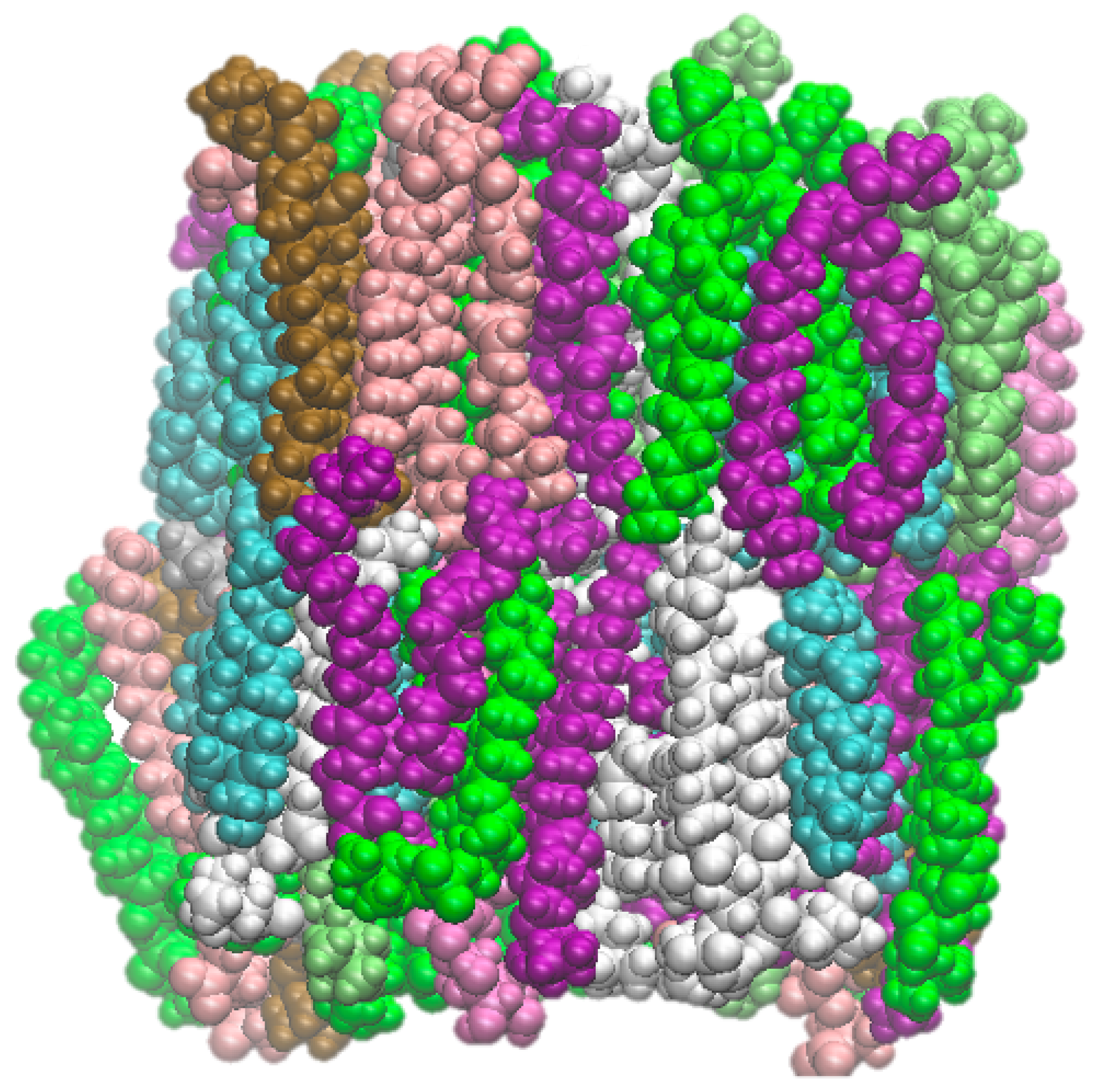
2.1. BBB Model Membrane
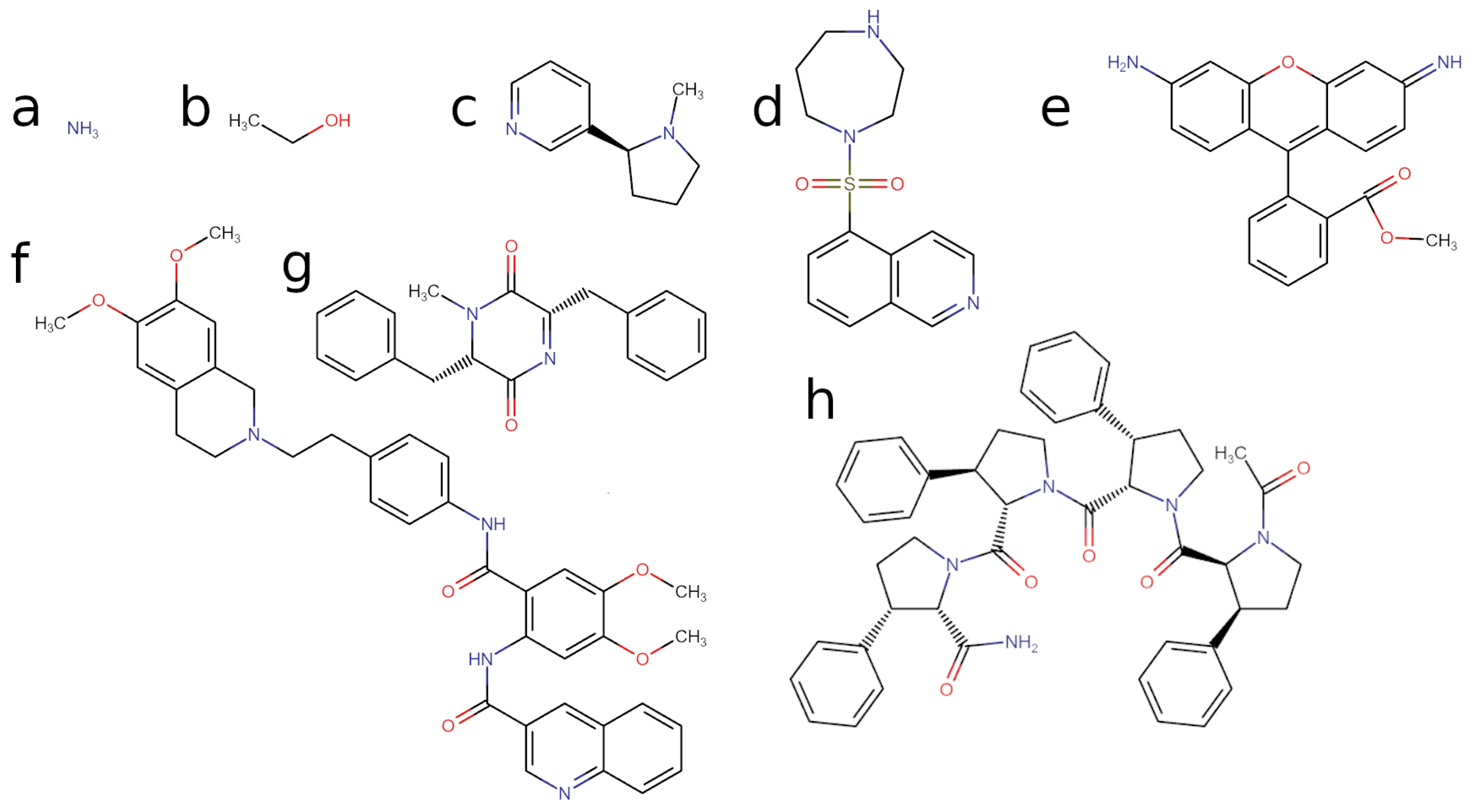
2.2. Selection of Molecules
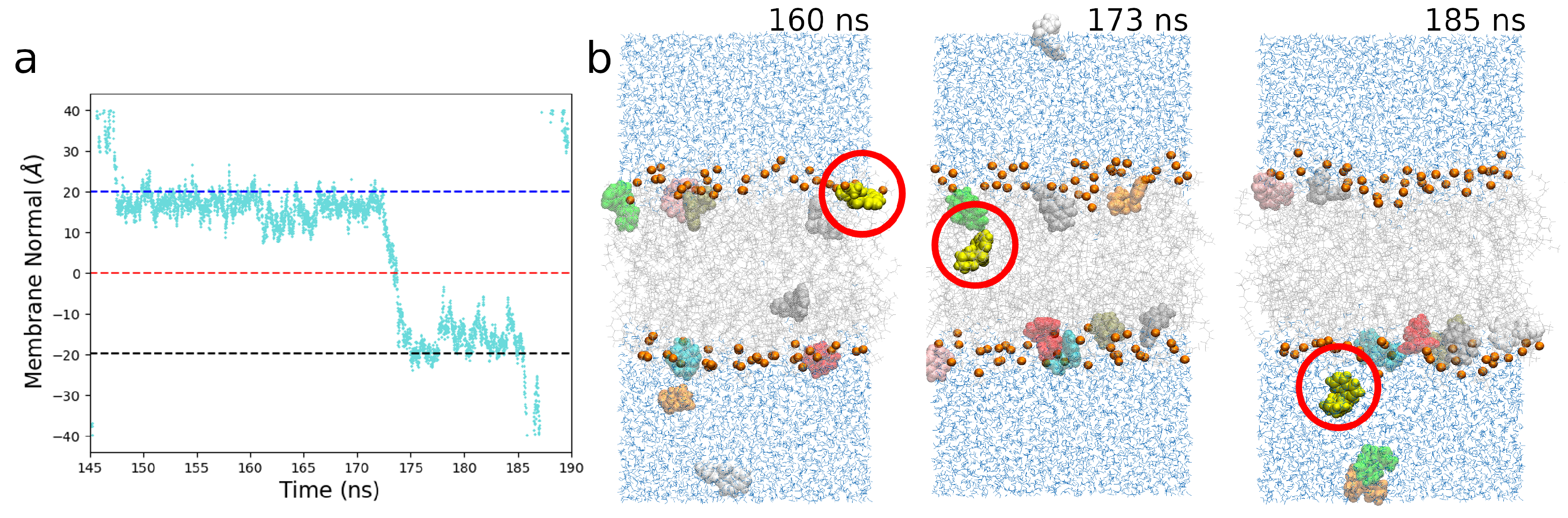
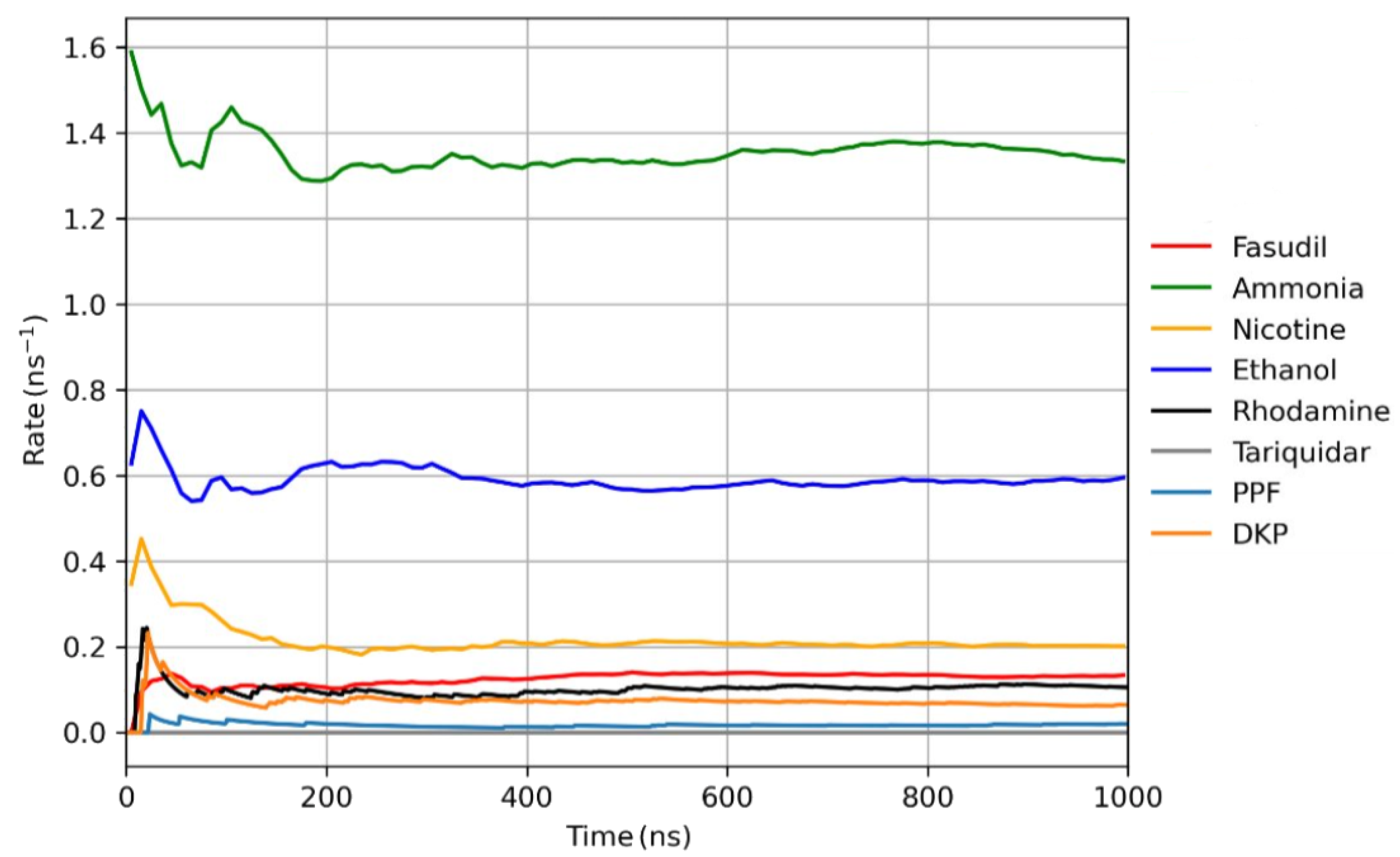
2.3. Permeability and Rate Constants
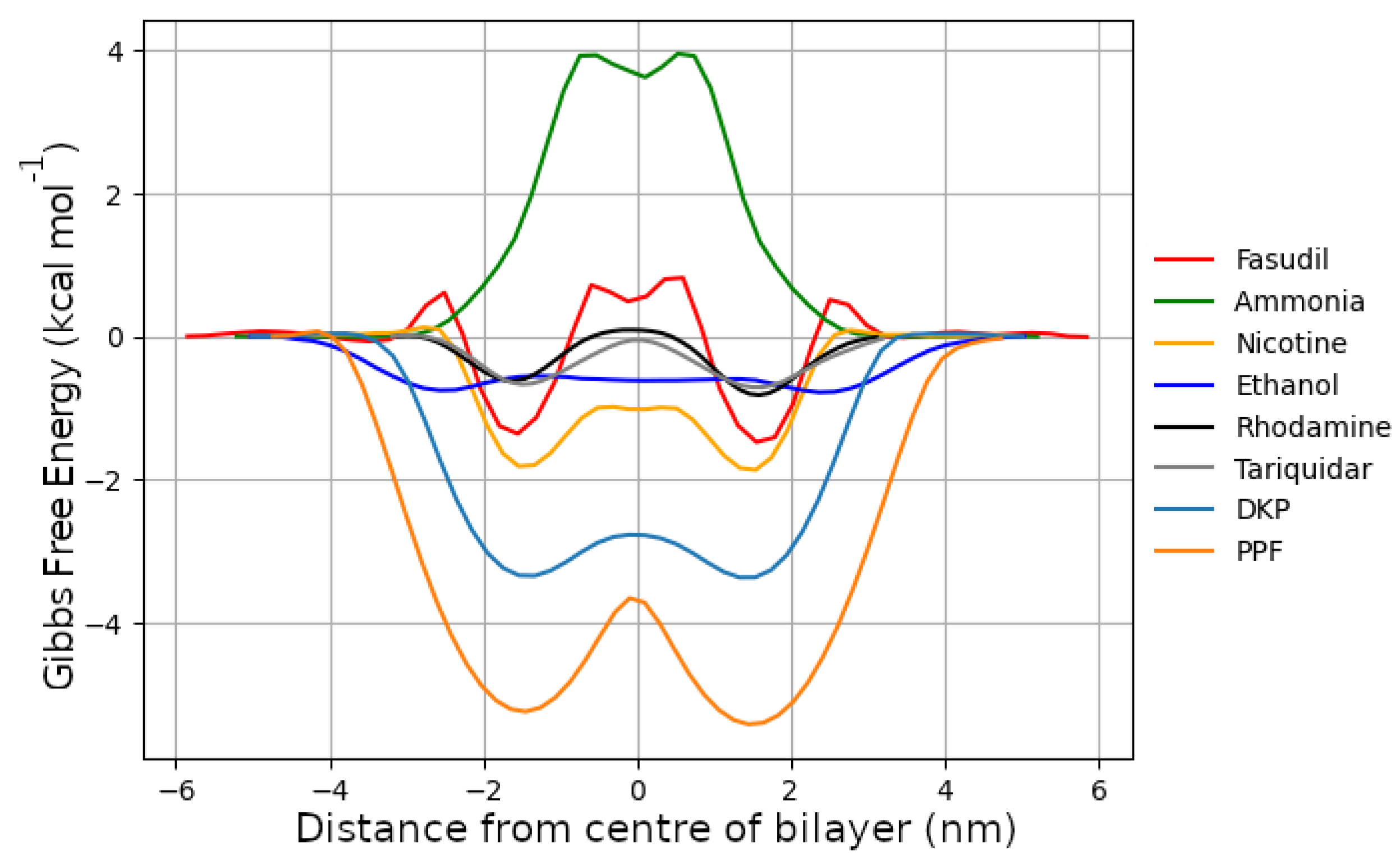
2.4. Gibbs Free Energy
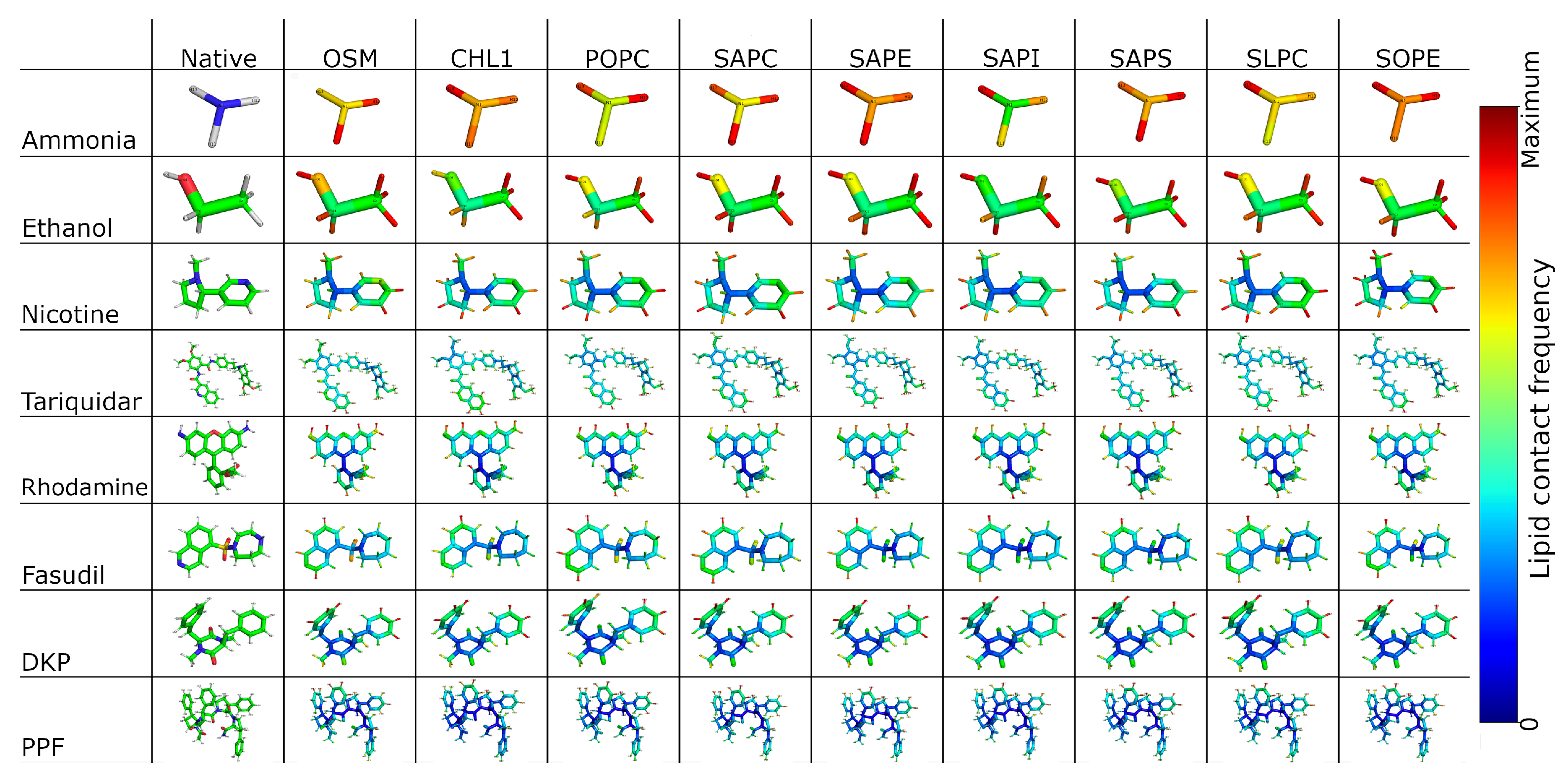
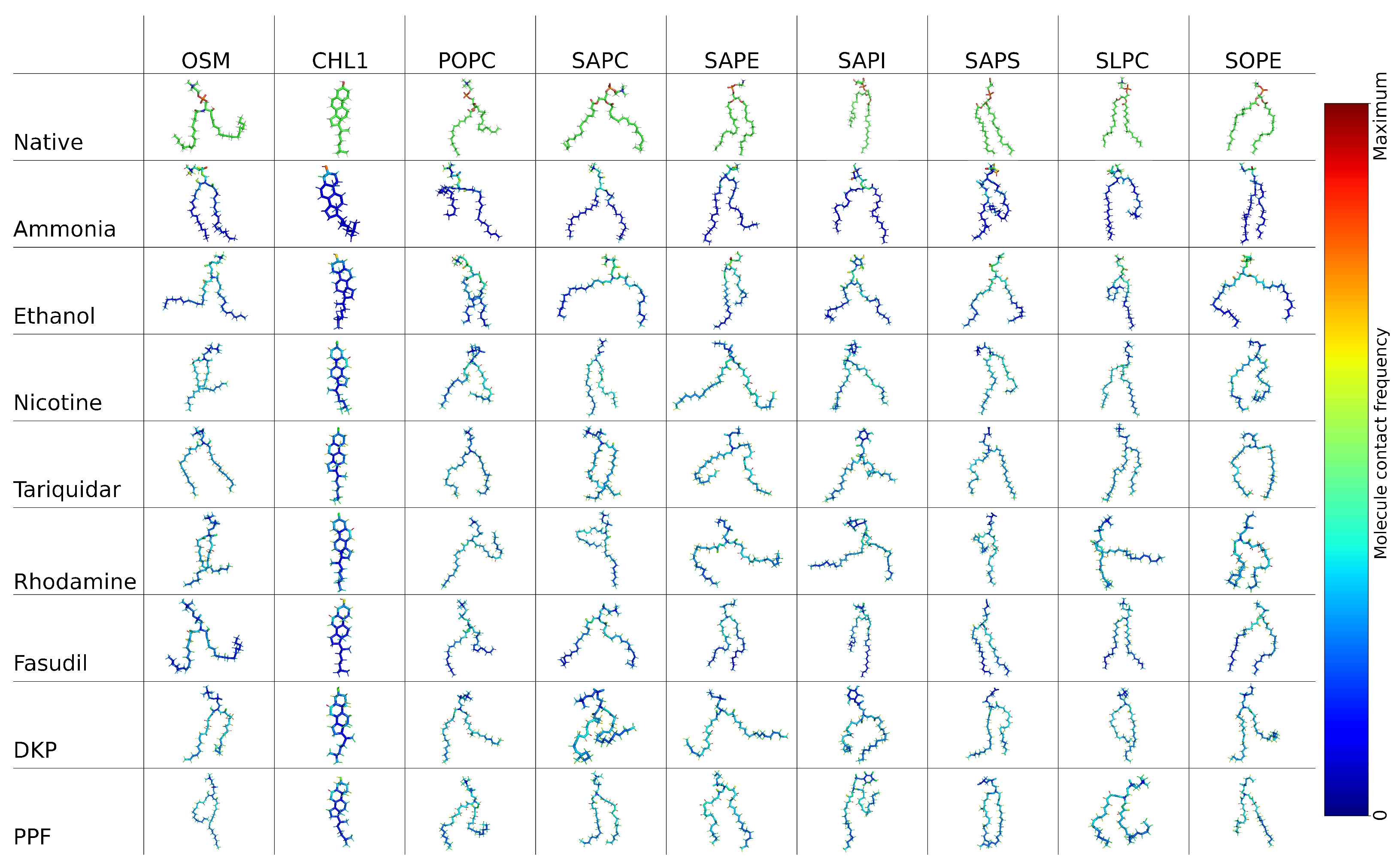
2.5. Contacts with Membrane
2.6. Limitations of the Methodology
3. Materials and Methods
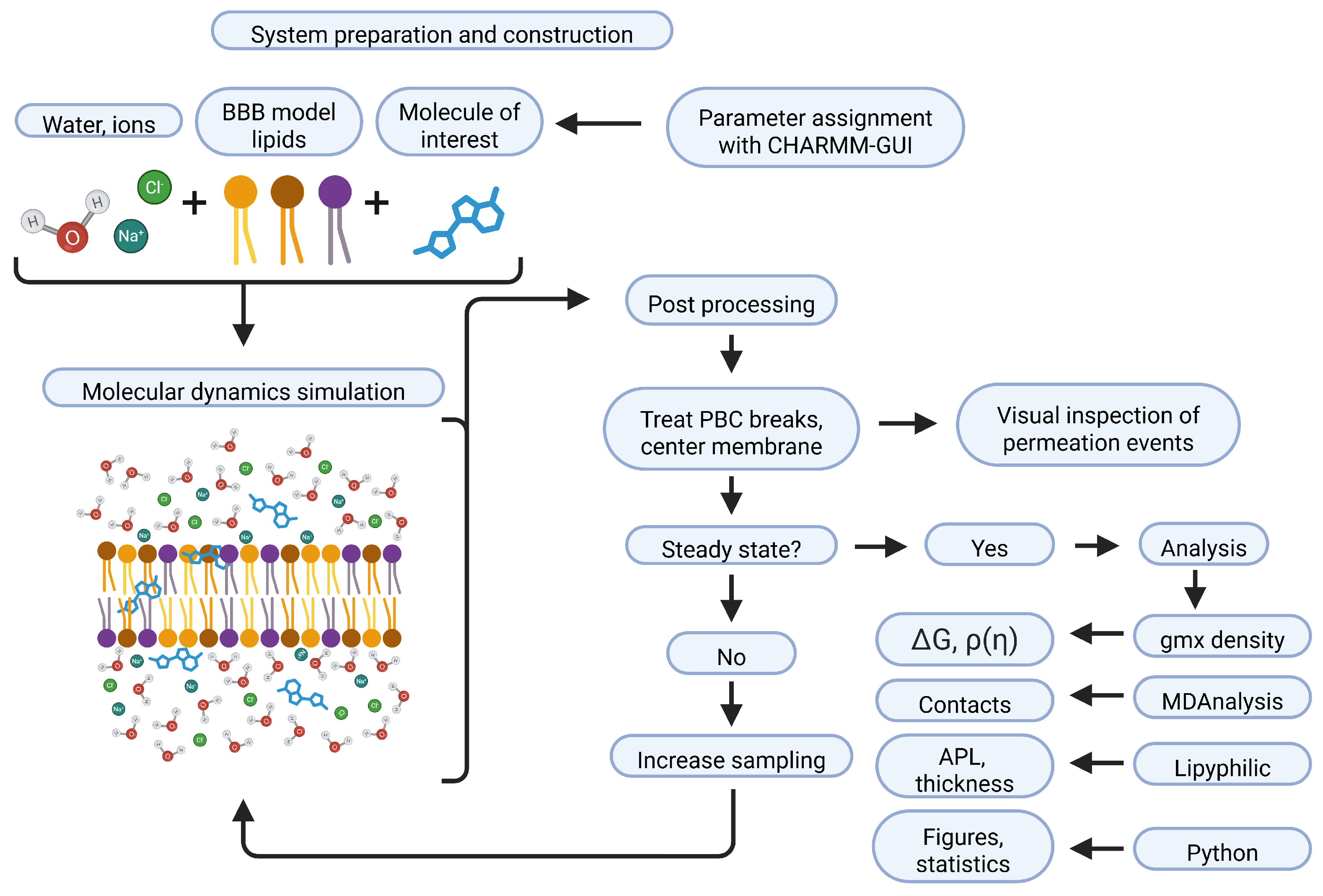
3.1. Molecular Dynamics Simulations
3.2. Free Energy Calculations
4. Conclusions
Supplementary Materials
Author Contributions
Funding
Institutional Review Board Statement
Informed Consent Statement
Data Availability Statement
Conflicts of Interest
Abbreviations
| AD | Alzheimer’s disease |
| AB | Amyloid |
| BBB | Blood–brain barrier |
| CHOL | Cholesterol |
| DKP | Diketopiperazine |
| HPC | High-performance computing |
| LINCS | Linear constraint solver |
| MD | Molecular dynamics |
| MM | Molecular mechanics |
| OSM | (palmitoyl) sphingomyelin |
| PGP | P-glycoprotein |
| PMF | Potential of mean force |
| POPC | 1-palmitoyl-2-oleoyl-sn-glycero-3-phosphocholine |
| PPF | (PhenylProline)4-NH2 |
| QM | Quantum mechanics |
| ROCK | Rho kinase |
| SAPC | 1-stearoyl-2-arachidonoyl-sn-glycero-3-phosphocholine |
| SAPE | 1-stearoyl-2-arachidonoyl-sn-glyce- ro-3-phosphoethanolamine |
| SAPI | 1-stearoyl-2-arachidonoyl-sn-glycero-3-phosphoinositol |
| SAPS | 1-stearoyl-2-arachidonoyl-sn-glycero-3-phospho-L-serine |
| SLPC | 1-stearoyl-2-linoleoyl-sn-glycero-3-phosphocholine |
| SOPE | 1-stearoyl-2-oleoyl-sn-glycero-3-phosphoethanolamine |
| WHAM | Weighted histogram analysis method |
References
- Schlander, M.; Hernandez-Villafuerte, K.; Cheng, C.Y.; Mestre-Ferrandiz, J.; Baumann, M. How much does it cost to research and develop a new drug? A systematic review and assessment. Pharmacoeconomics 2021, 39, 1243–1269. [Google Scholar] [CrossRef] [PubMed]
- Dowden, H.; Munro, J. Trends in clinical success rates and therapeutic focus. Nat. Rev. Drug Discov. 2019, 18, 495–496. [Google Scholar] [CrossRef]
- Shaker, B.; Ahmad, S.; Lee, J.; Jung, C.; Na, D. In silico methods and tools for drug discovery. Comput. Biol. Med. 2021, 137, 104851. [Google Scholar] [CrossRef]
- Lin, X.; Li, X.; Lin, X. A review on applications of computational methods in drug screening and design. Molecules 2020, 25, 1375. [Google Scholar] [CrossRef]
- Jumper, J.; Evans, R.; Pritzel, A.; Green, T.; Figurnov, M.; Ronneberger, O.; Tunyasuvunakool, K.; Bates, R.; Žídek, A.; Potapenko, A.; et al. Highly accurate protein structure prediction with AlphaFold. Nature 2021, 596, 583–589. [Google Scholar] [CrossRef]
- Varadi, M.; Anyango, S.; Deshpande, M.; Nair, S.; Natassia, C.; Yordanova, G.; Yuan, D.; Stroe, O.; Wood, G.; Laydon, A.; et al. AlphaFold Protein Structure Database: Massively expanding the structural coverage of protein-sequence space with high-accuracy models. Nucleic Acids Res. 2022, 50, D439–D444. [Google Scholar] [CrossRef] [PubMed]
- Rohl, C.A.; Strauss, C.E.; Misura, K.M.; Baker, D. Protein structure prediction using Rosetta. In Methods in Enzymology; Elsevier: Amsterdam, The Netherlands, 2004; Volume 383, pp. 66–93. [Google Scholar]
- Leman, J.K.; Weitzner, B.D.; Lewis, S.M.; Adolf-Bryfogle, J.; Alam, N.; Alford, R.F.; Aprahamian, M.; Baker, D.; Barlow, K.A.; Barth, P.; et al. Macromolecular modeling and design in Rosetta: Recent methods and frameworks. Nat. Methods 2020, 17, 665–680. [Google Scholar] [CrossRef]
- Jefferson, R.E.; Oggier, A.; Füglistaler, A.; Camviel, N.; Hijazi, M.; Villarreal, A.R.; Arber, C.; Barth, P. Computational design of dynamic receptor—peptide signaling complexes applied to chemotaxis. Nat. Commun. 2023, 14, 2875. [Google Scholar] [CrossRef] [PubMed]
- Paradis, J.S.; Feng, X.; Murat, B.; Jefferson, R.E.; Sokrat, B.; Szpakowska, M.; Hogue, M.; Bergkamp, N.D.; Heydenreich, F.M.; Smit, M.J.; et al. Computationally designed GPCR quaternary structures bias signaling pathway activation. Nat. Commun. 2022, 13, 6826. [Google Scholar] [CrossRef]
- Jorgensen, C.; Linville, R.M.; Galea, I.; Lambden, E.; Vögele, M.; Chen, C.; Troendle, E.P.; Ruggiu, F.; Ulmschneider, M.B.; Schiøtt, B.; et al. Permeability Benchmarking: Guidelines for Comparing in Silico, in Vitro, and in Vivo Measurements. J. Chem. Inf. Model. 2025, 65, 1067–1084. [Google Scholar] [CrossRef]
- Möller, H.J.; Graeber, M.B. The case described by Alois Alzheimer in 1911. Eur. Arch. Psychiatry Clin. Neurosci. 1998, 248, 111–122. [Google Scholar] [CrossRef] [PubMed]
- Scheltens, P.; De Strooper, B.; Kivipelto, M.; Holstege, H.; Chételat, G.; Teunissen, C.E.; Cummings, J.; van der Flier, W.M. Alzheimer’s disease. Lancet 2021, 397, 1577–1590. [Google Scholar] [CrossRef] [PubMed]
- Cai, R.; Wang, Y.; Huang, Z.; Zou, Q.; Pu, Y.; Yu, C.; Cai, Z. Role of RhoA/ROCK signaling in Alzheimer’s disease. Behav. Brain Res. 2021, 414, 113481. [Google Scholar] [CrossRef]
- Blennow, K.; de Leon, M.J.; Zetterberg, H. Alzheimer’s disease. Lancet 2006, 368, 387–403. [Google Scholar] [CrossRef]
- Ono, K.; Watanabe-Nakayama, T. Aggregation and structure of amyloid β-protein. Neurochem. Int. 2021, 151, 105208. [Google Scholar] [CrossRef]
- Bennett, R.E.; DeVos, S.L.; Dujardin, S.; Corjuc, B.; Gor, R.; Gonzalez, J.; Roe, A.D.; Frosch, M.P.; Pitstick, R.; Carlson, G.A.; et al. Enhanced tau aggregation in the presence of amyloid β. Am. J. Pathol. 2017, 187, 1601–1612. [Google Scholar] [CrossRef] [PubMed]
- Jimenez, S.; Navarro, V.; Moyano, J.; Sanchez-Mico, M.; Torres, M.; Davila, J.C.; Vizuete, M.; Gutierrez, A.; Vitorica, J. Disruption of amyloid plaques integrity affects the soluble oligomers content from Alzheimer disease brains. PLoS ONE 2014, 9, e114041. [Google Scholar] [CrossRef]
- Hampel, H.; Hardy, J.; Blennow, K.; Chen, C.; Perry, G.; Kim, S.H.; Villemagne, V.L.; Aisen, P.; Vendruscolo, M.; Iwatsubo, T.; et al. The amyloid-β pathway in Alzheimer’s disease. Mol. Psychiatry 2021, 26, 5481–5503. [Google Scholar] [CrossRef]
- Salo-Ahen, O.M.; Alanko, I.; Bhadane, R.; Bonvin, A.M.; Honorato, R.V.; Hossain, S.; Juffer, A.H.; Kabedev, A.; Lahtela-Kakkonen, M.; Larsen, A.S.; et al. Molecular dynamics simulations in drug discovery and pharmaceutical development. Processes 2020, 9, 71. [Google Scholar] [CrossRef]
- Adelusi, T.I.; Oyedele, A.Q.K.; Boyenle, I.D.; Ogunlana, A.T.; Adeyemi, R.O.; Ukachi, C.D.; Idris, M.O.; Olaoba, O.T.; Adedotun, I.O.; Kolawole, O.E.; et al. Molecular modeling in drug discovery. Inform. Med. Unlocked 2022, 29, 100880. [Google Scholar] [CrossRef]
- Korb, O.; Olsson, T.S.G.; Bowden, S.J.; Hall, R.J.; Verdonk, M.L.; Liebeschuetz, J.W.; Cole, J.C. Potential and Limitations of Ensemble Docking. J. Chem. Inf. Model. 2012, 52, 1262–1274. [Google Scholar] [CrossRef]
- Strecker, C.; Meyer, B. Plasticity of the Binding Site of Renin: Optimized Selection of Protein Structures for Ensemble Docking. J. Chem. Inf. Model. 2018, 58, 1121–1131. [Google Scholar] [CrossRef]
- Durrant, J.D.; McCammon, J.A. Computer-aided drug-discovery techniques that account for receptor flexibility. Curr. Opin. Pharmacol. 2010, 10, 770–774. [Google Scholar] [CrossRef] [PubMed]
- Kang, H.J.; Lee, C.; Drew, D. Breaking the barriers in membrane protein crystallography. Int. J. Biochem. Cell Biol. 2013, 45, 636–644. [Google Scholar] [CrossRef] [PubMed]
- Avci, F.G.; Sariyar Akbulut, B.; Ozkirimli, E. Membrane active peptides and their biophysical characterization. Biomolecules 2018, 8, 77. [Google Scholar] [CrossRef] [PubMed]
- Sani, M.A.; Separovic, F. How membrane-active peptides get into lipid membranes. Accounts Chem. Res. 2016, 49, 1130–1138. [Google Scholar] [CrossRef]
- Ye, W.; Wang, W.; Jiang, C.; Yu, Q.; Chen, H. Molecular dynamics simulations of amyloid fibrils: An in silico approach. Acta Biochim. Biophys. Sin. 2013, 45, 503–508. [Google Scholar] [CrossRef]
- Urbanc, B.; Betnel, M.; Cruz, L.; Bitan, G.; Teplow, D.B. Elucidation of Amyloid β-Protein Oligomerization Mechanisms: Discrete Molecular Dynamics Study. J. Am. Chem. Soc. 2010, 132, 4266–4280. [Google Scholar] [CrossRef]
- de Jong-Hoogland, D.; Ulmschneider, J.; Ulmschneider, M. Computational investigation of the effect of BODIPY labelling on peptide-membrane interaction. Sci. Rep. 2024, 14, 27726. [Google Scholar] [CrossRef]
- Ulmschneider, M.B.; Ulmschneider, J.P.; Freites, J.A.; von Heijne, G.; Tobias, D.J.; White, S.H. Transmembrane helices containing a charged arginine are thermodynamically stable. Eur. Biophys. J. 2017, 46, 627–637. [Google Scholar] [CrossRef]
- Ulmschneider, M.B.; Doux, J.P.; Killian, J.A.; Smith, J.C.; Ulmschneider, J.P. Mechanism and kinetics of peptide partitioning into membranes from all-atom simulations of thermostable peptides. J. Am. Chem. Soc. 2010, 132, 3452–3460. [Google Scholar] [CrossRef]
- Ulmschneider, M.B.; Smith, J.C.; Ulmschneider, J.P. Peptide partitioning properties from direct insertion studies. Biophys. J. 2010, 98, L60–L62. [Google Scholar] [CrossRef]
- Ulmschneider, J.P.; Smith, J.C.; White, S.H.; Ulmschneider, M.B. In silico partitioning and transmembrane insertion of hydrophobic peptides under equilibrium conditions. J. Am. Chem. Soc. 2011, 133, 15487–15495. [Google Scholar] [CrossRef]
- Ulmschneider, J.P.; Smith, J.C.; White, S.H.; Ulmschneider, M.B. The importance of the membrane interface as the reference state for membrane protein stability. Biochim. Biophys. Acta (BBA) Biomembr. 2018, 1860, 2539–2548. [Google Scholar] [CrossRef]
- Jorgensen, C.; Ulmschneider, M.B.; Searson, P.C. Atomistic Model of Solute Transport across the Blood–Brain Barrier. ACS Omega 2021, 7, 1100–1112. [Google Scholar] [CrossRef]
- Sugita, M.; Sugiyama, S.; Fujie, T.; Yoshikawa, Y.; Yanagisawa, K.; Ohue, M.; Akiyama, Y. Large-scale membrane permeability prediction of cyclic peptides crossing a lipid bilayer based on enhanced sampling molecular dynamics simulations. J. Chem. Inf. Model. 2021, 61, 3681–3695. [Google Scholar] [CrossRef] [PubMed]
- Radan, M.; Djikic, T.; Obradovic, D.; Nikolic, K. Application of in vitro PAMPA technique and in silico computational methods for blood-brain barrier permeability prediction of novel CNS drug candidates. Eur. J. Pharm. Sci. 2022, 168, 106056. [Google Scholar] [CrossRef]
- Kumar, S.; Rosenberg, J.M.; Bouzida, D.; Swendsen, R.H.; Kollman, P.A. THE weighted histogram analysis method for free-energy calculations on biomolecules. I. The method. J. Comput. Chem. 1992, 13, 1011–1021. [Google Scholar] [CrossRef]
- Marrink, S.J.; Monticelli, L.; Melo, M.N.; Alessandri, R.; Tieleman, D.P.; Souza, P.C. Two decades of Martini: Better beads, broader scope. Wiley Interdiscip. Rev. Comput. Mol. Sci. 2023, 13, e1620. [Google Scholar] [CrossRef]
- Levental, I.; Lyman, E. Regulation of membrane protein structure and function by their lipid nano-environment. Nat. Rev. Mol. Cell Biol. 2023, 24, 107–122, Correction in Nat. Rev. Mol. Cell Biol. 2023, 24, 79.. [Google Scholar] [CrossRef]
- Nagarajan, S.R.; Butler, L.M.; Hoy, A.J. The diversity and breadth of cancer cell fatty acid metabolism. Cancer Metab. 2021, 9, 2. [Google Scholar] [CrossRef]
- Cecchelli, R.; Berezowski, V.; Lundquist, S.; Culot, M.; Renftel, M.; Dehouck, M.P.; Fenart, L. Modelling of the blood–brain barrier in drug discovery and development. Nat. Rev. Drug Discov. 2007, 6, 650–661. [Google Scholar] [CrossRef]
- Wang, Y.; Gallagher, E.; Jorgensen, C.; Troendle, E.P.; Hu, D.; Searson, P.C.; Ulmschneider, M.B. An experimentally validated approach to calculate the blood-brain barrier permeability of small molecules. Sci. Rep. 2019, 9, 6117. [Google Scholar] [CrossRef]
- Jorgensen, C.; Troendle, E.P.; Ulmschneider, J.P.; Searson, P.C.; Ulmschneider, M.B. A least-squares-fitting procedure for an efficient preclinical ranking of passive transport across the blood–brain barrier endothelium. J. Comput. Aided Mol. Des. 2023, 37, 537–549. [Google Scholar] [CrossRef] [PubMed]
- Awoonor-Williams, E.; Rowley, C.N. Molecular simulation of nonfacilitated membrane permeation. Biochim. Biophys. Acta (BBA) Biomembr. 2016, 1858, 1672–1687. [Google Scholar] [CrossRef]
- Yusof, S.R.; Avdeef, A.; Abbott, N.J. In vitro porcine blood–brain barrier model for permeability studies: PCEL-X software pKaFLUX method for aqueous boundary layer correction and detailed data analysis. Eur. J. Pharm. Sci. 2014, 65, 98–111. [Google Scholar] [CrossRef]
- Soares, J.X.; Santos, Á.; Fernandes, C.; Pinto, M.M.M. Liquid Chromatography on the Different Methods for the Determination of Lipophilicity: An Essential Analytical Tool in Medicinal Chemistry. Chemosensors 2022, 10, 340. [Google Scholar] [CrossRef]
- Mannhold, R.; Poda, G.I.; Ostermann, C.; Tetko, I.V. Calculation of Molecular Lipophilicity: State-of-the-Art and Comparison of LogP Methods on more than 96,000 Compounds. J. Pharm. Sci. 2009, 98, 861–893. [Google Scholar] [CrossRef] [PubMed]
- Chen, M.; Liu, A.; Ouyang, Y.; Huang, Y.; Chao, X.; Pi, R. Fasudil and its analogs: A new powerful weapon in the long war against central nervous system disorders? Expert Opin. Investig. Drugs 2013, 22, 537–550. [Google Scholar] [CrossRef] [PubMed]
- Guo, M.F.; Zhang, H.Y.; Zhang, P.J.; Liu, X.Q.; Song, L.J.; Wei, W.Y.; Wang, Y.Y.; Mu, B.T.; Chai, Z.; Yu, J.Z.; et al. Fasudil reduces β-amyloid levels and neuronal apoptosis in APP/PS1 transgenic mice via inhibition of the Nogo-A/NgR/RhoA signaling axis. J. Integr. Neurosci. 2020, 19, 651–662. [Google Scholar] [CrossRef]
- Yu, J.Z.; Li, Y.H.; Liu, C.Y.; Wang, Q.; Gu, Q.F.; Wang, H.Q.; Zhang, G.X.; Xiao, B.G.; Ma, C.G. Multitarget therapeutic effect of fasudil in APP/PS1transgenic mice. CNS Neurol.-Disord.-Drug Targets 2017, 16, 199–209. [Google Scholar] [CrossRef]
- Al-Kuraishy, H.M.; Sulaiman, G.M.; Mohammed, H.A.; Al-Gareeb, A.I.; Albuhadily, A.K.; Mohammed, S.G. Role of RhoA-ROCK signaling inhibitor fasudil in Alzheimer disease. Behav. Brain Res. 2025, 484, 115524. [Google Scholar] [CrossRef]
- Sheikh, A.M.; Yano, S.; Mitaki, S.; Tabassum, S.; Yamaguchi, S.; Nagai, A. Rho-Kinase inhibition decreases focal cerebral ischemia-induced glial activation in rats. J. Cent. Nerv. Syst. Dis. 2022, 14, 11795735221123910. [Google Scholar] [CrossRef] [PubMed]
- Weidner, L.D.; Fung, K.L.; Kannan, P.; Moen, J.K.; Kumar, J.S.; Mulder, J.; Innis, R.B.; Gottesman, M.M.; Hall, M.D. Tariquidar is an inhibitor and not a substrate of human and mouse P-glycoprotein. Drug Metab. Dispos. 2016, 44, 275–282. [Google Scholar] [CrossRef] [PubMed]
- Srinivas, N.R. Understanding the role of tariquidar, a potent Pgp inhibitor, in combination trials with cytotoxic drugs: What is missing? Cancer Chemother. Pharmacol. 2016, 78, 1097–1098. [Google Scholar] [CrossRef]
- Chiang, M.; Back, H.; Lee, J.B.; Oh, S.; Guo, T.; Girgis, S.; Park, C.; Haroutounian, S.; Kagan, L. Pharmacokinetic Modeling of the Effect of Tariquidar on Ondansetron Disposition into the Central Nervous System. Pharm. Res. 2024, 41, 1401–1411. [Google Scholar] [CrossRef] [PubMed]
- Ilyas-Feldmann, M.; Langer, O.; Bauer, M.; Asselin, M.C.; Hendrikse, N.H.; Sisodiya, S.M.; Duncan, J.S.; Löscher, W.; Koepp, M. Tolerability of tariquidar–a third generation P-gp inhibitor as add-on medication to antiseizure medications in drug-resistant epilepsy. Seizure-Eur. J. Epilepsy 2024, 119, 44–51. [Google Scholar] [CrossRef]
- Reimold, I.; Domke, D.; Bender, J.; Seyfried, C.A.; Radunz, H.E.; Fricker, G. Delivery of nanoparticles to the brain detected by fluorescence microscopy. Eur. J. Pharm. Biopharm. 2008, 70, 627–632. [Google Scholar] [CrossRef]
- Jouan, E.; Le Vée, M.; Mayati, A.; Denizot, C.; Parmentier, Y.; Fardel, O. Evaluation of P-glycoprotein inhibitory potential using a rhodamine 123 accumulation assay. Pharmaceutics 2016, 8, 12. [Google Scholar] [CrossRef]
- Zahra, R.; Furqan, M.; Ullah, R.; Mithani, A.; Saleem, R.S.Z.; Faisal, A. A cell-based high-throughput screen identifies inhibitors that overcome P-glycoprotein (Pgp)-mediated multidrug resistance. PLoS ONE 2020, 15, e0233993. [Google Scholar] [CrossRef]
- Yu, H.; Wang, Q.; Sun, Y.; Shen, M.; Li, H.; Duan, Y. A New PAMPA Model Proposed on the Basis of a Synthetic Phospholipid Membrane. PLoS ONE 2015, 10, e0116502. [Google Scholar] [CrossRef]
- Leung, S.S.F.; Mijalkovic, J.; Borrelli, K.; Jacobson, M.P. Testing Physical Models of Passive Membrane Permeation. J. Chem. Inf. Model. 2012, 52, 1621–1636. [Google Scholar] [CrossRef]
- Venable, R.M.; Krämer, A.; Pastor, R.W. Molecular Dynamics Simulations of Membrane Permeability. Chem. Rev. 2019, 119, 5954–5997. [Google Scholar] [CrossRef]
- Balachandra, C.; Padhi, D.; Govindaraju, T. Cyclic dipeptide: A privileged molecular scaffold to derive structural diversity and functional utility. ChemMedChem 2021, 16, 2558–2587. [Google Scholar] [CrossRef] [PubMed]
- Teixidó, M.; Zurita, E.; Malakoutikhah, M.; Tarragó, T.; Giralt, E. Diketopiperazines as a tool for the study of transport across the blood- brain barrier (BBB) and their potential use as BBB-shuttles. J. Am. Chem. Soc. 2007, 129, 11802–11813. [Google Scholar] [CrossRef]
- Arranz-Gibert, P.; Guixer, B.; Malakoutikhah, M.; Muttenthaler, M.; Guzmán, F.; Teixidó, M.; Giralt, E. Lipid Bilayer Crossing The Gate of Symmetry. Water-Soluble Phenylproline-Based Blood-Brain Barrier Shuttles. J. Am. Chem. Soc. 2015, 137, 7357–7364. [Google Scholar] [CrossRef] [PubMed]
- Sánchez-Navarro, M.; Giralt, E.; Teixidó, M. Blood–brain barrier peptide shuttles. Curr. Opin. Chem. Biol. 2017, 38, 134–140. [Google Scholar] [CrossRef]
- Brahm, J. Permeability of human red cells to a homologous series of aliphatic alcohols. Limitations of the continuous flow-tube method. J. Gen. Physiol. 1983, 81, 283–304. [Google Scholar] [CrossRef] [PubMed]
- Garberg, P.; Ball, M.; Borg, N.; Cecchelli, R.; Fenart, L.; Hurst, R.; Lindmark, T.; Mabondzo, A.; Nilsson, J.; Raub, T.; et al. In vitro models for the blood–brain barrier. Toxicol. Vitr. 2005, 19, 299–334. [Google Scholar] [CrossRef]
- Krämer, A.; Ghysels, A.; Wang, E.; Venable, R.M.; Klauda, J.B.; Brooks, B.R.; Pastor, R.W. Membrane permeability of small molecules from unbiased molecular dynamics simulations. J. Chem. Phys. 2020, 153, 124107. [Google Scholar] [CrossRef]
- Ghorbani, M.; Wang, E.; Krämer, A.; Klauda, J.B. Molecular dynamics simulations of ethanol permeation through single and double-lipid bilayers. J. Chem. Phys. 2020, 153, 125101. [Google Scholar] [CrossRef]
- Mohammad, S.G. Recent Experimental Developments in Studying Passive Membrane Transport of Drug Molecules. Mol. Pharm. 2021, 18, 2122–2141. [Google Scholar] [CrossRef]
- Filipe, H.A.L.; Loura, L.M.S.; Moreno, M.J. Permeation of a Homologous Series of NBD-Labeled Fatty Amines through Lipid Bilayers: A Molecular Dynamics Study. Membranes 2023, 13, 551. [Google Scholar] [CrossRef] [PubMed]
- Harris, J.; Chipot, C.; Roux, B. Statistical Mechanical Theories of Membrane Permeability. J. Phys. Chem. 2024, 128, 9183–9196. [Google Scholar] [CrossRef] [PubMed]
- Ding, Y.; Lambden, E.; Peate, J.; Picken, L.J.; Rees, T.W.; Perez-Ortiz, G.; Newgas, S.A.; Spicer, L.A.R.; Hicks, T.; Hess, J.; et al. Rapid Peptide Cyclization Inspired by the Modular Logic of Nonribosomal Peptide Synthetases. J. Am. Chem. Soc. 2024, 146, 16787–16801. [Google Scholar] [CrossRef]
- Waller, C.; Marzinek, J.K.; McBurnie, E.; Bond, P.J.; Williamson, P.T.; Khalid, S. Impact on S. aureus and E. coli Membranes of Treatment with Chlorhexidine and Alcohol Solutions: Insights from Molecular Simulations and Nuclear Magnetic Resonance. J. Mol. Biol. 2023, 435, 167953. [Google Scholar] [CrossRef]
- Huang, J.; Rauscher, S.; Nawrocki, G.; Ran, T.; Feig, M.; De Groot, B.L.; Grubmüller, H.; MacKerell Jr, A.D. CHARMM36m: An improved force field for folded and intrinsically disordered proteins. Nat. Methods 2017, 14, 71–73. [Google Scholar] [CrossRef]
- O’Boyle, N.M.; Banck, M.; James, C.A.; Morley, C.; Vandermeersch, T.; Hutchison, G.R. Open Babel: An open chemical toolbox. J. Cheminform. 2011, 3, 1–14. [Google Scholar] [CrossRef]
- Kim, S.; Lee, J.; Jo, S.; Brooks III, C.L.; Lee, H.S.; Im, W. CHARMM-GUI ligand reader and modeler for CHARMM force field generation of small molecules. J. Comput. Chem. 2017, 5, 1879–1886. [Google Scholar] [CrossRef]
- Wu, E.L.; Cheng, X.; Jo, S.; Rui, H.; Song, K.C.; Dávila-Contreras, E.M.; Qi, Y.; Lee, J.; Monje-Galvan, V.; Venable, R.M.; et al. CHARMM-GUI membrane builder toward realistic biological membrane simulations. J. Comput. Chem. 2014, 35, 1997–2004. [Google Scholar] [CrossRef] [PubMed]
- Jorgensen, W.L.; Chandrasekhar, J.; Madura, J.D.; Impey, R.W.; Klein, M.L. Comparison of simple potential functions for simulating liquid water. J. Chem. Phys. 1983, 79, 926–935. [Google Scholar] [CrossRef]
- Van Der Spoel, D.; Lindahl, E.; Hess, B.; Groenhof, G.; Mark, A.E.; Berendsen, H.J. GROMACS: Fast, flexible, and free. J. Comput. Chem. 2005, 26, 1701–1718. [Google Scholar] [CrossRef] [PubMed]
- Van Gunsteren, W.F.; Berendsen, H.J. A leap-frog algorithm for stochastic dynamics. Mol. Simul. 1988, 1, 173–185. [Google Scholar] [CrossRef]
- Hess, B.; Bekker, H.; Berendsen, H.J.; Fraaije, J.G. LINCS: A linear constraint solver for molecular simulations. J. Comput. Chem. 1997, 18, 1463–1472. [Google Scholar] [CrossRef]
- Essmann, U.; Perera, L.; Berkowitz, M.L.; Darden, T.; Lee, H.; Pedersen, L.G. A smooth particle mesh Ewald method. J. Chem. Phys. 1995, 103, 8577–8593. [Google Scholar] [CrossRef]
- Hoover, W.G. Canonical dynamics: Equilibrium phase-space distributions. Phys. Rev. A 1985, 31, 1695–1697. [Google Scholar] [CrossRef]
- Nosé, S. A unified formulation of the constant temperature molecular dynamics methods. J. Chem. Phys. 1984, 81, 511–519. [Google Scholar] [CrossRef]
- Parrinello, M.; Rahman, A. Polymorphic transitions in single crystals: A new molecular dynamics method. J. Appl. Phys. 1981, 52, 7182–7190. [Google Scholar] [CrossRef]
- Michaud-Agrawal, N.; Denning, E.J.; Woolf, T.B.; Beckstein, O. MDAnalysis: A toolkit for the analysis of molecular dynamics simulations. J. Comput. Chem. 2011, 32, 2319–2327. [Google Scholar] [CrossRef]
- Smith, P.; Lorenz, C.D. LiPyphilic: A Python toolkit for the analysis of lipid membrane simulations. J. Chem. Theory Comput. 2021, 17, 5907–5919. [Google Scholar] [CrossRef]



| Lipid | Full Name | Percentage (%) |
|---|---|---|
| POPC | 1-palmitoyl-2-oleoyl-sn-glycero-3-phosphocholine | 4.1 |
| SAPI | 1-stearoyl-2-arachidonoyl-sn-glycero-3-phosphoinositol | 2.0 |
| CHOL | Cholesterol | 29.3 |
| SAPE | 1-stearoyl-2-arachidonoyl-sn-glycero-3-phosphoethanolamine | 14.5 |
| SAPC | 1-stearoyl-2-arachidonoyl-sn-glycero-3-phosphocholine | 8.3 |
| OSM | palmitoyl sphingomyelin | 18.9 |
| SLPC | 1-stearoyl-2-linoleoyl-sn-glycero-3-phosphocholine | 8.3 |
| SOPE | 1-stearoyl-2-oleoyl-sn-glycero-3-phosphoethanolamine | 6.3 |
| Molecule | Chemical Formula | log(Poct) | MW (Da) | Charge | Simulation Time (μs) |
|---|---|---|---|---|---|
| Ammonia | NH3 | −0.23 | 17.03 | 0 | 5 |
| Ethanol | C2H6O | 0.06 | 46.07 | 0 | 5 |
| Nicotine | C10H14N2 | 1.09 | 162.24 | 0 | 5 |
| Fasudil | C14H17N3O2S | 2.5 | 298.4 | 0 | 5 |
| Rhodamine 123 | C21H17N2O3 | 2.63 | 344.37 | 0 | 5 |
| Tariquidar | C38H38N4O6 | 4.5 | 646.74 | 0 | 5 |
| DKP | C18H18N2O2 | 1.21 | 305.4 | 0 | 5 |
| PPF | C45H49N5O5 | 5.80 | 751.93 | 0 | 5 |
| Molecule | Chemical Formula | (cm s−1) | from Literature | from Literature | Relative Error () | |
|---|---|---|---|---|---|---|
| Ammonia | NH3 | [44] | - | 0.1506 | ||
| Ethanol | C2H6O | [44] | [69] | 0.417 | ||
| Nicotine | C10H14N2 | [44] | [70] | 0.53 | ||
| Tariquidar | C38H38N4O6 | - | - | - | ||
| Rhodamine 123 | C21H16N2O3 | - | - | - | ||
| Fasudil | C14H17N3O2S | - | - | - | ||
| DKP | C20H22N2O2 | [66] | - | 0.685 | ||
| (PhPro)4 | C46H49N5O5 | - | [67] | 0.571 |
| Molecule | (kcal mol−1) | |
|---|---|---|
| Ammonia | ||
| Ethanol | ||
| Nicotine | ||
| Fasudil | ||
| Rhodamine | ||
| Tariquidar | ||
| DKP | ||
| PPF |
Disclaimer/Publisher’s Note: The statements, opinions and data contained in all publications are solely those of the individual author(s) and contributor(s) and not of MDPI and/or the editor(s). MDPI and/or the editor(s) disclaim responsibility for any injury to people or property resulting from any ideas, methods, instructions or products referred to in the content. |
© 2026 by the authors. Licensee MDPI, Basel, Switzerland. This article is an open access article distributed under the terms and conditions of the Creative Commons Attribution (CC BY) license.
Share and Cite
Ajao, F.; de Jong-Hoogland, D.; Ulmschneider, J.P.; Ulmschneider, M.B.; Lambden, E. In Silico Prediction and Validation of the Permeability of Small Molecules Across the Blood–Brain Barrier. Int. J. Mol. Sci. 2026, 27, 1427. https://doi.org/10.3390/ijms27031427
Ajao F, de Jong-Hoogland D, Ulmschneider JP, Ulmschneider MB, Lambden E. In Silico Prediction and Validation of the Permeability of Small Molecules Across the Blood–Brain Barrier. International Journal of Molecular Sciences. 2026; 27(3):1427. https://doi.org/10.3390/ijms27031427
Chicago/Turabian StyleAjao, Favour, Dominique de Jong-Hoogland, Jakob P. Ulmschneider, Martin B. Ulmschneider, and Edward Lambden. 2026. "In Silico Prediction and Validation of the Permeability of Small Molecules Across the Blood–Brain Barrier" International Journal of Molecular Sciences 27, no. 3: 1427. https://doi.org/10.3390/ijms27031427
APA StyleAjao, F., de Jong-Hoogland, D., Ulmschneider, J. P., Ulmschneider, M. B., & Lambden, E. (2026). In Silico Prediction and Validation of the Permeability of Small Molecules Across the Blood–Brain Barrier. International Journal of Molecular Sciences, 27(3), 1427. https://doi.org/10.3390/ijms27031427