Evaluation of AI-Predicted GH11 Xylanase Models Against a Previously Unreported Experimental Structure: Implications for Conformational Accuracy and Ligand Binding


Abstract
1. Introduction
2. Results
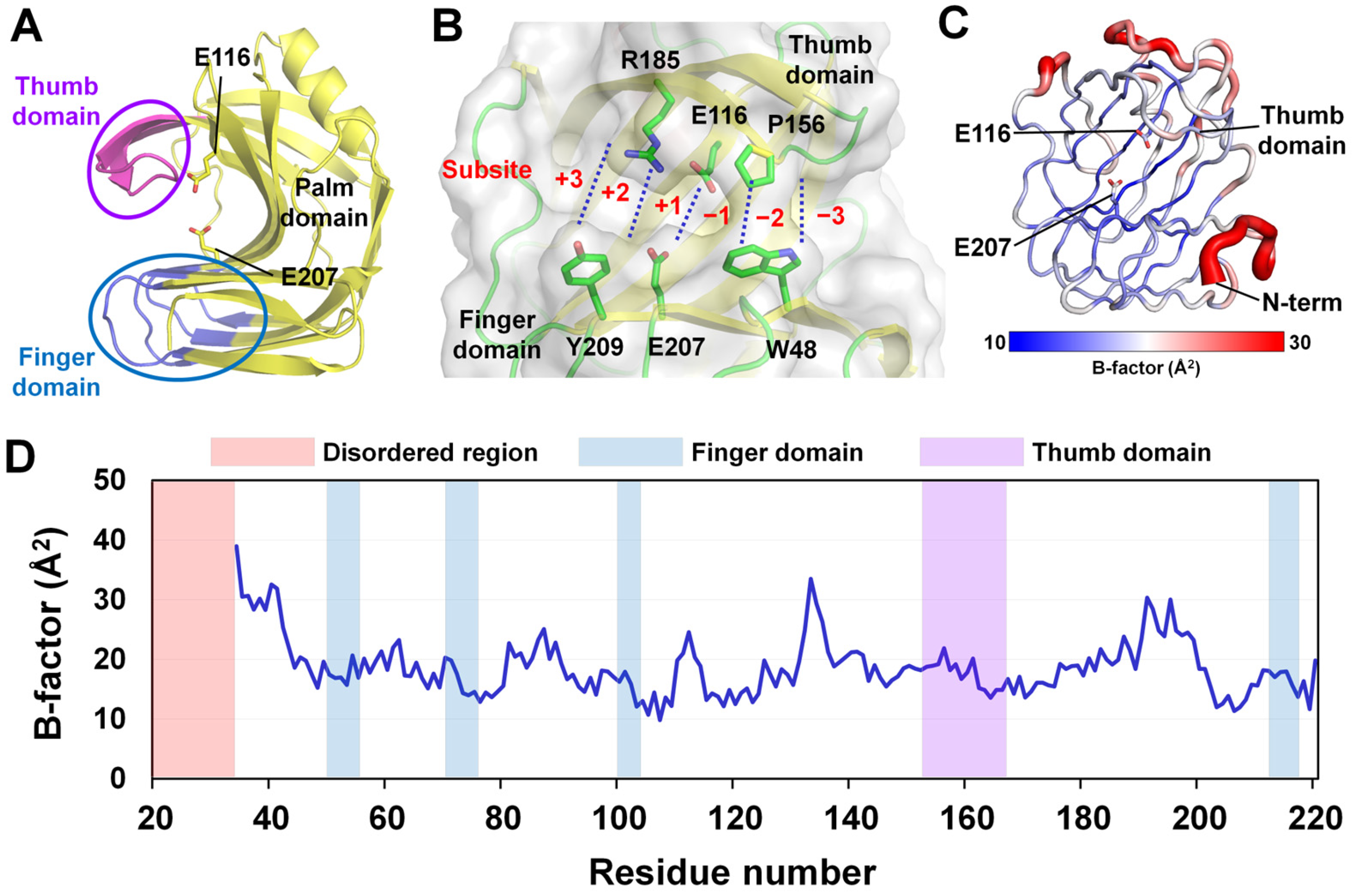
2.1. Experimental Structure of HviGH11
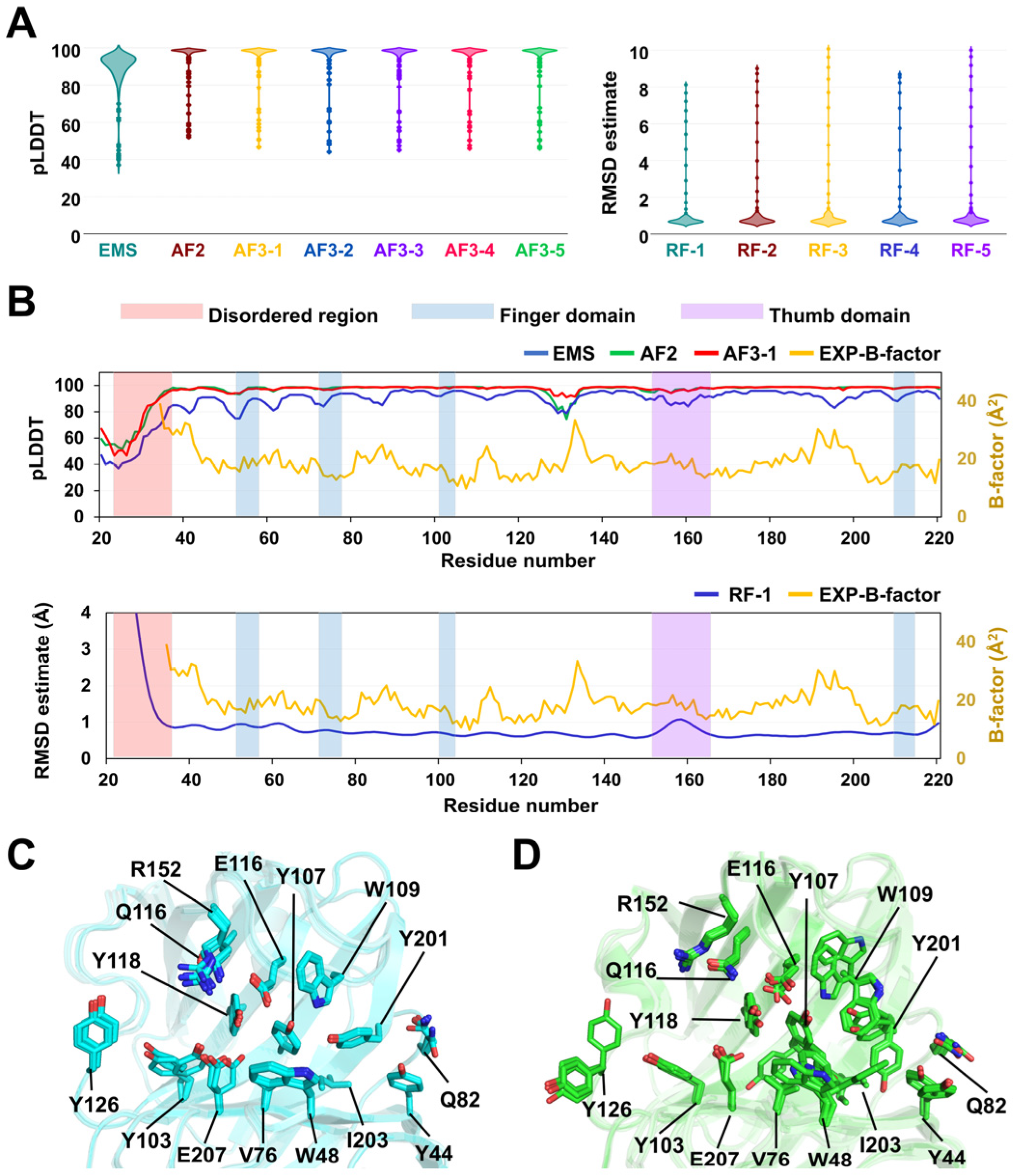
2.2. AI-Predicted HviGH11 Structures
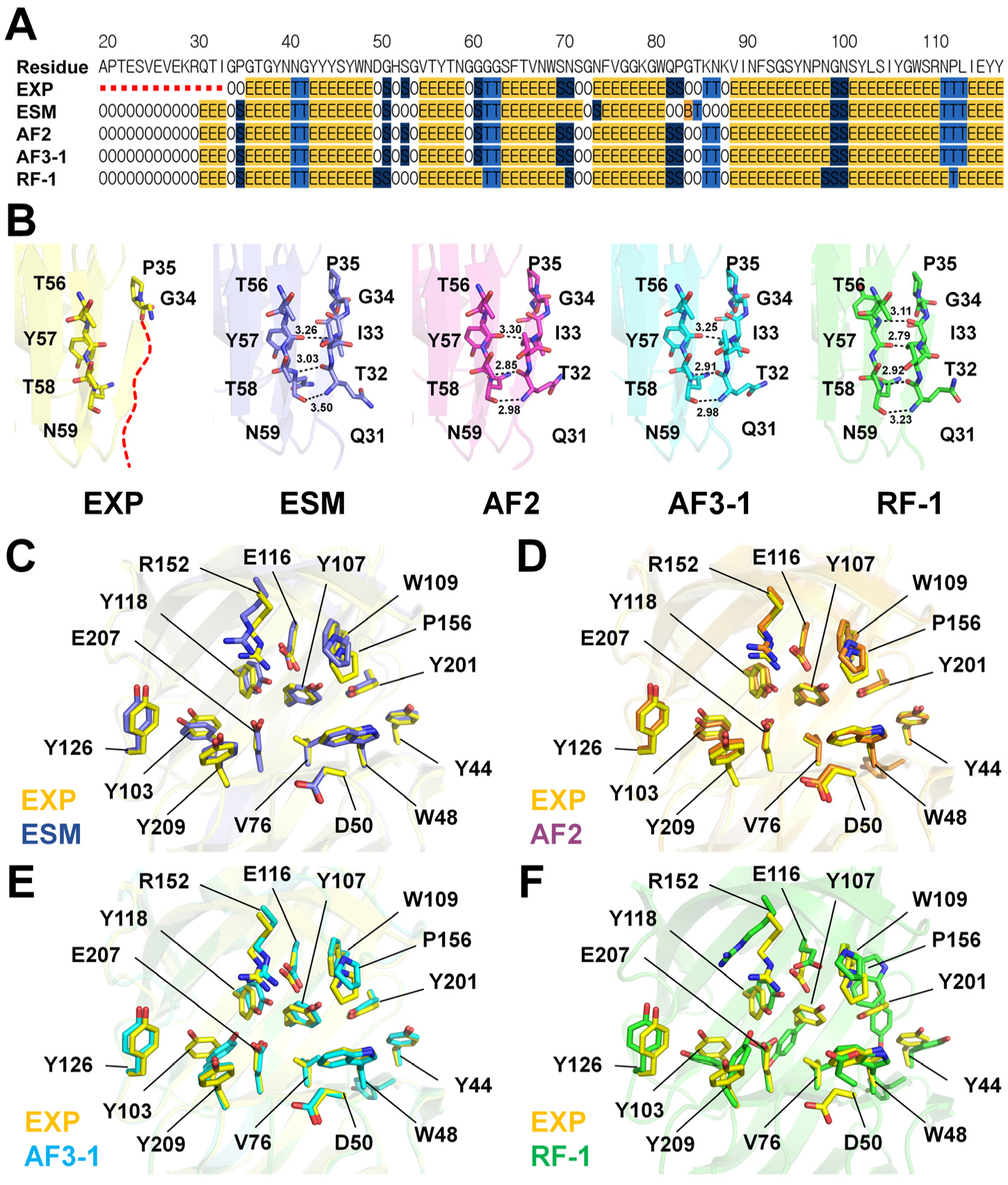
2.3. Structural Comparison of Experimental and AI-Predicted HviGH11 Structures
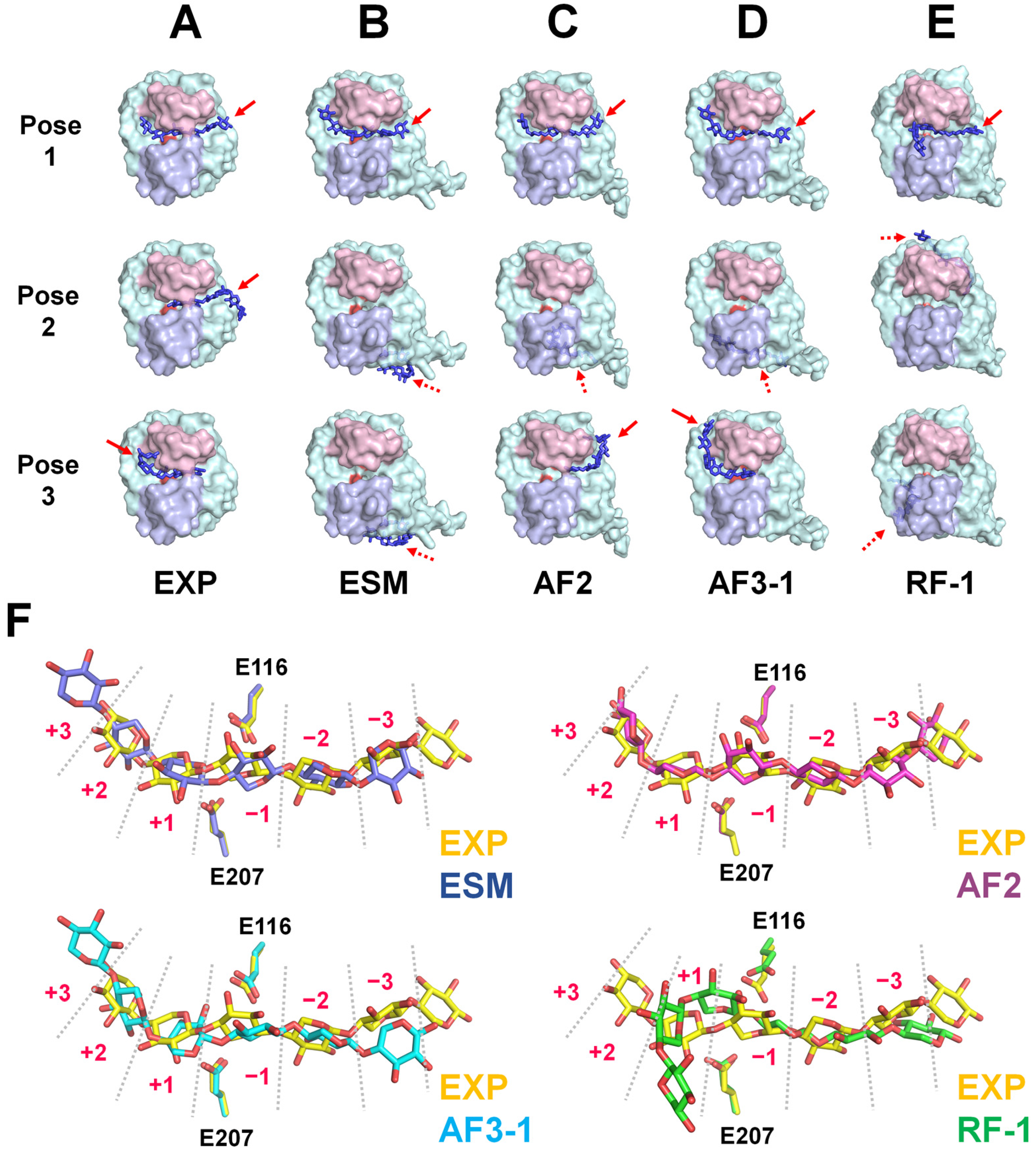
2.4. Docking of Xylohexaose to the Experimental and AI-Predicted Models of HviGH11
3. Discussion
4. Materials and Methods
4.1. Structure Determination
4.2. Generation of the AI-Predicted Structure
4.3. Bioinformatics
5. Conclusions
Supplementary Materials
Funding
Institutional Review Board Statement
Informed Consent Statement
Data Availability Statement
Acknowledgments
Conflicts of Interest
Abbreviations
| AI | Artificial intelligence |
| ESM | ESMFold |
| AF2 | AlphaFold2 |
| AF3 | AlphaFold3 |
| RF | RoseTTAFold |
References
- Stollar, E.J.; Smith, D.P. Uncovering protein structure. Essays Biochem. 2020, 64, 649–680, Erratum in Essays Biochem. 2021, 65, 407. [Google Scholar] [CrossRef]
- Borkakoti, N.; Ribeiro, A.J.M.; Thornton, J.M. A structural perspective on enzymes and their catalytic mechanisms. Curr. Opin. Struc. Biol. 2025, 92, 103040. [Google Scholar] [CrossRef]
- Cao, D.; Zhang, P.; Wang, S. Advances in structure-based drug design: The potential for precision therapeutics in psychiatric disorders. Neuron 2024, 112, 526–538. [Google Scholar] [CrossRef]
- Batool, M.; Ahmad, B.; Choi, S. A Structure-Based Drug Discovery Paradigm. Int. J. Mol. Sci. 2019, 20, 2783. [Google Scholar] [CrossRef]
- O’Maille, P.E.; Bakhtina, M.; Tsai, M.-D. Structure-based Combinatorial Protein Engineering (SCOPE). J. Mol. Biol. 2002, 321, 677–691. [Google Scholar] [CrossRef]
- Ovchinnikov, S.; Huang, P.-S. Structure-based protein design with deep learning. Curr. Opin. Chem. Biol. 2021, 65, 136–144. [Google Scholar] [CrossRef]
- Zhou, W.; Šmidlehner, T.; Jerala, R. Synthetic biology principles for the design of protein with novel structures and functions. FEBS Lett. 2020, 594, 2199–2212. [Google Scholar] [CrossRef] [PubMed]
- Dobson, C.M. Biophysical Techniques in Structural Biology. Annu. Rev. Biochem. 2019, 88, 25–33. [Google Scholar] [CrossRef] [PubMed]
- Smyth, M.S.; Martin, J.H. x Ray crystallography. Mol. Pathol. 2000, 53, 8–14. [Google Scholar] [CrossRef] [PubMed]
- Berman, H.M. The Protein Data Bank. Nucleic Acids Res. 2000, 28, 235–242. [Google Scholar] [CrossRef]
- Mirza, S.; Ahmad, M.S. Applications of MicroED in structural biology and structure-based drug discovery. Biochim. Biophys. Acta–Gen. Subj. 2025, 1869, 130758. [Google Scholar] [CrossRef] [PubMed]
- Nam, K.H. Guide to serial synchrotron crystallography. Curr. Res. Struct. Biol. 2024, 7, 100131. [Google Scholar] [CrossRef]
- Slabinski, L.; Jaroszewski, L.; Rodrigues, A.P.C.; Rychlewski, L.; Wilson, I.A.; Lesley, S.A.; Godzik, A. The challenge of protein structure determination—Lessons from structural genomics. Protein Sci. 2009, 16, 2472–2482. [Google Scholar] [CrossRef]
- Carpenter, E.P.; Beis, K.; Cameron, A.D.; Iwata, S. Overcoming the challenges of membrane protein crystallography. Curr. Opin. Struc. Biol. 2008, 18, 581–586. [Google Scholar] [CrossRef]
- Huang, B.; Kong, L.; Wang, C.; Ju, F.; Zhang, Q.; Zhu, J.; Gong, T.; Zhang, H.; Yu, C.; Zheng, W.-M.; et al. Protein Structure Prediction: Challenges, Advances, and the Shift of Research Paradigms. Genom. Proteom. Bioinform. 2023, 21, 913–925. [Google Scholar] [CrossRef]
- Waterhouse, A.; Bertoni, M.; Bienert, S.; Studer, G.; Tauriello, G.; Gumienny, R.; Heer, F.T.; de Beer, T.A.P.; Rempfer, C.; Bordoli, L.; et al. SWISS-MODEL: Homology modelling of protein structures and complexes. Nucleic Acids Res. 2018, 46, W296–W303. [Google Scholar] [CrossRef]
- Fiser, A.; Šali, A. Modeller: Generation and Refinement of Homology-Based Protein Structure Models. In Macromolecular Crystallography, Part D; Methods in Enzymology; Academic Press: Cambridge, MA, USA, 2003; pp. 461–491. [Google Scholar]
- Carugo, O.; Djinović-Carugo, K. Structural biology: A golden era. PLoS Biol. 2023, 21, e3002187. [Google Scholar] [CrossRef]
- Schwalbe, H.; Audergon, P.; Haley, N.; Amaro, C.A.; Agirre, J.; Baldus, M.; Banci, L.; Baumeister, W.; Blackledge, M.; Carazo, J.M.; et al. The future of integrated structural biology. Structure 2024, 32, 1563–1580. [Google Scholar] [CrossRef] [PubMed]
- Jumper, J.; Evans, R.; Pritzel, A.; Green, T.; Figurnov, M.; Ronneberger, O.; Tunyasuvunakool, K.; Bates, R.; Žídek, A.; Potapenko, A.; et al. Highly accurate protein structure prediction with AlphaFold. Nature 2021, 596, 583–589. [Google Scholar] [CrossRef]
- Abramson, J.; Adler, J.; Dunger, J.; Evans, R.; Green, T.; Pritzel, A.; Ronneberger, O.; Willmore, L.; Ballard, A.J.; Bambrick, J.; et al. Accurate structure prediction of biomolecular interactions with AlphaFold 3. Nature 2024, 630, 493–500. [Google Scholar] [CrossRef] [PubMed]
- Baek, M.; DiMaio, F.; Anishchenko, I.; Dauparas, J.; Ovchinnikov, S.; Lee, G.R.; Wang, J.; Cong, Q.; Kinch, L.N.; Schaeffer, R.D.; et al. Accurate prediction of protein structures and interactions using a three-track neural network. Science 2021, 373, 871–876. [Google Scholar] [CrossRef]
- Lin, Z.; Akin, H.; Rao, R.; Hie, B.; Zhu, Z.; Lu, W.; Smetanin, N.; Verkuil, R.; Kabeli, O.; Shmueli, Y.; et al. Evolutionary-scale prediction of atomic-level protein structure with a language model. Science 2023, 379, 1123–1130. [Google Scholar] [CrossRef]
- McCoy, A.J.; Sammito, M.D.; Read, R.J. Implications of AlphaFold2 for crystallographic phasing by molecular replacement. Acta Crystallogr. D Biol. Crystallogr. 2022, 78, 1–13. [Google Scholar] [CrossRef]
- Nam, K.H.; Park, S.; Park, J. Preliminary XFEL data from spontaneously grown endo-1,4-β-xylanase crystals from Hypocrea virens. Acta Crystallogr. F Struct. Biol. Commun. 2022, 78, 226–231. [Google Scholar] [CrossRef] [PubMed]
- Hu, C.; van Beljouw, S.P.B.; Nam, K.H.; Schuler, G.; Ding, F.; Cui, Y.; Rodríguez-Molina, A.; Haagsma, A.C.; Valk, M.; Pabst, M.; et al. Craspase is a CRISPR RNA-guided, RNA-activated protease. Science 2022, 377, 1278–1285. [Google Scholar] [CrossRef] [PubMed]
- Hu, C.; Myers, M.T.; Zhou, X.; Hou, Z.; Lozen, M.L.; Nam, K.H.; Zhang, Y.; Ke, A. Exploiting activation and inactivation mechanisms in type I-C CRISPR-Cas3 for genome-editing applications. Mol. Cell 2024, 84, 463–475.e5. [Google Scholar] [CrossRef] [PubMed]
- Budisa, N.; Pak, M.A.; Markhieva, K.A.; Novikova, M.S.; Petrov, D.S.; Vorobyev, I.S.; Maksimova, E.S.; Kondrashov, F.A.; Ivankov, D.N. Using AlphaFold to predict the impact of single mutations on protein stability and function. PLoS ONE 2023, 18, e0282689. [Google Scholar] [CrossRef]
- Kim, I.J.; Kim, S.R.; Bornscheuer, U.T.; Nam, K.H. Engineering of GH11 Xylanases for Optimal pH Shifting for Industrial Applications. Catalysts 2023, 13, 1405. [Google Scholar] [CrossRef]
- Desai, D.; Kantliwala, S.V.; Vybhavi, J.; Ravi, R.; Patel, H.; Patel, J. Review of AlphaFold 3: Transformative Advances in Drug Design and Therapeutics. Cureus 2024, 16, e63646. [Google Scholar] [CrossRef]
- Borkakoti, N.; Thornton, J.M. AlphaFold2 protein structure prediction: Implications for drug discovery. Curr. Opin. Struc. Biol. 2023, 78, 102526. [Google Scholar] [CrossRef]
- Goverde, C.A.; Wolf, B.; Khakzad, H.; Rosset, S.; Correia, B.E. De novo protein design by inversion of the AlphaFold structure prediction network. Protein Sci. 2023, 32, e4653. [Google Scholar] [CrossRef] [PubMed]
- Wang, J.; Watson, J.L.; Lisanza, S.L. Protein Design Using Structure-Prediction Networks: AlphaFold and RoseTTAFold as Protein Structure Foundation Models. Cold Spring Harb. Perspect. Biol. 2024, 16, a041472. [Google Scholar] [CrossRef]
- Terwilliger, T.C.; Liebschner, D.; Croll, T.I.; Williams, C.J.; McCoy, A.J.; Poon, B.K.; Afonine, P.V.; Oeffner, R.D.; Richardson, J.S.; Read, R.J.; et al. AlphaFold predictions are valuable hypotheses and accelerate but do not replace experimental structure determination. Nat. Methods 2023, 21, 110–116. [Google Scholar] [CrossRef] [PubMed]
- Nam, K.H. Evaluation of AlphaFold3 prediction for post-translational modification, oligomeric assembly, and quenchable metal binding of fluorescent proteins. J. Mol. Graph. Model. 2026, 142, 109169. [Google Scholar] [CrossRef] [PubMed]
- Nam, K.H. Evaluation of AlphaFold3 for the fatty acids docking to human fatty acid-binding proteins. J. Mol. Graph. Model. 2024, 133, 108872. [Google Scholar] [CrossRef]
- Nam, K.H. Improving the Quality of Spontaneously Growing HviGH11 Crystals by Increasing the Viscosity Using Polyethylene Glycols. Crystals 2024, 14, 289. [Google Scholar] [CrossRef]
- Paës, G.; Berrin, J.-G.; Beaugrand, J. GH11 xylanases: Structure/function/properties relationships and applications. Biotechnol. Adv. 2012, 30, 564–592. [Google Scholar] [CrossRef]
- Kim, I.J.; Kim, S.R.; Kim, K.H.; Bornscheuer, U.T.; Nam, K.H. Characterization and structural analysis of the endo-1,4-β-xylanase GH11 from the hemicellulose-degrading Thermoanaerobacterium saccharolyticum useful for lignocellulose saccharification. Sci. Rep. 2023, 13, 17332. [Google Scholar] [CrossRef]
- Vieira, D.S.; Ward, R.J. Conformation analysis of a surface loop that controls active site access in the GH11 xylanase A from Bacillus subtilis. J. Mol. Model. 2011, 18, 1473–1479. [Google Scholar] [CrossRef]
- Vucinic, J.; Novikov, G.; Montanier, C.; Dumon, C.; Schiex, T.; Barbe, S. A Comparative Study to Decipher the Structural and Dynamics Determinants Underlying the Activity and Thermal Stability of GH-11 Xylanases. Int. J. Mol. Sci. 2021, 22, 5961. [Google Scholar] [CrossRef]
- Mhlongo, N.N.; Ebrahim, M.; Skelton, A.A.; Kruger, H.G.; Williams, I.H.; Soliman, M.E.S. Dynamics of the thumb-finger regions in a GH11 xylanase Bacillus circulans: Comparison between the Michaelis and covalent intermediate. RSC Adv. 2015, 5, 82381–82394. [Google Scholar] [CrossRef]
- Meng, X.-Y.; Zhang, H.-X.; Mezei, M.; Cui, M. Molecular Docking: A Powerful Approach for Structure-Based Drug Discovery. Curr. Comput. Aided Drug Des. 2011, 7, 146–157. [Google Scholar] [CrossRef]
- Huang, S.-Y.; Zou, X. Advances and Challenges in Protein-Ligand Docking. Int. J. Mol. Sci. 2010, 11, 3016–3034. [Google Scholar] [CrossRef]
- Agu, P.C.; Afiukwa, C.A.; Orji, O.U.; Ezeh, E.M.; Ofoke, I.H.; Ogbu, C.O.; Ugwuja, E.I.; Aja, P.M. Molecular docking as a tool for the discovery of molecular targets of nutraceuticals in diseases management. Sci. Rep. 2023, 13, 13398. [Google Scholar] [CrossRef] [PubMed]
- Anishchenko, I.; Kundrotas, P.J.; Vakser, I.A. Structural quality of unrefined models in protein docking. Proteins 2016, 85, 39–45. [Google Scholar] [CrossRef]
- Kim, B.S.; Kim, I.J. Strategies and Recent Trends in Engineering Thermostable GH11 Xylanases. Catalysts 2025, 15, 317. [Google Scholar] [CrossRef]
- Wu, Q.; Zhang, C.; Dong, W.; Lu, H.; Yang, Y.; Li, W.; Xu, Y.; Li, X. Simultaneously Enhanced Thermostability and Catalytic Activity of Xylanase from Streptomyces rameus L2001 by Rigidifying Flexible Regions in Loop Regions of the N-Terminus. J. Agric. Food Chem. 2023, 71, 12785–12796. [Google Scholar] [CrossRef]
- Ma, X.; Jiang, K.; Zhou, C.; Xue, Y.; Ma, Y. Identification and characterization of a novel GNAT superfamily Nα-acetyltransferase from Salinicoccus halodurans H3B36. Microb. Biotechnol. 2022, 15, 1652–1665. [Google Scholar] [CrossRef]
- Manna, B.; Ghosh, A. Understanding the conformational change and inhibition of hyperthermophilic GH10 xylanase in ionic liquid. J. Mol. Liq. 2021, 332, 115875. [Google Scholar] [CrossRef]
- Nam, K.H. Temperature-dependent structural changes in xylanase II from Trichoderma longibrachiatum. Carbohyd. Res. 2024, 541, 109173. [Google Scholar] [CrossRef] [PubMed]
- Nam, K.H. Dehydration-Induced Space Group Transition Triggers Conformational Changes in Protein Structure. Crystals 2025, 15, 674. [Google Scholar] [CrossRef]
- Bender, B.J.; Gahbauer, S.; Luttens, A.; Lyu, J.; Webb, C.M.; Stein, R.M.; Fink, E.A.; Balius, T.E.; Carlsson, J.; Irwin, J.J.; et al. A practical guide to large-scale docking. Nat. Protoc. 2021, 16, 4799–4832, Erratum in Nat. Protoc. 2022, 17, 177. [Google Scholar] [CrossRef]
- Paggi, J.M.; Pandit, A.; Dror, R.O. The Art and Science of Molecular Docking. Annu. Rev. Biochem. 2024, 93, 389–410. [Google Scholar] [CrossRef]
- Vagin, A.; Teplyakov, A. Molecular replacement with MOLREP. Acta Crystallogr. D Biol. Crystallogr. 2010, 66, 22–25. [Google Scholar] [CrossRef]
- Agirre, J.; Atanasova, M.; Bagdonas, H.; Ballard, C.B.; Baslé, A.; Beilsten-Edmands, J.; Borges, R.J.; Brown, D.G.; Burgos-Mármol, J.J.; Berrisford, J.M.; et al. The CCP4 suite: Integrative software for macromolecular crystallography. Acta Crystallogr. D Struct. Biol. 2023, 79, 449–461. [Google Scholar] [CrossRef]
- Emsley, P.; Cowtan, K. Coot: Model-building tools for molecular graphics. Acta Crystallogr. D Biol. Crystallogr. 2004, D60, 2126–2132. [Google Scholar] [CrossRef] [PubMed]
- Liebschner, D.; Afonine, P.V.; Baker, M.L.; Bunkoczi, G.; Chen, V.B.; Croll, T.I.; Hintze, B.; Hung, L.W.; Jain, S.; McCoy, A.J.; et al. Macromolecular structure determination using X-rays, neutrons and electrons: Recent developments in Phenix. Acta Crystallogr. D Struct. Biol. 2019, 75, 861–877. [Google Scholar] [CrossRef] [PubMed]
- Williams, C.J.; Headd, J.J.; Moriarty, N.W.; Prisant, M.G.; Videau, L.L.; Deis, L.N.; Verma, V.; Keedy, D.A.; Hintze, B.J.; Chen, V.B.; et al. MolProbity: More and better reference data for improved all-atom structure validation. Protein Sci. 2018, 27, 293–315. [Google Scholar] [CrossRef]
- Zhang, Y. TM-align: A protein structure alignment algorithm based on the TM-score. Nucleic Acids Res. 2005, 33, 2302–2309. [Google Scholar] [CrossRef]
- Drew, E.D.; Janes, R.W. 2StrucCompare: A webserver for visualizing small but noteworthy differences between protein tertiary structures through interrogation of the secondary structure content. Nucleic Acids Res. 2019, 47, W477–W481. [Google Scholar] [CrossRef] [PubMed]
- Kabsch, W.; Sander, C. Dictionary of protein secondary structure: Pattern recognition of hydrogen-bonded and geometrical features. Biopolymers 2004, 22, 2577–2637. [Google Scholar] [CrossRef] [PubMed]
- Liu, Y.; Yang, X.; Gan, J.; Chen, S.; Xiao, Z.-X.; Cao, Y. CB-Dock2: Improved protein–ligand blind docking by integrating cavity detection, docking and homologous template fitting. Nucleic Acids Res. 2022, 50, W159–W164. [Google Scholar] [CrossRef] [PubMed]




| Data Collection | HviGH11 |
|---|---|
| Space group | P212121 |
| Unit cell (Å) a, b, c | 43.33, 51.27, 94.44 |
| Resolution (Å) | 50.00–1.95 (1.98–1.95) |
| Unique reflections | 15,684 (778) |
| Completeness (%) | 97.6 (97.7) |
| Redundancy | 5.0 (4.7) |
| Mean I/σ (I) | 9.00 (1.90) |
| Rmerge | 0.130 (0.595) |
| CC1/2 | 0.993 (0.811) |
| CC* | 0.998 (0.946) |
| Structure refinement | |
| Resolution (Å) | 45.06–1.95 (1.98–1.95) |
| Rwork a | 0.1700 (0.1915) |
| Rfree b | 0.2018 (0.2311) |
| R.m.s. deviations | |
| Bonds (Å) | 0.006 |
| Angles (°) | 0.846 |
| B factors (Å2) | |
| Protein | 19.65 |
| Water | 31.39 |
| Ramachandran plot (%) | |
| Favored | 98.38 |
| Allowed | 1.62 |
| Disallowed | 0.00 |
| PDB code | 9VXQ |
Disclaimer/Publisher’s Note: The statements, opinions and data contained in all publications are solely those of the individual author(s) and contributor(s) and not of MDPI and/or the editor(s). MDPI and/or the editor(s) disclaim responsibility for any injury to people or property resulting from any ideas, methods, instructions or products referred to in the content. |
© 2026 by the author. Licensee MDPI, Basel, Switzerland. This article is an open access article distributed under the terms and conditions of the Creative Commons Attribution (CC BY) license.
Share and Cite
Nam, K.H. Evaluation of AI-Predicted GH11 Xylanase Models Against a Previously Unreported Experimental Structure: Implications for Conformational Accuracy and Ligand Binding. Int. J. Mol. Sci. 2026, 27, 1370. https://doi.org/10.3390/ijms27031370
Nam KH. Evaluation of AI-Predicted GH11 Xylanase Models Against a Previously Unreported Experimental Structure: Implications for Conformational Accuracy and Ligand Binding. International Journal of Molecular Sciences. 2026; 27(3):1370. https://doi.org/10.3390/ijms27031370
Chicago/Turabian StyleNam, Ki Hyun. 2026. "Evaluation of AI-Predicted GH11 Xylanase Models Against a Previously Unreported Experimental Structure: Implications for Conformational Accuracy and Ligand Binding" International Journal of Molecular Sciences 27, no. 3: 1370. https://doi.org/10.3390/ijms27031370
APA StyleNam, K. H. (2026). Evaluation of AI-Predicted GH11 Xylanase Models Against a Previously Unreported Experimental Structure: Implications for Conformational Accuracy and Ligand Binding. International Journal of Molecular Sciences, 27(3), 1370. https://doi.org/10.3390/ijms27031370