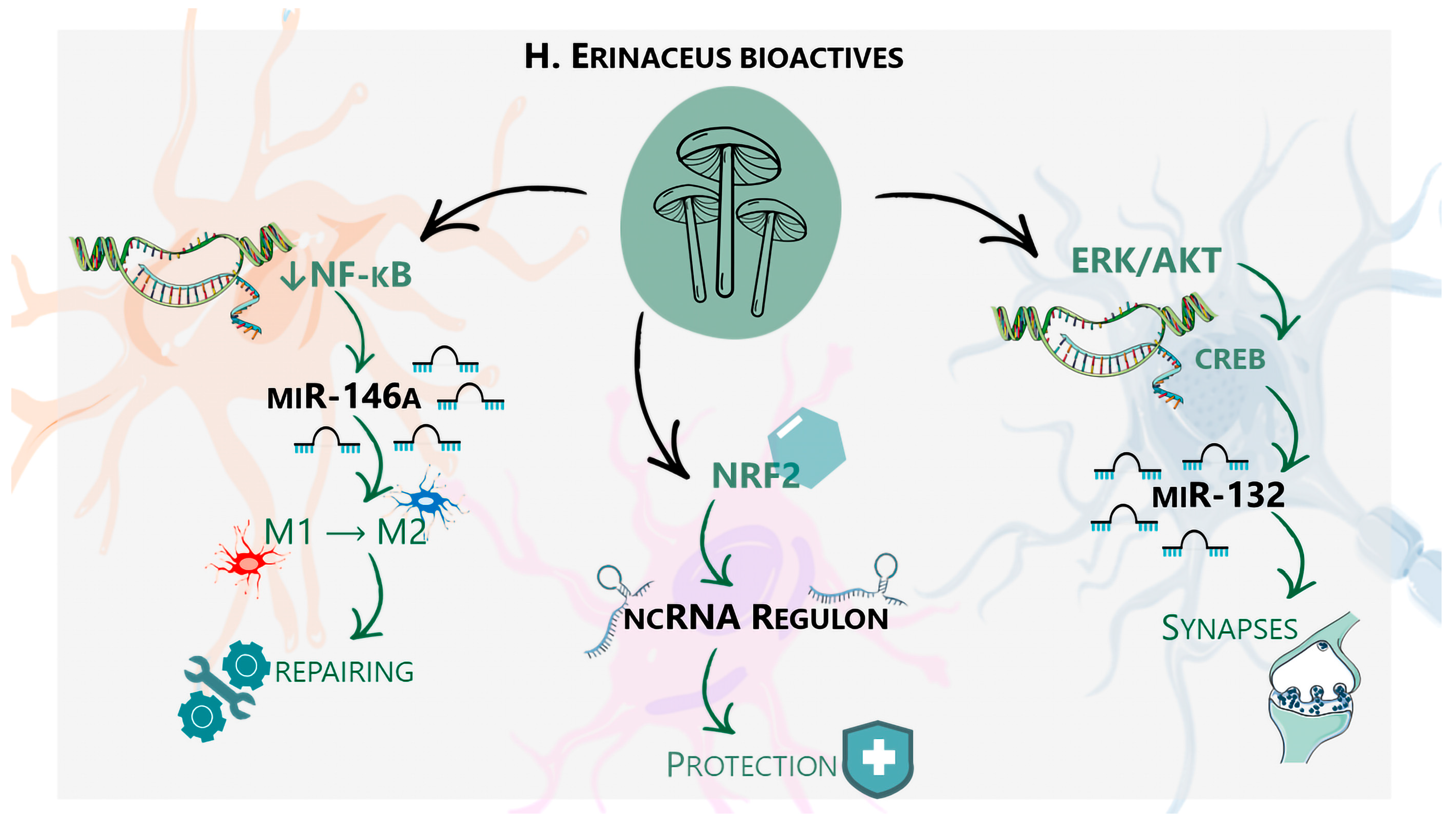
Beyond Neurotrophins: A Proposed Neurotrophic–Epigenetic Axis Mediated by Non-Coding RNA Networks for Hericium erinaceus Bioactives—A Hypothesis-Driven Review

 , , , , , ,
  , and
, and
Abstract
1. Introduction
A Triad of Neuroprotection: Hericium erinaceus, Neurotrophins, and Non-Coding RNAs
2. Mechanistic Evidence on Neurotrophins and Downstream Signaling
3. The Regulatory Landscape of Non-Coding RNAs in Neuronal Function and Pathology
4. Bridging the Gap: Hypothesized Links Between Hericium erinaceus Bioactives and ncRNA Networks
4.1. Mechanistic Hypotheses: Integrating Transcription Factors and ncRNA Networks
4.2. Constraints and Limitations of the Proposed Framework
5. Disease-Focused Perspectives: Mapping Pathways to Pathologies
6. Knowledge Gaps and a Framework for Future Research
7. Conclusions
Author Contributions
Funding
Institutional Review Board Statement
Informed Consent Statement
Data Availability Statement
Acknowledgments
Conflicts of Interest
Abbreviations
| 3′ UTR | 3′ untranslated region |
| Aβ | Amyloid-beta |
| AD | Alzheimer’s disease |
| ALS | Amyotrophic lateral sclerosis |
| AREs | Antioxidant Response Elements |
| BACE1 | B-site APP cleaving enzyme 1 |
| BACE1-AS | BACE1 natural antisense transcript |
| BBB | Blood–brain barrier |
| BDNF | Brain-Derived Neurotrophic Factor |
| CDR1as | Cerebellar Degeneration-Related protein 1 antisense |
| circRNAs | Circular RNAs |
| ciRS-7 | Circular RNA sponge for miR-7 |
| CNS | Central nervous system |
| CREB | cAMP response element-binding protein |
| ERK | Extracellular Signal-Regulated Kinase |
| GLP | Good Laboratory Practice |
| H. erinaceus | Hericium erinaceus |
| IDE | Insulin-degrading enzyme |
| iPSC | Induced pluripotent stem cell |
| lncRNAs | Long non-coding RNAs |
| MALAT1 | Metastasis-Associated Lung Adenocarcinoma Transcript 1 |
| MAPK | Mitogen-Activated Protein Kinase |
| miRNAs | MicroRNAs |
| mRNAs | Messenger RNAs |
| MS | Multiple Sclerosis |
| ncRNAs | Non-coding RNAs |
| NDPIH | N-de phenylethyl isohericerin |
| NEAT1 | Nuclear Enriched Abundant Transcript 1 |
| NGF | Nerve Growth Factor |
| OPCs | Oligodendrocyte precursor cells |
| PD | Parkinson’s disease |
| PI3K | Phosphoinositide 3-kinase |
| TBI | Traumatic brain injury |
| TrkA | Tropomyosin receptor kinase A |
| TrkB | Tropomyosin receptor kinase B |
References
- Szućko-Kociuba, I.; Trzeciak-Ryczek, A.; Kupnicka, P.; Chlubek, D. Neurotrophic and Neuroprotective Effects of Hericium erinaceus. Int. J. Mol. Sci. 2023, 24, 15960. [Google Scholar] [CrossRef]
- Brandalise, F.; Roda, E.; Ratto, D.; Goppa, L.; Gargano, M.L.; Cirlincione, F.; Priori, E.C.; Venuti, M.T.; Pastorelli, E.; Savino, E.; et al. Hericium erinaceus in Neurodegenerative Diseases: From Bench to Bedside and Beyond, How Far from the Shoreline? J. Fungi 2023, 9, 551. [Google Scholar] [CrossRef]
- Contato, A.G.; Conte-Junior, C.A. Lion’s Mane Mushroom (Hericium erinaceus): A Neuroprotective Fungus with Antioxidant, Anti-Inflammatory, and Antimicrobial Potential—A Narrative Review. Nutrients 2025, 17, 1307. [Google Scholar] [CrossRef]
- Li, I.C.; Lee, L.Y.; Tzeng, T.T.; Chen, W.P.; Chen, Y.P.; Shiao, Y.J.; Chen, C.C. Neurohealth Properties of Hericium erinaceus Mycelia Enriched with Erinacines. Behav. Neurol. 2018, 2018, 5802634. [Google Scholar] [CrossRef] [PubMed]
- Spangenberg, E.T.; Moneypenny, A.; Bozzo, G.G.; Perreault, M.L. Unveiling the Role of Erinacines in the Neuroprotective Effects of Hericium erinaceus: A Systematic Review in Preclinical Models. Front. Pharmacol. 2025, 16, 1582081. [Google Scholar] [CrossRef] [PubMed]
- Hu, J.H.; Li, I.C.; Lin, T.W.; Chen, W.P.; Lee, L.Y.; Chen, C.C.; Kuo, C.F. Absolute Bioavailability, Tissue Distribution, and Excretion of Erinacine S in Hericium erinaceus Mycelia. Molecules 2019, 24, 1624. [Google Scholar] [CrossRef] [PubMed]
- Roda, E.; Priori, E.C.; Ratto, D.; De Luca, F.; Di Iorio, C.; Angelone, P.; Locatelli, C.A.; Desiderio, A.; Goppa, L.; Savino, E.; et al. Neuroprotective Metabolites of Hericium erinaceus Promote Neuro-Healthy Aging. Int. J. Mol. Sci. 2021, 22, 6379. [Google Scholar] [CrossRef]
- Mori, K.; Obara, Y.; Hirota, M.; Azumi, Y.; Kinugasa, S.; Inatomi, S.; Nakahata, N. Nerve Growth Factor-Inducing Activity of Hericium erinaceus in 1321N1 Human Astrocytoma Cells. Biol. Pharm. Bull. 2008, 31, 1727–1732. [Google Scholar] [CrossRef]
- Numakawa, T.; Kajihara, R. The Role of Brain-Derived Neurotrophic Factor as an Essential Mediator in Neuronal Functions and the Therapeutic Potential of Its Mimetics for Neuroprotection in Neurologic and Psychiatric Disorders. Molecules 2025, 30, 848. [Google Scholar] [CrossRef]
- Calvo-Enrique, L.; Lisa, S.; Vicente-García, C.; Deogracias, R.; Arévalo, J.C. Enhanced TrkA Signaling Impairs Basal Forebrain-Dependent Behavior. Front. Mol. Neurosci. 2023, 16, 1266983. [Google Scholar] [CrossRef]
- Smeyne, R.J.; Klein, R.; Schnapp, A.; Long, L.K.; Bryant, S.; Lewin, A.; Lira, S.A.; Barbacid, M. Severe Sensory and Sympathetic Neuropathies in Mice Carrying a Disrupted Trk/NGF Receptor Gene. Nature 1994, 368, 246–249. [Google Scholar] [CrossRef] [PubMed]
- Colucci-D’Amato, L.; Speranza, L.; Volpicelli, F. Neurotrophic Factor BDNF, Physiological Functions and Therapeutic Potential in Depression, Neurodegeneration and Brain Cancer. Int. J. Mol. Sci. 2020, 21, 7777. [Google Scholar] [CrossRef]
- Martínez-Mármol, R.; Chai, Y.J.; Conroy, J.N.; Khan, Z.; Hong, S.M.; Kim, S.B.; Gormal, R.S.; Lee, D.H.; Lee, J.K.; Coulson, E.J.; et al. Hericerin Derivatives Activates a Pan-Neurotrophic Pathway in Central Hippocampal Neurons Converging to ERK1/2 Signaling Enhancing Spatial Memory. J. Neurochem. 2023, 165, 791–808. [Google Scholar] [CrossRef] [PubMed]
- Alammari, F.; Al-Hujaily, E.M.; Alshareeda, A.; Albarakati, N.; Al-Sowayan, B.S. Hidden Regulators: The Emerging Roles of LncRNAs in Brain Development and Disease. Front. Neurosci. 2024, 18, 1392688. [Google Scholar] [CrossRef] [PubMed]
- Zimmer-Bensch, G. Emerging Roles of Long Non-Coding RNAs as Drivers of Brain Evolution. Cells 2019, 8, 1399. [Google Scholar] [CrossRef]
- Lu, D.; Xu, A.D. Mini Review: Circular RNAs as Potential Clinical Biomarkers for Disorders in the Central Nervous System. Front. Genet. 2016, 7, 53. [Google Scholar] [CrossRef]
- Zhang, C.C.; Cao, C.Y.; Kubo, M.; Harada, K.; Yan, X.T.; Fukuyama, Y.; Gao, J.M. Chemical Constituents from Hericium erinaceus Promote Neuronal Survival and Potentiate Neurite Outgrowth via the TrkA/Erk1/2 Pathway. Int. J. Mol. Sci. 2017, 18, 1659. [Google Scholar] [CrossRef]
- Kawagishi, H.; Shimada, A.; Hosokawa, S.; Mori, H.; Sakamoto, H.; Ishiguro, Y.; Sakemi, S.; Bordner, J.; Kojima, N.; Furukawa, S. Erinacines E, F, and G, Stimulators of Nerve Growth Factor (NGF)-Synthesis, from the Mycelia of Hericium erinaceum. Tetrahedron Lett. 1996, 37, 7399–7402. [Google Scholar] [CrossRef]
- Kawagishi, H.; Shimada, A.; Shirai, R.; Okamoto, K.; Ojima, F.; Sakamoto, H.; Ishiguro, Y.; Furukawa, S. Erinacines A, B and C, Strong Stimulators of Nerve Growth Factor (NGF)-Synthesis, from the Mycelia of Hericium Erinaceum. Tetrahedron Lett. 1994, 35, 1569–1572. [Google Scholar] [CrossRef]
- Shimbo, M.; Kawagishi, H.; Yokogoshi, H. Erinacine A Increases Catecholamine and Nerve Growth Factor Content in the Central Nervous System of Rats. Nutr. Res. 2005, 25, 617–623. [Google Scholar] [CrossRef]
- Chong, P.S.; Poon, C.H.; Roy, J.; Tsui, K.C.; Lew, S.Y.; Phang, M.W.L.; Tan, R.J.Y.; Cheng, P.G.; Fung, M.-L.; Wong, K.H.; et al. Neurogenesis-Dependent Antidepressant-like Activity of Hericium erinaceus in an Animal Model of Depression. Chin. Med. 2021, 16, 132. [Google Scholar] [CrossRef] [PubMed]
- Qiu, Y.; Lin, G.; Liu, W.; Zhang, F.; Linhardt, R.J.; Wang, X.; Zhang, A. Bioactive Compounds in Hericium erinaceus and Their Biological Properties: A Review. Food Sci. Hum. Wellness 2024, 13, 1825–1844. [Google Scholar] [CrossRef]
- Phan, C.-W.; Lee, G.-S.; Hong, S.-L.; Wong, Y.-T.; Brkljača, R.; Urban, S.; Abd Malek, S.N.; Sabaratnam, V. Hericium erinaceus (Bull.: Fr) Pers. Cultivated under Tropical Conditions: Isolation of Hericenones and Demonstration of NGF-Mediated Neurite Outgrowth in PC12 Cells via MEK/ERK and PI3K-Akt Signaling Pathways. Food Funct. 2014, 5, 3160–3169. [Google Scholar] [CrossRef]
- Rascher, M.; Wittstein, K.; Winter, B.; Rupcic, Z.; Wolf-Asseburg, A.; Stadler, M.; Köster, R.W. Erinacine C Activates Transcription from a Consensus ETS DNA Binding Site in Astrocytic Cells in Addition to NGF Induction. Biomolecules 2020, 10, 1440. [Google Scholar] [CrossRef]
- Kim, M.-S.; Shutov, L.P.; Gnanasekaran, A.; Lin, Z.; Rysted, J.E.; Ulrich, J.D.; Usachev, Y.M. Nerve Growth Factor (NGF) Regulates Activity of Nuclear Factor of Activated T-Cells (NFAT) in Neurons via the Phosphatidylinositol 3-Kinase (PI3K)-Akt-Glycogen Synthase Kinase 3β (GSK3β) Pathway. J. Biol. Chem. 2014, 289, 31349–31360. [Google Scholar] [CrossRef]
- Menon, A.; Jalal, A.; Arshad, Z.; Nawaz, F.A.; Kashyap, R. Benefits, Side Effects, and Uses of Hericium erinaceus as a Supplement: A Systematic Review. Front. Nutr. 2025, 12, 1641246. [Google Scholar] [CrossRef]
- Chiu, C.-H.; Chyau, C.-C.; Chen, C.-C.; Lee, L.-Y.; Chen, W.-P.; Liu, J.-L.; Lin, W.-H.; Mong, M.-C. Erinacine A-Enriched Hericium erinaceus Mycelium Produces Antidepressant-Like Effects through Modulating BDNF/PI3K/Akt/GSK-3β Signaling in Mice. Int. J. Mol. Sci. 2018, 19, 341. [Google Scholar] [CrossRef] [PubMed]
- Deshmukh, S.K.; Sridhar, K.R.; Gupta, M.K. Hericium erinaceus—A Rich Source of Diverse Bioactive Metabolites. Fungal Biotec 2021, 1, 10–38. [Google Scholar] [CrossRef]
- Lee, K.F.; Hsieh, Y.Y.; Tung, S.Y.; Teng, C.C.; Cheng, K.C.; Hsieh, M.C.; Huang, C.Y.; Lee, K.C.; Lee, L.Y.; Chen, W.P.; et al. The Cerebral Protective Effect of Novel Erinacines from Hericium erinaceus Mycelium on In Vivo Mild Traumatic Brain Injury Animal Model and Primary Mixed Glial Cells via Nrf2-Dependent Pathways. Antioxidants 2024, 13, 371. [Google Scholar] [CrossRef] [PubMed]
- Guo, Y.; Pan, W.; Liu, S.; Shen, Z.; Xu, Y.; Hu, L. ERK/MAPK Signalling Pathway and Tumorigenesis (Review). Exp. Ther. Med. 2020, 19, 1997–2007. [Google Scholar] [CrossRef]
- Chong, P.S.; Khairuddin, S.; Tse, A.C.K.; Hiew, L.F.; Lau, C.L.; Tipoe, G.L.; Fung, M.L.; Wong, K.H.; Lim, L.W. Hericium erinaceus Potentially Rescues Behavioural Motor Deficits through ERK-CREB-PSD95 Neuroprotective Mechanisms in Rat Model of 3-Acetylpyridine-Induced Cerebellar Ataxia. Sci. Rep. 2020, 10, 14945. [Google Scholar] [CrossRef]
- Li, J.; Wang, X. Functional Roles of Conserved LncRNAs and CircRNAs in Eukaryotes. Noncoding RNA Res. 2024, 9, 1271–1279. [Google Scholar] [CrossRef]
- Duchaine, T.F.; Fabian, M.R. Mechanistic Insights into Microrna-Mediated Gene Silencing. Cold Spring Harb. Perspect. Biol. 2019, 11, a032771. [Google Scholar] [CrossRef] [PubMed]
- Ye, Y.; Xu, H.; Su, X.; He, X. Role of MicroRNA in Governing Synaptic Plasticity. Neural Plast. 2016, 2016, 4959523. [Google Scholar] [CrossRef]
- Wanet, A.; Tacheny, A.; Arnould, T.; Renard, P. MiR-212/132 Expression and Functions: Within and beyond the Neuronal Compartment. Nucleic Acids Res. 2012, 40, 4742–4753. [Google Scholar] [CrossRef] [PubMed]
- Qian, Y.; Song, J.; Ouyang, Y.; Han, Q.; Chen, W.; Zhao, X.; Xie, Y.; Chen, Y.; Yuan, W.; Fan, C. Advances in Roles of MiR-132 in the Nervous System. Front. Pharmacol. 2017, 8, 770. [Google Scholar] [CrossRef]
- Yi, L.T.; Li, J.; Liu, B.B.; Luo, L.; Liu, Q.; Geng, D. BDNF-ERK-CREB Signalling Mediates the Role of MiR-132 in the Regulation of the Effects of Oleanolic Acid in Male Mice. J. Psychiatry Neurosci. 2014, 39, 348–359. [Google Scholar] [CrossRef] [PubMed]
- Son, G.; Na, Y.; Kim, Y.; Son, J.-H.; Clemenson, G.D.; Schafer, S.T.; Yoo, J.-Y.; Parylak, S.L.; Paquola, A.; Do, H.; et al. MiR-124 Coordinates Metabolic Regulators Acting at Early Stages of Human Neurogenesis. Commun. Biol. 2024, 7, 1393. [Google Scholar] [CrossRef]
- Rashidi, S.K.; Kalirad, A.; Rafie, S.; Behzad, E.; Dezfouli, M.A. The Role of MicroRNAs in Neurobiology and Pathophysiology of the Hippocampus. Front. Mol. Neurosci. 2023, 16, 1226413. [Google Scholar] [CrossRef]
- Zhao, J.L.; Rao, D.S.; Boldin, M.P.; Taganov, K.D.; O’Connell, R.M.; Baltimore, D. NF-ΚB Dysregulation in MicroRNA-146a-Deficient Mice Drives the Development of Myeloid Malignancies. Proc. Natl. Acad. Sci. USA 2011, 108, 9184–9189. [Google Scholar] [CrossRef]
- Gaudet, A.D.; Fonken, L.K.; Watkins, L.R.; Nelson, R.J.; Popovich, P.G. MicroRNAs: Roles in Regulating Neuroinflammation. Neuroscientist 2018, 24, 221–245. [Google Scholar] [CrossRef]
- Schratt, G.M.; Tuebing, F.; Nigh, E.A.; Kane, C.G.; Sabatini, M.E.; Kiebler, M.; Greenberg, M.E. A Brain-Specific MicroRNA Regulates Dendritic Spine Development. Nature 2006, 439, 283–289, Erratum in Nature 2006, 441, 902. [Google Scholar] [CrossRef]
- Park, I.; Kim, H.J.; Kim, Y.; Hwang, H.S.; Kasai, H.; Kim, J.-H.; Park, J.W. Nanoscale Imaging Reveals MiRNA-Mediated Control of Functional States of Dendritic Spines. Proc. Natl. Acad. Sci. USA 2019, 116, 9616–9621. [Google Scholar] [CrossRef]
- Jalaiei, A.; Asadi, M.R.; Sabaie, H.; Dehghani, H.; Gharesouran, J.; Hussen, B.M.; Taheri, M.; Ghafouri-Fard, S.; Rezazadeh, M. Long Non-Coding RNAs, Novel Offenders or Guardians in Multiple Sclerosis: A Scoping Review. Front. Immunol. 2021, 12, 774002. [Google Scholar] [CrossRef] [PubMed]
- Badrlou, E.; Ghafouri-Fard, S.; Omrani, M.D.; Neishabouri, S.M.; Arsang-Jang, S.; Taheri, M.; Pouresmaeili, F. Expression of BDNF-Associated LncRNAs in Treatment-Resistant Schizophrenia Patients. J. Mol. Neurosci. 2021, 71, 2249–2259. [Google Scholar] [CrossRef]
- Bohnsack, J.P.; Teppen, T.; Kyzar, E.J.; Dzitoyeva, S.; Pandey, S.C. The LncRNA BDNF-AS Is an Epigenetic Regulator in the Human Amygdala in Early Onset Alcohol Use Disorders. Transl. Psychiatry 2019, 9, 34. [Google Scholar] [CrossRef]
- Abdolmaleki, A.; Ferdowsi, S.; Asadi, A.; Panahi, Y. Long Non-Coding RNAs Associated with Brain Disorders: A Literature Review. Gene Cell Tissue 2021, 8, e111802. [Google Scholar] [CrossRef]
- Zhang, X.; Hamblin, M.H.; Yin, K.J. The Long Noncoding RNA Malat1: Its Physiological and Pathophysiological Functions. RNA Biol. 2017, 14, 1705–1714. [Google Scholar] [CrossRef] [PubMed]
- Liu, X.; Zhang, Y.; Zhou, S.; Dain, L.; Mei, L.; Zhu, G. Circular RNA: An Emerging Frontier in RNA Therapeutic Targets, RNA Therapeutics, and MRNA Vaccines. J. Control. Release 2022, 348, 84–94. [Google Scholar] [CrossRef] [PubMed]
- Mehta, S.L.; Chokkalla, A.K.; Bathula, S.; Arruri, V.; Chelluboina, B.; Vemuganti, R. CDR1as Regulates α-Synuclein-Mediated Ischemic Brain Damage by Controlling MiR-7 Availability. Mol. Ther. Nucleic Acids 2023, 31, 57–67. [Google Scholar] [CrossRef]
- Guo, Z.; Cao, Q.; Zhao, Z.; Song, C. Biogenesis, Features, Functions, and Disease Relationships of a Specific Circular RNA: CDR1as. Aging Dis. 2020, 11, 1009–1020. [Google Scholar] [CrossRef]
- Zheng, Q.; Bao, C.; Guo, W.; Li, S.; Chen, J.; Chen, B.; Luo, Y.; Lyu, D.; Li, Y.; Shi, G.; et al. Circular RNA Profiling Reveals an Abundant CircHIPK3 That Regulates Cell Growth by Sponging Multiple MiRNAs. Nat. Commun. 2016, 7, 11215. [Google Scholar] [CrossRef]
- Ahmed, S.; Kwatra, M.; Gawali, B.; Panda, S.R.; Naidu, V.G.M. Potential Role of TrkB Agonist in Neuronal Survival by Promoting CREB/BDNF and PI3K/Akt Signaling in Vitro and in Vivo Model of 3-Nitropropionic Acid (3-NP)-Induced Neuronal Death. Apoptosis 2021, 26, 52–70. [Google Scholar] [CrossRef]
- Wu, J.; Nagy, L.E.; Liangpunsakul, S.; Wang, L. Non-Coding RNA Crosstalk with Nuclear Receptors in Liver Disease. Biochim. Biophys. Acta (BBA)—Mol. Basis Dis. 2021, 1867, 166083. [Google Scholar] [CrossRef]
- Serafini, M.M.; Catanzaro, M.; Fagiani, F.; Simoni, E.; Caporaso, R.; Dacrema, M.; Romanoni, I.; Govoni, S.; Racchi, M.; Daglia, M.; et al. Modulation of Keap1/Nrf2/ARE Signaling Pathway by Curcuma- And Garlic-Derived Hybrids. Front. Pharmacol. 2020, 10, 1597. [Google Scholar] [CrossRef]
- Anilkumar, S.; Wright-Jin, E. NF-ΚB as an Inducible Regulator of Inflammation in the Central Nervous System. Cells 2024, 13, 485. [Google Scholar] [CrossRef]
- Zhou, C.; Zhao, L.; Wang, K.; Qi, Q.; Wang, M.; Yang, L.; Sun, P.; Mu, H. MicroRNA-146a Inhibits NF-κB Activation and Pro-inflammatory Cytokine Production by Regulating IRAK1 Expression in THP-1 Cells. Exp. Ther. Med. 2019, 18, 3078–3084. [Google Scholar] [CrossRef]
- Liu, P.; Zhang, Z.; Du, M.; Chen, W.; Li, W.; Yang, W.; Zhou, C.; Wu, D.; Yang, Y. Restoring Mitochondrial Function and Remodeling Gut Microbiota by Low-Molecular-Weight β-Glucan of Hericium erinaceus in Alcohol-Induced Gastrointestinal Injury. J. Agric. Food Chem. 2025, 73, 28864–28882. [Google Scholar] [CrossRef]
- Roda, A.; Serra-Mir, G.; Montoliu-Gaya, L.; Tiessler, L.; Villegas, S. Amyloid-Beta Peptide and Tau Protein Crosstalk in Alzheimer’s Disease. Neural Regen. Res. 2022, 17, 1666. [Google Scholar] [CrossRef]
- Tsai-Teng, T.; Chin-Chu, C.; Li-Ya, L.; Wan-Ping, C.; Chung-Kuang, L.; Chien-Chang, S.; Chi-Ying, H.F.; Chien-Chih, C.; Shiao, Y.J. Erinacine A-Enriched Hericium erinaceus Mycelium Ameliorates Alzheimer’s Disease-Related Pathologies in APPswe/PS1dE9 Transgenic Mice. J. Biomed. Sci. 2016, 23, 49. [Google Scholar] [CrossRef]
- Lan, Z.; Chen, Y.; Jin, J.; Xu, Y.; Zhu, X. Long Non-Coding RNA: Insight Into Mechanisms of Alzheimer’s Disease. Front. Mol. Neurosci. 2022, 14, 821002. [Google Scholar] [CrossRef]
- Zhao, J.; Yue, D.; Zhou, Y.; Jia, L.; Wang, H.; Guo, M.; Xu, H.; Chen, C.; Zhang, J.; Xu, L. The Role of MicroRNAs in Aβ Deposition and Tau Phosphorylation in Alzheimer’s Disease. Front. Neurol. 2017, 8, 342. [Google Scholar]
- Castillo-Rangel, C.; Marin, G.; Hernández-Contreras, K.A.; Vichi-Ramírez, M.M.; Zarate-Calderon, C.; Torres-Pineda, O.; Diaz-Chiguer, D.L.; De la Mora González, D.; Gómez Apo, E.; Teco-Cortes, J.A.; et al. Neuroinflammation in Parkinson’s Disease: From Gene to Clinic: A Systematic Review. Int. J. Mol. Sci. 2023, 24, 5792. [Google Scholar] [CrossRef]
- Lee, S.L.; Hsu, J.Y.; Chen, T.C.; Huang, C.C.; Wu, T.Y.; Chin, T.Y. Erinacine A Prevents Lipopolysaccharide-Mediated Glial Cell Activation to Protect Dopaminergic Neurons against Inflammatory Factor-Induced Cell Death In Vitro and In Vivo. Int. J. Mol. Sci. 2022, 23, 810. [Google Scholar] [CrossRef]
- Fu, J.T.; Yang, C.J.; Lee, L.Y.; Chen, W.P.; Chen, Y.W.; Chen, C.C.; Sun, Y.T.; Yang, C.S.; Tzeng, S.F. Erinacine S, a Small Active Component Derived from Hericium erinaceus, Protects Oligodendrocytes and Alleviates Mood Abnormalities in Cuprizone-Exposed Rodents. Biomed. Pharmacother. 2024, 173, 116297. [Google Scholar] [CrossRef]
- Chen, Y.; Mateski, J.; Gerace, L.; Wheeler, J.; Burl, J.; Prakash, B.; Svedin, C.; Amrick, R.; Adams, B.D. Non-Coding RNAs and Neuroinflammation: Implications for Neurological Disorders. Exp. Biol. Med. 2024, 249, 10120. [Google Scholar] [CrossRef]
- Lee, K.F.; Chen, J.H.; Teng, C.C.; Shen, C.H.; Hsieh, M.C.; Lu, C.C.; Lee, K.C.; Lee, L.Y.; Chen, W.P.; Chen, C.C.; et al. Protective Effects of Hericium erinaceus Mycelium and Its Isolated Erinacine a against Ischemia-Injury-Induced Neuronal Cell Death via the Inhibition of INOS/P38 MAPK and Nitrotyrosine. Int. J. Mol. Sci. 2014, 15, 15073–15089. [Google Scholar] [CrossRef]
- Wang, L.-Y.; Huang, C.-S.; Chen, Y.-H.; Chen, C.-C.; Chen, C.-C.; Chuang, C.-H. Anti-Inflammatory Effect of Erinacine C on NO Production Through Down-Regulation of NF-ΚB and Activation of Nrf2-Mediated HO-1 in BV2 Microglial Cells Treated with LPS. Molecules 2019, 24, 3317. [Google Scholar] [CrossRef]
- Yang, X.; Liu, Y.; Cao, J.; Wu, C.; Tang, L.; Bian, W.; Chen, Y.; Yu, L.; Wu, Y.; Li, S.; et al. Targeting Epigenetic and Post-Translational Modifications of NRF2: Key Regulatory Factors in Disease Treatment. Cell Death Discov. 2025, 11, 189. [Google Scholar] [CrossRef]
- Fabrizio, F.P.; Sparaneo, A.; Muscarella, L.A. NRF2 Regulation by Noncoding RNAs in Cancers: The Present Knowledge and the Way Forward. Cancers 2020, 12, 3621. [Google Scholar] [CrossRef]
- Yousefzadeh, N.; Alipour, M.R.; Ghadiri Soufi, F. Deregulation of NF-KB–MiR-146a Negative Feedback Loop May Be Involved in the Pathogenesis of Diabetic Neuropathy. J. Physiol. Biochem. 2015, 71, 51–58. [Google Scholar] [CrossRef] [PubMed]
- Percie du Sert, N.; Hurst, V.; Ahluwalia, A.; Alam, S.; Avey, M.T.; Baker, M.; Browne, W.J.; Clark, A.; Cuthill, I.C.; Dirnagl, U.; et al. The ARRIVE Guidelines 2.0: Updated Guidelines for Reporting Animal Research. PLoS Biol. 2020, 18, e3000410. [Google Scholar] [CrossRef]

Disclaimer/Publisher’s Note: The statements, opinions and data contained in all publications are solely those of the individual author(s) and contributor(s) and not of MDPI and/or the editor(s). MDPI and/or the editor(s) disclaim responsibility for any injury to people or property resulting from any ideas, methods, instructions or products referred to in the content. |
© 2026 by the authors. Licensee MDPI, Basel, Switzerland. This article is an open access article distributed under the terms and conditions of the Creative Commons Attribution (CC BY) license.
Share and Cite
Cipriano, G.L.; Raffaele, I.; Floramo, A.; Argento, V.; Donato, D.S.; Malatino, C.; Silvestro, S.; Schepici, G.; Astorino, M.F.; Calabrò, M.; et al. Beyond Neurotrophins: A Proposed Neurotrophic–Epigenetic Axis Mediated by Non-Coding RNA Networks for Hericium erinaceus Bioactives—A Hypothesis-Driven Review. Int. J. Mol. Sci. 2026, 27, 1269. https://doi.org/10.3390/ijms27031269
Cipriano GL, Raffaele I, Floramo A, Argento V, Donato DS, Malatino C, Silvestro S, Schepici G, Astorino MF, Calabrò M, et al. Beyond Neurotrophins: A Proposed Neurotrophic–Epigenetic Axis Mediated by Non-Coding RNA Networks for Hericium erinaceus Bioactives—A Hypothesis-Driven Review. International Journal of Molecular Sciences. 2026; 27(3):1269. https://doi.org/10.3390/ijms27031269
Chicago/Turabian StyleCipriano, Giovanni Luca, Ivana Raffaele, Alessia Floramo, Veronica Argento, Deborah Stefania Donato, Chiara Malatino, Serena Silvestro, Giovanni Schepici, Maria Francesca Astorino, Marco Calabrò, and et al. 2026. "Beyond Neurotrophins: A Proposed Neurotrophic–Epigenetic Axis Mediated by Non-Coding RNA Networks for Hericium erinaceus Bioactives—A Hypothesis-Driven Review" International Journal of Molecular Sciences 27, no. 3: 1269. https://doi.org/10.3390/ijms27031269
APA StyleCipriano, G. L., Raffaele, I., Floramo, A., Argento, V., Donato, D. S., Malatino, C., Silvestro, S., Schepici, G., Astorino, M. F., Calabrò, M., & Anchesi, I. (2026). Beyond Neurotrophins: A Proposed Neurotrophic–Epigenetic Axis Mediated by Non-Coding RNA Networks for Hericium erinaceus Bioactives—A Hypothesis-Driven Review. International Journal of Molecular Sciences, 27(3), 1269. https://doi.org/10.3390/ijms27031269