Whole-Exome Sequencing Identifies Novel Genetic Variants Associated with Unexplained Neurodevelopmental Disorders in Children
 ,
,  , ,
, ,  ,
,
Abstract
1. Introduction
2. Results
2.1. Whole-Exome Sequencing Results
2.2. CAST Analysis Results
3. Discussion
4. Materials and Methods
4.1. Participants and Clinical Information
4.2. Data Collection
4.3. Sample Collection, WES Sequencing, Bioinformatic Analysis, and Variant Prioritization
4.4. Variant Inclusion and Classification
4.5. Disease-Causing Variants for Gene Burden Testing
4.6. Statistical Analysis
5. Conclusions
Supplementary Materials
Author Contributions
Funding
Institutional Review Board Statement
Informed Consent Statement
Data Availability Statement
Conflicts of Interest
Abbreviations
| ACMG | American College of Medical Genetics and Genomics |
| ADHD | Attention-Deficit/Hyperactivity Disorder |
| Array-CGH | Array Comparative Genomic Hybridisation |
| ASD | Autism Spectrum Disorder |
| CAST | Cohort Allelic Sums Test |
| CNVs | Copy Number Variations |
| GDD | Global Developmental Delay |
| ID | Intellectual Disability |
| LoF | Loss-Of-Function |
| NDDs | Neurodevelopmental Disorders |
| NGS | Next-Generation Sequencing |
| pLI | Loss-Of-Function Intolerance |
| SLD | Specific Learning Disorders |
| SNVs | Single-Nucleotide Variants |
| WES | Whole-Exome Sequencing |
| WGS | Whole-Genome Sequencing |
References
- Diagnostic and Statistical Manual of Mental Disorders, 5th ed.; Text Revision DSM-5-TRTM; American Psychiatric Association: Washington, DC, USA, 2022.
- Mullin, A.P.; Gokhale, A.; Moreno-De-Luca, A.; Sanyal, S.; Waddington, J.L.; Faundez, V. Neurodevelopmental Disorders: Mechanisms and Boundary Definitions from Genomes, Interactomes and Proteomes. Transl. Psychiatry 2013, 3, e329. [Google Scholar] [CrossRef] [Scilit] [PubMed]
- Reiss, A.L. Childhood Developmental Disorders: An Academic and Clinical Convergence Point for Psychiatry, Neurology, Psychology and Pediatrics. J. Child Psychol. Psychiatry 2009, 50, 87–98. [Google Scholar] [CrossRef] [Scilit] [PubMed]
- Cainelli, E.; Bisiacchi, P. Neurodevelopmental Disorders: Past, Present, and Future. Children 2023, 10, 31. [Google Scholar] [CrossRef] [Scilit] [PubMed]
- Bowling, K.M.; Thompson, M.L.; Amaral, M.D.; Finnila, C.R.; Hiatt, S.M.; Engel, K.L.; Cochran, J.N.; Brothers, K.B.; East, K.M.; Gray, D.E.; et al. Genomic Diagnosis for Children with Intellectual Disability and/or Developmental Delay. Genome Med. 2017, 9, 43. [Google Scholar] [CrossRef] [Scilit]
- Parenti, I.; Rabaneda, L.G.; Schoen, H.; Novarino, G. Neurodevelopmental Disorders: From Genetics to Functional Pathways. Trends Neurosci. 2020, 43, 608–621. [Google Scholar] [CrossRef] [Scilit]
- Khodosevich, K.; Sellgren, C.M. Neurodevelopmental Disorders—High-Resolution Rethinking of Disease Modeling. Mol. Psychiatry 2023, 28, 34–43. [Google Scholar] [CrossRef] [Scilit]
- Olson, L.; Bishop, S.; Thurm, A. Differential Diagnosis of Autism and Other Neurodevelopmental Disorders. Pediatr. Clin. N. Am. 2024, 71, 157–177. [Google Scholar] [CrossRef] [Scilit]
- Scandurra, V.; Emberti Gialloreti, L.; Barbanera, F.; Scordo, M.R.; Pierini, A.; Canitano, R. Neurodevelopmental Disorders and Adaptive Functions: A Study of Children with Autism Spectrum Disorders (ASD) and/or Attention Deficit and Hyperactivity Disorder (ADHD). Front. Psychiatry 2019, 10, 673. [Google Scholar] [CrossRef] [Scilit]
- Tyser, R.C.V.; Srinivas, S. Recent Advances in Understanding Cell Types during Human Gastrulation. Semin. Cell Dev. Biol. 2022, 131, 35–43. [Google Scholar] [CrossRef] [Scilit]
- Johnson, M.H. Functional Brain Development in Humans. Nat. Rev. Neurosci. 2001, 2, 475–483. [Google Scholar] [CrossRef] [Scilit]
- Abramov, A.Y. The Brain-from Neurodevelopment to Neurodegeneration. FEBS J. 2022, 289, 2010–2012. [Google Scholar] [CrossRef] [Scilit]
- Purves, D.; Augustine, G.J.; Fitzpatrick, D.; Katz, L.C.; LaMantia, A.-S.; McNamara, J.O.; Williams, S.M. The Initial Formation of the Nervous System: Gastrulation and Neurulation. In Neuroscience, 2nd ed.; Sinauer Associates: Sunderland, MA, USA, 2001. [Google Scholar]
- Stiles, J.; Jernigan, T.L. The Basics of Brain Development. Neuropsychol. Rev. 2010, 20, 327–348. [Google Scholar] [CrossRef] [Scilit] [PubMed]
- Cayre, M.; Canoll, P.; Goldman, J.E. Cell Migration in the Normal and Pathological Postnatal Mammalian Brain. Prog. Neurobiol. 2009, 88, 41–63. [Google Scholar] [CrossRef] [Scilit] [PubMed]
- Stagni, F.; Bartesaghi, R. The Challenging Pathway of Treatment for Neurogenesis Impairment in Down Syndrome: Achievements and Perspectives. Front. Cell. Neurosci. 2022, 16, 903729. [Google Scholar] [CrossRef] [Scilit] [PubMed]
- Khan, Q.A.; Khan, R.; Verma, R.; Shah, S.D.; Vattikuti, B.; Khan, A.Z.; Shahzadi, A.; Abdi, P.; Anthony, M.; Farkouh, C.S.; et al. Non-Syndromic Intellectual Disability: An Experimental In-Depth Exploration of Inheritance Pattern, Phenotypic Presentation, and Genomic Composition. Cureus 2023, 15, e34085. [Google Scholar] [CrossRef]
- Fernandez, B.A.; Scherer, S.W. Syndromic Autism Spectrum Disorders: Moving from a Clinically Defined to a Molecularly Defined Approach. Dialogues Clin. Neurosci. 2017, 19, 353–371. [Google Scholar] [CrossRef] [Scilit]
- Foster, A.; Titheradge, H.; Morton, J. Genetics of Learning Disability. Paediatr. Child Health 2015, 25, 450–457. [Google Scholar] [CrossRef] [Scilit]
- Gao, S.; Shan, C.; Zhang, R.; Wang, T. Genetic Advances in Neurodevelopmental Disorders. Med. Rev. 2024, 5, 139–151. [Google Scholar] [CrossRef] [Scilit]
- Rooney, K.; Sadikovic, B. DNA Methylation Episignatures in Neurodevelopmental Disorders Associated with Large Structural Copy Number Variants: Clinical Implications. Int. J. Mol. Sci. 2022, 23, 7862. [Google Scholar] [CrossRef] [Scilit]
- Hou, K.; Zheng, X. A 10-Year Review on Advancements in Identifying and Treating Intellectual Disability Caused by Genetic Variations. Genes 2024, 15, 1118. [Google Scholar] [CrossRef] [Scilit]
- Tărlungeanu, D.C.; Novarino, G. Genomics in Neurodevelopmental Disorders: An Avenue to Personalized Medicine. Exp. Mol. Med. 2018, 50, 1–7. [Google Scholar] [CrossRef] [Scilit] [PubMed]
- Sanchis-Juan, A.; Megy, K.; Stephens, J.; Armirola Ricaurte, C.; Dewhurst, E.; Low, K.; French, C.E.; Grozeva, D.; Stirrups, K.; Erwood, M.; et al. Genome Sequencing and Comprehensive Rare-Variant Analysis of 465 Families with Neurodevelopmental Disorders. Am. J. Hum. Genet. 2023, 110, 1343–1355. [Google Scholar] [CrossRef] [Scilit] [PubMed]
- Manickam, K.; McClain, M.R.; Demmer, L.A.; Biswas, S.; Kearney, H.M.; Malinowski, J.; Massingham, L.J.; Miller, D.; Yu, T.W.; Hisama, F.M. Exome and Genome Sequencing for Pediatric Patients with Congenital Anomalies or Intellectual Disability: An Evidence-Based Clinical Guideline of the American College of Medical Genetics and Genomics (ACMG). Genet. Med. 2021, 23, 2029–2037. [Google Scholar] [CrossRef] [Scilit] [PubMed]
- Srivastava, S.; Cole, J.J.; Cohen, J.S.; Chopra, M.; Smith, H.S.; Deardorff, M.A.; Pedapati, E.; Corner, B.; Anixt, J.S.; Jeste, S.; et al. Survey of the Landscape of Society Practice Guidelines for Genetic Testing of Neurodevelopmental Disorders. Ann. Neurol. 2024, 96, 900–913. [Google Scholar] [CrossRef] [Scilit]
- Du, X.; Gao, X.; Liu, X.; Shen, L.; Wang, K.; Fan, Y.; Sun, Y.; Luo, X.; Liu, H.; Wang, L.; et al. Genetic Diagnostic Evaluation of Trio-Based Whole Exome Sequencing Among Children with Diagnosed or Suspected Autism Spectrum Disorder. Front. Genet. 2018, 9, 594. [Google Scholar] [CrossRef] [Scilit]
- Chiang, C.W.K.; Marcus, J.H.; Sidore, C.; Biddanda, A.; Al-Asadi, H.; Zoledziewska, M.; Pitzalis, M.; Busonero, F.; Maschio, A.; Pistis, G.; et al. Genomic History of the Sardinian Population. Nat. Genet. 2018, 50, 1426–1434. [Google Scholar] [CrossRef] [Scilit]
- Sullivan, J.A.; Schoch, K.; Spillmann, R.C.; Shashi, V. Exome/Genome Sequencing in Undiagnosed Syndromes. Annu. Rev. Med. 2023, 74, 489–502. [Google Scholar] [CrossRef] [Scilit]
- Li, C.; Wang, Y.; Zeng, C.; Huang, B.; Chen, Y.; Xue, C.; Liu, L.; Rong, S.; Lin, Y. Trio-Whole Exome Sequencing Reveals the Importance of de Novo Variants in Children with Intellectual Disability and Developmental Delay. Sci. Rep. 2024, 14, 27590. [Google Scholar] [CrossRef] [Scilit]
- Álvarez-Mora, M.I.; Sánchez, A.; Rodríguez-Revenga, L.; Corominas, J.; Rabionet, R.; Puig, S.; Madrigal, I. Diagnostic Yield of Next-Generation Sequencing in 87 Families with Neurodevelopmental Disorders. Orphanet J. Rare Dis. 2022, 17, 60. [Google Scholar] [CrossRef] [Scilit]
- Leite, A.J.d.C.; Pinto, I.P.; Leijsten, N.; Ruiterkamp-Versteeg, M.; Pfundt, R.; de Leeuw, N.; da Cruz, A.D.; Minasi, L.B. Diagnostic Yield of Patients with Undiagnosed Intellectual Disability, Global Developmental Delay and Multiples Congenital Anomalies Using Karyotype, Microarray Analysis, Whole Exome Sequencing from Central Brazil. PLoS ONE 2022, 17, e0266493. [Google Scholar] [CrossRef] [Scilit]
- Clark, M.M.; Stark, Z.; Farnaes, L.; Tan, T.Y.; White, S.M.; Dimmock, D.; Kingsmore, S.F. Meta-Analysis of the Diagnostic and Clinical Utility of Genome and Exome Sequencing and Chromosomal Microarray in Children with Suspected Genetic Diseases. npj Genom. Med. 2018, 3, 16. [Google Scholar] [CrossRef] [Scilit]
- Dharmadhikari, A.V.; Ghosh, R.; Yuan, B.; Liu, P.; Dai, H.; Al Masri, S.; Scull, J.; Posey, J.E.; Jiang, A.H.; He, W.; et al. Copy Number Variant and Runs of Homozygosity Detection by Microarrays Enabled More Precise Molecular Diagnoses in 11,020 Clinical Exome Cases. Genome Med. 2019, 11, 30. [Google Scholar] [CrossRef] [Scilit]
- Srivastava, S.; Love-Nichols, J.A.; Dies, K.A.; Ledbetter, D.H.; Martin, C.L.; Chung, W.K.; Firth, H.V.; Frazier, T.; Hansen, R.L.; Prock, L.; et al. Meta-Analysis and Multidisciplinary Consensus Statement: Exome Sequencing Is a First-Tier Clinical Diagnostic Test for Individuals with Neurodevelopmental Disorders. Genet. Med. 2019, 21, 2413–2421, Erratum in Genet. Med. 2020, 22, 1731–1732. [Google Scholar] [CrossRef] [Scilit] [PubMed]
- Pennington, M.L.; Cullinan, D.; Southern, L.B. Defining Autism: Variability in State Education Agency Definitions of and Evaluations for Autism Spectrum Disorders. Autism Res. Treat. 2014, 2014, 327271. [Google Scholar] [CrossRef] [Scilit] [PubMed]
- Owen, D.J.; Aguilar-Martinez, E.; Ji, Z.; Li, Y.; Sharrocks, A.D. ZMYM2 Controls Human Transposable Element Transcription through Distinct Co-Regulatory Complexes. eLife 2023, 12, RP86669. [Google Scholar] [CrossRef] [PubMed]
- Gocke, C.B.; Yu, H. ZNF198 Stabilizes the LSD1–CoREST–HDAC1 Complex on Chromatin through Its MYM-Type Zinc Fingers. PLoS ONE 2008, 3, e3255. [Google Scholar] [CrossRef] [Scilit]
- Graham-Paquin, A.-L.; Saini, D.; Sirois, J.; Hossain, I.; Katz, M.S.; Zhuang, Q.K.-W.; Kwon, S.Y.; Yamanaka, Y.; Bourque, G.; Bouchard, M.; et al. ZMYM2 Is Essential for Methylation of Germline Genes and Active Transposons in Embryonic Development. Nucleic Acids Res. 2023, 51, 7314–7329. [Google Scholar] [CrossRef] [Scilit]
- Lezmi, E.; Weissbein, U.; Golan-Lev, T.; Nissim-Rafinia, M.; Meshorer, E.; Benvenisty, N. The Chromatin Regulator ZMYM2 Restricts Human Pluripotent Stem Cell Growth and Is Essential for Teratoma Formation. Stem Cell Rep. 2020, 15, 1275–1286. [Google Scholar] [CrossRef] [Scilit]
- Connaughton, D.M.; Dai, R.; Owen, D.J.; Marquez, J.; Mann, N.; Graham-Paquin, A.L.; Nakayama, M.; Coyaud, E.; Laurent, E.M.N.; St-Germain, J.R.; et al. Mutations of the Transcriptional Corepressor ZMYM2 Cause Syndromic Urinary Tract Malformations. Am. J. Hum. Genet. 2020, 107, 727–742. [Google Scholar] [CrossRef] [Scilit]
- Politano, D.; Marazzi, F.; Scognamillo, I.; Morelli, F.; Signorini, S.; Gana, S.; Nicolosi, S.; Rognone, E.; Borgatti, R.; Valente, E.M.; et al. A de Novo ZMYM2 Gene Variant Associated to a Rett-like Phenotype: Case Report of a New Phenotype and Review of the Literature. Brain Dev. 2025, 47, 104351. [Google Scholar] [CrossRef] [Scilit]
- Betancur, C.; Buxbaum, J.D. Gene Constraint and Genotype-Phenotype Correlations in Neurodevelopmental Disorders. Curr. Opin. Genet. Dev. 2020, 65, 69–75. [Google Scholar] [CrossRef] [Scilit] [PubMed]
- Badenhorst, P.; Voas, M.; Rebay, I.; Wu, C. Biological Functions of the ISWI Chromatin Remodeling Complex NURF. Genes Dev. 2002, 16, 3186–3198. [Google Scholar] [CrossRef] [Scilit] [PubMed]
- Hamiche, A.; Sandaltzopoulos, R.; Gdula, D.A.; Wu, C. ATP-Dependent Histone Octamer Sliding Mediated by the Chromatin Remodeling Complex NURF. Cell 1999, 97, 833–842. [Google Scholar] [CrossRef] [Scilit] [PubMed]
- Stankiewicz, P.; Khan, T.N.; Szafranski, P.; Slattery, L.; Streff, H.; Vetrini, F.; Bernstein, J.A.; Brown, C.W.; Rosenfeld, J.A.; Rednam, S.; et al. Haploinsufficiency of the Chromatin Remodeler BPTF Causes Syndromic Developmental and Speech Delay, Postnatal Microcephaly, and Dysmorphic Features. Am. J. Hum. Genet. 2017, 101, 503–515. [Google Scholar] [CrossRef] [Scilit]
- Ünsel-Bolat, G.; Gerik-Celebi, H.B.; Durgut, B.D.; Türkyılmaz, A.; Bolat, H. Effects of the Missense Variants on Complete Phenotype and Splicing Variant on Severe Growth Retardation in the BPTF Gene. Dev. Neurobiol. 2025, 85, e22970. [Google Scholar] [CrossRef] [Scilit]
- Tsuchiya, Y.; Yoshiba, S.; Gupta, A.; Watanabe, K.; Kitagawa, D. Cep295 Is a Conserved Scaffold Protein Required for Generation of a Bona Fide Mother Centriole. Nat. Commun. 2016, 7, 12567. [Google Scholar] [CrossRef] [Scilit]
- Izquierdo, D.; Wang, W.-J.; Uryu, K.; Tsou, M.-F.B. Stabilization of Cartwheel-Less Centrioles for Duplication Requires CEP295-Mediated Centriole-to-Centrosome Conversion. Cell Rep. 2014, 8, 957–965. [Google Scholar] [CrossRef] [Scilit]
- Li, N.; Xu, Y.; Chen, H.; Lin, J.; AlAbdi, L.; Bekheirnia, M.R.; Li, G.; Gofin, Y.; Bekheirnia, N.; Faqeih, E.; et al. Bi-Allelic Variants in CEP295 Cause Seckel-like Syndrome Presenting with Primary Microcephaly, Developmental Delay, Intellectual Disability, Short Stature, Craniofacial and Digital Abnormalities. eBioMedicine 2023, 99, 104940. [Google Scholar] [CrossRef] [Scilit]
- An, H.-L.; Kuo, H.-C.; Tang, T.K. Modeling Human Primary Microcephaly with hiPSC-Derived Brain Organoids Carrying CPAP-E1235V Disease-Associated Mutant Protein. Front. Cell Dev. Biol. 2022, 10, 830432. [Google Scholar] [CrossRef] [Scilit]
- Kritioti, E.; Theodosiou, A.; Nicolaou, N.; Alexandrou, A.; Papaevripidou, I.; Efstathiou, E.; Christophidou-Anastasiadou, V.; Sismani, C.; Tanteles, G.A. First Reported Case of Steel Syndrome in the European Population: A Novel Homozygous Mutation in COL27A1 and Review of the Literature. Eur. J. Med. Genet. 2020, 63, 103939. [Google Scholar] [CrossRef] [Scilit]
- Li, J.; Lin, S.; Wu, Q.; Feng, J.; Chen, Q.; Jiang, K. Spontaneous Mutation in the COL6A2 Gene Causing Ullrich Congenital Muscular Dystrophy Type 1 in a Chinese Child: A Case Report. Medicine 2023, 102, e36398. [Google Scholar] [CrossRef] [Scilit] [PubMed]
- Kotabagi, S.; Shah, H.; Shukla, A.; Girisha, K.M. Second Family Provides Further Evidence for Causation of Steel Syndrome by Biallelic Mutations in COL27A1. Clin. Genet. 2017, 92, 323–326. [Google Scholar] [CrossRef] [Scilit] [PubMed]
- Unzueta-Larrinaga, P.; Cuesta-Vega, E.; Barrena-Barbadillo, R.; Olabarrieta, E.; Recio-Barbero, M.; Horrillo, I.; Mentxaka, O.; Segarra, R.; Meana, J.J.; Nacher, J.; et al. Extracellular Matrix Dysfunction and Synaptic Alterations in Schizophrenia. Mol. Psychiatry 2025, 31, 396–406. [Google Scholar] [CrossRef] [Scilit] [PubMed]
- Long, K.R.; Huttner, W.B. How the Extracellular Matrix Shapes Neural Development. Open Biol. 2019, 9, 180216. [Google Scholar] [CrossRef] [Scilit]
- Kevenaar, J.T.; Hoogenraad, C.C. The Axonal Cytoskeleton: From Organization to Function. Front. Mol. Neurosci. 2015, 8, 44. [Google Scholar] [CrossRef] [Scilit]
- Lasser, M.; Tiber, J.; Lowery, L.A. The Role of the Microtubule Cytoskeleton in Neurodevelopmental Disorders. Front. Cell. Neurosci. 2018, 12, 165. [Google Scholar] [CrossRef] [Scilit]
- Liaci, C.; Camera, M.; Caslini, G.; Rando, S.; Contino, S.; Romano, V.; Merlo, G.R. Neuronal Cytoskeleton in Intellectual Disability: From Systems Biology and Modeling to Therapeutic Opportunities. Int. J. Mol. Sci. 2021, 22, 6167. [Google Scholar] [CrossRef] [Scilit]
- Kühnle, S.; Kogel, U.; Glockzin, S.; Marquardt, A.; Ciechanover, A.; Matentzoglu, K.; Scheffner, M. Physical and Functional Interaction of the HECT Ubiquitin-Protein Ligases E6AP and HERC2. J. Biol. Chem. 2011, 286, 19410–19416. [Google Scholar] [CrossRef] [Scilit]
- Cubillos-Rojas, M.; Schneider, T.; Hadjebi, O.; Pedrazza, L.; de Oliveira, J.R.; Langa, F.; Guénet, J.-L.; Duran, J.; de Anta, J.M.; Alcántara, S.; et al. The HERC2 Ubiquitin Ligase Is Essential for Embryonic Development and Regulates Motor Coordination. Oncotarget 2016, 7, 56083–56106. [Google Scholar] [CrossRef] [Scilit]
- Elpidorou, M.; Best, S.; Poulter, J.A.; Hartill, V.; Hobson, E.; Sheridan, E.; Johnson, C.A. Novel Loss-of-Function Mutation in HERC2 Is Associated with Severe Developmental Delay and Paediatric Lethality. J. Med. Genet. 2021, 58, 334–341. [Google Scholar] [CrossRef] [Scilit]
- Morice-Picard, F.; Benard, G.; Rezvani, H.R.; Lasseaux, E.; Simon, D.; Moutton, S.; Rooryck, C.; Lacombe, D.; Baumann, C.; Arveiler, B. Complete Loss of Function of the Ubiquitin Ligase HERC2 Causes a Severe Neurodevelopmental Phenotype. Eur. J. Hum. Genet. 2017, 25, 52–58. [Google Scholar] [CrossRef] [Scilit]
- Vincent, K.M.; Eaton, A.; Yassaee, V.R.; Miryounesi, M.; Hashemi-Gorji, F.; Rudichuk, L.; Goez, H.; Leonard, N.; Lazier, J. Delineating the Expanding Phenotype of HERC2-Related Disorders: The Impact of Biallelic Loss of Function versus Missense Variation. Clin. Genet. 2021, 100, 637–640. [Google Scholar] [CrossRef] [Scilit]
- Ackermann, F.; Schink, K.O.; Bruns, C.; Izsvák, Z.; Hamra, F.K.; Rosenmund, C.; Garner, C.C. Critical Role for Piccolo in Synaptic Vesicle Retrieval. eLife 2019, 8, e46629. [Google Scholar] [CrossRef] [Scilit] [PubMed]
- Garner, C.C.; Ackermann, F. Synaptic Logistics: The Presynaptic Scaffold Protein Piccolo a Nodal Point Tuning Synaptic Vesicle Recycling, Maintenance and Integrity. Mol. Cell. Neurosci. 2023, 124, 103795. [Google Scholar] [CrossRef] [Scilit] [PubMed]
- Fenster, S.D.; Garner, C.C. Gene Structure and Genetic Localization of the PCLO Gene Encoding the Presynaptic Active Zone Protein Piccolo. Int. J. Dev. Neurosci. 2002, 20, 161–171. [Google Scholar] [CrossRef] [Scilit] [PubMed]
- Lertsakulbunlue, S.; Piyachon, P.; Pichantianchai, P.; Chivaruangrot, T.; Suwanpakdee, P.; Boonyawat, B. Pontocerebellar Hypoplasia Type 3 with Two Novel PCLO Gene Mutations: A Case Report. Case Rep. Pediatr. 2025, 2025, 1955363. [Google Scholar] [CrossRef] [Scilit]
- Ahmed, M.Y.; Chioza, B.A.; Rajab, A.; Schmitz-Abe, K.; Al-Khayat, A.; Al-Turki, S.; Baple, E.L.; Patton, M.A.; Al-Memar, A.Y.; Hurles, M.E.; et al. Loss of PCLO Function Underlies Pontocerebellar Hypoplasia Type III. Neurology 2015, 84, 1745–1750. [Google Scholar] [CrossRef] [Scilit]
- Chen, C.-H.; Huang, Y.-S.; Liao, D.-L.; Huang, C.-Y.; Lin, C.-H.; Fang, T.-H. Identification of Rare Mutations of Two Presynaptic Cytomatrix Genes BSN and PCLO in Schizophrenia and Bipolar Disorder. J. Pers. Med. 2021, 11, 1057. [Google Scholar] [CrossRef] [Scilit]
- Warr, A.; Robert, C.; Hume, D.; Archibald, A.; Deeb, N.; Watson, M. Exome Sequencing: Current and Future Perspectives. G3 Genes|Genomes|Genet. 2015, 5, 1543–1550. [Google Scholar] [CrossRef] [Scilit]
- Gao, C.; Wang, X.; Mei, S.; Li, D.; Duan, J.; Zhang, P.; Chen, B.; Han, L.; Gao, Y.; Yang, Z.; et al. Diagnostic Yields of Trio-WES Accompanied by CNVseq for Rare Neurodevelopmental Disorders. Front. Genet. 2019, 10, 485. [Google Scholar] [CrossRef] [Scilit]
- Lee, H.-F.; Chi, C.-S.; Tsai, C.-R. Diagnostic Yield and Treatment Impact of Whole-Genome Sequencing in Paediatric Neurological Disorders. Dev. Med. Child Neurol. 2021, 63, 934–938. [Google Scholar] [CrossRef] [Scilit]
- Goranitis, I.; Best, S.; Stark, Z.; Boughtwood, T.; Christodoulou, J. The Value of Genomic Sequencing in Complex Pediatric Neurological Disorders: A Discrete Choice Experiment. Genet. Med. 2021, 23, 155–162. [Google Scholar] [CrossRef] [Scilit]
- Shin, S.; Lee, J.; Kim, Y.-G.; Ha, C.; Park, J.-H.; Kim, J.-W.; Lee, J.; Jang, J.-H. Genetic Diagnosis of Children with Neurodevelopmental Disorders Using Whole Genome Sequencing. Pediatr. Neurol. 2023, 149, 44–52. [Google Scholar] [CrossRef] [Scilit]
- Chi, C.-S.; Tsai, C.-R.; Lee, H.-F. Resolving Unsolved Whole-Genome Sequencing Data in Paediatric Neurological Disorders: A Cohort Study. Arch. Dis. Child. 2024, 109, 730–735. [Google Scholar] [CrossRef] [Scilit]
- Richards, S.; Aziz, N.; Bale, S.; Bick, D.; Das, S.; Gastier-Foster, J.; Grody, W.W.; Hegde, M.; Lyon, E.; Spector, E.; et al. Standards and Guidelines for the Interpretation of Sequence Variants: A Joint Consensus Recommendation of the American College of Medical Genetics and Genomics and the Association for Molecular Pathology. Genet. Med. 2015, 17, 405–424. [Google Scholar] [CrossRef] [Scilit]



| Clinical Findings | Value | % |
|---|---|---|
| Male | 61 | 65% |
| Female | 33 | 35% |
| Age at symptom onset (months) | 24 | |
| Positive family history | 25 | 27% |
| Birth at term | 83 | 88% |
| Premature birth | 11 | 12% |
| Neurodevelopmental disorder | ||
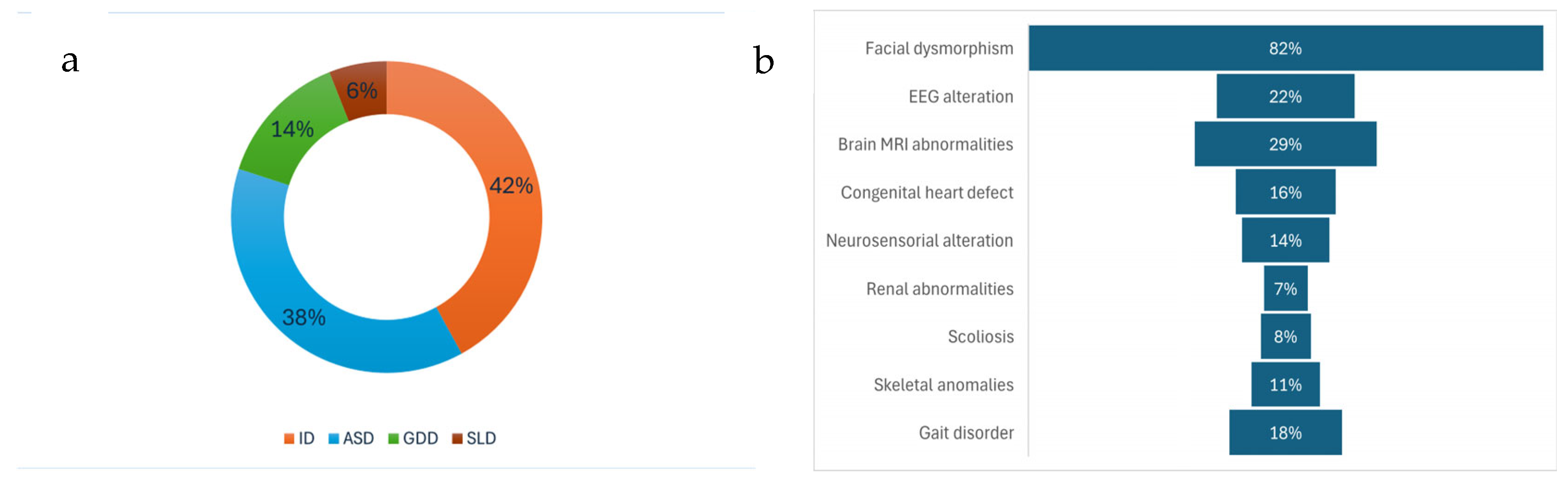
| Autism spectrum disorder | 36 | 38% |
| Intellectual disability | 39 | 42% |
| Global developmental delay | 13 | 14% |
| Specific learning disorder | 6 | 6% |
| Case n. | Phenotype | Gene (Transcript) | Variant | Zygosity | Inheritance | Segregation |
|---|---|---|---|---|---|---|
| 2 | GDD | NIPBL (NM_133433.4) | c.6056T>C p.(Leu2019Pro) | het | AD | NA |
| 5 | ID | DLG4 (NM_001321075.3) | c.14_15delTG p.(Cys5Tyrfs*12) | het | AD | de novo |
| 6 | GDD | MED13L (NM_015335.5) | c.700A>G, p.(Lys234Glu) | het | AD | de novo |
| 16 | ID | KCNA2 (NM_004974.4) | c.889C>T p.Arg297Trp | het | AD | de novo |
| 17 | ID | PPP2R1A (NM_014225.6) | c.544C>T p.(Arg182Trp | het | AD | de novo |
| 18 | ID | SETD5 (NM_001080517.3) | c.2750delT p.(Leu917fs) | het | AD | de novo |
| 23 | GDD | PPP2R5D (NM_006245.4) | c.592G>A p.(Glu198Lys) | het | AD | de novo |
| 25 | ASD | ZMYM2 (NM_197968.4) | c.3729_3730del p.(Phe1244*) | het | AD | pat |
| 26 | ID | ATP1A1 (NM_000701.8) | c.1181A>T p.(Asp394Val) | het | AD | de novo |
| 27 | ID | HNRNPK (NM_031263.4) | c.1241G>A p.(Arg414His) | het | AD | de novo |
| 30 | ASD | MECP2 (NM_001110792.2) | c.952C>T p.(Arg318Cys) | het | AD | de novo |
| 31 | ID | MED13L (NM_015335.5) | c.1768C>T p.(Gln590*) | het | AD | de novo |
| 41 | ID | CHD2 (NM_001271.4) | c.762_764del p.(Asp254del) | het | AD | de novo |
| 42 | ID | SCN8A (NM_001330260.2) | c.2811G>A p.(Trp937*) | het | AD | de novo |
| 43 | ID | SCN8A (NM_001330260.2) | c.2811G>A p.(Trp937*) | het | AD | de novo |
| 44 | ASD | GRIN2A (NM_001134407.3) | c.395c>T p.(Ser132Phe) | het | AD | de novo |
| 45 | ASD | TCF12 (NM_207037.2) | c.686-1G>C | het | AD | de novo |
| 50 | ID | POU4F1 (NM_006237.4) | c.486_487insGG p.(Pro163Gly) | het | AD | de novo |
| 54 | ID | ANKRD11 (NM_013275.6) | c.1903_1907del (p.Lys635fs) | het | AD | de novo |
| 55 | GDD | PPP2R5D (NM_006245.4) | c.592G>A p.(Glu198Lys) | het | AD | de novo |
| 59 | ID | SMARCA2 (NM_003070.5) | c.1574G>A p.(Arg525His) | het | AD | de novo |
| 60 | ASD | ASH1L (NM_018489.3) | c.4579C>T p.(Arg1527*) | het | AD | de novo |
| 63 | ID | AUTS2 (NM_015570.4) | c.1603_1626del p.(His535-Thr542del) | het | AD | de novo |
| 64 | GDD | ITPR1 (NM_001378452.1) | c.1554+6T>G | het | AD | N/A |
| 67 | ASD | TRAPPC9 (NM_001374682.1) | c.307A>T p.(Lys103*) | het | AR | mat |
| c. 610 C>T p.(Arg204Cys) | het | AR | pat | |||
| 71 | ID | SETBP1 (NM_015559.3) | c.1075C>T p.(Gln359Ter) | het | AD | de novo |
| 74 | GDD | SMC1A (NM_006306.4) | c.170G>A p.(Arg57Gln) | het | XLD | de novo |
| 77 | GDD | KMT2A (NM_001197104.2) | c.3853C>T p.(Gln1285*) | het | AD | de novo |
| 79 | ID | PRRT2 (NM_145239.3) | c.649del p.(Arg217GlufsTer12) | het | AD | de novo |
| 80 | ASD | SETD1A (NM_014712.3) | c.644_645delinsCC p.(Glu215Ala) | het | AD | de novo |
| 83 | ID | CHD5 (NM_015557.3) | c.2842G>T p.(Val948Phe) | het | AD | N/A |
| 84 | GDD | CHD5 (NM_015557.3) | c.2842G>T p.(Val948Phe) | het | AD | N/A |
| 85 | ID | GRIA2 (NM_001083619.3) | c.857C>G p.(Pro286Arg) | het | AD | de novo |
| 88 | ID | SMARCD1 (NM_003076.5) | c.77C>T p.(Ala26Val) | het | AD | de novo |
| 89 | ID | ANKRD11 (NM_013275.6) | c.5806G>T p.(Glu1936*) | het | AD | de novo |
| 91 | GDD | KAT6A (NM_006766.5) | c.3553C>T p.(Gln1185Ter) | het | AD | de novo |
| 94 | ID | PTEN (NM_000314.8) | c.1003C>T p.(Arg335*) | het | AD | de novo |
Disclaimer/Publisher’s Note: The statements, opinions and data contained in all publications are solely those of the individual author(s) and contributor(s) and not of MDPI and/or the editor(s). MDPI and/or the editor(s) disclaim responsibility for any injury to people or property resulting from any ideas, methods, instructions or products referred to in the content. |
© 2026 by the authors. Licensee MDPI, Basel, Switzerland. This article is an open access article distributed under the terms and conditions of the Creative Commons Attribution (CC BY) license.
Share and Cite
Mancuso, G.; Serventi, L.; Cocco, C.; Lai, F.; Soddu, C.; Marica, M.; Mereu, C.; Lorrai, M.; Tosone, G.M.; Cannas, F.; et al. Whole-Exome Sequencing Identifies Novel Genetic Variants Associated with Unexplained Neurodevelopmental Disorders in Children. Int. J. Mol. Sci. 2026, 27, 964. https://doi.org/10.3390/ijms27020964
Mancuso G, Serventi L, Cocco C, Lai F, Soddu C, Marica M, Mereu C, Lorrai M, Tosone GM, Cannas F, et al. Whole-Exome Sequencing Identifies Novel Genetic Variants Associated with Unexplained Neurodevelopmental Disorders in Children. International Journal of Molecular Sciences. 2026; 27(2):964. https://doi.org/10.3390/ijms27020964
Chicago/Turabian StyleMancuso, Giancarlo, Laura Serventi, Chiara Cocco, Francesco Lai, Consolata Soddu, Monica Marica, Caterina Mereu, Michela Lorrai, Gaia Maria Tosone, Federica Cannas, and et al. 2026. "Whole-Exome Sequencing Identifies Novel Genetic Variants Associated with Unexplained Neurodevelopmental Disorders in Children" International Journal of Molecular Sciences 27, no. 2: 964. https://doi.org/10.3390/ijms27020964
APA StyleMancuso, G., Serventi, L., Cocco, C., Lai, F., Soddu, C., Marica, M., Mereu, C., Lorrai, M., Tosone, G. M., Cannas, F., Nutile, G., Floris, M., Savasta, S., & Giglio, S. (2026). Whole-Exome Sequencing Identifies Novel Genetic Variants Associated with Unexplained Neurodevelopmental Disorders in Children. International Journal of Molecular Sciences, 27(2), 964. https://doi.org/10.3390/ijms27020964