


Enhancing the Water Solubility and Efficacy of Anticancer Drugs Using Hydroxypropyl-β-Cyclodextrin


Abstract
1. Introduction
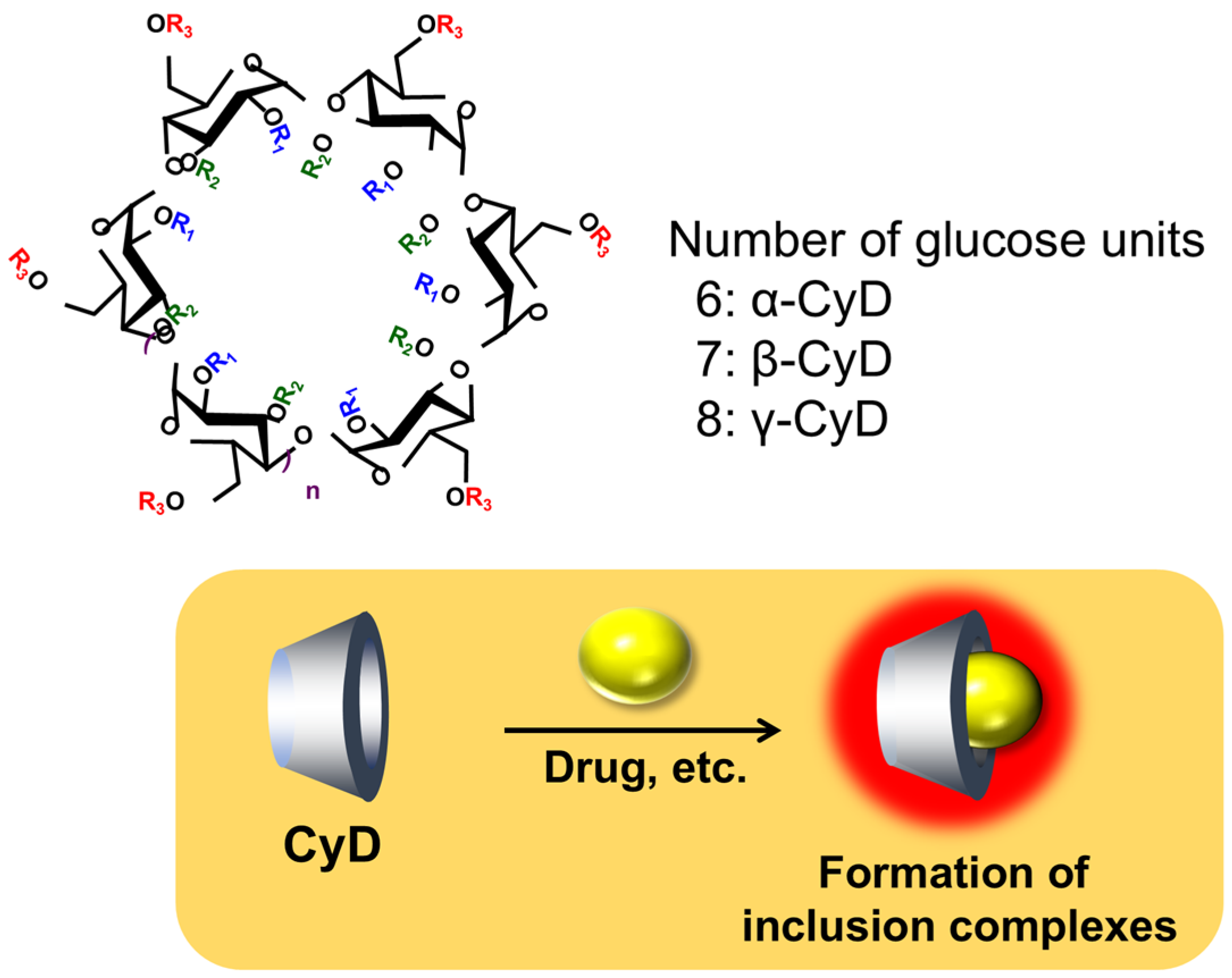
2. Cyclodextrin
3. The Use of HP-β-CyD as a Solubilizing Excipient and Carrier System for Drug Delivery
3.1. Cancer Prevention
3.2. Cancer Treatment
3.2.1. Paclitaxel
3.2.2. Camptothecin
3.2.3. Doxorubicin
3.2.4. Cisplatin
3.2.5. Venetoclax
3.2.6. Curcumin
3.2.7. Other Agents

| Drug | Additional Agent | Synthesis | Solubility * | Type of Cancer | In Vitro | Anticancer Effects | Reference |
|---|---|---|---|---|---|---|---|
| Paclitaxel | Hot sonication, lyophilization | 16–17.2 | Colon | Caco-2 | Increased cytotoxicity | [40] | |
| Paclitaxel | Hot sonication, lyophilization | 16–17.2 | Breast | MCF-7, MCF-7/ADR | Increased cytotoxicity and cellular uptake | [41] | |
| Paclitaxel | Hot sonication, lyophilization | 16–17.2 | Breast | MCF-7 | Improved anticancer activity and cellular uptake | [42] | |
| Paclitaxel | Aqueous solution-stirring method | 47.1–556.5 | Lung | A549/T | Enhanced cytotoxicity and cellular uptake | [50] | |
| 9-nitro-camptothecin | Transferrin, liposome | Lyophilization | 875 | Ovarian, liver | HepG2, A2780, L02 | Enhanced cytotoxicity | [67] |
| Venetoclax | Kneading | 3.16 | Lung | A549 | Enhanced cytotoxicity | [91] | |
| Saikosaponin-D | Stirring, lyophilization | 351–1074 | Cutaneous | HSC-1 | Apoptosis | [118] | |
| Albendazole | Stirring | 10,368 | Colorectal, prostate | HCT116, DU145 | Antiproliferative effect | [125] | |
| N,N′-bis-naphthyl 2-alkyl-substituted imidazolium salts | N.D. | >8.8 | Lung | NCI-H460, NCI-H1975, NCI-A549, HCC827 | High anticancer activity comparable to cisplatin | [126] | |
| Chrisyn | Lyophilization | 5.66–7.52 (RAMEB > SBECD > HP-β-CyD > β-CyD) ** | Colon | Caco-2 | No cytotoxicity up to 100 µM | [127] | |
| Fisetin | PLGA | Coacervation technique, physical mixture | 161.9 | Breast | MCF-7 | Higher cytotoxicity, increased cellular uptake | [136] |
| Purinostat | Simple dissolution | 220 | B-cell lymphoma | SU-DHL-6 | Maintained cytotoxicity | [137] | |
| Thymoquinone | Lyophilization | 1559 | Lung | A549, HCC827 | Enhanced cytotoxicity | [161] |
4. HP-β-CyD as an Active Pharmaceutical Ingredient
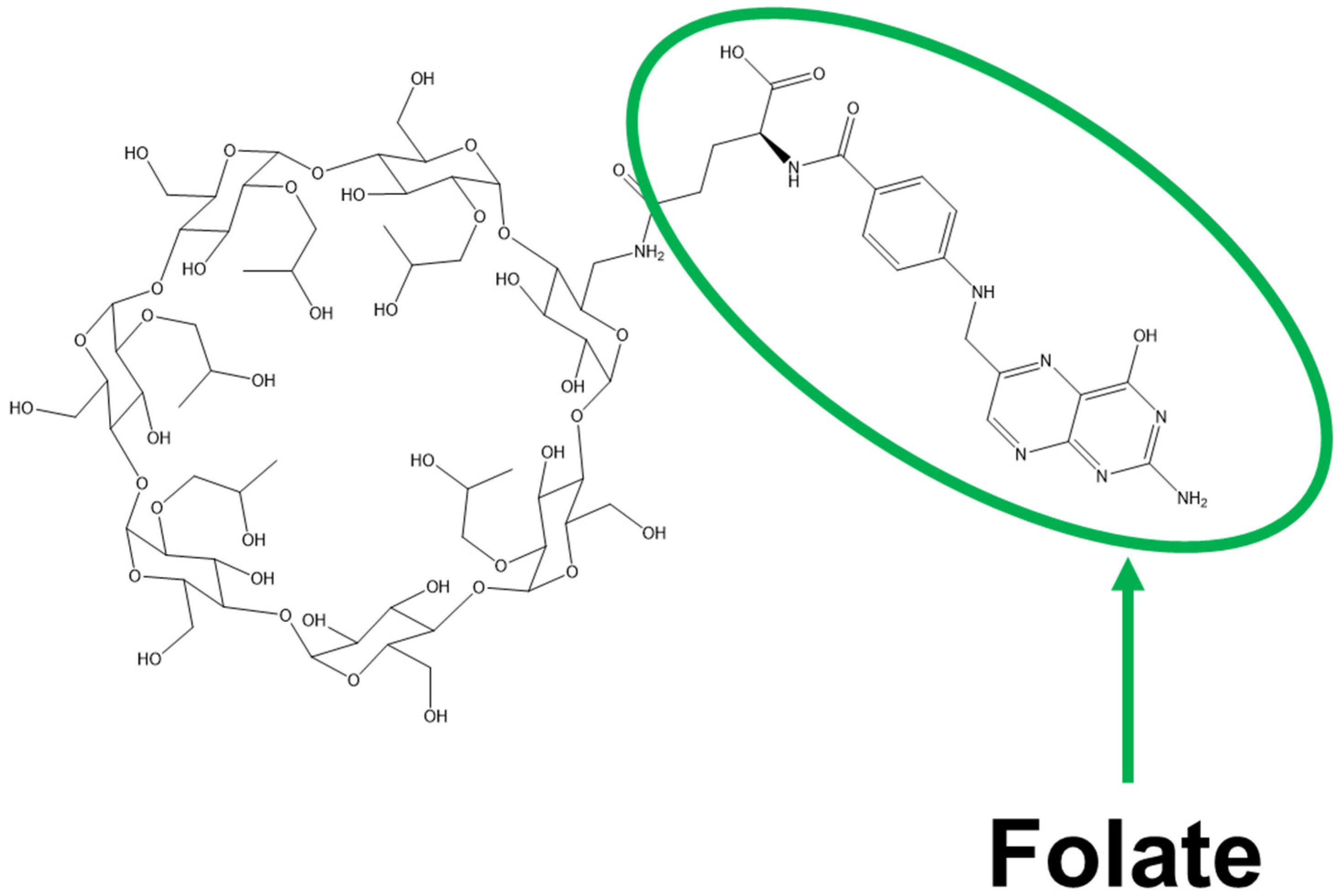
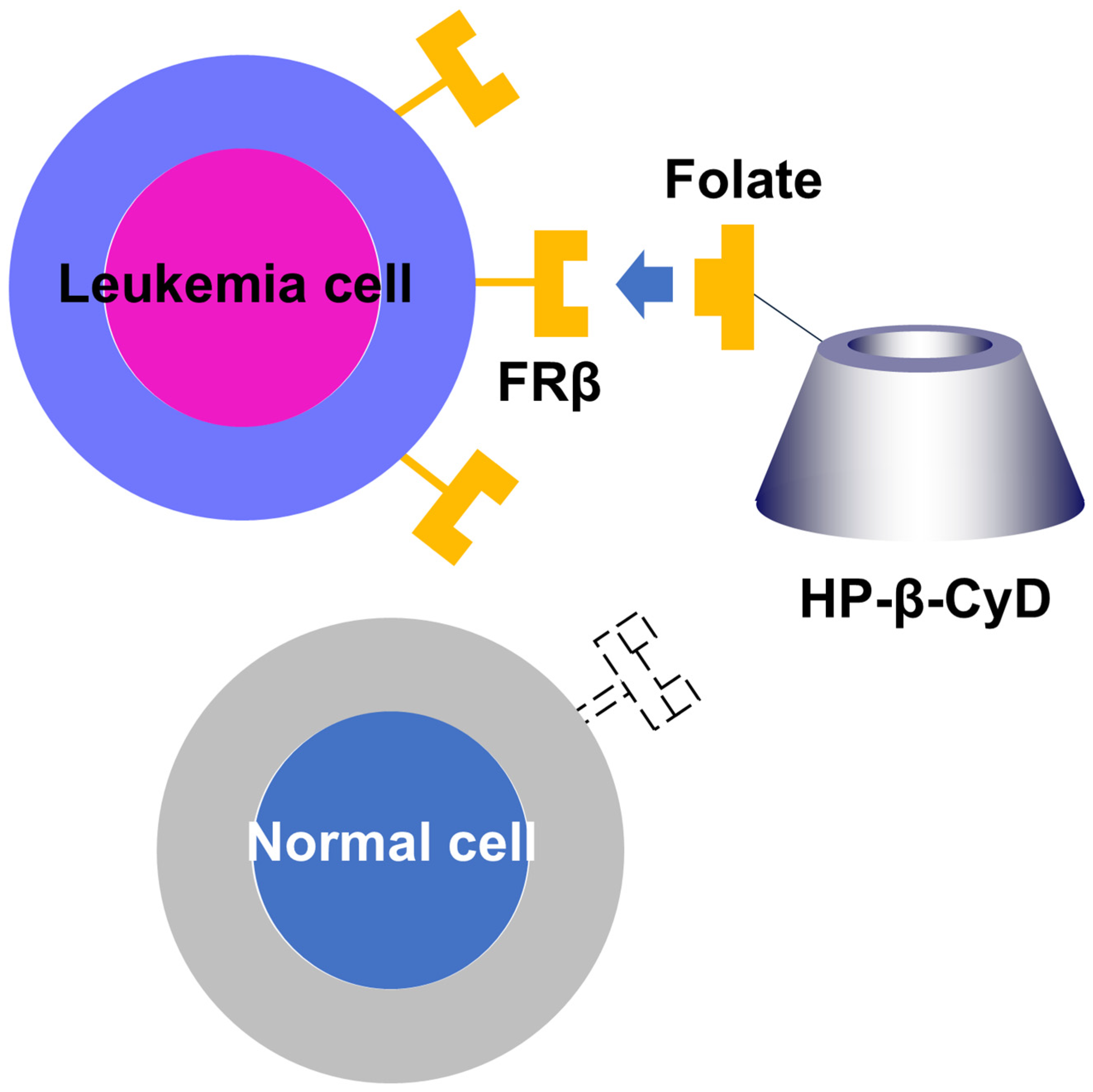
5. Folate-Appended Cyclodextrins
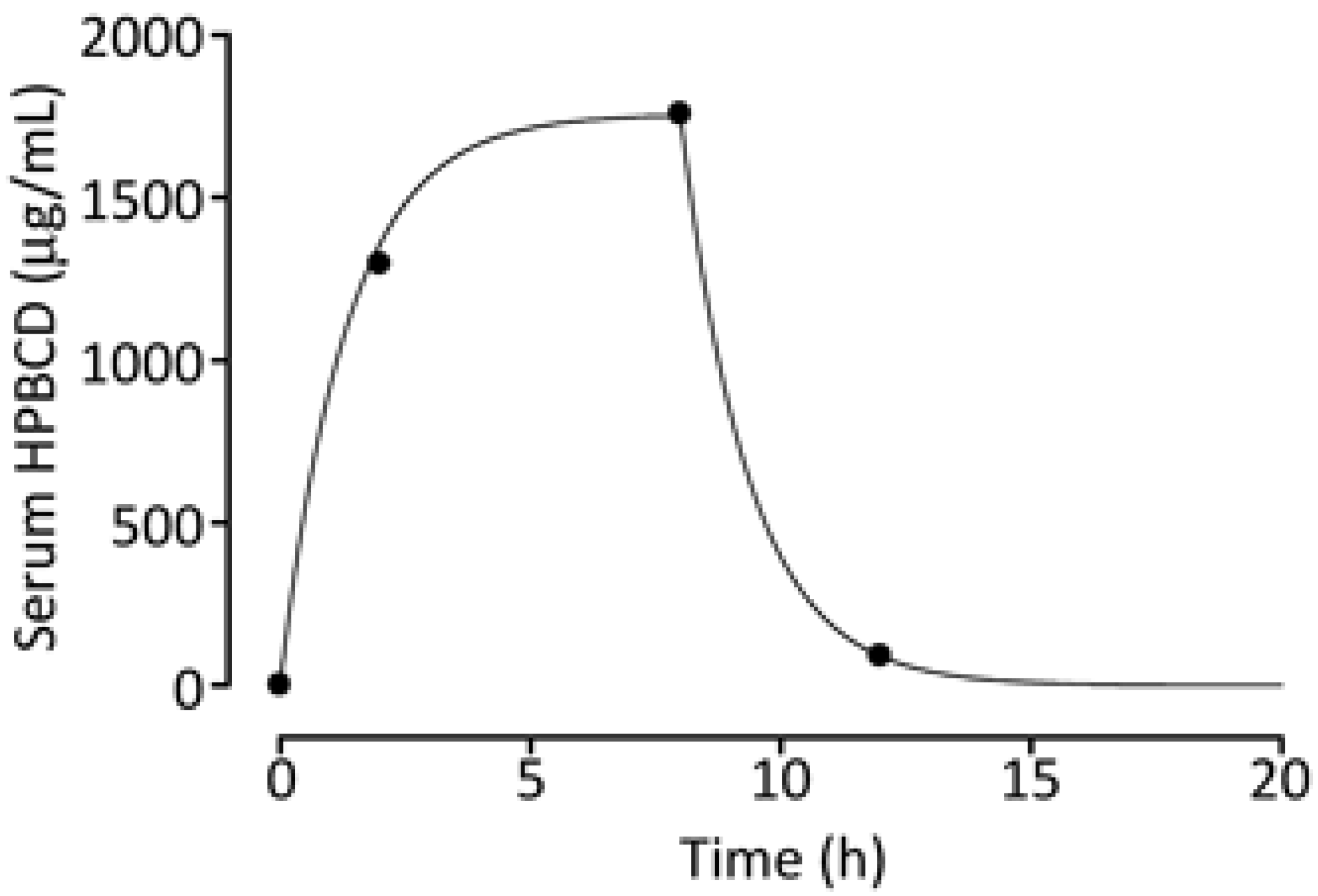
6. Pharmacokinetic Profile
7. Toxicity
8. Barriers to Clinical Application
9. Conclusions
Author Contributions
Funding
Institutional Review Board Statement
Informed Consent Statement
Data Availability Statement
Conflicts of Interest
References
- Davis, M.E.; Brewster, M.E. Cyclodextrin-based pharmaceutics: Past, present and future. Nat. Rev. Drug Discov. 2004, 3, 1023–1035. [Google Scholar] [CrossRef] [PubMed]
- Uekama, K.; Hirayama, F.; Irie, T. Cyclodextrin Drug Carrier Systems. Chem. Rev. 1998, 98, 2045–2076. [Google Scholar] [CrossRef]
- Szente, L.; Szejtli, J. Highly soluble cyclodextrin derivatives: Chemistry, properties, and trends in development. Adv. Drug Deliv. Rev. 1999, 36, 17–28. [Google Scholar] [CrossRef]
- Dahabra, L.; Broadberry, G.; Le Gresley, A.; Najlah, M.; Khoder, M. Sunscreens Containing Cyclodextrin Inclusion Com plexes for Enhanced Efficiency: A Strategy for Skin Cancer Prevention. Molecules 2021, 26, 1698. [Google Scholar] [CrossRef]
- Pitha, J.; Irie, T.; Sklar, P.B.; Nye, J.S. Drug solubilizers to aid pharmacologists: Amorphous cyclodextrin derivatives. Life Sci. 1988, 43, 493–502. [Google Scholar] [CrossRef]
- Loftsson, T.; Duchêne, D. Cyclodextrins and their pharmaceutical applications. Int. J. Pharm. 2007, 329, 1–11. [Google Scholar] [CrossRef] [PubMed]
- Kurkov, S.V.; Loftsson, T. Cyclodextrins. Int. J. Pharm. 2013, 453, 167–180. [Google Scholar] [CrossRef]
- Jansook, P.; Ogawa, N.; Loftsson, T. Cyclodextrins: Structure, physicochemical properties and pharmaceutical applications. Int. J. Pharm. 2018, 535, 272–284. [Google Scholar] [CrossRef]
- Muankaew, C.; Loftsson, T. Cyclodextrin-Based Formulations: A Non-Invasive Platform for Targeted Drug Delivery. Basic. Clin. Pharmacol. Toxicol. 2018, 122, 46–55. [Google Scholar] [CrossRef]
- Gould, S.; Scott, R.C. 2-Hydroxypropyl-beta-cyclodextrin (HP-beta-CD): A toxicology review. Food Chem. Toxicol. 2005, 43, 1451–1459. [Google Scholar] [CrossRef] [PubMed]
- Qu, G.; Han, X.; Ma, L.; Feng, S.; Li, Y.; Zhang, X. Cyclodextrins as non-viral vectors in cancer theranostics: A review. Int. J. Biol. Macromol. 2025, 313, 143697. [Google Scholar] [CrossRef]
- Kfoury, M.; Landy, D.; Fourmentin, S. Characterization of Cyclodextrin/Volatile Inclusion Complexes: A Review. Molecules 2018, 23, 1204. [Google Scholar] [CrossRef] [PubMed]
- Cid-Samamed, A.; Rakmai, J.; Mejuto, J.C.; Simal-Gandara, J.; Astray, G. Cyclodextrins inclusion complex: Preparation methods, analytical techniques and food industry applications. Food Chem. 2022, 384, 132467. [Google Scholar] [CrossRef] [PubMed]
- Szejtli, J. Introduction and General Overview of Cyclodextrin Chemistry. Chem. Rev. 1998, 98, 1743–1754. [Google Scholar] [CrossRef]
- Saokham, P.; Muankaew, C.; Jansook, P.; Loftsson, T. Solubility of Cyclodextrins and Drug/Cyclodextrin Complexes. Molecules 2018, 23, 1161. [Google Scholar] [CrossRef]
- Braga, S.S. Cyclodextrins: Emerging Medicines of the New Millennium. Biomolecules 2019, 9, 801. [Google Scholar] [CrossRef] [PubMed]
- Liu, B.; Turley, S.D.; Burns, D.K.; Miller, A.M.; Repa, J.J.; Dietschy, J.M. Reversal of defective lysosomal transport in NPC disease ameliorates liver dysfunction and neurodegeneration in the npc1-/- mouse. Proc. Natl. Acad. Sci. USA 2009, 106, 2377–2382. [Google Scholar] [CrossRef]
- Davidson, C.D.; Ali, N.F.; Micsenyi, M.C.; Stephney, G.; Renault, S.; Dobrenis, K.; Ory, D.S.; Vanier, M.T.; Walkley, S.U. Chronic cyclodextrin treatment of murine Niemann-Pick C disease ameliorates neuronal cholesterol and glycosphingolipid storage and disease progression. PLoS ONE 2009, 4, e6951. [Google Scholar] [CrossRef]
- Vite, C.H.; Bagel, J.H.; Swain, G.P.; Prociuk, M.; Sikora, T.U.; Stein, V.M.; O’Donnell, P.; Ruane, T.; Ward, S.; Crooks, A.; et al. Intracisternal cyclodextrin prevents cerebellar dysfunction and Purkinje cell death in feline Niemann-Pick type C1 disease. Sci. Transl. Med. 2015, 7, 276ra226. [Google Scholar] [CrossRef]
- Ory, D.S.; Ottinger, E.A.; Farhat, N.Y.; King, K.A.; Jiang, X.; Weissfeld, L.; Berry-Kravis, E.; Davidson, C.D.; Bianconi, S.; Keener, L.A.; et al. Intrathecal 2-hydroxypropyl-beta-cyclodextrin decreases neurological disease progression in Niemann-Pick disease, type C1: A non-randomised, open-label, phase 1-2 trial. Lancet 2017, 390, 1758–1768. [Google Scholar] [CrossRef]
- Hastings, C.; Liu, B.; Hurst, B.; Cox, G.F.; Hrynkow, S. Intravenous 2-hydroxypropyl-β-cyclodextrin (Trappsol® Cyclo™) demonstrates biological activity and impacts cholesterol metabolism in the central nervous system and peripheral tissues in adult subjects with Niemann-Pick Disease Type C1: Results of a phase 1 trial. Mol. Genet. Metab. 2022, 137, 309–319. [Google Scholar] [CrossRef]
- Sharma, R.; Hastings, C.; Staretz-Chacham, O.; Raiman, J.; Paucar, M.; Spiegel, R.; Murray, B.; Hurst, B.; Liu, B.; Kjems, L.; et al. Long-term administration of intravenous Trappsol® Cyclo™ (HP-β-CD) results in clinical benefits and stabilization or slowing of disease progression in patients with Niemann-Pick disease type C1: Results of an international 48-week Phase I/II trial. Mol. Genet. Metab. Rep. 2023, 36, 100988. [Google Scholar] [CrossRef]
- Klein, A.D.; Eden, E.R.; Zanlungo, S. Treating Niemann-Pick C lysosomal storage: Approved and emerging approaches. Trends Mol. Med. 2025, 31, 195–196. [Google Scholar] [CrossRef]
- Lin, Y.C.; Hu, S.C.; Huang, P.H.; Lin, T.C.; Yen, F.L. Electrospun Resveratrol-Loaded Polyvinylpyrrolidone/Cyclodextrin Nanofibers and Their Biomedical Applications. Pharmaceutics 2020, 12, 552. [Google Scholar] [CrossRef]
- Zhang, M.; Li, J.; Jia, W.; Chao, J.; Zhang, L. Theoretical and experimental study of the inclusion complexes of ferulic acid with cyclodextrins. Supramol. Chem. 2009, 21, 597–602. [Google Scholar] [CrossRef]
- Wang, J.; Cao, Y.; Sun, B.; Wang, C. Characterisation of inclusion complex of trans-ferulic acid and hydroxypropyl-β-cyclodextrin. Food Chem. 2011, 124, 1069–1075. [Google Scholar] [CrossRef]
- Hsu, C.M.; Yu, S.C.; Tsai, F.J.; Tsai, Y. Characterization of in vitro and in vivo bioactivity of a ferulic acid-2-Hydroxypropyl-β-cyclodextrin inclusion complex. Colloids Surf. B Biointerfaces 2019, 180, 68–74. [Google Scholar] [CrossRef]
- Mercader-Ros, M.T.; Lucas-Abellán, C.; Fortea, M.I.; Gabaldón, J.A.; Núñez-Delicado, E. Effect of HP-β-cyclodextrins complexation on the antioxidant activity of flavonols. Food Chem. 2010, 118, 769–773. [Google Scholar] [CrossRef]
- de Oliveira, M.R.; Nabavi, S.F.; Habtemariam, S.; Erdogan Orhan, I.; Daglia, M.; Nabavi, S.M. The effects of baicalein and baicalin on mitochondrial function and dynamics: A review. Pharmacol. Res. 2015, 100, 296–308. [Google Scholar] [CrossRef]
- Kim, H.; Yiluo, H.; Park, S.; Lee, J.Y.; Cho, E.; Jung, S. Characterization and Enhanced Antioxidant Activity of the Cysteinyl β-Cyclodextrin-Baicalein Inclusion Complex. Molecules 2016, 21, 703. [Google Scholar] [CrossRef] [PubMed]
- Yan, T.; Ji, M.; Sun, Y.; Yan, T.; Zhao, J.; Zhang, H.; Wang, Z. Preparation and characterization of baicalein/hydroxypropyl-β- cyclodextrin inclusion complex for enhancement of solubility, antioxidant activity and antibacterial activity using supercritical antisolvent technology. J. Incl. Phenom. Macrocycl. Chem. 2019, 96, 285–295. [Google Scholar] [CrossRef]
- Jullian, C.; Moyano, L.; Yañez, C.; Olea-Azar, C. Complexation of quercetin with three kinds of cyclodextrins: An antioxidant study. Spectrochim. Acta A Mol. Biomol. Spectrosc. 2007, 67, 230–234. [Google Scholar] [CrossRef]
- Haddad, R.; Alrabadi, N.; Altaani, B.; Li, T. Paclitaxel Drug Delivery Systems: Focus on Nanocrystals’ Surface Modifications. Polymers 2022, 14, 658. [Google Scholar] [CrossRef]
- Lee, S.; Seo, D.; Kim, H.W.; Jung, S. Investigation of inclusion complexation of paclitaxel by cyclohenicosakis-(1-->2)-(beta-D-glucopyranosyl), by cyclic-(1-->2)-beta-D-glucans (cyclosophoraoses), and by cyclomaltoheptaoses (beta-cyclodextrins). Carbohydr. Res. 2001, 334, 119–126. [Google Scholar] [CrossRef] [PubMed]
- Agüeros, M.; Ruiz-Gatón, L.; Vauthier, C.; Bouchemal, K.; Espuelas, S.; Ponchel, G.; Irache, J.M. Combined hydroxypropyl-beta-cyclodextrin and poly(anhydride) nanoparticles improve the oral permeability of paclitaxel. Eur. J. Pharm. Sci. 2009, 38, 405–413. [Google Scholar] [CrossRef]
- Agüeros, M.; Zabaleta, V.; Espuelas, S.; Campanero, M.A.; Irache, J.M. Increased oral bioavailability of paclitaxel by its encapsulation through complex formation with cyclodextrins in poly(anhydride) nanoparticles. J. Control. Release 2010, 145, 2–8. [Google Scholar] [CrossRef] [PubMed]
- Fenyvesi, F.; Fenyvesi, E.; Szente, L.; Goda, K.; Bacso, Z.; Bacskay, I.; Varadi, J.; Kiss, T.; Molnar, E.; Janaky, T.; et al. P-glycoprotein inhibition by membrane cholesterol modulation. Eur. J. Pharm. Sci. 2008, 34, 236–242. [Google Scholar] [CrossRef] [PubMed]
- Ishikawa, M.; Yoshii, H.; Furuta, T. Interaction of modified cyclodextrins with cytochrome P-450. Biosci. Biotechnol. Biochem. 2005, 69, 246–248. [Google Scholar] [CrossRef]
- Calleja, P.; Espuelas, S.; Vauthier, C.; Ponchel, G.; Irache, J.M. Controlled Release, Intestinal Transport, and Oral Bioavailablity of Paclitaxel Can be Considerably Increased Using Suitably Tailored Pegylated Poly(Anhydride) Nanoparticles. J. Pharm. Sci. 2015, 104, 2877–2886. [Google Scholar] [CrossRef]
- Baek, J.S.; So, J.W.; Shin, S.C.; Cho, C.W. Solid lipid nanoparticles of paclitaxel strengthened by hydroxypropyl-β-cyclodextrin as an oral delivery system. Int. J. Mol. Med. 2012, 30, 953–959. [Google Scholar] [CrossRef]
- Baek, J.S.; Cho, C.W. 2-Hydroxypropyl-β-cyclodextrin-modified SLN of paclitaxel for overcoming p-glycoprotein function in multidrug-resistant breast cancer cells. J. Pharm. Pharmacol. 2013, 65, 72–78. [Google Scholar] [CrossRef]
- Baek, J.S.; Kim, J.H.; Park, J.S.; Cho, C.W. Modification of paclitaxel-loaded solid lipid nanoparticles with 2-hydroxypropyl-β-cyclodextrin enhances absorption and reduces nephrotoxicity associated with intravenous injection. Int. J. Nanomed. 2015, 10, 5397–5405. [Google Scholar] [CrossRef]
- Baek, J.S.; Kim, B.S.; Puri, A.; Kumar, K.; Cho, C.W. Stability of paclitaxel-loaded solid lipid nanoparticles in the presence of 2-hydoxypropyl-β-cyclodextrin. Arch Pharm Res 2016, 39, 785–793. [Google Scholar] [CrossRef]
- Huang, M.; Liu, G. The study of innate drug resistance of human hepatocellular carcinoma Bel7402 cell line. Cancer Lett. 1999, 135, 97–105. [Google Scholar] [CrossRef] [PubMed]
- Baek, J.S.; Cho, C.W. Controlled release and reversal of multidrug resistance by co-encapsulation of paclitaxel and verapamil in solid lipid nanoparticles. Int. J. Pharm. 2015, 478, 617–624. [Google Scholar] [CrossRef]
- Tan, J.; Meng, N.; Fan, Y.; Su, Y.; Zhang, M.; Xiao, Y.; Zhou, N. Hydroxypropyl-β-cyclodextrin-graphene oxide conjugates: Carriers for anti-cancer drugs. Mater. Sci. Eng. C Mater. Biol. Appl. 2016, 61, 681–687. [Google Scholar] [CrossRef]
- Li, J.; Wang, Y.; Xue, S.; Sun, J.; Zhang, W.; Hu, P.; Ji, L.; Mao, Z. Effective combination treatment of lung cancer cells by single vehicular delivery of siRNA and different anticancer drugs. Int. J. Nanomed. 2016, 11, 4609–4624. [Google Scholar] [CrossRef]
- Kneidl, B.; Peller, M.; Winter, G.; Lindner, L.H.; Hossann, M. Thermosensitive liposomal drug delivery systems: State of the art review. Int. J. Nanomed. 2014, 9, 4387–4398. [Google Scholar] [CrossRef]
- Xu, Y.; Qiu, L. Nonspecifically enhanced therapeutic effects of vincristine on multidrug-resistant cancers when coencapsulated with quinine in liposomes. Int. J. Nanomed. 2015, 10, 4225–4237. [Google Scholar] [CrossRef]
- Shen, Q.; Shen, Y.; Jin, F.; Du, Y.Z.; Ying, X.Y. Paclitaxel/hydroxypropyl-β-cyclodextrin complex-loaded liposomes for overcoming multidrug resistance in cancer chemotherapy. J. Liposome Res. 2020, 30, 12–20. [Google Scholar] [CrossRef] [PubMed]
- Zheng, K.; Huang, Z.; Huang, J.; Liu, X.; Ban, J.; Huang, X.; Luo, H.; Chen, Z.; Xie, Q.; Chen, Y.; et al. Effect of a 2-HP-β-Cyclodextrin Formulation on the Biological Transport and Delivery of Chemotherapeutic PLGA Nanoparticles. Drug Des. Devel Ther. 2021, 15, 2605–2618. [Google Scholar] [CrossRef] [PubMed]
- Aslam, A.; Masood, F.; Perveen, K.; Berger, M.R.; Pervaiz, A.; Zepp, M.; Klika, K.D.; Yasin, T.; Hameed, A. Preparation, characterization and evaluation of HPβCD-PTX/PHB nanoparticles for pH-responsive, cytotoxic and apoptotic properties. Int. J. Biol. Macromol. 2024, 270, 132268. [Google Scholar] [CrossRef] [PubMed]
- Lu, Y.; Chen, Y.; Gemeinhart, R.A.; Wu, W.; Li, T. Developing nanocrystals for cancer treatment. Nanomedicine 2015, 10, 2537–2552. [Google Scholar] [CrossRef] [PubMed]
- Jacob, S.; Nair, A.B. Cyclodextrin complexes: Perspective from drug delivery and formulation. Drug Dev. Res. 2018, 79, 201–217. [Google Scholar] [CrossRef] [PubMed]
- Liu, J.; Tu, L.; Cheng, M.; Feng, J.; Jin, Y. Mechanisms for oral absorption enhancement of drugs by nanocrystals. J. Drug Deliv. Sci. Technol. 2020, 56, 101607. [Google Scholar] [CrossRef]
- Haddad, R.; Alrabadi, N.; Altaani, B.; Masadeh, M.; Li, T. Hydroxypropyl Beta Cyclodextrin as a Potential Surface Modifier for Paclitaxel Nanocrystals. AAPS PharmSciTech 2022, 23, 219. [Google Scholar] [CrossRef]
- Yan, C.; Liang, N.; Li, Q.; Yan, P.; Sun, S. Biotin and arginine modified hydroxypropyl-β-cyclodextrin nanoparticles as novel drug delivery systems for paclitaxel. Carbohydr. Polym. 2019, 216, 129–139. [Google Scholar] [CrossRef]
- Fu, J.; Zhao, W.; Liang, N.; Sun, S. Functionalized hydroxypropyl-β-cyclodextrin inclusion complex for combined tumor therapy through intelligent delivery of paclitaxel and polarization of M2-like tumor associated macrophages. Colloids Surf. B Biointerfaces 2025, 252, 114654. [Google Scholar] [CrossRef]
- Hevener, K.; Verstak, T.A.; Lutat, K.E.; Riggsbee, D.L.; Mooney, J.W. Recent developments in topoisomerase-targeted cancer chemotherapy. Acta Pharm. Sin. B 2018, 8, 844–861. [Google Scholar] [CrossRef] [PubMed]
- Venkatachalam, A.; Kaufmann, S.H. Targeting DNA Topoisomerase I for the Treatment of Cancer: Past, Present and Future. J. Mol. Biol. 2025, 169401. [Google Scholar] [CrossRef]
- Shen, G.; Li, S.; Zhu, Y.; Xu, Z.; Liu, X.; Lv, C.; Xing, Z.; Cui, L.; Li, W. Recent progress in topoisomerase inhibitors as anticancer agents: Research and design strategies for Topo I and II inhibitors via structural optimization. Bioorg. Chem. 2025, 165, 109040. [Google Scholar] [CrossRef]
- Berrada, M.; Serreqi, A.; Dabbarh, F.; Owusu, A.; Gupta, A.; Lehnert, S. A novel non-toxic camptothecin formulation for cancer chemotherapy. Biomaterials 2005, 26, 2115–2120. [Google Scholar] [CrossRef]
- González-Ruiz, V.; Cores, Á.; Martín-Cámara, O.; Orellana, K.; Cervera-Carrascón, V.; Michalska, P.; Olives, A.I.; León, R.; Martín, M.A.; Menéndez, J.C. Enhanced Stability and Bioactivity of Natural Anticancer Topoisomerase I Inhibitors through Cyclodextrin Complexation. Pharmaceutics 2021, 13, 1609. [Google Scholar] [CrossRef]
- Giovanella, B.C.; Stehlin, J.S.; Hinz, H.R.; Kozielski, A.J.; Harris, N.J.; Vardeman, D.M. Preclinical evaluation of the anticancer activity and toxicity of 9-nitro-20(S)-camptothecin (Rubitecan). Int. J. Oncol. 2002, 20, 81–88. [Google Scholar] [CrossRef]
- Jiang, Y.; Sha, X.; Zhang, W.; Fang, X. Complex of 9-nitro-camptothecin in hydroxypropyl-beta-cyclodextrin: In vitro and in vivo evaluation. Int. J. Pharm. 2010, 397, 116–121. [Google Scholar] [CrossRef]
- Jiang, Y.; Jiang, X.; Law, K.; Chen, Y.; Gu, J.; Zhang, W.; Xin, H.; Sha, X.; Fang, X. Enhanced anti-tumor effect of 9-nitro-camptothecin complexed by hydroxypropyl-β-cyclodextrin and safety evaluation. Int. J. Pharm. 2011, 415, 252–258. [Google Scholar] [CrossRef]
- Chen, J.; Lu, S.; Gu, W.; Peng, P.; Dong, J.; Xu, F.; Yang, X.; Xiong, Z.; Yang, X. Characterization of 9-nitrocamptothecin-in-cyclodextrin-in-liposomes modified with transferrin for the treating of tumor. Int. J. Pharm. 2015, 490, 219–228. [Google Scholar] [CrossRef] [PubMed]
- Moruno-Manchon, J.F.; Uzor, N.E.; Kesler, S.R.; Wefel, J.S.; Townley, D.M.; Nagaraja, A.S.; Pradeep, S.; Mangala, L.S.; Sood, A.K.; Tsvetkov, A.S. TFEB ameliorates the impairment of the autophagy-lysosome pathway in neurons induced by doxorubicin. Aging 2016, 8, 3507–3519. [Google Scholar] [CrossRef] [PubMed]
- Coisne, C.; Tilloy, S.; Monflier, E.; Wils, D.; Fenart, L.; Gosselet, F. Cyclodextrins as Emerging Therapeutic Tools in the Treatment of Cholesterol-Associated Vascular and Neurodegenerative Diseases. Molecules 2016, 21, 1748. [Google Scholar] [CrossRef] [PubMed]
- Moruno-Manchon, J.F.; Uzor, N.E.; Kesler, S.R.; Wefel, J.S.; Townley, D.M.; Nagaraja, A.S.; Pradeep, S.; Mangala, L.S.; Sood, A.K.; Tsvetkov, A.S. Peroxisomes contribute to oxidative stress in neurons during doxorubicin-based chemotherapy. Mol. Cell Neurosci. 2018, 86, 65–71. [Google Scholar] [CrossRef]
- Durço, A.O.; Souza, D.S.; Rhana, P.; Costa, A.D.; Marques, L.P.; Santos, L.; de Souza Araujo, A.A.; de Aragão Batista, M.V.; Roman-Campos, D.; Santos, M. d-Limonene complexed with cyclodextrin attenuates cardiac arrhythmias in an experimental model of doxorubicin-induced cardiotoxicity: Possible involvement of calcium/calmodulin-dependent protein kinase type II. Toxicol. Appl. Pharmacol. 2023, 474, 116609. [Google Scholar] [CrossRef] [PubMed]
- Durço, A.O.; Souza, D.S.; Lima Conceição, M.R.; Beserra, S.D.S.; Teixeira da Fonseca, J.L.; Loch, L.; Silva, M.A.; Pereira de Oliveira, A.; Araujo, A.A.S.; Lins de Vasconcelos, C.M.; et al. D-limonene complexed with hydroxypropyl-β-cyclodextrin prevents impaired cardiac excitation-contraction coupling by reducing oxidative stress and cardiac apoptosis in an animal model of cardiotoxicity induced by doxorubicin. Chem. Biol. Interact. 2025, 418, 111580. [Google Scholar] [CrossRef] [PubMed]
- Yoo, Y.; Yoon, S.J.; Kim, S.Y.; Lee, D.W.; Um, S.; Hyun, H.; Hong, S.O.; Yang, D.H. A local drug delivery system based on visible light-cured glycol chitosan and doxorubicin⋅hydrochloride for thyroid cancer treatment In Vitro and In Vivo. Drug Deliv. 2018, 25, 1664–1671. [Google Scholar] [CrossRef]
- Hyun, H.; Park, M.H.; Jo, G.; Kim, S.Y.; Chun, H.J.; Yang, D.H. Photo-Cured Glycol Chitosan Hydrogel for Ovarian Cancer Drug Delivery. Mar. Drugs 2019, 17, 41. [Google Scholar] [CrossRef] [PubMed]
- Yoon, S.J.; Moon, Y.J.; Chun, H.J.; Yang, D.H. Doxorubicin·Hydrochloride/Cisplatin-Loaded Hydrogel/Nanosized (2-Hydroxypropyl)-Beta-Cyclodextrin Local Drug-Delivery System for Osteosarcoma Treatment In Vivo. Nanomaterials 2019, 9, 1652. [Google Scholar] [CrossRef]
- Christou, A.; Parisis, N.A.; Tzakos, A.G.; Gerothanassis, I.P.; Goulas, V. Optimization of β-cyclodextrin based ultrasound- assisted extraction: A green strategy to enhance the extraction of bioactive compounds from taro leaf byproduct. Sustain. Chem. Pharm. 2024, 41, 101728. [Google Scholar] [CrossRef]
- Niu, W.; Xu, L.; Li, J.; Zhai, Y.; Sun, Z.; Shi, W.; Jiang, Y.; Ma, C.; Lin, H.; Guo, Y.; et al. Polyphyllin II inhibits human bladder cancer migration and invasion by regulating EMT-associated factors and MMPs. Oncol. Lett. 2020, 20, 2928–2936. [Google Scholar] [CrossRef]
- Li, J.; Ma, W.; Cheng, X.; Zhang, X.; Xie, Y.; Ji, Z.; Wu, S. Activation of FOXO3 pathway is involved in polyphyllin I-induced apoptosis and cell cycle arrest in human bladder cancer cells. Arch. Biochem. Biophys. 2020, 687, 108363. [Google Scholar] [CrossRef]
- Liu, J.; Liu, Y.X.; Song, Y.S.; Liu, C.K.; Yu, F.X.; Liu, G.; Xu, T.R.; Sang, J. Targeting GRB2-Akt-SREBP1 signaling axis by saponins from Paris polyphylla Smith var. yunnanensis (Franch.) Hand.-Mazz to overcome cisplatin resistance in bladder cancer. J. Ethnopharmacol. 2025, 354, 120502. [Google Scholar] [CrossRef]
- Scully, M.A.; Wilkins, D.E.; Dang, M.N.; Hoover, E.C.; Aboeleneen, S.B.; Day, E.S. Cancer Cell Membrane Wrapped Nanoparticles for the Delivery of a Bcl-2 Inhibitor to Triple-Negative Breast Cancer. Mol. Pharm. 2023, 20, 3895–3913. [Google Scholar] [CrossRef]
- Inao, T.; Iida, Y.; Moritani, T.; Okimoto, T.; Tanino, R.; Kotani, H.; Harada, M. Bcl-2 inhibition sensitizes triple-negative human breast cancer cells to doxorubicin. Oncotarget 2018, 9, 25545–25556. [Google Scholar] [CrossRef]
- Alhoshani, A.; Alatawi, F.O.; Al-Anazi, F.E.; Attafi, I.M.; Zeidan, A.; Agouni, A.; El Gamal, H.M.; Shamoon, L.S.; Khalaf, S.; Korashy, H.M. BCL-2 Inhibitor Venetoclax Induces Autophagy-Associated Cell Death, Cell Cycle Arrest, and Apoptosis in Human Breast Cancer Cells. OncoTargets Ther. 2020, 13, 13357–13370. [Google Scholar] [CrossRef] [PubMed]
- Rodenas, M.C.; Peñas-Martínez, J.; Pardo-Sánchez, I.; Zaragoza-Huesca, D.; Ortega-Sabater, C.; Peña-García, J.; Espín, S.; Ricote, G.; Montenegro, S.; Ayala-De La Peña, F.; et al. Venetoclax is a potent hepsin inhibitor that reduces the metastatic and prothrombotic phenotypes of hepsin-expressing colorectal cancer cells. Front. Mol. Biosci. 2023, 10, 1182925. [Google Scholar] [CrossRef] [PubMed]
- Bala Tannan, N.; Manzari, M.T.; Herviou, L.; Da Silva Ferreira, M.; Hagen, C.; Kiguchi, H.; Manova-Todorova, K.; Seshan, V.; de Stanchina, E.; Heller, D.A.; et al. Tumor-targeted nanoparticles improve the therapeutic index of BCL2 and MCL1 dual inhibition. Blood 2021, 137, 2057–2069. [Google Scholar] [CrossRef]
- Liang, B.; Jiang, D.; Pan, L.; Xiong, F.; Feng, S.; Wu, S.; Ye, H.; Yu, Z.; Shi, C.; Gao, S. Lipase-triggered drug release from BCL2 inhibitor ABT-199-loaded nanoparticles to elevate anti-leukemic activity through enhanced drug targeting on the mitochondrial membrane. Acta Biomater. 2022, 145, 246–259. [Google Scholar] [CrossRef]
- Griffin, J.; Wu, Y.; Mu, Q.; Li, X.; Ho, R.J.Y. Design and Characterization of a Novel Venetoclax-Zanubrutinib Nano-Combination for Enhancing Leukemic Cell Uptake and Long-Acting Plasma Exposure. Pharmaceutics 2023, 15, 1016. [Google Scholar] [CrossRef]
- Adamo, F.M.; Silva Barcelos, E.C.; De Falco, F.; Dorillo, E.; Rompietti, C.; Sorcini, D.; Stella, A.; Del Papa, B.; Baldoni, S.; Esposito, A.; et al. Therapeutic Targeting Potential of Novel Silver Nanoparticles Coated with Anti-CD20 Antibody against Chronic Lymphocytic Leukemia. Cancers 2023, 15, 3618. [Google Scholar] [CrossRef]
- Yang, J.; Zhang, P.; Mao, Y.; Chen, R.; Cheng, R.; Li, J.; Sun, H.; Deng, C.; Zhong, Z. CXCR4-Mediated Codelivery of FLT3 and BCL-2 Inhibitors for Enhanced Targeted Combination Therapy of FLT3-ITD Acute Myeloid Leukemia. Biomacromolecules 2024, 25, 4569–4580. [Google Scholar] [CrossRef]
- Rajana, N.; Chary, P.S.; Pooja, Y.S.; Bhavana, V.; Singh, H.; Guru, S.K.; Singh, S.B.; Mehra, N.K. Quality by design approach-based fabrication and evaluation of self-nanoemulsifying drug delivery system for improved delivery of venetoclax. Drug Deliv. Transl. Res. 2024, 14, 1277–1300. [Google Scholar] [CrossRef] [PubMed]
- Chandani, S.; Dighe, S.; Katari, O.; Yadav, V.; Jain, S. Crosslinked hydroxypropyl-beta-cyclodextrin nanoparticles for improved efficacy of venetoclax against triple negative breast cancer. Int. J. Pharm. 2025, 671, 125296. [Google Scholar] [CrossRef]
- Patil, S.K.; Chary, P.S.; Maddipatla, S.; Madhavi, Y.V.; Singothu, S.; Bhandari, V.; Pardhi, E.; Bansal, K.K.; Mehra, N.K. Development of venetoclax with 2-hydroxypropyl-beta-cyclodextrin inclusion complex for improved bioavailability. J. Biomol. Struct. Dyn. 2025, 43, 4847–4864. [Google Scholar] [CrossRef] [PubMed]
- Fang, J.Y.; Hung, C.F.; Chiu, H.C.; Wang, J.J.; Chan, T.F. Efficacy and irritancy of enhancers on the in-vitro and in-vivo percutaneous absorption of curcumin. J. Pharm. Pharmacol. 2003, 55, 593–601. [Google Scholar] [CrossRef]
- Tomeh, M.A.; Hadianamrei, R.; Zhao, X. A Review of Curcumin and Its Derivatives as Anticancer Agents. Int. J. Mol. Sci. 2019, 20, 1033. [Google Scholar] [CrossRef]
- Kunnumakkara, A.B.; Bordoloi, D.; Padmavathi, G.; Monisha, J.; Roy, N.K.; Prasad, S.; Aggarwal, B.B. Curcumin, the golden nutraceutical: Multitargeting for multiple chronic diseases. Br. J. Pharmacol. 2017, 174, 1325–1348. [Google Scholar] [CrossRef]
- Kunnumakkara, A.B.; Harsha, C.; Banik, K.; Vikkurthi, R.; Sailo, B.L.; Bordoloi, D.; Gupta, S.C.; Aggarwal, B.B. Is curcumin bioavailability a problem in humans: Lessons from clinical trials. Expert. Opin. Drug Metab. Toxicol. 2019, 15, 705–733. [Google Scholar] [CrossRef]
- Guo, L.D.; Chen, X.J.; Hu, Y.H.; Yu, Z.J.; Wang, D.; Liu, J.Z. Curcumin inhibits proliferation and induces apoptosis of human colorectal cancer cells by activating the mitochondria apoptotic pathway. Phytother. Res. 2013, 27, 422–430. [Google Scholar] [CrossRef] [PubMed]
- Lim, T.G.; Lee, S.Y.; Huang, Z.; Lim, D.Y.; Chen, H.; Jung, S.K.; Bode, A.M.; Lee, K.W.; Dong, Z. Curcumin suppresses proliferation of colon cancer cells by targeting CDK2. Cancer Prev. Res. 2014, 7, 466–474. [Google Scholar] [CrossRef] [PubMed]
- Johnson, J.J.; Mukhtar, H. Curcumin for chemoprevention of colon cancer. Cancer Lett. 2007, 255, 170–181. [Google Scholar] [CrossRef]
- Jyoti, K.; Bhatia, R.K.; Martis, E.A.F.; Coutinho, E.C.; Jain, U.K.; Chandra, R.; Madan, J. Soluble curcumin amalgamated chitosan microspheres augmented drug delivery and cytotoxicity in colon cancer cells: In vitro and in vivo study. Colloids Surf. B Biointerfaces 2016, 148, 674–683. [Google Scholar] [CrossRef]
- Abdelkader, H.; Fatease, A.A.; Fathalla, Z.; Shoman, M.E.; Abou-Taleb, H.A.; Abourehab, M.A.S. Design, Preparation and Evaluation of Supramolecular Complexes with Curcumin for Enhanced Cytotoxicity in Breast Cancer Cell Lines. Pharmaceutics 2022, 14, 2283. [Google Scholar] [CrossRef]
- Jang, M.; Cai, L.; Udeani, G.O.; Slowing, K.V.; Thomas, C.F.; Beecher, C.W.; Fong, H.H.; Farnsworth, N.R.; Kinghorn, A.D.; Mehta, R.G.; et al. Cancer chemopreventive activity of resveratrol, a natural product derived from grapes. Science 1997, 275, 218–220. [Google Scholar] [CrossRef] [PubMed]
- Kundu, J.K.; Surh, Y.J. Cancer chemopreventive and therapeutic potential of resveratrol: Mechanistic perspectives. Cancer Lett. 2008, 269, 243–261. [Google Scholar] [CrossRef]
- Berta, G.N.; Salamone, P.; Sprio, A.E.; Di Scipio, F.; Marinos, L.M.; Sapino, S.; Carlotti, M.E.; Cavalli, R.; Di Carlo, F. Chemo prevention of 7,12-dimethylbenz[a]anthracene (DMBA)-induced oral carcinogenesis in hamster cheek pouch by topical application of resveratrol complexed with 2-hydroxypropyl-beta-cyclodextrin. Oral Oncol. 2010, 46, 42–48. [Google Scholar] [CrossRef]
- Hao, X.; Sun, X.; Zhu, H.; Xie, L.; Wang, X.; Jiang, N.; Fu, P.; Sang, M. Hydroxypropyl-β-Cyclodextrin-Complexed Resveratrol Enhanced Antitumor Activity in a Cervical Cancer Model: In Vivo Analysis. Front. Pharmacol. 2021, 12, 573909. [Google Scholar] [CrossRef]
- Lin, H.S.; Zhang, W.; Go, M.L.; Choo, Q.Y.; Ho, P.C. Determination of Z-3,5,4′-trimethoxystilbene in rat plasma by a simple HPLC method: Application in a pre-clinical pharmacokinetic study. J. Pharm. Biomed. Anal. 2010, 53, 693–697. [Google Scholar] [CrossRef]
- Lin, H.S.; Sviripa, V.M.; Watt, D.S.; Liu, C.; Xiang, T.X.; Anderson, B.D.; Ong, P.S.; Ho, P.C. Quantification of trans-2,6-difluoro-4′-N,N-dimethylaminostilbene in rat plasma: Application to a pharmacokinetic study. J. Pharm. Biomed. Anal. 2013, 72, 115–120. [Google Scholar] [CrossRef]
- Chen, W.; Yeo, S.C.; Elhennawy, M.G.; Xiang, X.; Lin, H.S. Determination of naturally occurring resveratrol analog trans-4,4′-dihydroxystilbene in rat plasma by liquid chromatography-tandem mass spectrometry: Application to a pharmacokinetic study. Anal. Bioanal. Chem. 2015, 407, 5793–5801. [Google Scholar] [CrossRef]
- Navarro-Orcajada, S.; Conesa, I.; Matencio, A.; García-Carmona, F.; López-Nicolás, J.M. Molecular encapsulation and bioactivity of gnetol, a resveratrol analogue, for use in foods. J. Sci. Food Agric. 2022, 102, 4296–4303. [Google Scholar] [CrossRef] [PubMed]
- Radeva, L.; Yordanov, Y.; Spassova, I.; Kovacheva, D.; Tzankova, V.; Yoncheva, K. Double Encapsulation of Resveratrol and Doxorubicin in Composite Nanogel-An Opportunity to Reduce Cardio- and Neurotoxicity of Doxorubicin. Gels 2024, 10, 699. [Google Scholar] [CrossRef]
- Du, Y.; Zhao, J.; Li, S.; Yuan, H. Application of photodynamic activation of prodrugs combined with phototherapy in tumor treatment. Mol. Cancer 2025, 24, 200. [Google Scholar] [CrossRef] [PubMed]
- Nagano, T.; Arakane, K.; Ryu, A.; Masunaga, T.; Shinmoto, K.; Mashiko, S.; Hirobe, M. Comparison of singlet oxygen production efficiency of C60 with other photosensitizers, based on 1268 nm emission. Chem Pharm. Bull. 1994, 42, 2291–2294. [Google Scholar] [CrossRef]
- Iohara, D.; Hirayama, F.; Higashi, K.; Yamamoto, K.; Uekama, K. Formation of stable hydrophilic C60 nanoparticles by 2-hydroxypropyl-β-cyclodextrin. Mol. Pharm. 2011, 8, 1276–1284. [Google Scholar] [CrossRef] [PubMed]
- Iohara, D.; Hiratsuka, M.; Hirayama, F.; Takeshita, K.; Motoyama, K.; Arima, H.; Uekama, K. Evaluation of photodynamic activity of C60/2-hydroxypropyl-β-cyclodextrin nanoparticles. J. Pharm. Sci. 2012, 101, 3390–3397. [Google Scholar] [CrossRef] [PubMed]
- Altaf, A.; Aldawsari, H.; Banjar, Z.M.; Iohara, D.; Anraku, M.; Uekama, K.; Hirashima, F. Potential use of C60/2-hydroxypropyl-β-cyclodextrin nanoparticles as a new photosensitizer in the treatment of cancer. Int. J. Photoenergy 2014, 2014, 570506. [Google Scholar] [CrossRef]
- Yuan, B.; Yang, R.; Ma, Y.; Zhou, S.; Zhang, X.; Liu, Y. A systematic review of the active saikosaponins and extracts isolated from Radix Bupleuri and their applications. Pharm. Biol. 2017, 55, 620–635. [Google Scholar] [CrossRef]
- Hsu, Y.L.; Kuo, P.L.; Lin, C.C. The proliferative inhibition and apoptotic mechanism of Saikosaponin D in human non-small cell lung cancer A549 cells. Life Sci. 2004, 75, 1231–1242. [Google Scholar] [CrossRef]
- Lu, C.N.; Yuan, Z.G.; Zhang, X.L.; Yan, R.; Zhao, Y.Q.; Liao, M.; Chen, J.X. Saikosaponin a and its epimer saikosaponin d exhibit anti-inflammatory activity by suppressing activation of NF-κB signaling pathway. Int. Immunopharmacol. 2012, 14, 121–126. [Google Scholar] [CrossRef]
- Hu, S.C.; Lai, Y.C.; Lin, C.L.; Tzeng, W.S.; Yen, F.L. Inclusion complex of saikosaponin-d with hydroxypropyl-β-cyclodextrin: Improved physicochemical properties and anti-skin cancer activity. Phytomedicine 2019, 57, 174–182. [Google Scholar] [CrossRef]
- Qiu, N.; Cheng, X.; Wang, G.; Wang, W.; Wen, J.; Zhang, Y.; Song, H.; Ma, L.; Wei, Y.; Peng, A.; et al. Inclusion complex of barbigerone with hydroxypropyl-β-cyclodextrin: Preparation and in vitro evaluation. Carbohydr. Polym. 2014, 101, 623–630. [Google Scholar] [CrossRef]
- Gao, X.; Cen, L.; Li, F.; Wen, R.; Yan, H.; Yao, H.; Zhu, S. Oral administration of indole substituted dipyrido[2,3-d]pyrimidine derivative exhibits anti-tumor activity via inhibiting AKT and ERK1/2 on hepatocellular carcinoma. Biochem. Biophys. Res. Commun. 2018, 505, 761–767. [Google Scholar] [CrossRef]
- Gao, X.; Wei, M.; Shan, W.; Liu, Q.; Gao, J.; Liu, Y.; Zhu, S.; Yao, H. An oral 2-hydroxypropyl-β-cyclodextrin-loaded spirooxindole-pyrrolizidine derivative restores p53 activity via targeting MDM2 and JNK1/2 in hepatocellular carcinoma. Pharmacol. Res. 2019, 148, 104400. [Google Scholar] [CrossRef] [PubMed]
- Pourgholami, M.H.; Woon, L.; Almajd, R.; Akhter, J.; Bowery, P.; Morris, D.L. In vitro and in vivo suppression of growth of hepatocellular carcinoma cells by albendazole. Cancer Lett. 2001, 165, 43–49. [Google Scholar] [CrossRef] [PubMed]
- Pourgholami, M.H.; Akhter, J.; Wang, L.; Lu, Y.; Morris, D.L. Antitumor activity of albendazole against the human colorectal cancer cell line HT-29: In vitro and in a xenograft model of peritoneal carcinomatosis. Cancer Chemother. Pharmacol. 2005, 55, 425–432. [Google Scholar] [CrossRef] [PubMed]
- Pourgholami, M.H.; Yan Cai, Z.; Lu, Y.; Wang, L.; Morris, D.L. Albendazole: A potent inhibitor of vascular endothelial growth factor and malignant ascites formation in OVCAR-3 tumor-bearing nude mice. Clin. Cancer Res. 2006, 12, 1928–1935. [Google Scholar] [CrossRef]
- Ehteda, A.; Galettis, P.; Chu, S.W.; Pillai, K.; Morris, D.L. Complexation of albendazole with hydroxypropyl-beta-cyclodextrin significantly improves its pharmacokinetic profile, cell cytotoxicity and antitumor efficacy in nude mice. Anticancer. Res. 2012, 32, 3659–3666. [Google Scholar]
- DeBord, M.A.; Southerland, M.R.; Wagers, P.O.; Tiemann, K.M.; Robishaw, N.K.; Whiddon, K.T.; Konopka, M.C.; Tessier, C.A.; Shriver, L.P.; Paruchuri, S.; et al. Synthesis, characterization, In Vitro SAR and in vivo evaluation of N,N’bisnaphthylmethyl 2-alkyl substituted imidazolium salts against NSCLC. Bioorg. Med. Chem. Lett. 2017, 27, 764–775. [Google Scholar] [CrossRef]
- Fenyvesi, F.; Nguyen, T.L.P.; Haimhoffer, Á.; Rusznyák, Á.; Vasvári, G.; Bácskay, I.; Vecsernyés, M.; Ignat, S.R.; Dinescu, S.; Costache, M.; et al. Cyclodextrin Complexation Improves the Solubility and Caco-2 Permeability of Chrysin. Materials 2020, 13, 3618. [Google Scholar] [CrossRef]
- Noh, E.M.; Park, Y.J.; Kim, J.M.; Kim, M.S.; Kim, H.R.; Song, H.K.; Hong, O.Y.; So, H.S.; Yang, S.H.; Kim, J.S.; et al. Fisetin regulates TPA-induced breast cell invasion by suppressing matrix metalloproteinase-9 activation via the PKC/ROS/MAPK pathways. Eur. J. Pharmacol. 2015, 764, 79–86. [Google Scholar] [CrossRef]
- Adhami, V.M.; Syed, D.N.; Khan, N.; Mukhtar, H. Dietary flavonoid fisetin: A novel dual inhibitor of PI3K/Akt and mTOR for prostate cancer management. Biochem. Pharmacol. 2012, 84, 1277–1281. [Google Scholar] [CrossRef]
- Maurya, B.K.; Trigun, S.K. Fisetin Modulates Antioxidant Enzymes and Inflammatory Factors to Inhibit Aflatoxin-B1 Induced Hepatocellular Carcinoma in Rats. Oxid. Med. Cell. Longev. 2016, 2016, 1972793. [Google Scholar] [CrossRef]
- Suh, Y.; Afaq, F.; Johnson, J.J.; Mukhtar, H. A plant flavonoid fisetin induces apoptosis in colon cancer cells by inhibition of COX2 and Wnt/EGFR/NF-kappaB-signaling pathways. Carcinogenesis 2009, 30, 300–307. [Google Scholar] [CrossRef]
- Kang, K.A.; Piao, M.J.; Hyun, J.W. Fisetin induces apoptosis in human nonsmall lung cancer cells via a mitochondria-mediated pathway. Vitr. Cell Dev. Biol. Anim. 2015, 51, 300–309. [Google Scholar] [CrossRef]
- Yi, C.; Zhang, Y.; Yu, Z.; Xiao, Y.; Wang, J.; Qiu, H.; Yu, W.; Tang, R.; Yuan, Y.; Guo, W.; et al. Melatonin enhances the anti-tumor effect of fisetin by inhibiting COX-2/iNOS and NF-kappaB/p300 signaling pathways. PLoS ONE 2014, 9, e99943. [Google Scholar] [CrossRef] [PubMed]
- Chou, R.H.; Hsieh, S.C.; Yu, Y.L.; Huang, M.H.; Huang, Y.C.; Hsieh, Y.H. Fisetin inhibits migration and invasion of human cervical cancer cells by down-regulating urokinase plasminogen activator expression through suppressing the p38 MAPK- dependent NF-kappaB signaling pathway. PLoS ONE 2013, 8, e71983. [Google Scholar] [CrossRef] [PubMed]
- Tripathi, R.; Samadder, T.; Gupta, S.; Surolia, A.; Shaha, C. Anticancer activity of a combination of cisplatin and fisetin in embryonal carcinoma cells and xenograft tumors. Mol. Cancer Ther. 2011, 10, 255–268. [Google Scholar] [CrossRef] [PubMed]
- Kadari, A.; Gudem, S.; Kulhari, H.; Bhandi, M.M.; Borkar, R.M.; Kolapalli, V.R.; Sistla, R. Enhanced oral bioavailability and anticancer efficacy of fisetin by encapsulating as inclusion complex with HPβCD in polymeric nanoparticles. Drug Deliv. 2017, 24, 224–232. [Google Scholar] [CrossRef]
- Zhu, Z.; Wen, J.; Xu, Y.; Pei, H.; Li, D.; Tang, M.; Bai, P.; He, J.; Yang, Z.; Chen, L. Therapeutic efficacy of an injectable formulation of purinostat mesylate in SU-DHL-6 tumour model. Ann. Med. 2022, 54, 743–753. [Google Scholar] [CrossRef]
- Yang, L.; Qiu, Q.; Tang, M.; Wang, F.; Yi, Y.; Yi, D.; Yang, Z.; Zhu, Z.; Zheng, S.; Yang, J.; et al. Purinostat Mesylate Is a Uniquely Potent and Selective Inhibitor of HDACs for the Treatment of BCR-ABL-Induced B-Cell Acute Lymphoblastic Leukemia. Clin. Cancer Res. 2019, 25, 7527–7539. [Google Scholar] [CrossRef]
- Jiang, L.; Liu, X.; Xuan, G. Preparation of pH-Sensitive β-Cyclodextrin Derivatives and Evaluation of Their Drug-Loading Properties. IOP Conf. Ser. Mater. Sci. Eng. 2020, 774, 012009. [Google Scholar] [CrossRef]
- Dietsch, G.N.; Lu, H.; Yang, Y.; Morishima, C.; Chow, L.Q.; Disis, M.L.; Hershberg, R.M. Coordinated Activation of Toll-Like Receptor8 (TLR8) and NLRP3 by the TLR8 Agonist, VTX-2337, Ignites Tumoricidal Natural Killer Cell Activity. PLoS ONE 2016, 11, e0148764. [Google Scholar] [CrossRef]
- Rook, A.H.; Gelfand, J.M.; Wysocka, M.; Troxel, A.B.; Benoit, B.; Surber, C.; Elenitsas, R.; Buchanan, M.A.; Leahy, D.S.; Watanabe, R.; et al. Topical resiquimod can induce disease regression and enhance T-cell effector functions in cutaneous T-cell lymphoma. Blood 2015, 126, 1452–1461, Erratum in Blood 2015, 126, 2765. [Google Scholar] [CrossRef]
- Varshney, D.; Qiu, S.Y.; Graf, T.P.; McHugh, K.J. Employing Drug Delivery Strategies to Overcome Challenges Using TLR7/8 Agonists for Cancer Immunotherapy. AAPS J. 2021, 23, 90. [Google Scholar] [CrossRef] [PubMed]
- Yuan, H.; Gui, H.; Chen, S.; Zhu, L.; Wang, C.; Jing, Q.; Lv, H.; Wan, Q.; Wang, S.; Zhou, S.; et al. Regulating Tumor-Associated Macrophage Polarization by Cyclodextrin-Modified PLGA Nanoparticles Loaded with R848 for Treating Colon Cancer. Int. J. Nanomed. 2024, 19, 3589–3605. [Google Scholar] [CrossRef]
- Makarević, J.; Tsaur, I.; Juengel, E.; Borgmann, H.; Nelson, K.; Thomas, C.; Bartsch, G.; Haferkamp, A.; Blaheta, R.A. Amygdalin delays cell cycle progression and blocks growth of prostate cancer cells In Vitro. Life Sci. 2016, 147, 137–142. [Google Scholar] [CrossRef]
- Chang, H.K.; Shin, M.S.; Yang, H.Y.; Lee, J.W.; Kim, Y.S.; Lee, M.H.; Kim, J.; Kim, K.H.; Kim, C.J. Amygdalin induces apoptosis through regulation of Bax and Bcl-2 expressions in human DU145 and LNCaP prostate cancer cells. Biol. Pharm. Bull. 2006, 29, 1597–1602. [Google Scholar] [CrossRef]
- Kwon, H.Y.; Hong, S.P.; Hahn, D.H.; Kim, J.H. Apoptosis induction of Persicae Semen extract in human promyelocytic leukemia (HL-60) cells. Arch. Pharm. Res. 2003, 26, 157–161. [Google Scholar] [CrossRef]
- Abboud, M.M.; Al Awaida, W.; Alkhateeb, H.H.; Abu-Ayyad, A.N. Antitumor Action of Amygdalin on Human Breast Cancer Cells by Selective Sensitization to Oxidative Stress. Nutr. Cancer 2019, 71, 483–490. [Google Scholar] [CrossRef]
- Park, H.J.; Yoon, S.H.; Han, L.S.; Zheng, L.T.; Jung, K.H.; Uhm, Y.K.; Lee, J.H.; Jeong, J.S.; Joo, W.S.; Yim, S.V.; et al. Amygdalin inhibits genes related to cell cycle in SNU-C4 human colon cancer cells. World J. Gastroenterol. 2005, 11, 5156–5161. [Google Scholar] [CrossRef]
- Makarević, J.; Rutz, J.; Juengel, E.; Kaulfuss, S.; Tsaur, I.; Nelson, K.; Pfitzenmaier, J.; Haferkamp, A.; Blaheta, R.A. Amygdalin influences bladder cancer cell adhesion and invasion In Vitro. PLoS ONE 2014, 9, e110244. [Google Scholar] [CrossRef]
- Meenatchi, V.; Narayanan, K.B.; Sood, A.; Han, S.S. Formation of amygdalin/β-cyclodextrin derivatives inclusion complexes for anticancer activity assessment in human cervical carcinoma HeLa cell line. Int. J. Pharm. 2024, 662, 124293. [Google Scholar] [CrossRef] [PubMed]
- Lombardo, L.J.; Lee, F.Y.; Chen, P.; Norris, D.; Barrish, J.C.; Behnia, K.; Castaneda, S.; Cornelius, L.A.; Das, J.; Doweyko, A.M.; et al. Discovery of N-(2-chloro-6-methyl- phenyl)-2-(6-(4-(2-hydroxyethyl)- piperazin-1-yl)-2-methylpyrimidin-4- ylamino)thi azole-5-carboxamide (BMS-354825), a dual Src/Abl kinase inhibitor with potent antitumor activity in preclinical assays. J. Med. Chem. 2004, 47, 6658–6661. [Google Scholar] [CrossRef] [PubMed]
- Itamura, H.; Kubota, Y.; Shindo, T.; Ando, T.; Kojima, K.; Kimura, S. Elderly Patients with Chronic Myeloid Leukemia Benefit from a Dasatinib Dose as Low as 20 mg. Clin. Lymphoma Myeloma Leuk. 2017, 17, 370–374. [Google Scholar] [CrossRef] [PubMed]
- Cutrignelli, A.; Sanarica, F.; Lopalco, A.; Lopedota, A.; Laquintana, V.; Franco, M.; Boccanegra, B.; Mantuano, P.; De Luca, A.; Denora, N. Dasatinib/HP-β-CD Inclusion Complex Based Aqueous Formulation as a Promising Tool for the Treatment of Paediatric Neuromuscular Disorders. Int. J. Mol. Sci. 2019, 20, 591. [Google Scholar] [CrossRef]
- Sokač, K.; Vrban, L.; Liović, M.; Škorić, I.; Vianello, R.; Bregović, N.; Žižek, K. Controlled release of dasatinib from cyclodextrin-based inclusion complexes by mechanochemistry: A computational and experimental study. Int. J. Pharm. 2025, 675, 125552. [Google Scholar] [CrossRef]
- Zhang, S.S.; Nagasaka, M. Spotlight on Sotorasib (AMG 510) for KRAS (G12C) Positive Non-Small Cell Lung Cancer. Lung Cancer 2021, 12, 115–122. [Google Scholar] [CrossRef]
- Nakajima, E.C.; Drezner, N.; Li, X.; Mishra-Kalyani, P.S.; Liu, Y.; Zhao, H.; Bi, Y.; Liu, J.; Rahman, A.; Wearne, E.; et al. FDA Approval Summary: Sotorasib for KRAS G12C-Mutated Metastatic NSCLC. Clin. Cancer Res. 2022, 28, 1482–1486. [Google Scholar] [CrossRef]
- Patel, H.J.; Patel, K. Biosurfactant stabilized nanosuspension of KRAS inhibitor—Sotorasib (AMG-510): Systematic optimization using quality by design approach. Colloids Surf. B Biointerfaces 2025, 254, 114831. [Google Scholar] [CrossRef]
- Zhao, Z.X.; Li, S.; Liu, L.X. Thymoquinone affects hypoxia-inducible factor-1α expression in pancreatic cancer cells via HSP90 and PI3K/AKT/mTOR pathways. World J. Gastroenterol. 2024, 30, 2793–2816. [Google Scholar] [CrossRef]
- Taiyab, A.; Choudhury, A.; Haidar, S.; Yousuf, M.; Rathi, A.; Koul, P.; Chakrabarty, A.; Islam, A.; Shamsi, A.; Hassan, M.I. Exploring MTH1 inhibitory potential of Thymoquinone and Baicalin for therapeutic targeting of breast cancer. Biomed. Pharmacother. 2024, 173, 116332. [Google Scholar] [CrossRef] [PubMed]
- Shakeel, I.; Haider, S.; Khan, S.; Ahmed, S.; Hussain, A.; Alajmi, M.F.; Chakrabarty, A.; Afzal, M.; Imtaiyaz Hassan, M. Thymoquinone, artemisinin, and thymol attenuate proliferation of lung cancer cells as Sphingosine kinase 1 inhibitors. Biomed. Pharmacother. 2024, 177, 117123. [Google Scholar] [CrossRef] [PubMed]
- Zheng, W.W.; Ding, J.X.; Liang, Y.X.; Ye, L. Hydroxypropyl-β-cyclodextrin/thymoquinone inclusion complex inhibits non-small cell lung cancer progression through NF-κB-mediated ferroptosis. Oncol. Rep. 2025, 54, 157. [Google Scholar] [CrossRef]
- Andre, F.; Zielinski, C.C. Optimal strategies for the treatment of metastatic triple-negative breast cancer with currently approved agents. Ann. Oncol. 2012, 23, vi46–vi51. [Google Scholar] [CrossRef]
- Won, K.A.; Spruck, C. Triple-negative breast cancer therapy: Current and future perspectives (Review). Int. J. Oncol. 2020, 57, 1245–1261. [Google Scholar] [CrossRef] [PubMed]
- Cai, F.; Xu, H.; Cao, N.; Zhang, X.; Liu, J.; Lu, Y.; Chen, J.; Yang, Y.; Cheng, J.; Hua, Z.C.; et al. ADT-OH, a hydrogen sulfide-releasing donor, induces apoptosis and inhibits the development of melanoma in vivo by upregulating FADD. Cell Death Dis. 2020, 11, 33. [Google Scholar] [CrossRef]
- Jia, J.; Wang, Z.; Zhang, M.; Huang, C.; Song, Y.; Xu, F.; Zhang, J.; Li, J.; He, M.; Li, Y.; et al. SQR mediates therapeutic effects of H(2)S by targeting mitochondrial electron transport to induce mitochondrial uncoupling. Sci. Adv. 2020, 6, eaaz5752. [Google Scholar] [CrossRef]
- Yu, S.; Cao, Z.; Cai, F.; Yao, Y.; Chang, X.; Wang, X.; Zhuang, H.; Hua, Z.C. ADT-OH exhibits anti-metastatic activity on triple-negative breast cancer by combinatorial targeting of autophagy and mitochondrial fission. Cell Death Dis. 2024, 15, 463. [Google Scholar] [CrossRef] [PubMed]
- Bom, A.; Bradley, M.; Cameron, K.; Clark, J.K.; Van Egmond, J.; Feilden, H.; MacLean, E.J.; Muir, A.W.; Palin, R.; Rees, D.C.; et al. A novel concept of reversing neuromuscular block: Chemical encapsulation of rocuronium bromide by a cyclodextrin-based synthetic host. Angew. Chem. Int. Ed. Engl. 2002, 41, 266–270. [Google Scholar] [CrossRef]
- Adam, J.M.; Bennett, D.J.; Bom, A.; Clark, J.K.; Feilden, H.; Hutchinson, E.J.; Palin, R.; Prosser, A.; Rees, D.C.; Rosair, G.M.; et al. Cyclodextrin-derived host molecules as reversal agents for the neuromuscular blocker rocuronium bromide: Synthesis and structure-activity relationships. J. Med. Chem. 2002, 45, 1806–1816. [Google Scholar] [CrossRef] [PubMed]
- Epemolu, O.; Bom, A.; Hope, F.; Mason, R. Reversal of neuromuscular blockade and simultaneous increase in plasma rocuronium concentration after the intravenous infusion of the novel reversal agent Org 25969. Anesthesiology 2003, 99, 632–637; discussion 636A. [Google Scholar] [CrossRef]
- Gijsenbergh, F.; Ramael, S.; Houwing, N.; van Iersel, T. First human exposure of Org 25969, a novel agent to reverse the action of rocuronium bromide. Anesthesiology 2005, 103, 695–703. [Google Scholar] [CrossRef]
- Vanier, M.T. Niemann-Pick disease type C. Orphanet J. Rare Dis. 2010, 5, 16. [Google Scholar] [CrossRef]
- Griffin, L.D.; Gong, W.; Verot, L.; Mellon, S.H. Niemann-Pick type C disease involves disrupted neurosteroidogenesis and responds to allopregnanolone. Nat. Med. 2004, 10, 704–711. [Google Scholar] [CrossRef] [PubMed]
- Matsuo, M.; Togawa, M.; Hirabaru, K.; Mochinaga, S.; Narita, A.; Adachi, M.; Egashira, M.; Irie, T.; Ohno, K. Effects of cyclodextrin in two patients with Niemann-Pick Type C disease. Mol. Genet. Metab. 2013, 108, 76–81. [Google Scholar] [CrossRef]
- Matsuo, M.; Shraishi, K.; Wada, K.; Ishitsuka, Y.; Doi, H.; Maeda, M.; Mizoguchi, T.; Eto, J.; Mochinaga, S.; Arima, H.; et al. Effects of intracerebroventricular administration of 2-hydroxypropyl-β-cyclodextrin in a patient with Niemann-Pick Type C disease. Mol. Genet. Metab. Rep. 2014, 1, 391–400. [Google Scholar] [CrossRef]
- Megías-Vericat, J.E.; García-Robles, A.; Company-Albir, M.J.; Fernández-Megía, M.J.; Pérez-Miralles, F.C.; López-Briz, E.; Casanova, B.; Poveda, J.L. Early experience with compassionate use of 2 hydroxypropyl-beta-cyclodextrin for Niemann-Pick type C disease: Review of initial published cases. Neurol. Sci. 2017, 38, 727–743. [Google Scholar] [CrossRef]
- Sitarska, D.; Tylki-Szymańska, A.; Ługowska, A. Treatment trials in Niemann-Pick type C disease. Metab. Brain Dis. 2021, 36, 2215–2221. [Google Scholar] [CrossRef]
- Li, H.Y.; Appelbaum, F.R.; Willman, C.L.; Zager, R.A.; Banker, D.E. Cholesterol-modulating agents kill acute myeloid leukemia cells and sensitize them to therapeutics by blocking adaptive cholesterol responses. Blood 2003, 101, 3628–3634. [Google Scholar] [CrossRef] [PubMed]
- Ghalaut, V.S.; Pahwa, M.B.; Sunita; Ghalaut, P.S. Alteration in lipid profile in patients of chronic myeloid leukemia before and after chemotherapy. Clin. Chim. Acta 2006, 366, 239–242. [Google Scholar] [CrossRef]
- Mulas, M.F.; Abete, C.; Pulisci, D.; Pani, A.; Massidda, B.; Dessi, S.; Mandas, A. Cholesterol esters as growth regulators of lymphocytic leukaemia cells. Cell Prolif. 2011, 44, 360–371. [Google Scholar] [CrossRef]
- Rudling, M.; Gafvels, M.; Parini, P.; Gahrton, G.; Angelin, B. Lipoprotein receptors in acute myelogenous leukemia: Failure to detect increased low-density lipoprotein (LDL) receptor numbers in cell membranes despite increased cellular LDL degradation. Am. J. Pathol. 1998, 153, 1923–1935. [Google Scholar] [CrossRef]
- Vitols, S.; Norgren, S.; Juliusson, G.; Tatidis, L.; Luthman, H. Multilevel regulation of low-density lipoprotein receptor and 3-hydroxy-3-methylglutaryl coenzyme A reductase gene expression in normal and leukemic cells. Blood 1994, 84, 2689–2698. [Google Scholar] [PubMed]
- Brindisi, M.; Fiorillo, M.; Frattaruolo, L.; Sotgia, F.; Lisanti, M.P.; Cappello, A.R. Cholesterol and Mevalonate: Two Metabolites Involved in Breast Cancer Progression and Drug Resistance through the ERRα Pathway. Cells 2020, 9, 1819. [Google Scholar] [CrossRef]
- Ehmsen, S.; Pedersen, M.H.; Wang, G.; Terp, M.G.; Arslanagic, A.; Hood, B.L.; Conrads, T.P.; Leth-Larsen, R.; Ditzel, H.J. Increased Cholesterol Biosynthesis Is a Key Characteristic of Breast Cancer Stem Cells Influencing Patient Outcome. Cell Rep. 2019, 27, 3927–3938.e3926. [Google Scholar] [CrossRef]
- Dattilo, R.; Mottini, C.; Camera, E.; Lamolinara, A.; Auslander, N.; Doglioni, G.; Muscolini, M.; Tang, W.; Planque, M.; Ercolani, C.; et al. Pyrvinium Pamoate Induces Death of Triple-Negative Breast Cancer Stem-Like Cells and Reduces Metastases through Effects on Lipid Anabolism. Cancer Res. 2020, 80, 4087–4102. [Google Scholar] [CrossRef]
- Beckwitt, C.H.; Shiraha, K.; Wells, A. Lipophilic statins limit cancer cell growth and survival, via involvement of Akt signaling. PLoS ONE 2018, 13, e0197422. [Google Scholar] [CrossRef]
- Beckwitt, C.H.; Clark, A.M.; Ma, B.; Whaley, D.; Oltvai, Z.N.; Wells, A. Statins attenuate outgrowth of breast cancer metastases. Br. J. Cancer 2018, 119, 1094–1105. [Google Scholar] [CrossRef]
- Mollinedo, F.; Gajate, C. Lipid rafts as major platforms for signaling regulation in cancer. Adv. Biol. Regul. 2015, 57, 130–146. [Google Scholar] [CrossRef]
- Li, B.; Qin, Y.; Yu, X.; Xu, X.; Yu, W. Lipid raft involvement in signal transduction in cancer cell survival, cell death and metastasis. Cell Prolif. 2022, 55, e13167. [Google Scholar] [CrossRef] [PubMed]
- Yokoo, M.; Kubota, Y.; Motoyama, K.; Higashi, T.; Taniyoshi, M.; Tokumaru, H.; Nishiyama, R.; Tabe, Y.; Mochinaga, S.; Sato, A.; et al. 2-Hydroxypropyl-beta-Cyclodextrin Acts as a Novel Anticancer Agent. PLoS ONE 2015, 10, e0141946. [Google Scholar] [CrossRef] [PubMed]
- Wu, Y.; Zhao, Y.; He, X.; He, Z.; Wang, T.; Wan, L.; Chen, L.; Yan, N. Hydroxypropyl-β-cyclodextrin attenuates the epithetlial-to-mesenchymal transition via endoplasmic reticulum stress in MDA-MB-231 breast cancer cells. Mol. Med. Rep. 2020, 21, 249–257. [Google Scholar] [CrossRef] [PubMed]
- Zhao, Y.; He, L.; Wang, T.; Zhu, L.; Yan, N. 2-Hydroxypropyl-β-cyclodextrin Regulates the Epithelial to Mesenchymal Transition in Breast Cancer Cells by Modulating Cholesterol Homeostasis and Endoplasmic Reticulum Stress. Metabolites 2021, 11, 562. [Google Scholar] [CrossRef]
- Saha, S.T.; Abdulla, N.; Zininga, T.; Shonhai, A.; Wadee, R.; Kaur, M. 2-Hydroxypropyl-beta-cyclodextrin (HPbetaCD) as a Potential Therapeutic Agent for Breast Cancer. Cancers 2023, 15, 2828. [Google Scholar] [CrossRef] [PubMed]
- Zhu, M.; Zhao, Q.; Zhang, W.; Xu, H.; Zhang, B.; Zhang, S.; Duan, Y.; Liao, C.; Yang, X.; Chen, Y. Hydroxypropyl-beta-cyclodextrin inhibits the development of triple negative breast cancer by enhancing antitumor immunity. Int. Immunopharmacol. 2023, 125, 111168. [Google Scholar] [CrossRef]
- Bajracharya, R.; Song, J.G.; Patil, B.R.; Lee, S.H.; Noh, H.M.; Kim, D.H.; Kim, G.L.; Seo, S.H.; Park, J.W.; Jeong, S.H.; et al. Functional ligands for improving anticancer drug therapy: Current status and applications to drug delivery systems. Drug Deliv. 2022, 29, 1959–1970. [Google Scholar] [CrossRef] [PubMed]
- Anarjan, F.S. Active targeting drug delivery nanocarriers: Ligands. Nano- Struct. Nano-Objects 2019, 19, 100370. [Google Scholar] [CrossRef]
- Parker, N.; Turk, M.J.; Westrick, E.; Lewis, J.D.; Low, P.S.; Leamon, C.P. Folate receptor expression in carcinomas and normal tissues determined by a quantitative radioligand binding assay. Anal. Biochem. 2005, 338, 284–293. [Google Scholar] [CrossRef] [PubMed]
- Assaraf, Y.G.; Leamon, C.P.; Reddy, J.A. The folate receptor as a rational therapeutic target for personalized cancer treatment. Drug Resist. Updat. 2014, 17, 89–95. [Google Scholar] [CrossRef]
- Gonen, N.; Assaraf, Y.G. Antifolates in cancer therapy: Structure, activity and mechanisms of drug resistance. Drug Resist. Updat. 2012, 15, 183–210. [Google Scholar] [CrossRef]
- Onodera, R.; Motoyama, K.; Okamatsu, A.; Higashi, T.; Arima, H. Potential use of folate-appended methyl-beta-cyclodextrin as an anticancer agent. Sci. Rep. 2013, 3, 1104. [Google Scholar] [CrossRef]
- Onodera, R.; Motoyama, K.; Tanaka, N.; Ohyama, A.; Okamatsu, A.; Higashi, T.; Kariya, R.; Okada, S.; Arima, H. Involvement of autophagy in antitumor activity of folate-appended methyl-beta-cyclodextrin. Sci. Rep. 2014, 4, 4417. [Google Scholar] [CrossRef]
- Motoyama, K.; Onodera, R.; Tanaka, N.; Kameyama, K.; Higashi, T.; Kariya, R.; Okada, S.; Arima, H. Evaluation of antitumor effects of folate-conjugated methyl-beta-cyclodextrin in melanoma. Biol. Pharm. Bull. 2015, 38, 374–379. [Google Scholar] [CrossRef]
- Kameyama, K.; Motoyama, K.; Tanaka, N.; Yamashita, Y.; Higashi, T.; Arima, H. Induction of mitophagy-mediated antitumor activity with folate-appended methyl-β-cyclodextrin. Int. J. Nanomed. 2017, 12, 3433–3446. [Google Scholar] [CrossRef] [PubMed]
- Hoshiko, T.; Kubota, Y.; Onodera, R.; Higashi, T.; Yokoo, M.; Motoyama, K.; Kimura, S. Folic Acid-Appended Hydroxypropyl-beta-Cyclodextrin Exhibits Potent Antitumor Activity in Chronic Myeloid Leukemia Cells via Autophagic Cell Death. Cancers 2021, 13, 5413. [Google Scholar] [CrossRef] [PubMed]
- Kubota, Y.; Hoshiko, T.; Higashi, T.; Motoyama, K.; Okada, S.; Kimura, S. Folate-Appended Hydroxypropyl-beta-Cyclodextrin Induces Autophagic Cell Death in Acute Myeloid Leukemia Cells. Int. J. Mol. Sci. 2023, 24, 16720. [Google Scholar] [CrossRef]
- Kubota, Y.; Kimura, S. Current Understanding of the Role of Autophagy in the Treatment of Myeloid Leukemia. Int. J. Mol. Sci. 2024, 25, 12219. [Google Scholar] [CrossRef] [PubMed]
- Saito, S.; Koya, Y.; Kajiyama, H.; Yamashita, M.; Kikkawa, F.; Nawa, A. Folate-appended cyclodextrin carrier targets ovarian cancer cells expressing the proton-coupled folate transporter. Cancer Sci. 2020, 111, 1794–1804. [Google Scholar] [CrossRef]
- Li, J.M.; Zhang, W.; Su, H.; Wang, Y.Y.; Tan, C.P.; Ji, L.N.; Mao, Z.W. Reversal of multidrug resistance in MCF-7/Adr cells by codelivery of doxorubicin and BCL2 siRNA using a folic acid-conjugated polyethylenimine hydroxypropyl-β-cyclodextrin nanocarrier. Int. J. Nanomed. 2015, 10, 3147–3162. [Google Scholar] [CrossRef]
- Tanaka, Y.; Yamada, Y.; Ishitsuka, Y.; Matsuo, M.; Shiraishi, K.; Wada, K.; Uchio, Y.; Kondo, Y.; Takeo, T.; Nakagata, N.; et al. Efficacy of 2-Hydroxypropyl-β-cyclodextrin in Niemann-Pick Disease Type C Model Mice and Its Pharmacokinetic Analysis in a Patient with the Disease. Biol. Pharm. Bull. 2015, 38, 844–851, Erratum in Biol. Pharm. Bull. 2016, 39, 455. [Google Scholar] [CrossRef]
- Irie, T.; Uekama, K. Pharmaceutical applications of cyclodextrins. III. Toxicological issues and safety evaluation. J. Pharm. Sci. 1997, 86, 147–162. [Google Scholar] [CrossRef]
- Loftsson, T. Cyclodextrins in Parenteral Formulations. J. Pharm. Sci. 2021, 110, 654–664. [Google Scholar] [CrossRef]
- Mantik, P.; Xie, M.; Wong, H.; La, H.; Steigerwalt, R.W.; Devanaboyina, U.; Ganem, G.; Shih, D.; Flygare, J.A.; Fairbrother, W.J.; et al. Cyclodextrin Reduces Intravenous Toxicity of a Model Compound. J. Pharm. Sci. 2019, 108, 1934–1943. [Google Scholar] [CrossRef]
- Pitha, J.; Szente, L. Rescue from hypervitaminosis A or potentiation of retinoid toxicity by different modes of cyclodextrin administration. Life Sci. 1983, 32, 719–723. [Google Scholar] [CrossRef]
- Chien, Y.H.; Shieh, Y.D.; Yang, C.Y.; Lee, N.C.; Hwu, W.L. Lung toxicity of hydroxypropyl-beta-cyclodextrin infusion. Mol. Genet. Metab. 2013, 109, 231–232. [Google Scholar] [CrossRef]
- Ramirez, C.M.; Liu, B.; Taylor, A.M.; Repa, J.J.; Burns, D.K.; Weinberg, A.G.; Turley, S.D.; Dietschy, J.M. Weekly cyclodextrin administration normalizes cholesterol metabolism in nearly every organ of the Niemann-Pick type C1 mouse and markedly prolongs life. Pediatr. Res. 2010, 68, 309–315. [Google Scholar] [CrossRef]
- Muralidhar, A.; Borbon, I.A.; Esharif, D.M.; Ke, W.; Manacheril, R.; Daines, M.; Erickson, R.P. Pulmonary function and pathology in hydroxypropyl-beta-cyclodextin-treated and untreated Npc1(-)/(-) mice. Mol. Genet. Metab. 2011, 103, 142–147. [Google Scholar] [CrossRef] [PubMed]
- Ward, S.; O’Donnell, P.; Fernandez, S.; Vite, C.H. 2-hydroxypropyl-beta-cyclodextrin raises hearing threshold in normal cats and in cats with Niemann-Pick type C disease. Pediatr. Res. 2010, 68, 52–56. [Google Scholar] [CrossRef] [PubMed]
- Crumling, M.A.; Liu, L.; Thomas, P.V.; Benson, J.; Kanicki, A.; Kabara, L.; Halsey, K.; Dolan, D.; Duncan, R.K. Hearing loss and hair cell death in mice given the cholesterol-chelating agent hydroxypropyl-beta-cyclodextrin. PLoS ONE 2012, 7, e53280. [Google Scholar] [CrossRef]
- Cronin, S.; Lin, A.; Thompson, K.; Hoenerhoff, M.; Duncan, R.K. Hearing Loss and Otopathology Following Systemic and Intracerebroventricular Delivery of 2-Hydroxypropyl-Beta-Cyclodextrin. J. Assoc. Res. Otolaryngol. 2015, 16, 599–611. [Google Scholar] [CrossRef] [PubMed]
- Crumling, M.A.; King, K.A.; Duncan, R.K. Cyclodextrins and Iatrogenic Hearing Loss: New Drugs with Significant Risk. Front. Cell Neurosci. 2017, 11, 355. [Google Scholar] [CrossRef]
- Stella, V.J.; He, Q. Cyclodextrins. Toxicol. Pathol. 2008, 36, 30–42. [Google Scholar] [CrossRef]
- De Schaepdrijver, L.; Mariën, D.; Rhimi, C.; Voets, M.; van Heerden, M.; Lammens, L. Juvenile animal testing of hydroxypro pyl-β-cyclodextrin in support of pediatric drug development. Reprod. Toxicol. 2015, 56, 87–96. [Google Scholar] [CrossRef]
- Centini, M.; Maggiore, M.; Casolaro, M.; Andreassi, M.; Maffei Facino, R.; Anselmi, C. Cyclodextrins as cosmetic delivery systems. J. Incl. Phenom. Macrocycl. Chem. 2007, 57, 109–112. [Google Scholar] [CrossRef]
- Dickenmann, M.; Oettl, T.; Mihatsch, M.J. Osmotic nephrosis: Acute kidney injury with accumulation of proximal tubular lysosomes due to administration of exogenous solutes. Am. J. Kidney Dis. 2008, 51, 491–503. [Google Scholar] [CrossRef]
- Lin, E.Y.; Chen, Y.S.; Li, Y.S.; Chen, S.R.; Lee, C.H.; Huang, M.H.; Chuang, H.M.; Harn, H.J.; Yang, H.H.; Lin, S.Z.; et al. Liposome Consolidated with Cyclodextrin Provides Prolonged Drug Retention Resulting in Increased Drug Bioavailability in Brain. Int. J. Mol. Sci. 2020, 21, 4408. [Google Scholar] [CrossRef] [PubMed]
- Hastings, C.; Vieira, C.; Liu, B.; Bascon, C.; Gao, C.; Wang, R.Y.; Casey, A.; Hrynkow, S. Expanded access with intravenous hydroxypropyl-beta-cyclodextrin to treat children and young adults with Niemann-Pick disease type C1: A case report analysis. Orphanet J. Rare Dis. 2019, 14, 228. [Google Scholar] [CrossRef] [PubMed]
- Soga, M.; Ishitsuka, Y.; Hamasaki, M.; Yoneda, K.; Furuya, H.; Matsuo, M.; Ihn, H.; Fusaki, N.; Nakamura, K.; Nakagata, N.; et al. HPGCD outperforms HPBCD as a potential treatment for Niemann-Pick disease type C during disease modeling with iPS cells. Stem Cells 2015, 33, 1075–1088, Erratum in Stem Cells 2015, 33, 2885–2886. [Google Scholar] [CrossRef]
- Yamada, Y.; Ishitsuka, Y.; Kondo, Y.; Nakahara, S.; Nishiyama, A.; Takeo, T.; Nakagata, N.; Motoyama, K.; Higashi, T.; Arima, H.; et al. Differential mode of cholesterol inclusion with 2-hydroxypropyl-cyclodextrins increases safety margin in treatment of Niemann-Pick disease type C. Br. J. Pharmacol. 2021, 178, 2727–2746. [Google Scholar] [CrossRef]
- Abdelkader, H.; Fathalla, Z.; Moharram, H.; Ali, T.F.S.; Pierscionek, B. Cyclodextrin Enhances Corneal Tolerability and Reduces Ocular Toxicity Caused by Diclofenac. Oxid. Med. Cell. Longev. 2018, 2018, 5260976. [Google Scholar] [CrossRef]
- Rassu, G.; Fancello, S.; Roldo, M.; Malanga, M.; Szente, L.; Migheli, R.; Gavini, E.; Giunchedi, P. Investigation of Cytotoxicity and Cell Uptake of Cationic Beta-Cyclodextrins as Valid Tools in Nasal Delivery. Pharmaceutics 2020, 12, 658. [Google Scholar] [CrossRef] [PubMed]
- Santos, A.C.; Costa, D.; Ferreira, L.; Guerra, C.; Pereira-Silva, M.; Pereira, I.; Peixoto, D.; Ferreira, N.R.; Veiga, F. Cyclodextrin-based delivery systems for in vivo-tested anticancer therapies. Drug Deliv. Transl. Res. 2021, 11, 49–71. [Google Scholar] [CrossRef]


| Type of CyD | Substituent (R) | Mol. Wt. (Da) | Solubility (mg/mL) | Cavity diameter (Å) |
|---|---|---|---|---|
| Natural CyDs | ||||
| α-CyD | 972 | 145 | 4.5–5.3 | |
| β-CyD | 1135 | 18.5 | 6.0–6.5 | |
| γ-CyD | 1297 | 232 | 7.5–8.3 | |
| Chemically modified CyDs | ||||
| HP-α-CyD | ˗CH2˗CHOH˗CH3 | 1180 | – | 4.5–5.3 |
| HP-β-CyD | ˗CH2˗CHOH˗CH3 | 1400 | >1200 | 5.8–6.5 |
| CM-β-CyD | ˗CH2˗CO2H | 1541 | 50 | – |
| DM-β-CyD | ˗CH3 | 1331 | 570 | 5.8–6.5 |
| RM-β-CyD | ˗CH3 | 1312 | >500 | – |
| TM-β-CyD | ˗CH3 | 1430 | 310 | 4–7 |
| HE-β-CyD | ˗CH2-CH2OH | 1443 | >2000 | – |
| SBE-β-CyD | (CH2)4-SO3Na | 2163 | >1200 | 5.8–6.5 |
| HP-γ-CyD | ˗CH2˗CHOH˗CH3 | 1576 | 800 | 7.5–8.3 |
| Drug | Additional Agent | Synthesis | Solubility * | Type of Cancer | In Vitro | Anticancer Effects | Reference |
|---|---|---|---|---|---|---|---|
| Curcumin | Chitosan | Stirring, lyophilization | 279 | Colon | HT-29 | N.D. | [99] |
| Curcumin | Physical mixing/solvent evaporation | about 50–70 | Breast | MCF-7 | N.D. | [100] | |
| Resveratrol | Coevaporation | 438.6 | Cervical | N.D. | N.D. | [104] |
| Drug | Additional Agent | Synthesis | Solubility * | Type of Cancer | In Vitro | Anticancer Effects | Reference |
|---|---|---|---|---|---|---|---|
| Paclitaxel | Verapamil | Hot sonication, lyophilization | N.D. | Breast | MCF-7, MCF-7/ADR | Higher cytotoxicity and cellular uptake than PTX | [45] |
| Paclitaxel | Bcl-2 siRNA, L-arg | Facile synthesis, ligand exchange reaction | N.D. | Lung | A549 | Increased cytotoxicity | [47] |
| Paclitaxel | Modified emulsion solvent evaporation | N.D. | Breast | MCF-7 | Enhanced cytotoxicity | [57] | |
| Paclitaxel | BM-HA-Man | Solution-stirring method | N.D. | Breast | MCF-7 | Enhanced cytotoxicity | [58] |
| Paclitaxel | PLGA | Modified emulsion solvent evaporation | N.D. | Lung | A549 | Improved anticancer activity and cellular uptake | [51] |
| Paclitaxel | PHB | Solvent evaporation, nanoprecipitation | N.D. | Breast, colon | MCF-7, MDA-MB-231, SW-620 | Enhanced cytotoxicity, apoptosis, G2/M cell cycle arrest | [52] |
| Camptothecin | Sonication followed by magnetic stirring | N.D. | Breast, lung, liver, ovarian, neuroblastoma | AREc32, H-23, HepG2, A2780, SH-SY5Y | Enhanced cytotoxicity | [63] | |
| 9-nitro-camptothecin | Colyophilization | N.D. | Ovarian, breast, Cervical, mouse sarcoma | Skov-3, MCF-7, Hela, S180 | Enhanced cytotoxicity | [66] | |
| Doxorubicin + cisplatin | Sonication, lyophilization | N.D. | Osteosarcoma | KHOS/NP, MG-63 | Enhanced cytotoxicity | [75] | |
| Venetoclax | TPGS, EPI | Nanoprecipitation | N.D. | Breast (triple-negative) | 4T1, MDA- MB-231 | Enhanced cytotoxicity and cellular uptake | [90] |
| Resveratrol | N.D. | N.D. | Oral | HCPC1 | Protection against the progression of carcinogenesis | [103] | |
| C60 | Coground | N.D. | Cervical | Hela | Growth inhibition | [113] | |
| C60 | Coground | N.D. | Cervical, lung | Hela, A549 | Growth inhibition | [114] | |
| Resiquimod (R848) | PLGA | Enhanced emulsification solvent-evaporation technique. | N.D. | Colon | MC38 | Inhibition of tumor growth | [143] |
| Amygdalin | Ultrasonication, lyophilization | N.D. | Cervical | HeLa (CCL-2) | Growth inhibition | [150] | |
| ADT-OH | Stirring | N.D. | Breast | MDA-MB-231, 4T1, MCF-7 | Suppression of metastasis | [166] |
| Drug | Additional Agent | Type of Cancer | In Vivo | Anticancer Effects | Other Effects | Reference |
|---|---|---|---|---|---|---|
| Paclitaxel | Breast | BALB/c nude (intratumoral) | Improved anticancer activity and cellular uptake | High bioavailability without worsening nephrotoxicity (i.v.) | [45] | |
| Paclitaxel | Breast | U14 tumor (i.v.) | Enhanced cytotoxicity, tumor reduction effect | [57] | ||
| Paclitaxel | BM-HA-Man | Breast | 4T1 tumor (i.v.) | Enhanced cytotoxicity, tumor reduction effect | Re-education of M2 to M1 macrophages | [58] |
| Paclitaxel | Lung | A549/T tumor (i.v.) | Enhanced cytotoxicity and cellular uptake, tumor reduction effect | [50] | ||
| Paclitaxel | PLGA | Lung | Kunming mice (i.v.) | Improved anticancer activity and cellular uptake | Superior biodistribution in lung | [51] |
| 9-nitro-camptothecin | Ovarian, breast, cervical, sarcoma | S180 tumor (i.v. or i.m.) | Enhanced cytotoxicity, tumor reduction effect | Reduced toxicity compared to free 9-NC (cytopenia, liver and nephrotoxicity) | [66] | |
| 9-nitro-camptothecin | Transferrin, liposome | Ovarian, liver | S180 tumor (intratumoral) | Enhanced cytotoxicity, tumor reduction effect | [67] | |
| Doxorubicin + cisplatin | Osteosarcoma | KHOS/NP tumor (injected around the cancer area) | Enhanced cytotoxicity, tumor reduction effect | Reduced cardiac and renal toxicities | [75] | |
| Curcumin | Chitosan | Colon | Swiss albino (p.o.) | N.D. | Increased distribution to colon | [99] |
| Venetoclax | TPGS, EPI | Breast (triple- negative) | 4T1 tumor (i.v.) | Enhanced cytotoxicity and cellular uptake, tumor reduction effect | [90] | |
| Resveratrol | Oral | DMBA-induced oral cancer (p.o.) | Protection against the progression of carcinogenesis | [103] | ||
| Resveratrol | Cervical | Prevention & Treatment (Hela cells) (p.o.) | Inhibition of tumor growth | Decreased expression of HPV18-E6/E7, Increased expression of p53 and Rb1 | [104] | |
| C60 | Cervical, lung cancer | mouse sarcoma S-80 (intratumoral) | Growth inhibition | [114] | ||
| Albendazole | Colorectal, prostate | HCT116 (i.p.) | Prolonged survival | [125] | ||
| Purinostat | B-cell lymphoma | SU-DHL-6 (i.v.) | Better anticancer effect and lower toxicity than Hyper-CVAD | [137] | ||
| Resiquimod (R848) | PLGA | Colon | MC38 (i.v.) | Inhibition of tumor growth and prolonged survival | Macrophage reprogramming | [143] |
| Thymoquinone | Lung | A549 (i.p.) | Enhanced cytotoxicity | NF-κB-mediated ferroptosis | [161] | |
| ADT-OH | Breast | 4T1 tumor (i.p.) | Suppression of metastasis | [166] |
| Guest | Additional Compound | In Vitro Model | In Vivo Model | Outcome | Reference | |
|---|---|---|---|---|---|---|
| FA-HP-β-CyD | (-) | (-) | CML | CML | Apoptosis, autophagy, prolonged survival of CML mouse model | [203] |
| FA-HP-β-CyD | (-) | (-) | AML | AML | Apoptosis, autophagy, prolonged survival of AML mouse model | [204] |
| FA-HP-β-CyD | DXR | Bcl-2 siRNA | Breast cancer | N.D. | overcome MDR and enhance apoptosis | [207] |
Disclaimer/Publisher’s Note: The statements, opinions and data contained in all publications are solely those of the individual author(s) and contributor(s) and not of MDPI and/or the editor(s). MDPI and/or the editor(s) disclaim responsibility for any injury to people or property resulting from any ideas, methods, instructions or products referred to in the content. |
© 2026 by the authors. Licensee MDPI, Basel, Switzerland. This article is an open access article distributed under the terms and conditions of the Creative Commons Attribution (CC BY) license.
Share and Cite
Kubota, Y.; Kimura, S. Enhancing the Water Solubility and Efficacy of Anticancer Drugs Using Hydroxypropyl-β-Cyclodextrin. Int. J. Mol. Sci. 2026, 27, 915. https://doi.org/10.3390/ijms27020915
Kubota Y, Kimura S. Enhancing the Water Solubility and Efficacy of Anticancer Drugs Using Hydroxypropyl-β-Cyclodextrin. International Journal of Molecular Sciences. 2026; 27(2):915. https://doi.org/10.3390/ijms27020915
Chicago/Turabian StyleKubota, Yasushi, and Shinya Kimura. 2026. "Enhancing the Water Solubility and Efficacy of Anticancer Drugs Using Hydroxypropyl-β-Cyclodextrin" International Journal of Molecular Sciences 27, no. 2: 915. https://doi.org/10.3390/ijms27020915
APA StyleKubota, Y., & Kimura, S. (2026). Enhancing the Water Solubility and Efficacy of Anticancer Drugs Using Hydroxypropyl-β-Cyclodextrin. International Journal of Molecular Sciences, 27(2), 915. https://doi.org/10.3390/ijms27020915