


Abstract
Macrobrachium nipponense is an important commercial freshwater prawn species in China. Since larger individuals command higher market value, there is a pressing need to identify growth-related genes and single-nucleotide polymorphisms (SNPs) to facilitate genetic improvement in this species. Previous studies have suggested a potentially regulatory role of an actin-like protein (ACTL) in the growth of M. nipponense. Therefore, the present study aimed to functionally characterize the role of ACTL in growth and identify growth-associated SNPs within this gene. The open reading frame of Mn-ACTL is 1131 bp, encoding a protein with 377 amino acids. Blastx and phylogenetic analyses indicated that Mn-ACTL shares a close evolutionary relationship with orthologs from Macrobrachium rosenbergii and Palaemon carinicauda. The highest expression level of Mn-ACTL in muscle tissue detected by qPCR suggested its potential involvement in growth regulation. RNA interference experiments showed that prawns injected with dsGFP exhibited larger body sizes than those injected with dsACTL, indicating that knockdown of Mn-ACTL expression inhibits growth performance in M. nipponense. Furthermore, muscle tissue from the dsACTL-injected group displayed looser myofibril packing, visibly eroded areas, and increased sarcomere spacing. Collectively, these results demonstrated that ACTL positively regulates growth in M. nipponense. Additionally, the T allele at locus S28_17149891 and the G allele at locus S28_17145758 were significantly associated with growth traits (p < 0.05). In conclusion, this study confirmed the positive regulatory role of ACTL in growth and identified growth-associated SNPs in M. nipponense, providing valuable insights for breeding new varieties with enhanced growth performance in this species.
1. Introduction
Growth performance is a key objective in the genetic improvement of aquatic animals. Larger individuals offer greater economic benefits compared to smaller ones. Actin plays a regulatory role in the growth and development of various human cancers, including gastric [1], breast [2], and pancreatic cancers [3]. Beyond oncogenesis, actin is considered a candidate gene associated with individual growth performance in crustaceans [4,5]. Its functions have been well-characterized in the giant freshwater prawn, Macrobrachium rosenbergii [6]. Subsequently, growth-related single-nucleotide polymorphisms (SNPs) have been identified within this gene, facilitating genetic improvement through marker-assisted selection in this species [7].
Transcriptome profiling revealed that actin-like (ACTL) was significantly upregulated in the muscle of fast-growing prawns compared to slow-growing individuals, suggesting its critical role in the regulation of growth performance in M. nipponense [8]. Actin is a ubiquitous eukaryotic protein and a major constituent of the cytoskeleton in all cell types with several paralogs [9,10]. They play critical roles in diverse cellular processes, including muscle contraction, cell shape maintenance, adhesion, motility, intracellular trafficking, and cell division, which are essential for overall body growth [11,12,13,14].
The oriental river prawn, Macrobrachium nipponense, is an important commercial freshwater species widely distributed in China and other Asian countries [15,16,17,18,19]. In China, the annual production of this species is approximately 230,000 metric tons, accounting for 5.72% of the total freshwater prawn production and generating substantial economic benefits [20]. There is an urgent need to identify growth-related genes and single-nucleotide polymorphisms (SNPs) to facilitate genetic enhancement of growth performance in M. nipponense. In our previous study, a genome-wide association study was conducted to screen for growth-related genes and SNPs in M. nipponense [8]. However, to the best of our knowledge, no studies have yet reported functional analyses of growth-related genes in this species.
In the present study, we aimed to investigate the potential roles of ACTL in regulating growth performance in M. nipponense using quantitative PCR (qPCR) and RNA interference (RNAi). Additionally, growth-related SNPs were identified in this gene through PCR amplification. This study enhances the understanding of the molecular mechanisms underlying growth and contributes to the development of new varieties with improved growth traits via marker-assisted selection.
2. Results
2.1. Sequence Analysis
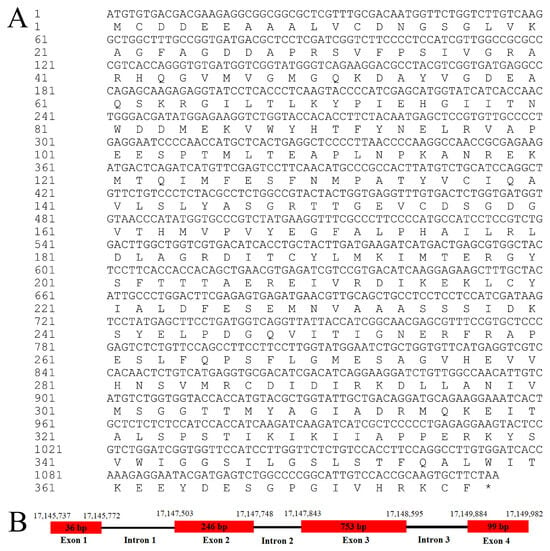
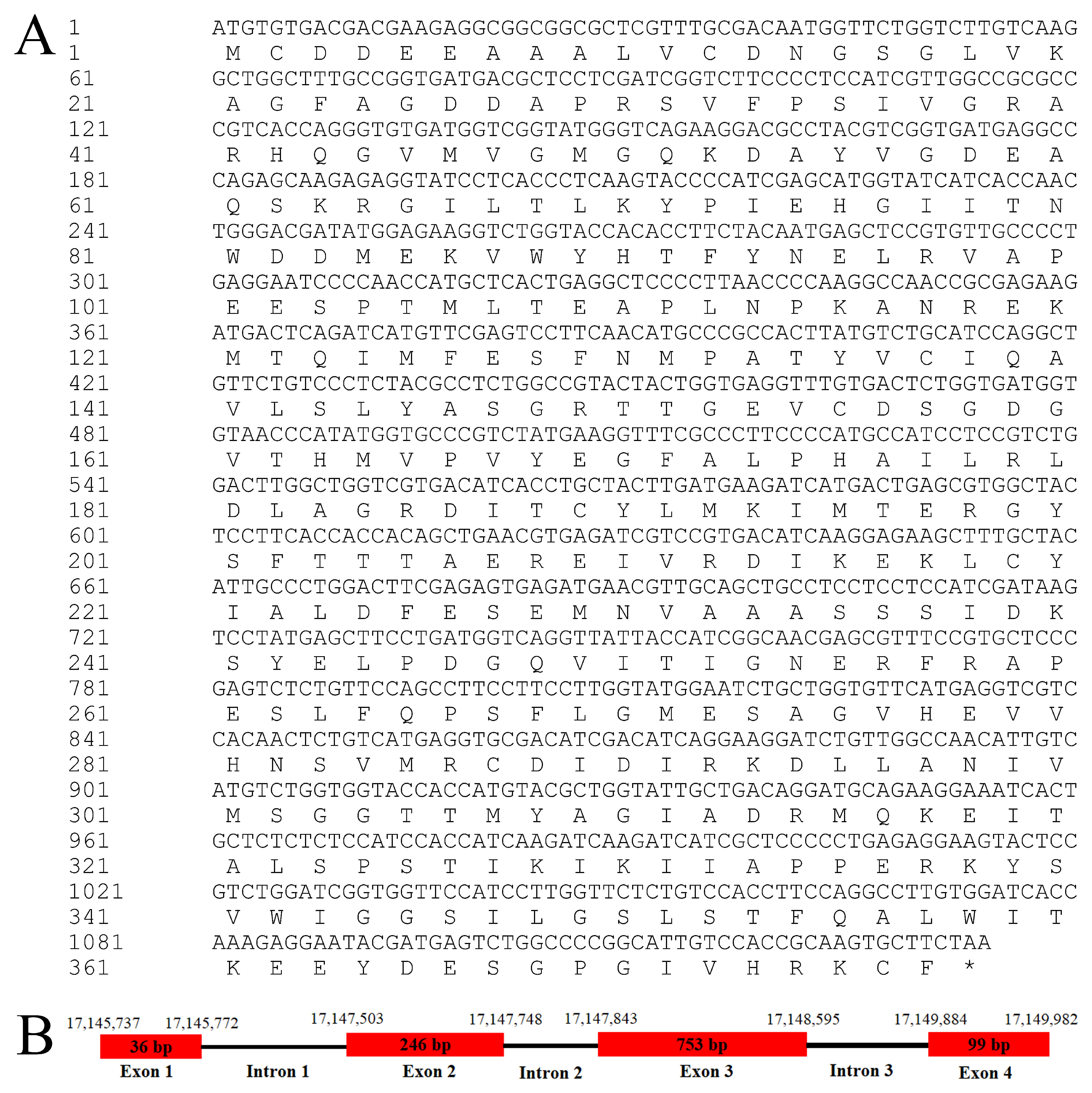
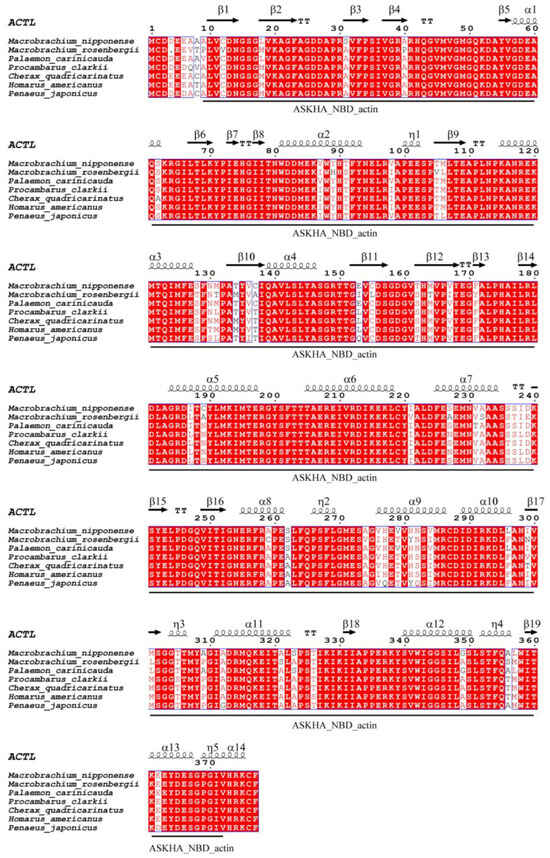
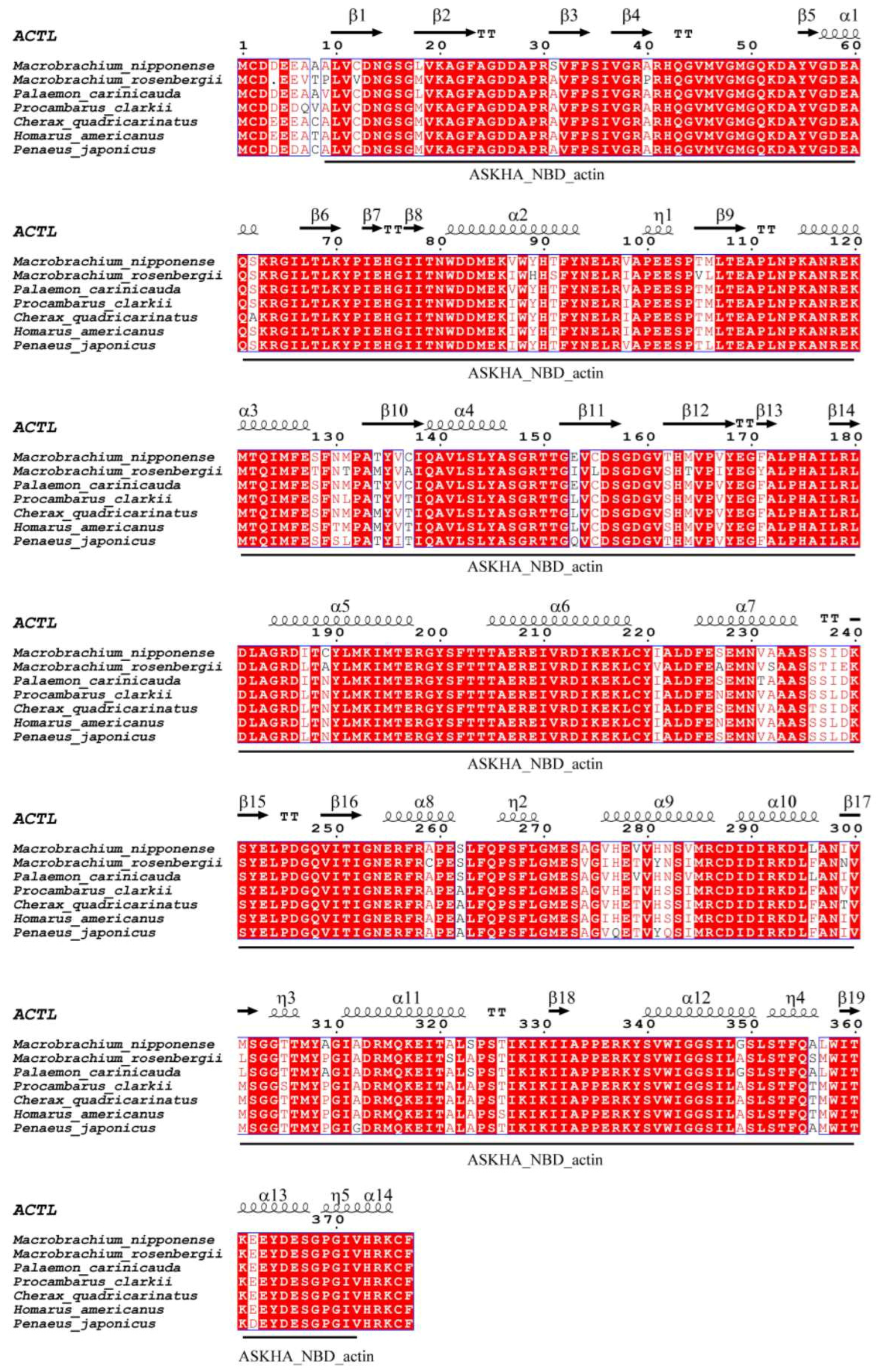
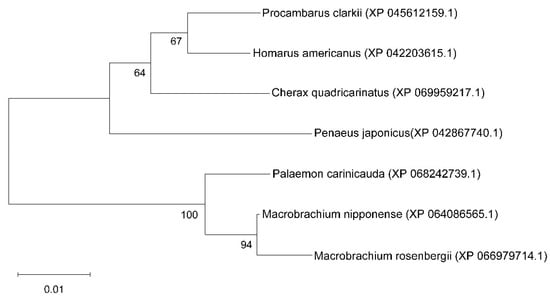
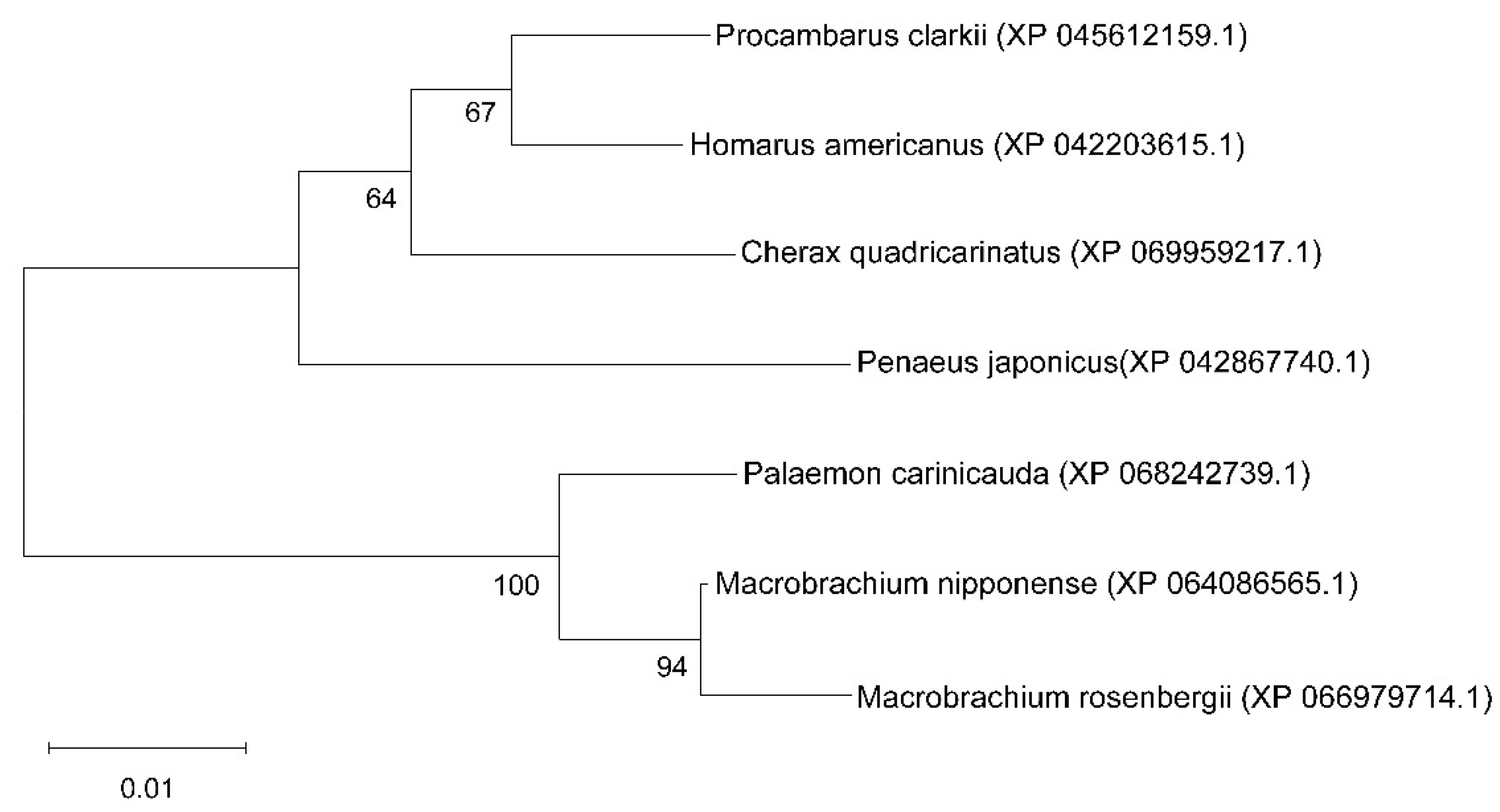
The open reading frame (ORF) of Mn-ACTL annotated from the M. nipponense reference genome [21] was 1134 bp, encoding 377 amino acids from nucleotide position 17145737 to 17149982 of chromosome 28 (NCBI accession: CP062029) (Figure 1A). The genomic sequence of Mn-ACTL was 4246 bp, comprising four exons and three introns (Figure 1B). The theoretical pI and the protein molecular weight were 5.11 and 41,623 Da, respectively. The secondary structure of this protein comprises 14 α-helices, 19 β-sheets, 7 β-turns, and 5 310-helices. A conserved functional domain, ASKHA_NBD_actin, was predicted within the protein, spanning amino acid residues 8 to 372 (Figure 2). Additionally, the gene was found to be highly conserved among crustaceans. In a multiple sequence alignment involving seven crustacean species, 317 sites exhibited 100% sequence identity, accounting for approximately 84% of all amino acid residues (Figure 2). Blastx analysis against the NCBI database revealed that the Mn-ACTL amino acid sequence exhibited high identity (>92%) with its orthologs from other shrimp species. It shared the highest identity with M. rosenbergii (99.20%), followed by Palaemon carinicauda (98.41%) and Cherax quadricarinatus (93.37%). The maximum likelihood phylogenetic analysis revealed that the Mn-ACTL amino acid sequence is most closely related to that of M. rosenbergii, forming a clade with P. carinicauda. This observed phylogenetic relationship is consistent with the results from the sequence similarity alignment (Figure 3).
Figure 1.
(A) The open reading frame sequence of the ACTL gene. Both nucleotide and deduced amino acid sequences are presented in the 5′ to 3′ direction. A single uppercase letter represents the amino acid code in the deduced amino acid sequence. The methionine initiation codon (ATG) and termination codon (TAA, indicated by an asterisk) are explicitly annotated. (B) The genome structure of the ATCL gene. The number indicates the start and end positions of each exon.
Figure 2.
Sequence alignment and structural information of the ACTL protein from M. nipponense. α: α-helix, β: β-sheet, TT: β-bend, η: 310-helix. Red shades indicated that the amino acid sequences were identical across different species, while white shades indicates that the amino acid sequences varied among species. The black font color indicated differences in amino acids among the different species.
Figure 3.
Phylogenetic tree analysis of ACTL protein in crustaceans.
2.2. qPCR Analysis in Different Mature Tissues
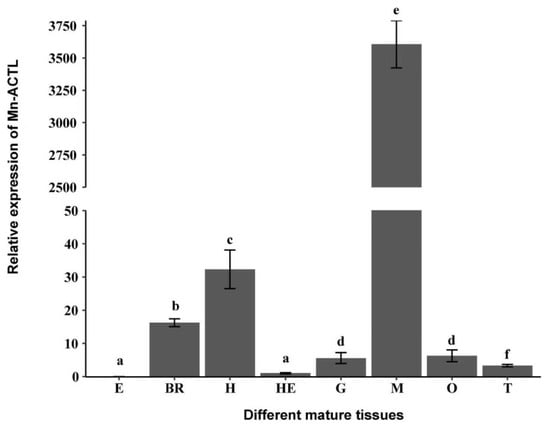
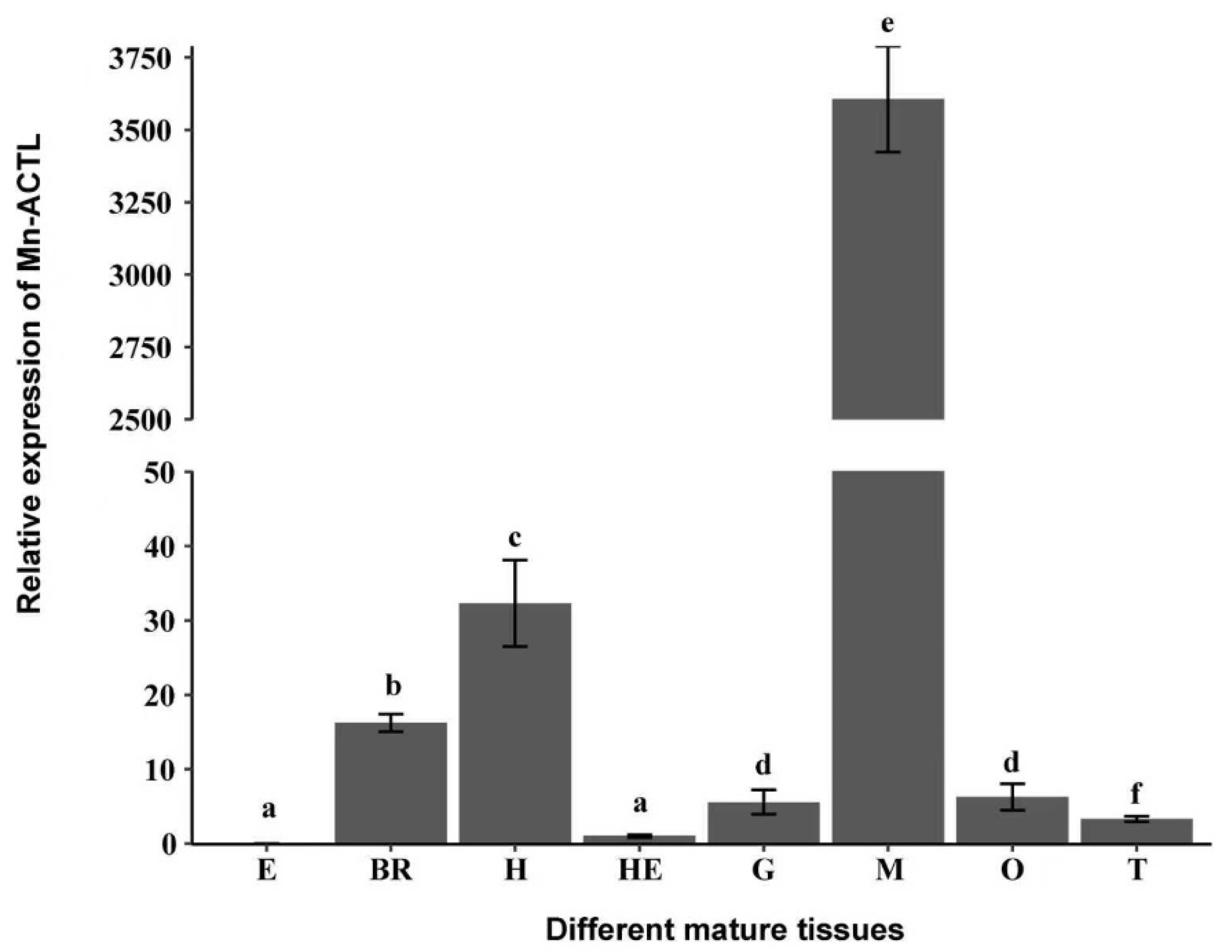
The highest transcript level of Mn-ACTL was detected in muscle, which was significantly greater than in all other examined tissues (p < 0.05). Specifically, the expression in muscle was 3612.37-fold higher than that in the eyestalk. Moderately high expression was observed in the heart and brain, respectively, whereas transcript levels in the remaining tissues were negligible (Figure 4).
Figure 4.
The relative expression levels of the ACTL gene in various mature tissues of M. nipponense were determined by qPCR. The EIF gene was used as an internal reference for normalization. Data were presented as the mean ± standard deviation (SD; n = 6). Significant differences in ACTL expression among different tissues were indicated by lowercase letters (p < 0.05). E, eyestalk; BR, brain; H, heart; HE, hepatopancreas; G, gill; M, muscle; O, ovary; T, testis.
2.3. RNAi Analysis
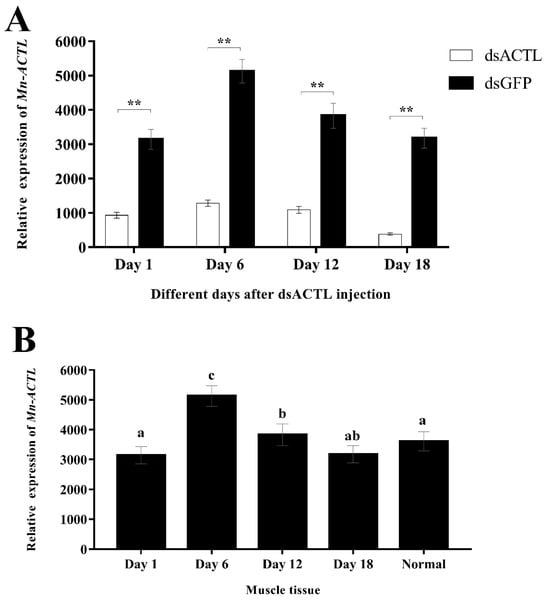
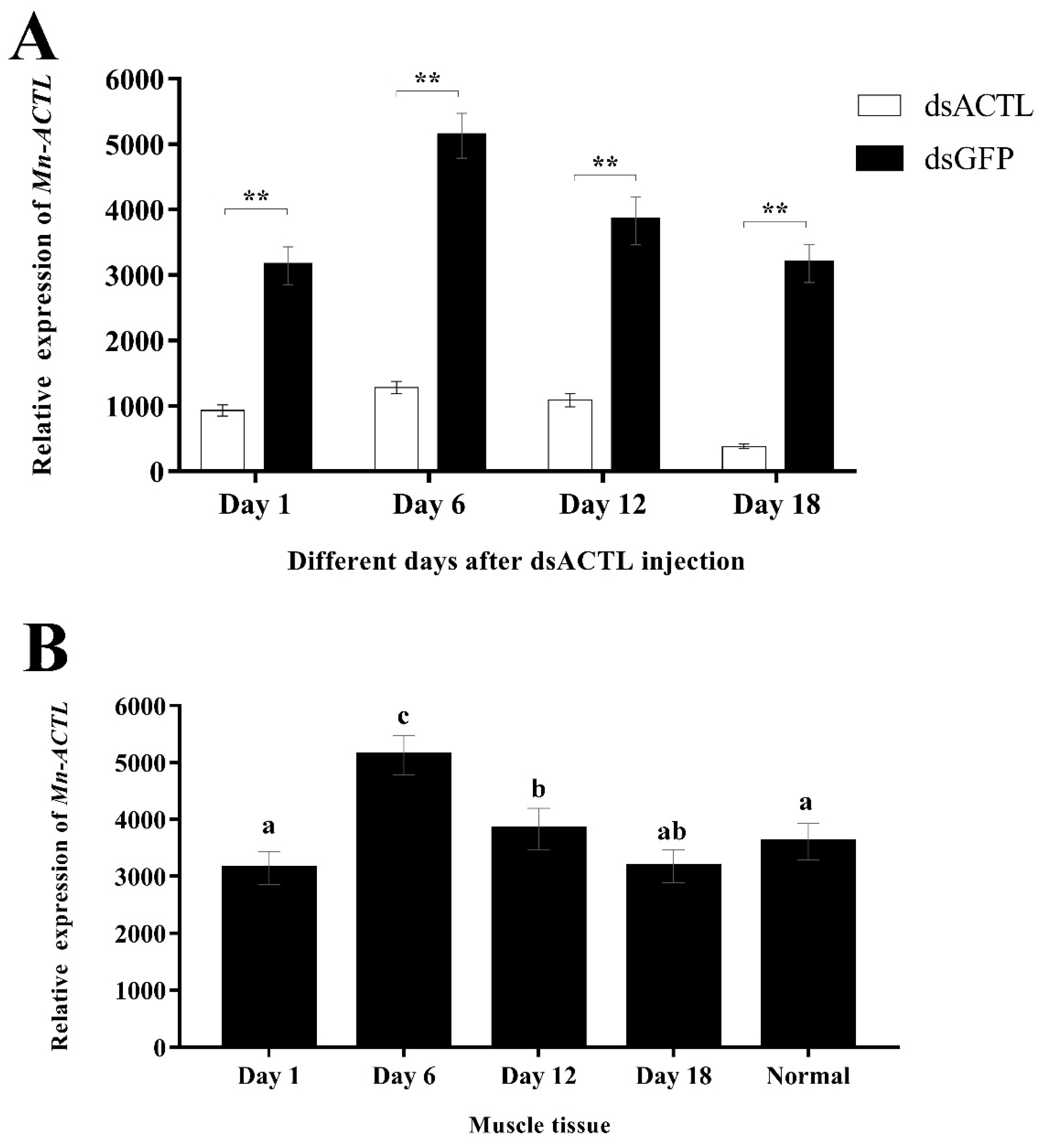
Compared to the dsGFP-injected controls, the dsACTL-injected group showed a successful knockdown, with Mn-ACTL expression suppressed by 70.28% to 90.84% across the sampling days (Figure 5A). Additionally, Mn-ACTL expression was compared between muscle tissue from the dsGFP-injected group and normal (untreated) muscle (Figure 5B). Relative to the normal muscle control, expression levels in tissues sampled on days 1, 6, 12, and 18 were 0.87-, 1.42-, 1.06-, and 0.88-fold, respectively.
Figure 5.
(A) The interference efficiency of dsACTL was monitored over a time course by qPCR. Gene expression data were normalized to the EIF reference gene and were expressed as the mean ± SD (n = 6). Asterisks (**) denote a highly significant difference (p < 0.01) between the dsACTL and dsGFP control groups at identical time points. (B) Comparison of Mn-ACTL expression in muscle tissue from dsGFP-injected and normal control groups. The “Normal” group represents untreated control groups. Lowercase letters indicated significant differences (p < 0.05).
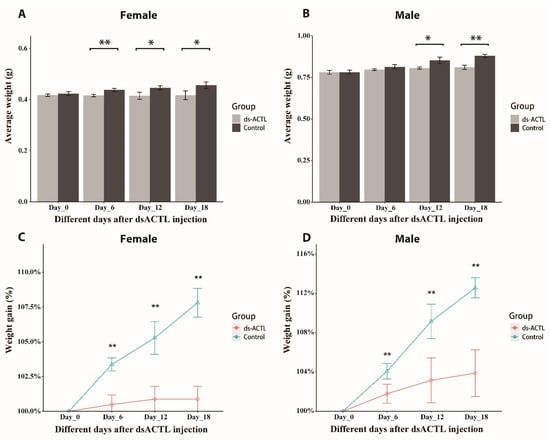
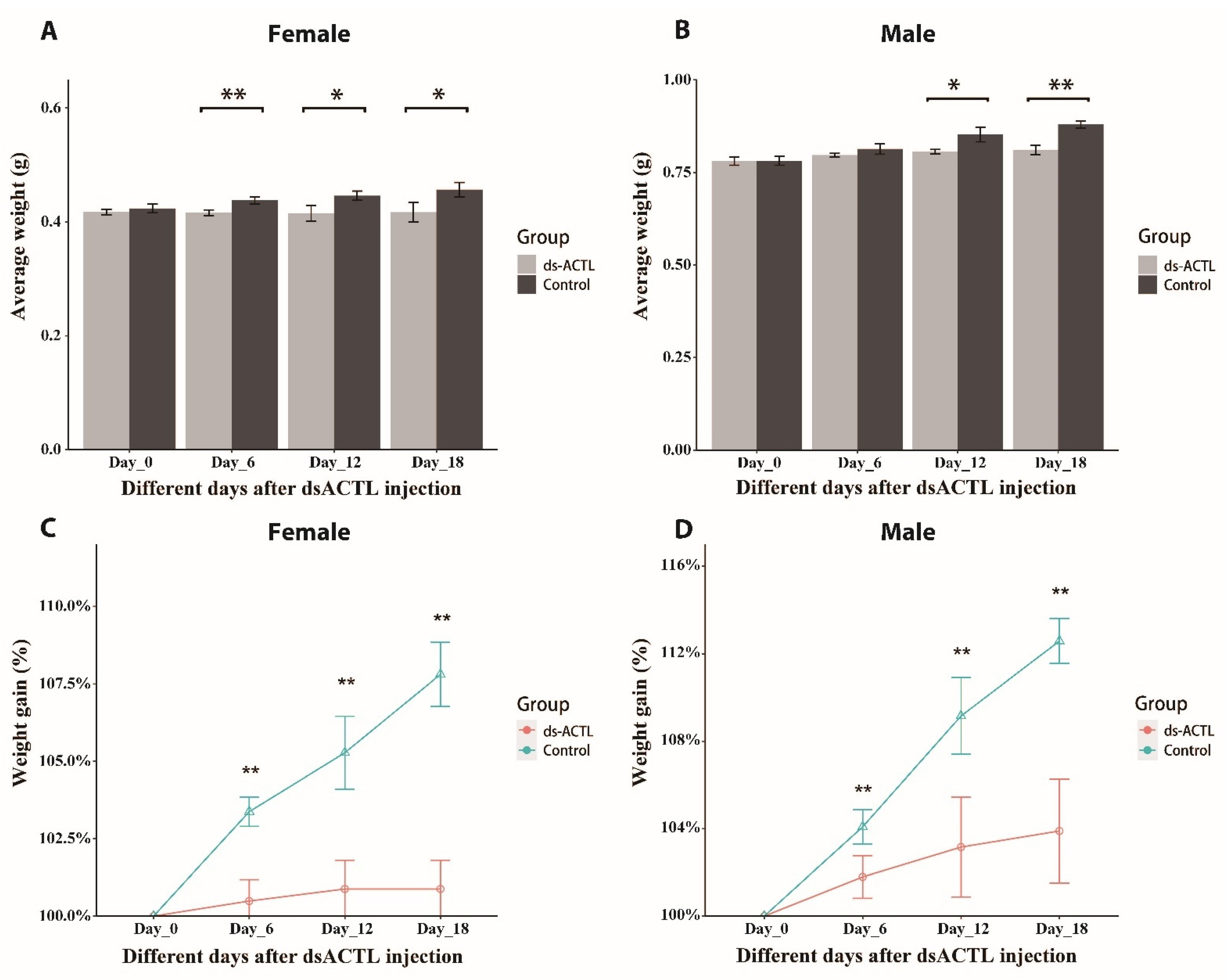
The initial mean body weights of female prawns at day 0 were comparable between the dsGFP-injected control (0.424 ± 0.05 g) and the dsACTL-injected group (0.417 ± 0.05). By days 6, 12, and 18, the weights in the dsGFP-injected control reached 0.438 ± 0.06 g, 0.446 ± 0.06 g, and 0.457 ± 0.06 g, respectively. In contrast, the dsACTL-injected group exhibited lower weights of 0.419 ± 0.04 g, 0.421 ± 0.05 g, and 0.422 ± 0.05 g at the same time points (Figure 6A). A similar pattern was observed in males. The initial weights were 0.781 ± 0.11 g for the dsGFP-injected control and 0.781 ± 0.10 g for the dsACTL-injected group. Over time, the dsGFP-injected control attained weights of 0.814 ± 0.12 g, 0.855 ± 0.11 g, and 0.881 ± 0.13 g on days 6, 12, and 18, respectively. In contrast, the dsACTL-injected group exhibited markedly lower weights of 0.794 ± 0.11 g, 0.805 ± 0.11 g, and 0.811 ± 0.12 g at the same intervals (Figure 6B).
Figure 6.
Effect of dsACTL injection on weight gain in M. nipponense. Body weight changes were monitored over time following injection with dsACTL or dsGFP (control). Significant differences between the dsACTL and dsGFP groups at the same time point are indicated by * (p < 0.05) and ** (p < 0.01). (A) Weight gain in females. (B) Weight gain in males. (C) Percentage increase in body mass for females. (D) Percentage increase in body mass for males.
When expressed as percentage mass increase relative to day 0, female prawns in the dsGFP-injected control showed gains of 1.79%, 3.16%, and 3.89% on days 6, 12, and 18, respectively, which were significantly higher than the 0.48%, 0.88%, and 0.88% increases observed in the dsACTL-injected group (p < 0.01) (Figure 6C). Similarly, male prawns in the dsGFP-injected control displayed mass increases of 4.08%, 9.16%, and 12.59%, significantly greater than the 3.37%, 5.28%, and 7.81% increases in the dsACTL-injected group (p < 0.01) (Figure 6D).
On day 18 of the experiment, the daily weight gain rate (DWGR) and daily length gain rate (DLGR) in the dsACTL-injected group were significantly lower than those in the dsGFP-injected control for both female and male prawns (p < 0.05). Specifically, the female prawns in the dsACTL-injected group showed an 80.40% reduction in DWGR and a 27.50% reduction in DLGR compared to the controls. Similarly, the male prawns exhibited decreases of 57.91% in DWGR and 67.47% in DLGR.
2.4. Histological Observation
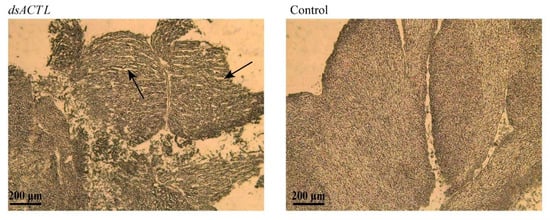
Histological analysis of abdominal muscles on day 18 revealed distinct morphological differences between the groups (Figure 7). The prawns in dsGFP-injected control exhibited tightly arranged myofibrils and continuous sarcomeres, whereas the prawns in dsACTL-injected group displayed looser myofibril packing, evident eroded areas, and consequently, increased sarcomere spacing.
Figure 7.
Histological changes of abdominal muscle tissue after 18 days of dsACTL and dsGFP injection. The area indicated by the arrow was the scattered erosion region in myofibrils.
2.5. Identification of SNPs
A total of 18 SNPs were identified within the Mn-ACTL coding region. These loci exhibited observed heterozygosity (Ho) ranging from 0.074 to 0.418, expected heterozygosity (He) from 0.127 to 0.385, and polymorphism information content (PIC) from 0.097 to 0.989. All 18 sites were synonymous mutations (Table 1).
Table 1.
Identification of SNPs within the Mn-ATCL.
Among these 18 SNPs, two SNPs were identified to be significantly associated with growth traits of M. nipponense (false discovery ratio < 0.05). The locus S28_17145758 was pointed at the 8th amino acid of the gene, whereas the other locus S28_17149891 was localized at the 348th amino acid (Table 1).
A total of 91 individuals (45 females and 46 males) were successfully genotyped at the S28_17145758 locus (Table 2). Among the 91 genotyped individuals, those with the GG genotype exhibited significantly greater body weight and length than those with either the CC or CG genotype (p < 0.05), though GG female was absent among genotyped individuals. The CG genotype (n = 11 and 13, respectively) showed better growth than the CC genotype (p < 0.05), but inferior to the GG among males (p < 0.05).
Table 2.
Identification of growth-associated SNPs within the Mn-ATCL.
A total of 86 individuals (44 females and 42 males) were successfully genotyped at the S28_17149891 locus (Table 2). The TT genotype was identified in 5 individuals, who showed the highest averages in both body weight and full length (p < 0.05). Better growth of the TT genotype was also confirmed when separately examined by sex (p < 0.05).
3. Discussion
Growth performance is a primary target for the genetic improvement of M. nipponense. Marker-assisted selection is a modern breeding technique that enhances selection accuracy and shortens the breeding cycle [22,23,24,25]. Consequently, there is a pressing need to identify growth-related genes and SNPs in M. nipponense to facilitate genetic improvement for superior growth. As a candidate gene, ACTL has been implicated in the regulation of growth performance in this species [8]. To this end, this study aimed to validate the regulatory role of ACTL on growth and to identify growth-associated SNPs within this gene, thereby contributing to the genetic improvement of M. nipponense.
To the best of our knowledge, the expression of actin genes has rarely been analyzed in aquatic animals. Northern blot analysis revealed that the actin gene was predominantly expressed in the muscle tissues of M. rosenbergii, while transcripts in the hepatopancreas were barely detectable. The expression of the actin gene varied during embryonic development, peaking at the zoea stage [6]. In the present study, the highest expression level of Mn-ACTL was observed in muscle tissue, consistent with the pattern observed in M. rosenbergii, suggesting that Mn-ACTL may be involved in regulating growth performance in M. nipponense.
RNAi has been widely employed as an established approach for the functional characterization of genes related to reproduction [26,27,28], growth [29] and immune defense [30,31,32] in M. nipponense. Here, we report for the first time the application of RNAi to investigate the role of the actin gene in regulating growth performance in M. nipponense. In the present study, injection of dsACTL significantly suppressed Mn-ACTL expression, demonstrating that the synthesized dsACTL effectively knocks down Mn-ACTL expression. The injection of dsACTL impaired growth performance in both sexes, as evidenced by reduced mass gain and disrupted sarcomere spacing. Collectively, these results indicated that Mn-ACTL plays a positive role in regulating growth performance in M. nipponense. The variation in Mn-ACTL expression within the dsGFP group across sampling days could reflect the influence of both endogenous biological rhythms and exogenous environmental cues.
Associations between SNPs and key traits have been documented in M. nipponense, regarding hypoxia resistance [33] and sexual maturation [34]. In the present study, a total of 18 SNP loci were identified within the coding region of the ACTL gene in M. nipponense. Two of these loci, S28_17145758 and S28_17149891, were found to be associated with growth performance. The identified potential molecular markers could facilitate the genetic improvement of growth traits through marker-assisted selection in this species.
4. Materials and Methods
4.1. Tissue Collection
A total of 268 healthy individuals and 100 full-sibs (50 males and 50 females) of M. nipponense were collected from the Dapu Breeding Base in Wuxi, China (120°13′44″ E, 31°28′22″ N) (Table 3). Prior to experimentation, all prawns were acclimatized under controlled laboratory conditions for 3 days, during which water temperature was maintained at 26.0 ± 1.2 °C and dissolved oxygen was kept above 6.0 mg/L.
Table 3.
Specimens used in this study.
Muscle tissues were dissected from ten randomly selected individuals to verify the Mn-ACTL ORF sequence. Eighteen healthy M. nipponense individuals were collected for qPCR analysis. Various mature tissues, including eyestalk, brain, heart, hepatopancreas, gill, muscle, ovary, and testis, were dissected. Tissues from three individuals were pooled as one biological replicate, with six replicates prepared per tissue for qPCR. For RNAi analysis, 240 prawns (120 males and 120 females) were obtained. Muscle tissues were collected for qPCR following injection of double-stranded GFP (dsGFP) or double-stranded ACTL (dsACTL). Body weight and length of the full-sibs were measured, and their muscle tissue was collected for SNP identification. All samples were immediately snap-frozen in liquid nitrogen and stored at −80 °C to prevent RNA degradation.
4.2. Annotation and Comparison of Mn-ACTL
The full-length cDNA sequence of Mn-ACTL was acquired from the M. nipponense genome database (accession number: GCA_015104395.2) and muscle transcriptome data (accession number: SRX25177010-SRX25177021).
For sequence confirmation, total RNA was isolated from each muscle sample using RNAiso Plus reagent (TaKaRa, Dalian, China). RNA concentration was measured with a spectrophotometer (Eppendorf, Hamburg, Germany), and integrity was evaluated by agarose gel electrophoresis. Approximately 1 µg of total RNA per sample was reverse-transcribed into first-strand cDNA using the iScript™ cDNA Synthesis Kit (Bio-Rad, Hercules, CA, USA). To verify sequence accuracy, the obtained sequence was experimentally validated with three specific primer pairs (Table 4), using the synthesized cDNA as templates. The PCR products were sequenced by Shanghai Shenggong Bioengineering Technology Service Co., Ltd. (Shanghai, China) on an ABI 3730 automated DNA sequencer (Invitrogen Biotechnology Co., Ltd., Carlsbad, CA, USA).
Table 4.
Primers used in the present study.
The ORF of Mn-ACTL was predicted with the online tool ORF-FINDER (https://www.ncbi.nlm.nih.gov/orffinder, 15 December 2023) [35]. The corresponding cDNA sequence was translated into its amino acid sequence and visualized using DNAman software (version 6.0) [36]. Multiple sequence alignment of ACTL protein sequences from various species was conducted with ClustalW (version 2.0) [37]. A phylogenetic tree was subsequently constructed in MEGA (version 11) [38] based on the aligned sequences, employing the maximum likelihood method. Branch support was evaluated with 1000 bootstrap replicates, and the support values are indicated at the corresponding nodes.
4.3. qPCR Analysis
In the present study, the mRNA expression levels of Mn-ACTL in various mature tissues were quantified using qPCR. Total RNA was isolated from each tissue with RNAiso Plus Reagent (TaKaRa) according to the manufacturer’s instructions. RNA concentration was determined using a spectrophotometer (Eppendorf), and integrity was assessed by agarose gel electrophoresis. Approximately 1 µg of total RNA from each sample was reverse-transcribed into first-strand cDNA using the iScript™ cDNA Synthesis Kit (Bio-Rad).
Real-time qPCR was performed on a Bio-Rad iCycler iQ5 Real-Time PCR System using SYBR Green chemistry. The general qPCR procedures were consistent with those described in previous studies [39]. Each 25 µL reaction mixture contained 12.5 µL of 2× Ultra SYBR Mix (CWBIO, Taizhou, China), 0.5 µL of each forward and reverse primer (Table 4, 10 µM each), 1 µL of cDNA template, and 10.5 µL of PCR-grade water. The thermal cycling protocol consisted of an initial denaturation at 95 °C for 10 min, followed by 40 cycles of 95 °C for 15 s and 60 °C for 1 min. All reactions were performed in triplicate for each tissue.
The elongation factor gene (EIF) was employed as an internal reference [40]. The amplification efficiencies of Mn-ACTL and EIF were verified to be approximately equal, enabling the use of the 2–ΔΔCt method for calculating relative gene expression [41].
4.4. RNAi Analysis
The potential regulatory role of Mn-ACTL on the growth performance of M. nipponense was investigated using RNAi. The 240 prawns were randomly assigned to two experimental groups: a control group injected with dsGFP and an experimental group injected with dsACTL. Each group consisted of 60 male or 60 female prawns. The dsGFP served as a negative control to account for non-specific effects [42]. The initial average body weight was 0.781 ± 0.11 g for males and 0.424 ± 0.05 g for females in the dsGFP-injected control group, and 0.781 ± 0.10 g for males and 0.417 ± 0.05 g for females in the dsACTL-injected group.
Gene-specific RNAi primers flanked by T7 promoter sequences were designed using Snap Dragon tools (https://www.flyrnai.org/cgi-bin/RNAi_find_primers.pl, 13 April 2024) (Table 4). Double-stranded RNA (dsRNA) targeting Mn-ACTL and GFP (control) was synthesized in vitro using the TranscriptAid™ T7 High Yield Transcription Kit (Fermentas, Inc., Waltham, MA, USA) according to the manufacturer’s instructions. Following established methods [43], prawns in the experimental and control groups were microinjected with Mn-ACTL dsRNA and GFP dsRNA (4 µg/µL each in an isotonic solution), respectively, at a dosage of 4 µg per gram of body weight. Consequently, the injection volume (in µL) administered to each prawn was numerically equivalent to its body weight (in grams). To evaluate the RNAi interference efficiency, Mn-ACTL mRNA expression levels in muscle tissue were analyzed by qPCR at 1, 6, 12, and 18 days post-injection (N ≥ 5 per time point). Concurrently, the body weight of each prawn was measured on the sampling days.
4.5. Histological Observation
Abdominal muscle samples were collected at 18 days, and histological analysis was performed to compare tissue histology between the two groups. Muscle tissues from each group were embedded using an OCT embedding kit (Rebiosci, Shanghai, China) in accordance with the manufacturer’s instructions. Longitudinal sections were prepared with an OTF5000 cryostat (Bright, San Francisco, CA, USA). For histological verification, muscle tissue samples were cryosectioned at a thickness of 10 μm. The resulting sections were examined and observed under an optical microscope (LEICA MC170 HD, Wetzlar, Germany).
4.6. Identification of SNPs Within ACTL
The cDNA template was synthesized via reverse transcription from total RNA isolated from the muscle tissue of each individual, as described above. The target regions were amplified by PCR with three pairs of primers using the synthesized cDNA as templates (Table 3), and the quality and specificity of the amplification products were verified by 1.2% agarose gel electrophoresis. The PCR products were then purified and subjected to bidirectional sequencing on an ABI 3730xl DNA Analyzer (Applied Biosystems, Waltham, MA, USA) by Shanghai Shenggong Bioengineering Co., Ltd. (Shanghai, China) The resulting sequences were assembled and aligned using MEGA 11.0 software [38] to identify SNP loci within the ACTL gene, according to a previous study [33,34]. The associations between the identified SNP loci and growth traits (body weight and total length) were analyzed using SPSS Statistics 23.0, with these traits treated as dependent variables.
4.7. Statistical Analysis
Statistical analyses were conducted using SPSS Statistics 23.0. Significant differences among groups were evaluated by one-way ANOVA, supplemented with LSD and Duncan’s post hoc tests for multiple comparisons. The results from quantitative data were expressed as mean ± standard deviation (SD), and a p-value of less than 0.05 was regarded as statistically significant.
5. Conclusions
Actin is a known regulator of crustacean growth. Our results support this role by showing that ACTL positively influences growth performance in both sexes of M. nipponense. Moreover, growth-associated SNPs identified within the ACTL gene promote the use of marker-assisted selection for genetic breeding in this species.
Author Contributions
S.J. (Shubo Jin): conceptualization, software, writing—review and editing; J.L.: data curation, formal analysis; H.F.: investigation, validation; Y.X.: formal analysis, resources; H.Q.: software, data curation; W.Z.: validation, writing—review and editing, supervision; S.J. (Sufei Jiang): validation, writing—review and editing, supervision, funding acquisition. All authors have read and agreed to the published version of the manuscript.
Funding
This research was supported by grants from Central Public-interest Scientific Institution Basal Research Fund CAFS (2025XT0702; 2023TD39); the earmarked fund for CARS-48-07; the seed industry revitalization project of Jiangsu province (JBGS [2021]118).
Institutional Review Board Statement
Permissions for the experiments involved in the present study were obtained from the Institutional Animal Care and Use Ethics Committee of the Freshwater Fisheries Research Center, Chinese Academy of Fishery Sciences (Wuxi, China) (Authorization NO.20230615002, 15 June 2023).
Informed Consent Statement
Not applicable.
Data Availability Statement
The raw data supporting the conclusions of this article will be made available by the authors on request.
Acknowledgments
Thanks to the Jiangsu Province Platform for the Conservation and Utilization of Agricultural Germplasm.
Conflicts of Interest
The authors declare no conflicts of interest.
References
- Gao, H.; Qin, L.; Shi, H.; Song, H.; Li, Z.; Xue, Y.; Liu, T. ASAP1 promotes gastric cancer cell growth and F-actin cytoskeleton remodeling through VEGF and HIF-1α protein expression. Int. J. Biol. Macromol. 2025, 315, 144589. [Google Scholar] [CrossRef] [Scilit] [PubMed]
- McGarry, D.J.; Armstrong, G.; Castino, G.; Mason, S.; Clark, W.; Shaw, R.; McGarry, L.; Blyth, K.; Olson, M.F. MICAL1 regulates actin cytoskeleton organization, directional cell migration and the growth of human breast cancer cells as orthotopic xenograft tumours. Cancer Lett. 2021, 519, 226–236. [Google Scholar] [CrossRef] [Scilit] [PubMed]
- Schenk, M.; Aykut, B.; Teske, C.; Giese, N.A.; Weitz, J.; Welsch, T. Salinomycin inhibits growth of pancreatic cancer and cancer cell migration by disruption of actin stress fiber integrity. Cancer Lett. 2015, 358, 161–169. [Google Scholar] [CrossRef] [Scilit] [PubMed]
- El Haj, A.J. Gene Expression and Manipulation in Aquatic Organisms: Crustacean Genes Involved in Growth; Cambridge University Press: Cambridge, UK, 1996; pp. 93–112. [Google Scholar]
- De-Santis, C.; Jerry, D.R. Candidate growth genes in finfish—Where should we be looking? Aquaculture 2007, 272, 22–38. [Google Scholar] [CrossRef] [Scilit]
- Zhu, X.J.; Dai, Z.M.; Liu, J.; Yang, W.J. Actin gene in prawn, Macrobrachium rosenbergii: Characteristics and differential tissue expression during embryonic development. Comp. Biochem. Physiol. Part B Biochem. Mol. Biol. 2005, 140, 599–605. [Google Scholar] [CrossRef] [Scilit]
- Thanh, N.M.; Barnes, A.C.; Mather, P.B.; Li, Y.T.; Lyons, R.E. Single nucleotide polymorphisms in the actin and crustacean hyperglycemic hormone genes and their correlation with individual growth performance in giant freshwater prawn Macrobrachium rosenbergii. Aquaculture 2010, 301, 7–15. [Google Scholar] [CrossRef] [Scilit]
- Gao, Z.; Zhang, W.; Jiang, S.; Qiao, H.; Xiong, Y.; Jin, S.; Fu, H. Genome-wide association and transcriptomic analysis and the identification of growth-related genes in Macrobrachium nipponense. BMC Genom. 2024, 25, 1182. [Google Scholar] [CrossRef] [Scilit]
- Vandekerckhove, J.; Weber, K. At least six different actins are expressed in a higher mammal: An analysis based on the amino acid sequence of the amino-terminal tryptic peptide. J. Mol. Biol. 1978, 126, 783–802. [Google Scholar] [CrossRef] [Scilit]
- Arora, A.S.; Huang, H.L.; Singh, R.; Narui, Y.; Suchenko, A.; Hatano, T.; Heissler, S.M.; Balasubramanian, M.K.; Chinthalapudi, K. Structural insights into actin isoforms. eLife 2023, 12, e82015. [Google Scholar] [CrossRef] [Scilit]
- Heissler, S.M.; Chinthalapudi, K. Structural and functional mechanisms of actin isoforms. FEBS J. 2025, 292, 468–482. [Google Scholar] [CrossRef] [Scilit]
- Jeruzalska, E.; Mazur, A.J. The role of non-muscle actin paralogs in cell cycle progression and proliferation. Eur. J. Cell Biol. 2023, 102, 151315. [Google Scholar] [CrossRef] [Scilit]
- Svitkina, T.M. Ultrastructure of the actin cytoskeleton. Curr. Opin. Cell Biol. 2018, 54, 1–8. [Google Scholar] [CrossRef] [Scilit] [PubMed]
- Vedula, P.; Kashina, A. The makings of the ‘actin code’: Regulation of actin’s biological function at the amino acid and nucleotide level. J. Cell Sci. 2018, 131, jcs215509. [Google Scholar] [CrossRef] [Scilit] [PubMed]
- Afanasyev, D.; Zhivoglyadova, L.; Nebesikhina, N.; Magomedov, M.; Mutallieva, Y.K.; Velibekova, B.; Mirzoyan, A. Finding of oriental river prawn Macrobrachium nipponense (De Haan, 1849) in the lower Terek River (Caspian Sea Basin). Russ. J. Biol. Invasions 2020, 11, 191–197. [Google Scholar] [CrossRef] [Scilit]
- Marques, H.L.; New, M.B.; Boock, M.V.; Barros, H.P.; Mallasen, M.; Valenti, W.C. Integrated freshwater prawn farming: State-of-the-art and future potential. Rev. Fish. Sci. Aquac. 2016, 24, 264–293. [Google Scholar] [CrossRef] [Scilit]
- New, M.B. Freshwater prawn farming: Global status, recent research and a glance at the future. Aquac. Res. 2005, 36, 210–230. [Google Scholar] [CrossRef] [Scilit]
- New, M.B.; Nair, C.M. Global scale of freshwater prawn farming. Aquac. Res. 2012, 43, 960–969. [Google Scholar] [CrossRef] [Scilit]
- Luo, P.; Jin, Y.; Zhao, T.; Bian, C.; Lv, Z.; Zhou, N.; Qin, J.; Sun, S. Population structure and mitogenomic analyses reveal dispersal routes of Macrobrachium nipponense in China. BMC Genom. 2025, 26, 497. [Google Scholar] [CrossRef] [Scilit]
- Zhang, X.; Cui, L.; Li, S.; Liu, X.; Han, X.; Jiang, K. Fisheries economic statistics. In China Fishery Yearbook; China Agricultural Press: Beijing, China, 2020; p. 24. [Google Scholar]
- Jin, S.; Bian, C.; Jiang, S.; Han, K.; Xiong, Y.; Zhang, W.; Shi, C.; Qiao, H.; Gao, Z.; Li, R.; et al. A chromosome-level genome assembly of the oriental river prawn, Macrobrachium nipponense. Gigascience 2021, 10, giab160. [Google Scholar] [CrossRef] [Scilit]
- Ravi, S.; Hassani, M.; Heidari, B.; Deb, S.; Orsini, E.; Li, J.; Richards, C.M.; Panella, L.W.; Srinivasan, S.; Campagna, G.; et al. Development of an SNP assay for marker-assisted selection of soil-borne Rhizoctonia solani AG-2-2-IIIB resistance in sugar beet. Biology 2022, 11, 49. [Google Scholar] [CrossRef] [Scilit]
- Guan, W.Z.; Qiu, G.F.; Liu, F. Transcriptome analysis of the growth performance of hybrid mandarin fish after food conversion. PLoS ONE 2020, 15, e240308. [Google Scholar] [CrossRef] [Scilit]
- Zhu, S.R.; Zhu, Y.A.; Meng, Q.L.; An, L.; Yu, Z.H.; Zhang, Y.Y. A preliminary study on karyotype of Barbus capito. Chin. Agri. Sci. Bull. 2019, 35, 142–145. [Google Scholar]
- Zhou, Y.; Fu, H.C.; Wang, Y.Y.; Huang, H.Z. Genome-wide association study reveals growth-related SNPs and candidate genes in mandarin fish (Siniperca chuatsi). Aquaculture 2022, 550, 737879. [Google Scholar] [CrossRef] [Scilit]
- Zhang, W.; Xiong, Y.; Wang, P.; Chen, T.; Jiang, S.; Qiao, H.; Gong, Y.; Wu, Y.; Jin, S.; Fu, H. RNA interference analysis of potential functions of cyclin A in the reproductive development of male oriental river prawns (Macrobrachium nipponense). Front. Genet. 2022, 13, 1053826. [Google Scholar] [CrossRef] [Scilit] [PubMed]
- Cui, W.; Liu, X.; Zhang, S.; Li, X.; Wang, Z.; Li, Y.; Zhang, M.; Wang, L.; Yu, M.; Qiao, Z.; et al. Identification and ovarian developmental regulation of ribosomal protein S6 kinase in Macrobrachium nipponense. Int. J. Biol. Macromol. 2025, 328, 147666. [Google Scholar] [CrossRef] [Scilit] [PubMed]
- Jiang, H.; Liu, X.; Li, Y.; Zhang, R.; Liu, H.; Ma, X.; Wu, L.; Qiao, Z.; Li, X. Identification of ribosomal protein L24 (RPL24) from the oriental river prawn, Macrobrachium nipponense, and its roles in ovarian development. Comp. Biochem. Physiol. Part A 2022, 266, 111154. [Google Scholar] [CrossRef] [Scilit] [PubMed]
- Li, F.J.; Zhang, S.Y.; Fu, C.P.; Wang, A.L.; Zhang, D. Comparative transcriptional analysis and RNA interference reveal immunoregulatory pathways involved in growth of the oriental river prawn Macrobrachium nipponense. Comp. Biochem. Physiol. Part D 2019, 29, 24–31. [Google Scholar] [CrossRef] [Scilit]
- Sun, B.; Luo, H.; Zhao, S.; Yu, J.L.; Lv, X.T.; Yi, C.; Wang, H. Characterization and expression analysis of a gC1qR gene from Macrobrachium nipponense under ammonia-N stress. Aquaculture 2019, 513, 734426. [Google Scholar] [CrossRef] [Scilit]
- Li, M.Y.; Qin, N.; Yuan, B.W.; Guo, M.H.; Yang, L.K.; Tang, T.; Li, F.C.; Liu, F.S. Involvement of nerve cord-expressed SVWC2 in pathogen recognition and defense in Macrobrachium nipponense. Fish Shellfish Immun. 2025, 162, 110329. [Google Scholar] [CrossRef] [Scilit]
- Ren, Q.; Huang, Y.; Liu, B.X. Function of two newly identified Spätzle genes in innate immune response of Macrobrachium nipponense against WSSV infection. Fish Shellfish Immun. 2025, 161, 110296. [Google Scholar] [CrossRef] [Scilit]
- Gao, X.; Gao, Z.; Zhang, M.; Qiao, H.; Jiang, S.; Zhang, W.; Xiong, Y.; Jin, S.; Fu, H. Identifying relationships between glutathione S-transferase-2 single nucleotide polymorphisms and hypoxia tolerance and growth traits in Macrobrachium nipponense. Animals 2024, 14, 666. [Google Scholar] [CrossRef] [Scilit]
- Jiang, S.; Xie, Y.; Gao, Z.; Niu, Y.; Ma, C.; Zhang, W.; Xiong, Y.; Qiao, H.; Fu, H. Studies on the relationships between growth and gonad development during first sexual maturation of Macrobrachium nipponense and associated SNPs screening. Int. J. Mol. Sci. 2024, 25, 7071. [Google Scholar] [CrossRef] [Scilit] [PubMed]
- Rombel, I.T.; Sykes, K.F.; Rayner, S.; Johnston, S.A. ORF-FINDER: A vector for high-throughput gene identification. Gene 2002, 282, 33–41. [Google Scholar] [CrossRef] [Scilit] [PubMed]
- Wang, W.Q. The molecular detection of Corynespora cassiicola on cucumber by PCR assay using DNAman software and NCBI. In IFIP Advances in Information and Communication Technology, Proceedings of the Computer and Computing Technologies in Agriculture IX, Beijing, China, 27–30 September 2015; Li, D., Li, Z., Eds.; Springer: Singapore, 2016; pp. 248–258, Erratum in IFIP Advances in Information and Communication Technology, Proceedings of the Computer and Computing Technologies in Agriculture IX, Beijing, China, 27–30 September 2015; Li, D., Li, Z., Eds.; Springer: Singapore, 2017; p. E1. [Google Scholar]
- Larkin, M.A.; Blackshields, G.; Brown, N.P.; Chenna, R.; McGettigan, P.A.; McWilliam, H.; Valentin, F.; Wallace, I.M.; Wilm, A.; Lopez, R.; et al. Clustal W and Clustal X version 2.0. Bioinformatics 2007, 23, 2947–2948. [Google Scholar] [CrossRef] [Scilit] [PubMed]
- Tamura, K.; Stecher, G.; Kumar, S. MEGA11: Molecular evolutionary genetics analysis version 11. Mol. Biol. Evol. 2021, 38, 3022–3027. [Google Scholar] [CrossRef] [Scilit] [PubMed]
- Jin, S.B.; Jiang, S.F.; Xiong, Y.W.; Qiao, H.; Sun, S.M.; Zhang, W.Y.; Li, F.J.; Gong, Y.S.; Fu, H.T. Molecular cloning of two tropomyosin family genes and expression analysis during development in oriental river prawn, Macrobrachium nipponense. Gene 2014, 546, 390–397. [Google Scholar] [CrossRef] [Scilit]
- Hu, Y.N.; Fu, H.T.; Qiao, H.; Sun, S.M.; Zhang, W.Y.; Jin, S.B.; Jiang, S.F.; Gong, Y.S.; Xiong, Y.W.; Wu, Y. Validation and evaluation of reference genes for quantitative real-time PCR in Macrobrachium nipponense. Int. J. Mol. Sci. 2018, 19, 2258. [Google Scholar] [CrossRef] [Scilit]
- Livak, K.J.; Schmittgen, T.D. Analysis of relative gene expression data using real-time quantitative PCR and the 2–ΔΔCt method. Methods 2001, 25, 402–408. [Google Scholar] [CrossRef] [Scilit]
- Zhang, S.B.; Jiang, P.; Wang, Z.Q.; Long, S.R.; Liu, R.D.; Zhang, X.; Yang, W.; Ren, H.J.; Cui, J. Dsrna-mediated silencing of nudix hydrolase in Trichinella spiralis inhibits the larval invasion and survival in mice. Exp. Parasitol. 2016, 162, 35–42. [Google Scholar] [CrossRef] [Scilit]
- Li, F.; Qiao, H.; Fu, H.T.; Sun, S.M.; Zhang, W.Y.; Jin, S.B.; Jiang, S.F.; Gong, Y.S.; Xiong, Y.W.; Wu, Y.; et al. Identification and characterization of opsin gene and its role in ovarian maturation in the oriental river prawn Macrobrachium nipponense. Comp. Biochem. Physiol. Part B Biochem. Mol. Biol. 2018, 218, 1–12. [Google Scholar] [CrossRef] [Scilit]

Disclaimer/Publisher’s Note: The statements, opinions and data contained in all publications are solely those of the individual author(s) and contributor(s) and not of MDPI and/or the editor(s). MDPI and/or the editor(s) disclaim responsibility for any injury to people or property resulting from any ideas, methods, instructions or products referred to in the content. |
© 2026 by the authors. Licensee MDPI, Basel, Switzerland. This article is an open access article distributed under the terms and conditions of the Creative Commons Attribution (CC BY) license.