


Clinical Spectrum of Arrhythmogenic Entities in Spanish Children Carrying Deleterious SCN5A Variants

 , , , ,
  and
and
Abstract
1. Introduction
2. Results
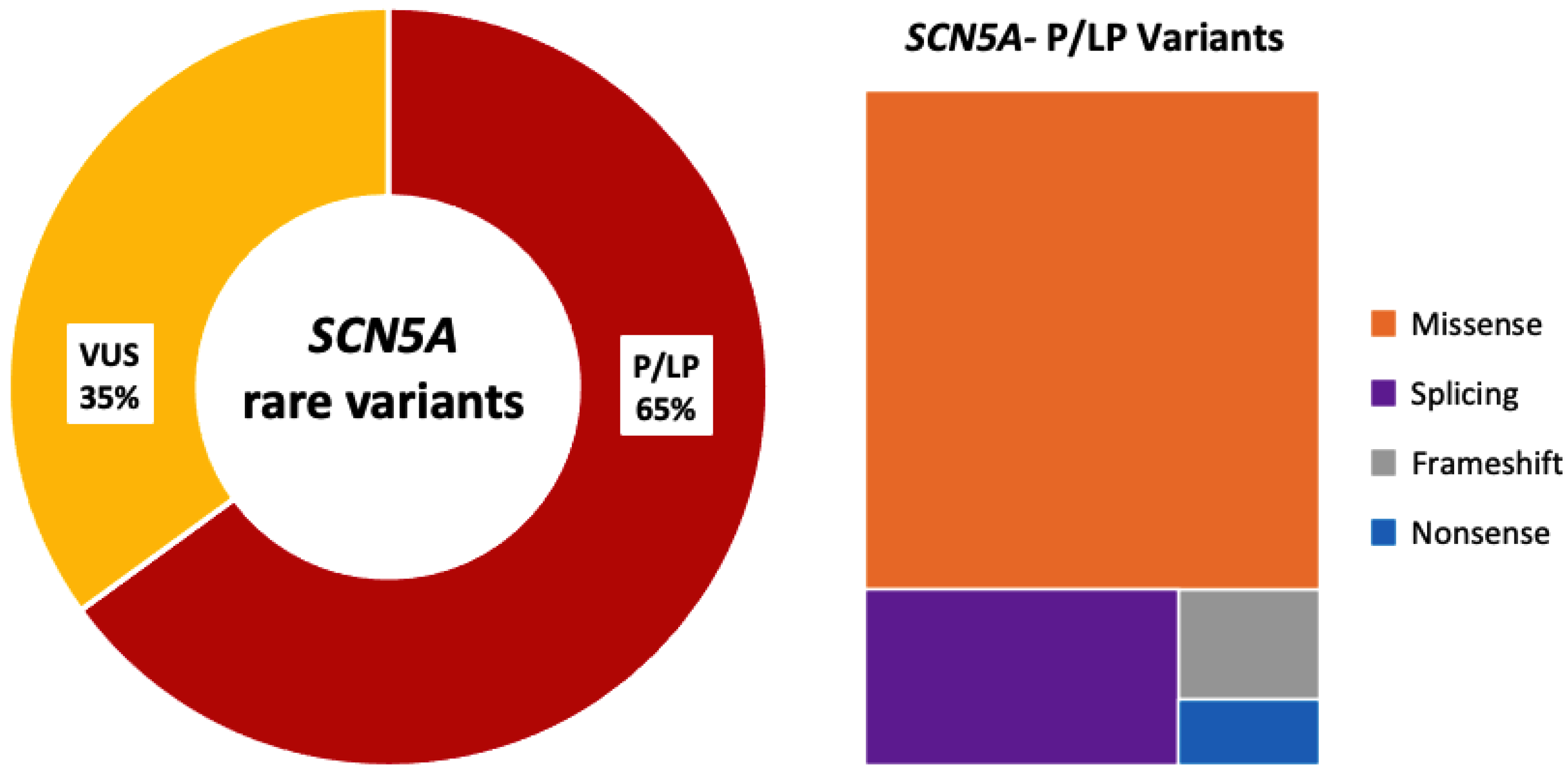
2.1. Genetic Results
2.2. Descriptive Analysis of SCN5A-P/LP Carriers
2.3. Family History
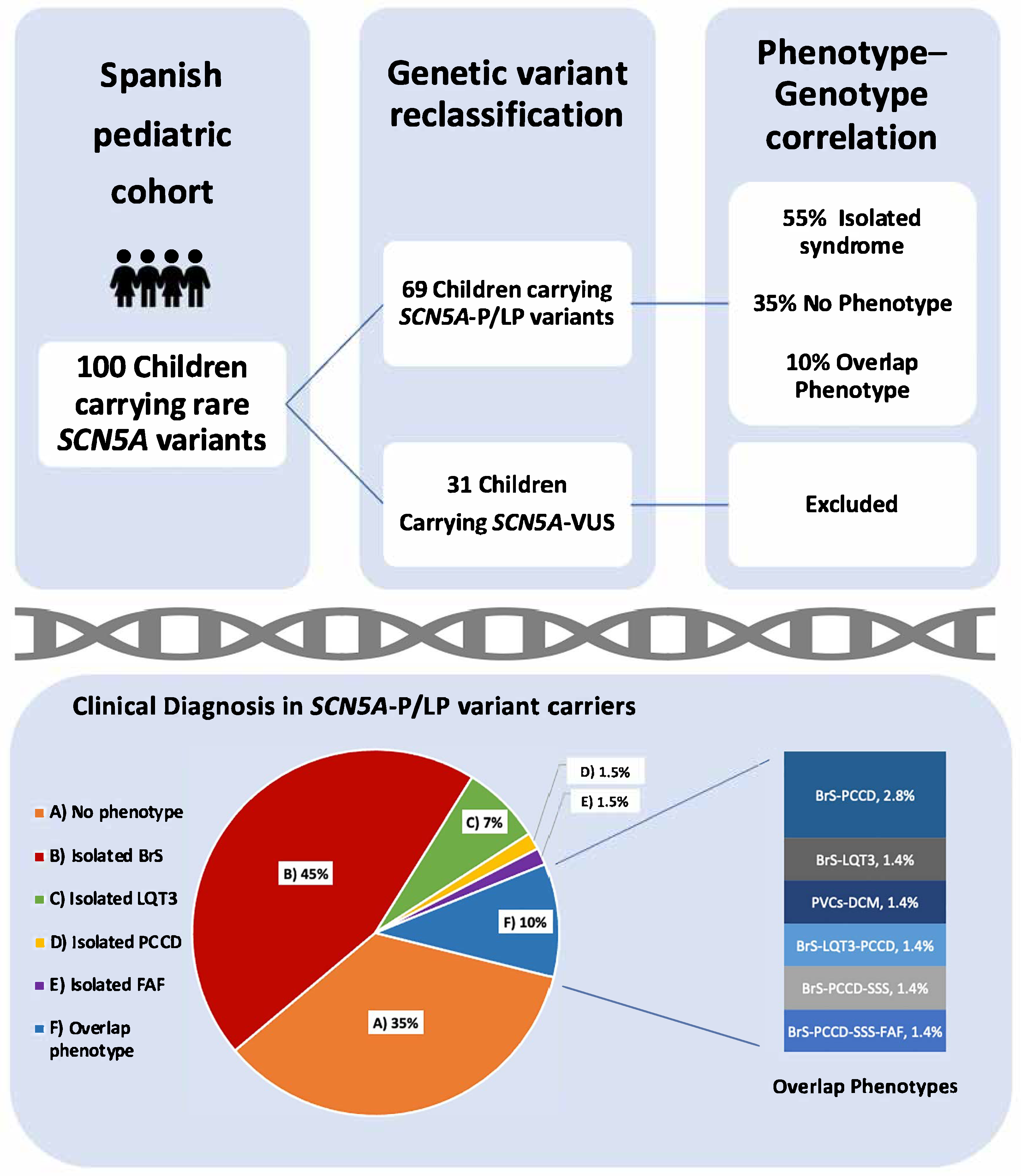
2.4. Clinical Diagnosis in Children Carrying SCN5A-P/LP Variants
2.5. Clinical Findings in Patients with Isolated Syndromes
2.6. Clinical Findings in Patients with Overlapping Phenotypes
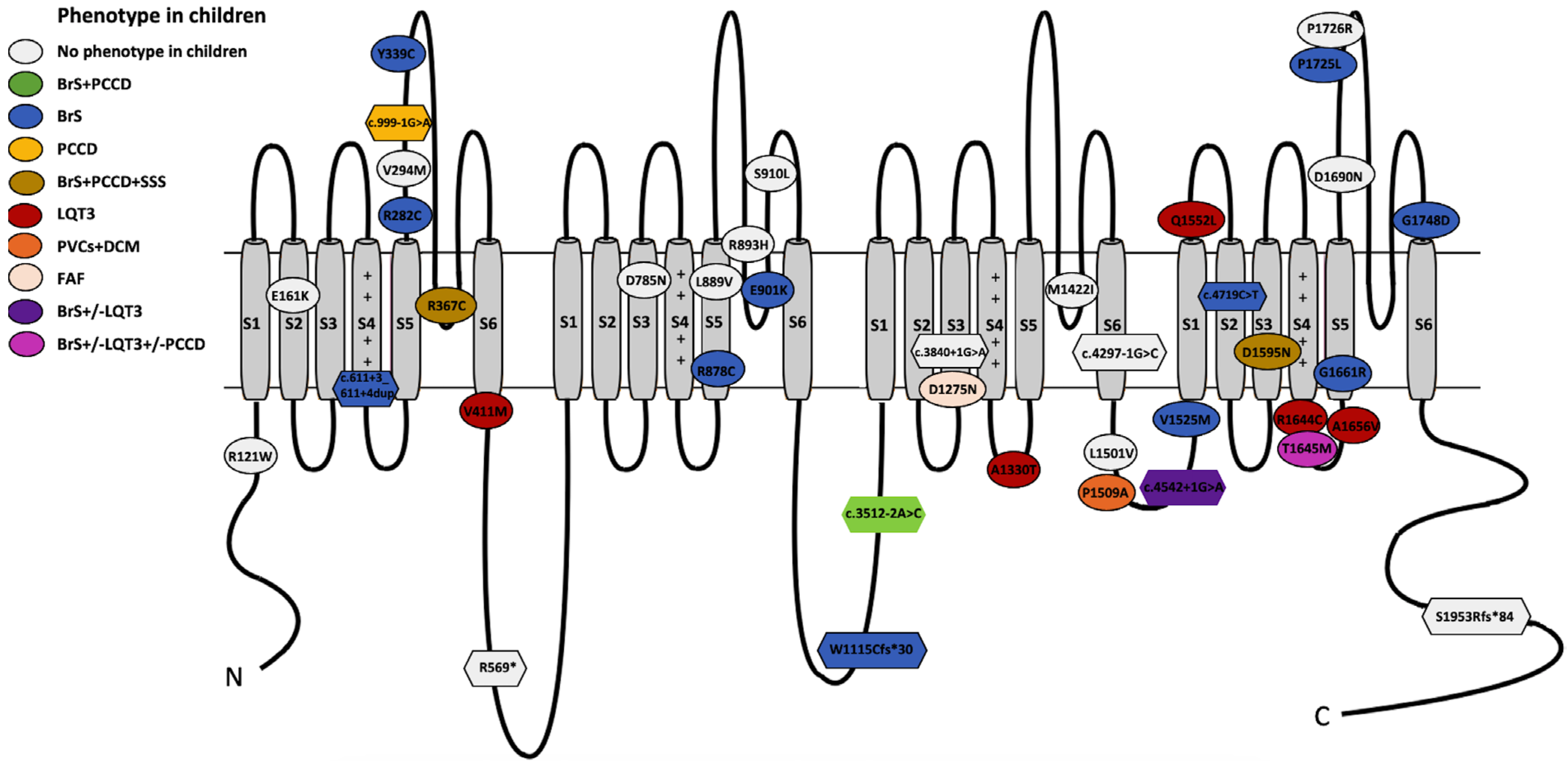
2.7. Genotype–Phenotype Correlation in Isolated Syndromes
2.8. Genotype–Phenotype Correlation in Overlapping Phenotypes
3. Discussion
4. Materials and Methods
4.1. Study Design
4.2. Data and Variables
4.3. Genetic Analysis
4.4. Statistical Analysis
5. Conclusions
Supplementary Materials
Author Contributions
Funding
Institutional Review Board Statement
Informed Consent Statement
Data Availability Statement
Acknowledgments
Conflicts of Interest
References
- Veerman, C.C.; Wilde, A.A.M.; Lodder, E.M. The cardiac sodium channel gene SCN5A and its gene product NaV1.5: Role in physiology and pathophysiology. Gene 2015, 573, 177–187. [Google Scholar] [CrossRef] [PubMed]
- Frisso, G.; Detta, N.; Coppola, P.; Mazzaccara, C.; Pricolo, M.R.; D’onofrio, A.; Limongelli, G.; Calabrò, R.; Salvatore, F. Functional Studies and In Silico Analyses to Evaluate Non-Coding Variants in Inherited Cardiomyopathies. Int. J. Mol. Sci. 2016, 17, 1883. [Google Scholar] [CrossRef] [PubMed]
- Richards, S.; Aziz, N.; Bale, S.; Bick, D.; Das, S.; Gastier-Foster, J.; Grody, W.W.; Hegde, M.; Lyon, E.; Spector, E.; et al. Standards and guidelines for the interpretation of sequence variants: A joint consensus recommendation of the American College of Medical Genetics and Genomics and the Association for Molecular Pathology. Genet. Med. Off. J. Am. Coll. Med. Genet. 2015, 17, 405–424. [Google Scholar] [CrossRef] [PubMed]
- Robyns, T.; Nuyens, D.; Vandenberk, B.; Kuiperi, C.; Corveleyn, A.; Breckpot, J.; Garweg, C.; Ector, J.; Willems, R. Genotype-phenotype relationship and risk stratification in loss-of-function SCN5A mutation carriers. Ann. Noninvasive Electrocardiol. Off. J. Int. Soc. Holter Noninvasive Electrocardiol. Inc. 2018, 23, e12548. [Google Scholar] [CrossRef]
- Wang, Q.; Shen, J.; Li, Z.; Timothy, K.; Vincent, G.; Priori, S.G.; Schwartz, P.J.; Keating, M.T. Cardiac sodium channel mutations in patients with long QT syndrome, an inherited cardiac arrhythmia. Hum. Mol. Genet. 1995, 4, 1603–1607. [Google Scholar] [CrossRef]
- Darbar, D.; Kannankeril, P.J.; Donahue, B.S.; Kucera, G.; Stubblefield, T.; Haines, J.L.; George, A.L.; Roden, D.M. Cardiac sodium channel (SCN5A) variants associated with atrial fibrillation. Circulation 2008, 117, 1927–1935. [Google Scholar] [CrossRef]
- Veltmann, C.; Barajas-Martinez, H.; Wolpert, C.; Borggrefe, M.; Schimpf, R.; Pfeiffer, R.; Cáceres, G.; Burashnikov, E.; Antzelevitch, C.; Hu, D. Further Insights in the Most Common SCN5A Mutation Causing Overlapping Phenotype of Long QT Syndrome, Brugada Syndrome, and Conduction Defect. J. Am. Heart Assoc. 2016, 5, e003379. [Google Scholar] [CrossRef]
- Zeppenfeld, K.; Tfelt-Hansen, J.; de Riva, M.; Winkel, B.G.; Behr, E.R.; Blom, N.A.; Charron, P.; Corrado, D.; Dagres, N.; de Chillou, C.; et al. 2022 ESC Guidelines for the management of patients with ventricular arrhythmias and the prevention of sudden cardiac death. Eur. Heart J. 2022, 43, 3997–4126. [Google Scholar] [CrossRef]
- Hermida, A.; Jedraszak, G.; Ader, F.; Denjoy, I.; Fressart, V.; Maury, P.; Beyls, C.; Bloch, A.; Clerici, G.; Daire, E.; et al. Systematic analysis of SCN5A variants associated with inherited cardiac diseases. Heart Rhythm. 2025, 22, 844–851. [Google Scholar] [CrossRef]
- Baruteau, A.E.; Kyndt, F.; Behr, E.R.; Vink, A.S.; Lachaud, M.; Joong, A.; Schott, J.-J.; Horie, M.; Denjoy, I.; Crotti, L.; et al. SCN5A mutations in 442 neonates and children: Genotype-phenotype correlation and identification of higher-risk subgroups. Eur. Heart J. 2018, 39, 2879–2887. [Google Scholar] [CrossRef]
- Shimizu, W.; Matsuo, K.; Kokubo, Y.; Satomi, K.; Kurita, T.; Noda, T.; Nagaya, N.; Suyama, K.; Aihara, N.; Kamakura, S.; et al. Sex hormone and gender difference—role of testosterone on male predominance in Brugada syndrome. J. Cardiovasc. Electrophysiol. 2007, 18, 415–421. [Google Scholar] [CrossRef] [PubMed]
- Martínez-Barrios, E.; Arbelo, E.; Cesar, S.; Cruzalegui, J.; Fiol, V.; Díez-Escuté, N.; Hernández, C.; Brugada, R.; Brugada, J.; Campuzano, O.; et al. Brugada Syndrome in Women: What Do We Know After 30 Years? Front. Cardiovasc. Med. 2022, 9, 874992. [Google Scholar] [CrossRef] [PubMed]
- Díez-Escuté, N.; Arbelo, E.; Martínez-Barrios, E.; Cerralbo, P.; Cesar, S.; Cruzalegui, J.; Chipa, F.; Fiol, V.; Zschaeck, I.; Hernández, C.; et al. Sex differences in long QT syndrome. Front. Cardiovasc. Med. 2023, 10, 1164028. [Google Scholar] [CrossRef] [PubMed]
- Kapplinger, J.D.; Tester, D.J.; Alders, M.; Benito, B.; Berthet, M.; Brugada, J.; Brugada, P.; Fressart, V.; Guerchicoff, A.; Harris-Kerr, C.; et al. An international compendium of mutations in the SCN5A-encoded cardiac sodium channel in patients referred for Brugada syndrome genetic testing. Heart Rhythm 2010, 7, 33–46. [Google Scholar] [CrossRef]
- Roterberg, G.; El-Battrawy, I.; Veith, M.; Liebe, V.; Ansari, U.; Lang, S.; Zhou, X.; Akin, I.; Borggrefe, M. Arrhythmic events in Brugada syndrome patients induced by fever. Ann. Noninvasive Electrocardiol. Off. J. Int. Soc. Holter Noninvasive Electrocardiol. Inc. 2020, 25, e12723. [Google Scholar] [CrossRef]
- Bardai, A.; Amin, A.S.; Blom, M.T.; Bezzina, C.R.; Berdowski, J.; Langendijk, P.N.; Beekman, L.; Klemens, C.A.; Souverein, P.C.; Koster, R.W.; et al. Sudden cardiac arrest associated with use of a non-cardiac drug that reduces cardiac excitability: Evidence from bench, bedside, and community. Eur. Heart J. 2013, 34, 1506–1516. [Google Scholar] [CrossRef]
- Nakano, Y.; Shimizu, W. Genetics of long-QT syndrome. J. Hum. Genet. 2016, 61, 51–55. [Google Scholar] [CrossRef]
- Li, W.; Yin, L.; Shen, C.; Hu, K.; Ge, J.; Sun, A. SCN5A Variants: Association With Cardiac Disorders. Front. Physiol. 2018, 9, 1372. [Google Scholar] [CrossRef]
- Wattanasirichaigoon, D.; Vesely, M.R.; Duggal, P.; Levine, J.C.; Blume, E.D.; Wolff, G.S.; Edwards, S.B.; Beggs, A.H. Sodium channel abnormalities are infrequent in patients with long QT syndrome: Identification of two novel SCN5A mutations. Am. J. Med. Genet. 1999, 86, 470–476. [Google Scholar] [CrossRef]
- Napolitano, C.; Priori, S.G.; Schwartz, P.J.; Bloise, R.; Ronchetti, E.; Nastoli, J.; Bottelli, G.; Cerrone, M.; Leonardi, S. Genetic testing in the long QT syndrome: Development and validation of an efficient approach to genotyping in clinical practice. JAMA 2005, 294, 2975–2980. [Google Scholar] [CrossRef]
- Takahashi, K.; Miyake, A.; Otsuka, Y.; Ohfu, M.; Ganaha, H. Diagnosis of epilepsy using an implantable loop recorder in a child with long-QT syndrome type 3. Pediatr. Int. Off. J. Jpn. Pediatr. Soc. 2013, 55, 251–253. [Google Scholar] [CrossRef] [PubMed]
- Schott, J.J.; Alshinawi, C.; Kyndt, F.; Probst, V.; Hoorntje, T.M.; Hulsbeek, M.; Wilde, A.A.; Escande, D.; Mannens, M.M.; Le Marec, H. Cardiac conduction defects associate with mutations in SCN5A. Nat. Genet. 1999, 23, 20–21. [Google Scholar] [CrossRef] [PubMed]
- Bezzina, C.R.; Rook, M.B.; Groenewegen, W.A.; Herfst, L.J.; van der Wal, A.C.; Lam, J.; Jongsma, H.J.; Wilde, A.A.; Mannens, M.M. Compound heterozygosity for mutations (W156X and R225W) in SCN5A associated with severe cardiac conduction disturbances and degenerative changes in the conduction system. Circ. Res. 2003, 92, 159–168. [Google Scholar] [CrossRef] [PubMed]
- Moreau, A.; Gosselin-Badaroudine, P.; Chahine, M. Molecular biology and biophysical properties of ion channel gating pores. Q. Rev. Biophys. 2014, 47, 364–388. [Google Scholar] [CrossRef]
- Chiang, D.Y.; Kim, J.J.; Valdes, S.O.; de la Uz, C.; Fan, Y.; Orcutt, J.; Domino, M.; Smith, M.; Wehrens, X.H.; Miyake, C.Y. Loss-of-Function SCN5A Mutations Associated With Sinus Node Dysfunction, Atrial Arrhythmias, and Poor Pacemaker Capture. Circ. Arrhythm. Electrophysiol. 2015, 8, 1105–1112. [Google Scholar] [CrossRef]
- Smits, J.P.P.; Koopmann, T.T.; Wilders, R.; Veldkamp, M.W.; Opthof, T.; Bhuiyan, Z.A.; Mannens, M.M.A.M.; Balser, J.R.; Tan, H.L.; Bezzina, C.R.; et al. A mutation in the human cardiac sodium channel (E161K) contributes to sick sinus syndrome, conduction disease and Brugada syndrome in two families. J. Mol. Cell Cardiol. 2005, 38, 969–981. [Google Scholar] [CrossRef]
- Wang, D.W.; Viswanathan, P.C.; Balser, J.R.; George, A.L.; Benson, D.W. Clinical, genetic, and biophysical characterization of SCN5A mutations associated with atrioventricular conduction block. Circulation 2002, 105, 341–346. [Google Scholar] [CrossRef]
- Meregalli, P.G.; Tan, H.L.; Probst, V.; Koopmann, T.T.; Tanck, M.W.; Bhuiyan, Z.A.; Sacher, F.; Kyndt, F.; Schott, J.-J.; Albuisson, J.; et al. Type of SCN5A mutation determines clinical severity and degree of conduction slowing in loss-of-function sodium channelopathies. Heart Rhythm. 2009, 6, 341–348. [Google Scholar] [CrossRef]
- Makita, N.; Behr, E.; Shimizu, W.; Horie, M.; Sunami, A.; Crotti, L.; Schulze-Bahr, E.; Fukuhara, S.; Mochizuki, N.; Makiyama, T.; et al. The E1784K mutation in SCN5A is associated with mixed clinical phenotype of type 3 long QT syndrome. J. Clin. Investig. 2008, 118, 2219–2229. [Google Scholar] [CrossRef]
- Mann, S.A.; Castro, M.L.; Ohanian, M.; Guo, G.; Zodgekar, P.; Sheu, A.; Stockhammer, K.; Thompson, T.; Playford, D.; Subbiah, R.; et al. R222Q SCN5A mutation is associated with reversible ventricular ectopy and dilated cardiomyopathy. J. Am. Coll. Cardiol. 2012, 60, 1566–1573. [Google Scholar] [CrossRef]
- Nakaya, H. SCN5A mutations associated with overlap phenotype of long QT syndrome type 3 and Brugada syndrome. Circ. J. Off. J. Jpn. Circ. Soc. 2014, 78, 1061–1062. [Google Scholar] [CrossRef]
- Gigli, M.; Merlo, M.; Graw, S.L.; Barbati, G.; Rowland, T.J.; Slavov, D.B.; Stolfo, D.; Haywood, M.E.; Ferro, M.D.; Altinier, A.; et al. Genetic Risk of Arrhythmic Phenotypes in Patients with Dilated Cardiomyopathy. J. Am. Coll. Cardiol. 2019, 74, 1480–1490. [Google Scholar] [CrossRef]
- Kapplinger, J.D.; Tester, D.J.; Salisbury, B.A.; Carr, J.L.; Harris-Kerr, C.; Pollevick, G.D.; Wilde, A.A.; Ackerman, M.J. Spectrum and prevalence of mutations from the first 2,500 consecutive unrelated patients referred for the FAMILION long QT syndrome genetic test. Heart Rhythm. 2009, 6, 1297–1303. [Google Scholar] [CrossRef]
- Splawski, I.; Shen, J.; Timothy, K.W.; Lehmann, M.H.; Priori, S.; Robinson, J.L.; Moss, A.J.; Schwartz, P.J.; Towbin, J.A.; Vincent, G.M.; et al. Spectrum of mutations in long-QT syndrome genes. KVLQT1, HERG, SCN5A, KCNE1, and KCNE2. Circulation 2000, 102, 1178–1185. [Google Scholar] [CrossRef]
- Frustaci, A.; Priori, S.G.; Pieroni, M.; Chimenti, C.; Napolitano, C.; Rivolta, I.; Sanna, T.; Bellocci, F.; Russo, M.A. Cardiac histological substrate in patients with clinical phenotype of Brugada syndrome. Circulation 2005, 112, 3680–3687. [Google Scholar] [CrossRef]

| Children Carrying SCN5A-P/LP Variants | |
|---|---|
| n = 69 (%) | |
| Demographic data | |
| Sex. females | 26 (37.7) |
| Age at debut or diagnosis (years) | 3 (IQR: 1–12) |
| Symptoms | 18 (26.1) |
| Syncope [Cardiogenic] | 12 (17.4) [6 (8.7)] |
| SCD or SCA | 5 (7.2) |
| Epilepsy | 1 (1.4) |
| Cardiac event | 13 (18.8) |
| Response to fever | |
| Debut with fever: symptoms or arrhythmias | 8 (11.6) |
| Febrile syncope | 3 (4.3) |
| Febrile seizures | 5 (7.2) |
| Arrhythmias with fever | 3 (4.3) |
| SCD/SCA associated with fever | 3 (4.3) |
| ECG Findings | |
| Basal ECG abnormal | 34 (49.3) |
| ECG abnormal during follow-up | 47 (68.1) |
| QTc > 470 ms | 7 (10.1) |
| Type 1 Brugada pattern [spontaneous/febrile] | 36 (52.2) [9 (13)/10 (14.5)] |
| Type 2 Brugada pattern | 4 (5.8) |
| Type 3 Brugada pattern | 3 (4.3) |
| Sodium channel blocker drug challenge | 35 (50.7) |
| Positive | 27 (39.1) |
| Arrhythmias | |
| Bradycardia [sinus] | 7 (10.1) [4 (5.8)] |
| AVB I-III | 11 (15.9) |
| Atrial flutter/atrial fibrillation | 5 (7.2) |
| Atrial Silence | 1 (1.4) |
| VT/VF | 9 (13.0) |
| EPs for inducibility of ventricular arrhythmias | 13 (18.8) |
| Positive | 1 (1.4) |
| SCN5A Nucleotide Variant (c.) | SCN5A Protein Variant (p.) | ACMG Classification | n (Pediatric Carriers) | Additional Variants | Phenotype in Pediatric Carriers | n (Adult Carriers) | Phenotype in Adult Carriers |
|---|---|---|---|---|---|---|---|
| c.361C>T | p.R121W | P | 1 | - | No | 2 | 2 BrS |
| c.481G>A | p.E161K | P | 1 | - | No | 3 | 2 BrS |
| c.611+3_611+4dup | p.? | P | 6 | 4 BrS | 7 | 6 BrS | |
| c.844C>T | p.R282C | LP | 2 | - | 1 BrS | 3 | 1 BrS |
| c.880G>A | p.V294M | LP | 2 | - | No | 1 | BrS |
| c.999-1G>A | p.? | P | 1 | p.T1304M cis (VUS) | PCCD | 2 | 1 SCD |
| c.1016A>G | p.Y339C | LP | 1 | - | BrS | 1 | BrS |
| c.1099C>T | p.R367C | P | 2 | 1 p.T1304M trans (VUS) | 1 BrS; 1 BrS-PCCD-SSS compound heterozygous p.T1304M (VUS) | 1 | BrS |
| c.1231G>A | p.V411M | P | 1 | - | LQT3 | - | Unknown |
| c.1705_1706delCGinsTA | p.R569* | LP | 2 | - | No | 1 | BrS |
| c.2353G>A | p.D785N | LP | 1 | - | No | 10 | 3 BrS |
| c.2632C>T | p.R878C | LP | 2 | - | 2 BrS | 3 BrS | 1 BrS |
| c.2665C>G | p.L889V | LP | 3 | 1 p.S524C trans (VUS) | 1 BrS compound heterozygous with p.S524C (VUS) | 2 | No |
| c.2678G>A | p.R893H | LP | 2 | - | No | 2 | 1 BrS |
| c.2701G>A | p.E901K | P | 4 | - | No | 10 | 6 BrS |
| c.2729C>T | p.S910L | P | 1 | - | No | 2 | 1 BrS |
| c.3345del | p.W1115Cfs*30 | LP | 1 | - | BrS | 1 | BrS |
| c.3512-2A>C | p.? | LP | 2 | - | 2 BrS-PCCD | 4 | 4 BrS |
| c.3823G>A | p.D1275N | P | 2 | - | AF | 2 | 1 BrS-FA |
| c.3840+1G>A | p.? | P | 2 | 2 p.D1690N cis (P) | No | 3 | 2 BrS |
| c.3988G>A | p.A1330T | LP | 1 | - | LQT3 | 1 | No |
| c.4266G>A | p.M1422I | LP | 1 | - | No | 4 | 4 BrS |
| c.4297-1G>C | p.? | LP | 1 | No | 1 | SCD | |
| c.4501C>G | p.L1501V | LP | 1 | - | No | 4 | 3 BrS |
| c.4525C>G | p.P1509A | LP | 1 | - | PVCs-DCM-SCD | 2 | 1 BrS-SCD |
| c.4542+1G>A | p.? | LP | 2 | - | 1 BrS-LQT3 | 5 | 1 Overlap BrS+LQT3, 1 isolated BrS, 1 isolated LQT3 |
| c.4573G>A | p.V1525M | LP | 1 | - | BrS | 3 | 3 BrS |
| c.4655A>T | p.Q1552L | LP | 1 | - | BrS | 1 | BrS |
| c.4719C>T | p.C1574_T1605del | P | 10 | 1 p.D1819N cis (VUS) | 9 BrS, 1 BrS-SCD | 1 | BrS |
| c.4783G>A | p.D1595N | LP | 1 | - | BrS-PCCD-SSS-AF (de novo) | - | NA |
| c.4930C>T | p.R1644C | LP | 1 | - | LQT3 | 1 | LQT3 |
| c.4934C>T | p.T1645M | LP | 2 | 2 c.393-5C>A cis (VUS) | 1 BrS-PCCD-LQT3 | 2 | 2 BrS-PCCD-LQTS in cis with c.393-5C>A (VUS) |
| c.4967C>T | p.A1656V | LP | 1 | - | LQT3 (de novo) | - | NA |
| c.4981G>A | p.G1661R | P | 1 | - | BrS | 4 | 3 BrS |
| c.5174C>T | p.P1725L | LP | 1 | - | BrS | 7 | 7 BrS |
| c.5177C>G | p.P1726R | LP | 2 | - | No | 5 | 4 BrS, 1 SCD |
| c.5243G>A | p.G1748D | LP | 1 | - | BrS | 1 | BrS |
| c.5859_5862delTGAG | p.S1953Rfs*84 | LP | 1 | 1 p.A1870T trans (VUS) | No | 1 | BrS |
Disclaimer/Publisher’s Note: The statements, opinions and data contained in all publications are solely those of the individual author(s) and contributor(s) and not of MDPI and/or the editor(s). MDPI and/or the editor(s) disclaim responsibility for any injury to people or property resulting from any ideas, methods, instructions or products referred to in the content. |
© 2026 by the authors. Licensee MDPI, Basel, Switzerland. This article is an open access article distributed under the terms and conditions of the Creative Commons Attribution (CC BY) license.
Share and Cite
Martínez-Barrios, E.; Cruzalegui, J.; Hidalgo-Sanuy, M.; Greco, A.; Cesar, S.; Chipa, F.; Díez-Escuté, N.; Cerralbo, P.; Zschaeck, I.; Merchán, F.; et al. Clinical Spectrum of Arrhythmogenic Entities in Spanish Children Carrying Deleterious SCN5A Variants. Int. J. Mol. Sci. 2026, 27, 880. https://doi.org/10.3390/ijms27020880
Martínez-Barrios E, Cruzalegui J, Hidalgo-Sanuy M, Greco A, Cesar S, Chipa F, Díez-Escuté N, Cerralbo P, Zschaeck I, Merchán F, et al. Clinical Spectrum of Arrhythmogenic Entities in Spanish Children Carrying Deleterious SCN5A Variants. International Journal of Molecular Sciences. 2026; 27(2):880. https://doi.org/10.3390/ijms27020880
Chicago/Turabian StyleMartínez-Barrios, Estefanía, José Cruzalegui, Maria Hidalgo-Sanuy, Andrea Greco, Sergi Cesar, Fredy Chipa, Nuria Díez-Escuté, Patricia Cerralbo, Irene Zschaeck, Fernanda Merchán, and et al. 2026. "Clinical Spectrum of Arrhythmogenic Entities in Spanish Children Carrying Deleterious SCN5A Variants" International Journal of Molecular Sciences 27, no. 2: 880. https://doi.org/10.3390/ijms27020880
APA StyleMartínez-Barrios, E., Cruzalegui, J., Hidalgo-Sanuy, M., Greco, A., Cesar, S., Chipa, F., Díez-Escuté, N., Cerralbo, P., Zschaeck, I., Merchán, F., Mejia, S. B., Brugada, J., Campuzano, O., & Sarquella-Brugada, G. (2026). Clinical Spectrum of Arrhythmogenic Entities in Spanish Children Carrying Deleterious SCN5A Variants. International Journal of Molecular Sciences, 27(2), 880. https://doi.org/10.3390/ijms27020880

