Next Article in Journal
Integrated Blood Biomarker and Neurobehavioural Signatures of Latent Neuroinjury in Experienced Military Breachers Exposed to Repetitive Low-Intensity Blast
Previous Article in Journal
Research Advances in Bionic Cell Membrane-Mediated Nanodrug Delivery Systems for the Treatment of Periodontitis with Osteoporosis
Previous Article in Special Issue
Folate Receptor Alpha in Advanced Epithelial Ovarian Cancer: Diagnostic Role and Therapeutic Implications of a Clinically Validated Biomarker
error_outline You can access the new MDPI.com website here. Explore and share your feedback with us.
 
 
Review

Cholesterol Metabolism: An Ally in the Development and Progression of Cervical Cancer

by
Imelda Martínez-Ramírez
1,
J. Omar Muñoz-Bello
1,
Adriana Contreras-Paredes
1,
Elías Parra-Hernández
2,
Adela Carrillo-García
1 and
Marcela Lizano
1,3,*
1
Subdirección de Investigación Básica, Unidad de Investigación Biomédica en Cáncer, Instituto Nacional de Cancerología, Mexico City 14080, Mexico
2
Gerencia de Análisis y Desarrollo de Pruebas Biológicas, Comisión de Control Analítico y Ampliación de Cobertura (CCAYAC)-Comisión Federal para la Protección Contra Riesgos Sanitarios (COFEPRIS), Mexico City 14050, Mexico
3
Departamento de Medicina Genómica y Toxicología Ambiental, Instituto de Investigaciones Biomédicas, Universidad Nacional Autónoma de México, Ciudad Universitaria, Mexico City 04510, Mexico
*
Author to whom correspondence should be addressed.
Int. J. Mol. Sci. 2026, 27(2), 591; https://doi.org/10.3390/ijms27020591
Submission received: 20 November 2025 / Revised: 27 December 2025 / Accepted: 3 January 2026 / Published: 6 January 2026
(This article belongs to the Special Issue Molecular Insights and Treatments for Gynecological Cancers)

Abstract

Despite screening programs and vaccination campaigns, cervical cancer (CC) remains a health problem worldwide. The involvement of the E6 and E7 oncoproteins of Human Papillomavirus (HPV) is crucial for the development and progression of this type of cancer. Metabolic reprogramming by cancer cells has gained relevance in the last decade due to its ability to promote cell growth, survival, invasion, metastasis, and resistance to therapy. In this review, we focus on alterations in cholesterol metabolism that significantly influence the development and progression of CC, as well as the clinical outcome of patients. Furthermore, evidence from comprehensive omics studies suggesting that E6 and E7 are involved in the exacerbation of elements related to cholesterol metabolism is analyzed. Preclinical and clinical studies are also discussed that demonstrate that cholesterol metabolism is a potential therapeutic target, highlighting its impact on reducing tumor growth, altering the tumor microenvironment, and improving antitumor immunity.

1. Introduction

Cervical cancer (CC) continues to be a health problem in the female population, particularly in developing countries. Although the introduction of Human Papillomavirus (HPV) vaccination has shown effectiveness in reducing CC cases in some countries [1,2], this type of cancer continues to rank fourth in cancer mortality in the female population worldwide [3], which is partly explained by the fact that it is commonly diagnosed at advanced stages [4]. Therefore, there is a need to improve therapeutic strategies, which requires a deeper understanding of the biological processes involved in CC.
The main etiologic agent for the development of cervical cancer is the persistent infection with high-risk HPV types, which are responsible for almost all cases of cervical cancer [5]. It has been shown that for cancer phenotype maintenance, the continued expression of the HPV E6 and E7 oncogenes is required [6]. HPV oncoproteins contribute to CC development through their interactions with several cellular proteins, affecting essential processes such as proliferation, DNA damage repair, the immune system, apoptosis, and metabolic pathways [7,8,9].
Cancer cells reprogram their cellular metabolism to meet bioenergetic and biosynthetic needs and can also alter the metabolism of the tumor microenvironment [10]. Increased cancer cell proliferation rates lead to a clear shortage and increased demand for nutrients such as glucose, glutamine, and lipids, resulting in increased use of these carbon sources for anabolic processes. Reprogramming of cell metabolism provides cancer cells growth advantages, which result in increased cell survival, invasion, metastasis, and resistance to chemo and radiotherapy [11]. It has been shown that HPV E6 and E7 oncoproteins regulate key enzymes of the glycolytic pathway, promoting the Warburg effect [12,13,14]. Some insights have also been gained into the regulation of glutaminolysis by HPV oncoproteins [8]. Nevertheless, their participation in other metabolic switches has not been studied in depth.
Lipid metabolism provides cells with energy, membrane production, and activates lipids-mediated signaling pathways [15,16]. Among the different types of lipids, cholesterol is a key component for maintaining cellular homeostasis [17]. Cholesterol is essential for cell growth and development, being an important component of the mammalian cell membrane that ensures membrane fluidity to maintain the structural integrity of the cell [17]. It also participates in the production of steroid hormones, vitamins, bile acids, and the generation of eicosanoids [18]. Therefore, maintaining its homeostasis must be tightly regulated, since an imbalance in any part of its metabolism has been associated with pathological conditions such as cancer [19,20].
Alterations in factors implicated in cholesterol synthesis promote the development and progression of different types of cancers, significantly affecting apoptosis, proliferation, migration, and invasion [21,22,23,24,25]. This article analyzes how changes in cholesterol metabolism in CC contribute to cancer progression and the clinical outcome of patients. Furthermore, the involvement of HPV oncoproteins E6 and E7 in the dysregulation of genes and proteins involved in cholesterol metabolism is explored. The article also reviews therapeutic strategies targeting exacerbated cholesterol metabolism and how combining these strategies with conventional therapy can exert promising anticancer effects, focused on improving the quality of life of patients with CC.

2. Homeostasis of Cholesterol Metabolism

Cholesterol is one of the three most important cellular membrane lipids, making up almost 25% of it. Furthermore, it is an essential structural molecule for maintaining cellular homeostasis [17,20]. Cholesterol is distributed across cellular membranes and interacts with other lipids and proteins, maintaining membrane permeability and fluidity. This ensures structural integrity and cell functions including cell adhesion, signal transduction, membrane trafficking, and interactions with pathogens [20,26,27]. Besides its role as a cellular membrane component, cholesterol acts as a precursor of steroid hormones, vitamins, oxysterols, and bile acids and participates in intracellular signal pathways, contributing to important physiological processes [18]. At the intracellular level, the homeostasis of cholesterol is tightly monitored and regulated by a complex network that controls cholesterol biosynthesis, metabolism, and intracellular transport [28].
Most mammalian cells obtain cholesterol via endogenous synthesis or by exogenous uptake. The endogenous synthesis converts acetyl-CoA into cholesterol in the cytoplasm and endoplasmic reticulum by over 20 enzymatic reactions, that can be grouped into the following steps: condensation of acetyl-CoA to 3-hydroxy-3-methylglutaryl-CoA (HMG-CoA); reduction of HMG-CoA to mevalonate; conversion of mevalonate into isopentenyl pyrophosphate and farnesyl pyrophosphate; condensation of farnesyl pyrophosphate into squalene; oxygenation and cyclization of squalene to lanosterol, which is finally converted to cholesterol. After synthesis, the newly formed cholesterol is transported to the cell membrane through the Golgi apparatus [23,29].
In the exogenous uptake pathway, cholesterol is taken up by cells through endocytosis via receptor-mediated mechanisms. Most cholesterol is stored as cholesterol esters (CE) and is transported in the body bound to different Apo proteins, forming a lipoprotein complex. Among these, low-density lipoprotein (LDL) is the main cholesterol transporter in the form of LDL-cholesteryl ester (LDL-CE), while high-density lipoprotein (HDL) transports cholesterol from peripheral tissues to the liver in the form of HDL-cholesteryl ester (HDL-CE) [30,31]. LDL receptor (LDLR)-mediated endocytosis is the most important mechanism whereby cells uptake cholesterol from LDL. The LDLR-LDL-CE complex is internalized into the cell via clathrin-coated pits, fusing with early endosomes where LDL-CE is dissociated from LDLR, and is then transferred to lysosomes, where the CE in the LDL is hydrolyzed through acid lipase hydrolysis to release the free cholesterol [31]. Free cholesterol is transported out of the lysosome by the Niemann-Pick type C proteins (NPC2 in the lysosome lumen, NPC1 in the lysosome membrane) [32,33]. Finally, cholesterol is exported to other membranes and incorporated into the metabolically active intracellular pool, with the help of sterol transfer proteins [17]. HDL uptake is a more complex and versatile mechanism that involves scavenger receptor B-type I (SR-BI). SR-B1 forms a water-free channel on the cell surface through which HDL-CE molecules diffuse to the cell plasma membrane. The CE molecule binds to HDL through its extracellular domain and selectively delivers it into the cell. The extracellular domain contains highly conserved cysteine residues essential for SR-B1 activity [34,35,36]. SR-B1 mediates bidirectional cholesterol transport between HDL and cells, delivering cholesteryl esters into cells from HDL and transporting free cholesterol out of cells into HDL. Also, SR-B1 redistributes cholesterol within the plasma membrane by increasing its availability to the extracellular space [37].
The regulation of cholesterol homeostasis occurs through a complex interplay at the transcriptional and post-transcriptional levels, enabling rapid adaptation to cellular needs. This process involves the sterol regulatory element binding protein 2 (SREBP-2), the nuclear erythroid 2-related factor 1 (NRF1), and the liver X receptor (LXR), which control cholesterol levels in the endoplasmic reticulum [38,39,40]. The accumulation of cholesterol and oxysterols inactivates the SREBP-2 pathway by promoting insulin-induced gene (INSIG)-mediated retention of the SCAP (SREBP cleavage-activating protein)-SREBP-2 complex in the endoplasmic reticulum (ER), thereby negatively regulating cholesterol biosynthesis and uptake [41]. Furthermore, oxysterols and desmosterol bind and activate LXRs, indirectly enhancing the expression of genes involved in cholesterol efflux such as ATP-binding cassette subfamily A member 1 (ABCA1) [42]. High cholesterol levels also prevent nuclear translocation of NRF1 and block the LXR pathway inhibition, making it a key part of the response to excess cellular cholesterol [39]. Under conditions of cholesterol deficiency, these mechanisms work together to maintain proper cholesterol levels in the cell.

3. Alterations of Cholesterol Metabolism in Cervical Cancer: A Clinical Approach

Cancer cells are highly proliferative and therefore heavily dependent on cholesterol to meet their increasing demand for substrates for membrane biosynthesis. Therefore, cholesterol generally support cancer by promoting oncogenic signaling, cell migration and invasion, and evasion of apoptosis [25,43,44,45].
In this manner, cancer cells improve their own cholesterol homeostasis (biosynthesis, uptake, efflux, storage), contributing to tumor progression and resistance to chemotherapeutic drugs. Consequently, reducing cholesterol or blocking its trafficking has been shown to hinder tumor growth and invasion in a variety of cancers [46,47,48,49].
Recently, the study of dysregulation of cholesterol metabolism and its effects on the incidence, progression, and clinical outcomes of patients with different types of cancer has gained interest, and some findings related to CC have been reported [19,50,51]. To date, there is evidence from studies of various cohorts that indicate an association between alterations in lipid levels, with the progression of premalignant lesions of the cervix to cancer, as well as with the clinical outcome of patients with CC. Mwangi G et al. (2024) [52] evaluated the prevalence of dyslipidemia and its association with cervical intraepithelial neoplasia (CIN) and CC in 203 women who attended at the Uganda Cancer Institute. The study showed that the prevalence of dyslipidemia in patients with CC was significantly higher (96%) than in those with CIN (73%) and those negative for intraepithelial lesions (41%). The authors also found that high levels of total cholesterol (TC) and triglycerides (TG), as well as low HDL-cholesterol (HDL-c), were associated with CIN, while elevated LDL-cholesterol (LDL-c) and TG levels were observed in CC. These findings highlight the role of dyslipidemia in the progression to CC [52].
Lin F et al. (2021) [53] analyzed 583 patients diagnosed with early-stage CC (IB1-IIA2) who underwent radical hysterectomy and pelvic lymph node dissection. They found that preoperative high levels of TC and TG, evaluated in blood serum, were associated with worse overall survival (OS), with the 5-year OS rate being 94% for low cholesterol versus 82.1% for high cholesterol levels. Therefore, the authors determined that preoperative cholesterol levels could be a potential predictor of OS in patients with early-stage CC. Similarly, Jiang Q et al. (2022) [54] analyzed the correlation between preoperative lipid levels and CC as well as its prognostic value, in a cohort that included 1713 patients with early-stage CC (I–II) undergoing radical hysterectomy and 10,397 healthy women as a control group. The results showed that CC patients had higher plasma levels of TC, TG, and LDL-c, along with lower HDL-c levels, compared to the healthy women group, regardless of age and Body Mass Index (BMI). Furthermore, those with the highest TC levels showed lower OS than those with lower TC levels, although this difference was not statistically significant [54].
In a retrospective study published by Qiu Q et al. (2024) [55], the relationship between OS rate and dyslipidemia was analyzed in a cohort with 840 patients with stages I to IV of CC. It was found that patients with elevated LDL and TC levels had significantly worse OS. Similarly, high LDL levels correlated with worse OS, disease-specific survival (DSS), and recurrence-free survival (RFS). Finally, high levels of TC, LDL, and TG, and the presence of diabetes, were independently associated with decreased OS after adjusting for age, cancer stage, and treatment type [55].
Furthermore, Cheng L et al. (2024) [56] studied a cohort of 1589 patients composed of 951 patients with clinical stage I and 638 in II–IV stages. Healthy women were also included as a control. The findings showed that, unlike healthy women, CC patients had elevated levels of TC, TG, and LDL-c along with decreased HDL-c levels. Furthermore, patients with advanced stages of CC had lower levels of HDL-c and higher levels of LDL-c than patients with early stages. Finally, the analysis highlighted those elevated levels of TC, TG, and LDL-c are significant risk factors for the development of CC [56].
Contrary to the previously described studies, Sun Y et al. (2016) [57] conducted a retrospective observational study in a cohort of 300 CC patients and 311 patients with uterine leiomyomas (benign disease). TG, TC, HDL-c, LDL-c, and lipoprotein levels were analyzed and, unlike the previously described studies, no associations of lipid profile disorders with the development of CC were found.
Overall, these studies show that in women with CC, plasma levels of TC, TG, and LDL-c are higher, and levels of HDL-c are lower than in women without cancer. Furthermore, in more advanced stages of CC, HDL-c levels are lower and LDL-c levels are higher than in less advanced stages, which is associated with reduced OS. Additionally, preoperative levels of these lipids predict patient survival. However, to strengthen these findings, it will be necessary to analyze what occurs in other populations with respect to these parameters in studies that include rigorous stratification of CC.

4. Alterations of Cholesterol Metabolism in Cervical Cancer: A Molecular Approach

Given the impact of altered lipid levels on the clinical outcome of patients with CC, the analysis of these elements at the molecular level deserves to be studied in depth, in order to identify possible therapeutic targets. In this regard, it has already been shown that some elements involved in cholesterol metabolism are dysregulated in CC.
For instance, the human protein encoded by the TM7SF2 (7-transmembrane superfamily member 2) gene, responsible for reducing the delta C14 double bond of sterol intermediates in the post-squalene region of the cholesterol biosynthesis pathway, is significantly elevated in CC cell lines and tissue [58,59].
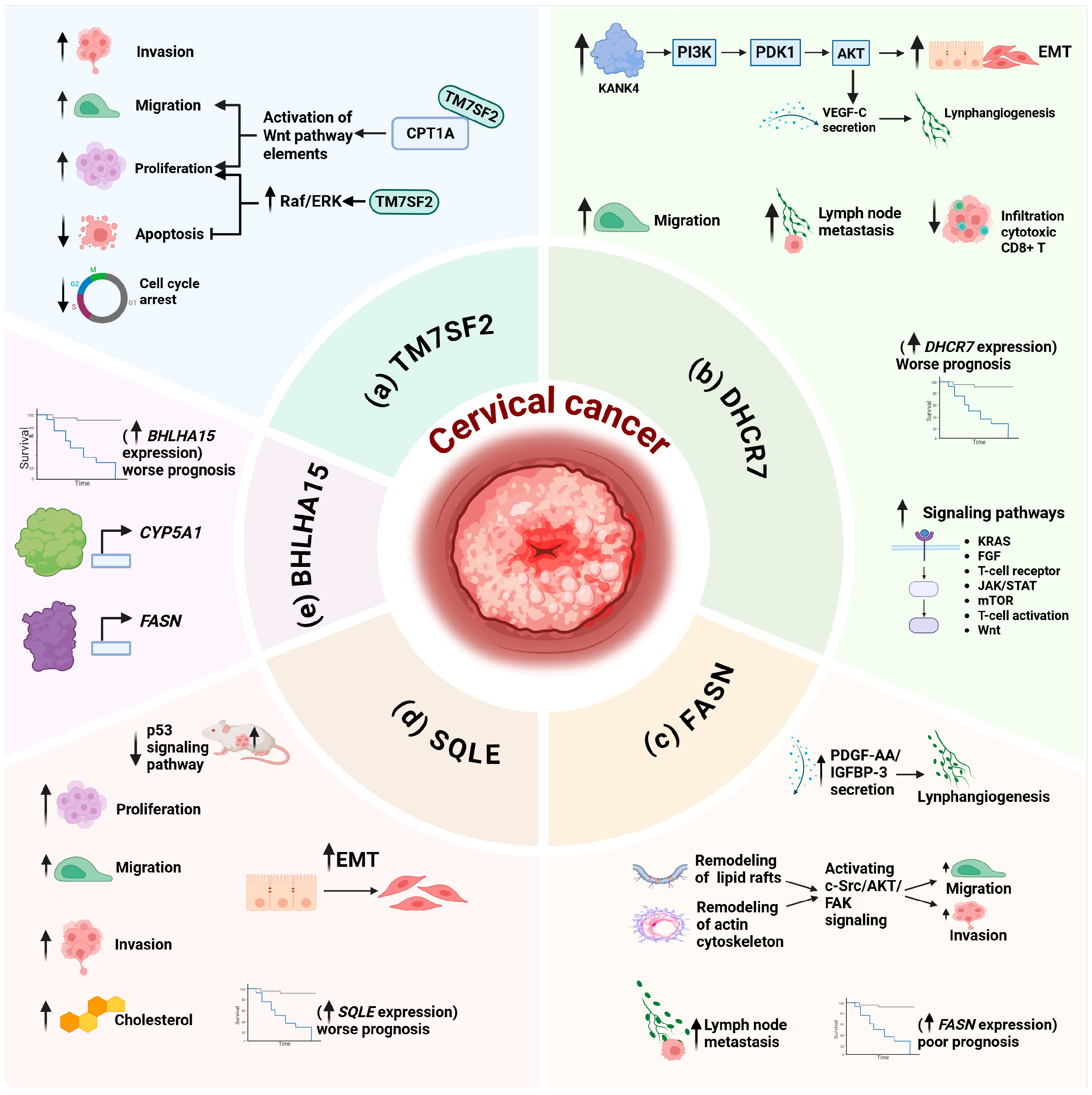
It was also reported that in CC cell lines, increased levels of TM7SF2 had a positive effect on proliferation, migration, and invasion, while negatively impacting on cell apoptosis and G0/G1 phase arrest (Figure 1a). Functional assays using CC cell lines demonstrated that the mechanism by which TM7SF2 induced cervical oncogenesis involves the c-Raf/ERK signaling pathway, which promotes cell proliferation and inhibits apoptosis. Finally, through in vivo model assays revealed that TM7SF2 contributes to the progression of CC by promoting tumor growth and inhibiting apoptosis (Figure 1a) [59].
Additionally, it was shown in CC cell lines that cell migration and proliferation promoted by TM7SF2 can also be regulated by means of its direct binding to the enzyme Carnitine palmitoyl transferase 1 A (CPT1A), which controls the entry of fatty acids into the mitochondria for their oxidation. In turn, CPT1A regulates the Wnt/β-Catenin pathway; therefore, another mechanism by which TM7SF2 regulates cell proliferation and migration in CC cell lines is through the induction of lipid reprogramming by the CPT1A/Wnt/β-catenin axis (Figure 1a) [60].
Another key enzyme in cholesterol biosynthesis overexpressed in CC is 7-dehydrocholesterol reductase (DHCR7), which regulates the rate of cholesterol synthesis through the removal of the C (7-8) double bond in the B ring of sterols, which reduces 7-dehydrocholesterol to cholesterol [61].
Zou J et al. (2022) [62] analyzed a dataset of CC patients from the Cancer Genome Atlas (TCGA) and found that those patients with high DHCR7 gene expression had a worse clinical outcome in terms of OS, Progression-Free Interval (PFI), and DFS, compared to those patients who had low DHCR7 levels. Consequently, overexpression of DHCR7 could be considered a biomarker of poor prognosis for CC patients. The results of this analysis showed that increased DHCR7 gene expression correlated with an enrichment of signaling pathways such as KRAS, FGF, T-cell receptor, JAK/STAT, mTORC1, T-cell activation, and the Wnt-activated receptor. Moreover, cellular processes related to G2/M checkpoint, macrophage migration, and regulation of cholesterol biosynthesis were exacerbated. In addition, DHCR7 expression inversely correlated with tumor-infiltrating lymphocytes. Finally, it was observed that DHCR7 protein levels were significantly higher in CC cell lines than in non-tumor epithelial cell lines and that downregulation of DHCR7 protein negatively affected cell proliferation (Figure 1b). Therefore, DHCR7 could participate in CC development and progression [62].
In vitro experiments in CC cell lines showed that overexpression of DHCR7 promotes epithelial-to-mesenchymal transition and lymphangiogenesis; meanwhile in vivo assays, DHCR7 overexpression is associated with metastasis to lymph nodes [63]. Furthermore, it was reported that the mechanism by which DHCR7 induces these processes in CC is through the activation of the KANK4/PI3K/AKT axis and secretion of VEGF-C, in a manner dependent on the reprogramming of cholesterol metabolism (Figure 1b) [63]. It was found that DHCR7 reprograms cholesterol metabolism, thereby increasing KANK4 levels and alternatively, promoting VEGF-C secretion, which is associated with the induction of lymphangiogenesis. Consequently, KANK4 activates the PI3K/AKT signaling pathway, which promotes epithelial–mesenchymal transition, cell migration, and invasion. In this work, it was also demonstrated that CC patients with high DHCR7 expression had significantly lower DFS and OS than those with low levels (Figure 1b) [63].
It is worth noting that the fatty acid synthase enzyme (FASN), responsible for catalyzing the synthesis of long-chain fatty acids, also participates in cholesterol synthesis [64]. It was shown that acetoacetyl-CoA produced by FASN activity is a key metabolite in cholesterol production. In this sense, Du Q et al. (2022) [65] found that in patients with CC, there is a positive correlation between elevated FASN levels and lymph node metastasis, and high expression of FASN was correlated with a poor prognosis (Figure 1c). The authors demonstrated that CC cell lines as well as CC tissue samples presented elevated levels of FASN. Furthermore, in vitro experiments showed that FASN increases cell migration and invasion, primarily by reprogramming cholesterol metabolism, causing remodeling of lipid rafts and the actin cytoskeleton, and subsequently by activating the c-Src/AKT/FAK signaling pathway. It was found that FASN can accelerate lymphangiogenesis by upregulating the secretion of PDGF-AA/IGFBP-3 (Figure 1c). Finally, in an in vivo model, it was revealed that elevated levels of FASN contribute to the development of metastases in CC, as evidenced by an increase in the percentage of lymph node metastases, a higher density of lymphatic structures, and increased lymphatic volume [65].
Regarding cholesterol synthesis, after 3-hydroxy-3-methylglutaryl-CoA reductase (HMGCR), squalene epoxidase (SQLE) is the second rate-limiting enzyme. SQLE, also known as squalene monooxygenase, is responsible for the first oxidation reaction that converts squalene to 2,3-epoxysqualene, and when lanosterol synthase enzyme levels are low, SQLE can convert 2,3-epoxysqualene into dioxidesqualene [66]. The final product of this shunt pathway, 24(S),25-epoxycholesterol, functions as a ligand for the hepatic X receptor (LXR). This interaction upregulates the ATP-binding cassette transporter protein A1 (ABCA1), thus promoting cholesterol production [66]. Interestingly, using bioinformatics analysis, Guo M et al. (2023) [67], determined that CC tissues exhibited high levels of SQLE, compared to adjacent tissue, which correlated with patient’s shorter OS. Furthermore, they confirmed that in both CC-derived cell lines and CC tissues, SQLE expression and protein levels were significantly higher than in a cancer-free cervical cell line and adjacent tissue, respectively. Molecular assays determined that SQLE induced cell proliferation, migration, and invasion in CC-derived cell lines. Finally, in vivo assays showed that SQLE overexpression increased tumor growth, mediated by a decrease in the tumor suppressor protein p53, corroborating the findings of the bioinformatics analyses.
Zhao Y et al. (2024) [68] reported that SQLE overexpression may be involved in the growth and aggressiveness of CC tumors. SQLE expression levels were analyzed in different types of cancer from the Timer 2.0 pan-cancer database, it was found that CC patients’ tissues had considerably higher SQLE gene expression than healthy patients’ tissues. When evaluating the diagnostic capacity of SQLE expression levels, the authors determined that differential SQLE levels could serve as a powerful diagnostic tool for distinguishing between normal patients and those with CC, as well as for identifying tumor stages. In this study high levels of SQLE gene expression in stages T3/T4 were strongly associated with lower survival rates. Using in vitro and in vivo functional assays, it was demonstrated that SQLE can promote epithelial–mesenchymal transition (a key process in tumor metastasis), proliferation, migration, invasion, and evasion of the immune system, as well as affecting tumor size and aggressiveness, thus participating in the development of CC. It was also demonstrated that SQLE gene expression levels are directly related to cholesterol levels, which in turn correlated with an exacerbated cell proliferation (Figure 1d) [68].
Finally, it has been reported that dysregulation of transcription factors in cervical cancer may affect cholesterol homeostasis, promoting tumor progression. Wang W et al. (2021) [69], reported that the transcription factor basic helix-loop-helix family member a15 (BHLHA15), also called MIST1, an important regulator in cellular processes such as organogenesis, regulates tumor progression by inducing epithelial–mesenchymal transition in some cancers, including CC. Comparative analysis of BHLHA15 gene expression levels in normal tissue and CC primary tumors showed that BHLHA15 expression was higher in CC primary tumors. Furthermore, the authors determined that elevated expression of BHLHA15 correlated with lower OS and DFS (Figure 1e) [69]. Recently, Ye H et al. (2025) [70], through bioinformatics analysis and subsequent validation with in vitro and in vivo assays as well as in CC tissues, determined that the expression levels of BHLHA15 and its transcriptional targets CYP51A1 and FASN are elevated in CC cell lines and tissue, with respect to normal cervical cells and adjacent normal cervical tissue, respectively (Figure 1e). It was found that high expression of BHLHA15 in CC was strongly associated with stages III–IV, mortality, and poor prognosis. Finally, the authors reported that BHLHA15, by directly activating the transcription of CYP51A1 and FASN, acts as a critical transcriptional factor in regulating cholesterol metabolism reprogramming, favoring CC progression (Figure 1e) [70].

5. Regulation of Cholesterol Metabolism by HPV Oncoproteins

The role of E6 and E7 oncoproteins in the dysregulation of cellular energy pathways has been extensively studied [71]. However, there is limited information on their direct participation in cholesterol metabolism and their potential contribution to carcinogenesis, maintenance of the tumor phenotype, or progression of HPV-related tumors. Comprehensive omics analysis suggests that E6 and E7 may contribute to increased cholesterol metabolism. To better understand the effects of the viral oncoproteins, the list of genes deregulated by HPV-16 E6 and E7 oncoproteins from the different studies described below was compared with the set of genes included in the term cholesterol metabolic process from the Gene Ontology annotations [72]. Recently, our group demonstrated that in cervical cancer C-33 A cells, HPV-16 E6 oncoprotein altered the expression of 22 cholesterol metabolism-related genes, 15 of which were overexpressed and 7 underexpressed; whereas E7 oncoprotein deregulated the expression of 23 genes, 15 of which were overexpressed and 8 downexpressed. Interestingly, 8 genes were upregulated by both oncoproteins (EBP, FDFT1, GNB3, LDLR, LIMA1, LRP5, SCARB1, and TTC39B), while 5 genes were downregulated by both oncoproteins (CUBN, FGF1, PMP22, SC5D, and TNFSF4) (Table 1) [73].
The expression of these genes and the protein levels of some of them have been previously linked to cancer. For example, farnesyl diphosphate farnesyltransferase 1 (FDFT1) also known as squalene synthase, is an enzyme that synthesizes squalene by condensing two farnesyl pyrophosphate molecules. FDFT1 has been reported to induce metabolic reprogramming, cell proliferation, and invasion. Overexpression of FDFT1 is required to produce cholesterol precursors, which are necessary for tumor progression, lipid rafts formation, signal transduction, and cancer cell proliferation, invasion, and migration [74]. Another gene that is downregulated in cells with E6 and E7 expression is sterol-C5-desaturase (SC5D), an enzyme that catalyzes the conversion of lathosterol into 7-dehydrocholesterol [75]. It has been postulated that a reduction in SC5D activity in cancer could promote the prenylation of Ras, Rac or RhoC, impacting cancer progression [76].
When osteosarcoma-derived cells, U2OS, were stably transfected with HPV-16 E6, few genes related to cholesterol metabolism were altered, among which HMGCS1, LBR, and PRKAA1 were upregulated, whereas only one gene, FDXR, was underexpressed [77].
On the other hand, in immortalized keratinocytes HaCaT, with stable expression of HPV16 E6/E7 oncogenes, 45 genes related to cholesterol metabolism was deregulated, with 27 genes being overexpressed while 18 genes were downregulated [78] (Table 1).
In a proteomic analysis study performed in primary human neonatal keratinocytes (HEKn cells) with stable expression of HPV-16 E6/E7, it was found that the protein products of the LBR and VDLR genes increased, while those of APLP2, APOE, CLN8, LDLR, LIPE, NPC2, NSDHL, SC5D, and SCAP decreased in relation to cells transfected with the empty vector [79]. Furthermore, in immortalized female human oral keratinocytes (NOKs) stably expressing HPV-16 E6/E7 oncogenes, transcriptomic and proteomic analysis showed that both the expression and protein levels of PMVK were increased, while SAA1, NPC2, and SEC14L2 decreased, compared with the control cell group [80].
Notably, the deregulated genes detected in various studies merit further study to analyze the effect of viral oncoproteins on cholesterol metabolism, both in cancer and in an infectious context. Below, some of the genes mentioned in different studies are highlighted.
As previously mentioned, in U2OS and HEKn cells, expressing E6 and E6/E7, respectively, LBR gene expression was upregulated. Interestingly, the LBR gene encodes the lamin B receptor, a polytopic membrane protein located in the inner nuclear membrane, associated with the nuclear lamina. The C-terminal domain has been shown to anchor lamin B receptor to the inner nuclear membrane. Furthermore, it exhibits sequence homology with sterol C14 reductases, so lamin B receptor participates in cholesterol synthesis, catalyzing the reduction in the C14-unsaturated bond of lanosterol [81]. The involvement of lamin B receptor in promoting cell proliferation and immortalization in p53- and RB-deficient cells has been previously identified [82].
The NPC2 (Niemann-Pick Disease Type C2) gene encodes a protein with a lipid-recognition domain, which is involved in cholesterol transport across the late endosomal/lysosomal system. NPC2 is involved in the export of cholesterol derived from lysosomal hydrolysis of low-density lipoproteins. NPC2 has been shown to accelerate sterol exchange between liposomes, especially under conditions that mimic the intra endosomal environment [83]. The NPC2 gene has been previously described as part of a group of lysosomal-associated genes in lung adenocarcinoma. These genes were weakly expressed in malignant epithelial cells, and patients with low expression showed a higher percentage of M2 macrophage infiltration. Furthermore, restoring the expression of the lysosomal-associated genes signature, including NPC2, diminished malignant cell proliferation and invasion and reduced M2 macrophage polarization and cellular secretion of pro-tumor cytokines [84]. In contrast, the NPC2 gene was found to be significantly upregulated in gliomas; patients with high NPC2 expression had higher levels of immune cell infiltration and were associated with poor clinical outcome [85]. Interestingly, oncogenes E6 and E7 reduced NPC2 expression in HEKn and NOKs cells but promoted its overexpression in HaCaT cells.
Two genes encoding receptors involved in cholesterol entry are LDLR and SCARB1, which recognize LDL and HDLs, respectively. Both E6 and E7 have been shown to overexpress LDLR and SCARB1 in C-33A cells. Previous studies using murine models have demonstrated that mammary tumors with high LDLR expression increased in size in mice with elevated serum LDL-c levels [86]. Furthermore, increased SCARB1 expression has been observed in primary prostate cancer. In a castration-resistant prostate cancer (CRPC) cell model, SCARB1 inhibition suppressed cholesterol uptake, cell growth, and viability, and induced endoplasmic reticulum stress and autophagy [87]. Therefore, HPV oncoproteins E6 and E7 may promote the entry of cholesterol into cancer cells, a hypothesis that needs to be investigated.
The CUBN gene encodes cubilin, a high-affinity receptor responsible for the endocytosis of HDL-C and lipid-poor apoA-I, and functions as a receptor for intrinsic factor-vitamin B12 complexes [88,89]. Its overexpression has been detected in samples from patients with colorectal cancer, with higher levels of CUBN in advanced stages. In contrast, CUBN levels are low in patients who have undergone radiation therapy. Furthermore, high CUBN expression has been associated with a worse prognosis (recurrence and survival) in patients with colorectal cancer [90]. Transcriptomic data from HaCaT cells harboring E6/E7 expression and in C-33 A cells with E6 and E7 expression showed a decrease in CUBN expression, which could affect vitamin B12 absorption and HDL entry.
The PRKAA1 gene encodes the α1 catalytic subunit of AMP-activated protein kinase, a catalytic subunit of 5′-AMP-activated protein kinase (AMPK), that regulates cellular energy by modulating glucose and lipid metabolic pathways [91]. In gastric cancer cells, PRKAA1 silencing significantly inhibits proliferation and promotes cell cycle arrest and apoptosis, in addition to reducing tumor growth in mouse models. Furthermore, this study revealed that PRKAA1 protumoral activity is mediated by the JNK1 and/or AKT signaling pathways [92]. In addition, it was observed that patients with gastric cancer with distant metastasis and advanced stages showed increased PRKAA1 expression [93]. Specifically, the E6 oncoprotein induces PRKAA1 overexpression in cancer cells such as C-33A and U-2OS cells, whereas coexpression of E6 and E7 decreases PRKAA1 expression.
Interestingly, the SREBF2 gene is overexpressed in C-33 A cells expressing E7 [73]. Its protein product, SREBP-2, plays an important role in regulating lipid homeostasis [94]. SREBP-2 target genes include those encoding rate-limiting enzymes in cholesterol biosynthesis pathways, as well as proteins that mediate cholesterol entry, such as LDLR and SRB1 [94]. Activation of the PI3K/AKT/mTORC1 signaling pathway is known to induce proteolytic cleavage of SREBP and its nuclear translocation [95]. It is possible that the E6 and E7 oncoproteins promote its nuclear translocation and transcriptional activity, given that both have been previously shown to induce mTORC1 activation [96,97].
Table 1. Deregulation of genes and proteins related to cholesterol metabolism by HPV E6 and E7 oncogenes. Black arrows pointing downwards indicate that the genes/proteins are downregulated, while arrows pointing upwards indicate that they are upregulated.
OncoproteinModelBiomoleculeLevelGene or ProteinReferences
E6C-33 A cellsmRNAIjms 27 00591 i001APP, EBP, FDFT1, FDX1, GNB3, LDLR, LIMA1, LRP5, MAPK1, PRKAA1, SCARB1, SOAT1, SOD1, STARD4, TTC39B[73]
Ijms 27 00591 i002CUBN, FGF1, SC5D, TM7SF2, TNFSF4, LRP1, PMP22
U-2 OS cellsmRNAIjms 27 00591 i001HMGCS1, LBR, PRKAA1[77]
Ijms 27 00591 i002FDXR
E7C-33 A cellsmRNAIjms 27 00591 i001DHCR24, LIMA1, LDLR, FDFT1, LRP5, DHCR7, SREBF2, SCARB1, LSS, EBP, TTC39B, DGAT2, ABCA2, INSIG1, GNB3[73]
Ijms 27 00591 i002CUBN, CYP39A1, TNFSF4, FGF1, LEPR, PCTP, SC5D, PMP22
E6/E7HaCaT cellsmRNAIjms 27 00591 i001ABCA5, APLP2, CEBPA, CLN8, CYP7B1, DHCR24, EPHX2, FDFT1, FDXR, HMGCS1, HSD17B7, LBR, LDLRAP1, LMF1, MVD, MVK, NPC2, PCSK9, PCTP, SAA1, SEC14L2, SOAT2, SQLE, SULT2B1, THRB, TM7SF2, TTC39B[78]
Ijms 27 00591 i002ABCA1, ABCA2, ABCG1, ACADL, CUBN, CYB5R3, GNB3, HSD3B7, LEPR, LRP5, NPY1R, PMP22, PMVK, PRKAA2, SCAP, SCARB1, SMPD1, VLDLR
HEKn cellsProteinIjms 27 00591 i001LBR, VDLR[79]
Ijms 27 00591 i002APLP2, APOE, CLN8, LDLR, LIPE, NPC2, NSDHL, SC5D, SCAP
NOKs CellsmRNAs and their protein productsIjms 27 00591 i001PMVK[80]
Ijms 27 00591 i002NPC2, SEC14L2, SAA1
Accumulating evidence suggests that HPV E6 and E7 oncoproteins can regulate cholesterol metabolism. Omics studies are a valuable source of information that allows, as a first step, the establishment of a causal association between the possible involvement of viral oncoproteins and altered cholesterol metabolism. While current omics studies are limited, further in-depth research is needed on the direct role of the E6 and E7 oncoproteins in the dysregulation of cholesterol metabolism and their biological impact on tumor transformation or progression. It is worth noting that the aforementioned evidence comes from high-throughput sequencing and proteome analysis, where the exogenous expression of E6 and/or E7 allows for exploring changes in the transcriptome and proteome, with their potential impact on exacerbating cellular processes. However, validations in in vitro and in vivo assays are required to confirm the direct involvement of viral oncoproteins in cholesterol metabolism.
Table 1 summarizes genes and/or proteins related to cholesterol metabolism altered in the presence of HPV E6 and E7 oncogenes.

6. Cholesterol Metabolism as a Therapeutic Opportunity in Cervical Cancer

Reprogramming of cholesterol metabolism is crucial for cancer development and its maintenance. Preclinical and clinical studies have demonstrated that modulating cholesterol metabolism can slow tumor growth, alter the immune environment, and enhance antitumor immune responses. As a result, various approaches have been developed to target cholesterol metabolism to combat cancer. These strategies include repurposed drugs and specific inhibitors targeting different stages of cholesterol metabolism (biosynthesis, uptake, efflux, and storage) [98].
Developing new anticancer drugs is expensive and involves a long research process [99]. As a result, efforts have been made to repurpose pharmacological treatments approved for other diseases for cancer therapy. Such is the case of statins, which are competitive inhibitors of HMGCR and have been used for cholesterol lowering. These drugs bind to the active site of HMGCR, inhibiting the conversion of HMG-CoA to mevalonic acid, which is an early step in cholesterol synthesis [100,101]. Lipid-lowering agents are widely used to prevent cardiovascular disease [102,103]. Since the early 1990s, studies have shown that statins not only lower cholesterol levels but also inhibit tumor growth [104,105], and their use is associated with a reduced risk of gynecological cancers such as endometrial and ovarian cancer [106] and with lower mortality in these types of cancer. In CC, simvastatin has been shown to enhance in vitro and in vivo efficacy of chemotherapy [107].
Statins can be categorized into two groups based on their chemical structure: hydrophilic (pravastatin and rosuvastatin) and lipophilic (cerivastatin, simvastatin, lovastatin, fluvastatin, and atorvastatin). Biochemical differences between these two types may affect their uptake mechanisms [108]. In preclinical models, combining simvastatin with paclitaxel (a chemotherapeutic agent against CC) significantly improves paclitaxel effectiveness [107]. Phase II clinical trials (identification numbers NCT03324425 and NCT00313859) indicate that some patients with different types of cancer might benefit from combining simvastatin with other chemotherapeutic drugs [109,110].
Research has shown that prescribing statins for more than one year before diagnosis reduces the risk of endometrial and ovarian cancer. In addition, women who used statins only after a cancer diagnosis had significantly better survival rates [111]. Similarly, in another cohort study by Habis M et al. (2014) [112] it was found that patients with non-serous papillary epithelial ovarian cancer and hyperlipidemia who were treated with statins experienced increased DSS and PFS (Progression-Free Survival).
Few studies have examined the use of statins in the risk of CC, and their results are controversial [113,114,115]. Liu Y et al. (2014) [113] performed a meta-analysis on the impact of statins on CC risk, which was inconclusive due to the limited number of studies and small case numbers in each one. Recently, Kim D et al. (2022) [116] compared women who used oral statins for at least 6 months with a control group. Their findings indicated that statin use was significantly associated with a lower risk of developing breast cancer and CC incidence. Conversely, Jiao X et al. (2024) [115] reported that statin use significantly increases the risk of CC in a UK cohort study.
Regarding the role of statins in the clinical outcomes of patients with CC, Song M et al. (2017) [114] found that patients diagnosed with locally advanced cervical cancer (LACC) who consistently used lipophilic statins for a prolonged period before their CC diagnosis had significantly longer PFS and OS compared to the control group. Additionally, they showed that the adverse effect of high BMI on clinical outcomes in patients with CC can be reduced by treatment with lipophilic statins. The same study also indicated that hydrophilic statins had a non-significant protective effect, possibly because lipophilic statins can penetrate extrahepatic cells and, thus, reach higher concentrations in all tissues; in contrast, hydrophilic statins tend to be more hepatoselective [108,117].
FASN-derived acetoacetyl-CoA is vital for cholesterol synthesis, which favors the formation of lipid rafts that promote the pro-inflammatory response by regulating TLR signaling (Toll-like receptor) [64]. High FASN levels promote cell proliferation, invasion, tumor progression, and drug resistance in female cancers, including breast cancer [118,119,120,121] ovarian cancer [122,123] and CC [124,125,126] FASN expression was progressively higher in cervical low-grade squamous intraepithelial lesions (LSIL) and in high-grade squamous intraepithelial lesions (HSIL), and CC samples, indicating a possible role of this enzyme in cervical carcinogenesis [124]. It has been reported that FASN is overexpressed in CC, leading to reprogrammed cholesterol metabolism and increased lymph node metastasis, both of which are associated with a poor prognosis in CC patients [65,125].
Inhibitors of FASN activity have been evaluated in cancer, including cerulenin, C75, orlistat (ORL), and TVB-264, but cerulenin and C75 have serious side effects in animal models [126,127,128]. TVB-2640 (Denifanstat) is a recently added inhibitor in clinical trials with promising results [129,130]. TVB-2640 has demonstrated potent effects as monotherapy and in combination with paclitaxel and bevacizumab across various solid tumors, including breast cancer, non-small cell lung cancer, and CC (identification numbers NCT02223247, NCT03032484 and NCT03808558) [110,129]. Additionally, Wang X et al. (2025) [131] found that FASN overexpression correlated with cisplatin resistance in CC and showed that TVB-2640 significantly improved the effectiveness of cisplatin therapy, markedly suppressing the growth of xenograft tumors derived from cisplatin-resistant CC cells.
Orlistat (ORL) is an irreversible FASN inhibitor because it binds the thioesterase domain, which blocks palmitate synthesis [132]. Moreover, it inhibits the pancreatic lipase in the gastrointestinal tract, for which it has been approved for the treatment of obesity [133]. Furthermore, ORL has demonstrated antitumor effects and enhances therapy in various tumor types [134,135,136,137,138]. In CC-derived cell lines, inhibition of FASN with ORL decreased cell viability, reduced colony formation, and induced apoptosis and cell cycle arrest [124]. ORL has drawbacks, including low water solubility and poor oral bioavailability, which limit its formulation and clinical use; pharmacological efforts have been made to improve its solubility and enhance its therapeutic potential for cancer [139,140].
The debate surrounding the use of inhibitors of key cholesterol-metabolizing proteins for CC remains highly controversial, largely due to methodological limitations. Specifically, in the case of statins, some studies, including those discussed in this section, suggest that statins may reduce the risk of developing CC; however, this effect is not yet conclusive. The primary source of this debate is the inconsistent findings across studies. These discrepancies may stem from variations in study populations; differences in statin dosage and duration of use and differences in statin physicochemical properties (lipophilic vs. hydrophilic). Evidence suggests that statins with distinct physicochemical properties may exert anticancer effects through different mechanisms, independent of their lipid-lowering pharmacological effects. For example, lipophilic statins have been shown to have greater pro-apoptotic and cytotoxic activity than hydrophilic statins, such as pravastatin [141].
Moreover, the emerging evidence that suggests that statins may play a role in the treatment of various cancers by synergizing with immunotherapy and certain chemotherapeutic agents [142,143,144], should be approached with caution, since adding atorvastatin to gemcitabine treatment has been shown to reduce the efficacy of chemotherapy in patients with pancreatic cancer [145]. The evidence supporting its use in the treatment of CC is encouraging but limited; therefore, future research should focus on establishing the dose–response relationship and identifying the most effective dosing regimens for the treatment of patients with CC, designing personalized treatment and exploring combining statins with other anticancer therapies as immunotherapy. Addressing these current controversies and optimizing statin use will be crucial for their successful application in cervical cancer treatment.

7. Concluding Remarks

Energy reprogramming is a necessary condition that enables cancer cells to survive in hostile environments, such as hypoxia, nutrient deprivation, or changes in extracellular acid-base conditions. In different tumor types, changes in the energy circuits associated with cell survival and progression have been studied. In particular, in CC, a tumor frequently associated with persistent HPV infection, dysregulation of glucose, protein, and lipid metabolism has been described [146,147]. Several approaches have been used to associate serum cholesterol levels to the clinical course of CC patients, demonstrating its role in disease development and progression. Furthermore, some elements of the catabolic and anabolic cholesterol pathways that are altered in cancer have been identified, and their association with patient prognosis has been established. While there is limited evidence regarding the involvement of HPV oncoproteins E6 and E7 in the dysregulation of cholesterol metabolism, the emergence of new omics technologies has focused attention on certain genes or proteins whose regulation is altered by the viral oncogenes. These dysregulations could exacerbate cholesterol uptake and metabolism and, in turn, alter other signaling pathways that, together, exacerbate cancer-related processes such as proliferation, migration, invasion and metastasis, among others. High expression of HPV oncoproteins has been previously described as being associated with a poor clinical prognosis of patients with CC [148,149]. Therefore, further studies are needed to elucidate the specific role of viral oncoproteins in regulating cholesterol metabolism, in order to identify biomarkers with prognostic value and molecules that could serve as pharmacological targets. In this review, we highlight the strategy of controlling lipid metabolism for combating cervical tumors and, consequently, improving the quality of life of patients. Cholesterol-derived metabolites promote cancer progression and suppress immune responses. Preclinical and clinical studies have demonstrated that strategies targeting cholesterol metabolism suppress tumor growth, alter the immune microenvironment, and activate antitumor immunity [46]. In this regard, the pharmacological strategies studied to date have shown promising results, but with limited effect in preclinical studies. Therefore, it is necessary to continue investigating the molecular mechanisms underlying cancer aggressiveness, including lipid metabolism in CC, in order to develop effective therapeutic strategies for this disease.

Author Contributions

Conceptualization, I.M.-R. and M.L.; investigation, I.M.-R., J.O.M.-B., A.C.-P., E.P.-H. and M.L.; writing—original draft preparation, I.M.-R., J.O.M.-B., A.C.-P., E.P.-H., A.C.-G. and M.L.; writing—review and editing, I.M.-R., J.O.M.-B. and M.L.; visualization, I.M.-R.; supervision, I.M.-R. and M.L.; funding acquisition, I.M.-R. All authors have read and agreed to the published version of the manuscript.

Funding

This research was partially supported by SECIHTI grants: Ciencia de Frontera CF-2023-I-2402 and PRONAII-7-Virus y Cáncer 303044, and Instituto Nacional de Cancerología grants: (024/019/IBI) (CEI/025/24) and (015/039/IBI) (CEI/998/15).

Institutional Review Board Statement

Not applicable.

Informed Consent Statement

Not applicable.

Data Availability Statement

No new data were created or analyzed in this study. Data sharing is not applicable to this article.

Conflicts of Interest

The authors declare no conflicts of interest.

References

  1. Ikeda, S.; Ueda, Y.; Hara, M.; Yagi, A.; Kitamura, T.; Kitamura, Y.; Konishi, H.; Kakizoe, T.; Sekine, M.; Enomoto, T.; et al. Human Papillomavirus Vaccine to Prevent Cervical Intraepithelial Neoplasia in Japan: A Nationwide Case-Control Study. Cancer Sci. 2021, 112, 839–846. [Google Scholar] [CrossRef]
  2. Patel, C.; Brotherton, J.M.L.; Pillsbury, A.; Jayasinghe, S.; Donovan, B.; Macartney, K.; Marshall, H. The Impact of 10 Years of Human Papillomavirus (HPV) Vaccination in Australia: What Additional Disease Burden Will a Nonavalent Vaccine Prevent? Eurosurveillance 2018, 23, 30–40. [Google Scholar] [CrossRef]
  3. Cancer Today. Available online: https://gco.iarc.fr/today/en (accessed on 18 November 2025).
  4. Singh, G.K.; Azuine, R.E.; Siahpush, M. Global Inequalities in Cervical Cancer Incidence and Mortality Are Linked to Deprivation, Low Socioeconomic Status, and Human Development. Int. J. MCH AIDS 2012, 1, 17–30. [Google Scholar] [CrossRef]
  5. de Martel, C.; Plummer, M.; Vignat, J.; Franceschi, S. Worldwide Burden of Cancer Attributable to HPV by Site, Country and HPV Type. Int. J. Cancer 2017, 141, 664–670. [Google Scholar] [CrossRef]
  6. Jabbar, S.F.; Park, S.; Schweizer, J.; Berard-Bergery, M.; Pitot, H.C.; Lee, D.; Lambert, P.F. Cervical Cancers Require the Continuous Expression of the Human Papillomavirus Type 16 E7 Oncoprotein Even in the Presence of the Viral E6 Oncoprotein. Cancer Res. 2012, 72, 4008–4016. [Google Scholar] [CrossRef] [PubMed]
  7. Peng, Q.; Wang, L.; Zuo, L.; Gao, S.; Jiang, X.; Han, Y.; Lin, J.; Peng, M.; Wu, N.; Tang, Y.; et al. HPV E6/E7: Insights into Their Regulatory Role and Mechanism in Signaling Pathways in HPV-Associated Tumor. Cancer Gene Ther. 2024, 31, 9–17. [Google Scholar] [CrossRef] [PubMed]
  8. Ortiz-Pedraza, Y.; Muñoz-Bello, J.O.; Ramos-Chávez, L.A.; Martínez-Ramírez, I.; Olmedo-Nieva, L.; Manzo-Merino, J.; López-Saavedra, A.; Pérez-de la Cruz, V.; Lizano, M. HPV16 E6 and E7 Oncoproteins Stimulate the Glutamine Pathway Maintaining Cell Proliferation in a SNAT1-Dependent Fashion. Viruses 2023, 15, 324. [Google Scholar] [CrossRef]
  9. Mukherjee, A.G.; Ramesh Wanjari, U.; Valsala Gopalakrishnan, A.; Jayaraj, R.; Katturajan, R.; Kannampuzha, S.; Murali, R.; Namachivayam, A.; Evan Prince, S.; Vellingiri, B.; et al. HPV-Associated Cancers: Insights into the Mechanistic Scenario and Latest Updates. Med. Oncol. 2023, 40, 212. [Google Scholar] [CrossRef]
  10. Lu, J.; Chen, S.; Bai, X.; Liao, M.; Qiu, Y.; Zheng, L.L.; Yu, H. Targeting Cholesterol Metabolism in Cancer: From Molecular Mechanisms to Therapeutic Implications. Biochem. Pharmacol. 2023, 218, 115907. [Google Scholar] [CrossRef] [PubMed]
  11. DeBerardinis, R.J.; Lum, J.J.; Hatzivassiliou, G.; Thompson, C.B. The Biology of Cancer: Metabolic Reprogramming Fuels Cell Growth and Proliferation. Cell Metab. 2008, 7, 11–20. [Google Scholar] [CrossRef]
  12. Hoppe-Seyler, K.; Honegger, A.; Bossler, F.; Sponagel, J.; Bulkescher, J.; Lohrey, C.; Hoppe-Seyler, F. Viral E6/E7 Oncogene and Cellular Hexokinase 2 Expression in HPV-Positive Cancer Cell Lines. Oncotarget 2017, 8, 106342–106351. [Google Scholar] [CrossRef]
  13. Gore, M.; Kabekkodu, S.P.; Chakrabarty, S. Exploring the Metabolic Alterations in Cervical Cancer Induced by HPV Oncoproteins: From Mechanisms to Therapeutic Targets. Biochim. Biophys. Acta Rev. Cancer 2025, 1880, 189292. [Google Scholar] [CrossRef]
  14. Fan, R.; Hou, W.J.; Zhao, Y.J.; Liu, S.L.; Qiu, X.S.; Wang, E.H.; Wu, G.P. Overexpression of HPV16 E6/E7 Mediated HIF-1α Upregulation of GLUT1 Expression in Lung Cancer Cells. Tumour Biol. 2016, 37, 4655–4663. [Google Scholar] [CrossRef]
  15. Riscal, R.; Skuli, N.; Simon, M.C. Even Cancer Cells Watch Their Cholesterol! Mol. Cell 2019, 76, 220–231. [Google Scholar] [CrossRef]
  16. Wang, H.Q.; Altomare, D.A.; Skele, K.L.; Poulikakos, P.I.; Kuhajda, F.P.; Di Cristofano, A.; Testa, J.R. Positive Feedback Regulation between AKT Activation and Fatty Acid Synthase Expression in Ovarian Carcinoma Cells. Oncogene 2005, 24, 3574–3582. [Google Scholar] [CrossRef]
  17. Ikonen, E. Cellular Cholesterol Trafficking and Compartmentalization. Nat. Rev. Mol. Cell Biol. 2008, 9, 125–138. [Google Scholar] [CrossRef]
  18. Hegele, R.A. Plasma Lipoproteins: Genetic Influences and Clinical Implications. Nat. Rev. Genet. 2009, 10, 109–121. [Google Scholar] [CrossRef] [PubMed]
  19. Kuzu, O.F.; Noory, M.A.; Robertson, G.P. The Role of Cholesterol in Cancer. Cancer Res. 2016, 76, 2063–2070. [Google Scholar] [CrossRef] [PubMed]
  20. Luo, J.; Yang, H.; Song, B.L. Mechanisms and Regulation of Cholesterol Homeostasis. Nat. Rev. Mol. Cell Biol. 2020, 21, 225–245. [Google Scholar] [CrossRef]
  21. Zhang, N.; Zhang, H.; Liu, Y.; Su, P.; Zhang, J.; Wang, X.; Sun, M.; Chen, B.; Zhao, W.; Wang, L.; et al. SREBP1, Targeted by MiR-18a-5p, Modulates Epithelial-Mesenchymal Transition in Breast Cancer via Forming a Co-Repressor Complex with Snail and HDAC1/2. Cell Death Differ. 2019, 26, 843–859. [Google Scholar] [CrossRef] [PubMed]
  22. Hartmann, P.; Trufa, D.I.; Hohenberger, K.; Tausche, P.; Trump, S.; Mittler, S.; Geppert, C.I.; Rieker, R.J.; Schieweck, O.; Sirbu, H.; et al. Contribution of Serum Lipids and Cholesterol Cellular Metabolism in Lung Cancer Development and Progression. Sci. Rep. 2023, 13, 5662. [Google Scholar] [CrossRef]
  23. Xiao, M.; Xu, J.; Wang, W.; Zhang, B.; Liu, J.; Li, J.; Xu, H.; Zhao, Y.; Yu, X.; Shi, S. Functional Significance of Cholesterol Metabolism in Cancer: From Threat to Treatment. Exp. Mol. Med. 2023, 55, 1982–1995. [Google Scholar] [CrossRef]
  24. Wang, Y.; Liu, C.; Hu, L. Cholesterol Regulates Cell Proliferation and Apoptosis of Colorectal Cancer by Modulating MiR-33a-PIM3 Pathway. Biochem. Biophys. Res. Commun. 2019, 511, 685–692. [Google Scholar] [CrossRef]
  25. Liu, Z.; Liu, X.; Liu, S.; Cao, Q. Cholesterol Promotes the Migration and Invasion of Renal Carcinoma Cells by Regulating the KLF5/MiR-27a/FBXW7 Pathway. Biochem. Biophys. Res. Commun. 2018, 502, 69–75. [Google Scholar] [CrossRef]
  26. Espinosa, G.; López-Montero, I.; Monroya, F.; Langevin, D. Shear Rheology of Lipid Monolayers and Insights on Membrane Fluidity. Proc. Natl. Acad. Sci. USA 2011, 108, 6008–6013. [Google Scholar] [CrossRef]
  27. Allen, J.A.; Halverson-Tamboli, R.A.; Rasenick, M.M. Lipid Raft Microdomains and Neurotransmitter Signalling. Nat. Rev. Neurosci. 2007, 8, 128–140. [Google Scholar] [CrossRef]
  28. Chang, T.Y.; Chang, C.C.Y.; Ohgami, N.; Yamauchi, Y. Cholesterol Sensing, Trafficking, and Esterification. Annu. Rev. Cell Dev. Biol. 2006, 22, 129–157. [Google Scholar] [CrossRef]
  29. Cortes, V.A.; Busso, D.; Maiz, A.; Arteaga, A.; Nervi, F.; Rigotti, A. Physiological and Pathological Implications of Cholesterol. Front. Biosci. Landmark Ed. 2014, 19, 416–428. [Google Scholar] [CrossRef]
  30. Williamsa, D.L.; Wongb, J.S.; Hamiltonb, R.L. SR-BI Is Required for Microvillar Channel Formation and the Localization of HDL Particles to the Surface of Adrenocortical Cells in Vivo. J. Lipid Res. 2002, 43, 544–549. [Google Scholar] [CrossRef]
  31. Wijers, M.; Kuivenhoven, J.A.; Van De Sluis, B. The Life Cycle of the Low-Density Lipoprotein Receptor: Insights from Cellular and in-Vivo Studies. Curr. Opin. Lipidol. 2015, 26, 82–87. [Google Scholar] [CrossRef]
  32. Kwon, H.J.; Abi-Mosleh, L.; Wang, M.L.; Deisenhofer, J.; Goldstein, J.L.; Brown, M.S.; Infante, R.E. Structure of N-Terminal Domain of NPC1 Reveals Distinct Subdomains for Binding and Transfer of Cholesterol. Cell 2009, 137, 1213–1224. [Google Scholar] [CrossRef] [PubMed]
  33. Wang, M.L.; Motamed, M.; Infante, R.E.; Abi-Mosleh, L.; Kwon, H.J.; Brown, M.S.; Goldstein, J.L. Identification of Surface Residues on Niemann-Pick C2 Essential for Hydrophobic Handoff of Cholesterol to NPC1 in Lysosomes. Cell Metab. 2010, 12, 166–173. [Google Scholar] [CrossRef] [PubMed]
  34. Rodrigueza, W.V.; Thuahnai, S.T.; Temel, R.E.; Lund-Katz, S.; Phillips, M.C.; Williams, D.L. Mechanism of Scavenger Receptor Class B Type I-Mediated Selective Uptake of Cholesteryl Esters from High Density Lipoprotein to Adrenal Cells. J. Biol. Chem. 1999, 274, 20344–20350. [Google Scholar] [CrossRef]
  35. Papale, G.A.; Hanson, P.J.; Sahoo, D. Extracellular Disulfide Bonds Support Scavenger Receptor Class B Type I-Mediated Cholesterol Transport. Biochemistry 2011, 50, 6245–6254. [Google Scholar] [CrossRef]
  36. Guo, L.; Chen, M.; Song, Z.; Daugherty, A.; Li, X.A. C323 of SR-BI Is Required for SR-BI-Mediated HDL Binding and Cholesteryl Ester Uptake. J. Lipid Res. 2011, 52, 2272–2278. [Google Scholar] [CrossRef]
  37. Powers, H.R.; Sahoo, D. SR-B1’s Next Top Model: Structural Perspectives on the Functions of the HDL Receptor. Curr. Atheroscler. Rep. 2022, 24, 277–288. [Google Scholar] [CrossRef]
  38. Radhakrishnan, A.; Goldstein, J.L.; McDonald, J.G.; Brown, M.S. Switch-like Control of SREBP-2 Transport Triggered by Small Changes in ER Cholesterol: A Delicate Balance. Cell Metab. 2008, 8, 512–521. [Google Scholar] [CrossRef]
  39. Widenmaier, S.B.; Snyder, N.A.; Nguyen, T.B.; Arduini, A.; Lee, G.Y.; Arruda, A.P.; Saksi, J.; Bartelt, A.; Hotamisligil, G.S. NRF1 Is an ER Membrane Sensor That Is Central to Cholesterol Homeostasis. Cell 2017, 171, 1094.e15–1109.e15. [Google Scholar] [CrossRef]
  40. Venkateswaran, A.; Laffitte, B.A.; Joseph, S.B.; Mak, P.A.; Wilpitz, D.C.; Edwards, P.A.; Tontonoz, P. Control of Cellular Cholesterol Efflux by the Nuclear Oxysterol Receptor LXR Alpha. Proc. Natl. Acad. Sci. USA 2000, 97, 12097–12102. [Google Scholar] [CrossRef]
  41. Brown, M.S.; Radhakrishnan, A.; Goldstein, J.L. Retrospective on Cholesterol Homeostasis: The Central Role of Scap. Annu. Rev. Biochem. 2018, 87, 783–807. [Google Scholar] [CrossRef] [PubMed]
  42. Wang, B.; Tontonoz, P. Liver X Receptors in Lipid Signalling and Membrane Homeostasis. Nat. Rev. Endocrinol. 2018, 14, 452–463. [Google Scholar] [CrossRef]
  43. Li, Y.C.; Park, M.J.; Ye, S.K.; Kim, C.W.; Kim, Y.N. Elevated Levels of Cholesterol-Rich Lipid Rafts in Cancer Cells Are Correlated with Apoptosis Sensitivity Induced by Cholesterol-Depleting Agents. Am. J. Pathol. 2006, 168, 1107–1118. [Google Scholar] [CrossRef] [PubMed]
  44. Kuzu, O.F.; Gowda, R.; Noory, M.A.; Robertson, G.P. Modulating Cancer Cell Survival by Targeting Intracellular Cholesterol Transport. Br. J. Cancer 2017, 117, 513–524. [Google Scholar] [CrossRef]
  45. Gorin, A.; Gabitova, L.; Astsaturov, I. Regulation of Cholesterol Biosynthesis and Cancer Signaling. Curr. Opin. Pharmacol. 2012, 12, 710–716. [Google Scholar] [CrossRef]
  46. Huang, B.; Song, B.-L.; Xu, C. Cholesterol Metabolism in Cancer: Mechanisms and Therapeutic Opportunities. Nat. Metab. 2020, 2, 132–141. [Google Scholar] [CrossRef]
  47. Costa, G.A.; de Souza, S.B.; da Silva Teixeira, L.R.; Okorokov, L.A.; Arnholdt, A.C.V.; Okorokova-Façanha, A.L.; Façanha, A.R. Tumor Cell Cholesterol Depletion and V-ATPase Inhibition as an Inhibitory Mechanism to Prevent Cell Migration and Invasiveness in Melanoma. Biochim. Biophys. Acta Gen. Subj. 2018, 1862, 684–691. [Google Scholar] [CrossRef]
  48. Lyu, J.; Yang, E.J.; Head, S.A.; Ai, N.; Zhang, B.; Wu, C.; Li, R.J.; Liu, Y.; Yang, C.; Dang, Y.; et al. Pharmacological Blockade of Cholesterol Trafficking by Cepharanthine in Endothelial Cells Suppresses Angiogenesis and Tumor Growth. Cancer Lett. 2017, 409, 91–103. [Google Scholar] [CrossRef]
  49. Wen, Y.A.; Xiong, X.; Zaytseva, Y.Y.; Napier, D.L.; Vallee, E.; Li, A.T.; Wang, C.; Weiss, H.L.; Evers, B.M.; Gao, T. Downregulation of SREBP Inhibits Tumor Growth and Initiation by Altering Cellular Metabolism in Colon Cancer. Cell Death Dis. 2018, 9, 265. [Google Scholar] [CrossRef] [PubMed]
  50. He, Z.; Zhang, L.; Gong, S.; Yang, X.; Xu, G. Cholesterol Metabolism and Cancer: Molecular Mechanisms, Immune Regulation and an Epidemiological Perspective (Review). Int. J. Mol. Med. 2025, 56, 226. [Google Scholar] [CrossRef] [PubMed]
  51. Liu, X.; Lv, M.; Zhang, W.; Zhan, Q. Dysregulation of Cholesterol Metabolism in Cancer Progression. Oncogene 2023, 42, 3289–3302. [Google Scholar] [CrossRef]
  52. Mwangi, G.F.; Niyonzima, N.; Atwine, R.; Tusubira, D.; Mugyenyi, G.R.; Ssedyabane, F. Dyslipidemia: Prevalence and Association with Precancerous and Cancerous Lesions of the Cervix; a Pilot Study. Lipids Health Dis. 2024, 23, 3. [Google Scholar] [CrossRef]
  53. Lin, F.; Zheng, R.; Yu, C.; Su, Y.; Yan, X.; Qu, F. Predictive Role of Serum Cholesterol and Triglycerides in Cervical Cancer Survival. Int. J. Gynecol. Cancer 2021, 31, 171–176. [Google Scholar] [CrossRef]
  54. Jiang, Q.; Wang, L.; Jin, M.; Shou, Y.; Zhu, H.; Li, A. The Clinical Value of Lipid Abnormalities in Early Stage Cervical Cancer. Int. J. Gen. Med. 2022, 15, 3903–3914. [Google Scholar] [CrossRef] [PubMed]
  55. Qiu, Q.; Song, J.R.; Zheng, X.Q.; Zheng, H.; Yi, H. The Impact of Diabetes, Hypercholesterolemia, and Low-Density Lipoprotein (LDL) on the Survival of Cervical Cancer Patients. Discov. Oncol. 2024, 15, 349. [Google Scholar] [CrossRef]
  56. Cheng, L.; Li, Z.; Zheng, Q.; Yao, Q. Correlation Study of Serum Lipid Levels and Lipid Metabolism-Related Genes in Cervical Cancer. Front. Oncol. 2024, 14, 1384778. [Google Scholar] [CrossRef] [PubMed]
  57. Sun, Y.; Meng, H.; Jin, Y.; Shi, X.; Wu, Y.; Fan, D.; Wang, X.; Jia, X.; Dai, H. Serum Lipid Profile in Gynecologic Tumors: A Retrospective Clinical Study of 1,550 Patients. Eur. J. Gynaecol. Oncol. 2016, 37, 348–352. [Google Scholar] [CrossRef] [PubMed]
  58. Bennati, A.M.; Castelli, M.; Della Fazia, M.A.; Beccari, T.; Caruso, D.; Servillo, G.; Roberti, R. Sterol Dependent Regulation of Human TM7SF2 Gene Expression: Role of the Encoded 3beta-Hydroxysterol Delta14-Reductase in Human Cholesterol Biosynthesis. Biochim. Biophys. Acta 2006, 1761, 677–685. [Google Scholar] [CrossRef]
  59. Xu, Y.; Chen, X.; Pan, S.; Wang, Z.-W.; Zhu, X. TM7SF2 Regulates Cell Proliferation and Apoptosis by Activation of C-Raf/ERK Pathway in Cervical Cancer. Cell Death Discov. 2021, 7, 299. [Google Scholar] [CrossRef] [PubMed]
  60. Liu, H.; Liu, Y.; Zhou, Y.; Chen, X.; Pan, S.; Zhou, Q.; Ji, H.; Zhu, X. TM7SF2-Induced Lipid Reprogramming Promotes Cell Proliferation and Migration via CPT1A/Wnt/β-Catenin Axis in Cervical Cancer Cells. Cell Death Discov. 2024, 10, 207. [Google Scholar] [CrossRef]
  61. Correa-Cerro, L.S.; Porter, F.D. 3beta-Hydroxysterol Delta7-Reductase and the Smith-Lemli-Opitz Syndrome. Mol. Genet. Metab. 2005, 84, 112–126. [Google Scholar] [CrossRef]
  62. Zou, J.; Liu, S.; Long, J.; Yan, B. High DHCR7 Expression Predicts Poor Prognosis for Cervical Cancer. Comput. Math. Methods Med. 2022, 2022, 8383885. [Google Scholar] [CrossRef]
  63. Mei, X.; Xiong, J.; Liu, J.; Huang, A.; Zhu, D.; Huang, Y.; Wang, H. DHCR7 Promotes Lymph Node Metastasis in Cervical Cancer through Cholesterol Reprogramming-Mediated Activation of the KANK4/PI3K/AKT Axis and VEGF-C Secretion. Cancer Lett. 2024, 584, 216609. [Google Scholar] [CrossRef] [PubMed]
  64. Carroll, R.G.; Zasłona, Z.; Galván-Peña, S.; Koppe, E.L.; Sévin, D.C.; Angiari, S.; Triantafilou, M.; Triantafilou, K.; Modis, L.K.; O’Neill, L.A. An Unexpected Link between Fatty Acid Synthase and Cholesterol Synthesis in Proinflammatory Macrophage Activation. J. Biol. Chem. 2018, 293, 5509–5521. [Google Scholar] [CrossRef] [PubMed]
  65. Du, Q.; Liu, P.; Zhang, C.; Liu, T.; Wang, W.; Shang, C.; Wu, J.; Liao, Y.; Chen, Y.; Huang, J.; et al. FASN Promotes Lymph Node Metastasis in Cervical Cancer via Cholesterol Reprogramming and Lymphangiogenesis. Cell Death Dis. 2022, 13, 488. [Google Scholar] [CrossRef]
  66. Chen, M.; Yang, Y.; Chen, S.; He, Z.; Du, L. Targeting Squalene Epoxidase in the Treatment of Metabolic-Related Diseases: Current Research and Future Directions. PeerJ 2024, 12, e18522. [Google Scholar] [CrossRef] [PubMed]
  67. Guo, M.; Qiao, Y.; Lu, Y.; Zhu, L.; Zheng, L. Squalene Epoxidase Facilitates Cervical Cancer Progression by Modulating Tumor Protein P53 Signaling Pathway. J. Obstet. Gynaecol. Res. 2023, 49, 1383–1392. [Google Scholar] [CrossRef]
  68. Zhao, Y.C.; Li, Y.F.; Qiu, L.; Jin, S.Z.; Shen, Y.N.; Zhang, C.H.; Cui, J.; Wang, T.J. SQLE-a Promising Prognostic Biomarker in Cervical Cancer: Implications for Tumor Malignant Behavior, Cholesterol Synthesis, Epithelial-Mesenchymal Transition, and Immune Infiltration. BMC Cancer 2024, 24, 1133. [Google Scholar] [CrossRef]
  69. Wang, W.; Xie, X.; Zhou, Z.; Zhang, H. Expression Analysis of MIST1 and EMT Markers in Primary Tumor Samples Points to MIST1 as a Biomarker of Cervical Cancer. Int. J. Gen. Med. 2021, 14, 1293–1300. [Google Scholar] [CrossRef]
  70. Ye, H.; Li, S.; Bai, J.; Wan, F.-z.; Wang, H.; Hu, X.-y.; Chen, L.; Zeng, S.-h.; Qin, X.-l.; Zou, X.-x.; et al. BHLHA15 Promotes Cervical Cancer Cholesterol Synthesis and Tumor Progression. Cell. Signal. 2025, 134, 111966. [Google Scholar] [CrossRef]
  71. Chen, B.; Wang, Y.; Wu, Y.; Xu, T. Effect of HPV Oncoprotein on Carbohydrate and Lipid Metabolism in Tumor Cells. Curr. Cancer Drug Targets 2024, 24, 987–1004. [Google Scholar] [CrossRef]
  72. AmiGO 2: Term Details for “Cholesterol Metabolic Process” (GO:0008203). Available online: https://amigo.geneontology.org/amigo/term/GO:0008203 (accessed on 18 November 2025).
  73. Olmedo-Nieva, L.; Muñoz-Bello, J.O.; Martínez-Ramírez, I.; Martínez-Gutiérrez, A.D.; Ortiz-Pedraza, Y.; González-Espinosa, C.; Madrid-Marina, V.; Torres-Poveda, K.; Bahena-Roman, M.; Lizano, M. RIPOR2 Expression Decreased by HPV-16 E6 and E7 Oncoproteins: An Opportunity in the Search for Prognostic Biomarkers in Cervical Cancer. Cells 2022, 11, 3942. [Google Scholar] [CrossRef]
  74. Ha, N.T.; Lee, C.H. Roles of Farnesyl-Diphosphate Farnesyltransferase 1 in Tumour and Tumour Microenvironments. Cells 2020, 9, 2352. [Google Scholar] [CrossRef]
  75. Freitas, F.P.; Alborzinia, H.; dos Santos, A.F.; Nepachalovich, P.; Pedrera, L.; Zilka, O.; Inague, A.; Klein, C.; Aroua, N.; Kaushal, K.; et al. 7-Dehydrocholesterol Is an Endogenous Suppressor of Ferroptosis. Nature 2024, 626, 401–410. [Google Scholar] [CrossRef]
  76. Ershov, P.; Kaluzhskiy, L.; Mezentsev, Y.; Yablokov, E.; Gnedenko, O.; Ivanov, A. Enzymes in the Cholesterol Synthesis Pathway: Interactomics in the Cancer Context. Biomedicines 2021, 9, 895. [Google Scholar] [CrossRef] [PubMed]
  77. Paget-Bailly, P.; Meznad, K.; Bruyère, D.; Perrard, J.; Herfs, M.; Jung, A.C.; Mougin, C.; Prétet, J.L.; Baguet, A. Comparative RNA Sequencing Reveals That HPV16 E6 Abrogates the Effect of E6*I on ROS Metabolism. Sci. Rep. 2019, 9, 5938. [Google Scholar] [CrossRef] [PubMed]
  78. Dai, R.; Tao, R.; Li, X.; Shang, T.; Zhao, S.; Ren, Q. Expression Profiling of MRNA and Functional Network Analyses of Genes Regulated by Human Papilloma Virus E6 and E7 Proteins in HaCaT Cells. Front. Microbiol. 2022, 13, 979087. [Google Scholar] [CrossRef]
  79. Dust, K.; Carpenter, M.; Chen, J.C.Y.; Grant, C.; McCorrister, S.; Westmacott, G.R.; Severini, A. Human Papillomavirus 16 E6 and E7 Oncoproteins Alter the Abundance of Proteins Associated with DNA Damage Response, Immune Signaling and Epidermal Differentiation. Viruses 2022, 14, 1764. [Google Scholar] [CrossRef]
  80. Yang, R.; Klimentová, J.; Göckel-Krzikalla, E.; Ly, R.; Gmelin, N.; Hotz-Wagenblatt, A.; Řehulková, H.; Stulík, J.; Rösl, F.; Niebler, M. Combined Transcriptome and Proteome Analysis of Immortalized Human Keratinocytes Expressing Human Papillomavirus 16 (HPV16) Oncogenes Reveals Novel Key Factors and Networks in HPV-Induced Carcinogenesis. mSphere 2019, 4, e00129-19. [Google Scholar] [CrossRef] [PubMed]
  81. Tsai, P.L.; Zhao, C.; Turner, E.; Schlieker, C. The Lamin B Receptor Is Essential for Cholesterol Synthesis and Perturbed by Disease-Causing Mutations. eLife 2016, 5, e16011. [Google Scholar] [CrossRef]
  82. Choi, H.; Kang, C. Living Beyond Restriction: LBR Promotes Cellular Immortalization by Suppressing Genomic Instability and Senescence. FEBS J. 2024, 291, 2091–2093. [Google Scholar] [CrossRef]
  83. Berzina, Z.; Solanko, L.M.; Mehadi, A.S.; Jensen, M.L.V.; Lund, F.W.; Modzel, M.; Szomek, M.; Solanko, K.A.; Dupont, A.; Nielsen, G.K.; et al. Niemann-Pick C2 Protein Regulates Sterol Transport between Plasma Membrane and Late Endosomes in Human Fibroblasts. Chem. Phys. Lipids 2018, 213, 48–61. [Google Scholar] [CrossRef] [PubMed]
  84. Wang, Z.M.; Ning, Z.L.; Ma, C.; Liu, T.B.; Tao, B.; Guo, L. Low Expression of Lysosome-Related Genes KCNE1, NPC2, and SFTPD Promote Cancer Cell Proliferation and Tumor Associated M2 Macrophage Polarization in Lung Adenocarcinoma. Heliyon 2024, 10, e27575. [Google Scholar] [CrossRef] [PubMed]
  85. Zheng, G.; Zeng, G.; Wei, D. The Role of NPC2 Gene in Glioma Was Investigated Based on Bioinformatics Analysis. Sci. Rep. 2024, 14, 19134. [Google Scholar] [CrossRef]
  86. Gallagher, E.J.; Zelenko, Z.; Neel, B.A.; Antoniou, I.M.; Rajan, L.; Kase, N.; LeRoith, D. Elevated Tumor LDLR Expression Accelerates LDL Cholesterol-Mediated Breast Cancer Growth in Mouse Models of Hyperlipidemia. Oncogene 2017, 36, 6462–6471. [Google Scholar] [CrossRef]
  87. Chen, W.; Bao, L.; Ren, Q.; Zhang, Z.; Yi, L.; Lei, W.; Yang, Z.; Lu, Y.; You, B.; You, Y.; et al. SCARB1 in Extracellular Vesicles Promotes NPC Metastasis by Co-Regulating M1 and M2 Macrophage Function. Cell Death Discov. 2023, 9, 323. [Google Scholar] [CrossRef] [PubMed]
  88. Moestrup, S.K.; Kozyraki, R. Cubilin, a High-Density Lipoprotein Receptor. Curr. Opin. Lipidol. 2000, 11, 133–140. [Google Scholar] [CrossRef]
  89. Kozyraki, R.; Verroust, P.; Cases, O. Cubilin, the Intrinsic Factor-Vitamin B12 Receptor. Vitam. Horm. 2022, 119, 65–119. [Google Scholar] [CrossRef]
  90. Wu, Y.; Xu, Y. Bioinformatics for The Prognostic Value and Function of Cubilin (CUBN) in Colorectal Cancer. Med. Sci. Monit. 2020, 26, e922447. [Google Scholar] [CrossRef]
  91. Gleason, C.E.; Lu, D.; Witters, L.A.; Newgard, C.B.; Birnbaum, M.J. The Role of AMPK and MTOR in Nutrient Sensing in Pancreatic Beta-Cells. J. Biol. Chem. 2007, 282, 10341–10351. [Google Scholar] [CrossRef]
  92. Zhang, Y.; Zhou, X.; Cheng, L.; Wang, X.; Zhang, Q.; Zhang, Y.; Sun, S. PRKAA1 Promotes Proliferation and Inhibits Apoptosis of Gastric Cancer Cells Through Activating JNK1 and Akt Pathways. Oncol. Res. 2020, 28, 213–223. [Google Scholar] [CrossRef]
  93. Chen, Y.; Chen, S.; Zhu, J.; Yang, S.; Yu, Q.; Xu, S. PRKAA1 Predicts Prognosis and Is Associated with Immune Characteristics in Gastric Cancer. Funct. Integr. Genom. 2023, 23, 252. [Google Scholar] [CrossRef]
  94. Zhao, X.; Yang, F. Regulation of SREBP-Mediated Gene Expression. Sheng Wu Wu Li Hsueh Bao 2012, 28, 287. [Google Scholar] [CrossRef] [PubMed]
  95. Bakan, I.; Laplante, M. Connecting MTORC1 Signaling to SREBP-1 Activation. Curr. Opin. Lipidol. 2012, 23, 226–234. [Google Scholar] [CrossRef]
  96. Spangle, J.M.; Münger, K. The Human Papillomavirus Type 16 E6 Oncoprotein Activates MTORC1 Signaling and Increases Protein Synthesis. J. Virol. 2010, 84, 9398–9407. [Google Scholar] [CrossRef]
  97. Zhang, L.; Wu, J.; Ling, M.T.; Zhao, L.; Zhao, K.N. The Role of the PI3K/Akt/MTOR Signalling Pathway in Human Cancers Induced by Infection with Human Papillomaviruses. Mol. Cancer 2015, 14, 87. [Google Scholar] [CrossRef] [PubMed]
  98. Maurya, S.K.; Chaudhri, S.; Kumar, S.; Gupta, S. Repurposing of Metabolic Drugs Metformin and Simvastatin as an Emerging Class of Cancer Therapeutics. Pharm. Res. 2025, 42, 49–67. [Google Scholar] [CrossRef]
  99. Prasad, V.; Mailankody, S. Research and Development Spending to Bring a Single Cancer Drug to Market and Revenues After Approval. JAMA Intern. Med. 2017, 177, 1569–1575, Erratum in JAMA Intern Med. 2018, 178, 1433. https://doi.org/10.1001/jamainternmed.2018.3298. [Google Scholar] [CrossRef]
  100. Sirtori, C.R. The Pharmacology of Statins. Pharmacol. Res. 2014, 88, 3–11. [Google Scholar] [CrossRef]
  101. Williams, M.J.; Alsehli, A.M.; Gartner, S.N.; Clemensson, L.E.; Liao, S.; Eriksson, A.; Isgrove, K.; Thelander, L.; Khan, Z.; Itskov, P.M.; et al. The Statin Target Hmgcr Regulates Energy Metabolism and Food Intake through Central Mechanisms. Cells 2022, 11, 970. [Google Scholar] [CrossRef] [PubMed]
  102. Almeida, S.O.; Budoff, M. Effect of Statins on Atherosclerotic Plaque. Trends Cardiovasc. Med. 2019, 29, 451–455. [Google Scholar] [CrossRef]
  103. Goldstein, J.L.; Brown, M.S. A Century of Cholesterol and Coronaries: From Plaques to Genes to Statins. Cell 2015, 161, 161–172. [Google Scholar] [CrossRef]
  104. O’Grady, S.; Crown, J.; Duffy, M.J. Statins Inhibit Proliferation and Induce Apoptosis in Triple-Negative Breast Cancer Cells. Med. Oncol. 2022, 39, 142. [Google Scholar] [CrossRef]
  105. Bansal, D.; Undela, K.; D’Cruz, S.; Schifano, F. Statin Use and Risk of Prostate Cancer: A Meta-Analysis of Observational Studies. PLoS ONE 2012, 7, e46691. [Google Scholar] [CrossRef]
  106. Chen, Y.; Han, L.; Zheng, A. Association between Statin Use and the Risk, Prognosis of Gynecologic Cancer: A Meta-Analysis. Eur. J. Obstet. Gynecol. Reprod. Biol. 2022, 268, 74–81. [Google Scholar] [CrossRef]
  107. Pan, Q.; Xu, J.; Ma, L. Simvastatin Enhances Chemotherapy in Cervical Cancer via Inhibition of Multiple Prenylation-Dependent GTPases-Regulated Pathways. Fundam. Clin. Pharmacol. 2020, 34, 32–40. [Google Scholar] [CrossRef] [PubMed]
  108. Climent, E.; Benaiges, D.; Pedro-Botet, J. Hydrophilic or Lipophilic Statins? Front. Cardiovasc. Med. 2021, 8, 687585. [Google Scholar] [CrossRef]
  109. Han, J.Y.; Lee, S.H.; Yoo, N.J.; Lee, S.H.; Moon, Y.J.; Yun, T.; Kim, H.T.; Lee, J.S. A Randomized Phase II Study of Gefitinib plus Simvastatin versus Gefitinib Alone in Previously Treated Patients with Advanced Non-Small Cell Lung Cancer. Clin. Cancer Res. 2011, 17, 1553–1560. [Google Scholar] [CrossRef] [PubMed]
  110. Home | ClinicalTrials.Gov. Available online: https://clinicaltrials.gov/ (accessed on 18 November 2025).
  111. Lavie, O.; Pinchev, M.; Rennert, H.S.; Segev, Y.; Rennert, G. The Effect of Statins on Risk and Survival of Gynecological Malignancies. Gynecol. Oncol. 2013, 130, 615–619. [Google Scholar] [CrossRef] [PubMed]
  112. Habis, M.; Wroblewski, K.; Bradaric, M.; Ismail, N.; Yamada, S.D.; Litchfield, L.; Lengyel, E.; Romero, I.L. Statin Therapy Is Associated with Improved Survival in Patients with Non-Serous-Papillary Epithelial Ovarian Cancer: A Retrospective Cohort Analysis. PLoS ONE 2014, 9, e104521. [Google Scholar] [CrossRef]
  113. Liu, Y.; Qin, A.; Li, T.; Qin, X.; Li, S. Effect of Statin on Risk of Gynecologic Cancers: A Meta-Analysis of Observational Studies and Randomized Controlled Trials. Gynecol. Oncol. 2014, 133, 647–655. [Google Scholar] [CrossRef]
  114. Song, M.K.; Shin, B.S.; Ha, C.S.; Park, W.Y. Would Lipophilic Statin Therapy as a Prognostic Factor Improve Survival in Patients With Uterine Cervical Cancer? Int. J. Gynecol. Cancer 2017, 27, 1431–1437. [Google Scholar] [CrossRef]
  115. Jiao, X.F.; Li, H.; Zeng, L.; Yang, H.; Hu, Y.; Qu, Y.; Chen, W.; Sun, Y.; Zhang, W.; Zeng, X.; et al. Use of Statins and Risks of Ovarian, Uterine, and Cervical Diseases: A Cohort Study in the UK Biobank. Eur. J. Clin. Pharmacol. 2024, 80, 855–867. [Google Scholar] [CrossRef]
  116. Kim, D.S.; Ahn, H.S.; Kim, H.J. Statin Use and Incidence and Mortality of Breast and Gynecology Cancer: A Cohort Study Using the National Health Insurance Claims Database. Int. J. Cancer 2022, 150, 1156–1165. [Google Scholar] [CrossRef]
  117. Fong, C.W. Statins in Therapy: Understanding Their Hydrophilicity, Lipophilicity, Binding to 3-Hydroxy-3-Methylglutaryl-CoA Reductase, Ability to Cross the Blood Brain Barrier and Metabolic Stability Based on Electrostatic Molecular Orbital Studies. Eur. J. Med. Chem. 2014, 85, 661–674. [Google Scholar] [CrossRef]
  118. Xu, S.; Chen, T.; Dong, L.; Li, T.; Xue, H.; Gao, B.; Ding, X.; Wang, H.; Li, H. Fatty Acid Synthase Promotes Breast Cancer Metastasis by Mediating Changes in Fatty Acid Metabolism. Oncol. Lett. 2021, 21, 27. [Google Scholar] [CrossRef] [PubMed]
  119. Chaturvedi, S.; Biswas, M.; Sadhukhan, S.; Sonawane, A. Role of EGFR and FASN in Breast Cancer Progression. J. Cell Commun. Signal. 2023, 17, 1249–1282. [Google Scholar] [CrossRef] [PubMed]
  120. Giró-Perafita, A.; Palomeras, S.; Lum, D.H.; Blancafort, A.; Viñas, G.; Oliveras, G.; Pérez-Bueno, F.; Sarrats, A.; Welm, A.L.; Puig, T. Preclinical Evaluation of Fatty Acid Synthase and EGFR Inhibition in Triple-Negative Breast Cancer. Clin. Cancer Res. 2016, 22, 4687–4697. [Google Scholar] [CrossRef] [PubMed]
  121. Menendez, J.A.; Papadimitropoulou, A.; Steen, T.V.; Cuyàs, E.; Oza-Gajera, B.P.; Verdura, S.; Espinoza, I.; Vellon, L.; Mehmi, I.; Lupu, R. Fatty Acid Synthase Confers Tamoxifen Resistance to ER+/HER2+ Breast Cancer. Cancers 2021, 13, 1132. [Google Scholar] [CrossRef]
  122. Cai, Y.; Wang, J.; Zhang, L.; Wu, D.; Yu, D.; Tian, X.; Liu, J.; Jiang, X.; Shen, Y.; Zhang, L.; et al. Expressions of Fatty Acid Synthase and HER2 Are Correlated with Poor Prognosis of Ovarian Cancer. Med. Oncol. 2015, 32, 391. [Google Scholar] [CrossRef]
  123. Papaevangelou, E.; Almeida, G.S.; Box, C.; deSouza, N.M.; Chung, Y.L. The Effect of FASN Inhibition on the Growth and Metabolism of a Cisplatin-Resistant Ovarian Carcinoma Model. Int. J. Cancer 2018, 143, 992–1002. [Google Scholar] [CrossRef]
  124. Nascimento, J.; Mariot, C.; Vianna, D.R.B.; Kliemann, L.M.; Chaves, P.S.; Loda, M.; Buffon, A.; Beck, R.C.R.; Pilger, D.A. Fatty Acid Synthase as a Potential New Therapeutic Target for Cervical Cancer. An. Acad. Bras. Cienc. 2022, 94, e20210670. [Google Scholar] [CrossRef] [PubMed]
  125. Zhong, S.; Guo, Q.; Chen, X.; Luo, X.; Long, Y.; Chong, T.; Ye, M.; He, H.; Lu, A.; Ao, K.; et al. The Inhibition of YTHDF3/M6A/LRP6 Reprograms Fatty Acid Metabolism and Suppresses Lymph Node Metastasis in Cervical Cancer. Int. J. Biol. Sci. 2024, 20, 916–936, Erratum in Int. J. Biol. Sci. 2025, 21, 3825–3826. https://doi.org/10.7150/ijbs.115928. [Google Scholar] [CrossRef]
  126. Lupu, R.; Menendez, J. Pharmacological Inhibitors of Fatty Acid Synthase (FASN)--Catalyzed Endogenous Fatty Acid Biogenesis: A New Family of Anti-Cancer Agents? Curr. Pharm. Biotechnol. 2006, 7, 483–494. [Google Scholar] [CrossRef]
  127. Chen, H.W.; Chang, Y.F.; Chuang, H.Y.; Tai, W.T.; Hwang, J.J. Targeted Therapy with Fatty Acid Synthase Inhibitors in a Human Prostate Carcinoma LNCaP/Tk-Luc-Bearing Animal Model. Prostate Cancer Prostatic Dis. 2012, 15, 260–264. [Google Scholar] [CrossRef]
  128. Fhu, C.W.; Ali, A. Fatty Acid Synthase: An Emerging Target in Cancer. Molecules 2020, 25, 3935. [Google Scholar] [CrossRef]
  129. Falchook, G.; Infante, J.; Arkenau, H.T.; Patel, M.R.; Dean, E.; Borazanci, E.; Brenner, A.; Cook, N.; Lopez, J.; Pant, S.; et al. First-in-Human Study of the Safety, Pharmacokinetics, and Pharmacodynamics of First-in-Class Fatty Acid Synthase Inhibitor TVB-2640 Alone and with a Taxane in Advanced Tumors. eClinicalMedicine 2021, 34, 100797. [Google Scholar] [CrossRef] [PubMed]
  130. Kelly, W.; Duque, A.E.D.; Michalek, J.; Konkel, B.; Caflisch, L.; Chen, Y.; Pathuri, S.C.; Madhusudanannair-Kunnuparampil, V.; Floyd, J.; Brenner, A. Phase II Investigation of TVB-2640 (Denifanstat) with Bevacizumab in Patients with First Relapse High-Grade Astrocytoma. Clin. Cancer Res. 2023, 29, 2419–2425. [Google Scholar] [CrossRef]
  131. Wang, X.; Du, Q.; Mai, Q.; Zou, Q.; Wang, S.; Lin, X.; Chen, Q.; Wei, M.; Chi, C.; Peng, Z.; et al. Targeting FASN Enhances Cisplatin Sensitivity via SLC7A11-Mediated Ferroptosis in Cervical Cancer. Transl. Oncol. 2025, 56, 102396. [Google Scholar] [CrossRef]
  132. Kridel, S.J.; Axelrod, F.; Rozenkrantz, N.; Smith, J.W. Orlistat Is a Novel Inhibitor of Fatty Acid Synthase with Antitumor Activity. Cancer Res. 2004, 64, 2070–2075. [Google Scholar] [CrossRef]
  133. Heck, A.M.; Yanovski, J.A.; Calis, K.A. Orlistat, a New Lipase Inhibitor for the Management of Obesity. Pharmacotherapy 2000, 20, 270–279. [Google Scholar] [CrossRef]
  134. Czumaj, A.; Zabielska, J.; Pakiet, A.; Mika, A.; Rostkowska, O.; Makarewicz, W.; Kobiela, J.; Sledzinski, T.; Stelmanska, E. In Vivo Effectiveness of Orlistat in the Suppression of Human Colorectal Cancer Cell Proliferation. Anticancer Res. 2019, 39, 3815–3822. [Google Scholar] [CrossRef]
  135. You, B.J.; Chen, L.Y.; Hsu, P.H.; Sung, P.H.; Hung, Y.C.; Lee, H.Z. Orlistat Displays Antitumor Activity and Enhances the Efficacy of Paclitaxel in Human Hepatoma Hep3B Cells. Chem. Res. Toxicol. 2019, 32, 255–264. [Google Scholar] [CrossRef]
  136. Schcolnik-Cabrera, A.; Chávez-Blanco, A.; Domínguez-Gómez, G.; Taja-Chayeb, L.; Morales-Barcenas, R.; Trejo-Becerril, C.; Perez-Cardenas, E.; Gonzalez-Fierro, A.; Dueñas-González, A. Orlistat as a FASN Inhibitor and Multitargeted Agent for Cancer Therapy. Expert. Opin. Investig. Drugs 2018, 27, 475–489. [Google Scholar] [CrossRef]
  137. Peng, H.; Wang, Q.; Qi, X.; Wang, X.; Zhao, X. Orlistat Induces Apoptosis and Protective Autophagy in Ovarian Cancer Cells: Involvement of Akt-MTOR-Mediated Signaling Pathway. Arch. Gynecol. Obstet. 2018, 298, 597–605. [Google Scholar] [CrossRef]
  138. Agostini, M.; Almeida, L.Y.; Bastos, D.C.; Ortega, R.M.; Moreira, F.S.; Seguin, F.; Zecchin, K.G.; Raposo, H.F.; Oliveira, H.C.F.; Amoêdo, N.D.; et al. The Fatty Acid Synthase Inhibitor Orlistat Reduces the Growth and Metastasis of Orthotopic Tongue Oral Squamous Cell Carcinomas. Mol. Cancer Ther. 2014, 13, 585–595. [Google Scholar] [CrossRef] [PubMed]
  139. Gade, M.M.; Hurkadale, P.J. Formulation and Evaluation of Self-Emulsifying Orlistat Tablet to Enhance Drug Release and in Vivo Performance: Factorial Design Approach. Drug Deliv. Transl. Res. 2016, 6, 276–288. [Google Scholar] [CrossRef] [PubMed]
  140. Bebawy, G.; Collier, P.; Williams, P.M.; Burley, J.C.; Needham, D. LDLR-Targeted Orlistat Therapeutic Nanoparticles: Peptide Selection, Assembly, Characterization, and Cell-Uptake in Breast Cancer Cell Lines. Int. J. Pharm. 2025, 676, 125574. [Google Scholar] [CrossRef] [PubMed]
  141. Osmak, M. Statins and Cancer: Current and Future Prospects. Cancer Lett. 2012, 324, 1–12. [Google Scholar] [CrossRef]
  142. Dang, Y.; Zhang, Y.; Wang, Z. The Role of Statins in the Regulation of Breast and Colorectal Cancer and Future Directions. Front. Pharmacol. 2025, 16, 1578345. [Google Scholar] [CrossRef]
  143. Kansal, V.; Burnham, A.J.; Kinney, B.L.C.; Saba, N.; Paulos, C.; Lesinski, G.B.; Buchwald, Z.S.; Schmitt, N.C. Statin Drugs Enhance Responses to Immune Checkpoint Blockade in Head and Neck Cancer Models. J. Immunother. Cancer 2023, 11, e005940, Erratum in J. Immunother. Cancer 2023, 11, e005940corr1. https://doi.org/10.1136/jitc-2022-005940corr1. [Google Scholar] [CrossRef]
  144. Yulian, E.D.; Siregar, N.C. Bajuadji Combination of Simvastatin and FAC Improves Response to Neoadjuvant Chemotherapy in Locally Advanced Breast Cancer. Cancer Res. Treat. 2021, 53, 1072–1083. [Google Scholar] [CrossRef]
  145. Liu, Q.; Li, Y.; Niu, Z.; Zong, Y.; Wang, M.; Yao, L.; Lu, Z.; Liao, Q.; Zhao, Y. Atorvastatin (Lipitor) Attenuates the Effects of Aspirin on Pancreatic Cancerogenesis and the Chemotherapeutic Efficacy of Gemcitabine on Pancreatic Cancer by Promoting M2 Polarized Tumor Associated Macrophages. J. Exp. Clin. Cancer Res. 2016, 35, 33. [Google Scholar] [CrossRef]
  146. Martínez-Ramírez, I.; Carrillo-García, A.; Contreras-Paredes, A.; Ortiz-Sánchez, E.; Cruz-Gregorio, A.; Lizano, M. Regulation of Cellular Metabolism by High-Risk Human Papillomaviruses. Int. J. Mol. Sci. 2018, 19, 1839. [Google Scholar] [CrossRef] [PubMed]
  147. Arizmendi-Izazaga, A.; Navarro-Tito, N.; Jiménez-Wences, H.; Mendoza-Catalán, M.A.; Martínez-Carrillo, D.N.; Zacapala-Gómez, A.E.; Olea-Flores, M.; Dircio-Maldonado, R.; Torres-Rojas, F.I.; Soto-Flores, D.G.; et al. Metabolic Reprogramming in Cancer: Role of HPV 16 Variants. Pathogens 2021, 10, 347. [Google Scholar] [CrossRef]
  148. Ruiz, F.J.; Inkman, M.; Rashmi, R.; Muhammad, N.; Gabriel, N.; Miller, C.A.; McLellan, M.D.; Goldstein, M.; Markovina, S.; Grigsby, P.W.; et al. HPV Transcript Expression Affects Cervical Cancer Response to Chemoradiation. J. Clin. Investig. Insight 2021, 6, e138734. [Google Scholar] [CrossRef] [PubMed]
  149. Dürst, M.; Hoyer, H.; Altgassen, C.; Greinke, C.; Häfner, N.; Fishta, A.; Gajda, M.; Mahnert, U.; Hillemanns, P.; Dimpfl, T.; et al. Prognostic Value of HPV-MRNA in Sentinel Lymph Nodes of Cervical Cancer Patients with PN0-Status. Oncotarget 2015, 6, 23015–23025. [Google Scholar] [CrossRef] [PubMed]
Figure 1. Clinical and molecular approach to cholesterol metabolism alterations in cervical cancer. (a) TM7SF2 promotes cell proliferation, migration, and invasion, and decreases apoptosis and cell cycle arrest. Furthermore, the binding of TM7SF2 to CPT1A activates elements of the Wnt pathway, resulting in increased cell migration and proliferation. TM7SF2 exacerbates proliferation and inhibits apoptosis via the Raf/ERK pathway. (b) High expression of the DHCR7 is associated with a worse clinical prognosis in patients with cervical cancer. Furthermore, this high expression correlates with greater activation of altered signaling pathways in cancer and with lower infiltration of cytotoxic CD8+ T lymphocytes. Additionally, DHCR7 promotes epithelial–mesenchymal transition, lymphangiogenesis, and lymph node metastasis by activating the KANK4/PI3K/AKT axis and secreting VEGF-C. (c) High FASN levels and mRNA expression in CC patients are associated with lymph node metastasis and a poor prognosis, respectively. FASN increases cell migration and invasion by remodeling lipid rafts and the actin cytoskeleton, and subsequently by activating the c-Src/AKT/FAK signaling pathway. FASN accelerate lymphangiogenesis by increasing PDGF-AA/IGFBP-3 secretion. (d) High expression of the SQLE is associated with reduced survival in patients with cervical cancer. Furthermore, SQLE promotes epithelial–mesenchymal transition, proliferation, migration, invasion, and evasion of the immune system. Additionally, elevated SQLE expression increases cholesterol levels and decreases p53 expression, which exacerbates cell proliferation and tumor growth. (e) High expression of BHLHA15 correlates with a poor clinical prognosis in patients with cervical cancer. Furthermore, BHLHA15 enhances the transcription of CYP51A1 and FASN, which affects the reprogramming of cholesterol metabolism and, consequently, promotes the progression of cervical cancer. Created in BioRender. Martínez Ramírez, I. (2026) https://BioRender.com/ymp8ajv (accessed on 2 January 2026).
Ijms 27 00591 g001
Disclaimer/Publisher’s Note: The statements, opinions and data contained in all publications are solely those of the individual author(s) and contributor(s) and not of MDPI and/or the editor(s). MDPI and/or the editor(s) disclaim responsibility for any injury to people or property resulting from any ideas, methods, instructions or products referred to in the content.