BCL-2 and BCL-xL in Cancer: Regulation, Function, and Therapeutic Targeting




Abstract
1. Introduction
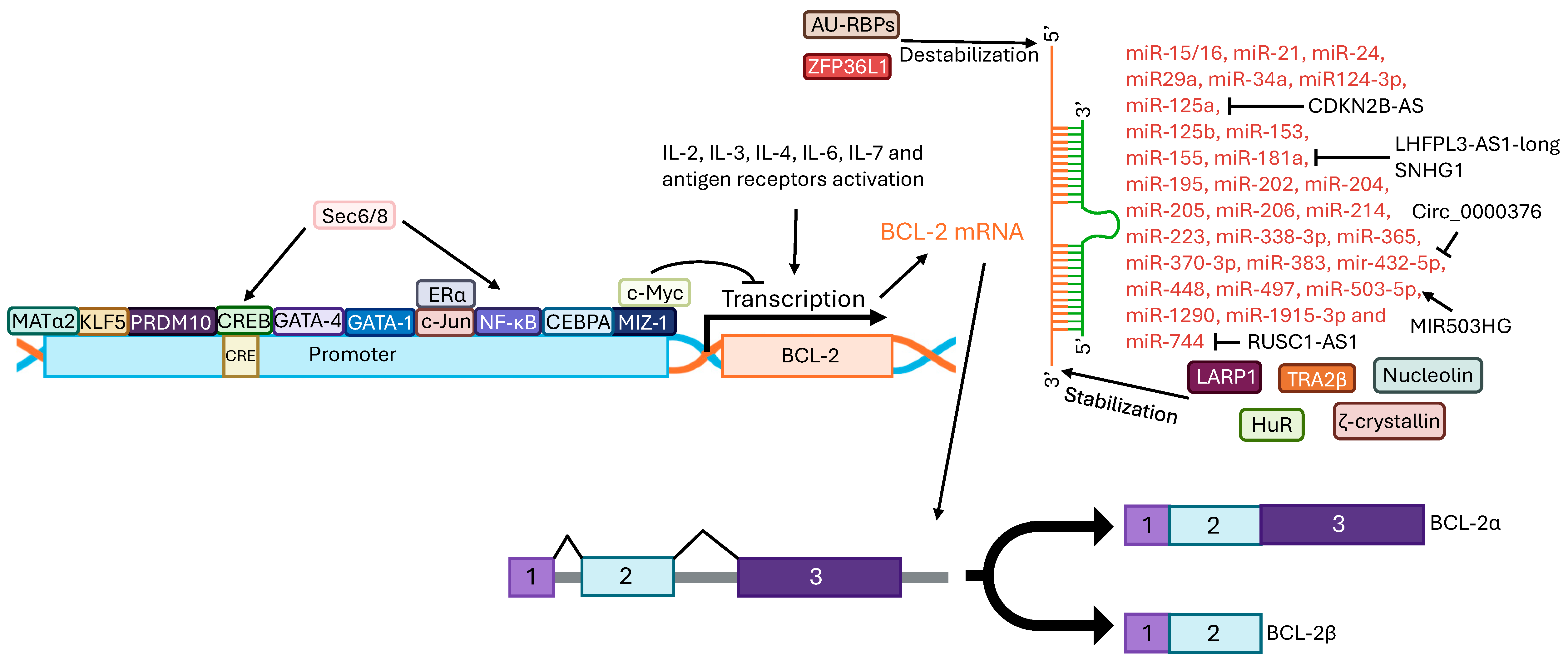
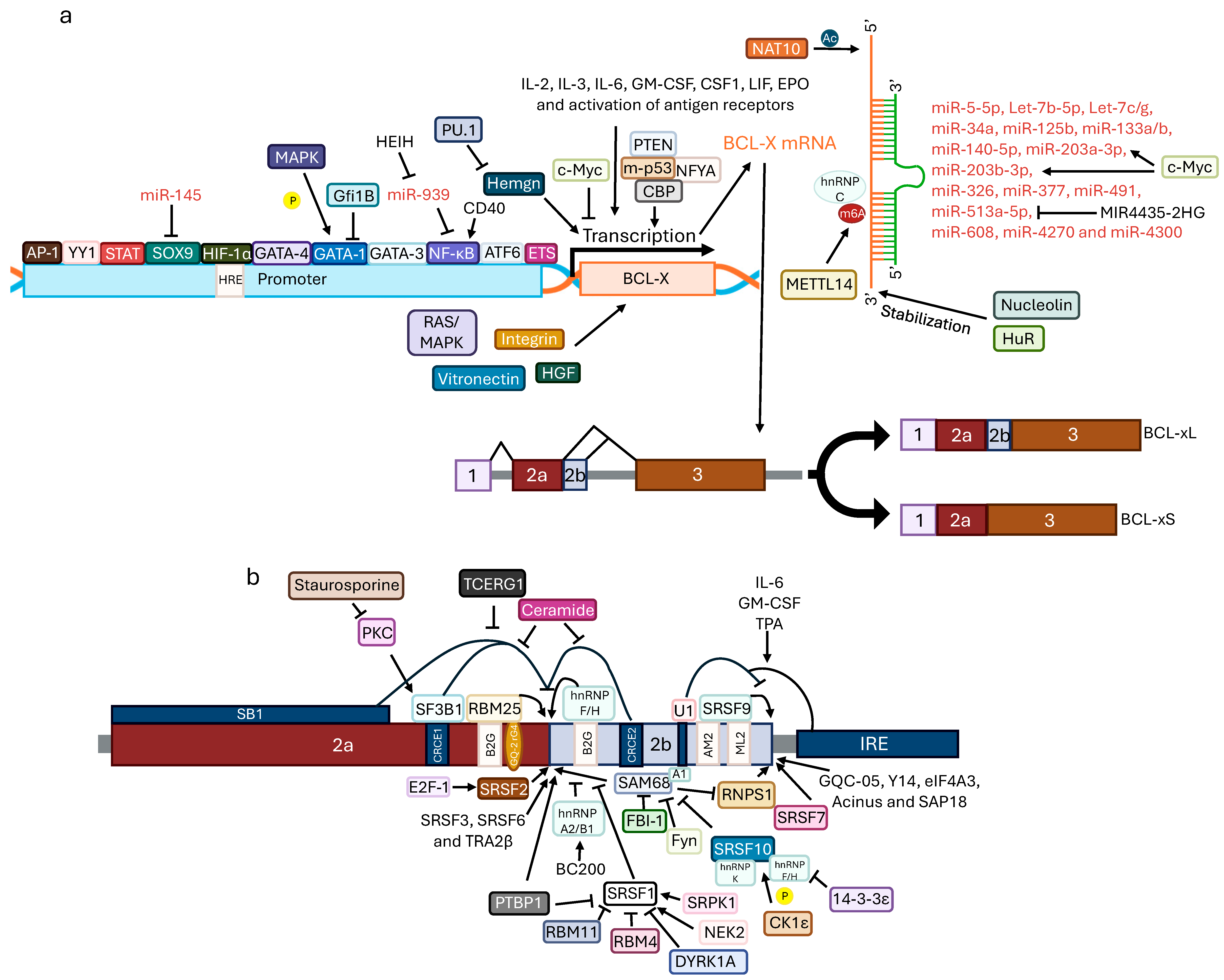
2. BCL-2 and BCL-xL Genes and Regulation
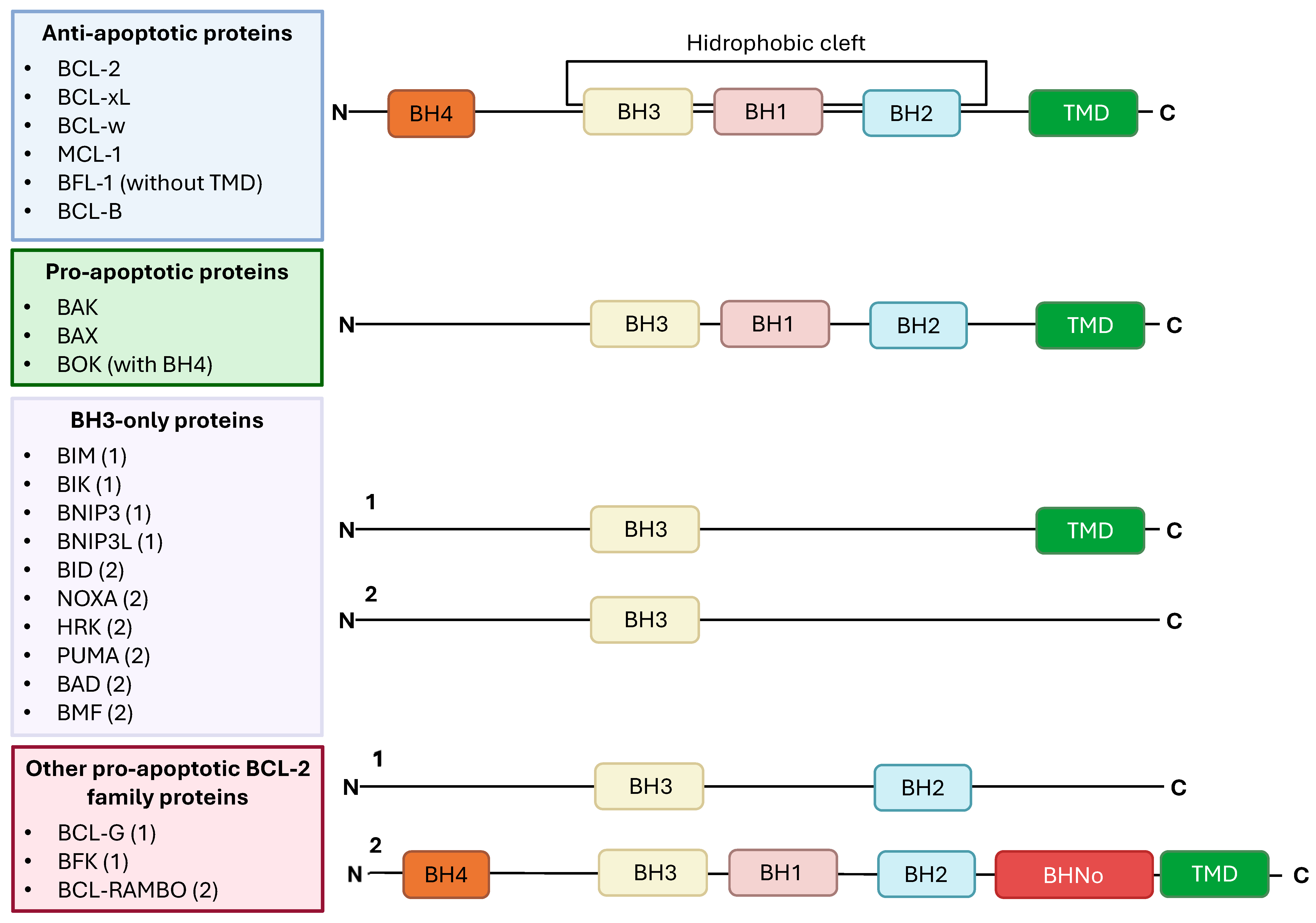
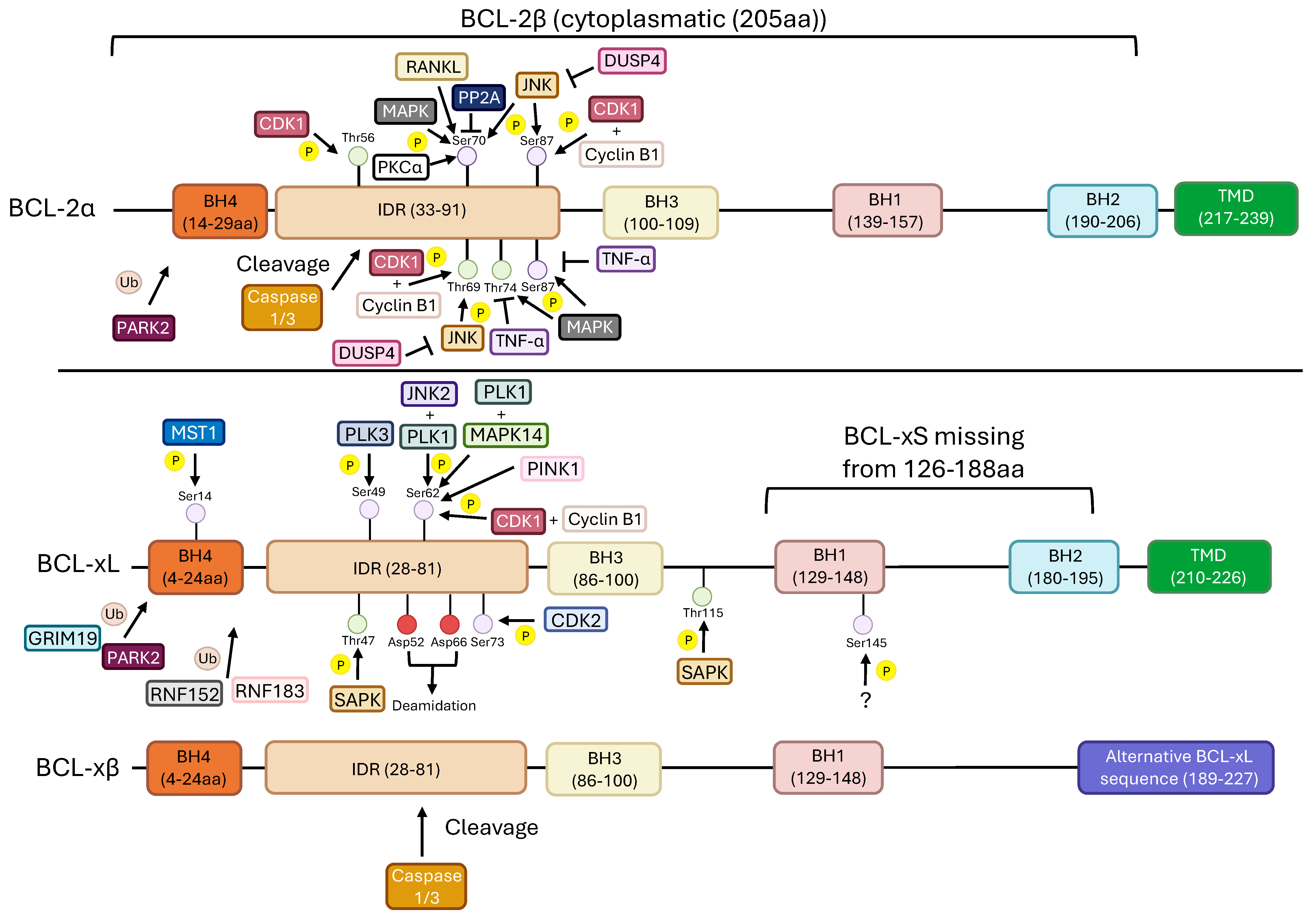
3. BCL-2 Family Members Domains and Functions

| Modification Sites | Interacting Molecules | Modification | Functional Impacts | References |
|---|---|---|---|---|
| Thr56 | p38 MAPK | Phosphorylation | Suppresses BCL-2 antiapoptotic activity | [89] |
| CDK1 | Phosphorylation | Promotes cell cycle inhibition | [91] | |
| Thr69 | CDK1 + cyclin B1 | Phosphorylation | Enhanced affinity for BAK and BIM. In the presence of apigenin, suppresses BCL-2 antiapoptotic activity | [92,146] |
| JNK | Phosphorylation | Probably essential for Paclitaxel to fully induce cell death. Also needed for autophagy promotion. | [116,147] | |
| Ser70 | PP2A | Dephosphorylation | Prevents BCL-2 antiapoptotic function | [86] |
| MAPK | Phosphorylation | Essential for BCL-2 antiapoptotic function | [87] | |
| PKCα | Phosphorylation | Essential for BCL-2 antiapoptotic function | [88] | |
| CDK1 + cyclin B1 | Phosphorylation | Enhanced affinity for BAK and BIM | [92] | |
| JNK | Phosphorylation | Essential for Paclitaxel to fully induce cell death. Also promotes autophagy | [116,147] | |
| RANKL | Phosphorylation | Promotes interaction between BCL-2 and Beclin-1 | [82] | |
| Thr74 | TNF-α | Dephosphorylation | Leads to BCL-2 degradation | [90] |
| CDK1 + cyclin B1 | Phosphorylation | Enhanced affinity for BAK and BIM | [92] | |
| Ser87 | p38 MAPK | Phosphorylation | Suppresses BCL-2 antiapoptotic activity | [89] |
| TNF-α | Dephosphorylation | Leads to BCL-2 degradation | [90] | |
| CDK1 + cyclin B1 | Phosphorylation | Enhanced affinity for BAK and BIM. In the presence of apigenin, suppresses BCL-2 antiapoptotic activity | [92,146] | |
| JNK | Phosphorylation | Essential for Paclitaxel to fully induce cell death. Also promotes autophagy | [116,147] | |
| Paxillin | Phosphorylation | Promotes BCL-2 stability | [148] | |
| ? | PARK2 | Ubiquitination | Increases BCL-2 and Beclin-1 interaction, but can also promote BCL-2 degradation | [117] |
| Modification Sites | Interacting Molecules | Modification | Functional Impacts | References |
|---|---|---|---|---|
| Ser14 | MST1 | Phosphorylation | Represses BCL-xL and BAX interaction | [143] |
| Thr47 | SAPK | Phosphorylation | In the presence of DNA damage promotes apoptosis | [142] |
| Ser49 | PLK3 | Phosphorylation | In G2 checkpoint phosphorylation of Ser49 occurs in the presence of DNA damage. In telophase Ser49 phosphorylation is implicated in cytokinesis | [137] |
| Asp52 | ? | Deamidation | Decreases BCL-xL affinity for pro-apoptotic BH3 domains. Promotes BCL-xL degradation | [94,95] |
| Ser62 | CDK1 + cyclin B1 | Phosphorylation | Suppresses BCL-xL antiapoptotic activity | [146] |
| PLK1 + JNK2 | Phosphorylation | Leads to BCL-xL recruitment to nucleolar structures during the stabilization of G2 arrest | [138] | |
| MAPK14 + PLK1 | Phosphorylation | During prometaphase and metaphase leads to BCL-xL association with SAC silencing complexes and also to its localization at centromeres, suggesting a possible role of BCL-xL in spindle assembly and chromosome segregation | [139] | |
| PINK1 | Phosphorylation | Prevents cell death | [145] | |
| PGAM5 | Dephosphorylation | Prevents cell death by increasing BCL-xL affinity to BAX and BAK | [149] | |
| Asp66 | ? | Deamidation | Decreases BCL-xL affinity for pro-apoptotic BH3 domains. Promotes BCL-xL degradation | [94,95] |
| Ser73 | CDK2 | Phosphorylation | Apoptosis promotion in the presence of Cisplatin | [93] |
| Thr115 | SAPK | Phosphorylation | In the presence of DNA damage promotes apoptosis | [142] |
| Ser145 | ? | Phosphorylation | PAR2 when activated promotes phosphorylation of Ser145 stabilizing BCL-xL | [150] |
| ? | RNF152 | Ubiquitination | Leads to BCL-xL degradation | [150] |
| RNF183 | Ubiquitination | Leads to BCL-xL degradation | [128] | |
| GRIM19 | Ubiquitination | Indirectly promotes BCL-xL ubiquitination leading to its degradation | [151] | |
| PARK2 | Ubiquitination | Leads to BCL-xL degradation | [117] |
4. Function of BCL-2 and BCL-xL in Cancer
4.1. Invasiveness and Progression
4.2. Angiogenesis
4.3. BCL-2 and BCL-xL Effects on Drug Responses
5. BCL-2 and BCL-xL Expression in Cancer Across TCGA and CPTAC Datasets Using UALCAN Analysis
6. Co-Targeting of BCL-2 and BCL-xL in Clinical Trials
| Drug | Disease | Intervention | Phase | Results | NCT/References |
|---|---|---|---|---|---|
| Navitoclax | Lymphomas | Navitoclax | Phase I | Complete with no published results | NCT00743028 |
| Lymphoid malignancies and solid tumors | Navitoclax | Phase I | Complete with no published results | NCT00982566 | |
| Lymphoid malignancies | Navitoclax | Phase I | Of the 46 patients analyzed, 10 showed partial response. The most common non-hematologic grade 3/4 AEs was pneumonia (11%). | NCT00406809 [323] | |
| SCLC and other solid tumors | Navitoclax | Phase I | Of the 38 patients analyzed, 8 showed stable disease and 1 a partial response. Serious AEs were reported in 3 patients (fatal respiratory failure, left ventricular systolic dysfunction and asymptomatic lipase elevation). | [324] | |
| Relapsed or refractory CLL | Navitoclax | Phase I | Among 29 patients, 7 achieved stable disease and 9 had a partial response. The MTD with intermittent dosing was estimated at 200 mg/day. Serious adverse events included grade ≥ 3 thrombocytopenia (n = 8), neutropenia (n = 8), tumor lysis syndrome (n = 1), progressive multifocal leukoencephalopathy (n = 1), and myocardial infarction (n = 1). | NCT00481091 [325] | |
| Relapsed or refractory high-risk myelodysplastic syndrome | Navitoclax | Phase Ib/II | Active, not recruiting | NCT05564650 | |
| CLL | Navitoclax | Phase II | Complete with no published results | NCT01557777 | |
| Relapsed or refractory lymphoid malignancies | Navitoclax | Phase IIa | All patients discontinued Navitoclax due to AEs and radiologic progressive disease. | NCT00406809 [326] | |
| Heavily pretreated recurrent epithelial ovarian cancer | Navitoclax | Phase II | Of the 46 patients analyzed, 15 showed stable disease and 1 a partial response. The most common grade 3/4 AEs was thrombocytopenia (26%). | NCT02591095 [328] | |
| Relapsed SCLC | Navitoclax | Phase II | Of the 39 patients analyzed, 9 showed stable disease and 1 a partial response. The most common AEs was thrombocytopenia (41%). | NCT00445198 [327] | |
| Relapsed or refractory B-cell CLL | Navitoclax | Phase IIb | Withdrawn since the sponsor decided to not proceed with the study | NCT00918450 | |
| Lymphoma and solid tumors | Navitoclax with Ketoconazole | Phase I | Complete with no published results | NCT01021358 | |
| SCLC | Navitoclax plus Etoposide and Cisplatin | Phase I | Complete with no published results | NCT00878449 | |
| High grade serous epithelial ovarian cancer and TNBC | Navitoclax and Olaparib | Phase I | Active, not recruiting | NCT05358639 | |
| Lymphoma and solid tumors | Navitoclax with Rifampin | Phase I | Complete with no published results | NCT01121133 | |
| Relapsed/refractory AML | Navitoclax and Venetoclax with Cladribine-based salvage therapy | Phase I | Withdrawn since sponsor withdrew support | NCT06007911 | |
| Advanced myeloid neoplasms | Navitoclax, Venetoclax and Decitabine | Phase I | Active, not recruiting | NCT05455294 | |
| Relapsed/refractory AML | Navitoclax in combination with Venetoclax and Decitabine | Phase Ib | Active, not recruiting | NCT05222984 | |
| Pediatric patients with relapsed or refractory hematological malignancies | Navitoclax in combination with Venetoclax and Decitabine | Phase I/II | Withdrawn since company stopped development and production of one of the investigational medicinal products. | NCT05740449 | |
| Patients with myeloproliferative neoplasms | Navitoclax alone or in combination with Ruxolitinib | Phase I | Active, not recruiting | NCT04041050 | |
| Myelofibrosis | Navitoclax, Ruxolitinib and Mivebresib vs. Mivebresib alone | Phase Ib | Terminated with no published results | NCT04480086 | |
| Myelofibrosis | Navitoclax, Ruxolitinib and ABBV-744 vs. ABBV-744 alone | Phase Ib | Active, not recruiting | NCT04454658 | |
| Myelofibrosis | Navitoclax with Ruxolitinib | Phase II | 23–31% of the patients achieved a ≥35% spleen volume reduction and 24–30% a ≥50% total symptom score reduction. The most common AEs was reversible thrombocytopenia without clinically significant bleeding (88%). | NCT03222609 [338,379,380] | |
| Relapsed/refractory myelofibrosis | Navitoclax with Ruxolitinib | Phase III | Active, not recruiting | NCT04472598 NCT04468984 | |
| Advanced solid tumors | Navitoclax and Vistusertib | Phase I | Treatment was well tolerated at dose level 1 (Navitoclax 150 mg once daily plus Vistusertib 35 mg twice daily). A serious AE, grade 3 serum aminotransferase elevation, occurred in 2 patients at dose level 2. | NCT03366103 [336] | |
| Relapsed or refractory solid tumors | Navitoclax and Sorafenib | Phase I | The MTD was Navitoclax 150 mg daily plus Sorafenib 400 mg twice daily. Stable disease was observed in 6 patients, with no partial or complete responses. The most common grade 3 toxicity was thrombocytopenia (n = 5). | NCT01364051 NCT02143401 [337] | |
| Solid tumors | Navitoclax combined with Gemcitabine | Phase I | Of the 46 patients analyzed, 21 showed stable disease. No complete or partial response was observed. The MTD was Navitoclax 325 mg plus Gemcitabine 1000 mg/m2. The most common AEs were thrombocytopenia 58.7%), nausea (58.7%), and fatigue (56.5%). | NCT00887757 [329] | |
| Advanced solid tumors | Navitoclax in combination with Erlotinib | Phase I | Among 11 patients, 3 showed stable disease with no complete or partial responses. The MTD was not reached. The most common grade ≥ 3 AEs were diarrhea (36%), syncope (18%), and thrombocytopenia (9%). | NCT01009073 [332] | |
| Advanced solid tumors | Navitoclax with Irinotecan | Phase I | Among 31 patients, 2 had partial responses. The MTD in a once-weekly regimen group was Navitoclax 150 mg plus Irinotecan 75 mg/m2. Grade ≥ 3 AEs occurred in 77.4% of patients, mostly diarrhea (35.5%). | NCT01009073 [334] | |
| Relapsed or refractory acute lymphoblastic leukemia and lymphoblastic lymphoma | Navitoclax and Venetoclax combined with chemotherapy | Phase I | Among 47 patients, 3 showed complete response, 8 a partial response, and 8 showed stable disease. The most common grade 3/4 AEs were febrile neutropenia (46.8%), neutropenia (38.3%), and thrombocytopenia (25.5%). | NCT03181126 [341] | |
| Advanced solid tumors | Navitoclax plus Docetaxel | Phase I | Of the 41 patients analyzed, 4 showed a partial response. The MTD was Navitoclax 150 mg days 1–5 every 21 days combined with Docetaxel 75 mg/m2 day 1. The most common AEs included thrombocytopenia (63%), fatigue (61%), nausea (59%) and neutropenia (51%). | NCT00888108 [330] | |
| Solid tumors | Navitoclax plus Carboplatin and Paclitaxel | Phase I | Among 19 patients, 1 showed a partial response. The study was discontinued due to significant hematological and non-hematological toxicities. | NCT00891605 [333] | |
| Relapsed or refractory chronic lymphocytic leukemia | Navitoclax plus Fludarabine, Cyclophosphamide and Rituximab or Bendamustine and Rituximab | Phase I | Complete with no published results | NCT00868413 | |
| Relapsed or refractory CD20+ lymphoid malignancies | Navitoclax in combination with Rituximab | Phase I | Among 29 patients, 5 showed complete responses and 5 showed partial responses. The MTD of Navitoclax was 250 mg/day. Grade 4 thrombocytopenia occurred in 17% of patients, and common adverse events included mild diarrhea (79%) and nausea (72%). | NCT00788684 [339] | |
| B-cell chronic lymphocytic leukemia | Navitoclax with Rituximab | Phase II | Of the 78 patients analyzed, 2 showed complete responses, 47 showed partial responses, and 25 showed stable disease. Serious AEs were reported and included neutropenia (37.2%), and thrombocytopenia (25.6%). | NCT01087151 [340] | |
| EGFR-mutant NSCLC | Navitoclax plus Osimertinib | Phase Ib | Among 27 patients, 2 showed partial responses, and 12 showed stable disease. The recommended phase 2 dose was Osimertinib 80 mg plus Navitoclax 150 mg daily. The most common AEs were thrombocytopenia (37%), lymphopenia (37%), fatigue (22%), and nausea (22%). | NCT02520778 [335] | |
| Pediatric patients with relapsed or refractory acute lymphoblastic leukemia or lymphoblastic lymphoma | Navitoclax and Venetoclax | - | No results published | NCT05215405 | |
| Relapsed acute lymphoblastic leukemia | Navitoclax and Venetoclax | Phase I/II | Active not recruiting | NCT05192889 | |
| High-risk patients with T-cell acute lymphoblastic leukemia | Navitoclax and Venetoclax | Phase Ib/II | Not yet recruiting | NCT05054465 | |
| KRAS or NRAS mutant advanced solid tumors | Navitoclax and Trametinib | Phase I/II | Among 91 patients, 8 showed partial responses. The recommended phase 2 dose was Trametinib 2 mg daily (days 1–14) plus Navitoclax 250 mg daily (days 1–28). The most common AEs included diarrhea (72.9%), decreased platelet count (70.6%) and increased AST (68.2%). | NCT02079740 [331] | |
| BRAF mutant melanoma and other solid tumors | Navitoclax with Dabrafenib and Trametinib | Phase I/II | Active not recruiting | NCT01989585 | |
| Relapsed/refractory mantle cell lymphoma | Navitoclax plus Venetoclax, Ibrutinib and Rituximab vs. Venetoclax, Ibrutinib and Rituximab | Phase II | Active not recruiting | NCT05864742 | |
| Progressive metastatic castrate refractory prostate cancer | Navitoclax and Abiraterone acetate with or without Hydroxychloroquine | Phase II | Terminated due to investigator leaving the organization | NCT01828476 | |
| Relapsed DLBCL | Navitoclax plus Bendamustine and Rituximab | Phase II | Terminated due to non-safety related reasons | NCT01423539 | |
| Obatoclax Mesylate | Hematological malignancies | Obatoclax mesylate | Phase I | Completed with no published results | NCT00438178 |
| Advanced hematologic malignancies | Obatoclax | Phase I | Of the 44 patients analyzed, 1 showed a complete response and 3 showed hematologic improvement. Obatoclax mesylate was well tolerated with no dose-limiting toxicities. The most common AEs were somnolence (43%), dizziness (38%), and fatigue (36%). | [342] | |
| Advanced CLL | Obatoclax | Phase I | Of the 26 patients analyzed, 1 showed a partial response. The MTD was 28 mg/m2 over 3 h every 3 weeks. The most common grade ≥ 3 AEs were somnolence, ataxia, and confusion. | NCT00600964 [343] | |
| Advanced solid tumors or lymphoma | Obatoclax | Phase I | Of the 35 patients analyzed, 1 showed a partial response and 1 showed stable disease. The MTD was 1.25 mg/m2 for the 1 h infusion and 20 mg/m2 for the 3 h infusion. The most common AEs were somnolence (91%), dizziness (60%), and euphoric mood (57%). | [344] | |
| Previously untreated AML | Obatoclax mesylate | Phase I/II | Among 18 patients, 4 had stable disease, with no complete responses. The MTD was 20 mg/day administered over 3 h for 3 consecutive days. The most common AEs were neurologic (77.8%) or psychiatric (88.9%). | NCT00684918 [345] | |
| Systemic mastocytosis | Obatoclax | Phase II | No reported responses 3 months after treatment | NCT00918931 | |
| Myelofibrosis | Obatoclax mesylate | Phase II | Among 22 patients, 1 showed clinical improvement in hemoglobin and platelets, with no complete or partial responses. The most common grade 3/4 AEs were fatigue (9%), dyspnea (9%), and febrile neutropenia (9%). | NCT00360035 [347] | |
| Hodgkin’s lymphoma | Obatoclax | Phase II | Among 13 patients, 5 had stable disease, with no objective responses. Further enrollment was not pursued due to limited clinical activity. | NCT00359892 [348] | |
| Patients with myelodysplastic syndromes with anemia or thrombocytopenia | Obatoclax | Phase II | Among 24 patients, 17 had stable disease, with no complete or partial responses. The most common grade 3/4 AEs were anemia (21%), thrombocytopenia (13%), and pneumonia (13%). | NCT00413114 [346] | |
| Aggressive relapsed or recurrent non-Hodgkin lymphoma | Obatoclax and Bortezomib | Phase I | Terminated with no results | NCT00538187 | |
| Relapsed or refractory solid tumors, lymphoma, or leukemia | Obatoclax mesylate, Vincristine sulfate, Doxorubicin hydrochloride and Dexrazoxane hydrochloride | Phase I | Terminated with no results | NCT00933985 | |
| Extensive-stage SCLC | Obatoclax in combination with Carboplatin and Etoposide | Phase I | Among 25 patients, 17 had complete or partial responses. The MTD of Obatoclax was 30 mg/day for the 3 h infusion. The most common AEs included neutropenia (96%), thrombocytopenia (76%), and anemia (72%). | [349] | |
| Extensive-stage SCLC | Obatoclax mesylate with Carboplatin and Etoposide vs. Carboplatin and Etoposide | Phase II | Among 155 patients, the objective response rate was 62% with Carboplatin/Etoposide plus Obatoclax and 53% with Carboplatin/Etoposide alone. Clinical benefit was 81% vs. 68%. Common grade 3/4 adverse events included neutropenia (46.5%), anemia (21%), and thrombocytopenia (16.5%). | NCT00682981 [350] | |
| Relapsed CLL | Obatoclax in combination with Fludarabine and Rituximab | Phase I | Among 13 patients, 2 had complete responses and 9 had partial responses. No MTD was reached. Common adverse events included dizziness (46%), euphoria (46%), and ataxia (38%). | NCT00612612 [351] | |
| Solid tumor malignancies | Obatoclax combined with Topotecan | Phase I | Of the 14 patients analyzed, 2 showed partial responses and 4 showed stable disease. The MTD of Obatoclax was 20 mg/m2. The most common grade 3/4 AEs were anemia (21.4%), and thrombocytopenia (14.3%). | [352] | |
| Relapsed SCLC | Obatoclax combined with Topotecan | Phase II | Of the 9 patients analyzed, 5 showed stable disease. No partial or complete responses were observed. The MTD of Obatoclax was 20 mg/m2. Common grade 3/4 AEs included thrombocytopenia (22%), anemia (11%), neutropenia (11%), and ataxia (11%). | NCT00521144 [353] | |
| Relapsed or refractory non-Hodgkin lymphoma | Obatoclax mesylate, Rituximab, and Bendamustine hydrochloride | Phase I/II | Withdrawn due to no patients accrued | NCT01238146 | |
| Relapsed or refractory multiple myeloma | Obatoclax plus Bortezomib | Phase I/II | Trial termination was attributed to insufficient enrollment and drug supply | NCT00719901 | |
| Relapsed or refractory mantle cell lymphoma | Obatoclax mesylate plus Bortezomib | Phase I/II | Of the 13 patients analyzed, 3 showed complete responses, 1 showed a partial response, and 6 showed stable disease. Grade 3/4 AEs included thrombocytopenia (21%), anemia (13%), and fatigue (13%). | NCT00407303 [354] | |
| Relapsed non–small-cell lung cancer | Obatoclax in combination with Docetaxel | Phase I/II | Of the 32 patients analyzed, 3 showed partial responses and 2 showed stable disease. The MTD was not reached. The most common grade 3/4 AEs included neutropenia (31%), febrile neutropenia (16%), and dyspnea (19%). | NCT00405951 [355] | |
| Previously untreated follicular lymphoma | Obatoclax mesylate with or without Rituximab | Phase II | Among 13 patients, 3 had complete responses, 1 had a partial response, and 6 had stable disease. Grade 3/4 adverse events included thrombocytopenia (21%), anemia (13%), and fatigue (13%). | NCT00427856 | |
| Chemotherapy-naive patients with extensive-stage small cell lung cancer | Obatoclax mesylate combined with Carboplatin and Etoposide vs. Carboplatin and Etoposide | Phase III | Withdrawn due to business decision | NCT01563601 | |
| AT-101 | Relapsed or refractory B-cell non-Hodgkin’s lymphoma | AT-101 | Phase I/II | Currently recruiting | NCT05338931 |
| Refractory metastatic breast cancer | AT-101 | Phase I/II | Grade III dose limiting dermatologic AEs were observed in two patients receiving 50 mg/day of AT-101. Stable disease was reported for 2 of the 20 patients analyzed in this study. A minor response was also reported. Moreover, the MTD was achieved (40 mg/day). | [356] | |
| Castrate-resistant prostate cancer | AT-101 | Phase I/II | Of the 23 patients analyzed, 2 showed stable disease. Grade 3 small intestinal obstruction occurred in 21.7% of patients, while common AEs included diarrhea (43.5%), fatigue (34.8%), nausea (21.7%), and anorexia (21.7%). | NCT00286806 [357] | |
| Castration sensitive metastatic prostate cancer | AT-101 | Phase II | Of the 55 patients analyzed, 17 (31%) achieved an undetectable PSA level (≤0.2 ng/mL). Serious AEs were reported in 22% of patients, and included sensory neuropathy (4%), and ileus (3.7%). | NCT00666666 [358] | |
| Relapsed or refractory B-cell malignancies | AT-101 | Phase II | Complete with no published results | NCT00275431 | |
| Newly diagnosed or recurrent glioblastoma multiforme | AT-101 | Phase II | Among 71 patients, 1 had a partial response and 16 had stable disease. Grade 3/4 adverse events included gastrointestinal symptoms. All patients with recurrent glioblastoma multiforme died at the time of data analysis. | NCT00540722 NCT00390403 [359] | |
| Recurrent extensive stage SCLC | AT-101 | Phase II | Of the 15 patients analyzed, 3 showed stable disease. No complete or partial responses were observed. Grade 3/4 AEs included anorexia (20%), fatigue (13.3%) and nausea (13.3%). | [360] | |
| Advanced adrenal cortical carcinoma | AT-101 | Phase II | Of the 29 patients analyzed, 8 showed stable disease. No complete or partial responses were observed. The most commom grade 4 AEs were hypokalemia (10.3%), cardiac troponin elevation (3.4%), and lymphopenia (3.4%). | [361] | |
| Newly diagnosed glioblastoma multiforme | AT-101 and Temozolomide with or without radiotherapy | Phase I | Completed with no published results | NCT00390403 | |
| Solid tumors | AT-101 with Paclitaxel and Carboplatin | Phase I | Of the 24 patients analyzed, 1 showed a complete response and 4 showed partial responses, and 8 showed stable disease. The MTD was not reached. Grade 3/4 AEs included neutropenia (21%), leukopenia (13%), anemia (4%), and thrombocytopenia (4%). | NCT00891072 [362] | |
| Advanced solid tumors | AT-101 with Cisplatin and Etoposide | Phase I | Of the 27 patients analyzed, 4 showed partial responses, and l0 demonstrated stable disease. The MTD of AT-101 was 40 mg orally twice daily on days 1–3, administered with Cisplatin 60 mg/m2 and Etoposide 120 mg/m2 on day 1 of a 21-day cycle, supported by Pegfilgrastim. The most common grade 3/4 AEs included neutropenia (59.3%), and leukopenia (44.4%). | [363] | |
| Advanced NSCLC | AT-101 with Erlotinib | Phase I | Withdrawn with no published results | NCT00934076 | |
| Advanced NSCLC patients with EGFR activating mutations | AT-101 with Erlotinib | Phase II | Of the 5 patients analyzed, 3 showed stable disease and 1 a partial response. A serious adverse event was reported in 1 patient (hypotension) | NCT00988169 | |
| Relapsed B-cell chronic lymphocytic leukemia | Lenalidomide and AT-101 | Phase I/II | Of the 13 patients analyzed, 11 showed complete response. The most common AEs were gastrointestinal, including vomiting, anorexia, and odynophagia. | NCT01003769 [381] | |
| Gastroesophageal carcinoma | AT-101 with Docetaxel, 5-fluorouracil and radiotherapy | Phase I/II | Of the 36 patients analyzed, 3 showed partial responses and 15 showed stable disease. No complete response was observed. The most common AEs grade ≥ 3 were neutropenia (44.4%), thrombocytopenia (41.7%), and anemia (27.8%). | NCT00561197 [364] | |
| Relapsed and refractory SCLC | AT-101 with Topotecan | Phase I/II | Of the 13 patients analyzed, 11 showed complete response. The most common AEs were gastrointestinal, including vomiting, anorexia, and odynophagia. | NCT00397293 [365] | |
| CLL | AT-101 plus Rituximab | Phase II | Completed with no published results | NCT00286780 | |
| Grade I-II follicular non-Hodgkin’s lymphoma | AT-101 combined with Rituximab | Phase II | Completed with no published results | NCT00440388 | |
| Recurrent, locally advanced, or metastatic HNC | AT-101 in combination with Docetaxel | Phase II | Of the 11 evaluable patients, 1 showed partial responses and 6 showed stable disease. No complete response was observed. The most grade 3/4 AEs was lymphopenia (36.4%). | NCT01285635 [366] | |
| NSCLC | AT-101 plus Docetaxel | Phase II | Of the 53 patients analyzed, 2 showed partial response, and 22 showed stable disease. No complete responses were observed. The most common grade ≥ 3 AEs were neutropenia (9.4%), dyspnea (5.7%), and anemia (5.7%). | NCT00544960 [367] | |
| Advanced NSCLC with high expression of apurinic/apyrimidinic endonuclease 1 | AT-101 combined with Docetaxel and Cisplatin | Phase II | Of the 31 patients analyzed, 3 showed partial response, and 23 showed stable disease. No complete responses were observed. The most common grade ≥ 3 AEs was anemia (3.2%). | NCT01977209 [368] | |
| Laryngeal cancer | AT-101 in combination with Docetaxel and Cisplatin or Carboplatin | Phase II | Of the 36 patients analyzed, 19 showed partial response. No complete responses were observed. The most common grade ≥ 3 AEs were neutropenia (9%), diarrhea (7%), and nausea (7%). | NCT01633541 [369] | |
| Metastatic castration-resistant prostate cancer | AT-101 plus Docetaxel and Prednisone Vs Docetaxel with Prednisone | Phase II | 110 patients were analyzed. The median OS was 18.1 months. The most common grade 3/4 AEs were neutropenia (47.3%), leukopenia (24.5%), and lymphopenia (22.7%). | NCT00286793 NCT00571675 [370] | |
| Pelcitoclax | SCLC or advanced solid tumors | Pelcitoclax | Phase I | Terminated with no published results | NCT03387332 |
| Locally advanced or metastatic solid tumors | Pelcitoclax | Phase I | The treatment was well tolerated with transaminase elevations and thrombocytopenia as most common AEs. The ORR and DCR were 6.5% and 30.4%, respectively. | NCT03080311 [371] | |
| Advanced neuroendocrine tumor | Pelcitoclax | Phase Ib | Terminated with no published results | NCT04893759 | |
| Myelofibrosis that progressed after initial therapy | Pelcitoclax | Phase Ib/II | Withdrawn by sponsor decision | NCT04354727 | |
| Recurrent ovarian and endometrial cancers | Pelcitoclax and Cobimetinib | Phase I | Currently recruiting | NCT05691504 | |
| EGFR TKI resistant NSCLC | Pelcitoclax and Osimertinib | Phase Ib | Active, not recruiting | NCT04001777 | |
| Relapsed or refractory non-Hodgkin lymphoma | Pelcitoclax or Pelcitoclax plus Chidamide | Phase Ib/II | Currently recruiting | NCT05186012 | |
| Relapsed/refractory SCLC | Pelcitoclax and Paclitaxel | Phase Ib/II | Terminated with no published results | NCT04210037 | |
| AZD0466 | Advanced hematologic or solid tumors | AZD0466 | Phase I | Terminated with no published results | NCT04214093 |
| Advanced hematological malignancies | AZD0466 alone or combined with Voriconazole | Phase I/II | Terminated based on benefit-risk profile assessment | NCT04865419 | |
| Advanced non-Hodgkin lymphoma | AZD0466 alone or combined with anticancer agents | Phase I/II | Terminated due to safety reasons | NCT05205161 | |
| LP-118 | Advanced malignancies | LP-118 | Phase I | Active, not recruiting | NCT05025358 |
| Relapsed or refractory hematological malignancies | LP-118 | Phase I/Ib | Recruiting | NCT04771572 | |
| Relapsed/refractory acute lymphoblastic leukemia or lymphoblastic lymphoma | LP-118, Ponatinib, Vincristine and Dexamethasone | Phase I/II | Recruiting | NCT06207123 |
7. Conclusions
Author Contributions
Funding
Data Availability Statement
Conflicts of Interest
Abbreviations
| 5-FU | 5-fluorouracil |
| A1/BFL-1 | BCL-2-related gene A1 |
| AEs | Adverse events |
| AKT | Ak strain transforming |
| AML | Acute Myeloid Leukemia |
| APAF | Apoptotic Protease Activating Factor |
| ASF | Alternative splicing factor |
| ATP | Adenosine Triphosphate |
| BAD | BCL-2-associated death promoter |
| BAK | BCL-2 homologous antagonist/killer |
| BAX | BCL-2-associated X protein |
| BCL | B-cell lymphoma |
| BET | Bromodomain and extra-terminal |
| BFK | BCL-2 family kin |
| BH | BCL-2 Homology |
| BID | BH3-interacting domain death agonist |
| BIK | BCL-2-interacting killer |
| BIM | BCL-2-interacting mediator of cell death |
| BMF | BCL-2-modifying factor |
| BMPR2 | Bone Morphogenetic Protein Receptor Type 2 |
| BOK | BCL-2-related ovarian killer |
| BRAF | B-Raf proto-oncogene |
| Ca2+ | Divalent calcium ion |
| CBP | CREB binding protein |
| CDK | Cyclin-dependent kinase |
| CeRNA | Competing Endogenous RNA |
| c-Jun | Cellular Jun |
| CK1ε | Casein kinase 1ε |
| CLL | Chronic lymphocytic leukemia |
| CML | Chronic myeloid leukemia |
| c-Myc | Cellular Myelocytomatosis oncogene |
| COX | Cyclooxygenase |
| CPTAC | Clinical Proteomic Tumor Analysis Consortium |
| CRC | Colorectal cancer |
| CRE | cAMP Response Element |
| CREB | cAMP Response Element-Binding protein |
| CXCR4 | C-X-C chemokine receptor type 4 |
| DCR | Disease control rate |
| DISC | Death-inducing signaling complex |
| DLBCL | Diffuse Large B-Cell Lymphoma |
| DNA | Deoxyribonucleic Acid |
| Drp1 | Dynamin-related protein 1 |
| DUSP4 | Dual specificity phosphatase 4 |
| EGFR | Epidermal growth factor receptor |
| ER | Endoplasmic reticulum |
| ERK | Extracellular signal-Regulated Kinase |
| FADD | Fas-associated protein with death domain |
| GABARAP | GABA type A Receptor–Associated Protein |
| GRIM19 | Gene associated with Retinoid-IFN-induced Mortality 19 |
| GTP | Guanosine Triphosphate |
| HCC | Hepatocellular carcinoma |
| HIF | Hypoxia-Inducible Factor |
| hnRNPs | Heterogeneous nuclear ribonucleoproteins |
| HNSCC | Head and Neck Squamous Cell Carcinoma |
| HRK | Harakiri |
| HSP | Heat Shock Protein |
| IDR | Intrinsically disordered region |
| IFN | Interferon |
| IL | Interleukin |
| IP3R | Inositol 1,4,5-trisphosphate receptor |
| JNK | c-Jun N-terminal kinase |
| LATS | Large tumor suppressor kinases |
| lncRNA | Long non-coding RNA |
| Lys | Lysine |
| MAPK | Mitogen-Activated Protein Kinase |
| MCL-1 | Myeloid cell leukemia 1 |
| MEK | Mitogen-activated protein kinase kinase |
| METTL14 | Methyltransferase-like 14 |
| miRNA | Micro Ribonucleic Acid |
| MITF | Microphthalmia-associated transcription factor |
| MMP | matrix metalloproteinase |
| MOMP | Mitochondrial outer membrane permeabilization |
| mRNA | Messenger Ribonucleic Acid |
| MST | Mammalian Sterile 20-like kinase |
| MTD | Maximum tolerated dose |
| MYC | Myelocytomatosis oncogene |
| NEK2 | NIMA (Never In Mitosis Gene A)-related kinase 2 |
| NF-κB | Nuclear Factor kappa-light-chain-enhancer of activated B cells |
| NFYA | Nuclear transcription factor Y α |
| NSCLC | Non-small cell lung cancer |
| OS | Overall survival |
| OSCC | Oral squamous cell carcinoma |
| PAR2 | Protease-activated receptor 2 |
| PARP | Poly (ADP-Ribose) Polymerase |
| PDTX | Patient-Derived Tumor Xenograft |
| PGAM5 | Phosphoglycerate Mutase Family Member 5 |
| PI3K | Phosphoinositide 3-Kinase |
| PINK1 | PTEN-induced putative kinase 1 |
| PKCα | Protein kinase Cα |
| PLK | Polo-like kinase |
| PP2A | Protein Phosphatase 2A |
| PTBP1 | Polypyrimidine Tract Binding Protein 1 |
| PTEN | Phosphatase and Tensin Homolog |
| PUMA | p53 upregulated modulator of apoptosis |
| RAS | Rat sarcoma |
| RASSF | Ras association domain family |
| RBM | RNA binding motif protein |
| ROS | Reactive oxygen species |
| RNAPII | RNA polymerase II |
| RNF | RING finger |
| RNPS1 | RNA-binding protein with SR domain 1 |
| SAC | Spindle assembly checkpoint |
| SAM68 | SRC associated with mitosis, of 68 kDa |
| SAPK | Stress-Activated Protein Kinase |
| SCC | Squamous cell carcinoma |
| SCLC | Small cell lung cancer |
| Ser | Serine |
| SF3B1 | Splicing factor 3b subunit 1 |
| SOX9 | SRY-box transcription factor 9 |
| Sp1 | Specificity Protein 1 |
| SRPK | Serine/arginine protein kinase |
| SRSF | Serine/arginine-rich splicing factor |
| STAT | Signal Transducer and Activator of Transcription |
| TCGA | The Cancer Genome Atlas |
| TGF | Transforming Growth Factor |
| Thr | Threonine |
| TNBC | Triple-Negative Breast Cancer |
| TNF-R | Tumor necrosis factor receptor |
| TRA2β | Transformer 2β |
| TRAIL-R1/2 | TNF-related apoptosis-inducing ligand receptor 1/2 |
| UALCAN | University of ALabama at Birmingham CANcer data analysis Portal |
| Ub | Ubiquitination |
| VDAC1 | Voltage-Dependent Anion Channel 1 |
| VEGF | Vascular endothelial growth factor |
| VPS | Vacuolar Protein Sorting |
| uPA | Urokinase-type Plasminogen Activator |
| uPAR | Urokinase-type Plasminogen Activator Receptor |
| YAP | Yes-associated protein |
References
- Voss, A.K.; Strasser, A. The Essentials of Developmental Apoptosis. F1000Research 2020, 9, 148. [Google Scholar] [CrossRef]
- Renault, T.T.; Dejean, L.M.; Manon, S. A Brewing Understanding of the Regulation of Bax Function by Bcl-XL and Bcl-2. Mech. Ageing Dev. 2017, 161, 201–210. [Google Scholar] [CrossRef]
- Green, D.R.; Llambi, F. Cell Death Signaling. Cold Spring Harb. Perspect. Biol. 2015, 7, a006080. [Google Scholar] [CrossRef]
- Yanumula, A.; Cusick, J.K. Biochemistry, Extrinsic Pathway of Apoptosis; StatPearls Publishing: Treasure Island, FL, USA, 2024. [Google Scholar]
- Lee, E.F.; Fairlie, W.D. The Structural Biology of Bcl-XL. Int. J. Mol. Sci. 2019, 20, 2234. [Google Scholar] [CrossRef] [PubMed]
- Osterlund, E.J.; Hirmiz, N.; Nguyen, D.; Pemberton, J.M.; Fang, Q.; Andrews, D.W. Endoplasmic Reticulum Protein BIK Binds to and Inhibits Mitochondria-Localized Antiapoptotic Proteins. J. Biol. Chem. 2023, 299, 102863. [Google Scholar] [CrossRef]
- Bas, J.; Nguyen, T.; Gillet, G. Involvement of Bcl-XL in Neuronal Function and Development. Int. J. Mol. Sci. 2021, 22, 3202. [Google Scholar] [CrossRef]
- Lossi, L. The Concept of Intrinsic versus Extrinsic Apoptosis. Biochem. J. 2022, 479, 357–384. [Google Scholar] [CrossRef] [PubMed]
- Kwon, J.-W.; Oh, J.-S.; Seok, S.H.; An, H.-W.; Lee, Y.J.; Lee, N.Y.; Ha, T.; Kim, H.A.; Yoon, G.M.; Kim, S.E.; et al. Combined Inhibition of Bcl-2 Family Members and YAP Induces Synthetic Lethality in Metastatic Gastric Cancer with RASA1 and NF2 Deficiency. Mol. Cancer 2023, 22, 156. [Google Scholar] [CrossRef]
- Farmer, T.; O’Neill, K.L.; Naslavsky, N.; Luo, X.; Caplan, S. Retromer Facilitates the Localization of Bcl-XL to the Mitochondrial Outer Membrane. Mol. Biol. Cell 2019, 30, 1138–1146. [Google Scholar] [CrossRef] [PubMed]
- Chen, Y.; Aon, M.A.; Hsu, Y.-T.; Soane, L.; Teng, X.; McCaffery, J.M.; Cheng, W.-C.; Qi, B.; Li, H.; Alavian, K.N.; et al. Bcl-XL Regulates Mitochondrial Energetics by Stabilizing the Inner Membrane Potential. J. Cell Biol. 2011, 195, 263–276. [Google Scholar] [CrossRef]
- Alavian, K.N.; Li, H.; Collis, L.; Bonanni, L.; Zeng, L.; Sacchetti, S.; Lazrove, E.; Nabili, P.; Flaherty, B.; Graham, M.; et al. Bcl-XL Regulates Metabolic Efficiency of Neurons through Interaction with the Mitochondrial F1FO ATP Synthase. Nat. Cell Biol. 2011, 13, 1224–1233, Erratum in Nat. Cell Biol. 2011, 13, 1383.. [Google Scholar] [CrossRef]
- Pinton, P.; Giorgi, C.; Siviero, R.; Zecchini, E.; Rizzuto, R. Calcium and Apoptosis: ER-Mitochondria Ca2+ Transfer in the Control of Apoptosis. Oncogene 2008, 27, 6407–6418. [Google Scholar] [CrossRef] [PubMed]
- Montero, J.; Letai, A. Why Do BCL-2 Inhibitors Work and Where Should We Use Them in the Clinic? Cell Death Differ. 2018, 25, 56–64. [Google Scholar] [CrossRef]
- Green, D.R. A Matter of Life and Death. Cold Spring Harb. Perspect. Biol. 2022, 14, a041004. [Google Scholar] [CrossRef]
- Chong, S.J.F.; Lu, J.; Valentin, R.; Lehmberg, T.Z.; Eu, J.Q.; Wang, J.; Zhu, F.; Kong, L.R.; Fernandes, S.M.; Zhang, J.; et al. BCL-2 Dependence Is a Favorable Predictive Marker of Response to Therapy for Chronic Lymphocytic Leukemia. Mol. Cancer 2025, 24, 62. [Google Scholar] [CrossRef] [PubMed]
- Kump, K.J.; Ahmad, E.; Foucar, C.; Avelar, R.A.; Murga-Zamalloa, C.; Lieberman, M.; Kandarpa, M.; Mady, A.S.A.; DiFeo, A.; Zhang, L.; et al. Understanding the Functional Dependence and Inhibition of the Bcl-2 Pro-Survival Proteins in a Wide Spectrum of Cancers toward Precision Medicine. ACS Pharmacol. Transl. Sci. 2025, 8, 2922–2935. [Google Scholar] [CrossRef]
- Basu, A. The Interplay between Apoptosis and Cellular Senescence: Bcl-2 Family Proteins as Targets for Cancer Therapy. Pharmacol. Ther. 2022, 230, 107943. [Google Scholar] [CrossRef]
- Singh, R.; Letai, A.; Sarosiek, K. Regulation of Apoptosis in Health and Disease: The Balancing Act of BCL-2 Family Proteins. Nat. Rev. Mol. Cell Biol. 2019, 20, 175–193. [Google Scholar] [CrossRef]
- Chrysovergis, A.; Papanikolaou, V.S.; Tsiambas, E.; Ragos, V.; Peschos, D.; Kyrodimos, E. Digital Analysis of BCL2 Expression in Laryngeal Squamous Cell Carcinoma. Anticancer Res. 2019, 39, 1253–1257. [Google Scholar] [CrossRef]
- Warren, C.F.A.; Wong-Brown, M.W.; Bowden, N.A. BCL-2 Family Isoforms in Apoptosis and Cancer. Cell Death Dis. 2019, 10, 177. [Google Scholar] [CrossRef] [PubMed]
- Kaloni, D.; Diepstraten, S.T.; Strasser, A.; Kelly, G.L. BCL-2 Protein Family: Attractive Targets for Cancer Therapy. Apoptosis 2023, 28, 20–38. [Google Scholar] [CrossRef]
- Li, Z.-L.; Ueki, K.; Kumagai, K.; Araki, R.; Otsuki, Y. Regulation of Bcl-2 Transcription by Estrogen Receptor-α and c-Jun in Human Endometrium. Med. Mol. Morphol. 2014, 47, 43–53. [Google Scholar] [CrossRef]
- Chen, N.; Hu, T.; Gui, Y.; Gao, J.; Li, Z.; Huang, S. Transcriptional Regulation of Bcl-2 Gene by the PR/SET Domain Family Member PRDM10. PeerJ 2019, 7, e6941. [Google Scholar] [CrossRef]
- Kyrönlahti, A.; Raämö, M.; Tamminen, M.; Unkila-Kallio, L.; Butzow, R.; Leminen, A.; Nemer, M.; Rahman, N.; Huhtaniemi, I.; Heikinheimo, M.; et al. GATA-4 Regulates Bcl-2 Expression in Ovarian Granulosa Cell Tumors. Endocrinology 2008, 149, 5635–5642. [Google Scholar] [CrossRef][Green Version]
- Suzuki, Y.J. Cell Signaling Pathways for the Regulation of GATA4 Transcription Factor: Implications for Cell Growth and Apoptosis. Cell. Signal. 2011, 23, 1094–1099. [Google Scholar] [CrossRef] [PubMed]
- Catz, S.D.; Johnson, J.L. Transcriptional Regulation of Bcl-2 by Nuclear Factor ΚB and Its Significance in Prostate Cancer. Oncogene 2001, 20, 7342–7351. [Google Scholar] [CrossRef]
- Wilson, B.E.; Mochon, E.; Boxer, L.M. Induction of Bcl -2 Expression by Phosphorylated CREB Proteins during B-Cell Activation and Rescue from Apoptosis. Mol. Cell. Biol. 1996, 16, 5546–5556. [Google Scholar] [CrossRef] [PubMed]
- Tanaka, T.; Kikuchi, N.; Goto, K.; Iino, M. Sec6/8 Regulates Bcl-2 and Mcl-1, but Not Bcl-Xl, in Malignant Peripheral Nerve Sheath Tumor Cells. Apoptosis 2016, 21, 594–608. [Google Scholar] [CrossRef]
- Tomasi, M.L.; Ryoo, M.; Ramani, K.; Tomasi, I.; Giordano, P.; Mato, J.M.; Lu, S.C. Methionine Adenosyltransferase A2 Sumoylation Positively Regulate Bcl-2 Expression in Human Colon and Liver Cancer Cells. Oncotarget 2015, 6, 37706–37723. [Google Scholar] [CrossRef] [PubMed]
- Patel, J.H.; McMahon, S.B. BCL2 Is a Downstream Effector of MIZ-1 Essential for Blocking c-MYC-Induced Apoptosis. J. Biol. Chem. 2007, 282, 5–13. [Google Scholar] [CrossRef]
- Filippova, N.; Yang, X.; Wang, Y.; Gillespie, G.Y.; Langford, C.; King, P.H.; Wheeler, C.; Nabors, L.B. The RNA-Binding Protein HuR Promotes Glioma Growth and Treatment Resistance. Mol. Cancer Res. 2011, 9, 648–659. [Google Scholar] [CrossRef]
- Sengupta, T.K.; Bandyopadhyay, S.; Fernandes, D.J.; Spicer, E.K. Identification of Nucleolin as an AU-Rich Element Binding Protein Involved in Bcl-2 MRNA Stabilization. J. Biol. Chem. 2004, 279, 10855–10863. [Google Scholar] [CrossRef]
- Lapucci, A.; Lulli, M.; Amedei, A.; Papucci, L.; Witort, E.; Di Gesualdo, F.; Bertolini, F.; Brewer, G.; Nicolin, A.; Bevilacqua, A.; et al. Ζ-Crystallin Is a Bcl-2 MRNA Binding Protein Involved in Bcl-2 Overexpression in T-cell Acute Lymphocytic Leukemia. FASEB J. 2010, 24, 1852–1865. [Google Scholar] [CrossRef] [PubMed]
- Kuwano, Y.; Nishida, K.; Kajita, K.; Satake, Y.; Akaike, Y.; Fujita, K.; Kano, S.; Masuda, K.; Rokutan, K. Transformer 2β and MiR-204 Regulate Apoptosis through Competitive Binding to 3′ UTR of BCL2 MRNA. Cell Death Differ. 2015, 22, 815–825. [Google Scholar] [CrossRef]
- Hopkins, T.G.; Mura, M.; Al-Ashtal, H.A.; Lahr, R.M.; Abd-Latip, N.; Sweeney, K.; Lu, H.; Weir, J.; El-Bahrawy, M.; Steel, J.H.; et al. The RNA-Binding Protein LARP1 Is a Post-Transcriptional Regulator of Survival and Tumorigenesis in Ovarian Cancer. Nucleic Acids Res. 2016, 44, 1227–1246. [Google Scholar] [CrossRef] [PubMed]
- Lapucci, A.; Donnini, M.; Papucci, L.; Witort, E.; Tempestini, A.; Bevilacqua, A.; Nicolin, A.; Brewer, G.; Schiavone, N.; Capaccioli, S. AUF1 Is a Bcl-2 A + U-Rich Element-Binding Protein Involved in Bcl-2 MRNA Destabilization during Apoptosis. J. Biol. Chem. 2002, 277, 16139–16146. [Google Scholar] [CrossRef]
- Zekavati, A.; Nasir, A.; Alcaraz, A.; Aldrovandi, M.; Marsh, P.; Norton, J.D.; Murphy, J.J. Post-Transcriptional Regulation of BCL2 MRNA by the RNA-Binding Protein ZFP36L1 in Malignant B Cells. PLoS ONE 2014, 9, e102625. [Google Scholar] [CrossRef]
- Cui, J.; Placzek, W. Post-Transcriptional Regulation of Anti-Apoptotic BCL2 Family Members. Int. J. Mol. Sci. 2018, 19, 308. [Google Scholar] [CrossRef]
- Zhang, X.; Pan, Y.; Fu, H.; Zhang, J. MicroRNA-205 and MicroRNA-338-3p Reduces Cell Apoptosis in Prostate Carcinoma Tissue and LNCaP Prostate Carcinoma Cells by Directly Targeting the B-Cell Lymphoma 2 (Bcl-2) Gene. Med. Sci. Monit. 2019, 25, 1122–1132. [Google Scholar] [CrossRef]
- Guo, Q.; Zhang, Q.; Lu, L.; Xu, Y. Long Noncoding RNA RUSC1-AS1 Promotes Tumorigenesis in Cervical Cancer by Acting as a Competing Endogenous RNA of MicroRNA-744 and Consequently Increasing Bcl-2 Expression. Cell Cycle 2020, 19, 1222–1235. [Google Scholar] [CrossRef] [PubMed]
- Zhuang, D.; Liang, L.; Zhang, H.; Feng, X. MiR-202 Suppresses Hepatocellular Carcinoma Progression via Downregulating BCL2 Expression. Oncol. Res. Featur. Preclin. Clin. Cancer Ther. 2020, 28, 399–408. [Google Scholar] [CrossRef]
- Zhao, Y.; Wang, X. MiR-34a Targets BCL-2 to Suppress the Migration and Invasion of Sinonasal Squamous Cell Carcinoma. Oncol. Lett. 2018, 16, 6566–6572. [Google Scholar] [CrossRef]
- Liao, Z.; Tan, X.; Dong, K.; Zhang, H.; Chen, X.; Chu, L.; Zhang, B. MiRNA-448 Inhibits Cell Growth by Targeting BCL-2 in Hepatocellular Carcinoma. Dig. Liver Dis. 2019, 51, 703–711. [Google Scholar] [CrossRef] [PubMed]
- Ye, B.; Qiao, K.; Zhao, Q.; Jiang, Z.; Hu, N.; Wang, F. Tanshinone I Restrains Osteosarcoma Progression by Regulating Circ_0000376/MiR-432-5p/BCL2 Axis. Mol. Cell. Biochem. 2022, 477, 1–13. [Google Scholar] [CrossRef]
- Cao, X.; Fan, Q.-L. LncRNA MIR503HG Promotes High-Glucose-Induced Proximal Tubular Cell Apoptosis by Targeting MiR-503-5p/Bcl-2 Pathway. Diabetes Metab. Syndr. Obes. Targets Ther. 2020, 13, 4507–4517. [Google Scholar] [CrossRef]
- Sims, E.K.; Lakhter, A.J.; Anderson-Baucum, E.; Kono, T.; Tong, X.; Evans-Molina, C. MicroRNA 21 Targets BCL2 MRNA to Increase Apoptosis in Rat and Human Beta Cells. Diabetologia 2017, 60, 1057–1065. [Google Scholar] [CrossRef] [PubMed]
- Zhao, L.; Islam, R.; Wang, Y.; Zhang, X.; Liu, L.-Z. Epigenetic Regulation in Chromium-, Nickel- and Cadmium-Induced Carcinogenesis. Cancers 2022, 14, 5768. [Google Scholar] [CrossRef]
- Cui, H.; Han, W.; Hou, L.; Yang, L.; Li, X.; Su, X. MiR-1915-3p Inhibits Bcl-2 Expression in the Development of Gastric Cancer. Biosci. Rep. 2019, 39, BSR20182321. [Google Scholar] [CrossRef] [PubMed]
- Tao, S.; Gu, J.; Wang, Q.; Zheng, L. Translational Control of Bcl-2 Promotes Apoptosis of Gastric Carcinoma Cells. BMC Cancer 2021, 21, 12. [Google Scholar] [CrossRef]
- Ma, X.; Wu, D.; Zhang, X.; Shao, X.; Hu, G. MicroRNA-214 Prevents Traits of Cutaneous Squamous Cell Carcinoma via VEGFA and Bcl-2. Technol. Cancer Res. Treat. 2020, 19, 1533033820980098. [Google Scholar] [CrossRef]
- Raonić, J.; Ždralević, M.; Vučković, L.; Šunjević, M.; Todorović, V.; Vukmirović, F.; Marzano, F.; Tullo, A.; Giannattasio, S.; Radunović, M. MiR-29a Expression Negatively Correlates with Bcl-2 Levels in Colorectal Cancer and Is Correlated with Better Prognosis. Pathol.-Res. Pract. 2024, 262, 155491. [Google Scholar] [CrossRef] [PubMed]
- Hu, C.; Wang, S.; Liu, L. Long Non-Coding RNA Small Nucleolar RNA Host Gene 1 Alleviates the Progression of Epilepsy by Regulating the MiR-181a/BCL-2 Axis in Vitro. Life Sci. 2021, 267, 118935. [Google Scholar] [CrossRef]
- Davari, N.; Ahmadpour, F.; Kiani, A.A.; Azadpour, M.; Asadi, Z.T. Evaluation of MicroRNA-223 and MicroRNA-125a Expression Association with STAT3 and Bcl2 Genes in Blood Leukocytes of CLL Patients: A Case–Control Study. BMC Res. Notes 2021, 14, 21. [Google Scholar] [CrossRef]
- Morales-Martínez, M.; Vega, M.I. Roles and Regulation of BCL-XL in Hematological Malignancies. Int. J. Mol. Sci. 2022, 23, 2193. [Google Scholar] [CrossRef] [PubMed]
- Borrás, C.; Mas-Bargues, C.; Román-Domínguez, A.; Sanz-Ros, J.; Gimeno-Mallench, L.; Inglés, M.; Gambini, J.; Viña, J. BCL-XL, a Mitochondrial Protein Involved in Successful Aging: From C. Elegans to Human Centenarians. Int. J. Mol. Sci. 2020, 21, 418. [Google Scholar] [CrossRef]
- Chen, N.; Chen, X.; Huang, R.; Zeng, H.; Gong, J.; Meng, W.; Lu, Y.; Zhao, F.; Wang, L.; Zhou, Q. BCL-XL Is a Target Gene Regulated by Hypoxia-Inducible Factor-1α. J. Biol. Chem. 2009, 284, 10004–10012. [Google Scholar] [CrossRef] [PubMed]
- Arellano, N.S.; Heaton, W.L.; Nauman, M.C.; Runnels, A.E.; Gomez-Villa, J.; Vanni, D.; Gaviria, M.; Fujita, M.; Krah, N.M.; Ciboddo, M.; et al. Type 2 Calreticulin Mutations Activate ATF6 to Promote BCL-XL–Mediated Survival in Myeloproliferative Neoplasms. Blood 2025, 146, 971–983. [Google Scholar] [CrossRef]
- Haselager, M.; Thijssen, R.; West, C.; Young, L.; Van Kampen, R.; Willmore, E.; Mackay, S.; Kater, A.; Eldering, E. Regulation of Bcl-XL by Non-Canonical NF-ΚB in the Context of CD40-Induced Drug Resistance in CLL. Cell Death Differ. 2021, 28, 1658–1668. [Google Scholar] [CrossRef]
- Lucianò, A.M.; Pérez-Oliva, A.B.; Mulero, V.; Del Bufalo, D. Bcl-XL: A Focus on Melanoma Pathobiology. Int. J. Mol. Sci. 2021, 22, 2777. [Google Scholar] [CrossRef]
- Bielli, P.; Busà, R.; Di Stasi, S.M.; Munoz, M.J.; Botti, F.; Kornblihtt, A.R.; Sette, C. The Transcription Factor FBI-1 Inhibits SAM68-mediated BCL-X Alternative Splicing and Apoptosis. EMBO Rep. 2014, 15, 419–427. [Google Scholar] [CrossRef]
- Sun, Q.; Tang, Y.; Wang, L.; Liu, B.; Xiao, J.; Wang, H.; Lei, S.; Chen, Y.; Liu, Y.; Liu, S.; et al. CK1ε/SRSF10 Axis Regulates the Alternative Splicing of Bcl-x in Lung Cancer Cells. J. Biol. Chem. 2025, 301, 110508. [Google Scholar] [CrossRef]
- Stevens, M.; Oltean, S. Modulation of the Apoptosis Gene Bcl-x Function Through Alternative Splicing. Front. Genet. 2019, 10, 804. [Google Scholar] [CrossRef]
- Weldon, C.; Dacanay, J.G.; Gokhale, V.; Boddupally, P.V.L.; Behm-Ansmant, I.; Burley, G.A.; Branlant, C.; Hurley, L.H.; Dominguez, C.; Eperon, I.C. Specific G-Quadruplex Ligands Modulate the Alternative Splicing of Bcl-X. Nucleic Acids Res. 2018, 46, 886–896. [Google Scholar] [CrossRef]
- Revil, T.; Toutant, J.; Shkreta, L.; Garneau, D.; Cloutier, P.; Chabot, B. Protein Kinase C-Dependent Control of Bcl-x Alternative Splicing. Mol. Cell. Biol. 2007, 27, 8431–8441. [Google Scholar] [CrossRef] [PubMed]
- Bielli, P.; Bordi, M.; Di Biasio, V.; Sette, C. Regulation of BCL-X Splicing Reveals a Role for the Polypyrimidine Tract Binding Protein (PTBP1/HnRNP I) in Alternative 5′ Splice Site Selection. Nucleic Acids Res. 2014, 42, 12070–12081. [Google Scholar] [CrossRef]
- Inoue, A.; Yamamoto, N.; Kimura, M.; Nishio, K.; Yamane, H.; Nakajima, K. RBM10 Regulates Alternative Splicing. FEBS Lett. 2014, 588, 942–947. [Google Scholar] [CrossRef] [PubMed]
- Garneau, D.; Revil, T.; Fisette, J.-F.; Chabot, B. Heterogeneous Nuclear Ribonucleoprotein F/H Proteins Modulate the Alternative Splicing of the Apoptotic Mediator Bcl-X. J. Biol. Chem. 2005, 280, 22641–22650. [Google Scholar] [CrossRef]
- Zhang, S.; Zhong, J.; Xu, L.; Wu, Y.; Xu, J.; Shi, J.; Gu, Z.; Li, X.; Jin, N. Truncated Dyrk1AAggravates Neuronal Apoptosis by Inhibiting ASF-mediated Bcl-x Exon 2b Inclusion. CNS Neurosci. Ther. 2024, 30, e14493. [Google Scholar] [CrossRef]
- Pedrotti, S.; Busà, R.; Compagnucci, C.; Sette, C. The RNA Recognition Motif Protein RBM11 Is a Novel Tissue-Specific Splicing Regulator. Nucleic Acids Res. 2012, 40, 1021–1032. [Google Scholar] [CrossRef] [PubMed]
- Fuentes-Fayos, A.C.; Pérez-Gómez, J.M.; G-García, M.E.; Jiménez-Vacas, J.M.; Blanco-Acevedo, C.; Sánchez-Sánchez, R.; Solivera, J.; Breunig, J.J.; Gahete, M.D.; Castaño, J.P.; et al. SF3B1 Inhibition Disrupts Malignancy and Prolongs Survival in Glioblastoma Patients through BCL2L1 Splicing and MTOR/ß-Catenin Pathways Imbalances. J. Exp. Clin. Cancer Res. 2022, 41, 39. [Google Scholar] [CrossRef]
- Michelle, L.; Cloutier, A.; Toutant, J.; Shkreta, L.; Thibault, P.; Durand, M.; Garneau, D.; Gendron, D.; Lapointe, E.; Couture, S.; et al. Proteins Associated with the Exon Junction Complex Also Control the Alternative Splicing of Apoptotic Regulators. Mol. Cell. Biol. 2012, 32, 954–967. [Google Scholar] [CrossRef]
- Montes, M.; Cloutier, A.; Sánchez-Hernández, N.; Michelle, L.; Lemieux, B.; Blanchette, M.; Hernández-Munain, C.; Chabot, B.; Suñé, C. TCERG1 Regulates Alternative Splicing of the Bcl-x Gene by Modulating the Rate of RNA Polymerase II Transcription. Mol. Cell. Biol. 2012, 32, 751–762. [Google Scholar] [CrossRef]
- Zhang, Y.; Deng, Z.; Sun, S.; Xie, S.; Jiang, M.; Chen, B.; Gu, C.; Yang, Y. NAT10 Acetylates BCL-XL MRNA to Promote the Proliferation of Multiple Myeloma Cells through PI3K-AKT Pathway. Front. Oncol. 2022, 12, 967811. [Google Scholar] [CrossRef]
- Aakko, S.; Straume, A.H.; Birkeland, E.E.; Chen, P.; Qiao, X.; ’Lønning, P.E.; Kallio, M.J. MYC-Induced MiR-203b-3p and MiR-203a-3p Control Bcl-XL Expression and Paclitaxel Sensitivity in Tumor Cells. Transl. Oncol. 2019, 12, 170–179. [Google Scholar] [CrossRef] [PubMed]
- Shimizu, S.; Takehara, T.; Hikita, H.; Kodama, T.; Miyagi, T.; Hosui, A.; Tatsumi, T.; Ishida, H.; Noda, T.; Nagano, H.; et al. The Let-7 Family of MicroRNAs Inhibits Bcl-XL Expression and Potentiates Sorafenib-Induced Apoptosis in Human Hepatocellular Carcinoma. J. Hepatol. 2010, 52, 698–704. [Google Scholar] [CrossRef] [PubMed]
- Veys, C.; Boulouard, F.; Benmoussa, A.; Jammes, M.; Brotin, E.; Rédini, F.; Poulain, L.; Gruchy, N.; Denoyelle, C.; Legendre, F.; et al. MiR-4270 Acts as a Tumor Suppressor by Directly Targeting Bcl-XL in Human Osteosarcoma Cells. Front. Oncol. 2023, 13, 1220459. [Google Scholar] [CrossRef] [PubMed]
- Zhu, R.; Zhou, H.; Chen, W.; Bai, S.; Liu, F.; Wang, X. BCL2L1 Is Regulated by the LncRNA MIR4435-2HG-MiR-513a-5p-BCL2L1 CeRNA Axis and Serves as a Biomarker for Pancreatic Adenocarcinoma Treatment and Prognosis. Gene 2024, 925, 148615. [Google Scholar] [CrossRef]
- Kelekar, A.; Thompson, C.B. Bcl-2-Family Proteins: The Role of the BH3 Domain in Apoptosis. Trends Cell Biol. 1998, 8, 324–330. [Google Scholar] [CrossRef]
- Gabellini, C.; Trisciuoglio, D.; Del Bufalo, D. Non-Canonical Roles of Bcl-2 and Bcl-XL Proteins: Relevance of BH4 Domain. Carcinogenesis 2017, 38, 579–587. [Google Scholar] [CrossRef]
- Hirotani, M.; Zhang, Y.; Fujita, N.; Naito, M.; Tsuruo, T. NH2-Terminal BH4 Domain of Bcl-2 Is Functional for Heterodimerization with Bax and Inhibition of Apoptosis. J. Biol. Chem. 1999, 274, 20415–20420. [Google Scholar] [CrossRef]
- Ke, D.; Yu, Y.; Li, C.; Han, J.; Xu, J. Phosphorylation of BCL2 at the Ser70 Site Mediates RANKL-Induced Osteoclast Precursor Autophagy and Osteoclastogenesis. Mol. Med. 2022, 28, 22. [Google Scholar] [CrossRef]
- Wang, H.-G.; Rapp, U.R.; Reed, J.C. Bcl-2 Targets the Protein Kinase Raf-1 to Mitochondria. Cell 1996, 87, 629–638. [Google Scholar] [CrossRef]
- Nolan, A.A.; Aboud, N.K.; Kolch, W.; Matallanas, D. Hidden Targets in RAF Signalling Pathways to Block Oncogenic RAS Signalling. Genes 2021, 12, 553. [Google Scholar] [CrossRef]
- Ito, T.; Deng, X.; Carr, B.; May, W.S. Bcl-2 Phosphorylation Required for Anti-Apoptosis Function. J. Biol. Chem. 1997, 272, 11671–11673. [Google Scholar] [CrossRef] [PubMed]
- Low, I.C.C.; Loh, T.; Huang, Y.; Virshup, D.M.; Pervaiz, S. Ser70 Phosphorylation of Bcl-2 by Selective Tyrosine Nitration of PP2A-B56δ Stabilizes Its Antiapoptotic Activity. Blood 2014, 124, 2223–2234. [Google Scholar] [CrossRef] [PubMed]
- Zhou, M.; Zhang, Q.; Zhao, J.; Liao, M.; Wen, S.; Yang, M. Phosphorylation of Bcl-2 Plays an Important Role in Glycochenodeoxycholate-Induced Survival and Chemoresistance in HCC. Oncol. Rep. 2017, 38, 1742–1750. [Google Scholar] [CrossRef]
- Joniova, J.; Misuth, M.; Sureau, F.; Miskovsky, P.; Nadova, Z. Effect of PKCα Expression on Bcl-2 Phosphorylation and Cell Death by Hypericin. Apoptosis 2014, 19, 1779–1792. [Google Scholar] [CrossRef] [PubMed]
- De Chiara, G.; Marcocci, M.E.; Torcia, M.; Lucibello, M.; Rosini, P.; Bonini, P.; Higashimoto, Y.; Damonte, G.; Armirotti, A.; Amodei, S.; et al. Bcl-2 Phosphorylation by P38 MAPK. J. Biol. Chem. 2006, 281, 21353–21361. [Google Scholar] [CrossRef]
- Breitschopf, K.; Haendeler, J.; Malchow, P.; Zeiher, A.M.; Dimmeler, S. Posttranslational Modification of Bcl-2 Facilitates Its Proteasome-Dependent Degradation: Molecular Characterization of the Involved Signaling Pathway. Mol. Cell. Biol. 2000, 20, 1886–1896. [Google Scholar] [CrossRef]
- Furukawa, Y.; Iwase, S.; Kikuchi, J.; Terui, Y.; Nakamura, M.; Yamada, H.; Kano, Y.; Matsuda, M. Phosphorylation of Bcl-2 Protein by CDC2 Kinase during G2/M Phases and Its Role in Cell Cycle Regulation. J. Biol. Chem. 2000, 275, 21661–21667. [Google Scholar] [CrossRef]
- Dai, H.; Ding, H.; Meng, X.W.; Lee, S.-H.; Schneider, P.A.; Kaufmann, S.H. Contribution of Bcl-2 Phosphorylation to Bak Binding and Drug Resistance. Cancer Res. 2013, 73, 6998–7008. [Google Scholar] [CrossRef] [PubMed]
- Megyesi, J.; Tarcsafalvi, A.; Seng, N.; Hodeify, R.; Price, P. Cdk2 Phosphorylation of Bcl-XL after Stress Converts It to a pro-Apoptotic Protein Mimicking Bax/Bak. Cell Death Discov. 2016, 2, 15066. [Google Scholar] [CrossRef]
- Follis, A.V.; Llambi, F.; Kalkavan, H.; Yao, Y.; Phillips, A.H.; Park, C.-G.; Marassi, F.M.; Green, D.R.; Kriwacki, R.W. Regulation of Apoptosis by an Intrinsically Disordered Region of Bcl-XL. Nat. Chem. Biol. 2018, 14, 458–465. [Google Scholar] [CrossRef]
- Dho, S.H.; Deverman, B.E.; Lapid, C.; Manson, S.R.; Gan, L.; Riehm, J.J.; Aurora, R.; Kwon, K.-S.; Weintraub, S.J. Control of Cellular Bcl-XL Levels by Deamidation-Regulated Degradation. PLoS Biol. 2013, 11, e1001588. [Google Scholar] [CrossRef]
- Dho, S.H.; Manson, S.R.; Jung, S.H.; Lim, J.C.; Weintraub, S.J. Bcl-XL Deamidation Is Regulated by Multiple Ion Transporters and Is Intramolecularly Catalyzed. Biochim. Biophys. Acta-Mol. Cell Res. 2018, 1865, 995–1001. [Google Scholar] [CrossRef]
- Follis, A.V.; Chipuk, J.E.; Fisher, J.C.; Yun, M.-K.; Grace, C.R.; Nourse, A.; Baran, K.; Ou, L.; Min, L.; White, S.W.; et al. PUMA Binding Induces Partial Unfolding within BCL-XL to Disrupt P53 Binding and Promote Apoptosis. Nat. Chem. Biol. 2013, 9, 163–168. [Google Scholar] [CrossRef] [PubMed]
- Zheng, J.H.; Viacava Follis, A.; Kriwacki, R.W.; Moldoveanu, T. Discoveries and Controversies in BCL-2 Protein-mediated Apoptosis. FEBS J. 2016, 283, 2690–2700. [Google Scholar] [CrossRef]
- Du, M.; Yu, S.; Su, W.; Zhao, M.; Yang, F.; Liu, Y.; Mai, Z.; Wang, Y.; Wang, X.; Chen, T. Mitofusin 2 but Not Mitofusin 1 Mediates Bcl-XL-Induced Mitochondrial Aggregation. J. Cell Sci. 2020, 133, jcs245001. [Google Scholar] [CrossRef] [PubMed]
- Rosa, N.; Speelman-Rooms, F.; Parys, J.B.; Bultynck, G. Modulation of Ca2+ Signaling by Antiapoptotic Bcl-2 versus Bcl-XL: From Molecular Mechanisms to Relevance for Cancer Cell Survival. Biochim. Biophys. Acta-Rev. Cancer 2022, 1877, 188791. [Google Scholar] [CrossRef]
- Peña-Blanco, A.; García-Sáez, A.J. Bax, Bak and beyond—Mitochondrial Performance in Apoptosis. FEBS J. 2018, 285, 416–431. [Google Scholar] [CrossRef]
- Lee, E.F.; Grabow, S.; Chappaz, S.; Dewson, G.; Hockings, C.; Kluck, R.M.; Debrincat, M.A.; Gray, D.H.; Witkowski, M.T.; Evangelista, M.; et al. Physiological Restraint of Bak by Bcl-x L Is Essential for Cell Survival. Genes Dev. 2016, 30, 1240–1250. [Google Scholar] [CrossRef]
- Bleicken, S.; Hantusch, A.; Das, K.K.; Frickey, T.; Garcia-Saez, A.J. Quantitative Interactome of a Membrane Bcl-2 Network Identifies a Hierarchy of Complexes for Apoptosis Regulation. Nat. Commun. 2017, 8, 73. [Google Scholar] [CrossRef]
- Puja, R.; Dutta, S.; Bose, K. Elucidating the Interaction of C-Terminal Domain of Vaccinia-Related Kinase 2A (VRK2A) with B-Cell Lymphoma-Extra Large (Bcl-XL) to Decipher Its Anti-Apoptotic Role in Cancer. Biochem. J. 2023, 480, 1871–1885. [Google Scholar] [CrossRef] [PubMed]
- Bogner, C.; Kale, J.; Pogmore, J.; Chi, X.; Shamas-Din, A.; Fradin, C.; Leber, B.; Andrews, D.W. Allosteric Regulation of BH3 Proteins in Bcl-XL Complexes Enables Switch-like Activation of Bax. Mol. Cell 2020, 77, 901–912.e9. [Google Scholar] [CrossRef]
- Murad, F.; Garcia-Saez, A.J. Bcl-XL Inhibits TBid and Bax via Distinct Mechanisms. Faraday Discuss. 2021, 232, 86–102. [Google Scholar] [CrossRef] [PubMed]
- Mai, Z.; Sun, H.; Yang, F.; Du, M.; Cheng, X.; Chen, H.; Sun, B.; Wen, J.; Wang, X.; Chen, T. Bad Is Essential for Bcl-XL-Enhanced Bax Shuttling between Mitochondria and Cytosol. Int. J. Biochem. Cell Biol. 2023, 155, 106359. [Google Scholar] [CrossRef] [PubMed]
- King, L.E.; Rodriguez-Enriquez, R.; Pedley, R.; Mellor, C.E.L.; Wang, P.; Zindy, E.; White, M.R.H.; Brennan, K.; Gilmore, A.P. Apoptotic Priming Is Defined by the Dynamic Exchange of Bcl-2 Proteins between Mitochondria and Cytosol. Cell Death Differ. 2022, 29, 2262–2274. [Google Scholar] [CrossRef]
- Edlich, F.; Banerjee, S.; Suzuki, M.; Cleland, M.M.; Arnoult, D.; Wang, C.; Neutzner, A.; Tjandra, N.; Youle, R.J. Bcl-XL Retrotranslocates Bax from the Mitochondria into the Cytosol. Cell 2011, 145, 104–116. [Google Scholar] [CrossRef]
- Todt, F.; Cakir, Z.; Reichenbach, F.; Emschermann, F.; Lauterwasser, J.; Kaiser, A.; Ichim, G.; Tait, S.W.; Frank, S.; Langer, H.F.; et al. Differential Retrotranslocation of Mitochondrial Bax and Bak. EMBO J. 2015, 34, 67–80. [Google Scholar] [CrossRef]
- Vuillier, C.; Lohard, S.; Fétiveau, A.; Allègre, J.; Kayaci, C.; King, L.E.; Braun, F.; Barillé-Nion, S.; Gautier, F.; Dubrez, L.; et al. E2F1 Interacts with BCL-xL and Regulates Its Subcellular Localization Dynamics to Trigger Cell Death. EMBO Rep. 2018, 19, 234–243. [Google Scholar] [CrossRef]
- Denis, G.V.; Yu, Q.; Ma, P.; Deeds, L.; Faller, D.V.; Chen, C.-Y. Bcl-2, via Its BH4 Domain, Blocks Apoptotic Signaling Mediated by Mitochondrial Ras. J. Biol. Chem. 2003, 278, 5775–5785. [Google Scholar] [CrossRef]
- Fernández, Á.F.; Sebti, S.; Wei, Y.; Zou, Z.; Shi, M.; McMillan, K.L.; He, C.; Ting, T.; Liu, Y.; Chiang, W.-C.; et al. Disruption of the Beclin 1–BCL2 Autophagy Regulatory Complex Promotes Longevity in Mice. Nature 2018, 558, 136–140, Correction in Nature 2018, 561, E30.. [Google Scholar] [CrossRef]
- Pattingre, S.; Tassa, A.; Qu, X.; Garuti, R.; Liang, X.H.; Mizushima, N.; Packer, M.; Schneider, M.D.; Levine, B. Bcl-2 Antiapoptotic Proteins Inhibit Beclin 1-Dependent Autophagy. Cell 2005, 122, 927–939. [Google Scholar] [CrossRef]
- Tran, S.; Fairlie, W.D.; Lee, E.F. BECLIN1: Protein Structure, Function and Regulation. Cells 2021, 10, 1522. [Google Scholar] [CrossRef]
- Yang, J.; Yao, S. JNK-Bcl-2/Bcl-XL-Bax/Bak Pathway Mediates the Crosstalk between Matrine-Induced Autophagy and Apoptosis via Interplay with Beclin 1. Int. J. Mol. Sci. 2015, 16, 25744–25758. [Google Scholar] [CrossRef]
- Gong, Y.; Schumacher, S.E.; Wu, W.H.; Tang, F.; Beroukhim, R.; Chan, T.A. Pan-Cancer Analysis Links PARK2 to BCL-XL-Dependent Control of Apoptosis. Neoplasia 2017, 19, 75–83. [Google Scholar] [CrossRef]
- Ma, P.; Schwarten, M.; Schneider, L.; Boeske, A.; Henke, N.; Lisak, D.; Weber, S.; Mohrlüder, J.; Stoldt, M.; Strodel, B.; et al. Interaction of Bcl-2 with the Autophagy-Related GABAA Receptor-Associated Protein (GABARAP). J. Biol. Chem. 2013, 288, 37204–37215. [Google Scholar] [CrossRef]
- Grunwald, D.S.; Otto, N.M.; Park, J.-M.; Song, D.; Kim, D.-H. GABARAPs and LC3s Have Opposite Roles in Regulating ULK1 for Autophagy Induction. Autophagy 2020, 16, 600–614. [Google Scholar] [CrossRef] [PubMed]
- Rosa, N.; Ivanova, H.; Wagner, L.E.; Kale, J.; La Rovere, R.; Welkenhuyzen, K.; Louros, N.; Karamanou, S.; Shabardina, V.; Lemmens, I.; et al. Bcl-XL Acts as an Inhibitor of IP3R Channels, Thereby Antagonizing Ca2+-Driven Apoptosis. Cell Death Differ. 2022, 29, 788–805. [Google Scholar] [CrossRef] [PubMed]
- Ismatullah, H.; Jabeen, I.; Kiani, Y.S. Structural and Functional Insight into a New Emerging Target IP 3 R in Cancer. J. Biomol. Struct. Dyn. 2024, 42, 2170–2196. [Google Scholar] [CrossRef] [PubMed]
- Rong, Y.-P.; Bultynck, G.; Aromolaran, A.S.; Zhong, F.; Parys, J.B.; De Smedt, H.; Mignery, G.A.; Roderick, H.L.; Bootman, M.D.; Distelhorst, C.W. The BH4 Domain of Bcl-2 Inhibits ER Calcium Release and Apoptosis by Binding the Regulatory and Coupling Domain of the IP3 Receptor. Proc. Natl. Acad. Sci. USA 2009, 106, 14397–14402. [Google Scholar] [CrossRef] [PubMed]
- Monaco, G.; Decrock, E.; Akl, H.; Ponsaerts, R.; Vervliet, T.; Luyten, T.; De Maeyer, M.; Missiaen, L.; Distelhorst, C.W.; De Smedt, H.; et al. Selective Regulation of IP3-Receptor-Mediated Ca2+ Signaling and Apoptosis by the BH4 Domain of Bcl-2 versus Bcl-Xl. Cell Death Differ. 2012, 19, 295–309. [Google Scholar] [CrossRef]
- Yang, J.; Vais, H.; Gu, W.; Foskett, J.K. Biphasic Regulation of InsP 3 Receptor Gating by Dual Ca 2+ Release Channel BH3-like Domains Mediates Bcl-x L Control of Cell Viability. Proc. Natl. Acad. Sci. USA 2016, 113, E1953–E1962. [Google Scholar] [CrossRef]
- Vervliet, T.; Decrock, E.; Molgó, J.; Sorrentino, V.; Missiaen, L.; Leybaert, L.; De Smedt, H.; Kasri, N.N.; Parys, J.B.; Bultynck, G. Bcl-2 Binds to and Inhibits Ryanodine Receptors. J. Cell Sci. 2014, 127, 2782–2792. [Google Scholar] [CrossRef]
- Vervliet, T.; Lemmens, I.; Vandermarliere, E.; Decrock, E.; Ivanova, H.; Monaco, G.; Sorrentino, V.; Kasri, N.N.; Missiaen, L.; Martens, L.; et al. Ryanodine Receptors Are Targeted by Anti-Apoptotic Bcl-XL Involving Its BH4 Domain and Lys87 from Its BH3 Domain. Sci. Rep. 2015, 5, 9641. [Google Scholar] [CrossRef]
- Monaco, G.; Decrock, E.; Arbel, N.; van Vliet, A.R.; La Rovere, R.M.; De Smedt, H.; Parys, J.B.; Agostinis, P.; Leybaert, L.; Shoshan-Barmatz, V.; et al. The BH4 Domain of Anti-Apoptotic Bcl-XL, but Not That of the Related Bcl-2, Limits the Voltage-Dependent Anion Channel 1 (VDAC1)-Mediated Transfer of Pro-Apoptotic Ca2+ Signals to Mitochondria. J. Biol. Chem. 2015, 290, 9150–9161. [Google Scholar] [CrossRef]
- Wu, Y.; Li, X.; Jia, J.; Zhang, Y.; Li, J.; Zhu, Z.; Wang, H.; Tang, J.; Hu, J. Transmembrane E3 Ligase RNF183 Mediates ER Stress-Induced Apoptosis by Degrading Bcl-XL. Proc. Natl. Acad. Sci. USA 2018, 115, E2762–E2771. [Google Scholar] [CrossRef]
- Park, H.-A.; Licznerski, P.; Alavian, K.N.; Shanabrough, M.; Jonas, E.A. Bcl-XL Is Necessary for Neurite Outgrowth in Hippocampal Neurons. Antioxid. Redox Signal. 2015, 22, 93–108. [Google Scholar] [CrossRef]
- Nguyen, T.T.M.; Gadet, R.; Lanfranchi, M.; Lahaye, R.A.; Yandiev, S.; Lohez, O.; Mikaelian, I.; Jabbour, L.; Rimokh, R.; Courchet, J.; et al. Mitochondrial Bcl-XL Promotes Brain Synaptogenesis by Controlling Non-Lethal Caspase Activation. iScience 2023, 26, 106674. [Google Scholar] [CrossRef] [PubMed]
- Li, H.; Alavian, K.N.; Lazrove, E.; Mehta, N.; Jones, A.; Zhang, P.; Licznerski, P.; Graham, M.; Uo, T.; Guo, J.; et al. A Bcl-XL–Drp1 Complex Regulates Synaptic Vesicle Membrane Dynamics during Endocytosis. Nat. Cell Biol. 2013, 15, 773–785. [Google Scholar] [CrossRef] [PubMed]
- Haughn, L.; Hawley, R.G.; Morrison, D.K.; von Boehmer, H.; Hockenbery, D.M. BCL-2 and BCL-XL Restrict Lineage Choice during Hematopoietic Differentiation. J. Biol. Chem. 2003, 278, 25158–25165. [Google Scholar] [CrossRef]
- Du, X.; Fu, X.; Yao, K.; Lan, Z.; Xu, H.; Cui, Q.; Yang, E. Bcl-2 Delays Cell Cycle through Mitochondrial ATP and ROS. Cell Cycle 2017, 16, 707–713. [Google Scholar] [CrossRef]
- Vairo, G.; Soos, T.J.; Upton, T.M.; Zalvide, J.; DeCaprio, J.A.; Ewen, M.E.; Koff, A.; Adams, J.M. Bcl-2 Retards Cell Cycle Entry through P27 Kip1, PRB Relative P130, and Altered E2F Regulation. Mol. Cell. Biol. 2000, 20, 4745–4753. [Google Scholar] [CrossRef]
- Yamamoto, K.; Ichijo, H.; Korsmeyer, S.J. BCL-2 Is Phosphorylated and Inactivated by an ASK1/Jun N-Terminal Protein Kinase Pathway Normally Activated at G2/M. Mol. Cell. Biol. 1999, 19, 8469–8478. [Google Scholar] [CrossRef]
- Barboule, N.; Truchet, I.; Valette, A. Localization of Phosphorylated Forms of Bcl-2 in Mitosis: Co-Localization with Ki-67 and Nucleolin in Nuclear Structures and on Mitotic Chromosomes. Cell Cycle 2005, 4, 583–589. [Google Scholar] [CrossRef]
- Wang, J.; Beauchemin, M.; Bertrand, R. Bcl-XL Phosphorylation at Ser49 by Polo Kinase 3 during Cell Cycle Progression and Checkpoints. Cell. Signal. 2011, 23, 2030–2038. [Google Scholar] [CrossRef] [PubMed]
- Wang, J.; Beauchemin, M.; Bertrand, R. Phospho-Bcl-x L (Ser62) Plays a Key Role at DNA Damage-Induced G2 Checkpoint. Cell Cycle 2012, 11, 2159–2169. [Google Scholar] [CrossRef]
- Wang, J.; Beauchemin, M.; Bertrand, R. Phospho-Bcl-XL(Ser62) Influences Spindle Assembly and Chromosome Segregation during Mitosis. Cell Cycle 2014, 13, 1313–1326. [Google Scholar] [CrossRef] [PubMed]
- Baruah, P.S.; Beauchemin, M.; Hébert, J.; Bertrand, R. Dynamic Bcl-XL (S49) and (S62) Phosphorylation/Dephosphorylation during Mitosis Prevents Chromosome Instability and Aneuploidy in Normal Human Diploid Fibroblasts. PLoS ONE 2016, 11, e0159091. [Google Scholar] [CrossRef]
- Chattopadhyay, A.; Chiang, C.-W.; Yang, E. BAD/BCL-XL Heterodimerization Leads to Bypass of G0/G1 Arrest. Oncogene 2001, 20, 4507–4518. [Google Scholar] [CrossRef]
- Kharbanda, S.; Saxena, S.; Yoshida, K.; Pandey, P.; Kaneki, M.; Wang, Q.; Cheng, K.; Chen, Y.-N.; Campbell, A.; Sudha, T.; et al. Translocation of SAPK/JNK to Mitochondria and Interaction with Bcl-XL in Response to DNA Damage. J. Biol. Chem. 2000, 275, 322–327, Erratum in J. Biol. Chem. 2000, 275, 19433–19434.. [Google Scholar] [CrossRef]
- Del Re, D.P.; Matsuda, T.; Zhai, P.; Maejima, Y.; Jain, M.R.; Liu, T.; Li, H.; Hsu, C.-P.; Sadoshima, J. Mst1 Promotes Cardiac Myocyte Apoptosis through Phosphorylation and Inhibition of Bcl-XL. Mol. Cell 2014, 54, 639–650. [Google Scholar] [CrossRef]
- Yu, S.; Du, M.; Yin, A.; Mai, Z.; Wang, Y.; Zhao, M.; Wang, X.; Chen, T. Bcl-XL Inhibits PINK1/Parkin-Dependent Mitophagy by Preventing Mitochondrial Parkin Accumulation. Int. J. Biochem. Cell Biol. 2020, 122, 105720. [Google Scholar] [CrossRef]
- Arena, G.; Gelmetti, V.; Torosantucci, L.; Vignone, D.; Lamorte, G.; De Rosa, P.; Cilia, E.; Jonas, E.A.; Valente, E.M. PINK1 Protects against Cell Death Induced by Mitochondrial Depolarization, by Phosphorylating Bcl-XL and Impairing Its pro-Apoptotic Cleavage. Cell Death Differ. 2013, 20, 920–930. [Google Scholar] [CrossRef]
- Chang, J.-G.; Tien, N.; Chang, Y.-C.; Lin, M.-L.; Chen, S.-S. Oxidative Stress-Induced Unscheduled CDK1–Cyclin B1 Activity Impairs ER–Mitochondria-Mediated Bioenergetic Metabolism. Cells 2021, 10, 1280. [Google Scholar] [CrossRef]
- Ruvolo, P.; Deng, X.; May, W. Phosphorylation of Bcl2 and Regulation of Apoptosis. Leukemia 2001, 15, 515–522. [Google Scholar] [CrossRef]
- Wu, D.-W.; Huang, C.-C.; Chang, S.-W.; Chen, T.-H.; Lee, H. Bcl-2 Stabilization by Paxillin Confers 5-Fluorouracil Resistance in Colorectal Cancer. Cell Death Differ. 2015, 22, 779–789. [Google Scholar] [CrossRef] [PubMed]
- Ma, K.; Zhang, Z.; Chang, R.; Cheng, H.; Mu, C.; Zhao, T.; Chen, L.; Zhang, C.; Luo, Q.; Lin, J.; et al. Dynamic PGAM5 Multimers Dephosphorylate BCL-XL or FUNDC1 to Regulate Mitochondrial and Cellular Fate. Cell Death Differ. 2020, 27, 1036–1051. [Google Scholar] [CrossRef] [PubMed]
- Li, W.; Ma, Y.; He, L.; Li, H.; Chu, Y.; Jiang, Z.; Zhao, X.; Nie, Y.; Wang, X.; Wang, H. Protease-Activated Receptor 2 Stabilizes Bcl-XL and Regulates EGFR–Targeted Therapy Response in Colorectal Cancer. Cancer Lett. 2021, 517, 14–23. [Google Scholar] [CrossRef]
- Ni, F.; Yan, C.; Zhou, S.; Hui, P.; Du, Y.; Zheng, L.; Yu, J.; Hu, X.; Zhang, Z. Repression of GRIM19 Expression Potentiates Cisplatin Chemoresistance in Advanced Bladder Cancer Cells via Disrupting Ubiquitination-Mediated Bcl-XL Degradation. Cancer Chemother. Pharmacol. 2018, 82, 593–605. [Google Scholar] [CrossRef] [PubMed]
- Um, H.-D. Bcl-2 Family Proteins as Regulators of Cancer Cell Invasion and Metastasis: A Review Focusing on Mitochondrial Respiration and Reactive Oxygen Species. Oncotarget 2016, 7, 5193–5203. [Google Scholar] [CrossRef]
- Chen, Z.X.; Pervaiz, S. Involvement of Cytochrome c Oxidase Subunits Va and Vb in the Regulation of Cancer Cell Metabolism by Bcl-2. Cell Death Differ. 2010, 17, 408–420. [Google Scholar] [CrossRef] [PubMed]
- Bessou, M.; Lopez, J.; Gadet, R.; Deygas, M.; Popgeorgiev, N.; Poncet, D.; Nougarède, A.; Billard, P.; Mikaelian, I.; Gonzalo, P.; et al. The Apoptosis Inhibitor Bcl-XL Controls Breast Cancer Cell Migration through Mitochondria-Dependent Reactive Oxygen Species Production. Oncogene 2020, 39, 3056–3074. [Google Scholar] [CrossRef]
- Choi, S.; Chen, Z.; Tang, L.H.; Fang, Y.; Shin, S.J.; Panarelli, N.C.; Chen, Y.-T.; Li, Y.; Jiang, X.; Du, Y.-C.N. Bcl-XL Promotes Metastasis Independent of Its Anti-Apoptotic Activity. Nat. Commun. 2016, 7, 10384. [Google Scholar] [CrossRef] [PubMed]
- Zhang, T.; Li, S.; Tan, Y.A.; Chen, X.; Zhang, C.; Chen, Z.; Mishra, B.; Na, J.H.; Choi, S.; Shin, S.J.; et al. Bcl-XL Is Translocated to the Nucleus via CtBP2 to Epigenetically Promote Metastasis. Cancer Lett. 2024, 604, 217240. [Google Scholar] [CrossRef] [PubMed]
- España, L.; Fernández, Y.; Rubio, N.; Torregrosa, A.; Blanco, J.; Sierra, A. Overexpression of Bcl-XL in Human Breast Cancer Cells Enhances Organ-Selective Lymph Node Metastasis. Breast Cancer Res. Treat. 2004, 87, 33–44. [Google Scholar] [CrossRef]
- Singh, R.; Gupta, S.C.; Peng, W.-X.; Zhou, N.; Pochampally, R.; Atfi, A.; Watabe, K.; Lu, Z.; Mo, Y.-Y. Regulation of Alternative Splicing of Bcl-x by BC200 Contributes to Breast Cancer Pathogenesis. Cell Death Dis. 2016, 7, e2262. [Google Scholar] [CrossRef]
- Skov, N.; Alves, C.L.; Ehmsen, S.; Ditzel, H.J. Aurora Kinase A and Bcl-XL Inhibition Suppresses Metastasis in Triple-Negative Breast Cancer. Int. J. Mol. Sci. 2022, 23, 10053. [Google Scholar] [CrossRef] [PubMed]
- Ricca, A.; Biroccio, A.; Del Bufalo, D.; Mackay, A.R.; Santoni, A.; Cippitelli, M. Bcl-2 over-Expression Enhances NF-?B Activity and Induces Mmp-9 Transcription in Human MCF7ADR Breast-Cancer Cells. Int. J. Cancer 2000, 86, 188–196. [Google Scholar] [CrossRef]
- Noujaim, D.; van Golen, C.M.; van Golen, K.L.; Grauman, A.; Feldman, E.L. N-Myc and Bcl-2 Coexpression Induces MMP-2 Secretion and Activation in Human Neuroblastoma Cells. Oncogene 2002, 21, 4549–4557. [Google Scholar] [CrossRef]
- Choi, J.; Choi, K.; Benveniste, E.N.; Hong, Y.-S.; Lee, J.-H.; Kim, J.; Park, K. Bcl-2 Promotes Invasion and Lung Metastasis by Inducing Matrix Metalloproteinase-2. Cancer Res. 2005, 65, 5554–5560. [Google Scholar] [CrossRef]
- Duan, S.; Li, J.; Tian, J.; Yin, H.; Zhai, Q.; Wu, Y.; Yao, S.; Zhang, L. Crosstalk between Let-7a-5p and BCL-XL in the Initiation of Toxic Autophagy in Lung Cancer. Mol. Ther.-Oncolytics 2019, 15, 69–78. [Google Scholar] [CrossRef]
- Ho, J.; Kang, G.Y.; Lee, S.; Kim, J.; Bae, I.H.; Hwang, S.; Um, H. Bcl-X L and STAT3 Mediate Malignant Actions of Γ-irradiation in Lung Cancer Cells. Cancer Sci. 2010, 101, 1417–1423. [Google Scholar] [CrossRef]
- Klein, S.; Abraham, M.; Bulvik, B.; Dery, E.; Weiss, I.D.; Barashi, N.; Abramovitch, R.; Wald, H.; Harel, Y.; Olam, D.; et al. CXCR4 Promotes Neuroblastoma Growth and Therapeutic Resistance through MiR-15a/16-1–Mediated ERK and BCL2/Cyclin D1 Pathways. Cancer Res. 2018, 78, 1471–1483. [Google Scholar] [CrossRef] [PubMed]
- Zhu, Y.; Wen, X.; Zhao, P. MicroRNA-365 Inhibits Cell Growth and Promotes Apoptosis in Melanoma by Targeting BCL2 and Cyclin D1 (CCND1). Med. Sci. Monit. 2018, 24, 3679–3692. [Google Scholar] [CrossRef] [PubMed]
- D’Aguanno, S.; Valentini, E.; Tupone, M.G.; Desideri, M.; Di Martile, M.; Spagnuolo, M.; Buglioni, S.; Ercolani, C.; Falcone, I.; De Dominici, M.; et al. Semaphorin 5A Drives Melanoma Progression: Role of Bcl-2, MiR-204 and c-Myb. J. Exp. Clin. Cancer Res. 2018, 37, 278. [Google Scholar] [CrossRef]
- Zhang, S.; Wan, H.; Zhang, X. LncRNA LHFPL3-AS1 Contributes to Tumorigenesis of Melanoma Stem Cells via the MiR-181a-5p/BCL2 Pathway. Cell Death Dis. 2020, 11, 950. [Google Scholar] [CrossRef]
- Leiter, U.; Schmid, R.M.; Kaskel, P.; Peter, R.U.; Krähn, G. Antiapoptotic Bcl-2 and Bcl-XL in Advanced Malignant Melanoma. Arch. Dermatol. Res. 2000, 292, 225–232. [Google Scholar] [CrossRef]
- Trisciuoglio, D.; Desideri, M.; Ciuffreda, L.; Mottolese, M.; Ribatti, D.; Vacca, A.; Del Rosso, M.; Marcocci, L.; Zupi, G.; Del Bufalo, D. Bcl-2 Overexpression in Melanoma Cells Increases Tumor Progression-associated Properties and in Vivo Tumor Growth. J. Cell. Physiol. 2005, 205, 414–421. [Google Scholar] [CrossRef]
- Trisciuoglio, D.; Tupone, M.G.; Desideri, M.; Di Martile, M.; Gabellini, C.; Buglioni, S.; Pallocca, M.; Alessandrini, G.; D’Aguanno, S.; Del Bufalo, D. BCL-XL Overexpression Promotes Tumor Progression-Associated Properties. Cell Death Dis. 2017, 8, 3216. [Google Scholar] [CrossRef] [PubMed]
- Rimkus, T.K.; Arrigo, A.B.; Zhu, D.; Carpenter, R.L.; Sirkisoon, S.; Doheny, D.; Regua, A.T.; Wong, G.L.; Manore, S.; Wagner, C.; et al. NEDD4 Degrades TUSC2 to Promote Glioblastoma Progression. Cancer Lett. 2022, 531, 124–135. [Google Scholar] [CrossRef]
- Huang, X.; Zhang, Y.; Tang, Y.; Butler, N.; Kim, J.; Guessous, F.; Schiff, D.; Mandell, J.; Abounader, R. A Novel PTEN/Mutant P53/c-Myc/Bcl-XL Axis Mediates Context-Dependent Oncogenic Effects of PTEN with Implications for Cancer Prognosis and Therapy. Neoplasia 2013, 15, 952–965. [Google Scholar] [CrossRef]
- Wick, W.; Wild-Bode, C.; Frank, B.; Weller, M. BCL-2-induced Glioma Cell Invasiveness Depends on Furin-like Proteases. J. Neurochem. 2004, 91, 1275–1283. [Google Scholar] [CrossRef] [PubMed]
- Weiler, M.; Bähr, O.; Hohlweg, U.; Naumann, U.; Rieger, J.; Huang, H.; Tabatabai, G.; Krell, H.W.; Ohgaki, H.; Weller, M.; et al. BCL-XL: Time-Dependent Dissociation between Modulation of Apoptosis and Invasiveness in Human Malignant Glioma Cells. Cell Death Differ. 2006, 13, 1156–1169. [Google Scholar] [CrossRef] [PubMed][Green Version]
- Trisciuoglio, D.; Iervolino, A.; Candiloro, A.; Fibbi, G.; Fanciulli, M.; Zangemeister-Wittke, U.; Zupi, G.; Del Bufalo, D. Bcl-2 Induction of Urokinase Plasminogen Activator Receptor Expression in Human Cancer Cells through Sp1 Activation. J. Biol. Chem. 2004, 279, 6737–6745. [Google Scholar] [CrossRef] [PubMed]
- D’Aguanno, S.; Brignone, M.; Scalera, S.; Chiacchiarini, M.; Di Martile, M.; Valentini, E.; De Nicola, F.; Ricci, A.; Pelle, F.; Botti, C.; et al. Bcl-2 Dependent Modulation of Hippo Pathway in Cancer Cells. Cell Commun. Signal. 2024, 22, 277. [Google Scholar] [CrossRef]
- De Luca, T.; Pelosi, A.; Trisciuoglio, D.; D’Aguanno, S.; Desideri, M.; Farini, V.; Di Martile, M.; Bellei, B.; Tupone, M.G.; Candiloro, A.; et al. MiR-211 and MITF Modulation by Bcl-2 Protein in Melanoma Cells. Mol. Carcinog. 2016, 55, 2304–2312. [Google Scholar] [CrossRef]
- Wu, X.; Zhang, L.; Toombs, J.; Kuo, Y.-C.; Piazza, J.T.; Tuladhar, R.; Barrett, Q.; Fan, C.; Zhang, X.; Walensky, L.D.; et al. Extra-Mitochondrial Prosurvival BCL-2 Proteins Regulate Gene Transcription by Inhibiting the SUFU Tumour Suppressor. Nat. Cell Biol. 2017, 19, 1226–1236. [Google Scholar] [CrossRef]
- Koehler, B.C.; Scherr, A.-L.; Lorenz, S.; Urbanik, T.; Kautz, N.; Elssner, C.; Welte, S.; Bermejo, J.L.; Jäger, D.; Schulze-Bergkamen, H. Beyond Cell Death—Antiapoptotic Bcl-2 Proteins Regulate Migration and Invasion of Colorectal Cancer Cells In Vitro. PLoS ONE 2013, 8, e76446. [Google Scholar] [CrossRef]
- Gopalan, V.; Ebrahimi, F.; Islam, F.; Vider, J.; Qallandar, O.B.; Pillai, S.; Lu, C.-T.; Lam, A.K. Tumour Suppressor Properties of MiR-15a and Its Regulatory Effects on BCL2 and SOX2 Proteins in Colorectal Carcinomas. Exp. Cell Res. 2018, 370, 245–253. [Google Scholar] [CrossRef]
- Saleh, H.A.; Jackson, H.; Khatib, G.; Banerjee, M. Correlation of Bcl-2 Oncoprotein Immunohistochemical Expression with Proliferation Index and Histopathologic Parameters in Colorectal Neoplasia. Pathol. Oncol. Res. 1999, 5, 273–279. [Google Scholar] [CrossRef] [PubMed]
- Kattan, S.W.; Hobani, Y.H.; Abubakr Babteen, N.; Alghamdi, S.A.; Toraih, E.A.; Ibrahiem, A.T.; Fawzy, M.S.; Faisal, S. Association of B-cell Lymphoma 2/MicroRNA-497 Gene Expression Ratio Score with Metastasis in Patients with Colorectal Cancer: A Propensity-matched Cohort Analysis. J. Clin. Lab. Anal. 2022, 36, e24227. [Google Scholar] [CrossRef]
- Xu, W.; Nie, C.; Chen, X. DUSP4 Inhibits Autophagic Cell Death and Apoptosis in Colorectal Cancer by Regulating BCL2-Beclin1/Bax Signaling. Mol. Biol. Rep. 2023, 50, 3229–3239. [Google Scholar] [CrossRef] [PubMed]
- Wang, G.; Yang, H. CircRNA DUSP16 Knockdown Suppresses Colorectal Cancer Progression by Regulating the MiR-432-5p/E2F6 Axis. Cancer Manag. Res. 2021, 13, 6599–6609. [Google Scholar] [CrossRef] [PubMed]
- Major, J.L.; Salih, M.; Tuana, B.S. Interplay between the E2F Pathway and β-Adrenergic Signaling in the Pathological Hypertrophic Response of Myocardium. J. Mol. Cell. Cardiol. 2015, 84, 179–190. [Google Scholar] [CrossRef]
- Kondo, E.; Miyake, T.; Shibata, M.; Kimura, T.; Iwagaki, H.; Nakamura, S.; Tanaka, T.; Ohara, N.; Ichimura, K.; Oka, T.; et al. Expression of Phosphorylated Ser70 of Bcl-2 Correlates with Malignancy in Human Colorectal Neoplasms. Clin. Cancer Res. 2005, 11, 7255–7263. [Google Scholar] [CrossRef]
- Yang, J.; Sun, M.; Zhang, A.; Lv, C.; De, W.; Wang, Z. Adenovirus-Mediated SiRNA Targeting Bcl-XL Inhibits Proliferation, Reduces Invasion and Enhances Radiosensitivity of Human Colorectal Cancer Cells. World J. Surg. Oncol. 2011, 9, 117. [Google Scholar] [CrossRef]
- Ma, J.; Liu, Y.; Yuan, J.; Ma, Y.; Zhao, X.; Chen, K.; Zhang, X.; Zhang, F.; Wang, H. Bcl-XL Mediates Interferon-Beta Secretion by Protease-Activated Receptor 2 Deficiency through the Mitochondrial Permeability Transition Pore in Colorectal Cancer Metastasis. Cancer Lett. 2024, 580, 216483. [Google Scholar] [CrossRef]
- Cui, C.; Zhai, D.; Cai, L.; Duan, Q.; Xie, L.; Yu, J. Long Noncoding RNA HEIH Promotes Colorectal Cancer Tumorigenesis via Counteracting MiR-939–Mediated Transcriptional Repression of Bcl-XL. Cancer Res. Treat. 2018, 50, 992–1008. [Google Scholar] [CrossRef]
- Ravi, D.; Nalinakumari, K.R.; Rajaram, R.S.; Nair, M.K.; Pillai, M.R. Expression of Programmed Cell Death Regulatory P53 and Bcl-2 Proteins in Oral Lesions. Cancer Lett. 1996, 105, 139–146. [Google Scholar] [CrossRef]
- Dwivedi, R.; Chandra, S.; Mehrotra, D.; Raj, V.; Pandey, R. Predicting Transition from Oral Pre-Malignancy to Malignancy via Bcl-2 Immuno-Expression: Evidence and Lacunae. J. Oral Biol. Craniofacial Res. 2020, 10, 397–403. [Google Scholar] [CrossRef]
- Loro, L. Decreased Expression of Bcl-2 in Moderate and Severe Oral Epithelia Dysplasias. Oral Oncol. 2002, 38, 691–698. [Google Scholar] [CrossRef]
- Singh, B.B.; Chandler, F.W.; Whitaker, S.B.; Forbes-Nelson, A.E. Immunohistochemical Evaluation of Bcl-2 Oncoprotein in Oral Dysplasia and Carcinoma. Oral Surg. Oral Med. Oral Pathol. Oral Radiol. Endodontol. 1998, 85, 692–698. [Google Scholar] [CrossRef]
- Piattelli, A.; Rubini, C.; Fioroni, M.; Iezzi, G.; Santinelli, A. Prevalence of P53, Bcl-2, and Ki-67 Immunoreactivity and of Apoptosis in Normal Oral Epithelium and in Premalignant and Malignant Lesions of the Oral Cavity. J. Oral Maxillofac. Surg. 2002, 60, 532–540. [Google Scholar] [CrossRef]
- Niedzielska, I.; Sypnilewski, D.; Niedzielski, Z. Expression of Bcl-2 on Oral Cavity Pathologies. Med. Sci. Monit. 2007, 13, BR84–BR88. [Google Scholar] [PubMed]
- Juneja, S.; Chaitanya, N.B.; Agarwal, M. Immunohistochemical Expression of Bcl-2 in Oral Epithelial Dysplasia and Oral Squamous Cell Carcinoma. Indian J. Cancer 2015, 52, 505. [Google Scholar] [CrossRef] [PubMed]
- McAlinden, R.; Maxwell, P.; Napier, S.; Hamilton, P.; Cowan, C.; Lundy, F.; Lamey, P.; Marley, J. Oral and Maxillofacial Pathology: Bcl-2 Expression in Sequential Biopsies of Potentially Malignant Oral Mucosal Lesions Assessed by Immunocytochemistry. Oral Dis. 2000, 6, 318–326. [Google Scholar] [CrossRef] [PubMed]
- Schoelch, M.; Le, Q.; Silverman, S., Jr.; McMillan, A.; Dekker, N.; Fu, K.; Ziober, B.; Regezi, J. Apoptosis-Associated Proteins and the Development of Oral Squamous Cell Carcinoma. Oral Oncol. 1999, 35, 77–85. [Google Scholar] [CrossRef]
- Sampaio-Góes, F.C.G.; Oliveira, D.T.; Dorta, R.G.; Nonogaki, S.; Landman, G.; Nishimoto, I.N.; Kowalski, L.P. Expression of PCNA, P53, Bax, and Bcl-X in Oral Poorly Differentiated and Basaloid Squamous Cell Carcinoma: Relationships with Prognosis. Head Neck 2005, 27, 982–989. [Google Scholar] [CrossRef]
- Alam, M.; Mishra, R. Bcl-XL Expression and Regulation in the Progression, Recurrence, and Cisplatin Resistance of Oral Cancer. Life Sci. 2021, 280, 119705. [Google Scholar] [CrossRef]
- Zuo, J.; Ishikawa, T.; Boutros, S.; Xiao, Z.; Humtsoe, J.O.; Kramer, R.H. Bcl-2 Overexpression Induces a Partial Epithelial to Mesenchymal Transition and Promotes Squamous Carcinoma Cell Invasion and Metastasis. Mol. Cancer Res. 2010, 8, 170–182. [Google Scholar] [CrossRef]
- Kannan, K.; Latha, P.N.L.; Shanmugam, G. Expression of Bcl-2 Oncoprotein in Indian Oral Squamous Cell Carcinomas. Oral Oncol. 1998, 34, 373–376. [Google Scholar] [CrossRef]
- Yao, L.; Iwai, M.; Furuta, I. Correlations of Bcl-2 and P53 Expression with the Clinicopathological Features in Tongue Squamous Cell Carcinomas. Oral Oncol. 1999, 35, 56–62. [Google Scholar] [CrossRef]
- Chen, Y.; Kayano, T.; Takagi, M. Dysregulated Expression of Bcl-2 and Bax in Oral Carcinomas: Evidence of Post-Transcriptional Control. J. Oral Pathol. Med. 2000, 29, 63–69. [Google Scholar] [CrossRef] [PubMed]
- Akbarin, M.M.; Farjami, Z.; Acevedo-Jiménez, G.E.; Murillo, C.R.; González-Fernández, V.D.; de María Avila-De la Vega, L.; Martínez, M.A.; Santos, H.J.N.; Álvarez, H.R. BCL-2 Family Dysregulation in HTLV-1 and BLV Pathogenesis and Its Implications for Leukemogenesis and Therapy. Mol. Biol. Rep. 2026, 53, 61. [Google Scholar] [CrossRef]
- Chen, J.; Li, C.; Zhan, R.; Yin, Y. SPG6 Supports Development of Acute Myeloid Leukemia by Regulating BMPR2-Smad-Bcl-2/Bcl-Xl Signaling. Biochem. Biophys. Res. Commun. 2018, 501, 220–225. [Google Scholar] [CrossRef] [PubMed]
- Högstrand, K.; Hejll, E.; Sander, B.; Rozell, B.; Larsson, L.-G.; Grandien, A. Inhibition of the Intrinsic but Not the Extrinsic Apoptosis Pathway Accelerates and Drives Myc-Driven Tumorigenesis Towards Acute Myeloid Leukemia. PLoS ONE 2012, 7, e31366. [Google Scholar] [CrossRef] [PubMed]
- Singh, L.; Pushker, N.; Saini, N.; Sen, S.; Sharma, A.; Bakhshi, S.; Chawla, B.; Kashyap, S. Expression of Pro-apoptotic Bax and Anti-apoptotic Bcl-2 Proteins in Human Retinoblastoma. Clin. Exp. Ophthalmol. 2015, 43, 259–267. [Google Scholar] [CrossRef]
- Li, C.; Dai, L.; Zhang, J.; Zhang, Y.; Lin, Y.; Cheng, L.; Tian, H.; Zhang, X.; Wang, Q.; Yang, Q.; et al. Follistatin-like Protein 5 Inhibits Hepatocellular Carcinoma Progression by Inducing Caspase-dependent Apoptosis and Regulating Bcl-2 Family Proteins. J. Cell. Mol. Med. 2018, 22, 6190–6201, Correction in J. Cell. Mol. Med. 2021, 25, 3665.. [Google Scholar] [CrossRef]
- Zhang, X.; Fang, J.; Chen, S.; Wang, W.; Meng, S.; Liu, B. Nonconserved MiR-608 Suppresses Prostate Cancer Progression through RAC2/PAK4/LIMK1 and BCL2L1/Caspase-3 Pathways by Targeting the 3′-UTRs of RAC2/BCL2L1 and the Coding Region of PAK4. Cancer Med. 2019, 8, 5716–5734. [Google Scholar] [CrossRef]
- Ikezawa, K.; Hikita, H.; Shigekawa, M.; Iwahashi, K.; Eguchi, H.; Sakamori, R.; Tatsumi, T.; Takehara, T. Increased Bcl-XL Expression in Pancreatic Neoplasia Promotes Carcinogenesis by Inhibiting Senescence and Apoptosis. Cell. Mol. Gastroenterol. Hepatol. 2017, 4, 185–200.e1. [Google Scholar] [CrossRef] [PubMed]
- Du, Y.-C.N.; Lewis, B.C.; Hanahan, D.; Varmus, H. Assessing Tumor Progression Factors by Somatic Gene Transfer into a Mouse Model: Bcl-XL Promotes Islet Tumor Cell Invasion. PLoS Biol. 2007, 5, e276. [Google Scholar] [CrossRef]
- Hager, J.H.; Ulanet, D.B.; Hennighausen, L.; Hanahan, D. Genetic Ablation of Bcl-x Attenuates Invasiveness without Affecting Apoptosis or Tumor Growth in a Mouse Model of Pancreatic Neuroendocrine Cancer. PLoS ONE 2009, 4, e4455. [Google Scholar] [CrossRef]
- Changphasuk, P.; Inpad, C.; Horpaopan, S.; Khunchai, S.; Phimsen, S.; Surangkul, D.; Janvilisri, T.; Silsirivanit, A.; Kaewkong, W. SRPK Inhibitors Reduce the Phosphorylation and Translocation of SR Protein Splicing Factors, Thereby Correcting BIN1, MCL-1 and BCL2 Splicing Errors and Enabling Apoptosis of Cholangiocarcinoma Cells. Front. Biosci. 2024, 16, 17. [Google Scholar] [CrossRef]
- Giorgini, S.; Trisciuoglio, D.; Gabellini, C.; Desideri, M.; Castellini, L.; Colarossi, C.; Zangemeister-Wittke, U.; Zupi, G.; Del Bufalo, D. Modulation of Bcl-XL in Tumor Cells Regulates Angiogenesis through CXCL8 Expression. Mol. Cancer Res. 2007, 5, 761–771. [Google Scholar] [CrossRef]
- Gabellini, C.; Castellini, L.; Trisciuoglio, D.; Kracht, M.; Zupi, G.; Del Bufalo, D. Involvement of Nuclear Factor-kappa B in Bcl-xL-induced Interleukin 8 Expression in Glioblastoma. J. Neurochem. 2008, 107, 871–882. [Google Scholar] [CrossRef] [PubMed]
- Gabellini, C.; Gómez-Abenza, E.; Ibáñez-Molero, S.; Tupone, M.G.; Pérez-Oliva, A.B.; de Oliveira, S.; Del Bufalo, D.; Mulero, V. Interleukin 8 Mediates Bcl-xL-induced Enhancement of Human Melanoma Cell Dissemination and Angiogenesis in a Zebrafish Xenograft Model. Int. J. Cancer 2018, 142, 584–596. [Google Scholar] [CrossRef] [PubMed]
- Trisciuoglio, D.; Iervolino, A.; Zupi, G.; Del Bufalo, D. Involvement of PI3K and MAPK Signaling in Bcl-2-Induced Vascular Endothelial Growth Factor Expression in Melanoma Cells. Mol. Biol. Cell 2005, 16, 4153–4162. [Google Scholar] [CrossRef]
- Diensthuber, M.; Potinius, M.; Rodt, T.; Stan, A.C.; Welkoborsky, H.-J.; Samii, M.; Schreyögg, J.; Lenarz, T.; Stöver, T. Expression of Bcl-2 Is Associated with Microvessel Density in Olfactory Neuroblastoma. J. Neurooncol. 2008, 89, 131–139. [Google Scholar] [CrossRef]
- Iervolino, A.; Trisciuoglio, D.; Ribatti, D.; Candiloro, A.; Biroccio, A.; Zupi, G.; Del Bufalo, D. Bcl-2 Overexpression in Human Melanoma Cells Increases Angiogenesis through VEGF MRNA Stabilization and HIF-1mediated Transcriptional Activity. FASEB J. 2002, 16, 1453–1455. [Google Scholar] [CrossRef]
- Biroccio, A.; Candiloro, A.; Mottolese, M.; Sapora, O.; Albini, A.; Zupi, G.; Del Bufalo, D. Bcl-2 Overexpression and Hypoxia Synergistically Act to Modulate Vascular Endothelial Growth Factor Expression and in Vivo Angiogenesis in a Breast Carcinoma Line. FASEB J. 2000, 14, 652–660. [Google Scholar] [CrossRef] [PubMed]
- Hang, X.; Zhao, L.; Wu, B.; Li, S.; Liu, P.; Xu, J.; Wang, X.; Chi, P.; Chen, C.; Niu, T.; et al. BCL-2 Isoform β Promotes Angiogenesis by TRiC-Mediated Upregulation of VEGF-A in Lymphoma. Oncogene 2022, 41, 3655–3663. [Google Scholar] [CrossRef] [PubMed]
- Perrone, G.; Vincenzi, B.; Santini, D.; Verzì, A.; Tonini, G.; Vetrani, A.; Rabitti, C. Correlation of P53 and Bcl-2 Expression with Vascular Endothelial Growth Factor (VEGF), Microvessel Density (MVD) and Clinico-Pathological Features in Colon Cancer. Cancer Lett. 2004, 208, 227–234. [Google Scholar] [CrossRef]
- Sun, T.; Sun, B.; Zhao, X.; Zhao, N.; Dong, X.; Che, N.; Yao, Z.; Ma, Y.; Gu, Q.; Zong, W.; et al. Promotion of Tumor Cell Metastasis and Vasculogenic Mimicry by Way of Transcription Coactivation by Bcl-2 and Twist1: A Study of Hepatocellular Carcinoma. Hepatology 2011, 54, 1690–1706. [Google Scholar] [CrossRef]
- Schmitt, C.A.; Rosenthal, C.T.; Lowe, S.W. Genetic Analysis of Chemoresistance in Primary Murine Lymphomas. Nat. Med. 2000, 6, 1029–1035. [Google Scholar] [CrossRef] [PubMed]
- Maji, S.; Panda, S.; Samal, S.K.; Shriwas, O.; Rath, R.; Pellecchia, M.; Emdad, L.; Das, S.K.; Fisher, P.B.; Dash, R. Bcl-2 Antiapoptotic Family Proteins and Chemoresistance in Cancer. Adv. Cancer Res. 2018, 137, 37–75. [Google Scholar]
- Kassim, S.K.; Ali, H.S.; Sallam, M.M.; Fayed, S.T.; Seada, L.S.; Abd-Elkawy, E.; Seada, M.A.; Khalifa, A. Increased Bcl-2 Expression Is Associated with Primary Resistance to Chemotherapy in Human Epithelial Ovarian Cancer. Clin. Biochem. 1999, 32, 333–338. [Google Scholar] [CrossRef]
- Konopleva, M.; Zhao, S.; Hu, W.; Jiang, S.; Snell, V.; Weidner, D.; Jackson, C.E.; Zhang, X.; Champlin, R.; Estey, E.; et al. The Anti-apoptotic Genes Bcl-X L and Bcl-2 Are Over-expressed and Contribute to Chemoresistance of Non-proliferating Leukaemic CD34 + Cells. Br. J. Haematol. 2002, 118, 521–534. [Google Scholar] [CrossRef]
- Gioacchini, F.M.; Alicandri-Ciufelli, M.; Rubini, C.; Magliulo, G.; Re, M. Prognostic Value of Bcl-2 Expression in Squamous Cell Carcinoma of the Larynx: A Systematic Review. Int. J. Biol. Markers 2015, 30, 155–160. [Google Scholar] [CrossRef]
- Abdel Raheem, A.M.; Hameed, D.A.; ElGanainy, E.O.; Mosad, E.; Abdelwanis, M.E.; Kamel, N.A.; Hammouda, H.M.; Abdelaziz, M.A.; Hemeyda, K. Can Bcl-XL Expression Predict the Radio Sensitivity of Bilharzial-Related Squamous Bladder Carcinoma? A Prospective Comparative Study. BMC Cancer 2011, 11, 16. [Google Scholar] [CrossRef]
- Han, J.-Y.; Hong, E.K.; Choi, B.G.; Park, J.N.; Kim, K.W.; Kang, J.H.; Jin, J.-Y.; Park, S.Y.; Hong, Y.S.; Lee, K.S. Death Receptor 5 and Bcl-2 Protein Expression as Predictors of Tumor Response to Gemcitabine and Cisplatin in Patients with Advanced Non-Small-Cell Lung Cancer. Med. Oncol. 2003, 20, 355–362. [Google Scholar] [CrossRef]
- Thummuri, D.; Khan, S.; Underwood, P.W.; Zhang, P.; Wiegand, J.; Zhang, X.; Budamagunta, V.; Sobh, A.; Tagmount, A.; Loguinov, A.; et al. Overcoming Gemcitabine Resistance in Pancreatic Cancer Using the BCL-XL–Specific Degrader DT2216. Mol. Cancer Ther. 2022, 21, 184–192. [Google Scholar] [CrossRef]
- Shi, X.; Dou, Y.; Zhou, K.; Huo, J.; Yang, T.; Qin, T.; Liu, W.; Wang, S.; Yang, D.; Chang, L.; et al. Targeting the Bcl-2 Family and P-Glycoprotein Reverses Paclitaxel Resistance in Human Esophageal Carcinoma Cell Line. Biomed. Pharmacother. 2017, 90, 897–905. [Google Scholar] [CrossRef] [PubMed]
- Bauer, J.A.; Kumar, B.; Cordell, K.G.; Prince, M.E.; Tran, H.H.; Wolf, G.T.; Chepeha, D.B.; Teknos, T.N.; Wang, S.; Eisbruch, A.; et al. Targeting Apoptosis to Overcome Cisplatin Resistance: A Translational Study in Head and Neck Cancer. Int. J. Radiat. Oncol. 2007, 69, S106–S108. [Google Scholar] [CrossRef] [PubMed]
- Williams, J.; Lucas, P.C.; Griffith, K.A.; Choi, M.; Fogoros, S.; Hu, Y.Y.; Liu, J.R. Expression of Bcl-XL in Ovarian Carcinoma Is Associated with Chemoresistance and Recurrent Disease. Gynecol. Oncol. 2005, 96, 287–295. [Google Scholar] [CrossRef] [PubMed]
- Sobol, B.; Azzam Nieto, O.; Eberlein, E.L.; Scherr, A.-L.; Ismail, L.; Kessler, A.; Nader, L.; Schwab, M.; Hoffmeister, P.; Schmitt, N.; et al. Specific Targeting of Antiapoptotic Bcl-2 Proteins as a Radiosensitizing Approach in Solid Tumors. Int. J. Mol. Sci. 2022, 23, 7850. [Google Scholar] [CrossRef]
- Minn, A.J.; Rudin, C.M.; Boise, L.H.; Thompson, C.B. Expression of Bcl-XL Can Confer a Multidrug Resistance Phenotype. Blood 1995, 86, 1903–1910. [Google Scholar] [CrossRef]
- Kim, D.W.; Kim, K.-O.; Shin, M.J.; Ha, J.H.; Seo, S.W.; Yang, J.; Lee, F.Y. SiRNA-Based Targeting of Antiapoptotic Genes Can Reverse Chemoresistance in P-Glycoprotein Expressing Chondrosarcoma Cells. Mol. Cancer 2009, 8, 28. [Google Scholar] [CrossRef]
- Beale, P.J.; Rogers, P.; Boxall, F.; Sharp, S.Y.; Kelland, L.R. BCL-2 Family Protein Expression and Platinum Drug Resistance in Ovarian Carcinoma. Br. J. Cancer 2000, 82, 436–440. [Google Scholar] [CrossRef]
- Geng, M.; Wang, L.; Li, P. Correlation between Chemosensitivity to Anticancer Drugs and Bcl-2 Expression in Gastric Cancer. Int. J. Clin. Exp. Pathol. 2013, 6, 2554–2559. [Google Scholar]
- Huang, D.C.; Cory, S.; Strasser, A. Bcl-2, Bcl-XL and Adenovirus Protein E1B19kD Are Functionally Equivalent in Their Ability to Inhibit Cell Death. Oncogene 1997, 14, 405–414. [Google Scholar] [CrossRef] [PubMed]
- Zhao, Y.; Zhang, C.; Zeng, B.; Wu, X.; Gao, T.-T.; Oda, Y. Enhanced Chemosensitivity of Drug-Resistant Osteosarcoma Cells by Lentivirus-Mediated Bcl-2 Silencing. Biochem. Biophys. Res. Commun. 2009, 390, 642–647. [Google Scholar] [CrossRef]
- Cooke, P.W.; James, N.D.; Ganesan, R.; Burton, A.; Young, L.S.; Wallace, D.M.A. Bcl-2 Expression Identifies Patients with Advanced Bladder Cancer Treated by Radiotherapy Who Benefit from Neoadjuvant Chemotherapy. BJU Int. 2000, 85, 829–835. [Google Scholar] [CrossRef]
- Michaud, W.A.; Nichols, A.C.; Mroz, E.A.; Faquin, W.C.; Clark, J.R.; Begum, S.; Westra, W.H.; Wada, H.; Busse, P.M.; Ellisen, L.W.; et al. Bcl-2 Blocks Cisplatin-Induced Apoptosis and Predicts Poor Outcome Following Chemoradiation Treatment in Advanced Oropharyngeal Squamous Cell Carcinoma. Clin. Cancer Res. 2009, 15, 1645–1654. [Google Scholar] [CrossRef]
- Yang, D.; Zhan, M.; Chen, T.; Chen, W.; Zhang, Y.; Xu, S.; Yan, J.; Huang, Q.; Wang, J. MiR-125b-5p Enhances Chemotherapy Sensitivity to Cisplatin by down-Regulating Bcl2 in Gallbladder Cancer. Sci. Rep. 2017, 7, 43109. [Google Scholar] [CrossRef]
- Wang, F.; Yu, D.; Liu, Z.; Wang, R.; Xu, Y.; Cui, H.; Zhao, T. MiR-125b Functions as a Tumor Suppressor and Enhances Chemosensitivity to Cisplatin in Osteosarcoma. Technol. Cancer Res. Treat. 2016, 15, NP105–NP112. [Google Scholar] [CrossRef]
- Ryan, J.; Tivnan, A.; Fay, J.; Bryan, K.; Meehan, M.; Creevey, L.; Lynch, J.; Bray, I.M.; O’Meara, A.; Davidoff, A.M.; et al. MicroRNA-204 Increases Sensitivity of Neuroblastoma Cells to Cisplatin and Is Associated with a Favourable Clinical Outcome. Br. J. Cancer 2012, 107, 967–976, Erratum in Br. J. Cancer 2012, 107, 1203.. [Google Scholar] [CrossRef] [PubMed]
- Hsu, C.-C.; Tsai, K.-Y.; Su, Y.-F.; Chien, C.-Y.; Chen, Y.-C.; Wu, Y.-C.; Liu, S.-Y.; Shieh, Y.-S. A7-Nicotine Acetylcholine Receptor Mediated Nicotine Induced Cell Survival and Cisplatin Resistance in Oral Cancer. Arch. Oral Biol. 2020, 111, 104653. [Google Scholar] [CrossRef] [PubMed]
- Liu, Y.; Shi, L.; Yuan, C.; Feng, Y.; Li, M.; Liu, H.; Chen, X.; Yao, D.; Wang, Q. Downregulation of ITIH3 Contributes to Cisplatin-based Chemotherapy Resistance in Ovarian Carcinoma via the Bcl-2 Mediated Anti-apoptosis Signaling Pathway. Oncol. Lett. 2022, 25, 61. [Google Scholar] [CrossRef] [PubMed]
- Deverman, B.E.; Cook, B.L.; Manson, S.R.; Niederhoff, R.A.; Langer, E.M.; Rosová, I.; Kulans, L.A.; Fu, X.; Weinberg, J.S.; Heinecke, J.W.; et al. Bcl-XL Deamidation Is a Critical Switch in the Regulation of the Response to DNA Damage. Cell 2002, 111, 51–62. [Google Scholar] [CrossRef]
- Chang, C.-Y.; Lin, Y.-M.; Lee, W.-P.; Hsu, H.-H.; Chen, E.I.T. Involvement of Bcl-XL Deamidation in E1A-Mediated Cisplatin Sensitization of Ovarian Cancer Cells. Oncogene 2006, 25, 2656–2665. [Google Scholar] [CrossRef]
- Lizárraga-Verdugo, E.; Ruiz-García, E.; López-Camarillo, C.; Bermúdez, M.; Avendaño-Félix, M.; Ramos-Payán, R.; Romero-Quintana, G.; Ayala-Ham, A.; Villegas-Mercado, C.; Pérez-Plasencia, C.; et al. Cell Survival Is Regulated via SOX9/BCL2L1 Axis in HCT-116 Colorectal Cancer Cell Line. J. Oncol. 2020, 2020, 5701527. [Google Scholar] [CrossRef]
- Lee, S.D.; Yu, D.; Lee, D.Y.; Shin, H.; Jo, J.; Lee, Y.C. Upregulated MicroRNA-193a-3p Is Responsible for Cisplatin Resistance in CD44(+) Gastric Cancer Cells. Cancer Sci. 2019, 110, 662–673. [Google Scholar] [CrossRef]
- Cao, X.; Rodarte, C.; Zhang, L.; Morgan, C.D.; Littlejohn, J.; Smythe, W.R. Bcl2/Bcl-Xl Inhibitor Engenders Apoptosis and Increases Chemo-Sensitivity in Mesothelioma. Cancer Biol. Ther. 2007, 6, 246–252. [Google Scholar] [CrossRef]
- Cloutier, A.; Shkreta, L.; Toutant, J.; Durand, M.; Thibault, P.; Chabot, B. HnRNP A1/A2 and Sam68 Collaborate with SRSF10 to Control the Alternative Splicing Response to Oxaliplatin-Mediated DNA Damage. Sci. Rep. 2018, 8, 2206. [Google Scholar] [CrossRef]
- GC, B.; Du, P.; Zhang, Y.; Yang, L.; Dong, F. Bcl-XL Is Important for the Antiapoptotic Activity of Gfi1 and Is Upregulated by Gfi1 through Hemgn. J. Immunol. 2025, 214, 1046–1058. [Google Scholar] [CrossRef]
- Del Bufalo, D.; Biroccio, A.; Trisciuoglio, D.; Bruno, T.; Floridi, A.; Aquino, A.; Zupi, G. Bcl-2 Has Differing Effects on the Sensitivity of Breast Cancer Cells Depending on the Antineoplastic Drug Used. Eur. J. Cancer 2002, 38, 2455–2462. [Google Scholar] [CrossRef] [PubMed]
- Hernandez-Luna, M.A.; Rocha-Zavaleta, L.; Vega, M.I.; Huerta-Yepez, S. Hypoxia Inducible Factor-1α Induces Chemoresistance Phenotype in Non-Hodgkin Lymphoma Cell Line via up-Regulation of Bcl- XL. Leuk. Lymphoma 2013, 54, 1048–1055. [Google Scholar] [CrossRef] [PubMed]
- Park, S.S.; Lee, D.M.; Lim, J.H.; Lee, D.; Park, S.J.; Kim, H.M.; Sohn, S.; Yoon, G.; Eom, Y.W.; Jeong, S.-Y.; et al. Pyrrolidine Dithiocarbamate Reverses Bcl-XL-Mediated Apoptotic Resistance to Doxorubicin by Inducing Paraptosis. Carcinogenesis 2018, 39, 458–470. [Google Scholar] [CrossRef]
- Fan, F.; Xiuwen, Z.; Yongyi, L.; Weiping, C.; Lu, G.; Yueqin, L.; Qi, C.; Huiling, S.; Xiaolan, Z.; Wenlin, X. The CD44 Variant Induces K562 Cell Acquired with Resistance to Adriamycin via NF-ΚB/Snail/Bcl-2 Pathway. Med. Hypotheses 2018, 121, 142–148. [Google Scholar] [CrossRef]
- Elsamany, S.; Farooq, M.U.; Elsirafy, M.; Shamaa, S.; Sakr, M. Phase II Study of Low-Dose Fixed-Rate Infusion of Gemcitabine Combined with Cisplatin and Dexamethasone in Resistant Non-Hodgkin Lymphoma and Correlation with Bcl-2 and MDR Expression. Med. Oncol. 2014, 31, 872. [Google Scholar] [CrossRef]
- Bold, R.J.; Chandra, J.; McConkey, D.J. Gemcitabine-Induced Programmed Cell Death (Apoptosis) of Human Pancreatic Carcinoma Is Determined by Bcl-2 Content. Ann. Surg. Oncol. 1999, 6, 279–285. [Google Scholar] [CrossRef]
- Nocquet, L.; Roul, J.; Lefebvre, C.C.; Duarte, L.; Campone, M.; Juin, P.P.; Souazé, F. Low BCL-XL Expression in Triple-Negative Breast Cancer Cells Favors Chemotherapy Efficacy, and This Effect Is Limited by Cancer-Associated Fibroblasts. Sci. Rep. 2024, 14, 14177. [Google Scholar] [CrossRef]
- Yu, Z.; Guo, J.; Meng, T.; Ge, L.; Liu, L.; Wang, H.; Yang, X. Bcl-XL DNAzymes Promote Radiosensitivity and Chemosensitivity in Colorectal Cancer Cells via Enhancing Apoptosis. BMC Pharmacol. Toxicol. 2022, 23, 13. [Google Scholar] [CrossRef] [PubMed]
- Cheng, J.; Qian, D.; Ding, X.; Song, T.; Cai, M.; Xie, D.; Wang, Y.; Zhao, J.; Liu, Z.; Wu, Z.; et al. High PGAM5 Expression Induces Chemoresistance by Enhancing Bcl-XL-Mediated Anti-Apoptotic Signaling and Predicts Poor Prognosis in Hepatocellular Carcinoma Patients. Cell Death Dis. 2018, 9, 991. [Google Scholar] [CrossRef] [PubMed]
- Chong, S.J.F.; Iskandar, K.; Lai, J.X.H.; Qu, J.; Raman, D.; Valentin, R.; Herbaux, C.; Collins, M.; Low, I.C.C.; Loh, T.; et al. Serine-70 Phosphorylated Bcl-2 Prevents Oxidative Stress-Induced DNA Damage by Modulating the Mitochondrial Redox Metabolism. Nucleic Acids Res. 2020, 48, 12727–12745. [Google Scholar] [CrossRef]
- Chong, S.J.F.; Lai, J.X.H.; Qu, J.; Hirpara, J.; Kang, J.; Swaminathan, K.; Loh, T.; Kumar, A.; Vali, S.; Abbasi, T.; et al. A Feedforward Relationship between Active Rac1 and Phosphorylated Bcl-2 Is Critical for Sustaining Bcl-2 Phosphorylation and Promoting Cancer Progression. Cancer Lett. 2019, 457, 151–167. [Google Scholar] [CrossRef]
- Chen, H.; Li, Y.; Li, Y.; Chen, Z.; Xie, L.; Li, W.; Zhu, Y.; Xue, H.; Koeffler, H.P.; Wu, W.; et al. PARK2 Promotes Mitochondrial Pathway of Apoptosis and Antimicrotubule Drugs Chemosensitivity via Degradation of Phospho-BCL-2. Theranostics 2020, 10, 9984–10000. [Google Scholar] [CrossRef] [PubMed]
- Li, Y.; Zhang, B.; Xiang, L.; Xia, S.; Kucuk, O.; Deng, X.; Boise, L.H.; Dong, J.-T. TGF-β Causes Docetaxel Resistance in Prostate Cancer via the Induction of Bcl-2 by Acetylated KLF5 and Protein Stabilization. Theranostics 2020, 10, 7656–7670. [Google Scholar] [CrossRef]
- Suleimenov, M.; Bekbayev, S.; Ten, M.; Suleimenova, N.; Tlegenova, M.; Nurmagambetova, A.; Kauanova, S.; Vorobjev, I. Bcl-XL Activity Influences Outcome of the Mitotic Arrest. Front. Pharmacol. 2022, 13, 933112. [Google Scholar] [CrossRef]
- Yu, C.Y.; Yeung, T.K.; Fu, W.K.; Poon, R.Y.C. BCL-XL Regulates the Timing of Mitotic Apoptosis Independently of BCL2 and MCL1 Compensation. Cell Death Dis. 2024, 15, 2. [Google Scholar] [CrossRef]
- Nanjo, S.; Wu, W.; Karachaliou, N.; Blakely, C.M.; Suzuki, J.; Chou, Y.-T.; Ali, S.M.; Kerr, D.L.; Olivas, V.R.; Shue, J.; et al. Deficiency of the Splicing Factor RBM10 Limits EGFR Inhibitor Response in EGFR-Mutant Lung Cancer. J. Clin. Investig. 2022, 132, e145099. [Google Scholar] [CrossRef]
- Lv, Y.; Zhang, W.; Zhao, J.; Sun, B.; Qi, Y.; Ji, H.; Chen, C.; Zhang, J.; Sheng, J.; Wang, T.; et al. SRSF1 Inhibits Autophagy through Regulating Bcl-x Splicing and Interacting with PIK3C3 in Lung Cancer. Signal Transduct. Target. Ther. 2021, 6, 108. [Google Scholar] [CrossRef]
- Zhang, J.; Wang, Y.; Li, S.; Fang, L.; Wang, X.; Li, J.; Zhang, H.; Huang, B.; Xu, Y.; Yang, W.; et al. Correction of Bcl -x Splicing Improves Responses to Imatinib in Chronic Myeloid Leukaemia Cells and Mouse Models. Br. J. Haematol. 2020, 189, 1141–1150. [Google Scholar] [CrossRef]
- Zhang, J.; Liao, Z.-H.; Xu, Y.-M.; Li, S.-Q.; Zhong, F.-M.; Zhang, L.; Yao, F.-Y.; Bai, Q.; Yao, L.-H.; Huang, B.; et al. The Role of METTL14 in the Progression of Chronic Myeloid Leukemia. Hematology 2025, 30, 2535819. [Google Scholar] [CrossRef] [PubMed]
- Aird, D.; Teng, T.; Huang, C.-L.; Pazolli, E.; Banka, D.; Cheung-Ong, K.; Eifert, C.; Furman, C.; Wu, Z.J.; Seiler, M.; et al. Sensitivity to Splicing Modulation of BCL2 Family Genes Defines Cancer Therapeutic Strategies for Splicing Modulators. Nat. Commun. 2019, 10, 137. [Google Scholar] [CrossRef] [PubMed]
- Iyer, R.; Ding, L.; Batchu, R.B.; Naugler, S.; Shammas, M.A.; Munshi, N.C. Antisense P53 Transduction Leads to Overexpression of Bcl-2 and Dexamethasone Resistance in Multiple Myeloma. Leuk. Res. 2003, 27, 73–78. [Google Scholar] [CrossRef] [PubMed]
- Wilson, K.S.; Sehn, L.H.; Berry, B.; Chhanabhai, M.; Fitzgerald, C.A.; Gill, K.K.; Klasa, R.; Skinnider, B.; Sutherland, J.; Connors, J.M.; et al. CHOP-R Therapy Overcomes the Adverse Prognostic Influence of BCL-2 Expression in Diffuse Large B-Cell Lymphoma. Leuk. Lymphoma 2007, 48, 1102–1109. [Google Scholar] [CrossRef]
- Tu, Y.; Renner, S.; Xu, F.; Fleishman, A.; Taylor, J.; Weisz, J.; Vescio, R.; Rettig, M.; Berenson, J.; Krajewski, S.; et al. BCL-X Expression in Multiple Myeloma: Possible Indicator of Chemoresistance. Cancer Res. 1998, 58, 256–262. [Google Scholar]
- Wang, C.; Zhu, X.; Li, A.; Yang, S.; Qiao, R.; Zhang, J. S100A16 Regulated by Snail Promotes the Chemoresistance of Nonmuscle Invasive Bladder Cancer through the AKT/Bcl-2 Pathway. Cancer Manag. Res. 2019, 11, 2449–2456. [Google Scholar] [CrossRef]
- Chen, Y.; Jacamo, R.; Konopleva, M.; Garzon, R.; Croce, C.; Andreeff, M. CXCR4 Downregulation of Let-7a Drives Chemoresistance in Acute Myeloid Leukemia. J. Clin. Investig. 2013, 123, 2395–2407. [Google Scholar] [CrossRef]
- Kremer, K.N.; Peterson, K.L.; Schneider, P.A.; Meng, X.W.; Dai, H.; Hess, A.D.; Smith, B.D.; Rodriguez-Ramirez, C.; Karp, J.E.; Kaufmann, S.H.; et al. CXCR4 Chemokine Receptor Signaling Induces Apoptosis in Acute Myeloid Leukemia Cells via Regulation of the Bcl-2 Family Members Bcl-XL, Noxa, and Bak. J. Biol. Chem. 2013, 288, 22899–22914. [Google Scholar] [CrossRef]
- Sellin, M.; Mack, R.; Rhodes, M.C.; Zhang, L.; Berg, S.; Joshi, K.; Liu, S.; Wei, W.; Peter Breslin, S.J.; Larsen, P.; et al. Molecular Mechanisms by Which Splice Modulator GEX1A Inhibits Leukaemia Development and Progression. Br. J. Cancer 2022, 127, 223–236. [Google Scholar] [CrossRef]
- Nelson, D.M.; Joseph, B.; Hillion, J.; Segal, J.; Karp, J.E.; Resar, L.M.S. Flavopiridol Induces BCL-2 Expression and Represses Oncogenic Transcription Factors in Leukemic Blasts from Adults with Refractory Acute Myeloid Leukemia. Leuk. Lymphoma 2011, 52, 1999–2006. [Google Scholar] [CrossRef] [PubMed]
- Dong, J.; Park, S.Y.; Nguyen, N.; Ezhilarasan, R.; Martinez-Ledesma, E.; Wu, S.; Henry, V.; Piao, Y.; Tiao, N.; Brunell, D.; et al. The Polo-like Kinase 1 Inhibitor Volasertib Synergistically Increases Radiation Efficacy in Glioma Stem Cells. Oncotarget 2018, 9, 10497–10509. [Google Scholar] [CrossRef]
- Castellanet, O.; Ahmad, F.; Vinik, Y.; Mills, G.B.; Habermann, B.; Borg, J.-P.; Lev, S.; Lamballe, F.; Maina, F. BCL-XL Blockage in TNBC Models Confers Vulnerability to Inhibition of Specific Cell Cycle Regulators. Theranostics 2021, 11, 9180–9197. [Google Scholar] [CrossRef] [PubMed]
- Ramkumar, K.; Tanimoto, A.; Della Corte, C.M.; Stewart, C.A.; Wang, Q.; Shen, L.; Cardnell, R.J.; Wang, J.; Polanska, U.M.; Andersen, C.; et al. Targeting BCL2 Overcomes Resistance and Augments Response to Aurora Kinase B Inhibition by AZD2811 in Small Cell Lung Cancer. Clin. Cancer Res. 2023, 29, 3237–3249. [Google Scholar] [CrossRef] [PubMed]
- Zhang, J.; Zhang, S.; Shi, Q.; Allen, T.D.; You, F.; Yang, D. The Anti-Apoptotic Proteins Bcl-2 and Bcl-XL Suppress Beclin 1/Atg6-Mediated Lethal Autophagy in Polyploid Cells. Exp. Cell Res. 2020, 394, 112112. [Google Scholar] [CrossRef]
- Frederick, D.T.; Salas Fragomeni, R.A.; Schalck, A.; Ferreiro-Neira, I.; Hoff, T.; Cooper, Z.A.; Haq, R.; Panka, D.J.; Kwong, L.N.; Davies, M.A.; et al. Clinical Profiling of BCL-2 Family Members in the Setting of BRAF Inhibition Offers a Rationale for Targeting De Novo Resistance Using BH3 Mimetics. PLoS ONE 2014, 9, e101286. [Google Scholar] [CrossRef][Green Version]
- Luanpitpong, S.; Janan, M.; Yosudjai, J.; Poohadsuan, J.; Chanvorachote, P.; Issaragrisil, S. Bcl-2 Family Members Bcl-XL and Bax Cooperatively Contribute to Bortezomib Resistance in Mantle Cell Lymphoma. Int. J. Mol. Sci. 2022, 23, 14474. [Google Scholar] [CrossRef]
- Panda, P.K.; Paschoalini Mafra, A.C.; Bastos, A.C.S.; Cao, L.; Serra Bonet, M.; Brashears, C.B.; Chen, E.Y.; Benedict-Hamilton, H.M.; Ehrhardt, W.; Bomalaski, J.; et al. BCL-XL Protects ASS1-Deficient Cancers from Arginine Starvation–Induced Apoptosis. Clin. Cancer Res. 2025, 31, 1333–1345. [Google Scholar] [CrossRef]
- Sangfelt, O.; Österborg, A.; Grandér, D.; Anderbring, E.; Öst, Å.; Mellstedt, H.; Einhorn, S. Response to Interferon Therapy in Patients with Multiple Myeloma Correlates with Expression of the Bcl-2 Oncoprotein. Int. J. Cancer 1995, 63, 190–192. [Google Scholar] [CrossRef]
- Larsen, M.S.; Bjerre, K.; Giobbie-Hurder, A.; Lænkholm, A.-V.; Henriksen, K.L.; Ejlertsen, B.; Lykkesfeldt, A.E.; Rasmussen, B.B. Prognostic Value of Bcl-2 in Two Independent Populations of Estrogen Receptor Positive Breast Cancer Patients Treated with Adjuvant Endocrine Therapy. Acta Oncol. 2012, 51, 781–789. [Google Scholar] [CrossRef]
- Wu, M.-Z.; Fu, T.; Chen, J.-X.; Lin, Y.-Y.; Yang, J.-E.; Zhuang, S.-M. LncRNA GOLGA2P10 Is Induced by PERK/ATF4/CHOP Signaling and Protects Tumor Cells from ER Stress-Induced Apoptosis by Regulating Bcl-2 Family Members. Cell Death Dis. 2020, 11, 276. [Google Scholar] [CrossRef]
- Wang, H.; Ren, R.; Yang, Z.; Cai, J.; Du, S.; Shen, X. The COL11A1/Akt/CREB Signaling Axis Enables Mitochondrial-Mediated Apoptotic Evasion to Promote Chemoresistance in Pancreatic Cancer Cells through Modulating BAX/BCL-2 Function. J. Cancer 2021, 12, 1406–1420. [Google Scholar] [CrossRef] [PubMed]
- Wang, J.; Feng, W.; Yuan, Z.; Weber, J.D.; Zhang, Y. DHX33 Interacts with AP-2 β To Regulate Bcl-2 Gene Expression and Promote Cancer Cell Survival. Mol. Cell. Biol. 2019, 39, e00017-19. [Google Scholar] [CrossRef]
- Han, Y.; Zhang, X.; Guan, M.; Huo, C.; Yu, C.; Hu, B.; Cai, J. RASSF4 Inhibits Cell Proliferation and Increases Drug Sensitivity in Colorectal Cancer through YAP/Bcl-2 Pathway. J. Cell. Mol. Med. 2022, 26, 3538–3547. [Google Scholar] [CrossRef]
- Sattlermc, M.; Griffin, J.D. Molecular Mechanisms of Transformation by the BCR-ABL Oncogene. Semin. Hematol. 2003, 40, 4–10. [Google Scholar] [CrossRef] [PubMed]
- Horita, M.; Andreu, E.J.; Benito, A.; Arbona, C.; Sanz, C.; Benet, I.; Prosper, F.; Fernandez-Luna, J.L. Blockade of the Bcr-Abl Kinase Activity Induces Apoptosis of Chronic Myelogenous Leukemia Cells by Suppressing Signal Transducer and Activator of Transcription 5–Dependent Expression of Bcl-XL. J. Exp. Med. 2000, 191, 977–984. [Google Scholar] [CrossRef] [PubMed]
- Håkansson, A.; Gustafsson, B.; Abdiu, A.; Krysander, L.; Håkansson, L. Bcl-2 Expression in Metastatic Malignant Melanoma. Importance for the Therapeutic Efficacy of Biochemotherapy. Cancer Immunol. Immunother. 2003, 52, 249–254. [Google Scholar] [CrossRef]
- von Minckwitz, G.; Sinn, H.-P.; Raab, G.; Loibl, S.; Blohmer, J.-U.; Eidtmann, H.; Hilfrich, J.; Merkle, E.; Jackisch, C.; Costa, S.D.; et al. Clinical Response after Two Cycles Compared to HER2, Ki-67, P53, and Bcl-2 in Independently Predicting a Pathological Complete Response after Preoperative Chemotherapy in Patients with Operable Carcinoma of the Breast. Breast Cancer Res. 2008, 10, R30. [Google Scholar] [CrossRef]
- Liu, Y.; Ma, X.; Wu, X.; Hou, X.; Jin, W.; Fu, L.; Xun, X.; Yu, Y.; Shen, Z. Zanubrutinib Is Effective in Non-Germinal-Center B-Cell-like Diffuse Large B-Cell Lymphoma with Mutated CD79B, High TCL1A Expression, or over- Expressed MYC/BCL-2. Leuk. Lymphoma 2024, 65, 1079–1089. [Google Scholar] [CrossRef]
- Kyndi, M.; Sørensen, F.B.; Knudsen, H.; Alsner, J.; Overgaard, M.; Nielsen, H.M.; Overgaard, J. Impact of BCL2 and P53 on Postmastectomy Radiotherapy Response in High-Risk Breast Cancer. A Subgroup Analysis of DBCG82 B&C. Acta Oncol. 2008, 47, 608–617. [Google Scholar] [CrossRef]
- Buffa, F.M.; Bentzen, S.M.; Daley, F.M.; Dische, S.; Saunders, M.I.; Richman, P.I.; Wilson, G.D. Molecular Marker Profiles Predict Locoregional Control of Head and Neck Squamous Cell Carcinoma in a Randomized Trial of Continuous Hyperfractionated Accelerated Radiotherapy. Clin. Cancer Res. 2004, 10, 3745–3754. [Google Scholar] [CrossRef] [PubMed][Green Version]
- Pollack, A.; Cowen, D.; Troncoso, P.; Zagars, G.K.; von Eschenbach, A.C.; Meistrich, M.L.; McDonnell, T. Molecular Markers of Outcome after Radiotherapy in Patients with Prostate Carcinoma. Cancer 2003, 97, 1630–1638. [Google Scholar] [CrossRef]
- Sun, D.; Mu, Y.; Piao, H. MicroRNA-153-3p Enhances Cell Radiosensitivity by Targeting BCL2 in Human Glioma. Biol. Res. 2018, 51, 56. [Google Scholar] [CrossRef] [PubMed]
- Jackson, M.R.; Ashton, M.; Koessinger, A.L.; Dick, C.; Verheij, M.; Chalmers, A.J. Mesothelioma Cells Depend on the Antiapoptotic Protein Bcl-XL for Survival and Are Sensitized to Ionizing Radiation by BH3-Mimetics. Int. J. Radiat. Oncol. 2020, 106, 867–877. [Google Scholar] [CrossRef] [PubMed]
- Nix, P.; Cawkwell, L.; Patmore, H.; Greenman, J.; Stafford, N. Bcl-2 Expression Predicts Radiotherapy Failure in Laryngeal Cancer. Br. J. Cancer 2005, 92, 2185–2189. [Google Scholar] [CrossRef]
- Dong, X.; Li, X.; Gan, Y.; Ding, J.; Wei, B.; Zhou, L.; Cui, W.; Li, W. TRAF4-Mediated Ubiquitination-Dependent Activation of JNK/Bcl-XL Drives Radioresistance. Cell Death Dis. 2023, 14, 102. [Google Scholar] [CrossRef]
- Streffer, J.R.; Rimner, A.; Rieger, J.; Naumann, U.; Rodemann, H.-P.; Weller, M. BCL-2 Family Proteins Modulate Radiosensitivity in Human Malignant Glioma Cells. J. Neurooncol. 2002, 56, 43–49. [Google Scholar] [CrossRef]
- Lee, J.-U.; Hosotani, R.; Wada, M.; Doi, R.; Kosiba, T.; Fujimoto, K.; Miyamoto, Y.; Tsuji, S.; Nakajima, S.; Nishimura, Y.; et al. Role of Bcl-2 Family Proteins (Bax, Bcl-2 and Bcl-X) on Cellular Susceptibility to Radiation in Pancreatic Cancer Cells. Eur. J. Cancer 1999, 35, 1374–1380. [Google Scholar] [CrossRef]
- SZOSTAK, M.J.; KAUR, P.; AMIN, P.; JACOBS, S.C.; KYPRIANOU, N. APOPTOSIS AND BCL-2 EXPRESSION IN PROSTATE CANCER. J. Urol. 2001, 165, 2126–2130. [Google Scholar] [CrossRef]
- Khor, L.Y.; Moughan, J.; Al-Saleem, T.; Hammond, E.H.; Venkatesan, V.; Rosenthal, S.A.; Ritter, M.A.; Sandler, H.M.; Hanks, G.E.; Shipley, W.U.; et al. Bcl-2 and Bax Expression Predict Prostate Cancer Outcome in Men Treated with Androgen Deprivation and Radiotherapy on Radiation Therapy Oncology Group Protocol 92-02. Clin. Cancer Res. 2007, 13, 3585–3590. [Google Scholar] [CrossRef] [PubMed]
- Vergis, R.; Corbishley, C.M.; Thomas, K.; Horwich, A.; Huddart, R.; Khoo, V.; Eeles, R.; Sydes, M.R.; Cooper, C.S.; Dearnaley, D.; et al. Expression of Bcl-2, P53, and MDM2 in Localized Prostate Cancer with Respect to the Outcome of Radical Radiotherapy Dose Escalation. Int. J. Radiat. Oncol. 2010, 78, 35–41. [Google Scholar] [CrossRef] [PubMed]
- Oing, C.; Tennstedt, P.; Simon, R.; Volquardsen, J.; Borgmann, K.; Bokemeyer, C.; Petersen, C.; Dikomey, E.; Rothkamm, K.; Mansour, W.Y. BCL2-Overexpressing Prostate Cancer Cells Rely on PARP1-Dependent End-Joining and Are Sensitive to Combined PARP Inhibitor and Radiation Therapy. Cancer Lett. 2018, 423, 60–70. [Google Scholar] [CrossRef] [PubMed]
- Bharti, V.; Watkins, R.; Kumar, A.; Shattuck-Brandt, R.L.; Mossing, A.; Mittra, A.; Shen, C.; Tsung, A.; Davies, A.E.; Hanel, W.; et al. BCL-XL Inhibition Potentiates Cancer Therapies by Redirecting the Outcome of P53 Activation from Senescence to Apoptosis. Cell Rep. 2022, 41, 111826. [Google Scholar] [CrossRef]
- Alcon, C.; Kovatcheva, M.; Morales-Sánchez, P.; López-Polo, V.; Torres, T.; Puig, S.; Lu, A.; Samitier, J.; Enrich, C.; Serrano, M.; et al. HRK Downregulation and Augmented BCL-XL Binding to BAK Confer Apoptotic Protection to Therapy-Induced Senescent Melanoma Cells. Cell Death Differ. 2025, 32, 646–656. [Google Scholar] [CrossRef]
- Gayle, S.S.; Sahni, J.M.; Webb, B.M.; Weber-Bonk, K.L.; Shively, M.S.; Spina, R.; Bar, E.E.; Summers, M.K.; Keri, R.A. Targeting BCL-XL Improves the Efficacy of Bromodomain and Extra-Terminal Protein Inhibitors in Triple-Negative Breast Cancer by Eliciting the Death of Senescent Cells. J. Biol. Chem. 2019, 294, 875–886. [Google Scholar] [CrossRef]
- Sela, Y.; Li, J.; Maheswaran, S.; Norgard, R.; Yuan, S.; Hubbi, M.; Doepner, M.; Xu, J.P.; Ho, E.S.; Mesaros, C.; et al. Bcl-XL Enforces a Slow-Cycling State Necessary for Survival in the Nutrient-Deprived Microenvironment of Pancreatic Cancer. Cancer Res. 2022, 82, 1890–1908. [Google Scholar] [CrossRef]
- Ryder, C.; McColl, K.; Zhong, F.; Distelhorst, C.W. Acidosis Promotes Bcl-2 Family-Mediated Evasion of Apoptosis. J. Biol. Chem. 2012, 287, 27863–27875. [Google Scholar] [CrossRef]
- Ploumaki, I.; Triantafyllou, E.; Koumprentziotis, I.-A.; Karampinos, K.; Drougkas, K.; Karavolias, I.; Trontzas, I.; Kotteas, E.A. Bcl-2 Pathway Inhibition in Solid Tumors: A Review of Clinical Trials. Clin. Transl. Oncol. 2023, 25, 1554–1578. [Google Scholar] [CrossRef]
- Wilson, W.H.; O’Connor, O.A.; Czuczman, M.S.; LaCasce, A.S.; Gerecitano, J.F.; Leonard, J.P.; Tulpule, A.; Dunleavy, K.; Xiong, H.; Chiu, Y.-L.; et al. Navitoclax, a Targeted High-Affinity Inhibitor of BCL-2, in Lymphoid Malignancies: A Phase 1 Dose-Escalation Study of Safety, Pharmacokinetics, Pharmacodynamics, and Antitumour Activity. Lancet Oncol. 2010, 11, 1149–1159. [Google Scholar] [CrossRef]
- Gandhi, L.; Camidge, D.R.; Ribeiro de Oliveira, M.; Bonomi, P.; Gandara, D.; Khaira, D.; Hann, C.L.; McKeegan, E.M.; Litvinovich, E.; Hemken, P.M.; et al. Phase I Study of Navitoclax (ABT-263), a Novel Bcl-2 Family Inhibitor, in Patients with Small-Cell Lung Cancer and Other Solid Tumors. J. Clin. Oncol. 2011, 29, 909–916. [Google Scholar] [CrossRef]
- Roberts, A.W.; Seymour, J.F.; Brown, J.R.; Wierda, W.G.; Kipps, T.J.; Khaw, S.L.; Carney, D.A.; He, S.Z.; Huang, D.C.S.; Xiong, H.; et al. Substantial Susceptibility of Chronic Lymphocytic Leukemia to BCL2 Inhibition: Results of a Phase I Study of Navitoclax in Patients with Relapsed or Refractory Disease. J. Clin. Oncol. 2012, 30, 488–496. [Google Scholar] [CrossRef]
- de Vos, S.; Leonard, J.P.; Friedberg, J.W.; Zain, J.; Dunleavy, K.; Humerickhouse, R.; Hayslip, J.; Pesko, J.; Wilson, W.H. Safety and Efficacy of Navitoclax, a BCL-2 and BCL-X L Inhibitor, in Patients with Relapsed or Refractory Lymphoid Malignancies: Results from a Phase 2a Study. Leuk. Lymphoma 2021, 62, 810–818. [Google Scholar] [CrossRef]
- Rudin, C.M.; Hann, C.L.; Garon, E.B.; Ribeiro de Oliveira, M.; Bonomi, P.D.; Camidge, D.R.; Chu, Q.; Giaccone, G.; Khaira, D.; Ramalingam, S.S.; et al. Phase II Study of Single-Agent Navitoclax (ABT-263) and Biomarker Correlates in Patients with Relapsed Small Cell Lung Cancer. Clin. Cancer Res. 2012, 18, 3163–3169. [Google Scholar] [CrossRef] [PubMed]
- Joly, F.; Fabbro, M.; Follana, P.; Lequesne, J.; Medioni, J.; Lesoin, A.; Frenel, J.-S.; Abadie-Lacourtoisie, S.; Floquet, A.; Gladieff, L.; et al. A Phase II Study of Navitoclax (ABT-263) as Single Agent in Women Heavily Pretreated for Recurrent Epithelial Ovarian Cancer: The MONAVI—GINECO Study. Gynecol. Oncol. 2022, 165, 30–39. [Google Scholar] [CrossRef] [PubMed]
- Cleary, J.M.; Lima, C.M.S.R.; Hurwitz, H.I.; Montero, A.J.; Franklin, C.; Yang, J.; Graham, A.; Busman, T.; Mabry, M.; Holen, K.; et al. A Phase I Clinical Trial of Navitoclax, a Targeted High-Affinity Bcl-2 Family Inhibitor, in Combination with Gemcitabine in Patients with Solid Tumors. Investig. New Drugs 2014, 32, 937–945. [Google Scholar] [CrossRef] [PubMed]
- Puglisi, M.; Molife, L.R.; de Jonge, M.J.; Khan, K.H.; van Doorn, L.; Forster, M.D.; Blanco, M.; Gutierrez, M.; Franklin, C.; Busman, T.; et al. A Phase I Study of the Safety, Pharmacokinetics and Efficacy of Navitoclax Plus Docetaxel in Patients with Advanced Solid Tumors. Futur. Oncol. 2021, 17, 2747–2758. [Google Scholar] [CrossRef]
- Corcoran, R.B.; Do, K.T.; Kim, J.E.; Cleary, J.M.; Parikh, A.R.; Yeku, O.O.; Xiong, N.; Weekes, C.D.; Veneris, J.; Ahronian, L.G.; et al. Phase I/II Study of Combined BCL-XL and MEK Inhibition with Navitoclax and Trametinib in KRAS or NRAS Mutant Advanced Solid Tumors. Clin. Cancer Res. 2024, 30, 1739–1749. [Google Scholar] [CrossRef]
- Tolcher, A.W.; LoRusso, P.; Arzt, J.; Busman, T.A.; Lian, G.; Rudersdorf, N.S.; Vanderwal, C.A.; Kirschbrown, W.; Holen, K.D.; Rosen, L.S. Safety, Efficacy, and Pharmacokinetics of Navitoclax (ABT-263) in Combination with Erlotinib in Patients with Advanced Solid Tumors. Cancer Chemother. Pharmacol. 2015, 76, 1025–1032. [Google Scholar] [CrossRef]
- Vlahovic, G.; Karantza, V.; Wang, D.; Cosgrove, D.; Rudersdorf, N.; Yang, J.; Xiong, H.; Busman, T.; Mabry, M. A Phase I Safety and Pharmacokinetic Study of ABT-263 in Combination with Carboplatin/Paclitaxel in the Treatment of Patients with Solid Tumors. Investig. New Drugs 2014, 32, 976–984. [Google Scholar] [CrossRef]
- Tolcher, A.W.; LoRusso, P.; Arzt, J.; Busman, T.A.; Lian, G.; Rudersdorf, N.S.; Vanderwal, C.A.; Waring, J.F.; Yang, J.; Holen, K.D.; et al. Safety, Efficacy, and Pharmacokinetics of Navitoclax (ABT-263) in Combination with Irinotecan: Results of an Open-Label, Phase 1 Study. Cancer Chemother. Pharmacol. 2015, 76, 1041–1049. [Google Scholar] [CrossRef] [PubMed]
- Bertino, E.M.; Gentzler, R.D.; Clifford, S.; Kolesar, J.; Muzikansky, A.; Haura, E.B.; Piotrowska, Z.; Camidge, D.R.; Stinchcombe, T.E.; Hann, C.; et al. Phase IB Study of Osimertinib in Combination with Navitoclax in EGFR -Mutant NSCLC Following Resistance to Initial EGFR Therapy (ETCTN 9903). Clin. Cancer Res. 2021, 27, 1604–1611. [Google Scholar] [CrossRef] [PubMed]
- Scott, S.C.; Farago, A.; Lai, W.V.; Zahurak, M.; Rudek, M.A.; Murray, J.; Carducci, M.A.; Uziel, T.; Takebe, N.; Gore, S.D.; et al. A Phase 1 Study of the Combination of BH3-Mimetic, Navitoclax, and MTORC1/2 Inhibitor, Vistusertib, in Patients with Advanced Solid Tumors. Cancer Chemother. Pharmacol. 2025, 95, 37. [Google Scholar] [CrossRef] [PubMed]
- Emiloju, O.E.; Yin, J.; Koubek, E.; Reid, J.M.; Borad, M.J.; Lou, Y.; Seetharam, M.; Edelman, M.J.; Sausville, E.A.; Jiang, Y.; et al. Phase 1 Trial of Navitoclax and Sorafenib in Patients with Relapsed or Refractory Solid Tumors with Hepatocellular Carcinoma Expansion Cohort. Investig. New Drugs 2024, 42, 127–135. [Google Scholar] [CrossRef]
- Harrison, C.N.; Garcia, J.S.; Somervaille, T.C.P.; Foran, J.M.; Verstovsek, S.; Jamieson, C.; Mesa, R.; Ritchie, E.K.; Tantravahi, S.K.; Vachhani, P.; et al. Addition of Navitoclax to Ongoing Ruxolitinib Therapy for Patients with Myelofibrosis with Progression or Suboptimal Response: Phase II Safety and Efficacy. J. Clin. Oncol. 2022, 40, 1671–1680. [Google Scholar] [CrossRef]
- Roberts, A.W.; Advani, R.H.; Kahl, B.S.; Persky, D.; Sweetenham, J.W.; Carney, D.A.; Yang, J.; Busman, T.B.; Enschede, S.H.; Humerickhouse, R.A.; et al. Phase 1 Study of the Safety, Pharmacokinetics, and Antitumour Activity of the BCL2 Inhibitor Navitoclax in Combination with Rituximab in Patients with Relapsed or Refractory CD20+ Lymphoid Malignancies. Br. J. Haematol. 2015, 170, 669–678. [Google Scholar] [CrossRef]
- Kipps, T.J.; Eradat, H.; Grosicki, S.; Catalano, J.; Cosolo, W.; Dyagil, I.S.; Yalamanchili, S.; Chai, A.; Sahasranaman, S.; Punnoose, E.; et al. A Phase 2 Study of the BH3 Mimetic BCL2 Inhibitor Navitoclax (ABT-263) with or without Rituximab, in Previously Untreated B-Cell Chronic Lymphocytic Leukemia. Leuk. Lymphoma 2015, 56, 2826–2833. [Google Scholar] [CrossRef]
- Pullarkat, V.A.; Lacayo, N.J.; Jabbour, E.; Rubnitz, J.E.; Bajel, A.; Laetsch, T.W.; Leonard, J.; Colace, S.I.; Khaw, S.L.; Fleming, S.A.; et al. Venetoclax and Navitoclax in Combination with Chemotherapy in Patients with Relapsed or Refractory Acute Lymphoblastic Leukemia and Lymphoblastic Lymphoma. Cancer Discov. 2021, 11, 1440–1453. [Google Scholar] [CrossRef]
- Schimmer, A.D.; O’Brien, S.; Kantarjian, H.; Brandwein, J.; Cheson, B.D.; Minden, M.D.; Yee, K.; Ravandi, F.; Giles, F.; Schuh, A.; et al. A Phase I Study of the Pan Bcl-2 Family Inhibitor Obatoclax Mesylate in Patients with Advanced Hematologic Malignancies. Clin. Cancer Res. 2008, 14, 8295–8301. [Google Scholar] [CrossRef] [PubMed]
- O’Brien, S.M.; Claxton, D.F.; Crump, M.; Faderl, S.; Kipps, T.; Keating, M.J.; Viallet, J.; Cheson, B.D. Phase I Study of Obatoclax Mesylate (GX15-070), a Small Molecule Pan–Bcl-2 Family Antagonist, in Patients with Advanced Chronic Lymphocytic Leukemia. Blood 2009, 113, 299–305. [Google Scholar] [CrossRef] [PubMed]
- Hwang, J.J.; Kuruvilla, J.; Mendelson, D.; Pishvaian, M.J.; Deeken, J.F.; Siu, L.L.; Berger, M.S.; Viallet, J.; Marshall, J.L. Phase I Dose Finding Studies of Obatoclax (GX15-070), a Small Molecule Pan-BCL-2 Family Antagonist, in Patients with Advanced Solid Tumors or Lymphoma. Clin. Cancer Res. 2010, 16, 4038–4045. [Google Scholar] [CrossRef]
- Schimmer, A.D.; Raza, A.; Carter, T.H.; Claxton, D.; Erba, H.; DeAngelo, D.J.; Tallman, M.S.; Goard, C.; Borthakur, G. A Multicenter Phase I/II Study of Obatoclax Mesylate Administered as a 3- or 24-Hour Infusion in Older Patients with Previously Untreated Acute Myeloid Leukemia. PLoS ONE 2014, 9, e108694. [Google Scholar] [CrossRef] [PubMed]
- Arellano, M.L.; Borthakur, G.; Berger, M.; Luer, J.; Raza, A. A Phase II, Multicenter, Open-Label Study of Obatoclax Mesylate in Patients with Previously Untreated Myelodysplastic Syndromes with Anemia or Thrombocytopenia. Clin. Lymphoma Myeloma Leuk. 2014, 14, 534–539. [Google Scholar] [CrossRef]
- Parikh, S.A.; Kantarjian, H.; Schimmer, A.; Walsh, W.; Asatiani, E.; El-Shami, K.; Winton, E.; Verstovsek, S. Phase II Study of Obatoclax Mesylate (GX15-070), a Small-Molecule BCL-2 Family Antagonist, for Patients with Myelofibrosis. Clin. Lymphoma Myeloma Leuk. 2010, 10, 285–289. [Google Scholar] [CrossRef]
- Oki, Y.; Copeland, A.; Hagemeister, F.; Fayad, L.E.; Fanale, M.; Romaguera, J.; Younes, A. Experience with Obatoclax Mesylate (GX15-070), a Small Molecule Pan–Bcl-2 Family Antagonist in Patients with Relapsed or Refractory Classical Hodgkin Lymphoma. Blood 2012, 119, 2171–2172. [Google Scholar] [CrossRef]
- Chiappori, A.A.; Schreeder, M.T.; Moezi, M.M.; Stephenson, J.J.; Blakely, J.; Salgia, R.; Chu, Q.S.; Ross, H.J.; Subramaniam, D.S.; Schnyder, J.; et al. A Phase I Trial of Pan-Bcl-2 Antagonist Obatoclax Administered as a 3-h or a 24-h Infusion in Combination with Carboplatin and Etoposide in Patients with Extensive-Stage Small Cell Lung Cancer. Br. J. Cancer 2012, 106, 839–845. [Google Scholar] [CrossRef]
- Langer, C.J.; Albert, I.; Ross, H.J.; Kovacs, P.; Blakely, L.J.; Pajkos, G.; Somfay, A.; Zatloukal, P.; Kazarnowicz, A.; Moezi, M.M.; et al. Randomized Phase II Study of Carboplatin and Etoposide with or without Obatoclax Mesylate in Extensive-Stage Small Cell Lung Cancer. Lung Cancer 2014, 85, 420–428. [Google Scholar] [CrossRef]
- Brown, J.R.; Tesar, B.; Yu, L.; Werner, L.; Takebe, N.; Mikler, E.; Reynolds, H.M.; Thompson, C.; Fisher, D.C.; Neuberg, D.; et al. Obatoclax in Combination with Fludarabine and Rituximab Is Well-Tolerated and Shows Promising Clinical Activity in Relapsed Chronic Lymphocytic Leukemia. Leuk. Lymphoma 2015, 56, 3336–3342. [Google Scholar] [CrossRef]
- Paik, P.K.; Rudin, C.M.; Brown, A.; Rizvi, N.A.; Takebe, N.; Travis, W.; James, L.; Ginsberg, M.S.; Juergens, R.; Markus, S.; et al. A Phase I Study of Obatoclax Mesylate, a Bcl-2 Antagonist, plus Topotecan in Solid Tumor Malignancies. Cancer Chemother. Pharmacol. 2010, 66, 1079–1085. [Google Scholar] [CrossRef] [PubMed]
- Paik, P.K.; Rudin, C.M.; Pietanza, M.C.; Brown, A.; Rizvi, N.A.; Takebe, N.; Travis, W.; James, L.; Ginsberg, M.S.; Juergens, R.; et al. A Phase II Study of Obatoclax Mesylate, a Bcl-2 Antagonist, plus Topotecan in Relapsed Small Cell Lung Cancer. Lung Cancer 2011, 74, 481–485. [Google Scholar] [CrossRef] [PubMed]
- Goy, A.; Hernandez-Ilzaliturri, F.J.; Kahl, B.; Ford, P.; Protomastro, E.; Berger, M. A Phase I/II Study of the Pan Bcl-2 Inhibitor Obatoclax Mesylate plus Bortezomib for Relapsed or Refractory Mantle Cell Lymphoma. Leuk. Lymphoma 2014, 55, 2761–2768. [Google Scholar] [CrossRef]
- Chiappori, A.; Williams, C.; Northfelt, D.W.; Adams, J.W.; Malik, S.; Edelman, M.J.; Rosen, P.; Van Echo, D.A.; Berger, M.S.; Haura, E.B. Obatoclax Mesylate, a Pan–Bcl-2 Inhibitor, in Combination with Docetaxel in a Phase 1/2 Trial in Relapsed Non–Small-Cell Lung Cancer. J. Thorac. Oncol. 2014, 9, 121–125. [Google Scholar] [CrossRef] [PubMed]
- Van Poznak, C.; Seidman, A.D.; Reidenberg, M.M.; Moasser, M.M.; Sklarin, N.; Van Zee, K.; Borgen, P.; Gollub, M.; Bacotti, D.; Yao, T.-J.; et al. Oral Gossypol in the Treatment of Patients with Refractory Metastatic Breast Cancer: A Phase I/II Clinical Trial. Breast Cancer Res. Treat. 2001, 66, 239–248. [Google Scholar] [CrossRef]
- Liu, G.; Kelly, W.K.; Wilding, G.; Leopold, L.; Brill, K.; Somer, B. An Open-Label, Multicenter, Phase I/II Study of Single-Agent AT-101 in Men with Castrate-Resistant Prostate Cancer. Clin. Cancer Res. 2009, 15, 3172–3176. [Google Scholar] [CrossRef]
- Stein, M.N.; Hussain, M.; Stadler, W.M.; Liu, G.; Tereshchenko, I.V.; Goodin, S.; Jeyamohan, C.; Kaufman, H.L.; Mehnert, J.; DiPaola, R.S. A Phase II Study of AT-101 to Overcome Bcl-2–Mediated Resistance to Androgen Deprivation Therapy in Patients with Newly Diagnosed Castration-Sensitive Metastatic Prostate Cancer. Clin. Genitourin. Cancer 2016, 14, 22–27. [Google Scholar] [CrossRef]
- Fiveash, J.B.; Ye, X.; Peerboom, D.M.; Mikkelsen, T.; Chowdhary, S.; Rosenfeld, M.; Lesser, G.J.; Fisher, J.; Desideri, S.; Grossman, S.; et al. Clinical Trials of R-(-)-Gossypol (AT-101) in Newly Diagnosed and Recurrent Glioblastoma: NABTT 0602 and NABTT 0702. PLoS ONE 2024, 19, e0291128. [Google Scholar] [CrossRef]
- Baggstrom, M.Q.; Qi, Y.; Koczywas, M.; Argiris, A.; Johnson, E.A.; Millward, M.J.; Murphy, S.C.; Erlichman, C.; Rudin, C.M.; Govindan, R. A Phase II Study of AT-101 (Gossypol) in Chemotherapy-Sensitive Recurrent Extensive-Stage Small Cell Lung Cancer. J. Thorac. Oncol. 2011, 6, 1757–1760. [Google Scholar] [CrossRef]
- Xie, H.; Yin, J.; Shah, M.H.; Menefee, M.E.; Bible, K.C.; Reidy-Lagunes, D.; Kane, M.A.; Quinn, D.I.; Gandara, D.R.; Erlichman, C.; et al. A Phase II Study of the Orally Administered Negative Enantiomer of Gossypol (AT-101), a BH3 Mimetic, in Patients with Advanced Adrenal Cortical Carcinoma. Investig. New Drugs 2019, 37, 755–762. [Google Scholar] [CrossRef]
- Stein, M.N.; Goodin, S.; Gounder, M.; Gibbon, D.; Moss, R.; Portal, D.; Lindquist, D.; Zhao, Y.; Takebe, N.; Tan, A.; et al. A Phase I Study of AT-101, a BH3 Mimetic, in Combination with Paclitaxel and Carboplatin in Solid Tumors. Investig. New Drugs 2020, 38, 855–865. [Google Scholar] [CrossRef]
- Schelman, W.R.; Mohammed, T.A.; Traynor, A.M.; Kolesar, J.M.; Marnocha, R.M.; Eickhoff, J.; Keppen, M.; Alberti, D.B.; Wilding, G.; Takebe, N.; et al. A Phase I Study of AT-101 with Cisplatin and Etoposide in Patients with Advanced Solid Tumors with an Expanded Cohort in Extensive-Stage Small Cell Lung Cancer. Investig. New Drugs 2014, 32, 295–302. [Google Scholar] [CrossRef]
- Song, S.; Chen, Q.; Li, Y.; Lei, G.; Scott, A.; Huo, L.; Li, C.Y.; Estrella, J.S.; Correa, A.; Pizzi, M.P.; et al. Targeting Cancer Stem Cells with a Pan-BCL-2 Inhibitor in Preclinical and Clinical Settings in Patients with Gastroesophageal Carcinoma. Gut 2021, 70, 2238–2248. [Google Scholar] [CrossRef]
- Suk Heist, R.; Fain, J.; Chinnasami, B.; Khan, W.; Molina, J.R.; Sequist, L.V.; Temel, J.S.; Fidias, P.; Brainerd, V.; Leopold, L.; et al. Phase I/II Study of AT-101 with Topotecan in Relapsed and Refractory Small Cell Lung Cancer. J. Thorac. Oncol. 2010, 5, 1637–1643. [Google Scholar] [CrossRef] [PubMed]
- Swiecicki, P.L.; Bellile, E.; Sacco, A.G.; Pearson, A.T.; Taylor, J.M.G.; Jackson, T.L.; Chepeha, D.B.; Spector, M.E.; Shuman, A.; Malloy, K.; et al. A Phase II Trial of the BCL-2 Homolog Domain 3 Mimetic AT-101 in Combination with Docetaxel for Recurrent, Locally Advanced, or Metastatic Head and Neck Cancer. Investig. New Drugs 2016, 34, 481–489. [Google Scholar] [CrossRef]
- Ready, N.; Karaseva, N.A.; Orlov, S.V.; Luft, A.V.; Popovych, O.; Holmlund, J.T.; Wood, B.A.; Leopold, L. Double-Blind, Placebo-Controlled, Randomized Phase 2 Study of the Proapoptotic Agent AT-101 Plus Docetaxel, in Second-Line Non-Small Cell Lung Cancer. J. Thorac. Oncol. 2011, 6, 781–785. [Google Scholar] [CrossRef]
- Wang, Y.; Li, X.; Zhang, L.; Li, M.; Dai, N.; Luo, H.; Shan, J.; Yang, X.; Xu, M.; Feng, Y.; et al. A Randomized, Double-Blind, Placebo-Controlled Study of B-Cell Lymphoma 2 Homology 3 Mimetic Gossypol Combined with Docetaxel and Cisplatin for Advanced Non-Small Cell Lung Cancer with High Expression of Apurinic/Apyrimidinic Endonuclease 1. Investig. New Drugs 2020, 38, 1862–1871. [Google Scholar] [CrossRef] [PubMed]
- Swiecicki, P.L.; Bellile, E.; Casper, K.; Chinn, S.B.; Dragovic, A.F.; Jolly, S.; Kupfer, R.; Malloy, K.M.; Mierzwa, M.L.; Shuman, A.G.; et al. Randomized Trial of Laryngeal Organ Preservation Evaluating Two Cycles of Induction Chemotherapy with Platinum, Docetaxel, and a Novel Bcl-xLInhibitor. Head. Neck 2022, 44, 1509–1519. [Google Scholar] [CrossRef]
- Sonpavde, G.; Matveev, V.; Burke, J.M.; Caton, J.R.; Fleming, M.T.; Hutson, T.E.; Galsky, M.D.; Berry, W.R.; Karlov, P.; Holmlund, J.T.; et al. Randomized Phase II Trial of Docetaxel plus Prednisone in Combination with Placebo or AT-101, an Oral Small Molecule Bcl-2 Family Antagonist, as First-Line Therapy for Metastatic Castration-Resistant Prostate Cancer. Ann. Oncol. 2012, 23, 1803–1808. [Google Scholar] [CrossRef] [PubMed]
- Lakhani, N.J.; Rasco, D.; Wang, H.; Men, L.; Liang, E.; Fu, T.; Collins, M.C.; Min, P.; Yin, Y.; Davids, M.S.; et al. First-in-Human Study with Preclinical Data of BCL-2/BCL-XL Inhibitor Pelcitoclax in Locally Advanced or Metastatic Solid Tumors. Clin. Cancer Res. 2024, 30, 506–521. [Google Scholar] [CrossRef]
- Li, Y.; McIntosh, J.; Jiang, V.; Yan, F.; Vargas, J.; Che, Y.; Wang, W.; Li, C.-F.; Fei, Y.; Lee, C.; et al. BCL-2/BCL-XL Dual Inhibition Triggers Gasdermin D-Mediated Pyroptosis in Mantle Cell Lymphoma. Cancer Lett. 2025, 632, 217961. [Google Scholar] [CrossRef]
- Judd, A.S.; Bawa, B.; Buck, W.R.; Tao, Z.-F.; Li, Y.; Mitten, M.J.; Bruncko, M.; Catron, N.; Doherty, G.; Durbin, K.R.; et al. BCL-X L—Targeting Antibody-Drug Conjugates Are Active in Preclinical Models and Mitigate on-Mechanism Toxicity of Small-Molecule Inhibitors. Sci. Adv. 2024, 10, eado7120. [Google Scholar] [CrossRef] [PubMed]
- Patterson, C.M.; Balachander, S.B.; Grant, I.; Pop-Damkov, P.; Kelly, B.; McCoull, W.; Parker, J.; Giannis, M.; Hill, K.J.; Gibbons, F.D.; et al. Design and Optimisation of Dendrimer-Conjugated Bcl-2/XL Inhibitor, AZD0466, with Improved Therapeutic Index for Cancer Therapy. Commun. Biol. 2021, 4, 112. [Google Scholar] [CrossRef]
- Yecies, D.; Carlson, N.E.; Deng, J.; Letai, A. Acquired Resistance to ABT-737 in Lymphoma Cells That up-Regulate MCL-1 and BFL-1. Blood 2010, 115, 3304–3313. [Google Scholar] [CrossRef]
- Mérino, D.; Khaw, S.L.; Glaser, S.P.; Anderson, D.J.; Belmont, L.D.; Wong, C.; Yue, P.; Robati, M.; Phipson, B.; Fairlie, W.D.; et al. Bcl-2, Bcl-XL, and Bcl-w Are Not Equivalent Targets of ABT-737 and Navitoclax (ABT-263) in Lymphoid and Leukemic Cells. Blood 2012, 119, 5807–5816. [Google Scholar] [CrossRef]
- Liu, Q.; Osterlund, E.J.; Chi, X.; Pogmore, J.; Leber, B.; Andrews, D.W. Bim Escapes Displacement by BH3-Mimetic Anti-Cancer Drugs by Double-Bolt Locking Both Bcl-XL and Bcl-2. Elife 2019, 8, e37689. [Google Scholar] [CrossRef]
- Wesarg, E.; Hoffarth, S.; Wiewrodt, R.; Kröll, M.; Biesterfeld, S.; Huber, C.; Schuler, M. Targeting BCL-2 Family Proteins to Overcome Drug Resistance in Non-small Cell Lung Cancer. Int. J. Cancer 2007, 121, 2387–2394. [Google Scholar] [CrossRef] [PubMed]
- Pemmaraju, N.; Somervaille, T.C.P.; Palandri, F.; Harrison, C.; Komrokji, R.S.; Perkins, A.; Ayala Diaz, R.M.; Lavie, D.; Tomita, A.; Feng, Y.; et al. Addition of Navitoclax to Ruxolitinib for Patients with Myelofibrosis with Progression or Suboptimal Response. Blood Neoplasia 2025, 2, 100056. [Google Scholar] [CrossRef]
- Pemmaraju, N.; Garcia, J.S.; Potluri, J.; Harb, J.G.; Sun, Y.; Jung, P.; Qin, Q.Q.; Tantravahi, S.K.; Verstovsek, S.; Harrison, C. Addition of Navitoclax to Ongoing Ruxolitinib Treatment in Patients with Myelofibrosis (REFINE): A Post-Hoc Analysis of Molecular Biomarkers in a Phase 2 Study. Lancet Haematol. 2022, 9, e434–e444. [Google Scholar] [CrossRef] [PubMed]
- Paulus, A.; Advani, P.; Laplant, B.R.; Akhtar, S.; Sher, T.; Rivera, C.E.; Foran, J.M.; Roy, V.; Colon-Otero, G.; Ailawadhi, S.; et al. Phase I/II Clinical Trial of Lenalidomide in Combination with AT101 for the Treatment of Relapsed B-Cell Chronic Lymphocytic Leukemia (B-CLL). Blood 2015, 126, 5299. [Google Scholar] [CrossRef]
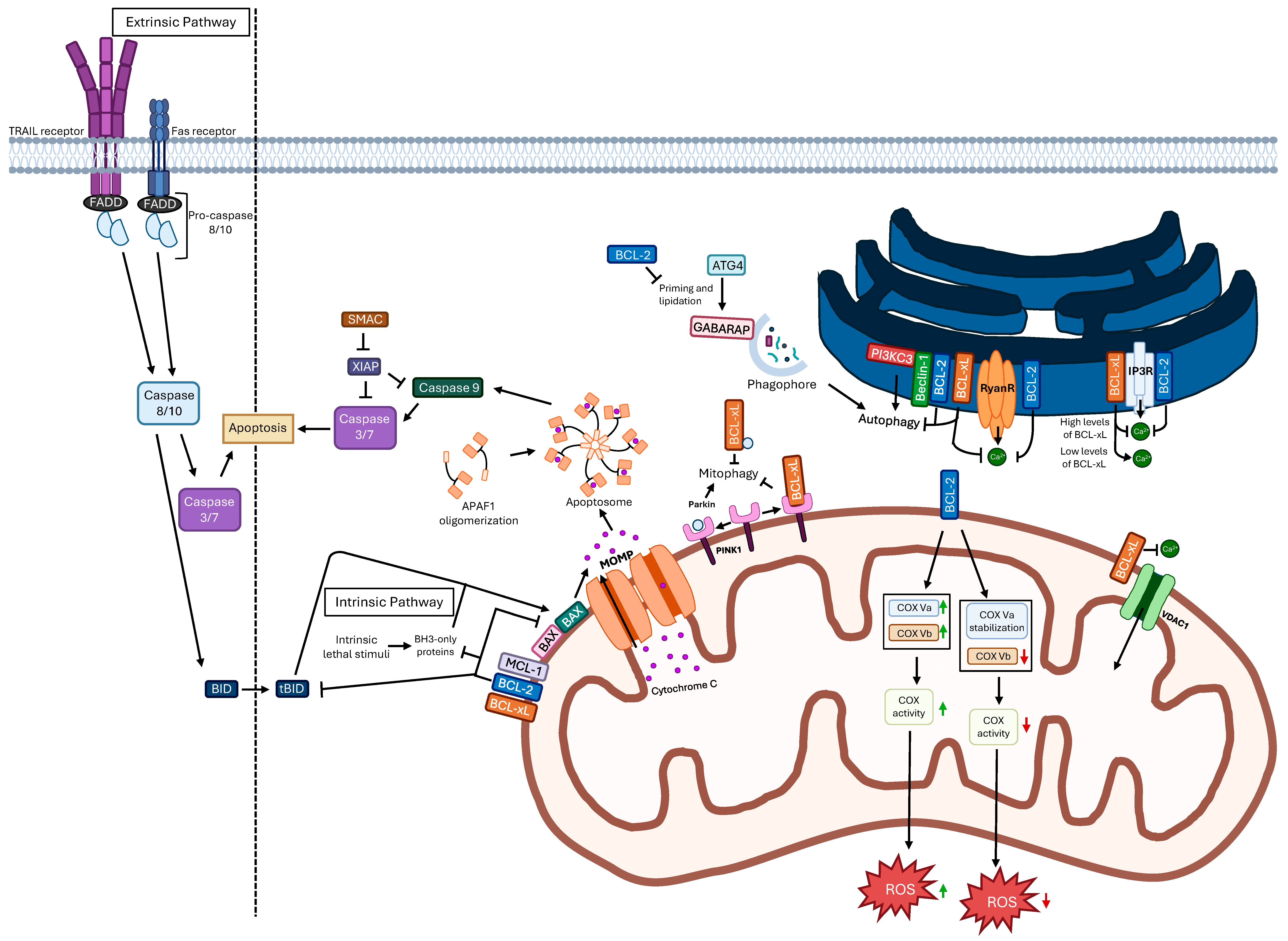


| Organ | Cancer Type | mRNA Expression | Protein Expression |
|---|---|---|---|
| Bladder | Bladder urothelial carcinoma | Downregulated | No data |
| Brain and CNS | Glioblastoma multiforme | - | - |
| Breast | Breast cancer | No data | Downregulated |
| Breast invasive carcinoma | Downregulated | No data | |
| Cervix | Cervical squamous cell carcinoma | Downregulated | No data |
| Colon | Colon adenocarcinoma | Downregulated | No data |
| Endometrium | Uterine corpus endometrial carcinoma | Downregulated | - |
| Esophagus | Esophageal carcinoma | - | No data |
| Head and neck | Head and neck squamous cell carcinoma | - | - |
| Kidney | Clear cell renal cell carcinoma | Upregulated | - |
| Kidney chromophobe | Upregulated | No data | |
| Renal papillary cell carcinoma | Upregulated | No data | |
| Liver | Hepatocellular carcinoma | Upregulated | Downregulated |
| Lung | Lung adenocarcinoma | - | No data |
| Lung squamous cell carcinoma | Downregulated | - | |
| Pancreas | Pancreatic adenocarcinoma | - | No data |
| Prostate | Prostate adenocarcinoma | Downregulated | No data |
| Rectum | Rectum adenocarcinoma | Downregulated | No data |
| Stomach | Stomach adenocarcinoma | Downregulated | No data |
| Thymus | Thymoma | - | No data |
| Thyroid | Thyroid carcinoma | Downregulated | No data |
| Other | Cholangiocarcinoma | Upregulated | No data |
| Pheochromocytoma and paraganglioma | - | No data | |
| Sarcoma | - | No data |
| Organ | Cancer Type | mRNA Expression | Protein Expression |
|---|---|---|---|
| Bladder | Bladder urothelial carcinoma | Upregulated | No data |
| Brain and CNS | Glioblastoma multiforme | - | - |
| Breast | Breast cancer | No data | - |
| Breast invasive carcinoma | Upregulated | No data | |
| Cervix | Cervical squamous cell carcinoma | Upregulated | No data |
| Colon | Colon adenocarcinoma | Upregulated | Upregulated |
| Endometrium | Uterine corpus endometrial carcinoma | Upregulated | Upregulated |
| Esophagus | Esophageal carcinoma | Upregulated | No data |
| Head and neck | Head and neck squamous cell carcinoma | Upregulated | Downregulated |
| Kidney | Clear cell renal cell carcinoma | - | Downregulated |
| Kidney chromophobe | Upregulated | No data | |
| Renal papillary cell carcinoma | Upregulated | No data | |
| Liver | Hepatocellular carcinoma | Upregulated | - |
| Lung | Lung adenocarcinoma | - | Upregulated |
| Lung squamous cell carcinoma | Downregulated | Downregulated | |
| Ovaries | Ovarian cancer | No data | Upregulated |
| Pancreas | Pancreatic adenocarcinoma | - | Upregulated |
| Prostate | Prostate adenocarcinoma | Upregulated | No data |
| Rectum | Rectum adenocarcinoma | Upregulated | No data |
| Stomach | Stomach adenocarcinoma | Upregulated | No data |
| Thymus | Thymoma | - | No data |
| Thyroid | Thyroid carcinoma | Upregulated | No data |
| Other | Cholangiocarcinoma | Upregulated | No data |
| Pheochromocytoma and paraganglioma | - | No data | |
| Sarcoma | - | No data |
Disclaimer/Publisher’s Note: The statements, opinions and data contained in all publications are solely those of the individual author(s) and contributor(s) and not of MDPI and/or the editor(s). MDPI and/or the editor(s) disclaim responsibility for any injury to people or property resulting from any ideas, methods, instructions or products referred to in the content. |
© 2026 by the authors. Licensee MDPI, Basel, Switzerland. This article is an open access article distributed under the terms and conditions of the Creative Commons Attribution (CC BY) license.
Share and Cite
Silva, J.P.N.; Pinto, B.; Silva, P.M.A.; Bousbaa, H. BCL-2 and BCL-xL in Cancer: Regulation, Function, and Therapeutic Targeting. Int. J. Mol. Sci. 2026, 27, 1123. https://doi.org/10.3390/ijms27021123
Silva JPN, Pinto B, Silva PMA, Bousbaa H. BCL-2 and BCL-xL in Cancer: Regulation, Function, and Therapeutic Targeting. International Journal of Molecular Sciences. 2026; 27(2):1123. https://doi.org/10.3390/ijms27021123
Chicago/Turabian StyleSilva, João P. N., Bárbara Pinto, Patrícia M. A. Silva, and Hassan Bousbaa. 2026. "BCL-2 and BCL-xL in Cancer: Regulation, Function, and Therapeutic Targeting" International Journal of Molecular Sciences 27, no. 2: 1123. https://doi.org/10.3390/ijms27021123
APA StyleSilva, J. P. N., Pinto, B., Silva, P. M. A., & Bousbaa, H. (2026). BCL-2 and BCL-xL in Cancer: Regulation, Function, and Therapeutic Targeting. International Journal of Molecular Sciences, 27(2), 1123. https://doi.org/10.3390/ijms27021123