Beyond the Genome: Can Epigenetics Forecast Therapeutic Success in Graves’ Disease and Thyroid Eye Disease?

 ,
,  , , , ,
  and
and 
Abstract
1. Introduction
2. Methodology
3. DNA Methylation and Histones
3.1. DNA Methylation and GD Relapse
3.2. DNA Methylation and Histone Modifications in TED
4. MicroRNAs: Potential Biomarkers and Modulators
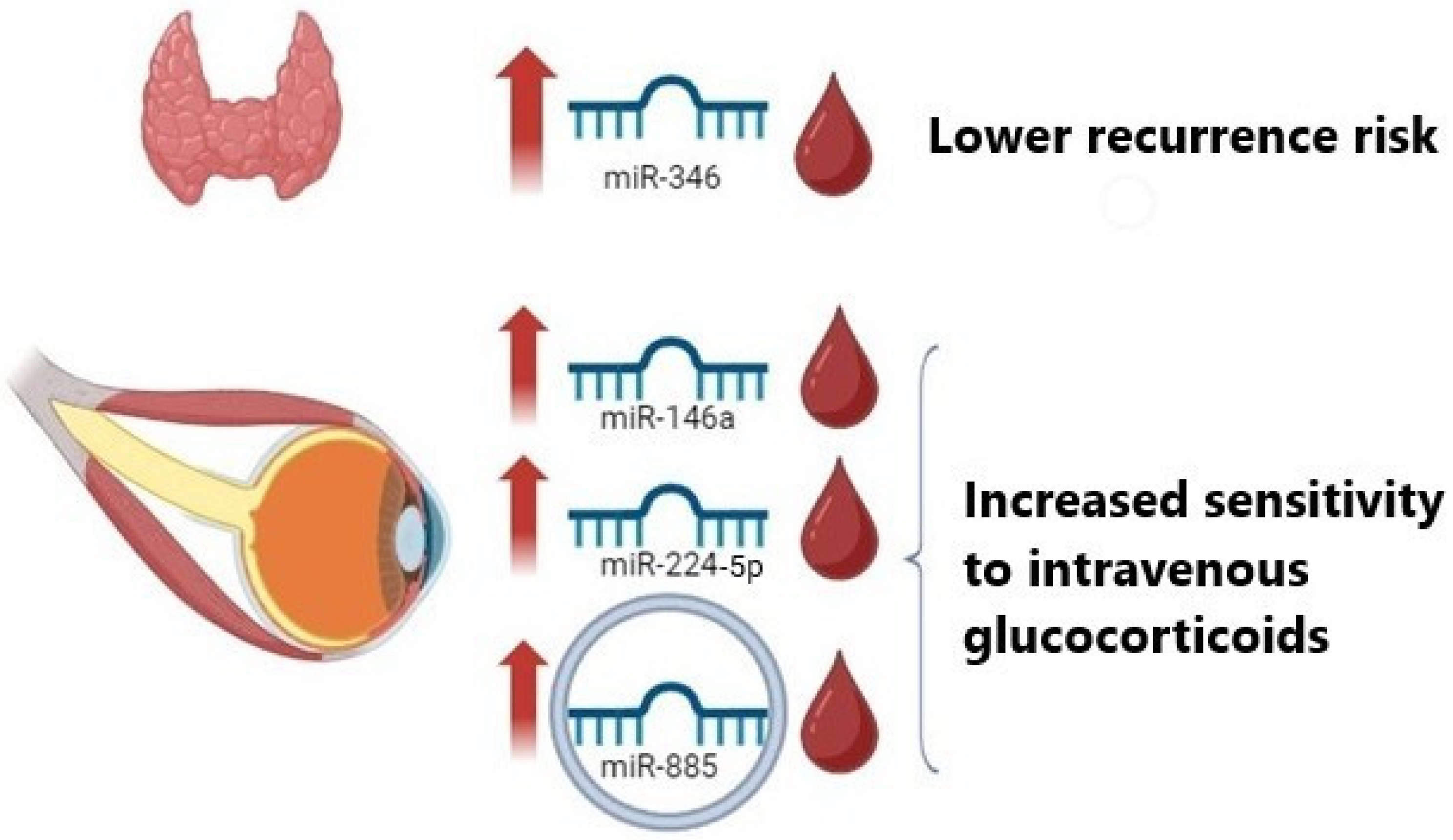
4.1. Predicting ATD Response in GD
4.2. Predicting Glucocorticoid Response in TED
4.2.1. MiRNAs Involved in the Response to Glucocorticoid
4.2.2. MiRNAs Involved Primarily in TED Pathogenesis
5. Discussion and Future Perspectives
6. Conclusions
Author Contributions
Funding
Institutional Review Board Statement
Informed Consent Statement
Data Availability Statement
Conflicts of Interest
Abbreviations
| ATD | Antithyroid Drug |
| CAS | Clinical Activity Score |
| C/EBP | CCAAT-Enhancer-Binding Protein |
| CpG | Cytosine-phosphate-Guanine |
| DNA | Deoxyribonucleic Acid |
| EUGOGO | European Group on Graves’ Orbitopathy |
| FT4 | Free Thyroxine |
| GD | Graves’ Disease |
| ICAM-1 | Intercellular Adhesion Molecule 1 |
| IL | Interleukin |
| ITK | Interleukin-2-Inducible T-cell Kinase |
| IVGCs | Intravenous Glucocorticoids |
| miRNA | microRNA |
| NF-κB | Nuclear Factor kappa-light-chain-enhancer of activated B cells |
| PPARγ | Peroxisome Proliferator-Activated Receptor gamma |
| PPV | Positive Predictive Value |
| PTX3 | Pentraxin-3 |
| TED | Thyroid Eye Disease |
| Th17 | T helper 17 cells |
| TRAb | TSH Receptor Antibodies |
| TSH | Thyroid Stimulating Hormone |
| UTR | Untranslated Region |
References
- Peschansky, V.J.; Wahlestedt, C. Non-coding RNAs as direct and indirect modulators of epigenetic regulation. Epigenetics 2014, 9, 3–12. [Google Scholar] [CrossRef] [PubMed]
- Valinezhad Orang, A.; Safaralizadeh, R.; Kazemzadeh-Bavili, M. Mechanisms of miRNA-Mediated Gene Regulation from Common Downregulation to mRNA-Specific Upregulation. Int. J. Genom. 2014, 2014, 970607. [Google Scholar] [CrossRef]
- Inui, M.; Martello, G.; Piccolo, S. MicroRNA control of signal transduction. Nat. Rev. Mol. Cell Biol. 2010, 11, 252–263. [Google Scholar] [CrossRef]
- Smith, T.J.; Hegedüs, L. Graves’ Disease. N. Engl. J. Med. 2016, 375, 1552–1565. [Google Scholar] [CrossRef]
- Davies, T.F.; Andersen, S.; Latif, R.; Nagayama, Y.; Barbesino, G.; Brito, M.; Eckstein, A.K.; Stagnaro-Green, A.; Kahaly, G.J. Graves’ disease. Nat. Rev. Dis. Primers 2020, 6, 52. [Google Scholar] [CrossRef]
- Bartalena, L.; Kahaly, G.J.; Baldeschi, L.; Dayan, C.M.; Eckstein, A.; Marcocci, C.; Marino, M.; Vaidya, B.; Wiersinga, W.M.; Dagger, E. The 2021 European Group on Graves’ orbitopathy (EUGOGO) clinical practice guidelines for the medical management of Graves’ orbitopathy. Eur. J. Endocrinol. 2021, 185, G43–G67. [Google Scholar] [CrossRef]
- Taylor, P.N.; Zhang, L.; Lee, R.W.J.; Muller, I.; Ezra, D.G.; Dayan, C.M.; Kahaly, G.J.; Ludgate, M. New insights into the pathogenesis and nonsurgical management of Graves orbitopathy. Nat. Rev. Endocrinol. 2020, 16, 104–116. [Google Scholar] [CrossRef]
- Xia, N.; Zhou, S.; Liang, Y.; Xiao, C.; Shen, H.; Pan, H.; Deng, H.; Wang, N.; Li, Q.Q. CD4+ T cells and the Th1/Th2 imbalance are implicated in the pathogenesis of Graves’ ophthalmopathy. Int. J. Mol. Med. 2006, 17, 911–916. [Google Scholar] [CrossRef]
- Ponto, K.A.; Merkesdal, S.; Hommel, G.; Pitz, S.; Pfeiffer, N.; Kahaly, G.J. Public health relevance of Graves’ orbitopathy. J. Clin. Endocrinol. Metab. 2013, 98, 145–152. [Google Scholar] [CrossRef] [PubMed]
- Azizi, F.; Mehran, L.; Abdi, H.; Amouzegar, A. Approach to the Patient Considering Long-term Antithyroid Drug Therapy for Graves’ Disease. J. Clin. Endocrinol. Metab. 2024, 109, e1881–e1888. [Google Scholar] [CrossRef] [PubMed]
- Kahaly, G.J.; Bartalena, L.; Hegedus, L.; Leenhardt, L.; Poppe, K.; Pearce, S.H. 2018 European Thyroid Association Guideline for the Management of Graves’ Hyperthyroidism. Eur. Thyroid J. 2018, 7, 167–186. [Google Scholar] [CrossRef]
- Baczewska, N.; Alexopoulou, O.; Constantinescu, S.M.; Daumerie, C.; Coutel, M.; Boschi, A.; Burlacu, M.C. Factors Associated with Response to Intravenous Glucocorticoids in Active Moderate-to-Severe Thyroid Eye Disease. Thyroid 2025, 35, 424–432. [Google Scholar] [CrossRef] [PubMed]
- Jiang, Y.; Mu, K.; Huang, Z.; Zhang, X.; Wang, Y.; Xu, W.; Song, R.; Zhang, J. Th17-associated cytokine gene hypomethylation reflects epigenetic dysregulation in graves’ disease. Front. Immunol. 2025, 16, 1635883. [Google Scholar] [CrossRef] [PubMed]
- Struja, T.; Fehlberg, H.; Kutz, A.; Guebelin, L.; Degen, C.; Mueller, B.; Schuetz, P. Can we predict relapse in Graves’ disease? Results from a systematic review and meta-analysis. Eur. J. Endocrinol. 2017, 176, 87–97. [Google Scholar] [CrossRef]
- Limbach, M.; Saare, M.; Tserel, L.; Kisand, K.; Eglit, T.; Sauer, S.; Axelsson, T.; Syvänen, A.C.; Metspalu, A.; Milani, L.; et al. Epigenetic profiling in CD4+ and CD8+ T cells from Graves’ disease patients reveals changes in genes associated with T cell receptor signaling. J. Autoimmun. 2016, 67, 46–56. [Google Scholar] [CrossRef]
- Lane, L.C.; Cheetham, T.D.; Perros, P.; Pearce, S.H.S. New Therapeutic Horizons for Graves’ Hyperthyroidism. Endocr. Rev. 2020, 41, 873–884. [Google Scholar] [CrossRef] [PubMed]
- Marino, M.; Rotondo Dottore, G.; Menconi, F.; Comi, S.; Cosentino, G.; Rocchi, R.; Latrofa, F.; Figus, M.; Santini, F. Role of genetics and epigenetics in Graves’ orbitopathy. Eur. Thyroid J. 2024, 13, e240179. [Google Scholar] [CrossRef]
- Wang, B.; Shao, X.; Song, R.; Xu, D.; Zhang, J.A. The Emerging Role of Epigenetics in Autoimmune Thyroid Diseases. Front. Immunol. 2017, 8, 396. [Google Scholar] [CrossRef]
- Li, J.; Cai, Y.; Sun, X.; Yao, D.; Xia, J. MiR-346 and TRAb as Predicative Factors for Relapse in Graves’ Disease Within One Year. Horm. Metab. Res. 2017, 49, 180–184. [Google Scholar] [CrossRef]
- Hiratsuka, I.; Yamada, H.; Munetsuna, E.; Hashimoto, S.; Itoh, M. Circulating MicroRNAs in Graves’ Disease in Relation to Clinical Activity. Thyroid 2016, 26, 1431–1440. [Google Scholar] [CrossRef]
- El Kawkgi, O.; Toro-Tobon, D.; Toloza, F.J.K.; Vallejo, S.; Jacome, C.S.; Ayala, I.N.; Vallejo, B.A.; Wenczenovicz, C.; Tzeng, O.; Spencer, H.J.; et al. A Predictive Model for Graves’ Disease Recurrence After Antithyroid Drug Therapy: A Retrospective Multicenter Cohort Study. Endocr. Pract. 2025, 31, 455–464. [Google Scholar] [CrossRef]
- Manso, J.; Censi, S.; Clausi, C.; Piva, I.; Zhu, Y.H.; Mondin, A.; Pedron, M.C.; Barollo, S.; Bertazza, L.; Midena, G.; et al. Circulating miR-146a predicts glucocorticoid response in thyroid eye disease. Eur. Thyroid. J. 2023, 12, e230083. [Google Scholar] [CrossRef]
- Sun, J.; Wei, J.; Zhang, Y.; Li, J.; Li, J.; Yan, J.; Guo, M.; Han, J.; Qiao, H. Plasma Exosomes Transfer miR-885-3p Targeting the AKT/NFκB Signaling Pathway to Improve the Sensitivity of Intravenous Glucocorticoid Therapy Against Graves Ophthalmopathy. Front. Immunol. 2022, 13, 819680. [Google Scholar] [CrossRef] [PubMed]
- Ichiyama, K.; Gonzalez-Martin, A.; Kim, B.S.; Jin, H.Y.; Jin, W.; Xu, W.; Sabouri-Ghomi, M.; Xu, S.; Zheng, P.; Xiao, C.; et al. The MicroRNA-183-96-182 Cluster Promotes T Helper 17 Cell Pathogenicity by Negatively Regulating Transcription Factor Foxo1 Expression. Immunity 2016, 44, 1284–1298. [Google Scholar] [CrossRef] [PubMed]
- Chatzikyriakidou, A.; Voulgari, P.V.; Georgiou, I.; Drosos, A.A. The role of microRNA-146a (miR-146a) and its target IL-1R-associated kinase (IRAK1) in psoriatic arthritis susceptibility. Scand. J. Immunol. 2010, 71, 382–385. [Google Scholar] [CrossRef]
- Shen, L.; Huang, F.; Ye, L.; Zhu, W.; Zhang, X.; Wang, S.; Wang, W.; Ning, G. Circulating microRNA predicts insensitivity to glucocorticoid therapy in Graves’ ophthalmopathy. Endocrine 2015, 49, 445–456. [Google Scholar] [CrossRef] [PubMed]
- Kim, N.; Choung, H.; Kim, Y.J.; Woo, S.E.; Yang, M.K.; Khwarg, S.I.; Lee, M.J. Serum microRNA as a potential biomarker for the activity of thyroid eye disease. Sci. Rep. 2023, 13, 234. [Google Scholar] [CrossRef]
- Ren, F.J.; Yao, Y.; Cai, X.Y.; Fang, G.Y. Emerging Role of MiR-192-5p in Human Diseases. Front. Pharmacol. 2021, 12, 614068. [Google Scholar] [CrossRef]
- Yu, B.; Wang, Y.; Jin, J.; Liu, J.; Huang, Y.; Wang, Y.; Zhu, C.; Li, Y.; Li, B.; Sun, J.; et al. CD34+ Orbital Fibroblasts Contribute to the Pathogenesis of Thyroid Eye Disease via miR-182-5p. J. Clin. Endocrinol. Metab. 2025, 110, 2631–2644. [Google Scholar] [CrossRef]
- Lu, Y.; Wang, Y.; Wang, Y.; Wu, Y.; Huang, Y.; Liu, X.; Zhang, S.; Zhong, S.; Li, Y.; Li, B.; et al. M1-Like Macrophages Modulate Fibrosis and Inflammation of Orbital Fibroblasts in Graves’ Orbitopathy: Potential Relevance to Soluble Interleukin-6 Receptor. Thyroid 2023, 33, 338–350. [Google Scholar] [CrossRef]
- Jang, S.Y.; Chae, M.K.; Lee, J.H.; Lee, E.J.; Yoon, J.S. MicroRNA-27 inhibits adipogenic differentiation in orbital fibroblasts from patients with Graves’ orbitopathy. PLoS ONE 2019, 14, e0221077. [Google Scholar] [CrossRef]
- Lin, Q.; Gao, Z.; Alarcon, R.M.; Ye, J.; Yun, Z. A role of miR-27 in the regulation of adipogenesis. FEBS J. 2009, 276, 2348–2358. [Google Scholar] [CrossRef]
- Zhu, Y.; Chen, Y.; Shu, X.; Wei, R. miR-101-3p suppresses proliferation of orbital fibroblasts by targeting pentraxin-3 in thyroid eye disease. PeerJ 2024, 12, e18535. [Google Scholar] [CrossRef] [PubMed]
- Zhang, H.; Wang, R.; Wang, Z.; Wu, W.; Zhang, N.; Zhang, L.; Hu, J.; Luo, P.; Zhang, J.; Liu, Z.; et al. Molecular insight into pentraxin-3: Update advances in innate immunity, inflammation, tissue remodeling, diseases, and drug role. Biomed. Pharmacother. 2022, 156, 113783. [Google Scholar] [CrossRef]
- Wang, H.; Atkins, S.J.; Fernando, R.; Wei, R.L.; Smith, T.J. Pentraxin-3 Is a TSH-Inducible Protein in Human Fibrocytes and Orbital Fibroblasts. Endocrinology 2015, 156, 4336–4344. [Google Scholar] [CrossRef]
- Li, X.; Kong, D.; Chen, H.; Liu, S.; Hu, H.; Wu, T.; Wang, J.; Chen, W.; Ning, Y.; Li, Y.; et al. miR-155 acts as an anti-inflammatory factor in atherosclerosis-associated foam cell formation by repressing calcium-regulated heat stable protein 1. Sci. Rep. 2016, 6, 21789. [Google Scholar] [CrossRef] [PubMed]
- Ma, X.; Becker Buscaglia, L.E.; Barker, J.R.; Li, Y. MicroRNAs in NF-kappaB signaling. J. Mol. Cell Biol. 2011, 3, 159–166. [Google Scholar] [CrossRef] [PubMed]
- Choi, Y.J.; Kim, C.; Choi, E.W.; Lee, S.H.; Chae, M.K.; Jun, H.O.; Kim, B.Y.; Yoon, J.S.; Jang, S.Y. MicroRNA-155 acts as an anti-inflammatory factor in orbital fibroblasts from Graves’ orbitopathy by repressing interleukin-2-inducible T-cell kinase. PLoS ONE 2022, 17, e0270416. [Google Scholar] [CrossRef]
- Lechner, K.S.; Neurath, M.F.; Weigmann, B. Role of the IL-2 inducible tyrosine kinase ITK and its inhibitors in disease pathogenesis. J. Mol. Med. 2020, 98, 1385–1395. [Google Scholar] [CrossRef]
- Viola, N.; Colleo, A.; Casula, M.; Mura, C.; Boi, F.; Lanzolla, G. Graves’ Disease: Is It Time for Targeted Therapy? A Narrative Review. Medicina 2025, 61, 500. [Google Scholar] [CrossRef]
- Song, P.; Li, B. New Generation of Clinical Epigenetics Analysis and Diagnosis for Precision Medicine. Diagnostics 2025, 15, 1539. [Google Scholar] [CrossRef] [PubMed]


| MicroRNA | Study | Year | Number of Patients | Putative Role/Key Findings | Classification |
|---|---|---|---|---|---|
| miR-146a | Manso et al. [15] | 2023 | 30 | High pre-treatment serum levels predict positive response to intravenous glucocorticoids (100% PPV). | Predictive |
| miR-224-5p | Shen et al. [16] | 2015 | 35 | Low pre-treatment serum levels are associated with insensitivity to glucocorticoid therapy. | Predictive |
| miR-885 | Sun et al. [17] | 2022 | 17 | Plasma exosomal levels are higher in responders; enhances glucocorticoid sensitivity by targeting the AKT/NF-κB pathway and upregulating the glucocorticoid receptor. | Predictive |
| miR-192-5p/miR-484 | Kim N. et al. [18] | 2023 | 15 | Significantly reduced in active TED compared to inactive TED; involved in cell proliferation, apoptosis, and inflammatory response | Pathogenic |
| miR-182-5p | Yu B. et al. [20] | 2025 | 49 | Upregulated in CD34+ orbital fibroblasts; promotes a profibrotic and proinflammatory phenotype, contributing to cellular autoimmunity. | Pathogenic |
| miR-27a/miR-27b | Jang SY et al. [22] | 2019 | 21 | Downregulated in TED orbital fibroblasts; act as inhibitors of adipogenesis by targeting PPARγ and C/EBPα-β pathways. | Pathogenic |
| miR-101-3p | Zhu Y et al. [23] | 2024 | 20 | Downregulated in TED; regulates orbital fibroblast proliferation by targeting Pentraxin-3. | Pathogenic |
| miR-155 | Choi YJ et al. [24] | 2022 | 22 | Upregulated in TED; acts as an anti-inflammatory regulator in orbital fibroblasts by repressing interleukin-2-inducible T-cell kinase. | Pathogenic |
Disclaimer/Publisher’s Note: The statements, opinions and data contained in all publications are solely those of the individual author(s) and contributor(s) and not of MDPI and/or the editor(s). MDPI and/or the editor(s) disclaim responsibility for any injury to people or property resulting from any ideas, methods, instructions or products referred to in the content. |
© 2026 by the authors. Licensee MDPI, Basel, Switzerland. This article is an open access article distributed under the terms and conditions of the Creative Commons Attribution (CC BY) license.
Share and Cite
Manso, J.; Sardone, D.; Marotta, V.; Salcuni, A.S.; Brunetti, A.; Cipri, C.; Sciannimanico, S.M.; Piva, L.; Carpentieri, M.; Falchetti, A.; et al. Beyond the Genome: Can Epigenetics Forecast Therapeutic Success in Graves’ Disease and Thyroid Eye Disease? Int. J. Mol. Sci. 2026, 27, 1116. https://doi.org/10.3390/ijms27021116
Manso J, Sardone D, Marotta V, Salcuni AS, Brunetti A, Cipri C, Sciannimanico SM, Piva L, Carpentieri M, Falchetti A, et al. Beyond the Genome: Can Epigenetics Forecast Therapeutic Success in Graves’ Disease and Thyroid Eye Disease? International Journal of Molecular Sciences. 2026; 27(2):1116. https://doi.org/10.3390/ijms27021116
Chicago/Turabian StyleManso, Jacopo, Dario Sardone, Vincenzo Marotta, Antonio Stefano Salcuni, Alessandro Brunetti, Claudia Cipri, Silvia Maria Sciannimanico, Lorenzo Piva, Maria Carpentieri, Alberto Falchetti, and et al. 2026. "Beyond the Genome: Can Epigenetics Forecast Therapeutic Success in Graves’ Disease and Thyroid Eye Disease?" International Journal of Molecular Sciences 27, no. 2: 1116. https://doi.org/10.3390/ijms27021116
APA StyleManso, J., Sardone, D., Marotta, V., Salcuni, A. S., Brunetti, A., Cipri, C., Sciannimanico, S. M., Piva, L., Carpentieri, M., Falchetti, A., & Vescini, F. (2026). Beyond the Genome: Can Epigenetics Forecast Therapeutic Success in Graves’ Disease and Thyroid Eye Disease? International Journal of Molecular Sciences, 27(2), 1116. https://doi.org/10.3390/ijms27021116