Antibody–Drug Conjugates in Hematological Malignancies: Current Landscape and Future Perspectives



Abstract
1. Introduction
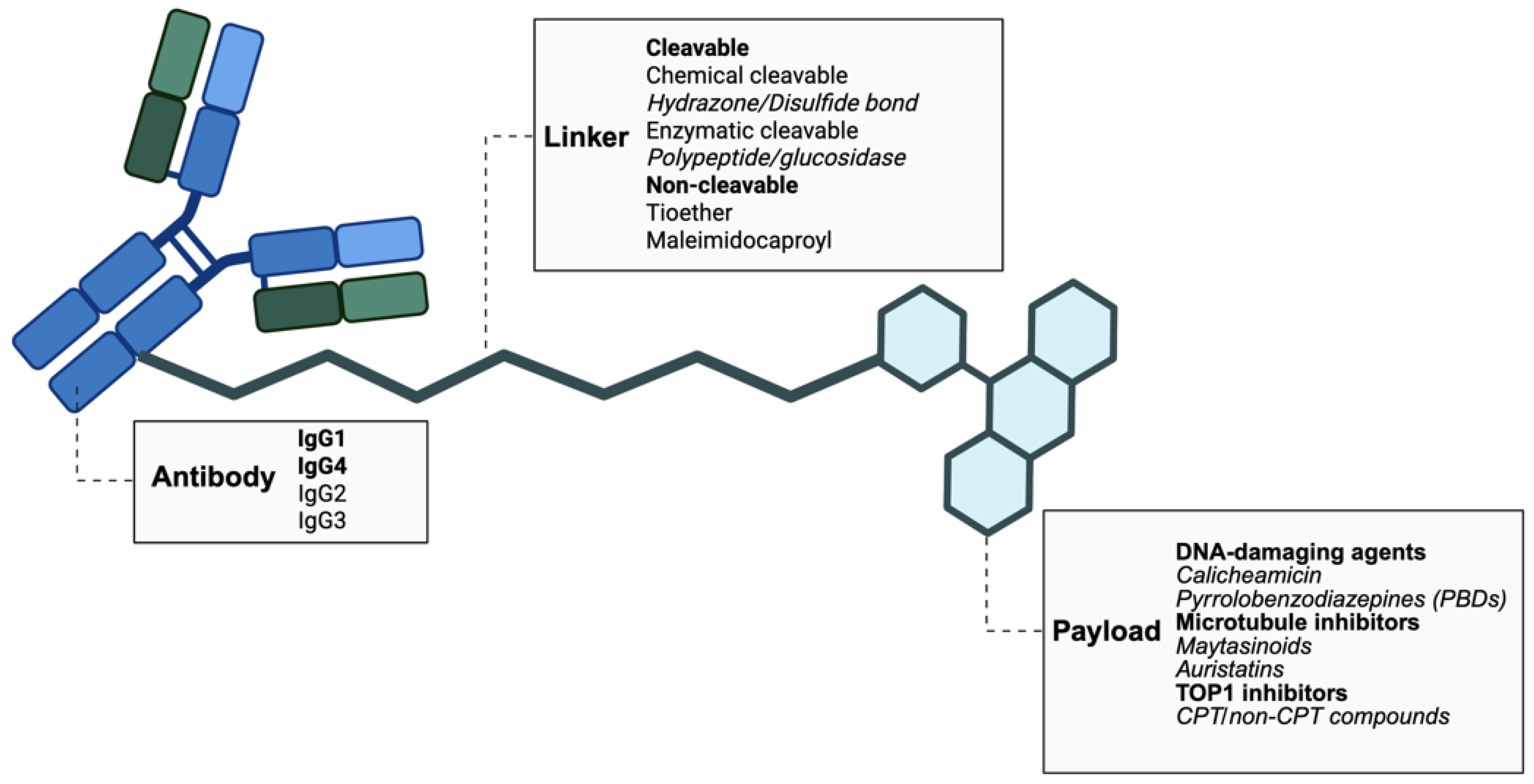
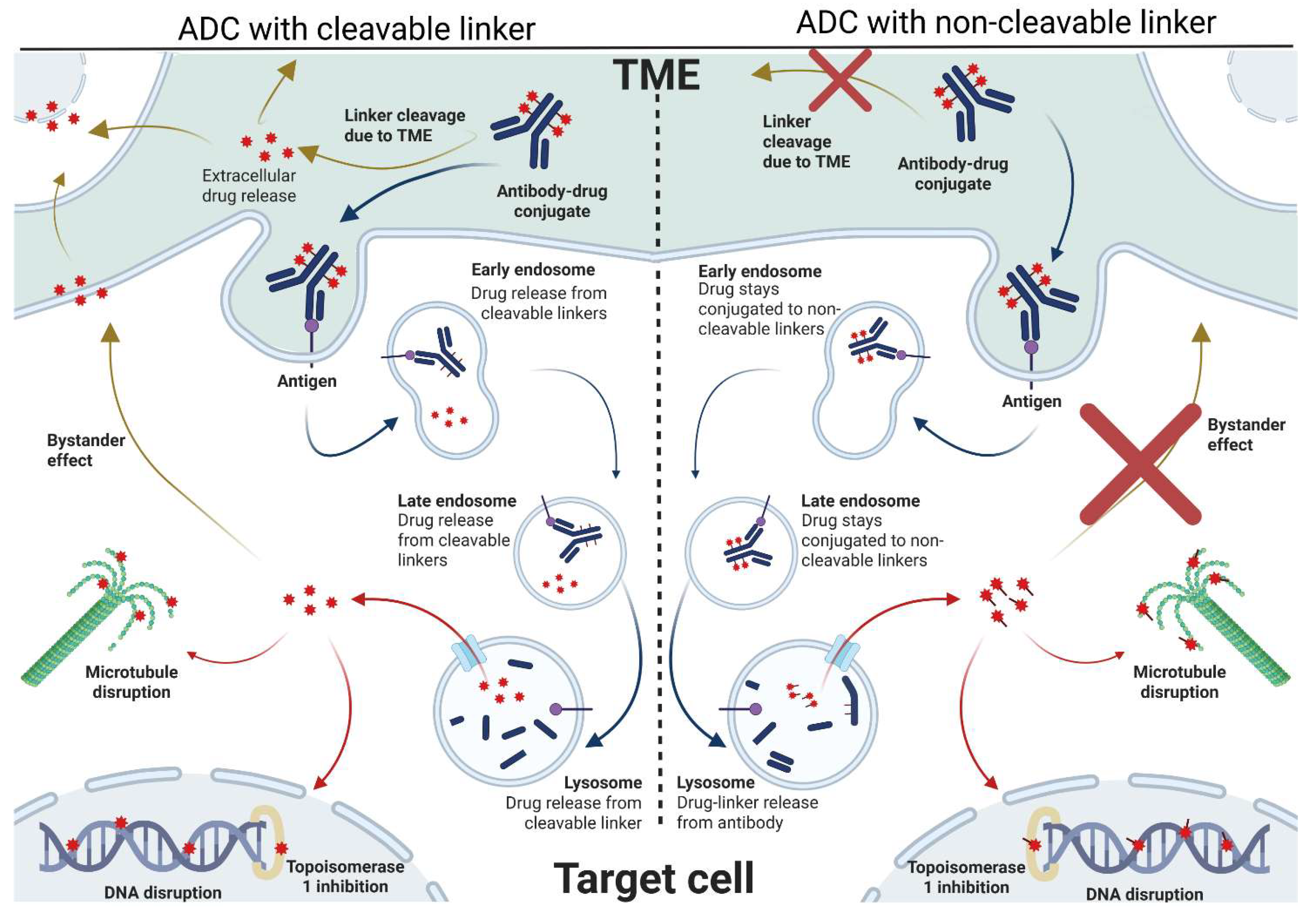
2. ADC Structure and Mechanism of Action
3. ADCs in the Landscape of Hematological Malignancies: Overview of the Approved Compounds
3.1. Gemtuzumab Ozogamicin
3.2. Brentuximab Vedotin
3.3. Inotuzumab Ozogamicin
3.4. Polatuzumab Vedotin
3.5. Loncastuximab Tesirine
3.6. Belantamab Mafodotin
4. What We Have Learned from the Clinical Trials
5. ADCs’ Current Limitations
- (i)
- Less than 1% of the total dose of intravenously administered ADCs reaches tumor cells, whereas approximately one third of the injected dose remains in circulation and up to 15% distributes to the liver, with additional uptake in the spleen, kidneys, and adipose tissue [101,102,103]. This issue is mainly relevant for those ADCs targeting antigens that are not exclusively tumor-associated antigens, thus presenting a broader expression, including normal cells [102]. Defining their toxicity mechanisms is therefore crucial to design safer and more selective compounds.
- (ii)
- Cancers are usually characterized by intra- and inter-tumoral heterogeneity. On the one side, intratumoral heterogeneity is the result of changes over time in antigen expression and density, or the presence of cells with a more aggressive phenotype. These features can determine suboptimal drug responses or the emergence of ADC-resistant clones during treatment, ultimately resulting in disease relapse. On the other hand, the same type of neoplasia can be genetically and/or molecularly different across patients, underscoring the need to optimize therapeutic strategies based on disease profiling and the implementation of patient-tailored treatments [104].
- (iii)
- The conjugated payload and linker used in ADC design, independently of the target antigen, contribute to the dose-limiting toxicity (DLT) and maximum tolerated dose (MTD). Data from clinical ADC development programs have shown that compounds sharing the same linker–payload exhibit highly similar toxicity profiles, DLTs, and MTDs, largely independent of the target antigen or its expression in normal tissues [102,105]. For instance, vc-MMAE-based ADCs consistently induce bone marrow suppression, sepsis, and peripheral neuropathy, a pattern observed across multiple clinical candidates and approved agents, such as Pola-V [28,106]. ADCs sharing the same payload may show a similar toxicity profile. Specifically, MMAE-containing ADCs are commonly associated with neutropenia and neuropathy, DM1-based ADCs with thrombocytopenia and hepatotoxicity, MMAF- or DM4-containing ADCs with ocular toxicity, and PBD dimer ADCs with bone marrow suppression, vascular leak syndrome, and hepatic and renal adverse events [105,107]. Illustrative clinical examples further highlight this principle. Trastuzumab-based ADCs armed with distinct payloads exhibit non-overlapping toxicities, with trastuzumab emtansine (DM1 payload) primarily causing thrombocytopenia and hepatotoxicity, whereas trastuzumab deruxtecan is associated with interstitial lung disease and enhanced myelosuppression [108]. Similarly, BCMA-targeted ADCs show divergent DLTs depending on the payload, with MMAF-based belantamab mafodotin characterized by ocular toxicity, while alternative warheads confer distinct systemic adverse events [93]. CD33- and CD22-targeted ADCs conjugated to calicheamicin, such as GO and InO, are consistently associated with hepatotoxicity and sinusoidal obstruction syndrome [24,109,110]. Finally, toxicity analyses stratified by ADC payload and linker type showed higher rates of grade ≥3 adverse events (meaning severe or medically significant, but not immediately life-threatening events, according to CTCAE criteria [111]) among ADCs with cleavable linkers compared to those with non-cleavable ones (7.9% vs. 2.2%, respectively) [112].
- (i)
- The downregulation of the surface target antigen during therapy, which ultimately leads to treatment refractoriness. While this phenomenon has been reported for treatment with anti-BCMA ADCs (e.g., belantamab mafodotin), it appears to be less relevant and frequent for other ADCs, including the anti-CD33 GO and the anti-CD30 BV [114,115,116].
- (ii)
- Antigen escape occurring because of genetic mutations or structural alterations of the target antigen, as described for anti-CD22 therapy with InO [114].
- (iii)
- Alteration in proteins involved in endocytic trafficking or lysosomal dysfunctions, such as changes in lysosomal pH or defects in transmembrane transport, which are critical determinants for payload release [113].
- (iv)
- Payload target or target-related protein alterations, as reported for anti-CD22 ADC InO, where mutations in key genes or pathways involved in DNA repair lead to reduced sensitivity to calicheamicin [117].
- (v)
- (vi)
- The dysregulation of apoptotic pathways, as in the case of GO therapy, where the overexpression of the anti-apoptotic proteins BCL-2 and BCL-xL has been shown to contribute to resistance [116].
6. Conclusions and Future Directions
Author Contributions
Funding
Institutional Review Board Statement
Informed Consent Statement
Data Availability Statement
Conflicts of Interest
References
- Colombo, R.; Tarantino, P.; Rich, J.R.; LoRusso, P.M.; de Vries, E.G.E. The Journey of Antibody-Drug Conjugates: Lessons Learned from 40 Years of Development. Cancer Discov. 2024, 14, 2089–2108. [Google Scholar] [CrossRef] [PubMed]
- Wang, R.; Hu, B.; Pan, Z.; Mo, C.; Zhao, X.; Liu, G.; Hou, P.; Cui, Q.; Xu, Z.; Wang, W.; et al. Antibody-Drug Conjugates (ADCs): Current and future biopharmaceuticals. J. Hematol. Oncol. 2025, 18, 51. [Google Scholar] [CrossRef] [PubMed]
- Shi, R.; Jia, L.; Lv, Z.; Cui, J. Another power of antibody-drug conjugates: Immunomodulatory effect and clinical applications. Front. Immunol. 2025, 16, 1632705. [Google Scholar] [CrossRef] [PubMed]
- Yang, C.; He, B.; Zhang, H.; Wang, X.; Zhang, Q.; Dai, W. IgG Fc Affinity Ligands and Their Applications in Antibody-Involved Drug Delivery: A Brief Review. Pharmaceutics 2023, 15, 187. [Google Scholar] [CrossRef]
- Maecker, H.; Jonnalagadda, V.; Bhakta, S.; Jammalamadaka, V.; Junutula, J.R. Exploration of the antibody-drug conjugate clinical landscape. mAbs 2023, 15, 2229101. [Google Scholar] [CrossRef]
- Bargh, J.D.; Isidro-Llobet, A.; Parker, J.S.; Spring, D.R. Cleavable linkers in antibody-drug conjugates. Chem. Soc. Rev. 2019, 48, 4361–4374. [Google Scholar] [CrossRef]
- Conilh, L.; Sadilkova, L.; Viricel, W.; Dumontet, C. Payload diversification: A key step in the development of antibody–drug conjugates. J. Hematol. Oncol. 2023, 16, 3. [Google Scholar] [CrossRef]
- Tsuchikama, K.; An, Z. Antibody-drug conjugates: Recent advances in conjugation and linker chemistries. Protein Cell 2018, 9, 33–46. [Google Scholar] [CrossRef]
- Dere, R.C.; Beardsley, R.L.; Lu, D.; Lu, T.; Ku, G.H.; Man, G.; Nguyen, V.; Kaur, S. Integrated summary of immunogenicity of polatuzumab vedotin in patients with relapsed or refractory B-cell non-Hodgkin’s lymphoma. Front. Immunol. 2023, 14, 1119510. [Google Scholar] [CrossRef]
- Dornan, D.; Bennett, F.; Chen, Y.; Dennis, M.; Eaton, D.; Elkins, K.; French, D.; Go, M.A.; Jack, A.; Junutula, J.R.; et al. Therapeutic potential of an anti-CD79b antibody-drug conjugate, anti-CD79b-vc-MMAE, for the treatment of non-Hodgkin lymphoma. Blood 2009, 114, 2721–2729. [Google Scholar] [CrossRef]
- Van de Donk, N.W.; Dhimolea, E. Brentuximab vedotin. mAbs 2012, 4, 458–465. [Google Scholar] [CrossRef]
- Bross, P.F.; Beitz, J.; Chen, G.; Chen, X.H.; Duffy, E.; Kieffer, L.; Roy, S.; Sridhara, R.; Rahman, A.; Williams, G.; et al. Approval summary: Gemtuzumab ozogamicin in relapsed acute myeloid leukemia. Clin. Cancer Res. 2001, 7, 1490–1496. [Google Scholar] [PubMed]
- Rubinstein, J.D.; O’Brien, M.M. Inotuzumab ozogamicin in B-cell precursor acute lymphoblastic leukemia: Efficacy, toxicity, and practical considerations. Front. Immunol. 2023, 14, 1237738. [Google Scholar] [CrossRef] [PubMed]
- Senter, P.D. Potent antibody drug conjugates for cancer therapy. Curr. Opin. Chem. Biol. 2009, 13, 235–244. [Google Scholar] [CrossRef] [PubMed]
- Ferron-Brady, G.; Rathi, C.; Collins, J.; Struemper, H.; Opalinska, J.; Visser, S.; Jewell, R.C. Exposure-Response Analyses for Therapeutic Dose Selection of Belantamab Mafodotin in Patients With Relapsed/Refractory Multiple Myeloma. Clin. Pharmacol. Ther. 2021, 110, 1282–1292. [Google Scholar] [CrossRef]
- Collados-Ros, A.; Muro, M.; Legaz, I. Gemtuzumab Ozogamicin in Acute Myeloid Leukemia: Efficacy, Toxicity, and Resistance Mechanisms-A Systematic Review. Biomedicines 2024, 12, 208. [Google Scholar] [CrossRef]
- Cortes, J.E.; de Lima, M.; Dombret, H.; Estey, E.H.; Giralt, S.A.; Montesinos, P.; Rollig, C.; Venditti, A.; Wang, E.S. Prevention, recognition, and management of adverse events associated with gemtuzumab ozogamicin use in acute myeloid leukemia. J. Hematol. Oncol. 2020, 13, 137. [Google Scholar] [CrossRef]
- Montesinos, P.; Kota, V.; Brandwein, J.; Bousset, P.; Benner, R.J.; Vandendries, E.; Chen, Y.; McMullin, M.F. A phase IV study evaluating QT interval, pharmacokinetics, and safety following fractionated dosing of gemtuzumab ozogamicin in patients with relapsed/refractory CD33-positive acute myeloid leukemia. Cancer Chemother. Pharmacol. 2023, 91, 441–446. [Google Scholar] [CrossRef]
- Younes, A.; Gopal, A.K.; Smith, S.E.; Ansell, S.M.; Rosenblatt, J.D.; Savage, K.J.; Ramchandren, R.; Bartlett, N.L.; Cheson, B.D.; de Vos, S.; et al. Results of a pivotal phase II study of brentuximab vedotin for patients with relapsed or refractory Hodgkin’s lymphoma. J. Clin. Oncol. 2012, 30, 2183–2189. [Google Scholar] [CrossRef]
- Prince, H.M.; Kim, Y.H.; Horwitz, S.M.; Dummer, R.; Scarisbrick, J.; Quaglino, P.; Zinzani, P.L.; Wolter, P.; Sanches, J.A.; Ortiz-Romero, P.L.; et al. Brentuximab vedotin or physician’s choice in CD30-positive cutaneous T-cell lymphoma (ALCANZA): An international, open-label, randomised, phase 3, multicentre trial. Lancet 2017, 390, 555–566. [Google Scholar] [CrossRef]
- Chen, R.; Palmer, J.M.; Martin, P.; Tsai, N.; Kim, Y.; Chen, B.T.; Popplewell, L.; Siddiqi, T.; Thomas, S.H.; Mott, M.; et al. Results of a Multicenter Phase II Trial of Brentuximab Vedotin as Second-Line Therapy before Autologous Transplantation in Relapsed/Refractory Hodgkin Lymphoma. Biol. Blood Marrow Transplant. 2015, 21, 2136–2140. [Google Scholar] [CrossRef] [PubMed]
- Forero-Torres, A.; Holkova, B.; Goldschmidt, J.; Chen, R.; Olsen, G.; Boccia, R.V.; Bordoni, R.E.; Friedberg, J.W.; Sharman, J.P.; Palanca-Wessels, M.C.; et al. Phase 2 study of frontline brentuximab vedotin monotherapy in Hodgkin lymphoma patients aged 60 years and older. Blood 2015, 126, 2798–2804. [Google Scholar] [CrossRef] [PubMed]
- DeAngelo, D.J.; Stock, W.; Stein, A.S.; Shustov, A.; Liedtke, M.; Schiffer, C.A.; Vandendries, E.; Liau, K.; Ananthakrishnan, R.; Boni, J.; et al. Inotuzumab ozogamicin in adults with relapsed or refractory CD22-positive acute lymphoblastic leukemia: A phase 1/2 study. Blood Adv. 2017, 1, 1167–1180. [Google Scholar] [CrossRef] [PubMed]
- Kantarjian, H.M.; DeAngelo, D.J.; Advani, A.S.; Stelljes, M.; Kebriaei, P.; Cassaday, R.D.; Merchant, A.A.; Fujishima, N.; Uchida, T.; Calbacho, M.; et al. Hepatic adverse event profile of inotuzumab ozogamicin in adult patients with relapsed or refractory acute lymphoblastic leukaemia: Results from the open-label, randomised, phase 3 INO-VATE study. Lancet Haematol. 2017, 4, e387–e398. [Google Scholar] [CrossRef]
- Kantarjian, H.M.; DeAngelo, D.J.; Stelljes, M.; Martinelli, G.; Liedtke, M.; Stock, W.; Gokbuget, N.; O’Brien, S.; Wang, K.; Wang, T.; et al. Inotuzumab Ozogamicin versus Standard Therapy for Acute Lymphoblastic Leukemia. N. Engl. J. Med. 2016, 375, 740–753. [Google Scholar] [CrossRef]
- Wynne, J.; Wright, D.; Stock, W. Inotuzumab: From preclinical development to success in B-cell acute lymphoblastic leukemia. Blood Adv. 2019, 3, 96–104. [Google Scholar] [CrossRef]
- Deeks, E.D. Polatuzumab Vedotin: First Global Approval. Drugs 2019, 79, 1467–1475, Correction in Drugs 2019, 79, 1829. https://doi.org/10.1007/s40265-019-01214-w. [Google Scholar] [CrossRef]
- Palanca-Wessels, M.C.; Czuczman, M.; Salles, G.; Assouline, S.; Sehn, L.H.; Flinn, I.; Patel, M.R.; Sangha, R.; Hagenbeek, A.; Advani, R.; et al. Safety and activity of the anti-CD79B antibody-drug conjugate polatuzumab vedotin in relapsed or refractory B-cell non-Hodgkin lymphoma and chronic lymphocytic leukaemia: A phase 1 study. Lancet Oncol. 2015, 16, 704–715. [Google Scholar] [CrossRef]
- Tilly, H.; Morschhauser, F.; Bartlett, N.L.; Mehta, A.; Salles, G.; Haioun, C.; Munoz, J.; Chen, A.I.; Kolibaba, K.; Lu, D.; et al. Polatuzumab vedotin in combination with immunochemotherapy in patients with previously untreated diffuse large B-cell lymphoma: An open-label, non-randomised, phase 1b-2 study. Lancet Oncol. 2019, 20, 998–1010. [Google Scholar] [CrossRef]
- Kahl, B.S.; Hamadani, M.; Radford, J.; Carlo-Stella, C.; Caimi, P.; Reid, E.; Feingold, J.M.; Ardeshna, K.M.; Solh, M.; Heffner, L.T.; et al. A Phase I Study of ADCT-402 (Loncastuximab Tesirine), a Novel Pyrrolobenzodiazepine-Based Antibody-Drug Conjugate, in Relapsed/Refractory B-Cell Non-Hodgkin Lymphoma. Clin. Cancer Res. 2019, 25, 6986–6994. [Google Scholar] [CrossRef]
- Hamadani, M.; Radford, J.; Carlo-Stella, C.; Caimi, P.F.; Reid, E.; O’Connor, O.A.; Feingold, J.M.; Ardeshna, K.M.; Townsend, W.; Solh, M.; et al. Final results of a phase 1 study of loncastuximab tesirine in relapsed/refractory B-cell non-Hodgkin lymphoma. Blood 2021, 137, 2634–2645. [Google Scholar] [CrossRef]
- Caimi, P.F.; Ai, W.Z.; Alderuccio, J.P.; Ardeshna, K.M.; Hamadani, M.; Hess, B.; Kahl, B.S.; Radford, J.; Solh, M.; Stathis, A.; et al. Loncastuximab tesirine in relapsed/refractory diffuse large B-cell lymphoma: Long-term efficacy and safety from the phase II LOTIS-2 study. Haematologica 2024, 109, 1184–1193. [Google Scholar] [CrossRef]
- Lu, R.; Morphey, A.; Diaz, F.; Chen, J.; Razmandi, A.; Richards, T. Management of Ocular Toxicity in Patients Receiving Belantamab Mafodotin. J. Adv. Pract. Oncol. 2023, 14, 300–306. [Google Scholar] [CrossRef] [PubMed]
- Ricart, A.D. Antibody-Drug Conjugates of Calicheamicin Derivative: Gemtuzumab Ozogamicin and Inotuzumab Ozogamicin. Clin. Cancer Res. 2011, 17, 6417–6427. [Google Scholar] [CrossRef] [PubMed]
- Lee, A. Loncastuximab Tesirine: First Approval. Drugs 2021, 81, 1229–1233. [Google Scholar] [CrossRef] [PubMed]
- Petersdorf, S.H.; Kopecky, K.J.; Slovak, M.; Willman, C.; Nevill, T.; Brandwein, J.; Larson, R.A.; Erba, H.P.; Stiff, P.J.; Stuart, R.K.; et al. A phase 3 study of gemtuzumab ozogamicin during induction and postconsolidation therapy in younger patients with acute myeloid leukemia. Blood 2013, 121, 4854–4860. [Google Scholar] [CrossRef]
- Amadori, S.; Suciu, S.; Stasi, R.; Salih, H.R.; Selleslag, D.; Muus, P.; De Fabritiis, P.; Venditti, A.; Ho, A.D.; Lubbert, M.; et al. Sequential combination of gemtuzumab ozogamicin and standard chemotherapy in older patients with newly diagnosed acute myeloid leukemia: Results of a randomized phase III trial by the EORTC and GIMEMA consortium (AML-17). J. Clin. Oncol. 2013, 31, 4424–4430. [Google Scholar] [CrossRef]
- Burnett, A.K.; Hills, R.K.; Milligan, D.; Kjeldsen, L.; Kell, J.; Russell, N.H.; Yin, J.A.; Hunter, A.; Goldstone, A.H.; Wheatley, K. Identification of patients with acute myeloblastic leukemia who benefit from the addition of gemtuzumab ozogamicin: Results of the MRC AML15 trial. J. Clin. Oncol. 2011, 29, 369–377. [Google Scholar] [CrossRef]
- Burnett, A.K.; Russell, N.H.; Hills, R.K.; Kell, J.; Freeman, S.; Kjeldsen, L.; Hunter, A.E.; Yin, J.; Craddock, C.F.; Dufva, I.H.; et al. Addition of gemtuzumab ozogamicin to induction chemotherapy improves survival in older patients with acute myeloid leukemia. J. Clin. Oncol. 2012, 30, 3924–3931. [Google Scholar] [CrossRef]
- Borthakur, G.; Cortes, J.E.; Estey, E.E.; Jabbour, E.; Faderl, S.; O’Brien, S.; Garcia-Manero, G.; Kadia, T.M.; Wang, X.; Patel, K.; et al. Gemtuzumab ozogamicin with fludarabine, cytarabine, and granulocyte colony stimulating factor (FLAG-GO) as front-line regimen in patients with core binding factor acute myelogenous leukemia. Am. J. Hematol. 2014, 89, 964–968. [Google Scholar] [CrossRef]
- Lambert, J.; Pautas, C.; Terre, C.; Raffoux, E.; Turlure, P.; Caillot, D.; Legrand, O.; Thomas, X.; Gardin, C.; Gogat-Marchant, K.; et al. Gemtuzumab ozogamicin for de novo acute myeloid leukemia: Final efficacy and safety updates from the open-label, phase III ALFA-0701 trial. Haematologica 2019, 104, 113–119. [Google Scholar] [CrossRef] [PubMed]
- Hills, R.K.; Castaigne, S.; Appelbaum, F.R.; Delaunay, J.; Petersdorf, S.; Othus, M.; Estey, E.H.; Dombret, H.; Chevret, S.; Ifrah, N.; et al. Addition of gemtuzumab ozogamicin to induction chemotherapy in adult patients with acute myeloid leukaemia: A meta-analysis of individual patient data from randomised controlled trials. Lancet Oncol. 2014, 15, 986–996. [Google Scholar] [CrossRef] [PubMed]
- Norsworthy, K.J.; Ko, C.W.; Lee, J.E.; Liu, J.; John, C.S.; Przepiorka, D.; Farrell, A.T.; Pazdur, R. FDA Approval Summary: Mylotarg for Treatment of Patients with Relapsed or Refractory CD33-Positive Acute Myeloid Leukemia. Oncologist 2018, 23, 1103–1108. [Google Scholar] [CrossRef] [PubMed]
- Jen, E.Y.; Ko, C.W.; Lee, J.E.; Del Valle, P.L.; Aydanian, A.; Jewell, C.; Norsworthy, K.J.; Przepiorka, D.; Nie, L.; Liu, J.; et al. FDA Approval: Gemtuzumab Ozogamicin for the Treatment of Adults with Newly Diagnosed CD33-Positive Acute Myeloid Leukemia. Clin. Cancer Res. 2018, 24, 3242–3246. [Google Scholar] [CrossRef]
- Ali, S.; Dunmore, H.M.; Karres, D.; Hay, J.L.; Salmonsson, T.; Gisselbrecht, C.; Sarac, S.B.; Bjerrum, O.W.; Hovgaard, D.; Barbachano, Y.; et al. The EMA Review of Mylotarg (Gemtuzumab Ozogamicin) for the Treatment of Acute Myeloid Leukemia. Oncologist 2019, 24, e171–e179. [Google Scholar] [CrossRef]
- Dohner, H.; Wei, A.H.; Appelbaum, F.R.; Craddock, C.; DiNardo, C.D.; Dombret, H.; Ebert, B.L.; Fenaux, P.; Godley, L.A.; Hasserjian, R.P.; et al. Diagnosis and management of AML in adults: 2022 recommendations from an international expert panel on behalf of the ELN. Blood 2022, 140, 1345–1377. [Google Scholar] [CrossRef]
- Bradley, A.M.; Devine, M.; DeRemer, D. Brentuximab vedotin: An anti-CD30 antibody-drug conjugate. Am. J. Health Syst. Pharm. 2013, 70, 589–597. [Google Scholar] [CrossRef]
- Foyil, K.V.; Bartlett, N.L. Anti-CD30 Antibodies for Hodgkin lymphoma. Curr. Hematol. Malig. Rep. 2010, 5, 140–147. [Google Scholar] [CrossRef]
- Prince, H.M.; Hutchings, M.; Domingo-Domenech, E.; Eichenauer, D.A.; Advani, R. Anti-CD30 antibody-drug conjugate therapy in lymphoma: Current knowledge, remaining controversies, and future perspectives. Ann. Hematol. 2023, 102, 13–29. [Google Scholar] [CrossRef]
- Ansell, S.M.; Radford, J.; Connors, J.M.; Dlugosz-Danecka, M.; Kim, W.S.; Gallamini, A.; Ramchandren, R.; Friedberg, J.W.; Advani, R.; Hutchings, M.; et al. Overall Survival with Brentuximab Vedotin in Stage III or IV Hodgkin’s Lymphoma. N. Engl. J. Med. 2022, 387, 310–320. [Google Scholar] [CrossRef]
- Borchmann, P.; Ferdinandus, J.; Schneider, G.; Moccia, A.; Greil, R.; Hertzberg, M.; Schaub, V.; Huttmann, A.; Keil, F.; Dierlamm, J.; et al. Assessing the efficacy and tolerability of PET-guided BrECADD versus eBEACOPP in advanced-stage, classical Hodgkin lymphoma (HD21): A randomised, multicentre, parallel, open-label, phase 3 trial. Lancet 2024, 404, 341–352, Correction in Lancet 2024, 404, 2164. [Google Scholar] [CrossRef]
- Castellino, S.M.; Pei, Q.; Parsons, S.K.; Hodgson, D.; McCarten, K.; Horton, T.; Cho, S.; Wu, Y.; Punnett, A.; Dave, H.; et al. Brentuximab Vedotin with Chemotherapy in Pediatric High-Risk Hodgkin’s Lymphoma. N. Engl. J. Med. 2022, 387, 1649–1660. [Google Scholar] [CrossRef] [PubMed]
- Evens, A.M.; Advani, R.H.; Helenowski, I.B.; Fanale, M.; Smith, S.M.; Jovanovic, B.D.; Bociek, G.R.; Klein, A.K.; Winter, J.N.; Gordon, L.I.; et al. Multicenter Phase II Study of Sequential Brentuximab Vedotin and Doxorubicin, Vinblastine, and Dacarbazine Chemotherapy for Older Patients With Untreated Classical Hodgkin Lymphoma. J. Clin. Oncol. 2018, 36, 3015–3022. [Google Scholar] [CrossRef] [PubMed]
- Younes, A.; Bartlett, N.L.; Leonard, J.P.; Kennedy, D.A.; Lynch, C.M.; Sievers, E.L.; Forero-Torres, A. Brentuximab vedotin (SGN-35) for relapsed CD30-positive lymphomas. N. Engl. J. Med. 2010, 363, 1812–1821. [Google Scholar] [CrossRef] [PubMed]
- Pro, B.; Advani, R.; Brice, P.; Bartlett, N.L.; Rosenblatt, J.D.; Illidge, T.; Matous, J.; Ramchandren, R.; Fanale, M.; Connors, J.M.; et al. Brentuximab vedotin (SGN-35) in patients with relapsed or refractory systemic anaplastic large-cell lymphoma: Results of a phase II study. J. Clin. Oncol. 2012, 30, 2190–2196. [Google Scholar] [CrossRef]
- De Claro, R.A.; McGinn, K.; Kwitkowski, V.; Bullock, J.; Khandelwal, A.; Habtemariam, B.; Ouyang, Y.; Saber, H.; Lee, K.; Koti, K.; et al. U.S. Food and Drug Administration approval summary: Brentuximab vedotin for the treatment of relapsed Hodgkin lymphoma or relapsed systemic anaplastic large-cell lymphoma. Clin. Cancer Res. 2012, 18, 5845–5849. [Google Scholar] [CrossRef]
- Moskowitz, C.H.; Nademanee, A.; Masszi, T.; Agura, E.; Holowiecki, J.; Abidi, M.H.; Chen, A.I.; Stiff, P.; Gianni, A.M.; Carella, A.; et al. Brentuximab vedotin as consolidation therapy after autologous stem-cell transplantation in patients with Hodgkin’s lymphoma at risk of relapse or progression (AETHERA): A randomised, double-blind, placebo-controlled, phase 3 trial. Lancet 2015, 385, 1853–1862, Correction in Lancet 2015, 389, 532. [Google Scholar] [CrossRef]
- Horwitz, S.; O’Connor, O.A.; Pro, B.; Trumper, L.; Iyer, S.; Advani, R.; Bartlett, N.L.; Christensen, J.H.; Morschhauser, F.; Domingo-Domenech, E.; et al. The ECHELON-2 Trial: 5-year results of a randomized, phase III study of brentuximab vedotin with chemotherapy for CD30-positive peripheral T-cell lymphoma. Ann. Oncol. 2022, 33, 288–298. [Google Scholar] [CrossRef]
- Domingo-Domenech, E.; Pro, B.; Illidge, T.; Horwitz, S.; Trumper, L.; Iyer, S.; Advani, R.; Bartlett, N.L.; Christensen, J.H.; Kim, W.S.; et al. Brentuximab vedotin plus chemotherapy for the treatment of front-line systemic anaplastic large cell lymphoma: Subgroup analysis of the ECHELON-2 study at 5 years’ follow-up. Blood Cancer J. 2025, 15, 129. [Google Scholar] [CrossRef]
- Horwitz, S.M.; Scarisbrick, J.J.; Dummer, R.; Whittaker, S.; Duvic, M.; Kim, Y.H.; Quaglino, P.; Zinzani, P.L.; Bechter, O.; Eradat, H.; et al. Randomized phase 3 ALCANZA study of brentuximab vedotin vs physician’s choice in cutaneous T-cell lymphoma: Final data. Blood Adv. 2021, 5, 5098–5106, Erratum in Blood Adv. 2024, 8, 2243. https://doi.org/10.1182/bloodadvances.2024012976. [Google Scholar] [CrossRef]
- Bartlett, N.L.; Hahn, U.; Kim, W.S.; Fleury, I.; Laribi, K.; Bergua, J.M.; Bouabdallah, K.; Forward, N.; Bijou, F.; MacDonald, D.; et al. Brentuximab Vedotin Combination for Relapsed Diffuse Large B-Cell Lymphoma. J. Clin. Oncol. 2025, 43, 1061–1072. [Google Scholar] [CrossRef] [PubMed]
- Kantarjian, H.M.; Boissel, N.; Papayannidis, C.; Luskin, M.R.; Stelljes, M.; Advani, A.S.; Jabbour, E.J.; Ribera, J.M.; Marks, D.I. Inotuzumab ozogamicin in adult acute lymphoblastic leukemia: Development, current status, and future directions. Cancer 2024, 130, 3631–3646. [Google Scholar] [CrossRef]
- Clark, E.A.; Giltiay, N.V. CD22: A Regulator of Innate and Adaptive B Cell Responses and Autoimmunity. Front. Immunol. 2018, 9, 2235. [Google Scholar] [CrossRef] [PubMed]
- Dang, N.H.; Ogura, M.; Castaigne, S.; Fayad, L.E.; Jerkeman, M.; Radford, J.; Pezzutto, A.; Bondarenko, I.; Stewart, D.A.; Shnaidman, M.; et al. Randomized, phase 3 trial of inotuzumab ozogamicin plus rituximab versus chemotherapy plus rituximab for relapsed/refractory aggressive B-cell non-Hodgkin lymphoma. Br. J. Haematol. 2018, 182, 583–586. [Google Scholar] [CrossRef] [PubMed]
- Fayad, L.; Offner, F.; Smith, M.R.; Verhoef, G.; Johnson, P.; Kaufman, J.L.; Rohatiner, A.; Advani, A.; Foran, J.; Hess, G.; et al. Safety and clinical activity of a combination therapy comprising two antibody-based targeting agents for the treatment of non-Hodgkin lymphoma: Results of a phase I/II study evaluating the immunoconjugate inotuzumab ozogamicin with rituximab. J. Clin. Oncol. 2013, 31, 573–583. [Google Scholar] [CrossRef]
- Goy, A.; Forero, A.; Wagner-Johnston, N.; Christopher Ehmann, W.; Tsai, M.; Hatake, K.; Ananthakrishnan, R.; Volkert, A.; Vandendries, E.; Ogura, M. A phase 2 study of inotuzumab ozogamicin in patients with indolent B-cell non-Hodgkin lymphoma refractory to rituximab alone, rituximab and chemotherapy, or radioimmunotherapy. Br. J. Haematol. 2016, 174, 571–581. [Google Scholar] [CrossRef]
- Dijoseph, J.F.; Dougher, M.M.; Armellino, D.C.; Evans, D.Y.; Damle, N.K. Therapeutic potential of CD22-specific antibody-targeted chemotherapy using inotuzumab ozogamicin (CMC-544) for the treatment of acute lymphoblastic leukemia. Leukemia 2007, 21, 2240–2245. [Google Scholar] [CrossRef]
- Kantarjian, H.; Thomas, D.; Jorgensen, J.; Jabbour, E.; Kebriaei, P.; Rytting, M.; York, S.; Ravandi, F.; Kwari, M.; Faderl, S.; et al. Inotuzumab ozogamicin, an anti-CD22-calecheamicin conjugate, for refractory and relapsed acute lymphocytic leukaemia: A phase 2 study. Lancet Oncol. 2012, 13, 403–411. [Google Scholar] [CrossRef]
- Kantarjian, H.M.; DeAngelo, D.J.; Stelljes, M.; Liedtke, M.; Stock, W.; Gokbuget, N.; O’Brien, S.M.; Jabbour, E.; Wang, T.; Liang White, J.; et al. Inotuzumab ozogamicin versus standard of care in relapsed or refractory acute lymphoblastic leukemia: Final report and long-term survival follow-up from the randomized, phase 3 INO-VATE study. Cancer 2019, 125, 2474–2487. [Google Scholar] [CrossRef]
- Jabbour, E.; Ravandi, F.; Kebriaei, P.; Huang, X.; Short, N.J.; Thomas, D.; Sasaki, K.; Rytting, M.; Jain, N.; Konopleva, M.; et al. Salvage Chemoimmunotherapy With Inotuzumab Ozogamicin Combined With Mini-Hyper-CVD for Patients With Relapsed or Refractory Philadelphia Chromosome-Negative Acute Lymphoblastic Leukemia: A Phase 2 Clinical Trial. JAMA Oncol. 2018, 4, 230–234. [Google Scholar] [CrossRef]
- Kantarjian, H.; Haddad, F.G.; Jain, N.; Sasaki, K.; Short, N.J.; Loghavi, S.; Kanagal-Shamanna, R.; Jorgensen, J.; Khouri, I.; Kebriaei, P.; et al. Results of salvage therapy with mini-hyper-CVD and inotuzumab ozogamicin with or without blinatumomab in pre-B acute lymphoblastic leukemia. J. Hematol. Oncol. 2023, 16, 44. [Google Scholar] [CrossRef]
- Jabbour, E.J.; Rousselot, P.; Gokbuget, N.; Chevallier, P.; Kantarjian, H.M.; Stelljes, M. Inotuzumab Ozogamicin as First-Line Therapy in Acute Lymphoblastic Leukemia. Clin. Lymphoma Myeloma Leuk. 2025, 25, e302–e309. [Google Scholar] [CrossRef] [PubMed]
- Kantarjian, H.; Ravandi, F.; Short, N.J.; Huang, X.; Jain, N.; Sasaki, K.; Daver, N.; Pemmaraju, N.; Khoury, J.D.; Jorgensen, J.; et al. Inotuzumab ozogamicin in combination with low-intensity chemotherapy for older patients with Philadelphia chromosome-negative acute lymphoblastic leukaemia: A single-arm, phase 2 study. Lancet Oncol. 2018, 19, 240–248. [Google Scholar] [CrossRef] [PubMed]
- Jabbour, E.; Short, N.J.; Senapati, J.; Jain, N.; Huang, X.; Daver, N.; DiNardo, C.D.; Pemmaraju, N.; Wierda, W.; Garcia-Manero, G.; et al. Mini-hyper-CVD plus inotuzumab ozogamicin, with or without blinatumomab, in the subgroup of older patients with newly diagnosed Philadelphia chromosome-negative B-cell acute lymphocytic leukaemia: Long-term results of an open-label phase 2 trial. Lancet Haematol. 2023, 10, e433–e444, Correction in Lancet Haematol. 2023, 10, e490. https://doi.org/10.1016/S2352-3026(23)00167-9. [Google Scholar] [CrossRef] [PubMed]
- Chevallier, P.; Leguay, T.; Delord, M.; Salek, C.; Kim, R.; Huguet, F.; Wartiovaara-Kautto, U.; Raffoux, E.; Cluzeau, T.; Balsat, M.; et al. Inotuzumab Ozogamicin and Low-Intensity Chemotherapy in Older Patients With Newly Diagnosed CD22(+) Philadelphia Chromosome-Negative B-Cell Precursor Acute Lymphoblastic Leukemia. J. Clin. Oncol. 2024, 42, 4327–4341. [Google Scholar] [CrossRef]
- Stelljes, M.; Raffel, S.; Alakel, N.; Wasch, R.; Kondakci, M.; Scholl, S.; Rank, A.; Hanel, M.; Spriewald, B.; Hanoun, M.; et al. Inotuzumab Ozogamicin as Induction Therapy for Patients Older Than 55 Years With Philadelphia Chromosome-Negative B-Precursor ALL. J. Clin. Oncol. 2024, 42, 273–282. [Google Scholar] [CrossRef]
- Jain, N.; Maiti, A.; Ravandi, F.; Konopleva, M.; Daver, N.; Kadia, T.; Pemmaraju, N.; Short, N.; Kebriaei, P.; Ning, J.; et al. Inotuzumab ozogamicin with bosutinib for relapsed or refractory Philadelphia chromosome positive acute lymphoblastic leukemia or lymphoid blast phase of chronic myeloid leukemia. Am. J. Hematol. 2021, 96, 1000–1007. [Google Scholar] [CrossRef]
- Stock, W.; Martinelli, G.; Stelljes, M.; DeAngelo, D.J.; Gokbuget, N.; Advani, A.S.; O’Brien, S.; Liedtke, M.; Merchant, A.A.; Cassaday, R.D.; et al. Efficacy of inotuzumab ozogamicin in patients with Philadelphia chromosome-positive relapsed/refractory acute lymphoblastic leukemia. Cancer 2021, 127, 905–913. [Google Scholar] [CrossRef]
- Lamb, Y.N. Inotuzumab Ozogamicin: First Global Approval. Drugs 2017, 77, 1603–1610. [Google Scholar] [CrossRef]
- Sehn, L.H.; Herrera, A.F.; Flowers, C.R.; Kamdar, M.K.; McMillan, A.; Hertzberg, M.; Assouline, S.; Kim, T.M.; Kim, W.S.; Ozcan, M.; et al. Polatuzumab Vedotin in Relapsed or Refractory Diffuse Large B-Cell Lymphoma. J. Clin. Oncol. 2020, 38, 155–165. [Google Scholar] [CrossRef]
- Morschhauser, F.; Flinn, I.W.; Advani, R.; Sehn, L.H.; Diefenbach, C.; Kolibaba, K.; Press, O.W.; Salles, G.; Tilly, H.; Chen, A.I.; et al. Polatuzumab vedotin or pinatuzumab vedotin plus rituximab in patients with relapsed or refractory non-Hodgkin lymphoma: Final results from a phase 2 randomised study (ROMULUS). Lancet Haematol. 2019, 6, e254–e265. [Google Scholar] [CrossRef]
- Pfeifer, M.; Zheng, B.; Erdmann, T.; Koeppen, H.; McCord, R.; Grau, M.; Staiger, A.; Chai, A.; Sandmann, T.; Madle, H.; et al. Anti-CD22 and anti-CD79B antibody drug conjugates are active in different molecular diffuse large B-cell lymphoma subtypes. Leukemia 2015, 29, 1578–1586. [Google Scholar] [CrossRef] [PubMed]
- Sehn, L.H.; Hertzberg, M.; Opat, S.; Herrera, A.F.; Assouline, S.; Flowers, C.R.; Kim, T.M.; McMillan, A.; Ozcan, M.; Safar, V.; et al. Polatuzumab vedotin plus bendamustine and rituximab in relapsed/refractory DLBCL: Survival update and new extension cohort data. Blood Adv. 2022, 6, 533–543. [Google Scholar] [CrossRef] [PubMed]
- Tilly, H.; Morschhauser, F.; Sehn, L.H.; Friedberg, J.W.; Trneny, M.; Sharman, J.P.; Herbaux, C.; Burke, J.M.; Matasar, M.; Rai, S.; et al. Polatuzumab Vedotin in Previously Untreated Diffuse Large B-Cell Lymphoma. N. Engl. J. Med. 2022, 386, 351–363. [Google Scholar] [CrossRef] [PubMed]
- Budde, L.E.; Olszewski, A.J.; Assouline, S.; Lossos, I.S.; Diefenbach, C.; Kamdar, M.; Ghosh, N.; Modi, D.; Sabry, W.; Naik, S.; et al. Mosunetuzumab with polatuzumab vedotin in relapsed or refractory aggressive large B cell lymphoma: A phase 1b/2 trial. Nat. Med. 2024, 30, 229–239. [Google Scholar] [CrossRef]
- Juarez-Salcedo, L.M.; Nimkar, S.; Corazon, A.M.; Dalia, S. Loncastuximab Tesirine in the Treatment of Relapsed or Refractory Diffuse Large B-Cell Lymphoma. Int. J. Mol. Sci. 2024, 25, 7580. [Google Scholar] [CrossRef]
- Li, X.; Ding, Y.; Zi, M.; Sun, L.; Zhang, W.; Chen, S.; Xu, Y. CD19, from bench to bedside. Immunol. Lett. 2017, 183, 86–95. [Google Scholar] [CrossRef]
- Caimi, P.F.; Ai, W.; Alderuccio, J.P.; Ardeshna, K.M.; Hamadani, M.; Hess, B.; Kahl, B.S.; Radford, J.; Solh, M.; Stathis, A.; et al. Loncastuximab tesirine in relapsed or refractory diffuse large B-cell lymphoma (LOTIS-2): A multicentre, open-label, single-arm, phase 2 trial. Lancet Oncol. 2021, 22, 790–800. [Google Scholar] [CrossRef]
- Hamadani, M.; Spira, A.; Zhou, X.; Liao, L.; Chen, L.; Radford, J.; Ai, W.; Solh, M.; Ardeshna, K.M.; Hess, B.; et al. Clinical outcomes of older and younger patients treated with loncastuximab tesirine in the LOTIS-2 clinical trial. Blood Adv. 2024, 8, 93–98. [Google Scholar] [CrossRef]
- Epperla, N.; Lucero, M.; Bailey, T.; Mirams, L.; Cheung, J.; Amet, M.; Milligan, G.; Chen, L. Outcomes with loncastuximab tesirine following CAR T-cell therapy in patients with relapsed or refractory diffuse large B-cell lymphoma. Blood Cancer J. 2024, 14, 210. [Google Scholar] [CrossRef]
- Alderuccio, J.P.; Alencar, A.J.; Schatz, J.H.; Kuker, R.A.; Pongas, G.; Reis, I.M.; Lekakis, L.J.; Spiegel, J.Y.; Sandoval-Sus, J.; Beitinjaneh, A.; et al. Loncastuximab tesirine with rituximab in patients with relapsed or refractory follicular lymphoma: A single-centre, single-arm, phase 2 trial. Lancet Haematol. 2025, 12, e23–e34. [Google Scholar] [CrossRef] [PubMed]
- Shah, N.; Chari, A.; Scott, E.; Mezzi, K.; Usmani, S.Z. B-cell maturation antigen (BCMA) in multiple myeloma: Rationale for targeting and current therapeutic approaches. Leukemia 2020, 34, 985–1005. [Google Scholar] [CrossRef] [PubMed]
- Mukhopadhyay, P.; Abdullah, H.A.; Opalinska, J.B.; Paka, P.; Richards, E.; Weisel, K.; Trudel, S.; Mateos, M.-V.; Dimopoulos, M.A.; Lonial, S. The clinical journey of belantamab mafodotin in relapsed or refractory multiple myeloma: Lessons in drug development. Blood Cancer J. 2025, 15, 15, Correction in Blood Cancer J. 2025, 15, 44. https://doi.org/10.1038/s41408-025-01243-7. [Google Scholar] [CrossRef] [PubMed]
- Baines, A.C.; Ershler, R.; Kanapuru, B.; Xu, Q.; Shen, G.; Li, L.; Ma, L.; Okusanya, O.O.; Simpson, N.E.; Nguyen, W.; et al. FDA Approval Summary: Belantamab Mafodotin for Patients with Relapsed or Refractory Multiple Myeloma. Clin. Cancer Res. 2022, 28, 4629–4633. [Google Scholar] [CrossRef]
- Tzogani, K.; Penttilä, K.; Lähteenvuo, J.; Lapveteläinen, T.; Lopez Anglada, L.; Prieto, C.; Garcia-Ochoa, B.; Enzmann, H.; Gisselbrecht, C.; Delgado, J.; et al. EMA Review of Belantamab Mafodotin (Blenrep) for the Treatment of Adult Patients with Relapsed/Refractory Multiple Myeloma. Oncologist 2021, 26, 70–76. [Google Scholar] [CrossRef]
- Dimopoulos, M.A.; Hungria, V.T.M.; Radinoff, A.; Delimpasi, S.; Mikala, G.; Masszi, T.; Li, J.; Capra, M.; Maiolino, A.; Pappa, V.; et al. Efficacy and safety of single-agent belantamab mafodotin versus pomalidomide plus low-dose dexamethasone in patients with relapsed or refractory multiple myeloma (DREAMM-3): A phase 3, open-label, randomised study. Lancet Haematol. 2023, 10, e801–e812. [Google Scholar] [CrossRef]
- Dimopoulos, M.A.; Beksac, M.; Pour, L.; Delimpasi, S.; Vorobyev, V.; Quach, H.; Spicka, I.; Radocha, J.; Robak, P.; Kim, K.; et al. Belantamab Mafodotin, Pomalidomide, and Dexamethasone in Multiple Myeloma. N. Engl. J. Med. 2024, 391, 408–421. [Google Scholar] [CrossRef]
- Hungria, V.; Robak, P.; Hus, M.; Zherebtsova, V.; Ward, C.; Ho, P.J.; Hájek, R.; Kim, K.; Grosicki, S.; Sia, H.; et al. Belantamab mafodotin plus bortezomib and dexamethasone in patients with relapsed or refractory multiple myeloma (DREAMM-7): Updated overall survival analysis from a global, randomised, open-label, phase 3 trial. Lancet Oncol. 2025, 26, 1067–1080, Correction in Lancet Oncol. 2025, 26, E522. https://doi.org/10.1016/S1470-2045(25)00488-7. [Google Scholar] [CrossRef]
- Song, L.; Qi, J.; Wang, Z.; Li, X.; Xiao, S.; Zhu, H.; Zhu, Y.; Wang, J. BL-M11D1, a Novel CD33 Antibody-Drug Conjugate (ADC), in Patients with Relapsed/Refractory Acute Myeloid Leukemia: Initial Results from First-in-Human Phase 1 Study. Blood 2024, 144 (Suppl. S1), 4260. [Google Scholar] [CrossRef]
- Esapa, B.; Jiang, J.; Cheung, A.; Chenoweth, A.; Thurston, D.E.; Karagiannis, S.N. Target Antigen Attributes and Their Contributions to Clinically Approved Antibody-Drug Conjugates (ADCs) in Haematopoietic and Solid Cancers. Cancers 2023, 15, 1845. [Google Scholar] [CrossRef]
- Bensch, F.; Smeenk, M.M.; van Es, S.C.; de Jong, J.R.; Schröder, C.P.; Oosting, S.F.; Lub-de Hooge, M.N.; Menke-van der Houven van Oordt, C.W.; Brouwers, A.H.; Boellaard, R.; et al. Comparative biodistribution analysis across four different (89)Zr-monoclonal antibody tracers-The first step towards an imaging warehouse. Theranostics 2018, 8, 4295–4304. [Google Scholar] [CrossRef] [PubMed]
- Nguyen, T.D.; Bordeau, B.M.; Balthasar, J.P. Mechanisms of ADC Toxicity and Strategies to Increase ADC Tolerability. Cancers 2023, 15, 713. [Google Scholar] [CrossRef] [PubMed]
- Oude Munnink, T.H.; Dijkers, E.C.; Netters, S.J.; Lub-de Hooge, M.N.; Brouwers, A.H.; Haasjes, J.G.; Schroder, C.P.; de Vries, E.G. Trastuzumab pharmacokinetics influenced by extent human epidermal growth factor receptor 2-positive tumor load. J. Clin. Oncol. 2010, 28, e355–e356. [Google Scholar] [CrossRef] [PubMed]
- Drago, J.Z.; Modi, S.; Chandarlapaty, S. Unlocking the potential of antibody-drug conjugates for cancer therapy. Nat. Rev. Clin. Oncol. 2021, 18, 327–344. [Google Scholar] [CrossRef]
- Masters, J.C.; Nickens, D.J.; Xuan, D.; Shazer, R.L.; Amantea, M. Clinical toxicity of antibody drug conjugates: A meta-analysis of payloads. Investig. New Drugs 2018, 36, 121–135. [Google Scholar] [CrossRef]
- Saber, H.; Leighton, J.K. An FDA oncology analysis of antibody-drug conjugates. Regul. Toxicol. Pharmacol. 2015, 71, 444–452. [Google Scholar] [CrossRef]
- Zhu, Y.; Liu, K.; Wang, K.; Zhu, H. Treatment-related adverse events of antibody-drug conjugates in clinical trials: A systematic review and meta-analysis. Cancer 2023, 129, 283–295. [Google Scholar] [CrossRef]
- Ma, P.; Tian, H.; Shi, Q.; Liu, R.; Zhang, Y.; Qi, X.; Chen, Y. High risks adverse events associated with trastuzumab emtansine and trastuzumab deruxtecan for the treatment of HER2-positive/mutated malignancies: A pharmacovigilance study based on the FAERS database. Expert Opin. Drug Saf. 2023, 22, 685–696. [Google Scholar] [CrossRef]
- Lee, H.C.; Raje, N.S.; Landgren, O.; Upreti, V.V.; Wang, J.; Avilion, A.A.; Hu, X.; Rasmussen, E.; Ngarmchamnanrith, G.; Fujii, H.; et al. Phase 1 study of the anti-BCMA antibody-drug conjugate AMG 224 in patients with relapsed/refractory multiple myeloma. Leukemia 2021, 35, 255–258. [Google Scholar] [CrossRef]
- Tallman, M.S.; McDonald, G.B.; DeLeve, L.D.; Baer, M.R.; Cook, M.N.; Graepel, G.J.; Kollmer, C. Incidence of sinusoidal obstruction syndrome following Mylotarg (gemtuzumab ozogamicin): A prospective observational study of 482 patients in routine clinical practice. Int. J. Hematol. 2013, 97, 456–464. [Google Scholar] [CrossRef]
- Common Terminology Criteria for Adverse Events (CTCAE) v6.0. Available online: https://dctd.cancer.gov/research/ctep-trials/for-sites/adverse-events/ctcae-v6.pdf (accessed on 10 January 2026).
- Li, J.; Shen, G.; Liu, Z.; Liu, Y.; Wang, M.; Zhao, F.; Ren, D.; Xie, Q.; Li, Z.; Liu, Z.; et al. Treatment-related adverse events of antibody-drug conjugates in clinical trials: A systematic review and meta-analysis. Cancer Innov. 2023, 2, 346–375. [Google Scholar] [CrossRef] [PubMed]
- Khoury, R.; Saleh, K.; Khalife, N.; Saleh, M.; Chahine, C.; Ibrahim, R.; Lecesne, A. Mechanisms of Resistance to Antibody-Drug Conjugates. Int. J. Mol. Sci. 2023, 24, 9674. [Google Scholar] [CrossRef] [PubMed]
- Firestone, R.S.; Socci, N.D.; Shekarkhand, T.; Zhu, M.; Qin, W.G.; Hultcrantz, M.; Mailankody, S.; Tan, C.R.; Korde, N.; Lesokhin, A.M.; et al. Antigen escape as a shared mechanism of resistance to BCMA-directed therapies in multiple myeloma. Blood 2024, 144, 402–407. [Google Scholar] [CrossRef] [PubMed]
- Chen, R.; Herrera, A.F.; Hou, J.; Chen, L.; Wu, J.; Guo, Y.; Synold, T.W.; Ngo, V.N.; Puverel, S.; Mei, M.; et al. Inhibition of MDR1 Overcomes Resistance to Brentuximab Vedotin in Hodgkin Lymphoma. Clin. Cancer Res. 2020, 26, 1034–1044. [Google Scholar] [CrossRef]
- Linenberger, M.L. CD33-directed therapy with gemtuzumab ozogamicin in acute myeloid leukemia: Progress in understanding cytotoxicity and potential mechanisms of drug resistance. Leukemia 2005, 19, 176–182. [Google Scholar] [CrossRef]
- Zhao, Y.; Short, N.J.; Kantarjian, H.M.; Chang, T.C.; Ghate, P.S.; Qu, C.; Macaron, W.; Jain, N.; Thakral, B.; Phillips, A.H.; et al. Genomic determinants of response and resistance to inotuzumab ozogamicin in B-cell ALL. Blood 2024, 144, 61–73. [Google Scholar] [CrossRef]
- Mazor, Y.; Sachsenmeier, K.F.; Yang, C.; Hansen, A.; Filderman, J.; Mulgrew, K.; Wu, H.; Dall’Acqua, W.F. Enhanced tumor-targeting selectivity by modulating bispecific antibody binding affinity and format valence. Sci. Rep. 2017, 7, 40098. [Google Scholar] [CrossRef]
- Zhao, H.; Atkinson, J.; Gulesserian, S.; Zeng, Z.; Nater, J.; Ou, J.; Yang, P.; Morrison, K.; Coleman, J.; Malik, F.; et al. Modulation of Macropinocytosis-Mediated Internalization Decreases Ocular Toxicity of Antibody-Drug Conjugates. Cancer Res. 2018, 78, 2115–2126. [Google Scholar] [CrossRef]
- Tsuchikama, K.; Anami, Y.; Ha, S.Y.Y.; Yamazaki, C.M. Exploring the next generation of antibody-drug conjugates. Nat. Rev. Clin. Oncol. 2024, 21, 203–223. [Google Scholar] [CrossRef]
- Gu, Y.; Wang, Z.; Wang, Y. Bispecific antibody drug conjugates: Making 1+1>2. Acta Pharm. Sin. B 2024, 14, 1965–1986. [Google Scholar] [CrossRef]
- Hamblett, K.J.; Hammond, P.W.; Barnscher, S.D.; Fung, V.K.; Davies, R.H.; Hammond, P.W.; Hernandez, A.; Wickman, G.R.; Fung, V.K.; Ding, T.; et al. ZW49, a HER2 targeted biparatopic antibody drug conjugate for the treatment of HER2 expressing cancers. Cancer Res. 2019, 79, P6-17-13. [Google Scholar] [CrossRef]
- Knuehl, C.; Toleikis, L.; Dotterweich, J.; Ma, J.; Kumar, S.; Ross, E.; Wilm, C.; Schmitt, M.; Grote, H.J.; Amendt, C. M1231 is a bispecific anti-MUC1xEGFR antibody-drug conjugate designed to treat solid tumors with MUC1 and EGFR co-expression. Cancer Res. 2022, 82, 5284. [Google Scholar] [CrossRef]
- Li, J.Y.; Perry, S.R.; Muniz-Medina, V.; Wang, X.; Wetzel, L.K.; Rebelatto, M.C.; Masson Hinrichs, M.J.; Bezabeh, B.Z.; Fleming, R.L.; Dimasi, N.; et al. A Biparatopic HER2-Targeting Antibody-Drug Conjugate Induces Tumor Regression in Primary Models Refractory to or Ineligible for HER2-Targeted Therapy. Cancer Cell 2016, 29, 117–129, Erratum in Cancer Cell 2019, 35, 948–949. [Google Scholar] [CrossRef] [PubMed]
- DeVay, R.M.; Delaria, K.; Zhu, G.; Holz, C.; Foletti, D.; Sutton, J.; Bolton, G.; Dushin, R.; Bee, C.; Pons, J.; et al. Improved Lysosomal Trafficking Can Modulate the Potency of Antibody Drug Conjugates. Bioconjug. Chem. 2017, 28, 1102–1114. [Google Scholar] [CrossRef] [PubMed]
- Andreev, J.; Thambi, N.; Perez Bay, A.E.; Delfino, F.; Martin, J.; Kelly, M.P.; Kirshner, J.R.; Rafique, A.; Kunz, A.; Nittoli, T.; et al. Bispecific Antibodies and Antibody-Drug Conjugates (ADCs) Bridging HER2 and Prolactin Receptor Improve Efficacy of HER2 ADCs. Mol. Cancer Ther. 2017, 16, 681–693. [Google Scholar] [CrossRef]
- De Goeij, B.E.; Vink, T.; Ten Napel, H.; Breij, E.C.; Satijn, D.; Wubbolts, R.; Miao, D.; Parren, P.W. Efficient Payload Delivery by a Bispecific Antibody-Drug Conjugate Targeting HER2 and CD63. Mol. Cancer Ther. 2016, 15, 2688–2697. [Google Scholar] [CrossRef]
- Oberoi, H.K.; Garralda, E. Unmasking New Promises: Expanding the Antigen Landscape For Antibody-Drug Conjugates. Clin. Cancer Res. 2021, 27, 4459–4461. [Google Scholar] [CrossRef]
- Johnson, M.; El-Khoueiry, A.; Hafez, N.; Lakhani, N.; Mamdani, H.; Rodon, J.; Sanborn, R.E.; Garcia-Corbacho, J.; Boni, V.; Stroh, M.; et al. Phase I, First-in-Human Study of the Probody Therapeutic CX-2029 in Adults with Advanced Solid Tumor Malignancies. Clin. Cancer Res. 2021, 27, 4521–4530. [Google Scholar] [CrossRef]
- Singh, S.; Serwer, L.; DuPage, A.; Elkins, K.; Chauhan, N.; Ravn, M.; Buchanan, F.; Wang, L.; Krimm, M.; Wong, K.; et al. Nonclinical Efficacy and Safety of CX-2029, an Anti-CD71 Probody-Drug Conjugate. Mol. Cancer Ther. 2022, 21, 1326–1336. [Google Scholar] [CrossRef]
- American Association of Neurological Surgeons (AANS); American Society of Neuroradiology (ASNR); Cardiovascular and Interventional Radiology Society of Europe (CIRSE); Canadian Interventional Radiology Association (CIRA); Congress of Neurological Surgeons (CNS); European Society of Minimally Invasive Neurological Therapy (ESMINT); European Society of Neuroradiology (ESNR); European Stroke Organization (ESO); Society for Cardiovascular Angiography and Interventions (SCAI); Society of Interventional Radiology (SIR); et al. Multisociety Consensus Quality Improvement Revised Consensus Statement for Endovascular Therapy of Acute Ischemic Stroke. Int. J. Stroke 2018, 13, 612–632. [Google Scholar] [CrossRef]
- Trang, V.H.; Zhang, X.; Yumul, R.C.; Zeng, W.; Stone, I.J.; Wo, S.W.; Dominguez, M.M.; Cochran, J.H.; Simmons, J.K.; Ryan, M.C.; et al. A coiled-coil masking domain for selective activation of therapeutic antibodies. Nat. Biotechnol. 2019, 37, 761–765. [Google Scholar] [CrossRef]
- Lyon, R.P.; Bovee, T.D.; Doronina, S.O.; Burke, P.J.; Hunter, J.H.; Neff-LaFord, H.D.; Jonas, M.; Anderson, M.E.; Setter, J.R.; Senter, P.D. Reducing hydrophobicity of homogeneous antibody-drug conjugates improves pharmacokinetics and therapeutic index. Nat. Biotechnol. 2015, 33, 733–735. [Google Scholar] [CrossRef] [PubMed]
- Kovtun, Y.V.; Audette, C.A.; Mayo, M.F.; Jones, G.E.; Doherty, H.; Maloney, E.K.; Erickson, H.K.; Sun, X.; Wilhelm, S.; Ab, O.; et al. Antibody-maytansinoid conjugates designed to bypass multidrug resistance. Cancer Res. 2010, 70, 2528–2537. [Google Scholar] [CrossRef] [PubMed]
- Zacharias, N.; Podust, V.N.; Kajihara, K.K.; Leipold, D.; Del Rosario, G.; Thayer, D.; Dong, E.; Paluch, M.; Fischer, D.; Zheng, K.; et al. A homogeneous high-DAR antibody-drug conjugate platform combining THIOMAB antibodies and XTEN polypeptides. Chem. Sci. 2022, 13, 3147–3160. [Google Scholar] [CrossRef] [PubMed]
- Su, D.; Zhang, D. Linker Design Impacts Antibody-Drug Conjugate Pharmacokinetics and Efficacy via Modulating the Stability and Payload Release Efficiency. Front. Pharmacol. 2021, 12, 687926. [Google Scholar] [CrossRef]
- Chuprakov, S.; Ogunkoya, A.O.; Barfield, R.M.; Bauzon, M.; Hickle, C.; Kim, Y.C.; Yeo, D.; Zhang, F.; Rabuka, D.; Drake, P.M. Tandem-Cleavage Linkers Improve the In Vivo Stability and Tolerability of Antibody-Drug Conjugates. Bioconjug. Chem. 2021, 32, 746–754. [Google Scholar] [CrossRef]
- Satomaa, T.; Pynnonen, H.; Vilkman, A.; Kotiranta, T.; Pitkanen, V.; Heiskanen, A.; Herpers, B.; Price, L.S.; Helin, J.; Saarinen, J. Hydrophilic Auristatin Glycoside Payload Enables Improved Antibody-Drug Conjugate Efficacy and Biocompatibility. Antibodies 2018, 7, 15. [Google Scholar] [CrossRef]
- Tao, J.; Gu, Y.; Zhou, W.; Wang, Y. Dual-payload antibody–drug conjugates: Taking a dual shot. Eur. J. Med. Chem. 2025, 281, 116995. [Google Scholar] [CrossRef]
- Zhao, Y.; Ren, P.; Guan, M.; Tang, J.; Qi, L.; Fan, X.; Yin, S.; Lei, G.; Ke, X. Abstract 1586: KH815, a novel dual-payload TROP2-directed antibody-drug conjugate, shows potent antitumor efficacy in pre-clinical tumor model. Cancer Res. 2025, 85 (Suppl. S1), 1586. [Google Scholar] [CrossRef]
- Weidle, U.H.; Tiefenthaler, G.; Georges, G. Proteases as activators for cytotoxic prodrugs in antitumor therapy. Cancer Genom. Proteom. 2014, 11, 67–79. [Google Scholar]
- Gregson, S.J.; Barrett, A.M.; Patel, N.V.; Kang, G.D.; Schiavone, D.; Sult, E.; Barry, C.S.; Vijayakrishnan, B.; Adams, L.R.; Masterson, L.A.; et al. Synthesis and evaluation of pyrrolobenzodiazepine dimer antibody-drug conjugates with dual beta-glucuronide and dipeptide triggers. Eur. J. Med. Chem. 2019, 179, 591–607. [Google Scholar] [CrossRef] [PubMed]
- Vaisitti, T.; Vitale, N.; Micillo, M.; Brandimarte, L.; Iannello, A.; Papotti, M.G.; Jaksic, O.; Lopez, G.; Di Napoli, A.; Cutrin, J.C.; et al. Anti-CD37 alpha-amanitin-conjugated antibodies as potential therapeutic weapons for Richter syndrome. Blood 2022, 140, 1565–1569. [Google Scholar] [CrossRef] [PubMed]
- Pahl, A.; Lutz, C.; Hechler, T. Amanitins and their development as a payload for antibody-drug conjugates. Drug Discov. Today Technol. 2018, 30, 85–89, Erratum in Drug Discov. Today Technol. 2020, 38, 103–104. https://doi.org/10.1016/j.ddtec.2021.01.002. [Google Scholar] [CrossRef] [PubMed]
- Figueroa-Vazquez, V.; Ko, J.; Breunig, C.; Baumann, A.; Giesen, N.; Palfi, A.; Muller, C.; Lutz, C.; Hechler, T.; Kulke, M.; et al. HDP-101, an Anti-BCMA Antibody-Drug Conjugate, Safely Delivers Amanitin to Induce Cell Death in Proliferating and Resting Multiple Myeloma Cells. Mol. Cancer Ther. 2021, 20, 367–378. [Google Scholar] [CrossRef]
- Bekes, M.; Langley, D.R.; Crews, C.M. PROTAC targeted protein degraders: The past is prologue. Nat. Rev. Drug Discov. 2022, 21, 181–200. [Google Scholar] [CrossRef]
- Neumann, C.S.; Olivas, K.C.; Anderson, M.E.; Cochran, J.H.; Jin, S.; Li, F.; Loftus, L.V.; Meyer, D.W.; Neale, J.; Nix, J.C.; et al. Targeted Delivery of Cytotoxic NAMPT Inhibitors Using Antibody-Drug Conjugates. Mol. Cancer Ther. 2018, 17, 2633–2642. [Google Scholar] [CrossRef]
- Hicks, S.W.; Tarantelli, C.; Wilhem, A.; Gaudio, E.; Li, M.; Arribas, A.J.; Spriano, F.; Bordone, R.; Cascione, L.; Lai, K.C.; et al. The novel CD19-targeting antibody-drug conjugate huB4-DGN462 shows improved anti-tumor activity compared to SAR3419 in CD19-positive lymphoma and leukemia models. Haematologica 2019, 104, 1633–1639. [Google Scholar] [CrossRef]
- Yu, S.F.; Lee, D.W.; Zheng, B.; Del Rosario, G.; Leipold, D.; Booler, H.; Zhong, F.; Carrasco-Triguero, M.; Hong, K.; Yan, P.; et al. An Anti-CD22-seco-CBI-Dimer Antibody-Drug Conjugate (ADC) for the Treatment of Non-Hodgkin Lymphoma That Provides a Longer Duration of Response than Auristatin-Based ADCs in Preclinical Models. Mol. Cancer Ther. 2021, 20, 340–346. [Google Scholar] [CrossRef]
- Drake, P.M.; Carlson, A.; McFarland, J.M.; Banas, S.; Barfield, R.M.; Zmolek, W.; Kim, Y.C.; Huang, B.C.B.; Kudirka, R.; Rabuka, D. CAT-02-106, a Site-Specifically Conjugated Anti-CD22 Antibody Bearing an MDR1-Resistant Maytansine Payload Yields Excellent Efficacy and Safety in Preclinical Models. Mol. Cancer Ther. 2018, 17, 161–168. [Google Scholar] [CrossRef]
- Abdelhamed, S.; Zhang, X.; Zeng, W.; Grogan, B.; Schilperoort, L.; James, R.; Burley, K.C.; Sarrett, S.M.; Bou, L.; Raha, P.; et al. PF-08046032: A Novel, Investigational CD25-Directed Antibody-Drug Conjugate Optimized for Selective Depletion of Regulatory T Cells in Advanced Malignant Tumors. Mol. Cancer Ther. 2025, 24, 963–975. [Google Scholar] [CrossRef]
- Ryan, M.; Lyski, R.; Bou, L.; Heiser, R.; Grogan, B.; Meyer, D.; Jin, S.; Simmons, J.; Conerly, M.; Senter, P.; et al. SGN-CD30C, An Investigational CD30-Directed Camptothecin Antibody-Drug Conjugate (ADC), Shows Strong Anti Tumor Activity and Superior Tolerability in Preclinical Studies. Blood 2020, 136, 41–42. [Google Scholar] [CrossRef]
- Jeremy, E.; Artiga, E.; Elgamal, S.; Cheney, C.; Eicher, D.; Zalponik, K.; Orwick, S.; Mao, C.; Wasmuth, R.; Harrington, B.; et al. CD37 in acute myeloid leukemia: A novel surface target for drug delivery. Blood Adv. 2025, 9, 1–14. [Google Scholar] [CrossRef] [PubMed]
- Le, Q.; Tang, T.; Leonti, A.; Castro, S.; McKay, C.N.; Perkins, L.; Pardo, L.; Kirkey, D.; Hylkema, T.; Call, L.; et al. Preclinical studies targeting CD74 with STRO-001 antibody-drug conjugate in acute leukemia. Blood Adv. 2023, 7, 1666–1670. [Google Scholar] [CrossRef] [PubMed]
- Costanza, M.; Giordano, C.; von Brunneck, A.C.; Zhao, J.; Makky, A.; Vinh, K.; Montes-Mojarro, I.A.; Reisinger, F.; Forchhammer, S.; Witalisz-Siepracka, A.; et al. Preclinical in vitro and in vivo evidence for targeting CD74 as an effective treatment strategy for cutaneous T-cell lymphomas. Br. J. Dermatol. 2025, 192, 883–895. [Google Scholar] [CrossRef]
- Springer, A.D.; Wang, R.; Wang, J.; Du, Q.; Pi, W.; Nguyen, A.Q.; Li, X.; Khasanov, A.; Zhu, T.; Yan, Z.; et al. Preclinical Evaluation of STI-8811, a Novel Antibody-Drug Conjugate Targeting BCMA for the Treatment of Multiple Myeloma. Cancer Res. Commun. 2024, 4, 2660–2672. [Google Scholar] [CrossRef]
- Cardillo, T.M.; Govindan, S.V.; Zalath, M.B.; Rossi, D.L.; Wang, Y.; Chang, C.H.; Goldenberg, D.M. IMMU-140, a Novel SN-38 Antibody-Drug Conjugate Targeting HLA-DR, Mediates Dual Cytotoxic Effects in Hematologic Cancers and Malignant Melanoma. Mol. Cancer Ther. 2018, 17, 150–160. [Google Scholar] [CrossRef]
- Han, Y.C.; Jiang, F.; Piche-Nicholas, N.; Katragadda, M.; Prashad, N.; Charati, M.; Hu, W.; Leal, M.; Tumey, N.; Maderna, A.; et al. Generation and preclinical characterization of CD123-CPI antibody-drug conjugate (ADC). Cancer Res. 2018, 78, 935. [Google Scholar] [CrossRef]
- Chang, C.A.; Emberley, E.; D’Souza, A.L.; Zhao, W.; Cosgrove, C.; Parrish, K.; Mitra, D.; Payson, E.; Oleksijew, A.; Ellis, P.; et al. ABBV-319: A CD19-targeting glucocorticoid receptor modulator antibody-drug conjugate therapy for B-cell malignancies. Blood 2024, 144, 757–770. [Google Scholar] [CrossRef]
- Hernandez-Ilizaliturri, F.J.; Kuruvilla, J.; Christian, B.A.; Flinn, I.W.; Assouline, S.E.; Ulrickson, M.L.; Landsburg, D.J.; Stuart, M.; Lowman, H.; Levin, N.; et al. Results from a phase I pharmacokinetic (PK) and safety study of TRPH-222, a novel CD22-targeting antibody-drug conjugate, in patients with relapsed/refractory B-cell non-Hodgkin lymphoma (R/R NHL). Hemasphere 2022, 6, 1039–1040. [Google Scholar] [CrossRef]
- Zammarchi, F.; Havenith, K.E.; Sachini, N.; Janghra, N.; Chivers, S.; Idusogie, E.; Gaudio, E.; Tarantelli, C.; Bertelli, F.; Santos, K.; et al. ADCT-602, a Novel PBD Dimer-containing Antibody-Drug Conjugate for Treating CD22-positive Hematologic Malignancies. Mol. Cancer Ther. 2024, 23, 520–531. [Google Scholar] [CrossRef]
- Spriano, F.; Tarantelli, C.; Cascione, L.; Gaudio, E.; Golino, G.; Scalise, L.; Cacciapuoti, M.T.; Zucca, E.; Stathis, A.; Van Berkel, P.H.; et al. Targeting CD25+ lymphoma cells with the antibody-drug conjugate camidanlumab tesirine as a single agent or in combination with targeted agents. Br. J. Haematol. 2024, 205, 1873–1882. [Google Scholar] [CrossRef]
- Hamadani, M.; Collins, G.P.; Caimi, P.F.; Samaniego, F.; Spira, A.; Davies, A.; Radford, J.; Menne, T.; Karnad, A.; Zain, J.M.; et al. Camidanlumab tesirine in patients with relapsed or refractory lymphoma: A phase 1, open-label, multicentre, dose-escalation, dose-expansion study. Lancet Haematol. 2021, 8, e433–e445. [Google Scholar] [CrossRef] [PubMed]
- Herrera, A.F.; Ansell, S.M.; Zinzani, P.L.; Radford, J.; Maddocks, K.; Pinto, A.; Collins, G.P.; Bachanova, V.; Bartlett, N.L.; Bence-Bruckler, I.; et al. Camidanlumab tesirine for relapsed or refractory classic Hodgkin lymphoma: A phase 2 study. Blood Adv. 2025, 9, 6205–6217. [Google Scholar] [CrossRef] [PubMed]
- Shen, Y.; Yang, T.; Cao, X.; Zhang, Y.; Zhao, L.; Li, H.; Zhao, T.; Xu, J.; Zhang, H.; Guo, Q.; et al. Conjugation of DM1 to anti-CD30 antibody has potential antitumor activity in CD30-positive hematological malignancies with lower systemic toxicity. mAbs 2019, 11, 1149–1161. [Google Scholar] [CrossRef] [PubMed]
- Deckert, J.; Park, P.U.; Chicklas, S.; Yi, Y.; Li, M.; Lai, K.C.; Mayo, M.F.; Carrigan, C.N.; Erickson, H.K.; Pinkas, J.; et al. A novel anti-CD37 antibody-drug conjugate with multiple anti-tumor mechanisms for the treatment of B-cell malignancies. Blood 2013, 122, 3500–3510. [Google Scholar] [CrossRef]
- Stathis, A.; Flinn, I.W.; Madan, S.; Maddocks, K.; Freedman, A.; Weitman, S.; Zucca, E.; Munteanu, M.C.; Lia Palomba, M. Safety, tolerability, and preliminary activity of IMGN529, a CD37-targeted antibody-drug conjugate, in patients with relapsed or refractory B-cell non-Hodgkin lymphoma: A dose-escalation, phase I study. Investig. New Drugs 2018, 36, 869–876. [Google Scholar] [CrossRef]
- Levy, M.Y.; Jagadeesh, D.; Grudeva-Popova, Z.; Trněný, M.; Jurczak, W.; Pylypenko, H.; André, M.; Nasta, S.D.; Rechavi-Robinson, D.; Toffanin, S.; et al. Safety and Efficacy of CD37-Targeting Naratuximab Emtansine PLUS Rituximab in Diffuse Large B-Cell Lymphoma and Other NON-Hodgkin’S B-Cell Lymphomas—A Phase 2 Study. Blood 2021, 39, 526. [Google Scholar] [CrossRef]
- Cole, F.M.; Laszlo, G.S.; Lunn-Halbert, M.C.; Kehret, A.R.; Zweidler-McKay, P.A.; Rodriguez-Arboli, E.; Wu, D.; Nyberg, K.; Li, J.; Lim, S.Y.T.; et al. Preclinical characterization of the anti-leukemia activity of the CD123 antibody-drug conjugate, pivekimab sunirine (IMGN632). Leukemia 2025, 39, 1243–1246. [Google Scholar] [CrossRef]
- Daver, N.G.; Montesinos, P.; DeAngelo, D.J.; Wang, E.S.; Papadantonakis, N.; Todisco, E.; Sweet, K.L.; Pemmaraju, N.; Lane, A.A.; Torres-Minana, L.; et al. Pivekimab sunirine (IMGN632), a novel CD123-targeting antibody-drug conjugate, in relapsed or refractory acute myeloid leukaemia: A phase 1/2 study. Lancet Oncol. 2024, 25, 388–399. [Google Scholar] [CrossRef]
- Dutta, D.; Pan, P.; Fleming, R.; Andrade-Campos, M.; Belova, E.; Wheeler, J.; Cheung, P.; Santacroce, P.; Daniels, C.; Sabol, D.; et al. First Disclosure of AZD9829, a TOP1i-ADC Targeting CD123: Promising Preclinical Activity in AML Models with Minimal Effect on Healthy Progenitors. Blood 2023, 142, 5957. [Google Scholar] [CrossRef]
- Maragno, A.-L.; Seiss, K.; Newcombe, R.; Mistry, P.; Schnell, C.R.; Von Arx, F.; Koenig, J.; Malamas, A.S.; Le Toumelin-Braizat, G.; Bresson, L.; et al. S227928: A Novel Anti-CD74 ADC with MCL-1 Inhibitor Payload for the Treatment of Acute Myeloid Leukemia (AML) and Other Hematologic Malignancies. Blood 2024, 144, 1381. [Google Scholar] [CrossRef]
- Abrahams, C.L.; Li, X.; Embry, M.; Yu, A.; Krimm, S.; Krueger, S.; Greenland, N.Y.; Wen, K.W.; Jones, C.; DeAlmeida, V.; et al. Targeting CD74 in multiple myeloma with the novel, site-specific antibody-drug conjugate STRO-001. Oncotarget 2018, 9, 37700–37714. [Google Scholar] [CrossRef] [PubMed]
- Li, X.; Abrahams, C.; Yu, A.; Embry, M.; Henningsen, R.; DeAlmeida, V.; Matheny, S.; Kline, T.; Yam, A.; Stafford, R.; et al. Targeting CD74 in B-cell non-Hodgkin lymphoma with the antibody-drug conjugate STRO-001. Oncotarget 2023, 14, 1–13. [Google Scholar] [CrossRef] [PubMed]
- Vaisitti, T.; Arruga, F.; Vitale, N.; Lee, T.T.; Ko, M.; Chadburn, A.; Braggio, E.; Di Napoli, A.; Iannello, A.; Allan, J.N.; et al. ROR1 targeting with the antibody-drug conjugate VLS-101 is effective in Richter syndrome patient-derived xenograft mouse models. Blood 2021, 137, 3365–3377. [Google Scholar] [CrossRef]
- Li, F.; Li, Y.; Zhang, L.; Zhang, C.K.; Hu, H.-H.A.; Zhang, J.; Pan, Y.; Jung, J.; Lee, S.H.; Ryu, H.-M.; et al. CS5001, a novel ROR1-targeting antibody drug conjugate (ADC) armed with tumor-cleavable β-glucuronide linkers and pyrrolobenzodiazepine (PBD) prodrugs for hematological and solid malignancies. Mol. Cancer Ther. 2021, 20, LBA008. [Google Scholar] [CrossRef]
- Lemech, C.R.; Zuniga, R.; Barve, M.A.; Song, Y.; Zhang, J.; Zhou, K.; Zhang, L.; Shen, L.; Bishnoi, S.; Cherng, H.-J.J.; et al. A phase 1a/b, multi-regional, first-in-human study of CS5001, a novel anti-ROR1 ADC, in patients with advanced solid tumors and lymphomas. J. Clin. Oncol. 2024, 42, 3023. [Google Scholar] [CrossRef]
- Chakraborty, R.; Yan, Y.; Royal, M. A Phase 1, Open-Label, Dose-Escalation Study of the Safety and Efficacy of Anti-CD38 Antibody Drug Conjugate (STI-6129) in Patients with Relapsed or Refractory Multiple Myeloma. Blood 2021, 138, 4763. [Google Scholar] [CrossRef]
- Saggu, G.; Lee, M.Y.; Dunbar, F.; Singh, R.; Sachsenmeier, K.; Vogl, D.T.; Atrash, S.; Holstein, S.A.; Nadeem, O.; Kaufman, J.L.; et al. Modakafusp Alfa Demonstrates Type I Interferon-Mediated Innate and Adaptive Immune Enhancement in a Phase 1/2 Study in Patients with Relapsed and/or Refractory Multiple Myeloma (RRMM). Blood 2023, 142, 3316. [Google Scholar] [CrossRef]
- Vogl, D.T.; Atrash, S.; Holstein, S.A.; Nadeem, O.; Benson, D.; Chaudry, M.; Biran, N.; Suryanarayan, K.; Li, C.; Liu, Y.; et al. Targeted interferon therapy with modakafusp alfa for relapsed or refractory multiple myeloma. Blood 2025, 145, 944–955. [Google Scholar] [CrossRef]
- Holstein, S.A.; Atrash, S.; Mian, H.; Dimopoulos, M.A.; Schjesvold, F.; Popat, R.; Shah, N.; Gatt, M.E.; Gocke, C.B.; Frenzel, L.; et al. A phase 2 randomized study of modakafusp alfa as a single agent for patients with relapsed/refractory multiple myeloma. Blood 2025, 146, 1051–1064. [Google Scholar] [CrossRef]
- VanWyngarden, M.J.; Walker, Z.J.; Su, Y.; Perez de Acha, O.; Stevens, B.M.; Forsberg, P.A.; Mark, T.M.; Matsui, W.; Liu, B.; Sherbenou, D.W. CD46-ADC Reduces the Engraftment of Multiple Myeloma Patient-Derived Xenografts. Cancers 2023, 15, 5335. [Google Scholar] [CrossRef]
- Ailawadhi, S.; Kelly, K.R.; Vescio, R.A.; Jagannath, S.; Wolf, J.; Gharibo, M.; Sher, T.; Bojanini, L.; Kirby, M.; Chanan-Khan, A. A Phase I Study to Assess the Safety and Pharmacokinetics of Single-agent Lorvotuzumab Mertansine (IMGN901) in Patients with Relapsed and/or Refractory CD-56-positive Multiple Myeloma. Clin. Lymphoma Myeloma Leuk. 2019, 19, 29–34. [Google Scholar] [CrossRef]
- Jagannath, S.; Heffner, L.T., Jr.; Ailawadhi, S.; Munshi, N.C.; Zimmerman, T.M.; Rosenblatt, J.; Lonial, S.; Chanan-Khan, A.; Ruehle, M.; Rharbaoui, F.; et al. Indatuximab Ravtansine (BT062) Monotherapy in Patients With Relapsed and/or Refractory Multiple Myeloma. Clin. Lymphoma Myeloma Leuk. 2019, 19, 372–380. [Google Scholar] [CrossRef]
- Kelly, K.R.; Ailawadhi, S.; Siegel, D.S.; Heffner, L.T.; Somlo, G.; Jagannath, S.; Zimmerman, T.M.; Munshi, N.C.; Madan, S.; Chanan-Khan, A.; et al. Indatuximab ravtansine plus dexamethasone with lenalidomide or pomalidomide in relapsed or refractory multiple myeloma: A multicentre, phase 1/2a study. Lancet Haematol. 2021, 8, e794–e807. [Google Scholar] [CrossRef]



| ADC Name | Target | Payload | Linker | DAR | mAb | Approved Indications | Main Related Toxicities | Ref. |
|---|---|---|---|---|---|---|---|---|
| Gemtuzumab ozogamicin | CD33 | N-acetyl-gamma-calicheamicin | Cl | 2.5 | IgG4k | CD33+ untreated AML in patients > 15 years, except APL, in combination with daunorubicin and cytarabine (EMA) CD33+ untreated AML in adult patients; CD33+ R/R AML in patients > 2 years. GO can be used in combination with daunorubicin and cytarabine and as monotherapy (FDA) | HVOD/SOS Myelosuppression (thrombocytopenia, neutropenia) Infections | [16,17,18] |
| Brentuximab vedotin | CD30 | Monomethyl auristatin E (MMAE) | Cl | 4 | IgG1 | CD30+ TN cHL stage III/IV in association with AVD (EMA/FDA) CD30+ TN cHL stage IIB/III/IV in association with etoposide, cyclophosphamide, doxorubicin, dacarbazine and dexamethasone (EMA) CD30+ TN high risk cHL in pediatric patients in association with doxorubicin, vincristine, etoposide, prednisone and cyclophosphamide (FDA) CD30+ high risk cHL maintenance after ASCT (EMA/FDA) CD30+ cHL after ASCT failure or after failure of at least two prior treatment lines (EMA/FDA) TN sALCL in association to CHP (EMA/FDA) R/R sALCL (EMA/FDA) CD30+ R/R CTCL (EMA/FDA) R/R LBCL after two or more lines of systemic therapy not eligible for ASCT or CAR-T therapy in combination with lenalidomide and rituximab (FDA) | Peripheral sensory neuropathy Myelosuppression (neutropenia) GI symptoms (nausea, diarrhea, decreased appetite) Elevated liver enzymes Pruritus | [19,20,21,22] |
| Inotuzumab ozogamicin | CD22 | N-acetyl-gamma-calicheamicin | Cl | 6 | IgG4k | R/R CD22+ adult B-ALL (EMA); R/R CD22+ pediatric and adult B-ALL (FDA) B-ALL Ph+ after TKI treatment failure (EMA/FDA) | Myelosuppression (thrombocytopenia, neutropenia) Elevated liver enzymes GI symptoms (nausea and vomiting) HVOD/SOS | [23,24,25,26] |
| Conatumumab vedotin | CD79b | Monomethyl auristatin E (MMAE) | Cl | 3.5 | IgG1 | R/R DLBCL in combination with BR (EMA/FDA) Previously untreated DLBCL in association to R-CHP (EMA/FDA) | Peripheral sensory neuropathy Myelosuppression (neutropenia) GI symptoms (nausea and vomiting, diarrhea, decreased appetite) | [27,28,29] |
| Loncastuximab tesirine | CD19 | Pyrrolobenzodiazepine (PBD) | Cl | 2 | IgG1 | R/R DLBCL and HGBL monotherapy after two lines of systemic therapy (EMA/FDA) | Myelosuppression (thrombocytopenia, neutropenia, anemia) Hepatotoxicity Peripheral edema GI symptoms (nausea and vomiting, diarrhea, decreased appetite) Skin-related toxicity (rash) | [30,31,32] |
| Belantamab mafodotin * | BCMA | Monomethyl auristatin F (MMAF) | Non-Cl | 2.5 | IgG1 | In combination with bortezomib and desametasone (BVd) in RRMM patients (EMA) In combination with pomalidomide and desametasone (Pd) in RRMM patients after at least one lenalidomide-based therapy (EMA) | Ocular toxicity (mainly corneal epithelium alterations) Myelosuppression (thrombocytopenia, anemia) | [33] |
| Compound Name | Target | Payload | Linker | Experimental Model | References |
|---|---|---|---|---|---|
| huB4-DGN462 | CD19 | DGN462 (IGN) | Cl | B-ALL and B-lymphoma cell lines, DLBCL xenograft models | [148] |
| Anti–CD22-(LC:K149C)-SN3624 | CD22 | SN3624 (seco-CBI-dimer) | Non-Cl | NHL xenograft models | [149] |
| CAT-02-106 | CD22 | Maytansine | Non-Cl | NHL xenograft models | [150] |
| PF-08046032 | CD25 | MMAE | NA | Lymphoma xenograft models | [151] |
| SGN-CD30c | CD30 | AMDCPT (TOP1 inhibitor) | Cl | Lymphoma preclinical models | [152] |
| Anti-CD37 Ama1, 2, 3 | CD37 | Amanitin | Cl | RT xenograft models | [143] |
| IMGN529 (Naratuximab emtansine) | CD37 | DM1 (Maytasinoid) | Non-Cl | AML cell lines, primary AML blasts and xenograft models | [153] |
| STRO-001 | CD74 | SC347 (Maytasinoid) | Non-Cl | AML cell lines and xenograft models; CTCL cell lines and xenograft models | [154,155] |
| STI-8811 | BCMA | Duostatin | Cl | MM cell lines and xenograft models | [156] |
| huXBR1-402-G5-PNU | ROR1 | PNU (anthracycline derivative) | NA | ROR1+ leukemia xenograft models | [88] |
| IMMU-140 | HLA-DR | SN38 (TOP1 inhibitor) | NA | AML, ALL, CLL, MM cell lines HL and DLBCL xenograft models | [157] |
| CD123-CPI-ADC | CD123 | CPI | NA | AML xenograft models | [158] |
| Compound Name | Target | Payload | Linker | Clinical Field | Clinical Phase | Trial ID | Status | References |
|---|---|---|---|---|---|---|---|---|
| ABBV-319 | CD19 | GRM (glucocorticoid receptor modulator) | Cl | R/R DLBCL, FL, CLL | I | NCT05512390 | Recruiting | [159] |
| TRPH-222 | CD22 | Maytansine | Non-Cl | R/R B-cell malignancies (DLBCL, FL, MCL, MZL) | I | NCT03682796 | Completed | [160] |
| ADCT-602 | CD22 | SG3249 (PBD) | Cl | R/R B-ALL | I/II | NCT03698552 | Recruiting | [161] |
| ADCT-301 (Camidanlumab tesirine) | CD25 | SG3199 (PBD) | Cl | R/R NHL and cHL | I | NCT02432235 | Completed | [162,163,164] |
| R/R cHL | II | NCT04052997 | Completed | |||||
| F0002-ADC | CD30 | DM1 (Maytasinoid) | Non-Cl | R/R CD30+ hematological malignancies | I | NCT03894150 (China) | Completed | [165] |
| BL-M11D1 | CD33 | Ed-04 (TOP1 inhibitor) | Cl | R/R AML | I | NCT05924750 | Recruiting | [99] |
| IMGN529 (Naratuximab emtansine) Debio 1562M | CD37 | DM1 (Maytasinoid) | Non-Cl | R/R B-cell malignancies (DLBCL, FL, MCL, MZL) | I | NCT01534715 | Completed | [166,167,168] |
| R/R DLBCL in combination with rituximab | II | NCT02564744 | Completed | |||||
| IMGN632 (Pivekimab Sunirine) | CD123 | sFGN849 (IGN) | Cl | Untreated or R/R BPDCN | I/II | NCT03386513 | Active | [169,170] |
| AML monotherapy or in combination with venetoclax and/or azacitidine | I/II | NCT04086264 | Active | |||||
| Newly diagnosed adverse risk AML and other high-grade myeloid neoplasms in combination with FLAG-Ida | I | NCT06034470 | Recruiting | |||||
| AZD9829 | CD123 | AZ14170132 (TOP1 inhibitor) | NA | CD123+ hematological malignancies | I/II | NCT06179511 | Recruiting | [171] |
| S227928 | CD74 | S64315 (MCL-1 inhibitor) | Cl | R/R AML, MDS/AML, CMML monotherapy or in combination with venetoclax | I | NCT06563804 | Recruiting | [172] |
| STRO-001 | CD74 | SC347 (Maytasinoid) | Non-Cl | Advanced B-cell malignancies (MM and NHL) | I | NCT03424603 | Completed | [173,174] |
| VLS-101/MK-2140 (Zilovertamab vedotin) | ROR1 | MMAE (Auristatin) | Cl | Pediatric R/R B-ALL, DLBCL, BL | I/II | NCT06395103 | Recruiting | [32,175] |
| Aggressive and indolent B-cell malignancies (MCL, RT, FL, CLL) monotherapy and in combination | II | NCT05458297 | Recruiting | |||||
| R/R DLBCL in combination with SOC (R-GemOx/BR) versus SOC | II/III | NCT05139017 | Recruiting | |||||
| Untreated DLBCL in combination with R-CHP versus R-CHOP | III | NCT06717347 | Recruiting | |||||
| Untreated DLBCL in combination with R-CHP versus Pola-R-CHP | II | NCT06890884 | Recruiting | |||||
| CS5001 | ROR1 | PBD dimer | Cl | Lymphomas as single agent and in combination | I | NCT05279300 | Recruiting | [176,177] |
| STI-6129 | CD38 | DUO-5.2 (microtubule inhibitor) | NA | R/R MM | I/II | NCT05308225 (US) NCT05565807 (China) | Active | [178] |
| TAK-573 (Modakafusp Alfa) | CD38 | IFNα2b | NA | R/R MM | II | NCT03215030 | Completed | [179,180,181] |
| FOR46 | CD46 | MMAF (Auristatin) | Non-Cl | R/R MM | I | NCT03650491 | Completed | [182] |
| IMGN901 (Lorvotuzumab mertansine) | CD56 | DM1 (Maytasinoid) | Cl | R/R MM monotherapy | I | NCT00346255 | Completed | [183] |
| R/R MM in combination with lenalidomide and dexamethasone | I | NCT00991562 | Completed | |||||
| HDP-101 | BCMA | α-amanitin | Cl | R/R MM | I/II | NCT04879043 | Recruiting | [145] |
| BT062 (Indatuximab ravntansine) | CD138 | DM4 (Maytasinoid) | Cl | R/R MM monotherapy | I/II | NCT01001442 NCT00723359 | Completed | [184,185] |
| R/R MM in combination with pomalidomide or lenalidomide and dexamethasone | I/II | NCT01638936 | Completed |
Disclaimer/Publisher’s Note: The statements, opinions and data contained in all publications are solely those of the individual author(s) and contributor(s) and not of MDPI and/or the editor(s). MDPI and/or the editor(s) disclaim responsibility for any injury to people or property resulting from any ideas, methods, instructions or products referred to in the content. |
© 2026 by the authors. Licensee MDPI, Basel, Switzerland. This article is an open access article distributed under the terms and conditions of the Creative Commons Attribution (CC BY) license.
Share and Cite
Montalbano, M.C.; Micillo, M.; Deaglio, S.; Vaisitti, T. Antibody–Drug Conjugates in Hematological Malignancies: Current Landscape and Future Perspectives. Int. J. Mol. Sci. 2026, 27, 1025. https://doi.org/10.3390/ijms27021025
Montalbano MC, Micillo M, Deaglio S, Vaisitti T. Antibody–Drug Conjugates in Hematological Malignancies: Current Landscape and Future Perspectives. International Journal of Molecular Sciences. 2026; 27(2):1025. https://doi.org/10.3390/ijms27021025
Chicago/Turabian StyleMontalbano, Maria Chiara, Matilde Micillo, Silvia Deaglio, and Tiziana Vaisitti. 2026. "Antibody–Drug Conjugates in Hematological Malignancies: Current Landscape and Future Perspectives" International Journal of Molecular Sciences 27, no. 2: 1025. https://doi.org/10.3390/ijms27021025
APA StyleMontalbano, M. C., Micillo, M., Deaglio, S., & Vaisitti, T. (2026). Antibody–Drug Conjugates in Hematological Malignancies: Current Landscape and Future Perspectives. International Journal of Molecular Sciences, 27(2), 1025. https://doi.org/10.3390/ijms27021025