Regulation of Inducible Nitric Oxide Synthase (NOS2) Expression in Healthy and Inflamed Bowel: A Narrative Review

Abstract
1. Introduction
1.1. Nitric Oxide Synthases (NOS)
1.2. Protective vs. Deleterious Roles of NOS2/NO: Context Dependency
1.3. Inflammatory Bowel Disease
1.4. Clinical Relevance and Therapeutic Implications of NOS2 in IBD
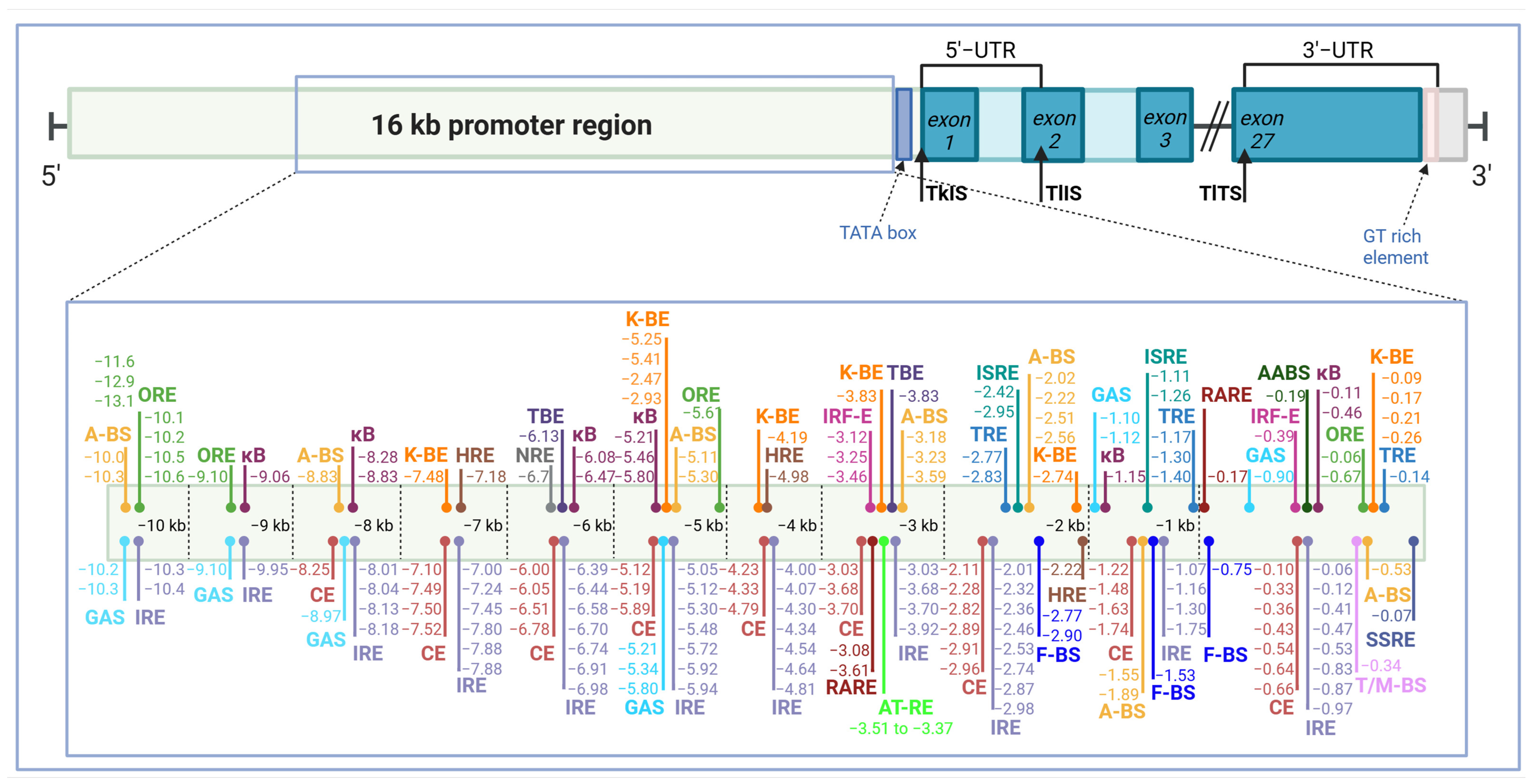
2. NOS2 Gene Organization
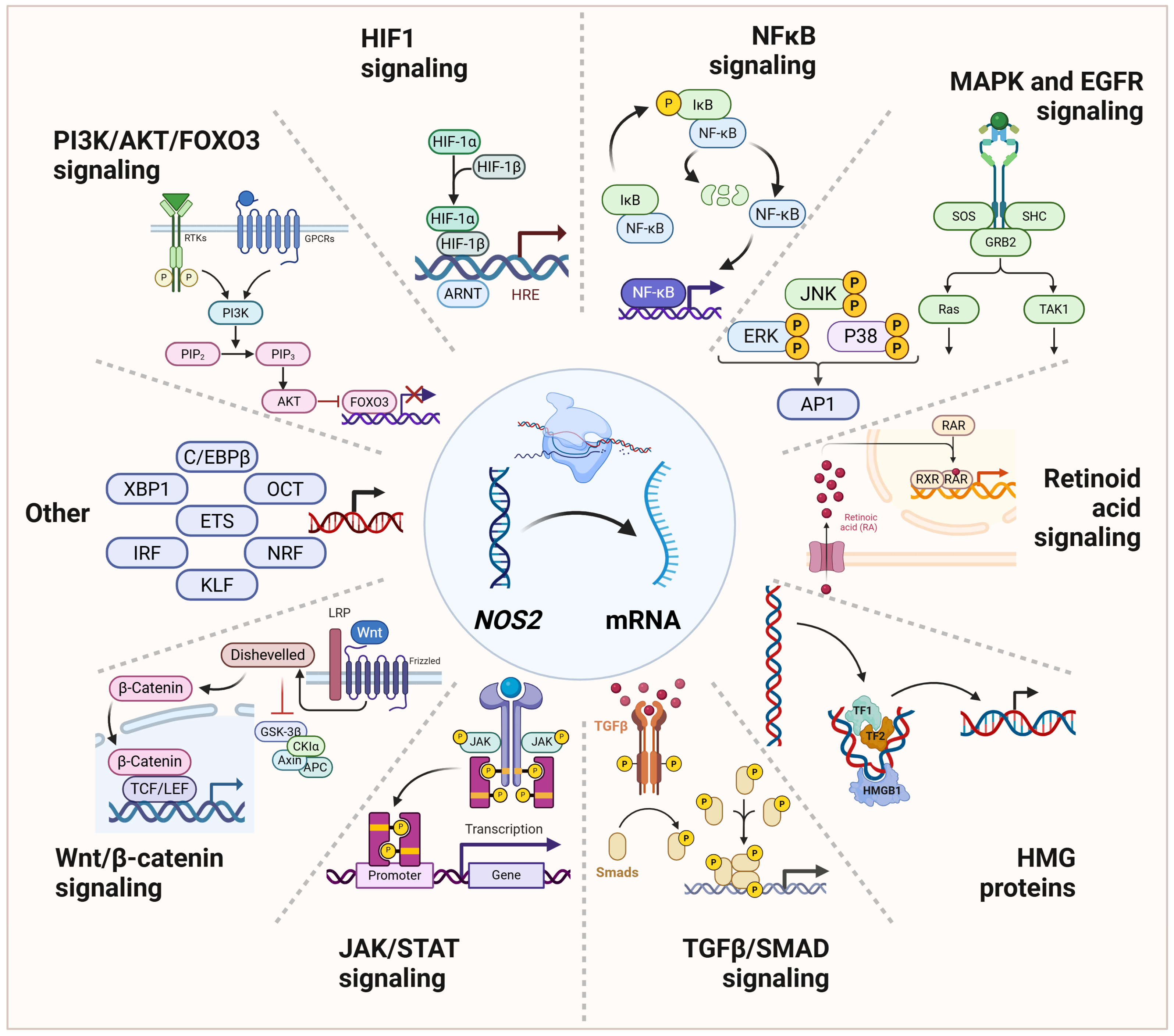
3. Transcriptional Regulation of NOS2 Expression
3.1. NF-κB: Master Regulator of Inflammatory NOS2 Expression
3.1.1. An Overview of NF-κB Signaling
3.1.2. Binding Sites for NF-κB and Its Repressor
3.1.3. Upstream Pathways Activating NF-κB
Microbial Signals and Pattern Recognition Receptors
Cytokines and Their Receptors
Antigen-Recognition Receptors
3.1.4. Feedback Inhibition of NF-κB by NOS2-Derived NO
3.1.5. Translational Evidence from Human IBD
3.1.6. Experimental Evidence
3.1.7. Concluding Remarks
3.2. IFNγ-JAK-STAT-IRF Signaling: Defining Cytokine Responsiveness of the NOS2 Promoter
3.2.1. Overview of the IFNγ/JAK/STAT1 Pathway
3.2.2. Cooperation with IRF1, IRF8, and NF-κB
3.2.3. Negative Regulation of IFNγ Signaling
3.2.4. Translational Evidence from Human IBD
3.2.5. Experimental Evidence
3.2.6. Concluding Remarks
3.3. AP-1: Integrator of Microbial, Cytokine, and Stress-Induced NOS2 Expression
3.3.1. Overview of AP-1 Signaling
3.3.2. AP-1-Responsive Elements in NOS2 Regulation
3.3.3. Cooperation with STAT1 and Chromatin-Remodeling Factors
3.3.4. Integration of Microbial and Stress Signaling Pathways
3.3.5. Translational Evidence from Human IBD
3.3.6. Experimental Evidence
3.3.7. Concluding Remarks
3.4. HIFs: Mediators of Hypoxia-Dependent NOS2 Regulation
3.4.1. Overview of HIF Signaling
3.4.2. HIF-Responsive Elements in NOS2 Regulation
3.4.3. Crosstalk with Inflammatory Signaling Pathways
3.4.4. Physiological and Pathological Consequences of HIF-Dependent NOS2 Expression
3.4.5. Translational Evidence from Human IBD
3.4.6. Experimental Evidence
3.4.7. Concluding Remarks
3.5. KLF4 and KLF6: Context-Dependent Integrators of Inflammatory and Stress Signals in NOS2 Regulation
3.5.1. Overview of KLF Signaling
3.5.2. KLF-Responsive Elements in NOS2 Regulation
3.5.3. Integration with Inflammatory, Stress, and Polarization Pathways
3.5.4. Translational Evidence from Human IBD
3.5.5. Experimental Evidence
3.5.6. Concluding Remarks
3.6. FOXO3: Connecting Inflammatory and Metabolic Pathways in NOS2 Regulation
3.6.1. Overview of FOXO3 Signaling
3.6.2. FOXO-Responsive Elements in NOS2 Regulation
3.6.3. Integration with Inflammatory and Metabolic Signaling Pathways
3.6.4. Translational Evidence from Human IBD
3.6.5. Experimental Evidence
3.6.6. Concluding Remarks
3.7. Retinoic Acid: Context-Dependent Modulator of NOS2 Expression and Intestinal Inflammation
3.7.1. Overview of Retinoic Acid Signaling
3.7.2. Retinoic Acid Response Elements in NOS2 Regulation
3.7.3. Integration with Inflammatory Signaling Pathways
3.7.4. Translational Evidence from Human IBD
3.7.5. Experimental Evidence
3.7.6. Concluding Remarks
3.8. ETS Factors: Balancing Pro- and Anti-Inflammatory Control of NOS2 Expression
3.8.1. Overview of ETS Signaling
3.8.2. ETS-Dependent Regulation of NOS2 Expression
3.8.3. Translational and Experimental Evidence in Intestinal Inflammation
3.8.4. Concluding Remarks
3.9. HMG Proteins: Architectural Regulators of NOS2 Transcription
3.9.1. Overview of HMG Proteins
3.9.2. HMG Proteins in NOS2 Regulation
3.9.3. Evidence from Human Intestinal Inflammation
3.9.4. Concluding Remarks
3.10. OCT Factors: Facilitators of Cytokine-Induced NOS2 Transcription
3.10.1. Overview of OCT Factors
3.10.2. OCT-Responsive Elements in NOS2 Regulation
3.10.3. Experimental Evidence
3.10.4. Concluding Remarks
3.11. TCF4: Linking Wnt Signaling to NOS2 Expression and Epithelial Defense
3.11.1. Overview of TCF4 Signaling
3.11.2. TCF4-Responsive Elements in NOS2 Regulation
3.11.3. Translational Evidence from Human IBD
3.11.4. Concluding Remarks
3.12. C/EBPβ and XBP1: Integrators of Inflammatory and Endoplasmic Reticulum Stress Signaling in NOS2 Regulation
3.12.1. Overview of C/EBPβ and XBP1 Signaling
3.12.2. C/EBPβ/XBP1-Responsive Elements in NOS2 Regulation
3.12.3. Translational Evidence from Human IBD
3.12.4. Experimental Evidence
3.12.5. Concluding Remarks
3.13. CNC-bZIP Factors: Linking Redox Homeostasis to Repression of NOS2 Expression
3.13.1. Overview of CNC-bZIP Signaling
3.13.2. CNC-bZIP-Responsive Elements in NOS2 Regulation
3.13.3. Concluding Remarks
3.14. TGFβ-SMAD Signaling: Preserving Endogenous Control of NOS2 Expression
3.14.1. Overview of TGFβ/SMAD Signaling
3.14.2. TGFβ-Dependent Regulation of NOS2 Expression
3.14.3. Translational Evidence from Human IBD
3.14.4. Experimental Evidence
3.14.5. Concluding Remarks
4. Epigenetic Regulation
4.1. Acetylation and Methylation in NOS2 Expression
4.2. Chromatin Regulators
4.3. Implications for IBD and Intestinal Inflammation
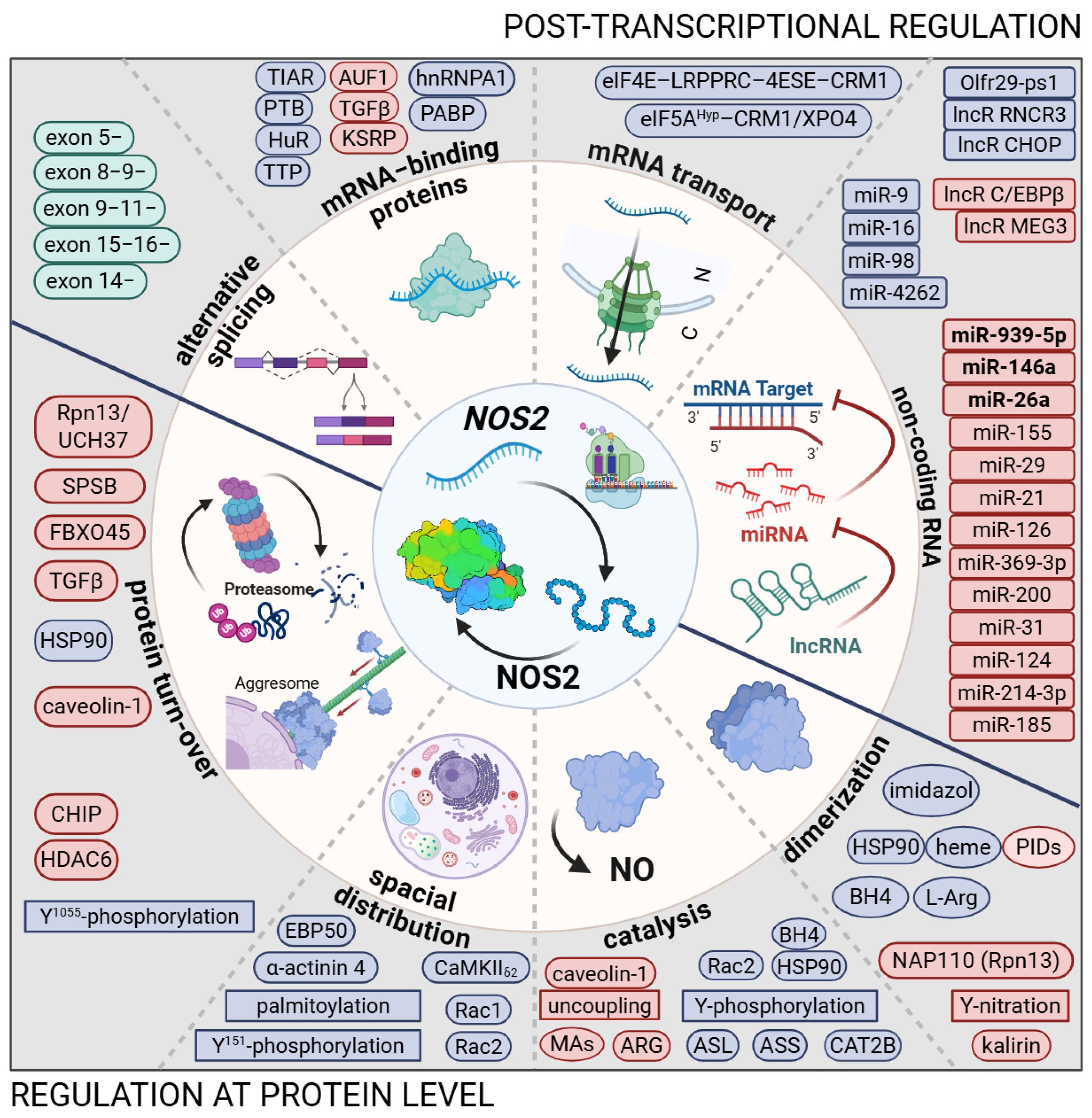
5. Post-Transcriptional Regulation of NOS2 Expression
5.1. Alternative Splicing
5.2. mRNA Processing and Stability
5.3. Nuclear Export of NOS2 mRNA
5.4. Non-Coding RNA in NOS2 Regulation
5.4.1. MiR-26
5.4.2. MiR-939-5p
5.4.3. MiR-146a and lncRNA HCG18 and CHR
5.4.4. MiR-155
5.4.5. MiR-29
5.4.6. MiR-21
5.4.7. MiR-126
5.4.8. MiR-98-5p and lncRNA MEG3
5.4.9. MiR-9
5.4.10. MiR-369-3p
5.4.11. MiR-200
5.4.12. MiR-31
5.4.13. MiR-16
5.4.14. MiR-124
5.4.15. MiR-4262
5.4.16. Lnc–CHOP and Lnc–C/EBPβ
5.4.17. MiR-185 and lncRNA RNCR3
5.4.18. MiR-214-3p and lncRNA Pseudogene Olfr29-ps1
5.5. Reading Frame Variation and Translational Control
5.6. Implications for IBD and Intestinal Inflammation
6. Regulation of NOS2 Protein and Its Catalytic Activity
6.1. NOS2 Assembly
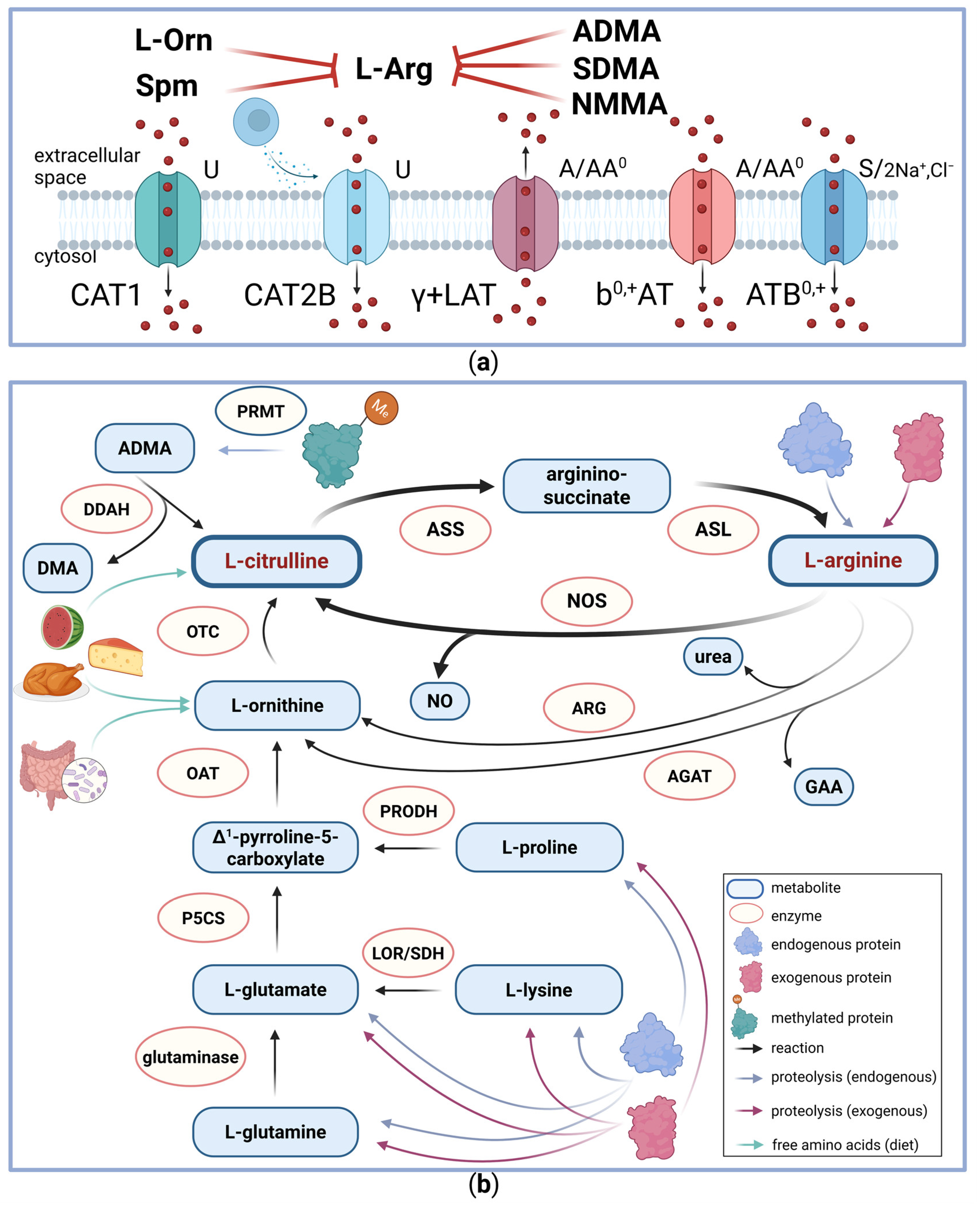
6.2. Substrate Availability
6.3. Catalytic Activity
6.4. Post-Translational Covalent Modifications
6.5. Subcellular Localization
6.6. Protein Turnover
6.6.1. Proteasomal Degradation
6.6.2. Sequestration in Aggresomes
6.7. Implications for IBD and Intestinal Inflammation
7. NOS2 Expression in Non-Immune Cells of the Bowel
7.1. Intestinal Epithelial Cells
7.1.1. NOS2 Expression in Intestinal Epithelial Cells
7.1.2. Regulation of NOS2 Expression in Intestinal Epithelial Cells
NF-κB Signaling and Microbial Sensing
HSP70, Short-Chain Fatty Acids, and PPARγ
Cytokine-Dependent JAK/STAT Signaling
MAPK and EGFR Signaling
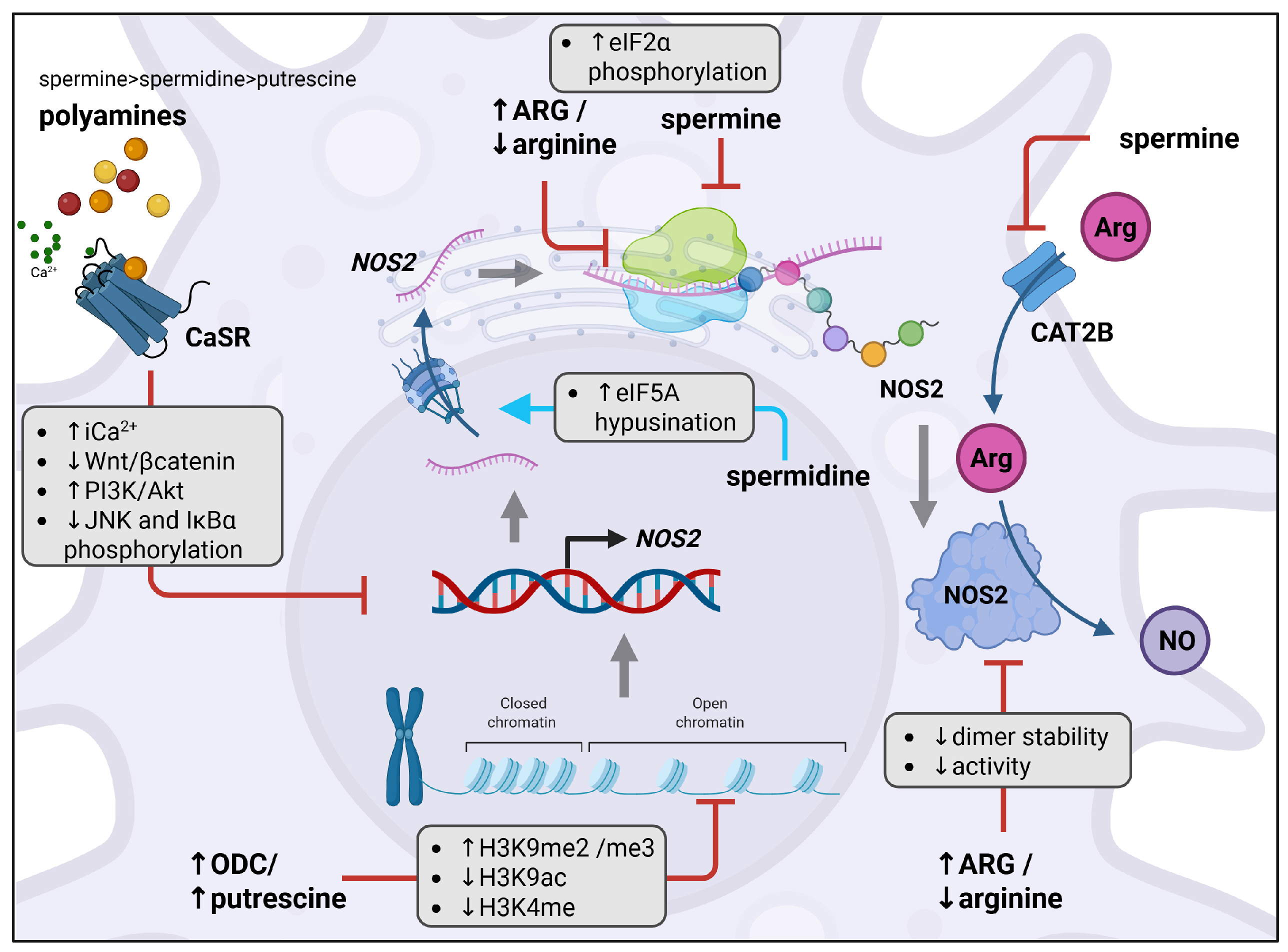
CaSR, Wnt/β-Catenin, and RhoA Signaling
Regulation by Immune Cell Interactions
7.2. Stromal Cells
7.3. Smooth Muscle Cells
7.4. Endothelial Cells
7.5. Enteric Nervous System (ENS)
7.6. Extracellular Regulation of NOS2
8. NOS2 Expression in Gut Immune Cells
8.1. Macrophages
8.1.1. NOS2 Expression and Macrophage Polarization
8.1.2. Pro-Inflammatory Pathways Driving NOS2 Expression
8.1.3. Negative Regulation of NOS2
8.1.4. Metabolic and Environmental Regulation
8.1.5. Neuroimmune Regulation of Macrophage NOS2
8.1.6. Additional Regulatory Mechanisms
8.2. Dendritic Cells
8.3. T-Cells
8.4. NKcells
8.5. Myeloid-Derived Suppressor Cells (MDSCs)
8.6. Neutrophils
8.7. Mast Cells
9. Conclusions and Future Directions
Funding
Institutional Review Board Statement
Informed Consent Statement
Data Availability Statement
Conflicts of Interest
List of Abbreviations
| 43S PIC | 43S preinitiation complex |
| 4ESE | eIF4E sensitivity element |
| 5-ASA | 5-aminosalicylic acid |
| αMSH | α-melanocyte-stimulating hormone |
| A2AR | Adenosine A2A receptor |
| AABS | A activator-binding site |
| ADMA | Asymmetric dimethylarginine |
| Akt | Protein kinase B; PKB |
| ALK | Anaplastic lymphoma kinase |
| ANP | Atrial natriuretic peptide |
| AP-1 | Activator protein 1 |
| APCs | Antigen-presenting cells |
| Arg | L-arginine |
| ARG1 | Arginase 1 |
| ARL2 | ADP-ribosylation factor-like protein 2 |
| ASL | Argininosuccinate lyase |
| ASS | Argininosuccinate synthetase |
| ATF2 | Activating transcription factor 2 |
| AUF1 (hnRNP D) | AU-binding factor 1 |
| BAFF-R | B-cell activating factor receptor |
| BCR | B-cell receptor |
| BH4 | Tetrahydrobiopterin |
| BMDMs | Bone marrow-derived macrophages |
| C/EBPβ | CCAAT/enhancer-binding protein-β |
| CAC | Colitis-associated cancer |
| CaMK | Calcium/calmodulin-dependent protein kinase |
| CaSR | Ca2+-sensing receptor |
| CAT | Cationic amino acid transporter |
| CBP | CREB-binding protein |
| CD | Crohn’s disease |
| C/EBPβ | CCAAT/enhancer-binding protein element |
| cGAS-STING | ‘Cyclic GMP-AMP synthase-stimulator of interferon genes’ |
| CHIP | ‘C-terminus of Hsc70-interacting protein’ |
| CHOP | C/EBP homologous protein (Gad153) |
| cIAPs | Cellular inhibitors of apoptosis proteins |
| CLA | Conjugated linoleic acid |
| CLRs | C-type lectin receptors |
| CNC-bZIP | Cap’n’collar subfamily of the basic leucine zipper |
| COX2 | Cyclooxygenase 2 |
| CpG | Cytosine-phosphate-guanine |
| CPS | Carbamoyl phosphate synthetase |
| CRC | Colorectal cancer |
| CREB | cAMP-responsive element-binding protein |
| CRM1 | Exportin 1 |
| DAMPs | Damage-associated molecular patterns |
| DCs | Dendritic cells |
| DHPS | Deoxyhypusine synthase |
| DSS | Dextran sodium sulfate |
| DUOX2 | Dual oxidase 2 |
| EBP50 | ‘Ezrin-radixin-moesin-binding phosphoprotein 50’ protein |
| ECM | Extracellular matrix |
| ECs | Endothelial cells |
| ECS | ‘Elongin–Cullin–SOCS-box’ |
| EGCs | Enteric glial cells |
| EGF | Epithelial growth factor |
| EGFR | Epithelial growth factor receptor |
| Egr2 | ‘Early growth response factor 2’ |
| eIF | Eukaryotic translation initiation factor |
| ELF | E74-like ETS transcription factor |
| ELK | ETS-like transcription factor |
| ENS | Enteric nervous system |
| ER | Endoplasmic reticulum |
| ERK | Extracellular-signal-regulated kinase |
| ETS | E26 transformation-specific |
| EZH2 | ‘Enhancer of zeste homolog 2’ histone methyltransferase |
| FBXO45 | F-box/SPRY domain-containing protein 1 |
| FOXO3 | Forkhead box O3 |
| FOXP3 | Forkhead box P3 |
| GAS | GAF activation sites |
| GSK3β | Glycogen synthase kinase 3 beta |
| HA | Hyaluronan |
| HB-EGF | Heparin-binding EGF-like growth factor |
| HDAC | Histone deacetylase |
| HIF | Hypoxia-inducible factor |
| HIMECs | Human intestinal microvascular endothelial cells |
| HMG | High mobility group |
| HSP | Heat shock protein |
| HRE | Hypoxia response elements |
| HuR | Human antigen R |
| HUVECs | Human umbilical vein endothelial cells |
| IBD | Inflammatory bowel disease |
| IECs | Intestinal epithelial cells |
| IELs | γδ intraepithelial lymphocytes |
| IFN-γ, | Interferon γ |
| IKK | IκB kinase |
| IL | Interleukin |
| ILCs | Innate lymphoid cells |
| IMFs | Intestinal myofibroblasts |
| IRAK | Interleukin-1 receptor-associated kinase |
| IRF | Interferon regulatory factor |
| IRF-E | IFN regulatory factor element |
| ISRE | Interferon-stimulated response element |
| IκB | Inhibitory κB |
| JAK | Janus kinases |
| JNK | c-Jun N-terminal kinase |
| KGF | Keratinocyte growth factor |
| KLF | Kruppel-like factor |
| KSRP | KH-type splicing regulatory protein |
| LAP | ‘Liver-enriched activator protein’ |
| LCN2 | Lipocalin 2 |
| LD | Lipid droplet |
| LIP | ‘Liver-enriched inhibitory protein’ |
| L-NAME | N-nitro-L-arginine methyl ester |
| LPS | Lipopolysaccharide |
| LRPPRC | Leucine-rich pentatricopeptide repeat protein |
| LTβR | Lymphotoxin β receptor |
| Maf | v-maf musculoaponeurotic fibrosarcoma oncogene family proteins |
| MAPK | Mitogen-activated protein kinase |
| MARs | Nuclear matrix attachment regions |
| MD-2 | Myeloid differentiation factor 2 |
| MDSCs | Myeloid-derived suppressor cells |
| MEG3 | ‘Maternally expressed gene 3’ |
| MEK | Mitogen-activated protein kinase kinase |
| Mincle | ‘Macrophage-inducible C-type lectin’ receptor |
| MSCs | Mesenchymal stem cells |
| MST2 | ‘Mammalian sterile 20-like kinase 2’ |
| MTAP | Methylthioadenosine phosphorylase |
| MTP | 5′-deoxy-5′-methylthioadenosine |
| MYCBP2 | ‘MYC Binding Protein 2’ |
| Myd88 | ‘Myeloid differentiation primary response 88’ |
| NAIP5 | ‘NLR family apoptosis inhibitory protein 5’ |
| NAP110 | NOS-associated protein 110 kDa |
| NEMO | NF-κB essential modulator |
| NETs | Neutrophil extracellular traps |
| NFAT | ‘Nuclear factor of activated T cells’ |
| NF-E2 | Nuclear factor (erythroid 2)-like |
| NF-κB | Nuclear factor kappa-light-chain-enhancer of activated B cells |
| NIK | NF-κB–inducing kinase |
| NK | Natural killer cells |
| NLR | Nucleotide-binding domain and leucine-rich repeat-containing proteins |
| NLRC4 | NLR family CARD domain-containing protein 4 |
| NLRP3 | NOD-, LRR- and pyrin domain-containing protein 3 |
| NMD | Nonsense-mediated mRNA decay |
| NMMA | NG-monomethyl-L-arginine |
| NO | Nitric oxide |
| NOD | Nucleotide oligomerization domains |
| NOS | Nitric oxide synthase |
| NOS2P3 | Nitric Oxide Synthase 2 Pseudogene 3 |
| NOX2 | NADPH oxidase 2 |
| NRE | NF-E2 recognition element |
| NRE | Negative regulatory element for NF-κB |
| NRF | NF-κB-repressing factor |
| Oct | Octamer binding transcription factor |
| ODC | Ornithine decarboxylase |
| ORE | Oct-response elements |
| ORF | Open reading frame |
| PABP | Polypyrimidine-tract binding protein |
| PACAP | Pituitary adenylate cyclase–activating peptide |
| PARP1 | Poly(ADP-ribose) polymerase-1 |
| PBMCs | Peripheral blood mononuclear cells |
| PCs | Plasma cells |
| PCDP | Programmed cell death protein |
| PD-L | Programmed death-ligand |
| PERK | ‘Pancreatic EIF-2alpha kinase’ |
| PG | Prostaglandin |
| PI3K | Phosphoinositide 3-kinase |
| PIAS | Protein inhibitors of activated STAT |
| PIDs | Pyrimidine imidazole derivatives |
| PKA | Protein kinase A |
| PKC | Protein kinase C |
| PMA | Phorbol myristate acetate |
| PPAR | Peroxisome proliferator-activated receptor |
| PPREs | Peroxisome proliferator response elements |
| PRC1 | Polycomb Repressive Complex 1 |
| PRMT | Protein arginine methyltransferase |
| PRRs | Pattern recognition receptors |
| PTB | Polypyrimidine tract-binding protein |
| PTEN | Phosphatase and tensin homolog |
| PTPN2 | Protein tyrosine phosphatase non-receptor type 2 |
| RA | Retinoic acid |
| RAGE | Receptor for advanced glycation end products |
| RANKL | Receptor activator of NF-κB ligand |
| RAR, RXR | Retinoic acid receptors |
| RAREs | Retinoic acid response elements |
| RhoA | Ras homolog family member A |
| RIPK | Receptor-interacting protein kinase |
| RNCR3 | ‘Retinal non-coding RNA 3’ |
| RONS | Reactive oxygen and nitrogen species |
| RUNX | Runt-related transcription factor |
| SCF | ‘Skp–Cullin–F-box’ |
| SCFAs | Short-chain fatty acids |
| SDMA | Symmetric dimethylarginine |
| SIRT | Sirtuin |
| SMAD | ‘Suppressor of mothers against decapentaplegic homolog’ |
| SMCs | Smooth muscle cells |
| SOCS | ‘Suppressor of cytokine signaling’ protein |
| SPSB | ‘SPRY domain-containing SOCS box’ protein |
| STAT | Signal transducer and activator of transcription |
| TAB | TAK1-binding protein |
| TAK1 | TGF-β–activated kinase 1 |
| TBE | T-cell factor (TCF) 4-binding element |
| TBK1 | ‘TANK-binding kinase 1’ |
| TCF | T-cell transcription factor |
| TCR | T-cell receptor |
| TET | ‘Ten-eleven translocation’ demethylase |
| TF | Transcription factor |
| TGFβ | Transforming growth factor β |
| TIAR | T cell intracellular antigen-1–related protein |
| TIGAR | TP53-induced glycolysis regulatory protein |
| TLRs | Toll-like receptors |
| TNBS | 2,4,6-trinitrobenzene sulfonic acid |
| TNFα | Tumor necrosis factor α |
| TNFR | Tumor necrosis factor receptor |
| TRAFs | TNFR-associated factors |
| TRE | TNF response element |
| TRIB | Tribbles homolog |
| TTP | Tristetraprolin |
| TXNIP | Thioredoxin-interacting protein |
| uORF | Upstream open reading frame |
| UPR | Unfolded protein response |
| UC | Ulcerative colitis |
| UTR | Untranslated region |
| VEGFA | Vascular endothelial growth factor A |
| VIP | Vasointestinal peptide |
| VPAC | Vasoactive intestinal peptide receptor |
| WNK1 | WNK lysine deficient protein kinase 1 |
| Wnt | ‘Wingless-related integration site’ |
| XBP1 | X-box binding protein 1 |
| XPO | Exportin |
References
- Ghafourifar, P.; Cadenas, E. Mitochondrial nitric oxide synthase. Trends Pharmacol. Sci. 2005, 26, 190–195. [Google Scholar] [CrossRef] [Scilit] [PubMed]
- Spratt, D.E.; Taiakina, V.; Palmer, M.; Guillemette, J.G. Differential binding of calmodulin domains to constitutive and inducible nitric oxide synthase enzymes. Biochemistry 2007, 46, 8288–8300. [Google Scholar] [CrossRef] [Scilit] [PubMed]
- Satriano, J. Arginine pathways and the inflammatory response: Interregulation of nitric oxide and polyamines: Review article. Amino Acids 2004, 26, 321–329. [Google Scholar] [CrossRef] [Scilit] [PubMed]
- Dao, V.T.; Elbatreek, M.H.; Fuchß, T.; Grädler, U.; Schmidt, H.H.H.W.; Shah, A.M.; Wallace, A.; Knowles, R. Nitric Oxide Synthase Inhibitors into the Clinic at Last. In Reactive Oxygen Species: Network Pharmacology and Therapeutic Applications; Springer International Publishing: Cham, Switzerland, 2021; Volume 264, pp. 169–204. [Google Scholar] [CrossRef] [Scilit] [PubMed]
- Crane, B.R.; Arvai, A.S.; Ghosh, D.K.; Wu, C.; Getzoff, E.D.; Stuehr, D.J.; Tainer, J.A. Structure of nitric oxide synthase oxygenase dimer with pterin and substrate. Science 1998, 279, 2121–2126. [Google Scholar] [CrossRef] [Scilit] [PubMed]
- Chreifi, G.; Li, H.; McInnes, C.R.; Gibson, C.L.; Suckling, C.J.; Poulos, T.L. Communication between the zinc and tetrahydrobiopterin binding sites in nitric oxide synthase. Biochemistry 2014, 53, 4216–4223. [Google Scholar] [CrossRef] [Scilit] [PubMed]
- Mondal, P.; Ishigami, I.; Yeh, S.R.; Wijeratne, G.B. The role of heme peroxo oxidants in the rational mechanistic modeling of nitric oxide synthase: Characterization of key intermediates and elucidation of the mechanism. Angew. Chem. Int. Ed. 2022, 61, e202211521. [Google Scholar] [CrossRef] [Scilit] [PubMed]
- MacMicking, J.; Xie, Q.W.; Nathan, C. Nitric oxide and macrophage function. Annu. Rev. Immunol. 1997, 15, 323–350. [Google Scholar] [CrossRef] [Scilit] [PubMed]
- Murray, I.A.; Coupland, K.; Daniels, I.D.; Goddard, W.P.; Long, R.G. INOS is expressed by unstimulated human duodenal enterocytes in vitro with increased expression in disease. Gastroenterology 1998, 114, A1046. [Google Scholar] [CrossRef] [Scilit]
- Förstermann, U.; Boissel, J.P.; Kleinert, H. Expressional control of the ’constitutive’ isoforms of nitric oxide synthase (NOS I and NOS III). FASEB J. 1998, 12, 773–790. [Google Scholar] [CrossRef] [Scilit] [PubMed]
- Nakajima, T.; Okuda, Y.; Chisaki, K.; Shin, W.S.; Iwasawa, K.; Morita, T.; Matsumoto, A.; Suzuki, J.; Suzuki, S.; Yamada, N.; et al. Bile acids increase intracellular Ca2+ concentration and nitric oxide production in vascular endothelial cells. Br. J. Pharmacol. 2000, 130, 1457–1467. [Google Scholar] [CrossRef] [Scilit] [PubMed]
- Bogdan, C. Nitric oxide and the immune response. Nat. Immunol. 2001, 2, 907–916. [Google Scholar] [CrossRef] [Scilit] [PubMed]
- Kolios, G.; Valatas, V.; Ward, S.G. Nitric oxide in inflammatory bowel disease: A universal messenger in an unsolved puzzle. Immunology 2004, 113, 427–437. [Google Scholar] [CrossRef] [Scilit] [PubMed]
- Kubes, P.; McCafferty, D.-M. Nitric oxide and intestinal inflammation. Am. J. Med. 2000, 109, 150–158. [Google Scholar] [CrossRef] [Scilit] [PubMed]
- Farahani, A.; Farahani, A.; Kashfi, K.; Ghasemi, A. Inducible nitric oxide synthase (iNOS): More than an inducible enzyme? Rethinking the classification of NOS isoforms. Pharmacol. Res. 2025, 216, 107781. [Google Scholar] [CrossRef] [Scilit] [PubMed]
- Kubes, P. Inducible nitric oxide synthase: A little bit of good in all of us. Gut 2000, 47, 6–9. [Google Scholar] [CrossRef] [Scilit] [PubMed]
- Perner, A.; Andresen, L.; Normark, M.; Rask-Madsen, J. Constitutive expression of inducible nitric oxide synthase in the normal human colonic epithelium. Scand. J. Gastroenterol. 2002, 37, 944–948. [Google Scholar] [CrossRef] [Scilit] [PubMed]
- Fang, F.C. Perspectives series: Host/pathogen interactions. Mechanisms of nitric oxide-related antimicrobial activity. J. Clin. Investig. 1997, 99, 2818–2825. [Google Scholar] [CrossRef] [Scilit] [PubMed]
- Matziouridou, C.; Rocha, S.D.C.; Haabeth, O.A.; Rudi, K.; Carlsen, H.; Kielland, A. iNOS- and NOX1-dependent ROS production maintains bacterial homeostasis in the ileum of mice. Mucosal Immunol. 2018, 11, 774–784. [Google Scholar] [CrossRef] [Scilit] [PubMed]
- Hickey, M.J. Role of inducible nitric oxide synthase in the regulation of leucocyte recruitment. Clin. Sci. 2001, 100, 1–12. [Google Scholar] [CrossRef] [Scilit] [PubMed]
- Beck, P.L.; Li, Y.; Wong, J.; Chen, C.W.; Keenan, C.M.; Sharkey, K.A.; McCafferty, D.M. Inducible nitric oxide synthase from bone marrow-derived cells plays a critical role in regulating colonic inflammation. Gastroenterology 2007, 132, 1778–1790. [Google Scholar] [CrossRef] [Scilit] [PubMed]
- McCafferty, D.M.; Mudgett, J.S.; Swain, M.G.; Kubes, P. Inducible nitric oxide synthase plays a critical role in resolving intestinal inflammation. Gastroenterology 1997, 112, 1022–1027. [Google Scholar] [CrossRef] [Scilit] [PubMed]
- Stettner, N.; Rosen, C.; Bernshtein, B.; Gur-Cohen, S.; Frug, J.; Silberman, A.; Sarver, A.; Carmel-Neiderman, N.N.; Eilam, R.; Biton, I.; et al. Induction of nitric-oxide metabolism in enterocytes alleviates colitis and inflammation-associated colon cancer. Cell Rep. 2018, 23, 1962–1976. [Google Scholar] [CrossRef] [Scilit] [PubMed]
- Hashimoto-Hill, S.; Hunt, B.; Cole, S.; Negi, S.; Waddell, A.; Yang, Z.F.; Wayman, J.A.; Ollberding, N.J.; Miraldi, E.R.; Lim, H.W.; et al. Epithelial-intrinsic nitric oxide synthase 2 sustains host-microbiota dynamics that promote colitis. bioRxiv 2025. [Google Scholar] [CrossRef] [Scilit] [PubMed]
- Zamora, R.; Vodovotz, Y.; Billiar, T.R. Inducible nitric oxide synthase and inflammatory diseases. Mol. Med. 2000, 6, 347–373. [Google Scholar] [CrossRef] [Scilit] [PubMed]
- Kleinert, H.; Schwarz, P.M.; Förstermann, U. Regulation of the expression of inducible nitric oxide synthase. Biol. Chem. 2003, 384, 1343–1364. [Google Scholar] [CrossRef] [Scilit] [PubMed]
- Seyedian, S.S.; Nokhostin, F.; Malamir, M.D. A review of the diagnosis, prevention, and treatment methods of inflammatory bowel disease. J. Med. Life 2019, 12, 113–122. [Google Scholar] [CrossRef] [Scilit] [PubMed]
- Ng, S.C.; Shi, H.Y.; Hamidi, N.; Underwood, F.E.; Tang, W.; Benchimol, E.I.; Panaccione, R.; Ghosh, S.; Wu, J.C.Y.; Chan, F.K.L.; et al. Worldwide incidence and prevalence of inflammatory bowel disease in the 21st century: A systematic review of population-based studies. Lancet 2017, 390, 2769–2778. [Google Scholar] [CrossRef] [Scilit] [PubMed]
- Mak, W.Y.; Zhao, M.; Ng, S.C.; Burisch, J. The epidemiology of inflammatory bowel disease: East meets West. J. Gastroenterol. Hepatol. 2020, 35, 380–389. [Google Scholar] [CrossRef] [Scilit] [PubMed]
- Kuenzig, M.E.; Fung, S.G.; Marderfeld, L.; Mak, J.W.Y.; Kaplan, G.G.; Ng, S.C.; Wilson, D.C.; Cameron, F.; Henderson, P.; Kotze, P.G.; et al. Twenty-first century trends in the global epidemiology of pediatric-onset inflammatory bowel disease: Systematic review. Gastroenterology 2022, 162, 1147–1159.e4. [Google Scholar] [CrossRef] [Scilit] [PubMed]
- Alatab, S.; Sepanlou, S.G.; Ikuta, K.; Vahedi, H.; Bisignano, C.; Safiri, S.; Sadeghi, A.; Nixon, M.R.; Abdoli, A.; Abolhassani, H.; et al. The global, regional, and national burden of inflammatory bowel disease in 195 countries and territories, 1990–2017: A systematic analysis for the global burden of disease study 2017. Lancet Gastroenterol. Hepatol. 2020, 5, 17–30. [Google Scholar] [CrossRef] [Scilit] [PubMed]
- Windsor, J.W.; Kaplan, G.G. Evolving epidemiology of IBD. Curr. Gastroenterol. Rep. 2019, 21, 40. [Google Scholar] [CrossRef] [Scilit] [PubMed]
- Argollo, M.; Gilardi, D.; Peyrin-Biroulet, C.; Chabot, J.-F.; Peyrin-Biroulet, L.; Danese, S. Comorbidities in inflammatory bowel disease: A call for action. Lancet Gastroenterol. Hepatol. 2019, 4, 643–654. [Google Scholar] [CrossRef] [Scilit] [PubMed]
- Keller, D.S.; Windsor, A.; Cohen, R.; Chand, M. Colorectal cancer in inflammatory bowel disease: Review of the evidence. Tech. Coloproctol. 2019, 23, 3–13. [Google Scholar] [CrossRef] [Scilit] [PubMed]
- Leso, V.; Gervetti, P.; Macrini, M.C.; Russo, F.; Iavicoli, I. Inflammatory bowel diseases and work disability: A systematic review of predictive factors. Eur. Rev. Med. Pharmacol. Sci. 2021, 25, 165–181. [Google Scholar] [CrossRef] [Scilit] [PubMed]
- Guan, Q. A comprehensive review and update on the pathogenesis of inflammatory bowel disease. J. Immunol. Res. 2019, 2019, 7247238. [Google Scholar] [CrossRef] [Scilit] [PubMed]
- Nishida, A.; Inoue, R.; Inatomi, O.; Bamba, S.; Naito, Y.; Andoh, A. Gut microbiota in the pathogenesis of inflammatory bowel disease. Clin. J. Gastroenterol. 2018, 11, 1–10. [Google Scholar] [CrossRef] [Scilit] [PubMed]
- Gao, F.; Lucke-Wold, B.P.; Li, X.; Logsdon, A.F.; Xu, L.C.; Xu, S.; LaPenna, K.B.; Wang, H.; Talukder, M.A.H.; Siedlecki, C.A.; et al. Reduction of endothelial nitric oxide increases the adhesiveness of constitutive endothelial membrane ICAM-1 through Src-mediated phosphorylation. Front. Physiol. 2018, 8, 1124. [Google Scholar] [CrossRef] [Scilit] [PubMed]
- Krzystek-Korpacka, M.; Fleszar, M.G.; Bednarz-Misa, I.; Lewandowski, Ł.; Szczuka, I.; Kempiński, R.; Neubauer, K. Transcriptional and metabolomic analysis of L-arginine/nitric oxide pathway in inflammatory bowel disease and its association with local inflammatory and angiogenic response: Preliminary findings. Int. J. Mol. Sci. 2020, 21, 1641. [Google Scholar] [CrossRef] [Scilit] [PubMed]
- Christophi, G.P.; Rong, R.; Holtzapple, P.G.; Massa, P.T.; Landas, S.K. Immune markers and differential signaling networks in ulcerative colitis and Crohn’s disease. Inflamm. Bowel Dis. 2012, 18, 2342–2356. [Google Scholar] [CrossRef] [Scilit] [PubMed]
- Wu, F.; Zikusoka, M.; Trindade, A.; Dassopoulos, T.; Harris, M.L.; Bayless, T.M.; Brant, S.R.; Chakravarti, S.; Kwon, J.H. MicroRNAs are differentially expressed in ulcerative colitis and alter expression of macrophage inflammatory peptide-2α. Gastroenterology 2008, 135, 1624–1635.e24. [Google Scholar] [CrossRef] [Scilit] [PubMed]
- Baranipour, S.; Amini Kadijani, A.; Qujeq, D.; Shahrokh, S.; Haghazali, M.; Mirzaei, A.; Asadzadeh-Aghdaei, H. Inducible nitric oxide synthase as a potential blood-based biomarker in inflammatory bowel diseases. Gastroenterol. Hepatol. Bed Bench 2018, 11, S124–S128. [Google Scholar] [PubMed]
- Singer, I.I.; Kawka, D.W.; Scott, S.; Weidner, J.R.; Mumford, R.A.; Riehl, T.E.; Stenson, W.F. Expression of inducible nitric oxide synthase and nitrotyrosine in colonic epithelium in inflammatory bowel disease. Gastroenterology 1996, 111, 871–885. [Google Scholar] [CrossRef] [Scilit] [PubMed]
- Dijkstra, G.; Moshage, H.; van Dullemen, H.M.; de Jager-Krikken, A.; Tiebosch, A.T.; Kleibeuker, J.H.; Jansen, P.L.; van Goor, H. Expression of nitric oxide synthases and formation of nitrotyrosine and reactive oxygen species in inflammatory bowel disease. J. Pathol. 1998, 186, 416–421. [Google Scholar] [CrossRef] [Scilit] [PubMed]
- Dhillon, S.S.; Mastropaolo, L.A.; Murchie, R.; Griffiths, C.; Thöni, C.; Elkadri, A.; Xu, W.; Mack, D.; Walters, T.; Guo, C.; et al. Higher activity of the inducible nitric oxide synthase contributes to very early onset inflammatory bowel disease. Clin. Transl. Gastroenterol. 2014, 5, e46. [Google Scholar] [CrossRef] [Scilit] [PubMed]
- Guihot, G.; Guimbaud, R.; Bertrand, V.; Narcy-Lambare, B.; Couturier, D.; Duée, P.H.; Chaussade, S.; Blachier, F. Inducible nitric oxide synthase activity in colon biopsies from inflammatory areas: Correlation with inflammation intensity in patients with ulcerative colitis but not with Crohn’s disease. Amino Acids 2000, 18, 229–237. [Google Scholar] [CrossRef] [Scilit] [PubMed]
- Colón, A.L.; Menchén, L.; Lizasoain, I.; Leza, J.C.; Menchén, P.; González-Lara, V.; Moro, M.A.; Lorenzo, P. Inducible nitric oxide synthase activity is expressed not only in inflamed but also in normal colonic mucosa in patients with ulcerative colitis: A potential prognostic marker. Am. J. Gastroenterol. 2000, 95, 1371–1373. [Google Scholar] [CrossRef] [Scilit] [PubMed]
- Kankuri, E.; Vaali, K.; Knowles, R.G.; Lähde, M.; Korpela, R.; Vapaatalo, H.; Moilanen, E. Suppression of acute experimental colitis by a highly selective inducible nitric-oxide synthase inhibitor, N-[3-(aminomethyl)benzyl]acetamidine. J. Pharmacol. Exp. Ther. 2001, 298, 1128–1132. [Google Scholar] [CrossRef] [Scilit] [PubMed]
- Yang, X.; Guo, H.; Zou, M. Inflammatory bowel diseases: Pathological mechanisms and therapeutic perspectives. Mol. Biomed. 2026, 7, 2. [Google Scholar] [CrossRef] [Scilit] [PubMed]
- Alarfaj, S.J.; Mostafa, S.A.; Negm, W.A.; El-Masry, T.A.; Kamal, M.; Elsaeed, M.; El Nakib, A.M. Mucosal genes expression in inflammatory bowel disease patients: New insights. Pharmaceuticals 2023, 16, 324. [Google Scholar] [CrossRef] [Scilit] [PubMed]
- Kennedy, M.; Wilson, L.; Szabó, C.; Salzman, A.L. 5-Aminosalicylic acid inhibits iNOS transcription in human intestinal epithelial cells. Int. J. Mol. Med. 1999, 4, 437–443. [Google Scholar] [CrossRef] [Scilit] [PubMed]
- Moeslinger, T.; Friedl, R.; Spieckermann, P.G. Inhibition of inducible nitric oxide synthesis by azathioprine in a macrophage cell line. Life Sci. 2006, 79, 374–381. [Google Scholar] [CrossRef] [Scilit] [PubMed]
- De Vera, M.E.; Taylor, B.S.; Wang, Q.; Shapiro, R.A.; Billiar, T.R.; Geller, D.A. Dexamethasone suppresses iNOS gene expression by upregulating I-κBα and inhibiting NF-κB. Am. J. Physiol. Gastrointest. Liver Physiol. 1997, 273, G1290–G1296. [Google Scholar] [CrossRef] [Scilit] [PubMed]
- González, M.V.; Jiménez, B.; Berciano, M.T.; González-Sancho, J.M.; Caelles, C.; Lafarga, M.; Muñoz, A. Glucocorticoids antagonize AP-1 by inhibiting the activation/phosphorylation of Jnk without affecting its subcellular distribution. J. Cell Biol. 2000, 150, 1199–1208. [Google Scholar] [CrossRef] [Scilit] [PubMed]
- Linehan, J.D.; Kolios, G.; Valatas, V.; Robertson, D.A.; Westwick, J. Effect of corticosteroids on nitric oxide production in inflammatory bowel disease: Are leukocytes the site of action? Am. J. Physiol. Gastrointest. Liver Physiol. 2005, 288, G261–G267. [Google Scholar] [CrossRef] [Scilit] [PubMed]
- Leonard, N.; Bishop, A.E.; Polak, J.M.; Talbot, I.C. Expression of nitric oxide synthase in inflammatory bowel disease is not affected by corticosteroid treatment. J. Clin. Pathol. 1998, 51, 750–753. [Google Scholar] [CrossRef] [Scilit] [PubMed]
- Basta, D.W.; Vong, M.; Beshimova, A.; Nakamura, B.N.; Rusu, I.; Kattah, M.G.; Shao, L. A20 restricts NOS2 expression and intestinal tumorigenesis in a mouse model of colitis-associated cancer. Gastro Hep Adv. 2023, 2, 96–107. [Google Scholar] [CrossRef] [Scilit] [PubMed]
- Björner, K.; Chen, W.N.; Gannavarapu, V.R.; Axling, F.; Gulyas, M.; Halim, M.A.; Webb, D.L.; Hellström, P.M. High iNOS and IL-1β immunoreactivity are features of colitis-associated colorectal cancer tumors, but fail to predict 5-year survival. Upsala J. Med. Sci. 2023, 128, e10241. [Google Scholar] [CrossRef] [Scilit] [PubMed]
- Krzystek-Korpacka, M.; Kempiński, R.; Bromke, M.A.; Neubauer, K. Oxidative stress markers in inflammatory bowel diseases: Systematic review. Diagnostics 2020, 10, 601. [Google Scholar] [CrossRef] [Scilit] [PubMed]
- Wang, D.; Xie, B. Prognostic and tumor immunity implication of inflammatory bowel disease-associated genes in colorectal cancer. Eur. J. Med. Res. 2022, 27, 91. [Google Scholar] [CrossRef] [Scilit] [PubMed]
- Caligiuri, A.; Becatti, M.; Porro, N.; Borghi, S.; Marra, F.; Pastore, M.; Taddei, N.; Fiorillo, C.; Gentilini, A. Oxidative stress and redox-dependent pathways in cholangiocarcinoma. Antioxidants 2024, 13, 28. [Google Scholar] [CrossRef] [Scilit] [PubMed]
- Hu, Y.; Xiang, J.; Su, L.; Tang, X. The regulation of nitric oxide in tumor progression and therapy. J. Int. Med. Res. 2020, 48, 0300060520905985. [Google Scholar] [CrossRef] [Scilit] [PubMed]
- Wang, H.; Wang, L.; Xie, Z.; Zhou, S.; Li, Y.; Zhou, Y.; Sun, M. Nitric oxide (NO) and NO synthases (NOS)-based targeted therapy for colon cancer. Cancers 2020, 12, 1881. [Google Scholar] [CrossRef] [Scilit] [PubMed]
- Du, Q.; Liu, S.; Dong, K.; Cui, X.; Luo, J.; Geller, D.A. Downregulation of iNOS/NO promotes epithelial-mesenchymal transition and metastasis in colorectal cancer. Mol. Cancer Res. 2023, 21, 102–114. [Google Scholar] [CrossRef] [Scilit] [PubMed]
- Chartrain, N.A.; Geller, D.A.; Koty, P.P.; Sitrin, N.F.; Nussler, A.K.; Hoffman, E.P.; Billiar, T.R.; Hutchinson, N.I.; Mudgett, J.S. Molecular cloning, structure, and chromosomal localization of the human inducible nitric oxide synthase gene. J. Biol. Chem. 1994, 269, 6765–6772. [Google Scholar] [CrossRef] [Scilit] [PubMed]
- Gather, F.; Ihrig-Biedert, I.; Kohlhas, P.; Krutenko, T.; Peitz, M.; Brüstle, O.; Pautz, A.; Kleinert, H. A specific, non-immune system-related isoform of the human inducible nitric oxide synthase is expressed during differentiation of human stem cells into various cell types. Cell Commun. Signal. 2022, 20, 47. [Google Scholar] [CrossRef] [Scilit] [PubMed]
- Nunokawa, Y.; Ishida, N.; Tanaka, S. Promoter analysis of human inducible nitric oxide synthase gene associated with cardiovascular homeostasis. Biochem. Biophys. Res. Commun. 1994, 200, 802–807. [Google Scholar] [CrossRef] [Scilit] [PubMed]
- Zhang, X.; Laubach, V.E.; Alley, E.W.; Edwards, K.A.; Sherman, P.A.; Russell, S.W.; Murphy, W.J. Transcriptional basis for hyporesponsiveness of the human inducible nitric oxide synthase gene to lipopolysaccharide/interferon-γ. J. Leukoc. Biol. 1996, 59, 575–585. [Google Scholar] [CrossRef] [Scilit] [PubMed]
- de Vera, M.E.; Shapiro, R.A.; Nussler, A.K.; Mudgett, J.S.; Simmons, R.L.; Morris, S.M., Jr.; Billiar, T.R.; Geller, D.A. Transcriptional regulation of human inducible nitric oxide synthase (NOS2) gene by cytokines: Initial analysis of the human NOS2 promoter. Proc. Natl. Acad. Sci. USA 1996, 93, 1054–1059. [Google Scholar] [CrossRef] [Scilit] [PubMed]
- Linn, S.C.; Morelli, P.J.; Edry, I.; Cottongim, S.E.; Szabó, C.; Salzman, A.L. Transcriptional regulation of human inducible nitric oxide synthase gene in an intestinal epithelial cell line. Am. J. Physiol.-Gastrointest. Liver Physiol. 1997, 272, G1499–G1508. [Google Scholar] [CrossRef] [Scilit] [PubMed]
- Laubach, V.E.; Zhang, C.X.; Russell, S.W.; Murphy, W.J.; Sherman, P.A. Analysis of expression and promoter function of the human inducible nitric oxide synthase gene in DLD-1 cells and monkey hepatocytes. Biochim. Biophys. Acta (BBA)-Gene Struct. Expr. 1997, 1351, 287–295. [Google Scholar] [CrossRef] [Scilit] [PubMed]
- Taylor, B.S.; de Vera, M.E.; Ganster, R.W.; Wang, Q.; Shapiro, R.A.; Morris, S.M., Jr.; Billiar, T.R.; Geller, D.A. Multiple NF-κB enhancer elements regulate cytokine induction of the human inducible nitric oxide synthase gene. J. Biol. Chem. 1998, 273, 15148–15156. [Google Scholar] [CrossRef] [Scilit] [PubMed]
- Park, K.S.; Guo, Z.; Shao, L.; Du, Q.; Geller, D.A. A far-upstream Oct-1 motif regulates cytokine-induced transcription of the human inducible nitric oxide synthase gene. J. Mol. Biol. 2009, 390, 595–603. [Google Scholar] [CrossRef] [Scilit] [PubMed]
- Du, Q.; Park, K.S.; Guo, Z.; He, P.; Nagashima, M.; Shao, L.; Sahai, R.; Geller, D.A.; Hussain, S.P. Regulation of human nitric oxide synthase 2 expression by Wnt β-catenin signaling. Cancer Res. 2006, 66, 7024–7031. [Google Scholar] [CrossRef] [Scilit] [PubMed]
- Berg, D.T.; Gupta, A.; Richardson, M.A.; O’Brien, L.A.; Calnek, D.; Grinnell, B.W. Negative regulation of inducible nitric oxide synthase expression mediated through transforming growth factor-β-dependent modulation of transcription factor TCF11. J. Biol. Chem. 2007, 282, 36837–36844. [Google Scholar] [CrossRef] [Scilit] [PubMed]
- Lee, M.; Wang, C.; Jin, S.W.; Labrecque, M.P.; Beischlag, T.V.; Brockman, M.A.; Choy, J.C. Expression of human inducible nitric oxide synthase in response to cytokines is regulated by hypoxia-inducible factor-1. Free Radic. Biol. Med. 2019, 130, 278–287. [Google Scholar] [CrossRef] [Scilit] [PubMed]
- Chu, S.C.; Marks-Konczalik, J.; Wu, H.P.; Banks, T.C.; Moss, J. Analysis of the cytokine-stimulated human inducible nitric oxide synthase (iNOS) gene: Characterization of differences between human and mouse iNOS promoters. Biochem. Biophys. Res. Commun. 1998, 248, 871–878. [Google Scholar] [CrossRef] [Scilit] [PubMed]
- Marks-Konczalik, J.; Chu, S.C.; Moss, J. Cytokine-mediated transcriptional induction of the human inducible nitric oxide synthase gene requires both activator protein 1 and nuclear factor κB-binding sites. J. Biol. Chem. 1998, 273, 22201–22208. [Google Scholar] [CrossRef] [Scilit] [PubMed]
- Kristof, A.S.; Marks-Konczalik, J.; Moss, J. Mitogen-activated protein kinases mediate activator protein-1-dependent human inducible nitric-oxide synthase promoter activation. J. Biol. Chem. 2001, 276, 8445–8452. [Google Scholar] [CrossRef] [Scilit] [PubMed]
- Ganster, R.W.; Taylor, B.S.; Shao, L.; Geller, D.A. Complex regulation of human inducible nitric oxide synthase gene transcription by Stat 1 and NF-κB. Proc. Natl. Acad. Sci. USA 2001, 98, 8638–8643. [Google Scholar] [CrossRef] [Scilit] [PubMed]
- Pance, A.; Chantome, A.; Reveneau, S.; Bentrari, F.; Jeannin, J.F. A repressor in the proximal human inducible nitric oxide synthase promoter modulates transcriptional activation. FASEB J. 2002, 16, 631–633. [Google Scholar] [CrossRef] [Scilit] [PubMed]
- Feng, X.; Guo, Z.; Nourbakhsh, M.; Hauser, H.; Ganster, R.; Shao, L.; Geller, D.A. Identification of a negative response element in the human inducible nitric-oxide synthase (hiNOS) promoter: The role of NF-κB-repressing factor (NRF) in basal repression of the hiNOS gene. Proc. Natl. Acad. Sci. USA 2002, 99, 14212–14217. [Google Scholar] [CrossRef] [Scilit] [PubMed]
- Guo, Z.; Shao, L.; Feng, X.; Reid, K.; Marderstein, E.; Nakao, A.; Geller, D.A. A critical role for C/EBPβ binding to the AABS promoter response element in the human iNOS gene. FASEB J. 2003, 17, 1718–1720. [Google Scholar] [CrossRef] [Scilit] [PubMed]
- Warke, V.G.; Nambiar, M.P.; Krishnan, S.; Tenbrock, K.; Geller, D.A.; Koritschoner, N.P.; Atkins, J.L.; Farber, D.L.; Tsokos, G.C. Transcriptional activation of the human inducible nitric oxide synthase promoter by Kruppel-like factor 6. J. Biol. Chem. 2003, 278, 14812–14819. [Google Scholar] [CrossRef] [Scilit] [PubMed]
- Cavicchi, M.; Whittle, B.J.R. Potentiation of cytokine-induced iNOS expression in the human intestinal epithelial cell line, DLD-1, by cyclic AMP. Gut 1999, 45, 367–374. [Google Scholar] [CrossRef] [Scilit] [PubMed]
- Schreiber, S.; Nikolaus, S.; Hampe, J. Activation of nuclear factor κB in inflammatory bowel disease. Gut 1998, 42, 477–484. [Google Scholar] [CrossRef] [Scilit] [PubMed]
- Ogura, Y.; Bonen, D.K.; Inohara, N.; Nicolae, D.L.; Chen, F.F.; Ramos, R.; Britton, H.; Moran, T.; Karaliuskas, R.; Duerr, R.H.; et al. A frameshift mutation in NOD2 associated with susceptibility to Crohn’s disease. Nature 2001, 411, 603–606. [Google Scholar] [CrossRef] [Scilit] [PubMed]
- Medzhitov, R.; Preston-Hurlburt, P.; Janeway, C.A., Jr. A human homologue of the Drosophila Toll protein signals activation of adaptive immunity. Nature 1997, 388, 394–397. [Google Scholar] [CrossRef] [Scilit] [PubMed]
- Cario, E.; Podolsky, D.K. Differential alteration in intestinal epithelial cell expression of Toll-like receptor 3 (TLR3) and TLR4 in inflammatory bowel disease. Infect. Immun. 2000, 68, 7010–7017. [Google Scholar] [CrossRef] [Scilit] [PubMed]
- Guo, Q.; Jin, Y.; Chen, X.; Ye, X.; Shen, X.; Lin, M.; Zeng, C.; Zhou, T.; Zhang, J. NF-κB in biology and targeted therapy: New insights and translational implications. Signal Transduct. Target. Ther. 2024, 9, 53. [Google Scholar] [CrossRef] [Scilit] [PubMed]
- Mao, H.; Zhao, X.; Sun, S.C. NF-κB in inflammation and cancer. Cell. Mol. Immunol. 2025, 22, 811–839. [Google Scholar] [CrossRef] [Scilit] [PubMed]
- Benedik, N.S.; Proj, M.; Steinebach, C.; Sova, M.; Sosič, I. Targeting TAK1: Evolution of inhibitors, challenges, and future directions. Pharmacol. Ther. 2025, 267, 108810. [Google Scholar] [CrossRef] [Scilit] [PubMed]
- Xu, H.; Li, D.; Liang, J.; Adamson, N.; Scherl, A.; Zou, L.; Hu, C.; Storm, E.E.; Cox, C.B.; Johnson, A.; et al. Noncanonical NF-κB pathway driven inflammation across multiple cellular compartments identifies NIK as a therapeutic target for inflammatory bowel disease. Front. Immunol. 2026, 17, 1825442. [Google Scholar] [CrossRef] [Scilit] [PubMed]
- Nunokawa, Y.; Oikawa, S.; Tanaka, S. Human inducible nitric oxide synthase gene is transcriptionally regulated by nuclear factor-κB dependent mechanism. Biochem. Biophys. Res. Commun. 1996, 223, 347–352. [Google Scholar] [CrossRef] [Scilit] [PubMed]
- Kolyada, A.Y.; Madias, N.E. Transcriptional regulation of the human iNOS gene by IL-1β in endothelial cells. Mol. Med. 2001, 7, 329–343. [Google Scholar] [CrossRef] [Scilit] [PubMed]
- Abreu, M.T. Toll-like receptor signalling in the intestinal epithelium: How bacterial recognition shapes intestinal function. Nat. Rev. Immunol. 2010, 10, 131–144. [Google Scholar] [CrossRef] [Scilit] [PubMed]
- Kordjazy, N.; Haj-Mirzaian, A.; Haj-Mirzaian, A.; Rohani, M.M.; Gelfand, E.W.; Rezaei, N.; Abdolghaffari, A.H. Role of toll-like receptors in inflammatory bowel disease. Pharmacol. Res. 2018, 129, 204–215. [Google Scholar] [CrossRef] [Scilit] [PubMed]
- Fernandes, P.; MacSharry, J.; Darby, T.; Fanning, A.; Shanahan, F.; Houston, A.; Brint, E. Differential expression of key regulators of Toll-like receptors in ulcerative colitis and Crohn’s disease: A role for Tollip and peroxisome proliferator-activated receptor gamma? Clin. Exp. Immunol. 2016, 183, 358–368. [Google Scholar] [CrossRef] [Scilit] [PubMed]
- Caruso, R.; Warner, N.; Inohara, N.; Núñez, G. NOD1 and NOD2: Signaling, host defense, and inflammatory disease. Immunity 2014, 41, 898–908. [Google Scholar] [CrossRef] [Scilit] [PubMed]
- Davis, B.K.; Philipson, C.; Hontecillas, R.; Eden, K.; Bassaganya-Riera, J.; Allen, I.C. Emerging significance of NLRs in inflammatory bowel disease. Inflamm. Bowel Dis. 2014, 20, 2412–2432. [Google Scholar] [CrossRef] [Scilit] [PubMed]
- Hasegawa, M.; Fujimoto, Y.; Lucas, P.C.; Nakano, H.; Fukase, K.; Núñez, G.; Inohara, N. A critical role of RICK/RIP2 polyubiquitination in Nod-induced NF-κB activation. EMBO J. 2008, 27, 373–383. [Google Scholar] [CrossRef] [Scilit] [PubMed]
- Tötemeyer, S.; Sheppard, M.; Lloyd, A.; Roper, D.; Dowson, C.; Underhill, D.; Murray, P.; Maskell, D.; Bryant, C. IFN-γ enhances production of nitric oxide from macrophages via a mechanism that depends on nucleotide oligomerization domain-2. J. Immunol. 2006, 176, 4804–4810. [Google Scholar] [CrossRef] [Scilit] [PubMed]
- Buzzo, C.L.; Campopiano, J.C.; Massis, L.M.; Lage, S.L.; Cassado, A.A.; Leme-Souza, R.; Cunha, L.D.; Russo, M.; Zamboni, D.S.; Amarante-Mendes, G.P.; et al. A novel pathway for inducible nitric oxide synthase activation through inflammasomes. J. Biol. Chem. 2010, 285, 32087–32095. [Google Scholar] [CrossRef] [Scilit] [PubMed]
- Buzzo, C.L.; Medina, T.; Branco, L.M.; Lage, S.L.; Ferreira, L.C.; Amarante-Mendes, G.P.; Hottiger, M.O.; De Carvalho, D.D.; Bortoluci, K.R. Epigenetic regulation of nitric oxide synthase 2, inducible (Nos2) by NLRC4 inflammasomes involves PARP1 cleavage. Sci. Rep. 2017, 7, 41686. [Google Scholar] [CrossRef] [Scilit] [PubMed]
- Leppkes, M.; Roulis, M.; Neurath, M.F.; Kollias, G.; Becker, C. Pleiotropic functions of TNF-α in the regulation of the intestinal epithelial response to inflammation. Int. Immunol. 2014, 26, 509–515. [Google Scholar] [CrossRef] [Scilit] [PubMed]
- Kolios, G.; Brown, Z.; Robson, R.L.; Robertson, D.A.; Westwick, J. Inducible nitric oxide synthase activity and expression in a human colonic epithelial cell line, HT-29. Br. J. Pharmacol. 1995, 116, 2866–2872. [Google Scholar] [CrossRef] [Scilit] [PubMed]
- Parisio, L.; Cuccia, G.; Giudice, A.; Carrabetta, F.; Del Gaudio, A.; Privitera, G.; Carbone, L.; Spagnuolo, R.; Pugliese, D. Interleukin 23: Pathogenetic involvement and therapeutic target for ulcerative colitis. J. Clin. Med. 2025, 14, 4590. [Google Scholar] [CrossRef] [Scilit] [PubMed]
- Awane, M.; Andres, P.G.; Li, D.J.; Reinecker, H.C. NF-κB-inducing kinase is a common mediator of IL-17-, TNF-α-, and IL-1β-induced chemokine promoter activation in intestinal epithelial cells. J. Immunol. 1999, 162, 5337–5344. [Google Scholar] [CrossRef] [Scilit] [PubMed]
- Monteleone, I.; Pallone, F.; Monteleone, G. Interleukin-23 and Th17 cells in the control of gut inflammation. Mediat. Inflamm. 2009, 2009, 297645. [Google Scholar] [CrossRef] [Scilit] [PubMed]
- Rafa, H.; Saoula, H.; Belkhelfa, M.; Medjeber, O.; Soufli, I.; Toumi, R.; de Launoit, Y.; Moralès, O.; Nakmouche, M.; Delhem, N.; et al. IL-23/IL-17A axis correlates with the nitric oxide pathway in inflammatory bowel disease: Immunomodulatory effect of retinoic acid. J. Interferon Cytokine Res. 2013, 33, 355–368. [Google Scholar] [CrossRef] [Scilit] [PubMed]
- Yen, D.; Cheung, J.; Scheerens, H.; Poulet, F.; McClanahan, T.; McKenzie, B.; Kleinschek, M.A.; Owyang, A.; Mattson, J.; Blumenschein, W.; et al. IL-23 is essential for T cell-mediated colitis and promotes inflammation via IL-17 and IL-6. J. Clin. Investig. 2006, 116, 1310–1316. [Google Scholar] [CrossRef] [Scilit] [PubMed]
- Melcher, C.; Yu, J.; Duong, V.H.H.; Westphal, K.; Farimany, N.H.S.; Shaverskyi, A.; Zhao, B.; Strowig, T.; Glage, S.; Brand, K.; et al. B cell-mediated regulatory mechanisms control tumor-promoting intestinal inflammation. Cell Rep. 2022, 40, 111051. [Google Scholar] [CrossRef] [Scilit] [PubMed]
- Marshall, H.E.; Stamler, J.S. Inhibition of NF-κB by S-nitrosylation. Biochemistry 2001, 40, 1688–1693. [Google Scholar] [CrossRef] [Scilit] [PubMed]
- Kelleher, Z.T.; Matsumoto, A.; Stamler, J.S.; Marshall, H.E. NOS2 regulation of NF-κB by S-nitrosylation of p65. J. Biol. Chem. 2007, 282, 30667–31306. [Google Scholar] [CrossRef] [Scilit] [PubMed]
- Rogler, G.; Brand, K.; Vogl, D.; Page, S.; Hofmeister, R.; Andus, T.; Knuechel, R.; Baeuerle, P.A.; Schölmerich, J.; Gross, V. Nuclear factor κB is activated in macrophages and epithelial cells of inflamed intestinal mucosa. Gastroenterology 1998, 115, 357–369. [Google Scholar] [CrossRef] [Scilit] [PubMed]
- Szebeni, B.; Veres, G.; Dezsőfi, A.; Rusai, K.; Vannay, A.; Mraz, M.; Majorova, E.; Arató, A. Increased expression of Toll-like receptor (TLR) 2 and TLR4 in the colonic mucosa of children with inflammatory bowel disease. Clin. Exp. Immunol. 2008, 151, 34–41. [Google Scholar] [CrossRef] [Scilit] [PubMed]
- Frolova, L.; Drastich, P.; Rossmann, P.; Klimešová, K.; Tlaskalová-Hogenová, H. Expression of Toll-like receptor 2 (TLR2), TLR4, and CD14 in biopsy samples of patients with inflammatory bowel diseases: Upregulated expression of TLR2 in terminal ileum of patients with ulcerative colitis. J. Histochem. Cytochem. 2008, 56, 267–274. [Google Scholar] [CrossRef] [Scilit] [PubMed]
- Vamadevan, A.S.; Fukata, M.; Arnold, E.T.; Thomas, L.S.; Hsu, D.; Abreu, M.T. Regulation of Toll-like receptor 4-associated MD-2 in intestinal epithelial cells: A comprehensive analysis. Innate Immun. 2010, 16, 93–103. [Google Scholar] [CrossRef] [Scilit] [PubMed]
- Hugot, J.P.; Chamaillard, M.; Zouali, H.; Lesage, S.; Cézard, J.P.; Belaiche, J.; Almer, S.; Tysk, C.; O’Morain, C.A.; Gassull, M.; et al. Association of NOD2 leucine-rich repeat variants with susceptibility to Crohn’s disease. Nature 2001, 411, 599–603. [Google Scholar] [CrossRef] [Scilit] [PubMed]
- Cheng, Y.; Zhu, Y.; Huang, X.; Zhang, W.; Han, Z.; Liu, S. Association between TLR2 and TLR4 gene polymorphisms and the susceptibility to inflammatory bowel disease: A meta-analysis. PLoS ONE 2015, 10, e0126803. [Google Scholar] [CrossRef] [Scilit] [PubMed]
- Borm, M.E.; van Bodegraven, A.A.; Mulder, C.J.; Kraal, G.; Bouma, G. A NFKB1 promoter polymorphism is involved in susceptibility to ulcerative colitis. Int. J. Immunogenet. 2005, 32, 401–405. [Google Scholar] [CrossRef] [Scilit] [PubMed]
- Guidi, L.; Costanzo, M.; Ciarniello, M.; De Vitis, I.; Pioli, C.; Gatta, L.; Pace, L.; Tricerri, A.; Bartoloni, C.; Coppola, L.; et al. Increased levels of NF-κB inhibitors (IκBα and IκBγ) in the intestinal mucosa of Crohn’s disease patients during infliximab treatment. Int. J. Immunopathol. Pharmacol. 2005, 18, 155–164. [Google Scholar] [CrossRef] [Scilit] [PubMed]
- Steere, B.; Schmitz, J.; Powell, N.; Higgs, R.; Gottlieb, K.; Liu, Y.; Jia, B.; Tuttle, J.L.; Sandborn, W.J.; Sands, B.E.; et al. Mirikizumab regulates genes involved in ulcerative colitis disease activity and anti-TNF resistance: Results from a phase 2 study. Clin. Transl. Gastroenterol. 2023, 14, e00578. [Google Scholar] [CrossRef] [Scilit] [PubMed]
- Rath, T.; Billmeier, U.; Ferrazzi, F.; Vieth, M.; Ekici, A.; Neurath, M.F.; Atreya, R. Effects of anti-integrin treatment with vedolizumab on immune pathways and cytokines in inflammatory bowel diseases. Front. Immunol. 2018, 9, 1700. [Google Scholar] [CrossRef] [Scilit] [PubMed]
- Ukil, A.; Maity, S.; Das, P.K. Protection from experimental colitis by theaflavin-3,3′-digallate correlates with inhibition of IKK and NF-κB activation. Br. J. Pharmacol. 2006, 149, 121–131. [Google Scholar] [CrossRef] [Scilit] [PubMed]
- De Vry, C.G.; Prasad, S.; Komuves, L.; Lorenzana, C.; Parham, C.; Le, T.; Adda, S.; Hoffman, J.; Kahoud, N.; Garlapati, R.; et al. Non-viral delivery of nuclear factor-κB decoy ameliorates murine inflammatory bowel disease and restores tissue homeostasis. Gut 2007, 56, 524–533. [Google Scholar] [CrossRef] [Scilit] [PubMed]
- Greten, F.R.; Eckmann, L.; Greten, T.F.; Park, J.M.; Li, Z.W.; Egan, L.J.; Kagnoff, M.F.; Karin, M. IKKβ links inflammation and tumorigenesis in a mouse model of colitis-associated cancer. Cell 2004, 118, 285–296. [Google Scholar] [CrossRef] [Scilit] [PubMed]
- Ke, K.; Chen, T.H.; Arra, M.; Mbalaviele, G.; Swarnkar, G.; Abu-Amer, Y. Attenuation of NF-κB in intestinal epithelial cells is sufficient to mitigate the bone loss comorbidity of experimental mouse colitis. J. Bone Miner. Res. 2019, 34, 1880–1893. [Google Scholar] [CrossRef] [Scilit] [PubMed]
- Abou El Hassan, M.; Huang, K.; Eswara, M.B.; Xu, Z.; Yu, T.; Aubry, A.; Ni, Z.; Livne-Bar, I.; Sangwan, M.; Ahmad, M.; et al. Properties of STAT1 and IRF1 enhancers and the influence of SNPs. BMC Mol. Biol. 2017, 18, 6. [Google Scholar] [CrossRef] [Scilit] [PubMed]
- Mancino, A.; Termanini, A.; Barozzi, I.; Ghisletti, S.; Ostuni, R.; Prosperini, E.; Ozato, K.; Natoli, G. A dual cis-regulatory code links IRF8 to constitutive and inducible gene expression in macrophages. Genes Dev. 2015, 29, 394–408. [Google Scholar] [CrossRef] [Scilit] [PubMed]
- Song, R.; Gao, Y.; Dozmorov, I.; Malladi, V.; Saha, I.; McDaniel, M.M.; Parameswaran, S.; Liang, C.; Arana, C.; Zhang, B.; et al. IRF1 governs the differential interferon-stimulated gene responses in human monocytes and macrophages by regulating chromatin accessibility. Cell Rep. 2021, 34, 108891. [Google Scholar] [CrossRef] [Scilit] [PubMed]
- Simon, P.S.; Sharman, S.K.; Lu, C.; Yang, D.; Paschall, A.V.; Tulachan, S.S.; Liu, K. The NF-κB p65 and p50 homodimer cooperate with IRF8 to activate iNOS transcription. BMC Cancer 2015, 15, 770. [Google Scholar] [CrossRef] [Scilit] [PubMed]
- Feng, H.; Zhang, Y.B.; Gui, J.F.; Lemon, S.M.; Yamane, D. Interferon regulatory factor 1 (IRF1) and anti-pathogen innate immune responses. PLoS Pathog. 2021, 17, e1009220. [Google Scholar] [CrossRef] [Scilit] [PubMed]
- Alexander, W.S.; Starr, R.; Fenner, J.E.; Scott, C.L.; Handman, E.; Sprigg, N.S.; Corbin, J.E.; Cornish, A.L.; Darwiche, R.; Owczarek, C.M.; et al. SOCS1 is a critical inhibitor of interferon γ signaling and prevents the potentially fatal neonatal actions of this cytokine. Cell 1999, 98, 597–608. [Google Scholar] [CrossRef] [Scilit] [PubMed]
- Liu, B.; Mink, S.; Wong, K.A.; Stein, N.; Getman, C.; Dempsey, P.W.; Wu, H.; Shuai, K. PIAS1 selectively inhibits interferon-inducible genes and is important in innate immunity. Nat. Immunol. 2004, 5, 891–898. [Google Scholar] [CrossRef] [Scilit] [PubMed]
- Ten Hoeve, J.; de Jesus Ibarra-Sanchez, M.; Fu, Y.; Zhu, W.; Tremblay, M.; David, M.; Shuai, K. Identification of a nuclear Stat1 protein tyrosine phosphatase. Mol. Cell. Biol. 2002, 22, 5662–5668. [Google Scholar] [CrossRef] [Scilit] [PubMed]
- Anderson, C.A.; Boucher, G.; Lees, C.W.; Franke, A.; D’Amato, M.; Taylor, K.D.; Lee, J.C.; Goyette, P.; Imielinski, M.; Latiano, A.; et al. Meta-analysis identifies 29 additional ulcerative colitis risk loci, increasing the number of confirmed associations to 47. Nat. Genet. 2011, 43, 246–252. [Google Scholar] [CrossRef] [Scilit] [PubMed]
- Rafa, H.; Amri, M.; Saoula, H.; Belkhelfa, M.; Medjeber, O.; Boutaleb, A.; Aftis, S.; Nakmouche, M.; Touil-Boukoffa, C. Involvement of interferon-γ in bowel disease pathogenesis by nitric oxide pathway: A study in Algerian patients. J. Interferon Cytokine Res. 2010, 30, 691–697. [Google Scholar] [CrossRef] [Scilit] [PubMed]
- Hanada, T.; Kobayashi, T.; Chinen, T.; Saeki, K.; Takaki, H.; Koga, K.; Minoda, Y.; Sanada, T.; Yoshioka, T.; Mimata, H.; et al. IFNγ-dependent, spontaneous development of colorectal carcinomas in SOCS1-deficient mice. J. Exp. Med. 2006, 203, 1391–1397. [Google Scholar] [CrossRef] [Scilit] [PubMed]
- Terry, J. Interferon γ expressing mucosal cells in pediatric chronic inflammatory bowel disease. Pediatr. Dev. Pathol. 2024, 27, 576–581. [Google Scholar] [CrossRef] [Scilit] [PubMed]
- Zimmerman, M.A.; Singh, N.; Martin, P.M.; Thangaraju, M.; Ganapathy, V.; Waller, J.L.; Shi, H.; Robertson, K.D.; Munn, D.H.; Liu, K. Butyrate suppresses colonic inflammation through HDAC1-dependent Fas upregulation and Fas-mediated apoptosis of T cells. Am. J. Physiol. Gastrointest. Liver Physiol. 2012, 302, G1405–G1415. [Google Scholar] [CrossRef] [Scilit] [PubMed]
- Mennillo, E.; Kim, Y.J.; Lee, G.; Rusu, I.; Patel, R.K.; Dorman, L.C.; Flynn, E.; Li, S.; Bain, J.L.; Andersen, C.; et al. Single-cell and spatial multi-omics highlight effects of anti-integrin therapy across cellular compartments in ulcerative colitis. Nat. Commun. 2024, 15, 1493. [Google Scholar] [CrossRef] [Scilit] [PubMed]
- Kong, L.; Pokatayev, V.; Lefkovith, A.; Carter, G.T.; Creasey, E.A.; Krishna, C.; Subramanian, S.; Kochar, B.; Ashenberg, O.; Lau, H.; et al. The landscape of immune dysregulation in Crohn’s disease revealed through single-cell transcriptomic profiling in the ileum and colon. Immunity 2023, 56, 444–458.e5. [Google Scholar] [CrossRef] [Scilit] [PubMed]
- Krzak, M.; Alegbe, T.; Taylor, D.L.; Jones, G.R.; Ghouraba, M.; Strickland, M.; Harris, B.T.; Satti, R.; Arestang, K.; Ramirez-Navarro, L.; et al. Single-cell RNA sequencing of terminal ileal biopsies identifies signatures of Crohn’s disease pathogenesis. Nat. Genet. 2026, 58, 1610–1619. [Google Scholar] [CrossRef] [Scilit] [PubMed]
- Langlais, D.; Barreiro, L.B.; Gros, P. The macrophage IRF8/IRF1 regulome is required for protection against infections and is associated with chronic inflammation. J. Exp. Med. 2016, 213, 585–603. [Google Scholar] [CrossRef] [Scilit] [PubMed]
- Spalinger, M.R.; McCole, D.F.; Rogler, G.; Scharl, M. Protein tyrosine phosphatase non-receptor type 2 and inflammatory bowel disease. World J. Gastroenterol. 2016, 22, 1034–1044. [Google Scholar] [CrossRef] [Scilit] [PubMed]
- Parlato, M.; Nian, Q.; Charbit-Henrion, F.; Ruemmele, F.M.; Rodrigues-Lima, F.; Cerf-Bensussan, N.; Bègue, B.; Berthelet, J.; Boztug, K.; Latour, S.; et al. Immunobiota Study Group. Loss-of-function mutation in PTPN2 causes aberrant activation of JAK signaling via STAT and very early onset intestinal inflammation. Gastroenterology 2020, 159, 1968–1971.e4. [Google Scholar] [CrossRef] [Scilit] [PubMed]
- Meraz, M.A.; White, J.M.; Sheehan, K.C.; Bach, E.A.; Rodig, S.J.; Dighe, A.S.; Kaplan, D.H.; Riley, J.K.; Greenlund, A.C.; Campbell, D.; et al. Targeted disruption of the Stat1 gene in mice reveals unexpected physiologic specificity in the JAK-STAT signaling pathway. Cell 1996, 84, 431–442. [Google Scholar] [CrossRef] [Scilit] [PubMed]
- Kamijo, R.; Harada, H.; Matsuyama, T.; Bosland, M.; Gerecitano, J.; Shapiro, D.; Le, J.; Koh, S.I.; Kimura, T.; Green, S.J.; et al. Requirement for transcription factor IRF-1 in NO synthase induction in macrophages. Science 1994, 263, 1612–1615. [Google Scholar] [CrossRef] [Scilit] [PubMed]
- Martin, E.; Nathan, C.; Xie, Q.W. Role of interferon regulatory factor 1 in induction of nitric oxide synthase. J. Exp. Med. 1994, 180, 977–984. [Google Scholar] [CrossRef] [Scilit] [PubMed]
- Shaulian, E.; Karin, M. AP-1 as a regulator of cell life and death. Nat. Cell Biol. 2002, 4, E131–E136. [Google Scholar] [CrossRef] [Scilit] [PubMed]
- Xu, W.; Comhair, S.A.; Zheng, S.; Chu, S.C.; Marks-Konczalik, J.; Moss, J.; Haque, S.J.; Erzurum, S.C. STAT-1 and c-Fos interaction in nitric oxide synthase-2 gene activation. Am. J. Physiol. Lung Cell Mol. Physiol. 2003, 285, L137–L148. [Google Scholar] [CrossRef] [Scilit] [PubMed]
- Guo, Z.; Zheng, L.; Liao, X.; Geller, D. Up-regulation of human inducible nitric oxide synthase by p300 transcriptional complex. PLoS ONE 2016, 11, e0146640. [Google Scholar] [CrossRef] [Scilit] [PubMed]
- Correa, R.G.; Milutinovic, S.; Reed, J.C. Roles of NOD1 (NLRC1) and NOD2 (NLRC2) in innate immunity and inflammatory diseases. Biosci. Rep. 2012, 32, 597–608. [Google Scholar] [CrossRef] [Scilit] [PubMed]
- Zingarelli, B.; Hake, P.W.; Burroughs, T.J.; Piraino, G.; O’Connor, M.; Denenberg, A. Activator protein-1 signalling pathway and apoptosis are modulated by poly(ADP-ribose) polymerase-1 in experimental colitis. Immunology 2004, 113, 509–517. [Google Scholar] [CrossRef] [Scilit] [PubMed]
- Waetzig, G.H.; Seegert, D.; Rosenstiel, P.; Nikolaus, S.; Schreiber, S. P38 mitogen-activated protein kinase is activated and linked to TNF-α signaling in inflammatory bowel disease. J. Immunol. 2002, 168, 5342–5351. [Google Scholar] [CrossRef] [Scilit] [PubMed]
- Dobre, M.; Milanesi, E.; Mănuc, T.E.; Arsene, D.E.; Ţieranu, C.G.; Maj, C.; Becheanu, G.; Mănuc, M. Differential intestinal mucosa transcriptomic biomarkers for Crohn’s disease and ulcerative colitis. J. Immunol. Res. 2018, 2018, 9208274. [Google Scholar] [CrossRef] [Scilit] [PubMed]
- Moriyama, I.; Ishihara, S.; Rumi, M.A.; Aziz, M.M.; Mishima, Y.; Oshima, N.; Kadota, C.; Kadowaki, Y.; Amano, Y.; Kinoshita, Y. Decoy oligodeoxynucleotide targeting activator protein-1 (AP-1) attenuates intestinal inflammation in murine experimental colitis. Lab. Investig. 2008, 88, 652–663. [Google Scholar] [CrossRef] [Scilit] [PubMed]
- Hasselblatt, P.; Gresh, L.; Kudo, H.; Guinea-Viniegra, J.; Wagner, E.F. The role of the transcription factor AP-1 in colitis-associated and β-catenin-dependent intestinal tumorigenesis in mice. Oncogene 2008, 27, 6102–6109. [Google Scholar] [CrossRef] [Scilit] [PubMed]
- Colgan, S.P.; Taylor, C.T. Hypoxia: An alarm signal during intestinal inflammation. Nat. Rev. Gastroenterol. Hepatol. 2010, 7, 281–287. [Google Scholar] [CrossRef] [Scilit] [PubMed]
- Hou, F.; Bian, X.; Jing, D.; Gao, H.; Zhu, F. Hypoxia, hypoxia-inducible factors and inflammatory bowel diseases. Gastroenterol. Rep. 2024, 12, goae030. [Google Scholar] [CrossRef] [Scilit] [PubMed]
- Ganster, R.W.; Guo, Z.; Shao, L.; Geller, D.A. Differential effects of TNF-α and IFN-γ on gene transcription mediated by NF-κB–Stat1 interactions. J. Interferon Cytokine Res. 2005, 25, 707–719. [Google Scholar] [CrossRef] [Scilit] [PubMed]
- Solanki, S.; Devenport, S.N.; Ramakrishnan, S.K.; Shah, Y.M. Temporal induction of intestinal epithelial hypoxia-inducible factor-2α is sufficient to drive colitis. Am. J. Physiol. Gastrointest. Liver Physiol. 2019, 317, G98–G107. [Google Scholar] [CrossRef] [Scilit] [PubMed]
- Cummins, E.P.; Berra, E.; Comerford, K.M.; Ginouves, A.; Fitzgerald, K.T.; Seeballuck, F.; Godson, C.; Nielsen, J.E.; Moynagh, P.; Pouyssegur, J.; et al. Prolyl hydroxylase-1 negatively regulates IκB kinase-β, giving insight into hypoxia-induced NF-κB activity. Proc. Natl. Acad. Sci. USA 2006, 103, 18154–18159. [Google Scholar] [CrossRef] [Scilit] [PubMed]
- Giatromanolaki, A.; Sivridis, E.; Maltezos, E.; Papazoglou, D.; Simopoulos, C.; Gatter, K.C.; Harris, A.L.; Koukourakis, M.I. Hypoxia inducible factor 1α and 2α overexpression in inflammatory bowel disease. J. Clin. Pathol. 2003, 56, 209–213. [Google Scholar] [CrossRef] [Scilit] [PubMed]
- Knyazev, E.; Maltseva, D.; Raygorodskaya, M.; Shkurnikov, M. HIF-dependent NFATC1 activation upregulates ITGA5 and PLAUR in intestinal epithelium in inflammatory bowel disease. Front. Genet. 2021, 12, 791640. [Google Scholar] [CrossRef] [Scilit] [PubMed]
- Kim, Y.I.; Yi, E.J.; Kim, Y.D.; Lee, A.R.; Chung, J.; Ha, H.C.; Cho, J.M.; Kim, S.R.; Ko, H.J.; Cheon, J.H.; et al. Local stabilization of hypoxia-inducible factor-1α controls intestinal inflammation via enhanced gut barrier function and immune regulation. Front. Immunol. 2021, 11, 609689. [Google Scholar] [CrossRef] [Scilit] [PubMed]
- McConnell, B.B.; Yang, V.W. Mammalian Krüppel-like factors in health and diseases. Physiol. Rev. 2010, 90, 1337–1381. [Google Scholar] [CrossRef] [Scilit] [PubMed]
- Ghaleb, A.M.; Yang, V.W. Krüppel-like factor 4 (KLF4): What we currently know. Gene 2017, 611, 27–37. [Google Scholar] [CrossRef] [Scilit] [PubMed]
- Feinberg, M.W.; Cao, Z.; Wara, A.K.; Lebedeva, M.A.; Senbanerjee, S.; Jain, M.K. Kruppel-like factor 4 is a mediator of proinflammatory signaling in macrophages. J. Biol. Chem. 2005, 280, 38247–38258. [Google Scholar] [CrossRef] [Scilit] [PubMed]
- Liao, X.; Sharma, N.; Kapadia, F.; Zhou, G.; Lu, Y.; Hong, H.; Paruchuri, K.; Mahabeleshwar, G.H.; Dalmas, E.; Venteclef, N.; et al. Krüppel-like factor 4 regulates macrophage polarization. J. Clin. Investig. 2011, 121, 2736–2749. [Google Scholar] [CrossRef] [Scilit] [PubMed]
- Goodman, W.A.; Omenetti, S.; Date, D.; Di Martino, L.; De Salvo, C.; Kim, G.D.; Chowdhry, S.; Bamias, G.; Cominelli, F.; Pizarro, T.; et al. KLF6 contributes to myeloid cell plasticity in the pathogenesis of intestinal inflammation. Mucosal Immunol. 2016, 9, 1250–1262. [Google Scholar] [CrossRef] [Scilit] [PubMed]
- Zhu, X.; Wang, J.; Zhang, H.; Yue, H.; Zhu, J.; Li, J.; Wang, K.; Shen, K.; Yang, K.; Leng, X.; et al. Downregulated KLF4, induced by m6A modification, aggravates intestinal barrier dysfunction in inflammatory bowel disease. Cell. Mol. Life Sci. 2024, 81, 470. [Google Scholar] [CrossRef] [Scilit] [PubMed]
- Chen, Y.; Sun, L.; Liu, H.; Li, J.; Guo, L.; Wang, Z. KLF4 interacts with TXNIP to modulate the pyroptosis in ulcerative colitis via regulating NLRP3 signaling. Immun. Inflamm. Dis. 2024, 12, e1199. [Google Scholar] [CrossRef] [Scilit] [PubMed]
- Ghaleb, A.M.; Laroui, H.; Merlin, D.; Yang, V.W. Genetic deletion of Klf4 in the mouse intestinal epithelium ameliorates dextran sodium sulfate-induced colitis by modulating the NF-κB pathway inflammatory response. Inflamm. Bowel Dis. 2014, 20, 811–820. [Google Scholar] [CrossRef] [Scilit] [PubMed]
- Chen, W.; Zhuo, M.; Lu, X.; Xia, X.; Zhao, Y.; Huang, Z.; Xu, J.; Li, W.; Yu, C. SRC-3 protects intestine from DSS-induced colitis by inhibiting inflammation and promoting goblet cell differentiation through enhancement of KLF4 expression. Int. J. Biol. Sci. 2018, 14, 2051–2064. [Google Scholar] [CrossRef] [Scilit] [PubMed]
- Kristof, A.S.; Fielhaber, J.; Triantafillopoulos, A.; Nemoto, S.; Moss, J. Phosphatidylinositol 3-kinase-dependent suppression of the human inducible nitric-oxide synthase promoter is mediated by FKHRL1. J. Biol. Chem. 2006, 281, 23958–23968. [Google Scholar] [CrossRef] [Scilit] [PubMed]
- Pennington, K.; Chan, T.; Torres, M.; Andersen, J.L. The dynamic and stress-adaptive signaling hub of 14-3-3: Emerging mechanisms of regulation and context-dependent protein–protein interactions. Oncogene 2018, 37, 5587–5604. [Google Scholar] [CrossRef] [Scilit] [PubMed]
- Snoeks, L.; Weber, C.R.; Wasland, K.; Turner, J.R.; Vainder, C.; Qi, W.; Savkovic, S.D. Tumor suppressor FOXO3 participates in the regulation of intestinal inflammation. Lab. Investig. 2009, 89, 1053–1062. [Google Scholar] [CrossRef] [Scilit] [PubMed]
- Lee, J.C.; Espéli, M.; Anderson, C.A.; Linterman, M.A.; Pocock, J.M.; Williams, N.J.; Roberts, R.; Viatte, S.; Fu, B.; Peshu, N.; et al. Human SNP links differential outcomes in inflammatory and infectious disease to a FOXO3-regulated pathway. Cell 2013, 155, 57–69. [Google Scholar] [CrossRef] [Scilit] [PubMed]
- Penrose, H.M.; Cable, C.; Heller, S.; Ungerleider, N.; Nakhoul, H.; Baddoo, M.; Hartono, A.B.; Lee, S.B.; Burow, M.E.; Flemington, E.F.; et al. Loss of forkhead box O3 facilitates inflammatory colon cancer: Transcriptome profiling of the immune landscape and novel targets. Cell. Mol. Gastroenterol. Hepatol. 2019, 7, 391–408. [Google Scholar] [CrossRef] [Scilit] [PubMed]
- Snoeks, L.; Weber, C.R.; Turner, J.R.; Bhattacharyya, M.; Wasland, K.; Savkovic, S.D. Tumor suppressor Foxo3a is involved in the regulation of lipopolysaccharide-induced interleukin-8 in intestinal HT-29 cells. Infect. Immun. 2008, 76, 4677–4685. [Google Scholar] [CrossRef] [Scilit] [PubMed]
- Heller, S.; Cable, C.; Penrose, H.; Makboul, R.; Biswas, D.; Cabe, M.; Crawford, S.E.; Savkovic, S.D. Intestinal inflammation requires FOXO3 and prostaglandin E2-dependent lipogenesis and elevated lipid droplets. Am. J. Physiol. Gastrointest. Liver Physiol. 2016, 310, G844–G854. [Google Scholar] [CrossRef] [Scilit] [PubMed]
- Hu, M.C.; Lee, D.F.; Xia, W.; Golfman, L.S.; Ou-Yang, F.; Yang, J.Y.; Zou, Y.; Bao, S.; Hanada, N.; Saso, H.; et al. IκB kinase promotes tumorigenesis through Inhibition of forkhead FOXO3a. Cell 2004, 117, 225–237. [Google Scholar] [CrossRef] [Scilit] [PubMed]
- Santos-Barriopedro, I.; Vaquero, A. Complex role of SIRT6 in NF-κB pathway regulation. Mol. Cell. Oncol. 2018, 5, e1445942. [Google Scholar] [CrossRef] [Scilit] [PubMed]
- Snarski, P.; Ghimire, J.; Savkovic, S.D. FOXO3: At the crossroads of metabolic, inflammatory, and tumorigenic remodeling in the colon. Am. J. Physiol. Gastrointest. Liver Physiol. 2024, 326, G247–G251. [Google Scholar] [CrossRef] [Scilit] [PubMed]
- Iftikhar, R.; Penrose, H.M.; King, A.N.; Kim, Y.; Ruiz, E.; Kandil, E.; Machado, H.L.; Savkovic, S.D. FOXO3 expression in macrophages is lowered by a high-fat diet and regulates colonic inflammation and tumorigenesis. Metabolites 2022, 12, 250. [Google Scholar] [CrossRef] [Scilit] [PubMed]
- Ghimire, J.; Iftikhar, R.; Penrose, H.M.; Snarski, P.; Ruiz, E.; Savkovic, S.D. FOXO3 deficiency in neutrophils drives colonic inflammation and tumorigenesis. Int. J. Mol. Sci. 2023, 24, 9730. [Google Scholar] [CrossRef] [Scilit] [PubMed]
- Penrose, H.; Heller, S.; Cable, C.; Makboul, R.; Chadalawada, G.; Chen, Y.; Crawford, S.E.; Savkovic, S.D. Epidermal growth factor receptor mediated proliferation depends on increased lipid droplet density regulated via a negative regulatory loop with FOXO3/Sirtuin6. Biochem. Biophys. Res. Commun. 2016, 469, 370–376. [Google Scholar] [CrossRef] [Scilit] [PubMed]
- Lavudi, K.; Nuguri, S.M.; Olverson, Z.; Dhanabalan, A.K.; Patnaik, S.; Kokkanti, R.R. Targeting the retinoic acid signaling pathway as a modern precision therapy against cancers. Front. Cell Dev. Biol. 2023, 11, 1254612. [Google Scholar] [CrossRef] [Scilit] [PubMed]
- Zou, F.; Liu, Y.; Liu, L.; Wu, K.; Wei, W.; Zhu, Y.; Wu, J. Retinoic acid activates human inducible nitric oxide synthase gene through binding of RARα/RXRα heterodimer to a novel retinoic acid response element in the promoter. Biochem. Biophys. Res. Commun. 2007, 355, 494–500. [Google Scholar] [CrossRef] [Scilit] [PubMed]
- Crosby, M.B.; Svenson, J.; Gilkeson, G.S.; Nowling, T.K. A novel PPAR response element in the murine iNOS promoter. Mol. Immunol. 2005, 42, 1303–1310. [Google Scholar] [CrossRef] [Scilit] [PubMed]
- Bécherel, P.A.; Le Goff, L.; Ktorza, S.; Chosidow, O.; Francès, C.; Issaly, F.; Mencia-Huerta, J.M.; Debré, P.; Mossalayi, M.D.; Arock, M. CD23-mediated nitric oxide synthase pathway induction in human keratinocytes is inhibited by retinoic acid derivatives. J. Investig. Dermatol. 1996, 106, 1182–1186. [Google Scholar] [CrossRef] [Scilit] [PubMed]
- Mehta, K.; McQueen, T.; Tucker, S.; Pandita, R.; Aggarwal, B.B. Inhibition by all-trans-retinoic acid of tumor necrosis factor and nitric oxide production by peritoneal macrophages. J. Leukoc. Biol. 1994, 55, 336–342. [Google Scholar] [CrossRef] [Scilit] [PubMed]
- Sirsjö, A.; Gidlöf, A.C.; Olsson, A.; Törmä, H.; Ares, M.; Kleinert, H.; Förstermann, U.; Hansson, G.K. Retinoic acid inhibits nitric oxide synthase-2 expression through the retinoic acid receptor-α. Biochem. Biophys. Res. Commun. 2000, 270, 846–851. [Google Scholar] [CrossRef] [Scilit] [PubMed]
- Mucida, D.; Park, Y.; Kim, G.; Turovskaya, O.; Scott, I.; Kronenberg, M.; Cheroutre, H. Reciprocal TH17 and regulatory T cell differentiation mediated by retinoic acid. Science 2007, 317, 256–260. [Google Scholar] [CrossRef] [Scilit] [PubMed]
- Sanders, T.J.; McCarthy, N.E.; Giles, E.M.; Davidson, K.L.; Haltalli, M.L.; Hazell, S.; Lindsay, J.O.; Stagg, A.J. Increased production of retinoic acid by intestinal macrophages contributes to their inflammatory phenotype in patients with Crohn’s disease. Gastroenterology 2014, 146, 1278–1288.e2. [Google Scholar] [CrossRef] [Scilit] [PubMed]
- Rampal, R.; Wari, N.; Singh, A.K.; Das, U.; Bopanna, S.; Gupta, V.; Nayak, B.; Velapandian, T.; Kedia, S.; Kumar, D.; et al. Retinoic acid is elevated in the mucosa of patients with active ulcerative colitis and displays a proinflammatory role by augmenting IL-17 and IFNγ production. Inflamm. Bowel Dis. 2021, 27, 74–83. [Google Scholar] [CrossRef] [Scilit] [PubMed]
- Rampal, R.; Awasthi, A.; Ahuja, V. Retinoic acid-primed human dendritic cells inhibit Th9 cells and induce Th1/Th17 cell differentiation. J. Leukoc. Biol. 2016, 100, 111–120. [Google Scholar] [CrossRef] [Scilit] [PubMed]
- Yang, Y.; Han, X.; Sun, L.; Shao, F.; Yin, Y.; Zhang, W. ETS transcription factors in immune cells and immune-related diseases. Int. J. Mol. Sci. 2024, 25, 10004. [Google Scholar] [CrossRef] [Scilit] [PubMed]
- Rudders, S.; Gaspar, J.; Madore, R.; Voland, C.; Grall, F.; Patel, A.; Pellacani, A.; Perrella, M.A.; Libermann, T.A.; Oettgen, P. ESE-1 is a novel transcriptional mediator of inflammation that interacts with NF-κB to regulate the inducible nitric oxide synthase gene. J. Biol. Chem. 2001, 276, 3302–3309. [Google Scholar] [CrossRef] [Scilit] [PubMed]
- Shao, J.; Ding, J.; Lu, L.; Hou, W.; Wang, F.; Sun, Z.; Jiang, H.; Zhao, Y. Propofol protects against high glucose-mediated endothelial injury via inhibition of COX2 and iNOS expressions. Acta Biochim. Biophys. Sin. 2022, 54, 548–555. [Google Scholar] [CrossRef] [Scilit] [PubMed]
- Chen, Y.H.; Layne, M.D.; Chung, S.W.; Ejima, K.; Baron, R.M.; Yet, S.F.; Perrella, M.A. Elk-3 is a transcriptional repressor of nitric-oxide synthase 2. J. Biol. Chem. 2003, 278, 39572–39577. [Google Scholar] [CrossRef] [Scilit] [PubMed]
- Cao, M.; Chen, P.; Peng, B.; Cheng, Y.; Xie, J.; Hou, Z.; Chen, H.; Ye, L.; Li, H.; Wang, H.; et al. The transcription factor ELF4 alleviates inflammatory bowel disease by activating IL1RN transcription, suppressing inflammatory TH17 cell activity, and inducing macrophage M2 polarization. Front. Immunol. 2023, 14, 1270411. [Google Scholar] [CrossRef] [Scilit] [PubMed]
- Stankey, C.T.; Bourges, C.; Haag, L.M.; Turner-Stokes, T.; Piedade, A.P.; Palmer-Jones, C.; Papa, I.; Silva Dos Santos, M.; Zhang, Q.; Cameron, A.J.; et al. A disease-associated gene desert directs macrophage inflammation through ETS2. Nature 2024, 630, 447–456. [Google Scholar] [CrossRef] [Scilit] [PubMed]
- Tyler, P.M.; Bucklin, M.L.; Zhao, M.; Maher, T.J.; Rice, A.J.; Ji, W.; Warner, N.; Pan, J.; Morotti, R.; McCarthy, P.; et al. Human autoinflammatory disease reveals ELF4 as a transcriptional regulator of inflammation. Nat. Immunol. 2021, 22, 1118–1126. [Google Scholar] [CrossRef] [Scilit] [PubMed]
- Sun, G.; Wu, M.; Lv, Q.; Yang, X.; Wu, J.; Tang, W.; Dai, R.; Zhou, L.; Ding, Y.; Zhang, Z.; et al. A multicenter cohort study of immune dysregulation disorders caused by ELF4 variants in China. J. Clin. Immunol. 2023, 43, 933–939. [Google Scholar] [CrossRef] [Scilit] [PubMed]
- Starkova, T.Y.; Polyanichko, A.M.; Artamonova, T.O.; Tsimokha, A.S.; Tomilin, A.N.; Chikhirzhina, E.V. Structural characteristics of high-mobility group proteins HMGB1 and HMGB2 and their interaction with DNA. Int. J. Mol. Sci. 2023, 24, 3577. [Google Scholar] [CrossRef] [Scilit] [PubMed]
- Kang, R.; Chen, R.; Zhang, Q.; Hou, W.; Wu, S.; Cao, L.; Huang, J.; Yu, Y.; Fan, X.G.; Yan, Z.; et al. HMGB1 in health and disease. Mol. Asp. Med. 2014, 40, 1–116. [Google Scholar] [CrossRef] [Scilit] [PubMed]
- Agresti, A.; Lupo, R.; Bianchi, M.E.; Müller, S. HMGB1 interacts differentially with members of the Rel family of transcription factors. Biochem. Biophys. Res. Commun. 2003, 302, 421–426. [Google Scholar] [CrossRef] [Scilit] [PubMed]
- Calegari-Silva, T.C.; Vivarini, Á.C.; Miqueline, M.; Dos Santos, G.R.; Teixeira, K.L.; Saliba, A.M.; Nunes de Carvalho, S.; de Carvalho, L.; Lopes, U.G. The human parasite Leishmania amazonensis downregulates iNOS expression via NF-κB p50/p50 homodimer: Role of the PI3K/Akt pathway. Open Biol. 2015, 5, 150118. [Google Scholar] [CrossRef] [Scilit] [PubMed]
- Calegari-Silva, T.C.; Vivarini, Á.C.; Pereira, R.M.S.; Dias-Teixeira, K.L.; Rath, C.T.; Pacheco, A.S.S.; Silva, G.B.L.; Pinto, C.A.S.; Dos Santos, J.V.; Saliba, A.M.; et al. Leishmania amazonensis downregulates macrophage iNOS expression via histone deacetylase 1 (HDAC1): A novel parasite evasion mechanism. Eur. J. Immunol. 2018, 48, 1188–1198. [Google Scholar] [CrossRef] [Scilit] [PubMed]
- Perrella, M.A. Gene regulation. In Encyclopedia of Respiratory Medicine; Elsevier: Oxford, UK, 2006; Volume 1, pp. 231–237. [Google Scholar] [CrossRef] [Scilit]
- Takamiya, R.; Baron, R.M.; Yet, S.F.; Layne, M.D.; Perrella, M.A. High mobility group A1 protein mediates human nitric oxide synthase 2 gene expression. FEBS Lett. 2008, 582, 810–814. [Google Scholar] [CrossRef] [Scilit] [PubMed]
- Yuan, F.; Zhang, Y.H.; Kong, X.Y.; Cai, Y.D. Identification of candidate genes related to inflammatory bowel disease using minimum redundancy maximum relevance, incremental feature selection, and the shortest-path approach. BioMed Res. Int. 2017, 2017, 5741948. [Google Scholar] [CrossRef] [Scilit] [PubMed]
- Vázquez-Arreguín, K.; Tantin, D. The Oct1 transcription factor and epithelial malignancies: Old protein learns new tricks. Biochim. Biophys. Acta (BBA)-Gene Regul. Mech. 2016, 1859, 792–804. [Google Scholar] [CrossRef] [Scilit] [PubMed]
- Reveneau, S.; Petrakis, T.G.; Goldring, C.E.; Chantôme, A.; Jeannin, J.F.; Pance, A. Oct-1 cooperates with the TATA-binding initiation complex to control rapid transcription of human iNOS. Cell. Mol. Life Sci. 2012, 69, 2609–2619. [Google Scholar] [CrossRef] [Scilit] [PubMed]
- van Heel, D.A.; Udalova, I.A.; De Silva, A.P.; McGovern, D.P.; Kinouchi, Y.; Hull, J.; Lench, N.J.; Cardon, L.R.; Carey, A.H.; Jewell, D.P.; et al. Inflammatory bowel disease is associated with a TNF polymorphism that affects an interaction between the OCT1 and NF-κB transcription factors. Hum. Mol. Genet. 2002, 11, 1281–1289. [Google Scholar] [CrossRef] [Scilit] [PubMed]
- Vázquez-Arreguín, K.; Bensard, C.; Schell, J.C.; Swanson, E.; Chen, X.; Rutter, J.; Tantin, D. Oct1/Pou2f1 is selectively required for colon regeneration and regulates colon malignancy. PLoS Genet. 2019, 15, e1007687. [Google Scholar] [CrossRef] [Scilit] [PubMed]
- Janeckova, L.; Stastna, M.; Hrckulak, D.; Berkova, L.; Kubovciak, J.; Onhajzer, J.; Kriz, V.; Dostalikova, S.; Mullerova, T.; Vecerkova, K.; et al. Tcf4 regulates secretory cell fate decisions in the small intestine and colon tumors: Insights from transcriptomic, histological, and microbiome analyses. Stem Cell Res. Ther. 2025, 16, 170. [Google Scholar] [CrossRef] [Scilit] [PubMed]
- Wehkamp, J.; Wang, G.; Kübler, I.; Nuding, S.; Gregorieff, A.; Schnabel, A.; Kays, R.J.; Fellermann, K.; Burk, O.; Schwab, M.; et al. The Paneth cell α-defensin deficiency of ileal Crohn’s disease is linked to Wnt/Tcf-4. J. Immunol. 2007, 179, 3109–3118. [Google Scholar] [CrossRef] [Scilit] [PubMed]
- Ren, Q.; Liu, Z.; Wu, L.; Yin, G.; Xie, X.; Kong, W.; Zhou, J.; Liu, S. C/EBPβ: The structure, regulation, and its roles in inflammation-related diseases. Biomed. Pharmacother. 2023, 169, 115938. [Google Scholar] [CrossRef] [Scilit] [PubMed]
- Stein, B.; Cogswell, P.C.; Baldwin, A.S. Functional and physical associations between NF-κB and C/EBP family members: A Rel domain–bZIP interaction. Mol. Cell. Biol. 1993, 13, 3964–3974. [Google Scholar] [CrossRef] [Scilit] [PubMed]
- Guo, F.; Lin, E.A.; Liu, P.; Lin, J.; Liu, C. XBP1U inhibits the XBP1S-mediated upregulation of the iNOS gene expression in mammalian ER stress response. Cell. Signal. 2010, 22, 1818–1828. [Google Scholar] [CrossRef] [Scilit] [PubMed]
- Kaser, A.; Lee, A.H.; Franke, A.; Glickman, J.N.; Zeissig, S.; Tilg, H.; Nieuwenhuis, E.E.; Higgins, D.E.; Schreiber, S.; Glimcher, L.H.; et al. XBP1 links ER stress to intestinal inflammation and confers genetic risk for human inflammatory bowel disease. Cell 2008, 134, 743–756. [Google Scholar] [CrossRef] [Scilit] [PubMed]
- Nowak, J.K.; Adams, A.T.; Kalla, R.; Lindstrøm, J.C.; Vatn, S.; Bergemalm, D.; Keita, Å.V.; Gomollón, F.; Jahnsen, J.; Vatn, M.H.; et al. Characterisation of the circulating transcriptomic landscape in inflammatory bowel disease provides evidence for dysregulation of multiple transcription factors including NFE2, SPI1, CEBPB, and IRF2. J. Crohns Colitis 2022, 16, 1255–1268. [Google Scholar] [CrossRef] [Scilit] [PubMed]
- Cao, S.; Fachi, J.L.; Ma, K.; Antonova, A.U.; Wang, Q.; Cai, Z.; Kaufman, R.J.; Ciorba, M.A.; Deepak, P.; Colonna, M. The IRE1α/XBP1 pathway sustains cytokine responses of group 3 innate lymphoid cells in inflammatory bowel disease. J. Clin. Investig. 2024, 134, e174198. [Google Scholar] [CrossRef] [Scilit] [PubMed]
- Liu, Q.; Peng, Z.; Zhou, L.; Peng, R.; Li, X.; Zuo, W.; Gou, J.; Zhou, F.; Yu, S.; Huang, M.; et al. Short-chain fatty acid decreases the expression of CEBPB to inhibit miR-145-mediated DUSP6 and thus further suppresses intestinal inflammation. Inflammation 2022, 45, 372–386. [Google Scholar] [CrossRef] [Scilit] [PubMed]
- Degagné, E.; Turgeon, N.; Moore-Gagné, J.; Asselin, C.; Gendron, F.P. P2Y2 receptor expression is regulated by C/EBPβ during inflammation in intestinal epithelial cells. FEBS J. 2012, 279, 2957–2965. [Google Scholar] [CrossRef] [Scilit] [PubMed]
- Liu, P.; Kerins, M.J.; Tian, W.; Neupane, D.; Zhang, D.D.; Ooi, A. Differential and overlapping targets of the transcriptional regulators NRF1, NRF2, and NRF3 in human cells. J. Biol. Chem. 2019, 294, 18131–18149. [Google Scholar] [CrossRef] [Scilit] [PubMed]
- Di Giorgio, E.; Cortolezzis, Y.; Gualandi, N.; Agostini, F.; Rapozzi, V.; Xodo, L.E. NRF2 interacts with a distal enhancer and inhibits nitric oxide synthase 2 expression in KRAS-driven pancreatic cancer cells. Biochim. Biophys. Acta (BBA)-Mol. Cell Res. 2024, 1871, 119606. [Google Scholar] [CrossRef] [Scilit] [PubMed]
- Rapozzi, V.; Comuzzi, C.; Di Giorgio, E.; Xodo, L.E. KRAS and NRF2 drive metabolic reprogramming in pancreatic cancer cells: The influence of oxidative and nitrosative stress. Front. Cell Dev. Biol. 2025, 13, 1547582. [Google Scholar] [CrossRef] [Scilit] [PubMed]
- Kobayashi, E.H.; Suzuki, T.; Funayama, R.; Nagashima, T.; Hayashi, M.; Sekine, H.; Tanaka, N.; Moriguchi, T.; Motohashi, H.; Nakayama, K.; et al. Nrf2 suppresses macrophage inflammatory response by blocking proinflammatory cytokine transcription. Nat. Commun. 2016, 7, 11624. [Google Scholar] [CrossRef] [Scilit] [PubMed]
- Monteleone, G.; Boirivant, M.; Pallone, F.; MacDonald, T.T. TGF-β1 and Smad7 in the regulation of IBD. Mucosal Immunol. 2008, 1, S50–S53. [Google Scholar] [CrossRef] [Scilit] [PubMed]
- Troncone, E.; Marafini, I.; Stolfi, C.; Monteleone, G. Transforming growth factor-β1/Smad7 in intestinal immunity, inflammation, and cancer. Front. Immunol. 2018, 9, 1407. [Google Scholar] [CrossRef] [Scilit] [PubMed]
- Stolfi, C.; Troncone, E.; Marafini, I.; Monteleone, G. Role of TGF-beta and Smad7 in gut inflammation, fibrosis and cancer. Biomolecules 2021, 11, 17. [Google Scholar] [CrossRef] [Scilit] [PubMed]
- Sugiyama, Y.; Kakoi, K.; Kimura, A.; Takada, I.; Kashiwagi, I.; Wakabayashi, Y.; Morita, R.; Nomura, M.; Yoshimura, A. Smad2 and Smad3 are redundantly essential for the suppression of iNOS synthesis in macrophages by regulating IRF3 and STAT1 pathways. Int. Immunol. 2012, 24, 253–265. [Google Scholar] [CrossRef] [Scilit] [PubMed]
- Monteleone, G.; Kumberova, A.; Croft, N.M.; McKenzie, C.; Steer, H.W.; MacDonald, T.T. Blocking Smad7 restores TGF-β1 signaling in chronic inflammatory bowel disease. J. Clin. Investig. 2001, 108, 601–609. [Google Scholar] [CrossRef] [PubMed]
- Zorzi, F.; Calabrese, E.; Di Fusco, D.; De Cristofaro, E.; Biancone, L.; Casella, S.; Palmieri, G.; Monteleone, G. High Smad7 in the early post-operative recurrence of Crohn’s disease. J. Transl. Med. 2020, 18, 395. [Google Scholar] [CrossRef] [Scilit] [PubMed]
- Monteleone, G.; Neurath, M.F.; Ardizzone, S.; Di Sabatino, A.; Fantini, M.C.; Castiglione, F.; Scribano, M.L.; Armuzzi, A.; Caprioli, F.; Sturniolo, G.C.; et al. Mongersen, an oral SMAD7 antisense oligonucleotide, and Crohn’s disease. N. Engl. J. Med. 2015, 372, 1104–1113. [Google Scholar] [CrossRef] [Scilit] [PubMed]
- Monteleone, G.; Stolfi, C.; Marafini, I.; Atreya, R.; Neurath, M.F. Smad7 antisense oligonucleotide-based therapy in Crohn’s disease: Is it time to re-evaluate? Mol. Diagn. Ther. 2022, 26, 477–481. [Google Scholar] [CrossRef] [Scilit] [PubMed]
- Boirivant, M.; Fuss, I.J.; Chu, A.; Strober, W. Oxazolone colitis: A murine model of T helper cell type 2 colitis treated with treatable with antibodies to interleukin 4. J. Exp. Med. 1998, 188, 1929–1939. [Google Scholar] [CrossRef] [Scilit] [PubMed]
- Nakao, A.; Miike, S.; Hatano, M.; Okumura, K.; Tokuhisa, T.; Ra, C.; Iwamoto, I. Blockade of transforming growth factor-β/Smad signaling in T cells by overexpression of Smad7 enhances antigen-induced airway inflammation and airway reactivity. J. Exp. Med. 2000, 192, 151–158. [Google Scholar] [CrossRef] [Scilit] [PubMed]
- Chan, G.C.; Fish, J.E.; Mawji, I.A.; Leung, D.D.; Rachlis, A.C.; Marsden, P.A. Epigenetic basis for the transcriptional hyporesponsiveness of the human inducible nitric oxide synthase gene in vascular endothelial cells. J. Immunol. 2005, 175, 3846–3861. [Google Scholar] [CrossRef] [Scilit] [PubMed]
- Gross, T.J.; Kremens, K.; Powers, L.S.; Brink, B.; Knutson, T.; Domann, F.E.; Philibert, R.A.; Milhem, M.M.; Monick, M.M. Epigenetic silencing of the human NOS2 gene: Rethinking the role of nitric oxide in human macrophage inflammatory responses. J. Immunol. 2014, 192, 2326–2338. [Google Scholar] [CrossRef] [Scilit] [PubMed]
- Morgan, M.A.J.; Shilatifard, A. Reevaluating the roles of histone-modifying enzymes and their associated chromatin modifications in transcriptional regulation. Nat. Genet. 2020, 52, 1271–1281. [Google Scholar] [CrossRef] [Scilit] [PubMed]
- Wang, Z.; Ren, B. Role of H3K4 monomethylation in gene regulation. Curr. Opin. Genet. Dev. 2024, 84, 102153. [Google Scholar] [CrossRef] [Scilit] [PubMed]
- Dreger, H.; Ludwig, A.; Weller, A.; Baumann, G.; Stangl, V.; Stangl, K. Epigenetic suppression of iNOS expression in human endothelial cells: A potential role of Ezh2-mediated H3K27me3. Genomics 2016, 107, 145–149. [Google Scholar] [CrossRef] [Scilit] [PubMed]
- Lou, X.; Zhu, H.; Ning, L.; Li, C.; Li, S.; Du, H.; Zhou, X.; Xu, G. EZH2 regulates intestinal inflammation and necroptosis through the JNK signaling pathway in intestinal epithelial cells. Dig. Dis. Sci. 2019, 64, 3518–3527. [Google Scholar] [CrossRef] [Scilit] [PubMed]
- Pétrilli, V.; Herceg, Z.; Hassa, P.O.; Patel, N.S.; Di Paola, R.; Cortes, U.; Dugo, L.; Filipe, H.M.; Thiemermann, C.; Hottiger, M.O.; et al. Noncleavable poly(ADP-ribose) polymerase-1 regulates the inflammation response in mice. J. Clin. Investig. 2004, 114, 1072–1081. [Google Scholar] [CrossRef] [PubMed]
- Del Moral-Martínez, M.; Sánchez-Uceta, P.; Clemente-González, R.; Moreno-SanJuan, S.; Puentes-Pardo, J.D.; Khaldy, H.; López-Pérez, D.; Arnedo, J.; Casado, J.; Martínez-Heredia, L.; et al. iNOS-produced nitric oxide from cancer cells as an intermediate of stemness regulation by PARP-1 in colorectal cancer. Biomolecules 2025, 15, 125. [Google Scholar] [CrossRef] [Scilit] [PubMed]
- Chang, P.V.; Hao, L.; Offermanns, S.; Medzhitov, R. The microbial metabolite butyrate regulates intestinal macrophage function via histone deacetylase inhibition. Proc. Natl. Acad. Sci. USA 2014, 111, 2247–2252. [Google Scholar] [CrossRef] [Scilit] [PubMed]
- Guo, Y.; Liu, Y.; Zhang, C.; Su, Z.Y.; Li, W.; Huang, M.T.; Kong, A.N. The epigenetic effects of aspirin: The modification of histone H3 lysine 27 acetylation in the prevention of colon carcinogenesis in azoxymethane-and dextran sulfate sodium-treated CF-1 mice. Carcinogenesis 2016, 37, 616–624. [Google Scholar] [CrossRef] [Scilit] [PubMed]
- Hardbower, D.M.; Asim, M.; Luis, P.B.; Singh, K.; Barry, D.P.; Yang, C.; Steeves, M.A.; Cleveland, J.L.; Schneider, C.; Piazuelo, M.B.; et al. Ornithine decarboxylase regulates M1 macrophage activation and mucosal inflammation via histone modifications. Proc. Natl. Acad. Sci. USA 2017, 114, E751–E760. [Google Scholar] [CrossRef] [Scilit] [PubMed]
- Gobert, A.P.; Finley, J.L.; Latour, Y.L.; Asim, M.; Smith, T.M.; Verriere, T.G.; Barry, D.P.; Allaman, M.M.; Delgado, A.G.; Rose, K.L.; et al. Hypusination orchestrates the antimicrobial response of macrophages. Cell Rep. 2020, 33, 108510. [Google Scholar] [CrossRef] [Scilit] [PubMed]
- Bussière, F.I.; Chaturvedi, R.; Cheng, Y.; Gobert, A.P.; Asim, M.; Blumberg, D.R.; Xu, H.; Kim, P.Y.; Hacker, A.; Casero, R.A., Jr.; et al. Spermine causes loss of innate immune response to Helicobacter pylori by inhibition of inducible nitric-oxide synthase translation. J. Biol. Chem. 2005, 280, 2409–2412. [Google Scholar] [CrossRef] [Scilit] [PubMed]
- Cooke, J.P.; Lai, L. Transflammation in tissue regeneration and response to injury: How cell-autonomous inflammatory signaling mediates cell plasticity. Adv. Drug Deliv. Rev. 2023, 203, 115118. [Google Scholar] [CrossRef] [Scilit] [PubMed]
- Wang, Y.; Li, Q.; Zhang, J.; Liu, P.; Zheng, H.; Chen, L.; Wang, Z.; Tan, C.; Zhang, M.; Zhang, H.; et al. Ring1a protects against colitis through regulating mucosal immune system and colonic microbial ecology. Gut Microbes 2023, 15, 2251646. [Google Scholar] [CrossRef] [Scilit] [PubMed]
- Chu, S.C.; Wu, H.P.; Banks, T.C.; Eissa, N.T.; Moss, J. Structural diversity in the 5′-untranslated region of cytokine-stimulated human inducible nitric oxide synthase mRNA. J. Biol. Chem. 1995, 270, 10625–10630. [Google Scholar] [CrossRef] [Scilit] [PubMed]
- Eissa, N.T.; Strauss, A.J.; Haggerty, C.M.; Choo, E.K.; Chu, S.C.; Moss, J. Alternative splicing of human inducible nitric-oxide synthase mRNA: Tissue-specific regulation and induction by cytokines. J. Biol. Chem. 1996, 271, 27184–27187. [Google Scholar] [CrossRef] [Scilit] [PubMed]
- Castro, E.D.; Mathias, P.P.M.; Batista, W.L.; Sato, A.Y.S.; Toledo, M.S.; de Almeida, V.T.; Curcio, M.F.; da Costa, P.E.; Stern, A.; Monteiro, H.P. Knockdown of the inducible nitric oxide synthase (NOS2) splicing variant S3 promotes autophagic cell death from nitrosative stress in SW480 human colon cancer cells. Cell Biol. Int. 2022, 46, 158–169. [Google Scholar] [CrossRef] [Scilit] [PubMed]
- Eissa, N.T.; Yuan, J.W.; Haggerty, C.M.; Choo, E.K.; Palmer, C.D.; Moss, J. Cloning and characterization of human inducible nitric oxide synthase splice variants: A domain, encoded by exons 8 and 9, is critical for dimerization. Proc. Natl. Acad. Sci. USA 1998, 95, 7625–7630. [Google Scholar] [CrossRef] [Scilit] [PubMed]
- Eissa, N.T.; Haggerty, C.M.; Palmer, C.D.; Patton, W.; Moss, J. Identification of residues critical for enzymatic activity in the domain encoded by exons 8 and 9 of the human inducible nitric oxide synthase. Am. J. Respir. Cell Mol. Biol. 2001, 24, 616–620. [Google Scholar] [CrossRef] [Scilit] [PubMed]
- Lee, C.; Robinson, L.; Michel, T. Oligomerization of endothelial nitric oxide synthase. Evidence for a dominant negative effect of truncation mutants. J. Biol. Chem. 1995, 270, 27403–27406. [Google Scholar] [PubMed]
- Tiscornia, A.C.; Cayota, A.; Landoni, A.I.; Brito, C.; Oppezzo, P.; Vuillier, F.; Robello, C.; Dighiero, G.; Gabús, R.; Pritsch, O. Post-transcriptional regulation of inducible nitric oxide synthase in chronic lymphocytic leukemia B cells in pro- and antiapoptotic culture conditions. Leukemia 2004, 18, 48–56. [Google Scholar] [CrossRef] [Scilit] [PubMed]
- Nunokawa, Y.; Oikawa, S.; Tanaka, S. Expression of human inducible nitric oxide synthase is regulated by both promoter and 3′-regions. Biochem. Biophys. Res. Commun. 1997, 233, 523–526. [Google Scholar] [CrossRef] [Scilit] [PubMed]
- Evans, T.; Carpenter, A.; Cohen, J. Inducible nitric-oxide-synthase mRNA is transiently expressed and destroyed by a cycloheximide-sensitive process. Eur. J. Biochem. 1994, 219, 563–569. [Google Scholar] [CrossRef] [Scilit] [PubMed]
- Caput, D.; Beutler, B.; Hartog, K.; Thayer, R.; Brown-Shimer, S.; Cerami, A. Identification of a common nucleotide sequence in the 3′-untranslated region of mRNA molecules specifying inflammatory mediators. Proc. Natl. Acad. Sci. USA 1986, 83, 1670–1674. [Google Scholar] [CrossRef] [Scilit] [PubMed]
- Rodriguez-Pascual, F.; Hausding, M.; Ihrig-Biedert, I.; Furneaux, H.; Levy, A.P.; Förstermann, U.; Kleinert, H. Complex contribution of the 3′-untranslated region to the expressional regulation of the human inducible nitric-oxide synthase gene: Involvement of the RNA-binding protein HuR. J. Biol. Chem. 2000, 275, 26040–26049. [Google Scholar] [CrossRef] [Scilit] [PubMed]
- Linker, K.; Pautz, A.; Fechir, M.; Hubrich, T.; Greeve, J.; Kleinert, H. Involvement of KSRP in the post-transcriptional regulation of human iNOS expression-complex interplay of KSRP with TTP and HuR. Nucleic Acids Res. 2005, 33, 4813–4827. [Google Scholar] [CrossRef] [Scilit] [PubMed]
- García-Mauriño, S.M.; Rivero-Rodríguez, F.; Velázquez-Cruz, A.; Hernández-Vellisca, M.; Díaz-Quintana, A.; De la Rosa, M.A.; Díaz-Moreno, I. RNA binding protein regulation and cross-talk in the control of AU-rich mRNA fate. Front. Mol. Biosci. 2017, 4, 71. [Google Scholar] [CrossRef] [Scilit] [PubMed]
- Fechir, M.; Linker, K.; Pautz, A.; Hubrich, T.; Förstermann, U.; Rodriguez-Pascual, F.; Kleinert, H. Tristetraprolin regulates the expression of the human inducible nitric oxide synthase gene. Mol. Pharmacol. 2005, 67, 2148–2161. [Google Scholar] [CrossRef] [Scilit] [PubMed]
- Eshelman, M.A.; Matthews, S.M.; Schleicher, E.M.; Fleeman, R.M.; Kawasawa, Y.I.; Stumpo, D.J.; Blackshear, P.J.; Koltun, W.A.; Ishmael, F.T.; Yochum, G.S. Tristetraprolin targets Nos2 expression in the colonic epithelium. Sci. Rep. 2019, 9, 14413. [Google Scholar] [CrossRef] [Scilit] [PubMed]
- Fechir, M.; Linker, K.; Pautz, A.; Hubrich, T.; Kleinert, H. The RNA binding protein TIAR is involved in the regulation of human iNOS expression. Cell Mol. Biol. 2005, 51, 299–305. [Google Scholar] [PubMed]
- Pautz, A.; Linker, K.; Hubrich, T.; Korhonen, R.; Altenhöfer, S.; Kleinert, H. The polypyrimidine tract-binding protein (PTB) is involved in the post-transcriptional regulation of human inducible nitric oxide synthase expression. J. Biol. Chem. 2006, 281, 32294–32302. [Google Scholar] [CrossRef] [Scilit] [PubMed]
- Casper, I.; Nowag, S.; Koch, K.; Hubrich, T.; Bollmann, F.; Henke, J.; Schmitz, K.; Kleinert, H.; Pautz, A. Post-transcriptional regulation of the human inducible nitric oxide synthase (iNOS) expression by the cytosolic poly(A)-binding protein (PABP). Nitric Oxide 2013, 33, 6–17. [Google Scholar] [CrossRef] [Scilit] [PubMed]
- Bollmann, F.; Fechir, K.; Nowag, S.; Koch, K.; Art, J.; Kleinert, H.; Pautz, A. Human inducible nitric oxide synthase (iNOS) expression depends on chromosome region maintenance 1 (CRM1)- and eukaryotic translation initiation factor 4E (elF4E)-mediated nucleocytoplasmic mRNA transport. Nitric Oxide 2013, 30, 49–59. [Google Scholar] [CrossRef] [Scilit] [PubMed]
- Tauc, M.; Cougnon, M.; Carcy, R.; Melis, N.; Hauet, T.; Pellerin, L.; Blondeau, N.; Pisani, D.F. The eukaryotic initiation factor 5A (eIF5A1): The molecule, mechanisms and recent insights into the pathophysiological roles. Cell Biosci. 2021, 11, 219. [Google Scholar] [CrossRef] [Scilit] [PubMed]
- Guo, K.; Zhou, J. Insights into eukaryotic translation initiation factor 5A: Its role and mechanisms in protein synthesis. Biochim. Biophys. Acta (BBA)-Mol. Cell Res. 2024, 1871, 119849. [Google Scholar] [CrossRef] [Scilit] [PubMed]
- Farache, D.; Antine, S.P.; Lee, A.S.Y. Moonlighting translation factors: Multifunctionality drives diverse gene regulation. Trends Cell Biol. 2022, 32, 762–772. [Google Scholar] [CrossRef] [Scilit] [PubMed]
- Volpon, L.; Culjkovic-Kraljacic, B.; Sohn, H.S.; Blanchet-Cohen, A.; Osborne, M.J.; Borden, K.L.B. A biochemical framework for eIF4E-dependent mRNA export and nuclear recycling of the export machinery. RNA 2017, 23, 927–937. [Google Scholar] [CrossRef] [Scilit] [PubMed]
- Anderson-Baucum, E.; Piñeros, A.R.; Kulkarni, A.; Webb-Robertson, B.J.; Maier, B.; Anderson, R.M.; Wu, W.; Tersey, S.A.; Mastracci, T.L.; Casimiro, I.; et al. Deoxyhypusine synthase promotes a pro-inflammatory macrophage phenotype. Cell Metab. 2021, 33, 1883–1893.e7. [Google Scholar] [CrossRef] [Scilit] [PubMed]
- Colvin, S.C.; Maier, B.; Morris, D.L.; Tersey, S.A.; Mirmira, R.G. Deoxyhypusine synthase promotes differentiation and proliferation of T helper type 1 (Th1) cells in autoimmune diabetes. J. Biol. Chem. 2013, 288, 36226–36235. [Google Scholar] [CrossRef] [Scilit] [PubMed]
- Maier, B.; Ogihara, T.; Trace, A.P.; Tersey, S.A.; Robbins, R.D.; Chakrabarti, S.K.; Nunemaker, C.S.; Stull, N.D.; Taylor, C.A.; Thompson, J.E.; et al. The unique hypusine modification of eIF5A promotes islet β cell inflammation and dysfunction in mice. J. Clin. Investig. 2010, 120, 2156–2170. [Google Scholar] [CrossRef] [Scilit] [PubMed]
- Aksu, M.; Trakhanov, S.; Görlich, D. Structure of the exportin Xpo4 in complex with RanGTP and the hypusine-containing translation factor eIF5A. Nat. Commun. 2016, 7, 11952. [Google Scholar] [CrossRef] [Scilit] [PubMed]
- Tunca, B.; Tezcan, G.; Cecener, G.; Egeli, U.; Zorluoglu, A.; Yilmazlar, T.; Ak, S.; Yerci, O.; Ozturk, E.; Umut, G.; et al. Overexpression of CK20, MAP3K8 and EIF5A correlates with poor prognosis in early-onset colorectal cancer patients. J. Cancer Res. Clin. Oncol. 2013, 139, 691–702. [Google Scholar] [CrossRef] [Scilit] [PubMed]
- Nazari, M.H.D.; Ghorbaninejad, M.; Shahrokh, S.; Meyfour, A. Biomarker discovery for non-invasive diagnosis of inflammatory bowel disease using blood transcriptomics. Front. Immunol. 2025, 16, 1570374. [Google Scholar] [CrossRef] [Scilit] [PubMed]
- Gobert, A.P.; Smith, T.M.; Latour, Y.L.; Asim, M.; Barry, D.P.; Allaman, M.M.; Williams, K.J.; McNamara, K.M.; Delgado, A.G.; Short, S.P.; et al. Hypusination maintains intestinal homeostasis and prevents colitis and carcinogenesis by enhancing aldehyde detoxification. Gastroenterology 2023, 165, 656–669.e8. [Google Scholar] [CrossRef] [Scilit] [PubMed]
- Gobert, A.P.; Finley, J.; Asim, M.; Barry, D.P.; Allaman, M.M.; Hawkins, C.V.; Williams, K.J.; Delgado, A.G.; Mirmira, R.G.; Zhao, S.; et al. Analysis of the effect of hypusination in myeloid cells on colitis and colitis-associated cancer. Heliyon 2024, 10, e33838. [Google Scholar] [CrossRef] [Scilit] [PubMed]
- Sokal-Dembowska, A.; Jarmakiewicz-Czaja, S.; Helma, K.; Filip, R. The role of microRNAs in inflammatory bowel disease. Int. J. Mol. Sci. 2025, 26, 4750. [Google Scholar] [CrossRef] [Scilit] [PubMed]
- Ortega Moreno, L.; Chaparro, M.; Gisbert, J.P. Long non-coding RNAs and their potential role as biomarkers in inflammatory bowel disease. Int. J. Mol. Sci. 2024, 25, 8808. [Google Scholar] [CrossRef] [Scilit] [PubMed]
- Fasseu, M.; Tréton, X.; Guichard, C.; Pedruzzi, E.; Cazals-Hatem, D.; Richard, C.; Aparicio, T.; Daniel, F.; Soulé, J.C.; Moreau, R.; et al. Identification of restricted subsets of mature microRNA abnormally expressed in inactive colonic mucosa of patients with inflammatory bowel disease. PLoS ONE 2010, 5, e13160. [Google Scholar] [CrossRef] [Scilit] [PubMed]
- Sun, J.Y.; Ni, M.M. Long non-coding RNA HEIH: A novel tumor activator in multiple cancers. Cancer Cell Int. 2021, 21, 558. [Google Scholar] [CrossRef] [Scilit] [PubMed]
- Kern, F.; Aparicio-Puerta, E.; Li, Y.; Fehlmann, T.; Kehl, T.; Wagner, V.; Ray, K.; Ludwig, N.; Lenhof, H.P.; Meese, E.; et al. MiRTargetLink 2.0—Interactive miRNA target gene and target pathway networks. Nucleic Acids Res. 2021, 49, W409–W416. [Google Scholar] [CrossRef] [Scilit] [PubMed]
- Cui, S.; Yu, S.; Huang, H.Y.; Lin, Y.C.; Huang, Y.; Zhang, B.; Xiao, J.; Zuo, H.; Wang, J.; Li, Z.; et al. MiRTarBase 2025: Updates to the collection of experimentally validated microRNA-target interactions. Nucleic Acids Res. 2025, 53, D147–D156. [Google Scholar] [CrossRef] [Scilit] [PubMed]
- Zhu, H.; Jia, Y.; Leung, S.W. Citations of microRNA biomarker articles that were retracted: A systematic review. JAMA Netw. Open 2024, 7, e243173. [Google Scholar] [CrossRef] [Scilit] [PubMed]
- Li, C.; Li, Y.; Lu, Y.; Niu, Z.; Zhao, H.; Peng, Y.; Li, M. MiR-26 family and its target genes in tumorigenesis and development. Crit. Rev. Oncol. Hematol. 2021, 157, 103124. [Google Scholar] [CrossRef] [Scilit] [PubMed]
- Zhu, H.; Vishwamitra, D.; Curry, C.V.; Manshouri, R.; Diao, L.; Khan, A.; Amin, H.M. NPM-ALK up-regulates iNOS expression through a STAT3/microRNA-26a-dependent mechanism. J. Pathol. 2013, 230, 82–94. [Google Scholar] [CrossRef] [Scilit] [PubMed]
- Rasheed, Z.; Al-Shobaili, H.A.; Rasheed, N.; Mahmood, A.; Khan, M.I. MicroRNA-26a-5p regulates the expression of inducible nitric oxide synthase via activation of the NF-κB pathway in human osteoarthritis chondrocytes. Arch. Biochem. Biophys. 2016, 594, 61–67. [Google Scholar] [CrossRef] [Scilit] [PubMed]
- Deng, M.; Zhang, R.; He, Z.; Qiu, Q.; Lu, X.; Yin, J.; Liu, H.; Jia, X.; He, Z. TET-mediated sequestration of miR-26 drives EZH2 expression and gastric carcinogenesis. Cancer Res. 2017, 77, 6069–6082. [Google Scholar] [CrossRef] [Scilit] [PubMed]
- Guo, Z.; Shao, L.; Zheng, L.; Du, Q.; Li, P.; John, B.; Geller, D.A. MiRNA-939 regulates human inducible nitric oxide synthase posttranscriptional gene expression in human hepatocytes. Proc. Natl. Acad. Sci. USA 2012, 109, 5826–5831. [Google Scholar] [CrossRef] [Scilit] [PubMed]
- Chen, C.; Zong, M.; Lu, Y.; Guo, Y.; Lv, H.; Xie, L.; Fu, Z.; Cheng, Y.; Si, Y.; Ye, B.; et al. Differentially expressed lnc-NOS2P3-miR-939-5p axis in chronic heart failure inhibits myocardial and endothelial cells apoptosis via the iNOS/TNFα pathway. J. Cell. Mol. Med. 2020, 24, 11381–11396. [Google Scholar] [CrossRef] [Scilit] [PubMed]
- Lin, Y.; Zhou, Z.; Xie, L.; Huang, Y.; Qiu, Z.; Ye, L.; Cui, C. Effects of miR-939 and miR-376A on ulcerative colitis using a decoy strategy to inhibit NF-κB and NFAT expression. Eur. J. Histochem. 2022, 66, 3316. [Google Scholar] [CrossRef] [Scilit] [PubMed]
- Bobowicz, M.; Skrzypski, M.; Czapiewski, P.; Marczyk, M.; Maciejewska, A.; Jankowski, M.; Szulgo-Paczkowska, A.; Zegarski, W.; Pawłowski, R.; Polańska, J.; et al. Prognostic value of 5-microRNA-based signature in T2–T3N0 colon cancer. Clin. Exp. Metastasis 2016, 33, 765–773. [Google Scholar] [CrossRef] [Scilit] [PubMed]
- Nafea, H.; Youness, R.A.; Abou-Aisha, K.; Gad, M.Z. LncRNA HEIH/miR-939-5p interplay modulates triple-negative breast cancer progression through NOS2-induced nitric oxide production. J. Cell Physiol. 2021, 236, 5362–5372. [Google Scholar] [CrossRef] [Scilit] [PubMed]
- Cui, C.; Zhai, D.; Cai, L.; Duan, Q.; Xie, L.; Yu, J. Long noncoding RNA HEIH promotes colorectal cancer tumorigenesis via counteracting miR-939-mediated transcriptional repression of Bcl-xL. Cancer Res. Treat. 2018, 50, 992–1008. [Google Scholar] [CrossRef] [Scilit] [PubMed]
- Wan, T.; Wang, H.; Gou, M.; Si, H.; Wang, Z.; Yan, H.; Liu, T.; Chen, S.; Fan, R.; Qian, N.; et al. LncRNA HEIH promotes cell proliferation, migration and invasion in cholangiocarcinoma by modulating the miR-98-5p/HECTD4. Biomed. Pharmacother. 2020, 125, 109916. [Google Scholar] [CrossRef] [Scilit] [PubMed]
- Perske, C.; Lahat, N.; Sheffy-Levin, S.; Bitterman, H.; Hemmerlein, B.; Rahat, M.A. Loss of inducible nitric oxide synthase expression in the mouse renal cell carcinoma cell line RENCA is mediated by MicroRNA miR-146a. Am. J. Pathol. 2010, 177, 2046–2054. [Google Scholar] [CrossRef] [Scilit] [PubMed]
- Runtsch, M.C.; Hu, R.; Alexander, M.; Wallace, J.; Kagele, D.; Petersen, C.; Valentine, J.F.; Welker, N.C.; Bronner, M.P.; Chen, X.; et al. MicroRNA-146a constrains multiple parameters of intestinal immunity and increases susceptibility to DSS colitis. Oncotarget 2015, 6, 28556–28572. [Google Scholar] [CrossRef] [Scilit] [PubMed]
- Simanovich, E.; Brod, V.; Rahat, M.M.; Rahat, M.A. Function of miR-146a-5p in tumor cells as a regulatory switch between cell death and angiogenesis: Macrophage therapy revisited. Front. Immunol. 2018, 8, 1931. [Google Scholar] [CrossRef] [Scilit] [PubMed]
- Alexander, M.; Hu, R.; Runtsch, M.C.; Kagele, D.A.; Mosbruger, T.L.; Tolmachova, T.; Seabra, M.C.; Round, J.L.; Ward, D.M.; O’Connell, R.M. Exosome-delivered microRNAs modulate the inflammatory response to endotoxin. Nat. Commun. 2015, 6, 7321. [Google Scholar] [CrossRef] [Scilit] [PubMed]
- Béres, N.J.; Kiss, Z.; Sztupinszki, Z.; Lendvai, G.; Arató, A.; Sziksz, E.; Vannay, Á.; Szabó, A.J.; Müller, K.E.; Cseh, Á.; et al. Altered mucosal expression of microRNAs in pediatric patients with inflammatory bowel disease. Dig. Liver Dis. 2017, 49, 378–387. [Google Scholar] [CrossRef] [Scilit] [PubMed]
- Zhu, F.; Yang, T.; Ning, M.; Liu, Y.; Xia, W.; Fu, Y.; Wen, T.; Zheng, M.; Xia, R.; Qian, R.; et al. MiR-146a alleviates inflammatory bowel disease in mice through systematic regulation of multiple genetic networks. Front. Immunol. 2024, 15, 1366319. [Google Scholar] [CrossRef] [Scilit] [PubMed]
- Taganov, K.D.; Boldin, M.P.; Chang, K.J.; Baltimore, D. NF-κB-dependent induction of microRNA miR-146, an inhibitor targeted to signaling proteins of innate immune responses. Proc. Natl. Acad. Sci. USA 2006, 103, 12481–12486. [Google Scholar] [CrossRef] [Scilit] [PubMed]
- Liao, Z.; Zheng, R.; Shao, G. Mechanisms and application strategies of miRNA-146a regulating inflammation and fibrosis at molecular and cellular levels (Review). Int. J. Mol. Med. 2023, 51, 7. [Google Scholar] [CrossRef] [Scilit] [PubMed]
- Garo, L.P.; Ajay, A.K.; Fujiwara, M.; Gabriely, G.; Raheja, R.; Kuhn, C.; Kenyon, B.; Skillin, N.; Kadowaki-Saga, R.; Saxena, S.; et al. MicroRNA-146a limits tumorigenic inflammation in colorectal cancer. Nat. Commun. 2021, 12, 2419. [Google Scholar] [CrossRef] [Scilit] [PubMed]
- Schaefer, J.S.; Attumi, T.; Opekun, A.R.; Abraham, B.; Hou, J.; Shelby, H.; Graham, D.Y.; Streckfus, C.; Klein, J.R. MicroRNA signatures differentiate Crohn’s disease from ulcerative colitis. BMC Immunol. 2015, 16, 5. [Google Scholar] [CrossRef] [Scilit] [PubMed]
- Takagi, T.; Naito, Y.; Mizushima, K.; Hirata, I.; Yagi, N.; Tomatsuri, N.; Ando, T.; Oyamada, Y.; Isozaki, Y.; Hongo, H.; et al. Increased expression of microRNA in the inflamed colonic mucosa of patients with active ulcerative colitis. J. Gastroenterol. Hepatol. 2010, 25, S129–S133. [Google Scholar] [CrossRef] [Scilit] [PubMed]
- Svrcek, M.; El-Murr, N.; Wanherdrick, K.; Dumont, S.; Beaugerie, L.; Cosnes, J.; Colombel, J.F.; Tiret, E.; Fléjou, J.F.; Lesuffleur, T.; et al. Overexpression of microRNAs-155 and 21 targeting mismatch repair proteins in inflammatory bowel diseases. Carcinogenesis 2013, 34, 828–834. [Google Scholar] [CrossRef] [Scilit] [PubMed]
- Min, M.; Peng, L.; Yang, Y.; Guo, M.; Wang, W.; Sun, G. MicroRNA-155 is involved in the pathogenesis of ulcerative colitis by targeting FOXO3a. Inflamm. Bowel Dis. 2014, 20, 652–659. [Google Scholar] [CrossRef] [Scilit] [PubMed]
- Béres, N.J.; Szabó, D.; Kocsis, D.; Szűcs, D.; Kiss, Z.; Müller, K.E.; Lendvai, G.; Kiss, A.; Arató, A.; Sziksz, E.; et al. Role of altered expression of miR-146a, miR-155, and miR-122 in pediatric patients with inflammatory bowel disease. Inflamm. Bowel Dis. 2016, 22, 327–335. [Google Scholar] [CrossRef] [Scilit] [PubMed]
- Hussen, B.M.; Sulaiman, S.H.A.; Abdullah, S.R.; Hidayat, H.J.; Khudhur, Z.O.; Eslami, S.; Samsami, M.; Taheri, M. MiRNA-155: A double-edged sword in colorectal cancer progression and drug resistance mechanisms. Int. J. Biol. Macromol. 2025, 299, 140134. [Google Scholar] [CrossRef] [Scilit] [PubMed]
- Yao, R.; Ma, Y.L.; Liang, W.; Li, H.H.; Ma, Z.J.; Yu, X.; Liao, Y.H. MicroRNA-155 modulates Treg and Th17 cells differentiation and Th17 cell function by targeting SOCS1. PLoS ONE 2012, 7, e46082. [Google Scholar] [CrossRef] [Scilit] [PubMed]
- Jablonski, K.A.; Gaudet, A.D.; Amici, S.A.; Popovich, P.G.; Guerau-de-Arellano, M. Control of the inflammatory macrophage transcriptional signature by miR-155. PLoS ONE 2016, 11, e0159724. [Google Scholar] [CrossRef] [Scilit] [PubMed]
- Shi, Y.; Shi, X.; Yang, Y.; Lin, X.; Pan, Y.; Wu, B. MiR-155 aggravates inflammation in MRSA pneumonia by modulating macrophage polarization. Mol. Biol. Rep. 2025, 52, 855. [Google Scholar] [CrossRef] [Scilit] [PubMed]
- Cai, X.; Yin, Y.; Li, N.; Zhu, D.; Zhang, J.; Zhang, C.Y.; Zen, K. Re-polarization of tumor-associated macrophages to pro-inflammatory M1 macrophages by microRNA-155. J. Mol. Cell Biol. 2012, 4, 341–343. [Google Scholar] [CrossRef] [Scilit] [PubMed]
- Paraskevi, A.; Theodoropoulos, G.; Papaconstantinou, I.; Mantzaris, G.; Nikiteas, N.; Gazouli, M. Circulating microRNA in inflammatory bowel disease. J. Crohns Colitis 2012, 6, 900–904. [Google Scholar] [CrossRef] [Scilit] [PubMed]
- Singh, U.P.; Murphy, A.E.; Enos, R.T.; Shamran, H.A.; Singh, N.P.; Guan, H.; Hegde, V.L.; Fan, D.; Price, R.L.; Taub, D.D.; et al. MiR-155 deficiency protects mice from experimental colitis by reducing T helper type 1/type 17 responses. Immunology 2014, 143, 478–489. [Google Scholar] [CrossRef] [Scilit] [PubMed]
- Qin, Y.; Wang, Q.; Zhou, Y.; Duan, Y.; Gao, Q. Inhibition of IFN-γ-induced nitric oxide dependent antimycobacterial activity by miR-155 and C/EBPβ. Int. J. Mol. Sci. 2016, 17, 535. [Google Scholar] [CrossRef] [Scilit] [PubMed]
- Tang, B.; Xiao, B.; Liu, Z.; Li, N.; Zhu, E.D.; Li, B.S.; Xie, Q.H.; Zhuang, Y.; Zou, Q.M.; Mao, X.H. Identification of MyD88 as a novel target of miR-155, involved in negative regulation of Helicobacter pylori-induced inflammation. FEBS Lett. 2010, 584, 1481–1486. [Google Scholar] [CrossRef] [Scilit] [PubMed]
- Xu, C.; Ren, G.; Cao, G.; Chen, Q.; Shou, P.; Zheng, C.; Du, L.; Han, X.; Jiang, M.; Yang, Q.; et al. MiR-155 regulates immune modulatory properties of mesenchymal stem cells by targeting TAK1-binding protein 2. J. Biol. Chem. 2013, 288, 11074–11089. [Google Scholar] [CrossRef] [Scilit] [PubMed]
- Xin, Y.; Yuan, Q.; Liu, C.; Zhang, C.; Yuan, D. MiR-155/GSK-3β mediates anti-inflammatory effect of Chikusetsusaponin IVa by inhibiting NF-κB signaling pathway in LPS-induced RAW264.7 cell. Sci. Rep. 2020, 10, 18303. [Google Scholar] [CrossRef] [Scilit] [PubMed]
- Wang, H.; Brown, J.; Martin, M. Glycogen synthase kinase-3: A point of convergence for the host inflammatory response. Cytokine 2011, 53, 130–140. [Google Scholar] [CrossRef] [Scilit] [PubMed]
- Louafi, F.; Martinez-Nunez, R.T.; Sanchez-Elsner, T. MicroRNA-155 targets SMAD2 and modulates the response of macrophages to transforming growth factor-β. J. Biol. Chem. 2010, 285, 41328–41336. [Google Scholar] [CrossRef] [Scilit] [PubMed]
- Nazari-Jahantigh, M.; Wei, Y.; Noels, H.; Akhtar, S.; Zhou, Z.; Koenen, R.R.; Heyll, K.; Gremse, F.; Kiessling, F.; Grommes, J.; et al. MicroRNA-155 promotes atherosclerosis by repressing Bcl6 in macrophages. J. Clin. Investig. 2012, 122, 4190–4202. [Google Scholar] [CrossRef] [Scilit] [PubMed]
- Alivernini, S.; Gremese, E.; McSharry, C.; Tolusso, B.; Ferraccioli, G.; McInnes, I.B.; Kurowska-Stolarska, M. MicroRNA-155—at the critical interface of innate and adaptive immunity in arthritis. Front. Immunol. 2018, 8, 1932. [Google Scholar] [CrossRef] [Scilit] [PubMed]
- Yang, Z.; Zheng, B.; Zhang, Y.; He, M.; Zhang, X.H.; Ma, D.; Zhang, R.N.; Wu, X.L.; Wen, J.K. MiR-155-dependent regulation of mammalian sterile 20-like kinase 2 (MST2) coordinates inflammation, oxidative stress and proliferation in vascular smooth muscle cells. Biochim. Biophys. Acta (BBA)-Mol. Basis Dis. 2015, 1852, 1477–1489. [Google Scholar] [CrossRef] [Scilit] [PubMed]
- Wei, Y.; Nazari-Jahantigh, M.; Chan, L.; Zhu, M.; Heyll, K.; Corbalán-Campos, J.; Hartmann, P.; Thiemann, A.; Weber, C.; Schober, A. The microRNA-342-5p fosters inflammatory macrophage activation through an Akt1- and microRNA-155-dependent pathway during atherosclerosis. Circulation 2013, 127, 1609–1619. [Google Scholar] [CrossRef] [Scilit] [PubMed]
- Dawson, O.; Piccinini, A.M. MiR-155-3p: Processing by-product or rising star in immunity and cancer? Open Biol. 2022, 12, 220070. [Google Scholar] [CrossRef] [Scilit] [PubMed]
- Brain, O.; Owens, B.M.; Pichulik, T.; Allan, P.; Khatamzas, E.; Leslie, A.; Steevels, T.; Sharma, S.; Mayer, A.; Catuneanu, A.M.; et al. The intracellular sensor NOD2 induces microRNA-29 expression in human dendritic cells to limit IL-23 release. Immunity 2013, 39, 521–536. [Google Scholar] [CrossRef] [Scilit] [PubMed]
- Bernshtein, B.; Curato, C.; Ioannou, M.; Thaiss, C.A.; Gross-Vered, M.; Kolesnikov, M.; Wang, Q.; David, E.; Chappell-Maor, L.; Harmelin, A.; et al. IL-23-producing IL-10Rα-deficient gut macrophages elicit an IL-22-driven proinflammatory epithelial response. Sci. Immunol. 2019, 4, eaau6571. [Google Scholar] [CrossRef] [Scilit] [PubMed]
- Sewell, G.W.; Kaser, A. Interleukin-23 in the pathogenesis of inflammatory bowel disease and implications for therapeutic intervention. J. Crohns Colitis 2022, 16, ii3–ii19. [Google Scholar] [CrossRef] [Scilit] [PubMed]
- Li, M.; Zhang, D.; Ge, X.; Zhu, X.; Zhou, Y.; Zhang, Y.; Peng, X.; Shen, A. TRAF6-p38/JNK-ATF2 axis promotes microglial inflammatory activation. Exp. Cell Res. 2019, 376, 133–148. [Google Scholar] [CrossRef] [Scilit] [PubMed]
- Guo, H.; Zhang, L.; Wang, Y.; He, X. Mechanisms of HuR in regulation of epithelial cell apoptosis in rat ulcerative colitis. Cell. Signal. 2021, 82, 109957. [Google Scholar] [CrossRef] [Scilit] [PubMed]
- Sheedy, F.J. Turning 21: Induction of miR-21 as a key switch in the inflammatory response. Front. Immunol. 2015, 6, 19. [Google Scholar] [CrossRef] [Scilit] [PubMed]
- Thorlacius-Ussing, G.; Schnack Nielsen, B.; Andersen, V.; Holmstrøm, K.; Pedersen, A.E. Expression and localization of miR-21 and miR-126 in mucosal tissue from patients with inflammatory bowel disease. Inflamm. Bowel Dis. 2017, 23, 739–752. [Google Scholar] [CrossRef] [Scilit] [PubMed]
- Deissova, T.; Al Tukmachi, D.; Radova, L.; Bohosova, J.; Machackova, T.; Kren, L.; Hrunka, M.; Pinkasova, T.; Ambrozova, M.; Sana, J.; et al. Tissue microRNA expression signatures as diagnostic biomarkers and predictors of residual disease activity and relapse in treatment-naïve pediatric inflammatory bowel disease. Inflamm. Bowel Dis. 2025, 31, izaf120. [Google Scholar] [CrossRef] [Scilit] [PubMed]
- Mohammadi, A.; Kelly, O.B.; Filice, M.; Kabakchiev, B.; Smith, M.I.; Silverberg, M.S. Differential expression of microRNAs in peripheral blood mononuclear cells identifies autophagy- and TGF-β-related signatures aberrantly expressed in inflammatory bowel disease. J. Crohns Colitis 2018, 12, 568–581. [Google Scholar] [CrossRef] [Scilit] [PubMed]
- Sheedy, F.J.; Palsson-McDermott, E.; Hennessy, E.J.; Martin, C.; O’Leary, J.J.; Ruan, Q.; Johnson, D.S.; Chen, Y.; O’Neill, L.A.J. Negative regulation of TLR4 via targeting of the proinflammatory tumor suppressor PDCD4 by microRNA miR-21. Nat. Immunol. 2010, 11, 141–147. [Google Scholar] [CrossRef] [Scilit] [PubMed]
- Zhao, Z.; Hao, J.; Li, X.; Chen, Y.; Qi, X. MiR-21-5p regulates mycobacterial survival and inflammatory responses by targeting Bcl-2 and TLR4 in Mycobacterium tuberculosis-infected macrophages. FEBS Lett. 2019, 593, 1326–1335. [Google Scholar] [CrossRef] [Scilit] [PubMed]
- Hackett, E.E.; Charles-Messance, H.; O’Leary, S.M.; Gleeson, L.E.; Muñoz-Wolf, N.; Case, S.; Wedderburn, A.; Johnston, D.G.W.; Williams, M.A.; Smyth, A.; et al. Mycobacterium tuberculosis limits host glycolysis and IL-1β by restriction of PFK-M via microRNA-21. Cell Rep. 2020, 30, 124–136.e4. [Google Scholar] [CrossRef] [Scilit] [PubMed]
- Correia de Sousa, M.; Calo, N.; Sobolewski, C.; Gjorgjieva, M.; Clément, S.; Maeder, C.; Dolicka, D.; Fournier, M.; Vinet, L.; Montet, X.; et al. Mir-21 suppression promotes mouse hepatocarcinogenesis. Cancers 2021, 13, 4983. [Google Scholar] [CrossRef] [Scilit] [PubMed]
- Pereira, M.; Gazzinelli, R.T. Regulation of innate immune signaling by IRAK proteins. Front. Immunol. 2023, 14, 1133354. [Google Scholar] [CrossRef] [Scilit] [PubMed]
- Zhou, H.; Bulek, K.; Li, X.; Herjan, T.; Yu, M.; Qian, W.; Wang, H.; Zhou, G.; Chen, X.; Yang, H.; et al. IRAK2 directs stimulus-dependent nuclear export of inflammatory mRNAs. eLife 2017, 6, e29630. [Google Scholar] [CrossRef] [Scilit] [PubMed]
- Chen, Y.; Liu, W.; Chao, T.; Zhang, Y.; Yan, X.; Gong, Y.; Qiang, B.; Yuan, J.; Sun, M.; Peng, X. MicroRNA-21 down-regulates the expression of tumor suppressor PDCD4 in human glioblastoma cell T98G. Cancer Lett. 2008, 272, 197–205. [Google Scholar] [CrossRef] [Scilit] [PubMed]
- Valera, P.S.; Plou, J.; García, I.; Astobiza, I.; Viera, C.; Aransay, A.M.; Martin, J.E.; Sasselli, I.R.; Carracedo, A.; Liz-Marzán, L.M. SERS analysis of cancer cell-secreted purines reveals a unique paracrine crosstalk in MTAP-deficient tumors. Proc. Natl. Acad. Sci. USA 2023, 120, e2311674120. [Google Scholar] [CrossRef] [Scilit] [PubMed]
- Zhang, C.; Ma, H.M.; Wu, S.; Shen, J.M.; Zhang, N.; Xu, Y.L.; Li, C.X.; He, P.; Ge, M.K.; Chu, X.L.; et al. Secreted PTEN binds PLXDC2 on macrophages to drive antitumor immunity and tumor suppression. Dev. Cell 2024, 59, 3072–3088.e8. [Google Scholar] [CrossRef] [Scilit] [PubMed]
- Feng, X.; Wang, H.; Ye, S.; Guan, J.; Tan, W.; Cheng, S.; Wei, G.; Wu, W.; Wu, F.; Zhou, Y. Up-regulation of microRNA-126 may contribute to pathogenesis of ulcerative colitis via regulating NF-kappaB inhibitor IκBα. PLoS ONE 2012, 7, e52782. [Google Scholar] [CrossRef] [Scilit] [PubMed]
- Schober, A.; Nazari-Jahantigh, M.; Wei, Y.; Bidzhekov, K.; Gremse, F.; Grommes, J.; Megens, R.T.A.; Heyll, K.; Noels, H.; Hristov, M.; et al. MicroRNA-126-5p promotes endothelial proliferation and limits atherosclerosis by suppressing Dlk1. Nat. Med. 2014, 20, 368–376. [Google Scholar] [CrossRef] [Scilit] [PubMed]
- Tang, S.T.; Wang, F.; Shao, M.; Wang, Y.; Zhu, H.Q. MicroRNA-126 suppresses inflammation in endothelial cells under hyperglycemic conditions by targeting HMGB1. Vasc. Pharmacol. 2017, 88, 48–55. [Google Scholar] [CrossRef] [Scilit] [PubMed]
- Coskun, M.; Bjerrum, J.T.; Seidelin, J.B.; Troelsen, J.T.; Olsen, J.; Nielsen, O.H. MiR-20b, miR-98, miR-125b-1*, and let-7e* as new potential diagnostic biomarkers in ulcerative colitis. World J. Gastroenterol. 2013, 19, 4289–4299. [Google Scholar] [CrossRef] [Scilit] [PubMed]
- Peng, Y.; Wang, Q.; Yang, W.; Yang, Q.; Pei, Y.; Zhang, W. MiR-98-5p expression inhibits polarization of macrophages to an M2 phenotype by targeting Trib1 in inflammatory bowel disease. Acta Biochim. Pol. 2020, 67, 157–163. [Google Scholar] [CrossRef] [Scilit] [PubMed]
- Wang, Y.; Wang, N.; Cui, L.; Li, Y.; Cao, Z.; Wu, X.; Wang, Q.; Zhang, B.; Ma, C.; Cheng, Y. Long non-coding RNA MEG3 alleviated ulcerative colitis through up-regulating miR-98-5p-sponged IL-10. Inflammation 2021, 44, 1049–1059. [Google Scholar] [CrossRef] [Scilit] [PubMed]
- Tian, J.; Rui, K.; Tang, X.; Ma, J.; Wang, Y.; Tian, X.; Zhang, Y.; Xu, H.; Lu, L.; Wang, S. MicroRNA-9 regulates the differentiation and function of myeloid-derived suppressor cells via targeting Runx1. J. Immunol. 2015, 195, 1301–1311. [Google Scholar] [CrossRef] [Scilit] [PubMed]
- Khan, F.; Abdulla, N.; du Plessis, T.L.; Karlsson, K.; Barrow, P.; Bebington, B.; Gu, L.; Kaur, M. Identification and validation of biomarkers to predict early diagnosis of inflammatory bowel disease and its progression to colorectal cancer. Biochem. Genet. 2025, 63, 3717–3743. [Google Scholar] [CrossRef] [Scilit] [PubMed]
- Ebihara, T.; Taniuchi, I. Transcription factors in the development and function of group 2 innate lymphoid cells. Int. J. Mol. Sci. 2019, 20, 1377. [Google Scholar] [CrossRef] [Scilit] [PubMed]
- Kitoh, A.; Ono, M.; Naoe, Y.; Ohkura, N.; Yamaguchi, T.; Yaguchi, H.; Kitabayashi, I.; Tsukada, T.; Nomura, T.; Miyachi, Y.; et al. Indispensable role of the Runx1–Cbfβ transcription complex for in vivo-suppressive function of FoxP3+ regulatory T cells. Immunity 2009, 31, 609–620. [Google Scholar] [CrossRef] [Scilit] [PubMed]
- Wong, W.F.; Kohu, K.; Nakamura, A.; Ebina, M.; Kikuchi, T.; Tazawa, R.; Tanaka, K.; Kon, S.; Funaki, T.; Sugahara-Tobinai, A.; et al. Runx1 deficiency in CD4+ T cells causes fatal autoimmune inflammatory lung disease due to spontaneous hyperactivation of cells. J. Immunol. 2012, 188, 5408–5420. [Google Scholar] [CrossRef] [Scilit] [PubMed]
- Liu, H.P.; Cao, A.T.; Feng, T.; Li, Q.; Zhang, W.; Yao, S.; Dann, S.M.; Elson, C.O.; Cong, Y. TGF-β converts Th1 cells into Th17 cells through stimulation of Runx1 expression. Eur. J. Immunol. 2015, 45, 1010–1018. [Google Scholar] [CrossRef] [Scilit] [PubMed]
- Liu, Y.; Chen, J.; Li, A.; Wu, Y.; Ge, J.; Yuan, M.; Xu, B.; Zheng, X.; Chen, L.; Jiang, J. Novel biomarkers: The RUNX family as prognostic predictors in colorectal cancer. Front. Immunol. 2024, 15, 1430136. [Google Scholar] [CrossRef] [Scilit] [PubMed]
- Scalavino, V.; Liso, M.; Cavalcanti, E.; Gigante, I.; Lippolis, A.; Mastronardi, M.; Chieppa, M.; Serino, G. MiR-369-3p modulates inducible nitric oxide synthase and is involved in regulation of chronic inflammatory responses. Sci. Rep. 2020, 10, 15942. [Google Scholar] [CrossRef] [Scilit] [PubMed]
- Galleggiante, V.; De Santis, S.; Liso, M.; Verna, G.; Sommella, E.; Mastronardi, M.; Campiglia, P.; Chieppa, M.; Serino, G. Quercetin-induced miR-369-3p suppresses chronic inflammatory response targeting C/EBP-β. Mol. Nutr. Food Res. 2019, 63, e1801390. [Google Scholar] [CrossRef] [Scilit] [PubMed]
- Guo, H.; Zhang, N.; Huang, T.; Shen, N. MicroRNA-200c in cancer generation, invasion, and metastasis. Int. J. Mol. Sci. 2025, 26, 710. [Google Scholar] [CrossRef] [Scilit] [PubMed]
- Bracken, C.P.; Li, X.; Wright, J.A.; Lawrence, D.M.; Pillman, K.A.; Salmanidis, M.; Anderson, M.A.; Dredge, B.K.; Gregory, P.A.; Tsykin, A.; et al. Genome-wide identification of miR-200 targets reveals a regulatory network controlling cell invasion. EMBO J. 2014, 33, 2040–2056. [Google Scholar] [CrossRef] [Scilit] [PubMed]
- Maas-Bauer, K.; Stell, A.V.; Yan, K.L.; de Vega, E.; Vinnakota, J.M.; Unger, S.; Núñez, N.; Norona, J.; Talvard-Balland, N.; Koßmann, S.; et al. ROCK1/2 signaling contributes to corticosteroid-refractory acute graft-versus-host disease. Nat. Commun. 2024, 15, 446. [Google Scholar] [CrossRef] [Scilit] [PubMed]
- Fessler, M.B.; Arndt, P.G.; Just, I.; Nick, J.A.; Malcolm, K.C.; Worthen, G.S. Dual role for RhoA in suppression and induction of cytokines in the human neutrophil. Blood 2007, 109, 1248–1256. [Google Scholar] [CrossRef] [Scilit] [PubMed]
- Glotfelty, E.J.; Tovar-Y-Romo, L.B.; Hsueh, S.C.; Tweedie, D.; Li, Y.; Harvey, B.K.; Hoffer, B.J.; Karlsson, T.E.; Olson, L.; Greig, N.H. The RhoA–ROCK1/ROCK2 pathway exacerbates inflammatory signaling in immortalized and primary microglia. Cells 2023, 12, 1367. [Google Scholar] [CrossRef] [Scilit] [PubMed]
- Fang, K.; Law, I.K.M.; Padua, D.; Sideri, A.; Huang, V.; Kevil, C.G.; Iliopoulos, D.; Pothoulakis, C. MicroRNA-31-3p is involved in substance P (SP)–associated inflammation in human colonic epithelial cells and experimental colitis. Am. J. Pathol. 2018, 188, 586–599. [Google Scholar] [CrossRef] [Scilit] [PubMed]
- Sari, A.N.; Kacan, M.; Unsal, D.; Sahan Firat, S.; Kemal Buharalioglu, C.; Vezir, O.; Korkmaz, B.; Cuez, T.; Canacankatan, N.; Sucu, N.; et al. Contribution of RhoA/Rho-kinase/MEK1/ERK1/2/iNOS pathway to ischemia/reperfusion-induced oxidative/nitrosative stress and inflammation leading to distant and target organ injury in rats. Eur. J. Pharmacol. 2014, 723, 234–245. [Google Scholar] [CrossRef] [Scilit] [PubMed]
- Du, R.; Wang, J.L.; Wang, Y.L. Role of RhoA/MEK1/ERK1/2/iNOS signaling in ocular ischemic syndrome. Graefes Arch. Clin. Exp. Ophthalmol. 2016, 254, 2217–2226. [Google Scholar] [CrossRef] [Scilit] [PubMed]
- Rattan, R.; Giri, S.; Singh, A.K.; Singh, I. Rho A negatively regulates cytokine-mediated inducible nitric oxide synthase expression in brain-derived transformed cell lines: Negative regulation of IKKα. Free Radic. Biol. Med. 2003, 35, 1037–1050. [Google Scholar] [CrossRef] [Scilit] [PubMed]
- Atanassova, A.; Georgieva, A. Circulating miRNA-16 in inflammatory bowel disease and some clinical correlations—A cohort study in Bulgarian patients. Eur. Rev. Med. Pharmacol. Sci. 2022, 26, 6310–6315. [Google Scholar] [CrossRef] [Scilit] [PubMed]
- Vuerich, M.; Nguyen, D.H.; Ferrari, D.; Longhi, M.S. Adenosine-mediated immune responses in inflammatory bowel disease. Front. Cell Dev. Biol. 2024, 12, 1429736. [Google Scholar] [CrossRef] [Scilit] [PubMed]
- Brodie, C.; Blumberg, P.M.; Jacobson, K.A. Activation of the A2A adenosine receptor inhibits nitric oxide production in glial cells. FEBS Lett. 1998, 429, 139–142. [Google Scholar] [CrossRef] [Scilit] [PubMed]
- Odashima, M.; Bamias, G.; Rivera-Nieves, J.; Linden, J.; Nast, C.C.; Moskaluk, C.A.; Marini, M.; Sugawara, K.; Kozaiwa, K.; Otaka, M.; et al. Activation of the A2A adenosine receptor attenuates intestinal inflammation in animal models of inflammatory bowel disease. Gastroenterology 2005, 129, 26–33. [Google Scholar] [CrossRef] [Scilit] [PubMed]
- Tian, T.; Zhou, Y.; Feng, X.; Ye, S.; Wang, H.; Wu, W.; Tan, W.; Yu, C.; Hu, J.; Zheng, R.; et al. MicroRNA-16 is putatively involved in the NF-κB pathway regulation in ulcerative colitis through adenosine A2a receptor (A2aAR) mRNA targeting. Sci. Rep. 2016, 6, 30824. [Google Scholar] [CrossRef] [Scilit] [PubMed]
- Koukos, G.; Polytarchou, C.; Kaplan, J.L.; Morley-Fletcher, A.; Gras-Miralles, B.; Kokkotou, E.; Baril-Doré, M.; Pothoulakis, C.; Winter, H.S.; Iliopoulos, D. MicroRNA-124 regulates STAT3 expression and is down-regulated in colon tissues of pediatric patients with ulcerative colitis. Gastroenterology 2013, 145, 842–852.e2. [Google Scholar] [CrossRef] [Scilit] [PubMed]
- Aldossary, K.M.; Abdallah, M.S.; Kamal, N.; Bahgat, M.M.; Alrubia, S.; Alsegiani, A.S.; Bahaa, M.M.; Hassan, A.S.; El-Khateeb, E. Therapeutic modulation of IL-6/STAT-3 and nitric oxide by fenofibrate in patients with ulcerative colitis: A randomized controlled pilot study. Pharmacother. J. Hum. Pharmacol. Drug Ther. 2025, 45, 840–851. [Google Scholar] [CrossRef] [Scilit] [PubMed]
- Khayati, S.; Dehnavi, S.; Sadeghi, M.; Tavakol Afshari, J.; Esmaeili, S.A.; Mohammadi, M. The potential role of miRNA in regulating macrophage polarization. Heliyon 2023, 9, e21615. [Google Scholar] [CrossRef] [Scilit] [PubMed]
- Deng, X.; Shang, L.; Du, M.; Yuan, L.; Xiong, L.; Xie, X. Mechanism underlying the significant role of the miR-4262/SIRT1 axis in children with inflammatory bowel disease. Exp. Ther. Med. 2020, 20, 2227–2235. [Google Scholar] [CrossRef] [Scilit] [PubMed]
- Yang, Y.; Liu, Y.; Wang, Y.; Chao, Y.; Zhang, J.; Jia, Y.; Tie, J.; Hu, D. Regulation of SIRT1 and its roles in inflammation. Front. Immunol. 2022, 13, 831168. [Google Scholar] [CrossRef] [Scilit] [PubMed]
- Wu, Q.J.; Zhang, T.N.; Chen, H.H.; Yu, X.F.; Lv, J.L.; Liu, Y.Y.; Liu, Y.S.; Zheng, G.; Zhao, J.Q.; Wei, Y.F.; et al. The sirtuin family in health and disease. Signal Transduct. Target Ther. 2022, 7, 402. [Google Scholar] [CrossRef] [Scilit] [PubMed]
- Leija Montoya, G.; González Ramírez, J.; Sandoval Basilio, J.; Serafín Higuera, I.; Isiordia Espinoza, M.; González González, R.; Serafín Higuera, N. Long non-coding RNAs: Regulators of the activity of myeloid-derived suppressor cells. Front. Immunol. 2019, 10, 1734. [Google Scholar] [CrossRef] [Scilit] [PubMed]
- Gao, Y.; Sun, W.; Shang, W.; Li, Y.; Zhang, D.; Wang, T.; Zhang, X.; Zhang, S.; Zhang, Y.; Yang, R. Lnc-C/EBPβ negatively regulates the suppressive function of myeloid-derived suppressor cells. Cancer Immunol. Res. 2018, 6, 1352–1363. [Google Scholar] [CrossRef] [Scilit] [PubMed]
- Gao, Y.; Wang, T.; Li, Y.; Zhang, Y.; Yang, R. Lnc-chop promotes immunosuppressive function of myeloid-derived suppressor cells in tumor and inflammatory environments. J. Immunol. 2018, 200, 2603–2614. [Google Scholar] [CrossRef] [Scilit] [PubMed]
- Shang, W.; Tang, Z.; Gao, Y.; Qi, H.; Su, X.; Zhang, Y.; Yang, R. LncRNA RNCR3 promotes Chop expression by sponging miR-185-5p during MDSC differentiation. Oncotarget 2017, 8, 111754–111769. [Google Scholar] [CrossRef] [Scilit] [PubMed]
- Ma, D.; Cao, Y.; Wang, Z.; He, J.; Chen, H.; Xiong, H.; Ren, L.; Shen, C.; Zhang, X.; Yan, Y.; et al. CCAT1 lncRNA promotes inflammatory bowel disease malignancy by destroying intestinal barrier via downregulating miR-185-3p. Inflamm. Bowel Dis. 2019, 25, 862–874. [Google Scholar] [CrossRef] [Scilit] [PubMed]
- Kršul, D.; Prenc, E.; Požgaj, L.; Štefok, D.; Pongrac, P.; Podolski, M.; Radičević, A.P.; Karlović, D.; Jerković, A.; Golčić, M.; et al. Diagnostic relevance of miR-185, miR-141, and miR-21 in colon carcinoma: Insights into tumor sidedness and reference gene selection. Biomedicines 2025, 13, 2460. [Google Scholar] [CrossRef] [Scilit] [PubMed]
- Shang, W.; Gao, Y.; Tang, Z.; Zhang, Y.; Yang, R. The pseudogene Olfr29-ps1 promotes suppressive function and differentiation of monocytic MDSCs. Cancer Immunol. Res. 2019, 7, 813–827. [Google Scholar] [CrossRef] [Scilit] [PubMed]
- Li, J.H.; Chen, Y.; Ye, Z.H.; Chen, L.P.; Xu, J.X.; Han, J.; Xie, L.; Xing, S.; Tian, D.A.; Seidler, U.; et al. Suppression of MyD88 disturbs gut microbiota and activates the NLR pathway and hence fails to ameliorate DSS-induced colitis. Precis. Clin. Med. 2024, 7, bae013. [Google Scholar] [CrossRef] [Scilit] [PubMed]
- Scanga, C.A.; Bafica, A.; Feng, C.G.; Cheever, A.W.; Hieny, S.; Sher, A. MyD88-deficient mice display a profound loss in resistance to Mycobacterium tuberculosis associated with partially impaired Th1 cytokine and nitric oxide synthase 2 expression. Infect. Immun. 2004, 72, 2400–2404. [Google Scholar] [CrossRef] [Scilit] [PubMed]
- Zhao, D.; Ji, H.; Zhang, W.; He, A.; Guo, C.; Ma, L.; Liu, Y. MiR-214-3p inhibits LPS-induced macrophage inflammation and attenuates the progression of dry eye syndrome by regulating ferroptosis in cells. Genes Genom. 2025, 47, 183–195. [Google Scholar] [CrossRef] [Scilit] [PubMed]
- Li, J.A.; Wang, Y.D.; Wang, K.; Wang, Z.L.; Jia, D.Y.; Yang, B.Y.; Xiong, C.B. Downregulation of miR-214-3p may contribute to pathogenesis of ulcerative colitis via targeting STAT6. BioMed Res. Int. 2017, 2017, 8524972. [Google Scholar] [CrossRef] [Scilit] [PubMed]
- Rutschman, R.; Lang, R.; Hesse, M.; Ihle, J.N.; Wynn, T.A.; Murray, P.J. Cutting edge: Stat6-dependent substrate depletion regulates nitric oxide production. J. Immunol. 2001, 166, 2173–2177. [Google Scholar] [CrossRef] [Scilit] [PubMed]
- De Oliveira, T.; Ramakrishnan, M.; Diamanti, M.A.; Ziegler, P.K.; Brombacher, F.; Greten, F.R. Loss of Stat6 affects chromatin condensation in intestinal epithelial cells causing diverse outcome in murine models of inflammation-associated and sporadic colon carcinogenesis. Oncogene 2019, 38, 1787–1801. [Google Scholar] [CrossRef] [Scilit] [PubMed]
- Long, L.M.; He, B.F.; Huang, G.Q.; Guo, Y.H.; Liu, Y.S.; Huo, J.R. MicroRNA-214 functions as a tumor suppressor in human colon cancer via the suppression of ADP-ribosylation factor-like protein 2. Oncol. Lett. 2015, 9, 645–650. [Google Scholar] [CrossRef] [Scilit] [PubMed]
- Yap, K.; Ramakumar, S.; Hamid, F.; Makeyev, E.V. Regulation of eukaryotic gene expression through functional coupling between alternative splicing and nonsense-mediated decay. J. Mol. Biol. 2026, 438, 169764. [Google Scholar] [CrossRef] [Scilit] [PubMed]
- Gather, F.; Schmitz, K.; Koch, K.; Vogt, L.M.; Pautz, A.; Kleinert, H. Regulation of human inducible nitric oxide synthase expression by an upstream open reading frame. Nitric Oxide 2019, 88, 50–60. [Google Scholar] [CrossRef] [Scilit] [PubMed]
- Bryk, R.; Wolff, D.J. Pharmacological modulation of nitric oxide synthesis by mechanism-based inactivators and related inhibitors. Pharmacol. Ther. 1999, 84, 157–178. [Google Scholar] [CrossRef] [Scilit] [PubMed]
- Panda, K.; Rosenfeld, R.J.; Ghosh, S.; Meade, A.L.; Getzoff, E.D.; Stuehr, D.J. Distinct dimer interaction and regulation in nitric oxide synthase types I, II, and III. J. Biol. Chem. 2002, 277, 31020–31030. [Google Scholar] [CrossRef] [Scilit] [PubMed]
- Ghosh, A.; Chawla-Sarkar, M.; Stuehr, D.J. Hsp90 interacts with inducible NO synthase client protein in its heme-free state and then drives heme insertion by an ATP-dependent process. FASEB J. 2011, 25, 2049–2060. [Google Scholar] [CrossRef] [Scilit] [PubMed]
- Albakri, Q.A.; Stuehr, D.J. Intracellular assembly of inducible NO synthase is limited by nitric oxide-mediated changes in heme insertion and availability. J. Biol. Chem. 1996, 271, 5414–5421. [Google Scholar] [CrossRef] [Scilit] [PubMed]
- Chen, Y.; Panda, K.; Stuehr, D.J. Control of nitric oxide synthase dimer assembly by a heme-NO-dependent mechanism. Biochemistry 2002, 41, 4618–4625. [Google Scholar] [CrossRef] [Scilit] [PubMed]
- Lanone, S.; Manivet, P.; Callebert, J.; Launay, J.M.; Payen, D.; Aubier, M.; Boczkowski, J.; Mebazaa, A. Inducible nitric oxide synthase (NOS2) expressed in septic patients is nitrated on selected tyrosine residues: Implications for enzymic activity. Biochem. J. 2002, 366, 399–404. [Google Scholar] [CrossRef] [Scilit] [PubMed]
- Mitchell, D.A.; Erwin, P.A.; Michel, T.; Marletta, M.A. S-nitrosation and regulation of inducible nitric oxide synthase. Biochemistry 2005, 44, 4636–4647. [Google Scholar] [CrossRef] [Scilit] [PubMed]
- Sennequier, N.; Wolan, D.; Stuehr, D.J. Antifungal imidazoles block assembly of inducible NO synthase into an active dimer. J. Biol. Chem. 1999, 274, 930–938. [Google Scholar] [CrossRef] [Scilit] [PubMed]
- Nagpal, L.; Haque, M.M.; Saha, A.; Mukherjee, N.; Ghosh, A.; Ranu, B.C.; Stuehr, D.J.; Panda, K. Mechanism of inducible nitric oxide synthase dimerization inhibition by novel pyrimidine imidazoles. J. Biol. Chem. 2013, 288, 19685–19697. [Google Scholar] [CrossRef] [Scilit] [PubMed]
- Thapa, D.; Lee, J.S.; Park, S.Y.; Bae, Y.H.; Bae, S.K.; Kwon, J.B.; Kim, K.J.; Kwak, M.K.; Park, Y.J.; Choi, H.G.; et al. Clotrimazole ameliorates intestinal inflammation and abnormal angiogenesis by inhibiting interleukin-8 expression through a nuclear factor-κB-dependent manner. J. Pharmacol. Exp. Ther. 2008, 327, 353–364. [Google Scholar] [CrossRef] [Scilit] [PubMed]
- Ratovitski, E.A.; Bao, C.; Quick, R.A.; McMillan, A.; Kozlovsky, C.; Lowenstein, C.J. An inducible nitric-oxide synthase (NOS)-associated protein inhibits NOS dimerization and activity. J. Biol. Chem. 1999, 274, 30250–30257. [Google Scholar] [CrossRef] [Scilit] [PubMed]
- Mazumdar, T.; Gorgun, F.M.; Sha, Y.; Tyryshkin, A.; Zeng, S.; Hartmann-Petersen, R.; Jørgensen, J.P.; Hendil, K.B.; Eissa, N.T. Regulation of NF-κB activity and inducible nitric oxide synthase by regulatory particle non-ATPase subunit 13 (Rpn13). Proc. Natl. Acad. Sci. USA 2010, 107, 13854–13859. [Google Scholar] [CrossRef] [Scilit] [PubMed]
- Ratovitski, E.A.; Alam, M.R.; Quick, R.A.; McMillan, A.; Bao, C.; Kozlovsky, C.; Hand, T.A.; Johnson, R.C.; Mains, R.E.; Eipper, B.A.; et al. Kalirin inhibition of inducible nitric oxide synthase. J. Biol. Chem. 1999, 274, 993–999. [Google Scholar] [CrossRef] [Scilit] [PubMed]
- Sakai, K.; Suzuki, H.; Oda, H.; Akaike, T.; Azuma, Y.; Murakami, T.; Sugi, K.; Ito, T.; Ichinose, H.; Koyasu, S.; et al. Phosphoinositide 3-kinase in nitric oxide synthesis in macrophage: Critical dimerization of inducible nitric-oxide synthase. J. Biol. Chem. 2006, 281, 17736–17742. [Google Scholar] [CrossRef] [Scilit] [PubMed]
- Banjarnahor, S.; Rodionov, R.N.; König, J.; Maas, R. Transport of L-arginine-related cardiovascular risk markers. J. Clin. Med. 2020, 9, 3975. [Google Scholar] [CrossRef] [Scilit] [PubMed]
- Bröer, S. Amino acid transport across mammalian intestinal and renal epithelia. Physiol. Rev. 2008, 88, 249–286. [Google Scholar] [CrossRef] [Scilit] [PubMed]
- Bröer, S.; Fairweather, S.J. Amino acid transport across the mammalian intestine. Compr. Physiol. 2018, 9, 343–373. [Google Scholar] [CrossRef] [Scilit] [PubMed]
- Singh, K.; Coburn, L.A.; Barry, D.P.; Boucher, J.L.; Chaturvedi, R.; Wilson, K.T. L-arginine uptake by cationic amino acid transporter 2 is essential for colonic epithelial cell restitution. Am. J. Physiol. Gastrointest. Liver Physiol. 2012, 302, G1061–G1073. [Google Scholar] [CrossRef] [Scilit] [PubMed]
- Franceschelli, S.; Gatta, D.M.P.; Pesce, M.; Ferrone, A.; Quiles, J.L.; Genovese, S.; Epifano, F.; Fiorito, S.; Taddeo, V.A.; Patruno, A.; et al. Modulation of CAT-2B-mediated L-arginine uptake and nitric oxide biosynthesis in HCT116 cell line through biological activity of 4′-geranyloxyferulic acid extract from quinoa seeds. Int. J. Mol. Sci. 2019, 20, 3262. [Google Scholar] [CrossRef] [Scilit] [PubMed]
- Singh, K.; Coburn, L.A.; Barry, D.P.; Asim, M.; Scull, B.P.; Allaman, M.M.; Lewis, N.D.; Washington, M.K.; Rosen, M.J.; Williams, C.S.; et al. Deletion of cationic amino acid transporter-2 exacerbates dextran sulfate sodium colitis and leads to an IL-17-predominant T cell response. Am. J. Physiol. Gastrointest. Liver Physiol. 2013, 305, G225–G240. [Google Scholar] [CrossRef] [Scilit] [PubMed]
- Singh, K.; Al-Greene, N.T.; Verriere, T.G.; Coburn, L.A.; Asim, M.; Barry, D.P.; Allaman, M.M.; Hardbower, D.M.; Delgado, A.G.; Piazuelo, M.B.; et al. The L-arginine transporter solute carrier family 7 member 2 mediates immunopathogenesis of attaching and effacing bacteria. PLoS Pathog. 2016, 12, e1005984. [Google Scholar] [CrossRef] [Scilit] [PubMed]
- Gupta, N.; Miyauchi, S.; Martindale, R.G.; Herdman, A.V.; Podolsky, R.; Miyake, K.; Mager, S.; Prasad, P.D.; Ganapathy, M.E.; Ganapathy, V. Upregulation of the amino acid transporter ATB0,+ (SLC6A14) in colorectal cancer and metastasis in humans. Biochim. Biophys. Acta (BBA)-Mol. Basis Dis. 2005, 1741, 215–223. [Google Scholar] [CrossRef] [Scilit] [PubMed]
- Eriksson, A.; Flach, C.F.; Lindgren, A.; Kvifors, E.; Lange, S. Five mucosal transcripts of interest in ulcerative colitis identified by quantitative real-time PCR: A prospective study. BMC Gastroenterol. 2008, 8, 34. [Google Scholar] [CrossRef] [Scilit] [PubMed]
- Eriksson, A.; Jennische, E.; Flach, C.F.; Jorge, A.; Lange, S. Real-time PCR quantification analysis of five mucosal transcripts in patients with Crohn’s disease. Eur. J. Gastroenterol. Hepatol. 2008, 20, 290–296. [Google Scholar] [CrossRef] [Scilit] [PubMed]
- Chaturvedi, R.; Asim, M.; Hoge, S.; Lewis, N.D.; Singh, K.; Barry, D.P.; de Sablet, T.; Piazuelo, M.B.; Cheng, Y.; Sarvaria, A.R.; et al. Polyamines impair immunity to Helicobacter pylori by inhibiting L-arginine uptake required for nitric oxide production. Gastroenterology 2010, 139, 1686–1698.e6. [Google Scholar] [CrossRef] [Scilit] [PubMed]
- Víteček, J.; Lojek, A.; Valacchi, G.; Kubala, L. Arginine-based inhibitors of nitric oxide synthase: Therapeutic potential and challenges. Mediat. Inflamm. 2012, 2012, 318087. [Google Scholar] [CrossRef] [Scilit] [PubMed]
- Latour, Y.L.; Gobert, A.P.; Wilson, K.T. The role of polyamines in the regulation of macrophage polarization and function. Amino Acids 2020, 52, 151–160. [Google Scholar] [CrossRef] [Scilit] [PubMed]
- Mori, M.; Gotoh, T. Arginine metabolic enzymes, nitric oxide and infection. J. Nutr. 2004, 134, 2820S–2825S. [Google Scholar] [CrossRef] [Scilit] [PubMed]
- Erez, A.; Nagamani, S.C.S.; Shchelochkov, O.A.; Premkumar, M.H.; Campeau, P.M.; Chen, Y.; Garg, H.K.; Li, L.; Mian, A.; Bertin, T.K.; et al. Requirement of argininosuccinate lyase for systemic nitric oxide production. Nat. Med. 2011, 17, 1619–1626. [Google Scholar] [CrossRef] [Scilit] [PubMed]
- Morris, S.M., Jr. Arginine metabolism revisited. J. Nutr. 2016, 146, 2579S–2586S. [Google Scholar] [CrossRef] [Scilit] [PubMed]
- Rath, M.; Müller, I.; Kropf, P.; Closs, E.I.; Munder, M. Metabolism via arginase or nitric oxide synthase: Two competing arginine pathways in macrophages. Front. Immunol. 2014, 5, 532. [Google Scholar] [CrossRef] [Scilit] [PubMed]
- Nakamura, A.; Ooga, T.; Matsumoto, M. Intestinal luminal putrescine is produced by collective biosynthetic pathways of the commensal microbiome. Gut Microbes 2019, 10, 159–171. [Google Scholar] [CrossRef] [Scilit] [PubMed]
- Cheng, C.T.; Qi, Y.; Wang, Y.C.; Chi, K.K.; Chung, Y.; Ouyang, C.; Chen, Y.R.; Oh, M.E.; Sheng, X.; Tang, Y.; et al. Arginine starvation kills tumor cells through aspartate exhaustion and mitochondrial dysfunction. Commun. Biol. 2018, 1, 178. [Google Scholar] [CrossRef] [Scilit] [PubMed]
- Huang, H.; Chen, W.; Hsu, H.; Cho, C.; Hung, Y.H.; Wang, C.; Lai, M. Silencing of argininosuccinate lyase inhibits colorectal cancer formation. Oncol. Rep. 2017, 37, 163–170. [Google Scholar] [CrossRef] [Scilit] [PubMed]
- Bednarz-Misa, I.; Fleszar, M.G.; Zawadzki, M.; Kapturkiewicz, B.; Kubiak, A.; Neubauer, K.; Witkiewicz, W.; Krzystek-Korpacka, M. L-arginine/NO pathway metabolites in colorectal cancer: Relevance as disease biomarkers and predictors of adverse clinical outcomes following surgery. J. Clin. Med. 2020, 9, 1782. [Google Scholar] [CrossRef] [Scilit] [PubMed]
- Nishijima, Y.; Sridhar, A.; Bonilla, I.; Velayutham, M.; Khan, M.; Terentyeva, R.; Li, C.; Kuppusamy, P.; Elton, T.S.; Terentyev, D.; et al. Tetrahydrobiopterin depletion and NOS2 uncoupling contribute to heart failure-induced alterations in atrial electrophysiology. Cardiovasc. Res. 2011, 91, 71–79. [Google Scholar] [CrossRef] [Scilit] [PubMed]
- Daniliuc, S.; Bitterman, H.; Rahat, M.A.; Kinarty, A.; Rosenzweig, D.; Lahat, N. Hypoxia inactivates inducible nitric oxide synthase in mouse macrophages by disrupting its interaction with α-actinin 4. J. Immunol. 2003, 171, 3225–3232. [Google Scholar] [CrossRef] [Scilit] [PubMed]
- Kuncewicz, T.; Balakrishnan, P.; Snuggs, M.B.; Kone, B.C. Specific association of nitric oxide synthase-2 with Rac isoforms in activated murine macrophages. Am. J. Physiol.-Ren. Physiol. 2001, 281, F326–F336. [Google Scholar] [CrossRef] [Scilit] [PubMed]
- García-Cardeña, G.; Martasek, P.; Masters, B.S.S.; Skidd, P.M.; Couet, J.; Li, S.; Lisanti, M.P.; Sessa, W.C. Dissecting the interaction between nitric oxide synthase (NOS) and caveolin: Functional significance of the NOS caveolin binding domainin vivo. J. Biol. Chem. 1997, 272, 25437–25440. [Google Scholar] [CrossRef] [Scilit] [PubMed]
- Felley-Bosco, E.; Bender, F.C.; Courjault-Gautier, F.; Bron, C.; Quest, A.F.G. Caveolin-1 down-regulates inducible nitric oxide synthase via the proteasome pathway in human colon carcinoma cells. Proc. Natl. Acad. Sci. USA 2000, 97, 14334–14339. [Google Scholar] [CrossRef] [Scilit] [PubMed]
- Pan, J.; Burgher, K.L.; Szczepanik, A.M.; Ringheim, G.E. Tyrosine phosphorylation of inducible nitric oxide synthase: Implications for potential post-translational regulation. Biochem. J. 1996, 314, 889–894. [Google Scholar] [CrossRef] [Scilit] [PubMed]
- Hausel, P.; Latado, H.; Courjault-Gautier, F.; Felley-Bosco, E. Src-mediated phosphorylation regulates subcellular distribution and activity of human inducible nitric oxide synthase. Oncogene 2006, 25, 198–206. [Google Scholar] [CrossRef] [Scilit] [PubMed]
- Tyryshkin, A.; Gorgun, F.M.; Abdel Fattah, E.; Mazumdar, T.; Pandit, L.; Zeng, S.; Eissa, N.T. Src kinase-mediated phosphorylation stabilizes inducible nitric oxide synthase in normal cells and cancer cells. J. Biol. Chem. 2010, 285, 784–792. [Google Scholar] [CrossRef] [Scilit] [PubMed]
- Jia, J.; Arif, A.; Terenzi, F.; Willard, B.; Plow, E.F.; Hazen, S.L.; Fox, P.L. Target-selective protein S-nitrosylation by sequence motif recognition. Cell 2014, 159, 623–634. [Google Scholar] [CrossRef] [Scilit] [PubMed]
- Wolhuter, K.; Whitwell, H.J.; Switzer, C.H.; Burgoyne, J.R.; Timms, J.F.; Eaton, P. Evidence against stable protein S-nitrosylation as a widespread mechanism of post-translational regulation. Mol. Cell 2018, 69, 438–450.e5. [Google Scholar] [CrossRef] [Scilit] [PubMed]
- Navarro-Lérida, I.; Corvi, M.M.; Barrientos, A.A.; Gavilanes, F.; Berthiaume, L.G.; Rodríguez-Crespo, I. Palmitoylation of inducible nitric oxide synthase at Cys-3 is required for proper intracellular traffic and nitric oxide synthesis. J. Biol. Chem. 2004, 279, 55682–55689. [Google Scholar] [CrossRef] [Scilit] [PubMed]
- Webb, J.L.; Harvey, M.W.; Holden, D.W.; Evans, T.J. Macrophage nitric oxide synthase associates with cortical actin but is not recruited to phagosomes. Infect. Immun. 2001, 69, 6391–6400. [Google Scholar] [CrossRef] [Scilit] [PubMed]
- Saini, R.; Patel, S.; Saluja, R.; Sahasrabuddhe, A.A.; Singh, M.P.; Habib, S.; Bajpai, V.K.; Dikshit, M. Nitric oxide synthase localization in the rat neutrophils: Immunocytochemical, molecular, and biochemical studies. J. Leukoc. Biol. 2006, 79, 519–528. [Google Scholar] [CrossRef] [Scilit] [PubMed]
- Kolodziejska, K.E.; Burns, A.R.; Moore, R.H.; Stenoien, D.L.; Eissa, N.T. Regulation of inducible nitric oxide synthase by aggresome formation. Proc. Natl. Acad. Sci. USA 2005, 102, 4854–4859. [Google Scholar] [CrossRef] [Scilit] [PubMed]
- Glynne, P.A.; Darling, K.E.; Picot, J.; Evans, T.J. Epithelial inducible nitric oxide synthase is an apical EBP50-binding protein that directs vectorial nitric oxide output. J. Biol. Chem. 2002, 277, 33132–33138. [Google Scholar] [CrossRef] [Scilit] [PubMed]
- Rumbo, M.; Courjault-Gautier, F.; Sierro, F.; Sirard, J.C.; Felley-Bosco, E. Polarized distribution of inducible nitric oxide synthase regulates activity in intestinal epithelial cells. FEBS J. 2005, 272, 444–453. [Google Scholar] [CrossRef] [Scilit] [PubMed]
- Jones, R.J.; Jourd’heuil, D.; Salerno, J.C.; Smith, S.M.; Singer, H.A. iNOS regulation by calcium/calmodulin-dependent protein kinase II in vascular smooth muscle. Am. J. Physiol. Heart Circ. Physiol. 2007, 292, H2634–H2642. [Google Scholar] [CrossRef] [Scilit] [PubMed]
- Musial, A.; Eissa, N.T. Inducible nitric oxide synthase is regulated by the proteasome degradation pathway. J. Biol. Chem. 2001, 276, 24268–24273. [Google Scholar] [CrossRef] [Scilit] [PubMed]
- Kolodziejski, P.J.; Musial, A.; Koo, J.S.; Eissa, N.T. Ubiquitination of inducible nitric oxide synthase is required for its degradation. Proc. Natl. Acad. Sci. USA 2002, 99, 12315–12320. [Google Scholar] [CrossRef] [Scilit] [PubMed]
- Chen, L.; Kong, X.; Fu, J.; Xu, Y.; Fang, S.; Hua, P.; Luo, L.; Yin, Z. CHIP facilitates ubiquitination of inducible nitric oxide synthase and promotes its proteasomal degradation. Cell. Immunol. 2009, 258, 38–43. [Google Scholar] [CrossRef] [Scilit] [PubMed]
- Kuang, Z.; Lewis, R.S.; Curtis, J.M.; Zhan, Y.; Saunders, B.M.; Babon, J.J.; Kolesnik, T.B.; Low, A.; Masters, S.L.; Willson, T.A.; et al. The SPRY domain-containing SOCS box protein SPSB2 targets iNOS for proteasomal degradation. J. Cell Biol. 2010, 190, 129–141. [Google Scholar] [CrossRef] [Scilit] [PubMed]
- Foster, M.W.; Thompson, J.W.; Forrester, M.T.; Sha, Y.; McMahon, T.J.; Bowles, D.E.; Moseley, M.A.; Marshall, H.E. Proteomic analysis of the NOS2 interactome in human airway epithelial cells. Nitric Oxide 2013, 34, 37–46. [Google Scholar] [CrossRef] [Scilit] [PubMed]
- Nishiya, T.; Matsumoto, K.; Maekawa, S.; Kajita, E.; Horinouchi, T.; Fujimuro, M.; Ogasawara, K.; Uehara, T.; Miwa, S. Regulation of inducible nitric oxide synthase by the SPRY domain- and SOCS box-containing proteins. J. Biol. Chem. 2011, 286, 9009–9019. [Google Scholar] [CrossRef] [Scilit] [PubMed]
- Wang, T.; Luo, S.; Qin, H.; Xia, Y. Hsp90 inhibition renders iNOS aggregation and the clearance of iNOS aggregates by proteasomes requires SPSB2. Free Radic. Biol. Med. 2018, 117, 90–98. [Google Scholar] [CrossRef] [Scilit] [PubMed]
- Bender, F.C.; Reymond, M.A.; Bron, C.; Quest, A.F.G. Caveolin-1 levels are down-regulated in human colon tumors, and ectopic expression of caveolin-1 in colon carcinoma cell lines reduces cell tumorigenicity. Cancer Res. 2000, 60, 5870–5878. [Google Scholar] [PubMed]
- Pandit, L.; Kolodziejska, K.E.; Zeng, S.; Eissa, N.T. The physiologic aggresome mediates cellular inactivation of iNOS. Proc. Natl. Acad. Sci. USA 2009, 106, 1211–1216. [Google Scholar] [CrossRef] [Scilit] [PubMed]
- Sha, Y.; Pandit, L.; Zeng, S.; Eissa, N.T. A critical role for CHIP in the aggresome pathway. Mol. Cell. Biol. 2009, 29, 116–128. [Google Scholar] [CrossRef] [Scilit] [PubMed]
- Wang, T.; Xia, Y. Inducible nitric oxide synthase aggresome formation is mediated by nitric oxide. Biochem. Biophys. Res. Commun. 2012, 426, 386–389. [Google Scholar] [CrossRef] [Scilit] [PubMed]
- Atlas, P. NOS2 Tissue Expression Profile. Available online: https://www.proteinatlas.org/ENSG00000007171-NOS2/tissue (accessed on 25 December 2025).
- Witthöft, T.; Eckmann, L.; Kim, J.M.; Kagnoff, M.F. Enteroinvasive bacteria directly activate expression of iNOS and NO production in human colon epithelial cells. Am. J. Physiol. 1998, 275, G564–G571. [Google Scholar] [CrossRef] [Scilit] [PubMed]
- Kuemmerle, J.F. Synergistic regulation of NOS II expression by IL-1β and TNF-α in cultured rat colonic smooth muscle cells. Am. J. Physiol.-Gastrointest. Liver Physiol. 1998, 274, G178–G185. [Google Scholar] [CrossRef] [Scilit] [PubMed]
- Binion, D.G.; Fu, S.; Ramanujam, K.S.; Chai, Y.C.; Dweik, R.A.; Drazba, J.A.; Wade, J.G.; Ziats, N.P.; Erzurum, S.C.; Wilson, K.T. iNOS expression in human intestinal microvascular endothelial cells inhibits leukocyte adhesion. Am. J. Physiol. Gastrointest. Liver Physiol. 1998, 275, G592–G603. [Google Scholar] [CrossRef] [Scilit] [PubMed]
- Binion, D.G.; Rafiee, P.; Ramanujam, K.S.; Fu, S.; Fisher, P.J.; Rivera, M.T.; Johnson, C.P.; Otterson, M.F.; Telford, G.L.; Wilson, K.T. Deficient iNOS in inflammatory bowel disease intestinal microvascular endothelial cells results in increased leukocyte adhesion. Free Radic. Biol. Med. 2000, 29, 881–888. [Google Scholar] [CrossRef] [Scilit] [PubMed]
- Brecher, P. The Fibroblast and Nitric Oxide. In Nitric Oxide and the Cardiovascular System; Contemporary Cardiology; Loscalzo, J., Vita, J.A., Eds.; Humana Press: Totowa, NJ, USA, 2000; pp. 177–189. [Google Scholar] [CrossRef]
- Wu, J.; Chitapanarux, T.; Chen, Y.; Soon, R.K., Jr.; Yee, H.F., Jr. Intestinal myofibroblasts produce nitric oxide in response to combinatorial cytokine stimulation. J. Cell. Physiol. 2013, 228, 572–580. [Google Scholar] [CrossRef] [Scilit] [PubMed]
- Saini, R.; Singh, S. Inducible nitric oxide synthase: An asset to neutrophils. J. Leukoc. Biol. 2019, 105, 49–61. [Google Scholar] [CrossRef] [Scilit] [PubMed]
- Veglia, F.; Sanseviero, E.; Gabrilovich, D.I. Myeloid-derived suppressor cells in the era of increasing myeloid cell diversity. Nat. Rev. Immunol. 2021, 21, 485–498. [Google Scholar] [CrossRef] [Scilit] [PubMed]
- Albert-Bayo, M.; Paracuellos, I.; González-Castro, A.M.; Rodríguez-Urrutia, A.; Rodríguez-Lagunas, M.J.; Alonso-Cotoner, C.; Santos, J.; Vicario, M. Intestinal mucosal mast cells: Key modulators of barrier function and homeostasis. Cells 2019, 8, 135. [Google Scholar] [CrossRef] [Scilit] [PubMed]
- Si, C.; Zhang, R.; Wu, T.; Lu, G.; Hu, Y.; Zhang, H.; Xu, F.; Wei, P.; Chen, K.; Tang, H.; et al. Dendritic cell-derived nitric oxide inhibits the differentiation of effector dendritic cells. Oncotarget 2016, 7, 74834–74845. [Google Scholar] [CrossRef] [Scilit] [PubMed]
- Cifone, M.G.; Ulisse, S.; Santoni, A. Natural killer cells and nitric oxide. Int. Immunopharmacol. 2001, 1, 1513–1524. [Google Scholar] [CrossRef] [Scilit] [PubMed]
- Douguet, L.; Cherfils-Vicini, J.; Bod, L.; Lengagne, R.; Gilson, E.; Prévost-Blondel, A. Nitric oxide synthase 2 improves proliferation and glycolysis of peripheral γδ T cells. PLoS ONE 2016, 11, e0165639. [Google Scholar] [CrossRef] [Scilit] [PubMed]
- Saini, A.S.; Shenoy, G.N.; Rath, S.; Bal, V.; George, A. Inducible nitric oxide synthase is a major intermediate in signaling pathways for the survival of plasma cells. Nat. Immunol. 2014, 15, 275–282. [Google Scholar] [CrossRef] [Scilit] [PubMed]
- Tumurkhuu, G.; Koide, N.; Dagvadorj, J.; Noman, A.S.; Khuda, I.I.; Naiki, Y.; Komatsu, T.; Yoshida, T.; Yokochi, T. B1 cells produce nitric oxide in response to a series of toll-like receptor ligands. Cell. Immunol. 2010, 261, 122–127. [Google Scholar] [CrossRef] [Scilit] [PubMed]
- Mattila, J.T.; Thomas, A.C. Nitric oxide synthase: Non-canonical expression patterns. Front. Immunol. 2014, 5, 478. [Google Scholar] [CrossRef] [Scilit] [PubMed]
- The Cell Line Mutation Encyclopedia (CCLE). 25 December 2025. Available online: https://www.gtexportal.org/home/multiGeneQueryPage/NOS2 (accessed on 25 December 2025).
- Spiegel, A.; Hundley, T.R.; Chen, J.; Gao, J.; Ouyang, N.; Liu, X.; Go, M.F.; Tsioulias, G.J.; Kashfi, K.; Rigas, B. NO-donating aspirin inhibits both the expression and catalytic activity of inducible nitric oxide synthase in HT-29 human colon cancer cells. Biochem. Pharmacol. 2005, 70, 993–1000. [Google Scholar] [CrossRef] [Scilit] [PubMed]
- The COSMIC Cell Line Gene Mutation Profiles. 25 December 2025. Available online: https://maayanlab.cloud/Harmonizome/gene/NOS2 (accessed on 25 December 2025).
- Cavicchi, M.; Whittle, B.J. Regulation of induction of nitric oxide synthase and the inhibitory actions of dexamethasone in the human intestinal epithelial cell line, Caco-2: Influence of cell differentiation. Br. J. Pharmacol. 1999, 128, 705–715. [Google Scholar] [CrossRef] [Scilit] [PubMed]
- Jenkins, D.C.; Charles, I.G.; Baylis, S.A.; Lelchuk, R.; Radomski, M.W.; Moncada, S. Human colon cancer cell lines show a diverse pattern of nitric oxide synthase gene expression and nitric oxide generation. Br. J. Cancer 1994, 70, 847–849. [Google Scholar] [CrossRef] [Scilit] [PubMed]
- Siegert, A.; Rosenberg, C.; Schmitt, W.D.; Denkert, C.; Hauptmann, S. Nitric oxide of human colorectal adenocarcinoma cell lines promotes tumour cell invasion. Br. J. Cancer 2002, 86, 1310–1315. [Google Scholar] [CrossRef] [Scilit] [PubMed]
- Available online: https://www.proteinatlas.org/ENSG00000007171-NOS2/cell+line (accessed on 25 December 2025).
- Available online: https://sites.broadinstitute.org/ccle/datasets//sites.broadinstitute.org/ccle/datasets (accessed on 25 December 2025).
- Vecchini, F.; Pringault, E.; Billiar, T.R.; Geller, D.A.; Hausel, P.; Felley-Bosco, E. Decreased activity of inducible nitric oxide synthase type 2 and modulation of the expression of glutathione S-transferase alpha, bcl-2, and metallothioneins during the differentiation of CaCo-2 cells. Cell Growth Differ. 1997, 8, 261–268. [Google Scholar] [PubMed]
- Jobin, C.; Haskill, S.; Mayer, L.; Panja, A.; Sartor, R.B. Evidence for altered regulation of I kappa B α degradation in human colonic epithelial cells. J. Immunol. 1997, 158, 226–234. [Google Scholar] [CrossRef] [Scilit] [PubMed]
- Smillie, C.S.; Biton, M.; Ordovas-Montanes, J.; Sullivan, K.M.; Burgin, G.; Graham, D.B.; Herbst, R.H.; Rogel, N.; Slyper, M.; Waldman, J.; et al. Intra- and inter-cellular rewiring of the human colon during ulcerative colitis. Cell 2019, 178, 714–730.e22. [Google Scholar] [CrossRef] [Scilit] [PubMed]
- Sæterstad, S.; Østvik, A.E.; Røyset, E.S.; Bakke, I.; Sandvik, A.K.; Granlund, A.V.B. Profound gene expression changes in the epithelial monolayer of active ulcerative colitis and Crohn’s disease. PLoS One. 2022, 17, e0265189. [Google Scholar] [CrossRef] [Scilit] [PubMed]
- Li, J.; Simmons, A.J.; Hawkins, C.V.; Chiron, S.; Ramirez-Solano, M.A.; Tasneem, N.; Kaur, H.; Xu, Y.; Revetta, F.; Vega, P.N.; et al. Identification and multimodal characterization of a specialized epithelial cell type associated with Crohn’s disease. Nat. Commun. 2024, 15, 7204. [Google Scholar] [CrossRef] [Scilit] [PubMed]
- Mukherjee, T.; Kumar, N.; Chawla, M.; Philpott, D.J.; Basak, S. The NF-κB signaling system in the immunopathogenesis of inflammatory bowel disease. Sci. Signal. 2024, 17, eadh1641. [Google Scholar] [CrossRef] [Scilit] [PubMed]
- Sergent, T.; Piront, N.; Meurice, J.; Toussaint, O.; Schneider, Y.J. Anti-inflammatory effects of dietary phenolic compounds in an in vitro model of inflamed human intestinal epithelium. Chem. Biol. Interact. 2010, 188, 659–667. [Google Scholar] [CrossRef] [Scilit] [PubMed]
- Stempelj, M.; Kedinger, M.; Augenlicht, L.; Klampfer, L. Essential role of the JAK/STAT1 signaling pathway in the expression of inducible nitric-oxide synthase in intestinal epithelial cells and its regulation by butyrate. J. Biol. Chem. 2007, 282, 9797–9804. [Google Scholar] [CrossRef] [Scilit] [PubMed]
- Salmenperä, P.; Hämäläinen, S.; Hukkanen, M.; Kankuri, E. Interferon-γ induces C/EBPβ expression and activity through MEK/ERK and p38 in T84 colon epithelial cells. Am. J. Physiol. Cell Physiol. 2003, 284, C1133–C1139. [Google Scholar] [CrossRef] [Scilit] [PubMed]
- Reardon, C.; McKay, D.M. TGF-βsuppresses IFN-γ-STAT1-dependent gene transcription by enhancing STAT1-PIAS1 interactions in epithelia but not monocytes/macrophages. J. Immunol. 2007, 178, 4284–4295. [Google Scholar] [CrossRef] [Scilit] [PubMed]
- Byndloss, M.X.; Olsan, E.E.; Rivera-Chávez, F.; Tiffany, C.R.; Cevallos, S.A.; Lokken, K.L.; Torres, T.P.; Byndloss, A.J.; Faber, F.; Gao, Y.; et al. Microbiota-activated PPAR-γ signaling inhibits dysbiotic Enterobacteriaceae expansion. Science 2017, 357, 570–575. [Google Scholar] [CrossRef] [Scilit] [PubMed]
- Muro, P.; Zhang, L.; Li, S.; Zhao, Z.; Jin, T.; Mao, F.; Mao, Z. The emerging role of oxidative stress in inflammatory bowel disease. Front. Endocrinol. 2024, 15, 1390351. [Google Scholar] [CrossRef] [Scilit] [PubMed]
- Liu, Z.; Kong, F.; Vallance, J.E.; Harmel-Laws, E.; Amarachintha, S.; Steinbrecher, K.A.; Rosen, M.J.; Bhattacharyya, S. Activation of TGF-β-activated kinase 1 promotes colon mucosal pathogenesis in inflammatory bowel disease. Physiol. Rep. 2017, 5, e13181. [Google Scholar] [CrossRef] [Scilit] [PubMed]
- Nenci, A.; Becker, C.; Wullaert, A.; Gareus, R.; van Loo, G.; Danese, S.; Huth, M.; Nikolaev, A.; Neufert, C.; Madison, B.; et al. Epithelial NEMO links innate immunity to chronic intestinal inflammation. Nature 2007, 446, 557–561. [Google Scholar] [CrossRef] [Scilit] [PubMed]
- Zong, W.; Gong, Y.; Sun, W.; Li, T.; Wang, Z.Q. PARP1: Liaison of chromatin remodeling and transcription. Cancers 2022, 14, 4162. [Google Scholar] [CrossRef] [Scilit] [PubMed]
- Ali, G.F.; Hassanein, E.H.M.; Mohamed, W.R. Molecular mechanisms underlying methotrexate-induced intestinal injury and protective strategies. Naunyn Schmiedebergs Arch. Pharmacol. 2024, 397, 8165–8188. [Google Scholar] [CrossRef] [Scilit] [PubMed]
- Sappington, P.L.; Yang, R.; Yang, H.; Tracey, K.J.; Delude, R.L.; Fink, M.P. HMGB1 B box increases the permeability of Caco-2 enterocytic monolayers and impairs intestinal barrier function in mice. Gastroenterology 2002, 123, 790–802. [Google Scholar] [CrossRef] [Scilit] [PubMed]
- Hu, Z.; Wang, X.; Gong, L.; Wu, G.; Peng, X.; Tang, X. Role of high-mobility group box-1 protein in inflammatory bowel disease. Inflamm. Res. 2015, 64, 557–563. [Google Scholar] [CrossRef] [Scilit] [PubMed]
- Chan, J.Y.; Ou, C.C.; Wang, L.L.; Chan, S.H. Heat shock protein 70 confers cardiovascular protection during endotoxemia via inhibition of nuclear factor-κB activation and inducible nitric oxide synthase expression in the rostral ventrolateral medulla. Circulation 2004, 110, 3560–3566. [Google Scholar] [CrossRef] [Scilit] [PubMed]
- McDaniel, D.K.; Eden, K.; Ringel, V.M.; Allen, I.C. Emerging roles for noncanonical NF-κB signaling in the modulation inflammatory bowel disease pathobiology. Inflamm. Bowel Dis. 2016, 22, 2265–2279. [Google Scholar] [CrossRef] [Scilit] [PubMed]
- Chawla, M.; Mukherjee, T.; Deka, A.; Chatterjee, B.; Sarkar, U.A.; Singh, A.K.; Kedia, S.; Lum, J.; Dhillon, M.K.; Banoth, B.; et al. An epithelial Nfkb2 pathway exacerbates intestinal inflammation by supplementing latent RelA dimers to the canonical NF-κB module. Proc. Natl. Acad. Sci. USA 2021, 118, e2024828118. [Google Scholar] [CrossRef] [Scilit] [PubMed]
- Asea, A.; Kraeft, S.K.; Kurt-Jones, E.A.; Stevenson, M.A.; Chen, L.B.; Finberg, R.W.; Koo, G.C.; Calderwood, S.K. HSP70 stimulates cytokine production through a CD14-dependant pathway, demonstrating its dual role as a chaperone and cytokine. Nat. Med. 2000, 6, 435–442. [Google Scholar] [CrossRef] [Scilit] [PubMed]
- Krause, M.; Heck, T.G.; Bittencourt, A.; Scomazzon, S.P.; Newsholme, P.; Curi, R.; Homem de Bittencourt, P.I., Jr. The chaperone balance hypothesis: The importance of the extracellular to intracellular HSP70 ratio to inflammation-driven type 2 diabetes, the effect of exercise, and the implications for clinical management. Mediat. Inflamm. 2015, 2015, 249205. [Google Scholar] [CrossRef] [Scilit] [PubMed]
- Ludwig, D.; Stahl, M.; Ibrahim, E.T.; Wenzel, B.E.; Drabicki, D.; Wecke, A.; Fellermann, K.; Stange, E.F. Enhanced intestinal expression of heat shock protein 70 in patients with inflammatory bowel diseases. Dig. Dis. Sci. 1999, 44, 1440–1447. [Google Scholar] [CrossRef] [Scilit] [PubMed]
- Tomasello, G.; Sciumé, C.; Rappa, F.; Rodolico, V.; Zerilli, M.; Martorana, A.; Cicero, G.; De Luca, R.; Damiani, P.; Accardo, F.M.; et al. Hsp10, Hsp70, and Hsp90 immunohistochemical levels change in ulcerative colitis after therapy. Eur. J. Histochem. 2011, 55, e38. [Google Scholar] [CrossRef] [Scilit] [PubMed]
- Otaka, M.; Odashima, M.; Watanabe, S. Role of heat shock proteins (molecular chaperones) in intestinal mucosal protection. Biochem. Biophys. Res. Commun. 2006, 348, 1–5. [Google Scholar] [CrossRef] [Scilit] [PubMed]
- Venkatraman, A.; Ramakrishna, B.S.; Shaji, R.V.; Kumar, N.S.; Pulimood, A.; Patra, S. Amelioration of dextran sulfate colitis by butyrate: Role of heat shock protein 70 and NF-κB. Am. J. Physiol. Gastrointest. Liver Physiol. 2003, 285, G177–G184. [Google Scholar] [CrossRef] [Scilit] [PubMed]
- Dubuquoy, L.; Rousseaux, C.; Thuru, X.; Peyrin-Biroulet, L.; Romano, O.; Chavatte, P.; Chamaillard, M.; Desreumaux, P. PPAR-γ as a new therapeutic target in inflammatory bowel diseases. Gut 2006, 55, 1341–1349. [Google Scholar] [CrossRef] [Scilit] [PubMed]
- Hamer, H.M.; Jonkers, D.; Venema, K.; Vanhoutvin, S.; Troost, F.J.; Brummer, R.J. Review article: The role of butyrate on colonic function. Aliment. Pharmacol. Ther. 2008, 27, 104–119. [Google Scholar] [CrossRef] [Scilit] [PubMed]
- Andoh, A.; Zhang, Z.; Inatomi, O.; Fujino, S.; Deguchi, Y.; Araki, Y.; Tsujikawa, T.; Kitoh, K.; Kim-Mitsuyama, S.; Takayanagi, A.; et al. Interleukin-22, a member of the IL-10 subfamily, induces inflammatory responses in colonic subepithelial myofibroblasts. Gastroenterology 2005, 129, 969–984. [Google Scholar] [CrossRef] [Scilit] [PubMed]
- Ziesché, E.; Bachmann, M.; Kleinert, H.; Pfeilschifter, J.; Mühl, H. The interleukin-22/STAT3 pathway potentiates expression of inducible nitric-oxide synthase in human colon carcinoma cells. J. Biol. Chem. 2007, 282, 16006–16015. [Google Scholar] [CrossRef] [Scilit] [PubMed]
- Kleinert, H.; Wallerath, T.; Fritz, G.; Ihrig-Biedert, I.; Rodriguez-Pascual, F.; Geller, D.A.; Förstermann, U. Cytokine induction of NO synthase II in human DLD-1 cells: Roles of the JAK-STAT, AP-1 and NF-κB-signaling pathways. Br. J. Pharmacol. 1998, 125, 193–201. [Google Scholar] [CrossRef] [Scilit] [PubMed]
- Grbic, D.M.; Degagné, E.; Langlois, C.; Dupuis, A.A.; Gendron, F.P. Intestinal inflammation increases the expression of the P2Y6 receptor on epithelial cells and the release of CXC chemokine ligand 8 by UDP. J. Immunol. 2008, 180, 2659–2668. [Google Scholar] [CrossRef] [Scilit] [PubMed]
- Salarpour, F.; Sévigny, J. P2Y2 receptor signaling in health and disease. Int. J. Mol. Sci. 2025, 26, 9815. [Google Scholar] [CrossRef] [Scilit] [PubMed]
- Hardbower, D.M.; Singh, K.; Asim, M.; Verriere, T.G.; Olivares-Villagómez, D.; Barry, D.P.; Allaman, M.M.; Washington, M.K.; Peek, R.M., Jr.; Piazuelo, M.B.; et al. EGFR regulates macrophage activation and function in bacterial infection. J. Clin. Investig. 2016, 126, 3296–3312. [Google Scholar] [CrossRef] [Scilit] [PubMed]
- Zhang, X.; Bandyopadhyay, S.; Araujo, L.P.; Tong, K.; Flores, J.; Laubitz, D.; Zhao, Y.; Yap, G.; Wang, J.; Zou, Q.; et al. Elevating EGFR-MAPK program by a nonconventional Cdc42 enhances intestinal epithelial survival and regeneration. JCI Insight 2020, 5, e135923. [Google Scholar] [CrossRef] [Scilit] [PubMed]
- Miguel, J.C.; Maxwell, A.A.; Hsieh, J.J.; Harnisch, L.C.; Al Alam, D.; Polk, D.B.; Lien, C.L.; Watson, A.J.; Frey, M.R. Epidermal growth factor suppresses intestinal epithelial cell shedding through a MAPK-dependent pathway. J. Cell Sci. 2017, 130, 90–96. [Google Scholar] [CrossRef] [Scilit] [PubMed]
- Lara-Marquez, M.L.; Mehta, V.; Michalsky, M.P.; Fleming, J.B.; Besner, G.E. Heparin-binding EGF-like growth factor down regulates proinflammatory cytokine-induced nitric oxide and inducible nitric oxide synthase production in intestinal epithelial cells. Nitric Oxide 2002, 6, 142–152. [Google Scholar] [CrossRef] [Scilit] [PubMed]
- Tremblay, É.; Thibault, M.P.; Ferretti, E.; Babakissa, C.; Bertelle, V.; Bettolli, M.; Burghardt, K.M.; Colombani, J.F.; Grynspan, D.; Levy, E.; et al. Gene expression profiling in necrotizing enterocolitis reveals pathways common to those reported in Crohn’s disease. BMC Med. Genom. 2016, 9, 6. [Google Scholar] [CrossRef] [Scilit] [PubMed]
- Ferretti, E.; Tremblay, É.; Thibault, M.P.; Grynspan, D.; Burghardt, K.M.; Bettolli, M.; Babakissa, C.; Levy, E.; Beaulieu, J.F. The nitric oxide synthase 2 pathway is targeted by both pro- and anti-inflammatory treatments in the immature human intestine. Nitric Oxide 2017, 66, 53–61. [Google Scholar] [CrossRef] [Scilit] [PubMed]
- Takeuchi, K.; Hatazawa, R.; Tanigami, M.; Tanaka, A.; Ohno, R.; Yokota, A. Role of endogenous nitric oxide (NO) and NO synthases in healing of indomethacin-induced intestinal ulcers in rats. Life Sci. 2007, 80, 329–336. [Google Scholar] [CrossRef] [Scilit] [PubMed]
- Cianchi, F.; Cortesini, C.; Fantappiè, O.; Messerini, L.; Sardi, I.; Lasagna, N.; Perna, F.; Fabbroni, V.; Di Felice, A.; Perigli, G.; et al. Cyclooxygenase-2 activation mediates the proangiogenic effect of nitric oxide in colorectal cancer. Clin. Cancer Res. 2004, 10, 2694–2704. [Google Scholar] [CrossRef] [Scilit] [PubMed]
- Lo, H.W.; Hsu, S.C.; Ali-Seyed, M.; Gunduz, M.; Xia, W.; Wei, Y.; Bartholomeusz, G.; Shih, J.Y.; Hung, M.C. Nuclear interaction of EGFR and STAT3 in the activation of the iNOS/NO pathway. Cancer Cell 2005, 7, 575–589. [Google Scholar] [CrossRef] [Scilit] [PubMed]
- Wang, G.; Yang, Y.; Zhang, S.; Lan, H.; Zheng, X. The biological activity and signaling profile of EGF/EGFR were affected under heat stress conditions in IEC6 cells. Gen. Comp. Endocrinol. 2022, 325, 114050. [Google Scholar] [CrossRef] [Scilit] [PubMed]
- Adachi, S.; Natsume, H.; Yamauchi, J.; Matsushima-Nishiwaki, R.; Joe, A.K.; Moriwaki, H.; Kozawa, O. P38 MAP kinase controls EGF receptor down-regulation via phosphorylation at Ser1046/1047. Cancer Lett. 2009, 277, 108–113. [Google Scholar] [CrossRef] [Scilit] [PubMed]
- Nishimura, M.; Shin, M.S.; Singhirunnusorn, P.; Suzuki, S.; Kawanishi, M.; Koizumi, K.; Saiki, I.; Sakurai, H. TAK1-mediated serine/threonine phosphorylation of epidermal growth factor receptor via p38/extracellular signal-regulated kinase: NF-κB-independent survival pathways in tumor necrosis factor alpha signaling. Mol. Cell. Biol. 2009, 29, 5529–5539. [Google Scholar] [CrossRef] [Scilit] [PubMed]
- Heo, Y.J.; Lee, N.; Choi, S.E.; Jeon, J.Y.; Han, S.J.; Kim, D.J.; Kang, Y.; Lee, K.W.; Kim, H.J. Amphiregulin induces iNOS and COX-2 expression through NF-κB and MAPK signaling in hepatic inflammation. Mediat. Inflamm. 2023, 2023, 2364121. [Google Scholar] [CrossRef] [Scilit] [PubMed]
- Owen, J.L.; Cheng, S.X.; Ge, Y.; Sahay, B.; Mohamadzadeh, M. The role of the calcium-sensing receptor in gastrointestinal inflammation. Semin. Cell Dev. Biol. 2016, 49, 44–51. [Google Scholar] [CrossRef] [Scilit] [PubMed]
- Cheng, S.X.; Lightfoot, Y.L.; Yang, T.; Zadeh, M.; Tang, L.; Sahay, B.; Wang, G.P.; Owen, J.L.; Mohamadzadeh, M. Epithelial CaSR deficiency alters intestinal integrity and promotes pro-inflammatory immune responses. FEBS Lett. 2014, 588, 4158–4166. [Google Scholar] [CrossRef] [Scilit] [PubMed]
- Zhang, H.; Kovacs-Nolan, J.; Kodera, T.; Eto, Y.; Mine, Y. γ-Glutamyl cysteine and γ-glutamyl valine inhibit TNF-α signaling in intestinal epithelial cells and reduce inflammation in a mouse model of colitis via allosteric activation of the calcium-sensing receptor. Biochim. Biophys. Acta (BBA)-Mol. Basis Dis. 2015, 1852, 792–804. [Google Scholar] [CrossRef] [Scilit] [PubMed]
- Piatek, K.; Gushchina, V.; Kleinwächter, A.; Kupper, N.; Mesteri, I.; Elajnaf, T.; Iamartino, L.; Salzmann, M.; Müller, C.; Manhardt, T.; et al. Targeting the calcium-sensing receptor in chemically induced medium-grade colitis in female BALB/C mice. Nutrients 2024, 16, 4362. [Google Scholar] [CrossRef] [Scilit] [PubMed]
- Koch, S. Extrinsic control of Wnt signaling in the intestine. Differentiation 2017, 97, 1–8. [Google Scholar] [CrossRef] [Scilit] [PubMed]
- Du, Q.; Zhang, X.; Cardinal, J.; Cao, Z.; Guo, Z.; Shao, L.; Geller, D.A. Wnt/β-catenin signaling regulates cytokine-induced human inducible nitric oxide synthase expression by inhibiting nuclear factor-κB activation in cancer cells. Cancer Res. 2009, 69, 3764–3771. [Google Scholar] [CrossRef] [Scilit] [PubMed]
- Verma, M.; Garg, M.; Khan, A.S.; Yadav, P.; Rahman, S.S.; Ali, A.; Kamthan, M. Cadmium modulates intestinal Wnt/β-catenin signaling ensuing intestinal barrier disruption and systemic inflammation. Ecotoxicol. Environ. Saf. 2024, 277, 116337. [Google Scholar] [CrossRef] [Scilit] [PubMed]
- López-Posadas, R.; Becker, C.; Günther, C.; Tenzer, S.; Amann, K.; Billmeier, U.; Atreya, R.; Fiorino, G.; Vetrano, S.; Danese, S.; et al. Rho-A prenylation and signaling links epithelial homeostasis to intestinal inflammation. J. Clin. Investig. 2016, 126, 611–626. [Google Scholar] [CrossRef] [Scilit] [PubMed]
- Muniyappa, R.; Xu, R.; Ram, J.L.; Sowers, J.R. Inhibition of Rho protein stimulates iNOS expression in rat vascular smooth muscle cells. Am. J. Physiol. Heart Circ. Physiol. 2000, 278, H1762–H1768. [Google Scholar] [CrossRef] [Scilit] [PubMed]
- Hausding, M.; Witteck, A.; Rodriguez-Pascual, F.; von Eichel-Streiber, C.; Förstermann, U.; Kleinert, H. Inhibition of small G proteins of the Rho family by statins or Clostridium difficile toxin B enhances cytokine-mediated induction of NO synthase II. Br. J. Pharmacol. 2000, 131, 553–561. [Google Scholar] [CrossRef] [Scilit] [PubMed]
- Witteck, A.; Yao, Y.; Fechir, M.; Förstermann, U.; Kleinert, H. Rho protein-mediated changes in the structure of the actin cytoskeleton regulate human inducible NO synthase gene expression. Exp. Cell Res. 2003, 287, 106–115. [Google Scholar] [CrossRef] [Scilit] [PubMed]
- Pahan, K.; Sheikh, F.G.; Namboodiri, A.M.; Singh, I. Lovastatin and phenylacetate inhibit the induction of nitric oxide synthase and cytokines in rat primary astrocytes, microglia, and macrophages. J. Clin. Investig. 1997, 100, 2671–2679. [Google Scholar] [CrossRef] [Scilit] [PubMed]
- Hoffman, R.A. Intraepithelial lymphocytes coinduce nitric oxide synthase in intestinal epithelial cells. Am. J. Physiol. Gastrointest. Liver Physiol. 2000, 278, G886–G894. [Google Scholar] [CrossRef] [Scilit] [PubMed]
- Ke, B.J.; Dragoni, G.; Matteoli, G. Fibroblast heterogeneity in inflammatory bowel disease. Int. J. Mol. Sci. 2024, 25, 13008. [Google Scholar] [CrossRef] [Scilit] [PubMed]
- Ito, T.; Kayama, H. Roles of fibroblasts in the pathogenesis of inflammatory bowel diseases and IBD-associated fibrosis. Int. Immunol. 2025, 37, 379–392. [Google Scholar] [CrossRef] [Scilit] [PubMed]
- Barnhoorn, M.C.; Hakuno, S.K.; Bruckner, R.S.; Rogler, G.; Hawinkels, L.J.A.C.; Scharl, M. Stromal cells in the pathogenesis of inflammatory bowel disease. J. Crohns Colitis 2020, 14, 995–1009. [Google Scholar] [CrossRef] [Scilit] [PubMed]
- Li, C.; Kuemmerle, J.F. The fate of myofibroblasts during the development of fibrosis in Crohn’s disease. J. Dig. Dis. 2020, 21, 326–331. [Google Scholar] [CrossRef] [Scilit] [PubMed]
- Augsten, M.; Sjöberg, E.; Frings, O.; Vorrink, S.U.; Frijhoff, J.; Olsson, E.; Borg, Å.; Östman, A. Cancer-associated fibroblasts expressing CXCL14 rely upon NOS1-derived nitric oxide signaling for their tumor-supporting properties. Cancer Res. 2014, 74, 2999–3010. [Google Scholar] [CrossRef] [Scilit] [PubMed]
- Park, J.H.; Park, K.S. SMAD3 promotes ELK3 expression following transforming growth factor β-mediated stimulation of MDA-MB231 cells. Oncol. Lett. 2020, 19, 2749–2754. [Google Scholar] [CrossRef] [Scilit] [PubMed]
- Jiang, Z.L.; Fletcher, N.M.; Diamond, M.P.; Abu-Soud, H.M.; Saed, G.M. Hypoxia regulates iNOS expression in human normal peritoneal and adhesion fibroblasts through NF-κB activation. Fertil. Steril. 2009, 91, 616–621. [Google Scholar] [CrossRef] [Scilit] [PubMed]
- Bassotti, G.; Antonelli, E.; Villanacci, V.; Baldoni, M.; Dore, M.P. Colonic motility in ulcerative colitis. United Eur. Gastroenterol. J. 2014, 2, 457–462. [Google Scholar] [CrossRef] [Scilit] [PubMed]
- Lundberg, S.; Holst, M.; Hellström, P.M. Expression of iNOS mRNA associated with suppression of colonic contraction in rat colitis. Acta Physiol. 2006, 187, 489–494. [Google Scholar] [CrossRef] [Scilit] [PubMed]
- Wehner, S.; Buchholz, B.M.; Schuchtrup, S.; Rocke, A.; Schaefer, N.; Lysson, M.; Hirner, A.; Kalff, J.C. Mechanical strain and TLR4 synergistically induce cell-specific inflammatory gene expression in intestinal smooth muscle cells and peritoneal macrophages. Am. J. Physiol. Gastrointest. Liver Physiol. 2010, 299, G1187–G1197. [Google Scholar] [CrossRef] [Scilit] [PubMed]
- Lin, Y.M.; Li, F.; Shi, X.Z. Mechanical stress is a pro-inflammatory stimulus in the gut: In vitro, in vivo and ex vivo evidence. PLoS ONE 2014, 9, e106242. [Google Scholar] [CrossRef] [Scilit] [PubMed]
- Feinberg, M.W.; Watanabe, M.; Lebedeva, M.A.; Depina, A.S.; Hanai, J.; Mammoto, T.; Frederick, J.P.; Wang, X.-F.; Sukhatme, V.P.; Jain, M.K. Transforming growth factor-β1 inhibition of vascular smooth muscle cell activation is mediated via Smad3. J. Biol. Chem. 2004, 279, 16388–16393. [Google Scholar] [CrossRef] [Scilit] [PubMed]
- Pellacani, A.; Wiesel, P.; Razavi, S.; Vasilj, V.; Feinberg, M.W.; Chin, M.T.; Reeves, R.; Perrella, M.A. Down-regulation of high mobility group-I(Y) protein contributes to the inhibition of nitric-oxide synthase 2 by transforming growth factor-β1. J. Biol. Chem. 2001, 276, 1653–1659. [Google Scholar] [CrossRef] [Scilit] [PubMed]
- Mihăiluță, F.; Chioașcă, T.P.; Onofrei Popa, A.; Chelmu Vodă, C.; Baltă, A.A.Ș.; Arghir, O.C.; Voinescu, D.C. The vulnerable vascular network: Endothelial dysfunction as a central driver of intestinal inflammation—A systematic review. Biomedicines 2025, 13, 2690. [Google Scholar] [CrossRef] [Scilit] [PubMed]
- Beleslin-Čokić, B.B.; Cokić, V.P.; Wang, L.; Piknova, B.; Teng, R.; Schechter, A.N.; Noguchi, C.T. Erythropoietin and hypoxia increase erythropoietin receptor and nitric oxide levels in lung microvascular endothelial cells. Cytokine 2011, 54, 129–135. [Google Scholar] [CrossRef] [Scilit] [PubMed]
- Ozawa, N.; Shichiri, M.; Iwashina, M.; Fukai, N.; Yoshimoto, T.; Hirata, Y. Laminar shear stress up-regulates inducible nitric oxide synthase in the endothelium. Hypertens. Res. 2004, 27, 93–99. [Google Scholar] [CrossRef] [Scilit] [PubMed]
- Heidemann, J.; Domschke, W.; Kucharzik, T.; Maaser, C. Intestinal microvascular endothelium and innate immunity in inflammatory bowel disease: A second line of defense? Infect. Immun. 2006, 74, 5425–5432. [Google Scholar] [CrossRef] [Scilit] [PubMed]
- Hollenhorst, P.C.; Jones, D.A.; Graves, B.J. Expression profiles frame the promoter specificity dilemma of the ETS family of transcription factors. Nucleic Acids Res. 2004, 32, 5693–5702. [Google Scholar] [CrossRef] [Scilit] [PubMed]
- MacEachern, S.J.; Patel, B.A.; Keenan, C.M.; Dicay, M.; Chapman, K.; McCafferty, D.M.; Savidge, T.C.; Beck, P.L.; MacNaughton, W.K.; Sharkey, K.A. Inhibiting inducible nitric oxide synthase in enteric glia restores electrogenic ion transport in mice with colitis. Gastroenterology 2015, 149, 445–455.e3. [Google Scholar] [CrossRef] [Scilit] [PubMed]
- Soufflet, F.; Biraud, M.; Rolli-Derkinderen, M.; Lardeux, B.; Trang, C.; Coron, E.; Bruley des Varannes, S.; Bourreille, A.; Neunlist, M. Modulation of VIPergic phenotype of enteric neurons by colonic biopsy supernatants from patients with inflammatory bowel disease: Involvement of IL-6 in Crohn’s disease. Neurogastroenterol. Motil. 2018, 30, e13198. [Google Scholar] [CrossRef] [Scilit] [PubMed]
- Suman, S. Enteric nervous system alterations in inflammatory bowel disease: Perspectives and implications. Gastrointest. Disord. 2024, 6, 368–379. [Google Scholar] [CrossRef] [Scilit] [PubMed]
- Wang, S.; Wang, Y.; Miao, J.; Zheng, X.; Ge, W.; Chen, G.; Yin, Y. Enteric nervous system and inflammatory bowel disease. Gastroenterol. Rep. 2026, 14, goag005. [Google Scholar] [CrossRef] [Scilit] [PubMed]
- Sferra, R.; Vetuschi, A.; Latella, G.; Cappariello, A.; Pompili, S. Inflammatory bowel disease and extracellular matrix: When victim becomes double agent. Inflamm. Res. 2026, 75, 61. [Google Scholar] [CrossRef] [Scilit] [PubMed]
- D’Alessio, S.; Ungaro, F.; Noviello, D.; Lovisa, S.; Peyrin-Biroulet, L.; Danese, S. Revisiting fibrosis in inflammatory bowel disease: The gut thickens. Nat. Rev. Gastroenterol. Hepatol. 2022, 19, 169–184. [Google Scholar] [CrossRef] [Scilit] [PubMed]
- Taylor, K.R.; Trowbridge, J.M.; Rudisill, J.A.; Termeer, C.C.; Simon, J.C.; Gallo, R.L. Hyaluronan fragments stimulate endothelial recognition of injury through TLR4. J. Biol. Chem. 2004, 279, 17079–17084. [Google Scholar] [CrossRef] [Scilit] [PubMed]
- Jiang, D.; Liang, J.; Fan, J.; Yu, S.; Chen, S.; Luo, Y.; Prestwich, G.D.; Mascarenhas, M.M.; Garg, H.G.; Quinn, D.A.; et al. Regulation of lung injury and repair by Toll-like receptors and hyaluronan. Nat. Med. 2005, 11, 1173–1179. [Google Scholar] [CrossRef] [Scilit] [PubMed]
- de la Motte, C.A.; Hascall, V.C.; Drazba, J.; Bandyopadhyay, S.K.; Strong, S.A. Mononuclear leukocytes bind to specific hyaluronan structures on colon mucosal smooth muscle cells treated with polyinosinic acid:polycytidylic acid: Inter-α-trypsin inhibitor is crucial to structure and function. Am. J. Pathol. 2003, 163, 121–133. [Google Scholar] [CrossRef] [Scilit] [PubMed]
- Petrey, A.C.; de la Motte, C.A. Hyaluronan in inflammatory bowel disease: Cross-linking inflammation and coagulation. Matrix Biol. 2019, 78–79, 314–323. [Google Scholar] [CrossRef] [Scilit] [PubMed]
- Ruiz-Rodríguez, M.J.; Oller, J.; Martínez-Martínez, S.; Alarcón-Ruiz, I.; Toral, M.; Sun, Y.; Colmenar, Á.; Méndez-Olivares, M.J.; López-Maderuelo, D.; Kern, C.B.; et al. Versican accumulation drives Nos2 induction and aortic disease in Marfan syndrome via Akt activation. EMBO Mol. Med. 2024, 16, 132–157. [Google Scholar] [CrossRef] [Scilit] [PubMed]
- Robertson, I.B.; Rifkin, D.B. Regulation of the bioavailability of TGF-β and TGF-β-related proteins. Cold Spring Harb. Perspect. Biol. 2016, 8, a021907. [Google Scholar] [CrossRef] [Scilit] [PubMed]
- Finder, J.; Stark, W.W., Jr.; Nakayama, D.K.; Geller, D.; Wasserloos, K.; Pitt, B.R.; Davies, P. TGF-beta regulates production of NO in pulmonary artery smooth muscle cells by inhibiting expression of NOS. Am. J. Physiol. Lung. Cell. Mol. Physiol. 1995, 268, L862–L867. [Google Scholar] [CrossRef] [Scilit] [PubMed]
- Kim, Y.J.; Chang, S.Y.; Ko, H.J. Myeloid-derived suppressor cells in inflammatory bowel disease. Intest. Res. 2015, 13, 105–111. [Google Scholar] [CrossRef] [Scilit] [PubMed]
- Garrido-Trigo, A.; Corraliza, A.M.; Veny, M.; Dotti, I.; Melón-Ardanaz, E.; Rill, A.; Crowell, H.L.; Corbí, Á.; Gudiño, V.; Esteller, M.; et al. Macrophage and neutrophil heterogeneity at single-cell spatial resolution in human inflammatory bowel disease. Nat. Commun. 2023, 14, 4506. [Google Scholar] [CrossRef] [Scilit] [PubMed]
- Dharmasiri, S.; Garrido-Martin, E.M.; Harris, R.J.; Bateman, A.C.; Collins, J.E.; Cummings, J.R.F.; Sanchez-Elsner, T. Human intestinal macrophages are involved in the pathology of both ulcerative colitis and Crohn’s disease. Inflamm. Bowel Dis. 2021, 27, 1641–1652. [Google Scholar] [CrossRef] [Scilit] [PubMed]
- Kang, J.H.; Kim, J.H.; Gim, J.A.; Lee, M.Y. iNOS in macrophage polarization: Pharmacological and regulatory insights. Int. J. Mol. Sci. 2025, 26, 12056. [Google Scholar] [CrossRef] [Scilit] [PubMed]
- Jorens, P.G.; Matthys, K.E.; Bult, H. Modulation of nitric oxide synthase activity in macrophages. Mediat. Inflamm. 1995, 4, 75–89. [Google Scholar] [CrossRef] [Scilit] [PubMed]
- Bögel, G.; Murányi, J.; Szokol, B.; Kukor, Z.; Móra, I.; Kardon, T.; Őrfi, L.; Hrabák, A. Production of NOS2 and inflammatory cytokines is reduced by selected protein kinase inhibitors with partial repolarization of HL-60 derived and human blood macrophages. Heliyon 2022, 8, e08670. [Google Scholar] [CrossRef] [Scilit] [PubMed]
- Ratajczak-Wrona, W.; Jablonska, E.; Garley, M.; Jablonski, J.; Radziwon, P.; Iwaniuk, A. Role of AP-1 family proteins in regulation of inducible nitric oxide synthase (iNOS) in human neutrophils. J. Immunotoxicol. 2013, 10, 32–39. [Google Scholar] [CrossRef] [Scilit] [PubMed]
- Santana, P.T.; de Lima, I.S.; Silva E Souza, K.C.D.; Barbosa, P.H.S.; de Souza, H.S.P. Persistent activation of the P2X7 receptor underlies chronic inflammation and carcinogenic changes in the intestine. Int. J. Mol. Sci. 2024, 25, 10874. [Google Scholar] [CrossRef] [Scilit] [PubMed]
- Neves, A.R.; Castelo-Branco, M.T.; Figliuolo, V.R.; Bernardazzi, C.; Buongusto, F.; Yoshimoto, A.; Nanini, H.F.; Coutinho, C.M.; Carneiro, A.J.; Coutinho-Silva, R.; et al. Overexpression of ATP-activated P2X7 receptors in the intestinal mucosa is implicated in the pathogenesis of Crohn’s disease. Inflamm. Bowel Dis. 2014, 20, 444–457. [Google Scholar] [CrossRef] [Scilit] [PubMed]
- Savio, L.E.B.; Leite-Aguiar, R.; Alves, V.S.; Coutinho-Silva, R.; Wyse, A.T.S. Purinergic signaling in the modulation of redox biology. Redox Biol. 2021, 47, 102137. [Google Scholar] [CrossRef] [Scilit] [PubMed]
- Gessi, S.; Merighi, S.; Stefanelli, A.; Fazzi, D.; Varani, K.; Borea, P.A. A1 and A3 adenosine receptors inhibit LPS-induced hypoxia-inducible factor-1 accumulation in murine astrocytes. Pharmacol. Res. 2013, 76, 157–170. [Google Scholar] [CrossRef] [Scilit] [PubMed]
- Chen, B.C.; Lin, W.W. Pyrimidinoceptor potentiation of macrophage PGE2 release involved in the induction of nitric oxide synthase. Br. J. Pharmacol. 2000, 130, 777–786. [Google Scholar] [CrossRef] [Scilit] [PubMed]
- Lee, W.B.; Kang, J.S.; Choi, W.Y.; Zhang, Q.; Kim, C.H.; Choi, U.Y.; Kim-Ha, J.; Kim, Y.J. Mincle-mediated translational regulation is required for strong nitric oxide production and inflammation resolution. Nat. Commun. 2016, 7, 11322. [Google Scholar] [CrossRef] [Scilit] [PubMed]
- Veremeyko, T.; Yung, A.W.Y.; Anthony, D.C.; Strekalova, T.; Ponomarev, E.D. Early growth response gene-2 is essential for M1 and M2 macrophage activation and plasticity by modulation of the transcription factor CEBPβ. Front. Immunol. 2018, 9, 2515. [Google Scholar] [CrossRef] [Scilit] [PubMed]
- Cieslik, K.; Zhu, Y.; Wu, K.K. Salicylate suppresses macrophage nitric-oxide synthase-2 and cyclo-oxygenase-2 expression by inhibiting CCAAT/enhancer-binding protein-β binding via a common signaling pathway. J. Biol. Chem. 2002, 277, 49304–49310. [Google Scholar] [CrossRef] [Scilit] [PubMed]
- Lawrence, T.; Natoli, G. Transcriptional regulation of macrophage polarization: Enabling diversity with identity. Nat. Rev. Immunol. 2011, 11, 750–761. [Google Scholar] [CrossRef] [Scilit] [PubMed]
- Perino, A.; Pols, T.W.H.; Nomura, M.; Stein, S.; Pellicciari, R.; Schoonjans, K. TGR5 reduces macrophage migration through mTOR-induced C/EBPβ differential translation. J. Clin. Investig. 2014, 124, 5424–5436. [Google Scholar] [CrossRef] [Scilit] [PubMed]
- Hardbower, D.M.; Coburn, L.A.; Asim, M.; Singh, K.; Sierra, J.C.; Barry, D.P.; Gobert, A.P.; Piazuelo, M.B.; Washington, M.K.; Wilson, K.T. EGFR-mediated macrophage activation promotes colitis-associated tumorigenesis. Oncogene 2017, 36, 3807–3819. [Google Scholar] [CrossRef] [Scilit] [PubMed]
- Takeda, N.; O’Dea, E.L.; Doedens, A.; Kim, J.W.; Weidemann, A.; Stockmann, C.; Asagiri, M.; Simon, M.C.; Hoffmann, A.; Johnson, R.S. Differential activation and antagonistic functions of HIF-α isoforms in macrophages are essential for NO homeostasis. Genes Dev. 2010, 24, 491–501. [Google Scholar] [CrossRef] [Scilit] [PubMed]
- Qiu, B.; Yuan, P.; Du, X.; Jin, H.; Du, J.; Huang, Y. Hypoxia-inducible factor-1α is an important regulator of macrophage biology. Heliyon 2023, 9, e17167. [Google Scholar] [CrossRef] [Scilit] [PubMed]
- Sun, B.; Long, Y.; Xu, G.; Chen, J.; Wu, G.; Liu, B.; Gao, Y. Acute hypoxia modulate macrophage phenotype accompanied with transcriptome re-programming and metabolic re-modeling. Front. Immunol. 2025, 16, 1534009. [Google Scholar] [CrossRef] [Scilit] [PubMed]
- Platanitis, E.; Decker, T. Regulatory networks involving STATs, IRFs, and NF-κB in inflammation. Front. Immunol. 2018, 9, 2542. [Google Scholar] [CrossRef] [Scilit] [PubMed]
- Schleicher, U.; Paduch, K.; Debus, A.; Obermeyer, S.; König, T.; Kling, J.C.; Ribechini, E.; Dudziak, D.; Mougiakakos, D.; Murray, P.J.; et al. TNF-mediated restriction of arginase 1 expression in myeloid cells triggers type 2 NO synthase activity at the site of infection. Cell Rep. 2016, 15, 1062–1075. [Google Scholar] [CrossRef] [Scilit] [PubMed]
- Mitani, T.; Terashima, M.; Yoshimura, H.; Nariai, Y.; Tanigawa, Y. TGF-β1 enhances degradation of IFN-γ-induced iNOS protein via proteasomes in RAW 264.7 cells. Nitric Oxide 2005, 13, 78–87. [Google Scholar] [CrossRef] [Scilit] [PubMed]
- Takaki, H.; Minoda, Y.; Koga, K.; Takaesu, G.; Yoshimura, A.; Kobayashi, T. TGF-β1 enhances degradation of IFN-γ-induced NO production in macrophages by suppressing STAT1 activation and accelerating iNOS protein degradation. Genes Cells 2006, 11, 871–882. [Google Scholar] [CrossRef] [Scilit] [PubMed]
- Ulloa, L.; Doody, J.; Massagué, J. Inhibition of transforming growth factor-β/SMAD signalling by the interferon-γ/STAT pathway. Nature 1999, 397, 710–713. [Google Scholar] [CrossRef] [Scilit] [PubMed]
- Gauthier, T.; Chen, W. IFN-γ and TGF-β, crucial players in immune responses: A tribute to Howard Young. J. Interferon Cytokine Res. 2022, 42, 643–654. [Google Scholar] [CrossRef] [Scilit] [PubMed]
- Vodovotz, Y.; Bogdan, C.; Paik, J.; Xie, Q.W.; Nathan, C. Mechanisms of suppression of macrophage nitric oxide release by transforming growth factor beta. J. Exp. Med. 1993, 178, 605–613. [Google Scholar] [CrossRef] [Scilit] [PubMed]
- Díaz-Guerra, M.J.; Castrillo, A.; Martín-Sanz, P.; Boscá, L. Negative regulation by phosphatidylinositol 3-kinase of inducible nitric oxide synthase expression in macrophages. J. Immunol. 1999, 162, 6184–6190. [Google Scholar] [CrossRef] [Scilit] [PubMed]
- Arranz, A.; Doxaki, C.; Vergadi, E.; Martinez de la Torre, Y.; Vaporidi, K.; Lagoudaki, E.D.; Ieronymaki, E.; Androulidaki, A.; Venihaki, M.; Margioris, A.N.; et al. Akt1 and Akt2 protein kinases differentially contribute to macrophage polarization. Proc. Natl. Acad. Sci. USA 2012, 109, 9517–9522. [Google Scholar] [CrossRef] [Scilit] [PubMed]
- Kum, W.W.; Lo, B.C.; Yu, H.B.; Finlay, B.B. Protective role of Akt2 in Salmonella enterica serovar Typhimurium-induced gastroenterocolitis. Infect. Immun. 2011, 79, 2554–2566. [Google Scholar] [CrossRef] [Scilit] [PubMed]
- Mancinelli, R.; Carpino, G.; Petrungaro, S.; Mammola, C.L.; Tomaipitinca, L.; Filippini, A.; Facchiano, A.; Ziparo, E.; Giampietri, C. Multifaceted roles of GSK-3 in cancer and autophagy-related diseases. Oxid. Med. Cell. Longev. 2017, 2017, 4629495. [Google Scholar] [CrossRef] [Scilit] [PubMed]
- Jope, R.S.; Cheng, Y.; Lowell, J.A.; Worthen, R.J.; Sitbon, Y.H.; Beurel, E. Stressed and inflamed, can GSK3 be blamed? Trends Biochem. Sci. 2017, 42, 180–192. [Google Scholar] [CrossRef] [Scilit] [PubMed]
- Hoffmeister, L.; Diekmann, M.; Brand, K.; Huber, R. GSK3: A kinase balancing promotion and resolution of inflammation. Cells 2020, 9, 820. [Google Scholar] [CrossRef] [Scilit] [PubMed]
- Uddin, M.J.; Jeong, S.O.; Zheng, M.; Chen, Y.; Cho, G.J.; Chung, H.T.; Joe, Y. Carbon monoxide attenuates dextran sulfate sodium-induced colitis via inhibition of GSK-3β signaling. Oxid. Med. Cell. Longev. 2013, 2013, 210563. [Google Scholar] [CrossRef] [Scilit] [PubMed]
- Vergadi, E.; Ieronymaki, E.; Lyroni, K.; Vaporidi, K.; Tsatsanis, C. Akt signaling pathway in macrophage activation and M1/M2 polarization. J. Immunol. 2017, 198, 1006–1014. [Google Scholar] [CrossRef] [Scilit] [PubMed]
- Wang, J.; Zhao, X.; Wang, Q.; Zheng, X.; Simayi, D.; Zhao, J.; Yang, P.; Mao, Q.; Xia, H. FAM76B regulates PI3K/Akt/NF-κB-mediated M1 macrophage polarization by influencing the stability of PIK3CD mRNA. Cell. Mol. Life Sci. 2024, 81, 107. [Google Scholar] [CrossRef] [Scilit] [PubMed]
- Ricote, M.; Li, A.C.; Willson, T.M.; Kelly, C.J.; Glass, C.K. The peroxisome proliferator-activated receptor-γ is a negative regulator of macrophage activation. Nature 1998, 391, 79–82. [Google Scholar] [CrossRef] [Scilit] [PubMed]
- Chen, C.W.; Chang, Y.H.; Tsi, C.J.; Lin, W.W. Inhibition of IFN-γ-mediated inducible nitric oxide synthase induction by the peroxisome proliferator-activated receptor γ agonist, 15-deoxy-Δ12, 14-prostaglandin J2, involves inhibition of the upstream Janus kinase/STAT1 signaling pathway. J. Immunol. 2003, 171, 979–988. [Google Scholar] [CrossRef] [Scilit] [PubMed]
- Paukkeri, E.L.; Leppänen, T.; Sareila, O.; Vuolteenaho, K.; Kankaanranta, H.; Moilanen, E. PPAR-α agonists inhibit nitric oxide production by enhancing iNOS degradation in LPS-treated macrophages. Br. J. Pharmacol. 2007, 152, 1081–1091. [Google Scholar] [CrossRef] [Scilit] [PubMed]
- Dubuquoy, L.; Jansson, E.A.; Deeb, S.; Rakotobe, S.; Karoui, M.; Colombel, J.F.; Auwerx, J.; Pettersson, S.; Desreumaux, P. Impaired expression of peroxisome proliferator-activated receptor γ in ulcerative colitis. Gastroenterology 2003, 124, 1265–1276. [Google Scholar] [CrossRef] [Scilit] [PubMed]
- Rousseaux, C.; Lefebvre, B.; Dubuquoy, L.; Lefebvre, P.; Romano, O.; Auwerx, J.; Metzger, D.; Wahli, W.; Desvergne, B.; Naccari, G.C.; et al. Intestinal anti-inflammatory effect of 5-aminosalicylic acid is dependent on peroxisome proliferator–activated receptor-γ. J. Exp. Med. 2005, 201, 1205–1215. [Google Scholar] [CrossRef] [Scilit] [PubMed]
- Kiemer, A.K.; Vollmar, A.M. The atrial natriuretic peptide regulates the production of inflammatory mediators in macrophages. Ann. Rheum. Dis. 2001, 60, iii68–iii70. [Google Scholar] [CrossRef] [Scilit] [PubMed]
- Kiemer, A.K.; Vollmar, A.M. Induction of L-arginine transport is inhibited by atrial natriuretic peptide: A peptide hormone as a novel regulator of inducible nitric-oxide synthase substrate availability. Mol. Pharmacol. 2001, 60, 421–426. [Google Scholar] [CrossRef] [Scilit] [PubMed]
- Na, Y.R.; Stakenborg, M.; Seok, S.H.; Matteoli, G. Macrophages in intestinal inflammation and resolution: A potential therapeutic target in IBD. Nat. Rev. Gastroenterol. Hepatol. 2019, 16, 531–543. [Google Scholar] [CrossRef] [Scilit] [PubMed]
- Lührs, H.; Gerke, T.; Müller, J.G.; Melcher, R.; Schauber, J.; Boxberg, F.; Scheppach, W.; Menzel, T. Butyrate inhibits NF-κB activation in lamina propria macrophages of patients with ulcerative colitis. Scand. J. Gastroenterol. 2002, 37, 458–466. [Google Scholar] [CrossRef] [Scilit] [PubMed]
- Machiels, K.; Joossens, M.; Sabino, J.; De Preter, V.; Arijs, I.; Eeckhaut, V.; Ballet, V.; Claes, K.; Van Immerseel, F.; Verbeke, K.; et al. A decrease of the butyrate-producing species Roseburia hominis and Faecalibacterium prausnitzii defines dysbiosis in patients with ulcerative colitis. Gut 2014, 63, 1275–1283. [Google Scholar] [CrossRef] [Scilit] [PubMed]
- Weiss, G.; Werner-Felmayer, G.; Werner, E.R.; Grünewald, K.; Wachter, H.; Hentze, M.W. Iron regulates nitric oxide synthase activity by controlling nuclear transcription. J. Exp. Med. 1994, 180, 969–976. [Google Scholar] [CrossRef] [Scilit] [PubMed]
- Dlaska, M.; Weiss, G. Central role of transcription factor NF-IL6 for cytokine- and iron-mediated regulation of murine inducible nitric oxide synthase expression. J. Immunol. 1999, 162, 6171–6177. [Google Scholar] [CrossRef] [Scilit] [PubMed]
- Corna, G.; Campana, L.; Pignatti, E.; Castiglioni, A.; Tagliafico, E.; Bosurgi, L.; Campanella, A.; Brunelli, S.; Manfredi, A.A.; Apostoli, P.; et al. Polarization dictates iron handling by inflammatory and alternatively activated macrophages. Haematologica 2010, 95, 1814–1822. [Google Scholar] [CrossRef] [Scilit] [PubMed]
- Yang, F.; Liu, Y.; Ren, H.; Zhou, G.; Yuan, X.; Shi, X. Endoplasmic reticulum stress regulates macrophage polarization via EIF-2α kinase. Cell. Immunol. 2019, 336, 40–47. [Google Scholar] [CrossRef] [Scilit] [PubMed]
- Konjar, Š.; Benedik, E.; Šestan, M.; Veldhoen, M.; Županič, A. Systems biology to unravel Western diet-associated triggers in inflammatory bowel disease. Front. Immunol. 2025, 16, 1621334. [Google Scholar] [CrossRef] [Scilit] [PubMed]
- Yang, Y.; Wang, L.; Peugnet-González, I.; Parada-Venegas, D.; Dijkstra, G.; Faber, K.N. cGAS–STING signaling pathway in intestinal homeostasis and disease. Front. Immunol. 2023, 14, 1239142. [Google Scholar] [CrossRef] [Scilit] [PubMed]
- Wottawa, F.; Bordoni, D.; Baran, N.; Rosenstiel, P.; Aden, K. The role of cGAS–STING in intestinal immunity. Eur. J. Immunol. 2021, 51, 785–797. [Google Scholar] [CrossRef] [Scilit] [PubMed]
- Gomes, M.T.R.; Guimarães, E.S.; Marinho, F.V.; Macedo, I.; Aguiar, E.R.G.R.; Barber, G.N.; Moraes-Vieira, P.M.M.; Alves-Filho, J.C.; Oliveira, S.C. STING regulates metabolic reprogramming in macrophages via HIF-1α during Brucella infection. PLoS Pathog. 2021, 17, e1009597. [Google Scholar] [CrossRef] [Scilit] [PubMed]
- Souza-Moreira, L.; Campos-Salinas, J.; Caro, M.; Gonzalez-Rey, E. Neuropeptides as pleiotropic modulators of the immune responses. Neuroendocrinology 2011, 94, 89–100. [Google Scholar] [CrossRef] [Scilit] [PubMed]
- Carrión, M.; Pérez-García, S.; Martínez, C.; Juarranz, Y.; Estrada-Capetillo, L.; Puig-Kröger, A.; Gomariz, R.P.; Gutiérrez-Cañas, I. VIP impairs acquisition of the macrophage proinflammatory polarization profile. J. Leukoc. Biol. 2016, 100, 1385–1393. [Google Scholar] [CrossRef] [Scilit] [PubMed]
- Chen, L.; Yuan, W.; Chen, Z.; Wu, S.; Ge, J.; Chen, J.; Chen, Z. Vasoactive intestinal peptide represses activation of tumor-associated macrophages in gastric cancer via regulation of TNFα, IL-6, IL-12 and iNOS. Int. J. Oncol. 2015, 47, 1361–1370. [Google Scholar] [CrossRef] [Scilit] [PubMed]
- Kittikulsuth, W.; Nakano, D.; Kitada, K.; Uyama, T.; Ueda, N.; Asano, E.; Okano, K.; Matsuda, Y.; Nishiyama, A. Vasoactive intestinal peptide blockade suppresses tumor growth by regulating macrophage polarization and function in CT26 tumor-bearing mice. Sci. Rep. 2023, 13, 927. [Google Scholar] [CrossRef] [Scilit] [PubMed]
- Delgado, M.; Ganea, D. Anti-inflammatory neuropeptides: Endogenous immunoregulatory agents. Brain Behav. Immun. 2008, 22, 1146–1151. [Google Scholar] [CrossRef] [Scilit] [PubMed]
- Oliver, F.J.; Ménissier-de Murcia, J.; Nacci, C.; Decker, P.; Andriantsitohaina, R.; Muller, S.; de la Rubia, G.; Stoclet, J.C.; de Murcia, G. Resistance to endotoxic shock as a consequence of defective NF-κB activation in poly (ADP-ribose) polymerase-1 deficient mice. EMBO J. 1999, 18, 4446–4454. [Google Scholar] [CrossRef] [Scilit] [PubMed]
- Hassa, P.O.; Buerki, C.; Lombardi, C.; Imhof, R.; Hottiger, M.O. Transcriptional Coactivation of Nuclear Factor-κB-dependent Gene Expression by p300 Is Regulated by Poly(ADP)-ribose Polymerase-1. J. Biol. Chem. 2003, 278, 45145–45153. [Google Scholar] [CrossRef] [Scilit] [PubMed]
- Hassa, P.O.; Haenni, S.S.; Buerki, C.; Meier, N.I.; Lane, W.S.; Owen, H.; Gersbach, M.; Imhof, R.; Hottiger, M.O. Acetylation of poly (ADP-ribose) polymerase-1 by p300/CREB-binding protein regulates coactivation of NF-κB-dependent transcription. J. Biol. Chem. 2005, 280, 40450–40464. [Google Scholar] [CrossRef] [Scilit] [PubMed]
- Le Page, C.; Sanceau, J.; Drapier, J.C.; Wietzerbin, J. Inhibitors of ADP-ribosylation impair inducible nitric oxide synthase gene transcription through inhibition of NF-κB activation. Biochem. Biophys. Res. Commun. 1998, 243, 451–457. [Google Scholar] [CrossRef] [Scilit] [PubMed]
- Larmonier, C.B.; Shehab, K.W.; Laubitz, D.; Jamwal, D.R.; Ghishan, F.K.; Kiela, P.R. Transcriptional reprogramming and resistance to colonic mucosal injury in poly(ADP-ribose) polymerase 1 (PARP1)-deficient mice. J. Biol. Chem. 2016, 291, 8918–8930. [Google Scholar] [CrossRef] [Scilit] [PubMed]
- Wang, D.; Li, Y.; Yang, H.; Shen, X.; Shi, X.; Li, C.; Zhang, Y.; Liu, X.; Jiang, B.; Zhu, X.; et al. Disruption of the TIGAR–TAK1 axis alleviates immunopathology in a murine model of sepsis. Nat. Commun. 2024, 15, 4340. [Google Scholar] [CrossRef] [Scilit] [PubMed]
- Arai, Y.; Asano, K.; Mandai, S.; Ando, F.; Susa, K.; Mori, T.; Nomura, N.; Rai, T.; Tanaka, M.; Uchida, S.; et al. WNK1–TAK1 signaling suppresses lipopolysaccharide-induced cytokine production and classical activation in macrophages. Biochem. Biophys. Res. Commun. 2020, 533, 1290–1297. [Google Scholar] [CrossRef] [Scilit] [PubMed]
- Park, Y.J.; Yoo, S.A.; Kim, M.; Kim, W.U. The role of calcium–calcineurin–NFAT signaling pathway in health and autoimmune diseases. Front. Immunol. 2020, 11, 195. [Google Scholar] [CrossRef] [Scilit] [PubMed]
- Sun, D.; Li, C.; Chen, S.; Zhang, X. Emerging role of dendritic cell intervention in the treatment of inflammatory bowel disease. BioMed Res. Int. 2022, 2022, 7025634. [Google Scholar] [CrossRef] [Scilit] [PubMed]
- Baumgart, D.C.; Metzke, D.; Guckelberger, O.; Pascher, A.; Grötzinger, C.; Przesdzing, I.; Dörffel, Y.; Schmitz, J.; Thomas, S. Aberrant plasmacytoid dendritic cell distribution and function in patients with Crohn’s disease and ulcerative colitis. Clin. Exp. Immunol. 2011, 166, 46–54. [Google Scholar] [CrossRef] [Scilit] [PubMed]
- Thwe, P.M.; Amiel, E. The role of nitric oxide in metabolic regulation of dendritic cell immune function. Cancer Lett. 2018, 412, 236–242. [Google Scholar] [CrossRef] [Scilit] [PubMed]
- Khan, N.; Aqdas, M.; Vidyarthi, A.; Negi, S.; Pahari, S.; Agnihotri, T.; Agrewala, J.N. Triggering through NOD-2 differentiates bone marrow precursors to dendritic cells with potent bactericidal activity. Sci. Rep. 2016, 6, 27263. [Google Scholar] [CrossRef] [Scilit] [PubMed]
- Zhao, X.; Guo, Y.; Jiang, C.; Chang, Q.; Zhang, S.; Luo, T.; Zhang, B.; Jia, X.; Hung, M.C.; Dong, C.; et al. JNK1 negatively controls antifungal innate immunity by suppressing CD23 expression. Nat. Med. 2017, 23, 337–346. [Google Scholar] [CrossRef] [Scilit] [PubMed]
- Tang, J.; Lin, G.; Langdon, W.Y.; Tao, L.; Zhang, J. Regulation of C-type lectin receptor-mediated antifungal immunity. Front. Immunol. 2018, 9, 123. [Google Scholar] [CrossRef] [Scilit] [PubMed]
- Mofrad, L.Z.; Fateh, A.; Sotoodehnejadnematalahi, F.; Asbi, D.N.S.; Davar Siadat, S. The effect of Akkermansia muciniphila and its outer membrane vesicles on microRNAs expression of inflammatory and anti-inflammatory pathways in human dendritic cells. Probiotics Antimicrob. Proteins 2024, 16, 367–382. [Google Scholar] [CrossRef] [Scilit] [PubMed]
- Everts, B.; Amiel, E.; van der Windt, G.J.W.; Freitas, T.C.; Chott, R.; Yarasheski, K.E.; Pearce, E.L.; Pearce, E.J. Commitment to glycolysis sustains survival of NO-producing inflammatory dendritic cells. Blood 2012, 120, 1422–1431. [Google Scholar] [CrossRef] [Scilit] [PubMed]
- Letz, P.; Huber, S.; Velasquez, L.N. Crosstalk between the microbiota and intestinal dendritic cells in IBD. Semin. Immunopathol. 2025, 47, 37. [Google Scholar] [CrossRef] [Scilit] [PubMed]
- Paul, S.; Shilpi; Lal, G. Role of gamma-delta (γδ) T cells in autoimmunity. J. Leukoc. Biol. 2015, 97, 259–271. [Google Scholar] [CrossRef] [Scilit] [PubMed]
- Shiromizu, C.M.; Jancic, C.C. γδ T lymphocytes: An effector cell in autoimmunity and infection. Front. Immunol. 2018, 9, 2389. [Google Scholar] [CrossRef] [Scilit] [PubMed]
- Roy, S.; Rizvi, Z.A.; Clarke, A.J.; Macdonald, F.; Pandey, A.; Zaiss, D.M.W.; Simon, A.K.; Awasthi, A. EGFR-HIF1α signaling positively regulates the differentiation of IL-9 producing T helper cells. Nat. Commun. 2021, 12, 3182. [Google Scholar] [CrossRef] [Scilit] [PubMed]
- Sato, S.; Sanjo, H.; Tsujimura, T.; Ninomiya-Tsuji, J.; Yamamoto, M.; Kawai, T.; Takeuchi, O.; Akira, S. TAK1 is indispensable for development of T cells and prevention of colitis by the generation of regulatory T cells. Int. Immunol. 2006, 18, 1405–1411. [Google Scholar] [CrossRef] [Scilit] [PubMed]
- An, J.; Golech, S.; Klaewsongkram, J.; Zhang, Y.; Subedi, K.; Huston, G.E.; Wood, W.H., 3rd; Wersto, R.P.; Becker, K.G.; Swain, S.L.; et al. Krüppel-like factor 4 (KLF4) directly regulates proliferation in thymocyte development and IL-17 expression during Th17 differentiation. FASEB J. 2011, 25, 3634–3645. [Google Scholar] [CrossRef] [Scilit] [PubMed]
- Chen, Z.Y.; Shie, J.; Tseng, C. Up-regulation of gut-enriched krüppel-like factor by interferon-γ in human colon carcinoma cells. FEBS Lett. 2000, 477, 67–72. [Google Scholar] [CrossRef] [Scilit] [PubMed]
- Cifone, M.G.; D’Alò, S.; Parroni, R.; Millimaggi, D.; Biordi, L.; Martinotti, S.; Santoni, A. Interleukin-2-activated rat natural killer cells express inducible nitric oxide synthase that contributes to cytotoxic function and interferon-γ production. Blood 1999, 93, 3876–3884. [Google Scholar] [CrossRef] [Scilit] [PubMed]
- Diefenbach, A.; Schindler, H.; Röllinghoff, M.; Yokoyama, W.M.; Bogdan, C. Requirement for type 2 NO synthase for IL-12 signaling in innate immunity. Science 1999, 284, 951–955. [Google Scholar] [CrossRef] [Scilit] [PubMed]
- Salvucci, O.; Kolb, J.P.; Dugas, B.; Dugas, N.; Chouaib, S. The induction of nitric oxide by interleukin-12 and tumor necrosis factor-alpha in human natural killer cells: Relationship with the regulation of lytic activity. Blood 1998, 92, 2093–2102. [Google Scholar] [CrossRef] [Scilit] [PubMed]
- Furuke, K.; Burd, P.R.; Horvath-Arcidiacono, J.A.; Hori, K.; Mostowski, H.; Bloom, E.T. Human NK cells express endothelial nitric oxide synthase, and nitric oxide protects them from activation-induced cell death by regulating expression of TNF-α. J. Immunol. 1999, 163, 1473–1480. [Google Scholar] [CrossRef] [Scilit] [PubMed]
- Poggi, A.; Benelli, R.; Venè, R.; Costa, D.; Ferrari, N.; Tosetti, F.; Zocchi, M.R. Human gut-associated natural killer cells in health and disease. Front. Immunol. 2019, 10, 961. [Google Scholar] [CrossRef] [Scilit] [PubMed]
- Wang, Y.; Ding, Y.; Deng, Y.; Zheng, Y.; Wang, S. Role of myeloid-derived suppressor cells in the promotion and immunotherapy of colitis-associated cancer. J. Immunother. Cancer 2020, 8, e000609. [Google Scholar] [CrossRef] [Scilit] [PubMed]
- Kontaki, E.; Boumpas, D.T.; Tzardi, M.; Mouzas, I.A.; Papadakis, K.A.; Verginis, P. Aberrant function of myeloid-derived suppressor cells (MDSCs) in experimental colitis and in inflammatory bowel disease (IBD) immune responses. Autoimmunity 2017, 50, 170–181. [Google Scholar] [CrossRef] [Scilit] [PubMed]
- Haile, L.A.; von Wasielewski, R.; Gamrekelashvili, J.; Krüger, C.; Bachmann, O.; Westendorf, A.M.; Buer, J.; Liblau, R.; Manns, M.P.; Korangy, F.; et al. Myeloid-derived suppressor cells in inflammatory bowel disease: A new immunoregulatory pathway. Gastroenterology 2008, 135, 871–881.e5. [Google Scholar] [CrossRef] [Scilit] [PubMed]
- Zhu, Y.; Cao, S. Unraveling the complexities of myeloid-derived suppressor cells in inflammatory bowel disease. Int. J. Mol. Sci. 2025, 26, 3291. [Google Scholar] [CrossRef] [Scilit] [PubMed]
- Sinha, P.; Okoro, C.; Foell, D.; Freeze, H.H.; Ostrand-Rosenberg, S.; Srikrishna, G. Proinflammatory S100 proteins regulate the accumulation of myeloid-derived suppressor cells. J. Immunol. 2008, 181, 4666–4675. [Google Scholar] [CrossRef] [Scilit] [PubMed]
- Cheng, P.; Corzo, C.A.; Luetteke, N.; Yu, B.; Nagaraj, S.; Bui, M.M.; Ortiz, M.; Nacken, W.; Sorg, C.; Vogl, T.; et al. Inhibition of dendritic cell differentiation and accumulation of myeloid-derived suppressor cells in cancer is regulated by S100A9 protein. J. Exp. Med. 2008, 205, 2235–2249. [Google Scholar] [CrossRef] [Scilit] [PubMed]
- Gilchrist, M.; McCauley, S.D.; Befus, A.D. Expression, localization, and regulation of NOS in human mast cell lines: Effects on leukotriene production. Blood 2004, 104, 462–469. [Google Scholar] [CrossRef] [Scilit] [PubMed]
- Cedergren, J.; Follin, P.; Forslund, T.; Lindmark, M.; Sundqvist, T.; Skogh, T. Inducible nitric oxide synthase (NOS II) is constitutive in human neutrophils. APMIS 2003, 111, 963–968. [Google Scholar] [CrossRef] [Scilit] [PubMed]
- Wheeler, M.A.; Smith, S.D.; García-Cardeña, G.; Nathan, C.F.; Weiss, R.M.; Sessa, W.C. Bacterial infection induces nitric oxide synthase in human neutrophils. J. Clin. Investig. 1997, 99, 110–116. [Google Scholar] [CrossRef] [Scilit] [PubMed]
- Jyoti, A.; Singh, A.K.; Dubey, M.; Kumar, S.; Saluja, R.; Keshari, R.S.; Verma, A.; Chandra, T.; Kumar, A.; Bajpai, V.K.; et al. Interaction of inducible nitric oxide synthase with Rac2 regulates reactive oxygen and nitrogen species generation in the human neutrophil phagosomes: Implication in microbial killing. Antioxid. Redox Signal. 2014, 20, 417–431. [Google Scholar] [CrossRef] [Scilit] [PubMed]
- Singh, A.K.; Awasthi, D.; Dubey, M.; Nagarkoti, S.; Kumar, A.; Chandra, T.; Barthwal, M.K.; Tripathi, A.K.; Dikshit, M. High oxidative stress adversely affects NFκB mediated induction of inducible nitric oxide synthase in human neutrophils: Implications in chronic myeloid leukemia. Nitric Oxide 2016, 58, 28–41. [Google Scholar] [CrossRef] [Scilit] [PubMed]
- Ear, T.; Fortin, C.F.; Simard, F.A.; McDonald, P.P. Constitutive association of TGF-β–activated kinase 1 with the IκB kinase complex in the nucleus and cytoplasm of human neutrophils and its impact on downstream processes. J. Immunol. 2010, 184, 3897–3906. [Google Scholar] [CrossRef] [Scilit] [PubMed]
- Danne, C. Neutrophils: Old cells in IBD, new actors in interactions with the gut microbiota. Clin. Transl. Med. 2024, 14, e1739. [Google Scholar] [CrossRef] [Scilit] [PubMed]
- Wéra, O.; Lancellotti, P.; Oury, C. The dual role of neutrophils in inflammatory bowel diseases. J. Clin. Med. 2016, 5, 118. [Google Scholar] [CrossRef] [Scilit] [PubMed]
- Putro, E.; Carnevale, A.; Marangio, C.; Fulci, V.; Paolini, R.; Molfetta, R. New insight into intestinal mast cells revealed by single-cell RNA sequencing. Int. J. Mol. Sci. 2024, 25, 5594. [Google Scholar] [CrossRef] [Scilit] [PubMed]
- Kanwar, S.; Wallace, J.L.; Befus, D.; Kubes, P. Nitric oxide synthesis inhibition increases epithelial permeability via mast cells. Am. J. Physiol. 1994, 266, G222–G229. [Google Scholar] [CrossRef] [Scilit] [PubMed]
- Videla, S.; Vilaseca, J.; Medina, C.; Mourelle, M.; Guarner, F.; Salas, A.; Malagelada, J.R. Modulatory effect of nitric oxide on mast cells during induction of dextran sulfate sodium colitis. Dig. Dis. Sci. 2007, 52, 45–51. [Google Scholar] [CrossRef] [Scilit] [PubMed]
- Hamilton, M.J.; Frei, S.M.; Stevens, R.L. The multifaceted mast cell in inflammatory bowel disease. Inflamm. Bowel Dis. 2014, 20, 2364–2378. [Google Scholar] [CrossRef] [Scilit] [PubMed]



| Region/ Regulatory Factor/Pathway 1 | NOS2 Regulatory Element(s) 1 | Major Activating Stimulus(es) | Effect on NOS2 Expression | Functional Significance/Role in IBD |
|---|---|---|---|---|
| Core promoter (<3.8 kb) | Multiple factors | Basal transcription machinery | Basal transcription |
|
| NF-κB (RelA/p50) | κB elements (multiple sites) | TLR ligands, NOD2 agonists, TNFα, IL-1β | Master inducer |
|
| STAT1/GAF | GAS elements (multiple sites) | IFNγ | Essential inducer |
|
| IRF1 and related IRFs | IRF-E, ISRE (multiple sites) | IFNγ, type I IFNs | IRF1: essential cofactor IRF8: required cofactor |
|
| AP-1 | AP-1-binding sites | Cytokines, MAPK signaling, oxidative stress | Major activator |
|
| HIF1α/HIF2α | HRE (distal promoter) | Hypoxia | Major activators |
|
| KLF4 | K-BE (−0.095 and −0.21 kb) | IFNγ, LPS, inflammatory signaling | Direct activator |
|
| KLF6 | K-BE (−0.164 and −0.261 kb) | TLR signaling, TNFα, oxidative stress, hypoxia | Direct activator |
|
| FOXO3 | F-BS (~−1.53 kb)/indirect mechanisms | Reduced PI3K/Akt signaling | Direct repressor |
|
| Retinoic acid signaling (RAR/RXR, PPAR/RXR) | RARE; PPRE; indirect mechanisms | Retinoic acid | Bimodal regulator |
|
| ELF3 and ETS2 | ETS-binding elements | Inflammatory stimuli (LPS/TLR-NF-κB) | Secondary activators |
|
| ELK3 and ELF4 | TGFβ/homeostatic signals | Secondary repressors |
| |
| HMG proteins | AT-RE (~−3.5 to −3.8 kb) | Inflammatory cytokines/NF-κB | Architectural cofactors |
|
| Oct-1 | OREs (~−10.2 kb; ~−0.06 kb) | Inflammatory cytokines/NF-κB | Facilitating cofactor |
|
| TCF4/β-catenin | TBEs (−3.83 kb; −6.13 kb) | Wnt/β-catenin signaling | Secondary activator |
|
| C/EBPβ (NF-IL6) | AABS/NF-IL6 site (multiple) | Inflammatory cytokines/NF-κB | Secondary activator |
|
| XBP1 | AABS | ER stress, IRE1 activation | Stress-responsive activator |
|
| CNC-bZIP (TCF11/NRF1; NRF2) | NF-E2; distal AREs | TGFβ/SMAD6; redox stress | Stress-responsive repressors |
|
| TGFβ-SMAD2/3/4 | Indirect regulation | TGFβ | Major indirect repressor |
|
| Distal epithelial enhancer region | −10.7 to −8.7 kb | Multiple inflammatory stimuli | Essential for maximal induction |
|
| Distal NF-κB/STAT1-responsive enhancer | ~−6.2 to −5.0 kb | TNFα, IL-1β, IFNγ | Strong activation |
|
| NF-κB-Activating Pathway | Main Trigger | Principal Mucosal Cells | IBD Phenotype | Contribution to NOS2 Induction | Mode of NOS2 Induction |
|---|---|---|---|---|---|
| TLR4 → MyD88 → IRAK → TRAF6 → IKK | LPS, DAMPs | Mφ, DCs, IECs | CD and UC | Very high |
|
| TLR2 → MyD88 → TRAF6 → IKK | Bacterial lipoproteins, PGN, LTA, zymosan | Mφ, DCs, IECs | CD and UC | High |
|
| TLR5 → MyD88 → TRAF6 → IKK | Flagellin | IECs, Mφ, DCs | Mainly CD, also UC | Moderate-high |
|
| TLR9 → MyD88 → TRAF6 → IKK | Bacterial and fungal CpG DNA | DCs, Mφ, IECs | CD and UC | Moderate |
|
| TLR3 → TRIF → RIPK1 → TAK1 | dsRNA (viral or DAMPs) | Mφ, DCs, IECs | CD and UC | Moderate |
|
| NOD2 → RIPK2 → TAK1 → IKK | MDP | Mφ, DCs, Paneth cells | Mainly CD | High |
|
| TNFα → TNFR1/TNFR2 → RIPK1/TRAF2 → IKK | TNFα | Mφ, IECs, fibroblasts, ECs | CD and UC | Moderate-high |
|
| IL-1β → IL-1R → MyD88 → IRAK → TRAF6 → IKK | IL-1β | Mφ, IECs, fibroblasts, ECs | CD and UC | High |
|
| IL-17A/F → IL-17R → ACT1 → TRAF6 | IL-17A, IL-17F | IECs, fibroblasts | Mainly CD, also active in UC | Low-moderate |
|
| IL-23/Th17 axis | IL-23 | Th17 cells, ILC3 | Mainly CD | Indirect |
|
| BCR/CD40/BAFFR | Antigen, CD40L, BAFF | B cells, PCs | Both; relatively more evident in UC | Minimal-direct |
|
| LTβR/CD40/BAFFR → NIK → p52/RelB (non-canonical NF-κB) | BAFF, CD40L, lymphotoxin | B cells, stromal cells, DCs | Chronic CD and UC | Low |
|
| miR | Expression in IBD | Direct NOS2 Target | Major Target(s) /Mechanism | Effect on NOS2 | Potential Significance in IBD |
|---|---|---|---|---|---|
| miR-26a-5p | ↑ UC/↑ CD | Yes | Direct binding to NOS2 mRNA; HMGA1 | ↓ |
|
| miR-939-5p | ↓ UC lesions | Yes | Direct binding to NOS2 3′UTR | ↓ | Reduced expression may:
|
| miR-146a | ↑ UC/↑ CD | In mice | (NOS2), IRAK1, TRAF6, RIPK2, STAT1 | ↓ |
|
| miR-155 | ↑ UC/↑ CD | No | SOCS1, SHIP1, SMAD2, FOXO3A; BCL6, MYD88, CEBPB, TAB2 | Mostly ↑ |
|
| miR-29a/b | ↑ UC/↑ CD | No | IL-12/23 pathway, ATF2, HMGB1 | ↓ |
|
| miR-21 | ↑ UC/↑ CD | No | TLR4, IRAK2/4, PDCD4, PTEN | Context-dependent |
|
| miR-126 | ↑ UC/↑ CD | No | IKBA, HMGB1 | Context-dependent |
|
| miR-98-5p | ↑ UC | No | TRIB1 | ↑ |
|
| miR-9 | ↑ CD lesions | No | RUNX1 | ↑ |
|
| miR-369-3p | ↓ IBD | In mice | (NOS2), TNFA, CEBPB, NFKB | ↓ |
|
| miR-200 family | Variable | No | KLF6, HMGB1, HIF1A, ROCK2 | ↓ |
|
| miR-31 | ↑ UC/↑ CD | No | RHOA | ↓ |
|
| miR-16 | ↑ UC/ ↑ CD blood | No | A2AR pathway | ↑ |
|
| miR-124 | ↓ pediatric UC | No | STAT3 | ↓ |
|
| miR-4262 | ↑ pediatric IBD | No | SIRT1 | ↑ |
|
| miR-185-5p | ↓ IBD/↓ CRC | No | CHOP | ↓ |
|
| miR-214-3p | ↓ UC/↓ CRC | No | MYD88, STAT6 | ↓ |
|
| lncRNA | Mechanism | Effect on NOS2 | Biological Significance |
|---|---|---|---|
| HCG18 | Sponges miR-146a | ↑ |
|
| CHRF | Sponges miR-146a | ↑ |
|
| HEIH | Sponges miR-939-5p | ↑ |
|
| MEG3 | Sponges miR-98-5p | ↓ |
|
| lnc-CHOP | Releases active C/EBPβ LAP; promotes H3K4 methylation | ↑ |
|
| lnc-C/EBPβ | Stabilizes inhibitory LIP-LAP complex | ↓ |
|
| RNCR3 | Sponges miR-185-5p | ↑ |
|
| Olfr29-ps1 | Sponges miR-214-3p | ↑ |
|
| NOS2P3 | Sponges miR-939-5p | ↑ |
|
| Cell Type | NOS2 Expression | Principal Inducers/ Regulators | Proposed Functions of NOS2 | Overall Relevance to IBD |
|---|---|---|---|---|
| IECs | Constitutive, strongly inducible | Microbial products, cytokines | Barrier regulation, antimicrobial defense, carcinogenesis | High |
| LNDs | High | Inflammation-associated reprogramming | Antimicrobial and immunoregulatory | High |
| IMFs | Inducible | IFNγ, TNFα, IL-22, hypoxia | Repair, fibrosis, immune modulation | Moderate |
| SMCs | Inducible | IL-1β, TNFα, LPS, mechanical stress | Dysmotility, smooth-muscle dysfunction | Moderate |
| ECs | Weakly inducible | Hypoxia, shear stress, TLR/NOD signaling | Leukocyte adhesion, angiogenesis, vascular homeostasis | High |
| EGCs | Induced in inflammation | Colitis-associated inflammatory signaling | Barrier dysfunction, ion transport abnormalities | Low- Moderate |
| ENs | Predominantly NOS1 | Inflammatory stimuli | Neuroimmune regulation, motility | Low |
| Cell Type | NOS2 Expression | Principal Inducers/ Regulators | Proposed Functions of NOS2 | Overall Relevance to IBD |
|---|---|---|---|---|
| Mφ | Strongly upregulated; enriched in inflammatory macrophage subsets | TLR/NF-κB, IFNγ/JAK/STAT1, HIF1α, MAPK, P2X7R; inhibited by IL-10, TGFβ, PI3K/Akt1, PPARs | Antimicrobial defense, M1 polarization, cytokine production, regulation of adaptive immunity, fibrosis and carcinogenesis | High |
| DCs | Inducible | TLRs, NOD2, CLRs, IFNγ; inhibited by NRF2-dependent pathways | Regulation of DC differentiation, T-cell activation, antibacterial responses, maintenance of tolerance | Moderate |
| T cells | Inducible in activated T-cell subsets, particularly γδ IELs | IFNγ/STAT1, NF-κB, TAK1; inhibited by TGFβ | Modulation of T-cell activation and mucosal immunity; contribution to epithelial repair through γδ T-cell responses | Low-Moderate |
| NK cells | Express NOS2 following activation | IL-12, inflammatory stimuli | Antimicrobial defense, IFNγ production, regulation of epithelial survival through IL-22-producing subsets | Low |
| MDSCs | Highly expressed in monocytic MDSCs | IFNγ/STAT1, inflammatory mediators | Immunoregulation through NO production, T-cell suppression, modulation of chronic inflammation | Moderate |
| NEUs | Constitutively expressed and further induced during inflammation | NF-κB, cytokines, microbial products | Microbial killing, RONS generation, regulation of neutrophil activation and NET formation; potential tissue injury | High |
| MCs | Inducible following activation | Poorly characterized | Regulation of barrier integrity, neuroimmune signaling, vascular permeability; role of NOS2 remains unclear | Low |
Disclaimer/Publisher’s Note: The statements, opinions and data contained in all publications are solely those of the individual author(s) and contributor(s) and not of MDPI and/or the editor(s). MDPI and/or the editor(s) disclaim responsibility for any injury to people or property resulting from any ideas, methods, instructions or products referred to in the content. |
© 2026 by the authors. Licensee MDPI, Basel, Switzerland. This article is an open access article distributed under the terms and conditions of the Creative Commons Attribution (CC BY) license.
Share and Cite
Krzystek-Korpacka, M.; Korpacki, A.; Wąsowicz, A.; Neubauer, K. Regulation of Inducible Nitric Oxide Synthase (NOS2) Expression in Healthy and Inflamed Bowel: A Narrative Review. Int. J. Mol. Sci. 2026, 27, 8359. https://doi.org/10.3390/ijms27188359
Krzystek-Korpacka M, Korpacki A, Wąsowicz A, Neubauer K. Regulation of Inducible Nitric Oxide Synthase (NOS2) Expression in Healthy and Inflamed Bowel: A Narrative Review. International Journal of Molecular Sciences. 2026; 27(18):8359. https://doi.org/10.3390/ijms27188359
Chicago/Turabian StyleKrzystek-Korpacka, Małgorzata, Andrzej Korpacki, Adam Wąsowicz, and Katarzyna Neubauer. 2026. "Regulation of Inducible Nitric Oxide Synthase (NOS2) Expression in Healthy and Inflamed Bowel: A Narrative Review" International Journal of Molecular Sciences 27, no. 18: 8359. https://doi.org/10.3390/ijms27188359
APA StyleKrzystek-Korpacka, M., Korpacki, A., Wąsowicz, A., & Neubauer, K. (2026). Regulation of Inducible Nitric Oxide Synthase (NOS2) Expression in Healthy and Inflamed Bowel: A Narrative Review. International Journal of Molecular Sciences, 27(18), 8359. https://doi.org/10.3390/ijms27188359