Article

Valorization of Beach-Cast Biomass from the Invasive Seaweed Rugulopteryx okamurae on the Moroccan Coast: A Comparative Assessment of Extraction Conditions for Sodium Alginate Recovery


1
Phycology, Blue Biodiversity and Biotechnology RU, Laboratory of Plant Biotechnology, Ecology and Ecosystem Valorization—CNRST Labeled Research Unit N°10, Faculty of Sciences, University Chouaib Doukkali, P.O. Box 20, El Jadida 24000, Morocco
2
Laboratory of Catalysis and Corrosion of Materials, Faculty of Sciences, University Chouaib Doukkali, P.O. Box 20, El Jadida 24000, Morocco
3
Materials and Transformations Unit, University of Lille, CNRS, INRAE, Centrale Lille, UMR 8207-UMET, F-59000 Lille, France
4
University Brest, CNRS, IRD, Ifremer, LEMAR, IUEM, F-29280 Plouzane, France
*
Author to whom correspondence should be addressed.
Int. J. Mol. Sci. 2026, 27(17), 7898; https://doi.org/10.3390/ijms27177898
Submission received: 27 July 2026 / Revised: 29 August 2026 / Accepted: 1 September 2026 / Published: 4 September 2026
(This article belongs to the Special Issue Characterization and Biological Function of Marine Biopolymers)

Abstract

Rugulopteryx okamurae is an aggressively invasive seaweed whose proliferation along the Moroccan coastline represents both an ecological problem and an underexploited source of biomass. This work highlights the isolation of sodium alginate from R. okamurae under four combinations of acid pretreatment and alkaline (carbonate) extraction conditions. The extracted alginates were characterized by determining the extraction yield and analyzing their structural features using Fourier-transform infrared spectroscopy (FTIR) and proton nuclear magnetic resonance (1H NMR). Alginate yields ranged from 11 to ~16% (dry weight), and the highest yield 15.85 ± 0.66% dw was obtained with acidification treatments of 2 h at 40 °C and alkaline extraction at 60 °C over 5 h. FTIR analysis confirmed the sodium alginate structure and suggested the absence of detectable sulfate polysaccharide (fucoidan) contamination, as evidenced by the absence of a S=O band. 1H NMR analysis revealed a guluronate rich polymer within the four used protocols, highlighting its potential to form a strong and rigid gel. The present study highlights the alien R. okamurae as a viable source of high guluronate sodium alginate and clarifies how extraction conditions might shape its yields.

1. Introduction

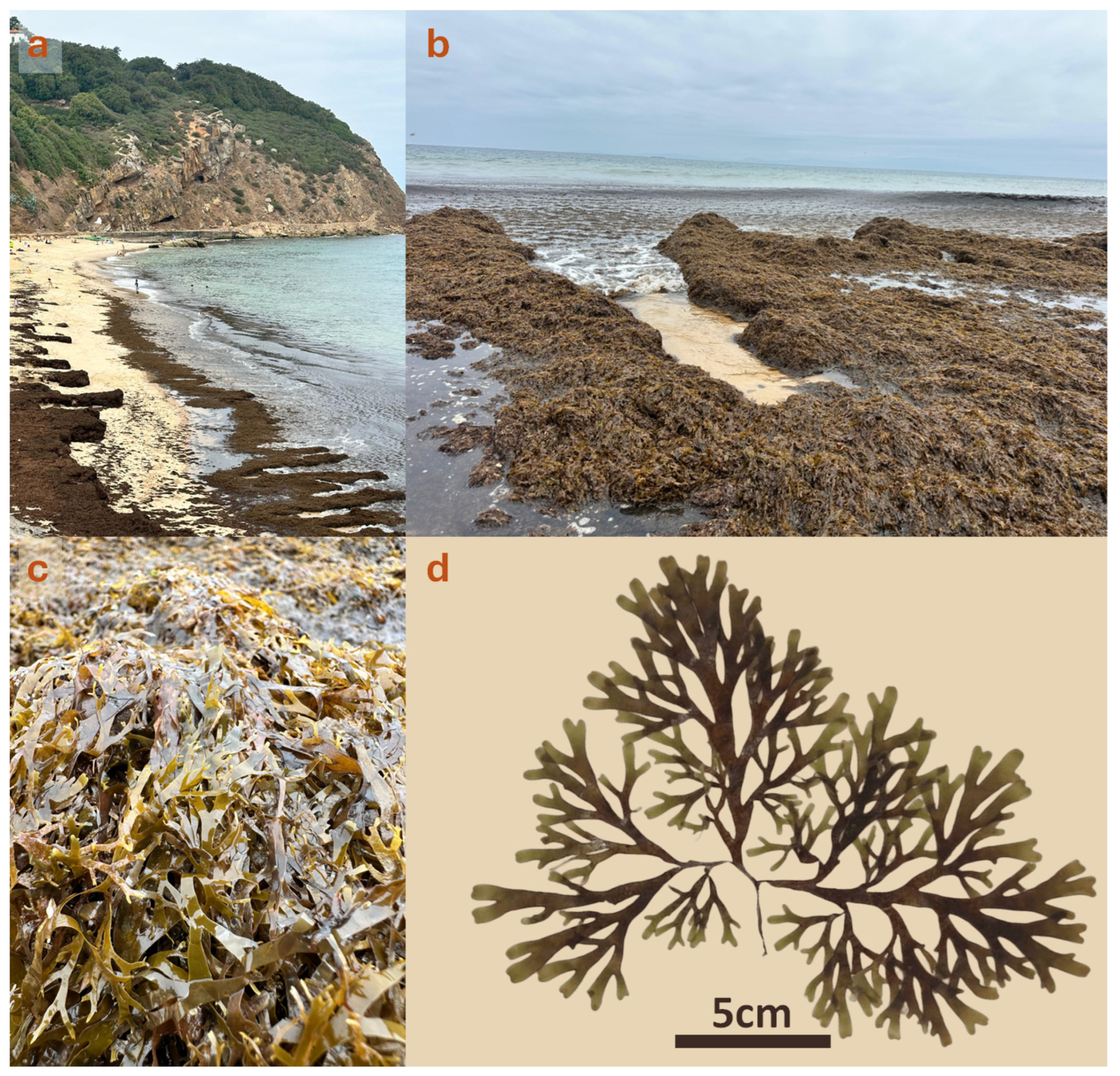
Few marine invasions have unfolded as rapidly, or as visibly, as that of Rugulopteryx okamurae (E.Y. Dawson) (Dictyotales, Phaeophyceae), known natively in Japan as フクリンアミジ (Fukurin-amiji) [1,2]. Native to the northwestern Pacific, this brown macroalga was documented on the Moroccan Mediterranean and Atlantic coast [3,4]. R. okamurae has since become one of the most conspicuous invasive macroalgae in the region, forming dense benthic cover and generating substantial beach-cast accumulations along the shoreline (Figure 1). The rapid proliferation of invasive macroalgae can substantially alter native communities and ecosystem structure, with consequences for biodiversity and trophic interactions [5,6]. The severity of the invasion has prompted concern beyond the initially affected Spanish and Moroccan coasts: since 2022, the species has been recognized as a threat to marine ecosystems by the European Union and is now included in the European List of Invasive Alien Species (IAS) (EU 2022/2013) [5]. In just over a decade, Rugulopteryx okamurae has rapidly spread throughout the Strait of Gibraltar, the western Mediterranean, and adjacent Atlantic coastal areas. This significant proliferation has led to the establishment of dense populations that have negatively impacted autochthonous communities [6,7]. Furthermore, the continued expansion of R. okamurae also highlights the need for coordinated monitoring and regional management strategies to limit its spread and associated ecological impacts [5].
However, this remarkable abundance also makes the species particularly attractive as a potential biomass resource. Since biomass must be harvested as part of invasive species management efforts, its transformation into marketable products [8,9] could help offset the costs associated with controlling this invasive species. At the same time, the economic value of the harvested biomass could provide an additional incentive for its collection, thus reinforcing the ecological justification for its management [10].
The most promising target within this feedstock is alginate. It is the single most abundant component of R. okamurae, reported to be roughly one third of the dry biomass [11,12].
Alginate is a linear anionic polysaccharide built from (1 → 4)-linked β-D-mannuronic acid (M) and α-L-guluronic acid (G) residues, organized into homopolymeric M-blocks, homopolymeric G-blocks, and alternating MG-blocks [13]. The alginate sequence is a determining factor in the functional properties of this biopolymer. The proportion of the two residues, expressed by the M/G ratio, as well as their sequential arrangement along the polymer chain, determine whether the polymer forms a soft, flexible gel or a stiff, thermostable one [14]. In particular, G-blocks bind divalent cations through the “egg-box” mechanism. Consequently, guluronate-rich alginates generally form stronger and more rigid hydrogels, making them particularly suitable for encapsulation and structural applications [15]. Beyond that, it is a commercially established biopolymer used across the food, pharmaceutical, biomedical, and materials sectors [16]. Alginate is isolated from seaweed through an acid step, which converts the polymer into insoluble alginic acid and strips away acid-soluble impurities, followed by an alkaline (carbonate) treatment, which redissolves it as sodium alginate before precipitation. Each extraction step can be run gently or harshly, and the choice is not free. More severe alkaline conditions, such as higher temperatures and prolonged extraction times, can increase alginate recovery but can also promote chain breakage, leading to a reduction in molecular mass and potentially altering the material’s functional properties [14].
This study takes up both questions. Using a duplicated two-factor design that varies the acid and carbonate steps independently, we ask how extraction severity governs the yield and composition of R. okamurae alginate. In parallel, we characterize alginate from drifting biomasses on the Atlantic Moroccan coast as a source not previously described, combining FTIR, and 1H NMR. In doing so, we also confront a small but persistent puzzle: a reproducible NMR signal near 4.96 ppm that appears in R. okamurae alginate spectra across independent studies yet has never been identified, and which is a loose thread we set out to bound, if not yet fully resolve. Overall, the exploration of R. okamurae contributes to advancing scientific knowledge on the extraction and characterization of alginates. Furthermore, its valorization can offer potential environmental benefits by helping to reduce the ecological impacts associated with the accumulation and spread of this invasive species. In this context, the study of beach-cast R. okamurae in Morocco contributes both to the understanding of alginate extraction and to the valorization of an invasive species, thus illustrating how a problematic biomass can be turned into a useful resource with potential economic and environmental benefits.

2. Results and Discussion

2.1. Alginate Yield

The alginate yields obtained under the four protocols (PR1, PR2, PR3 and PR4) are summarized in Table 1. Yields ranged from 11.19 ± 0.52% (PR1) to 15.85 ± 0.66% (PR3), with the low standard deviations reflecting good reproducibility across independent extractions. Both extraction assumptions were satisfied prior to analysis (Shapiro–Wilk p = 0.259 and Levene’s p = 0.808), permitting parametric analysis.
Two-way ANOVA revealed that both steps significantly affected the yield, but to markedly different degrees. Carbonation had the dominant effect (F(1, 8) = 100.4, p < 0.001), while acidification contributed a smaller but significant effect (F(1, 8) = 18.8, p = 0.003); no significant interaction was found between the two factors (F(1, 8) = 1.33, p = 0.283). The absence of interaction indicates that the two extraction steps acted independently and additively. The highest yield was obtained when both acid and carbonate treatments were intensified (PR3), the lowest when both were mild (PR1), and the single factor protocols (PR2 and PR4) fell in between. This ranking by F-value identifies the carbonation step as the principal determinant of alginate recovery.
Pairwise comparisons (Tukey HSD) confirmed this pattern. PR3 yielded significantly more alginate than all other protocols (p < 0.05), whereas PR1 and PR4 (the two protocols sharing the mild carbonation step) did not differ significantly (p = 0.190). The fact that modifying the acidification step alone (PR1 versus PR4) failed to produce a significant increase, while intensifying the carbonation step markedly improved recovery, reinforces the predominant role of carbonation. This reflects the function of the carbonation step, in which sodium carbonate solubilizes alginate as sodium alginate; the heated, extended treatment likely promoted more complete conversion and release of the polymer from the algal matrix, increasing the extraction yield [17].
The predominance of the carbonation conditions agrees with previous studies investigating the optimization of the alginate extraction process. Using a response-surface approach, Rincón-Cervera et al. [12] identified elevated temperature and extended extraction time as optimal for alginate recovery from R. okamurae. Comparable optimal conditions (60 °C, 5 h) have been reported for Sargassum spp. [18]. The intensified carbonation applied here (60 °C, 5 h) corresponds to these conditions, and the present factorial analysis independently confirms, through direct comparison of discrete protocols, that it governs the increase in yield. Importantly, these differences in yield were achieved without altering the guluronate rich composition of the alginate (Section 2.2 and Section 2.3), indicating that the extraction can be intensified to maximize recovery from R. okamurae drift biomass while preserving the structural quality of the product. The alginate yields obtained in the present work fall within the range reported for the main alginophyte species on the Moroccan coast [16]. Similarly, the yields obtained for R. okamurae (11–16% dw) are consistent with the range of 3–32% dw previously reported for this species [19,20]. Furthermore, highest yield was achieved under the optimized conditions of PR3, in agreement with the extraction parameters reported by Rincón-Cervera et al. [12], from which this protocol was adapted.

2.2. FTIR Spectroscopy Analysis

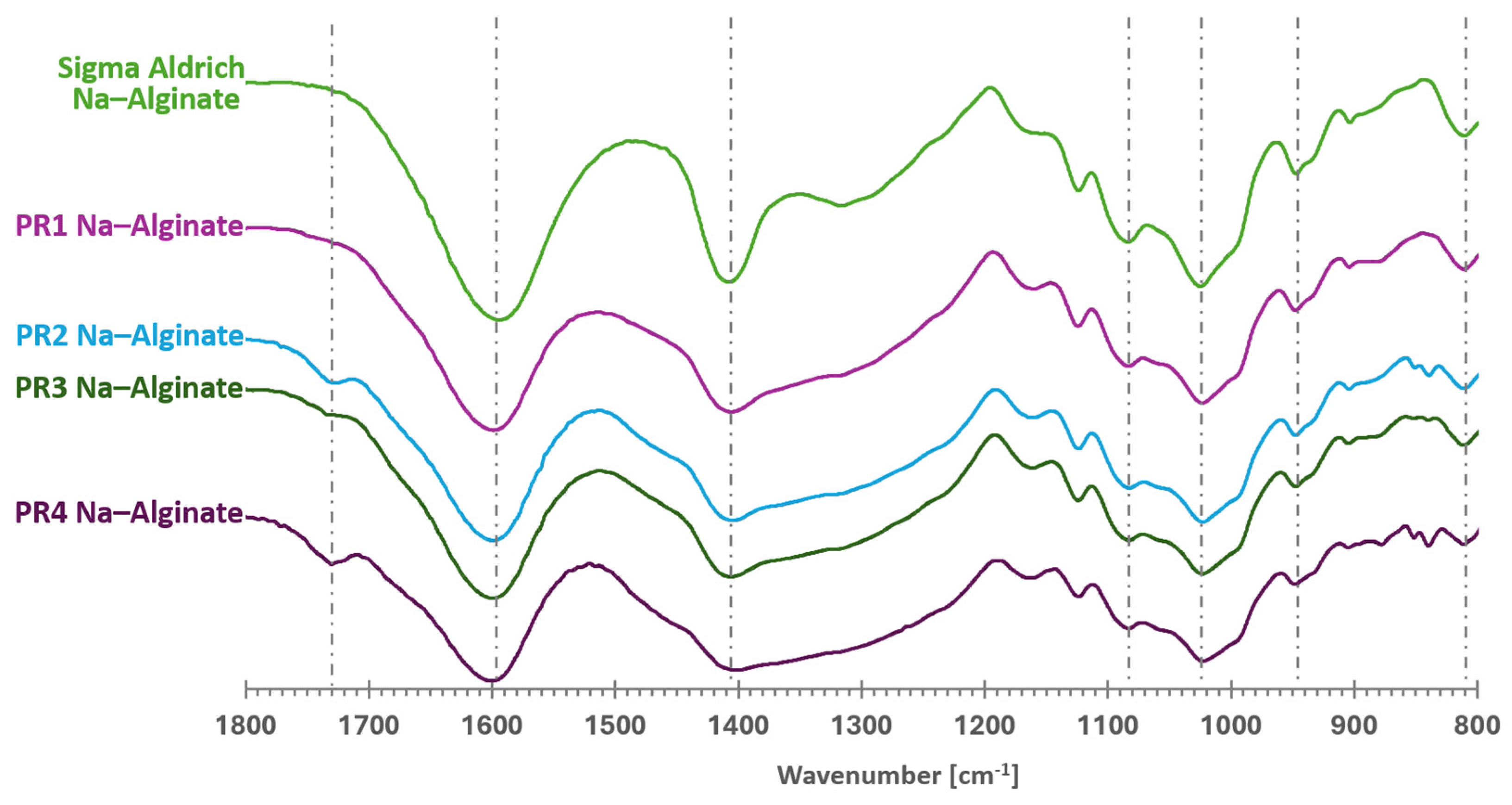
The functional groups of the extracted sodium alginates from beach-casted biomass of the invasive brown seaweed R. okamurae were characterized by FTIR, allowing comparison between all four PR1–PR4 protocols and assignment of the characteristic alginate absorption bands (Figure 2). Commercial Sigma-Aldrich sodium alginate served as a reference for band assignment. The absorption bands of sodium alginate are present in all five spectra, indicating that the target polysaccharide was obtained with each extraction protocol applied to R. okamurae biomass.
Asymmetric and symmetric stretching vibrations of the carboxylate (COO−) groups of uronic acid residues are assigned to the two most diagnostic bands, which are recorded at approximately 1594 cm−1 and 1405 cm−1 [21]. A systematic difference was observed in the carbonyl region between alginates obtained from the different protocols used. PR1 showed only the carboxylate bands, with no absorption in the 1710–1730 cm−1 region. This confirms that the alginate was recovered entirely in its deprotonated sodium salt form [16]. In contrast, PR2, PR3, and PR4 each exhibited an additional band at approximately 1728 cm−1, characteristic of the C=O stretching of protonated carboxylic acid (–COOH) groups. The presence of this band alongside the carboxylate bands stipulates that these alginate samples retained a fraction of non-neutralized carboxylic acid groups, reflecting incomplete total conversion to the sodium salt form. PR1 was the only protocol in which both the acidification and carbonation steps were performed at room temperature over 24 h, while each of PR2–PR4 involved a heated and shortened acidification and/or carbonation step. Thus, the appearance of the carboxylic acid ester (C=O) band at 1728 cm−1 appears associated with these modified conditions, which were less effective at achieving complete neutralization of the alginic acid. The C-O and C-C stretching of the pyranose ring are responsible for the bands at approximately 1080 and 1021 cm−1, respectively [21,22]. In the fingerprint region, all spectra exhibited a distinct band at 945 cm−1, corresponding to the C–O stretching vibration of uronic acid residues. Furthermore, the absorption band detected at 810 cm−1 has consistently been attributed to mannuronic acid residues [16,23].
Importantly, the alginates obtained using the four extraction protocols exhibited the same characteristic bands as the commercial standard. This indicated that the chemical identity and the principal functional groups of the alginate samples were not altered. The spectral profile was reproducible across all four protocols, indicating consistent alginate recovery under various extraction conditions. This reproducibility is advantageous for scale-up. This consistency is in agreement with published assignments for R. okamurae [12]. Furthermore, sulfated polysaccharide contamination was excluded by the absence of the 1230–1280 cm−1 band [24]. Meanwhile, FTIR is a simple, rapid, and low-cost technique that reliably confirms the functional groups of the extracted alginate, but it does not resolve the functional properties of the polymer. Therefore, 1H NMR spectroscopy is the recognized reference employed to determine the M/G ratio and the block composition of the extracted alginate [25].

2.3. 1H NMR Spectroscopy Analysis

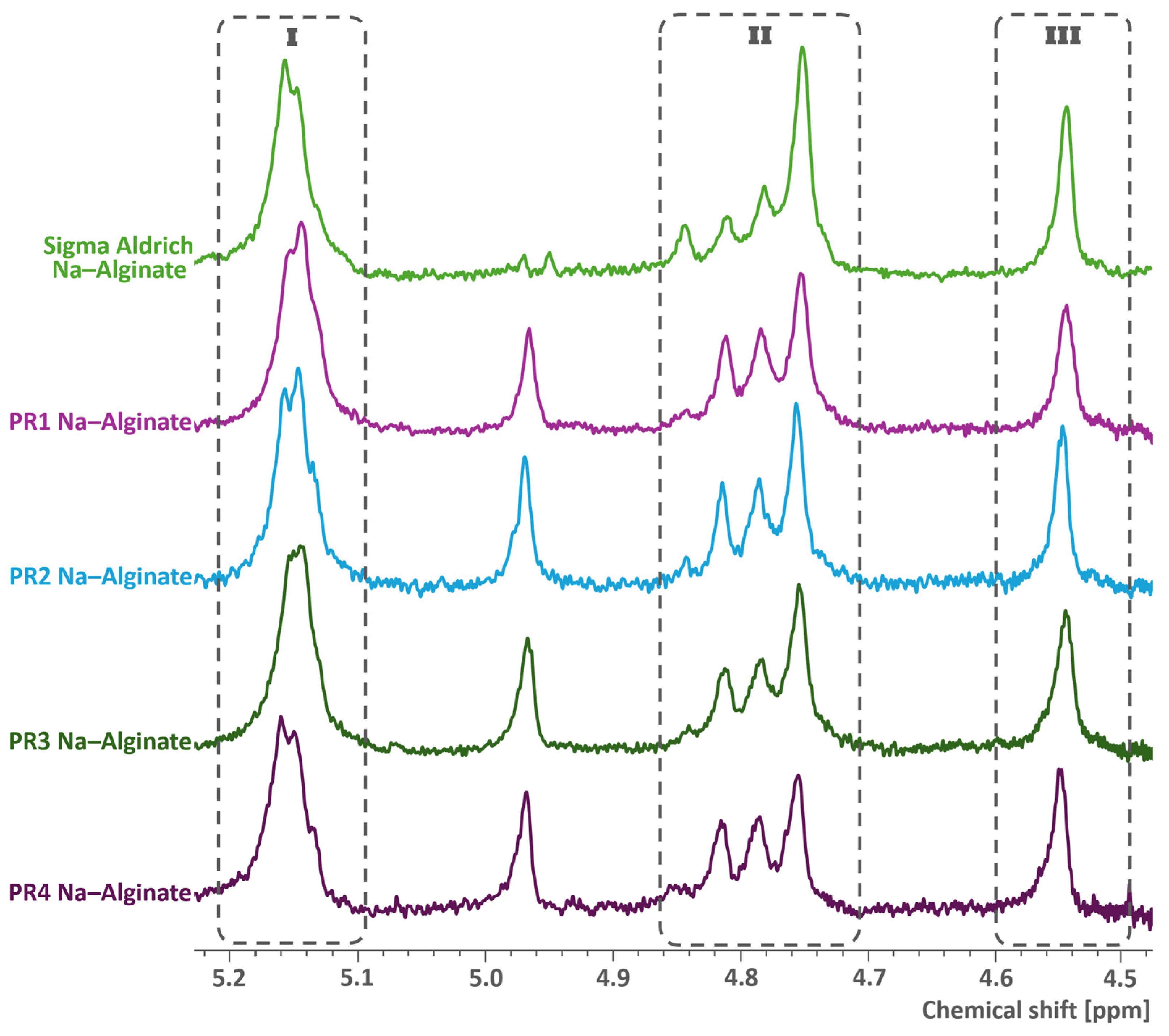
The structural composition of the extracted alginate was determined by 1H-NMR spectroscopy recorded in D2O at 343 K. All four extracted alginates (PR1–PR4) and the commercial standard exhibited the three diagnostic anomeric signals of alginate (Figure 3): the guluronate anomeric proton (G-1) at ~5.1–5.2 ppm (I), the overlapping mannuronate anomeric proton (M-1) and H-5 of alternating GM blocks at ~4.74–4.85 ppm (II), and the H-5 of homopolymeric guluronate blocks at ~4.5–4.6 ppm (III) [25]. The spectral concordance between the extracted samples and the commercial standard confirmed the identity of the recovered polysaccharide as alginate.
The molar fractions of guluronate (FG) and mannuronate (FM) and the M/G ratio were derived from signals I–III, according to Grasdalen et al. [26] (Table 2). All four protocols yielded a markedly guluronate-rich alginate (FG = 0.75–0.82; M/G = 0.21–0.33), in every case exceeding the guluronate content of the commercial Sigma-Aldrich standard. The alginate remained G-rich across the four protocols despite substantial differences in acidification and carbonation conditions, although PR4 showed a lower M/G ratio (0.21) than the other protocols. The lower M/G ratio observed for PR4 may suggest an influence of the intensified acidification treatment; however, the present data are insufficient to distinguish a genuine process-related effect from experimental variation. No definitive mechanistic explanation is, therefore, proposed. Nevertheless, the consistently low M/G values across all protocols indicate the G-rich character is a prominent feature of the recovered alginate from this species. Acidification induces protonation of the carboxylate groups of alginate, yielding the comparatively insoluble alginic acid form. Subsequent treatment with Na2CO3 neutralizes these carboxylic acid groups, facilitating conversion to the water-soluble sodium alginate salt [14]. Variations in the acidification and carbonation steps, therefore, influence the extent of neutralization and the final salt form in which the polymer is recovered. This finding complements the FTIR results, where the modified protocols altered the degree of neutralization and, consequently, the relative protonated and sodium salt forms of the recovered alginate, without substantially affecting the polysaccharide backbone. Together, the two spectroscopic analyses show that the extraction conditions govern recovery and the final salt form as they allow extraction to be optimized for yield or purity without compromising its structural quality.
This guluronate rich profile places R. okamurae alginate within the G-rich end of the broad compositional range reported for brown algae. Alginate composition varies widely among species, and its molecular characteristics, particularly the M/G ratio and the distribution of M and G residues, strongly influence its physicochemical and functional properties, including viscosity and gel-forming behavior [13]. Macrocystis pyrifera, a major commercial source, is mannuronate-rich (≈62% M, 38% G) and forms soft, elastic gels, whereas Laminaria hyperborea is strongly guluronate-rich (≈45% M, 55% G) and forms rigid gels, with reported M/G values across sources spanning roughly from 0.4 to 1.63 [27]. The low M/G ratio obtained here places R. okamurae alginate toward the L. hyperborea end of this spectrum. This is the compositional class prized for strong-gelling and structuring applications [28]. Functionally, this is because the high guluronate content responsible for the formation of rigid and thermally stable Ca2+ mediated “egg-box” gels in L. hyperborea alginate is the same feature identified for R. okamurae in the present study. Meanwhile, M. pyrifera and Ascophyllum nodosum alginates, which contain higher portion of mannuronate, generally form softer and more elastic gels [27]. That alginate, which is from an invasive, otherwise drifting biomass, falls into the same G-rich category because the premium commercial source is a central outcome of this work and directly supports the valorization of R. okamurae as a raw material for alginate. This result supports the guluronate-rich character previously reported for the species, with low M/G ratios (0.47–0.88), strengthening the interpretation that the G-rich character is a reproducible feature of R. okamurae rather than a result of a single study distortion [11,12]. Some inter-study variation is, nonetheless, expected, as the M/G ratio varies with season, growing environment, geographic origin, and extraction method [14]. In addition to the overall M/G ratio, the sequence and distribution of M and G residues are important structural parameters that can influence alginate functionality, particularly its rheological and Ca2+ induced gelation behavior [13]. Diad-level sequence parameters and block lengths were not reported in the present study because the additional resonance at ~4.96 ppm falls outside the conventional three-region integration scheme and, therefore, precludes their reliable determination. The monomeric composition (FG, FM and M/G), however, remains unaffected, being derived from the well-resolved anomeric signals.
A reproducible resonance between the signals I and II at ~4.96 ppm was observed in the four obtained 1H-NMR spectra; this was also visible in previously reported R. okamurae alginate spectra but not assigned, or treated as an impurity [10,12]. This signal does not correspond to any of the three standard alginate diagnostic peaks. A plausible initial hypothesis was that the observed signal originated from a co-extracted polymer and could be originating from a co-extracted sulfated polysaccharide (e.g., fucoidan or a galactofucan) [29]. However, this hypothesis is not supported by the present FTIR data. Unlike commercial fucoidan, which typically exhibits a very distinct sulfate ester ν(S=O) absorption in the 1230–1260 cm−1 region, it was not detectable and was not observed in any of the extracted alginate samples. This finding argues against the presence of significant amounts of highly sulfated fucoidan. These data do not support the presence of highly sulfated fucoidan as the origin of this resonance. A residual desulfated fucan (sulfates are, potentially, stripped during alkaline extraction, which would erase the FTIR signature while leaving the sugar visible via NMR) cannot be excluded based on the present evidence alone, but is considered unlikely to account for an intense signal. Its reproducibility across different protocols, collection sites, and alginates of differing M/G argues against a random impurity or a variable reducing end signal and points, instead, to a consistent component or structural feature of R. okamurae alginate. Accordingly, definitive assignment of this resonance cannot be established from the present one dimensional 1H NMR data. Such an assignment would require two-dimensional NMR (2D NMR), such as 1H-13C HSQC and/or 1H-1H COSY experiments, to establish the relevant proton–carbon and proton–proton correlations and determine whether the observed resonance can be assigned to the alginate backbone.

2.4. Toward Valorization and IAS Management

The valorization of R. okamurae, especially drifting biomass, offers a route to convert an environmental liability into an economic resource. Introduced to the Strait of Gibraltar most probably by ballast water and hull fouling, the specie has since expanded rapidly, displacing native benthic communities and generating substantial accumulations of stranded biomass along the coastline [30]. These strandings impose direct costs on coastal municipalities through collection and disposal, while the invasion itself has been associated with declines in native biodiversity, disruption of local artisanal fisheries, and adverse effects on coastal tourism [5]. Current management relies largely on the removal and landfilling or incineration of stranded biomass, an approach that is costly and generates no return.
Establishing a commercially viable alginate extraction process from this drift biomass reframes that management burden as a feedstock supply. The present results show that beach-casted R. okamurae yields guluronate rich alginate of a quality comparable to premium commercial sources, and that this quality is recovered consistently across a range of extraction conditions. A regional alginate industry based on this invasive material could, therefore, align two objectives that are usually treated separately: supporting invasive species management for local authorities, and supplying a value-added marine biopolymer within a circular, blue economy framework.

3. Materials and Methods

3.1. Sampling Site and Biomass Pretreatment

Drift biomass of R. okamurae (Figure 1) was collected on June 2025 along a large transect at the Tangier shoreline (35°47′40.75″ N 5°50′05.17″ W), Morocco, from recently drifting material retained in the shallow coastal water. The collected biomass was pooled and homogenized, followed by manual separation to remove visible epiphytes. Given the fragile nature of the biomass, the algal material was gently rinsed with tap water, followed by rinsing with deionized water, to eliminate surface-adhered debris. The initial moisture content of the freshly collected biomass was 80 ± 0.55% (n = 3). The biomass was then shade dried until a constant weight was reached.

3.2. Alginate Extraction and Experimental Design

Sodium alginate was extracted from R. okamurae following a procedure adapted from Calumong et al. [31], with the acidification and carbonation conditions based on the optimization reported by Rincón-Cervera et al. [12].
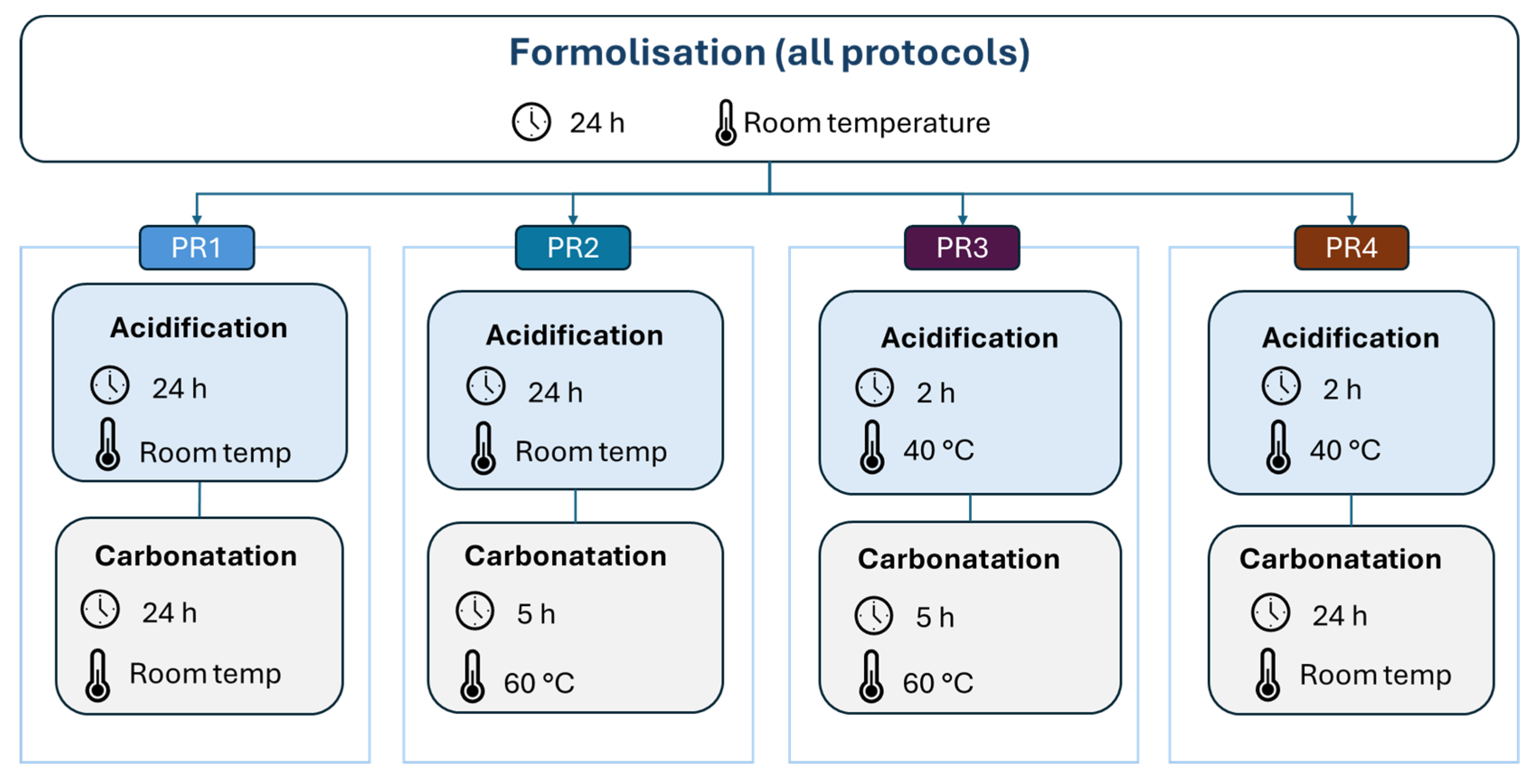
In all protocols, 12.5 g of dried biomass was first subjected to formolisation using 2% formaldehyde at room temperature for 24 h, followed by washing with water. The biomass was subsequently acidified using 0.2 M HCl and subjected to carbonation using 2% Na2CO3. The reagent concentrations, biomass mass, and solution volume were kept constant across all protocols, while acidification and carbonation time and temperature were varied according to the experimental design. Four extraction protocols were tested using a 2 × 2 factorial design combining two acidification treatments (24 h at room temperature or 2 h at 40 °C) with two carbonation treatments (24 h at room temperature or 5 h at 60 °C). This yielded four protocols (PR1–PR4), as illustrated in Figure 4, where PR1 corresponds to the baseline Calumpong conditions (room-temperature acidification and carbonation), and PR3 represents the optimized conditions of Rincón-Cervera (heated, shortened acidification and carbonation), while PR2 and PR4 constitute intermediate conditions in which a single factor was modified, allowing the individual contributions of acidification and carbonation to be distinguished. Following carbonation, the sodium alginate was precipitated using ethanol 95%, washed by acetone 90%, and dried in an oven at 50 °C until a constant weight was achieved. Each extraction protocol was performed in triplicate. Extraction yield was expressed as a percentage of dry algal biomass (% dw).

3.3. FTIR Spectroscopy Analysis

FTIR spectra of the dried sodium alginate samples were placed on a Thermo Scientific Nicolet Impact 400D FT-IR spectrometer (Nicolet Instrument Co., Madison, WI, USA) in attenuated total reflectance (ATR) mode. Spectra were recorded over the 4000–600 cm−1 range at a resolution of 4 cm−1, with 32 scans averaged per sample. The resulting spectra were processed using OMNIC 7.1 software (Nicolet, Madison, WI, USA).

3.4. 1H NMR Spectroscopy Analysis

1H-NMR spectra of the sodium alginate samples, dissolved in D2O, were recorded at 343 K on a Bruker AV II 400 MHz spectrometer (9.4 T; proton Larmor frequency 400.33 MHz; Bruker Corporation, Billerica, MA, USA) equipped with a 5-mm triple-resonance broadband inverse (TBI) probe (Bruker Corporation, Billerica, MA, USA). Free induction decays were acquired with 16 K data points and a sweep width of 4800 Hz, averaging 32 transients. Presaturation was applied during the relaxation delay and mixing time to suppress the residual water signal. Prior to Fourier transformation, the data were apodized with a line-broadening factor of 0.5 Hz. A commercial sodium alginate (Sigma-Aldrich, Gillingham, UK) was used as the standard.

3.5. Statistical Analysis

Each extraction protocol used for this study was performed in triplicate (n = 3), and results are expressed as mean ± standard deviation. The effects of the acidification and carbonation conditions on extraction yield were evaluated using a two-way analysis of variance (ANOVA), with acidification and carbonation as fixed factors and their interaction included in the model. Prior to analysis, normality of the model residuals was verified using the Shapiro–Wilk test and the homogeneity of variances using Levene’s test. When significant effects were detected, pairwise comparisons between protocols were performed using Tukey’s honestly significant difference (HSD) test. Differences were considered statistically significant at p < 0.05. All analyses were carried out in R (version 4.6.1). The alginate M/G composition was determined from a single representative sample per protocol and is, therefore, reported descriptively, without statistical comparison.

4. Conclusions

This study characterized sodium alginate extracted from the brown invasive seaweed R. okamurae, using drift biomass collected from the Moroccan coast, and evaluated the influence of the extraction conditions on the recovered polymer. Four protocols, differing in their acidification and carbonation steps, were compared by extraction yield, FTIR, and 1H-NMR. The FTIR analysis confirmed the successful extraction of alginate using all four protocols, with spectra closely matching that of the commercial standard. A systematic difference was observed in the carbonyl region, indicating that the extraction conditions influenced the degree of neutralization. No sulfate absorption was detected, suggesting the absence of significant co-extracted sulfated polysaccharides. 1H-NMR analysis showed that the extracted alginate is guluronate rich (M/G ≈ 0.3). Notably, this composition remained consistent across all used protocols despite the substantial differences in extraction conditions, demonstrating that the guluronate-rich character is an inherent property of the biomass rather than a consequence of a particular extraction method. This compositional stability is advantageous for processing as it allows the extraction parameters to be adjusted according to yield and processing requirements without compromising the structural characteristics of the recovered alginate. The consistently low M/G ratio indicates a G-rich alginate composition, similar to G-rich commercial alginate sources. However, important physicochemical and functional properties, including molecular weight distribution and rheological behavior should be investigated in future works. These findings support the valorization of R. okamurae drift biomass. Although this invasive species currently represents an ecological and economic burden along invaded coastlines, it could serve as a viable feedstock for alginate, aligning invasive-species management with a circular, blue-economy approach. Further work should focus on the complete sequential characterization of the polymer, including diad frequencies and block-length distribution, which could not be reliably resolved here, as well as on the molecular weight and gelling performance of the extracted alginate, to fully establish its suitability for specific industrial applications.

Author Contributions

Conceptualization, B.S., Z.B. and K.K.; methodology, Z.B., K.K., A.C. and F.B.; software, B.S., F.B. and C.J.; validation, B.S. and F.B.; formal analysis, F.B., C.J., V.S.-P. and K.K.; investigation, B.S., Z.B., A.C., V.S.-P. and K.K.; resources, B.S.; data curation, B.S., Z.B., V.S.-P. and K.K.; writing—original draft preparation, K.K. and A.C.; writing—review and editing, Z.B., B.S., A.C., V.S.-P. and F.B.; visualization, B.S.; supervision, B.S. and Z.B.; project administration, B.S.; and funding acquisition, B.S. All authors have read and agreed to the published version of the manuscript.

Funding

This research was partially funded by the Project VPMA3-578/2021/ANPMA/CNRST/UCD and the Research contract n° 612/2021URL CNRST 10. K.K. was funded by the National Center for Scientific and Technical Research (CNRST) through PhD-Associate Scholarship n° 25 UCD 2023.

Institutional Review Board Statement

Not applicable.

Informed Consent Statement

Not applicable.

Data Availability Statement

The raw data supporting the conclusions of this article will be made available by the authors on request.

Acknowledgments

The authors sincerely thank Taheri Ahmed and El Ajjouri Bilal for logistical assistance and active participation in biomass sampling.

Conflicts of Interest

The authors declare no conflicts of interest.

References

  1. Figueroa, F.L.; Vega, J.; Flórez-Fernández, N.; Mazón, J.; Torres, M.D.; Domínguez, H.; Pereira, L. Challenges and opportunities of the exotic invasive macroalga Rugulopteryx okamurae (Phaeophyceae, Heterokontophyta). J. Appl. Phycol. 2025, 37, 579–595. [Google Scholar] [CrossRef] [Scilit]
  2. Vieira, C.; Akita, S.; Suzuki, M.; Terada, R.; Hanyuda, T.; Shimada, S.; Uwai, S.; Kawai, H. A taxonomic sudoku: Resolving the long-standing puzzle of Japanese Dictyoteae (Dictyotales, Phaeophyceae) with new records and biogeographic insights. J. Phycol. 2025, 61, 1457–1485. [Google Scholar] [CrossRef] [Scilit] [PubMed]
  3. El Aamri, F.; Idhalla, M.; Tamsouri, M.N. Occurrence of the invasive brown seaweed Rugulopteryx okamurae (E.Y. Dawson). Mediterr. Fish. Aquac. Res. 2018, 1, 92–96. [Google Scholar]
  4. El Madany, M.; Hassoun, M.; El Aamri, F.; El Mtili, N. Recent occurrence and expansion of the non-indigenous alga Rugulopteryx okamurae in Morocco (Mediterranean and Atlantic shores). Aquat. Bot. 2024, 190, 103722. [Google Scholar] [CrossRef] [Scilit]
  5. Bellissimo, G.; Altamirano, M.; Muñoz, A.R.; de la Rosa, J.; Hung, H.M.; Rizzuto, G.; Vizzini, S.; Tomasello, A. Dictyota rugulopteryx (Dictyotales, Ochrophyta) continues to expand: First record in Italy. BioInvasions Rec. 2024, 13, 385–401. [Google Scholar] [CrossRef] [Scilit]
  6. Sempere-Valverde, J.; Ostalé-Valriberas, E.; Maestre, M.; Aranda, R.G.; Bazairi, H.; Espinosa, F. Impacts of the non-indigenous seaweed Rugulopteryx okamurae on a Mediterranean coralligenous community (Strait of Gibraltar): The role of long-term monitoring. Ecol. Indic. 2021, 121, 107135. [Google Scholar] [CrossRef] [Scilit]
  7. Faria, J.; Prestes, A.C.; Moreu, I.; Cacabelos, E.; Martins, G.M. Dramatic changes in the structure of shallow-water marine benthic communities following the invasion by Rugulopteryx okamurae (Dictyotales, Ochrophyta) in Azores (NE Atlantic). Mar. Pollut. Bull. 2022, 175, 113358. [Google Scholar] [CrossRef] [Scilit] [PubMed]
  8. Santana, I.; Félix, M.; Guerrero, A.; Bengoechea, C. Processing and characterization of bioplastics from the invasive seaweed Rugulopteryx okamurae. Polymers 2022, 14, 355. [Google Scholar] [CrossRef] [Scilit] [PubMed]
  9. Barcellos, L.; Pham, C.K.; Menezes, G.; Bettencourt, R.; Rocha, N.; Carvalho, M.; Felgueiras, H.P. A concise review on the potential applications of Rugulopteryx okamurae macroalgae. Mar. Drugs 2023, 21, 40. [Google Scholar] [CrossRef] [Scilit] [PubMed]
  10. Patón, D.; García-Gómez, J.C.; Loring, J.; Torres, A. Composting the invasive toxic seaweed Rugulopteryx okamurae using five invertebrate species, and a mini-review on composting macroalgae. Waste Biomass Valorization 2023, 14, 167–184. [Google Scholar] [CrossRef] [Scilit]
  11. Santana, I.; Félix, M.; Bengoechea, C. Feasibility of invasive brown seaweed Rugulopteryx okamurae as source of alginate: Characterization of products and evaluation of derived gels. Polymers 2024, 16, 702. [Google Scholar] [CrossRef] [Scilit] [PubMed]
  12. Rincón-Cervera, M.A.; de Burgos-Navarro, I.; Chileh-Chelh, T.; Belarbi, E.H.; Álvarez-Corral, M.; Carmona-Fernández, M.; Ezzaitouni, M.; Guil-Guerrero, J.L. The agronomic potential of the invasive brown seaweed Rugulopteryx okamurae: Optimisation of alginate, mannitol, and phlorotannin extraction. Plants 2024, 13, 3539. [Google Scholar] [CrossRef] [Scilit] [PubMed]
  13. Aarstad, O.A.; Tøndervik, A.; Sletta, H.; Skjåk-Bræk, G. Alginate sequencing: An analysis of block distribution in alginates using specific alginate-degrading enzymes. Biomacromolecules 2012, 13, 106–116. [Google Scholar] [CrossRef] [Scilit] [PubMed]
  14. Felicia, W.X.L.; Rovina, K.; Zuldin, W.H.; Suriati, L.; Huda, N.; Nurdiani, R. Sustainable valorization of alginate: A review of green extraction, structure–function relationships, and next-generation food applications. Food Bioprocess Technol. 2026, 19, 97. [Google Scholar] [CrossRef] [Scilit]
  15. Tønnesen, H.H.; Karlsen, J. Alginate in drug delivery systems. Drug Dev. Ind. Pharm. 2002, 28, 621–630. [Google Scholar] [CrossRef] [Scilit] [PubMed]
  16. Belattmania, Z.; Kaidi, S.; Atouani, S.E.; Katif, C.; Bentiss, F.; Jama, C.; Reani, A.; Sabour, B.; Vasconcelos, V. Isolation and FTIR-ATR and 1H NMR characterization of alginates from the main alginophyte species of the Atlantic coast of Morocco. Molecules 2020, 25, 4335. [Google Scholar] [CrossRef] [Scilit] [PubMed]
  17. Lee, K.Y.; Mooney, D.J. Alginate: Properties and biomedical applications. Prog. Polym. Sci. 2012, 37, 106–126. [Google Scholar] [CrossRef] [Scilit] [PubMed]
  18. Torres, M.R.; Sousa, A.P.A.; Silva Filho, E.A.T.; Melo, D.F.; Feitosa, J.P.A.; de Paula, R.C.M.; Lima, M.G.S. Extraction and physicochemical characterization of Sargassum vulgare alginate from Brazil. Carbohydr. Res. 2007, 342, 2067–2074. [Google Scholar] [CrossRef] [Scilit] [PubMed]
  19. Ferreira-Anta, T.; Flórez-Fernández, N.; Torres, M.D.; Mazón, J.; Domínguez, H. Microwave-assisted hydrothermal processing of Rugulopteryx okamurae. Mar. Drugs 2023, 21, 319. [Google Scholar] [CrossRef] [Scilit] [PubMed]
  20. Cebrián-Lloret, V.; Cartan-Moya, S.; Martínez-Sanz, M.; Gómez-Cortés, P.; Calvo, M.V.; López-Rubio, A.; Martínez-Abad, A. Characterization of the invasive macroalgae Rugulopteryx okamurae for potential biomass valorisation. Food Chem. 2024, 440, 138241. [Google Scholar] [CrossRef] [Scilit] [PubMed]
  21. Mathlouthi, M.; Koenig, J.L. Vibrational spectra of carbohydrates. Adv. Carbohydr. Chem. Biochem. 1987, 44, 7–89. [Google Scholar] [CrossRef] [Scilit] [PubMed]
  22. Rashedy, S.H.; Abd El Hafez, M.S.M.; Dar, M.A.; Cotas, J.; Pereira, L. Evaluation and characterization of alginate extracted from brown seaweed collected in the Red Sea. Appl. Sci. 2021, 11, 6290. [Google Scholar] [CrossRef] [Scilit]
  23. El Atouani, S.; Bentiss, F.; Reani, A.; Zrid, R.; Belattmania, Z.; Pereira, L.; Mortadi, A.; Cherkaoui, O.; Sabour, B. The invasive brown seaweed Sargassum muticum as new resource for alginate in Morocco: Spectroscopic and rheological characterization. Phycol. Res. 2016, 64, 185–193. [Google Scholar] [CrossRef] [Scilit]
  24. Kamal, K.; Belattmania, Z.; Khaya, K.; Chaouti, A.; Bentiss, F.; Jama, C.; Stiger-Pouvreau, V.; Sabour, B. Characterization of alginate from drifted pelagic Sargassum natans and Sargassum fluitans along the Moroccan Atlantic coast. Phys. Chem. 2025, 5, 51. [Google Scholar] [CrossRef] [Scilit]
  25. Kaidi, S.; Bentiss, F.; Jama, C.; Khaya, K.; Belattmania, Z.; Reani, A.; Sabour, B. Isolation and structural characterization of alginates from the kelp species Laminaria ochroleuca and Saccorhiza polyschides from the Atlantic coast of Morocco. Colloids Interfaces 2022, 6, 51. [Google Scholar] [CrossRef] [Scilit]
  26. Grasdalen, H.; Larsen, B.; Smidsrød, O. Study of the composition and sequence of uronate residues in alginates. Carbohydr. Res. 1979, 68, 23–31. [Google Scholar] [CrossRef] [Scilit]
  27. Peteiro, C. Alginate Production from Marine Macroalgae, with Emphasis on Kelp Farming. In Alginates and Their Biomedical Applications; Rehm, B.H.A., Moradali, M.F., Eds.; Springer Series in Biomaterials Science and Engineering; Springer: Berlin/Heidelberg, Germany, 2018; Volume 11, pp. 27–66. [Google Scholar] [CrossRef] [Scilit]
  28. Nøkling-Eide, K.; Aachmann, F.L.; Tøndervik, A.; Arlov, Ø.; Sletta, H. In-process epimerisation of alginates from Saccharina latissima, Alaria esculenta and Laminaria hyperborea. Carbohydr. Polym. 2024, 325, 121557. [Google Scholar] [CrossRef] [Scilit] [PubMed]
  29. Castro-Riquelme, C.L.; Alberto, E.; Maldonado, L. Multifunctional characterization of fucoidan: Structural insights and efficient removal of toxic metal ions. Res. Updat. Polym. Sci. 2025, 14, 54–61. [Google Scholar] [CrossRef] [Scilit]
  30. Roca, M.; Dunbar, M.B.; Román, A.; Caballero, I.; Zoffoli, M.L.; Gernez, P.; Navarro, G. Monitoring the marine invasive alien species Rugulopteryx okamurae using unmanned aerial vehicles and satellites. Front. Mar. Sci. 2022, 9, 1004012. [Google Scholar] [CrossRef] [Scilit]
  31. Calumpong, H.P.; Maypa, A.P.; Magbanua, M. Population and alginate yield and quality assessment of four Sargassum species in Negros Island, central Philippines. Hydrobiologia 1999, 398, 211–215. [Google Scholar] [CrossRef] [Scilit]
Figure 1. Sampling site and morphology of R. okamurae. (a,b) Field view of the intertidal zone at Merkala beach, Tangier (Morocco), showing accumulated biomass. (c) Field photograph of the collected specimen. (d) Representative specimen illustrating the branched morphology of R. okamurae.
Ijms 27 07898 g001
Figure 2. FTIR spectra of sodium alginate extracted under the four protocols (PR1–PR4) and of commercial sodium alginate (Sigma-Aldrich).
Ijms 27 07898 g002
Figure 3. 1H NMR spectra of commercial sodium alginate (Sigma-Aldrich) and alginates from the four protocols (PR1–PR4). I: signal attributed to anomeric hydrogen of guluronic acid (G). II: signals of H-1 on mannuronic acid (M) and H-5 on GM alternating blocks. III: signal corresponding to the H-5 of homopolymeric G residues.
Ijms 27 07898 g003
Figure 4. Flow chart of the four alginate extraction protocols (PR1–PR4) from the R. okamurae biomass.
Ijms 27 07898 g004
Table 1. Yield of extracted alginate from R. okamurae under the four extraction protocols (PR1–PR4).
ParameterPR1PR2PR3PR4
Yield (% dw)11.19 ± 0.52 c14.07 ± 0.33 b15.85 ± 0.66 a12.22 ± 0.67 c
Values are expressed as mean ± standard deviation (n = 3). Different superscript letters within a row indicate statistically significant differences among extraction protocols (Tukey HSD, p < 0.05).
Table 2. 1H-NMR composition of alginate extracted from R. okamurae under the four protocols (PR1–PR4) compared to the commercial sodium alginate.
ParameterPR1PR2PR3PR4Commercial Standard (Sigma-Aldrich)
FG0.750.770.750.82 0.68
FM0.250.230.250.180.32
M/G0.330.300.330.210.46
Disclaimer/Publisher’s Note: The statements, opinions and data contained in all publications are solely those of the individual author(s) and contributor(s) and not of MDPI and/or the editor(s). MDPI and/or the editor(s) disclaim responsibility for any injury to people or property resulting from any ideas, methods, instructions or products referred to in the content.