Article

Molecular Characterization of Infectious Laryngotracheitis Virus from Broiler Diseased Chickens in Northern Vietnam During 2023–2025


by
Giang Thi Huong Tran
1,2,
Vuong Trong Tran
3,
Amonpun Rattanasrisomporn
4,
Hieu Van Dong
1,
Autchara Kayan
2,5,* and
Jatuporn Rattanasrisomporn
2,6,*
1
Faculty of Veterinary Medicine, Vietnam National University of Agriculture, Hanoi 131000, Vietnam
2
Center for Advanced Studies for Agriculture and Food, Kasetsart University Institute for Advanced Studies, Kasetsart University, Bangkok 10900, Thailand
3
National Center for Veterinary Diagnosis No. 2, Department of Animal Health and Production, Ministry of Agriculture and Environment, Hanoi 131000, Vietnam
4
Interdisciplinary of Genetic Engineering and Bioinformatics, Graduate School, Kasetsart University, Bangkok 10900, Thailand
5
Department of Animal Science, Faculty of Agriculture, Kasetsart University, Bangkok 10900, Thailand
6
Department of Companion Animal Clinical Sciences, Faculty of Veterinary Medicine, Kasetsart University, Bangkok 10900, Thailand
*
Authors to whom correspondence should be addressed.
Int. J. Mol. Sci. 2026, 27(17), 7544; https://doi.org/10.3390/ijms27177544 (registering DOI)
Submission received: 12 July 2026 / Revised: 20 August 2026 / Accepted: 21 August 2026 / Published: 23 August 2026

Abstract

PCR-based surveillance identified the infectious laryngotracheitis virus (ILTV) genome in 8 out of 14 (57.14%) commercial broiler farms across three Northern Vietnam provinces. Partial sequencing of the infected cell protein 4 (ICP4) and glycoprotein B, G, and J (gB, gG, and gJ) genes from the ILTV isolates obtained during 2023–2025 indicated that eight Vietnamese ILTV-positive samples were field ILTV strains. Additionally, high nucleotide identity was observed among the isolates, with ranges of 99.74–100% for the gB, 99.63–100% for the gJ, 99.66–100% for the gG, and 99.34–100% for the ICP4 genes. Phylogenetic analyses based on four genes (gB, gJ, gG, and ICP4) revealed that the eight ILTV strains belonged to two distinct lineages, except for the gJ gene. Analysis of the ICP4 gene showed that the five ILTV strains (VNUA-ILTV-02, VNUA-ILTV-05 to VNUA-ILTV-08) clustered with the United States Laryno Vac, Poulvac-ILT, and ON-2462242/1987 strains, whereas the remaining strains (VNUA-ILTV-01, VNUA-ILTV-03, and VNUA-ILTV-04) were in a distinct group. Furthermore, several amino acid changes were observed in the gB, gG, and gJ proteins of the characterized ILTV strains.

1. Introduction

The poultry industry is a key pillar of the agricultural economy in Vietnam, contributing notably to national food security through the supply of poultry meat and eggs as major sources of animal protein. Infectious laryngotracheitis (ILT) is a highly transmissible respiratory disease of chickens and represents a major cause of economic loss in the global poultry sector. The causative agent, infectious laryngotracheitis virus (ILTV), also known as Gallid herpesvirus 1, is classified within the genus Iltovirus, subfamily Alphaherpesvirinae of the family Herpesviridae [1].
The ILTV genome consists of a linear double-stranded DNA molecule about 153 kilobases in size. Its genome includes a unique long (UL) region and a unique short (US) region, both flanked by inverted repeat sequences (IRSs) and terminal repeat sequences (TRSs) [2]. The viral genome is predicted to encode about 80 protein-coding open reading frames (ORFs). Molecular typing based on PCR amplification and sequencing of the infected cell protein 4 (ICP4) gene remains the most widely used method for strain differentiation [3,4,5].
Chickens constitute the principal natural host of ILTV, with more severe and predominant clinical signs exhibited typically by mature birds [6]. In severe infection, clinical presentation includes marked respiratory distress, manifested by gasping, coughing, and tracheal exudate, which may progress to fatal airway obstruction [7,8]. Disease outcomes vary according to host immune status and viral virulence, with flock mortality potentially reaching 100% and case fatality rates exceeding 50% [9]. ILTV infection leads to substantial production losses, including increased chicken losses and reduced egg output in both commercial broiler and layer production systems [10].
In Vietnam, scientific reports are scarce regarding the molecular epidemiology of ILTV [11]. This knowledge gap necessitates targeted investigation of ILTV associated with current outbreaks in commercial broiler flocks and the performance of molecular characterization of circulating strains. Such findings are critical for elucidating viral diversity for optimizing control strategies against ILT within the country.

2. Results

2.1. ILTV Genome Detection Using PCR

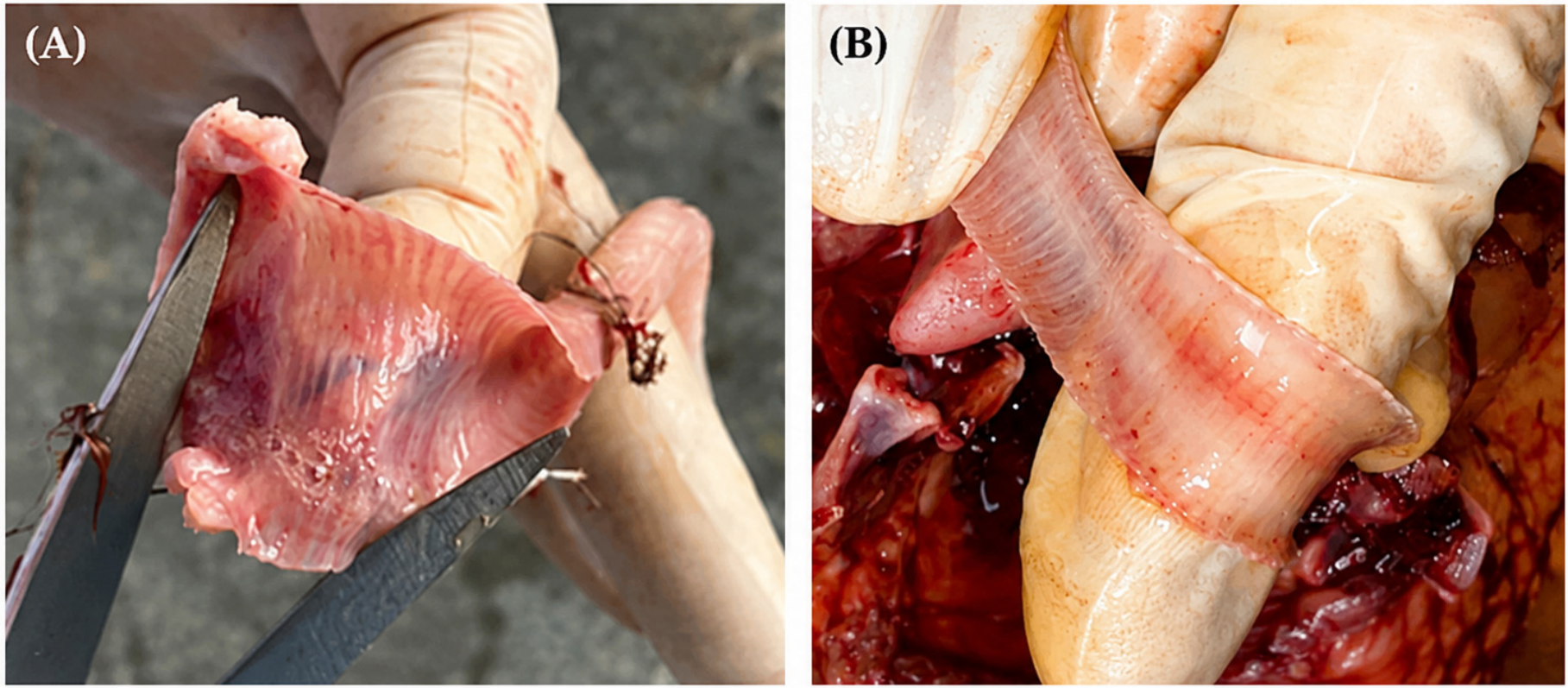
The present study investigated flocks of predominantly broiler chickens containing 500–6000 individuals. Clinical signs observed among the sampled chickens included depression, poor growth performance, coughing, and gasping, with a mortality rate of 5–10%. Notably, frequent, excessive accumulation of mucus within the respiratory tract was observed, with some chickens exhibiting hemorrhagic lesions of the tracheal mucosa (Figure 1).
The present study indicated that ILTV DNA was detected by PCR in 8 of 14 (57.14%) diseased ILTV-suspected broiler chicken farms in the three northern cities/province. More specifically, three samples from BN, one sample from TN, and four samples from HN were determined to be ILTV genome-positive. The ILTV strains were Vietnam/VNUA/ILTV-01/2023, Vietnam/VNUA/ILTV-02/2023, Vietnam/VNUA/ILTV-03/2024, Vietnam/VNUA/ILTV-04/2024, Vietnam/VNUA/ILTV-05/2025, Vietnam/VNUA/ILTV-06/2025, Vietnam/VNUA/ILTV-07/2025, and Vietnam/VNUA/ILTV-08/2025, with abbreviated names set as VNUA-ILTV-01, VNUA-ILTV-02, VNUA-ILTV-03, VNUA-ILTV-04, VNUA-ILTV-05, VNUA-ILTV-06, and VNUA-ILTV-07, and VNUA-ILTV-08 (Table 1).

2.2. Characterization of gB, gJ, gG, and ICP4 Genes

Of the eight current ILTV strains, the present study obtained partial sequences for four genes (gB, gJ, gG, ICP4), with nucleotide identities of 99.74–100%, 99.63–100%, 99.66–100%, and 99.34–100%, respectively (Table 2(A–D)). Based on these partial ICP4 gene sequences, the eight ILTV strains displayed maximum genetic divergences of 0.01, 0.01, 0.005, and 0.006 from the virulent ILTV, tissue culture origin (TCO) vaccine, attenuated vaccine, and chicken embryo origin (CEO) vaccine strains, respectively (Table 3).
Analysis of the amino acid (aa) sequence spanning residues 613–743 of the gB protein from the eight strains identified in the present study with reference sequences in GenBank showed variation at residue 644. Most strains contained threonine (T) at this position, whereas strains VNUA-ILTV-05 to VNUA-ILTV-08 contained isoleucine (I). Notably, all field ILTV strains had substitution of valine (V) with alanine (A) at residue 740 of the gB protein. In addition, there was a nucleotide polymorphism at position 1931 of the gB gene (Table 4). Specifically, strains VNUA-ILTV-01 to VNUA-ILTV-04 contained cytosine (C) at this position, whereas thymine (T) was the substitute in the other ILTV strains obtained in the present study.
Regarding the gJ protein, the aa sequence remained highly conserved across the ILTV strains analyzed in the present study. Nevertheless, the VNUA-ILTV-05 strain contained two aa substitutions (S357F and T359P) relative to the reference strains. Similar to the gB protein, the gG protein aa sequences of the eight ILTV strains were highly conserved. The only detected variation was a glycine (G)-to-alanine substitution at residue 220 (G220A), which was present consistently in strains VNUA-ILTV-03, VNUA-ILTV-04, and VNUA-ILTV-05 (Table 4).
Analysis of fragment 1 (aa positions 86–281) of the ICP4 protein showed only one aa polymorphism at residue 86. In detail, five strains retained asparagine (N) at this position, whereas strains VNUA-ILTV-01, VNUA-ILTV-03, and VNUA-ILTV-04 carried aspartic acid (D) (Table 4).
The number of base substitutions per site was calculated by averaging the overall sequence pairs between different groups. The analysis involved 23 nucleotide sequences. Codon positions consisted of 1st + 2nd + 3rd + non-coding. All positions contained gaps, with missing data eliminated. There were a total of 592 positions in the final data. Evolutionary analyses were conducted using MEGA 6.0 software.

2.3. Phylogenetic Characterization of gB, gJ, gG, and ICP4 Genes

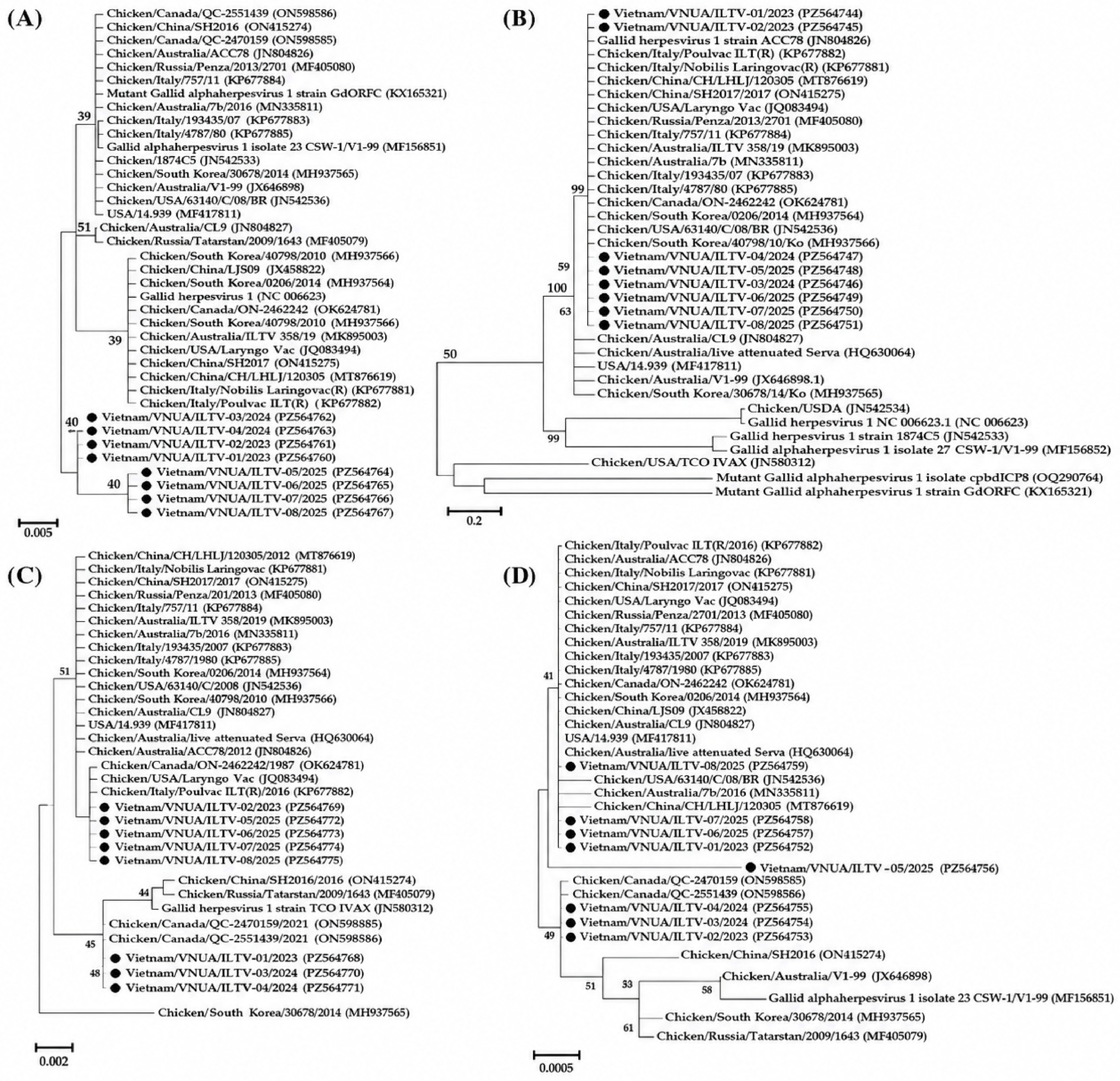
The phylogenetic analyses of the eight representative ILTV strains using the four genes (gB, gJ, gG, and ICP4 genes) revealed that all strains belonged to two distinct lineages, except for the gJ gene (Figure 2). In particular, the phylogenetic tree of the partial gB gene sequence indicated that four obtained ILTV strains (VNUA-ILTV-01 to VNUA-ILTV-04) were clustered together within a single group. In contrast, the remaining VNUA-ILTV strains formed a separate lineage. Notably, both lineages were differentiated clearly from the reference strains available in the GenBank database (Figure 2A). Similar to the gB phylogenetic analysis, the five identified ILTV strains (VNUA-ILTV-04 to VNUA-ILTV-08) belonged to a group with the live-attenuated Serva vaccine strain, whereas the remaining ILTV in the study were classified in one cluster with other ILTV vaccine strains (Poulvac ILT (Zoetis UK Limited, Surrey, UK), Nobilis Laringovac (MSD Animal Health, Cario, Egypt), USA Larynogo Vac (Zoetis US, New Jersey, US)) based on the phylogenetic tree of the gG gene (Figure 2B). Regarding the ICP4 gene, the five ILTV strains (VNUA-ILTV-02, VNUA-ILTV-05 to VNUA-ILTV-08) belonged to a group containing the USA Laryno Vac, Poulvac-ILT, and ON-2462242/1987 strains. In addition, VNUA-ILTV-01, VNUA-ILTV-03, and VNUA-ILTV-04 were clustered in a distinct branch, based on the phylogenetic tree of the ICP4 gene (Figure 2C).
The phylogenetic tree constructed using the partial gJ gene sequences indicated the presence of three distinct subgroups among the obtained ILTV strains. Specifically, VNUA-ILTV-02 to VNUA-ILTV-04 were clustered together and were closely related to an ILTV strain reported in Canada. Furthermore, the VNUA-ILTV-01 and VNUA-ILTV-06 to VNUA-ILTV-08 strains formed a separate subgroup that shared close genetic relatedness to vaccine strains and field isolates from Australia, China, and South Korea. Strain VNUA-ILTV-05 was assigned to an independent subgroup; however, this subgroup remained genetically closer to the strains VNUA-ILTV-01 and VNUA-ILTV-06 to VNUA-ILTV-08 than to the Canadian-associated lineage (Figure 2D).

3. Discussion

Although ILTV is considered to produce lower mortality rates than the highly pathogenic avian influenza virus (AIV) and the Newcastle disease virus (NDV), ILTV continues to be an economically important poultry pathogen. ILTV outbreaks can negatively affect poultry production and lead to substantial economic losses worldwide [12]. Before the present study, there had been only limited scientific reports documenting the occurrence or surveillance of ILTV in poultry production in Vietnam [11]. The present investigation has provided evidence of ILTV circulation in Vietnamese poultry farms, with PCR analysis targeting the TK gene detecting the virus genome in 8 of 14 farms examined, all located in Northern Vietnam. Other studies have reported that ILTV infection is characterized by clinical signs such as tracheal rales, severe tracheitis, respiratory distress, bloody tracheal exudate, reduced mortality, infraorbital sinus swelling, and conjunctival inflammation [7,8]. Gross pathological lesions observed at necropsy consisted of blood expectoration, blood clots in the tracheal lumen, hemorrhagic changes in the trachea and larynx, and congestion with edema of the suborbital sinus [8,13]. Similar clinical manifestations were observed in the chicken samples from ILT-suspected chicken flocks in the present study. However, despite the observation of clinical signs and post-mortem lesions, these findings are inadequate for diagnosing ILTV, largely due to the similarity with the respiratory signs induced by other economically important avian viruses, such as NDV, AIV, and infectious bronchitis virus. Consequently, confirmatory laboratory testing is essential for reliable identification of ILTV.
In the present study, the ILTV genome in the field samples was identified using PCR with a primer set to amplify the TK gene. Eight out of fourteen broiler farms suspected of having ILTV (57.14%) in the present study were positive for ILTV based on PCR in three provinces (TN, BN, and HN) in Northern Vietnam during 2023–2025. The partial sequences of four genes (gJ, gB, gG, and ICP4) were analyzed phylogenetically to characterize the genetic evolution of the ILTV strains currently circulating in Vietnam. Among the genomic targets used for this purpose, the ICP4 gene plays a critical role because it regulates viral gene expression during the early phase of infection [3]. The ICP4 gene has distinct sequence differences between the wild-type and vaccine strains [14]. Consistent with other reports, the phylogenetic tree based on the ICP4 gene was divided into two major clusters, namely the TCO and CEO vaccines and the vaccine-like strains [15,16]. Among the isolates characterized in the present study, five ILTV strains were clustered within the vaccine-associated group and had the highest genetic similarity to CEO vaccine strains, particularly the USA Laryno Vac and Poulvac-ILT strains. This phylogenetic pattern is consistent with other published evidence suggesting that CEO vaccine-like or closely related ILTV strains have been associated with ILT outbreaks in poultry populations worldwide [17,18,19]. Nevertheless, because the vaccine strains used locally were not directly sequenced and compared with the isolates in the present study, these findings should not be interpreted as definitive evidence of vaccine derivation.
The gB protein, derived from the UL27 gene, is an essential component of ILTV and is essential for viral binding to susceptible cells and subsequent viral internalization [20]. The present study identified the nucleotide variation at site 1931 of the gB gene among the strains examined, including both virulent and vaccine strains (TCO and CEO strains). In addition, another study demonstrated that most field strains had cytosine at this position, whereas most vaccine strains contained thymine [21]. These findings support the use of the nucleotide substitution at position 1931 in the gB gene as a potential genetic marker for differentiating field and vaccine-associated ILTV strains [21,22]. The codon composition at site 1931 in the gB gene indicated that the identified ILTV isolates showed sequence identity to vaccine strains and several field isolates.
In addition, analysis of the gG gene sequence has been used widely for the genetic characterization of ILTV isolates [23]. The sequence analysis in the present study identified a novel aa substitution (G to A) at position 220 in the gG protein of three field ILTV isolates in Vietnam. To the best of our knowledge, this was the first report of this mutation in either field or vaccine-related ILTV strains. Therefore, this supports undertaking additional surveillance and genetic characterization of ILTV strains presenting in the various regions of Vietnam to determine the distribution and epidemiological importance of this variant. Furthermore, ILTV gG is known to be an important virulence factor due to it linking with chemokines and suppressing leukocyte chemotaxis [24,25]. However, the functional effects of the identified mutations were not evaluated using bioinformatics-based structural of functional prediction tools. Therefore, further studies are essential to assess whether this aa substitution affects the biological properties and pathogenic potential of ILTV.
Phylogenetic and molecular analyses of the gJ, gB, gG, and ICP4 genes from the ILTV strains isolated during 2023–2025 revealed that the outbreaks in commercial broiler flocks in Vietnam were associated with vaccine-related ILTV strains. Notably, none of the affected flocks included in the present study had been vaccinated against ILTV. In Vietnam, ILTV vaccination is practiced primarily in layer flocks, while, currently, chicken flocks are vaccinated mainly using CEO vaccines. It is considered a potential source of vaccine-like viruses. It has been suggested from other studies that the CEO and TCO vaccine viruses can increase virulence following bird-to-bird transmission, resulting in severe outbreaks among susceptible chickens [15,26]. In addition to vaccine-related factors, environmental transmission may contribute to ILTV spread. In particular, wind-borne dissemination of ILTV has been reported as an important epidemiological factor and may have facilitated virus transmission between poultry flocks [27,28]. In addition, the relatively small number of sampled farms and ILTV-positive isolates is a limitation of this study. This may not fully represent the genetic diversity of ILTV circulating in Northern Vietnam. Therefore, further studies involving larger-scale sampling are warranted to better characterize ILTV genetic diversity and transmission dynamics in the region.

4. Materials and Methods

4.1. Ethics Statement

All animal-related procedures (including handling and sample collection) were undertaken in strict compliance with the Ethical Guidelines of the Vietnam National University of Agriculture (CARE-2023/15 approval, 1 May 2023). The study protocol was approved by the University’s Committee on Animal Research and Ethics. Prior to sampling, written informed consent was obtained from all farm owners after providing a comprehensive explanation of the study objectives and sampling procedures. All procedures was performed in compliance with internationally recognized animal welfare standards to minimize animal stress and discomfort.

4.2. Sample Collection

Samples were collected from 14 commercial broiler farms in Thainguyen (TN), Bacninh (BN), and Hanoi (HN) cities/provinces in Northern Vietnam during 2023–2025. None of these flocks had been vaccinated against ILTV. The farm sites were located in TN, BN, and HN, with approximate distances of 81 km between TN and HN, 70 km between TN and BN, and 46 km between BN and HN. Five sick or dead chickens from each farm were sent for further analysis to the Department of Microbiology and Infectious Diseases, the Faculty of Veterinary Medicine, Vietnam National University of Agriculture. Pooled trachea swabs were collected in sterile tubes. A 10% (w/v) sample homogenate was prepared in phosphate-buffered saline supplemented with gentamicin (10 mg/mL).

4.3. DNA Extraction and PCR for ILTV Genome Detection

DNA was extracted from the homogenate sample using Viral Gene-spin™ Viral DNA/RNA Extraction Kit (iNtRON Biotechnology; Seoul, Republic of Korea), according to the manufacturer’s instructions.
The primer sets ILTV-F1 and ILTV-R1 were applied to amplify a 647 bp fragment of the partial thymidine kinase (TK) gene of ILTV (Table 5), as described elsewhere [29]. Subsequently, four additional primer sets were used for sequencing of the partial ICP4, gB, gG, and gJ genes (Table 5), as described elsewhere [30,31]. The thermal conditions as a preliminary denaturation step were 94 °C for 2 min, followed by 35 cycles at 94 °C for 30 s, 55 °C for 30 s, and 72 °C for 30 s, and a final extension step at 72 °C for 10 min. The PCR product was separated on 1.2% agarose gel and examined under UV light.

4.4. Nucleotide Sequencing and Phylogenetic Analysis

The PCR products were purified using GeneClean® II Kits (MP Biomedicals; Santa Ana, CA, USA). Sequencing of the ICP4, gB, gG, and gJ genes was carried out by 1st BASE, Malaysia.
The sequence data were processed using the GENETYX ver. 10 software (GENETYX Corp.; Tokyo, Japan) and compared with reference sequences available using the BLAST algorithm (https://blast.ncbi.nlm.nih.gov/, accessed on 15 August 2026). Predicted amino acid (aa) sequences were generated using the Clustal W algorithm of BioEdit software version 7.2 [32,33]. Evolutionary distances were estimated from aligned sequences using the Kimura 2-parameter model. Phylogenetic trees were constructed using the maximum likelihood method in MEGA 6.0 software, with 1000 bootstrap replications [34].

4.5. Accession Numbers of Nucleotide Sequence

The nucleotide sequences generated in the present study were deposited in the GenBank database under accession numbers PZ564744–PZ564775.

5. Conclusions

The present study documented ILTV-positive field samples collected during 2023–2025 from unvaccinated commercial broiler farms with ILTV in Northern Vietnam. Molecular analyses of the gJ, gB, gG, and ICP4 genes indicated that these ILTVs were genetically similar to known vaccine strains. These data have enhanced understanding of the molecular characterization of ILTV circulating in Northern Vietnam, with the findings contributing to the foundation of further studies on the viral evolution and transmission dynamics of ILTV. In addition, full-genome sequencing and comparative genomic analysis will be required to determine their origin in the future.

Author Contributions

Study conceptualization, G.T.H.T., A.K. and J.R.; methodology, G.T.H.T. and H.V.D.; software and validation: V.T.T., G.T.H.T., H.V.D., A.K. and J.R.; formal data analysis, G.T.H.T., V.T.T. and J.R.; investigation, G.T.H.T., H.V.D., V.T.T.; resources, G.T.H.T., H.V.D., A.K. and J.R.; data curation, G.T.H.T., A.K. and J.R.; writing—original draft, G.T.H.T. and H.V.D.; writing—review & editing, H.V.D. and J.R.; visualization, A.R. and J.R.; supervision, A.K. and J.R.; project administration, A.K. and J.R.; funding acquisition, A.K. and J.R. All authors have read and agreed to the published version of the manuscript.

Funding

Financial support for this research was provided by a CLMV Research Fellowship from Kasetsart University, Bangkok; the Thailand Project 2025; and the Faculty of Veterinary Medicine, Kasetsart University.

Institutional Review Board Statement

The study complied with the Ethical Guidelines of the Vietnam National University of Agriculture (CARE-2023/15 approval, 1 May 2023) and was approved by the University’s Committee on Animal Research and Ethics.

Informed Consent Statement

Written informed consent was obtained from all farm owners.

Data Availability Statement

The original data supporting the findings of this study are provided in the article. Further inquiries can be addressed to the corresponding author.

Conflicts of Interest

No conflicts of interest are declared.

References

  1. King, A.; Carstens, E.B.; Lefkowitz, E.J. Ninth Report of the International Committee on Taxonomy of Viruses; Elsevier: Amsterdam, The Netherlands, 2011. [Google Scholar]
  2. Spatz, S.J.; Volkening, J.D.; Keeler, C.L.; Kutish, G.F.; Riblet, S.M.; Boettger, C.M.; Clark, K.F.; Zsak, L.; Afonso, C.L.; Mundt, E.S.; et al. Comparative full genome analysis of four infectious laryngotracheitis virus (Gallid herpesvirus-1) virulent isolates from the United States. Virus Genes 2012, 44, 273–285. [Google Scholar] [CrossRef] [Scilit] [PubMed]
  3. Spatz, S.J.; Garcia, M.; Riblet, S.; Ross, T.A.; Volkening, J.D.; Taylor, T.L.; Kim, T.; Afonso, C.L. MinION sequencing to genotype US strains of infectious laryngotracheitis virus. Avian Pathol. 2019, 48, 255–269. [Google Scholar] [CrossRef] [Scilit] [PubMed]
  4. Hermann, S.; Stevens, M.J.A.; Sigrist, B.; Bilic, I.; Albini, S.; Wolfrum, N. Unveiling the genetic landscape of infectious laryngotracheitis virus in Switzerland: Evidence for vaccine-like and wild-type strains. Virology 2024, 600, 110217. [Google Scholar] [CrossRef] [Scilit] [PubMed]
  5. Kardoğan, Ö.; İnce, S.S. Molecular characterization and phylogenetic analysis of infectious laryngotracheitis virus isolates from commercial chicken flocks in Turkey. Arch. Virol. 2024, 169, 231. [Google Scholar] [CrossRef] [Scilit] [PubMed]
  6. Munuswamy, P.; Mariappan, A.K.; Dhama, K.; Reddy, M.R. Avian Infectious Laryngotracheitis. In Recent Advances in Animal Virology; Malik, Y.S., Singh, R.K., Yadav, M.P., Eds.; Springer Singapore: Singapore, 2019; pp. 71–97. [Google Scholar]
  7. Gowthaman, V.; Kumar, S.; Koul, M.; Dave, U.; Murthy, G.K.; Munuswamy, P.; Tiwari, R.; Karthik, K.; Dhama, K.; Michalak, I.; et al. Infectious laryngotracheitis: Etiology, epidemiology, pathobiology, and advances in diagnosis and control—A comprehensive review. Vet. Q. 2020, 40, 140–161. [Google Scholar] [CrossRef] [Scilit] [PubMed]
  8. Rojs, O.Z.; Dovč, A.; Krapež, U.; Žlabravec, Z.; Račnik, J.; Slavec, B. Detection of Laryngotracheitis Virus in Poultry Flocks with Respiratory Disorders in Slovenia. Viruses 2021, 13, 707. [Google Scholar] [CrossRef] [Scilit] [PubMed]
  9. Loncoman, C.A.; Hartley, C.A.; Coppo, M.J.; Vaz, P.K.; Diaz-Méndez, A.; Browning, G.F.; Lee, S.W.; Devlin, J.M. Development and application of a TaqMan single nucleotide polymorphism genotyping assay to study infectious laryngotracheitis virus recombination in the natural host. PLoS ONE 2017, 12, e0174590. [Google Scholar] [CrossRef] [Scilit] [PubMed]
  10. Magouz, A.; Medhat, S.; Abou Asa, S.; Desouky, A. Detection of infectious laryngotracheitis virus (Gallid herpesvirus-1) from clinically infected chickens in Egypt by different diagnostic methods. Iran. J. Vet. Res. 2018, 19, 194–201. [Google Scholar] [PubMed]
  11. Nguyen, V.G.; Cao, T.B.P.; Le, V.T.; Truong, H.T.; Chu, T.T.H.; Dang, H.A.; Nguyen, T.H.; Le, T.L.; Huynh, T.M.L. A Multiplex PCR Method for Simultaneous Detection of Infectious Laryngotracheitis Virus and Ornithobacterium rhinotracheale. Vet. Sci. 2023, 10, 272. [Google Scholar] [CrossRef] [Scilit] [PubMed]
  12. Fuchs, W.; Veits, J.; Helferich, D.; Granzow, H.; Teifke, J.P.; Mettenleiter, T.C. Molecular biology of avian infectious laryngotracheitis virus. Vet. Res. 2007, 38, 261–279. [Google Scholar] [CrossRef] [Scilit] [PubMed]
  13. Kirkpatrick, N.C.; Mahmoudian, A.; Colson, C.A.; Devlin, J.M.; Noormohammadi, A.H. Relationship between mortality, clinical signs and tracheal pathology in infectious laryngotracheitis. Avian Pathol. 2006, 35, 449–453. [Google Scholar] [CrossRef] [Scilit] [PubMed]
  14. Johnson, M.A.; Tyack, S.G.; Prideaux, C.; Kongsuwan, K.; Sheppard, M. Nucleotide sequence of infectious laryngotracheitis virus (gallid herpesvirus 1) ICP4 gene. Virus Res. 1995, 35, 193–204. [Google Scholar] [CrossRef] [Scilit] [PubMed]
  15. Bayoumi, M.; El-Saied, M.; Amer, H.; Bastami, M.; Sakr, E.E.; El-Mahdy, M. Molecular characterization and genetic diversity of the infectious laryngotracheitis virus strains circulating in Egypt during the outbreaks of 2018 and 2019. Arch. Virol. 2020, 165, 661–670. [Google Scholar] [CrossRef] [Scilit] [PubMed]
  16. de Macedo Couto, R.; Preis, I.S.; Braga, J.F.; Brasil, B.S.; Drummond, M.G.; Martins, N.R.; Ecco, R. Molecular characterization of infectious laryngotracheitis virus in naturally infected egg layer chickens in a multi-age flock in Brazil. Arch. Virol. 2015, 160, 241–252. [Google Scholar] [CrossRef] [Scilit] [PubMed]
  17. Neff, C.; Sudler, C.; Hoop, R.K. Characterization of western European field isolates and vaccine strains of avian infectious laryngotracheitis virus by restriction fragment length polymorphism and sequence analysis. Avian Dis. 2008, 52, 278–283. [Google Scholar] [CrossRef] [Scilit] [PubMed]
  18. Ojkic, D.; Swinton, J.; Vallieres, M.; Martin, E.; Shapiro, J.; Sanei, B.; Binnington, B. Characterization of field isolates of infectious laryngotracheitis virus from Ontario. Avian Pathol. 2006, 35, 286–292. [Google Scholar] [CrossRef] [Scilit] [PubMed]
  19. Oldoni, I.; Rodríguez-Avila, A.; Riblet, S.; García, M. Characterization of infectious laryngotracheitis virus (ILTV) isolates from commercial poultry by polymerase chain reaction and restriction fragment length polymorphism (PCR-RFLP). Avian Dis. 2008, 52, 59–63. [Google Scholar] [CrossRef] [Scilit] [PubMed]
  20. Connolly, S.A.; Jackson, J.O.; Jardetzky, T.S.; Longnecker, R. Fusing structure and function: A structural view of the herpesvirus entry machinery. Nat. Rev. Microbiol. 2011, 9, 369–381. [Google Scholar] [CrossRef] [Scilit] [PubMed]
  21. García, M.; Volkening, J.; Riblet, S.; Spatz, S. Genomic sequence analysis of the United States infectious laryngotracheitis vaccine strains chicken embryo origin (CEO) and tissue culture origin (TCO). Virology 2013, 440, 64–74. [Google Scholar] [CrossRef] [Scilit] [PubMed]
  22. Piccirillo, A.; Lavezzo, E.; Niero, G.; Moreno, A.; Massi, P.; Franchin, E.; Toppo, S.; Salata, C.; Palù, G. Full Genome Sequence-Based Comparative Study of Wild-Type and Vaccine Strains of Infectious Laryngotracheitis Virus from Italy. PLoS ONE 2016, 11, e0149529. [Google Scholar] [CrossRef] [Scilit] [PubMed]
  23. Han, M.G.; Kim, S.J. Analysis of Korean strains of infectious laryngotracheitis virus by nucleotide sequences and restriction fragment length polymorphism. Vet. Microbiol. 2001, 83, 321–331. [Google Scholar] [CrossRef] [Scilit] [PubMed]
  24. Devlin, J.M.; Browning, G.F.; Hartley, C.A.; Kirkpatrick, N.C.; Mahmoudian, A.; Noormohammadi, A.H.; Gilkerson, J.R. Glycoprotein G is a virulence factor in infectious laryngotracheitis virus. J. Gen. Virol. 2006, 87, 2839–2847. [Google Scholar] [CrossRef] [Scilit] [PubMed]
  25. Devlin, J.M.; Viejo-Borbolla, A.; Browning, G.F.; Noormohammadi, A.H.; Gilkerson, J.R.; Alcami, A.; Hartley, C.A. Evaluation of immunological responses to a glycoprotein G deficient candidate vaccine strain of infectious laryngotracheitis virus. Vaccine 2010, 28, 1325–1332. [Google Scholar] [CrossRef] [Scilit] [PubMed]
  26. Shehata, A.A.; Halami, M.Y.; Sultan, H.H.; Abd El-Razik, A.G.; Vahlenkamp, T.W. Chicken embryo origin-like strains are responsible for Infectious laryngotracheitis virus outbreaks in Egyptian cross-bred broiler chickens. Virus Genes 2013, 46, 423–430. [Google Scholar] [CrossRef] [Scilit] [PubMed]
  27. Dufour-Zavala, L. Epizootiology of infectious laryngotracheitis and presentation of an industry control program. Avian Dis. 2008, 52, 1–7. [Google Scholar] [CrossRef] [Scilit] [PubMed]
  28. Pitesky, M.; Chin, R.P.; Carnaccini, S.; Sentíes-Cué, C.G.; Charlton, B.; Woolcock, P.R.; Shivaprasad, H.L. Spatial and temporal epidemiology of infectious laryngotracheitis in central California: 2000–2012. Avian Dis. 2014, 58, 558–565. [Google Scholar] [CrossRef] [Scilit] [PubMed]
  29. Pang, Y.; Wang, H.; Girshick, T.; Xie, Z.; Khan, M.I. Development and application of a multiplex polymerase chain reaction for avian respiratory agents. Avian Dis. 2002, 46, 691–699. [Google Scholar] [CrossRef] [Scilit]
  30. Chacón, J.L.; Ferreira, A.J. Differentiation of field isolates and vaccine strains of infectious laryngotracheitis virus by DNA sequencing. Vaccine 2009, 27, 6731–6738. [Google Scholar] [CrossRef] [Scilit] [PubMed]
  31. Yang, Z.; Murata, S.; Fujisawa, S.; Takehara, M.; Katakura, K.; Hmoon, M.M.; Win, S.Y.; Bawm, S.; Konnai, S.; Ohashi, K. Molecular detection and genetic characterization of infectious laryngotracheitis virus in poultry in Myanmar. BMC Vet. Res. 2020, 16, 453. [Google Scholar] [CrossRef] [Scilit] [PubMed]
  32. Hall, T.A. BioEdit: A user-friendly biological sequence alignment editor and analysis program for Windows 95/98/NT. Nucleic Acids Symp. Ser. 1999, 41, 95–98. [Google Scholar]
  33. Thompson, J.D.; Higgins, D.G.; Gibson, T.J. CLUSTAL W: Improving the sensitivity of progressive multiple sequence alignment through sequence weighting, position-specific gap penalties and weight matrix choice. Nucleic Acids Res. 1994, 22, 4673–4680. [Google Scholar] [CrossRef] [Scilit] [PubMed]
  34. Tamura, K.; Stecher, G.; Peterson, D.; Filipski, A.; Kumar, S. MEGA6: Molecular evolutionary genetics analysis version 6.0. Mol. Biol. Evol. 2013, 30, 2725–2729. [Google Scholar] [CrossRef] [Scilit] [PubMed]
Figure 1. Post-mortem lesions of chickens with suspected ILTV infection: (A) Accumulation of mucus within the respiratory tract and (B) Hemorrhagic lesion of the tracheal mucosa.
Ijms 27 07544 g001
Figure 2. Phylogenetic tree of partial sequences of (A) gB, (B) gG, (C) ICP4, and (D) gJ genes of current Vietnamese ILTV strains compared to sequences of other ILTVs obtained from GenBank database. The tree was constructed using the maximum likelihood method (1000 bootstrap replicates) and MEGA6 software. Bootstrap values are shown at nodes. Sequences determined in the present study are highlighted with black circles.
Ijms 27 07544 g002
Table 1. Characteristics of Vietnamese ILTV strains investigated in the present study.
Virus StrainYearDistrictFarm TypeFlock SizeGenBank Accession No.
VNUA-ILTV-012023BNSemi-Grazing1500PZ564744, PZ564752, PZ564760, PZ564769
VNUA-ILTV-022023TNSemi-Grazing2500PZ564745, PZ564753, PZ564761, PZ564768
VNUA-ILTV-032024BNSemi-Grazing6000PZ564746, PZ564754, PZ564762, PZ564770
VNUA-ILTV-042024HNSemi-Grazing3000PZ564747, PZ564755, PZ564763, PZ564771
VNUA-ILTV-052025BNSemi-Grazing3000PZ564748, PZ564756, PZ564764, PZ564772
VNUA-ILTV-062025HNSemi-Grazing5000PZ564749, PZ564757, PZ564765, PZ564773
VNUA-ILTV-072025HNSemi-Grazing1000PZ564750, PZ564758, PZ564766, PZ564774
VNUA-ILTV-082025HNSemi-Grazing500PZ564751, PZ564759, PZ564767, PZ564775
Table 2. (A) Nucleotide sequence identities of partial gB gene of Vietnamese ILTV strains. (B) Nucleotide sequence identities of partial gJ gene of Vietnamese ILTV strains. (C) Nucleotide sequence identities of partial gG gene of Vietnamese ILTV strains. (D) Nucleotide sequence identities of partial ICP4 gene of Vietnamese ILTV strains.
(A)
Number of StrainsStrain NameNumber of Strains/nt Identity (%)
12345678
1VNUA/ILTV-01100
2VNUA/ILTV-02100100
3VNUA/ILTV-03100100100
4VNUA/ILTV-04100100100100
5VNUA/ILTV-0599.7499.7499.7499.74100
6VNUA/ILTV-0699.7499.7499.7499.74100100
7VNUA/ILTV-0799.7499.7499.7499.74100100100
8VNUA/ILTV-0899.7499.7499.7499.74100100100100
(B)
Number of StrainsStrain NameNumber of Strains/nt Identity (%)
12345678
1VNUA/ILTV-01100
2VNUA/ILTV-0299.94100
3VNUA/ILTV-0399.94100100
4VNUA/ILTV-0499.94100100100
5VNUA/ILTV-0599.7099.6399.6399.63100
6VNUA/ILTV-0610099.9499.9499.9499.70100
7VNUA/ILTV-0710099.9499.9499.9499.70100100
8VNUA/ILTV-0810099.9499.9499.9499.70100100100
(C)
Number of StrainsStrain NameNumber of Strains/nt Identity (%)
12345678
1VNUA/ILTV-01100
2VNUA/ILTV-02100100
3VNUA/ILTV-0399.6699.66100
4VNUA/ILTV-0499.6699.66100100
5VNUA/ILTV-0599.6699.66100100100
6VNUA/ILTV-0699.8399.8399.8399.8399.83100
7VNUA/ILTV-0799.8399.8399.8399.8399.83100100
8VNUA/ILTV-0899.8399.8399.8399.8399.83100100100
(D)
Number of StrainsStrain NameNumber of Strains/nt Identity (%)
12345678
1VNUA/ILTV-01100
2VNUA/ILTV-0299.34100
3VNUA/ILTV-0310099.34100
4VNUA/ILTV-0410099.34100100
5VNUA/ILTV-0599.3410099.3499.34100
6VNUA/ILTV-0699.3410099.3499.34100100
7VNUA/ILTV-0799.3410099.3499.34100100100
8VNUA/ILTV-0899.3410099.3499.34100100100100
Table 3. Comparative evolutionary distances among current Vietnamese ILTV and vaccine strains based on ICP4 gene sequence.
Number of StrainsStrain NameVirulent ILTV aTCO Vaccine bAttenuated Vaccine cCEO Vaccine d
1VNUA/ILTV-010–0.010.010.0010–0.001
2VNUA/ILTV-020.005–0.010.0030.0050.005–0.006
3VNUA/ILTV-030.005–0.010.0030.0050.005–0.006
4VNUA/ILTV-040.005–0.010.0030.0050.005–0.006
5VNUA/ILTV-050–0.010.010.0010–0.001
6VNUA/ILTV-060–0.010.010.0010–0.001
7VNUA/ILTV-070–0.010.010.0010–0.001
8VNUA/ILTV-080–0.010.010.0010–0.001
a: USA/63140/C/2008 strain (JN542536), Republic of South Korea/40798/2010 strain (MH937566), Republic of South Korea/30678/2014 strain (MH937565), China/CH/LHLJ/120305/2012 strain (MT876619), China/SH2017/2017 strain (ON415275), Canada/QC-2470159/2021 strain (ON598585), Canada/QC-2551439/2021 strain (ON598586), China/SH2016/2016 strain (ON152274). b: TCO-IVAX strain (JN580312). c: Live-attenuated Serva strain (HQ630064), Nobilis strain (KP677881). d: Italy/4787/1980 strain (KP677885), Italy/193435/2007 strain (KP677883), LT Blent strain (JQ083493), USA/Laryngo vac strain (JQ083494), Poulvac strain (KP677882).
Table 4. Amino acid substitutions of representative gB, gJ, gG, and ICP4 proteins from other ILTV strains.
Strain NamegB Protein
(613–743)
gJ Protein
(152–359)
gG Protein
(34–229)
ICP4 Protein
(86–281)
64474035735922086
Consensus aT/IVST/PGN/D
VNUA-ILTV-01TA.T.D
VNUA-ILTV-02TA.T.N
VNUA-ILTV-03TA.TAD
VNUA-ILTV-04TA.TAD
VNUA-ILTV-05IAFPAN
VNUA-ILTV-06IA.T.N
VNUA-ILTV-07IA.T.N
VNUA-ILTV-08IA.T.N
TCO and CEO vaccine c.b.....
Virulent strains d......
a: Consensus amino acid sequence derived from 57 ILTV strains from GenBank (PQ476026, MF417808–MF417811, PX492157, PQ497631, PQ476027, MK894996–MK895003, PX522223, PX496590, OR906269, NC_075683, NC_006623, JN596962, JN596963, JX646898, JX646899, JN804826, HQ630064, OL354140, OK646550, OK573459, KX165320, KX165321, PZ112168, PX619776, ON598585, ON598586, ON415274, JN808826, MF405080, KP677881–KP677885, MN335811, MF156851, JN542533, MH937564–MH937566, JN804827, MF405079, JX458822, OK624781, JQ083494, ON415275, MT876619). b: Same as consensus amino acid sequence; c: TCO-IVAX strain (JN580312), Italy/4787/1980 strain (KP677885), Italy/193435/2007 strain (KP677883), LT Blent strain (JQ083493), USA/Laryngo vac strain (JQ083494), Poulvac strain (KP677882), Nobilis strain (KP677881); d: USA/63140/C/2008 strain (JN542536), South Korea/40798/2010 strain (MH937566), South Korea/30678/2014 strain (MH937565), China/CH/LHLJ/120305/2012 strain (MT876619), China/SH2017/2017 strain (ON415275), Canada/QC-2470159/2021 (ON598585), Canada/QC-2551439/2021 strain (ON598586), and China/SH2016/2016 strain (ON152274).
Table 5. Information on primer sets applied in present study.
Primer NameSequence (5′–3′) of PrimerAmplicon Length
(bp)
Reference
TK-FACG ATG ACT CCG ACT TTC647[29]
TK-RCGT TGG AGG TAG GTG GTA
gB-FCAA GGG CGG AAT TTG ATA GA440[31]
gB-RAAT GAG GCG ATG CCA GAT GC
gG-FTTG TGC GCG TCT GTA TTA GG612[30]
gG-RCTC CAT AGG ACC GTC GAG TT
gJ-FGTT AAC GCC TCT CTG GAA CG667[30]
gJ-RTCG GGG AAG TAC CTG TAT CG
ICP4-FACT GAT AGC TTT TCG TAC AGC ACG688[30]
ICP4-RCAT CGG GAC ATT CTC CAG GTA GCA
Disclaimer/Publisher’s Note: The statements, opinions and data contained in all publications are solely those of the individual author(s) and contributor(s) and not of MDPI and/or the editor(s). MDPI and/or the editor(s) disclaim responsibility for any injury to people or property resulting from any ideas, methods, instructions or products referred to in the content.