Rhizobacteria-Mediated Reprogramming of Phytohormone Landscapes for Mitigating Salinity Stress in Plants
 , ,
, ,  and
and
Abstract
1. Introduction
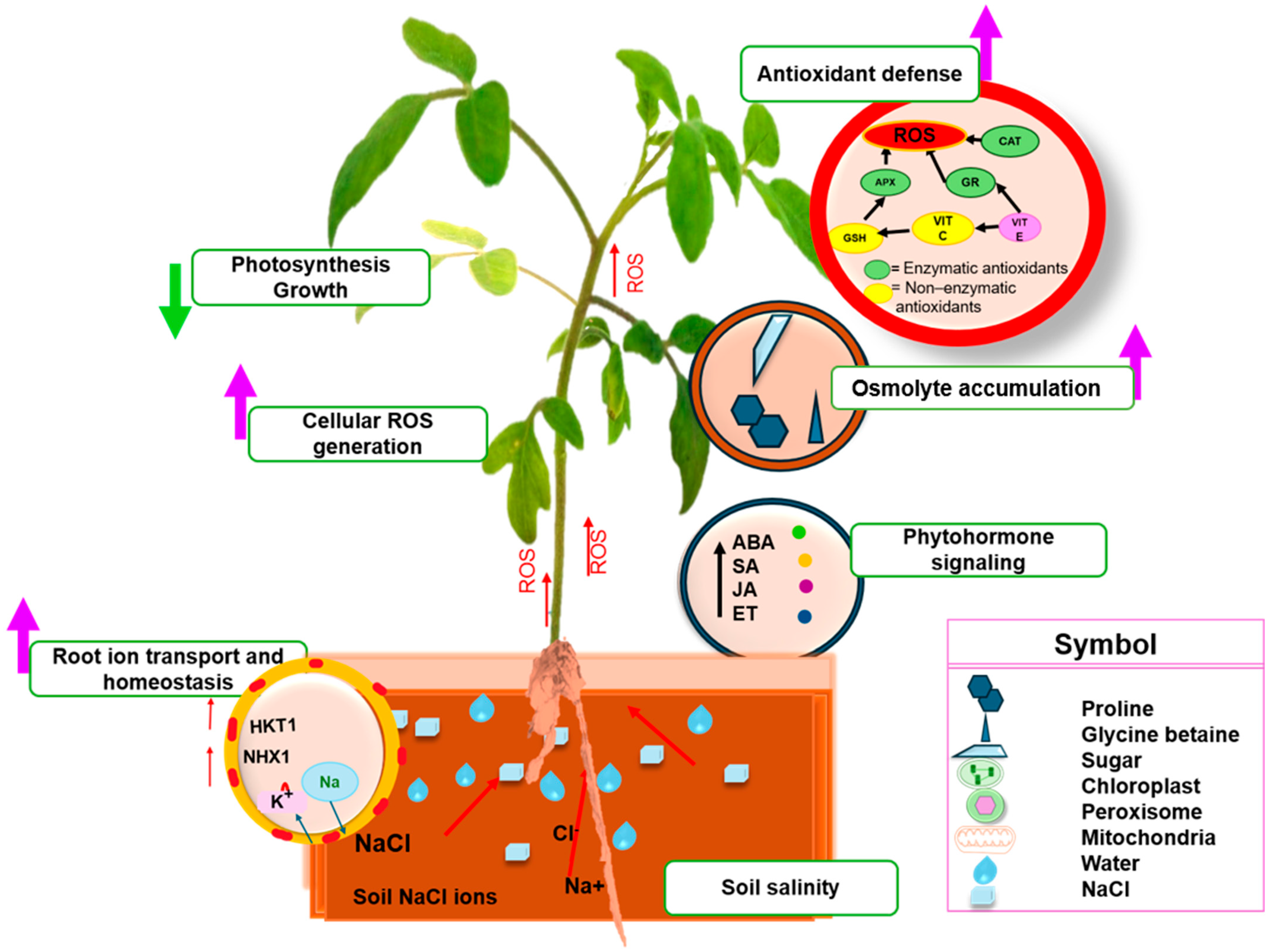
2. Morpho-Physiological and Molecular Plant Responses to Salinity Stress
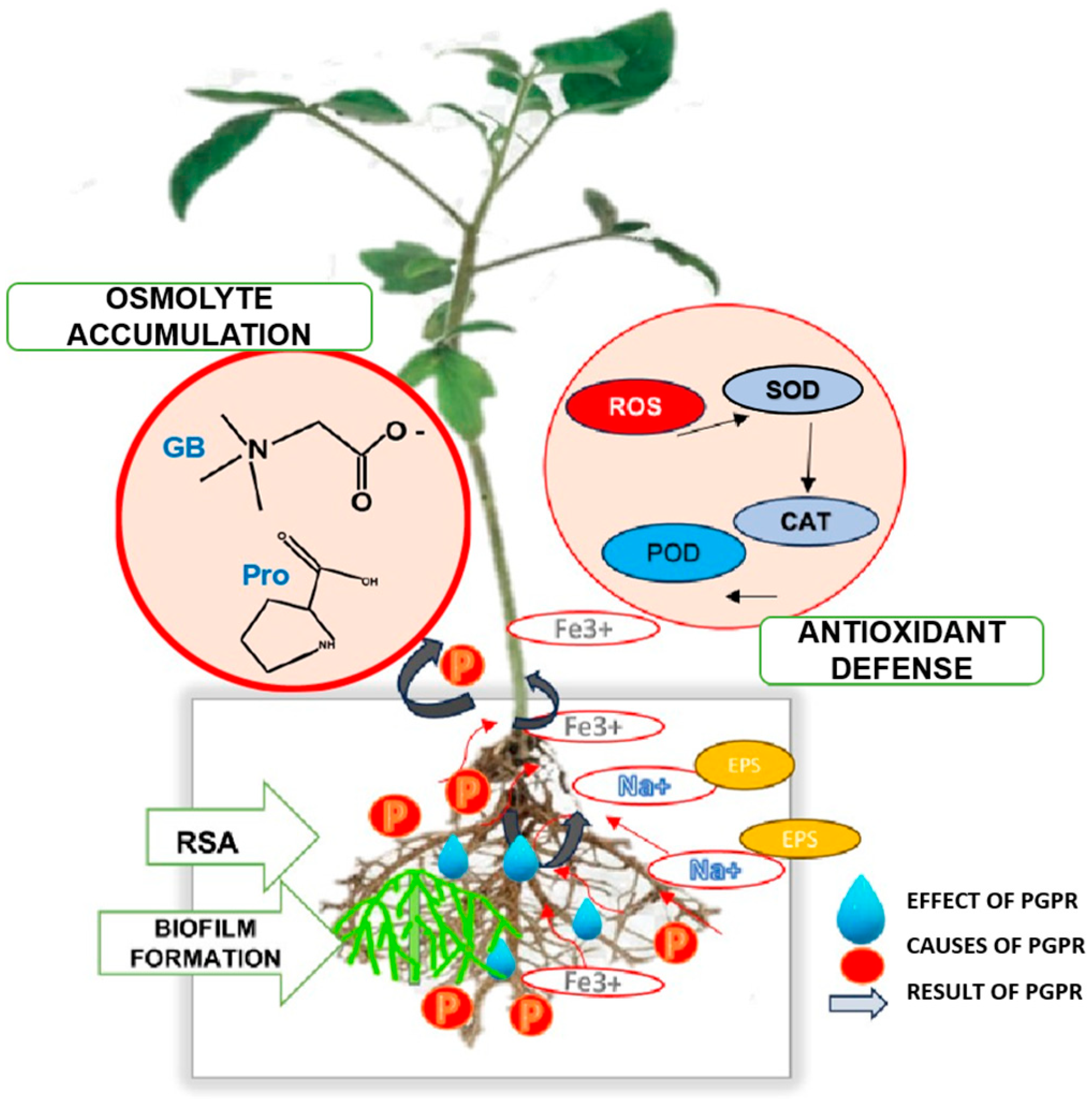
3. Role of PGPRs in the Mitigation of Salinity Stress
4. Rhizobacteria-Mediated Phytohormone Regulation
4.1. ABA
4.2. AUXs
4.3. BRs
4.4. CKs
4.5. ET
4.6. GAs
4.7. JA
4.8. SA
4.9. SLs
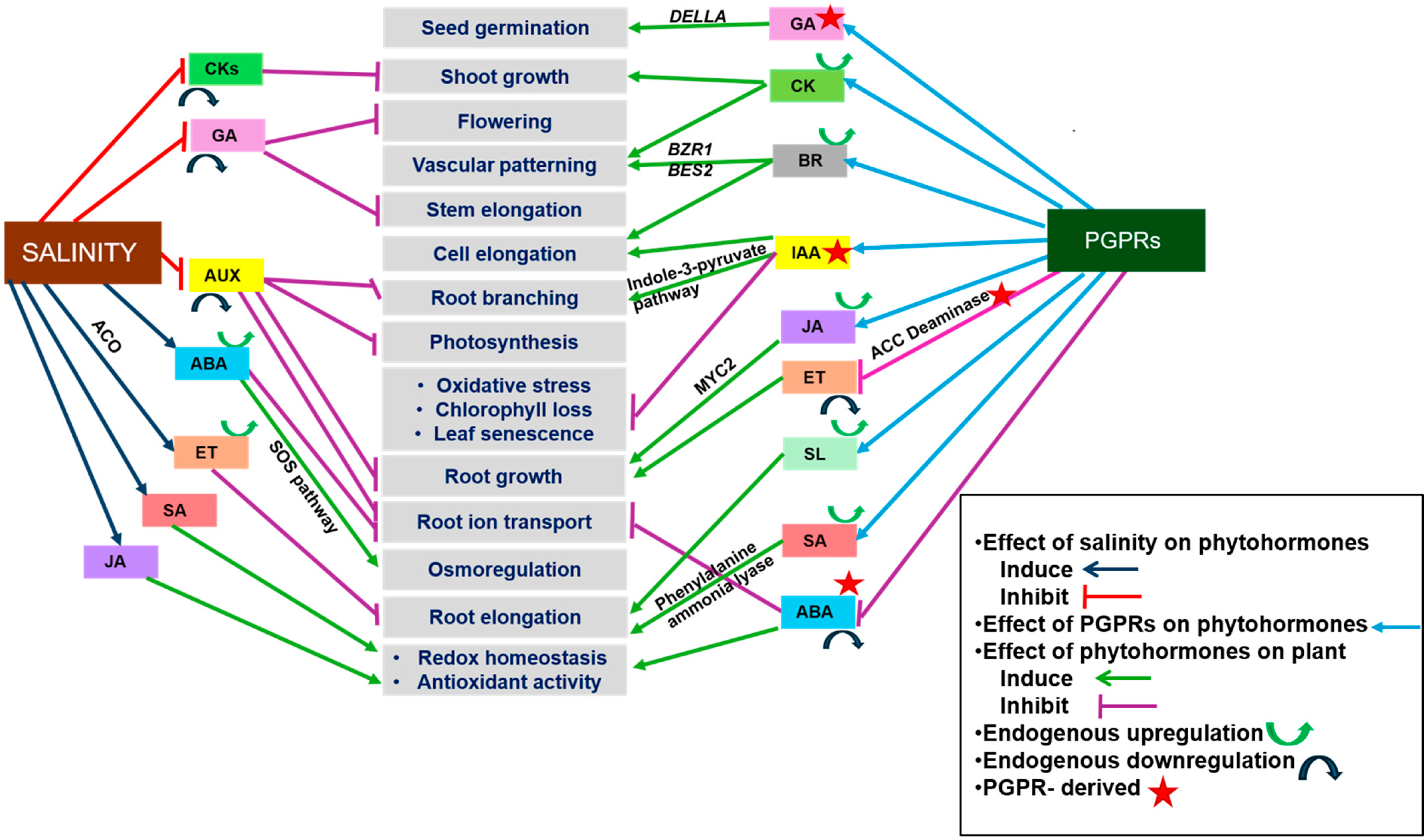
4.10. PGPRs Orchestrate Phytohormone Crosstalk to Coordinate Salinity Tolerance
5. Conclusions and Future Perspectives
Author Contributions
Funding
Institutional Review Board Statement
Informed Consent Statement
Data Availability Statement
Conflicts of Interest
References
- Atta, K.; Mondal, S.; Gorai, S.; Singh, A.P.; Kumari, A.; Ghosh, T.; Roy, A.; Hembram, S.; Gaikwad, D.J.; Mondal, S.; et al. Impacts of salinity stress on crop plants: Improving salt tolerance through genetic and molecular dissection. Front. Plant Sci. 2023, 14, 1241736. [Google Scholar] [CrossRef] [Scilit] [PubMed]
- Munns, R.; Tester, M. Mechanisms of salinity tolerance. Annu. Rev. Plant Biol. 2008, 59, 651–681. [Google Scholar] [CrossRef] [Scilit] [PubMed]
- Xiao, F.; Zhou, H. Plant salt response: Perception, signaling, and tolerance. Front. Plant Sci. 2023, 13, 1053699. [Google Scholar] [CrossRef] [Scilit] [PubMed]
- Arif, Y.; Singh, P.; Siddiqui, H.; Bajguz, A.; Hayat, S. Salinity induced physiological and biochemical changes in plants: An omic approach towards salt stress tolerance. Plant Physiol. Biochem. 2020, 156, 64–77. [Google Scholar] [CrossRef] [Scilit] [PubMed]
- Solomon, W.; Janda, T.; Molnár, Z. Unveiling the significance of rhizosphere: Implications for plant growth, stress response, and sustainable agriculture. Plant Physiol. Biochem. 2024, 206, 108290. [Google Scholar] [CrossRef] [Scilit] [PubMed]
- Ali, S.; Tyagi, A.; Mir, R.A.; Rather, I.A.; Anwar, Y.; Mahmoudi, H. Plant beneficial microbiome a boon for improving multiple stress tolerance in plants. Front. Plant Sci. 2023, 14, 1266182. [Google Scholar] [CrossRef] [Scilit] [PubMed]
- Mulugeta, M.; Yimer, D.; Rabuma, T. Evaluating the potential of rhizobacterial isolates enhancing Sorghum’s abiotic stress tolerance: A focus on ethiopian soil isolates from Sorghum root. J. Agron. Crop Sci. 2025, 211, e70062. [Google Scholar] [CrossRef] [Scilit]
- Singh, A.; Prasad, V. Mitigation of salinity induced negative impacts by salt tolerant plant growth promoting rhizobacteria Bacillus flexus in mustard (Brassica juncea L.). Front. Microbiol. 2025, 16, 1638366. [Google Scholar] [CrossRef] [Scilit] [PubMed]
- Mmotla, K.; Sibanyoni, N.R.; Allie, F.; Sitole, L.; Mafuna, T.; Mashabela, M.D.; Mhlongo, M.I. Exploring the intricacies of plant growth promoting rhizobacteria interactions: An omics review. Ann. Microbiol. 2025, 75, 5. [Google Scholar] [CrossRef] [Scilit]
- Giannelli, G.; Potestio, S.; Visioli, G. The contribution of PGPR in salt stress tolerance in crops: Unravelling the molecular mechanisms of cross-talk between plant and bacteria. Plants 2023, 12, 2197. [Google Scholar] [CrossRef] [Scilit] [PubMed]
- Liu, S.; Tian, Y.; Jia, M.; Lu, X.; Yue, L.; Zhao, X.; Jin, W.; Wang, Y.; Zhang, Y.; Xie, Z.; et al. Induction of salt tolerance in Arabidopsis thaliana by volatiles from Bacillus amyloliquefaciens FZB42 via the jasmonic acid signaling pathway. Front. Microbiol. 2020, 11, 562934. [Google Scholar] [CrossRef] [Scilit] [PubMed]
- Gupta, A.; Sinha, R.; Fernandes, J.L.; Abdelrahman, M.; Burritt, D.J.; Tran, L.S.P. Phytohormones regulate convergent and divergent responses between individual and combined drought and pathogen infection. Crit. Rev. Biotechnol. 2020, 40, 320–340. [Google Scholar] [CrossRef] [Scilit] [PubMed]
- Ghosh, T.; Atta, K.; Mondal, S.; Bandyopadhyay, S.; Singh, A.P.; Jha, U.C.; Kumar, R.; Gujjar, R.S. Hormonal signaling at seed germination and seedling stage of plants under salinity stress. Plant Growth Regul. 2025, 105, 583–600. [Google Scholar] [CrossRef] [Scilit]
- Choudhary, P.; Pramitha, L.; Rana, S.; Verma, S.; Aggarwal, P.R.; Muthamilarasan, M. Hormonal crosstalk in regulating salinity stress tolerance in graminaceous crops. Physiol. Plant. 2021, 173, 1587–1596. [Google Scholar] [CrossRef] [Scilit] [PubMed]
- Llanes, A.; Andrade, A.; Alemano, S.; Luna, V. Alterations of endogenous hormonal levels in plants under drought and salinity. Am. J. Plant Sci. 2016, 7, 1357–1371. [Google Scholar]
- Liu, W.; Li, R.J.; Han, T.T.; Cai, W.; Fu, Z.W.; Lu, Y.T. Salt stress reduces root meristem size by nitric oxide mediated modulation of auxin accumulation and signaling in Arabidopsis. Plant Physiol. 2015, 168, 343–356. [Google Scholar] [CrossRef] [Scilit] [PubMed]
- Shafi, Z.; Shahid, M.; Ilyas, T.; Pandey, V.K.; Aijaz, S.A.; Singh, R.; Sahu, P.K. Unveiling the plant growth regulators crosstalk in agricultural crop response to salinity-stress: A concise review. Physiol. Plant. 2025, 177, e70402. [Google Scholar] [CrossRef] [Scilit] [PubMed]
- Grover, M.; Bodhankar, S.; Sharma, A.; Sharma, P.; Singh, J.; Nain, L. PGPR mediated alterations in root traits: Way toward sustainable crop production. Front. Sustain. Food Syst. 2021, 4, 618230. [Google Scholar] [CrossRef] [Scilit]
- Khan, M.A.; Asaf, S.; Khan, A.L.; Adhikari, A.; Jan, R.; Ali, S.; Imran, M.; Kim, K.M.; Lee, I.J. Halotolerant rhizobacterial strains mitigate the adverse effects of NaCl stress in soybean seedlings. BioMed Res. Int. 2019, 2019, 9530963. [Google Scholar] [CrossRef] [Scilit] [PubMed]
- Khoso, M.A.; Wagan, S.; Alam, I.; Hussain, A.; Ali, Q.; Saha, S.; Poudel, T.R.; Manghwar, H.; Liu, F. Impact of plant growth-promoting rhizobacteria (PGPR) on plant nutrition and root characteristics: Current perspective. Plant Stress 2024, 11, 100341. [Google Scholar] [CrossRef] [Scilit]
- Kunal; Pranaw, K.; Kumawat, K.C.; Meena, V.S. Editorial: Plant growth-promoting rhizobacteria (PGPR) and plant hormones: An approach for plant abiotic stress management and sustainable agriculture. Front. Microbiol. 2023, 14, 1285756. [Google Scholar] [CrossRef] [Scilit] [PubMed]
- Patten, C.L.; Glick, B.R. Role of Pseudomonas putida indoleacetic acid in development of the host plant root system. Appl. Environ. Microbiol. 2002, 68, 3795–3801. [Google Scholar] [CrossRef] [Scilit] [PubMed]
- Saleem, S.; Iqbal, A.; Ahmed, F.; Ahmad, M. Phytobeneficial and salt stress mitigating efficacy of IAA producing salt tolerant strains in Gossypium hirsutum. Saudi J. Biol. Sci. 2021, 28, 5317–5324. [Google Scholar] [CrossRef] [Scilit] [PubMed]
- Shahzad, R.; Khan, A.L.; Bilal, S.; Waqas, M.; Kang, S.M.; Lee, I.J. Inoculation of abscisic acid-producing endophytic bacteria enhances salinity stress tolerance in Oryza sativa. Environ. Exp. Bot. 2017, 136, 68–77. [Google Scholar] [CrossRef] [Scilit]
- Alonazi, M.A.; Alwathnani, H.A.; AL-Barakah, F.N.I.; Alotaibi, F. Native plant growth-promoting rhizobacteria containing ACC Deaminase promote plant growth and alleviate salinity and heat stress in maize (Zea mays L.) plants in Saudi Arabia. Plants 2025, 14, 1107. [Google Scholar] [CrossRef] [Scilit] [PubMed]
- Kang, S.M.; Khan, A.L.; Waqas, M.; You, Y.H.; Kim, J.H.; Kim, J.G.; Hamayun, M.; Lee, I.J. Plant growth-promoting rhizobacteria reduce adverse effects of salinity and osmotic stress by regulating phytohormones and antioxidants in Cucumis sativus. J. Plant Interact. 2014, 9, 673–682. [Google Scholar] [CrossRef] [Scilit]
- Kang, S.M.; Radhakrishnan, R.; Khan, A.L.; Kim, M.J.; Park, J.M.; Kim, B.R.; Shin, D.H.; Lee, I.J. Gibberellin secreting rhizobacterium, Pseudomonas putida H-2-3 modulates the hormonal and stress physiology of soybean to improve the plant growth under saline and drought conditions. Plant Physiol. Biochem. 2014, 84, 115–124. [Google Scholar] [CrossRef] [Scilit] [PubMed]
- Shahid, M.; Ameen, F.; Maheshwari, H.S.; Ahmed, B.; AlNadhari, S.; Khan, M.S. Colonization of Vigna radiata by a halotolerant bacterium Kosakonia sacchari improves the ionic balance, stressor metabolites, antioxidant status and yield under NaCl stress. Appl. Soil Ecol. 2021, 158, 103809. [Google Scholar] [CrossRef] [Scilit]
- Tibesigwa, D.G.; Zhuang, W.; Matola, S.H.; Zhao, H.; Li, W.; Yang, L.; Ren, J.; Liu, Q.; Yang, J. Molecular insights into salt stress adaptation in plants. Plant Cell Environ. 2025, 48, 5604–5615. [Google Scholar] [CrossRef] [Scilit] [PubMed]
- Soltabayeva, A.; Ongaltay, A.; Omondi, J.O.; Srivastava, S. Morphological, physiological and molecular markers for salt-stressed plants. Plants 2021, 10, 243. [Google Scholar] [CrossRef] [Scilit] [PubMed]
- Gulzar, R.M.A.; Munir, R.; Yi, Z.R.; Jan, N.; Rauf, A.; Kaleem, Z.; Javaid, M.H.; Saand, M.A.; El-Keblawy, A.; Sheteiwy, M.S.; et al. Genome-wide identification of NHX gene family and effects of salicylic acid in regulating antioxidant activity as well as nutrients deposition under salt stress in three Brassica species. BMC Plant Biol. 2025, 25, 740. [Google Scholar] [CrossRef] [Scilit] [PubMed]
- Ma, L.; Liu, X.; Lv, W.; Yang, Y. Molecular Mechanisms of Plant Responses to Salt Stress. Front. Plant Sci. 2022, 13, 934877. [Google Scholar] [CrossRef] [Scilit] [PubMed]
- Jiang, Z.; Zhou, X.; Tao, M.; Yuan, F.; Liu, L.; Wu, F.; Wu, X.; Xiang, Y.; Niu, Y.; Liu, F.; et al. Plant cell-surface GIPC sphingolipids sense salt to trigger Ca2+ influx. Nature 2019, 572, 341–346. [Google Scholar] [CrossRef] [Scilit] [PubMed]
- Feng, W.; Kita, D.; Peaucelle, A.; Cartwright, H.N.; Doan, V.; Duan, Q.; Liu, M.C.; Maman, J.; Steinhorst, L.; Schmitz-Thom, I.; et al. The FERONIA receptor kinase maintains cell-wall integrity during salt stress through Ca2+ signaling. Curr. Biol. 2018, 28, 666–675. [Google Scholar] [CrossRef] [Scilit] [PubMed]
- Ma, L.; Ye, J.; Yang, Y.; Lin, H.; Yue, L.; Luo, J.; Long, Y.; Fu, H.; Liu, X.; Zhang, Y.; et al. The SOS2-SCaBP8 complex generates and fine-tunes an AtANN4-dependent calcium signature under salt stress. Dev. Cell 2019, 48, 697–709. [Google Scholar] [CrossRef] [Scilit] [PubMed]
- Zhou, H.; Shi, H.; Yang, Y.; Feng, X.; Chen, X.; Xiao, F.; Lin, H.; Guo, Y. Insights into plant salt stress signaling and tolerance. J. Genet. Gen. 2024, 51, 16–34. [Google Scholar] [CrossRef] [Scilit] [PubMed]
- Wu, F.; Chi, Y.; Jiang, Z.; Xu, Y.; Xie, L.; Huang, F.; Wan, D.; Ni, J.; Yuan, F.; Wu, X.; et al. Hydrogen peroxide sensor HPCA1 is an LRR receptor kinase in Arabidopsis. Nature 2020, 578, 577–581. [Google Scholar] [CrossRef] [Scilit] [PubMed]
- Singh, D. Juggling with reactive oxygen species and antioxidant defense system—A coping mechanism under salt stress. Plant Stress 2022, 5, 100093. [Google Scholar] [CrossRef] [Scilit]
- Barnawal, D.; Bharti, N.; Pandey, S.S.; Pandey, A.; Chanotiya, C.S.; Kalra, A. Plant growth-promoting rhizobacteria enhance wheat salt and drought stress tolerance by altering endogenous phytohormone levels and TaCTR1/TaDREB2 expression. Physiol. Plant. 2017, 161, 502–514. [Google Scholar] [CrossRef] [Scilit] [PubMed]
- Li, W.; Gupta, A.; Tian, H.; Nguyen, K.H.; Tran, C.D.; Watanabe, Y.; Tian, C.; Li, K.; Yang, Y.; Guo, J.; et al. Different strategies of strigolactone and karrikin signals in regulating the resistance of Arabidopsis thaliana to water-deficit stress. Plant Signal. Behav. 2020, 15, 1789321. [Google Scholar] [CrossRef] [Scilit] [PubMed]
- Martynenko, E.; Arkhipova, T.; Safronova, V.; Seldimirova, O.; Galin, I.; Akhtyamova, Z.; Veselov, D.; Ivanov, R.; Kudoyarova, G. Effects of phytohormone-producing rhizobacteria on casparian band formation, ion homeostasis and salt tolerance of durum wheat. Biomolecules 2022, 12, 230. [Google Scholar] [CrossRef] [Scilit] [PubMed]
- Song, H.; Wu, G.; Wang, H.; Huang, R.; Gong, X.; Wang, H. Rhizosphere inoculation of PGPR strain Bacillus cereus BC56 enhances salt tolerance of cucumber. Plant Growth Regul. 2024, 103, 509–523. [Google Scholar] [CrossRef] [Scilit]
- Ullah, S.; Ikram, M.; Sarfaraz, S.; ul Haq, I.; Khan, A.; Murad, Z.; Munsif, F. Influence of plant growth promoting rhizobacteria (PGPR) on the growth and yield of sunflower (Helianthus annus L.) under salt stress. J. Crop Health 2024, 76, 1221–1234. [Google Scholar] [CrossRef] [Scilit]
- Gomez, M.Y.; Schroeder, M.M.; Chieb, M.; McLain, N.K.; Gachomo, E.W. Bradyrhizobium japonicum IRAT FA3 promotes salt tolerance through jasmonic acid priming in Arabidopsis thaliana. BMC Plant Biol. 2023, 23, 60. [Google Scholar] [CrossRef] [Scilit] [PubMed]
- Hou, Y.; Zeng, W.; Ao, C.; Luo, Y.; Wang, Z.; Hou, M.; Huang, J. Bacillus atrophaeus WZYH01 and Planococcus soli WZYH02 improve salt tolerance of maize (Zea mays L.) in saline soil. Front. Plant Sci. 2022, 13, 891372. [Google Scholar] [CrossRef] [Scilit] [PubMed]
- Akram, W.; Sharif, S.; Rehman, A.; Anjum, T.; Ali, B.; Aftab, Z.E.H.; Shafqat, A.; Afzal, L.; Munir, B.; Rizwana, H.; et al. Exploring the potential of Bacillus subtilis IS1 and B. amyloliquificiens IS6 to manage salinity stress and Fusarium wilt disease in tomato plants by induced physiological responses. Microorganisms 2024, 12, 2092. [Google Scholar] [CrossRef] [Scilit] [PubMed]
- Salwan, R.; Sharma, M.; Sharma, A.; Sharma, V. Insights into plant beneficial microorganism-triggered induced systemic resistance. Plant Stress 2023, 7, 100140. [Google Scholar] [CrossRef] [Scilit]
- Nawaz, A.; Shahbaz, M.; Asadullah, M.; Imran, A.; Marghoob, M.U.; Imtiaz, M.; Mubeen, F. Potential of salt tolerant PGPR in growth and yield augmentation of wheat (Triticum aestivum L.) under saline conditions. Front. Microbiol. 2020, 11, 2019. [Google Scholar] [CrossRef] [Scilit] [PubMed]
- Alhoqail, W.A. Exopolysaccharide-producing PGPR: Mechanisms for alleviating salinity-induced plant stress. Pol. J. Environ. Stud. 2026, 35, 501–518. [Google Scholar] [CrossRef] [Scilit] [PubMed]
- Zhang, H.; Kim, M.-S.; Sun, Y.; Dowd, S.E.; Shi, H.; Paré, P.W. Soil bacteria confer plant salt tolerance by tissue-specific regulation of the sodium transporter HKT1. Mol. Plant Microbe Interact. 2008, 21, 737–744. [Google Scholar] [CrossRef] [Scilit] [PubMed]
- Peng, Y.; Lee, J.H.; Kim, C.Y.; Lee, J. Halophyte-derived Kushneria strains enhance salt tolerance and rhizosphere dynamics in cabbage. Plant Cell Environ. 2026, 49, 531–549. [Google Scholar] [CrossRef] [Scilit] [PubMed]
- Leftley, N.; Banda, J.; Pandey, B.; Bennett, M.; Voß, U. Uncovering How auxin optimizes root systems architecture in response to environmental stresses. Cold Spring Harb. Perspect. Biol. 2021, 13, a040014. [Google Scholar] [CrossRef] [Scilit] [PubMed]
- Ma, X.; Ouyang, Z.; Luo, H.; Shang, W.; Ma, H.; Zhu, M.; Dong, H.; Guo, Z.; Dong, X.; Piao, F.; et al. Bacillus velezensis HR6-1 enhances salt tolerance in tomato by increasing endogenous cytokinin content and improving ROS scavenging. Microbiol. Res. 2025, 296, 128143. [Google Scholar] [CrossRef] [Scilit] [PubMed]
- Lu, L.; Liu, N.; Fan, Z.; Liu, M.; Zhang, X.; Tian, J.; Yu, Y.; Lin, H.; Huang, Y.; Kong, Z. A novel PGPR strain, Streptomyces lasalocidi JCM 3373T, alleviates salt stress and shapes root architecture in soybean by secreting indole-3-carboxaldehyde. Plant Cell Environ. 2024, 47, 1941–1956. [Google Scholar] [CrossRef] [Scilit] [PubMed]
- Chen, G.; Zheng, D.; Feng, N.; Zhou, H.; Mu, D.; Zhao, L.; Shen, X.; Rao, G.; Meng, F.; Huang, A. Physiological mechanisms of ABA-induced salinity tolerance in leaves and roots of rice. Sci. Rep. 2022, 12, 8228. [Google Scholar] [CrossRef] [Scilit] [PubMed]
- Lamers, J.; Zhang, Y.; van Zelm, E.; Leong, C.K.; Meyer, A.J.; de Zeeuw, T.; Verstappen, F.; Veen, M.; Deolu-Ajayi, A.O.; Gommers, C.M.M.; et al. Abscisic acid signaling gates salt-induced responses of plant roots. Proc. Natl. Acad. Sci. USA 2025, 122, e2406373122. [Google Scholar] [CrossRef] [Scilit] [PubMed]
- Waadt, R.; Seller, C.A.; Hsu, P.K.; Takahashi, Y.; Munemasa, S.; Schroeder, J.I. Plant hormone regulation of abiotic stress responses. Nat. Rev. Mol. Cell Biol. 2022, 23, 680–694. [Google Scholar] [CrossRef] [Scilit] [PubMed]
- Kavi Kishor, P.B.; Tiozon, R.N.; Fernie, A.R.; Sreenivasulu, N. Abscisic acid and its role in the modulation of plant growth, development, and yield stability. Trends Plant Sci. 2022, 27, 1283–1295. [Google Scholar] [CrossRef] [Scilit] [PubMed]
- Arkhipova, T.; Martynenko, E.; Sharipova, G.; Kuzmina, L.; Ivanov, I.; Garipova, M.; Kudoyarova, G. Effects of plant growth promoting rhizobacteria on the content of abscisic acid and salt resistance of wheat plants. Plants 2020, 9, 1429. [Google Scholar] [CrossRef] [Scilit] [PubMed]
- Akhtyamova, Z.; Arkhipova, T.; Martynenko, E.; Nuzhnaya, T.; Kuzmina, L.; Kudoyarova, G.; Veselov, D. Growth-promoting effect of rhizobacterium (Bacillus subtilis IB22) in salt-stressed barley depends on abscisic acid accumulation in the roots. Int. J. Mol. Sci. 2021, 22, 10680. [Google Scholar] [CrossRef] [Scilit] [PubMed]
- Cruz, C.; Cardoso, P.; Santos, J.; Matos, D.; Sá, C.; Figueira, E. Application of plant growth-promoting bacteria from Cape Verde to increase maize tolerance to salinity. Antioxidants 2023, 12, 488. [Google Scholar] [CrossRef] [Scilit] [PubMed]
- Misra, S.; Semwal, P.; Umrao, V.; Mishra, S.K.; Shirke, P.A.; Chauhan, P.S. Bacillus spp. and Jeotgalicoccus huakuii induce rice growth and salt stress resilience through eco-physiological adaptations. Environ. Sustain. 2026, 9, 461–480. [Google Scholar] [CrossRef] [Scilit]
- Woo, J.I.; Injamum-Ul-Hoque, M.; Zainurin, N.; Shaffique, S.; Kwon, E.H.; Gam, H.J.; Jeon, J.R.; Lee, I.J.; Joo, G.J.; Kang, S.M. Gibberellin-producing bacteria isolated from coastal soil enhance seed germination of mallow and broccoli plants under saline conditions. BioTech 2023, 12, 66. [Google Scholar] [CrossRef] [Scilit] [PubMed]
- Li, X.; Sun, P.; Zhang, Y.; Jin, C.; Guan, C. A novel PGPR strain Kocuria rhizophila Y1 enhances salt stress tolerance in maize by regulating phytohormone levels, nutrient acquisition, redox potential, ion homeostasis, photosynthetic capacity and stress-responsive genes expression. Environ. Exp. Bot. 2020, 174, 104023. [Google Scholar] [CrossRef] [Scilit]
- Han, L.; Zhang, H.; Xu, Y.; Li, Y.; Zhou, J. Biological characteristics and salt-tolerant plant growth-promoting effects of an ACC deaminase-producing Burkholderia pyrrocinia strain isolated from the tea rhizosphere. Arch. Microbiol. 2021, 203, 2279–2290. [Google Scholar] [CrossRef] [Scilit] [PubMed]
- Tao, J.; Huang, H.X.; Qin, Y.Y.; Wang, Q.; Kong, S.Y.; Lu, Y.F.; Wan, Z.Y.; Xing, K.; Qin, S. Volatile organic compounds from the salt-tolerant Glutamicibacter halophytocola KLBMP 5180 enhance salt stress tolerance in tomato seedlings by regulating antioxidant defense, ion homeostasis, and auxin, jasmonic acid/ethylene signaling pathways. Microbiol. Res. 2026, 308, 128501. [Google Scholar] [CrossRef] [Scilit] [PubMed]
- Vives-Peris, V.; Gómez-Cadenas, A.; Pérez-Clemente, R.M. Salt stress alleviation in citrus plants by plant growth-promoting rhizobacteria Pseudomonas putida and Novosphingobium sp. Plant Cell Rep. 2018, 37, 1557–1569. [Google Scholar] [CrossRef] [Scilit] [PubMed]
- Sharma, A.; Gupta, A.; Ramakrishnan, M.; Van Ha, C.; Zheng, B.; Bhardwaj, M.; Tran, L.S.P. Roles of abscisic acid and auxin in plants during drought: A molecular point of view. Plant Physiol. Biochem. 2023, 204, 108129. [Google Scholar] [CrossRef] [Scilit] [PubMed]
- Ramos, J.R.D.; Reyes-Hernández, B.J.; Alim, K.; Maizel, A. Auxin-mediated stress relaxation in pericycle and endoderm remodeling drives lateral root initiation. Biophys. J. 2025, 124, 942–953. [Google Scholar] [CrossRef] [Scilit] [PubMed]
- Wang, Y.; Li, K.; Li, X. Auxin redistribution modulates plastic development of root system architecture under salt stress in Arabidopsis thaliana. J. Plant Physiol. 2009, 166, 1637–1645. [Google Scholar] [CrossRef] [Scilit] [PubMed]
- Akbar, A.; Han, B.; Khan, A.H.; Feng, C.; Ullah, A.; Khan, A.S.; He, L.; Yang, X. A transcriptomic study reveals salt stress alleviation in cotton plants upon salt tolerant PGPR inoculation. Environ. Exp. Bot. 2022, 200, 104928. [Google Scholar] [CrossRef] [Scilit]
- Lee, S.; Kim, Y.K.; Nie, H.; Ahn, J.; Kim, N.; Ko, S.R.; Choi, A.H.; Kwon, H.; Peng, Y.; Kwon, S.Y.; et al. Functional characterization of a novel plant growth-promoting rhizobacterium enhancing root growth and salt stress tolerance. Sci. Rep. 2025, 15, 30405. [Google Scholar] [CrossRef] [Scilit] [PubMed]
- Jin, Y.; Yang, P.; Li, J.; Yang, Y.; Yang, R.; Fu, H.; Li, J. Brassinosteroids alleviate salt stress by enhancing sugar and glycine betaine in pepper (Capsicum annuum L.). Plants 2024, 13, 3029. [Google Scholar] [CrossRef] [Scilit] [PubMed]
- Nikhil, P.T.; Faiz, U.; Sharma, R.; Mohapatra, S. Modulation of plant polyamine and ethylene biosynthesis and brassinosteroid signaling during Bacillus endophyticus J13-mediated salinity tolerance in Arabidopsis thaliana. J. Plant Physiol. 2024, 301, 154304. [Google Scholar] [CrossRef] [Scilit] [PubMed]
- Li, J.; Zhou, H.; Zhang, Y.; Li, Z.; Yang, Y.; Guo, Y. The GSK3-like Kinase BIN2 is a molecular switch between the salt stress response and growth recovery in Arabidopsis thaliana. Dev. Cell 2020, 55, 367–380. [Google Scholar] [CrossRef] [Scilit] [PubMed]
- Bhattacharyya, D.; Yu, S.M.; Lee, Y.H. Volatile compounds from Alcaligenes faecalis JBCS1294 confer salt tolerance in Arabidopsis thaliana through the auxin and gibberellin pathways and differential modulation of gene expression in root and shoot tissues. Plant Growth Regul. 2015, 75, 297–306. [Google Scholar] [CrossRef] [Scilit]
- Liu, S.; Hao, H.; Lu, X.; Zhao, X.; Wang, Y.; Zhang, Y.; Xie, Z.; Wang, R. Transcriptome profiling of genes involved in induced systemic salt tolerance conferred by Bacillus amyloliquefaciens FZB42 in Arabidopsis thaliana. Sci. Rep. 2017, 7, 10795. [Google Scholar] [CrossRef] [Scilit] [PubMed]
- Barriuso, J.; Ramos Solano, B.; Gutiérrez Mañero, F.J. Protection against pathogen and salt stress by four plant growth-promoting rhizobacteria isolated from Pinus sp. on Arabidopsis thaliana. Phytopathology 2008, 98, 666–672. [Google Scholar] [CrossRef] [Scilit] [PubMed]
- Ha, S.; Vankova, R.; Yamaguchi-Shinozaki, K.; Shinozaki, K.; Tran, L.S.P. Cytokinins: Metabolism and function in plant adaptation to environmental stresses. Trends Plant Sci. 2012, 17, 172–179. [Google Scholar] [CrossRef] [Scilit] [PubMed]
- Yu, Y.; Li, Y.; Yan, Z.; Duan, X. The role of cytokinins in plant under salt stress. J. Plant Growth Regul. 2022, 41, 2279–2291. [Google Scholar] [CrossRef] [Scilit]
- Li, Q.; Wang, X.; Lv, S.; Zhang, Y.; Zhang, J.; Liu, J.; Li, Z.; Zhang, K.; Zhang, M. Ethylene inhibited plasma membrane H+-ATPase to decrease root Na+ efflux in maize to break Na+/H+ homeostasis under salt stress. Plant Cell Environ. 2026, 49, 2724–2740. [Google Scholar] [CrossRef] [Scilit] [PubMed]
- Gupta, S.; Pandey, S. ACC deaminase producing bacteria with multifarious plant growth promoting traits alleviates salinity stress in French Bean (Phaseolus vulgaris) plants. Front. Microbiol. 2019, 10, 1506. [Google Scholar] [CrossRef] [Scilit] [PubMed]
- Singh, R.P.; Pandey, D.M.; Jha, P.N.; Ma, Y. ACC deaminase producing rhizobacterium Enterobacter cloacae ZNP-4 enhance abiotic stress tolerance in wheat plant. PLoS ONE 2022, 17, e0267127. [Google Scholar] [CrossRef] [Scilit] [PubMed]
- Sarkar, A.; Pramanik, K.; Mitra, S.; Soren, T.; Maiti, T.K. Enhancement of growth and salt tolerance of rice seedlings by ACC deaminase-producing Burkholderia sp. MTCC 12259. J. Plant Physiol. 2018, 231, 434–442. [Google Scholar] [CrossRef] [Scilit] [PubMed]
- Hershey, D.M.; Lu, X.; Zi, J.; Peters, R.J. Functional conservation of the capacity for ent-kaurene biosynthesis and an associated operon in certain rhizobia. J. Bacteriol. 2014, 196, 100–106. [Google Scholar] [CrossRef] [Scilit] [PubMed]
- Chu, T.N.; Tran, B.T.H.; Van Bui, L.; Hoang, M.T.T. Plant growth-promoting rhizobacterium Pseudomonas PS01 induces salt tolerance in Arabidopsis thaliana. BMC Res. Notes 2019, 12, 11. [Google Scholar] [CrossRef] [Scilit] [PubMed]
- Ali, Q.; Ahmad, M.; Kamran, M.; Ashraf, S.; Shabaan, M.; Babar, B.H.; Zulfiqar, U.; Haider, F.U.; Ali, M.A.; Elshikh, M.S. Synergistic effects of rhizobacteria and salicylic acid on maize salt-stress tolerance. Plants 2023, 12, 2519. [Google Scholar] [CrossRef] [Scilit] [PubMed]
- Li, L.; Gupta, A.; Zhu, C.; Xu, K.; Watanabe, Y.; Tanaka, M.; Seki, M.; Mochida, K.; Kanno, Y.; Seo, M.; et al. Strigolactone and karrikin receptors regulate phytohormone biosynthetic and catabolic processes. Plant Cell Rep. 2025, 44, 60. [Google Scholar] [CrossRef] [Scilit] [PubMed]
- Danish, S.; Hareem, M.; Dawar, K.; Naz, T.; Iqbal, M.M.; Ansari, M.J.; Salmen, S.H.; Datta, R. The role of strigolactone in alleviating salinity stress in chili pepper. BMC Plant Biol. 2024, 24, 209. [Google Scholar] [CrossRef] [Scilit] [PubMed]
- Kumar, G.A.; Kumar, S.; Bhardwaj, R.; Swapnil, P.; Meena, M.; Seth, C.S.; Yadav, A. Recent advancements in multifaceted roles of flavonoids in plant–rhizomicrobiome interactions. Front. Plant Sci. 2024, 14, 1297706. [Google Scholar] [CrossRef] [Scilit] [PubMed]
- Mehrabi, S.S.; Sabokdast, M.; Bihamta, M.R.; Dedičová, B. The coupling effects of PGPR inoculation and foliar spraying of strigolactone in mitigating the negative effect of salt stress in wheat plants: Insights from phytochemical, growth, and yield attributes. Agriculture 2024, 14, 732. [Google Scholar] [CrossRef] [Scilit]
- Guendouzi, S.; Ortega-Villaizan, A.G.; King, E.; Benmati, M.; Vicente-Carbajosa, J. Transcriptomic profiling of Arabidopsis thaliana responses to Stutzerimonas stutzeri, Chlorella vulgaris, and mixed consortium inoculation under salt stress. Plant Mol. Biol. 2025, 115, 125. [Google Scholar] [CrossRef] [Scilit] [PubMed]
- Patel, T.; Saraf, M. Biosynthesis of phytohormones from novel rhizobacterial isolates and their in vitro plant growth-promoting efficacy. J. Plant Interact. 2017, 12, 480–487. [Google Scholar] [CrossRef] [Scilit]
- Adhikari, A.; Khan, M.A.; Lee, K.E.; Kang, S.M.; Dhungana, S.K.; Bhusal, N.; Lee, I.J. The halotolerant rhizobacterium—Pseudomonas koreensis MU2 enhances inorganic silicon and phosphorus use efficiency and augments salt stress tolerance in soybean (Glycine max L.). Microorganisms 2020, 8, 1256. [Google Scholar] [CrossRef] [Scilit] [PubMed]
- Kim, M.J.; Radhakrishnan, R.; Kang, S.M.; You, Y.H.; Jeong, E.J.; Kim, J.G.; Lee, I.J. Plant growth promoting effect of Bacillus amyloliquefaciens H-2-5 on crop plants and influence on physiological changes in soybean under soil salinity. Physiol. Mol. Biol. Plants 2017, 23, 571–580. [Google Scholar] [CrossRef] [Scilit] [PubMed]
- Cappellari Ldel, R.; Banchio, E. Microbial volatile organic compounds produced by Bacillus amyloliquefaciens GB03 ameliorate the effects of salt stress in Mentha piperita principally through acetoin emission. J. Plant Growth Regul. 2020, 39, 764–775. [Google Scholar] [CrossRef] [Scilit]
- Dalli, Y.; Ghediri, A.; Dehana, D. Divergent biostimulant capacities under salinity: PGPR monoinoculation and a tri-strain consortium evaluated in tomato (in vitro) and wheat (pot culture). Res. Sq. 2026; preprint. [CrossRef] [Scilit]
- Jadhav, L.R.; Jyoti, A.; Singh, V.; Sharma, C.; Siddiqui, A.J.; Saxena, J. Halophilic bacteria and archaea in salinity-resilient agriculture: Mechanisms and multi-omics perspectives. Arch. Microbiol. 2026, 208, 325. [Google Scholar] [CrossRef] [Scilit] [PubMed]
- Talat, N. Alleviation of soil salinization and the management of saline soils, climate change and soil interactions. In Climate Change and Soil Interactions; Elsevier: Amsterdam, The Netherlands, 2026; pp. 197–218. [Google Scholar]
- Bello, S.K.; Alayafi, A.H.; Al-Solaimani, S.G.; Abo-Elyousr, K.A.M. Mitigating soil salinity stress with gypsum and bio-organic amendments: A review. Agronomy 2021, 11, 1735. [Google Scholar] [CrossRef] [Scilit]
- Batool, A.; Zhang, K.; Abbas, F.; Akhtar, A.; Mao, J. A comparative evaluation of soil amendments in mitigating soil salinization and modifying geochemical processes in arid land. Agronomy 2026, 16, 222. [Google Scholar] [CrossRef] [Scilit]
- Haque, M.A.; Rafii, M.Y.; Yusoff, M.M.; Ali, N.S.; Yusuff, O.; Datta, D.R.; Anisuzzaman, M.; Ikbal, M.F. Advanced breeding strategies and future perspectives of salinity tolerance in rice. Agronomy 2021, 11, 1631. [Google Scholar] [CrossRef] [Scilit]



| S. No. | PGPR Strains | Plant Species | Site of Regulation | Hormone | Salinity Tolerance | Effect on Salinity Response | Ref. |
|---|---|---|---|---|---|---|---|
| 1. | Bacillus subtilis IB-22 | Triticum durum | In planta | ↓Root ABA ↑Leaf ABA | ↑ | ↓Stomatal conductance ↓Chlorophyll loss ↑Water uptake ↑Root hydraulic conductivity ↑RSA | [59] |
| 2. | Rhizobium E20-8 | Zea mays | Rhizosphere | ↑IAA | ↑ | ↑Proline ↑Antioxidant defense ↑Root growth | [61] |
| 3. | Streptomyces lasalocidi JCM 3373T, | Glycine max | Rhizosphere | ↑ICA1d | ↑ | ↑Proline ↑Antioxidant defense ↑RSA ↑Expression of AUX-transport genes GmPIN1a, GmPIN2a and AUX-biosynthesis GmYUCCA5 GmYUCCA6 genes | [54] |
| 4. | B. spp., Jeotgalicoccus huakuii | Oryza sativa | In planta | ↓ET | ↑ | ↑Plant growth ↑Photosynthesis ↑Gas exchange ↑Antioxidant defense | [62] |
| 5. | Pseudomonas frederiksbergensis Priestia aryabhattai | Malva verticillata, Brassica oleracea | Rhizosphere | ↑GAs | ↑ | ↑Seed germination ↑Shoot growth ↑Root growth ↑Biomass | [63] |
| 6. | Bradyrhizobium japonicum IRAT FA3 | Arabidopsis thaliana | In planta | ↑JA | ↑ | ↑Seed germination ↑Plant growth ↑Shoot biomass ↓Lipid peroxidation ↓Na+ accumulation ↓Shoot and root weight | [44] |
| 7. | Kocuria rhizophila Y1 | Zea mays | Rhizosphere In planta | ↑IAA ↓ABA | ↑ | ↑Biomass ↑Seed germination rate ↑Photosynthesis ↑Antioxidant defense ↑RWC ↑Chlorophyll | [64] |
| 8. | B. haynesii SFO145, Salinicola halophilus SFO075, Staphylococcus petrasii SFO132 | Zea mays | Rhizosphere | ↑IAA ↑ACCD | ↑ | ↑Shoot and root growth | [25] |
| 9. | Burkholderia pyrrocinia P10 | Arachis hypogea | Rhizosphere | ↑IAA ↑ACCD | ↑ | ↑Fresh weight ↑Root length ↑Root development ↑Chlorophyll | [65] |
| 10. | Glutamicibacter halophytocola KLBMP 5180 | Solanum lycopersicum | In planta | ↑IAA ↑ET ↑JA | ↑ | ↑Photosynthesis ↑Antioxidant defense ↑Ion balance | [66] |
| 11. | Bacillus atrophaeus WZYH01, Planococcus soli WZYH02 | Zea mays | In planta | ↑IAA ↓ABA | ↑ | ↑Biomass ↑Antioxidant defense ↑Proline, soluble sugars, GSH ↑Nutrient acquisition ↓Na+ levels ↑Expression levels of ZmNHX1, ZmNHX2, ZmHKT, ZmDREB2A, ZmWRKY58 ↓Expression levels of ZmNCED | [45] |
| 12. | Pseudomonas putida KT2440 | Citrus macrophylla | In planta | ↓ABA ↓SA | ↑ | ↓Transpiration (E) ↓Stomatal conductance ↓Quantum yield ↓Root chloride ↓Root proline levels ↑Leaf abscission | [67] |
| S. No. | Phytohormonal Pathway | Mutants | PGPR Strains Tested | Response/Result | Ref |
|---|---|---|---|---|---|
| 1. | BR | cbb1 | Alcaligenes faecalis JBCS1294 (volatiles/VOCs only) | JBCS1294 VOC induces growth promotion and salt tolerance | [76] |
| 2. | CK | cre1 | Alcaligenes faecalis JBCS1294 (volatiles/VOCs only) | JBCS1294 VOC induces growth promotion and salt tolerance | [76] |
| 3. | ET | etr1-3 | Bacillus amyloliquefaciens FZB42 | FZB42 induces plant salt tolerance via activating ET/JA signaling | [77] |
| 4. | ET | eto1 | Bacillus amyloliquefaciens FZB42 | FZB42 induces plant salt tolerance via activating ET/JA signaling | [77] |
| 5. | JA | jar1-1 | Bacillus amyloliquefaciens FZB42 | FZB42 induces plant salt tolerance via activating ET/JA signaling | [77] |
| 6. | JA | lox4 | Bacillus amyloliquefaciens FZB42 (volatiles/VOCs only) | FZB42 volatiles induce the expression of JA synthesis gene | [11] |
| 7. | JA | myc2 | Bradyrhizobium japonicum IRAT FA3 | MYC2 is essential for B. japonicum to promote growth and confer salt tolerance | [44] |
| 8. | SA | NahG | Arthrobacter oxidans BB1 | BB1 induces salt stress tolerance through activation of SA-dependent signaling pathway | [78] |
| Approach | Cost | Time to Take Effect | Ecological Impact | Agronomic Benefits | Drawbacks | Refs |
|---|---|---|---|---|---|---|
| PGPR inoculation | Low | Days | Restores soil biology | Boosts nutrient uptake, water retention, and ion homeostasis |
| [97,98] |
| Leaching, scraping, deep plowing | High cost of heavy machinery | Weeks | Risks groundwater salinity, disrupts soil structure | Lowers salt levels in topsoil |
| [99] |
| Soil amendment with gypsum, lime or elemental sulfur | Moderate to high cost of bulk material and transport costs | Weeks–months | Risks of soil compaction or crusting | Replaces availability of Na+ ions with beneficial Ca2+ ions |
| [100,101] |
| Salt-tolerant cultivars generated through breeding or genetic engineering | High cost of research | Years | GMO regulatory hurdles | High yield security in saline environments |
| [102] |
Disclaimer/Publisher’s Note: The statements, opinions and data contained in all publications are solely those of the individual author(s) and contributor(s) and not of MDPI and/or the editor(s). MDPI and/or the editor(s) disclaim responsibility for any injury to people or property resulting from any ideas, methods, instructions or products referred to in the content. |
© 2026 by the authors. Licensee MDPI, Basel, Switzerland. This article is an open access article distributed under the terms and conditions of the Creative Commons Attribution (CC BY) license.
Share and Cite
Moharana, A.; Dhruw, L.; Chakraborty, A.; Pashwan, P.; Keya, S.S.; Rahman, M.M.; Singh, A.; Bhardwaj, M.; Tran, L.-S.P.; Gupta, A. Rhizobacteria-Mediated Reprogramming of Phytohormone Landscapes for Mitigating Salinity Stress in Plants. Int. J. Mol. Sci. 2026, 27, 7494. https://doi.org/10.3390/ijms27167494
Moharana A, Dhruw L, Chakraborty A, Pashwan P, Keya SS, Rahman MM, Singh A, Bhardwaj M, Tran L-SP, Gupta A. Rhizobacteria-Mediated Reprogramming of Phytohormone Landscapes for Mitigating Salinity Stress in Plants. International Journal of Molecular Sciences. 2026; 27(16):7494. https://doi.org/10.3390/ijms27167494
Chicago/Turabian StyleMoharana, Arghyadeepa, Lochan Dhruw, Armita Chakraborty, Preeti Pashwan, Sanjida Sultana Keya, Md. Mezanur Rahman, Archita Singh, Mamta Bhardwaj, Lam-Son Phan Tran, and Aarti Gupta. 2026. "Rhizobacteria-Mediated Reprogramming of Phytohormone Landscapes for Mitigating Salinity Stress in Plants" International Journal of Molecular Sciences 27, no. 16: 7494. https://doi.org/10.3390/ijms27167494
APA StyleMoharana, A., Dhruw, L., Chakraborty, A., Pashwan, P., Keya, S. S., Rahman, M. M., Singh, A., Bhardwaj, M., Tran, L.-S. P., & Gupta, A. (2026). Rhizobacteria-Mediated Reprogramming of Phytohormone Landscapes for Mitigating Salinity Stress in Plants. International Journal of Molecular Sciences, 27(16), 7494. https://doi.org/10.3390/ijms27167494