This is an early access version, the complete PDF, HTML, and XML versions will be available soon.
Article

Functional and Evolutionary Insights of NR1J1 Nuclear Receptors: A Diversified Sensing Weapon in Bivalves


by
Maria Paula Gómez-Román
1,2,
Elza Fonseca
1,
Mário Jorge Araújo
1,
Vitor Vasconcelos
1,3 and
Alexandre Campos
1,*
1
CIIMAR/CIMAR LA, Centro Interdisciplinar de Investigação Marinha e Ambiental, Universidade do Porto, Terminal de Cruzeiros do Porto de Leixões, 4450-208 Matosinhos, Portugal
2
ICBAS, Instituto de Ciências Biomédicas de Abel Salazar, Universidade do Porto, Rua de Jorge Viterbo Ferreira 228, 4050-313 Porto, Portugal
3
Departamento de Biologia, Faculdade de Ciências, Universidade do Porto, Rua Campo Alegre s/n, 4169-007 Porto, Portugal
*
Author to whom correspondence should be addressed.
Int. J. Mol. Sci. 2026, 27(15), 6810; https://doi.org/10.3390/ijms27156810
Submission received: 27 June 2026 / Revised: 22 July 2026 / Accepted: 27 July 2026 / Published: 29 July 2026
(This article belongs to the Special Issue New Insights into the Structure and Function of Nuclear Receptors)

Abstract

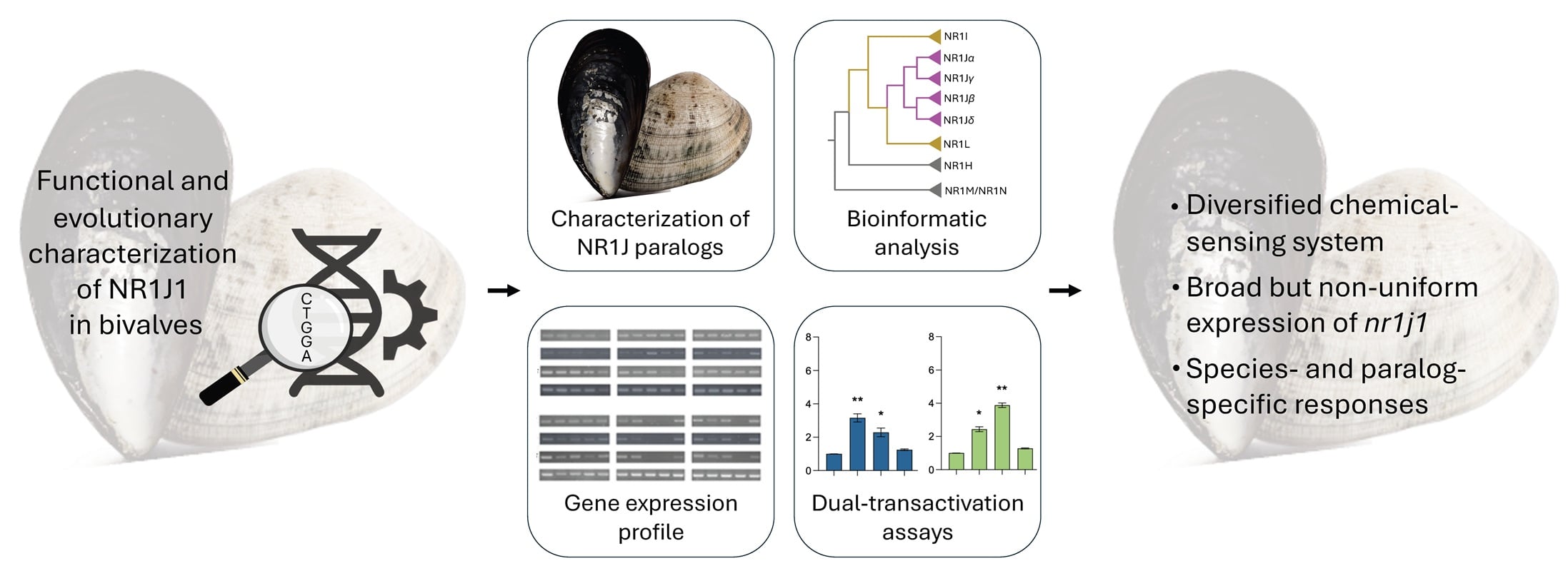
Nuclear receptors (NRs) of the NR1J1 group have been described in aquatic invertebrates and proposed as the evolutionary counterparts of vertebrate NR1I receptors, known for their role in xenobiotic-sensing and detoxification. In bivalves, previous studies have shown that NR1J1 activity and gene expression are modulated by pharmaceuticals, toxins, natural compounds, and algal extracts. However, their functional properties and diversification remain poorly understood. Here, we investigated the function and evolution of NR1J1 receptors in the bivalves Mytilus galloprovincialis and Ruditapes decussatus. We first identified four nr1j1 paralogs in R. decussatus and then integrated phylogenetic analysis, domain identity comparisons, tissue distribution profiling, and luciferase-based transactivation assays to characterize NR1J1 paralogs from both species. The receptors displayed distinct but partially overlapping transactivation profiles in response to confirmed ligands of NR1I and NR1H receptors, natural compounds, plant extracts, and fish bile, indicating paralog- and species-specific differences in ligand responsiveness. Allocholic acid emerged as the most consistent agonist across paralogs, whereas curcumin, carnosic acid, and Ptychopetalum olacoides extract showed more selective response patterns. Tissue profiling revealed broad but non-uniform expression of nr1j1 paralogs across bivalve tissues. Together, these findings underscore that bivalve NR1J1 receptors constitute a functionally diversified chemical-sensing system and provide a framework for future studies addressing ligand-dependent regulation and detoxification pathways.
Keywords: transcription factors; xenobiotic sensing; functional responses; evolutionary diversification; ligand responsiveness; Mytilus galloprovincialis; Ruditapes decussatus transcription factors; xenobiotic sensing; functional responses; evolutionary diversification; ligand responsiveness; Mytilus galloprovincialis; Ruditapes decussatus
Graphical Abstract